
Main Tropes Index

Troperville

Editing

Tools

Toys

Narrative

Genre

Media

Topical Tropes

Other Categories


alt title(s): Cosmic Horrors
The most merciful thing in the world, I think, is the inability of the human mind to correlate all its contents. We live on a placid island of ignorance in the midst of black seas of infinity, and it was not meant that we should voyage far. The sciences, each straining in its own direction, have hitherto harmed us little; but some day the piecing together of dissociated knowledge will open up such terrifying vistas of reality, and of our frightful position therein, that we shall either go mad from the revelation or flee from the light into the peace and safety of a new dark age.
H.P. Lovecraft, first paragraph of "The Call of Cthulhu."

This is Azathoth, the Nuclear Chaos and Daemon Sultan. He resides in the center of the universe and can decide whether galaxies live or die with a single thought. He is quite mindless, though. Say hi.
Imagine a world where the Nietzsche Wannabe is overly optimistic. The crazy guy yelling about the apocalypse on the street corner is actually the only one with half a clue.

It is a world where Humanity is surrounded by nameless horrors, and all our hopes are a cruel illusion; a world which was once ruled by eldritch terrors that seeped down from the cold stars long ago. Nor are those terrors dead; they merely sleep, and soon they shall wake.

Then they shall return to rule this world, and all humanity's labours shall have been in vain, for we are but mice in the wainscotting, making merry while the cat's away. Even today, the world is more dangerous than we may know. Take one step from the comforts of home, and you will find terror and madness on every side - dark cults praying and offering sacrifices to their profane gods, hideous monstrosities, truths so terrible than none may comprehend them and remain sane.

Even now there may be ghouls gibbering in the sewers beneath your feet, ghosts hovering unseen in the air around you, and the vile spawn of an Elder God lurking in the recesses of your own family tree.

Scared yet?

Such was the vision of H.P. Lovecraft. Humanity is utterly insignificant and its gods feeble. All victories are fleeting and doom is certain. Worse still, the monsters don't even care about us. Satan is evil, but he values every human soul. Cthulhu would obliterate humanity without ever really noticing its existence.

This vision has inspired Horror writers ever since. Some have written their own tales in the Cthulhu Mythos — essentially, professional Fan Fic — and many others have included homages to Lovecraft. While it is a rather bleak concept for a series, there have been many movies and one-off TV dramas which use this approach.

Cosmic Horror tends to be on the extreme "cynical" side of the Sliding Scale Of Idealism Versus Cynicism; any optimism whatsoever is wrong-headed denial. Most series will tend to use monsters that are similar in visual style, but make them much more conventional otherwise. Even those that use a true Cosmic Horror-style setting will tend to moderate it by giving humanity a way to ultimately make a difference; after all, conflict is neutered just as easily with an omnipotent antagonist as with an omnipotent protagonist.

Common tropes in Cosmic Horror include:

None of these are unique to Cosmic Horror, but any series that uses more than three or four of them usually is in that genre. For the occasions that they are easily defeated, see Did You Just Punch Out Cthulhu.


Examples:

Live Action TV
  • The "true history of the world" in Buffy The Vampire Slayer makes it clear that the show takes place in a Cosmic Horror universe; even the Powers That Be, who are perceived as being on the side of Good, seem somewhat less than nice guys. This is strongest in the early seasons; Buffy's long string of victories runs counter to the conventions of Cosmic Horror.
    • There is even the occasional Shout Out to Lovecraft; and some fans love to point out the numerous details that suggest that Dawn is in truth an avatar of Yog-Sothoth.
    • Angel, while generally a more pessimistic show, carries this further: Illyria, an ancient god-thing from the beyond returns... to find her armies long turned to dust, her powers gone, and herself stuck in a human body. That the pitilessness of the universe can brutalize Lovecraftian monstrosities themselves is somehow made to feel a little sad.
  • Sapphire And Steel takes place in a universe threatened by formless evils from outside time.

Video Games
  • The Survival Horror game Eternal Darkness (cheerfully subtitled "Sanity's Requiem") for the Gamecube. This one takes one of the most interesting twists, as the most powerful Eldritch Abomination, the Corpse God, is actually mildly fond of humanity, even serving as a fertility god in a small village in Cambodia. He's ultimately responsible for the main character's destruction of the "evil" abominations, and he's probably the only abomination even close to being good. Ever.
  • Flash game example: Arcane is a point-and-click Adventure Game based around the Mythos.
  • In 1987, Infocom made an Interactive Fiction text adventure called The Lurking Horror loosely drawing on the themes of the Cthulhu Mythos.
  • Another IF example: Anchorhead is an award-winningly well-regarded example of a text adventure set in the "slowly unraveling horror" Lovecraftian milieu. Look here for download and information on the game.
  • In Drakengard, The World Is Always Doomed because the gods are not just evil, but also composed entirely of Eldritch Abominations. There are not slithering masses of tentacles that cause insanity by their very sight, but something very morbid.
  • In Mass Effect's backstory, the Reapers are a race of sentient machines that hate all forms of organic life. They claim not only to be the first sentient species in the universe, predating even the ancient Protheans, but to have existed since the beginning of time. They are constantly in a process of allowing organic civilizations to rise to a certain level of technological advancement, then wiping out all advanced life forms and starting the process over again, a bleak prospect for we organics.
  • Warcraft 3 introduced a faction of vaguely Lovecraftian entities, the Faceless, presided over by a stock Eldritch Abomination called the Forgotten One. The manual for the game asserts that in the distant past the world was ruled by a cabal of malevolent "Old Gods", which, again, fit this trope to a tee. One extant Old God (C'Thun) actually appears as a boss in the game.
  • The True Runes from Suikoden are implied to be cosmic horrors, as they will eventually freeze the world, and spend the meantime making said world a terrible place to live. One True Rune eats the souls of your loved ones. One will start wars so that the two people with the two halves of it will be forced to kill each other. Interestingly, the True Runes are used by the heroes as often as the villains.
  • Wild Mass Guessing goes that the glitch Pokemon Missingo is actually a Reality Warper Cosmic Horror, explaining its effects upon the games. Personally, this troper is convinced that the Unown are a canon example...
  • The events of Persona 3 ultimately leads to the The End Of The World As We Know It, complete with a doomsday cult and brain-dead people uttering prophetic warnings. This is all due to the subtle influence of the reawakened Nyx, a vast and ancient being and who apparently is the moon, being called down to the earth. Her presence causes people to explode into puddles of black ooze and random organs. In all likelihood, she doesn't care in the slightest. Oh and she's mainly summoned by the Anthropomorphic Personification of the malice and despair in the hearts of humanity.
    • Oh, and Persona 4? Everything you see on TV is a demon from an alternate reality, who would just love to take a step into our world. Enjoy!
  • The American NES version of Life Force has Zelos, a giant alien that eats entire planets, with two of them being the planets Latis and Gradius, and the premise of the game revolves around destroying Zelos from the inside out.
  • As brain-breaking as Cthulhu himself is the premise of a Sugar Bowl world with Cosmic Horror influences, but Kirby pulls it off in the last few levels and bosses of each game. With Alien Geometries for levels, Eldritch Abombinations for bosses, and Nightmare Fuel ahoy. The anime actually implies that Kirby is a good Eldritch Abomination.
  • You cannot grasp the true form of Giygas' attack!

Anime
  • In the episode "Dagomon's Call/His Master's Voice" of Digimon Adventure 02, Hikari (Kari) got sucked into "The Dark Ocean", a Hell-like dimension of shadows. There, at a ruined town called Innmouth (really), she encountered Deep Ones pretending to be Digimon, who tried to marry her to their god, Dagomon. (AKA Dagon, although his appearance was that of Cthulhu.) She escaped because her element was the Light of Hope, powered by the love of her friends (shipping fans would say the love of Takeru), both completely foreign to the Dark Ocean and to Cosmic Horror.
    • The writer of this episode went on to do an entire series, Digimon Tamers, where the final enemy was the D-Reaper, a data-disposal program that began taking its orders a bit too literally and got plugged into cosmic power. To fulfill its objective (a null-state for everything), it mutated into more and more alien forms, all inspired by the Cthulhu Mythos (Mixed correspondingly with designs of the Angels from Evangelion). Unique in that it got worse when it became aware of humans as entities; in order to analyze this strange entity known as humanity, it tapped into the agony and pain of one little girl, amplifying and becoming The Heartless and quite, quite insane by anyone's standard.
      • The series had several other Shout Outs to the Mythos, including the Hypnos organization and their Yuggoth data-tracking system. Later, once the Devas started attacking, two of the "experts" on TV trying to figure out what was going on were from Miskatonic University.
  • Both the Orechalcos stones in the Doma arc of Yu-Gi-Oh and the Light of Ruin that the Society of Light in Yu-Gi-Oh GX's second season is built around are Eldritch Abominations which evoke Cosmic Horror, having been borne from spatial phenomena, and having no purpose but to doom the universe under their whims. Even Judai's Neospacians reminded him that the Light of Ruin was a literal danger to all the cosmos.
  • The Invaders from Getter Robo Armageddon. A force that can assimilate any life-form, assume any shape, and is constantly evolving. Oh, and the only thing in existence that lets humanity fight them, the Getter Rays? Yeah, they accelerate that evolution. By series's end, Getter Robo's forced to do suicidal attacks to take down its opponents, and even then, the Invaders aren't completely beat.
  • Bokurano: Something is making you fight in its super robot against other super robots, which themselves are piloted by similarly coerced pilots from other universes. If you win, that entire alternate universe will be destroyed and you die. Don't pilot? Okay, your entire universe will die. Why? Why not?

Western Animation
  • Mighty Max arguably takes place in this universe. Although over the course of the series we find Max beating his fair share of enemies, ultimately the great big-bad is show to be unstoppably powerful, and our hero's only hope to even TIE with him is to let all his friends die and restart the timeline with his own death in the hopes it goes better the second time. Unfortunately, given the prophecies frequently referenced, this cycle has happened at least several dozen times.
  • Shadow Raider's premise is that the 4 elemental worlds must band together using ancient technology to fight a great giant planet that wants to eat their homes. It is unstoppable, unrelenting, and unbeatable. The only hope is to run away, or face certain destruction. And they can't run forever. For a child's show this is somewhat jarring.
  • Recent retcons have turned the planet-eating Transformer Unicron into a Eldritch Abomination, not only giving it the power to move between dimensions, but also insinuating that a piece of its dark soul inhabits all of the Transformers since the beginning, meaning that any one of them could turn into a servant to its apocalyptic hunger.
    • The Swarm in Transformers: Generation 2 could also be considered an Eldritch Abomination, being born from a long-lost ritual of Transformer reproduction that their god Primus never intended them to retain, and obsessed with destroying all mechanical life in the known universe.

Literature
  • Hell, not even being rammed by a boat can stop Cthulhu for long.
  • In Terry Pratchett's Discworld novels (especially the early ones), a constant danger of the use of magic is that of accidentally opening a rift into the "Dungeon Dimensions", regions with "very little reality", inhabited by nightmarish Lovecraftian monstrosities that crave the reality that those in more solid universes take for granted. They tend to try and invade the Discworld's universe in the vain hope of becoming more real themselves, "with the same effect as the ocean trying to warm itself around a candle".
  • Peter F. Hamilton's Nights Dawn Trilogy incorporates a positive slew of cosmic horrors: an incident involving a satanic ritual and a passing energy being creates a cross-dimensional link that allows the souls of the dead to come back and possess the living, before secreting entire planets away to their own pocket dimensions. Even worse, the trans-dimensional powers of the possessed, as well as the fact that they have absolutely no idea what they're doing, open the door to a range of other, semi-scientific cosmic horrors, by far the worst being a dimension of almost infinite entropy, which, if linked to our dimension, would suck it dry like a vampire. Things get so hopeless that it pretty much takes a literal Deus Ex Machina to sort the whole mess out.
  • Proto-example: Robert W. Chambers' book The King in Yellow, which was an influence on Lovecraft himself, and he made references to it that are now better known than the original source. Filled with Mind Screw and Take Our Word For It.
  • The Whateley Universe is blatantly a Lovecraftian universe, to the extent that one of the main characters (apparently a 13-year-old mutant) is actually the granddaughter of Yog-Sothoth Shub-Niggurath. The other side of her family tree is even freakier. Surviving creations of the Great Old Ones are currently trying to destroy... well, everything and everybody.
    • One of the recurring characters is a mutant teacher at the Whateley Academy. Twenty-some years ago, he fought something that turned him into a living replica of a Starspawn. He now has to live in a huge tank of water. No one wants to talk about this particular adventure.
    • Heck, the academy is named for Noah Whateley, and set outside of Dunwich, both of which originally appeared in Lovecraft's "The Dunwich Horror".
  • The Blight from Vernor Vinge's A Fire Upon The Deep.
  • The Atrocity Archives and it's sequels take place in a world where bureaucratic top secret government agencies even more covert and shadowy than MI 5 and the CIA battle Eldritch Abominations attracted to reality after Alan Turing discovered a theory that allowed the user to warp reality with computers and the Nazis attempted to summon the Great Old Ones using the souls of those slaughtered in the Holocaust to win the Second World War.
  • Sarah Monette's Kyle Murchison Booth stories (collected in The Bone Key) take place in a Cosmic Horror universe — unsurprisingly, as she openly acknowledges Lovecraft as a major influence.
  • Stephen King has an occasional fondness for this trope.
    • In IT, the eponymous monster is perceived as a giant spider by the protagonists, because this was the closest analogue that their rational minds could find for Its appearance. Attempting to fight It can result one's mind being flung beyond the edge of the universe, then being driven mad by the Deadlights (which It is merely an appendage of). After the protagonists succeed in killing It, they magically forget about the entire incident; apparently this was the only way they could have lived a normal life afterwards.
    • From A Buick 8 chronicles a Pennsylvania state police force's acquiring of some entity that has only a passing resemblance to a Buick; around it, living things sometimes disappear, and things from somewhere else come through. A rare example of a non-malevolent Horror, as the "car" is completely incomprehensible to the police, and expresses no outright hostility to anyone. That said, though, being around it can be worse than lethal.
  • Robin Jarvis' Deptford Mice and Deptford Histories have at least two; Lord Hobb, the Satan-like rat god of war, and Suruth Scarophion, the snake god whose blood is deadly to the touch and whose mere presence turns jungle to desert. Keep in mind that these books are aimed at ten-year-olds.
  • One could argue that The Hitchhiker's Guide To The Galaxy is an Affectionate Parody of this genre.
    • The mice?

Comic Books
  • The Archons of The Outer Church in The Invisibles are typically Lovecraftian — slimy, chitinous and decidedly non-human. In an interesting inversion of Lovecraft's themes, the Archons aren't entities of entropic chaos, but absolute order. When the universe reorients itself in their presence, it's not because it's breaking down, but because it's coming more in line with the Archons' specifications.
  • Hellboy is pretty much built on this. Especially the Ogdru Jahad, neither male nor female, sleeping until they bring the down fall of man; this plan somehow involves an army of frog men.

Film
  • Even though the main character has lots of Satanic trappings, the end of the world in the movie Hellboy is in fact apparently the arrival of the Eldritch Abomination's tentacles. As mentioned above.

Tabletop RPGs
  • In White Wolf's original World Of Darkness, Cosmic Horror is not the central part of the game, but the authors love to incorporate alien Eldritch ABominations from beyond time and space into the setting, whose presence corrupts souls, drives people insane or warps reality. Included in this list are the Wyrm and its servants from Werewolf: the Apocalypse, the Nephandi and their patrons from Mage: the Ascension, the Fomorians from Changeling: the Dreaming, the Onceborn and Neverborn from Wraith: the Oblivion (and Grandmother from Orpheus), and the Earthbound from Demon: the Fallen.
  • Holistic Design's Fading Suns has a similar take on Cosmic Horror, letting it sneak about on the sidelines.
  • Unknown Armies subverts the trope; while E Ldritch Abominations exist in the game, the setting's big secret is that the universe is humanocentric, existing only for our benefit. Any horrific monsters beyond time that make us insignificant, then, are actually the product, not the cause, of our sense of insignificance. It's a vicious cycle.
  • In the Tabletop Games Monsters and Other Childish Things, one of the types of monsters used in its dark and twisted take on Mons are Cosmic Horror-style entities. The non-statted sample monster Dewdrop is a Cosmic Horror take on a unicorn, while one of the statted sample monsters is a Lovecraftian monstrosity merged with a teddy bear named Yog-So`Soft.
  • Eden Studio's Witch Craft makes Cosmic Horror the main threat to its World of Darkness like setting.
  • The Swedish RPG KULT mixed Gnosticism, Kabbalah, Aleister Crowley occult traditions and the Hellraiser movies, and took its aesthetics from Splatter Punk, Clive Barker and H.R. Giger art.
  • Pikathulhu's Gonna Catch You All.
  • The Whispering Vault offers an odd inversion in that the player characters are all minor E Ldritch Abominations swho act as a "police force" that apprehends and retrieves abominations who have illicitly made their way to Earth.
  • Warhammer and Warhammer 40000 take place in worlds infiltrated by Chaos, a corruptive force given strength by the ickier parts of the human psyche. In both cases, the only way to combat Chaos is to be frighteningly dogmatic and wipe it out whenever it looks at you funny, no matter who gets caught in the crossfire.
    • Alternatively, the Necrons have a plan to defeat Chaos: completely sever the material universe from the Warp, where Chaos — and the souls of every sentient being — dwell.
    • The C'Tan, gods of the Necrons, are Eldritch Abominations in their own right. Though very definitely mortal, they are hideously powerful energy beings with the power of gods, to whom the laws of physics aren't even guidelines. There are four left: the Nightbringer, the personification of death who burned his image into the psyche of virtually all life (big exception: the Orks) as such and made life afraid of death, the Deceiver, Chessmaster par excellence, the Outsider, currently batshit bonkers and locked away in a cosmic prison, and the Void Dragon, currently napping. Information on the Void Dragon is sketchy, but he is said to be the most powerful C'Tan of them all, is believed to have total control over machines of all sorts, lightning, and may be the Machine God worshipped by the Adeptus Mechanicus — conveniently assumed to be sleeping under Mars.
      • Oh, and the combined power of six of the thirteen Blackstone Fortresses, (each capable of annihilating a planet systems in a single blast with elemental Warp energy (the only known weakness of the C'Tan), and two or three of which can easily make a star go supernova), bolstered by the power of the space elf god of war, was enough to make the Void Dragon feel sleepy.
    • And lets not forget the unending fun of the Tyranids and the Hivemind! As far as Cosmic Horror tends to go, they're a bit more grounded in the real world, but that doesn't change the sheer scale and impossibly alien will behind them.
  • Rifts included a huge number of Cosmic Horrors and other fantastic creatures, and took the extra step, similar to Warhammer 40k, of making its requisite Power Armored Nazis the good guys in comparison.
    • In typical Palladium style, however, they all had hit points, so could be killed.
  • Dungeons And Dragons has the Far Realm, a plane of existence from which most if not all of the game's cosmic horrors hail. To look upon it is to invite madness, and to exist within it is to become part of it.
    • On a more earthly level, the subterranean illithids (also known as mind flayers) are inhumanly dispassionate, squid-headed alien creatures with vast psychic powers who raise human(or any other sapient, they're not picky) cattle to feed on their brains.
    • It should be noted that they can eat the brains of any animal, they just like sapient creatures because they're jerks.
      • Plus they need human bodies without the brains in order to reproduce. Really.
    • Several kinds of demons in the game invite comparisons to Lovecraftian beasties as well, especially the various Obyrith subspecies: they've existed since before the dawn of time, often have incomprehensible biologies, and just glancing at one is enough to induce new phobias or temporary insanity.
    • Perhaps closest to the Lovecraftian mold are the aboleths, giant psychic fishlike aberrations that dwell in the deepest, darkest parts of the world in unspeakable aquatic cities and have racial memories stretching back to before the creation of the physical world as we know it.
    • Another subterranean race culled from Lovecraft are the kuo-toa, amphibian humanoids consciously modeled on the Deep Ones.
    • Don't forget the Daelkyr. Extradimensional invaders who mess with the fabric of reality for shits and giggles. They also like to mess with mortal biology the same what a kid plays with play-doh.
    • Recently, Wizards has released a book called "Elder Evils", which features a guide of how to create your own Cosmic Horrors, as well as several examples including Ragnorra, the Mook Maker Space Whale with an Evilutionary Biologist streak, Pandory, the living Forgotten Superweapon with a personality you don't want anywhere near a Forgotten Superweapon, Atropus the undead planet, and of course, the Hulks of Zoretha. One wonders how the campaign world has survived this long.
    • 3.5 Edition also included the Alienist class. The class features made all your Summoning spells summon creatures from the aforementioned Far Realms, which took the forms of creatures you could normally summon, but took on a template that gave them hit points, resistances, tentacles, and the ability to shift into their "true(r) form" which scared everything like crazy. Basically, you're calling tiny C'thuloid monsters. In addition to that, the caster who takes the class eventually becomes one of these creatures, goes more then a little insane, becomes tougher, grows a tentacle or two, and is taken to the Far Realms by the unspeakable Cosmic Horrors when they would normally die of old age. If they can advance even further, they become ageless mini Cosmic Horrors themselves. Thier creature type changes to "Outsider",
    • 4th Edition finally took this to the logical conclusion by making the warlock one of the main player classes, offering them a choice of spells depending on whether or not the warlock made a deal with a demon, a faerie lord, or something from the Far Realm. That's right; you can be best buddies with Yog-Sothoth, and get shiny magical powers from him. Needless to say, these powers rely a lot on the shrieking cold of the void and psychic damage.
    • The Dark Powers of the Ravenloft Setting are very mysterious, fickle beings with very little information stated - but many players interpeted them to be Cosmic Horrors.
  • It's probably a case of omitting the obvious, but hasn't Chaosium published since the early 80's a quaint little RPG whose name is Call Of Cthulhu?
  • 7th Sea is full of light-hearted swashbuckling adventure with some magic, until one splatbook revealed that most magic was introduced to break down the barriers keeping out a race of Cosmic Horrors called the Strangers. Naturally, this book was Dis Continuity for most fans.
  • FASA's Shadowrun and Earthdawn both feature a group of cosmic horrors (called, imaginatively enough, the Horrors) that come to our dimension whenever the tide of magic gets terribly high. Earthdawn was a post-apocalyptic fantasy game where the world tried to recover from the last invasion, while Shadowrun gradually introduced cults planning to bring the horrors back early. This was such a Genre Shift, and proved so unpopular with players, that the whole arc was resolved quite anticlimactically.

Card Games
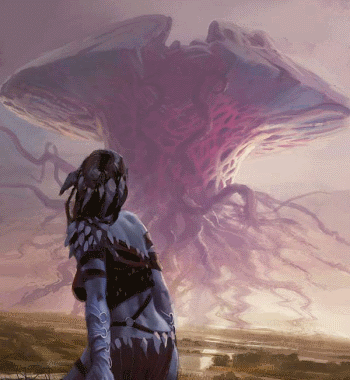
  • Magic The Gathering has a black card with this name as seen here. Its steep upkeep cost, the same as the cost of actually summoning it, limits its usefulness.

Webcomics
  • Played with in this strip of Kris Straub's Chainsawsuit.