
Sometimes, a clue on a Game Show or other similar competition may be so arcanely obscure that the contestants and viewers are left scratching their heads long after the fact. Other times, it may be a puzzle or password that is impossible to convey no matter how much skill the contestant has. Granted, everyone has a different level of skill when it comes to game shows, but when it gets to the point that nearly everyone at home is asking "How do they expect anyone to be able to know that?!", you know you have an unexpectedly obscure answer. Such clues are sometimes used as a way to ramp up the difficulty, although many fans of the genre (jokingly or otherwise) refer to such clues as being a way of saving money after a particularly big win...or just to save money period if the show's particularly stingy.
Sometimes played with in game show parodies, where the host asks an insanely obscure question and the contestant gets it right for a big win.
Examples are restricted to In-Universe, plus games where the trope is Invoked to achieve a desired effect.
While Jeopardy! was the inspiration for this trope (see the discussion page for the most egregious examples), it's Not an Example because the writers honestly thought that someone among the contestants would get the answer right. Most examples of this sort (i.e., Nine Times Out of Ten that it happens in Real Life) fall under Moon Logic Puzzle. Contrast Speak Friend and Enter, where the solution is much simpler than it seems.
In-Universe examples:
- One moment from the Pokémon: The Original Series is particularly infamous. The cast take on an exam that allows instant access to the Pokémon League if passed, and one question shows a circular silhouette and asks participants to name the Pokémon. Rather than the obvious Voltorb or Electrode, it's... a Jigglypuff seen from above. This gag was used again many years later in the "Who's that Pokémon?" Eye Catch for an episode of Pokémon the Series: Sun & Moon that featured Jigglypuff.
- In an omake of Good Luck Girl!, Momiji hosts a quiz show. One of the questions is the full, formal name of the Thai capital Bangkok note . Even the host herself quipped how creepy it was that one of the contestants knew it!
- In When Supernatural Battles Became Commonplace, Andou and Chifuyu enter a quiz competition in a pool resort with animal-related questions. The last three questions presented are vaguely animal related, where the answers are Schrödinger's Cat, Raven paradox and Brazen Bull, designed so that no one would realistically be able to win the top two prizes (a whale plush for eight correct answers or a car for all ten answer). Fortunately Andou is such a huge chuunibyou that he has the obscure knowledge to answer those questions.
- In Dr. STONE, Senku asks Taiju and Shishio what is the most important thing for a technological civilization. Taiju says it's smartphones. Shishio says it's steel. It turns out the correct answer is calcium carbonate.
- In one of the stories in Joker's Asylum, the Joker takes over a game show and presents the contestants with ridiculously difficult questions. To their surprise and relief, failure to answer correctly results in harmless joke penalties rather than the expected lethal ones — the real target of the joke is the show's executives, who are cynically exploiting the incident for ratings (in a control booth bugged by the Joker).
- Disney Ducks Comic Universe:
- In the Donald Duck story "The Crazy Quiz Show" by Carl Barks, Donald and his nephews participate in a television quiz, hoping to win a (literal) barrel of money. The nephews each successfully answer their question, but to Donald's dismay they pick a new bicycle instead of the cash. When it's finally his turn, the quizmaster decides that since Donald has been such a Jerkass throughout the show, he gets the most difficult question ever: How many drops per hour fall from the Niagara falls? He knows the answer! But the stress of reciting it causes him to go mad and also pick the bicycle as his prize.
- Inverted in the story "Zio Paperone e il vegliardo sapientone", which features a game show where the contestants must ask the host a question that he doesn't know the answer to. Said host, however, is apparently a ridiculously erudite Omnidisciplinary Scientist who can answer questions such as "how many glasses have been broken by the waiter in the town hall?".
- Zipi y Zape: Deliberately set up by the twins in Olimpiadas escolares, when trying to prevent a rival team from winning a sports quiz show. They disguise as the show's secretary and present an envelope to the host containing the question "What is the name of the mother of the Zaire national team's goalkeeper?" Obviously, the rival team fails to figure it out.
- In FoxTrot, Jason comes up with a quiz show called "I Want to Be a Millionaire", which he talks his dad into playing. He starts off by switching to math questions after Roger says that he was an English major, and the first question is "What is the 8,346th digit of pi?"note The trick being that every time Roger gets a question wrong, he has to pay Jason that amount (as Jason points out, the name of the game is "I Want to Be a Millionaire").
- Played for laughs in the "Bridge of Death" segment of Monty Python and the Holy Grail, with a man who asks three questions to those who cross a bridge, and anyone who fails to answer is thrown into the gorge. The third question alternates between "What is your favourite colour?" and questions like these. When it's King Arthur's turn, the question is "What... is the airspeed velocity of an unladen swallow?" Arthur turns the tables on him by asking "What do you mean? African or European?" When the man can't clarify which he was intending, he is the one to get ejected from the bridge.
- The Labyrinth in the Second Son trilogy includes a series of gates which can only be opened by answering a riddle engraved on them. Entering the wrong answer triggers a lethal trap. The last riddle is an obscure reference to the architect's favorite pancake recipe (the correct answer is a series of numbers depicting the ratio of ingredients in the recipe, in the exact order they are to be mixed together). This is quite deliberate, as the architect didn't want anyone he hadn't personally prepped with the answers to be able to make it through.
- In Making Money, Vetinari comes up against this, courtesy of a new crossword compiler. "Who would know that 'psdyxes' are ancient Ephebian needle holders?"
- Monty Python's Flying Circus:
- Parodied. John Cleese's game show host asks a housewife (played by Terry Jones) a very obscure question about philosophy: "Which great opponent of Cartesian Dualism resists the reduction of psychological phenomena to a physical state and insists there is no point of contact between the the extended and the unextended?" When she protests she has no idea, Cleese nudges her to take a guess, which she does, correctly guessing Henri Bergson (despite never having heard of him). She has more difficulty with the second question, "What do penguins eat?"
- Another Python sketch had a British television host a game show with the leading figures of Communism: Karl Marx, Vladimir Lenin, Che Guevara, and Mao Zedong. Marx, Che, and Lenin are shot down with obscure English First Division Football questions and to name the Teddy Johnson and Pearl Carr song which won at the 1959 Eurovision Song Contest ("Sing Little Birdie"), to which Mao unexpectedly knows the answer. In the Monty Python Live at the Hollywood Bowl version this last question is changed to naming "Great Balls of Fire" by Jerry Lee Lewis.
- In a case of Time Marches On one of the questions was "In what year did Coventry City win the FA Cup?" At the time it was correctly identified as a trick question; "Coventry City have never won the FA Cup." That changed in 1987.
- Eventually, they ask Marx another set of three questions about "workers' control of factories": "The development of the industrial proletariat is conditioned by what other development?" note , "The struggle of class against class is a what struggle?" note , and finally "Who won the cup final in 1949?" note
- Played for drama in the episode "Quiz Show" of Boy Meets World. A traditional Quiz Bowl-type game show is revamped in order to appeal to youngsters by ditching their acadamia-themed questions for pop culture and "stupid question-stupid answer" type questions — much to Feeny's dismay. Naturally, this made goofballs Cory and Shawn (and the not-so-goofy-but-still-on-the-team Topanga) popular returning champions. When the executives wanted Cory and Shawn out of the game, they brought back the academia to force the team to lose (bordering the line of what caused the quiz show scandals), including one question that Feeny answered in a Chekhov's Lecture earlier in the episode, which the team wasn't able to answer.
- Late Night with Jimmy Fallon had the Audience Game "Wheel of Game Shows" — a Minigame Game where pretty much every game was rigged to make the contestants lose — due either to an obscure answer (such as, on a rebus puzzle, the contestant's seemingly correct guess of "Tickle my balls" was rejected in favor of "Play my sports") or Fallon refusing to actually explain the rules.
- The 30 Rock episode "The Beginning of The End" featured an unfair NBC game show called Homonym as a Cutaway Gag; the contestant has to give the correct definition for a word that has homophones, but always ends up incorrectly giving the answer for "the other one". A scene over the credits features a contestant getting a second chance on "Sent" wrong because of "the third one", and then is told that the correct answer for "Au pair" was "Oh, pear!", an exclamation about a fruit. Later episodes featured celebrity and Iranian versions.
- In one episode of Home Improvement, Tim agrees to take audience questions on home improvement on a show with Bob Vila. It isn't planned as a competition, but Tim is determined to show Bob up, and so convinces his wife to call in with a question about an obscure, traditional woodworking tool. Naturally, Bob is able to answer without hesitation.
- Referenced by Touch Me, I'm Karen Taylor in a sketch parodying phone-in game shows (themselves prone to using this trope for real), where callers were asked to provide answers for the overly broad category "Things you might do". The "answers" included "Borrow an angle grinder", "Oology" (studying bird eggs and nestings), and "See the film Coneheads".
- "Weird Al" Yankovic's "Albuquerque" has the protagonist win a radio contest that involved guessing the number of molecules of Leonard Nimoy's butt. He was off by three.
- A flash animation adaptation of the song elaborated that his answer was "all of them save three", whereas the correct answer was actually "all of them save six".
- The music video for "I Lost on Jeopardy" by "Weird Al" Yankovic is full of this. How may bricks are in the Great Wall of China?
- Pro Pinball: Timeshock! allows the player to "combine" various Time Travel souvenirs to unlock various awards, such as a papyrus scroll + first wheel = Ultra Spinner. And that's one of the more straightforward examples...
- In the Book of Job in The Bible, God poses a series of impossible challenges to the book's title character, including asking him to count the number of clouds (presumably across the whole Earth), something that God knew only He could do, making this trope Older Than Feudalism.
- It was a Running Gag in the "Politician's Ball" episode of I'm Sorry I Haven't a Clue, where they played a game of 'Strip Quiz', which built on the 'old-fashioned principles of strip poker', that Tim got all the impossible questions, whereas everyone else got very elementary ones.
Humph: Now, pay attention here, because I'm going to go quite fast, and these are quite tricky questions. Barry, you first — what is the capital of England?
Barry: London!
Humph: Willie — what is one and one?
Willie: Two...?
Humph: Graeme — what is the name of the Queen of England?
Graeme: Elizabeth.
Humph: Tim — what is the pharmacopean name for turpentine?
Tim: ...Nigel?
Humph: No, I'm sorry — the word is 'terebinthina'. Tim loses his shirt on that one. - A sketch in A Prairie Home Companion had special guest Fred Willard host a "Wheel of Willard" game, functioning as Wheel of Fortune where the puzzles were quotes of his. The categories were "Lines from my movies", "Things I've said to myself while by myself in a soundproof room", and "Things I have said at some point in my entire life". One of the contestants, self-proclaimed as Fred's biggest fan, gets all of them correct. The final one was guessed without any clues, and was a fifty-plus word ramble about getting bananas from the grocery store.
- The university in the GURPS Illuminati University setting has an "Advanced Cheating" class, in which the final exam is nominally a series of impossibly obscure trivia questions. The real test is to cheat on the test without getting caught.
- In the Borderlands 2 DLC Tiny Tina's Assault on Dragon Keep, Tina asks Torgue three geeky questions to prove he's a real geek. Torgue gets the first two right, but the third is for a very specific piece of in-universe geek trivia, and Torgue doesn't know the answer. Therefore, according to Lilith, Torgue isn't really a geek.
- Pajama Sam:
- Subverted in the first game, in which one of the questions of an in-game quiz concerns the response of a young French duke when he was presented a question on policy. All four possible answers are variants on "I have no idea," "That's too hard, I'm just a kid," or simply, "Huh?" All four answers are correct (except, of course, the duke said it in French).
- Played straight in the second game, where Sam must answer an employee questionnaire to gain access to an executive washroom key. The questions range from easy to impossible-to-answer-wrong, except for the last one, where Sam is asked a difficult economics question. Once again, all four answers are variants of "I don't know." The secret is to locate a friendly carrot who has been studying economic theory, and bring him to the question. He answers the question for you, making the next MacGuffin reachable and teaching the player what Giffen's Paradox is note or describing the US economy note .
- Parodied in Sam & Max Save the World: Situation: Comedy, where you have to win "Who's Never Going to Be a Millionaire?" The questions are just as ridiculously arcane as you'd expect with a title like that. To win, you have to switch the question cards with questions (actually song lyrics) that are insanely simple.
- Subverted in Super Paper Mario, a minigame to get through a living doorway has the door set up extremely complex math questions, then ending the paragraph with questions that relate to the game or franchise and are significantly easier. The only hard question he asks is what number question the current question is.
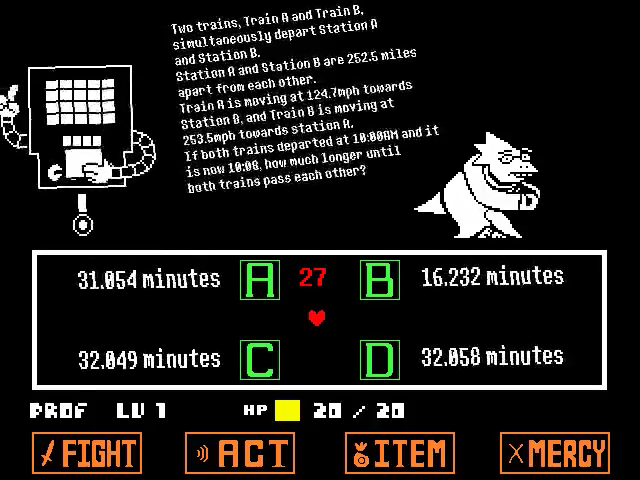
- In Undertale, Mettaton starts throwing some bizarre and improbable questions at you during his deadly quiz game. You can probably guess "what are robots made of" for yourself. While the game has never mentioned that the answer is metal and magic, the other three answers are obviously wrong. But when he throws this
 ◊ Train Problem at you, you're probably going to resort to guessing. Or cheating. The intended solution to this quiz puzzle is to notice that Alphys is showing you the correct answer with her fingers.
- The Mayor's Quiz from Mega Man Legends 2 is all about this. Unlike one might expect, all the question are about real life knowledge. There are some examples: "Who was the leader of the Italian Unification Movement?"note , "Christianity became the official religion of the Roman Empire with what?"note , "What is the tilt of the Earth's axis?"note .
- Cookie Run Kingdom Last Cookie Standing: In the Quiz Challenge, one of the questions asked is who is the creator of the show. Neither Affogato Cookie nor Madeline Cookie know the answer, but it turns out Cream Unicorn Cookie does. When asked in an interview how they knew, Cream Unicorn explains that they read the contract.
- In the official Fate/Grand Order manga Fujimaru Ritsuka Doesn't Get it, Moriarty runs a class for villainy where he asks Fujimaru and Baobhan Sith which Servants are Evil-aligned. First he asks if Lancer Altria Alter is Evil-aligned, with Fujimaru answering it incorrectly since she is actually Good-aligned in contrast to Saber Altria Alter. Next he asks Baobhan Sith what alignment Henry Jekyll is. She correctly answers that Jekyll is Good-aligned... except the picture Moriarty was using is from the Oniland event, meaning that he was actually asking about Hyde who is acting out as Jekyll.
- The Looney Tunes short The Ducksters:
- Daffy is the host of a radio game show parody of Truth or Consequences and Porky is the hapless contestant. Daffy throws several of these at Porky throughout the cartoon, including asking for the maiden name of Cleopatra's auntnote , or asking him to name an opera based on hearing a single note.
- After winning a cash jackpot of exactly $26,000,000.03 (...yep), Porky gets even by buying the radio station with it. Daffy begins receiving the same sadistic treatment immediately after being asked by Porky, "At what latitude and longitude did the wreck of the Hesperus occur?"note
- Subverted in ''People Are Bunny" when Bugs, locked in a phone booth, wins a jackpot over the phone by answering a nigh-difficult math problem in zero time. When the moderator asks how Bugs got the answer so fast, he says "If there's one thing us rabbits can do, it's multiply!"
- Garfield and Friends:
- "The Binky Show" sees Garfield go on the gameshow Name That Fish, hosted by Binky the Clown, to win a birthday gift for Jon. The tone is set by the first question: "What did Christopher Columbus have for breakfast the day he discovered America?" The answer? "He didn't have breakfast that day." The question also has a ridiculously low time limit, something like three seconds tops. Then there's the title round, as Binky produces a fish and asks Garfield to name it, with a board of fish species to choose from and the obligatory shouted suggestions from the audience. The fish's name? "Walter", an option that wasn't even on the board! The bizarre nature of the show is eventually justified when it turns it was All Just a Dream.
- In "Mind Over Melvin", Roy hosts a game show called You Can't Win. The questions start off with a fact, and then segue into something completely random: for example, "In the entire republic of Venezuela, there is only one dry cleaner run by a man named Al. What is his address?"
- In the Tiny Toon Adventures short "One Minute 'Til Three", Granny quizzes each student with a ridiculous-sounding question, with Plucky as Granny's last student and dreading every second of it, hoping for the clock to reach 3:00 so he can leave and not have to answer. Granny DOES gets to Plucky, however, and tells him, "Using Faustic's Method of bifractal computation, give me the minimum number of quantified pixels needed on a bilateral view screen." (This is complete gibberish, for the record.) After a bit of stalling, Plucky tells her, "But Granny! It's two-fifty-nine!" regarding the time—which turns out to be the correct answer of 259.
Invoked Examples:
- On The $64,000 Question, these kinds of questions were used in an attempt to force losses from contestants Charles Revson (head of show sponsor Revlon) didn't like, going so far as to swap out the questions that had been secured in a bank vault prior to the show. Dr. Joyce Brothers was one such target, but she managed to win the $64,000 legitimately by studying every book about boxing she could find.
- After a string of correct answers, Double Dare would throw in a few questions that no child could be expected to know, such as "What does DNA stand for?" note , to try and force a messy Physical Challenge (one of the main draws of the series) to be played. As could be expected, it didn't always work.
- Ellen's Game of Games invokes this with the category choices of the final round, with which you must identify celebrities by their picture in three second. For example, one episode had the choices of "Emmy-Winning Actresses", "Grammy-winning Gals", or "Baltic Ballerinas from the 1940s".
- Happens frequently on QI, which has an explicit policy of asking questions that nobody's likely to know, and awarding points for how interesting a contestant's answer is, regardless of whether it's correct. In a Series 3 episode, Helen Atkinson-Wood correctly answers a question "so impossible that Stephen Fry shall award a gigantic 200 points if anyone gets the answer right." After she answers, the other contestants, rightly astonished, ask "How the hell did you know that?" For the curious, the question was "What does this chemical equation: "C6H12O6 + 6O2 —> 6CO2 + 6H2O", represent?" Her answer: "An explosion in a custard powder factory." The equation is for the combustion of glucose (a key element of said powder). According to those behind the show, "an explosion in a custard factory" is the standard Textbook Humor example used when the combustion of glucose is taught at school (it's also a common example of the effects of static electricity), hence how she knew it.
- Played with on the Comedy Central show Vs. Winning teams would be given two choices for categories, one hilariously obscure, and one hilariously gamed to their advantage. For instance, a team of Grateful Dead fans would be given the choices of "International Grandmasters of Chess" or "Jerry Garcia Songs". Occasionally the teams would spring for the obscure category, for which they did indeed have a question prepared.
- It also came into play in the bonus round of Clash, from 1990-91 on "Ha! The Comedy Network" (which merged with "The Comedy Channel" to form Comedy Central in 1991): a representative of the winning team spins a wheel to determine the category of a final question; get it right, and the team wins a major prize. One wedge is the "Easy Question" (e.g. "Which is bigger: the Sun or your head?"). The other five are categories like "Incredibly Difficult Tax Code Trivia".
- This is the MO of the Phone-in Game Shows that went through a brief amount of popularity amongst the television money-men from 2005-10, as this clip shows — the host isn't even able to pronounce the big answer.
- Some phone-in game shows actually got into legal issues for using this in combination with encouraging viewers to phone in multiple times (which of course keeps racking up revenue for the operator).
- Endemol's Brainteaser was caught out faking their on-air winners (or more or less, using names of their production staff) in their phone-in segments during the 2007 British Phone-In Scandal, leading to the show's axing and a hefty fine being given to Channel 5, the show's broadcaster.
- Also during the 2007 British Phone-In Scandal, a viewer alleged that one show said that a "balaclava" (you know, those full-face masks the burglars always wear) and "rawlplugs" (a piece of hardware used to anchor a screw into a drywall or plaster wall) were listed as items a woman would keep in her handbag. Seriously?
- On a German call-in show, there once was a question of "Animals Starting With 'S'" with a really high prize. Of course the answers were obscure as usual, but one caller actually answered one correctly with "Stirnlappenbasilisk" (Plumed Basilisk). Which is why this animal became the mascot of critiques of this kind of show.
- A German TV show also posed the supposedly simple question "Add up these numbers: 1,1,2,2,3,3,4." However, rather than the expected answer of "16", the desired answer was an enormous number that appeared to be the sum of all the digits plus all the two-, three-, four-, five-, six-, and seven-digit permutations of those digits!
- A Canadian call-in show controversially threw this one at viewers: "4 girls are travelling on a bus. Each of them have 3 baskets, in each basket there are 4 cats. Each cat has 3 little kittens. How many legs are in the bus?" Figured it out? Well, you're likely wrong: the desired answer was 222, which not only assumed the kittens weren't on the bus, but also counted the driver's legs and the legs of the seats as well.
- Some phone-in game shows actually got into legal issues for using this in combination with encouraging viewers to phone in multiple times (which of course keeps racking up revenue for the operator).
- Questions in Only Connect tend to be fairly difficult at the best of times, but some stand out as being unanswerable by anyone except a human manifestation of Google. In one such question, contestants had not only to identify the category of Chief Medical Officers of England, but also to provide the fourth in the sequence. And to get the maximum points, not only must you get it right, but you must get it in one clue! Possibly inverted by the tendency to shove in less obscurist topics which invariably loses players who wind up over-thinking.
- In volume 3 of You Don't Know Jack (a series of PC games that play like a game show) there are "impossible questions", worth a ridiculous $20,000 (normal questions go from $1,000 to $3,000 in Round 1 and from $2,000-$6,000 in Round 2), like "I'm Thinking of a number between One and Nine, what is it?", "Within two years, how much time was there between the invention of the can and the invention of the can opener?", or "If you travel at a constant speed of 10 knots, at how many bells will you have to lift anchor in order to arrive at exactly 11:00 AM and get the last delicious Fiesta Breakfast Burrito?" What's even weirder about it is that it's either multiple choice or fill in the blank (in either case five, any number between 46 and 50 years (48 years is the actual number), and four Taco bells, respectively).
- Subverted occasionally, as with one impossible question of the category "It's a Dog!": "What has four legs, barks, and is a common household pet?" No tricks here, the answer is "a dog". Another "Impossible Question" was the not-terribly-obscure "What is it called when winning costs you more than losing would have?" The correct answer is, of course, "Pyrrhic Victory". However, keeping with the theme, if you get it right you lose points.
- Carried over to "The Lost Gold". However, each question is Pirate-themed, was worth $26,606.06 (minus the six cents), and if nobody gives the right answer, a Skull and Crossbones replaces where the correct answer would be revealed. Before each question of this type, the Set-Up music would play and the Captain would be heard crying. Schmitty becomes more and more terrified each and any time he hears it.
- A huge number of University Challenge questions have very obscure answers, but there have been some that take the cake. One picture round required the contestants to identify nuclear power stations from photographs. What university students are spending their spare time admiring nuclear power stations!? note
- Played with on MTV's Remote Control with the "Public Television" channel/category, which consisted entirely of obscure scientific facts, etc. One contestant selected the channel and got the question right, however, leading to a Moment of Awesome.
Ken Ober: Name the physical law which simply states that the magnitude of the electrostatic force between two point electric charges is directly proportional to the product of the magnitudes of each of the charges and inversely proportional to the square of the distance between the two charges.Contestant: Coulomb's Law.
- In order to win anything at all on the British game show The Million Pound Drop, contestants must face a final All or Nothing multiple-choice question at the end of the game, picking from two choices. Picking the right answer means they get to keep their winnings, while picking the wrong one wipes out their winnings at the last second. For contestants who reach this final question, it usually ends up being an unexpectedly obscure piece of pure trivia that may as well be a coin flip. Examples:
- For one team, the final question required them to correctly identify which happened first: the wedding of Prince Charles and Lady Diana, or that of Ozzy and Sharon Osbourne. note They got it wrong, losing £525,000.
- Another team got the question "Which of these two U.S. TV comedies ran for more series?" with choices Friends and Frasier. note
- The three-answer questions can fall into this, by having one answer that's fairly easy to dismiss, and two which are so close together it has to be a guess. One question asked the contestants which of three famous Peters (Peter Jones, Peter Andre, and Peter Kay) was the shortest. note
- Both Debt and Idiot Savants made use of categories based on a contestant's selected field of pop culture expertise. During each game's bonus round, questions would come from these categories, but would be extremely obscure to anyone but absolute experts. For example, one Debt question about The Flintstones asked who gave the voices for the adult Pebblesnote ; an Idiot Savants question about the Back to the Future series involved the exact time Marty woke up when he returned to 1985.
- Mario Party 3: The mini-game "M.P.I.Q." will sometimes ask questions based on on-cartridge data, like what the current record time or distance on some other mini-game is or how many times a certain board has been played. Likely invoked, as the Mario Party series is a Luck-Based Mission anyway.
- Played straight with a twist in British quiz Pointless.
- Given a category, the aim is to name the most obscure member. But even though giving obscure answers is the point, it's still unexpected when it happens. Also, sometimes it's the fact that a given answer is obscure that's unexpected; sometimes the 100 people surveyed will simply miss an answer that you'd expect to be obvious.
- The final round gives you three guesses to name an answer that none of the surveyed people got, or go home with nothing. One category ("Places in Britain which gained official city status since 1900") had only three answers that scored zero, which even the hosts seemed to think was on the unfair side.
- For reasons of this trope, the category "Rare breeds of poultry" went unchosen for so long that it became a Running Gag, with the presenters advising viewers at home who were thinking of applying to appear on the show to start researching this subject. The team that finally picked it had done just that, and won the jackpot.
- The French quiz show Burger Quizz always contained a segment where contestants had to choose between three sets of questions : two which were rather normal (for example, questions about then-current president Jacques Chirac, Star Wars, or pop rock) and a final one which was extremely difficult and based around a particularly obscure subject (examples include "the county of Côte d'Or during the years 1870s" or "chemistry so complicated, that even Nobel Prize winners would have trouble answering those questions"). Needless to say, the first two sets of questions were always picked.
- Except this one time when third set was about some obscure and supposedly boring comic named after a theologian and a philosopher... that was picked and aced.
- Following the 2010 Retool of the US version of Who Wants to Be a Millionaire?, a recent trend in questions seems to ask what celebrities did before they became famous (or which of four celebrities had a specific job). These are almost always the hardest in Round 1 and frequently jumped or walked away from, and none have been answered correctly.
- The $100,000 Mystery Tune/Big Prize Tune on Name That Tune was this as well. More often than not, the song was an extremely obscure Broadway showtune, or an old Tin Pan Alley song, or even a classical piece that was designed to be the hardest song to name. Although, during the Tom Kennedy era, there were seven $100,000 winners, so some hardcore musicologists were able to name it.
- One contestant was even able to get one past the writers. Her $100,000 Mystery Tune was "Fugue for Tinhorns" from the musical Guys and Dolls. The contestant gave the title "Can Do" (a line repeated many times in the song) and was ruled incorrect. However, the contestant did some research and found that "Can Do" is an alternate title of the song. The producers agreed, and brought her back onstage to award her the $100,000 prize.
- Some questions in HQ can become this, especially when they happen in the first couple of questions. When they eliminate a large portion of the audience, Scott calls them "Savage Questions", complete with an associated graphic.
