
troperville

tools

toys

Must be Monday. New podcast! Just click on the fancy logo below.
SubpagesLaconic
Main
PlayingWith

main index

Narrative

Genre

Media

Topical Tropes

Other Categories

TV Tropes Org
random
Adam Smith Hates Your Guts

This is the simplest way of saying that the market in a game hates you, the player, beyond all measure.

What this means to the player of a game, and it need not be an MMORPG, is that during the course of a game, the price of a valued commodity will go up, usually several times, usually to the point where it's prohibitive to actually buy this commodity, and heaven help you if you can't find this commodity in the game normally.

Take, for example, inn prices. The farther out from the origin point one goes, the more expensive a night at the inn is. It does not matter if the inn is in a capital city, or whether it's in a podunk village in the middle of nowhere. To understand the significance of why this is wrong, consider the following: which is going to be more expensive, given properties of approximately the same size and number of stars: a hotel room in Manhattan near Times Square, or one in Poughkeepsie? (If you don't know where Poughkeepsie is, you've proven the point). The point is: One night's stay at an inn late in the game costs about as much as buying the entire metropolitan city you started out in.

In short, Adam Smith Hates Your Guts.

Named after Adam Smith himself, (the one from the 18th Century, not George Goodman, the current-day writer on finance who uses this pen name) who is usually considered to be the father of modern economics. Common in games that manage to avert With This Herring. See also Command And Conquer Economy. A hero with a 100% Heroism Rating might be able to get a discount, though.

It's worth noting that, in Real Life, a person like the player character would have a perfectly inelastic demand for the commodity, meaning that they will manage to raise the funds and be willing to fork them over simply because they need to buy it in order to finish the game. Any merchants who are aware of this can and will charge absurd amounts of money, because they know it will sell regardless. Note that the above is only true if there isn't another merchant in town offering the same commodity.

Ironically often overlaps with Karl Marx Hates Your Guts, where the gaming economy is stacked against you so that all goods have a globally fixed price, but you can never sell things for that price, so becoming a successful businessperson is nigh impossible without serious abuse of the system. Going back to our example of the inn, the inn in Poughkeepsie and the inn in Times Square are both the same price (Karl Marx hates you), and that price keeps going up (Adam Smith hates you).

Not to be confused with No Hero Discount (which is where storekeepers charge full price even though you're saving their butts). Also not to be confused with Adam West, though he may hate your guts too, if only because they may contain microscopic bacteria that he saw in a dream once.

Examples

    open/close all folders 

    Video Games 
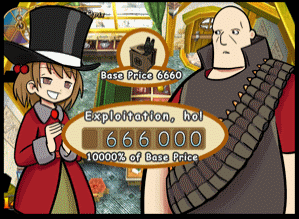
  • The picture above is a parody of Recettear: An Item Shop's Tale, in which you can be a blood gutter merchant who sets a price of whatever you sell very high. Note that the tactic does work on one Rich Bitch, but to others, raising item's prices above 200% will piss off most of your customers.
    • Unless said item is experiencing a price rise, at which point average customers can be made to cough up 250% for, say, food during a famine.
    • This gets a massive Lampshade Hanging when you buy your first wholesale stock for the express purpose of selling at an inflated price for profit - your fairy assistant mentions Adam Smith by name.
    • And a great example of Artificial Stupidity: in the unpatched game, the first "tutorial" customer will never walk out on a bad deal, meaning you can bid them up to several million for the very first item in the game.
  • The biggest example of this is probably Transport Tycoon. The game simulates inflation by making everything more expensive the longer time goes on. The only problem with this is that if you just keep playing, a regular bus will eventually cost more than the GNP of any (or with enough time played EVERY) country on Earth. This especially causes trouble for the AI as they might, in extreme cases, found a company so late in the game that the starting funds are not enough to buy a single vehicle and they are forced into bankruptcy right after building their headquarters!
    • Railroad Tycoon suffered from similar problems. If you tried to buy controlling stock of another railroad, someone else would immediately start buying the stock, which resulted in driving the price up, and, because The Computer Is a Cheating Bastard, the competitor can always be one step ahead of you and you could never buy enough shares of stock. At the same time, as you buy the stock, the price goes way up. When you sell the stock, the price goes way down. Because you're the only real buyer, when you buy, the price is inflated. When you sell, the stock loses value.
  • The Cadash arcade game has a huge case of this. There are three ways to heal in the game. One is a magical herb that restores 10 hp when you would otherwise die (with a stock cap of 4). The second is an elixir, which has a stock limit of one, there are only two of in the entire game, and you can only use automatically after all your herbs are gone and you would otherwise die. Method 3 is to stay at an inn. The inn price more than doubles each time you stay at one. It is completely impossible to afford every inn if you stay at one after each section, so you must put off that first visit as long as possible.
  • Test Drive Unlimited suffers from this with the police fines. They start off reasonable, but as the player progresses become ridiculous. What's worse, is that they are based off of the number cars the player collides with and the only tactic the police use to stop the player is running into him.
    • And in a Truth in Television application of this trope, both the performance and prices of the cars are pretty much accurate. This means that a $70,000 Corvette can outrun cars that cost two or three times as much and that some of the vintage cars that may cost over a million dollars are useless for everything but vintage races, and maybe not even those.
  • Glaringly obvious in Devil May Cry. Every time you buy a Vital Star, the price goes up, sometimes by rather large multiples. To be fair, if you're relying largely on using them, you're not exactly playing the game very well and if you really insist on spamming items, you're better off finding them lying around in stages (if they're even there).
  • Justified in Pathologic. A plague has befallen the town, and the prices rise accordingly.
  • Star Flight: The price of fuel for your vessel will DOUBLE several times over the course of the game, and while the rationale is provided for it in the reports you'll get, you won't get any warning that this is going to happen until you return home and see the price has doubled again.
    • Once you know everything you need to beat the game properly, you can rush through and finish the story before the first date falls, thereby stalling the increase in price permanently. However, most players are unable to beat it to the first increase. As many find catching animals and finding new mine-able planets the gameplay's appeal, this seems intentional.
      • It is far less severe in the Genesis version, in which the price increases in relatively small increments. It's also fairly easy to amass enough money that the price increases don't hurt much.
  • Star Control: In the second game, there are actions you can take (selling your crew to the Druuge to tend nuclear furnaces (and serve as fuel for same)) that will cause the price of crewmembers (effectively your life points in this game) to rise, along with the ire of your home station master.
    • This will also occur if you consistently lose men you purchased from the Earth Starbase (something that can easily happen if you try to use the pitiful Cyborg - Which except for very few specific instances guarantees the loss of a ship or 13 - instead of actually controlling your ships), but this takes longer and can easily be offset by giving Tanaka (or his brother) a Shofixti maiden after repeatedly insulting him and escaping, thereby speedily repopulating the Shofixti race.
    • The Syreen Penetrator (which, being the Blue Skinned Space Babes ship, looks EXACTLY like you'd expect) has the ability to call crew from the opposing ship and capture them. Master this, and you start getting REWARDED for slavery, as you can then sell the enslaved crew back at the inflated price.
    • Though this trope is inverted at the near-end of the game when the Chmmr suddenly grant you unlimited resources to build anything you wish.
      • And then subverted by the fact that your main badass supership that if upgraded right can dominate every fight against any opponent needs to be converted into a flying bomb by the Chmmr in order to destroy the big bad's superweapon, effectively taking it out of the fight.
    • This is justified in-game by the fact that the Earth Starbase itself has severely limited resources (and crew, natch!)
      • ...and if you sell enough crew to the Druuge it is quite explicitly stated that you're effectively bribing people to join up with a known slave trader.
    • You can also completely turn the tables on the Druuge in a very simple way. You can sell them a small portion of your crew or one of a few various MacGuffins that you pick up on your travels and they will pay you by fully fueling up your ship. Now fuel can be bought and sold at your home starbase, and your ship can be reconfigured as one giant fuel tank. Go to the Druuge with an empty giant fuel tank, sell some crew or a MacGuffin, watch them fuel you right up and scream at how you pulled a savage burn on them! Then you fly back to your home starbase and sell all your fuel for a CRAPTON of cash to buy all the ships and expensive upgrades you'll ever need.
    • Justified, or perhaps Lampshaded, with the Melnorme traders, whose culture considers giving without receiving in turn to be vulgar. So no freebies.
  • Dead Rising 2: The price for a box of Zombrex, to keep Chuck's poor daughter from turning into a zombie, starts off at $25,000, and goes up from there with each purchase, so it would be more financially prudent to find some on your own. Would this be justified if I told you the pawn shops that sell Zombrex are run by looters, in the midst of a zombie outbreak?
    • It can actually be Justified by how rare Zombrex is. Chuck buys one, that's one less the looters have and obviously anyone who wants Zombrex will be willing to pay top-dollar. And the looters are Jerkasses, bear in mind ...
  • Dead Frontier: Hoo boy. You know a marketplace is flawed when a green jacket costs more than an M1 Super 90 shotgun. Especially when said green jacket does nothing for the player. No stat boosters, no extra protection, nothing.
    • Justified in that it's a player-generated economy in a Scavenger World. Prices are easily linked to in-game supply and demand - while, realistically, fresh vegetables shouldn't cost $50,000 apiece, supply and demand says otherwise.
  • Anarchy Online's player driven market is inflated to such a degree due to the rarity of items that many players are often turned off by the market and its impressive prices. In a game where any given character can hold 1 credit short of 1 billion credits, you will find single items running for up to 5 BILLION credits (mind you, credits are only as easy to make as your willingness to enjoy dirty socks) while you find player owned CITIES (which besides the benefits also give option to get their hands on some of those Random dropping loot) on sale for equally terrifying amounts of cred. Does nobody else see the irony in "Anarchy" becoming a textbook example of inflation in a capitalist market?
    • Anarcho-Capitalism Online isn't as catchy, is all.
      • Not that the concept isn't fun. See EVE Online, where just about everything is produced in the player economy by people who probably hate your guts.
      • When money and items can be acquired by way of drops from interacting with (murdering) continuously spawned sources, you have pretty much divorced any relation to the real world, and created a great example of what creates inflation: money being created much more quickly than the goods it chases. Combine this with a having a player economy where they put their own loot they found quickly raises the prices in any MMO to extreme levels. Eve has averted this since all the goods in the world do not come from random drops but is made by a player, shipped by another person, and sold to you by a third.
  • After the release of the "Burning Crusade" expansion for World of Warcraft, the market for low level items and materials soared due to vast amount of gold being generated by high level characters and the massive demand for low level gear for said high level character's low level alts.
    • The inflation in the cost of flightpaths is a direct example of this trope. You can fly from one tip of the Eastern Kingdoms to the Other for less then a gold, it'll cost you that much to travel within the zone in Icecrown.
      • Somewhat understandable, actually. Flights through higher-level zones would realistically have a greater chance of attacks from flying enemies, so the flightmaster demands compensation in case you get his mount killed.
    • The most flagrant example, however, is that because enemies drop magic items and other pieces of manufactured equipment, equipment manufactured by players is actually cheaper than raw materials. A herbalist/ miner, or skinner/ herbalist or other combo of raw material gathering professions is a good way of amassing a huge fortune quickly and buying all that ? equipment from the players that have the manufacturing skills almost cheap as free.
    • Most MMORPG developers are aware of this trope and will often build money sinks into their games to remove excess cash from players' wallets, with varying levels of success. Do you twink your alt or drop 20K on a giant mammoth or a motorcycle?
      • The most reliable money sink, of course, is armor repairs. If you play end-game content, this can drain you of several hundred gold a night on progression days.
    • Also somewhat averted in WoW with faction rep discounts, getting to a higher reputation with a faction causes all vendors allied to that faction to offer you increasing discounts on all items.
  • Averted by Final Fantasy XI. Although the auction house is a player-run economy, NPC store prices drop according to how much fame (a hidden stat that goes up whenever you do quests) you have in the town they are located in.
    • Although, your rewards are still given after you save the world, instead of before.
    • Played straight in Final Fantasy II where the Rising Cost Of Health Insurance hits you hard as your stats increase. Inns will be very cheap early on, but charge you more and more money depending on how much HP and MP you need to replenish. It's possible to cut down on your inn prices by using Cure spells before entering, as it will be less expensive to replenish a hundred MP than a few thousand HP.
  • Steambot Chronicles has this happen with the price of fuel and parts/repairs as you progress through the story. Working through the story segments quickly and not recognizing the point where you can jump off and just go wandering about for a few game weeks can lead to severe cash flow problems and/or death. Prepared players, however, can easily amass a nice fat bankroll and a stockpile of parts to sell back to the shops at the newly-inflated prices, although that latter is only slightly better than breaking even.
  • Digital Devil Saga is pretty bad about this, especially because the same money you need for items is also spent on your abilities, which get ludicrously expensive by the end of the game.
    • Only debatably an example of this trope: mantras (the items that grant you new abilities) stay the same price throughout the game, but you need to buy higher level ones to stay competitive. Still not the same thing as actual price hikes.
  • Not so in Golden Sun and its sequel, where the Inn prices go up because they charge per person and as you gather more people while going along.
  • Averted in Wild AR Ms, apart from the inn located at the optional arena, which charges over 30 times as much as normal, which coincidentally is as much as the entry fee into the combat arena itself. Otherwise all the inns charge the same low price. There are even some towns that let you rest for free.
  • Persona 3 also had the items getting exponentially more expensive, which is made even more bizarre when you consider that your protagonists are Japanese school children, and that the person selling you the gear was a police officer who was fully aware of the situation.
    • Thing is, by the time things get really costly, you're getting so many Yen out of Tartarus that you could buy out his entire inventory. Apparently, he's also aware of this. Why the swimsuits are so expensive is a question for another day...
      • A better question: Why does he even have your swimsuits in the first place?
  • The economy of Deus Ex confounds. Hacking into ATM networks will usually give the player somewhere between 100 - 500 credits a pop. Credit Chits are rare and few between. Yet, everyone and anyone who sells you "second-hand goods" will charge you 700 credits for a clip of ammo (6 shots, which early enough in the game, could go quick), up to 2000 or more for a weapon add-on (accuracy mod, scope, etc.). On the other end of this problem, you can find this crap laying around ALL OVER the place. You think that the supply would outweigh the demand at SOME point...
    • Not to mention that most of the people who take thousands of credits off your hands for relatively common items are somehow still homeless despite apparently sitting on money machines.
    • However, you play an elite government agent and completing your assignments efficiently and following orders reaps commissions and performance bonuses, totaling thousands of dollars. Deus Ex encourages players to work hard, be curious, and loot for maximum survivability.
    • This is even lampshaded at one point later in the game; if you pay someone's 5000 credit asking price for a suit of thermo-camouflage, which is a huge amount of cash for something that is neither that rare nor that amazingly useful, he'll be dumbfounded anyone was willing to go for his offer.
    • The game actually does a good job at keeping your resources just ahead of demand, which with the multiple solutions to any given puzzle means that you could be drowning in lockpicks while carrying around seven different guns in the false hope that one of them might have enough ammo to get you through the next firefight. On an economic basis, part of the plot is that the economy is screwed on a massive scale.
  • In Tales Of Eternia, not only does each successive town charge more for the inn, but the moment you visit an inn, every other inn you've ever been to increases their prices to match the new one.
  • Averted in Tales Of The Abyss — prices go up and down dependent upon actual availability. If a town is destroyed, its products get more expensive. If there's a war on, weapons are suddenly at a premium. On your New Game Plus you can take serious advantage of this by stocking up on items when they're cheap and unloading them when the price skyrockets.
    • However, the most expensive inn is in Sheridan at 600 Gald, unless you count the Keterburg Hotel, which is explicitly stated to be for the rich and does have a much cheaper Inn. This is compared to Daath, whose inn is 200 Gald. Sheridan's inn successfully beats out both capital cities. Prices for that, though, can be averted with the Mini Maven title for Anise.
  • Also averted in Tales Of Symphonia to some extent. Shops will still charge you, but certain events such as the dragon tours and trips to Thoda Geyser will not charge anything as the people can't take the Chosen's money.
  • The player can choose to avert this themselves in any Tales Series game by taking advantage of the fact that many commodities - especially food - don't cost as much in some areas as in others. It's possible to make ridiculous amounts of money as a merchant if you know the differences.
  • Somewhat averted in Paper Mario: The Thousand-Year Door in the varying inn prices. They accurately reflect the wealth of the local area. The inn that charges the most coins, at 30 coins, is in Poshley Heights, which is essentially where all the rich people live high lifestyles; compare to criminal cesspool Rogueport, where the inn charges only 5 coins.
    • And yet played straight in the Pit of 100 Trials. There is a sleazy merchant who occasionally shows up in certain rooms to sell you various items at inflated prices. The lower you go, the more dangerous it gets, and the more likely it is you'll be running out of healing items. He knows this. By the time you get near the bottom, he'll be selling items for twenty times what they'd be worth in a normal shop. Since you're likely to be maxed out in coins yet an inch near death at this point, these items might actually be worthwhile.
    • Karl Marx Hates Your Guts is averted in both Paper Mario titles. It is possible to purchase items from one shop in the land and sell them at a higher price in another shop for a small profit. For example, you could cheaply purchase a Fire Flower in a warm place and sell it at a cold place at a higher price. This is no secret; it is hinted at within NPC dialogue in the original game, and one of the first side-quests in the sequel teaches the player a simple trick to make coins. Buy a Sleepy Sheep in Rogueport for 8 coins, then sell it in Petalburg for 10 coins - a 2-coin profit. Rinse and repeat for infinite profit, although the journeying can get tedious.
      • Even more so once you get access to a chef. Not sure if it works in the second game, but in the first, you could buy Mysteries for 1 coin each from the shop in Boo's Manor and give them to Tayce T. back in Toad Town for cooking. You'll either get a potentially rare random item or a mistake, which is otherwise useless but can be sold at Boo's Manor for 5 coins, quintupling your investment if you're willing to take the time out from your adventure to do the trade route over and over.
      • There's a Goomba who will buy Mistakes for 20 coins, but you have to go halfway through Bowser's castle to find him.
  • In Wario World, there are machines that sell garlic (health). The later the level, the higher the price. Some machines will even raise the price for each clove that is bought.
  • In Mega Man Battle Network, every successive HP Memory upgrade is usually at least twice the price of the one you just bought from the same vendor. PowerUPs likewise in the first two games. Star Force does this too.
  • Bioshock does this with a literal Ayn Rand's Revenge. It can be justified, though, as you are in a super-capitalist dystopia, where the 1st act takes you through the medical pavillion and the fisherman's wharf, whilst the 3rd takes you through the uptown residential district, where demand for ammo would be higher.
    • There is one area where this is Played for Laughs - at the Fleet Hall Theater, the lobby vending machine only sells snack items - at about a 4,000 percent markup.
  • Subverted in a locally-written game called No (to hide it from the system managers) which ran on the mainframe computer at Orange Coast College in Costa Mesa, California back around the late 1980s. You got to travel around the galaxy buying and selling things, or alternatively, looting other ships and stealing their supplies. Planets had different technology levels, from 1 to 9. Goods became cheaper the higher the technology level, so that photon torpedoes at a #4 technology planet were less expensive than the ones at the #1 planet (which is how you made money, buying from H.T. planets and transporting goods to lower technology ones). Higher technology planets also did better things with ship's equipment, e.g. a #2 shield could provide more energy against other ships trying to fire on you to loot your ship than did a #1 shield, a #3 did better than a #2, and so on. If you bought a #3 shield at a #3 or higher technology planet, the price was in line with it being what it was worth, say, twice that of a #2. But buy a #3 at a #1 planet, however, and while the planet would sell it to you, the price might be 100 or 500 times as much, which is in line with demanding high technology in a place not equipped for it, it's much more expensive where they don't know how. Each planet's level was announced when you arrive, and prices were clearly marked on the price chart, but the program wouldn't prevent you from being stupid and not checking the price. Planetary technology levels were based on a formula as if to say some planets developed faster than others.
  • In Fable II you can actually buy any offending store and lower the prices accordingly. Added bonus: Lowering prices counts as a pure and wholesome act, adding to your karmic stats.
    • Further, the more "loved" you are, the more discount you get.
    • However, any discounts you get also affect the price you get for selling. So yes, that shopkeeper who loves you will give you cheaper stuff but also pays you less for your Vendor Trash.
    • Yeah but at that point you own the shop so you don't need to sell to him anymore. When you can finally buy buildings if you can afford anything the economy is broken from then on.
  • In the first Fable in the economy was driven by supply and demand and that you could earn discounts and get better prices for your sold goods by having a higher guile level.
    • More specifically, a shopkeeper will sell items they have a lot of for cheaper than items they only have a few of. Similarly, they will spend more to buy items they don't have than they will for items they have a surplus of. This opened the door to a cheat where you could essentially sell him 99 of an item time they didn't have (which he would pay handsomely for), then buy all 99 of those items back (which he will sell to you very cheaply), and turn a profit. Doing this repeatedly with high-price items (like engagement rings or precious gems) effectively becomes an infinite gold supply.
  • In Knights Of The Old Republic II where you at one point could reprogram a droid shopkeeper to give you better prices.
    • You could do the same in Fallout 3.
    • And the vending machines in Bioshock (mentioned above).
  • In Fallout (not II or III), you can put points into Bargaining until you can buy items from NPCs, sell them back, and make a profit! It's not too hard to get to that point either.
  • In the first Ratchet & Clank game, you can acquire a failed attempt at a mind control device that causes vendors to give you a discount.
  • In System Shock 2 with good stats and lucky clicks, you can either reprogram vendor machines to give items at lower prices, or change the stock altogether, replacing soda drinks with armor-piercing bullets.
  • In Freelancer, the most central, highly populated systems in the universe have the cheapest/lowest-quality goods. Outside the universe, it's a good idea, because you start the game in the dead center of the universe, with no money and no ship. As the difficulty rises and you get more money, you go farther from the center, and have the opportunity to spend more money on better equipment. But in-universe, it does not entirely make sense.
    • However, their equipment isn't that great (ranking second or third), and it sells that low, too. It's a sort of Hero Discount so you can iron out the really weak points of your gear before the final battle.
    • Once you join up with the Order, you can buy all the best equipment and the best ship at ridiculously low prices. Even if you don't have much money, trading in your previous ship will let you buy everything the Order has and have an entire fortune left over. Won't do you much good after the end of the main storyline, though.
  • In Dungeon Siege all mules are equal, but they are sold in almost every city. You can buy a mule in the first city for 1,500 gold. In the final city, the NPC complains that he is having to practically give away his mules because he had no food to keep them alive. The price? 370,000!
  • In the ARPG Sacred II, high-level items are more expensive than low-level items. A level 120 healing potion sells for $1200, enough to buy 150 level 1 pots if you are level 1. And both heal exactly 24%...
    • It gets better(tm). You can merge one $1200 pot with 19 $12 pots, making a stack of 20 $1200 pots. I Hate Your Guts Too, Adam Smith.
  • In Oregon Trail II, supplies get more expensive the farther out on the trail you go. This is probably justified, since the prices would include the additional costs involved in transporting them to a remote outpost.
    • Horses actually get significantly cheaper, also justified.
  • Secret of Evermore had an interesting take on this trope; each of the four areas of the game uses an entirely different type of money (e.g. gold, gems or credits), and the exchange rate is where you get shafted, with e.g. 1 gold coin equal to 2 jewels or some such. Therefore, the item you buy may sell for the exact same price, but the currency in use is worth twice as much, so you're really paying twice as much for the same item.
    • Although this actually gets averted pretty fucking hard at the end of the game. The way this game works, the area you're in at that point is technically the first part of Evermore you get into it, predating the Prehistoric area, and in terms of currency, that means the exchange rate for this currency is at the lowest end of the hierarchy. If you saved up 25,000 coins, that makes 50,000 jewels, which makes 100,000 talons, which makes 200,000 credits. Probably the only game in history where you literally come into a currency gold mine right as you come into the store WITH THE STRONGEST EQUIPMENT YOU CAN BUY.
  • Victoria: An Empire Under The Sun works on a crude supply and demand scheme. This often makes it feel like Adam Smith Hates Your Guts because when a major war breaks out the cost of war materials can increase drastically. This is perfectly realistic of course, and if you happened to somehow coax your capitalists into building said weapons factories you might earn a tidy profit. A more straight version perhaps is that as technology (and hence production efficiency) increases so does demand: Unless you keep up the pace you might well end up with a population unable to buy the fancy new toys your factories are producing.
  • Averted in Escape Velocity Nova, where as you progress through any one of the game's story lines, purchasing outfits and new ships becomes less expensive on planets belonging to the government you are currently serving, as well as granting you access to ships and outfits that wouldn't be available if you weren't working for that government. The only exception to this is the Vell-os, who are slaves in their story line. And since their "ships" are actually psychic projections, you can't buy outfits for them anyway.
    • Actually, you can buy SOME outfits, such as a Marine Platoon or two, IF you have the space on a Vell-os ship (they do have VERY minimal free-space though)
  • The Elder Scrolls games have always survived on dungeon crawling to collect items to sell in shops or exchange with other characters. Occasionally, the prices are reasonable, but you are usually being fleeced by buying that sword for more than what you sold one just like it for. You tend to get the best deals in your higher-ranking guilds and with people who like you (in Daggerfall, by selling items to stores of "rustic" quality).
    • Morrowind, which runs on a bottle economy, offers an subversion: alchemy. That potion you made and can sell is more expensive than the cost of its ingredients most of the time.
      • The system can become hilariousy broken the moment the player realizes that they can make potions that boost Intelligence, which can be used to brew better potions, which sell for more money...
    • In Oblivion at least, one can also very easily get access to spells that make vendors like you so much that it breaks the haggling mechanic and they'll always give you the best possible buy/sell prices.
    • In Skyrim, it's actually possible to invert this and still have the market hate you; Dragon Bone drops will become so frequent alongside enchanted daedric artifacts that simply selling one piece will bankrupt the store owner if you don't have any merchant perks or accept the "loss". On top of that several merchants only buys one type of loot (food, armor, weapons, or potions) with only a handful in each town that would buy any loot, so careful management is also needed so that you don't sell to the easiest merchants first and end up unable to sell the rest.
  • In EVE Online, "basic" modules are less powerful versions of Tech I (normal) modules. They were in between Tech I and Civilian (cheap and nearly useless) modules. CCP decided that they weren't needed, and removed the blueprints for Basic modules. Now they fetch massive prices on the market; it's mostly item collectors who buy them.
    • Civilian items also suffer from this; since they're basically useless, there's far less Civilian items than anything else. It's common to see a normal frigate-grade Afterburner selling for 15,000 ISK, and a Civilian Afterburner selling for 300,000. Somebody actually made a Brutix (Gallente Battlecruiser) that was fitted with nothing but Civilian modules. It was named "Civil Minded".
  • In Chrono Trigger, before you do Ozzie's sub-quest at the end of the game, the Medina market charges insane prices for his low-level gear. Once you complete the quest, though, his prices become more reasonable; because you killed Ozzie in the past, the Mystics, who live in the village, never held a grudge against humans. Interestingly, they also sell some high level gear there at even MORE exorbitant prices, thus keeping it out of your reach. By the time you lower the cost, this is pointless as you are a couple tiers of equipment above what is sold there. However, it is quite possible to have enough just enough money to purchase a weapon you aren't supposed to get for another 10 hours pretty early in the game, even with the massively inflated price. Oops.
  • Earthbound seems to avert this trope for most of the game, as you start in an insignificant little village, and the price of lodging naturally increases as you approach the big city of Fourside and the resort towns of Summers and Scaraba. Additionally, shop prices never seem to change; the cup of coffee that costs $6 in Onett will be valued the same wherever you go. But then, near the end, you reach the Tenda Village and Adam Smith slaps you in the face: items of all sorts are hideously expensive (costing not money but a certain high-valued item that must be bought elsewhere), and the "ATM" people you find charge 100% handling fees.
  • Pokémon:
    • Averted: Everything costs the same amount wherever you go (though it does strike one as a little strange that a small shop in tiny little Mahogany Town would stock Ultra Balls when Goldenrod City's massive department store doesn't), and Pokémon Centers are always free. ** The fourth generation even averts the odd stock issues - the stock in all stores is dependent on how many badges you have - they just won't sell Ultra Balls to greenhorn trainers. The only city-dependent items are specialty balls that generally have explanations as to why they're only sold there (like selling balls that are better at catching Water-types in a fishing village).
    • Also in Goldenrod City (both in the original Gold & Silver and their fourth generation remakes) there is a "bargain shop" that sells you expensive items with no use other than being sold, at 90% of their selling price. However, you cannot get rich from it; the salesman is only there on Monday mornings, and only sells you one of each item each time. It's more of a steady income than anything.
    • Also: the fancy store in the center of Black City. $10,000 for a Poke Ball?
  • In Metro 2033, the only money is bartering with 5.45mm ammo left over from before the apocalypse. The ammo is in perfect condition, and packs more punch than the homemade crap you usually find. therefore, you must choose between supporting the economy and saving your ass in a firefight. There's even an Achievement (Scrooge) for hoarding 500 Bullets.
  • A rare aversion occurs in The Spirit Engine 2: One of the endgame shopkeepers does agree to give you a discount. Played straight and lampshaded by the shopkeeper right next to him, however, who scoffs at you when you tell him you're about to save the world.
  • In Guardians Crusade, Inns vary in price, basically the more populous the city is the more expensive sleeping there is. Subverted where after you save the cities from a Gargoyle invasion, the Inns usually let you stay for free.
  • Colonization: While you can sell whatever you produce in the game in Europe, the prices you get decrease over time. Also, the price you have to pay to buy products or military units from Europe increases. You can theoretically avoid this by trading with Native Americans or with other colonies, but it never seems to work in your favor.
    • The trope is also literally inverted. You can recruit Adam Smith himself into your Continental Congress, in which case he loves you and wants you to succeed. Unless a rival colony snatches him away from you.
    • The Firaxis remake makes the latter impossible, as once you get a Founding Father, he's yours. No other colony can get him. Whether or not this is good depends on whether or not you were able to get him first.
    • FreeCol has the initial amount of goods on market explicitly established in the ruleset, which mostly affects price elasticity — you could eventually buy all 10000 tons of food and sometimes it could even make sense to try, but since one caravel takes only 200, it will take forever even if you could churn out goods to sell back to Europe equally fast (which won't happen, since New World goods have only 1000 reserve and prices fall quickly). Natives simply shift goods from "very interested" to "also can be traded" category after one transaction, so you would get the best deal by cycling wares between visits accordingly, and packing holds full when they are ready to buy high — until a village wants something you don't have.
  • In The Legend of Zelda: Ocarina of Time, Young Link needs to buy some beans, which you can plant in various places to create levitating plants in the future. When you buy the first one, the seller tells you that he's not moving any stock, so he sells it to you for 10 rupees. When you buy the tenth and final one, he tells you that his beans are selling like mad, and he'll let you have it for 100 rupees, yet Link is his only customer.
  • Also in Wind Waker, Tingle charges ridiculously high prices for his goods and services that are necessary to advance in the game, even requiring the player to get a wallet upgrade for the sake of a single extra Rupee.
  • In Etrian Odyssey on DS, the price to spend a night at the inn goes up with every level that your party increases, as does the price to revive a fallen member at the hospital. Items and equipment are also rather pricey — in the first two games, a single Nectar costs a whopping 500en. In The Drowned City, healing items get a much needed price drop, such as Nectars now only costing a mere 50en. Ironically, the shopkeeper here is a major Money Fetishist; probably best if she doesn't find out she's selling this stuff at such a staggering discount...
  • Civilization has an odd variant of this trope. The 'prices' of buildings and units, in the form of hammers (required production to build it), stays constant, no matter which era you're in. Thus, erecting a building in a newly built town will take exactly the same number of turns in the stone age as it will in the modern era, after building cranes, construction equipment and unionised labour has been invented. At the same time, buildings and units you unlock with better technology that you research later are prohibitively more expensive in terms of hammer cost. This leads to odd situations where you have a new town in the modern era where building a TV station (which is unlocked in the modern era) takes over eight times longer than building a library (unlocked upon learning how to read) or a Colosseum (unlocked by construction), and training a unit of riflemen takes four times as long as training a unit of longbowmen (which would be the opposite of Real Life).
  • This occurs in Sa Ga 2: Hihō Densetsu​ (rebranded and released as Final Fantasy Legend II outside of Japan). It can be difficult enough to grow in strength since weapons have limited uses, and the prices go up by a huge amount as the game progresses, but there's a bug that occurs when you win a fight: each group of enemies is checked one by one to see if they drop meat (used to transform Monster class characters), but if you were fighting 3 different enemy groups, the game does not calculate dropped gold for the remaining groups if meat happens to be dropped by the first or second group. If you were fighting 3 different groups of enemies and the first group consisted of only 1 monster whereas the two others had 9 monsters in them, you would be ripped off of almost all the gold you should have obtained if the first monster group happens to drop meat because you will only get the full amount of gold you were supposed to get if the enemies do not drop meat, or if you're lucky enough that the last enemy group is the one to drop meat. As a result, making money is very frustrating because a lot of the time you'll only get 1/3 to 2/3 of the enemy groups dropping their gold.
  • Inverted in Crazy Taxi; each customer pays you, the player hundreds of dollars and tips to drive them very short (usually less than a kilometer) distances. Possible Ridiculous Future Inflation?
  • In the forgotten FPS/RPG Strife, the quartermaster at The Front base will give you a few assault rifle clips if you run out. Aside from that don't expect any hand-outs from him or from the citizens that you're trying to save from the evil empire/cult.
  • The first Shadowrun for the Sega Genesis had outrageous prices for weapons and powerups. You earned money by taking jobs but since the jobs paid very little, you ended up having to do the same few missions over and over again in order to get enough money to progress in the game.
  • In the Tropico series, inflation occurs gradually over the course of the 20th century. Unless you raise the rates of Tropicans' earnings as well as gradually increase the price of your exports, you will have a lot of unhappy Tropicans noting the disparity between the average Caribbean wage rates and yours.
  • In the Dragon Quest series, cost of inns generally increases throughout the game in standard Eastern RPG fashion (to add insult to injury, the base rate is also multiplied by the number of people alive in your party). The cost to revive a character at a church sharply increases depending on the level of the character to be revived, but this becomes irrelevant once you have a character with a revivification spell.
    • Subverted, in some cases, in the newer games. Every once in a while, when you come to a new town or village, the inn rate will be mercifully cheap. Whether or no this concurs with a sharp upgrade in available weapons depends.
  • In Fantasy Zone, excluding the engine upgrades, everything you can buy from the shops gets more expensive each time you buy them. The PlayStation 2 remake included in SEGA Classics Collection lets you unlock an setting that turns off price inflation.
  • Black market merchants in Kid Icarus charge exorbitant prices for their wares. You can haggle with them to get a lower price, but if your strength is lower than the level number, he'll raise the price.
  • In The Sims Medieval, Sims can actually have Adam Smith Hates Your Guts as a flaw. It's called "Guild Enemy." Even when prices are low for everyone else in the kingdom (thanks to high Well-Being), the Guild Enemy has to pay a ridiculous markup unless he wants to go to non-Guild shops whose selection is pitiful.
  • Quest For Glory II has an interesting aversion; when the elementals show up, the merchants will gladly give you what you need to defeat and contain the elementals, provided you just ask when the time comes. The sole exception is the blacksmith, but he's a Jerk Jock anyhow, and he'll give it to you if you can beat him at arm wrestling. You can also convince him that you really need the item, but you have to wait two days after the elemental shows up (it destroys the city the following day) to showcase the danger, and you still need a high Communication skill.
  • The Web Game New Star Soccer has 'NRG' Drinks. Every time you sign a new contract, the prices increase. Near the end of the game, an energy drink can cost more than your HOUSE .
  • Kingdom Of Loathing's Suspicious-Looking Guy is the sole source of Goofballs. The first bottle costs nothing, but every one after that costs an additional 1,000 meat; so if you want 101 bottles, the 101st one will cost 100,000 Meat and you'll be out over 5 million meat in total (weeks worth of farming). Still, you can work around this by ascending (which resets the price to 0), and you shouldn't really be using Goofballs anyway because they have nasty aftereffects.
  • In Diablo 2, a market developed in trading items between players: but the game's "official" currency, gold, quickly became worthless due to inflation as most items were valued at more gold than a character could ever carry or transfer. Instances of a particular rare magic item, the Stone of Jordan, became the unofficial currency.
  • In Diablo III, the position was effectively reversed by the Auction House massively simplifying player trading: at any difficulty level but Inferno (the highest), most item treasure that drops can be ignored as players on higher levels will be getting much better items as "junk" and selling them off for tiny amounts of gold. This wiped out the value of several in-game crafting mechanisms.
  • Assassins Creed III has a complex crafting system that lets you build useful items and sell them to merchants around the Colonies. However, the price of crafting items increases each time you make something in a given session, which can result in things like nails, barrels, and soap inexplicably costing hundreds of pounds to create. This is ostensibly to prevent farming infinite cash.
  • Like most other "freemium" mobile games, Gameloft's My Little Pony: Friendship Is Magic allows you to play completely for free, earning an unlimited supply of coins within the game that can be used to buy new characters. But the game (as released) also utilizes additional currency systems, including "gems" that can only be earned at a rate of one a day and sometimes as quest rewards, and "hearts" which mostly require friends to visit your town and leave a gift (again at a rate of one heart per friend per day). Alternatively, the player can spend real money to buy gems and hearts. Players have worked out that to complete the game's main storyline requires the player to buy ponies and other objects that can only be bought by gems or hearts; as originally released, it would take 3 to 5 consecutive years of playing the game once a day to earn enough of these to buy all the required ponies. Alternatively, these could be bought through around $80 worth of gems. And then there's all the optional characters... Made worse when you consider this game, while having the brony audience from the TV show, is meant for kids.
  • The Time Goddess in Half Minute Hero will gladly reverse time for you (a necessity when you only have 30 seconds to save the world) but each use increases in cost (first 100 gold, then 200, then 300, etc.). She shamelessly doesn't deny her love of money.
  • You can exploit this trope in SaGa Frontier thanks to a Good Bad Bug. You can buy and sell gold nuggets in this game, and in one of the locales its price rises and falls as per the good old laws of supply and demand...except the game's programming recalculates the worth of your inventory in the sell menu before any actual goods change hands! So, start with an inventory of about a dozen or so gold nuggets, "sell" them until the price per ingot is zero, and then toggle the number of ingots that you're "selling" until the price raises to a level where actually selling them ingot by ingot nets you a profit. Then, travel to another locale where the price of gold is fixed and buy more ingots than when you started, and repeat for effectively infinite money.

    Tabletop Games 
  • In D&D
    • Third edition with gold piece based magic and overhaul of existing prices toward inflation and price gaps. E.g. base price of a Crystal Ball raised from 5000 to 42000. And even built magic items expected in the specific style of campaign into challenge level system.
    • Fourth edition, for ease of play everything has a fixed standard price (particularly visible in the way the cost of any magic item is purely a function of its level). Fair enough. However, player characters can never sell anything (including magic items) not explicitly put into the game as a cash-substitute treasure by the scenario designer for more than 20% of it's notional 'market price'... (There's a reason for that, and it's that the game developers explicitly wanted to encourage players to take their characters adventuring rather than have them sit around using weeks and months of in-game downtime making stuff to generate more money. But it still fits the trope to a T.)
    • A special case is also the component cost for the Raise Dead ritual. It starts at 500 gold pieces' worth of materials... until a character reaches 11th level, whereupon it suddenly increases by a factor of ten?and then the same thing happens once more upon hitting level 21 (of 30 possible). Handwaved by the game as 'death being less willing to return great heroes'.
      This because death has to be significant enough that it is meaningful, but not significant enough that dying is a major disruption to the game. 500 gp is a pittance to a mid to high level character, so the cost needed to be increased in order to make it at least mean something. It is a constant struggle in such games for death to be meaningful, but not crippling. In previous editions, you lost levels for dying and being raised, so this is a significant step forward as far as pricing goes. And honestly, 20% is not all that strange if you look at it from an economic perspective; sure, the merchant seems like they're ripping you off, but how often do high-level adventurers come by town? In the default assumption, the heroes are pretty much THE heroes, and there just aren't all that many other people who would be capable of buying that + 5 flaming bastard sword that you sold to Bob's Used Weapon Emporium.
    • Lampshaded in this Full Frontal Nerdity strip.
    • A relatively recent addition to the 4th-edition rules is item rarity. Common items can be purchased, created by PCs, and sell for the usual 20%. Rare items, however, cannot be crafted or bought — they only turn up as loot if the DM specifically places them. The good news is that they sell for 50% (or even 100%) of their list price.
  • GURPS went to a ridiculous extreme in justifying and averting this trope. Magic items are balanced via a, relatively simple, economic system they built for the game (and explain to any GM who wants to change it).
  • Completely averted in the board game Container, where the players are responsible for producing, storing, shipping and buying the titular multicoloured containers, and there are no outside market forces whatsoever. How much does it cost to buy an orange container? As much as the seller is asking. How much can you make from shipping three white containers? As much as the buyer is willing to pay. It's basically a self-contained economic system, and you could use it to teach supply-and-demand theory.
  • Monopoly is based on this principle. As the game goes on, the players acquire more and more property, monopolize what they can, and charge higher and higher rents to other players who land on their property. Players whose income does not increase fast enough to pay off increasing rents will eventually be eliminated, until only one remains.

     Web original 
  • The shopkeepers in WarrensOfOricTheAwesome. There are 3 different currencies , with ridiculous exchange rates between them (10 fountain pence for a stream ruby, 5 stream rubies for a fountain pence). The shops often inflate their prices, and are the only practical way to gain stats.
     Other 
Link: "Forty, thousand, rupees for a satchel? This is cheap burlap!"

Zillion Dollar BillMoney TropesA Homeowner Is You
With This HerringHollywood EconomicsBulk Buy Only
Actually Four MooksRole-Playing GameAlliance Meter

alternative title(s): Rising Cost Of Health Insurance
random
TV Tropes by TV Tropes Foundation, LLC is licensed under a Creative Commons Attribution-NonCommercial-ShareAlike 3.0 Unported License.
Permissions beyond the scope of this license may be available from thestaff@tvtropes.org.
Privacy Policy
82082
1