
Some people want you to put a "The" before their name. Avoid these people. (In particular, if the name does not sound like an ordinary name — say, "the Ice" — then do not borrow money from them, or at least make very, very sure to keep up with the payments, and then some.) For two particularly ominous versions, see The Master and The Butcher.
Another particular use of this trope involves the use of emphasized "the"s — in text, written in either bold or italic fonts (or both) — to refer to someone or something that is well-known and/or set the current bar for other examples like it down the line, as if to say "this is the real deal."
A form of Insistent Terminology. May overlap with Third-Person Person, and is commonly used with Capital Letters Are Magic.
In Japanese media, many works will feature a "THE" followed by the rest of the title in Japanese characters.
Compare The Magnificent, where the "the" goes in the middle—and which is not always bad. See also Red Baron, The Trope without a Title, and The "The" Title Confusion, where it is unclear whether or not something should begin with a "the".
The Examples:
- Yu-Gi-Oh! GX: Chazz Princeton from the dub. The original was similar, with Manjoume constantly correcting people with "Manjoume-san da!" (roughly translated to "That's Mr. Manjoume, to you!"). Unfortunately, too many of the offenders completely misinterpret this as him trying to say the Engrish "Thunder", and thus twisting it into his nickname "Manjoume Thunder".
- Kinnikuman:
- The Ninja. Kinnikuman is a series that likes to throw a lot of inappropriate "The"s at the start of characters' names, although they're normally omitted in translation. The most bizarre example is "Big The Budo". Much to the confusion of most English speakers, "The Budo" is the character's base name, not "Big". It's why he was renamed "Big Budo" in the localization of Galactic Wrestling: Featuring Ultimate Muscle
- One particular case that comes in the reboot combines this with the series' other primary naming gimmick of Something Person. The leader of the Perfect Origin is known by different names, such as Choujin Enma and Strong the Budo. Once he is no longer an active antagonist, we learn his true identity, that of the Choujin God of Mercy who descended from heaven to guide and protect the Choujin as a whole before being tempted by darker powers. Once he's back on the side of good, the name everyone settles on calling him is indicative of this aspect of his nature and the fact he's one of, if not the, oldest Choujin. They call him simply "The Man".
- The girls' official designation in Psychic Squad is "The Children."
- JoJo's Bizarre Adventure gives us The World (ZA WARUDO), Dio Brando's Stand. This name doesn't seem to mesh very well with what it does. On the same vein, the stands of Iggy and Arabia Fats are named The Fool and The Sun respectively. Other tarot-themed stands do not follow this convention (for example: Star Platinum).
- Dio refers to himself as "Kono Dio-sama" which roughly means "this magnificent Dio," usually translated as "I, Dio."
- In the Jorge Joestar novel, President Funny Valentine's son and grandson are named Funnier Valentine and The Funniest Valentine, with the latter being specifically noted as the first person in history to have a first name of "The".
- Read or Die features a heroine with code name "The Paper" in Gratuitous English. Lampshaded by Anita who explains her job to Nenene as being her "The Bodyguard".
- D.Gray-Man: The Earl of Millennium is referred to in this way. It's even included in the character profiles from the Japanese official materials as part of his name.
- Mobile Suit Zeta Gundam: Scirocco's final mecha is named the The O (no, that's not a typo). In this case, the "O" seems to represent the world — thus, "The O" means "the entire planet", representing Scirocco's ambition to Take Over the World.
- Sword Art Online: Kirito mentions that one can identify high-level Bosses by this trope, such as "The Gleam Eyes" or "The Skull Reaper". In an amusing turn of events, Kirito becomes known as The Black Swordsman. Spell my name with a "The" indeed.
- Saki: The subtitles have Amae Koromo refer to herself as the Koromo, possibly to point out that she isn't doing it to be cute.
- Blame!: After the main event, the main character is referred as The Calamity.
- Shaman King: In the Tournament Arc, Tao Ren names his team The Ren team. When "team" is said after the name of a team, it becomes "the The Ren team". It is usually said before, as with "Team X-Laws" or "Team Funbari Onsen", but Tao Ren chose to name it "Team The Ren" specifically so that either way, it's his team.
- Darker than Black: While Hei doesn't have a "the" before that name, one of his other names is "The Black Reaper".
- Toradora!: Taiga Asaka is referred to by her fellow students as "The Palmtop Tiger" for her diminutive statue and tsundere nature.
- Bleach: Kenpachi Zaraki declares there is nothing he cannot cut because he's "The Kenpachi" (a title give to the strongest swordsman in all of Soul Society by way of Klingon Promotion. Zaraki specifically is the eleventh Kenpachi) during his fight with Gremmy Thoumeaux.
- One of the magazines in Shueisha's Margaret line is called "The Margaret".
- Sailor Moon: While likely a quirk of the Portuguese language, this trope is nonetheless inverted in one of the Brazilian dubs, during her In the Name of the Moonnote speech, she says "Sou uma Sailor Moon!", which literally translates to "I'm a Sailor Moon!".
- Pete Holmes has a stand-up special called "Nice Try, the Devil".
- As the page quote shows, The Incredible Hulk, often referred to as "The Hulk" as well. Amusingly, it's barely used in self-descriptions due to Hulk Speak.
- The Goddamn Batman, The Joker, The Riddler, The Penguin, and The Scarecrow, though occasionally the articles get dropped when they are being spoken to directly. It's even lampshaded in one issue of Superman & Batman: Generations, when Bruce is talking to Alfred's ghost. "The" Batman. You must be the only one who uses the definite article anymore.
- And in Batman Returns by Selina Kyle.
Selina: Wow. The Batman...
Batman: [Visible Silence]
Selina: Or is it just "Batman"?
Batman: [Visible Silence, then leaves]
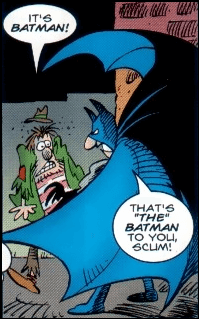
Selina: Your choice, of course! - Sergio Aragonés Destroys DC has some fun with this in Batman's chapter:
Random hobo: It's Batman!!
Batman: That's "The" Batman to you, scum!
(later, at the amusement park)
Joker: Hiya, "The"! Fancy meeting you here!
Batman: What's this "The" business, Joker? You don't know me well enough to address me by my first name[...]
- And in Batman Returns by Selina Kyle.
- Superman:
- In Man of Steel (2018), Superman runs into Toyman, who resents not being called THE Toyman:
Superman: "You absolutely do...Toyman."
Toyman: "Not Toyman. The Toyman! THE Toyman. Like THE Godfather, you alien pain in my tuchas!" - Defied in Superman Smashes the Klan. When Superman makes his Dynamic Entry:
Atom Man: GASP! The Superman! Oof!
Superman: No "the." The "the" is a bit pretentious, don't you think?
- In Man of Steel (2018), Superman runs into Toyman, who resents not being called THE Toyman:
- Spider-Man: The Shocker. Not to mention The Sandman, The Kingpin, The Green Goblin, The Hobgoblin, The Jackal, The Lizard, The Rhino, The Tinkerer, The Vulture, The Rose, The... Of course, Spidey would never settle for being outdone by his enemies. The Webslinger, The Wallcrawler, Your Friendly Neighborhood Spider-Man... heck, one version of him even monologues to himself that he is The Spectacular Spider-Man (or even The Amazing Spider-Man)!
- The Spike in the second X-Force insists on the definite article, to the point of also being a Third-Person Person.
- The Corinthian from The Sandman (1989). Despite the title, the Sandman himself is an aversion. He is usually called Dream, or Morpheus.
- Cerebus the Aardvark: While Cerebus was married to Red Sophia, she was once called Mrs the Aardvark.
- The Drummer in Planetary. First name the, second name Drummer.
- The original alias of Oroku Saki in Teenage Mutant Ninja Turtles was actually "The Shredder". As time went by and subsequent media adaptations left their mark on the franchise, he is now more commonly referred as simply "Shredder".
- The Flash counts too.
- J'onn J'onzz is almost always referred to as THE Martian Manhunter, not just "Martian Manhunter". Or just the Manhunter. Or the Manhunter from Mars. Point is, he's always a "the".
- The Mandarin from Iron Man. Tony Stark calls the armor "the Iron Man" as a way of distinguishing himself from his weapon system.
- The Punisher has fought THE Russian, THE Mongolian, and THE Mennonite.
- X-Men:
- Nobody can stop The Juggernaut from being mentioned here!
- Nothing moves The Blob off this page!
- The wielder of the Phoenix Force is known either as 'the Phoenix' or just 'Phoenix'. The entity itself is almost universally referred to as The Phoenix.
- Transformers: Generation One: Of the Original Thirteen Primes, two things stand out about The Fallen (real name Megatronus Prime). The other is that he's perpetually on fire.
- During the Young Justice: Sins of Youth story arc, Klarion the Witch Boy insists that you address him as Klarion Bum Bum Bum The Witch Boy.
- In The DCU, God himself uses this for most of the names he uses/aspects he appears in, The Source, The Presence, The Hand, and The Voice. Wally doesn't use it, presumably because it would clash with the unassuming persona of that aspect.
- In Brian K. Vaughan's Saga Freelancers have names in the format of 'The <Word>'. Notable in that "The" is always capitalized and is almost always included ("Good luck, The Will"). Her being called "The Stalk" also gives Marko pause and makes Alana immediately realize she's a Freelancer when they first encounter The Stalk. Other known Freelancers include The Import, The March, The Fluke, and The Brand.
- Black Canary was originally "the Black Canary" but eventually "the" was removed from her title.
- Wonder Woman:
- The villain eventually revealed to be Nina Close was known as The Mask, due to the black mask she wears and the Death Trap masks she locks her victims in.
- Wonder Woman (1942): The Adjudicator's title just doesn't work without the "The"
- Wonder Woman (1987): The White Magician is always referred to with a "the" before his former-superhero-current-supervillain name.
- In the Batgirl storyline The Attack of the Annihilator, the titular villains insists that his name is "THE Annihilator".
- The Cat, from the Le Chat comics, literally has "The" as his first name.
- The Dog from Footrot Flats, who's likely to respond to his real name (Raupo) by ripping your throat out.
- In the UK's weekly anthology comic The Beano, any character referred to with a "the" in their title actually has it in their name. Dennis the Menace has parents referred to as Mr & Mrs. The Menace, Ivy The Terrible's have been called Mr & Mrs The Terrible (although admittedly Mr/Mrs Terrible is more usual), along with Mr/Mrs The Minx, Mr/Mrs The Dodger. However they have also all been given other names on occasion, so these names might not be considered canon.
- The Ace Savvy Extended Universe: In addition to the canon characters such as the Night Club, some villains include the Exterminator, the Tanooki, and the Mosquito.
- Comedic example: Alternative Gods has "The Matt." There's also "The L" which is much more menacing.
- A Certain Droll Hivemind: The Network always refers to the Accelerator, underlining how they see him less as a person and more as a force. It is technically a title, so it's appropriate, but he uses it as his name because he's forgotten his real one.
- Hellsister Trilogy: Subverted because Kara is not so cocky as to add "the" to her codename, but Nemesis always refers to her as "the" Supergirl.
- The Loud House fanfic Lincoln's Memories:
- In "Horsey Ride", Luan and Lincoln give themselves and Lucy "cowboy/cowgirl names". Luan's is "The Wandering Pie-Thrower", Lincoln's is "The White-Haired Rider", and Lucy's is "The Dark Princess".
- The magician in "Lincoln's Seventh Birthday" is named the Amazing Alexander.
- Standard fare for the ghosts and demons in The Mansionverse. "The" Hatbox Ghost, "the" Ghost Host, "the" One-Eyed Black Cat… even "the" Mothman.
- The Disinfector from Marie D. Suesse and the Mystery New Pirate Age!.
- The Mountain and the Wolf: The titular Wolf's actual name is Wulfrik, but he only ever seems to be referred to as "the Wolf". Even in narration.
- Numerous cases in The Night Unfurls:
- Kyril has five of such titles: the Hunter, the Good Hunter, the First Hunter, the Saint of Killers, and the Reaper.
- "The Goddess Reborn", for Celestine.
- "The Dark Queen", for Olga.
- "The Silent Hunter", for Hugh.
- "The Pristine Hunter", for Lily.
- Several orc war chiefs are named like this. There's "the Defiler" and "the Arsonist" in the original version, and there's "the Arch-Arsonist" and "the Eater of Men" in the remastered version.
- Perfection Is Overrated, has The Usurper, although Natsuki once just calls him "Usurper," as well as The Advisor also known as The Avatar.
- The Shining Armor Arc of the Pony POV Series has a background character known only as The Lord Flasheart. Asking him for advice on dating is advised against.
- In The Superheroics of Haruhi Suzumiya, Izuku and Haruhi run into a rather excentric Pro Heroine who demands that they address her The Kagemusha.
- Taylor Varga: After Amy saves her friend Lucy from a mugger, everyone takes to referring to her as The Amy, much to her chagrin. While it dies down eventually, her nearest and dearest still break it out on occasion.
- The Baron in Through a Diamond Sky, leader of the Resource Hog Gang.
- Remarkably inverted in the Triptych Continuum with Sun and Moon (as in, the celestial bodies), which are referred to with a distinct lack of "the" in Celestia and Luna's narration. A Mark of Appeal reveals that that's because they are actually Magitek constructs, complete with internal A.I.s.
- The Hunter in With Strings Attached. Quite pointedly, as evidenced by the following exchange:
John said over his burden, "We're lookin' for a hunter, actually."
The blond man smoothed his mustache and gazed thoughtfully at the ceiling. "A hunter? I'm sure I can find someone here to accommodate you… hm…."
"Didn't he say the hunter?" George said to John.
The blond man's eyes snapped down. "The hunter? You mean—the Hunter?"
"Yeah, I’m sure we mean the Hunter," John said. He sighed and shifted Paul to a slightly more comfortable position. "Of course it's gotta be the Hunter. We always get the the's." - In The Wizard in the Shadows this trope meets The Magnificent in a torrent of cool names: (Emrys) The Avenger. (Harry) The Darkness Slayer. (Sirius) The Marauder. (Théoden) The Defender. (Théodred) The Green Knight. (Éowyn) The Wraith Killer. (Eirian) The Doom Singer.
- Bambi's father, The Great Prince of the Forest.
- The "La" part of La Muerte from The Book of Life’s name basically means "the".
- In Cars, one of the racers is Strip Weathers, AKA "The King". At one point, Lightning McQueen calls him, "Mr. The King". Extra credit for referring to The King's wife as "Mrs. The King".
- Toad from Flushed Away. Many charactersnote refer to him as "The Toad".
- In Home (2015), the two prominent alien species are called The Boov and The Gorg. It's literal in the latter's case, as there is only one of them.
- In The Incredibles, Dash refers to himself as "The Dash".
- Done with an Insult Backfire in Kung Fu Panda.
Tai Lung: You can't defeat me! You're just a big...fat...panda!
Po: I'm not a big, fat panda... I'm THE big, fat panda!- Kung Fu Panda 4 introduces The Chameleon as the Big Bad, who is always referred as such by other characters, especially Po.
Po: How do we defeat this "The Chameleon"? - The Once-ler in the 2012 The Lorax adaptation is an odd case in that, while Ambiguously Human in the original, he's a seemingly normal man in this version, yet he's still only ever referred to as "The Once-ler".
- The Tramp, from Lady and the Tramp. Though he frequently gets called "Tramp", mostly by the people closest to him (like Lady). When Lady's owners adopt him he becomes just "Tramp" to everyone.
- Strange Magic has The Bog King, although characters also abridge it to 'BK' or just call him 'Bog' (or in his Abhorrent Admirer's case, "Boggy-Woggy Kingy-Wingy").
- In Accident, Ho Kwok-fai is known as 'The Brain', and whenever anyone refers to him by his nickname, it always includes the definite article.
- The Batman (2022)
- The Big Lebowski: "The Dude", though he's actually addressed as just "Dude". There is also Jesus Quintana referring to himself once as "The Jesus", which even appears in the title of his movie.
- In Bill & Ted's Excellent Adventure, our heroes refer to Billy the Kid as "Mr The Kid" (and Joan of Arc as "Ms Of Arc").
- The title of Chespirito's film El Chanfle (and its sequel) refers to the main character (which he also plays).
- The Chad in Charlie's Angels (2000).
- Cold Pursuit: Brock puts his brother Nels in touch with a Professional Killer called 'The Eskimo'. Brock warns him that is always 'The Eskimo', not 'Eskimo'. Apparently, it's a Mob thing.
- A pretty bad example is The Eye Creatures, which was given the prefix "Attack of the" for re-distribution without removing the "the" that was already there.
- The Chief in Fanboys:
The Chief: The Chief likes to refer to himself in the third person. It causes confusion, especially with the bitches.
- The Final Destination, fifth in the Final Destination series.
- A Funny Thing Happened on the Way to the Forum has Miles Gloriosus, who does not technically insist on a The, but other characters are compelled to give him one (or two). Fun fact: Latin doesn't even use articles like English does!
- Groundhog Day: Averted.
Phil: I'm a god. I'm not the God... I don't think.
- The villain in Hackers insists on going by his hacker handle, "The Plague". When he corrects a security guard played by Penn Jillette, the guard responds, "Sorry, Mr. The Plague!"
- Highlander: Subverted by the Kurgan. He is never called "Kurgan", but always "the Kurgan". The subversion is that it isn't his name, but the name of his now extinct people
 . Since he is the only one left, he is the Kurgan. For added Genius Bonus, the Kurgan people were named by modern archaeologists for a Turkic word meaning a burial mound; no one knows what they called themselves.
- The Drake, the gang boss in Hobo with a Shotgun. Insisting on this is one of his less deranged characteristics.
- The Greg Wilson. Who did The Hottie and the Nottie, which should tell you something, and from the same film, "The Jesus".
- In Jackdaw, at one Jack Dawson refers to himself as "the Jackdaw", later on in the film Bo lists this as one of Jack's monikers.
- Kopps: Benny calls himself "Benny the Cop".
- The titular character of the El Mariachi trilogy has No Name Given, so other characters call him "El Mariachi", or by the third movie, just "El".
- In Once Upon a Spy, The Spymaster who runs the agency Chenault and Tannheill work for is always referred to as 'The Lady'.
Tannehill: The Lady wants to see you.
Chenhault: What lady?
Tannehill: The Lady! - The Passion of the Christ. Justified, since "Christ" wasn't originally a name, but rather a title meaning "anointed" (in Greek, equivalent to Hebrew "Messiah").
- The Wolf (Winston Wolf), in Pulp Fiction.
- The co-creator of Repo! The Genetic Opera has been quoted as saying "I think if you asked Pavi, he would say his first name is 'The'."
- Spider-Man: Homecoming: More than a few civilians refer to Peter Parker's vigilante identity as "the Spider-Man", even if Peter doesn't actually do so himself.
- In the Irish comedy The Stag, a group of friends go on what is supposed to be a quiet stag party in the countryside, but are forced to bring the bride's brother with them. His name is The Machine. He is called The Machine every time anyone talks about him or to him, even his sister. Every. Single. Time. The "The" is not left off even once.
- Star Wars: The series' Big Bad, in the original trilogy, is referred to solely as The Emperor. The original Expanded Universe did clarify that his name was Palpatine, but this name did not appear onscreen until 1999’s The Phantom Menace, and many casual fans who hadn’t followed the EU were still surprised by Revenge of the Sith revealing him to be the Emperor.
- The second Suicide Squad film in the DC Extended Universe is titled The Suicide Squad.
- From Where the Heart Is:
Jimmy: We're broke, we're desperate, we're hopeless... The fag doesn't pay, the Shit doesn't pay...
Chloe: Don't call him "the fag!"
Daphne: Don't call him "the Shit!"
Shitty: At least I'm "the Shit." You're just a shit. - In A Wrinkle in Time (2018), the Big Bad is referred to as "The It". Most likely it was Renamed to Avoid Association with It (2017).
- In You Don't Mess with the Zohan, the titular character is sometimes referred to with a "The", although he himself doesn't do that. His archnemesis The Phantom is always referred to with a "The", except when it's revealed that his Embarrassing First Name is Fatoush.
- Mad Max: Fury Road has The Dag and The Bullet Farmer, who are always referred to with a "The" both in-universe and in promotional material.
- Less often done in the "hero pulps", but often in the paperback original series of the 1960s to 1980s. The Executioner, the Penetrator, the Sharpshooter, the Liquidator, The Destroyer, the Butcher, the Nazi Hunter, the Terminator, the Revenger, the Avenger, the Protector, etc., stand as examples. Many retrospectives on the paperback original trend (e.g. Jeff Siegel's The American Detective: An Illustrated History, Sons of Sam Spade, Geherin in American Private Eye, Warren Murphy's article in The Fine Art of Murder, Murder Off the Rack's Matt Helm article) derisively point out how common the agent noun series title turned out.
- The Agents in the Ahriman Trilogy seem to have a penchant for this with The Surgeon and The Axe-Man.
- The Age of Madness: The North has Named Men, celebrated warriors who are known by a nickname earned in battle. When Rikke finds the name of her lover, the Nail, a bit cumbersome, she asks what his friends call him. He answers, "The Nail." She asks what his father calls him, and he answers, "The Nail."
- Beautiful Creatures calls its dark creatures 'lilum'. And there's one that's just 'The Lilum'.
- The cover of Rik Mayall's semi-fictionalised autobiography Bigger Than Hitler, Better Than Christ names him as The Rik Mayall.
- Subverted in Blue Avenger, in which the protagonist wants to legally change his name to "The Blue Avenger", until it's pointed out that "The" would end up being his first name, after which he drops the "The" and becomes just "Blue Avenger".
- The Chronicles of Narnia: In The Lion, the Witch, and the Wardrobe, the Pevensie children refer to the Creepy Housekeeper, Mrs. Macready, as The Macready, although she doesn't call herself that, of course.
- All of the Insequent from The Chronicles of Thomas Covenant have titles like this: the Harrow, the Ardent, the Mahdoubt, etc. These are not their true names, however.
- In Clarges aka To Live Forever by Jack Vance, those who reach the top caste (whose perqs include effective immortality) get "The" prefixed to their name; the protagonist, Gavin Waylock, thus becomes The Gavin Waylock.
- Inverted in The Cleric Quintet. The assassin known as Ghost gets irritated with anyone who calls him "the ghost".
- In Jeramey Kraatz's The Cloak Society, Misty, who has Super Smoke powers, bugs people to call her "the Mist". Alex keeps telling that this is a bad idea, noting that Misty's aunt went from "the Phantom Queen" to just "Phantom", and the titular supervillain team is usually just called "Cloak", even by its members.
- Clockpunk and the Vitalizer: Is apparently the case with The Vitalizer, though he naturally doesn't offer any other names in the story.
- A negative variation is in The Comfortable Courtesan, in which Clorinda almost always refers to von Ehleben (a sadistic bad john who almost killed her) only as "the Junker", because she can't bear to use his name.
- In A Connecticut Yankee in King Arthur's Court, Hank Morgan comes to be known as The Boss; he's pleased with this, because "there were very few THEs — the king, the queen, the Pope — and I was one of them."
- The Dark Tower: Roland Deschain, a.k.a. "The Gunslinger".
- The Jackal from The Day of the Jackal. This is partly the consequence of his name being a secret even from the reader. Before he got his code name he was called the Englishman.
- Discworld: Although it's not a person's name, special mention must go to ...the Woodpecker from Going Postal. Spelled not only with a "the", but with a Dramatic Pause as well.
- Lawrence Smith, in Robert A. Heinlein's Double Star, bills himself as "The Great Lorenzo" Smythe, "the One-Man Stock Company", "Pantomimist and Mimicry Artist Extraordinary". He actually is a very capable actor and impersonator, though down on his luck at the beginning of the story, from bad luck and bad judgment.
- Subverted by the band "Tiffanys" in the German novel Fleisch ist mein Gemüse. Everyone but themselves keeps calling them "Die Tiffanys" ("The Tiffanys").
- Flowers in the Attic: The Dollanganger children consistently refer to their grandmother as "the grandmother."
- Isaac Asimov's "The Mule": The Mule (although his "the" is usually only capitalized at the start of a sentence). None of the characters ever call him simply "Mule", making it clear that it's a nickname, not an actual name.
- The Cadpig from The Hundred and One Dalmatians. She's mostly referred to as just "Cadpig" in the sequel, The Starlight Barking. She's still a Little Miss Snarker, though.
- In Paul Robinson's Instrument of God the people in that world are all dead, and live in different "countries" based on the language they can think in, the English Section, the Spanish Section, the French Section, etc. The means to travel between them is a road named "The". The full name of the travel path is "The Road".
- The Lord of the Rings:
- While plotting to betray Frodo and get his hand on the Ring, Gollum briefly fantasises about being known as The Gollum. Sauron is also called "The Lord of the Rings".
- When the wizard Radagast mentioned to Gandalf that he's heard of some place called "Shire", Gandalf corrects him, "The Shire". This even though in the Common Speech (Westron), which all the characters spoke, the Shire was simply named Sûza, without an article. According to The Peoples of Middle-earth, the Hobbits actually refer to their home country as Sûzat (with a final t), which translates into "the/this Shire", as opposed to Sûza, which is just "shire".
- In the Malazan Book of the Fallen, when people refer to Errastas as an Elder God they usually speak of The Errant. The Korelri also know him as The Great Deceiver.
- Matilda's Sadist Teacher, The Trunchbull.
- In Patrick Rothfuss' The Name of the Wind, the main character Kvothe encounters a man who calls himself The Chronicler to which Kvothe replies, "I asked for your name, not your profession." When Chronicler does give his full name and identity, Kvothe then replies, "Oh. So you are the Chronicler."
- A foreign variation is The Diva Carlotta in ‘’The Phantom of the Opera’’ being frequently referred to as La Carlotta, ‘la’ being a Spanish, feminine ‘the’. This was not unheard of for particularly celebrated opera divas in real life, including Carlotta’s inspiration Adelina Patti (La Patti). As Christine’s star begins to rise, she is occasionally referred to by the in-universe press as La Daaè, Christine being presumably too common a name to be given the ‘the’ treatment.
- "Daaè" was Christine's father's surname and he was a violinist. They're likely doing it to both show she is the child of the well-known musician (in the 2004 movie, two characters recognise her by her surname even before she's known herself) and to also show that she has outclassed him as a musician herself
- Richard Adams' The Plague Dogs has The Tod. The concept of names is alien to him as a wild animal, and The Tod (fox) is simply what he is.
- The Ruby's Song trilogy has a character called The Jackman. It is not clear why he's called this.
- In Sharpe, partisan leaders (following the Real Life examples below) give themselves titles such as "El Matarife" (The Slaughterman). Lampshaded in one instance, where Sharpe's teenage sidekick wants to be a partisan leader when he grows up, and has already chosen his title.
- According to Watson in "A Scandal in Bohemia", Irene Adler is always "The Woman", never "a woman", to Sherlock Holmes. This becomes an important point of contention in the fandom, since in "The Five Orange Pips" Holmes makes reference to being fooled by "a woman", and fans have debated whether he is referring to Adler.
- A Song of Ice and Fire:
- Many nicknames that can stand alone begin with "The", such as the Imp, the Mountain That Rides, the Sword of the Morning, the Mad King, the Kingslayer, and the Red Viper. Whether the nicknames are flattering or embarrassing is a mixed bag.
- The mountain clans in the North don't really consider themselves as nobility, even though Winterfell does. They prefer to be addressed as The Norrey, The Flint, etc. instead of Lord Norrey and Lord Flint. They (and many in the North) refer to Lord Stark as "The Stark" or "The Stark in Winterfell" or, in special cases, simply by their first name, such as 'The Ned' for Eddard Stark.
- Several of the central characters in Terry Mancour's The Spellmonger Series become this as the series progresses.
- Even after the protagonist Minalan becomes an ennobled magelord, he is still known as "The Spellmonger".
- The knight Sire Cei becomes known as "The Dragonslayer" after he kills a dragon.
- Minalan's apprentice Dara becomes "The Hawkmaiden" due to her hawk familiar.
- In William Gibson's Sprawl Trilogy, The Finn.
- From Star Trek: Vanguard, each of the elite ''Serrataal'' among the Shedai; e.g. The Maker, The Wanderer, The Myrmidon, The Apostate.
- The Stormlight Archive: Lopen mentions that his family members often call him the Lopen, because no one has ever heard of anyone else with that name. In his own narration, he occasionally uses it for himself as well.
- In Peter S. Beagle's Tamsin there is The Billy Blind. Not a Billy Blind, but The Billy Blind.
- Anne McCaffrey's Tower and the Hive series has the Rowan. So named because she was found in the ruins of The Rowan Mining Company and with no known name, was referred to as "the Rowan child", and eventually she came to think it was her name.
- In the Tunnels series, due to the Styx language being a Starfish Language bordering on Black Speech, most Styx are known to outsiders by their nicknames, usually including a "The". Examples include The Old Styx, The Crawfly, and the Rebecca Twins.
- Puckoon by Spike Milligan has as its protagonist Dan Milligan, who the narrator frequently refers to as "the Milligan":-
Farther along, from an overhanging branch, a pure-blooded Irish crow watched the Milligan approach. It also watched him hit the pothole, leave the bike, strike the ground, clutch the shin, scream the agony, swear the word. ‘Caw!’ said the crow. ‘Balls!’ said the Milligan.
- Uprooted: Zig-zagged with wizards. Non-wizards use their names as titles in this manner ("The Dragon", "The Sword", "The Splendid"), while fellow wizards use their direct translations in the Language of Magic like normal names ("Sarkan", "Alosha", "Ragostok").
- In Veniss Underground, the Gollux insists on calling itself the Gollux, because it is the only one of its kind that Quin made.
- The Warhammer 40,000 Night Lords saga includes the Exalted, a chaos space marine/tzeentchian daemon gestalt. For bonus alienation factor, it is only ever referred to as an "it". Calling it by the host's birth name of Vandred is a major Berserk Button.
- In Watership Down, the grand old leader of the (doomed) old warren is named "Threarah" ("Lord Rowan-Tree"), but the rabbits invariably call him "The Threarah" though nobody can really say why — the narrator theorizes that it might be "because there happened to be only one threar, or rowan, near the warren, from which he took his name."
- In the Chris Crutcher novel Whale Talk, TJ's real name is The Tao Jones. His teacher doesn't believe at first that his first name is actually The. His biological mother gave him his first and middle names.
- Whateley Universe: A few people insist on their codenames starting with a "The".
- Larry Damone's codename at Whateley Academy is 'The Man Called Vengeance'. You have to say the whole thing. Really.
- Bladedancer's new roommate is The Crimson Comet!!!, complete with definite article and punctuation, apparently.
- Inverted with Wings of Fire, Darkstalker becomes a legendary monster after his disappearance, used to frighten IceWing and NightWing dragonets into behaving, and he is referred to as The Darkstalker. This is inaccurate, obviously, and when he returns he finds it embarrassing and asks them to stop.
- According to Trivial Pursuit, Winnie the Pooh's middle name is "The".note However, it's occasionally implied that his real name is Edward Bear, and Winnie-the-Pooh is just his nickname.
- The Leewit from The Witches of Karres by James H. Schmitz. You do not want her to whistle at you, which she might if you call her just "Leewit". Then again, she might whistle at you anyway. As it turns out, the Leewit was named according to a tradition restricting the name to one living person, and that the name is a descriptive word. It then turns out that the Leewit is the originator of this tradition, and that the word 'Leewit'' means "like the Leewit".
- The Witchlands: The Rook is a mysterious supernatural bird who will only respond when addressed as "The Rook". He gets annoyed with people who leave out the "The".
- In "A Witch Shall Be Born", Constantius also goes by "the Falcon". He doesn't insist on the "the", though.
- Worm has The Simurgh, the third Endbringer.
- Also, The Siberian, a superpowered cannibalistic serial killer.
- The Brazilian novel The Yellow Bag has the Umbrella. Notably, the story uses the article "a" instead of the grammatically correct "o" to denote that she is female.
- Zeroes has a drug dealer named Craig, who insists on referring to himself as "the Craig". The other characters respond with varying degrees of annoyance and incredulity.
- El Zorro. We don't call him "El", though.
- The Macquern in Zuleika Dobson is always referred to as, well, The Macquern — except by Zuleika, who insists on calling him Mr. Macquern instead. If he was the head of a Scottish clan, then "The Macquern" would be his official title, so it's possible that Zuleika was deliberately yanking his chain by calling him plain "Mr." — any man in his clan would be "Mr. Macquern", but only one could claim to be The Macquern.
In General:
- Some shows have this with episode names, such as Seinfeld, and Friends. In Seinfeld in particular, they had a friend called "The Drake".
By Series:
- Adam Adamant Lives!: Adam's archnemesis is The Face.
- The overly cocky original quarterback of the Bulldogs in Bella and the Bulldogs refers to himself as "the Troy".
- Invoked by TV Guide with a short-lived 1970s game show called The Better Sex. TV Guide normally omits "The" from titles beginning with that word, but they realized that people might balk at seeing "Better Sex" in the listings.
- In one sketch on The Bozo Show, played straight when Bozo T. Clown and Cooky T. Cook both identify their middle names as "The." Averted with Wizzo T. Wizard, who says his middle name is "Walter" (or "Twalter").
- Buffy the Vampire Slayer:
- A demon mistakenly referred to as "The Gnarl" is actually just named Gnarl.
- The Three ("Angel")
- The Judge.
- The First Evil.
- Not to mention The Slayer. Though starting with the second season, there were actually two or more Slayers due to supernatural Loophole Abuse). With the exception of the third season and the latter part of the seventh season, any Slayers other than Buffy were usually Put on a Bus somewhere.
- Capadocia takes place in a prison by the same name. Any inmate who is known by her nickname has a La in front of it. Examples: La Pelona (the bald one), La Saiko (the Spanish phonetic spelling of the word "psycho"), etc.
- Most of the CBBC presenting puppets have this, with their names actually being Edd The Duck, Gordon T. Gopher, and Oucho T. Cactus. However, since Hacker T Dog and Dodge T Dog's mother is referred to as "Mrs T Dog", it's possible that their T doesn't stand for "the" at all, it's just a part of their surname. Similarly, in The Christmas Annual, an interview with Gordon has him specifically state the T doesn't stand for "The" ... although he refuses to say what it stands for.
- From Charmed (1998), The Source, The Triad, The Elders, The Seer.
- Chespirito named many of his characters like this. In addition to "El Chanfle", we also have El Chavo (literally, "The Boy"), La Chilindrina, La Popis, El Chompiras, El Peterete, El Botijanote (often called "Boti" for short), and La Chimoltrufia (who later became El Botija's wife). There's also El Chapulín and several members of his Rogues Gallery: El Cuajinais, El Tripaseca, el Rascabuches, among others.
- Inverted with Stephen Colbert's Running Gag about the newspaper USA Today. It started with the character mistakenly referring to it as The USA Today. Now he makes a game out of getting as many "the"s and "today"s into the sentence as possible. Colbert has since spread the gag to other jokes, especially to (at the time) new and trending technologies, such as "The Twitter" or "The Facebook".
- In the Corner Gas episode "Tax Man", a tax man repeatedly demands to be not referred to with a "the".
"I'm a tax man, not the tax man. Saying 'the tax man is just a little dehumanizing!"
- During the writer's strike, Jon Stewart's show was just A Daily Show. When the writers returned, they once again became The Daily Show.
Jon Stewart: Oh, definite article, how I've missed you!
- Dead Like Me: The Ted would like a word. And everyone else would like him to stop.
- Dead Ringers' version of the Fourth Doctor gave his first name as "The".
- Doctor Who:
- The Doctor. Referred to in-universe:
- And the Master.
- Also the Meddling Monk, the Valeyard, the Rani ... it seems renegade Time Lords like this trope.
- Also the Corsair, who has never appeared onscreen but was mentioned in passing in the episode "The Doctor's Wife".
- "The Long Game" has the Editor (human) and his boss the Mighty Jagrafess of the Holy Hadrojassic Maxarodenfoe (not so much).
- In "Silence in the Library", the Doctor explains that the titular location is just the Library.
"So big it doesn't need a name, just a great big the."
- In "The End of Time" we meet more Time Lords; the only names we get are "The Visionary", "The Partisan", and a few others known only by titles and it's never made clear if they are names or descriptors. The only one we get a name for is "The Narrator", better known as Lord President Rassilon.
- In "Hell Bent", all the Gallifreyan characters are again credited in this way: "The General", "The Woman" and so on. Even "The President", who's once again only too happy to tell anyone prepared to listen that his name is Rassilon.
- "The Return of Doctor Mysterio": Grant Gordon performs superheroics as "the Ghost".
- Mocked on The Drew Carey Show where Kate is dating a wrestler called The Disciplinarian (played by Triple H), who the gang has hired to promote their beer during his wrestler promos.
Are you going to believe a guy whose first name is "The?"
- The short-lived 1967 western Dundee and The Culhane. Yes, the co-title character called himself The Culhane.
- In the Eerie, Indiana episode "Zombies in P.J.s", convenience store owner Mr. Radford makes a Deal with the Devil with a man calling himself "The Donald". Well, this guy might not be the actual devil because he apparently had a boss, but said boss probably was. So... a Deal with the Devil made with Donald Trump??
- Averted in Firefly. An Alliance officer in the episode "Safe" calls Serenity "the Serenity". Inara is quick to correct him, saying that it's just Serenity. This is absolute Truth in Television, at least in the English-speaking west: ship names are supposed to be treated like a person's name.
- Game of Thrones: The Greatjon.
- Arthur Fonzarelli was referred to as "The Fonz" on Happy Days. In conversation people called him, Fonzie, or Fonz.
- Mike "The Situation" in Jersey Shore.
- Kamen Rider Kabuto has Kamen Rider TheBee. Not a gag, an ego thing, or a title that takes the place of a name like the Doctor Who examples; it's just what he's called, perhaps because Kamen Rider Bee sounds kinda lame.
- High-ranking Fae figures in Lost Girl have titles — not names — like this, such as The Ash and The Morrigan.
- In the Monk episode "Mr. Monk Takes His Medicine", jerkass medicated Monk demands to be called "The Monk".
- On The Muppet Show, Lew Zeeland typically addressed Kermit as "Mr. The Frog".
- Elsewhere, on both The Muppet Show and The Sesame Street, Kermit signs all his formal communications as "Kermit T. Frog"; as with Winnie The Pooh, "The" is actually his middle name.
- In the Season 1 finale of The Muppet Show, the special guest star was Swiss pantomime trio Mummenschanz. Kermit referred to them erroneously as "the Mummenschanz" throughout the episode; as attention was never called to this, it was presumably a genuine error on Jim Henson's part which no one bothered to correct.
- Mystery Science Theater 3000 combines this with Mysterious Middle Initial; yes, Crow T. Robot's middle initial stands for "The".
- The OA: The main character, previously called Nina and then Prairie, returns after a traumatic, seven-year disappearance calling herself "the OA". It's left a mystery through most of the series as to what "the OA" signifies.
- The Cat on Red Dwarf. Until the events of The Promised Land, he was the only surviving member of the Felis sapiens species the rest of the crew knew. He also either doesn't seem to have any other name or is so vain that he sees himself as the model Felis sapiens.
- The Bruce Dickinson from the Saturday Night Live More Cowbell sketch. Possibly to say "The Iron Maiden guy has nothing on me!"
- Comedy news correspondent (Saturday Night Live, The Daily Show) A. Whitney Brown would say he hopes to one day be "THE Whitney Brown".
- Played straight, and subverted in Scrubs. First there's The Todd. Then there's the janitor, who, although never referred to by name, is not called the janitor. He's called Janitor, like it's his name. (Taking it so far that when he impersonates a doctor (which happens more than any of us would do well to dwell on), he calls himself Dr. Jan Itor.)
- From Seinfeld: "Love The Drake!"
- In Smallville, Lois Lane subverts this when operating as "Stiletto".
Lois: [annoyed] It's just "Stiletto". There's no "the".
- On Snog, Marry, Avoid?, POD always refers to Jenny Frost as "The Frost" when addressing her.
- Star Trek:
- Starships are frequently referred to as "the Enterprise" or "the Defiant". Only a few rare examples are averted, such as Voyager and Enterprise NX-01. Then Star Trek: Picard gives us La Sirena, which means "The Mermaid".
- In the Star Trek: The Next Generation episode "Who Watches the Watchers", Picard is referred to as "The Picard".
"I believe I have seen the Overseer. He is called 'The Picard'."
- The Prophets in Star Trek: Deep Space Nine exclusively refer to Sisko as "The Sisko", which becomes kind of hilarious when you start thinking about his several no-nonsense kick-ass actions throughout the series. They also call Grand Nagus Zek "The Zek" in "Prophet Motive", but it's the only time they mention him in the entire series, so it goes mostly unnoticed.
- In Stranger Things, the heroes name the monstrous antagonist after the classic Dungeons & Dragons villain Demogorgon, whom they consistently refer to as the Demogorgon. Whether this error is on the writers or the characters is unclear.
- In Season 10, Supernatural finally got on this boat introducing a primordial monster known simply as "The Darkness". She eventually gets the name Amara when she's born into a human baby's body, but before that, she was just "The Darkness", even to Death, who is as old as God.
- In one episode of The Tick (2001), Tick is applying for a super hero license. When asked for his name, he says "Well, that would be The Tick." When the interviewer says she means his real name, he replies "Oh, well, that would be...The Tick."
- Tim and Eric Awesome Show, Great Job!: "Starring LeVar Burton from 'The Star Trek'."
- Top Gear does the same 'out-of-touch' joke with website names, and also inverts it:
Jeremy Clarkson: If you are lucky enough to own an internet...
- The Stig, the mysterious racing driver whose face is never shown, although they sometimes just refer to him as "Stig" and he doesn't seem to mind.
- Some say that his first name really is "The". (Which would make sense, as they call each other "Clarkson" and "Hammond" all the time.)
- The Stig, the mysterious racing driver whose face is never shown, although they sometimes just refer to him as "Stig" and he doesn't seem to mind.
- WandaVision: On the deed for the lot Vision bought in Westview with the intent of building a house and settling down with Wanda, his name is listed as "The Vision". Hayward also constantly refers to him as "The Vision" as a means of dehumanizing him, since to him, Vision's not a person but an expensive sentient weapon to use for his agenda.
- In the UK at least, The Weakest Link became just Weakest Link after about a year on air. For some reason, although they removed the definite article from the show's logo, the chain link it was previously attached to remained, even though it was now redundant.
- William "The Bunk" Moreland from The Wire.
- In Workaholics, Ders (Anders Holmvik) is usually just called Ders. But when he reaches a certain level of drunkness, he's called The Ders-and this a bad thing. According to Blake, he "fucked a koi fish in the mouth outside a P.F. Changs until it died". Adam mentions the last time they partied with The Ders we got them on-stage at a Seven Mary Three concert. Blake remembers this differently, saying he "bumrushed the stage, head-butted a female security guard, and dedicated a song to his dad." Blake spends Ders' 25th birthday trying to get him to slow down instead of becoming the Ders-which he does anyway, with a battle yell. He promptly snaps out of him when a guy punches him the face, though.
- One of the commentators on World's Dumbest... is The Greg Wilson.
- And one of the idiots featured on the show (twice!) calls himself "The Horse".
"I'M THE FUCKING HORSE!"
- And one of the idiots featured on the show (twice!) calls himself "The Horse".
- U2's The Edge—but everyone calls him The Edge anyway.
- Eels (currently) have a band member nicknamed "The Chet".
- Zig-zagged by Red Hot Chili Peppers. Their official band name was known as "The" Red Hot Chili Peppers up to about 1989; their fourth album Mother's Milk was the first to refer to the band as Red Hot Chili Peppers (without the "The") on the album cover. Despite this, the band members often slip up and call themselves "The" Red Hot Chili Peppers, since each band member is technically "a" red hot chili pepper. Yeah, it's confusing.
- There's a particular promotional photograph of the band Fear that's notable for depicting a short-lived lineup of the group that included a pre-RHCP Flea: The photo is captioned with the names of the band members, and Flea is listed as The Flea.
- The The pretty much subverts this trope.
- The/Das, meaning almost the same, as "das" is the neutrum case of "the."
- A band-naming riff that plays with this trope was found in a number of L.A. bands in the mid-1960s, starting with Thee Midniters, who were followed by Thee Enchantments, Thee Montclairs, Thee Atlantics, etc. The "thee" trend was revived in the 1990s, with Thee Headcoats, Thee Hypnotics, etc.
- In an episode of KYTV, a quiz host disqualifies a contestant in a "Name the Tune" contestant for identifying a song as Beatles' "Yellow Submarine", insisting that it is The Beatles' "Yellow Submarine". Well, the Beatles themselves omitted the "The" in the covers of some of their albums ("Sgt. Peppers" and "Abbey Road", for example).
- Inverted with art punk band Yeah Yeah Yeahs.
- Similarly, the band Pixies are named just that, not The Pixies.
- Also, rhythm group All Mighty Senators. Woe be on you if you call them The All Mighty Senators.
- It's not The Simple Minds either, nor is it The Faces or The Wings.
- Nor is it The Talking Heads; they even titled a live album after it: The Name of This Band Is Talking Heads. Chris Frantz, the band's drummer, notably gets this wrong in Stop Making Sense.
We gotta change back into the Talking Heads!
- Nor is it "the" Eagles (except for the documentary History of the Eagles and the same-named reunion tour).
- Nor is it "the" Editors.
- Nor is it "the" Deftones.
- Nor is it "the" Eurythmics.
- Nor is it "the" Stars.
- Nor is it "the" Scorpions.
- Nor is it "the" Gorillaz.
- Although sometimes "the Gorillaz" is used as a catch-all term for both the (fictional) band and all its (real) contributors...which is still wrong.
- Nor is it "the" Arctic Monkeys.
- Nor is it "the" Foo Fighters.
- Nor is it "the" Sick Puppies.
- Nor it is "the" Carpenters.
- Nor "the" Cocteau Twins (they're named after a Simple Minds song which doesn't have a "The" either).
- Also zigzagged by the country group that started out as Dixie Chicks, without "The". However, in 2020, they became The Chicks.
- Likewise "The" Real Thing, who in their heyday usually credited themselves as Real Thing - but the one single where they had a "The" became their biggest hit and Signature Song and they couldn't shake it off after that. Since reforming they've just accepted it and call themselves The Real Thing. For real.
- It's officially Pet Shop Boys, but they don't mind if people call them "the Pet Shop Boys" and they do it sometimes themselves informally.
- Apparently, The Mascara Snake, who played clarinet for Captain Beefheart.
- Toward the end of The '60s, it seems like British record companies and music publications insisted that all bands had to start their name with "The" even if the name was clearly in singular form. Pink Floyd was called The Pink Floyd in their early days (this survived a bit, with band members and fans sometimes calling affectionately calling the band "The Floyd" in later years). Soft Machine was The Soft Machine for their first two albums. Status Quo began as The Status Quo. This hung on into the first part of The '70s, with Sweet sometimes labeled as The Sweet on early releases.
- According to Liam Howlett, it has always been The Prodigy, and the word the was only removed to fit within the displayed logo.
- Ardent fans of The Tragically Hip will correct you, if you either drop "The" from the band's name or don't capitalize it.
- "The" Smashing Pumpkins seemed to go back-and-forth on this on their earlier albums, but Billy Corgan says that the "The" is official.
- Melvins are also a bit inconsistent — their album artwork and shirts usually render their name as just "Melvins", but on occasion it will be "The Melvins". And of course when they worked with Jello Biafra, the collaboration was billed as Jello Biafra And The Melvins, probably just because it sounded better. A slight Lampshade Hanging is done on the front cover of A Senile Animal, which features the text "(A) Senile Animal by (The) Melvins".
- Arcade Fire are similarly inconsistent. Their album covers etc generally stick to just "Arcade Fire", but the band fairly often refer to themselves as the Arcade Fire.
- Insane Ian’s wife and sometimes-collaborator is known as "The Stacey".
- The Great Luke Ski
- Apparently, the dislike of this trope (Specifically having fans calling him "Mr. The Game") is why the rapper-formerly-known-as The Game is now known as Game.
- For some reason, the front cover of Sonic Youth's Sister bills them as The Sonic Youth — not only did they never have a "the" in their name before or since, but they're also credited as just "Sonic Youth" elsewhere in the same album artwork.
- Québécoise folk singer La Bolduc (where "Bolduc" was simply her last name).
- The Mark of Cain lead singer John Scott insists on people not omitting the definite article, or else "it sounds like Andrew of Wodonga".
- 1960s psychedelic group Country Joe and the Fish was headed by 'Country Joe' McDonald and Barry 'The Fish' Melton.
- The classic country / folk song "Wildwood Flower" is sometimes referred to as "The Wildwood Flower".
- Wu-Tang Clan has The RZA and The GZA, although both often spell it without the article too.
- In the music video for "Purse First," a character addresses Bob The Drag Queen by saying, "I am so sorry, Ms. The Drag Queen!"
- God:
- "Allah," used not just by Muslims but also Baha'is and Arabic-speaking Christians, literally just means "the God." Likewise Islam and Baha'ism traditionally list 99 other names for God, all of which follow this trope ("the Merciful," "the All-Seeing," etc.)
- "The Lord," a common Judeo-Christian name for God. Often used as the translation both for "Adonai" (which literally means "lord") and the Tetragrammaton; in some Bibles, this will be written as the Lord to distinguish them.
- The Hebrew version is haShem, which means "The Name," because Judaism sees the Tetragrammaton as too holy to be used except in very specific contexts that aren't even possible today.
- Celtic Mythology gives us "the Dagda" and "the Morrigan," usually translated as "the good god" and "the phantom queen," respectively.
- Most Legacy gimmicks in pro wrestling have some sort of numerical clue, such as Mr Wrestling II, The Grappler 2000, Novia Del Santo, El Hijo de Dr. Wagner Jr, Mini Chessman, but The Masked Marvel is usually an exception. While there have been variants like Red Masked Marvel the number of men just going with "The Masked Marvel" is pushing 30 at the least.
- A great many luchadores' names begin with "El," which is Spanish for "The." (Gran Hamada became El Gran Hamada in CMLL, for instance). This sometimes leads to instances of luchadores in fiction being referred to by others as just "El."
- The Iron Sheik almost always referred to people as "the X". The Hulk Hogan, The Chris Brown, even The Jesus at one point.
- Bret Hart had an interesting Verbal Tic — he'd put "The" in front of names that didn't require one. "The SummerSlam", "The WrestleMania"...
- The Rock's name was born from this, as his previous ring name was Rocky Maivia.
- WWE, later TNA and AEW commentator Tazz was often jokingly referred to as "The Tazz", after a gaffe by Mike Adamle.
Tazz: I have nightmares when I hear "The Tazz."
- WWE's "The Brian Kendrick". And he doesn't let you forget it. (started in mockery of the above Adamle gaffe.)
- The Austin Starr, who apparently wasn't cool enough as Austin Aries.
- The Miz. Initially "The Miz" was explained as the "real" person that exists in everyone but at some point this was discarded, mainly because fans weren't biting; later it appeared to be a symptom of his ego. Behind the scenes, he's a fan of The Rock.
- The Big Show. Although later inverted, as WWE has been calling him simply "Big Show". And since WWE has the trademark, he now goes by his real name of Paul Wight in AEW.
- Ryback is often referred to backstage, by insiders, and smarks as "The Ryback", popularized by interviews of Daniel Bryan.
- Rhyno doesn't have a "The" in front of his name, but Edge & Christian sometimes put one in front of his name.
Edge: Christian? Get the Rhyno!
- Similarly to Manjyome above, Kazuchika Okada tends to remind fans "That's Mr. Okada to you," if they chant "Okada" at him.
- Santana Garrett and Gabi Castrovinci can't agree on if their Tag Team is "Culture Shock" or "The Culture Shock". SHINE has the title graphic change depending on which of them is speaking.
- The Priscilla Kelly is less verbal as it is literally spelling, or at least initializing "TPK". "The" was a joke at the expense of another reality television participant entering pro wrestling.
- René Duprée, Robert Conway, and Sylvain Grenier were a part of the stable "La Resistance".
- It's common for some people, especially non-fans or casual fans, to refer to any wrestling promotion with a "the" at the beginning. This makes some sense when talking about "the NWA" (National Wrestling Alliance) "the WWF" (World Wrestling Federation) or "the AWA" (American Wrestling Association), but little to none when talking about "the WWE" (World Wrestling Entertainment) or "the WCW" (World Championship Wrestling).
- Notably averted with New Japan Pro-Wrestling's popular heel stable Bullet Club. Officially, it's just called "Bullet Club", not "the Bullet Club" (their original founder Prince Devitt specifically didn't want a "the" in the group's name). This isn't strictly enforced, though: even a few of their members have casually called the group "the Bullet Club" before.
- Twice Averted in The Hitchhiker's Guide to the Galaxy (1978). First, in episode 7:
Receptionist: You're Zaphod Beeblebrox? The Zaphod Beeblebrox?
Zaphod Beeblebrox: No, A Zaphod Beeblebrox. Haven't you heard, I come in six-packs.- And then later, on Brontytoll, upon discovering a gigantic statue of Arthur Dent:
Bird: You're Arthur Dent? The Arthur Dent?
Arthur Dent: I don't know if I'm The Arthur Dent, but That Arthur Dent is me.
- And then later, on Brontytoll, upon discovering a gigantic statue of Arthur Dent:
- Who knows what evil lurks in the hearts of men? The Shadow knows.
- In the I'm Sorry I Haven't a Clue spinoff Hamish and Dougal: You'll Have Had Your Tea? the Laird's full name is, apparently, "The McCoist Of McCoist Of That Ilk". (See also clan chiefs below under Real Life.)
- In the early years of American radio, it wasn't uncommon to hear references to "the CBS" or "the NBC", which actually made linguistic sense as initialisms for the Columbia Broadcasting System and the National Broadcasting Company. In his closing announcement for The War of the Worlds (1938), Orson Welles says that "We annihilated the world before your very ears, and utterly destroyed the CBS."
- The Architect of Shadowhunter Peril. Beware.
- Battletech: Captains-General of the Free Worlds league intermittently style themselves as The Marik, as the incumbent holder of the office is the de facto head of House Marik note The "The Marik" title is most closely associated with Janos Marik.
- Dungeons & Dragons: In the Spelljammer setting, there are regular spelljamers, flying ships that travel the void between worlds, and then there's The Spelljammer, a legendary city-sized Living Ship.
- Exalted: Abyssal Exalts, traditionally 'sacrificing' their names and replacing them with titles, sometimes begin their new titles with The.
- Being Exalts embodying death, destruction and decay, they also tend to be names you run away from. Given that titles have a tendency to be flowery, poetic, and overwrought, they make you wonder if they might be names someone ran away with... or at least got carried away with. None the less, 'the' seems used as a division between Name and Title in most of the game's parlance.
- The Sea That Marched Against the Flame, The Shadow of All Things e. g. the Ebon Dragon — Primordials definitely qualify too. Being personification of cosmic principle usually allows you that. Though they can look more like titles, additional to actual names (TSTMA is also named Kimbery), these names still work in incantations involving said Primordials.
- Planescape features The Lady of Pain. She is never directly addressed as "The Lady" or "Lady of Pain," because she never acknowledges anyone who speaks to her directly, and she neither brooks disrespect nor accepts worship. People will discuss her in private by various euphemisms, but if you know what's good for you, don't cross The Lady of Pain.
- The Ace
- The Adjectival Superhero
- The Aggressive Drug Dealer
- The Ahnold
- The Alcatraz
- The Alcoholic
- The Alibi
- The All-American Boy
- The Alleged Boss
- The Alleged Car
- The Alleged Computer
- The Alleged Expert
- The Alleged Steed
- The All-Solving Hammer
- The Aloner
- The Antichrist
- The Anticipator
- The Anti-Nihilist
- The Apprentice
- The Assimilator
- The Atoner
- The Baby Trap
- The Bait
- The Bard
- The Baroness
- The Battlestar
- The Bear
- The Beard
- The Beautiful Elite
- The B Grade
- The Big Bad Wolf
- The Big Board
- The Big Damn Kiss
- The Big Guy
- The Blacksmith
- The Bluebeard
- The Boxing Episode
- The Breakfast Plot
- The Bride with a Past
- The Brute
- The Bully
- The Butcher
- The Cabin Boy
- The Cake Is a Lie
- The Caligula
- The Cape
- The Captain
- The Captivity Narrative
- The Caretaker
- The Cartel
- The Casanova
- The Cassandra
- The Cavalry
- The Chain of Harm
- The Chains of Commanding
- The Chanteuse
- The Charmer
- The Chessmaster
- The Chew Toy
- The Chief's Daughter
- The Chosen One
- The Coconut Effect
- The Collector
- The Comically Serious
- The Commissioner Gordon
- The Con
- The Confidant
- The Conqueror
- The Conscience
- The Consigliere
- The Conspiracy
- The Convenient Store Next Door
- The Corrupter
- The Corruptible
- The Couch
- The Coup
- The Cracker
- The Cutie
- The Cynic
- The Danza
- The Dark Side
- The Day of Reckoning
- The Diaper Change
- The Dilbert Principle
- The Ditherer
- The Ditz
- The Dividual
- The Don
- The Drag-Along
- The Dragon
- The Dreaded
- The Dreaded Dreadnought
- The Dreaded Pretend Tea-Party
- The Drifter
- The Drunken Sailor
- The Dulcinea Effect
- The Dutiful Son
- The Eeyore
- The Empath
- The Empire
- The Engineer
- The Epic
- The Everyman
- The Evil Prince
- The Evils of Free Will
- The Face
- The Faceless
- The Fair Folk
- The Fake Cutie
- The Family That Slays Together
- The Fashionista
- The Federation
- The Fettered
- The Fighting Narcissist
- The Final Temptation
- The Flapper
- The Four Gods
- The Friend Nobody Likes
- The Friends Who Never Hang
- The Fundamentalist
- The Gadfly
- The Gambler
- The Generalissimo
- The Generic Guy
- The Ghost
- The Gimmick
- The Glasses Come Off
- The Glorious War of Sisterly Rivalry
- The Golden Rule
- The Good Chancellor (as well as one name for their Evil Counterpart, The Grand Vizier)
- The Good King
- The Good Kingdom
- The Goomba
- The Great Flood
- The Great Repair
- The Grinch
- The Group
- The Grovel
- The Grunting Orgasm
- The Gunslinger
- The Heart
- The Heartless
- The Heavy
- The Hecate Sisters
- The Hedonist
- The Hermit
- The Hero
- The High Queen
- The Hollywood Formula
- The Homeward Journey
- The Horde
- The Horseshoe Effect
- The Hyena
- The Idol's Blessing
- The Igor
- The Immodest Orgasm
- The Immune
- The Imp
- The Informant
- The Ingenue
- The Inspector Is Coming
- The Jailbait Wait
- The Jailer
- The Jeeves
- The Jinx
- The Ketchup Test
- The Killer in Me
- The Kindness of Strangers
- The Kirk
- The Klutz
- The Lab Rat
- The Lad-ette
- The Lady's Favour
- The Lancer
- The Last DJ
- The Last Straw
- The Leader
- The Legions of Hell
- The Little Shop That Wasn't There Yesterday
- The Load
- The Mad Hatter
- The Magazine Rule
- The Magic Goes Away
- The Magic Touch
- The Magnificent
- The Magnificent Seven Samurai
- The Maiden Name Debate
- The Man Behind the Curtain
- The Man Behind the Man
- The Man They Couldn't Hang
- The Masochism Tango
- The Master
- The Matchmaker
- The McCoy
- The Medic
- The Meddling Kids Are Useless
- The Men in Black
- The Mentor
- The Migration
- The Mole
- The Moral Substitute
- The Münchausen
- The Muse
- The Music Meister
- The Napoleon
- The Navigator
- The Needs of the Many
- The Neidermeyer
- The Nicknamer
- The Noisy Straw
- The Nudifier
- The Oath-Breaker
- The Obi-Wannabe
- The Obstructive Love Interest
- The Old Convict
- The Old North Wind
- The Omnipotent
- The Omniscient
- The Omniscient Council of Vagueness
- The One Guy
- The One Who Made It Out
- The Only One
- The Ophelia
- The Paragon
- The Paranoiac
- The Pawn
- The Peeping Tom
- The Perfectionist
- The Performer King
- The Peter Principle
- The Philosopher
- The Piano Player
- The Pig-Pen
- The Pirates Who Don't Do Anything
- The Plot Reaper
- The Pollyanna
- The Pornomancer
- The Prankster
- The Pratfall
- The Precarious Ledge
- The Precious, Precious Car
- The Prima Donna
- The Professor
- The Profiler
- The Promise
- The Promised Land
- The Protagonist
- The Proud Elite
- The Psycho Rangers
- The Punishment
- The Purge
- The Quarterback
- The Quest
- The Quiet One
- The Quincy Punk
- The Quisling
- The Rant
- The Real Heroes
- The Real Remington Steele
- The Reliable One
- The Remnant
- The Renfield
- The Republic
- The Resenter
- The Reveal
- The Right Hand of Doom
- The Right of a Superior Species
- The Rival
- The Roast
- The Ruins I Caused
- The Sacred Darkness
- The Scapegoat
- The Scottish Trope
- The Scourge of God
- The Scrappy
- The Scream
- The Scrooge
- The Scrounger
- The Short Guy with Glasses
- The Shrink
- The Shut-In
- The Siege
- The Slacker
- The Smart Guy
- The Smurfette Principle
- The Snark Knight
- The Sneaky Guy
- The So-Called Coward
- The Social Darwinist
- The Sociopath
- The Soulless
- The Spiny
- The Spock
- The Spook
- The Spymaster
- The Squadette
- The Squire
- The Stateless
- The Stoic
- The Stoner
- The Stool Pigeon
- The Storyteller
- The Strategist
- The Svengali
- The Swarm
- The Swear Jar
- The Taxi
- The Team
- The Team Benefactor
- The Team Normal
- The Team Wannabe
- The Tease
- The Teetotaler
- The Theocracy
- The Three Faces of Adam
- The Three Faces of Eve
- The Trickster
- The Tyson Zone
- The Ugly Guy's Hot Daughter
- The Unapologetic
- The Undead
- The Underworld
- The Unfair Sex
- The Un-Favourite
- The Unfettered
- The Un-Hug
- The Unintelligible
- The Unpronounceable
- The Un-Smile
- The Un-Twist
- The Vamp
- The Vicar
- The Vietnam Vet
- The Voice
- The Voiceless
- The Watchmaker
- The Watson
- The Whitest Black Guy
- The Wise Prince
- The Witch Hunter
- The Wonka
- The Woobie
- The Worf Barrage
- The Worf Effect
- The World's Expert (on Getting Killed)
- The Worm Guy
- The Worst Seat in the House
- The Wrongful Heir to the Throne
- The prefixing of Japanese titles with a gratuitous "THE" in romaji is almost a trope of its own. Examples include practically every game in D3 Publisher's Simple series, and Hudson Soft's THE Kung Fu (known in English as China Warrior).
- The Bishi Bashi series has a later installment called The Bishi Bashi.
- Grand Knights of Kazimierz in Arknights are distinguished from regular Knights by having "the" before their title. Characters like Greynuty and Sona may have titles of "Ashlock" and "Flametail" respectively, but Nearl is the Radiant Knight and Droste is the Candle Knight.
Greatmouth Mob: Today will see this Major's first clash of Grand Knight on Grand Knight! With the honor of 'the T, the H, and the E' on their titles, that's all you need to hear to know what these knights are about!
- Bastion has The Kid. Also, when meeting the other characters, they are only given a title initially which includes The Stranger, The Survivor and The Singer.
- In-keeping with the Hulk and characters of that ilk, any Player Character in City of Heroes can have the game plunk a "The" before the character's name whenever it appears onscreen. Any such optional "The" is omitted for occurrences of Hello, [Insert Name Here], however.
- Darius has exactly one boss prefixed with "The", in one of G-Darius's final stages.
"WARNING! A HUGE BATTLESHIP 'THE EMBRYON' IS APPROACHING FAST"
- Destiny, and how. On a regular basis, you'll hear all about the Traveler, the Darkness, the Speaker, the Stranger, etc. And that's not even getting into the locations.
- Divinity: Original Sin II: "The Arx" is the greatest city in Rivellon and is the setting of the game's final act.
- Dragon Age:
- The Legacy DLC for Dragon Age II has the Carta searching for "The Hawke". This title actually is justified, in that the Carta aren't specifically referring to Hawke, but also their sibling, both of whom are they have been attempting to kidnap. Likewise, the title of "The Hawke" is occasionally used to refer to their father, Malcolm. The protagonist is frequently referred to as "The Champion" during the third act.
- Awakening, the expansion for the original Dragon Age, has lots of folks who spell their names with a The: "The Architect", "The Mother", "The Withered", "The Lost", "The First"...
- The protagonist is referred to as either "The Warden", "The Hero of Ferelden" or "The Commander of the Grey".
- In Dragon Age: Inquisition, the Iron Bull is normally referred to by others as simply "Iron Bull" or "Bull", but he notes that it's supposed to have a "the" at the front. Cole makes a point to always say it that way (even when it's grammatically clunky, e.x. "What are you doing, the Iron Bull?", as per Cole's literal-mindedness), but no-one else bothers.
Iron Bull: I like having an article in front of my name. It makes it sound like I'm not even a person, just a blunt object used for hitting things. I like that. A lot.
- The Elder Scrolls:
- The Red Baron of the Player Character in each game in the series to date has had one. To note: The Eternal Champion, The Agent, The Nerevarine, The Champion of Cyrodiil, The Dragonborn, and The Soulless One.
- The HoonDing is the Yokudan/Redguard spirit of perseverance over infidels and the "Make Way" god. The HoonDing has historically manifested whenever it is needed to "make way" for the Yokudan/Redguard people. It is almost always referred to as "The" HoonDing.
- Every Fallout game uses this for the player character. Specifically, The Vault Dweller, The Chosen One, The Lone Wanderer, The Courier and The Sole Survivor.
- Fire Emblem: Awakening gives us a comical example in Vaike, who insists on being called (and who calls himself) "The Vaike."
- A Vortigaunt in Half-Life 2 called Gordon Freeman "The Free Man". This is partially because the Vortigaunts revere Gordon as a Messianic Archetype, as he freed them from generations of slavery in Half-Life — he is "The Free Man". Other prominent characters are called "the Magnusson", "the Alyx Vance" and "the Eli Vance" but the main character's the only one whose nickname can stand on its own like that.
- Freeman is also apparently known among various resistance groups as "The One Free Man", according to one of the Breencasts. While they don't know about Gordon's situation with the G-Man, Gordon is indeed entirely free of the Combine occupying the world.
- Halo:
- The Arbiter, the original trilogy's second player character. In almost an inversion of The Cheat, some characters leave out the article entirely and treat Arbiter like a name, even when referring to him in the third person.
- The Forerunners love this trope. There were many Forerunner librarians, didactic individuals, prelates, etc. in their empire, but you know that The Librarian, The Didact, or The Prelate were very important people, and rather big deals. These were unique titles only, usually given to them by elders who felt they embodied the ideal of the word; each of those people had actual names that didn't begin with "the", but they tended to be referred to by their titles by everyone, even between The Didact and Librarian, who were married!
- Master-Chief, The Hero of the video games. While the UNSC are already The Dreaded among the Covenant, especially the Spartan Unit being named 'Demons', Chief takes it to the next level as he's specifically refered as The Demon after the destruction of Installation 04, one of Covenant's sacred spots, as well as destroying most of the Covenant soldiers sent to destroy humanity.
- The Unnamed 771 from Hellsinker. To explain, several enemies are entitled "Unnamed XXX" where XXX is a three-digit number. The unnamed 771 is the only one with a "The" attached to it.
- Not only a name, but a title; I Wanna Be the Guy. Also, The Kid.
- One of the bands in THE iDOLM@STER: SideM is called THE Kogadou.
- La-Mulana, both the game title and the titular ruins. For those who don't speak Spanish, "La" is a feminine definite article.
- The Legend of Zelda:
- The Imprisoned in The Legend of Zelda: Skyward Sword.
- The Calamity Ganon in The Legend of Zelda: Breath of the Wild.
- This was even done to a game: there are people, and even certain official marketing materials (such as the Banjo-Kazooie promotional video), that have referred to this one as The Legend of Zelda: The Ocarina of Time.
- Mass Effect:
- The Illusive Man.
- One ending of Mass Effect 3 has the protagonist having become known as "The Shepard", thousands of years into the future.
- Mass Effect: Andromeda has The Moshae, cool old lady for the angara people, and The Charlatan, mysterious information broker / crime lord of Kadara. The former just means "teacher", the later is kept by necessity to protect their identity.
- The "Blind Idiot" Translation for the Navi Mode dialogue in Mega Man Anniversary Collection sometimes puts a "the" in front of character names, resulting in things like "the Beat" or "the Plant Man".
- Mega Man X5 gave us The Skiver.
- The members of the Cobra unit in Metal Gear Solid 3: Snake Eater: The Pain, The Fear, The Fury, The End, and The Sorrow. In the case of The Boss, however, other characters tend to just call her "Boss" (forgoing the "The") when speaking to her; probably as a sign of respect. However, her original codename was "The Joy".
- The old Shandalar Magic: The Gathering game features quiz questions inside dungeons that refer to cards with a "the" (e.g. What is the power rating of the Shivan Dragon?), which stands out as odd because it's not how card names in the source game are normally said.
- In Might and Magic VII, the android encountered in the final cutscene is at pains to point out that:
I am a Corak, not the Corak.note
- In Monsters vs. Aliens, The Missing Link is always addressed as The Missing Link. Dr. Cockroach even says things like "Nice job, The Missing Link." This is odd, as this was not the case in the actual film.
- A bug in the English-language Fan Translation of Mother 3 causes some character names to be prefixed with a "The" in rare situations. As elaborated on the online readme, this is due to differences in English and Japanese grammatical structure that are very difficult to work around.
- OMORI: Mikhael insists on being called The Maverick. Although Maverick is a name, it's also a noun used to describe unique individuals, so it's actually grammatically correct. Knowing Mikhael, however, he probably still insists on the "The" even when it's not grammatically correct.
- Persona: The Updated Re-release of Persona 4 and Persona 5 gives them the title of The Golden and The Royal in the Japanese release, while the Western localization removes "The" from each title, leaving only "Golden" and "Royal".
- According to early version images found in the instruction booklet, Pokémon Red and Blue almost did this. Instead of "LASS wants to fight!", it would have instead said "The LASS wants to fight!". Considering how character names were handled at this point ("The BROCK wants to fight!", which actually shows up in the instruction booklet's page on Brock), it's easy to see why it was changed before the final release.
- The Postal Dude. It's apparently his actual name.
- Count the number of times Boyd refers to The Milkman in Psychonauts. Now count how many times he says "Milkman" alone. note Raz tends to use the 'The', too.
- The Saints Row series has "The Boss," although homies typically refer to him/her simply as "boss."
- Samurai Warriors 2: If you take "Mitsuhide Akechi's 3rd Request" on the 41st floor of the Infinite Castle/Survival Mode, you get a mission to "defeat the Keiji Maeda".
- Sly Cooper has "The Murray", The Contessa, and The Grizz.
- The Evil Guy in Something Else. Since he is a Generic Doomsday Villain, it makes him even more generic.
- According to some sources, the main character of the Sonic the Hedgehog series is actually named Sonic The Hedgehog — first name Sonic, middle name The, last name Hedgehog.note Poked fun at when Sonic makes a "Metaphor" Is My Middle Name statement, and Knuckles responds "I thought your middle name was 'The'."
- The main character in A Spot of Bother and The Warlord, the Princess and the Bulldog, Stavros "The Bulldog" McGrogan, is very insistent on being referred to as "The Bulldog."
- The instruction manual for the Game & Watch Super Mario Bros. refers to the Big Bad as "the Bowser◊".
- Super Robot Wars Z gave us The Edel Bernal, who actually needed the "the" to distinguish himself from the other character named Edel Bernal.
- Pretty much everyone in Team Fortress 2 — the Pyro, the Medic, the Announcer. This only extends to in-game text and the like, as in-game lines and the comics have them refer to each other without any articles.
- Toontown: Corporate Clash: In dialogue and task text, the Managers are always referred to with a "The". For example, "the Rainmaker" or "the Prethinker".
- Toontown Online has two Cogs with a "The" in their names: The Big Cheese and The Mingler. The game does not check whether this would break the grammar for NPC dialog. note
- In Total Annihilation, one unit is named "The Can". Should a player decide to build fifty of them, he or she could reasonably be described as having an army of The Cans.
- The Arch-Enemy in the Turrican series is THE almighty, evil and imperial Machine. In the clone Hurrican, you're instead up against some random guy (although the Pot Hole is only comparatively true) called Dr. Geno X.
- Xenoblade Chronicles 1 has the Bionis and the Mechonis, the two gods on whose corpses the game takes place.
- The sequel to Lords of the Fallen is named The Lords of the Fallen. Not a reboot. Sequel.

- Hatoful Boyfriend: Holiday Star has The King. Nearly every character refers to him with the "the". Capitalized too.
- A downplayed example comes from Animated Inanimate Battle with Oodle the Doodle. Even though there is a "the" in his full name, he does not mind being called "Oodle."
- Homestar Runner has a running gag based on this. There are a good number of characters and pseudocharacters whose names start with "the" (the most notable being The Cheat), and not only are they always addressed as such, but they will even preserve the "the" in cases where it conflicts with the grammar of the sentence, like in the title of "500 The Cheats".
- The King of Town is an exception; he's always addressed as either "King of Town" or just "King". That is, when he's not being addressed as "Oldie" or "Stank Wad". However, in episode 2 of Strong Bad's Cool Game for Attractive People, when Strong Bad denounces the King's rule, everyone starts consistently referring to him as "The Of Town" (including himself, after he's deposed).
- In the case of The Cheat, it seems that the "The" is actually part of his name, rather than a title, which means it's always capitalized (though there have been a few occasions of him being referred to as simply "Cheat", they are very few and far between).
- The old-timey counterpart of Homestar Runner is called The Homestar Runner. The Homestar Runner Enters the Strongest Man in the World Contest and Where My Hat Is At?, the children's books where Homestar originated from, also consistently refer to him as the Homestar Runner—albeit without capitalization, implying it's a title. This is retained in other toons set in the children's book universe, and lampshaded in the animated remakes:
Homestar: If there's two things I know about Homestar Runner, it's that everybody loves the him, and he's a terrific athlete.
- The Cheat's old-timey counterpart, The Sneak, follows the same rules as his modern-day counterpart.
- One short featured Strong Bad wanting to change his name to The Leg (pronounced "ledge", short for "legend") until he actually wrote it down and realized what it looked like ("Homestar was right! This just spells 'leg'!").
- One of Strong Bad's wrestling alter egos in the Strong Bad Email "yes, wrestling" does this twice, as he's referred to as The Il Cartographer ("il" is Italian for "the").
- Spinoff Teen Girl Squad has "The Ugly One" as one of the main characters. Her father's name is "Manolios Ugly One," so it's very possible that her first name is "The."
- In the CollegeHumor video "Bowser's Minions", the Super Mario Bros. enemies refer to Mario as "The Mario".
- Happy Tree Friends: The Mole.
- Pimp Lando has The Evil Guitarist.
- Friday Night Funkin' WITH LYRICS: It's not "Boyfriend" and "Girlfriend" as in canon, it's "The Boyfriend" and "The Girlfriend".
- The Comics Irregular's The Hyperstig in mezzacotta.
- Magellan has The Man Who Can, who constantly has to remind people to remember the 'The' in front, along with other parts of his nomme de guerre.
- Scary Go Round gives us The Boy, along with his parents, The Mother and The Father.
- Every character in The Way of the Metagamer 2: In Name Only.
- The Hulking Shyster and The Leering Gobbler from A Moment of Peace have 'The' names because they each represent their species of monster.
- The Las Vegas Tsunami from The Dugs features a protagonist known only as "The G.M." meaning General Manager. There have been several moments hinting at that the man's initials are also G.M.
- Impure Blood The Abomination — though one of the first things asked on his rescue is his true name.
- Played around with in Schlock Mercenary: Ship names are generally referenced as "the" (IE, the Touch-And-Go), though occasionally "the" is omitted (see the Real Life section below on ship names). In many cases, however, the Artificial Intelligences of the various spacecraft share their name with the ship itself (exceptions exist, such as Ennesby during his stint as AI of Serial Peacemaker or Petey). In which case the ship might be spelled with a "the," but the AI is not (IE, the AI of the Athens is just, Athens).
- The Hizrim from morphE refers to The Mage Asia Ellis and The Thatcher Mage as The all of The time.
- In Homestuck, almost all of the ancestors trolls have titles starting with the: 'The Handmaid'; 'The Summoner'; 'The Psiionic' 'The Signless/The Sufferer; 'The Disciple'; 'The Dolorosa' and finally 'The Condesce'. This trope is invoked in particular with lowblood ancestors, because they often have no title during their lives, and became known because of what they did.
- There are exceptions if you turn some of the high blood titles into 'the' names: 'The Orphaner' 'The E%ecutioner/The E%patriate
- Nebula: Played with: Jupiter insists on putting a 'the' in front of Sun's name to make himself sound more dramatic while talking about him.
- Rage Comics will often address nouns as "le (noun)" "le" being French for "the".
- There is a web comic and former syndicated comic strip called The Norm. Norm is actually the main character's middle name; his first name is Theodore, which he shortens to "The".
- The Crew of the Copper-Colored Cupids: Madame Tarsa is sometimes known as just "the Interdimensional Toymaker" or "the Toymaker". There is also "the Imperial Imperator" and "the Frost King," for whom no other names are ever mentioned, although it is less clear that they see these monikers as names rather than titles.
- Almost all of The Fear Mythos's Fears are like this- the Archangel, the Blind Man, etc.
- In Protectors of the Plot Continuum, most of the Flowers are known by "The" plus species name, including some of the Firstborn, who are the only Flowers with proper "names". There is also the Mysterious Somebody, though he did secretly have a proper name, being a clone of Joruus C'baoth.
- Facebook started out as The Facebook, before dropping the "The".
- Plenty of Creepypasta monsters and Humanoid Abominations apparently also like to spell their names with a "The", including The Rake and The Slender Man, amongst others.
- Scootertrix the Abridged has The Bird, a name derived from and reflecting the character's trauma from past Training from Hell.
Spike: Bird! Pinkie! Sup?
The Bird: It's pronounced The Bird.
Spike: Right, right.
- The hilariously bad mistranslation turned fandub of Revenge of the Sith, known as Backstroke of the West, possibly has the most triumphant example with Count Dooku, who was renamed in the translation to simply "The" (although Ratio Tile also addresses him as "Drop" once).
- Dragon Ball Z Abridged: The Buu Bits discusses this with regard to the Great Saiyaman.
- Sharpner: Oh my god, is 'the' part of his name? What is he, a rapper?
- A Call-Back would prove that Sharpner didn't let it go.
Sharpner: Tsk, oh c'mon, he knows I love him; you know I love you "THE Great Saiyaman"!
- The Nostalgia Critic, which is now just "Nostalgia Critic". He dropped the "The" after his comeback.
- Steve and Larson of Ten FTW use "The Twitters" and "The Facebooks" and add it to years (e.g. "The 08").
- raocow does this sometimes as a running gag, after it was popularized with the "Song of Mr. the Duck". One of his nicknames among the fans has subsequently become "Mr. the Cow".
- Strippin's channel name is actually TheStrippin, although he only did this because the name "Strippin" was already taken. He almost never refers to himself by his channel's full name.
- End Times has The Archivist.
- Nicktoon Aaahh!!! Real Monsters features their Sadist Teacher, The Gromble. Also their school disciplinarian is normally referred to as The Snorch.
- Action League NOW!: In an "Ask the League" segment, when asked if The Mayor has a first name:
The Flesh: Same as mine...The!
- Every episode in the second half of the second season of Aqua Teen Hunger Force begins with the word "The" and is lampshaded with an episode titled "The The".
- As Told by Ginger had a dog called The Duchess, who Hoodsie always had to remind Carl to add the "the" to.
- Avatar: The Last Airbender:
- "The Duke" (a little kid) gets mad if you call him "Duke".
- The Boulder is angered by your failure to mention him!
- "Load the Toph!"
- The Batman, from his own show. Oddly, the "The" is dropped for most of the characters that have it in the comics (i.e. it's now just Joker and Penguin), and even Batman himself isn't always referred to this way.
- A Pimp Named Slickback from The Boondocks, though with a different article in front. He will not tolerate being called "Slickback." ("It's like A Tribe Called Quest! You say the whole thing!")
- The Troll from Carmen Sandiego insists on being referred to as "The Troll", even when it doesn't work grammatically in certain sentences.
- "The Tommy" Gilligan from Codename: Kids Next Door after he left the K.N.D.
- Played with on The Cuphead Show!, when Cuphead meats Baroness Von Bon Bon, when he refers to her as "The Baroness". She laughs and says "We're friends now! Call me 'The'" just to show how batshit insane she is.
Cuphead: You got a reeeeeeeeal creepy way about you, lady!
- (The) Hacker from Cyberchase. It's even in his catchphrase.
Hacker: That's The Hacker to you!
- Futurama:
- When Dr. Zoidberg got his mind swapped with Fry and is confronted with the Robo-Hungarian emperor in a wash bucket's body claiming to be Bender, he exclaims, "Bender, old pal! It's me, the Fry!"
- And in the Ultimate Robot Fighting episode, Bender's fembot companions address him as "Mr. The Offender", matching his stage persona as "Bender the Offender".
- In "Luck of the Fryrish", when Fry thinks that his brother stole his identity and fulfilled his dream of landing on Mars:
Leela: [The tombstone] says, "Philip Fry, the Original Martian."
Fry: That's a lie, every word of it! He wasn't original, he wasn't a Martian, he wasn't Philip Fry! And since when is he a "the"?
Bender: You're twice the "the" he ever was!
- Infinity Train: In "The Engine", the Cat tells Tulip to call her "THE Cat" when they part ways at the beginning of the episode.
- Invader Zim:
- A minor character is apparently named The Letter M.
- Also, Zim sometimes refers to others this way, particularly "the Dib", despite these characters not doing it themselves.
- Combined with Everyone Calls Him "Barkeep", we have "the (Almighty) Tallest," co-leaders of the Irken Empire. Their real names, Red and Purple, are All There in the Script.
- In Kim Possible, when Ron is temporarily rich for an episode, he insists on being referred to as "The Ron".
- In Littlest Pet Shop (2012), some girls like to call a teenage girl by her name of Blythe Baxter (hence adding "the" to her first name).
- Looney Tunes: A mouse in “A Message to Gracias” and a cat in “Daffy’s Diner” both go by El Supremo, “El” being the Spanish word for the masculine singular “the”.
- The Flea from ¡Mucha Lucha! not only has a “The” in his name, he always speaks in the third person.
- My Little Pony: Friendship Is Magic:
- The Great and Powerful Trrrrrrrrixie demands that you call her as such! Until her Heel–Face Turn when she finally gets over that. Then it's The Great and Apologetic Trrrrrrrrrixie and you'd better believe she's the most humble pony you ever met!
- We eventually find out that Spike's surname is actually The Dragon.
- In "Shadow Play Part 2", Applejack at one point refers to Starswirl as "Mr. The Bearded".
- OK K.O.! Let's Be Heroes: A reoccurring character who works at Lakewood Plaza Turbo is A Real Magic Skeleton, who is frequently referred to by his whole name, including the indefinite article.
- In PAW Patrol, minor villains Ladybird and Copycat are frequently called The Ladybird and The Copycat.
- The Penguins of Madagascar is the Alternate Continuity TV series based on the eponymous penguins of Madagascar film trilogy. Penguins of Madagascar, no "The", is the spinoff movie starring the eponymous penguins.
- In The Perils of Penelope Pitstop, the Ant Hill Mob's sentient car Chugaboom is occasionally referred to as "the Chugaboom".
- Pinky and the Brain's The Brain. Doesn't always get a "The" (especially from Pinky), but this seems to be his only first name when one is required. One episode of Animaniacs (2020) has Pinky hear The Brain refer to himself this way, act surprised, and wonder aloud if his name is actually "The Pinky".
- Razzberry Jazzberry Jam:
- All of the show’s Animate Inanimate Objects seem to have “The” as their middle name, to go with their Species Surname.
- For a more traditional example, take The Shock. And his Third-Person Person tendencies make sure everyone around him knows this. (Though he’s never actually referred to this way, this means his full name would be The Shock The Double-Necked Guitar.)
- SpongeBob SquarePants: Karen tends to refer to the title character as "the SpongeBob" in early episodes.
- Star Trek: Lower Decks: In "Much Ado About Boimler", Tendi names her genetically engineered dog The Dog, always said with a "The" at the beginning.
- Star Trek: Prodigy: The Vau N'Akat members of the time-travelling Order abandon their names in favor of portentous nouns like "the Decider" and "the Vindicator".
- Star Wars: Clone Wars and Star Wars: The Clone Wars.
- Steven Universe: Inverted — Peridot tends to address others as "the [name]". It's technically correct when she's talking about other Gems (Pearl is a Pearl, etc.), but "The Steven" eventually has to explain that his name doesn't work that way.
- Strawberry Shortcake: Subverted with The Peculiar Purple Pieman of Porcupine Peak. While he is a villain who speaks of himself using his full name (and following up with his song and dance), he couldn't care less that everyone else calls him by shorter versions of his name.
- Teen Titans (2003): Starfire inverts this, as she tends to address villains as "The (Villain Name)", even if their names don't have "the" to start with. This might be justified as being an idiosyncrasy of Tamaranian grammar she's carried over into English, but her sister Komand'r/Blackfire does not seem to do this. In Teen Titans Go!, Starfire's tendency to do this is even more exaggerated. She often inserts "the" in front of an adjective, which effectively turns a condition into a title: "Robin is sad" becomes, in Starfire-speak, "The Robin is The Sad."
- The Tick contains a Batman Parody called Die Fledermaus, whose name (it sounds like "Deflator Mouse" when spoken) is always said with its article intact.
- El Tigre: The titular protagonist's name translates into English as "The Tiger".
- The Owl House: Lampshaded in "Elsewhere and Elsewhen" when the main cast are discussing about The Collector's name. Providing the image quote from this page.
- Total Drama World Tour: Ezekiel starts to call himself "The Zeke" as part of his Determinator/Jive Turkey routine. He doesn't seem to care whether or not other people use it, though.
- Undergrads has "The Douggler".
- The Venture Bros.: Played with. The Monarch tells Hank that he is listed in the Guild of Calamitous Intent's books under M, for Monarch. Or possibly T, for The Monarch. This also applies to his wife, nee Dr. Girlfriend, later known as Dr. Mrs. The Monarch.
- Young Justice (2010):
- In "Alpha Males", The Brain returns as the Villain of the Week.
- The Scarab tends to refer to people this way, either with their superhero name ("The Impulse") or even normal names ("The Holling Longshadow"). Likely this is because he was created by a species where individuals have names like "the Scientist" and "the Ambassador". The only exception seems to be Jaime, who's simply "Jaime Reyes".
