
An antagonist discovers the hero they've opposed for quite a while has apparently met their end, death or otherwise. After all these years, they're finally gone. It's too good to be true.
Cue a rather bizarre sense of loss and perhaps suddenly feeling more sympathetic towards the hero than ever before. This may just be the villain realizing that he will never have the opportunity to personally destroy the hero, but occasionally the villain might even seem to genuinely miss him, wonder what he'll do now that the conflict is over, feel that villainy is just no fun without the hero to interfere, realize that he was defined by his enemy, and/or feel that a fallen foe deserves respect on general principles. Luckily, the hero may well turn up alive somewhere else, and the mourning will quickly be dismissed as things return to status quo. Also a common cause/symptom of Foe Romance Subtext.
Contrast And There Was Much Rejoicing. Sister trope of Victory Is Boring. When the fandom does this to a hated character's death, it's Alas, Poor Scrappy. Compare and contrast Reminiscing About Your Victims, which may go hand in hand with this. Alas, Poor Villain is the opposite of this.
As this is a Death Trope, unmarked spoilers abound. Beware.
Examples:
- Buso Renkin: Downplayed when Papillon bursts into tears when Kazuki strands himself and Victor on the Moon. He goes so far as to give up on his plan to burn everything, dedicating himself to finding a cure for Kazuki's Victorisation should the Alchemist army find a way to bring him back to Earth.
Papillon: "And now... there's no one left... who knows my name!"
- Dr. STONE: Before he "kills" Senku, Tsukasa laments that, under different circumstances, they could have been friends.
- In Lupin III, Lupin the Third and Inspector Zenigata have Joker Immunity, but situations where one has a funeral or execution happens at least once every series.
- Zenigata's obsessive pursuit of Lupin tends to make him very unsettled whenever Lupin is actually caught, although this is always temporary. He becomes convinced that Lupin wanted to get caught and was trying to Get into Jail Free. (He's right, of course.) "One Chance to Breakout" is an example from the Green Jacket series.
- Similarly, Lupin is fond enough of Zenigata to mourn Zenigata's apparent death in the Made-for-TV Movie Lupin III: The Last Job.
- Invoked in real-life: Gorō Naya (the voice of Zenigata) provided a short eulogy (in-character) at the funeral of Yasuo Yamada (the voice of Lupin): "Hey, Lupin, from now on, who should I keep chasing after?" His angry voice shook with tears.
- At the beginning of YuYu Hakusho, one of the things that convinces the stuck-in-limbo Yuusuke to come back to life is his rival Kuwabara's tearful bellows to 'come back and fight him' at Yuusuke's funeral.
- Although most likely never taught the philosophical and spiritual side of Martial Arts in her training, Triela of Gunslinger Girl solemnly and sadly returned Pinocchio's treasured key-ring to him after slaying him in single combat, paying her final respects to a fellow warrior.
- Reisi Munakata of K in season 2, after being essentially forced to slay the Red King, Mikoto Suoh. Their Foe Romance Subtext was strong, but they were still mostly enemies.
- Light Yagami in Death Note is initially ecstatic when he finally kills L, but as the next few years go by, he becomes bored with the lack of real opposition that L gave him. When he has to deal with L's successors Near and Mello, he contemptuously regards them as inferior to L, and is actually enraged when he finally meets Near and finds him wearing a mask of L's face. As the moments draws near for Mikami to execute Light's ploy to kill Near, Light only thinks about how L would have anticipated his plan and found a way to dodge it. Considering what ends up happening, Light really should have taken Near a bit more seriously.
- In the Japanese Live-action films, L feels the same way after Light's death, even wearing his watch as a memento.
- Viral of Tengen Toppa Gurren Lagann felt this for a long time after learning that his rival, Kamina, died.
- Nagi in Tenchi Muyo!'s Universe continuity does something like this in the final episode after Ryoko's apparent death, though she's also noticeably skeptical as they Never Found the Body.
- Technically, they were supposed to be on the same side, but since they spent the majority of their mutual appearances trying to take each other out, Alucard's visible distress as Father Anderson dies in the Hellsing manga likely qualifies. Justified in that it seemed he'd been hoping for Anderson to be the one who's finally able to kill him, and do so without throwing away his humanity, which Anderson did by using the Nail of Helena on himself and becoming a monster of God.
- In Fullmetal Alchemist (2003), Envy flips from composed Smug Super to Psychopathic Manchild, throwing a full-on temper tantrum complete with punching a crater into the floor and being near-tears, when he finds out that his boss has already "killed" Hohenheim of Light. Not that he cared about or misses Hohenheim, he makes it clear that he feels robbed that he didn't get to kill Hohenheim himself. As a consolation prize, he sets his sights on doing his utmost to torment and kill Hohenheim's sons Edward and Alphonse for the rest of the series to deny them a happy ending and get revenge on their father by proxy.
- In Legend of the Galactic Heroes, most of the top-ranking officers in the Imperial Army, and Emperor Reinhard, mourn for Yang Wenli. Yang also mourned for Siegfried Kircheis, saying he felt like he'd lost a friend.
- In Guyver, Aptom actually watches over the friends of his rival Sho for a year, to the point of absorbing/eating other Zoanoids so he'd have a reason to return.
- One Piece:
- This trope gets played with in the case of Buggy. After Whitebeard dies, he flees crying (mainly because he's scared witless). His current crew, however, sees his tears as invoking this trope.
- Played straight in Chapter 0. Shiki, Big Bad of Strong World was once one of Gold Roger's pirate rivals but hoped We Can Rule Together. He was outraged to learn that the navy had arrested Roger and was planning to execute him in the East Blue. After the Great Pirate Era starts, we go to Shiki's cell in Impel Down where he's flat on his back, angsting over Roger's death and refusal to join him.
- In Transformers: Armada, Megatron seems to be genuinely upset when he finally manages to kill Optimus Prime, and acts a lot more like his old self after Prime gets better.
- Dragon Ball:
- After Cell is defeated in Dragon Ball Z, Vegeta is so distraught at Goku's death, that he vows that he'll never fight again. When he gets a chance at their rematch seven years later, he gets a tad... fixated on it.
- In The History of Trunks, Vegeta has much the same reaction when Goku succumbs to the heart virus.
Future Vegeta: Kakarot... no!
- MW has Michio crying over Garai after he sacrifices himself with the titular gas to the ocean.
- In Digimon Adventure, Noble Demon Ogremon heartfully mourns Leomon as he's dying, telling Leomon what a good rival he's been.
- In Episode 93 of Kirby: Right Back at Ya!, King Dedede gets a big surprise when he learns that his latest prank, which involved exploding watermelons, supposedly "killed" Kirby, and that everyone in Cappy Town is having a funeral for him to remember his time in the village. Dedede and Escargoon become upset and start crying like babies over Kirby's "death". Dedede places a watermelon at Kirby's grave, and then Kirby pops back out and eats the watermelon. Dedede becomes overjoyed and hugs Kirby in realization that Kirby was alright after all.
- Parodied in Tentai Senshi Sunred, when Vamp goes through this after Sunred becomes seriously angry at him and drops their normal relationship in favour of not talking to him. The irony is that their 'normal' relationship is Sunred being constantly (and openly) annoyed at him anyway, which Vamp cheerfully seems to accept as Sunred just being Sunred.
- Mobile Suit Gundam SEED:
- Happens to Kira after he destroyed the Desert Tiger's mobile suit. That's when Cagalli had to comfort him.
- Also Rau briefly in the final episode. Having only damaged Mu and letting him escape (probably so he can witness his apparent triumph later on) he looks genuinely shocked and disappointed when he comes across the remains of the Strike shortly afterwards since Mu ended up taking a hit for Archangel. Though he quickly gets over it and proceeds to attack Kira and rant at him instead, this shows that Rau thought of Mu as his Worthy Opponent unlike Kira whom he thinks is an inhuman abomination. Also, Mu and Rau are more or less brothers, something Rau knew all along but Mu had only recently discovered.
- Naruto: Much of Madara Uchiha's appearances upon being revived show him regretting the death of Hashirama Senju, the First Hokage and his former best friend, as he believes that none of the other Kages can live up to Hashirama's legacy.
- Yona of the Dawn: Soo-Won was visibly shocked and upset when he heard his old friends Yona and Hak's supposed deaths, despite him murdering Yona's father and attempting the same with Yona.
- Yu-Gi-Oh!: Seto Kaiba's past-life incarnation, the Priest Seto, spent most of the Egyptian arc backtalking his rival, the Pharaoh, and making secret plans against his wishes, and then (in the original flashback) leading a rebellion against him. When the Pharaoh dies from sealing his soul away with an evil entity to save the kingdom, Seto promptly erects a memorial tablet to him, signing a dedication message as 'the Pharaoh's true friend'.
- In Side: Future Episode 3 of Danganronpa 3: The End of Hope's Peak High School, a flashback shows that Naegi found Kamukura staring at a vase of flowers on the ruined desk of a classroom, which in Japanese culture is a mark of respect and grief for the deceased student. Episode 11 of Side: Despair reveals the flowers were for his Star Crossed Lover, Nanami.
- Inverted at the end of Codename: Sailor V (the series that started the Sailor Moon franchise), where Minako mourns the death of Danburite, the villain who she fought for the last year. Justified, as Danburite had done everything, including joining the Dark Kingdom and setting up his own death at her hands, to make sure Minako would realize she'd always choose duty over her own happiness before she had to fight the full force of the Dark Kingdom, and she had just fallen in love with him before she had to kill him in battle.
- Code Geass: This is Lelouch's reaction when he's forced to kill his half-sister Euphemia after accidentally turning her into the Massacre Princess. She was genuinely an opponent of his and he just before accepted her as a Worthy Opponent he was going to work alongside after admitting defeat to. Then things went horribly wrong and Lelouch had to not only kill Euphie but use her as The Scapegoat and means to kick off his rebellion. He ends up crying before and after.
- JoJo's Bizarre Adventure: In Phantom Blood, Dio ambushes Jonathan on his honeymoon with the intention to claim his body after his hatred for him has twisted so far around it has become Villain Respect, believing no one else would be worthy. He mortally wounds Jonathan and latches onto him with his prehensile veins, but Jonathan uses the last of his strength to grab Dio's head and hold him close to keep him in place, and Dio can only beg his foe to let him go while promising him immortality... and then he realises that Jonathan has gone out with a smile and is horrified that he has done so. Even though he does indeed behead Jonathan's body and attach his own head to it afterwards, he sounds like he's about to cry when he realizes that Jonathan is actually dead. In Stardust Crusaders, when he returns, he has some scenes alone where, after a hundred years, he is still mourning.
- Astro City: The supervillain Simon Says becoming broken over the death of superhero Starbright, due to the reveal that Starbright was a rich white jock, who still wanted to help a nerdy misunderstood genius (and closeted transwoman) to reform. It's enough to trigger a Heel–Face Turn and the transformation of Simon Says into the new Starbright.
- Batman: In Batman: Going Sane by J.M. DeMatteis, a series of issues of Batman, Batman supposedly dies, and the Joker apparently becomes sane, gets cosmetic surgery, and begins to call himself Joseph Kerr. As soon as Batman recovers and appears in public again, "Joseph" reverts back to his villainous personality and leaves behind the job and girlfriend that he had gotten in the meantime without a second thought.
- Blaze of Glory: A Hero Antagonist, but Caleb Hammer was not pleased at seeing Kid Colt get shot in the back by Gunhawk.
- Captain Atom: Subverted in issue #50: Wade Eiling seemed genuinely sorrowful at Dr. Megala's death, but it soon turned out that he was just upset that Megala's death would trigger the failsafe that would reveal all the dirty secrets of the Captain Atom Project to the American public.
- Captain America:
- Civil War: The Confession is entirely about this. The fact that said antagonist (Tony Stark/Iron Man) was formerly best friends with the dead hero (Captain America) and never intended him to die just makes his victory all the more heartbreakingly Pyrrhic.
- In one of Captain America's earlier "deaths", his Friendly Enemy Batroc the Leaper bids him a tearful farewell.
Batroc: I will miss you, mon ami. - Captain Marvel: In The Death of Captain Marvel, Mar-Vell layed on his deathbed, disowned by his race, the Kree, as a traitor. But the Skrull, whom he had fought for most of his life, sent a representative to present him with a medal reserved solely for Worthy Opponents of the Skrull. Granted, he had saved the entire Universe at one point, and that benefited them, too.
- The Flash: When The Rogues accidentally killed Bart Allen due to Inertia's interference, they were all near-universally distraught. Once they found out Inertia was responsible, they gave no quarter and avenged the fallen hero.
- Invincible: In issue #100, the title hero is seemingly killed by Dinosaurus, his death broadcast around the globe because it happened during a really high-stakes superhuman fight. While it's revealed later that this was a clone created by Dinosaurus to fake Invincible's death, the world at large thinks him dead. Several of his enemies, including Kursk, Powerplex, and Titan, are seen to be disturbed and even upset by his death. The one most hurt by this development, however, is Angstrom Levy, his personal Arch-Enemy, because obviously Invincible being dead really puts a damper on his bitter revenge plot against Invincible. Thragg, the Viltrumite king, is the only one of his enemies shown to betray no emotion upon receiving the news.
- The Mighty Thor: For a while, Thor had a hero known as Thunderstrike take his place. Thunderstrike eventually died and Thor was brought back. There was a scene in which the villain Absorbing Man visited his grave in order to pay his respects. Thor witnessed this and, thinking the Absorbing Man had come to defile the grave, began to fight him. The villain was offended by the thought. He angrily pointed out that he had come to mourn someone whom he considered to be a friend despite all of the fights the two had been in and went so far as to point out that Thunderstrike was more likable than Thor. It was probably the only instance where Thor apologized to an enemy.
- Moriarty: James Moriarty genuinely misses Holmes after he seemingly passes on, as he feels his life is pointless without his Arch-Enemy and even visits Holmes's apparent grave. When Holmes turns out to be alive, Moriarty seems genuinely thrilled.
- The Sandman (1989):
Augustus Caesar: ...What was it like, Lycius? In the days of the Republic? It was chaos, held at bay by a handful of men: Cicero, for example.
Lycius the Dwarf: The lawyer? My father told me about him. He was a great man, wasn't he?
Augustus: Yes. A fine mind, and an honorable man. The last of the giants.
Lycius: Cicero... whatever happened to him?
Augustus: I had him killed.note - Superman:
- When Superman returns from his exile in space, Lex Luthor thinks, "Strange. I must admit, I'm almost glad. Despite the strife... regardless of the inconveniences... a world without Superman can be pretty mundane, indeed." On the other hand, when Superman is killed by Doomsday, Lex's grief is entirely due to seeing himself as The Only One Allowed To Defeat Him.
- During the "Funeral for a Friend" arc, which follows Superman's death, there is a one-panel shot of Toyman mourning the death and admiring Superman's kindness to children.
- In The Leper from Krypton, Lex Luthor gets Superman infected with a deadly and highly contagious alien disease. Being unable to find a cure and unwilling to spread the disease, Superman builds a rocketship and blasts himself into space where he expects to die within hours. As watching Superman's rocket leaving Earth, Lex Luthor feels strangely sad and cannot help but think he will miss their battles.
Lex Luthor: ''"The prison siren is giving Superman a final salute!... He was my worthiest foe! It seems crazy...But I'm going to miss our duels of wits!"'
- The Transformers (Marvel): Megatron becomes increasingly Ax-Crazy after the loss of Prime, attacking fellow Decepticons and going on enraged tangents and generally acting like he got swapped with cartoon Galvatron when no one was looking. In the end, Shockwave sends the Predacons to kill him so that he won't further endanger the 'Cons. Unfortunately, madness also doubles as Unstoppable Rage nicely.
- Watchmen: Rorschach sees Moloch visit The Comedian's grave at the end of "Absent Friends".
Rorschach: Is that what happens to us? No time for friends? Only our enemies leave roses. Violent lives ending violently.
- X-Men: Downplayed by Magneto when his archenemy Professor X "died" the first time. He expressed regret ... but only because it was not him to whom it was given to finish him.
- Krazy Kat: Thinking that Kat has drowned, Ignatz weeps into a handkerchief and bemoans his cruelty... until Krazy shows up again, and Ignatz beans him with a brick without missing a beat.
- The Assassination of Twilight Sparkle and its sequel Aftermath of a Fallen Star: Discord, Trixie, Diamond Tiara, and Sunset Shimmer all mourn Twilight's death.
- Blood and Spirit: After a Backstab Backfire results in her killing Sheik, who was Taking the Bullet for Link, Veress is left in tearful remorse, as she and Sheik were once best friends and despite her turn to evil, Veress still cared for her.
- Death Note Equestria: Over the course of the story, Twilight comes to see L as a Worthy Opponent, and during her Memory Gambit genuinely comes to see her as a friend, feelings which stay even when her memories return. When her Gambit Roulette pays off and results in L's death, Twilight is actually saddened, ending up crying over her corpse.
- Friday Night Funkin': Mario's Madness ends with Horror Mario successfully killing Boyfriend and Girlfriend as payback for Daddy Dearest backstabbing him and Boyfriend breaking a deal the two made. However, the credits song, "A Mad World Without You" shows that he regrets his act of killing, as it robbed him of the first two persons he interacted with in decades, and he doesn't know Pico is around.
Horror Mario: Is this what I wanted?
Am I satisfied?
And now I'm standing tall
Yet all I want to do
Is hide inside
This empty shell
This husk
This world
This empty hell
I wander through
My song reigns true
The world is mad
And I am too
Without you... - In Funeral for a Flash, the Weather Wizard is distraught when Wally West confirms the original Flash was killed in action.
The Flash: Stop calling me that, Whiz. I'm just the Flash now.
Weather Wizard: So the rumor's true? The first one...passed on?
The Flash: Yeah.
Weather Wizard: I'm sorry, Kid. You may not believe that, but I'm sorry.
The Flash: For the moment, I'll choose to believe it. - Hours 'Verse: In Sunset, Nyarlathotep grieves Tatsuya in the wake of the latter's death, and Thanatos and Keres show up at his funeral in human disguises to pay their respects. Later, Nyarlathotep also grieves when Jun passes, getting drunk off of wine from the cellars of destroyed Paris and picking fights with several of the Children of Nyx.
Keres: He’s made Oizys and the Fates cry, and he got into a shouting match with Momus. Not that Momus didn’t deserve it, but I do not want this to escalate further.
- In The Pride
 Kagura sets out to kill Sakura for (allegedly) killing Tsunade because she thinks Tsunade deserved better than to be betrayed by her student.
- This Bites!: When Whitebeard dies at Marineford, both Big Mom and Kaido have Villainous Breakdowns, raging in grief at the loss of their decades-long rival.
- Elsewhere Fic Villains has the Flash's Rogue Gallery have a spontaneous moment of silence for him as they think he's just died fighting "Brainthor" in Justice League Unlimited.
- In Yu-Gi-Oh! The Abridged Series, dubbing company 4Kids are portrayed as the villains in one arc. When they die, the characters comment that they will be remembered for the better dubs they provided, and the hours of childhood entertainment.
Yugi: ...and unfortunately, the One Piece theme song.
- Megamind is about the eponymous supervillain who defeats the hero, then discovers that even though he is finally victorious, without The Cape to oppose him the challenge is gone. The variation here is that the movie is about the supervillain, so he's technically not the antagonist.
- Peter Pan has Captain Hook doing this when he believes the titular character died from the exploding gift he gave him.
Hook: (Removing his hat in respect) And so passeth a Worthy Opponent.
Smee: (Removing his own hat) Amen... - In the uncut ending of Leafie, a Hen into the Wild, the weasel that menaced the protagonist and her loved ones throughout the movie is shown weeping as it moves in for the kill when the protagonist gives up her life to her because she won't be able to survive the winter anyway. At least this way, she figures, the weasel's offspring will live.
- In Cleopatra, Octavian offers a verbal beatdown to one of his Generals who celebrates the news of Antony's death, reminding him that he was once a warrior and hero of Rome and that the appropriate response on hearing such news is to weep with rage for the fact that such a man no longer exists in the world.
- Given a nod in Kill Bill, when Budd and Elle think The Bride is dead. Budd asks Elle, who considered The Bride a personal rival/nemesis (in more ways than one), which R she feels: Relief, or Regret. It's regret - she didn't want Beatrix killed by alcoholic washed-up trailer trash like Bud.
- More importantly, Beatrix weeps in the bathroom after she succeeds in killing Bill.
- Bill the Butcher in the movie Gangs of New York commemorated the death of his Worthy Opponent "Priest" Vallon every year with a public celebration. At one point, he laments that, of all the people he'd killed, Vallon was the only one worth remembering.
- Discussed in Zhang Yimou's Hero (2002). The Qin Emperor knows he cannot allow Nameless to continue to live, but gives him a hero's funeral and mourns him, knowing that despite being his enemy, he was the person who understood him most in the world.
- In Hook, while Peter Pan isn't dead, Captain James Hook has turned into this. Once Peter left Neverland, Hook was fine for a while hunting down the crocodile that had haunted him for so long. Eventually though, Hook becomes a suicidal mess and eventually kidnaps Peter's children in order to bring his old rival back to Neverland for one final glorious battle. Once he discovers Pan is now a fat coward who has forgotten his past, he tries to kill himself again but overcomes this when he realizes Pan will eventually remember who he is.
- In Grumpy Old Men, the eponymous characters, John and Max, have been bitter antagonists for years. During the course of their biggest fight yet, John suffers a heart attack and nearly dies. A visibly shaken Max goes to see him in the hospital, and when the nurse asks if he's a friend or relative, he pauses, as though for the first time, really realized what John means to him, and answers "...a friend."
- In Kagemusha, when the death of Shingen Takeda is finally revealed, one of his rivals sings a song of mourning.
- Lampshaded by M. Bison in Street Fighter after learning that Guile was seemingly killed in some random prison escape, claiming that he deserved the honor of going out with a broken spine at Bison's hands.
Deejay: That's great news, General! Congratulations!
Bison: On the contrary, I mourn.
Deejay: Okay. - Nobody dies, but in Spider-Man 2, Spidey hangs up (actually, throws out) the spandex. Jameson is just beginning to admit that the world is a darker place without him when the costume he had bought and pinned to his wall was swiftly abducted, changing his opinion mid-sentence.
- In X-Men: The Last Stand, Magneto sincerely grieves over Xavier's death and cuts off Pyro's irreverent talk about the deceased abruptly. As in most versions of X-Men, Xavier and Magneto were very close friends who eventually found themselves on separate sides due to their ideological differences.
- Heathers has J.D. mourning over Veronica after she fakes her suicide, despite the fact that he is literally in the process of sneaking into her room to kill her himself.
- After The Kid leads his gang of bandits into town in Cimarron and starts shooting up the place, good guy Yancey Cravat leads the counterattack. Yancey eventually shoots and kills The Kid. Yancey has a huge reward coming, but he refuses the cash and remembers his friend The Kid from when they rode together in the old days before The Kid turned to crime.
- Artemis Fowl:
- A temporary example in the first book when Holly mourns Artemis' "death".
- Commander Root also displays a mild version of this when Mulch Diggums fakes his death.
- In return, Mulch is horrified when Commander Root really does die at the hand of Opal Koboi.
- In The Cardinal of the Kremlin by Tom Clancy, a Soviet general shows up at the eponymous character's funeral, despite the Cardinal being a traitor and American agent — but he was a national hero after all. While the general seems to accept the explanation and stays out of respect, he shows up without knowing the reason, only having been asked by the President of the United States, and as a person connected to the embassy, it would not do for him to decline.
- Several times in Romance of the Three Kingdoms, Cao Cao is respectful of the soldiers he captures and cannot persuade to join his army, forcing him to execute them. He demands their loyalty be recognized and has them buried with full honors.
- In The Book of Dreams, the last book of Jack Vance's The Demon Princes series, the last line is Gersen contemplating the fact that he has destroyed all five of the Princes, completing the vengeance he was raised from boyhood to achieve: "I have been deserted by my enemies. Treesong is dead. The affair is over. I am done."
- Exit Music, the last Inspector Rebus novel (for now...?) by Ian Rankin. Rebus's arch-nemesis Big Ger Cafferty, the man who has been behind — or at least involved with — practically every criminal plot Rebus has ever investigated, suffers a heart attack at the end of the book. Rebus leaps on him, starts CPR, shouts for medical assistance, and quite disturbingly shouts "Don't die... don't let him die!!"
- Frankenstein: When the creature realizes that Victor has died, he calls Victor the "select specimen of all that is worthy of love and admiration", despite having pursued the man to his end.
- In the Alexandria Quartet, the cross-dressing old sailor Scobie is notorious among the Alexandria vice squad, who bust him with regularity. The burly squad members are last seen at his funeral, blubbering like babies.
- In The Accursed Kings, after Mahaut of Artois is poisoned by her handmaid, her nephew and enemy Robert is pleased but not exactly overjoyed, like he has now lost purpose and reason to live. Even more so with Charles of Valois' attitude towards Enguerrand de Marigny. He worked a great deal to have him executed only to eventually miss the time they lived together at court and literally worship his memory.
- Inverted in the novelization of Batman Begins. Bruce built a sepulcher for Henri Ducard/Ra's al Ghul in his family cemetery next to Thomas Wayne after the event, and there's this exchange:
Bruce: They both gave me my life. It seems fitting that they be buried together.
Alfred: And do you mourn them together?
Bruce: Yes. I do. - The Husky and His White Cat Shizun: Erha He Ta De Bai Mao Shizun: Chu Wanning's death in the first timeline drives Taxian-jun into becoming mentally unstable, so much so that he preserves Chu Wanning's corpse in the Red Lotus Pavilion to visit and speak with. It also made Taxian-jun lose the will to live.
- In Paths of Darkness of The Legend of Drizzt series, Entreri has his chance to duel Drizzt to find out which of them is the better fighter, but he only 'wins' because Kimmuriel casts a psionic shell around him that lets him punch a hole into Drizzt's chest. Immediately afterward he falls to his knees beside his opponent and laments that he didn't mean it to end like that. At the end of The Silent Blade, we are told that he is sulking in his room, not knowing that Jarlaxle secretly saved Drizzt.
- Anita de Monte Laughs Last: Jack occasionally tears up for Anita's death, mainly for how lonely he feels without her. He still does not regret how he treated her in life, though. Nor does it make him turn himself in for having thrown her out a window.
- Downplayed in Blake's 7. When Servalan thinks her hired assassin has killed Avon and Tarrant, she says she's happy enough, but a universe without them will take a bit of getting used to.
- The Devil Judge: Sun-ah reacts with shock and dismay when she hears Yo-han is dead, even though she was responsible for the events leading up to his apparent death.
- Scholar Who Walks the Night: Gwi and Hye Ryung spend years using and manipulating each other. When Hye Ryung dies at Gwi's hand, he mourns her and reflects that he wanted to keep her by his side for thousands of years.
- The Dukes of Hazzard did an episode where Roscoe thought that Bo and Luke had drowned. Roscoe, who spent years as an enemy of the Duke family, was genuinely mourning them as much as their friends and family. The narrator had a line that summed up this trope, "Sometimes, losing an enemy can be like losing a friend."
- Stephen Colbert on Fidel Castro's retirement:
Stephen: I'm conflicted here. Sure, I'm happy he's gone, [tearing up] but I have spent so much time hating him... that I think I love him.
- Wiseguy: Music industry Big Bad Winston Newquay is genuinely upset over the death of his long-time rival Isaac Twine, though that doesn't stop Newquay from carrying out his side of their bet to dance on the grave of the one who dies first.
- In Star Trek: Deep Space Nine, Sisko has a deeply antagonistic relationship with Eddington, who betrayed the Federation. Sisko is utterly single-minded when hunting Eddington down. However, when Eddington and Sisko are in battle together in "Blaze of Glory", the wounded Eddington has to turn a gun on Sisko to convince him to leave him to die in battle. Sisko later acknowledges that Eddington was the most loyal man he knew.
- In the Star Trek: Enterprise episode "The Augments", Dr. Arik Soong is upset when he thinks Archer is dead and furious at Malik, the Augment who supposedly killed him.
- In Lost, this is both Jack and Ben's reaction to Locke's death, both of Locke's chief rivals that hated him in life. Both were the only people to attend his visitation and funeral. It came to the point where Jack almost killed himself upon finding about Locke's death in remorse. In death, Locke earned more respect from Jack and Ben than he ever did when he was alive. However, while he never told Jack this, Ben was the one who killed him, even if he missed Locke in the end.
Ben Linus: [delivering a eulogy] John Locke was a believer, he was a man of faith. He was a much better man than I will ever be, and I'm very sorry I murdered him.
Frank Lapidus: [burying the body] Weirdest damn funeral I've ever been to. - This may not be for a protagonist per se, but in the Mystery Science Theater 3000 episode "Samson vs. the Vampire Women", main antagonist Dr. Forrester mourns over his assistant TV's Frank with the song "Who Will I Kill?" after he's killed by poisoned food and taken to Second Banana Heaven by the angel Torgo.
- In a period of the show before their relationship became friendlier, Police Captain Leland Stottlemeyer became upset in an episode of Monk when he thought the titular character was dead, despite not liking him very much. Humorously, he says "I loved that man", then finds out he's still alive, then says "I hate that man!"
- In the Three Kingdoms 2010 TV version, of Romance of the Three Kingdoms, upon Zhuge Liang's death, Sima Yi is portrayed as saying the following words (translated from the original): "Now that you are gone, who else can know my mind as well as you did? Will I not be lonely?"
- A variation on the "Protagonist in Mourning" angle occurs in Sanctuary. When Tesla is devamped, Helen is saddened by the apparent loss of all of The Five via death, de-powering, or just leaving her. This, even though non-vampire Tesla is a MUCH easier "foe" to deal with.
- The Wire: Stringer Bell's death occurs just as the cops think they've cracked the case. Jimmy McNulty is seriously dejected by this.
Jimmy: I caught him, Bunk. On the wire, I caught him. He doesn't fucking know it.
- Doctor Who:
- In "The Daemons", especially the novelization, the Master clearly regrets it when (he believes) the Doctor has been killed.
- After all prior and current incarnations of the Doctor are taken out of time in "The Five Doctors", the man the Third Doctor called his "best enemy" is called in to rescue him by the Time Lords. The Master agrees to try to reverse the complete elimination of multiple forms of his mortal enemy from the universe in part because of this trope.
The Master: A cosmos without the Doctor scarcely bears thinking about.
- When the Master dies (again) in "Last of the Time Lords", the Doctor builds him a funeral pyre and lights it.
- The White Queen:
- King Edward IV is visibly distressed when he witnesses his old friend turned enemy Lord Warwick die in front of his eyes at the Battle of Barnet. At Warwick's funeral, Richard of Gloucester becomes irritated when George of Clarence makes a nasty comment, especially since George had just switched sides from Warwick to support his brothers once again.
George: [Warwick's] head should be torn off and skewered on the tower gates for all to see. It's the only way to punish traitors.
Richard: A bit rich, George, even for you. - And later:
Edward: We are here to honour one of the finest warriors this country has ever known. He fought with our father, and we would be nothing without him.
Richard: He may have been only an in-law to you [George], but he was like a brother to us. We must remember him for the hero he was, and not the traitor he became.
- King Edward IV is visibly distressed when he witnesses his old friend turned enemy Lord Warwick die in front of his eyes at the Battle of Barnet. At Warwick's funeral, Richard of Gloucester becomes irritated when George of Clarence makes a nasty comment, especially since George had just switched sides from Warwick to support his brothers once again.
- Person of Interest: When Detective Carter is shot to death by Simmons the very night she takes down his corrupt organisation, all the other protagonists are devastated by her death, but ultimately decide to bring him in by the book. Mob boss Elias, on the other hand, is also saddened by Carter's death - despite their clashes, he admired her integrity, and she once saved his life and refused his offers to kill her enemies in repayment. Since there remains a debt, he makes sure that when Simmons wakes up in hospital, Elias is there... as is henchman Scarface, with a garotte.
- Luke Cage (2016): After Pop is killed by Tone during a botched hit on Chico, Cottonmouth is shown crying over a picture with him and Pop in it.
- In Rome, Julius Caesar reacts this way to the death of Pompey, who was the chief general of the other side of a civil war.
- When Caesar first arrives in Egypt, the Egyptian court (who are eager to curry favor with Caesar), present him with Pompey's head. Caesar is furious and aghast that a Roman Consul was butchered and disrespected in such a way.
Caesar: He was a consul of Rome! A consul of Rome... to die in this sordid way, quartered like some low thief. Shame!
- There's a more downplayed example later in the season, when Caesar and Brutus attend a theater performance that mocks the deaths of Caesar's rivals. Brutus looks over and sees that while most of the audience is amused, Caesar is stone faced and looks displeased by the mockery of his dead foes.
- When Caesar first arrives in Egypt, the Egyptian court (who are eager to curry favor with Caesar), present him with Pompey's head. Caesar is furious and aghast that a Roman Consul was butchered and disrespected in such a way.
- Batwoman (2019): After Kate goes missing, presumed dead in a plane crash at the start of Season 2, Alice is devastated... because this denies her the chance to enact the much more complex and personal revenge plot she intended to enact. Kate and Alice are also sisters.
- In October 1986, Dusty Rhodes and Magnum T.A. were scheduled to enter a steel cage against Ole Anderson and James J. Dillon. However, Magnum T.A. was involved in a horrific car accident earlier in the month, and would never wrestle again, leaving Rhodes alone in the cage against Anderson and Dillon. That is, until Nikita Koloff, well-known Russian heel and personal nemesis of both Rhodes and Magnum, entered the cage as Rhodes' partner. Koloff would dedicate that match, and several more after, to his fallen foe Magnum, making a Heel–Face Turn in the process.
- Cibernético's antagonism against AAA founder Antonio Peña went so deep Cibernético started an anti-Antonio Peña religion. When Peña died, however, Cibernético almost left AAA entirely out of grief, initially only showing up at the memorial show and a 2008 tour of the USA (branching into the region had been Peña's goal since the beginning).
- In the song "Evil Twin", Eminem expresses grief over his cultural relevance well outlasting that of his old nemeses, *NSYNC and the Backstreet Boys. On his 2000 single "The Real Slim Shady" he'd claimed he'd been sent to destroy them, but with them gone he just feels empty.
- Sabaton's "Smoking Snakes" tells the "forgotten story" of three soldiers of the Brazilian Expeditionary Force who fought to the death when they were trapped by a German patrol in northern Italy, and were buried by the Germans out of respect with a grave marker reading "Drei Brasilianischen Helden" ("Three Brazilian Heroes").
Three took the blow, while impressing their foe
Throwing dice with their lives as they’re paying the price
Sent to raise hell, hear the toll of the bell
It is calling for you as the Wehrmacht devised
- The Bible:
- David does this both for Saul (the king of Israel, father of both his first wife and best friend) and Absalom (his Antagonistic Offspring).
- After betraying Jesus to the Romans, Judas Iscariot was so wracked with guilt that he committed suicide.
- A heroic inversion occurs in Sentinels of the Multiverse with a mix of Alas, Poor Villain and Death Equals Redemption. Baron Blade is a playable hero temporarily taking on the name Luminary in the OblivAeon event and thus his Luminary card has a flipside image for if he is defeated. It portrays the Freedom Five attending his funeral while his long-time enemy Legacy gives a eulogy. This is ultimately subverted in that the whole thing turns out to have been a ruse — an alternate version of the card shows the same scene, but from the perspective of Baron Blade himself, watching it from a nearby hillside.
- Done in the play Amadeus where Salieri is, for many years, Mozart's Unknown Rival and seeming friend, but works covertly to ruin his life. As Mozart continues to produce great works while losing everything, Salieri ironically ends up becoming the only person who realizes the full extent of Mozart's greatness and thus ultimately mourns him more than anyone else.
- In Julius Caesar, after Brutus dies, Antony calls him "the noblest Roman of them all", and says that the others conspired against Caesar out of jealousy, but Brutus did it because he thought it was right. He and Octavian agree to give him a respectful burial.
- While most productions do not portray him as a full-on antagonist, in Jesus Christ Superstar, Judas has a complete emotional breakdown after helping Jesus' arrest and execution, and commits suicide.
- In Antony and Cleopatra, Caesar notes that Antony's death "is tidings to wash the eyes of kings". The two men often clashed, and this culminated in a war between the two, but even so, Caesar still has great respect for Antony, or at least who Antony was. The same respect does eventually spread to Cleopatra as well, if his promise to attend their funeral "in solemn show". Of course, given Caesar's character, this could be said to be all political maneuvering.
- Hamilton:
- Aaron Burr, after fatally shooting the titular character in a duel. Upon seeing that Hamilton has aimed his gun at the sky, he screams "Wait!" The verse that follows is nothing short of heartbreaking, as Burr quietly and miserably realizes:
Burr: The world was wide enough for Hamilton and me...- Thomas Jefferson and James Madison also mourn Hamilton's passing despite spending most of the second act arguing against all his ideas. At Hamilton's funeral, they both admit that he was a genius who took the country from bankruptcy to prosperity.
- For a non-lethal example, King George III is disappointed on hearing that George Washington has stepped down from the Presidency, and remarks that nobody else in America seems worthy to replace him.
- Sonic the Hedgehog:
- In Sonic Adventure 2, Dr. Eggman utters a short and respectful farewell to his "admirable adversary" Sonic after believing he's finally killed him… which is then promptly subverted when he says this in his Previously on… segment for the scene:
Eggman: Hahahahahaha! I finally did it! I've defeated Sonic! That annoying hedgehog is now gone forever! He's nothing but floating chunks in space, now!
- As for a more genuine example, Shadow also watches Sonic's "death" and comments, "I guess he was just a regular hedgehog after all..." in a slightly disappointed tone.
- Sonic the Hedgehog (2006): When Shadow (now more of a rival to Sonic) finds out that Sonic was killed by Mephiles in order to make Elise cry, he shuts his eyes and looks away in grief. While it's a stretch to say the same for Dr. Eggman given the above, he still refrains from celebrating Sonic's death, likely because it means the cast lost their strongest asset towards defeating Solaris.
- In Sonic Frontiers, Sage is an AI created by Eggman that learns to develop sentience and emotion and yet retains an Undying Loyalty to the evil doctor. Regardless, when watching Sonic keep going despite how his body is slowly being corrupted by cyber-energy, she gives him a brief eulogy before he finally succumbs to the corruption. Eggman, on the other hand, prefers to add insult to injury this time:
Eggman: (evil cackle) My only regret is you denying me the pleasure of finishing you off, rodent!
- In Sonic Adventure 2, Dr. Eggman utters a short and respectful farewell to his "admirable adversary" Sonic after believing he's finally killed him… which is then promptly subverted when he says this in his Previously on… segment for the scene:
- In Tales of Vesperia, after helping to orchestrate a long chain of events that involves the death of Don Whitehorse, Yeager proves himself to be a Jerk with a Heart of Gold when he shows up in Dahngrest with a bouquet of flowers, indicating that while what he did was business, he personally regrets the loss very much and needs time to mourn before returning to his job. At least, that's what he says to the party.
- On the online game DragonFable, Warlic is killed by his apprentice, Natherya. The people of Falconreach hold a funeral in front of a statue of him. Then, his greatest enemy Xan shows up, obviously angry over his death. However, Xan says that HE wanted to be the one to kill him, and is given the idea to bring him back to life just to kill him again. Do the math and guess how that turns out.
- Happens in World of Warcraft when you kill Illidan. His last words to Maiev are "You have won... Maiev... But the huntress... is nothing... without the hunted... You... are nothing... without... me..." She agrees.
- In Mafia: The City of Lost Heaven, Don Salieri is completely depressed after thinking that the main character had succeeded in killing his best friend and adviser, who had betrayed him after his wife and child were kidnapped (this follows a literary tradition of mobsters going to each other's funerals and providing for each other's families, even if they themselves had been responsible for the death). In truth, Tom (the main character) spared him after saving his family and setting right what his betrayal screwed up. Ironically, that didn't stop him from finding out he was still alive, having him killed for real, and putting out a hit on Tom for having spared him.
- In Halo 3, even though they are now more allies than enemies, the Arbiter consistently says "Were it so easy" whenever someone makes a jab about killing Master Chief, or even on occasion when he is killed by an enemy in-game. He looks especially sad when the Chief becomes MIA at the end.
- In Sengoku Basara: Samurai Heroes, Ieyasu and Mitsunari will mourn each other's deaths and cry openly (though for different reasons) in their red paths. Mitsunari in particular is at first thrilled by his triumph but soon realizes that his life has no meaning now that he's had his revenge.
- One of the endings of Heavy Rain, "Ethan's Grave", can show the villain, the Origami Killer, hiding behind a tree, looking sad at the titular situation.
- Roy Earle in L.A. Noire appears, giving a eulogy in the end at Cole Phelps' funeral, but he's faking it, making it a subversion.
- Wings portrays the Allied forces as having a "bittersweet" reaction to the death of Manfred von Richthofen. Truth in Television, as this really is how they reacted; see also the real-life section.
- Big time in City of Heroes. Big Bad, Lord Recluse mourns the death of Statesman even more than his own grand-daughter.
- Porky Minch in Mother 3 has a shrine dedicated to Ness, who is likely long gone when this game takes place. There are even items that can be found that are heavily implied to once belong to the late hero.
- Gilgamesh Wulfenbach in Girl Genius spends several months in deep mourning when Agatha fakes her own death to escape capture by his father. While Gil never really saw himself as her enemy, his father, Baron Klaus Wulfenbach, has thought of her as a threat since he first realized that she was the missing Heterodyne heir, and the Baron only becomes more convinced when he learns that she can order the Other's minions and open portals in space-time. As Gil remains loyal to his father, and is also worried by the evidence that she may be the Other, he plans to capture her and verify that she isn't evil reincarnated before wooing her. Wooing her "Most Vigorously"!
- Parodied in The Non-Adventures of Wonderella: "The DEATH of Wonderella", where Arch-Enemy Hitlerella tries to take up Wonderella's mantle.
- Happens in Homestuck a while after Terezi kills Vriska.
- Nerf NOW!!, "She was just level one", Team Fortress 2 arc, ends with Red Team engie lured on turrets by a spy and dying on the hands of Blue Team engie. And when it seems to be over, there's "Revengineer 2", where Blue Engineer visits his grave and meets a weeping female Red Engineer there...
- Brawl in the Family: King Dedede when informed about Kirby in the "It's a Plunderful Life" arc.
Dedede: I was s'posed to get him...
- Amazing Super Powers parodied it in the end of Slaughterbot arc.
- Grim Tales from Down Below: Aku, of all people, rearranged his entire house in ancient Japanese style as a memento to the fallen Samurai Jack.
Aku: It would be a lie to say I do not miss the samurai. He may have been my greatest enemy but I also felt the most alive when he opposed me.
- In El Goonish Shive, Magus, despite hating Sirleck from the moment he met him and planning to kill him since then, did mourn the vampire's death. Even he notes that this is pretty screwed up.
Magus: He was the only one I could talk to for months. He was like a friend to me. How messed up is that?
- Neopets has an (Anti) Heroic example: After the death of longtime villain Hubrid Nox in "The Faeries' Ruin", the Advent Calendar featured an animation of Magax, visiting Nox's grave and holding a present he'd presumably bought before Nox's death.
- Cracked: "Why Supervillains Always Keep the Good Guy Alive"
- SCP Foundation: SCP-1638 was made by an SCP creator as a way to honour a deceased Foundation agent who he considered a Worthy Opponent. The agent had tried on several occasions to petition against development of a certain forest near where she grew up but was unsuccessful. The SCP creator had dug up her remains and re-buried them there, then turned the whole forest into an SCP so that the Foundation would have to protect it, preventing any development from happening there.
- Increasing the Foe Romance Subtext aspect, Mara Wilson is heartbroken when The Nostalgia Chick has to tell her that The Nostalgia Critic "died" in To Boldly Flee.
- Bill Gates does this in Epic Rap Battles of History when Steve Jobs leaves but in a How Dare You Die on Me! sort of way.
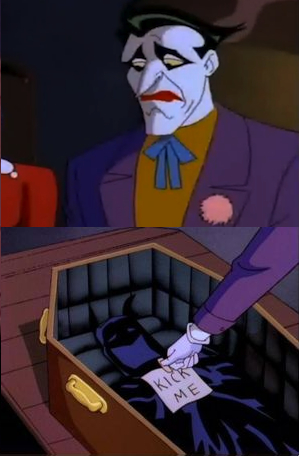
- Batman: The Animated Series: There are two examples in "The Man Who Killed Batman", in which no-name goon Sid "The Squid" accidentally convinces many people, himself included, that he has killed Batman.
- The Joker is skeptical, but after holding up a jewelry store and just waiting there several hours to see if Batman will show up, Joker's skepticism and glee gradually vanish. In his usual bizarre way, Joker mourns the loss of his favorite and most entertaining adversary by holding a symbolic funeral for Batman inside the Joker's "birthplace", the Ace Chemical Plant, complete with delivering a eulogy on how Batman made him the man he is today, and how he now will never be able to defeat him in a battle of wits, and declaring that since he has been cheated out of killing Batman, he will just have to settle for killing Sid instead by having him "buried" in Batman's place; that is, locking him inside Batman's coffin as he has it dumped into a big vat of acid. His goons proceeds to grab Sid and throw him in the coffin, which is lowered in to the vat via conveyor belt as Harley plays "Amazing Grace" on a kazoo. Meanwhile, the Joker watches in silence with sad expression on his face and he lets a Single Tear fall for his lost adversary as the coffin disappears into the acid. Batman, having survived the unintended explosion in the beginning of the episode, turns out to be watching from the shadows the whole time, waiting for his apparent demise to make a particularly troublesome crime boss careless. (He also rescues Sid.) The Joker of course bounces back afterward with a smile:
- To a lesser degree, Detective Harvey Bullock as well. He has frequently made it apparent that he doesn't like Batman. Bullock thinks the Caped Crusader is just as dangerous as the criminals he turns in, and is often ready to bring Batman in at the slightest suspicion that he's gone rogue. But even he is visibly upset by Batman's apparent demise.
- When Superman is thought to have been killed by the Toyman on Justice League, Lex Luthor appears at his funeral. Knowing the history between the two, Lois Lane's disgust and slapping his face just for showing up is justified. Despite this, Luthor admits to genuinely missing him.
- In the DVD movie Superman: Doomsday, Luthor gets positively homoerotic with Superman's clone once it's believed Superman himself is dead.
Lex: Why did you leave me!? WHY!? We had so much...unfinished business...!
- Inverted in Sonic the Hedgehog (SatAM) when, in the series finale, Sonic says, "No more Robotnik. Too bad." Sally looks confused until he adds, "Without a villain, what's a hero for?"
- Invader Zim:
- In the unfinished Invader Zim episode "Mopiness of Doom," Dib gives up Paranormal Investigation to learn "real science" with his father. Zim finds himself too depressed to do any evil and winds up lying on the couch eating junk food. Dib is initially happy but eventually realizes that he's bored and goes back to fighting Zim.
- But somewhat pointedly Averted in "Bad, Bad Rubber Piggy". Zim manages to (temporarily) kill Dib (as a little kid!) and his response is...to quietly take a sip of his drink before merrily going on his way.
- Dr. Drakken gives Kim Possible a brief eulogy when he thinks she's been shot and killed by a laser cannon in the Grand Finale "Graduation".
Drakken: You were a worthy foe. You were, indeed, "all that". Farewell, Kim Possible!
- In the classic animated short "What's Opera, Doc?", a parody of Richard Wagner's works, Elmer Fudd as Siegfried hunts down Bugs Bunny in retaliation for the latter's disguising himself as Brunhilde. When he finally succeeds in his attempts to "kill da wabbit", he regrets it and tearfully carries Bugs away, cradled in his arms. Bugs revives for a moment to address the audience:
Bugs Bunny: Well, what did you expect in an opera? A happy ending?
- This has almost always been Elmer's reaction when he mistakenly thinks he's actually killed Bugs, dating back to their first cartoon, "A Wild Hare". But "What's Opera, Doc?'' certainly plays it up the most.
- Danny Phantom: Though he doesn't outright say it, Vlad Masters in a Bad Future blatantly admits his terrible actions resulted in the loss of those he was close to, mourning them for ten years strong—including Jack.
- ReBoot: After Bob is gone, Hack and Slash realize that there is no one to stop them from finishing their evil acts anymore. This distresses them intensely. It also helps to remember Hack and Slash are a bit of a relic from when ReBoot was a kid's show. When the series got Darker and Edgier, they didn't.
- In The Fairly OddParents! "Wishology" trilogy, Vicky actually breaks down sobbing after Timmy's Heroic Sacrifice.
- In the Phineas and Ferb episode "Come Home, Perry", Perry the Platypus was relocated to a new family and a new villain, and like everyone else who knew him, Doofenshmirtz was feeling a bit sad with the loss.
- An inversion has Perry severely depressed and feeling betrayed after Doofenshmirtz gets a new nemesis and doesn't need him anymore.
- Doofenshmirtz felt sad the one time he believed he had destroyed Perry.
- Tom and Jerry Tales has the titular cat crying for the titular mouse, thinking he is killed by being crushed by a pillar. Afterwards, Tom gets haunted by Jerry's "ghost", not knowing that the mouse is alive and that he and his bat-lookalike are trying to scare him.
- One of the original Tom and Jerry cartoons, "The Lonesome Mouse", has Jerry celebrating that Tom has been kicked out of the house. Before long, though, he finds that life without Tom is boring, so he conspires to get him back.
- Batman: The Brave and the Bold:
- In the episode "Requiem for a Scarlet Speedster", The Flash (Barry Allen) has died (or so it seems), and his old rogues' gallery fondly remember fighting him, and say that Jay Garrick and Wally West "just aren't the same", They don't miss him. Oh no.
- In the episode "Emperor Joker", when The Joker obtains god-like powers, he finally defeats Batman. Though seemingly saddened by the loss of his adversary, it's immediately subverted when he laughs it off and resurrects him to do it again and again.
The Joker: I can't believe it. He's...he's actually gone. Let's take a moment to reflect on the passing of a man who was more than just another do-gooder in tights! He was the best archnemesis a sociopath could ask for! [Beat] Okay! Let's do it again! [Record Needle Scratch]
- Played with in Legion of Super Heroes (2006). Kell-El is the good guy but when Brainiac pulls an Eviler than Thou and kills Imperiex, Kell-El becomes depressed. Not because he has a hero's reverence for life, but because he was created to destroy Imperiex and now doesn't know what his purpose in life is.
- The Simpsons:
- In a non-death example, in "Sweet Seymour Skinner's Baadasssss Song", Bart gets Principal Skinner fired and soon realizes that he misses him as an enemy (the new principal is Ned Flanders, who is too nice to curb any kind of misbehavior). Lisa mentions the trope, explaining that Moriarty needs his Sherlock.
- In a later episode, "Home Away From Homer", Flanders moves away to be replaced by a new bully neighbor who causes Homer to miss Flanders and attempt to get him back.
- Grampa has always wanted to dance on Mona's grave after she left him, but when she dies in "Mona Leaves-a", he's too depressed to do so.
- In the Show Within a Show The Itchy & Scratchy Show: Itchy is inconsolable after Scratchy's death so he invents a cloning machine to bring back his friend/victim to life. Gory hilarity ensues.
- The South Park episode "Smug Alert" shows Cartman at first rejoicing the fact that Kyle, along with his family, has moved to San Francisco. But since Butters doesn't really cut it as a Jewish nemesis to him (not giving the entertaining reactions that he thrives off of), Cartman decides to brave lethal clouds of "smug" (emitted by people who drive hybrids) to save and bring Kyle back to South Park (in secret, of course).
Cartman: We just can't get rid of you, can we, sneaky Jew rat!
Kyle: Don't belittle my people, you fucking fatass! [leaves]
Cartman: Ah, that's better. - SpongeBob SquarePants:
- One episode has an inverted, non-fatal example when Plankton undergoes a Heel–Face Turn and converts the Chum Bucket into a knick-knack shop. Krabs doesn't buy it and continues to antagonise Plankton until Plankton finally snaps, at which points Krabs bursts into tears, partly at the thought of losing his greatest adversary and partly at the realisation of what a jerk he's been to the reformed Plankton. Subverted when it turns out that, not only was Plankton faking his Heel–Face Turn the whole time, but Krabs knew he was faking it and was in turn faking his remorse and subsequent acceptance of Plankton.
- "Spongebob vs the Patty Gadget" has a subversion when we see what appears to be Squidward attending Spongebob's funeral and tearfully laying flowers on his grave... only for Spongebob himself to walk into frame and begin dancing on said grave, which is then revealed to be that of the titular Patty Gadget.
- The Venture Bros.: After Think-Tank is rendered comatose, the superhero Stars and Garters visits him in the hospital and plays guitar for him after being told music helps in the healing process. Given his team member, Warriana has apparently battled him in the past, it can be presumed Stars and Garters was one of Think-Tank's "jock" nemeses.
- Where on Earth Is Carmen Sandiego? featured the loss of the titular antagonist in an avalanche. The detectives and Da Chief have to grapple with the loss of their greatest criminal adversary (Da Chief, in particular, drops most of his snappy dialogue, wondering what went wrong), as the remnants of her criminal organization jockey for control. It turns out that Carmen was Faking the Dead to determine who was worthy of taking over from her when the time came.
- Philip II of Macedon, the father of a certain conqueror, defeated the Sacred Band of Thebes at the Battle of Chaeronea in 338 BC. This was an army consisting entirely of gay male couples, the logic behind which was summarized by Plato: "For what lover would not choose rather to be seen by all mankind than by his beloved, either when abandoning his post or throwing away his arms? He would be ready to die a thousand deaths rather than endure this. Or who would desert his beloved or fail him in the hour of danger?" This evidently proved true, as the Sacred Band was previously known to be invincible, with their defeat and destruction by Philip's forces being their Last Stand. According to Plutarch, Philip wept when he realized who he had been fighting: "Perish any man who suspects that these men either did or suffered anything unseemly."
- Alexander the Great had the soldiers who betrayed and mortally wounded Persian King Darius III killed, though this could also have been because their commander took the title of King of Asia for himself and he also wanted Darius alive. He did have Darius buried in his home as a king, showing him immense respect.
- The Romans were upset that Quintus Servilius Caepio accepted a deal to have Lusitanian chieftain Viriathus assassinated rather than defeating him militarily, to the point they denied Caepio his triumph for ending the Lusitanian Wars. The Romans had come to see Viriathus as a Worthy Opponent, something they very, very rarely did with anybody, much less a barbarian, and this outcome was considered a disgraceful way to dispose of him. Depending on who you believe, Caepio actually had nothing to do with Viriathus' betrayal and was equally upset himself when the Lusitanian traitors came to him with the news.
- Julius Caesar wept at the death of his friend-turned-rival Pompey, after being presented with his severed head and hand by the Egyptians after Pompey tried to seek sanctuary with them. Some of this might have been for good P.R., but he might have also genuinely believed that Pompey deserved a far more dignified end. Caesar had the killers put to death, for the above reasons, and also to make the point that foreigners did not get away with assassinating Roman officials.
- Plutarch writes that Octavian wept when a member of Mark Antony's bodyguard brought Antony's sword to him. It was almost certainly not because of any lasting affection for him, but by that time, they had been fighting on and off for fourteen years. Octavian had crushed every single one of his enemies at last. The feeling of so many years of conflict finally being brought to a close probably made him pretty emotional.
- As mentioned with Julius Caesar and Octavian above, Roman commanders, contrary to the modern notion that they were stone-faced and dry-eyed, were expected to cry Manly Tears over the fate of their vanquished enemies:
- Plutarch records in his Life of Marcellus that Marcellus, after two years of besieging Syracuse, cried his eyes out upon capturing it, musing on how it was about to be looted by his men. He was also upset when he learned that one of his own soldiers had murdered Archimedes, who had been using his inventions, most notably the Claw of Archimedes, to keep the Romans at bay.
- Polybius also makes note that Scipio Aemilianus burst into tears and quoted a verse from The Iliad as he saw Carthage burn. When Polybius asked him what he meant by that, Scipio replied that, just as Carthage fell, so would Rome someday.
- Although Cao Cao and Yuan Shao were goods friends for most of their lives, as the strongest forces of the Three Kingdoms period, a bitter war started between them in 200 AD. Yuan Shao died in 202 AD and was succeeded (mostly) by Yuan Shang in 202. When Cao Cao captured their capital, Ye, in 204, he grieved for his friend-turned-enemy.
- When King Jean II of France died as a hostage in England during The Hundred Years War, his English captors gave him an extravagant royal funeral.
- After Janos Hunyadi's death, Sultan Mehmed II said: "Although he was my enemy, I feel grief over his death, because the world has never seen such a man."
- After destroying the French army in the Battle of Cerignola, Spanish general Gonzalo Fernández de Córdoba ordered to call for prayer for the fallen French and search for the body of his French counterpart, Louis d'Armagnac, Duke of Nemours, and was saddened to find it stripped down by the victors (who had at least the decency to cover his privates with a roof tile). Fernández had a military funeral hosted for Louis and couldn't hold back the tears, as he knew him personally and considered him a young and promising general who had suffered a pointless death by recklessly charging against the Spanish arquebusiers. King Louis XII of France himself would later praise Fernández for his piety.
- Hernán Cortés and his entourage cried at the death of Aztec Emperor Moctezuma, a man they were holding hostage and who in turn had tried to arrange for their ambush and death at least twice.
- The same happened to Francisco Pizarro after his inner circle voted for the captured Inca Emperor Atahualpa to be executed, as the two had improbably become friends. Pizarro originally intended to send Atahualpa to a golden cage in the Spanish court, but was overruled by his less delicate lieutenants and anti-Atahualpist native allies (some of which were Inca themselves who hoped to replace the emperor).
- Uesugi Kenshin reportedly cried at the death of his greatest opponent, Takeda Shingen, with whom he had previously fought a lengthy series of battles.
- In the story of The 47 Ronin, the lead of the titular group, Ōishi, pretended to be a hopeless drunk in order to escape the attention of his enemies. During this time, he was attacked by a random passerby who accused him of being a coward for not seeking revenge for the death of his master. After Ōishi and his men exacted vengeance on their enemy and committed seppuku, the same passerby, now ashamed for what he had done, visited the graves of the ronin and committed suicide. His body was then buried alongside theirs.
- During the Thirty Years' War, Italian general Raimondo Montecuccoli was distraught to hear his Arch-Enemy, the French Viscount of Turenne, had been killed in an artillery exchange before one of their clashes. He proclaimed, "a man is dead today who did honour to Man".
- Frederick the Great upon the death of Maria Theresa: "I have shed some very sincere tears at her death. She has done honor to her sex and to the throne. I have made war upon her, but I have never been her enemy."
- When 17th-century Dutch admiral Michiel de Ruyter died a week after being injured during a naval battle with the French, the French king Louis XIV fired cannons as a salute when the ship carrying the body of Michiel de Ruyter sailed by.
- After the Battle of Trafalgar, the British respected the Spanish admiral Cosme de Churruca so much that, having captured his ship, they placed a brass plaque on the door of the cabin that had been his, and all who entered it were required to remove their hats in salute to a very Worthy Opponent.
- Political differences eventually cropped up among the leaders of the movement that became the Meiji Restoration in 19th-century Japan, but that didn't always make things bitter. Yamagata Aritomo is notably said to have wept over the severed head of Saigo Takamori, his former comrade who'd led the only rebellion against his regime worth mentioning.
- Upon the death of his bitter political rival Benjamin Disraeli, British politician William Gladstone noted his sadness and claimed that he had never held any personal hatred for his opposite number.
- To his utter surprise, John Wilkes Booth was denounced by many in the soon-to-collapse Confederate States for assassinating Abraham Lincoln. Quite a few Confederate officials, including Jefferson Davis and Alexander Stephens, still liked (or at least respected) Lincoln on a personal level and felt that assassination was unworthy of him; many Confederate generals felt the same way, especially Robert E. Lee, who was seen to have covered his face in grief at the news.
- Booth had acted as part of a poorly-planned conspiracy, but one without Confederate government involvement. Even so, many Confederates realized that they could be blamed for the assassination in the court of public opinion even if they had actually nothing to do with it, and so scrambled to condemn the shooting of Lincoln as an act of barbarity.
- Although some Southerners openly rejoiced at Lincoln's death, many more realized that it would actually make things worse because Lincoln had wanted to show relative magnanimity towards the rebelling states after the war ended. With him gone, it was widely feared that the newly reunited Union, controlled by the Radical Republicans would go out of its way to severely punish the rebels and deliberately make life Hell for the South, and for ex-Confederates especially.
- Manfred von Richthofen was regarded with the greatest respect by most Allied airmen. When he was eventually shot down and killed in 1918, his aircraft crashed behind Allied lines in a sector controlled by the Australian Imperial Force, and he was given a funeral with full military honours by No. 3 Squadron, Australian Flying Corps.
- Erwin Rommel received a moving tribute from Churchill upon his death. It was still the middle of WWII at the time.
- During the North African campaign, Rommel ordered that British Major Geoffrey Keyes, the commander of the failed British attempt to assassinate him, to be buried with full military honors. Not only was Keyes killed during an attempt to kill Rommel, Rommel was under orders to treat British commandos as spies (i.e., interrogation followed by execution), not as soldiers, at the time.
- Fidel Castro felt this way about President Kennedy. When asked about his assassination, Castro said, "What I felt when I heard that news was as someone who has an adversary, someone who respects his adversary and all of a sudden, someone else kills his adversary. A boxer in the ring for example, and the adversary is shot to death in the middle of the boxing match."
- Senator Barry Goldwater, who would've run against Kennedy in the 1964 election, felt similar loss, having been Friendly Enemies with the late President.
- The last chapter ("666") of Hunter S. Thompson's Better Than Sex is a meditation on the death of Richard Nixon. He starts by saying that it was Nixon (or rather, his dislike of Nixon) that got him into politics, and "now that he's gone, I feel lonely"... and then ultimately subverts the trope by eviscerating the late president, writing a vitriolic screed that finishes by saying that Nixon "killed the heart of the American dream".
- Pierre Trudeau's funeral provided a twist on the trope: not because old rivals and political opponents paid him tribute and mourned the passing of one of the most charismatic leaders the country has ever had, but because it was an example of Antagonists in Mourning for someone else. The funeral was attended by both former US president Jimmy Carter and long-time American enemy Fidel Castro, who sat beside one another and were both Honorary Pallbearers.
- From the book Blind Man's Bluff, when an American and Soviet submarine had a severe collision in the ocean, and both believed the other had been destroyed, the sailors on both submarines felt genuine regret at the death of fellow sailors, even though they were opponents.
- The U.S. side of Why We Are Bummed Communism Fell. Especially U.S. military and intelligence officers who regarded the Soviet Union as a fine Worthy Opponent.
- During the 1980s, Ronald Reagan and Mikhail Gorbachev were the leaders of opposing superpowers. Despite this, both men respected each other a great deal. When Reagan passed away in 2004, Gorbachev attended the funeral to pay his respects to his former rival.
- Despite the mutual bad blood between both Koreas even after The Korean War, following the sinking of the MV Sewol in South Korea, which killed approximately 295 passengers (with around 250 of them being high school students), North Korea was one of the many countries to offer condolences.
- When one of the most famous historical figures of Argentina, Juan Domingo Perón, died in 1974, the most touching words of mourning came from his political antagonist, Ricardo Balbín: "This old adversary farewells a friend".
- When Republican strategist Lee Atwater died, Democratic Party chairman Ron Brown ordered flags at Democratic headquarters to be flown at half-staff.
- Barack Obama gave a eulogy for his opponent of the 2008 presidential election, John McCain.
- As did George W. Bush, who had previously defeated McCain in the 2000 primary on his own way to a successful presidential run.
- Formula One champions Alain Prost and Ayrton Senna were bitter rivals throughout their careers, even crashing into each other at times to screw each other over. Prost even had a clause in one contract that Senna could not be his teammate, the rivalry was so strong. When Prost retired the second time, they tried to repair their relationship, but sadly Senna died a few months later during the Blackest Weekend. Prost, as it turns out, was one of his pallbearers.
- To this day Prost is reluctant to talk about Senna and admits a part of himself died that weekend as well.
- Prost oversaw the making of the Senna documentary. He made sure Senna came out looking the best he possibly could.
- After the death of Pitt the Younger, his great political rival Charles James Fox said, "It feels as if something is missing in the world."
- One of the greatest rivalries in American baseball was between Red Sox star Carlton Fisk and Yankees captain Thurman Munson, with one altercation between them in 1973 resulting in a 10-minute bench-clearing brawl between the two teams. And yet, Fisk reportedly broke down in tears when he found out Munson had been killed in a 1979 plane crash.
- Similarly, Joe Girardi choked back tears in announcing the cancellation of a game due to the death of rival pitcher Darryl Kile. On an even larger level, the St. Louis Cardinals (for whom Kile pitched) were playing the Chicago Cubs (for whom Girardi played at the time) in Chicago when Kile passed.
- A rare case in college baseball: When the University of California Berkeley's baseball team was threatened with disbandment after budget cuts, fundraisers were held to save the team. Among the donors was Cal's biggest rival, Stanford University, whose fans made plenty of donations. According to former Cal baseball player Doug Nickle: "I don't think Stanford has any problem if Cal loses, but I think they have a problem if Cal didn't exist."
- In the Scottish Premier League nearly every season has been a battle between the "Old Firm", Glasgow-based clubs Celtic and Rangers. However, in 2012, the Rangers found themselves relegated to the lowly third division due to going into liquidation. Whilst Celtic were of course quite happy to mock their bitter rivals with their impending doom looming, many players and fans have admitted it just wasn't the same without their nemesis around, especially considering their clashes on the pitch were the highlights of any given season.
- NBC Sports dedicated their broadcast of the opening ceremonies of the 1996 Olympics to Jack O'Hara, "A colleague in sports broadcasting." O'Hara was the executive producer of rival ABC's Wide World Of Sports, and died in the crash of TWA flight 800.
- Club Nacional de Football and Club Atlético Peñarol, have the most bitter rivality in Uruguayan football (soccer) and one of the most famous in South America. But in 2023, when José Fuentes, President of Nacional died during his therm, Ignacio Ruglio, the President of Peñarol, appeared in Fuentes' wake to show his respects and only have nice word to Fuentes' memory. The next two matches, Peñarol with black armbands as sign of respect and sympathy with his rivals.
- Kazuo Koike, creator of Lone Wolf and Cub and longtime rival to Monkey Punch, creator of Lupin III, was one of many in the industry to tweet in tribute to the latter the day after news of his death broke. Koike himself died seven days later.
- On a lighter scale, (given that it was less about death, and more about Playstation skipping), without Sony attending E3 in 2019, major rival Microsoft had a bigger showing, however Phil Spencer (Head of Xbox) has admitted that "E3 was not as enjoyable without Sony there."
- Austin St. John had a well-known feud with fellow Power Rangers star Jason David Frank, noting that they were "not beer-drinking buddies". However, when Frank died in 2022, he posted a video online paying respects to his former co-star, lamenting the loss his family was enduring, and eulogizing him as "once a Ranger, always a Ranger".
