

Some Speculative Fiction Series and Space Opera shows focus on a Cool Starship or two that's shiny and new and full of all the latest Applied Phlebotinum. The shows are all about idealistic and well-funded explorers or warriors, boldly going where angels fear to tread.
Shows on the other end of the Sliding Scale of Shiny Versus Gritty treat the future as a place where blue-collar workers make a living doing unglamorous jobs and where spaceships look dirty, dingy, and used, like heavy equipment that one might find at a lonely truck stop in the middle of the night right now. The ships are rusty junk heaps of mismatched scrap parts seemingly held together with two pieces of string, chewing gum, and the will of God. The ships are run on a shoestring by scrappy, hard-bitten characters with a Mysterious Past (or even a Dark and Troubled Past in La Résistance) who live on the fringe of the galaxy, the SF equivalent of the struggling Film Noir private eye or Wild West gunslinger. This is the gritty Used Future, and it's home to Space Truckers, renegades, Space Cossacks, a Ragtag Bunch of Misfits, Venturous Smuggler, regular working stiffs on spaceships, and anyone on the "cynical" end of the Sliding Scale of Idealism Versus Cynicism. Think of it as gritty Diesel Punk IN SPACE!
Sometimes, there will be Shiny-Looking Spaceships alongside dingier ones; usually these new, ascetic and shiny ships will belong to the Galactic Military or elite rulers who have access to constantly churning shipyards and the newest heights of technology while the scrappy heroes must survive on surplus gear and DIY repairs. These shiny-looking spaceships, however, can denote that the crew piloting these über-ships is formed of completely green recruits with no real combat experience, often led by a pompous noble, while the battered, laser-scarred ships are piloted by grizzled veterans who can fly circles around them.
The original Star Wars popularised the concept (although arguably Moon Zero Two (1969), Silent Running (1972), and Dark Star (1974) led the way.) For budgetary reasons, typical science fiction offerings from the pre- Star Wars era often resorted to kitbashing to create sets for spaceships, space stations, or planetary locations. This meant a lot of quarries, boiler rooms, and power plants acting as futuristic locations. Also, a lot of junked electronics were used to create random consoles and instrument panels. For contrast, the Star Wars prequels, set in a more civilized time, are correspondingly shinier. (Star Wars is a rare example on the "idealism" end of the above-mentioned scale.)
A notable reason for the look descends from classic tricks for making and photographing models for practical effects work; dirtying up a model helps add a sense of scale. Applying color washes gives deeper shadows, making the surface appear more convoluted and complex than it actually is; adding streaking can help fool the eye into believing that inch-wide panels are actually meters-wide; and adding sooty smears near thruster cones and the like implies realism, even though in the real world those thrusters really shouldn't be spewing out a lot of dark sooty particles.
Interestingly, portraying this in CG effects is actually more difficult, but sometimes the audience won't accept things not looking dirty enough. Which can be ironic because many spaceship exteriors are actually perpetually shiny in real life (polished to a high shine for heat management reasons, and unmarred due to the scarcity of dirt, grime and oxidizing agents in space) — unless, that is, they have to endure high-velocity atmospheric reentry, which the vast majority of real hardware only does once.
On the other hand, some ships use a layered-ablative-standoff-armor setup like the Whipple Shield which takes advantage of the tendency of small objects moving at comically-high speeds to shatter on impact, and lets the first armor layer shatter the junk (which makes a very tidy hole through the outer layer), and the second layer absorbs the (much less dangerous) spray of components without having any holes in it. This would have a scarred and pitted look after a while, and if the ship's owner didn't have money to replace sections of the shield as necessary, it could be this trope to a T.
Contrast Shiny-Looking Spaceships, Crystal Spires and Togas, and Everything Is an iPod in the Future.
See Also: Scavenger World as well as The Dung Ages for the Fantasy Counterpart. Often the aesthetic of choice for Space Orcs or Space Pirates.
Usually found on harder science fictions.
Examples:
- Vandread mostly has Shiny-Looking Spaceships, but a notable example of this trope occurs when the crew visits a space station filled with refugees from the Harvest.
- While we are mostly given a worm's-eye-view of the Armored Trooper VOTOMS universe, this does apply, when the fact that a century-long galaxy-wide conflict has just ended.
- The only ships that appear pristine in the Cowboy Bebop world are, cynically, those belonging to the bad guys. The Bebop, as well as the characters' personal ships, are all rendered with realistic levels of rust, grime and plenty of wingdings from daily usage. Not to mention Jet's Hammerhead is just a futuristic tow-truck and Spike's much-prided Swordfish is some sort of out-of-date (classic?) personalized space race car so neither of them are meant to be shot at. The Bebop itself is a converted fishing trawler with an excusably large outer deck.
- The vehicle in Outlaw Star deteriorates gradually from Shiny Looking Spaceship to Used Future, mainly because the characters do so much traveling in it.
- Planetes focuses entirely on the blue collar workers whose job it is to clean up space junk that endangers flights.
- Mobile Suit Gundam: The 08th MS Team has a bunch of Gundam Ground Types that are basically a pile of spare-parts for the original Gundam that are put together and armed with a couple of large rifles. Maintenance is done quite frequently, to the extent that when a Gundam isn't being piloted, someone is doing maintenance on it, to make sure they work. In fact, the main character arrives at the EFF-base, while his Gundam is being tuned. Most repairs are done simply by taking functional parts from other Mobile Suits and stuffing them on the Gundams, which results in one of the 08th MS Team pilots being referred to as "GM-head" because her Gundam's head gets replaced by that of a mass-produced GM's head after the original head was punched off. On the Zeon side, we got to see a single Zaku Tank, which is basically a Zaku torso with arms and head, stuffed on top of a Magella-class attack tank. We never saw it in action, but one can only assume it was a make-shift repair to a Zaku II that had lost its legs in battle. Expanded Universe sources indicate that Zaku Tanks are common ways to make use of wrecked Zakus, but the use of one for actual combat is quite rare. Normally they're converted for construction/combat engineer work.
- Anything drawn by Jean Girard, aka Mœbius, will usually incorporate elements of both Used Future and Shiny-Looking Spaceships.
- Ignition City by Warren Ellis. The titular city is a spaceport constructed from rusted spaceships that has a lot of expies of classic sci-fi heroes as its residents.
- In Fear Agent it is hard to keep your ship and jetpack shiny when you are the last survivor of a monster-hunting group from Texas with alcohol problems.
- The Generation Ship humans live on in Battle for Terra. The thing barely holds together, and when Mala and Jim visit it the first thing that happens is that the control tower breaks down, killing everyone inside. Jim offhandedly notes this is common occurence there. By the end of the movie, when people evacuated to titular Terra, the abandoned thing can be seen in space breaking apart and leaving trail of its pieces.
- Downplayed compared to the book, but still present in The Mystery of the Third Planet, despite being set in a bright Communist future. In the first scene with the starship the cargo lift is misbehaving, throwing containers back at loading robots. The Eeyore captain keeps saying "The Pegasus will never take off" (the film doesn't mention the starship is an obsolete courier saved from the scrapyard by leasing it to the zoo). When Alice and her father are first attacked by pirate robots, the captain can't help them, because he is busy fixing the hovercraft. And every time the heroes capture enemy robots, the captain plans disassembling them for spare parts.
- Titan A.E., focusing as it does on the refugee remnants of humanity After the End of an Earth-Shattering Kaboom.
- WALL•E pretty much embodies this trope, especially when WALL-E is compared to the sleek, shiny, futuristic EVE. Note that this is literally due to use; they were actually designed and built at about the same time, but WALL-E has been in continuous use while EVE has spent most of the time in storage.
Creators:
- Apparently Dan O'Bannon had a thing for working on films involving this sort of thing. Prior to doing special effects work for Star Wars and writing the screenplay for Alien, he was involved with the production of a low-budget college short-turned-feature called Dark Star which centered around four guys who have been stuck for 20 years on a spaceship which is riddled with malfunctions since nobody wants to do any maintenance. This includes but is not limited to the sleeping quarters being blown away (forcing the men to sleep on improvised mattresses in a food storage room), storage areas self-destructing on their own, a faulty seat which has already killed the original commander, and an elevator that moves up and down at random (with an emergency hatch too small for a person to fit through and an emergency phone that is offline). Incidentally, Dan O'Bannon partially adapted his script for Alien from this film, making it Older Than They Think.
Movies:
- While the Discovery itself is bright and clean in 2001: A Space Odyssey, in the sequel 2010 it's decidedly less so, with dust having collected on it thanks to hanging in orbit around Io for 9 years without any humans to maintain it. The Alexi Leonov doesn't look particularly shiny, either. It's interesting to note that the Leonov is brand new — it was built specifically to recover Discovery after contact was lost. Then again, it's also designed to survive aerobraking.
- The Nostromo in Alien takes the worn, lived-in aesthetic from Star Wars and adds on a thick layer of industrial grime. This even extends to the occupation of the protagonists—they're truck drivers, hardly a glamorous job.
- In The American Astronaut, the space is pretty much dominated by roughnecks and manual laborers.
- In a weird example of people expecting spaceships to look like this, the visual effects people who made Apollo 13 said they had to make the Saturn V rocket look dirtier than it actually was at liftoff, just because people wanted it that way.
- Blade Runner: Decorators just overdid their aversion of Shiny-Looking Spaceships with cloudy, polluted skies, graffiti everywhere and trash blowing in the wind. Ridley Scott actually said "The future is not new. It's old". And because of that it looks amazing.
- Brazil takes place in a highly-stylized Used Future — and, while we're at it, more or less a Crapsack World that simultaneously resembles 20 Minutes into the Future ("sometime in the 20th century") and Diesel Punk. Everything is so used in this future, in fact, that it rarely functions properly, including but not limited to the entire bureaucracy-based system of government.
- All the alien technology in District 9 looks quite used and gritty. The spaceship is itself a wreck that barely managed to reach Earth rather than falling apart into oblivion. The whole point of the movie is to portrait an Apartheid-like regime.
- The film based on Lilac Sphere has a Generation Ship (with all its crew long dead from Hate Plague) that's been in space around 40 000 years. Its hull looks like a sponge and lights don't work, but the air is still breathable. However, the Pegasus is more of a Cool Starship in the film, unlike in its animated spiritual predecessor (see the entry for Animation above).
- The real world in The Matrix, where humans have astounding technology but (having lost the Robot War) must scrounge a living in a cramped, dirty underground city among Absurdly Spacious Sewers and caves.
- Outland replaces the old west mining town from High Noon with a mining "colony" on Io that is as dirty, cramped, overcrowded and "used" as the crummiest oil-rig of today. The hero and the leading lady are middle-aged, unattractive (by movie standards) and cynical. The bad guys are not aliens or galactic emperors, but drug-dealers, corrupt cops and venal businessmen. The weapons are shotguns and rifles. It takes a year for spaceships to travel from Earth to Io.
- Pacific Rim has shades of it. Computers are holographic but they need huge tapes/disks for information, Jaegers are often rusty and dented and society is on the verge of collapsing with ration for work programs. Cherno Alpha embodies this trope the best, being the oldest working jaeger (and boy does it show among the newer, shinier ones).
- Andrei Tarkovsky did not like the clean look of 2001 and made Solaris in 1972 partially as a response. The space station in that movie is made intentionally to look broken down and features loose wires that often shoot sparks, trashed rooms, and bare bulbs.
- Given the genre it's parodying, it's probably not surprising that this trope gets a lampshade hung on it in Spaceballs.
Dark Helmet: Fuck! Even in the future nothing works!
- Star Wars:
- Most spaceships and other futuristic devices are covered with dings and scratches. The 'droid characters R2-D2 and C-3PO look scruffy even before they end up trekking across a desert (Threepio even has mismatched feet), Luke's landspeeder is missing the casing of one of its engines, while the Millennium Falcon looks like it's almost ready to fall apart — and, in fact, the Falcon breaking down mid-flight is a major story beat in the second movie. This extends to the sound design as well; apparently George Lucas' instructions were that he wanted to hear every loose bolt in the Falcon's engines.
- This trope is also used to contrast the Galactic Empire and the Rebel Alliance. Imperial equipment is immaculate and their design utilitarian, favoring sharp geometric shapes, from their capital ships' interiors to their disposable TIE Fighters. The Rebels meanwhile start the Galactic Civil War with whatever (frequently obsolete and cast-off) wargear they can scrounge together, and some of their ships look like they're held together with space duct tape and the Force. Even when they're reinforced with professionally-made ships, like the X-Wing fighters* or the Mon Calamari star cruisers*, their older stuff sees use out of necessity, emphasizing that they're still a Ragtag Bunch of Misfits no matter how large the Rebellion grows.
- The original movie uses this trope to demonstrate what a dirt-poor backwater Tatooine is. Starting in orbit aboard the clean Alderaanian corvette and a Star Destroyer that invokes Germanic efficiency, the story moves to the surface, where Jawas roam the desert in a ramshackle sandcrawler to sell stolen hardware to farmers who literally live in a hole in the ground. While the embarked Stormtroopers are clad in pristine white armor, those on the ground are shown to be as dirty and sand-blasted as the peasants they oppress.
- The prequel trilogy turns the aesthetic around, since it takes place over the last generation of the Republic, amid the seats of planetary or galactic power, resulting in far cleaner and tidier sets and Shiny-Looking Spaceships. But when the action shifts to locations like Tatooine or the seedy underbelly of Coruscant, things get noticeably grungier.
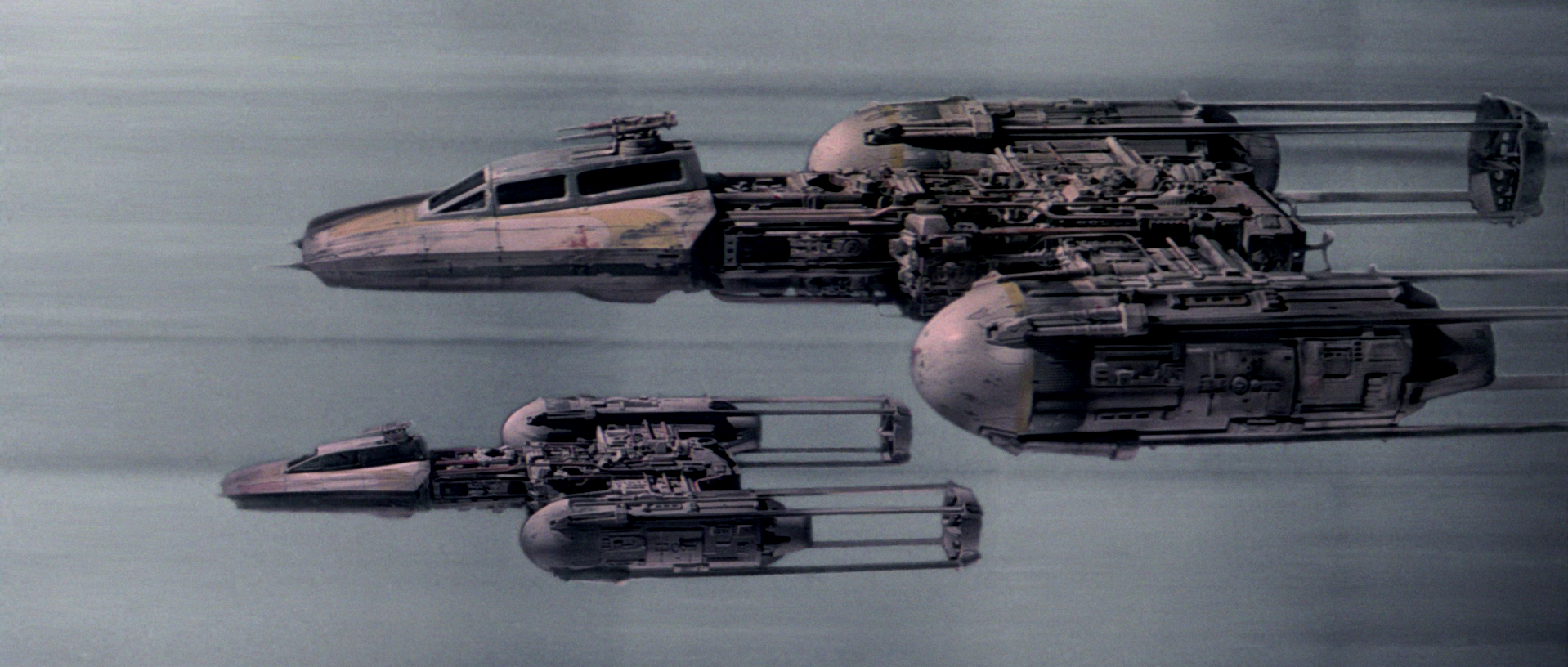
- The Y-Wing fighter-bomber notably bridges the design aesthetics of the prequel and original trilogies. When the ship first appears in A New Hope, all the Y-Wings that participate in the Death Star trench run◊ are stripped down to their bare fuselages, exposing the cabling and wires. But Star Wars: The Clone Wars reveals the originally, the Y-Wings looked sleek and fully-armored◊, with an entirely different ship profile. It's just that the Y-Wing's design flaws resulted in a constant need for maintenance, and by the time of the Rebellion decades after the ship's introduction, Rebel technicians got fed up with removing the armor to get at the cooling system and stopped bothering to put it back on. This, in turn, actually fixed several of the major issues and ended up making the Y-Wings more reliable to the point that the armor was left off (apart from around the cockpit, in order to protect the crew) and the Y-Wing's distinctive profile and appearance was born.
- Every future sequence in the Terminator franchise, with Terminator Salvation being an entire movie of this. Of course, it helps that the future the movies feature is set after a major nuclear holocaust.

- The Hitchhiker's Guide to the Galaxy: Arthur is taken aback by the squalor of the Vogon ship, and notes that the much shinier Heart of Gold is more in line with what he expects of a spaceship — of course, the Heart of Gold is only clean because it's so new that it still has the protective film on.
- Robert A. Heinlein led the way with Used Futures in many books. Here are several books and stories.
- The Man Who Sold The Moon, 1951
- Citizen of the Galaxy, 1957
- Farnham's Freehold, 1965
- The Moon Is a Harsh Mistress, 1966
- I Will Fear No Evil, 1970
- Even The Rolling Stones (1952),
- "The Machine Stops" is about a future civilization that has grown dependent upon automation. When the titular machine deteriorates and dies, so does the civilization.
- Older Than Radio: H. G. Wells' The Time Machine. When the Time Traveller visits the distant future, everything is older than the dust that covers it and the inhabitants make use of the technology only out of habit or instinct.
- Revelation Space Series:
- The first ship described is about 3-4 kilometers long and has 5 people running it. Vast swathes of it are described as "flooded with coolant... others were infested with rogue janitor-rats... patrolled by defense drogues which had gone berserk... filled with toxic gas, or vacuum, or too much high-rad." As the story goes on, things go worse and worse, culminating in the ship evolving into a veritable virus-mutated, alien-infused sentient Eldritch Starship.
- A few stories take place during the earlier "Belle Epoque" age when everything was shiny, back when the Rust Belt around Yellowstone was known as the Glitter Band. Then a nanotech virus called The Melding Plague arrived and ruined everything.
- Everything Peter Watts ever wrote. Everything. Well, no, that's not strictly true; some of his stories are set in futures so used they've fallen apart; but the rest of them are just severely used. The prime example of this trope is, of course, the Rifters Trilogy, particularly Lenie Clarke's cross-country tour-o-death in Maelstrom.
- "Do Androids Dream of Electric Sheep?" has "kipple" — the accumulation of society's junk and litter, which seems to grow spontaneously whenever you're not looking. The Earth of the story had been largely abandoned in favor of space colonies, leaving many empty and unmaintained sections of the city to rot and accumulate random garbage. Appropriate, as it's the book that Blade Runner is based on.
- Isaac Asimov
- Foundation Series:
- The Prequel novels demonstrate that it takes a critical eye analysing the infrastructure of Trantor to notice the signs of decay, but even without psychohistory, Seldon can observe the Empire’s corruption and deterioration. During "The Psychohistorians", Gaal Dornick, a mathematician from a small planet in the galaxy, sees Trantor as a powerful and majestic capital for the Galactic Empire, but Seldon shows him how psychohistory predicts its imminent collapse. The illusion that the Empire is still strong comes from ignorance of the decay. As we leap ahead to each conflict, various factions use the remnants of the Empire's technology to live as best they can. Foundation (1951) shows wealthy technicians maintaining machines by rote and ritual, while the Empire's territory shrinks in size over the centuries. Foundation and Empire shows the Empire reduced to only a few hundred worlds, and then, to a few dozen, while their enormous ships are re-commissioned because their newer ships aren’t as good. Second Foundation shows the Empire has collapsed entirely, leaving the capital of Trantor an Agri World that sells the ready-made steel from the vast abandoned cities to clear more land for crops.
- Inverted by the Foundation, who Seldon predicts will form the core of a Second Galactic Empire. They are initially established on Terminus, where most of the metal they have was from their initial colonization and they rely on Imperial degree to protect them. While the Empire collapses, the Foundation is forced to improve their technology and defend themselves. Their ships are smaller, and faster. They've miniaturized Deflector Shields and self-destructing message capsules. Late in the series, they've begun to build Mind Static device and other machines to escape the psychic control of the Second Foundation.
- "Someday": Niccolo's Bard is a very old model, from when he was a kid (Niccolo is eleven). It has dents and corrosion, stemming from intentional and accidental physical abuse. He'd much rather a newer model, but his family can't afford one any newer.
- Foundation Series:
- Book of the New Sun "describes the future where humanity just sits at home and waits for the money to run out" according to Gene Wolfe. The central character grows up in the hulk of a former starship which still has a couple of operating devices, if you can round up enough apprentices to hand-crank them. Miners dig up old machines rather than raw materials, which were exhausted a long time ago (indeed one of their measures of time, the "age," starts when one resource is exhausted and ends when the next runs out.) The very rich have access to advanced technology, which they appear to get by trading slaves to aliens.
- Tales of Pirx the Pilot by Stanisław Lem.
- In Michael Flynn's The January Dancer, the New Angeles finds the artifact because it broke down and they had to mine on an uninhabited planet just to repair it.
- One of the novelisations of Battlestar Galactica (1978) mentions that the eponymous vessel has been in service for 500 years! The small observation dome on top, where courting couples go to gaze at the stars, was originally used to take navigational fixes.
- The Books of Ember: An underground shelter city was supposed to keep the remnants of humanity safe from an unspecified apocalyptic event for 200 years, but keeps being used because everybody misses the critical event that should have provided the call to leave. Decades pass and everything starts to degrade — spares for everything run out, pipes are held together by rags and duct tape, and the hydrogenerator that drives the whole thing regularly breaks down. Eventually the generator gets so bad fires become a daily occurrence, and the main characters realize that the only viable long-term plan is to leave Ember.
- Much of the Solar System in The Expanse has been settled, and colonists in the Asteroid Belt ad beyond are the poorest around, surviving mainly off of ice found in the Belt and processed fungi. Many make their livings as space truckers in blocky, beat-up "ice haulers." Military ships are often blocky on the outside as well, but their interiors are usually shiny as hell.
- While mostly averted in The Lost Fleet in the beginning (ships are consistently described as sleek and "shark-like"), the later novels make it clear that The Alliance is straining under the pressure of a nonstop hundred-year war with a horrendous casualty rate. In Geary's time, ships were built to last 100 years, 150 with a refit. Now, most ships are destroyed in battle before their first year of service, so no one bothers to build them to last over 3 years. Since Geary is so successful in keeping most of his ships alive (by virtue of not being a moron in terms of fleet tactics, which are pretty much nonexistent in this time), the fleet's engineers now have to scramble to replace parts (such as power conduits) that start to fail with a startling regularity. When the fleet finally returns to Alliance space, he is given several of the new Adroit-class battlecruisers. Geary takes one look at their specs and gives a massive WTF. It's about half the size of the previous battlecruiser class, has less weapons and defense systems, and its sensor package is completely useless for its primary role. When Geary actually visits the Adroit, he is startled to see that the ship hasn't even been properly finished and that its engineers are trying to finish up on-the-fly with plenty of exposed bulkheads, wires, and conduits.
- Lucifer's Star by C.T. Phipps has humanity survive the Great Crash that resulted in the Galactic Dark Age, which the names should tell you were not pleasant. As such, Schizo Tech is very common with some planets very primitive despite some high-tech items and most advanced tech being heavily used. Word of God said he was inspired by Alien, Star Wars, and Firefly.
- The nonfiction Where the Wasteland Ends (1972) by Theodore Roszak employed this trope as a critique of modernism, invoking examples of decaying mid-20th-century modernist artifacts as seen in the early 1970s.
- The Ark in The 100 has an air of this having been cobbled together from a dozen disparate space stations nearly a hundred years previous to the series opening. The ship they send down to Earth literally starts falling apart during entry.
- Gerry Anderson shows, from puppets to live-action, loved this trope. Virtually every building and vehicle exterior would feature some variant of rust, paint chipping, burn marks, lubricant stains, dirt streaks and mismatched panels. Although the interiors were usually fairly pristine.
- Almost all the ships in Andromeda, except the Andromeda Ascendant herself, which was a time-shifted relic of a bygone era of cleanliness. The series is really about injecting old-fashioned heroics into the Used Future. More Old Commonwealth ships are later recovered to become the core of the New Commonwealth's Space Navy, only to be ambushed and wiped out.
- Babylon 5 went so far as to prominently feature a station that had acquired Used Future levels of grime before it opened.
- Not to mention homeless people and illegal drugs.
- The relatively advanced Minbari and Vorlon stuff, on the other hand, is plenty shiny. When it comes to ships and space stations, it seems that human manufacturers have had a decades-long preference for dingy-looking, mostly unpainted metal paneling with no easily discernible regular pattern. Ultimately, this aesthetic is not reflected in the Victory class produced a few years after the series proper ended, but since only one prototype is left and its spacedock is busted, Earthforce is gonna stay looking that way for a while longer.
- Eventually, a Minbari character dryly observes that if humans were allowed to make such decisions, every starship would only use the colors grey or green. Suffice to say, even where technology isn't a limiting factor, the humans and the Minbari have very different cultural preferences to starship design.
- However, until the founding of the Interstellar Alliance, technology was a limiting factor as humans could only simulate gravity with rotation.
- Battlestar Galactica, both versions. The Galactica is even called "The Old Bucket" by its crew.
- The Battlestar Pegasus is included in the series pretty much just to show how a Battlestar actually fit for battle is supposed to look.
- Just to rub in how much more advanced the Cylons are, once we get episodes set inside a Basestar in the second season we find out they're tastefully and futuristically decorated with curved, minimalist passageways with lights set in square sconces, flowing streams of water serving as user interfaces, bands of cyclopic red, Matrix Raining Code holograms in the bridge, and Victorian furniture.note
- Zigzagged in Blake's 7 mainly due to the No Budget sets depicting a rundown dystopia with all the shoddy architecture and bureaucratic indifference you'd expect with a low budget series written by British scriptwriters writing what they know. While we have the pristine white of Supreme Commander Servalan's office on her space station, and the baroque alien design of the Liberator, we also have rundown freighters like London (the spaceship that carries the protagonist to a penal colony) and Scorpio (the vessel that succeeds the Liberator in the final season), while scenery ranges from muddy quarries to the white heat of British nuclear power station technology.
- In the CSI episode about Star Trek fans — all right, Astro Quest fans — the sample clip of the proposed Darker and Edgier revival of the old sci-fi program has a definite Used Future look to the set, costumes, and characters.
- Doctor Who:
- The series dips in and out of this, although it's extremely soft sci-fi with a handful of exceptions. In "The Long Game", the worn look of everything is actually the point, as The Conspiracy has kept human culture and technology stagnant for years. Averted by the shiny Mars base in "The Waters of Mars", though that makes sense, since it's a fairly recent outpost with a tiny population.
- The TARDIS is practically the embodiment of this trope. It's a clapped-out old relic locked into one appearance, the last of a model which was junked by its creators centuries ago, and which is in places held together with paper clips and hope. Nevertheless, it still manages to be the most powerful ship in the universe.
- On the outside it remains as pristine as the shiniest of Shiny-Looking Spaceships, except for the time it got graffitied. And that was really done by Rose Tyler using the Time Vortex anyway. Travelling anywhere in it does seem to clean the outside, as seen in "Vincent and the Doctor", where a layer of posters the TARDIS has acquired is burnt away after a short journey.
- The TARDIS seems to be a kind of Empathic Shapeshifter with regards to this — it's almost always quite shiny, but when we're shown the TARDIS belonging to the War Doctor, it's absolutely battered and covered in stains and flaking paint, both outside and in. This reflects the War Doctor's been-through-it-all, weary personality.
- "42" is set on the cargo spaceship Pentallian, which is old, failing and has to resort to an illegal method of fuelling itself up.
"Everything on this ship is so cheap!"
- "Utopia": At the end of the universe, everything is rough and worn-down. The computers need near-constant rebooting, among other issues.
- Firefly, though there is a deliberate contrast between the Shiny-Looking Spaceships of the Alliance and the used, battered craft on the border regions, as well as the Space Western design of the outer planets compared with the Crystal Spires and Togas look of the central planets.
- In "Heart of Gold", the rich guy who runs the world is deliberately keeping the world rustic so he can "play cowboy".
- In "Ariel" the crew salvages an old air ambulance (that's still a pretty well-advanced piece of technology itself) from a junkyard as part of their scheme to rob the pharmacy of an Alliance hospital.
- In "Out of Gas" it's revealed that Mal bought Serenity from a literal used spaceship lot.
- Red Dwarf. It got much softer as time went on, due to the remaining crew members moving into the more luxurious officer's sleeping quarters (at least while still on Red Dwarf).
- The titular Red Dwarf itself was a mining ship, and other than the command deck, really looked the part. (An early plot point revolves around changing the interior color from ocean grey to military grey.) The exterior as well, until the ship was re-built in the later seasons, looks correspondingly used. Plus the "nothing ever works" aspect applies, many episodes revolve around various malfunctions. (Service robot screwing with the wiring, docking bay doors that don't open, etc.)
- The series also includes characters who are products of the Used Future, in the form of a defective hologram, a senile computer, a neurotic service droid and the way the sassy Scutters seem to have almost developed 'personality' over the millions of years they've been left unattended.
- The novelisation describes the Red Dwarf as having old, out of date technology even when Lister first got on it.
- Stargate:
- The Traveler ships from Stargate Atlantis are jury-rigged to hell, the result of having to keep them going for decades on anything that comes to hand. They're still pretty badass though, given that just one of these manages to beat 3 rogue Asgard ships and then save the Daedalus. That said, Vanir (the Pegasus Asgard) ships themselves are a far cry from the shiny and sleek ships built by the Ida Asgard. Justified due to their far more limited resources and the fact that their original ships (the ones they used to come to Pegasus) were all destroyed by the Wraith.
- Somehow preventing the Destiny (over 50 million years old) from breaking apart is one of the constant main concerns of the characters in Stargate Universe.
- The Tulip in Starhunter is extremely old and beat-up, with huge sections of the exterior hull missing and suffering frequent mechanical problems. Doesn't help that she's been through at least two retrofits, starting out as a luxury passenger liner, then converted to a troopship, then surplussed out and turned into a bounty hunting vessel. Most of the locations visited are similarly dark and dingy.
- In Star Trek it shows that minor races that lack the Federation's technology and resources are filthy. The interiors of Romulan, Cardassian, Dominion, Ferengi, Hirogen, Vulcans, etc are all quite clean, and neither the Borg nor the Klingons care.
- The Klingon military is said to like keeping their ships as spartan and utilitarian as possible, viewing Starfleet's creature comforts as "soft". With the Ferengi, it's down to their extreme predatory capitalism making even properly functioning essentials come with extravagantly extortionate price tags.
- The titular space station Deep Space Nine was like this early on, as the Cardassians had stripped and/or sabotaged everything of value and importance and then some. A running flavour detail in the first couple seasons was O'Brien's constant efforts to make the station livable.
- In an interesting reversal, the further they go into the future it depicts even more streamlined Federation ships. The further into the past shows the Federation ships as being fairly rough looking. The Star Trek (2009) movie redesigns the Enterprise and even shows the rougher USS Kelvin, making it interesting to look at the aesthetics of Star Trek: Enterprise, the movie, and Star Trek: The Next Generation eras.
- The story aspect of BIONICLE portrays Mechanical Lifeforms living a tribal lifestyle in a fantasy world mixed with remnants of Lost Technology that vaguely hint at some old calamity. Juxtaposing dilapidated advanced robots and their mysterious past with natural settings was a huge part of the franchise's concept pitch and unveiling their origin was the franchise's longest unspoken Driving Question. Comics and occasionally even LEGO building manuals would portray the robotic characters as dirty and scuffed after centuries of use (the toys themselves were, of course, pristine). In the series' 4th year, half of the mystery was unveiled with a prequel arc about the high tech pre-cataclysm world, after which the franchise returned to its more fantastical roots, culminating in the Bara Magna saga, a desert world of ruined tech. The Animated Adaptation The Legend Reborn put extra emphasis on making the characters' armor and vehicles look as rugged as possible, contrasting them with the new arrival Mata Nui and his shiny golden armor.
- The Sword outright has a song and album titled "Used Future". The Animated Music Video is a 16-bit RPG reminiscent of Fallout and Terminator, where the band members fight some evil robots in a post-apocalyptic desert.
- As with the Literature example above, any game with a cyberpunk setting will have this trope in effect by default.
- Battletech plays this trope straight, especially in the beginning. With the technology for most high tech weaponry lost, the best weapons are also the oldest. And in most cases, they have been used all the time. Of course, this was only a plot device to rediscover better technology later on, and to introduce stronger units into the game.
- Heavy Gear is a fairly far-future setting which has humanity spreading out from Earth to thousands of other worlds, all becoming their own independent cultures, complete with interplanetary and even intergalactic travel. It depicts almost all of its units not only as real military equipment with the attendant limtiations (maximum ranges thanks to fuel limits, limited ammunition even for energy weapons, maintenance needs and breakdowns, parts shortages especially for experimental tech), it also goes out of its way to avoid having anything appear particularly shiny or new—even one-of-a-kind prototypes like the Hunter XMG feature worn, pitted hulls to reflect the fact that they are machines undergoing significant wear and tear, in keeping with the game's Desert Punk aesthetic.
- Lancer: IPS-Northstar armors tend towards this aesthetic, with more realistic heavy proportions and visibly weathered yet reliably tough aspect. This establishes them as manufacturers of reliable, implacable workhorses with simple yet effective equipment - and helps them stand out against the slim, shiny and showy Smith-Shimano Corpro frames, the hard-edged and visibly militaristic Harrison Armory style, and whatever the fresh hell HORUS is doing.
- Transhuman Space: A lot of the tech is new and shiny, but where it's used and shabby, the fact is acknowledged. The Broken Dreams supplement discusses the topic in detail.
- Traveller has both. There are Cool Ships — for instance private yachts or large ships of the Imperial Navy or a Megacorporation. And then there are used ships which do meat and potatoes jobs like Free Traders, the IISS, or the Sworld Worlder's Confederation Patrol. Though in a potential subversion, even Free Traders are major investments; it's worth a guess that even on a small ship, the bridge (if not the hold) will look like a library or an office, rather than like a Firefly or Millenium Falcon.
- Warhammer 40,000
- The Tech-Priests of the Imperium are quite suspicious of any technology that hasn't proved its worth for several millennia, while some specific vehicles or pieces of equipment have been lovingly-maintained for ten thousand years, and are often quite battered underneath the gold leaf and religious iconography.
- All the Orks' technology looks like scrapyard metal haphazardly bolted and welded together, but that's what it looked like new. The less commonly encountered Rak'gol take this a step further and their vessels usually boil down to whatever they could rivet around a nuclear reactor and successfully launch into space, with their technology often leaking radiation in doses lethal to humanity due to minimal maintenance.
- Other alien races avert this, though. The Eldar's equipment and armour is always sleek and immaculate, despite being older than mankind's, while the Tau were specifically designed to avert the trope in contrast to its near-ubiquity among humans.
- Dead Space:
- One would be hard-pressed to call the USG Ishimura of Dead Space a "nice workplace", even if one ignores the ravenous, nightmarish Necromorphs. It doesn't look like it looked much better even before the infection. It's all rugged-edged metal and screeching doors, hence the developers calling it "an oil rig in space".
- Depending on the section, the Sprawl of Dead Space 2 averts and plays this straight. Sections like the residence halls, Church of Unitology, shopping center, and school are well maintained, while sections like the mining decks are quite reminiscent of the Ishimura.
- Dead Space 3 continues the theme, being set on a series of spaceships as well as a colony on an alien planet that are all over 200 years old. One wonders how much of the Dead Space universe isn't covered in rust.
- The Doom games makes use of this. This is especially noticeable in Doom³'s 'Mars city' The well maintained sections look pretty rough, the seldom used sections are dilapidated, then the forces of hell turn up...
- EVE Online the MMORPG features the Minmatar Republic, a race of former slaves whose ships are often mocked for being "Flying Junkyards", and the Minmatar pilots often iterate their sacred adage "In Rust We Trust". The trope is avoided in the game by ships belonging to the other factions, most notably and appropriately those of the Amarr Empire, the Minmatar's former enslavers, whose ships are covered in pristine gold plating.
- In Freelancer, the lawful factions mostly have Shiny-Looking Spaceships (with the exception of Bretonia, whose ships are dingy brown and ugly as sin), while the pirates have to get around in filthy junk heaps. The starter ship, the Starflier, is a heap of rubbish whose one advantage is its manoeuvrability, bases are often simply carved out of asteroids, most of the bars on space stations look like dingy, seedy dives, and the Leeds system is so filthy and polluted that it has smog clouds. Smog clouds in space. Ironically, the best ship the player can have is a powerful custom pirate ship.
- Gears of War pretty much runs rampant with this, especially the "used" part. Anywhere outside of Jacinto, and even a lot of places inside of it, are battered, damaged, run-down, and barely functional.
- Although it should be noted that most of their earth was Kill Satted by their own government, to attempt to slow down their enemies and rob them of any spoils. Those places also tend not to be inhabited by the only remaining formal government's citizens.
- From the bits seen in Jacinto that were actually in somewhat decent if disheveled shape and the backstory provided in bonus materials it's learned that these locations were at one time exceptionally pretty and opulant but after ninety seven years of total war on a planetary scale first between various human nations and then against the locust has pretty much ruined them all. Scrubbing away the grime or mowing the grass just isn't as high a priority as fending off the hulking xenocidal alien monsters.
- It gets worse by the time of Gears of War 3 where humanity has lost all of its cities and all humans now exist as self-defending tribes. Everything has predictably become dirtier and more desperate. Less Used Future and more Scavenger World.
- Infinity: The Quest for Earth has the StarFold Confederacy, who are essentially a breakaway faction of industrialists and super-capitalists who don't care about the aesthetics of their ships.
- The Jak and Daxter series, as of the second game, takes place in a Crapsack World 20 Minutes into the Future where everything looks like it came from 1984.
- Mass Effect:
- The Council (including humanity) invariably have Shiny-Looking Spaceships and space stations. However, as you begin to explore the galaxy, visit remote colonies and the lawless Terminus Systems, this trope comes further and further into play. The difference between the Citadel (the capital of the Citadel Council) and Omega (the "capital" of the Terminus) is quite striking.
- The quarian fleet is a good example of an entire fleet of ships that have been constantly patched up for the last 300 years by quarians who lived on them for generations after they were driven off their homeworld by the geth. Centuries of maintenance have turned most quarians into engineering geniuses. Young quarians on their Pilgrimage try to find a ship, any ship, even one that every other race would write off as a wreck, fix it up and get it flying again.
- The Normandy SR-2 has some of this in Mass Effect 3 thanks to being on the tail end of a refit when all Hell broke loose on Earth. Several rooms have access panels missing, cables draped across the floor, et cetera. It's still perfectly spaceworthy, just not as pretty inside as it used to be.
- 20 Minutes into the Future, Pokémon Colosseum features Pyrite Town, a dirty, patchwork city full of thugs that uses banged up versions of the technology found in the game.
- Sins of a Solar Empire makes some use of this trope for many of the TEC's craft, understandable given that the bulk of them are repurposed civilian vessels. They by and large go for the utilitarian look, but aren't all wrecked up. They do feel a lot like this trope compared to the Vasari, or especially the Advent, where everything is shiny, ironic because they're the rebel-like faction.
- The pirates have spikes on their spaceships. Why? Because most of them are refitted TEC ships and heck yea!
- The Terrans from StarCraft, sometimes portrayed as a futuristic version of the Deep South. The art book for StarCraft II describes them as the "junkyard dogs" of the setting. The exception is the Umojan Protectorate whose technology is bright, sleeker, and shiny.
- Wing Commander, especially Privateer. Not quite so much with Prophecy, and the TCS Concordia from Wing Commander II. Given that the former is "fresh from spacedock" on its shakedown cruise, and Tolwyn is using the Concordia as his flagship, though, this isn't surprising. The sleeping chamber from Wing Commander I even has water dripping from the ceiling into a metal bucket standing in the metal-plated floor.
- The Teladi ships in X3: Terran Conflict are basically flying rust buckets, assembled in sweatshop shipyards. They sure can take a beating, though. The Pirate and Yaki factions have old, repainted and modified versions of the Commonwealth ships, and capital ships assembled from the rusting (in space) remains of old cargo ships, welded together. The Argon ships also have some shades of this, at least on their fighters - the ships shown visible signs of wear, rust, and bad welds.
- The Albion Skunk of X: Rebirth is kinda like the Millennium Falcon or Serenity in that it is extremely old and beat-up.
- Most Metroid games consists of running through partially ruined technology of all kinds of aesthetics, with rusty crashed spaceships and half-ruined bases mixed with wilderness. Then again, the technology levels range from Organic Technology to Magitek.
- Vega Strike firmly stands here. Humans use both cheap fairly good fighters and Shiny-Looking Spaceships at 10-20 times their cost made by an elitist faction, cargo is hauled by Space Truckers on ships looking like a box with thrusters and cabin welded on or a bundle of cans. note The same applies to some aliens — one of NPC random phrases is a joking advice to keep the distance because "They say paint job is a structural component". Most space stations has pretty rough-and-tumble design style too.
- Tachyon: The Fringe, both played straight and averted: the Bora rebels use large, heavy fighters that look like they've been put together with pieces of several ships and haphazardly patched up many times, while the GalSpan corporation has nimble, sleek fighters that look like they've just come out of the factory. The former is a mining guild which saw no need for dedicated warships (save for occasional pirate raids) until the GalSpan incursion, while the latter is the largest and most powerful MegaCorp in known space likely the only one able to field a Standard Sci-Fi Fleet. For game balance, Bora ships are slow, bulky things with thick hulls and powerful weapons (repurposed mining equipment). GalSpan ships are fast, maneuverable, but fairly weak in terms of hull strength and firepower. Also averted by Star Patrol, whose Enforcer fighters are what happens when you take a StarFury, paint it white, and smooth out some of the lines.
- Deus Ex has this in spades, but the sequel, Deus Ex: Invisible War and the prequel, Deus Ex: Human Revolution, have more equal measures of shine and grit.
- Timeline-wise, Human Revolution takes place during a Golden Age of technology and Bio-Augmentation but also with significant portions of society being left behind and clear urban decay wherever augmentation hasn't helped. The original Deus Ex takes place after a major backlash against augmentation, several high-profile terrorist attacks, and a plague that is threatening to wipe out a large number of people. Invisible War takes place after the Collapse, but with society slowly recovering.
- In Deus Ex: Mankind Divided, taking place shortly after Human Revolution but before the original game, shows the transition from the "Golden Age" to this trope, with a huge social backlash against anyone with augmentations. The fact that some augmented extremists are perfectly willing to use terror tactics in retaliation only adds to the feeling. Compare Adam's mostly sleek-looking augs to the leader of the augmented extremists, whose augs are rough-looking and bulky.
- Naturally, the Fallout series' future is used, broken, jury-rigged back together, and then used some more. Particularly notable examples are the Highwayman of Fallout 2, with its lack of hood or trunk cover (and don't even think about paint), the tragically damaged AI M.A.R.Go.T. (who states herself to be operating at 14% capacity), and the duct-tape-heavy skins of the Hunting Rifle in every last game.
- Marathon, especially in the first game.
- Both Portal games bring this trope into effect. The second half of the first game and the first half of the second game.
- The Half-Life games showed a bit of this in the old, abandoned segments of Black Mesa but really cranked this trope up in Half-Life 2 which simply screams cyberpunk and dystopia. Every lab belonging to the Resistance is full of visibly old mainframes and CRT monitors, despite the fact that the second game is supposed to take place somewhere in the 2020s. Justified in that there has been a Vichy Earth situation going on since the events of Half Life which significantly curtailed human technological advancement on all fronts, and there's no way to get your hands on shiny, brand-new technology without stealing it from the Combine. One particular example is the Gravity Gun: it's the wet dream of every physicist, yet it looks rusted and ready to fall apart at a moment's notice.
- The Longest Journey and Dreamfall: The Longest Journey have this with Stark, the world of science. While the wealthy live in shiny high-rises and travel in Flying Cars, the majority of humanity lives in lower levels with slums, ghettos, and art schools. It's no wonder that, when April first ravels to Arcadia, the magical world stuck in Medieval Stasis, she's awed by its beauty and simplicity (being an art student helps). Naturally, she decides to stay in Arcadia after the events of the game. Things get only worse in Stark after that. The Collapse results in society going back to older technology, and interstellar space flight is no longer a possibility (not that life in the colonies was a picnic). Notably, things in Arcadia have also taken a turn for the worse but for a different reason. Life in the colonies may have been worse before the Collapse, but after the Collapse they may be dying out. It's heavily implied that the colonies were deliberately kept from being self-sufficient, so they'd always be reliant on Earth for supplies.
- Both played straight and averted in Star Wars: The Old Republic in regards to personal starships. The Sith and Jedi have sleek-looking craft, the Imperial Agent has an elaborate cruiser and the Republic Trooper has a military drop ship, while the Smuggler has a well worn-in freighter and the Bounty Hunter's (stolen) assault craft is a rust-bucket.
- The futuristic, steam-punk world of Machinarium looks extremely rusty and worn out.
- Low wealth and possibly mid wealth sims living in the cities of tomorrow in SimCity have their choice of either retro-fitting their ranch homes and brownstones with clunky machinery and laser lights or shacking it up in a massive, bulky, and bleak mega-tower. OmegaCo is considerably much grungier than its Academy counterpart, to the point that even the corporate headquarters is just a black tower with neon lights.
- Everything in Alien: Isolation has a sort of futuristic 70s feel and the ship interiors have a very worn, "lived in" look, keeping consistent with the original film.
- Waste Land was fairly shiny. Fifteen years later in Waste Land 2, the Apocalypse has meant it's tough to make anything new, proper maintanance is reserved for the most important things, and everything is getting kind of rusty. One of your jobs as the Desert Rangers is to help people repair things (explained by how the original Rangers were Army Engineers).
- Rebel Galaxy is rather rusted. And you start out with an obsolete ship you inherited from your smuggler aunt Juno.
- Command & Conquer: Tiberian Sun has overtones of this as well. A lot of maps feature run-down cities in various states of disrepair, and many in-game units are visibly dirty and banged up, particularly in GDI's case. Nod is slightly shinier, but still has elements of this trope.
- Ships made by Lakon Spaceways in Elite Dangerous tend to have a lot of wear on them, especially inside the cockpit, where, if you look around, you can see obvious signs of wear and tear such as chipped and worn pain on the control panel and edges of the seat to obvious signs of wear on the edges of the floor and small cracks and scuffs on maintenance panels on the walls. It goes very well with the very utilitarian aesthetic that said cockpits evoke anyway.
- Equipment and weapons in Evolve are dented and worn, with paint worn off the edges. The ship has lockers marked with strips of labelled duck tape and the hold has graffiti scratched into the walls. Its especially prominent when looking at the Broken Hill Foundry map where the habitation section has just as much junk, markings, and general wear and tear that you'd expect to find in a town.
- The Borderlands setting has advanced technology that includes teleportation devices, spaceships and sapient robots, but as the ecosystem of every planet seems hell bent in devouring everything in sight and there is no stable government anywhere, only Mega Corps, rebel groups and bandits constantly fighting over every ressource or for domination, everything seems prematurely worn out in this chaotic mess of a setting. Best seen with the Bandit/Scav/COV line of weaponry, which all look hastily cobbled together from random bits of junk and scrap to form nonetheless functional weaponry.
- The Grineer in Warframe don't seem keen on polishing anything they produce, with their arsenal consisting of "crude" weapons that look like they were made by slapping metal parts together, and fleets featuring giant galleons with dingy interiors and fighters that sound like they run on diesel engines. The Corpus puts much more effort into polishing their toys, but you can see their dirty underbelly in Fortuna, a poorly lit underground colony where slaves... oh, sorry, lazy indentured servants, work their fingers off on haphazardly designed machines to meet impossible quotas, replacing their body parts with cybernetics that look like they were made from any scrap they could find (which, judging by the fact you can help the colony by donating servofish caught in Orb Vallis lakes, they probably are). They can also get you equipped with modular guns that look like they were made from repurposed tools.
- Of the three planets you visit in Cosmic Star Heroine, only Nuluup can be described as shiny; the other two are cyberpunk-styled Araenu and Space Western-inspired Rhomu, where most people live in subpar conditions. On the streets of Araenu, Dave's Envirohack lets him attack the enemies with poisonous gas; those streets are just that dirty.
- Visible everywhere in The Outer Worlds. Even Byzantium, the shiny, luxurious city where people flaunted their wealth in ludicrous ways like importing Italian marble all the way from Earth to decorate their foyers is crumbling around the edges and material shortages are starting to become severe. As the game's tagline says "Welcome to the future. Try not to break it."
- The Metro 2033 series is set in the post-apocalyptic subways and other tunnels beneath Moscow following a nuclear disaster. Humanity tries to pick up the pieces as monstrous mutants come out of the woodwork. On top of the expected dirt, grime, and rust of the dilapidated Metro and some Mad Max-esque vehicles, basically everyone in the Metro is living in what are basically shanty towns—in some of the stations, you can come across subway cars that have been retrofitted into sleeping quarters where people are packed in like sardines. Currency is obsolete and goods are traded in pre-apocalypse military-grade bullets, and mundane items from real-life like postcards are considered valuable treasures.
- Hardwar features the moon Titan converted into a mining outpost by various anonymous mining corporations. Problems of unspecified nature arose and the corporations responsible for the operations immediately left, taking interplanetary means of travel with them and stranding thousands of colonists on the moon. They still live there, two centuries later, using whatever tech and vehicles have been left behind and patching them up with local resources - but everything is a banged-up mess, nothing looks clean, and life is extremely cheap.
- In the year of 2328, where the second game takes place, 7 Days a Skeptic has the Mephistopheles where the technology is outfitted with obsolete technology from the 23rd and a half century.
- Hardspace: Shipbreaker breathes this tropes: Everything from your spacesuit and equipment to your habitat module is outdated, dirty and breaking down. Of course the ships you are dismantling are, by definition, either obsolete or broken beyond repair.
- Last Chance in Xollywood: On the surface, Ingress seems glamorous enough, but the majority of the population lives underground. Last Chance is found in a decaying, mostly abandoned mall.
- Freefall takes place on a colony still undergoing terraforming. The Savage Chicken in particular is still rather less than pristine even after Florence starts to work on fixing it.
- Most of the main cast of Dallas & Robo are blue-collar and the setting of Mars itself is seen as the wrong side of the tracks.
- Futurama, if taken as its own universe rather than pure parody, presents a very lived-in future where things do go wrong and break down. Particularly notable is the part of the opening sequence where two Zeerust rocket ships get into a fender-bender, and a third one (i.e. the Planet Express ship) smashes into a billboard at the end of the intro.
- The Venture Bros. is very fond of juxtaposing the dreams of the '50s and '60s (especially the projects of Jonas Venture Sr.) with the ruins that they became in the present.
- While technically not the future, the Space Shuttles were still very high tech and futuristic looking vehicles during their lifetimes. Despite this however the Space Shuttles apparently got quite dirty and banged up. And a credit to NASA's engineers as well. Most equipment built now wouldn't survive half of what those babies can. Two of them, the Challenger and the Columbia, didn't. Reportedly some expert warned NASA that the chances of a shuttle being destroyed in flight were 1 in 50 note . There were 135 flights, and 2 shuttles destroyed with all crew lost. In light of that second failure, earlier Shuttle flights were looked at again and reassessed for risk. It was estimated that early flights should have failed about 1 in 10 times, and the likelihood of staving off failure until Challenger was just 6%!
- The International Space Station (and other modern space stations) tend towards a bleached version of this rather than the I-pod like designs one'd expect, with exposed wires all over the place, and it's for the large part cramped. Many fixes are standard "Duct tape and Hope", as getting spare parts involves putting them into orbit.
- Compare what people in the 1950s thought today would look like to what actually exists... It's a lot dirtier and less planned than they thought, not to mention the lack of flying cars and the like.
- Factory Robots like mechanical arms look advanced by today's standards. That said, most of them have been through some serious use and look scuffed and greased stained.
- Anyone who has been to CERN in Switzerland can attest that it feels like this trope — instead of being a shiny place for high-tech physics research, it is better described as "urban decay and sprawl", "general disorganized clutter", and "mostly abandoned offices". It's been around since the '50s, after all. That said, some of the newer buildings are shinier. Any actually working laboratory (not the unused showpieces) looks like this. It might be spotless clean (where it's required by the needs of the experiment), but it will look like "general disorganized clutter", because the main reason for a lab's existence is for people to tinker with stuff, not organize it neatly.
- Take any car made within the last ten years and crawl up under it, and you'll find some really scary stuff. All that dirt, oil, dust and grime builds up over time. Older vehicles tend to show this more apparently, especially those that haven't been brought in for periodic maintenance, but any mechanic can tell you there's a good reason why used car salesmen don't show you the underside of the car.
- High Speed Rail is full of this: sleek fast trains in colors like white or silver sure look like the future in advertisements, but what pulls into the station often looks like it could use a wash and there are perceivable dents in the roof. The inside is usually much cleaner, but still.
- Air traffic turned out to be this. Not only we did not get the supersonic transport crossing the oceans in a matter of couple of hours, but we got the capacious but slow and uncomfortable cattle wagons of the skies. Most of the airliners tend to have extremely long lifespans - up to 60 years, so it isn't rare to encounter a beaten-up ramshackle recycled airliner from the 1970s or 1980s anywhere in the Third World.
