
A character sheet for Final Fantasy VI, originally released for the SNES in North America as Final Fantasy III.
All spoilers will be unmarked. Proceed with caution.
Heroes
- The Anti-Nihilist: The playable party collectively represents this in spite of all the suffering done to and by them in direct opposition to Kefka's Straw Nihilist stance.Kefka: Why do people insist on creating things that will inevitably be destroyed? Why do people cling to life, knowing that they must someday die? ...Knowing that none of it will have meant anything once they do?
Terra: Because it's not the end that matters! It's knowing that you have something to live for right now, at this moment! Something you've worked for... something that's worth protecting! As long as you have that...that's enough! - Character Development: This is basically Character Development: The Game. Terra allows herself to love others, Locke gets over his loved one's death, Celes learns to show affection like a human being, Cyan gets over his Survivor Guilt, and so on. Kefka, being a Straw Nihilist subject to Sanity Slippage, shows the dark side of this trope when his rampant thirst for destruction eventually leads him to the conclusion that everything exists only to be destroyed, preferably by him.
- Desperation Attack: As a precursor to the Limit Break that made a proper debut as a battle mechanic in the next game, everyone note has one super-strong attack they may perform randomly while in critical health.
- Empowered Badass Normal: It's a plot point. Aside from Terra and Celes, and later Strago, none of the Returners have access to magicnote . Sure, their swords and shields and such are doing well enough to hold off the Empire for now, but they need magic of their own to get an edge and go on the offensive. Thus they acquire Magicite and begin to learn magic to combat the Empire's Magitek.
- Ensemble Cast: A famous example in the series. Terra is mostly considered the main heroine by virtue of being the initial character and her personal character quest and backstory being critical to the first half of the game. However, she’s sidelined for the second half of the game and does not even need to be re-recruited.note Meanwhile Celes takes over the initial character for the second half and features prominently in the first, Locke plays as The Lancer to Terra and Celes for much of the game, and Edgar and Sabin are important characters throughout the game to a lesser extent. Even with Terra, there is no one central character one can point to without being challenged.
- Optional Party Member: Exaggerated. Everyone but Celes, Edgar and Setzer is optional in the World of Ruin. Even major characters like Terra, Locke and Sabin are not required to finish the game, although Terra still come Back for the Finale. A very common challenge run is "CES" - beating the game with just Celes, Edgar, and Setzer.
- Patrick Stewart Speech: The whole party (minus the optional ones) give one to Kefka when he tells the party that life is meaningless. Suffice to say, he is not amused.
- Sliding Scale of Idealism Versus Cynicism: Kefka believes that life is meaningless because everything you create will eventually be destroyed and eventually you will die. Terra then states that the sum of one's life isn't what important; it's the day-to-day concerns, the personal triumphs, the celebration of life and love, and being able to experience the joy that every day of your life can bring.

Voiced by: Yukari Fukui (Japanese), Natalie Lander (English)
Widely considered The Protagonist of the game, or at least of its first half, and the primary representative for VI in crossover and spin-off titles. Terra is introduced as an amnesiac young woman with no clue who she is; all she knows is her name, she can use magic, she was being mind-controlled by the Empire, and she has some strange connection to a frozen esper in Narshe. Unwilling to return to the Empire, Terra seeks refuge with the Returners and reluctantly joins their rebellion.
She eventually discovers she is the child of an esper and a human, which is where her magic comes from. After learning this, she is able to temporarily transform into an esper to enhance her magical potential, and her connection to the espers makes her a focal point of the Returners' plans. However, even as she aids them Terra comes to detest the war, believing that people only want power to hurt others, and she fears and hates her own abilities because they alienate her from others and condemn her to being used as a tool of destruction.
- 10-Minute Retirement: All characters experience this to some degree in the World of Ruin, but Terra's is the most prominent.
- Ace Pilot: Terra has access to more attacks in the Magitek Armor in addition of to the standard three elemental beams and one healing move. In the Game Boy Advance version her class name is Magitek Elite.
- Action Girl: She was raised to be a living weapon. It shows; in terms of pure stats Terra is the best party member in the game.
- Action Mom: The children of Mobliz see her as their Mama after their real parents were killed by Kefka's Light of Judgment.
- Adaptation Dye-Job: She's blonde in the artwork but has green hair in-game. When Dissidia Final Fantasy came out, it stuck with the artwork, with only one of her three alternate costumes having green hair. Theatrhythm Final Fantasy made her blonde with a greenish tint. Finally, the iOS version kept the Amano design for her portrait, but dyed the hair green. She could be an honorary member of FFV's cast with all those alterations. Final Fantasy Brave Exvius splits the difference by having three different versions of her, none of whom share the same hair - the original version has green hair, her Trance form has bright pink hair, and her Magitek Warrior version has blonde hair.
- A.I. Roulette: Like all others in the Coliseum, but Terra is unique due to a strange bug with her Trance command: if it ends up getting used at random, the game will mistake her transformation gauge for a normal ready gauge, making her stand there and do nothing while it completely drains; her AI can freeze for up to minutes at a time.
- Amnesiac Hero: She can't remember her past until after the party escapes from the southern continent, about two thirds of the way through the World of Balance.
- Amnesiacs are Innocent: Although there is some resentment towards her, the other party members make a point of telling those people that she shouldn't be held responsible for crimes she can't even remember committing.
- Audience Surrogate: For much of the first half of the game, barring her lengthy absence at one point. She's caught up in two sides of a war with no understanding of what's going on or who's the side to fight for.
- Back for the Finale: If Terra is not re-recruited in the World of Ruin, she will still return after the final boss battle to guide everyone out of Kefka's tower.
- Badass Adorable: She has a very vulnerable and sweet personality, but she's an excellent battle unit.
- Brainwashed and Crazy: Used in conjunction with the Mind-Control Device, albeit very briefly at the beginning of the game.
- Break the Cutie: Ever since she was a newborn, she had to suffer under enslavement to the Gestahlian Empire. First, she was pretty much raised in a loveless environment. Then, Kefka discovers her and places a mind control device on her against her will, causing her to be forced to fry several Imperial troops alive under his command (50 soldiers, to be precise).
- Brought Down to Normal: In the ending, magic and espers cease to exist, but Terra manages to hold onto her life and continues to exist as a normal human.
- Catch a Falling Star: In the ending, when escaping Kefka's Tower, Terra's magical powers cease to exist, making her fall. The rest of the party uses the Cool Airship to catch her.
- Child Soldiers: Kefka installed a slave crown to control her, and she slaughtered scores of people in the Empire's name.
- Color-Coded Eyes: Her in-game sprite, though it's hard to tell, has green eyes, fitting perfectly with her mysterious and magical nature. Her Final Fantasy Anthology renders show them in full. Her (in-game) Esper form has Red Eyes, Take Warning—at first played straight, then later subverted.
- Cute Monster Girl: In contrast to later depictions, her Esper form in the original game is not this; Terra is unable to fully control herself in her transformed state even after her Character Development, and she is viewed as a terrifying and feral beast. The trope is played straighter in the iOS and Steam versions. While people still react to her Esper form with fear, her new portrait is quite alluring, and thanks to the art design of the new sprites she has an Impossible Hourglass Figure with her breasts looking quite large when viewed from the side.
- Decoy Protagonist: While central to the World of Balance section, she is optional in the World of Ruin section and the story no longer revolves around her. Celes then becomes The Hero after the world is ruined. Terra does show up in the ending if not recruited however, but after the battle with Kefka.
- Depending on the Artist: One of the most infamous cases in the series. Not only is Terra's hair a different color from concept art to in-game appearance, but her outfit is also substantially different.
- Originally the design team decided to give Terra green hair because Celes was already blond. They also designed the character sprites first before handing off their work to Yoshitaka Amano which was the opposite order of the previous games. Tetsuya Nomura later stated in an interview that had Amano started with the character art, he would have always given Terra blond hair.
- The green hair was her signature look up until Dissidia, which gave her blonde hair since everyone in that game was based mostly on their original concept art. Since then the blonde hair became the usual look for her, but the green hair continues to pop up, particularly in sprite-based cameos (but not just them).
- Her sprite and SD artwork depict her with a red minidress, no tights, and a large pair of purple shoulder pads, while her concept art shows her in a red minidress with tights, no shoulder pads, and a pink cape. The original Dissidia based her design on her concept art and so went with the tights and cape, while her alt outfit removes the tights and gives her the green hair in reference to her game sprite. The arcade Dissidia gives her a more faithful variant of this outfit that removes the cape and adds the shoulder pads to complete the sprite-inspired look.
- Later games after Dissidia tie her hair color and dress design together — the blonde hair goes with the tights and cape look, and the green hair goes with the no tights and shoulder pads look. Aside from the arcade Dissidia, Record Keeper includes both her designs, though with the green-haired one as the default and the blonde-haired one as the alt. Other games mostly stick to one design or the other now.
- This also applies to Terra's eye color, which has variously been blue, green, or purple. These days she's mostly settled on a purple-ish blue.
- Desperately Seeking A Purpose In Life: Once the crown is removed by the rebellion, Terra is left uncertain of what to fight for in a war where both sides believe she is a key asset.
- Determinator: As soon as she recovers from whatever emotional trauma she was experiencing (amnesia and the power leak caused by emotional confusion), she becomes like this.
- Doomed Hometown: She was born in the alternate realm of the Espers, so it's more like Doomed Homeworld.
- Dub Name Change: From Tina to Terra. The name "Tina" was used in Japan because it was an exotic name to them, but it's a more common name in the West so "Terra" was used for the same purpose.
- Easy Amnesia: By way of a Mind-Control Device. It's implied that it malfunctioned and damaged her mind when Tritoch attacked her, which is why she can't control her powers properly and can't remember her past.
- Elemental Personalities: She automatically learns fire spells. Initially this goes with the wild and potentially destructive nature of her esper side, but later in the game it reflects her warm, caring, maternal side.
- Emotionless Girl: Her brief enslavement to the slave crown rendered her temporarily incapable of feeling emotions after breaking free of it.
- Fantastic Nuke: Gameplay-wise, she is the only one who can learn the Ultima spell simply by leveling up. Of course, by the time she learns it, the entire party will probably know how to do it from using the Ragnarok magicite or the Paladin Shield.
- Fantastic Racism: Terra's "mixed" lineage, her feelings about it, the historical treatment of Espers and magic-using humans, and the reaction to her existence all have shades of this.
- Flashback Nightmare: When she falls down the cave and is knocked out, she undergoes a terrifying flashback revealing that she was placed under mind control via the Slave Crown by Kefka, forced against her will to burn fifty Imperial Troopers alive, and being present for Emperor Gestahl's war speech.
- Friend to All Children: She's quite taken with Relm. Eventually a town full of orphans latches onto her as their "mama."
- Gorgeous Gorgon: Her Esper form is seen as a monstrous and frightening thing that is barely recognizable as human. But when the children of Mobliz get over their initial shock of seeing the unknown creature and recognize their "Mama" in her, they crowd around without fear.
- Hair Color Dissonance: Her in-game appearance has green-hair. This has become a case of Depending on the Artist thanks to Dissidia, where she has blonde hair as in her Amano artwork. Subsequent cameos use either color variably, since the green hair is still considered iconic.
- Hair of Gold, Heart of Gold: In Amano's artwork. Fits with her sweet, innocent and motherly personality.
- Half-Breed Angst: Terra is half-human and half-Esper. She has to contend with the fact that as half-Esper, she is viewed as a weapon of mass destruction that both sides of the conflict want to use.
- Half-Human Hybrid: She's half-Esper, half-human. Makes up a good part of her character arc as she questions if she can fit into either world.
- Heal the Cutie: Was enslaved from childhood under the Gestahlian Empire, and grows up without love and care. When she is recruited by the party, she has no memory of her past, and struggles with the idea of love. However, her experiences with the party and discovery of a group of orphans turn her into a Mama Bear and Friend to All Children with a great deal of hope and idealism.
- Heavy Equipment Class: Proficient with both swords and heavy armour.
- Heroes Prefer Swords: Most of her weapons are swords, including her Infinity +1 Sword in the ports, the Apocalypse.
- Heroic BSoD: Early in Act 1, when it's brought up to her for the first time that she may not be human.
- The Heroine: According to
 Word of God, the game wasn't meant to have a main character, as the entire cast was given time to shine. Despite this, Terra is considered the central protagonist, especially after Dissidia made her the face of the game. She (with the Magitek armor) is depicted in the game's logo and the story begins and ends with her, essentially revolving around her for the first half and being mandatory for the ending sequence note .
 - High-Class Gloves: She sports elbow-length gloves in Amano's artwork, fitting the delicate young lady archtype of the trope.
- How Do I Shot Web?: It takes her some time to learn how to control her Esper side properly.
- Human Weapon: She was used as one by the Empire. See Brainwashed and Crazy.
- Hypno Trinket: The specific method behind her initial Brainwashed and Crazy state.
- Impairment Shot: Gets quite a few of these in beginning due to amnesia, headache, exhaustion, and blunt head trauma before she passes out.
- Jekyll & Hyde: During the game she uncovers her origin as the child of an Esper and a human, endowing her with a Super Form which is emotionally unstable but useful in battle.
- Lady of Black Magic: An attractive young woman with a slanderous reputation as a witch due to her highly destructive magical power.
- Last of Her Kind: Kind of. After killing off Kefka, all of the Espers and magic disappeared from the world due to Kefka's death. The only reason Terra survived this was because she held onto something in the non-magic realm, thus making her the last Esper to survive (depending on how you define the phrase, considering that she is not an Esper anymore by this point).
- Late-Arrival Spoiler: Her being half-Esper was supposed to be a plot twist, but Dissidia Final Fantasy and other crossover materials treat it as common knowledge.
- Letting Her Hair Down: Removes her ponytail as she savors freedom during the ending.
- Magic Knight: She and Celes are the only party members to learn magic naturally, her equipment selection includes everything from swords and heavy armor to rods and robes, her stats are all-around high, and her Trance increases all of her damage dealt. All-in-all Terra is a candidate for strongest offensive character in the game on both the physical and magical spectrums. Spinoffs actually forget this aspect, as a far greater emphasis is placed on her being a spellcaster.
- Mama Bear: Threaten her, enslave her, or try to kill her and she'll shrug it off. But if you have the bright idea to threaten her adopted children and attack her True Companions... we hope you like fire.
- Meaningful Name: Her English name is Latin for "Earth". Also, her Japanese name, Tina, was picked for more reasons than simply because it was an exotic name in Japan than in the West: Tina is the shortened version of Christiana, which is the feminine form of "Christian", and is also the name of an early saint who was tormented by her pagan father. Similar to that early saint, Terra was tormented by the Empire when they took her as a child.
- Military Mage: Terra starts the game as a slave soldier in the Imperial Army controlled by a mind-control crown. She does not appear to have a formal rank, but is used by her Magitek-riding handlers as a Living Weapon.
- Mind-Control Device: Kefka forces her to wear the Slave Crown, making her a puppet to his will.
- My Name Is ???: In the beginning, before the player names her.
- Mysterious Past: Terra's past aside from her origins is left almost entirely unexplored. We never find out the full extent of her servitude to the Empire - we know she wasn't consciously serving them, but what exactly was she used for? And as an even bigger question, what was her life like in between being kidnapped by Gestahl as an infant and being mind-controlled by Kefka as a young woman? It seems almost axiomatic that she was raised in Vector because Gestahl took her, but beyond that...
- Mysterious Waif: Terra is an amnesiac ex-soldier who has the innate ability to cast magic, which was thought long-extinct. The other party members are quickly sympathetic to her and a good chunk of the first half is devoted to finding out her origins.
- Mystical Waif: The only one anyone's met who can use natural magic (until Celes joins). Also the only living human/esper mix.
- Orphan's Plot Trinket: Terra has a pendant which only appears as a key item and is only mentioned once in the story; her father gave it to her mother when they first met.
- Out of Focus: Goes from the closest thing the game has to a central protagonist in the World of Balance to an Optional Party Member in the World Of Ruin. That said, she is brought back into the spotlight during the ending sequence.
- Parental Abandonment: Her father is captured, and her mother is killed.
- Parental Substitute: For the Mobliz orphans, whom she takes care of since all their actual parents died.
- Personality Powers: Fire — wild, destructive, and hard to control, but if you can manage it it's also very warm and comforting.
- Phlebotinum Girl: She starts out under Kefka's mind control, and can use special functions of Magitek Armor thanks to her innate magic. The game starts with her being injured trying to escape The Empire and is rescued by Locke.
- Phlebotinum Rebel: She was a very valuable find for Gestahl until her Slave Crown came off.
- Playing with Fire: Terra starts the game with Fire. She can also learn Fira, Firaga, and Meltdown naturally when she reaches certain levels if she doesn't already know the spells.
- Power Glows: Some fans believe that this is actually the explanation for the Barbie Doll Anatomy — the glow is so bright, it obscures her clothes (thus, she's still clothed and wouldn't be showing that anatomy). Amano's artwork has it as a case of Fur Bikini.
- The Power of Love: In the World of Ruin, Terra stumbles upon a village of orphans whose parents were killed by Kefka and his Light of Judgment. She starts looking after them, the children take to calling her "Mama", and these new feelings confuse Terra. She eventually realizes that it was love all along and that the future of these children is worth fighting for (she finally understood what General Leo meant about love). It's this, and her love for her true companions, that saves her from going poof like the rest of the Espers and the world's magic at the end.
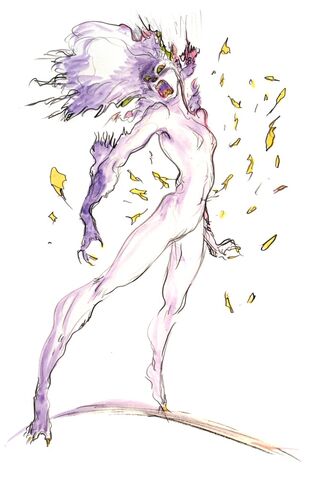
- Progressively Prettier: Her Esper form started out like this in concept art
 ◊, to this portrait in the GBA version◊, to this portrait in the mobile and Steam versions◊.
 - Properly Paranoid: She is extremely wary of everyone she meets in the beginning because she's afraid they just want her for her powers. Although the Returners try to emphasize that they don't want to force her... they still basically want her for her powers.
- Psychosomatic Superpower Outage: Espers are not naturally emotional creatures, y'see, which leads to her powers being sapped to pretty much nothing while she struggles with learning how to love in the second half of the game.
- Put on a Bus: After the battle in Narshe and her transformation into an Esper, Terra flies away as her powers go out of control. When her friends find her in Zozo, they discover that she still needs some time to get her head together. The Bus Came Back when the other Returners revisit Zozo after rescuing the Espers from Vector. Terra's regained her memories and made peace with who she is, and she rejoins the party.
- The Red Mage: Her job name is "Magitek Elite", but she's also a textbook example of a Final Fantasy Red Mage. She uses swords and wears heavy armor, and she also has a mix of offensive and defensive magic.
- Reluctant Warrior: Isn't much up to fighting in the World of Ruin during her Character Development. Wasn't all that keen on the idea in the World of Balance, either.
- Required Party Member: For the trip to the Esper Gate, you're forced to bring her along since she's the one who actually opens it. She's also the first character you can play as, and isn't able to be switched out for quite some time after the game begins.
- Sorry I'm Late: In the second fight with Humbaba, she rushes in to help the party when half the team is blown out of combat and things look dire.
- Super Mode: Morph/Trance: It doubles her magical and physical damage, doubles her heals, and halves all the magic damage she takes (unless they are barrier-piercing spells). This ability is called the Boss Killer with good reason.
- Sword Beam: Her Riot Blade Desperation Attack fires waves of energy at opponents.
- Team Mom: It doesn't quite show until later. This also naturally implies another trope is waiting in the wings at any time.
- Technicolor Eyes: Some artwork gives Terra purple eyes, emphasizing her otherworldly appearance.
- Thong of Shielding: Usually it's hidden behind her sash, but it can be seen rather clearly in the modified 'knocked out' sprite after she's blown away from the Sealed Gate and less clearly in her normal 'knocked out' sprite.
- Token Flyer: When she transforms into her Esper form she is the only character that can fly. Notably this means that the party has to find ways to get to her when she takes off without warning the first time. In the ending this allows her to get to the party when everyone else couldn't.
- Took a Level in Badass: Two times.
- The first is after you clear the Magitek Research Facility and she rejoins your party. She has her Super Mode under control now, and she's also a few levels stronger than when she left.
- Later, when she returns in the World of Ruin, not only is she more confident in who she is, but her Trance lasts twice as long.
- Tyke Bomb: She's been raised since she was a baby to be a living weapon for the Empire.
- What Is This Thing You Call "Love"?: A big issue for Terra. She struggles with learning how to love in the second half of the game. She finds it when she comes across a group of kids who don't have any parents.
- You Killed My Father: In the Japanese version and the GBA version, her mother, Madeline, spends the last moments of her life trying to keep Gestahl from taking Terra. In the English version of the original release she was already dying for unclear reasons and she willingly gave Terra to Gestahl and asked him to raise her. Gestahl knew she was half human and half esper and decided to take advantage of this. Madeline immediately demanded Terra back, but she did not succeed and she eventually died soon afterward.


Voiced by: Yuki Ono (Japanese), Jonathan von Mering (English) [Dissidia NT]
An adventurer and spy for the Returners, Locke is a thief that insists on being called a "treasure hunter". Years ago his lover Rachel was injured in an accident and lost her memory, and Locke left her to let her start a new life without him, blaming himself for her condition since she endangered herself pushing him to safety. When the Empire attacked the town and Rachel was killed, Locke again blamed himself for abandoning her. He has spent the time since searching for a "legendary treasure" that is rumored to revive the dead, to restore Rachel to life and correct his greatest mistake. However, during the course of the game he begins to develop new feelings for Celes.
- Always Save the Girl: Has this mentality due to the tragedy with Rachel. He was quick to save and accompany both Terra and Celes.
- The Atoner: A lot of Locke's compulsion to protect women comes from the fact that he's never forgiven himself for failing Rachel, since her amnesia and subsequent death led to his Heroic BSoD. As Celes rightly points out at the Opera House if you've taken her and Locke to Kohlingen, when Locke helped her escape from South Figaro, he was really saving Rachel.
- Badasses Wear Bandanas: His fancy blue bandana is easily the most iconic thing about his character design.
- Bad "Bad Acting": His improvised on the spot acting after he, his comrades, and Ultros unintentionally hijack the Opera. The Impressario immediately comments on how awful Locke's acting is.
- Berserk Button: Calling him a thief really ticks him off.
- "Blackmail" Is Such an Ugly Word: How he feels about being called a "thief".
- Bodyguard Crush: Locke swears to protect Celes because she reminds him of Rachel; he eventually falls in love with her.
- Break the Cutie: Though he doesn't show it, Locke is constantly haunted by his memory of Rachel.
- Changing Clothes Is a Free Action: When in South Figaro, Locke can steal clothes from merchants and guards to disguise himself, and changes costume with a quick spin around.
- Chick Magnet: Has shades of this with Terra and Celes. Sorry, Edgar!
- Cut His Heart Out with a Spoon: In this case, he'll rip your lungs out if you keep calling him a thief (Ted Woolsey translation only).
- Devious Daggers: Locke's class "Adventurer" is modeled after tradition Thieves, thus he mostly equips daggers and short swords. His Infinity +1 Sword in the ports is the Zwill Crossblade, a dagger.
- Dressing as the Enemy: During his escape from South Figaro, Locke does this by stealing his enemy's clothes... during combat.
- Failure Knight: Played straight with Rachel. He couldn't save her from her accident and he wasn't in Kohlingen when The Empire attacked and killed her. Averted in the ending, when Locke saves Celes from an identical fall as Rachel had.
- Gentleman Thief: He's not a thief, he's a treasure hunter! But either way, he's quite polite, chivalrous, and friendly.
- Guile Hero: Tends to fight more with finesse than brute strength. He had to sneak out of South Figaro while it was occupied.
- Heroes Prefer Swords: Aside from knives and boomerangs, Locke is capable of wielding swords, including the Ragnarok and Illumina/Lightbringer (which he can make good use out of if using Mug without draining MP to do instant criticals).
- Heroic BSoD: In the backstory, he went through a major one when he accidentally caused Rachel to suffer from amnesia and later when she died during the Imperial attack on Kohlingen.
- I Let Gwen Stacy Die: Twice over. He was too slow to keep her from falling down a cliff while exploring a mountain, which led to her contracting amnesia. Her father called out Locke on this and Locke left Kohlingen. While he was away, she was killed in an Imperial attack, and since then, he fully blames himself for once again not being there to protect her.Locke: I never should have left her side. I... I failed her...
- Iconic Item: His bandanna, to the point Celes recognizes it as his when she sees a bird carrying it.
- Insistent Terminology: He is not a thief, thank you! He's a treasure hunter. It's lampshaded in-game immediately after he makes the distinction.Locke: I prefer the term "treasure hunting"!
Arvis: Ha! Semantic nonsense!
Locke: There's a huge difference! - It's All My Fault: How he felt about Rachel's amnesia. And he's not exactly wrong...
- It's Personal: Locke's reason for going against the Empire was because he was unable to save Rachel from being killed by them in a raid.
- Kleptomaniac Hero: He isn't fooling anybody with his Treasure Hunter speech.
- Lightning Bruiser: In sharp contrast to the Fragile Speedster nature of most Thieves in the series, Locke's official job is "Adventurer". The difference is he gets greater access to heavy equipment and the top-tier swords for excellent offense and defense, and he keeps the expected high speed.
- The Lost Lenore: His lover, Rachel, died in an Imperial attack many years ago, which spurred Locke to join the fight. Rachel rejected him after he inadvertently caused her to suffer from amnesia, and Locke blames himself for her death because he left her side and wasn't there to protect her.
- Love Hurts: Locke can't forgive himself for what happened to Rachel until the Phoenix revives her and she convinces him otherwise.
- Loveable Rogue: He seems to be the sort that makes a point of only stealing from his enemies.
- Master of Unlocking: He frees Celes from her chains when he finds her in South Figaro, and is also the only party member who can unlock the doors in Narshe in the World Of Ruin. Notably, he's ones of the only thieves in the entire series who's ever seen actually picking locks.
- Meaningful Name:
- Locke Cole comes from a town called Kohlingen, which is roughly equivalent to a town name like "Coalton". His first name may be taken either as a bad Pun (what is it any self-respecting thief ought to be able to get past?) or a reference to the English philosopher John Locke, who espoused "government by consent of the governed" and the theory of Tabula Rasa — Locke is embroiled in a struggle against the Evil Empire and is particularly protective of the amnesiac Terra, due to his backstory. John Locke also wrote extensively about the concept of private property, which adds an ironic twist to the name.
- Locke's last name of "Cole" may also be seen as a reference to the Cole National Company, known for manufacturing keys. Not only does Locke pick several locks during the game, he's pretty much the only thief we see doing this in the entire series.
- Mugged for Disguise: When Locke is trapped in South Figaro after the Empire takes over, he can steal the clothes from merchants and imperial soldiers to disguise himself as one of them. Somehow, this works flawlessly.
- My Greatest Failure: Not being able to rescue Rachel from her accident and later death.
- My Greatest Second Chance:
- His dream is to find the legendary Esper Phoenix, which could perhaps restore Rachel to life.
- As the party escapes Kefka's Tower, Celes drops the bandanna she found on Solitary Island and, as she runs back for it, the floor begins to collapse. Celes begins to hang onto an edge as Locke rushes to save her, and this time he refuses to let go.
- Nice Job Breaking It, Hero: Locke sees himself as this for failing to protect Rachel.
- Out of Focus: Goes from one of the most consistently important members of the party in the World of Balance to an Optional Party Member in the World of Ruin.
- Precision F-Strike: In the Advance translation.Locke: Dammit! Got to get to Narshe on the fly.
- Required Party Member: Of all the playable characters, Locke is required for the most amount of time. He has his own scenario in South Figaro where he meets Celes, and he goes with Celes again after Zozo, when he comes along to protect her during the infiltration of Vector. He also accompanies Terra to Crescent Island due to his lack of trust in the Empire (which unsurprisingly turns out to be justified). Finally, if you want to fully explore Narshe in the World of Ruin, you need to bring Locke along to pick the doorlocks.
- Screw This, I'm Outta Here: He left his hometown after Rachel's accident.
- Stealth Insult: To Edgar. Minus the stealth.Locke: Terra, please wait for me, and please, don't let a lecherous young king, who shall remain nameless, near you.
- Supporting Protagonist: Has shades of this. While Terra and Celes take turns being the most central members of the game's Ensemble Cast, Locke is in the party from the beginning, receives the most instances of being a Required Party Member, and has well-defined relationships with both of the aforementioned female leads.
- Take My Hand!: During the ending, he dives to grab Celes' hand as the floor crumbles behind them.
- Tritagonist: Locke is the third-most central character after Terra and Celes and is very prominent in the first part of the game. He's a required party member from the end of the intro up to the Siege of Narshe, then for the long trek to the southern continent, and then again for the expedition to Crescent Island. The only times he's not a required character is the journey to Zozo and the Cave to the Sealed Gate, but the former is also the time players will learn Locke's backstory if they bring him to Kohlingen. The narrative also treats him as the "leader" of the group on numerous occasions when they aren't formally meeting with Banon as Returners.
- Video Game Stealing: His special ability is Steal, which consists of him leaping at an enemy's sprite to steal an item. Exclusively during his infiltration of South Figaro, he can also steal clothing from merchants or soldiers to use as a disguise.
- Vitriolic Best Buds: With Edgar, whom he pokes fun at and who mocks him in return.

Voiced by: Shin-ichiro Miki (Japanese), Ray Chase (English) [World of Final Fantasy]
The King of Figaro, the desert castle, Edgar is a genius engineer and a shameless flirt. He ascended the throne at a young age when his father died and his twin brother Sabin fled the kingdom, leaving Edgar to rule alone. While he is publicly allied with the Empire, he is a secret supporter of the Returners. When Kefka burns Figaro believing Edgar is sheltering the escaped Terra (which he is), Edgar casts off this deception and fully throws his lot in the Returners.
- Annoying Arrows: Averted; the Auto Crossbow is a Disc-One Nuke capable of one-shotting entire groups of enemies for a long time.
- Automatic Crossbows: His first (and most useful, until it becomes obsolete) tool is the AutoCrossbow, which sprays all enemies in front of it with multiple highly accurate bolts.
- Badass Cape: His ingame sprite shows him wearing a collared regal cape.
- Blinded by the Light: His Flash tool blares an array of light at enemies to damage them and inflict Blind.
- Boomerang Bigot: Edgar remarks that he doesn't like men because they don't listen, despite being a man himself.
- Bunny-Ears Lawyer: He's incredibly weird, he'll hit on any female of age, and his icon depicts him with a goofy grin, but he created several advanced machines (including a castle that can submerge into the ground and emerge hundreds of miles away) and is a very good ruler.
- Casanova Wannabe: He hits on quite a few women throughout the course of the game, but he's successful with very few of them.
- In-Universe as well: Locke and Sabin poke fun at him for this.
- Chainsaw Good: Edgar can use a chainsaw that sometimes kills the enemy in one hit or deal massive damage.
- The Chains of Commanding: After their father's death, Edgar and Sabin were to co-rule. Both wanted out, but at the same time didn't want to plunge the kingdom into chaos with their absence since there would be no heir. So they settled it with a coin toss. Edgar, being the protective brother he is, rigged the toss with a double-headed coin so it landed in Sabin's favor. Thus Sabin won his freedom while Edgar stayed in Figaro to rule alone.
- Chivalrous Pervert: Or at least he tries to be. He's not nearly the ladies man he acts.
- Cultured Badass: Well, he is a king. Though he's not The Dandy, he does dress far more nattily than most of the team.
- Deadly Gas: His Bio Blaster shoots a cloud of poisonous mist over enemies.
- Disc-One Nuke: Edgar is easily the strongest member of your team when you get him. His Auto Crossbow hits all enemies for more damage than a normal attack, at no cost or drawback, and will end most enemy encounters in one turn. Once you get to Zozo and learn magic, the Auto Crossbow starts to fade in power, but Edgar gets a selection of Disc Two Nukes with the Flash, Drill, and Chainsaw. By the time you get to the World of Ruin his tools largely fall off, but he has a good enough equipment set and rare access to spears that allows him to transition into a capable dragoon instead, preventing him from being a Crutch Character.
- Dramatic Irony: In the World of Ruin, he masquerades as "Gerad" to take command of a band of thieves that escaped from Figaro Castle when it got stuck while submerging, so they can lead him through the caves they used to escape and he can get into the castle and fix the problem. Yes — the king of Figaro takes command of the thieves he imprisoned so they can break back into the castle they escaped from in the first place. Celes even lampshades this.
- The Dutiful Son: Edgar willingly stayed behind to rule over Figaro when Sabin became so desperate to strike out on his own. Edgar eventually settled the matter with a rigged coin toss that allowed Sabin to leave with a clear conscience.
- Emperor Scientist: To a degree, as he is a rather skilled machinist.
- The Engineer: Early localizations even have his class being Engineer.
- Gadgeteer Genius: Invented a submersible land castle, and fights with mechanical tools in battle.
- Genius Bruiser: He's quite an intelligent man and his Tools make him one of the most hard-hitting party members in the early game.
- The Good King: It's quite apparent all of Figaro loves Edgar and considers him a great king. He's earned that sentiment. See Insists on Paying further down the page.
- Guile Hero: All of his greatest moments involve outwitting someone rather than defeating them through strength. His own twin doesn't always know what he's up to.
- Heavy Equipment Class: Capable with both sword and spear along with heavy armor.
- Hockey Mask and Chainsaw: A random effect with the Chainsaw is for Edgar to don a hockey mask and attempt to deal a One-Hit KO.
- The Infiltration: In the World of Ruin, he adopts the Paper-Thin Disguise of "Gerad" the Thief, worrying Celes who wonders if he lost his memory in the airship crash. In truth he is looking to prevent some bandits from looting his mobile castle, now stalled underground.
- Insists on Paying: If you have him at the head of your party while in Figaro Castle, the shopkeepers there will refuse to take any payment from their own king. Edgar insists ("Look, don't you have a family to feed? Just shut up and take it."), and the player gets a 50% discount as a compromise.
- The Jailbait Wait:
- Regarding Relm:Edgar: Not even a lady yet... Here's hoping you're still around in eight years, kid.
- Averted in the Pixel Remaster translation, however. Instead, he just remarks that she's gonna break quite a few hearts when she's older.
- There's also a little girl in Figaro to whom he apparently told he'd marry her when she's grown up.
- Regarding Relm:
- King Incognito: Well, sort of. Celes (and probably the player, for that matter) figures out who "Gerad" is immediately, but he keeps up the charade. Fortunately, the criminals he's infiltrating don't know Edgar as well as Celes does, so the trick works on them.
- Meaningful Name: Edgar is an English name that means "great spearman". Edgar best weapon is The Longinus in the GBA, IOS, Android and PC ports, which is a Spear.
- Mighty Glacier: His tools can dish out a lot of punishment— his Autocrossbow tends to hand out One Hit Poly Kills on command, and the Drill is fantastic against bosses— but he's also very slow.
- Modest Royalty: Although he's clearly seen as king by his subjects, he avoids gratuitous special treatment by insisting he pay them for their wares.
- The Mole: At the very beginning of the game, Edgar and Figaro in general are officially aligned with Vector, though he's secretly working with Locke and feeding info (and possibly more material assistance) to the Returners. This ends shortly after the game's beginning, when Terra's appearance forces his hand and he makes his true allegiances official.
- Obfuscating Stupidity: When Kefka comes looking for Terra, Edgar feigns like he has no idea who Kefka is talking about, much less how Kefka expects him to know if she came to Figaro.
- Paper-Thin Disguise: As the bandit leader Gerad, who looks identical to Edgar but with a Palette Swap.
- Poisonous Person: His Bio Blaster tool will cause damage and has a high chance of poisoning any foe not otherwise immune to the condition.
- Rain of Arrows: His Auto-Crossbow shoots a storm of arrows, three for each enemy on-screen.
- Rank Scales with Asskicking: He's more than willing to personally fight the Empire, and is one of the most powerful characters in the game for the first part of it.
- Reluctant Ruler: He didn't particularly want to become the king, but it was him or Sabin and he knew Sabin wanted a life of freedom, so he took the burden for him.
- Royals Who Actually Do Something: He is the king of Figaro, and one of your most versatile and most valuable party members.
- Significant Anagram: "Gerad" in the English version; his alias is "Geoff" in the Japanese version.
- Small Name, Big Ego: A possible subversion. He's known as a flirt to his subjects (and the children want to marry him), but his banter to Terra and Celes is not reciprocated. If one pays attention, though, he only attempts it once as a kind of greeting and treats them normally from then on.
- Something Only They Would Say: When in his "Gerad" disguise, he tries to get rid of Celes while saying "My Lady". Celes responds that only Edgar would address her that way, and after a moment of silence, he declares that "My Lady" is a fairly common way of addressing someone. In the GBA translation, he refers to Celes as a "beautiful lady", saying that it's common courtesy to be polite to ladies.
- Status-Buff Dispel: Edgar's Debilitator tool adds an elemental weakness to an enemy. Being completely random, you could easily end up with a fire-spitting dragon that's suddenly weak to fire, and you could reuse it until an enemy was weak to every element.
- This Is a Drill: Edgar's toolset includes one massive power drill, complete with safety helmet.
- This Means War!: Though he pretends to be an Imperial sympathizer, he uses Locke to coordinate with the Returners behind closed doors, which the Empire has gotten wise to. After Kefka torches his castle and Figaro is occupied, Edgar drops the charade and joins the rebels.
- Tough Leader Façade: It comes off when he talks to Sabin in the throne room. Beneath the noble king is a man who deeply misses his brother and has doubts over his own effectiveness as a ruler.
- Two-Headed Coin: He uses such a coin in his childhood gambit with Sabin, betting which of them will leave the kingdom on the result, knowing that when it comes up heads Sabin will be able to live his own life guilt-free. If he's in the party when Celes is abducted by Setzer, it's strongly implied Edgar passes the coin on to her to use for her own bet, and then Setzer holds onto it. If Edgar and Sabin are both in the party, this will be depicted and Sabin will comment on it.
- With This Herring: The King of Figaro has joined the party! That means lots of resources, right? Wrong, he comes with some basic tools and equipment. It is somewhat justified in that he spends most of the game on the run, or with his kingdom in shambles, and the shops in his castle are more than willing to give him free stuff. He simply insists on paying since they have families to feed, and settles at a 50% discount.

Voiced by: Shinshu Fuji (Japanese) [Dissidia Final Fantasy Opera Omnia]
Edgar's twin brother. When their father died, Sabin was disgusted with the Figaro nobility that were more concerned with who would take over the kingdom than the death of their king, and they didn't seem to care about rumors their father had been poisoned by the Empire. A fateful coin flip with Edgar won Sabin his freedom and he left Figaro to have his own life. However, he never truly abandoned his kingdom or his brother, and stayed close to home training for the day he would be needed. That day comes when Figaro and Edgar join with the Returners, and Sabin joins up with them to defeat the Empire.
- Action Commands: His Blitz attacks require controller inputs, but you can't use them until you've actually learned them in-game.
- Adaptation Name Change: His name is "Mash" in the Japanese versions.
- Animal Battle Aura: Tiger Break blasts a tiger-shaped aura of energy at enemies.
- Animal-Themed Fighting Style: Tiger style, at least in part. His style incorporates clawed gauntlets (with his Infinity -1 Sword being the Tigerfang), he wears a fang necklace (and in concept art, a leopard-spotted sash), and his Desperation Attack is called Tiger Break. He's also compared to a bear more than once, and seems to have practiced some of his wrestling moves on actual bears.
- Bash Brothers: When Edgar mobilizes Figaro against the Empire, Sabin comes out of seclusion to join his brother in the fight.
- Big Brother Instinct: Displays this toward Gau. When Gau's father fails to recognize his son, Sabin has to be restrained from decking him.
- Big Damn Heroes: At Mt. Koltz, in the World of Balance, Sabin comes in to save the party from Vargas in order to avenge his late master. He's also the first character to reunite with Celes in the World of Ruin; he's found single-handedly holding up a collapsing house in Tzen after the town gets razed by Kefka on a whim.
- Big Eater: Cyan is taken aback at his big appetite and noisy eating.
- Big Little Brother: Played straight. He's the younger of the twins, and is supposed to be a tad taller than Edgar. He's also built like a padded bank vault due to years of training, whereas Edgar has a standard build.
- Boisterous Bruiser: Built like a bodybuilder and has a happy, friendly personality.
- Charles Atlas Superpower: The dude can suplex a train, and manages to hold up a collapsing burning building for several minutes during a sequence later in the game.
- Cultured Badass: Despite spending the last 10 years away from Figaro and a royal lifestyle, Sabin still displays knowledge of things such as proper etiquette, such as when he takes Gau to meet the man he thinks is Gau's father.
- Then again, if you take him to the Opera...Sabin: Huh? Why's everyone singing?
- Then again, if you take him to the Opera...
- Damn You, Muscle Memory!: In most fighting games, a special move input's direction is determined by the orientation of the character. This is mostly true for Sabin, as well, given most battles have him face towards the left, and so the Hadouken-esque Aura Cannon is inputted Down, Down-Left, Left. The problem happens for the small handful of battles where he isn't facing to the left due to a back or pincer attack. Unlike in most fighting games, his commands are not inverted in these cases, potentially tripping up players used to them. The Pixel Remaster remedies this by displaying the inputs on screen as you input them instead of making you enter them from memory.
- Defector from Decadence: Okay, so Figaro isn't all that decadent, but regardless, Sabin became highly disenchanted with royalty once it became clear that the court was more worried about who would succeed the king despite his supposed death at the hands of the Empire and made it abundantly clear that he wanted out.
- Depending on the Artist: In a pair of artworks, Sabin has a beard, but not in the game, and according to some developers, it was because of the limitations with pixellated sprites. He does have a bit of stubble in Dissidia Final Fantasy Opera Omnia, though.
- Didn't Think This Through: Sabin dives off a raft to fight Ultros, only to be swept away from the rest of the party by the strong current.
- Disc-One Nuke: Sabin's Rising Phoenix can one-shot every battle when you get it. If you use him in battle consistently, you can easily end up one or two-shotting every non-boss battle up to the end of the Floating Continent.
- Dub Name Change: From Mash to Sabin, to give him a more royal-sounding name.
- Duel Boss: After Vargas blows everyone except Sabin away, it becomes Sabin vs. Vargas.
- Gentle Giant: He's the largest human character in-game, and physically the strongest. He's also a Nice Guy.
- Got Me Doing It: After having a hard time trying to instruct Cyan on how to operate the Magitek armor:Sabin: Oh, for...! Thou art getting to be quite a pain in the— Great, now I'm even starting to talk like you!
- The Heart: Sabin is the nicest, happiest and most selfless member of the team, and he's the one that goes out of his way to keep their hopes up. Celes is overjoyed to find him in the World of Ruin. See Hope Bringer below.
- Heroic Build: The official art depicts him as muscular.
- Heroic Sacrifice: While he doesn't actually canonically pull one in-game, his Soul Spiral/Spiraler Blitz can be used to this effect as it restores the other party members' HP and cures all their status ailments (even KO and Zombie), at the cost of Sabin's life (his HP goes down to 0 and he's removed from the battle). Unfortunately, the A.I. Roulette can make him use this during the one-on-one battles at the Colosseum, which causes you to lose instantly in a Senseless Sacrifice.
- Holy Hand Grenade: Sabin's Aura Cannon Blitz does Holy elemental damage.
- Hope Bringer: Sabin is the first teammate Celes finds in the World of Ruin. Sabin meets her with a laugh and with 100% determination to help her find the rest of their friends and afterwards go punch Kefka in the face. This positive attitude renews Celes hopes that they can still save the world.
- Hunk: Sabin shares his twin's good looks, but combines them with a tall and very muscular build.
- I Got Bigger: We're told that as a kid, Sabin was very small and had a weak constitution. After years of training, we see that's no longer the case.
- Informed Deformity: After a flashback to Edgar and Sabin as children, the person telling the story comments that at that time Sabin was small — even smaller than Edgar. However, the flashback used the same sprites as the rest of the game, when Sabin is a very large bodybuilder.
- Insists on Paying: Like his brother, the merchants at Figaro don't feel comfortable charging the prince for goods. Sabin forces them to accept payment because they need to support themselves.
- Kamehame Hadoken: Aura Cannon fires a large blue energy blast from his palms.
- Ki Manipulation: How his Blitzes are implied to work. With the exception of Raging Fist and Suplex/Meteor Strike, all of Sabin's blitzes use his magic stat to determine damage.
- Knight Errant: Sabin, disgusted with the ordeal and wanting revenge on the Empire which was rumored to be behind their father's poisoning, left the castle but never strayed far from the kingdom. He trained for years with a martial arts master near South Figaro.
- Load-Bearing Hero: Two examples: When he holds up the collapsing house so that Celes can save the child trapped inside, and during the ending, when he saves his brother from some collapsing junk.
- Magic Knight: Invoked by his Blitz abilities, half of which deal magic damage, including his ultimate technique. Unfortunately for Sabin, he has among the worst base Magic stats in the game, and thus requires heavy Magic investment in order to get the most out of Blitz.
- Magnetic Hero: Sabin is the one who actually gets three of the other heroes to join the Returner cause (Cyan, Shadow and Gau).
- Mr. Fanservice: He's tall, strong, muscular, and has his brother's good looks.
- Nice Guy: He's one of the nicer playable characters, as he saves Edgar and his teammates from Vargas at Mt. Koltz in the World of Balance and agrees to join them as part of the Returners shortly after. He even helps Celes save some people in Tzen from a collapsing house after Kefka's Light of Judgement blasts through the whole town in the World of Ruin.
- Not Distracted by the Sexy: When Cyan asks why Sabin is not affected by the infamous "licentious howler", Sabin attributes it to his years of ascetic training.
- Playing with Fire: His Rising Phoenix Blitz, which launches a barrage of flaming Sabin spectres at enemies.
- The Pollyanna: Not even The End of the World as We Know It can ruin his chipper mood as Celes finds him holding up a collapsing house to save some people ravaged by Kefka's World Of Ruin. When Celes asks for his aid, he's ecstatic for the chance and actually restores Celes' failing faith that the world can still be saved.
- Rapid-Fire Fisticuffs: His Raging Fist is a rapid series of punch attacks. His training with Duncan implies Phantom Rush is likewise this trope, but it's not clear what Sabin is actually doing when he uses it in battle.
- Razor Wind: One of his Blitzes, Razor Gale, sends slicing blades of wind at enemies.
- Rebel Prince: Didn't want to be king, preferring to focus on his martial arts.
- Royals Who Actually Do Something: Despite not really being involved in the monarchy, he's still a prince, and quickly becomes a hero to rival any of the others. He states that the reason he started training in the first place was so he would be able to properly support Edgar.
- Shirtless Scene: Occasionally, in official artwork and CGI animation. He'd be a Walking Shirtless Scene except for the fact that he does often wear a shirt (and his game sprites are always sporting one).
- Shout-Out: He's a walking shoutout to fighting games in general.
- The first Blitz you learn is a picture perfect Zanretsuken, right down to the input command.
- Guess what the input for Aura Cannon is? Quarter-circle forward + A.
- Also, more than one player has noted that his sprite looks like a super-deformed version of Guile.
- Some Dexterity Required: Sabin's Blitz techniques, while freed from many variables in Fighting Games, still require pulling off Street Fighter-esque input commands. However, the game is much more lenient, and not only can commands be given one button press at a time, but the more difficult ones (even the 360-motion Phantom Rush) can be performed with easy and simplified button presses. Just remember not to reverse the inputs when you're attacked from the rear.
- Sorry I'm Late: Shows up when the party fights Vargas and saves them from him, fighting him as a Duel Boss.
- Stock Shōnen Hero: His personality and fighting prowess make him fit this trope to a T.
- Supernatural Martial Arts: From healing others to blasting his opponents or summoning firestorms, its easy to understand why he has the power to suplex a train.
- Suplex Finisher: An early-game Blitz, though it was retranslated to "Meteor Smash" for the GBA release. It does a ton of damage, though most bosses are immune to it, with the notable exception of the Phantom Train.
- Time to Unlock More True Potential: How he learns the Phantom Rush Blitz if he hasn't already learned it from leveling. Multiple rounds one-on-one with Duncan until he picks it up.
- Walking Shirtless Scene: In the FMVs in the Anthology release, he's topless.
- Wolverine Claws: His weapons, being based on the Monk class. Notably this means he avoids the Bare-Fisted Monk trope many other Monks in the series subscribe too: Sabin needs weapons as much as any other party member.
- World's Strongest Man: He easily takes World’s Strongest Man title. While other members of cast such as Terra and Celes are arguably more “magically powerful” than him, Sabin with just his Ki Manipulation and pure Bare-Fisted Monk physical strength is capable of insane feats like single-handedly holding up a collapsing mansion and memorably suplexing a Ghost Train.
- You Shouldn't Know This Already: Even if you know the proper inputs, Sabin cannot use a Blitz until he actually learns it by leveling up.

Voiced by: Houko Kuwashima (Japanese); Christina Rose (English) [World of Final Fantasy]; Masumi Nemoto (Japanese), Hannah Grace (English), Morgane Heyse (French & German), Antonelia Rondinone (Italian), Francesca Calero (Spanish), An Hye-Sao (Korean) [Pixel Remaster vocals for Aria di Mezzo Carattere]
A former general of the Empire, Celes is a Magitek Knight who received her magic infusion as a child, granting her the power to use magic; fortunately by then, the process had been perfected and she didn't lose her mind as Kefka did. Locke meets Celes during his infiltration of the imperial-occupied South Figaro, arrested and imprisoned as a traitor when she became disillusioned with the Empire and spoke against them. Locke frees her and Celes accompanies him and joins the Returners. However, her past as an Imperial causes some of her new allies to question her loyalties, which is not helped by her frosty and proud demeanor. Over the course of the game her relationship with Locke turns from friendship to Love Interest, causing her to gradually defrost and become a more openly empathic person.
Celes becomes the viewpoint character for the second half of the game after the party is scattered. This, coupled with her importance throughout the story and acting as a character Foil to Terra, means she is often considered the Deuteragonist of the game.
- Action Girl: She was an Imperial General and is one of the most powerful characters in the game, with excellent stats, equipment, and natural magic.
- The Aloner: The possibility of being the last living person in the world after Cid's death is not a pretty thought.
- Anti-Magic: Her Runic ability causes magic to be diverted toward her. It also absorbs all damage and grants Celes the amount of MP it took to cast the spell. Unfortunately, it can also absorb spells cast by the party, meaning the player has to take turn order into account once they start training with Espers.
- The Atoner: Joins the Returners partially out of a desire to atone for her crimes as a member of the Imperial army. Her most specific described war atrocity was the burning of Maranda.
- Audience Surrogate: Celes assumes this role for the second half of the game, though it gradually gives way as she is rejoined with more of her friends. In the ending, she becomes the viewpoint character again for the most part, and expresses the most concern over Terra's disappearance. She, Edgar, and Setzer are the only characters you must have to finish the game.
- Badass Cape: Her costume includes one, even though it's only present in the sprites rather than the artwork.
- Beautiful Singing Voice: She has a lovely enough singing voice to pass for a professional opera singer, and Locke refers to her performance as "wonderful".
- Big Good: She becomes this in the World of Ruin, when she recruits her party members back to fight Kefka and end his tyranny.
- Broken Bird: It's clear when she joins the party that she doesn't have any experience with genuine friendship and affection. It gets even worse on the World of Ruin, where she may make a suicide attempt depending on the player's actions.
- Bungled Suicide: In the World of Ruin, she attempts suicide by leaping off a cliff if Cid dies, but survives the fall.
- Celebrity Resemblance: In-universe, Celes resembles the opera singer Maria. Because of this, she becomes a drop-in replacement for the original singer, as part of a plan to obtain an airship. Setzer noticed the difference only after bringing her aboard.
- Concert Climax: She is a replacement singer for the opera and the target of Ultros' 4-ton anvil.
- Convenient Coma: Celes was in a coma during the first year in the World of Ruin, giving plenty of time for the other party members to end up in the situations she finds them in.
- Crutch Character: During the Narshe-Opera House segment. While it is possible to go through this part of the game without Celes in the party, it is quite difficult, as it is one of the game's first increases in difficulty and enemies in Zozo can use magic to deal several hundred damage to the party and they otherwise have powerful physical attacks. Celes makes the going much easier since she can heal the party with her own spells and absorb some of the enemy's spells to restore her MP with Runic. By the time you go the Southern Continent and reach Vector, you've had enough time with Magicite to teach other party members some spells and won't need to rely on Celes anymore.
- Damsel in Distress: Locke discovers her being held captive in South Figaro and waiting to be executed.
- Dark Reprise: The Aria that Celes sings during the opera is repeated in her character theme/leitmotif... the night before Terra, Locke, Shadow, Celes, and Leo depart to Thamasa from the Albrook port, when Locke is trying to apologize to Celes for thinking that she was a traitor during the confrontation with Kefka in the Magitek Lab. It plays again when she attempts suicide by jumping off the cliff after Cid dies.
- Defector from Decadence: At some point during the ransacking of Figaro, Celes was stripped of rank and imprisoned for treason, though we never learn why or by what methods Celes carried out the plot (although she reportedly balked at Kefka's plan to poison Doma).
- Defrosting Ice Queen: Joins the party with a very cold attitude, and then Locke gradually defrosts her. After the halfway point of the game, Celes becomes much more friendly towards the rest of the party and is altogether more optimistic and hopeful, to the point where she eventually becomes their unifying force. Edgar practically lampshades the trope in the SNES version, commenting that Celes is "cold as ice" when they first meet.
- Depending on the Artist: Her Amano artwork depicts her as wearing a deep yellow uniform, her top variably being a corset with gloves or a yellow jacket with a purple/blue/black top. Her superdeformed art, as well as her in-game sprite, instead show her wearing a white cape over a green leotard. While the yellow outfit is not uncommon, in fan or official materials, it's the cape and leotard look that's stuck with her through her spin-off appearances.
- Despair Event Horizon: After Celes wakes up from a year-long coma to realize that the world really was destroyed, she's stranded on a deserted island with Cid, and everyone she knew is probably dead. Then, if you don't manage to save him, Cid's death completely shatters what small shred of hope was left in her, which leads to her attempted suicide.
- Deuteragonist: To Terra. While Terra is the first character the player controls in the World of Balance and her story and character arc are central to its plot, Celes is the first character in the World of Ruin and she's the one who begins to Put The Band Back Together to strike back against Kefka. She's also a required character during the long, very plot-important infiltration of the Empire, and her appearance, abilities, and personality heavily present her as a Foil to Terra.
- Driven to Suicide: If Cid dies, Celes loses any hope for life and leaps off a cliff. She survives, however, and it's possible to avoid it by healing Cid properly.
- Early-Bird Cameo: She appears in the background of one of Terra's flashbacks long before she appears in the main game as an Imperial General alongside Kefka and Leo.
- Emergency Impersonation: Celes has to impersonate Maria so you can find a way onto Setzer's airship.
- Foil: To Terra. They have nearly identical equipment save for one armor piece and their exclusive weapons in the GBA version, and their stats are very similar. Their contrasts include outfits (green dress with white cloak, red dress with pink cloak), abilities (Runic with Ice and defensive status spells vs Trance with Fire and offensive status spells), and personalities. Terra is innocent, naive, and idealistic while Celes is proud, snarky, and cynical.
- Hair of Gold, Heart of Gold: In both the artwork and her sprites. Noble and heroic traits included.
- Heavy Equipment Class: Rivals Terra in her range of swords and heavy armour.
- Heel–Face Turn: Before the game begins, Celes burns Maranda to the ground; she's the reason that everyone is rebuilding the town when you visit. She resigns from the Imperial Army and is arrested for it afterwards, and after Locke rescues her in Figaro, Celes joins the Returners.
- Heroes Prefer Swords: Almost all of her weapons are swords and her ability Runic must have a sword equipped in order to work. Her Infinity +1 Sword in the ports is the Save The Queen.
- An Ice Person: Her natural magic includes the Blizzard line of spells, contrasting Terra using Fire. She's also seen as a bit of an Ice Queen, with the comparison directly made by Edgar.
- Identical Stranger: Celes is the spitting image of the opera star Maria, but is implied to have barely an idea of who she is.
- I'm a Doctor, Not a Placeholder: Twice; first when Edgar remarks Locke is smitten with her during the group's trip to the cliffs above Narshe, and again when Locke suggests that she impersonates Maria to trick Sezter into leading their group to his airship.Celes: Thanks for your concern, but I'm a soldier, not some love-starved twit. (During the group's trip to protect the frozen Esper in Narshe)
Celes: H-hold on here! I'm a former general, not some opera floozy! (During the group's trip to the Opera House) - Improbable Age: She's only 18 years old and she already reached the rank of General, placing her in a similar level to the older Leo and Kefka whom are in their 30s. Her being a Magitek Knight skilled in ice magic may have something to do with it. It's also likely that her magical infusion process, having been perfected before her birth, allowed her to perform feats far greater than most soldiers.
- Incorruptible Pure Pureness: Only in the first translation, when her character quote describes her as having "a spirit as pure as snow." Kind of an Informed Attribute when paired with the fact that she is a former general who is infamous for torching a city.
- Instant Expert: When she's made to impersonate Maria, Celes not only manages to physically resemble her, but perform her part in the opera well enough to fool the audience and Setzer, despite apparently having no prior vocal training. The Pixel Remaster zigzags this somewhat in the Japanese and English versions of the opera: Uematsu specifically chose not to hire opera singers for those languages, so while still sung well, she's nowhere near as skilled as a veteran prima donna would be. Italian, Spanish, German and French play it completely straight, however.
- Lady of Black Magic: She's aloof, cold, and elegant, as well as a capable magic-caster who's skilled with ice magic.
- Lady of War: She's cool-headed, graceful and looks beautiful in an opera dress. She is also a skilled fighter who can use swords, knives and maces. Her artwork even shows her striking an elegant pose while holding a sword.
- Leotard of Power: Her in-game sprite shows her in a green leotard.
- Lonely at the Top: Her character description in the GBA retranslation states this when it says, "None have ever truly known the woman beneath the general's guise..."
- Love Hurts: If you let Cid die, Celes tries to kill herself. Before she throws herself off a cliff, she thinks about how everyone is gone; she specifically mentions Locke.
- Magic Knight: Aside from a very small handful of exclusive items, Celes's equipment and stats are mirror images of Terra's in this regard. Interestingly, unlike Terra, spinoffs tend to not only remember but put more of an emphasis on her "knightly" abilities.
- Memento MacGuffin: Finding Locke's bandana tied around a seagull is what gives her the hope to get off of the solitary island and start searching for her friends after her failed attempted suicide, if Cid dies. It appears again in the ending.
- Military Mage: She was infused with magic as a baby, after the process was perfected and no longer caused insanity. She holds the rank of General in the Imperial Army. We never actually see her commanding troops, but dialogue tells us that she was in charge of the campaign to capture the town of Maranda. Besides the offensive and healing abilities that all mages in the setting share, she has a unique magic absorption ability that makes her an effective counter-mage, although ironically this doesn't prove useful until she turns against The Empire.
- The Mole: Subverted. Although Kefka implies that she was a double agent to the Returners, she actually did defect to the Returners, proving her loyalty by teleporting Kefka away before he could attack.
- Mysterious Past: There is very little backstory on how Celes rose to the rank of general, and even exactly what she did to get herself imprisoned or her motives for whatever she did. We know she was a bit fond of Cid even before the start of the World of Ruin, and she seems to find Kefka's methods distasteful from the start, but anything beyond that is left out.
- Nice Job Breaking It, Hero: It was nice of her to prove her loyalty to the Returners by turning the sword Gestahl gave her on Kefka, but she really should have killed him instead of just stabbing him and then backing off. The sight of his own blood and the sting of Celes' betrayal finally catapult him off the deep end, and gives him the motativation he needs to seizes the Triad for himself and kills Gestahl. Oops.
- Noodle Incident: She did something to be locked up as a traitor. Don't expect the game to ever explain what.
- Not So Above It All: For the majority of her screentime she's presented as nothing but serious. When forced into a role in the Opera however... She has a mild freak out and then proceeds to run face first into the nearest wall.
- Overranked Soldier: General at age eighteen. Try to figure that one out.
- Personality Powers: Ice — cold, stoic and hard when the party first meets her, but gradually softens into a kind and compassionate woman. Again, Defrosting Ice Queen.
- Pimped-Out Dress: Worn when she was in the opera. The FMVs from the PS1 version lavish quite a bit of attention on it.
- Please Wake Up: If Cid dies on Solitary Island, Celes thinks, at first, that Cid isn't really dead, but then she realizes he really is gone. Cue Sparkling Stream of Tears and attempted Driven to Suicide.
- The Power of Love: If Cid dies, Celes will see a pigeon on the beach with a blue bandanna wrapped around its wound. Celes recognizes it as Locke's bandanna and knows that he must be alive. Knowing that Locke is out there somewhere is enough motivation for Celes to leave Solitary Island and find her friends.
- Pure Is Not Good: In the first translation, she is described as having "a spirit as pure as snow." Up until her Heel–Face Turn, she was responsible for razing a city to the ground.
- Putting the Band Back Together: In the second half of the game, this is her quest.
- Required Party Member: With Locke after Zozo, she becomes the effective party leader to infiltrate Vector, since she knows the Empire best. She's also the first party member you get back in the World of Ruin, and for a short time, is the only playable character. She can only be switched out of the party again after getting the second airship.
- Second Love: For Locke, who eventually moves on from Rachel's death to be with her.
- She Cleans Up Nicely: When she poses as Maria, leading to an amusing moment of Locke looking her up and down and turning beet red.
- Sparkling Stream of Tears: She leaves tears behind when she leaps off the cliff if Cid dies.
- Spin Attack: Her Desperation Attack, Spinning Edge, has her leap towards enemies and spin in place with her sword out.
- Statuesque Stunner: Skirts the line at 5'8".
- Super-Soldier: Augmented with Magitek so she could use magic.
- Tyke-Bomb: The Empire infused Celes with magic at a young age, much like was done to Kefka, except it didn't cause mental instability in Celes since by that time the process had been refined. Kids have better mental rebound as well.
- Visible Silence: Her attitude towards Locke after the events in the Magitek Labs.
- Wink "Ding!": After she gets on Setzer's Airship, she flashes one to the player, since it's All According to Plan.
- Younger Than They Look: Though her portrait looks like a refined woman in her late twenties or early thirties, Celes is only 18 years old at the start of the game, and 19 years old when she wakes up on Solitary Island.

Voiced by: Yoshito Yasuhara (Japanese) [Dissidia Final Fantasy: Opera Omnia]
Shadow is an assassin and mercenary who will kill anyone for right price. He travels the world with his faithful dog Interceptor, and offers his help to the party on a few occasions where they cross paths. Sometimes he charges them, sometimes he comes along for free, and he may abandon them whenever he feels like — Shadow's reasons on each occasion are his own. However, he does possess a sense of morality buried deep within, and eventually joins the party permanently to fight for a greater cause than money.
Shadow's backstory is revealed through dreams he has of his past when sleeping while in the party. Years ago, he was a train robber named Clyde, who was part of the "Shadow Bandits" with his partner, Baram. When the authorities caught up with them and Baram was killed, Shadow went into hiding at Thamasa and fathered a daughter before leaving town to keep running from the law. He became a cutthroat-for-hire under the alias "Shadow" in memory of his fallen partner.
- Anti-Hero: He starts out as a mercenary who will work for anyone who can pay him without question. After being betrayed by the Empire he becomes a Classical Anti-Hero — a stoic loner tortured by old memories.
- The Atoner: For the events described below under Mercy Kill.
- Attack Animal: Interceptor will often intercept attacks meant for Shadow and then perform a powerful counterattack.
- Badass Normal: Shadow only has Throw and no access to Ninjutsu magic like Edge. Even if he could learn magic from Magicite, his magic stats are low.
- Blood Knight: When you defeat him in the Coliseum, your party asks him what he's doing there, and he explains that fighting is the only thing he knows how to do. He eventually agrees to join the Returners, mostly so he can put his skills up to the ultimate challenge. The reason for this isn't revealed until much later, and then only to the player.
- Canine Companion: Interceptor, his loyal dog who follows him anywhere. It's when Interceptor stops his blind loyalty that something is up, namely, with Relm.
- Counter-Attack: Interceptor will occasionally block and counter attacks from enemies.
- Dark and Troubled Past: He was formerly a train robber, but he ended up chickening out of giving Baram a mercy kill, and it is hinted that his assassin/mercenary role was his way of running from his guilt for failing to do so.
- Dark Is Not Evil: He wears all black, and is hinted to kill for money, but overall, he's not half-bad.
- Death Seeker: It's the only way for him to atone for the spoiler mentioned in Mercy Kill below.
- Defeat Means Playable: In the World of Ruin. The only way to recruit him is to fight him in the Coliseum.
- Disappeared Dad: When the details of Shadow's five dreams and Relm's one dream are combined, it becomes certain that he is Relm's missing father.
- The Drifter: In the World of Balance, sans the Floating Continent, Shadow can leave the party at set points in the story, or after he's earned enough money to earn his hiring fee.
- Driven to Suicide: It's implied in the ending that he deliberately stayed behind when Kefka's Tower was collapsing on top of him as a means to atone for failing to grant his partner-in-crime his mercy kill.
- Emotion Suppression: He tells Terra that there are many people like him who have killed their emotions and warns her against forgetting that, implying that he thinks she'd be wise to not do the same.
- Everyone Has Standards: A programming quirk automatically gives Shadow the party leader slot when Kefka announces that he's going to poison Doma. Unless the player switches Sabin back in, this leads to Shadow expressing moral outrage over an inhumane atrocity.
- Shadow agrees to escort Sabin past the Imperial Base free of charge and only leaves after Cyan shows up and can take over watching Sabin's back. Despite being a cold professional who works for pay even Shadow isn't heartless enough to leave a poor guy who washed up from the river in the middle of enemy territory on his own.
- Flashback Nightmare: In the World of Ruin, resting in any inn with Shadow in the party causes him to have post-traumatic flashbacks of his past.
- Game-Breaking Bug: "Interceptor" is considered a permanent status effect for Shadow, and unfortunately, this makes it vulnerable to the infamous Rippler glitch. If an enemy snatches up Shadow's status and is then killed, kiss his beloved pooch good-bye outside of story sequences. (This has an equally odd aspect that if the same enemy uses Rippler again to target another player character, "Interceptor" will be transferred to that character instead.)
- Guest-Star Party Member: He'll join your party at a few points throughout the first half of the game, but will decide to leave either through random chance after an enemy encounter or at designated points in the plot. He can be recruited permanently if the player waits for him on the Floating Continent and bets a certain knife in the Coliseum.
- Heroes Love Dogs: We know Shadow can't be all bad, because he cares for Interceptor and the dog is extremely loyal to him.
- I Cannot Self-Terminate: Was asked by his friend, Baram, to kill him, since he couldn't do it himself because of his mortal wounds. Clyde, as Shadow was known back then, couldn't do it and ran away.
- Interface Spoiler: The Memento Ring, which is described as using the love of Relm's mother to protect from One-Hit Kill attacks, can only be equipped by Relm... and Shadow.
- Ironic Echo: More evident in the GBA translation, in which Edgar claims that Shadow would kill his best friend for the right price. As mentioned above, however, he couldn't.
- I Was Just Passing Through: He saves the party from the burning mansion in Thamasa, but when Strago thanks him for it, he claims he just wanted Interceptor back, who happened to be with them. This is implied to be Blatant Lies.
- I Work Alone: After the Fire incident in Thamasa, Shadow tells the rest of the party that he will look for the Espers in his own way.
- Killed Off for Real: If you leave the Floating Continent without him. Also strongly implied to be what happens to him in the ending of the game if he survived the first act, though his fate is never firmly established.
- Lack of Empathy: He alludes to this when he tells Terra that some people deliberately kill their emotions. Shadow himself is not a case, though, since it is shown that he cares for his dog, Interceptor.
- Mercy Kill: Shadow, back when he was known as Clyde the train robber, chickened out of mercy killing his wounded comrade Baram, and left him to be captured. He never forgives himself for it.
- Morality Pet: Shadow's devotion to his dog Interceptor is one of the chief things that humanizes him.
- Muggle–Mage Romance: He is the father of Relm, whose mother is magical. Clyde (Shadow), on the other hand, is a Badass Normal. Even his magic stats are low!
- Neutral No Longer: Shadow's first appearances show him mostly unconcerned with the conflict between the Empire and the Returners, only showing up for a paycheck. However, despite his claims to the contrary, he starts warming to the party's aims, and eventually Kefka and Gestahl's grand plan nearly kills Shadow, which results in him siding with the party (though, as noted under I Work Alone, that doesn't mean he works with them immediately).
- Ninja: Yup. He special ability is "Throw," which lets him use throwing stars, and his best weapons are knives. He's also very fast and hits pretty hard, but his magic stats are quite low.
- No One Gets Left Behind: If the player waits long enough, he will escape with the party on the Blackjack, and can be formally (and permanently) recruited at the Dragon's Neck Coliseum in the World of Ruin.
- Only in It for the Money: He loans his muscle to anyone who can pay his fee, then leaves when it pleases him or when his contract is fulfilled.
- Only Known by Their Nickname: His real name is Clyde. "Shadow" was taken from the name "Shadow Bandits", a group of train robbers who he was a part of, along with his partner, Baram. By taking the name Shadow, he's making sure he doesn't forget his past.
- Past Experience Nightmare: Leaving his only friend Baram to die. An act which still haunts him, as evidenced by VI's surprisingly-chilling dream sequences that randomly crop up when Shadow uses a Trauma Inn.
- Permanently Missable Content: If you don't wait for him on the Floating Continent, Shadow perishes without you to help him escape. This also prevents Gogo from ever being able to use Throw.
- Right-Hand Attack Dog: His lone companion is his doberman, Interceptor, who sometimes attacks or guards against hits in battle.
- Screw This, I'm Outta Here: In the World of Balance, if you recruit Shadow after Zozo and take him into the Opera House, he'll leave midway through the performance before Ultros arrives. The Impresario relays a message from him that he would have fallen asleep if he stayed another five minutes.
- Shell-Shocked Veteran: Implied by several of his flashbacks and his overall personality.
- Shoo the Dog: He stays behind in the collapsing tower at the end, but doesn't want to drag Interceptor into it and tells him to go and live.
- The Stoic: Shadow hardly says anything during the game and very rarely, if ever, shows any emotion.Shadow: There are people in this world who have chosen to kill their own emotions. Remember that.
- Throwing Your Sword Always Works: While his Throw command is (probably) supposed to be used with just shuriken and scrolls, he can throw any weapon, including daggers, swords, spears, dice, brass knuckles, and magic staves.
- Train Job: He used to be a train robber who left his partner to die (or worse) when the posse closed in.
- Wild Card: After completing the events at the Imperial Base near Doma, he may leave after any random battle (except aboard the Phantom Train), and he will depart at the cliffs shortly after the events of the Phantom Train if he hasn't left by then. The next time he meets the party he demands a hefty fee for his services, and will again be prone to leaving after a random battle. Averted in the World of Ruin, where he will stay with you permanently once he joins, and has his own spot on the airship.
- You All Meet in an Inn: Where you'll find him in the World of Balance. He's most often chilling in a bar and awaiting his next assignment.
- You Have Outlived Your Usefulness: He is an optional character during Sabin's brawl with Kefka in Doma, but the Empire lures him away with a bigger paycheck. Gestahl's men backstab him on the Floating Continent, but he survives and pledges to make them regret it.
- You Shall Not Pass!: He pins Kefka down long enough for the Returners to escape his wrath on the Floating Continent.

Voiced by: Ryūzaburō Ōtomo (Japanese) [Dissidia: Final Fantasy Opera Omnia]
A samurai of Doma, Cyan is a staunch traditionalist who rejects modern technology. Though he defended his kingdom well, he could do nothing to save them when Kefka poisoned their water supply, wiping out the entire populace including Cyan's wife and son. Cyan joins the Returners and dedicates himself to destroying the Empire. He spends most of the game wracked with survivor's guilt and shame for not being able to protect Doma, believing he has dishonored himself and lost his reason to live.
- Armor-Piercing Attack: His basic Fang Bushido strikes enemies with a defense-ignoring blow.
- Awesome, but Impractical: Cyan's Bushido abilites may seem impressive, but it takes so long for the gauge to fill up that it isn't really worth it unless you manipulate your turns so that you select their attacks first and charge up his Bushido while their attack animations are going off. The iOS remaster changes this so that he's a lot more viable—you pick Bushido, and get to pick which technique you want him to use from a list; when you do, his special ATB gauge appears and fills up (stronger attacks take more time, obviously), and you can have everyone else act as needed. Patience is still required, but it makes him much more viable. The Pixel Remaster removes the special gauge altogether and just has a sub-menu with all of his skills.
- Battle in the Center of the Mind: Spending a night at the abandoned Doma castle in the World of Ruin with him as a party member triggers this as a sidequest.
- Boring, but Practical: In earlier versions of VI it's considered more worthwhile to simply use Fang, and occasionally Flurry than most of his other Bushido skills.
- Chick Magnet: To Cyan's own chagrin, especially considering he was recently widowed.
- The Comically Serious: He can be rather prudish and is frequently exasperated with Sabin's antics.
- Counter-Attack: One of his Bushido techniques, Sky, is a powerful single slash counter to an enemy that attacks him.
- Covert Pervert: If you look in Cyan's secret box at Mt. Zozo when Cyan isn't in the party, you can find several books, among them Machinery for Dunces, A Pictorial Guide to Machines, Everything about Machines, Machines for the Mechanically Disinclined, and Bushido in the Bedroom. Also, when you get to explore it during the Battle in the Center of the Mind, it looks like his mind is populated by nude women and Femmes fatales. This is especially curious as flashbacks show he was a fairly devoted husband (though obviously totally smitten with his wife).
- Crusading Widower: His wife and son were killed in the poisoning of Doma, and he joins the Returners' cause to avenge them.
- Cultured Warrior: He's very skilled at making hand-crafted silk flowers, and he's also a talented poet.
- Curse Cut Short: When he first meets Celes, he doesn't know that she has defected from the Gestahlian Empire at first. He angrily confronts her, calling her an "Imperial b-" before the others intervene.
- Dead Person Impersonation: Writes letters and sends silk flowers made by him to the girlfriend of the dead soldier he met in Mobliz to make her happy.
- Doomed Hometown: He's one of the few survivors after Kefka poisons Doma's water supply.
- Dub Name Change: From Cayenne to Cyan, due both to Character Name Limits and Woolsey likely thinking that naming a serious, dour knight after a pepper made him difficult to take seriously. This was kept in the Advance retranslation despite the removal of the limit.
- Similarly, since they don't have their own entries on this page, his wife and son had their original and Japanese-sounding names, Mina and Shun, respectively, to the rather Arthurian-sounding Elayne and Owain, in keeping with Cyan's adapted speech pattern.
- Everything's Better with Samurai: His character class. He's also the only one in the game, although presumably there were others in Doma before they were killed. Strangely, however, Doma doesn't have any particularly "Japanese" stylings, which in the SNES version in particular made it difficult to realize just how Japanese Cyan is meant to be. At least in the Japanese version, the only other named citizens, his wife and son, had Japanese-sounding names.
- Failure Knight: He is one of only two known survivors of Doma Castle. Even his wife and child die when Kefka poisons the river (the other on-screen survivor is an unnamed soldier who together with Cyan is searching the castle for more survivors. He is never seen or mentioned again after Cyan discovers his dead family and goes berserk).
- Flowery Elizabethan English: His dialect in localized editions. It was originally Ye Olde Butcherede Englishe in the original SNES translation, but made much more accurate in the Advance retranslation and every other retranslation onward.
- Good Parents: It's implied that Cyan was a good father to his late son. Owain adored him and internalized some of Cyan's values, such as the importance of protecting others. This gets carried forward into Final Fantasy XIV's Hien, who is basically an Expy of Owain/Shun, save that he was able to actually grow into the man Owain should've been able to (and had to watch his father die at the hands of an Imperial general instead).
- Gory Discretion Shot: His Limit Break "Tsubame Gaeshi" cuts to black as he leaps at the opponent and slices them. We don't see what he does, but it deals a lot of damage.
- Happily Married: To Elaine for many years before she was killed during the siege of Doma. In a flashback, Cyan tells her that he loves her.
- Heartbroken Badass: He was devastated by the deaths of his wife and child.
- Heavy Equipment Class: A master of the katana along with being able to wear heavy armor.
- Heroic Build: The official art depicts him with an athletic build. One art piece in particular depicts him as top-heavy.
- Heroic Sacrifice: It's implied that his assault on the imperial camp after the poisoning of Doma was Cyan attempting to cripple their army in a last stand. He calms down somewhat after meeting Sabin and agreeing to join the Returners.
- Hopeless with Tech: He cannot work any of the technology he comes across to (at one point literally) save his life. A manual found in the World of Ruin implies he's trying to get over it.
- Inconsistent Spelling:
- Due to the character limit. Even with the Advance version's larger character limit, his Woolsey-localized name is still kept.
- Incidentally, Kaien (海燕 in kanji) is a real male name that was used during the age of samurai (meaning "sea swallow", which also puns on this character's Limit Break being the "Tsubame Gaeshi", or Swallow Reversal technique), and is meant to be a kind of antique, old-timey name. While the Japanese Final Fantasy VI and its reference material consistently renders his name as Cayenne (カイエン in katakana), Final Fantasy XIV: Stormblood includes an NPC named Kaien (カイエン) in direct reference. This has led to some suspicion that, despite the consistency otherwise, the VI character was intended to be "Kaien" the entire time and the transliteration of the name from katakana somehow got confused with the pepper.
- It's All My Fault: He blames himself for not stopping Kefka from poisoning the river, even though there's no way he could have known the bastard was going to do it, or that Kefka was even there at the time. Wrexsoul and the Dream Stooges gleefully exploit his Survivor Guilt.
- Jidaigeki: In Japanese, he's pretty much a walking ball of Warring States tropes (he talks like an old-timey samurai which inspired his English speech pattern, he's got an old-fashioned name if you render it in kanji, and his limit break is literally Sasaki Kojiro's Swallow Reversal technique, which puns off his name).
- Katanas Are Just Better: Befitting his class, Cyan is the exclusive wielder of katanas (labeled "knives" in the SNES/PSX versions), including his Infinity +1 Sword in the GBA version, the Zanmato.
- Lantern Jaw of Justice: Not as exaggerated as other examples of this trope, but there it is.
- Magically Inept Fighter: His Bushido techniques and his normal attacks do quite a bit of damage. However, his magic is among the game's worst.
- Manly Facial Hair: Cyan has a magnificent mustache, the only party member in the game to have one too.
- Mighty Glacier: Very impressive physical stats like HP and Strength. Not so impressive Speed.
- Old Retainer: Identified as such in-game, he is fiercely loyal to Doma and her people and would do anything to protect them. Cyan's canonical age is 50, and the King of Doma in his final moments says Cyan has served the realm "since my father's days.
- Possession Equals Mastery: Zig-zagged. When Cyan, Sabin, and Shadow steal three mechas from an imperial camp, Cyan has no idea how to pilot his mecha and accidentally rampages through the camp. After a few moments, he gains control of his mecha and uses it in battle.
- Required Secondary Powers: Before the mobile version of the game, Quick was the only way to use his higher end Bushidos without turning the entire party into sitting ducks.
- Roaring Rampage of Revenge: The death of his wife and son, not to mention his entire kingdom, sends him into one, as he charges toward the Imperial camp.
- Rōnin: Of the reluctant variety, due to the death of the King of Doma, his liege-lord. He's deeply unhappy about it, blaming himself for his lord and family's deaths.
- Samurai: His character class and way of battle, and he has the noble and honorable personality demanded of bushido.
- Samurai Ponytail: His black hair is quite long and tied in a ponytail, being shorter than Edgar's but longer than Sabin's. And like said above, he's a samurai.
- Shell-Shocked Veteran: The events at Doma leave him broken. His sidequest in the World of Ruin involves putting him back together as his problems have made him prey for mind demons.
- Single-Stroke Battle: His ultimate Bushido, Oblivion, cleaves enemies apart in one stroke.
- The Strength of Ten Men: His character description in the SNES version describes as having "the courage and strength of a hundred men." He lives up to that description when he single-handedly kills the attacking Imperials and later storms their camp alone and holds his own with some help.
- Survivor Guilt: The core of his character arc. Cyan is the only surviving member of the kingdom of Doma, and was powerless to save his people from Kefka's poison. He is wracked with grief over this loss, believing he failed as a samurai and has lost his honor. Coming to terms with this pain and letting go of his guilt is the pinnacle of his Character Development.
- Suspiciously Specific Denial: When Sabin confronts him over his aversion to machines aboard the Phantom Train, Cyan panics and denies it.
- This Is Unforgivable!: Cyan literally says this after the poisoning of Doma and then rushes into the Imperial Camp roaring challenges and killing soldiers left and right. Appropriately, the song playing during this scene is called "The Unforgiven."
- Walking Techbane: He is not good with machines and has a pronounced aversion to them, such as his first time using the Magitek Armor in the Imperial Camp, where he ends ups doing spastic right-hand donuts before accidentally trampling over several Imperial soldiers. He tries to learn more about how to use them over the course of the game, though.
- Watching Troy Burn: Shortly after repelling an initial Empire attack, Cyan has to watch nearly everyone in his home castle drop dead from poison, including his king as well as his wife and son.
- Ye Olde Butcherede Englishe: He speaks like this in the original SNES version, but it was then retranslated into actual Flowery Elizabethan English in the GBA version and every other version since then.

Voiced by: Tomo Muranaka (Japanese) [Dissidia Final Fantasy: Opera Omnia]
A Wild Child who lives on the Veldt where monsters migrate, running among them and learning to fight by copying their behavior. When Sabin and Cyan are stranded on the Veldt seeking a way to Narshe, they earn Gau's trust with some food and he shows them a way to swim from the area. Although he really has no idea what's happening beyond "Gau's friends good, Empire bad", he becomes friends with them and sticks with them as a de facto member of the Returners.
Gau's backstory is given in pieces by NPCs who provide clues and rumors. His mother died giving birth to him and his father abandoned him on the Veldt in his grief, and slipped into madness and convinced himself his entire marriage was just a dream. In the World of Ruin Sabin connects the dots and figures out the crazy old man living north of the Veldt is Gau's father, and they set up a reunion. It doesn't go as well as Sabin thought it would.
- Animalistic Abilities: Gau learned to fight by copying the attack patterns and special abilities of the monsters and animals that migrated to the Veldt by leaping into their packs and living and hunting alongside them. He also makes it easier for Strago to learn several of his Lore spells, as he can simply cast them during some of his Rages.
- Awesome by Analysis: It's how he learned to fight, and how he learns his Rages. Gau lives on the Veldt, where monsters from around the world migrate, and he has lived his life watching them to the point that a bit of time observing the animals there allows him to copy their attack patterns and special attacks.
- Badass Adorable: Being able to survive in a fierce wilderness and kick the ass of monsters bigger than you since you were barely old enough to walk should qualify anyone as this.
- Bare-Fisted Monk: Gau doesn't equip weapons, but his base attack power is far higher than any other character's. When physically attacking, he uses a weapon that mimics the attack animation of the monster he's copying, but this doesn't actually increase his attack power. When copying some monsters, or when he counterattacks with the Black Belt before you choose a Rage, Gau will simply punch the enemy.
- The Berserker: When Rage is initiated, although unlike the Berserker status in the series, he has a 50-50 chance of either physically attacking, or using the special move related to the specific "Rage" he's using. As an added bonus, if you cast the Berserk spell on him after he's in Rage mode, he will still have a 50% chance of using his Rage's special attack, but his regular physical attacks will also get a power boost.
- Cloudcuckoolander: He doesn't seem to have any interest in the larger situation and is primarily just concerned with his friends.
- Cool, but Inefficient: Gau's rages require him to visit the Veldt, and know exactly when to visit the Veldt. He also requires a guide to know which rages do what and there's a ton of them. And in the time you've taken to really get the most out of Gau, you've already slaughtered the enemy team with Ultima or another powerful magical attack. Gau never loses power or use, but the question then becomes "Why use him when I got about 6-7 other members who can do what he does without losing control of him?
- Crutch Character: Gau is one of the strongest party members in the World of Balance if you understand how Rages work and know which ones do what. He can be casting Level 2 magic before the rest of your party has touched their first Magicite shard, and he has other powerful abilities too. However, later in the game the power of his Rages in proportion to normal magic and other special attacks begins to level out. By the end of the game his Berserk status when using Rages heavily hampers his effectiveness, though he remains capable, especially as a Tank. Some of the Rages he can get, like Magic Urn, grants protection from instant death and other status immunities, absorbing most spells and having a 50% chance of casting Cure 3/Curaga on the party.
- Death by Childbirth: The reason his father went mad and abandoned him on the Veldt.
- Demoted to Extra: Once you gain access to the Blackjack, his plot relevance pretty much becomes nil, since the potential exists to easily leave him on the Veldt from that point on. He doesn't even have any sort of special method of being re-recruited in the World of Ruin; Cyan informs the party that he saw Gau on the Veldt as usual, and you can easily grab him there, no strings attached.
- Difficult, but Awesome: He is either the worst or most-broken character, depending on how surgically you use him. Gau's Rages really demand you use a guide to figure out what each one does, or you have to rely on trial-and-error or just memorization
- Disc-One Nuke: When you first pick up Gau, it is possible to get him to learn Rages that include some absurdly powerful attacks for that stage of the game, such as Fire 2, Blaze, Wind Slash and Fireball. Later in the first half, he can learn spells that you don't learn until well into the 2nd half, like Quake and Gigavolt, the equivalent to Bolt 3/Thundaga. Or, if you prefer for him to handle support, he's the only one capable of using Life3/Reraise in the first half of the game. And did we mention that absolutely none of them cost MP?
- Ditto Fighter: His time on the Veldt allows him to understand and copy the moves of monsters on the plain (and by proxy, any regular mob in the game). He fights using the patterns of defeated monsters, even copying their elemental affinities and innate statuses like Float.
- Fairy Battle: When fighting on the Veldt, Gau is liable to appear at the end of fights to rejoin your party after using Leap. However, you'll need to have an open spot in the group for him to fill.
- He Cleans Up Nicely: An optional sequence late in the game allows the party to reunite him with his father, who fails to recognize Gau but momentarily snaps to his senses to compliment him on being a well-bred young man.
- Hulk Speak: Frankly it's impressive that he's able to speak with any kind of coherence, given that he was abandoned as a newborn.
- Innocent Fanservice Girl: Some Amano concept art showed him naked (but not showing parts). This would have been entirely logical for a Wild Child in Real Life. The in-game graphics and the more well-known art show Gau wearing his more familiar animal skin clothes.
- Insistent Terminology: Thanks to Cyan's speech patterns, he picks up the idea Sabin is named "Mr. Thou."
- In the Dreaming Stage of Grief: After his mother died giving birth to him, his father was driven to insanity and threw him out into the wild. When the party presents Gau to him late in game, the crazed old man denies having a son and relates the story of his dream in which a "demon child" was born.
- Lethal Joke Character: He's completely uncontrollable and all of the Rages he actually starts with suck, which makes many players dislike him. If you train and equip him correctly, though, he can be extremely effective.
- Lightning Bruiser: Perhaps to make up for his uncontrollable nature and inability to equip weapons, Gau has all-around great stats.
- Makeover Montage: During the World of Ruin the party gets him cleaned up to meet his father.
- Nature Hero: A very friendly one. He was raised entirely isolated from people and his skillset is based around wild monsters.
- Nerf: Later ports of the game took away his ability to wear the Merit Award, which is needed for one of the setups involving him.
- Nice Guy: Despite his lack of social skills, he's pretty friendly and only playful at worst. When he thinks he has upset Cyan, he seems deeply concerned about it until Sabin sets Gau straight. Gau also prevents Sabin from slugging his father even though he probably deserves it.
- No-Sell: Gau acquires the status and elemental immunities of whatever monster he's copying. These also stack with the protection he gets from his equipment.
- No Social Skills: Of course, being Raised by Wolves will do that.
- Offing the Offspring: His father, driven mad by grief of losing his wife, threw his own son to the Veldt.
- Parental Abandonment: His mother died when he was born, and his father was driven insane from her death and threw Gau into the Veldt.
- Power Copying: His Rages let him copy the attack patterns of enemies the party has defeated.
- Raised by Wolves: And other miscellaneous animals on the Veldt.
- Scarily Competent Tracker: You can make him Leap in one battle and then travel halfway across the Veldt, and Gau will still rejoin you in a later battle. Your location on the Veldt is irrelevant. No matter where you are on the Veldt, Gau will find you as long as you've got an open space in the party.
- Stone Wall: Late in the 2nd half, after he's no longer outstripping everyone in terms of magic capability, he excels as a Tank, as he has really high defense when equipped with the Snow Scarf and his best equipment and some of his Rages like Magic Urn make him really hard to kill as it absorbs most magic, has instant death protection and casts Cure 3/Curaga 50% of the time.
- Tagalong Kid: Has no personal connection to the main plot; he just follows Sabin and Cyan after befriending them and apparently likes everyone so much he just decides to keep with them.
- Through His Stomach: How he's initially recruited - Gau will run from Sabin and Cyan after a set time, but if they give him Dried Meat, he'll join them.
- Utility Party Member: Late in the game he's really better as a Tank or a assisting party member, able to cast support or healing spells and have his Rages give him status immunities.
- Verbal Tic Name: Gau is actually a Japanese onomatopoeia for roaring.
- "Well Done, Son" Guy: Zigzagged. The Crazy Old Man doesn't have a son, but says that Gau is good enough to make whoever his father is proud. When he recalls that crazy reoccurring nightmare of abandoning a demon-child on the Veldt, Sabin wants to deck him. Gau stops him and says that he's happy his father is still alive.
- Wild Child: Deconstructed, as the game actually looks into the rather terrible circumstances that would produce one, and how completely socially inept such a person would be.
- Wild Hair: Obligatory for the above trope, his hair is green and very long and unkempt.

Voiced by: Ryōtarō Okiayu (Japanese) [Dissidia: Final Fantasy Opera Omnia and Kingdom Hearts II], Crispin Freeman (English) [Kingdom Hearts II]
A gambler and owner of the Blackjack, a flying casino airship. Setzer lives for the thrill of gambling and commits himself to the Returners' cause for no more reason than he was tricked with a two-headed coin by Celes. When the Blackjack is destroyed in the world's destruction, Setzer becomes a demoralized drunk bemoaning the loss of his wings. Celes snaps him out of it and Setzer rejoins the crew and raises the Falcon, another airship owned by his late friend Darill.
- Actually Pretty Funny: How he gets recruited into the party: you'd think that a flashy gambler (who has scars on his face to show how serious he is about it) would go ballistic after being fooled by Celes using a one-sided coin, but, no... he quickly accepts the fact that he, "the world's greatest gambler", has been outsmarted for once.Setzer: Ha! How low can you stoop? ...I love it!
- And Now You Must Marry Me: He is in love with the opera star Maria and plots to kidnap her, only to abduct Celes instead when she masquerades as Maria in order to sneak the Returners aboard his craft.
- Animal Stampede: His aptly named Chocobo Stampede Slots attack.
- Badass Longcoat: Wears a long black coat. Fitting given he's reputed to be a flashy show-off by the Impressario.
- The Captain: An unorthodox example, now that Cid has temporarily relinquished the role. After the Blackjack snaps in two when Kefka pulls the Triad out of alignment, Setzer leads the party to Darill's tomb so they can find a new mode of transport.
- Cast from Money: The game's Gil Toss user if you equip him with the appropriate relic.
- Cool Airship: The Blackjack, his massive airship that's also a flying casino. And later, he gets the Falcon.
- Critical Failure: His failed Joker's Death Slots kills off the party for getting it wrong.
- The Dandy: When they try to make Gau presentable, Setzer tells the shopkeeper to get him some clothes like the one he's wearing.
- Death Dealer: Setzer can obtain a set of cards called "Trump Cards", which have a small chance of landing a One-Hit Kill. Not to mention his gambling motif and the fact that his Desperation Move is literally a volley of magical playing cards. Later translations call them the "Death Tarot", making it even more literal.
- Death from Above: His Dive Bomb Slots calls the Blackjack in to rain explosives on enemies.
- Death Seeker: There are strong implications (more blatant in the Advance version) that Setzer doesn't really care if he lives or dies, accompanying the Returners initially as either something to give his life meaning or as a grandiose way to face his death. In the World of Ruin, Setzer reveals this was a consequence of losing Daryl when he was younger.
- Defector from Decadence: In the SNES version, he's initially wary of the Returners' cause since the empire has allowed him to make a fortune as a free-roaming gambler, but they convince him to help them after he learns the true goals of the empire (or Kefka in particular). In reality, this is a translation error — in the Japanese version and as corrected in Advance, he realizes the empire has actually been bad for business.
- Drowning My Sorrows: How he spend his time after his Heroic BSoD in the World of Ruin.
- Flechette Storm: His cards. Give him a specific relic and you got a Gil Toss ability where he throws money. His Desperation Attack is just to throw cards at enemies three times.
- The Gambler: He's a firm believer of luck and will gamble everything, even his own life. He also fights with darts, dice, and playing cards.
- Good Scars, Evil Scars: His face is covered in scars from gambling sessions that went wrong.
- Heroic BSoD: In World of Ruin, he seemed like had lost hope after 'losing his wings'. Only after Celes gave him an ear of Get A Hold Of Yourself Man did he finally unearth the Falcon.
- Hope Bringer: In the World of Ruin, he restores hope to his friends by resurrecting the Falcon. The airship allows them to reunite the heroes and challenge Kefka.
- Improbable Piloting Skills: This man caught a falling person with the bow of his airship. A zeppelin-shaped airship.
- Improbable Weapon User: He fights by throwing playing cards, darts, and dice at opponents.
- Karma Houdini: Setzer's introduction involves a plot by him to kidnap and forcibly marry opera singer Maria. No one ever calls him out on his behavior and he's never punished for it; he just decides Celes is a better prize then Maria, and then he loses his coin toss to her and decides to go with it.
- Lethal Joke Character: Normally, Setzer struggles to find a role, since his usual weapons do middling damage and often have weird effects (like instant death, which sounds great but always fully heals undead), his magic is unremarkable, and Slots aren't typically so great. But - but! - Setzer has two ways to break the game. Either equip him with Loaded Dice and the Offering, for 4x attacks that are not subject to the damage penalty from the Offering, or learn to manipulate the Slots, allowing for target-all instant death on demand.
- Light 'em Up: His Prismatic Flash Slots attacks enemies with rainbow beams of light.
- Luck Manipulation Mechanic: His supposedly random Slots are infamously easy to rig.
- Master of None: Unfortunately. He's not particularly good with magic, not particularly good in combat, and worse than the all-rounders at both those things. His Slots ability has a lot of potential uses, but other characters have a similar "toolkit" mechanic without having to get through a buggy slot machine that mostly yields Lagomorphs. He also has Late Character Syndrome to deal with.
- Meaningful Name: 'Gabbiani' is Italian for seagull. Like seagulls, Setzer is a migratory person. "Setzer" may be translated from German as "someone who places", which might hint to his nature as a gambler, i.e. someone who places bets.
- Memento MacGuffin: The Falcon once belonged to his beloved, Darill. She ended up dying in an airship accident, and he laid the Falcon to rest at her tomb until he decides to fly it once more in the World of Ruin.
- Money Mauling: His standard attack is replaced with Coin Toss/GP Rain when he equips Heiji's Jitte relic.
- Rocks Fall, Everyone Dies: Setzer's Slot command can pull this off in two ways. One is to get 7-7-Bar on the machine, which kills the entire party. The other is getting three bars to trigger a random Esper summon. If the game randomly decides to summon Crusader when your party is still weak, you'll be wiped out.
- Sky Pirate: Only very slightly. He doesn't attack and rob other ships (mainly because he has the only airship) but he's definitely not a strict adherent to the law.
- Summon Magic: Two of his Slots results. Three bars brings up a random Esper, while three silver dragons will always summon Bahamut.
- Take My Hand!: Does this to Terra when the Apocalypse ripped the Blackjack into two before both of them falling, making this gesture somewhat pointless and to Celes in the ending scene if you didn't re-recruit Locke in the game's second half.
- Thrill Seeker: Conned into helping the rebels and delighting in their trickery, Setzer entrusts his life to them as little more than another bet.
- We All Die Someday: The Advance translation adjusts his reckless gambling into a symptom of this trope. Setzer will ante up his own life because he knows sooner or later his number is going to come up, so he might as well have fun playing the odds and winning until it does.Setzer: When things fall, they fall... Life's a game of chance. You play your cards, and Fate plays hers...
- White Hair, Black Heart: Downplayed. He has long white hair and is the most amoral member of the party, but he's still clearly a hero.

Voiced by: Kenichi Ogata (Japanese) [Dissidia Final Fantasy: Opera Omnia]
A citizen of the isolated backwater village of Thamasa. Like all of the inhabitants, Strago is a secret descendent of the Magi, the humans who became able to wield magic and fought in the War of the Magi 1000 years ago. Though their power has waned through generations, it isn't gone. Strago's magic manifests as the Lore Skill, the Final Fantasy VI version of Blue Magic, which allows him to learn and copy certain magical attacks of monsters.
- 10-Minute Retirement: Once a monster hunter, he's settled down in his old age to raise his adopted granddaughter, Relm. When Terra and Locke come to the village seeking the Espers, Strago is eventually roped into helping them. He later gets conned by his well-meaning war buddy to go hunt down a monster which eluded them so long ago.
- Anti-Magic: His Force Field Lore chooses a random element and negates all damage and magic of that type.
- Blow You Away: His wind-elemental Lore, Aero, creates a gale-force wind that manifests tornados around enemies.
- Brainwashed and Crazy: In the World of Ruin, he is brainwashed into joining the Cult of Kefka after the seeming death of Relm, but she snaps him to his senses.
- Can't Catch Up: By the time you recruit him, the World of Balance is almost done, and you get him for an hour or two before you move on to the Floating Continent. As a result, you'll have a hard time teaching him even the most basic spells, and in the World of Ruin, he'll be lagging behind everyone else still learning them while they've moved on to the World of Ruin Espers and their end-game magic.
- Cool Old Guy: A wisecracking and nervy old Blue Mage. At age seventy, he's one of the oldest characters in the series.
- Despair Event Horizon: It is strongly implied that the reason he joined the Cult of Kefka was because he felt he had nothing left to live for due to believing that Relm had died. Thankfully, when Relm reveals her survival, he wakes up.
- Dub Name Change: His name in the original Japanese is Stragus. It was changed to Strago due to Character Name Limits.
- Eccentric Mentor: To the party when they enter Thamasa. He pretends he has no idea what espers are or what "magic" is, but later proves himself a powerful mage.
- Elite Tweak: Having problems learning some Lores? Use other's characters' abilities to make the process easier; Gau and Relm can use many Lores via their own abilities, and even Setzer can use one if you're very lucky with (or rigged) his Slots.
- Face–Heel Turn: He loses track of Relm during the apocalypse. Believing her dead, he allows the Cult of Kefka to brainwash him and take him in. He snaps right out of it, though, once he realizes that Relm is alive.
- Fixed Damage Attack: 1000 Needles deals exactly 1000 unblockable damage to enemies.
- Go to Your Room!: Tries this on Relm frequently. Since Relm is quite the Bratty Half-Pint, it never works.
- Heroic Sacrifice: His Transfusion Lore has Strago give up his life to restore an ally's stats.
- Inconsistent Spelling: Due to the character limit, the last letter of his Japanese name "Stragus" had to go. Early fan translations had it as "Stragos".
- I Will Only Slow You Down: In the ending, he decides to stay behind because of this trope. Relm doesn't listen to a word of it.
- Mage Species: Strago is descended from the original magi from the War of the Magi and thus has the ability to use magic passed down through his bloodline. * Making a Splash: His initial Lore, Aqua Breath/Aqua Rake, and later Tsunami/Cleansweep, attack enemies with water. The former manifests as an explosion of bubbles, and the latter calls in a tidal wave.
- Meaningful Name: Strago Magus is one of only two player characters that can cast magic spells innately from birth (Celes was infused with magicite as an infant).
- Miniature Senior Citizens: He's only 4'11".
- Overshadowed by Awesome: Strago's Lores are genuinely impressive, except he's in one of the games of the franchise where magic is ridiculously overpowered. As a result Strago's unique skillset is outdone by the normal spells everyone can learn including him. Their sole advantage is they ignore Reflect, but by the time you get to areas in the game where that's a problem, you've probably picked up magic that ignores Reflect like Meteor or Ultima.
- Power Copying: As a Blue Mage, he learns Lore skills by watching someone else use them. As mentioned in Elite Tweak, this includes player characters.
- Screw the Rules, I'm Doing What's Right!: Thamasa forbids its citizens to openly practice magic, especially when outsiders are around, to avoid their powers being found out. When Relm is trapped in a burning house, Strago decides he doesn't care and begins using magic to try and put out the flames in full view of Terra and Locke.
- Squishy Wizard: If you equip him right, he can do a lot of damage, but as you might expect he can't take a whole lot of punishment. Not surprising given his age.

Voiced by: Aoi Yūki (Japanese) [Dissidia: Final Fantasy Opera Omnia]
Strago's adopted granddaughter, a ten-year-old girl with a sharp wit and a foul mouth more appropriate for someone much older. She joins the party alongside Strago for no reason other than she refuses to be left behind if they're going to accept him into the group. Like Strago she is a descendent of the Magi, and her magic manifests in her ability to bring her paintings and drawings to life to attack.
While not outright stated in-game, it is heavily implied and confirmed by Word of God that Relm is Shadow's daughter. She was an infant when he left Thamasa, so she has no idea the mysterious ninja is her father. This is why Interceptor, otherwise hostile to anyone but Shadow, becomes a playful puppy with Relm; the family dog remembers Relm even ten years later.
- Art Attacker: Relm has the Sketch ability which lets her use the target monster's special abilities.
- Badass Adorable: She's a cute little girl who can paint a portrait of you that kicks your ass.
- The Beastmaster: The Fake Moustache relic changes "Sketch" to "Control", letting her directly take command of enemies.
- Bratty Half-Pint: She has no problems sassing her elders even when they include kings and former Imperial generals.
- Canine Companion: Interceptor is friendly towards her, despite Shadow's claim that he isn't friendly with strangers. If Shadow wasn't rescued in Floating Continent, Interceptor will become Relm's protector in the battle, instead. This is another hint to Shadow and Relm's relationship.
- Can't Catch Up: Like Strago, she joins very late in the World of Balance part of the game, so you'll have to spend a lot of time teaching her the basics while everyone else is getting stronger. However, unlike her grandfather her explosive magic stat growth gives you an incentive to look past this and spend the time farming her up anyway, as she can quickly outperform party members who are much higher level and more developed than her.
- Ditto Fighter: Her magic manifests in the ability to paint living portraits that attack their subjects.
- Flashback Nightmare: If Shadow dies on the Floating Continent, you will not find Shadow in the Cave on the Veldt, but instead Relm, who will have a dream of her own that ties in to Shadow's five Flashback Nightmare scenes. But without Save Scumming to many hours earlier in the game, Shadow's fifth dream and Relm's dream cannot both be viewed within the same playthrough.
- Gamebreaking Bug: In the 1.0 edition of SNES version, the Sketch command has a good chance of crashing the game if used on the wrong enemies. At worst, it can irreparably bork your save. On the other hand, judicious use with save states can lead to breaking the game in the other direction, as demonstrated by this tool-assisted speedrun. It can also net you multiple copies of items you're not supposed to be able to get multiples of, like Illuminas and Atma Weapons. The 1.1 revision of the SNES version patched this glitch, as did the PS1, GBA, Virtual Console and SNES Classic Edition versions.
- Improbable Weapon User: Her primary weapons are paint brushes.
- The Jailbait Wait: Joked with by Edgar, who cracks he hopes she's still around in eight years. Though given what had just happened, this could also be taken as an incredibly dark joke that he hopes she's still alive in eight years. This is changed in the Pixel Remaster to commenting about how she's going to be a heartbreaker when she grows up.
- Jumped at the Call: She joins the party just for its own sake, and is indignant at the suggestion she be left behind because of her age.
- Kid With The Remote Control: The Fake Moustache relic allows her to control monsters. The success rate of this ability can be boosted with the Hypno Crown.
- Lethal Joke Character: Relm doesn't have very good Strength or weapon options, and Sketch is either bugged or mostly useless. But she has the highest base Magic stat in the party (even though she doesn't initially know any spells), and her equipment spread also provides her with a lot of magic-boosting options. So with a bit of training and Esper use, she can become very useful. (Notably, she has the highest natural magic stat in the game, although it's quite likely that players will have boosted Celes' and Terra's stats to comparable levels with Espers by the time they recruit her).
- While Sketch is mostly useless, the Fake Moustache relic changes it into Control, which is an incredibly useful ability that trivializes a lot of usually difficult encounters.
- Little Miss Badass: She proves her worthiness by following the party through a dangerous cave and defeating Ultros. Mechanically, she's also a walking explosion once kitted out with magic properly.
- Mage Species: Relm is descended from the original magi from the War of the Magi and thus has the ability to use magic passed down through her bloodline.
- Manic Pixie Dream Girl: Though Strago is often exasperated with her devil-may-care behavior, Relm is always there when the old man needs a kick to get going in the right direction.
- No One Gets Left Behind: She has none of it when Strago said to leave him and carries him on her back instead. She's also quite insistent that she not be left behind during her ending segment if she is recruited back into the party but Strago isn't.
- Orphan's Plot Trinket: The Memento Ring, which protects from Instant Death with the power of her dead mother's love. Notably, Shadow can also use this, because he is her father.
- Parental Abandonment: Relm's mother is said to be dead in the inventory description of her Orphan's Plot Trinket; her father, on the other hand, is never directly mentioned. Indirectly, there's a million and one hints that he's Shadow. The developers confirmed this in an interview. There was going to be a scene between Strago and Shadow confirming his relationship to Relm, but it was dropped.
- The Pen Is Mightier: Statistically not, but what she draws with it is possibly mightier depending on the subject.
- People Puppets: When given the Fake Mustache relic, she can Control enemies.
- Raised by Grandparents: Her adopted grandparent. Her mother died, and her father ran away to be a ninja.
- Running Gag: Her threats to Strago about "painting his picture," which, given her abilities, is an actual threat.
- Sir Swears-a-Lot : In the original Japanese script she is surprisingly foul-mouthed for one so young. This was Bowdlerised in the Woolsey translation, due to Nintendo's censorship policies at the time. Later translations emphasize the snark and sharp tongue.
- Squishy Wizard: Like her grandfather, Relm is a powerful magic-user. However, whereas Strago was so old he had a hard time taking blows, Relm is so young she has a hard time taking blows.
- Tagalong Kid: She's an excellent mage and a fun character, but she doesn't have a huge amount of relevance to the plot and mostly comes along because she demands to.
- Troubling Unchildlike Behavior: Played for Laughs. Despite being only ten, Relm has a foul mouth, is extremely rude, and has a sharp wit she uses to make a lot of snarky remarks. Sabin and Edgar are both surprised to see someone so young acting in such a manner.
- Useless Useful Spell: Save for a few specific instances, the Sketch algorithm falls into this for three reasons. Firstly, it is incredibly glitchly and can corrupt your saves and crash the game. Secondly, it has the monster's stats, rather than Relm's. Thirdly, many elemental or status attack will be likely nullified or even absorbed since monsters are commonly immune to their own status and elemental attacks.
- Whatevermancy: In the Japanese and GBA version, Relm is a "Pictomancer".

Voiced by: Sumire Morohoshi (Japanese) [Dissidia Final Fantasy Opera Omnia]
The leader of the moogle tribe living deep in an abandoned mine of Narshe, hiding from humans. When Terra fell unconscious outside their home, the moogles emerged to help Locke defend her from the guards of Narshe.
For some reason, the esper Ramuh appeared to Mog in dreams, encouraging him to aid the party. Mog learned to speak the human language from the dreams, and when encountered by the party later in the game he rejoins them as a permanent ally.
- Advertised Extra: Featured heavily in the English SNES version's advertising, being the only character to appear on the cover, and the only one to appear in the TV commercial and magazine ads. Even so, he's irrelevant to the plot, being an optional character who's easily missed, and his only other appearance is in a brief tutorial sequence near the beginning.
- Animal Stampede: Wombat and Boar Brigade both unleash those critters on enemies.
- Badass Adorable: A moogle that can be equipped to be a dragoon.
- Battle Couple: One of the other moogles in his party (during the Narshe Mines fight), Molulu, is Mog's girlfriend/mate.
- The Berserker: Like Gau, Mog becomes uncontrollable for the rest of battle or until killed once he uses a Dance. However, each Dance includes four possible attacks with various effects, so he's a bit more versatile about it than Gau.
- Blow You Away: His Wind Slash and Sandstorm Dance attacks.
- Breaking the Fourth Wall: Mog is your guide during an early part of the game where the main characters are separated into three groups, and he explains that you must pick a group in order to progress the story.
- Chekhov's Gunman: He's one of the Moogles who help Locke protect an unconscious Terra from the Narshe guards trying to capture her near the beginning of the game.
- Combat Medic: His base weapons hit hard and his Dances have great offensive potential, but they also include powerful healing and buffing abilities.
- Cute Bruiser: With proper Esper stat training and the right equipment, Mog can slaughter enemies. And he waves to you before he does it!
- He can become an even better dragoon than Edgar, who was created to be a dragoon. He has better armor, being able to reach the armor cap with no cheats and no bug exploits, he's the only character to be able to reach it.
- Dance Battler: Learns various dances related to the environment; each has various attack and support techniques.
- Dishing Out Dirt: His Rock Slide and Cave In Dance attacks attack enemies with falling boulders. However, they aren't actually Earth-elemental.
- Early-Bird Cameo: Mog is briefly playable during the Multi-Mook Melee at the start of the game; he can't be formally recruited until much later.
- Flat Character: Has only a few lines of dialogue in the whole game, none of which indicate much of a personality, is the only non-secret party member without a World of Ruin sidequest, and to top it all off, he doesn't even have a unique sprite, looking just like every other Moogle in the game.
- Friend-or-Idol Decision: Between Mog and Lone Wolf. Choose Mog and you get yourself an Optional Party Member. Choose Lone Wolf and you will get a Gold Hairpin which halves MP cost. Since it's not the only Gold Hairpin in the game and one of his Dances can be Permanently Missable if you don't recruit him (at least in the SNES and Pixel Remaster versions), the choice is obvious.
- Geo Effects: How he learns his dances, by fighting on different terrains. Also used in said dances where he attacks with nature-themed abilities; his Dances basically combine the Geomancer (magic determined by the current surroundings) and Berserker (losing control of him once he starts dancing) jobs from Final Fantasy III and V. He also has 100% success in using a Dance native to its surroundings.
- Healing Hands: Mog has several dances which have restorative effects, including Sunbath, Forest Healing, Tapir, Raccoon, and Arctic Hare.
- Heroic BSoD: In the World of Ruin, the party finds him alone in the cave where the other Moogles used to live, staring at a wall (the item found by inspecting said wall, a memento from his girlfriend Molulu, implies he was staring at it). Then the party arrives and Mog is overjoyed to see some of his friends are still alive.
- An Ice Person: His Dance attack Avalanche is ice-elemental, and sends a wave of ice and snow over enemies.
- Interface Spoiler: In the opening sequence, you get help from eleven Moogles. Oddly, one of them learns an ability while fighting while the others have none, and the others cannot have their equipment modified while the same lone Moogle lets you equip and unequip him like normal. Hmm...
- Jumped at the Call: Ramuh told him via psychic dreams to prepare to join your party someday soon. Mog's response? "Cool!"
- Killer Rabbit: In the World of Balance, Mog's Dances are wicked strong. In the World of Ruin, Mog makes for a great Dragoon.
- Last of His Kind: Unfortunately it appears the rest of Mog's tribe did not survive the year under Kefka's rule.
- Magic Dance: Learned through fighting in the relevant environments.
- Making a Splash: El Niño is a water-elemental attack.
- Nature Hero: In a fashion, as several of his dances bring forth various animals to either attack enemies or heal/buff the party, not to mention his friendship with Umaro.
- Optional Party Member: He never needs to join up with the Returners once his tribe is done helping Locke protect Terra.
- Permanently Missable Content: The Water Harmony Dance can only be learned in the World of Balance via the Serpent Trench or the Lethe River in the original game. The GBA version adds one last chance to get it if you acquire him in the World of Ruin and take him into the optional boss battle with Leviathan, but if you don't, it's gone for good.
- Petal Power: His Rage Dance attack sends a wave of slicing leaves at enemies.
- Pintsized Powerhouse: He's under five feet but a very useful party member.
- Playing with Fire: His Will o' the Wisp summons spectral fire to damage enemies.
- The Power of Rock: He uses the power of Dance to harness the forces of earth (basically Geomancy).
- Rapid-Fire Fisticuffs: His Desperation Maneuver is "Moogle Rush", which looks and acts like Sabin's Pummel/Zanretsuken blitz (just without the flare-up around him on start-up).
- Ridiculously Cute Critter: He's a Moogle. It comes with the territory as a two-foot tall, fluffy white creature with tiny pink wings.
- Series Mascot: Mog regularly pops up to give you tutorials on gameplay and at one point is the character you control to pick which of three scenarios to play through, and in North America he got to be on the game's boxart and in its television commercials. His prominence died down later though, as the rest of the game's cast got more recognition and re-releases of it give no particular prominence to Mog in marketing.
- Shock and Awe: His Plasma attack deals lightning-elemental damage, and takes the form of pillars of energy rising over enemies.
- Stone Wall: He's not very fast, and his damage output is outpaced by several other characters. That said, he has the game's best natural Defense stat. With the right equipment, he can even hit the Cap for defense.
- Tagalong Kid: Assuming Moogles have roughly the same lifespan as humans. He's only twelve years old.
- Uplifted Animal: Learned to speak the human language through a series of psychic dreams with Ramuh.
- Verbal Tic: Mog (and all other Moogles) end their sentences with "kupo", kupo!
- You Can Talk?: The Party's reaction when he is formally introduced, as the other Moogles in Final Fantasy VI, as well as all previous games, just say "kupo". Mog claims Ramuh taught him to speak through psychic dreams.

A yeti living in a cave system north of Narshe, Umaro shirks humans and avoids being seen, but is friendly with the moogles. When Mog rejoins the party in the World of Ruin, he browbeats Umaro into coming along.
- Attack! Attack! Attack!: His method of fighting is to just keep attacking.
- Awesome, but Impractical: Umaro is bar none the strongest physical fighter in the game, but his uncontrollable nature renders him incompatible with even the most basic of strategies. Unless said strategy equates to "let Umaro run wild".
- The Berserker: You can't control him at all. The most you can do is equip him with relics that alter his attack patterns. His permanent Berserker status comes in handy in the Fanatics' Tower, since melee attacks are otherwise locked-out there.
- Bigfoot, Sasquatch, and Yeti: Explicitly referred to as the latter two.
- Breath Weapon: He's a purely physical fighter who can't be controlled in battle, but equipping a certain accessory can add other moves to his arsenal, such as frost breath.
- Chekhov's Gunman: You can sometimes see him peering out from a cavern in Narshe in the World of Balance, but you won't be able to reach or interact with him until the World of Ruin.
- Cursed with Awesome: Sometimes Umaro's uncontrollable nature is a blessing in disguise. He completely ignores the restrictions on attacking in the Cultists' Tower, he can still attack while Cyan is charging his Bushidos, and he'll never do anything stupid in the Coliseum. (The only other character for whom this last can apply is Gogo, depending on how you set up his/her abilities).
- Defeat Means Playable: You have to fight him as a boss before he'll join the party.
- Dumb Muscle: Umaro's muscles are as thick and hard as the mountain stone. So is his head. Mog lampshades this trope as the reason to bring him along: without Mog around to give him commands, Umaro would be helpless.
- Early-Bird Cameo: You can occasionally catch him peeking out from a then-unreachable cave in the World of Balance. (It's only after defeating Valigarmanda in the World of Ruin that this cave opens up).
- Fastball Special: When Umaro has the Berserker Ring equipped, he'll randomly throw party members at enemies for increased damage. Sometimes he'll "throw" himself, which is interpreted as a lunging body crash more than anything.
- If he uses a sleeping or confused party member as a projectile, they snap back to normal! Best of all, those characters get priority when Umaro moves to toss someone.
- Hulk Speak: He only has a couple lines of dialogue, but he speaks worse than Gau!
- An Ice Person: If Umaro has the Blizzard Orb equipped, he will sometimes attack enemies with an ice storm. Also, due to being permanently equipped with the Snow Muffler, he'll absorb ice-elemental spells to restore HP.
- Interface Spoiler: The battle with him in the SNES version uses his name. The Japanese text and all later translations just call him "Yeti" until the actual naming screen.
- Lightning Bruiser: He's one of the physically strongest characters in the entire series, has a high HP total and can equip the Snow Muffler (the best armor in the game), and he's surprisingly fast to boot.
- Not Completely Useless: His limited skillset makes him a surprisingly good choice for the Coliseum, where all characters become uncontrollable and can use any of their abilities at random. As Umaro can't use items or learn any magic, he'll always use the same handful of attacking abilities, ensuring he doesn't do anything stupid like cast a spell the enemy is immune to or waste a valuable item. He's completely also unaffected by the Fanatics' Tower's restrictions on attacking.
- Primitive Clubs: Umaro's favorite weapon is a huge club carved from bone, reflecting his nature as an unintelligent, fairly brutish yeti.
- Secret Character: Hidden away deep in the mines of Narshe, recruiting him is optional. However, Mog gives a hint how to meet him.
- Turns Red: In the boss fight with him, after he takes enough damage, Umaro buffs himself with a Green Cherry (an item that, for the player, cures Imp). This effect doesn't happen for him as a player character, sadly.
- Unskilled, but Strong: Umaro cannot learn magic, equip Espers, or change equipment. What he can do is batter enemies into a pulp with his club.
- Younger Than They Look: Word of God is that Umaro is four years old. Though it was actually four years since Mog had him start counting, so this is likely not accurate.

A mysterious figure found in the depths of a cave on Triangle Island, Gogo is a master of mimicry and joins the party for the challenge of mimicing them as they save the world. It is heavily implied they are the same Gogo from Final Fantasy V, transported between games through the Void Between the Worlds.
- Ambiguous Gender: The character quote in the GBA version extends it to ambiguous species. Hidden price modifiers in the game and his Japanese honorifics imply they're a man, but who really knows?
- Badass Boast: Gets one out of sheer mimicry.Gogo: I have been idle for too long. Perhaps I should mimic you... Tell me, what are you doing here? [...] You say you are going to save the world? Then I guess that means I shall save the world as well!
- Continuity Nod: To Final Fantasy V boss Gogo and to the Mimic class in general. A common fan theory is that they're the same person, since Gogo works the same way as Mimes did in V. Presumably when Gogo cast themself into the Void in V, they wound up in the world of VI.
- Epic Flail: Their Infinity +1 Sword in the ports is the Scorpion Tail flail.
- Flat Character: Their personality isn't elaborated too much.
- Foil: Gogo and fellow secret character Umaro are polar opposites. Gogo can do everything but not well due to their terrible stats; Umaro does one thing and does it very well thanks to his fantastic physical stats.
- Fragile Speedster: Gogo's Speed stat is the only one that doesn't absolutely suck, and they really can't take many hits either.
- Master of None: Gogo can learn just about every skill that's normally accessible to your characters, and has all-around balanced stats. However, those stats are only balanced on a relative scale; As a party member, Gogo has the worst stats by far, and they can't raise them much higher because they can't equip Espers. So they can do anything, but nothing well.
- Nerf: Just like Gau.
- Optional Party Member: Recruiting Gogo isn't necessary to complete the game.
- Power Copying: A variant in that Gogo typically steals the abilities of the other heroes, rather than Gogo's enemies. Anything the other Returners can do, Gogo can do too... just not as well because of Gogo's terrible stats. Gogo also specifically imitates what the other active party members can do — if equipping magic from the menu, Gogo can only cast a spell learned by someone else currently in the party. Gogo also has the special ability Mimic, which allows them to repeat the last action one of your party members did, even if the corresponding command isn't set.
- Powers as Programs: Gogo can equip almost any other character's special ability (except Terra's Trance, Shadow's Throw if he died and Desperation Attacks), and does need to equip appropriately to use some of them, though. This includes equipping appropriate relics to use altered abilities, like Mug or Gil Toss.
- Secret Character: Recruiting Gogo requires you to engage in battle with a giant sandworm that swallows the party whole. Gogo lives in its innards.
- Weak, but Skilled: They have very poor stats but an unmatched level of versatility in their abilities.
Temporary Characters
Two Mooks assigned to attack Narshe with Terra at the start of the game. While they easily kill their way through the town guard with the power of their Magitek Armor, they are vaporized by the power of the frozen esper.
- Death by Irony: They ruthlessly shoot their way through Narshe, killing numerous citizens, but are promptly eradicated when Tritoch stirs.
- Inconsistent Spelling: Biggs is called Vicks in the Super Nintendo version (as well as Virtual Console and Classic Edition). Contrary to popular belief, this is not due to a mistake by Woolsey, but a simple transliteration error in the original Japanese (as Biggs would be ビッグス and not ビックス). Regardless, every other English re-release changes his name to Biggs to keep the intended reference, but every Japanese re-release keeps the spelling the same despite changing it in other Square games; for example, when the names were reused for minor characters in Chrono Trigger, the Japanese text corrected it to ビッグス over ビックス but the English text still kept it as Vicks until the DS port.
- Mooks: Outside of their robot suits, they're just ordinary soldiers, unlike Terra who has a wider array of Magitek attacks. They don't even get unique sprites or portraits, and are practically interchangeable with each other. They're just there so Terra doesn't have to fight the introductory battles alone.
- Shout-Out: They're named after two Rebel pilots from Star Wars.
- Those Two Guys: Even less relevant than usual, given their very brief appearance, but they do talk a little about the war and magic.
- We Hardly Knew Ye: They're killed off after less than ten minutes of gameplay.
A tribe of Moogles that live in the mines of Narshe, of which Mog is the 11th member and it's leader. They help Locke protect Terra from the guards of Narshe.After helping Locke, the remain in the mines and try to stay out of the way.
- Battle Couple: Molulu is Mog's girlfriend.
- Heroic Bystander: They are mostly content with staying out of conflict, and only help Locke and Terra when the conflict almost literally reaches their doorstep.
- Hufflepuff House: The three parties the players controls when protecting Terra only have two important characters between them, Locke and Mog. The third party, led by Mogsy, is comparatively unimportant.
- Odd Name Out: They all share a general theme of "Mo" or "Mu" at the beginning of their name. Cosmog is the only one with "Mo" at the end instead.
- Weapon-Based Characterization: They all have similar statlines and don't participate in the plot long enough to exhibit much of a personality. The only real difference between them is what weapons they use, which are all above average for that point in the game.
- Uncertain Doom: They're all missing in the World of Ruin. Mog can be found alone in the cave where they were, staring at a charm that is said to be Molulu's.

Leader of the Returners, a resistance group fighting the Empire from the shadows. He briefly joins the party during the whitewater rafting sequence on the Lethe River, but then remains at Narshe to oversee the town's defense and convince its citizens to formally join their cause.
- Badass Preacher: His class in the GBA version is "Oracle", and he heals the party by praying.
- Big Good: Leader of the Returners and thus the commander of those resisting the Empire's control.
- Brutal Honesty: Upon meeting Terra, one of the first things he brings up is how she killed fifty soldiers in three minutes. When Edgar and Locke chide him for distressing Terra and not taking her amnesia into account, Banon says that there's no point in her hiding from the truth. He's also entirely blunt about how badly the Returners need her abilities, though he leaves the door open for her to refuse his request.
- Combat Medic: His Pray ability basically casts Cura on the party for no MP cost, and he can still help out offensively well enough.
- Escort Mission: Oddly, one of the few easy ones (since you can control him, leaving no room for Leeroy Jenkins behavior).
- Good Is Not Nice: He is a stern but insightful leader.
- Guest-Star Party Member: Early in the game, he accompanies the party on the escape from the hideout.
- Inconsistent Spelling: Officially Banon, but some translations give him "Bannon" instead. It's also been translated as "Vernon" and, even less impressively, "Banan" by some fan translators.
- La Résistance: The guy in charge of the Returners that fight to save the world from the Empire.
- Manly Facial Hair: He sports a truly enormous beard that gives him an impressive and imposing appearance.
- The Medic: His special ability is to heal everyone for free.
- Non-Action Guy: He mostly delegates responsibilities to Edgar and Locke, and must be protected from harm in battle. He's purely a support character who can heal everyone for 0 MP.
- Non-Standard Game Over: If he gets KO'ed even once (most likely against Ultros), it's an automatic game over. He can't be used at all during the second siege on Narshe, and if any enemy reaches him, you lose by default since he's the one standing between Kefka and the Esper.
- Sadly Mythtaken: He relates to Terra a story that is based on Pandora's Box, and the evils unleashed from it when it was opened were the Seven Deadly Sins (minus Lust and Gluttony). Aside from combining Greek and Christian mythos, the stories of Pandora's Box never specified its contents beyond evils both emotional and physical (like disease and illness).note
- Supporting Leader: He's the leader of the Returners and thus the driving force in the war on the Empire, but aside from the trip with him to Narshe, he's working in the background while the player pursues various leads on how to gain an edge in the struggle.
- We Cannot Go On Without You: If Banon falls in battle, it's a Game Over. Very irritating for many players who probably shouted "Why can't I use a Phoenix Down on him!?"
- What Happened to the Mouse?: The party lose track of him in the World of Ruin, and it's probable that the Returners perished along with the Empire. Word of God states you're supposed to use your imagination.
- Wild Hair: His face is lost in a fiery mane of hair and beard.
- You ALL Look Familiar: He uses the same sprite as Duncan in the World of Ruin, albeit slightly recolored. This will undoubtedly startle most players.

A spectre encountered aboard the Phantom Train; for some reason, he wants to come with the party, but bows out before they get to the front of the train.
- Ambiguous Gender: The Super NES release referred to the Ghost as an "it", but the Advance port uses male terminology.
- Bedsheet Ghost: He has the general appearance of this, as do the other ghost characters that aren't so friendly.
- Crouching Moron, Hidden Badass: No equipment and an ability Too Awesome to Use, but when you do use it (preferably against a strong miniboss on the train), it performs a Heroic Sacrifice to instantly kill the target.
- The Faceless: In his sprite, his portrait has a face, but not a very human one.
- Guest-Star Party Member: Only appears in the short Phantom Train sequence.
- In the Hood: Wears a white hood which leaves its face in shadow.
- Loophole Abuse: Since you can only use the Ghost during a time when you don't fight any bosses, they didn't bother giving the bosses in the main game resistance to Possess, so even enemies immune to instant death will perish. This can only be accomplished with glitches or hacking, though.
- My Name Is ???: Since it's a Ghost that never talks, the party has no idea what to call it, and neither does the interface.
- One-Hit Kill: Possess kills any enemy instantly.
- Revive Kills Zombie: As can be expected, being a ghost.note
- Taking You with Me: Possess kills the Ghost and removes him from the party.

Voiced by: Masashi Sugawara (Japanese) [Dissidia Final Fantasy: Opera Omnia]
The finest officer of the Empire, Leo is respected on all sides as an honorable commander in spite of the atrocities the Empire commits. However, his moral character puts him at odds with Kefka on principle; Kefka cannot stand him just because he's a good person. When Leo recognises, that Kefka's atrocities have gone too far, he tries to stop him and is murdered for his effort.
- Accomplice by Inaction: Believes this about himself for not speaking out when Terra was enslaved by the Empire.
- Ambiguously Brown: His artwork and portrait depict him with dark skin, but his field sprite is peach. This is due to limitations of the game's color palettes though, since character sprites share palettes and there just isn't enough room on Leo's to allow him a unique skin tone. The smartphone version darkened his sprite's skin (though still not to the extent of his portrait and art) and most spin-offs tend to depict him with darker skin, though not always. An IPS patch for the SNES version restores his skintone closer to his artwork.
- Badass Longcoat: Wears an awesome green military coat.
- Badass Normal: He refused a Magitek infusion and thus has no magical powers at all. In the five minutes you control him, he proves that he doesn't need them; with top-tier equipment, amazing stats, and a powerful ability, he is far more powerful than the rest of the party.
- Breakout Character: Spin-off titles often treat Leo like a core member of the Final Fantasy VI playable cast, and he tends to appear more often and with greater prominence than some of the actual permanent party members.
- Cultured Warrior: His Ultimania profile lists his hobby as "appreciating music" and his favorite thing being "chivalry".
- Defector from Decadence: Just before he dies, he has finally had enough with Kefka and tries to fight back.
- Duel Boss: Leo battles Kefka one-on-one.
- Due to the Dead: Gets a burial mound and funeral scene, sponsored by the people who should have been his enemies but had respect for his kind and noble nature.
- Enemy Mine: After the party forms an uneasy alliance with Gestahl, Leo serves as adjunct to the Emperor and journeys with them to Thamasa to find the Esper refugees.
- A Father to His Men: He tells his soldiers not to be too eager to rush into battle and think of their families waiting for them to come home.
- Foil: To Kefka. Leo is a rational, principled general who treats everyone with respect, even the enemies of the Empire. Kefka is a laughing mad psychopath who treats his soldiers like disposable peons. Leo is well-respected by imperial troops, while Kefka is universally hated by the troops.
- Four-Star Badass: You only control him once in the game, for a very short time. That's all he needs to prove you that his General rank isn't for show.
- Gameplay and Story Segregation: He refused to undergo esper infusion, but his Shock ability still deals magic damage.
- Guest-Star Party Member: The brief scene in Thamasa where he's the only party member is the one and only time he's playable.
- Hero Antagonist: Sabin describes him as "the guy with the principles", also saying "he could be my friend if he weren't my enemy" when encountering him in an Imperial Camp.
- Impaled with Extreme Prejudice: His morals put him in conflict with the more underhanded Kefka, who loses patience with Leo and brutally stabs him to death.
- Killed Off for Real: Leo is killed by Kefka in Thamasa, and there's no way to bring him back to life.
- Master of All: His base stats are ridiculous — his Strength, Stamina and defenses are comparable to Umaro, and his Speed and Evasion are comparable to Shadow. In other words, Leo is just as strong and hardy as a sasquatch and as fast as a ninja assassin. His Magic stat is his worst stat only on a comparative level, he's on-par with Celes and Strago and just behind Terra and Relm.
- Military Mage: General Leo also acts primarily as an officer, leading the siege of Doma Castle but never taking the field himself that we can see. He's more than capable, however, having a unique multi-target magical Shock attack not equaled by the party until the endgame. Unfortunately, the only time we see him use it is when he's fighting Kefka after the latter gets a massive Next Tier Powerup, and Leo comes down with a fatal case of The Worf Effect.
- My Country, Right or Wrong: He's a great guy, but his Evil Empire comes first.
- Nice to the Waiter: How do we know from his first appearance that General Leo is an Anti-Villain? He tells an Imperial he's not going to attack Doma again because it'll cause too many casualties on both sides, and doesn't want his men throwing their lives away. That, and he actually speaks to Kefka like a person, as opposed to the heroes and other Imperials who speak about him like the Monster Clown he really is.
- Nominal Villain: The only reason Leo's an enemy of the Returners is because he works for the Empire. Even then, Leo attempts to minimize casualties on both sides, is A Father to His Men, and has a sense of honor and morality. As Sabin notes, "he could be my friend if he weren't my enemy." The few times he works with the party, he's also very polite and courteous, even giving Terra some genuine words of encouragement. When he pulls a Heel–Face Turn against Kefka, it's not much of a shock; Leo didn't have very far to turn.
- "Not So Different" Remark: Brought up by Leo himself. Leo admitted that he felt ashamed over doing nothing when Kefka enslaved Terra using the Slave Crown, and that his passivity made him no better than Kefka.
- Officer and a Gentleman: He's one of the Empire's best warriors, and he's also polite, noble, values the lives of friend and foe alike, and is disgusted by Kefka's wanton bloodthirst.
- Purposely Overpowered: When you use him as a party member, he has a powerful sword, a shield that can block magic attacks, a relic to attack four times a turn, and a good deal more HP than your party members unless you do a lot of level grinding. It's to ensure you win the obligatory storyline battle he's used for.
- Redemption Equals Death: He finally turns against Kefka when he witnesses Kefka's genocide of the Espers, but it's too late, and he's killed as a traitor.
- Sacrificial Lion: Kefka killing him, his own ally and one of the Empire's best officers, is a sign that any lingering lines Kefka might not have crossed yet have now been crossed.
- Token Good Teammate: Of the Evil Empire, he's the only one with a sense of morals (after Celes defects).
- Universally Beloved Leader: His subordinates have nothing but gushing things to say about him, and even his enemies hold him in high regard. Even Cyan, whose country had been besieged by Leo's army for the previous three years, expressed dismay at news of his demise. Kefka seems to be the only person in the entire world who hates him.
- Weapon Tombstone: His sword is stuck into his grave.
- Worthy Opponent: He is the consummate worthy opponent — as the characters say, "He could be my friend, if he weren't my enemy..."
- He also seems to view the Returners in a similar way, as can be witnessed in his appearance in the Imperial Camp near Doma Castle.
- You're Insane!: His last words in the GBA translation are to shout this to Kefka before he's killed.
NPCs

Head scientist of the Empire and a friend of Celes, Cid is the mastermind behind Magitek and thus the creator of the Empire's elite soldiers and war machines. When he discovers the truth of how Esper magic works and witnesses their sacrifice to aid the Returners, he begins to rethink some things.
- The Caretaker: He implies he helped raise Celes as a child and has been watching over her during her military career.
- Defector from Decadence: At the banquet, he counts himself as a Returner, because the Empire has just gone too far for him to take after he learned about Magicite.
- Legacy Character: This game's Cid.
- Plotline Death: If Celes doesn't feed him fast-swimming fish, or just takes too long to feed him at all. Dissidia Final Fantasy implies that his death is canon, while Final Fantasy Record Keeper, a mobile game retelling the stories of the various games, states the contrary.
- Promotion to Parent: On Solitary Island, Celes says that Cid is her "granddad" and she his granddaughter.
- Reluctant Mad Scientist: Kind of. He says he was threatened by Kefka, but he was extracting power from Espers long before (his process is what created Kefka). He does express remorse when confronted with people who point out how awful his actions are.
- Unwitting Instigator of Doom: Cid developed the Magitek Knight project, but the first of the Knights went insane while still getting great power. The test subject's name? Kefka.
A key Returner operative living in Narshe, he's the one who rescues Terra in the introductory sequence of the game. When Banon moves the Returner operations to Narshe, Arvis effectively becomes his second-in-command.
- Dub Name Change: Possibly because his original name "Jun" was oddly Japanese.
- Mr. Exposition: He helpfully talks with Terra and then Locke at the beginning of the game, helping to set up the Returners' conflict with the Empire.
- Unfazed Everyman: Arvis is the Returner to go to in Narshe, and tags along with Banon when the Returners travel to Vector for peace negotiations with the Empire. Arvis is resourceful, but he isn't a combatant.
- What Happened to the Mouse?: This trope applies to Arvis in exactly the same way it applies to Banon. See Banon's entry.
A martial arts master living in seclusion near Figaro. He is Sabin's mentor and Vargas's father. Some time before the game's events, Vargas supposedly killed him to take his place as master of the dojo, but it is later revealed that Duncan survived. Duncan's wife offers a hint on where to find him in the World of Ruin.
- Badass Armfold: Takes it to an art form, striking this pose almost every other animation.
- Faking the Dead: Though it's unknown why he never appears in person until the World of Ruin, or how he survived his encounter with Vargas when everyone (including Vargas) thought he didn't.
- Guide Dang It!: In the World of Ruin, his home is in a completely different location relative to the rest of the world than it was in the World of Balance. Talking to his wife does provide an oblique hint to its location, but finding it can still be tricky considering that it's not marked on the map in the normal way, appearing as a formation of trees.
- The Mentor: To Sabin and Vargas, teaching them all he knows about martial arts.
- Mentor Occupational Hazard: Killed by his own son, or at least believed to be.
- Old Master: He's old, but he's still a powerful martial artist. Teaches martial arts to itinerant princes.
- Palette Swap: He's got Banon sprites, just with darker coloring.
Setzer's friend and rival, she was captain of the Falcon, the other "only" airship in the world. She tragically went missing after a race with Setzer, and the wreck of the Falcon was found a year later. Setzer restored the craft and put both it and Darill to rest.
- Cool Airship: It might not have a casino on it, but it's pretty cool nonetheless. Cid did note the Blackjack would be a lot faster without the casino weighing it down. No wonder the Falcon could always beat it in a race.
- Deadpan Snarker: Has shades, laughing and jokingly ribbing how Setzer can't compare to her.
- Gender-Blender Name: Darill is usually a man's name.
- Inconsistent Spelling: Daril, Daryl, Darril, Darryl?
- Lady of Adventure: She sure had no problem with taking risks and living her life to the fullest, a philosophy Setzer adopted.
- Love Interest: Though not outright stated, the flashback scenes of her and Setzer have undeniable romantic undertones. He even tells her he'll wait on "[their] hill" for her to come back.
- Posthumous Character: Died in a race with Setzer.
- The Rival: To Setzer, as his Love Interest and fellow airship pilot.

A traveling swordsman and treasure hunter who pops up periodically. His origins and motives are a mystery; apparently there was deleted scenario in which he featured prominently. There's an impostor Siegfried around, too, and in some versions of the game it's never quite clear when you meet the real one or the impostor. (The Woolsey translation makes it clear by always misspelling his name when it's the impostor, but this was dropped in other translations).
- Arm Cannon: If you look closely at his left hand, you can see he has a gun mounted on his arm. It's represented by his armor-piercing ability Hyperdrive.
- The Artifact: The subplot with the impostor Siegfried? Possibly intended as part of the subquest to fight Gogo before he was moved, but that detail was left in.
- Badass Cape: He wears a large dark blue cape.
- Giant Space Flea from Nowhere: Who is this guy? What does he want? Is he a friend or an enemy? How does he know Ultros? It doesn't help that apparently there's an impostor Siegfried running around, so each time you encounter him, who knows if it's the real thing or not.
- Inconsistent Spelling: Is it Siegfried or Ziegfried? In the Super NES version this is a plot point: the weak goofball you effortlessly spank on the Phantom Train is Ziegfried (or sometimes Sigfried), who is impersonating Siegfried, the legendary swordsman who hands you your ass on a platter at the Coliseum. Later releases removed the distinction and they're both "Siegfried".
- The Rival: To Ultros, apparently. Ultros tries to steal the statues in the Esper Caves to get his attention.
- Superboss: Bet a Megalixir in the Coliseum to face him in a proper fight. He's moderately strong on his own, but the Duel Boss nature of the Coliseum combined with the fact you can't control your character bumps him up to end-game difficulty, usually requiring a One-Hit Kill build to beat him before he does the same.
- What Happened to the Mouse?: In the World of Ruin, you find him trailing Gerad and the thieves into Figaro Castle. Once you get through the cave, though, he vanishes, and it's never revealed what he was doing there.
- Zero-Effort Boss: The fight against him on the Phantom Train is a complete joke. If you're using the Black Belt accessory, he will probably die during his (really weak) initial attack flurry; even if he doesn't, he'll die in one hit to nearly anything. But it's later indicated that the one on the Phantom Train is the impostor.
Terra's parents. Maduin was the guardian of the gateway to the Esper World. Madeline accidentally found her way there, and the two fell in love and had a child to see if their two races could truly co-exist. They were among the victims of Gestahl's initial raid on Maduin's realm.
- Beast and Beauty: Maduin is the Esper Beast to Madeline's human Beauty.
- Dub Name Change: In the original SNES release, Madeline's name was given as Madonna, as a deliberate reference to her status as the mother of Terra, a Messianic Archetype. Additionally, the Esper's name is usually translated as Maduin in FFVI translations, but the same name has been translated as Madeen (e.g. in Final Fantasy IX).
- Fire, Ice, Lightning: Maduin's Magicite teaches Fira, Blizzara and Thundara. Maduin's summon attack, however, is Non-Elemental.
- G-Rated Sex: How they conceive Terra — they fly around the screen in trails of sparkles, and the sparkles come together to form baby Terra.
- Interspecies Romance: Maduin was an Esper, Madeline was a human; Their love was a testament that the two races could co-exist peacefully, even if on a small scale.
- Jack of All Trades: While the menu is not enabled during the flashback when the player controls Maduin, hacking the game reveals that nearly all of his stats are 30.
- Madonna Archetype: Madeline is depicted as something of a "virgin" mother (via G-Rated Sex) whose daughter with the Esper Maduin is Terra, a Half-Human Hybrid who can bridge the two worlds.
- Meaningful Name: In keeping with Terra being a Messianic Archetype, in the Super NES translation Madeline was called "Madonna", as in the virgin mother.
- Small Role, Big Impact: They only appear in a small handful of scenes, but as they are Terra's parents, Maduin's romance with Madonna may just be the catalyst for the game's entire plot.
- Unwitting Instigator of Doom: Madeline suddenly getting ejected from the Esper Realm in the wake of the Empire's invasion left her disoriented and dying, and in her desperation, she gave the infant Terra to the nearest person she could find. Unfortunately, she realized too late that this person was Emperor Gestahl himself. He didn't give poor Madeline the chance to correct her mistake. Terra's nature as a Half-Human Hybrid would become a breakthrough in Magitek research, allowing Gestahl to begin his world-conquering campaign.
Villains

Ruler of the Gestahlian Empire (and by default the world) with grand ambitions. Gestahl poured over records of the Espers and invaded their homeworld. Thus armed, he raised a magic-infused army and began a campaign to conquer the world.
- Asshole Victim: Kefka betrays him and gets the power of the Warring Triad and uses it to knock Gestahl off a cliff, killing him. Considering that this only happened to him because he betrayed Kefka, and taking into account his other crimes as an Evil Overlord, it's easy to say he had it coming.
- Bad Boss: Gestahl, after demonstrating a willingness to dispose of anyone who has outlived their usefulness (including Leo and Shadow), turns on Kefka after the clown tries to meddle with the Triad.
- Big Bad: In the World of Balance, though Kefka is established as the Dragon-in-Chief in that portion.
- Big Bad Wannabe: He tries to take the power of the Warring Triad for himself but Kefka betrays him and kicks him to his death.
- Bodyguard Betrayal: Gestahl appears with Kefka thoroughly on his side on the Floating Continent. And then Kefka must show them the meaning of power...
- Disc-One Final Boss: One of the first bosses to invoke this trope, but the technology of the time (cartridge) made it less obvious. Still, when the player is confronting Gestahl, one can't help but think the game is a little short.
- Disney Villain Death: Kefka has enough of taking orders and usurps Gestahl at the height of his power by kicking him off the Floating Continent to his demise.
- Dub Name Change: From "Gastra" or "Ghastla" in Japanese.
- The Emperor: His title and position as the ruler of the Gestahlian Empire.
- Even Evil Has Standards: He desired to rule the world, but when Kefka decided to demand that the Warring Triad expose their true power, he attempts to stop Kefka, feeling that it was going too far. In addition, when Kefka murders General Leo, he claims that he'll simply report that he disposed of a traitor as an excuse for murdering him, implying that Gestahl would not have approved of Kefka killing General Leo, even though he manipulated the latter, unless there was good reason. He was also against the decimation of Doma.
- Evil Is Not a Toy: He assumes he has a tight leash on Kefka the whole time when in reality, the mad jester is much, much stronger than his Emperor and has very little loyalty to the man.
- Evil Old Folks: He's in his 60s and is the main antagonist. Flashbacks imply he's been at work building the Empire and conquering the world for over 20 years.
- Evil Overlord: Ruler of the Gestahlian Empire from the capital of Vector, spends much of the game never being seen, wants to Take Over the World...
- Falsely Reformed Villain: When the Espers annihilate the capital city of Vector he feigns repentance and vows to end the war, even imprisoning Kefka for war crimes (that he committed without Gestahl's approval, supposedly) and hosting a dinner for the heroes before they go on their mission to save the world. He lays it on so thick that nobody believes him, but the party reluctantly attends for lack of alternatives. To the surprise of nobody, it's all a scheme to corner the heroes so Gestahl can get his hands on the Warring Triad.
- Godzilla Threshold: Eventually tries to use Meltdown on Kefka. Keep in mind Meltdown is one of the most powerful spells in the game and hits the enemy and caster parties for heavy damage. Gestahl was clearly desperate.
- Hoist by His Own Petard: Gestahl meets his doom at the hands of his genetically altered Super-Soldier.
- I Surrender, Suckers: When the Espers torch his city as punishment for using their kind for experiments, Gestahl waves the white flag and enlists his longtime enemies, the Returners, to broker peace with the Espers. He shows his true colors when Kefka kills everyone at the summit, then escapes back into the Esper realm with the Emperor.
- Karmic Death: It's very fitting that Emperor Gestahl dies at the hands of Kefka after he was responsible for having Kefka infused with magical powers, and had him Promoted to Scapegoat when things started going wrong. Add additional karmic points for the fact that Kefka kills him using the power of the Warring Triad, the very things he has pursued all of this time.
- Military Brat: According to the Final Fantasy VI timeline, Gestahl was from a well-off military family. It's also strongly implied that his father was heavily involved in a large coup that resulted in Vector becoming an Empire.
- A Nazi by Any Other Name: Let's see... He's an amazingly charismatic dictator with a German-sounding name attempting to conquer the world, his troops are obliquely compared to Nazi stormtroopers in a reference to a scene from Star Wars, his troops use the "Nazi arm-raise salute", he keeps Espers in a Magitek Research Facilitynote , and... oh, he wanted to create a "master race" by breeding Celes and Kefka. His characterization is also quite similar to Mussolini and his Fascism movement, especially when taking into account the fact that he was essentially trying to resurrect an old empire of Magic.
- No, Mr. Bond, I Expect You to Dine: After the Espers razed Vector, Gestahl seemingly has a change of heart (or at least realizes that after the Esper attack he has no chance against the Returners), asks for the ceasefire, invites the party to the dinner party, blames everything on Kefka, asks the party to find the Espers and negotiate with them to prevent another War of the Magi. The party doesn't fall for it, but they play along since they really need to convince the Espers not to destroy everything. And they leave behind lots of people to uncover the plans.
- Obviously Evil: Wears black and red robes, is an old man, and styles himself The Emperor.
- Playing with Fire: Uses Firaga, Flare and Meltdown when he attacks Kefka on the Floating Continent.
- Pragmatic Villainy: In the SNES version, at least, Emperor Gestahl tries to stop Kefka from doing something that will cause The End of the World as We Know It, because he wants to rule the world, not blow it up. Kefka kills him. In the GBA version, his final words were "The world will now experience true fear..." before being kicked off by Kefka, implying that it was closer to Even Evil Has Standards.
- Red and Black and Evil All Over: His robes are red and black, and he's the only character in the game with that color scheme.
- Redemption Equals Death: In a sense. He realized just how dangerous Kefka was and tried to stop him from ending the world, and got killed for his efforts. With that being said, it was more likely just a case of Pragmatic Villainy.
- Shipper on Deck: In the GBA version, on the Floating Continent Gestahl invites Celes to create a new generation of Magitek children for the Gestahlian Empire with Kefka.
- Shoot the Dangerous Minion: Attempted by Emperor Gestahl. Let's just say that trying to kill Kefka on a Floating Continent miles above the surface is a BAD idea, especially when Kefka is wielding the power of three gods combined.
- This Cannot Be!: His reaction to Kefka surviving the best spells Gestahl can throw at him.
- Too Dumb to Live: Even when it becomes abundantly clear that Kefka is a psychopath, Gestahl keeps Kefka in his inner circle. Gestahl pays dearly for his poor judgment atop the Floating Continent.
- The Unfought: Kefka zaps him before you get the chance.
- Unwitting Instigator of Doom: Seizing the Floating Continent to take the power of the Warring Triad works out extremely well, and the heroes are unable to stop them. Too bad Kefka is more than a bit Ax-Crazy, and Gestahl was a Horrible Judge of Character for him and had no one else to fall back onto for this plan; he ends up an Unwitting Pawn to the mad clown's spur of the moment decision to disrupt the Triad's formation due to Celes stabbing him, along with the sight of his own blood and then gets murdered right before Kefka ends the world.
- We Can Rule Together: Atop the Floating Continent, he offers Celes the chance to join him and Kefka to rule the world.
- While Rome Burns: Orders a banquet and dines with the Returners mere hours after Vector was attacked by the Espers. The buildings are still burning when you leave afterwards.
- The Worf Barrage: His magic barrage against Kefka serves to show just how powerful Kefka has become.
- Xanatos Speed Chess: He plays a mean game of it; everything the Returners do advances his goals in ways even he didn't necessarily anticipate. When Kefka betrayed him, Gestahl not only had a lot of Magicite in his possession, but he also controlled the source of all magic in the world, and he did it by rolling with his defeats and finding ways to further his plans in spite of them.
- You Killed My Father: Though he was purged along with his platoon, he did manage to capture an Esper and his half-human daughter (after killing her mother in cold blood) for research.
- Younger Than They Look: Possibly. If the Ultimania artbook is to be believed, Gestahl is only 50 years old. Other sources, however, give the far more believable claim that he is in his 70s.

Three ancient gods who effectively birthed magic as it is now known, they created the Espers in the crossfire of their feud. They turned themselves to stone when they realized their struggle was destroying the world. They are named Demon, Fiend, and Goddess. After getting reawakened, the Triad act as sub-bosses prior to facing Kefka for the fate of the world.
- All There in the Manual: Concept art shows that Tetsuya Nomura did give them names but they aren't used in the final product. They are used in Final Fantasy XIV.
- Bowdlerise: The Goddess was give more clothing in the American SNES version, as well as every post-2000 re-release in all regions (though not as much as US SNES ver.). The names of the other two may have also been subjected to some, but it's debatable - see "Inconsistent Spelling", below.
- Color-Coded for Your Convenience: Demon is red, Fiend is primarily black/blue with gold wings, and Goddess wears blue and bears a gold crest. Dissidia assigns them colors in a roundabout way — the three circles that appear during Kefka's EX Burst are in the same formation as the Triad, and Demon's is red, Fiend's is yellow, and Goddess's is blue.
- Cosmic Keystone: Their existence is key to the continued existence of magic. In the backstory, magic first entered the world when they descended from the heavens to do war with each other. They took some humans and turned them into espers to use as soldiers in their armies. The alignment they left themselves in when they became statues was essential to preventing their magic from being unleashed upon the world. Move them out of alignment and the imbalance of power drastically reshapes the known world, which is exactly what Kefka does once he sends Gestahl flying. Kefka drains their power and ends up becoming this, and the Triad's destruction near the end of the game thus does not result in the cessation of magic.
- Eldritch Abomination: Fiend is by far the most grotesque of the three.
- Fire, Ice, Lightning: They each correspond to one of the three basic elements in the game's magic system. Demon is Fire, Fiend is Ice, and Goddess is Lightning.
- Female Angel, Male Demon: The two male gods are obviously demonic while the female is angelic.
- God Is Evil: Though their backstory reveals they realized the havoc they were causing and stopped. By the time you meet them at the end of the game, they're fighting for Kefka for whatever reason. Hell, thanks to Kefka absorbing most of their energies, they barely even qualify as gods by that point.
- Good Wings, Evil Wings: Demon has angel wings, Fiend has demon wings.
- Inconsistent Spelling: With a possible side of Bowdlerizing. While "Goddess" (megami, めがみ) has never really been in contention, an entire generation of fans and translators have struggled to come up with good translations for the other two, who are majin (魔神) for the blue muscly one and kishin (鬼神) for the red snake one. Neither term really has an absolute equivalent in English, and ''kishin'' in particular describes a conceptual entity that barely even exists in most western mythology - "War God" is sort of similar, but still not quite right. They're called "Fiend" and "Demon" in the Advance and iOS versions, though a lot of people note "Demon" is still not a very good translation for kishin; the SNES version called them "Doom" and "Poltergeist", probably to avoid religious references (though it's been noted that "poltergeist" is actually not an awful analogy to the "ki" part of kishin... it just isn't divine enough to cover the shin).
- Infinity +1 Sword: Demon drops the Radiant Lance, Fiend drops the Mutsunokami, and Goddess drops the Excalibur. In the original Super NES release, the former two were the strongest weapons of their kind. Excalibur was outclassed by the Ultima Weapon, Ragnarok, and Illumina, but getting the latter two meant passing up the Ragnarok Magicite that taught
 Ultima (though you could still learn that from the uncursed Paladin Shield).
 - MacGuffin: They serve as this in the first part of the game, as the source of the strongest magic in the universe. While Kefka does render them husks when you see them again in his tower, they are still powerful and are mandatory boss fights that are the last line of defense prior to the Point of No Return and Kefka himself.
- Multi-Armed and Dangerous: Fiend has six arms.
- My God, What Have I Done?: This is the reason why they sealed themselves as statues in the first place.
- Navel-Deep Neckline: Goddess' "clothing" is two strips of material over her breasts and crotch, leaving her torso between them bare.
- No Name Given: They're not given proper names, only being referred to as Fiend, Demon, and Goddess. Concept art gives them the names Sophia (Goddess), Zurvan (Demon), and Sephirot (Fiend), which were later reused for their appearance in Final Fantasy XIV.
- Permanently Missable Content: Hope those of you aiming for 100% Completion brought Strago to fight Fiend, because he's the only enemy in the entire game who knows the Force Field Lore. Averted in the Advance port, where you can fight Fiend again... if you feel like dragging Strago through the Soul Shrine.
- Pre-Final Boss: While the order they are fought in is up to the player, the Triad are collectively the final encounters before the final boss Kefka.
- Secret Art: Tyrfing for Demon, Fiendish Rage and Force Field for Fiend, and Cloudy Heaven for Goddess. Quasar is not exclusive to Goddess, but it is likely she'll be the first enemy you see using it, since of the only other two with it, one is a normal enemy you're likely to kill before it uses it, and the other is the GBA-exclusive Gilgamesh.
- Shout-Out: The rest of the series contains subtle references to them, such as three statues in Kuja's palace resembling them, and Yunalesca resembling Goddess in her second form. They also appear flat-out in Final Fantasy XIV.
- Snake People: Demon's concept art depicts what ended up being his sprite as the torso of a long snake body.
- Stripperiffic: Goddess. She actually got censored in the SNES version with lengthened clothes.
- Taken for Granite: They turned themselves to stone centuries ago.
- Two Guys and a Girl: The male and female Demon and Fiend, and the female Goddess.

Eight ancient and powerful dragons sealed in the earth, they were unleashed when Kefka moved the Warring Triad out of alignment. They reappear in the Advance bonus dungeon Dragons' Den with their boss, Kaiser Dragon.
- Actually Four Mooks: The reborn Ice Dragon appears as a group of four, but their sprites overlay on top of each other so you can't pick out a specific one to target.
- Anti-Magic: The reborn Gold Dragon in Dragons' Den absorbs all magic.
- Badass Boast: Kaiser Dragon's greeting to the party when the player finds him.Kaiser Dragon: Humans and your insatiable greed... Your lust for power leads always to a lust for blood... This place is a sanctuary for wayward souls... What business have you filthy creatures here? You slaughter my brethren, and befoul their rest with the profanity of your continued existence... You should not have come here. In the name of all dragonkind, I shall grant you the death you desire. I am the dealer of destruction... I am the font from which fear springs... I am Kaiser... And your time is at an end.
- Barrier Change Boss: Kaiser Dragon shifts his attack patterns and elemental properties throughout the battle.
- Battle Amongst the Flames: Kaiser Dragon recycles the "burning house" background for the battle, resulting in this.
- Berserk Button: For some reason, the reborn Skull Dragon has a special hatred of Terra, and will unleash his strongest attack every fourth turn if you happen to have her in your party.
- The Berserker: The reborn Earth Dragon eventually enters an Unstoppable Rage and starts attacking you four times every turn.
- Blow You Away: Storm Dragon, Dragon of Wind.
- Boss Rush: In the Soul Shrine in the Advance release, their eight reborn incarnations plus Kaiser Dragon are the final opponents.
- Bragging Rights Reward: Congratulations, you defeated Kaiser Dragon and won the Diabolos Magicite! Not that you need it — even with the Soul Shrine and Omega Weapon left, the spells Diabolos teaches are pretty useless since odds are everyone knows Ultima by now, his summon isn't that great either, and his level up bonus, in terms of pure Min-Maxing, just means that if you raise your party to Level 99, they'll have a few extra points in their other stats than they would without him.
- Cast From Life Span: The reborn Red Dragon will eventually expire once it puts all its energy into blasting you with the most powerful attacks it can, including Ultima. It's entirely invulnerable until it does, so the party can only endure its onslaught.
- Color-Coded Characters: Aside from the black and grey Storm Dragon and green Skull Dragon, the Eight Dragons are colored pretty much just as you'd guess given their elemental typings as listed below. And even with those two the coloring fits.
- Deceased and Diseased: The undead Skull Dragon uses status attacks and is Poison-elemental.
- Dem Bones: The name "Skull Dragon" should be a clue.
- Dinosaurs Are Dragons: Gold, Earth, and Ice Dragon are palette swaps of dinosaur-type enemies.
- Dishing Out Dirt: Earth Dragon, Dragon of Earth.
- Early-Bird Boss: The game encourages you to visit Mt. Zozo pretty early on. You are encouraged to step on a switch that releases the Storm Dragon, one of the stronger of the original eight. First timers usually come up against it first. The game even throws another curveball by giving the player Thunder Shield only a few screens prior - which, among any useful traits it has, makes the wielder weak to Wind.
- Elemental Dragon: They're a set of eight dragons that each correspond to a given element.
- Elemental Powers: Each Dragon embodies one of the eight elements of the game, with Kaiser Dragon invoking All Your Powers Combined and combining it with Non-Elemental, using a variety of attacks.
- Elemental Rock-Paper-Scissors: They all have elemental weaknesses except for Holy Dragon.
- Foreshadowing: A certain NPC describes them, along with Humbaba and Deathgaze, as one of the ancient monsters of the world.
- Holy Hand Grenade: Holy Dragon, Dragon of Holy.
- An Ice Person: Ice Dragon, the Dragon of Ice.
- Infinity +1 Sword: They all guard powerful weapons in the original game, though usually not the strongest of their types. Their reborn incarnations, however, do drop the strongest weapons.
- Making a Splash: Blue Dragon, Dragon of Water.
- No Cure for Evil: Averted with the reborn Holy Dragon, it has Auto-Regen and a 66% chance to counter any attack by casting Curaga on itself. Reborn Skull Dragon averts No Revivals For Evil by endlessly reviving itself unless it runs out of MP.
- Not-So-Harmless Villain: The Holy Dragon is originally the weakest of the Eight Dragons; all of his attacks can be Reflected, so equipping the party with Reflect Rings makes him totally unable to deal damage to them. The reborn Holy Dragon is one of the strongest dragons, and in particular has learned Heartless Angel as a counter-attack. Factor in that it uses Saintly Beam, which cannot be Reflected or absorbed by Runic, and the fact that there is exactly one equipment piece to absorb or nullify Holy attacks, and you're looking at a Total Party Kill if you aren't careful.
- Our Dragons Are Different: Red and Holy Dragon are the only ones to be a Palette Swap of another one of the Eight Dragons; the other six use their own sprites among the group, and thus their appearances vary wildly.
- Palette Swap: Except for Kaiser, they're all just recolored versions of normal dragon/dinosaur enemies.
- Playing with Fire: Red Dragon, Dragon of Fire.
- Power Up Letdown:
- The reborn Blue Dragon is pretty much the same as the original, just higher stats. Its "gimmick" is just that it inflicts more status ailments on itself when using Rippler as described above, but it still only does that if you use your own status buffs.
- Gold Dragon when first fought will charge up for some time... To use Bolt 3/Thundaga, which was already being used halfway through the World of Balance.
- If you brought along Celes to fight Red Dragon, she can use Runic to absorb all of its spells.
- Puzzle Boss: A couple of them in the Dragons' Den:
- Ice Dragon if pretty normal, it's just that there are 5 of them.
- Red Dragon you cannot harm at all - you just have to wait until it burns itself out. Be sure to cast Reraise first, since it sends an Ultima followed by Flare as it dies.
- Gold Dragon has permanent Runic status, and, as such, absorbs all but few specific spells such as Flood.
- Skull Dragon endlessly revives itself when killed - unless you kill them by Rasping until the dragon runs out of MP.
- Holy Dragon you have to both be careful when attacking, as it can randomly counter with Heartless Angel, yet attack enough to ensure you can get through its Auto-Regen and Curaga counters.
- Revive Kills Zombie: Actually averted with Skull Dragon - it has the appropriate name, looks like any other zombie dragon, and is weak to Holy, but is not considered undead.
- Secret Art: They all get one in the Dragons' Den, aside from Earth Dragon and Storm Dragon, who had theirs originally.
- Red Dragon: Red Fang and Eraser.
- Blue Dragon: Blue Fang.
- Ice Dragon: Freeze.
- Holy Dragon: Heavenly Wrath.
- Earth Dragon: Honed Tusk.
- Storm Dragon: Leaf Swirl and Wing Saber.
- Skull Dragon: Apparition and Fear.
- Gold Dragon: Mighty Claw.
- Kaiser Dragon: Last Breath.
- Shock and Awe: Gold Dragon.
- Superboss: Technically, all of them are optional encounters.
- Suspiciously Similar Substitute: Kaiser Dragon is similar to Shinryu from the prior game in both appearance and role.
- Took a Level in Badass: Their reborn incarnations in Dragons' Den are far higher tiers than the originals. The Holy Dragon is particularly notable — the original is entirely incompetent and a party with Reflect Rings is invincible, but the reborn version is one of the most powerful of them.
- Universal Poison: Skull Dragon, Dragon of Poison.
- Victory by Endurance: There's no way to defeat the reborn Red Dragon other than simply tanking all of its attacks.
- Weaksauce Weakness: Their original forms can be rendered almost helpless with basic status spells. The Ice Dragon is subseptible to Silence, as is the Holy Dragon (and it has absolutely no physical attack), Dirt Dragon can be put to Sleep, Red Dragon can be Confused and Rasped to die at 0 MP (and only has 1780 MP so that'll take only a few turns), Skull Dragon can also be Rasped to death and only has a few hundred more MP, and Gold Dragon can be Berserked so it can only use physical blows. The only ones that can't be locked down are the Blue Dragon and Storm Dragon. However, the Blue Dragon is fought so late into the game and has such low HP for that point that he's a pushover anyway. Appropriately, the Storm Dragon, fought early on if you follow the nudges the game gives you, is generally considered the strongest dragon.
- Worf Had the Flu: Their Dragons Den incarnations are far stronger, suggesting they originally were somehow not fighting at full power.

Voiced by: Masaya Onosaka (Japanese), Sam Riegel (English) [World of Final Fantasy]
A recurring octopus boss with a fondness for bad jokes. He pops up to harass the party and cause trouble for them for no real reason other than he can and he seemingly has nothing better to do with his time.
For more info on his appearances in spin-offs, see the Recurring Character sheet.
- Boss Banter: He never shuts up in any of the battles.
- Braggart Boss: Constantly boasts he's octopus royalty that's going to thrash the party.
- Breakout Character: He's just this side of Gilgamesh, having become a recurring boss in the series, but isn't as popular or widespread.
- Combat Tentacles: Naturally, since he's an octopus. His trademark attack is Tentacle.
- Dual Boss: The final time Ultros is fought before the Floating Continent, he brings Typhon along for the battle.
- Dub Name Change: Originally called "Orthros" in Japanese, as he and Typhon are both named after Greek monsters. Later FF games have waffled on which version of the name to use, but the general rule seems to be that a monster which looks like him is Orthros, while one that actually is the FFVI character (such as the Final Fantasy XIII-2 Coliseum DLC) is Ultros. In contrast, his buddy Typhon, who was named Chupon in the SNES version, was properly named Typhon in all installments ever since, with the exception of the original PS1 version of Final Fantasy VII, where he was named Typoon.note
- Evil Duo: With Typhon. While Ultros is a goofy and ineffectual wisecracker, Typhon is his Dumb Muscle bodyguard.
- Giant Space Flea from Nowhere: Every time he appears his arrival is more unexpected, nonsensical, and at odds with events surrounding him. You'd expect some sort of aquatic boss to appear on the Lethe River, but then Ultros is suddenly able to go on land and is at the Opera House to sabotage the party's plans. Then even later he's at Crescent Island plotting to steal some statues to impress Siegfried, who Ultros has never even mentioned before. Then somehow he's flying in with the Imperial Air Force on Typhon, also never mentioned or seen before but suddenly he's Ultros' accomplice. Given how silly and pathetic Ultros is, this escalating absurdity may well be intentional.
- Goldfish Poop Gang: His pal is Chupon/Typhon, a two-headed, floating, fire-breathing monstrosity which acts as his muscle.
- Harmless Villain: His battles in VI were never all that difficult to begin with, and he was never as formidable as his more rarely-seen friend Typhon. In the World of Ruin, Ultros is forced to work indefinitely as a receptionist to pay off his crippling debts. You can see him and speak to him as often as you please, but his role as a villain has ended.
- Jerkass: Ultros is this in spades. While he is the game's Plucky Comic Relief, he's also downright mean. He attacks your party several times throughout the game for no reason other than just because. In the battle against him in Crescent Mountain, he mouths off to Relm, a little girl who just wanted to paint his picture. This causes the party to stop fighting and berate Ultros for making a little girl cry! He eventually caves in. Of course, Relm had ulterior motives for painting his picture, but Ultros didn't know that and still reacted badly to it.
- Large Ham: He's always shouting and his sprite is sporting a wacky grin.
- Laughably Evil: Uwehehehe! Look at him! He's a receptionist!
- Lovable Sex Maniac: In the original Japanese and newer localizations past the original SNES version, he's straight up perverted towards Terra and intent on lecherous motives, a consistent character trait he's kept ever since across the series. He's also something of a Butt-Monkey that is doomed to fail his antagonism, keeping it from being any more than just commentary.
- Recurring Boss: You get to tangle with Ultros several times in the World of Balance, with the very last encounter with him being prior to the Floating Continent.
- Tentacled Terror: As an enemy octopus, this is to be expected. His primary attack is simply whacking the party with his tentacles.
- Timed Mission: The first battle with him has him use Tentacle on different party members at fixed intervals. Take too long and he'll attack Banon because "Your ugly mug gives me the creeps." Banon can survive this if you had the foresight to put him in the back row. If you didn't? Game over.
- Took a Level in Badass: In the third battle with him, after a period of time he'll gain powerful elemental spells and will become much stronger, and can even pull off a Total Party Kill if you aren't careful.
- To Serve Man: The SNES translation changes his lusting after Terra in the first fight against him to a carnivorous desire to eat her, not unlike a sapient predator after prey.Ultros: (original/future translation towards Terra) Oh, that one's a tasty morsel! I'd love to get my tentacles around her...
Ultros: (SNES translation towards Terra) Delicious morsel! Let me get my bib! - Weak to Fire: When you use a Fire spell on this aquatic creature...Ultros: Yeeeouch! Seafood soup is NOT on the menu!
- We Cannot Go On Without You: Enforces this. Ultros's first fight is generally not that difficult. Except for the fact that he at one point specifically targets Banon with a powerful attack because "your ugly mug gives me the creeps." And you're supposed to be protecting Banon during this fight. If he dies, it's game over.
- Working Off the Debt: He is reduced to an NPC in the World of Ruin, now deeply in hock to the Dragon's Neck Coliseum. He literally can't afford to fight you anymore because he's lost so many battles that he now serves as their receptionist. Typhon will still bounce you from the Coliseum if you place a worthless item up for bet.

An ancient monster released in the apocalypse that terrorizes the children of Mobliz.
- Breath Weapon: In the climax of the second fight, he uses Humbaba Breath to blast away two party members.
- Duel Boss: The final fight with Humbaba is between him and Esper Terra.
- Elemental Rock-Paper-Scissors: Is weak to Poison-elemental attacks in every appearance.
- Fixed Damage Attack: He has 1000 Needles for a guaranteed 1000 damage.
- Foreshadowing: A certain NPC describes him, along with Deathgaze and the Eight Dragons, as one of the ancient monsters of the world.
- Recurring Boss: First fought by Terra, then by your party the first time you visit Mobliz. On your second visit, he is first fought by your party, then by Terra, who is permanently in Esper form for this battle, as well as the remnants of your party that weren't blown away by his Humbaba Breath.
- Rule of Three: He finally dies in the third battle.
- Shock and Awe: He loves using lightning attacks, and he absorbs it as well.
- Would Hurt a Child: Mobliz being inhabited entirely by children (the oldest other than Terra are only teenagers) does nothing to stop Humbaba attacking it.

An ancient monster released in the apocalypse that flies about the world terrorizing the people.
- Blow You Away: He also attacks with Aero.
- Bowdlerise: Changed to "Doomgaze" in the SNES translation, thanks to Nintendo's Never Say "Die" restrictions.
- Evil Is Deathly Cold: As evidenced by his spells, which focus on Instant Death, Wind, and Ice.
- Foreshadowing: A certain NPC describes him, along with Humbaba and the Eight Dragons, as one of the ancient monsters of the world.
- "Get Back Here!" Boss: Flees after a few rounds of battle, but can't regenerate his HP after combat, so you can wear him down after repeated encounters. It's hard to track down a monster that could be anywhere in the world when you have no way to tell where he may be. You're going to be spending a lot of time flying around looking for him.
- Giant Flyer: A huge flying enemy who wanders the world preying on people and is fought aboard the airship.
- An Ice Person: His main offensive spell is Blizzaga.
- Names to Run Away from Really Fast: Though the "gaze" part of the name is a bit out of place, the meaning of his full name is obvious.
- Noodle Incident: Even Dissidia remarks that how Bahamut's Magicite piece ended up in his mouth is something no one knows.
- One-Hit Kill: Opens with Level 5 Death, and loves to spam the normal Death spell.
- Revive Kills Zombie: Subverted. Despite its skeletal appearance, it's not technically undead, so this won't work. That being said, it is still weak to Holy and Fire like actual undead monsters are.
- Superboss: A superboss in the game's original release, with end-game HP, loves to spam powerful magic, and drops a very powerful Magicite shard.
- Total Party Kill: He opens every encounter with Level 5 Death, potentially wiping your group out before their first turn if they're all at a level multiple of 5.

A rival of Sabin, that trained with the same master, his father Duncan.
- Deceptive Disciple: He was Duncan's loyal son and student, but prizes power above anything else, and betrayed and killed his master when he felt he had been shunned.
- Duel Boss: For the second part of the fight with him, the other party members are blown away for Sabin to fight him one-on-one.
- Evil Counterpart: To Sabin, as a fellow pupil to Duncan, but Vargas prizes power over discipline and honor.
- Oh, Crap!: Hitting him with a Blitz ends the fight instantly, as Vargas realizes Sabin knows more of Duncan's art than he does. Whether the Blitz kills him or convinces him to retreat is unclear.
- A Pupil of Mine Until He Turned to Evil: He was Duncan's son and best student, but he wanted command of the dojo and turned on his father when he thought Sabin was chosen over him. Sabin, however, claims Duncan had always intended for Vargas to be his successor; sadly, Vargas is too enraged to listen to reason by the time they confront each other.
- Rival Turned Evil: To Sabin. The two were both Duncan's pupils, and Vargas claims Duncan favored him and so hates him.
- Walking Shirtless Scene: He spends all his onscreen time stripped to the waist.
- "Well Done, Son" Guy: His antagonism towards Sabin is based on his believing that his father Duncan favoured Sabin and chose him to be his successor instead of him. According to Sabin, however, he misunderstood everything.
- What Happened to the Mouse?: He appears very early on, and is never seen nor heard from again afterward. Even immediately after the battle, it's unknown if he died or if he just ran away. His unique "death" animation makes it all the more ambiguous.
Espers

An Esper living in the human realm, he calls Terra to him when her powers awaken.
- Ascended Extra: Before this game, summons (excluding Bahamut and Odin) didn't get a lot of character exploration. Ramuh was no exception. This time, aside from Valigarmanda/Tritoch and Maduin, Ramuh could be considered the most plot-important Esper in the game, and his characterization here has heavily influenced his appearances in other games in the franchise.
- Cool Old Guy: The first (but not the last) time that Ramuh is characterized as this. In this case, he's introduced by taking care of Terra during her magical meltdown and spends the time after that watching over her and being magnanimous and helpful to the Returners.
- Fire, Ice, Lightning: With Ifrit and Shiva. The dynamic become a plot point when you fight the other two in the Magitek Research Facility. After beating them, they recognized Ramuh's power and decided to help the party, revealing the three of them to be siblings in the process.
- Heroic Sacrifice: Turns himself into Magicite to grant the party his power to help save the other Espers.
- Humanoid Aliens: Ramuh can pass for human, allowing him to travel through human cities incognito.
- The Mentor: Has shades to Terra and the party, explaining many things to them and helping Terra learn to control her powers when she first transforms.
- Mr. Exposition: Appears to plot dump a lot of backstory on the party, then performs a Heroic Sacrifice. However, he avoids As You Know; everything he brings up is stuff the party didn't know, or thought was only legend.
- My Greatest Failure: He isn't very proud that he fled the Empire and survived while his friends were still trapped in the Magitek Facility.
- Shock and Awe: Teaches Thunder and Thundara, and uses a Lightning-elemental attack when summoned.
- Small Role, Big Impact: He only has one scene, but it shifts the entire tone and direction of the story.
The leader of the Esper Realm.
- Everybody Calls Him "Barkeep": His true name is unknown.
- Good Wings, Evil Wings: Has two white angel wings.
- Heroic Sacrifice: Casts a binding spell to sweep the Empire out of the Esper realm, but he's so old it's implied he lost his life.
- Senseless Sacrifice: But by the time he does it, the Empire has already captured enough Espers to begin their campaign and keep it going for 20 years.
A younger Esper who crosses over from the Esper World towards the end of the World of Balance.
- The Atoner: When the party encounters him and his companions in the mountains near Thamasa, he clearly feels awful about razing Vector.
- Killed Off for Real: He's transformed into magicite by Kefka along with the rest of the Espers at Thamasa.
- Unstoppable Rage: After emerging from the Sealed Gate, Yura and a number of other Espers go to Vector in search of the captured Espers from 20 years ago. Upon discovering that they died in the Magitek Research Facility, they fly into a rage and set Vector ablaze.

The frozen Esper excavated in Narshe who kickstarts the plot of the game.
- Aborted Arc: Once the Returners try to wake it up, they forget about it for the rest of the World of Balance. Justified in that the first time they tried it, most of them almost got thrown into a chasm and Terra lost control of her powers and transformed the first time, so trying again would be risky to the point of stupid.
- And I Must Scream: It still has some sense of awareness when inside the ice, able to defend itself with magic in the World of Ruin. Possibly subverted in that, once he finally wakes up, he's confused about whether or not the War of the Magi is still happening.
- Dub Name Change: In the SNES release as Tritoch. Let's be real here — "Valigarmanda" was never going to fit.
- Fire, Ice, Lightning: Teaches Firaga, Blizzaga, and Thundaga, and uses a tri-elemental attack when called into battle.
- Gameplay and Story Integration: His being frozen in solid ice influences how his fight goes. He attacks with ice attacks, but is vulnerable to fire and armor-piercing attacks - in other words, being around him freezes the party, but they can melt and chip him out of the ice.
- Gameplay and Story Segregation: While the Returners fail to wake Tritoch up the first time they try it and subsequently leave it alone for the rest of the game... unless you, as the player, make them go back and try again.
- Giant Flyer: Its field sprite is quite huge, even if it's likely not to scale.
- Harmless Freezing: Ended up frozen in the glaciers north of Narshe. The lack of permanent harm is justifiable given that he's not only a powerful supernatural being, but one who has cold as part of his portfolio anyway.
- An Ice Person: Naturally, given he's frozen solid, his attacks are primarily ice-based when the party goes to break him out.
- Interface Spoiler: In the story, it's only ever referred to as "the frozen Esper", except that right at the start of the game in the Super NES version, when your party enters the battle screen to play out a cutscene, you can see its name displayed in the enemy listing. The GBA release changed this first scene so it is simply called "Frozen Esper"... but they did not change the second instance when this occurs after the battle with Kefka.
- Kill It with Fire: Or rather, free him with fire by melting him out of his icy prison. Either that or chip him out of there with barrier-piercing attacks like the Phantom Rush, Locke's Valiant Knife or some of Cyan's Bushido techniques.
- MacGuffin: Its existence and the desire to obtain it drive the first several hours of gameplay.
- Meaningful Name: His Dub Name Change to Tritoch refers to his power over three elements: Fire, Ice, Lightning.
- Original Generation: Unlike virtually every other Esper in the game, Valigarmanda isn't based on any kind of existing legend or myth, and is, so far as anyone knows, a totally original creation of the VI team.
- On the other hand, it's possible his name is a portmanteu of Vritra and Salamander.
- On the other hand, it's possible his name is a portmanteu of Vritra
- Sealed Badass in a Can: One of the most powerful Espers in the game once you thaw it.
Two Espers who are being held captive at the Magitek Research Facility.
- Amazing Technicolor Population: Shiva has blue skin, while Ifrit has green skin.
- Cold-Blooded Torture: The process by which the Gestahlian Empire extracts magic from Espers is painful and draining. When the heroes find Shiva and Ifrit, they've been so drained that they're close to death.
- Horned Humanoid: Ifrit has horns.
- An Ice Person: Shiva uses ice-themed attacks.
- I'm Dying, Please Take My MacGuffin: After the party battles them, they realize they're only minutes from death, and so turn themselves into Magicite so the party can use their power to avenge their torture at the Empire's hands.
- Kill It with Fire: Ifrit uses fire-themed attacks.
- Stripperific: Shiva only wears a single length of cloth around her torso.
- You Have Outlived Your Usefulness: Kefka discards them in a pit for drained, dying Espers.
