
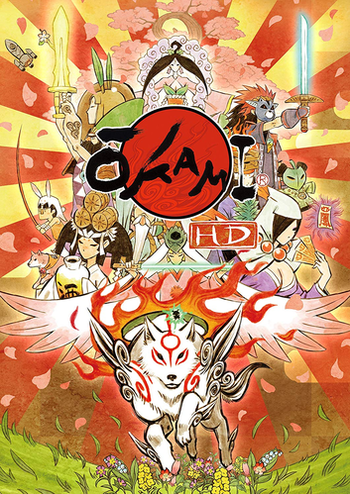
Long ago, in The Time of Myths, the eight-headed serpent Orochi lorded over the village of Kamiki, demanding a sacrifice every year on the night of the full moon. During the weeks before the day on which the sacrifice was chosen, a large white wolf — dubbed Shiranui by the villagers — would be spotted roaming the outskirts of the village. Many of the villagers suspected that Shiranui was Orochi's familiar. One warrior, Nagi, made it his mission to slay the wolf, but every time they met, Shiranui would manage to get away.
On the night of the 100th sacrifice, a maiden by the name of Nami — whom Nagi harbored strong feelings for — was selected to be offered to Orochi. Refusing to accept this, Nagi traveled to Orochi's cave to destroy the monster. However, Orochi proved to be far too strong for Nagi, and it appeared that he would kill the man.
But when Orochi was about to deal the final blow, a howl was heard. Shiranui appeared and fought Orochi in Nagi's place, proving an equal match for the serpent. In the end, the wolf gave her life so that Nagi could triumph. In Shiranui's honor, a shrine was constructed in Kamiki Village and the sword that slew Orochi, dubbed Tsukuyomi, was sealed away in the snake's cave in order to prevent his revival. All the while, the villagers never realized that, in reality, the wolf was sun goddess Amaterasu in physical form.
100 years after these events, someone foolishly removes Tsukuyomi from Orochi's cave, allowing Orochi to revive himself and spread his influence over Nippon.
Sakuya, wood sprite and guardian of Kamiki Village, realized that something needed to be done and revived Amaterasu's body so that she may defeat Orochi once more. However, Nippon's faith in the gods has declined over the century, leaving Amaterasu greatly weakened. Adding the fact that Nagi's descendant, Susano, appears to be useless, it looks like it will be a severely uphill battle for Amaterasu to defeat Orochi...
And that's just the beginning of the game.
Made by Clover Studio and released in 2006, Ōkami is an action/adventure game in the vein of The Legend of Zelda series, except using classic Japanese Mythology and folklore as the basis of its setting. Players take on the role of Amaterasu, a Physical Goddess who takes on the form of a white wolf to battle the forces of darkness that are sweeping across ancient Japan. She wields a magic paintbrush that can be used to alter reality and is accompanied by a tiny loudmouth named Issun. Amaterasu and Issun travel across Japan fighting evil, gaining new magical powers, meeting a cast of odd and eccentric characters, and living out the "true stories" behind many of Japan's most famous myths.
A sequel was released for Nintendo DS by the name of Ōkamiden, starring Amaterasu's son Chibiterasu.
In 2008, Capcom released a port of the game for the Platform/Wii which incorporated the Wii's motion controls for the Celestial Brush. Sadly, this version removed the credits sequence because it contained the original company's logo. In 2009, an improved version of the Wii port was released in Japan, which fixes most of the issues regarding the motion controls and the combat system, as well as including the removed credits sequence back in the game.
In 2010, Amaterasu joined the playable roster of Marvel vs. Capcom 3. Before that, in 2008, Yami showed up as the Final Boss of Tatsunoko vs. Capcom.
In 2012, Capcom released an HD version of the original game for the Playstation 3 supporting Move controls. In 2017, Capcom released a newer HD version of the original game for PlayStation 4, Xbox One, and PC with 4K compatibility, releasing on December 12. In 2018, Capcom released a port for Nintendo Switch which incorporated both motion controls and touch controls.
Not to be confused with Senjō no Ōkami.
This game provides examples of:
- 0% Approval Rating: Orochi in Ōkami. Granted, being a monstrous, armored, multi-headed dragon probably killed any thoughts of resistance against him.
- 2D Visuals, 3D Effects: Mostly averted, this being a game designed to look like Japanese paintings. In both movement and still imagery, the game looks like an actual painting, but pixelation in some of the textures can be seen if one looks closer.
- 11th-Hour Superpower: Right before you put the final smackdown on the final boss. Note that you don't get any new gameplay abilities (you already have all the techniques you need to fight him), it is solely for narrative reasons.
- 100% Completion: There are many requirements, with a whole menu screen containing many of them. Collect all of the Stray Beads, obtain and upgrade all weapons, fight all of the monsters (including one that can be missed forever), catch all of the fish, feed every individual group of animals in the map... there's a lot.
- Ability Required to Proceed: Used very frequently in the game. There are places very early on that require some of the final Brush Techniques to enter.
- Abnormal Ammo: The only way to defeat Lechku and Nechku, the twin clockwork owl demons, is to dizzy them and then shoot Oki at them.
- Abnormal Limb Rotation Range: Onigiri-sensei flips his head upside-down like a topsy-turvy image to assume a more intimidating aspect.
- Accessory-Wearing Cartoon Animal: All the 8 Satomi Canine Warriors have scarves.
- Accidental Misnaming: That people forget or mess up Amaterasu's name is something of a Running Gag. While Issun's kind enough to think up a relatively cute, inoffensive nickname (Ammy, though he doesn't always use it), most people just end up calling her things like "Snowy" or "Fido". Justified in that she looks to everyone like a normal white wolf, so most assume she is a simple beast and won't care.
- Achilles in His Tent: Susano does this when he finally admits, to the villagers and himself, that the Orochi of legend was real and he has released it. It takes his girlfriend, Kushi, to shake him out of it, and even then she is nearly eaten by Orochi herself.
- Acrofatic: One of the mermaid spring dancers in the Dragon Palace is notably larger and fatter than the rest — but when it comes to running around the spring, she's running laps around them.
- Addressing the Player: The game asks you to draw a symbol onto a mask you use as a disguise. Sometime later, this same symbol appears all over the walls of a town in trouble, implied to have become popular for a reason not explained.
- Affably Evil: Tobi's Boss Subtitles call him an "Evil Being". He never does anything evil. Ever. In fact, he's very polite.
- Air-Aided Acrobatics:
- The Galestorm brush technique allows Amaterasu to control the wind, which becomes handy when you have to jump between curtains that are blowing thanks to this ability.
- The only way to get characters across gaps in the digging minigame is to use Galestorm to blow them across.
- A.I. Roulette: All enemies are subject to this. The most prominent example is Yami's slot-machine form where, if you don't Powerslash it or use Mist, it will just pick random moves. Another good example is the boss fight against Lechku and Nechku.
- All Animals Are Dogs: You can make your character, the wolf god Amaterasu, bark like a dog on command. Real wolves rarely bark, and their barks are not the same as a dog bark, being different in both sound and function.
- Allergic to Evil: The whole world. Since evil is portrayed as contamination or pollution, everyone suffers. The most obvious example is the Blight which prostrates Sei-an City, leaving most of its residents sickly and hopeless. And then there's the cursed zones caused by Orochi's evil, which are so powerful they can even drain Ammy's power out of her.
- All Your Powers Combined: Part of the goal is to collect the powers of all the other brush gods that you lost from sleeping for 100 years, though they once belonged to Ammy/Shiranui before being split off into other gods when the wolf died 100 years before.
- Already Done for You: Waka restores the Guardian Sapling in N. Ryoshima Coast for you. You can still get Praise from the tree, but it requires an alternate method.
- Always Chaotic Evil: Subverted with Tobi, who just wants a good race. Actually, most of the monsters (the imps, at least) are just a bunch of goofy guys. They may be serving up poor Kushi, but to them, it's just how they live. And imp merchants are always happy to do battle... er, business... with Amaterasu.
- Always Night: Regardless of what time of day it is, you're forced into Night and can't force it to go into the next day during the festival where Orochi reawakens and picks Kushina to be his next victim. Also, by late game, the sky will always show the impending total eclipse regardless of what time of day it is.
- Amazing Technicolor Wildlife: The orca that ferries you around is a pastel color.
- Ambiguous Gender: Demon Lord Ninetails has no clearly defined gender. It's unknown if it is male or female. But considering it is a demonic creature with deific power, as well as being a shapeshifter that can take on male and female forms, it is likely genderless. Amaterasu has also stirred confusion, as she urinates with her leg up when using the Golden Fury ability. This confusion likely derives from the common misconception that only male canines can urinate with one leg up. This is more related to the degree of dominance a canine has, rather than its gender.
- Anachronism Stew: The whole game is riddled with it, since it meshes Shinto mythology with actual historical records, and then scrambles them out of chronology.
- Nagi, Nami, Sakuya, Amaterasu, Susano and Kushi are kami (deities) related to the birth of the world.
- Queen Himiko is based on a semi-legendary shaman queen from the Yayoi Period from 3rd century BC.
- Okuni is based on the famous dancer who invented Kabuki, Izumo no Okuni.
- Gen is based off Hiraga Gennai, a Japanese inventor that created the Elekiter, which was a small box that uses the power of friction to generate electricity.
- The Kaguya subplot is taken from the 10th century Tale of the Bamboo Cutter.
- Waka (who speaks with a French accent), Yoichi, and Benkei are historical warriors from the late Heian Period (ca. 12th century). The former is short for Ushiwakamaru, which is the childhood name of said warrior.
- The characters Issun, Rao, Mr and Mrs Cutter, Mr Flower, Orihime, Urashima and Momotarō are taken from latter Muromachi and Edo Period folk tales.
- Princess Fuse and the Satomi Warriors are from Kyokutei Bakin's 106 volume novel Nansō Satomi Hakkenden (19th century, set in the 15th).
- Sei-an is clearly based on Edo (modern-day Tokyo), which only became the capital in the 17th century.
- The canine warriors are mostly dog breeds that either wouldn't be introduced into Japan for centuries, or didn't even exist until recent times.
- Lechku and Nechku wear monocles and top hats. While their clockwork nature can be explained by them from another world, their fashion sense is strictly Victorian English.
- Ancient Astronauts: The Japanese folk tale of Kaguya, a child found inside a bamboo shoot by a bamboo cutter, turns out to be the tale of an alien princess whose spaceship resembles a giant stalk of bamboo —as well as her suit, which comes complete with a clear glass helmet. Also, the Celestials and the forces of darkness also arrived on Nippon from another physical world, using the Ark of Yamato as a spaceship.
- Androcles' Lion: In Sasa Sanctuary, a man in one of the rooms is a hunter who is being served by a Sparrow girl. If you talk to him, he mentions that when he was a young man, he saved an injured sparrow. If you talk to the sparrow, she'll tell you (excitedly) that when she was a little girl, she was rescued by a hunter, and now that very same man is staying in the inn — so she's making sure he has everything he needs.
- And the Adventure Continues: The game ends with Amaterasu and Waka sailing the Ark of Yamato back to the Celestial Plane. A Sequel Hook of the finest order.
- And Your Reward Is Clothes: The New Game+ gives you the 'Karmic Transformers', which change Amaterasu into various other forms, such as her de-powered form (no red markings), the Amaterasu statue in Kamiki, Shiranui markings, and other breeds of dogs. There's even a photo-realistic style Amaterasu, which is actually a Call-Back to the realistic look originally intended for the game). Good for a change of pace on long journeys, indeed.
- And Your Reward Is Edible: Various characters offer you food after you've helped them out. Some, however, request that you wait until it's night.
- Angelic Abomination: The "Fire Eye", a mook that consists of a flaming wheel with multiple eyes on its rim and one big eye in the center, heavily resemble descriptions of Ophanim, the bizarre flaming wheel angels connected to Cherubim. This is probably completely unintentional, as it takes inspiration from a Japanese Youkai like most enemies.
- Animals Lack Attributes: Played both ways — the game raised an eyebrow for the inclusion of a black "dot" underneath Amaterasu's tail (which, with the exception of one cutscene, is generally obscured by her tail anyway); other canine characters have a similar detail. But other species of animals (like horses and boars) are not depicted with any such visible... things...
- Anime Theme Song: Ayaka Hirahara on "Reset" during the ending credits. Doubles as a cut song in the Wii version, as it's still present in the Extras menu but the credits it appears in were left out. Ends up completely cut out (save for the special "Thank You" version used before the last battle) in the international releases of the HD version due to licensing issues. It still appears in the Japanese releases of the HD version.
- Animorphism: The entire Oina tribe can transform into wolfs or dogs and back, though it's never explained why. Each one also wears a mask at all times depicting their animal form, making them also border on [1]. The first one you meet, Oki, even does this during battle — I Am Not Left-Handed indeed.
- Anti-Climax: Yami's death. When you're used to seeing Stuff Blowing Up (either literally or at least florally) when you defeat a boss, watching this one just go... "poof" in an explosion of kanji and a small cloud of smoke is quite a contrast.
- Anti-Frustration Features:
- Limited yet regenerating ink is a key game mechanic, but the game also provides consumable Inkfinity Stone items that give unlimited ink for a brief time to make tasks or fights that might require fast repeated ink use easier.
- Catcall Tower is a lengthy climb up the outside of a very tall pillar. Fortunately, at several points during the climb, a golden ring of clouds will form, creating a solid platform that will catch players who fall and ensuring that they'll only ever have to redo the last segment, not the entire climb.
- The game has a journal feature in the menu that archives story hints and prompts from Issun, making it easy to check what your last task or direction was if you're coming back to the game after a while and don't remember what you were doing when you left off.
- Arc Number: The number 8 is all over the place, being a game based on the legend of Orochi, the eight-headed snake.
- The first major boss is the Spider Queen, whose shadowed form is even played to look like Orochi before she is revealed, and both she and the Bandit Spiders have eight vulnerable points inside their abdomen-flowers.
- You get a shield made of eight orbs while fighting Crimson Helm that absorbs eight hits for free; said orbs were donated from the (eight) Satomi Canine Warriors.
- The door leading to Orochi's temple is marked with an infinity sign (an 8 turned on its side), and to gain access to his chamber Amaterasu has to hit the Epicurean Bell eight times in a row.
- You get Orochi drunk off sake that was purified eight times and poured into eight vats.
- You only chop off eight of Ninetails' tails, which wield the same elemental powers as Orochi's eight heads.
- The Ark: The Ark of Yamato brought the gods to earth after Yami sacked heaven. Unfortunately, Yami came along...
- Arrows on Fire: Gaining entrance to Sei-an City requires that you light a torch to lower a bridge. Said torch is on the other side of the gorge which you need to cross. The solution is to get the archer who normally uses a flaming arrow to light said torch to fire an unlit arrow, just to prove he can, then light it on fire midflight using a brush skill.
- Art Attacker:
- Amaterasu uses her tail as a brush to cast spells.
- The first phase of the Ninetails fight has the boss use your own brush attacks against you.
- Art Initiates Life: Literally. Many actions can be performed with the help of the brush techniques, including reviving the withered trees to dispel the curse of lifelessness in the different parts of Nippon.
- Art Shift: The illustrations that depict various events are done in an authentic ukiyo-e style and differ quite a bit from the more simplified game rendering, notably turning the young looking Issun into a much mature looking man. One of the Karmic Transformers for New Game Plus (unlocked by being ranked "S" for total Praise earned after beating the game) also gives Ammy a realistic 3D render (possibly a holdover from a scrapped development concept).
- Artifact of Doom: The Fox Rods turn out to belong to Ninetails, the evil fox that is threatening Ryoshima coast.
- Artistic License – Religion: When Amaterasu being associated with wolves (she wasn't; her animals were roosters, crows, horses, kitsune and snakes) and Susanoo not even being her brother are the least dramatic changes...
- Ascended Extra: Yami is the final boss in Tatsunoko vs. Capcom, and the given explanation why all the characters in that game meet up together.
- Ascend to a Higher Plane of Existence: This happens to Amaterasu and Waka at the end of the game, but not quite in the way one'd think — they literally travel up to the Celestial Plane, while piloting the Ark of Yamato.
- Asian Cleaver Fever: Sidequest NPC Chef Umi's Cyclone Slice is exactly what it sounds like: slashing at a marlin that's bigger than he is fast enough to levitate it in a tornado of Razor Wind and having it land as five perfectly arranged sashimi platters, each decorated with a smaller marlin's head and tail.
- Asian Fox Spirit: Demon Lord Nine-Tails is based on Tamamo-no-Mae and is a powerful nine-tailed demon-fox who is the ruler of Oni Island.
- As Lethal as It Needs to Be: Amaterasu's Power Slash ability can cleanly cut trees, boulders and various minor demons in half, but when performed on friendly NPCs, it will simply knock them back. Justified, as Amaterasu is supposedly the one doing this, and theoretically she'd be able to control the strength of her own power so she doesn't accidentally hurt anyone.
- Assassination Sidequest: The Revenge Contracts are sidequests where Amaterasu is tasked by specific characters to get rid of, in each case, five mooks marked with Exorcizing Arrows. The characters who give the sidequests to Amaterasu suffered in some way due to these mooks (one got her father killed, another is being intimidated by them, etc.) The mooks only appear at night.
- Asteroids Monster: Ninetails periodically raises the sword on her back, which acts as a lightning rod to Amaterasu's lightning power. Attacking her this way splits her into nine maidens, which must be destroyed individually before she reforms. Destroying eight of them begins the second phase of the fight, where she reverts to a weaker form.
- As You Know:Kemu: As You Know, Ezofuji is formed from two active volcanoes.
- Attack of the 50-Foot Whatever: The Greater Monster in the Sunken Ship is a grotesque sleeping seaweed face that summons large arms made of seaweed to pursue you.
- Attack Reflector: Although not usually used to reflect attacks, Power Slash can be used to bounce back fruit from cursed fruit trees. Equipping certain weapons as sub-weapons also reflected attacks, most notably, Infinity Judge against Crow Tengu when they swoop down to attack.
- Auto-Revive: Possible via the Astral Pouch. It gradually fills with food and empties itself to revive Amaterasu if she dies. You can gain up to four of them, and they refill your health completely, making actual Game Over very unlikely. Justified in that Amaterasu is a goddess.
- Award-Bait Song: "Reset". The whole tracklist could be this, really.
- Babies Ever After: Several female characters are pregnant or have already given birth by the ending of the game.
- Back for the Finale: During the final battle with Yami, using certain brush techniques will cause notable past characters linked to said brush technique to assist in attacking or support:
- Using Crescent summons Nagi's spirit to slice Yami in half and expose the core for Ammy.
- Using Veil of Mist, in addition to slowing time, causes Queen Himiko's spirit to appear overhead and restore solar energy.
- Using Thunderstorm on the core calls forth the ghost of Real Rao who dishes the core multiple rapid slashes.
- Using Blizzard on the core makes Oki somehow appear, despite the fact he isn't a spirit/dead. He dukes out a powerful blow from his sword.
- Back from the Dead: It's a major part of the plot, having Amaterasu as the resurrected/reincarnated form of Shiranui. Unfortunately for her, Orochi has been resurrected as well.
- Badass Adorable: Issun is a tiny, youthful person with a determined warrior spirit. Amaterasu can be one as well, juggling godly heroism with occasional puppy antics.
- Bad Moon Rising: This trope signifies the arrival of both Orochi and Ninetails. The full moon signifies the beginning of Orochi's ritual of sacrifice. A blood-red moon, complete with nine dark lines, replaces the regular one after Queen Himiko is killed by Ninetails. It stays in the sky until you defeat the fox. And then there is the solar eclipse, which signifies the rising of Yami, the Lord of Darkness, and the concurrent waning of Amaterasu's solar power. This, fortunately, is only an issue during the very last battle. You don't suffer any gameplay weakness during the eclipse.
- Bait-and-Switch: At the end of the Tsuta Ruins, the first major dungeon, there's a gigantic flower bud that ate Kokari's dog Ume. As Amaterasu and Issun run forward, they see a shadowy eight-pronged mass writhing behind the bud. Issun is speechless as he assumes it's Orochi, the eight-headed serpent running the show, but the silhouette becomes the eight arms of the Spider Queen, and the bud is her abdomen. The model for Orochi is used in the leadup, however, implying that he was projecting to create or animate the Spider Queen.
- Bamboo Technology: Kaguya came to Earth in a giant bamboo spaceship.
- Barely-Changed Dub Name: Most of the characters had their name shortened in the dub. The changes include: Kushinada to Kushi, Issunboshi to Issun, Ushiwaka to Waka, Izanagi to Nagi, Izanami to Nami etc.
- Barrier Maiden: Sakuya, whose trees ward off evil, has been turned into Sealed Good in a Can. Only by rejuvenating the trees can the area's cursed zone be lifted. Princess Fuse also functions as this for Kusa Village, though the village starts becoming a cursed zone after she gets possessed by some imps. It's also implied that Queen Himiko is the main reason why the Blight is only making most people feel weak. Also, there is the possibility that Otohime protects her people from the Water Dragon, though it could also be that it avoids the area on purpose, given it was the king's home.
- Bathos: Done intentionally in the battle with Orochi Nagi tries to look awesome, but it's hard to take him seriously when he's dressed in women's clothing... and even harder when he falls flat on his face jumping into battle.
- Batman Gambit:
- Queen Himiko lets Rao/Ninetails regain the Fox Rods, and thus ultimate power, in order to use that power to find Oni Island so Amaterasu can finish Ninetails off.
- Shiranui's plot to get Kutone glowing again to open the way to the Ark of Yamato and thus to Yami and the Celestial Plain (which involves a Stable Time Loop). And you have to admit that Orochi seemed Crazy-Prepared, too, waiting for one of Nagi's descendants to unwittingly pull Tsukuyomi out of Orochi's seal so he would curse the world, and tempt said descendant so he could complete the blood pact and give the giant snake "dark powers beyond comprehension". And if that failed, he'd die and then subsequently release the souls of the four other major baddies to take over the world. All of this while Waka knowing exactly what is going on and trying to set Amaterasu up to get her to the Celestial Plain, too.
- Battle Butler: A scrap of paper infused with a demon of sorts serves as "gatekeeper" to one of the game's bosses. While his only means of halting Amaterasu involve racing past her to shut gates, he has the full personality of a Battle Butler. To the point that a literal piece of paper is considered the Worthy Opponent of a Physical God.
- Battle Theme Music: The game has a strange distribution of boss music. The theme that is first heard when fighting Crimson Helm (the second boss) is also heard in the fight against Blight (the fourth boss) as well as in nearly every Mini-Boss fight. But Waka, a miniboss himself, uses a special remix of that theme for his own battles against the protagonist, while Nagi, Susano's ancestor (the last miniboss introduced in the game) uses a different theme altogether. Also, the Fishing Minigame has a dedicated battle music heard whenever Amaterasu is helping a fisher capture a particularly strong fish (Whopper in Agata Forest, Cutlass Fish in Sei-an City and Marlin in West Ryoshima Coast). All remaining opponents (the dungeon bosses other than Crimson Helm and Blight), including the Final Boss, have their own respective tracks.
- Beary Funny: The sleepy bear who balances on various spherical objects, dubbed Sleepy by Issun. Susano attacks him at one point, but all it does is wake him (very briefly) up.
- Beat Them at Their Own Game: The kitsune lord Ninetails has a Celestial Brush of its own on each of its tails. Trying to use your own Celestial Brush will make Ninetails bring up a Brush to match and disrupt your Technique, forcing you to finish the pattern as soon as possible before the enemy crosses it out. It can also perform techniques similar to your own.
- Beethoven Was an Alien Spy: Though it's probably lost on anyone not familiar to Japanese history, the game suggests and eventually confirms that historical figure Minamoto no Yoshitsune is a 200+ year old Moon-born celestial. For those wondering when Yoshitsune was ever shown or even mentioned in the game, just remember that his childhood nickname was Ushiwaka.
- Being God Is Hard: Explored and pointed out by Issun to the people of Nippon in the final battle, when Amaterasu is on her last legs against Yami, and needs prayer badly."Let's show Ammy that we truly believe! Put your hands together and pray. Let's make our gratitude obvious! I mean, we shouldn't pray only when we want something. We should consider how the gods must feel once in a while. We should even take on some of their burden. If you pray with all your heart, maybe the sun will cheer up and show itself once again, lighting our world with its heavenly glow! After all, the best thing about the great god Amaterasu is that happy-go-lucky spirit! Right, Ammy? Answer if you can hear me, ya big furball!"
- Benevolent Architecture: Menacing or crumbling dungeons will nonetheless have convenient Konohana Blossoms to grapple to with the Vine power.
- Berserk Button: Don't call Issun a bug, especially if you're someone he's interested in. He's a "wandering artist". Also, he doesn't like being reminded that he's a Poncle in general, considering they remain devoted to their role in life, and he's determined to try and run from destiny.
- BFS:
- The Glaives obtained by Amaterasu, particularly the Thunder Edge, which is as large as Amaterasu herself.
- Susano's sword and Tsukuyomi, Nagi's sword, also count.
- Tachigami, the guardian of Power Slash, has a huge sword. He's barely the size of the thing's grip, and he still manages to swing the thing around.
- The 8-pronged sword used by Ninetails, which acts as a big lightning rod.
- Big Bad: Orochi is Amaterasu's Arch-Enemy who rules over Eastern Nippon and forces pure maidens to be sacrificed to him so he can become god of the underworld. Until he is defeated, at which point Ninetails, ruler of Oni Island, takes over, leading the demon invasion of Ryoshima Coast, killing Rao and tricking Amaterasu into giving over the Fox Rods; though both he/she/it and Orochi are working for the real villain, Yami, the God of Darkness who wiped out the Moon Clan and leads all the demons.
- Big Boo's Haunt: The game has a Mini-Dungeon like this on a sunken ship, where the ghosts of those who perished want to harm you. You can only kill them with the priestess on your back, who accompanies you on that mission and uses dispelling slips of paper to attack. Also features a scary bit where the ghost of the spider boss (whose face looks like a dead girl) dive-bombs the actual TV screen and shrieks at you. It doesn't help that the ghosts can move while you use the Celestial Brush, which very few enemies ever do. This makes them even more unsettling, since it's kind of an Interface Screw.
- Big Friendly Dog: Amaterasu is a benevolent goddess and exhibits some puppy-like affection for other characters. She even jumps up on Waka and licks his face at the end of the game.
- Big Heroic Run: Any time "Giving Kushinada a Ride" plays, it'll always be during these moments.
- Bishie Sparkle: Waka creates these from time to time to add to his air of ethereal superiority.
- The Blade Always Lands Pointy End In: Whenever you disarm Blight, the sword that animates the armor lands point-in-ground. Possibly justified since the blade itself is the actual entity.
- Bleak Level: The game features a mixture of cheery and dark areas, but the bleakest one among the latter group is Sei-an City under the Blight's influence. The atmosphere is very foreboding, as the city is being shrouded by a thick green mist that originates from the Emperor's body (the culprit isn't him, but Blight who invaded his body). As a result, the inhabitants' morale has deteriorated, and so did the health of some. Even Issun tells Amaterasu that the place has gotten a more sinister appearance than Orochi's cursed zones, which says a lot.
- Bloodless Carnage: For the most part, the game is gore-free, but the aftermath of Orochi's vertical bifurcation is shown obliquely in the game, and more clearly and bloodily in the cutscene paintings afterward.
- Blow You Away: The Gale brushstroke, which is obtained from Kazegami. By drawing a swirl of ink, you can create winds that blow you, your opponents, or objects around. Later, you get a Whirlwind brush technique by drawing three horizontal lines. It can be used for juggling enemies.
- Body Bridge: During the Sei-An Story Arc, Queen Otohime uses the Dragon Orb to transform into a Water Dragon and, while having this shape, positions herself between the Watcher's Cape in North Ryoshima Coast and the elusive Oni Island so Amaterasu and Issun can reach the latter destination.
- Bonus Dungeon: The game features a particularly evil example. In different areas of the overworld there are three caves that are home to (slightly) upgraded versions of a previous giant demon spider boss. Defeating them earns a reward, but you can then return to the same cave later to find a demon gate eerily sitting there. Going through forces you to battle wave after wave of superpowered regular enemies. Even the lowliest of Mooks can waste you with a couple of hits in these battles (and you have to go through 10 of them to get the reward) and have HP that would make some of the late-game bosses jealous. These battles could be considered a refreshing change of pace compared to the general easiness of Okami if not for their sheer sadism. The most difficult cave has you face several minibosses from the past in groups, usually two or three at a time. Including Waka and two possessed Raos.
- Booze-Based Buff: Magical sake to boost attack or defense power is available from every vendor in the game. Veil of Mist is also related to holy sake as seen by its brush deity drinking it before activating Bullet Time.
- Border Patrol: The water dragon in West Ryoshima Coast. It is actually possible to bypass it using the lily pad brush power, but it's very difficult to do. As the story progresses, the dragon becomes less of a problem with the help of Orca, who is faster than it (and immune to its attacks anyway). Later on the dragon is killed, allowing the waters to be traversed safely.
- Boss-Arena Idiocy: Very frequently, the Boss Room will contain exactly what you need to defeat said boss, even − especially! − if there is no reason for it to be there whatsoever. Against Ninetails, the Twin Demons and Yami, there will be torches, waterfalls or thunderous clouds at your disposal all around the room. As for Yami, the fight actually takes place on the deck (the top) of the Ark of Yamato. Also, there are Konohana Blossoms in the Spider Queen's boss chamber, as well as the various Bandit Spiders' throughout the game. Which also have torches. At the bottom of random cavernous holes in the ground.
- Boss-Altering Consequence: The Exorcism Slips are typically meant to be used during fights with normal enemies, inflicting powerful damage to finish them off faster. However, if the player brings an Exorcism Slip L with them to the first fight against Orochi, they can use it to instantly end the first phase of the battle after exposing the boss' weak point. However, the trick isn't effective during the second and third fights against Orochi; attempting to use an Exorcism Slip L on him at these points still leaves him with a third of his health.
- Boss Arena Recovery:
- Using your slow-time-down power, occasionally one of the characters will drop health for you.
- During the final boss there are a few chests littered around the battlefield atop tall pillars you can open for inventory items. Hey, they had to put some use for the strictly non-combat Catwalk power in this Final-Exam Boss. One of the boss's forms even mimics a slot machine, and one combination makes it give up a load of recovery power-ups.
- Boss in Mook Clothing: The Dogu that you meet the first time in the past just before fighting Orochi could qualify. They are very resilient, have some fast and varied attacks, and can do quite a bit of damage when you're not used to them; it helps that they're a variant of Blight, an actual boss. Of course they are even worse in the Ten Demonic Gates sidequest.
- Boss Remix: Waka's battle theme is an amalgamation between his leitmotif and the battle music heard with most minibosses as well as two main bosses (Crimson Helm and Blight). Interestingly, in appearance order, Waka is fought before anybody else in the game.
- Boss Rush:
- It's almost a Capcom tradition — The Very Definitely Final Dungeon has no puzzles to solve or enemies to fight; just five rooms, each containing one of the bosses you beat beforehand. The only boss that dosen't appear are the twin mechanical owls, which are excluded because they were fought just prior.
- The third Bandit Spider Demon Gate includes a rematch against three tough mini-bosses (up to three Evil Raos and two Wakas, all at the same time) previously seen through the main quest.
- Boss Subtitles: You get a shot of Issun's Bestiary scroll every time you fight a boss, as well as any time a new enemy makes its debut.
- Bottomless Bladder: The game allows you to pee and poop on enemies. This is, however, completely optional so despite the fact Amaterasu is capable of peeing far more than her own body mass in just a short battle, she never needs to.
- Boundareefs: The Ryoshima Coast is surrounded by some rocky formations that prevent Orca (and later Amaterasu when she has access to the Water Tablet) from going further into the ocean. However this brings a question: how did the Sunken Ship get past them?
- Braggart Boss: "Waka, the gods' gift to man, is here! Bonjour!" While not villainous, per se, he still acts as a recurring antagonist to Amaterasu. Subverted in that he eventually turns out to be as competent as he brags. It was his prophecy that led to the original defeat of Orochi, after all. He also carries more emotional baggage than the average Braggart Boss.
- Bragging Rights Reward: Collecting all 100 stray beads allows you to create an accessory that gives you invincibility, infinite ink, and a 10x strength bonus. Want to know how you get the last bead? You receive it as a gift from Issun after you beat the game. Fortunately, you can keep it in a New Game Plus; in fact, this is the whole purpose of it.
- Breath Weapon: Each of Orochi's heads has a different one for each element: Fire, Water, Earth, Wind, Lightning, Light, Poison, and Curse.
- Brick Joke:
- A Poncle will offer to design a seal for you. If you accept, you don't see your seal design again until a blink-and-you'll-miss-it scene right at the end of the credits. This does not appear in the Western Wii versions because the credits, including that scene, were cut out.
- An earlier one also appears, when you try to get into Orochi's lair you need to find a paper mask. After finding it, you can put any symbol you want on the mask. Once you reach Sei-an City and defeat Blight you'll see a little girl putting various drawings on the floors and walls. The first picture she does? The same symbol you put on your mask.
- Bridge Logic: Happens with a tree trunk that Susano is rafting down the river with. Amusingly, this is the only such instance — with her reality-altering paintbrush, Amaterasu can 'fill' any other Broken Bridge in.
- Broken Bridge:
- Used a few times, most directly in the form of 'curse zones', which (if stumbled into) turn the background rather trippy, and slowly chip off Amaterasu's health (unless escaped from, or her 'health-bubble' runs out).
- There are also a couple of literal broken bridges, some of which you immediately fix. One interesting example is the broken staircase that leads to Orochi's lair. Amaterasu must travel through a set of caves as an alternate way to reach Orochi. The interesting part is that, much later on, Amaterasu winds up traveling back in time to before the staircase was destroyed and uses it to confront Orochi again, this time without getting sidetracked.
- There is the held-up bridge at the City Checkpoint and the closed bridge in between the Commoners and Aristocratic Quarters. Funnily enough, they were invented by the same person.
- Building Swing: Upon learning the pertinent Brush Technique, Amaterasu can summon vines from conveniently-located hovering flowers and either pull herself along or use them to snare other objects.
- Bullet Time: The Veil of Mist brush technique. It's subverted by Kasugami when you learn the technique, since she's so drunk she gets hit by every object.
- Bullfight Boss: Oni (both red and blue) and the appropriately-named Bull Charger. If you try to attack them head-on, you can't damage them and you're likely to get smacked senseless, but if you attack from behind or hit them when they've dropped their masks, you can take them down fairly easily.
- Bunny-Ears Lawyer: A good number of characters in the game are far more proficient than their demeanors would indicate, particularly Amaterasu, Susano, Waka, Tama, the Oranges, several of the Canine Warriors, and Nagi. Amaterasu in particular stands out the most on account of being the main character: who knew that the ditzy, impulsive, and frankly airheaded wolf could kick so much ass?
- But Thou Must!:
- "No" options are provided when Ammy is asked to do something, but the characters responded to will beg you to reconsider until you say "yes".
- When Amaterasu ends up in past Kamiki Village, she finds a very young Sakuya alongside her tree which is a small sapling. Attempting to Bloom it will instead cancel it out since doing so would break the timeline.
- By the Eyes of the Blind: Only people with some spiritual sensitivity can see Amaterasu's Facial Markings, including the late priest of the Gale Shrine whose spirit has lost his physical sight. In addition, only Poncles still hold the ability to understand gods, which is how Issun is able to speak with her despite her apparent muteness. Some very spiritual people (Sakuya, Otohime, etc) are able to interpret at least a little based on her behaviour though.
- Call a Hit Point a "Smeerp": Solar Energy, Ink, and Praise serve the functions of hit points, mana, and experience, respectively.
- The Call Knows Where You Live: An interesting case where you are the call, rather than The Chosen One. Susano is reluctant to assume any mantle of heroism, but Amaterasu never stops following him and guiding him down the path that will lead him to his destined battle against Orochi.
- Camera Abuse: Hasugami, one of the monkey gods, accidentally hits the "camera" and makes cracks appear on the screen before giving you his brush technique.
- Canis Major: Ninetails, an enormous demon fox.
- The Cape: Susano dons one after his level-up.
- Cape Wings: Waka's hat.
- Carnivore Confusion: Averted. Amaterasu, though a wolf, never eats anything but Holy Bones, fruits and vegetables, or prepared foods. She doesn't even eat the fish from the various fishing games (though she can eat sashimi in a sidequest). The wild critters also have no fear of her, though they might sense her true nature. Also, one of her epithets is "mother to us all".
- Cartoon Bomb: One of the brush techniques creates a 'Cherry Bomb' for the orb and stem shape of these things. It's meant to be a firework, rather than just a bomb, but it looks almost the same. The technique can be upgraded to allow Amaterasu to draw two Cherry Bombs at the same time, and once again so she can draw three.
- The Catfish: Three cases. There's Whopper, who ate the reflection of the moon, a "living sword" (i.e. cutlassfish), and the Legendary Marlin.
- Cats Are Mean:
- Amaterasu bonds with Kabegami by batting Issun around like a toy mouse.
- Gekigami, a tiger, is a bigger offender in this department, briefly firing off his arrows at Amaterasu. Both cats, however, prove to be just as friendly and respectful as the other brush gods once all's said and done.
- Try to bite a tiger and they'll take a good swipe at you.
- Cave Behind the Falls: The game makes heavy use of this trope - making it easy to find secrets if you know it. Once Issun even tells you to jump down a waterfall, and though you don't have to, sure enough, there's a cave there with a wall you can bomb to get a Stray Bead.
- Cel Shading: A surprising aversion. The game uses a fairly unique rendering method involving flowing liquid shadows (and outlined models) meant to look like ink. Although in still shots it looks slightly similar to cel-shading, the actual technique, and the appearance in motion, is completely different (notably it isn't tied to light sources, instead being closer to ambient occlusion).
- Central Theme:
- Eastern Nippon: Your problems will not be solved by sitting around praying for the gods to bail you out. You have to be able to stand up and take action yourself.
- Western Nippon: Sometimes, the greater good requires sacrifice from the greatest of people.
- Kamui, the Northern Lands: Your duty isn't always what you think it is.
- Character Catchphrase: Issun says "You hear that, Ammy!?" a lot. He also has some self-invoked ones, such as "Leap before you think!" and "There's no stopping me once I've made a decision!"
- Charged Attack: The glaives, in both primary and secondary versions have these.
- Checkpoint: The game has the occasional golden gate, usually located just before difficult encounters. Amaterasu can continue from the gate if she dies. Unlike the mirrors, the player cannot resume the game at these gates after quitting to the title screen or shutting the console off.
- Chekhov's Gun: While exploring Kamiki Village early on, talking to Kushi has her elaborate on the incident which broke her waterwheel was when she gave some of her Thunder Brew sake to an imp who proceeded to go on a drunken rampage. That same brand of sake comes up much later when she's set up as the latest sacrifice, since Susano drunk the 8 Purification Sake out of depression for what he did, and it's enough to get Orochi drunk.
- Chekhov's Gunman: It's easy to dismiss Mushi's dog Hayabusa and Kokari's dog Ume as harmless side characters, until you're asked to locate the 8 Satomi Canine Warriors, where you learn that Hayabusa and Ume are two of the ones you're looking for.
- Cherry Blossom Girl: Sakuya in qualifies despite being the spirit of a golden peach tree — she protects and preserves Nippon through her network of enchanted trees, has pink blossoms, hides the people of Kamiki Village in her fruit when the darkness is about to overwhelm it, and at one point in the early game withdraws into her tree until revived by the protagonist Amaterasu.
- Cherry Blossoms: Everywhere, including Sakuya's trees (even though she's the spirit of a peach tree).
- Cherry Tapping: Killing enemies with the Golden Fury or Brown Rage techniques, which are weak attacks primarily made for obtaining Demon Fangs.
- Chest Monster: Some chests on the Sunken Ship contain monstrous hands with eyes. They can be identified by their brighter gold color.
- The Chessmaster:
- Ninetails. While Orochi's confined to the Moon Cave and Yami seems to be happy acting as a vague monster-spawning Greater-Scope Villain, Ninetails does everything in his power to make sure he and his stronghold are completely unassailable. It almost worked, too, as Amaterasu breached Oni Island with only minutes to spare.
- Queen Himiko, whose Thanatos Gambit beats out Ninetails in the end.
- Chivalrous Pervert: Issun, who blatantly ogles every woman he sees, climbs inside Sakuya's robe, and even encourages Rao to relieve herself in the ocean while he and Ammy are there. He's... heavy on the perv, light on the chivalry.Issun: The name's Issun. And by the way... it only looks like I'm staring at your melons.
- City Guards: Sei-an's guards are never seen doing anything but staying put at their post or wandering around the city aimlessly. They certainly don't help you catch a certain infamous pickpocket, either.
- Clap Your Hands If You Believe: How the main character gets more powerful. Performing helpful divine intervention gives Praise and with Praise, Amaterasu can be upgraded. This is also how Ammy gets her second wind against the Final Boss after her powers are stolen a second time: Issun, left behind, spreads the word about Ammy's divine nature and what she's already done for people, causing everyone she's helped to pray for her success, restoring her abilities and then some, returning her to the glory she had as Shiranui.
- Cleavage Window: The first form/clothing set of Wood Sprite Sakuya, who is a peach tree spirit, has two Cleavage Windows. The first one is a diamond-shaped cutout showing off her cleavage. The second ones bares her buttocks, to go even further then the first one in using her figure to remind a viewer of her connection to peaches.
- Clifftop Caterwauling: Okami Amaterasu does this during the game's Attract Mode intro. Due to Climbing Climax, several boss battles take place on high platforms, giving her after-action victory howl this flavor.
- Climax Boss: Whilst minor bosses are encountered throughout, each act has one of these; Orochi in Act 1, Ninetails in Act 2, and Yami in Act 3.
- Clip Its Wings: Several enemy types are invulnerable, or at least much harder to attack, while flying, but you can use brush techniques to cut their wings off and/or knock them out of the air with gusts of wind. Also implied to have happened to Waka when he tried to take on Yami unaided.
- Clockworks Area: The Wawku Shrine is built around a frozen giant clock, and features numerous gears and clock faces.
- Clothing Damage: During the fight with Orochi, Susano's clothes are torn to reveal his butt.
- Cloudcuckoolander: Amaterasu herself doesn't seem totally in touch with events most of the time, and acts more like a dog than a goddess. Usually she's in the habit of taking naps or trying to play fetch with ancient and priceless artifacts during long conversation.
- Collapsing Lair: The Moon Cave and the Water Dragon's body must be escaped after they destabilize from your actions in completing the objective.
- Collection Sidequest: You can collect 100 Stray Beads throughout the course of the game to obtain the Infinity Plus One Accessory, but it's really really hard. Only the first 99 Beads are available during a first playthrough; the 100th Bead is rewarded upon finishing the game. This makes them an utterly worthless collectible for at least the first time you play, and probably several subsequent playthroughs, as well.
- Coloring in the World: The world has been engulfed in a literal darkness of gloom and despair. It comes down to Amaterasu to use her Celestial Brush to bring light and color back to Nippon.
- Combined Energy Attack: The collective power of prayer all over Nippon restores Amaterasu to full godhood.
- Compressed Hair: Waka, which only comes out before his apparent death.
- Concept Art Gallery: Upon clearing the game for the first time, you'll unlock the game's concept gallery, which includes art from characters, locations that appear in the game, and locations that were planned but scrapped during development.
- Cool Gate: The Spirit Gate, Devil Gates, and Golden Gates are all magical. The Spirit Gate leads to the past, the Devil Gates lead to enemy gauntlets, and Golden Gates create soft-saves within dungeon areas. There are also larger gates that, when passed through, change the reality to open passage to spiritual zones.
- Cool Old Guy:
- Onigiri Sensei, a demanding, tough master whose head turns upside down when he goes badass.
- Also Mr. Orange, who has some mean dance moves.
- Cordon Bleugh Chef: Moon Cave has an Oni chef who sends the disguised protagonist out to fetch various monster bits to make an appetizer for his boss. Upon making the dish, the chef declares that it is the perfect appetizer because anything else will taste excellent in comparison.
- The Corruption: The game plays this trope a bit more unconventionally, in that the corrupting force doesn't affect an individual person, but rather an environment; a dark red mist spawned by Orochi as well as Ninetails, Lechku & Nechku, and ultimately Yami turns whole portions of Nippon into desolate brownish-gray landscapes where demons are allowed to run amok. These affected areas tend to feature Cursed Zones, which are so saturated in red mist that they physically harm Amaterasu, drowning her if she stays in them for too long. At one point, Ammy finds Kusa Village completely enveloped by a Cursed Zone, but because it's stretched out over a much larger area than normal, the worst it does is drain her ink without letting her recover it until she leaves or purifies the area. Additionally, during the battle against Orochi, his shadow-element head attacks by spitting out purple buds that spray out clouds of red mist, temporarily turning the battlefield into a mild Cursed Zone on-par with Kusa Village. He does it again during the battles with True Orochi 100 years in the past and on the Ark of Yamato.
- Cosmetic Award: Completing the game unlocks skins that allow the player to change Amaterasu's appearance. These range from simply altering her coloring (such as a skin that removes her Facial Markings or makes her black) to shape (such as the skins that turn her into various breeds of dog).
- Cosmic Plaything: Susano becomes convinced he's one. He's not really far off, since most of his feats miss without Ammy providing a boost with her powers.
- Counter-Attack: Whenever Amaterasu successfully blocks an opponent's attack with her Reflector (which must be set as a sub-weapon), she can counter with an izuna drop for massive damage. She can still perform this counter in Marvel vs. Capcom 3.
- Creepy Doll: The game has some of these in the Sunken Ship dungeon. They aren't exactly creepy on their own right, but combined with the surroundings, occasional chest-monsters and the sound world that at first makes them seem like they're laughing at you, we can't really blame you if you feel like Power Slashing them, just to be sure.
- Crossover: Amaterasu is a playable character in Marvel vs. Capcom 3: Fate of Two Worlds. Yami is the final boss in Tatsunoko vs. Capcom.
- Cryptic Conversation: Every single one of Waka's prophecies, and most of his regular conversation too.
- Crystal Ball: Queen Himiko uses a giant and very powerful one, allowing her to figure out a way to predict where Oni Island will appear next. She succeeds, but only after sacrificing her life.
- Cue the Sun: Not only can Amaterasu invoke this at will, it's how she defeats the True Final Boss, who smothers the arena in darkness. When she gets her Second Wind during that fight, the music is even named "The Sun Rises".
- Cunning Like a Fox: Dark Lord Ninetails is an evil fox that spends more time on complex plots than most of the other villains.
- Curb-Stomp Battle: The silver demon Nechku doesn't stand a chance once Shiranui starts attacking him.
- Cute Kitten: The game provides lots and lots of cats to feed in the game's strangely endearing "Animal Feeding" mini-quests. The game goes as far as to reinstate the Cat as a Chinese Zodiac constellation, and this Brush God gets along quite well with Amaterasu despite the latter being a canine.
- Cutscene Power to the Max: Amaterasu can do several moves in cutscenes that aren't possible in actual gameplay.
- Darkest Hour: First you have the tragic death of Queen Himiko and Race Against the Clock to reach Oni Island... but the real one is the legendary Day of Darkness, a day-long solar eclipse occuring once every 100 years, which applies in every sense of the word considering that you're the sun god. Not only that, but the blizzard in Kamui gets ten times stronger and threatens to freeze the entire village.
- Dark Reprise: The swordsman Oki is introduced with a laid-back but vaguely sad theme. As he becomes dangerously obsessed with slaying strong monsters to awaken his Ancestral Weapon, this is replaced by the off-kilter remix "Oki's Destiny". Once he comes to his senses and pledges to fight by Amaterasu's side, this is again replaced by the upbeat and heroic song "Brave Warrior Oki".
- Daruma Doll: Daruma dolls can be found in the overworld. They only have one eye, so drawing in the other eye will open the doll to reveal a treasure.
- The Day the Music Lied: Happens at the end, when it seems like the final boss is defeated after four phases, complete with victory music playing and you starting to do your victory howl, when suddenly the music stops as the boss comes up from behind and proceeds to strip you of your Brush Techniques again!
- Dead All Along: Priestess Rao asks Ammy and Issun to find the Fox Rods, an ultimate weapon that could aid the shut-in Queen Himiko and save Nippon. After they do and she receives the Fox Rods, Ammy and Issun are shown a vision of Rao being attacked by a monster. Racing to the temple, they follow an apparition of Rao to a secret passage, where a skeleton in her clothing lies. The Rao seen thus far is a demon in disguise who killed her and took her place, with that vision showing the real Rao's death long before.
- Death Course: Oni Island is a huge deathtrap... which is apparently entertainment for the local youkai. There are even rules for these areas posted on a small, hard-to-miss sign right before them. They're hosted by Tobi, the game master for the largest of these death courses.
- Degraded Boss: The Bandit Spiders, which are optional minibosses found in holes scattered throughout the land. They are all upgrades of the Spider Queen boss fight.
- Demon Slaying: This is Amaterasu's mission, along with restoring Nippon to its former beauty.
- Depower:
- It's only natural after nearly dying and being Sealed Good in a Can for a hundred years... or was that actually dying and being reincarnated from scratch using a stone statue for a body? It's not entirely clear.
- Tube Foxes are capable of draining your ink supply until you're forced to fight them with nothing but claws and fangs.
- Despair Event Horizon: Amaterasu comes perilously close to crossing it during the final Yami battle, with her powers being stolen twice.
- Developer's Foresight:
- If you try to raise the sun before you receive the tutorial, it won't work, but Issun will remark on it when you gain the ability, noting that you seemed to know what you were doing.
- Enemy arenas can be escaped by attacking a rift in the edge and jumping out. Because some battles may start near walls, there are two rifts in each arena so you aren't trapped by a rift you can't jump out of.
- Every member of the Oina tribe in Kamui has an animal form — even the merchants! Just cast Bloom on them and they'll transform for you.
- When carrying either Susano, Kushi, or Nagi on your back, you can run around Kamiki Village and the villagers will comment about it. And if you take Susano all the way to the statue of Nagi past the River of the Heavens, he's completely unphased by the experience; Issun even wonders if he's been there before.
- If you go out of your way to the Cave of Nagi during the Kamiki Festival, Susano and Kushi are there with extra dialogue.
- If you're using a Karmic Transformer on a New Game Plus, the early cutscene with Mr Orange's perspective will correctly show the depowered form of the Karmic Transformer you're using.
- Diagonal Cut: The training dummy in the Dojo falls apart with such a cut each time you complete an attack chain against it. Anything you can Power Slash will fall apart with a specific cut angle, regardless of the direction you drew the stroke (which can also be mildly diagonal).
- Did You Just Punch Out Cthulhu?:
- Inverted; you may be a god, but quite a few mortals manage to give you quite a thrashing.
- Played straight with the last boss, though—few things are as satisfying as punching out
some kind of unholy creature of pure darknessa fish-shaped... thing... in a giant mecha.
- Disc-One Final Boss: Despite being the apparent villain in the story, re-enacting the legend from 100 years ago and defeating Orochi is only a third of the game's story, with new evils being unleashed afterward and much more story ahead.
- Disc-One Final Dungeon: The game leads you to believe that Orochi is responsible for all the evil present in the world, and the supposed final dungeon is Moon Cave. But it's only all the evil represented in a small area of the world. Exploring the rest of the world leads to Oni Island, and an epic dungeon where you meet the Lord Of Darkness. Surely that's the end? No, that's 2/3 of the game. Only when reaching the Ark of Yamato, home of Yami, you're finally on the true last stage.
- Disc-One Nuke; You can buy the third reflector as soon as you reach the second town, only a few hours in. It is somewhat pricey, but as long as you have been saving it should not be out of your price range. You won't even see the third tier rosary or glaive (or even the first tier glaive) for many hours. Slap some gold dust on that reflector and you will cut through enemies like butter for a good while.
- Doomed by Canon: In-universe example — when Amaterasu and Issun wind up in Kamiki Village 100 years ago, they find themselves having to re-enact the very battle with Orochi as told in legend. Issun, remembering how this one ended with "Shiranui" dying, is very nervous about it. They defeat Orochi without incident but Shiranui appears in time to save Nagi from a falling boulder — and Shiranui, as we find out later, is already dying from a mortal wound inflicted elsewhere.
- Double Jump: Acquired from the Ryoshima Dojo. At the Kamui Dojo, you can even upgrade it to make it damage enemies during battle. It's one of the "God Techniques", which according to the sensei cannot be learned by ordinary people (or wolves). It should also be noted that after having learned the Holy Eagle technique (double jump) you can later upgrade it to a triple jump. Considering that by the end of the game Amaterasu can walk on water, summon lightning, water, ice, and fire, walk up walls, and make plants bloom, a Double Jump is really the least of her abilities.
- Double-Meaning Title: This game takes advantage of how the long-o prefix denotes something big or great, making the term "great god", as well as the word normally being Japanese for "wolf". As noted in the Anime section, kami can also mean "paper" or "hair," which suits someone who manifests her powers by painting things with a brush. Also, wolf hair is a typical material in calligraphy pens.
- The Dragon: All the big climactic bosses are such to Yami, but most notable are Orochi and Ninetails, who are the most active nemeses to Amaterasu.
- Dragons Are Divine:
- Yomigami, the dragon god of rejuvenation who grants Ammy (And later Chibiterasu via his seahorse children in Ōkamiden), the Rejuvenation brushstroke.
- Orochi, Amaterasu's Arch-Enemy, has as his goal becoming the god of the underworld through the maidens sacrificed to him every year prior to his sealing by Nagi, and his true form especially gives off the appearance of a divine being by being covered in golden armor.
- Dramatic High Perching: Waka has ethereal powers and a superior attitude and introduces himself while standing on a tree branch.
- Dramatic Thunder: The dramatic Ninetails battle in Oni Island, fought atop the great mansion of Oni Island. Since you've learned to control lightning at this point, and the foe enjoys flourishing her highly-conductive sword, this works to your advantage. One of the phases of the Final Battle repeats this, with lightning flashing as the boss raises its sword-shaped arms.
- Dressing as the Enemy: All imps that inhabit the Moon Cave will mistake Amaterasu for one of them due to her wearing a sheet with a custom drawing (all imps have their own marked sheets covering their faces). Thus, they won't attack her.
- Drunken Master:
- Mr. Orange enthusiastically breaks his vow of temperance to perform the Konohana Shuffle and restore Sakuya's tree. Additonally, Susano and even Amaterasu get a fighting edge by drinking special sake.
- Parodied with Kasugami, the god of mist. When the god makes her entrance, a bunch of imps throw instruments at her. She takes a swig from the bottle of alcohol on her back, leaps into the air... and utterly fails to dodge any of them. Turns out that drinking doesn't make her a kung fu master, it just makes her drunk.
- Dual Boss: The twin demon owls, Lechku and Nechku. Then there's Waka, Rao, and Nagi if you try to banish the Devil Gate in Kamui's Bandit Spider cave.
- Dual Wielding: Ammy can equip both a Main weapon and Sub weapon — note that rosary beads are the only ones still visible when equipped a subweapon. Waka also fights with two blades: one of metal (wielded in a Reverse Grip, no less) and one of energy.
- Dub Name Change:
- An odd example. The names in the US version were not exactly changed but those who had four syllables or more (except Amaterasu) were shortened. Izanagi becomes Nagi, Kushinada becomes Kushi, Ushiwaka becomes Waka, Tsuzurao becomes Rao, Okikurumi becomes Oki, etc.
- The Japanese name of the final boss is Tokoyami no Sumeragi, literally "Emperor of Everlasting Darkness". However, the English translation shortened it to simply Yami, which means "darkness".
- Dude, Where's My Respect?:
- You do 99% of the work needed to slay Orochi, destroy Oni Island, take down thousands of demons, restore beauty to Nippon, and master the powers of explosions, fire, wind and water. And most people will still call you demeaning nicknames until the finale. They'll also take credit for your work, though Amaterasu does seem to be trying to make her contributions not so obvious.
- Issun and Amaterasu also tend to help others by letting them take credit, such as telling Kokari he rebuilt the bridge to Taka Pass to get his confidence back when really Amaterasu used her Vine brush skills to stop a rampaging log, or most times with Susano early on. These people generally come back to help later on, though, so letting them take the credit at first eventually pays off.
- Ironically, anything related to animals or nature tends to give Amaterasu the respect she deserves; restoring nature and feeding animals are two of the main ways to increase Amaterasu's Praise. So nature itself gives Amaterasu respect, but the humans generally don't.
- Subverted in the final battle when, thanks to Issun's propaganda, everyone realizes she was a god all along, and blame themselves for her difficulty. In the end, it's their sincere gratitude that gives Amaterasu the strength to defeat Yami once and for all.
- Dungeon Crawling: Downplayed, since the dungeons and mini-dungeons are a secondary aspect of the games, both in plot and in gameplay, and only two of them (Moon Cave and Oni Island) are noticeably complex.
- Dungeon Shop: Justified. The only shops in dungeons are run by monsters. And yet, they still sell the holy paraphernalia Ammy needs to do her job.
- Dung Fu: The upgrade to the Golden Fury, "Brown Rage", which involves Amaterasu taking a dog-doo, followed by it, er... exploding on the enemy. Note that some of the Canine Warriors (notably Ume) are capable of using this against you.
- Earn Your Happy Ending: Amaterasu and Waka finally get to return to the Celestial Plain, but not before Ammy's died once and had to be reincarnated in a statue, kick the ever-loving crap out of Orochi three times, make most of Nippon believe in her and give her 'praise', regain all of her Celestial Brush Techniques and power, create a Stable Time Loop, involving a double of dose of Help Yourself In The Past/Future, do various jobs here and there, beat up several dragons twice, but more if you're Orochi and then finally destroy Yami, Lord of Darkness, but not before it has stolen all of Ammy's powers, and knocked Waka out for the count, leaving Ammy literally having to beat her power out of it, and kill it for good]]. It's worth it.
- Eastern Zodiac: The brush techniques are taught by the various members of said zodiac, with Amaterasu herself taking the role of the Dog. It also includes the Cat, the animal who was tricked out of joining the zodiac in the myth.
- Eat My Dust: One achievement is called "Eat My Flower Trail". Because Amaterasu leaves a trail of plant life when she sprints.
- Edge Gravity: Generally speaking, Ammy won't go off cliffs or edges of platforms; if you want to, you'll need to jump off.
- Eldritch Abomination: Yami is explicitly described as being so alien, it is never represented in human or animal shape, and its form is anachronistically technological to highlight its ill-fitting nature.
- Elemental Baggage: Paintbrush techniques can pull various elements across the screen. Interestingly, late-game weapons double as literal Elemental Baggage - if you need a stream of fire, you can just pull it from your flaming disc weapon. Which uses up a whole lot less ink then making it appear out of thin air. Same goes for your final rosary and glaive; Her rosary contains the ice element while her glaive contains thunder. As far as techniques that have you connecting two targets on-screen with a line, this just leaves the water power (which was obsolete in just about every way but one at that point) and the vine power (which was incredibly circumstantial and was mainly used for transportation).
- Elemental Powers:
- Sun is Ammy's initial element, with unlockable minor control over others coming later.
- The strongest weapons form a Fire, Ice, Lightning trio, and allow you become an elemental source (e.g. fire can be drawn from Ammy instead of needing a torch). The three include the Solar Flare Reflector, Tundra Beads, and Thunder Edge Glaive.
- Elemental Weapon: Amaterasu's three strongest weapons are Solar Flare (a fiery reflector), Thunder Edge (a lightning BFS) and Tundra Beads (a chain of ice energy). Said weapons also lets her use elemental brush magic corresponding to said elements without needing a source.
- Embodiment of Virtue: The Satomi Canine Warriors. Each of them represents the Confucian virtues: Brotherhood, Faith, Knowledge, Honor, Wisdom, Duty, Loyalty, and Justice.
- Enchanted Forest:
- Agata Forest is a misty forest with a murky lake where, according to legend, the moonlight cannot be reflected because it was literally eaten by a big fish known as the Whopper.
- The forest of Yoshpet in Kamui was very magic even before the dark forces moved in. The forest expels any outlier after a time limit, making Amaterasu need the guidance of Kai (and later Issun) when heading to a destination that can only be reached through this forest.
- End-Game Results Screen: The player gets an overall ranking after the epilogue, with grading criteria including the number of continues used and the total amount of money collected. Getting the top rank in each category unlocks goodies for New Game Plus.
- Equipment-Based Progression: Though the game has a leveling system, it is independent from its combat system. The brush techniques may not be equipment, but they do add new powers, allowing for further exploration and more effective combat, as well as some puzzle-solving.
- Even the Girls Want Her: Rao, if Amaterasu's rapt attention is anything to go by. Sakuya as well once her Stripperific outfit comes into play, with Amaterasu panting heavily when she sees her.
- Even the Guys Want Him: Played straight with Waka with his Tao Troopers all adoring him. Issun, though, can't stand him.
- Event-Driven Clock: It isn't completely real-time, but day and night come and go every few minutes, and the world (i.e. characters, quests, and conversations) changes accordingly. Once you learn the brushstrokes, though, you can force day or night to occur or continue and keep the world in perpetual day/night as well. The only time you can't Take Your Time is when you must make it to Oni Island before sunset, or else the island will disappear. And it will disappear if you take too long, making you start the whole sequence over.
- Every Episode Ending: The game ends every boss battle with a victory howl from Amaterasu. It gets subverted in the battle against Yami when he doesn't stay down the first time and drains all the power from Ammy, but then Ammy comes back to kick ass anyway.
- Everything's Better with Rainbows: At the end of the game, a rainbow forms a bridge to the Ark of Yamato.
- Everything Sounds Sexier in French: Waka speaks with a French Funetik Aksent, even though the game doesn't have any recorded voices.
- Evil-Detecting Dog: Amaterasu is a goddess taking the form of a white wolf. She's often seen preemptively reacting to threats before they appear onscreen. While Issun can usually also feel when a particular place has a bad vibe, there is one particular scene where this trope is played straight: when Amaterasu comes across a dead Queen Himiko and finds Rao also present and claiming to have witnessed the queen being attacked by a demon, Ammy immediately realizes that Rao is not who she says she is and attacks her. Issun thinks Ammy has gone crazy until "Rao" lets out an Evil Laugh.
- Evil Old Folks: Mr. and Mrs. Cutter are a creepy old couple who attack anybody who comes near and threaten to cook them, with evidence they've followed through before. They're really a pair of monsters called Crow Tengu.
- Everything Trying to Kill You: The Yoshpet Forest. Walls of poison spines that you only have the tiniest space to jump through unharmed (and some move!), cursed trees that target you with their toxic fruit, poisoned water that kills with one touch, icicles that are expert at falling on top of you, gigantic snowballs rolling downhill towards you and even the air being so toxic that you can only remain in the forest for five minutes at a time - what isn't trying to kill you in Yoshpet?
- Evil Counterpart: Ninetails, an evil fox to Amaterasu's wolf and the only opponent with his own version of the Celestial Brush.
- Evil Tainted the Place: Cursed Zones are lifeless areas covered with animate shadow, rivers of ooze, and statues that used to be living people. Only gods can move freely in a Cursed Zone, and even then death awaits them if they stay too long. The Hero's only recourse is to strengthen the nature around it, at which the point the world's inherent purity will instantaneously overcome the Zone and revert it to how it used to be.
- Excrement Statement: In the game, you play a wolf. Two of the moves you can learn at the dojo are Golden Fury, which lets you insult enemies by lifting your leg and letting loose, and Brown Rage, which adds insult to injury. These are a decent source of demon fangs.
- Exposition Fairy: Issun is an unusual example, as, beyond providing hints and tutorials, most of his assumptions about the plot and characters are dead wrong, and thus, he provides very little useful exposition. He also receives more character development than many cases of this trope.
- Extra Eyes: A feature of some monsters such as the Ogres and Crow Tengu.
- Eye Scream:
- In this game, door locks are monsters called Lockjaws and the keyhole is in their eye — you have to find an Exorcising Arrow key and kill them by shoving it in and twisting their eye with it.
- Amaterasu also defeats the Spider Queen by destroying her eight eyes, located within her bud-like abdomen.
- Eyes Do Not Belong There:
- One of the enemies in the game consists of a wheel with a huge eye in the center. Even better though, the locks in the game consist of a single giant eye and mouth. You unlock them by driving the key right into the eye.
- One of the bosses, the Spider Queen (or "Prostitute Spider" in the original translation). It's scary enough her head is just an eyeless giant mouth complete with oversized mandibles, but her abdomen can open up like a flower bud which has 8 EYEBALLS for petals.
- Faceless Goons: Imp-type enemies, which more accurately resemble monkeys, cover their faces with paper slips, with a kanji drawn on them as identification. Later on, as Amaterasu infiltrates their stronghold, she puts on the impenetrable disguise of... a sheet of paper with whatever the player wants to draw on it.
- Facial Markings: Amaterasu, though they're Invisible to Normals.
- Failed Attempt at Drama: Several of the Brush Gods' introductions are foiled by humiliating slapstick.
- Fairy Companion: Issun, coming from a race of tiny, forest-dwelling spirits. At first glance, he might look like a bug, but close-up shots reveal him to instead be a tiny man wearing a beetle shell as a hat.
- Fake King: Played with the leaders of Sei-an City; the game (and Issun) hint that Queen Himiko is behind the Emperor's illness and the city's curse, when in fact Ninetails, using the appearance of Priestess Rao (who he killed previously), infected the Emperor and caused him to exhale the evil mist that caused the curse.
- Fake Ultimate Hero:
- Susano, though he ends up being a Real Ultimate Hero by flipping out and dealing the final blow to Orochi unaided to save his Love Interest turned Damsel in Distress.
- Nagi himself also serves this role, as when you first meet him in person, he's every bit as lazy and cowardly as Susano. And like Susano, he ends up being a Real Ultimate Hero when it's all over. The Bestiary says that his apparent laziness and cowardliness is actually an act to fool his enemies, though this could just be him being viewed as such over time.
- False Camera Effects: Some of the Scenery Porn-tastic cutscenes in the game use Lens Flare to show off how shiny the place is now that you've cleaned it up.
- Famous Ancestor: Nagi to Susano, and Shiranui to Amaterasu. It also takes Issun by surprise when it's revealed that Ishaku was Shiranui's Celestial Envoy.
- Fanservice:
- Sakuya's first outfit features visible cleavage and a butt window before she is restored and dons a skimpy bra-and-skirt affair. Also, Rao's otherwise-proper priestess outfit does nothing to hide her buxom physique.
- A subtle example that can easily be missed, but if one looks closely at the outfit Kushi wears when she goes after Orochi, they'll notice that it's see-through. And when you meet her ancestor Nami, she's bathing in the spring. Surprisingly enough, Issun will actually chew you out if you get close enough for her to spot you, though that's because you're trying to avoid exactly that.
- Downplayed in another instance, where Sakuya's final form was originally going to be completely naked.
- Fantastic Fireworks: Many are fired during the Kamiki festival, including some depicting Amaterasu, Issun, and Mushi's mama and a radish.
- "Fantastic Voyage" Plot: Amaterasu voyages into a body twice. The first time, Amaterasu is shrunk and defeats the Blight inside the Emperor of Sei-An City, and the second time, Amaterasu has to recover the Dragon Orb from inside the Water Dragon, which is so large she doesn't have to shrink.
- Fast-Forward Mechanic: There are brush techniques to bring out the sun or moon, which instantly causes the world to shift to day or night, respectively. They can also be used again to prolong night or day indefinitely. The technique to call the sun is learned in the first hour of gameplay; the one to call the moon is learned a few hours after that.
- Fastball Special:
- Amaterasu gets to shoot Oki at the Twin Owls as a projectile weapon.
- During the gameplay segments when the player controls a miniaturized Amaterasu, Issun teaches her how to command him to fly out and attack targets (and steal items). Later in the game you can pick up an accessory to use this skill at any time.
- Fatal Fireworks: The Cherry Bomb brush technique explodes into a shower of fireworks.
- Fertile Blood: Crimson Helm is a bull-like monster that was born from the blood of Orochi after the hero Nagi beheaded it.
- Fertile Feet: Amaterasu trails grass and flowers behind her whenever she's running or jumping. (In water, you get lily pad leaves and frogs). Sakuya also seems to generate cherry blossoms wherever she manifests.
- Fictional Constellations: Each of the 13 Brush Gods (who are all based on Eastern Zodiac plus a cat, the animal who failed to join the Zodiac in the story), hides themselves as constellations with missing stars in various locations. When you spot them, you need to fill in the missing stars to restore their powers and make them at your service. In order to summon each of the Celestial Brush Gods, Amaterasu must use her powers to complete the constellation associated with each brush god. There are fourteen in all, plus an enemy who is also summoned in a similar fashion.
- Fiendish Fish: The Dead Fish is a monster that looks like a carp wearing a kimono. Unusually, they are found only on land, and are able to fly thanks to their huge fins. They are said to be the spirits of women who drowned themselves into the sea. There is also Whopper, a monstrous catfish that swallowed the reflection of the moon in Agata Forest and swallowed Kokari's dog Ume whole.
- Fill It with Flowers: Much of the game is about Amaterasu's quest to sweep the blight from Nippon and restore the flowers and growing plants. Even enemies turn into flowers when she's defeated them.
- Final-Exam Boss: Yami. Be prepared to draw brush techniques that you probably haven't touched since the first dungeon, and in approximately the same order you originally acquired them. The twin demon owls Lechku and Nechku also qualify to a lesser extent, as all of their attacks have one specific counter.
- Finishing Move: After you drain an enemy of its health, you can earn Demon Fangs by finishing them with a proper brush technique.
- Fire, Ice, Lightning: Three brush techniques use these elements, and behave the same way — you can draw a line from a source of the element to a target, or draw a special symbol for a stronger, more expensive attack. The three final weapons — the Solar Flare reflector, Tundra Beads, and Thunder Edge glaive — are always emanating an element (fire, ice, and electricity respectively), so Ammy always has an elemental source to draw from.note Water exhibits somewhat similar behavior, as a line of it can be drawn from the source to a target and another, more expensive brush technique produces a brief rainstorm, but there is no water-elemental weapon and water does not directly damage most enemies (it still slows them down or has other effects, and a handful of enemies are weak to water).
- First Town: Kamiki Village is where Amaterasu has rested in statue form for 100 years after having defeated Orochi. So when she's brought back to life, she proceeds to enter the River of Heavens that is next to her former resting spot and afterwards restores Kamiki Village to its usual form. Upon doing so, she has to complete some more errands in order to leave the village and properly start her adventure.
- Fishing Minigame: Four different characters try fishing, and all of them are airheaded enough to believe they can do it without a line or bait. Thankfully Ammy is there to help them by drawing a line from the pole to the fishes. Note that in the Wii version the timed button press to yank the fish out of water is replaced by a motion waggle.
- Fisticuffs Boss: The battle with Yami begins with Amaterasu's divine power being drained completely, reducing her to her basic wolf form with no special powers. The remainder of the battle consists of you slowly beating your own power out of the God of Darkness.
- Flaming Sword: The Seven Strike in looks like it's on fire, as well as being red and orange. Despite this, it's not actually on fire - the effect is merely its prongs moving. The actual fire weapon isn't a blade.
- Fog of Doom: The curse that is slowly killing the inhabitants of Sei-an City, caused by a demon inside the Emperor.
- Foreshadowing:
- During every encounter with Waka, the "half-baked prophet" will dish out vague predictions of events to come, and he reminds Ammy and Issun of the predictions after they come true.
- Orochi's spirit flies away after he is defeated. It is returning to the Ark of Yamato, which releases more evils upon the land, which the rest of the game focuses on defeating.
- While Taka Pass is still cursed, the Cutter house doesn't seem affected. The Cutters are really demons, so of course the evil does nothing to them.
- Kaguya is notable for having blonde hair, and she wears pink and is associated with the Moon, even turning out to be from there and returning in a spaceship. This all foreshadows the revelations behind Waka, the other blond character in the game, who also wears pink and is one of the last of the Moon Tribe, who unwittingly led demons to destroy the Celestial Plain and brought them to Earth. Since then, he has been working to aid Amaterasu in restoring Nippon and the Celestial Plain to atone for his errors.
- If you look closely at the early sections where Issun tries to use Celestial Brush techniques, he uses an ordinary brush with a green handle as opposed to Amaterasu's tail. That's the same brush the narrator used at the intro's beginning.
- If you retrieve Abe's Tao Mask by defeating Hayazo in his fourth and final race (which requires learning a brush technique from Oni Island), he'll tell you that Waka is the only recorded founder of the Tao Troopers in the last 200 years, foreshadowing that he's been alive for far longer than it seemed. This foreshadowing is twofold, because Issun then remarks that such a period of time is "nothing for [him]", but unusually long for a living human; though at this time it seems like Issun is being sarcastic, it turns out Issun is from a species of Poncles that can live for very long as well.
- Foul Fox: Ninetails is the lord of Ryoshima Coast, and an evil fox demon who murders and impersonates the priestess Rao to get the Fox Rods needed to restore themselves to full power.
- Foxy Vixen: Played with. The Dark Lord Ninetails isn't really a looker themselves, being "just" a nine-tailed fox, but their disguise as the priestess Rao is considerably busty, with cleavage abound; Ninetails's "Evil Rao" guise also retains the fanservicey design, plus the addition of a fox mask.
- Fractured Fairy Tale:
- Much of the game subverts and references famous Japanese Mythology, folklore, and fairy tales — implying that parts were exaggerated, downplayed, or Lost in Imitation over the centuries.
- Mythological Susano was a powerful warrior. Ōkami's Susano, not so much (until he slays Orochi).
- The game's presentation of The Tale of the Bamboo Cutter, on the other hand, is almost entirely accurate... except for the fact that the "shining bamboo stalk" she was found in turns out to be an enormous spaceship shaped like a bamboo shoot.
- Framed for Heroism: Amaterasu does this to Susano constantly, to the point where it's a major surprise when Susano reveals that he knows Ammy has been helping him, tells Ammy not to help him, and deals a serious blow with his stick unassisted.
- Framing Device: The overarching narrative is told by a mysterious narrator, beginning with the legend of Orochi and Shiranui one hundred years ago. By the end of the game, if you haven't figured out the narrator's identity, he'll berate you and switch to more familiar speech patterns that make it easier to recognize him. He then offers to tell you the story again so you can either figure out who he is or mainly to have you respect his brushwork more, setting up the New Game Plus as well.
- Free-Sample Plot Coupon: One of the earliest sidequests triggers this: in Shinshu Field, a priest asks Amaterasu to hunt down five criminal demons, each marked with a sacred arrow. As soon as the wolf exits the priest's house to start the search, night falls and the first criminal demon challenges her to a fight.
- Friend to All Living Things: She is a benevolent goddess of the sun and addressed several times as "Mother to us all", so it should be expected.
- Fungi Are Plants: The game requires players to raise the sun to encourage mushroom platforms to grow, as if they were plants that rely on photosynthesis. Mushrooms are also affected by the Greensprout's "bloom" technique, which helps plants heal and grow.
- Fungus Humongous: The mushrooms in the Tsuta Ruins start at a normal size, but with a bit of sunlight they become enormous.
- Fusion Dance: The crab-like enemies Jiro and Saburo (described as the lost souls of lovers drowned at sea) can combine into a larger (and much more dangerous) shark enemy called Ichiro.
- Gambit Pileup: Between the villain of Ryoshima Coast and Queen Himiko. Ninetails, in the guise of Priestess Rao, intended first to have Amaterasu die on a dangerous quest, but ultimately succeeded in getting them to deliver her the Fox Rods. Meanwhile, Queen Himiko has holed herself in her chambers to search for the location of Oni Island, Ninetails' base. When Ninetails obtains the Fox Rods, Himiko allows herself to be killed to tap into the evil power and enter her crystal ball so she can locate the island for Amaterasu and give her a chance to defeat Ninetails.
- Game-Breaking Bug: There's a tendency to unexpectedly crash during the first battle with Dogu enemies after you reach the Moon Cave 100 years in the past.
- Gameplay and Story Integration: The intro of the game mentions that in the battle between Shiranui and Orochi, Shiranui kept Orochi at bay by sprouting trees in front of it. In the Orochi fight, the primary means of defeating it is instead getting it drunk on sake and hitting it when its heads collapse and trees are never mentioned. However, in the second phase, while Orochi's heads alternate between elemental attacks and lunging, you can take advantage of the latter attack by sprouting a tree on the edge of the arena while it lunges, which will deal heavy damage to the head that lunges into the tree, rewarding players who paid close attention to the game's intro and thought to try the power mentioned in it.
- Gameplay Grading: The game rates the player's performance after each battle, based on time spent and damage received. The ratings are icons of plants; seeds represent the lowest rank and blossoming cherry trees the highest. The higher rating you get, the more money you obtain as a bonus. Even the Final Bosses have one, which pops up immediately before the End-Game Results Screen. Hitting the highest ranks on that as well will net you some Karmic Transformers for each rank cleared.
- Gangplank Galleon: East Ryoshima Coast features a large, curiously Western-looking shipwreck near one of the beaches. It is also home to many ghost-type enemies, crossing over with Big Boo's Haunt.
- Gender-Blender Name: The monster Saburo (or Saburoumaru in the original Japanese version) is explicitly stated to be a woman (or at least used to be one), despite the masculine name. In fact, the literal meaning of the name is "third son", with -maru being a common suffix in male names.
- Generation Xerox: You see that this is the case when you travel back to Kamiki Village 100 years ago, with everyone having a near-identical ancestor.
- Genre Blind:
- Issun. "Flowers like this always have treasure inside!"
- There's also the bit when you see a girl locked up and crying, facing away from our heroes. Issun, by this point, fully expects her to be a monster when she turns around. She's actually the very attractive and innocent Kaguya.
- When you travel to Kamiki 100 years ago, Issun doesn't catch on until the sacrifical arrow appears. Despite a younger Sakuya (because of her undeveloped voice, she says Shakuya), a sprout where Konohana is supposed to be, everyone attacking Amaterasu and calling her Orochi's familiar Shiranui, and the local warrior calling himself Nagi, he fails to realize they're in the past.
- Genre Shift: The game gets a bit of a shift towards the end, from a feudal Japan mythical fantasy to a feudal Japan Sci-Fi fantasy. Near the end, you see Kaguya, a woman born from a Bamboo shoot in the myth, have a rocket that looks like a bamboo shoot, and in the last part of the game, the eponymous Ark of Yamato turns out to be a spaceship, also implying that these monsters you've been facing are aliens.
- Get a Hold of Yourself, Man!: How you get Kokari to focus when he's too busy crying over his lost dog Ume.
- Ghost Ship: The "Sunken Ship" level, complete with Chest Monsters, ghosts that keep floating towards you even on the brush screen, the phantom heads of previous bosses that fly straight into the camera in an apparent attempt to eat your face, Spikes of Doom, a completely inexplicable giant hand that tries to squash you, and a couple of crab-demons living on a pile of bones that turn into an enormous armored shark.
- Giant Hands of Doom:
- The final form of Yami, the final boss is a giant hand attached to an orb. This is repeated in Tatsunoko vs. Capcom, where Yami is again the final boss. Its grab super is downright lethal.
- In the sunken ship area, there is a room where a giant seaweed monster lives. When you enter the room, two gigantic hands rise out of the water and attempt to crush Ammy and/or push her off into the waters below. Fortunately, the monster can be killed by draining the water from the room, and then rolling spiked cylinders across its face until it dies.
- Giant Spider: The Spider Queen, the boss of Tsuts Ruins and first boss overall in the game. She's a vicious arachnid monster who aims to eat Kokari's dog, and her belly opens like a bud. Later in the game, you can optionally find Bandit Spiders, who look similar to the Queen.
- Glamour Failure: There's a point in the game where you must encounter a creepy old couple. Pull them into the moonlight and their shadows reveal that they're demons. Though due to their creepy and somewhat disturbing demeanor, it's not that much of a surprise when they reveal themselves. In fact, it makes more sense.
- Glass Cannon: The Black Imps are supposed to be the most powerful of the imp enemies, yet can be killed easily with the more powerful weapons and Brush Techniques in the game.
- Global Currency Exception: Some vendors let you purchase items only with demon fangs, not the default currency. One vendor at the end accepts both currencies, but for different items each.
- Go Back to the Source: The end has Amaterasu confront the ultimate darkness at the Ark of Yamato, the vessel from which all monsters arrived from the Celestial Realm.
- A God Am I:
- A downplayed heroic example. Nagi declares himself the guardian deity of Kamiki Village. Fits only partially, since in Shinto local heroes are pretty much expected to become kami after death.
- Ninetails fights you in a mockery of the Celestial Plain where you meet brush gods and can use the Celestial Brush (though it has red ink here.) He even awaits you in a constellation! It gets subverted when you get rid of his tails and he reveals his true form... An old, wounded, fox.
- Godhood Seeker: Orochi seeks to become a god of the underworld through all the maidens that have been sacrificed.
- A God Is You: The player and Issun are no stranger to the fact that Amaterasu is the sun god, but being dead for 100 years has left Ammy with very little of her former power or glory.
- God Is Good: No problem is too big or small to be tackled by Amaterasu, though she is far from an enabler. A big part of the game is helping other people to recognize their own hidden potential. And she kills the ultimate evil in the universe, so there's that.
- God Save Us from the Queen!: Averted throughout. You meet three female rulers in the game and all of them are resolute, wise, and noble. The Spider Queen fits this trope, though.
- Gods Need Prayer Badly: In addition to earning Praise with which she buys upgrades, Amaterasu becomes a full-fledged god again at the end of the game when Issun convinces the entire world to pray for her, allowing to defeat Yami, the God of Darkness. Because all the people she helped during the entire game pray to her, the collective power restores her to full godhood, taking on her Shiranui form.
- God Test: Occurs repeatedly, since faith in the gods is at a low ebb. Amaterasu sometimes displays a wicked sense of humor in answering them.
- God Was My Copilot: A rare protagonist example. Amaterasu is a sun goddess in the from of a white wolf. The player knows this from the beginning; however, most of the people she runs into don't and mistake her for a dog or normal wolf, as they can't see the flaming mirror or the unusual red markings.
- Go for the Eye: The Spider Queen's only vulnerability is the eyes inside her bud-like abdomen. Lockjaws, as living dungeon locks, are defeated by twisting their eyes with a key.
- Going Through the Motions: The game has frequent instances of this, but the only one that really jars is Waka's "uncross arms, gesture with flute, cross arms" sequence. This is because Waka is Mr. Exposition, so you'll see him frequently.
- Gold and White Are Divine: Celestial Beings have angelic blonde hair and wear white togas.
- Golden Super Mode: Orochi's true form, in which he exhibits his true power, is covered in golden armor.
- Gondor Calls for Aid: When Amaterasu's powers are stolen by Yami for the second time during the Final Boss battle, Issun helps out down below by spreading the word of the goddess to the people of Nippon, whose prayers restore her to full glory.
- Gone Swimming, Clothes Stolen: You have to steal Nami's robe while she bathes in order to disguise Nagi as the sacrificial maiden.
- Gotta Catch Them All:
- The Celestial Brush techniques, some of which need to be found before moving on to certain parts of the story. There are also secret variants of the techniques, unlockable via sidequests.
- Treasures, animals to feed, fishes to catch, martial arts to learn, bestiary to complete, Gold Dust to empower the Divine Instruments, traveler scrolls to find— even if these are all optional, they're still things to catch for the poor completionist attempting them.
- The Stray Beads. Granted, it unlocks the String Of Beads weapon in the New Game Plus, but good luck finding all 100 without a guide.
- Gotta Kill Them All: There are four sidequests in which Amaterasu is tasked to defeat a group of enemies. The enemies can be identified by having exorcising arrows inlaid in their bodies. They're in Shinshu Field, Taka Pass, Ryoshima Coast and Kamui.
- Grappling-Hook Pistol: One of the brush techniques allows Amaterasu to let the vine of a hovering flower platform attach her to reach previously inaccessible spots.
- Gratuitous English: In Japan, Germany, and France for Waka's speech.
- Gratuitous French: Waka in the US version, ma chérie.
- Gravity Is a Harsh Mistress: When Amaterasu runs into the Boss Room of the Spider Queen, she stops in mid-air and it takes a moment of realization before she falls to the arena below.
- Gray Is Useless: If the player counters certain attacks with specific Brush Techniques, the enemy will be stunned momentarily, which is represented by them turning grey and gaining a pair of Circling Birdies above their head.
- Greater-Scope Villain: Yami, whose existence creates all of the evil beings you face in the game. Doesn't appear until the very final battle and is only vaguely hinted at before.
- Green Thumb: The Hanagami are a trifecta of plant-based Brush Gods, Sakigami, Tsutagami, and Hasugami. When you get their power, drawing a circle around a dead tree, scribbling over a miniature cursed zone, or painting a dot on fertile ground yields Bloom, drawing a line connecting a Konohana Blossom to something makes a Vine, and drawing circles on water creates Lilypads for you to Walk on Water.
- Grievous Harm with a Body: Amaterasu uses Mr. Orange as a weapon against a trio of imps, and she later learns the technique to shoot Oki and Issun at enemies for damage.
- Grim Up North: The Ark of Yamato, where the roots of evil originate from, has fallen in the frozen land of Kamui.
- Grimy Water:
- In Tsuta Ruins, there is a very obvious (purple) lake of poison water. Amaterasu's Exposition Fairy prompts her to draw a lily pad on the water, which is instantly destroyed. Once you destroy the totems that are polluting the water, it immediately clears. The same purple water appears in other places as a course hazard. If Ammy falls in she dies instantly, with a howl that will haunt your dreams.
- Later on there's a Womb Level where you have to use lily pads to move across a river of stomach acid. The acid functions just like water, except rather than costing you a unit of health if you stay in too long, it damages your health directly, and lily pads drawn on it will progressively shrink.
- The Guards Must Be Crazy: The Imp guards outside the main part of the Moon Cave dismiss Amaterasu as a normal wolf (perfectly reasonable though, in that only a few can see her markings), but when she comes back wearing a piece of paper over her face, they immediately let Ammy through, telling her to "Get back to [her] post!"
- Guest-Star Party Member: This happens twice during the sixth dungeon (Wawku Shrine). When you fight Lechku, you'll be helped by Shiranui, the past incarnation of Amaterasu. When you fight Lechku again (who is now helped by Nechku), your extra companion will be Oki. Likely because of the need of a second character in both battles, these two Owl monsters are absent during the Boss Rush of the final dungeon, since you can only refight bosses alone there.
- Guide Dang It!:
- Several of the Stray Beads can only be found after completing the second-to-last area, but before entering The Very Definitely Final Dungeon, which is beyond the point of no return. Also, good luck finding all 100 without a guide.
- Finding all of the cherry trees to bloom in the Sei-an City Commoner's Quarter can be difficult because one of them is inside Mr. Flower's house, and one of them is the tiny one on his head.
- The game (Wii version at least) never tells you how to use rapid fire beads properly when they're equipped as sub weapons (tapping Z only lets you fire one shot every few seconds, you have to switch to tapping C after the first shot to rapid-fire). You'll be forgiven if you spend the game only equipping shotgun beads if you could help it. Certain glaives equipped in the secondary slot can be charged as well, but holding Z does nothing.
- The only hint that the Ice Storm brush technique is gained along with Blizzard is in the fight with Ninetails, who will occasionally use it when the player pulls up the brush screen. You can paint a "snowflake" (an X with a horizontal line through the middle) which causes ice shards to rain down and freeze multiple targets. The size of the drawing determines the strength of the attack and how many ink pots are consumed. This one is especially nasty because up until that point, the "screen-filling attack" version of the brush techniques have all been upgrades that were the result of sidequests. If a player doesn't think to try what Ninetails did, or doesn't remember how it went, or thought that Ninetails was attempting to use Mist Warp before cancelling the brush screen, they may well spend hours searching Nippon in vain for a sidequest that isn't there.
- Four separate side-quests in Sei-An city require you to chase down the thief Hayazo, but before you can chase him you have to find him hiding somewhere in the city. But he's not hiding behind a building or under a bridge; he's hiding inside a rock. The rock is entirely unremarkable and this hiding place isn't really hinted at, and how exactly he's hiding inside a seemingly solid rock is never addressed.
- The Animal Lover's sidequest is to find his lost pet Inaba, but finding him is a bit obscure unless you know he shares the same name as the "Hare of Inaba" legend which is one of the only hints that you're looking for a rabbit alongside the hard-to-spot rabbit drawing on the Animal Lover's clothes. Then if you clear the nearby Devil Gate which restores several rabbits, you'd have to notice that one of them has black patches and is seperately fed from the pure-white rabbits, and that he's the only animal in the game who doesn't run away if you pick them up.
- Gusty Glade: The game actually makes this a player power, explained by Amaterasu gaining the powers of the Wind God. The ability is gained in the wind-themed second dungeon, Gale Shrine.
- Hailfire Peaks:
- The Sunken Ship is a mix of Gangplank Galleon and Big Boo's Haunt.
- The Wawku Shrine is a mix of Slippy-Slidey Ice World and Clockworks Area.
- Half the Man He Used to Be: Vertically done to Orochi, twic. You can also do this to most monsters if you use Power Slash on them when their health is depleted.
- Hammerspace: Where Amaterasu and her friends seem to keep their weapons (and other supplies) when not using them.
- Hard Head: Amaterasu can hit boulders, vases, and jars with her head. A late-game ability learned in Kamui allows her to gradually strengthen her head as she keeps hitting objects, allowing her to smash Iron and Crystal rocks without needing to use Power Slash as long as she's already unlocked the upgrades for that first.
- Hard Light: You can literally swim in stardust, or fragments of light, at the start of the game. You even need to draw it with Rejuvenation first. Later on, at the Point of No Return, you cross a rainbow bridge into the Ark of Yamato.
- Harmless Freezing: It costs a little health and will slow you down, but being frozen solid doesn't hurt Amaterasu or other creatures all that much.
- Hated Hometown: Issun refuses to even talk about Ponc'tan because he ran away after he failed to become a potential candidate for the role of Amaterasu's Celestial Envoy. Even after he did his best artistic works, his grandfather always demanded more effort from him and was never satisfied. Issun never returns there, even after his grandfather regrets having motivated his escape, but does manage to become the chosen Celestial Envoy and earn his grandfather's approval.
- Have You Seen My God?: Sun goddess Amaterasu was killed in battle while under the guise of a wolf 100 years before the start of the game, unbeknownst to the public. She gets better, granted, but it turns out that a century-long absence of Nippon's chief deity isn't exactly a good thing when her power relies on the belief of her followers.
- Having a Blast: One of Amaterasu's powers is the ability to create bombs at will to destroy weak walls or harm enemies which she gains from Bakugami, the God of Explosive Force.
- Head Pet: Issun spends most of his time bouncing on Amaterasu's forehead or nose.
- Healing Checkpoint: Stepping on an Origin Mirror refills your Solar Energy and Ink.
- Heart Container: The Solar Fragments. There are 15 of them and with 3 the life meter is increased by one sun icon, for a total of 5. Adding the 12 units gained via Praise grinding plus the default 3 units, the grand total is 20.
- Heavenly Concentric Circles: Amaterasu, the Japanese Top Goddess and deity of the sun, carries Divine Instruments floating on her back while in her true form. She's the only one who can wield them as weapons. One class, the Reflectors, is based on the Yata no Kagami and has the form of a spinning disc with concentric or spiral patterns on its surface.
- He Knows About Timed Hits: Issun will lead the player around by the nose at first (almost literally). Thinly-justified since he's dealing with a goddess in the form of a wolf who has been a statue up until about five minutes ago.
- Helpful Mook: There are times you wear a (literally) Paper-Thin Disguise. Any imp you encounter while doing this will help you get wherever you need to go. There is also an element of the genuine kind in that in certain dungeons, imp merchants will appear to sell you goods before you go to fight bosses.
- Help Yourself in the Future: The game pulls off both the past and future version of this. Amaterasu shows up in the past to fulfill a legend and defeat Orochi in place of your more powerful earlier incarnation, Shiranui, who at the time is off helping you fight Nechku some time later in the game. After defeating Nechku, Shiranui travels back in time to where you are and saves the hero Nagi by throwing herself in front of a falling rock. Amaterasu then returns to the present to fight Nechku with Shiranui.
- Henohenomoheji: Distant NPCs have the henohenomoheji face in their thought bubbles.
- Heroes Gone Fishing: This is actually a plot event in the game.
- You have to catch a giant catfish, which devours the moon's reflection in the water, thus stopping the moon from coming out. Once you nab this guy, you get a brush power that lets you draw a moon in the sky to turn day into night.
- One of the sidequests is to help a sword collector by fishing. Why? He is fishing for a specific catch, the Cutlass fish, also known as the living sword.
- Heroic Lineage: Susano is a descendant of the legendary hero Nagi. His resentment and later acceptance of his ancestor has a major impact on the plot of the first half of the game.
- Heroic Mime: Amaterasu, being a wolf, doesn't talk; she makes various wolfish noises and finds other ways to express her emotions instead. Issun, Waka, and certain others can understand what she says. It's implied that she speaks telepathically, as she didn't bark or anything when Issun mentions that she said "Resolve". It's also implied that she says what you choose with yes/no choices.
- Heroic Sacrifice: Shiranui in the prologue, and later, Himiko.
- Heroic Second Wind: In the climax of the game, after the Hope Spot against Yami and the combined energy attack that restores Amaterasu to her full, ultimate divine glory, casting "Sunrise" (Ammy's own Celestial Brush skill, but rarely used in the game) destroys Yami's so-called "eternal darkness" and makes it vulnerable to attack. But by that point, powered by the faith of all the people of Nippon, Ammy is so incredibly and awesomely ass-kicking badass that Yami isn't so much beaten as thoroughly trounced. Even the soundtrack agrees as the ominous Final Boss music makes way for Ammy's theme.
- Hidden Elf Village: Subverted. The Poncles, who otherwise fit most of the trope, are probably the only ones who seem to care about, or even notice, the decline of the gods.
- Hidden Track: The game's soundtrack has one song that, if you let it play past the point where the usual Japanese-styled music fades out, rewards your patience with a fun Chiptune version of Amaterasu's leitmotif.
- Hiding the Handicap: Rao. Justified because she's Ninetails in disguise, and the hair hides Ninetails' missing eye. The real Rao has both eyes showing.
- Hint System: You can buy hints from the fortune teller about where to go next.
- Hitodama Light: You'll see hitodama around some cursed zones, graves, and around several ghosts you encounter. When you find the corpse of the real Priestess Rao, there's a single one floating around her too.
- Holding Out for a Hero: Inverted. Although you, playing Amaterasu, have been helping the braggart swordsman Susano achieve fame by performing miraculous feats which he believes are his own, it doesn't take him long to realize that he's being "played with" by the gods. He then renounces any further help and goes off on his own. Although you do get to assist him one last time, against Orochi, he deals the final blow all by himself. Additionally, although Amaterasu is able to defeat Yami, the Lord of Eternal Darkness, it's only because the faith of all the people of Nippon granted her the divine might to do so.
- Holy Hand Grenade: The Cherry Bomb technique, especially Shiranui's version.
- Holy Burns Evil: Exorcism Slips produce increasingly large hemispheres of destruction.
- Holy Halo: The Flame Tablet, and later Amaterasu's fully powered form seems a lot like a sun's corona.
- Horrible Judge of Character: Zig-zagged with Issun, who is completely deceived by Ninetails and is suspicious of several sympathetic and noble characters (until he sees that they are beautiful women, that is). And added to his mistakes in trusting the wrong people, he never trusts Waka, who is revealed to be Good All Along. However, he is one of the first people to be on Ammy's side.
- Horror Doesn't Settle for Simple Tuesday: Orochi demands his sacrifice on Kamiki Village's annual Full Moon Festival; Yami attacks Amaterasu on the centennial solar eclipse. Justified in the latter case since a) she's the sun goddess and b) it's implied Yami has the power to bring this about.
- Hot Springs Episode: In Sasa Sanctuary, Amaterasu tries to go to a hot spring to relax, but the spring isn't running. You have to go on a mini-quest in which you dig underground to get it flowing again.
- Human Aliens: Kaguya, the Bamboo Princess, who even rides a bamboo rocket back home. She actually hails from the Moon. Waka is the same.
- Humble Hero: Ammy. The office of Celestial Envoy exists so that someone will tell the world what she has done for them, since she won't do it herself.
- Humongous Mecha: The Final Boss, Yami, the lord of darkness, is a small fish-shaped thing. He pilots a spherical mech, capable of numerous different forms and attacks, including one that extinguishes all light in the area.
- Howl of Sorrow: Amaterasu does this at the end of the game. After she defeats Yami. Issun pops up on her nose and says to give a triumphant howl like normal. Once she realizes she imagined it, she gives a sorrowful howl, only before getting attacked again.
- How Unscientific!: The game starts out as a Far East version of Fractured Fairy Tale, including references to people who live on the moon. Sounds appropriately mystical at first, but you eventually see these people's vessels and the game portrays them as spaceships (one - described the locals as a "metal bamboo shoot" - even looks like a traditional rocket). The Greater-Scope Villain itself is practically a robot.
- Hyperspace Arsenal: Amaterasu can carry all of her weapons, consumable items, treasures, fish, scrolls, etc. in her inventory, despite not having pockets. Then again, she is a goddess.
- Hypocrite: Issun lectures Kokari about shirking his duties because he might miss a great adventure, but Issun is currently on an adventure because he's shirking his duties.
- Ice Palace: The sixth dungeon, Wawku Shrine. It's from here where the evil beings (under the command of owl monsters Lechku and Nechku) want to reduce the temperature of all of Kamui to absolute zero, and has several mechanical setpieces that remain functional despite the low temperatures.
- An Ice Person: The last brush technique, Blizzard, is received from Itegami (the god of ice) in Kamui. With it, Amaterasu can use sources of ice to attack enemies, as well as employ a secret technique (Icestorm) to cast a powerful (albeit ink-costly) icicle rain.
- Iconic Starter Equipment: In the cutscenes and official artwork, Amaterasu is always shown with her starting weapon, the Divine Retribution.
- Idle Animation: In the first play-through of the game, if you don't press any buttons on the controller, Amaterasu will first sit down, then yawn, & finally lie down & take a nap. Then, later on you get an item that, when equipped, restores your health during the idle animation, at the cost of some of your in-game currency.
- I Just Want to Be Normal: Susano admits to removing Tsukuyomi in order to disprove the legend of Nagi because he doesn't want to deal with all the "Descendant of Nagi" stuff. It didn't work, instead proving it all true by bringing Orochi back to life.
- The Imperial Regalia: Amaterasu's weapons are based on the Imperial Regalia of Japan, aka the "Treasures of Amaterasu". The Mirror (Reflectors), Jewel (Rosaries), and Sword (Glaives)
- Improbable Weapon User:
- Amaterasu can equip 3 kinds of weapons, 2 of which fits this: "reflectors", basically mirror shields which she bludgeons people to death with (and counters attacks), and "rosaries", chain of beads which she either whips people with or shoot projectiles from. The last one are standard BFSes. She also uses a paintbrush. That one, at least, is not her "main" weapon, but instead used to draw magic symbols for her magic attacks.
- Waka uses his flute, which he plays deadly music with... and it can also project a Laser Blade.
- In a Single Bound: Waka's means for reaching heights. Borders on Not Quite Flight.
- Incendiary Exponent: The most powerful reflector weapon is perpetually on fire and very useful to draw fire from if you don't have the optional Fireburst attack.
- Inconsistent Spelling:
- Shinshuu or Shinshu?
- The name of the Twin Demons is also uncertain. The US version has Lechku and Nechku, the European version has Rechiku and Nechiku; but if you can read Japanese, you can go to the artwork bonus section and see that their image writes them as Moshirechiku and Kotanechiku. But again, since the Ainu language has no formal writing of its own, there can probably be several orthographs.
- Incredible Shrinking Man: Amaterasu must use the Lucky Mallet from the original tale of Issun Boshi to shrink down and infiltrate the Imperial Palace. While shrunk, she is the same size as Issun himself!
- Inescapable Ambush: Some battles, particularly boss fights and ones introducing you to new enemies, are impossible to get out of.
- Infinite Ammo:
- After getting the Bead String technique, the secondary beads will always reload faster than you can shoot them so there's no pausing while they regenerate.
- Inkfinity Stones give you infinite ink for a while. The String of Beads gives your permanent infinite ink when equipped.
- Infinity +1 Sword: Collecting all the beads gives you an item that increases your attack power by a factor of ten, and gives you infinite ink and health- but since one bead is obtained by beating the Final Boss, you can't use it until the New Game Plus.
- In-Joke: The clovers you dig up are a reference to Clover Studios, original developers of the game.
- In-Series Nickname: Many characters have their own nickname for Amaterasu. You get called (among other things) "Ammy", "Furball", "Snowy", even "Fido" by various characters. Waka in particular rarely calls you by name, either, using "ma cherie" for Ammy and "my little bouncing friend" for Issun.
- Instant Awesome: Just Add Mecha!: The fourth form of the final boss takes on a humanoid form, and with the core of the boss and the technological motif already established, resembles a mech.
- Instrument of Murder: Waka's flute turns into an energy sword named "Pillow Talk". Quite a lot of oni also use various instruments such as flutes, guitars and drums as weapons.
- Intellectual Animal: Amaterasu. That being said, she's one of the few who can't talk. At least not to Muggles, anyway.
- Interchangeable Antimatter Keys: Justified. The locks are demons, and the keys are enchanted exorcism one-use tools, which destroy demonic locks.
- Interspecies Friendship: There's Amaterasu, a sun goddess in wolf form; and Issun, a Poncle.
- In the End, You Are on Your Own: Played with gleefully at the climax — Amaterasu loses Issun's company, then Waka, then all of the brush gods before she confronts Yami. After she has it apparently beaten, Issun reappears — but it's just a vision, and then Yami shows its true form, destroying all of Amaterasu's powers a second time and leaving her shivering and alone. But Issun has been busy telling the whole world what Amaterasu has done for them, and their gratitude restores her to full power and then some.
- In-Universe Game Clock: There's a continuous day-night cycle, but you can change the time to morning or nightfall at any time with the appropriate brush techniques, and prolong day or night by repeating the brush technique before it changes.
- Invisible to Normals:
- Amaterasu's red markings and Divine Instruments are completely unseen by most humans—she's just a strangely intelligent white wolf/dog to them.
- Even some demons have this problem: When Amaterasu tries to enter Orochi's stronghold, the demon guards stop her, not because she is Amaterasu but because she is just a "dumb wolf."
- Invisible Wall: The game mostly avoids them by having reasonable barriers, but they become very obvious if you decide to explore the coastal areas a bit more after getting the Water Tablet. In certain spots there are even islands you can see but not get to because Ammy just won't advance past a certain point.
- Invulnerable Civilians:
- No one else will be attacked by a demon scroll. No one. (But some of them will get possessed/harassed by demons.)
- They also never stay hurt if you screw around with your brush techniques. Even after getting blown up by a Cherry Bomb, they just get knocked out and respawn shortly afterwards.
- Irrelevant Sidequest: Fishing, digging for treasure, exterminating wanted lists, ferrying people around Sei-an City... the list goes on.
- Istanbul (Not Constantinople): The game's setting is referred to as Nippon, the archaic Japanese name for Japan.
- Item Get!: Everything you pick up gets a fanfare (the awesomeness of said fanfare depending on the item you got) and a little scroll describing said item. These sounds range from "small success" to "MIRACLE", which is truly an epic sound effect in itself.
- It's Up to You: Nothing gets done without Amaterasu, apparently not even the laundry.
- Jacob Marley Apparel: There's a ghost who died from being struck by lightning. He has a lightning bolt stuck in his head and gives off sparks.
- Jaw Drop: Done by Ammy upon seeing Shiranui in the present.
- Jerk with a Heart of Gold: Waka may seem a jerk, but in the end, he is really Amaterasu's sincere helper.
- Jidaigeki: Sure it's an alternate world, but the setting clearly takes inspiration from Heian and Sengoku stories, events and characters.
- Jiggle Physics: Wood-sprite Sakuya and priestess Rao both take full advantage of a physics system which was designed to show off everything that can bounce and sway. You know, their hair. (And busts.) While Sakuya is an Innocent Fanservice Girl, Rao is most definitely doing it on purpose.
- Journey to the Sky:
- As Amaterasu and Issun explore the islands of West Ryoshima Coast, they eventually reach one in which the fabled Catcall Tower was erected. As they try to figure out the origin of the meows (audible even in the surroundings of the island), they proceed to climb it thanks to the luminous golden marks left by Kabegami, the god of walls and one of the 13 brush gods. It's a very tall tower divided into eight levels (the number is not a coincidence), its top is shrouded into the clouds and has a large cat statue. Reaching there and feeding the nearby cat (the one who is meowing) summons Kabegami, who proceeds to grant Amaterasu the Catwalk ability; this skill proves useful later for the location of the Dragon Palace, the homeland of the now-enraged Water Dragon.
- At the end of the game, after Amaterasu manages to defeat Yami the Lord of Darkness, she and Waka start piloting the now-purified Ark of Yamato to embark their trip to the realm of heavens, since their duties to protect Nippon have only begun.
- Justified Extra Lives: Amaterasu is the sun goddess, so she can return to life at the cost of a single unit of solar energy. If all the units run out, she can revive herself yet again if she has filled a special Celestial Pouch. Add a special item which can refill said Pouch instantly and you have a functionally immortal character.
- Justified Save Point: The Origin Mirrors are stated to record your memories as an explanation of their save function.
- Kabuki Sounds: The game uses a lot of the drum sounds, as well as several Kabuki-style shouts.
- Kamaitachi: The Kamaitachi (translated as Poltergeist) come in the form of three sickle-wielding weasels that can fight separately or join their weapons together to form a wheel of blades. Instead of just wind they can also use the elements of fire, lightning and ice.
- Keep It Foreign: Waka originally spiced up his sentences with Gratuitous English, which was mostly changed to Gratuitous French... except when he quotes recognizable catchphrases, such as "Let's rock, baby!" or "Just go for it!"
- Kill the Lights: Yami has the ability to plunge the whole battlefield into darkness, draining the player of all of their celestial power. The opposite works, however, if you shine light onto the battlefield to Yami, draining it of its energy.
- King of All Cosmos: Amaterasu's wolflike behavior gets played for laughs here and there, including not five minutes after her initial revival, where Amaterasu decides to take a nap even as Sakuya is pleading for her help to save the land from a revived Orochi. Several sidequests even play off Amaterasu being a dog, such as digging up turnips or chasing down various creatures.
- Kite Riding: Blue Imps are attached to kites that can be blown away with Galestorm.
- Kleptomaniac Hero: Swipe food, money, and treasure from people's pots, fields, and dresser drawers, but beware of Mushi's mother, who will defend her turnip field from hole-diggers like Amaterasu.
- Laser Blade: Waka's flute/laser sword, Pillow Talk.
- Laser-Guided Karma: Amaterasu (the sun goddess in the form of a white wolf) spends 90% of the game doing small kindnesses for others, even though it seems incidental to her main quest to defeat Yami, the god of darkness. Mid-battle, when Ammy is at her lowest and darkest, everyone she helped starts praying for her, boosting her to full power and making the final stage of the fight a glorious victory lap.
- Last Lousy Point:
- Stray Beads. There are 99 hidden throughout the game, and through various means, like exploration and sidequests. Finding the last few without a guide can be very difficult, and some of the Beads are hard to obtain due to the challenge of the quests linked to them.
- To unlock every Karmic Transformer, you have to get 4500+ Praise. Good luck. However, you can do it in more than one playthrough on the Wii version. It gets very easy to keep track of once you don't have to spend it on everything.
- If there's one thing that even completionists find too bothersome to finish, it's filling out the Fish Tome. Accomplished through a simplistic and repetitive minigame, with four different fishing spots, each with exclusive fish depending on time of day, and very few ways to tip the RNG in your favor. You can easily find yourself pulling the same common fish over and over again instead of the one you want. While the caught fish can be sold, it's not very much and there are much faster ways to get cash. Add onto the fact that, unlike the Stray Beads and Praise, there is no reward for going through the trouble other than an achievement (and some platforms like the Switch don't even have achievements, and getting the achievement means you never have to bother with it on future playthroughs on that platform), and you get a side quest that many will simply ignore.
- Lava Is Boiling Kool-Aid: The game lets Amaterasu use the Waterspout technique on lava. If she has the Fire Tablet equipped, she can swim in lava, otherwise she's instantly ejected and suffers damage.
- Lava Pit: Queen Himiko's palace has a huge pit of lava in it. And it's located on the second floor of a building that looks easily burnable. There's also some rather impressive (and considerably more justifiable) lava pits on Oni Island. In both cases, Ammy can swim in them like they're water by equipping an item called the Fire Tablet. She can even use the Waterspout technique on it!
- Leaning on the Fourth Wall: You can fight the "The Kusa Five," who are the Canine Warriors remaining at Princess Fuse's side. Despite the name, you actually fight all eight Canine Warriors. When Issun mentions this, Fuse says it's because even when they are separated, they fight as one. Then Issun says something to the effect of, "Then how come they didn't help us fight that Crimson Helm guy?" Fuse can't come up with anything to explain this save "Um..." before quickly moving to another topic, as the game's way of giving a Hand Wave to their presence as an extra boss.
- Leap of Faith: The game not only WANTS you to jump into what seems like a bottomless pit of flame, your sidekick actually ENCOURAGES you to do so.
- Leave the Two Lovebirds Alone: At a big celebration party, the player can sneak into Sakuya's tree and discover Kushi and Susano (the brewer and the lush) enjoying the scenery. However, there's no one to stop you from interrupting, save a few pointed remarks from the couple - in the end, Issun has to do the job himself and scold Ammy into leaving.
- The Legend of Chekhov: In-universe, Susano doesn't believe in the Legend of Nagi, while Issun doesn't believe the NPC who talks about Mermaid Springs in Taka Pass. Naturally, both are wrong. The former finds out Orochi is a real threat by accidentally unleashing him on Nippon, and the latter, mermaid springs, are really magical and serve as a fast-travel method.
- Leitmotif: Every important character (Susano, Waka, Rao, Oki, etc.) has a theme song you'll hear repeatedly. Sakuya's melody in particular may as well be the leitmotif for the entire game considering how often it gets remixed (including the Final Boss music).
- Le Parkour: Amasterasu starts off having a Wall Jump, and then gets a Double Jump, and a clinging to walls ability.
- Lethal Chef: Ajimi the demon cook."Introducing my grand masterpiece, Dungheap Slimeball Goulash. This will make the main course taste 1000 times better!"
- Let's Get Dangerous!: Most of Susano's character arc casts him in a comic relief role, and his cowardice is often played for laughs. When monsters threaten Kushi, however, all bets are off. The greatest example of this is when he's seen cowering outside Orochi's lair while Amaterasu goes in, but when Orochi is about to devour Kushi, he says without fear or hesitation: "Hold it right there, vile serpent." He then goes on to state that he requires help from nobody, and that all he needs to slay Orochi is his trusty wooden sword. Right before he uses said wooden sword to slice the last Orochi head in half lengthwise, unaided by Amaterasu.
- Level-Map Display: The game makes use of a detailed map display that is placed by default at a part of the screen, but by holding a specific button you can display the map in the screen's center with a larger scale; this is useful to see how to reach a desired exact spot (often one marked as the next story destination). Inside a dungeon, it is necessary to collect a map first.
- Light 'em Up: Ammy, as befits the sun goddess. Note that there's only one opponent against which Sunrise is effectively weaponized — the Final Boss.
- Lily-Pad Platform: You can make your own by drawing on water with your celestial brush. While you can swim on lava, lily pads won't last on it. At one point in the game, you can take villagers for a ride on your lily pads.
- Living Statue: Amaterasu was revived from a stone statue. Get a Game Over, her body reverts back to a stone statue... then shatters. One of the Karmic Transformer bonus skins for Ammy is this statue.
- Living Structure Monster: Blockhead is a youkai based on Nurikabe from Japanese folklore. They appear in several places during the game, always blocking the player's path with their wall-like body. To get past a Blockhead, the player must headbutt him to make him reveal his weak points, memorize them, and copy the dots with the Celestial Brush, after which the Blockhead disappears in a puff of smoke.Ga-ha! I am Blockhead! I guard this place so that all shall pass! Er, wait... I mean, none shall pass!
- Loads and Loads of Loading: The original version and the Switch port have minigames during loading times (in the latter, it's an option that can be toggled) that grant Demon Fangs for proficiency as compensation for the load time.
- Loads and Loads of Sidequests: The game has enough sidequests to double the total play time, which is already quite big with the main story alone. They can be anything, from making a huge snowball to impress a kid or catching a huge fish, to a
 Nintendo Hard Multi-Mook Melee.
 - Long Song, Short Scene: There are two variations of the theme that plays when you fight Orochi. You only hear the first for a few seconds before you find that your attacks don't work on him and it switches to the second variation for the remainder of the fight, then you only hear the second when you refight him in the past and on the Ark of Yamato.
- Long Speech Tea Time: Ammy tends to nod off and start dozing during long sequences of exposition, particularly with Waka. (No important Exposition is ever missed, of course, since Issun stays awake to hear it all and ask all the right questions.)
- Loot Command: Defeated enemies only drop Demon Fangs if you finish them with a specific Brush Technique.
- The Lost Woods:
- Agata Forest is a dense forest with several lake ponds and tall trees. A kid named Kokari is seen here fishing in one of the ponds, looking for a fish that swallowed the key the opens up the way to the game's first dungeon, Tsuta Ruins, an ancient temple full of flora and toxic water, and rescue his dog who got lost there. Later in the game, Kokari tries to capture a fish named Whopper who, according to legend, swallowed the reflection of the moon during night (when Amaterasu helps him capture Whopper, the reflection appears again and the god of the moon appears to teach her a new Brush Technique).
- The forest of Yoshpet in Kamui is a murky forest located in the snowy region of Kamui, thus intersecting with Slippy-Slidey Ice World. In addition to the slippery passageways, there are purple brambles along the way and forking paths, and Amaterasu will need the guidance of Kai (and later Issun) to reach quickly to certain destinations under a time limit. Near the end of the game, it's possible to challenge Kai in a Racing Minigame that takes place here.
- Lunacy:
- Yumigami is a rabbit god who gives you the power of Crescent, allowing you to change day to night. It's ocassionaly useful. There are more Demon Scrolls at night in case you wanna grind, enemies on wanted list only appear during nighttime, certain events can only happen at night, and one boss allows it to somehow be used as an attack.
- There are Mr. and Mrs. Cutter, two crow tengu who disguise themselves as human. Mrs. Cutter specifically says that during the full moon their kind gets too excited for them to move outside without exposing themselves.
- Yami, the Final Boss, is meant to represent the cold and lifeless moon in contrast to Amaterasu, the sun goddess.
- Lunarians: It's revealed near the end of the game that the Moon Tribe were this, and Waka is one of the only living members.
- MacGuffin Delivery Service: After going into the bowels of the Water Dragon, and retrieving the precious Fox Rods, Rao appears and... convinces Amaterasu to give them to her.
- Macro Zone: There's a large area in the Imperial Palace where a miniature Amaterasu has to make her way through a garden, into the castle, and ultimately to a showdown in the Emperor's belly. Later, she must also shrink down to enter the habitat of the Poncles.
- Madame Fortune: Madame Fawn. She lives in Agata Forest and can predict Amaterasu's future tasks and give her hints about what to do next.
- Made of Evil: Every villain disperses into a dark, malevolent cloud (with glowing evil eyes) once beaten, and flows back to the Final Boss. Which is pretty fitting, considering Yami is the source of all Evil/Darkness in the setting. Interestingly, one sub-boss, Red Helm, has it in his backstory as having spontaneously sprung from the spilled blood of Orochi, a bigger bad.
- Mad Marble Maze: There are several "push a ball" puzzles, ranging from merely annoying to infuriating. A difficult sidequest in Agata Forest involves rolling three of them up a hill.
- Magical Gesture: Amaterasu seems to control the Celestial Brush with precise movements of her tailtip.
- Magic Dance:
- The game features Mr. Orange performing the Konohana Shuffle (after consuming an entire jug of "Sake of Valor") to restore Kamiki Village's most sacred tree. While Amaterasu blooms the flowers in time with the dance ritual, it is impossible to blossom the giant tree without his help and the opening steps of his dance bloom three boughs of the giant tree in succession.
- Another old man by the name of Mr. Flower has the Gura Shuffle, which he claims to have learned from "a certain flower dance master." His dance does not directly bloom the trees, but it lifts the remnants of a curse from the trees Amaterasu cannot bloom herself, allowing them to be restored.
- Magic Mirror: Origin Mirrors serve both as Save Points and teleportation nodes (once you've purchased the Mist Warp technique from the Emperor for 80 Demon Fangs). Amaterasu also has mirrors as one of her main weapons, used both for attacking, and for blocking enemy attacks when equipped as subweapons. This references the Yata Mirror, of the Three Imperial Regalia associated with Amaterasu.
- Magitek: Waka provided the holographic computers for the Tao Tribe headquarters, but only he's able to understand or even use the things, and has a the lightsaber flute. But it suggests that Science Is Bad in that The God of Darkness is suggested to be the source of all technology, and Waka being a representative of the Moon Tribe also brought the Ark of Yamato to the Celestial Plane, when it was actually a trojan horse full of demons, although he had no idea at the time and is genuinely remorseful.
- Making a Splash: Nuregami is a snake goddess who gives Amaterasu the Waterspout brush technique. With it, she can take control of water, allowing her to solve puzzles where this element is required as well as extinguish fire. Certain sidequests unlock extra abilities with this technique, such as enabling the Mermaid Spring Portals and casting powerful rains.
- Male Gaze: Take a shot every time there's a lingering closeup of Rao's bust.
- Mana Meter: Your Ink pot meter. It also recharges over time, as you frequently need your brush techniques to solve puzzles.
- Mana Potion: The Ink Pot restores three ink uses.
- The Man Behind the Man: Orochi, the villain that is heavily featured in the intro and implied to be behind the game's events, is killed within the first third of the adventure, after which it's revealed he was a mere servant of the true main antagonist: Yami, an Eldritch Abomination who has been sealed long ago and has spawned all the demons that are wreaking havoc upon Nippon.
- Marathon Boss:
- The Mini-Boss battles during the Bandit Spider challenges are very lenghty, since both the minibosses involved and the enemies have their HP significantly buffed.
- Among the regular bosses, Orochi stands out for the need to destroy the seal (within a bell) in his central belly, and then the eight heads one by one. There's also Yami, which has to be fought across five lenghty phases, and in them Amaterasu has to retrieve the stolen brush techniques one by one, which further prolongs the fight.
- Marathon Level:
- Any completionist who's ever played the game has spent untold additional hours getting the stray beads. Specifically, a set of three beads requires you to fight through a total of thirty demon gates in groups of ten each. The first two sets aren't bad... fifteen minutes to half an hour each depending on your skills. The third one however is at least an hour and a half of the toughest enemies in the game, below bosses. You can't save, and if you leave after finishing any gates you have to start the stage over.
- Oni Island, the fifth dungeon, is the longest in the game. Lots of racing segments, tricky obstacles, fairly tough enemy battles, and a difficult boss. Even getting to the place takes a while.
- Marked Change: Amaterasu. While she does have red body markings almost at all times, they become twice as elaborate when she reaches full power via Combined Energy Attack.
- Mechanical Abomination:
- The last bosses in the game before entering The Very Definitely Final Dungeon are a pair of demons that look like owls made of clockwork called Lechku and Nechku.
- The Final Boss is Yami, who is the god of darkness, but it actually manifests in the form of a spherical robot controlled by a fish-like creature in a smaller sphere. It goes through several different forms but is always a spherical robot that transforms into a different shape. It starts as a mechanical sphere that opens up at the top like a flower, then becomes a sphere that can separate into a large number of disks, then becomes a sphere that turns into a slot machine, then becomes a sphere that turns into a robot wielding electric whips, and finally a sphere that turns into a giant hand.
- Mechanical Lifeforms: This is mixed with Science Is Bad in that Yami, the God of Darkness is the source of all technology and as such appears as a giant mechanical orb. This also applies to Lechku and Nechku, demonic Owls whose outer body take the form of Clockwork Creature, and several other demons.
- Medium Awareness: While talking to Kushi for the first time, Issun tells Amaterasu that her goddess abilities may cause her to see a triangle above someone's head if they have more to say.
- Mega Neko: Kabegami is pretty big for a cat — almost as large as Amaterasu. The tigers and Gekigami also count (see Panthera Awesome below).
- Metroidvania: You have to do a lot of backtracking in this game for new items, and some of it is plot-induced.
- Miles Gloriosus: The 'great swordsman' Susano is actually an incompetent coward. The main character, a magical wolf-goddess named Amaterasu, sometimes hangs around and helps him fight, although he never seems to notice that his techniques only work when the 'annoying wolf' is around. Interestingly, by the time you fight Orochi, this trope has been largely deconstructed. Susano doesn't want the reputation he's been bragging about, to the point that he started the whole incident by trying to prove the legend of his ancestor false to free himself from the burden of living up to it. Issun mocks him for quivering in fear in his sleep, unaware that his dreams contain things worth being afraid of. And he catches on to the fact that his heroic feats are not truly his own, embittering him to the idea that the gods expect him to save the world... and even then, Susano's Amaterasu-assisted slices are more effective than when Ammy does them on her own.
- Mind Screw: Amaterasu is saved, twice, mind you, by her past incarnation Shiranui who comes directly from the past to help her future self since she lost most of her power after being sealed in a statue. There are two versions of the same god in one place.
- Mini-Boss: In order of appearance: Waka, the Satomi Canine Warriors, the Tube Foxes, Evil Rao, Oki, and Nagi. A Bandit Spider, almost a replica of the first boss, can also be fought three times (one in each of the Devil Gate grottos that house the very difficult Multi-Mook Melee matches). Lastly, judging from the tense music, the three big fish creatures that are captured at different points (Whopper, Cutlass Sword and Marlin) are minibosses as well.
- Mini-Dungeon: There are two, and both of them are explored during the Ryoshima Coast arc of the game.
- The Sunken Ship, which precedes the Imperial Palace and even has the ítem that allows Amaterasu to get access to it.
- The Inside of the Water Dragon is explored to get a magical Crystal Ball in order to give it to Otohime and, right after its completion, a series of dramatic events occurs and leads to the entrance to Oni Island, the next main dungeon.
- Mirror Boss: Ninetails is a canine with godlike magical power, who wields a giant sword hovering over his back, and can even interrupt Ammy's Celestial Brush with his own. The second stage of the fight with Oki has him transform into a wolf and wear his sword in the same way Amaterasu wears glaives.
- The Mole: Priestess Rao is actually the Dark Lord Ninetails.
- Money Is Experience Points: Played with. Initially, you only use praise, the game's form of experience, to upgrade Amaterasu. However, once you upgraded all your stats and maxed out your praise, any praise you collected would be converted into yen, which can then be used to buy items. Meanwhile, abilities could be learned at a dojo by paying yen.
- Monster Compendium: Issun builds a Bestiary scroll as you encounter more enemies.
- Mood Whiplash:
- Orochi. It's a terrifying, demonic, eight-headed—aww, look at that poor confused thunder head. Then you hear that voice...
- The very first scene of the game has Sakuya revive Ammy and plead to her to save the world... to see Ammy sleeping, obviously not interested at all. There is even a very long Beat to lampshade the shift in tone.
- Mook Debut Cutscene: Most enemies get one the first time you encounter them. The only exceptions are a few late-game mooks, which are typically variants of previously encountered ones anyway.
- Moon Rabbit: To no Asian's surprise, the rabbit god gives moon related powers. Kaguya also appears to have rabbit ears thanks to the bamboo leaves in her hair, and she turns out to be from the Moon.
- Morphic Resonance: The Oina tribe can shapeshift to and from wolf or dog forms. They all wear masks in their humanoid forms, while their canine forms have faces closely resembling those masks as well as fur coats the same color as their clothes.
- Most Definitely Not a Villain: Rao seems genuinely good at first. When she lets you get eaten by the sea dragon while she escapes easily, it leaves you a little suspicious, if amused. You get a bit more suspicious when you notice she is the only character to ever mention the Fox Rods as a means to defeat the demons. Then you learn the Fox Rods are an Artifact of Doom that belongs to the Evil Overlord and that all the demons are actively trying to get it back. And just after that, She appears totally out of nowhere in a place supposedly inaccessible to humans, trembles with anticipation when you say you found the object, and gazes upon it before leaving. But hey, she says she will use it to fight the demons and banish evil, so What Could Possibly Go Wrong?
- Mother Goddess: Amaterasu is frequently referred to as the "origin of all that is good and mother to us all," by the other gods.
- Ms. Fanservice:
- Sakuya, the benevolent wood sprite—her personal motif is peaches, and her dress is both very low-cut and has an opening at the derriere so as to show how much she resembles a peach, herself. And that's just her weakened form. The form you'll see the most has her wearing a bra that shouldn't even be able to hold up her breasts, and what looks like a belt with two tapestries hanging from it. She was originally going to have a third outfit that was even more revealing, but this was cut.
- Rao has heavy eye makeup, a beauty mark, Sultry Bangs, and is well endowed with large breasts that are shown off by her outfit and never go unremarked upon. Her theme music also includes sultry woman's sighs. The real Rao wasn't much of a slouch, either, since she was still as buxom and her outfit accentuated it the same way, despite Rao lacking a beauty mark and leaving both eyes uncovered.
- Multi-Mook Melee: The Demon Gate Trials — three optional areas where the player must defeat ten waves of enemies, without much time to rest or heal in between. Brutal? Yes, but if you want 100% Completion...
- Multiple Head Case: Orochi is an eight-headed beast with an epic entrance the first two times around (save for his Thunder head ruining the moment by obliviously looking around with a "?" over its head). Note that it seems the Fire head is the dominant one, as it's the only one that speaks, and it's the final one to go down.
- Mundane Utility:
- There is an NPC named Mrs. Orange, who uses Shun Goku Satsu (A.K.A. Instant Hell Murder A.K.A. Raging Demon A.K.A Akuma's signature move from Street Fighter) to make cakes. And they're delicious.
- Ammy herself gains a wide range of elemental-based, borderline Reality Warper abilities. One of the very first things she does with the power to make the sun come closer to the Earth? Helping the aforementioned Mrs. Orange dry her laundry. Most likely, were she not the Goddess of the Sun, the world would've been engulfed in flames. She also uses the Whirlwind skill to help a sushi chef carve up a fish, and Fireburst to light the fire for another chef's oven. And Cherry Bomb levels 2 and 3 just to cheer up the pyrotechnician.
- My Greatest Failure: Waka accidentally brought all demons to Earth when he was trying to help the Celestials flee from them.
- Mystical 108:
- The extremely difficult to obtain string of beads is made up of 100 stray beads and 8 power orbs. Given the large amounts of Japanese symbolism in the game, this is unsurprising.
- The bell on Orochi's back is said to ring 108 times, once for each desire (temptation?) of that year's human sacrifice.
- Mystical Cave: When certain individuals pass through the torii gate to Konohana, they see a glowing portal nestled within the tree. Entering it takes them to a celestial island beside the River of the Heavens. Those who go around the gate see only a shrine to Nagi, carefully fitted between two of Konohana's vast roots.
- Mystical Plague: When you arrive at Sei-An City, you find the citizens all seriously ill from a disease that seems to be originating from a thick green mist covering the city. Worse, the queen seems to be doing absolutely nothing to help. It's caused by a demon who has possessed the emperor, infecting him with some sort of illness and leaving him bedridden as he exhales the infectious mist.
- Myth Prologue: begins with the story of how Shiranui and Nagi slayed Orochi 100 years ago.
- Narrator All Along: Issun in the role of Celestial Envoy is telling the story of the game. Also, it becomes apparent that the author of all the tutorial and lore-providing Travel Guide scrolls you pick up during the game was his grandfather Ishaku, Ammy's previous Celestial Envoy.
- Nay-Theist: Susano, who at one point yells at the gods to stop "dogging his footsteps." The irony is that he says that in the presence of Amaterasu after she has saved his bacon yet again.
- Near-Villain Victory: The game eventually gets rather dire as Yami has Ammy near death with her powers cut off and no help coming, but Issun went through with his role of being the person who reminds the world of Ammy, allowing her to regain much of her lost power.
- New Game Plus: You get to keep all of your weapons (save the Solar Flare, Tundra Beads and Thunder Edge), yen, consumable items, and Stray Beads. If you collected them all, you get a weapon that makes you invincible, makes your ink meter always full, and grants 10x attack power. You also get "Karmic Transformers" if you want to play around with Ammy's appearance.
- Nice Job Breaking It, Hero: Amaterasu and Issun go off to stop the raging Water Dragon and end up going inside it. There they get the Plot Coupon-y Fox Rods, but in the process end up killing the Water Dragon (who is then revealed to be the now-deceased king of the Dragon Palace). Upon escaping from inside the dying Water Dragon, you come across Rao, who you then give the Fox Rods to, but it's only once you've returned to Queen Himiko's palace that you find out that Rao is Ninetails - an impostor who killed the real Rao months ago. Now having the Fox Rods (whose paws you were trying to keep the Fox Rods out of), Ninetails promptly kills Queen Himiko, and reveals that because you killed the Water Dragon, there's now no way to reach Oni Island, and with Queen Himiko dead, the location can't be predicted. If it wasn't for Himiko having pulled a successful Thanatos Gambit to pinpoint the location of the island one last time, and the queen of Dragon Palace being able to turn into a dragon like her husband to reach it, the game would have ended in a Sudden Downer Ending.
- The Nicknamer: Issun hardly ever calls anyone by his/her real name.
- The Night That Never Ends: Partly used during the "Day of Darkness", when the monsters get stronger. Amaterasu being the sun may also have something to do with it.
- Noble Wolf: The sun goddess Amaterasu takes the form of a fluffy white wolf with red markings and Reality Warper powers, and goes around Nippon helping people, beating up evil demons and generally making the world bright and beautiful. While technically she is a goddess and not a real wolf, she behaves very much like a friendly, playful (and occasionally naughty) dog.
- No Body Left Behind: Enemies turn into flowers; justified as they're all monsters representing either literal or spiritual pollution, and Amaterasu purifies them.
- No Cutscene Inventory Inertia: Most cutscenes always show Ammy with the Divine Retribution reflector equipped, regardless of whether it's her current main weapon. This includes the cutscene immediately after obtaining the Solar Flare, despite that the Solar Flare gets equipped automatically. But if you equip a Karmic Transformer in a New Game Plus, it is reflected in cutscenes.
- No-Gear Level: Your initial trip into Kusa Village: The air is cursed, brush techniques do nothing, and it drains your ink until you run out.
- No Mouth: Every human and Poncle character, and some of the monsters. Averted in-universe since Issun's art shows clearly that (almost) everyone actually does have a mouth, whether it's reflected in the game's art style or not.
- Nonindicative Name: The English translation takes some liberties with some monsters' names. For example, the Nue, a Japanese youkai with the face of a monkey, legs of a tiger, and body of a tanuki, was renamed Chimera after an unrelated (though conceptually similar) monster from Greek mythology, and the Kamaitachi became Poltergeists.
- Non-Lethal Bottomless Pits: There aren't many, but you'll know 'em when you see them.
- Noob Cave: The River of the Heavens and Cave of Nagi function as this, featuring many tutorial obstacles and the first enemy battle in the game.
- No Power, No Color: If the player counters certain attacks with specific Brush Techniques, the enemy will be stunned momentarily, which is represented by them turning grey and gaining a pair of Circling Birdies above their head.
- Nostalgic Narrator: While it may seem like there is an outside party telling the story, it turns out that the narrator is actually Issun as the Celestial Envoy.
- Not Quite Dead: Orochi, even having his eight heads chopped off ''twice'' in the game's storyline.
- Not Quite Flight: Waka can leap to great heights and glide/hover on the "wings" of his hat.
- Now, Where Was I Going Again?: Averted, the Journal keeps track of major things you should remember.
- NPC Roadblock: Himiko's palace guards block your way if you try to get in; you can only get past them by using Veil of Mist.
- Nue: Nue (localised as "Chimera") are a family of monsters with similar body structures and abilities, which can only be harmed by stunning them and attacking their exposed core. The Nue itself resembles the classical depiction but has a torso shaped like a tea kettle, a reference to the tanuki story Bunbuku Chagama. Other monsters in this category are the Bud Ogre (Houzuki) and Igloo Turtle (Yuki-douji).
- Nurikabe: There's a family of nurikabe that go by the name "Blockhead." They claim to be "the only one", though.
- Obfuscating Stupidity:
- If talked to at the Cave of Nagi during the festival, Susano lets slip he is aware of Amaterasu's divinity, possibly the entire time. How much else he is faking is left to interpretation.
- At times, Ammy seems to use this to fool enemies, like Ninetails.
- Offscreen Teleportation:
- All of the recurring travelers. How does a cute girl with a weird hat and her little sister reach Sei-an City before a physical god?
- There's also the time a character says she wants to go someplace halfway across the continent, starts running, and has completely vanished by the time gameplay resumes in the same location.
- Onigiri-sensei takes this trope up to eleven by managing to be virtually in three places at the same time. Go to Shinshū? He's here! Teleport to Ryōshima? Oh, he's here again! Teleport to Kamui? Good to see you!
- Komuso (the travelling monk) shows up at Kamiki, Kusa and Sei-an, but even more impressively, at Sasa Sanctuary, which is supposedly an unreachable destination in-game but for those rare few who are favored by its inhabitants.
- Obliviously Beautiful: Priestess Rao seems oblivious to her effect on men and is baffled by Issun's comments about "melons" and being "stacked to the ceiling". Ostensibly it's because she is a holy woman and too innocent to understand. In reality, it is because she is the demon Ninetails in disguise.
- Odd Job Gods: The game features gods of assorted elements, rejuvenation, explosions, cutting, the Sun and Moon, and Kabegami, the god of walls. The game is based on Shinto, which has rather a lot of gods. When one wishes to refer to all of the Shinto gods collectively in Japanese, one speaks of "the eight million gods".note
- Oh, Crap!: You can tell this is exactly what is going through Orochi's head after Susano removes his other seven.
- Old Master: The sensei which teaches you new moves starts out when he first talks to you as a kind old man....but when you purchase a new move his head literally spins completely around, turning his giant chin into a giant forehead, and his long mustache into badass eyebrows, and his back straightens out, and his cane becomes a bamboo riding crop.
- Ominous Latin Chanting: The game has Ominous Japanese Buddhist Chanting in the theme of Oni Island, the Geisha Spider's battle music, anywhere this plays (that is, anywhere there is something evil), and anytime where you put your divinely lupine butt inside a cursed zone.
- Ominous Owl: Lechku and Nechku. The two Clockwork Twin owls with Hammerspace Nice Hats that control time and wear High-Class Glass.
- Ominous Pipe Organ: Present in the background music when facing the game's Final Boss.
- Omniscient Morality License: Waka could very likely be accused of this trope. In the game, it's shown that he can see the future, and is pretty strong, at one point even fixing the coastline of its corruption. Staggeringly, he does very little in the way of progress, when, theoretically, he could fix most of Nippon's problems. And a lot of problems would probably have been solved if he took a more direct approach in saving the world, rather than let destiny play out. Of course, Waka, knowing the future, would know that he's not powerful enough to defeat the Greater-Scope Villain without a powered-up Ammy's help.
- One-Time Dungeon: The Moon Cave dungeon cannot be accessed again once your defeat Orochi and leave it. There is also Oni Island, the whole "miniature" sequence at the Imperial Palace, the Water Dragon's body and Past Kamiki. Fortunately for you, most of the permanently missable items in these places are mere Shop Fodder. Exceptions include the dog in Past Kamiki (who counts towards your Animal Tome completion), and a Doom Mirror exclusive to the Imperial Palace. Fortunately, missing out on them doesn't deny you any tangible rewards (just true 100% Completion).
- One-Man Army: Amaterasu may be cute and fluffy to humans, but she mows down scores of demons over the course of the game, all by herself.
- Only Idiots May Pass: You have to accept a scenario, Rao's deception in order to get the shrinking mallet. You have to kill the Water Dragon to get the Dragon Orb. This may or may not be justified, depending on if you interpret things as Ammy knowing the future and choosing the hard but correct path, or Ammy being foolish.
- Only Six Faces: Or rather only 8 generic NPC types − little boy, little girl, ordinary man, woman, fat man, fat woman, old man and old woman. And dogs. Each character of the same type has the exact same animations and reactions.
- Opening the Sandbox: You can go back and get most of the missing collectibles once you've bought the Double Jump and unlocked Kabegami's brush technique, allowing you to climb walls, but it's a lot less traveling to wait until you've gotten the Mist Warp technique (available after completing the fourth dungeon, Imperial Palace) so you can teleport between certain sacred mirrors.
- Organ Drops: The horns of slain demons can be collected and used as currency in certain stores.
- Orgasmic Combat: Waka's mini-boss fights involve you deflecting the swords he launches at you with Power Slash. When he's hit by one of those, he makes a rather interesting noise.
- Orochi: He appears here as an eight-headed serpent wearing elemental symbols on his heads and a mountain on his back.
- Our Angels Are Different: The extinct Celestials were very angelic, they had halos, yellow wings on their head, and lived a perfect life in a utopia. Four of them are seen in the game as ghosts.
- Our Mermaids Are Different: Turns out they're an underwater-dwelling people whose leader turns into a giant dragon.
- Out-Gambitted: Himiko to Ninetails, by way of Thanatos Gambit.
- Painfully Slow Projectile: There's generally a reason for this — you have to deflect the projectiles with your Power Slash. That, and they aren't bullets, they're generally rocks or fruit being thrown at you. In any case, later projectiles are sped up considerably, with the idea that you need to use Mist to slow time down in order to be able to slash them — if you try to slash them without Mist, they either don't show up on the brush screen or they aren't affected by Mist.
- Panthera Awesome: Gekigami, the lightning-god, who is an enormous white tiger. There are also smaller (though still larger than Amaterasu) orange tigers found in various areas.
- Paper-Thin Disguise: Literally—you receive a flat paper mask in Imp fashion while infiltrating the Moon Cave and you even get to draw your own symbol on it. Issun notes that, really, only Imps would ever be fooled by it.
- The Paragon: Amaterasu. She, as the Matron God of Nippon, can bestow all sorts of blessings upon the world, such as slicing obstacles in half (up to and including boulders blocking roads) and revitalizing dead flora. Very often, she (and by extension, the player) employs her powers in a way that makes it look as though the ones actually achieving her feats are mortals, in order to give them the initiative and confidence to keep striving for the greater good of the land and to praise the gods. This does backfire at least once, namely with Susano, a rather incompetent warrior that misinterprets Amaterasu's help as mockery from the Gods for his laziness and uneffectiveness.
- Parasites Are Evil: The demon Blight parasitizes the Emperor's stomach, using his body to spread a toxic fog around the city.
- Partly Cloudy with a Chance of Death: A looming solar eclipse (it happens at the speed of plot, but still) leads up to your confrontation with Yami, the lord of darkness. When you finally meet him, the sun goes completely dark and things get worse. By the way, you are playing as the Shinto sun goddess, Amaterasu.
- Patrick Stewart Speech: In what is possibly a subtle parody of the concept, the Sidekick Issun will comment that "Humanity sure was smart coming up with something like this" if you examine one of many shishi-odoshi.
- Pause Scumming: Since Blockhead Grande has eight weak points to remember, which must be struck precisely and in order (and change randomly after each try), many players consider the best way to do it is to pause and write them down as each one is revealed (or record it on a camera).
- Perfect Pacifist People: The Celestials, a race of angelic (they have wings on their head) beings that were driven into extinction by Orochi and his Demons. Some of their ghosts appear in the game.
- Permanently Missable Content:
- In order to achieve 100% Completion, you must find and feed every animal (or cluster thereof) in Nippon. Of the hundred or so animals that litter the game, one is missable, which is found during a one-time trip 100 years into the past. If you forgot to feed that one dog, you won't get another chance.
- Any Praise and treasures hidden in the Moon Cave, the miniature area of Imperial Palace, and Oni Island, as well as several high-Praise clovers in ancient Kamiki Village; the clovers require an upgraded Power Slash, so make sure you've visited the island spring off of North Ryoshima Coast before completing Yoshpet.
- The unripened fruit on the sapling in North Ryoshima must be gotten with the help of the archer who will permanently leave the area after a certain point. It only contains Praise though, making it effectively just another clover.
- Fire and Ice Doom Mirrors inhabit one specific room in the one-time-visit Emperor's Palace. Unlike their Wind and Earth counterparts they are optional battles, so if you prefer to avoid demon scrolls then these bestiary entries are Lost Forever. Thankfully they can be gotten in the New Game Plus.
- Physical God: Shiranui, Amaterasu's past self (or father, if the sequel is to be believed). Amaterasu is... actually slightly less of one, at least not until the New Game Plus, and only in the sense that a bonus item grants you unlimited resources. You never get the same powers as Shiranui as seen in the actual gameplay.
- Pivotal Boss: Orochi stays at all times in the center of his battlefield, within the crater where he was sealed 100 years before the events of the game. All of his heads have long necks, though, so he doesn't need to move away from his position anyway to harass Amaterasu.
- Platforming Pocket Pal: Issun manages to stay on Ammy's head pretty well throughout all the fighting, running, and falling that she undergoes.
- Playing with Fire: The Inferno series of brush powers, granted by the god of Fire (Moegami). Also, the ultimate Reflector weapon is always on fire and can be used as a source for Inferno.
- Plot Coupon: The Serpent Crystal (ultimately claimed and used by Waka), and the Tube Foxes (collected by you, but given to and used by Rao, the fake one).
- Plot Lock: You can't fix the Broken Bridge between Agata Forest and Taka Pass, even though Amaterasu can paint them good as new everywhere else, perhaps due to the raging river that washed the original away. The same goes for the stairs to Watcher's Cape in North Ryoshima Coast, as you're meant to acquire the Catwalk brush technique instead. There is, at least, a Hand Wave for the stairs to Watcher's Cape: Issun says that because the stairs fell apart with age, "No amount of brushwork will fix this."
- Plucky Girl: Kushi. She actually runs off to face Orochi herself, armed with nothing but her faith in Susano and her best sake.
- Point of No Return: Boarding the Ark of Yamato. Issun will also squeak up just before a boss battle, asking Ammy (and the player) if she's ready to go on.
- Porn Stash: In Ponc'tan, you can find a house with several scrolls hanging up. Rolling them up reveals several sketches of nude female bodies, all but confirming that this is Issun's house.
- Portal Pool: Mermaid Springs can be used to travel instantly to other springs on the map. You need to toss a Mermaid Coin into it to enable the portal, but a secret brush technique unlocked in Dragon Palace allows you to enable it without tossing anything.
- Portal to the Past: Hidden in the forest of Yoshpet is a gate that connects to Kamiki Village of 100 years ago, causing the protagonist to have to reenact a famous battle — in which the protagonist died.
- Power Up Letdown:
- Not all of the bonus brush techniques you can get in sidequests turn out to be as useful in combat as they sound. Especially since some of them only have effects on certain enemies (like using Deluge on a Great Tengu). And considering all the awesome powers your past self Shiranui demonstrated, you'd think that you'd also get to use them when your Eleventh Hour Superpowers activate during the final phase of the final boss, but nope, all you get is a fancy glow.
- Of all the regular brush techniques, Catwalk is far and away the most useless as it only allows Ammy to wall jump when near a very specific statue. It's quite telling that the only use for Catwalk during the final boss is to retrieve items you're likely to already have in your inventory. One can only wonder if this was intentional, given that the main character is a dog.
- Power-Up Magnet: The Golden Lucky Cat item attracts loose money, Solar energy, ink pots, and Demon Fangs from anywhere on the screen.
- Pre-existing Encounters: Demon Scrolls in the overworld and dungeons initiate battles when touched (though they can be incapacitated with a Power Slash). A lot of them introduce a new enemy, overlapping with Mook Debut Cutscene.
- Press X to Not Die: While there's no penalty for failing them though other than starting over, a few cutscenes require you use brush techniques in quick-time events (mainly the Power Slash) during them.
- Pretty Boy: Waka, the self-proclaimed "god's gift to man", is slender, elegant and depicted without caricatured features, even catching the appellation "pretty boy" from Issun. Issun's also surprisingly handsome when seeing him up close.
- Puberty Power: Averted, in case you were wondering if Oina children (Lika and Otter Mask boy) already know how to shapeshift into their animal forms; they do (just cast Bloom and watch what happens). When Lika references "what kind of Oina" Oki wants her to become, this is meant spiritually, not physically.
- Pun:Issun: Hey, he drew a sword!Waka: Oui! This is how I get my point across, pun intended...
- Pun-Based Title: In Japanese, "Okami" is a homophone that can mean either "wolf" or "great deity", with each meaning being written differently in kanji (the game's title uses the kanji for the latter). Fittingly, the game's story involves Amaterasu, one of the most important deities in Japanese Mythology, taking the form of a wolf.
- Punctuated Pounding: Susano likes to do this a lot when he's attacking stuff. He gets it from Nagi.Susano-Style SUSANO! SU! SA! NO! SUSANO!
Susano-Style Blade of Truth! GOOD! WILL! NEVER! GIVE! IN! TO! EVIL! - Punny Name:
- For a Japanese pun, "Ōkami" can mean either "wolf" or "great god". Not to mention that the title can be used as part of an alternate spelling for Amaterasu in Japanese, as well as referencing the kind of paper used in woodcut artwork, which is basically what the game is built on.
- A lot of character names, too. Some of them got translated (Mr. Orange, for instance), some didn't (Kiba the Demon Fang merchant, say).
- Puzzle Boss: All of them. Much like any Zelda game, your most recently-acquired brush technique will prove vital to stunning/damaging or otherwise battling each major boss. For instance, if you're not a pro at the brush technique Veil of Mist by the time you beat Blight, you're in for a tough battle. Midbosses (like Waka or the Tube Foxes) are more action-oriented, though.
- Puzzle Pan: Every area containing a puzzle is given a quick camera sweep across the room to highlight whatver needs to be interacted with.
- Racing Minigame:
- You can choose to battle two "postmen" in a race involving chasing the postman, attempting to tackle him before he runs out of eyeshot. In later races, spined balls are thrown at you in an attempt to slow you down.
- Near the end of the game, it's possible to challenge Kai in a race through the first half of the Yoshpet forest. Defeating her nets Amaterasu a Stray Bead.
- Rage Against the Heavens:
- Susano yells at the gods to stop tormenting him for their amusement and dogging his footsteps — while benevolent goddess Amaterasu, who has been following and assisting him in the form of a wolf, is there to hear it. As a Heroic Mime she says nothing but seems amused.
- Then you beat Orochi, find Susano in the Cave of Nagi... and you learn that he knew Amaterasu was a god all along, much to Issun's surprise. He craftily waited until the defeat of Orochi to reveal that he knew, and this is an optional conversation that is well out of your way. He IS the descendant of Nagi, after all...
- Rainbow Speak: Anything highlighted in bright red is definitely something important.
- Rank Inflation: Rank is divided into two categories: Time and Damage. And the ranks are shown by a tree's growth stage (a sprout being the lowest and a Cherry Blossom tree being the highest). The higher the rank: the more money rewarded at the end of the battle.
- Reality Is Unrealistic: When Amaterasu uses Golden Fury, she hikes her leg up in a way that most people associate with male dogs. This confuses some people and is used as evidence to support the theory that Amaterasu is using a male wolf vessel, not transforming into a wolf. In real life, whether a wolf hikes its leg or not is dependent on whether they are trying to show dominance — some female dogs hike their leg, too.
- Reality Warper: Amaterasu. Not many people can control day and night, cause flowers to bloom, trees to sprout, or the skies to rain or burn on command.
- Really 700 Years Old: Waka. It's not entirely clear just how old he is (longer than 200 years, for sure), only that he originated from the Celestial Plain like Amaterasu.
- Recurring Boss:
- Recurring Riff: Amaterasu's leitmotif, encountered in various forms throughout the game as The Sun Rises, Reset, the Ida Race theme and Cherry Blossom Storm. It also doubles as Sakuya's theme.
- Recurring Traveller: Several characters over the course of Ammy's journey. The wandering priest Komuso, the quarreling sisters, the little fisher boy, the frightened archer Yoichi...
- Red Eyes, Take Warning: The reveal that "Rao" is actually Ninetails begins with a glowing red eye.
- Red Oni, Blue Oni: There's a pair of enemies known as "Red Oni/Ogre" and "Blue Oni/Ogre". They attack with fire and ice, respectively.
- Refusal of the Call:
- Susano is revealed to have removed Tsukuyomi from the cave in order to prove that what happened 100 years ago wasn't really true so that he didn't have to carry Nagi's title. Even after being proven gravely wrong, he still resists the call of ancestry until the showdown with Orochi.
- Issun ran away from his village so that he wouldn't have to become a Celestial Envoy, but his doing so saves Amaterasu and allows her to defeat the final boss..
- A recurring theme in the game is people discovering (often after a few unsubtle divine hints) their true calling in life.
- Regenerating Mana: The Ink meter gradually refills itself, and a special item can increase the speed of ink regeneration.
- Regional Bonus: When the game was ported to Wii, the credits were cut out due to copyright issues (such as Clover Studios being defunct) and space constraints. The Japanese version had the credits put back in.
- Reluctant Monster: The imp merchants only want to sell you something - even when you attack their bases.
- The Reveal:
- It was Susano, Nagi's descendant, who freed Orochi from his seal. He didn't do it for malicious reasons: He simply believed that the legend telling the story of Orochi, Shiranui, and Nagi was just a myth. Much to his horror, the legend was true, so he was the one who placed a big boulder blocking the entrance to Kamiki Village for the sake of protecting the town. Lastly, Susano is aware that Amaterasu is a god.
- Rao, the priestess who helped the citizens of Sei-an City, was Dead All Along, and the Rao Amaterasu and Issun were interacting with was her murderer in disguise, namely Ninetails. Upon receiving the Fox Rods from a seemingly-clueless Amaterasu, she proceeds to kill Queen Himiko, but this in turn leads to another reveal: Himiko knew about the deception, and let Ninetails kill her so her spirit would gain access to the powers of the crystal ball she was using and accurately locate Oni Island, allowing Amaterasu and Issun to enter and storm it to eventually defeat Ninetails.
- Two in the last arc (Kamui):
- Issun fled from his hometown after he felt he would never earn the role of Celestial Envoy, despite his best efforts, so he travelled around Nippon as a Wandering Artist. Ironically, this was a wise move, as this led him to meet and befriend Amaterasu and earn the dreamed role on his own.
- All of the enemies and villains fought in the game came from the same source: the Ark of Yamato, which was built by the Lunarian tribe and served as a rescue boat for troubled souls until a demon tribe ambushed it and killed all Lunarians except one. The lone survivor of that onslaught is Waka, who is shown to be Good All Along, and wishes Amaterasu to defeat the mastermind of the raid, still living in the Ark: Yami, the Lord of Darkness.
- Reverse Escort Mission: A member of the Oina tribe, Kai, escorts Ammy through Yoshpet, the forest of confusion. Her presence is mostly just to teach the player the route, as she'll wait for them if they get left behind, and she won't guide the player again afterward.
- Reverse Grip: Waka holds his normal sword this way.
- Reverse Shrapnel: Many mini-bosses in the game use swords like this.
- Revive Kills Zombie: Bloom, a brush technique to which most friendly characters respond positively, harms or kills certain enemies, including Yami.
- Rewarding Vandalism: You can find rewards in almost anything, but things grow back, no matter how many times you destroy them.
- Right for the Wrong Reasons: Issun hesitates in giving Rao the Fox Rods because owning them would make her a target for evil creatures. Rao is actually being impersonated by one of their most powerful enemies, which makes him right that her having them would be a bad thing.
- Rouge Angles of Satin: The game features a few grammatical and spelling mistakes in its English translation, but they are minor.
- Rousing Speech: Several. Such as the final speeches given by everyone, especially Issun, when they help Amaterasu restore her powers to their prime by praying for her.
- Royal "We": Issun claims to be using this in regard to going into Yoshpet, saying he was referring to Amaterasu when he said "we". He doesn't seem to get that the Royal We usually refers to the speaker.
- RPG Elements: When you do a good deed (from making trees blossom to helping cook the ultimate dish) you are rewarded with so-called "praise spheres" which more or less function as experience points, allowing you to increase your ink, your solar energy or your number of stomachs. The health is also partly increased with hidden solar fragments.
- Rubber-Band A.I.: There's a bonus mission where you can race a character through a forest maze. Your opponent is much faster than you if you decide to take the normal route, so you must exploit every possible shortcut on the course in order to stay ahead. However, the race is split into three areas with load screens in between. If you were losing at the end of a section, the opponent will be far ahead of you at the beginning of the next section. If you were winning, no matter how far ahead you were, the opponent will suddenly be racing neck and neck with you in the next section. This leaves very little room for mistakes on any part of the course.
- Rule of Cool:
- You as Amaterasu can rewrite reality with your paint brush: bloom trees, make fountains appear, draw burning infinity symbols, lightning bolts, and ice storms, and put three Cherry Bombs on the screen at once, provided you get the right upgrades.
- The brush gods qualify as well, often crossing over with Rule of Funny. Take, for example, Kasugami the drunken Bullet Time kung-fu sheep who grants you Veil of Mist.
- Run, Don't Walk: A wolfy run is Amaterasu's default speed, but one puzzle requires her to stealthily walk up, grab something, and walk away again so she is unheard.
- Sadly Mythcharacterized: Amaterasu, the humanoid Sun/Universe goddess of Japanese Mythology becomes depicted as a wolf. This is due to a pun. Okami can mean "great god" or "wolf".
- Sadly Mythtaken: There are some liberties taken with Amaterasu's and Issun's respective families (Nagi is changed from Ammy's father to a human whom Ammy teams up with, among other changes, and Issun is changed from an abnormal human to a Lilliputian) but these changes appear to be deliberate and don't have any bearing on what the characters actually do.
- Save Point: The game features Save Points in the form of "Origin Mirrors" (which also top up your health and ink when stepped on), and generally being asked if you want to save after a boss battle. The larger mirrors, found in the starter area of towns and other major locations, also work as warp points once a special ability is purchased in the Imperial Palace in Sei-an City.
- Scenery Porn: The Game, brought to you by Clover! The graphics are styled after Japanese Sumi-e ink wash paintings, and the result is one of the most gorgeous games of all time.
- Science Is Bad: Zig-zagged. Yami is heavily implied to be the originator of technology and Lechku and Nechku are mechanical beings, but Waka's Tao Troopers use Magitek computers and helping Gen with his invention strengthens Amaterasu with the Power of Lightning.
- Seashell Bra: The pretty Dragonian dancers have seashell stick-ons.
- Sealed Evil in a Can: Orochi is sealed by the sword of Nagi in the Moon Cave. Also Yami, in the frozen Ark of Yamato. Lechku and Nechku too, imprisoned in the peaks of Ezofuji.
- Sealed Good in a Can: Amaterasu starts as one, having turned into a statue before being released by Sakuya... who herself becomes one shortly afterwards and must be restored by reviving her sacred trees.
- Sea Monster: The Water Dragon, which turns out to be the king of the Dragonians.
- Sea Serpents: The Water Dragon. Not only does it eat you (but thankfully spits you out) as you escape from the Sunken Ship, but later as you ride on Ocra, it continues to try to do so, leading into some pretty horrifying chases, complete with terrifying music.
- Secret A.I. Moves: Shiranui is capable of using upgraded versions of Ammy's Celestial Brush Techniques, as well as an attack that turns Shiranui into a blazing fireball that tears enemies to shreds. You never get these techniques, not even when Ammy returns to full divinity.
- Sequel Hook: At the closing of the game, the narrator Issun says "I'll tell you the rest of the story some other time." Years later (and despite the closure of Clover Studios), there is Ōkamiden.
- Sequential Boss: Happens with the Climax Bosses as well as the Final Boss:
- Orochi has two: In the first, the seal that protects him has to be broken once the serpent heads have been incapacitated. In the second, with the seal broken, Amaterasu can now slay the heads one by one.
- Ninetails has two: One in which it behaves as an Asteroids Monster and you have to slay the foxes that represent the tails, and another in which one tail remains and the boss is now attacking Amaterasu in a faster-paced duel.
- The Final Boss example is Yami the Lord of Darkness, whom you fight five times, all the while regaining your Celestial Brush techniques, which Yami zapped out of Amaterasu at the start of the fight. It has to be mentioned though, that Yami's first four forms aren't that different, being a different variety of ball each time.
- Serious Business:
- Some people (Ida, Hayate and Tobi) like footraces. They like them so much, they are willing to give up a family heirloom, their career, or even their life in order to race.
- Late in the game, Kai even challenges you to a race through Yoshpet because she's obsessed with finding out whether or not Ammy is faster than her.
- Shatterpoint Tap: There are literal living walls blocking your paths that can only be destroyed with the celestial brush. When you approach them, you get a brief hint of where the weak points are in the enemy, then you have to use the brush to tap each of the weak points in the order that they appear to destroy it. If you miss even one, you have to start over. Quickly becomes hard sidequest when you encounter one with eight such points.
- She's a Man in Japan: For some bizarre reason, the section of the English manual explaining some of the game's more esoteric references tries to claim that the game's version of Amaterasu is genderless. Why the manual does this when characters in the English version of the game constantly refer to Ammy as a female (as she is in the Japanese version and, for that matter, the original mythology) is inexplicable. It's possibly because Ammy openly ogles female characters including most notably Rao, to the point of ignoring Issun's warning because she's literally Distracted by the Sexy.
- Shielded Core Boss:
- To damage Crimson Helm, you have to attack him until his armor falls off, then (after putting out his flames via Gale) you can inflict real damage to his skeleton.
- All Ogre-type enemies (Bud Ogres, Chimera, Igloo Turtles). Keep attacking them to stun them, then use a brush technique to open their core to damage before they get back up.
- Shock and Awe:
- Gekigami, the god of storms. He is a celestial tiger who fires arrows with a back-mounted bow and his tail, and grants Amaterasu the ability to manipulate electricity to attack enemies or recharge certain gizmos. There's an unlockable secret technique that allows Ammy to cast a powerful (albeit ink-costly) lightning.
- The most powerful glaive is lightning-charged, and you can draw lightning from it if you don't want to unlock or use the brush technique that lets you create it from nowhere.
- Shop Fodder: Well over half of the treasures that you find. They're registered permanently in your Treasure Tome, but the only other thing you can do with it is sell them. Even Issun tells you that the only thing you should do with them is sell them to interested mortals.
- Shout-Out:
- For starters, there are some to other Clover games, like Viewtiful Joe and God Hand. Amaterasu's ink-less kicks are just like John Talbain's. Also, when Amaterasu is shrunk by the Magic Mallet, the Imperial Palace guards are identical to Colossi from Shadow of the Colossus, down to the ominous shining eyes.
- And Mrs. Orange makes her Cherry Cakes using the Shun Goku Satsu. With a Marvel vs Capcom 3 lampshading years later:
Issun: Hey, that demon guy's attack looked just like Mrs. Orange making cherry cakes! That's crazy!- The Dojo Master's transformation from doddering old man to able trainer is done pose for pose in the exact same manner as Joe's transformation into Viewtiful Joe.
- Shortly before your first fight with him, Waka shouts "Let's rock, baby!" The second time you fight him, he shouts "Just go for it!"
- One of Tama's explosives is dubbed the "Midnight Wonder Boy", an allusion to "Midnight Thunder Boy", the name of a chapter in Viewtiful Joe, which introduced Alastor.
- One of the kimono designs you can create is a letter V, which is referred to as the "henshin" pattern."Isn't it viewtiful?"
- Waka's design was evidently inspired by Science Ninja Team Gatchaman. And as per the developers, his mannerisms of using a flute and sword is based on another Tatsunoko show, Yattodetaman.
- To The Legend of Zelda, notable for managing to make more and less blatant allusions to the featured concept or mechanic of several Zelda releases where one is present:
- To explore the ocean, you sail around on a talking animal, or hop on a lily pad and blow yourself around with gusts of air.
- To help cure a diseased individual, you have to enter the man's body by shrinking to minuscule size.
- To infiltrate a lair, you have to disguise yourself by wearing a mask.
- And indeed, time-travel is invoked at some point.
- The fight with the Spider Queen is extremely reminiscent of the Kalle Demos fight in The Wind Waker. The boss's abdomen is a giant carnivorous flower that contains the character you have been looking for, and she must be damaged by opening the flower and attacking the core before it closes around you. The main difference is that with Kalle Demos, Link had to cut down the vines holding up the flower. The Spider Queen must be made vulnerable by creating vines.
- And of course, at the very beginning of the tutorial, Issun lampshades that the only purpose of pots is to be smashed for goodies.
- Although most of the game makes references to Japanese mythology, the concept of an ancient wolf bringing the sun into the sky was also part of Norse mythology.
- Sasa Sanctuary is a bathhouse run by sparrows, and during one quest there where you help a sparrow find his dog, he references another famous bathhouse by asking the dog Amaterasu finds if "that white wolf spirited you away over here."
- Sidequest: Plentiful in the game. Sidequests help Amaterasu to gain Praise units, which gradually enhance her health, paint storage, money and revival chance stats. Some sidequests also house Stray Beads, a bonus supply of Gold Dust (which will permanently power up one weapon) and secret brush techniques.
- "Simon Says" Mini-Game: The Blockhead encounters. Attack one to see a sequence of weak points appear, then dot over the weak points in the same order to actually defeat it. Many players didn't initially realize that the order matters, which can add to the frustration of trying to take down Blockhead Grande for his Stray Bead.
- Sincerest Form of Flattery: The director admitted that the Zelda series is the inspiration for this game.
- Single-Use Shield:
- By racking up long attack chains, Ammy earns levels of "godhood" in battle — an invisible barrier that can block up to three hits from enemies. There are also items (Traveler's Charm and Godly Charm) that can bestow/recharge this barrier immediately.
- During the battle against Crimson Helm in the Gale Shrine, the eight Satomi Power Orbs surround you and each one will absorb one hit for free. Combined with the godhood barrier, this can make you invincible against up to eleven attacks.
- Sinister Geometry: The final boss Yami has several "big scary sphere" forms.
- Sizable Snowflakes: When in Kamui, Amaterasu leaves behind big, starry snowflakes while running instead of flowers. These also appear in the air to indicate that it can be frozen into platforms.
- Slippy-Slidey Ice World: The entire northern land of Kamui, which has copious amounts of slippery ice, dense snow terrain, and a fog that reduces visibility. Demons are trying to make it even colder, to the point of being uninhabitable.
- Small Name, Big Ego: Issun, who is convinced he is far more talented and attractive than he actually is. (To his credit, all the other Poncles consider him the best artist from their village.) Also partially justified because when Ammy gets shrunk to his size he is revealed to indeed be a handsome Bishōnen with some impressive sword skills.
- Sneeze of Doom: At one point in the Tsuta Ruins, Issun sneezes, causing the walkway you're currently on to start crumbling away.
- Snot Bubble: Sleepy sleeps while showing a snot bubble. The most surprising detail is that he's sleeping while standing onto a ball, and never falls down.
- Solar and Lunar: The mysterious trickster Waka (who belongs to the deceased Moon Tribe) fights alongside the reborn sun goddess in her battle against Orochi.
- Somebody Named "Nobody": There's a minor character who lives next to Hana Valley whose text boxes say "Nameless Man".
- Some Dexterity Required:
- The game is more forgiving of blemishes and errors with some brushstrokes than others. A simple straight line, for example, can be a tricky thing to draw in the Wii version, and the Thunderstorm symbol, which is composed of three sharp angled lines, is one of the hardest to draw so it registers.
- Many of the more advanced technique upgrades like Fireburst (infinity symbol) and Icestorm (three intersecting lines). Drawing the girl's designs in Seian City is also quite frustrating. (It helps to know a thing or two about Calligraphy.) The game is also kinda picky about what counts as a 5 pointed star... Like real picky.
- This is also subverted with some of the brushstrokes. If it requires several straight lines (i.e. Veil of Mist and Deluge), then you can draw them wherever you want. In other words, you can just move your brush in a straight line while releasing the paint button to create gaps. It's much easier to invoke Veil of Mist by painting "- -" instead of "=". The game seems to recognize straight brush lines better if you hold the Z button while painting, which forces you to draw straight lines.
- Sound of No Damage: A metallic clang accompanied by two kanji (translating as "useless") any time your attack was ineffective — do note that the appearance of the kanji is the more important part.
- Sound Test: Among the extras unlocked for beating the game is the game's entire soundtrack, alongside the Concept Art Gallery and the pre-release promotional videos. And it's huge.
- Speaking Simlish: The voice clips are based on actual Japanese speakers, but chopped up and mixed in various ways. Every (important) character has their own unique sound of voice, too.
- Speak of the Devil: When Issun says Orochi's name out loud, the wind eerily begins to pick up. Waka warns him not to throw around the monster's name casually, as apparently just that is enough to curse someone with a weak will.
- Sphere of Power: The Dragon Orb, which is linked to the Water Dragon's power, the Satomi Power Orbs which grant extra one-time hit points, Queen Himiko's Crystal Ball which can locate evil places, and the Stray Beads, which boost Ammy's power and make her invincible and with unending ink. And Yami, whose form is a transforming technological ball.
- Spinning Piledriver: Deflecting certain attacks with a reflector equipped as a sub-weapon results in this. It is particularly effective against enemies that otherwise require you to wait until they can be attacked, or those that guard against attacks.
- Spontaneous Generation: According to his backstory, the monster Crimson Helm spontaneously sprung from the spilled blood of Orochi.
- Sprite/Polygon Mix: Many elements like the trees and some items are in 2D and programmed to always face the camera.
- Stable Time Loop:
- Judging by the third Story Arc of the game, it wasn't actually Shiranui who originally defeated Orochi 100 years ago — it was you. Shiranui was apparently busy elsewhere saving you from the twin owls of Wawku Shrine, though at the cost of a mortal wound, perhaps knowing you could handle Orochi by yourself.
- According to Issun's version of the legend of Nagi, Nagi dressed himself up as a maiden before leaving to slay Orochi. Strange that you never heard this particular detail before... it's exactly what you do to him after accidentally knocking him out in a fight.
- Stab the Sky: A villain example. During their boss fight, Ninetails raises his pronged sword to the sky as part of a charge attack. It's also a cue for Amaterasu to connect one of the lightning clouds in the background to the sword, electrocuting Ninetails and leaving him vulnerable.
- Stalactite Spite: Falling stalactites are found everywhere in Yoshpet. And they freeze you. Oh, and the segment is a Timed Mission.
- Stationary Boss: In all his battles, Orochi never moves from his resting pit. His eight heads have long, slender necks, so it's not a problem for him.
- Stellification: After Amaterasu's death, the Celestial Brush Gods hid themselves in the form of constellations in order to wait for the day when she returns to restore their former strength.
- Stepford Smiler:
- Rao. She is the demon lord in disguise and trying to destroy Ryoshima Coast.
- Waka. Much of his breezy, smug behaviour seems to be an attempt to hide the fact that he is drowning in regret and sorrow due to being indirectly responsible for the massacre of the Celestials.
- Sticks to the Back: All of Amaterasu's weapons float above her back or around her neck. Susano doesn't appear to have anything holding that BFS to his back, either.
- Stock Animal Diet: Amaterasu loves (holy) bones. Cats will eat only fish; dogs will eat only red meat; birds will only eat seeds.
- Storm of Blades: Several Sword-wielding bosses have an attack that summons a number of swords above their heads and sends them flying at you, one of the later enemies also has an attack that summons in lots of swords to converge at your position.
- Story Arc: The game is neatly divided into three story arcs: The Orochi story arc, regarding the release of Orochi and the terror he tries to release upon the world; the Capital Arc regarding a strange mist covering the capital and the threats of the Water Dragon terrorizing the seas and the Dark Lord that seems to be the mastermind behind everything; and the Kamui Arc, which takes place on the northern, frozen mountains of Nippon. Several mini-arcs take place as different plot points are solved so there's nothing undisclosed by the end of the story: The backstory of Issun and his hometown, the threat of two twin demons in the shape of mechanical owls that plan to freeze the land of Kamui over, the true backstory of the first arc and, finally, the appearance of The Very Definitely Final Dungeon and every aspect related to it (its origin, the fate of its former inhabitants, and the nature of the Greater-Scope Villain in the form of Yami, the Lord of Darkness).
- Story to Gameplay Ratio: This game has more cutscenes than Metal Gear Solid 4, but fortunately, they're all skippable in the New Game Plus (and Wii version).
- Stuff Blowing Up: One of the most useful Brush powers in the game involves drawing Cherrybombs to blow up an enemy Imp or two, gain access to secret caves, and fluster the natives. You get this power from Bakugami, a boar god.
- Stupid Sexy Flanders: Rao. Even the mother goddess, the origin of all, from whom all that is good arose, is stunned by her... beauty.
- Stupidity Is the Only Option:
- The bridge to Orochi's lair has been broken and the ritual is about to begin! Better use Rejuvenation to repair it and head straight to battle, right? Nope, the brush technique inexplicably refuses to work here, forcing the player to follow Issun's advice and just jump into the Moon Cave below.
- In the second half of the game, each time you have to rush back to some place before it's too late, the most simple solution is to use Mermaid's pools or Mirrors to teleport directly to that place and waste no time, but Issun won't allow you, because he has no idea where you might be thinking of warping off to (and on a technical level, there are certain events that need to occur along the route).
- Sudden Humility: Invoked when Amaterasu is shrunk to the same minuscule size as Issun. When a human foot nearly stomps on both of them, Issun asks if she can understand what he goes through living at that size. We don't get to know how she felt about the "experience" though...
- Sugar Bowl: Once you erase major threats, Nippon is a near utopia where everyone is nice, life is slow, simple and peaceful, kings are generous and benevolent, landscapes are heavenly and preserved, war and misery do not exist, and the most dangerous people you will meet are Bratty Half Pints, Jerks With A Heart Of Gold and Ineffectual Sympathetic Villains. Including the minor yōkai!
- Superboss: The game has the Bandit Spiders and the Kusa Five. The former ones (of which there are three, scattered through different parts of Nippon) are each a preface to a series of very difficult Multi-Mook Melee encounters, and the latter two also have souped-up minibosses originally fought in the main story. The latter is a quintet of dogs previously fought as minibosses during the game's earlier parts, and now make up for a massively buffed team that requires good reflexes and skill to be defeated.
- Suspiciously Cracked Wall: Cracked glowing walls appear around Nippon. It's your clue to bomb them. Though a few bombable walls don't do this, mostly ones concealing Stray Beads.
- Suspiciously Specific Denial: One of the first things Issun says upon meeting the well-endowed Priestess Rao is "It only looks like I'm staring at your melons". Fortunately for him, she is oblivious to what he means by his remarks.
- Symbol Drawing Interface: The gameplay revolves primarily around the Celestial Brush Techniques, requiring the player to "paint" symbols on the screen to create various effects such as, among other things, making the sun rise or fall, lashing objects as with a blade, causing dormant plants to bloom, etc.
- Tactical Suicide Boss:
- Orochi is only vulnerable after you get his various heads drunk and you can only truly damage him after knocking out all eight of his heads. To get him drunk, you draw the sake below him into his mouth when he roars, and he roars after you thwart his attacks. He cannot learn to avoid this strategy all three times he is fought.
- Ninetails. In the first part of the battle, drawing lightning to her sword when she lifts it up for a charged attack is the only way to make her vulnerable.
- When doing a ranged attack, Blight throws all his swords at you, including the one that the Blight entity is actually within, and it's very visually distinct from the rest because it is glowing blue. If Blight stuck to just melee and dash attacks, it wouldn't be fine - Amaterasu has Blight's Kryptonite Factor, namely time-slow - but it'd certainly reduce the number of opportunities to power-slash the sword out of the sky and wail on it.
- Tagline: "God. Hero. Hunter. Savior."
- Taken for Granite: Amaterasu was turned into a statue after her death fighting Orochi; at the start of the game she's reanimated to save the world.
- Take Up My Sword: Mushi's dog Hayabusa isn't the real Hayabusa. The real one died some time ago, but warned the current Hayabusa to save Mushi from getting killed by a white arrow he saw in a vision.
- Take Your Time:
- The trope is usually played straight, but there's one exception: Oni Island before the next day arrives and it moves to a new location. Wait too long, and you'll have to start over.
- A later sequence in the game tells you about the coming Day of Darkness, when the sun will be swallowed and there's nothing you can do about it. Since you're the Goddess of the Sun, this would be a Very Bad Thing but of course, no matter how much you dawdle, the sun is only swallowed the moment the final boss stares you down, leaving you powerless.
- Taking the Bullet
- Shiranui saves Oki from a fatal blow from the Twin Demons of the Wawku Shrine.
- As the solar eclipse drains Amaterasu of her power, Waka protects her from the Final Boss.
- Taking You with Me: Dead Fish, when low on health, will tackle Amaterasu and then explode to try and bring her down.
- Tastes Like Friendship: You earn Praise from animals by feeding them the food they like.
- Technicolor Death: Monsters tend to dissolve into flowers. Boss monsters can be more spectacular; for instance, the Spider Queen turns into a giant lotus flower in the cutscene following her death. Devil Gates also cause the landscape to bloom when they're destroyed.
- Tennis Boss: Just about any time an enemy throws a projectile at you, you can knock it straight back at them with a Power Slash. Note that this is virtually required on some bosses, who are otherwise invulnerable to direct attack.
- Thanatos Gambit: How Himiko deals with Ninetails, allowing herself to be killed so she can tap into its power and expose its stronghold.
- That's No Moon: When Susano unintentionally frees Orochi, he seemingly removes a sword from a commemorative zen garden, only for the reveal that the "garden" is on Orochi's back.
- Theme Music Power-Up: The Final Boss battle is between Amaterasu, the Goddess of the Sun, and Yami, the Lord of Darkness. Guess what the theme is called, "The Sun Rises".
- This Was His True Form: Without her other tails, Ninetails is revealed to be a weak, old, one-eyed fox.
- This Way to Certain Death: The Tsuta Ruins feature a lot of clay haniwa statues, which are particularly concentrated in the chamber before the Spider Queen boss along with some skulls. Haniwa are funerary statues, so each one is implied to represent a person who died to the Spider Queen.
- Throwing Your Sword Always Works: At least Waka, Blight, Evil Rao and Nagi think so.
- Tick Tock Tune: The Wawku Shrine is heavily clock-themed, and its music reflects it perfectly, with ticking, rythmic beats and various clock sounds. The music heard during the fight against the clockwork owls serving as the dungeons' boss also has shades of this.
- Timed Mission: There are two sections of Yoshpet Forest which must be completed within a certain time. There are also shorter segments (snaring a runaway log, escaping Collapsing Lairs) which must be completed in time or the player must restart. The digging minigames are also timed.
- Time Keeps On Ticking: Timed missions allow you to pause the game with no benefit, but using the Celestial Brush (which freezes everything on screen) doesn't stop the clock. This is justified, though, since you are actually doing things with that time.
- Time Stands Still:
- Bringing up the Brush screen causes time to effectively stop so you can draw brushstrokes (mostly) unhindered. Additionally, Amaterasu can noticeably slow time with her Veil of Mist ability and time stops when doing brush strokes for the most part. Ghosts aren't affected by it, and the boss Ninetails can use its own versions of the Celestial Brush techniques to interrupt your own.
- Lechku and Nechku, the Dual Boss of Wawku Shrine, have both the ability to stop time (complete with deliberate monochrome) and move really fast. Shiranui is able to overcome the time stop effect, but not without great effort.
- Time Travel: At one point, Amaterasu and Issun travel 100 years into the past, and relive the legend of how Nagi slew Orochi.
- Toggling Setpiece Puzzle: The Ghost Ship incorporates this type of puzzle by allowing Amaterasu to, in a certain room with a crack that grants a view of the skies, transition between day and night with the Sunrise and Crescent brush techniques. During day, the tide level of Ryoshima's sea rises, flooding much of the ship's interior; this allows her, Issun, and then-accompanying Rao to reach upper parts of the vessel that were previously inaccessible during night. At one point, however, they reach a crucial area that is flooded and cannot be entered in that state (since they don't know how to swim), so they have to enable a shortcut to the area with the crack and turn day into night, lowering the tide and granting access to the desired area (which has a Magic Mallet that grants access to the next dungeon).
- Toilet Humor: The game allows you to urinate and defecate on enemies. Not as bad as it sounds: The protagonist, while a goddess, is still a dog.
- Took a Level in Badass:
- Susano, who gives away his shyness to play a decisive role in the battle against Orochi.
- Averted with Orochi. He gets cool golden armor... but that's about it and there's functionally no real difference.
- Too Kinky to Torture: "The Labyrinth of Torment is for the enjoyment of everyone on Oni Island, so don't make a mess of it while playing."
- Total Eclipse of the Plot: The Day of Darkness, a solar eclipse that occurs only once every 100 years, and lasts for a full day.
- Towering Flower: The Spider Queen masquerades as a giant creepy flower with eyes in place of the stamens to lure unsuspecting prey. After defeat, she transforms into a giant lotus flower several times bigger than Amaterasu.
- Training Dummy: Straw dummies are seen at Susano's house and the dojos around the game.
- Treacherous Advisor: You wind up consulting High Priestess Rao for help fixing the cursed mess that is Sei-an City and the Ryoshima Coast. Too bad she'd been killed months earlier, and you turn out to have been dealing with Demon Lord Ninetails, who was responsible for a lot of it and had been trying to use you as a Macguffin Delivery Service for the Fox Rods or, failing that, get you killed. It works pretty well, too, and only some very quick thinking and a Heroic Sacrifice on Queen Himiko's part allow Ammy to stop Ninetails.
- Tron Lines: The Ark of Yamato is made of grey stone with glowing red lines that become blue when the bosses are defeated.
- True Sight: Several characters (mostly those with great spiritual power) are able to see Amaterasu's true form.
- Tsuchigumo and Jorogumo: The first boss is based on the jorougumo (translated as Spider Queen). You later meet the tsuchigumo (Bandit Spiders) as optional bosses.
- The Unchosen One: Played with. Amaterasu, Goddess of the Sun, is acknowledged by all the other gods and spirits as the one to restore the beauty of Nippon, but as far as the human world is concerned, the inept and lazy Susano (and Nagi, his ancestor) are the legendary heroes. Played with still further when Susano reveals that he knows he's the Fake Ultimate Hero — and then, when the chips are altogether down, summons up some heroism and delivers the final blow without any help from Ammy.
- Underground Monkey: Nearly every single enemy and boss in the game shares similar moves and/or tactics with at least one other. Each class of enemy has an official name and list of standard enemies in supplementary material, but most bosses can be neatly placed in one of these categories:
- Fallen Demons: The basic mooks in each region: Imps, Guardians, Namahage, Clay Army. Each group has five variants with the same gimmicks (basic, defensive, burrowing, flying, and projectile-shielded), save the first variant for the Guardians.
- Chimera Family: Bud Ogre, Chimera, Igloo Turtle. These demons are extremely tough until they're stunned, at which point an opening appears after you use a certain brush technique.
- Flying Demons: Dead Fish, Crow Tengu, Ubume. As the name suggests, they fly, but can be brought down with the right tactics; Crow Tengu and Ubume also guard, but can be attacked by countering with the right brushstroke.
- Wheeled Destruction: Fire Eye, Ice Mouth, Thunder Ear, Earth Nose, Poltergeist. Each must be countered by a certain element or by waiting for an opening, while the Poltergeist can use any element. A sub category, the Doom Mirrors, act as the enemies in the Imperial Palace dungeon, with a counterpart for each of the four basic wheels.
- Greater Goblins: Blue Cyclops and Great Tengu. Powerful, masked, flying warriors that will go berserk if enraged.
- Crabs: Jiro, Saburo, Ichiro. An interesting family in that all three are technically the same enemy; Jiro and Saburo always fight together, but if they manage to flood the arena, they fuse to become Ichiro.
- Bovine Demons: Crimson Helm, Red Ogre, Blue Ogre, Bull Charger. Armored powerhouses that are typically slow, but make up for with pure offense and the ability to jump and charge. Interestingly, Crimson Helm, the first introduced, is a major boss, while the enemy versions don't show up for another three dungeons.
- Canines: Satomi Canine Warriors, Tube Foxes, Ninetails, Wolf Oki. Fast quadrupeds that may tire out.
- Arachnids: Spider Queen, Bandit Spider. Immense spiders weak to having their backs open via Vine.
- Humanoids: Two distinct subclasses exist. The first is a miniboss-exclusive that includes Waka, Evil Rao, Oki, and Nagi. The second features Blight and Dogu, who attack so quickly that Veil of Mist is needed to counter them.
- The remaining bosses can all be split into their own special groups: Orochi and True Orochi, Lechku and Nechku, and the five forms of Yami.
- Under the Sea: The Dragon Palace is completely underwater, but the controls are identical to playing above land - jumping, gravity, et al. That includes small ponds that you can drown in. Underwater. You can also shake off this underwater... water.
- Unique Enemy: There is only one Fire Doom Mirror in the game, and it's an optional and completely missable encounter. If you want to complete your Bestiary, you must enter the Demon Scroll fights in the Emperor's Chambers during the Lucky Mallet segment, because you cannot shrink down to explore the area again after leaving and there are no other Fire Doom Mirrors in the game.
- Unsafe Haven: Such is the case of the Divine Rods. Namely, you gave them to The Dragon while she was in disguise.
- Unusually Uninteresting Sight: Amaterasu is in the form of a wolf for the entirety of the game. Most people see Amaterasu merely as a wolf, but some spiritually sensitive individuals (such as a particular little girl) can see her colorful markings and hovering holy weapons; two very powerful characters refer to her as a gorgeous young woman, apparently able to see her true form. But even then, most of the population finds nothing odd about a white wolf wandering the city, buying items from shops, and offering rides on magically created lily pads to passersby. This is justified by the town's shrine implying that white wolves are seen as special, but a few especially thick peasants think she's just a strange dog. Doing miracles right before them - unless scripted to be something relevant - usually does nothing more than make the person look at it in confusion or get scared for a second and then forget all about it. A tree that just shoots out of the ground before you? Water that flies across the street? You getting set on fire? Nothing unusual about that.
- Unwinnable by Design: Averted. While the tutorial message on a Save Point tells you to keep multiple saves in case you get stuck (implying a Sierra title), it's actually impossible to become "stuck" anywhere. But you might want to use a separate save file after the clearly-noted Point of No Return anyway.
- Updated Re-release: Originally on the PS2, the game was ported to the Wii, received a downloadable HD version made for the PS3, and then a second HD version made for PS4, Xbox One, Nintendo Switch, and PC.
- Urine Trouble: The game lets our lupine hero pee on enemies as an attack to gain valuable Demon Fangs. And she's God. Even stranger? You have to pay money to gain the ability to do this. It can later be upgraded into explosive crap. For the most part, this barely does any damage, thus is only used to get said valuable Demon Fangs. However, improving your strength enough does allow these moves to be used for Cherry Tapping. And if you get and equip the Infinity Plus One Bead Necklace, they become deadly all on their own.
- Use Your Head: There's a reason she's called hard-headed Ammy...
- Uvula Escape Route: Amaterasu has to go inside the Emperor's body to heal the sickness that is plaguing the entire city of Sei'an. The way to leave his body (besides beating the boss Blight) is by striking his uvula.
- Vague Hit Points: Hit Points are represented by orbs of solar energy. There's a cap of 20, but each orb is worth 300 Hit Points. The orbs progressively deplete themselves when Hit Points are lost, but it's never said the exact amounts that are there.
- Variable Mix: Going into important and/or busier areas of some maps would add an extra layer of music. Also, most "overworld" musics have two versions, which one is playing depends on plot point and the time of day, most of the time. Example: Spend a full day from morning to dusk in Shinshu Field, and you'll notice that, while it's mostly orchestral and gentle at first, busy percussion and other instruments fade in as the day progresses. And when it nears sundown, that part fades out again.
- Vanity Plate: Clover Studios had a very ordinary vanity plate, a green 4-leaf clover blooming accompanied by a female voice saying, "Clover..." But in this game, one of the standard 'clean up the trashed world' activities you have to do in the game is first dig up black clovers, then bloom them into healthy green ones.
- Ventriloquist Animal: Most animals remain static when speaking to Amaterasu. While the game doesn't give most of its characters visible mouths with which to speak, they usually bob up and down while talking; save for more anthropomorphic characters like the Molsters and Sparrow Clan, the animals that do communicate— whether they be regular animals or gods— give no gestures to indicate speech. This even extends to Orochi, who does have a visible and mobile mouth, but doesn't actually use it to speak (possibly justified in his case, given that reptilian body structures aren't particularly well-equipped for vocalizing past grumbles and roars).
- Verbal Backpedaling: When Susano claims he needs to go "train", he sometimes lets slip that he's actually just trying to run away in shame.
- The Very Definitely Final Dungeon: The Ark of Yamato. You can tell because it's a ominous hovering megabase said to contain the monster behind all the monsters.
- Victoria's Secret Compartment: Priestess Rao stores her prayer slips here, apparently.
- Victory Fakeout: There's one during the Final Boss battle (wait, what's Issun doing here? Didn't he stay behind?)
- Video Game Caring Potential: Feeding kittens? Adorable. The entire game is based on Ammy healing nature and helping humans as a means to regain power, so the game is built on this trope.
- Video Game Cruelty Potential: Setting them on fire? Priceless. This game excels in both tropes. You can watch Amaterasu feed bunnies and kittens, help someone find their rabbit, or grow clovers to make things pretty. Also, you can tackle, blow up, douse, cut, freeze, turn into snowmen, blow away, shock and bite anyone from the cute dancers to main heroes.
- Video Game Cruelty Punishment: Head-butting or biting certain animals (adult boars, tigers and bears) and certain humans (Susano) will cause them to attack Amaterasu. Downplayed in that this has no real consequences, not even loss of HP.
- Video Game Perversity Potential: Amaterasu must design and wear a paper mask. The mask must have a red drawing inscribed in it. The drawing is entirely up to the player to make...
- Viewers Are Morons: Before you reach Agata Forest, the game has a bad habit of telling you exactly what you need to do rather than letting you figure it out yourself or even waiting to dispense hints. Just got the ability to create lily pads? Issun immediately reminds you of the ferry tunnel you couldn't swim down before. During minigames where you need to draw something within a time limit (such as the Konohana Shuffle or Blockheads), Issun will also remind you what you need to draw a certain pattern even if the problem is the game failing to register the pattern rather than you not drawing anything.
- Villainous Legacy: Orochi makes sure the yet-to-be-lifted evil curses cast by him wouldn't fade away after his defeat by Amaterasu and Susano. In addition, as his soul flies away to the north of Kamui to reactivate the Ark of Yamato to summon Yami, the Lord of Darkness, he releases several monsters originating from that place so they can terrorize all of Nippon, starting with Kamui itself.
- Visible to Believers: The protagonist, Amaterasu, can be seen by the other characters but her facial markings can only be seen by those who still believe in the gods. Those who can't assume she's just an ordinary wolf. There are two sisters, the younger of whom believes in the gods (and can see Ammy's true form) while her older sister cannot. If you perform enough Celestial Brush powers for her, though, the older sister does start to believe, and will comment that she can see "faint" markings on Ammy.
- Violation of Common Sense: As Issun will regularly tell you: when in doubt,
jump off an apparently endless cliff"leap before you think". - Vortex Barrier: The Dragon Palace of Japanese Mythology can only be reached through an ocean whirlpool. Even a god like Amaterasu can't swim through on her own: she has to ride (the) Orca, and before that she has to get a starry nebula turning again so the whirlpool will even appear.
- Wake-Up Call Boss:
- Waka, because before that, you can just hack n' slash your enemies to bits close-range. Not Waka: he throws his sword(s) at you repeatedly, and you have to deflect them back at him with some skill to beat him. The Spider Queen may come as a nasty surprise to new players as well, especially since she can stomp on you.
- The Cutters, if you have been using weapons other than the disc class weapons, you will have a tough time killing them You have to defend with the disc when they attack to do an automatic counterattack.
- Walk on Water: Made possible by the Water Tablet, though it's implied it's only because she gains the ability to grow lily pads below her feet and that she's not actually touching the water. Otherwise Amaterasu will drown (Non-Lethal Bottomless Pits style) if you can't get her out of water in a set time.
- Wall Crawl: Amaterasu can perform a "catwalk," which is essentially this trope, on walls bearing the mark of Kabegami, goddess of walls. However, it's not so much a walk or crawl as it is a hop.
- Wallet of Holding: The money purse is one of the attributes you can upgrade as you gather enough Praise points from the characters you help, as well as the plants and animals you make happy. Each upgrade increases the current cap by one digit, thus going from 99999 to 99999999 (four upgrades).
- Wall Jump: Amaterasu can gain purchase on any smooth wall to perform a wall-jump. With the appropriate skills, she can do successive leaps.
- Warp Whistle: The game has two separate networks:
- When you drop a Mermaid Coin (found in chests and sold by most merchants) into a Mermaid Spring, it opens a single-use portal to any Mermaid Spring you have previously seen. The hidden brush technique Fountain allows you to open these portals at no cost by drawing a spiral on the spring.
- The hidden brush technique Mist Warp allows you to travel between Ultimate Origin Mirrors (a subset of Origin Mirrors, the game's save points) by drawing an X on the mirror. There are two mirrors which can only be reached in this way.
- Water-Geyser Volley: Amaterau's power to redirect water into small streams must often be used on fountains to make them rise into temporary watery pillars.
- Water Is Air: The underwater Dragon Palace retains all of your above ground movement mechanics, including a few pools that you can swim around and drown in, as well as a chest that requires you to jump around a few pillars instead of just swimming up.
- Weak, but Skilled: Waka fights Amaterasu twice, and though he loses he urges her to get stronger. It's clear that he's far stronger than Ammy through most of the game's beginning and middle because he shows up to help in the very final fight, and manages to block a full strength blast from Yami long enough to deliver a Final Speech. It helps he's been awake and active for 100 years while Amaterasu was weakened Sealed Good in a Can, but he's still just a mortal and survives fighting gods.
- Weakened by the Light: The final form of the Final Boss, Yami, is powered up by darkness and weakened by sunlight. Fortunately, you, as the wolf-goddess Amaterasu, can Cue the Sun.
- Weaksauce Weakness:
- Orochi's vulnerability to sake (or rather, being drunk), Yami's vulnerability to certain brush techniques Bloom, in Stage 1, and Sunlight, in the last stage. Other minor minions have similar weaksauce weaknesses, some of which can be exploited immediately after you kill them to gain Demon Fangs.
- In reverse, Ammy has two weaknesses that enemies exploit: she is quite weak to cursed/polluted areas (they make her lose her ink and thus power, which gets actively used by the Tube Fox enemies) and — as the Sun Godess — is weak against darkness (which the Final Boss uses against her).
- Weaponized Animal:
- Amaterasu can wield various weapons which hover over her back. She starts out with a flaming mirror, but can also use other mirrors, swords, or rosaries (which are used like a whip or shot like bullets.)
- Oki also wields a sword, which hovers over his back when he is in wolf form, like Amaterasu.
- Weather-Control Machine: The game features on of these in Kamui. It is used by demons to unleash a massive blizzard on the citizens of Wep'Keer.
- Weird Moon: When Amaterasu and Issun go through a Portal to the Past, the first sign that things are different is that the moon is full again. Amaterasu can also invoke this at will once she gets the Crescent technique, which baffles and confuses any bystanders. Also of note is the arena in which you battle Ninetails, in which the moon is red and covered with 9 dark streaks, symbolizing his influence over it.
- Whack-a-Monster: There's a minigame like this that does feature moles. There's a ring of holes, and you need to headbutt the leader three times. You can predict where he'll pop up by the dirt clouds he sends up as he travels underground, but he's also got two or three henchmen doing the same thing to throw you off. And they speed up every time you make a successful hit. Fortunately you only ever need to do this once to fulfill a sidequest.
- Wham Episode: There's a series of "Wham" moments after the Water Dragon dies. First you learn that the dragon was actually the King of the Dragonians. Then Otohime has a vision of Rao being attacked by a monster. You run off to save her, discovering a tunnel leading to the queen's palace from Rao's temple. When you reach the throne room, you discover that Himiko has been murdered, then that the Rao you've known all along is actually the Demon Lord Ninetails, who killed the original and replaced her, and you played straight into his hands by retrieving and giving him the Fox Rods. Finally, after a boss fight with him, he declares that The Battle Didn't Count, and escapes to Oni Island, which is now inaccessible because the Water Dragon, who could break the barrier around the island, and Himiko, who could determine where Oni Island is, are both dead. The situation does improve afterwards: It turns out that Queen Himiko has been conducting a Thanatos Gambit all along in order to locate Oni Island, and make it visible until sunset. Otohime becomes the new Water Dragon, allowing her to bridge the gap between the coast and Oni Island, allowing Amaterasu to reach it and put an end to Ninetails. It's also implied that Ammy knew about Himiko's gambit all along.
- What the Hell, Player?: Most people (and animals) will negatively respond to attacks of any sort in the game. Additionally, nearly every character and animal will react differently to the various brush powers. In particular, using offensive techniques like Power Slash or Inferno will make them angry and confused; using Bloom, on the other hand, will infuse them with joy and usually cause them to lovingly pat Ammy on the head. Or, in the case of the Oina tribe, it will transform them into their animal forms.
- When Trees Attack: Certain trees lob cursed spheres at Ammy. Not terribly dangerous, but certainly distracting (and a little scary the first time it happens). They can be stunned by knocking back their projectiles with Power Slash and using Bloom to purify them while they're dizzy.
- White and Red and Eerie All Over: The pantheon of the Japanese setting the game takes place in are a more benelovent example; nevertheless, they take the form of various animals whose appearances are entirely white with red tattoos all over their bodies, serving to indicate their divinity and set them apart from mortal animals.
- White Shirt of Death: Shiranui's white fur ends up stained pretty badly (in cutscene illustrations).
- Wild Card: It's really hard to tell whose side Waka is on for most of the game. Subverted when it turns out he's been running a big ol' Batman Gambit for Team Good all along.
- Wind Is Green: The Wind Brush Techniques show up as swirly green lights, still drawn in the traditional Japanese painting style.
- Windmill Scenery: The Gale Shrine of Kusa Village is actually a massive windmill. Its purpose is to protect the village by blowing the Divine Wind, protecting it from monsters. Unfortunately, it has stopped rotating, and the demons invaded Kusa Village as a result.
- Wish Upon a Shooting Star: The Watcher from Watcher's Cape hopes to spot a shooting star since it would allow him to wish for the Whirlpool Galaxy to appear. After Amaterasu materializes one, he expresses his wish to the star, and it is immediately granted.
- Wolfpack Boss: A literal canine example if you return to Kusa Village late in the game and accept Princess Fuse's offer to face the "Kusa 5". There's also the battle against the Tube Foxes that haunt the Fox Rods.
- Wolves Always Howl at the Moon: Zigzagged. Amaterasu howls a few times to summon the moon, and the 'sundown' animation involves a wolf howling. But she's more often seen howling at the sun, because she's the sun goddess.
- Womb Level: The game does this twice. Once in the stomach of the Emperor of Japan, another inside of a giant dragon. This trope is deconstructed in the dragon level, as it turns out all that meddling with the dragon's internal organs does kill him.
- World-Healing Wave: Bloom a Guardian Sapling, and Scenery Porn ensues with flowers and blossoms spreading across the land and taking cursed energy with them.
- World Tree: The Sacred Tree of Konohana, which generally gets refered to as 'Sakuya's Tree'. It also has seedlings (known as 'Guardian Saplings') all over the land, which protect the land. Every time Amaterasu revives one, a fruit grows on Sakuya's tree, which can be cut down for a treasure of some sort.
- World-Wrecking Wave: What happens to Nippon when Orochi is released, with his spirit creating curses and demons.
- Wrestler in All of Us: Amaterasu can equip a Reflector as her subweapon to give her a Defend Command input, which automatically leads into an upside-down Spinning Piledriver on any normal enemy if she blocks a melee attack.
- Xanatos Speed Chess: Ninetails has to do some quick thinking when his initial plan of getting Amaterasu devoured by the Water Dragon doesn't quite pan out, but is fortunate enough to actually succeed in receiving the Fox Rods from her.
- You Already Changed the Past: The evil Orochi was defeated by a legendary hero named Nagi and a miraculous white wolf, who died in the attempt. The wolf was actually Amaterasu in physical guise, and was resurrected a century later as you, the player character. But then you travel back in time and discover — you were the one who defeated Orochi then too, and the wolf who died was a different version of you.
- You Are Not Alone: When Amaterasu is in the brink of defeat during the fight against the Final Boss, Issun (who is traveling across Nippon as a Celestial Envoy) makes sure that everybody cares about her, and their combined faith grants her the strength it takes to defeat Yami once and for all.
- You Cannot Grasp the True Form: Yami is stated to be so alien an entity that it cannot be represented as either a human or animal. In actuality however, it takes the form of a mechanical sphere with a fish/fetus-like core.
- You Can't Fight Fate: Issun initially refuses to become a Celestial Envoy because the severe training required to become one burned him out (and his grandpa being even more demanding to hin than to the other apprentices also destroyed the relationship between the two). He then meets Amaterasu and, inadvertedly, becomes her Celestial Envoy, and by the end of the game this proves vital for her to defeat Yami.
- You Can't Go Home Again: Issun doesn't want to, at least, and in the end, never fully returns even though he fulfills his role. The Celestials killed by Yami also apparently have no chance of ever returning to the celestial realm.
- You Have Researched Breathing: The game gives the player character the option to buy an ability that lets her pee. For 20 times the price, she gets a more useful ability. Poop. It makes sense, since it's exploding poop.
- Your Princess Is in Another Castle!: The game has two false climactic dungeons: Orochi's Cave one third of the way through the game, and then Oni Island, at about roughly the two thirds point. While before you enter these areas the game heavily portrays them as being The Very Definitely Final Dungeon, once you're actually inside, they have a curiously lighthearted and unhurried atmosphere. The real final dungeon on the other hand is treated with the appropriate amount of melodrama and gravity. Then there's the fact that when you get to Orochi's Cave and Oni Island, you still haven't collected all thirteen brush techniques yet. The game did this so often that the place felt like an Expansion Pack World. "Yay! We're done! But what's this area over HERE for?"
- Youkai: Unsurprisingly, many of the monsters are based on classic Japanese folklore.
- Orochi is the first main antagonist of the game, with the legend around him forming the basis for the Kamiki legend in the game.
- Ninetails, the villain of the Ryoshima Coast arc, is a kitsune, being a nine-tailed fox creature with the ability to take the form of a beautiful woman.
- Blockheads are based on nurikabe, youkai that function as living walls who block travelers' passage.
- Chimera enemies are based on the nue, a creature with a monkey's head, tiger's legs, and snake tail, with the added element of their bodies being kettles (nue's bodies are tanuki-like).
- Both flavors of tengu are featured with the Crow Tengu being birdlike, and the Great Tengu being the more humanoid "long-nosed tengu" version.
- The Ubume enemies are named after the ubume youkai, seeming to draw from their interpretation as child-snatching bird monsters.
- Poltergeist enemies are based on kamaitachi, "sickle weasels", who ride the wind with sharp blades in hand.
- The Namahage enemies are directly based on the youkai of the same name, being oni-faced mountain monsters in straw coats.
- The Spider Queen is named after the jorogumo (prostitute spider/entangling bride) in the Japanese version, though she's far from alluring in this depiction. The ominous soundtrack in the area before her boss fight is played on a biwa lute as well, which is the instrument the jorogumo was said to play in legends to lure people to her.
- The wheel and Doom Mirror enemies seem inspired by the wanyudo, a monk's head on a flaming wheel. The former are wheels with elemental powers, and the latter are elemental mirrors with faces in the middle.
- The lanterns in the Moon Cave are chochin-obake, as evidenced when you Power Slash them and see that they have tongues.
- Your Costume Needs Work: Mr. Orange's first response to Amaterasu is to remark on her subpar resemblance to Shiranui, her former incarnation. Of course, he cannot see her godly markings, which may contribute to it.
- You Shouldn't Know This Already:
- Justified with the Celestial Brush techniques. You need to find the correct god and release/rejuvenate it before you can use its technique. (Which means if you start a New Game Plus, you have to redo all of those subquests again.) It's also pointed out in-game: At the beginning of the game in Kamiki Village, if you try to use Sunrise without exploring the village, Issun will wonder what you're trying to do, "raise the sun or something? That's impossible!"
- Zero-Effort Boss: The fight against Nechku, a mechanical owl demon. Nechku is guaranteed to lose, because you'll be accompanied by Shiranui, a far more powerful previous incarnation of yourself, who'll tear that owl apart. The main challenge here is to avoid taking any damage.
- Zigzag Paper Tassel: The sacred tree and its saplings can be identified by shimenawa.
