

Sometimes, humans in animation and video games have decidedly non-standard skin colors. Instead of being tan and brown, they'll be green, grey, and purple. But they're not the only ones — sometimes, animators have a bit of fun when designing animals as well. And thus, the world is filled with Amazing Technicolor Wildlife.
Animals are a bit different from humans — a lot of them do come in wilder, more flamboyant colors, especially in tropical areas. Animals use bright colors as a way of saying "Don't eat me! I'm poisonous!" or "Look at me! Aren't I a sexy beast?," or even for reasons we're not quite sure of. However, not all animals come in different colors — a lot of mammals tend to be the same grayish and yellowish and brownish and reddish colors we humans are, with the brightest colors reserved for birds, insects, and fish. (A few reptiles here and there, too.) And while no one would bat their eye at a blue peacock with green tail feathers, a red peacock with bright purple tailfeathers would be distinctly more unusual. For instance, there is no green in mammals (unless you count fur tinted green because of algae) and blue is only found in a few mammal species (unless you count greyish-blue or a blue sheen). It just doesn't exist naturally, since there are no pigments in mammal fur/hair that can produce these colors; many mammals also have poor color vision to begin with, so brightly-colored fur wouldn't have much of an evolutionary advantage in reality. Funny Animals, in particular, seem to be prone to this.
Sometimes animators exaggerate the range of colors, patterns, and markings found on each species of animal in Real Life. Several species of penguin, like the Fairy Penguin ◊, have a naturally blue sheen to their feathers, but many animated penguins tend to be bright blue. There are other accepted variants from the range of colors, markings, and patterns each species of animal can have in Real Life, like solid-colored, non-tabby red cats.
Other times, they're outright strange. Blue dogs, pink rabbits, orange sharks, and teal-colored platypodes abound.
Little songbirds which are dull-colored in Real Life may be depicted as brightly colored; in a more subtle version, crows and ravens in western media are often shown with yellow beaks and feet, though retaining their all-black plumage (modern works, however, will show them with gray beaks and feet instead).
Can be subject to Hair Color Dissonance where the unnatural color is adjusted to something more natural by the viewer's brain. Completely unrelated to Pink Elephants, although this trope may cause people to think that that trope or Mushroom Samba is in play. The plant equivalent is Fantastic Flora, which may produce Fantastic Fruits and Vegetables.
Subtle and Minor Acceptable Breaks from Reality Examples Found in Animated Works in General:
- Crows and Ravens
- Yellow beaks and feet
- Gray beaks and feet
- Domestic Cats
- Actual solid-colored/self-colored Red and Cream furred cats (with or without white spotting) note
- Non black-furred (with or without white spotting) or all-white cats with black noses
- Grey or black-furred cats with pink/red noses (with no white spotting on the muzzle or nose) note
- Stripes only on the back or at least a lack of stripes on the legs if there are any
- White stomach and/or chest (on the whole chest, not just a locket on the chest) without white paws
- Black stripes on a Red Tabby (with or without white spotting)
- Domestic Dogs
- A black nose on a liver-colored dog
- Giant Pandas
- Purple-and-white or blue-and-white fur
- Crustaceans
- Bright red. Lobstersnote and most crabs are only red if they're cooked. The Christmas Island red crabs are an exception.
- Penguins
- Bright blue feathers (as opposed to just a naturally blue sheen to their feathers) note
- Yellow or orange beaks and feet
- Rats and Mice
- Black, brown, or dark brown noses
- Wolves
- Red noses or any nose color except black
- Solid brown or gray fur, with or without white spotting. Only black and white wolves have solid coloring, with others being agouti mixes of grey, brown, white, tan, and/or rust.
- Crocodiles and alligators
- Green or blue.
- Skunks
- White countershading
Distinct and Outright Strange Examples:
- Happy Bunny from It's Happy Bunny comes in a variety of bright colors including yellow and pink.
- Doraemon: Nobita in the Wan-Nyan Spacetime Odyssey have it's main villain being a navy-blue tabby cat named Nekojara. There's also a pink Persian cat named Sharmee, while the supporting character Duc in the manga is a white dachshund (who gets a more accurate brown recolour in the anime film - though it's downplayed that white dachshunds do exist, if not exceedingly rare).
- Hello! Sandybell: While Sandybell is tending to the Countess' garden, she befriends a purple squirrel amongst other animals.
- Shima Shima Tora no Shimajirō: Ramurin Makiba and Nyakkii Momoyama are both pink.
- Kimba the White Lion has Ali, a baby pink alligator.
- For such a whimsically cute franchise about tiny, talking, magical animals, Jewelpet has surprisingly few impossibly colored titular pets. Out of over 40 pets, only a little over 10 are of wild colors. Jewelpet Sunshine has a non-Jewelpet animal called Iruka, a pink dolphin. When he turns gray, it's a sign that he's dying.
- The majority of the animal characters in Happy Happy Clover from brown to pink colored rabbits to sky blue colored squirrels. It's more notable in the anime adaptation though.
- Pecola: Mayor Papazoni of Cube Town is a pink elephant and Miss Lucky is a light blue cat.
- Pui Pui Molcar: Molcars are giant guinea pigs, so their coats typically match those found on real life guinea pigs. Due to doubling as the local vehicles, they've also been seen with bright, colorful fur, such as a red mail truck, a purple DJ's car, and a green and pink zombie.
- The Secret Garden: Mary's friends include a pink cat and purple squirrels.
- In Chhota Bheem, the Team Pet is a dark blue monkey named Jaddu.
- King Shakir: Necati, an anthropomorphic elephant, is purple.
- Tik Tak Tail: Tik is a yellow rabbit and Tak is a light blue tiger.
- Several of the Funny Animal characters in 3000 Whys of Blue Cat, including Blue Cat himself, come in different colors that aren't expected of such animals in real life.
- In one episode of Motu Patlu, Motu and Patlu try to save a light purple elephant named Appu from a ringmaster.
- Pleasant Goat and Big Big Wolf: Merry the mouse, from the season Paddi the Amazing Chef, has pink fur.
- Happy Heroes: The ants in Season 5 are mostly colored a reasonable brown, with the exception of the pink ant girl and the blue-green queen.
- Monica's Gang. Played straight with blue dogs, green dogs, green elephants, etc. Yellow dogs, even bright yellow ones, not so much.
- Changeling aka Beast Boy from the Teen Titans is always green when he shapeshifts, which obviously stands out when he turns into any non-reptilian or -amphibian animal.
- Douwe Dabbert is accompanied by a dodo on two of his adventures. While no one is completely sure what dodo birds looked like, they are generally described as brown or grey, so there's really no excuse for the dodo to be bright pink.
- Subverted in Sonic the Comic. Yes, Sonic is blue, however he was Locked into Strangeness. He was born brown-furred. One issue implied that the pink-furred Amy was born brown too, however it is dubiously canon due to its numerous Series Continuity Errors. Most other characters are realistically coloured or are based on actual colours.
- In The Golden Age of Comic Books, Fawcett Comics had a Funny Animal version of Captain Marvel called Hoppy the Marvel Bunny. All the bunnies in Hoppy's world were bright pink.
- The Snow Cat Prince: Syv and his brothers are cats who have blue and white fur.
- Arlene from Garfield is a cat with pink fur.
- Mark Trail, a supposedly serious serial strip supposedly about nature and wildlife, nonetheless frequently features miscolored animals, such as ducks with green bodies and brown heads (instead of the other way around) and baby-blue chicks. Who often grow to the size of Buicks and talk out of their butts, but that's another issue.
- The main character of My Cage, Norm, is a bright blue platypus. One of his friends is also an orange shark.
- Anger Management: Ronnie Anne owns an orange stuffed toy hippo named Lincoln, who was apparently in a pile of multicoloured hippos.
- In the Space Chickens In Space fanfiction Our New Sister, the starring character Chickpea is a pink pigeon.
- The protagonist of the Warrior Cats Troll Fic StarKitsProphcy, Stargleam, has a purple pelt.
- Funnily enough, a cat can have a diluted form of chocolate-colored coat that appears somewhat purple or pink, lilac.
- The 3 Little Pigs: The Movie: Big Boss & other wolves, the rabbits, the mole, Aromé the skunk, some unidentified predators, and what might possibly be a tiger, have blue fur. Some other animals have vibrant yellow fur.
- Azur and Asmar: The Princes' Quest has the Scarlet Lion.
- Granted, as mentioned in the Literature section, we don't know what color most of the dinosaurs actually were, but nonetheless, the characters from The Land Before Time are oddly brightly colored. Cera (a Triceratops) is bright yellow-orange, Littlefoot (Apatosaurus) is purplish-pink, Petrie (Pteranodon) is reddish-brown, and Spike and Ducky (a Stegosaurus and Saurolophus, respectively) are different shades of green. Chomper (Tyrannosaurus) from The Land Before Time II: The Great Valley Adventure and V: The Mysterious Island is blue.
- Tarzan featured literal Pink Elephants. Word of God says that the creators were inspired when they observed elephants covering themselves in red dirt.
- "Kevin" from Up is a 13-foot flightless bird with bright, iridescent plumage that, while not unusual for tropical birds, is nearly nonexistent among large flightless birds.
- The Cheshire Cat from Alice in Wonderland is magenta.
- In The Sword in the Stone, the animals Merlin and Madam Mim transform into are blue and pink respectively, same color as their clothing. The animals Wart becomes are tan, which is somewhat less conspicuous.
- Annabellle from All Dogs Go to Heaven is bright pink. She's an angel so it's likely that mortal colors don't apply to her. Her evil cousin (who's implied to be a Fallen Angel) Belladonna is a dark blue.
- Spies in Disguise: Lance's pigeon form as bright blue, with a small mark resembling a bow tie on his chest.
- The Lion King:
- Pumbaa the warthog is bright red. Word of God says that this was inspired by the warthogs that the producers encountered on their pre-production research trip to Kenya, who would wallow in iron-rich red soil.
- Zazu is supposed to be a red-billed hornbill, but with his bright blue feathers, he looks more like Toucan Sam.
- In Rugrats Go Wild!, Siri the clouded leopard is purple, a color that does not naturally occur in any feline species, let alone hers.
- The Rescuers Down Under has both Joanna the Goanna and Frank the Frilled Lizard being vibrant green colors, but those lizard types are more likely to be brown or beige in reality (there is a green monitor species, but not in Australia).
- NIMONA (2023): All of the creatures Nimona transforms into in the teaser (apes, rhinos, whales) are all colored pink.
- The Wizard of Oz, offering many viewers their first glimpse of actual Technicolor, featured a "horse of a different color", which gradually changed from one color to another.
- Most of the sea life in The Life Aquatic with Steve Zissou is like this.
- Avatar: Nearly all of the animals living in the dark green forests of Pandora are a brilliant shade of cobalt. This is Hand Waved through them blending in when the plants start to glow at night, but it still doesn't explain why they keep this color during the day (one would expect them to either change colors or for only the nocturnal species to be blue, but nope).
- Angela Nicely: “Blooming Gardens!” reveals Angela to own several blue soft toy elephants.
- The strange colours of the anthropomorphic animals resulting from Professor Scarper's experiments are a Running Gag in The Crew of the Copper-Colored Cupids. Most notable are the Green Gorillas, who are not only green gorillas themselves, but want to brainwash all of humanity into believing that all gorillas are green. Other example include golden goats, azure-and-emerald panthers and mauve muskrats.
- Clifford the Big Red Dog:
- Clifford is a bright red Labrador Retriever.
- There's also Cleo, a lavender poodle; T-Bone, a yellow bulldog; and Machiavelli, a blue greyhound.
- Eric Carle:
- The picture book Brown Bear, Brown Bear, What Do You See features a blue horse and a purple cat.
- Another Eric Carle book, Hello, Red Fox, featured a green fox, a blue cat, a purple bird, a red snake, an orange fish, and a yellow butterfly.
- Eric Carle Lampshaded this in his book The Artist Who Painted a Blue Horse.
- Elmer the Patchwork Elephant
- Accidentally applied to a village full of Funny Animal wading birds in Chorus Skating, when Jon-Tom magically re-grows their lost feathers by revising the lyrics of songs about custom paint jobs on cars. Luckily, the altered birds get a real kick out of their new makeovers.
- We don't know much about the coloring of prehistoric dinosaurs, admittedly, and as bird-reptiles they might not have been limited to the same colors as mammals. Still, in Dinoverse basically all dinosaurs are brightly colored and individual - ankylosaurs come in oranges and browns; tyrannosaurs are gray and blue, or emerald and rust, green and grey and purple and yellow, or deep green; leptoceratopses are yellow and red, or blue and grey again, or emerald, or purple and gold, or green and blue and emerald; quetzalcoatli are dark crimson and neon blue, gold with streaks of gray, blue, and scarlet, or yellow with streaks of crimson and midnight blue. Nothing at all is camouflaged. Our viewpoint characters, all from the modern day, find these colors unremarkable.
- Giants Series: Justified Trope. The native Minervan land animals had no predators, so they were generally brightly colored; one is described as bright blue with pink stripes. Earth researchers finding a room decorated with them initially thought they had found a nursery with cartoon Funny Animals. Deconstructed later; when Earth predators were imported, it was a slaughter that gave Earth prey species enough time to grow their numbers to survive.
- In Guardians Of Gahoole, thowls in the owls in the Sixth Kingdom are blue versions of normal owls.
- Pat the Beastie has a blue dog and a green bird that show up in the book to warn Paul and Judy about them mistreating their pet Beastie.
- Evidently, not even zebras are exempt from this as shown in Rainbow Dash and the Daring Do Double Dare. Blaze is described as having flame-like red, orange, and yellow stripes as opposed to white and black.
- Kobitos Zukan almost all of the small dwarf like creatures the Scribd are colorful, and colors from all over the rainbow to boot!
- Liv in the Future:
- Liv's kitten, Agent Spaghetti, has teal fur.
- One of Alix's many pets is a purple-furred cat named Gemini.
- The Middle Kingdom dragon owls from Guardians of Ga'Hoole are always either blue or green.
- In Fungus the Bogeyman, Fungus owns a green cat and a green skunk.
- Shades of Grey: Several Chromatacian animals are very brightly colored, making them easily spottable by people with the appropriate color perception. Ratfinks and bouncing goats are vivid green, and squarriels bold red. Three rare animals species — the techniparrot, the purple frog and the clapping tree lobster — are unusual in being "univisual", meaning they have all primary and secondary colors somewhere on their bodies and can thus bee perceived in color by everyone.
- A Song of Ice and Fire: Dragons come in a variety of colors, which isn't surprising since they are creatures of magic. Daenerys Targaryen's three dragons are Drogon (black), Rhaegal (green), and Viserion (cream). In the past, there were also blue (Dreamfyre), brown (Sheepstealer), bronze (Vhagar), gold (Sunfyre), pink (Morning), red (Caraxes), silver (Meraxes), and yellow (Syrax) dragons.
- The Summer King Chronicles: Most gryfon have normal mammalian colors like brown, orange, and black. Dragon-blooded Aesir are more bird-like and can have green feathers. Their abnormal coloring comes from dragons blessing their ancestors.
- Most dragons in Wings of Fire have naturalistic or darker scale colors such as red, gold, brown, blue, and silver. Rainwings are specified as being brightly colored like birds of paradise.
- The title character of the children's book series Rotten Ralph is a red cat.
- Who Wet My Pants: One of Reuben's friends is a pink hippo.
- How Green Was My Mouse, one of Dick King-Smith's more obscure books, revolves around a man who successfully breeds a bright green mouse.
- Spanish show El Perro Verde was a interview program that featured, indeed, a green dog.
- Some of the characters on The Muppet Show. Sure, you had a green frog (Kermit) and a pink pig (Piggy). Rowlf was a brown dog - not too far-fetched there. But Fozzie Bear has orange fur and a bright pink nose, and Sam the Eagle is blue.
- In Käpt'n Blaubär, the eponymous blue bear has three grandkids, who are pink, yellow and green respectively.
- The Pajanimals features a green dog, an orange horse, a blue duck, and a purple cow.
- Bear in the Big Blue House gives us Tutter the blue mouse, Pip and Pop the purple otters (for what it's worth, in the pilot they were brown), Treelo the green-and-blue lemur, and Ojo the dark orange bear cub. Bear himself is either orange or a light shade of brown.
- The animated red-white-and-blue CGI eagle mascot of The Colbert Report.
- The Mythbusters once tested if elephants are really afraid of mice while visiting a preserve in South Africa, and found to their great surprise that the idea seemed to have some merit, as the elephant they used backed away when a hidden mouse was uncovered. Unfortunately, the mouse they used was white, a color bred in pets and not likely to be found in the wild, especially a jungle. They later admitted this was a mistake, as they chose the mouse for its ability to show up on camera and didn't expect any real results from the test.
- In Australian children's show Swinging, Rosy has two monkey friends named Mitzi and Theodore, who have pink and red fur respectively.
- Barney & Friends: Barney is purple, Baby Bop is green, BJ is yellow, and Riff is orange.
- In Sesame Street, the Big Bad Wolf is purple (or sometimes green) as are the Squirelles. Booombah in the Indian co-production Galli Galli Sim Sim is a neon pink lion, and Hu Hu Zhu in Zhima Jie, the Chinese co-production, is a blue-furred pig.
- The Funny Animal persona of BUTAOTOME member Ranko no Ane is a pink rabbit.
- Paul Bunyan has Babe the Blue Ox.
- The reason coyotes are brown and not brilliant blue? Because Coyote fell in a mud puddle.
- Jersey Jack Pinball's The Wizard of Oz has the Horse of a Different Color, which changes colors as you play. It's also possible to get a Rainbow Horse.
- Jinni Zeala has a neon pink camel prominent on the playfield.
- Psycho Pinball has several pink critters, including elephants, octopi, and an enormous pink whale.
- In the Cool Kids Table Harry Potter-themed game Hogwarts: The New Class, Josh's cat Geno is blue.
- Tellie from Sequinox changes colours based on which Sequinox member its near: white with Yuki, orange with Sid, pink with Hannah, and red with Chell. It turns gold near Vivaldi or when all the girls are together.
- In Trials & Trebuchets, the animals native to the Plane of Isathil are all vibrantly colored.
- Our Miss Brooks: In "Blue Goldfish", the titular fish in the aquarium in Mr. Boynton's lab. Miss Brooks initially mistakes it for a tropical fish. The reason it's blue? The fish is cold, because Principal Conklin won't heat the school to a proper temperature.
- Dungeons & Dragons: Just open a Monster Manual or similar setting supplement. Even if you entirely ignore the various "magical" monsters borrowed from mythology (such as the couatl, a feathered serpent based on depictions of Quetzalcoatl, an Aztec god) and the color-coded dragons you will find e.g. an amazing technicolor dream-coated wolf with feathered wings instead of front legs (the Senmurv
 ◊), and Tribex, horned beasts of burden that resemble African antelopes but with a bright blue stripe along its flank instead of a brown stripe (in the Eberron setting).
- Pathfinder: Alebrijes resemble mundane animals colored in multiple vidid shades, often with complex patterning such as spots, spirals or stripes.
- Mouse Trap (1963): The four mouse pieces are red, yellow, green, and blue. The mice on various box art are also those colors, though unusually, the instruction manual from a mid-to-late 2010s version depicts a brown mouse and gray mouse.

- Zigzagged with the animals in "it's a small world" at the Disney Theme Parks. Some of the animals in the ride look completely normal, while others have a completely outrageous coloring; examples including a pink camel and an orange zebra.
- Former Disneyland attraction America Sings featured a blue stork playing the guitar. The other animals in the attraction had more normal coloring.
- Beanie Babies range from realistic designs and colors to more cartoonish designs with bright or pastel colors.
- Care Bears also come in pastel colors. This works because they are not ordinary bears, but also have tummy symbols (belly badges), heart-shaped noses, and so on. The bears are Color-Coded Characters, though there are so many bears that some have similar shades. Some of the Care Bear Cousins also exhibit this trope; Bright Heart is a purple raccoon, Gentle Heart is a green lamb, and so on.
- My Little Pony almost never has completely normal colored ponies. G1 also had the Pony Friends, which were animals other than ponies, such as a pink lion, a pink and green zebra, a purple and yellow elephant, and various oddly-colored others.
- Fairy Tails is a Spin-Off of My Little Pony and likewise is exclusive to brightly and diversely colored animals; birds in this case. They're from the same period as the aforementioned Pony Friends.
- In My Pretty Mermaids, another Spin-Off of My Little Pony, the wildlife consists of mermaids. Normally, mermaids already are prone to fantasy colors of all kind, but it's a goal with these mermaids.
- Artwork by Lisa Frank has featured pink and purple dolphins, purple pandas, and rainbow leopards.
- While the arcade of Altered Beast (1988) (and the Master System port) had the two-headed wolf who provides the Upgrade Artifact being albino, in the better-known Genesis version it's blue.
- The pigs in Angry Birds are lime green. That's what you get when you're creating a game and everyone panics about swine flu.
- Many of the animal townsfolk in Animal Crossing are peculiarly colored, in almost every color imaginable. The quickest example? A bear called Bluebear. Guess what color she is.
- In APICO, the bees of the APICO Islands come in a rainbow of colors, not just black-and-yellow.
- The protagonist of Armillo is a bright red armadillo. His brother is blue.
- Zigzagged in Cereal Soup. Usually, this trope is Played Straight as it allows players to apply any color under the sun to their meerkat, canine, or feline characters in its Character Customization, but it also offers to randomize "realistic" colors for their animal avatars in order to avert this trope as well.
- Club Penguin:
- You can choose all sorts of colors for your penguin, most of them being impossible in real life. The available colors for penguins are: red, yellow, green, lime, purple, pink, peach, light blue, aqua, brown, orange white, dark blue and black. Most, if not all mascots fall under this trope, with the closest to natural coloured being Gary and G Billy, who are dark blue.
- Puffles, the furry, limbless Ridiculously Cute Critters that penguins own as pets are similarly brightly coloured. Unlike penguins, different-coloured puffles have different personalities. Red puffles are Surfer Dudes and adventurous, orange puffles are Big Eaters, yellow puffles are artistic etc.
- In the video game adaptation of Dennis the Menace, Mr. Wilson owns a bunch of purple cats.
- Dynamite Dux stars the blue and pink ducks Bin and Pin.
- The bunny kids (Oswald the Lucky Rabbit's children) from Epic Mickey are bright cyan.
- The neon snakes and eponymous dragons from Far Cry 3: Blood Dragon have glowing neon coloration, while nearly every animal on the island has glowing eyes as well.
- FarmVille, the Facebook game, has this in spades (pink cows, purple sheep, etc). The colors also determine the relative value of each of your farm critters.
- Feeding Frenzy features exceedingly vivid marine creatures such as fuschia wrasses with bright orange and red marks, purple and blue dories, cyan cods, etc.
- The cats in Feed the Cat are orange, but with blue stripes and noses.
- Carol Tea from Freedom Planet is a green wildcat. She shares this trait with her older sister, Corazon Tea, who appears in the sequel.
- In Jet Set Radio, the GGs' dog Potts is blue in the first game, and green in JSRF.
- The dream eaters in Kingdom Hearts 3D [Dream Drop Distance] are based on real and mythological creatures, and always unusually colored. The nightmare versions fought as enemies tend to use dark color schemes, while the friendly spirit versions are downright fluorescent. The latter can also be recolored to a limited degree by the player.
- Knuckle Bash: The stage at a wharf have you fighting a green-skinned, yellow-furred feral monkey as a boss.
- The Legend of Zelda:
- The Legend of Zelda: A Link to the Past: When Link is transformed into a rabbit, his fur is the same pink as his in-game hair.
- The Legend of Zelda: Ocarina of Time: The Chain of Deals includes Cojiro, a blue Cucco (chicken).
- The Legend of Zelda: Majora's Mask: Among the dogs at the Romani Ranch race track, one of them is a borderline-plausable gold, while another one is dark blue. The rest of the dogs are all of standard colors.
- The Legend of Zelda: Oracle Games: Moosh is a blue bear. He has wings that allow him to fly, but still.
- The Legend of Zelda: Spirit Tracks: There are golden dolphins and rabbits with fur blending in with any environment (including the green of the Forest Realm, red of the Fire Realm, and blue of the Ocean Realm).
- The Legend of Zelda: Breath of the Wild: Rainbow pigeons have purple backs, wings and necks, blue wingtips, green bellies, yellow, orange and red necks, yellow-green eye rings, and pink crests.
- Hyrule Warriors features golden Cuccos.
- Lorwolf: The game has a wide color wheel for all wolves, including those obtained via breeding, wild encounters, and your 2 custom starters, including a variety of bright shades that wolves can't be in real life. Averted with the non-player characters, who all have realistic colors for their species.
- Minecraft has sheep, which appear in the wild with colors that include white (of course), black, grey, brown (all plausible), and, very rarely, pink (plainly impossible in Real Life). Gets even more bizarre when colored dyes are added to the mix: Not only does a dyed sheep regrow its wool in the dyed color after being sheared, but if it's one of a breeding pair, it has a chance of passing on that color to its offspring.
- Moshi Monsters has many creatures who look like multicoloured regular animals.
- The orca that ferries you around in Ōkami is a pastel color.
- Parappa The Rapper. Not only is Katy Kat blue, but her head is semicircular!
- The dinosaurs in Parkasaurus come in various bold, bright colours.
- There are some pretty funky Pokémon examples. True, they're technically not animals, but most are based on animals. A yellow mousenote , a blue turtlenote , a purple ratnote … And that's just the first generation! Yeah, those critters cover the spectrum and back. Most Pokémon tend to be colored based on what sort of type they're supposed to represent, and even that isn't a hard rule. It also applied to the fictional critters themselves with Shiny Pokémon.
- Punky Skunk: Kelly is a pink rabbit.
- In the Puyo Puyo series, the Ocean Prince is a pink-colored minnow. Real-life minnows are usually blue-silver on the sides and green-blue on the back. Since the Ocean Prince's natural human form has pink hair and wears pink in his outfit, this may have influenced why his fish form is colored the way it is.
- In The Sapling, your creations can come in any colour from the visible light spectrum and beyond; you get an achievement for colouring an animal infrared or ultraviolet.
- Savage Halloween has a pink werewolf character, named Lulu. Who, despite the name and colour, is actually a dude.
- A lot of Sonic the Hedgehog characters fall under this category:
- Sonic in particular is famous for being a "blue hedgehog" ("The Blue Blur" being his nickname), but there are also pink, black and silver hedgehogs, purple cats, red echidnas, yellow polar bears, green tufted woodpeckers, black armadillos with red shells, green hawks, the list goes on and on; pretty much the only characters who are the colors they should be are Tails, Vector, Cream and Charmy. Originally, Naoto Ooshima drew Sonic with black fur, but quickly changed it to blue so it would match the Sega logo.
- The small animals found in the badniks of certain games are also oddly colored, such as purple peacocks with red tails, pink and purple elephants, pink seals, purple penguins, and blue gorillas.
- Star Fox:
- Krystal certainly fits under this trope (in both her original Dinosaur Planet design and her Star Fox version) because she's blue.
- Marcus McCloud, Fox and Krystal's future son, who appears in one of Command's possible endings inherits his mother's blue fur color.
- Katt Monroe is pink. Her character design was changed for Command. She's now dark grey - triggering mostly They Changed It, Now It Sucks! reactions.
- Command has Amanda, Slippy's love interest (pink). One of the endings shows their kids, each having a different color.
- Unlike Falco Lombardi, real falcons don't have blue feathers... but Word of God has it he's actually a pheasant.
- The titular character of Sushi Cat is a bright blue cat.
- Super Mario Bros.:
- There's the Yoshi species, which comes in a rainbow variety of colors.
- Come to think of it, the Koopas [turtles] tend to be multicoloured as well, starting in the first game with the red ones.
- Tanuki Justice stars a pair of tanuki ninja siblings, the sister which is pink. There's also a pair of Japanese proboscis monkey Dual Boss with yellow and green fur (despite the game having regular, white-furred proboscis monkeys as lesser mooks) and eaglers with magenta feathers.
- Them's Fightin' Herds: Pom's fleece has a light tint of pink, while Nidra is a lavender tapir. A lot of the background ungulates, such as the reindeer and other sheep, also come in a wide variety of unusual colors. Some of the alternate palettes for the playable characters can get a bit wild as well.
- In Trog, you play one of four dinosaurs in different colors. Rex is red, Bloop is blue, Spike is yellow and Gwen is purple.
- Even before dying, Jibanyan from Yo-kai Watch was a red cat, hence his name used to be Akamaru (Rudy in the English dub).
- An Adventure of Sheep and Chicken: The main characters are a blue chicken and a red sheep.
- Audience! is overloaded with strangely colored canines. Although most of the more fantastic ones are supernatural in nature. The Darkkies are a set of characters based on a single individual, Darkky. In order to stand apart from one another, they all have outlandish and eye-catching designs. There are also a few zombies, some eldritch abominations, and even a living Piñata. To be fair many of the characters, including the protagonist, have reasonably naturalist fur tones.
- DSBT InsaniT: Bee has green legs and a purple stinger and antennae.
- generic purple protogen: Grape, one of the characters in the animations, is a purple deer.
- Happy Tree Friends has things such as yellow rabbits, pink chipmunks and purple beavers.
- The Oats Series has Big Pete, who is distinct from Older and Younger Pig due to his inexplicable green hue.
- Reverse Jurassic Park features lime green and hot pink Velociraptors.
- Wings: The "wolfiin" are wolves that come in various colors. For example, the protago11nist Dawn has white and black fur with blue hair, while Comet has light brown and green fur with black hair.
- Wolf Song: The Movie features dogs and wolves of various colors ranging from normal, like black and brown, to impossible, like purple and yellow.
- Shrapnel: The Ugandan Knuckles are deformed echidna people with either red or blue fur, with the former colouration being more common than the latter.
- Trick Moon: Tarot and Buffer are a purple fox and a yellow rabbit respectively, especially notable when compared to the rest of the cast, who have colors accurate or semi-accurate to which animals they are supposed to be.
- The Black Blood Alliance: The wolves go from a coat of bright red to neon blue and green markings.
- Commander Kitty has CK himself, who has purple fur in a galaxy full of more naturally colored Funny Animal characters. There's also Zenith and her Tagged army, who sport a blue color scheme.
- The Fuzzy Princess: Kat is a purple cat.
- Keychain of Creation: Marena retains her hair's red and white coloring in her animal forms.
- Kukuburi has orange sky whales, blue sky otters and ginormous purple giraffes. Also a flying pink seahorse (Florence) and a snail with a mood-ring shell (Leonard). These two are sapient, though.
- The Hare's Bride: The hare is blue, highlighting his strangeness.
- Homestuck:
- Lusii, the monsters that raise infant trolls, are stark white, but the latter have an outline corresponding to their protégée. Several regular animals, such as Halley the dog and all horses, are the same snowy shade.
- The frogs come in a great rainbow of shades, ranging from common greens and yellows to vivid scarlets, oranges, blues, purples, and pinks.
- The hummingbirds of Jade's land are a bright lilac in color.
- Feferi's cuttlefish come in bright shades of red, orange, yellow, lime, green, light blue, dark blue, purple, violet, and magenta — notably including all of the colors of the troll Hemospectrum, excepting only Karkat and the Sufferer's mutant bright red.
- Housepets! features a few weird ones, notably Grape the purple cat and Jasper, who is more indigo. Most of the others are somewhat realistic shades. Events in Heaven and Hell allow for some weird variations but those don't seem to count.
- Legend of the Blue Diamond: The characters almost never have natural fur colors, from the yellow Akela to the purple Indigo. Averted with Asher, Spirit, and Ash, since they are gray.
- The Order of the Stick: Vaarsuvius retains the same purple-and-red-robed color palette, even when transformed into animal shapes.
- Picpak Dog features a pink dog; his wife and son are blue cats.
- Scandinavia and the World: The tendency of British sheep farmers to mark their stock with brightly coloured dyes is used in this episode.
- The Britsune Garden series features Britsunes, which are colorful and magical vulpine creatures, amongst other creatures such as Sylvaninus, Floralies, and Sakanyas. Many of them sport bright and pastel colours such as shades of pink, purple, aquamarine, yellow, etc.
- Chicken Maker features unnaturally colored chickens sporadically. Like purple or blue.
- In Chicken Smoothie, pets can be any color.
- Common in the Furry Fandom. Species is no indicator of color, and the sheer diversity of species and color options means you can find a representative of some combination before long. Among the most well known examples of this trope in furry fandom is FGC Ace SonicFox5000, usually depicted as a bright blue and white fox and wearing a similarly colored fursuit head onto stages for matches.
- In So I'm a Spider, So What?, the protagonist reincarnates into a pink spider.
- Neopets:
- When you create a pet it can be red, green, yellow, or blue, but with magical paint brushes you get even more unusual colors. Paint brush colors include simple pink, brown, and purple... but they also include things like mutant, Darigan, robot, ghost, pirate, starry, cloud, fire, strawberry, and Christmas.
- Petpet paint brushes let you do the same thing to your petpet only with fewer options. Petpets start out with a color/pattern that all members of that species are (such as a brown owl-like petpet) but can be changed to things such as rainbow and custard by using petpet paint brushes.
- Lioden: Not present in most of the NPCs or game-generated lions, who are almost all various shades of yellow, brown, and gray, but extremely common in players' prides due to the abundance of brightly-colored bases and markings. Until the introduction of the Moss Agate base, the only non-joke color that a lion couldn't be was green.
- Sagan 4: Many species are of vivid, "unnatural" colors such as purple, pink, blue, and red. This is more prevalent in Sagan 4 Alpha, but present in Sagan 4 Beta as well. Possibly justified, as the flora are also quite colorful and being just as colorful can serve as camouflage.
- Seldnac'Rae: Every Seldnac has glowing markings and flames on their ears that may be in any color of the rainbow.
- Serina: While most of the mammal-analogue tribbetheres are of subdued shades of brown, black and gray, similar to actual mammals, some species have taken more unusual colorations, such as the green moose-like antlears, or the vibropterans, hummingbird-like tribbats that come in vivid neon shades. There's also the aquatic molodonts who take on parrotfish-like colors.
- Sylestia: Exaggerated. All Sylestis can have any of their genes any color (due to use of hex codes versus preset colors). This results in most wild, non-themed Sylestis looking... horrible.
- Welcome Home (Clown Illustrations): Downplayed with Barnaby. While blue dogs do exist in real life, none of them are the pastel blue of Barnaby's fur.
- Kid Time Story Time features the teddy bear brothers Red Bear, Pink Bear, and Green Bear.
- The Scarlet Lion in Azur and Asmar: The Princes' Quest.
- A Treasure In My Garden: The episode "Scuttlebutt, What A Nut" has a blue cat as one of the main characters.
- The Backyardigans features an orange moose named Tyrone, a blue penguin named Pablo, a yellow hippo named Tasha, and a purple kangaroo named Austin. Uniqua is pink, but since we don't actually know what her species is, she doesn't really count.
- Cracked (2016): The main character, Ed, is a red ostrich.
- Tiny Toon Adventures had Buster (blue) and Babs (pink) Bunny (no relation), Furball (blue cat), Dizzy Devil (a purple Tasmanian Devil), Fifi (purple skunk), Binky (a purple bunny), and Bimbette (a pink skunk), among other animals with strange colors.
- Averted with Calamity Coyote (grey, albeit different for coyotes), Hamton (a pink pig) and Barky Marky (a brown dog) however.
- This show plays this trope straight, and yet it doesn’t play its sister trope, Amazing Technicolor Population. The human characters still have realistic non-technicolor skintones.
- In All Dogs Go to Heaven Charlie and Anne Marie meet up with Flo to deliver pizza to her litter of orphaned puppies. Some of the said puppies are blue, pink, yellow, and bright green. The alligator they meet in the sewers is also bright green.
- Blue's Clues, of course: Many of the animals are unusually-colored, and tend to be named after their color. Examples: Blue, Magenta, and Green Puppy (all dogs), and Periwinkle (a cat).
- The Dog & Pony Show: Pony is an anthropomorphic pony with a blue coat and pink mane.
- Doug: As if the Amazing Technicolor Population wasn't weird enough, the animals are colored just the same, with Doug's dog being navy blue and Roger's cat being purple.
- Some of the characters in Rocko's Modern Life have abnormal skin/fur color, such as Heffer, a steer, being colored yellow.
- Dora the Explorer features Dora's friend Boots (a light blue monkey), Isa, (a green iguana), Tico (a purple squirrel), Benny (a blue bull), and Swiper (an orange fox).
- In The Grim Adventures of Billy & Mandy, Billy's cat has pink fur.
- In The Fairly OddParents!, Cosmo and Wanda retain their hair color for some of the animals into which they can transform. Their hair colors are green and pink, respectively.
- The Gummi Bears were actually small, mystical creatures, and not actual bears, but they were still as brightly colored as their namesake candy.
- And on the subject of cartoon bears, both the Care Bears and the Care Bear Cousins were bright, often pastel, colors. See entry under Toys.
- All the Nessies in Happy Ness: The Secret of the Loch come in varying colors.
- Even the dragons in Dragon Tales are in all different colors as well.
- Most of the main pets in Littlest Pet Shop (2012) are multicolored, with the exception of Vinnie (a green gecko) and Pepper (a gray skunk). Russell is an orange hedgehog, Zoe is a purple spaniel, Minka is a pink monkey, Sunil is a blue mongoose, and Penny Ling is a violet-and-white panda. Outside the main cast, there's also examples such as Buttercream (a yellow rabbit), Delilah (a purple cat), and Mitzi (a pink skunk).
- Cyrill and Cedric Sneer from The Raccoons are pink aardvarks. The show's creator did this so that kids wouldn't think real aardvarks were mean and miserly.
- Courage the Cowardly Dog: The titular dog has pink fur.
- Phineas and Ferb:
- The boys' pet platypus, Perry, is teal-colored with an orange bill. In one episode, it seems like all platypuses (in Danville at least) are the same color as theirs. According to Word of God, most viewers don't know much about the platypus, so they can take artistic license with the species. Even funnier, platypus glows in UV light. And the color they have is the same as the platypus in the show.
- Averted in "Primal Perry", which showed a brown platypus.
- The cave salamander from "Phineas and Ferb Save Summer" has brownish-yellow skin with spots. Real cave salamanders have a pale pink coloring.
- Harry the Hyena from "The O.W.C.A Files" has purple fur, which is odd given the hyenas that appeared previously are realistically portrayed with brown-yellow fur. On the other hand, he has a darker shading on his muzzle, paws, and tail just like a real spotted hyena.
- The titular equines of My Little Pony and later generations come in all the colors of the rainbow and then some. My Little Pony: Friendship Is Magic is pretty reasonable with wild animals and some sapient non-pony species... but ponies come in all sorts of crazy colors, as do the griffons and dragons. Blaze the zebra from the chapter books has stripes that are white and red/orange.
- Semi-justified on The Wuzzles, given that each character was a crossbreed of two different species (although, oddly, each seemed to be the only one of its kind). Some of the color schemes were fairly reasonable for a "zoologically accurate" animated fantasy: "Bumblelion," for instance, was a half-lion, half-bumblebee creature, and had tan lion fur (correct) and brown and yellow bee stripes across his torso (close enough). But then again you had his pal "Rhinokey," who was a rhinoceros-nosed monkey with carnation-pink fur.
- The cast and background characters of Oggy and the Cockroaches who are animals have this: The cats; Oggy is blue, Jack is green. The cockroaches; Dee Dee has a blue body and orange head, Marky has a grey body and green head and Joey has a pink body and purple head. Characters such as Olivia and Bob, on the other hand, avert this.
- In Eek! The Cat, the titular character has purple fur, his girlfriend Annabelle is pink, and Sharky the Sharkdog is gray. Also, The Incredible Elmo is brown, and Mittens is blue colored.
- Beast Boy of Teen Titans (2003) is green, which is translated over into his animal forms.
- In The Shnookums & Meat Funny Cartoon Show, Meat the dog is blue.
- In The Problem Solverz, Bad Cat has rainbow stripes and his henchmen are blue. Professor Sugar Fish is a giant rainbow fish.
- The Drainlanders in Staines Down Drains. Being mutant life forms living in a drain system, they tend to come in a lot of shapes, sizes and colors.
- The Amazing World of Gumball has blue cats and pink rabbits in the main character's family. Among actual wildlife, few things can be recognized as real life animals, but there are pink, purple and red squirrels.
- In Animaniacs, Flavio is a light blue hippo, and Marita is a purple hippo.
- Taz-Mania has a yellow kiwi and orange platypus.
- In Tinga Tinga Tales, almost none of the animals are their natural colour: Lion is blue, Elephant is purple, the monkeys are red, orange and yellow, Hippo is black, Giraffe is black with white spots, Warthog is green, etc.
- The titular protagonist of Steven Universe has a pet pink lion. Justified because Lion is magical, and is implied to have been an ordinary lion who was resurrected by Rose Quartz and given these powers by her healing.
- None of the horses in Rainbow Brite have realistic colors. The closest is Starlite, who has white fur but a rainbow colored mane. Starlite was originally completely white but was Locked into Strangeness.
- Num Nums from The ZhuZhus is a purple hamster, and Chunk is a light blue hamster, while Pipsqueak and Mr. Squiggles have exceptional colors.
- Kaeloo gives us Pretty and Eugly, two rabbits with pink fur. Averted with the main four however since they are normally colored.
- Strawberry Shortcake and her friends' pets in the 80's were several different hues. Custard the cat is pink, Pupcake is a brown dog, but his ears are white with green stripes, Rhubarb the monkey is magenta, there's a panda who is white and purple, etc.
- Curbside depicted Muskie Muskrat and Vincent Van Gopher from The Deputy Dawg Show as having purple fur and green fur respectively.
- Tumble Leaf has Fig the blue fox, and Maple, who is a pink polar bear.
- Leo and Carmen of Let's Go Luna! are a blue wombat and a purple butterfly, respectively.
- Most of the animals in Gasp! are relatively realistically (if garishly) coloured, but Dogbox is blue with a yellow head, and Catflap is a pale lavender.
- In Ni Hao, Kai-Lan, Lulu the rhino is pink.
- Snagglepuss is a pink mountain lion.
- Endangered Species (2015) has Pickle, who's a yellow-furred rabbit.
- Zafari features several such characters, like a rhino with a bright blue-and-red face (like a mandrill), a spotted koala and a striped kangaroo, pandas with inverted fur colors, and a bright blue horse.
- There are several strangely coloured animals in Flipper and Lopaka:
- Dexter, an octopus, is purple.
- Otty, an otter, is mauve.
- Ray, a manta ray, is olive.
- Blue Aardvark, the blue aardvark who's always hunting Charlie Ant in The Ant and the Aardvark.
- The Pink Panther, who is... well, you get the picture.
- PAW Patrol has Walinda the walrus and her pup, both of whom are a light purple. The pup is originally a lighter shade of purple than her mother, but she becomes closer to the same shade when she grows a little older. The episode "Pups Save a Herd" also has One-Shot Character Sylvia the Shepherd Dog, who is a blue Palette Swap of Chase.
- Pocoyo: Elly'is a pink elephant.
- In Rosie And Ruff In Puppydog Tales, while Rosie and Sniff are black-and-white and beige with an orange beard, respectively, Ruff is bright blue and Scratch has pink spots.
- In Noah and Nelly in Skylark, Rose the elephant is pink, William the hippo is green-blue, George the rhino is purple and Cynthia the snake is blue.
- Mamemo: Of all the anthropomorphic cows on the show, the one closest to Mamemo is green.
- Most dinosaurs and other prehistoric reptiles in Dinosaur Train are very brightly coloured.
- The Oh Yeah! Cartoons short "Apex Cartoon Props & Novelties" follows the mishaps of a blue wolf and a purple possum.
- In the direct to video series Little Dogs on the Prairie, several of the titular main characters have unusually colored fur such as Darcy (pink), Sport (yellow), and the Sheriff (light orange).
- Work It Out Wombats! has blue, purple, and orange wombats, pink tarsiers, purple kangaroos, and that's just the tip of the iceberg.
- Reef wildlife typically consists of any of the (and often times, multiple) colours of the visible light spectrum.
- Parrots and other tropical birds come in many bright colours. For example, Green Macaws, Blue and Yellow Macaws, and Red-Lored Amazon Parrots.
- Invoked by dyeing mammal fur, which allows you dress up your dog as the colors of rainbow or another exotic creature, though this practice isn't recommended because of the possible harmful side-effects of hair dye on animals.
- Averted: Most depictions of dinosaurs tend to color them in various shades of brown—and until fossilized samples of dinosaur skin were unearthed, their skin tended to have no texture to them.
- Played straight in real life. Some dinosaur fossils (mostly from feathered dinosaurs) are well-preserved enough for paleontologists to make a good guess as to what color the animal was. They've tested a few so far; the first one, Sinosauropteryx, was orange with white stripes, the second, Anchiornis, was black, with mottled white and a rufous mohawk. Sinornithosaurus was most likely orange and black. The most brightly coloured so far, Caihong, was black with a rainbow of iridescent colours on its head, similar to a hummingbird. It's likely that every species of dinosaur was flamboyantly-colored. They, like all other reptiles, had great vision and likely relied on visual signals and bright colors to communicate.
- There were some exceptions, including a weird subversion/inversion combo in the form of Microraptor. It was once thought that Microraptor would be a brightly colored species, like its avian relatives. Later studies revealed, however, that Microraptor was actually an iridescent black color, like a starling.
- Subverted with Confuciusornis, a primitive bird. When its colour scheme was initially studied, it was interpreted to have had varying shades of gray, white and orange/reddish-brown on its body, similar to a zebra finch. However, the alleged reddish pigment turned out to be traces of copper instead of pheomelanin. In 2018, its colour scheme was determined to be mostly gray and black with lots of spotting and white wings (although the wings are also likely to have been coloured with carotenoid pigments, which can't be proved).
- Played straight in real life. Some dinosaur fossils (mostly from feathered dinosaurs) are well-preserved enough for paleontologists to make a good guess as to what color the animal was. They've tested a few so far; the first one, Sinosauropteryx, was orange with white stripes, the second
- The animals that lived alongside the dinosaurs, like pterosaurs and marine reptiles, also play with this trope in the media (and likely did so in real life). Pterosaurs often play this trope straight in media, especially the famous Pteranodon, with its large headcrest which may have been used as a brightly-colored mating display in real life. Marine reptiles often avert this in the media, and there is some evidence that they did so in real life as well; Ichthyosaurs (dolphin-like sea reptiles) were likely all black with variations depending on the species. Mosasaurs (large predatory marine lizards) were probably countershaded (dark on top and light below).
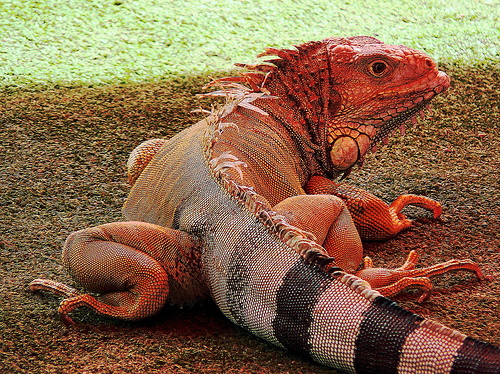
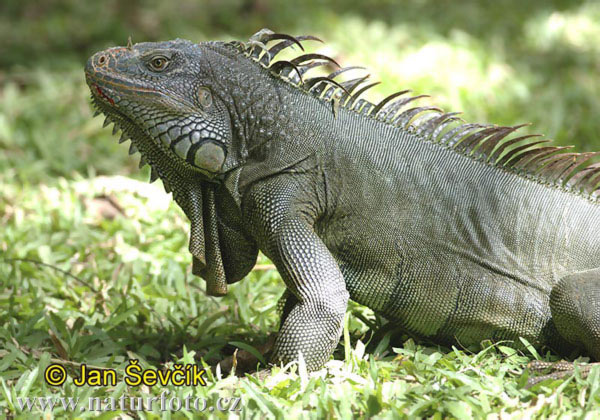
- Iguanas come◊ in◊ all◊ colors◊ of the rainbow.
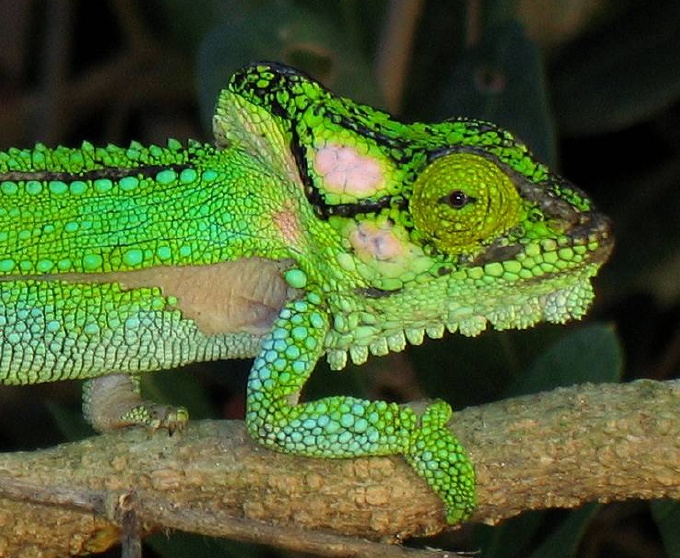
- Chameleons◊ naturally◊ fall◊ under◊ this◊.
- It's subverted as well. Although chameleons are famous for their ability to change colors, and use a pretty wide range of colors for camouflage and to communicate with one another, they cannot instantly change into every color in existence despite what movies/cartoons would like you to believe. And, no, they cannot turn "pink with purple polka dots" or whatnot either.
- Several kinds of snakes have bright colors; most of them are venomous snakes or mimics of venomous snakes. However, there are brightly-colored nonvenomous snakes such as blood pythons and rainbow boas, and Amazing Technicolor morphs of ball pythons and corn snakes are becoming increasingly popular in the pet trade.
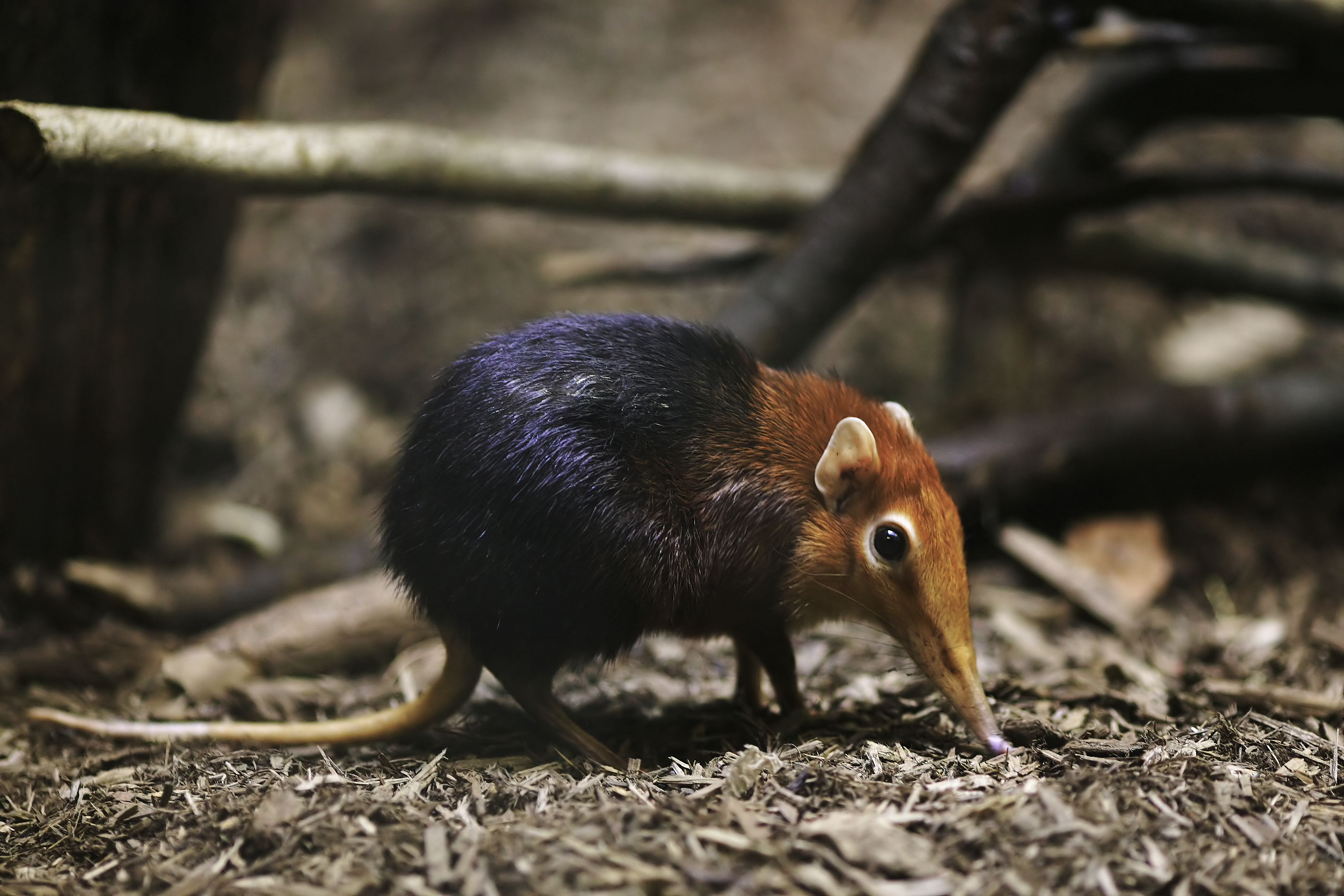
- The Black and Rufous Elephant Shrew◊
- Mantis◊ shrimp◊
- This trope plays a variant with mammals. Nearly all mammal fur comes in varying shades of browns, grays, oranges, blacks and white, while bright shades of pinks, purples, blues or greens is almost unheard of (sloths appear green due to the algae in their fur). This is due to most mammals having poor color vision and having only 2 kinds of pigments (birds and arthropods have more). That being said, lots of mammals have evolved distinctive and complex patterns, such as spots, stripes and other markings. Primates have better color vision, and a few species have more colorful patterns then most mammals (but not as complex as birds).
- Reptiles vary a lot. Some can be especially colorful, while others are drab in comparison. It really depends on the behavior of the animal and if they use colors for communication.
- Played straight with many species of bony fish, but Averted with sharks, except for some notable exceptions like the wobbegong and carpet shark.
- Blue, White and Golden lobsters and crabs. Often caught and kept for pets or tourist attractions. They don't survive long in the wild, due to to the oddity of their coloration.
- Male mandrills have red and blue skin on their faces and buttocks, which are used as a display. Female mandrills are significantly less colorful.
- Golden snub-nosed monkeys have blue faces.
- Pink Elephants. No, seriously.
- Sea Slugs are like the My Little Ponies of the water, coming in a variety of different shapes and color combinations from across the spectrum. There were also hot pink land slugs discovered in Australia.
- Most frogs and toads are dark green or brown, but dart frogs are amazing technicolor wildlife; most are a combination of black and a bright color, but the golden mantella frog is named after its color.
- White-Spotted Jellyfish.
- Lilac-Breasted Roller◊
- Puppies can be born with green fur if they've been exposed to biliverdin in utero.
- Cephalopods such as octopuses and cuttlefish are masters of color, able to manipulate the chromatophores in their skin finely enough to create rings, polygons, and traveling waves of color. The ability of octopuses to disguise themselves this way is well known. What's less well-known is that some species of cuttlefish seem to use their color-changing to communicate with their fellows.
- Turn out the lights and switch on a blacklight, and flying squirrels and duck-billed platypuses will glow pink and blue-green, respectively!

.jpg/800px-Conolophus_subcristatus_(North_Seymour_5).jpg)




Subtle and Minor Acceptable Breaks from Reality Examples Found in Specific Animated Works
- Jenna from Balto is a bright red Husky, as are most of her and Balto's children in the sequels. "Red" is an actual Husky colour; however, it's more of a brownish or burnt orange colour than the deep red Jenna is.
- While the lionesses in The Lion King are more or less offset from realistic lion colors, the males are either bright gold with cherry red manes or extremely dark with completely black manes. This is played straight during the musical number "I Just Can't Wait to be King", though; it wouldn't be a Disney Acid Sequence otherwise!
- The Muppets:
- Fozzie is a bright orange bear (although he referred to himself as "light brown" in one episode).
- Kermit himself is a mild case, as he's the same color green all over. None of the frog species in the two states he or his "official biography" refer to as his place of origin are all green, being either mottled, white-bellied, spotted or not green at all.
- Most productions of Cats portray Bombalurina as a bright red cat. As in scarlet.
- Color options with the pet system for Kingdom Hearts χ introduced in 2017 have included blue, pink, green and gold. They are said to be spirits and thus aren't real animals.
- WarioWare: Spitz, an anthropomorphic cat, has Simpson-yellow fur. His partner Dribble is an orange bulldog, a color commonly found on the animal in real life, but not in the bright orange Dribble has.
- Rats SMP: A few of the rats have decidedly unnatural fur/hair colours, like Acho (lilac), Lizzie (pink), and Scott (light blue). Acho's case is justified, being a former pet fancy rat who had ink spilled on him (and his fur is revealed to be naturally greyish white in his lore finale via Expository Hairstyle Change), while others have varying degrees of justification themselves from various pigments and less human influence.
- Although the main characters from Flavio the Goat have regular colors for their respective species, the background characters come in a wide variety of hues.
- The Huckleberry Hound Show: Huckleberry Hound is light blue. He is supposed to be the breed of dog called the "bluetick coonhound", but they're white with a mottling ("ticking") of black, not a solid powder blue color.
- Kaeloo has a blue emperor penguin named Olaf.
- Kate & Mim-Mim takes place inside a little girl's imagination, so it's not surprising that there's a rainbow of different characters. Mim-Mim is purple because that's the color of her stuffed bunny to begin with. Other main characters are pink, blue, brown and orange.
- All of the frogs from Kulipari: An Army of Frogs look pretty similar in chose of color to frogs in real life — even the Kulipari, who are all dart frogs. The only exception is that the Kulipari tend to glow when they use their superpowers.
- The five major animal characters in Littlest Pet Shop (1995) include a blue dog, a purple cat, a pink rabbit and a yellow horse. Only the brown monkey has a normal fur color.
- My Little Pony: Friendship Is Magic:
- Applejack is orange with a yellow mane and tail. She is probably the closest to the color of a real horse out of the main cast, resembling a palomino. Rarity also has an actual horse color (white) but unlike real horses, has a purplish-blue mane and tail.
- A few of the background ponies do come in more natural colors (for example, Pipsqueak); but there are fewer naturally-colored mares than there are horses.
- Oggy and the Cockroaches: The cast and background characters who are animals have this: The cats; Oggy is blue, Jack is green. The cockroaches; Dee Dee has a blue body and orange head, Marky has a grey body and green head and Joey has a pink body and purple head. Characters such as Olivia and Bob, on the other hand, avert this.
- Everest the Husky from PAW Patrol has mostly white fur, but it is also partially purple.
- Psyko Ferret stars a red ferret. Ferrets don't come in red.
- Bullwinkle J. Moose from Rocky and Bullwinkle is brown all over, but in recent renderings of him over the last few decades, he's given orange antlers.
- The 1994 direct-to-video film Simon The Lamb by Precious Moments, is focused on a baby lamb named Simon who gets discovered by a shepherd at night. Simon becomes a new member of the flock, but mostly gets rejected by a majority of the lambs. Albert the lamb is the most notable since he finds ways to mess with him (such as leading him away from the pasture while playing a game of "Blind man's buff"). However, Daisy is the only sheep from the flock that genuinely likes him and is constatly scolding the lambs for rejecting and making fun of him. She even calls out Albert for how he treated Simon and motivates the other lambs to help find Simon after going missing. After a blizzard, Simon gets a kiss on the cheek by Daisy after saving their lives and finding him safe. It's revealed that an angel accidentally spilled a bucket of paint which brings Simon to life on earth.
- SpongeBob SquarePants:
- Larry the Lobster. Yes, lobsters can be bright red, but not live lobsters... only cooked ones. May be a case of The Coconut Effect. Somewhat justified, since Larry does like to tan a lot.
- Squidward Tentacles is a blue-green octopus, but octopi only look that color because of the sea tint. "Reef Blower" shows him to be purple above water as a justification. However, he remains green in his other out-of-water appearances, such as in "Pressure" and The SpongeBob Movie: Sponge Out of Water.
- Plucky Duck from Tiny Toon Adventures is green, but a green duck is not that strange. Not counting the male Mallard, which is only green on its head, there's the Cayuga. For that matter, his mentor/spiritual predecessor, Daffy Duck is solid black with his bill/legs/feet being orange. There is a type of duck called the American Black Duck, but its plumage is generally more very dark brown than truly black and has a distinct blue patch on each wing.
- On Wild Animal Baby Explorers, Izzy is a blue owl while his fellow explorers are all normal colors for their types of animals.
- The Wild Puffalumps have a group of multicolored jungle animals consisting of a pink toucan, a sky blue elephant, a dark blue walrus, a yellow monkey, a maroon tiger, a magenta rhino, and a white and cerulean panda.
- Some breeds of dogs, cats, and horses come in a color referred to as "blue". It is actually a shade of grey with a very faint bluish tint.
- Poodles will sometimes, just for yuks, be dyed in vibrant colors for special occasions (green for a Saint Patrick's Day parade, for instance). The dyeing agent is usually unmixed Kool-Aid powder.
- Some chinchillas are described as blue or purple, although their actual fur color is closer to grey with a bluish or purplish tinge.
- In 2014 a stray cat in Bulgaria was found walking the streets with bright green fur. While it was originally thought to be the result of vandalism, it turned out the cat had slept on discarded synthetic paint in someone's garage.
- Owners of pet rodents sometimes use pet-safe dyes to mark the fur of individual animals that would otherwise be difficult to tell apart, such as albino mice.
- Wildlife rescuers have experimented with dyeing the pelts of deer bright orange before releasing them, in hope that hunters will mistake the color for a fellow-hunter's safety jacket and hesitate before shooting the animals. Naturally they don't do this in regions where wild predators still pose a greater threat to deer than humans, as it spoils the animal's stealth until the dye wears off.
