

Even the load screens are colourful.
Say you just left a mountain prone to mudslides, then you are surprised you stumble upon a Brightly Coloured Rainforest with multicoloured plants and the skies are rainbow. A world that is colorful even without its wildlife. Congratulations, you just entered an Amazing Technicolor World. But an Amazing Technicolor World is not necessarily any world as a whole — it can also be just be part of one.
Not to be confused with Amazing Technicolor Battlefield, but may be associated with it. Most, if not all cases also fall under Scenery Porn. If the world is dangerous, see Dangerously Garish Environment.
Examples
open/close all folders
Anime & Manga
- Naruto has Takigakure ("Village Hidden in a Waterfall") from an OVA which contains Bright Greens, Yellows, Cyans and Blues.
- In Shippuden, there is Kumogakure ("Village Hidden in the Clouds") which contains Browns, Cyans, Greens, Yellows and Blues.
- The anime adaptation of No Game No Life is known for being so brightly colored, it hurts. Look at the page image there, and imagine that about 3 times stronger. That's what pretty much the entire anime looks like.
- The entire world in One Piece total.
- Everywhere in K. In fact, this is what got most of its future fans to watch it in the first place.
- Everything in Rolling Girls has the appearance of a giant pastel-colored painting.
- The SoulTaker has nearly every scene filled with bright & contrasting colors, sometimes combined with Chiaroscuro.
- The AR-Fields in Digimon Universe: App Monsters are usually very brightly-colored Dark Worlds that resemble what the real world would look like under the influence of a particular Appmon. Color schemes vary from copper ground and cyan sky to everything in neon colors. The Net Ocean that the AR-Fields all connect to is more variable, with its "server islands" being a mix of normally-colored landmasses and garish floating surfaces all interconnected by a network of bright yellow tunnels.
Arts
- Isle of the Dead: The old men's clothes look as if someone spilled a batch of rainbow inks all over them and the background is a red, theatre-like curtain.
Films — Animation
- Big Hero 6 has San Fransokyo and especially the portal dimension.
- The Land of the Remembered from The Book of Life.
- Like the Land of the Remembered, The Land of the Dead from Coco is just as colorful.
- Everywhere with coral in Finding Nemo.
- Moominvalley and the Riviera in Moomins on the Riviera.
- Turning Red makes the city of Toronto look like something out of Sailor Moon with buildings in pastel colours. According to executive producer Dan Scanlon, "It feels more like a very soft, colorful, magical, idyllic, almost youthful version of the city".
- Sugar Rush from Wreck-It Ralph
- Yellow Submarine has this mixed with Acid-Trip Dimension.
Films — Live-Action
- Speed Racer easily tops every other example on this list.
- Star Wars:
- The Phantom Menace has Naboo (the most Earth-like planet in the series, with dense forests, wide plains, and wide oceans)
- Attack of the Clones has Coruscant, a city-scape planet with various districts, like a political district, a working-class district, and a filthy, dingy slum district.
- Revenge of the Sith has Felucia, a planet of towering technicolor plants and mushrooms.
- TRON falls under this inside the computer . TRON: Legacy is the same thing.
- Joe Versus the Volcano becomes this as soon as Joe takes control of his life.
- Pandora is a Rainbow world in Avatar, especially at night.
- The Titular Game in Spy Kids 3-D: Game Over.
- Planet Drool from The Adventures of Sharkboy and Lavagirl.
- Oz from The Wizard of Oz.
- Pretty much anything Guillermo del Toro is creatively involved with - Hellboy and Pacific Rim being the two strongest examples.
- The dance academy in Suspiria (1977).
- Doctor Strange (2016): The Dark Dimension is one of these.
Live-Action TV
- Polk Middle School from Ned's Declassified School Survival Guide.
- iCarly has the iCarly Studio, and in later Season Carly's Room.
- Hollywood Arts from Victorious.
- Dan Schneider must love this trope by adding it, to at least one area in everyone of his shows, but the most colorful is PCA from Zoey101.
- The Suite Life on Deck has the S.S. Tipton.
- Hannah Montana's home in Season 4.
- Shake it Up has anywhere indoors.
- Everywhere in Wizards of Waverly Place.
- Kinkow in Pair of Kings
- Disney Channel and Disney XD also love this trope so much it appears in all their shows at least once.
- The producers of The Lord of the Rings: The Rings of Power aimed for the series to show a more vibrant and luscious Middle-earth in the second Age which was the Golden Era for many civilizations, than it was in the decadent Third Age of the movies.
Tabletop Games
- In Paranoia, the various areas of Alpha Complex are color-coded to match the minimum security clearance needed to be there legally. These start at Infrared (black), then run through the entire rainbow in ascending order (Red, Orange, Yellow, Green, Blue, Indigo, Violet), before ending with the highest clearance, Ultraviolet, which is represented with white. The color-coding can be as simple as a meter-wide stripe along the walls, but often, the entire area is painted in the relevant color, or there might be a very narrow path of a citizen's assigned color running along the floor. Attempts by unauthorized personnel to alter the color of anything in Alpha Complex is treason.
Theatre
- In Twice Charmed, the Fairy Godmother's magic turns the black and white ball into a colorful one.
Video Games
- Alice: Madness Returns, specifically, the first chapter where Alice enters the Vale of Tears.
- Hover: Revolt of Gamers has a city that is teeming with vivid colors and beautiful scenery.
- Kingdom Hearts has many worlds that fall under this trope:
- Space Paranoids (TRON) from Kingdom Hearts II is currently one of the most colorful.
- The Grid (TRON: Legacy) while colorful is noticeably less so than the world of its predecessor.
- Traverse Town is full of various colors of neon, especially in the Second and Third District. The new districts added in Kingdom Hearts 3D [Dream Drop Distance], which are full of colorful icicle lights, are even flashier.
- Monstro (Pinocchio)'s insides are a garish lavender with green and red spots everywhere.
- Prankster's Paradise (Also Pinocchio) is justifiably just as colorful as its world of light counterpart if not moreso, especially since it has Pleasure Island included this time.
- Atlantica (The Little Mermaid) is a bright turquoise and is populated by loudly colored sea life.
- Hollow Bastion/Radiant Garden is full of indigo, green, and gold.
- End of the World from Kingdom Hearts is a deep purple with neon accents and contributions of bright color from previous levels.
- Twilight Town is, as its name suggests, constantly dyed red by sunset; the architecture itself contributes teal accents.
- The exterior of Castle Oblivion is bronze and teal, starkly contrasting the White Void Rooms that populate its interior.
- Destiny Island is possibly justified, being a tropical island paradise.
- Land of Departure from Kingdom Hearts: Birth by Sleep. Being the past version of Castle Oblivion, their colors are fairly similar.
- Disney Town is also quite multicolored.
- Mirage Arena is similar to Space Paranoids in this regard.
- Deep Space (Lilo & Stitch) has different color schemes for each section of the world.
- Symphony of Sorcery (Fantasia) is just as colorful as Space Paranoids, while like Deep Space each section of the world has a different color scheme.
- Toy Box (Toy Story) has a colorful toy store that is the most focused upon part of the world.
- Monstropolis (Monsters, Inc.) is a pretty colorful factory especially with the multicolored door room.
- San Fransokyo (Big Hero 6) is just as colorful as it is in the movie.
- Space Paranoids (TRON) from Kingdom Hearts II is currently one of the most colorful.
- Final Fantasy has had many colorful locations throughout the franchise:
- Final Fantasy IV has the underworld with amber lava, red in the areas where the earth and lava meet, black in the earth, dark red rocks and caves and dark purple cave walls. And don't even get me started about Sylph Cave in comparison to Passage of Eidolons and Feymarch.
- Final Fantasy V has the last floor of the rift which has bright blue crystals, navy rocks, azure glyphs and brown wooded trees with teal leaves.
- Final Fantasy VII has the Gold Saucer which is practically a Rainbow Amusement Park. The Northern Crater is also colorful.
- Terra from Final Fantasy IX
- Spira from Final Fantasy X
- Cocoon from Final Fantasy XIII
- Final Fantasy XIV has many colorful locations such as:
- In A Realm Reborn there are regions such as:
- The Black Shroud has some colorful areas with one of the most notable being the Sylphlands a forest that consists primarily green plants with some glowing orange lantern-like fruits hanging from trees, colorful flowers & fungi , blue mist, and purple water.
- La Noscea has Halfstone a rocky land with blue water, bluish-gray rocks, has giant glowing red snail and cyan-lipped clam shells strewn about, and colorful coral all over the area.
- Thanalan is a mostly a desert with yellow sand, orange rocks and green plants.
- Mor Dhona has a particularly colorful areas near the raids that have glowing orange and turquiose crystals with purple skies occuring often, though the raids themselves are maybe even more colorful.
- Heavensward while mostly downplaying this trope has the The Diadem and Azys Lla as the most colorful locations in the entire expansion.
- Stormblood has some prominently colorful locations which are:
- Rhalgr's Reach has most of the region being downplayed due to being a gray rockland with green plants and blue water, but played straight with the colorful tents found throughout most of it.
- Kugane is a Japanese-themed city who's colors consist primarily of red, teal and white with some other colors added in for good measure.
- The Ruby Sea while mostly similar to any other area in coloring it does have the additional volcano and coral to make it more colorful.
- Doma is the Chinese counterpart of Kugane with a color scheme consisting primarily of red, green and orange.
- Shadowbringers cranks this trope up to the next level with the regions of:
- Lakeland is a mostly a beautiful bright purple forest with azure water, white dirt and gray mesas.
- Kholusia while mostly inverting this trope there are places like the sulphur mines and of course eulmore that are play this trope straight.
- Amh Araeng is similar to its source counterpart Thanalan mostly only with reddish-brown rocks and orange sand instead, along with the addition of glowing turquoise crystals that is actually crystallized light.
- Il Mheg is the most colorful place prior to Endwalker due to having every known color visible to the human eye appear at least in one area.
- Rak'tika Greatwood is about as colorful as The Black Shroud is in a majority of the areas.
- Endwalker is appearing take the colorfulness of Shadowbringers and runs with it to what might be an even greater degree.
- The Sapling's sea & sandbox update allows you to customise plant colours, and in sandbox mode, you can customise which colours will be able to photosynthesise on your planet.
- Super Mario Bros.: The Mushroom Kingdom in many games, and also:
- The seven worlds of Super Mario Galaxy 2:
- World 1: The blue-colored planet Mario calls home
- World 2: A solar system composing of an orange sun and brown planets
- World 3: A green nebula
- World 4: A dark blue galaxy
- World 5: Several pink and purple galaxies
- World 6: A red and yellow black hole
- World S: A multicolored planet
- Super Mario Bros.: The Lost Levels has all of World 9 with very trippy colors. Sadly, the colorful landscape was removed in the Super Mario All-Stars version and replaced with standard colors.
- The seven worlds of Super Mario Galaxy 2:
- If you thought the TRON movies are bad? TRON 2.0 is worse. Bright colors everywhere, landscapes of purple and blue, a corrupted server with a Sickly Green Glow. The Internet looks like Vegas and Coruscant.
- Eversion (especially the HD version) has World 1 (magenta), World 2 (cyan), World 5 (yellow), World 6 (orange), World 7 (red) and World 8 (purple). Heck, the game's worlds as a whole counts as this trope.
- The land of Mania in the DLC Shivering Isles from The Elder Scrolls IV: Oblivion is rather brightly coloured, particularly the sky.
- Slime Rancher 2: The grass on Rainbow Island comes in every colour of the rainbow; in some places, it appears iridescent.
- Each planet in Spore can have one of eight-or-so ground, water, and sky colours, such as red water and cyan ground under a green sky.
- The entire island of Far Cry 3: Blood Dragon has neon highlights, along with every cyber-animal and mook.
- Edgar Teglee's mind in Psychonauts looks like a Mexican-themed blacklight painting.
- Trine consists of series of brightly multi-colored worlds, wildlife, plants and terrain.
- Every level in Astal is like this. Justified in that the world this game takes place in, Quartilia, was made from crystals.
- The final level of Bug Too!, "Cicada Night Fever" appears to be some sort of acid trip level with primarily blue-and-yellow platforms and a rainbow background.
- Almost every background scenery for Spin Rhythm XD has vibrant, flashy colours (and visuals!)
Webcomics
Web Original
- Many of the empires in Empires SMP Season 2 are built with very colourful construction palettes, but Chromia, being the land that exports dyes, takes the cake as even its founder/ruler describes it to be like "Disney on an acid trip".
- Arbalednac, the world where the Seldnac'Rae live, has lots of vegetation glowing in any color of the rainbow, which helps the Seldnacs blend right in.
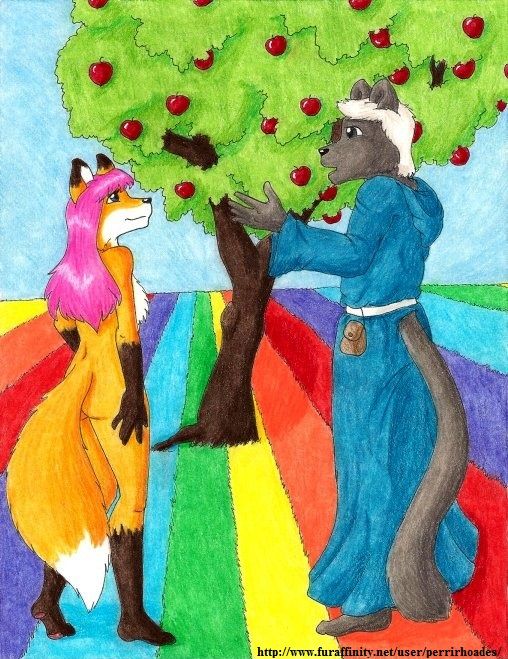
- In Perri Rhoades' Spectral Shadows, the planet of Pentalous is described as this. Parts of the Realm of Fantasy have been said to be this, especially when the art consists of pictures like this.
 ◊
◊
- The eponymous world in the Minecraft series Stampy's Lovely World is built to be bright and colourful. Even though there are buildings made out of varieties of stone and wood, Stampy almost always ends up incorporating a splash of colour to the design so that the building doesn't appear dull. Just try looking out over the Lovely World from a high place at night. It's stunning.
- The Plane of Isathil in Trials & Trebuchets is described as having vibrant multicolored flora and a brightly colored sky, and is home to lots of vibrantly-colored animals.
Western Animation
- Caillou: In Caillou's world, almost everything man-made has the colors red, blue, green, and yellow, right down to the trimmings and furniture in all the houses.
- The Fimbles: The entire world is fantastical and colourful, from the magic tree to the bubbles waterfall.
- The Legend of Vox Machina: The Fey Realm is incredibly colorful, almost Pandora-like. Heck, it can even make you vomit a Rainbow.
Real Life
- The Fly Geyser in Fly Ranch, Washoe Country, Nevada contains Red, Yellow and Green in ascending order.
- Clifton Hill, Niagara Falls is practically a Rainbow of colors.
- There are so many colorful places that you could say over 50% of the world is at one time or another, but most of Japan takes it to a whole new level.
- The Burning Man festival becomes an intensely psychedelic version of this at night.
- Any live concert by Coldplay.
- The Solar System is full of colorful worlds:
- Mercury is mostly dark gray.
- Venus is surrounded by thick, white clouds, which conceal a dark orange and yellow surface underneath.
- Our Earth is surrounded by wispy white clouds covering a surface of blue oceans and green, yellow, and brown continents.
- The Moon is light gray with dark gray maria.
- Mars is reddish-brown with white polar ice caps.
- Phobos and Deimos are both gray with pale pink splotches.
- Most asteroids are mostly shades of tan and gray.
- Dwarf planet Ceres is predominantly pale peach color and gray .
- Jupiter is surrounded by orange, gray, and white bands, with a large red storm on its southern hemisphere.
- Its five largest moons are also colorful: Amalthea is a bright red, Io is orange, yellow, and green, Europa is tan and white, Ganymede is purplish-gray, and Callisto is sepia-toned. All of its smaller moons are mostly gray.
- Saturn is surrounded by tan, blue, and gray bands, with shimmering white rings going around it.
- Its largest moon Titan is surrounded by thick yellow clouds and a dark blue haze, which covers its orange and brown surface. Its smaller moons are mostly grayish (Pan, Atlas, Prometheus, Epimetheus, Telesto, Calypso, and Dione being lighter gray, Pandora, Janus, Mimas, Tethys, Helene, and Phoebe being darker gray), but Enceladus is white, Rhea is steel-blue, Hyperion is tan, and Iapetus is dark gray on one side and light gray on the other.
- Uranus is predominantly a pale blue-green color, with slightly yellowish poles.
- Its moons are also varying shades of gray (Puck and Titania being a lighter gray, and Umbriel being a darker gray) and brown (Ariel is light brown, Oberon is dark brown), but Miranda is almost pinkish.
- Neptune is almost completely blue in color, with white clouds, and a darker blue storm also on its southern hemisphere.
- Its largest moon Triton is mostly light blue and purple in color, but its other moons, such as Larissa, Proteus, and Nereid, are mostly grayish.
- Most comets are grayish, with white dust tails and blue gas tails.
- Most Kuiper Belt objects are predominantly dark blues and grays.
- Dwarf planet Pluto is mostly with bright orange and brown splotches (plus a large, heart-shaped crater, while its largest moon Charon is a bluish-gray color.
- Other dwarf planets in the Kuiper Belt are also in distinguishable colors: Orcus is light blue, Haumea is a pale blue with red splotches, Makemake is mostly pinkish-brown, Quaoar is yellowish, Gonggong is dark brown, and Eris is almost white in color.
- Sedna, the furthest object in our Solar System is mainly dark red.
- Most planets outside our Solar System will probably have a greater range in colors: Desert planets are mostly yellow, ocean planets are mostly blue, jungle planets are mostly green, ice planets are mostly white, poison planets are mostly purple, volcanic planets are mostly bright red, rock planets are mostly gray, gas giant planets are mostly multicolored, etc.
- Depending on which chemical dominates the most, most nebulae are also brightly-colored. This is also true with most galaxies. The Milky Way is mostly sky blue with a pale yellow center, the LMC and SMC are bluish-gray, the Andromeda Galaxy is dark blue with a purple center, the Triangulum Galaxy is aqua green with an orange center, while all the other galaxies are either colored lavender with a pink center or maroon with a yellow center.
