
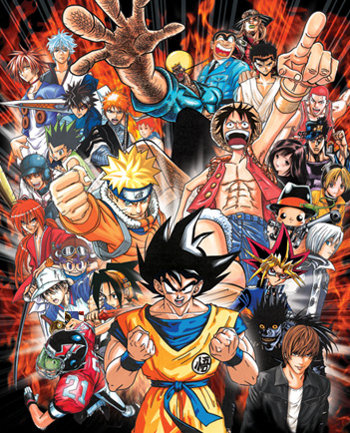
Shōnen is a demographic term for manga and anime aimed mainly at early to late teen boys. Basically, between ages 12 and 18. They tend to be Fighting Series focused more on action than relationships, with romance generally either perfunctory or Played for Laughs. Some battles can be sublimated into a form such as a sports competition or even a Tabletop Game.
While there was a time where protagonists could be adult men the target audience would look up to, it's more common for the title character, and most of the cast, to be predominantly teenage or young adult male, equally capable of action and ham. Lots and lots of ham. This mainly serves to make the characters relatable to the targeted readers.
Note that while the term "shōnen" tends to be used to refer to a few standard genres, and many shonen works tend to have several tropes in common, it isn’t technically a genre as it actually refers to the target demographic (and in Japan, generally refers strictly to manga, rather than animenote ). Its more mature counterpart is seinen, although both are enjoyed by other audiences as well. The Distaff Counterpart to shōnen is called shōjo.
There is no definite marker for a series being or not being shōnen. Though the magazine it runs in is a good indicator, many shōnen magazines aim for the huge seinen Periphery Demographic that also purchases them. Some of this is a natural result of the franchise Growing the Beard together with the audience: many series that are popular with the seinen demographic (and marketed towards such in omnibus tankoubon volumes) have run in Shōnen magazines when they were serialized. Some long running series will "graduate" to a magazine for an older demographic to follow its aging audience. While the same can't usually be said of series with a strong shōjo and josei periphery, some authors throw a bone their way by writing exclusive installments for magazines of those demographics.
Themes are not a definite indicator either: while most Shōnen works (particularly the action fighter types) tend to fall in the idealist side on the scale of idealism vs. cynicism, there are also plenty of works with Darker and Edgier elements and outright Deconstructions that can easily be mistaken for a seinen series and evoke a What Do You Mean, It's for Kids? reaction (Death Note, Neon Genesis Evangelion, Attack on Titan, Hunter × Hunter and Chainsaw Man are some of the notable examples). That being said, light and fluffy/dark and moody romance, serious female-led dramas, and cute art styles aren't limited to shōjo manga either, as stories like Teasing Master Takagi-san, Azumanga Daioh, and act-age can attest.
Due to Values Dissonance, many shōnen series feature content that most Westerners would not consider appropriate for younger teenagers, such as frequent gory violence and scenes of titillating fanservice which may include nudity (many works labeled Ecchi run in shōnen magazines). As such, they are often marketed towards adult fans in the West, sometimes leading localizers to insert more adult language into the translated version. One of the most illustrative examples of this is Tengen Toppa Gurren Lagann: a highly idealistic Hot-Blooded, bright and cartoonish Super Robot series that aired as the equivalent of a Saturday-Morning Cartoon in Japan, but debuted on Adult Swim in the US. In fact, most of [adult swim]'s anime lineup consists of shōnen series.
Shōnen series were the first to be brought over en masse to the Western world, and as such, makes up much of the popular American perception of anime.
This is because it is, perhaps, the genre most similar to heavily actionized, Rated M for Manly Western Animation shows of The '80s, also largely geared towards teenage males with swaths of Multiple Demographic Appeal. (Pure shōjo bounces between the realms of cutesy and too melodramatically scandalous for most Media Watchdogs, so it does not get shown in the West as much.)
If you want to write a shōnen series, here's a good place to start. If you want to see the Chinese grandfather of most shōnen, see Wuxia and its more spiritual counterpart in Spirit Cultivation Genre or Xianxia.
Magazines
- Shonen Champion
- Shonen Jump
- Jump GIGA
- Jump SQ
- Shōnen Jump+
- Shōnen Magazine
- Shōnen Sirius
- Shonen Sunday
General Examples
- Many series with Humongous Mecha.
- Sometimes, adaptations of stories with Multiple Demographic Appeal will create two versions of the story, one shōnen and one shōjo. For example, The Vision of Escaflowne had a shōnen-version manga produced of its story, while Magic Knight Rayearth's OAVs have a similar bent as compared to the original series.
- All the titles featured in the Weekly Shōnen Jump (or simply Jump) magazine, which should be obvious. Shōnen Jump series are often considered to be their own subcategory of the shōnen demographic and have a kind of legacy with each other, enough that a crossover video game is a common thing to see every few years.
- Although somewhat niche outside of its native Japan, Kinnikuman was the first series to experiment with the formula that would go on to be refined by later Jump Series, serving as the Ur-Example of what would come to be known as the "Shonen Battle" subgenre.
- Also niche in the west, Fist of the North Star is a very important and influential title to Shōnen Manga, and is considered to be the work to start the "Golden Age" of Shōnen Jump, with all other subsequent Fighting Series building on what it established.
- The Dragon Ball series is by far the quintessential Shōnen, and due to its age, length and influence provides examples of most of the classic tropes. Not to mention the fact that its popularity has more or less inspired most of the current shōnen manga of this day and age.
- Of all the ongoing Shōnen series, One Piece is the most popular across the world, and has a cult following in the United States. It has drawn a great deal of inspiration from Dragon Ball, but developed a very unique and compelling flavor of its own.
- Naruto, another series inspired by Dragon Ball, which is possibly the most noteworthy manga in the west.
- JoJo's Bizarre Adventure, released in 1987, is one of Shōnen Jump's longest running shōnen series, having reached over 100 volumes in Japan. With its 7th part, "Steel Ball Run", it has switched magazines to Ultra Jump and thus officially "graduated" to seinen. It drew much inspiration from Fist of the North Star.
Other Examples in Shonen Jump
- Abyss Rage
- act-age
- Agravity Boys
- Aharen-san wa Hakarenai
- Akane-banashi
- Amalgam of Distortion
- Ane Doki
- Angel Densetsu
- Assassination Classroom
- Astra Lost in Space
- Ayakashi Triangle
- Ayashimon
- Bang Brave Bang Bravern!
- Bakuman。
- Baoh
- Barefoot Gen: Sometimes mistaken for seinen due to its harrowing depiction of the nuclear attack on Hiroshima, but it originally ran in Shōnen Jump, of all magazines.
- Barrage
- Bastard!! (1988) has a lot of violence and sexual content, but it did in fact spend most of its run in Weekly Shonen Jump despite this. It later moved to the seinen publication Ultra Jump in 2000.
- Beelzebub
- Beet the Vandel Buster: Notably put on a ten-year hiatus due to one of its creators falling ill.
- Black Cat
- Black Clover
- Black Torch
- Blade of the Moon Princess
- Bleach: was one of the members of the "Big Three" alongside One Piece and Naruto. Eventually, it became less popular than the other two members once the anime and the manga finished.
- Blood Blockade Battlefront
- Bloody Roar
- Blue Box
- Blue Exorcist
- Blue Flag: Often mistaken for Boy's Love due to its gay themes, but the manga actually ran in Shōnen Jump+ (and the plot really revolves more around a Bisexual Love Triangle).
- Bobobo-bo Bo-bobo: A humorous and surreal parody of shōnen.
- Bone Collection
- Boys over Flowers: Season 2: Although its predecessor was a shōjo manga, this series runs in Shōnen Jump+.
- Burn The Witch (2018)
- Buso Renkin
- Butsu Zone
- Candy Flurry
- Captain Tsubasa: Up until the Road to 2002 saga, that is; then it moves into seinen territory. Makes sense, the readers are mostly adult males (and some adult females) who grew reading it in ''Shonen Jump'.
- Cat's Eye
- Claymore: Although it's sometimes thought to be seinen because of its dark themes as well as bearing a superficial resemblance to Berserk.
- Chained Soldier
- Chainsaw Man: Yet another series commonly mistaken for seinen due to its intense graphic violence and sexual content.
- Chieri's Love is 8 Meters Tall
- Cipher Academy
- Cool Shock B.T.
- The ComiQ
- Cowa!
- Cross Manage
- Cyber Blue
- Cyborg Grandpa G
- Dandadan
- Dark Gathering
- DARLING in the FRANXX: The manga adaptation drawn by Yabuki Kentarou is published online in Shōnen Jump+.
- Death Note: Although even plenty of anime fans still mistake it for seinen, mostly because Light is an adult for most of the series and there's the What Do You Mean, It's for Kids? factor. Played with in the Bakuman。 series (by the same creators), in which several characters support seinen-type stories running in Shōnen magazines.
- Demon Slayer: Kimetsu no Yaiba: a noteworthy series from The New '10s with a highly successful anime series and a record breaking movie.
- Destiny Lovers
- D.Gray-Man, even when its Estrogen Brigade says otherwise.
- The Disastrous Life of Saiki K.
- DNA²
- Doctor Slump
- Dr. STONE: Replaces hot-blooded battles with hot-blooded SCIENCE.
- Dokonjou Gaeru
- Doron Dororon
- Double Arts
- Dragon Ball
- Dragon Ball, especially its second part Dragon Ball Z, is a major contributor to many tropes to shōnen in general.
- Dragon Ball Super
- Dragon Ball: That Time I Got Reincarnated as Yamcha!
- Dragon Drive
- Dragon Quest: The Adventure of Dai
- ElDLIVE
- The Elusive Samurai
- Embalming
- Enigme
- Eyeshield 21
- Fabricant 100
- Food Wars!
- Fire Punch
- Fist of the North Star, although Yuria Gaiden and Juuza Gaiden (the most recent ones) are seinen. Again, a major contributor to fighting shōnen.
- Futaba-kun Change!
- The Game Devil
- Gamma
- Genkaku Picasso
- Ginga: Nagareboshi Gin
- Gintama: Although a shōnen series, Gintama is known for often taking potshots towards shōnen tropes.
- Goodbye, Eri
- Good Luck Girl!
- Green Green Greens
- Gun Blaze West
- Gorgeous Irene
- Haikyuu!!: Despite having some sort of Estrogen Brigade similar to that of other sports manga
- Hareluya II Boy
- Harisugawa in Mirror World
- Hatsukoi Limited
- Hell Teacher Nube
- Hell Warden Higuma
- Hell's Paradise: Jigokuraku
- High School Family
- Hikaru no Go: Go-game oriented
- Hinomaru Zumou
- Hokenshitsu no Shinigami
- Hokkaido Gals Are Super Adorable!
- Hoshin Engi
- Hungry Marie
- The Hunters Guild: Red Hood
- Hunter × Hunter
- Ice Revolution
- I"s
- i tell c
- Iron Knight
- Jiya
- JoJo's Bizarre Adventure: Parts 1-6. It moved to seinen magazine Ultra Jump starting with Part 7, Steel Ball Run.
- Jujutsu Kaisen
- Jumbor Barutronica
- Jungle King Tar-Chan
- Kagamigami
- Kagurabachi
- Kaiju No. 8
- Kajika
- The Kajiki Chef: Divine Cuisine
- Kemono Jihen
- Kill Blue
- Kimagure Orange Road
- Kindergarten Wars
- Kinnikuman: Wrestling oriented, but also a major contributor to shōnen tropes. Its sequel, Kinnikuman Nisei is seinen.
- Kochira Katsushika-ku Kameari Koen Mae Hashutsujo: The longest manga series to ever reach its conclusion, after 200 volumes and 40 years of uninterrupted publication.
- Kono Oto Tomare! Sounds of Life
- Kurenai Sanshiro
- Kurogane (2011)
- Kuroko's Basketball
- The Last Saiyuki
- Level E
- Listen to me, girls. I am your father! (first manga adaptation ran in Jump Square)
- Lock On!
- Mx0
- Magical Taruruto-kun
- magico
- Magilumiere Co. Ltd.
- Magu-chan: God of Destruction
- Majin Tantei Nougami Neuro
- Make the Exorcist Fall in Love
- MamaYuyu
- MARRIAGETOXIN
- Mashle: Magic and Muscles
- Mazinger Z: Its first run, anyway. In 1974, it was moved to Kodansha's TV magazine.
- Me & Roboco
- Medaka Box
- Mission: Yozakura Family
- Mitama Security: Spirit Busters
- Mone-san no Majime Sugiru Tsukiaikata
- Moriarty the Patriot, despite the fact that all of the protagonists are adults.
- Moriking
- Muhyo and Roji: contains seinen elements
- My Girlfriend Gives Me Goosebumps!
- My Hero Academia: one of the most noteworthy manga series in The New '10s and is considered the Spiritual Successor to the Big Three.
- Naruto: one of, if not, the most noteworthy manga in the west.
- Nine Dragons' Ball Parade
- Ninku
- Nisekoi, in spite of being a romantic comedy.
- Noah's Notes
- Nora
- Nue's Exorcist
- Nura: Rise of the Yokai Clan
- One Piece, although it attracts nearly every demographic, from kids to teens and adults. Currently Japan's most popular ongoing manga.
- One Winged Michelangelo, a Jump SQ manga with a Cast Full of Pretty Boys and almost no action, about a young Michelangelo Buonarroti and cute, Genki Boy versions of other figures from his time, including, of course, Leonardo da Vinci and Cesare Borgia (and Michelotto).
- Oumagadoki Doubutsuen
- Phantom Seer
- Platinum End
- PPPPPP
- Pretty Face
- The Prince of Tennis is sometimes mistaken for shoujo due to its Cast Full of Pretty Boys and huge female fanbase, but the manga did run in Shonen Jump. That said, executives eventually caught on to how popular the series was with girls and started marketing it towards a female audience as well, with regular ads for it in shoujo magazines and even Otome Games based on the series.
- The Promised Neverland: A very rare example of a (non-romcom) shōnen with a female protagonist. Also pretty horrific.
- Psyren
- Read or Die: Rehabilitation: Often confused as seinen due to it being more risque than Read or Die and Read or Dream, both genuine Seinen.
- Reborn! (2004)
- Red Sprite
- Ring ni Kakero: Starts as shōnen and is the Ur-Example of Battle-Shonen, the sequel switches to seinen.
- Robot × Laserbeam
- Rokudenashi Blues
- Romantic Killer
- Ron Kamonohashi: Deranged Detective
- Rookie Policewoman Kiruko-san
- Rookies
- Rosario + Vampire: contains seinen elements
- RuriDragon
- Rurouni Kenshin
- RWBY: The Official Manga
- Saint Seiya: Trope Codifier for Cast Full of Pretty Boys in the genre, and the Genre Popularizer for the shōnen Estrogen Brigade. Also, the term "Yaoi" was coined by the series' fandom to refer to the Male/Male Slash Fic generated by said fandom.
- Sakamoto Days
- Sakigake!! Otokojuku
- Samon the Summoner
- Samurai 8: The Tale of Hachimaru
- Samurai Usagi
- Sand Land
- Senyuu.
- Seraph of the End
- Shadow Lady
- Shaman King
- Shibatarian
- Shiki
- Sket Dance
- Slam Dunk
- Slime Life
- Space Adventure Cobra, but only in its original run in Shōnen Jump. Every story afterward is seinen.
- Spy X Family
- Steam Detectives started its serialization in Monthly Shonen Jump, but moved to the seinen imprint Ultra Jump two years into its run and was published there until its conclusion.
- Stealth Symphony
- Stop!! Hibari-kun!
- Strawberry 100%
- Summer Time Rendering
- Super Psychic Policeman Chojo
- Super Robot Wars Original Generation: Divine Wars
- SWOT
- Taisho Otome Fairy Tale
- Takama-ga-hara
- Takopi's Original Sin
- Tegami Bachi: Letter Bee
- Tenmaku Cinema
- Time Paradox Ghostwriter
- Tista
- 'Tis Time for "Torture," Princess
- Tokyo Shinobi Squad
- To Love Ru: Surprising, its much Hotter and Sexier Sequel Series To Love-ru: Darkness is still a shōnen series, albeit in magazine that skews toward the older edge of the demographic.
- Toriko
- To Strip the Flesh, a short one-shot manga that was published in Shounen Jump+
- Twin Star Exorcists
- Undead Unluck
- Video Girl Ai
- We Never Learn
- Whistle!
- Witch Watch
- World Trigger
- World's End Harem: Mistaken as seinen due being drawn by a hentai mangaka, containing frontal nudity and basic premise being a man being requested to become a breeding stallion due to men going extinct.
- Yu-Gi-Oh!
- Yu-Gi-Oh! (first anime series)
- Yu-Gi-Oh! (Duel Monsters): Trope Codifier for card game themed anime
- Yu-Gi-Oh!: Capsule Monsters
- Yu-Gi-Oh! R
- Yu-Gi-Oh! GX
- Yu-Gi-Oh! 5Ds
- Yu-Gi-Oh! ZEXAL
- Yu-Gi-Oh! ARC-V
- Yu-Gi-Oh! VRAINS
- Yui Kamio Lets Loose
- Yuugai Shitei Doukyuusei
- Yuuna and the Haunted Hot Springs
- YuYu Hakusho: Another paradigm of Shōnen.
- Zipman!!
- Zombie Powder
Non-Shōnen Jump Examples
- .hack//Legend of the Twilight
- +Anima
- 090 ~ Eko to Issho
- 8 Man (1963)
- 12 Beast
- 21 Emon
- 801 T.T.S. Airbats
- Ace Attorney
- Active Raid
- Adachi and Shimamura: The original novels are published in Dengeki Bunko magazine, and its two manga adaptations are respectively serialized in the shonen publications Gangan Online and Monthly Comic Dengeki Daioh.
- Afterschool Dice Club
- Again!!
- Aho Girl
- Ai Kora
- A.I. Love You
- Air Gear
- Aiura
- Akame ga Kill!
- Akarui Sekai Keikaku
- Akashic Records of Bastard Magic Instructor: The manga adaptation ran in Monthly Shonen Ace.
- AKB49 – Renai Kinshi Jourei
- Akumetsu
- Alice in Borderland
- Alive: The Final Evolution
- Altair: A Record of Battles
- Alya Sometimes Hides Her Feelings in Russian: The manga adaptation runs in Magazine Pocket.
- Amanchu!: By the same creator as ARIA, it similarly contains elements found in shōjo, seinen, and josei, but it officially ran in a shonen magazine.
- The Ambition of Oda Nobuna
- The Ancient Magus' Bride: Often mistaken as shōjo due the protagonist, Chise, being female and the story's focus on her growing relationship with Elias, the titular magus. However, it runs in a shōnen magazine.
- Angelic Layer
- Angolmois
- Animal Academy: Hakobune Hakusho
- Animal Land
- Ann Cassandra
- Aoharu × Machinegun
- Aphorism
- Apocalypse Alice
- Apocalypse Zero
- Arachnid
- AR∀GO: City of London Police's Special Crimes Investigator
- Arata: The Legend
- Arcade Gamer Fubuki
- An Archdemon's Dilemma: How to Love Your Elf Bride: The manga adaptation and spinoff both run in Comic Fire.
- Area no Kishi
- ARIA: Although it contains elements commonly found in shōjo, seinen, and josei manga, it was serialized in a shōnen magazine and it tends to be labelled as such.
- Arifureta: From Commonplace to World's Strongest: The manga adaptation and various spinoffs run in Comic Gardo.
- Armed Girl's Machiavellism
- Ashigei Shoujo Komura-san
- As Miss Beelzebub Likes
- As the Gods Will
- Astro Boy
- Asura
- Attack on Titan
- Azumanga Daioh: Serialized in the shōnen-aimed Dengeki Daioh, it is often mistaken for seinen or shōjo, along with the whole genre it codified.
- B't X
- Babel II
- Baby Steps
- Baccano!
- Bad Company
- Baka and Test: Summon the Beasts: The manga adaptation ran in Shonen Ace. Oddly, the manga is Darker and Edgier than its light novel counterpart.
- Bakemonogatari: The manga adaptation ran in Weekly Shonen Magazine.
- Bakugan
- Bamboo Blade B
- Banana no Nana
- Banished from the Hero's Party: The manga adaptation runs in Monthly Shonen Ace.
- Batman - the 1960s licensed series.
- Battle Game in 5 Seconds
- Beastars, a rather dark and pessimistic story set in a World of Funny Animals
- Beast Complex
- The Beast Player (The manga. The original novel is not marketed by gender.)
- BECK
- Best Student Council (manga adaptation ran in Dengeki Comic Gao!)
- B.Ichi
- Big Order
- BirdMen
- Black Butler, even though it resembles a mix of seinen and shōjo much more than actual shōnen.
- Black Jack
- Blast of Tempest
- Blazer Drive
- Blazing Transfer Student
- Blood+
- Bloody Cross
- Bloody Maiden: Juusanki no Shima
- Bloom Into You
- Blue Lock
- Boarding School Juliet
- Boku×Kano'
- Boys Be...
- Break Shot
- Brigadoon: Marin and Melan: The manga adaptation ran in Shonen Ace.
- Buster Keel!
- Buyuden
- The Café Terrace and Its Goddesses
- Cage of Eden
- Cahe Detective Club
- Call of the Night
- Campfire Cooking in Another World with My Absurd Skill: The manga adaptation runs in Comic Gardo.
- Campione!: The manga adaptation ran in Super Dash & Go!.
- Campus Special Investigator Hikaruon
- Case Closed
- The Case Study of Vanitas
- Cells at Work!
- A Certain Magical Index
- Change 123
- Chaosic Rune
- Cheat Slayer
- Cheeky Angel
- Chivalry of a Failed Knight: The manga adaptation ran in Gangan Online.
- Choubu no Shinobi
- Choujin Gakuen
- Chūka Ichiban!
- City Hunter
- City Hunter Rebirth
- The Classroom of a Black Cat and a Witch
- Code:Breaker
- Most Code Geass manga
- Code Geass: Nightmare of Nunnally
- Code Geass: Tales of an Alternate Shogunate
- Code Geass: Suzaku of the Counterattack
- Code Geass: Renya of the Dark
- A Couple of Cuckoos
- Crime Zone
- Criminale!
- Crimsons – The Scarlet Navigators of the Ocean
- Croisée in a Foreign Labyrinth
- Cromartie High School
- Cross Ange: Plenty of anime fans mistake it for being a seinen, but it's actually a shōnen; despite being an original anime, the manga adaptations ran on the online shonen manga website Comicwalker. This is mostly due to Cross Ange having some graphic violence, rampant nudity and acts of sexual violence. Therefore this is a shōnen that is for older audiences.
- Crows
- Daemons of the Shadow Realm
- Dagashi Kashi
- Dai Dark
- Daily Lives of High School Boys
- The Dangers in My Heart
- Darwin's Game
- Dash Kappei
- Dazzle: Started its run in the shonen magazine Monthly G Fantasy, but later moved to the shoujo magazine Monthly Comic Zero Sum in 2002 and has continued to be published there ever since.
- Deadline Summoner
- Deadman Wonderland: Often mistaken as seinen due to its violent content and basically having a similar story to Elfen Lied
- DEAD Tube: Mistaken as seinen due the copious amount of blood, sex, murder and nudity; it runs on Champion RED so it is expected from them.
- DearS
- Defense Devil
- Delinquent In Drag
- Destiny of the Shrine Maiden
- Destroy All Humankind. They Can't Be Regenerated.
- Detatoko Princess
- Devilman: Yes, that Devilman. Despite all the blood, violence, gore, and nudity, the original manga ran in Weekly Shōnen Champion in 1972.
- D-Live!!
- Digimon: Mon Trope Codifier along with Pokémon. Like Pokémon, however, it's actually closer to kodomomuke, with the exception of the Darker and Edgier Digimon Tamers and Digimon Data Squad, which are more shōnen-like.
- DinoZaurs
- Dolls Fall
- Domina no Do!
- Don Dracula
- Don't Toy with Me, Miss Nagatoro
- Dororo
- Dororon Enma-kun
- Double-J
- Doubt
- Dragon Half
- Dragons Rioting
- Drifting Classroom
- Dropkick on My Devil
- Dr. Ramune: Mysterious Disease Specialist
- The Duke of Death and His Black Maid
- Duklyon: CLAMP School Defenders
- The Dungeon of Black Company
- Dusk Maiden of Amnesia
- Eat-Man
- EDENS ZERO
- Elegant Yokai Apartment Life: The manga adaptation ran in Monthly Shonen Sirius.
- Elemental Gelade
- Encouragement of Climb
- Eromanga Sensei: The light novels are aimed at a male audience, and the manga adaptation ran in Dengeki Daioh.
- Esper Mami
- Et Cetera
- Eternal Alice
- Eureka Seven: The anime can go into many genres, but both the manga adaptations were published in Shōnen magazines.
- Evergreen
- Fairy Tail
- Farming Life In Another World: The manga adaptation runs in Monthly Dragon Age.
- Father and Son
- Firefighter Daigo: Rescuer In Orange
- Fire Force
- Flame of Recca
- The Flowers of Evil
- Flunk Punk Rumble
- Fly Me to the Moon
- Flying Witch
- Fort of Apocalypse
- Franken Fran
- Frieren: Beyond Journey's End
- Fukashigi Philia
- Full Contact
- Fullmetal Alchemist: Alchemy themed, as well as a major contributor to anime tropes.
- Full Metal Panic!
- Future Diary: Often mistaken as seinen due to its violent and horrific content, and its spinoff series Future Diary: Paradox, is genuine seinen.
- Fuuka
- Gabriel DropOut
- Gacha Gacha
- Gachiakuta
- Gamaran
- Gamble Fish
- Gambling Emperor Legend Zero
- Gamers! (2015): The manga adaptation ran in Shonen Ace.
- Gamerz Heaven
- Gan Kon
- Ga-Rei
- Gargoyle of the Yoshinagas: The manga adaptation ran in Magi-Cu.
- Gate 7
- Gather! Mystery Research Club
- GE - Good Ending
- The Geek Ex-Hitman (Shonen Ace Plus)
- Get Backers
- Getter Robo
- Ghost Sweeper Mikami
- Ghost Talker's Daydream
- Ghostly Things
- Giant Ojou-sama
- Girlfriend, Girlfriend
- The Girl from the Other Side
- The Girl I Like Forgot Her Glasses
- Girls Bravo
- Girls Go Around
- Girls Saurus
- Go, Go, Loser Ranger!
- Goblin Is Very Strong
- Golden Time: The manga adaptation ran in Dengeki Daioh.
- Goodbye! I'm Being Reincarnated!
- Good Luck! Ninomiya-kun: The manga adaptation ran in Monthly Dragon Age.
- Good Night World
- Grave of the Fireflies: Often mistaken for seinen due to how relentlessly depressing the film is, but it is considered an all-ages family film in Japan with a particular focus on adolescents. The film's message was focused on being sent to adolescent audiences.
- The Great Jahy Will Not Be Defeated!
- Great Teacher Onizuka
- GTO: The Early Years: Despite frequent graphic violence with mature and sexual themes, it was published in Shōnen Magazine.
- Green Worldz
- Gugure! Kokkuri-san
- Gun×Clover
- Gunslinger Girl: Often mistaken as seinen due to themes of child abuse and terrorism and bearing a superficial resemblance to Black Lagoon, but the manga ran in Dengeki Daioh.
- Guyver
- H2
- Hajime no Ippo
- Hana ni Arashi
- Hanako and the Terror of Allegory
- Hanasaku Iroha: The manga adaptation ran in Gangan Joker.
- Hanaukyō Maid Team
- Happiness
- Happy Sugar Life: Despite the cast full of very messed-up people and dealing with heavy themes such as stalking and domestic abuse, this series ran in the shonen magazine Gangan Joker.
- Haré+Guu
- Harem in the Labyrinth of Another World: The manga adaptation runs in Monthly Shonen Ace.
- Harem Royale - When the Game Ends -
- Harlem Beat
- Haruhi Suzumiya: The light novels are aimed at a male demographic, and almost all of its manga adaptations and spinoffs have run in shonen magazines (except for The Disappearance of Nagato Yuki-chan, which is seinen).
- Hatsukoi Zombie
- Haunted Junction
- Hayate the Combat Butler
- Heaven's Lost Property
- He Is My Master
- Hekikai No Aion
- Helck
- Helen ESP
- Hell's Kitchen (2010)
- Hensuki: Are You Willing to Fall in Love with a Pervert, as Long as She's a Cutie?: The manga adaptation ran in Monthly Dragon Age.
- The Hero is Overpowered but Overly Cautious: The manga adaptation runs in Monthly Dragon Age.
- The Hero Who Returned Remains the Strongest in the Modern World
- The Heroic Legend of Arslan (manga adaptation by Hiromu Arakawa)
- Heroine Voice
- Heroman
- Hetalia: Axis Powers: Originally, the published manga ran in Gentosha Comics's seinen magazine Comic Birz until it was relaunched in Shueisha's Shōnen Jump Super in 2014.
- Hibiki's Magic
- Higehiro: May be mistaken as seinen due to themes of consent, prostitution, and abusive parents. However, it was published in Shonen Ace Plus.
- High-Rise Invasion
- High School D×D
- Highschool of the Dead: Yes, THAT Highschool of the Dead. For all the violence and gorn (and Fanservice), it was published as a shōnen series instead of seinen.
- Hitoribocchi no OO Seikatsu
- Horimiya: Despite looking like a shōjo series, it was serialized in Monthly G Fantasy, a shōnen magazine.
- How Heavy Are the Dumbbells You Lift?
- How Not to Summon a Demon Lord: The manga adaptation runs in Suiyobi no Sirius.
- How to Make an Invisible Man
- Hyakuen!
- Hyde and Closer
- Hyouka
- Hyper Police
- I don't know if it's LOVE or MAGIC!
- I Guess I Became the Mother of the Great Demon King's 10 Children in Another World
- I May Be a Guild Receptionist, But I'll Solo Any Boss to Clock Out on Time: The manga adaptation runs in Dengeki Daioh.
- I'm Standing on a Million Lives
- Idol no Akahon
- Im: Great Priest Imhotep
- Immoral Guild
- In/Spectre: The manga adaptation runs in Shonen R and Monthly Shonen Magazine.
- Interspecies Reviewers: Despite being a Sex Comedy focused on Cute Monster Girl brothels, it's published in the shonen magazine Dragon Dragon Age.
- In the Heart of Kunoichi Tsubaki
- Inu × Boku SS: Despite having a female protagonist and a very shoujo-inspired art style, the manga ran in Gangan Joker.
- Inuyasha
- "Ippon" Again!
- Iron Wok Jan
- Isekai Cheat Magician: The manga adaptation runs in Monthly Shonen Ace.
- Itsudatte My Santa!
- Iwa Kakeru!: Sport Climbing Girls
- Joshiraku
- Jōjū Senjin!! Mushibugyō
- Judas
- Juujika no Rokunin
- Kagetora
- Kaiten Mutenmaru: Season 2 was published as a shōnen webcomic in Manga Goccha.
- Kakegurui
- Kakushigoto: My Dad's Secret Ambition
- Kamen no Maid Guy
- Kamen no Ninja Akakage
- Kamichu!: The manga adaptation ran in Dengeki Daioh.
- Kannagi: Crazy Shrine Maidens
- Karakuri Circus
- Karakuridouji Ultimo
- Karakurizoushi Ayatsuri Sakon
- Karin: While the main character is female and much of the plot focuses on her growing romantic relationship with a boy that's largely told from her perspective, it ran in the shonen magazine Monthly Dragon Age.
- Kashimashi: Girl Meets Girl
- Katteni Kaizo
- The Keeper Wants to Build a Zoo in Another World, so He Tames Monsters
- Keijo!!!!!!!!
- Kekkaishi
- Kemeko Deluxe!
- Kemono Michi
- Kengan Ashura
- Kenichi: The Mightiest Disciple
- Kenko Zenrakei Suieibu Umisho
- Kenji
- Kerberos Panzer Cop
- Kiba
- Killing Me/Killing You
- Kimiiro Focus
- The Kindaichi Case Files ran in Weekly Shonen Magazine from 1992 to 2017, after which it moved to the seinen magazine Evening.
- Kingdom Hearts: A video game-based franchise that uses many stock shōnen archetypes, tropes and plot points. Despite using many kid-friendly Disney characters and settings, the series has been stated to be mainly aimed at teenagers. A manga adaptation of the games ran in Shōnen Gangan and other magazines.
- Kitsune No Akuma To Kuroi Madousho
- Kitsune no Yomeiri
- Kiyo in Kyoto: From the Maiko House
- Kokoro Library
- Komi Can't Communicate
- Kongoh Bancho
- Kotaro Makaritoru!
- Kunisaki Izumo no Jijou
- Kurogane Communication
- Kuzumi-kun, Can't You Read The Room?
- Kyō Kara Ore Wa!!
- The Law of Ueki
- Legend of Heavenly Sphere Shurato
- The Legend of the Legendary Heroes: All of its manga spinoffs ran in shonen magazines such as Monthly Dragon Age and Gangan Online.
- The Legendary Hero Is Dead!
- Let's Make a Mug Too
- Life with an Ordinary Guy who Reincarnated into a Total Fantasy Knockout
- Linebarrels of Iron
- Little Jumper
- Little Witch Academia (Keisuke Sato) ran on Monthly Shōnen Ace.
- Live on Cardliver Kakeru
- Living Dead!
- Living for the Day After Tomorrow
- Log Horizon
- Lolita Complex Phoenix
- Long Riders!
- Lost+Brain: Sometimes mistaken for seinen for just about as much as Death Note.
- Love After World Domination
- Love Fighter Shuravan
- Love Hina
- Love Tyrant
- Lucky Star
- Maburaho: Both manga adaptations ran in Monthly Dragon Age.
- Maga-Tsuki
- The Mage Will Master Magic Efficiently in His Second Life
- Magical Circle Guru-Guru
- The Magical Girl And The Evil Lieutenant Used To Be Archenemies
- Magical Girl Apocalypse
- The Magical Girl And The Evil Lieutenant Used To Be Archenemies
- Magical Girl Site
- Magic Kaito
- Magic User's Club
- Magi: The Labyrinth of Magic
- Magimoji Rurumo
- Mahoraba
- Mahou no Iroha
- The Maid I Hired Recently Is Mysterious
- Mai, the Psychic Girl
- Majin Devil
- Major
- Maken-ki!
- Manabi Straight!
- A Man and His Cat
- Man of Many Faces
- Mao
- Maoh: Juvenile Remix
- Maoyu: All of its manga adaptations and spinoffs have run in various shonen magazines.
- MÄR
- Marry Grave
- Marugoto Anju Gakuen
- Masamune-kun's Revenge
- The Masterful Cat is Depressed Again Today
- Maze Megaburst Space: The manga adaptation ran in Comic Dragon.
- Mazinger Z
- Medaka Kuroiwa is Impervious to My Charms
- Megalomania
- Meitantei Marnie
- Mermaid Saga: Often mistaken as seinen due to its dark and violent content, but it ran in Shonen Sunday like most of Rumiko Takahashi's other works.
- Metroid: Samus and Joey
- Miami Guns
- Midori Days
- Minami Kamakura High School Girls Cycling Club
- Minotauros no Omoibito
- Miss Isshiki Wants to Know About Love
- Miss Kuroitsu from the Monster Development Department
- Miss Machiko
- Mitsudomoe
- MiXiM
- Mobile Fighter G Gundam
- Mobile Police Patlabor (ran in Weekly Shonen Sunday)
- Mob Psycho 100
- Monster Soul
- Monthly Girls' Nozaki-kun: Often mistaken for shōjo due to its romantic themes and being an Affectionate Parody of shōjo manga and how it's made, but it is serialized in the online shōnen magazine GanGan Online. However, it has enough Multiple Demographic Appeal to be reprinted in shōjo anthologies.
- The Moon
- Moonlight Act
- Moribito: Guardian of the Spirit
- The Morose Mononokean
- Mother Keeper
- Mother of the Goddess' Dormitory
- Muromi-san
- The Mute Girl and Her New Friend
- Muv-Luv: All of its manga adaptations ran in Dengeki Daioh.
- My Bride is a Mermaid
- My Celestial Family
- My Cheat Skill Resurrection Revived Me
- My Clueless First Friend
- My First Girlfriend Is a Gal
- My-HiME
- My Monster Secret
- My Sister, My Writer (manga adaptation ran in Monthly Dragon Age)
- Mythical Detective Loki Ragnarok
- My Wife is the Student Council President
- My Wife Is Wagatsuma-san
- Nanaka 6/17
- Natsu no Arashi!
- Nazca
- Negima! Magister Negi Magi
- Neko-de Gomen!
- Neon Genesis Evangelion: Often mistaken as pure seinen, but most of its manga adaptions as well as the anime are either shōnen or shōjo. The manga adaptation eventually switched its run to Young Ace, a seinen magazine, while Rebuild of Evangelion was primarily marketed towards adults from the get-go due to the original show's reputation (if still unclear whether the movies are shōnen as well or actual seinen).
- Nichijou
- Nightmare Inspector started in the shoujo magazine Monthly Stencile for the first two years of its run, but then moved to the shonen magazine Monthly G Fantasy where it continued until its conclusion.
- Ninja Nonsense
- Ninja Shinobu-san no Junjou
- No Bra
- Noragami
- Not Lives
- Number Girl
- Nyankees
- Nyan Koi!
- Oku-sama wa Mahou Shoujo: Bewitched Agnes (manga adaptation ran in Dengeki Comic Gao!)
- O Maidens in Your Savage Season
- Omamori Himari
- Onidere
- Onihei Hankachou
- O-Parts Hunter
- Ore ga Akuma de, Aitsu ga Yome de
- Osomatsu-kun
- Otaku Elf
- Otherside Picnic: The manga adaptation runs in Monthly Shonen Gangan.
- Outlanders
- Overtake!
- PandoraHearts: Like many series published in GFantasy, it has a Multiple Demographic Appeal and blends shounen and shōjo tropes with more mature storytelling.
- Pani Poni Dash!
- Panzerfraulein Alteseisen
- Paradox Blue
- Peacemaker Kurogane
- Penguin Musume
- Phi-Brain: Puzzle of God
- Pita-Ten
- Plunderer
- Examples from Pokémon:
- Pokémon: The Series, which, along with Dragon Ball Z, helped to popularize the genre in the West. Thought it’s technically not a shounen franchise. While most of the series is halfway between this and kodomomuke (with the Kalos seasons most closely resembling other shōnen anime in terms of characters and plot), Origins and the Mega Evolution Special episodes are solidly shounen (in terms of characters and plot).
- Pokémon Origins
- Pokémon Generations
- Pokémon Evolutions
- Pokémon: Hisuian Snow
- Pocket Monsters Emerald Challenge!! Battle Frontier
- Pocket Monsters HGSS - Jou's Big Adventure
- Pokémon Adventures
- Pokémon: Diamond and Pearl Adventure!
- Pokémon Getto Da Ze!
- Pokémon Golden Boys
- Pokémon RéBURST
- Pokémon Zensho
- The Electric Tale of Pikachu
- Popcorn Avatar
- Precarious Woman Executive Miss Black General
- Pretty Boy Detective Club: The manga adaptation began serialization in the shoujo magazine Aria but later moved to Shonen Magazine Edge after the former ceased publication, making it both shonen and shoujo.
- Princess Lucia
- Princess Mononoke: Despite the extreme violence and gore (at least, for a PG-13 rating), the film was made by Hayao Miyazaki with fifth-graders as the target demographic, and the film is considered appropriate for all ages in Japan.
- Princess Resurrection
- Princess Tutu
- Pseudo Harem
- Psychic Squad
- Psychometrer Eiji
- Pumpkin Scissors
- Queen Emeraldas
- The Quintessential Quintuplets
- RABUKOME QUEST
- Ragna Crimson
- Ramen Fighter Miki
- Ranking of Kings
- Ranma ½
- Rappi Rangai
- Rave Master
- Real Account
- Real Bout High School
- Recently, My Sister Is Unusual
- The Record of a Fallen Vampire
- Red Eyes
- The Red Ranger Becomes an Adventurer in Another World
- Reign of the Seven Spellblades: The manga adaptation ran in Monthly Shōnen Ace.
- Remake Our Life!: The manga adaptation ran in Suiyobi no Sirius and Magazine Pocket.
- Renjou Desperado
- Rent-A-Girlfriend
- RIN-NE
- Rising × Rydeen
- Rizelmine
- Rokudou's Bad Girls
- Ronin Warriors: The manga adaptation was aimed at a younger male audience with heavy depictions of violence and gore.
- Rough
- The Royal Tutor: Often mistaken for shoujo due to the art style and its Cast Full of Pretty Boys, but it ran in the shonen magazine Monthly G Fantasy; however, G Fantasy does have a high female readership and thrives on Bishōnen Jump Syndrome.
- Rune Soldier Louie: The manga adaptation ran in Monthly Dragon Junior.
- Rust Blaster
- Ryu
- Ryu's Path
- Ryuuroden
- Saijou no Meii
- Saike Mata Shitemo
- Saitama Chainsaw Shoujo
- Sakura Discord
- Sakura no Ichiban!
- Samurai Deeper Kyo
- Samurai Harem: Asu no Yoichi
- Samurai High School
- Sankarea
- Sasami-san@Ganbaranai: The manga adaptation ran in Weekly Shonen Sunday and Shonen Sunday S.
- Satou Kashi no Dangan wa Uchinukenai
- Saving 80,000 Gold in Another World for My Retirement: The manga adaptation runs in Suiyobi no Sirius.
- Sayonara Football
- Sayonara, Zetsubou-Sensei: Yet another series often mistaken for seinen due to its extremely Black Comedy, Fanservice, and Take No Prisoners-style satire of...pretty much everything including Moe.
- School Mermaid
- School Rumble
- Science Fell in Love, So I Tried to Prove it
- Scryed: The manga adaptation ran in Weekly Shonen Champion.
- Seikesshou Albatross
- Sengoku Strays
- Sengoku Youko
- Senryu Girl
- Sensei wa Koi o Oshierarenai
- Seton Academy: Join the Pack!
- The Seven Deadly Sins
- Seven of Seven: The manga adaptation ran in Weekly Shonen Champion.
- Sgt. Frog
- Shakugan no Shana: The manga adaptation ran in the shonen magazine Dengeki Daioh.
- Shanghai Youma Kikai
- Shangri-La Frontier: The manga adaptation runs in Weekly Shōnen Magazine.
- She's Adopted a High School Boy!
- Shibatora: Deals explicitly with some dark and mature content, but was serialized in Weekly Shōnen Magazine.
- Shikimori's Not Just a Cutie
- Shiki Tsukai
- Shina Dark
- Shindere Shoujo to Kodoku na Shinigami
- Shinigami-sama ni Saigo no Onegai wo
- Shinigami-sama to 4-nin no Kanojo
- Shinmai Shimai No Futari Gohan
- Shinobi no Kuni: The manga adaptation ran in Monthly Shonen Sunday.
- Shinozaki-san Ki wo Ota Shika ni!
- Shirokuro Kitan
- Shitei Bouryoku Shoujo Shiomi-chan
- Shitsurakuen
- Shuukan Shounen Hachi
- Shy
- Silent Möbius
- A Silent Voice
- Silver Spoon
- Siscon Ani To Brocon Imouto Ga Shoujiki Ni Nattara
- Slayers: The light novels are aimed at a male audience, and most of its manga spinoffs have run in Dragon Junior and Monthly Dragon Age.
- Sleepy Princess in the Demon Castle
- Slow Life in Another World (I Wish!): The manga adaptation runs in Comic Gardo.
- Smile Down the Runway
- Soara and The Monsters' House
- Softenni
- So, I Can't Play H!: The manga adaptation ran in Monthly Dragon Age.
- Sola
- Someday's Dreamers
- Sou Bou Tei Must Be Destroyed
- Soul Eater
- Souten no Koumori
- Spider-Man (Manga): Japanese versions of the Marvel Comics superhero of the same name. Both versions were serialized in shōnen magazines.
- Spiral
- Splatoon: The franchise mainly consists of video games that provide a cartoony, urban take on the Third-Person Shooter, mainly aimed at tweens and teenagers.
- Splatoon
- Splatoon 2
- Splatoon 3
- The Splatoon manga adaptation: Overlaps with kodomomuke as it runs in CoroCoro Comic.
- Spriggan
- Squid Girl
- Star Driver
- Steel Angel Kurumi
- Stitch & the Samurai: A spin-off of Lilo & Stitch set in Sengoku-era Japan. It has a lot of cute moments for a manga targeted towards this demographic, though, but that's to be expected when you have Disney's cute and fluffy blue mischief-making alien involved.
- The Story Between a Dumb Prefect and a High School Girl with an Inappropriate Skirt Length: One would be forgiven for mistaking this for shoujo — it's a romantic comedy told from the girl's perspective, and does not end after the two leads get together. However, it's published in Shonen Sirius magazine.
- Strawberry Marshmallow
- Stray Little Devil
- Strike the Blood: The manga adaptation ran in Dengeki Daioh.
- Student Council's Discretion: The manga adaptation ran in Monthly Dragon Age.
- Studio Apartment, Good Lighting, Angel Included
- Submarine 707 R
- Suki × Suki
- Sumire 16-sai!!
- Super Doctor K
- Super Dreadnought Girl 4946
- Super HxEros
- Superior
- Susanoo
- Suzuka
- Switch (2002)
- Symphogear: The manga adaptation ran in Monthly Shonen Ace.
- Takeo-chan Bukkairoku
- Talentless Nana
- Tales of Reincarnation in Maydare: The manga adaptation runs in Monthly G-Fantasy.
- Tamamo-chan’s a Fox!
- Tamayura: The manga adaptation ran in Mag Garden's Eden.
- Tanaka-kun is Always Listless
- Teasing Master Takagi-san: Adorable Puppy Love "rivalry" gives this one a strong Periphery Demographic, though.
- Teekyuu
- Tenchi Muyo!: All of the series' manga adaptations and spinoffs have run in shonen magazines.
- Tengen Toppa Gurren Lagann: The manga adaptation ran in Dengeki Daioh.
- Tenkai Knights
- Teppen–!!!
- A Terrified Teacher at Ghoul School!
- Tesla Note
- That Time I Got Reincarnated as a Slime: The manga adaptation and many of its spinoffs run in Monthly Shonen Sirius and Suiyobi no Sirius.
- There, Beyond the Beyond
- There's a Ghost Behind That Gal
- This Is Screwed Up, but I Was Reincarnated as a GIRL in Another World!: The manga adaptation runs in Suiyobi no Sirius.
- Those Snow White Notes
- Those Who Hunt Elves
- Tiger Mask
- Tiger Mask W
- Time Stop Hero
- Today's Cerberus
- Toilet-Bound Hanako-kun
- Tokyo ESP
- Tokyo Revengers
- Tokyo Underground
- Tomorrow's Joe
- Tona-Gura!
- Toradora!: Despite being a romantic comedy, the light novels are aimed at a male demographic and the manga adaptation was serialized in a shōnen magazine.
- To the Abandoned Sacred Beasts
- The prose parts of the Touhou Project series:
- Touhou Sangetsusei blurs the line between this and shōjo.
- Touhou Bougetsushou (all three parts)
- Wild and Horned Hermit
- Forbidden Scrollery
- Curiosities of Lotus Asia: Technically a set of short stories rather than a manga, but was published in shōnen manga magazines.
- Touhou Suichouka ~ Lotus Eater-tachi no Suisei
- Both manga/anime adaptations of Touken Ranbu, Touken Ranbu - Hanamaru and Katsugeki/Touken Ranbu
- Toward the Terra
- A Town Where You Live
- Triage X
- Tricks Dedicated to Witches
- Trigun was shōnen for the first two years of its run until Monthly Shonen Captain ceased publication; the manga became seinen after moving to Young King OURS, where it continued until its conclusion.
- Trinity Seven
- Tripeace
- Tsubasa -RESERVoir CHRoNiCLE-: While the series is a crossover of various works by CLAMP (many of which are shoujo), the manga was serialized in Weekly Shonen Magazine.
- Tsujiura-san to Chupacabra
- Tsukiyo no Fromage
- Tsurezure Children
- Tune in to the Midnight Heart
- Tuxedo Gin
- Twinkle Saber Nova
- Tying the Knot with an Amagami Sister
- Ultimate Otaku Teacher
- Undertaker Riddle
- The Unforgiving Flowers Blossom in the Dead of Night
- Unicorn And The Lonesome Girl
- UQ Holder!
- Urusei Yatsura
- Ushio and Tora
- Usotsuki Satsuki wa Shi ga Mieru
- Uzaki-chan Wants to Hang Out!
- Val × Love
- The Vampire Dies in No Time
- Vector Ball
- Venus Versus Virus
- Vermeil in Gold
- Violence Jack originally ran in Weekly Shōnen Champion from 1973 to 1974. The later half of the manga moved to a seinen magazine.
- Violinist of Hameln
- Viral Hit
- Viper's Creed
- Vivy: Fluorite Eye's Song: The manga adaptation runs in Mag Comi, which is a shonen publication.
- Wanna Be the Strongest in the World!
- Watashi No Messiah Sama
- W-Change!!
- Welcome Back, Alice
- Welcome to the Ballroom
- Welcome to Demon School! Iruma-kun
- Welcome to the NHK: The manga adaptation ran in Monthly Shonen Ace.
- When Will Ayumu Make His Move?
- Wild Life
- WIND BREAKER: This manga's serialization began on Kodansha's Magazine Pocket manga website.
- The World God Only Knows
- The World of Narue
- Xenoblade Chronicles: While the franchise is entirely video game-based, the creators have explicitly stated shōnen anime and manga as one of its inspirations, often citing teenagers in the same age range as the protagonists as a target demographic, and all the games in the series feature characters, tropes, and content ratings typical of most shōnen media.
- Yaiba
- Yakitate!! Japan
- Yamada-kun and the Seven Witches
- Yandere Kanojo
- Yankee JK KuzuHana-chan
- Yokai Rental Shop
- Yotsuba&!: Like Azumanga Daioh, its feel-good nature often causes people to think the series is shōjo or seinen, but it is serialized in the shōnen-aimed Dengeki Daioh. That being said, the series has such wide Multiple Demographic Appeal that calling it "shōnen" is more of a technicality than anything.
- You and Me
- Your Lie in April
- Yowamushi Pedal
- Yozakura Quartet
- Yugami-kun ni wa Tomodachi ga Inai
- Yumemigaoka Wonderland
- Yume Mitaina Hoshi Mitaina
- Zatch Bell!
- Zombie Loan
Commonly Mistaken for Shōnen:
- Aldnoah.Zero: All the manga adaptations are seinen, despite being a mecha series with teenage protagonists.
- Bokurano: Seems to be a normal shōnen Humongous Mecha series, but is actually a seinen Genre Deconstruction of such series.
- Den-noh Coil sometimes gets mistaken for shōnen because of its emphasis on high-tech action scenes, but the manga adaptation ran in a shōjo magazine.
- Digimon: As with Pokémon, is often believed to be shōnen, but most of the franchise is kodomomuke. In spite of its dark content, Digimon Tamers is still aimed at the same demographic as the rest of the series. On the other hand, Digimon Adventure tri. and Digimon Adventure: Last Evolution Kizuna is aimed at adult fans who grew up with the original.
- Fate/stay night adaptations are occasionally mistaken as shōnen due to heavy emphasis on fighting and a protagonist heavily remeniscent of stereotypical shōnen heroes (albeit a heavy deconstruction of such characters), though the series is adapted from a +18 H-Game. Notably, the manga adaptations did run in shōnen magazines.
- Hypnosis Mic: Aimed at a general female audience despite the heavy emphasis on gangs. Two of its 3 manga adaptations run in shōnen magazines despite this.
- My Love Story!!: Often mistaken for being a shōjo-themed shōnen a la Monthly Girls' Nozaki-kun due to its humor and Gonk male protagonist, but it was serialized in a shōjo magazine.
- One-Punch Man: A Superhero parody that deconstructs many typical Shōnen tropes. The manga remake actually runs in Young Jump Web Comics, a seinen magazine. It does run in the English-language Shōnen Jump despite this.
- Place to Place: A comedic yonkoma, that's seinen.
- Pokémon: The Series: As detailed above, most of the franchise—the anime included— is actually kodomomuke. Some of the manga series are shōnen, however, with Pokémon RéBURST being the most prominent example.
- Pretty Cure: Sharing of well-known Fighting Series animators and the abundance of surprisingly violent Magical Girl Warrior stories aside, it's a shōjo franchise, and all of its manga adaptations run in the shoujo magazine Nakayoshi. It does also aim for the seinen crowd, however.
- Sabagebu!: Its Bloody Hilarious humor and stylized Moe aesthetic point to being a shōnen Bishoujo Series, but it ran in the shōjo Nakayoshi.
- Servamp: Runs in the Josei magazine Comic Gene but is often mistaken for both shōnen and shōjo due to its Cast Full of Pretty Boys and Fighting Series roots.
- Tiger & Bunny: A superhero action anime, though its protagonists are adults and the manga adaptation runs in the seinen publication Newtype Ace.
- Tokyo Ghoul: Seinen, but easily confused with similiarly violent shōnen series like Attack on Titan and others.
