
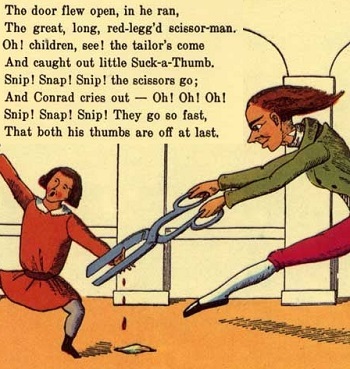
Dr. Fox: Aw! That's pretty cute.
Unikitty: No, no, no! In this context, it's super creepy.
For added atmosphere, play the music from this track while reading on.
A Nursery Rhyme used to convey an underlying sadness and/or creepiness, sometimes made into a theme tune that sounds like a music box that's slightly off key. It's mainly used to indicate someone with a Squicky past, a child molester or other psychosis. Ironically, due to this trope, it's very uncommon for anyone to use nursery music to indicate anything positive anymore, making it a common theme of Grimmification.
Occasionally the writers want to be more poetic with it, and a character will sing the lyrics to some bedtime song. This is sometimes handwaved as being learned from a nanny or grandmother, since they tend to be rhymes no one has used in the last century.
"Ring-a-Ring-of-Roses" (or "Ring Around the Rosey", as it's known in some parts of the world) is especially prone to this, due to the popular belief that a cute little children's song was written about the Black Death. While some disagree with this interpretation, the lyrics of the earliest documented and best-known form do lend themselves undeniably to rather dark interpretations; enough that the Victorians started Bowdlerizing it with more lighthearted variants.
Old-time songs like "Singin' in the Rain" (seen in A Clockwork Orange) and the works of Frank Sinatra are quickly becoming part of this trope. If you enter an ancient, dilapidated mansion and a song whose original listeners are either senile or dead from old age plays over and over and over, you're in trouble. Also, the famous "Hush Little Baby" or "Mockingbird" lullaby seems to be the top icon of this trope, it's simple enough for parents (or some creepy unseen killer) to ad-lib further verses as required.
Overlaps with the Ominous Music Box Tune. Often goes with the Creepy Child, the Psychopathic Manchild and Ambiguous Innocence. See also Soundtrack Dissonance. The opposite, where the music box is used positively, is Nostalgic Music Box. Compare and contrast Fractured Fairy Tale. Compare Creepy Circus Music and Sinister Whistling. Compare and contrast Creepy Children Singing, where creepy songs and nursery rhymes are played in the background to add tension and fear to a scene. Zig-zagged by many a Playground Song, which genuinely come from children's oral tradition but often just are that dark. When used in advertising, see Moody Trailer Cover Song. May overlap with Self-Soothing Song.
Examples:
- This Australian road safety advertisement uses "Happy Christmas" to absolutely soul-crushing effect.
- An old Public Service Announcement started with a closeup of a black mother singing Mockingbird to her toddler... and the camera slowly panning back to reveal she is kneeling in the middle of the street where her baby had just been caught in the crossfire.
- This Scottish ad for Friends of the Earth uses "All Things Bright and Beautiful" — with a slight alteration to the words...
- There is a safety advertisement about overhead powerlines that used to be on the radio in Calgary, Alberta. It started out with the tune from Rock a Bye Baby, with the song slowing down and slowly becoming more sinister-sounding. It doesn't seem ironic, but considering that one of the ways you can come in contact (and one the ways they like to remind people about) is backing up while in a cherry picker, and the cherry picker can resemble a cradle in a way, and the lyrics for the end of the nursery rhyme are, "And down will come baby, cradle and all," well, it just brings up some fairly disturbing images.
- A campaign ad put out by Barack Obama during the 2012 election takes his opponent (and later Utah Senator) Mitt Romney's rendition of "America the Beautiful" and turns it into this, altering the audio to give it a mournful quality and playing it over scenes of closed factories and ghost towns while attacking Romney's jobs record as head of Bain Capital.
Mitt Romney's not the solution. He's the problem.
- This 2010 Canadian drug prevention PSA includes an ominous, hollow girlish voice singing one of those to depict a girl's descent into drug addiction
One, two, kicked out of school
Three, four, snort some more
Five, six, need my fix
Seven, eight...feels too late... - This video includes a German public service video involving classic horror characters singing "Brahm's Lullaby."
- A PIF (featured in the above video) had an instrumental version of "How Much Is That Doggy In the Window" playing as the announcer threatens to literally Shoot the Dog unless people donate money to the RSPCA.
- The German child advocacy group Kinderschutzbund made a series of radio PSA's that featured kids singing children's songs, but with the lyrics changed to be about child abuse.
- The Partnership for a Drug Free America did the exact same thing in a 2004 campaign to encourage parents to talk to their kids about drugs because they probably have already been exposed to them. There is a kid singing the ABC song, only instead of the alphabet, she is listing off drug acronyms.
ABCD PCP,
E or X and THC.
Special K and LSD,
J's and H and GHB.
Now I know my drugs you see.
Next time won't you sing with me? - This 1992 PIF from Community Hygiene Concern. "There's a worm at the bottom of the garden," the worm in question being the Toxocara worm, which can cause blindness.
- Three radio PIFs from the NSPCC made in 2002 took nursery rhymes and reworte them to be about child abuse.
- When Georgie Porgie's dad hears that he has been making girls cry, he hits him, leading to Georgie being confused and unable to concentrate in school.
- Little Jack Horner's mum hits him for sticking his thumb in his pie instead of using a spoon. Jack, upset that he gets in trouble for doing that but not his baby brother, punches the baby.
- Polly gets shouted at by her father and hit with a spoon while putting the kettle on, making her wet herself.
- Friend sings one a few times in 20th Century Boys to taunt the heroes.
Friend: Kenji-kun, come and play with me.
- Amatsuki uses the ancient Japanese poem "Tooryanse", about either getting blessings for your child when it turns seven — first stanza — or burying it on its seventh birthday — second stanza, to incredibly creepy effect, sung by a choir of children in an eerie whisper and accompanied only by the occasional ringing of a bell. Now remember that the Yakou has a bell. Its sound drives people insane...
- Black Butler:
- During an arc in the anime, a serial killer named Drocel keeps grinding his organ and sings a very creepy version of "London Bridge is Falling Down". His prey is young, beautiful girls that he turns into living dolls; the song is used to control said dolls and determine what materials to construct them from. Despite being male, he's kind enough to make an exception for Ciel.
Drocel: Make it out of gold and silver, gold and silver, gold and silver. Make it out of gold and silver, my fair lady.
- In the manga, we have "Tom, Tom, the Piper's Son" — but only the first verse, over and over.
- During an arc in the anime, a serial killer named Drocel keeps grinding his organ and sings a very creepy version of "London Bridge is Falling Down". His prey is young, beautiful girls that he turns into living dolls; the song is used to control said dolls and determine what materials to construct them from. Despite being male, he's kind enough to make an exception for Ciel.
- Hansel and Gretel from Black Lagoon can be heard singing one of these while changing after "playing" with one of Balalaika's men until he died from it and then with his dead body, which still twitched every time they hammered nails into his head.
My mother has killed me
My father is eating me
My brothers and sisters sit under the table
Picking at my bones
They will bury them
Under the cold marble stones- This is likely inspired by the creepy folktale of "The Juniper Tree", in which the murder victim sings this ditty from beyond the grave:
It was my mother who murdered me
It was my father who ate me
It was my sister Marjorie
Who all my bones in pieces found
Them in a handkerchief she bound
And laid them under the juniper tree
Kywitt, kywitt, kywitt I cry;
Oh, what a beautiful bird am I!
- This is likely inspired by the creepy folktale of "The Juniper Tree", in which the murder victim sings this ditty from beyond the grave:
- Case Closed: The leader of the Black Organization uses a popular Japanese children's song written by Noguchi Ujō — titled "Nanatsu no Ko" (七つの子, lit. "Seven Children" or "Child of Seven") — to encode his/her phone number.
- Many chapters of Count Cain are inspired by Mother Goose rhymes, even some of those that were an integral part of the larger arc. Based on Agatha Christie's technique, these chapters usually start with the nursery rhyme, which gradually turns out to frame a ghastly crime.
- Not quite this, but in Darker than Black, one Contractor, Mai, was formerly a normal schoolgirl, and after she uses her powers, she has the Renumeration of whistling. Said powers involve Kill It with Fire, and she whistles a dissonant melody as her victims scream in agony.
- Deadman Wonderland features the Lullaby, a sad and disturbing song about a cursed woodpecker. As revealed later, the song acts to calm the Wretched Egg, allowing her to exist as Shiro. When she and Ganta were children, they would often sing the song together while Ganta's mother played the tune and cried.
- One episode of Death Note has Misa taking over the role of Kira and singing a nursery song in the "I'm watching you" vein while occasionally killing those around her.
- The Road's Song from D.Gray-Man — both Japanese and English are deliciously creepy.
- Elfen Lied has tunes like "Neji", "Yureai", and "Uso Sora", among others. Some of which are played during the flashbacks of Lucy's terrible childhood.
- Ghost in the Shell: Stand Alone Complex:
- The Tachikomas sing a children's song as they're being packed up and sent to the laboratory for formatting and disassembly. They think it's a happy song and tell Batou as much. Problem is, the song is actually "Dona, Dona", a horrific Yiddish song written in 1941, about a calf being taken to slaughter and told to accept his fate without crying.note It was also implied that, to the Tachikomas, death was an exciting adventure that they were looking forward to, especially because to experience death was something reserved for those with ghosts. It can be interpreted as the Tachikomas slinging some guilt on Batou for letting it happen. Just previously Batou had deceived them by pretending that everything was OK, when he knew about their impending fate, and their farewells were rather sharp and subdued compared to their usually cheerful personality. Considering their earlier worries, they weren't eager to die.
- In one episode, an insane serial killer skins women alive and sells their recorded experiences as snuff films at a flea market, all while humming "Mary Had a Little Lamb".
- Hellsing courts this trope in the episode with the two vampire serial killers when there were scenes of the aftermath of a horrific, gruesome murder of a family is shown with a happy television show tune is playing in the background.
- In a rare example Played for Laughs, England from Hetalia: Axis Powers sings the lyrics "Flare up and burn it down/ from corner to corner with that hellfire/ don't leave a single trace/ burn down even their souls" to the tune of Georges Bizet's L'Arlésienne Suite No. 2... as a campfire song while roasting marshmallows. America screams that it sounds like he's trying to summon the Devil.
- In the anime of Inuyasha, Kagome's name is implied to have been derived from the old Japanese game "Kagome, Kagome" in which the players form a ring with a person in the middle with his or her eyes closed, then move in a circle around him or her, singing, and stop once the song is finished. The person in the middle then tries to guess who is standing behind them now. Although the song is very cryptic and has several interpretations, Kagome ultimately discovers Naraku behind the possessed priestess in this episode and shoots him.
- Judas uses this traditional prayer to creepy effect: "Now I lay me down to sleep/I pray the Lord my soul to keep/And if I die before I wake/I pray the Lord my soul to take."
- The "Uwasa" (lit. "Rumour") song from the Magia Record: Puella Magi Madoka Magica Side Story anime. Its lyrics and melody are composed to invoke children's counting folk songs that would be very at home in Japanese Horror. It also foreshadows the appearance of a new enemy called Rumours. Bonus points for being sung by a baby variant of Kyubey.
- Alyssa from My-HiME sings one of these in English early on in the anime.
Who are those little girls in pain just trapped in castle of dark side of moon
Twelve of them shining bright in vain like flowers that blossom just once in years?
They're dancing in the shadow like whispers of love just dreaming of a place where they're free as doves
They've never been allowed to love in this cursed cage
It's only the fairy tale they believe - Noir:
- The first thirty-odd seconds of Melodie are of the music box variety. The song then swells into a more rock-ish theme with the music box chimes heard heavily in the background.
- Chloe's theme, Secret Game is of the rhyme variant.
- In one chapter of One Piece as the battle of the World Government and Whitebeard draws close and reactions of people around the world are shown, small children on the Grand Line sing a nursery rhyme-style song about how fearsome Whitebeard is as they play and the woman watching them comments that even they know what's going on.
- Episode 7 of the anime of Psychic Detective Yakumo opens with the young Miyuki Nanase singing another version of "London Bridge is Falling down" while drawing on the ground with a piece of chalk a girl eating three people, which goes like this:
Take a key and lock her up
Lock her up
Lock her up
Take a key and lock her up
My fair lady. - One of Kafuka's Nightmare Fuel Station Attendant moments in Sayonara, Zetsubou-Sensei involves her singing an extraordinarily creepy nursery tune which she seems to think is a cheerful song.
- Margery Daw from Shakugan no Shana was also named after one of these; in fact, her spells use rather obscure and creepy ones as incantations.
- The Unforgiving Flowers Blossom in the Dead of Night has the protagonist's teacher strangling her while singing Aogeba Tōtoshi, a song sung at graduation ceremonies in Japan.
- Big Finish Doctor Who: That creepy Zagreus rhyme in the Eighth Doctor audio adventures, which turns into "extremely scary" when Zagreus possesses the Doctor. "Zagreus sits inside your head/Zagreus lives among the dead/Zagreus sees you in your bed/And eats you when you're sleeping." Sleep tight, Time Lord kids!
- Howie Mandel's version of "The Mockingbird Song" in one stand-up routine takes a horrifying turn for the worse (for the bird, anyway) very early on.
- The DCU:
- When written by Jeph Loeb, the Batman villain Scarecrow frequently sings "The Mockingbird Song".
- The name of Solomon Grundy, Super Zombie of Green Lantern (1941) and onward, was based on a nursery rhyme of a man "born on a Monday" and "died on a Saturday."
- In Night of the Owls, the Court of Owls has an old nursery rhyme about them:
The Court of Owls watches,
Watches all the time.
Ruling Gotham from a shadowed perch,
Behind granite and lime.
They see you at your hearth.
And they see you in your bed.
Speak not a whispered word about them...
...or they'll send The Talon for your head!
- In The Invisibles, the demon Orlando leaves a recording of "Pop Goes the Weasel" playing in the house of a family he has butchered.
- Marvel Universe:
- In Thunderbolts #120, Norman Osborn finally goes completely insane, puts on his old Goblin costume and starts killing people. In between cackling and declaring that he's God, he joyfully sings John Barleycorn, a traditional folk/drinking song that personifies wheat and barley and describes the harvesting process in the most violent way possible. Though the song was originally meant to be disturbing, having the Green Goblin sing it during a massacre makes it even worse.
"They hired men with scythes so sharp to cut him off at the knee. Bound him about the waist and served him most barbarously."
- The previews for Way of X have an ironic nursery rhyme for Krakoa's bogeyman, the Patchwork Man:
There is a man who's made of parts,
Of grafts and empty spaces.
He slinks beyond the sight of eyes,
And hunts in hidden places.
His dream will be undying!
The nightmare will not end!
The Patchwork Man is coming
And to his will you'll bend.
- In Thunderbolts #120, Norman Osborn finally goes completely insane, puts on his old Goblin costume and starts killing people. In between cackling and declaring that he's God, he joyfully sings John Barleycorn, a traditional folk/drinking song that personifies wheat and barley and describes the harvesting process in the most violent way possible. Though the song was originally meant to be disturbing, having the Green Goblin sing it during a massacre makes it even worse.
- A partial example with the use of the Guy Fawkes rhyme ("Remember, remember...") in V for Vendetta — while it is obviously dark in tone and based on real events, most modern British people don't stop to think about the lyrics, much like most nursery rhymes.
- Better Bones AU: The Clans make up one concerning Tigerstar's death that describes in gruesome detail all of the organs that fell out of his body, which serves to teach young cats the names of those organs.
- In Breaking Point, Medusa sings "All Through The Night" to five-year-old Crona while holding him gently to her. Sound like a Pet the Dog moment to you? You are wrong, my friend. This is Crona's worst memory, because it happens while Medusa is drunk on wine (and has made him drink some too), there's countless snakes crawling all over them, and she's rambling on about how she can't love and wants Crona to help her feel as if she can. It scares poor Crona so badly that he forces himself to forget it ever happened. Harmful to Minors, indeed.
- Calvin & Hobbes: The Series:
- A creepy ghost sings on.
"Oh we are very happy where we are.
We have many things to do.
This song is the result of very hard work
Listen to the song, from very far.
We have eyes and ears and toes.
We have quite a lot of foes
Beware us when we are mad.
For what will happen will be bad.
We have brothers, sisters, and Mothers.
We have also a many Fathers.
Oh we are very happy where we are.
We have many things to do.
This song is the result of very hard work
This has been the song, from very far." - Much later, a poltergeist girl sings "Ring Around the Rosey" while skipping around on a wall.
- A creepy ghost sings on.
- In this Death Note fic, Near recalls one as part of his father's horrible abuse:
Hush, little baby, don't make a sound
Just quiet your cries as Daddy throws you to the ground
Hush, little baby, don't make a move
Because Daddy isn't nearly through with you - It's not uncommon for people to do creepy covers of Disney songs, which may not be nursery songs in the classical sense, but they are often tied to childhood innocence and these creepy covers tend to be lullaby-like orchestral or music box covers. A compilation of such covers can be found here.
- Dragon Ball Z Abridged:
- Freeza sings his own version of "My Favorite Things":
"Peaceful young races with fire on their houses,
Millions of voices all silenced like mouses,
Watching the cowards bow to their new king,
These are a few of my favorite things..." - Later on, Imperfect Cell is introduced creepily singing "Mr. Sandman". Makes sense, since he was partly made from Freeza's DNA.
- Freeza sings his own version of "My Favorite Things":
- Dragon Lily has a disturbing childhood song from Bellatrix.
Lady Death, Lady Death,
Catch me while I still draw breath! - In "The Ember Island Lighthouse", the Fire Nation has some screwed up kids' songs, as demonstrated by the young Azula, Mai, and Ty Lee. (Azula explains that the song is about a past Fire Lord who crushed a rebellion in the Outer Islands of the nation, killed the rebels when they surrendered, left the bodies lying on the beaches, and then burned down all their hometowns for good measure.)
All the sons and daughters
Left lying in the waters
Ashes, ashes
We all rise up! - In chapter 75 of Gensokyo 20XXV, we have a poltergeist of Yukari's memories singing "Kagome, Kagome", the Japanese equivalent, with some of the verses being changed, translating to,
Caged bird, caged bird
When will I come out
In the night of dawn
The crane and turtle slipped
I know who stands behind! - The voiced-over Dragon Ball Z short Gohan's a BLUEY Fan? by MasakoX has Super-Saiyan 2 Gohan singing his own rendition of "Poor Little Bug on a Wall" from Bluey as he marches towards Cell, while the villain is begging him not to get closer as Gohan sings how there's "no one to clean up the mess."
- The Soul Eater fanfic "The Hand That Rocks the Cradle" starts off perfectly innocent, with Marie singing a lullaby to her and Stein's baby son. But it turns into this trope when it's revealed that the singer is not Marie, but Medusa. She's kidnapped the child and intends to raise him as a Tykebomb to succeed where Crona failed. Oh, Crap!.
Hush, little baby, quiet now, Mama's going to hold you safe and sound
Hush, little baby, don't make a move, your Mama'd move heaven and earth for you
Hush, little baby, don't you cry, you're the most precious thing in Daddy's life
Hush, little baby, you'll never know, how Daddy loves you with all his soul
Hush, little baby, don't you fear, Mama's always going to be right here
Hush, little baby, my precious one, I know you'll be your father's son
Hush, little baby, soon you'll know, Mama's never going to let you go
Hush, little baby, here you'll stay, because Daddy couldn't keep his demon away. - In Hard Being Pure, Snatch, the villain specializing in theft, comes check on Noa while she's confined to her magic circle and finds her signing "Who killed Cock Robin", ending with the Sparrow in the song being hung like a thief.
- In Harry Crow, a pregnant Bellatrix Lestrange sings nursery rhymes while cutting strips of skin off Edmund Parkinson.
- In Harry Potter and the Prince of Slytherin Bellatrix Lestrange sings a rather disturbing little ditty while in Azkaban.
Dead Muggle, dead Muggle, swinging in a tree
How many dead Muggles do you see?
Tongues turned blue and faces gone grey
Watch them all as they twist and sway! - Heir of the Nightmare: Nightmare Moon sings "Twinkle, Twinkle, Little Star" as she dementedly and viciously chases after her daughter Twilight.
"Twinkle, Twinkle, little star. How I wonder where you are. Up above the world so high, like a diamond in the sky. Twinkle, Twinkle, little star. How I wonder where you are..."
- In Holidays with Holmes, Holmes comes up with his own twist on the traditional Guy Fawkes rhyme after a convicted murderer tries to kill him and Watson on that night.
- The fan fiction "Hush Little Baby" is a continuation of the song sung by Harley Quinn in Batman: Arkham City.
- "Hypno's Lullaby" is a well-known Pokémon creepypasta poem in this form.
- A Mighty Demon Slayer Grooms Some Ponies has Megan singing the old My Little Pony theme song as part of her Heroic BSoD after she is forced to kill one of the ponies, who has turned villainous.
- The My Little Pony: Friendship Is Magic Dark Fic "Pattycakes 2" has in the "bad" ending sung from Fluttershy to a permanently regressed Rainbow Dash and Scootaloo. Try singing it to the tune of Want You Gone from Portal 2. Here is the last verse.
You'll have the mind of a baby
That's what I'm counting on
You're [sic] never hurt anyone else
Now that your mind is gone
Now you are at age one
Now our little game is done - A Touhou Project fan remix, "Sweets Time Midnight", sets Flandre Scarlet's famous leitmotif to a nursery rhyme. The lyrics don't make a lot of sense when read literally, but a little imagination about the "dolls" or food being mentioned turns the whole song into Nightmare Fuel.
- AKIRA: The movie has the jingling toy bells and squeaking as the killer toys attack.
- In the flashback in Batman Beyond: Return of the Joker, Batman and Batgirl return to the condemned Arkham Asylum. As they walk through the dilapidated halls, they hear Harley Quinn singing "Hush, Little Baby". It only gets worse from there.
- In Batman: Under the Red Hood, the Joker sings a creepy version of "I'm a Little Teapot" while pouring gasoline on Black Mask, his secretary, and Red Hood/Jason Todd's gang (many of whom used to work for Black Mask) in the truck they're bound and gagged in.
Joker: I'm a little teapot. Short and stout. Here is my handle. Here is my spout.
- In Daffy Duck's Quackbusters, Daffy finds himself in a parody of The Exorcist, and the possessed Regan stand-in goes Jekyll & Hyde on a classic: "Mary had a little lamb... BUT I ATE IT!"
- DC Showcase – Batman: Death in the Family has another instance of this in the path in which Jason confronts the Joker as the Red Hood if the viewer chooses to spare the Joker. Here, the Joker recites a version of "Humpty Dumpty" to mock the deterioration of Jason's sanity after Jason had learned that he had violated Batman's no-kill policy and repressed his memories of doing so, resulting in the Bat-Family shunning him in spite of ultimately not going through with killing the Joker as Batman asked him to on his deathbed.
- Fantastic Mr. Fox: "Boggis, Bunce, and Bean: one fat, one short, one lean..." This is only a partial example of this trope as the song is actually sung by schoolchildren and is not used ironically. Mr. Badger even invokes it in order to dissuade Mr. Fox from buying a house next to said farmers.
- Near the end of Finding Nemo, Darla can be heard singing "Twinkle, Twinkle, Little Star" out loud while tapping on the aquarium's glass wall where Peach the starfish is hanging onto.
Peach: Find a happy place! Find a happy place!
- Discussed in Frozen II, as Elsa and Honeymaren recall the lyrics to "All Is Found", a Northuldran lullaby that Queen Iduna once sang to Elsa and Anna:
Elsa: Dive down deep into her sound... [Honeymaren joins her] But not too far or you'll be drowned...
Honeymaren: Why do lullabies always have to have some terrible warning in them?
Elsa: I wonder that all the time. - A scene in Ice Age: The Meltdown has the main characters encounter some vultures who start singing "Food, Glorious Food" from Oliver!. It's more silly than creepy.
- The Nightmare Before Christmas features the three musicians (one of whom is Greg Proops) playing an off-key, really creepy version of "Jingle Bells." However, since this is Halloween Town, where everything is supposed to be scary and creepy, Jack Skellington congratulates them instead of sending them off. Later, they give the same treatment to "Here Comes Santa Claus".
- In Open Season, a hunter that barely seems competent during other scenes suddenly appears very menacing when quietly singing "Teddy Bears' Picnic" as he stalks the protagonist, a domesticated bear who'd been released into the wild and snuck into the cabin not knowing who the owner was. That the bear's former owner had used this song as a lullabye earlier in the film doesn't help.
- In The Rescuers Down Under, Percival McLeach's version of "Home on the Range" counts:
Home, home on the range
Where them critters are tied up in chains
I cut through their sides
And tear off their hides
And the next day I do it again!
Everybody! - In Sailor Moon SuperS: The Movie, the villains use a cheerful song called Three O'Clock Fairy to hypnotize children.
- Shrek:
- Lord Farquaad taunts the Gingerbread man by holding his missing legs and saying "Run run run as fast as you can, you can't catch me I'm the gingerbread man!".
- There's also a parody of "It's a Small World" in the Duloc welcome box that combines this with Lyrical Dissonance. It uses the cheery tune and smiling characters, but is actually giving quite a few clues as to how rigid and dystopian Duloc has become. In the Halloween special ''Scared Shrekless' there is a Halloween variation of it.
- In Spider-Man: Into the Spider-Verse, the Big Bad Kingpin enters by singing a few bars of the old Spider-Man theme song, while the superhero himself is pinned down by minions and at his mercy.
"Watch out! Here comes the Spider-Man."
- In Absolute Beginners, hooligan Ed the Ted sings "The Teddy Bear Picnic" in a menacing tone on his way to a rumble.
- In the climactic battle of The Amazing Spider-Man 2, Electro zaps between electrical coils and makes them emit one tone at a time, playing a Tesla-coil rendition of "Itsy-Bitsy Spider" as he punches Spidey in between his jumps, to Spidey's dismay.
Spider-Man: I hate this song!
- Avengers: Age of Ultron: "I've Got No Strings" becomes much less whimsical and more terrifying when sung by Ultron.
- Axeman: The Axeman whistles "Three Blind Mice" during the climax.
- The use of "Au Claire de la Lune" in The Bad Seed (1956).
- One particularly chilling scene in The Birds is a perfect example. Melanie is waiting to pick up someone from the schoolhouse, so she sits outside on a bench. As she lights a cigarette, the children inside can be heard singing "Risseldy Rosseldy", an English nonsense song ("I married my wife in the month of June, risseldy-rosseldy, mau-mau-mau..."). As they do, a single crow flies behind Melanie and lands on the jungle gym... and then another... and then another... When she finally looks up, the entire structure is covered with crows, silently waiting for the children to emerge...
- Black Christmas (1974) has the deranged 'Billy' singing "Daddy's gone a-huntin" while rocking a chair in which he has placed the corpse of a girl he murdered.
- Black Christmas (2006) has Dance of the Sugar Plum Fairies play during several suspense scenes. Surprisingly effective.
- In Cat People and The Curse of the Cat People, Irena hums a wordless lullaby that is both soothing and slightly creepy.
- "Mairzy Doats" is sung during a torture scene in The Cell.
- In Changeling, a serial killer sings "Silent Night" to make himself feel better immediately before he gets executed by hanging.
- A Clockwork Orange doesn't use a nursery rhyme, but it uses the next best thing: "Singin' in the Rain", a musical number from The Golden Age of Hollywood. Alex sings this song while he and his droogs torture an old writer and rape his wife.
- Creepshow has a relentlessly ominous example in the short "Something to Tide You Over". While the hero is enduring his drowning death, the soundtrack uses the chords from "Camptown Races" to make his wait for death almost unendurable.
- The Crow: City of Angels:
- A drug dealer precedes shooting a small child with "Hush little baby, don't you cry, Kali's going to give you eternal life."
- Later in the movie, when the Crow breaks Kali's back, he gives this line: "Hush little baby, shh, don't say a word. Daddy's gonna buy you a big black bird!" — just as he throws out of a window.
- Early in The Deaths of Ian Stone, the main character's secondary love interest sings "Cross my heart and hope to die / Stick a needle in your eye" when he makes a promise to her. Much later, she matter-of-factly recites the first line while sticking an actual needle in his eye.
- In Deep Red, the killer plays a creepy children's song before committing the murders.
- Dr. No plays a calypso rendition of "Three Blind Mice" during a scene of three hitmen Obfuscating Disability.
- In Duck Soup, newly installed president Firefly lays down the law in a peppy tune:
"I will not stand for anything that's crooked or unfair,
I'm strictly on the up-and-up, so everyone beware!
If anyone's caught taking graft and I don't get my share,
We stand him up against the wall and Pop Goes the Weasel!" - Elves (2017): Expect to hear a lot of creepy off-key piano/xylophone renditions of classic Christmas songs to help heighten the horror of the film.
- In Elysium, Kruger tries calming Frey's daughter, Matilda, with an Afrikaans children's tune as they're being taken to Elysium. She's being "comforted" by the man who beat her mother and stated his intent to "settle down with her", on top of a man with a live grenade being in close proximity. Worse, it's a song of a married man and woman going about their life after spending a night together.
- Evil Dead:
- In The Evil Dead (1981), Linda sings a creepy little song to the tune of "Ring Around the Rosie" while in Deadite form. "We're gonna get you, we're gonna get you / Not another peep, time to go to sleep."
- Annie's mother-turned-Deadite in Evil Dead 2 sings "The Mockingbird Song" to try and lull her daughter into a trap. Later, Annie distracts her possessed mother long enough for Ash to get the edge over her by singing the same song.
- In Army of Darkness, Ash sings "London Bridge" while killing miniature versions of himself. Definitely played for laughs though, especially when he steps on a nail and the tiny Ashes finish the verse for him as he gasps in pain.
- Not actually a nursery rhyme, but Marla Singer in Fight Club as she leaves the Paper Street house. "Gotta get off... gotta get off... gotta get off this merry-go-round..." Marla Singer is quoting from "(Theme from) Valley of the Dolls" — not strictly an ironic nursery rhyme, but considering what happens to the women of the film, it's appropriate.
- In The Fly (1986), a doomed Seth Brundle sings "I know an old lady who swallowed a fly... perhaps she'll die".
- Forget Me Not revolves around a children's game involving one.
One, two, three, four, five, six, seven, release the one ignore by heaven.
Eight, nine, ten, now run and hide or join her on the devil's side.
Eleven comes, the clock will chime. Forgotten souls erased by time.
Midnight comes but not too late. So kill the ghost or seal your fate. - Full Metal Jacket ends with American soldiers in Vietnam marching through burning ruins while singing the "Mickey Mouse March".
- Get Out (2017) does something similar to what A Clockwork Orange did to "Singin' in the Rain" by repurposing "Run Rabbit Run", a light-hearted song originally written for a comedy revue but rewritten to have Take Thats to the Nazis in 1939. The song's World War II association ties into some of the Armitage family's backstory.
- Ghost from the Machine has the ghost of a psychopathic daycare worker who killed a child, his mother, and then himself sing "Twinkle Twinkle Little Star" to the protagonist's little brother.
- Halloween III: Season of the Witch features a recurring advertising jingle for Silver Shamrock novelties sung to the tune of "London Bridge is Falling Down". This becomes increasingly sinister as we learn of Silver Shamrock's actual purpose. Becomes doubly chilling considering that the tune is changing with each passing day — "Six more days to Halloween, Halloween, Halloween..." Considering that Halloween is when the Silver Shamrock masks will kill every child wearing them, it's actually a countdown.
- In Hannibal Rising, Lecter forces an ex-Nazi to sing a German children's song before he kills him — a song that had also been used in Hansel and Gretel, just to make the point.
- The titular theme song of Happy Birthday to Me sounds like it's sung by a 10-year-old girl and has plenty of slow creepy music.
- In The Haunting (1963), Eleanor hums a wordless tune twice in the film, both times while dancing with Hugh Crain's statue. The effect is creepy.
- In The Haunting (1999), Eleanor hums a wordless tune: first while driving to Hill House in her car, then in the garden while she looks at the statues of the woman and children. This same tune is played later on as an Ominous Music Box Tune on a hand-cranked phonograph which she finds in the nursery... which only adds to the implication that Hill House is her home.
- In The Haunting in Connecticut, the main central tune is "Two Dead Boys".
One bright day in the middle of the night
Two dead boys got up to fight
Back to back they faced each other
Drew their swords and shot each other
A deaf policeman heard the noise
He came and killed those two dead boys
One bright day in the middle of the night - "Bobby Shaftoe" is heard several times during the first half of Heart of Darkness (1958), in ironic counterpoint to both Marlow's sufferings as a sailor and Maria's stymied wish for love.
- During the closing credits of the 2011 horror-short "Hellion", a babysitter who is turning into a zombie sings (to an already zombified small boy who she is tending) altered lyrics to the tune of "Brahms' Lullaby". The altered lyrics ("Lullaby, sweet baby mine / Soon we'll rise and soon we'll dine") lovingly promise the zombie child that, if he goes to sleep, he will awaken to a meal of his favorite foods:
"Newborn cheeks and infant lips,
Toddler toes and fingertips,
Now you're of the living dead,
Go to sleep and rest your head." - He's Out There has the killer luring two of his victims by playing a recording of "This Old Man", and also has a Creepy Child narration of a storybook over footage of the carnage of the penultimate scene.
- Hide and Seek:
- After Charlie takes over, David searches for his daughter while slowly sing "Hush, Little Baby" in a creepy way while holding a knife.
- If you listen through the credits, a little girl starts singing a creepy song: "Who's playing hide and seek? Won't you come play with me? Who's hiding in the dark? Come out, come out, let's play again..." The words aren't much until you hear the tune.
- In Hocus Pocus, the youngest of the three witches, Sarah, sings a magical nursery rhyme to lure young children to the witches' home, where they will be sacrificed to preserve the witches' youth.
Come, little children, I'll take thee away
Into a land of enchantment.
Come, little children, the time's come to play,
Here in my garden of magic. - In Hotel Rwanda, children singing is a sign of temporary respite and peace. However, Western viewers tend to find it extremely disturbing. It doesn't help that in every other scene of the movie, there really is creepy, disturbing stuff going on — after all, it's about the Rwandan genocide.
- In The Initiation, the escaped lunatics surround Nurse Higgins' car slowly singing ""Ring Around the Rosey".
- The Innocents: Flora has a music box which plays the tune O Willow Waly frequently throughout the movie, but it's only at the very beginning that the lyrics are heard (sung by Flora):
We lay my love and I
beneath the weeping willow.
But now alone I lie and weep beside the tree.
Singing O Willow Waly by the tree that weeps with me.
Singing O Willow Waly till my lover returns to me.
We lay my love and I
beneath the weeping willow.
But now alone I lie.
Oh willow I die.
Oh willow I die. - The opening credits of Jack the Reaper are accompanied by creepy children's voices singing "Ring Around the Rosey". Later, when Jessie is in the bus alone and sees Railroad Jack on horseback, the same voices recite a nursery rhyme about Jack.
- Jaws: Sean Brody makes sand castles and sings "The Muffin Man" immediately before Alex Kintner is delivered to Bruce on a plate — er, raft.
- Jeepers Creepers turns the title tune into a horrifying premonition.
- Played for Laughs in Kick-Ass. When Hit-Girl makes her debut in a drug dealer's apartment and goes on a violent murder spree to save the titular hero, the scene is set to a jaunty, frantic cover of the theme song from The Banana Splits. The cheery imagery — "One banana, two banana, three banana, four!" — contrasts with the sight of the various villains being brutally slaughtered in a hilarious bit of Black Comedy.
- Perhaps unsurprisingly, the rhyme "Lizzie Borden took an axe..." (which Haunted House Historian Cindy tells us is a children's skipping song from the 1930s) is used multiple times in Lizzie Borden's Revenge. When Leslie is first possessed by Lizzie's spirit, she starts reciting it in a creepy monotone that unnerves everybody before she seems to shake herself out of it. When it looks like Amanda might have been possessed at the end of the film, she starts reciting it as well, only to be slapped by Dee who tells her she never wants to hear that rhyme again.
- In the opening seconds of The Lost Boys, before the footage starts rolling, a little child's voice can be hears singing the first two lines of "Cry Little Sister". Although this song is also used with full vocal chorus and music at the beginning of the film and has since been covered by several bands as a Gothic rock anthem, that first soft-voiced A Cappella rendition sounds eerily like a children's nursery song.
- M:
- The film starts with children skipping while singing "Just you wait a little while/ Soon the man in black will come/ And with his little chopper/ He will chop you up! — You're out!" The rhyme itself was a sarcastic subversion of a popular operetta tune by Walther Kollo, with a bunch of violets ("Veilchen") turned into 1920s Serial Killer Fritz Haarmann's (possibly an inspiration behind the film) weapon of choice, an axe ("Beilchen").
- For that matter, Lorre's whistling of "Hall of the Mountain King" counts. Not exactly a nursery song, but still.
- Marnie incorporates the jump-rope chant "Mother Mother" into a scene where Marnie arrives at her mother's house for the first time, which is later revealed to be where she murdered a man and lost her childhood innocence. It's actually given a Triumphant Reprise at the end.
Mother, mother, I am ill
Send for the doctor over the hill
Call for the doctor, call for the nurse
Call for the lady with the alligator purse
Mumps said the doctor, measles said the nurse
Nothing said the lady with the alligator purse
How many years will I live? - In Midnight Cowboy, Joe Buck flashes back to scenes of his childhood while riding the Greyhound bus in the middle of the night and staring out the window; the voice of his grandmother singing "Hush, Little Baby" accompanies the scene.
- In Minority Report, the Swedish nurse Greta sings Små grodorna before Anderton's eye transplantation. The original text is Ej öron, ej öron, ej svansar hava de ("no ears, no ears, no tails they have") but it is sung ''Ej ögon, ej ögon'' ("no eyes") instead.
- In The Name of the Rose, Salvatore sings an old tuscan lullaby while he's tied to the stake.
- The A Nightmare on Elm Street series has a fairly well-known rhyme associated with its dream killer, Freddy Krueger:
One, two, Freddy's coming for you.
Three, four, better lock your door.
Five, six, grab a cru-ci-fix.
Seven, eight, better stay awake.
Nine, ten, never sleep again. - The Night of the Hunter includes a creepy children's skipping song about a hanging, and multiple creepy lullabies. The eponymous Hunter, Serial Killer Harry Powell, is also seen belting out the hymn "Leaning On The Everlasting Arms" to very creepy effect. Rachel later defeats Powell at the end by singing counterpoint to the hymn.
- A genuinely creepy nursery rhyme dictates the killer's murders in Non Ho Sonno.
- This scene from O Brother, Where Art Thou?, which is meant to echo the sirens of The Odyssey, manages to combine creepy and seductive into one rhyme. (Given the lyrics, some creepiness is guaranteed.)
- In the original, Japanese version of One Missed Call, there's the ringtone which announces the 'you're gonna die this day, at this hour, in this way' message, which is then revealed to be a theme tune from an old children's program. In the American version, it's revealed to be the song that a certain bear plushie plays when it's squeezed.
- Despite being an unbelievably creepy film, Pan's Labyrinth manages to mostly invert this, as the lullaby hummed by Mercedes is mostly used to genuinely comforting effect, as well as being a meditation on how sad everything is.
- In the horror film Pearl (2022), there is a scene where the titular character curls up in her dead mother’s arms while she sings a German lullaby to her in her imagination, all set over a Gross-Up Close-Up montage of Pearl dismembering and feeding one of her victims to a gator, and preparing the other two as well as a maggot-infested pig to look “presentable” for her husband when he returns from the war.
- Pirates of the Caribbean:
- The films use the original Disney song, "Yo Ho (A Pirate's Life for Me)", to creepy effect, primarily by having a young girl sing it slowly and in a minor key, instead of a pack of pirates singing upbeat and in major. This is then inverted in The Stinger of Pirates of the Caribbean: At World's End, with Will Turner, Jr. singing it in its original major key.
- "Hoist the Colors" is first sung in Pirates of the Caribbean: At World's End by a young boy and his fellow probably-not-all pirates on their way to the gallows.
- In Pirates of the Caribbean: On Stranger Tides, the mermaids' version of "My Jolly Sailor Bold" is particularly creepy due to the monotone way it's sung, and what almost happens next...
- The opening theme to Poltergeist (1982).
- In Pulp Fiction, while Bruce Willis and Ving Rhames are Bound and Gagged in a Torture Cellar beneath a perverted hick's pawnshop, the owner's similarly creepy brother decides which of the captives to torture and sodomize first by reciting "Eeny, meeny, miney, moe …" For bonus points, he uses an antiquated version of the rhyme containing the N word in place of "tiger."
- The toy piano music playing over the opening and closing credits of the Puppet Master movies falls into this trope.
- The Quatermass Conclusion features a children's nursery rhyme containing seemingly innocent lyrics that indicate that the terrible inexplicable events occurring in the film have happened before.
- Repo! The Genetic Opera:
- A couple of songs evoke this feel through clever use of repetition and call-and-response, especially "Zydrate Anatomy". As the creator describes it, "Gather 'round, kids! We're gonna teach you how to shoot up!"
Grave-Robber: Zydrate comes in a little glass vial.
Shilo: A little glass vial?
Scalpel sluts: A little glass vial! - There's also the song in which Pavi and Luigi prance around the Opera stage, singing about how Shilo's mother died.
- A couple of songs evoke this feel through clever use of repetition and call-and-response, especially "Zydrate Anatomy". As the creator describes it, "Gather 'round, kids! We're gonna teach you how to shoot up!"
- The Ring:
- Samara Morgan sings the following, nightmarish nursery rhyme to herself instants before being suffocated and tossed in a well to die by her adoptive mother:
"Round we go, the world is spinning.
When it stops, it's just beginning.
Sun comes up, we laugh and we cry.
Sun goes down, and then we all die." - The melody was already the movie's theme long before the rhyme itself was revealed, and was made even creepier after the fact.
- In the original Japanese version, Ringu, the nursery rhyme is about staying away from the ocean, or else monsters will get you, an allusion to the fact that Sadako is likely an oceanic demigoddess.
- Samara Morgan sings the following, nightmarish nursery rhyme to herself instants before being suffocated and tossed in a well to die by her adoptive mother:
- Rosemary's Baby has "Rosemary's Lullaby" as the opening and closing theme, sung by star Mia Farrow as la-las, and it's plenty creepy. However, the song does have lyrics and is also known as "Sleep Safe and Warm". Out of context, it seems to be an innocent promise of protection from a mother to her infant. But if you've seen the film, Fridge Horror makes you wonder if maybe it's the father doing the singing (or, considering the ending, it's a duet).
- In Sabotage (1936), after Mrs. Verloc's little brother Stevie is killed by a bomb planted by her husband, she wanders into the movie theater she and her husband run. A cartoon version of Who Killed Cock Robin? is playing, complete with song.
- The German song "Mamatschi" will forever be remembered by most people as the song that plays in Schindler's List as children are taken away by Nazis to be killed as their mothers run after the trucks, screaming. The song itself can be very disturbing, as the cheerful melody tells the story of a boy begging his mother for a horse, but never getting one, complaining about how he didn't want horses "like these" (of candy or wood) and later as an adult remembering this when he sees the chariot that carries his mother's coffin, making the outcry that he didn't want horses "like these" rather heart-breaking.
- Shanghai Triad: The Chinese title of this movie, Yáo a Yáo, Yáo Dào Wàipó Qiáo, refers to a Chinese lullaby that is sung by some of the characters (including star Gong Li). The irony comes from several of these characters having their innocence brutally stripped away during the story.
- Before the infamous "Here's Johnny!" scene in The Shining, Jack goes through a bit from "The Three Little Pigs" before hacking at the door with his axe. "Little pigs, little pigs, let me come in... Not by the hair on your chinny chin chin? Then I'll huff, and I'll puff, and blow your house in!" His Madness Mantra is another example: "All work and no play makes Jack a dull boy."
- Silent Night, Deadly Night, being about an Ax-Crazy Bad Santa with a traumatic childhood, naturally features a few ironic Christmas carols generally heard before, or while, something particularly nasty happens. These are mostly things written specifically for the film rather than real Christmas standards, the most prominently featured being the Paranoia Fuel that is "Santa's Watching":
Santa's watching, Santa's creeping
Now you're nodding, now you're sleeping
Were you good for Mom and Dad?
Santa knows when you've been bad... - The trailer for Sinister 2 makes use of the song "Hush, Hush, Hush, Here Comes the Bogeyman" by Henry Hall. While the full song is a cheerful little number about how the bogeyman is really a coward that can be easily driven away by any child, the trailer takes only the few lyrics it needs to make the song terrifying.
Children, have you ever met the bogeyman before?
No, of course you haven't, for you're much too good, I'm sure
Hush, hush, hush, here comes the bogeyman
Hush, hush, hush, here comes the bogeyman
Don't let him come too close to you, he'll catch you if he can
catch you if he can, catch you if he can, catch you if he — catch you if he — catch you if he— [scream] - A B-horror movie called Sleepstalker, in which the monster is an executed killer into a twisted, demonic version of the sandman, features a creepy nursery rhyme about a child going to sleep.
- In Smart House, as Pat goes crazy and tries to show that she can be a mother to the kids, she starts singing "Hush Little Baby". It gets kind of creepy, especially because as she's doing this, she's summoning a giant hurricane in the house and terrorizing the family.
- In Snapshot (1979), Daryl is stalking Angela in a Mr. Whippy van. Several times Angela is unnerved when she hears the tinny version of "Greensleeves"—the tune Mr. whippy vans play—in the middle of the night, even though she cannot see the van.
- S.O.B.: In the film within a film Night Wind, Sally performs a bizarre striptease on a set full of sexual imagery that represents her subconscious to a Sexophone-infused version of "Polly Wolly Doodle".
- Spider-Man: "The itsy, bitsy spider went up the water spout..." Face Palm moment: An electronic Spider-Man toy sings that as well, and it is aimed at toddlers.
- Starship Troopers 2: Hero of the Federation has one young female trooper, under the control of a Puppeteer Parasite, singing "Itsy Bitsy Spider" before trying to take out the heroes with a pair of live grenades.
- The short film Suckablood is told entirely in rhyming couplets and concerns a monster visiting a girl and her Evil Stepmother.
- Super Size Me uses a variant of this. The opening shows a group of young children repeating several lines of Product Placement as a group chant. This is intended to be off-putting and slightly disturbing. It's an actual song by the Fast Food Rockers named "Fast Food Song".
- Suspiria (1977):
- The opening sequence has a metallic toy piano playing over the heroines journey to her new job at a ballet school, to creepy effect.
- The infamously confusing trailer starts with a variation on "Roses are red, violets are blue".
- Ten has "Hush Little Piggy", a song about a butcher killing pigs one by one, with the melody being a slight variation on "Hush Little Baby". We first hear it being sung and played on an out-of-tune piano by The Folk Singer not long before the first death in the movie, and each line foreshadows the fate of one of the main characters in some way. A heavily rearranged version by Darling Pet Munkee shows up in the credits — the song now sounds more like Garage Rock / psychobilly than a lullaby, but the lyrics still have that certain nursery rhyme quality to them.
- The protagonist of Tetsuo III: The Bullet Man sings "Hush, Little Baby" to himself during various disturbing scenes, to calm himself down. It apparently helps to keep him from transforming.
- There Was a Little Girl: The score by Riz Ortolani incorporates melodies from various nursery rhymes, tying in to the film's themes of childhood trauma and the juxtaposition of innocence and evil. In addition, Father James sings "Old King Cole" while stalking the landlady Amantha.
- Tower of Terror uses "It's raining, it's pouring" while Buzzy and his niece walk down a deserted hallway.
- The 2007 horror film Trackman has the fake Russian lullaby "Tili Tili Bom".
Tili tili bom, close your eyes now
Someone's walking outside the house and knocks on the door
Tili tili bom, the nightbirds are chirping
He is inside the house to visit those who can't sleep
He walks, he is coming closer
Tili tili bom, can you hear him closing in?
Lurking around the corner, staring right at you
Tili tili bom, the silent night hides everything
He sneaks up behind you and he is going to get you
He walks, he is coming closer - In Turbulence, after the serial killer breaks loose and (supposedly) kills everyone on the plane except the flight attendant heroine, he stalks after her while gently singing "Buffalo Sally, won'tcha come out tonight, come out tonight..."
- In The Usual Suspects, McManus sings a special version of "Old MacDonald" right before killing several people.
"Old MacDonald had a farm,
E-I-E-I-O!
And on that farm, he... shot some guys,
Badda bing, badda bing bang boom!" - In War of the Worlds (2005), Rachel Ferrier sings "Hushabye Mountain" while her father kills the Crazy Survivalist whose actions are putting her in danger.
- The Filipino horror film White Lady corrupts the classic lullaby "Sa Ugoy ng Duyan" ("In the cradle's rocking") by using it as the Leitmotif of the eponymous vengeance-seeking ghost.
- In The Wizard of Oz, when Dorothy and her friends are cornered by the royal guards of the castle:
Wicked Witch of the West: Ring around the roses, a pocket-full of spears!
- The Woman in Black has a hell of a one in the trailer:
During afternoon tea, there's a shift in the air,
A bone trembling chill that tells you she's there,
There are those who believe the whole town is cursed,
But the house in the marsh is by far the worst,
What she wants is unknown, but she always comes back,
The specter of darkness, the woman in black.
By creator
- Agatha Christie:
- And Then There Were None features a rhyme about Indian boys being killed one by one, which many of the characters recognized from their nursery days. Said characters are killed in the same manner as the Indians in the song. There are even Indian dolls in the living room that disappear as the characters are bumped off. This is an arguably benign and harmless bowdlerisation of the original. Both rhyme and book were originally entitled "Ten Little Niggers", one paperback actually featured a hanged golliwog (a kind of gonk doll based on a blackface minstrel figure) on the cover. It was later further bowdlerized as "Ten Little Soldier Boys". Acceptable targets keep moving...
- Christie uses a lot of titles like this: Hickory Dickory Dock, A Pocket Full of Rye, Five Little Pigs, One, Two, Buckle My Shoe, and Three Blind Mice (the story on which the play The Mousetrap is based). There's even a Lampshade Hanging in one book where Poirot chides himself for thinking about nursery rhymes so much. The Mousetrap also has a lampshade hanging, where one character likes to recite the creepy nursery rhyme of the title and another, noting the lyrics, wonders why children like to say such horrible things.
By work
- An early villain in Abarat has realized the power of this trope, and sings tunes like these whenever he really wants to scare someone. They're not songs from our world, however, but openly sinister tunes apparently devised by Card Carrying Villains for Enfant Terribles. "Forget the future, forget the past. Your life is over. Breathe your last."
- One chapter of Agatha H. and the Airship City starts with a children's naming game about slaver wasps and Baron Wulfenbach's usual means of dealing with them.
Little Mary has bugs inside her head—
Inside her head, inside her head.
Now The Baron's gonna come and make her dead—
Make her dead, make her dead... - Like Agatha Christie, the Alex Cross serial killer mysteries use or adapt lines from nursery rhymes as the titles (omitting the few that buck the trend):
- Along Came a Spider
- Kiss the Girls
- Jack & Jill
- Pop Goes the Weasel
- Roses are Red
- Violets Are Blue
- Four Blind Mice
- The Big Bad Wolf
- London Bridges
- Mary, Mary
- S.S. Van Dine outdid Christie in his novel The Bishop Murder Case, which features a series of murders each related to a different nursery rhyme. For example, the first victim is a guy nicknamed "Cock Robin", who gets shot with an arrow.
- Nursery rhymes play a role several times in Barry Hughart's Bridge of Birds and sequels. The rhymes themselves tend to be quite harmless-sounding until you realize what they actually mean. As Kao Li points out, most real children's rhymes don't directly speak of the topic they're about, so if there's a nursery rhyme that actually talks about fighting and death and the apocalypse, it was probably made up by adults, whereas if it talks about goats and grass and wall-jumping, it's probably about virgins getting murdered by evil dictators or something similar. In Bridge of Birds, the children's rhyme and the game that went with it was part of a generations-spanning Gambit Roulette, where the players knew that all the documentation of what the Big Bad did to become the Big Bad would be purged, and eventually fade from living memory. However, oral tradition is not so easily lost, so they coded the whole story and the means to bring down the Big Bad into the children's game.
- Burying the Shadow brings us this gem being sung by little girls while the protagonist is possibly going crazy: "The pale lady rises, the pale lady falls. Up again, up again, smelling out souls."
- The Ciaphas Cain novel Death or Glory has the gem "The tracks on the land raider crush the heretic". ref This presumably isn't very ironic for the setting, but it certainly comes across as such to readers.
- Doctor Who Expanded Universe:
- A mid-Gallifreyan nursery rhyme from the Doctor Who New Adventures novel Cat's Cradle: Time's Crucible:
Isn't it dark? Isn't it cold?
Seek out the future before you get old.
Once there were children. This is their doom.
Now all the people are born from the loom. - In the Eighth Doctor Adventures novel Unnatural History, a Faction Paradox member taunts the Doctor with this parody of a Gallifreyan nursery rhyme:
Sing the past to me, 'cause I'm the one who wrote the song.
I made it up next week, so all the words will come out wrong,
The past won't keep you warm tonight, the future's blown to bits,
And everything that you believe is really full of— - One of the books commissioned by The BBC to tie in with the new series, an Eleventh Doctor story titled "Dead of Winter", has a small rhyme that is recalled by Dr. Smith that goes:
I know an old man called Michael Finnegan
He grew fat and then grew thin again
He had twelve lives
Then had to begin again
Poor old Michael Finnegan
Begin again.
- A mid-Gallifreyan nursery rhyme from the Doctor Who New Adventures novel Cat's Cradle: Time's Crucible:
- The Eugene Field poem The Duel is about a gingham dog and calico cat who get in a fight and end up completely destroying one another. Singer Dorothy Olsen adapted it more ironically as "The Gingham Dog and the Calico Cat" on her 1960 album Songs about Animals and Birds for Children.
- In Tim Lott's Fearless, the Whistler, X-17, never speaks, she only whistles nursery rhymes. Quite creepy.
- In the second book of Libba Bray's Gemma Doyle trilogy, Rebel Angels, Nell (a Bedlam patient) sings the old nursery tune "Jack and Jill" in a creepy manner every time we see her. Also, when the Bedlam patients have a little performance in front of their benefactors, she makes up a creepy little song about various vaguely ridiculous-sounding evils and how to defend them. Everyone thinks it's funny, but it later turns out it was a message for the heroines because everything she said was true...
- In the short story "Green Fingers" by Charles Birkin, a Nazi woman has an affair with a concentration camp officer who brings fertilizer for her garden. When the war ends and the British take over the town, they discover that he planted her garden with the corpses of camp prisoners whom he deemed so beautiful that he wanted them to be reborn as lovely flowers. Another character, who was taught at school by an English woman, is horribly reminded of a nursery rhyme she learned: "... how does your garden grow? With silver bells and cockle shells and pretty maids all in a row."
- The Green Knowe Chronicles: In The Children of Green Knowe, there's a fictional kids' song about a tree that's possessed by an evil spirit:
Green Noah, demon tree
Evil fingers can't catch me... - The first few lines of the last stanza of T. S. Eliot's The Hollow Men:
Here we go round the prickly pear
Prickly pear prickly pear
Here we go round the prickly pear
At five o'clock in the morning. - The Hunger Games introduces the "Hanging Tree" song. Children sing it innocently and make little necklaces of rope to go along with the lyric "wear a necklace of rope with me," but Katniss's mother realizes what they are singing and quickly stops her and her sister from singing it. Ironically, due to the film adaptations, Jennifer Lawrence's rendition of this song reached Top 40 radio stations... with a dubstep backbeat added.
- Robert Cormier's I Am the Cheese uses "The Farmer in the Dell". The song's last stanzas have a rat taking the cheese, and then the cheese stands alone. As one might guess from the title of the book, the cheese refers to the protagonist.
- Imperial Radch: The protagonist of Ancillary Justice, the Artificial Intelligence of a spaceship that operates planetside through Meat Puppet soldiers called ancillaries, hears some children playing a game and singing about them.
One, two, my aunt told me
Three, four, the corpse soldier
Five, six, it'll shoot you in the eye
Seven, eight, kill you dead
Nine, ten, break it apart and put it back together - In Insomnia, the Big Bad (who is essentially one of the three Fates, normally invisible "little bald doctors", who are Death) repeatedly sings a skipping song, while skipping with a skipping rope that he stole:
Three, six, nine
The goose drank wine... - In the Jane Yellowrock short story "Signatures of the Dead", a young, insane rogue female vampire is briefly heard attempting to sing "Starlight, Star Bright", but can't remember the words:
"Starlight, star fright, first star... No. Starlight, blood fight... No. I don' 'member. I don' 'member—"
- Taken to a fairly literal extent in Lullaby, which is about a nursery rhyme (a "culling song") that kills those who hear it.
- More Information Than You Require parodies the legends about "Ring-Around-the-Rosie" by providing a series of nursery rhymes that are unsubtly describing horrific events, such as "Ring-Around-the-Rosie" verses that are about the Bubonic Plague and other rhymes about the 1918 influenza epidemic, the Jonestown mass suicide (referencing the Kool-Aid Man), and the Teapot Dome Scandal (though the historical Teapot Dome Scandal didn't involve an undead President Harding devouring children's bones).
- In "Nackles", after voicing his suspicions that the belief of children who have been told the story will soon make Nackles real all over the country, the narrator quotes a line from "Santa Claus is Coming to Town".
- Nevermoor: It's revealed that Wundersmiths can call Wunder to them by singing to it, and you can sing any song you like. The Big Bad prefers a nursery rhyme that Morrigan remembers learning in pre-school, but the lyrics are... interesting.
Little crowling, little crowling, with button-black eyes
swoops down into the meadow, where the rabbits all hide.
Little rabbit, little rabbit, stay by mother's side,
or the crowling, little crowling, will peck out your eyes. - Midway through the New Jedi Order series, Mara Jade (former assassin for the Emperor) is told that she can probably be creepy even singing a nursery rhyme. She's amused, says that's easy, and sings the following fragment in a minor key: "Sleep, child, the night is mild, and slumber smiles upon you," making it sound as if "Slumber" is a grinning monster. Not only is it appropriate to the character, shortly thereafter a dark Jedi named "Lord Nyax" after a monster in a children's story appears.
- Nineteen Eighty-Four features two nursery rhymes: "Oranges and Lemons" and one which begins: "Under the falling chestnut tree/I sold you and you sold me." The latter is, of course, disturbingly prophetic.
- The Parasitology trilogy has the in-universe children's book Don't Go Out Alone, a lengthy poem about a pair of young siblings who go looking for the monster that used to live under their bed, narrated by the monster in a disturbingly parental tone. To give you an idea of just how creepy it is, parts of it were recycled either from or into a Filk song about Silent Hill, of all things.
"Little boy with faith so thin, little girl with strength within
I said I'd never leave you and I'm sorry, but I lied
If you're set to pay the price, learn the ways of sacrifice
Leave this world to grieve you, take a breath and step outside
The broken doors are open, down the path you've always known
My darling ones, be careful now, and don't go out alone" - Peeps: The companion book The Last Days discusses "Ring Around the Rosey," and the 700-year-old Night Mayor asserts that it's about the plague. Turns out he ate the kid who made it up.
- Redwall: In Loamhedge, Flinky the stoat sings his obnoxious leader to sleep with what starts out as a regular lullaby, but as the boss drifts off Flinky changes the lyrics into instructions to a comrade to stab the guy.
It looks like the fox has gone to sleep, sleep, sleep,
Slippy now be quiet as you creep, creep, creep,
And stick a good sharp spear straight through his head,
So the moment that he wakes up he'll be dead, dead, dead! - In the Austrian novel (and The Film of the Book) Schlafes Bruder by Robert Schneider, the protagonist's friend Peter says one when he burns down his father's house on Christmas, and subsequently half of the village because the fire spreads.
"Eins, zwei drei, vier, fünf, sechs, sieben, (one, two, three, four, five, six, seven,)
in der Schule wird geschrieben (in the school, they're writing)
in der Schule wird gelacht (in the school, they're laughing)
bis der Lehrer bitsch-batsch macht!" (till the teacher will slip-slap them!) - A Series of Unfortunate Events:
- Book the Eighth's accompanying song, Smile! No One Cares How You Feel; Book the Twelfth's Things Are Not What They Appear feels like this as well. The Film of the Book plays music-box tunes and the saccharine "Littlest Elf" song during tragic scenes.
- Also, The World Is a Very Scary Place. The lyrics could be threatening, to an extent, but the music is just so upbeat.
- A fictional one in Shaman Blues, while never mentioned in entirety, is about victims of a brutal series of child murders.
- In Skulduggery Pleasant: The Dying of the Light, the group hunting Remnants (pure evil, body-snatching shadow creatures) finds one of them sitting in the middle of a deserted street singing "Twinkle Twinkle Little Star".
"Right," said Donegan, "Because that's not creepy at all."
- The ghosts in the short story "Ashes, Ashes" from the compilation Somewhere Beneath Those Waves sing the eponymous nursery rhyme to draw attention to their skeletons.
- A Song of Ice and Fire gives us a strange version of this via Patchface, the Fool of Stannis Baratheon's court. He's usually used as a glorified babysitter simply because his horrible rhymes/shanties/songs make little to no sense to any adult who hears them, so they are merely dismissed as him just being his brain-damaged, lackwit, nutsy self. Yet, they (and he) are somehow still deemed suitably safe-yet-creepy enough for children! The creepier the lyrics get, and the more tortured the poor rhyme tacked to the metre becomes, the more accurate (and scary) the genuine prophecy masquerading as random drivel generally is. Brrrrrrr.
"Fool's blood. King's blood, blood on the maiden's thigh, but chains for the guests and chains for the bridegroom, aye, aye, aye."
- The nursery rhyme takes on a different sort of irony than the classical version of this trope in Stardust. The hairy little man Tristran Thorn meets asks if he knows how to get to Babylon, seemingly offhandedly, and Tristran recites a nursery rhyme about it. The little man, being a native of Faerie, where knowledge can be just as viable a form of payment as anything tangible, is flabbergasted that they would throw away such valuable information as a means of entertaining children.
- Swan Song: The Big Bad often sings "Here we go 'round the mulberry bush, the mulberry bush, the mulberry bush..." while doing something especially sinister.
- The Teenage Worrier's Panick Diary mentions that part of Letty's movie about war was a montage of child soldiers which she planned to set to a creepy distorted nursery rhyme soundtrack, but couldn't choose between "Humpty Dumpty" or "Twinkle Twinkle Little Star".
- The climax of Thud! features a variant on this. Sam Vimes is lost in a cave, addled with pain, despair, and rage, and fighting off a pack of dwarfs not to mention possession by the Summoning Dark, a diabolical "entity of pure vengeance" brought about by a dwarf curse, when out of pure force of habit he starts to shout the words to his infant son's favorite book, "Where's My Cow?" (since six o'clock is time to read Young Sam his bedtime story and come hell or high water he will read "Where's My Cow?" to Young Sam at six o'clock). Understandably, the dwarfs aren't sure at first how to react to the threat of a man with an axe and a sword shouting things like "It goes 'baa!' It is a sheep! That! Is!! Not!!! My!!!! COW!!!!!"
- Teen Power Inc.: At the end of Danger in Rhyme, local kids take up singing the song “This Old Man” near the site of one of the Nick Nack Bomber’s bombings, which were modeled after the rhymes in that song.
- In the first book of the Tunnels series, "You Are My Sunshine" is used very creepily indeed.
- The Underland Chronicles: The book Gregor and the Mark of Secret features a nursery rhyme that turns out to be a prophecy detailing the Holocaust-esque genocide of a group of innocent mice. Also, the nursery rhyme features the line "Some will slice and some will pour". This sounds like an innocent tea party but turns out to be a description of the medieval-style warfare used in the Underland. "Slicing" refers to the use of swords, and "pouring" refers to the pouring of boiling oil over the walls of a fortress or castle to stop a siege. Given the "revelation" that Sandwich's prophecies are either nonsense or so vague as to be practically so, this seems a lot less significant.
- The Warhammer novel Hammers of Ulric features a genuinely creepy fictional children's rhyme:
Ba ba Barak, come see thee tarry!
Slow not, wait not come and harry.
Ba ba Barak come and sup,
And eat the world and sky right up! - The second Wayside School book has this gruesome pastiche of "London Bridge is Falling Down", sung by Jerkass Kathy:
Wayside School is falling down, falling down, falling down. Wayside School is falling down, my fair lady.
Kids go splat as they hit the ground, hit the ground, hit the ground. Kids go splat as they hit the ground, my fair lady.
Broken bones and blood and gore, blood and gore, blood and gore. Broken bones and blood and gore, my fair lady.
We don't have no school no more, school no more, school no more. We don't have no school no more, my fair lady. - Wicked: The Life and Times of the Wicked Witch of the West:
Boys study, girls know
That's the way that lessons go
Boys learn, girls forget
That's the way of lessons yet.
Gillikinese are sharp as knives
Munchkinlanders lead corny lives
Glikkuns beat their ugly wives
Winkies swarm in sticky hives.
But the Quadlings, oh the Quadlings
Slimy stupid curse-at-godlings
Eat their young and bury their old
A day before the bodies get cold. - Bonesaw of Worm has her own version of a well-known song. Bonus points for spreading the lyrics out through a section of the story where other dramatic things are happening, so it can take a while to spot that there's something not right about them.
With the shoulder bone connected to the... hip bone.
And the hip bone connected to the... back bone.
And the back bone connected to the... knee bone.
And the knee bone connected to the... hand bone.
And the neck bone connected to the... head bone. - "Who Killed Cock Robin?" is used this way in the last Wyrd Museum book.
- In a second season episode of Alias, Olivia D'Abo is forced to sing "Pop Goes the Weasel". As she gets to the "pop", she's blown to smithereens by the explosive vest she's wearing.
- Not exactly a nursery tune, but definitely ironic; in the first episode of American Gothic (1995), Sheriff Buck whistles the theme tune to The Andy Griffith Show.
- American Horror Story: Asylum uses the cheerful Christian ditty "Dominique" in the break room scenes.
- Angel:
- Ashes to Ashes (2008): In the sixth episode of season three, resident Big Bad Jim Keats whistles the West Ham fight song, "I'm Forever Blowing Bubbles". It gets sinister when he whistles it while slowly approaching a dying Viv James, refusing to call for help or comfort Viv.
- Ash vs. Evil Dead reveals that the residents of Ash's hometown, believing him to be a crazed serial killer after the cabin incident, wrote one about his perceived misdeeds.
Ashy Slashy, hatchet and saw,
Takes your head and skins you raw!
Ashy Slashy, heaven or hell,
Cuts out your tongue so you can't yell! - The Dragon of the Babylon 5 episode "Ceremonies of Light and Dark", after explaining in detail how he spent seven days killing a prisoner, proceeds to go into a flat rendition of "Dem Bones".
- The Battlestar Galactica (2003) episode "Taking a Break from All Your Worries" opens with Baltar and Virtual Six singing one.
- Buffy the Vampire Slayer:
- "Hush" opens with a rhyme describing the Monster of the Week.
Can't even shout, can't even cry
The Gentlemen are coming by
Looking in windows, knocking on doors
They need to take seven, and they might take yours
Can't call to Mom, can't say a word
You're gonna die screaming, but you won't be heard. - When Drusilla is torturing Angel in "What's My Line: Part 2", she sings "Run and catch, run and catch; the lamb is trapped in the blackberry patch". Dru does this in multiple episodes...
- Subverted in "All the Way", in which an old man who hums "Pop Goes the Weasel" in a creepy fashion while seemingly suggesting he's going to do something horrible for Halloween. He's just making Rice Krispies treats for the kids; it's just set up as to make the viewer think he's creepy before he gets killed by the vampires.
- "Hush" opens with a rhyme describing the Monster of the Week.
- In Carnivàle, the Billie Holiday song "Love Me or Leave Me" is heard in the background on occasion, usually when something freaky is going on.
- Lullabies are a recurring theme in Charité at War: What a drunk and depressed Otto bawls out into the nightly streets on his way home from Anni's party is actually one, only Otto inserts new lyrics that refer to his war experience and trauma. At the end of the third episode, Anni sings a sad lullaby to her disabled baby, the lyrics roughly translate to "things we can laugh about carelessly because our own eyes do not see them", marking her Heel Realization regarding her passive support of the Nazi regime and the eugenics programme now that her own daughter is at risk.
- In one episode of Cold Case, the killer repetitively listens to John Denver's "Sunshine on My Shoulders".
- Columbo: The old nursery rhyme tune "This Old Man" becomes synonymous with Columbo, as Peter Falk liked the tune and used to whistle it and eventually incorporated it into the character. In fact, it's so associated with Columbo that it eventually becomes the closing theme!
- Criminal Minds
- The UnSub from "Hanley Waters" likes to sing "This Little Light of Mine", as that's what she and her child were singing in the car when he died.
- In "Run", the UnSub sings "Ring Around the Rosey" in a creepy voice to a young child. To make it creepier, a crayon is also used to act out the song, spinning in circles and carefully laying down. Not only that, but the child is J.J.'s son Henry, the UnSub is inside J.J. and Will's home at the time, and poor Henry doesn't know that the UnSub is a bad guy.
- In Criminologist Himura and Mystery Writer Arisugawa, series antagonist Moroboshi sings the Japanese children's rhyme "Kagome, Kagome" while in prison, thoroughly disturbing her attending officer. The "caged bird" in the rhyme refers to two different things — Moroboshi herself, who is imprisoned, and the officer's wife and child, who have been kidnapped by Moroboshi's cult in a bid to trade for Moroboshi's release. Later on she repeats the rhyme after kidnapping Arisugawa, giving Himura a nasty surprise when he tries to call his partner.
- The seventh season finale of CSI includes a serial killer reciting a silly rhyme in a definitively scary manner.
- Happens as well in the eighth season finale of CSI: Miami: ring around the rosie; a pocket full of posies... Ashes, ashes, we all fall DOWN.
- "London Bridge" is used in the original Dark Shadows. Initially, Barnabas' sister Sarah sings it and plays it on a recorder when she appears to Maggie Evans and later to David Collins. She helps Maggie to escape from the cell where Barnabas has trapped her hoping to make her remember her past life as his love Josette. After she is found, Maggie spends several episodes in an insane asylum; she can only recite the lyrics to the song, and it's clear that she's trying to tell people what happened:
"Take the key and LOCK HER UP! LOCK HER UP!"
- Doctor Who:
- When the Fourth Doctor has just regenerated from the Third in "Robot", he is in a temporary state of madness and has no idea who he is, but his physical processes are in overdrive. When the doctor (indefinite article) tells him that he's in no state to leave as he keeps babbling nonsense and has literally just come Back from the Dead, he attempts to demonstrate his health by grabbing a skipping rope and forcing the doctor to skip with him while chanting a disturbingly appropriate rhyme. The combination of his cheery Manchild behaviour, the morbid content of the rhyme and the disturbed and horrified reactions of the other UNIT members who haven't even stated mourning the dead Third Doctor, let alone become open to him being replaced by a whole different person, is deliberate Mood Whiplash — it's hilarious Nightmare Fuel and pretty much sums up what his era on the show is going to be like:
"Mother, mother, I feel sick,
Send for the Doctor, quick, quick, quick!
Mother, dear, shall I die?
Yes, my darling, by and by.
One, Two, Three... Four." - Subverted in "The Empty Child", in which a girl uses "Rock-a-Bye-Baby" to actually put a Creepy Child to sleep.
- Other examples include the use of "There's a Doctor at the gate" to represent a Creepy Child in "Remembrance of the Daleks", and a soon-to-be-Creepy Child in "Human Nature".
- The unidentified Creepy Child from "The Beast Below":
"A horse and a man, above, below
One has a plan, but both must go
Mile after mile, above, beneath
One has a smile, and one has teeth
Though the man above might say 'hello'
Expect no love from the beast below."
[and at the end of the episode:]
"In bed above, we're deep asleep
while greater love lies further deep
This dream must end, this world must know
We all depend on the beast below." - Used once again in "Night Terrors", in which a child is plagued by all his nightmares, including freakish dolls. A creepy tune serves as the soundtrack for much of the episode, and the last lines of the episode are freakish children singing this:
Tick-tock, goes the clock,
we laughed at fate and mourned her,
Tick-tock, goes the clock,
even for the Doctor... - The same nursery rhyme is reprised in "Closing Time", but with new verses:
Tick tock goes the clock
And all the years they fly
Tick tock and all too soon
Your love will surely die
Tick tock goes the clock
He cradled and he rocked her
Tick tock goes the clock
'Till River kills the Doctor... - It's also reprised again in the prequel for "The Wedding of River Song":
Doctor, brave and good, he turned away from violence
When he understood the falling of the Silence. - And yet again in the episode itself.
Tick tock goes the clock
He gave all he could give her
Tick tock goes the clock
Now prison waits for River. - "The God Complex" uses a real-life nursery rhyme ("Oranges and Lemons") which goes like this:
Here comes a candle to light you to bed.
Here comes a chopper to chop off your head.
Chop. Chop. Chop. Chop.
The last — man — dead. - "The Time of the Doctor" has another:
And now it's time for one last bow
Like all your other selves
Eleven's hour is over now
The clock is striking Twelve's. - A Gallifreyan nursery rhyme is used several times in "Listen":
What's that in the mirror, or the corner of your eye
What's that footstep following, never passing by
Perhaps they're not just waiting, perhaps when we're all dead
Out they'll come a-slithering, from underneath the bed.
- When the Fourth Doctor has just regenerated from the Third in "Robot", he is in a temporary state of madness and has no idea who he is, but his physical processes are in overdrive. When the doctor (indefinite article) tells him that he's in no state to leave as he keeps babbling nonsense and has literally just come Back from the Dead, he attempts to demonstrate his health by grabbing a skipping rope and forcing the doctor to skip with him while chanting a disturbingly appropriate rhyme. The combination of his cheery Manchild behaviour, the morbid content of the rhyme and the disturbed and horrified reactions of the other UNIT members who haven't even stated mourning the dead Third Doctor, let alone become open to him being replaced by a whole different person, is deliberate Mood Whiplash — it's hilarious Nightmare Fuel and pretty much sums up what his era on the show is going to be like:
- ER: As Doug tries to rescue a boy trapped in a storm drain, he forces him to sing "Take Me Out to the Ball Game" to keep him from passing out from hypothermia, turning a normally cheerful song into a desperate tool of survival.
- The Firefly episode "Serenity" has River rocking back and forth, repeating "Two by two, hands of blue". We don't find out until several episodes later what it means. Not a traditional nursery rhyme, but it definitely counts — the Hands of Blue are sadistic baddies.
- FlashForward (2009) has an episode that opens with the U.S. version of "Ring-a-Ring-of-Roses" sung/whispered by a group of children; it's amazingly creepy.
- General Hospital: Laura Spencer sings "Brahm's Lullaby" to her baby girl as mobsters take their revenge on her husband and his business partner. We get scenes of said partner's errand boy and his girlfriend huddling behind a car to avoid the gunfire, said partner's own girlfriend diving to the floor of her shower as the hitmen spray the bathroom with bullets, and finally, the Spencer house being pelted — all with Laura's soothing voice playing over everything. A few months later, Laura sung "Hush Little Baby" to her baby girl and another child she happened to be babysitting, blissfully unaware that the house she was in was being torched (she was upstairs). This time, her soothing voice plays over scenes of the fire consuming everything.
- Being a fairytale-based show, Grimm often has quotes from fairy tales at the beginning of each episode. The episode "Mr. Sandman" uses... well, the song "Mr. Sandman" by the Chordettes as the background music.
- Played for Laughs on How I Met Your Mother in a flashback to Lily's days as a Former Teen Rebel. She whistles the tune to "Farmer in the Dell" to warn the neighborhood children that she's coming.
- The Inside No. 9 episode "Sardines" features one about a baby sardine.
- Jekyll:
- "Boys and Girls, Come Out to Play" is used as a leitmotif for Hyde.
- Not an actual nursery rhyme, but kids love "The Lion Sleeps Tonight" by the Tokens. Hyde sings it while killing lions with his bare hands and flinging the corpses at the cops.
- A skit in Late Night with Conan O'Brien involves Conan pulling out a guitar and playing a soothing nursery tune, while scenes of horrific natural disasters show on the screen and Conan sings about horrible things. (After the Michael Jackson trial: "Watch out, kiddies, Jacko's free!")
- In Lexx episode "Brigadoom", the main musical motif for Kai and the eventual destruction of the Brunnen-g ("The time prophet/It will be a good way to die") is a note-for-note rendition of an Armenian lullaby, "Babuska Bay-oh" ("Sleep, my little one").
- The Librarians (2014): Done twice in the episode "And the Heart of Darkness"; first the spooky phonograph that plays "What Are Little Girls Made Of?", and then Katie singing "She'll Be Coming Round the Mountain" while stalking Cassandra.
- Life on Mars (2006) includes nursery rhymes spoken by the Test Card F girl.
- Lost:
- An episode has Sayid and Shannon trying to translate maps that they've found from the French woman. Shannon recognizes the lyrics as a song that she heard while in France and starts singing the French original of Bobby Darin's "Beyond The Sea".note It's pretty creepy considering where they are, contrasting with the jovial tune of the song.
- In an episode during the final season, this trope was used once again. This time, we hear an imprisoned and psychotic Claire singing "Catch a falling star". If you thought the snippets you heard the first time were creepy, boy, are you in for a surprise. After the smoke monster massacres those in the temple who chose not to follow it as Locke, we hear the full version of Claire singing it. While we see bodies of those slaughtered and Sayid and Claire bearing satisfied smirks.
- Loving: "Itsy Bitsy Spider" is often played over scenes of the "Loving Murders", or of the killer preparing to strike. It turns out to be something that the killer and her brother would often sing to each other when they were children.
- A somber (slightly accented) rendition of Edelweiss is the opening theme song for The Man in the High Castle, in which a Fallen States of America has succumbed to a joint Nazi-Imperial Japanese occupation.
- Mystery Science Theater 3000 lampshades this trope's use in the episode riffing Squirm, which has a child singing a lullaby over the opening credits. Servo chimes in and starts substituting the lullaby lyrics with the words "Evil little kid music..."
- In the NCIS episode "Chimera", Team Gibbs is investigating a seemingly abandoned and downright eerie ship where some unknown black op mission was being conducted. Tony, who had earlier been bantering with Ziva about the difference between a black ship and a black sheep, quietly sings a revised "Baa Baa Black Sheep" as he searches one of the rooms. It loses its creepiness when he rapidly shoehorns a line about not having the security clearance to even know what they're looking for into the song.
Tony: Baa, baa, black sheep, have you any wool? Yes sir, yes sir... but if you want to see it, you'll need top secret government clearance.
- Oz: Beecher's Madness Mantra in the second season is an especially creepy version of this, considering that he has gone insane by this time.
- Penny Dreadful utilizes the old folk song "The Unquiet Grave" as a frequent reference. It first appears in "Séance", sung by the possessed Vanessa at the seance. It comes back in "Closer than Sisters", sung by young Vanessa and later older Vanessa, both times while walking the hedge maze. Finally, in "Fresh Hell", it's our introduction to Evelyn Poole, who is singing it while bathing in a bathtub of blood.
- Pretty Little Liars uses this trope in quite a few episodes.
- Mona, who is lampshaded by the characters as having a Beautiful Singing Voice in-universe, gets to do this a few times:
- In episode 3x03, she is shown singing “In the Eye Abides the Heart” while lying awake in her hospital bed at Radley Sanitarium.
- Episode 3x13, a Halloween special, opens with her singing “Teddy Bear’s Picnic” while painting a mannequin head.
- In episode 6x01, she sings “Hush, Little Baby” to herself while imprisoned in “the hole” at the Dollhouse. As it was the season premiere, this was also used in promos for the episode to sufficiently creepy effect, juxtaposing the horrors the Liars are forced to go through with Mona’s soft voice.
- The above song also appears in two more episodes, both in season 7:
- In episode 7x01, Hanna dreams about Spencer singing her to sleep with it while she is imprisoned by A.D. It’s a tender moment in an otherwise dark episode, until the series finale reveals that it wasn’t a dream and “Spencer” was really Alex Drake (A.D.), Spencer’s evil twin, probing her for information on Charlotte’s death.
- In episode 7x10, Mary Drake sings it to Spencer who has just been shot, and uses the moment to reveal to her that she is actually Spencer’s biological mother.
- Mona, who is lampshaded by the characters as having a Beautiful Singing Voice in-universe, gets to do this a few times:
- Tenaya 7 from Power Rangers RPM has a habit of whistling "The Farmer in the Dell" when she wants to be extra creepy.
- The Psych episode "Tuesday the 17th" uses the theme song of the fictional Camp Tikihama as the camera goes under the lake to reveal Shawn's Rick Astley pinata.
- In a fifth season episode of Rebus, a man has had his wife and two children killed when his house was firebombed and has been reciting nursery rhymes on occasion since then. After shooting the two dirty cops responsible (killing one and causing the other serious brain damage), he recites "Pop Goes the Weasel" and then eats a bullet.
- "I'm a Little Teapot" appears in Rose Red. Stephen King certainly seems to love this rhyme.
- Sapphire and Steel:
- The first serial has the malevolent Time using a nursery rhyme from a child's storybook to enter this universe.
- As does the fourth serial.
- In the third serial, the leitmotif for the changeling is a creepified version of the lullaby that his mother sang him when he was a baby.
- Though not technically a nursery rhyme, the second serial uses the usually upbeat "Pack up your Troubles in your Old Kit Bag" to much the same effect, with a vengeful soldier's ghost whistling it constantly.
- Conversely, however, both the first and second serials use rhymes in a deliberately upbeat way. In the first, "What shall we do with the Drunken Sailor?" is used to keep in contact with a boy who's been sent back in time, and in the second, the aforementioned "Pack up your Troubles..." is sung cheerfully to lure the ghost out.
- The Sopranos: The episode "Denial, Anger, Acceptance" has Chris being abducted and mock-executed by Russians while Meadow sings "All Through the Night" in the school choir.
- A mild example, but Star Trek: The Next Generation uses "When the Bough Breaks" as the title of an episode about a race who have lost the ability to have children and resort to stealing the Enterprise crew's.
- Storm of the Century has "I'm a little teapot..." Its memorable "Born in sin, come on in/Born in lust, turn to dust/Born in vice, say it twice..." doesn't really count, though — they're rhymes, but clearly not of the nursery variant.
- Supernatural has a possessed nurse cheerily singing "Patty Cake, Patty Cake, Baker's Man" to a newborn, but she has Black Eyes of Evil, and she plans to cook the baby as a meal for the demon Lilith.
- Terminator: The Sarah Connor Chronicles has the A.I. John Henry and Savannah Weaver singing "Where's Your Trousers?" over scenes of Sarah being taken in by police and Derek's burial.
- The Chinese series Together is a hard-hitting historical drama focusing on the difficult times of the post-WWII period. The Chinese-language title, though, is actually the name of the Chinese version of "The More We Get Together", and the theme song samples this tune for its opening bars.
- It doesn't appear in the actual series, but the ads for Torchwood: Children of Earth use the melody of "Twinkle, Twinkle, Little Star". To elaborate, the music is played in the background before switching to an eerie silence as all the children stop before... WE... WE... WE. ARE. COMING.
- The West Wing: At the end of "Noel", a group of singers perform an a cappella rendition of "Carol of the Bells" that's surprisingly eerie. It's also an In-Universe example, as Josh Lyman's PTSD is triggered by music, and it's clear that the singing is causing him to have flashbacks to when he was nearly killed by a gunman.
- Parodied in Whose Line Is It Anyway? by Colin Mochrie here.
- In The Wire, Omar Little is fond of whistling "The Farmer in the Dell" when he robs drug dealers. He even sings it sometimes.
Omar: The cheese stands alone... the cheese stands alone...
- The X-Files:
- Used the haunted mansion variation with "Have Yourself a Merry Little Christmas" in "How the Ghosts Stole Christmas". While adding a very creepy/ironic air, the song was also strangely appropriate for a tongue-in-cheek episode revolving around holiday-inspired murder-suicide.
- In "Chinga", the evil doll kills to the tune of the Hokey Pokey.
- This trope was used to the ultimate creep factor in "Invocation". The nursery song "All the Pretty Little Horses" is played throughout the episode, both instrumental and lyrical, and is even backmasked on Scully's tape recorder; the point being to lead Scully and Doggett to a little boy's kidnapper and murderer, who sang the song to keep him quiet.
In general
- Experimental Industrial and Neofolk groups adore this trope. See Current 93's "All the Pretty Little Horses" and Death in June's "Rocking Horse Night". Current 93 also did "Hey Ho the Noddy Oh", a thoroughly disturbing little song putting Rape as Drama to a tune reminiscent of "The Farmer in the Dell".
- In what could be described as an inversion of this, you can find lullaby versions of some pretty dark songs on YouTube or through the Rockabye Baby! albums (which compile lullaby versions of a single artist's songs). They have no lyrics, but that doesn't make them any less creepy. Some of them include Panic! at the Disco's "I Write Sins, Not Tragedies", System of a Down's "Chop Suey", and Imagine Dragons' "Radioactive".
Specific artists
- Alice Cooper's "Wind-Up Toy" uses the broken music box by itself to introduce the song's themes of childishness and madness/horror.
- Amanda Palmer:
- Naturally, Palmer and/or the Dresden Dolls love this trope, or variations thereupon. In the album No, Virginia, a song includes this verse:
Counting sheep
I lay me down to sleep
But I see
A sheep that will not leave
From the back
They catch him in a trap
Hit his head
and send him off to bed. - And who could forget "Missed Me"? It's a song about a young woman/little girl who badgers and badgers an older man for a kiss and gets him thrown into prison for it... which starts out, "Missed me, missed me, now you've gotta kiss me" and continues in that style.
- Naturally, Palmer and/or the Dresden Dolls love this trope, or variations thereupon. In the album No, Virginia, a song includes this verse:
- German punk rock band Die Ärzte has a song called "Schlaflied" ("Lullaby"). Starting in the style of a typical lullaby, the first verse is very innocently telling the child to go to sleep. The second verse mentions the monster in the closet. The remainder of the song goes on in graphic detail about how that monster will kill and eat the child. The song is also a Bolero, as distorted guitars and creepy sound effects are added to the initial music box theme. The last verse goes back to the original instruments and tells the child to fall asleep quickly, or else the monster can't come in.
- Ayria's "Hunger" quotes the children's rhyme "Star Light, Star Bright":
On these stars I'll make a wish
A million words, a million fists
I wish I may, I wish I might
Devour it all in one bite - Bauhaus has their incredibly melancholic and nonsensical waltz, "The Three Shadows, Part II", which Peter Murphy described years later as being based around nursery rhymes. The song sounds more like a sermon given to unfaithful followers as a threat more than something one might play for their children.
But I will always exist
Because I always exist
Damn good, too
The rat race begins
The fat face stings
I hold the fresh, pink baby with a smile
I slice off those rosy cheeks, because I feel so thirsty
And Oedipus Rex complexes
Riddle my closed, bloated breast - The Blue Öyster Cult album Secret Treaties is punctuated by snatches of sinister-sounding musical-box theme. The jolly, innocent-sounding link pieces prededing and following the keynote song Astronomy are probably the most sinister of all, although the one associated with Caegey Cretins (about a columbine-style school pupil on the verge of going postal) and Dominance and Submission (which could be about the pedophilic violation of a young boy) are almost as creepy.
- The song "Mr. Ouija" by the rap group Bone Thugs-N-Harmony has the group chanting a nursery rhyme like tune asking the Ouija board to tell them their future, and asking it will they die of murder, a bloody murder. All the while distorted demonic vocals are heard in the background.
- The Boondox's song 'Seven', about a serial killer, has the chorus run as such:
A tisket, a tasket
The Scarecrow's out his casket
Turn out the light and lock the doors
Praying that he passes - "Mary Mary, Quite Contrary" from Can's "Monster Movie" is a slow-moving Epic Rocking tune based on the traditional nursery rhyme, but gradually gets more melancholic as the melody goes on.
- Neo-Progressive Rock band Citizen Cain's song "Harmless Criminal", which is about childhood fears, begins:
I know an old woman who swallowed a fly
I don't know why she wanted to die; so do I - Several songs from Color Theory's superstition-themed Concept Album Lucky Ago incorporate nursery/playground-style rhymes, notably "Avian"("One for sorrow, two for joy, three for a girl, four for a boy..."), "Phobiac"("Thirteen steps up the gallows stairs, the thirteenth guest will die in the year..."), and "Sniper"("Soldier lights his cigarette, sniper spots a mortal threat...").
- Counting Crows use this a few times, first in the song A Murder Of One with the "one for sorrow, two for joy" rhyme used in a song about an abusive partner, and then later in I'm Not Sleeping we get "I said rain rain go away\ Come again some other day,\ Cause I got all this shit to say\ But I've gone back to find my way", which is very powerful in context.
- One for nerdcore: the hook of Dan Bull's Assassin's Creed: Unity rap is a word-for-word dark rendition of the popular French children's song "Alouette".
- Decoded Feedback's "Death Control" has a Creepy Child singing "Ring Around the Rosies" in the intro.
- Dream Theater have a song called Lie which plays with this trope.
Mother Mary, quite contrary
Kissed the boys and made them wary,
Things are getting just a little bit scary
It's a wonder I can still breathe - To quote The Eighties Matchbox B-Line Disaster's song "Puppy Dog Snails"...
What do we do with a puppy dog's tail?
What do we do with a bucket of snails?
What do we do with a boy like you?
We put them in a pot and we throw them on the fire! - Emilie Autumn's "Miss Lucy Had Some Leeches" is a morbid parody of the children's rhyme "Miss Susie Had a Steamboat" about an asylum in the 1840s, complete with clapping.
Miss Lucy had some leeches
Her leeches liked to suck
And when they drank up all her blood she didn't give a—
Funny when the doctors had locked her in her cell
Miss Lucy screamed all night that they should go to bloody—
Hello to the surgeon [...] - Emilie Simon's "Ice Girl" uses a music box-like sound to both invoke the sound of ice and a creepy fairytale sound.
- Eminem:
- Eminem's partial cover/sampling of "Toy Soldiers" by Martika (below) uses the chorus to surprisingly effective melancholy effect.
- "Mockingbird", from the same CD as "Toy Soldiers" ("Encore"), was Eminem's own (slightly) twisted take on "Hush Little Baby".
- Eminem, going with his Subverted Kids' Show theme, also loved using nursery rhymes, chants and folk songs in many violent songs around 2003-6, such as in "Bully", "Monkey See Monkey Do", "Jimmy Crack Corn", "Evil Deeds", and so on. Although it's more rare in his later music, 2017's "Offended" is based around the ancient playground doggerel of "Nobody Likes Me, Everybody Hates Me, I Guess I'll Go Eat Worms", and 2020's "Little Engine" is based around chants from The Little Engine That Could.
- Evanescence's song "Lose Control" has this: "Mary had a lamb, his eyes black as coals. If we play very quiet, my lamb, Mary never has to know."
- Genesis (Band):
- The song "The Musical Box" is a ghost story about a dead child whose ghost is summoned by his musical box. About halfway through, it quotes "Old King Cole". The album is called Nursery Cryme.
- Don't forget the nursery-rhyme bit at the end of the "Guaranteed Eternal Sanctuary Man" segment of "Supper's Ready".
- The Genitorturers end the song "Lecher Bitch" on a creepy version of "Ring Around the Rosie".
- George Clinton likes to take nursery rhymes and turn them into drug references, and it's all Played for Laughs instead of scary.
- For instance, Funkadelic's "Let's Take it to the Stage" from "Let's Take It To The Stage" offers us this warped take:
Little Miss Muffet sat on her tuffet snorting some THC
Along came a spider, slid down beside her
Said, "What's in the bag, bitch?" - And Parliament's "Sir Nose D'Voidoffunk" from "Funkentelechy Vs. the Placebo Syndrome" has:
Baa baa black sheep, have you any wool?
Yes sir, yes sir, a nickel-bag fullnote
- For instance, Funkadelic's "Let's Take it to the Stage" from "Let's Take It To The Stage" offers us this warped take:
- The Green Day song "Letterbomb" opens with a girl singing this:
Nobody likes you
Everyone left you
They're all off without you
Having fun. - Older Than Television: In the 3rd movement of Gustav Mahler's Symphony No. 1, Mahler represents the funeral of a huntsman by a creepy minor-key version of "Frère Jacques," starting in the double basses and then expanding to the entire orchestra.
- Heather Dale's song "Mordred's Lullaby." Morgause is crooning to her infant son about how she's going to shape his very soul to utterly loathe his father, all so he can die enacting her vengeance against him. Talk about your Evil Matriarchs...
- Hollywood Undead has, on "Dead Bite", "Good night, sleep tight, don't let the dead bite" sprinkled throughout the song, with the soon added "Wrap a wrap around your head and watch you as you take flight."
- Jonathan Coulton's aptly named song "Creepy Doll" uses this in its verses.
- The Kacey Musgraves song ''Merry Go Round" corrupts not one, but two nursery rhymes at once:
Jack and Jill went up the hill
Jack burned out on booze and pills
Mary had a little lamb
Mary just don't give a damn no more - Kerli:
- "Creep Show". Before the last chorus, she sings an Estonian children's song in a whispery voice.
- Same for "Tea Party", which includes part of "I'm a Little Teapot".
- Kevin MacLeod made this version of "Pop Goes the Weasel" that gets creepier with each verse. Good luck watching a toddler play with a jack-in-the-box without fear ever again. By the way that is royalty free.
- Korn:
- Shoots And Ladders is a whole song about nursery rhymes, mentioning how many of them are not quite so innocent as they seem. And then goes into full-on creepy, weaving several rhymes into a rant. Korn singer Jonathan Davis used the example of the lyrics to "Ring Around the Rosie" being about the bubonic plague (which they weren't).
Nursery rhymes are said
Verses in my head
Into our childhood they're spoonfed
Hidden violence revealed
Darkness that seems real
Look at the pages that cause all this evil - Dead Bodies Everywhere features a creepy music box interspersed with the metal.
- Shoots And Ladders is a whole song about nursery rhymes, mentioning how many of them are not quite so innocent as they seem. And then goes into full-on creepy, weaving several rhymes into a rant. Korn singer Jonathan Davis used the example of the lyrics to "Ring Around the Rosie" being about the bubonic plague (which they weren't).
- After the death of Michael Brown at the hands of a police officer, Lauryn Hill — whose musical involvement was very little since The Miseducation of Lauryn Hill — surprised everyone by releasing a song called "Black Rage" on her Soundcloud page. The song takes the melody of "My Favorite Things" and repurposes it to be a Protest Song about what the black community has to go through all the time.
- Lordi's "Blood Red Sandman" uses the off-key music box and an eerie nursery rhyme couplet to add to the theme of the song's subject/singer as a sort of bogeyman.
- "Out Comes the Evil" by Lords of Acid starts off by repeating the chorus of "Pop Goes the Weasel" twice. As the music slowly ramps up, the verse becomes a bit more... adult ("Half a pound of heroin/half a pound of treacle/that's the way the story goes/out comes the evil") and the song goes into full industrial techno mode.
- Martika's song "Toy Soldiers" has this as its chorus.
Step by step, heart to heart
Left right left, we all fall down
Like toy soldiers
Beat by beat, torn apart
We never win, but the battle wages on
For toy soldiers... - Marilyn Manson's "Cryptorchid" is made up almost entirely of these.
Each time I make my mother cry an angel dies and falls from Heaven...
- The Mechanisms:
- Two in the Science Fiction Fairy Tale Free-for-All Rock Opera Once Upon a Time in Space. "King Cole" is a Villain Song about the album's version of King Cole as a ruthless Galactic Conqueror, and "Rose Red" starts with a traditional performance of the round, before switching to a much harder version of the same tune about Rose's life in Cole's army.
- The song "Alice", sets the Red Queen's segment about decapitating people to turn them into robot soldiers to the tune of "The Mending Song" from Bagpuss.
- Characteristic for Melanie Martinez' brand of creepiness:
- "Milk and Cookies" (from the Cry Baby album) has allusions to "1, 2, Buckle My Shoe" and "Ring Around the Rosie". Did we mention that this a Murder Ballad sung by the title character towards her kidnapper? The chorus lampshades this with the lyrics "'Sing you a lullaby where you die at the end".
1, 2, melatonin is coming for you
3, 4, baby won't you lock the door?
5, 6, I'm done with this
7, 8, it's getting late so close your eyes, sleep for days - The chorus of "Tag, you're it" describes the kidnapper pursuing Cry Baby and reffering to the chase as the titular game. The third verse puts a twist on Eenie meenie.
Eenie meenie miny mo
Get your lady by her toes
If she screams, don't let her go
- "Milk and Cookies" (from the Cry Baby album) has allusions to "1, 2, Buckle My Shoe" and "Ring Around the Rosie". Did we mention that this a Murder Ballad sung by the title character towards her kidnapper? The chorus lampshades this with the lyrics "'Sing you a lullaby where you die at the end".
- "Early in the Morning" by Conor Maynard, Kriss Kross Amsterdam and Shaggy sets Intercourse with You lyrics to the tune of "The Drunken Sailor".
- Metallica's "Enter Sandman" makes verbatim use of a common rhyme-ish prayer in the middle:
Now I lay me down to sleep
Pray the lord my soul to keep
If I die before I wake
Pray the lord my soul to take- It does so in a distinctly creepy way. Listen to the song. Directly after comes another rhymish segment, this one original and more overtly sinister:
Hush, little baby, don't say a word
And never mind that noise you heard
It's just the beast under your bed
In your closet, in your head- The prayer can take on a distinctly creepy tone all by itself if you think about it the wrong way — in Hogfather, Susan notes that it was taught to Twyla and Gawain by their previous governess and the impression she got was that it carried the rider that the second half was the preferred result. At the time it was played for laughs, but now think about a child saying it with the same intent.
- "Enter Sandman" was inspired by and actually samples Robert Schumann's "Der Sandmann" (itself from the German short story of the same name) which is just as creepy.
- It does so in a distinctly creepy way. Listen to the song. Directly after comes another rhymish segment, this one original and more overtly sinister:
- Miracle Musical's "The Mind Electric" is an unsettling Sanity Slippage Song which at one point references Jack and the Beanstalk.
Service of the fee, fi, fo fum...
- Singer/guitarist/songwriter Morten Veland (ex-Tristania, Sirenia) seems fond of using these and Ominous Latin Chanting together.
- Mylene Farmer has the song Chloe, which is performed in a light, sing-song-y voice like a child reciting a rhyme. The background music is creepy enough on its own, and the "la-la"s in the chorus don't help at all. Then you actually start paying attention to the lyrics instead of the overall tone and realize it's about a girl hitting her head and drowning in a stream.
- Nightwish (Band):
- "Dead Boy's Poem" is made creepy not so much for the fact that this little boy is talking so calmly about suicide and being forgotten but because he's begging to be forgotten so that he doesn't have to feel the pain of his broken heart anymore.
- "Scaretale" opens with a creepy chorus of children singing "Ring Around the Rosie" and later develops into Creepy Circus Music.
- Used in the Nine Inch Nails song Down in It
Rain, rain, go away
Come again some other day - Nox Arcana is fond of this trope:
- The band's debut album, Darklore Manor, contains a track entitled "Nursery Rhyme", in which a little girl recites a version of the archetypal bedtime prayer (cited below) but changes it to address the Sandman. Close listening reveals an accompanying grown woman's voice in the background.
- The aforementioned track is followed by one entitled "Music Box", in which the same little girl sings meaningless syllables over the melody.
- Carnival of Lost Souls includes the self-explanatory "Calliope", "Haunted Carousel", "Living Dolls", and "Pandora's Music Box". "Spellbound" is made to sound as though it is an old love song played on a phonograph, though its much longer reprise at the album's end is done in the style of heavy metal.
- Shadow of the Raven's "Annabel Lee" is played on a music box, though the result is more melancholy than scary. Given the album's source of inspiration, and the song's namesake in particular, that's probably done quite purposely. And for the record, reading the poem to the song is surrealistic, almost scary.
- Grimm Tales makes use of this trope throughout. Strangely, there seems to be an unusual focus on dramatic orchestrations rather than music-box sounds.
- The album Gothic contains the gem "The House Beyond the Graveyard", sang by a Creepy Child.
- "Augen Auf" by the band Oomph takes phrases from the German version of "Hide-and-seek". "Augen Auf, Ich komme" can be translated as "Ready or not, here I come!"
- From the intro of "Eat the Children" by Otep:
Hush little baby, don't make a sound
Hush little baby, don't make a move
This is going to hurt me more than you - Paul McCartney: After the BBC refused to play his Protest Song "Give Ireland Back to the Irish", an irritated Paul set "Mary Had a Little Lamb" to music and actually released it as a single.
- Pink Martini's cover of "Que Sera, Sera", reportedly inspired by the Hitchcock classic The Man Who Knew Too Much, starts off very slowly with a waltzing chime reminiscent of the circus in the background. Combine with China Forbes singing softly about how the future is not ours to see, and it becomes like a chilling little music box that you wish someone would close, except that it's so enchanting... This version of the song was also used in Mary and Max.
- In Pirates of the Mississippi's "Feed Jake", the narrator reminisces on a childhood pet while concurrently observing societal stereotypes:
Now I lay me down to sleep
I pray the Lord my soul to keep
If I die before I wake
Feed Jake, he's been a good dog
My best friend right through it all
If I die before I wake, feed Jake - Queen's Seven Seas of Rhye is a surreal, apocalyptic A God Am I rant by Freddie Mercury including such lyrics as "I'll defy the laws of nature and come out alive/and then I'll get you." It ends by fading into a sample of the old music-hall tune "I Do Like to Be Beside the Seaside".
- Rammstein:
- Ramstein has the song "Spieluhr" ("Music Box"), which is about a child who gets buried alive. The chorus includes Richard Kruspe's daughter singing a ghastly variant of the German nursery rhyme "Hoppe, Hoppe Reiter" (which is in parts somewhat creepy even in its normal form) through a vocoder.
- Let's not forget "Hilf Mir", and its original inspiration: "Die gar traurige Geschichte mit dem Feuerzeug". Refined scariness, and in a child's story book, too...
- Regina Spektor's "Mockingbird"
Hush little baby, here comes the Sandman
Papa's going to buy you a medical plan
And if that medical plan don't cover your ass
Papa's going to buy you a pregnancy test
And if that pregnancy test comes out positive
Then, girl, I don't know how the hell we're going to live
Maybe on your bright ideas - Rob Zombie, on the first Hellbilly Deluxe album, begins with a track called "Call of the Zombie" that certainly fits this trope.
And out of the Darkness the Zombie did call
True pain and suffering he brought to them all
Away went the children to hide in their beds
For fear that the devil would chop off their heads - The majority of Rose Berlin's song "Coraline" is creepy, which is fitting when you consider the book it's based on. Then there's the following:note
We are small, but we are many
We are many, we are small
But we were here before you were
So we will be here when you fall - The live version of the instrumental Rush (Band) song "La Villa Strangiato" from the album "Exit... Stage Left" featured Geddy Lee singing the lyrics to a Yiddish children's song during a very odd-sounding guitar solo.
- Metalcore artist Scene Queen, whose lyrics are often very violent and sexual in nature, uses this in her songs "Pink Rover" and "Pretty in Pink" which parodies "Red Rover" and "London Bridge is Falling Down" respectively.
- Set It Off's "Wolf in Sheep's Clothing" has twisted parts of "Jack Be Nimble", "Baa Baa Black Sheep", "Jack and Jill", and a bit from "Jack and the Beanstalk":
Baa baa black sheep, have you any soul?
No sir, by the way, what the hell are morals?
Jack be nimble, Jack be quick
Jill's a little whore and her alibis are turning tricks - Simon & Garfunkel's "7 O'Clock News/Silent Night" is Exactly What It Says on the Tin. It starts off as just Silent Night, then the news comes in, getting steadily louder until it drowns out the singing.
- Siouxsie and the Banshees' "Mother" on their 1979 Join Hands album. The eerily decelerating music box plays 'Oh Mein Papa' while the dual lyric details a love/hate relationship with the narrator's mother.
- "The Stomp Song" by Australian industrial band Snog is a dystopian children's hymn referencing Nineteen Eighty-Four, specifically O'Brien's line "imagine a boot stomping on a human face, forever", and using a variation of the tune from "The Old Gray Mare".
- The children's album Spin, Spider, Spin has a take on "Ring Around the Rosey" titled "The Little Bird is Dead", about a funeral for a bird.
- The use of "Camptown Races" in Squirrel Nut Zippers' "Ghost of Stephen Foster" seems intended solely to evoke this.
- Subway to Sally:
- "Abendlied" starts with the refrain played by a music box and seems at first like a nice lullaby, but it becomes clearer and clearer that the song is actually about a father molesting his daughter.
- One of their older songs, "Julia und die Räuber", starts with a little girl cheerfully singing "Blut, Blut - Räuber saufen Blut! Raub und Mord und Überfall ist gut! Hoch vom Galgen klingt es, hoch vom Galgen klingt es: Raub und Mord und Überfall ist gut! ("Blood, blood - Robbers drink blood! Robbery and Murder and Mugging is fine! [The song] resounds from the gallows, [the song] resounds from the gallows! Robbery and murder and mugging is fine!") Those are also alternate lyrics to a common canon ("Hey Ho! Spann den Wagen an").
- "A New Kind of Water", a song about the threat of nuclear war by the British post-punk group This Heat, incorporates lines from the English nursery rhyme "Two Little Dickie Birds".
- "Girl Land" from Free To Be... You And Me by Marlo Thomas and Friends begins and ends with the MC of the titular Amusement Park of Doom, played by Jack Cassidy, singing a Creepy Circus Music rendition of "Toyland".
- "When the Stars Begin to Fall" by Tomahawk goes from creepy crooning to disjointed yelping to... whispering "One for Sorrow"?
- Tom Lehrer:
- "MLF Lullaby", a Cold War Wiegenlied, from That Was the Year That Was. A sweet, pretty song about how you should rest easy and not worry about the fact that peace and the human race's continued existence depends on some really untrustworthy people.
- "The Old Dope Peddler", a parody of gentle music-box style songs about innocent neighborhood figures, from Songs by Tom Lehrer.
- Tom Waits:
- Closing Time features the song "Midnight Lullaby", which makes liberal, and ironic, use of "Song of Sixpence", but not to creepy effect. Just ironic as in "I'm lonely and impoverished." He uses this trope to more standardly nightmarish effect in "Everything You Can Think of Is True" and "Misery Is the River of the World", featured on Alice and Blood Money respectively. The latter album also provides the page quote in the form of "Lullaby".
- "On the Nickel" from Heartattack and Vine is another pseudo-lullaby, this one about little boys who don't do what they should and grow up to be skid row homeless.
- Zawazawa-P's Vocaloid song "Kakome, Kakome" is a "Ring Around the Rosie"-like song about immortal children playing endlessly and the horrible way they died, based on the real-life children's game "Kagome, Kagome". The video doesn't help.
- "Weird Al" Yankovic's The Night Santa Went Crazy, an Ax-Crazy parody of The Night Before Christmas.
- "The Clapping Song", first recorded by Shirley Ellis in 1965 and covered by many since then, including Gary Glitter, The Belle Stars, and Icona Pop (as "Clap Snap"), incorporates a jump-rope rhyme ("Three, six nine, the goose drank wine...") with a not-so subtle allusion to a black man being lynched ("The line broke, the monkey got choked").
- Magic: The Gathering:
- The Phyrexian Hulk has this wonderfully disturbing flavor text:
It doesn't think. It doesn't feel.
It doesn't laugh or cry.
All it does from dusk till dawn
Is make the soldiers die.— Onean children's rhyme - Another example is Infectious Host:
"Lost man, dead man,
knocking on the door.
Cankerman, soreman,
knock no more."— Ravnican children's rhyme - Shadows Over Innistrad adds another one in the form of a children's prayer to the archangel Avacyn on Always Watching.
- The Phyrexian Hulk
- Pathfinder:
- Part one of the Carrion Crown campaign, The Haunting of Harrowstone, has a skipping song listing the murderers who burned to death in the Harrowstone Prison fire and now haunt the ruin.
- There are three in the Rise of the Runelords Adventure path as well. One is about a murderous scarecrow that eats children, based on a scarecrow-like golem that a local cult of murderers has been using. The second is about a monster called an "Attic Whisperer", an undead creature that preys on children and their families, created when a neglected child dies and made up of the dead kid's spirit animating abandoned toys. And finally the last one is sung by Goblins about how they want to eat you. It's surprisingly catchy.
- In Blood Brothers, a group of children sing a song about Mrs. Lyons, a character who over time gets more and more paranoid.
High upon the hill the mad woman lives
Never ever eat the sweets she gives
Just throw them away and tell your dad
Because high upon the hill is a woman gone mad - The Mousetrap uses 'Three Blind Mice', variously sung, written, and played on a piano. The "blind mice" reference the motive for murder: three children abused to the point of death (one was killed) by their foster mother, a farmer's wife.
- "I Dreamed a Dance" from Next to Normal seems like a tune Diana would sing to her son (augmented by the music box tune in the background from the first item her husband ever gave her when she was pregnant). Yet, of course, said son is deceased, and she is singing of longing to be with him so much that she dreams of him every night. Oh, and this song does come right before he persuades her to attempt suicide to go with him to a "world where we can be free".
- "Mistress Mary, Quite Contrary" is sung by the ghosts several times throughout The Secret Garden.
- In Street Scene, two nurses are reading a tabloid feature about the double murder of Mrs. Maurrant and Sankey, and sing about it to calm a crying baby. The second verse of this lullaby contains additional soothing thoughts about adultery and Domestic Abuse:
Your parents are a loving pair;
He smacks her face, she pulls his hair;
Their shrieks and curses fill the air.
She smashes plates, and he tears her clothes;
She lands a left right on his nose,
Until there's blood all over his mug!
Sleep, ladybug;
Sleep sweet and snug;
Sleep my lady bug-bug. - Sweeney Todd: The Demon Barber of Fleet Street:
- Tobias chants "Pat-a-cake, pat-a-cake, baker's man" in an eerie voice as he picks up Sweeney's razor and slits Sweeney's throat.
- Let's not forget Mrs. Lovett singing "Nothing's gonna hurt you" while hunting Tobias through the sewers in the film version.
- Many of the songs are disturbingly dissonant, like when Sweeney has a beautiful round of "Pretty Women" with the guy he plans to kill, or the cheerful song about how great the meat pies are. You know, those meat pies.
- The film may also contain an inversion: "Johanna", when sung in the movie, is a sweet and romantic song about love overcoming every obstacle. When heard on its own, the lyrics are very creepy.
- Plus, "A Little Priest" is what one might consider a... subversion? It's full of happy, cheerful, downright corny puns, but the actual subject of the song and the levity of the characters is actually what makes the scene funny.
- In Benjamin Britten's operatic version of The Turn of the Screw, the children are singing "Lavender's Blue," while the adults look on, unmoved by this show of innocence ("It is all a wicked lie"). This is mostly foreshadowing, as the plot hasn't gotten too creepy yet.
- In the London play of The Woman in Black, whenever Arthur Kipps goes into the abandoned nursery, the musical box will start playing Brahms Lullaby. Cue audience screaming and hugging of complete strangers.
- The Caretaker from Halloween Horror Nights is an avid user of this trope.
- In one commercial for his debut year of 2002, he picks out which tool he'll use to dissect his victim alive with by using the "Eenie Meenie Minie Moe" method.
- In a second commercial, he mockingly plays with the toes of his dead victims while doing the "This little piggy..." tune.
- In 2015, he would recite his own version of the "Hush Little Baby" rhyme right before subjecting his victim to said live dissection.
"Hush, little baby. Don't say a word. Daddy's gonna buy you a mockingbird. And if the mockingbird don't fly, daddy says it's time! To! Die!"
- In one commercial
- At Hangman's House of Horrors in Texas, this trope is frequently invoked by actors playing clown or doll characters. One common tune is slowly repeating the first six notes of "Ring Around the Rosey" in a minor key.
- Like the film above, Disney's The Twilight Zone Tower of Terror has of one of the unfortunate guests sent to the Twilight Zone from the elevator sing a creepy rendition of "It's Raining, It's Pouring", likely a reference to the lightning from a storm being responsible for their accident.
- A classic, from The 7th Guest. One scene in the game has a shorter version of the rhyme that has different lyrics, is sung by children, and is played backwards.
Old man Stauf built a house
And filled it with his toys.
Six guests were invited one night
Their screams the only noise
Blood inside the library,
Blood right up the hall,
Dripping down the attic stairs...
Hey guests, try not to fall?
Nobody came out that night
Not one was ever seen
But old man Stauf is waiting there *evil chuckle*
Crazy, sick, and MEAN! - American McGee's Alice:
- Several tracks utilize toy instruments; the "Pale Realm" level music includes the chorus of an old children's song ("My Grandfather's Clock", according to Wikipedia). As if the demonic children with exposed brains weren't scary enough, right? That's pretty understandable, as the lyrics are about this clock stopping when the owner dies. Said toy they used for sampling the chorus went back into production eventually. Thank goodness they both target separate demographics.
- In the sequel, Alice: Madness Returns, one of the orphans who Dr. Bumby cares for can be found standing with her face to a wall as she sings an excerpt from a nursery rhyme called "The Sandman". What makes it creepy is that later on in the game, you discover that Bumby has been brainwashing the orphans and turning them into prostitutes. How that relates to the rhyme? He's also the Big Bad, and he's responsible for the Infernal Train that's destroying Wonderland.
"The sandman's coming in his train of stars, with moonbeam windows, and wheels of stars.
So hush you little ones, and have no fear. The man in the moon, he is the engineer."
- This trailer for Amnesia: A Machine for Pigs features an unsettling rendition of "This Little Piggy".
- Batman: Arkham City:
- When you visit him, Calendar Man can be heard reciting the pneumonic device "Thirty Days Hath September" in his Creepy Monotone.
- At the very end of the credits, you can hear Harley Quinn sing this to her and the Joker's child: "Hush, little baby, don't say a word, Momma's gonna kill for you the whole damn world..."
- Bendy and the Ink Machine:
- Sammy sings one as he's about to sacrifice Henry to Bendy.
- The Alice Angel theme song that plays as Henry is introduced to the... real-life version.
- The Binding of Isaac:
- One of the endings uses this trope. After the first time you beat It Lives, a creepy, distorted version of "Jesus Loves Me" will replace the credits theme.
- Rebirth features two of these on the soundtrack (but not in the game itself): Hush (Jesus Loves Uke), the song from the second trailer and possibly what was supposed to replace the "Jesus Loves Me" track from the original and "He's The Number One", both biblical songs with distorted vocals (though the latter has a normal voice providing vocals while more distorted voices sing along.)
- BioShock:
- BioShock:
- One of the Little Sisters can be heard singing a creepy little song to the tune of "Frère Jacques". You'll also hear music from the 1940s playing in the background in certain areas, and it continues playing as you fight off hordes of splicers.
- Probably the creepiest is when you have to slaughter nearly 20 splicers to the tune of "How Much is that Doggy in the Window?" in the Little Sisters' Orphanage... which is secretly home to a conditioning lab that turns little girls into the ADAM-gathering Little Sisters.
- The orphanage isn't the worst use of that song, not by a long shot. The worst use comes in Fort Frolic, where it's playing when you enter the flooded wine cellar. Why is it the worst? Because you enter the cellar by passing through two rows of plaster statues that are scariness personified all by themselves... and because it's your first clue that those statues might not be all they seem.
- Splicers are often heard singing "Jesus loves me, this I know..." when they are looking for you.
- In BioShock 2, the Little Sisters are sometimes singing to themselves when gathering ADAM.
"Who watches over sleeping angels? I do, I do..."
- In BioShock Infinite there's a nursery song about the Songbird.
Songbird, Songbird, see him fly,
Drop the children from the sky.
When the young ones misbehave,
Escorts children to their grave.
Never back-talk, never lie,
Or he'll drop you from the sky!
- BioShock:
- The Blood series makes a frequent use of the music box in its soundtracks.
- Borderlands 2 introduces the player to Tiny Tina (the world's most dangerous 12-year-old) as she's singing a setting-appropriate version of "Pop Goes the Weasel":
"All around the stactus plant,
The Stalker chased the bandit,
The Stalker thought 'twas all in fun...
[as she pushes down on a plunger, blowing a nearby bandit to bits] POP goes the bandit!~" - The music from Bully has a lot of this.
- The trailer for Call of Duty: Black Ops II's Zombies mode features zombies attacking a bus while a creepy version of "The wheels on the bus go round and round" plays.
- CarnEvil is especially fond of this.
- In the Rickety Town level, light-hearted and cheesy Christmas music is played while you're gunning down giant wasps and zombie elves wielding candy canes.
- Perhaps one of the most disturbing bosses is the giant, mutant baby (and in the unlocked levels, a giant stitched-up teddy bear) in the Freak Show level. While trying to squash and mangle you, a music box version of Pop Goes the Weasel is visibly heard with the baby occasionally humming along with it, making the whole thing pure scariness.
- There's also the Big Bunyan Ride song:
Come on and ride, Big Bunyan Ride!
No place to hide, Big Bunyan Ride!
Come on inside, Big Bunyan Ride,
We'll ride n' ride, into the night!
You'll will scream and cry,
And then you'll die!
Then you'll die...
Then you'll die...
Then you'll die!
- In Castle Crashers, the knights interrupt a forced marriage ceremony and fight the groom and his men to a twisted, dark rendition of "Here comes the Bride".
- One rather memorable scene in Clock Tower 2 involves ghostly children singing a creepy nursery rhyme about "Scissorman" and the children he has killed.
- The Crooked Man:
- The game is based around the children's song of the same name.
There was a crooked man, and he walked a crooked mile.
He found a crooked sixpence upon a crooked stile.
He bought a crooked cat, which caught a crooked mouse,
And they all lived together in a little crooked house. - Towards the end of the game, a little boy sings his own improvised addition to the song, about the hero's descent into self-loathing:
Then he had a crooked thought:
"Why is crookedness my lot?
Why must I be crooked, instead of being not?"
So the crooked man would cry
And he couldn't fathom why!
He was sad all the time, and he sighed.
- The game is based around the children's song of the same name.
- The Huntress killer in Dead by Daylight will alert survivors that she is nearby by softly humming a Russian lullaby, "Baju". With perks, this can also make them regress their ability to skill-check.
- Dead Space:
- You won't see "Twinkle Twinkle Little Star" in the same way ever again. It appeared first in one of the trailers for Dead Space, along with flashes of gore and mutilated corpses, not to mention the player being mauled by monsters. In the game itself, if you let the game run without pressing start, it plays through the beginning bumper, pretty much like it is in the trailer. It most prominently appears in one of the later levels in the waiting room of a train station that has been converted into a chapel, filled with lit candles and the corpses of a mass suicide of Unitologists awaiting their reincarnation. It's eerily silent, except for the voice that keeps forever singing — the creepiest part is that you never find the woman who's singing. It can also be heard while riding on an elevator in an earlier level, sounding like it's coming over the radio or the PA, again with no explanation. As many things that Isaac sees on the Ishimura are hallucinations, there's a good chance that it's the Hive Mind imitating the voice of Nicole in Isaac's head.
- There's also the little tune that plays in the baby lab aboard the Ishimura, which is hard to hear at first if you don't turn up the volume.
- A trailer for Dead Space 2 gives "Ring Around the Rosie" the same treatment. For the curious, these are the lyrics to the song in the trailer:
Ring around the rosie / Pocket full of posies / Ashes, ashes / We all fall down.
Ring around the rosie / What do you suppose we / Can do to fight the darkness / In which we drown?
Ring around the rosie / This evil thing, it knows me / Lost ghosts surround me / I can't fall down...
- The trailer of Dishonored features a very creepy nursery rhyme, "Drunken Whaler", a modified version of the classic song "Drunken Sailor", sung by a children's chorus:
What will we do with a drunken whaler,
what shall we do with a drunken whaler,
what shall we do with a drunken whaler
early in the morning?
Feed him to the hungry rats for dinner,
feed him to the hungry rats for dinner,
feed him to the hungry rats for dinner,
early in the morning.
Slice his throat with a rusty cleaver,
slice his throat with a rusty cleaver,
slice his throat with a rusty cleaver,
early in the morning. - Dragon Age: Origins:
- Haven is definitely... off from the moment you arrive, to the point that your party will comment on it. Wandering around leads you to discover a boy, who starts rhyming.
"Come, come, bonny Lynne; tell us, tell us where you've been.
Were you up, were you down,
Chasing rabbits 'round the town?
Come, come, bonny Lynne; tell us, tell us where you've been.
Come, come, bonny Lynne; we've a bed to put you in.
It is soft, it is warm,
It will shelter from the storm,
Come, come, bonny Lynne; we've a bed to put you in.
Dear, dear bonny Lynne sleeps the peaceful crib within.
A mossy stone, a finger bone,
No one knows but Lynne alone.
Dear, dear bonny Lynne sleeps the peaceful crib within." - There are two others that play in the orphanage in Denerim. One is a little boy saying "One, two, Maric's run through/Three, four, the kingdom's at war/Eight, nine and now you die!", with laughter ending it. The other is a little girl saying "Do you hear me, Ser Wilhem, Ser Wilhem?/I am falling, Ser Wilhem, Ser Wilhem, today./I'm a maiden, Ser Wilhem, Ser Wilhem,/But I'm dying, Ser Wilhem, Ser Wilhem, in pain."
- And then there's the very creepy rhyme that Hespith recites in the Deep Roads.
"First day they come, and catch everyone..."
- Haven is definitely... off from the moment you arrive, to the point that your party will comment on it. Wandering around leads you to discover a boy, who starts rhyming.
- Epic Mickey features creepy versions of classic Disney songs mixed into the soundtrack:
- The background music for Dark Beauty Castle includes snippets from "Once Upon a Dream".
- The music for the Boss Battle with the Clock Tower is "It's a Small World After All".
- The music for Mickeyjunk Mountain includes a snippet from the theme song for The Mickey Mouse Club.
- Fatal Frame III has this with the "Sleep Priestess" song sung by the four young handmaidens.
- A teaser for Five Nights at Freddy's 2 features a chorus of children singing "London Bridge Is Falling Down". The game itself makes use of "My Grandfather's Clock" and "Pop Goes the Weasel", though more as Ominous Music Box Tunes.
- In the Hidden Object Game Haunted Hotel: Death Sentence, one of these plays as background music, although it may take the player a while to realize just what they're hearing.
Hush, little baby, don't say a word
Auntie's gonna buy you a mockingbird
And if that mockingbird don't sing
Auntie's gonna break that birdie's wing - In Hollow Knight, No Eyes, the Warrior Dream boss fought in the Stone Sanctuary, sings an incredibly creepy Latin-sounding lullaby in place of the usual Dream Boss Battle music. Myla's increasingly disjointed singing as she is overtaken by The Corruption also qualifies.
- Killer7 does this with Emir Parkreiner whistling "Greensleeves"/"What Child is This?" as he murders the Smiths.
- The theme "Hashizoroe" from Kuon. Hashizoroe is a ceremony in which a child is fed with chopsticks for the first time. It doesn't help that it is sung by a pair of Creepy Twins.
Hashizoroe, hashizoroe.
Through the blinds, I see a woman and a wicker basket,
I hear the sound of a little drum,
Scattered blood colours the carpet red-hot,
Silk thread spins a trail of lies.
A wicker basket tied up with thread, trembling calmly,
Like a happy child before the hashizoroe cermony.
A terrible ceremony that continues in earnest.
Hashizoroe. - League of Legends features one of these as the theme song of the character Thresh, an undead, soul-stealing Torture Technician.
Cling, clang, go the chains
Someone's out to find you
Cling, clang, oh the chains
The warden's right behind you
Quick, now, his seeking chains
Approach with their shrill scrape
Don't stop, flee the chains
Your last chance to escape
Drag the chains, drag the chains
With all the strength you may
Drag the chains, drag the chains
Ere they drag you away
Cling, clang, go the chains
There's no more time for fear
Cling, clang, no, the chains
The last sound that you'll hear - The background music for Clock Town's Final Day in The Legend of Zelda: Majora's Mask is somewhat similar to, if a bit more frantic than, the music that plays during the First Day. Until you turn up the bass, that is, and can hear the creepy, dooming countermelody that is supplementing the happy normal music.
- Lemmings. We All Fall Down. Nuff said.
- Little Nightmares II makes heavy use of the melody of Three Blind Mice as a running motif in the score, combined with Creepy Children Singing and Ominous Music Box Tune.
- Mario & Luigi: Partners in Time has a rather depressing rendition of "Jingle Bells" that plays in Hollijolli Village, a town that was razed during Christmas by the Shroobs.
- Max Payne has a music box playing "Rock-a-Bye Baby" in the nursery where Max finds his infant daughter murdered, and during the Nightmare Sequence flashbacks of the scene.
- In Mortal Kombat 11, the Joker sings his own twisted version of "Pop Goes the Weasel" during his appropriately named "Pop Goes the Mortal" Fatality. It has two possible variations:
The fight is done and now's the time
to bring it to a crescendo!
Crank the knob, and what'll I get?...
Your head as a memento!
[Alternatively...]
Bats would say that I’m a bad boy
to kill without a reason
But bodies stacked high never gets old.
Blood's always in season! - In Mystery Castle The Mirrors Secret, when the main character first locates their kidnapped daughter, she happens to be under a spell and slowly mounts the steps to a play castle while singing a take on "One Two, Buckle My Shoe" in a Creepy Monotone.
"One, two, the mirror has you.
Three, four, can't open this door.
Five, six, some things you can't fix.
Seven, eight, you'll be too late.
Nine, ten, will I see you again?" - OFF has "Race of a Thousand Ants" playing in the background as the Batter bludgeons Hugo, his creator and baby "son", to death with his baseball bat. Many players tend to get undesirable flashbacks when hearing it afterwards, as a result.
- In Outlast: Whistleblower, a document can be found about Mount Massive's resident delusional serial killer, Eddie Gluskin, with someone's rhyme about just what he'll do to you should he catch you.
Above the knees, below the navel,
Sliced and sewn on Gluskin's table.
To make a place to push inside,
The Groom will make himself a bride. - The trailer The Path, a surreal modern retelling of "Little Red Riding Hood", includes a recitation of this rhyme from the end of the original tale:
Little girls, this seems to say,
Never stop along the way.
Never trust a stranger friend,
No one knows how it will end.
As you're pretty, so be wise,
Wolves may lurk in every guise.
Now as then, 'tis simple truth,
Sweetest tongue has sharpest tooth! - Plague Inc. has several sound effects randomly played over the main view of the world map. One has a child singing "Ring Around the Rosie" with an echo. The echo makes it sound extremely creepy.
- The trailer for A Plague Tale: Innocence has a haunting version of "Ring-a-Ring-of-Roses" over the last few seconds.
- In Plants vs. Zombies, "Pop Goes the Weasel" plays whenever the creepy Jack-In-The-Box Zombie enters the scene. And the fact that the Jack-In-The-Box is actually a bomb makes it all the scarier. Though, the game's cute visuals and overall humor make this a lighter example than most.
- The teaser trailer for Poppy Playtime uses a creepy and eerie cover of "The Itsy-Bitsy Spider", being sang by a female with an echoed and raspy voice that can trigger goosebumps to rise. It's even more spine-chilling and butt-clenching when demon-like whispering is heard during the song and gets louder to repeat the "climbed up the spout again" line before the woman stops singing, only for the titular antagonist to foreshadow the upcoming main antagonist for the chapter. Yeesh.
- Resident Evil – Code: Veronica has the musical piece "Berceuse" (taken from the French for "Lullaby"), which is the leitmotif of Alfred and Alexia's childhood. As played in the game, it's fairly unremarkable, and barely qualifies as an Ominous Music Box Tune. However, the game's OST has a vocal version of the song, which reveals that it's about a friendly but naive king wed to a ruthlessly evil queen who ultimately murders him to seize power for herself. The vocal version of the song reappears in the Code: Veronica levels for Resident Evil: The Darkside Chronicles, in which it's retitled as "Alexia's Lullabye", and it makes it impossible to not be creeped out by the instrumental version ever again.
- A creepy one is sung by the Aristocrat Club in Rule of Rose at the conclusion of the Sir Peter-chapter:
Monday's pea was a sight to see
Tuesdays pea almost made it free
Wednesday's pea didn't think to flee
Stray Dog will have his peas - In episode 304 of Sam & Max: The Devil's Playhouse, we have an army of half-naked Sam Clones singing songs to an infant elder god. The lyrics are Black Speech, but the tunes are nursery songs like "Pop Goes the Weasel".
- Scratches uses this in combination with Ominous Music Box Tune once, and then we have this BGM on a hidden room.
- The Secret World:
- Issue #7 features the Sleepless Lullaby, a rather eerie piece of music used to keep the young test subjects at the Nursery pacified. Judging by the lyrics scrawled on the walls of other facilities earlier in the issue, it's had some less-than pleasant side-effects on the children; for good measure, it's actually written and performed by the band Bright September, and the song itself is every bit as creepy as those graffitied lyrics make it seem.
Hello I walk into empty
Hallways tell me
Not to hurry
Caution sends the signal not to
Look around the bend and single out
The shadows whisper through the
Twisted corners
Waiting silently for hours
Watching every move and shiver
With eyes that glitter - Throughout Issue #6 and #7, the Dreamers have a particular fascination with nursery rhymes — appropriate, given that the Gaia Engines are keeping them suppressed with arcane lullabies. Lore for "A Dream to Kill For" reveals that the Dreamers can be heard uttering stanzas from "Twinkle, Twinkle, Little Star"note while they wait to feast upon the cosmos, while in Issue #6, one Dreamer can be heard whispering a few mangled lines from "Ring Around the Rosie". However, the prize for creepiness goes to the Dreamers' rendition of "Row, Row, Row, Your Boat" in "The Vanishing of Tyler Freeborn":
"They rowed, rowed, rowed their boat
Through the Sargasso Sea.
Merrily, merrily, merrily, merrily,
Soon we'll all be free." - Meanwhile, trailers for the spinoff game The Park feature prominent usage of "Five Little Ducks", though only using the final verse. In the game itself, Lorraine can occasionally be heard singing the song in an attempt to draw Callum back to her as he flees deeper into the abandoned amusement park, and Callum will occasionally reply with the following lyrics; more disturbingly, the Bogeyman a.k.a. Nathaniel Winter can be heard singing his own variation of the song as he lures Callum and Lorraine into the basement of the House of Horrors. Tragically, as with the rhyme, Callum (the "little duck") never comes back.
- Issue #7 features the Sleepless Lullaby, a rather eerie piece of music used to keep the young test subjects at the Nursery pacified. Judging by the lyrics scrawled on the walls of other facilities earlier in the issue, it's had some less-than pleasant side-effects on the children; for good measure, it's actually written and performed by the band Bright September, and the song itself is every bit as creepy as those graffitied lyrics make it seem.
- After losing her mind in Sengoku Basara 3 and being consumed by darkness, Oichi sings an extremely creepy one that predicts Nobunaga's resurrection:
"Wander freely, wander far, off beneath the Devil's star
In the dark, the girl so bright, got up to see the day by night
Her fear in hand, her fear in heart, her fear did tear her soul apart
The white of flesh, the white of bone, the worms will leave your soul alone
On and on the road does go, down into the depths below
Off you went to call the king, you wish to hear the Devil sing..." - Shadow Man contains some genuinely creepy music and sound effects throughout, but none more so than the theme to the area called the "Playrooms". Here, a decidedly on-key music box plays along with the background noises of giggling children, horrified screams, and the bone-chilling sounds of someone being ripped apart with power tools.
- In Sid Meier's Alpha Centauri, according to the Dream Twister's associated quote, the final transmission from Assassin's Redoubt is "Mary Had a Little Lamb". Considering that Assassin's Redoubt belongs to the Spartan Federation (the Proud Warrior Faction Guys) and the Dream Twister boosts psychic attack power, this is likely the product of some very heavy-duty Mind Rape.
- Silent Hill:
- One puzzle in Silent Hill 2 involves combining three music boxes in the lobby of an empty hotel. Together they produce a haunting, nursery-rhyme-like melody.
- Also, in 'The Reverse Will', there is a vocal sample of Laura reciting the rhyme 'If I should die before I wake/I pray the Lord my soul to take'. But reversed. Which you can also hear the children at Sharon's old orphanage saying before they go to bed, probably as a Shout-Out to the song.
- Let's not forget the skipping rhyme about the hanged men.
Dead men, dead men
Swinging in a tree
How many dead men do you see?
Tongue gone blue and face gone grey
Watch them as they twist and sway - Silent Hill: Origins uses the "Oranges and Lemons" rhyme, as mentioned above under Nineteen Eighty-Four. In this case, however, it's not "a chopper" but "The Butcher" who has come to chop off your head.
- Starsiege describes a conflict between humanity and Killer Robots that are Humongous Mecha. The manual and intro cutscene are filled with charming children's songs:
Teddy kicks some dusty
Cybrids are all rusty
Mommy's burning!
Mommy's burning!
All fall down!
Little old Peter
Missing his liter
While Herky plays in the red
Down came the glitches
And burn us in ditches
And we slept after eating our dead. - In one of the last levels of The Suffering, you witness three mysterious Puritan girls singing "Ring Around the Rosie" while dancing around the ancient site of a witch-burning. Then they giggle insanely and transform into Infernas.
- In System Shock 2, random snippets of children's songs (among other things) play during SHODAN's voice clips: at 3:50 in this excerpt, one can clearly hear Shirley Temple's "Animal Crackers in My Soup".
- Tales Series:
- Tales of Vesperia has a melancholy musicbox play during the Player Punch fight of Yuri VS Estelle.
- Tales of Hearts opens with this ditty. Of course, at the end of the game, when the day is saved, the heroes compose a new, more hopeful version of the fairy tale.
Sleeping princess in the Forest of Thorns
Princess dreaming for a thousand years
Long is her hair of emerald
Like rose crystal are her cheeks
Sleeping princess in the Forest of Thorns
Never awakening from her slumber
Damned by the poisonous thoughts
of the devil with scarlet hair
Within the spines of the Forest of Thorns
Dream forever and ever as the world ends
Someday, the black moon will fall
And the white moon will crumble
Prayers for release wither
Consumed by the monsters that live in dreams
And pearly tears, too, shatter
Wrapped up in thorns, until the day the nightmares come to life...
Until the day the hero stops the nightmares.
- An odd example in Terranigma in the bowels of Sylvain Castle, just before the fight with Bloody Mary. Before you face the boss herself, you have to play two games with her "daughters" (a set of Creepy Dolls). The first of these is a few rounds of the Japanese children's game "Kagome Kagome" (see the Inuyasha example under Anime & Manga above) where once the dolls spinning around you stop moving, you have to hit the one that stopped behind you. The lyrics of the song were apparently directly translated into English and subsequently make almost no sense, in a bizarre aversion of Pragmatic Adaptation. What makes it even stranger is that it's a uniquely Japanese childrens' game appearing in a decidedly western setting (Sylvain Castle is in France).
Round, round and round we go.
The watcher's in the bush we go round.
When oh when will the watcher rise?
At the dawning of the long night-time.
When the early bird does take flight.
Who's in the eyes of the one behind? - In Thief: Deadly Shadows, the coming of the Big Bad is prophesized in a variety of nursery rhymes.
- In Trapt, there is a tune known as 'The Man-Eating Music-Box', which is indeed often accompanied by the cracking of bones and the sound of flesh rended, as the titular music-box devours its latest victim.
- Both versions of "Ashley's Theme" from WarioWare use a music box tune combined with sweet singing from Ashley as an ironic counterpoint to the actual attitude of the character, who is a sinister, near-emotionless Cute Witch who has tried to turn another character into potion ingredients, and who practices and researches dark magic to do things like turn plants into giant monsters. Averted in Super Smash Bros. Brawl, in which it is arranged as a big band tune, although Japanese Ashley's singing is still pretty creepy. Ironically, the original Japanese lyrics boil down to "Ashley is awesome. Isn't Ashley awesome? She's a little bored and wants friends, though. But she's awesome."
- One of the teaser trailers for We Happy Few features Uncle Jack singing a twisted version of "London Bridge is Falling Down". In keeping with the game's theme, the lyrics in Uncle Jack's version are about how London Bridge has fallen down, but everyone should forget it happened and carry on like "everything is quite alright".
- The Witcher 3: Wild Hunt's cinematic trailer, "A Night to Remember", features an eerie nursery song that seems to be aimed at vampire children.
Wolves asleep amidst the trees,
Bats all are swaying in the breeze,
But one soul lies anxious wide awake,
Fearing all manner of ghouls, hags and wraiths
Birds are silent for the night,
Cows turned in as daylight dies,
But one soul lies anxious wide awake,
For the Witcher brave and bold, paid in coin of gold,
He'll chop and slice you, gut and dice you, eat you up whole,
Eat you whole.- The first DLC has a nursery song about Gunter O'Dimm.
- World of Warcraft has a rhyme sung by the children of Suramar reflecting their ten thousand years of isolation inside a magical shield.
Ring around the city.
Hearts are full of pity.
Ashes, ashes.
Outside lies doom.
- In the second Ace Attorney Investigations: Miles Edgeworth game, Gyakuten Kenji 2, the victim of "The Stolen Turnabout" is Tsubasa Kagome, a member of the Prosecutorial Investigation Committee who was privately investigating the death of her boyfriend, a photojournalist called Ryuji Kamei that happened some years previous to the event of the game. Both names make reference to the Japanese children's game Kagome Kagome (see the Inuyasha example under Anime & Manga, as well as the Terranigma example above). To elaborate: "Tsubasa" means "wings" and her full name comes from the phrase "kago no naka no tori" (bird in a cage) and Ryuji's surname comes from "kame" (turtle). The song also serves as foreshadowing about the identity of the real culprit: the last part of the song reads "The crane and turtle slipped/Who is behind you now?" The answer? Bansai Ichiyanagi, the man responsible for both deaths..
- In Animamundi Dark Alchemist, Georik's little sister has a habit of singing. "Hot Cross Buns" wasn't so bad, it was in fact pretty cute. But "Baa Baa Black Sheep", "Lizzie Borden Took an Axe" and "Solomon Grundy" were creepy. Notably, Georik tells her to stop singing because it was disturbing him.
- In Spirit Hunter: NG, Kubitarou of Kintoki goes around singing a children's song about the sacred cedar tree of Kintoki. Given that Kubitarou is an axe-murdering spirit with a horrible, groaning voice, the effect is rather chilling.
- Captain SNES: The Game Masta uses "Row, Row, Row your Boat" as the iconic tune associated with the Sovereign of Sorrow; the sprites refer to it as being like a funeral dirge about the futility of existence.
- This Evil, Inc. comic makes use of a parody of "It's a Small Small World", which is originally seen as humorous. (Since this is an amusing comic, it stays humorous, but not to the characters.)
- This Exterminatus Now comic has carolers singing snippets of twisted versions of Christmas carols (and in panel 2, "The Hokey Pokey") in the background. All of the lyrics are partially covered up by dialogue depending on the panel, but the other three songs are parodies of "Good King Wenceslas", "Silent Night", and "Deck the Halls".
- Parodied in this Medium Large strip (second from the bottom).
- In Not a Villain, Bloody Mary recites twisted versions of nursery rhymes before attacking. She also slips nursery rhyme references of varying subtlety into her regular conversations whenever the opportunity presents itself.
- Roommates: The Scrible Person (a.k.a. Living Words a.k.a. Story) is literally made out of "Ring Around the Rosey", when it guides the spear, which kills the Champion in the Kings War arc.
- Scarlet Lady: Stormy Weather sings It's Raining, It's Pouring when going to confront Alec over rigging the weather girl contest.
"It's raining, it's pouring, the old man is snoring. He bumped his head when he went to bed, and he DIDN'T get up in the morning!"
- Sluggy Freelance has this gruesome nursery rhyme derivative for the return of the evil kittens.
- Sugar Bits: After Bo is stabbed in the chest with a candy lance by Licorice, she starts reciting a despair-filled variation of "Mary Had a Little Lamb" over the course of a few pages, starting here, ignoring everything and everyone around her: "Mary had a little lamb... a lamb that she soon lost... And no one tried to find this lamb... not at any cost..."
- VG Cats:
- "Frosty the Snowman" is used in this utterly creepy and disturbing comic.
- The VG Cats Adaptation with No Name uses the same tune in their Christmas Special.
- "Frosty the Snowman" is used in this utterly creepy and disturbing comic
- Alphabet ends with the Alphabet Song playing over the depressing finale: when all of the alphabet members, as children, drive F away after he's forced to spell "frick" by L and O, leading to him creating the punctuation crystals and hardening himself to become the Big Bad. The "next time won't you sing with me" part in particular plays after showing F is now completely alone, with the planet Z mourning his fate.
- How It Should Have Ended runs with the Avengers: Age of Ultron example in their send-up of the trailer. After "I've Got No Strings", Ultron goes on to sing "A Dream is a Wish Your Heart Makes", "A Whole New World", and "Hakuna Matata", with the Avengers being increasingly agitated. They become hysterical once he finishes with "Do You Want To Build a Snowman?". This goes on into The Stinger, in which Batman and Superman offer to team up with him against the Avengers. He answers with "You've Got a Friend in Me".
- Played for Laughs in the Strong Bad Email episode "licensed", in which Senor Cardgage sits alone in his sketchy day care singing "Where is Tompkins? Where is coleslaw? Here I am!"
- Pretty Pink Ponytails from Angel of Death sings a short rhyming song about how much she loves killing people.
- The Cold Boy from The Fear Mythos loves these, befitting his Creepy Child status.
"Come to the window
My baby, with me,
And look at the stars
That shine on the sea!" - The Hard Times: Parodied in the article "Movie Trailer Editor Struggling to Create Menacing Rendition of 'Mary Had a Little Lamb'", in which attempts at giving "Mary Had a Little Lamb" the Moody Trailer Cover Song go south.
"When people see this trailer, we want them to have nightmares about it," said Lionsgate marketing head Damon Wolf. "There is absolutely nothing more terrifying than hearing the song your mother sang to you every night, but like, scary. You're going to piss your pants the next time you walk into a daycare, just wait and see."
- A Japanese Creepypasta entitled Hitchhike has two friends on a cross-country hitchhike end up in a camper with a family of twisted American Christian caricatures.note The family meets up with another friend out in the woods who's over two meters tall, dresses like the dad, and constantly whistles the "Mickey Mouse March" while being a threat throughout the story. The narrator ends up traumatized, and years later, he freaks out when a friend has it for a ringtone and gets a call while he's nearby.
- In Hitherby Dragons, the rhyme "Skin and Bones" includes the verse:
His son, He wandered far and fell
In love with the baron's daughter,
In the name of hatred he was
Tortured, skinned, slaughtered. - Used extensively in the "French invasion of England" chapters of Look to the West. When the French steam fleet sails up the Thames to bombard London, we get interludes of "London's Burning" and, of course, when their rocket ship clears the only barrier before them:
London Bridge is falling down
My fair lady. - In the creepypasta Mommy Sleeps in the Basement, Paisley has written a rhyming poem titled "My Family" and reads it aloud in class. The content of the poem quickly goes from uncomfortable, to disturbing, to downright horrifying, especially concerning the last few lines.
- This Tumblr post about Sherlock starts out innocent enough, but the last line turns it into this when it's revealed who the singer is:
Hush, little baby, don't you cry
Daddy John is always ready to save your life
Hush, little baby, just stay here
Mama Mary's gonna hold you sweet and dear
Quiet, little baby, just stay still
Sherlock really loves you and always will
Hush, little baby, don't make a sound
Uncle Moriarty's got you now - Cillian Crowe in Survival of the Fittest singing 'happy birthday' to himself, while not exactly a nursery rhyme, embodies this trope perfectly. That is, if you consider that he was currently thinking about killing the person he was talking to at the time — insisting on showing him his 'present' (a meat cleaver).
- Played for Laughs in an episode of Game Grumps when Arin and Dan make up a nursery tune about a "balognaman", then make up a horror movie trailer about a movie called Balognaman.
Arin: [narrating] Balognaman! Rated R, starts Friday.
Dan (as future victim): It's okay! This just says "bo-log-na"! - In KateModern: Precious Blood, drugged-up serial killer Terrence calls "Little pigs! Little pi-igs!", probably referencing The Shining. He also uses the (already slightly creepy) Breeniverse chant "The Hymn of One is fun!" after describing carrying out a ritualistic murder.
- "Mockingbird" by FEWDIO Horror has an extremely creepy example:
"And if that diamond ring gets broke, Mama's gonna slit your little throat..."
- David Near's voice for Suicide Mouse features this little gem near the end of the video, to the tune of "Hush, Little Baby". Sweet dreams (NOTE: Video is age-restricted):
"So hush, little human. Don't say a word.
Mickey's gonna watch this whole world burn.
Death's the only true escape.
Dying is the only way.
So just relax and close your eyes.
Now, it's time for you to die." - Sword Art Online Abridged's second episode, in which a player sees a vision of a giant hallucinatory Jesus that tells him to "kill them all", ends with a discordant rendition of "Jesus Loves Me" and the appearance of the Laughing Coffin symbol.
- In Yu-Gi-Oh! The Abridged Series, Noah's version of "Hush Little Baby" goes as such:
"Hush, little Mokuba, don't say a word,
Noah's going to keep you in the virtual world,
And if your brother tries to moan,
Noah's going to turn him into stone."
- Adventure Time:
- In "Marceline's Closet", Finn and Jake play a hide-and-seek style game called "Cloud Hunt", which starts with Finn reciting a creepy poem that seems to be about nuclear fallout.
Over the mountain, the ominous cloud
Coming to the cover the land in a shroud
Hide in a bushel, a basement, a cave
But when cloud comes a-huntin', no one's a-saved - During the "Elementals" arc, Princess Bubblegum gets turned into a giant Candy elemental who converts others into overly cheerful candy people by singing "Let Me Call You Sweetheart".
- In "Marceline's Closet", Finn and Jake play a hide-and-seek style game called "Cloud Hunt", which starts with Finn reciting a creepy poem that seems to be about nuclear fallout.
- In Æon Flux, when a former anarchist spy is implanted with a behavior-modifying... thing, she takes up a job writing nursery rhymes. Her recitation of one of her compositions, edited with an extreme close up of her face, is incredibly creepy.
- Arcane: In the opening scene, Powder sings a song about being poor and asking a friend across the river for a penny, promising not to envy. This as she covers her eyes to hide from the violence and dead bodies from Enforcers of Piltover mercilessly gunning down an uprising by the people of Zaun rebelling against the staggering wealth disparity.
- The Mad Hatter in Batman: The Animated Series, based as he is on the Alice in Wonderland character, uses these as part of his schtick. In one scene, he's stalking Bats through a giant maze, taunting him with "Twinkle, Twinkle, little Bat! How I wonder what you're at!"
- In one Bobby's World skit, Bobby's mother sings him to sleep with the Mockingbird Song over Bobby's panic-stricken pleas for her to stop.
- Centaurworld has a few references to a spooky lullaby about a "Nowhere King". The "Nowhere King" turns out to be the Big Bad behind the monsters threatening both Horse and Rider's world and Centaurworld.
- Captain Planet and the Planeteers: "The Deadly Glow" has the Planeteers racing to find a pair of kids who have picked up some cesium (a radioactive mineral) before Duke Nukem does. Duke Nukem references Jack and the Beanstalk while hunting the cesium piece.
Duke Nukem: Fee fi fo fum! I smell atomic cesium!
- Courage the Cowardly Dog:
- In the final episode "Perfect", a twisted, minor version of "Twinkle, Twinkle, Little Star" often is heard when preceding the appearance of the strict and cruel ghostly teacher who proceeds to mentally dismantle the main character into a nervous wreck over his "imperfection". A few times, it's accompanied by the original light and happy version, which makes it worse as it veers into a cracked negative key when something goes wrong. It's even heard at the beginning of the episode.
- Freaky Fred and his theme song: a creepy version of "Ring Around the Rosey".
- In the final episode "Perfect", a twisted, minor version of "Twinkle, Twinkle, Little Star" often is heard when preceding the appearance of the strict and cruel ghostly teacher
- Droopy has an example Played for Laughs in the cartoon "Thanks a Latte": after driving Wolfie crazy from unexplicably coming back to ask him for a tip after making him a latte, Wolfie escapes the airplane they're in, only for Droopy to make a dry remark to the rhythm of "Ring Around The Rosey" .
Droopy: You know what? He forgot his latte.
- Justice League:
- In "Only a Dream", John Dee torments the heroes by trapping them in nightmares. Batman, being one of those who's managed to not fall asleep, attempts to block Dee's influence out of his brain by constantly humming "Frere Jacques"/"Brother John", appropriately enough. ("Are you sleeping? Are you sleeping?") What makes it creepy is the end of the episode, when a wide-eyed Dee is humming the same song, having been trapped in a catatonic state by a power backfire.
- In "Wild Cards", the Joker sings his variation of "London Bridge is Falling Down" while kicking the crap out of Batman:
Joker: Big old Bats has fallen down!
On the ground, mind unsound!
Big old Bats has fallen down,
I'm soooooo happy!
- The Rick and Morty episode "Lawnmower Dog" has a Freddy Krueger parody, Scary Terry, who comes along with a white-dressed little girl jumping a cord while singing his nursery rhyme: "A, B, his name is Scary Terry... C, D, he's very scary... E, F, he'll design your death..." When Rick tries to save himself and Morty from Terry, he knocks out the girl and incepts her dream... ending up in a copy of the environment they just escaped from, with another identical little girl continuing: "J, K, he'll really ruin your day..."
- The Simpsons:
- In one of the very first segments on The Tracey Ullman Show, the kids are each being put to bed with something said that keeps them awake and freaked out — Marge sings "Rock-a-bye Baby" to Maggie, who visualizes herself falling out of a tall tree on a windy day.
- In "Lisa's First Word", as a toddler, Bart imagines the creepy Monster Clown bed Homer made him saying "If you should die before you wake...", complete with an Evil Laugh.
- In "Bart of Darkness", Bart and Lisa believe Ned Flanders has killed Maude, we see him heading up to the attic, where Lisa's hiding, carrying an axe and singing "Mary had a little lamb". Even though the audience knows it must be a Mistaken for Murderer plot (even if they've seen it before, and know exactly what's going on), it's still very creepy.
- In another episode, Bart calmly strolls through an Abandoned Playground with an Ironic Nursery Tune playing in the background.
- "Thursdays with Abie" has Nelson threatening Bart to take care of the school's stuffed lamb doll. "Nelson loved a little lamb that kept him nice and sane."
- Parodied and lampshaded in "Halloween of Horror":
"Creepy nursery rhyme, like in every movie..."
- Total Drama World Tour: "The cradle will fall, and down... will... come... GWEN!"
- Later done again in the 2023 reboot, with Scary Girl chanting "if you're gonna hide a body clap your hands" in the confessional after being disrespected by Ripper.
- T.U.F.F. Puppy: "Go to sleep, go to sleep, go to sleep or I'll choke you."
- It's often said that "Ring Around the Rosey" is "actually about the Black Death". The connection is purely apocryphal, but the Urban Legend has risen to such prominence in popular culture that the song is often cited or alluded to as a sinister Ironic Nursery Tune. Heavy metal band Brocas Helm even used this nursery rhyme as the chorus of their song "Black Death".
- London Bridge is Falling Down wears its dark on its jaunty sleeve, my fair lady. It chronicles centuries of lives lost thanks to the difficulties inherent in building anywhere in the shifting Thames estuary. With humour.
- Brazilian nursery rhyme Nana Nenê (Sleep, Little Baby) that goes like this:
Sleep, little baby
So Cuca can catch you
Your father's on the field
Your mother went to work- As for what a "Cuca" is, it's a child-eating hag (not unlike the Baba Yaga character of Russian folklore) with the head of an alligator.
- According to most scholarly interpretations, the English nursery rhyme 'Oranges and Lemons' is either about sex, or the execution of King Charles I (when all the bells of London rang), or both.
- It's used for ironic effect in 1984: the Thought Police echo the creepy final lines as they crash in and arrest Winston.
- For that matter, the horror story "A Visitor from Down Under" by L.P. Hartley has made use of the final lines: "Here comes a candle to light you to bed/ Here comes a chopper to chop off your head."
- The 1960 BBC miniseries An Age of Kings, based on Shakespeare's history plays, has the doomed Princes in the Tower sing it, with the last lines cueing Richard's remark on the fate of Lord Hastings: "Chop off his head! Something we will determine."
- "Under the spreading chestnut tree... I sold you, you sold me..."
- "Alouette" is a rather graphic description of the preparation of a bird for supper: it has to be plucked.
- And they just had to use it in Tom and Jerry. To be exact, The Two Mouseketeers.
- It was also used in the 1949 Pepe Le Pew cartoon "For Scentimental Reasons" (Pepe was singing part of it while the cat was trying to wash the paint — and possibly his stench — off her). Does not help that the song can also be warped into something sexual.
- Near the end of Tales of Monkey Island Chapter 4: The Trial and Execution of Guybrush Threepwood, the Marquis De Singe sings a twisted version of the song while getting the Wind Control Device ready for pulverizing Elaine into a fine powder:
De Singe: Alouette, I will live forever, alouette, immortalité... Who will live forever? Moi... Who will conquer nature? Moi... Alouette, I will live forever, alouette, immortalité...- One episode of The Alvin Show has Alvin, Simon and Theodore singing it in French. Then this occurs:
Dave: I'm sorry, but I can't understand what you're saying. Can you please sing it in English?Alvin, Simon and Theodore: Can we sing it in English?"If you love me, tell me that you love me, if you don't please tell me that you do! Tell me that you love me true, tell me that you really do! Do do do, love me true, aaaah!" - Many tunes written by one Hans Baumann. He was a children's book writer eventually, and wrote in that style early on—however, the songs he wrote early on were for the Hitler Youth. Particularly unsettling is this one, which in a children's rhyming style contains the phrase "For today we rule Germany/Tomorrow, the world!"
- While the linked version translates to "today Germany will hear us" both phrases were in use at the time. Just replace the words in bold with gehört to change the mood from hopeful/uplifting to creepy/sinister.
- Another German one:
Fly Zeppelin,Help us in the war,Fly to England,England will be destroyed by fire,Fly Zeppelin.
- The popular German (not Nazi related) nursery rhyme Maikäfer flieg translates to:
Fly may bug, flyFather is fighting in the warMother is in (gun)powder land(Gun)powder land burned downFly may bug, fly
- There are different versions of where the mother is (Pulverland = (Gun)powder land, Pommerland = Pomerania, Kummerland = sorrow land, etc.) The version with Pomerania is often linked to the Thirty Years' War.
- And Hoppe Hoppe Reiter: (Hoppa, Hoppa, Horseman, it doesn't translate well)
Hoppa, hoppa, horseman,When/if he falls he screams,If he falls into the ditch,The ravens will eat him,If he falls into the bog/swamp,The horseman will go *splash*.- This one (very probably from the Thirty Years' War) doesn't need any Wild Mass Guessing about its content:
Pray, children, praytomorrow the Swede[s] will cometomorrow Oxestern will come
he will teach the children how to pray! - "Rock-A-Bye Baby" is about a kid falling out of a tree.
- Shel Silverstein lampshades it in one of his children's poems:
Rock-a-bye baby, in the treetop
Don't you know a treetop's no safe place to rock?
And who put you up there, and your cradle, too?
Baby, I think someone down here's got it in for you.- There is a version of it from the early days of the Industrial Revolution and the bleak part of the common man:
Rock-a-bye-baby, on the tree topWhen you grow old your wages will stopWhen you have spent the little you've madeFirst to the poorhouse and then to the grave - There's a common nursery rhyme about Mickey Mouse getting ran over by a train.
Mickey on the railway picking up stones,Down came an engine, and broke Mickey's bones."Ah!" said Mickey, "That's not fair.""Oh!" said the engine driver, "I don't care."
- Yankee Doodle is a fairly common nursery rhyme in the United States (and much more common in Britain). The song dates back to the Revolutionary War, and in context calls the average American (Yankee Doodle) a backwards hick with no sense of fashion.
- Already during the war it had been adopted by members of the American army, who sang it with an ironic pride. Now, the irony is largely forgotten, but the later verses are much more obvious in their deprecation of the Americans than the well-known first verse and chorus.
- "Waltzing Matilda" is actually about a sheep poacher who commits suicide by drowning rather than be executed by hanging. "Matilda" is what swagmen (basically drifters with no home thanks to the depression) called his bedroll and bundle of personal possessions, so "Waltzing Matilda" was the slang for "wandering the country carrying my belongings". The song still made it onto an episode of Kidsongs, a children's singing program, minus the final verse with the swagman's suicide.
- And suddenly, its use in On the Beach (the 1959 film, at least) is all the more meaningful.
- The traditional lullaby from the Southern United States, "All the Pretty Horses" (or "Hush-a-bye"), was sung by black slaves during the pre-Civil War period. The line "wee little lamby...cried for her mammy" refers to slaves forcibly separated from their own families in order to serve their owners.
- Ah, Mary, how does your garden grow?
- Serial killer, Mary Ann Cotton, killed 20 of her husbands and offspring in County Durham in the 1800s. She had her own nursery tune, sung after her hanging in 1873:
"Mary Ann CottonShe's dead and she's rottenShe lies in her bed,With her eyes wide openSing, sing, oh, what can I sing,Mary Ann Cotton is tied up with stringWhere, where? Up in the airSellin' black puddings a penny a pair."
- The Lizzie Borden jump-rope rhyme is similar. It should be noted, however, that Lizzie was acquitted of the double homicide.note
"Lizzie Borden took an axeAnd gave her mother forty whacks.When she saw what she had doneShe gave her father forty-one."
- There's a Dutch one that translates into English as:
"There were seven little frogsin a farmer's pond.The pond was covered in ice,the frogs half-dead.They didn't croak, they didn't croakout of hunger and sadness.There were seven little frogsin a farmer's pond."
- Another Dutch nursery rhyme called "Little lawyer went out" sings of the death of said lawyer, all in a happy tune. The lyrics translate to something like:
The little lawyer went out, tweedledee, tweedledumCarrying is hat on his arm, tweedledee, tweedledumHe stood still at a tavern, tweedledee, tweedledumHe had stockfish for breakfast, tweedledee, tweedledumA fish bone got stuck in his throat, tweedledee, tweedledumA doctor was fetched, tweedledee, tweedledumBut the doctor arrived too late, tweedledee, tweedledumThis is how the little lawyer died, tweedledee, tweedledumGrass is now growing on his stomach, tweedledee, tweedledum - A bunch of Danish children's songs is about lovely events like crows and rabbits being shot by hunters, fish and crabs being cooked alive and eaten, royality being executed, and a lot of other deaths.
- The American folk song "Oh My Darling, Clementine" is about a clumsy girl tripping into a river and drowning. Her miner father then commits suicide in despair. The song is sung from the viewpoint of Clementine's lover, who wishes to join her.
- Specifically, she dies because her lover can't swim, hence why he's "dreadful sorry."
- Happy ending though: The guy hooks up with Clementine's little sister in the end.
- Subverted. Although it starts off sounding like a sad ballad, it's actually a tongue-in-cheek parody of ballads, albeit sung in a deadpan style. For example, the lyrics mention that Clementine's feet were so large, she had to wear boxes in place of shoes, which a serious romantic ballad wouldn't mention. However, the parody has survived long after the original ballads it was meant to satirize fell out of fashion.
- Bobby Darin's version of the song changes it to her being so enormously fat and heavy that a bridge collapses under her, and then suggests that she floated out to sea and was hunted by whalers.
- "Goodnight Irene" (as performed by Leadbelly, the songwriter):
- I love Irene God knows I doLove her till the seas run dryAnd if Irene turns her back on me,I'll take morphine and die
- Field Operation Manual for early Panzerfaust had a two-line stanza on every page, forming a short poem mimicking popular children's rhymes. It begins with: Der schwerste Panzer geht in Brand / Nimmst Du die Panzerfaust zur Hand (The heaviest armor goes up in flame / Once the Panzefaust in hand you take). May count for real-life example of Mood Dissonance.
- Around that time there was another cheerful jingle written in the German language: Nach dem Arbeit, vor dem Essen, Haende waschen, nicht vergessen. ("After work, before eating, don't forget to wash your hands.") And where was this helpful reminder posted up? The synthetic rubber factory in Auschwitz! This comes from a really old saying used to teach children hygene: Nach dem Pipi, vor dem Essen, Händewaschen nicht vergessen! ("After wee-wee, before eating, don't forget to wash hands").
- Any camp counselor will verify that kids love dark humour and slightly gory songs. Classic camp songs/rhymes as examples (notable lyrics in brackets) include Sgt. Billy Madison (he jumped from 40 000 ft, forgot to pull the chute. SPLAT!), Great green gobs of greasy grimy gopher guts (and I forgot my spoon!), The Titanic (All the husbands and wives, little children lost their lives, it was sad when the great ship went down), and The Shark Song (and all was red, 'cause they were dead). Also note that each one of those and others (and there are so many others) are sung with a happy, upbeat tune.
- Commonly seen in kids' circles is a different shark song about losing your leg in a shark attack, dying due to blood loss, and finding out you're going to hell. Really gets the spirits up for a week of camping.
- This seems as international tract, because among Polish Scouts there are, for example, play-song when they sing something like (loosely translated):
Old Abraham have 7 sons;7 sons have old Abraham;And they sit down and eat old men;And sing like that:Right arm, left arm;Right leg, left leg;And head too, and rest body too;
- An Israeli parody of a well-known Hanukkah song goes:
I have a candle, I have a candle, I have a thin candle;Why does the parachute stay in the bag?The reserve one won't open either:On the ground I go SPLAT!
- There's a Finnish song known as 'Tuuti Tuuti', which is sung like a lullaby but is literally about a peasant mother singing to her dead child, wishing it safe passage into the afterlife. Translated verses include speaking about 'children in Hades' and that there will be a lot of room and food over in the hereafter.
Hush, my baby to Hadesto sleep under the grassto swing with children of Hades,to be held by the maids of HadesThe cradle of Hades is more beautifulthe sleep of Death is betterHush, hush my dark onein dark cradlewith a dark baby-sitterin the dark croftMansions of Hades are largerooms of Hades are spacious
- This little gem has been taught to kids as recent as the 80s.
Tell Tale Tit,Your tongue shall be slit.And all the dogs in the town,Shall have a little bit.
- There's a Finnish children's rhyme often used in a game similar to the English game/song "London Bridge is Falling Down" that ends in these words:
Hooray, hooray, wedding! Clock already struck twelve!The emperor's waiting in the palaceAs black as soil, as white as foal,The one who comes last, he is Death.
- There are several parodies of popular Finnish Christmas songs (especially the ones who children have to sing a bit more than they would like), that are quite bloody and violent. One parody goes more or less like this:
The Christmas tree has been stolenThe cops are at the doorSanta Claus has been hanged to the branches of the spruceThe small candles on the three burn SantaSanta cries in despair "Bring flowers to my grave!"
- "Blood on the Saddle" is a catchy, never-ending ditty about falling off a horse and squishing one's brains out.
- The traditional Jewish equivalent of "The House That Jack Built" ends with the ANGEL OF DEATH coming to kill the butcher who killed the ox who drank the water that quenched the fire that burned the stick that hit the dog that bit the cat that ate the goat that Daddy bought for two zuzim... (There may be another verse after that about the Angel of Death himself dying in the End of Days, but that just makes it weirder).
- There is indeed another verse, and there comes the Lord (literally, "the Holy One, Blessed be He"), probably in the End of Days.
- A Viennese song, "Heidschi Bumm-Beidschi", is often sung as a Christmas carol. Its origins lie in the Turk siege of Vienna, and "Heidschi Bumm-Beidschi" refers to Turk skirmishers who took children as slaves to be raised as soldiers. So it was a creepy nursery tune to begin with.
- Walking down the street at the height of the 1918 Spanish Influenza, you would hear a few little girls in the playground singing this song as they jump rope:
I had a little birdie,Her name was Enza.I opened up the window;In-flew-Enza.
- This is the chorus of The Hearse Song, a US/UK children's song about decomposition. It's... oozy. Very oozy.
Worms go inand worms go outThrough your stomach and out your mouthAnd when you see the hearse go byYou know you'll be the next to die.
- Some versions, however, play up the Black Comedy angle instead, with verses like "The worms crawl in, the worms crawl out, the worms play Pinochle on your snout!
- Another decomposition-based example: the Hungarian version of John Brown's body (sang to the chorus of the Battlehymn of the Republic) (called literally "Uncle John in battle") is sang as a children's song. The third and forth stanzas are (translated back):
Uncle John's body's being eaten by the worms,Uncle John's body's being eates by the worms,Uncle John's body's being eaten by the wormsAnd one of them cries:Oh, how stinky this John is!Oh, how stinky this John is!Oh, how stinky this John is!This man's already rotting away!
- "Mon Coq Est Mort". A song frequently used as a warm-up for school chorus classes, upbeat and peppy...and the title translates to "My Rooster is Dead". At least one high-schooler who never took French likely ended up unnerved when they had it translated by a French-speaking classmate.
- "Malbrough s'en va-t-en guerre" is a popular French folk song about the titular Duke of Marlborough failing to return from the war on account of deadness. Much wailing and rending of garments ensues. (It's also a well-known children's song in Spain, with Malborough rendered this time as "Mambrú".)
- A few older Japanese lullabies count as this. Sung by the poor babysitters of children from rich families, they can be summed up as, "I hate this job, I hate this kid, I hate my life." Some of them can count as Tear Jerkers
I certainly hateTaking care of the crying childThey hate me for keeping the child to cryThey hate me for keeping the child to cryThe sleeping child'sCuteness and innocent look!The crying child's ugly lookThe crying child's ugly lookI would hate babysitting beyond Bon FestivalThe snow begins to fall, and the baby criesHow can I be happy even when Bon Festival is here?I don't even have nice clothes or a sash to wearThis child continues to cry and is mean to meI get thinner because the baby cries all dayI would quickly quit here and go backTo my parents' home over thereTo my parents' home over there
- There is also Toryanse and Kagome Kagome. The former has something to do with a kid turning seven and how you would either go to a shrine to celebrate their birthdays (infant mortality being high at the time) or you would be having their funerals Context and the latter no one is too sure of; however, some theories range from being about someone being executed, prostitution, or a pregnant woman being pushed down a flight of stairs (which causes her to miscarry).
- There is also Toryanse
- There's a Spanish song, "Don Federico", one version of which goes:
Don Federicokilled his wife,chopped her up,and threw her in the pan.People who passed bysmelled the stink:it was the wifedancing cha-cha-cha.
- And then it keeps on about people losing parts of themselves so they can marry someone else, who then loses something in turn:
Don Federico lost his walletso he could marry a seamstress.The seamstress lost her thimbleso she could marry a general.[...]The Pepsi-cola lost its bubblesso it could marry a wicked witch.The wicked witch lost her kittenso she could marry don Federico.Don Federico said "no"and the wicked witch cursed him.A year later, he told her "yes"- There's another Spanish song named "Let's tell lies" which plays this trope literally:
Now that we're going slowNow that we're going slowlet's tell lies tra-la-raLet's tell lies tra-la-raLet's tell liesThe hares run through the seaThe hares run through the seaThe sardines through the mount, tra-la-raThe sardines through the mount, tra-la-raThe sardines through the mountI left my campI left my campWith a six-week hunger tra-la-raWith a six-week hunger tra-la-raWith a six-week hunger...- The song "A girl's going to Atocha" starts off describing the titular girl's pretty hair, the combing of the hair, the pretty gold comb and glass hairclips and so forth. Then suddenly:
The girl's ill, carabí
The girl's ill, carabí
Maybe she'll die, carabí urí, carabí urá
Maybe she'll die, carabí urí, carabí urá
The girl's died, carabí [bis]
They're taking her to be buried, carabí urí, carabí urá [bis]
The box was gold, carabí [bis]
The lid was glass, carabí urí, carabí urá [bis]
[Cut to birdies singing happily over her coffin] - The translated lyrics of this Russian lullaby are basically, "Be smart about where you choose to sleep because if you're not careful, then a wolf will come, bite you in the stomach, and drag you off into the forest."
- Many a child has played the "Concentration" game at sleepovers, which starts with sitting behind the victim and telling them that "people are dying, children are crying" and then miming different things like having an egg cracked on their head, getting stabbed in the back with a knife, having blood running down...
- The Polish lullaby "Był sobie król" tells the story of a king, a pageboy and a princess, who lived happily together until they were Eaten Alive by various animals. At the end, the narrator insists we shouldn't be sad for them, since they were made of sweets. Ironically, this reassurance gives the song an even more unsettling feel.
- US Kindergartens now teaching nursery rhymes to prep kids for school shooters. An example, sung to the tune of Twinkle Twinkle Little Star:
Lockdown, lockdownLock the doorShut the lights offSay no moreGo behind the desk and hideWait until it’s safe insideLockdown, lockdownIt’s all doneNow it’s time to have some fun!
- There's a Hungarian children's song from the time of the Turkish invasion, Katalinka, szállj el (Ladybug, fly away), detailing what the Turks would do to the poor ladybug if she doesn't fly:
Ladybug, fly awayThe Turks are comingThey'll put you in salt(water) wellThey'll take you out of there too,They'll put you under wheelsThey'll take you out from there too,Lo, here the Turks are coming,They'll shoot you dead right away!
- Yet another song from the same time Gólya, gólya, gilice (Stork, stork, gilicenote )
Stork, stork, giliceWhy is your leg bloody?A turkish boy had cut itA hungarian boy will heal itWith a whistle, a drum, and a reed violin
- It's a Small World (as in, the song from the Disney ride) becomes this with context: the Cuban Missile Crisis.
It's a world of hopesAnd a world of fearsThere's so much that we shareThat it's time we're aware
- Although she didn't specify which one, Meghan, Duchess of Sussex described humming a lullaby in order to calm herself and her son when she realized that she was having a miscarriage even as she was cradling him.
- The cheerfully repetitive Yorkshire folk tune On Ilkla Moor Baht 'at describes the singer's friend going out to court a woman on the titular Ilkla Moor and forgetting his hat, whereupon he catches his death of cold, is buried and eaten by worms, then the worms are eaten by ducks, and finally the ducks are eaten by the village folk:
''Then we will all have eaten thee, eaten thee,
Then we will all have eaten thee
Eaten thee
On Ilkla Moor Baht 'at... - English folk tune Ladybird, Ladybird has a few regional variations, but the most common is probably:
Ladybird, Ladybird, fly away home
Your house is on fire, your children will burn
All but one, and her name is Ann
And she hid under the frying pan
