A piece of media that's oddly endearing (or simply perplexing) in its utter oddity. Quirky works often consist of Surreal Humor or are a Gag Series, or in darker cases, Surreal Horror. The plot may hinge on bizarre transformations, freakish-looking creatures, and nonsensical actions that only seem to make sense in realms of logic far removed from your own.
Cultural differences can play into this. Some works are comedies full of references that the target audience gets, but comes across as surreal to viewers from cultures other than the creators' own. In some cases, full-fledged Values Dissonance can be a possibility.
With particularly unusual works, viewers may end up feeling that their creation seems to have involved large amounts of hallucinogens, cocaine, crack, or any other illicit substance that makes people think really weird ideas are also really good ones. In most cases, the creators were actually sober, but sometimes Artistic Stimulation was involved.
Regardless of the quirkiness's scope, such a work may involve a Big-Lipped Alligator Moment, a particularly egregious Makes Just as Much Sense in Context moment, or a Dada Ad.
This trope may sometimes (but not always) overlap with Cliché Storm, and Humor Dissonance may be involved. Compare with Mind Screw (which refers to works that are densely symbolic and/or surreal), and This Is Your Premise on Drugs (in the event that Artistic Stimulation is suspected or even involved).
Not to be confused with Crazy Workplace, where an in-universe work environment is quirky.
Examples with their own pages:
Examples:
- There was one joke where one of the people working on the talking dog Above the Influence commercial was completely stoned when he came up with the premise.
- The "Adventureland" ad for Friskies cat food makes one wonder how much cat-nip is in there...
- The 2000's ads for Bob's Discount Furniture in New England sometimes featured things like talking claymation furniture, Bob Kaufman (the chain's founder and mascot) multiplying to sit on each cushion on a couch, and old west scenes. Also the actual store tends to have some pretty strange things in it.
- Danish candy company BonBon, which had weird and\or disguting names
 such as Dog Farts, Pee Diapers, Rotten Fish and Ant Piss - just look at these commercials!. Some were dropped, but not all, given an attempt of the parent company to drop all the naughty names led to fan outcry and their restoration. They're even known internationally for theme park BonBon-Land, which has statues of the mascots and attractions based on them (for instance, the Dog-Fart Roller Coaster, which includes speakers with fart noises and a feces in the scenery).
- This ad for Chara Paki Choco has a giant hand with a face watching over some girls as they play with the chocolate advertised. Then, it turns out the hand with a face is actually one of the girl's hands, reminding them that the heart is strawberry flavored.
- Little Baby's Ice Cream, a commercial featuring a person made from ice cream (the producers of that ad actually used marshmellow fluff) eating themself, while a voiceover is talking about their glistening skin.
- Sakeru Gummy's Long Long Man series of commercials is unique in that it employs a narrative that could easily qualify it as a Soap Opera - it's about a woman who's torn between the affections of her boyfriend, who loves to share his Sakeru Gummy candies with her, and the "Long Long Man", who prefers a longer version of said candy. Since the commercials originally aired, they've gathered some attention from Western viewers as another example of Japanese weirdness.
- They've also directed two commercials for Saints Row: The Third. They involve a self-proclaimed creator of Saint's Row turning into a parrot, surreal one-liners and a man rejecting a wedding invitation because he'll always be busy playing the game.
- They've also directed two
- Sprint's "Meet the Frobinsons." The patriarch of the family is a talking hamster and the youngest daughter is constantly surrounded by animated bluebirds and only speaks French.
- Quiznos. Enjoy! Dancing chicken breasts, with eyes and top hats...
- These railway crossing safety ads from Latvia, which feature several bizarre events such as a couple people riding a handcar while singing Latvian folk songs (?) and a train coming off the rails and chasing rowdy kids into their home. The hooligan driver in particular was Too Dumb to Live for trying to drive through a railroad crossing at the wrong time, and also for failing to realise Money Is Not Power.
- This is an ad for a blackcurrant drink. We knew it had extra vitamin C, but this makes it look like there might be other additives. In fact, it makes K-Fee's rather infamous ads look normal.
- This Peugeot ad. We're not sure if men who are lifted out of their apartments by giant cartoon octopi are exactly the biggest target group...
- The Puppymonkeybaby Mountain Dew ad generally gets one of three reactions: "WTF?!", "I want some of whatever the people who made this were on," or all of the above.
- The late 90's "Popsicle Zone" ads. With things like licking popsicles causing crazy things to happen and nearly all the ads ending with a talking dog making some sort of snarky comment makes you wonder what the Unilever ad execs were smoking when they came up with them.
- Travel Oregon's Only Slightly Exaggerated and Only Slightly (More) Exaggerated, which feature, among other happenings, two kids riding a giant bunny through a multicoloured field full of normal-sized bunnies. Though there is some speculation that the ads are a reference to recreational marijuana being legal in the state.
- Goiânia, Brazil hosts a shoe store called Star's Chic - and its ads are pretty bizarre. One wonders if some Mexican cartels found their way into Brazil and the makers of these ads bought some of the contraband and then smoked it all up before the production of them. And we're not sure if horrifying CGI tribesmen, cockroaches, dinosaurs, Woody Woodpecker, and kids form a big target group.
- Some 1980's Kuwaiti commercials are pretty bizarre - this ad for Americana Crossiants with a jingle set to "Jingle Bells" of all things, this ad for Kitco snacks, this ad for the restaurant chain Chicken Tikka, this ad for Lulu dish liquid, this ad for the Al-Nakheel restaurant, this ad for Alwazah Tea (and its sequel), and this ad for Dalal cooking oil all certainly count.
- Most Bangladesh commercials fill the quota if you're not a Bangla speaker: in asecending order of WTF - Citycell (a man is caught up in a rush for cell phone sales), Goalini condensed milk (a family having dinner made of condensed milk winds up in a Bollywood-esque musical number), and Marshall Chips (a cartoon brings a robot man to life via the power of potato chips).
- DirecTV's short-lived "Hannah Davis and Her Horse" ad campaign. You'd think the ad execs were all on drugs when they came up with them. It's about a Sports Illustrated swimsuit issue model riding a talking horse, and the only connections to DirecTV is them talking about it. What Were They Selling Again? came in full effect and the ads soon vanished from the airwaves.
- The infamous 1980s UK ad for Kia-Ora juice. A racist caricature is chased after for his Kia-Ora by scat-singing crows, one of whom takes the sun out of the sky and uses it as a basketball.
- Orangina, an orange soft drink brand, had a 2008 advertisement that revolved around anthropromophic animals in swim suits spraying the drink onto each others' breasts, gyrating around stripper poles, and riding giant bottles of soda until the caps blow off. And that was the part that was deemed acceptable for television- it had already had 45 seconds worth of content that was even more sexually provocative removed. The full (NSFW) ad looks more like furry porn.
- UFO Kamen Yakisoban is an Affectionate Parody of tokusatsu series such as Kamen Rider, starring Yakisoban, a superhero with the power of noodles and sauce who hailed from the Yakisoba Planet. The ads were so popular he even got a tie-in video game, a direct-to-VHS movie, and many pieces of merchandise.
- Sam & Max: Freelance Police. A couple of gun-toting Funny Animals fight crime (sometimes on purpose), and go on mildly psychedelic adventures through Eagleland childhood nostalgia and American pop cultural references. To non-Americans it ranges from mildly incomprehensible to completely incomprehensible, which may be why the largest fansite for them is British.
- Superman/Batman, the sucessor to the old World's Finest teamup comics, is so heavily reliant on continuity that it can result in this to the uninitiated. For example, the Maximums arc (A Spiritual Crossover with The Ultimates... or at least it starts that way) begins by showing Superman and Batman committing Superdickery on unsuspecting Captain Ersatzes of Marvel characters, leading them to vow revenge and invade their earth, while two deformed and psychotic doubles of Superman and Batman (Bizarro and Batzarro) try to save the originals by going to multiple alternate earths (including one where Superman is a communist). In the end it turns out the Maximums were creations of the Joker and Mr. Myxpltk who were playing a game of chance with one another in exchange for cosmic power, who proceed to forcibly Fusion Dance the Maximums into a being called the Maximum Maximum and then do the same to the various version of Superman and Batman and make them fight. Having the knowledge of who these characters are and what all these plot points are Mythology Gags of only makes it make somewhat more sense.
- Most of Grant Morrison's works fall on this category due to their esoteric views and love for the sillier Silver Age stories.
- Doom Patrol is considered one of the weirdest comic books ever made, featuring things like an imaginary city of Scissor Men who speak in non sequitur, the Pentagon being an Eldritch Location that trapped a telephone-like being with tongs or dogs that can smell through time.
- The Invisibles is freaking mind-bending. It takes place in a 3D holograph made by the friction of two overlapping universes (What, you've never heard about the Holographic principle?) of fascism and anarchy. The story follows the Invisibles, anarchistic chaos magicians, as they do things like fight bacterial gods, seek for the chalice that contains the shit and pus of Judas twitching during his suicide, try to beat a Genetic Abomination designed to be a fleshsuit for the Archons and was supposed to marry Lady Di or travel from reality to fiction (Yes, from reality to fiction).
- Flex Mentallo has its titular hero being a tulpa of a lower dimension that wears leopard trunks and can alter reality by flexing his muscles fighting with the man who wrote him, who thinks he is now childish and lame, and is also an alternate version of Morrison dying of a drug overdose and hallucinating parallel worlds and shitting kids.
- Archie’s Madhouse is a series of weird and fantastical stories based on the Riverdale gang, fitting it snugly this category. Madhouse was also a springboard for the equally bizarre Sabrina the Teenage Witch.
- Madman. It's hard to place it in one particular genre or the other. Usually, it's every genre all at the same time.
- Savage Dragon is too violent and sexual to be a typical superhero book but way too fun to be a serious adult comic. Some of the villains this series has seen include a man who fires human waste with enough force to decapitate, a deadly Flying Brick with a chicken head, and a cute 3-foot-tall warlord that takes over entire galaxies (and was friends with the hero's adopted daughter for a time). Then we have strange twists on expies of Doctor Doom or Captain Marvel. Then we have the other end of the spectrum with characters like Darklord and the Fiend who are very disturbing and deadly.
- Never before has Canada's largest city been so quirky. Scott Pilgrim includes but is not limited to lesbian half-ninjas, psychic super vegans, bionic arms, Sexy Demon Hipster Chicks, abilities to manipulate pure sound using sheer determination, angry Chinese fathers with katanas protecting their obsessive daughters, and gay men as far as the eye can see (though the book focuses on a heterosexual couple).
- Paperinik New Adventures: Donald Duck has a Secret Identity as Paperinik, known in English-speaking countries as Superduck or the Duck Avenger; he finds an Artificial Intelligence in a skyscraper.
- Herman Hedningnote , a weird Reference Overdosed Swedish comic with the sickest sence of humor you are likely to encounter. You have to wonder what the hell is going on inside Jonas Darnell's head.
- Novas Aventuras De Megaman, thanks in no small part to having a Genre Shift almost every issue, being Darker and Edgier, Bloodier and Gorier and Hotter and Sexier than most versions of the Mega Man (Classic) franchise.
- The genre of superhero comics is this to many people around the world. After all, people can understand a masked vigilante fighting crime, a wizard dealing with demonic incursions, or a mad scientist threatening the world from his faraway lair. Perhaps even a flying man wearing a cape and helping people. But to see all of them at once, teaming up to fight off an alien invasion? Only in America.
- A Dutch cartoon series called Boes (the inspiration for Ox Tales), about a Dutch farmer and his misadventures around the farm, including a lot of humour involving various farm and exotic animals, with lots of surreal Body Horror scenarios.
- The Beano and its characters (Minnie the Minx, Dennis and Gnasher, etc.) count as this, having very British humor and not being exported elsewhere to countries not familiar with said humor or the characters.
- Shade, the Changing Man. As expected of a story where madness is a central theme, there’s a lot of weirdness and psychedelic imagery to be found in it. What makes things even more complicated is that sometimes, the weird things we see in the story aren’t even real, they’re just part of someone’s dreams or imagination, so it can be pretty hard for the reader to tell what’s real or not. This goes for its sequel series, Shade The Changing Girl and Shade The Changing Woman too.
- Giraffes On Horseback Salad is a surrealist romantic comedy by Salvador Dalí, an adaptation of a never-produced film that would have starred Harpo Marx. The only true surprise here is that it's not even more quirky than it already is.
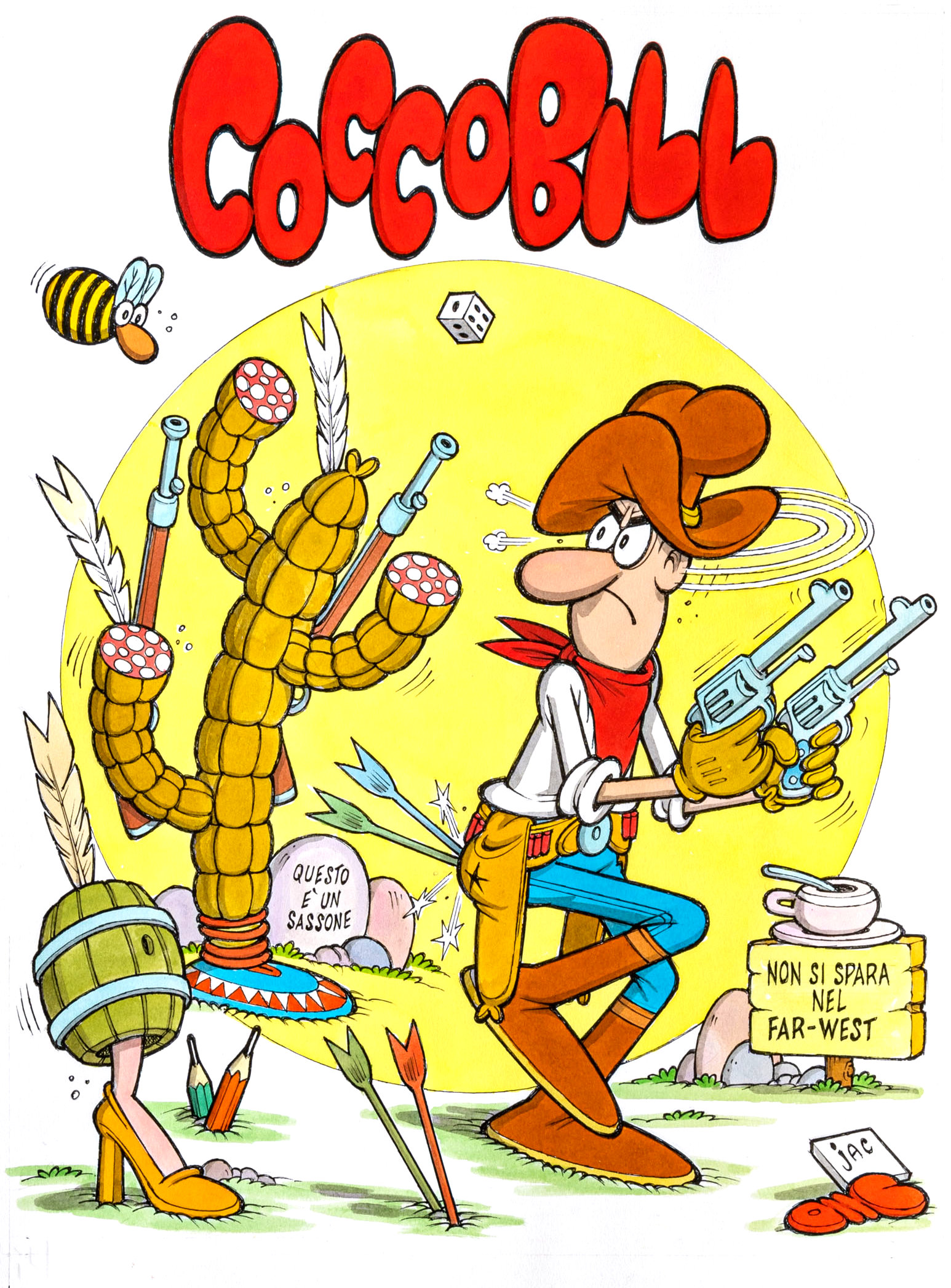
- Anything drawn by Benito Jacovitti. The man had a rather surreal sense of humor and absolutely refused to leave empty space in any comic he made, resulting in characters such as a talking horse who works as an accountant when not carrying his hero and panels filled to the brim with all kinds of salami, including walking ones and cactus-salami◊. Thanks to his enormous influence, Italian comics in general tend to be weird in general.
- Lupo Alberto is set in a World of Funny Animals... And not only the title character is a wolf dating a hen, he actually eats other chicken - and was rather miffed when his girlfriend accused him to cheat on her with his midnight snack.
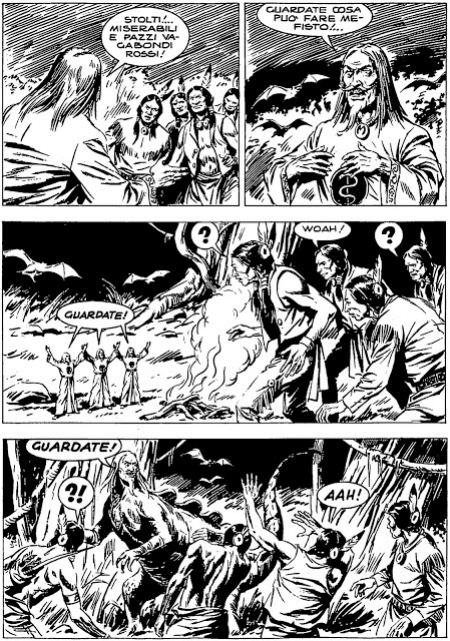
- Tex Willer is normally a serious comic, but storylines with Mefisto instantly takes a turn toward the insane due the sheer weirdness of the nightmares he can conjure◊. Then there was the storyline where Mefisto allied himself with a voodoo cult whose leader was a white man that believed himself the earthly incarnation of Baron Samedi and had a faux-medieval castle hidden in Florida's swamps...
- Kabouter Wesley from Belgium, has talking animals and talking objects like food and a house. The protagonist has an illegal chicory plantation and a neogotic chapel in his home. Oh, and that aforementioned house has spores, which form traintracksnote , on which comes a train that runs over the protagonist. Who also dies multiple times in the series, always being alive the next episode. Once even within the same episode, for no reason.
- The Knight Life, a Life Embellished webcomic with a tendency towards parody, is very much this. Such characters as a housewife who puts on an armless costume and fights crime as "The Masked Maggot," or a lowlife who works as a human rug and can identify shoes by how they press into his back, make sense if and only if one's familiar with the parts of American culture they're mocking.
- Footrot Flats is probably one of the most New Zealandy pieces of media ever made. Being set on a rural farm, there's a fair bit of exploration of the countryside and wildlife, as well as elements of both Maori culture and language, as well as white New Zealander common culture (such as their obsessions with football and cricket).
- Adventures of Captain Vrungel: A Soviet inconsistently animated mini-series about an old seadog protagonist who is probably lying about the show's entire plot, a handsome but not very bright young sailor, and a dishonoured tramp participating in a regatta around the globe while getting chased by two hilariously gratuitous Mafiosi and a seemingly unkillable James Bond Captain Ersatz looking for a priceless MacGuffin in a cello case. Squirrels, robo-dogs, exploding volcano island saunas, house domino and lots of champagne ensue. This is an adaptation of a much earlier children's novel of the same name. Most of the weirdness and hilariousness was preserved (and even added, in case of the James Bond character).
- Last Year's Snow Was Falling: A Claymation short about a narrator desperately trying to find a story to tell, before settling on a nameless small-town idiot and ADD-plagued Cloudcuckoolander who is ordered by his wife into the woods to find a christmas tree. He comes across Baba Yaga's house instead. What comes next challenges even the narrator's endurance.
- Gustavus: Continuity-free adult comedy about a hapless, balding bastard dealing with the absurdities of '60s-'70s urban Socialist life. Each episode starts with a pretty standard setup with a genuine satirical message that gets excessively weirder and veers strongly into ridiculous cartoon logic territory, often mixing it with Black Comedy. Characters and the world itself become pliable, metaphors become literal, and Gustav himself gets crazier as each story progresses — and some shorts barely have a story beyond a series of sight gags.
- Fantadroms, a Latvian cartoon about a shapeshifting cat robot that goes around his homeworld stopping various disputes between other characters. This trope actually prevented this show from getting an American release - Streamline Pictures had plans to release an American localization of the show, but they scrapped it partially due to them considering it too bizarre for American audiences.
- Scissor Seven is an action comedy about an amnesiac idiot named Seven becoming an assassin to make money, cure his amnesia, and maybe find out about his past along the way. Sadly, he's a horrible hitman, in a world where everyone and their dog have some sort of super power. Expect all sorts of unexpected things... that somehow manages to have an interesting plotline, character development, with surpisingly hard hitting moments, while still being incredibly silly.
- The Touhou M-1 Grand Prix features a Monster Mash of characters, including many from Japanese Mythology, from a shmup video-game doing stand-up comedy.
- A.A. Pessimal uses the canonical country of Agatea as the launch-pad for all those things Japanese which Western observers find to be culturally strange or impenetrable. There is a fashion in Ankh-Morpork, for instance, for imported Agatean illustrated novels of the sort popularly known as Man-Gi comics. The canonical character of Miss Pretty Butterfly (Koukouchou-sama), now Principal Tutor in Agatean Studies at the Assassins' Guild School, is used as a walking illustration of stereotyped "Japanese" culture and society. Depending on her mood, her hair can go through all the classic Japanese styles, such as Hime Cut, Ojou Ringlets, Odango Hair, and many others, from day to day.
- Aachi and Ssipak is a strange South Korean animated socio-political action comedy about a dark futuristic world that is powered by fecal matter. Needless to say, there is a lot of Toilet Humor.
- The Tales Of Waterville (as far as obscure and unknown films are concerned) is just so downright bizarre that it makes Wild Woody look sober; aside from looking like something that belongs in a Nintendo 64 Video Game due to its weird graphics and animations, the voice acting is all over the place with the heroes sounding bored at times whereas the villains sound downright bombastic, the narrator is of the Captain Obvious variety, and the aforementioned villains are laughably stupid and have no common sense whatsoever. It has to be seen to be believed!
- Waking Ned Devine: The eponymous Ned dies of a massive heart attack after winning the lottery. The local town bands together to cover up his death in order to claim his winnings. Hilarity ensues. Also, a very old man rides a motorcycle while very, very naked.
- The Butchers Boy: A young lad in rural 1960's Ireland loves nothing more than playing with his best friend. Then his mother commits suicide and he slowly starts going mad. As a result he's sent away to a borstal, where he has visions of a foul mouthed Virgin Mary, played by Sinead O'Connor, before being molested by a priest. Eventually he escapes, and returns home to his abusive alcoholic father, before finally losing it completely and going on a murder spree, having hallucinated the world being destroyed by nukes and being repopulated by humanoid flies. This is a comedy.
- The Guard: An over the top homage to 70's Dirty Harry-esque, mismatched partner Cop Movies ... set in small town Ireland. The eponymous Guard (Irish Cop) takes acid, molest corpses, hires prostitutes, insults his American counterparts, buys his dying mother cocaine and contracts an STD. By comparison, the drug dealers he's taking down discuss existentialism and morality, and there's an off kilter scene about gay IRA operatives.
- A Film with Me in It: a film about a guy who really wants to be in a film but has been generally unlucky in his life, who keeps ending up with people being killed in incredibly incriminating accidents around his flat while he and his best friend keep proposing film scenarios in order to figure out how to get out of their predicaments.
- Grabbers, a monster film about a group of giant squid-like bloodsucking aliens that attack a seaside town. High-alcohol blood is poison to them, so when they rampage one evening there's only one way to survive the night: get everyone to the pub and keep them sloshed all night long.
- Adam & Paul, a more-or-less plotless dark comedy about two heroin addicts (modeled on Didi and Gogo and Laurel and Hardy) who spend a day wandering around Dublin trying to scrape money together to buy a fix. There are Amusing Injuries, an encounter with a patriotic Bulgarian, lots of dialogue that goes absolutely nowhere, and a generally weird and tragicomic tone.
- The Young Offenders, a pair of Lower Class Louts go on a road trip on stolen bicycles in order to salvage cocaine bales from the sea in order to get rich and are pursued by a cop with an unhealthy obsession with arresting bike thieves and an Evil Cripple with a nail gun.
- Yellow Submarine, translating The Beatles' psychedelic phase with perfection.
- Zardoz, where the weirdness is enhanced by Sean Connery in an orange nappy. Unsurprisingly, John Boorman was heavily abusing cocaine throughout filming, and to this day admits even he isn't sure what half the film is about.
- Monty Python's The Meaning of Life. Even if you've seen their popular works, nothing will prepare you for this 2 hours worth of strangeness.
- The Cook, the Thief, His Wife and Her Lover, a crime drama/dark comedy/art film set almost entirely in a surreal, high-class French restaurant where the characters' costumes change colour depending on the room they're in. It mixes passionate sex scenes with horrifying spousal abuse, a truck full of rotten meat, and a man forced to roll around in dog poo, and has one of the most unappetizing, horrifying final movie meals in history. Some say it's supposed to be a commentary on British politics in the 1980s.
- Spice World, which could be The Spice Girls' own A Hard Day's Night, but aims more for Head with its parade of nonsensical sequences.
- Bon Cop, Bad Cop. The entire setup, most of the humor, and even the title are all hinged upon Canadian bilingualism.
- The Twentieth Century A surrealist, aggressively historically incorrect retelling of the story of Mackenzie King, Canada’s longest-serving prime minister. Though almost every substantial fact about King’s political career, and indeed, Canada itself is portrayed laughably wrong (prime ministers are not selected by winning a seal-clubbing contest, for example, and King did not have a crippling boot-sniffing fetish) there’s just enough truth snuck in, in terms of events, characters, and places, to make it function as a work of social commentary on the habits of the late Victorian-era Canadian ruling class (which, incidentally, wasn’t even King’s era). The director has described it as “a nightmare King might have had,” in the sense it’s full of things King would have been aware of, but warped beyond all recognition.
- Ginger Snaps - Werewolves as a literal metaphor for puberty. Shooting up drugs (well, wolfsbane) is the only way to temporarily slow the transformation. Its two sequels ramp up the weirdness even more.
- Anything by Guy Maddin, but especially his 2015 film The Forbidden Room, which was full of stories inside of stories inside of stories inside of stories, including (but not limited to) such topics as Filipino banana vampires, evil skeleton-leotard-wearing insurance defrauders, an educational film on how to take a bath, a man bidding against his own doppelganger on a cursed bust of the god Janus, and a musical number where Udo Kier had to have a lobotomy to stop him from thinking about butts.
- Takashi Miike films, particularly his most extreme films such as Gozu and Ichi the Killer, tend to represent the most bizarre, violent and fetishistic Japanese strain of films to people outside of the nation.
- Funky Forest First Encounter is a surrealist collection of vignettes, some of which interact with one another and none of which make much sense at face value. For a taste of the madness, head here.
- RoboGeisha. We dare you to watch the trailer without bursting out laughing or dropping your jaw in sheer WTF. Or both.
- Sukiyaki Western Django. A Spaghetti Western, in English, with an almost totally Asian cast.
- Tampopo is a western in '80s Japan about ramen, complete with John Wayne-alike, varmits, and dramatic string music, interspersed with other unrelated sketches about food.
- Tokyo Gore Police: A film which takes Gorn to new heights.
- The Calamari Wrestler, and Minoru Kawasaki's follow-up film, Executive Koala are respectively about a wrestler who becomes a giant squid and a giant Koala who may have murdered his wife.
- Survive Style 5 Plus. An entirely Japanese movie... starring Vinnie Jones.
- Wild Zero. Japanese punk rockers, bikers and a trans woman fight zombies, aliens and evil managers wearing short shorts. And it is GLORIOUS.
- Onechanbara, known in the US as Bikini Samurai Squad. Exactly What It Says on the Tin. They fight zombies.
- Hausu. There is a killer piano in this movie. It isn't the only killer inanimate object, either. And this is just the tip of the iceberg, people.
- Big Tits Zombie. The title says it all.
- Fish Story: The long and complicated tale of how, thanks to a series of coincidences, an obscure punk song from a failed 1970s punk band saves the world in 2012.
- Tetsuo: The Iron Man: A Deliberately Monochrome Body Horror movie about a salaryman cursed to slowly transform into a walking pile of scrap metal.
- Bubba Ho Tep: The description defies any rational reality and should be read in full on its page, but the short version is Elvis Presley (who swapped places with an impersonator) wakes from a coma after twenty years and teams up with John F. Kennedy (who had his death faked, was dyed to look like a black man and finally had the missing half of his brain replaced with a bag of sand) team up to take on a redneck mummy who's offing various residents of the retirement home they live in. Yeah.
- The Adventures of Buckaroo Banzai Across the 8th Dimension: A sci-fi comedy satire about a Parody Sue who saves the world from a Mad Scientist.
- Attack Of The Killer Refrigerator. Title is all you need to know.
- David Lynch. Twin Peaks was absurdly popular in Japan when it first aired. It still maintains a much larger and more fanatical following there than among fans from anywhere else, to the point that many Japanese fans were surprised to discover that it was created by an American, as it was considered to be "very Japanese" in style and tone.
- Donnie Darko, as well as director Richard Kelly's other movies are examples of a WAT in action.
- Faster, Pussycat! Kill! Kill!: Russ Meyers's best-remember film, a hallmark of sexy, violent, Americanexploitation films.
- The Giant Claw: A 50s B-Movie best known for the design of the titular monster.
- Glen or Glenda: An unintentionally surreal film by Ed Wood who hijacked a true story about a transvestite.
- Grim Prairie Tales: Two travellers in The Wild West played by Brad Dourif and James Earl Jones try to top one another with increasingly outrageous stories in this anthology movie.
- Rockula, a vampire movie done in a way no one else would even fathom. How does this young, nerdy vampire go out on the town in the daytime? Sunblock. Then he forms a circa-1980s rock band, with Bo Diddley — yes, it's really Bo Diddley — to court his reincarnated girlfriend from centuries ago and break a curse, but in doing so he runs afoul of his rival, a futuristic mortician(?) played by Thomas Dolby. We've only scratched the surface of the weird decisions this movie makes, not the least of which includes the vampire's mom played by Toni Basil who has a dancing sequence for no other reason than it's Toni Basil, and then Dolby dressing up as a pirate and attacking the lead with a hambone.
- The Rocky Horror Picture Show: The midnight movie to end all midnight movies.
- Repo Man: A sci-fi punk rock movie with a Random Events Plot.
- Repo! The Genetic Opera: A metal Rock Opera set After the End featuring musical contributions by Yoshiki.
- Total Recall (1990): Arnold Schwarzenegger stars in a Mind Screw-y parody of Arnold Schwarzenegger movies, based off a short story by Philip K. Dick and directed by Paul Verhoeven.
- Attack of the Killer Tomatoes!: a parody of cheesy monster films, a hallmark of American cinema.
- The Western is so deeply rooted in how other countries perceive America that we even have a trope about it. Ironically, many of the most beloved Westerns are Spaghetti Westerns, made by Italians for both the American and Italian markets.
- Pee-wee's Big Adventure: Being the first feature length film by Tim Burton as well as having Pee-Wee Herman go on a road trip in order to find his Cool Bike, it was almost guaranteed a spot on this page.
- Casa de mi Padre: A parody of Mexican telenovelas starring the very WASPy Will Ferrell as a Mexican who must defend the family home.
- Hot Rod: A film about an Evel Knievel wannabe wanting to raise $50,000 in order to get a heart transplant for his Jerkass stepfather, solely so he can mercilessly beat him, all set in a warped Affectionate Parody of 80s Spielbergian Suburbia.
- The duo DANIELS had already proven to be weird with Swiss Army Man, which revolves around a man using a versatile corpse to get out of a deserted island. But Everything Everywhere All at Once takes it on a whole new level being a multiversal madness where it's borderline impossible to guess what will happen in the next scene, with new events like Ratatouille with a talking raccoon, sentient rocks, hot dogs for fingers, a bagel that threatens the multiverse, awards shaped like butt plugs, etc.
- The films of writer Charlie Kaufman, who started with Being John Malkovich (the actor in the title reacted to receiving said script with Is This a Joke?) and didn't dial down anywhere down the line. That movie's director, Spike Jonze, indulged in this before with his music videos (putting Beastie Boys in a cop show and Weezer on Happy Days, making Christopher Walken dance madly - and eventually fly - to Fatboy Slim), and his movies took one step further - after Malkovich, there was Adaptation. (another Kaufman script), Where the Wild Things Are, and her.
- The films of Tyler Perry are an example within a country. Having started his career on the African-American urban theater circuit, he makes his films primarily for a religious black audience, with Critical Dissonance being in full effect whenever (mostly white) professional critics examine his films. His most famous character, Madea (played by Perry himself), is a tough-talking, Jerk with a Heart of Gold older woman with a propensity to use violence (especially against bratty children) in order to get her way.
- Rubber. A movie about a sentient murderous tire. And the people who watch the film.
- The films of Jean-Pierre Jeunet.
- Delicatessen is about a butcher in post-apocalyptic France murdering the janitors he employs in his apartment building and serving them in his shop, and when his daughter falls in love with one of the janitors, she enlists the help of a team of militant vegetarians to save him.
- The City of Lost Children is about a mad scientist who lives on an oil rig offshore from an unspecified Steampunk city abducting children so he can steal their dreams; and when he abducts the little brother of a circus strongman, the strongman and a little girl from an orphanage go on a quest to get him back. And it involves a brain in a tank.
- Amélie is about a woman attempting to make her neighbors' lives better by taking a garden gnome from one of them and taking pictures of it vacationing around the world, tricking an abusive greengrocer into thinking he's insane, and escorting a blind man to a train station giving him vivid descriptions of the surroundings.
- Micmacs is about a video store clerk falling in with a clan of weirdos who live in a junkyard after he gets shot in the head, and then him and the clan taking revenge on the two biggest weapons manufacturers in France (one of whom created the landmine that killed his father, the other one which made the bullet that he got shot with) via a procession of "Home Alone" Antics.
- Last Year at Marienbad is a French film that lacks a traditional plot, backstory, named characters, etc. It's a pretty good representation of some of the more difficult-to-access aspects of French cinma.
- All the 60's films of Jean-Luc Godard, which pretty much sum up the craziness that was the French New Wave, and French art film in general.
- Holy Motors, is about a man being driven around Paris in a limousine — every time it stops, he exits in costume as a different character, and the entire style of the movie seems to change along with him. The movie goes out of its way to basically frustrate any and every expectation or definition as to what it's about or how to describe it, as it jumps from bizarre monster movie to serious family drama to violent crime thriller to sudden, inexplicable musical number. It also begins with a different man finding a movie theater hidden behind his bedroom wall, has an insanely awesome accordion-based intermission, and concludes with an extremely melancholy but still WTF-worthy barrage of conceptual non-sequiturs.
- Daft Punk's Electroma. Who ever imagined a town populated by people wearing Daft Punk helmets?
- A Town Called Panic. A film based on a show animated entirely with toy figurines about a horse, cowboy, and indian toy being roommates. Horse is the main character.
- Director Julia Ducournau already showed she was unconventional with Raw. But Titane takes it to unbelievable levels. It's about a showgirl who spends her off time being a Serial Killer... and in the first twenty minutes she has sex with a car. And gets pregnant! It only gets weirder and more horrifying from there.
- Black Sheep (2007) is a black comedy about Killer Sheep.
- Meet the Feebles is practically The Muppets on a cocktail of acid and weed.
- The entire Ozsploitation genre, as chronicled in the documentary Not Quite Hollywood, after the R-18 rating was approved in 1971.
- Any film by Taika Waititi applies. Even his first major studio project, Thor: Ragnarok, where he appears as the rock alien Korg, modelled after what he calls a "cuzzie from the East Cape of New Zealand".
- Attack the Gas Station!, a South Korean comedy film that runs on Rule of Cool and Rule of Funny.
- Save the Green Planet!, a film by South Korean director Jang Joon-Hwan about a man who kidnaps and tortures to death people who he thinks are alien invaders. And he's the hero! It is, naturally, primarily a comedy
- Sweet Movie and W.R.: Mysteries of the Organism are Weird Serbian Stuff. Just the intros to our articles have serious problems summing up the movies.
- The "mo lei tau" genre of Hong Kong films, the most well-known purveyor being Stephen Chow. "Mo lei tau" roughly translates to "nonsense talk" and consists of madcap, slapstick and over-the-top humor.
- The strange Spanish movie Amanece, que no es poco (At least it's dawning). The title itself refers to the last scene, where the sun rises.... from the WEST. Cue Title Drop from the no-longer-caring main characters.
- Santa Claus lives in outer space with tone-deaf singing children from all over the world? His sleigh is pulled by laughing reindeerbots? He teams up with his pal Merlin to battle an effeminate poodle-poking demon in red tights? You can see all of this and more in the So Bad, It's Good Cult Classic Santa Claus (1959), a Weird Mexican Thing.
- All the movies starring the Mexican luchador El Santo also definitely qualify as a Mexican Example Of Weirdness (MEOW). Any and all movies featuring him (or any luchador, for that matter: El Blue Demon had a few films of his own) can be best described as "the sixties Batman tv series but sillier, and Mexican". They have a cult following in Japan, presumably because of this.
- Valerie and Her Week of Wonders is a surreal, allegorical 1970 Czech movie set perhaps in the 1800s about a 13-year-old girl's sexual awakening. Seemingly, every character who interacts with her is infatuated with her and/or a vampire. Or secretly her parents. Cut to cheery Gainax Ending.
- Taxidermia is a possibly-generational epic featuring three extremely different but equally gross segments that go, in full Genre-Busting mode, from weird historical sex comedy to puke-filled inspiration sports film parody, finally arriving at ultra-gory horror film territory.
- The Lure is about two mermaids winding up in 1980s Warsaw, Poland and joining a band that plays at a dance club. One falls in love with a musician, and the other one's a cannibal. It took Sundance Festival by storm... and the Polish critics are confused why. Completely Different Title must have helped, though.
- Judging by the trailers of movies like Obonsam Besu note , Twenty Sixteen, and The Godfathernote , the entire movie industry of Ghana seems to run on this trope. It's a SWAG (Surreal and Weird Arriving from Ghana). And special mention to Nkrato for this comment:
"I was expecting the silly karate, CGI monsters, and lots and lots of talking. Like any good Ghana Film. But nothing, absolutely nothing could prepare me for the cat mouth missile at 0:44"
- Valhalla Rising: a Danish/UK film about a mute one-eyed Norseman and a young boy, both slaves, who kill their pagan masters and join a bunch of Crusaders trying to get to Jerusalem. However, the crew gets lost and end up in America, where they all go crazy and get killed by mostly-unseen natives or each other. The film has very little dialogue, with long stretches of almost complete silence.
- A few Turkish films from the 1970's and 1980's were pretty (in)famous for their blatant plagiarism of characters and effects, practically no budget for the effects they didn't steal and some really bizarre plots. This resulted in such films as Three Big Men (where Captain America and El Santo fight Spider-Man, who has become a murderous thief), Rampage 1986 (A.K.A: Turkish Rambo) and The Man Who Saves the World (better known as Turkish Star Wars).
- Much like the games it's based on, Super Mario Bros. (1993) is noted for just how weird it is, from individual scenes like the dancing Goombas and Toad's devolution to the movie as a whole's conceit of a parallel dinosaur dimension.
- Shredder Orpheus takes the myth of Orpheus and Eurydice to a post-apocalyptic future where Hades and Persephone run a broadcasting corporation that literally suck out people's souls, Orpheus's lyre was supposedly made by Jimi Hendrix in an effort to elevate human consciousness, and the lead-in to the climax revolves around skating an Underworld parking garage.
- Akikan! is a series about about empty soda/juice cans doing battle to determine whether steel or aluminum cans are superior, for the standardization of cans into one format, strengthening the industry. Oh, and the cans take the forms of cute girls in strange outfits...
- Alice in Wonderland and its sequel, Through the Looking Glass can get very strange thanks to much of the plot operating on dream logic, and Alice herself often becomes frustrated with the strange characters she encounters. Many of the odder things in these Dream Lands are takeoffs of aspects of Victorian Britain.
- At Swim-Two-Birds, a bizarre comic novel by Flann O'Brien, in which the protagonist, also an author, wanders Dublin and doesn't do very much of anything, comes across some strange quasi-fictional phenomena and eventually has to deal with his characters breaking the fourth wall and rising up against him.
- While Bakemonogatari is probably still bizarre in Japan, the religion/mythology of Japan at least let the original audience understand things like the crab gods and lost cows. The series also makes many, many puns which make more sense in Japanese.
- Bludgeoning Angel Dokuro-chan is a parody of every Harem Genre trope and plenty more, and does it by taking them to ridiculous extremes, so it looks especially strange to those not familiar with the genre. Unusually though, whilst the tropes are Japanese, the humor is nearer to American Gag Series like South Park.
- The Complete World Knowledge trilogy, which consists of books with long titles, filled to the brim with "100% false" facts, though the appendices in the paperback versions acknowledge the fact that occasionally a truth manages to end up in one of them by accident. In addition, the page numbering does not restart in later books in the series, instead picking up where the previous one left off. The second book also serves as a page-a-day calendar, which among other things reveals an Escalating War of bizarre precipitation between Richmond, Virginia, and Milwaukee, Wisconsin, in the late 1970s.
- In Date A Live, there are girls who can cause massive damage to the world just by appearing. And killing them is just about impossible. The solution? Date them. And the Dating Sim-like choices that occasionally pop up as you do so are not decided by you, but by a group dedicated to this very purpose.
- The Devil is a Part-Timer!: A demon lord who escaped from a fantasy dimension to modern-day Japan is forced to work at MgRonald's, and enjoys it so much that he pulls a Heel–Face Turn.
- Dog & Scissors: A teenage bookworm is murdered and inexplicably reincarnated as a dachshund. His (former?) favorite novelist adopts his new doggy self and torments him with scissors.
- Gonna Be the Twin-Tail!!: Extra-dimensional invaders attack Earth not for its resources or to conquer it but... for its twintails? Rather, they're attacking Earth to drain the "zokusei" (something that has no direct definition in most languages other than Japanese) of its people. Said Zokusei manifests in typical Otaku fetishes like bloomers, model-making, and of course, twintails.
- The Hitchhiker's Guide to the Galaxy comes across as this to non-British audiences, especially during the scenes when they use the Infinite Improbability Drive. Douglas Adams himself alluded to how much cricket is a weird British game in Life, the Universe and Everything with the commentators of Test Match Special not at all fazed by Arthur Dent, Ford Prefect, and a sofa appearing from nowhere on the pitch at Lord's. And only the British would be so insensitive to use the hallowed 'Wikkit Gate' as part of a game.
- Humanity Has Declined: Humanity is nearing extinction... and being replaced by a race of small, stupid, perpetually-smiling fairies. This is all played for satire and Black Comedy.
- Max Havelaar is considered to be by lots of Dutch literature critics to be one of the weirdest works in Dutch literature to be ever written. The main reason why is because the book is one of the first to change of writer and writing style dependent on the one character who at the moment of writing is writing the story (which is nowadays common thanks to postmodernism, but the book was written in 1840, which was long before the very first postmodern writers were born).
- The Moomins is often difficult to describe to people who've never heard of it before. It's a slice-of-life series about a family of trolls who look like anthropomorphic hippos and occasionally go on adventures. The author of the books, Tove Jansson, was an anarchist and it often shows. What's really unusual is how much of a classic the series is considered in its native Finland, being nowadays an institution of national identity with The Merch of it being about as omnipresent as Winnie the Pooh. Again, it's about anarchist hippo trolls.
- Nyaruko: Crawling with Love!: Nyarlathotep the Crawling Chaos takes the form of a hyperactive Otaku teen girl and comes to Earth ostensibly because of her job as a Space Cop, partly because she wanted easy access to Anime and Toku goods, but primarily because she fell in Love at First Sight with Ordinary High-School Student and H. P. Lovecraft fan Mahiro Yasaka and wants to be his Manic Pixie Dream Girl wife (with lots of sex involved). He responds with Slapstick and forks. They're later joined by Nyarko's old classmates Cthuguha the Living Flame (who has an equally obsessive lesbian crush on Nyarko) and Hastur the Unspeakable One (who's an Adorably Precocious Child with a crush on Mahiro), all culminating in a parody harem-slash-Love Dodecahedron with LOTS of pop culture references. And that's just the base premise; we haven't even touched on the plot yet...
- The Peter Principle is a book of humorous stories and "laws" about how things go horribly wrong, with punny names and fantastically banal "case studies". (It was inspired by Parkinsons Law, a hilariously turgid work.)
- Redwall is about mice and other animals living in what is called an abbey but is more of a church crossed with an apartment complex, a gated community, a daycare, and an assisted living facility, and they constantly have to fight off vermin such as rats and foxes who plan to take over the "Abbey" For the Evulz. Then there are the stranger characters such as a owl who speaks in rhyme (Sir Harry the Muse), Somerset-accented moles, World War II fighter pilot hares (Basil Stag Hare, among others), and tribal squirrels obsessed with fighting (the Gawtrybe).
- Wicked! and Deadly! by Morris Gleitzman and Paul Jennings are two children's series revolving around the bizarre, including a killer superadvanced sheep army, and immortality-conferring tea. Anything by Paul Jennings generally counts.
- The Whitest Kids U' Know is, in many ways, a weird version of The Kids in the Hall, clearly taking its inspiration from that show but possessing its own bizarre sense of humor based around snark, Refuge in Audacity, and enough Lampshade Hanging to run an electrician supply house.
- Sabrina the Teenage Witch, much like the comic it’s based on, has a lot of bizarre moments. And it’s not just the spells. Its animated counterpart would follow suit.
- Pushing Daisies. It involves an explosive scratch-and-sniff card, Paul Reubens, an author of adult pop-up books (all in the same episode), a red-and-white striped morgue, and a very American '50s Retro Universe. Oh, and it's about a baker who can bring the dead back to life with a touch, and can't ever touch his thus-revived girlfriend or she'll die permanently. Should probably mention that.
- Tim and Eric Awesome Show, Great Job! runs on this and nothing else. Same with Spin-Off Check It Out! With Dr. Steve Brule.
- Chuck puts an ungodly amount of classified government information into the brain of a Best Buy-Expy retail slave and then sticks him with a Statuesque Stunner Femme Fatale and Adam Baldwin to keep him safe and his family unaware. Gets even funnier in the seasons that work Subway sandwiches or references to same into EVERY episode.
- Twin Peaks features an FBI agent with a sweet tooth as the main protagonist, a quirky soundtrack, an eccentric eyepatch-wearing woman with Super-Strength, and a dimension populated by strange beings who have the ability to control other peoples' bodies.
- David Lynch and Mark Frost followed up TP with On The Air, a short-lived sitcom about the production of a 1950s variety show that included among other things a possibly magical duck, a definitely magical talking dog, a studio technician with a medical condition that caused him to see 25.62 times more than anyone else (everything from childrens' toys to dancing Santas) along with the Hurry Up Twins who do nothing but rush around the studio saying "Hurry up! Hurry up!"
- The Monkees is filled with enough randomness and absurdity to qualify, especially during the second season, where they were either stoned out of their minds or didn't care any more and ad-libbed. ”Frodis,” anyone? The subsequent film Head cranked it up a few notches.
- Beakman's World. A zany-haired scientist in a neon green lab coat, his perky female assistant, a man in a rat suit, two penguins who watch the show from their home in the South Pole, famous dead guys, and a kooky and fun atmosphere to learn about science.
- Bibleman comes across as this to anyone who isn't American. Or at least an American Evangelical Christian.
- The Aquabats! Super Show! is often incredibly ridiculous, and indeed seems to revel in it. Laser guitars, cartoons randomly popping up, and odd plotlines often involving a rather strange Monster of the Week are only the start.
- The Spoils of Babylon and its Spin-Off The Spoils Before Dying. Affectionate Parodies of bloated, pretentious miniseries from the 70s and 80s that were based off Doorstopper novels, acted out by an All-Star Cast playing actors playing characters.
- Oobi is a show aimed at preschoolers where all the characters are played by live-action, talking hands with eyes on them.
- Duck Dynasty and Here Comes Honey Boo Boo, two of the main drivers of the "rednecksploitation" boom in American Reality TV in the early '10s. Specifically, they're Weird Images of the South (WITS), even for many Americans.
- Stranger Things makes it obvious right from the title. Rooted in nostalgia for The '80s, it is a homage to similar works of the past, particularly Stephen King's Americana-based horror novels and the family adventure films of Steven Spielberg and Amblin Entertainment, combined with dollops of H. P. Lovecraft, Dungeons & Dragons, and Silent Hill.
- Breaking Bad, from the moment it premiered, was joked about (especially by non-Americans) as a show whose plot, about a schoolteacher who turns to selling crystal meth in order to pay his medical bills, could only have taken place in the United States due to its expensive private healthcare system. This parody video jokes that, had the show been set in Canada, it would've been over the minute Walter White first arrived at his doctor's office.note Combine that with Mexican drug cartels, neo-Nazi gangsters, and a New Mexico setting presented in full New Old West mode, and you've got the makings of an epic crime drama.
- Unbreakable Kimmy Schmidt. The show starts with the titular character getting saved from a Apocalypse Cult but then goes into Mood Whiplash when the more... bizarre things appear, such as animated Imagine Spot sequences and a talking backpack. Mix it in with bizarre character names straight out of a Rik Mayall Britcom (Titus Andromedon, anyone?) and you get one of the most weird things Tina Fey has ever done.
- Public-access television was a gold mine for these sorts of shows in the '80s and '90s. They were non-commercial stations where anybody could create a TV show to be locally broadcast, and many of these shows were made to the... unique tastes of the kinds of people who would create a TV show with No Budget and no training just for the hell of it, ranging from mundane programs devoted to education and the arts to fringe political and religious activists to stuff that went out of its way to figure out just how far one could go on television. While much of its role has since been absorbed by the internet, there are still numerous public-access stations that produce shows like this. This article by Ross Wolinsky for Cracked goes into detail on some of the weirder things to come out of public access.
- The World According to Jeff Goldblum downplays this. In order to fully enjoy this Edutainment documentary series, the viewer has to not only find the very Serious Business behind ice cream, denim, tattoos, etc. (especially as experienced by Americans) as interesting and even inspiring rather than odd and/or pathetic, but be a fan of the CloudCuckoolander character actor/jazz musician who is exploring them in his cheerfully idiosyncratic way. The two trailers for the show are upfront about its eccentricity, especially the first one — Goldblum notes "Be forewarned, I am in the show a lot" and goes on to say "So if any of this tempts you, or wearies you, you can make a decision right here." But it ended up one of the most-hyped charter productions of Disney+, with National Geographic dubbing it into a double-digit number of foreign languages, and was only the third of the streaming service's many original productions to get the go-ahead for a second season.
- Barney & Friends is comes across as this to anybody who is not American (or from Southeast Asia), a young child, a member of its Periphery Demographic (!), or a member of its hatedom. It's about a group of children who gather in their schoolyard (and later a park) to play and end up causing a plush dinosaur doll named Barney to magically turn into a man in a dinosaur costume who teaches them and the audience moral lessons through song and dance, while also helping the kids "use their imagination" to engage in various activities. Barney is also assisted by three other dinosaurs in helping out the kids. And then there's the even stranger elements such as a storytelling black woman who uses a knockoff Anywhere Door as her method of transport, a rainbow bearded-pirate literally named "Rainbow Beard", and a puppet bookworm librarian.
- The Masked Singer involves celebrities performing in extravagant costumes that hide their identities, leaving a panel of judges to try and figure out who they are. The weirdness escalates once certain celebrities are unmasked, with possibly the most insane being Sarah Palin in season 3 and Kermit the Frog (!) in season 5. In fact, a Reddit comment on this clip from the season 5 sing-along special says it all:
MrKitchenSink: After watching this show for a while, you kind of forget how weird it is. But every so often, you get a moment like this one where a dude in a rooster costume leads Kermit the Frog, Logan Paul, Caitlyn Jenner, Danny Trejo, and Nick Cannon in a performance of "Never Gonna Give You Up", and you're just struck by the realization that this show really is a total fever dream.
- TLC, which once stood for The Learning Channel, has degraded into an entire WHAT channel thanks to Network Decay.
- My Mother the Car, which was about a man whose deceased mother possesses his car, and can speak to him through the radio.
- In-universe, 30 Rock shows a nonsensical musical soundbyte featuring Jenna smiling, winking, and laughing at the camera. She then says (out of the commercial) that she has no idea how it advertised Tokyo University.
- Combine a Game Show and Cooking Show format in Iron Chef. Iron Chef America is a more "normal" but more fast-paced version of the original.
- Some have said that the problem with Iron Chef USA (the first American adaptation, featuring William Shatner) was that the creators assumed the original was only popular for laughing at wacky foreigners, so they didn't take it seriously. ICA occasionally pokes fun at the Kayfabe of the show (according to Alton, there are several Kitchen Stadiums, at least one of which is in space), but otherwise takes it seriously as a competition between culinary masters.
- Dotch Cooking Show was an even more intense cooking game show that pitted two amazing-looking dishes against each other and a panel of seven choosing which dish to eat at the end of the episode. Each dish had its own crazy-awesome special ingredient. At the end, the people who voted for the winning dish got to eat it and the chef who made the losing dish had to (oh, darn the luck) eat it alone. Oh and the losers are forced to watch the winners eat as they get nothing at all. This show was amazing.
- SASUKE and Kinniku Banzuke, which air in the US and Australia as Ninja Warrior and Unbeatable Banzuke, respectively. G4 heavily plaued up their status as wacky Japanese shows. Not only did they throw "ninja" into the first show's name, but the on-camera host who appears before and after segments on Unbeatable Banzuke, who only speaks Japanese and needs to be subtitled? He was the host hired by G4 solely for the American version.
- Brain Wall, known to many American YouTubers as simply "Human Tetris". It lost much of its charm when adapted for Fox as Hole In The Wall.
- The six-episode variety show Vermilion Pleasure Night, which The Other Wiki compares to a Japanese version of SCTV. Recurring skits included a drama about a family of mannequins, a spaceship boarding house with a tortured alien, and a bunch of actresses being Barbie dolls. These are then interspersed with one off stories about cannibal cuisine, bondage nurses, and things that just take a sharp left turn halfway through a given sketch. This show hits you with weird repeatedly and never lets you up.
- One Japanese show called Susunu! Denpa Shonen note took an unsuspecting volunteer (who they told was going on an "important show-business related job", but that was it), then had him live in a small apartment, naked, with no supplies other than a pen and magazines. Then he had to live off of prizes won by magazine sweepstakes until he had the value of a specific amount of money. All this time, the guy was on TV and didn't know it, since he had been told it would be broadcasted after he was done. It seems almost pointless to mention that this is something that could only exist in Japan; in many countries the makers of the show would probably face criminal or civil penalties, and in the US (and maybe elsewhere, but especially the US), they'd be sued six ways from Sunday.
- Super Sentai. This is the reason an American adaptation, that would eventually become Power Rangers, got stuck in Development Hell. Executives thought it was too much of this trope to succeed on American TV.
- Within Sentai itself, there's Battle Fever J, which has bizarre costumes and a lot of dancing. However, it introduced the first robot in Sentai, and was thus the first Super Sentai. Toei eventually added Goranger and JAKQ into the ranks of Super Sentai, possibly to ensure that Battle Fever J wasn't the first one on the list.
- Ninja Sentai Kakuranger can only be described as what happens when you take Japanese beliefs and folktales (mainly of ninjas and Youkai; the latter of which are known for being very weird in their won right), adapt them as People in Rubber Suits fighting each other, add a Rakugo narrator to commentate on them, and then filter all that through the Camp sensibilities of the Batman (1966) TV show - complete with the Hit Flashes.
- Gekisou Sentai Carranger, which was essentially an extremely silly Self-Parody of Super Sentai. This resulted in some problems when adapting to Power Rangers Turbo as the seriousness of the American show did not go well with the Denser and Wackier Japanese footage. Seriously, there was an episode where the Monster of the Week bakes the heroes into a giant pizza! Go-Onger below was its Spiritual Successor.
- Bakuryuu Sentai Abaranger went to this territory more than once, especially in its early episodes, as can be seen in the Power Rangers: Dino Thunder episode "Lost and Found in Translation". Amazingly, it managed to do that while still being overall Darker and Edgier than its Power Rangers counterpart.
- Engine Sentai Go-onger is a LOT Lighter and Softer than the rest of the franchise and is considered a comedy. In direct contrast, Power Rangers RPM was a Pragmatic Adaptation which, as the top of the RPM page describes it, is to Power Rangers what The Dark Knight was to Batman, making this one real jarring to those who watched both versions.
- Zyuden Sentai Kyoryuger in the vein of the above, features Samba transformations and two villains who represent the emotions Joy and Happiness, with many of their antics qualifying as killing with kindness. Also the Red Ranger appears to be The Kid-Appeal Character.
- And then there's their unofficial series, Hikonin Sentai Akibaranger, where the characters fight monsters in their heads using the power of delusions. There's a reason why their name means "Unofficial Task Force Akibaranger". They're struggling to become an official team of Super Sentai.
- Season 2: The Akibarangers take on a cosplaying sentai villain fanboy, meet alternate versions of rangers, including Ryuuranger whose been reduced to a Chinese food mascot named China Red. They also get a second robot that is the size of a remote controlled car, not that it's any less effective than their full-size car.
- Ultraman Taro, a Self-Parody of the Ultra Series that draws inspiration from Japanese fairy tales. It's got incredibly silly kaiju like the opera-singing Orphy, the volleyball-playing Garaking, and Mochiron, a tiki monster from the Moon that loves to eat mochi rice cakes. It's got wacky plotlines that involve such things as an alien boy band having to play pop music to calm down a drunken kaiju, an android replica of a woman killed in a car accident bringing back the ghost of her pet parrot as a giant monster to kill all motorists in Japan, and an Oni-like alien shrinking the characters and putting them inside a bean to be eaten by one of their friends. And that's just the tip of the insanity iceberg.
- Ultraman Ace too, especially in its later cours. Episodes treated with utmost seriousness have dealt with things like an alien stealing pandas to make them a Cash-Cow Franchise on his homeworld, a kid whose bedwetting problems bring a monster recurring in his dreams to life, a man being turned into a cow by the Big Bad using a cursed nasal ring, a man-eating hot-air balloon literally draining the fun out of children, and a Kappa kaiju who disguises itself as a swimming pool and turns kids into kappas by eating their navels with the help of an android couple. The series is also infamous among fans for featuring some of the wackiest kaiju ever, including a violin kaiju.
- The Fuccons (Oh! Mikey in Japan) is a parody show featuring a Standard '50s Father, House Wife, and their son... With all the characters being played by mannequins whose faces never change. And raucous laughter. Yeah.
- LazyTown. The least bizarre thing is the pink hair on the central character. When the Canadian kids network YTV had the rights to the show, they put out a promo deriding the show for its weirdness, and theorized that the show must be made in Iceland by a giant gorilla - followed by a clip where the villain, dressed as a gorilla, climbs a giant antenna.
"Oh, it is made in Iceland? By a giant gorilla? Oh, well that explains it."
- Norwegian TV-series Brødrene Dal and KLM. Made by the comedy trio, Trond Kirkvaag, Knut Lystad, and Lars Mjøen.
- KLM being for more for adults (though still being rated 'for all ages'). Heavily inspired by Monty Python causing the actors to be dressed in drags, jokes about christianity and especiallly about priests, dirty jokes, news parodies and the gods know what more.
- Brødrene Dal is more aimed at children. Here the really different men play brothers, or maybe Same-Sex Triplets, or just In Name Only. Named after 3 famous Norwegian valleys, although they might have a 4th brother in the narrator simply called Fortelleren, and in the 4th season maybe even a 5th which not even the brothers remember. The actors for the brothers themselves also act as many different characters.
- The 1st season, og Profesor Drøvels Hemmelighet (and Prosfessor Drøvel(Uvula's) Secret) is for them to search for a friend who has something important to tell them. It has a ton of references to different Norwegian culture, pop-culture and some European fiction.
- The 2nd season, og spektralsteinene (and the spectral stones) can be best described as a Norwegian Doctor Who, having Time Travel between many famous fictional works like Ali Baba and the Forty Thieves, Robin Hood, Robinson Crusoe, and more, but also real-life happenings like World War II with them meeting their father and helping him in La Résistance, aka. Milorg, and in the end being named after themsleves. Ends with them traveling through space meeting aliens, driving the Doctor Who refference home.
- The 3rd and meant to be the Finale Season, og Legenden om Atlant-is (and the Legend of Atlant-ice), The Narrator finally appears on camera, being more unreliable than ever. The brothers are forced to find a sacred sami vase. In this season is it a World of Pun, and references to popular TV-shows at the time with stuff like A-Team Firing, and a tent that's Bigger on the Inside, etc. Near the end the Narrator takes a vacation to Mallorca and refuses to narrate anymore. In the end the brothers submit their adventures to have books written about them. On the way out they meet the Narrator who has written himself as the hero as the story.
- The 4th season and the Finale Season, og mysteriet om Karl XIIs gamasjer (and the mystery of Charles XII's gaiters), was made on request from the King of Norway himself, as a tribute to it being 100 years since the Dissolution of the union between Norway and Sweden. It's about Time Travel yet again. This time they have to find Charles XII's gaiters or else Sweden will force Norway into union with them again at the day of the 100 years anniversary. This season makes a Series Continuity Error, with the brothers living together again, and Brummund having a Secret Wife who lives in his room, who regulary comes down and steals the other brothers' breakfast, she also is a giant Parental Bonus by smoking a lot, her often being Ready for Lovemaking, and even being implied to be a whore. And why does even Brummund keep her as a secret, and often locked up in his room? It was even made in 2005! To make this season even weirder does their 2 nephews and niece come. The brothers doesn't remember the brother who's aparently is the father at all (might be the Narrator's or even Brummund's kids, or not). The three of them do not serve any real purpose to the story, and who their parents are is never told either.
- The 5th installment, a movie, og Vikingsverdets forbannelse (And the Viking Sword's Curse) is the real final adventure of the brothers. Made after Trond Kirkvaag lost his life to cancer, but with Brummund somewhat being in the movie due to putting him in from a taped version of the Stage Play. The brothers buy a time-machine on TV-shop, and are thrown 1000 years back in time. Now they are in the Viking Age. It became too weird even for Brødrene Dal itself and wasn't well recieved.
- KLM being for more for adults (though still being rated 'for all ages'). Heavily inspired by Monty Python causing the actors to be dressed in drags, jokes about christianity and especiallly about priests
- Téléchat, a French-Belgian puppet show from the '80s. The series is a parody of TV news presented by a black cat with an arm cast (which he uses as an all-purpose box) called Groucha and his female counterpart, an ostrich called Lola. The news (which Groucha does with the help of a sentient microphone) relates the life of "gluons", supposedly the smallest things in existence. Sometimes Lola will also have a talk round, with a fork and a spoon ([with human faces!). There are also nonsense commercials with a green orangutan in the jungle, who always manages to screw up the take, to the chagrin of the spot's director; and Léguman, a parody of Japanese Sentai shows. Because of its quirkiness and freakish ambiance, this show scared a whole generation of French kids, who will tell you that it still gives them some feeling of dread if they try rewatching the show. An outsider wouldn't necessarily be traumatized, but would get that this thing was weird in a distinctly French (well, Belgian and French) way.
- La Vie des Botes was a French sitcom about a robot family and talking objects (just like Pee-wee's Playhouse), which aired regular cartoons between the live-action segments. The channel, TF1, put many hopes on this project (because it was a co-production with Canada, some designers from E.T. the Extra-Terrestrial and Alien worked on it) but it wasn't successful and it stayed for just one year; today, very few people remember this show.
- Lazy Company, a French TV (mostly) comedy about four hapless GIs during the Battle of Normandy, featuring a Captain America ersatz, Hitler disguised as a nun, mad scientists, a friendly Japanese pilot, and general wackiness all over the place.
- Le Bébête Show looks like The Muppet Show, but all the Muppets are replaced by caricatures of French political figures. For example, François Mitterrand is portrayed as a frog named Kermitterrand (and naming himself God)
- In the same vein as Téléchat, we have Téléfrançais!, a show produced by TVOntario for the purpose of teaching French to English-speaking children that features, among many other oddities: a talking pineapple puppet that lives in a junkyard and looks like a rejected Furby, a fourth-wall breaking annonceur, and Les Squelettes, a musical group consisting of singing, dancing, instrument playing skeletons who will occasionally perform a number on the outside of a moving plane. It was also made in The '80s.
- Nanalan': A green little girl with a speech impediment visits her nana and plays in the backyard. For some reason, us Canadians thought that both this and Téléfrançais! were educational. Have fun trying to find out what her dog's name is. Here's one short.
- With sketches like Farm Film Report, the story of Vikings and beekeepers, and of course, Bob & Doug Mc Kenzie, SCTV could be considered as such.
- The 90's version of The Mr. Men Show, which was produced in Canada, had many weird and random segments during the show that were very out of place, including random quizzes, people dancing against stock backgrounds depicting places like the mountains and a church, a Japanese man who knows karate visiting a science lab and a man being fed corn like a baby.
- The Noddy Shop may look like your average kids' show, but some parts of it seem very strange. There's Aunt Agatha, a woman who has a high-pitched voice, obsesses over the ocean and rats, thinks she's a mermaid and can produce the sounds of a big ocean liner; a woman who runs an ice cream shop while dressed up in an ice cream cone costume; small creatures called goblins that act like a reverse family with the parents being childlike and the kid being the parent figure; a talking lobster who can play a piano and has a family; talking babies who claim to be toilet trained; singing lips without faces that live in a box; and an alligator who has big breasts, which is something not normally seen on a show made for preschoolers.
- The Red Green Show: A group of middle-aged rural Canadian men engage in various shenanigans in their lakeside lodge (including one stance where one of the members made hot sauce with a secret ingredient that was jet fuel) whilst the titular character creates DIY projects usually out of random junk held together with duct tape. For some reason, American PBS viewers found this to be hilarious.
- Today's Special centers around a mannequin with improbable dancing skills who lives in a department store and has a magic hat that brings him to life every night. Other characters include a Magical Computer who behaves like a human being, a mischievous oversized mouse who always talks in rhyme, and "the Mime Lady" who appears in random segments for no reason. And that's just the regular cast.
- Banzai was a British parody of Japanese game shows, deliberately designed to be strange and incomprehensible. The show's greatest stunt? Pitting several ventriloquists against each other in the Puppet Petrol Pump challenge - the vents themselves had to put petrol in a car blindfolded, and the puppets had to shout to tell them when to stop. Closest to £20 worth won.
- Anything by Monty Python, to the point where much British comedy is considered "Pythonesque" by non-Brits whether or not it's actually similar to Python's material.
- Black Books. Dave "Mouse Ears" Smith, pesticide by coffee machine, and "Then it's left... at the dead badger."
- Garth Marenghis Darkplace pretends to be the rediscovery of a cult 1980s horror series, somewhat in the style of actual British shows of the period but deliberately bad, with a made-up history on top of it.
- Eurotrash was a spoof travelogue show presenting the best, the worst and the weirdest of contemporary European culture to the British. A typical show might cover art and culture, naked fat unappealing Germans, weirdness in European porn, people who worked naked, and end on a Europop classic often performed live.
- Exploitica was a late-night Channel 4 equivalent of Mystery Science Theater 3000, except without actors, just text commentary in the letterbox space or superimposed on characters as thought bubbles. Subjects dryly mocked included B-movies, exploitation films, outdated educational reels, and a Gene Autry serial, for some reason.
- Jam was another late-night Channel 4 program designed to make you think the next morning that you probably hallucinated it. Deeply surreal Black Comedy specially aired with no intro, end credits, or ad break.
- The Mighty Boosh can be described as an endless series of nonsequiturs, or the aesthetics of a children's show (low budget, bad costumes, puppets, musical numbers) mixed with vulgar humor and stoner plots. Based on a radio program and something non-British people often cannot believe really exists.
- The American episode of Screenwipe had Charlie Brooker showing an American focus group a handful of British shows that he felt would be seen as weird to non-Brits, including EastEnders, The Bill, Countdown, Bullseye, and Springwatch. The Americans hated them... except for EastEnders, apparently.
- Noel's House Party. Specifically, Mr. Blobby. Originally created as a fake children's show character used for a Candid Camera Prank-type section of the show, that monstrosity spiraled out of control and became a franchise that fits this trope in its own right.
- There is a particular genre of British scifi/fantasy/horror which makes up for having no effects budget by filming at nice homes and focusing very intently on very ordinary objects with some spooky music, until eventually the very fact that you see nothing clearly menacing becomes unsettling. Some examples include Sapphire and Steel (the wall is haunted), The Owl Service (the plates are haunted), The Stone Tape (the stairs are haunted), etc. It's very British.
- The Young Ones: four college students who can't stand each other share a house with a series of random talking objects. In addition to frequent cutaway gags and other non-sequiturs, Once an Episode a band (or lion tamer) will perform, usually in their house.
- Bananas in Pyjamas, a kids' show about giant anthropomorphic bananas. That wear pajamas. And get cheated nearly every episode by the giant anthropomorphic rat that runs the corner shop. And there's the issue of their inherent desire to chase and hug giant living teddy bears.
- Round the Twist. Plots include a skeleton's curse that forces the cursed to end every sentence with "without my pants" (from the episode of that title), gum leaves that can transfer injuries to anyone who can hear a song played on them ("The Gum Leaf War"), a ghost haunting an outhouse ("Skeleton On The Dunny"), and superpower-conferring underpants ("Wunder Pants")...in the first season. It gets weirder: Overarching plots including music played by ghosts who are trying to save their lighthouse, two ghosts wanting to save their loved ones from accidentally crashing on a boat thanks to human error 100 years ago, and doing so by possessing all of the regulars, including a young girl possessing a teenage boy, a viking love book and a mysterious visitor from a lost land. On top of that, two seasons have extra story arcs, both involving hints that a child is deliberately cultivating weaponizable stenches. Based on the works of Paul Jennings, who's in Literature above.
- From the creators of Italian Spiderman comes Danger 5. Danger 5 are an international team of spies charged with fighting against the Nazis and, ultimately, assassinating Hitler. This is a difficult task, as the Nazis are armed with dinosaurs, diamond women soldiers, and various other useful weapons. It's also set in an alternate 1960s, despite being about World War II.
- Father Ted, while produced and funded by the British Channel 4, was written and created by two Irishmen, Graham Linehan and Arthur Mathews, and all of the actors, characters, locations, and crew were Irish. Collectively had the entirety of England, Wales, and Scotland asking "what does feck mean exactly?"
- Moone Boy, a surrealistic series featuring a Martin Moone, a somewhat dimwitted schoolboy, and his imaginary friend (who can talk to other people's imaginary friends) growing up in Boyle, Ireland from 1989 to the early 1990s which would occasionally shift into an animation style that resembled Martin's drawings.
- Bernd the Bread: depressive, pessimistic, box-shapped Bread from a kids' show whose hobbies include staring at his ingrain wallpaper and collecting TV test cards... Just look at his profile!
- El Chavo del ocho has shades of this. It's a comedic Mexican series with a fairly normal plot but has a serious case of Dawson Casting. The very obviously adult comedians playing children can come off as unusual.
- El Chavo is specially seen as weird to the rest of Latin America. While the show's popularity in its home country has waned in recent years, it's still widely beloved across countries like Venezuela, Colombia, and specially Brazil, of all places. Part of the appeal comes from just how zany and exotic the Mexican slang and mannerisms are to other Latin Americans (it helps that the stereotypes are very exaggerated), while still managing to be fairly relatable. Hell, El Chavo is just one of the pieces of media that makes English speakers think that the Spanish-speaking world (and Brazil & Portugal) is a paradise for crazyness.
- King of Mask Singer, a Korean Talent Show where every contestant is a celebrity hidden behind an elaborate costume, tends towards this. Vulture described its American adaptation, The Masked Singer, thusly:
"What if Gritty walked out on a soundstage made to look like an arena concert, belted out Sam Smith's 'Stay With Me,' was described as ‘a professional’ by Jenny McCarthy, took off his head to reveal he was Joey Fatone, and the entire experience felt three clicks away from an episode of Black Mirror?”
- Xou da Xuxa was hosted by model-turned-singer & TV presenter Xuxa Meneghel, wherein she dressed in scantily-clad outfits while presenting games, cartoons and various special guests' acts as well as performing musical numbers, while assisted by a mosquito named Dengue and a turtle named Praga. Surprisingly, it became a huge hit and led to two Spanish-speaking versions being produced with Xuxa at the helm (El Show de Xuxa produced in Argentina for Latin America, and Xuxa Park for Spain) as well as an American version (Xuxa). It got weirder with the Brazilian version of the Spanish Xuxa Park series (mainly known in the English-speaking world for the series-ending fire on the set), which began every episode with Xuxa emerging from a spaceship, and ended each episode with her leaving in the same spaceship.
- Hachaverim Shel Barney was adapted from Barney & Friends, itself a WHAT, that has even more shades of this, especially to viewers who aren't Israeli or Hebrew speakers. It's the same as Barney & Friends, but takes place in Israel (something that is very prevelant in this version) instead of America. And there's it's very own weird elements including a Nightmare Fuel-inducing Israeli rendition of Rainbow Beard the Pirate.
- Donkey Hodie follows the adventures of a donkey who lives in a windmill and has a magenta mane and her best friend, a purple-colored panda from outer space. Other strange elements in the show include a dragon who wants to be an actor, an alligator whose game shows pop up out of nowhere most of the time, a talking cloud, a skunk who is a doctor, a superhero radish whose sidekick is a superhero porcupine, weird fauna such as a flower that can grow humongous and rocks that resemble and smell like cheese, the main character owning strange stuffed animals (the least weird of these being a stuffed elephant), the existence of a Fan Convention dedicated to cheese, the characters finding a nest that holds a talking songbook inside it and the town in the show being populated by a huge amount of penguins.
- Farscape is an eclectic mixture of Australia, Bio Punk, muppets and S&M. And that's not even getting into their infamous "mindfrell" episodes....
- Pataclaun, a comedy Sitcom Centered around a Dysfunctional Family, the series star Machín and Wendy, a parody of a stereotypical Peruvian couple; alongside their observant baby, Monchi. After the pair got married, they moved to a new house; without realizing that the place is haunted by three ghosts: Queca, Tony, and Gonzalete, each of them representing a different facet of Peruvian society. This would be quirky enough on its own but they are also all deeply flawed brightly dressed clowns living in a very colorful house. It was considered a very unique series for its rampant use of irreverent humor, local slang, on-point satire of current events. Pataclaun's humor is deeply rooted in Peruvian culture, making references and jokes that resonate strongly with the local audience that adds to create a sense of surrealism for viewers from different cultural backgrounds.
- Llan-ar-goll-en is a wabbitnote (sort of) about a man solving mysteries in a live-action world with an animated doggy sidekick in the small, titular village. You'd think it sounds awfully a lot like Blue's Clues (and you're right), but what's especially weird about it is what it contains. From flying bikes to talking handbags and singing letter stamps, and with the main cast comprising of a pirate and wizard, this show is nothing short of a Welsh Mind Screw.
- Though it has a very large following in the US, early editions of Warhammer 40,000 were very much a Weird British Thing. Orks were based on Football Hooligans, there were visible references to British '80s Punk, jabs at certain politicians were made, etc. Although as time went on it became more universal and less overtly British.
- Paranoia is an example of American absurdity at its finest.
- Maid RPG. Original flavour Japanese weirdness in RPG form.
- HoL: Human Occupied Landfill. Hand-written in several late-night sessions in an IHOP, and originally offered no character creation since "everyone just makes the same types of characters over and over again". When character creation was included in the expansion, stat rolling included several strange and useless abilities, such as an "Almond Joy" stat. ("Roll 1-3: Sometimes you feel like a nut. Roll 4-6: Sometimes you don't.")
- A lot of card-carrying mad genius Jenna Moran's (best known for Nobilis and Chuubo's Marvelous Wish-Granting Engine) non-commercial pet projects are just straightforwardly weird. One that's currently on hiatus is about mischievous little fairies and has a task resolution system based off circuit diagrams and predicate logic.
- Experimental / indie / made for contest [RPGs] in general. From "Appliance Adventure" (a game about intelligent, talking household appliances) to "Get Out of Infernopolis" (storytelling gameified UNO where there is only one player / soul and everybody else is a GM / petty demon who makes the one player's life miserable).
- The Touhou fan video, Border of extacy by IOSYS is this trope with illogical pixellated imagery. Let's just extend that to "Half of all touhou-related songs and music videos" rather than list examples for half a page. Though some make more or less sense than others.
- Health with Little Red Riding Hood. Oh God, Health with Little Red Riding Hood.
- Cooking with Dog, a YouTube program featuring a woman demonstrating how to cook simple Japanese dishes "hosted" by a dog with a thick Japanese accent. Equal parts weird, cute, Japanese, and useful.
- Fight! Kikkoman is a Product as Superhero Parody Commercial featuring a fundoshi-wearing, comically-buff man with a packet of soy sauce for a head who fights off "foreign sauces" in a Kamen Rider parody. And it's based on an in-joke from the Japanese web forum 2channel.
- Llamas with Hats is, to put it simply, a series of videos describing the adventures of a psychopathic llama who visits and devastates a South American city, sinks a cruise ship, and nukes an entire city. All the while, his squeakily-voiced friend with a flowery hat voices his concern and condemns the madman's orphan-dooming actions by crying CAAAAAAARL! Repeatedly.
- The Italian Spiderman series on YouTube is filmed in English, dubbed into Italian and then subtitled back into English. As well as being a parody, its plot is fairly nonsensical, and it features various wonders such as surf-offs derailed by attacking penguins, and detachable exploding boomerang moustaches.
- The Big Lez Show is an MS Paint animated series about Lezlie Mackerel, an extra-terrestrial living in Australia along with his Sasquatch friends, weird loud yellow creatures known as Choomahs, and... whatever the hell Clarence is. Virtually everyone speaks in thick, curse laden Australian Slang, are huge stoners, and various other weird stuff happens.
- Homestar Runner. All crazy retro pop culture references, all the time. And are those guys supposed to be people or what?
- Sweet Cuppin' Cakes is an in-universe example, depicted as Strong Bad's attempt to deliberately create a "kuh-razy cartoon".
- The asdfmovie series is a rather odd series of sketches not tied together at all that involves potatos with guns, throwing cheese at aliens and "doing an internet".
- In a similar vein, you have Action Bunnies.
- The Annoying Orange, which has now crossed over to Cartoon Network.
- Although the plots in Neopets tend to be a bit more serious, the site itself has a LOT of weirdness. And that's why people love it.
- The Weird History of Finnish Youtube Art is a compilation of 10 years of internet weirdness from that part of the planet, between the years 2005 and 2015. WARNING: contains YouTube Poop (SinäTuuba Paska).
- Dutch Youtuber Massagraf. He usually makes YouTube Poops of Belgian kids' shows, which can (at times) be rather weird. An even weirder thing, however, is his Samsonimatie series, in which he takes characters from Samson En Gert and makes them do ridiculous things, such as drinking each other's heads through a straw. And if that's not weird enough for you, there's also vogeltje.
- Don't Hug Me I'm Scared is a creepy but deceptively cute series of videos starring puppets who encounter Faux Affably Evil talking food, animals, and objects. There's also a lot of gorn.
- The Filthy Frank Show (made by George "Joji" Miller, the self-proclaimed "Ed Wood of YouTube") relies heavily on Surreal Humor and tends toward the extremely random, offensive, and often downright gross.
- The SCP Foundation's New Weird trappings regularly lead it into this territory. Among the less surreal things the titular organisation deals with are a species of giant human hands that can be milked like cows to an alien disguised as a toaster that forces people to refer to me in first person.
- Some Japanese YouTube channels that review toys for kids are this, because the reviewer will often put the toys into weird situations. If the channel is hosted by children, sometimes it shows the kid hosts doing weird things. For example, this video features a young girl named Mari watching an episode of HuGtto! Pretty Cure enacted by plush dolls involving a unicorn Oshimaida that defeats not only the main team, but the Futari wa Pretty Cure girls. Cure Yell breaks the fourth wall and tells Mari (who Yell somehow knows the name of) that the show cannot continue until the girl buys the new merchandise from the show. After a brief scene where the girl goes shopping to find the merchandise, she is sucked into the show and defeats the unicorn. It's then revealed to be All Just a Dream, and her dad surprises her with the merchandise she got in the dream.
- Another video by the same channel as the video above involves a girl being sucked into a void while shopping for Star★Twinkle Pretty Cure merchandise at a store and seeing ghosts. It is only after she defeats them while becoming a Pretty Cure that she is able to return back.
- Another video by the same channel as the video above
- The YouTube channel Berd consists of short (ranging from one second to just over 1 minute) Stylistic Suck animations, starring kiwi-esque bird characters and a large dose of Surreal Humor. If you're wondering about the 1-second videos, they're mostly from the "skunk second" series, where each episode is just a picture of a skunk with a second-long voiceover of someone saying "skunk."
- SiIvaGunner is a gag music channel dedicated to imitating video game music channels as closely as possible. Most of their purported "High Quality Rips" are joke posts, except when they aren't (which itself is part of the joke). Their Running Gags are consistent enough to become sentient characters, some of which include: a recolored Mario that sometimes wears Fred Flintstone's clothes, a porn star with No Indoor Voice, Nozomi Tojo from Love Live!, and a poorly drawn Wood Man.
- Joseph's Machines is a channel focused on Rube Goldberg Devices, known for its complete lack of Do Not Try This at Home disclaimers, instead choosing to show the failures of the machines directly to the audience.
- Mushroom Land is a Polish web video series that seems to be some cross between an educational children's television and a heavy trip on hallucinogens. Or a product of a damaged child's mind. Or who knows.
- Battle for Dream Island: Let's see... the main cast is a group of anthropomorphic objects who not only battle for a luxurious island, but also suffer various cruel and unusual deaths, there are various Dark Crystal-esque made-up words (Goiky, Yoyleberry, Yoyleland, Non-Slip Shoes So Ha, etc.), the hosts are speaker boxes and Eldritch Abomination numbers, and the contestants who get eliminated don't get sent home, but rather to either a giant metal box, an eternal algebra class, or a big rotating building... yeah.
- The Zig-Zag song from the educational website Starfall feels like it was made on an acid trip, despite being meant for kids. The one-legged zigzag people are pretty weird and creepy-looking, there's an unnatural-looking environment around them, with its giant sun that looks like the planet this is taking place on is getting too close, twisted architecture, a lavender sky, and some weird cactus-like plants, along with a humanoid-faced cat and some chickens dancing the can-can. Not to mention the music sounds sad, angry, and insanely happy all at once. The fact they decided to use this as the final video in their alphabet series is rather surprising, and you better hope your kids will be able to sleep after watching something as terrifying as this.
- Axe Cop. What actually happens in the comic is weird enough, but when you factor in that the writer is a six-year-old boy, it truly achieves this status.
- Electric Wonderland can come off as pretty crazy, due to it taking place in a Cyberspace world unbound by the laws of physics.
- Princess Pi tends to rely on nonsensical logic.
- Let's Speak English thought it necessary in the strip for 24/02/2016 to explain the vital importance - as well as the social convention - of wearing a face mask in Japan if you suspect you are ill, so as not to spread anything contagious in a densely populated country. Up until early 2020 this was indeed a Weird East Asian Thing that had to be patiently explained to Westerners, and was taken as proof that the Japanese are impossibly weird and alien.
- Listening To 11975 M Hz is made by a Texan who is also a marine. You really, really would not guess that by reading it if you're going by stereotypes.
- Homestuck is fairly internally coherent, but the extremely unusual storytelling, as well as the sheer absurdity of the plot, definitely qualifies it as this. Furthing it is how American pop culture such as Con Air and Insane Clown Posse directly ties in to the plot.
- Awful Hospital is brain-meltingly surreal, to say the least, besides all the unorthodox characters and bizarre workings of the fictional universe it takes place in.
- Lookism, where to begin. Most of his life Park Hyung Suk has been bullied for being fat and unattractive. After his mother shows up at school and sees that he's bullied, she takes all the money she got and lets him transfer schools. It's a school with 7 departments, and he's enrolled to the fashion department. But On his way, the hairdresser cuts his hair to look like Kim Jong Un, and after being beat up on the street, he locks himself into his new apartment. After crying himself to sleep, ha awakens again due to a Potty Emergency. When done and washing his hands, he sees a Bishōnen in the mirror. It's him, with a Heroic Build! But in the bedroom, his old body is sleeping. It's not a "Freaky Friday" Flip and can best be described as Literal Split Personality as he changes between bodies each time he sleeps. Instead of taking the normal path of revenge, he decides to befriend as many as he can. So it's a fighting, gag, Psychological Horror, Romantic Comedy, and possibly more series with male fanservice(the same way some Anime & Manga has female fanservice for no reason what so ever all of sudden), while aimed at the same age and gender group as seinen manga.
- Mountain Time is about as WHAT as it gets, what with its constantly-derailing story lines, characters that range from astronauts to neurotic hamsters to Jewish garden hoses, and settings that are often nonsensical (such as clouds that turn into hams).
- Where do we even start with Sonichu and its magnitude of WHAT-ery? The basic premise alone is already bizarre; the adventures of a Sonic the Hedgehog/Pikachu hybrid and his real life creator, and only gets more wild from there; with one of the main villains being a witch based on one of the author's college deans, Time Travel, and rival webcomic creators being put on a show trial.
In General/Multiple Media
- Most American Christian media can come across this way to secular people, or even other Christians. Sometime in The '70s, evangelical Christians in the US became deeply enraptured by the concept of creating alternatives to "secular" pop culture. This grew to encompass literature (the Left Behind series is one of the most visible examples), music, movies, video games, dating sites, and more, to the point where it eventually became an entire separate subculture. Chick Tracts also fit the bill.
- tykylevits' videos make very little sense until you do some research and find out that, yep, he's from Finland. Then it seems perfectly normal.
- There are also the Japanese vending machines which dispense things like live crabs/lobsters and used panties.
- One aversion. Up until early 2020, television footage from the Far East showing Japanese, Korean, Chinese etc. people going about their everyday business in cities or on mass transport - whilst wearing surgical masks over their mouth and nose - was taken in Europe and the USA as yet more proof of how weird places like Japan were.note And then, in 2020, it all began to make sense.
Art
- Ao Usagi's art. A lot of it is Touhou fanart. Some of it is incredibly normal. Sometimes it's a boob in an orange peel.
- Old Polish movie posters have earned a reputation for mind-blowing weirdness on the Internet, with places such as Cracked or Something Awful doing articles on their content or parodies thereof. In the modern day, a typical movie poster to be seen in Poland is probably the same one as published internationally. However, it used to be so (especially in the commie times) that they were created from scratch by artists who never had much to do with popular art, and frequently had no access to the film beyond the title and perhaps a summary; and in those days, the market was never buyer's so if you went to a cinema the question was "what is" rather than "what to pick". As a result, they created artsy images that would suit an art gallery perfectly, but with nary a thought given to whether or not would they make a viewer actually watch the film they were supposed to advertise.
Audio Books
- "Hitsuji de Oyasumi" is a series of short talk CDs featuring various Japanese voice actors Counting Sheep. Not just a few sheep, either; most of the albums go to 400, plus short openings and closings and occasional other mid-count comments. There are at least 22 volumes of this.
Live shows
- Cirque du Soleil. This Weird French-Canadian Thing first caught attention in the U.S. because it was so different from the long-established, Ringling Bros.-dominated circus format. No animal acts, one ring, little dialogue, New Age/world music, etc. It actually took a lot of inspiration, and later performers, from established European and Asian circuses, but managed to make its own artistic statements and remain distinctive, to the point that their overall style has spawned its own imitators. (By the way, the Japanese love Cirque, to the point that the non-touring show ZED was created for Tokyo Disneyland.) Their 2003 TV show Solstrom is a mostly silent fantasy series that links acrobatic and novelty acts together via whimsical stories involving mischievous "sun creatures" (characters from the various stage shows) running amuck on Earth.
Sports
- Men With Brooms is possibly more Weirdly Canadian than Kids in the Hall. It's a sports comedy about curling, that also features Paul Gross, Leslie Nielsen (as a retired curling guru and hallucinogenic mushroom enthusiast), a guest appearance by Canadian rock group The Tragically Hip, a bagpiper in a kilt with no explicit connection to the plot, and a running gag involving beavers.
Tools and Gadgets
- Japanese Bento Lunch Tools. Ever see egg molds? Take a boiled egg, while it's still hot, shell it, and place it into one of these. The resulting shape can be anything from a bunny to a fish to an ice cream cone. There are also ones that essentially makes egg logs with the yolk in varying shapes, such as flower, star, heart etc. On a more extreme note, this kit.
- The Japanese have invented a bra that turns into a shopping bag.
- Japan now has the Toylet. It's a urinal game system. Your pee is the controller. And it's made by Sega.
- Chindōgu, literally translating to "weird tool" is a Japanese term for useless inventions, such as a mop attached to a baby so they clean the floor as they crawl around, a small fan on your arm that cools off your noodles for you◊, and the selfie stick.
- This weird Estonian thing that gives a person one euro if one Estonian kroon is inserted into it, instead of 15.6466 kroons to one euro. It's a cow.
- Invoked with the Cybiko, which was a Russian portable computer that was Totally Radical for the millennium! It tried to convince people that it was a WJT by using Gratuitous Japanese, Intentional Engrish for Funny and all around quirkyness
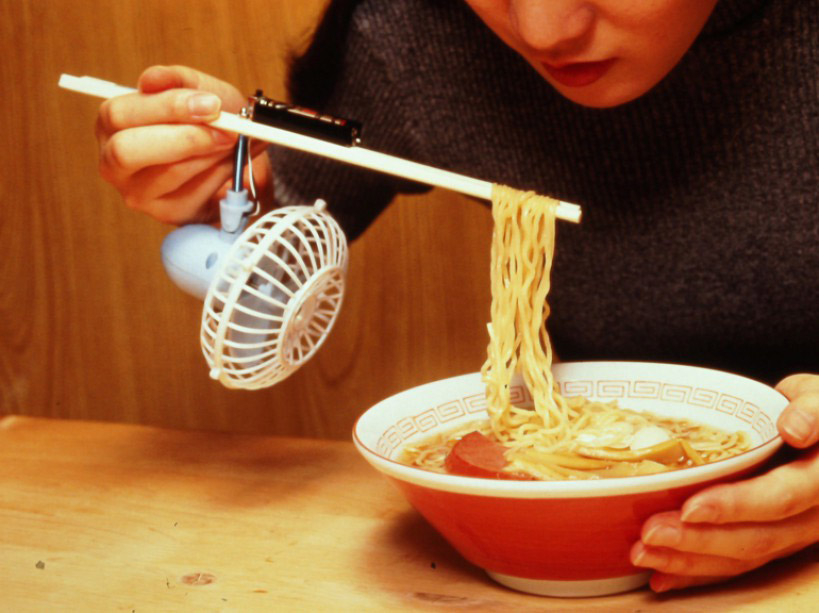
Vehicles
- The car industry has more than its fair share of quirkiness:
- Most small Toyotas since about 2000 have this to some extent or another.
- On the international front, ridiculous little dinky cars and hatchbacks from all around the world are perceived this way by Americans.note The ultimate example is the autorickshaw, a demented little car-thing built around a motorcycle. The American muscle cars, on other hand, are perceived this way outside America, since the idea of shoving an Enormous Engine in a box-shaped family car, let alone a large luxury car, comes off as ridiculously huge and thirsty for the rest of the world (with rare exceptions like Australia).
- A western example is the short-lived Yggdrasil 'green' motorcycles. We can't link to an example, unfortunately, as the website has been down. If you've played or seen screenshots of the game series Xtreme G, they resembled those cycles but only went about 140-170kph and were sold in small numbers in mainland Europe as an environmentally conscious alternative to move from point A to B. They were cheap to buy, but annoyingly expensive to maintain, and attempts to sell them elsewhere were met with confusion and head scratching elsewhere (and even at home) due to the way-too-futuristic designs and odd seating arrangement. (ridden as if you were straddling a rocket Wile E. Coyote style).
- Microcars/small cars in general and Smart cars in particular may also be seen this way in North America. This is caused by Japanese and European car makers not bothering to sell their microcars and more left-field models in North America in a self-fulfilling cycle of lack of demand from lack of products from lack of demand... Conversely, a lot of places in the rest of the world perceives their relative absence and the preponderance of big sedans, pickup trucks, SUVs and even the aforementioned American muscle cars for city dwellers as just as strange. The last few years have however seen SUVs getting commonplace everywhere, from America to Europe to even Japannote , so the trend might be changing.
- The whole Morgan car company: two-seat roadsters with a 1930s design and wooden chassis? Three wheelers with the one wheel at the back?◊. A car with crossed eyes◊? Jeremy Clarkson did a thorough investigation of the phenomenon of British sports cars and their drivers here, noting the irony of a country infamous for its wet, chilly weather being the home of a car that seems meant to be driven on warm, sunny days.
- The Caterham 7◊.
- In one of his solo feature-length DVD releases, Top Gear star Jeremy Clarkson has also introduced many British and American gearheads to this DOT (Dutch Oddity of Transportation), the Vandenbrink Carver. It was subsequently reviewed on Top Gear proper by the Hamster here.
- Top Gear also had a segment about the bizarre creations of the Soviet Union and Warsaw Pact civilian car industry, ranging from Russian compact sedans with holes in the bottom for ice fishing purposes and some kind of...thing from Czechoslovakia with three wheels and a body made of leather.
- French car makers have long had a reputation for quirky and advanced design and engineering. In particular, the Citroën DS was way more futuristic and technologically advanced than many other cars when it was first sold in 1955. The same was said for the Citroën SM when it came out in 1970.
- Some comments about the Handley Page Victor◊ bomber run along the lines of "Only the British would make their nuclear deterrent look like that". The same seems to apply to the Avro Vulcan, which happens to look more like a fighter plane than a bomber. Applies for the Russians and the Tu-95◊.
- English Electric built the most British fighter-jet ever, the Lightning. Twin-engines, one above the other, and with the upper engine staggered rearward of the lower engine, and a swept-wing that looks like a delta with a big notch cut from the inner trailing-edge. Its drop-tanks had to be mounted above the wing to avoid interfering with retraction of the landing-gear.
- Thanks to a combination of being strikingly ahead of their time, unique looking and having few export sales due to (among other things) Sweden's rather strict policies on weapons export, SAAB's jet fighters have seen Sweden get a reputation for uniquely distinct fighter jet designs. These include the J 35 Draken◊, JA 37 Viggen and the JAS 39 Gripen.
- Talking about Sweden, they also managed to field a turretless tank with its main gun just sticking out of the chassis (the Stridsvagn 103◊).
- English Electric built the most British fighter-jet ever, the Lightning
- The Japanese have a weird obsession with making as much noise as possible when driving a car or motorbike (even if that noise is the sound of the engine being shredded). They love to rev the crap out of mopeds for no apparent reason.