

Superman: [smiling] That's just what I'm waiting for it to do!
For the Trope Namer website Superdickery.com, go here.
It's a widespread tactic in serial fiction: show a teaser portraying the normally upright hero acting in an evil and despicable manner, causing the audience to wonder what the heck's going on and then, hopefully, to read/watch/listen to the thing you're advertising.
You look at the cover to the newest issue of your favorite comic, and what do you see? The superhero, apparently killing his sidekick and Love Interest! Or, On the Next episode of your favorite prime-time TV series, the main character goes bad, selling his team out to the Big Bad and shooting the Plucky Comic Relief in the face!
So you read or watch the installment in question, and find out It Makes Sense in Context. The hero, or someone in the supporting cast, was The Mole, a Secret Test of Character, Not Himself, Really Not Himself, putting on a show, or had learned that if the Happily Adopted son had gotten what he wanted for Christmas, it would have resulted in the destruction of every known universe simultaneously. It is also entirely possible that it was an "imaginary story" or in some way All Just a Dream. And many comic books flat-out ignore elements on the cover. For television, Manipulative Editing might also splice together two unrelated scenes for the promo, and it turns out the hero was being a dick to someone who actually deserved it. And now you're down a quarter. You should have known that Covers Always Lie and you can Never Trust a Trailer, but you were pulled in... by Superdickery.
Warning: Silver Age comics did have a tendency to induce Comedic Sociopathy in characters, alongside the strange plot devices and twists. This means that even if Superman wasn't as evil as the cover made him sound, the reader might still have to say "what a dick!" at the end of the story. The reason for this trope, however, isn't the writer's intent. During the Silver Age, the covers were designed first, and the writers had to work around that cover that had been drawn without a story.
Doesn't really work with Anti Heroes.
In comics, a Cover Drop will often explain the truth behind the dickery. Compare with Clickbait Gag, an In-Universe use of one of Superdickery's web equivalents, Clickbait. No relation to Super Sex Organs.
Examples:
- Fairy Tail:
- Gray's behavior in the anime original Daphne Arc is pretty much this: for the first half Gray apparently joins up with the Big Bad Daphne and captures Natsu so she can use him as a power source for her Dragonoid, taunting Erza and Lucy for good measure. It then turns out he set the whole thing up to remind Natsu of a promise he'd forgotten, to help the people the villain had trapped years ago, so he could stop Daphne and free them. Why he felt the need to beat up Natsu in the process is not explained. To his credit, Gray admits the situation got out of hand with the Dragonoid attacking Magnolia and apologizes afterwards.
- Some time after the Grand Magic Games, with Sting as the new guildmaster of Sabertooth, he tells Yukino to strip while the entire guild is assembled, in a scene eerily reminiscent of Jiemma kicking her out of Sabertooth for losing against Kagura. Then, for some reason, the entire guild collectively drops their pants... before throwing a party to celebrate the construction of their new pool. The undressing is just for everyone to get in their swimsuits.
- One episode of Rune Soldier Louie opens with Louie digging a deep hole in the middle of the rain, right next to a dead-looking Merrill. After a flashback, it's revealed that Merrill isn't dead, just really tired, and Louie is helping her in a paranoid, night-long, shenanigan-filled attempt to hide a gigantic jar full of gold.
- At the end of one episode of JoJo's Bizarre Adventure: Stardust Crusaders, Hermit Purple tells Joseph that Kakyoin is a traitor working for Dio, followed by a shot of Kakyoin staring menacingly at Jojo. In the next episode, it turns out that this Kakyoin was actually the Villain of the Week's Stand, Yellow Temperance, disguised as Kakyoin.
- Sailor Moon: In episode 43 of the original anime, Usagi and the rest of the Sailor Senshi apparently have a big falling-out, with them attacking her and refusing to help her fight a monster, and even the "episode preview" speaks of Usagi striking out on her own as revenge for Rei's abrasive behavior. It's an act; actually, Usagi came up with a plan for everyone to pretend they were fighting each other so that once Usagi "left" them, the Dark Kingdom would offer to bring Usagi to their side so Usagi could find out where Tuxedo Mask is. The plan almost works and Usagi is about to "join" the Dark Kingdom, until the youma Bonbon spots the other Sailor Senshi hiding in the bushes, which causes Kunzite to figure out that Usagi and the other Senshi are still on the same side.
- Superman: This was a staple practice in the Silver Age comics. They eventually had to advertise stories with shocking covers as "Not a dream! Not a hoax! Not an imaginary story!", to the point that it became a Running Gag.
- Sometimes the covers were drawn by people totally unconnected with the creation of the comic itself, forcing the writers to find a way to explain the cover after the fact. His motivations for these actions usually boil down to ensure that nobody else has powers like his because The World Is Not Ready, or he's trying to protect his friends from harm, and (for whatever reason) this requires them not to know about said impending harm, so he has to be mean to them, lie to them, or otherwise force them to do uncomfortable things for their own good.
- Superman's Pal, Jimmy Olsen #30, whose cover shows Superman chewing out Jimmy while destroying a housecoat, is a response to Superman overhearing an oracle proclaim that he would destroy his son. He presumes the oracle is referring to his adopted son Jimmy Olsen, cancels the adoption, and goes to great lengths to try and drive Jimmy away from him and into safety. And then he finds out that the oracle actually meant he would destroy his sun — referring to an artificial star he created so long ago he had forgotten about it. But cancelled adoptions can't be renewed, so... oops? In any event, in doing all that to Jimmy he basically "destroyed" his son anyway. Apparently, it never occurred to Supes to ask the oracle to clarify.
- The cover of Action Comics #1 shows him smashing a car to pieces for no apparent reason, while the car's occupants flee in terror. It ties in perfectly with Siegel and Shuster's original story Reign of the Superman, which is much more ambivalent about a super-being coexisting with normals than most Superman comics would ever be. You have to read the comic itself to find out that the car in question is a criminal's getaway car.
- In Supermans Girlfriend Lois Lane #71, Lois is being blackmailed, and Superman impersonates her blackmailer, because he simply must know her terrible secret. This leads to a bit of actual story-within-a-story dickery, as her secret turned out to be footage of Superman killing a bunch of people — which he did, but it's okay because they were evil aliens in disguise. It's still pretty dickish — and it's also dickish of Lois to not divulge what she thought was Superman committing mass murder.
- Superman is trying to save Lois from an assassin and forces her to gain a massive amount of weight so that no one would recognize her. He does this without her permission, the transformation is embarrassing and gut-wrenching, and Superman still sees fit to not only pretend not to recognize her himself, but to straight up insult her appearance and struggle to carry her (despite being the Trope Codifier for the Flying Brick):
Superman: Pardon my saying so, Miss... but you're quite a load! (Puff) The girl I most often fly with is slender... Lois Lane!
- The Adventures of Superman 1991 Annual proves that the tactic didn't die with the Silver Age — it depicted Superman and Maxima making out in a graveyard, with Maxima seated on the tombstone of Lois Lane — who died married to Superman and pregnant. The story turns out to take place in an Alternate Universe.
- Similarly, Action Comics #593 showed a tied-up Mr. Miracle Forced to Watch as Superman made out with his wife Big Barda in front of him. This is one of the few cases where it's even worse with context, as the two were being mind-controlled by a slimeball New God that was trying to make them film a porno together. Also, Darkseid gets involved.
- All-Star Superman, being a 2000s continuation of the Silver Age comics, was known to send up this trope. In particular, the cover of issue four, "The Superman/Olsen War!", depicts Superman trying to kill his best pal
 ◊. He's under the influence of Black Kryptonite.
- The first cover of the storyline Krypton No More depicts Supergirl smashing the Bottle City of Kandor, apparently killing several million Kryptonians. In context, Superman is having a nervous breakdown, and the Kandorians try to snap him out of it by convincing Supergirl to convince her cousin that his entire life is a lie, so the city she's shown destroying is a fake. It still doesn't make much sense and suggests that Superman's entire race consists of dicks.
- The Untold Story of Argo City: In the cover of the backup strip of Action Comics #315, Edna Danvers is murdering Supergirl's birth parents Zor-El and Allura In-Ze in revenge for taking her adoptive daughter away from her. The in-story explanation is that Edna was driven crazy by a Kryptonian creature's mind-altering venom.
- On the cover of Action Comics #258, Superman banishes Supergirl off the planet and tells her, "I'm sorry to end your career, but you're a failure as Supergirl! I must exile you to another world!" But in the actual story, he only banishes her for a year, and for a far pettier reason — she revealed her existence to Krypto. The exile was really a Secret Test of Character concerning the security of her Secret Identity, but it's still pretty dickish.
- The cover of Superman (1939) #293: The Miracle of Thirsty Thursday shows the citizens of Metropolis dying of thirst while Superman holds them back from a gushing fire hydrant, preventing them from drinking. Of course, a thoughtful reader may assume that the clarifying context is that the water is contaminated in some way, and Superman is protecting them. But in this case, the "context" is that the cover is a lie: in the actual story, the people of Metropolis are affected by a serum that creates an aversion to water, and Superman has to come up with a means to make them drink.
- The cover of Superman (1939) #365 features Supergirl trying to shrink Superman down to nothing. Inside, she had been driven to insanity by Blymm, a member of the Superman Revenge Squad.
- And it's not just Superman, either. There were plenty of covers involving Lois Lane, Jimmy Olsen, or Batman doing mean things to Superman, like blackmailing him, framing him, imprisoning him, giving away his secret identity, killing him, or otherwise being highly unhelpful. Lois in particular (and Lana Lang when he was Superboy) would constantly try to prove that Clark was Superman, on the assumption that if she did, he would have to marry her. About the only regular character who wasn't a dick was Perry White, despite his gruff behavior.
- In How Luthor Met Superboy, young Clark allowing himself to be a bit of an ass has far-reaching consequences. When teen Lex Luthor confides to Superboy that he is working on an amazing secret project, Clark cannot help pointing out smilingly that he can easily X-Ray Lex's drawers, before adding quickly he will not do such a thing because he would never betray a friend's trust. Unfortunately, when Lex's lab burns down, Luthor becomes convinced that Superboy indeed snooped on his project and decided to sabotage it out of jealousy.
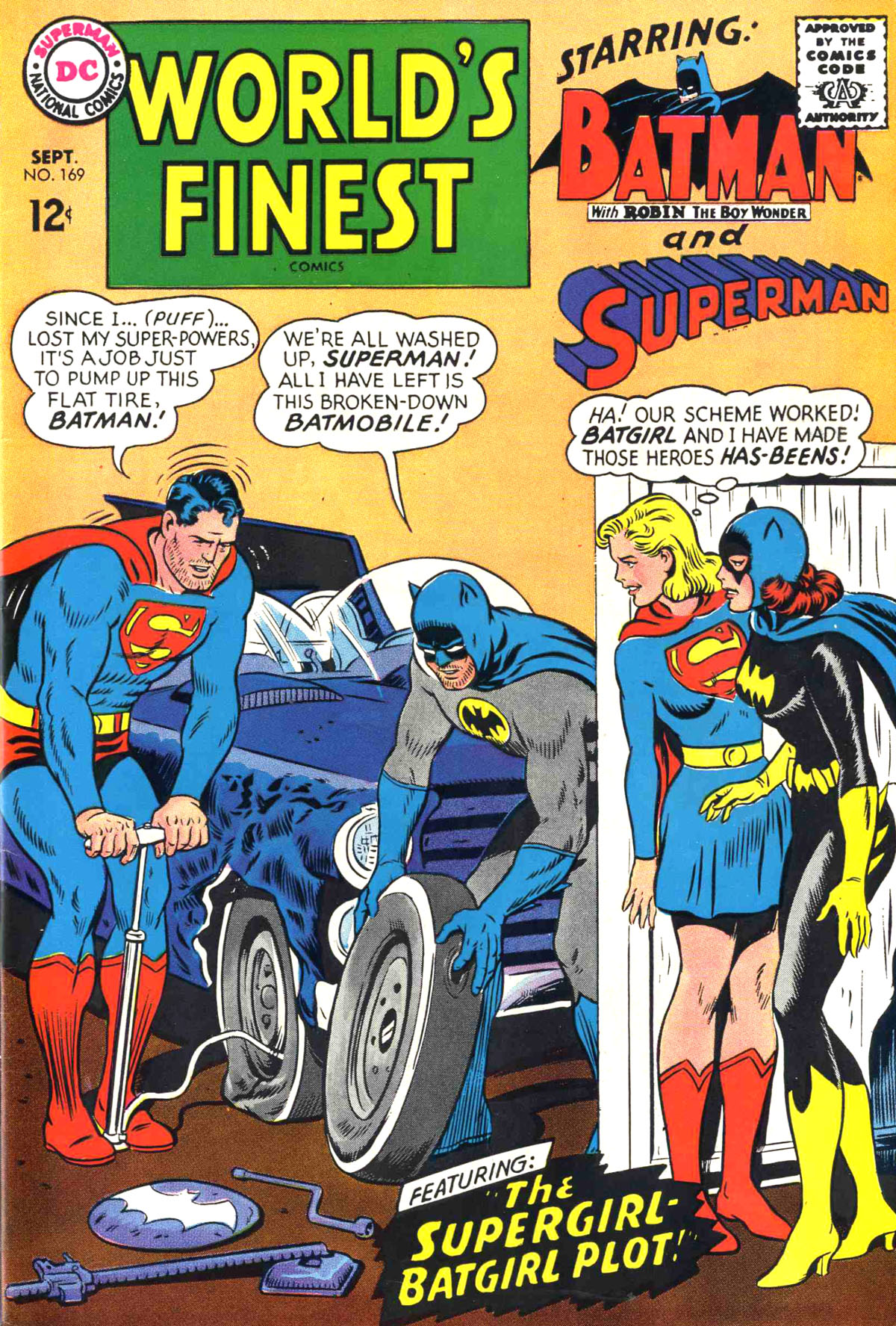
- The cover◊ of World's Finest (1941) #169: The Supergirl-Batgirl Plot features Supergirl and Batgirl gloating about ruining both Superman and Batman's lives. The scene happens in the inside, but both "women" turn out to be Mr. Mxyzptlk and Bat-mite, who are posing as Kara and Babs.
- During its run, Adventure Comics featured plenty covers showing a hero behaving as a jerkass and/or villain. Some examples: Superboy gleefully destroying Smallville with a giant top in issue #243 (he was only drilling a new well for a farmer), Dream Girl turning several Legionnaires into kids in issue #317 (she was stopping them from going in a mission where they would be killed off), Supergirl leading an army of thieves and attacking Superman in #381 (she was infiltrating a criminal gang)...
- The cover of Superboy (1949) issue #64 has Krypto to destroy a Superboy statue, while Lana gloats that he has become her dog now. In the story, Krypto becomes jealous of Superboy grabbing all the attention and praise, but he never goes on a rampage.
- In the cover of Superboy (1949) issue #96, Clark's best friend Pete Ross has stolen Superboy's powers' suit and dog, has imprisoned him a cage, and ignoring Clark's pleas to not leave him dying of thirst, flies off to steal his buddy's girl. In the story, Clark is having a nightmare because something has transferred his powers to Pete, and his newfound power seems to have gone to his friend's head.
- Green Lantern: Lampshaded in a 90's issue, with the cover showing Kyle Rayner fighting Wonder Woman as he desperately assures the reader that it isn't what it looks like. They were faking the fight to trick a villain.
- All-Star Batman & Robin, the Boy Wonder is an inversion. Frank Miller depicts Batman in the covers as fans are accustomed to seeing him: he takes in Dick Grayson after his parents are murdered, trains him to avenge them, and effectively adopts him. The story itself, though, shows Batman abducting the twelve-year-old Dick Grayson, (to the point that he gets his Face on a Milk Carton), training him by locking him in the Batcave and denying him food, and lashing out at Alfred for trying to take care of him. The entire story is messed up from top to bottom, especially Batman's behavior, but you wouldn't be able to tell just from the cover.
- Astro City:
- The story "Shining Armor" is a brutal deconstruction of Lois Lane's brand of Superdickery in the Silver Age Superman/Lois relationship. Irene Merriweather tries to prove herself worthy of Atomicus' love by exposing his secret identity, even as she repeatedly endangers him by doing so. When she finally succeeds, Atomicus explodes in rage and leaves Earth forever, tired of her dogged pursuit. Atomicus never wanted to play that game at all, but was too naive and afraid to tell her so.
- There was also a brief mention in the story "Old Times" — Supersonic, after an adventure that temporarily gave him 16 exact doubles, took his Lois-type girlfriend Caroleen to a dance as Supersonic and had one of his doubles come as his secret identity of Dale Enright. He did this just to mess with Caroleen.
- Champions: The cover of Champions (2016) #2 is a direct homage to the style of comic book covers where the hero is shown doing something morally dubious or outright evil, often with speech balloons included to emphasize this — in this case, Nova viciously attacking kid Cyclops while yelling "You think you're joining the Champions, Cyclops? Over my dead body!"
- City of Heroes: In the comic book adaptation, one issue ends on a cliffhanger depicting the Badass Normal of the superteam killing the team's leader. The next issue shows that he did it to appease the one person who could restore the rest of the team's powers, and he was planning to bring him Back from the Dead as soon as he could.
- Fantastic Four: In Fantastic Four (1961) #2, the Skrulls are first introduced by depicting the Fantastic Four committing criminal acts, only later to reveal them as shapeshifters.
- Legion of Super-Heroes:
- The various incarnations of the Legion, particularly in their secret character tests for Superboy and Supergirl, and in their periodic tryouts for new members, fall into this trap.
- The cover of their first story, The Legion of Super-Heroes!, features Cosmic Boy, Lightning Lad and Saturn Girl refusing to admit a disheartened Superboy into their club on grounds of having low scores and being too ordinary. In the story, the trio worship Superboy and were putting him through a stealth test to ascertain that he is as good as the old legends stated.
- In The Condemned Legionnaires, the cover leads to believe that Superboy is thoughtlessly and forcefully exiling his female teammates to some lost world where he expects them to simply die. In the story, they are simply being flown to a world wherein people who suffer from strange illness are taken care of.
- The editors noticed that the issues that sold the best were the ones with some kind of dissension or conflict within the ranks, hence stories like Revolt of the Girl Legionnaires.
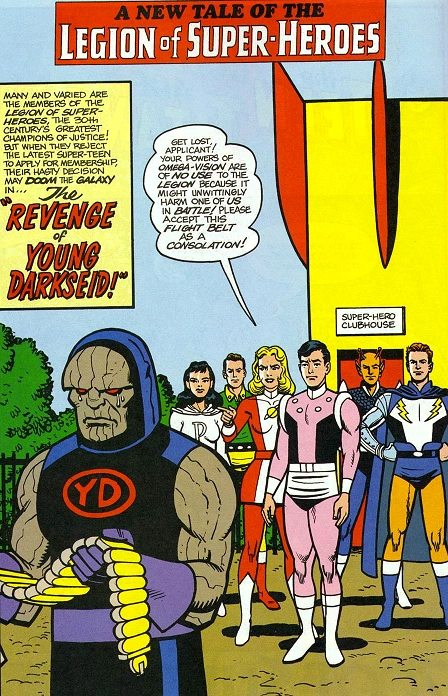
- They once turned down a guy who wanted to join, so he decided to become the greatest villain of all, and he succeeded. All this was a one-page gag from the famously rare Elseworlds 80-Page Giant.
- The Beano: This trope was frequently used the other way around, with Dennis the Menace shockingly becoming good. Of course, it didn't last.
- X-Men:
- Can be done on-panel: In the "Torn" Story Arc of Joss Whedon's Astonishing X-Men, a depowered Cyclops was casually gunning down villains and talking about it as if completely unconcerned. (This after the previous issue's Wham Episode ending of him shooting Emma Frost.) Turns out he's not crazy: he's the only one who's figured out that they're psychic projections created by a villain to move her Evil Plan along.
- Wolverine: Inverted in #70. The cover shows Wolverine fighting with his Rogues Gallery and losing, but in the comic he handles them quite easily because they are his friends and he was fooled by Mysterio.
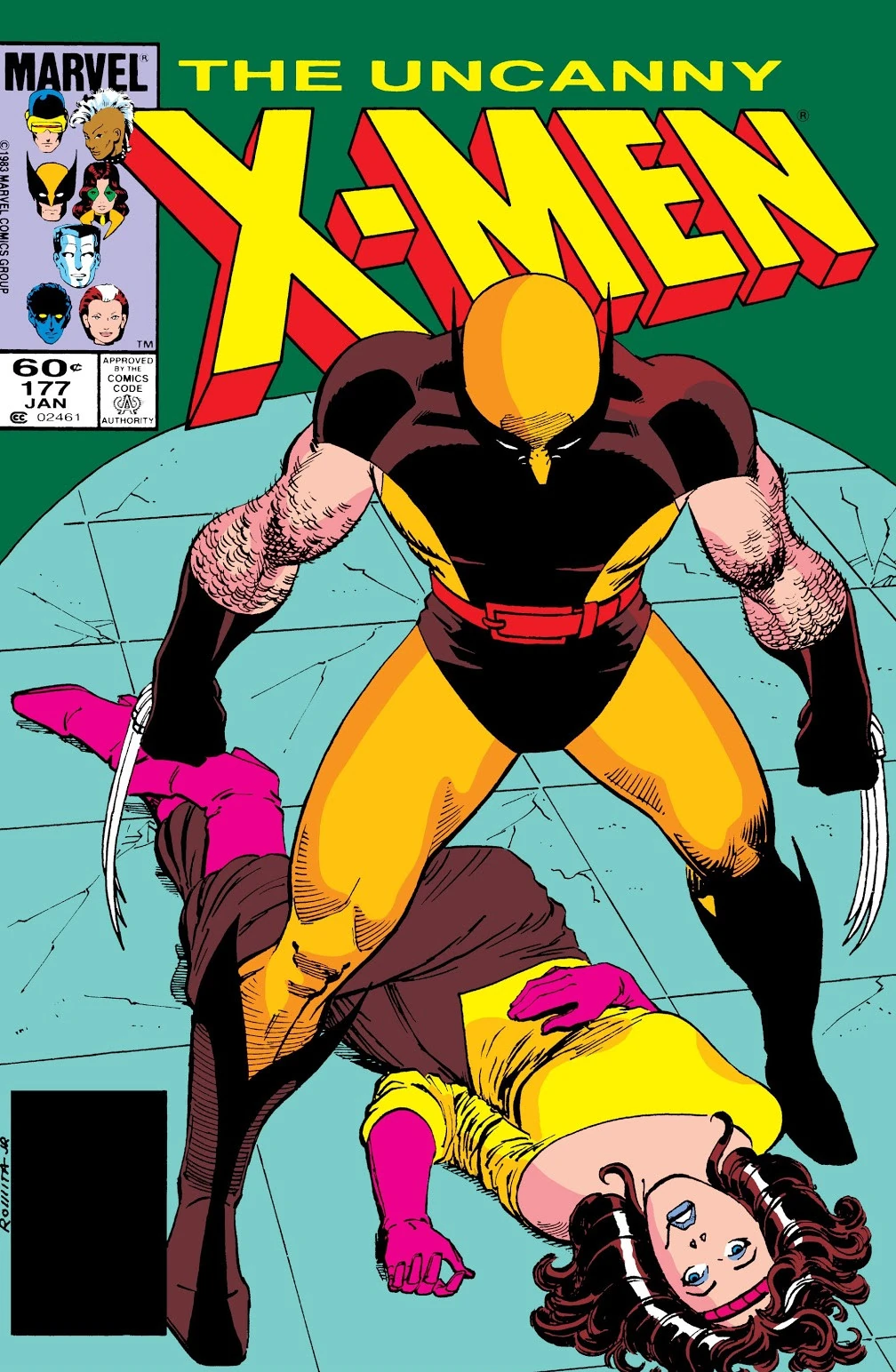
- One issue features Wolvie standing over the dead body of Kitty Pryde. Wolverine is actually Mystique in disguise, and Kitty is an android; Mystique was just practicing. There's a similar moment on the cover of Uncanny X-Men #276 where Wolverine is standing over a downed Professor X with his claws popped out, or rather a Skrull in disguise as Professor X.
- One has Professor X piloting a "Psi-ber Sentinel", gleefully laughing as he tries to mow down the X-Men. In the actual story, it's revealed to be even more blatant of a lie than this trope usually sees — he's not a clone, he's not being brainwashed, he's been imprisoned and is draining his psychic energy to wrest control of the robot from the bad guys. What's interesting is that if they had really wanted to sell this particular comic, all they had to do was point out on the cover that Deadpool was in the issue.
- Uncanny X-Men issue #99 ends with the All-New X-Men, in the middle of a rescue operation, coming face to face with the original X-Men, with Professor X telling the originals to destroy them. The cover of issue 100 has the Professor standing between them telling the teams to fight. Turns out the original X-Men are cunningly disguised Sentinels.
- Spider-Man:
- The cover of Amazing Fantasy #15, in much the same vein as the first ever Superman, is ambiguous about whether the title character is really a good guy — he's shown swinging through the air with a person under his arm (while monologuing about how people bullied him as Peter Parker but will respect him as Spider-Man), but is he saving the man or kidnapping him? In the modern day, with Spider-man's heroic persona well-established, this original ambiguity is largely lost.
- The Amazing Spider-Man #42 opens with Spider-Man robbing a bank. He's robbing it of a bomb, which was intended to destroy a safe. Too bad John Jameson (with temporary superpowers) didn't know that last bit and was too busy attacking Spidey for the webslinger to explain himself...
- Ultimate Spider-Man: One issue opens with Spider-man robbing a bank, this time holding an unconscious cop and announcing that yes, the bank is indeed being robbed by none other than Spider-Man. It turns out that it's not Peter Parker, but someone else who copied his costume.
- The PlayStation Spider-Man video game opens with Spidey stealing some technology. Yes, he's stealing it from Doctor Octopus, but that's not why it's Super Dickery — it's because it's not Spider-Man, but rather Mysterio, who's stealing the tech on Doctor Octopus' behalf. It's part of their Batman Gambit to frame Spidey and accomplish their Evil Plan without being disturbed. The cinematic where this happens shows Peter Parker taking pictures at the scene and commenting, "Wait a minute, I thought I was Spider-Man."
- In issue #11 of The Simpsons comic book, Ned Flanders gets lost during a camping trip, and when he comes back, he acts like a criminal, doing such things as robbing a bank and using a slingshot to knock Bart off his skateboard on the cover◊. It even starts with him angrily yelling at Maude that she's "ruined everything". It's not really him — it's a clone manufactured by Kang, Kodos, and Sideshow Bob. Except for yelling at Maude — she just forgot to bring the marshmallows for the camping trip, and Ned's actually irritated about it.
- Sonic the Hedgehog (Archie Comics):
- The cover to issue #28 depicts Sonic having just beaten up the other Freedom Fighters and being commanded by Robotnik to finish them off. However, the apparent dickery here is kind of made not that suspenseful by the fact that this was printing the second half of a two-parter, and therefore if you had read the previous issue, you would know that Sonic is just suffering amnesia and thinks he's on Robotnik's side.
- Issue #203 has Bunnie pinning Sonic under her foot and preparing to blast him with her arm cannon, complete with the caption "Bunnie Gone Bad?!". Actually reading it reveals the Iron Queen, being a techno-mage, has taken control of her cybernetic limbs and is forcing her to fight the others. They did the same thing next issue with Monkey Khan, though, like the above example, it's not at all suspenseful if you've read the previous issue, as it has almost the same explanation as Bunnie's. (This still doesn't stop Bunnie's husband Antoine from attacking Khan for knowing that Bunnie was susceptible to this beforehand and not telling him).
- Issue #217 inverts this: on the cover, we see Sonic drowning in oil, and Bunnie rushing to help him. Not only does this never happen in the story, but on the first page, Bunnie and Sonic are in the middle of an all-out battle with each other in the middle of an oil refinery; the issue-long flashback that shows How We Got Here reveals that neither one was being forced, and they're fighting over largely ideological differences.
- Issue #59 is another inversion: Earlier in the series, Sonic visited an odd dimension where two men named Horizont-al and Verti-cal lived and comically harassed Sonic. The cover of the issue in question shows them wrestling over a Sega Saturn controller while Sonic and Tails watch from behind the monitor, suggesting another light-hearted romp in their wacky world. The actual story is much more tragic, as Robotnik's actions in the Endgame arc caused this zone to mutate and turned them into nightmarish mechanical monsters who only live to fight — so while the cover isn't deceptive, the events of the story are far more disturbing.
- The cover of issue #256 suggests a confrontation with Dr. Eggman. To say that doesn't happen doesn't even begin to tell the story.
- Issue #24 opens with Sonic and all of the other Freedom Fighters attacking the citizen of Knothole Village in petty ways. It's really Evil Sonic and his own band of Freedom Fighters (who fight against freedom) from an alternate universe, hoping to ruin the reputation of their counterparts.
- In Elementals, Bill Willingham makes a point about how the Silver Age Superman spent all his time saving Jimmy Olsen from dropping packages and preventing Perry White from tripping over his shoelaces, while on the other side of the world thousands died of famine and poverty.
- An issue of Batman and Robin shows Robin preparing to decapitate Batman with a giant sword. The issue is even called "Batman vs. Robin". And it does happen! In one panel. Then Robin freaks out and fights off the mind-control that his mother had put him under.
- This trope in Silver Age Superman covers is given an amusing nod in Masterpiece Comics, a parody book that depicts famous literary works in the style of comic strips and comic books. The retelling of The Stranger has Superman standing in for Meursault, and the novel is told through a series of what look like Silver Age covers. Thus, the dickish things Meursault does in the book are a close (if exaggerated) parallel to the kind of things Superman would be shown doing on the cover.
- Sleepwalker did this in-story at the end of one issue. A mob of bizarre alien "mindspawn" who all strongly resemble Sleepwalker are invading New York City and killing the innocent bystanders. The issue ends with Sleepwalker seemingly destroying and absorbing Rick Sheridan's mind, with the final caption asking if Sleepwalker is a Supervillain. It's later revealed that Sleepwalker actually absorbed Rick's mind in a special weapon to protect him from being killed by the mindspawn, who really were going to kill him. Sleepwalker knew that if he tried to fight the mindspawn, Rick could have gotten hurt in the crossfire. This way, he could both keep Rick's mind safe and ingratiate himself with the mindspawn, which allows him to free their human prisoners.
- Richie Rich, usually a nice kid, doesn't always behave this way on the covers; he sometimes flaunts his ludicrous fortune in search of a bad money-related pun of the apparent envy of passersby. He shapes everything in the shape of a dollar sign, replaces workers with robots, or genetically modifies animals to be made out of gems, gold, gem-encrusted gold, money, or at the very least speckled with dollar signs. Occupy Richie Rich portrays him as bullying the working class with his sheer fortune.
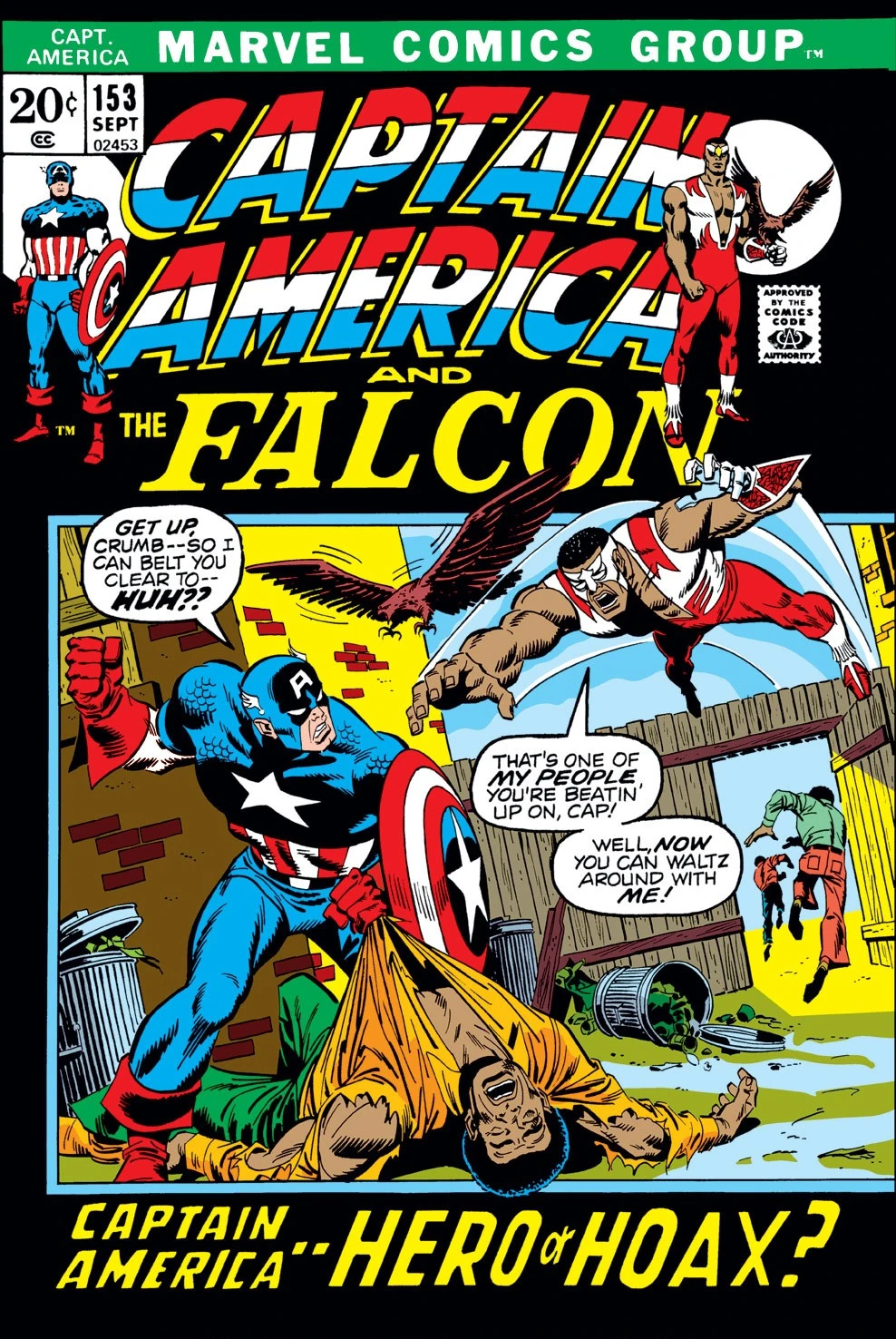
- The cover of Captain America #153 shows Cap beating up on a black man, as The Falcon attempts to stop him. We soon learn that the "Captain America" on the cover isn't the real deal, but rather the 1950s Cap, who went insane due to a faulty version of the Super-Soldier Serum being used on him.
- A Justice League of America storyline had Adam Strange kidnapping the League and putting them to work as slaves for the aliens rebuilding his planet, apparently driven insane by the death of his wife. At the end of the first half, J'onn J'onzz joins forces with him. It's all a ruse to confuse the invaders.
- One cover◊ of The Brave and the Bold features the original Teen Titans beating the living crap out of Batman. In the actual story, only two of the Titans "beat up" Batman, and that's because they're undercover with a group of criminals and Batman is intentionally letting them "work him over" so they can maintain their cover.
- Issue 3 of Original Sin ends with Bucky Barnes stranding Moon Knight and Gamora in space, confronting Nick Fury and brutally killing and decapitating him. Then Issue 4 comes around and we find out that Bucky realized they were being played and went hunting down their benefactor, the real Nick Fury — the Fury he killed was a Life Model Decoy.
- The Italian comic book Diabolik does it once in a while. And the readers are forced to take them seriously, as once in a while they actually do what they claim (from the very third issue: its title is "The Arrest of Diabolik", and that's exactly what happens).
- In the ninth issue, "The Train of Death", Diabolik's lover and accomplice Eva Kant is arrested, and his reaction appears to be kidnapping a gorgeous woman and brainwashing her into becoming his new lover and accomplice. Turns out he figured that she was facing the death penalty, and if he could make everyone think he had dumped her, the judge might not push for execution and that could buy him time to figure out how to break her out. In any event, this was before Diabolik had been established as so in love with Eva that he could never even pretend to harm her.
- In "Wedding in Black", Altea is injured in a bomb at a wedding, and she begs her fiancé Ginko to marry her then and there — only for Ginko, as soon as Altea is taken to hospital, to go to another house and kiss a woman there. The following panel reveals that "Ginko" was actually a disguised (the real one having been kidnapped the previous night) and the woman an equally disguised Eva.
- An interesting one was done in Ultimate Fantastic Four, which shows Magneto standing over the broken and beaten bodies of the eponymous heroes. It doesn't seem like Super Dickery at first glance, since Ultimate Magneto is a sociopathic mass murderer, but the comic reveals that this is actually the Magneto of an Alternate Universe who is, like his mainstream 616 counterpart, more of a Noble Demon Anti-Hero Depending on the Writer. Turns out the Fantastic Four team he was defeating (though this scene does not actually happen in the comic) were their undead Evil Twins from the Marvel Zombies universe, so this was really a heroic Magneto defeating a group of very, very evil villains.
- The cover of an issue of Excalibur showed guest-star Psylocke kicking her brother Captain Britain in the face. In the comic itself, this is just them sparring, and coming to the conclusion that their powers — his physical prowess and her telepathy — were evenly matched. It was actually a rather touching scene, since the twins were catching up after not having seen each other for several months.
- In Super Sons, Issue #14 has Damian standing over a prone Jon's body with a sword while declaring that Superboy is now dead. None of this happens in the story, and Damian actually snaps the sword depicted on the cover in half.
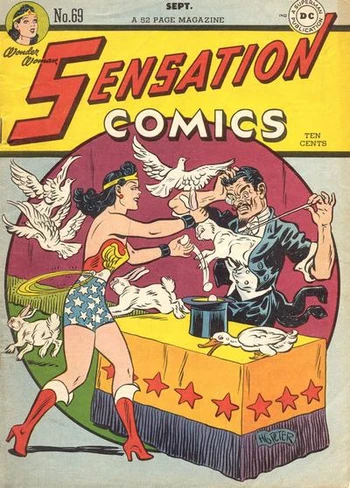
- Sensation Comics had a number of covers that show Wonder Woman being unnecessarily petty and unkind, usually to Steve Trevor. They're generally an exaggeration of the plot or an outright lie inspired by an element of the story. Examples include surprising Steve with a bunch of identical duplicates and telling him to figure out which one she is on #96, or ruining a magic show on #69.
- New 52 had the most brutal Wonder Woman to ever be regularly featured in DC's "main" setting, but several covers still felt the need to make her look viscious even during her softer moments. The cover of Wonder Woman, volume 4, #45 depicts her lifting the battered body of Donna Troy off the ground By the Hair, while preparing to finish Donna off with a Blade Below the Shoulder. In the actual story Donna Troy is suicidal and Diana has imprisoned Donna for her own safety. Teen Titans volume 5 #18 shows Wonder Woman standing over the broken bodies of The Titans while hoisting a brutaized Cassie Sandsmark over her head. The actual contents of the story have Diana hunting Cassandra, for the sake of protecting The Titans since Cassandra had a hand in the murder of Cassie's father.
- The cover of a General Jumbo special in a The Beano annual has the titular character deliberately piloting one of his model fighter jets towards a playpen full of young kids with their teddies. In the story, however, he figured out that Private Pike was disguised as a bear in the playpen and counted on the kids to run away with their own teddies, leaving an extra one behind so he could ram it.
- The cover of The Francis Blake Affair from Blake and Mortimer shows Francis Blake and Olrik (Blake is one of the two protagonists, Olrik is their recurring nemesis) wearing tuxedos and raising a toast to each other. In context, the scene is a No, Mr. Bond, I Expect You to Dine moment.




- Chapter 6 of Hop to It opens with Rabbit seemingly siding with an akuma named Cottontail after she kidnaps Alya, before cutting back a few hours to give it some context.
- Chapter 9 of Neither a Bird nor a Plane, it's Deku! ends with a reference to this in the author's notes.
"Join us next time when Midoriya adopts Bakugou as his son and spends weeks emotionally abusing him!"
- A frequent gag in The Brave and the Bold: The Lost Issues with such things as Doctor Strange turning Batman into a bat or Death from The Sandman watching Batman drown and not doing anything to help him.
- In Superman vs. the Elite, the Elite, a group of merciless antiheroes gaining popularity in Metropolis, decide to take on Superman for 'endangering innocent people' by not being as violent as they are and just killing supervillains. They apparently kill him in a climactic confrontation... at which point he decides to play by their rules, and easily and gleefully kill most of them and reduces their leader, Manchester Black, to tears and on his knees, while not caring about the collateral damage. Then the whole world stopped trembling in fear when Superman revealed he was just showing the world exactly how scary he would be if he started being judge, jury, and executioner as the Elite tried to be, and that he didn't kill anyone (the Elite are still alive but Brought Down to Normal and Superman's robots saved the people who were apparently killed by the collateral damage).
- One of the first trailers in the 199 Hero movie of Kaizoku Sentai Gokaiger depicts the Rangers fighting against the previous Sentai teams, highlighted by the fact that even the narration declares confusion over what's going on. The battle did make it into the movie, but the heroes were actually fighting against puppets animated by the Big Bad from the Gokaigers' Ranger Keys.
- Kamen Rider X Super Sentai Superhero Taisen features two separate Legions of Doom, a reformed Dai Shocker and the all-new Dai Zangyack. Both are staffed by villains from both franchises... and headed by two heroes, Kamen Rider Decade and Gokai Red. Okay, Decade used to be a villain, but promo material says he only reformed Dai Shocker after the Sentai villains invaded the Rider universe. It turns out a massive gambit by the two heroes to get the villains to bring their super-weapons out into the open so they and the other heroes (whom they faked killing while really sending them to a pocket dimension for safety) could destroy them.
- Later followed with Heisei Rider vs. Showa Rider: Kamen Rider Taisen feat. Super Sentai, where the two generations of Riders are seemingly killing each other over their differing philosophies and for the right to battle the Badan Empire. Initially, the in-fighting turns out to be for the exact same reason as in Super Hero Taisen (just replace "a pocket dimension" with "the Helheim Forest") but after the villains are defeated, the Showa Riders (who prioritize defeating evil first) reveal that their beef with the Heisei Riders is legitimate, since they feel that the Heisei kids' are "soft" for prioritizing the protection of civilians and blame their emotional attachment to their dead friends for allowing Badan to return as an army of the dead.
- Apparently this is law for Gokaiger movies. In Go-Busters vs Gokaiger, (whose name isn't an example - team-ups are always named "[current team] vs [returning team]" even though it's not really accurate) we have trailers of the Gokaigers dressed in a more traditionally piratical manner than usual and attacking the Go-Busters. Needless to say, they're still not really bad guys, and they still fight alongside the other heroes.
- And again with the Kyoryuger vs Go-Busters movie, which is being advertised with images of the Kyoryugers in black outfits swearing to destroy the dinosaurs — which are the Kyoryugers' allies and partners normally. As it turns out, the villains have brainwashed them in the second act.
- Kamen Rider X Super Sentai Superhero Taisen features two separate Legions of Doom, a reformed Dai Shocker and the all-new Dai Zangyack. Both are staffed by villains from both franchises... and headed by two heroes, Kamen Rider Decade and Gokai Red. Okay, Decade used to be a villain, but promo material says he only reformed Dai Shocker after the Sentai villains invaded the Rider universe. It turns out a massive gambit by the two heroes to get the villains to bring their super-weapons out into the open so they and the other heroes (whom they faked killing while really sending them to a pocket dimension for safety) could destroy them.
- One of the promotional posters for Man of Steel shows Superman in handcuffs being led away by soldiers. It turns out he just turned himself in to the military so he could gain their trust. Apparently, he can't completely escape this trope, even in these modern times.
- One teaser for Batman v Superman: Dawn of Justice consists entirely of a context-free scene where Superman flies down into an underground bunker to unmask an imprisoned Batman, with a row of loyal black-clad soldiers kneeling before Superman as he walks in. While Superman is definitely something of an Anti-Hero in Dawn of Justice's precursor film, Man of Steel, it's highly unlikely that he would actually recruit armed minions and keep his enemies chained up in a bunker. An interview makes it clear that it's from a Nightmare Sequence Bruce Wayne has.
- In The Lone Ranger, at the beginning of the film, a scene depicts The Lone Ranger and Tonto robbing a bank. By the end of the movie when we come full round to this scene. They're robbing the bank because it has explosives in it so they can take down the big bad.
- The first trailer of Captain Marvel shows one scene of the titular superheroine punching an old lady in the face. Comic book fans knew that the old lady is a Skrull which eventually makes more sense in the second trailer where the old woman growls, drop-kicks Carol, and acrobatically maneuvers her way through the train before Carol rams her face-first into a metal pole, denting it.
- Some trailers and promotional material for The Rise of Skywalker showed Rey as a Sith Lord, having fallen to The Dark Side. In the film proper, this is a nightmare sequence depicting a Bad Future, and we later find out it technically isn't even Rey in this vision: it's Palpatine (and/or a Mind Hive of Sith Lords) hijacking her body.
- Trailers for films from the Ultra Series is rather prone to doing this. Ultraman Taiga The Movie: New Generation Climax notably shows Taiga's father, the veteran hero Ultraman Taro, attacking his son and the New Generation Heroes, although Genre Savvy viewers might have deduced that Taro is very likely possessed and / or Brainwashed and Crazy. It turns out they're right, Taro was in fact possessed by the film's main antagonist, the demon-like Grimdo.
- Two guys are sitting in a bar in the 100th floor of the Empire State Building. One of them turns to the other and tells him, "Did you know that if you jump out the top of the Empire State Building, that the downforce from the wind will push you back into the building?" Hearing this, the bartender turns away and starts shaking his head. The other guy voices his disbelief, saying that it's not possible. So the first guy tells him "watch this," and jumps out the window. Sure enough, he falls for a long time, but as he gets to the 10th floor, he is pushed through an open window by the wind. He takes an elevator back up to the 100th floor, where the other guy is. The other guy tells him "it was just luck is all! A fluke!" So the first guy jumps out again, and again is pushed through the open window on the 10th floor. When he makes his way back up this time, the other guy decides he wants a try. So out the window he jumps, falling, falling, falling, all the way to the ground with a splat. Noting the first guy's smirk, the bartender turns back to him and says "y'know Superman. You can be a real asshole when you're drunk."
- The ninth volume of Accel World has a preview picture of a scene in which Kuroyukihime, as Black Lotus, announces her intention to kill Haruyuki's duel avatar, Silver Crownote after calling him to a meeting on the Unlimited Neural Field. When the novel gets to that scene, Haruyuki initially is horrified by the idea that Kuroyukhime betrayed him and lured him into a trap, until he realizes that Black Vise is impersonating Black Lotus, having waited to ambush him.
- In The Amazing Adventures of Kavalier and Clay, a comic book features the Escapist screaming "I'M ABOUT TO BE EXECUTED BY MY ALTER EGO!"
- The cover of Captain Future In Love shows The Hero shooting a Green-Skinned Space Babe In the Back with his Ray Gun. Has Allen Steele turned the 1930s pulp magazine hero into a Darker and Edgier modern hero? Turns out she's an escaping terrorist and his weapon is set to stun.
- At the start of Persuader, Jack Reacher, our hero appears to shoot a cop, steal a car and kidnap a child. After you're completely hooked, it turns out there's a good explanation.
- Subverted in Season 7 of 24. The preview trailers suggested that Tony Almeida was the culprit of the terrorist attacks: and at first it is revealed that Tony is working a deep cover agent, but later it turns out he is one of the bad guys. And then he has his own agenda in the end, which was just, though his means were well over the deep end.
- A promotional clip for the Agents of S.H.I.E.L.D. episode "The Magical Place" shows Agent May telling Agent Hand that Skye was of no use on the plane. Because Agent May knew that Agent Hand and the other extra agents on the Bus would interfere with Skye as she did her part in the mission, and she wanted Skye to do her part unhindered.
- Done a few times with Angel, with the additional attraction that there was no guarantee he wouldn't do the awful things hinted at, thanks to his "bad side" Angelus. In "Power Play", he infiltrates the Circle of The Black Thorn, even killing Drogyn to prove his loyalty. His friends are convinced his new position has taken him to the Dark Side.
- Played straight in the Buffy the Vampire Slayer episode "Enemies", where Angelus allies himself with Faith to lure Buffy into a trap. When Faith has Buffy completely at her mercy, it turns out that...
Faith: What can I say? I'm the world's best actor.
Angel: Second best.
- Played straight in the Buffy the Vampire Slayer episode "Enemies", where Angelus allies himself with Faith to lure Buffy into a trap. When Faith has Buffy completely at her mercy, it turns out that...
- Most episodes of Breaking Bad started with a Flash Forward that lacked any context and usually consisted of lots of close-ups that made it difficult to discern what was actually going on. Season 2 had most episodes start with increasingly longer sections of the same scene that didn't actually come to happen until the very end of that season's last episode. In almost all cases, the scene either meant something entirely different in context, or it was actually just a minor thing that wasn't really a major event for the characters.
- Chuck:
- One of the subplots of the first season involved Chuck's animosity towards his ex-Stamford University roommate Bryce Larkin (played by Matt Bomer, who would go on to voice Superman himself in Superman Unbound, amusingly enough), who framed Chuck for selling test answers to the other students in order to get him expelled. It turns out that Bryce did this in order to keep Chuck from being forcefully recruited into the CIA, as he felt Chuck was too good a person to be mixed up in their shadiness, didn't want his life to be risked, and deserved a chance to live his own life.
- Much later in the third season, an episode opens with Chuck chasing a man and killing him in cold blood. The man was The Mole and was going to attempt to kill Chuck, and as it turns out, Chuck didn't even kill him - Casey did.
- One On the Next segment for CSI: Miami made it look like Walter was about to be shot by another member of the team. The shooter was actually firing at a booby trap set by the perp, to destroy it before it could kill Walter.
- Doctor Who Cliffhangers:
- An inverted (and partially straight) example at the second Cliffhanger in "The Power of the Daleks", with a rather friendly, obedient Dalek constantly screaming "I-AM-YOUR-SERVANT" at the humans. The Doctor, meanwhile, rants and raves to the humans that the Daleks' only function is to exterminate people.
- The next-to-last cliffhanger in "The Evil of the Daleks" is a fairly complicated subversion which becomes an inversion. It starts with Jamie ranting at the Doctor for his callous, dispassionate attitude and saying he was quitting as the Doctor doesn't even seem to care about the people who died as a result of his plan. The Doctor attempts to justify himself, but Jamie asks him whose side he's on, and then three Daleks appear, following the Doctor, as if answering Jamie's question. The Doctor tells Jamie that the Daleks are his friends now, in a Wham Line-like tone that one would expect would lead into a cliffhanger. Except the scene then continues a few more seconds while the Doctor explains that they were Daleks he'd given a Morality Chip to. The actual cliffhanger becomes a Dalek giving Jamie a ride, while Jamie yells excitedly about the Daleks turning good!
- "The Deadly Assassin": In Part 1, the Doctor experiences a vision of the Time Lord president being assassinated. Arriving on Gallifrey, he's determined to prevent this from happening. He heads to the balcony overlooking the room where the murder is to take place so that he will be able to see what's going on, and finds a gun lying there. The Doctor picks up the gun, sights along with it, and fires. The president falls over, dead! Cut to credits! In Part 2, as is standard in Doctor Who, we see the last minute or so of the previous episode over again — only this time an extra shot is inserted that wasn't there before: that of a person in the crowd below holding a gun. It all becomes clear: the Doctor was trying to shoot at the assassin below, but his gun had been tampered with so that he would be unable to hit the assassin. The fact that he figures that out and convinces the investigating officer goes a long way towards clearing his name.
- In "The Invasion of Time", the Doctor returns to Gallifrey to claim his post as the Lord President. He starts acting out of character and becomes abrasive, moody and power mad. At the end of one episode in the story, he's seen laughing evilly as he helps a group of evil aliens take over Gallifrey. Of course, it was all part of an elaborate plan to defeat said aliens, but he can't tell anyone that because the aliens can monitor his thoughts. None of this stops the Doctor from obviously enjoying a chance to freak out people he dislikes by playing The Caligula.
Castellan: Is there anything else I can get you, sir?
The Doctor: Yes. A jelly baby. My right-hand pocket.
Castellan: What color would you prefer, sir?
The Doctor: Orange.
Castellan: [nervously] There doesn't appear to be an orange one.
The Doctor: [suddenly grabbing the Castellan's arm] One grows tired of jelly babies, Castellan.
Castellan: Indeed one does, sir.
The Doctor: One grows tired of almost everything, Castellan.
Castellan: Indeed, sir.
The Doctor: Except power. - "Day of the Moon" does this with recently-introduced character Canton Delaware. For the first several scenes, we are mystified as to why he is going around killing the main characters, but the situation becomes clear after a point.
- "The Name of the Doctor" ended with the Eleventh Doctor talking about an incarnation of himself that did unspeakably terrible things, leading some to assume he was an evil incarnation of the Doctor. When we actually meet that Doctor, he's actually just as virtuous as any of the others, if grumpy and ready to engage in some Dirty Business.
- The trailer for "Death in Heaven" has Clara doing some Evil Gloating that "Clara Oswald has never existed!" as if she was an imposter who was Evil All Along like the Doctor originally feared. Turns out she's just trying to bluff some Cybermen into believing that she's the Doctor.
- "The Magician's Apprentice" ends with the Twelfth Doctor pushed to the Despair Event Horizon by Clara, Missy, and the TARDIS' extermination and thus ready to kill Davros — as a young boy. Even before the second part, "The Witch's Familiar", aired, virtually the entire fanbase knew this was going to turn out to be more than it initially appeared, and the cliffhanger was how it would be so.
- In the promo for season 3, episode 4 of Downton Abbey, there's a shot of Branson crying with Lord Grantham loudly scolding him on "abandoning a pregnant woman [Sybil] in a land that's not her own, while you run for it!" and the descriptions for the new episode were full of stuff about "Sybil's loyalty being tested to the limit." It gave every impression of making viewers think that Sybil and Branson, one of the most popular couples on the show, might be headed to a break-up or at least some major tension. Instead, what happened was: Sybil was totally on-board with Branson's decision to escape Ireland to Downton and on her way after him.
- Trailers for the final episodes of the first season of The Flash (2014) showed Eddie Thawne shooting two cops. The episode in question had Everyman as the antagonist.
- Blue Swat has an episode open with our heroes seemingly robbing a bank and taking hostages. After suiting up, they reveal that the bank has had a bomb placed in it by an Alien who is disguised as one of the clients.
- Glee loves doing this in their previews. One of the most egregious ones was for the second episode of season two, where Finn is shown telling a happy Quinn "I'd be lying if I said I didn't still have feelings for you" followed by a shot of a tearful Rachel looking on. What really happened: Finn followed that statement by reassuring Quinn of his devotion to Rachel, and Quinn was only coming on to Finn in the first place as part of a deal she struck with Rachel to reassure her of Finn's loyalty. There was also the absolutely ridiculous hype when the creators announced a beloved character would die in the episode "Funeral," and the speculations included countless popular, major characters only for it to turn out to be Jean Sylvester, Sue's sister with Down Syndrome, a guest character who had only appeared in six episodes in two seasons.
- Season 3 of Heroes features many instances of dickery by the heroes. However, other than Hiro stabbing Ando (which turned out to be an elaborate hoax by the two of them to fool the bad guys), most of it was actually real. This is mainly because Season 3 started out with the Volume "Villains", which attempted to reboot the show (which was slipping in the ratings after the last season) by claiming any of the heroes could become a villain by the end of the season. Ironically, the end result was a number of pointless heel face turns and unnecessary deaths that actually made it less popular than last season.
- This is sort of a version of this trope: The House season 6 finale begins with House sitting in a bathroom, opening a bottle of Vicodin, and we're all, "WHAT, WHY DAT VICODIN?!". The narration then goes back to the beginning of the day. In the very end of the episode, the situation is pretty much what it looked like in the opening of the episode, but Cuddy shows up, having broken up with Lucas, and wants to try a relationship with House, just preventing him from taking the pill.
- Can any Merlin fan forget Merlin's brutal assassination attempts on Arthur? And his somewhat aroused expression just before, after, and heck during these attempts? The (more than usual, at least) UST is easily explained — if Merlin is contemplating killing Arthur, his eyes will be naturally drawn to his heart... and who can blame him if he gets distracted by that chest?
- Painkiller Jane has done this at least twice. Once, it was a Shapeshifter's con, the other time it turned out to be All Just a Dream.
- The Professionals. The episode "Servant With Two Masters" opens with George Cowley negotiating the illegal sale of a top secret tranquilizer gas to a foreign dictatorship. Bodie and Doyle are then ordered by another agency to investigate their boss for corruption. It's a sting operation Cowley is running to find another corrupt agent, and the gas is fake.
- RuPaul's Drag Race loves this trope. One of the Season 5 promos showed Alaska—one of the mellower contestants that season—yelling "I WILL WHOOP YOUR FUCKING ASS!" at somebody. It turned out she (and the others) were playfully acting. And in the "After the commercial break" clips, the show likes to Accentuate the Negative of the judges' critiques, even taking positive comments out of context, like a judge saying "Your look reminded me of a savage beast," followed by a shocked or frowning queen, when the actual line was praise and directed at someone else.
- The UK version gets in on the act too: One trailer showed Alan Carr rather pointedly saying he was about to "shit on the panel" with air quotes, while clips on Michelle Visage and Ru looking sour-faced were shown, giving the impression that Alan was about to have a furious disagreement with the other judges. In the actual episode, it turned out Carr was talking about the comedy roast acts (which obviously took more than a few potshots at the judges) and was playfully getting in on the act.
- Sanctuary:
- An episode opened with Will killing Magnus by cutting off the air to her compartment of the sub. He actually does kill her, then the episode goes back in time to explain why including his debating with her about it. He then works very hard to bring her back after the bug infecting her has left.
- Happens again in the teaser of "Veritas" with Will finding out that Helen apparently killed the Big Guy turns out it was all a Batman Gambit to flush out a bad guy.
- Smallville: Given the massive amounts of mind-altering powers and chemicals that showed up in early episodes, this trope quickly wore itself thin, with Lana kissing Clark, Jon going nuts, etc. However, even once that wore out, they continued to claim that the next episode would have Lex finally turn to evil. The scenes they showed were antihero actions out of context, or else Lex under, you guessed it, mind-altering powers and/or chemicals.
- The episode "Exile" (and part of the next episode, "Phoenix") deserves a special mention. It is a full episode of Clark doing everything ever linked to the word "superdickery", including but not limited to robbing banks (beating up the would-be robbers on the way), roughing up Chloe after she spent two months trying to convince him to go home, making a deal with a crime boss to break into a high-security vault and coming to actual blows with Jonathan. Oh, he stole and destroyed Chloe's class ring too. He is actually affected by the red kryptonite in Chloe's ring, and breaking it finally frees him from his Superpowered Evil Side.
- "Progeny" opens with Chloe forcing Lex's car off the road, knock him out and rob him of his cell phone. Not that he doesn't deserve it.
- "Sleeper" starts with a man fully clad in black surprising and robbing some guy of his high tech briefcase and stealing information from it. He then escapes through the elevator, changing to a formal suit on the way, revealing its Jimmy Olsen. Turns out he's doing this because the DDS are blackmailing him into finding out what Chloe is hacking and armed him with the spy toys to do it.
- "Fanatic" starts with an attempted assassination of Jonathan which is edited to look like Lois is doing it.
- An episode of Stargate Atlantis which featured Teyla impersonating a Wraith queen came with commercials trying very hard to imply she'd gone off the reservation and wanted to wipe out the Atlantis crew. The episode itself contains not even the hint that this is a possibility, and her "Destroy that ship!" lines from the commercials were directed at another Wraith hive.
- Star Trek: The Original Series did this with the episode called "The Enterprise Incident". Kirk, seemingly against Starfleet orders, invades Romulan space and gets the Enterprise captured. Spock then betrays the ship by siding with the Romulans and testifies that Kirk has gone insane from the pressures of command, before killing Kirk in self-defense. This all turns out to be a plan set up by Starfleet to allow Kirk and Spock to steal a Romulan cloaking device while providing Starfleet with plausible deniability should the deal go south.
- The old Star Trek: Next Voyage previews sometimes used this trope. For example, the trailer for "Turnabout Intruder" doesn't really explain that a "Freaky Friday" Flip happened and goes from there. Similarly, the trailer for "Amok Time" ends with Spock apparently killing Kirk. The trailer for "Mirror, Mirror" doesn't mention the Mirror Universe concept, etc.
- Star Trek: Voyager:
- In the Voyager episode "Worst Case Scenario", the Maquis stage a mutiny and Torres joins them, but it turns out to be a holodeck simulation that Tuvok created to counter a possible rebellion from the Maquis crew that had joined Voyager's crew. The two crews integrated so well that he decided to delete the program, but Torres discovered the program and the crew are playing it in the belief it's ordinary holodeck entertainment. Then the program a villain snuck into the simulation kicks in...
- In "Living Witness", the episode starts with Janeway declaring that "violence is the Starfleet way", and Voyager participating in an alien civil war, oppressively putting down a rebel faction. This turns out to be a simulation created by a museum curator many years in the future, painting Voyager's crew in a negative light. When a back-up of the holographic Doctor is discovered, the Doctor helps the curator sort out what really happened. A simple clue besides the crew being out of character in the intro? During the battle, all their systems hold and they break through everything thrown at them with ease. In any Star Trek battle, something's wrong if consoles aren't exploding!
- A fourth-season episode of Star Trek: Enterprise opens with Archer and Hoshi in a blazing argument where she berates him for every little thing wrong on the ship and he suggests that she can take a shuttlepod out if she's unhappy, also, she's putting on weight. Then she grins and calls the last bit a nice touch—she's helping him rehearse for the arrival of the Tellarites, whose species Hat is constantly arguing and insulting whomever they're talking to.
- Season 4 of Stranger Things opens with a flashback where Eleven seemingly massacres the other children in the lab. Unsurprisingly, it's later revealed to be Not What It Looks Like.
- Supernatural has used this multiple times. The first and most shocking being when the teaser featured a woman being tied up and tortured by a sadistic captor, the police storm the place only to reveal... it's Dean! Turns out it wasn't, they were tracking a shapeshifter who assumed Dean's form. Another shapeshifter version happens in "Slash Fiction", where the brothers are shown robbing a bank, herding the staff into a safe and machine-gunning them to death. Turns out it's a plot to frame Sam and Dean.
- Of course, when the same series has characters using their superpowers as a cruel joke this way (such as constantly beaming gay porn into a bully's head), the shocks have to get stranger.
- The fact that the brothers sometimes do end up in a Black-and-Gray Morality situation, or play the role of Villain Protagonist, makes the teaser fake-outs somewhat more effective. Sometimes the teaser or intro scene is exactly what it seems, and the Monster of the Week actually is innocent of actual wrongdoing (and killed by the Winchesters anyway).
- Super Sentai:
- In Shuriken Sentai Ninninger, one episode ends with Starninger approaching the Ninningers' grandfather, declaring "I'm here to kill you", and attacking with his Cool Sword, which leads into the next episode where the Ninningers hunt him down. Except it turns out Starninger is actually Grandpa's #1 fan and was told "If you can defeat me, I'll train you in the Ninja arts" when they met in America. It didn't help matters that Grandpa was only pretending to be hurt, which the heroes didn't learn until his son called his bluff by saying "There's nothing else we can do, we have to take Dad to the hospital."
- One episode of Kyōryū Sentai Zyuranger begins with the Zyurangers attacking a helpless city. It's quickly revealed that these are actually some of Bandora's Golem Soldiers (plus the Monster of the Week) in disguise. When Mighty Morphin' Power Rangers adapted the episode for its first season as "A Bad Reflection on You" they averted this, making it clear that the false Rangers were evil duplicates from the very beginning. (To the audience, that is. We got to see the false Rangers first impersonate the real Rangers in civilian form to vandalize the school and get them detention, so there would be no interference when they went out to ruin the Rangers' reputation by attacking civilians in morphed form.)
- Done at least once in Terminator: The Sarah Connor Chronicles. Dress the friendly neighborhood Terminator up in a way to evoke memories of the T-1000 and stick that sucker in the trailer, and your fanbase starts wondering if she hasn't gone bonkers. She actually did get damaged enough to revert to her "kill John Connor" programming in the Season 2 premiere, with the threat of it happening again hanging over the rest of the season.
- Parodied in the end-of-episode On the Next sequence at the end of A Touch of Cloth Part III. We see Asap holding another member of the team hostage with a gun to their head. Another teammate tells him to stop because it's 'out of character'. It should also be noted that the On the Next sequences always flat-out lie about what's in the next part, and Part III's sequence breaks the record for bizarre stuff happening, as it also features giant spaceships and angry ghost women.
- The Wild Wild West: In "The Night of the Turncoat", a mysterious villain sets Jim up in various situations that are meant to make him look bad (like hiring a man to play a priest claiming Jim attacked him). Jim's dickish response to his confused boss and partner make things worse until he's finally fired by Richmond and punches out Artemus. However, after the first commercial break, we learn that all the good guys had the villain's plan (to alienate Jim from the Secret Service so the agent would work for him) figured out from the beginning and staged Jim's break-up from the government and Artemus so he can be a Fake Defector and see what he's up to. Similarly "The Night of the Skulls" which opens with Jim shooting Artemus dead. After the credits, we find out it was all staged to find the person who's recently been kidnapping murderers.
- The X-Files: "Bad Blood" opened in a forest at night with a terrified chubby guy being pursued and ultimately killed by a tall man in a dark suit... who is then revealed to be Mulder, with Scully running behind trying to stop him. Cue one of the funniest How We Got Here, "Rashomon"-Style plots ever filmed.
- Ziwe provides "coming up" previews before commercial breaks that depict Ziwe's guests saying confusing or objectionable things, only for what they're saying to make perfect sense and seem much more innocuous in the context it was ripped from. For example, one such preview had Nicole Byer cheerily saying "Fuck the working class!", with the ensuing interview revealing that she was playing a game of fuck-marry-kill with "the working class" as one of the options.
- Taken to parodic extremes in the Season 2 finale of Nebulous, which opens with the Professor calmly confirming to the computer his murder of all of his coworkers. The flashback eventually reveals that the coworkers he murdered were robot duplicates created as part of an alien reality show in an exact duplicate of his headquarters in another dimension.
Nebulous: Cause of death, Gemini?
Gemini: They were all killed by you, Professor.
Nebulous: Exactly, my computerised compadre. They're dead, and I killed them.
Gemini: Do you feel any remorse?
Nebulous: Of course not. I had no choice. Of course, when I arrived for work this morning I hadn't planned to brutally murder my workmates, but I'm nothing if not flexible.
- Ace Attorney: Almost every case opens with a cutscene showing the aftermath of the crime. For the first few cases, the cutscenes are straightforward and make the case a Reverse Whodunnit, but later cases are either incidental to the murder (i.e. 1-3's introduction is a trailer for the in-universe Steel Samurai show, and the victim was an actor for the show) or very misleading.
- Case 1-4 shows Edgeworth holding a gun and looking at something in horror, implying he killed someone. He's actually being framed. The Caretaker brought him out in a boat, and then fired twice into the air before jumping off the boat and swimming away. Edgeworth picked up the gun in confusion over the situation.
- The opening sequence of case 5 of Ace Attorney Investigations is arranged to strongly imply that Kay will set fire to a building. She doesn't; she is caught in the fire and Edgeworth is afraid for her life.
- Bayonetta tends to treat Luka and especially Enzo like garbage. But she really does like Luka because he treated her lovingly when she was a little girl named Cereza. In Luka's case it's this trope interspersed with her flirting with him. In one of the early chapters, she's generally trolling him. While calling him "my little Cheshire puss". Cereza had a patchwork cat doll that she called Cheshire.
- In Call of Duty: Modern Warfare 2, Shepherd tries to get Price to back off raiding the nuclear submarine, saying that he's too far off the deep end and wanting a plan of revenge. You go through with the mission, believing Price will stop the missile. He doesn't. Cue about five minutes of 'HINT IT'S OBVIOUSLY GOING TO HIT NORTH AMERICA', complete with nuclear blast seen from two points of view - but he was just utilizing the EMP blast to give the Americans a fighting chance, not wipe it off the map.
- Chrono Cross starts with a dream sequence in which we see the protagonist, Serge, killing one of his friends. Later in the game, we get to actually see the scene come true, but it turns out that one of the villains had managed to switch bodies with Serge.
- Used in trailers for Devil May Cry 4, in which Dante, usually a wiseguy at worst, was seen bursting in on some sort of church-esque place and shooting a prominent priest-like person in the forehead. Turns out the shootee, Sanctus, was the Big Bad. It also has Nero, the protagonist for most of the game, uttering the line, "Now I know...this arm was made for sending guys like you back to Hell!" apparently directed at Dante, but actually, in the game itself, to Sanctus during the final battle.
- In the opening FMV of Final Fantasy X-2, Rikku and new character Paine infiltrate Luca Stadium where Yuna is throwing a concert. They proceed to assault several guards until they hitch a ride to reach Yuna, which triggers a Boss Battle against her. It isn't revealed until Rikku and Paine chase her to the docks that Yuna is actually an impostor (although the voice is a dead giveaway) and the real Yuna would later arrive at the docks to assist Rikku and Paine.
- Fire Emblem:
- Trailers for Fire Emblem: Awakening focus on Chrom and a mysterious masked individual claiming to be Marth fighting, making it seems like the Masked Marth would be an antagonist. In the game itself, this fight is a Combat by Champion tournament, and Masked Marth is not only entirely heroic but is out to protect Chrom at all costs. Because she is his Kid from the Future. Another example is the game's Premonition chapter, which is something of a Double Subversion. It shows the Avatar being possessed by the Big Bad and killing Chrom. Obviously that's taken out of context, right? The truth is more complicated. That was a vision of the events leading to the Bad Future, and they unfolded exactly like that in that timeline. But this knowledge allows the Avatar to plan ahead, and when the moment comes in the current timeline, the Avatar, Chrom and Basillio work together to fake Chrom's death and the Avatar's Face–Heel Turn.
- Trailers and the opening movie for Fire Emblem: Shadows of Valentia show a quick shot of the pacifistic priestess protagonist Celica drawing her sword in a scream-inducing rage, which is completely opposite her usual, calmly determined character. Late in the game reveals that Celica lost her soul to the Big Bad, and this Celica is actually just her body as a vessel being used to kill the other hero, Alm.
- Trailers for Fire Emblem Engage, and an early cutscene in the game itself, show Alear in a burned temple, sporting a Red and Black and Evil All Over color scheme and a Slasher Smile. This would imply they either suffer Sanity Slippage at some point in the story, or were evil before their amnesia. While the latter statement is somewhat true, Past Alear was a Minion with an F in Evil at worst and left that life at the first chance they got, and the smile came more from being Conditioned to Accept Horror than genuine malice.
- Kirby's Adventure has King Dedede stealing the Star Rod and breaking it into seven pieces to hide all over Dream Land. Kirby tracks down the pieces of the MacGuffin, only to learn that Dedede stole the Rod to keep it from Nightmare who corrupted the Fountain of Dreams and to protect Dream Land. But he doesn't explain this to Kirby very well though it doesn't help that Dedede was bathing in the Fountain of Dreams when Kirby arrived making him look especially guilty.
- The intro of Mega Man 5, has resident drifter and brother to the title character Proto Man become a villain who kidnaps Dr. Light. Near the end of the game, it turns out he was impersonated by Dark Man who works for Dr. Wily, who becomes the primary antagonist again.
- Legacy of Kain: Soul Reaver has an incredibly unconventional example - Kain, the protagonist of the previous game, tears the wings off of Raziel and orders him to be thrown into the Abyss to suffer a Fate Worse than Death, seemingly out of jealously for Raziel having surpassed him in evolution. But later installments in the series, however, would reveal that this was just one step in Kain's Xanatos Speed Chess Gambit Roulette plan against the Elder God, Moebius the Timestreamer, and the Hylden Lord, all of whom are worse than Kain, and that Kain wasn't actually jealous in the first place.
- Metal Gear:
- Metal Gear Solid 2: Sons of Liberty:
- The Plant chapter opens with us being told that the leader of the terrorists is Solid Snake! ...when Pliskin, who is clearly interested in destroying the terrorists himself, shows up 15 minutes later.
- There's even some retroactive Superdickery in-game when we see a montage of clips from the Tanker chapter that gives the impression that Snake sunk the tanker, complete with him going to town on the crew with an automatic rifle that isn't available in gameplay. However, the player has likely already played the Tanker chapter and would know Ocelot was actually responsible.
- After Emma's death, Snake suddenly corners Raiden, insists on taking the MacGuffin, indicates his allegiance is actually with the Patriot agent Mr. X, and, when Raiden accuses him of changing sides, responds with "I don't recall saying I was on yours", before leaving Raiden to be knocked out by Mr. X (who is also revealed to be Olga Gurlukovich) and captured by Solidus' forces. There is then an act break where the player is asked to save. Players who take a break and come back will not even get to the end of the (admittedly, lengthy) third-act intro cutscene before Olga explains Snake had to do it to get Raiden in there, and he's waiting a couple of rooms ahead with all of Raiden's things. Even Raiden doesn't seem surprised.
- Trailers for Metal Gear Solid V: Ground Zeroes drew attention to the scene where Snake strangles Chico, a thirteen-year-old boy who was an ally in the previous game. In context, Chico freaks out about Snake trying to rescue him, begins screaming at the top of his voice, and Snake is forced to render him unconscious to stop him from blowing his cover.
- One trailer for Metal Gear Solid V: The Phantom Pain showed a clip of two identical twelve-year-olds resembling Liquid and Solid Snake preparing to attack, with narration mentioning "Les Enfants Terribles", the clone project they were part of. In the actual game, while the child who looks like a young Liquid is a young Liquid, the other child is Tretij Rebenok (a young Psycho Mantis) using his powers to adopt Liquid's appearance. The idea of fighting a young Solid Snake may have sold a few games, but Liquid and Psycho Mantis being antagonists is certainly not new to the franchise.
- This in general forms the basis for MGSV's story, which had promises to show how Big Boss became the despotic Blood Knight we first saw him as as the Big Bad of the MSX2 games. Turns out the Big Boss that actually did all the horrible things big-bad Big Boss did is a Body Double who's drawing the attention of the Patriots away from the real Big Boss as he fights them from the shadows. It's closer to showing how Big Boss got that way than the last three games that promised to show his start of darkness, but not much closer.
- Metal Gear Solid 2: Sons of Liberty:
- Promo material for Puella Magi Madoka Magica Portable includes a frame of Homura slapping Madoka. It's a Get a Hold of Yourself, Man! moment from the bizarro-comedy-bonus-route, and Homura follows it up by telling Madoka how clumsy, slow and adorable she is.
- Resident Evil:
- The prologue mission of Resident Evil 6 is a Flash Forward that features a seriously injured Leon and Helena staring down Ada Wong in a helicopter and fleeing as she shoots at them. When you actually get to that part late in Leon's campaign, Ada's instead actually firing at the infected around them in a Big Damn Heroes moment. It was done to make the Ada doppelganger, actually the Big Bad Carla Radames, seem like Ada had genuinely pulled a Face–Heel Turn.
- Resident Evil Village begins with Chris Redfield and his soldiers raiding Ethan and Mia's new home to kidnap their baby. Chris Redfield then apologizes to Ethan, and shoots a prone Mia. Repeatedly. The real Mia is fine; Chris shot the main villain, who had transformed to look like Mia, replaced her, and lured Ethan to the village. Chris, who was actually there to rescue the baby from the main villain, doesn't clarify this immediately due to assuming Ethan was already under her control. Chris' own comrades later point out that he really should've told Ethen what was up then and there.
- Siren: Blood Curse - Chapter 3 ends with a scene where Saiga, the only armed, living person seen thus far, shoots Sam, one of the other playable characters, for what appears to be no reason. Then cut to the recap of the chapter at the start of the next one, and it suddenly turns out Saiga's target was a shibito sneaking up on Sam that clearly wasn't there the first time around.
- Sonic Forces: Promotional material and the start of the game make it look like Shadow is not only a villain again, but is part of Eggman's Legion of Doom alongside Metal Sonic, Zavok and Chaos. All of them are fakes created by the Phantom Ruby, and upon meeting the fake Shadow, the real one quickly shows up, trounces him, and is clearly on the heroes' side.
- Used in Splinter Cell: Conviction. The game opens in flash forward in which Sam meets Anna Grímsdóttir, his closest ally, in the White House while it is under attack. She proceeds to shoot him in the shoulder, appearing to betray him. The scene is revisited throughout the game, revealing more each time, including dialogue that suggests she really has turned. At the end of the game, it's revealed it was only a ploy to get Sam close to the Big Bad without immediately endangering the hostage president.
- In the third Super Robot Wars Z: Jigoku-hen, promotional trailers show the events of Mobile Suit Gundam: Char's Counterattack happening; while CCA has been in Super Robot Wars since the very beginning, it had special meaning here since in the first SRW Z, Char (as Quattro Bajeena) saw a vision of his future self acting that way and was so horrified that he swore to never let it happen. It turns out that Char was only a Fake Defector, using the CCA Colony Drop as part of a plan to repair the dimensional damage that had been occurring throughout the Z series. Unfortunately, his Expy Full Frontal drops the asteroid anyway because he actually does want to wreck Earth — but thankfully Char had a backup plan that manages to save the day.
- This is the plot hook for Tales of Symphonia: Dawn of the New World, with the star of the previous game Lloyd Irving apparently having headed the murder of an entire town of people and prompting the quest of the new hero, Emil. It wasn't Lloyd, just someone dressed as him.
- Team Fortress 2 mercilessly parodies this trope in Blood Brothers. In a loud cover blurb: "We've promised it before! It has never actually happened! Now, after 306 scene-setting issues, we're doing it! Not a dream! Not a hoax! Not an imaginary story! NOT THIS TIME! Finally... Hercules and The Alamo will fight!*" Then, tucked away in the corner: "*Racism, in this socially conscious alternate universe team-up!"
- Xenoblade Chronicles 3:
- The first half of the game, along with promotional material, push the the idea that the Queens of Keves and Agnus are Melia and Nia, who were part of the main playable cast in their respective games, and the heroes have to oppose them for enabling the Forever War. But then midway through the game it turns out the Queens leading the war are fake, and the real ones have been hidden away. Melia was captured by Moebius to gain access to Origin, while Nia went into hiding, but not before creating the Ourobouros powers to oppose them.
- The intro to the DLC story Xenoblade Chronicles 3: Future Redeemed (which was also used for the trailers) has a double example. It features Shulk and Rex confronting a seemingly villainous Alvis, with Rex saying "Nothing's gonna get through to him! He's a heartless machine!" Not only was Alvis benevolent in the first game, but Rex's comment feels brutally out-of-character given his compassion for Alvis' "siblings" in the second. Both are answered by the same truth: the Alvis the two are confronting is actually Alpha, a Literal Split Personality following Ontos' original programming, with none of their compassion and empathy (which became the heroic A). Rex's comment was therefore far more literal than it seemed.
- Angel Hare: Even after The Reveal, thumbnails for entries continued to show art painting Angel Gabby as a more sinister and deceptive figure than she actually is, often looming in darkness.
- An episode of Gotham Girls ends with Batgirl kicking (an admittedly dickish) Commissioner Gordon off a roof and into the Bat-Signal. Turns out it was a robot Gordon and she knew it.
- An episode of Cartoon Box Catch Up shows Superman recording a video of a bus full of passengers plummeting off a cliff due to faulty brakes, then putting it online and reaping millions of views.
- Parodied in Allen the Alien in a Poorly Drawn Allen strip. On the cover of a comic book, a superhero says "I'll rape your babies, and murder you, and spoil The Mousetrap." In tiny font, *He's really doing this to help him.
- Cracked:
- Superdickery derives most of its humor by posting a lot of these moments out of context, resulting in Superman coming off as a casual mass-murderer and dog kicker.
- The Adventure Time episode "Root Beer Guy" has heroes Finn and Jake kidnapping Princess Bubblegum, with Root Beer Guy as the only witness. He's been working on a detective novel for years and decides to solve the crime himself. The Banana Guards don't believe him when he reports seeing Finn and Jake about to dump PB's body and only come when he tells them he has gone out boating after 8 pm. It turns out that Princess Bubblegum enlisted Finn and Jake's help to test the new security system, intentionally leaving evidence for the guards to find.
- The Avatar: The Last Airbender episode "The Runaway" opens with Katara apparently turning Toph in to the authorities, self-righteously claiming that "You brought this on yourself". Then the episode flashes back a few days to show the two characters at odds, with Katara becoming increasingly annoyed with Toph's use of scams and con tricks to make money... until ultimately Katara decides to take part in a scam herself in an attempt to prove that she isn't purely a goody-goody, and pretends to turn Toph in — as we saw — for the reward. However, the scam goes horribly wrong and Toph and Katara end up captured for real, although they break out before the episode ends.
- Batman: The Animated Series:
- "Never Fear" has Batman under the influence of a toxin made by Scarecrow that removes all sense of fear, which naturally includes his fear of taking a life. It makes him a lot more reckless and aggressive, and he nearly crosses the line before Robin stops him.
- "Over the Edge" pulls one off and makes it absolutely terrifying; Commissioner Gordon goes into all-out war against Batman for the death of Barbara Gordon. It's all Barbara's nightmare.
- Batman: The Brave and the Bold:
- The season 3 episode, "Battle of the Superheroes!", is essentially a half-hour Shout-Out to the Super Dickery website. Superman, affected by Red Kryptonite, re-enacts many of the classic covers (including the former page image), while references are made to Lois' endless attempts to trick Supes into marriage and Jimmy's attempts to learn his identity. At one point, Jimmy even says "Superman's turned into such a di-" before Lois butts in with "-different person".
- Batman himself has his own Super Dickery case in "Death Race to Oblivion!" When various heroes and villains are gathered by Mongul to race against his champion, and any of them getting their heart's desire if they win, Batman coldly attempts to beat everyone in the race even sacrificing his own fellow heroes. At one point Catwoman's car flies off of a cliff while Batman has no reaction or even tries to save his on/off love interest, cold... Turns out he and Green Arrow are secretly working together to take Mongul out with Green Arrow intentionally losing the race.
- In the Beast Wars episode "Double Jeopardy", Rattrap apparently betrays the Maximals to save his own skin. It turns out to be an act set up between him and Optimus to figure out how the Predacons were always aware of their plans. Part of the plan was for Optimus and Rattrap to "argue" about Rattrap's loyalty.
- Ben 10: Alien Force
- "Above and Beyond" features the Plumbers' Helpers, who need to go to a space station to save Max, who's being attacked by an apparently psychotic Ben. The entire thing turns out to just be a test to see if they qualify for Plumbers Academy. Still turns out pretty creepy.
- "The Secret of Chromastone" begins with Tetrax suddenly arriving on Earth and demanding that Ben turn into Chromastone. When the Omnitrix turns Ben into Diamondhead instead, Tetrax pulls out a sonic weapon and shatters him to reveal Chromastone. Turns out Tetrax had found the means to use Chromastone to restore his home planet, but only had a small window of opportunity to do so, hence the brutal urgency.
- Gargoyles:
- The episode "Revelations'' begins with what looks like Matt Bluestone having betrayed Goliath. However, it was all just a plan to expose the Illuminati.
- Elisa gets it when she suddenly starts acting more irritable and violent until she quits the force to join the mob. Of course, she's really undercover the whole time.
- Green Lantern: The Animated Series shows how to do this trope right. After being well-established as a good, if a little reckless, Green Lantern, Sinestro randomly starts attacking Hal and Kilowog. As he's a villain in the comics, it's not too hard to buy this as his Face–Heel Turn. It's not. He's being possessed by an alien criminal.
- Justice League:
- In the opening of "A Better World", Superman kills Lex Luthor, who is the president of the United States, and proclaims he doesn't want to be a hero anymore. It's the Jumping Off the Slippery Slope moment of an Alternate Universe Superman who becomes a tyrant as a consequence.
- Supergirl herself demonstrates supreme Superdickery in the cold open for "Fearful Symmetry", gleefully destroying everything in her path, and proving that Evil Is Cool, in her pursuit of a terrified civilian. It's actually a dream triggered by psychic echoes of memories of her Evil Twin clone Galatea.
- As per its vicious parody format, many superhero skits in Robot Chicken are like this.
- The Spectacular Spider-Man: The episode "Opening Night" has a particularly bizarre "usually Reasonable Authority Figure-to-hero" example. The opening shows Norman Osborn, Captain Stacy, and J. Jonah Jameson locking Spidey in a high-security jail cell. The very first scene of the actual episode shows... he's there willingly, and this is just to test the security as a favor (of course, Jonah's still a dick about it).
- Not to break with tradition, the opening for the Grand Finale of Superman: The Animated Series shows the conquest of an alien planet by Superman, in the name of Darkseid. He's not doing it willingly, but it's exactly what it looks like after a little brainwashing. Humanity's trust in Superman, and superheroes in general after this lesson in what would happen if one went rogue, is not rebuilt in a day, as we will see in Justice League.
- Young Justice (2010):
- The episode "Image" opens with Batman, Green Arrow and Black Canary watching a recording of Black Canary and Superboy sparring and starting to kiss passionately. After the title credits, it turns out that it's actually Miss Martian taking on Black Canary's image, with Superboy fully aware of it too. The real Black Canary wasn't happy to learn about it, while an initially shocked Green Arrow finds the whole thing hysterical.
- A second season episode shows Aqualad skewering Artemis on one of his blades, after which a frantic Nightwing attempts CPR before Superboy announces that he can't hear her heartbeat. At the end, it's revealed that the whole thing was a Batman Gambit set up by Nightwing, Artemis, Kid Flash, and Aqualad in order to help Aqualad's cover as The Mole.
- Superboy's introduction has him beating the crap out of Aqualad, Robin, and Kid Flash after they free him. Aqualad realizes that he was psychically forced to do so.
- The Expanded Universe comics showcase the very start of the process Supes took to finally accept Conner as a "brother" which involved being a Stalker without a Crush and following him around as Clark Kent, witnessing his deeds personally.
