
Lou: That was an episode of Columbo, chief. They show you who the bad guy is at the beginning of each one.
Wiggum: Yeah, but you have to remember!
Also known as the "open mystery" or "Howcatchem"; a style of Crime and Punishment Series show popularized by Columbo, which used this setup for nearly every episode.
The traditional mystery challenges the viewer to solve the mystery along with the detective. Usually, the viewer is disadvantaged by the fact that the detective knows more than the viewer (We Would Have Told You, But...; Tomato Surprise; Clueless Mystery). Sometimes, the viewer gets to see all the clues along with the detective; that is Fair-Play Whodunnit. But in the Reverse Whodunnit, the advantage goes to the viewer: we actually get to see the murder as it is committed.
The "mystery" for the viewer is not "who is the murderer?" but instead "how will he/she get caught?." After the beginning of the episode, the audience will know the perpetrator, the crime scene, the murder, and sometimes the motive, perhaps in more detail than the detective will ever know. For the viewer, the question is: how will the detective solve what appears to be a perfect crime?
A successful Reverse Whodunnit requires a very intelligent criminal, capable of designing a crime complex enough that its solution remains interesting even if you already know who did it and why.
It also requires a far cleverer detective than you can get away with in a standard Whodunnit, because the writers can not rely so much on misdirection to make his job look hard. For example, solving any Scooby-Doo mystery would be trivial if Velma let the audience get a good look at the clues instead of hiding them until The Summation.
Sometimes called a "procedural" (not to be confused with the Police Procedural), because its focus is on the procedure rather than the solution.
This was probably invented by R. Austin Freeman in 1912, in a short story collection which featured Dr. Thorndyke. He called this concept the 'inverted detective story'.
A subtrope of Internal Reveal. Compare and Contrast both Clueless Mystery and Fair-Play Whodunnit.
Examples:
- The long-running manga Case Closed does these occasionally to mix things up. Although showing the audience the crime itself is rare, often there's only one likely suspect from Conan's point of view, and he has to figure out how they set up a false alibi.
- In Death Note, the main character is secretly an infamous mass murderer and the series follows his attempts to avoid suspicion from the police and a few genius detectives. An odd in-universe example with L, who has heavy suspicion of Light being Kira throughout the series, but since he can't just arrest him without hard evidence he plots for Light to reveal himself through one way or another.
- In JoJo's Bizarre Adventure: Diamond is Unbreakable, Kira is revealed almost immediately after his introduction to be the Serial Killer who murdered Reimi (along with many other victims in the town of Morioh), but the protagonists don't know until he slips up when Shigechi accidentally takes one of his severed hands due to it being in an identical bag to his sandwich. It goes even further when Kira murders and steals the identity of another man: we get several scenes, and even a Villain Episode, of him attempting to fit in with his new "family", while trying to resist the urge to kill, but the protagonists are left unaware of his new identity until the very last fight.
- Monster: In this instance, the hero himself knows who the killer is for almost the entire series, it's just finding and capturing him that's the problem.
- MW has Meguro having guessed right that Michio Yuki is the Serial Kidnapper.
- In the Phoenix Wright Ace Attorney manga's first case, the killer is shown in silhouette in the prologue section after the murder.
- This is the basic premise in the mystery comic strip Lance Lawson. In each installment Lance outright states who the culprit is, and the reader is challenged to guess what tipped Lance off to their guilt.
- As befitting a Columbo fanfic, the Columbo/Worm crossover Just One More Thing, Mr. Anders is a reverse-whodunnit, starting with the murder of the supervillain Purity by her husband Max Anders (himself also known as the supervillain Kaiser), and then following Lieutenant Columbo's investigation of the murder from the viewpoint of the murderer.
- Who Killed Who? plays this for laughs. The cartoon starts off with a live-action figure explaining how the medium of the animated cartoon will depict a murder in demonstrating how crime does not pay. When the cartoon detective captures the suspect and unmasks him, it turns out to be the live-action guy.
By Creator:
- The Alfred Hitchcock films Dial M for Murder and Rope.
By Title:
- In The Big Store, we already know who (and why) tried to whack Tommy Rogers. Rogers owns a large share of the department store and plans on selling it so that it can be replaced with a music conservatory. The store's manager Mr. Grover tries to have Rogers assassinated so that he can pocket the shares before he can sell them. Not only that, but he plans on doing the same thing to Martha after he marries her.
- Fracture: "I killed my wife...Prove it."
- Frequency has shades of this. Although, it's less a howcatchem than a howproveit. The main characters find out who the killer is fairly early on...the problem is, they only find this out by collaborating over a 30-year time gap (they can communicate via ham radio). So, they somehow have to prove who the killer is to the cops, with evidence the cops will actually believe.
- Subverted in Knives Out, where we're seemingly given The Reveal at the end of the first act. Harlan's death actually was a suicide, brought on after his nurse Marta mixed up his medicine and accidentally shot him up with a fatal dose of morphine, leading him to end his life on his own terms so that Marta's life and career wouldn't be ruined by a case of malpractice. Except... Benoit Blanc realizes that not everything adds up about this. It turns out that it was a normal whodunit after all — Ransom deliberately mixed up the medicine so that Marta would accidentally kill Harlan, then removed the naloxone (a treatment for opioid overdoses) from Marta's bag to make sure she couldn't save him, as part of a scheme to cut Marta out of the will (the "slayer rule" states that a person cannot inherit property from a person he or she murdered, even by accident) after Harlan left his entire estate to her instead of to his family. What's more, Marta was a good enough nurse that she was able to tell the medicines apart at a glance without looking at the labels, and only freaked out when she took a closer look at the bottles. She had given Harlan the right medicine all along, and he killed himself for no reason.
- Les Diaboliques. Alfred Fichet is investigating (on his own time) Michel's disappearance, who was killed by his wife and mistress. Alfred Fichet is the inspiration for Columbo, too.
- Memento plays the hell out of this trope. We see who (supposedly) was the murderer and so does Lenny in the very first scene. However, the film goes in reverse, and then with him only remembering scenes in several minute intervals, as we see the outcome and learn the clues as he does while already being "spoiled" to the ending, because of it going in reverse. For the first half, the viewer is able to string together the various short bits of color and he is not, involving quite a bit of mental work, but we still know more than he does because we can remember it. However, at the halfway point, all hell breaks loose and the people we and Lenny learn to trust and not trust every few minutes may not be as they seem, especially Lenny himself.
- Oldboy (2003) has the villain reveal himself to both the viewer and the protagonist partway through the film, and challenges the protagonist to figure out his motive for imprisoning him.
- 10 to Midnight: The audience knows right away who the killer is, and the detectives figure this out soon too, with the plot being how they will bring him down.
By Creator:
- By Isaac Asimov:
- The short story "The Singing Bell" opens with the murder, and then introduces the detective and proceeds to the investigation.
- "The Dust of Death", set in the same continuity, follows a similar pattern.
- Mystery author Michael Connelly has indulged in this twice.
- In The Scarecrow it is established very early that Carver and Stone are the murderers of Denise Babbit; the suspense lies in how Intrepid Reporter Jack McEvoy will track them down.
- In The Crossing (2015), it's obvious from the get-go that dirty cops Ellis and Long are the murderers. The mystery lies in why they killed Lexi Parks and framed another man, and how protagonist Harry Bosch will figure it out.
- By Freeman Wills Crofts:
- Done with a twist in Mystery on Southampton Water — we are shown the original murder, the killer's attempt to cover it up, and Inspector French's investigation. Then there's a second murder where the viewpoint character from the first (and therefore the reader) doesn't get to see who did it or how.
- 12:30 From Croydon is a straight example: the main protagonist is the murderer, whom we follow from the moment he contemplates committing murder, all the way to his trial and conviction. We only see what he sees of Inspector French's investigation, which is hardly anything. Then in the final two chapters, French retells events from his perspective and we see all the clues the murderer never even knew he was leaving.
- In Antidote To Venom the viewpoint character is the murderer's accomplice rather than the actual murderer, so although he's morally and legally just as culpable, even he doesn't know exactly how the crime was done.
- Almost everything written by Jeffrey Deaver is this—the novels often containing passages told from the point of view of the villain early in the novel, and spend the rest of the story charting the battle of wits between the good guys and the bad.
By Title:
- An early example is the story Ali Khwajah and the Merchant of Baghdad in One Thousand and One Nights. It's perhaps noteworthy that the criminal in this story is in no way exceptionally intelligent - he just picks a very unsuspecting victim. Still, solving the crime is so easy a child could do it...
- Anno Dracula: The heroes are out to catch Jack the Ripper; the first chapter reveals that he is Dr. John Seward.
- Occurs in the first two Beka Cooper books alongside regular whodunnits. In Terrier, it's obvious early on that Crookshank is the one behind the fire opal disappearances, but they have a hard time finding proof. Everyone in Bloodhound also knows that Pearl Skinner is behind the counterfeits, too, but in addition to evidence, they also have a Lord Provost who's terrified of her.
- Captain Leopold Incognito had the variation that the villain (and reader) knew Leopold would be making an undercover investigation but did not what identity he would be using.
- Examples from literature, later adapted into films: The Day of the Jackal by Frederick Forsyth and A Kiss Before Dying by Ira Levin.
- Although in The Day of the Jackal the investigators locate the assassin by pursuing a line of investigation based on a false assumption regarding his true identity.
- The Demolished Man by Alfred Bester spends its first five chapters showing a man commit an incredibly complex murder, then the rest of the book follows the officer who suspects he did it and is trying to prove it. Subverted a bit because even the killer isn't completely aware of his own motivation for the crime, which proves to be a pretty big obstacle for the officer to overcome.
- Discworld: The subtitle of Feet of Clay is "A Discworld Howdunnit", though the actual story is a classic whodunit.
- Although figuring out how arsenic is being administered to Vetinari is crucial to solving the who.
- Unless you're just really good at trilingual puns. It's a shame Vimes isn't.
- Word of Pterry describes both Guards! Guards! and Men at Arms in similar terms, although they're more along the lines of thrillers that happen to star policemen. Both villains think they're in an open mystery, and that they're the main villain of the piece. They're not. Their murder weapons are.
- The Truth is similar, except with reporters as the protagonists.
- Dream Park: In The California Voodoo Game, almost at the start, we see the villain kill someone to help cover up a theft, but we're not told what the theft is. So not only do we read to see how the heroes figure him out and catch him, but to discover what was stolen. Has two brilliant plans colliding one from each side.
- Dr. Thorndyke was one of the first to do this; several of his stories will show the killer performing an apparently perfect coverup in the first half, then following it with scientific deduction through the second half. (The first four such stories were collected together and published as The Singing Bone in 1912.) R. Austin Freeman stated that such stories were an experiment in whether it was possible to eliminate what he felt were implausibly melodramatic numbers of possible suspects in detective stories by making it clear from the start who did it and how, but the tension instead coming from whether the reader has spotted how a detective could find out by studying what evidence the criminal left.
- There are also variations such as The Shadow of the Wolf, in which the narrative cuts between the murderer (a skilled engraver and forger) creating a false trail to try to show his victim has absconded but is still alive, and Thorndyke using the faked evidence itself to trace it back to the murderer.
- In the prologue for the book that proceeds the Luke, I Am Your Father twist in The Land of Stories, we are shown the Fairy Godmother had two children-the twins father, who acts exactly like one would expect based on previous descriptions of him, and Lloyd, a withdrawn, power hungry young boy. They also look exactly like one another. Yeah, guess which brother was actually behind the Masked Man? A good portion of the book hinges on when the twins will figure this out.
- These were followed by Malice Aforethought (1931) by Anthony Berkeley Cox, and most of the Department of Dead Ends stories by Roy Vickers.
- Stephen King's Mr. Mercedes is about a retired cop tracking down a mass murderer. The reader knows early on who Mr. Mercedes is.
- Red Dragon and its sequel, The Silence of the Lambs. In both of them, we know fairly early on who the killer is, and learn more details as the FBI protagonists figure out the mystery.
- The Secret History begins with a prologue which tells you who dies and who kills him. Then the first chapter skips back a year previous, and we spend the first half of the book coming to understand why this happened. The author said of it:
Donna Tartt 1992 interview
 : One of the reasons why I wanted to do that was partly because I'd been studying Greek. There's tremendous suspense in The Iliad and you know everything that's going to happen — they tell you everything that's going to happen in the first six lines. This was just a very interesting question to me: How do you create suspense from knowing what we already know? I love Alfred Hitchcock and I read something that Alfred Hitchcock said: Suspense doesn't come from having a bomb thrown from nowhere at the hero. Suspense comes from having two people sitting, talking at a table. There's a bomb ticking underneath the table. The audience sees it but the characters don't. And that's what suspense is. In a funny way, that was what made me want to write this sort of novel.
- The James Bond novels Thunderball and (to a lesser degree) From Russia with Love feature villains putting a dastardly plot in motion, and Bond unravelling it.
- Two Little Girls in Blue is a partial example; the reader knows who the kidnappers of the titular little girls are, with the protagonists trying to figure this out and hunt them down. However, the identity of mastermind behind the kidnapping is hidden for most of the novel.
- Andor: For the first story arc Karn is trying to figure out and capture/kill whoever murdered the two corrupt corpos Cassian killed in the first nine minutes of the show. He does figure out that Cassian is the killer, but the attempt to capture him goes horribly wrong; the consequences are explored throughout the rest of the season, along with Karn's growing obsession with continuing to pursue him.
- This is the whole premise of Breaking Bad: Walt is a meth cook starting in the first episode, and the DEA spends much of the series looking for New Mexico's elusive new drug dealers. There's a concurrent plot of Walt's brother-in-law Hank, who works in the DEA, attempting to catch this mysterious new meth kingpin, unaware his target is a close family member.
- Columbo is a pioneer for the "howcatchum" style, and the creators invented the term. Rather than puzzle out the perpetrator from a variety of suspects, Columbo always focuses his investigations on the actual perpetrator and uses his unassuming style to amass enough evidence for an arrest.
- Many episodes of Criminal Minds.
- Most of the time, the show plays with this trope. We usually see the crime as it happens, but we don't always know the killer's identity or motivations. In some particular episodes, we don't even know what's really going on because it's shown from the killer's point of view, meaning that if he thinks the puppet is a person, his mother is still alive, or the gangsters he's fighting are demons, we see that too, until everything's explained. In the episode "What Happens in Mecklinberg," the killer is always wearing a pig mask until the BAU figures out that the killer is a woman, at which point, the killer never puts the mask on again.
- Most episodes of Criminologist Himura and Mystery Writer Arisugawa operate on Fair-Play Whodunnit, but "Smashing a Show Window" instead shows things from the criminal's point of view. He starts to hallucinate his victim following him around, and has to put up with Himura constantly pointing out the flaws in what he considered to be a perfect crime.
- The CSI episode "Killer" alternates its point of view between the killer and the CSIs, showing his motivations and attempts to cover up his crime as the investigators get closer.
- The second season of Dexter is about searching for the Bay-harbor butcher, who happens to be Dexter Morgan. However, it's less about "How do they catch him" then "How does he fool them".
- Dexter: New Blood: The audience knows very early on that Kurt Caldwell is the "Runaway Killer", and the question then becomes just how he'll be stopped-through legal means or Vigilante Execution by Dexter.
- Diagnosis: Murder does this a great deal.
- One fun episode has a killer bride and groom detailing their "perfect" murder and the audience shown how it plans out. Then the actual crime has nothing going to plan. Still, the killer gets it done only to be ironically be discovered, not for his many mistakes but because the "evidence" against the person framed for the crime was too convincing for Dr. Sloan. As he notes, it's hard to believe a smart killer can leave so much behind to implicate him and thus fights to get at the truth.
- Variation in Frasier. One episode starts with an entirely innocent explanation for why a cracked skull would end up under the floorboards of Frasier and Niles' old house, the remainder of the episode consists of the two of them discovering it and totally misinterpreting the evidence.
- Furuhata Ninzaburou is Columbo in all but name; just before the last act, the titular detective "pauses" the action to address the audience to give them hints as to why he believes that the chief suspect did it, and what evidence there is to force a confession.
- Since Hannibal is a prequel to the Hannibal Lecter film and book series (barring Hannibal Rising, which takes place even earlier, but doesn't seem to be canon to the show), the entire series is based around the build-up to Hannibal's eventual capture by Will. They also show us some of the other killers in advance.
- Law & Order: Criminal Intent used this format occasionally in its first couple of seasons, showing the whole crime at the beginning and (usually) setting Goren and Eames on the culprit and harrying them into showing their hand. In later seasons, it's more common that they show the circumstances around the murder but leave the killer's identity ambiguous, although there's still a handful of straight examples as late as Season 8, including the Season Finale.
- In any other Law & Order series, however, if at first the cold open looks to be setting up a Reverse Whodunnit, with a crime appearing imminent, you can expect that they'll subvert it once the near-victim trips over someone else's dead body, which will be the actual focus of the episode's investigation.
- Episode six of Lessons for a Perfect Detective Story is played this way. When interviewing murder suspects, the cast decides instantly who he was and the murderer, though never out-right confessing, doesn't deny that he was the murderer. The rest of the episode is Tenkaichi trying to figure out his trick: he never manages to.
- Every episode of Luther reveals the villain early on, with the drama coming from how Luther will catch the suspect.
- Some episodes of Matlock were like this.
- Monk tended to do this with many of its episodes.
- Although Monk's recaps still filled in a lot of gaps and would give the audience the context and usually more details of the murder itself.
- This is also played with in some cases. The exact nature of the mysteries varies to the point where what exactly is the mystery differs between each episode. Sometimes it's "who did it", and sometimes it's "how do they catch them", but sometimes the mystery ends up being "how did they do it?" or "why did they do it?". In most cases it tends to be a combination of two or more of these, but exactly which question is the primary focus differs every time.
- Monk figures out the who before the how so often that one of his recurring catchphrases is "I don't know how he did it, but he did it."
- The entire premise of Motive is that the viewer is told who the killer is within the first few minutes but you have to figure out... well, the motive. It's not a whodunit, it's a "whydunit". The detectives don't know who the killer is or their motive, but the answer to both is revealed in the ensuing investigation.
- Mrs. Columbo follows a similar to Columbo format.
- The NCIS episode "Defiance" starts with a political extremist sending a suicide bomber to stop a foreign diplomat from signing a treaty with the United States. (He fails.) The extremist in question is then shown to be a college professor for the diplomat's daughter; therefore, when she's kidnapped, it's no surprise when Team Gibbs finds out that he's responsible. It ends up Subverted, however, when the guy is found dead, revealing that there's another player involved with his own motives.
- The NCIS: New Orleans episode "Mind Games" starts by showing a serial killer finishing off her latest victim. When Team Pride discovers said victim, Gregorio calls an FBI profiler she studied under — who is revealed to be the serial killer. Once she realizes that Gregorio is on the case, she decides to go after her, and Team Pride has to race against time to save Gregorio.
- Our Miss Brooks: The episode "Jewel Robbery" see a criminal break into a jewelry store and flee when the alarm sounds. Miss Brooks, standing around the corner, sees Mr. Boynton look into the broken window. The episode then follows Miss Brooks as she suspects Mr. Boynton, and then catches the actual villain.
- The Perry Mason episode "The Case of the Lucky Loser" used this: at the very beginning, we see a man follow his cheating wife, then shoot her lover. The man's nephew is accused of the crime, and the family hires Perry to clear the nephew without implicating the uncle. Subverted when it turns out the shooting we saw wasn't really the murder. The supposed victim of the shooting was already dead, the real victim of the shooting was the murderer, and the shooter was the murder victim. It was complicated.
- Poker Face: Each episode usually begins with the murder and the plot from there usually involves Charlie piecing together the crime while she is on the run.
- The Police Squad!! series by Zucker, Abrahams, and Zucker.
- Star Trek: The Next Generation:
- In "The Vengeance Factor", the audience knows Yuta is the killer from the start, but is still privy to the crew's attempts at solving the murder.
- In "The Mind's Eye", it's obvious early on that the Romulans are manipulating Geordi to do something against the Klingons, and before the final commercial break we learn the endgame of the plot as well as who their inside man is. The question is whether our heroes figure it out in time.
- In "Conundrum", the audience knows that MacDuff isn't part of the crew, and this war with the Lysians is a fabrication. We just don't know what's really going on or how he figures into it.
- "The Inner Light" makes it plain that Picard is in a mental fantasy, but we see how the other crewmembers are tackling his condition. We also find out why Picard is in the fantasy.
- Star Trek: Deep Space Nine: The Cardassian legal system is said to work like this. The defendant is judged to be guilty before the trial commences, and the prosecutor's job is to demonstrate how their guilt was proven, so as to demonstrate to other Cardassians how no one escapes justice.
- White Collar has shades of this. The protagonists usually figure out who the bad guy is pretty quickly, and the rest of the episode is spent on how they catch him.
- The Wire. The audience knows the answer to most of the murder mysteries, and instead get to follow how the police solve them over the course of the season, or fail to. Season one has the murder of Avon's ex-girlfriend that D'angelo claims he did. Season two's dead women in the can is resolved by The Greeks within a couple of episodes. And in season four, we see Chris and Snoop kill one of Marlo's enemies in an abandoned house, and closing the exit with the nail gun Snoop buys in the cold open of the season premiere.
- The Bible:
- The deuterocanonical (or apocryphal, according to Protestants) extended Book of Daniel has a story of Susanna, a woman falsely accused of adultery. Daniel proves that Susanna is innocent using detective methods; he separates the two supposed witnesses and then asks them what tree they saw the affair take place under. Both give different answers, proving that they were lying.
- In the extended Book of Daniel, we have a story of Bel and the Dragon. In that story, Daniel exposes the lies of Bel’s priests, in one of the oldest cases of a Locked Room Mystery on the record. In this case, Daniel is challenged to prove how the meat of animals sacrificed to Bel kept disappearing despite the temple being locked. He spreads flour on the floor of the temple, proving that the priests entered at night through a secret passage to take the meat.
- The deuterocanonical (or apocryphal, according to Protestants) extended Book of Daniel has a story of Susanna
- How to run investigation adventures with mediums or other character with psychic powers: Sure, we know who did it since our resident psychic/medium/necromancer asked the dead guy who killed him/had a psychic flash and saw the crime happen just as if it had happened in front of his very eyes/is a Living Lie Detector and saw right through the lies of the culprit, but We Need to Get Proof if we want to avoid an innocent character to whom we have a connection becoming victim of a Miscarriage of Justice.
- A advertisement for A Gentleman's Guide to Love and Murder states that the musical is "not a whodunnit, rather how-does-he-do-it eight times".
- Oedipus Rex is the Ur-Example. The audience knows Oedipus killed his own father, but we wait for him to figure it out.
- The theme of the second act of Sleuth, as the inspector arrives to unravel the events shown in the first act. Subverted as no actual murder happened. In fact, the inspector is actually the supposed victim in disguise, putting his own plan in motion to get even.
- 3 out of 10: In Season 2's first episode, The Kevin Effect, the silhouette of the computer thief is very clearly shown, with no attempt to disguise their identity.
- Dark Romance: Ashville centers around two investigations taking place at different points in the timeline. Louise's efforts and notes help Robert acquire concrete proof of Bradley's unethical business practices so that he can get the police to take action against him.
- Overboard! (2021) casts the player in the role of Veronica Villensey, who is trying to get away with murdering her husband on the S.S. Hook.
- In The Sexy Brutale, it's not a question of who's committing the murders or how they were killed — rather, the goal is figuring out how to prevent the murders from playing out in the first place.
- Yesterday tells you just who the bad guys are right in the prologue. The twist lies more in their motivations.
- Ace Attorney:
- The first case of most games in the series is one of these, with the murderer being shown for the player's benefit in the opening cutscene and then serving as the all-too-obvious Warm-Up Boss. The most notable aversions are the third and fourth games' first cases, which are more standard whodunnits. This is likely partially because Phoenix himself is the defendant in both cases (and they're obviously not going to be throwing the main character in prison), partly because the the real murderers are played much more seriously and continue on to be the respective Big Bad of their games even after the initial defeat. The fourth game's first case even serves as its Wham Episode.
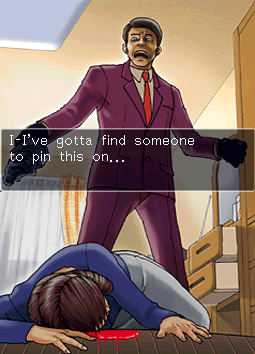
- The page image is the very first case in the series, where the player is shown Frank Sahwit panicking after killing Cindy Stone and deciding to avert suspicion from himself by claiming Larry Butz did the deed.
- On occasion (usually when the true culprit is just that Obviously Evil), this also happens with the second cases, such as the first game and Dual Destinies. And even the third case in Trials and Tribulations shows you the killer's silhouette at the start.
- The second case of Justice for All zig-zags this. The cutscene in the beginning shows the real killer talking about their crime, but not only is the person in silhouette, they also spend the entire trial disguised as someone else, so finding out who's been the intro character all along is still a challenge.
- Sometimes true nature of the guilty party is obvious when you see them for the first time, but other times they pull a U-Turn and make it someone you aren't expecting. ...Then other times, they'll know that players are expecting a U-Turn so won't give you one, instead making the real culprit the person all the evidence has been pointing to. All in all, the series does all three examples so sporadically that you usually can't tell if you should be looking out for the too obvious culprit, the so-completely-innocent-looking culprit, or the in-your-face culprit.
- The first murder in Danganronpa: Trigger Happy Havoc is an unintentional example, as the victim literally writes the killer's name in their own blood, but upside-down, backwards, and in English, so the Japanese-speaking cast think that it's a number (as a Japanese audience would most likely assume as well.) Western players, however, would see the clue for what it is right away, and thus the mystery for them is more about how the killer got into Makoto's bedroom to kill the victim (when the victim had previously stated they wouldn't open the door that night because they were afraid of being targeted), which is important to figuring out the case anyway and is a far more compelling mystery.
