
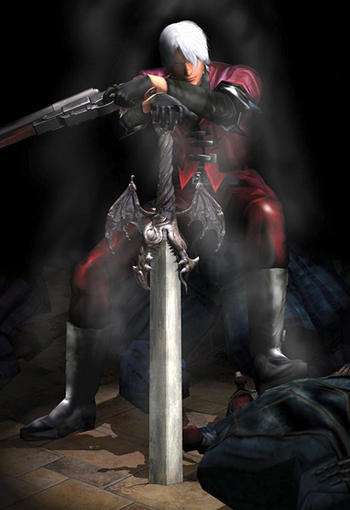
Devil May Cry is a Stylish Action Hack and Slash Video Game Franchise created by Hideki Kamiya, and developed and published by Capcom in 2001. Originally intended to be the fourth installment in Capcom's Resident Evil series, Devil May Cry branched into its own style and has been noted as the Trope Codifier for modern 3D Hack and Slash Stylish Action games.
Taking place in the modern day, the games revolve around Dante, the Anti-Hero Human-Demon Hybrid Demon Slaying son of an Ascended Demon named Sparda. Thousands of years ago, Sparda sealed away his fellow demons and freed the human world from their control. However, Sparda eventually died, leaving behind a human wife named Eva and two halfbreed twins named Dante and Vergil. Without Sparda to protect them, Eva is soon murdered, Vergil becomes an Anti-Villain obsessed with power, and Dante decides to work as a demon-hunting sword-for-hire so he can find the demons responsible for tearing apart his family and give them their just desserts. And make a great deal of money, of course.
Gameplay focuses on using mixtures of Hack and Slash, Real-Time Weapon Change, Launcher Moves, Ground Punches, Meteor Moves, Dash Attacks, Video Game Dashing, Double Jumps, Super Modes, and Stance Systems to create stylish, fast-paced Combos. Onus is placed on the player's skill with their moveset, and their ability to alternate between different weapons and moves. However, Adventure Game elements such as puzzle-solving and exploration are also featured.
The series also expanded into different media outside of video games, such as light novels, comic books, manga, an anime adaptation, a board game, and stage plays.
Compare other Hack and Slash video games, in particular Hideki Kamiya's PlatinumGames Creator-Driven Successor, Bayonetta. Despite the identical title acronym, the series isn't related with Run–D.M.C. or Detroit Metal City.
Main games
- Devil May Cry (2001): Human-Demon Hybrid demon slayer Dante fights his way through a demon-infested Haunted Castle to prevent the Big Bad his father sealed away from returning, along the way crossing paths with his brother Vergil and picking up a demon sidekick named Trish.
- Devil May Cry 2 (2003): A stoic Dante and an artificial demon named Lucia fight a Corrupt Corporate Executive who's after the powers of Hell.
- Devil May Cry 3: Dante's Awakening (2005): In a prequel to the first game, Dante tries to stop his brother Vergil from opening a Hell Gate to get his hands on the power of their father, along the way teaming up with a Badass Normal demon slayer called Lady who's looking for her demon-worshiping dad.
- Devil May Cry 3: Dante's Awakening - Special Edition (2006): Updated Re-release that adds Vergil as a playable character, a turbo mode, a "Bloody Palace" challenge mode, and new difficulty options (alongside rebalancing the existing ones so all versions match).
- Devil May Cry 4 (2008): A deuteragonist Dante and new protagonist Nero battle The Legions of Hell and each other when someone starts opening Hell Gates on the island where Nero lives.
- Devil May Cry 4: Special Edition (2015): Updated Re-release of Devil May Cry 4 for the PlayStation 4, Xbox One, and PC. Adds new playable characters (Vergil, Lady, and Trish), and a Japanese language track, plus Turbo Mode and Legendary Dark Knight difficulty in all versions.
- Devil May Cry HD Collection (2012): A compilation of remastered HD ports of the first 3 installments of the series for PlayStation 3 and Xbox 360. Re-released on March 18, 2018 for PlayStation 4, Xbox One, and PC. Devil May Cry 1 also received a port to the Nintendo Switch in June of 2019, followed by Devil May Cry 2 in September the same year and Devil May Cry 3 in February of 2020.
- DmC: Devil May Cry (2013): An Alternate Continuity Origins Episode developed by Ninja Theory, in which Dante fights his way through the Dark World of Limbo to get revenge on Mundus, the Demon Lord who killed his mother.
- DmC: Devil May Cry - Definitive Edition (2015): Updated Re-release for Xbox One and PlayStation 4. Includes new costumes, a "Gods Must Die" Harder Than Hard difficulty, a Bloody Palace mode for Vergil, optional manual lock-on, Turbo mode, "Must Style" mode,note and "Hardcore" mode.note Also includes all the previous Downloadable Content and runs at 60FPS 1080p on consoles.
- Devil May Cry 5 (2019): Taking place some time after 4, a Cyborg Nero teams up with a Gadgeteer Genius named Nico, Dante and the mysterious "V" to fight through a city infested by an evil World Tree and stop a villain who stole his demonic arm.
- Devil May Cry 5: Special Edition (2020): Updated Re-release of Devil May Cry 5 for the PlayStation 5 and Xbox Series X|S, released digitally and physically. It features Legendary Dark Knight Mode, Turbo Mode, various upgraded graphics, and playable Vergil. The latter is available for players who already own DMC5 on PlayStation 4, Xbox One, and PC in a separate DLC.
Other works
Guest Fighter appearances and Crossover Cameos
- Shin Megami Tensei III: Nocturne: An Atlus-made RPG, its Maniax rerelease, which was the basis for the game's Western localization, guest-stars DMC2-era Dante as a Recurring Boss and Optional Party Member.note Replaced by Raidou Kuzunoha, a demon hunter from the Shin Megami Tensei spin-off series Devil Summoner, with the later Maniax Chronicle Edition included with copies of Raidou Kuzunoha vs. King Abaddon, which served as the basis for the game's 2020 HD Remaster, though a "Maniax Pack" DLC is available to bring back Dante in his place.
- Shin Megami Tensei Liberation: Dx2: Another Atlus-made RPG for mobile devices which included a limited-time crossover event with DMC5, "Souls of the Devil Hunters", in which Dante, Nero and V could be recruited.
- Viewtiful Joe: A 2½D Beat 'em Up guest-starring Dante as a Secret Character in the PS2 Updated Re-release.
- Viewtiful Joe: Red Hot Rumble: A Mascot Fighter featuring Dante and Trish as Guest Fighters.
- Marvel vs. Capcom 3: A Capcom vs. Fighting Game featuring Dante, Trish, and, in Ultimate, Vergil.
- Marvel vs. Capcom: Infinite: Dante returned to the roster for this installment.
- PlayStation All-Stars Battle Royale: A Mascot Fighter featuring characters throughout PlayStation history, featuring DmC Dante as a third-party character.
- Project × Zone: A Turn-Based Strategy Massive Multiplayer Crossover game featuring Dante and Lady.
- Project X Zone 2: A sequel to Project X Zone featuring Dante and Vergil.
- Puzzle & Dragons: A Japanese puzzle/role-playing Gacha Game that had plenty of collaboration events in the past, and still gets them to this day. One of these was for the Devil May Cry series, which featured all of the usual suspects from both 4 and 5 (Yes, including Dante). However, it also had Lucia and Matier, both characters from 2.
- Last Cloudia: A mobile phone game where V, Dante and Nero were obtainable as units during a collaboration event. Vergil and the 4 version of Nero became playable in September 2022.
- Seven Knights: A Korean mobile RPG gacha game. The Devil May Cry series was one of the featured crossovers in the Korean and Japanese servers.
- Super Smash Bros. Ultimate: A Mascot Fighter featuring characters throughout Nintendo's history. While Dante doesn't appear as a Guest Fighter, a downloadable Mii Costume in his likeness does.
- Teppen (2019): A free-to-play mobile Collectible Card Game developed by both Gung-Ho Entertainment and Capcom. Dante and Nero are playable Heroes, alongside several cards themed after other DMC characters and concepts.
Related media and spin offs
- Devil May Cry (2002): A Light Novel prequel to the first game.
- Devil May Cry 2 (2003): A light novel prequel to DMC2.
- Devil May Cry (2004): A Comic Book series published by Canadian publisher Dreamwave Productions that is (loosely) based on the first game.
- Devil May Cry 3 (2005): A two-volume manga prequel to DMC3. note
- Devil May Cry: The Animated Series (2007): A 12-episode series that follows Dante's adventures between the first and second games.
- Devil May Cry Drama CD Vol.1 (2007) and Vol.2 (2008): Three scenarios voiced by the Japanese cast, the stories occurring during the same time as the anime.
- Devil May Cry 3 Pachislot
 (2007): A pachislot machine using the in-game assets.
 - Devil May Cry 4: Deadly Fortune (2009): A Japan-only two-volume novelization of DMC4 done by the game's scenario writer.
- Devil May Cry 4 Refrain (2011): A simplified iPhone port of DMC4.
- Devil May Cry 4 Pachislot (2013): A pachislot machine using the in-game assets.
- DmC: Devil May Cry - The Chronicles of Vergil (2013): A prequel graphic novel of DmC.
- Sengoku Basara vs. Devil May Cry (2015): A stage play in Tokyo that combines characters from the Sengoku Basara and Devil May Cry franchises.
- Devil May Cry X: The Last Judgement Pachislot (2016): A pachislot that used the in-game assets, the "X" pronounced "cross". Contains additional cut scenes and lines that apparently tied Vergil's story closer to 4.
- CR Devil May Cry 4 Pachislot (2018): A pachislot machine that uses a different graphics engine to retell the events of 4SE.
- Devil May Cry: The Live Hacker (2019): A live-stage play that takes place after 3.
- Devil May Cry 5: -Before the Nightmare- (2019): A prequel light novel with multiple vignettes detailing what different characters were up to before and during the prologue of 5, like how Nico and Nero met.
- Devil May Cry 5: Visions of V (2019-2022): A 36-chapter manga spinoff showing V's side of the story leading up to the events of 5.
- Devil May Cry: The Bloody Palace (2020): A board game produced by Steamforged Games Ltd.
- Devil May Cry: Peak of Combat (2024): A Gacha Game developed by China-based NebulaJoy (previously known as YunchangGame). The game uses 3's version of Dante, Lady, and Vergil's designs, but also uses elements from 3, 4, DmC, and 5 while telling a completely different story not related to the main titles. After a series of open and closed beta tests held from 2019 onward, the game was released on January 10, 2024.
- A Netflix-based animated adaptation produced by Adi Shankar, supervised by 3-5 game director Hideaki Itsuno, and animated by Studio Mir. While details are currently sparse, Adi has stated that this new show will join Castlevania (2017) in what he is calling the "bootleg multiverse". First teaser trailer released on September 27, 2023.
This page is gettin' crazy! Let's list examples!
Note: Each game in the series now has its own page, as does the anime. If a trope or an example only applies to one or two games in the series, or only to the anime, put it on that page. Likewise, Character-specific tropes must be placed on their Character folders, especially tropes that only apply to one or two characters. To simplify the labels in this page's trope list, the mainline games are referred to by their numbers, while acronyms (e.g. TAS, DmC) are used if necessary.
- Action Game: The general gameplay consists of pulling off long, stylish chains of attacks to dispose of enemies, with the player's dexterity being rewarded with items and a higher score.
- Action Girl:
- Trish doesn't get a lot of action scenes in the first Devil May Cry game, but even in the intro cutscene, she is clearly capable of taking on or hurting Dante, something only Mundus and Nelo Angelo are capable of doing in the story. Later installments helped this trait of hers shine even further, such as involving her in more fights, or making her playable (in Devil May Cry 2 and Devil May Cry 4: Special Edition). In the fourth game, Trish also disguised herself as Gloria, yet she can still single-handedly wipe out a horde of Scarecrows with just a pair of daggers.
- Lucia, the Deuteragonist of the second game and first playable female character of the franchise easily qualifies. She is an artificial demon created by the villain Arius and was adopted into a warrior clan who protect their home from evil with their fighting skills and powers borrowed from the gods they worship. Lucia is also the first female character of the series to take on and defeat a final boss of her own in story.
- The DMC2 novel features Beryl, a Badass Normal demon hunter who relies only on her BFG to take out demons. She is something of an antecedent to Lady below.
- Lady is introduced in the third game, and she already qualifies by taking out demons with enormous ease using her guns, rockets, and explosives. Even more impressive considering she is just a normal human being with no magic or demonic powers. Like Trish, she's also playable in the Special Edition of the fourth game.
- Adam Smith Hates Your Guts: Every time you purchase an item with Red Orbs, its price gradually goes up until the price freezes after a certain amount of purchases. Depending on the game, another layer is added to this mechanic:
- With the Proud Soul system in 4, the price of every other ability goes up every time you buy a new ability, but you can also lower the prices again by refunding your abilities.
- 5 allows you to revive your character on the spot by spending Red Orbs, but the price goes up with each consecutive revive attempt and becomes more expensive on the higher difficulty modes.
- Air-Dashing:
- From 3 onward, Dante's Trickster Style grants him the ability to perform a dash in the air. This is manifested as a red, circular incantation that he bounces off of.
- In 5, Nero's Gerbera Devil Breaker can fire a concussive blast that propels him through the air, making this a prime tool for maneuvering around enemies.
- In DmC, Dante can perform an airborne dash using his Angelic powers.
- Airborne Mook: Each game always includes one or more types of flying demons, such as the Bat-form Plasmas in 1, Puias and Flambats in 2, Blood-goyles and the Fallen in 3, Mephistos, Angelos and Fausts in 4, Bathos, Pathos (and their shielded versions) in DmC, Green Empusa and Hellbats in 5, etc... They typically move fast and zip around, but are vulnerable to firearms and can fall if damaged enough.
- All There in the Manual: The series' artbooks not only provide staff commentary regarding the illustrations and development details of some characters and concepts, they are also treasure troves when it comes to elaborating plot points that are never, or barely covered by the games. The Devil May Cry 3142 Graphic Arts artbook, for instance, contains a series-wide Interviews section dedicated to providing such kind of information. There are also materials and artbooks dedicated to a specific installment, such as the Devil May Cry 5 Official Artworks.
- Amazing Technicolor Battlefield:
- Many Bloody Palace stages tend to be this, with strange light shows going on under the floor or nebulae flying by.
- In the finale of 3, you fight a blob-shaped Arkham in some kind of shallow pool of various shades of purple and pink with a lot of black spots thrown in (Said black spots are the eyes and mouths in the faces of the souls of the damned that make up the pool). The exploding dolphin things he summons as backups are also writhing in technicolor energy.
- In DmC, A lot of areas in Limbo are full of blown-out, super bright colors and equally trippy designs. Lilith's nightclub deserves a mention, though - it's a demonic night club crammed with flashing neon lights and jittering sound waves with colors even more super-saturated than regular Limbo.
- Ambiguous Time Period: The series in general refuse to give an exact calendar, not even a fictional one, in any shape or form. The events in each game happen in a vaguely described "modern times" with the presence of technology and fashion that could be from anywhere in the eighties to the 2000's and beyond, most evident in 2, 3 and 5 with its initial urban settings before Dante and friends traverse the more demonic locations. The lack of cellphones in the series is the greatest barrier in any attempt to assume when the series could take place, since cellphones rapidly change over time moreso than most other tech, thus seeing a model on-screen would greatly help any assumption. The indication of days and dates passing in 5 was the first time the series ever had something close to a calendar being taken into consideration.
- Anachronic Order: For the original continuity, the major installments are chronologically arranged in this order: Manga 3 > 3 > 1 > Anime > Novel 2 > 2 > 4 > Novel 5 > 5. The original confirmation of 5 taking place after 2 was courtesy of French gaming site ActuGaming's interview with director Hideaki Itsuno, and 5 producer Matthew Walker's responding tweet to a fan's question. However, Capcom TV later streamed a quick summary video that put 2 before 4, causing much confusion until Walker confirmed it on Twitter.
- Anti-Frustration Features:
- In 1, the Nightmare fights make you face off against all the previous bosses. But when you fight Nightmare Nelo Angelo, you fight his phase two form instead of his far more difficult phase three form.
- In 2, Mission 15 requires the player to defeat a set number of enemies within two minutes to progress. The enemies become weaker with each failed attempt.
- In 3, dying a few times on Normal mode unlocks Easy mode.
- In 4, choosing "continue" a few times in a chapter automatically handicaps the enemy.
- In DmC, enemies will be less aggressive when out of sight, keeping you from getting blindsided too often. Likewise, Angel-element enemies never have shields, since every reliable method that can break shields is Demon-infused.
- There are several quality-of-life features in 5, covering new mechanics introduced in the game (like Nero's Wire Snatch being usable even without Devil Breakers), or resolving issues that plagued older DMC games (like how 5 now automatically turns off Devil Trigger mode every time a Bloody Palace floor is cleared).
- Armor Is Useless: The playable characters' weapons cut and pierce armored enemies like butter. The only enemies that can defend against the player's attacks are those with magical barriers, shields or demonic weapons of their own.
- Arrange Mode:
- In higher difficulty modes such as "Dante Must Die" and above, the enemies' placements are significantly altered to the point where Elite Mooks can spawn in the early missions. Depending on the game and its mechanics, these modes can also affect puzzles, platforming sections (such as the Dice Game and the moving Grim Grips in 4) or the availability of pick-ups (such as Green Orbs, White Orbs and Devil Breakers being less common or completely absent in the higher difficulties of 5).
- The "Must Die" difficulty mode gives the enemies access to Devil Trigger after a certain amount of time has passed.
- From the third game onwards, there's the "Heaven or Hell" mode where the damage values are cranked up to the point where both you and the enemies are One Hit Point Wonders, while enemy shields or barriers can be removed instantly with one attack. Depending on the game, this mode also affects other factors. In 4, Red Orb Crystals reward a massive amount of orbs on the first hit, while puzzle mechanisms activate immediately when struck. In 5, the checkpoints in the stages are removed.
- "Hell and Hell" mode borrows the enemy encounters and/or enemy health from the Son of Sparda difficulty, but your playable character dies in one hit.
- "Legendary Dark Knight" mode ramps up the difficulty by spawning a massive amount of enemies during encounters. Sometimes, the player faces off against dozens of enemies at once.
- The Definitive Edition of DmC has "Gods Must Die" which kicked the difficulty up a notch by spawning all enemies in their Devil Trigger state, completely removing all healing items, and replacing all Green Orbs with Red Orbs. It also introduced the "Must Style" mode which requires the player to maintain an S Stylish Rank or higher to be able to damage enemies.
- Artifact Title: The Devil May Cry: 3142 Graphic Arts artbook references the initial Anachronic Order of the first four games in its title. However, that title no longer holds true after the updated chronology later swapped 2 and 4.
- Artistic License – Physics:
- After launching an enemy airborne, you can keep them suspended in mid-air by continuously firing at them with your standard guns. Vice-versa, you can slow down your descent from mid-air by firing any gun regardless of direction. These are cool tricks that defy gravity and the Laws of Motion. The second game makes these gunplay even more absurd as repeatedly shooting a lesser demon gradually lifts it up in mid-air, and firing your guns in mid-air gives you another upward momentum.
- In 1, the Frost demons' claws are said to be at below absolute zero temperature. This might be trying to imply that they're supernaturally cold, but it still sounds like a defiance of physics. In the Kelvin Scale, nothing can be colder than absolute zero.
- While the series does its best to ignore physics completely, it does at one point mention how Dante is too cool for the law of conservation of momentum. The description of Spiral's "Reflector" skill in 3 states that Dante ricochets the bullet off nearby surfaces to increase its speed and deal maximum damage, even if collisions of that kind should've reduced the kinetic energy.
- Asskicking Leads to Leadership: The Always Chaotic Evil Demon World lives by this rule. The games and their supplementary material such as the Devil's Material Collection artbook and the Before the Nightmare prequel novel revealed bits of backstory to describe this as a recurring plot.
- There was an unnamed Demon King, but Mundus (who gained power from consuming a Qliphoth fruit) killed him in order to take over as the new Demon King.
- Although a great war occurred between him and Mundus, Argosax ruled over the rest of the Demon World and subdued all the demons under his domain.
- Berial once conquered and ruled a domain called "Fire Hell", while Echidna ruled the great forest in the Demon World before she took over the Mitis Forest in Fortuna.
- In DmC, "Kyle Ryder" a.k.a. Mundus controls virtually the entirety of the world's economy. He's also invincible under most circumstances, supremely strong compared to all other beings barring Nephilim, and has a large degree of control over the chaos in Limbo.
- Atrocious Arthropods:
- 1:
- Beezlebubs are insects that have grown to enormous proportions as a result of possession by demons. Blue Beelzebubs resemble flies and can spit out maggots that stop you from using guns, while green Beelzebubs resemble mantises.
- Phantom is a massive spider/scorpion demon who serves as one of the bosses in the game.
- The Kyklops are lesser demon enemies that resemble the aforementioned Phantom.
- 2: One of the game's bosses is Noctpteran, a giant moth demon under the command of Arius.
- 4: Agnus is the Evil Genius of the Order of the Sword, the main villains of the game. His demon form is a large humanoid insect.
- 5: the Empusa are insect-like demons who deliver all the stolen blood back to the hive which serves as the center of the Qliphoth.
- 1:
- Attack Its Weak Point: Several bosses receive more damage when certain parts of their body are attacked (e.g. Phantom's face, Beowulf's eye, Cerberus' heads, The Savior's blue jewels, Bael and Dagon's tongues, Gilgamesh's back, etc...) Oftentimes, dealing enough damage to any other part would stagger the boss, leaving their weak spots exposed.
- Awesome, but Impractical:
- Certain powerful moves don't work well when you're surrounded by crowds, mostly because they hit only one target at a time, because they have long start-up animations or short range, or because the character is left vulnerable for a while (especially if the attack whiffs as a result of the target moving away during the start-up). This can happen to Dante's Real Impact, to the Pandora's PF422: Grief in 4, or to Nero's Showdown. Nero's Buster moves also have this problem in a smaller scale; while they deal sufficient damage to individual enemies, their animations take a while and some don't even give him invincibility frames.
- The Sparda sword in 1. While a sword that can turn into a scythe is stupidly sweet, the lack of a Devil Trigger leaves you significantly better off using Alastor or Ifrit. At least, until the final battle, where it proves worthy of its name. Sparda does the extra damage Alastor does during Devil Trigger; nothing to write home about at first, but as you ramp the difficulty up towards "Dante Must Die", actual Devil Trigger abilities become progressively more useless, and melee attacks become your primary source of damage.
- In 2, the Charged Attack of Trish's Nightmare-γ fires a swarm of pinballing Frickin' Laser Beams in every direction but don't go straight at the enemy. Considering how the areas where you fight enemies underwater are huge, there's a chance that none of the pinballing projectiles actually hits anything.
- Nevan in 3 is surely awesome, but ridiculously difficult to use effectively since its attacks are less straightforward or slower than all other Devil Arms; summoning bats that home in on enemies and doing singular Area of Effect attacks instead of having combo strings you smack them with. It is also complex and rather unclear in terms of holding and releasing buttons, and most of its attacks involve moving the left stick in a precise direction (not just forth or back as with other weapons). In the middle of a fight, Dante's position is usually compromised if he's surrounded while charging Nevan, yet constantly moving around makes inputting controls quite tricky.
- In 5, the taunts gained from the EX Provocation skill are elaborate, well-choreographed sequences that give an instant SS rank. That said, they only give the rank if done fully; they're extremely long, leave you vulnerable, and they're the most expensive upgrades in the shop. V is the only character who could possibly use it in proper combat, since his demon pets can still attack while he dances.
- Awesomeness Meter: Combat is graded based on a number of factors, including variations within combos, number of hits, taunting, and damage taken. The better you perform, the faster the Style gauge fills up, which in turn, raises that battle's Stylish Rank from D to SSS (depending on the game). The Style gauge trickles down if you remain idle for a long time, but the Stylish Rank can drop several levels at once if you get hit. The first four games visualize the gauge using a horizontal meter below the Stylish Rank, but DmC and 5 used the Stylish Ranks' D to SSS letters as the vertical meters instead.
- Backtracking:
- In the early games, there are some sections that require backtracking (Mallet Island in 1, the Uroboros building in 2, and the Temen-ni-gru's lower levels in 3), but those were the well-done variants that change something in the environment and/or open a path to a new area.
- It's also present in 4 — and how! Nearly every reviewer called it out. Basically, Dante's part consists of retracing every step Nero went through, but in reverse. This was exacerbated by how the initial run with Nero already had some backtracking in and of itself.
- In DmC, you retrace your steps to Phineas after chasing the Harpy that stole his mechanical eye.
- 5 has segments where you have to find and destroy a Qliphoth Root's Blood Clot, and then return to the path that was previously blocked by that root. But when compared to the previous DMC games, the backtracking segments in this game are mostly short, streamlined, or self-contained within the same mission.
- Badass Crew: Dante, Trish and Lady make up the original Devil May Cry agency which specializes in hunting demons. Though Dante serves as the leader, all three of them have a deep respect for each other and are equally capable of eliminating their enemies. As of 5, Nero and Nico also tag along with them, but the two have their own mobile version of the Devil May Cry business.
- Badass Family: Three of the playable characters are Vergil, Dante, and Nero, all of whom are descendants of the Legendary Dark Knight Sparda and have inherited his demonic powers.
- Badass in Distress
- 2 has Lucia, who is perfectly capable in-game, but has to be rescued by Dante from explosions in cinematics twice. She also doesn't accomplish much without Dante, being captured by Arius and staying behind while he enters the portal to Hell. She does, however, kill Arius when he returns as a demon.
- In 4, Nero is absorbed into the Savior midway through the game. It takes Dante jamming Yamato into the giant statue's crystal to rescue and wake Nero up inside.
- In DmC, Vergil is powerful enough to be the final boss but gets in trouble a few times throughout the game. In the first instance, he's cornered by a demon and has to be saved by Dante (mainly because Vergil can't use his powers without outing himself as a Nephilim - which would give away their trump card to Mundus). The second time is during the fight with Mundus, where Mundus sucks him into the vortex and keeps him there until Dante busts him out.
- Much to Morrison and Nero's surprise, Dante, Trish and Lady are actually defeated by Urizen in the prologue of 5, with both girls getting captured by Urizen via the Qliphoth's roots, and Dante being MIA and assumed dead by most characters until he was found by V, albeit in a coma. Nero is almost captured after being beaten by Urizen during their second encounter. Luckily, Dante arrives just in time to free him and have Griffon carry him somewhere safe. More than halfway through the story, V is also cornered by Malphas before he is rescued by Nero.
- BFG: The "big guns" silliness comes along with the Rule of Cool in the franchise. Gameplay-wise, these deal higher damage at the expense of lower fire rates or slower projectile speeds in contrast to the standard firearms.
- 1 allows Dante to obtain the Grenadegun, a revolver-style grenade launcher to play with, along with an Energy Weapon called Nightmare-Beta which covers his entire forearm.
- 2 has Dante tool around with a distinctly traditional Stinger Missile Launcher fired over-the-shoulder.
- 3 gives Dante the Spiral, a colossal Lahti L-39 anti-tank rifle which has a noticeable recoil due to its size, yet its shots pack a punch. There's also Lady's trademark BFG, Kalina Ann; a rocket launcher with a rather large bayonet attached. It's about as big and tall as she is, yet not only does she lift it easily, she can also whip it out in time to stick the bayonet in a wall after being dropped off the tower. She temporarily gives it to Dante after their fight, hoping that it could help him defeat Arkham.
- In 4, Dante sports the Pandora, a suitcase which can transform, among other things, into large guns that start at about the size of his torso; from a rocket-launching heavy bowgun, a bazooka, a stationary laser turret, and a flying craft equipped with roughly twenty rocket launchers which all fire at once with the press of a button. In the Special Edition, playable Lady uses her Kalina Ann rocket launcher as one of her primary weapons, while Trish inherits some of Pandora's gun forms.
- Lady's Kalina Ann rocket launcher returns in 5 as a hidden weapon in one of the levels. If Dante finds it by the climax of the game (where Nico gives him a replica of the weapon), he gains the "Double Kalina Ann", which is him dual-wielding two rocket launchers that come with the ability to join together to fire off a massive laser.
- BFS:
- Dante's Rebellion and Nero's Red Queen are almost their own height in length. Dante acquires several other demonic swords that also qualify for this trope over the course of the series, such as the Vendetta blade in 2 which is also about as broad as Dante's shoulders, and the Devil Sword Dante in 5 which has a wide decorated blade.
- The Devil Sword Sparda has a large curved blade attached to the side of its main body and hilt. Compared to the Rebellion, this sword has a longer reach, and can extend itself further or transform during some of its attacks.
- Several enemies are also equipped with long large blades, such as Nelo Angelo's greatsword, Berial's flaming warblade, Angelo Credo's evolved sword, and Cavaliere Angelo's serrated electric blade.
- The Gladius demons in 4 can fly and transform into swords larger than the protagonists' weapons.
- In 4, Nero's Devil Trigger specter wields an oversized version of the Yamato katana.
- The Blade Always Lands Pointy End In: Swords always land by stabbing the ground, no matter how big or unbalanced they seem. The camera would often focus on them if this happens in a cutscene, just like how it did with the Rebellion in the climax of 3, or the Sparda in the finale of 4.
- Blob Monster:
- The Nightmare boss in 1 is an amorphous black mass that tries to swallow Dante. If exposed to light, it morphs into a solid, robotic form. In 5, a similar Nightmare demon serves as one of V's familiars, taking the form of a towering muscular golem that can emerge and dissolve into a puddle of goo as it enters and exits battles.
- After you defeat Mundus' first forms in 1, he begins to crumble until he ends up a horrid slimy blob with a lot of arms and eyeballs.
- Argosax the Chaos is an amalgamation of almost every boss in 2, resulting in a grotesque lump of flesh with countless demons' faces and limbs gruesomely merged into each other.
- Arkham in 3 degenerates into a bulbous, slimy monster after he fails to contain the power of Sparda.
- Blocking Stops All Damage:
- Dante's Royal Block skill can negate anything if properly done, including explosions, electrified floors, and 100ft tall statues dropkicking him. Mistimed blocks can break, causing Dante to take damage.
- Nero can block attacks by meeting them with his Devil Bringer (especially during cutscenes). In-game, a well-timed Buster can block all sorts of attacks, from giant spears, massive demons, and even punches from the False Savior. There's also the "Hold" skill which makes him carry a demon as a makeshift living shield.
- Many mooks and bosses can put up a defensive stance to stop your attacks cold. Some of the playable characters' heavier attacks can go around these.
- Blonde, Brunette, Redhead: Dante's leading ladies in the first three games are the blonde Trish in 1, redheaded Lucia in 2, and brown-haired Lady in 3.
- Blood Magic:
- When you kill monsters, you collect their crystallized blood and offer it to the nebulous God of Time to upgrade your powers.
- Certain demonic structures and organisms require blood to function. In 3, Arkham used the blood of Dante, Vergil, and Lady to open up the portal to the demon world. He needs this because the portal was sealed by Sparda (Dante and Vergil's father) using his own blood and the blood of a mortal priestess, Lady's ancestor. In 5, the Qliphoth's roots absorb human blood so that the demonic tree could produce a fruit that grants immense power to a demon that consumes it. Some in-game puzzles or secret passageways also require you to redirect fountains of blood to a given object before you can proceed.
- Blown Across the Room: Most guns in-game can send lesser demons flying back, but it usually depends on the firearm and the attack. Rocket and missile launchers like the Kalina Ann and Pandora easily accomplish this feat with just their normal shots, shotguns tend to do this at point-blank range, while handguns need stronger attacks such as Charge Shots in order to do so. Nero's revolver and Lady's handguns are equipped with explosive ammo to justify the latter kind. The in-game physics can come into play as the target is thrown at a greater distance if it's launched airborne beforehand. You can also be on the receiving end of being pushed back in games where The Gunslingers Dante and Lady are individually fought as bosses.
- Boring, but Practical: Standard ranged weapons (e.g. Ebony & Ivory, Luce & Umbra, Blue Rose, Summoned Swords) deal weak damage for every shot, but are useful in extending combos and keeping your Stylish gauge from dropping, especially if the next target is too far away from you.
- Boss Rush: Played with several times, as each game gets progressively closer to a true boss gauntlet.
- In 2, Argosax is an amalgamation of the previous bosses, whom the player has to fight simultaneously.
- In 3, one of the levels requires the player to kill previous bosses in order to progress, but the battles are tied to a puzzle, meaning a savvy player can make it through that sequence while fighting three bosses at most.
- 4 has an actual Boss Rush in the penultimate level, as Nero is forced to take down Berial, Dagon, Echidna and Angelo Agnus within The Savior, but those fights involve a puzzle segment in between.
- 5 has two downplayed versions of this; one where you fight weaker versions of Goliath, Artemis and Cavaliere Angelo, and the other one happens in Stages 98-101 of the Bloody Palace mode where you fight Urizen's three forms, followed by Vergil back-to-back.
- Bottomless Magazines:
- Dante can run out of ammo but his weapons refill automatically given time. According to 1's game manual, one of his demonic powers creates more bullets in his guns.
- While Lady and Nero have shown impressive reloading skills, Lady plays this straight during Mission 16 of 3 when Dante picks a fight with her; she is never seen reloading her Kalina Ann rocket launcher. Nero subverts this in 4 during gameplay since he can shoot as long as he wants but if he stops (don't do anything else), he will finish with what is apparently a quick reload. In 5, this is subverted again for Nero's Color Up skill. He reloads the Blue Rose with special bullets, yet he never runs out of them as the skill can be used over and over again.
- Bragging Rights Reward:
- Completing the "Must Die" difficulty in 1, 3, 4, and 5 unlocks a "Super Costume" for Dante or the other playable characters. These costumes are all purposely overpowered as they grant unlimited meters for the Devil Trigger transformation, and other mechanics like Nero's Exceed. In 2, completing said mode unlocks a cheat code that enables unlimited Devil Trigger regardless of the equipped costume. The Special Edition of 3 gives Dante and Vergil additional Super Costumes that have more benefits than their standard Super Costumes (unlocked by completing the Very Hard difficulty or Bloody Palace mode), such as health regeneration and unlimited usage of DT-reliant abilities. In DmC, they are classified as Perks instead of costumes.
- Beating the last of 12 Secret Missions in the first game offers you a Bangle of Time. Equipping it changes Devil Trigger to stop time, though it doesn't work on bosses and it's obtained so late in the game you only really get to use it during New Game Plus.
- In 5, each character has a special "EX Provocation" taunt that you can buy for 3,000,000 red orbs. It raises the Style gauge more than the regular taunt, but really, was it money well spent?
- Bring It: The dedicated Taunt button has this in its suite.
- In 1, Dante can taunt his enemies by pressing R2, making a beckoning hand gesture. If the button is held long enough, he'll use both hands and it will double the Devil Trigger recovery benefit.
- Depending on your playable character in 3, 4, and 5, you can do the becknoning hand gesture with the Taunt button. Dante and Nero even say "Come on!" or a variant of it. Apart from restoring some DT gauge like it does in 1, it also increases your Stylish Rank's gauge, though the taunt animation itself changes depending on the current Stylish Rank.
- Used by the enemy in the first mission of 4. During the tutorial segment where the player is familiarized with the jump and dodge mechanics, the player is tested by having to avoid a barrage of bullets from Dante. If the player is hit, Dante uses the beckoning hand gesture to taunt them.
- Camp: The dialogue is hammy, the action defies physics, most of the impressive acrobatics or fights are exaggerated in cutscenes, most weapons are Impossibly Cool Weapons, and the general stylish concept of the games runs on the Rule of Cool.
- Car Fu:
- In 1, Trish bursts through Dante's door on her motorcycle, then she hurls it at him.
- In 3, Dante uses Lady's motorbike to drive up Temen-ni-gru's outer wall, falls towards it for a short distance, and then is besieged in midair by Blood-goyles. So he beats all of them up with the motorbike which explodes shortly after he lands, leaving only the handlebars.
- In 5, Nico rams demons with the van she and Nero are riding on during the prologue, she also rams her van against an Empusa that was about to attack the unnamed soldier whom Nero nicknames "Crew cut", Goliath hurls an ambulance at Nero before they fight, Cavaliere Angelo hurls a motorcycle at Dante to get his attention, while the Caveliere Devil Arm is a dual-wielded motorcycle/chainsaw hybrid, complete with Bike-Fu when used by Dante.
- Catch and Return:
- Vergil in 3 shows the ability to block bullets by spinning the Yamato really fast. In a cutscene, he also catches the bullets with his katana and lays them down on the ground before knocking them right back to Dante.
- During the battle with Credo in 4, the spears that he throws can be caught with the Devil Bringer and then thrown right back at him.
- In DmC, the blades thrown by the Witches can be hooked using Demon Pull and kicked back at them.
- Catchphrase: "Jackpot!" is a recurring catch-phrase, usually said right before defeating the Big Bad. Throughout the series, Dante, Vergil and Nero have said it.
- Central Theme: Fatherhood.
- Dante's demon father Sparda is the Greater-Scope Paragon of the series who fell in love with a human woman Eva. Many of Dante's foes have a bone to pick with the disappeared Legendary Dark Knight but pass the blame on him instead. His character arc largely revolves around his acceptance of the power he inherited from his father.
- In contrast to Dante, Vergil embraces his demonic heritage and wishes to surpass Sparda in power. His character arc also largely revolves around his desire to obtain what he can still further inherit from his father's power. Ironically, he finds himself on the other side of the theme when it's revealed that he fathered later protagonist Nero; said paternal bond actually convinces Nero to save both Dante and Vergil from their perpetual feud, even though Vergil was never part of his life.
- Lady gets involved in the plot of the third game because her father Arkham has committed numerous atrocities, including murdering her mother, in the pursuit of greater power.
- In the fifth game, Nico wasn't bothered at all by the death of her father, Agnus, because he has abandoned Nico and her mother in the past.
- Chaos Architecture: Despite being supposedly the same building, Dante's Devil May Cry shop has multiple and drastic redesigns through the games and the animated series. Notably in the first and second games, it is contained in a single small room while in later works, it is more spacious and has stairs leading to a second floor.
- Character in the Logo: Trish's silhouette is part of the logo and a Visual Title Drop in the first game; Dante's silhouette is in 2, 3, and the anime; Lucia's outline was part of 2 on her disc; and Nero's silhouette is in 4. DmC and 5 are the exceptions where DmC doesn't have a silhouette, and 5 simply have wings shaped in "V" for the Roman numeral 5.
- Charged Attack: Both types of charged attacks are present in a lot of moves:
- The "Hold" type:
- Although it mostly depends on the weapon, this is a common feature that applies to many ranged attacks. Dante, Trish, Nero and Lady can charge some of their firearms for extra damage per shot. Nero channels the Devil Bringer's demonic energy into the Blue Rose for his Charge Shots, working like a standard Mega Man-style charged shot, but later upgrades allow it to blow up adjacent enemies or add an additional delayed explosion.
- Certain attacks (e.g. Round Trip, Drive, Judgement Cut, Hard Way) require you to hold a button to perform them, and some (e.g. Drive, Maximum Bet) deal more damage if they are held longer. Some games also have gauntlet-type/gauntlet-and-greave-type weapons (e.g. Ifrit, Beowulf, Gilgamesh, Eryx) with held charged attacks as their core mechanic for dealing more damage, especially on their ground combos. Depending on the weapon or the move, these charged attacks may also come with the benefit of a "Just Frame" Bonus upon releasing the held button at opportune times.
- In 5, all of Nero's "Break Age" moves with his Devil Breakers are performed by holding down and releasing a button. The Tomboy Devil Breaker also allows him to supercharge Blue Rose's shots, at the cost of having to manually aim it and hold down the shoot button.
- The "Collect" type:
- In all games where it's available, Dante's Royalguard Style comes with a Rage Meter or Royal Gauge that is filled by blocking hits from enemies. He can then perform an attack called "Release" where he releases all of the meter stored for a single powerful attack. Depending on the game, the meter can also be consumed to perform additional skills, such as the "Ultimate" in 3 that lets you Heal Thyself with the meter, the "Dreadnaught" form in 4 that turns Dante into an invulnerable Stone Wall, or the "Royal Revenge" in 5 that lets you perform an automatic Counter-Attack at a cost of a Royal Gauge stock.
- In 4, Pandora has a Disaster Gauge which is filled by doing normal attacks with it, and depleted by using its more powerful Gunslinger Style attacks, such as the "PF594: Argument", "PF422: Grief" and "PF666: Omen".
- Nero's Red Queen has a special mechanism called Exceed, where he can rev his sword to turn it into a Rocket-Powered Weapon, igniting the blade, and increasing its power if you attack while a meter is filled up. It has 3 levels and it's charged by either tapping and holding the rev button multiple times until the EX Gauge is full, or tapping the rev button while you're attacking normally with the EX-Act skill.
- In the Special Edition of 4, Lady's DT gauge can be consumed to trigger an Area of Effect explosion.
- In the Special Edition of 5, Vergil's Limit Breaks consume a specific meter for each use; he can perform "Judgement Cut End", "Hell on Earth", or "Deep Stinger" in human form at the cost of emptying his SDT Gauge, while his "World of V" empties his Concentration Gauge.
- For charged attacks that mix both the "Hold" and "Collect" types:
- The Devil Trigger Explosion in 3 which can be performed by holding the Devil Trigger button until the filled DT runes in the HUD glow. The more runes glow, the more powerful the explosion, and you can't use it if there are less than 3 runes filled up.
- Nero's EX Streak can be held to delay the attack, allowing you to charge the EX Gauge further before unleashing it. But like other Exceed attacks, this also consumes the EX Gauge.
- In the Special Edition of 4, Lady's shotgun has a meter and up to three lights that can be filled up by holding the shoot button. The more lights filled, the longer she can end up firing powered shots.
- Most of Vergil's specialized Summoned Sword/Mirage Blade formations in the Special Editions of 4 and 5 both consume a portion of the DT gauge, and require the player to hold then release the shoot button.
- Nero's Color Up skill in 5 charges up Blue Rose's shots through him loading a stronger set of bullets; he can have up to 3 powered-up shots at a time, indicated by icons on the HUD.
- In 5, holding the DT button allows Dante and Vergil to transfer their regular Devil Trigger gauge to their Sin Devil Trigger gauge, which further enables access to a stronger transformation and some ultimate moves that consume the latter.
- The "Hold" type:
- Charge Meter:
- All weapons that have "Hold"-type charged attacks glow to indicate their charge levels. The visuals vary depending on the character, weapon, or game, but it's usually the largest glow that indicates the highest charge.
- "Collect"-type charged attacks have unique meters in the HUD to indicate their levels, such as Dante's Royal Gauge, Pandora's Disaster Gauge, shells for Lady's shotgun, or bullets for Nero's Color Up shots. Specific weapons even glow in accordance to their charge meter, such as Red Queen turning red as it accumulates EX Gauge.
- Chekhov's Gun:
- In some games, you could inspect or spot some conspicuous objects early on, but your character would ignore them because they don't need those items yet, or have no means of reaching them at that time. It turns out those are going to be used as in-game Key Items or necessary puzzle elements later on, especially after some backtracking involved. For example, this applies to the Staff of Hermes in 1 (which can already be found in the third mission but is used in the late game), the Soul of Steel in 3 (which can be found in an early cage but is later used to walk across a chasm), or the Gyro Blades and Wing Talisman platforms in 4 (which are only activated after you obtain their proper key items).
- In 1, the biplane encountered in the first mission (christened Carnival according to Viewtiful Joe) is later used to make your escape from Mallet Island. Nobody knows how or why it was here to begin with, or why it's suspended by strings along with some marionettes, but who cares; it crashes through the ceiling in perfect working condition when everything is crashing down and the player is meant to think that Dante and Trish are screwed. Dante's Amulet is also listed as an inventory item at first, but it's actually plot-relevant as Nelo Angelo suspiciously backs off after seeing it, and it transforms the Force Edge into its awakened form, the Sparda.
- In 2, Dante's lucky coin is used in a Fake MacGuffin Batman Gambit to fool Arius.
- In 3, some statues resembling human-sized chess pieces are suspiciously scattered in the early parts of Temen-ni-gru, albeit inanimate at first. Then you realize later on that they're Damned Chessmen, a common threat throughout the tower, and in Mission 18, you finally square off with the entire chess board, king included. Dante and Vergil's halves of the Perfect Amulet are also used to undo the seal of the tower, and the bells you see strewn throughout Temen-ni-gru are involved in the ritual used to open the gate to the underworld.
- In 4, Nero's Devil Bringer is arm-slinged during the prologue, which he then quickly uses as a trump card to beat Dante. It also serves as the container of the Yamato mid-way through the game's story, especially after Dante allowed Nero to keep the sword as his own in the finale.
- Cliffhanger Wall: 2 ended with the protagonist, Dante, going through an apparent one-way motorcycle trip to the Demon World. The epilogue cutscene implies the plot twist of him returning as Lucia hears a motorcycle engine outside the Devil May Cry shop, but he's never shown on-screen to confirm it. The following game, 3, was a prequel to the series. The next game after that, 4, also used to be a cliffhanger wall, taking place between 1 and 2. For more than a decade, the series did not follow up on that ending, and it's only until the Before the Nightmare prequel novel of 5 where a Hand Wave was given to explain how Dante made it out of the Demon World - a portal "hole" just appeared in front of him, allowing him to return. In order to make the continuity more consistent with that ending, 4 was also retconned into being a sequel to 2 instead.
- Colour-Coded Timestop:
- The earliest games use straightforward visual effects that affect the majority of the screen or the environment; reversed colors in 1, 2 and 3, and then grayscale in 4.
- In DmC, Dante's Devil Trigger paints the environment in black and white while his coat gains a glowing bloody red aura.
- In 5, the Elder Geryon Knight's timestop and the Ragtime Devil Breaker's Break Age move color the screen in a purple-gray tint. It also comes in a smaller scale via the time-stopping spheres produced by the Elder Geryon Knight, the Ragtime, and Urizen; anything inside the spheres will be tinted, while those outside will have normal colors.
- Competitive Balance: Whether it's comparing the different ways Dante can deal out the hurt with his various weapons or styles or just comparing the playable characters with each other, this trope shows up in each game, wherein a weapon or character has a balance of both strengths and weaknesses.
- Compilation Re-release:
- Before the HD Collection re-release, this franchise had the 5th Anniversary Collection containing the first three games in the series. Other than using the Special Edition of 3, there were no additions or changes from the original releases.
- Capcom Essentials for PS3 and Xbox 360, which includes five games: Super Street Fighter IV, Resident Evil 6, Devil May Cry 4, Dead Rising 2, and the digital code for Mega Man 10.
- High-definition upscaling compilations of PlayStation 2 games for the PlayStation 3 (and later PlayStation 4) are so rampant, Devil May Cry is one of the many video game franchises which have been given this treatment, thanks to the HD Collection that also features Achievements/Trophies for the first three games.
- Content Warnings: The first three games always open with a warning about the explicit violence and gore... then Dante (or Trish in 1) shows up and destroys those warning screens.
- Continuing is Painful: When you use an item, it's used for good, and if you die, you will have to do the sequence (or the entire level) again without recovering the items you already used. The first game has very strict consequences on continuing compared to the sequels; dying without a Yellow Orb would force you to go back and load a save file. On the other hand, if you have any Yellow Orbs, you are forced to use one when you die, as opposed to having an option to deny, and being able to quit, retry and go shopping as later games would allow. Then again, the games do all they can to discourage constant use of items.
- Converted into a Weapon: Devil Arms are demonic weapons of variable sentience created from a demon's soul or power. As stated in the Before The Nightmare novel, a demon becomes a Devil Arm in one of two ways: they are beaten into submission or if they form a strong enough bond with their wielder. However, the former process has only ever been seen in Devil May Cry 3 and Devil May Cry 5, while other Devil Arms in the series are acquired when they have already been transformed into weapons.
- Create Your Own Hero:
- Dante became a demon hunter to eventually find and kill the demon that killed his mother. In 1 that demon, Mundus, makes the foolish mistake of luring Dante to his island in an attempt to kill him. Worse, Mundus' cruel treatment of his minion Trish makes her pull a Heel–Face Turn and lend her power to Dante in his climactic battle with the villain.
- A quite literal case with Lucia, the Deuteragonist of 2. She is revealed to be one of the demons created by Arius but was discarded for being a "defect". She is adopted by the demon hunting clan of the Vie du Marli and kills Arius in the game's climax.
- In 3, Arkham's murder of his wife Kalina Ann results in their daughter Mary, now known as Lady, becoming a demon hunter and killing him.
- Vergil, Dante's Evil Twin brother, begets a child named Nero who would go on to be the protagonist of 4 and 5. Nero would also defeat Vergil in the latter game.
- DmC basically retreads the same backstory of the original continuity but with some alterations - Mundus' murder of Eva and torture of Sparda led Vergil and Dante to embrace their Nephilim heritage and be reunited. This ultimately comes back to bite Mundus in the ass, big time, as he is later killed by the twins.
- Creative Closing Credits: Notable in 3, 4 and 5 where you have to kill as many demons as possible as a timer winds down while the credits roll. 4 has the added difficulty where you, as Nero, can't let even a single Scarecrow touch Kyrie in order to see an extra ending, while in 5 Dante has to compete with Vergil for the highest kill count.
- Crucified Hero Shot:
- Dante loves this pose when getting impaled, to the point where it doubles as a Running Gag. While it usually happens on the floor or in a wall, the anime adaptation shows him pinned to a life-sized cross.
- This happens to Trish when she is held captive by Mundus in 1.
- In 2, this happens to Lucia when she is captured by Arius, but before she's saved by Dante.
- Nero gets on this pose when he awakened his Devil Trigger in 4.
- Cutscene Power to the Max:
- Cutscenes usually make the characters kill enemies with one hit.
- Yamato in 3 and 4. Cutscenes turn its Absurdly Sharp Blade factor up to eleven, making it seem like everything else dies of being in the same room with it even without showing a direct contact with the blade. Nero wrecks a building's roof with it, and Dante even managed to slice a giant monolith in half with just a single slash from the Yamato at an extremely far range.
- Handguns seem to have the odd ability to kill pretty much everything with one blast. An extreme case happens in 4, Dante makes Echidna explode using this. Compare cutscenes to gameplay, where a single pistol shot is the weakest attack in all games no matter how many times you upgrade it.
- 4 in particular may be the worst offender. After beating a rather difficult boss as Dante, immediately afterwards five more of his kind come through the hell gate. Dante then obtains the Pandora, and proceeds to effortlessly wreck all of the boss's friends with a lethal combination of Pandora's abilities. Try replicating THIS in-game? You can't. Granted, all of those functions are available, but are in no way that powerful, flashy, nor are easy to pull off in-game.
- While you can certainly pull of some decently badass-looking moves in-game, the kind of flashy and acrobatic stunts that player characters, Dante especially, do in cutscenes is jaw-droppingly ridiculous.
- There are plenty of things that Nero's Devil Bringer can do in cutscenes but not in actual gameplay. Punch Dante's sword? Crush a giant statue's head? Those are only on cutscenes.
- Cutscenes usually make the characters kill enemies with one hit.
- Damn You, Muscle Memory!:
- Switch between 1 and 3. Thankfully the latter lets you remap the controls to your liking. Better yet, try going from 3 back to 1. Again thankfully, the HD collection remaps the controls of 1 to make them similar to the other games.
- Certain moves have different inputs between 4 and 3. For example, Dance Macabre is "Lock-on + Back + Style Action" in 3, but "Lock-on + Forward + Style Action" in 4. Round Trip previously had that input, but it and Overdrive have swapped places as well. In 3, Rain Storm can be extended by repeatedly tapping the Style button, but you simply need to hold the Style button to extend it in 4.
- Even though DmC retains some similar moves from the classic continuity, the absence of a hard lock-on function in the vanilla version means that it will take some time for series veterans to get used to the new controls. For example, Stinger requires you to tap the left stick in a direction twice instead of simply holding it towards the enemy you're locked on. The Definitive Edition eventually added the hard lock-on function, allowing players to emulate the classic DMC controls.
- 5 has quite a lot of moves with revamped controls compared to previous games, (e.g. Nero's Split having reversed directions compared to 4, and Dante's Lock-On+Back+Attack switching the stance of Balrog instead of being a Launcher Move just like his Ifrit and Beowulf from 1 and 3). The combat controls in the PC version are also similar to that of DmC, but there's a lock-on function here similar to the classic games (which the PC version of DmC lacked, so dodging requires holding more buttons instead of just pressing a single evade button). Switching between the playable characters could also change control layouts, such as Nero's Break Away being mapped to the same left shoulder button as Dante's Devil Trigger and V's Nightmare summon. And when Devil Sword Dante is used, it has a slightly different moveset than either Rebellion or Sparda.
- Dark and Troubled Past:
- Dante and Vergil grew up separately after their mother Eva died when Mundus led a demon attack on their household, while their father Sparda disappeared and died from unrevealed circumstances. In 5 and its supplementary material, this incident is discussed and revisited in a flashback; Eva died before she could find Vergil, which caused the latter to believe that he was abandoned. On the other hand, Dante believed that his brother died, and he took on an alias to start a new life.
- Lady has a supreme asshole of a father who murdered her mother and used her in a horrible plan to open the Hell Gate that Sparda closed.
- In DmC, Dante's life has gone to hell after Mundus killed his mother. He became a delinquent growing up, who killed the abusive head of the orphanage he was taken into since she was a demon. He also broke out of prison several times and got into multiple confrontations with the police.
- Dark Is Not Evil: Dante uses his demonic powers for good. Ditto with Sparda (after he woke up to justice), Trish (after her Heel–Face Turn), Nero (who received a demonic bloodline because he's the grandson of Sparda), and V (who wears black and summons shadowy familiars but is actually the personification of Vergil's human half).
- Dash Attack: The "Stinger" move and its variants used by several playable characters (like Nero's "Streak") and certain bosses (like Sanctus Diabolica's Sparda Stinger) make them lunge forward with their weapons.
- Death of a Thousand Cuts:
- Most starting firearms' basic shots deal minor damage but they're easily spammable enough to kill the target, even if you won't get any significant Stylish points, and even if it will take forever to do this against bosses. To compensate, all firearms have infinite ammunition, and some playable characters have gimmicks (like Dante's Gunslinger Style) where their guns have faster rate of fire. Vergil throws swords instead of firing guns for his ranged attacks, but they still fall under this principle.
- Some non-firearm weapons are also intentionally designed with little damage per hit to encourage spamming, such as Lucifer in 4 whose core gimmick first involves turning the target into a living pincushion by impaling it with a lot of swords.
- Dante and Vergil have Blade Spam attacks that involve slashing or stabbing the target(s) at inhuman speeds, though each individual hit deals low damage so the concept requires mashing the attack button to keep on doing the attack, otherwise they would pre-emptively stop it. Specific examples often exaggerate the name as well even though the move itself lasts for several seconds at most, such as "Million Stab" for the original continuity's twins, and "Trillion Stabs" for DmC Dante.
- Death or Glory Attack:
- The series has a lot of powerful moves with long wind-ups or animations, such as Dante's Real Impact, or Nero's Showdown. Those two examples even require the initial hit to connect with an enemy, otherwise, the character will be left defenseless for a few moments.
- The Royal Release is one risky Counter-Attack. With the proper timing, Dante can unleash a powerful punch. Mistime it otherwise, and it will just be a regular Release. Missing this attack completely can also make him briefly vulnerable to whiff punishes.
- In a sneaky way, the Devil Trigger explosion in 3. If simply used, it's a teeny burst that mildly inconveniences enemies. If charged up fully, with a maxed-out DT gauge, it will One-Hit Kill every minor enemy in the game. However, using it this way leaves you with only a few seconds of Devil Trigger time, so you better hope you got them all.
- In 4, Nero can also use his Devil Bringer to reverse some powerful enemy attacks instead of dodging them, but this feat requires some precise timing. For example, knocking back the combined sphere attack from a Bianco Angelo and Alto Angelos, interrupting Echidna's bull-rushing attack, throwing Credo's spear back, or grabbing Sanctus while he is charging at you.
- Demon of Human Origin:
- Starting from 2, turning into a powerful demon has become one of the main goals of every Big Bad and it's always for the sake of more power.
- 4 puts a spin on this. It's revealed that the Order of the Sword's chief alchemist, Agnus has been experimenting with turning humans into false-angelic demon knights with Credo and the Alto Angelos being the successful results. The "Angel Creation" laboratory room also shows the supposed transformation process of the latter kind. He even converted himself into a demon and we see Sanctus go through the "Ascension Ceremony" in-game.
- Demon Slaying: Dante's stock in trade, and the primary point of the series. This also becomes the "job" of his allies in the Devil May Cry joint.
- Devil, but No God: Not in the strictest sense. If there's something odd going on, a powerful demon is largely behind it, yet no Big Good is opposing him. Gods are mentioned, such as the God of Time (whose statues are used by Dante and Nero to upgrade their abilities), but none of them play a major part in the stories.
- Die, Chair, Die!:
- Typically a way to pick up a few extra red orbs. If it's clearly not a fixed portion of the scenery, it can be destroyed.
- Sometimes, the destructible object is even part of the scenery yet you can interact with it by attacking it.
- 4 took this idea and ran with it to initiate a cutscene, namely Nero having to get on top of a huge chandelier and slice it with his Red Queen.
- DmC incorporates this as well to varying degrees, usually with the Demonic weapons and marked spots on the environment - Arbiter and Eryx can smash cracked walls, while Dante can deliberately use his Demon Pull ability to detach certain objects.
- In 5, V can also summon Nightmare in certain places where it can break through walls, creating new pathways.
- Difficult, but Awesome:
- Royal Guard. If you do manage to pull it off though, it looks amazing. Using Royal Guard to cancel Spiral and Kalina Ann is also difficult but rewarding to master. To elaborate, the style lets you completely nullify damage by blocking at the right instant just as an attack hits you. This also boosts Style rating, Devil Trigger energy, and lets you save power for your monstrous counter-attacks, but you'll have to memorise enemy attack cues and patterns to get the timing right.
- Nevan seems all but useless at first, but when you actually master it, it will kick a lot of butt.
- Lucifer in 4 also appears weak at first due to its low damage output per hit, but you can pull tricky stuff with it. Beginner combos are basically: kick out a lot of blades with Pin-Up, use Bondage to impale a target, and then Ecstasy to finish that target off with explosions. Advanced combos allow Dante to impale enemies faster, or pin several targets and watch them detonate simultaneously.
- Changing styles mid-combo with Dante. It requires a bit of dexterity (going from analog stick to D-Pad) but when pulled off right, you can extend combos (For example, 4 lets you do Swordmaster's Aerial Rave > Dark Slayer's Aerial combo in midair) and compensate for holes in Dante's style made by the larger places you have to fight in (Air Trick > ground fighting > Swordmaster's Dance Macabre).
- Instant Revving with Nero. Revving up the Red Queen allows you to dish more damage and change the properties of some attacks. You can stand still and rev up the sword by tapping the Rev button a couple of times (up to a maximum of three levels) that charge up the next attack you do. But with the EX-Act upgrade, you can rev your sword as you slash it by pressing the Rev button as your sword makes contact with an enemy. This adds a single Exceed level instantly and can be done with every sword attack Nero has, provided you have the timing down. Later on, you can purchase the MAX-Act upgrade, which requires even more precise timing, but doing so will instantly grant you all three Exceed levels in a single go.
- Using enemies as platforms to reboot aerial combos (a technique which is also known as "Jump Cancel") requires a very precise timing, but allows you to stay in the air indefinitely once you master it.
- Royal Guard. If you do manage to pull it off though, it looks amazing.
- Doppelgänger Attack:
- When Dante uses his Doppelganger Style in 3, he can create a single duplicate of himself. The duplicate will mirror Dante's movements and attacks, but the player can choose to increase the lag between the command inputs and the duplicate's response — or a second player can take control instead.
- The doppelgänger's rules from 3 apply with Vergil's Devil Trigger in DmC, minus the second player controlling the doppelgänger. This is also the last phase as the Final Boss in Dante's story.
- In 5, Vergil gains the ability to summon a spectral copy of himself. He creates one when he Turns Red in the final battle, and his playable version from the Special Edition incorporates a Doppelganger as his regular Devil Trigger (just like his DmC counterpart). Nidhogg can also summon clones of himself instead of the usual serpents, but only on Dante Must Die mode, and once his health gets low enough.
- Double Jump: Almost every playable character has a double jump ability which is usually named "Air Hike". In most instances, the second jump is performed by creating a magic platform under their feet and leaping off that. It's taken one step further by Dante's Devil Trigger form in 4 to enable a triple jump. Since Lady lacks demonic powers, her variant is a Rocket Jump instead, but is still executed like an Air Hike (pressing the jump button twice). Vergil is notable because he lacks the traditional double jump, but he can mimic it by using Trick Up after a regular jump.
- Dramatically Missing the Point: A core flaw of most of the main antagonists, especially the ones who try to gain Sparda's power, is that they miss what makes Dante, and historically his father, so powerful isn't a lust for power, but the humanity they embraced.
- Dual Wielding: Lucia with all her weapons, Dante with Agni and Rudra, Vergil with Yamato and Force Edge. Nero sort of does this with Yamato and Red Queen for his moves Maximum Bet and Showdown but only when Devil Triggered.
- Eldritch Location:
- The various parts of the Underworld (a.k.a. the Demon World) visited in the classic continuity games all find different ways of representing this:
- In the first game, the Underworld is a series of fleshy caves with the occasional pit of lava that pulsates and beats like a heart.
- In 3, the Underworld's depiction is the most varied in the series thus far, with the majority being a vast white expanse of floating stone, shattered temples, and oddly-structured stairs (as a reference to M.C. Escher's Relativity stairways) where gravity is whatever the geography needs it to be, there are parts where time repeats itself, a dark room resembling an enormous chessboard to simulate a game of Human Chess, and an endless sea of blood with ruins and statues of angels. However in most areas, you can see a swirling vortex of darkness and lightning that resembles an eye watching over demon kind.
- In 5, the Qliphoth, while not the Demon World itself, acts as a bridge between the two realities, and its interior is a mixture of roots made of bone, vines made of veins, sacs of harvested blood, an unnecessary amount of Spikes of Villainy, fleshy structures, and the power to create illusions (the latter of which can then look like a Crack in the Sky and shatter like glass).
- Also in 1, the castle's layout changes when Dante revisits it after acquiring the Wheel of Destiny. The entire building is so dark, some doors disappear (which Dante points out), the giant statue in the hall disappears, new paths open up, and more dangerous demons lurk around compared to your first visit.
- DmC has Limbo City, which is actually full of demons and can transform and warp into completely new or distorted environments as it attempts to trap its victims into the Dark World.
- The various parts of the Underworld (a.k.a. the Demon World) visited in the classic continuity games all find different ways of representing this:
- Elemental Powers: All over the place with the Devil Arms (the weapon and its original demon form otherwise), ranging from fire, to wind, to ice, to thunder and lightning, or to light. Some entities even use a combination of these elements, such as Agni & Rudra in 3 who can channel fire or wind respectively, or both when the other dies. Also, many of the demons themselves are often stated to use determinated elements in order to appear in a solid form, while the others can wield specific elements as parts of their attacks and abilities.
- End-Game Results Screen: Each game in the series does this, usually with a slower remix of the current game's theme playing in the background.
- Essence Drop: May be the Trope Codifier for modern action games.
- In the classic DMC games, demonic blood comes in three colors when they turn into collectible Orbs from slain enemies; Red (currency), Green (health), and White (Devil Trigger energy).
- In DmC, slain enemies drop Red Orbs for currency, White Orbs accumulate skill points, and Purple Orbs refill Devil Trigger energy.
- Every Episode Ending: When you clear a mission in the classic continuity games, the screen is punctured with bullet holes, then shatters to reveal the ranking screen. In the Special Edition of 4 and 5, playable Vergil's missions end with the screen being slashed instead, as a reference to him relying on his trademark Yamato katana instead of firearms.
- Everyone Loves Blondes:
- At the very least, Sparda did fall in love with Eva, creating a demon-human hybrid of generations.
- In 1, Mundus tried to capitalize on Eva's beauty by making Trish in her image in an almost successful attempt at baiting Dante (he appears to be drawn to Trish solely on the basis of her resemblance to his departed mother, but nothing comes to pass).
- In TAS, Patty Lowell is a young blond girl who serves as Dante's female partner if Lady and Trish are absent. When they first meet in the Devil May Cry shop, Dante even thinks about asking Patty on a date in about 10 years or so.
- Extremely Short Timespan:
- 1 opens in Dante's shop at night, and the rest of the game seems to take place over a single night, with the first level at dusk and Dante and Trish escaping as the sun rises.
- 3 has the first few missions seemingly taking place as the sun sets, the action in Temen-ni-gru happening at night, and the end credits during the following morning.
- 4 is a bit more vague, but seems to take place over a couple days - the game starts at daytime, the second boss is fought at night, daytime returns at the halfway point, night returns for the second trip through Fortuna Castle, and the final boss and credits sequence is during the sunset.
- With the exception of the Prologue and Mission 10 taking place a month before, the main portion of 5 takes place over the course of a single day, the 15th of June, for about 11 hours from 5AM to 4PM (helpfully illustrated by the Title In present at the start of every mission). Mission 1 begins just before dawn, and the sun appears to be setting during the credits sequence.
- Failure Induced Transformation: From the third game onwards, some certain demon bosses will turn into Devil Arms after they're defeated. The third game implies that this is a sign of the demon surrendering themselves and their power to the one who defeated them, usually Dante.
- Family Theme Naming: The entire Sparda family - Sparda, Eva, Vergil, Dante, and Nero - have Italian names. Taken one step further, the sons and grandson of Sparda are all named after famous Roman figures.
- Fanservice:
- Capcom seems to have recognized their sizable female fanbase as of 3, as shirtless Dante being an unlockable most definitely qualifies. The character artist specifically states in the Note of Naught artbook that coatless Vergil "was designed to give our women users huge nosebleeds." Then there's Nevan. The type of demon she is justifies this, but still, she says stuff like "Sugarrr", makes orgasmic sounds when she takes a hit, and kisses Dante to replenish her health.
- While all of the ladies' outfits spanning the series are fanservicey as hell, Gloria's outfit and fighting style in 4 really take the cake. And that's not even mentioning that Lucifer acquisition scene with Dante speaking a lot of innuendos. Trish and Lady both seem to have received a Fanservice Pack in this game as well.
- After being captured by Urizen in 5, both Lady and Trish are trapped inside bosses and when they're rescued, they're completely naked, with only strategic arms and Scenery Censor to conceal their nudity before they're both given a Modesty Bedsheet.
- Flaming Sword: Agni in 3, wielded with the wind sword Rudra. Nero's sword, Red Queen, becomes something like this when revved up, and there's also Berial's sword, which naturally goes along with his hellfire powers.
- Flash Step:
- The various "Trick" techniques of Vergil and the "Air Trick" of Dante (after maxing Trickter Style) allow them to teleport at short distances. Vergil occassionaly takes this to Teleport Spam levels in the second and third boss battles with him in 3.
- In 1, Nelo Angelo (being Vergil and all) has the same ability as the latter, but this is undermined both by the blue flames that signify his flight path as well as the fact that he rarely uses it to his advantage.
- In 5, V's dodge has him move in this manner rather than rolling like other characters, but only when Shadow is available. He can also do one as a part of a finisher. Makes sense, cause V is a part of Vergil.
- Frosts, ice demons that appear in 1 and 4, possess a similar ability which involves the disassembly of their bodies at the molecular level, quickly moving across the room using the moisture in the air as a medium, and then reforming somewhere else.
- In 2, a specialty of The Despair Embodied is disappearing from sight and then blindsiding you with one of its attacks.
- Nero's "Table Hopper" dodge is fast enough to leave a streak/after-image and pass through enemy attacks. Further upgrades increase the number of flash steps that can be performed in quick succession.
- In the DmC continuity, Vergil's Sword Illusions in Angel mode would make him teleport to the pierced enemy.
- Flavor Text: In the classic games, Key Items briefly mention some lore alongside their in-game effects, while weapons usually provide additional backstories pertaining to their origins or their wielders. The games also have "Library" or "File" sections compiling these texts.
- Game Mod: 3, 4, DmC and 5 have an active modding scene which is mainly cosmetic, though more gameplay-focused modders emerged over the years, which also covered the older games, especially 2. There are also notable mods whose features were later implemented by Capcom in updated versions of the involved games:
- Style Switching Mod for 3 which gives you the ability to switch styles on the fly DMC4-style and makes the questionable PC port of 3 run better. The Nintendo Switch port incorporates an official Style Switching feature into gameplay (known as Freestyle Mode), as well as the ability to swap through all weapons on the fly with the right control stick. The option to play with the original fixed loadout for your style and weapons is also available.
- Using a tool for the PC version of 5 makes it possible to play as Vergil in the vanilla game, using a few techniques that he doesn't use in his boss fight. A later mod attempted to make this a more complete experience with better hit boxes and fewer oddities. With the Special Edition elevating Vergil to fully playable, what was left behind were actually remnants of a system used to test Vergil's moveset in his boss version.
- Gameplay Grading: Player performance is graded from D to SSS. The system grades not only the overall stage completion time, but also the execution of combos and tactics during individual battles. The latter is maintained by factors like the combo's length, variance (i.e. not spamming the same technique), timing (i.e. landing parries or deflections), and flawlessness (i.e. not getting hit). Otherwise, the battle's grade slowly decays over time and impacts the overall mission ranking. Higher Style ratings cause slain enemies to drop more Red Orbs.
- Glowing Eyes of Doom:
- Subverted with Sparda. He's a demon with distinct glowing eyes in his true form, but had a Heel–Face Turn long before the games' events to become a sort of savior figure to parts of the human race.
- Dante has these towards the end of 1 when he stops fooling around with Mundus and gets really pissed off.Dante: SILENCE!
- In 2, Tateobesu uses its eyes' glow to temporarily blind Lucia before their fight, though the flashing lights have no effect on her during gameplay.
- Beowulf, whose single glowing red eye becomes more evident as he Turns Red in 3.
- Nero's eyes glow red in 4 once Agnus manages to piss him off enough, unlocking a spectral Devil Trigger.
- In DmC, Mundus has glowing eyes when in combat, and Vergil gains these after absorbing Hollow Vergil towards the end of Vergil's Downfall.
- In 5, Urizen is a powerful demon with eyes that glow bright blue. Likewise, the playable characters' eyes permanently glow red if their Super Costumes are equipped.
- A God Am I:
- Arkham in 3, whose megalomania was so great that having his ass handed to him by both Dante and Vergil combined was not enough to shatter his delusion of invincibility."I have the true power of Sparda!"
- Sanctus of the Order of the Sword in 4, who sought to create an artificial God and unify with it to reign over a new utopia purged of chaos."A Savior is among you!"
- In DmC, Mundus has a serious god complex, that when Dante pissed him off, he said this:"You don't fuck with a god."
- In 5, Urizen labels himself divine, despite being a monstrous demon.
- Arkham in 3, whose megalomania was so great that having his ass handed to him by both Dante and Vergil combined was not enough to shatter his delusion of invincibility.
- The Goomba: The first types of Mooks encountered in each game are the most basic, cannon fodder demons that are generally weak, have little gimmicks, and only pose a threat in numbers.
- 1 has the Marionettes, with their only special ability being to tie you to strings, which is fairly easy to escape from.
- 2 has the Finis demons that are easily prone to knockback than any other type in the game, the Msira demons that generally have lower health than their elite variants, and the Flambats that die in one shot.
- 3 has the Hell Prides, fodder demons that are introduced by wrecking Dante's shop in the first mission, but are actually the weakest among the seven Hell types.
- 4 has two types of Scarecrows (labeled "Arm" and "Leg" depending on which limb is their blade attached to), but aren't aggressive from a distance unlike their larger Mega Scarecrow variants.
- 5 has the ant-type Empusas which can be easily picked off one-by-one. Their Green Empusa variants also appear a lot in battles, but only heal other demon types.
- DmC has the Stygians, the basic soldiers of the enemy in Limbo City. The Lesser Stygians are actually more common in the easier difficulties, but they are that pathetic in contrast to the regular variety that can block bullets at best.
- Goomba Springboard: Originally known as "Kick Jump", but later renamed to "Enemy Step" from 3 onwards. Playable characters can jump off enemies' heads (including those in mid-air), which allows more advanced gimmicks such as "Jump Cancel", and is useful for keeping yourself in the air for extended amounts of time. This is tied to the Wall Jump mechanic in 1 and 3, but the latter game gave it a specific term and also contains a Secret Mission centered around it. In 4 onwards, "Enemy Step" became a purchasable ability separate from "Kick Jump".
- Grappling-Hook Pistol:
- The Devil Bringer's functions in 4 include "Snatch" and "Hell Bound", two abilities that allow Nero to pull enemies or fling himself towards them. Certain flying objects in the environment can also be gripped, allowing him to reach higher areas. Nero later replicates these functions in 5 via his prosthetic arm's "Wire Snatch".
- Kalina Ann has a bayonet that can be fired to do this in 3.
- In DmC, Dante can acquire Ophion, a form of the Rebellion that's effectively a grappling hook capable of either pulling targets toward him (labeled in-game as Demon Pull), or vice-versa, letting Dante hook himself to the target (labeled in-game as Angel Lift). Most platforming sections mandate the use of this tool while interacting with environmental obstacles.
- Ground Punch:
- The Inferno ability in 1 and all its offshoots in the later games (Volcano, Shock!, Shocking!, Cruiser Dive) have Dante smash the ground with his fist to create either a wave of lava, a blast of Hard Light or a heavy shockwave. If you execute it immediately in certain games such as 4, the ground punch creates a small shockwave, but if you charge it up, you get a fairly large splash zone.
- In 1, Dante punches the ground as a part of his animation while switching from the Alastor sword to the Ifrit gauntlets. In 3, boss Vergil does the reverse instead; after punching the ground with the Beowulf gauntlets, he will then switch to his Yamato katana.
- Trish in 4:SE has Collider, a ground punch with the same charged attack mechanics as Dante's Shock! However, she does it by enhancing her fist with her lightning powers.
- Vergil in 5:SE can use Hell on Earth, a Limit Break where he punches the ground with the Beowulf to deal massive damage, which can even knock down bosses. Just like his other two weapon-specific super moves, it requires a full Concentration Gauge while either being in Sin Devil Trigger form, or having a full Sin Devil Trigger Gauge.
- Some bosses can also perform this move.
- In 3, Beowulf the Lightbeast is fond of punching the ground to create light-based shockwaves during his combos, which justifies why Dante and Vergil inherit ground punches in their Beowulf Devil Arm moveset. Doppelganger also has two variants of mimicking the "Volcano" ground punch of the Beowulf Devil Arm; one that turns the shockwave into a ranged attack, and another that serves as its desperation move to force a blackout if all lights are turned on.
- In Mission 11 of 4, The Savior is scripted to punch the ground near you halfway through the first fight against Sanctus, though the next punches can be interrupted by Nero.
- In Mission 17 of 5, Urizen would often punch the ground when he's near the playable character.
- In DmC, two of Dante's moves with the Eryx gauntlets are ground punches that can be charged. On the ground, it's a finisher of the Slam combo. On mid-air, the Stomp skill allows Dante to plummet down with his fist, and it has an added utility of destroying or activating red objects on the floor.
- Guide Dang It!: Secret Missions are usually located off the beaten path, but those from the first three games need more effort or a walkthrough to find because they aren't indicated by consistent visual cues or conspicuous objects that were implemented since 4 onwards.
- Guns Are Useless: Zig-zagged. In most games, guns aren't as powerful as melee weapons. 2 is the only exception, as it ramped up the damage of guns and made it possible for them to stunlock opponents, and then revealed why this had been the case for so much of the series, as it meant hammering the shoot button handled basically everything. 3 rebalanced it a bit to make it possible to get through the game with guns, but not monotonous or easy. On the flip side, guns are very effective against Airborne Mooks, and some flying demons (e.g. Blood-goyles in 3, Mephistos and Fausts in 4, and Harpies in DmC) are designed to be shot first before they can be properly hitstunned and damaged with melee attacks. In most difficulty modes, the default guns (e.g. Dante's pistols and Nero's revolver) deal Scratch Damage per hit, but they are very powerful in Heaven or Hell difficulty where enemies die in one hit.
- Harder Than Hard:
- The "Must Die" (e.g. Dante Must Die, Lucia Must Die) difficulty mode in most games, where all enemies get tougher and have access to Devil Trigger after a set period of time has passed.
- "Hell and Hell" mode in 4, DmC and 5. If "Heaven Or Hell" mode is where you die in one hit but so does every enemy and bosses, in Hell and Hell mode, you die in one hit but the enemies and bosses don't. To compensate this a little bit, the difficulty of enemies is that of the "Son of Sparda" mode.
- Hard Mode Perks: The "Heaven Or Hell" and "Hell And Hell" difficulty modes make your playable character die in one hit. Fortunately, the game is kind enough to give you several Gold Orbs from the get-go to compensate.
- Healing Factor: A perk of characters having demonic blood. In gameplay, this is a benefit of the Devil Trigger mechanic. In cutscenes, this is a reason why Dante, Vergil and Nero remain unscathed despite receiving injuries that would normally take long to heal.
- Healthy Green, Harmful Red: The health gauge is usually green, while damage taken is shown as red.
- Heart Container: The playable character's Vitality Gauge can be expanded by collecting Blue Orbs, both obtained in full (usually bought from the God of Time's Divinity Statues, or picked up as-is in the first two games) and assembled for each four Blue Orb Fragment obtained (the usual rewards for completing Secret Missions, and are found in the environment). Purple Orbs serve the same purpose for the Devil Trigger Gauge, though without Fragment counterparts and are almost exclusively bought as whole orbs from shops.
- Heel–Face Turn:
- Sparda "woke up to justice" and then proceeded to kick Mundus's ass and seal him away.
- Trish is a demon created by Mundus, but later became a recurring ally of Dante.
- Vergil is a recurring series antagonist who changed for the better at the end of 5 when he agrees to help save the Human World, and mended his relationship with his brother Dante.
- 5 reveals that V's summons committed Suicide by Cop by fighting Dante so that Vergil won't suffer the mental trauma from Mundus's torture any longer. This is the conclusion of their intentional, yet subverted Heel–Face Revolving Door.
- Hellfire:
- Ifrit from 1 is stated to be projecting this. Its hellfire is also given a significance in both lore and gameplay. A description for the Frost demons claims that, while impervious to volcanic fire, they're susceptible to higher levels of incendiary, justifying why they receive more damage from the Ifrit gauntlets.
- Furiataurus from 2 seems to be covered in it and bleeds lava when attacked.
- Berial from 4 comes with this element, since he is known as the "Conqueror of the Fire Hell."
- In the Chronicles of Vergil comic spin-off for DmC, Hellfire is described as a place or dimension where Dante was imprisoned one year before the events of the game.
- In 5, Nico's Report on Goliath states hellfire as the substance that's in his Belly Mouth.
- Helpful Mook: The series mostly has examples of the "Accidentally Assisting" variant of the trope.
- Several self-detonating demons in the series (such as the Hell Wraths in 3 and the Blitz in 4) also deal massive damage to their fellow demons when they explode. They tend to "accidentally" help you clear out a room of enemies provided they are closely-packed with the rest.
- The series' Goomba Springboard mechanic lets you use the Mooks as makeshift platforms. Oftentimes, this allows you to artificially reach an item located way up high, or it can be used for Sequence Breaking with the Demon Pull ability in DmC. Secret Mission 9 of 5 even partially encourages this, as you can repeatedly jump off the Hell Antenora's head in order to stay afloat.
- In 4:
- The Blitz is a Mini-Boss type of a demon Mook that's difficult to deal with. However, it's blind and thus can accidentally hurt its fellow demons whenever it strikes or Teleport Spams.
- Thanks to the game's Mêlée à Trois mechanics, the artificial demons created by Agnus (Angelos, Gladii and Basilisks) will fight the other demons and vice versa, which can be helpful for the player as the demons tend to switch their aggro. In normal circumstances, this happens rarely (such as in Mission 17, where two Alto Angelos confront a Faust), but it's in full force in the Legendary Dark Knight mode where dozens of enemies spawn at once.
- In Mission 11, there's a gate that can only be opened by activating its pressure plates on both sides at once. There's a Scarecrow demon on the other side, so Nero can just pull it to the pressure plate and help him open the gate.
- In 5, Hell Antenora, Empusa Queen and Behemoth are demons prone to going berserk, being able to hurt and outright kill other demons if they go on a rampage. Some of the other enemies' attacks (such as a Hell Judecca's ground spikes) can also "accidentally" damage their fellow kin in a crossfire.
- In the Bloody Palace modes, the Chimera Seeds from 4 and the Qliphoth Roots from 5 are guaranteed to drop Green Orbs that restore the player character's vitality. The Green Empusa in 5 also do so even outside of the Bloody Palace mode, but only when they're killed early on without having exhausted their healing substance yet.
- Holy Water: A standard item throughout the series. It blasts all Mooks nearby when used, and takes a good chunk out of any boss's health meter. Handy on the lower difficulty-levels, a vital resource on the higher ones.
- Homage: Several moves are callbacks to past Capcom games, mostly from the Street Fighter franchise. For example, Dante's uppercut moves such as the Rising Dragon resemble the Shoryuken with bits of the Shinryuken added in, Divine Dragon resembles the Shinryuken even more, Nero's Devil Buster against the Alto Angelos is identical to Zangief's Ultra Final Atomic Buster, Killer Bee/Starfall is Akuma's Tenma Kujinkyaku, Volcano appears to be Akuma's Kongo Koretsu Zan from Street Fighter III: 3rd Strike, and Tornado is the Shinkuu Tatsumaki Senpuu Kyaku. There are also callbacks outside of Street Fighter though, such as Hyper Fist being a reference to the Hokuto Hyakuretsu Ken from Fist of the North Star.
- Hunter of His Own Kind:
- In the backstory, Sparda turned against his fellow demons and sealed them back to their own world. His son, Dante, is a half-devil demon hunter who hunts demons that sneak into the human world.
- The same thing applies to some of Dante's allies, like Trish (a full demon) and Nero (a quarter-demon) who are also part of the Devil May Cry gig. In 2, Lucia is a full-blooded demon who was discarded by her creator for being a "defect", and was adopted by a clan of demon hunters who themselves have demon blood.
- Hybrid Power:
- In the classic continuity, Sid in TAS, Agnus in 4, and Urizen in 5 wonder why Dante is stronger than them, despite all three claiming a difference in power - Sid had absorbed Abigail's power before being defeated, whereas Agnus claims that Dante is "not human", and Urizen had gotten a recent power boost. While Dante never gives Agnus a completely straight answer, it boils down to how Dante not only has the power of demons, but also because he has the soul of a human that makes him more powerful, which can easily be applied to Nero as well and Vergil later on in 5. Director Hideki Kamiya of 1 has tweeted that it's because humans have heart, which demons lack, as well that Dante chooses to live as a human.Dante to Sid: "It's about souls. ... Basically, here's the story, Sid. Someone like you who's let a soul rot can't measure up by just getting some power, not to someone with a real soul. That's not how it works down here."
Dante to Agnus: "You surrendered your humanity. It's that simple."
Dante to Urizen: "It's not about loss... Strength is a choice! Fighting like hell to protect what matters! You threw away everything you ever had! No wonder you have no true power!" - This is relevant in the DmC continuity as well, but with a different context. Being Nephilim, Dante and Vergil's mixed heritage makes them the only ones strong enough to slay Mundus, according to Vergil. And indeed they succeed in their mission. In a minor example, it also makes them immune to Virility's mind controlling properties.
- In the classic continuity, Sid in TAS, Agnus in 4, and Urizen in 5 wonder why Dante is stronger than them, despite all three claiming a difference in power - Sid had absorbed Abigail's power before being defeated, whereas Agnus claims that Dante is "not human", and Urizen had gotten a recent power boost. While Dante never gives Agnus
- Idiosyncratic Combo Levels: The series played a major part in popularizing this trope in video game form. The names vary between games but are consistently alphabetical from D to A, then go from S to SSS afterwards.
- 1 has "Dull", "Cool!", "Bravo!", " Absolute!" and "Stylish!"
- 2 has "Don't worry", "Come on!", "Bingo!", "Are you ready?" and "Showtime!!"
- 3 takes it further with "Dope!", "Crazy!", "Blast!", "Alright!", "Sweet!", "SShowtime!!" and "SSStylish!!!"
- 4 has "Deadly!", "Carnage!", "Brutal!", "Atomic!", "Smokin'!", "Smokin' Style!" and "Smokin' Sick Style!"
- 5 has "Dismal", "Crazy", "Badass", "Apocalyptic", "Savage!", "Sick Skills!" and "Smokin' Sexy Style!"
- DmC has "Dirty!", "Cruel!", "Brutal!", "Anarchic!", "Savage!", "SSadistic!!", and "SSSensational!!!".
- Idle Animation:
- In 1, Dante has a different animation for whatever firearm he has equipped. With Ebony & Ivory, he would twirl them and put them away, whereas when equipped with the Shotgun, Grenadegun, or Nightmare-Beta, he would put one hand in his pocket while he would rest his weapon arm on his shoulder.
- In 3, Dante would scratch his head in annoyance, cross his arms, and tap his foot impatiently. Vergil would wipe the side of his coat and re-adjust his collar.
- In 4, Nero would inspect his Devil Bringer arm. Dante has two animations: looking around with his hands on his hips, then stretching out an arm while still looking around. The other is a little funnier — it looks like he might have dozed off standing up with his arms crossed. The Special Edition has Vergil doing a Badass Armfold pose, Trish checking her nails, and Lady stretching her arms, planting the Kalina Ann on the ground, then leaning on it.
- In 5, Dante and Vergil retain their idle animations from 4; Dante looks around with his hands on his hips, while Vergil still has his Badass Armfold. Nero has a new idle animation wherein he squats until the player moves him, while V simply adjusts his hair.
- In DmC, Dante would turn his head from side to side.
- Impaled with Extreme Prejudice:
- There seems to be a Running Gag of Dante getting impaled in almost every installment. In 1, it's Force Edge and Alastor, in 3, he has several scythe blades jammed to his body in the prologue and Vergil later stabs him twice (first with the Yamato and then his own Rebellion), in TAS, it's the Rebellion, in 4, he gets impaled and pinned to a statue of Sparda in the game's opening by Nero, in 5, Dante stabs himself with the Rebellion to obtain Devil Sword Dante and his Sin Devil Trigger.
- Nero gets stabbed the first time by a lance and then a demonic living sword before awakening his Devil Trigger in 4.
- Vergil finally gets to have his turn at being impaled in 5. He separated his human and demon halves by impaling himself with the Yamato. During the final boss fight in Mission 20, he can impale Nero first if the player times right, which immediately prompts Nero to yank out Yamato and impale Vergil in return. It turns out in Visions of V, he was impaled by a demon who attacked his home when he was a child, which in turn summoned Yamato in front of him.
- In DmC, the Final Boss is on the receiving end. Dante decisively wins the fight by running his Rebellion through Vergil's chest and pinning him to the ground, then pushing the sword even further. Vergil is resilient enough to survive, but mostly because of Kat's request for Dante to stop, which the latter follows out of mercy.
- Even the minor enemies, non-Final Boss characters and side characters are on the receiving end. In 1, Phantom meets his end this way after falling through a ceiling and landing on a statue's spear. Griffon is also pinned to a sacrificial pentagram by a giant pointy rock. In 4, Nero can use his Devil Bringer to pierce the Bianco Angelos and Angelo Credo with their own weapons.
- Implausible Fencing Powers: Thanks to their demonic nature, Dante, Vergil, and Nero can pull off some stylish and over-the-top moves that would require superhuman strength, speed, and reflexes, or are backed by supernatural abilities. The series made them demonstrate ridiculous tricks with the sword, like; catching and parrying bullets, tossing enemies away with a baseball swing, making blinding-fast stabs with one hand, creating portals and distortions out of thin air, sending shockwaves via slashes, tossing the sword and making it return like a boomerang, igniting the sword in flames without any side effects, using the sword to impale a demon on the ground and skate with it, propelling oneself forward in mid-air with a slash, etc...
- Impossibly Cool Clothes:
- Clothing in the Devil May Cry series seems to boast a Healing Factor, as they also appear to repair themselves alongside the wounds inflicted on their wearers.
- Played with when Dante disgustedly glares at Lady for shooting holes in his coat in 3. The holes are not present once gameplay resumes, though.
- In 4, Nero's clothes remain intact even if he was just pierced with the Bianco Angelos' lances and Agnus' demonic sword. Dante also gets ticked at Berial for not noticing that he was sitting on the demon's flaming tail soon enough. His coat doesn't look charred though, despite his dialogue claiming that it was charred.
- In 4, the Mephisto and Faust demons' cloaks are made out of magical black gas that allows them to pass through objects. The Faust demons wear sinister yet cool-looking dark cowboy hats made out of the same shadow substance as their cloaks.
- In 5, the boot harness/straps Nico wears are decorated with bullets.
- Clothing in the Devil May Cry series seems to boast a Healing Factor, as they also appear to repair themselves alongside the wounds inflicted on their wearers.
- Impossibly Cool Weapon: There are a couple of weapons that are just cool. Others are impossibly awesome.
- From 3, Nevan is a literal "electric guitar". Also, no nunchuks are as cool as large-size three-sided ones like Cerberus that can spout ice.
- From 4, Blue Rose is a two-barrel revolver, Red Queen is a petrol-powered BFS, Gilgamesh is organic metal that forms gauntlets and boots with spurs, Pandora's forms (other than suitcase) and Lucifer are just impossible to describe.
- From 5, Blue Rose and Red Queen return, while Dante has Cavaliere (a chainsaw-motorcycle hybrid) and Dr. Faust (A Hat of Power that absorbs Red orbs and can unleash attacks such as meteorites).
- Inescapable Ambush: There are barriers that flare into life when you walk into certain rooms, whereupon the enemies usually arrive via a Cutscene or some portals. Interestingly, if you get too close to a barrier in the first three games, it briefly forms into a hand and takes a swipe at you.
- In Harm's Way: A meta example as the player is tasked with taking a more high-risk, high-reward approach to combat due to the Style rank. There are ways to go about battles without putting yourself in a lot of danger (like by using firearms from a distance or by relying on aerial combos to keep you above the action on the ground) but these will result in a weak Style rating since repetitiveness is punished. So the only way to keep the Style meter cranked up is by getting right into the mix, varying your assault to get a higher ranking, all while running the risk of taking a blind-side attack that will deplete the Style rank you're fighting so hard for.
- Ink-Suit Actor: For 3, a stuntman named Reuben Langdon was brought in to do mocap for Dante, and he later became the character's official voice actor as well. There's Daniel Southworth as Vergil also in 3, and Johnny Yong Bosch as Nero in 4. They also returned to reprise their roles in 5.
- Interface Spoiler:
- The HD Collection introduced an Achievement System for the first three games, but these also include unhidden spoilers such as the names of the bosses, or the existence of unlockables and extras such as additional weapons or alternate playable characters.
- In 4, the rankings page shows how many missions there are in the game and which ones you get to control Dante in.
- In 5:
- The game deliberately tries to avert this thanks to a setting in the options menu. Due to the limited online co-op, players can turn off costumes and other aspects of the game that would spoil what happens in the story if one player happens to be further along than another. However, this trope is played straight from a certain perspective; the menu text warns you that this setting will NOT help with weapons that have been acquired. So for example, if one player has the Devil Sword Dante, the other co-op player who hasn't heard of it will still have that info spoiled for them.
- This is mostly averted with Nero in regards to his Devil Trigger and Devil Bringer. In the story, Nero lost both after his demonic arm was torn off, and the buttons that used to control them have either been reassigned or replaced by another function, which is evident when you compare his control layout to the other playable characters. For better or for worse, this hides the fact that Nero gets both back at the end of the game. However, this trope is played straight if you look at a specific menu; opening Nero's button configuration would reveal that two actions in the list are suspiciously labeled as "(UNUSED)". Once he has re-acquired his lost demonic powers, they will be properly labeled in the button configuration. The player can then reassign the two new actions as there is no longer any purpose in keeping the old button assignments.
- Once you gain access to the Mission Menu when playing as Dante, the Equipment section on the lower-right corner of the screen already has empty slots in the weapon loadout, hinting that Dante will acquire at least 4 melee weapons and 4 ranged weapons by the end of the story.
- The DLC store allows you to pay two bucks to unlock Vergil's EX color instantly, spoiling their appearance in the game. After the Special Edition was released, the main menu would also display the "Unleash Vergil" option for those who haven't purchased the DLC that makes said character playable.
- In DmC, the Definitive Edition includes a DLC named Vergil's Downfall, which you will see before starting the main game, and the trophy for beating said DLC is called "Our souls are at odds brother". Guess who ends up an enemy at the end.
- It's Okay to Cry: "Devils Never Cry" and its variant dialogue lines are mentioned to characters who suddenly shed tears or become emotional but try to hold their feelings back. These lines are referring to one recurring theme throughout the series. Essentially, it means that showing emotion and vulnerability is a sign of human nature and it's what separates you from the real monsters.
- In 1: After helping Dante defeat Mundus, Trish shares a hug with him and is surprised to find herself shedding tears of joy. This is the first time Dante says "Devils Never Cry" and tells her that there is nothing wrong with her showing emotion like a human.
- In 2: Lucia becomes a Death Seeker after discovering she is a creation of the villain Arius and fears she may turn on her friends. When she tearfully suggests sacrificing herself to destroy the Final Boss, Dante once again repeats his "Devils Never Cry" line and assures her that she is worthy of living.
- In 3: After his brother Vergil lets himself fall into the Demon Realm, Dante tries to pretend it doesn't bother him and pretends his tears are the rain in his eyes. His friend Lady quickly figures it out and assures him that "even a devil may cry when they've lost a loved one".
- In 5: After Nero sees both his uncle and father go to the Demon Realm, perhaps forever, after he just learned that he had a real family, his friend Nico has this to say:Nico: It's okay to cry if you want, Nero, over a loss. It doesn't make you a crybaby. ... does make you a little bitch, though.
- It Was a Gift:
- For the twins, Yamato and Rebellion to Vergil and Dante respectively, are passed down by Sparda. Their mother Eva also gave them their own halves of the Perfect Amulet.
- Midway through 4, Nero is already in possession of the Yamato (the katana that Sparda and Vergil once used), but he still asks Dante to let him keep the sword to fight with, as he needs it in order to save Kyrie. In the finale of the game, Dante lets Nero keep the sword permanently as a gift "worth giving" when Nero tries to return it to its rightful owner, Dante. Of course, Dante merely wants it to "stay in the family", and the revelation in 5 retroactively means he already realized that Nero deserves the Yamato during their second fight in 4.
- "Just Frame" Bonus: All of the games in the series have this to some extent.
- The most common example has the player delay one attack somewhere in the basic combo, which completely changes the rest of the combo. DmC helps players time the delay by having Dante's sword shine at the point when the next attack should be executed.
- Some Charged Attacks have a small window in which letting go of the attack button right as the attack hits max charge results in either a more powerful or faster attack which is usually indicated by a distinct visual effect and/or audio cue. Examples include most of Dante's moves using the Gilgamesh in 4, Dante's Drive or Vergil's Judgement Cut. Judgement Cuts in particular have a punishingly tight timing, but they can be rapidly chained with any attack for a devastating combo when done right. It got to the point where a loading screen in the Special Edition of 5 mentions them as the cornerstones of Vergil's offense with the Yamato, and acknowledged the "just" frame tactic by introducing the more lenient ability to cancel just about anything in Yamato's moveset with a Just Frame Judgement Cut (including Judgement Cut itself, up to three times) by charging one up and letting go of the melee button right when Vergil sheaths the Yamato at the end of an attack.
- Dante's Royalguard Style takes advantage of such proper timings when an opponent is about to hit him. The games even use the word "Royal" to identify the "Just"-Frame versions of its key moves; Royal Block nullifies all damage, while Royal Release is a stronger Counter-Attack.
- Nero's optimal playstyle revolves entirely around this. Normally, the Red Queen's Exceed attacks need to be revved up, which is a lengthy process, but if the player presses the rev button at specific points in any attack, the Red Queen instantly gets one Exceed charge. One upgrade allows players to get all three Exceed charges at once, but has an even tighter timing window than the normal version.
- Perfectly-timed evasions can have some benefits. Jumping or dodging an enemy's attack just before it hits will boost your Style Points, often enough to raise your Stylish Rank by one level. In 4, one Secret Mission forces you to do this. In DmC, the Demon Evade mechanic encourages this tactic as doing so will boost Dante's next attacks.
- Katanas Are Just Better: Yamato is such an absurdly powerful weapon that can do ridiculous feats regardless of the wielder. It can take down monoliths with one slash, One-Hit Kill a lot of enemies in cutscenes (usually via Delayed Causality), open portals, catch bullets and line them up, etc... It's also the major plot device during the events of 4 and 5.
- Kill Enemies to Open: Doors sometimes become locked with magical barriers, requiring you to kill all the demons in the room before proceeding. In the first three games, the demonic barriers will smack you if you try to get close to them.
- Kill Streak:
- The Stylish Rank system rewards you more Stylish Points for killing multiple enemies without taking any damage at all in between your kills. This means killing several enemies at once in a few seconds or in a single move can easily net you S ranks. The higher the rank, the more Orbs are dropped by the slain enemies. Inversely, if you get hit or take too long in killing the next enemy, the counter stops rising and your rank would drop or reset.
- Depending on the game, the need for kill streaks is encouraged, acknowledged, or enforced in a given scenario. For example:
- Some Secret Missions require you to kill all enemies in the room without taking damage.
- The Bloody Palace mode in later games reward you more time if you kill enemies while maintaining your Stylish Rank.
- There are achievements in 4:SE and 5 requiring you to kill 10 and 5 enemies within 1 second, respectively.
- DmC, the only game in the series which displays in-game feats in real-time, actively points out any kill streaks you've made by showing the phrases "Double Kill!", "Triple Kill!", or "Flawless Kill Streak!" on-screen.
- The "Extra Bonus" system in 5 rewards you additional Red Orbs for accomplishing various optional feats, some of which include killing two, three, or five enemies at the same time.
- Lag Cancel:
- "Jump Cancel", wherein you perform an aerial move, use Enemy Step to bounce off an enemy while both of you are airborne in order to reset your aerial state, repeat the move that can normally only be done once in a single jump, and then jump off the enemy again. Done right, you stay airborne until your enemy dies and rack up Style Points very quickly. This is technically "unofficial" (since Enemy Step is really meant as a tool to change your direction in the air when near an enemy) but Capcom has never removed it (back when it was originally known by fans as "Shotgun Hiking" in the first game), DmC made it official via some loading screen animations that briefly demonstrate it, and by Devil May Cry 4: Special Edition, Capcom is actively acknowledging its existence for the first time on their official YouTube channel.
- Quick movements can also cancel an attack's animation, allowing the player to input another move earlier than intended. For example in 1, moving just a fraction while using the Shotgun cancels its reloading time, and jumping or rolling cancels the (longer) reload time on the Grenadegun. In 3 and onwards, cancelling short hops and rolls into the guarding animation of the Royalguard Style is a very effective defensive tactic. In 3, you can also cancel the after-shot lag of the Spiral rifle and Kalina Ann rocket launcher by either switching to Ebony & Ivory immediately afterwards or properly timing the Royalguard Style's Block skill.
- The long cooldown at the end of many of Vergil's attacks (specifically, ones where he sheathes his sword) in Devil May Cry 4: Special Edition can be cancelled with a Summoned Swords teleport, with the downside of also cancelling the Concentration Gauge boost that occurs when the sword clicks fully into the sheath at the end of the animation.
- "Jump Cancel", wherein you perform an aerial move, use Enemy Step to bounce off an enemy while both of you are airborne in order to reset your aerial state, repeat the move that can normally only be done once in a single jump, and then jump off the enemy again. Done right, you stay airborne until your enemy dies and rack up Style Points very quickly. This is technically "unofficial" (since Enemy Step is really meant as a tool to change your direction in the air when near an enemy) but Capcom has never removed it (back when it was originally known by fans as "Shotgun Hiking" in the first game), DmC made it official via some loading screen animations that briefly demonstrate it, and by Devil May Cry 4: Special Edition, Capcom is actively acknowledging its existence
- Launcher Move: Dante's "High Time" move since 1, where you could stylishly suspend enemies in the air with sustained gunfire. Sequels later made this a recurring technique, introduced air combos, character-specific variants (e.g. Nero's "High Roller") and more ways of launching enemies airborne.
- Light/Fire Juxtaposition: Dante's rival/twin brother Vergil uses a set of gauntlets and greaves called Beowulf which grant him power over light. Dante himself uses a number of fire-based Elemental Weapons throughout the games such as Ifrit (a pair of fiery gauntlets), Agni (a Flaming Sword) and Balrog (a set of gauntlets and greaves similar to Beowulf).
- Light Is Not Good: Mundus' appearance in 1, Argosax's final form in 2, Beowulf and the Fallen from 3, and the entire Order of the Sword from 4 all evoke light, angels and holiness, but are actually antagonists.
- Lightning Bruiser: Dante, Vergil and Nero are all strong, fast and durable thanks to their demonic nature. Trish might be a literal example because she has lightning powers, although she also has Super-Strength. And then there is Beowulf in 3, a towering behemoth who is surprisingly agile and loves to beat you down with nothing more than his claws.
- Locked Door: All over 1 and 2, while it's limited to some simple puzzles in 3. By the way, don't go near the doors, they're usually sealed with demonic energy and will turn into a giant hand and grab your soul away from you.
- Lodged Blade Removal: Getting impaled is a Running Gag in the series and if the impaler isn't taking the sword out, the impalee is. Justified since the characters are all demon hybrids with Healing Factors.
- In 1, Trish impales Dante with the Force Edge, upon which he stands up, chides her, pulls the sword out of his chest and throws it to the ground. Later, the sword Alastor stabs itself through Dante and pins him to the ground. Dante just pulls himself off the sword.
- In 4, Dante casually pulls his sword, Rebellion, out of his chest after Nero impales him with it.
- During the final boss fight in 5, Nero can be impaled by Vergil's sword, Yamato, upon which he pulls the sword out of his body and impales Vergil with the same sword, who will also pull the blade out of their own body after a moment.
- Lost in Translation:
- The "R to L and vice-versa" problem when translating between Japanese and English is evident in at least two cases:
- Nelo Angelo is the single greatest cause of fan argument for the entire series starting from 1. Among the reasons that aren't spoilerriffic, his name is mistranslated: it is supposed to mean "Black Angel" in Italian, but thanks to the problem the Japanese have with R's and L's, the letter got switched up, thus his name would accurately be Nero Angelo (for once the R is actually supposed to be there). The kicker of it all regarding Nelo Angelo? In the game's Japanese manual, it's spelled — IN ENGLISH — "Nero Angelo". The whole deal with the "Nelo Angelo vs. Nero Angelo" translation also seeped in when 4 was still in development and announced to have a protagonist named Nero.
- In the more usual fashion with Berial. As always, his name is (almost certainly) supposed to be "Belial" because the series uses Religious and Mythological Theme Naming for its major demons and Devil Arms, while his Katakana, ベリアル, translates to "Belial" but is misspelled as "Berial", and as such, his English voice actor pronounced it like the word "burial". Either the Japanese are apparently incapable of getting that right, or the English translation team never catches it.
- In 5, this trope caused some plot holes for the English dub. For example, Dante taunts Vergil about his abusive parenting by calling him out for ripping off his own son's arm. Vergil's response is "My son...means nothing to me!" which sounds cold-hearted even for Vergil. Apparently, the actual dialogue in Japanese was supposed to be Vergil simply being clueless and not understanding what Dante is talking about, but the way it comes across in the English script gives the sequence its funny outcome.
- The "R to L and vice-versa" problem when translating between Japanese and English is evident in at least two cases:
- Macrogame: Skills and upgrades you unlock carry over between playthroughs for as long as they are on the same save file, and it's expected that you'd upgraded your character before tackling the harder difficulty modes. Later games such as 4 and 5 have currencies (e.g. Red Orbs, Proud Souls), consumable items (e.g. Gold Orbs), and Vitality/Devil Trigger Gauge upgrades shared by the several playable characters, eliminating the need to start over from scratch when switching between them (albeit the purchasable skills are still character-specific).
- Macross Missile Massacre: Pandora's "PF594: Argument" move in 4 and Kalina Ann's "Hysteric" move in 3, 4:SE and 5 all spray a cluster of missiles. Since Dante can find another Kalina Ann and dual-wield them in the fifth game, there's also a "Hysteric Twins" move that lets him fire a larger barrage.
- Marathon Level: Bloody Palace is a mode introduced since the second game, featuring a very long series of enemy and boss encounters that you're expected to finish in one session. 2 and 3 have 9999 and 10,000 levels each respectively, but you can skip up to 100 levels at a time by choosing harder fights. 4, DmC and 5 have 101 levels each, but you fight through one level at a time, and with an extendable timer. 5 also eases on this trope by adding a "Suspend" feature that allows you to take a break from the mode and continue from where you left off at a later time.
- Masked Villains, Unmasked Heroes:
- In 1, the main hero Dante never wears a mask. During the game, he fights a demon named Nelo Angelo who is dressed from head to toe in armor and is one of Mundus's servants. In their third and final battle, Nelo Angelo's helmet is knocked off, revealing him to be Dante's twin brother Vergil who served as one of the villains in 3.
- In 2, the Secretaries are female demon Mooks under the command of the main villain Arius. Their attire includes a bird-like feather mask. The Deuteragonist Lucia is actually one of the Secretaries herself but is a good guy and doesn't wear a mask like them.
- In DmC, Vergil wears a mask in videos from the Order encouraging people to rise up against the demons enslaving them. While he at first seems to be more heroic than his original counterpart, the game's climax reveals him to have his own tyrannical ambitions. And like in the original continuity, Dante doesn't wear a mask.
- Meaningful Name:
- If you thought that there wasn't enough of a contrast between the embodiments of Red Oni, Blue Oni in Devil May Cry 3: Dante's Awakening (Half-Human Hybrid protagonist Dante and his Evil Twin Vergil), just wait until you see the names of their trademark swords. Vergil wields a katana named Yamato while Dante brandishes a broadsword-esque weapon called Rebellion. Yamato (大和) is an ancient name of Japan that usually holds the connotation of symbolizing the Japanese people and their traditional ways of old. Rebellion hearkens to the Meiji period of Japan, a time where modernization began and some of the old customs such as imperial families and samurai were passed over in favor of Western-style innovations like guns. Now look at Dante and Vergil, their style of clothing, and their weapon preferences. How can that not be an allusion?
- Dante and Vergil are also inspired by The Divine Comedy, the first part (the Inferno) following the protagonist through hell.
- In addition, many of the bosses and enemies have meaningful names: Blitz in Devil May Cry 4 is a lightning monster, and Blitz is the German word for lightning, etc.
- The names of important characters in Devil May Cry 4 are related to Christianity in a way: Kyrie, Sanctus, Credo, Gloria and Agnus are names for parts of the Roman Catholic Mass which are traditionally sung in Latin (Except Kyrie, which is in Greek), and Kyrie is the only one among them who doesn't have demonic power, then Nero is named after the Roman emperor who persecuted the Christians of his era.
- Devil May Cry 2 has Lucia who is named after Lucia of Syracuse, or Saint Lucy as she was also known. While Saint Lucy did appear as a character in the Divine Comedy to aid Dante, she was also a real life person who was a Christian martyr during the Diocletianic Persecution. This is reflected in Lucia's character when during the game's climax, she insists on sacrificing herself to close the portal to the Demon World viewing herself as expendable but is stopped as Dante doesn't view her that way. Since Saint Lucy also happens to be the Patron Saint of The Blind, Lucia references this by by having one of her eyes covered at all times. The name Lucia is also derived from lux, the Latin word for light. This is appropriate given the white, angelic form of Lucia's Devil Trigger.
- Arius, the main villain of 2, is named after a priest who argued that Jesus Christ was not the same as his Father, resulting in him being declared a heretic. The Arius of Devil May Cry 2 is a Godhood Seeker.
- Trish's name is a reference to Lady Beatrice of the Divine Comedy, who was based on Dante Alighieri's muse and unrequited love, Beatrice Portinari. Trish herself is an artificial demon whose looks are based on DMC Dante's mother.
- Lady, the tritagonist of Devil May Cry 3, shares her original name, Mary, with the Virgin Mary, who called on St. Lucia and Beatrice to aid the poet Dante Alighieri in his sojourn through Hell. As such, her chosen name of "Lady" is likely then a reference to one of the Virgin's other names, "Madonna" (Italian for "Lady").
- Meaningful Rename: The Devil May Cry shop is renamed to "Devil Never Cry" at the end of the first game. However, the 2007 anime and the fourth game show that the shop is once again renamed back to the original "Devil May Cry". According to the first Audio Drama CD of TAS, it's due to Trish requesting Dante to rename the shop before the events of the anime, because "Devil Never Cry" meant that they owned the shop together and yet she wanted to travel the world solo at that time.
- Meteor Move: The games allow you to smack enemies into the air and also considers enemy bodies as targets for wall-jumping. Hilarity ensues because you can perform other attacks before letting the enemy fall, such as firing your guns at them. For some reason, this is far more satisfying to do in DMC1, possibly because the game's combo reward system doesn't expect you to torment enemies like this. The Launcher Moves can be held to make the playable character jump alongside the enemy launched airborne, and from there, some moves will send the enemy crashing down. "Helm Breaker" is a classic meteor move of Dante and Vergil, while Nero has his own variant called "Split". Nero's aerial Buster also makes him throw a mook or boss down to the ground, powerful enough to leave a temporary crater.
- Money Is Experience Points: In the first three games, in addition to using Red Orbs to buy recovery items, you could also use them to buy new weapon abilities, and partly increase your health and Devil Trigger meter by buying a limited number of blue and purple orbs that increase in price the more you buy.
- In Devil May Cry 4, there existed a separate currency for buying abilities, called "Proud Souls." Red Orbs could still be used to upgrade health and the Devil Trigger meter.
- In Devil May Cry 5, Red Orbs are almost exclusively used for upgrades due to the removal of most items. The only other thing they are used for is to revive the player if they die and that is only if they don't have any Gold Orbs.
- Monster Arena: From 2 onwards, a feature known as "Bloody Palace" is included in the games. In it, the player is faced against waves of common demons with increasing levels of difficulty on subsequent floors, while bosses are fought at regular intervals.
- Monster Compendium: The first game contains elaborate monster descriptions (called "Enemy Files") which grow more detailed as you fight them, recording every attack they use against you. The sequels also have Enemy Files, but they only have short descriptions, paragraphs or Flavor Text, and by nature, are static text without the gimmick of recording every attack information.
- Mook Chivalry: Starting from 4, the mooks become less aggressive and won't attack you if they're offscreen. Despite this, they will still attempt to approach you but would only resume attacking if they're on-screen again.
- Mook Debut Cutscene: Nearly every single enemy in the series has a special introductory cutscene. DMC1 has a gimmick wherein the enemies' attack at the end of the cutscene actually transitions into an immediate attack in-game that damages Dante if he doesn't dodge. Said gimmick is no longer present in later games, however. DmC introduced the trend of showing the names after a dramatic pause, which is implemented again in 5, though minor enemies also have some sort of descriptive titles in that game.
- More Dakka:
- Dante's "Honeycomb Fire" is a move for the Ebony & Ivory which increases his fire rate at the cost of standing still.
- Upgrading the Gunslinger Style in 3 lets you shoot faster in general, plus you can use Kalina Ann's mini Macross Missile Massacre. Also, the Artemis has multi-target-lock.
- The cutscene where Dante acquires Pandora in 4. First a minigun, then a triple-barrel rocket launcher, culminating in what is basically a floating, one-man munitions repository. Dante decides not to continue on to the next form after that.
- If her rockets and grenades won't kill her targets, Lady's other method of fighting is to unload as many bullets as possible with her firearms consisting of handguns, submachine guns, or a shotgun. When she became playable in the Special Edition of 4, some of her combos (especially with her handguns) consist of fast, multi-hitting shots that encourage sustained fire against the target, usually with Button Mashing involved.
- Morph Weapon:
- In 1, the Sparda weapon (the ultimate form of the Force Edge) works like this, changing from a sword, to a spear, to a sickle, depending on your moves.
- In 3, Nevan, is an electric guitar Devil Arm that can morph into a sickle when swung.
- 4 has Pandora, a suitcase that can turn into a bowgun, missile-launcher, minigun, laser, buzzsaw, or even a flying missile platform!
- Dante's Rebellion is cast as this in DmC. It's a sword that can tap into Dante's Angelic or Demonic heritages, thus changing its form into either a scythe or an axe.
- Mundane Utility:
- Some Key Items do basic things like opening a door or dispelling a barrier, even if their appearances and item descriptions imply them to have more noteworthy traits and uses. For example: In 1, there are items that resemble weapons (Staff of Judgment, Death Sentence, Trident, Pair of Lances) but are only used to unlock doors. In 3, you get to use the Soul of Steel (containing the brave soul of an immortal and invincible hero) to open ONE door, and so on.
- This is used for comedy in 5; when a Chaos demon got stuck on some debris, Dante uses its spinning blades to shave his scraggly beard. Nico also developed an entire Devil Breaker, Pasta Breaker, simply for Nero to have a fork to eat with.
- Musical Spoiler: There's a severe difference in style between the normal Background Music and the battle music in the games. Thus, if you enter an area and the music abruptly shifts gears, prepare yourself. This is especially true for the third game onwards, where most of the battle music tracks have vocals.
- Muzzle Flashlight: Briefly lighting up the environment with gunfire is particularly easy to do with Dante, Trish, Nero and Lady, as the game grants you infinite ammo as a core gameplay mechanic and your starting guns are always a pair of rapid-fire pistols or a revolver.
- Mythology Upgrade: When the games aren't screwing mythology up, they're doing this.
- Cerberus's ice powers in 3, for instance. It might make sense if you remember that in The Divine Comedy, Cerberus is the keeper of the Gluttony sinners, who are tormented by hailstorms.
- The Leviathan is a mythical sea creature in Judaism. While the Leviathan in 3 is still a sea creature (it resembles a giant whale), it has an immune system that spawns demons inside it.
- In 1, Alastor is a sword found impaled into a statue of the Judge of Death. In demonology, Alastor is the name given to the supreme arbiter of the court of Hell, or alternately, Hell's chief Executioner. Furthermore, Alastor is a Greek term for "avenger", notably both a title given to Zeus and the name of a man executed by Zeus, which would explain the lightning attacks in the game.
- Named Weapons: Most of the playable characters' weapons are given names (Rebellion, Ebony & Ivory, Yamato, Kalina Ann, Red Queen, Blue Rose, Arbiter, Osiris, etc...). By extension, the Devil Arms retain the name of their respective demons (Sparda, Nevan, Beowulf, Agni & Rudra, Gilgamesh, etc...)
- The Needless: Devils, demons, and other supernatural creatures tend not to require food, water, sleep, or other things for survival, although this can vary depending on the type—at the very least, many of them can still get stronger by eating humans, cannibalizing other demons, or consuming materials of great power, such as the Fruit of the Qliphoth.
- Nemesis Weapon: Whether it's the original continuity or the DmC continuity, Dante's sword Rebellion and Vergil's katana Yamato were handed down by their father, Sparda. The two twins are bitter enemies. In the original continuity, the contrast between the swords and their powers is elaborated further in DMC5. As best summarized by Nico in her enemy boss report for Dante; "Dante's sword's all about combining man and demon, while Vergil's all about keeping them apart. Feels like it's more than just two brothers playing around, it's like the swords themselves got something to settle."
- Never Bring a Knife to a Fist Fight: The series has been zig-zagging with this trope, depending on the fight:
- In actual gameplay, the gauntlet/greave weapons (Beowulf, Ifrit, Gilgamesh and Balrog) are the strongest in terms of raw damage output; the Ifrit in particular can easily break through Nelo Angelo's defensive stance using his zweihander. However in cutscenes, Dante never uses them against his enemies, just sticking to his swords for melee combat.
- Played straight in 1 where Nelo Angelo knocked the Force Edge out of Dante's hand using close-quarters combat, then quickly triumphs over him using further punches and a kick.
- In 3:
- Although the second fight with Vergil starts with him using the Beowulf gauntlets and greaves, he pulls out his Yamato katana after he finds out having the hand-to-hand weapon isn't stopping Dante from kicking his ass.
- Jester/Arkham easily managed to beat and knock Dante, Lady, and Vergil with some close-quarters-combat, martial arts, and a sweeping kick despite having up to three bladed weapons pointed at him. He even points out Vergil was weakened enough when he performed a Barehanded Blade Block, so he took advantage of their prior exhaustion.
- The Super-Strength and durability of Nero's Devil Bringer arm in 4 allowed him to block Dante's sword during their first fight, and can also counter the "Stinger"-like thrust of Sanctus Diabolica and the Sparda sword in the final mission. That being said, the only blade that could pierce through the arm is the absurdly sharp Yamato.
- Inverted in Mission 17 of 5 where Urizen mostly relies on using punches and kicks while fighting Dante, but the latter still had the upper hand and managed to impale him with his newly-acquired sword, the Devil Sword Dante.
- New Game Plus: Upgrades and unlockables are carried over across playthroughs for as long as they are on the same save file. This feature is almost compulsory for the higher difficulty levels.
- New Powers as the Plot Demands:
- In the first game, the Yamato is only available when playing with the "Legendary Dark Knight" costume, and although the lore on its description mentions that it has "will and the power to divide and wipe out the darkness", it functions identically to the Alastor. But as the series progressed, the katana gains new traits and abilities that were not shown in the previous installments:
- In 3, Vergil uses it to enhance his Iaijutsu moves, he can create slashes from afar by quickly unsheathing it (Judgement Cut), and its Devil Arms File mentions that its blade can cut through anything.
- It's only until 4 where its mentioned and shown to have the ability of opening and closing Hellgates, and giving Nero a spectral Guardian Entity as his Devil Trigger. The Special Edition of that game also gives Vergil a new powerful skill that allows him to time-freeze anything hit by the Yamato's slashes (Judgement Cut End).
- Retroactively, the "History of DMC" video in 5 reveals Yamato can revive someone from death, as it did with Nero when the latter was killed by Agnus in the sixth mission of 4.
- And then it's only until 5 where Vergil is shown to create portal shortcuts by slashing the fabric of space, just like how his Alternate Continuity counterpart did in the ending of DmC. Urizen also turns the Yamato into a multi-purpose crystal that he mostly uses to create a barrier for himself. The other plot-relevant ability of Yamato that only came about in 5 is its ability to separate Vergil's human and demon halves.
- At the end of the hostage exchange sequence in DmC, Mundus uses his powers to cause a massive chaotic dimensional shift in an attempt to kill the heroes. While Vergil and Kat attempt to escape by car, an earthquake causes them to be thrown into peril. Luckily, Dante gains the power to spontaneously shift to-and-fro between dimensions while those in the car suffer from time dilation, allowing him to leap about and rescue them. Tragically, he loses this ability without comment when the scene ends.
- In the first game, the Yamato is only available when playing with the "Legendary Dark Knight" costume, and although the lore on its description mentions that it has "will and the power to divide and wipe out the darkness", it functions identically to the Alastor. But as the series progressed, the katana gains new traits and abilities that were not shown in the previous installments:
-
 Nintendo Hard: The franchise is known for this, as the difficulty modes above Easy are hard to complete without a decent grasp of skill at the games' mechanics. On harder difficulties, the enemies are more durable, yet they deal more damage to the playable characters. Special note should be made of the initial Western release of DMC3, as that release saw the Easy mode removed and the other difficulties all ranked down in-name only to compensate; so the Western release's Normal mode was actually the Hard mode from the Eastern release. When the Special Edition was released later, the difficulties were kept the same as the Japanese release. As the Western "Hard" difficulty had no analogous equivalent in the Japanese version, it was given the new title "Very Hard" in Special Edition. DMC2 is the only exception to this trope because it's generally easier than most of the games, especially when compared to its predecessor.
 - No Fair Cheating: The Super costumes (unlocked by completing the "Must Die" mode) grant the character infinite Devil Trigger gauge (as well as other added features like instant MAX-Acts for Nero or a pseudo-permanently full Concentration Gauge for Vergil). However, health regeneration is disabled, moves that consume the DT Gauge (like Time Lag, Showdown, or Summoned Swords) will still drain the meter down (and in the case of Royalgaurd Style in 5, you have to put yourself into a cooldown state for the Royal Gauge to refill back to max, a Nerf to how it used to work with the Super costume in 4), and starting from 4 onwards, using Super costumes will cut your total mission score by a certain percentage.
- No Hugging, No Kissing: The series clearly has no time for romance between all the Hack and Slash action;
 Word of God stated the relationship between Dante and Trish and Lady are purely platonic (it does help that Trish resembles Dante's mother Eva). The real subversion is Nero and his childhood sweetheart Kyrie from the fourth game who are explicitly a couple, though their only kiss is off-screened.
 - Non-Indicative Difficulty: The difficulty modes in the series are generally arranged easiest-to-hardest from top-to-bottom order in the menu lists. However, later games may feature these two modes listed below the "Must Die" difficulty, but tend to be actually "easier" than what's above them due to some gameplay changes.
- Heaven Or Hell difficulty, where you die in one hit, but so does everything else, which means you can just easily shoot and One-Hit Kill everything quickly from a distance with your guns/ranged weapons. Contrast with the more traditionally difficult Hell And Hell, where only you die in one hit.
- The PC version and Special Edition of 4 had the Legendary Dark Knight difficulty which took the overall difficulty down a notch (comparable to the Son of Sparda difficulty) and made all enemies die a lot faster, but spawn greatly increased enemy numbers. Apart from being generally easier, your area-affecting and crowd-control attacks would hit most of the clustered demons, resulting in them dying fast and you getting a crapload of Style points for every attack, hence you'll easily farm a lot of Red Orbs here. This mode returns in the Special Edition of 5, but its non-indicative difficulty nature remains the same.
- Non-Linear Sequel: The story of 3 happens before 1, followed by 2, and then 4 and 5. DmC was originally planned as a prequel to 3 before it eventually became an Alternate Continuity set in a parallel universe.
- No Range Like Point-Blank Range:
- One of Dante's signature moves is the "Stinger", a charging stab with his broadsword that closes the distance between him and his target. 3 introduced the "Gun Stinger", the same move performed with a charged shotgun blast in order to invoke the trope of shooting the target at point-blank range. Against smaller targets, knockback ensues from the blast. Its Crazy Combo variant is even aptly named "Point Blank", as Dante follows up with more blasts. "Gun Stinger" returns in the next classic continuity games.
- Unfortunately, Dante's version of "Gun Stinger" got nerfed in 4 as he now lacks a follow-up blast after a point-blank shot. Lady's version of it in the Special Edition is named "Rush Hour" instead, and its follow-up is named "Ground Zero".
- 5 returned to the move's original roots and improved upon it unlike the previous game, as Dante now has three follow-up offshoot moves after firing "Gun Stinger".
- Also in 5, Nero and Dante's standard firearms deal more damage the closer they are to the target, and Nero invokes this by grabbing and shooting a Hell Caina right at its temple in point-blank range during a Buster sequence.
- One of Dante's signature moves is the "Stinger", a charging stab with his broadsword that closes the distance between him and his target. 3 introduced the "Gun Stinger", the same move performed with a charged shotgun blast in order to invoke the trope of shooting the target at point-blank range. Against smaller targets, knockback ensues from the blast. Its Crazy Combo variant is even aptly named "Point Blank", as Dante follows up with more blasts. "Gun Stinger" returns in the next classic continuity games.
- Notice This:
- All collectibles emit a glow of their respective color, allowing you to find them easily even if they're located off the beaten path.
- In most puzzle or platforming segments, the camera would often focus to where you're supposed to go next.
- Occult Blue Eyes: Dante, Vergil, and Nero all have bright blue eyes. All three are part demon and have powers attributed to their demonic heritage.
- Offhand Backhand:
- In every game after the first, Dante can fire one of his twin pistols in a direction he's not facing, a move referred to as "Twosome Time"; notable in that Dante will frequently pick improbable poses for this (i.e. firing forward and left has him point his left gun forward and his right one behind his back). There's also a move that lets him swing his shotgun around like it's a nunchaku, hitting enemies in every direction without specifically having to turn towards them.
- One recurring trend in cutscenes involves gunslingers like Dante, Nero and Trish shooting demons surrounding them without even looking behind.
- In 3:
- Dante does this in many forms in his intro. Some notable ones include kicking a mook that is being dragged with him because said mook's scythe is stuck in him and another blade by cutting down a ceiling fan onto the mooks below using a scythe blade lodged in his chest. All that and he's just walking over to his jukebox.
- Vergil also pulls an incredibly badass one of these on a Hell Vanguard, delivering an inhumanly fast Diagonal Cut with Yamato.
- Dante does this in many forms in his intro
- In 4:
- The introduction of the first Alto Angelo. Dude doesn't even stop walking to kill the two Assaults that rush him.
- Dante finishes Echidna by shooting at her without even looking.
- Nero pulls off one with Yamato at the end of the final battle against Sanctus Diabolica.
- In 5:
- When the Fury is first introduced, it tries to perform a sneak attack on Dante, only to be pushed back by his finger.
- In the scene leading up to the final battle, Nero does this to Dante with one of his Devil Bringer wings/arms to stop him and Vergil from trying to kill each other.
- Dante and Vergil deliver a simultaneous one to Nero when they leave for the Demon World to cut off the Qliphoth's roots and Nero tries to stop them towards the end.
- Ominous Latin Chanting:
- This is usually present as the background music when you visit the Divine Statues in all games that feature them.
- It's present quite a bit in 2, primarily in levels, cutscenes, and boss battles during the latter half of the game.
- The second and third battles with Vergil in 3 feature battle music that ends in a foreboding chant. Also, the song "Stage Music 9 (Demon World)" by Tetsuya Shibata begins with nothing but such chanting.
- In 4, Ominous Chanting makes up a considerable portion of the soundtrack. Considering the game's Crystal Dragon Jesus themes, this makes perfect sense.
- Once an Episode:
- Dante is impaled on his own sword at least once in every installment, barring 2.
- Breaking glass ceilings, skylights or windows, either by Dante or by some other recurring character.
- Mentioning the "Jackpot!" Catchphrase, usually before defeating the Big Bad.
- A character mocking their opponent by saying a variation of the "Didn't your [parent] teach you..." line.(DMC1) Trish to Dante: Didn't your daddy teach you how to use a sword?(DMC3) Dante to Beowulf: Didn't your mother teach you how to use a door?(DMC4) Nero to Echidna: Didn't your mom ever tell you not to litter?(DMC5) Nero to Urizen: Didn't your mother ever teach you that's it's not nice to steal?
- There's always a box or slice of pizza in Dante's Devil May Cry shop, even when he's not around. In later sequels such as 4 and 5, Lady and Trish also get to eat some of those. And even if the eponymous shop is absent in the DmC continuity, a pizza slice serves as a Scenery Censor to cover Dante's crotch when his trailer gets hooked by the Hunter.
- One-Hit Kill:
- Can be done to some enemies in 1 by hitting them in a specific way: Sin Scissors can be killed in a single shotgun blast by shooting their masks point blank right after they attack, and Blades can be killed with a single downwards air attack on their back after being knocked down from behind. Both of them give some extra Red Orbs before the ones they normally drop after their death animation to show the player they did it correctly... as if the Blades flailing around on the ground spraying blood everywhere wasn't enough of an indication. It's also possible to do this on a boss fight during Mission 8. If the player lures Phantom to jump and land on the glass platform five times, it would break, making him fall and be skewered with a large spike.
- In 4, a well-timed counterattack (using Buster, firearms, or melee weapons) against the energy ball fired by an Alto Angelo and several Bianco Angelos (if in formation) can easilly net an SSS rank and kills all the Angelos that fired it (especially true if the Alto is weak or doesn't have a high enough vitality). A Buster also instantly kills any Chimera Seed that hasn't attached itself to a host.
- Death Scissors, a variant of the Sin Scissors demons from DMC1 appear in 5 and they can be one-hit killed by parrying their attack with a melee weapon first, then using another attack to finish them off. Secret Mission 7 requires you to do this with one of them.
- One-Hit-Point Wonder:
- In the "Heaven or Hell" difficulty mode from 3 onwards, everyone dies in one hit - the player, enemies, and even bosses.
- "Hell and Hell" difficulty in 4 onwards only makes the playable character this while enemies and bosses have regular health.
- One-Winged Angel:
- Various playable characters have Devil Trigger forms that make them look monstrous.
- Some villains from the original continuity were humans who converted themselves into demons. Their transformations usually make them monstrous or hideous than before: Arkham from 3 goes from an already unpleasant humanoid demon form to an even worse blob form, Credo from 4 turns into a literal "One-Winged Angel", while Agnus looks like an insectoid instead of an angel.
- DmC has demons who disguised themselves as humans but later had to reveal their true forms when fighting Dante. Bob Barbas's real form is a giant holographic face with huge, fire-like mishmashes of data coming out of his head. Mundus ditches his "Kyle Ryder" disguise to become a colossal humanoid living statue made out of Limbo City itself.
- Only One Name: Most characters (especially the main cast like Dante, Vergil, Nero, Trish, Lady, Lucia) and demons aren't given surnames.
- Our Demons Are Different:
- The lesser demons are Always Chaotic Evil, while higher devils are not. The latter may occasionally do a Heel–Face Turn because of that, like in Sparda's case.
- Appearance-wise, just about every demon is completely different to each other and the sheer variety of what's classified as a demon is a little mind boggling. Living Puppets and Scarecrows? Demons. Human-sized lizards with shields and armour? Demons. Angelic suits of armour? Demons. Giant plant snake lady? Demon. Cat made of darkness? Demon. Flying whale? Demon. A clown? Demon.
- Certain individuals also have demonic blood mixed with their human nature, but gain a full-on demonic appearance when using their Devil Trigger. Dante and Vergil are draconic humanoid lizards in their devil forms, while Nero's physical Devil Trigger in 5 resembles a Japanese Oni with spectral wing-arms. These aforementioned characters are all descendants of Sparda, yet they don't exactly replicate all of Sparda's features in demon form, who's sort of an insect/ram/lizard/bat humanoid.
- In DmC, demons can disguise themselves as humans and blend into society.
- Trish's powers work differently compared to the part-demon descendants of Sparda. She can easily channel lightning from her hands, her Devil Trigger state just gives her a yellow/golden aura instead of physically manifesting a monstrous form (she even does it stylishly by wearing sunglasses), and she can completely alter her appearance, including her natural hair and skin color under the guise of "Gloria". On top of these abilities, she's a demon specifically made by Mundus to resemble the twins' mother, Eva.
- Lucia is an artificial Secretary demon.
- Our Souls Are Different: Done to a head-scratching degree in this series.
- In 3, the souls of defeated demons turn into Devil Arms/combat Styles for use by whoever gets them, but it's never known what exactly happens to a human soul once their bodies are destroyed.
- In 1, devils are referred to as having no souls at all to speak of, and the same is said about humans that "become devils" in 3 and 4.
- Anyone expecting 4 to be consistent with the concept of devil souls presented in 3 is going to get very confused at Echidna, Bael, Dagon, and Berial not turning into Devil Arms after being beaten.
- In DmC, the Lost Souls are human souls who are trapped in Limbo. They are found stuck on walls and wail in agony when Dante gets close. "Collecting" or attacking them releases Red Orbs.
- Parental Abandonment: Some characters are on the receiving end of this:
- Dante and Vergil (Eva died while Sparda disappeared when they were young)
- Lady (her father Arkham killed her mother for power)
- Nero (never knew his parents until he learns that Vergil's his father in 5).
- Planet Heck: The first three games have near-endgame levels set in the Demon World.
- Pop-Cultural Osmosis: Chances are, if you hear the names "Dante and Vergil", you'll be thinking of the two iconic brothers from the Devil May Cry series as opposed to the historical poets Dante Alighieri and Virgil from The Divine Comedy whom the characters are named after.
- Post Endgame Content: Beating the game unlocks the next difficulty mode, which recursively unlocks the next one everytime you beat the last. Depending on the game, the Bloody Palace mode and some alternate outfits are also unlocked when you're done with your first playthrough. Beating the "Must Die" mode will later unlock the Super Costumes or their Purposely Overpowered equivalent options (not that you need them anymore by that point).
- Power Fist:
- Dante has several of these, such as Ifrit in 1, Beowulf in 3, Gilgamesh in 4, Balrog in 5. The latter three combine this with Armed Legs.
- Nero's Devil Bringer arm allows him to perform various feats using it such as Super-Strength, a Megaton Punch and mostly Grapple Moves. The arm usually summons an astral version of itself, which can enlarge or extend as Nero wills it. In 5, many of his large arsenal of Devil Breaker arms he uses during combat are attributed to this.
- In DmC, Eryx is a pair of demonic flaming gauntlets.
- The Power of Love: Alongside Hybrid Power, it's a recurring theme throughout DMC. In the backstory, a demon being able to love a human is exemplified through Sparda and Eva. Humanity's capacity for love can make them stronger than demons, exemplified in 4 (Nero's love to Kyrie) and 5 (Nero's love to his uncle Dante and father Vergil). This is also discussed in 4; when Sanctus questions why he is unable to wield Sparda's power, even though he wields the legendary demon's weapon, Nero tells him it is because Sparda had the capacity to love another person, even a human, and this is what Sanctus lacks.
- Power-Up Food: Demons in the series gain power from human blood. 5 introduces the Qliphoth, a tree in the Underworld that produces a special fruit that condenses the blood of humans it drains which grants any demon who eats it a massive power boost. Retroactively, this also meant Mundus became the ruler of the Underworld in the past after he ate a Qliphoth fruit. The Big Bad of 5, Urizen aka Vergil's split off demonic nature, seeks to do the same.
- Practical Taunt:
- Taunting restores your Devil Trigger gauge and your Style gauge. Sometimes, it can be the difference between an SS combo and an SSS combo. The taunts also vary depending on your current Stylish Rank.
- Vergil and Trish in 4:SE have taunts that do damage to enemies right in front of them.
- Punch-Clock Hero: The Devil Hunters of the titular Devil May Cry shop are largely in it for the money, as evidenced by them having to wait for a client, or a customer's phone call and Trust Password before accepting the job. In 5, Dante is also delighted at the prospect of a "cash-upfront" offer. However, it's also implied they do a lot of pro-bono jobs for people in need who don't have the cash, or if enough risk is at stake from letting a demon run loose.
- Punched Across the Room:
- In 4, Dante's "Straight" move with the Gilgamesh makes him dash forward and punch the enemy to stagger or knock them back.
- Nero can do this to his enemies thanks to the Super-Strength given by his Devil Bringer, although this mostly happens when he punches in cutscenes or in some Buster sequences.
- Some gigantic bosses like The Savior and Goliath can punch or swipe you hard enough to knock you several feet away.
- In DmC, this is a core mechanic of the Eryx; every charged punch is guaranteed to send lesser demons flying away.
- Rated M for Manly: The series is all about Demon Slaying in stylish-as-hell Rule of Cool fashion. The playable characters' fighting styles also incorporate a lot of martial arts and kung-fu (Dante), Iaijutsu (Vergil), or wrestling (Nero). All of the games' music and songs also use rock and/or Badass Boasts.
- Real-Time Weapon Change: Technically, being able to switch between firearms and melee weapons in real-time is an integral part of the series' gameplay, it's just that the system gradually evolved and became more obvious in the succeeding installments. The first game allows you to switch between the Alastor sword and the Ifrit gauntlets by clicking the right analog stick, but it has a fairly lengthy startup animation. Starting with 2, you could switch between your firearms on the fly, but it would take until 3 for Dante to also be able to swap between his Devil Arms and guns in a more dynamic and freeform way to truly amp up the possible style combinations (although in the non-Nintendo Switch ports, Dante could only equip two Devil Arms and two firearms at any given time). The games from 4 onwards have an unrestricted weapon and gun switching system (especially for Dante). On February 2020, the Nintendo Switch port of 3 also implemented a "Freestyle Mode" which emulates the unrestricted real-time weapon and gun switching of the later games.
- Recurring Boss Template:
- There's a trend of using Blob Monsters as an aspect of some late-game bosses, but the true form of Arkham in 3, and V's familiar Nightmare in the Wolfpack Boss fight of 5 are both meant to evoke the original Nightmare from the first game. The dark colors of their slimy appearance are nearly identical, and all three are the penultimate bosses of their games. Arkham is a different entity but he also shares the original Nightmare's penchant of releasing parts of its blob body to distract you. And although V's Nightmare is not the exact same boss as the original by virtue of being a Literal Split Personality, it shares some similar attacks and the same weak spot.
- Nelo Angelo/Vergil has his fair share of gameplay imitators in the games past 3. Fittingly, all of them have the same "Angelo" suffix on their names.
- In 4, Angelo Credo's fighting style is a souped-up version of the Alto Angelo armors, but on the harder difficulty modes, he also shares a few obvious traits with Vergil via the use of Summoned Swords circling around the playable character. This is on top of Alto Angelo and Credo Angelo having Teleportation or Flash Step abilities just like Nelo Angelo/Vergil.
- 5 has the Proto Angelos and Cavaliere Angelo as thematic Suspiciously Similar Substitutes or variants of Nelo Angelo. The former are the Elite Mook versions of the recurring boss, sharing almost identical appearances, the same One-Handed Zweihänder fighting style, defensive gimmicks, and several moves. The latter is a boss who was designed to be an upgrade to Nelo Angelo, but ended up being a Sucksessor instead. Both are armored humanoid BFS wielders who can block your attacks, and can teleport. Cavaliere Angelo is also a demonic suit of armor that contains a living being inside powering it. Fittingly, this one contains an ex-servant of Mundus in Trish.
- Recurring Riff:
- "Dance With Devils", the intro theme of 2, has its octave changed to serve as "Evil Tower" (the theme of the battle with Nefasturris) while its guitar riff and Ominous Latin Chanting respectively are featured in "Shoot The Works" (Dante's second battle theme) and "Cry For The Moon" (Arius' boss theme).
- Bits of "Devils Never Cry", the main theme of 3, tend to work their way into music for battles involving Vergil, and into some dramatic cutscenes.
- In 4, Dante's battle theme is a remix of "Lock & Load", his second battle theme in the first game. "Out of Darkness" is used as a shop theme and is played during cutscenes involving both Nero and Kyrie.
- In 5:
- "Devil Trigger" is not just Nero's Leitmotif that plays in segments where he's involved, it can also be heard in the background while you're viewing the Gallery unlockables or files. Likewise, "Silver Bullet" is essentially a remix of "Devil Trigger". In the Special Edition, Vergil's "Bury the Light" theme song also incorporates elements and notes from "Devil Trigger".
- A portion of the game's main theme, "Legacy", can be heard in the instrumentals of Urizen's boss fight theme in Mission 17.
- Red Oni, Blue Oni:
- Dante/Vergil is the prominent example, along with having their respective color-coded outfits. From their characterizations in 3, Dante is the red-clad protagonist who's arrogant, sarcastic and impetuous, while Vergil is his blue-clad antagonistic twin brother who's somber, stoic and ruthless.
- Dante/Nero is at least a partial inversion. Nero, wearing blue, is the one prone to emotional outbursts, though he is still pretty levelheaded. Dante, wearing red, is the mysterious and somewhat more stoic one, though he still keeps his brand of wacky. In 4, he spends a boss fight getting Nero to cool off. Dante progressively becomes more Red during his own section of the game, though not by much.
- 5 retains most of the aforementioned dynamics but plays a bit with them and adds more comparisons thanks to Character Development and new interactions; Hot-headed red Nero tags along with a much more level-headed blue Dante. Dante however, remains much more passionate and red than his controlling blue twin, Vergil. Vergil is also a blue counterpart to Nero, although this is only seen in the final boss fight between the two. Nero is more aggressive and direct than the calm and thoughtful V.
- Regenerating Health: Activating Devil Trigger will make Dante or most other playable characters regenerate their health for as long as it's active.
- Religious and Mythological Theme Naming:
- Most demons and Devil Arms in the series are named after mythological figures and creatures from various origins. Some demons who share a similar role or backstory are often named from the same source, such as the Seven Hells from 3 (named after each of the Seven Deadly Sins), the brothers Baul and Modeus from the anime (their names are derived from Baal and Asmodeus from Judeo-Christian demonology or from the Ars Goetia), or the cloaked Mephisto and Faust demons from 4 (who are named after the Faust myth from German folklore).
- This can also apply to objects and structures. 5 for instance borrows names from mythologies that revolve around a World Tree; "Qliphoth" comes from Jewish mythology and is interpreted rather literally as the Tree of Death, while the "Nidhogg Hatchling" is named after Nidhogg of Norse mythology, the dragon who chews the roots of the cosmic tree Yggdrasil.
- Replay Mode: The Special Edition of 3 has a "Demo Digest" feature where the player can replay the cutscenes of completed levels. Ever since, this became a staple feature of the next games in the original continuity, albeit with a different name ("Story Theater" in 4) or menu placement (Gallery > Story in 5).
- Respawn on the Spot: Gold Orbs were introduced to the series by the second game, which are then carried to 3:SE, 4, and 5. Unlike the Yellow Orbs that acted like checkpoint tickets for every door you passed, Gold Orbs let you revive on-the-spot with full health regardless of where you died. You'll need them.
- Retcon:
- Most plot points in 1 got retconned when the prequel game, 3, got released and were followed up by other sequels and spin-off materials:
- In 4, Lady (who appeared in 3) works in the Devil May Cry business. But in 1 (taking place between 3 and 4), Dante clearly works alone and there is no mention of another partner besides Trish even at the end.
- Force Edge was originally a memento handed down to Dante by his father. 2 changed the sword to Rebellion and Force Edge was stuck in the Demon World in 3 until Dante takes it back with him in the end.
- Trish remarks that Dante "lost a mother and brother to evil twenty years ago." 3 has Dante encounter his brother a decade or so after Eva's death, and Vergil's status as an antagonist is very questionable. Kamiya's concept was that Vergil was kidnapped when Eva was killed, which explains why Dante didn't recognize Nelo Angelo: why would he connect an evil demon trying to kill him with a little kid who was never anything but a good boy? The memory the amulet triggered was one of his most recent of Vergil. The author of the first novel decided to ignore this and make Vergil free, evil, and badass, meaning that Dante should have had more recent not just memories but good memories of him since they were temporary partners. Then 3 decided to copy the first novel's Vergil and the second novel's plot.
- Vergil was never referred to as Dante's twin by the script of 1. Instead, that game just calls him Dante's "brother". Any in-game mentions of Dante and Vergil being twins started from 3.
- Dante's speech to Trish in 1 implies that he and Vergil never actually knew Sparda, and all the twins had to go by were the stories Eva would tell them of him. Vergil apparently reminds Dante of Sparda, but the kind of guy that Vergil is just makes that comparison mind-boggling.Dante: "My mother always used to tell me that my father was a man who fought for the weak. He had courage and a righteous heart."
- The name "Devil May Cry" comes from Enzo Ferino's testimony in the handbook (in reference to Dante: "He glares at a guy, and even the devil may cry!") and later was changed to the Title Drop by Lady ("Even a devil may cry when he loses a loved one"). The reason for "Devil Never Cry" returning back to "Devil May Cry" was because of Trish asking Dante to do so in volume 1 of the audio drama CD, prior to her meeting Lady in episode 4 of the anime. Trish wanted to travel around the world by herself, and "Devil Never Cry" meant that they owned the shop together, to which Dante agrees.
- In 1, Trish was the first to know about Dante's quest for revenge. In the manga for the third game, the Mad Hatter and White Rabbit (and by extension, Arkham) knew as well.
- The franchise's timeline was retconned during the marketing and release of 5. The order of events in the series initially went from 3 > 1 > the anime > 4 > 2 and finally 5. However, an official trailer on the history of Devil May Cry now has 4 taking place after 2 instead of before it.
- For a long time, Dante's Ebony & Ivory handguns have the phrase "FOR TONY REDGRAVE BY .45 ART WARKS" etched on their slides. Instead of fixing it immediately, the novel of the first game rendered it canon with a justification; Nell Goldstein, the gunsmith who crafted the handguns, makes this spelling goof frequently and Dante even calls her out for being a bad speller. It's only until 5 when the spelling has been finally corrected to "WORKS", leading to another retcon.
- Most plot points in 1 got retconned when the prequel game, 3, got released and were followed up by other sequels and spin-off materials:
- Rewarding Vandalism: In most games, breaking background objects yields red orbs, green orbs, or other collectibles. However, there are also times when this trope gets played with:
- An exaggerated example happens in 4. In the first fight against Berial, the houses in the area yield green orbs after being destroyed. However, the player isn't the one doing the "vandalism", Berial himself would destroy the houses during the fight.
- It's Zigzagged in 5. Ordinary background objects never have orbs in them so cutting them up results in no rewards (outside of the usual beating up on enemies, you only get orbs by breaking orb caches or just finding them lying around). However, there are several bonus rewards at the end of missions for destroying objects, including specific ones like the balloons in Mission 2, or coffins in Missions 9 and 15, which not only give these bonuses but also have red orbs in them.
- Rocket-Tag Gameplay: The games after 2 have a "Heaven Or Hell" difficulty mode unlocked after beating the game on the "Must Die" mode. All sources of damage — yours, the enemies', traps and the like — are boosted to ridiculous levels on this difficulty, so much that anything that can die in the game will do so from a single hit. This is in contrast to the "Hell And Hell" difficulty mode introduced by 4, where only the playable character dies in one hit.
- Ruder and Cruder: While 4 started a trend of using profanity (like Nero's "bullshits" and middle finger), it gets taken to an extreme in DmC, where practically every character is a complete Sir Swears-a-Lot, with the infamous example occurring during the encounter with the Succubus when she and Dante exchange F-bombs. 5 continued this trend but it's still tamer than DmC. Nero swears in the final mission, Dante says "shit" to Urizen, and Morrison calls Lady and Trish "bitches".
- Rule of Cool: Serves as the physics engine for the universe, it seems. The core basis of the series' gameplay is beating shit up and making it look good. Several of the cutscenes, concepts and Impossibly Cool Weapons are impractically over-the-top purely for raw awesome factor (Dante rocking on with a literal electric guitar, Lady's motorcycle having flamethrower attachments, Nero's sword revving like a motorcycle, Dante fighting demons by swinging a motorcycle around, anyone?). This also applies at a meta-level, as Hideki Kamiya was inspired to include the juggle mechanic in the original game due to a bug that caused enemies to float in the early versions of Onimusha: Warlords.
- Sadly Mythtaken:
- Cerberus, the guard dog of the Underworld in Classical Mythology, is an ice elemental in the third game, making him more of a Mythology Upgrade to his Divine Comedy counterpart.
- The character design for Beowulf is different from the human folk hero from Denmark/Germanic myth, as he's actually based on Pazuzu; in the third game, he's a light demon with four wings, a scorpion tail, claws and talons and a lion-like face.
- Geryon, in Greek mythology, was a hideous giant that looked like three men fused into one. In Dante's Inferno, he is a serpent-like creature with wings and a human face. There's never been a depiction of him as a horse, though the Greek version was a horse owner, so it's not entirely without precedence.
- Agni and Rudra are no longer the Hindu gods of fire and the storm respectively, but instead sentient scimitars wielded by headless brutes. While Rudra in Hindu mythology does have a secondary rubric in storms (and thus connected to winds), his primary shtick is as an archer. The Hindu god of wind is Vayu.
- The Basilisks from 4 are straight up Hellhounds rather than the snake-like beast from European legends.
- In DmC, Poison the Succubus is supposedly a succubus, but this hideous, ever-puking example of Big Creepy-Crawlies has nothing in common with the sex demons succubi are traditionally supposed to be except perhaps being female. The mythological resemblance is only "partially" accurate, since in the original myths and medieval demonology texts, succubi were hideous beings that used Glamour to appear as beautiful women and seduce men in their sleep.
- Sawed-Off Shotgun: Next to his custom pistols Ebony & Ivory, another constant in the series has been a custom sawed-off, magazine-fed double barrel shotgun, which finally received the name "Coyote-A" in DMC4.
- Second Hour Superpower:
- New weapons (mostly of demonic nature) such as Dante's Devil Arms and Nero's Devil Breakers, which are acquired either through flashy cutscenes, mission intervals, or defeating bosses. You'll only have your starting equipment at first, but the games are generous enough to give you something new to experiment with by the second or third missions. The main characters are superpowered already, but this makes them even more powerful.
- There's also Devil Trigger, which usually isn't acquired until you're a few missions into the game. In the first game, Dante gains the ability after acquiring his first Devil Arm, Alastor. The third game has him acquiring it after his first battle with Vergil, where he's defeated and impaled with his own sword, Rebellion. Nero from the fourth game acquires it after resurrecting and acquiring Yamato, the sword that once belonged to Vergil.
- In 4, Nero's core mechanics for his Devil Bringer arm (Snatch and Hell Bound) are unlocked when he absorbs the Evil Legacy item in the second mission, since the first mission is completely a tutorial/warm-up fight in nature.
- DmC is more straightforward with its gameplay mechanic progression than the classic Devil May Cry games. At first, Dante only has his BFS and two handguns, then Mission 2 unlocks the ability to transform his Rebellion into Angel/Demon forms (as a way to teach you the Stance System and Real-Time Weapon Change mechanics), then Mission 3 gives him the ability to Angel Dash (the platforming becomes more varied by this point).
- Shared Signature Move: One of Dante's most recognizable techniques is "Stinger", in which he unleashes a powerful sword thrust on an enemy while lunging forward. Other characters in the series who can use Stinger include Dante's father Sparda, his brother Vergil, and his devil-hunting partner Trish.
- Shield-Bearing Mook: There are plenty of shield-bearing demons in the series, but with varying defensive capabilities, gimmicks, or weaknesses.
- In 1, Fetish demons are equipped with two small, round sawblades that they also use like shields. The Blades are also equipped with small round shields that can deflect some attacks.
- In 3, the Dullahans are equipped with buzzsaw-edged shields that make them impervious to all frontal attacks.
- In 4, Bianco Angelos ("White Angels") and Alto Angelos ("High Angels") have collapsible one-handed wing shields which grant them flight, offer them protection from your attacks, and allow them to bash you as a Counter-Attack. Their shields can be broken to negate their protection and flight, but are eventually repaired after a while. The shield-bearing Blades from DMC1 also have identical counterparts in this game (called Assaults) but their shields are easier to destroy than the Angelos'.
- DmC has shielded Bathos/Pathos and Death Knight enemies that are dealt with using specific attacks that can break through their defenses, mostly via heavier attacks and Demon-aligned weapons.
- Scudo Angelos are 5's version of a sword-and-shield demon knight, capable of blocking some of your attacks as usual, but are also left defenseless when their shields are broken after repeated hits.
- Shielded Core Boss:
- In the first phase of his boss fight, Mundus from 1 periodically summons four magical orbs to create a protective barrier against Dante's attacks.
- Subverted by Jokatgulm in 2. You can bypass hacking away at her tentacles and instead go straight for her head, but that merely makes the fight more difficult.
- Leviathan's Heart, from 3, is encased in a hard shell that opens up for a short time when one of two adjacent organs is destroyed and before it regenerates.
- Nevan, also from 3, has an electrical shield that drops when all of the bats surrounding her are destroyed. And then you must instantly attack her at least once or else she'll immediately regenerate the shield to full.
- During both fights against Sanctus in 4, he is protected by a force field that you must destroy to damage him.
- In 5, Urizen puts up a shield that Nero or Dante must destroy before he can be damaged. After some time, he will regenerate the shield and while it goes down easier, his attacks become more aggressive and he hits much harder.
- Shock and Awe:
- Trish, Griffon, Blitz, Nevan and King Cerberus are demons who naturally have lightning powers. The latter two also retain their powers even after they become weapons for Dante. In 5, Dante also fights a demon named Cavaliere Angelo who possesses the power of lightning and is using Trish as a Living Battery.
- The Alastor sword and Nero's Overture Devil Breaker are lightning-elemental weapons.
- In 2, Lucia and Dante have access to the Electro Heart, a Power Crystal for the Amulet that enhances their Devil Trigger with lightning magic.
- Short-Range Shotgun: Dante's and Lady's shotguns pack far more punch (damage-wise and sheer knockback force) within ten feet. Given that they're explicitly hunting shotguns, the spread pattern is realistically tight, and their shots still do okay damage for a Devil May Cry-universe gun at range (the demons you fight being fairly bullet-resistant to begin with), so the range limit makes some sense. In 3, 4 and 5, Dante (with the Gunslinger Style) and Lady (in the Special Edition of 4) also both gain a shotgun variant of the swords' "Stinger" move called the "Gun Stinger" and "Rush Hour", respectively, which involve a high-speed forward dash just before shooting in order to better close the distance to their target before the shot.
- Shout-Out Theme Naming:
- The series' Theme Naming borrows heavily from The Divine Comedy. Almost every major character is named after someone mentioned in that literature.
- Dante - From Dante Alighieri, the writer and main character of The Divine Comedy.
- Vergil - Dante's guide through Hell and Purgatory who was based on a real Roman poet Publius Vergilius Maro.
- Nelo Angelo - If read as "Black Angel," is a character that appears in Canto XXVII to assert Hell's claim over a soul.
- Trish - Derived from Beatrice Portinari, Dante's lover and guide through Heaven.
- Lucia - Taken from Saint Lucy (Lucia in Latin), a Christian martyr who acts as an intermediate and instructs Virgil to lead Dante through Hell and Purgatory.
- Lady/Mary - Refers to the Catholic Madonna ("Our Lady" in Italian), otherwise known as the Virgin Mary.
- Apart from The Divine Comedy, various other sources get referenced or used along the way, such as William Blake in 5 via the character named Urizen.
- The series' Theme Naming borrows heavily from The Divine Comedy. Almost every major character is named after someone mentioned in that literature.
- Sidetrack Bonus: Depending on the game and the level design, the player may arrive at forks or crossroads, with one path leading to the actual "objective" that helps progress the game, while the other is an optional path that may lead to collectibes such as Blue Orb Fragments. How "obvious" the sidepaths are compared to the main paths may also vary, and backtracking may also be involved. Specific examples include:
- Mission 17 of 3 has a platforming puzzle where you have to jump into floating cubes to reach a door in a ledge, but it's obvious that this room has two ledges; one is an optional path that contains a Blue Orb Fragment.
- The "Lost Woods" area of 4 is a series of crossroads where you need to figure out the correct path using light and shadows as your guide. Going into the wrong path however takes you to the "Hidden Pit" where you are forced to fight a group of enemies, though you'll also find a Blue Orb Fragment there for your efforts.
- 5 is abundant with sidepaths, the game even has a button that can be held to show you the path to the main objective and differentiate them instead. Many of them (such as in Missions 4, 10, 15, and 16) are of the usual kind that rewards Blue Orb Fragments, Purple Orb Fragments, or Gold Orbs, though there are also unique cases where you can be rewarded more than these; you can find Lady's original Kalina Ann rocket launcher in an optional area of Mission 11, and you can pre-emptively make the Nightmare boss fight easier in Mission 18 by exploring the optional paths. In some of the missions mentioned above (such as 4 and 10), there are also situational dialogue lines that play only when you explore these optional paths.
- Simple, yet Awesome:
- "Flush" is a recurring technique of Dante, Vergil and Trish which makes their jumps deal damage. Even if the damage is low, it can be used to parry attacks, and is easily spammable, especially when combined with Enemy Step and the Jump Cancel trick.
- Vergil throws his Summoned Swords around without any extra motion or animation involved. This means that his ranged attacks can be used even while performing melee combos.
- Sprint Shoes:
- The Dash Attack Stinger and its counterparts have this as their supplemental mechanic. Fun fact, if you use Stinger and jump off a cliff, you jump insanely far compared to a regular jump.
- In the earlier games, Dante's Devil Trigger form could also increase his movement speed on certain conditions (equipping Alastor in 1, using the Majin Form in 2, equipping Rebellion or Cerberus in 3). In 2, Dante and Lucia can also increase their movement speed when in Devil Trigger by equipping the Quick Heart.
- 4 and 5 have the "Speed" ability which allows the player character to sprint properly after a bit of sustained strides. V's counterpart of "Speed" is named "Quickplay" and he rides Shadow instead of sprinting like the other characters.
- Stalked by the Bell: The games have a "Must Die" difficulty mode featuring battles where you are encouraged to kill all the mooks and bosses within a hidden time limit. Otherwise, those who are still alive will activate their Devil Trigger state where they deal more damage and are harder to take down.
- Stance System:
- In 2, Trish's melee moveset varies depending on whether she holds the Sparda sword or not. By default, she uses the Sparda in a swordplay fighting style. But when she throws it to an enemy via the Round Trip skill, Trish will employ enhanced punches and kicks instead. A button can be tapped to manually recall the Sparda and have her revert to swordplay, while another input allows her to plant the Sparda on the ground and switch to hand-to-hand combat. Unfortunately, her second stance in this game is mostly just noticeable via the Round Trip, as plenty of her moves and their controls aren't listed nor named in-game.
- The series was one of the first to use a straightforward stance mechanic in an action game form thanks to 3 and its Styles system; Swordmaster allows advanced use of melee weapons, Gunslinger grants new techniques to ranged weaponry, Trickster adds advanced dodging and aerial abilities, and Royal Guard allows you to stop nearly any attack cold. Dante later obtains Quicksilver and Doppelganger as spoils for defeating Geryon and Doppelganger. Dante is restricted to only one Style at a time, which can be swapped at a Mission Start screen or Divinity Statue. In the Nintendo Switch release, there's an option to use a Real-Time Style Switching feature that was implemented in later games past DMC3.
- In 4:
- The game decided to push the previous stance system to its natural evolution with the ability to switch styles on the fly as Dante with the push of a direction on the D-pad, allowing for even crazier combos than DMC3. Although Dante is back to his basic four Styles, midway through his segment of the game, he unlocks Dark Slayer, a homage to Vergil's single style of battle in 3; unlike his brother, Dante doesn't focus on Vergil's various teleportation "Trick" techniques, instead using Yamato to emulate a few of his brother's trademark moves.
- In the Special Edition, Trish retains her Sparda swordplay and hand-to-hand abilities from DMC2, but the latter stance is now officially called "Bare Knuckle" and utilizes her lightning powers. For ease-of-use, her Sparda moveset is tied to the Style button, while her Bare Knuckle moveset is tied to the standard melee button. Few of her Bare Knuckle moves are also dependent on the Sparda being thrown beforehand via the Round Trip skill.
- In DmC, the stance system returns in the form of your standard Rebellion sword, an Angelic weapon (focusing on fast, crowd-hitting attacks) and a Demonic weapon (focusing on slow, heavy-damage attacks). Vergil in the Vergil's Downfall DLC campaign uses this gameplay system too. Though he only has Yamato, Vergil has three different stances just like Dante. His normal stance with Yamato, his Angelic stance which imbues his katana with lightning-fast, crowd-hitting attacks, and his Demonic stance which imbues his katana with slow, but heavy attacks. Vergil's Devil Trigger, Doppelganger, can also be switched to any stance and will mimic any of the player's input.
- In 5:
- Aside from his returning four basic Styles, several of Dante's weapons have multiple stances or modes that can be switched between. The Balrog gauntlets and greaves can switch between a boxing mode and a capoeira-style mode, while the King Cerberus has three transformations depending on the move; the ice-elemental nunchucks from DMC3, a fire-elemental bo-staff and an electrical three-sectioned staff. His Styles can also directly affect some of his other weapons; the properties of his "Swords Formation" skill vary depending on his current style, Swordmaster converts the Cavaliere from two buzzsaws into a motorcycle weapon, Gunslinger now provides separate button inputs for the Ebony & Ivory, and a hidden Gunslinger mechanic of the Double Kalina Ann allows Dante to use just one rocket launcher instead of Dual Wielding them.
- Nero's "Tomboy" Devil Breaker gives him an entirely different moveset when activated, the drawback is that you lose it if Nero takes damage while it's active.
- Strong Family Resemblance: Sparda, Dante, Vergil and Nero have recurring physical traits that run in the family, such as white hair and blue eyes. Dante and Vergil are identical twins as well, at least in the early games; in 5, they no longer share the same face models. Oftentimes, the characters also remark on the resemblance between the younger generation and the older one, such as in the Deadly Fortune novel of 4 when Dante notes that Nero has the same look in his eyes as Vergil did.
- Super Mode:
- Characters with demonic blood can tap into a Devil Trigger state which boosts their offensive capabilities, enhances most of their moves and grants them a Healing Factor. Dante has an 11th-Hour Superpower in 1 that allows him to turn into a powerful Sparda form, and a secret transformation in 2 that can only be activated if he has less than 10% health. By the events of 5, Dante and Vergil both acquire their Sin Devil Trigger forms which are separate from their regular Devil Trigger, while Nero acquires a physical demonic transformation in contrast to the spectral phantom that he summons in 4. Trish's Devil Trigger state also shares the same gameplay benefits as the aforementioned characters, but she merely emits a golden aura and wears sunglasses instead of physically transforming. In DmC, Dante's Devil Trigger has an added effect of suspending enemies in the air. This trope's name is also taken literally with the "Super" costumes since they usually include a permanent Devil Trigger form plus other bonuses.
- Enemies can also activate Devil Trigger in Dante Must Die difficulty, making them tougher. Usually, the weaker the enemy, the sooner they will Devil Trigger. Exaggerated in the Gods Must Die difficulty mode in DmC where enemies spawn in Devil Trigger state.
- Super-Toughness:
- The descendants of Sparda shrug off many attacks and also have a massive Healing Factor to explain how they quickly recover from stuff that can injure them.
- Pretty much every demonic enemy that can be encountered is very tough. HOW many hits with a BFS does it take to kill even a single one of them? This is later demonstrated with a Surprisingly Realistic Outcome in 5: As Red Grave City is invaded by demons, the soldiers with ordinary firearms find it hard to even kill the weakest Mooks.
- Surprisingly Super-Tough Thing: All objects that can be interacted with (meaning it reacts to an attack) are breakable, with the following exceptions:
- Throughout the first four games, the "Red/Blue devices" (Basically, switches in the form of a pedestal with an intricate circular object layered in its surface) can only be activated by the playable character's only means of interacting with the environment: attacking it. They won't break even if you use the character's strongest attack, though they'll activate faster if you do that.
- Combat Adjudicators in 3 and 4 react to melee weapon attacks but not firearms. They are also Immune to Flinching unless you use the proper weapon or the playable character against them, respectively. But even so, they would only shatter when you reach a certain Stylish Rank while attacking them.
- 4 has Gyro Blades, torch/top-like devices which at least have the excuse of being sturdy enough to destroy indestructible doors and pedestals. Slashing it once it's ignited will make it spin faster, which in turn allows it to move faster when launched with Nero's Devil Bringer (or Lady and Vergil's melee attacks in the Special Edition).
- The Giant Dice from 4 which activates a board minigame. Nero can shoot, slash, and punch it all he wants and it will never break. Later subverted in a cutscene when it turns out you can actually destroy it, which Dante does by pulling off a Diagonal Cut on it before it activates the minigame.
- The Red Orb Crystals in 5 can only be destroyed if you deal enough damage within a given amount of time. If you're not fast enough to shatter them after landing the first hit, these crystals will turn black and become impervious to all further attacks.
- Sword Beam: Certain recurring moves by Dante (including his DmC counterpart), Vergil and Nero make them release energy waves from their blades.
- Dante's "Drive" causes a shockwave to jet across the ground and damage all enemies in its path. Vergil has a horizontal version of it using the Force Edge.
- Nero has "Maximum Bet", a Devil Trigger-exclusive move where he uses his swords to fire off a wide X-shaped energy wave that also pierces through targets. In the cutscenes of 4, Nero produces energy beams by swinging the Yamato.
- Sword of Plot Advancement:
- The Force Edge from 3 allowed Arkham to temporarily assume Sparda's form before the power corrupted him into a hideous blob monster. Dante and Vergil fought over it with the former emerging as the victor. In 1, it's Dante's initial weapon, which seemed weaker than Alastor at first, until the Perfect Amulet awakened its true form as the Sparda sword, which is then used as Dante's trump card in beating Mundus's first two forms. In 4, a disguised Trish gave the Sparda to infiltrate the Order of the Sword, even though it had to be retrieved afterwards. In 5, the Devil Sword Sparda is absorbed by Dante along with the broken Rebellion in order to unlock his Sin Devil Trigger form and have an upper hand against Urizen.
- The Rebellion is used to unlock Dante's hidden demonic powers in at least two instances. In 3, it revived Dante and allowed him to enter his Devil Trigger state. In 5, it was broken down to the hilt at first, but Dante stabs himself with it to absorb it along the Devil Sword Sparda and unlock his Sin Devil Trigger form.
- The Yamato from 3 was previously important only as Vergil's inheritance from Sparda, but resurfaces as a major plot point in 4 and 5. In the fourth game, it started off as a broken weapon kept by the Order of the Sword for research, but Yamato later reforged itself to be wielded by Nero, it awakens a demonic spirit within him, it's the reason why he becomes a target for the Order, and then it's used to open and close one giant Hellgate. Some years after Nero is in possession of the Yamato through his Devil Bringer arm, a flashback reveals that the conflict of 5 started from Vergil yanking off the Devil Bringer from Nero because it contained the Yamato. Vergil then uses the sword to split himself in two, creating V and Urizen..
- Sword Sparks: Happens almost any time when blades clash against each other.
- During their first battle in 3, Dante and Vergil lock swords so hard that not only do sparks fly, their weapons start glowing red-hot from the produced friction. A similar scene happens in 5 when the brothers lock swords again after Vergil re-emerged from the fusion of his two halves.
- This happens in the lengthy Buster sequence between Nero and Dante in 4, swinging their swords so hard that sparks flash upon each contact.
- A slow-motion variant happens in DmC when Dante and Vergil lock swords near the finale.
- Theme Naming:
- Five of the major characters draw their names from The Divine Comedy.
- The Seven Hells from 3 are named after the Seven Deadly Sins.
- In 4:
- Credo, Agnus, Sanctus, Kyrie, and Gloria are all named after the different parts of the Roman Catholic "Ordinary of the Mass".
- Red Queen and Gilgamesh have moves named around gambling themes. Lucifer's moves have an erotic/sexual theme. Pandora's moves are named after the evils from its original legend in Classical Mythology.
- Title Drop: Dante's demon-hunting business/shop, "Devil May Cry", shares its name with the series title. The phrase also serves as the protagonist devil hunters' first reply to their customers' phone calls, as heard in 1, 4 and 5. Aside from those, other variants of the phrase have their own context:
- In the game manual of 1, an anecdote of Enzo Ferino describes what Dante does for a living and how scary a Death Glare Dante can pull off to even make the devil cry.Enzo: "Rumor says blue blood may be flowing in that guy's body. I tell ya, if he glares at a guy, even The Devil may cry."
- It's said multiple times in 3. Though Dante has a habit of dropping the phrase "Devils never cry" Once an Episode, it's not until the end of this game (during his Sand In My Eyes excuse for crying over his brother seemingly dying) where Lady tells Dante in response to that, "Even a devil may cry when he loses a loved one." Chronologically, this would be the first time the phrase is mentioned. In the epilogue, Dante finally names his demon-hunting business as "Devil May Cry", and both he and Lady say it in unison just as the latter narrates in the background.Dante: Now I can start my business.
Lady: Oh, speaking of a kind devil, he finally decided on a name for his shop. It took him quite awhile to pick one. Want to know the name?
Dante and Lady: "Devil May Cry" - "Devil(s) Cry" is a Downplayed derivation of the series title. The main theme of 3, "Devils Never Cry", has verses ending with the line "Praise to my father, Blessed by the water, Black night, dark sky, The devils cry". In Nero's "The Time Has Come" battle theme from 4, the last lyric before the song repeats is "I make the angel scream, and the Devil CRY!"
- In the game manual of 1, an anecdote of Enzo Ferino describes what Dante does for a living and how scary a Death Glare Dante can pull off to even make the devil cry.
- Transformation Is a Free Action: Justified several times:
- Throughout the series, activating a Devil Trigger transformation is nigh instantaneous, transforming the character from their human form to their demonic form at blinding speeds. Gameplay-wise, a Devil Trigger transformation also acts as a Combo Breaker that grants you invincibility frames, thus preventing enemies from harming you during the transformation process. On the rare occasion that the transformation does take a moment to activate, it's accompanied by other effects. For example, in 5, when Dante transforms into his Sin Devil Trigger which takes about 6 seconds to complete before control is given back to the player, time around Dante slows down, and when the initial transformation is complete, the energy discharged is strong enough to damage surrounding enemies, sending them flying into the air. Dante is also Immune to Flinching during the entire duration of the transformation.
- In 4, even when Trish completely changes her appearance from that of Gloria, it is all done in the blink of an eye. Regardless, the other person near her at that time is Dante, who doesn't bother to attack her because they're allies.
- In DmC, Dante's Devil Trigger slows down time and sends any Mook or Elite Mook floating in the air while it's active, making it impossible for them to interrupt him in the first place.
- Trope Maker: The Devil May Cry series is this for the Stylish Action sub-genre of 3D games, and the first game of which was directed by eventual Bayonetta creator Hideki Kamiya. The third entry, largely considered to be the series' finest installment, is often seen as the "refinement" of the genre, while the fifth game is considered a masterpiece of Stylish Action.
- Turns Red:
- Several bosses become more aggressive or receive new mechanics and moves after their HP is reduced to a certain threshold. For example, Vergil takes advantage of this regardless of the continuity (In 3, his Devil Trigger lasts longer, while in DmC and 5, he summons a Doppelganger), Nevan (She starts to use her Kiss of Death move), etc... A few of them may even undergo a change in appearance, such as Cerberus, Bael and Dagon turning red.
- Even Elite Mooks can have this tactic, such as Blitzes moving faster when they're about to die.
- Exaggerated on the "Must Die" difficulty of the games. Every enemy can enter their Devil Trigger phase if left alive for too long. This makes them tougher, faster, much more aggressive and sometimes gain new moves.
- Two Halves Make a Plot: Twins Dante and Vergil own two halves of an amulet that, when brought together, can open a portal to the demon world or unlock the true power of their father's heirloom sword, the Force Edge.
- The Underworld: According to Word of God, this is how the Demon World works in Devil May Cry in spite of several characters referring to it as Hell. It's unclear how personal morality factors in, but it's made clear that the Underworld is divided into different zones with demons like Berial ruling over a Fire and Brimstone Hell while the Ascended Demons known as The Fallen live in higher areas.
- Unlockable Difficulty Levels: Clearing a difficulty mode unlocks the next difficulty mode, and so forth... though some specific games put a twist or add more to that pattern.
- In 1, Players start the game on its Normal difficulty, and upon clearing the game, it starts a New Game Plus on Hard mode on the cleared save file, and clearing that same save file on Hard mode will bring players to Dante Must Die mode. In later games, beating the "Must Die" mode unlocks the Heaven Or Hell difficulty (introduced in 3), and then that unlocks the Hell And Hell difficulty (introduced in 4).
- 1 unlocks an "Easy Automatic" mode if you use specific recovery/revival times in the first missions.
- 3 unlocks an "Easy" mode if you die three times on the Normal mode.
- In the Special Edition of 3, beating "Hard" mode unlocks "Very Hard" (a mode that's not present in the original version), which further unlocks the "Must Die" mode, and so forth.
- Specific games like 4, DmC and 5 allow you to choose between the starting difficulty modes when you begin a fresh save file. In 4 and 5, it's between Human (Easy) and Devil Hunter (Normal). In DmC, it's between Human (Easy), Devil Hunter (Normal), and Nephilim (Hard). Beating the game on any of the these starting difficulty modes unlock the Son of Sparda mode, and so forth.
- In 5, the fights against Urizen in the Prologue and Mission 8 are meant to be Hopeless Boss Fights. Should the player somehow manage to win anyway, they'll unlock the "Son of Sparda" difficulty. Doing it again on that difficulty will further unlock "Dante Must Die", and so on.
- Unstable Equilibrium: Even on a fresh playthrough where the character moveset is still limited, skilled players will use combos better and with more variations, giving them a higher Stylish rank than those who spam the same attacks and combo patterns over and over. The higher the Stylish rank, the more Red Orbs the enemies drop, which in turn allows the player to buy more and better moves, giving them the ability to use better and more varied combos to repeat the process of unlocking new stuff, which also includes Vitality and Devil Trigger gauge upgrades that are helpful for your character's survival and utility in the harder modes.
- Updated Re-release:
- Devil May Cry HD Collection is a compilation of remastered HD ports of the first 3 installments of the series
- Both 3 4, and 5 were given "Special Editions" that added new playable characters among other features.
- DmC calls it "Definitive Edition" instead, featuring all DLCs and some gameplay tweaks.
- The Nintendo Switch port of 3:SE adds a Free Style mode that allows Dante to freely swap between Styles, gives full, unlimited switching between every single gun and Devil Arm in the game, and an unrestricted, local 2-player co-op in the Bloody Palace, with one player as Dante and the other as Vergil.
- Urban Fantasy:
- While all installments of the series use modern-day technology and concepts mixed with supernatural fantasy, the urban settings are more evident in 2 (which has a corporate skyscraper), DmC (which takes place entirely in a city) and 5 (with battles taking place in the city streets, rooftops, and subway stations). The other games typically lean more towards a very old-world gothic feel, with 4 heavily relying on Roman Catholic imagery.
- The 2007 animated series is more straightforward with this than the games, as in-between the demon-hunting, the story entirely takes place in urban locale, or modern-day cities (the setting in Episode 3 is likewise named "Capulet City"), with their variety of establishments (such as a restaurant, apartment and hotels), or technology and transportation (such as trucks and trains).
- Vague Age: Even though the characters mature or grow up in later installments, the series doesn't explicitly mention most of the cast's exact ages. However, this gets subverted in a few instances when we are given the number or the approximate range in a specific event, such as an interview with Hideaki Itsuno confirming Nero as a teenager during the events of 4, or Patty Lowell having her eighteenth birthday by the events of 5.
- Vague Hit Points: Only Dante and bosses have health bars, but their exact HP is impossible to determine without datamining the game. Regular enemies don't have health bars, but rather displays their health in segments if the player targets them, but that is only an approximation rather than an accurate amount.
- Victor Gains Loser's Powers: A trend that started in 3, which continued in 4 and 5. Dante (and Vergil while he was alive) can turn the spirits of defeated bosses into weapons or powers. Nero has a lesser version of this in 4, as he just absorbs various abilities into his Devil Bringer instead of acquiring new weapons. Nero's Devil Breaker arms in 5 put a twist on this. By obtaining a body part of a defeated demon, Nico can engineer a mechanical arm for Nero that allows him to use said demon's powers in a way.
- Wall Jump: Officially named "Kick Jump". While jumping and making contact with walls, the playable characters can bounce off walls by pressing the jump button again. However, this can only be performed once for each attempt; you cannot repeatedly bounce off from the same wall when you're already airborne, though it will fortunately reset when you land. This enables the character to reach higher locations even before the Air Hike ability is unlocked, but it can still be used alongside the latter.
- Weird Currency: The recurring in-game currency, Red Orbs, are "crystallized demon blood", according to the lore and Flavor Texts.
- Where the Hell Is Springfield?:
- The manual of DMC1 is the only source in the entire franchise where it was ever mentioned Dante is American, but in which specific state and city his office is located is never mentioned. Likewise, the fact that Dante is supposed to be American is never mentioned anywhere again in the following sequels and adaptations, possibly throwing a wrench on his supposed nationality as well. Further complicating this, Hideki Kamiya stated in an interview that the original profile for the character listed Dante as "A British man, stylish, doesn't smoke."
- DMC2 and DMC4 present completely fictional locations like Dumary Island for 2 and Fortuna Island for 4, where it is completely impossible to determine where they are located. Dumary Island looks like it's Mediterranean inspired as it's said its inhabitants are composed of people who came from it. Fortuna on the other hand, looks like it kept itself locked in time in a quasi-medieval setting, but with some Italian inspiration.
- Despite being a modern-tech urban city, the Limbo City of DmC is completely fictional even though there are certain aspects of the game that try to connect with real-life nations and geography, such as the British Union flag sewn on the left arm of Dante's coat.
- DMC5 brings in Red Grave City with its mixture of British and American architecture and urban design. Yet again, it's not established in which country the city is located. It's also revealed Red Grave City is Dante and Vergil's birth place as their childhood mansion is located in it, although it isn't mentioned if Dante's Devil May Cry shop is set there as well. No one also says if it's the same city in DMC3 where the Temen-ni-gru was summoned, which all traces back to Dante's supposed nationality in DMC1; if he is American, then Red Grave City should be located in the United States, but again, nothing is ever said or made clear. Not helping the matter is that Mission 2 of DMC5 (set in Red Grave City) starts in a shopping mall based on the Galleria Vittorio Emanuele II, a real-life famous mall in Milan, Italy.
- Just like the games' fictional settings, it's difficult to pinpoint the locations of Capulet City and Morris Island, the respective named settings of Episodes 3 and 8 in TAS. Although, being named after Romeo and Juliet from the British Author William Shakespeare hints that the former has British influences.
- Who You Gonna Call?:
- The eponymous shop, Devil May Cry, hunts demons and devils for a fee. Apparently, the business has been confused for a more generic We Help the Helpless outfit before, hence Dante having a password that only those really needing demons slain would get. Initially, Dante was the only one slaying demons around, but over time, he later had this gig extended to his allies like Lady, Trish, and Nero. The latter even got his own Devil May Cry sign and placed it on Nico's van.
- The Order of the Sword from 4 is supposed to act this way for the island of Fortuna. It's a religious group with knights trained to fight demons, but it's eventually shown to be somewhat dubious as the Order uses demonic powers to enhance themselves.
- It has been suggested, at least in the expanded materials like the novels, that there are other little demon-hunting outfits in the universe.
- World of Badass: Almost every major character introduced in the series is a badass, though it's mostly justified by them having supernatural powers. However, even normal humans can be badasses too; like Lady who has ridiculous stamina, and Nico who can ram demons with her van. There are only a few double subversions such as Kyrie who's presented as a Damsel in Distress by the events of 4 (but was willing to use her body as a shield to protect a child from a demon attack), or Patty who's just a little girl in the anime adaptation (but was risking her life to wake Dante up and tried to pull the Rebellion despite her small body).
- You Shouldn't Know This Already:
- Some attacks must be purchased first before they can be executed no matter what, even if the player is already familiar with their control inputs (especially for the recurring abilities and attacks that have counterparts on other weapons), or even if the method to use them is as simple as holding the analog stick towards or away from a locked-on enemy.
- Even on New Game Plus playthroughs, it's a common trend in the series to re-acquire Key Items, or interact with certain objects again in order to make progress in the stages. 4 in particular, has an egregious example with the Evil Legacy. It's a Key Item that permanently provides Nero's Devil Bringer with the Snatch and Hell Bound abilities, yet you cannot latch onto Grim Grips unless you interact with the pedestal that houses said key item.
- We are falling
The night is calling
Tears inside me
Calm me down...
