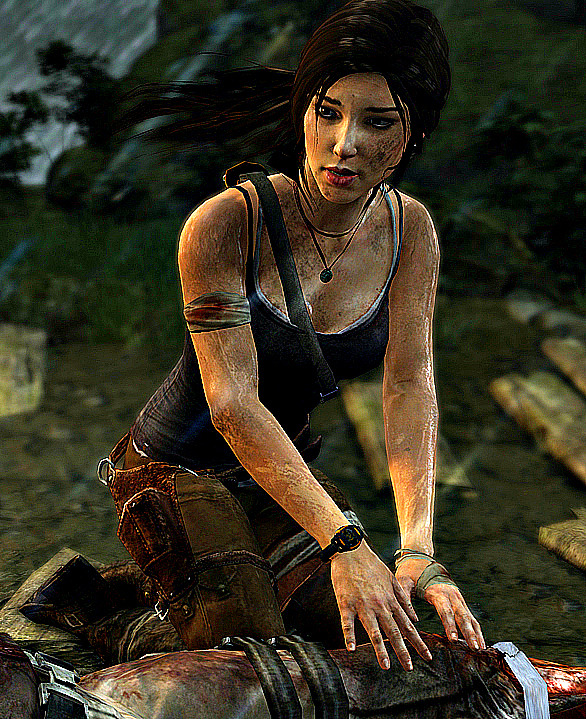
Tomb Raider is a video game franchise starring an adventurer archaeologist named Lara Croft. In most of the games, she travels around the world looking for highly prized treasures while avoiding rival hunters, wildlife, and various death traps.
Since its debut in 1996, the games have sold millions of copies around the world, appeared on almost every single format to date starting from the 5th-generation era, and have spawned a series of comic books, three movies, and an animated series.
The first six games were created by British developer Core Design. When the series began to decline and an attempt was made to give it a Darker and Edgier makeover, sales dropped and the publisher of the series, Eidos Interactive, handed it over to American developer Crystal Dynamics (who made most of the Legacy of Kain series).
In 2009, Square Enix acquired Eidos as a subsidiary, which also got them Crystal Dynamics and the Tomb Raider franchise. In 2022, Square Enix announced plans to sell most of their Western studios and franchises to Embracer Group, making them the new owners of both Crystal Dynamics and the Tomb Raider franchise. Later that year, it was announced that Crystal Dynamics struck an agreement with Amazon to publish the (currently untitled) next installment of the franchise and that it will be made using the Unreal 5 Engine.
Core Design era (original timeline)
- Tomb Raider I (1996)
- Tomb Raider Gold (1998)
- Tomb Raider II (1997)
- Tomb Raider II Gold (1999)
- Tomb Raider III (1998)
- Tomb Raider: The Last Revelation (1999)
- Tomb Raider Chronicles (2000)
- Tomb Raider: The Angel of Darkness (2003)
- Tomb Raider Trilogy Remastered (2024)
First Crystal Dynamics era (Legend timeline)
- Tomb Raider: Legend (2006)
- Tomb Raider: Anniversary (2007)
- Tomb Raider: Underworld (2008)
Second Crystal Dynamics/Square Enix era (survivor timeline)
- Tomb Raider (2013)
- Rise of the Tomb Raider (2015)
- Shadow of the Tomb Raider (2018)
Third Crystal Dynamics/Amazon era
- Upcoming untitled Tomb Raider game (TBA)
Spinoffs:
- Tomb Raider (2000; Game Boy Color)
- Tomb Raider: Curse of the Sword (2001)
- Tomb Raider: The Prophecy (2002; Game Boy Advance)
- Lara Croft and the Guardian of Light (2010)
- Lara Croft and the Temple of Osiris (2014)
- Lara Croft: Relic Run (2015; mobile) — Set after Lara Croft and the Temple of Osiris
- Lara Croft GO (2015)
- Tomb Raider Reloaded (2021; mobile)
Video Game Guest Appearances
- Final Fantasy Brave Exvius (JP:2015, WW:2016) - Lara was available during the 2018 Tomb of the Silversmith collaboration event based on Lara Croft And The Temple Of Osiris.
- Rainbow Six Siege (2015) - A Lara Croft elite costume was added for operator Ash in 2020.
- Fortnite (2017) - Tomb Raider skins were added in 2021.
- Brawlhalla (2017) - Tomb Raider content was added in a 2020 Downloadable Content.
- Call of Duty: Modern Warfare II and Warzone (2022) - A bundle containing Lara Croft as a playable Operator was released on September 9, 2023. These items can also be used in Modern Warfare III.
- PowerWash Simulator (2023) - Croft Manor was added as a free expansion, letting you wash the main building, the surrounding gardens, and some of her vehicles; Winston starts out as the client, sending you messages about your progress, but Lara herself takes over midway into the first assignment.
Animation:
- Revisioned: Tomb Raider Animated Series (2007)
- Tomb Raider: The Legend of Lara Croft (2024)
EMAP:
- Mean Machines Sega (1996) - 8 page comic published in issues 47 to 50
- Tomb Raider/Witchblade (1997)
- Witchblade/Tomb Raider (1998)
- Witchblade/Tomb Raider 1/2 (1998)
- Tomb Raider (1999-2005)
- Tomb Raider: Origins (2000)
- Dark Crossings (2000)
- Tomb Raider Journeys (2001-2003) — set in an Alternate Continuity where Lara promised her mentor that she wouldn't kill anybody.
- Tomb Raider/The Darkness Special (2001)
- Tomb Raider: The Greatest Treasure of All (preview published in 2002, full comic published in 2005)
- Tomb Raider: Scarface's Treasure (2003)
- Tomb Raider: Epiphany (2003)
- Tomb Raider: Sphere of Influence (2004)
- Tomb Raider: Takeover (2004)
- Tomb Raider: Arabian Nights (2004)
- Witchblade/Vampirella/The Magdalena/Lara Croft Tomb Raider (2005)
- Lara also appeared in other Top Cow series including Fathom, Witchblade and Monster War
Glénat
- Tomb Raider: Dark Aeons (1999) — published with permission of Eidos France until it was withdrawn from the market due to Top Cow owning the publishing rights.
- Tomb Raider: The Beginning (2013) — prelude to the 2013 game.
- Tomb Raider (2014-2015) — set between the 2013 reboot and its sequel.
- Lara Croft and the Frozen Omen (2015-2016) — Takes place in the same continuity as Lara Croft and the Guardian of Light and Temple of Osiris.
- Tomb Raider (2016-2017) — set after Rise of the Tomb Raider
- Tomb Raider: Survivor’s Crusade (2017-2018) — set after Rise of the Tomb Raider
- Tomb Raider: Inferno (2018) — set after Rise of the Tomb Raider
Films:
- Tomb Raider: The Trilogy (1998) — a Short Film made for the Tomb Raider III launch party
- Lara Croft: Tomb Raider (2001)
- Tomb Raider (2018)
Literature set after The Last Revelation
- Lara Croft, Tomb Raider: The Amulet of Power (2003)
- Lara Croft, Tomb Raider: The Lost Cult (2004)
- Lara Croft, Tomb Raider: The Man of Bronze (2004)
Literature
- Tomb Raider: The Ten Thousand Immortals (2014) — set after the 2013 reboot
- Lara Croft and the Blade of Gwynnever (2016) — set in the same continuity as Guardian of Light and Temple of Osiris
- Shadow of the Tomb Raider: Path of the Apocalypse (2018) — set between Rise of the Tomb Raider and Shadow of the Tomb Raider.
Tabletop Games:
- Tomb Raider Collectible Card Game (1999)
- Lara Croft: Tomb Raider – The Angel of Darkness (2003)
- Tomb Raider: Underworld (2009)
- Tomb Raider Legends: The Board Game (2019)
This series provides examples of:
- Acceptable Breaks from Reality: The entire world building of the Core Design series, be it everything following the cubical grid or doors being operated by remote switches and having separate "lockboxes".
- Action Dress Rip: Happens in Legend and subverted in Chronicles, where Lara does elaborate acrobatics while wearing a fancy dress and then simply change clothes.
- Action Girl: Lara Croft, an absolute badass, and the page image of the trope for damn good reason.
- Actionized Sequel: Tomb Raider II still had a healthy amount of puzzles to solve, but the game also had a much stronger emphasis on combat compared to the first game (enemies with greater range of movement, more guns to find, etc). By the halfway point of the game, ammo for the more powerful guns become plentiful to find and the very first level has a grenade launcher if you claim all of the level's secrets. The third game cranked up the combat further while all games after that toned it down a bit.
- Action Survivor: The younger Lara seen in the 2013 reboot is this.
- Advancing Wall of Doom: Usually with Spikes of Doom.
- Adventurer Archaeologist: Which makes her kicking open old vases looking for treasure all the more cringing.
- Adventurer Outfit: Lara wears one of the most iconic in all media: hiking boots with cotton socks, khaki shorts, two gun holsters, a cyan tanktop, a small leather backpack and a pair of fingerless gloves. Core's Lara was also very fond of ruby teashades.
- Affably Evil: Dr. Willard is very cordial. He stands out even more when compared with Marco Bartoli from previous game.
- A.I. Breaker: Throughout the entire franchise, there is only a small handful of enemies that can climb obstacles at all. Thus, you can simply climb up to any given spot and keep firing your guns until they drop dead. Bonus points if they can't engage you at range and only standing there aimlessly. One of the reasons why The Last Revelation is considered so hard is the amount of enemies that can chase you through the entire level by jumping and climbing.
- Alternate Continuity: Tomb Raider features three distinct, main continuities and a handful of "sub-continuities":
- The original, created by Core Design, consisting of the original game through The Angel of Darkness.
- The first reboot, created by Crystal Dynamics, consisting of Tomb Raider: Legend through Tomb Raider: Underworld.
- The second reboot, also by Crystal Dynamics, consisting of Tomb Raider (2013) through Shadow of the Tomb Raider.
- Certain spin-offs such as The Guardian of Light are ambiguous as to which pre-existing continuity they take place in, if any. There's also the two movies starring Angelina Jolie, the 2018 movie starring Alicia Vikander, an anthology animated series, countless comics (some of which are explicitly Alternate Continuity, others which take place in one of the main continuities, and others still which crossover with other franchises like Witchblade), and a few tie-in novels (which take place in various game continuities).
- American Accents: In the original Tomb Raider I, Natla has a Texan accent, Larson has a hillbilly accent, and The Kid's accent makes him sound like he is from New Jersey. In the Anniversary remake, Natla loses her accent and becomes more refined and almost mysterious. Larson's accent changes to Texan. For both of these characters, the changes are either due to a different vision from the developers or hiring new voice actors.
- Anachronism Stew: While the original games had their share of "advanced for the time" tech due to their urban environments often taking inspiration from spy media, (such as fully automated sentry guns and visible laser trip wires that are lethal to the touch.) the new gun models in the remasters are often based on specific weapons/versions of the old weapons that were developed after the games came out.
- Ancient Conspiracy: Several, and the answer is usually found at the bottom of a ruin.
- And Your Reward Is Clothes: Used in Legend, Anniversary, and Underworld as a reward for collecting secrets. All three games have at least one outfit that is a Shout-Out to a past game. Anniversary even has one where Lara is rendered in fewer polygons to reflect her model from the first game, pointy breasts and all, which made it very jarring and hilarious to see her interact with normal rendered characters in a cutscene.
- Anti-Hero: The very title of the game establishes that Lara is, effectively, a thief. And while she has good intentions, nonetheless her quests for finding treasure and artifacts usually result in many people (and a goodly number of animals) dying at her hand, and not always in a "must do it to save the world" context.
- Anti-Frustration Feature: In the Core era of the games, Lara will automatically swap to her pistols if her current weapon runs out of ammo so that the flow of combat isn't slowed down.
- Arc Villain: Natla in the Crystal Dynamics games.
- Area 51: Lara ends up here in Tomb Raider III.
- Artifact Title: Most entries in the series don't involve raiding any actual tombs.
- Artifact of Doom: Lots and lots of them.
- Artistic License – Biology: As mentioned below, Misplaced Wildlife and Everything Trying to Kill You abound in most of the games.
- One specific example in the first game sees crocodiles being faster and more dangerous on land.
- Ascended Glitch: Lara's iconic mammaries came about due to a programmer accidentally slipping a decimal point and the team throwing 'em in.
- Asshole Victim: Sergei Mikhailov in Chronicles, Louis Bouchard and Grant Muller in Angel of Darkness.
- Awesome, but Impractical: The grenade launcher in Tomb Raider II is very powerful, but it fires at a slow trajectory and unless your enemies run at you in a straight line, you'll miss your shots and have to endure a long reload time. The weapon also lacks Splash Damage. Tomb Raider III has the grenade launcher shots fall to the ground a lot faster and roll along it unless it hits an enemy.
- Aww, Look! He Really Does Care About Her: After spending most of The Last Revelation as an antagonist due to a combination of anger at being Left for Dead, greed, and Demonic Possession, Von Croy has a change of heart after the possession wears off, desperately trying to save Lara from the collapsing Temple of Horus, and is genuinely mournful when he can't save her. In addition, during the present day in Chronicles, he spearheads an operation to try and rescue her.
- Back from the Dead: Lara in The Angel of Darkness, although it's hardly a surprise seeing as she's the series' protagonist. A much bigger twist was the return of Natla in Underworld.
- Bad Boss: Eckhardt. His reaction to Boaz' failure to destroy the Proto Nephilim is to have the poor woman fed to the Pod.
- Badass Normal: Lara has encountered various supernatural beings, One-Winged Angel Superbeings and outright gods, and beaten (or re-sealed) them all.
- Badass Preacher: Father Dunstan.
- Bag of Spilling: A rather infamous one too. At the end of the level Nevada Desert in Tomb Raider III, Lara ends up getting captured by MP's. All her weapons get confiscated and depending on what order you play the levels, this includes several that you will never get back. Most guides highly recommend starting off with the Nevada levels for exactly this reason.
- Bamboo Technology: Appears in every single game. Almost all of the Durable Deathtraps are based on this.
- Bare Midriffs Are Feminine: Lara seemed to be quite fond of wearing these kinds of shirts. Until the reboot series averted it.
- Bears Are Bad News: Rise has some that are the only living things in the game that can survive a hit by a poison arrow.
- Subverted in the first game and Anniversary, where bears are one of the weakest enemies and exist only in first two opening levels. They easily pale in comparison with not only raptors, but also other animals from further levels.
- Beard of Evil: Pierre Dupont, in both of his incarnations. His Crystal Dynamics incarnation has him with a Bald of Evil, as well.
- Beauty Is Never Tarnished: No matter how much damage she endures or what kind of dusty/slimy tombs she crawls through, Lara always comes out looking like she just got back from the stylist. Justified in the games by Core Design, who did not have the technological means for any such effects.
- Averted in Legend, Anniversary and Underworld. Sometimes it's difficult to notice unless the camera's zoomed in, but Lara gets a layer of dirt and grime on her whenever she shimmies around or climbs ledges. Her face even gets smudged.
- Further averted in the 2013 reboot, where she gets impaled on spikes and other brutal injuries. And in general, doing a quick Google search will reveal that it's very hard to find any picture where she isn't dirty and beat up.
- Beethoven Was an Alien Spy: King Arthur was a real figure and the Excalibur was an ancient superweapon that granted him much power.
- Beleaguered Assistant: Winston, at least in the original continuity.
- Belligerent Sexual Tension: Lara and Kurtis, most obviously in their first scene together. Never has a disarming been so laced with sexual tension.
- Big Bad: Natla in the first game (and Anniversary and Underworld), Bartoli in the second game, Dr. Willard in the third game, Set in the fourth game, Eckhardt in the sixth game (at least, that's what you're supposed to believe, until The Reveal that he is The Dragon for Karel, the real Big Bad), Amanda in Legend, Xolotl in Guardian of Light.
- Big "NO!":
- Natla in TR 1, when Lara attempts to shoot the Scion.
- Lara's reaction in Underworld when the Doppelganger shoots Alister.
- Bilingual Bonus: Quite a few lines in Tomb Raider 2013 are spoken in Russian and Japanese.
- Bittersweet Ending: The Angel of Darkness. Even more so as the story was never continued.
- Underworld also has one.
- Blatant Item Placement: The classic games use the trope extensively; health kits, weapons, and ammo can be found anywhere, even in places where people have not been around for centuries. The modern games avert the trope though the Anniversary remake of the first game plays the trope straight.
- Block Puzzle: Frequent in the first games, toned down later on.
- Bloodier and Gorier: The series seems to up the ante with each instalment; the first game and II had small amounts of blood appear when Lara is damaged, III, The Last Revelation and Chronicles featured clouds of blood in water, The Angel of Darkness had its whole plot based on a Serial Killer (with his work witnessed first-hand many times), Legend, Anniversary and Underworld dialed it back a bit... and then Tomb Raider (2013) happened.
- Body Horror: Used quite a bit, but Tomb Raider III especially loves this.
- The Damned, a group of hooded, masked men who lurk underground, have, thanks to Sophia's experiments, been left with their flesh constantly rotting - and immortal, as they discovered when none of their suicide attempts worked.
- The RX-Tech mine workers have mutated into hideous (and violent) creatures due to the energies from the meteorite. They are among the most unsettling enemies in the game. Then there's Dr. Willard's boss form...
- The Angel of Darkness also features this in Boaz's case.
- It is implied that this is the fate of some of the Monstrum's victims. In the case of one of Bouchard's cronies we get to see the results first-hand. Half of his body is a giant, burnt, swollen mess. And he's somehow still alive.
- Bond One-Liner: Started in TR3, subverted in Underworld when a Mook knocks Lara out before she can finish delivering her quip.
- Bookends:
- This could be a bit of a stretch, but the first enemy you kill in Tomb Raider is a bat. The final enemy is Batla.
- Tomb Raider II. While the last level is set back at Lara's mansion, her quest for the Dagger of Xian begins and ends in China. Legend begins and ends in Bolivia.
- The Last Revelation opens with two flashback levels showing Von Croy trapped in a collapsing temple with Lara unable to save him. In the present day, the game ends with the roles reversed.
- Also, after finding out the true fate of Amelia and getting closure in Underworld, Lara and Amanda are sent back to the original gate Amelia disappeared through in the flashback during Legend.
- Bottomless Magazines: Lara's weapons never have to be reloaded, ever. Her pistols have infinite ammo, too (all the other weapons have a limited amount).
- Averted in AOD, as Lara's weapons all have to be reloaded and even her pistols can run out of ammo.
- After Crystal Dynamics took over the series, Lara's pistols have a limited magazine size but she can reload them as much as she wants.
- Averted entirely in the second reboot.
- Braids of Action: Lara, in the later installments and the movies. She was planned to have it from the get-go, but technical limitations prevented it from happening in the first Tomb Raider.
- She does sport a braid in the first game's FMVs, but not during gameplay or non-FMV cutscenes.
- Break the Cutie: Crystal Dynamics have stated their aim to do this to Lara in the 2013 reboot.
- Breaking the Fourth Wall: The ending of Tomb Raider II.
- Broken Bird: Lara, by the time of The Angel of Darkness.
- Butt-Monkey: Larson has some elements of this in the first game (shot repeatedly and roundhouse kicked in the head), but this aspect is taken to the max in Chronicles - in which his partner-in-crime, Pierre, is also elevated to Butt-Monkey status.
- Buxom Beauty Standard: Lara's signature trait, especially in the early games. More recent titles have made her more realistic, but she's still very well endowed.
- The Cameo: Kain and Raziel and Kane & Lynch appear as downloadable playable characters in Guardian of Light.
- Came Back Wrong: Lara's mom in Underworld.
- Canon Welding: Due to being a soft reboot, Legend's (and thus entire LAU trilogy) continuity is best described as three parts Core-era Tomb Raiders, two parts Lara Croft: Tomb Raider and a generous squeeze of TopCow's comics, garnished with a peel from one of the official novels. Various bits from all over the franchise were mixed and matched together to create a new continuity. Most notable is the drastic change in Lara's relationship with her parents (or the fact they are both dead) and the general redesign of the Croft manor (which is the family estate, rather than private property of Lara). For comparison, the 2013 game went for hard reboot and decided to reinvent Lara from a scratch. Both of those takes on canon and Lara were controversial among players upon premiere.
- Cave Behind the Falls: the Lost Valley in the original game was an iconic example of this being one of the first 3D examples of it. Legend attempts to outdo it by putting a whole open temple behind some falls.
- Anniversary had a lot of things behind various waterfalls
- In the "Lost Valley" level:
- Shotgun behind the upper waterfall in the cave.
- Exit from the level behind the lower waterfall in the cave.
- In the "Natla's Mines" level the exit from the initial room is behind the waterfall.
- In the "Final Conflict" level, for a change of pace, a relic is hidden behind a lava fall.
- Anniversary had a lot of things behind various waterfalls
- Celebrity Paradox: A curious and perhaps unintentional one exists in the continuities of the first Tomb Raider games in relation to both film adaptations. According to Core's biography, Deliverance was Lara's favorite movie. In case you don't know, it stars Jon Voight. Now Voight plays Lara's father in the first Tomb Raider movie, and his real life daughter, of course, plays Lara. This means that Voight and Jolie also have to exist within the universe of Core's games, and perhaps even, the TR movies themselves. Which means the movie probably exists within its own continuity. In Lara's promotional interviews
 for The Angel of Darkness, she compliments Jolie on looking so much like her. In The Angel of Darkness, a small box for a computer game called "Crypt Raider" can also be glimpsed on the shelf of the pawn shop.
 - Cherry Tapping: Try killing the Abomination from the end of the first game with pistols (just be sure to nurse your aching fingers afterward).
- City of Canals: The second game has a level in Venice.
- Clipped-Wing Angel: Dr. Willard in Tomb Raider III. Kristina Boaz in The Angel of Darkness is this as well.
-
 Common Knowledge: Lara is often described wearing a teal tank top in her most iconic outfit. This is not true, as she actually wears a Leotard of Power.
 - Continuity Reboot: Everything after the series was handed over to Crystal Dynamics. The 2013 title is a second one.
- Convection, Schmonvection: With Atlantis from Tomb Raider and Anniversary being the biggest offender, but Tomb Raider II and Tomb Raider III have their moments.
- Cult/Religion of Evil: The Fiama Nera cult from Tomb Raider II.
- In Tomb Raider '13, Lara threshes her way through a cult called the Solarii.
- Cutscene: The first five games on PC and PS1 mixed full motion video cutscenes (see the intro for an example) and in-game cutscenes using the gameplay engine. Originally, the in-game cinemas had no mouth movements, so it was rather awkward to see characters bob their heads (while their lips remained static) to indicate that they were talking. This was rectified starting with the fourth game.
- Starting with the Crystal Dynamics developed games, the cutscenes were all presented using the gameplay engine, due to the advancements of graphics since 1996.
- Cutscene Incompetence: Lara gets knocked out or otherwise incapacitated in situations that would be no sweat during gameplay, such as getting knocked out by a mechanic in TR II (to be fair, she was taken by surprise in that situation) or failing a quad jump in TR III (that would be perfectly doable in-game).
- Damn You, Muscle Memory!: A common occurrence, given the sheer number of games, different engines and different developers:
- Inverted chronological order, but still: there is neither crouch nor sprint in the first two games. Yet if you played just about any other TR, you are going to instinctively try to use those functions anyway. For added muscle memory, the first five games use the exact same control scheme, yet there is nothing under . and / buttons, as those functions simply weren't in the first and second game.
- Done deliberately with cheat codes in Core-era games. It's step forward, step backward in the 1st and 2nd games, but step backward, step forward in the 3rd.
- Each game of the LAU trilogy had a slightly different control scheme.
- Similarly, Rise of the Tomb Raider made few alternations to key mapping when compared to the 2013 game, causing people who played both to constantly use the wrong type of ammo depending on which game they were currently playing.
- For reasons unknown, the remaster of the first three games made a 1:1 port of the original controls... except for shifting the Look button from Ins on the numeric keyboard to V.
- Dark Action Girl:
- Amanda becomes this by the time she returns in Legend.
- Underworld has the Doppleganger. To the point where she even got her separate DLC.
- Darker and Edgier vs. Lighter and Softer: The original series generally veered towards Darker and Edgier as it went along, but The Angel of Darkness was the only major leap towards it. After the failure of that, Legend signaled a Lighter and Softer change arguably even over the earliest games. Underworld seems to be adding elements of Darker and Edgier again, making the series currently be in somewhat of a slalom.
- The 2013 game is this even compared to Angel of Darkness and Underworld, with some truly brutal, gory, horrifying imagery to be found throughout. Comparatively, it's sequel Rise of the Tomb Raider is a fair bit lighter, but it got a much darker DLC in the form of Baba Yaga: The Temple of the Witch.
- Dead Man's Trigger Finger: Happens in Tomb Raider 3, because apparently that game wasn't hard enough already.
- Deadpan Snarker: Lara in spades, especially when it's combined with her Bond One-Liner. Alister and Zip also have their quips in Legend and Underworld.
- In Tomb Raider III, after Lara winds up knocking herself out from a failed jump with her ATV, some mooks comment on how crazy she was to pull a stunt, then one of them wonders if Lara is an eco-terrorist. The other mook sarcastically replies "And they wear hot pants, huh?"
- Father Dunstan isn't afraid to snark at Verdilet, despite the latter being an Ax-Crazy demon.
- Death Course: It wouldn't be a Tomb Raider game if Lara wasn't running for her life at some point.
- Death Is a Slap on the Wrist: Used in Legend, Anniversary and Underworld, where death just sends you back to the last checkpoint with full health, making the games quite a bit easier.
- Demonic Possession: Von Croy is influenced and sometimes directly possessed by Set for much of The Last Revelation.
- Did You Just Punch Out Cthulhu?: Averted most of the time; while Lara faces gods she can rarely do direct damage and tends to just reseal them and other powerful beings she beats are just that and not outright gods. Partially played straight in Anniversary where while she doesn't kill Natla, she apparently at least incapacitates her for a while (the original game doesn't count as Natla, while a powerful being, was never said to be a god). Underworld she gets an artifact that does allow her to kill Natla) and Guardian of Light like Anniversary, Xolotl is not killed, but at least stunned enough by weaponry for him to be easily resealed, although Lara does have a god on her side too in this case
- Dirty Communists: Subverted, if unintentionally. In Legend, Lara comes to the assistance of Russian-speaking Kazakh soldiers at a Soviet-era research facility that is being attacked by, of all things, American mercenaries hired by a West Point graduate attempting to steal a Soviet-owned relic. She saves them from a likely death, and with some reluctance, they supply her with the passcode for their command center.
- Subverted also in Chronicles. Admiral Yarofev and his crew are painted in a much more sympathetic light than The Mafiya who have bought him and his submarine out. The bad Russians in this instance are the capitalists.
- Dismantled Macguffin: Used often enough. In Legend, Lara must find the different pieces of Excalibur and reassamble them. In the first game, the Atlantean Scion is split into three parts. The second example is a variation of the trope, as the fragments were not necessarily all from the same version of Excalibur, as it is mentioned that there was more than one such sword.
- Distant Prologue: Many of the games begin this way:
- The original game begins in an unnamed time period but it's heavily implied to be the Trinity Test, as the next cutscene flashes forward to the present day, where we meet Lara for the first time. Anniversary uses the same type of intro, but with minor script changes to reflect the change in continuity and improved graphics.
- Tomb Raider II also begins on an unknown date centuries in the past, when the Chinese army was defeated by the Tibetan monks, who returned the Dagger of Xian to its place in the Great Wall of China. After the title screen, the game flashes forward to present day when Lara lands in the Great Wall of China area.
- Tomb Raider III begins in prehistoric times when a comet wiped out the dinosaurs. After this, it flashes forward to present day when some Antarctic scientists discover said meteor.
- Tomb Raider: The Last Revelation features two levels at the beginning where you control teenage Lara, guided by her (then) mentor Von Croy. After these tutorial levels, the game switches to present day.
- Legend begins when Lara was nine.
- Distressed Dude: Jean-Yves in The Last Revelation; Father Dunstan in Chronicles.
- Doing In the Wizard: Legend strongly suggests that the fantastical elements of Arthurian myth were not supernatural, but the work of ancient astronauts.
- The first game does the same for both Ancient Egyptian mythology and Atlantis.
- Doppelgänger: Used as part of a puzzle in one of the final levels of the first game and Anniversary, and a more advanced one blows up Lara's mansion in Underworld.
- Downloadable Content: A considerable amount of DLC for Underworld was exclusive to the Xbox 360, including two new levels and several outfits. PlayStation loyalists, especially those who had supported the franchise from the very beginning, were not pleased.
- Down the Drain: While with a couple of exceptions it's notable for somewhat averting this, with several of the water-focused stages being considered among the highlights of the series for many.
- Downer Ending: The Last Revelation. Of course, Lara gets better.
- Dual Wielding: Lara is always carrying a pair of pistols, though she also uses dual magnums, automatic pistols, and Uzis.
- Durable Deathtrap: Used constantly, though subverted a few times in Legend.
- Dynamic Loading: Why Anniversary was mostly corridors.
- Early-Installment Weirdness:
- The very first Tomb Raider game feels incredibly awkward and odd compared to later installments. Lara's arsenal is limited to just 4 guns while the sequel nearly doubles the amount of guns Lara can get. Lara's movement is also a bit stiff due to not having the ability to sprint, flip in midair, or crawling into tight areas. Enemies that Lara faced in the first game consisted of animals and mutants. Compared to the handful of humans you can kill in the first game, the later installments has you killing people left and right. The first game also lacked vehicles.
- The options menu in the first also had some designs that were changed in later games. The icon for the sound options was represented by a Walkman, which was already dated by 1996 when the game launched. Later games would use a CD player for the sound options. The passport in the first game had a black cover and each page had an illustration. Future games would change the cover to red and made all the pages blank.
- Lara's signature braid was absent in the first game except in CG cutscenes. This was due to the game engine not being able to handle it without massive slowdown. Later games would give Lara her ponytail once the developers improved the game engine.
- The first game didn't have a short tune play for completing a level like the sequels did. Likewise, the health bar in the first game was a solid beige color while the sequels used red (PC) or green to red (PlayStation).
- Croft Manor was quite bare bones compared to its overhauls in the sequels. The very first iteration of Lara's mansion had no kitchen, no outside area, and no basement. The music room has a huge mat for Lara to practice her jumps and tumbling, which wasn't brought back in the sequels.
- Easily Forgiven: Tomb Raider (2013) is Crystal Dynamics' second chance at the series (not to mention yet another Continuity Reboot), whereas Core Design only had one chance and were sacked after AoD.
- Easy Level Trick: The bread and butter of secrets in Core-era games (with the exception of Chronicles, where they are Bragging Rights Reward). Secrets offer access to extra ammo and medkits, not to mention various weapons way ahead of finding them in the open. Getting the secrets themselves, however, ranges between relatively easy and obvious, through demanding acrobatics and/or time runs, and ending with utterly esotheric moves and concepts to get to them. Still, getting them by default is making rest of the game easier.
- Eerie Pale-Skinned Brunette: Lara's recent iterations are quite a bit paler than her original incarnations. Lara's humanesque doppelgänger is a more extreme example of this, though her hair is more of a dark red.
- Eldritch Abomination: The final boss of Tomb Raider III may qualify (if not, it's at the very least Body Horror). The Nephilim in Angel of Darkness is a more cut-and-dry example.
- Eldritch Location: The "Floating Islands" at the end of Tomb Raider II. Green chunks of rock bearing Chinese temple-like buildings guarded by flying statues drifting in the middle of an endless empty void? Yep.
- 11th-Hour Superpower: In Legend and Underworld, due to Lara reassembling Excalibur and finding Mjolnir, respectively.
- End-Game Results Screen: From Tomb Raider II to The Last Revelation players are shown their final statistics at the end of the game. It was dropped afterwards.
- The End of the World as We Know It: Apparently Underworld was an Evil Plan by Natla so Lara would lead her to the Lost Superweapon she could use to destroy the world.
- Enemy Mine: At the end of Underworld, Lara and Amanda team up to stop Natla from destroying the world.
- Enemy Chatter: In both Crystal Dynamics series, mooks will talk amongst themselves if you let them.
- Enemy Rising Behind: Happens to Larson in Chronicles.
- Equipment-Based Progression: The games follow this trope, giving you more powerful weapons as you progress whilst all other skills remain static from the start.
- Everything Trying to Kill You: Bats, bears, wolves, crocodiles, eels, tigers, monkeys, gorillas, sharks, ravens, random hobos and museum security guards. Lampshaded in Legend, when Mission Control wonders why predators always attack prey larger than themselves.
- Evil Plan: The bad guys usually have one, revolving around the game's MacGuffin artifact. Legend is something of a subversion, as the villain of that story doesn't want to do anything other than go to Avalon.
- Evil Counterpart: Amanda, who started off as a fellow archeologist student before turning to Rival Turned Evil.
- Evil Old Folks: A few of Lara's adversaries are on the older side, such as Pieter van Eckhardt.
- Evil Redhead: Lara's doppelganger, which has rather striking red hair compared to her auburn locks.
- Evil Twin: Lara's doppelganger in Underworld. Though she's not so much evil as completely amoral thanks to being a created thrall.
- Excuse Plot: Often times, the plot for most of the games in the series can best be described as "find McGuffin before rival explorer does and uses it for nefarious purposes. Don't ask why."
- Exposed to the Elements: A green tank top and shorts for any weather, even while climbing the Himalayas. Lara's outfit changes to fit the location starting with the second game, but this doesn't always avert the trope, and from Legend on, the player can choose outfits (even if they're inappropriate) themselves.
- Fangirl: The series has gained plenty thanks to Kurtis, Larson and Karel. And Lara.
- Fanservice: Lara, of course, is the main source of this in the franchise. Legend gives most of its male cast huge also, muscular frames and half-unbuttoned shirts. The 2013 reboot averts this, toning down the boobage and slathering a thick layer of dirt, grime, and blood over everything else.
- Fan Remake:
- OpenLara for TR1, a wrapper that allows the game to be ran at a higher resolution and framerate than the original games.
- Tomb Raider DOX for TR2, which is a complete reconstruction of the game using Unreal engine, but due to low manpower, the progress on the project is going really slow.
- Feathered Fiend: Creepy Crows, Vile Vulture's, and golden eagles. Plus the Guardian, a Half-Human Hybrid.
- Femme Fatalons: Natla in Anniversary sports some to compliment her less human look.
- Flame Spewer Obstacle: A common obstacle in the series, they're at their deadliest in the PlayStation era of games where Lara only has seconds to put the flames out if she isn't able to dodge them in time.
- Gaiden Game: Unfinished Business, Golden Mask, Lost Artifact, Times Exclusive, Beneath the Ashes, Lara's Shadow, and Guardian of Light.
- Game Mod: The infamous (and self-explanatory) Nude Raider patches are some of the first examples of modding a non-FPS game. Also, beyond that, while it is not well-known publicly, the level editor released with Chronicles has led to very large modding community with thousands of custom levels and other content.
- Genre Shift:
- Tomb Raider: Curse of the Sword for the Game Boy Color, a cinematic platformer ala Prince of Persia.
- While the first two series had become increasingly more combat-focused over time, they were still at heart 3D platform action games. The second reboot completely scrapped the platforming gameplay of the originals in favour of gritty and realistic Third-Person Shooter gameplay, taking more cues from the Uncharted series, ironically, than Uncharted ever had from Tomb Raider, with platforming and tomb exploration taking a backseat.
- Giant Spiders: The large spiders encountered in the Temple of Xian in Tomb Raider II (for no apparent reason, similar to the random pair of Tyrannosaurus rex in the secret area). Even bigger ones are encountered in Underworld. Dr. Willard's One-Winged Angel form also has elements of this.
- Girlish Pigtails: Teenage Lara sports them.
- God of Evil: Set.
- Going Down with the Ship: In Chronicles, Admiral Yarofev refuses Lara's offer to save him and chooses instead to stay aboard his sinking submarine.
- Government Conspiracy: Area 51 actually does have aliens. You come across several dead bodies and collect the artifact there in a UFO.
- Guns Akimbo:
- Lara Croft's signature weapon is a pair of akimbo pistols. In the first two titles she used to shoot them with remarkable timing, such that the two shots sounded just like one. In following titles of the series the two shots are slightly offset. She is also noted for automatically aiming both weapons independently in target rich environments.
- Lara's rival, Pierre, dual wields magnum pistols against her.
- Lara herself can use said magnum pistols later after she plucks them from his cold, dead, hands. They are replaced in the sequel by automatic pistols.
- Rounding out her arsenal, Lara can also wield dual Uzi SMGs.
- A promotional image for 2 showed her duel wielding a pair of M-16's.
- In the reboot, her trademark dual-pistols have been replaced by a bow and arrows. She only uses the one pistol. That is, until the finale, where she takes the Big Bad's pistol off his belt while grappling with him, and then finally uses it and her own one in her signature style to mow him down. That said, it's only a Mythology Gag, and she does not use it again.
- Hand Cannon: The Desert Eagle in III and the revolver in The Last Revelation were one-shot kills for most of the baddies in the game.
- He Knows About Timed Hits: In the first six games of the series, Lara Croft herself tells the player how to control her, always mentioning which button to press and staying in character throughout.
- In Tomb Raider: The Last Revelation, Lara's guide Verner Von Croy tells Lara the controls for the game throughout the first level, while she simply listens without noticing anything odd.
- Head Bob: Used in TR 1-3 to indicate characters talking. It wasn't until The Last Revelation when the game engine got Mouth Flaps added.
- Heel–Face Turn: Werner von Croy. At first it's due to greed, but later it's mainly down to Demonic Possession.
- Heroic Sacrifice: Sergeant Aziz in The Last Revelation drives his truck filled with explosives into the dragon blocking that is blocking the Citadel, making it explode and killing the beast and himself in the process, which allows Lara to progress. Lara even gives Aziz a farewell salute after the deed is done.
- Admiral Yarofev in Chronicles insists on staying behind on his doomed submarine in order to activate an escape pod for Lara. His only request is that she tell the world that his crew died bravely whilst doing their duty.
- A couple of these occur in the 2013 reboot. First, Grim tackles a mook off of a platform, killing them both in order to prevent himself from being used as leverage against Lara. Later on, Roth (whom Lara looks up to as a surrogate father) takes a hatchet to the back in order to protect Lara from it, then kills the mooks around them before dying from his injuries. Then there's Alex, who also lays down his life on Lara's behalf...in fact most of the male cast dies in Lara's name.
- Hijacked by Ganon: In Underworld Natla returns from Anniversary and plays Amanda and Lara like fiddles, and Amanda's whole revenge scheme becomes an afterthought.
- History Repeats: In the Russia chapters during Chronicles, Lara learns about an artifact called the Spear of Destiny, which is supposed to give its bearer and its armies untold power. A group of Nazis who claimed the spear were subjected to the spear's extremely unstable power and the artifact created an explosion that sunk the group's U-boat. Flash forward to the present where Lara finds the spear, is forced to hand it over to Russian mob boss Sergei, and the history repeats from there as the artifact's powers go haywire. Luckily, Lara manages to escape before the submarine explodes and sinks to the ocean bed.
- Used as a plot point in Legend. Lara notes that many myths and legends share similarities to the legend of King Arthur and his knights. There's a sword in a stone, a heroic leader figure, a mystical advisor and so on. Lara hypothesizes that these myths were actually real, and that that they are all connected in some manner, possibly through the same people (or things) that made the Excalibur swords.
- Hollywood Skydiving: Lara's base jump that opens the Kazhakstan level in Legend, which is an interactive cutscene. If the player doesn't press the right button as it appears on the screen, Lara won't deploy her chute and will fall to her death.
- Hope Spot: Towards the end of The Last Revelation, Lara attempts to summon Horus to help her defeat Set. Just as the summoning is almost complete, Set's swarm of locusts burst in and destroy Horus' statue and armour, thus stopping the summoning. Then Set himself appears...
- Hooker with a Heart of Gold: Janice in The Angel of Darkness.
- Iconic Outfit: Lara's getup on the original game (one of the three seen in the picture above), consisting of green tank top, brown shorts, boots, backpack and ruby teashades. Even if the design changed over the years and reboots, it was always consistently aiming for the original look.
- I'm a Humanitarian: The Polynesian tribe in Tomb Raider III.
- In the Hood: The Damned. They wear the hoods and masks to hide their Body Horror.
- Incendiary Exponent: Guardian of Light has a a T-Rex that's on fire!
- Indy Escape: In the Tomb Raider series, rolling boulders were a standard trap in level design, but only in a few places was this actually an Indy Escape:
- Tomb Raider: Legend. Lara is chased by a giant boulder while dodging obstacles. At the end the boulder opens a shortcut back up to the current level.
- Tomb Raider: Anniversary. In the "Atlas" room, you have to activate two switches to retrieve the key, which also causes the giant statue of Atlas to release the giant metal globe he was previously holding up. There are no nooks to hide in, and the pit at the far side is too wide to jump across without help.
- Informing the Fourth Wall: In the Tomb Raider series, when requested to use an item or medipack that she can't use in the current situation, Lara flatly responds "No."
- Made even funnier in the games where Jonell Elliott voices her, as Lara's "No!" suddenly sounds hostile and admonishing.
- And in Tomb Raider: Legend she shrugs her shoulders, which is just as strange.
- Finally, in Tomb Raider II she says "Aha!" every single time she picks up an object, except of course when she's underwater.
- Invisible Grid: All of the first five games were divided up into grids that made jumps very simple to do and all puzzle blocks always moved by each "square" (for example, Walk to the edge, tap back once, and you got enough room to do a running jump).
- Jiggle Physics:
- The Game Boy Color games were the first in the series to make Lara's breasts bounce with movement.
- The Crystal Dynamics games have it, as would seem obvious. The early games show exactly what is wrong with its absence; Lara's chest is literally Barbie-esque in its steely inflexibility, as if she were smuggling a pair of cannonballs in her bodysuit, or a pair of traffic cones if you played the first game. It was only in the cutscenes for Legend and Anniversary; Underworld has it in the gameplay itself. It's very subtle, but it is there. At least unless you use a user-made Jiggle+ PC mod for Underworld.
- In the Crystal Dynamics games, the developers actually used the jiggle physics from Dead or Alive, below, for use in Lara's ponytail.
- Speaking of her ponytail, the reboot uses a new graphical effect called TressFX to render Lara's hair, all several thousand strands of it.
- Speaking of her ponytail, the reboot uses a new graphical effect called TressFX
- Justified Tutorial: Any of the games which feature the "Lara's Home" level, which sees Ms. Croft honing her skills via an obstacle course in and around her mansion. Often there's secrets tucked away as rewards for performing exceptionally well.
- Killer Gorilla: In Greece, of all places. Handwaved by having them imported to fight in the Colosseum, though it makes one wonder how they're still there after all these years and why they were brought there since Gladiator Games were Roman, not Greek.
- Large Ham: Quite a few, but Verdilet, the demon from the Ireland levels of Chronicles, is particularly noteworthy.
- Lava Adds Awesome: Loads and loads of lava to be found in the PlayStation games, with Atlantis being mostly lava
- Left for Dead: Lara was forced to leave Von Croy in a collapsing temple when she was 16.
- Letting the Air out of the Band: Heard in Lara Croft and the Guardian of Light when you lose a life.
- Living Dinosaurs: The first game, Tomb Raider II (but only in a secret area), Tomb Raider III, Anniversary. There's never any real explanation for why they're still around (though the ones from the very first game are a homage to The Lost World (1912)).
- Living Motion Detector: In the third game, the T-Rex can not see Lara if she doesn't move (a direct Shout-Out to Jurassic Park) - but it can harm her, as it will stomp around very close to her even if she stays completely still.
- In the original Tomb Raider I, as well as Anniversary, Lara encounters a Doppelgänger of herself, which mimics her in every way, to the point at which if you shoot at it you will take harm. You kill it by luring it into a Bottomless Pit.
- Locked into Strangeness: In the Ireland levels of Chronicles, Father Dunstan's hair turns white and stays that way after an offscreen encounter with a demon.
- Lost World: The Lost Valley of Peru in the first game, beneath the Great Wall of China in the second (though it consists only of two tyrannosaurs), and a particularly large one on a South Pacific island in the third.
- MacGuffin Delivery Service: Used in the first and third games; avoided in Legend, where Lara never loses any piece of the Artifact of Doom and ends up wielding it as an 11th-Hour Superpower.
- Made of Iron: The 2013 Tomb Raider reboot will often have Lara wounded and she has to force herself to keep on going. However, even suffering from a wound that has her clutching her side doesn't stop her from clambering up on surfaces really quickly. Her Regenerating Health also ensures that she rebounds effortlessly from grievous injuries by design.
- Major Injury Underreaction: Alister's reaction to getting fatally shot in Underworld is simply "I feel bloody awful..."
- Alot of Lara's injuries in 2013 that should effect her for a significant period of time after simply vanish after the inital cutscene they happen in.
- Male Gaze: Lara suffers from this in many ways in the classic games; not only does she possess somewhat... exaggerated attributes in the bosom and rear end departments, but the clothes she wears (particularly in the earlier games) are designed to enhance them even further. Coupled with this is the fact that she is mostly viewed from behind during the game (partly as a necessity of the game mechanics), and it's not hard to imagine what many gamers of the male persuasion would be thinking about when playing the game.
- This got even worse in Tomb Raider Anniversary, where the updated graphics and animation allowed the developer to do the same game except with more fanservice—as Ben "Yahtzee" Croshaw notes in his review, when she comes out of the water she's realistically wet and glistening, and if you leave the game idle for a while she does these shamelessly erotic stretches.
- Any leftover modesty leaves in Underworld, where Lara dons a swimsuit-leotard for significant portions of the game.
- Crystal Dynamics have stated they are specially trying to avert this in the 2013 Tomb Raider reboot, to the point that they iterated on her model until people in tests were found to naturally focus on her eyes rather than her breasts.
- Malevolent Architecture: Lampshaded and then justified in Legend.
- Marathon Level: Each game has at least one level that's longer than the others. "Atlantis" from the first game, "Temple of Xian" from the second game (which is also filled with numerous nasty death traps), and three of the four England levels in the third game being some examples.
- Maniac Monkeys: In the third game, the initial monkeys are friendly but annoying but later ones are vicious.
- Mayincatec: The City of Vilcabamba is based on the real-life last outpost of the Inca. It contains a gold idol modelled on a Tumi, a ceremonial knife used in sacrifices.
- Metroidvania: Apparently, the 2013 reboot will allow free-roaming across the island, but certain areas will only be accessible once you have the right gear or skills.
- Mind over Matter: Kurtis Trent demonstrates telekinetic powers in The Angel of Darkness (
 which would have been a lot more apparent had Core been allowed to finish the game on time). Amanda's Black Magic ability is functionally similar.
 - Misplaced Wildlife: Are those piranhas in India? And lions in Egypt and China? They're extinct in both those places. There's also a bonus level in "The Golden Mask" (an expansion pack for Tomb Raider II) sees you fight a T-Rex and a large bird monster... in a Las Vegas hotel. Justified in that it's supposed to be Lara's nightmare.
- Mook Horror Show: Lara can polish off entire armies of trained mercenaries by herself.
- More Dakka: As Lara's signature weapons are her dual pistols, the dual Uzis essentially function as this for her character (and were used almost as much as the pistols in earlier art for the series). Also, while other weapons had higher overall damage output the mix and agility and damage the Uzi's offered made them the overall best weapon of the first couple of games, although they were overshadowed by other weapons from Tomb Raider III onwards. Due to being a remake, Anniversary did give them some extra limelight again.
- Multi-Platform: All of the mainline titles, even if II and III was only in one video game (PS1) alongside computers.
- Multiple-Choice Past: Lara's origin seems to be "whatever the designer of the current game/movie/comic feels like."
- My God, What Have I Done?: In Anniversary, Lara has this reaction after killing Larson.
- Never Found the Body: The ending of Chronicles; only her backpack is found in the rubble. Surprise: she's Not Quite Dead / Back from the Dead in The Angel of Darkness.
- Also, Kurtis Trent at the end of The Angel of Darkness.
- And Amanda in Legend; they only found an untied shoe in the ruins of Paraiso. She's still alive, of course.
- New Game Plus:
- Upon finishing the first two games, subsequent new games started with all weapons unlocked, also carrying unlimited ammo.
- LAU trilogy had an entire slew of bonus cheats and special options that were only unlockable after finishing the game.
- The remaster of the first three games offers a literal New Game+ option, where Lara starts with all weapons already unlocked, but there are no medkits to pick and enemies are much tougher.
- Nice Job Breaking It, Hero:
- The Last Revelation , as Lara accidentally releases the Egyptian god Set from his sarcophagus near the beginning of the game.
- Shadow of the Tomb Raider gets Lara tangles into the Mayan "end of times" - as the person responsible for triggering it.
- Nintendo Hard: The first two games are fair outside of a few sections, but from Tomb Raider III onwards (until Legend) the series took no prisoners. Anniversary also has its moments, although their nature makes this a partial overlap with Game Breaking Bugs.
- The trap-filled corridors in the Egyptian levels of Anniversary are probably the most extreme example in Crystal Dynamics' games. According to the commentary, the creators' decided that "traps" would be the theme of those levels, and basically stuffed the hallways with instant-death perils just to make them more interesting. The timing can be tricky to get right.
- The ascend in the Great Pyramid section of Atlantis. It's basically a series of timed jumping puzzles, that get worse the higher you go. The jumps themselves are not always that difficult to make, but in between levels, there are enemies that can blow you off your platform, forcing you to redo entire sections. This can be incredibly frustrating, and make it appear harder than it is.
- The first level in Tomb Raider II is notable for being incredibly difficult for an opening level, especially if you're new to the series. About halfway through the level, the game simply decides to throw as many spiked walls, spike pits, and blade traps at Lara as possible. Then there's the Golden Dragon secret... The first level in the next game is even harder (and first-time players will miss no fewer than 2 secrets just sliding down the first slope at the beginning), but then again, so is the rest of that game.
- The trap-filled corridors in the Egyptian levels of Anniversary are probably the most extreme example in Crystal Dynamics' games. According to the commentary, the creators' decided that "traps" would be the theme of those levels, and basically stuffed the hallways with instant-death perils just to make them more interesting. The timing can be tricky to get right.
- No-Gear Level: In almost every game, Lara gets captured and loses her guns. This allows those particular sections to focus completely on exploration, instead of combat, as Lara is completely defenseless. Young Lara, as seen in the 4th and 5th games, is always unarmed. By The Angel of Darkness, she has gained the ability to punch and kick.
- TR1: Natla's henchmen disarm Lara before taking the Scion, and she has to go through Natla's mines to regain them one-by-one.
- TR2: She loses them in the Offshore Diving Rig after being captured.
- TR3: After she crashes the quad bike in Nevada, guards disarm her and imprison her, obviously without weapons. This version is particularly cruel because it also strips the player of all ammo (not just the weapons), and even medipacks, except for a single small one. This is why choosing Nevada as the penultimate section of the game is either a horrible or foolish decision. It is considered a really tough Self-Imposed Challenge, since some weapons will be gone for good if Nevada is played last.
- TR4: Young Lara in Cambodia. In order to escape the wild boars, she needs to lure them towards Von Croy, who can kill them with his knife.
- TR5: This game has 3 segments where Lara loses her guns. First is a brief time in the Submarine, when Lara is locked up by Yarofev. Second, all the Ireland levels involve Young Lara, who cannot attack at all except during cutscenes with plot-related items. Finally, while trying to escape with the Iris, Lara comes across an X-ray room that activates machine-gun turrets if metal is detected; she has to leave her gun on a tray near the beginning of the level, go through without a weapon, disable the scanner, and then shoot a fire extinguisher down the hall to finish.
- TRAOD: For some reason Lara starts the game without any weapons, possibly because the dogs rip her backpack off her during the first cutscene as well as the fact she came to Paris for a Social visit not expecting any danger. She picks up a weapon in a shack on the rooftops, but it doesn't come with any ammo, so it's useless until a few levels in. Later, there's the famous scene in the Louvre where Kurtis disarms Lara: turns out he also stole all her weapons.
- Non-Action Guy: Alister and Zip. Also, Jean-Yves in the fourth game.
- Nonindicative Name: Each game features levels that aren't considered "tombs" by the strictest definition. More often than not, a "tomb" is any long-forgotten, non-civilized place where there are death traps everywhere and ancient artifacts lying around. Only the first and fourth games really stuck to tomb-y locations throughout. Some games even predominantly feature non tomb-based levels (Tomb Raider III with Nevada and London, and Tomb Raider Chronicles, with half the game taking place aboard a modern submarine and in a high rise skyscraper). Angel of Darkness wasn't even originally going to be called Tomb Raider, it would have simply been Lara Croft: The Angel of Darkness as it features virtually no tombs. The Tomb of the Ancients level was added in last minute, in order to justify the branding.
- Noob Bridge: Sometimes happens.
- In the second major area in Tomb Raider: The Prophecy for Game Boy Advance, there's one place where you just have to use the run button; if you never learned of it, you'd be stuck with a door that just closes too soon.
- In Tomb Raider II, there's an area where Lara must make a long jump into a pool of water far below. There is only a small square of space in the pool that isn't so shallow that it would lead to a lethal fall. However, even a perfectly executed running jump cannot reach it. This is the only point in the game where she absolutely must perform a dive while jumping in order to reach the small square of deep water.
- In the games made by Core, holding the action button while jumping causes Lara to grab onto the edge of a block if she can't quite make it across. This is incredibly useful, so it's common for new players to get into the habit of always doing so. What isn't immediately obvious (and not mentioned in manual or tutorial) is that this also reduces the jump range slightly. In at least one place (in III), a jump is set up so that you will end up bouncing off the cliff face if you hold action, and land safely on the target if you don't.
- No One Could Survive That!: One cutscene has Lara diving from a height that kills her if the player attempts it when controlling her. Also, Natla falling into a pool of lava. And the ending of The Last Revelation, where the temple collapses and she is shown falling to apparently certain death.
- Von Croy's is trapped in a collapsing temple in The Last Revelation flashback, with his leg trapped. He manages to survive, albeit with a disability for the rest of his life.
- Amanda's apparently certain death by drowning and crushing in the Legend flashback. But when Lara returned, she Never Found the Body, just an untied shoe. Guess what that means?
- Nothing Is Scarier: This trope is invoked quite a lot as Lara is frequently exploring places no-one has entered in thousands of years.
- Once per Episode: In every single game there is at least a section, if not an entire level, that goes without any weapons. The only exception is Underworld, but in the same time Chronicles has two such instances: one with "classic" disarmed adult Lara scenario and then a whole multi-level segment of the game when she's still a teen.
- Only in It for the Money: Pierre's motivations for raiding tombs is for pure profit, unlike Lara who raids tombs to appreciate the beauty and history behind the artifacts. Lara in the Anniversary remake tries to tell Pierre that life is more than just about money, but he isn't convinced.
- Older Than They Look: Sophia Leigh, who, in the words of one of her henchmen looks to be in her "late twenties; early thirties", but is actually much, much older, as the same henchman says that his father and grandfather before him also worked for her. It is later revealed that Sophia is testing treatments for everlasting beauty and keeps the best results for herself. Given that the failed experiments of some of the treatments, the Damned, cannot die, it is also quite possible that Sophia herself is immortal. Indeed, she does come Back from the Dead in the Lost Artifact expansion.
- Natla is the head of a technology corporation and, at most, looks to be in her mid-thirties. She's actually one of the last rulers of Atlantis, a civilization that pre-dates Ancient Egypt, Greece and Peru.
- Omnicidal Maniac: Natla.
- One-Hit Kill: Dr. Willard can fire homing energy projectiles that will instantly kill Lara if they touch her.
- The unlockable Golden Shotgun in Tomb Raider Anniversary can kill nearly every enemy and boss character in one shot.
- One-Steve Limit: Averted within the Core series: TR I and Chronicles feature Pierre DuPont; Angel of Darkness features a minor character named Pierre.
- One-Winged Angel:
- Marco Bartoli in Tomb Raider II. He turns himself in an Eastern-style dragon and faces Miss Croft in that form.
- Dr. Willard in Tomb Raider III. Having Lara right behind him all, he jumps into the meteor's pool, changing into a mis-shaped mutant resembling gigantic spider with a human head.
- Orphaned Series:
- The original Core Design continuity. Many fanfics have attempted to continue the story.
- Crystal Dynamics first continuity was also shelved after another reboot.
- Averted with comics, at least the TopCow ones - the story and most of loose ends were wrapped up in a preparation for reboot... which never happened. But at least the story as is had a full closure.
- Overly Long Scream: Unintentional version; if Lara falls more than a certain distance, her death scream starts playing, on the assumption that she'll die from impact damage when she lands. There are a handful of places in the early games where you can fall so far that the scream loops multiple times before she hits the ground (and at least one place where Soft Water will allow her to survive such a drop). The 2024 Remaster even has an achievement for falling long enough for this to happen.
- Panthera Awesome: Lions, tigers, panthers and bears, oh...wait a second, strike that last item.
- Parental Abandonment:
- In the Core Design games: Lara's parents disown her when she goes against their wishes and decides to become an adventurer.
- In the Crystal Dynamics games: Lara's mom was accidentally killed by Amanda, and her dad was killed by Natla.
- Permanently Missable Content: Some secrets in the games can be sealed off forever if you fail to solve its puzzle in time or go beyond the point of no return for that secret. Makes 100% Completion quite difficult without frequent use of Save Scumming.
- Plucky Comic Relief: Larson and Pierre in the Core Design continuity - most obviously in Chronicles. Also, both versions of Zip fill this role in both the Core and Crystal Dynamics continuities, although it's more downplayed in the latter.
- Pre-Rendered Graphics: Every game developed by Core Design (save Angel of Darkness) used pre-rendered cutscenes, though some were rendered using the gameplay engine instead.
- Press X to Die: Swan-diving off a ledge (without Soft Water below) is suicide. Saving while standing in spikes results in a Lara-kabob upon restoring. Don't jump in the Ganges River in 3, or you will be devoured by the piranhas, if you don't drown first. Lara is highly flammable; if you're lucky you can jump in the water before you burn to death. In the glitchy Angel of Darkness, don't go in the alcove with the medkit near the beginning, or you will be mauled to death by invisible dogs. There are countless other instances where you can glitch-kill Lara.
- For a more traditional example of this trope, try jumping onto the Midas hand in the original game (or the Anniversary remake) and gawk at your solid-gold Lara.
- And of course there's Tomb Raider 2 and its infamous button sequence that causes Lara to violently explode, often used as Schmuck Bait for dummies looking for the mythical "naked Lara" cheat.
- Press X to Not Die: The "Quick-time events"/"interactive cutscenes" In the Crystal Dynamics games.
- Product Placement: In Legend, some name brand SUVs (Jeep) and motorcycles (Ducati) were prominently displayed, and even used by Lara. One line of dialogue has Lara talk about the performance capabilities of a Ducati bike just as she jumps on it.
- Public Domain Artifact: Several, including Excalibur and the Spear of Destiny. The Ark of the Covenant makes a cameo appearance as well.
- Punctuated! For! Emphasis!: Lara has an admirable and frightening go at this where thanks to punctuating each word with a gunshot right by Amanda's face is even more powerful than Leonidas.Lara: WHERE (bang) IS (bang) MY (bang) MOTHER (bang)?
- Puzzle Boss: The original Tomb Raider I had an alien boss which copied Lara's movements. Shooting at it caused Lara's health to go down as well, resulting in a simultaneous death. The only way to defeat it was to position Lara so that the alien, on their side of the room, walked into a pit. The recent "Anniversary" remake once again features the same boss, with the added complications of having to "cooperate" with the Doppelgänger in order to seal its fate.
- In fact, most Tomb Raider bosses are Puzzle Bosses. Examples: The Dragon of Xian in Tomb Raider II, where you must put the dragon to sleep, then remove the dagger, causing him to revert to human form. Sophia in Tomb Raider III, who is Immune to Bullets, and you must electrocute her by shooting the fuse box (Guide Dang It!?). Dr. Willard's One-Winged Angel spider form in the same game, which can only be temporarily stunned, until you have all the meteor fragments. The ghost and statue boss in Tomb Raider: The Angel of Darkness. Finally, the first battle with the "unknown entity" in Tomb Raider: Legend, which involves a lot of switches, electrical orbs, and a Tesla gun.
- Pretty much all the bosses in Tomb Raider: Anniversary are puzzle bosses. An example is when you are fighting two centaurs that can turn you to stone. You must use a shield to reflect their spell and turn them into stone, then use the opportunity to attack them.
- Puzzle Pan: The original games forwent it for the most part, but the later Crystal-Dynamic games practically hold your hand as you solve a puzzle.
- Quirky Miniboss Squad: Natla's henchmen in Tomb Raider and Anniversary.
- Raptor Attack: Velociraptor are featured in Tomb Raider, Tomb Raider III, and Anniversary. As usual, they modeled after Jurassic Park's raptors, although Anniversary gives them quill-like feathers on their heads, backs, and arms.
- Real After All: In the Tomb Raider III Gaiden Game Lost Artifact, Lara discovers a fake Loch Ness monster in a secret area, however, viewing a certain area at the right time allows Lara to look over the water and apparently see the real Loch Ness monster moving across the water.
- Real Is Brown:
- A big criticism of Anniversary, outside of Peru there's not much color besides brown, tan and grey.
- The 2013 reboot's colors can be quite dull at times, especially in darker areas.
- Really 700 Years Old: Natla; Eckhardt; Karel.
- Reconstruction: The 2013 reboot is going this way, judging by a Game Informer interview with its designers and Lara's more realistic redesign.
- Recycled Title: Tomb Raider.
- Regenerating Health: Tomb Raider '13 is the first game in the series to use this game mechanic and abandon Heal Thyself. A strange choice considering the game's overt focus on Lara learning self-sufficiency.
- Tomb Raider Underworld has a limited Regen, Lara can only recover a little under a quarter of her health without the health upgrades from Relics, its enough to help against gunfire but without the max health boost from relics, most animals can still one-shot her.
- Rival Turned Evil: Amanda, complete with
whitebleach blonde hair. - Robbing the Dead: Well the games are called Tomb Raider....
- Rule of Cool: As explained in the first games manual, this is literally the reason for Lara's head first dive into a body of water.
- Running Gag: The unreachable medipack in the PS1 era Tomb Raiders.
- Save Token: The PlayStation version of Tomb Raider III had collectible save crystals that could be used at any time from the inventory.
- Scaled Up: Marco Bartoli at the end of Tomb Raider II. The intro of the same game also shows the same happening to the then-Emperor of China.
- Scary Black Man: Kold in TRA, who is head taller than any other character and happens to be sociopathic former convict, now on Natla's paycheck.
- Scenery Porn: Practically everywhere - especially the Crystal Dynamics games.
- Tomb Raider II has a level full of surreal architecture, including a large number of floating green islands.
- Screw the Money, I Have Rules!: Toby Gard and Paul Douglas, "fathers" of the first game, both left Core Design in disgust after a massive argument about how marketing was entirely focused on sexual pandering. In the process, they've resigned from their royalities worth - depeding on the source - from 100 to 500 thousands pounds each.
- Sealed Evil in a Can: In the first game and the remake, Tomb Raider: Anniversary, Natla was locked in limbo for thousands of years after using her powers for evil.
- Selective Condemnation: In The Angel of Darkness. Lara is framed for Von Croy's murder and chased by the Paris police force; never mind the many, many people she actually does kill in the game and in the earlier games; including innocent museum guards in the middle of London, most of the staff of Area 51 (surely the USA must have some cameras at one of its most important facilities?) and a gang massacre in broad daylight on the streets of Venice.
- Sensible Heroes, Skimpy Villains: A trademark of LAU trilogy
- While calling Lara's outfits "sensible" is already a stretch, Doppelganger is even more into tight leather and revealing clothes than Lara is, although apparently not enough for Zip to tell them apart on a fly.
- In Legend, Amanda, the main antagonist, dresses in skimpy tops and obligatory leather pants, further contrasting with her slightly younger, pre-corruption self, who was big on embroidered, pastel blouses.
- And then there is Natla in Anniversary, who's Cleavage Window reaches nearly to her solar supplex.
- Sex Sells: Zig-zagged. In the early days of the franchise, a lot of the advertisements played up her sex appeal. Although the games have some fanservicey outfits in them, its far more downplayed than the ads would suggest, it took until Legend and a change in developer for Lara to actually have a bikini outfit in the games.
- Sexy Soaked Shirt: In Legend, Lara has a costume, "Classic, Gray," with a white shirt and plaid shorts. In the remastered version for the PS3, the shirt becomes see-through when wet (she wears a bra, of course).
- Shapeshifter: Karel - this is one of his Nephilim aspects.
- Shout-Out:
- There's a rolling giant boulder trap in Legend, prompting an "Aww, hell no," from Zip.
- There's a rolling giant boulder trap in the Tomb of Qualopec in Anniversary. If that weren't enough it was recently discovered that the giant boulder has a bullwhip and fedora flattened onto it.
- Also, in the "Angkor Wat" level in The Last Revelation, Lara comes across a spike trap... and in the middle of this spike trap is a skeleton, a fedora, and a whip.
- The portrait of Kain (as a human) from the Legacy of Kain game series hangs in the lobby of Croft manor in the Crystal Dynamics games.
- Lara's Goth outfit has Kain's emblem on her belt buckle as well as Raziel's emblem stamped on her wet suit.
- The Soul Reaver is an unlockable special weapon in Legend.
- Croft Manor in the Crystal Dynamics games is ripped straight from the live action movies.
- The Ark of the Covenant peeking from the lobby crates in the original Tomb Raider.
- During Lara's battle with the Skateboard Kid, when you start to shoot him, he'll say "Are you firin' at me? You firin' at me? Ain't nobody else here; you must be firin' at me!"
- A large semi-hidden hand at one point in Guardian of Light looks quite similar to the famous Midas hand.
- One of the cutscenes in Tomb Raider II has Lara entering a room in the Temple of Xian and spying on the happenings below, which involves members of the Fiama Nera cult ominously chanting. This is definitely a reference to Indiana Jones and the Temple of Doom.
- One of the trophies in the PS3-updated Legend is "THERE ARE FOUR LIGHTS."
- The T-rex becoming a Living Motion Detector in Tomb Raider III is a reference to Jurassic Park.
- The fate of the RX-Tech mine workers and the entire level "RX-Tech Mines" in Tomb Raider III seem to be inspired by The Thing (1982). Additionally, she confronts Doctor Willard about the workers by saying "I just met a man who may as well have been Brundlefly!"
- Shower Scene: Subverted at the very end of Tomb Raider II, with Lara approaching the shower while untying her bathrobe... before turning to the camera and shooting it. Doubles as a That's All, Folks!.Lara: Don't you think you've seen enough? (shoots the player with a shotgun)
- Sinister Subway: The derelict Aldwych station in Tomb Raider III.
- Small Reference Pools: One of the Lara CG renders is a nude Lara sitting in a chair with the chair back covering her front. How many nowadays know this is a parody of a Christine Keeler photo?
- Smashing Hallway Traps of Doom: The franchise make a science of this. In the first level of Legend, you have to push a block through to stop the smashing walls.
- Soft Water:
- In the third game, you are forced to dive off a cliffside. Lara's scream ends and starts again three times. Until you hit the water, just fine after falling roughly 100 ft.
- The "Ghana" level in Legend opens with Lara swan-diving off a cliff into a lake about 100 feet below.
- Basically, most of the time you jump from an incredible height but land in a body of water, you'll be alright (if it isn't too shallow, that is).
- Spell My Name With An S: It's Lara, not Laura, Werner not Verner, Larson not Larsen, Sophia Leigh not Sophia Lee, Father Dunstan not Father Duncan, Alister not Alistair, Allister or Alasdair, and Amanda Evert, not Everett.
- Spy Catsuit: Lara dons a short-sleeved variant in the London levels of Tomb Raider III, and a more traditional one in the VCI Headquarters levels of Chronicles.
- Stalactite Spite: Seen in Tomb Raider II's "Catacombs of the Talion".
- Stealth Insult: This gem from Chronicles:Larson: You's one clever cookie, boss!Pierre: Comparatively, yes.
- Stripperiffic: From the beginning, most of Lara's outfits showed just a little more skin than practical. In Legend, the developers abandoned all pretense and stuck her in a low-cut, ripped-up evening dress for a whole level.
- Stopped Numbering Sequels: After the third installment.
- Sudden Sequel Death Syndrome: Von Croy returns in The Angel of Darkness, only to be brutally killed off in the game's intro.
- Survival Horror: The Core Design games have elements of this though how far they lean into it depends on the individual game. Traps and late-game enemies can drain Lara's health rapidly if not outright kill her, finding powerful weapons can take a while if the player isn't good at secret hunting[[note]]III and The Last Revelation give away having certain powerful weapons in an easy to find spot, but only few levels away from when you can first grab them as a secret[[note]], ammunition for these weapons can be just as scarce and poison enemies pretty much take away an entire medkit if they hit Lara once. On top of that, certain sections of various games are outright designed with horror vibes, like Antarctica or Ireland.
- Super Not-Drowning Skills: In Tomb Raider: Underworld, the oxygen meter takes much longer to deplete, making its underwater sections very easy compared to previous games. Most levels have her wearing proper diving gear though, which instead grants her infinite breath.
- Super-Strength: Lara is able to push around blocks measuring 2 metres per side. That's about 20 metric tonnes.
- Suspicious Videogame Generosity: Most noticeable with flares; there's rarely a reason to hoard them, since the games will usually give you more right before you enter a dark area.
- Take That!: See Shout-Out above.
- Tamer and Chaster: Lara went through a good portion of her life as a video game icon with two major traits: she is a badass adventurer and she is quite sexy, Lara’s image was heavily promoted as such for about 12 years, through two separate continuities; however, the third continuity which began in 2013 presented itself with a new take on Lara’s image, while she remains the same adventurer as always, the sex symbol image was discarded, despite Lara remaining as beautiful as always, she isn’t presented with sexually suggestive profiling and clothing anymore.
- Temple of Doom: If it wasn't for this trope, everyone's favorite Tomb Raider would have enormously less to do for a living. Oddly, sealed-up tombs, with no apparent exits to the outside world apart from the door Lara Croft has just opened, still contain live animals, burning fires, etc. There are some bits of bone or shredded clothing that indicated a... sticky end for some explorers in some levels.
- There Is No Kill Like Overkill: In the first game, it is possible, upon completion of the game, to replay the game with every weapon unlocked - so it is possible to gleefully kill bats with Uzis.
- Made even more fun in the second and third games with the grenade launcher and the rocket launcher.
- These Hands Have Killed: Lara does this in Anniversary after killing Larson. Repeatedly.
- Third-Person Seductress: Arguably the Trope Maker, and while there have been examples before definitely the Trope Codifier.
- Threatening Shark: Great Whites, Hammerheads, Blue Sharks, Greenland Sharks, Tigers, Lara can't swim in the ocean ever without her life being on the line.
- Took a Level in Dumbass: Larson and Pierre go from mildly incompetent in the first game to extremely incompetent in Chronicles. This is played with, however, as this particular Chronicles segment chronologically takes place before the first game.
- Took a Level in Jerkass: Lara in The Angel of Darkness, justified given what she had to go through at the end of The Last Revelation.
- Too Awesome to Use: The Grenade Launcher (Tomb Raider II and III), the Rocket Launcher, and the Desert Eagle (both in Tomb Raider III) will hardly get any use by most players simply because ammo for these weapons is not common. Even players that go out of their way to find the game's secrets and find more ammo for these weapons will never use these guns except on the Final Boss.
- Averted in Chronicles. Each story chapter has their own set of levels and items don't carry over between stories, so you're free to waste as much supplies and ammo as you want as long as you can find them in the levels.
- Training Dummy: In Legend, there is a dummy in the first Peru level which you can practice your hand-to-hand combat moves on.
- Trophy Room: In III, you can unlock one that has all of the artifacts that Lara got in all the previous games and sidequests, plus a T. Rex skull and the golden idol from the first Indiana Jones film.
- Ultimate Universe: The Tomb Raider trilogy in the 2010s, due to differences in backstory and characterization with Lara Croft, a significantly darker tone, and a Myth Arc oriented approach as opposed to the generally episodic nature of the original games. Due to other spinoffs in the 2010s featuring the original character design and voice actress for Lara, along with some elements of prior games, this infers that the trilogy started in 2013 is a separate continuity entirely rather than a full reboot.
- Unexplained Recovery: Lara by all indications dies at the end of The Last Revelation, so much so that the next game in the series consisted purely of flashbacks as her friends gather for her funeral. She is back alive and well in The Angel of Darkness with zero explanation of how she got here from the end of The Last Revelation.
- While there was an official explanation of Lara being rescued by an Egyptian Tribe mentioned in promotional material, the actual game fails to explain this due to the relevant cutscenes being unfinished due to the game's rushed nature and so were excluded from the game.
- The Unfought: Gunderson in The Angel of Darkness.
- Unintentionally Unwinnable: Tomb Raider II has one for the Floating Islands level. When you pick up the gold dragon statue, you can jump off the area you're on and land in the previous areas of the level, which you would probably only do if you missed the stone dragon statue. However, if you do this and try to go back through the normal methods, the zipline used to enter the temple is stuck at the bottom instead of being reset. The only way out is to use a level skip cheat.
- Universal Ammunition: This is how ammo is handled in Guardian of Light with a blue bar that depletes faster depending on what guns you're using.
- Unkempt Beauty: Lara in the 2013 reboot; even with—or maybe because of—those layers of grime, blood, and God knows what else, she looks stunning. Might be because of the Determinator vibe coming off of her rather than her superficial appearance, though.
- Unnecessary Combat Roll: In Legend, if you complete a combo of somersaults and flips (which serve little purpose in the gameplay), Zip or Alister will complement you over your headset.
- Un-Reboot: Several Tomb Raider spinoffs - Lara Croft and the Temple of Osiris, Lara Croft Relic Run and Lara Croft Go - use the character design and voice actress from the first Crystal Dynamics era despite being released after the 2013 reboot.
- Vague Hit Points: In the reboot games (Tomb Raider (2013) and onward), there's no HP gauge, just a red haze around the screen when Lara is injured. The best indication that she's near death is an enemy declaring that she's critically injured, though this is only applicable when fighting enemies that talk.
- Vertigo Effect: Seen in the first game's level 1 FMV, right before the wolves attack Lara's guide.
- Videogame Cruelty Potential: Not only are you perfectly able to kill the Tibetan warrior monks in the second game (who are perfectly tolerable towards Lara, unless she decides to shoot them), the friendly monkeys (first level only, after that they get understandably nasty) and the now-helpful (after Lara agrees to help them) members of "the Damned" (London levels) in the third game, you are also able to kill security guards and prison guards in assorted games. Okay, so they are attacking you at the time, but, hey, they're just doing their jobs...
- There are many, many videos on YouTube that show people diving Lara head first off a cliff onto solid ground. Heck, you can brutally be killed by almost anything in the series and people have happily done every single one of these things to Lara just to see what would happen (especially at Lara's mansion, which is supposed to be a perfectly safe tutorial level but still has little ways you can kill Lara in her own home.)
- You can also lock Lara's butler Winston in a freezer to keep him from following you in II. And on the assault course, Lara actually uses him for target practice.
- The trope is purposely invoked by one of the developers of Anniversary in one of the commentaries. Another developer joked that the developer who was invoking the trope always killed Lara by impaling her on spikes and was upset that the ESRB wouldn't allow the game to have Lara be impaled by spikes anymore (this was supposed to let the game remain rated T, which is odd since the PlayStation Tomb Raider games were also rated T and showed Lara getting impaled by spikes, probably due to improved/more realistic graphics).
- Video Game Perversity Potential: Since first game, male players have performed in-game actions to make Lara Croft repeatedly say phrases and view closer camera angles of her bust and her butt.
- Out of all the nude mods, few got the game's developer's attention other than that of Tomb Raider, resulting in the shutdown of the "Nude Raider" website.
- The Walls Are Closing In
- In Legend, it is possible to push a crate ahead of you through such obstacles, so you are safely inbetween the two smashing walls that have been stopped by the crate.
- We Can Rule Together: Egyptian god Set's offer to Lara in exchange for the MacGuffin in The Last Revelation; Karel's speech to Lara at the end of The Angel of Darkness; Natla's speech to Lara in Anniversary.
- Weredragon: Those who have the courage to plunge the Dagger of Xian into their heart are rewarded with being able to transform into a dragon.
- Wham Episode: The ending of The Last Revelation. Lara is apparently killed in a cave-in. Also, the opening of The Angel of Darkness. Werner Von Croy is almost immediately killed under mysterious circumstances, and Lara gets chased into the streets by police.
- The Antarctica levels of Tomb Raider III, which reveal that friendly, affable Doctor Willard, the man who sent you on your quest for the meteorite artifacts, is the big bad, using the power of the meteorite to muck about with evolution.
- What Beautiful Eyes!: Intended with the 2013 reboot to avoid Male Gaze. For comparison, these are her previous designs.◊ And this is her design in the reboot (also about as clean a picture as one can find.◊
- What Happened to Mommy?: When Lara finally manages to find her mother at the end of Underworld she discovers she's already an undead Underworld zombie, and apparently has been so for the past twenty years or so. Sadly, it's not like a human being could survive in the hellish zombie-filled Underworld for 20 years anyway.
- What Happened to the Mouse?: In The Angel of Darkness, Gunderson, the big brute, is sent to contain the situation involving the proto-Nephilim. He is never seen or mentioned again. This is quite jarring, because he was one of the members of Eckhardt's Cabal.
- Jean-Yves, a close friend of Lara's, completely disappears between The Last Revelation and Chronicles. This was due to legal trouble between Eidos and an archaeologist of the same name, who complained that Jean-Yves resembled him in both profession and name. Because of this, the decision was made to remove Jean-Yves from Chronicles and replace him with a different friend of Lara's, Charles Kane. The original storyboards found in the Special Features section of Chronicles censor out the character's name due to this.
- Jean-Yves, a close friend of Lara's, completely disappears between The Last Revelation and Chronicles. This was due to legal trouble between Eidos and an archaeologist of the same name, who complained that Jean-Yves resembled him in both profession and name.
- What the Hell, Hero?: In Underworld Zip is angered at Lara's desire to continue her search for Thor's Hammer after Alister is murdered.
- White Male Lead: Inverted. Maybe one of the reasons the series gained so much popularity is because it portrayed an attractive white female as protagonist, which garnered a substantial female Periphery Demographic to the franchise.
- Nearly played straight; originally, the series' protagonist was going to be a white male, but the development team dropped that for fear of being sued due to too many similarities with Indiana Jones.
- Originally this trope was to be averted completely with Lara being Laura Cruz, a South American explorer, but she was changed to be British to make her "UK friendly".
- Willing Suspension of Disbelief: You're gonna need it when you play TRs 2-5. But the craziness is what makes the series so fun.
- Tomb Raider 1 has one level section that can be summed up as a "underground skateboarding park", which suits the boss fight against The Kid, a punk who rides on a skateboard as he shoots at you. The developers in the Anniversary remake noted that the level design for that fight was so ridiculous and funny, which led them to remove that section in the remake and move The Kid's encounter later on without his skateboard.
- Womb Level: The last levels of the first game in Atlantis has walls of pulsating flesh and tissue mixed with tons of lava.
- You Killed My Father: It usually turns out that Lara's biggest enemy was responsible for her father's death. This is only averted in the original Core Designs continuity, where her parents are alive and well.
- In the Angelina Jolie Tomb Raider film, the Big Bad reveals he killed Lara's father to goad her into a final fight with him.
- In the 2018 Tomb Raider reboot film, Lord Croft is actually secretly still alive, but dies at the end and part of Lara's motivation for taking out Mathias is to avenge her father.
- In Underworld, just before the final battle Natla reveals she killed Lara's father.
- In Shadow of the Tomb Raider, Lara learns that Dr. Dominguez, the supreme leader of Trinity was the one who personally gave the order for Lord Croft to be killed.
- White Gangbangers: The Kid in TRA.
- Why Won't You Die?: Natla. Oh my God, Natla (in the Crystal Dynamics continuity, anyway). Lampshaded in this fan-made video.Lara: Jacqueline Natla. You just don't know when to die.