
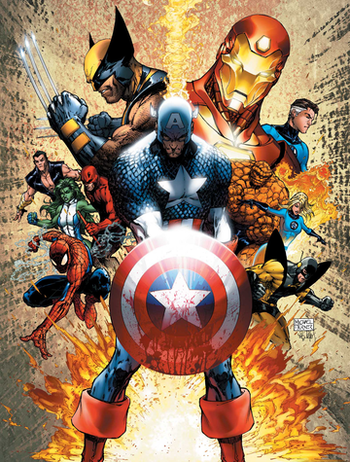
The world as portrayed in Marvel Comics, especially under Stan Lee, Steve Ditko and Jack Kirby, designated as Earth-616 in Marvel's multiverse. As in The DCU, Marvel heroes form teams and Crossovers occur frequently, with many Continuity Nods. (In fact, you could argue that Marvel invented the Continuity Nod.) Many of these comic books have been the basis for movies, TV series or both.
Many TV series and movies set in the Marvel Universe take place in and around New York. The original architects of the world put most of the heroes there, as a subversion of the then-dominant trope of No Communities Were Harmed and as an excuse for Crossovers.
The Marvel Universe's defining characteristics include a general trend toward realism mixed with the fantastic, a little more Civvie Spandex than The DCU, and a strong undercurrent of cynicism and irreverence among the local populace (who are everything from skeptical to distrustful of superpowered beings aside from charismatic mega-celebrities like Iron Man and the Fantastic Four). Of course, it varies from writer to writer; in some eras, Marvel have more explicitly tried to root their Universe in 'the real world', while at other times, there have been entire mutant ghettos covering large areas of New York City.
You can find a timeline of its major events here. If you want a more general history of how Marvel has changed under different Editors-In-Chief (EIC) go here.
Currently owned by Disney; a striking parallel to Disney's old animated shorts rival Warner Bros. owning the DCU. Although the dynamic between their current brand alignments are at cross-purposes. The Looney Tunes for instance were the edgy alternative to the family friendly Disney, just as Marvel was the edgy alternative to the family friendly DC of the Golden and Silver Age. Incidentally, before the Marvel/Disney buyout, Marvel did collaborate with Warner Bros' on some projects namely the X-Men: Evolution cartoon which was produced for and aired on Kids! WB.
Features of the Marvel Universe:
- Aborted Arc
- Abusive Parents
- Action Dad
- Action Girl
- Actually Pretty Funny
- Adaptational Heroism
- Adaptational Villainy
- Adaptation Amalgamation
- Adaptation Dye Job
- Adaptation Name Change
- Adaptation Relationship Overhaul
- Affably Evil
- Affirmative Action Legacy
- Alliterative Name
- Alternate Company Equivalent
- Alternate Universe
- Always Someone Better
- Ambiguously Bi
- Ambiguously Gay
- And I Must Scream
- Anti Hero
- Anti Hero Substitute
- Anti Villain
- Arch Enemy
- Arc Welding
- Armed With Canon
- Ascended Extra
- Badass Bookworm
- Badass Creed
- Badass Family
- Badass Normal
- BatmanGambit
- Be Careful What You Wish For
- Berserk Button
- Big Bad
- Big Bad Wannabe
- Big Brother Instinct
- Big Good
- Bittersweet Ending
- Blessed With Suck
- Blood Knight
- Body Horror
- Brainwashed And Crazy
- Breaking The Fourth Wall
- Breakout Character
- Breakout Villain
- Break The Cutie
- Bullying A Dragon
- But For Me It Was Tuesday
- Butt Monkey
- Call Back
- Call-Forward
- Canon Discontinuity
- Canon Immigrant
- Captain Ethnic
- Central Theme
- Cerebus Retcon
- Characterization Marches On
- ChuckCunningham Syndrome
- C List Fodder
- ComicBook Fantasy Casting
- Comic Book Time
- Composite Character
- Continuity Nod
- Continuity Porn
- Continuity Snarl
- Corrupt Corporate Executive
- Corrupted Character Copy
- Creator Provincialism
- Crime Fighting With Cash
- Crisis Crossover
- Curb Stomp Battle
- Cut Lex Luthor A Check
- Darker And Edgier
- Dating Catwoman
- Deal With The Devil
- Death Is Cheap
- Decomposite Character
- Deconstructed Character Archetype
- Deconstructed Trope
- Deconstruction
- Demoted To Extra
- Depending On The Artist
- Depending On The Writer
- Determinator
- Distaff Counterpart
- Downer Ending
- Driven To Suicide
- Early Installment Character Design Difference
- Early Installment Weirdness
- Earn Your Happy Ending
- Emotion Eater
- Enemy Mine
- Establishing Character Moment
- Even Evil Has Loved Ones
- Even Evil Has Standards
- Everyone Has Standards
- Evil Cannot Comprehend Good
- Evil Counterpart
- Exact Words
- Expy
- Eye Scream
- Face Heel Turn
- Famous Last Words
- Faux Affably Evil
- Flanderization
- Foil
- Fourth Wall Observer
- Freaky Friday Flip
- Friendly Enemy
- From Nobody To Nightmare
- Fun Personified
- Genius Bruiser
- Genre Deconstruction
- Good Is Not Nice
- Good Is Not Soft
- Green Eyed Monster
- Haiku
- Half Human Hybrid
- Happily Adopted
- Hate Sink
- Healing Factor
- Heel Face Revolving Door
- Heel Face Turn
- Heroic Sacrifice
- Hero Insurance
- Hero Killer
- Hero With Bad Publicity
- Heterosexual Life Partners
- Hoist By His Own Petard
- Hollywood Law
- Hypocrite
- Improbable Aiming Skills
- Ineffectual Sympathetic Villain
- Jerkass
- Jerk With A Heart Of Gold
- Joker Immunity
- Karma Houdini
- Karmic Death
- Knight Templar
- Kryptonite Factor
- Legacy Character
- Leg Focus
- Lets You And Him Fight
- Lighter And Softer
- Luke I Am Your Father
- Mad Scientist
- Male Gaze
- Meaningful Name
- Medium Awareness
- Meta Origin
- Ms Fanservice
- Mugging The Monster
- Multinational Team
- Never My Fault
- Nice Guy
- Nice Job Breaking It Hero
- Nice Job Fixing It Villain
- Nigh Invulnerability
- Nineties Anti Hero
- Noble Demon
- No Celebrities Were Harmed
- No Good Deed Goes Unpunished
- Not So Different Remark
- Oh Crap
- Omnicidal Maniac
- One Steve Limit
- OOC Is Serious Business
- Our Vampires Are Different
- Physical God
- Platonic Life Partners
- Power Incontinence
- Reality Warper
- Really Gets Around
- Reconstruction
- Redeeming Replacement
- Reed Richards Is Useless
- Reimagining The Artifact
- Remember The New Guy
- Required Secondary Powers
- Ret Canon
- Retcon
- Revisiting The Roots
- Rogues Gallery
- Rogues Gallery Transplant
- Sadist
- Secret Public Identity
- Series Continuity Error
- Sex God
- Shadow Archetype
- Ship Sinking
- Smug Snake
- Spanner In The Works
- Stalker With A Crush
- Status Quo Is God
- Stripperiffic
- Superman Stays Out Of Gotham
- Superpower Lottery
- Super Strength
- Super Weight
- Take That
- Tangled Family Tree
- The Artifact
- The Atoner
- The Bad Guy Wins
- The Dreaded
- The Fourth Wall Will Not Protect You
- The Friend Nobody Likes
- The Reason You Suck Speech
- The Sociopath
- The Unfettered
- Thou Shalt Not Kill
- Timeline
- Took A Level In Badass
- Took A Level In Jerkass
- Trademark Favorite Food
- Tranquil Fury
- Trauma Conga Line
- True Companions
- Truer To The Text
- Unwitting Instigator Of Doom
- Villain Has A Point
- Vitriolic Best Buds
- Well Intentioned Extremist
- Wham Episode
- Wham Line
- Wham Shot
- What Happened To The Mouse
- What The Hell Hero
- What You Are In The Dark
- With Great Power Comes Great Insanity
- Wolverine Publicity
- You Have Failed Me
- The Avengers
- The Avengers, the original comic book series.
- The Avengers: United They Stand, a 1999 cartoon that barely featured any of its three most famous members.
- Ultimate Avengers and it's sequel, two animated direct-to-DVD movies based on the Ultimate Marvel series.
- The Avengers: Earth's Mightiest Heroes, a animated series from 2010-2012 that features the "classic" roster — Iron Man, Captain America, Thor, Hulk, Ant-Man, and the Wasp — with more superheroes added over the course of the series.
- A big-budget feature film, and centerpiece of the Marvel Cinematic Universe, released in 2012 along with a sequel, Avengers: Age of Ultron in 2015 along with Avengers: Infinity War released in 2018 and Avengers: Endgame released in 2019.
- Avengers Assemble, a 2013 cartoon with a roster and tone similar to the live-action movie.
- Marvel Disk Wars: The Avengers, a 2014 anime which takes the franchise and adds some Mon flavoring.
- Marvel Future Avengers, a 2017 Shonen series.
- Several video games including Captain America and the Avengers, Avengers in Galactic Storm, Marvel: Avengers Alliance and it's sequel and spinoff, Avengers Academy, Marvel Avengers: Battle for Earth, LEGO Marvel's Avengers, and Marvel's Avengers.
- Pinball games Avengers: Infinity Quest, and The Avengers (Stern).
- Avengers C.A.M.P.U.S., a theme park attraction.
- Black Panther
- Black Panther comic books, including several books about Wakanda, such as Wakanda Forever and Wakanda (2022).
- Black Panther, a 2018 film set in the Marvel Cinematic Universe, and it's sequel Black Panther: Wakanda Forever.
- Black Panther, an animated series co-produced by BET.
- Blade
- The Blade comic books, including The Tomb of Dracula comics in which he was introduced.
- The Blade trilogy of films, which include Blade, Blade II, and Blade: Trinity starring Wesley Snipes as Blade.
- Blade: The Series, a live-action television series that lasted for one season starring Kirk "Sticky Fingaz" Jones.
- Marvel Anime: Blade, a 13-episode anime.
- Two video games, Blade and Blade II, both based on the Blade trilogy of films.
- Captain America
- Captain America comics.
- A 1944 theater serial.
- The Marvel Super Heroes, a 1966 animated anthology.
- Two Made For TV Movies, Captain America (1979) and Captain America II: Death Too Soon, featuring a Legacy Character version who rides a motorcycle.
- Captain America (1990), A 1990 theatrical movie so bad the production company never released it and denied it existed. It was finally released on home video in 1992.
- A 2011 big-budget film version called Captain America: The First Avenger, starring Chris Evans in the role of the Star-Spangled Avenger. A sequel, Captain America: The Winter Soldier sequel was released in 2014 and the second sequel Captain America: Civil War was released in 2016.
- A number of video games starring Captain America including Captain America and the Avengers and Captain America: Super Soldier.
- Daredevil
- Daredevil comic book series.
- Daredevil (2003), a 2003 film starring Ben Affleck. It had an improved director's cut and an Elektra spin-off released in 2005.
- Daredevil (2015), a 2015 television series starring Charlie Cox set in the Marvel Cinematic Universe.
- Daredevil, a video game based on the 2003 film.
- Deadpool
- Deadpool comic book series.
- Deadpool, a 2016 R-Rated film starring Ryan Reynolds that was a huge hit and nominated for a Golden Globe for Best Motion Picture, Musical or Comedy. A sequel, Deadpool 2 was released in 2018.
- A short film Deadpool: No Good Deed was released in 2017.
- Deadpool, a 2013 videogame by High Moon Studios.
- Doctor Strange
- The Doctor Strange comics.
- Doctor Strange (1978), a made for TV movie.
- Doctor Strange: The Sorcerer Supreme, a 2007 animated film.
- Two films set in the Marvel Cinematic Universe, Doctor Strange (2016), and Doctor Strange in the Multiverse of Madness.
- Fantastic Four
- The Fantastic Four comic books.
- The Fantastic Four (1967), a 1967 cartoon produced by Hanna-Barbera.
- The Fantastic Four (1978), a 1978 cartoon with the Human Torch replaced by the robot H.E.R.B.I.E.
- Additionally, the Thing got his own mini-show as part of Fred and Barney Meet the Thing.
- Fantastic Four: The Animated Series, a 1994 cartoon shown with the contemporary Iron Man cartoon as part of the "Marvel Action Hour".
- The Fantastic Four, an unreleased 1994 Roger Corman film, infamous around the fandom for its low quality.
- Fantastic Four (2005), a big-budget movie starring Jessica Alba with a 2007 sequel, Fantastic Four: Rise of the Silver Surfer.
- Fantastic Four: World's Greatest Heroes, a 2006 cartoon version with heavily French-influenced art, based loosely off the movie continuity.
- Fantastic Four, a panned 2015 movie reboot more loosely based on the Ultimate Fantastic Four iterations of the characters.
- Doctor Doom's Fearfall, a ride located at Universal's Islands of Adventure that centers around the team's arch-nemesis.
- Guardians of the Galaxy
- Guardians of the Galaxy comic books.
- Guardians of the Galaxy, 2014 movie which proved to be surprisingly popular and made it a major Marvel franchise. Guardians of the Galaxy Vol. 2, the sequel, was released in 2017. A third installment, Guardians of the Galaxy Vol. 3, released in 2023.
- The Guardians of the Galaxy Holiday Special, a holiday special starring the Guardians crew set in the Marvel Cinematic Universe.
- Guardians of the Galaxy (2015), an animated series adaptation.
- Rocket & Groot, a series of animated shorts starring Rocket Raccon and Groot.
- Guardians of the Galaxy: The Telltale Series, a 2017 adventure game by Telltale Games.
- Guardians of the Galaxy (2021), a 2021 action RPG video game by Eidos Montreal published by Square Enix.
- Guardians of the Galaxy – Mission: BREAKOUT!, a theme park ride at Disney California Adventure.
- The Incredible Hulk
- The Incredible Hulk comic books.
- The Marvel Super Heroes, a 1966 animated anthology.
- The Incredible Hulk, a 1978 TV series with a Walking the Earth/Stern Chase plot, and three Made For TV Movies based on it.
- A 1982 cartoon version.
- A 1996 cartoon version.
- Hulk, a big-budget 2003 movie, which polarized critics and viewers alike.
- The Incredible Hulk, a 2008 do-over with much better results. Part of the Marvel Cinematic Universe.
- Hulk Vs., a 2009 OVA wherein he causes numerous headaches for Wolverine and Thor.
- Planet Hulk, a 2010 OVA adaptation of the popular Hulk story line of the same name.
- A ensemble cartoon series with fellow "Hulks" such as She-Hulk and Red Hulk titled Hulk and the Agents of S.M.A.S.H. debuting in 2013.
- Several video games starring Hulk such as The Incredible Hulk: Ultimate Destruction.
- The Incredible Hulk Coaster, a ride located at Universal's Islands of Adventure.
- Iron Man
- Iron Man comic books.
- The Marvel Super Heroes, a 1966 animated anthology.
- Iron Man: Steel Terror, a 1996 prose novel.
- A 1994 cartoon version, shown with the contemporary Fantastic Four cartoon as part of the "Marvel Action Hour". Season 1 saw Shellhead leading Force Works, but a massive Retool for Season 2 saw — among other changes — more solo hero action.
- A 2007 OVA, The Invincible Iron Man.
- Iron Man, a 2008 big-budget movie, that spawned two sequels in 2010 and 2013, which featured Robert Downey Jr. as Iron Man. The first film was notable for having a post-credits scene that kickstarted the shared Marvel Cinematic Universe.
- Iron Man: Armored Adventures, a 2009 CGI animated TV show which has a sassy teen Stark as a quipping Spider-Man-esque incarnation of Iron Man.
- An anime version with 12 episodes.
- Iron Man: Rise of Technovore, an anime film produced as part of the Marvel Anime line.
- Iron Man & Hulk: Heroes United, an animated pseudo-tie-in to Iron Man 3.
- Iron Man & Captain America: Heroes United, a sequel to Iron Man & Hulk: Heroes United.
- Several video games that include Iron Man, Iron Man 2, Iron Man 3: The Official Game, Iron Man VR, and a pinball game Iron Man (Stern).
- Iron Man Experience, a simulator ride at Hong Kong Disneyland.
- The Mighty Thor
- The Mighty Thor comics.
- Thor: Tales of Asgard, an animated direct-to-DVD movie.
- A Live Action Adaptation was released in 2011, directed by Kenneth Branagh and featuring Chris Hemsworth (Captain Kirk's dad) as Thor. BRIAN BLESSED!!!!! was originally tapped to play Odin, but was quickly replaced by Anthony Hopkins. A sequel, Thor: The Dark World, was released in 2013 and the second sequel Thor: Ragnarok was released in 2017 and a third sequel Thor: Love and Thunder was released in 2022.
- Thor: God of Thunder (2011), a video game based on the 2011 film.
- The Punisher
- The Punisher comics.
- Archie Meets the Punisher, a cross over between the Punisher and Archie Comics.
- An anime, Avengers Confidential: Black Widow & Punisher where The Punisher teams up with Black Widow.
- Three film adaptations, The Punisher (1989), The Punisher (2004), and Punisher: War Zone.
- The Punisher (2017), a television series starring Jon Bernthal that was set in Marvel Cinematic Universe that ran for two seasons.
- Several video games, The Punisher (NES), The Punisher (PC), The Punisher (Capcom), and The Punisher (THQ), which was a quasi-follow up to the 2004 film.
- Spider-Man
- Spider-Man comics.
- Spider-Man (1967), a 1967 cartoon version, with an Expository Theme Tune that many baby-boomers can still sing from memory.
- The Amazing Spider-Man, a 1977 live-action series, cancelled due to
 Executive Meddling when CBS decided they were running too many Super Hero series.
 - Spider-Man, a 1978 Japanese Toku series that featured Spider-Man piloting a Humongous Mecha and was one of the inspirations for Super Sentai/Power Rangers.
- Spider-Man, a 1981 cartoon version with an early animated example of Story Arcs.
- Spider-Man and His Amazing Friends, a 1981 cartoon that teamed him up with Iceman of the X-Men and Firestar, an original character that eventually became a Canon Immigrant. Still considered as definitive as the 1960s series.
- Spider-Man, a 1994 cartoon with more focus on Story Arcs and Character Development.
- Spider-Man Unlimited, a short-lived 1999 cartoon where Spidey is transported to Another Dimension. Originally intended to be based on Spider-Man 2099, a comic book title many fans argue Bruce Timm ripped off when developing Batman Beyond.
- Spider-Man: The New Animated Series, a 2003 MTV computer-animated series based loosely on the movie continuity.
- Spider-Man, a 2002 big-budget movie, considered to be (along with X-Men) one of the causes of the current superhero movie boom. Has had two sequels, in 2004 and 2007.
- The Amazing Spider-Man Series duology, which was a Continuity Reboot consisting of The Amazing Spider-Man (2012) and The Amazing Spider-Man 2 (2014). The series was meant to be a launching board for Columbia Pictures's own Spider-Man centered Shared Universe, but failed due to (relative) financial failure and weak critical reception.
- Another Continuity Reboot series of Spider-Man films consisting Spider-Man: Homecoming (2017), Spider-Man: Far From Home (2019) and Spider-Man: No Way Home (2021), this time being part of the Marvel Cinematic Universe and being joint productions of Marvel Studios and Columbia Pictures.
- Venom (2018), another attempt by Columbia Pictures to make films with Spider-Man's extended cast, starring Tom Hardy as Venom. It was followed by Venom: Let There Be Carnage in 2021.
- Spider-Man: Into the Spider-Verse, an animated film released in 2018, starring Miles Morales (the second person to take up the Spider-Man identity in Marvel's Ultimate Marvel universe).
- He showed up in segments of The Electric Company (1971), where he taught reading to kids by having adventures while speaking only in word balloons.
- The Spectacular Spider-Man, a 2008-2010 series, focusing on Peter Parker's years as a high-school student and drawing from the Silver Age stories by Stan Lee and Steve Ditko, with a similar balance of action, drama and comedy as well as a high school setting. However, it also tends to utilize material from all eras of the comic's run and other sources such as the film series and the Ultimate Spider-Man comics., which aired on Kids' WB and then Disney XD for two seasons.
- Ultimate Spider-Man, a animated series that premiered in 2012, where Peter, also a high-school student in this show, is being trained by S.H.I.E.L.D. to be a professional superhero and teams up with a variety of other Marvel superheroes.
- Marvel's Spider-Man, the follow up to Ultimate Spider-Man featuring a back-to-basics approach with Spider-Man also teaming up with Spider-Girl, Spider-Gwen, and Miles Morales.
- A number of video games which include:
- Spider-Man and the X-Men in Arcade's Revenge.
- Spider-Man (2000) and its sequel Spider-Man 2 – Enter: Electro.
- a series of video games based on the film trilogy which include Spider-Man: The Movie, Spider-Man 2, and Spider-Man 3.
- Ultimate Spider-Man.
- Spider-Man: Mysterio's Menace.
- Spider-Man: Friend or Foe.
- Spider-Man: Web of Shadows.
- Spider-Man: Shattered Dimensions.
- Spider-Man: Edge of Time.
- Spider-Man Unlimited.
- The Amazing Spider-Man and The Amazing Spider-Man 2 based on The Amazing Spider-Man movies.
- Spider-Man (PS4) developed by Insomniac Games, along with its spinoff title, Spider-Man: Miles Morales. A sequel, Marvel's Spider-Man 2 was released in 2023.
- The Amazing Adventures of Spider-Man, a 3-D dark ride/simulator attraction.
- Wolverine
- Wolverine comics.
- A loose trilogy of spinoff films from the X-Men Film Series: X-Men Origins: Wolverine, 2009 film that served as a prequel to the X-Men movie franchise, along with 2013 solo film The Wolverine and another solo 2017 film, Logan.
- Wolverine and the X-Men (2009), a 2008 cartoon series (which aired in 2009 in the US) focusing on Wolverine as a leader to the X-Men team.
- Marvel Anime: Wolverine, an anime series released in 2011.
- Several video games, Wolverine (1991), Wolverine: Adamantium Rage (1994), X-Men: Wolverine's Rage (2001), X2: Wolverine's Revenge (2003), and 'X-Men Origins: Wolverine'' (2009)
- X-Men
- X-Men comics.
- Pryde of the X-Men, a failed 1989 Pilot Movie.
- X-Men: The Animated Series, a 1992 cartoon version.
- Wolverine and the X-Men (2009), a 2008 cartoon series (which aired in 2009 in the US). It dives straight into a spinoff of the comics continuity, so in tone it's closest to the 1992 cartoon (but in art it's more like Evolution). Canceled after one season.
- Marvel Anime: X-Men, an 2011 anime.
- Generation X was a failed Pilot Movie from 1996, featuring the characters of the X-Men comic-book spin off who attended Xavier's mutant school.
- Legion, a live-action TV series focusing on Professor X's son, Legion.
- The Gifted (2017), a live-action TV series focusing on an underground network of mutants on the run from the government.
- X-Men: Evolution, a 2000 cartoon with its own continuity. X23, a Canon Immigrant, originated here.
- X-Men, a 2000 big-budget movie that spawned its own movie franchise. It had two direct sequels, X2: X-Men United and X-Men: The Last Stand. In 2011, a prequel called X-Men: First Class set in the 1960s focused on the younger days of Professor X and Magneto, which spawned another sequel/prequel, X-Men: Days of Future Past, based on the famous X-Men story of the same name. A second sequel X-Men: Apocalypse was released in 2016, and a third sequel, Dark Phoenix, was released in 2019. A last spin-off film, The New Mutants, was released in 2020.
- The Astonishing X-Men tetralogy, a quartet of motion comics adapting the "Breakworld" arc of Joss Whedon's run, ending on a cliffhanger with Kitty Pryde trapped inside a 7-mile long bullet that has just been fired at Earth.
- Quite a number of video games; X-Men: The Ravages of Apocalypse, X-Men II: The Fall of the Mutants, X-Men (1992) for the arcades, X-Men (1993) and X-Men 2: Clone Wars released on the Sega Genesis, X-Men: Mutant Apocalypse, the fighting game trilogy of X-Men: Mutant Academy, X-Men Mutant Academy II and X-Men: Next Dimension, X-Men Legends and it's sequel X-Men Legends II, X-Men: Destiny, X-Men: The Official Game, a game set in the X-Men film series, and several fighting games by CAPCOM which launched the Capcom vs. series, X-Men: Children of the Atom and X-Men vs. Street Fighter.
- Storm Force Accelatron, a teacup spinner ride at Universal's Islands of Adventure.
- Adam Warlock
- All-New Ghost Rider
- Ant-Man
- The Awesome Slapstick
- Beta Ray Bill
- Captain Britain
- Captain Marvel
- Captain Universe
- Cloak and Dagger
- Darkhawk
- The Defenders
- Doctor Strange
- Exiles
- Great Lakes Avengers
- Hawkeye
- Howard the Duck
- Iron Fist
- The Incredible Hercules
- The Inhumans
- The Invaders
- Luke Cage
- Man-Thing
- Ms. Marvel
- The New Warriors
- Nextwave
- Nick Fury
- Nova
- Power Pack
- Quasar
- Rawhide Kid
- Runaways
- Secret Warriors
- Shang-Chi
- She-Hulk
- Silver Surfer
- Sleepwalker
- Spider-Girl
- Spider-Gwen
- Spider-Woman
- Squirrel Girl
- Totally Awesome Hulk
- Werewolf by Night
- Young Avengers
- Acts of Vengeance
- Annihilation
- Avengers vs. X-Men
- AXIS
- Civil War
- Dark Reign
- Fear Itself
- House of M
- Inferno (1988)
- Infinity
- The Infinity Gauntlet
- Monsters Unleashed
- Onslaught
- Original Sin
- Secret Empire
- Secret Invasion
- Secret Wars (1984)
- Secret Wars (2015)
- Shadowland
- The Thanos Imperative
- War of Kings
- World War Hulk
- Carnage in New York
- Iron Man: Steel Terror
- Loki: Where Mischief Lies
- Marvel's Spider-Man: Hostile Takeover
- Mary Jane: A Novel
- Spider-Man: Sinister Six Trilogy
- Spider-Man: Global War
- Spider-Man: The Darkest Hours
- Literature/Spider-Man: The Venom Trilogy
- The Unbeatable Squirrel Girl
- X-Men: Chaos Engine Trilogy
- X-Men Mutant Empire Trilogy
- The Marvel Super Heroes was a syndicated 1966 cartoon that was the first TV appearance of the Marvel Universe. It featured Captain America, Iron Man, The Incredible Hulk, Thor, and Namor, the Sub-Mariner in Three Shorts segments, with plots, dialogue and even artwork often taken directly from the comic books.
- Silver Surfer: The Animated Series, a short-lived 1998 cartoon, most notable for being cancelled right after a Cliffhanger wherein the universe ceased to exist.
- The Super Hero Squad Show, a 2009 animated Massive Multiplayer Crossover meant for small children, featuring Super-Deformed versions of the Marvel heroes and a Lighter and Softer storyline. Based on the Marvel Super Hero Squad toy line, except without Spider-Man, of whose TV rights Sony wouldn't let go.
- An animated Black Panther TV series, done in the style of motion comics, was created for BET based on a previous storyline.
- Marvel announced plans to create shows for ABC and ABC Family based on Cloak and Dagger, Jessica Jones, and Mockingbird —- some of those ideas ultimately came to fruition, with slight alterations:
- Marvel's Agents of S.H.I.E.L.D., set within the Marvel Cinematic Universe and featuring Agent Coulson as one of its main characters, premiered on ABC in 2013. Originally developed by Joss Whedon — writer and director of The Avengers— the show is executive produced by his brother Jed and Maurissa Tancharoen. Mockingbird (as played by Adrianne Palicki) joined the cast in the second season.
- Agent Carter, a TV series set in the Marvel Cinematic Universe starring Peggy Carter and the early days of S.H.I.E.L.D.
- Netflix teamed up with Marvel Television for several television shows, culminating in a crossover television event series:
- Marvel's Daredevil (starring Charlie Cox)
- Marvel's Jessica Jones (starring Krysten Ritter)
- Marvel's Iron Fist (starring Finn Jones)
- Marvel's Luke Cage'' (starring Mike Colter)
- Marvel's The Defenders
- Doctor Strange was made into a failed Pilot Movie in 1978; its demonology content allegedly prompted outcries from Christian groups that made sponsors back off from the project.
- A direct-to-DVD animated movie was released in 2007.
- A 1979 Captain America movie, its sequel and another in 1990
- A film version of Howard the Duck, produced (not directed) by George Lucas, was released in 1986.
- In 1991, a Pilot Movie was made for Power Pack, but was never aired. Even so, it still has an IMDB entry
 . Bootlegs of the pilot have caused some to assume it did get an actual broadcast in some markets, but as of yet there has been no proof.
 - The Ultimate Avengers OVA, based on the comic The Ultimates, was released on DVD, February 21st, 2006. A sequel was released on August 8, 2006.
- A big-budget Ghost Rider (2007) film starring Nicolas Cage was released in early 2007. The sequel, Ghost Rider: Spirit of Vengeance, was released in 2012.
- Marvel Entertainment has announced that they are in planning stages for a number of other future movie projects. Doctor Strange, Captain Marvel, Black Panther and The Inhumans are slated to receive their film debuts between 2016 and 2018.
- An Ant-Man film originally directed by Edgar Wright was released in 2015. Wright left the project with both he and Marvel stating it over Creative Differences, with Peyton Reed taking over as director. A sequel was released in July 2018.
- A animated film based on the Marvel comics property Big Hero 6 was released in 2014.
Franchise tropes:
- Abstract Apotheosis: The are several Abstracts in the Marvel Universe, such as Death, Oblivion, and Eternity. Thanos himself uses the Infinity Gauntlet at one point to become the new Eternity.
- Advanced Ancient Acropolis: Wakanda (the African home of the Black Panther and most of the world's Vibranium supply), Callahia, the Inhumans' city, and Atlantis all qualify.
- Affirmative-Action Legacy: While Marvel was a trailblazer in having multi-ethnic heroes (Black Panther being the first black hero in comics), there have been many successors to established characters who fit the bill, especially since Marvel NOW!.
- A.I. Is a Crapshoot: Ultron, as well as his subsequent creation Alkhema. Likewise the Sentinels, which have a disturbing tendency to eventually take their mutant-extermination agenda to extremes which have produced multiple Bad Future timelines where it sucks to be either a mutant or an ordinary human.
- Aliens Are Bastards: Few alien races in Marvel are nice on a consistent basis. The big three are;
- The Skrulls, shapeshifting lizard-beings from three galaxies away, who like to use their powers for turning allies against each other. Often portrayed as the most antagonistic of the big three alien races. They're in a constant state of war with...
- The Kree, fascistic, imperialist xenophobes, ruled by a gestalt intelligence that's so smart it's worshipped as a living god. They're the ones who started the war with the Skrulls, who favoured their sister-race, the Coati (a bunch of pleasant plant-aliens) and were originally pacifistic; their current ways are a He Who Fights Monsters situation that resulted from having to fight back the Kree for so long. They messed around with early human DNA, resulting in the Inhumans. Staggeringly, the Kree are usually displayed as one of the more tolerable alien empires out that, which shows just how much of a Crapsack World cosmic Marvel can be. They also produced the original Captain Marvel, who fell in love with humanity and decided we were worth protecting.
- And the Shi'ar, birdlike aliens with a tendency toward violently conquering other empires and stealing their culture (I.E. Space Romans). They usually tend to bother the X-Men the most, given that their empress married Professor X. Generally, they're portrayed as more benevolent (or at least less antagonistic) than the Kree and the Skrulls, as their empire is hegemonic. However, they're violently afraid of a cosmic entity they worship called the Phoenix, and are not afraid to murder entire bloodlines to prevent anyone hosting it. Additionally, their mythology teaches that their main gods were forcibly married against their will, but ultimately learned to love each other and form a dynasty, leading the Shi'ar forcibly conquer and "improve" the lives of other races. Also, Lilandra, the empress who married Professor X, was the White Sheep of her violently insane family. They've got an elite guard who look strangely familiar...
- There's also the Z'nox, the Lumphomoids, the Badoon, the Spartoinote , the Snarks, the Uncreated, the Symbiotes, the Beyonders...
- Alliterative Name: This was a favored trope of Stan Lee (who employed it so that he would remember his characters' names more easily), so many of the universe's classic characters have this — Peter Parker, Scott Summers, Richard Rider, Bruce Banner, Reed Richards, Susan Storm, Matthew Murdock, Stephen Strange, Pepper Potts (whose real first name is Virginia), and so on.
- Bruce Banner zigzags the trope: whoever is on a first-name basis with him calls him Bruce, but in early issues, sometimes Stan messed up and wrote "Bob" instead of "Bruce". This inconsistency led to the character's full name becoming Robert Bruce Banner.
- All of the Other Reindeer: First comic-book world to have widespread prejudice against a particular type of superhumans, the "anti-mutant paranoia".
- All Myths Are True: Every single mythology and religion ever is true, and their entire pantheons exist. Whether or not they're truly gods tends to vary by the times and the writer in question. They even have their own political system, called the Council of Godheads.
- All-Powerful Bystander:
- The Living Tribunal is this until a multiversial threat arises. He tends to destroy the universe the threat is located in and then resume being a bystander.
- Indeed, all the major cosmic entities tend to be this in a crisis. They'll just stand around talking about the problem, argue over whether they should do anything, and proceed to be of no actual use even if they do.
- The One Above All probably gets points for being the most powerful bystander of all. They are entirely omnipotent, can see everything that goes on in the omniverse... and their only weapon is love.
- Arguably, the Watchers could fit the bill as well, though they are only "all-powerful" from mortals' perspectives.
- Alternate History: While it deviates pretty early on, with figures like Leonardo da Vinci and Isaac Newton setting things like SHIELD in motion, the major point where the timeline splits from the real world one is World War 2, where the Super Soldier Serum used on Captain America creates a superhuman arms race, leading to the Allies' creation of the Invaders, and thus the spread of costumed heroes throughout the world.
- Alternate Universe: A number of Marvel stories deal with and take place in these; appearances of the heroes in other media also fall under this category. Most prominent (and Alternate Continuity examples) are listed below. Notably, the main continuity is not Earth-1 or Earth-Prime, it's Earth-616.
- Age of Apocalypse (Earth-295)
- Earth X (Earth-9997)
- House of M (Earth-58163)
- Marvel 1602 (Earth-311)
- Marvel Cinematic Universe (Earth-199999 - that's five nines)
- Marvel Comics 2 (Earth-982)
- Marvel Mangaverse (Earth-2301)
- Marvel Zombies (Earth-2149)
- Squadron Supreme (Earth-712)
- Ultimate Marvel (Earth-1610)
- Marvel Anime (Earth-101001)
- The Spider-Verse storyline. Just... The whole thing.
- Always Chaotic Evil: The Brood, The Dire Wraiths, The Badoon, and The Chitauri.
- Ancient Astronauts: The Celestials, The Eternals, The Deviants, The Asgardians, and The Olympians.
- Ancient Conspiracy: Dozens, with age varying on a case by case basis. One of which was led by a telepathic dolphin, though it go unceremoniously killed off during Mark Gruenwald's run on Captain America.
- Ancient Grome: Played with; Hercules changed his name to the more familiar roman version (as opposed to Herakles) to distance himself from his villainous mother Hera. Hades is often referred to as Pluto, the Roman name, to avoid confusion with the location.
- Anthropomorphic Personification: Usually referred to as The Abstracts. There's a lot of them, but they don't show up often, and when they do, it's clear that things have become incredibly dire.
- Arbitrarily Large Bank Account: Zig-zagged at times, but still very prevalent. Characters like Tony Stark, Reed Richards, Sebastian Shaw, Emma Frost and many others sometimes seem to have unlimited wealth at their disposal while at other times having money troubles. Also, the residents of New York City and their insurance companies, considering how frequently the place gets trashed in super-battles. The U.S. government is apparently having fewer budget issues than in Real Life, as they can afford an endless number of giant, mutant-hunting killer robots and other expendable Humongous Mecha. Canada also parallels this, seemingly having the money to engage in an astonishing array of massive black-ops projects (often in partnership with the U.S.). Tax rates must presumably be very high on Earth-616.
- Archaic Weapon for an Advanced Age: Quite a bit. Most of the Asgardians use clubs, swords and axes, and several members of the superhero community use a variety of swords or magic ancient weaponry. Even in space, pirates tend to use swords because they're effective for cutting space suits in the vacuum.
- Arch-Enemy: Most heroes have one.
- Arc Words:
- One that shows up in a lot of different contexts is "Omega".
- "Hated and feared"
- Arms and Armor Theme Naming: The covert organizations S.H.I.E.L.D., S.T.R.I.K.E., A.R.M.O.R., S.W.O.R.D., and H.A.M.M.E.R.
- The Artifact: Marvel in its early years positioned itself in the Golden Lee-Kirby-Ditko era as the edgy alternative to DC and its Constructed World setting (i.e. Gotham, Metropolis, Central City). It also averted Comic-Book Time in its early years having characters age as per the stories. Eventually it became a standardized comic universe sometime at the end of the '60s which has the effect of making many of its stories feel dated:
- The fact that the majority of Marvel's heroes, and the majority of the action therefore, is set in, and takes place in New York becomes this. Especially the case for the street-level heroes such as Spider-Man, The Punisher, and Daredevil. The rising costs of living, and greater gentrification, and the historical low crime rates of The '90s and The Oughties made the superhero careers of some of them very improbable and unlikely in terms of verisimilitude (especially Daredevil and The Punisher, since they largely fight non-powered villains, whereas Spider-Man's super-powered villains are purely fantastic) especially since The Big Rotten Apple era, which justified much of the early action is gone. The Punisher as a Vigilante Man in New York makes even less sense with the very tough anti-gun laws of the city. Ben Grimm, a Jewish origin Working-Class Hero from Brooklyn who in his youth was part of the Yancy Street Gang is more or less a Grandfather Clause since the specific neighbourhood he is associated with is gentrified.
- Some Marvel comics have contended that constant hero-villain fighting has held back gentrification and kept 21st-century Marvel New York locked into being The Big Rotten Apple. It's been repeatedly stated, as a specific example, that Hell's Kitchen is still The City Narrows because Daredevil and his enemies regularly demolish the place.
- Much of what is considered the classic Spider-Man story setting, i.e. Peter worried about his Aunt May, balancing his superhero career with his studies, and making a living by taking pictures of Spider-Man for J. Jonah Jameson's Daily Bugle is pretty much hard to do realistically. On account of rising costs of living, Peter can't believably operate as a low-income struggling scrapper in New York, without some form of "Friends" Rent Control. The development of digital and smartphones, makes the idea that Spider-Man could only be captured by a single shutterbug with inside knowledge hard to acceptnote , and the lower crime rates makes the drama of Peter balancing work with personal life feel disjointed. Recent comics, under Dan Slott have actually updated much of this but these elements are so iconic that they remain the most widely known parts of his mythos, and were adapted intact in the Spider-Man Trilogy mostly via Anachronism Stew.
- The fact that many of Marvel's tech businesses and geniuses are located in New York doesn't quite square with reality, since most of America's tech geniuses and brands especially in the recent era work in Silicon Valley, (the Ant-Man film is set in the San Francisco Bay Area for this reason). On the East Coast, tech geniuses mainly concentrate around Boston (because M. I. T.). Someone like Reed Richards and the Fantastic Four living in a prominent skyscraper in Manhattan, aka richer-than-god real estate, and subsisting on patents despite being famously useless is arguably the most fantastic part of the Fantastic Four these days.
- A few of Marvel's most famous heroes and villains are quite era-specific. Captain America is an actual World War II Propaganda Hero (albeit one made before America's entry of the war, i.e. premature anti-fascism), Red Skull is an actual Nazi, as are Baron Zemo, Arnim Zola among others. Since Captain America was thawed out of ice after more than a decade in the Silver Age, his de-thawing merely gets time-shifted and updated with the period of time in which he was a Human Popsicle becoming extended. Likewise, originally Uncle Ben and Aunt May were "Greatest Generation" contemporaries of Steve Rogers, with Ben Parker being a war veteran but sliding timelines have de-emphasized this since it made it unlikely that Peter's uncle would be several years older than his brother Richard (Spider-Man's dad). Magneto, who became an actual Holocaust survivor under Chris Claremont's run in The '70s, cannot quite make use of the same gimmick, so any contemporary X-Men story going forward will age him considerably. Iron Man originated as anti-communist capitalist Science Hero, requiring much Setting Update in his new stories (the MCU updates him to The War on Terror).
- The fact that the majority of Marvel's heroes, and the majority of the action therefore, is set in, and takes place in New York becomes this. Especially the case for the street-level heroes such as Spider-Man, The Punisher, and Daredevil. The rising costs of living, and greater gentrification, and the historical low crime rates of The '90s and The Oughties made the superhero careers of some of them very improbable and unlikely in terms of verisimilitude (especially Daredevil and The Punisher, since they largely fight non-powered villains, whereas Spider-Man's super-powered villains are purely fantastic) especially since The Big Rotten Apple era, which justified much of the early action is gone. The Punisher as a Vigilante Man in New York makes even less sense with the very tough anti-gun laws of the city. Ben Grimm, a Jewish origin Working-Class Hero from Brooklyn who in his youth was part of the Yancy Street Gang is more or less a Grandfather Clause since the specific neighbourhood he is associated with is gentrified.
- Artifact of Death: The Ultimate Nullifier, and several of the Cosmic Cubes.
- Artificial Human: There are tons of robots, clones, biological experiments, golems, and constructs with sentient life in the Marvel Universe.
- Ascend to a Higher Plane of Existence: Stephen Strange's mentor, The Ancient One, who became one with the universe. Man-Thing, who has become the Nexus of All Realities.
- Atrocious Arthropods:
- Fantastic Four: Annihilus is the insectoid tyrant of the Negative Zone. He views all other living creatures as a threat to him and believes the only way to survive is to kill everyone else.
- The Incredible Hulk: Miek, one of Hulk's companions in Planet Hulk and World War Hulk, doesn't start out this way but becomes this over time. Miek belongs to an insectoid race native to the planet Sakaar. After he encounters several tragedies, including his species facing extinction, Miek becomes obsessed with getting revenge on those who have wronged him, escalating to him withholding the truth about how the Hulk's wife and children truly died so the Hulk would go Worldbreaker and become a machine of complete rage and destruction.
- Spider-Man:
- Mac Gargan aka the Scorpion is a former private eye who was transformed into a scorpion-based villain after he underwent an experiment funded by J. Jonah Jameson.
- Richard Deacon aka the Human Fly was a two-bit criminal who stumbled upon a scientist's lab while fleeing the police. The scientist's experiments transformed into a superhuman using the genetic code of a housefly. Deacon killed the scientist and used his new powers for criminal pursuits.
- X-Men:
- The Brood are insectoid aliens who serve as antagonists to the heroes. The Brood's goal is to reproduce and consume all resources, and they have been shown to be very sadistic when torturing their victims.
- Madrox: Sheila DeSoto, the fiancée of mob boss Eddie Vance, is the true villain of the story and is a mutant with the ability to take on a terrifying insectoid form. She got engaged toEddie in order to kill him and take over his racket, and murdered a Madrox duplicate when he learned of her plans.
- Authority Equals Asskicking: Generally speaking, if a person is in charge of something, they're going to be able to kick some serious ass. Doctor Doom, Black Panther, Namor, Captain America, Black Bolt, and Nick Fury, among numerous more.
- Awakening the Sleeping Giant: Happens from time to time, such as whenever the higher-level cosmic entities like Eternity and Oblivion have their hands forced, such as when Thanos obtained the power to warp reality with the Infinity Gauntlet.
- Back from the Dead: This is a comic book universe we're talking about.
- Badass Bookworm: High Evolutionary, Thanos, M.O.D.O.K., The Leader, Valeria and Reed Richards, Alyssa Moy, Beast, Mad Thinker, Hank Pym, Doctor Doom, Doctor Octopus, Maelstrom, Mr. Sinister, Bruce Banner, and Spider-Man. Iron Man is actually an aversion: despite being brainy, he doesn't spend his time buried in books and studies.
- Badass Family: The Fantastic Four, the Summers Family, the Parker Family, and the Banner Family.
- Badass Normal: A ton of characters don't have any powers to speak of. The Punisher, Tony Stark, Hawkeye, Black Widow, Star-Lord, and numerous other heroes, and just about everyone who works for SHIELD, SWORD, and similar organizations.
- Bad Guy Bar: Several.
- Josie's is a New York hangout for low-level street criminals and mooks. The bar is operated by neutral alignment civilians, and allows heroes like Daredevil and Spider-Man to come in, but both parties maintain that Josie's isn't a place for fighting. When one of their own dies, many villains head to Josie's to pay their respects with a few rounds.
- The Bar With No Name in Medina County, Ohio was one of these, until Scourge decided to sneak in disguised as the bartender and opened fire on the patrons- killing 18 people.
- Subsequent writers overlooked the "Ohio" part and transplanted the Bar With No Name to NYC. The frequent damage caused by its patrons led to it becoming the Popup Bar With No Name in 2019.
- The Hellhouse is a villain bar regularly visited by Deadpool and members of his Rogue's Gallery, including Rhino.
- Bad Present: The Marvel Universe is always some varying degree of awful — when supervillains like Norman Osborn aren't in command, eldritch abominations are tearing reality apart and leaving lasting wounds, or the X-Men are abusing time travel so much that the time-space continuum is fractured. Every time something is fixed, it's only so things can get worse later on, and there are plenty of temporal displaced characters to remind us of this fact.
- Became Their Own Antithesis: Cyclops, after the Schism and Avengers vs. X-Men War, has essentially become all the things he was always afraid power would turn him into- when Magneto confronts him about how Scott has effectively become just as bad as he was, Scott scoffs him off, saying that they aren't the same because "I'm winning".
- The Berserker: Hulk, Juggernaut, Colossus, Thing, Thanos, Wolverine, and Thor when he delves into the Warrior's Madness.
- BFS: The Odinsword, Surtur's sword Twilight, The Sacred Sword of Satan, and the Phoenix Blade. Some of the Celestials are depicted as wielding sword-like weapons, and considering some Celestials are larger than the Earth itself...
- Beethoven Was an Alien Spy: Many.
- The Watergate Scandal's Deep Throat was actually a Skrull
- Ulysses Bloodstone used to go by the pseudonym Captain Ahab and his actions were the inspiration for Moby Dick
- Rasputin was one of Mister Sinister's allies
- Imhotep founded the Brotherhood of the Shield which included Isaac Newton, Leonardo da Vinci, Nostradamus, Galileo, Jabir ibn Hayyan, Archimedes and several other gifted minds of history.
- Zhang Heng once defended the Earth from a Celestial, using the spear of Imhotep.
- Nikola Tesla wore a costume and was called "Night Machine", time traveled, died and came back to life at least once and spent his life trying to stop and meddle with SHIELD affairs.
- Michelangelo became an omniscient human god when "Infinity washed over [him]", giving him some reality warping powers and making him glow gold, calling himself the Forever Man.
- Jack the Ripper was actually a parasitic demon of Dormammu's Dark Dimension, and eventually joined Azazel's afterlife pirate crew.
- The Tunguska Event was the result of a group of immortals trying to bring about The End of the World as We Know It with a were-bear.
- Big Applesauce: You can easily sum up the Marvel universe as "New York and the surrounding universe".
- Bit Part Bad Guys: For every world domination-minded super fighter, or universe-threatening threat, there's a dozen superpowered criminals who only want to steal from banks and make some money. They rarely carry their own stories or are seen as serious threats, but many of them fill out each hero's rogues gallery.
- Blessed with Suck: One of Stan Lee's innovations was to write about "superheroes with problems." Characters like Spider-Man, the Hulk, and the Thing were early results of this. Iron Man was the first superhero with a substance abuse problem.
- Blood Magic: One of the many types of magics that exist in the Marvel Universe. Doctor Strange sometimes draws on it, as much as he dislikes it, and Nico Minoru's Staff of One is powered by it as well.
- Bolt of Divine Retribution: Anyone with power over electricity and a vengeful nature. Thor, Zeus and Electro (although he isn't a god, he just fries people to show he can) are notable examples.
- Brainwashing for the Greater Good: Magneto a few times.
- Breaking the Fourth Wall: Deadpool knows he's a comic book character, and this trait was Flanderized to a ridiculous degree, though he's getting better more recently. She-Hulk occasionally made reference to being a comic book character. Loki claims sometimes that all gods are story (also has the dubious honor of being the person, who broke Deadpool's brain that way) but is way more prone to Leaning on the Fourth Wall than outright breaking it.
- Bullying a Dragon: It's like the civilians of the Marvel verse refuse to accept that pissing off a super-powered being is NOT a good idea.
- Bury Your Gays: Phyla-Vell was killed shortly after bringing her partner Moondragon back to life, and hasn't been resurrected (as of 2017). Freedom Ring was killed to make a statement on how inexperienced heroes would likely fare, in an action writer Robert Kirkman would later apologize for. Northstar was killed in three different universes within weeks of each other. Mulholland Black is given a mercy kill when she loses control of her powers.
- Cain and Abel: Invoked — Spider-Man's evil clone brother is actually named Kaine. Ultimately averted — he becomes a superhero, The Scarlet Spider, and a member of the New Warriors. There's also Loki (who is adopted) and Thor, the Juggernaut and Charles Xavier (who are stepbrothers), Barney (Trickshot) and Clint Barton (until they let it go), Ares and Hercules (although the former isn't so much evil as he's a Blood Knight), Coldfire and Luke Cage, the Highwayman and U.S. Archer, Emperor Vulcan with Cyclops and Havok, Stryfe and Cable (the former of which is a clone of the latter), Daken and X-23.
- Canon Immigrant: Numerous characters created for adaptations have made their way back to the mainline Marvel Universe, including (but far from limited to) H.E.R.B.I.E., Firestar, X-23, Agent Coulson, Nick Fury Jr., Reptil, Sam Alexander, the entire Chitauri species, and Angela.
- Canon Invasion: Sometimes, characters from other continuities are integrated into the Marvel Universe.
- Although technically always owned by the same company, The Eternals at Marvel is otherwise an example. The series was created by Jack Kirby as separate from the Marvel Universe, but later brought into it, with the result that, for instance, there would be Marvel Universe versions of gods but Eternals who were posing as those same gods.
- This was lampshaded in an issue of The Mighty Thor where it was revealed The Eternals and The Olympians had made a pact so the former would "represent" the latter in front of mortals.
- Also Machine Man originally appeared in issue #8 of Kirby's monthly comic of 2001: A Space Odyssey where each issue a different person encounters the 2001 monolith. Machine Man later got his own series and was integrated into the Marvel Universe.
- Many references from the movie were rewritten away. However, it is sporadically mentioned that the creators of the monoliths were the Celestials.
- Marvel bought out Malibu Comics in 1994 and soon Marvel heroes and villains were cropping up in Malibu titles. However, Marvel soon canceled all of the Malibu titles and common fan speculation was that Marvel only bought the company to acquire Malibu's then-groundbreaking in-house coloring studio, and/or its catalog of easily movie-licensed properties. Within the Marvel Comics multi-verse, the Malibu Universe is now designated as Earth-93060.
- Believe it or not, when Marvel briefly had the rights to publish Godzilla comics, Big G himself was a character in the Marvel Universe. And it's still considered 616 canon!
- Even though Rom Spaceknight can't be referenced, all the supporting characters and villains can still be seen in comics and the series is still canon.
- Aside from actually calling the Micronauts, the Micronauts, all the characters created for the comic can still be used and are all canon. Hell the character Bug was a member of the Guardians of the Galaxy and Captain Universe nearly killed Juggernaut in a Spider-Man comic.
- While ignored later on, Spider-Man appeared in early issues of Marvel's Transformers series, which made the Autobots and Decepticons Canon Immigrants to the Marvel Universe, at least temporarily.
- Technically the Marvel Transformers comics took place on alternate universes (Earth-91274 for the American comics and Earth-120185 for the UK comics) and are a huge part of the character Death's Head origin, so the Transformers comics are very loosely canon.
- But don't ask where Earthforce fits in as not even Marvel or Hasbro will attempt to make it canon. These are the companies where Marvel What Th—?! and Transformers: Kiss Players are to some degree canon.
- Evil Dead fits in here as the Dynamite Army of Darkness comics got referenced in the Marvel Zombies crossover and numbered in an issue of The Official Handbook to the Marvel Universe.
- Doctor Who is arguably canon if only because the Doctor has crossed over with Death's Head, Marvel's version of Merlin, and the obscure Alan Moore superteam Special Executive who first appeared in Doctor Who Magazine before appearing in Captain Britain.
- Licensed Robert E. Howard characters are probably the most firmly fit into the Marvel Universe. For example Conan (major enemy of Kulan Gath, enemy of Set a serpent god who powers the Serpent Crown, and ally to Red Sonja who would crossover with Spider-Man twice), King Kull (who ruled over Namor's Atlantis in pre-history), and Solomon Kane (appearing in back up stories in Savage Sword of Conan, as well as getting his own mini-series.) Dark Agnes has also been canonized as part of the Marvel Universe alongside Howard's other creations since 2020. Shuma-Gorath was also an enemy of Conan's god Crom.
- Shang-Chi was originally Fu Manchu's son. This has been quietly retconned away, with his father now identified as Zheng Zu.
- U.S. 1 is also canon to the Marvel U.
- Marvel's Guardians of the Galaxy/Killraven continuity's entire premise is that after the Martians of The War of the Worlds failed to conquer Earth the first time, they came back in 2001, and basically killed almost every super hero with only freedom fighters left to defend Earth.
- Earth-7642 of the Marvel Multiverse is the universe for all the crossovers that act as if characters crossing over with Marvel were part of continuity the whole time. It consists of most of the 70's to 90's crossovers with DC Comics, the IDW version of Transformers, Shi, Painkiller, many Image Comics and Top Cow characters, Archie Comics, and a few WildStorm characters.
- Subverted in the case of the Marvel Doc Savage comics, which didn't last long and the only proof of Doc existing in Earth-616 is him crossing over with the Thing and Spider-Man.
- This almost happened on an unimaginable scale in the mid '80s, when for a brief moment, DC seriously considered getting out of the comics publishing business and licensing all of their characters to Marvel. DC and Marvel engaged in talks, and a deal was almost struck when higher-ups on both sides called a halt. Had it happened, though, Superman and Batman may have inhabited New York alongside Spider-Man and The Punisher, and the Justice League and the Avengers would have had to negotiate turf.
- Although technically always owned by the same company, The Eternals at Marvel is otherwise an example. The series was created by Jack Kirby as separate from the Marvel Universe, but later brought into it, with the result that, for instance, there would be Marvel Universe versions of gods but Eternals who were posing as those same gods.
- Calling the Old Man Out: Cyclops' dad Corsair used to be a pretty scummy guy, Star-Lord's father J'Son is a conniving tyrant, Harry Osborn's dad is the Green Goblin, and both Bruce Banner's father and his father-in-law were his enemies at different points in his life.
- Characterization Marches On: It happens as a natural part of a franchise existing for 75+ years, with hundreds of writers.
- City of Adventure: Makes you wonder just how New York City hasn't gotten wiped out yet.
- They've got Damage Control. These guys are always there to make sure NY lives to see another day.
- City Noir: Hell's Kitchen in New York, Madripoor.
- Clones Are People, Too: This is the general mindset the Marvel Universe treats clones with. Spider-Man considers both Ben Reilly and Kaine his brothers, Wolverine actually adopted X-23, and most clones are treated as their own people, with their own minds, goals and personalities (Madelyne Pryor and Stryfe being prominent examples). There are some who consider them abominations, but this behavior is always portrayed as bigoted (which is kind of hypocritical considering the general treatment of mutants over the years...).
- Collector of the Strange: One of the Elders of the Universe, The Collector, who collects anything and everything that strikes his fancy, including sapient beings. Doctor Strange also collects dangerous and mysterious magic artifacts.
- Comic Books Are Real: Marvel Comics exists within the Marvel Universe, and gets likeness permissions/licensing rights from their main characters under contracts with accuracy requirements so strict that the contents of the comics are admissible in court as evidence. Steve Rogers, Captain America himself, once illustrated his own series. Uatu the Watcher transports John Byrne off-planet to observe the Trial of Reed Richards (for saving Galactus' life) so that Byrne can get the details right, and Rich Rider, the first Nova, got his discontinued in favor of a series about a cartoon mouse just after he saved Marv Wolfman and Sal Buscema.
- Comic-Book Time: When he revealed himself during Civil War, Peter Parker stated that he had been acting as Spider-Man since he was 15. Same goes for the first X-Men team, who started in heroics in their teens (sans Beast), and now almost 50 years later (in real time), they still seem to be 30-somethings.
- The Fantastic Four are among the first characters of the Marvel Universe. Reed and Sue quickly married and had a child, and it has taken the last 63 years for that child to reach teenhood, of which the first 54 years still had him barely out of his toddler years.
- Conqueror from the Future: "Kang the Conqueror" is quite likely the Ur-Example.
- Cosmic Egg: Galactus and Annihilus were both reborn in one, the former at the death and rebirth of the universe, the latter after his apparent death in the Annihilation War.
- Cosmic Entity: And how. Take a look at the page for a list.
- Cosmic Plaything: The universe will not allow Peter Parker to be happy, ever. Nor will it ever let Bruce Banner be happy. Deadpool is also quite frequently used as a cosmic plaything by various abstracts like Death, or at least he thinks she does.
- Counter-Earth: Several exist within the Marvel Multiverse and Universe.
- A Counter-Earth created by the Earth scientist, The High Evolutionary used to be there. He wanted it to be better than the real Earth, but one of his earlier creations, the Man-Beast, corrupted it. The High Evolutionary almost destroyed it in his disappointment, but the space hero Adam Warlock asked for the chance to save it, and was granted it. (If that sounds like a Christ analogy, it's because it was). The planet was eventually removed from the Solar system by Sufficiently Advanced Aliens and placed in a museum.
- One was briefly created in The Infinity Crusade: Paradise Omega, created by The Goddess (Adam Warlock's "good" side.)
- The Earth of The New Universe was placed here.
- Most recently, the Heroes Reborn Earth was moved from its Pocket Dimension and put in this position by Doctor Doom.
- Creator Cameo: Stan Lee and Jack Kirby were denied entry to Reed and Sue's wedding, while Stan Lee actually presided over the wedding of Vindicator and Guardian. Chris Claremont occasionally finds himself as a bystander in X-Men related activities and usually gets hurt or inconvenienced.
- Crossover Cosmology: Thor, Hercules, and Amaterasu (not that one, at least not here) all coexist with every other god EVER.
- Cut Lex Luthor a Check: The Trapster, the Ringer, and many, many more. Occasionally subverted by villains like the Wizard, who became a zillionaire through legitimate means before getting bored and turning to crime, or 8-Ball, who only became a supervillain after he was fired from his job and blacklisted for being suspected of selling company secrets to pay his gambling debts.
- Dangerous Workplace: Every single workplace in New York City.
- Darkest Hour: Probably the Dark Reign era — the moral pillar of the Marvel Universe, Captain America, was dead, the hero community was still divided from the wounds of civil war, the supervillains were in control and hunting the heroes with the public opinion on their side, and if Earth wasn't bad enough, the galactic wars in space had torn apart reality enough that Adam Warlock's evil side, the Magus, manifested and nearly allowed the entire Marvel Universe to be consumed by an undying stream of Eldritch Abominations that took the sacrifice of the entire Nova Force and the disbanding of the Guardians of the Galaxy to stop, leaving behind a deeply fractured status quo across the whole Marvel Universe.
- Hydra controlling the USA under Steve Rogers' command as shown in Secret Empire is a close contender too. A man appointed by the chief executive of the most powerful nation on Earth to be its head of security suddenly reveals himself to be the leader of a large Nazi terrorist organization, locks all space-bound heroes out of Earth thanks to an impenetrable forcefield around the Earth, and has Manhattan shrouded in a dome of darkness so that many of the Earth-bound heroes (most of them are based there, remember) cannot act to remove him from power. Inhumans are sent to concentration camps, other heroes are forced to go on the run so they can plot a counterattack without being caught, and entire nations are torn asunder as Captain America goes on a campaign to put a Cosmic Cube back together so he can rewrite history to make the Nazis win WWII (said Cosmic Cube being what turned him from the Big Good into the Big Bad in the first place).
- Death of Personality: The Symbiotes are supposed to do this to their hosts, making Venom and its children deviants among their species for trying to coexist with their hosts.
- Decapitated Army: The Annihilation Wave is a hive mind, so it collapsed when Nova killed Annihilus. The HAMMER forces fell apart completely when Norman Osborn was apprehended and the Sentry killed during the Siege of Asgard.
- Deconstruction: Arguably a founding father of the concept for superhero comics, as it definitely helped popularized the idea of Fantastic Racism for the genre. (People don't seem to notice as much due to how the earlier Marvel comics were not truly Darker and Edgier.) But still, Marvel is definitely one of the reasons why being a super-powered being (especially if you were born with superpowers) might not get you respected.
- Defiant to the End: The Skrull impersonator of John Lennon, one of the allies of Captain Britain's MI-13, spent his last moments in life mocking the Skrull soldiers about their plan to invade the Earth before they shot him in the head. When Thanos becomes all powerful while wielding the Gauntlet, Captain America refuses to break in his belief that Thanos will never win, even as he is killed.
- Demonic Vampires: This is what most Marvel vampires are at their core. Back before the Great Cataclysm, worshippers of Chthon (and maybe Set), an Elder God turned demon, and Earth's first Evil Sorcerer, used the Chthon Scrolls (which would later become The Darkhold) to turn fellow follower Varnae into the first Vampire. While multiple Vampire Sects have been made in the following millennia, most of all have their roots in Varnae, and by extension Chthon.
- Developing Nations Lack Cities: Wakanda is an inversion, being an Afrofuturistic city that is more advanced than virtually every other country on the planet. On the other hand, the rest of Africa is more often than not depicted as being only villages, jungles and deserts, with cities very rarely being shown.
- Devil, but No God: Averted. There are a metric crap-ton of devils and demons, but there is actually a God, who's actually a pleasant and amiable being. The Fantastic Four once went to ask him to bring Ben Grimm back life, and He did. (As to why they didn't ask Him to do the same for other dead superheroes, well...) Satan was a recurring character in the Son of Satan series. God, Jesus or the Angels never appeared or interfered. Later, it was retconned that Satan was being impersonated by demons such as Mephisto, and that the true Devil had NEVER appeared in a Marvel story note . In Ghost Rider, angels and Heaven have shown up. Well, Blaze had a guy helping him against Satan who was at some points implied to be Jesus.
- Journey into Mystery (Gillen) (The Mighty Thor comic)note gave us a council of those various hell lords like Nightmare, Satannish, and the Son-of-Satan-father Satannote . The evil demonic beings meet up and all have their own throne. There is one empty in the middle, for the true Satan ruler of all hells. It has never been used, but they're all terrified to sit on it and "claim" it, not only for the competition from the other Hell Lords vying for it, but of the possibility that he might be real and come back.
- The Marvel Universe with this is actually an inversion of the trope. As in there is quite clearly a supreme God (The One-Above-All) but no supreme Devil. About the One-Above-All there are two hypotheses floating around with an accompanying Shrug of God as both have their own implications the company doesn't want to tackle: 1) They are the Judeo-Christian God (which would lead to uncomfortable questions about the other gods) 2) They are an Author Avatar (which would "demote" YHVH to just another godhead like Zeus or Odin). If you dig deep enough you can find canonical evidence for both, but generally option 2 seems to be more popular (and would actually explain 1) too, when the author happens to be monotheistic his/her god will be the supreme one).
- That being said, The Immortal Hulk seems to have introduced a supreme Devil in the form of the One-Below-All, although its precise nature isn’t entirely clear.
- The Incredible Hulk:
- A good example is when an old flame allows Bruce Banner to see all his inner personalities (each a different Hulk), one of whom takes the form of a monstrous reptilian devil. Devil Hulk tells Bruce "There's a little bit of God and the Devil in everyone", but the comics have yet to get around to that God part. We do get to see that an incarnation of the Beast lives in Bruce's head as well.
- Another Hulk story offers a Double Subversion: Old Greenskin (who at the time had Bruce Banner's intellect) acted as best man at Rick Jones' wedding, and Mephisto crashed the party, claiming to have a lien on the bride's soul. He offered the Hulk a deal: His soul for hers. Banner thought it over, looked up at the sky, and sucker-punched the demon so completely that he flew right through the fire-circle wards he'd set up to keep the other superbeings in attendance from interfering. Sputtering, Mephisto screamed that what the Hulk had done was impossible (No mortal, however powerful, should be able to land a blow on a conceptual being without permission). Banner replied, (not an exact quote): "Weren't you listening to what the preacher said? We are gathered here in the sight of God! What, did you, of all beings, think that those were just words?" While Mephisto leaves the wedding seemingly defeated, his thoughts reveal that he took the beating on purpose to increase the Hulk's hubris. A few issues later, the Hulk's organisation, the Pantheon, went down in flames and Banner suffered a pretty bad nervous breakdown, ruining all of his work with Doc Samson.
- Distaff Counterpart: Common. Spider-Man has two Spider-Girls and four Spider-Women, Thor has both a Thor Girl and most recently a woman has taken up Mjölnir in his stead, Clint "Hawkeye" Barton has Kate "Hawkeye" Bishop, Hulk has She-Hulk and Red Hulk has Red She-Hulk, The Thing has Miss Thing, Wolverine has X-23, Bucky Barnes has Rikki Barnes, Namor has Namorita, Captain Marvel had Ms. Marvel, Deadpool had Lady Deadpool, Zarathos' host was once a Ghost Rider named Alejandra, and Pepper Potts briefly became one for Iron Man named Rescue.
- Divine Date: Thor has Jane Foster, and Hercules has centuries of countless mortal women. If someone is lucky or unlucky enough it's perfectly possible to run into Asgardians or other godly species on Speed Dating events.
- Doing In the Wizard: Jumps back and forth depending on the writer; there's definitely magic, gods, wizards, and demons in the Marvel Universe, and even several different versions of Hell, but certain aspects of the universe often depicted as these things are explained away with science (and often, promptly, reverted back to being magic later), such as whether Asgardians are aliens or gods and what exactly Adam Warlock's powers are — quantum energy manipulation or sorcery.
- The Dreaded:
- The Void. And The Sentry by default, as everyone just knows he's going to snap one day. Then he does.
- Most of Dr. Strange's antagonists qualify, but especially note Dormammu.
- And for the cosmic storylines, Thanos and Annihilus; the later's attempted genocide against all life was so catastrophic that most of the remaining civilizations named their highest threat to the galaxy level after him.
- Dr. Frankenstein:
- Victor Frankenstein is resurrected after his death in the Arctic by Igor, a servant of one of his descendants. In the body of one of his descendents, Victor attempts to incapacitate Orson Randall, AKA Iron Fist when the latter brings an injured ally for Victor to heal, subsequently attempting to body-jack him only to be killed by the "Prince of Orphans".
- Victor's distant relative, Maximilian von Katzenellenbogen, AKA "Max Frankenstein", takes up the mantle of the "Black Bishop" as part of the Hellfire Club against the X-Men.
- Dysfunction Junction: Most superhero teams qualify, but the X-Men are especially noteworthy.
- Easily Conquered World: When you look back at history, not so much. When one prospective conquering race heard about everything Marvel Earth has fought and beaten, they ran. Ran.
- Easily Thwarted Alien Invasion: A lot of them, starting all the way back in the sixties. The most recent big example being Secret Invasion.
- Easy Road to Hell: In both the DC and Marvel 'verses, there have been examples of people getting sent to Hell with magic, rather than through any fault of their own. Granted, in most such cases, they were able to get out later.
- Eldritch Abomination: Swarming hordes of them, whether of mystical or 'cosmic' origins.
- Elemental Rivalry: One of the first and oldest feuds in Marvel's publishing history is between Namor and the Human Torch. The rivalry carries over to the second Human Torch and the Fantastic Four. There's also Surge and Dust, and occasionally, Iceman and Firestar.
- Enormous Engine: SHIELD helicarriers are usually shown with four enormous turbines.
- Ethnicity Monarch:
- There are the Skrull, Kree, and Shiar Empires, all with their own rulers. Typically, their authority is only over Imperial territory, but they're also treated as the rulers of a homogeneous racial group. This is especially apparent in Young Avengers, when it's discovered that Hulkling has the ancestry of both Kree and Skrull royalty, which prompts both Empires into fighting over which gets to "claim" him.
- Various immortal or divine beings, such as Asgardians, Olympians, and so on are ruled by monarchs like Odin or Zeus who are stated to the ruler of all their kin, whether or not they currently live within their godly realm.
- Everyone Is Related: Due to the Summers' Tangled Family Tree (they used to be the Trope Namer for this trope, even).
- There's also most of the gods. Gaea is the Mother-Goddess in most pantheons in Marvel and has birthed a child in just about all of them. Thus, you get wacky family connections like The Mighty Thor being The Incredible Hercules's great-uncle.
- Evil Versus Oblivion: A lot of the Marvel Universe's more prominent villains aren't above fighting alongside the heroes to save the earth, if only because it's their earth. Doctor Doom has done this frequently, Loki has often allied with Odin's forces against beings like Surtur or HAMMER that would destroy Asgard, and even Thanos aided Nova and the Guardians of the Galaxy to destroy the Cancerverse, being unable to resist bringing death to an undying universe.
- Extra-Dimensional Shortcut:The superhero Cloak can teleport himself and others through the dimension of darkness he has access to. The same with Nightcrawler of the X-Men (it's why there's that puff of smoke whenever he uses his powers).
- Extranormal Institute: The Xavier Institute for Gifted Children, and it's much later spin-offs, the Wolverine-lead, Jean Grey School for Higher Learning and the Cyclops-lead New Charles Xavier School for Mutants. She-Hulk once lead a law firm specializing in superhero cases.
- Fake Ultimate Hero: Two of them, one played for laughs and the other one... not so much.
- Volstagg the Voluminous, of the Warriors Three, is a coward and often exaggerates his involvement in tales a great deal, and many of his victories were won by accident or coincidence rather than his own skill. That said, when push comes to shove, he's still an extremely powerful warrior and capable of living up to his exaggerated reputation if his friends and family need him to protect them.
- Norman Osborn managed to pull this off at the end of Secret Invasion, by hiring Deadpool in the guise of Nick Fury to steal data on how to kill the Skrull Queen, which he did on live television after the real Fury and the Avengers did all the heavy lifting, turning him into a global hero. His influence was so great among the people, that he was able to take control of SHIELD and replace it, turn the public against heroes and get everyone to forget that he used to run around in green and purple tights bombing New York City with pumpkin-shaped grenades and throwing innocent bystanders off bridges to their deaths for laughs.
- Fantastic Racism: Marvel is very well-known for this; documentaries have suggested that one reason for Marvel's popularity in the 60's was its use of resonant contemporary themes like bigotry and the marginalization of minorities. Mutants like the X-Men tend to receive it the worst but there are times when other superpowered heroes can also be on the brunt end of it. Spider-Man has gotten backlash from the public thanks to years of J. Jonah Jameson's slander. The Human Torch was beaten by angry civilians at a club during the Civil War event due to escalating anti-superhuman sentiment. And at one point, when many heroes were gathered together for the Hulk's funeral, dozens of protestors showed up to angrily picket the funeral.
- Fantasy Conflict Counterpart: In 2019, to avoid Refugee from Time problems, the comic series The History of the Marvel Universe retconned several well-known characters with histories related to the real-world Vietnam War (in particular Frank Castle/The Punisher and James Rhodes/War Machine) as having fought in a decades-long conflict in Siancong, a Fictional Country in South-East Asia which had made a few previous appearances in the comics (sometimes instead Romanised as "Sin-Cong"). This was also used to avoid identifying a specific war for certain other characters who were established as veterans but weren't so thematically tied to Vietnam, such as Tony Stark.
- Fantasy Kitchen Sink: One of the more prominent examples, right from the beginning with Atlantis coexisting with the gods of every mythology ever, angels, people in Power Armour, demons, dwarves, mutants, elves, aliens, vampires, dragons, zombies, werewolves, cyborgs, Dracula and Frankenstein, giants, and pretty much everything in-between. There are even several different types of magics, and most superhero teams have at least one wizard or occult specialist on tap.
- Fire and Brimstone Hell: Each of the Demon Lords of Hell can make their sub-levels of Hell look however they want, but most of them seem to prefer the more classical depiction. Mephisto's Realm especially.
- Flanderization: Natural to happen in a multiple decade old universe with dozens of writers and thousands of stories- some more notable examples include Wolverine being flanderized into a dumb berserker, Hank Pym's accidental striking of his wife has lead to his flanderization into being a deeply remorseful failure known primarily as a wife-beater, and every team book written by Brian Micheal Bendis stripping away all the original personality of the characters being written.
- Fire Is Masculine:
- Both the first and second Human Torches are male.
- Ghost Rider: All Ghost Riders have Flaming Skulls for heads when transformed. Most of the Ghost Riders that have been shown are male.
- X-Men:
- The original Pyro was a male mutant with the power to manipulate (but not create) fire. His successor is also male and has the ability to both generate and control fire.
- Sunfire and Sun Spot are both male mutants whose revolve around solar energy.
- Floating Continent: Asgard usually floats in space, but for a while, it was floating over Oklahoma. When Attilan, home of the Inhumans, was on Earth, it was similarly floating above the United States.
- Flying Firepower:
- The original Human Torch: one of the first characters to feature this powerset. Johnny Storm would later adopt the moniker, despite not being a robot.
- Toro: A young mutant adopted by Jim Hammond the original Human Torch, had this as his powerset.
- Tara: A female robot based on the original Torch, who was a member of the New Invaders. She was secretly built by the Red Skull for the purpose of infiltrating the New Invaders and destroying them when she self destructed. Jim Hammond sacrificed himself to save her and the Invaders.
- X-Men:
- Sunfire: Sun-related array of powers, and flight.
- Sunpyre: Sunfire's younger sister possesses the same powerset.
- Alternate, female version of Sunfire from Exiles.
- Sunspot from New Mutants, often described as a "living solar battery." He turns solar energy into Flying Brick powers with energy blasts.
- Jean Grey with the power of The Phoenix Force.
- Fantastic Four:
- Johnny Storm has flight and Playing with Fire, with a side order of Wreathed in Flames.
- The android Dragon Man can fly and breathe fire.
- Nova (Not that one, Johnny's girlfriend. Though Richie does qualify for this trope as well) also had this power set, before becoming a Herald of Galactus.
- The Avengers: Firebird (reserve Avenger, briefly an active member of the West Coast Avengers) uses her pyrokinesis to fly.
- New Warriors: Unlike her original cartoon version, Firestar controlled microwave energy instead of fire, but the uses and effects were largely the same.
- Forever War: The Kree-Skrull War isn't technically one war, but several wars that spring up every few years. It's referred to as a singular war because it's been ongoing for millions of years, so even in brief times of peace, the people of both Empires know it's just a break before the war begins again.
- Fourth Reich: The Marvel Universe has many Nazi villains who seek to create a new Nazi state: Red Skull, the original incarnation of Hydra, and Kubekult all come to mind.
- Friend on the Force: New York City has the "Freak Beat", a section of the NYPD that deals with superhuman, alien and mutant crime. Most members of the Freak Beat end up working closely with one particular hero- Moon Knight works with Detective Flint, Spider-Man worked with Jean DeWolff, and so on.
- Friendly Neighborhood Vampire: Michael Morbius, Blade, Hannibal King, Spitfire and Jubilee.
- Functional Magic: Every type of magic exists in the Marvel Universe. Alchemy, Blood Magic, Theurgy, Rule Magic, Chaos Magic, Force Magic, Device Magic- it's all present, as part of the Fantasy Kitchen Sink
- Funny Animal: Half-World is populated with them, like Captain Wal-Rus and Rocket Raccoon. Because it's actually an insane asylum, and the animal people were created so the "loonies" would feel more at ease by the adorable, funny animal people taking care of them and not have to think about how they were left alone on an alien planet.
- Fun with Acronyms: Recurrent with any organization that uses an acronym (see Arms and Armor Theme Naming; another prominent example is Advanced Idea Mechanics, or simply A.I.M.). Subverted with H.A.M.M.E.R., in which Norman Osborn first came up with the name without an acronym behind it and, even after he was arrested and broken out again, no one knows what it stands for. The crowner, though, may be the anarcho-terrorist organization ULTIMATUM (Underground Liberated Totally Integrated Mobile Army To Unite Mankind).
- They managed to top themselves with the Organo-Mechanic Nexus-Iterated Techno-Radical Organizational Networked Intelligent Computer Unity Systemnote , OMNITRONICUS for short.
- Genius Bruiser: Many physically imposing characters also have massive intellects to back them up.
- Genius Loci: The Living Planets Ego and Kathulos, Krakoa the Living Island, Id the Selfish Moon, and Spragg the Living Hill.
- God-Emperor: The Dread Dormammu, Ghaur of the Deviants, and as of Marvel Now Kang the Conqueror has become one, by drinking in the blood of a Celestial and gaining incredible power, in addition to his already impressive skills.
- Good Is Not Nice: Wolverine and Iron Man might be under the flag of good, but they can be outright pricks at times.
- Grey-and-Black Morality: The supervillains are very straight up bad guys most of the time and the heroes though genuinely heroic and noble tend to have personal problems and issues. Some of the heroes have to deal with bad publicity like Spider-Man and the X-Men while SHIELD though good guys tend to commit morally questionable acts while HYDRA are straight up Nazis who are also terrorists as well.
- Government Agency of Fiction: SHIELD, SWORD, ARMOR, and HAMMER, among others.
- Greater-Scope Villain: The Marvel Universe has the cosmic beings Deathnote and Oblivion, who are incredibly powerful and exactly what they sound like. They tend to empower mortals to achieve their goals for them; Thanos and Maelstrom, respectively, are their favorite "heralds," each of whom is a universe-threatening Big Bad in his own right. The two cosmic beings have each been around for (in our time) decades, and have been directly battled only a handful of times.
- As revealed during Fear Itself, the Marvel Universe's real Satan. The other demon lords hold meetings around his throne sometimes, but it's stated that all of them, including, apparently, cosmically-powered ones like Shuma-Gorath and the aforementioned Dormammu, are terrified of even trying to sit on it. He's been gone from this plane of existence so long that even among the demons themselves it's a common belief that he doesn't actually exist.
- The trope can easily become a problem when a bunch of writers work in a shared universe, especially one where the characters are in speaking distance of each other. For example, Marvel kept doing multibook crossovers over the course of the two years Lucifer was, or at least six hundred and sixteen fragments of him were, running wild and free on Earth. With the possible exception of Annihilation, nothing that inspired the crossover events was a bad a problem as this but Ghost Rider was the only one who seemed to care about it.
- In Spider-Verse, Solus is the Greater Scope Villain. He is father to Morlun and all the other Inheritors, but doesn't take part in the Great Hunt for totemic beings himself. He also turns out to be a cosmic-scale threat capable of going toe-to-toe with the Spider-Man of Earth-13, a reality where he kept his Captain Universe powers.
- The Sub-Mariner has Set, the ancient serpent god loosely adapted from Conan the Barbarian. Namor has rarely fought Set in person, but Set's servants Paul Destine, Naga, Llyra, and Ghaur have been involved in many of the terrible things that have happened to him and Atlantis over the years.
- The Wolverine comics revealed not only that Weapon X is in fact controlled by an organization of greater scope villains called Weapon Plus, a secret governmental organization hellbent on eradicating mutants, who is responsible (directly or indirectly) for a LOT of the crappy stuff that Wolverine went through in his life, but also that they are (directly or indirectly) responsible for the existence of many heroes and villains of the Marvel Universe, not just Wolverine himself. They created project rebirth, wich makes them indirectly responsible for the creation of Captain America and Isaiah Bradley(or to be more specific, the super soldier serum, AKA Weapon I). They also created Weapon II(a weird squirrel with Wolverine's powers), The Skinless Man(Weapon III), Nuke(One of Daredevil's villains and Weapon VII), X-23, Deadpool, Huntsman(Weapon XII), Fantomex(Weapon XIII), The Stepford Cuckoos(Clones of Emma Frost and Weapon XIV), Ultimaton(Weapon XV), Allgod(Weapon XVI) and according to Word of God, they are also responsible for creating or empowering many more unknown characters, both heroes and villains. They are also responsible for creating Project:Gladiator, wich makes them indirectly responsible for creating Man-Thing. In some comics, it's also implied that they might have been involved with the prison experiments that gave Luke Cage his powers, the program that created the sentinels and the Red Room Black Widow Ops organization that created the multiple Black Widows(like Natasha Romanoff and Yelena Belova). The organization has also been known to work with and provide money and ressources to other villainous organizations(especially those that hate the X-men) like A.I.M., HYDRA, The Hellfire Club, ROXXON, The Purifiers, OSCORP, ect...Later on, it's revealed that Weapon Plus was created and controlled by an even GREATER greater scope villain known as Romulus. He claims to be responsible for EVERYTHING that happened in Logan's life and more, with plenty of evidence to back up said claim (Such as immense intimate knowledge of Wolverine's life, for example). The aforementioned John Sublime was pulling strings in the program as well, and to make things even more confusing, Word of God from the writer of the very first Weapon X story indicated that the original greater scope villain was going to be Apocalypse, but this never saw print for unknown reasons.
- The Great Flood: Invoked directly by Namor, who floods and completely destroys Wakanda during the Avengers' war with the X-Men. He also flooded New York when he first got involved with the surface world.
- Half-Human Hybrid: Tons of them.
- Healing Factor: A very common ability once you get to the bigger tiers. Wolverine, Deadpool, and Hulk are the three most popular examples.
- Hero with Bad Publicity: Describes most of the heroic figures of the universe, minus those who are big celebrities like Reed Richards or supported by the government like Captain America.
- Hidden Elf Village: Marvel Earth is positively littered with these. Examples include:
- Atlantis and Lemuria, once surface bodies of land, subsequently underwater civilizations. In prehistoric times the Deviants ruled most of the world from Lemuria, but after the Celestials sank it they took up residence in underground cities.
- The Eternals maintained three hidden cities (Olympia, Polaria and Oceana) despite their small population and tendency to mingle with mortals for entertainment.
- The Inhumans had their hidden city of Attilan, which they relocated repeatedly throughout history (currently they're based in a huge building in the middle of the Hudson River).
- The Witches of New Salem introduced in the Fantastic Four, living hidden in Colorado.
- Wakanda is a borderline example, as it is a well-known place with UN representation, but its native technology and natural reserves (i.e. vibranium) aren't easily shared with anyone.
- Hollywood Dreamtime: The Dreamtime is the collective unconsciousness of all sentient beings in the universe. From the Dreamtime, it is possible to access anywhere gods live by going to the fringe of a species' collective consciousness and through the Heart of the Dreamtime, and linking to the others, through the abstract region of pure sentience. It contains countless planetary objects, including Alchera, home of the Aboriginal gods, which cannot be comprehended through reason, as well as Nightmare's "Dream Dimension", which is linked to and shaped by humanity's collective unconscious and include Nightmare World (which Nightmare rule, and which was bordering the Astral Plane), the Skrull Dreamtime, and the infinite alien consciousnesses of all the races of the universe. The Realm of Madness both bordered Nightmare's realm and was beyond it and the Dream Dimension.
- Horror Hippies: Angar the Screamer is a stereotypical long-haired hippie whose screams cause people around him to hallucinate your worst fear. Although he supposedly started out as a social activist, he mostly used his powers to commit crimes for personal gain.
- In Runaways, Frank and Leslie Dean (Karolina's parents) initially look like a pair of friendly aging hippies, but are in fact a pair of alien criminals who also happen to be members of the Pride, a combination between a doomsday cult and an organized crime syndicate.
- A House Divided: Civil War started it, and the rift didn't really get fixed until Siege resulted in Captain America, Iron Man, and Thor reuniting the Avengers. And when the truth about the Incursions comes out, they go and start it all over again, with Civil War II making things worse... And it might not be until the end of Secret Empire that the fences will be mended again. Not to mention all the instances of Let's You and Him Fight, which don't fall in here because they technically between different houses (Avengers vs. X-Men for instance).
- Humans Are Bastards: X-Men comics are the clearest example, but this trope shows up in other series as well.
- Human Sacrifice: Human Sacrifice is one of the methods through which magic can be cast in the Marvel Universe, though it's rarely used anymore — in great enough numbers, human sacrifice can actually damage the world and leave a blight of negative magical energy across a site. Doctor Strange once based his operations from one such site, in order to suppress and counter the bad juju there.
- Human Subspecies: The Mutants, Atlanteans, Eternals, Deviants, and Inhumans. These came about via (in order) random mutation, divine intervention (Poseidon saving his worshipers from drowning), cosmic alien intervention (Celestials designing unchanging Eternals and ever-changing Deviants) and regular alien intervention (Kree experimenting on humans to help kick start their own inability to mutate). Since the Celestials used pre-human hominids and supposedly intended (or created) humans as a control group, that makes Atlanteans and Inhumans Type 1, Mutants Type 2, and Eternals and Deviants Type 3.
- Humongous Mecha: The Sentinels, Red Ronin, Ultimo, The Godkiller, The Phoenix-Buster Iron Man armor, the Colossus of Rhodes, the Doomsman, and Baymax.
- Innocent Aliens: There are some alien races who are genuinely noble like the Symbiotes and the Shi'ar who are allies to the X-Men most of the time.
- Immortality: Marvel has at least one character who embodies each subtrope.
- Immortality Hurts: To his credit, Deadpool has fun when he gets mutilated, shot, stabbed, burned, decapitated, skinned, and liquefied, mostly because of his habit of being a funny guy, but he still feels the pain.
- Wolverine, as well, due to the fact that he's a walking Doom Magnet, with several lifetimes worth of traumatic memories, and an adamantium skeleton which continuously poisons him.
- Indecisive Medium: Before Doctor Strange (2016), the movies based on the comics started with the Marvel logo with the flipping comic book pages.
- Ironic Name: Along with Meaningful Name, there are a few examples of this.
- Peter means "rock". Most Peters in the Marvel universe can just about fly — Spider-man web-slings, Quicksilver runs extremely fast, Starlord pilots a space craft — except Colossus, who turns into metal.
- Jennifer means "beautiful woman", so of course Walters turns into a big green monster with rage issues.
- In a more punny sense, Murdock means "sea".
- Jerkass Gods: The Olympians firmly believe they have to be this way towards humanity. Even being the nicest of them by quite a stretch, Hercules has had his moments.
- Joker Immunity: An endemic problem in any long-running comic book universe, but especially so here.
- Killer Robot: No end of these things. Ultron would be the absolute worst, being an Omnicidal Maniac who has killed several countries worth of people by the modern day, along with briefly taking over an entire galaxy. For Mutants, there are the Sentinels.
- Killing Your Alternate Self: The MU provides various examples of characters dying by the hands of their alternates, such as Deadpool hunting every other Deadpool. This being Marvel, they don't always stay dead.
- Lamarck Was Right
- Last of His Kind: Galactus is the last survivor of his entire universe, assuming his daughter Galacta is non-canonical. Gamora is the last of the Zen-Whoberis who were all wiped out by the Universal Church of Truth. Richard Rider was the last of the Nova Corps, until he sacrificed himself to seal the Cancerverse — destroying the Nova Force itself in the process.
- Leaning on the Fourth Wall: The titles of events are often incorporated as the in-universe codenames for the events.
- Legacy Character: Several hero identities are passed on through the generations. The mantle of the Ghost Rider has passed down to hundreds of people across time, the US Government considered Captain America too important a symbol to lose and tried to replace him when he was gone several times and both Bucky Barnes and Sam Wilson took up the shield in their friend's honor, and nearly every other superhero has passed their costume and name down to the younger generation at some point, or had a friend or family member take up their title when they die.
- The Black Knights manage to take the proverbial cake, being a legacy character dating back to before Arthurian times.
- Leotard of Power: Several characters, including Ms. Marvel, Storm, Psylocke, and Scarlet Witch.
- Living Museum Exhibit: The Collector's main schtick is collecting various rare alien species, and he has tried many times to capture heroes to put them on display, especially The Avengers.
- Mad God:
- Thanos, also usually known as Thanos the Mad Titan. Thor as well when driven to Warrior's Madness.
- Loki can be a bit nuts when he wants to.
- Magic or Psychic?: Psychic powers are common mutant or alien powers, while magic stems from a variety of sources. However it seems that nearly anyone, human, mutant, or other, can learn or acquire magic.
- Magical Native American: Australian Aborigines in the Marvel U are similarly portrayed. A 'magical bullroarer' and the ability to teleport through Dream Time are the powers of two completely separate characters — Talisman (no relation to Elizabeth Twoyoungmen, above) from Contest of Champions and Gateway from X-Men''.
- MegaCorp: With vary degrees of morality. On the side of good, we've got Stark Industries (at least after Tony becomes Iron Man. Before then it's on the morally murky side). And then there's everyone else, but the worst of the worst is Roxxon, who do whatever the hell they want to whoever they want, without any regard to things like morals, ethics or sanity. They're responsible for the origins of more than a few supervillains.
- Mega Manning: Rogue is a famous example. Protege to a much higher degree; not even Celestial beings were safe.
- Meta Origin: There have been several over the course of the Marvel Universe, most notably the experimentation of the Celestials and the race to recreate the Super Soldier Serum.
- The Men in Black: SHIELD often tries to invoke this, and occasionally actually do pull it off.
- Micro Monarchy: The statelet of Latveria.
- Nepharious Pharaoh:
- The villain Kang the Conqueror (who may or may not be a future version of Doctor Doom) first appeared as the pharaoh Rama Tut; he had gone back in time to ancient Egypt to conquer from there.
- The Living Pharaoh, an X-Men villain who later became upgraded to The Living Monolith when he learned how to grow to colossal size.
- The Sphinx, one of Nova's villains, is from Ancient Egypt, and generally dresses like one.
- New York Is Only Manhattan: It has this as a Zig-Zagged Trope: While the majority of events that occur on New York visibly occur only on Manhattan, there are many heroes who live in other boroughs and thus occasionally had to deal with situations closer to home (example: Spider-Man being a Queens native, Captain America taking pride in bring from Brooklyn).
- Noble Bird of Prey: The Phoenix Force.
- Non-Human Undead: Way too many to list. Were-creatures are amazingly common, and in one instance in the 70s, there was an actual vampire cow. It got staked.
- Number of the Beast: Fandom recurrently tends to call the primary Marvel Universe number 616, sometimes considered to be the original number of absolute evil. Writer Dave Thorpe allegedly deliberately came up with the designation, since he considered this what the superhero genre in essence had evolved into.
- Fandom considered designating the Marvel Zombies universe as 666. It eventually ended up as 2149.
- In the end, Earth-666 became the native reality of the Undead Avengers. In context: said reality is populated by a Fantasy Kitchen Sink of monsters, which includes the superheroes, like a vampire Wolverine, a werewolf Captain America, and another Franken-Castle.
- Occult Detective: Everyone who worked at Borderline Investigations, including Frank Drake, Blade, and Hannibal King. Doctor Strange occasionally falls into this role, as did Brother Voodoo when he had Strange's job, and Moon Knight's "Mister Knight" persona.
- Ominous Cube: A Cosmic Cube is an artifact capable of causing anything its owner wishes to become real. Over time, a Cosmic Cube will eventually become sapient. Once it does so, its personality will be based on those of the people who used its powers.
- The Omnipotent: It really depends on one's definition of omnipotent. The Living Tribunal has been called omnipotent by several different characters, yet multiple beings have surpassed his power (Beyonder, Thanos, Protege, and Molecule Man) and defeated him. The Infinity Gauntlet grants the wearer omnipotence, but every being who has ever worn it has had it forcibly taken from them.
- The only indisputable example of an omnipotent character is The-One-Above-All. Just as the name says, he is above everyone in strength and is the higher power the Living Tribunal serves and answers to.
- One-Steve Limit: You better believe this trope is averted. There are easily half a dozen characters named James (Wolverine, War Machine, Bucky), some Johnnys (the Human Torch, the first Ghost Rider) a good few Henrys (the original Ant-Man/Giant-Man/Goliath/Yellowjacket and so on, Beast), a couple of Scotts (Cyclops, the second Ant-Man), and plenty of Peters (Spider-Man, Trapster, Star-Lord).
- There's a Henry Peter, to boot (Gyrich).
- Even the girls get in on it too, with multiple Jessicas (Spider-Woman, Jessica Jones).
- Our Dragons Are Different: Fin Fang Foom, a long-term Iron Man villain, is an alien dragon. His species start off relatively human-sized, getting bigger as they grow.
- All Iron Fists gain their power from winning a fight with Shao-Lao the Undying, who is an immortal dragon.
- Personal Gain Hurts: Just ask Spidey.
- Physical God: Dozens of them.
- Post-Modern Magik: Naturally, being a Fantasy Kitchen Sink set in the modern times. Ghost Rider is a man possessed by an ancient demon of vengeance who rides around on a motorcycle that spews demonic flame and occasionally wields a shotgun loaded with hellfire. Other modern-day Ghost Riders follow the trend, like Robbie Reyes and his muscle car. During one of the X-Men's many feuds with Dracula, he brushed Kitty Pryde's cross aside effortlessly but was burned by her Star of David (of course, she's Jewish, not Christian; what wards vampires off is the faith the would-be victim has in the object, and not the object himself). Thor spends more time hanging out with the Avengers on Earth than in Asgard, and thus interacts (sometimes more successfully than others) with modern technology constantly. Loki can improvise an evil containment unit from a kitchen jar or communicate with demons through junk food, and he just loves the internet.
- Putting the Band Back Together:
- The entire universe has undergone this since Avengers Disassembled. Civil War split The Avengers into two separate teams led by Captain America & Iron Man respectively, with most of the other superheroes picking a side. It took an alien invasion, Norman Osborn becoming the world's supercop, Captain America's resurrection and Iron Man having his brain rebooted from a back-up that he made prior to Civil War to reunite the various heroes against a common foe.
- Subverted with the X-Men, as they have generally stayed apart from the rest of the characters since House of M ended with most mutants being depowered & as of this entry, are now at the point that the X-Men are being split in two & fighting each other.
- Prime Timeline: The Marvel Universe focuses on Earth-616, with Ultimate Marvel set in a completely different timeline, Earth-1610. And that's just to start.
- Radiation-Induced Superpowers: A little radiation can be a wonderful thing in the Marvel Universe. Several of their heroes, including the Hulk, Spider-Man, the Fantastic Four, and even Captain America owe their origins in whole or in part to various forms of radiation, as do a corresponding number of villains, such as the Abomination, the Leader, and the U-Foes.
- Reed Richards Is Useless: Trope Namer. Despite the incredible, amazing and fantastic brains some super-heroes (and villains) have, they are utterly incapable of making the slightest change to the world, for fear of disrupting the idea that the Marvel universe is similar to our reality.
- Reptiles Are Abhorrent: For the most part, with a few exceptions.
- Ret-Canon: After a character or team gets a movie made about them, the comics often change the characters (if they've got a title) to more closely resemble the films, starting with Blade after his films.
- Rule of Three: Any Jekyll & Hyde character will have three identities, to set them apart from the dual identities of more regular people with secret identities. Examples include The Incredible Hulk, Moon Knight, and Typhoid Mary. An aversion is the Green Goblin.
- Run Away Hide Away: The Hostel, which is actually home to The Runaways.
- Ruritania: Marvel Earth has several of these in Eastern Europe, including Doctor Doom's Latveria, Symkaria, Transia and of course the local version of Transylvania. The latter two in particular tend to also be Überwalds due to very high levels of supernatural activity.
- Schizo Tech:
- Technology is all over the map, with governments employing real world guns, aircraft and other weapons at the same time as they also have Cyborgs, Humongous Mecha, Powered Armor and Super Soldiers of various kinds. Also, Imported Alien Phlebotinum can be found pretty much everywhere. Numerous heroes, villains, governments and corporations can produce Magic from Technology, but consumer products are roughly at parity with Real Life.
- This also extends into many of the Bad Futures depicted, overlapping the I Want My Jet Pack trope. While select people have been flying around in rocket-powered armor with unlimited fuel supplies or using anti-gravity gadgets for decades, such technology never seems to become widely available except in either very Utopian or very distant futures. Flying Cars, long used by some such as the Fantastic Four, rarely seem to come into consumer use any earlier than the late-21st Century. Despite numerous people having the necessary technology, manned spaceflight and especially FTL Travel are also very limited.
- Shipless Faster-Than-Light Travel:
- All Cosmic Entities and deities can fly across space without need of a ship. Thanks to the Power Cosmic, the mortal Heralds of Galactus can do this as well, notably the Silver Surfer being able to space-surf.
- Various superheroes are powerful enough to both survive in a vacuum and travel space Faster Than Light. Captain Marvel and the various Captain Marvels after him are a notable example due to being primarily space-based superheroes.
- Society of Immortals: The Eternals, the Asgardians, the Olympians and various other mythological pantheons have their own subcultures separate from mortals, and in some cases each other.
- Sociopathic Hero: Most prominently Deadpool, Wolverine, Punisher, and Moon Knight.
- Space Police: The Nova Corps, an intergalactic peace-keeping organization that taps into the power of the Nova Force, based on Xandar. Until the Annihilation Wave destroyed Xandar, leaving Richard Rider as the last Nova Corpsman. It began rebuilding after Secret Invasion, until Rich sacrificed himself, taking most of the Nova Force with him.
- Spiritual Antithesis:
- The The DCU is like the Marvel Universe, due to both being long-running comic book continuities, but the way they do things is a lot different: DC reboots their main universe every few years to streamline continuity while Marvel keeps the same one with constant updates; DC heroes tend to be more clean-cut and heroic while the Marvel heroes tend to act within morally grey areas; DC places a larger emphasis on legacy and passings-of-the-torch while Marvel has more independent superheroes who grow up to stand alongside the last generation. While this might make it sound like Marvel is the Darker and Edgier to DC's Lighter and Softer, in reality, they both have moments of lighter and darker content. The main difference is that while Marvel works to make its world and characters feel realistic, DC emphasizes the relationship and history between heroes to drive its arcs.
- Marvel like DC are the two longest comic book universes but the way they do things are different such as the DC heroes try not to commit morally questionable acts most of the time unless they have to while the Marvel heroes decide to commit morally questionable acts to save the ones they care about or the world. Most of the villains stay as straight-up bad guys most of the time while the villains in the DC universe try to change their ways and even become anti-heroes at times.
- Status Quo Is God: While there are always major arcs and Crisis Crossover events, the dust eventually settles and things in the Marvel universe eventually go back to a typical norm. The X-Men and other mutants will always be treated as the outcasts by society who hates and fears them. Any progress Spider-Man makes in his life is always undone and he'll always go back to being a single bachelor with money and women problems. Ben Grimm, the Thing, will never be cured of his condition and remain perpetually stuck in his monstrous, rocky form. And in contrast to Manga or Anime, many heroes typically don't have their power or abilities increase as the story progresses (unless a specific story calls for it and they're typically brought back to normal later), such as that brief period of time Spider-Man grew far stronger with the abilities of "The Other" but had it all undone with the events of One More Day.
- Stellar Station: Starcore One was a satellite placed in an orbit around the sun just outside the orbit of Mercury. It was eventually destroyed. Tony Stark built one of his own, the beginning of a Dyson sphere, called Sol's Hammer. As of Dawn of X, this has been taken over by Orchis, the anti-mutant super-science cabal, and renamed the Forge.
- Super Hero: Obviously.
- Superhero Capital of the World: The Ur-Example of the trope can be attributed to New York City. New York is the most common location for superheroes and Super Teams in the setting. Examples include: The Avengers, Fantastic Four, Heroes for Hire, Spider-Man, Daredevil, Doctor Strange, X-Men, etc. Granted, some of them often leave New York to go on foreign missions, but overall most Marvel heroes live in and are active in New York.
- Is it worth mentioning that prominent figures in Marvel Comics Stan Lee, Jack Kirby and original publisher Martin Goodman were all native New Yorkers and Timely/Marvel was headquartered in NYC, so Creator Provincialism is at play.
- Super Registration Act: Has happened on more than one occasion, the most recent one being Civil War. The first was the Mutant Registration Act, introduced in X-Men, and a major plot point in the Claremont years (not so much afterward).
- Super-Soldier: Captain America was the first Super Soldier. Subsequent attempts to replicate the success have been...less than ideal.
- Super Supremacist: The High Evolutionary is constantly fiddling with genetics in an attempt to breed a race superior to humanity.
- Superman Substitute: There are several characters in Marvel such as Gladiator, Sentry, Hyperion, and Blue Marvel who are modeled after the Superman mold, mainly in being Flying Bricks who possess flight, super strength, super speed, super durability, capes, and/or heat vision, along with possibly some other extra abilities to go with the usual Superman-esque repertoire.
- "Take That!" Kiss: Hawkeye did this to Deathbird after defeating her (trope image). He would later be on the receiving end of one from She-Hulk, when she joined the Avengers and showed him her chops.
- Token Minority Couple: Black Panther was paired off with Storm because they were both African, and no other reason then that.
- Too Dumb to Live:
- Many characters have had moments of this, but it's hard to believe someone knows Bruce Banner can turn into the Hulk, yet they still try to piss him off.
- On too many occasions to count, the civilian populace has shown a desire, nay, eagerness to turn on the superhero community. Much of that can be laid at J. Jonah Jameson's hatred of Spider-Man and the rest of the heroes leading him to spin the story with his various media outlets, but then there is the civilians emphatically embrace anything and everything that curtails their civil liberties and gives as much power as possible to megalomaniacal psychopaths , and when that, of course, goes completely wrong, most ordinary citizens, for some reason, blame the superheroes for everything that happened because they didn't "prevent it sooner" or unreasonably accuse them of causing it all intentionally , while still continuing to defend the actions of supervillains . This is notable when Norman Osborn returns after the Siege of Asgard fiasco: the Avengers suddenly find themselves accosted by picket lines in front of Avengers Mansion and protesting their role in peacekeeping (never mind that the President of the U.S. himself put Steven Rogers in charge of American security and fully supports him), thanks to Osborn manipulating the common people into thinking the Avengers are war criminals (which they apparently forgot he himself was). At times, one wonders why the heroes don't just let Galactus eat the planet.
- See also Ultimate Marvel, The New Universe, Marvel Adventures, Capcom vs., Marvel Comics 2.
- Training the Gift of Magic: Mutants in the Marvel Universe are sometimes described in terms that evoke this trope, although their powers are explicitly not magical; these powers usually kick in at adolescence, and it's sometimes said that mutants need training to prevent them harming themselves and others. However, in practice, many mutants seem to get their powers to work pretty well without much or any training, with at worst twinges of megalomania or outbursts of Power Incontinence. (The line that they "need training" might be considered more of an X-Men recruitment pitch, albeit one with some justification...) Ironically enough, the situation with actual magic is more complicated.
- Trench Coat Brigade: Pete Wisdom and Gambit.
- Ungrateful Bastard: No matter how many people the Marvel heroes save, there's always going to be at least one person who refuses to even say "thank you".
- The Unmasqued World: As hard as it is to believe now, there was once a time in the Marvel Universe where men like Leonardo da Vinci and Isaac Newton ran the Brotherhood of the Shield in secrecy, and the knowledge of things like Aliens, Mutants, Superpowers and Gods were actually hidden. This hasn't been true since the 1930's at the very least.
- Unusually Uninteresting Sight: New Yorkers are almost impossibly jaded after decades of super-battles, alien and/or demonic invasions, giant aliens/monsters/robots/superhumans trampling the city and just the day-to-day activities of the local superhumans and vigilantes. They get more worked up by J. Jonah Jameson's editorials than by actual mayhem going on around them. At best they'll complain about traffic jams caused by paranormal events.
- The 'Verse
- Wainscot Society: Large groups from the Morlocks to the Eternals manage to run well-developed societies of their own alongside mundane humanity.
- We ARE Struggling Together: At any one time, the average Marvel team will have half its members at each other's throats on a good day. Even the Avengers isn't immune to this, which is a given when someone like Hawkeye is on the team. More often than not a great majority of team-ups involve superheroes fighting each other, rather than the villain. And then there are things like Civil War, and Avengers vs. X-Men, which made these problems even worse...
- What Other Galaxies?: The Milky Way is by far the primary setting, to the point that the Multiverses are those born from variations of the Milky Way (the Earth, specifically). There have been multiple allusions to other galaxies but it's more to add hype to the big three galactic empires (Shi'ar, Kree, and Skrull) than anything else.
- With Great Power Comes Great Insanity: The Sentry.
- The Worf Effect: Need to show a villain is dangerous? There are plenty of heroes and supervillains for them to choose from. Hulk, Thor, the Juggernaut, the Thing, the X-Men.
- Happens with amazing regularity to the S.H.I.E.L.D. helicarriers, which spend most of their time crashing, or the Avengers Tower, which spends a lot of time being rebuilt after the last Big Bad knocked it down.
