
Shaun: Don't say that!
Ed: What?
Shaun: That.
Ed: What?
Shaun: That. The Z word. Don't say it.
Ed: Why not?
Shaun: Because it's ridiculous!
Ed: [sighs and rolls his eyes] All right... Are there any out there, though?
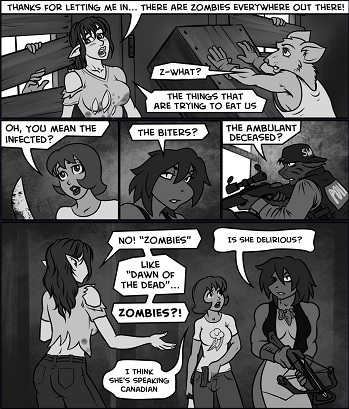
A story has creatures that are obviously based on some sort of mythological monster, but goes out of its way not to call them that.
The title comes from Shaun of the Dead, which gave this a Lampshade Hanging, as seen in the page quote: Shaun doesn't like it because it makes him nervous, but the real reason they're not supposed to say it is that they're in a zombie movie.
A subtrope of the Sci Fi Ghetto. Can be used to highlight how their monsters are different. Suppose your monsters are rotting shambling undead that want to drink your blood. Call them zombies and every casual reader's going to assume they're after "braaaaaiiinnss". Calling them vampires brings up images of old black-&-white horror movies, Anne Rice, and sparkles. When it's used to force a sense of "realism" (we don't call them "zombies" because zombies aren't real), it smacks painfully of Genre Blindness. If you were confronted by what appears to be a member of the walking dead, how much effort would you spend coming up with an alternative name? (After all, we know that hobbits are a fictional creation of J. R. R. Tolkien, but people were quick to nickname the extinct species Homo floresiensis as "hobbits" due to their short stature and human likeness).
Compare to Differently Powered Individual (for superheroes), Comic-Book Movies Don't Use Codenames (for superheroic individuals) A Mech by Any Other Name (for Humongous Mecha), Magic by Any Other Name (for magic), Call a Pegasus a "Hippogriff" (for using equally fantastic words), and Call a Rabbit a "Smeerp" (for animals).
If the reason why someone doesn't want to use the Z-word is not for semantics but because saying the word will bring bad luck, it's The Scottish Trope or Speak of the Devil. If it's because the Z-word is considered rude, it's Fantastic Slurs, or T-Word Euphemism. When used for non-fantastic things and attributes, it may be an attempt to show and not tell.
Examples:
- In Aposimz the generally called "Frame Disease Sufferers" are victims of the Frame Disease, a virus that slowly turns people into mindless doll-like skeletons. Rebedoa treats it like The Plague and potential carriers are quarantined or killed right away. The True Core Church has learned to partially undo it.
- Black Butler introduces Came Back Wrong zombies in the Campania arc, which have a very traditional appearance (stitches, falling-apart bodies, gaping mouths, shambling gait) but are referred to as Bizarre Dolls. This is most likely because the series is set in Victorian England, long before the word "zombie" entered common usage.
- Blood+:
- Chiropterans are a way to lampshade that they are sorta different from... Vampires. To be fair, the only things they have in common are the blood-sucking habit and the bat-like characteristics. Chiroptera is the scientific word for bats.
- And in Blood-C they're called... Elder-Bairns.
- In Chapter 47 of Franken Fran, most characters don't have any problem with the word "zombie" or the indigenous population's term for man-eating monsters in the forest that reproduce by infecting humans, but Fran suggests calling them "human-flesh-eating-syndrome-inflicted-individuals" and wants to look for a cure. It turns out Fran is right: The "zombies" are created by a brain parasite, a deathlike low-metabolism state is part of its maturation cycle, the infected could probably make a full recovery if the parasite were removed, and victims are still conscious but unable to control their actions.
- Highschool of the Dead doesn't even bother making up some name for the zombies, everyone just calls them "Them". One character called them zombies, only to be corrected by another character who made it sound as though zombies are entirely different creatures from the ones the cast faces (they're not). It's later mentioned by one of the main characters that the word "Them" was a piece of brilliance: It becomes easier to put "Them" down if you don't think of them as anything and thus affirm their existence as former humans. In the English dub, Takagi mentions it once while in the mansion, but it's the only time it's spoken. Not sure if it was a mistake on the voice actress' part, or if they accidentally had that word in the script dialogue she was reading (especially considering it's for the most part a Gag Dub that throws in more Woolseyisms and pop culture references than one can count).
- The Kurosagi Corpse Delivery Service has to deal with corpses on a regular basis. Most of them are even animate at some point, due to the main character's ability to let the spirits of the dead briefly animate their own bodies. They are, however, never referred to as "zombies". "Clients" is used instead.
- Naruto The Revenant Zombies created by Orochimaru and Kabuto are referred to as "Edo Tensei Reanimations". Oddly enough the term "zombie" seems to exist, as Kisame jokingly calls Hidan and Kakuzu the "Zombie Combo" for their powers making them somewhat resemble the undead.
- Parasyte: Humans are quick to identify the mysterious invaders as "parasites", rather than aliens. But because the narrative is deliberately ambiguous on whether or not new predators came from another world, or just manifested from ours, the absence of the "a"-word may totally be justified. It also makes the Mayor's Humans Are the Real Monsters-centric speech at the end much more meaningful.
- Samurai Champloo:
- In the episode "Lullaby of the Lost", there's a character named Okuru. To Western viewers, he seems to embody a lot of tropes that apply to American Indians. This is because he's supposed to be one of the Ainu, the native peoples of Japan. However, Japanese broadcast code is extremely strict on how the Ainu may be portrayed. Therefore, Okuru is never explicitly identified as Ainu.
- A later episode features zombies as villains; despite the show being a serious Anachronism Stew (and proudly so), none of the protagonists refer to them as such or as anything, really. Again, the series is set well before the modern concept of a zombie was established, but this is the same show with beat-boxing samurai (and, later on, a baseball episode pitting the main characters — who live in the Edo period — against Americans).
- The zombies in School-Live! are never mentioned in any fashion, they're just there. If anything it makes the contrast between Slice of Life and Zombie Apocalypse even more disturbing. According to the manga zombie fiction does exist, and you can even spot a poster from The Walking Dead once, however still no one mentions the word "zombie" or even euphemisms like "undead".
- The Mariage introduced in StrikerS Sound Stage X of the Lyrical Nanoha franchise are flesh-eating undead armies that are raised by a Necromancer. However, they are never called zombies or ghouls, and are instead referred to as Corpse Weapons.
- Vampire Hunter D doesn't refer to half vampires as dhampyrs because when that word was transliterated into Japanese for the novels and then back into English for the American release of the movies, we ended up with "dampiel" in the first film and "dunpeal" in Bloodlust. The novels correctly use "dhampir".
- In the Yu-Gi-Oh! GX dub, Jaden and the others keep annoyingly referring to the zombies as "Duel Ghouls".
- In the Big Finish Doctor Who audio production "Loups-Garoux", in which the Fifth Doctor meets a group of werewolves, they're usually called "Loups-Garoux", but one character calls them "Lobos", sometimes they're referred to as "wolves", and "Werewolf" is used sparingly.
- We're Alive prefers to use terms like "biters" or simply "them".
- Afterlife with Archie:
- Kevin gets berated for referring to a group of zombies as "the horde". According to him "zombie" lacks a certain "je ne sai quoi".
- The Comics Code once prevented the portrayal of zombies in comics. Marvel Comics decided to get around this by literally just making zombie comics but replacing the letter "o" with "uve", calling them "zuvembies" instead (a term popularized by "Pigeons from Hell", a Robert E. Howard story), since technically, they weren't using "zombies". The word zombies. It's even lampshaded in comics featuring them:
Werewolf by Night: You mean they're zo— SKRASH
- In Dead Eyes Open, the undead are called Returners. They also can be called Deadies.
- In Defoe, zombies are referred to as 'reeks', though Defoe himself has the title 'zombie-hunter general'.
- Robert Venditti's first Demon Knights storyline involves a horde of bloodsucking undead lead by the Big Bad from I, Vampire, but because it's set in 11th century Western Europe, none of the characters know the word "vampire".
- Pre-Code horror comics, particularly those from EC, are probably the root of zombie ubiquity in pop culture horror, but you'll find the word used only a handful of times in any of them. Like Romero later, these writers associated "zombie" with Caribbean folk magic, and employed it only in stories where voodoo raises the dead. There was no single word for other types of walking corpses at all.
- In Empowered, reanimated supers really hate the "z-word". Understandable, as aside from briefly post-reanimation, most are as smart as ever.
- In My Little Pony: Friendship Is Magic (IDW) #16, Rainbow Dash is really against anypony using "the zed word", in a probable direct reference to the trope namer.
- Grant Morrison's New X-Men run did this with superheroes. Though "mutant" is used frequently, the word "superhero" is only mentioned once, when Cyclops remarks "I was never sure why Professor Xavier had us dress like superheroes", when reviewing the team's new black leather uniforms. As part of Morrison's run, the other superheroes in the Marvel Universe are never mentioned or acknowledged, and the X-Men fervently insist that they're not (nor have they ever been) superheroes themselves...despite the costumes, codenames, secret identities, use of mutations to fight crime...
- Preacher has a vampire, Cassidy, who is never called a vampire (though they do in a way invoke this trope by him saying he's "the 'v' word"). This is partially due to the fact that, for quite a while, Cassidy didn't know he was a vampire (he was born before Dracula hit the big screen, and he never got to talk with the vampire who turned him). In fact, he didn't realize it until a friend of his lent him a copy of the original Dracula. However, outside of the regular series, in an all-Cassidy special where he meets another vampire, they play with the vampire image (especially the Anne Rice version) all over the place, also referencing (and pointing out the lack of) many different vampire tropes, but the closest they come to actually using the word is when Cassidy calls Ecarius a "wanker" and Ecarius asks if this is an eastern pronunciation of "Whampyre"...
- Raptors features blood-drinking, super-strong, fanged immortals that are not once referred to as vampires.
- Simon Dark: Includes one flesh golem made of twenty-four dead teenagers, two revived murder victims with stopped aging, three formerly human "familiars" who essentially Escaped from Hell an entire cult of dead humans who are being worn by demonic entities and a whole bunch of living humans who end up pale and superstrong and under the control of a bit of evil magic that causes them to mindlessly attack any other living soul in their vicinity. The word zombie is never once uttered or hinted at.
- Downplayed in The Walking Dead. The survivors call the zombies by a variety of names, including "walkers", "lurkers" and "roamers" (depending on the zombies' behavior) or simply "biters". Unlike the TV adaptation, the word "zombie" exists, but is used only infrequently — the characters admit they find their undead adversaries hard to take seriously when they're called that.
- In Zombies That Ate the World by Guy Davis and Jerry Frissen they are called "living impaired".
- Candorville justifies this in a humorous fashion regarding its "fangs": "Copyright issues. Lawyers would get involved".
- Respawn of the Dead is what would happen if you added zombies to Team Fortress 2. Of course, The Medic, being a man of science, insists that his teammates refrain from calling victims of The Virus zombies. (They do anyway).
- In With Strings Attached, the word "Beatles" rarely appears in the narrative; the author refers to them as "the four". Almost the only time the name appears is when one of the four makes a sardonic or angry reference to it, or when one of the Fans mentions it. Justified in that the book is set in 1980, and the four haven't been The Beatles for ten years, and the author isn't trying to reunite them in that way.
- Futari wa Pretty Cure Dragon never refers to qipaos in-story, even in the narration, using that term; the qipao is always referred to as a "Chinese dress" or something similar.
- Necessary in the Doctor Who fanfic Death and Liberty, which features reptilian Earth-natives who predate humanity who are familiar to any Doctor Who fan, but doesn't feature any characters who'd have heard the names "Silurian" or "Sea Devil". They end up being referred to as "Serpent Men", after Clark Ashton Smith. 'Klepsmnemon, in the same series, similarly refers to the "predators" from Planet 5, rather than the Fendahl.
- In The Magic School Bus fanfic, Under Cover of Darkness, only once is the word "zombie" used, and it's in a joking manner pre-apocalypse. Post-apocalypse, everyone calls them "maulers".
- In the Wicked fic Verdigris, zombies are referred to as "Unmentionables" and "Verdigris'".
- Inspector Gadget's Biggest Caper Ever: The "Prehistoric Giant Flying Lizard" is only ever called that or some variant. At no point does anybody think to just call it a pterosaur or dinosaur. For that matter, it's never called a dragon either, even though it could easily pass for one.
- Irish Folklore Trilogy:
- The Secret of Kells never uses the word "bible" — it's really a Gospel Book — despite being about making one. The Book of Iona/Kells is just referred to as "the book" or a sacred text. Considering that Bible comes from the Greek for "Book", maybe its just a case of Translation Convention.
- Wolfwalkers (2020) never uses the term Werewolf to describe its titular characters, possibly because they use Astral Projection rather than a physical transformation.
- Pinocchio and the Emperor of the Night: The titular Emperor is a demonic figure who wants Pinocchio to sign a contract so the Emperor can have the boy's "freedom", because the Emperor becomes more powerful whenever he takes somebody's "freedom". You thought he wanted Pinocchio's soul or something?
- The only uses of the word LEGO in The LEGO Movie are in the title and on the studs of the actual pieces the world is built from. Nobody uses terms like "minifig" or "minifigure", either.
- Sinbad: Legend of the Seven Seas is a movie about a crew of swashbuckling sailors who rob people on the high seas, and yet somehow never once uses the word "pirate".
- Avengers: Age of Ultron uses the term "enhanced" for super-powered individuals like the Maximoff twins. This is presumably because they weren't allowed to use "mutants" since it belonged to the X-Men franchise.
- Ultron is also never called a robot.
- 28 Days Later calls them the Infected. This has resulted in rather nerdy arguments on the Internet on whether they are actually zombies or not. However, Word of God claims that an infected person is intended to be a Technically-Living Zombie.note The exact same is also true of the zombies (or not) in The Crazies (2010) and [REC].
- Subverted in 30 Days of Night, where one character asks "if they aren't vampires, then what the hell are they?" after being told it's ridiculous to assume that the monsters are exactly that.
- Alien:
- They always call the Aliens "serpents" and the Predators "hunters" in AVP: Alien vs. Predator. In-universe, the Aliens are officially known to humans as Xenomorphs, although the nickname "Bugs" is more common (a minor character in Alien³ calls them "dragons"). Likewise, when the Predators are used as viewpoint characters in the Expanded Universe books, they refer to themselves as "yautja", though not many humans do. The Predators also refer to the Xenomorph as "kainde amedha" — "hard meat" — and humans as "pyode amedha" — "soft meat". The Predator Broken Tusk refers to humans as "oomans". Well, if that's the best they can do... For the record: the term "Xenomorph" — basically meaning "strange shape" — was initially used to refer to "an" alien, not "the" Alien. They have also been referred to, in the role-playing game materials, by a Latin species name, Linguafoeda acheronsis — literally "vile tongue of Acheron". The "Alien Quadrilogy" DVD menus, on the other hand, refer to them as Internecivus raptus — literally "murderous thief".
- Discussed at length in The Battery, when a drunken Ben and Mickey have a friendly argument about calling the Zombies that have them surrounded "Zombies". Ben is for because they logically are, Mickey is against because he thinks it's silly and zombies are fictional (although he does accidentally let a "zombie" slip later, much to Ben's amusement).
- Bit: Subverted in that characters have no problem using the word "vampire", then played straight with Vlad, who, despite the mountain of evidence, is never actually called Dracula.
- In BrainDead, the one time the word "zombie" is used, the corpse of Lionel's mother immediately kills the hooligan who says it. Maybe she took offense.
- No-one in Cloverfield mentions the words "Godzilla", "King Kong", or even "Monster", which would be the logical words anyone would utter upon seeing the creature. Not immediately, though.
- The Cursed primarily focuses on a couple of villagers turning into vaguely-canine monsters upon contact with a cursed set of silver fangs, their bites instilling a Viral Transformation. While the crew confirms it as a werewolf movie, the word is never once used to describe the beasts.
- The Z-word is not used in Dawn of the Dead (2004), but it is used once or twice in the DVD-extra news footage. Notably, a doctor who has been studying the reanimated corpses explicitly refers to them as "zombies".
- Deadtime Stories: Volume 2: If you know the legends, then it is apparent that Donna is turning into a Wendigo at the end of "The Gorge", but the word itself is never used.
- Death Becomes Her. No one in the film mentions zombies, but director Robert Zemeckis openly admits in interviews it's a zombie film, albeit glamorous literally Hollywood zombies.
- All mechs in Elysium are called droids, not robots.
- The Evil Dead series refers to its undead monsters as "deadites", a term first used by the medieval knights that Ash finds locked in combat against them in Army of Darkness. Justified in that 13th century Europeans would hardly know the word "zombie", but also an effort to emphasize that their monsters are different. The deadites, the result of Demonic Possession, can levitate, perform acrobatic feats such as cartwheels and spinning jump kicks, and possess a fiendish intelligence that gives them the heads-up on mortal enemies... not to mention great singing voices. The word "deadite" may refer to anything possessed by the spirits of the Necronomicon rather than a single creature, as it's been equally used to describe everything from possessed and reanimated humans to evil skeletons, winged gargoyles and mirror doppelgangers.
- Fast Color: The word "superhero" is only said once, when Ruth chides Lila for suggesting they use their powers openly.
Ruth: We're not superheroes.
- The villains from The Forgotten are never called aliens, aside from the implications of the missing children being referred to as "abducted" and not kidnapped.
- The guards in Frankenstein Island are never referred to as 'zombies', despite being described as mindless dead bodies reanimated by a psychic force.
- In From Dusk Till Dawn, an argument begins over whether the creatures they were fighting are technically vampires. The monstrous, rapid transformation is more typical of zombie films than of vampire stories. Quentin Tarantino himself has said that a zombie movie was what he had in mind. Played with at the end of the movie:
Carlos: What were they, psychos?
Seth: Did they look like "psychos"? Is that what they looked like? They were vampires! "Psychos" do not explode when sunlight hits them, I don't give a fuck how crazy they are! - Ganja & Hess doesn't use the word "vampire", putting the condition resulting from getting killed with a ceremonial dagger from the mythical African Myrthian tribe as "blood addiction". These addicts are pretty much immortal, though.
- Mundane example: David Fincher refused to use the term "Serial Killer" in his adaptation of The Girl with the Dragon Tattoo, seeing it as horribly clichéd. The closest he gets is the line "So we're looking for a serial murderer".
- Not a mythological monster example, but it is worth noting that The Godfather (part 1) does not once use the word "Mafia", and in the novel it's based on, only people outside the syndicate refer to it as such, while Vito uses the phrase Cosa Nostra (i.e., "this thing of ours") during his speech to the bosses of the Five Families. This ties in with the fact that real-world mobsters never use the term, as far as anyone can tell who is likely to say anything about it.
- The first member to even publicly acknowledge its existence was Joe Valachi, in October 1963.
- Word of God has it that one of the conditions for the real life Mob allowing the film to go ahead was that the word "Mafia" should never appear in the screenplay. However, there was only one instance of it in the first place, so it was hardly a dramatic edit.
- American mobsters didn't really use "Mafia" or "La Cosa Nostra" to refer to themselves until they adapted those terms from law enforcement and film and television. In Italy Mafia refers to geographically specific (Sicilian) crime groups but in North America some regional differences were ignored among Italian immigrants. Also, during and after Prohibition the vast organized crime network united by Lucky Luciano and Meyer Lansky was half Jewish, and thus preferred the ethnically neutral term "Syndicate".
- In the 1998 American Godzilla remake, the word "monster" is never used. Usually, it's "that thing" or "the creature" or "target" or, at one point, "a dinosaur". In fact, the name Godzilla is only used about twice. Godzilla fans and Toho Studios grew displeased with the creature and decided to rename the creature as just "Zilla" or even "Tuna Head", and director Ryuhei Kitamura decided to have the real Godzilla fight and kill "Zilla" to distinguish they're two different monsters.
- The Hamiltons never uses the word vampire; through most of the movie, it isn't even clear that that's what the story is about.
- A Hard Day's Night: Although it's a movie featuring The Beatles, the word "Beatle" is never used throughout the film (though it is printed on Ringo Starr's drumset).
- In the trailers for Here Alone, the word "zombie" is never used.
- Not a zombie example, but the 1943 OSS espionage training film How to Operate Behind Enemy Lines (meant to show US intelligence agents how not to get killed while spying in Germany) bent over backwards not to say the "G" word, always identifying the place that the agents were being dispatched as "Enemy Area", even in the most ridiculous usages (an agent picking out clothes is told the suit he's wearing is "an Enemy Area cut"). At one point, when the agent is going over his cover story, actual footage of "Enemy Area" troops are shown. In another scene, the agent's personal effects are written in "Enemy Area", and he's in a photograph with his girl, wearing an "Enemy Area" uniform. Then an "Enemy Area" spy is actually identified as German. Go figure.
- The Hunger never uses V-word, despite the fact that it centers around a nigh-immortal woman who drinks blood.
- John Landis' Innocent Blood never uses the word vampire, but isn't merely an example of Genre Blindness as dialog and clips from classic horror movies hint that many of the characters are thinking it.
- The Invitation (2022):
- Only once, at the very end of the film, is the word "vampire" used to describe the villains. In fact, the true nature of the villains is presented as a twist. The main villain does, however, refer to himself by two other terms for them, "strigoi" and "nosferatu".
- Furthermore, the villain is never referred to by the name "Dracula", even if the film does all it can to imply that that's who he is, between his two vampire brides (which he hopes to make three), one of his brides being named Lucy, him originally being from Transylvania, two of the townsfolk being Jonathan and Mina Harker (having long ago sold out to him in exchange for immortality), and the fact that he says his real name means "Son of the Dragon". On the same note, Renfield is only ever referred to as "Mr. Field".
- In Juan of the Dead Juan and his friends refer to the zombies as "dissidents" or similar political malcontents, following an early news broadcast from the Cuban government labeling them as such. Dealing with their first zombie-kill, the gang first think the man is either a vampire or demonically possessed.
- Averted with the aid-worker who calls them zombies. However, he is speaking English, so none of the other characters understand him.
- The protagonists of Kick-Ass talk about superheroes all the time, but the Mafia-esque villains refuse to at first. The mob bosses don't believe an underling when he claims he didn't betray them, he was framed by some guy dressed like Batman. Since at this point there are no known superheroes in the world, we can't really blame the boss for his incredulity. It then becomes something of a running gag for the mob to refer to Big Daddy as Batman. To try to make it seem less ridiculous, the guy telling the story attempts to save face by saying he's not the actual Batman but someone who looks like him.
- Legend of the Werewolf, a 1975 horror movie starring Peter Cushing about, you guessed it, a werewolf (not Cushing). Although Cushing and other characters talk about the probable cause of several murders, they never utter the word "werewolf" or "wolfman": "It could have been... (the other guy waits to hear the anticipated hypothesis) No, that's a preposterous idea". In addition, the wolfman's romantic interests works as a prostitute (which is an important part of the plot) and that word is not uttered either: "She told me she's a servant". "(Laughs) Yes, she does indeed serve".
- In Leprechaun 4: In Space the Leprechaun is never referred to as such; the main characters just assume he's some kind of alien.
- Living Dead Series:
- Night of the Living Dead (1968) never calls its undead "zombies". It does call them "ghouls" in a newscast. According to The Other Wiki, George A. Romero never thought of them as zombies, despite the movie becoming the Trope Maker for the modern Zombie Apocalypse. It was made at a time when 'zombie' still referred to someone under the spell of a voodoo priest. Although there may have been some passing references to reanimated corpses as zombies in earlier films, it wasn't a general term for them yet.
- Night of the Living Dead (1990) specifically avoids using the word as well, simply referring to the zombies as "those things" or "those people" since it is set in world where Romero films were never made.
- The second movie, Dawn of the Dead (1978), uses the word "zombie" only once. A policeman who mentions his grandfather was a Trinidadian voodoo priest offhandedly calls them as such, but only in one scene.
- Dawn of the Dead (1978) was titled Zombi in some countries. Along with Lucio Fulci's Zombie / Zombi 2/ Zombie Flesh Eaters, this probably cemented the idea of calling the undead "zombies". The term was also largely averted in other 1970s living dead movies such as The Living Dead at Manchester Morgue (aka Let Sleeping Corpses Lie) and Children Shouldn't Play with Dead Things.
- In Day of the Dead (1985), zombies are given perhaps the greatest nickname in their history: Dumbfucks.
- In Land of the Dead, where Dennis Hopper in particular uses it on a couple of occasions. Presumably, at this point in the series, everyone is sufficiently jaded about their situation to finally slap on a label.
- But in Survival of the Dead, they call them "deadheads" or "assholes".
- Not discussed, but the entire series of The Matrix has humans refer to the Machines, probably for similar reasons.
- The vampires of Near Dark are never referred to as vampires, despite the blood-drinking, extra strength, lack of aging and general vampire-ness.
- Nosferatu used — well, "nosferatu" to avoid saying "vampire". This was probably to disguise the fact that it was a wholesale Captain Ersatz rip-off of Dracula. It had copyright infringement problems as it was, considering that it was a more faithful adaptation of the book than any of the "official" filmed versions.
- In Outpost, no one ever refers to the undead Nazi soldiers as zombies.
- Perfect Creature: Not once during the story's spantime, the word "vampire" is used to describe the Brotherhood (who are super-strong and fast, have sharp fangs and drink blood) except for one instance during the opening narration which states they used to be called like that in older times when they were feared and reviled as abominations.
- Planet Terror had "sickos", brain-eating bubbly-skinned not-quite-zombies.
- Pontypool was marketed as a zombie film, but the producers stress that they aren't zombies, preferring to call them "conversationalists" due to their Madness Mantra of constantly repeating the last words they say or hear, while they aren't really referred to with any specific terminology in the film itself. Somewhat justified, as though they are functionally speaking Technically Living Zombies who singlemindedly pursue and devour any uninfected, they also have several much stranger traits that set them apart. Specifically the fact that the infection is spread through the English language rather than any kind of biological virus, the affliction somehow able to infect certain words that get stuck in peoples' heads and cause them to go violently insane. Word of God is also that they aren't trying to eat people, exactly, but are instead utterly convinced that the only way to end their affliction is to chew their way into the mouth of another person.
- The protagonists in Primer never refer to their time machine as a time machine, nor do they use the words time travel to describe their time travel.
- Covered and named straight out in The Spoony One's review of Quarantine (2008), which apparently just thinks all of its zombies are "sick" and "need help".
- In [REC], the 'zombies' are never acknowledged as such, even though it's acknowledged the fact that it's a virus. There's even the suggestion that the virus is from Hell.
- Nobody in Requiem for a Dream ever says the word "heroin". Viewers are expected to realize on their own what it is three of the four main characters are addicted to. Which is kind of Truth in Television, because real life addicts and street hustlers almost always refer to illicit substances in slang terms. Walking around in the streets calling drugs exactly what they are, will at best make people suspect that you're working with the cops.
- The Resident Evil Film Series never use the word zombie, instead opting for "infected". This doesn't make much sense because, although the games have a wide variety of non-zombie enemies, the movies only have zombies of various stages (except for Tyrants and Crows).
- The novelization of the first movie also includes an in-universe example. Matt Addison, as a child, used to read comic books where, for censorship reasons, zombies were renamed as "zuvembies". Matt liked the name so much that the Hive zombies are referred to as such when a chapter is read from his POV.
- Justified in-character example: In The Return of the Living Dead, a character who phones 911 doesn't admit that the attackers are animated corpses, realizing his pleas for help will be dismissed as a prank if he does. He claims that they're people who've gone Ax-Crazy ("It's a disease, it's like rabies, only it's faster, it's a lot faster.."). instead.
- Played with in the same movie, in that "zombies" is used to refer to the creatures from Night of the Living Dead, which exists in-Verse as fiction, but the actual reanimated corpses are mostly referred to as cadavers, corpses, or simply "things".
- The word "vampire" is never uttered in Rise: Blood Hunter to describe the cult of undead blood drinkers. That's why most people who saw the trailer thought it was about some sort of Pushing Daisies-esque zombie or something.
- Shaun of the Dead not only names the trope, but invokes it. Later in the film, when David says Barbara's "turning into one of those zombies", Ed angrily shouts "We're not using the Z-word!"
- The Sixth Sense avoids using the words "medium" and "psychic" although clearly the young Cole could be described as either. However, the ghosts of the film are called ghosts several times.
- Sky Line does the same thing, with the characters never using the word "aliens" to describe the invaders.
- The granddaddy of the "Don't use the 'R' word" subtrope: Back in 1977, the world knew mechanical/electronic automata as pretty much just one thing: Robots. To look different, we suppose, Star Wars referred to theirs as something (at the time) different, an abbreviation of "android" — droid. Of course, nowadays the word is so common that non-Star Wars-based shows and movies have used it, even, and it's entirely possible that there are people out there who would recognize the word "droid" more quickly. Moreover, "droid" is more immediately recognizable as a term for sci-fi movie robots — few people would think to refer to an automated arm that screws bolts onto cars, a thick frisbee that sucks your carpet clean, or a plastic velociraptor with stupid legs as "droids". This also contains irony. Abbreviated from "androids", the word "droid" should thus refer only to things that match the definition of "android". "Android", of course, means "artificial person" (and more precisely, male artificial people) — only of the two most famous Star Wars droids, 50% aren't humanoid at all.
According to source material, the word "droid" properly refers only to robots with full artificial intelligence, while less intelligent robots (like the aforementioned one's that folks in real would never think of referring to as "droids") are classified "robots", not "droids", although many characters refer to them colloquially as "droids" anyway. Robots aren't as common as droids, on account of being arguably inferior, which might also help explain the rarity of the term. However, the word "droid" is a (and has been for decades) a registered trademark of Lucasfilm. One only needs to watch a commercial for a Motorola Droid phone to see the "used with permission" fine print (the Motorola Droid was designed by George Lucas, himself; hence, why there is a Droid R2-D2). If the term "droid" has ever been used in a non-Lucasfilm movie, then the studio likely paid for the privilege. At one point in A New Hope, Luke explicitly refers to C-3PO and R2-D2 as robots. - The Stone Tape. The leader of the research team investigating the haunted house tells everyone not to use words like ghost or spook because the impulse is not to take them seriously.
- Marvel's Film/Thor for some reason goes out of its way to avoid mentioning Norse gods or Norse myths.
- Kind of Averted and not at the same time in Train to Busan; the word "zombie" is never spoken, but the hashtag #Zombie is use when a character checks his cellphone.
- The word "Transformer" is only used twice in the Transformers series, once in each film and the first film is referring to the piece of electrical equipment. Granted, the terms "Autobot", "Decepticon", and "Cybertronian" are thrown around constantly, though this might have something to do with the trademark. This is probably because in most Transformers continuities, the title isn't a term Cybertronians use to describe themselves.
- Ultraviolet (2006) directed by Kurt Wimmer, which is unrelated to the series but also features vampires, zig-zags the trope. Government agents refer to them as "hemophages". Civilian newspapers use the word "vampire" because it made for better headlines. Violet herself will use either one depending on the context.
- In Unbreakable, the word "superhero" is used a grand total of once and in the context of describing a comicbook's plot. At one point, the protagonist's son says "You think my dad's a..". but is interrupted. However, it rather fits with the Deconstructionist aspect of the movie.
- Justified in the zombie film Undead or Alive, as it takes place in the 1800's Wild West... well before the Z-word would come into regular use.
- The Underworld (2003) films call their vampires vampires, but their werewolves are called lycans, which, while it makes sense as a shortening of 'lycanthrope', does make them sound like lichens, that thin layer of green moss and fungus that grows on rocks. That being said, most of the movies are from the perspective of a vampire and someone who was part of neither society. In the third film/prequel we learn that a lycan is a specific kind of werewolf. Though in the first film when Selene is telling Michael about the history, she refers to the lycans as werewolves briefly just to clear up confusion. Especially funny since the filmmakers state in the commentary for the first movie that they didn't want to use the word "werewolf" because it sounds corny. Because "vampire" and "lycan" lend it that touch of classic elegance.
- In War of the Worlds (2005), the characters go out of their way to avoid describing the clearly alien invaders as "aliens", or even Martians, although it is reasonable that the characters couldn't figure they came from Mars. They are instead mistakenly referred to as "terrorists" or otherwise just "them".
- We Are the Night focuses on a group of immortal blood-drinking women with fangs and supernatural powers who have no reflection and burn in the sunlight, but the word "vampire" is never spoken by anyone in the film.
- In Willow, what would normally be called dwarves are called Nelwyns and humans are called Daikinis. Though The Making of... says that Daikini is a Nelwyn word meaning "tall person", implying that humans might call themselves human.
- In the 1994 film Wolf (Mike Nichols) the characters never use the word "werewolf", even though that is obviously what Jack Nicholson's character is turning into. Could be to avert expectations of a traditional Hollywood-style wolfman. Since the film tends to avoid standard horror tropes and was created with an older audience in mind than most horror films are made for, it's crucial to leave out anything which suggests that their werewolves are not different.
- Done again in The World's End (which parodies Invasion of the Body Snatchers), where the group has a loopy drunken discussion about what to call the robots taking over the town. They ultimately settle on "Blanks", because they can't think of a better alternative to "robot", which they refuse to use. A couple of alternatives discussed were "blue bloods", "Foebots", and "smashy-smashy egg-man", all rejected for being semantically wrong. Notably, the cause of the discussion in the first place is that the robots insist on not being called "robots", because etymologically it means "slave", and "[they] are ''not'' slaves".
- Exploited by Hidden. The deadly threat that the protagonists are hiding from are simply called "Breathers", and little is said that describes them, though flashbacks indicate the existence of a 28 Days Later style virus. Breathers are actually human soldiers wearing noisy rebreathers, who are tasked with hunting and killing zombies, such as the protagonists.
- The Affinity Bridge contains revenants: Victorian zombies.
- The vampiric narrator of Steven Brust's Agyar never once uses the word "vampire", nor does he ever explicitly describe himself feeding on blood, though he does so many times. Agyar tells the story simply to put his thoughts on paper, and therefore does not explain anything that would be second nature to himself.
- Charlotte of Along The Winding Road really prefers "infecteds", though her love interest doesn't mind throwing the z-word around.
- Kit Whitfield's Bareback (Benighted in the US) is about a world where nearly everyone is a werewolf; they are referred to only as "lycanthropes" or "lycos". She discussed this in an interview, saying that B-Movies have rendered the word "werewolf" utterly unusable.
- Bazil Broketail: Although they fit the common traits (mindless, ravenous former humans with a drive to bite the living, infecting them with the same condition), the infected are only called "ferals" instead (hence the title), never zombies.
- Black Tide Rising: In Under a Graveyard Sky, given that zombies were previously regarded as purely fictional, the experts are initially reluctant to call the Technically-Living Zombie victims of H7D3 "zombies", but eventually give in to the inevitable as everyone's thoughts gravitate that way anyhow.
- Carmilla: The word "vampire" is not used up to Chapter 13 (of 16), when it is used by the woodman who relates how the village of Karnstein came to be deserted. Before that, there is only ominous talk of the "oupire", the equivalent of vampire in the North-Slavic languages.
- In Cell, Stephen King has his protagonists calling the victims of the mystery brainwipe "phone-crazies", later "phoners". This is kind of mentioned in the main character's internal monologues; he finds himself thinking of them as zombies on one occasion, then decides that they aren't zombies because they are still alive.
- The shambling undead created by the Deadly Gas in the Clockwork Century novels are called Rotters (Justified Trope due to time period).
- Ganymede, set in New Orleans and including appearances by Marie Laveau, does refer to them as zombis.
- Ganymede, set in New Orleans and including appearances by Marie Laveau
- The Cosmere: From Brandon Sanderson's works come a couple of examples. The Elantrians from Elantris and the Lifeless from Warbreaker are both pretty clearly zombies (albeit very different variations), but are never called such. Indeed, the word "undead" itself is almost never used. Also, the Koloss from Mistborn: The Original Trilogy aren't exactly orcs, but have a number of similarities and play a similar role in the story. Word of God has stated that the people in Elantris are not zombies. In fact, he wrote a long blog post explaining why he does not consider them to be zombies. He then concluded by saying "Having said that, I have always wanted to write a zombie story". He also refers to the Elantrians as "essentially zombies" in an Annotation so make of that what you will.
- In The Dinosaur Lords, they're called hordelings, likely because the people of Paradise have never heard the word "zombie".
- Terry Pratchett's Discworld:
- Used for humor in Reaper Man. Windle Poons comes back as an undead, but almost any mention of the word "zombie" in describing his condition dissolves into a debate as to whether or not he actually is one. Because to really be a zombie, you need to eat a certain root and this specific kind of fish...
- Some zombies prefer to be called the "Vitally Impaired". Or the "Differently Alive".
- The Undrae and Pelk in The Dragon DelaSangre call themselves "People of the Blood", a name they've used since long before humanity existed.
- The Dresden Files: Explicitly parodied in Summer Knight. Harry is attacked by a fairy plant monster that he insists on calling a "Chlorofiend", a term he just made up because he'd feel silly saying he was attacked by a plant monster. He does call zombies as such though.
- In the Empire of the Ants series, humans are referred to as "Fingers." Somewhat justified since the protagonists are ants - fingers are all they normally see of humans.
- Invoked and justified in Ex-Heroes by Peter Clines. It's evidently easier to accept that they're dead if they're called "Exes" as in "Ex-living" or "Ex-people". Later used as a plot point in Ex-Purgatory. Even though they don't use the word "zombie" people should still know what it is, and the fact that no one actually does is a sign that something is wrong.
- In Carrie Ryan's The Forest of Hands and Teeth, the zombies are called "The Unconsecrated" by the people of the village fenced in by the titular forest. They mostly shamble around in a Romero-esque fashion, but occasionally some smarter, faster ones appear. Her second book, The Dead-Tossed Waves, which takes place in another village, uses the term "Mudo", a morphing of the word "mute". The last book, The Dark and Hollow Places, in a third locale, switches back to "Unconsecrated" for most people, although the main character occasionally uses the term "plague rat" (more of a "street name" than a formal name).
- Half lampshaded, half played straight in Daniel Waters' Generation Dead, where the term "zombie" is only used in the same way as words like "nigger" and "dyke" are in the real world: that is, it is occasionally used as a joke or jocular term of affection amongst those actually belonging to the subculture (undead kids obviously, in this case), but considered offensive for anybody else to use. In fact, one of the book's more amusing running gag concepts involves society's attempts to come up with a politically correct alternative, with them at first settling on "Living Impaired" and eventually leaning more towards "Differently Biotic". Of course, not that this really stops any of the people who are unsettled by them from calling them the Z word... Dead teenagers become non-deadly zombies and emo goes out of style. However, the insanely PC folks of the 'verse insist on calling the zombies "living-impaired" and don't get that zombies don't really care; they just want to live normal "lives", so to speak.
- In "Genre Savvy", Edgar is discussing the Tropes of horror movies with Charlotte over breakfast. He complains that most zombie movies happen in universe without zombie movies; otherwise the common people would be Genre Savvy enough to beat them and since nobody uses the term "zombie". He specially calls out Shaun of the Dead and Zombieland for being exceptions.
- Gone: In Lies, Brittney comes back from the dead with no pulse and no need to breathe or eat. She wasn't after anyone's brains, but other than that she basically was a zombie. The Town Council establishes that the other kids aren't allowed to call her a zombie, but the term is used anyway. When Brianna uses the term to her face, Brittney replies that she's not a zombie, she's an angel. As it turns out, she's a reanimated corpse possessed by the gaiaphage. In other words, a zombie.
- Goosebumps:
- Jekyll and Heidi features a monster that most likely is a werewolf or at least something very similar to one, although this is not immediately obvious because the protagonist incorrectly thinks it is a different kind of monster for most of the book, but even after The Reveal of the monster's true nature makes it obvious that the monster is a werewolf, the word "werewolf" is never used in the book.
- Another example is Full Moon Fever, where the kids become creatures due to a full moon, and yet it goes out of its way to say they aren't werewolves.
- The Gospel of Loki doesn't use the Norse names for the various realms and people of Norse Mythology (except Asgard) and doesn't use the traditional English translations either: the Frost Giants are Ice Folk, the dwarfs are the Tunnel Folk (or Maggots) and so on.
- In Neil Gaiman's The Graveyard Book, Silas is obviously a vampire, but the word is never used.
- Green Rider and its sequels by Kristen Britain have the Eletians or Elt. They look, act, and speak like traditional Tolkienesque elves, but the author never calls them that (though considering her alternate name was "Elt", she might as well just have owned up to it).
- In John Ajvide Lindqvist's Handling the Undead, a large number of recently dead people suddenly and for unclear reasons comes back to life, sort of. After some debate, the authorities decide that the official term for these people should be "the Reliving". Not everyone obey this politically correct rule and many people keeps referring to the undead as Zombies.
- Harry Potter:
- "Inferi" are closely based on the zombies of Haitian folklore (bodies animated by magic, to do the magician's bidding). The name comes from Roman gods of the underworld, the Inferi Dei. Ironically, zombies are mentioned by name in the first book; Quirrell supposedly got rid of one and received his turban as a reward. Word of God has later clarified that Inferi and Zombie are two different species.
- Being an undead wizard who uses a Soul Jar to gain immortality, Lord Voldemort is a textbook example of a lich, but the word is never uttered in the franchise.
- The Hitchhiker's Guide to the Galaxy: So Long, and Thanks for All the Fish contains a lampshade on this when discussing a real-life Rain God — "We can't call him supernatural, because people think they know what that means, and we can't really call him paranormal either for the same reason. So let's call him 'paranatural' or 'supernormal'..".
- Hollow Kingdom (2019): The rotting people that are wandering around and lunging for anything alive or made of glass are only ever referred to as being "sick (insert term for humans here)". It's justified due to all of the characters being animals and the vast majority of them having no exposure to pop culture, so they'd have no realistic way of knowing the word "zombie".
- In Hungry as a Wolf, the berserk, hungry undead are referred to as "screamers" rather than "zombies" or even "ghouls", mainly because of their distinctive, hellish screaming, and because neither of the other terms were in common usage in the setting to refer to hungry undead.
- Defied in The Immortal Journey: the protagonist Emily first refuses to call the flesh eaters "zombies", making up all sorts of semantic excuses to claim that they're technically something else. Her military instructor Daisy calls bullshit on all of that and tells her straight up that yes, they're zombies and she should deal with it.
- InCryptid: In Calculated Risks, Antimony objects to calling the mindwiped cuckoos "zombies", partially because it's culturally appropriativenote , and partially because they don't turn their victims (of course, not all fictional zombies do either).
- Martin Baker is a revenant. He's fully sapient and can't turn anyone by biting them, not that he would.
- There was a Gamebook series where the reader's character was a Kid Sidekick to Indiana Jones. Like in the movies, there were a few where they fight Nazis, and in Dragon of Vengeance can even meet Hitler himself. They're always, without exception, called "Fascists", though.
- Most humans in Janitors of the Post-Apocalypse have been reduced to shambling, moaning, Technically Living Zombies. They're generally referred to as "feral humans", which neatly helps indicate their fallen status and that they can be uplifted and partially cured by the Krakau, who treat them as a Servant Race. While the Krakau went through surviving archives of human media and this would have included the z-word, they found speculative fiction weird and confusing and didn't bother translating any to make available to cured humans. The word "zombie" only ever comes up once, in the mouth of one of the rare unmodified humans descended from those few immune to The Virus, but is apparently seen as disrespectful and dehumanizing.
- In Barbara Hambly's novel The Ladies of Mandrigyn, the Big Bad (or, more accurately, The Dragon and the Eldritch Abomination that's powering him) has a nasty habit of turning people — via a horrifically painful and disturbing supernatural process — into ghouls, or Technically Living Flesh-Eating Zombies, or some sort of blind, slavering, mindlessly vicious freaks. However, the canon term for the process's victims is "nuuwa", and that's all that they're ever called.
- The Laundry Files:
- The zombies used by the Laundry for jobs such as night guardians are called "Residual Human Resources"; there's also a bit of lampshade hanging about not calling them "zombies".
- And don't dare call a Photogogic Hemophagic Anagathic Neurotropic... Guy a "vampire" unless you want to get on the wrong side of non-discrimination policies...
- Legacy of the Dragokin: Being a life form that died and then cam back to life as something else, Kthonia's technically a zombie but no one uses that word. Then again, lots of people insist on calling what is obviously magic, 'science', despite the narration saying otherwise.
- Steven Erikson's Malazan Book of the Fallen series has the Tiste races and the Jaghut, who are basically elves without the pointy ears and scholarly orcs, respectively. The K'Chain Che'Malle are the Verse's Lizard Folk. And the Imass are Neanderthals in everything but name, or were, since now they're undead Neanderthals.
- Inverted in the Myth Adventures series, in which the word "human" is virtually never used. Sentient species are referred to by terms that reflect their dimensions of origin, and "people" is a catch-all for every known-to-be-sentient race. This has the effect of making the human characters sound just as fantastical as the nonhumans, as befits a Verse where a human in a nonhuman dimension is just as much a "demon" as vice versa. Well, not quite as "fantastical", as the "correct" term for denizens of the (human) protagonist's home dimension is "Klahds" (pronounced "clods" and that's definitely intentional on the author's part). Other races include Deveels, Perverts (who vehemently prefer "Pervects"), Trolls (and their female counterparts Trollops), Jahks (pronounced "jocks"), and more — the idea being that pretty much any sentient being you might encounter is probably just a native of a dimension where everyone looks like they do, and whatever name you know them by is probably just a species name (or a corruption of one) based on the name of their home dimension.
- The Old Kingdom series is heavily concerned with the undead, but never uses the familiar word "zombie". Analogues to common forms of undead would be Dead Hands (zombies), Shadow Hands (ghosts or wraiths), Mordicants (think a golem possessed by an undead spirit) and Greater Dead (liches). In general, they are simply called the Dead.
- The Parasite War has aliens that turn their victims into what are essentially zombies-they infect a human, then wander around blindly, looking for other humans to eat while they consume the body they're in. As their natural Blob Monster selves, they're "Colloids", and the infected humans are just "infected" or some such.
- The vampires in Peeps by Scott Westerfield are pointedly not referred to as vampires, instead they're called "Peeps" which is short for Parasite-Positive. They're explicitly acknowledged to be the source of vampire legends, but the modern and scientifically literate vampires just feel self-conscious using it, probably because it sounds pretentious.
- In Pride and Prejudice and Zombies, while no effort is made by the author/narrator to not refer to the zombies as such, the characters occasionally call them "unmentionables" or "the afflicted". Apparently "zombies" isn't proper, though they sometimes use the word anyway— although the novel is set before the word "zombie" was known in English. The euphemism results in a bit of narm for readers to whom "unmentionables" means "underwear" or simply "trousers".
- In The Radiant Dawn, the mook zombies are usually referred to as "undead" or "mindless". Elite Mooks are referred to as "cavaliers" or "necromancers".
- In the Ravenloft novel I, Strahd: The War Against Azalin, Strahd doesn't actually know the word "zombie" until Azalin tells him what it means. Ironic, as both of these dark wizards are undead themselves, and Strahd had been casting Animate Dead spells for decades beforehand: his native language simply hadn't had a name for the results.
- The "hyper-organisms" produced by birthing graves beneath "The Red Tower" are so-called because the narrator believes they are exaggerations of the two primary traits of living beings - vitality and decay. It's unclear whether they look like any conventional form of The Undead, however - the narrator hastily avoids describing them "in accord with a tradition of dumbstruck insanity", merely wondering vividly about their activities, life cycles, and anatomy.
- The flesh-eating undead in Joan Frances Turner's Resurgam Trilogy regard "zombie" as a slur. There's a bit in the first book where the narrator explains that it's like how Inuit won't call themselves "Eskimo", and mentions that ironically, there is an undead gang in the Dakotas that call themselves the Eskimos.
- When her brother finds her and tries to communicate, he calls her a zombie, but her vocal cords have rotted enough that she can't speak verbally anymore. She eventually just picks up a stick, draws a Z in the dirt, and scratches it out to get her point across.
- Saturn's Children justifies this in regard to its robots — the actual term "robot" (derived from the Czech word "robota", meaning "to work") is considered a Fantastic Slur. To avoid using "the R-word", menial or otherwise-limited mechs are called "arbeiters" (which is just the German word for "worker"). Neptune's Brood shows that their technology has advanced to the point that they're basically advanced Mechanical Lifeforms based on mechanical cells called mechanocytes, analogous to our biological cells. They just call themselves "metahuman" and refer to old-fashioned biological humans as the "Fragile".
- The Screwtape Letters:
- The word "God" is never used. Screwtape and Wormwood both only refer to him as "The Enemy".
- Likewise, Satan is only ever referred to as "our father".
- Shattered Continent doesn't have Zombies. It has Cultists. They're undead, like the taste of flesh, and even merit a lecture on how you need to remove the head or destroy the brain to deal with them, but the zed word is not used.
- In The Ship Who... Searched, Tia and Alex check in on an archaeological dig and find that three quarters of the people have died and the emaciated survivors are stumbling around and seem to have lost their higher brain functions. Alex immediately starts calling them Zombies. Tia protests this, seeing using a pop culture term like that for sick people as disrespectful, but he won't be moved on this, and gradually Tia starts calling them that as well. As they perform the hard work of capturing the Zombies to take to the medical quarantine center that can cure them, a little dehumanization helps.
- In the Sianim series by Patricia Briggs, shambling undead monsters that feed on human flesh are known as Uriah (both singular and plural). Since the series is set in a medieval fantasy world, "zombie" would have an Orphaned Etymology.
- Lian Hearn's Tales of the Otori series centers around a secret society of Japanese assassins. The author never once drops the word Ninja. Similarly, the feudal warriors are never referred to as samurai.
- Played with in This Book is Full of Spiders. The outbreak is caused by a sort of Puppeteer Parasite that can mutate humans in unpredictable ways, but isn't anywhere near contagious enough to cause a Zombie Apocalypse, and many of the infected retain their senses. In other words, not zombies. However, the government designates these infected individuals "Zulus" to encourage people to associate them with zombies, since that sort of black-and-white thinking will make it easier for the government to bomb the quarantined city once the rest of the country sees them as a lost cause.
- In the Torchwood novel Bay of the Dead, Gwen and Ianto initially refuse to refer to the attackers as zombies. Jack, however, is practically gleeful about it:
Jack: You know what I'm thinking, don't you?
Ianto: No, Jack. It's ridiculous. You know it's ridiculous.
Jack: On our way here we field a call from Gwen, who says that she and Rhys have been attacked by a walking corpse. And now here we are surrounded by evidence of an attack in which the perpetrators used their bare hands as murder weapons and then cannibalized their victims. What does that suggest to you, Ianto?
Ianto: It's crazy, Jack. It's horror-movie hokum. You know it is.
Jack: And you know what we're up against here, don't you?
Ianto: No, I don't. Don't say it, Jack. Don't use the—
Jack: Zombies!
Ianto: —zed word. - This is something of a discussed trope in the fourth The Trials of Apollo book, The Tyrant's Tomb. Hordes of undead are a major threat to New Rome. At one point, Frank and Apollo discuss all the different names cultures have for the creatures, including zombies (what Hazel, who grew up around voodoo, would call them), immortuos, lamai, and several others in Latin, and vrykolakai in Greek (which Apollo calls them when he first references them, quickly mentioning that in "TV parlance" they would be considered zombies).note
- The survivors of Undead on Arrival refer to the ravenous undead as "geeks".
- The Vampire Diaries books, though having the V word in the title don't use at all in the first, or most of the 2nd, it doesn't start occurring even semi-regularly till book 3.
- The Wheel of Time: Draghkar, despite having many classic vampire traits and in every appearance in the story so far have been in situations that nobody would bat an eyelash at having vampires in and only differing from classic vampires in classic stories in that they serve a darker power, are never referred to as vampires. Of course, given the nature of the world, it is reasonable to assume that Draghkar are supposed to be where we got our vampire myths from.
- In John Green's unpublished novel Zombicorns Mia hates the word zombies being used for the "Z'd up", saying that they're not zombies any more than The Spanish Flu was Spanish.
- The Zombie Knight calls its zombies Servants. Considering it takes place in a Constructed World, it's possible the word doesn't even exist in the setting.
- Zomboy: When word gets out that Imre Lazar is undead and people start protesting his presence at the school, several Zombie Advocates decide to try and discourage the use of the word "zombie" around Imre, feeling it's become a Fantastic Slur.
- Colson Whitehead's Zone One mostly refers to zombies as "skels" or "the dead".
- The TV side of the Marvel Cinematic Universe likes to indulge in this occasionally.
- In Agents of S.H.I.E.L.D., people with superhuman abilities are generally referred to as "Gifted", while words such as "superhero" or "supervillain" rarely come into play. This is a bit of an Enforced Trope, as the creators have mentioned that legal red tape bars them from using terms like "Mutants" (since Marvel didn't own film rights to the X-Men) to describe characters with powers.
- In the Netflix tv shows, the attack on New York, as seen in The Avengers (2012), is a major part of the backstory. However, it is never once referred to as an "Alien Invasion", but more obliquely as "The Incident", and treated more akin to 9/11 than Pearl Harbor. Word of God states this was done intentionally, starting with Daredevil (2015), because the writers felt that overt references to an invasion by aliens would distract viewers from the plot, which occurs in a relatively grounded setting.
- The Afflicted in American Horror Story: Hotel are contagious, feed on blood, are sensitive to light but otherwise nigh invulnerable and practically immortal. Despite being vampires in all but name, they are never named as such.
- Cylons in Battlestar Galactica (2003) are called any number of names, from "Toaster" to "Skin Job", but never robots, except in "Pegasus", in which some of Pegasus's crew members call a Cylon just that. In the miniseries, Baltar says disparagingly to Number Six "You're a Cylon. A robot".
- Lampshaded in S3E3 of Being Human (UK). "...or they were hiding a zombie". "Oh christ, are we really gonna call her that?" The USA/Canada version also makes this distinction in Season 3 when Sally and two of her ghostly friends are brought back to life. Sally also hates the idea that she is starting to decompose and refuses to call it that, as well.
- Buffy the Vampire Slayer:
- The Initiative insists on calling the various monsters they hunt "Hostile Sub-Terrestrials" or HSTs in a laughable effort to sound scientific about it, sounding suspiciously like "Aggressive Non-Terrestrials" from the Doctor Who story "Dragonfire". The Scoobies are not impressed. But then the Initiative are military. If they don't have a multiple-word phrase they can abbreviate, they wither and die.
- This was also played for laughs in an early ep, with someone asking if vampires prefer to be called "Undead Americans" instead.
- Charmed (1998):
- While the show does actually refer to Leo and his kind as Guardian Angels on occasion, the preferred term is "Whitelighter", and their bosses are "the Elders". How often they use the A-word may vary Depending on the Writer.
- The Source is the most powerful demon who rules the Underworld — don't call him "the Devil". To be fair it is a position rather than a single being, but then plenty of other works have used "the Devil" that way too. Though strangely, the sorcerer Tempus who was sent by the Source to help a demon kill the Charmed Ones by screwing with time in the Season 1 finale was titled "the Devil's Sorcerer".
- In "Episode 5" of Dark Matter (2015), the crew are hired to salvage a supposedly abandoned space freighter whose inhabitants have been infected with a virus that runs them into slavering, cannibalistic Technically Living Zombies. Although they're clearly zombies, the Z word is never used.
- Dead Set never uses the word zombie to describe its undead — writer Charlie Brooker wanted to distinguish it from more light-hearted zombie comedies like Shaun of the Dead where characters use the Z-word frequently. One character does however quote "They're coming to get you Barbara!" from Night of the Living Dead (1968), so at least they aren't completely genre blind.
- Plus Patrick directly quotes the famous "choke on 'em" line, in a tributary recreation of the scene from Day of the Dead (1985).
- Probably because calling him a zombie would be rather demeaning and would imply he's less than human. He retains his intelligence and reasoning, he's just dead.
- Doctor Who:
- "The Curse of Fenric" has undead which drink blood and are repelled by strong faith, but are never called vampires. This is possibly because an earlier story, "State of Decay", does have vampires called by name, and the ones in the later stories were clearly different.
- In their major new series appearances ("Rose", "The Pandorica Opens"/"The Big Bang"), the Autons, Murderous Mannequins made out of plastic, have never been called by that name except in the credits, usually being referred to as "Nestenes" or "Nestene duplicates" after the consciousness that controls them. In the case of "Rose", this may have been an attempt to avert Continuity Lockout since it was the first episode of the new series.
- "The Unquiet Dead": The Gelth aren't called ghosts, which is fair enough since they aren't actually ghosts, just gas creatures. They can also possess human bodies for a little zombie action.
- "Tooth and Claw" has the Doctor explain that the monster is a "lupine wavelength haemovariform", but it's called a werewolf throughout.
- Variation in The Girl In The Fireplace, the Doctor describes the titular fireplace as a "spatiotemporal hyperlink" before admitting...
The Doctor: I just didn't want to say "magic door".
- "Smith and Jones" has a plasmavore, a vampiric creature not named as such. Admittedly, they differ from vampires in some significant ways. Like drinking blood through a straw.
- "The Shakespeare Code": The Carrionites are frequently called witches.
- "The Vampires of Venice" inverts this trope by constantly saying how similar the Monster of the Week are to vampires, only for them to turn out to be not vampires but alien fish creatures. Which the Doctor makes reference to in later episodes as "Sexy Fish Vampires".
- Midway through Series 2 of Torchwood, Owen is killed off and then revived through Applied Phlebotinum. The show makes it quite clear that he's still technically dead: he has no metabolism, can't eat or drink, can't heal injuries, etc. And yet, despite all the references to him being a walking dead man, no one once uses the word "zombie".
- The Event places bizarre importance on using the term "Eebies" (Extra Terrestrial Biological Entities) and not "Aliens". Because "Aliens" makes the series hard to take seriously, whereas Eebies naturally lends a sense of seriousness and significance to the proceedings.
- The 2007 Flash Gordon series avoids referring to any of the Mongo peoples as the human-animal mashups or mythological constructs that they're based on, and by which they are known in most other adaptations. Thus, Hawkmen are "Dactyls", Lionmen are "Tuuren", Amazons are "Omadrians", and so forth.
- Mocked in Ghosted, when Leeroy and Max get into an argument over which silly, made-up name they should use for the alien Big Bads; Leeroy thinks “Zappers” sounds cooler, while Max thinks “Energons” is more descriptive and doesn’t downplay the danger. Both agree that Agent Checker’s idea (“the Luminescents”) just sounds stupid. Otherwise, this trope is thoroughly averted; the characters always just call monsters what they are, such as using the word “zombie” to describe Technically Living Zombies because it’s a good enough descriptor and they see no real point in making up new names.
- In Helix a CDC rapid response team of pathologists refers to infectees of The Virus NARVIK-B, who are super-strong, paranoid, aggressive and compelled to assault victims and vomit Bad Black Barf into their mouths, as "Vectors", repurposing an epidemiologically correct term for use in their research and containment efforts, instead of the word "Zombie".
- Hercules: The Legendary Journeys:
- In an episode, Herc visits his old friend Vlad, who lives in Transylvania, and learns that he's changed a bit since the old days... Apart from a couple of slips, however, the script resolutely uses the term "strigoi" to describe the bloodsucking monsters ("strigoi" being yet another East European term for a vampire, but is similar to the Classic Greek term "striga"). "Striga" is more likely to be interchangeable with "witch" than "vampire"... not, of course, that old folktales are super-careful about such distinctions. Fortunately, they're using the folklore version of Vlad and not drawing from the historical version. A "couple of slips" for Vlad Dracul would be pretty bad for anyone within a hundred miles that so much as looked at him funny. And certainly not be family-friendly Violence in the least.
- Also of note are the Bacchae who show up in both Hercules and Xena: Warrior Princess. Though in this case, it's more twisting the Bacchae from mythology into vampires than it is avoiding a term.
- Heroes is to be commended for being well into its third season with no sign of planning to use the word "mutant". Or for that matter, "superhero" or "supervillain". No one has "powers"; they have "abilities". And no-one has "super strength"; they have "enhanced strength", because "super strength"... well that would be just silly. Of course, Ascended Fanboy Hiro does refer to himself as a "superhero", and the characters have swapped "abilities" with "special powers" and "powers" occasionally. Especially Sylar. He doesn't have abilities; he has powers. And considering how he can slice the top of your head off like it's a hard-boiled egg, it's best not to argue.
- In In the Flesh, while "zombie" is said, the government prefers "Partially Deceased Syndrome", while the HVF uses the derogatory "Rotters".
- Most Heisei Kamen Rider shows try as much as possible to not have the characters call themselves Kamen Riders, the only notable exceptions are Movies, specials, and seven seriesnote . Ultimately, shows in the Reiwa era dropped this entirely.
- Though Kamen Rider Kabuto skirts it by having them be called 'Riders', just not 'Kamen Rider'. Even the plan to make them was called the 'Masked Rider Project'.
- Kamen Rider Gaim skirts around this. The Kamen Riders are called "Armored Riders", as they participate in a series of dance battles where all of the contestants (armored or not) are referred to as "Beat Riders". However, Gaim had the term "Kamen Rider" explained to him when he guest-starred in the Grand Finale of Kamen Rider Wizard.
- Kamen Rider Double has a more literal use of this trope in The Movie, which introduces Necro-Overs, a team of rebellious Super Soldiers made from the dead. They shorten it to NEVER and make it their group name. Their leader does refer to himself as a corpse and an "undead monster", but that's as closes as it gets to the Z-word.
- Kyle XY features a main character and another character who are clones, but follow almost no cloning cliches; possibly because of this, nobody ever uses the word "clone" in the show. Until the last episode comes and they are apparently not only not clones, but show no qualms about killing actual clones, even though the description of their origins (and their identical appearances to their parents in younger days) meant "clone".
- In the Legends of Tomorrow episode "Abominations", Professor Martin Stein is revealed to be DEADLY afraid of zombies, to the point he refuses to so much utter the word, and constantly begs the others not to say it in front of him.
- In Midnight Mass (2021) no one ever says the word vampire, even to point out to the people treating the transformation like a holy blessing what they've obviously become. Were it not for a passing reference to "legends" about people burned by the sun and the presence of 'Salem's Lot on a bookshelf, it could be mistaken for an Alternate Universe where vampire fiction doesn't exist. Word of God states that this was intentional because the viewers assumptions about the narrative would instantly be altered if the townsfolk started openly discussing vampires.
- Henry from Sanctuary (2007) doesn't like it when he's referred to as a werewolf.
Henry: Yeah, we don't use the "W" word around here.
Will: Oh, right, right. It's, uh, HAP.
Henry: It's a hyper-accelerated protean, thank you very much. - Sheena, Queen of the Jungle contains an episode in which the title character faces off against some mindless people who walk like the dead. When her love-interest/straight man refers to them as "zombies", Sheena and her African matron are alternately shocked and amused; apparently "zombie" is some sort of sexual term in the tribe's language.
- Star Trek: Enterprise:
- In the episode "Regeneration", the Borg obviously can't be called the Borg, since it's 200 years before the official first contact in Star Trek: The Next Generation. But the writers seem to go out of their way to avoid even calling them cyborgs. Instead they're referred to as "cybernetic hybrids". The Borg themselves seem to be going out of their way to avoid the name, even changing their iconic greeting to exclude it (and rendering it nonsensical in the process).
- Similarly, the episode "Acquisition" features the Enterprise being overrun by Ferengi. But the name of their species is never used.
- Star Trek: The Original Series: Redjac from "Wolf in the Fold" is obviously intended to be a demon, but nobody ever uses the word in the episode.
- The Studio C skit Zombies attack features all but one character explaining their various numbers for the undead creatures attacking them: walkers (because they think they can walk all over people), biters, scab-monsters, Them, orcs (sure! Let's just cross genres willy-nilly!), liberals, and Amy (after his ex-wife).
Whitney: Have everyone besides me forgotten the last sixty years of popular culture? They're called zombies!
- A more realistic version was Disney's late 60s The Swamp Fox series. It took place in South Carolina around the time of The American Revolution. Most people who know any American History at all know that most (though not all) African-Americans, particularly in southern states, were slaves at the time. And the character-slash-real person of Oscar definitely was. However, Disney never uses the "s" word, always calling them "servants" or "boy" in one or two cases. Most likely Disneyfication due to the target audience being kids.
- Terminator: The Sarah Connor Chronicles made a point of never ever saying the T-word out loud, despite it being in the very title of the show. Then, at the climax of (possibly) the last episode, Sarah screamed it into her adversary's face. Good times. Although this was an issue over royalties; as in they didn't want to pay any more than necessary so the T-word use was extremely limited.
- In That Mitchell and Webb Look no one in the quiz show broadcast uses the word zombie to describe Them. This may be because they've forgotten what it means. It helps that They are capable of speech, and are definitely intelligent, what with figuring out how to get inside, and apparently knowing more about the Event than anyone else.
- Ultraviolet (1998) never used the word vampire. Instead, the government called them "Code 5" (that is, V). Also 'leeches' as a slang term.
- The Walking Dead Television Universe: The characters never once refer to the undead as "zombies". This is a justified example, because, according to Robert Kirkman, the show exists in a timeline where "zombies" never became a pop-cultural phenomenon due to the lack of George A. Romero's Night of the Living Dead (1968), so people would not generally know the term (unless they had a trivial knowledge of voodoo). Because there's no easily recognizable equivalent in their universe, each group of survivors tends to call them different things. "Walkers" is the most commonly used term (and the one typically adapted by the revolving band of survivors in Rick's group), but we also have "geeks", "roamers", "lame-brains", "biters", "rotters", and "the infected".
- Wellington Paranormal: Maaka tells O'Leary not to call the zombies "zombies" in front of Officer Parker. O'Leary resorts to "very unwell people".
- In The West Wing, they don't like to use the word "recession" in the building, because the press might ask if they had been talking about a recession. Instead, they talk about bagels.
President Bartlet: So where are we headed?
Larry: Signs indicate we could be sliding toward... bagel.
[off Bartlet's look]
Josh: Sir, Larry doesn't need a vacation, that's the word we've agreed to use in-house to avoid using the "r" word.
Bartlet: What I need is your recommendation for keeping us out... I really don't have to call it that do I?... For keeping us out of a... thing. - The "Wizards vs. Angels" arc of Wizards of Waverly Place features "Angels of Darkness" (demons), led by Gorog, an expy of Satan.
- Wolf Like Me primarily dances around Mary's secret by only really using the words " turns into a wolf", which while meant to be literal easily gets Mistaken for Profound by an old woman Mary frequently visits. It becomes a form of zigzagging when episode 5 namedrops the word in a Wham Line.
- The Creature Feature song "Aim For the Head" is based on the film Night of the Living Dead (1968), and as such uses the term "ghoul" instead of zombie.
- The zombies in Chiodos' "Those Who Slay Together Stay Together" are only ever referred to as "the infected".
- As with the television series, Stern Pinball's The Walking Dead refers to its undead hordes as "walkers".
- In NBA, the Pinball word "Jackpot" is never used. Many have speculated that this was a requirement by the NBA to avoid accidentally associating basketball with gambling.
- Dimension X: In episode two, adapted from Jack Williamson's "With Folded Hands", Mr Underhill is very insistent that his wife call the machines "mechanicals", not "robots". She points out that there isn't any difference and he counters that it makes a lot of difference in advertising.
- Dungeons & Dragons:
- The 2nd Edition of AD&D removed all references to demons (Chaotic Evil fiends from the Abyss), daemons (Neutral Evil fiends from Gehenna and Hades), and devils (Lawful Evil fiends from the Nine Hells), changing their respective names to "tanar'ri", "yugoloths", and "baatezu" to appease Moral Guardians. Later editions restored the terms "demon" and "devil" but kept "tanar'ri" and "baatezu" to refer to the dominant races of the Abyss and Nine Hells (although other types of demons and devils exist). "Yugoloth" stuck, probably since the old name "daemon" was too hard to distinguish from "demon". As one of narrators in "Hellbound: The Blood War" put it:
Most berks think that the Blood War's nothing more than the battle between dem — no, wait. That ain't the right word. For one thing, it's a sure road to woe. Calling the fiends by the d-words is no better than insulting any other group of folks because of the way they look or act. Not only does it infuriate them, it marks the speaker as a crass boor, someone to be shunned (or killed). Might as well call a bariaur a randy goat, or a slaad a slimy toad. It's a mark of ignorance, plain and simple, and it'll paint a body to be as Clueless as they come.
When speaking of the evil creatures that fight the Blood War, just call them "baatezu" and "tanar'ri", or "the fiends". Or call them nothing at all; that way, a body's not as likely to draw their attention.- Treants, balors, and halflings got their names as a way of Writing Around Trademarks; they're respectively based on the Ents, Balrogs, and hobbits of Tolkien's Legendarium.
- The 2nd Edition of AD&D removed all references to demons (Chaotic Evil fiends from the Abyss), daemons (Neutral Evil fiends from Gehenna and Hades), and devils (Lawful Evil fiends from the Nine Hells), changing their respective names to "tanar'ri", "yugoloths", and "baatezu" to appease Moral Guardians. Later editions restored the terms "demon" and "devil" but kept "tanar'ri" and "baatezu" to refer to the dominant races of the Abyss and Nine Hells (although other types of demons and devils exist). "Yugoloth" stuck, probably since the old name "daemon" was too hard to distinguish from "demon". As one of narrators in "Hellbound: The Blood War
- Magic: The Gathering encountered a similar problem as D&D did several years into its rise to power; for many years, cards which depicted a horrible monster from the Underworld were "Beasts" or "Horrors" without fail, and never too closely resembled the demon stereotype. At about the same time, images such as "Unholy Strength"'s flaming pentagram disappeared, and this was later Handwaved as a choice to "avoid using real-world iconography in our fantasy universe". A few of the creature-type changes have since been Retconned. Lampshaded in Unglued, where Infernal Spawn of Evil has the type Demon crossed out with Beast scribbled in. (Wizards of the Coast have since realized that the game is popular enough to ignore such silliness, and demons now appear in almost every set. They even released a duel deck set for "Divine Vs. Demonic").
- This trope is inverted by the actual "zombie" type. MTG uses "zombie" to denote just about any reanimated corpse, sentient or otherwise. Liches, horde zombies, stitched together Frankenstein's Monsters, and even mummies are all typed as "zombie". This bit of Gameplay and Story Segregation allows cards from different sets to play better together (for example, Innistrad's skaab zombies and Amonkhet's mummies all interact with each other, rather than only themselves).
- Pandemic: Legacy Season One: Originally, the object of the game is to cure four diseases, but over time one of the disease mutates into COdA, whose victims become Technically Living Zombies called "the Faded".
- Red Markets euphemistically refers to the undead slow zombies as "Casualties", and the fast technically still alive ones as "Vectors".
- Unhallowed Metropolis, set in a nightmarish future London (while, in a twist, keeping the Victorian setting from before the outbreak of the plague alive) where the dead do not always rest quietly, uses various terms for them, and Zombies is only one of them. The standard term is "animates", mortus animatus is the scientific name, and the term ambulatory dead is also sometimes used. Meanwhile, the closest thing the setting has to werewolves... are called "thropes" and nothing but "thropes".
- The roleplaying game Victoriana is set in a 19th century alternate earth populated by dwarfs, orcs, dragons, magicians, vampires... and a race of long lived, magical, fae, nature loving, graceful pointy eared people called... "Eldren", and nothing but "Eldren". (the third edition of the game also adds a race of small, jolly, stealthy, hairy footed, quick-witted people called... "Hulder")
- Since it entered its eighth edition, Warhammer 40,000 now refers to the unit formerly called Plague Zombies as Poxwalkers. Probably for copyright reasons. Warhammer: Age of Sigmar still refers to zombie units as zombies, but their sub-faction was named Deadwalkers.
- When Warhammer 40,000 started off as Warhammer Fantasy Battle Recycled In Space, various factions had different treatment in naming. Elves became Eldar (used by Tolkien as an alternative name for elves) and Orks simply swapped their "c" for a "k", while Dwarves became Squats (which were later renamed again as "Kin" when the army was revamped into the Leagues of Votann). This may have been deliberate, since Squats are mutated humans rather than actually aliens; Ogryn (ogres) and Ratlings (halflings) were also mutants and were given new names.
- When Warhammer was transitioned into Warhammer: Age of Sigmar, which takes place in the same universe several ages later, several races had their names changed as a result of time (but mostly so Games Workshop could have copyright enforceable names). Thus Dwarves became Duardin, Orks became Orruks, Goblins were now Grotz, Ogres were Ogors, and Elves were Aelves. This gets lampshaded when Gotrek Gurnisson, a dwarven hero from the Old World, gets time-displaced in the Mortal Realms, and comments on how ridiculous he finds it.
- The World of Darkness games are a somewhat odd case: each of them uses the particular creature's common name as the title of the game ("Vampire", "Werewolf" etc). but those names are largely avoided in the actual text and even more in the parlance of the creatures themselves. Vampires are "Kindred" or sometimes (in Vampire: The Masquerade) "Cainites". Werewolves are "Garou" in Werewolf: The Apocalypse (or "Uratha" in Werewolf: The Forsaken), and so forth.
- They acknowledge the stereotypical terms, but use them about as frequently as we refer to ourselves as "hominids" and for similar reasons.
- In the case of vampires, this is explained as them wanting to sound more refined. One sourcebook describes using the word "vampire" in a meeting of the more civilized Kindred as being akin to shouting "motherfucker" in church.
- The trope is incompletely sustained, but justified where it is. Vampires know they're vampires, werewolves know they're werewolves, everyone else in on the Masquerade knows they're vampires and werewolves. But they call themselves by something more flattering and the others more insulting. Vampires, for instance, tend to call werewolves and mages "lupines" and "warlocks", whereas those groups might call vampires "bloodsuckers" or "leeches". The same thing extends to humans; few people refer to themselves and others as "humans", and the vampires label them the more condescending "kine".
- Promethean: The Created establishes that the name used for the Walking Wasteland supernaturals that are the game's subject is mostly just for-the-players's-convenience shorthand, and that most of the titular species wouldn't even recognize the term. There are simply too few of them for the Created to have an accepted species name.
- One of the factions of Hunters, the Talbot Group, specifically refuses to refer to Werewolves as such, perceiving the term as Hollywood slur. They instead refer to them as "Wolf People".
- While the fan-made Princess: The Hopeful is explicitly designed as to be about Magical Girls, the characters are never referred as such in-universe. They refer to themselves as "Princesses", "Nobles", or "the Hopeful".
- Amusingly defied in Hunter: The Vigil – Dark and Light, when a new member of Character Risk Analysis is reluctant to actually use the term "Magical Girl" when designing a Princess due to how cheesy it sounds. Her superior promptly tells him to shake that off.
“Say it,” Evelyn snapped. “Don’t let them use that awkwardness against you.”- The also fan-made Genius: The Transgression plays with it; the Peerage, the closer thing to good guys, will refer to themselves as Mad Scientists directly, and acknowledge they are definitely not sane. Lemurians, and those who are slipping a little too far and are starting to convince themselves of their own whacked-out theories, will tell you they are quite sane, and that it's the world that's wrong, not them.
- In the Yu-Gi-Oh! card game, any card in the "Demon" archetype becomes an "Archfiend" for its US release.
- In The Guy Who Didn't Like Musicals, the people assimilated by the singing alien Hive Mind aren't really given any name at all. There's one line in which Ted calls them "singing zombie motherfuckers", but for the most part, the survivors simply refer to the assimilated as "them".
- In Above Snakes the shambling, undead humans caused by the mysterious Green Rocks from space are known as "Lost Ones".
- In Alone in the Dark (1992), the stereotypical zombie-like mooks are named "ghouls" (as George Romero originally called his flesh-eating brand of zombie) in supplemental material, but the Toothy Bird demons that enter through windows are "zombie chickens".
- The open-source strategy game Battle for Wesnoth calls its zombies "walking corpses", which makes sense, given the term "zombie" would not have existed in the medieval setting used. One scenario in an included campaign even parodies the Shaun of the Dead "zed word" exchange mentioned above. It makes a little less sense when a Walking Corpse kills and reanimates a mounted unit. You then get a new mounted "walking corpse" that never walks.
- It gets worse when you have Walking Corpse mermen.
- Reconstructed in Bloodborne. To us, the monsters and plague-infested citizens are very obviously werewolves but there's no counterpoint for such creatures in the game's setting so they're given the catch-all term of "Beasts". The same thing for vampires — the Blood Ministrations of the Healing Church have made Yharnam an entire city of more or less vampires, so the kind of monsters we're scared of is just an average Yharnamite.
- It's mostly averted in Brawlhalla, which does mention zombies with no problem... except regarding the crossover content with The Walking Dead, which include three premium skins, a podium, a KO effect and a special game mode. In this instance, all undead humans are reffered to as "Walkers".
- In Breath of Fire: Dragon Quarter, characters rarely use the D word as slang for D-Constructs, despite its presence in the game's title.
- The roguelike Castle of the Winds uses "Walking Dead" instead of the Z word.
- City of Heroes had two distinct types of walking dead. Those resurrected by scientific means were called "Cadavers", while those animated by magic were "Husks". The z-word was used in the annual Halloween events, however, as well as for the henchmen summoned by the Necromancy powerset.
- The newer versions of the roguelike Cataclysm: Dark Days Ahead play with this a lot. In-universe newspapers printed during the "riots" and found during gameplay are senselessly myopic, referring to everyone as psychopaths and engaging in a mass breakdown of "rationality", actively denying anything remotely resembling zombies and only rarely drawing parallels to shambling hordes or even the possibility that it's a disease. Justified in-universe, as the world governments do everything (everything) to try to keep it under wraps. However, just days later everyone calls them zombies, knows that they are the dead walking, and knows that it's transmissible. Even this is actually an inversion: it really is in some ways psychological in origin. The lines of reality itself are blurred, and there's a lot of extra-dimensional horror going on behind the scenes that makes the zombification simultaneously both a hoodoo curse and science fact affecting everyone.
- The protagonists of Code Vein are immortals who require blood to survive and will only die if their hearts are destroyed. They are only referred to as "Revenants". Perhaps justified due to the aforementioned traits being the only thing they have in common with traditional vampires; they have no problem with sunlight, have no other vampire powers or weaknesses, aren't evil and don't even have fangs. It makes more sense when you learn that blood-drinking was an unintended, extremely problematic side-effect of the process that created them, and their intended purpose, immortal soldiers who come Back from the Dead no matter how many times they're killed, is more like a revenant than a vampire.
- In Company of Heroes, the German Wehrmacht army weren't referred to as "Nazis", and were referred to as "Krauts" and "Jerrys".
- While most of the enemies introduced (as well as affected heroes) in the Crimson Court DLC for Darkest Dungeon are clearly vampires, they're instead called bloodsuckers.
- In Days Gone, the zombie-like creatures that plague the setting are referred to as "Freakers".
- In Dead Island the in-game text refers to 'walkers' (slow zombies) and 'infected' (fast zombies). Other characters typically just refer to 'those things'. The epidemic started as a virus but characters also refer to the dead coming back to life so it is unclear where the line is between infection and undeath.
- Dead Space refers to its zombies as Necromorphs (from the Greek words "necros", meaning "dead", and "morph", meaning "form").
- Deadlight universally refers to the walking dead as "Shadows".
- Digimon Survive is based on the original concept for the franchise where Digimon have always existed alongside humans and were seen as youkai. They merely received the name "Digital Monsters" after being acknowledged and observed by humans via modern digital devices. As a result, the Digimon in this game are never actually called Digimon. They're called "Kemonogami" (Beast Gods) or just "monsters", and the UI never bothers to refer to Digimon as anything but "monsters". Similarly, the other world is unnamed, "Digivolution" is just called "evolution" and for plot reasons, the children are never called Digidestined/Chosen Children bar in one "bitter" ending. Until the end of the "good" routes, where The Professor or the general public coins the terms.
- Doom Eternal features the hilarious UAC Spokesperson, who at one point can be heard speaking over loudspeakers: "Remember: Demon is an offensive term!" and then explains that we should call the demons "Mortally Challenged". Weirdly enough, some others respect this terminology proposal.
- Earth Defense Force 5 has a strange version of this. Many of the monsters are giant versions of Earth insects and arachnids, but unlike in previous games they are never described as such. In fact the weirdly convoluted way in which new species are described makes it sound like the characters don’t recognise the animals.
- Elden Ring refers to the corpses that rise from their graves to attack the living as Those Who Live in Death, most likely because FROMSoft's previous game franchise had a very specific definition for "Undead" and they wanted to avoid the players correlating the two.
- Eternal Evil calls their zombie-like monsters "ghouls". They still act like zombies in typcial survival horror games though.
- The infected from Exit Limbo: Opening acts pretty much like zombies, being former living creatures exposed to a powerful mutagen, displays Zombie Gait and attacks by biting and clawing like the stereotypical zombie, but they're never explicitly referred as such.
- The Elder Scrolls:
- The series has classic zombies, but depending on the region the specific game in question takes place, they may not be called "zombies". Details beyond their names can be found on Our Zombies Are Different.
- Morrowind has "Bonewalkers", though this is explicitly described as a regional variation. Ash Zombies are another form, but they are much more eldritch and technically not even undead.
- In Skyrim, the word "zombie" is used, but it's for temporarily-risen bodies that crumble to dust after a while and generally look the same as they did when they were alive. Also unlike traditional zombies, they can talk and seem to be self-aware (but incapable of controlling their actions). The more traditional rotten shambling corpses are "Draugr", ancient undead Nords who also have elements of Mummies and first showed up in the series in Morrowind's Bloodmoon expansion. (The word "draugr" exists in real life languages in northern Europe, and essentially means "undead").
- The series also includes many other fictional types of creature under different names, including "demonic" lesser Daedra and the Elves known as the Races of Mer. Notably, the Races of Mer include many subspecies that would ordinarily be classified as other fantasy races, even though "Mer" ostensibly means "Elf"; the "Dwemer" are essentially dwarves, the "Falmer" are essentially goblins or Morlocks (though goblins by the name of goblins also exist and are entirely unrelated to the Falmer), and the "Orsimer" are essentially orcs, and the Dwemer and Orsimer are more commonly called "dwarves" and "orcs", too.
- The series has classic zombies, but depending on the region the specific game in question takes place, they may not be called "zombies". Details beyond their names can be found on Our Zombies Are Different.
- Fable:
- Fable II has zombies (reanimated, shambling dead) called "Hollow Men". Which is fair enough, since it takes place in a different world. One NPC, Sister Hannah, cracks a joke about them not truly being hollow because then they'd make a different noise when struck.
- In Fable III, this is lampshaded when one character notes not to call them zombies, as "the Hollow Men Defamation League is getting stronger all the time".
- Similarly, Fable opted to simply call them The Undead.
- Fallout:
- Fallout 3 hosts a form of radioactive human mutants called "Ghouls" in the post-WWIII nuclear wasteland, coming in intelligent, civilized and mindless, flesh-eating (but god, not slow) and arm-chewing forms. Because of the latter form, people keep calling the intelligent ones zombies, leading to situations where uttering the Z-word around normal Ghouls is about as smart as removing the safety pin on a hand grenade and not throwing. In fact, calling a Ghoul a zombie is on par with using the N-word around black people. "Three Dog", the DJ of one of the Game's Radio stations called "Galaxy News Radio", uses a "Public Service Announcement" to point out that the intelligent ghouls aren't zombies and explains that they are human, but also goes on to say that the feral ghouls that live in the sewers and other dark places "are just mindless zombies, so kill as many as you damn well please".
- There's one side-mission called "You Gotta Shoot Em In The Head" where a ghoul named Mr. Crowley tells you to go kill 4 characters you've probably met in your travels and take a key from them as proof because they're ghoul haters. He specifies that you need to take them out with head shots because these guys see ghouls as nothing more than zombies, so you might as well kill them with the method most used to kill zombies as a karmic death. This turns out to be a lie and he really just wants the keys so he can enter a locked area and get some rare armor. The 4 characters are 3 guys he worked with as a mercenary and their boss (who actually is a ghoul hater). Crowley's pissed off at them for supposedly leaving him to die when the mission went south, which lead to him becoming a ghoul.
- Of course, in Fallout and Fallout 2, they never are actually referred to as zombies. Probably as 1 and 2 had a dearth of the mindless, flesh-eating variety.
- Same in Fallout: New Vegas even less so, then again only the Legion hates Ghouls.
- Fallout 3 hosts a form of radioactive human mutants called "Ghouls" in the post-WWIII nuclear wasteland, coming in intelligent, civilized and mindless, flesh-eating (but god, not slow) and arm-chewing forms. Because of the latter form, people keep calling the intelligent ones zombies, leading to situations where uttering the Z-word around normal Ghouls is about as smart as removing the safety pin on a hand grenade and not throwing. In fact, calling a Ghoul a zombie is on par with using the N-word around black people. "Three Dog", the DJ of one of the Game's Radio stations called "Galaxy News Radio", uses a "Public Service Announcement" to point out that the intelligent ghouls aren't zombies and explains that they are human, but also goes on to say that the feral ghouls that live in the sewers and other dark places "are just mindless zombies, so kill as many as you damn well please".
- Final Fantasy:
- In Final Fantasy VII, Sephiroth notes that the scientist Hojo objected to the use of the term "magic" to refer to the powers of Materia. However, as he was unable to come up with a more concrete explanation of the phenomenon, he was ignored.
- In Crisis Core: Final Fantasy VII, they keep using "copies" instead of "clones". This is likely because, in the original game "clone" was a misnomer, with "copy" being more accurate, as they are not clones in the usual sense, but some poor schmucks who were modified to have traits of Genesis, Angeal or Sephiroth.
- In a case of 'using the other M word', the term "machine" was only used once near the beginning of Final Fantasy X to clarify for players what "machina" were. The trope is later played with in Final Fantasy X-2, where certain groups start using the term "machine" to avoid the in-universe negative connotations of "machina".
- In Final Fantasy XII and the other Final Fantasy games set in Ivalice call Humans "Humes", borrowing from Final Fantasy XI. Cid never uses the term "human", when he talks about bringing "History back into the hands of Man". Maybe "Man" is used to describe all of the sentient races of Ivalice, but it is never really explored.
- And for yet another, humans in Final Fantasy XIV are "Hyur". Another example in that game is the Voidsent.
- In Final Fantasy VII, Sephiroth notes that the scientist Hojo objected to the use of the term "magic" to refer to the powers of Materia. However, as he was unable to come up with a more concrete explanation of the phenomenon, he was ignored.
- Fire Emblem:
- Many of the monsters in Fire Emblem: The Sacred Stones adhere to this trope: walking corpses are 'revenants', skeletons are 'bonewalkers', minotaurs are 'tarvos'... Strangely, the game has no such qualms using the z word in the case of draco zombies.
- Later in the series, in Awakening, the invading army of undead warriors are only referred to as the "Risen", or "Corpse Soldiers" in the Japanese version. Though a few characters (particularly Henry) do call them zombies, informally.
- In Fire Emblem Echoes: Shadows of Valentia, monsters in general are referred to as "Terrors" when before they were always known as "monsters".
- In Fire Emblem: Three Houses, dragons are never referred to as such in the script, even when gameplay text uses that word. This presumably has something to do with the Church of Seiros limiting knowledge on the "children of the goddess" in order to hide the fact that the organization is run by an Ancient Conspiracy of reptilian monsters from a lost civilization called Nabatea. Ironically the organization still uses dragons in their iconography. For this reason, characters such as Edelgard and Claude who are only vaguely aware of their origins at best refer to them as "beasts".
- Fire Emblem Engage also has their reanimated undead referred instead as the "Corrupted".
- Genshin Impact avoids referring to the setting's gods as such, particularly in the context of worship, presumably to avoid raising religious issues. The divine beings are called Archons instead, even though the similarities are too obvious to miss.
- Despite the presence of several Ridiculously Human Robots in Teyvat, terms such as "android" are not used, with such characters being called "puppets" instead.
- Somewhat justified in Grim Dawn, in that the walking corpses you see going around trying to murder people aren't actually undead; rather, they're corpses that Aetherial spirits picked up and possessed, and the shambling gait is due to imperfect control (they have an easier time with non-combative living hosts). There could be genuine zombies since genuine undead actually exist, but the undead you do find are either far too old to count as anything but skeletons, ghosts, or something far worse than just a zombie.
- Guild Wars not only has more traditional zombies (the undead from early-mid Prophecies and in certain Eye of the North dungeons), it has "Awakened" (Joko's underlings and, presumably, Joko himself, all of whom look more like mummies) and "Afflicted" (those inflicted with Body Horror by Shiro's plague. Not actually undead, but they act enough like zombies to qualify). They're also The Virus.
- Half-Life 2 and the Episodes effectively invert this; the shambling, humanoid monsters you encounter are not actually the dead come to life, but living humans mutated and being controlled by the headcrabs., but characters refer to them as "zombies" nonetheless. In the first game, none of the NPCs had a specific term for them; they were actually known as "mawmen" (for the gaping, Vagina Dentata-like wound on the front of their torsos) to fans. Valve might not have been so eager to throw out the Z word if they'd known they would be making an honest-to-God zombie game before the series was even over.
- Combine forces refer to them as Necrotics. Even the Zombine radio chatter.
- The Flood in Halo are never referred to as zombies in-universe. The only time they are called that is in the Master Chief Collection achievement for killing 1000 Flood: "Zombie Repeller". Granted they are quite different from the standard idea of zombies to a knowledgeable observer but former allies transformed into hostile walking corpses should certainly be notably familiar to at least some humans.
- The word "zombie" is never used in-universe within the mainline House of the Dead series. Director Takashi Oda deemed the word zombie as "trite", preferring to call them "creatures" instead because they are created and cloned in labs, making them more similar to mass-produced, Frankensteins's monsters.
- The House of the Dead: OVERKILL uses this trope early on in the game, where G corrects his partner on calling the mutant enemies zombies, spelling out the trope's title. Of course, this is done with a wink and a nod, as the game is an intentional So Bad, It's Good mixup of every zombie trope in the book.
- Also, Sega Superstars crossover games avoid the words "Death" and "Zombie" all the time, so they refer to the series as "Curien Mansion" or abbreviate them as "HOTD". The zombies are called "Monsters" and "Experiments" by the race commentator and the profile of the two playable characters, Zobio and Zobiko, classify their species as "Ex-Humans".
- Kingdom Hearts calls clones "replicas". This is justified in that the Replicas are not made with genetics, but by implanting "memories" and "data" into a featureless puppet, creating something akin to a Nobody. Otherwise, they are, for all intents and purposes, intended to be clones of a person.
- A truly bizarre variant of this crops up in the Kirby series, where King Dedede is to all appearances a penguin, but is never referred to as one in any canonical capacity. This is lampshaded in both Super Smash Bros. Brawl and The Anime of the Game, Kirby: Right Back at Ya!.
- The Land of the Dead: Road to Fiddler's Green video game goes to such extremes to avoid using the "Z" word, it's almost comical. Some of the more strained euphemisms the game uses include "flesh feasters", "awakened dead", and "soulless walkers".
- The infected from The Last of Us never are called "zombies", but instead "infected", "things", or by the name of the class of zombie they are. Sure, they avoid using the z word, but we all know what's going on...
- Another Square Enix example, Humans in The Last Remnant are called Mitras.
- Link in The Legend of Zelda games is a Hylian by race or Hyrulian by nationality. The term "elf" is never used. Like 28 Days Later, this has resulted in some fan debate about whether he is actually an elf. Also used literally, as there is a race of living dead present through many of the games who have the appearance of corpses, no intelligence, and walk in a slow shuffle, yet they are only ever referred to as "ReDeads". The Legend of Zelda: Ocarina of Time even involves a minor Zombie Apocalypse, in which the entire of Hyrule town is infested by zombies, and we only see a small portion of its population evacuating to Kakariko. Nevertheless, all we hear is something along the lines of "Under Ganon, Hyrule became a land of monsters".
- Though there are enemies called zombies in Link's Awakening.
- The status of Link and Hylians in general as elves or another species altogether has been retconned in the later Zelda games, where they are just referred a different kind of human.
- Link is actually referred to as being half-elf in Yuu Mishouzaki's manga.
- The ReDead trophy in Super Smash Bros. Melee clarifies that ReDeads are magical constructs made to behave and look like the walking dead as an exercise in psychological warfare.
- Happens to several other monsters in the Zelda franchise;
- Mummies are called Gibdos.
- Cyclopses are Hinoxes.
- In Marvel Ultimate Alliance, apparently the word "soul" can't be used, so when in Mephisto's (a Captain Ersatz of the Devil) world, you'll be barraged by references of his obsession with people's "Astral Spirits", bordering into narm.
- Robots are "Synthetics" in Mass Effect.
- In the instance of reanimated corpses, you have either the Geth-transformed Husks or the plant spore mind-controlled Thorian Creepers, both of which shamble around fairly similarly to other undead specimens.
- The Codex does point out that various "synthetic rights" groups have successfully lobbied to have "artificial" lifeforms be dubbed "synthetic" instead of "robot" or similar.
- Might be a Genius Bonus. The origin of the word is from the Czech word for "work", first used in this context by one Czech sci-fi author.
- Metal Gear:
- In Metal Gear Solid 2, Vamp is a pale-skinned immortal who can perform superhuman physical feats and loves drinking human blood. He's insultingly called a 'vampire' a couple of times by Raiden, but Snake just calls him a 'freak', and his name is actually a reference to his sexuality.
- In Metal Gear Solid 4, when the French mercenaries in South America have their nanomachines repressed, causing emotion, guilt, and reason to flood back into their brain, they are heavily brain damaged, to the point where they feel no pain and shamble about and attack like Romero zombies. Despite being a nerd, Otacon says "things" instead of "zombies".
- In Parasite Eve 2, Eve is never referred to as a clone.
- Putrefaction calls it's basic zombie enemies "Putrid".
- The English versions of the Pokémon games and anime do this sometimes. Averted in the Japanese version.
- Arceus is never referred to as a god, even though it obviously is. It's referred to as a "creator" and "alpha" Pokémon, but not directly a "god".
- The word "afro" isn't used to refer to the obvious afro hair style on top of Bouffalant's head, to the point where they changed the move "Afro Break" to "Head Charge" in the English version. Although after what happened with Jynx, The Pokémon Company International probably just wanted to avoid Unfortunate Implications against African Americans, the race the hairstyle is most associated with.
- [PROTOTYPE] also uses the term "infected". Most infected resemble zombies, half-rotten and shambling around, but those aren't really even dangerous to the player character. Most of the strongest ones hardly even resemble people any longer.
- In Quake IV, you can hear one soldier complain over the radio that a zombie bit him. Another soldier corrects him at once; those are failed Stroggification victims who were dumped into garbage. The wiki does call them zombies, but the game uses the names Slimy Transfer and Failed Transfer.
- In the Red Dead Redemption DLC, Undead Nightmare, the word is almost never used despite taking place in the middle of a zombie apocalypse, instead they are referred to as the "Undead". Justified because the game takes place in 1911, before the modern zombie genre was invented.
- The Resident Evil games do use the term, quite a bit. There's even a moment in the fourth one where Leon observes the villagers trying to kill him aren't zombies, appearing perfectly human (if rather pale) and interacting intelligently with one another, and the first Majini Chris Redfield or Sheva shoots in the fifth, Chris notes that they don't move like any zombie he's ever seen.
- Totally averted in all the rest of the pre-REmake games: Everyone calls them zombies without hesitation or qualification. Except for Marvin, who refers to them as "zombie-like creatures" Most games that feature zombies made after REmake will have common folks refer to them as "monsters", while those with more knowledge will call them B.O.W.'s (Bio-Organic Weapons). This name is perhaps the only example sillier than the term zombie itself, seeing as biological and organic are synonyms, and saying BOW takes longer. Then again, it may be justified in that BOW encompasses more than just the humans — it includes the crocodile-like creatures, bats, snakes, etc. By the time of 4 and 5, as Capcom wanted to move away from the old "Romero-style slow zombies with a few mutated bosses" set up, they moved to the "normal people just converted by Las Plagas" approach. This also marked a Genre Shift from survival horror to action, though Resident Evil 5 does very briefly bring Zombies back into the mix; and after going two games without them, it's actually surprising again when they grab you.
- Resident Evil: Revelations ditches the word "Zombie" almost completely, as Jill and Parker generally refer to the zombie-ish Oozes as simply "things" or "infected" — this gets rather odd, as none of the monsters they encounter have their actual names (i.e. Ooze, Sea Creeper, Scagdead) ever said. The only exceptions to the Z-word is when Jill calls Rachel a zombie.
- Characters not on the Queen Zenobia generally refer to the enemies they face as, again, B.O.W's, although they'll occasionally call Hunters by their actual name.
- The remakes of 2 and 3 bring back zombies in all their glory and the policy of averting this trope is back in full force, as everyone present says "zombie" with no embellishments. This includes Marvin, listed above.
- Rift has your standard-issue shambling undead (although they seem to still be self-aware to some degree) who are often found in death rifts and areas otherwise corrupted by Regulos. They're called "lorn".
- Roadwarden refers to its undead as “shells”, which is also its name for a human body (swtting aside the soul).
- A trailer for the Funcom MMORPG The Secret World.
Narrator: I've seen those movies. I know what they're supposed to be called... but I refuse to use the word. They're dead people, but they're walking.
- Lampshaded in Spellspire's description of an Angry Corpse.
Don't say the Z-word.
- In Snowbreak: Containment Zone, people called Manifestations are possessed by mythological gods, but because the idea is too absurd to accept, scientists try to sidestep the label by clinically referring to the entities inhabiting such people as a "Deiwos". Because, you know, it might call itself Odin and summon lightning and ice, but saying it's a god is unscientific.
- The mutated enemies in Sunset Overdrive are called "OD" or "Overcharge Drinkers". The player character tries to call them "zombies" but one of his cohorts cuts him off and corrects his terminology; the OD are mutants, not undead, they are not contagious, and while they are extremely aggressive towards humans, they don't actually eat them, instead subsisting off the Overcharge energy drink that caused their transformation.
- In Tales of the Abyss, the word "replica" is used instead of "clone".
- In Tales of Vesperia, the "Kritya" are a race of highly intelligent humanoids with long, pointy ears, have been in existence far longer than humanity, with superior technology as old as the human race itself to boot. Sound familiar? We thought so.
- Tales of Graces uses "humanoid" instead of "robot".
- In the True Mastermind Edition of Time Crisis 5, there is a drug that was created to suppress pain and fear. However, with the lifeless way the move and attack, they're zombies in all but name. Robert Baxter plans on using the drug to turn the entire world into a Zombie Apocalypse, with New York as his first target.
- In Turok 2: Seeds of Evil, the living dead mooks of the River of Souls are called "Deadmen".
- In Ultima Underworld, the short, bearded people who really like gold consider "dwarf" to be a racist slur. They prefer the term "mountain-folk".
- Undertale simply refers to its magical, random, and immoral creatures of myth as "Monsters" through and through.
- Universe at War has "Mutants". They're the classic 50's monster-movie type zombie, right down to being radioactive and transmitting their "contagion" through their attacks
- Vampire Rain, despite the title of the game, prefers to call its vampires "Nightwalkers".
- The first five or ten minutes or so of Vampire: The Masquerade - Bloodlines only use the term "Kindred" in place of vampire, which might give one the impression that the term is exclusively used in place of the more familiar term. However, in the tutorial, your mentor Jack casually says "Kindred, that's, uh, our word for 'vampire'".
- Mona in A Vampyre Story is adamant that, even though she can't go out in the sun, is incredibly cold and clammy, turns into a bat, and lives on a liquid diet in flavors of salt and iron, she's not a vampire. She's just cursed. (Spoiler: She's a vampire).
- In Telltale's The Walking Dead, the word isn't spoken by any of the characters. They are usually called "walkers", but are sometimes called "monsters", "things", "geeks", or "dead people". However, the button prompts sometimes say "zombie".
- Humans transformed by dark magic into ravening, lupine monsters? Well, if it's in World of Warcraft they're called Worgen, and not any other w-word you might be thinking of.
- And the minotaurs are "Tauren."
- The zombie-like playable race are either "undead" or "the Forsaken."
- Boyfriend of the Dead: Most humans avoid the word zombie, since zombies aren't real. They prefer terms like "rotters", "biters", and "walkers". The zombies largely find this policy annoying, and N interrupts a human mob that is gearing up to tear him apart by insisting that they use the word zombie.
- Lampshaded in Dead Metaphor, a 'zombie comedy' webcomic. People call the undead 'zombies', but it's considered a politically-incorrect term, on par with calling someone a retard.
- Dead Winter has an interesting case of this trope. For some unknown reason, nobody seems to know what Zombies are (which also leads to some obvious Genre Blindness), possibly indicating the Zombie fiction never existed in the Dead Winter universe. The cast page even plays this for laughs by having the undead hordes be called "The Z-Words", it even seems adamant on not using the actual Z-word and to quote the page itself.
Shufflers, rots, shamblers, cannnibals; anything but the Z-word
- Parodied in a one-comic diversion from the NSFW webcomic Delve, as seen in the page image above. Bree then gives up and just ask for some water, to be informed that they only have "bottled sky juice".
- Subverted in El Goonish Shive:
Susan: You know what? Screw it. It was a vampire. [...] Not really, but it was a monster that used to be human, hypnotized young women, and sucked blood out of their necks. It doesn't matter what I say. You two are going to hear "vampire".
- Eventually, aberrations (the official term in-comic) become referred to as "vampires" frequently, even though none are as obviously vampiric as the one mentioned above. Instead, we get Body Surfers, beings that literally eat humans, and so forth as "vampires".
- Girl Genius:
- Robots are called "Clanks", never "robots". The real world owes the word "robot" solely to Czech author Karel Capek's play R.U.R. (from Slovak "robota" = "labor"), and Girl Genius is set before it was written. (Also, Capek's "robots" are apparently biological creations rather than mechanical, which would make them — in Girl Genius terminology — "Constructs" rather than "Clanks") Although the characters are all supposed to be speaking in German anyway, so Phil Foglio could "translate" it however he wanted.
- And, naturally, Lucrezia's army of mind-controlled corpses are called revenants. They're not dead. Ironically, this means that "zombie" is technically the more accurate term.
- In spite of the ever-present supernatural elements of the setting, Gunnerkrigg Court goes over 400 pages before the first use of the word "magic". The commentary below the comic lampshades this.
- The orphaned Lacunae has photosensitive bloodsuckers that are called "haemophages" or just "phages", but never "vampires".
- Linburger always has a different word for their Demihuman races. So thus the elves are called Cyll, the Cat Girls are called Mirrakae, and the orcs are called Trokks. Granted, Cat Girl would be a pretty silly name for a race.
- The online furry comic/graphic novel Rework the Dead and its sequel, Rework the Dead II, by David Hopkins, has zombies referred to as "Reworks" — which makes sense as the dead are reanimated immensely stronger, faster, incredibly violent and with claws and razor-sharp fangs (Warning: this "funny animal" comic is anything but cute and cuddly).
- Sarilho: The deslusos. A wordplay on former-lusitanians.
- Sluggy Freelance does this a couple of times with the "ghouls" who were revealed to be aliens who adopted human forms, and the "infected" (namely, infected with intelligence increasing insects that turn people into unusually feral geeks). Of course, it also includes straight-up, spelled-with-a-Z zombies on occasion, too, so the different names are probably to avoid confusion more than anything else. In one case, the Z-words are called "deadels" by the one who raised them. As one character argues, "Hey, when your world is ruled by an evil demon who wants to call its undead minions 'deadels', you call 'em 'deadels!'"
- In Stand Still, Stay Silent, all the surviving nations being Scandinavian has lead to the general agreement that "troll" is a perfect name for a horribly mutated Plague Zombie.
- In Unsounded non-sentient zombies are usually called plods, although the word zombie does appear. Sette initially insists on referring to Duane as her "attack zombie", while he maintains that he's a "galit". This is not a recognized term (since Duane's status is almost unique and unknown) and means approximately "damned one" in his language, reflecting his religious belief that the creation of zombies is blasphemous and by extension so is his existence.
- In the universe of The Descendants, there's a sort of culture war going on over using the term 'superhero'. As comic books exist in that world and there are presumably legal issues involved in using it, the media calls the real super humans emerging 'prelates' even though many of them call themselves 'superheroes' and their enemies 'super villains'. It gets better when you note the extent the series goes to to call their mutants anything but.
- To certain sects in the alt.barney.dinosaur.die.die.die USENET newsgroup and its sister website The Jihad to Destroy Barney on the Web, use of It Of The Ol' One Tooth's name is blasphemous and is believed to give him power. Thus many derogatory names were invented to label that Purple Pedophile in place of the monster's name.
- The Editing Room's script for The Dark Knight Rises (or as Cracked put it: "If The Dark Knight Rises Was 10 Times Shorter and More Honest" to lampshade how the movie never mentions the villain from the film's predecessor.
[Bane] has released all of Gotham's prisoners except for you-know-who! I dare not speak his name, but he's a smoker and a midnight toker getting his lovin' on the run, if you catch my drift.
- How to Write Badly Well parodies it.
- An example from this website: The page for Church of Happyology never explicitly states the name of the infamously litigious religion that is being lampooned by other creators
- Justified and used for Worldbuilding in Orion's Arm, where robots are referred to as "vecs" (named for the roboticist named Hans Moravec). This is because in the OA universe, the term robot has come to be considered a Fantastic Slur since it's definition implies that the machines in question are non-sentient, when they clearly are. Because of this, people who use the term robot within stories are treated as bigots.
- Taerel Setting: In the text of the wiki, the vampires are called "kin'toni" in pretty much every page. The main time it is averted is in pages written by JS 117. His pages tend to call the kin'toni "Vampyres", so in that case Phantasy Spelling is in effect instead. It was averted before the 2019 Retcon, as they was called Vampyres in all the text.
- The "Pallids" are the Chadam universes' equivalent to Zombies, being gray, bone-thinned monsters that have lost all semblance of sanity and just want to swarm and feed on the living. They, in fact, were once normal people, who became Pallid after losing their creativity glands.
- Played for Laughs in Team Four Star's Dungeons & Dragons campaign. After Lanipator rolls a Natural 1 on a Knowledge check about the undead, he decides to play it for comedy by having his character Wake be a Flat-Earth Atheist who doesn't believe that the undead are realnote . He went through some amusing mental gymnastics to justify his attitude, especially considering that shortly after this "revelation", the party met a friendly lich sorcerer named Mr. Rattles. Later in the campaign it's explained that Wake is a Fanboy of the Ashdrakes, a family of Vampire Hunters who released their adventures as a series of novels. He initially assumed that the books were fiction, but the party ended up actually meeting one of the Ashdrakes, who told Wake that everything they wrote really happened — which finally leads to his realizing that the undead are real.
- LA By Night: Much like it's source material, this is Enforced; one of the first things the other members of the Coterie drill into Annabelle's head is to never use the term "vampire" but "kindred" instead.
- Left POOR Dead: The main characters are convinced that the zombies are actually poor people.
- Many vlogs centered around The Slender Man Mythos very rarely have characters refer to the being as Slender Man, instead it's usually "it" or "that thing" or "the tall man". In Marble Hornets the creature isn't even named Slender Man, but "The Operator". His name is still never mentioned in the actual series.
- Aladdin: The Series had a character that controlled what were obviously some form of Undead, but the words undead and zombie were never mentioned. Instead, they were always called Mamluks, which rather than being some kind of mythological creature, simply means "slave" in Arabic. While they were enslaved zombies. Historically, the mamluks were the soldiers of slave origin used by Muslim rulers to fight their wars. They became a powerful warrior caste, and some did reach the level of sultan (including one named Ala'a ad-Din (Aladdin)). Therefore, it would be correct to call them mamluks, which has nothing to do with their status of being undead. Strangely enough, one of the original sources of Arabian Nights was written down in the second half of the 13th century in the Mamluk kingdoms of Syria and Egypt. However, the undead of Persia/Arabia were typically referred to as "ghuls", or "ghouls". Iago does refer to them as zombies in the episode "Black Sands": "Big blue zombie at twelve o’clock!"
- Despite being explicitly animated entities living in a mostly live-action setting,the characters in The Amazing World of Gumball are never referred to as toons; the closest is the antagonist of the 6th season finale calling them out for their "cartoonish conduct" and another episode when Gumball frames Alan for a "2D-ist" statement that discriminates against drawn people.
- For a sci-fi example, in The Bots Master, cybernetically enhanced humans are called "HumaBots" and not "cyborgs" or even any other commonly-used synonym.
- In the Halloween episode of Bubble Guppies zombies are referred to as 'spooky monsters'. This is probably because the cartoon is aimed at preschoolers.
- Apparently, ghosts do not possess people in the Danny Phantom universe. Rather, they "overshadow" people, which is... basically the same as possessing them.
- Darkwing Duck: It's obvious that Paddywhack is meant to be a vampire, what with his fangs, gloomy color-scheme, Transylvanian accent, and how he says he never eats... pizza. Despite this, he's never called a vampire, although it's worth noting that he feeds on misery rather than blood, likely to keep the show kid-friendly.
- Garfield and Friends: In "Carnival Curse", Garfield receives a gypsy's curse where he becomes a wolf-like cat when the moon is full. He is called a "wolf creature" rather than a werewolf or even a werecat, which is accurate in that "were" means "man".
- In Gargoyles, The Fair Folk are important to the show's mythology, and are usually either called "the Third Race" or "Oberon's Children". Word of God noted that they avoided "fairies", "fey" or similar because they knew that most viewers wouldn't take them seriously. There was this bit when the concept is introduced, though:
Goliath: Scotsmen call them "The Fair Folk". The Vikings call them "dark elves". They are changelings, shapeshifters, creatures of pure magic. And their possessions, like the mirror, are vessels of great power.
Elisa: Wait, wait, wait. Shapeshifters, elves, fairies? You meant they're real? - The Loud House features LGBTQ+ characters (gay, lesbian, bisexual, transgender), but the words are never explicitly stated.
- Played for Laughs in a Rugrats episode where Angelica convinces Chuckie he's going to turn into a rhinoceros. Tommy refuses to say the word and keeps saying "one of those things" instead.
- The Simpsons: In "Treehouse of Horror XX", a 'muncher' outbreak is started by eating infected hamburgers. Notably, the segment is mostly an extended parody of 28 Days Later, listed above. The Brazilian-Portuguese dub of the episode averts the trope and uses the term 'zumbi' (zombie).
