
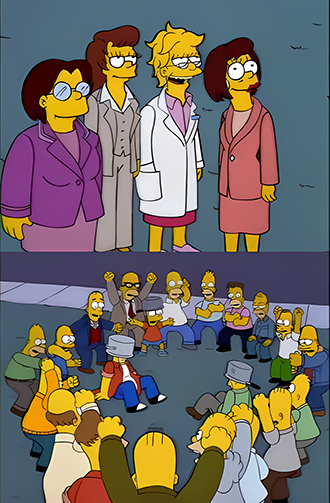
Bottom: Simpsons men, all boorish losers.

In some works of fiction, the female member(s) of a group, be it a married couple, siblings, True Companions, or the cast of characters in general, are portrayed as inherently better grounded than the male members: more rational, more reasonable, more level-headed and sensible, and often morally superior. This is most common in comedy but occasionally turns up in other genres.
Note that this trope is not about any specific instance of individual female characters being particularly sensible, but about depictions in which female characters are automatically positioned as more levelheaded than their male counterparts.
This is often not a net positive trope for the female characters themselves: while in some works it is invoked as an honest attempt to refute the trope Men Are Better Than Women, it often has the effect (especially in comedy) of shifting the burden of responsibility onto women for the actions of everyone around them as well as themselves. Men can be portrayed as undeserving of blame for making an interpersonal mistake or not knowing how to do a chore because women are supposedly just naturally better at that sort of thing. A common version of this is the widely held belief that girl children mature faster than boys, which can be used to excuse boys' behavior rather than to commend girls'. It can also pigeonhole them into being less interesting than their male counterparts, since they aren't allowed to be flawed to the same degree: for a classic example, if there's a single woman in a comedy, she will probably be the Straight Man, which often translates to her being the most boring character.
The likelihood of this trope occurring is inversely linked to how many women are in the cast. More female characters mean they have to fill more roles outside of the Only Sane Woman, resulting in female characters who are just as insensible if not more so than the male characters. As a result, in a mostly female cast with only The One Guy, it will be incredibly unlikely that every female character will be wiser than the sole male.
In advertisements, it's common for a woman to represent the advertiser's product, while a man represents the competition, or for women to be savvy consumers while men are Too Incompetent to Operate a Blanket. The woman patiently explains or demonstrates the superiority of the advertiser's product to the clueless man. This has roots in the resurgence of the middle-class housewife role in the 1950s and '60s when advertisers knew they could sell more products by convincing women they were experts on consumerism, and to this day it is especially pronounced in cleaning product ads that air during the day and are targeted at housewives.
In action-oriented works where both this trope and Men Are the Expendable Gender are in play, men will use violence in the "wrong way" or primarily to protect the "wiser" women. (See Force and Finesse or Scientist vs. Soldier.)
A form of Double Standard, in that it holds women to an impossible ideal and depicts men as naturally stupider. Compare Females Are More Innocent, High-Heel–Face Turn, Mother Nature, Father Science, Higher Education Is for Women, Motherhood Is Superior, and Mars and Venus Gender Contrast; often overlaps with Dysfunctional Family, Sage Love Interest, and Men Are Childish. Often combined with Ugly Guy, Hot Wife, Foolish Husband, Responsible Wife, and with Henpecked Husband where the husband is then portrayed as deserving the henpecking. More than often enacted through a Right Way/Wrong Way Pair. Exaggerated, this can become Wet Blanket Wife. Contrast Hysterical Woman, Clingy Jealous Girl, Psycho Ex-Girlfriend, Woman Scorned, and My Beloved Smother. Opposite Trope to Men Are Better Than Women.
It's often the outcome of a Gender Incompetence scenario.
Note: No Real Life examples, please!
Example Subpages:
Other Examples:
- Played ridiculously straight in this commercial for some sort of oven cleaning product. From the woman standing in the background with what can only be described as a scowl on her face, to the tagline "So easy...even a man could do it!". It's actually rather disgusting.
- Said advert received 663 complaints from men and women (men claiming it portrayed them as idiots, women claiming it supported out-of-date stereotypes regarding women and the kitchen). Amazingly, they were not upheld - which sparked backlash from people saying an opposite advert would be shot down immediately. The Daily Mail had a field day.
- This Butterfinger commercial. It goes just like any other Butterfinger commercial: man tries to steal Butterfinger and suffers the consequences from his friend. In the last three seconds, some random female appears and tells the men, "You guys are idiots." The line offers nothing to the commercial; there was no reason for its inclusion other than to be insulting.
- The ads for Flash in the UK seem to be aware of this trope such as one had the mother coming home to find the kitchen in a complete mess and storming all over the house looking for her husband. The husband uses this time to quickly clean the kitchen up and then position himself in the living room so that when the wife comes in to scold him about the mess she looks back to see it clean and is left speechless.
- Seen in one AT&T commercial, where four businesswomen (two of whom are minorities) and one white businessman are looking for a network provider and seek help from a female AT&T employee. Naturally, the women are the ones asking all of the 'smart questions' and displaying any business sense, while the guy is shown to be completely clueless and only going along with what the women are doing.
- Avenger: Both Layla Ashley, The Heroine of the show, and Westa, one of the rulers of Mars, are depicted as morally superior to Westa's male partner Lord Volk, who, while well intentioned, is the Big Bad willing to kill innocent people and rule as a tyrant to conserve resources, in contrast to Westa's pacifistic methods that make her much more popular with the people than he is.
- Inverted in Black Lagoon. Between the two main leads, Rock is depicted as the moral and level-headed one, whereas Revy is depicted as far more psychotic and emotionally unstable.
- Played with in Cardcaptor Sakura. Most females are high-spirited and extremely kind and adorable, while most males are somewhat arrogant Jerks With A Heart Of Gold. A handful of exceptions exist (Meiling, Ruby Moon, and Yukito). But a few of the females (particularly Sakura) are also suggested to be somewhat ditzy and naive in tone though given most of their ages this could be considered realistic. The Big Bad, Eriol, is also male, but he is not exactly evil so much as he is a Stealth Mentor with rather extreme methods.
- Case Closed: Played straight with Eri Kisaki — the more mature and businesslike ex-wife of Kogoro Mouri, and Miwako Sato — Takagi's senior love interest.
- In Demon Slayer: Kimetsu no Yaiba, the Hashira, the elite of the Demon Slayer Corps, put Tanjiro on trial for traveling with a demon- his sister Nezuko, who'd been transformed into one at the start of the series. Most of the male Hashira immediately call for Tanjiro's execution, except for Muichiro, who barely says anything, and Giyu (who met Tanjiro two years ago and knows of his situation). As for the females, Shinobu is willing to listen to Tanjiro's side of the story, while Mitsuri, who's also sympathetic to Tanjiro, reasonably points out that it wouldn't be a good idea to hold the trial without the Master of the Demon Slayer Corps present.
- Zoe, the only girl from Digimon Frontier, usually tends to act more rational and level-headed than all her male teammates. She also was able to control her Beast Spirit right away, whereas they couldn't.
- Fruits Basket: Komaki Nakao is this, especially when compared to her boyfriend Kakeru Manabe. During the funeral for Tohru's mother, Kakeru had the gall to tell Tohru off for openly grieving over Kyoko's death, telling her she's sickening and whiny for doing so and acting like she was the only one affected, especially since Komaki's father was the one who hit Kyoko and also died in the accident. In his point of view, he was just being a good boyfriend and sticking up for Komaki, only to discover the hard way that Komaki didn't feel the same way he did; in fact, she was outraged at his Lack of Empathy and read him the riot act for disrespecting Tohru's feelings. Her words cause Kakeru to suffer a Jerkass Realization, and he spends years kicking himself over it before finally apologizing to Tohru.
- In Lagrange: The Flower of Rin-ne, the heroes — the Jersey Club and Novumundos — are nearly all female, while almost all the villains are male. Kiss, the antagonist faction, is nearly all male with only one woman, Grania, as The Dragon to male Big Bad Villagiulio. In season 2, the other antagonist faction, the Polyhedron Federation, is run by King Dizelmine and Princess Lan- the former is portrayed as the Big Bad, while the latter is one of the heroines who betrayed him to stop his mad plans. Meanwhile, the heroic faction has only two men, Shozo Tadokoro and Balance T. Moid, and the latter is the true villain of the series who, unlike every other villain, is portrayed as pure evil, making Shozo the only male who does not start out as a villain or Anti-Villain.
- One Piece:
- Nami, the navigator of the Straw Hat pirates often has to express common sense, since few of her crewmembers, especially her captain Luffy, possess it. On the other hand, Nami has her own blind spots (such as the promise of wealth) and has to be reeled in by the others in turn.
- Robin, in turn, possesses common sense in spades and lacks the quirks (Robin has her own quirks too, they're just fairly subtle compared to the others') and Berserk Button tendencies that Nami has. She tends to stay cool and collected in almost any situation, even when her captain has them haring off on some utterly ridiculous course on a whim. The major difference between her and Nami is that, while Nami tends to try to show the rest of the group how ludicrous their actions are (sometimes coming off as the Only Sane Woman), Robin is perfectly content to sit back, smile, and read a book while Luffy makes plans to blast the ship and crew into the sky. There is a standing rule in the series that Robin is the only character who is never given exaggerated or cartoony facial expressions. The rest of the crew will often have extreme reactions to whatever insanity they come across, but she maintains the same placid expression. This is less to show her as reasonable and more to emphasize her role as a detached-to-a-fault intellectual. Except on the rare occasions when she does show strong emotion.
- A Running Gag is that when Franky reveals a new silly contraption of his, the nearby boys (or grown-up men boyish at heart) will turn into overly eager fanboys with stars in their eyes, while Nami, Robin, and other nearby female (child or adult) will give a Disapproving Look or Death Glare to show that they certainly are above fooling around with weird, flashy (and often not practical) technology.
- Regarding the Vinsmoke Big, Screwed-Up Family, only three members have more or less working moral compasses and show genuine compassion towards other people. Two of them are women: the dead matriarch Sora and the only daughter Reiju. The third one? The third-born son, Sanji.
- Pokémon: The Series: To a subtle extent with most female companions. While they still have profound moments of humility or hypocrisy, they usually have at least a small cut of competence over Ash. Brock initially balanced this.
- Inverted in Sailor Moon. Mamoru Chiba/Tuxedo Mask is often depicted as more level-headed than his ditzy girlfriend Usagi Tsukino/Sailor Moon.
- In episode 136 of the original anime Mamoru temporarily moves in with Rei Hino/Sailor Mars. Both of them react to it with indifference. Usagi's response? She dresses up like a ninja and stalks/harasses Rei.
- Act 19 and 20 of Sailor Moon Crystal show Usagi being jealous of Mamoru's affection for Chibiusa... despite the fact that Chibiusa is only a child.
- Mamoru is implied to study hard since he attends the most elite school in Tokyo. Usagi is shown having little academic motivation and getting bad grades.
- Scott Pilgrim Takes Off: Subverted for laughs. Roxie claims that, as Ramona's only female ex, she has an advantage over the boys: Emotional intelligence. Ramona flatly gives her the opportunity to talk about her feelings. Roxie pauses awkwardly, then insists on fighting instead.
- Soul Eater: Downplayed. Of the main males, Black Star is an arrogant jerk, Kid is mainly just an obsessed freak over symmetry, and Soul is snarky, impatient, and rude. The main females, Maka, Tsubaki, and Liz, are all practical, level-headed, intelligent, kind, and mature, for the most part; the only exception is Patty, who's a total dunce. Out of the villains, Medusa and Arachne are a lot more level-headed, calm and mature, whereas Crona, Giriko, and Asura are much more on the insane side. In the anime, Maka even outright kicks the male Final Boss Kishin Asura's ass all by herself and basically saves the world all by herself, while all the males get beaten by him. However, this does not translate to morally superior or more innocent — Medusa, and her sister Shaula from Soul Eater Not!, are a pair of sadistic Mad Scientist sisters who have no redeeming qualities (Medusa in particular being an abusive Evil Matriarch to Crona), and they are much worse morally than Asura, who has the excuse of being completely insane and thus unable to really control his actions.
- Trinity Blood: The female rulers and leaders are generally portrayed as more competent or in a better light. When they commit grave mistakes, they are just flawed and tragic rather than tyrannical or evil. The vast majority of the Saints who guided humanity were women. Most male leaders are either tyrannical, cruel, the incompetent Pope, or the Big Bad Cain Nightroad.
- Tweeny Witches: The society of the witches has flaws and issues, but they are definitely portrayed as morally superior compared to the warlocks, who are (mostly) Always Chaotic Evil Nazi analogs, and nearly every villain in the series is male — Grande is a hateful Evil Overlord, Sigma seems to be an Aloof Ally but is actually a manipulative Enfant Terrible, Tiana and Luca are bloodthirsty commanders, Lennon (though not a warlock) starts out as a ruthless pirate and a Sissy Villain, Jestor was a Mad Scientist in life and tries to destroy the world posthumously, and the Faceless Goons are cruel soldiers. The only witches to be villains are the incompetent special task force and two one-shot villains in The Adventures, the Ice Witch and Black Tohma; the former is a typical villain and not nearly as vile as Grande and Jestor while the latter is a sympathetic Enemy Without. Meanwhile, the only non-villainous named male characters are Jidan, the wizards Wil and Nito, Dragon, and a handful of one-shot The Adventures characters.
- Vandread seems to be something like this early on. In this show's take, the all-male planet develops into a paranoid fascist dictatorship, while the all-female planet is a constitutional democracy. However, it shows the men of their planet having few resources surviving in a harsh unforgiving world by using what they have sparingly and not being afraid to depend on each other, whereas the women inhabit a planet rich in resources, but are morally and socially deficient, constantly trying to one-up each other and waste the plentiful resources they have frivolously. Overall, both societies are corrupt, just in different ways.
- Lampooned in Yu-Gi-Oh! GX during Jaden's duel with Blair. After both Sparkman and Avian are entranced by Rei's Maiden in Love, Jaden decides he needs "a woman's touch" and brings Burstinatrix out - who chides the two male heroes and humiliates them. (Of course, Jaden's Burst Return Spell Card plays a bigger role here in getting them back, but the Solid Vision interprets it as the Trope.)
- Canadian comedian Mike MacDonald had a bit where he said that if men ever declare something "men only", and women are fine with that and don't demand that they also be allowed to participate, then it's obviously something incredibly stupid and dangerous that nobody should be doing. The example he used was the Running of the Bulls.
- Louis C.K. has expressed this opinion... in his own way, of course.
Louis CK: It's not that I think women are better than men. I just think men are worse than women.
- Archie Comics' Golden Age character Suzie ended up like this. Suzie first appeared as a Dumb Blonde Ms. Fanservice in the Anthology Comic Top Notch Comics in 1942 and proved so popular she eventually took over the comic which was renamed after her and ran until 1954 as Suzie Comics. In the mid-Forties, she gained a supporting cast including her clueless, loser boyfriend Ferdie who quickly became a one-man Spotlight-Stealing Squad - by the early Fifties he was arguably the real star and Suzie had become a supporting character in her own book. What made it surreal was that in the few late-era strips that didn't feature Ferdie Suzie acted like her original Brainless Beauty self. In the Ferdie strips, on the other hand, she suddenly gained several dozen IQ points to act as the straight woman to his antics.
- Disney Ducks Comic Universe comics:
- A truly infuriating example of this trope occurred at one point when the creators of Paperinik decided to give him a Distaff Counterpart and thus gave Daisy Duck her own superhero identity of Paperinika. Naturally, a great deal of stories involved them working together. Unfortunately, not only did they end up constantly bickering and hating each other in their secret identities, which was annoying enough on its own, but every time they were together, Paperinik suddenly lost all competence and reverted to Jerkass bungling Donald Duck in a costume. Seeing as the whole point of Paperinik's creation was responding to fans' complaints that Donald was always a Butt-Monkey loser, the fans were not pleased with this development, leading to Italy axing Paperinika all together (though she is still used in the Brazilian comics).
- Paperinika made a comeback in the Ultraheroes storyline, where all the major Disney comics superheroes teamed up. This time, though, she's been written as even more incompetent than Donald when the two get together; mainly because she is so driven to prove herself Paperinik's equal that she worries about that more than the job at hand, and they end up bickering when they should be saving the day.
- In Paperinik New Adventures this was inverted: it was Paperinik and One that had to keep the angry, vicious Xadhoom in check(you know it bad when Donald Duck thinks you have a temper). Also Everett Ducklair, who despite having his own demons is still more well adjusted than his daughters and wife. Same goes for his two main employees, as Anymore is clearly more rational than Birgit.
- In Legion of Super-Heroes storyline The Dominator War, when the Ranzz brothers have one opportunity to catch up, Garth and Mekt unanimously decide to let their sister Ayla do the talking because, unlike them, she knows how to keep a cool head.
- In Lucifer, the titular character creates a new universe and populates it with a single man and woman. He tries to convince them to act according to their desires and worship no one, not even him. In subverting the traditional Adam and Eve story, it plays this trope straight: here, it is the man who falls from grace and brings the woman down with him. The man decides that desire is evil, posits the existence of a greater creator beyond Lucifer, and decides to flagellate himself and dedicate his suffering to that creator. Lucifer destroys him as a flawed creation; the woman chooses to join him in death rather than accept a newly-created companion.
- Maintained for the large part in Sonic the Hedgehog:
- In Sonic the Hedgehog (Archie Comics), most of the female characters have far less overwhelming personality defects than the male cast and usually act as the voice of reason for their male comrades. This is especially obvious for Sally, who lost even the key flaws she had in SatAm (see below) to become an overly versatile and collected foil to the far more arrogant and hot-tempered Sonic.
- Amy in Sonic the Comic was made into The Lancer with Improbable Aiming Skills due to Executive Meddling. She had few flaws compared to her very flawed male counterparts, and Tekno (another thoroughly competent female character). Ironically her initial persona was surprisingly close to the lovesick Crouching Moron, Hidden Badass Amy of the later games. While Amy herself is a much more abrasive character in the American Sonic comics, it plays this straight with a fair few other characters. Sally and Bunnie are usually more rational and Closer to Earth than many male Freedom Fighters, who are often harbored by significant flaws like arrogance or temper issues, meanwhile the female leads' shortcomings are often more minor or down to circumstance than deep personality issues (e.g. Bunnie's robotization, Sally's responsibilities as leader and monarch). Julie Su leans less into this vein, more or less acting as a Distaff Counterpart to Knuckles, though is still slightly more rational than him.
- In the Superman vs. Shazam! crossover, while the titular male heroes are too mad to be talked out of fighting with each other, Supergirl and Mary Marvel talk with each other, analyze the situation and come to the conclusion that their relatives are being manipulated.
- Most of the women characters in Valhalla are wiser than their male counterparts and tend to avoid the mental pit-traps that the men fall into thanks to their pride and stubbornness. This is particularly noticeable with Frigg, Odin's wife, whose role in the original mythology was also to be the voice of reason to her husband.
- Laurie of Watchmen, also the only major female character in the main cast, is often the one with the most realistic and logical perspective. She is not bogged down with extreme views of justice like Rorschach is, holds a negative view on irrational behavior (such as Jon wanting to leave humanity to die and Dan's desire to help Rorschach in spite of his horrid behavior). On the other hand, she's also extremely stubborn and at times delusional, refusing to see the truth that the Comedian is her father when she had enough evidence and the detective skills to put it all together herself. She can also be weak-willed (her repeated attempts to quit smoking always end in failure).
- The Wicked + The Divine does this with Woden - of the three incarnations of them we've seen, the only female one (Romantic Era) is the only one who isn't a complete and utter piece of shit. (The early-twentieth-century one was based on Joseph Goebbels.)
- Wonder Woman:
- The series plays with this, mostly because her creator firmly believed women to be more truthful, kind, and less violent and the Amazons of Paradise Island were designed as an example of just how much better things would be with women in charge.
- Enforced by Athena in Wonder Woman (1987). In the backstory, Hippolyta and the Amazons were once enslaved by the demi-god Heracles and his men (sent by Ares in his war against Athena) and used as sex slaves. Athena freed Hippolyta on the condition that the Amazons would not seek revenge, but Heracles escaped anyway.
- Y: The Last Man - Discussed. After the gendercide that wipes out all but two of the male population of Earth, there are plenty of women around who act in a venal, selfish, and destructive fashion towards their fellow women. A male character later comments that he's surprised that a female-dominated society didn't abolish war and usher in an age of peace and "standing around in circles holding hands singing 'Kumbaya'."
- Blondie (1930): The title character runs both the household and her own catering business, the latter with Herb's wife Tootsie. Dagwood chronically wakes up late for work, is considered a screwup by his boss, and has no plans past his next snacktime. The couple was cut off from the sizable Bumstead family fortune when he married below his station, but it would appear she's adjusted to the change much better than he has.
- Calvin and Hobbes pits a wildly creative young boy against several eminently sensible female foils. While the entire cast usually winds up playing the Straight Man to Calvin, the other male leads still tend to be funnier than their female counterparts. (For instance: Dad explains science.) Susie Derkins, in particular, exhibits a surprisingly mature sensibility at times when she's not actively fighting with Calvin, does much better at schoolwork, and is good at spotting glaring flaws in Calvin's Zany Schemes.
- FoxTrot:
- Roger is a buffoon who is unaware of his own incompetence, while Andy is responsible and fairly intelligent, even if she is somewhat obsessed with bizarre tofu concoctions.
- However this is more of a subversion as Andy thinks she is closer to earth but upon closer inspection of her character is actually no better or worse than the rest of her family. Her own flaws are that she's fearful and overreactive of entertainment media, occasionally hypocritical, misinterprets her kids' character, and refuses to turn up the heater in the winter. Oh yes, and the cooking.
- Paige also tends to be a stereotypical ditzy, shallow teenager, obsessed with dating and going to the mall.
- Garfield has a typical example in Jon and Liz, although, to be fair, Garfield himself is also more sensible than Jon. (Hell, it could be possible that even Odie might be more sensible than Jon. That's very ironic, considering Odie's not exactly very bright himself anyway.)
- For the first several years of Retail, women in positions of authority (Marla, Val, Connie, Lara) were always portrayed positively, as intelligent, caring, sensible, and fair-minded leaders. By contrast, men in positions of authority were all depicted negatively - Stuart and Josh are arrogant Corporate stooges, Jerry a misogynist, Gary insisted on holding annoying and useless training seminars, and Bradley a gloating, insufferable jerkass who tried to steal his competitor's employees.
- As of late 2013, this trend has diminished somewhat, with Cooper's promotion to stockroom supervisor and the introduction of the Delman's managers, the sympathetic Greg and the manipulative backstabber, Mina.
- Pondus has two straight examples: Beate for Pondus and Camilla for Jokke. Both women are clearly more sane than their men.
- "The Wise Little Girl": When the Tsar asks two brothers several riddles, the rich brother goes to his godmother for help, whereas his penniless sibling is given the answers by his daughter.
- In Boys and Girls, Lori Loud thinks girls are less likely to cheat on boys than vice versa. Lincoln chews her out for her double standard.
- Deku in Class 1-B: While half the boys in 1-A believe Kirishima when he explains how he believes that Izuku is a Bitch in Sheep's Clothing who is planning on removing all of 1-A's powerhouses from the spotlight, the girls didn't believe it for a second and looked at him as if he was crazy, with some of them like Momo and Toru even poking holes in his logic. Even Mina, Kirishima's best friend points out that he's sounding like a crazy conspiracy theorist.
- Down a Rabbit Hole to Westeros focuses on the Florent noble family, whose founder Florys the Fox was famed for her cunning and wits — and it tends to show a lot in the daughters of the family, with Selyse and Rhea being the main actors behind the technological and industrial revolution currently sweeping down Westeros. However, the patriarchal society in which they live insist to dismiss them as "merely women".
- In Neither a Bird nor a Plane, it's Deku!, Jor-El jokes about how his wife Lara Lor-Van couldn't tell the difference between a Czarnian cyber processor and a Daxamite photon destabilizer. At the same time, he says that she is the far more sensible of the two and is able to remain calm even in the worst of situations, knowing just what to say to make her husband feel better.
- New Blood (artemisgirl): While it doesn't seem to hold true in general, the sex-ed class in third year seems to bring out the utter ridiculousness of teenage boys — particularly since one of the teachers is Snape, who the Gryffindors get a great laugh out of asking ridiculous questions. While the girls ask serious questions like "how do I ensure nobody uses my menstrual blood in a ritual", the boys' questions are more like "can boobs pop if you squeeze them too hard" and "is it possible to screw a mermaid".
- Inverted in A Phantom Hero in Metroplis where it's made pretty clear early on that Danny is the most logical and reasonable member on the otherwise entirely female team; though somewhat Downplayed in that the other girls have their moments, just not as often as Danny.
- Carmen from The Book of Life, is probably the sole Sanchez to think dying in a bullring is not that great.
- Inverted in Brave with Queen Elinor. While she's obviously the better administrator than her husband and can pacify the tensions between the four clans, the central conflict in the story is due to her being too obstinate to see the world from her daughter's point of view. Her husband Fergus, on the other hand, understands his daughter very well and tries to get Elinor to realize this when he pretended to be Merida in one scene.
- Inverted in Ice Age: The Meltdown as Manny is the one playing straight man to Ellie but used in Ice Age: Dawn of the Dinosaurs and Ice Age: Continental Drift with Ellie and Peaches as Manny is always freaking out about something while Ellie keeps calming him down and playing straight man to him by calming him down and telling him everything will be alright. This also happened in the Christmas special.
- The Incredibles:
- Helen (Elastigirl) copes with not being a superhero much better than Bob (Mr. Incredible) does, though it helps that she doesn't have a soul-crushing job.
- Compared to her brother Dash, Violet is more level-headed and thoughtful, that is when she's not distracted by teenager problems. She's also normally the one who notices when her parents are in trouble and tries to go help them.
- Played straight in The Lion King II: Simba's Pride with the now queen Nala, something that exasperated most fans of her previous portrayal, and even her small daughter Kiara in regards to Simba. On the other hand, Simba not being particularly wise by any standard is a big part of the plot.
- Giselle from Open Season is smarter and more level-headed than Elliot and Ian (especially Elliot).
- In An Autumn Afternoon, Akiko is much more sensible than her husband Koichi when it comes to financial matters.
- Capote: Nelle is depicted as being a sensible and down-to-earth woman who possesses both a sharp intellect and social savvy, in contrast to the equally smart but much more eccentric Truman. She's also the only person who can put up with Truman without getting completely fed up with him, though it probably helps that she's known him since childhood.
- In Dogma, the one Mooby's boardmember who's lived a virtuous life is also the only woman present at the meeting.
- Zig-zagged in Four Lions. Omar's wife Sofia seems like a reasonable and down-to-earth woman with a religiously moderate and Westernized cultural outlook, but she's actually fully aware of her husband's intention to martyr himself for Islam and does not seem to have much issue with being left a widow with a young son. She even smiles proudly when he declares he's about to "take his team up to the top floor", i.e, perform a suicide bombing. Critics found this to be unrealistic, but the filmmakers asserted that real life terrorists often have remarkably stable home lives, and their widows even usually support what their deceased husbands have done.
- In a World…...: All men in the film are either Straw Misogynist assholes (Gustav) or so diffident and non-threatening as to be effectively neutered (Demetri Martin and Rob Corddry's characters). The latter is presented as the "good" alternative, and Sam Soto's transition from the former to the latter is presented as character development. The women aren't presented as perfect—witness Dani's guilt over cheating on her husband or Carol starting the movie as a semi-employed Woman Child still living with Daddy at 32—but they're still presented as more competent than and morally superior to the men.
- In Knocked Up, female lead Alison is a smart, driven, competent, responsible career woman, and male lead Ben is a lazy stoner coasting off of an injury settlement and sporadically working on a website with a specious business model. The arc of the film is mostly about Ben settling down to become worthy of Alison. The trope is deconstructed by the Beta Couple, who resemble the Alpha Couple. Pete is more relaxed and less ambitious than his wife but not lazy or irresponsible, and Debbie is controlling and borderline emotionally abusive in her efforts to goad Pete into living up to her insane standards.
- Subverted in Last Sentinel (2023). Every male character is presented as a potentially unstable threat to the others at one point or another. It's The Squadette, presented as the most reliable, who turns out to be the most dangerous. She's an enemy spy who's murdered their relief crew.
- In the poster for the Katherine Heigl film Life as We Know It, Josh Duhamel is walking around in a nappy.
- Mad Max: Fury Road takes this to its logical extreme: Every single villain is male and all of the women, particularly the Vuvalini are heroic and wise about the world; and/or victims. There's even a Lampshade Hanging: The Dag is mourning the possibility of her child being an ugly Warlord, the Keeper rebates this simply by stating that "it could be a girl".
- This is somewhat downplayed as Max is the one who does a lot of the fighting before they meet the Vulvani because he's the only combatant besides Furiosa. When Nux joins he also proves to be very useful as well.
- In Minority Report, John Anderton asks the creator of the Precog system, Dr. Hineman, which Precog would have his minority report that depicts his innocence. Hineman responds that it would be the most gifted of the three. When John asks her which one would that be, she smiles and says in an "of course" manner, "The female."
- MirrorMask:
- Morris and Joanne Campbell. To quote the book version, "Dad's got his head in the clouds. Mum's got her feet on the ground."
- Also Helena and Valentine; Helena is intelligent, friendly, and mostly fair to everyone she meets. Valentine, while very likable, is rather scheming and often self-centered.
- This is shown again by the floating giant couple, whose balance keeps them in equilibrium; when they become uncoupled the female sinks into the ground while her mate helplessly floats away.
- In Mortdecai, while Charlie is bumbling, arrogant, and often moronic, his wife Johanna is by far more mature and intelligent.
- Defied and mocked in Neighbors, by Kelly when Mac asks her why she's not reining in his crazy revenge fantasies — she herself has those same urges. Nearly every review of the movie (even the negative ones) praised it for doing this. Seth Rogen stated in an interview that the wife character was written in the usual way until he showed his real wife the script and she pointed out that she'd get just as into it as he did.
- In No Kidding, the mothers of the children staying at Chartham Place understand much sooner than the fathers that it is wrong to constantly leave their children as much as they do.
- In Predators lone female character Isabella is the group conscience and team builder.
- Mutsuta's wife in Sanjuro is smarter than most of the men in the movie, save for Sanjuro and Mutsuta, and teaches Sanjuro a thing or two about violence. He tries to take her advice to heart.
- Subverted in SAVE ME, where Gayle (the only significant female character) appears at the beginning as the driving spiritual force of Genesis House, but her personal motives are deconstructed over the course of the film until she's shown to be at least as messed up as any of the men she is supposedly helping. That her husband Ted is shown to be more reasonable and reserved about the work they're doing, and more cognizant of her rather tangled motives for doing it, heightens the subversion.
- Played with in The Thing (2011). Juliette is the only person who believes Kate when she says the alien is disguised as one of them. That's because she's already been assimilated and is luring her someplace quiet to do the same.
- Miss Foster from Watch Your Stern comes up with both of the plans to disguise Blissworth in order to save Captain Foster and Commander Fanshawe from getting court-martialled for the destruction of the Creeper torpedo plans.
- The epitome of this trope is a joke where three men get a genie and they each get one wish. The first man wishes to become ten times smarter and the second man wishes to become a hundred times smarter. The third man wishes he was a thousand times smarter... and turns into a woman. Like many jokes of this type, of course, it's often inverted depending on the gender of the person telling it.
- Science develops the first working brain transplant. A woman's brain can be as low as $3000, while men's brains are often worth five times that much. When questioned about this, the scientist answers "Well, that's because women's brains have been used."
- George Carlin, describing God: "And if there is a God, it has to be a man. No woman would fuck up the world this much." (paraphrased)
- G. K. Chesterton's heroines have a tendency to be more sensible than his heroes. While they can rise to the occasion in times of crisis, they have much higher standards than his heroes for what qualifies as a crisis. This was also very much a conscious belief held by Chesterton.
- The Courtship of Princess Leia: Hapan women firmly believe this. In fact, a popular saying is about never letting a man believe that he's equal to women, as it will only cause evil. However, in the book, this isn't true, with both men and women showing a sound mind (or the lack thereof, as the case may be).
- Creation Man And The Messiah by Henrik Wergeland runs on this trope. The entire human race is ensouled by a male spirit, Phun-Abiriel, who took abode in Adam because he wanted to rule a "lesser" world than the spiritual one, and a female spirit, Ohebiel, who likewise took abode in Eve. She did this because she feared that humanity would be utterly lost without her spiritual guidance. And true to form, the influence of Ohebiel serves to make humanity wiser and is possibly the route to salvation because this spiritual element is necessary for the spiritual development of Jesus when he becomes the saviour. Thus, the female part of the human soul is essential for humanity to survive.
- Diary of a Wimpy Kid: Girls are portrayed as well-behaved and sensible, barely breaking any rules; meanwhile, the boys (except for Greg, Rowley, and Fregley) are portrayed as mischievous and complete troublemakers. The Meltdown subverts this by introducing some girls who are just as bad as the boys.
- Michael Crichton's Disclosure is entirely built around inverting this trope, with a piggish and sexually abusive female boss as the primary antagonist.
- This is one of the primary differences between witches and wizards in Discworld, particularly in the way they use magic. Wizards tend to be flashy and theatrical and have a social structure based on academia; witches have more sensible, practical magic and more commonly take on the roles of local midwives or herbalists. Not just the witches and wizards. The women of the Discworld are almost invariably smart and down to earth. There is the occasional one-off ditz, but there are no 'comic loser' female main characters in the spirit of Rincewind or Nobby; even Magrat, perhaps the closest a Discworld heroine comes to subverting this trope, is still a highly skilled witch and badass in her own way once you get through the New Age satire.
- In a Nac Mac Feegle clan, it's the Kelda's job, as the only female, to do the thinking for the entire tribe since male Feegles aren't that good at it.note
- The trope is discussed and zigzagged in Monstrous Regiment. Whilst it's true that the day is ultimately saved by the efforts of the disguised female soldiers, it's also pointed out repeatedly, both explicitly and subtly, that women can be just as stupid, petty, and cruel as the men around them. This is particularly emphasized by the climatic reveal that over a third of the High Command are women, and they haven't done a thing to stop the Eternal War devastating their country.
- The three holiest characters in The Divine Comedy (outside of God) are the Virgin Mary, Saint Lucia, and Beatrice. These three women orchestrate and allow Dante's descent through the afterlives even though he and Virgil frequently fail and need divine intervention to get through. Not only does Saint Lucia at one point need to carry Dante up Purgatory, but Beatrice spends nearly every canto of Paradiso admonishing Dante's flawed conceptions of God and correcting him with the help of the other saints.
- The Faerie Queene: After dozen of knights have been killed fighting over Canacee, it takes a lady to ensorcel the remaining heroes to stop fighting and be friends instead of wasting each other's lives.
- Feminine Intuition: This story sets up the idea that women have an intuition for the right decision that men lack; at the end, the narration reveals that Dr Calvin simply took the practical action of calling the truck driver to confirm her guess. Women are apparently blessed with common sense, not magical thinking.
- Frankenstein, though this largely depends on which version you read. In the original 1818 edition Victor is cold, callous, and foolish, but his father Alphonse is the perfect father and his friend Clerval is the perfect youth, full of life and vibrance. The second version turns Victor himself much more sympathetic, and Elizabeth is turned into a Purity Sue.
- In Aaron Allston's Galatea in 2-D, in the Battle Couple of Red and Penny, Penny does the prudent thing: argue they should contact their boss when the heroes show up unexpectedly, persuade Red not to fight after their boss dies, etc.
- Girls Don't Hit: Joss and Echo take advantage of this belief, since very few people suspect women will be assassins. Even when not combined with explicit seduction, it helps them get the drop on people many times.
- In Mario Puzo's book, The Godfather says it specifically. He says women have no head for business "though no doubt they will be saints in heaven while we men burn in hell."
- Harry Potter:
- Hermione is often portrayed as the most rational and level-headed member of the trio and is often exasperated at Harry and Ron for being more emotional and hot-headed. In the final book, Dumbledore even says he was counting on Hermione to rein in Harry's bad judgment when it came to going after the Deathly Hallows.
- Dumbledore notes in the annotations of The Tales of Beedle the Bard that no witch has ever been known to be the master of the elder wand and to, "make of that what you will". The implication is that he thinks women are too smart to either covet that power or to advertise that it's in their possession.
- Haugtussa: Gislaug is called by names that reflect her age and gender. As a youth she is called "Veslemøy", or "little maid", but in the final poem after she has gone and returned from the afterlife and outwitted all those who sought to take advantage of or to ignore the "little maid" and has reached adulthood she is called Vismøy "wise maid" to symbolize that she is now a woman.
- In The Iron Teeth web serial Vorscha is a famous and powerful bandit, while Geralhd is an unskilled youth. We can see that Vorscha is definitely the smarter one in their relationship.
- In The Muddle-Headed Wombat, the female Mouse is the most consistently sensible character of the main trio, compared to the muddle-headed Wombat and the neurotic Tabby, both male.
- My Son, the Physicist: The titular physicist is trying to convince a general that they need to drop all other Multivac tasks and begin designing an extremely fast method of communication to reduce the effects of light-speed lag in communications between Earth and Pluto. When his mother hears about this, she admonishes him and tells him all they need to do is keep up a constant stream of communications. He marvels at her wisdom and asks how she knew. Turns out, that's all part of women being Gossipy Hens.
- The wildly successful 1740 English novel Pamela, or Virtue Rewarded is an iconic example. The heroine, a girl of Incorruptible Pure Pureness, is matched against Mr. B, a lascivious and immoral man who makes great attempts at corrupting her virtue. Pamela withstands his advances and ultimately tames him, showing him the way to true morality.
- In the original Peter Pan book, Wendy asks the eponymous character why there aren't any Lost Girls. Peter responds to her that is because girls are too smart to fall out of their cradles. Wendy is delighted.
- Deconstructed in Naomi Alderman's The Power with characters like Tatiana who try to claim otherwise as some of the story's biggest monsters. The book's thesis, laid out in its Framing Device, is that this trope exists because, as the physically smaller and weaker sex, women deferred to men in a system where physical power determined who was in charge for most of human history. Therefore, to acquire power, women had to resort to means in which their physical limitations were no object, and oftentimes, they did so by claiming moral and intellectual authority. Matriarchy thus did not create societies organized along more peaceful lines than military glory or trial by combat, but was rather a consequence of it, as it gave women more ways to rise to the top. As such, when a biological mutation gives women greater physical power than men, the result is not egalitarianism, but an inversion of old gender roles, one that is most pronounced in countries like Saudi Arabia, India, and Moldova that had rigid, patriarchal gender roles before the Mass Super-Empowering Event. In the post-post-apocalyptic future in which the Framing Device takes place, this trope has been inverted for the reasons stated above, with men seen as the wiser, more peaceful gender because they can't challenge women in direct combat.
- The Small Back Room, by Nigel Balchin. The protagonist is a decent but weak-willed scientist struggling with alcoholism and the political infighting of his colleagues. His girlfriend (his bosses' secretary) has a lot more common sense, being able to see how his superiors are manipulating him, but unable to convince him to take action. At the end of the novel, he drearily concludes that he'll just leave all the decisions to her from now on.
- Subverted in A Song of Ice and Fire with Cersei Lannister, who is power-hungry, smug, and pretty much amoral, in comparison with her more anti-heroic brothers who, even though they do also morally-questionable acts, they become far more sympathetic. Cersei's only saving grace is her Mama Bear attitude towards her children but is overshadowed by her atrocious actions. In the TV show, she has a slightly more sympathetic portrayal, as some of her most evil acts in the book are performed by Joffrey instead. However, she still commits atrocities, such as when she blows up Baelor Sept, killing thousands and causing severe collateral damage.
- Referenced in Robin McKinley's Spindle's End: In the country where the story is set, there's a folk belief that queens are more level-headed and generally better rulers than kings, and this belief is deeply ingrained enough that the local evil magicians go to the trouble of casting a lot of spells to make the royal line hardly ever produce female heirs.
- Discussed in the Carl Hiaasen novel Stormy Weather. Skink (a Recurring Character who was the former governor of Florida, who now lives in the wilderness as a refuge) tells Edie (a con artist) he has the same low opinion of men that she does, and he wishes women were running things because it would be better for the environment.
- The Supervillainy Saga's Tales of Supervillainy: Cindy's Seven: Made fun of. Cindy Wakowski AKA Red Riding Hood repeatedly makes a claim about this as to why she should be the team leader instead of Gary Karkofsky AKA Merciless, only to be confronted by her (mostly women) teammates that she is every bit as deranged, selfish, and shortsighted as Gary. If not more so.
- Sword of Truth: Only female Confessors exist, because males are unable to control their power, and caused chaos in the past using them rampantly. Ever since, they have been killed at birth to prevent this from happening once again.
- In Thebe and the Angry Red Eye, one reason astronaut Thomas loves his wife Katie is because she's so sensible, including with economics.
Thomas: I was happy to hear that the house was paid off and that [Katie] was doing well. And although the money she was given would last her until I got back, she kept her job and endeavoured not to go into our savings. That is so like her.
- Tolkien's Legendarium has a number of straight examples, from the Valar and downwards: Varda and Yavanna both seem to be epitomes of wisdom. So does Nienna, who actually is The Mentor of Olórin/Gandalf. On the Maia level, Melian comes out as the truly wise one, being the sane consultant of Thingol, and passing her wisdom on to Lúthien. Melian also councels and guides Túrin, Beren, Morwen, and Húrin. She is also the one responsible for lifting the delusions Húrin has been victim to.
- Elvish women of wisdom counts Nerdanel, the wife of Fëanor, known for being the only one to actually restrain him when he went too far. For a time, at least. Idril is also worthy of mention here. She has premonitions about the fall of Gondolin, and orders an escape route built: which ultimately saves her family, and thus literally the entire world.
- Galadriel plays with this trope. She has an ability to perceive the minds and hearts of others, which would naturally fall under this trope. However, in her youth, she was nonetheless as brash and hotheaded as even the Sons of Fëanor, and openly joined the rebellion against the Valar with the rest of them because she desired lands of her own to rule. She remained in Middle-earth after the First Age because, as one of the leaders of the revolt, she wasn't allowed to sail into the West with the rest of the Noldor. That she ends up in the role of Melian come the Third Age — guiding and helping Elrond, Gandalf, Aragorn, Frodo, and Sam — is because her Heel Realization and spending millennia "fighting the long defeat" as penance for her actions have mellowed her considerably. It was only her refusal of the Ring (and essentially turning her back on the desire for power which led her to join the revolt of the Noldor) when freely offered it by Frodo that finally convinced the Valar to end her exile and allow her to return to Valinor.
Galadriel: I passed the test, I will diminish, and go into the West, and remain Galadriel.
- Though Tolkien has a number of wise men as well. Particularly of note is Finrod Felagund, older brother of Galadriel. When Humans first encountered him, they named him "Nóm" meaning "the wise" in their tongue. He acts as The Mentor to the Bëorians, and is a large part of the reason why humans develop a tradition of being elf-friends. Elendil, Turgon, Maglor, Elrond, Faramir and Sam also qualify. Thranduil, the Elvenking in The Hobbit, also plays with this trope. He does let his grief make him prejudiced against dwarves and a little bit greedy: but he is ultimately wise enough to avoid Thingol's embarrassing fate, and the gift of Orcrist to Erebor isn't just symbolic of his intention to be friendly from now on but also highly practical.
- Also there are several female subversions, particularly Aredhel the daughter of Fingolfin. She is tragically naive, and ends up in an abusive marriage. Morwen and her sister Rían make some fantastically bad calls, with terrible consequences for their children. Emeldir and Éowyn are less wise than they are brave. Erendis lets her marital problems prejudice her against all men, and teaches her daughter the same viewpoint: with some less than great repercussions for Númenorean society.
- Human wise-women in the are rarer, but if one of them should be pointed out, it is Tar-Miriel, last queen of Númenor. Also Andreth: who gets called "wise-heart" by Finrod Felagund. She is a prophetess and healer, well versed in esoteric lore. Lady Haleth is also notable for being both wise AND apparently enough of a Memetic Badass that there's a Rohirric Knight named after her. As a rule though, human women have a tendency to subvert the trope.
- The Traveler's Gate: Played for Laughs. Queen Cynara compliments King Zakareth on being an excellent king of Damasca... almost as good as some of the queens.
- Played straight in Bernard Werber's short story "Un jour, il n'y aura que des femmes sur terre" (One day, there will only be women on Earth), in which the protagonists see glimpses of the future in which all men died after a nuclear explosion, and genetically engineered women who reproduce asexually go on the form a perfect society free of wars, famine, envy, living closer to Mother Nature.
- Universal Monsters: Nina, a junior to the boys' freshmen, is by far the most reasonable of the group.
- In the Warrior Cats book Midnight, when Squirrelpaw gets stuck under a fence, the males of the group — Brambleclaw, Stormfur, and Crowpaw — start arguing aggressively about what to do. The she-cats Tawnypelt and Feathertail, meanwhile, actually come up with an idea to get Squirrelpaw out, and successfully free her. They even ask afterward if all toms do is fight.
- Archie and Edith Bunker in All in the Family. Edith was more moral and friendly than Archie, but she was also rather airheaded. Archie was smarter, but it came down to the same with Edith ultimately being the one who put Archie in his place when he went too far.
- Subverted in Arrested Development. Though Michael expects Lindsey to be more grounded in reality than the rest of the family, most of the time she's just as bad. She does tend to see the error of her ways more often than the others, not that she learns from her mistakes.
- Inverted in Battlestar Galactica with Starbuck and Apollo: She's the reckless loose cannon who prefers to shoot first and ask questions later, while he's the thoughtful moral compass and voice of reason who often has to reel her back in.
- Subverted in Being Human. Annie is somewhat ditzy, inclined towards crazy (if well-meaning) schemes, from which she often has to be talked down. Nina also tends to be more emotionally erratic than George, who's generally the Only Sane Man in the setting (though they both act as the other's moral compass on occasion, George tends to be more honest about it.) Played straight-er with Mitchell, who starts losing control of his life as of the end of season one and never really quite gets it back.
- The Big Bang Theory, very strongly. There's three types of character on the show: The stereotypical antisocial losers (always male), the Jerk Jock-type characters (also always male), and the girly girl who all the guys want to get with.
- Big Sky:
- Jenny and Cassie pick up immediately that Legarski's off in some way, and show caution toward. Cody, their mutual Love Interest, apparently didn't and Legarski shot him.
- In the Kleinsasser family, the two women are the intelligent and moral ones. Daughter Cheyenne and mother Margaret both loathe their male relatives' stupid, immoral acts, trying unsuccessfully to stop them.
- In Black Books, Fran likes to think that she's more sophisticated and superior to Bernard and Manny, but she's ultimately just as bad as Bernard, and in many ways worse. Of the three, Manny's actually the nicest and most decent person which, of course, just means that the other two ruthlessly exploit him.
- Bones, while it tries to be balanced, slants in this direction. While Bones herself isn't as much on the common sense scale, she is by far the most intelligent. The women are generally portrayed as wiser, while the men are usually the ones who do childish things like experiments for the purpose of Stuff Blowing Up and need the supervision of Team Mom Dr. Saroyan. Booth constantly gets anthropological terms wrong (which could be Obfuscating Stupidity, though) Angela and Sweets both declared "Men are idiots" in an episode. Bones and Angela went out of the way to remind us that all violence towards animals are male.
- Boy Meets World runs on this, going so far as to make an entire episode centered around the theory (ironically brought up by Eric) that "all men since the beginning of time have been idiots." In a special case, Cory and Topanga, the show's main couple, at first subverts it, then mercilessly plays it straight in the later seasons.
- Breaking Bad subverts this trope. In early episodes, given Skyler's overall lack of involvement in her husband's illegal activity, she is often portrayed as the voice of reason in relation to Walter who is slipping further and further into megalomania. As the story progresses, she becomes both more complicit and increasingly irrational.
- Subverted on Brooklyn Nine-Nine. Of the female characters, Det. Amy Santiago initially seems like one of the most mature characters in the cast, particularly compared to her partner / love interest Det. Jake Peralta, but when you look closer she's actually just as immature, competitive, socially awkward, and childish as he is — just from a different direction (whereas he's the class clown who never grew up, she acts like she's constantly striving to be high school valedictorian), thus leading her to get into just as much trouble. Det. Rosa Diaz also seems like she's got a good head on her shoulders, but this is contrasted with a very short temper and tendency towards violent solutions to problems, which also doesn't always help. And as for Gina Linetti, she's a raging Narcissist who barely cares about other people at all. The most sane, stable, and common-sense character in the cast is arguably the male Sgt. Terry Jeffords.
- Buffy the Vampire Slayer:
- We only saw Buffy's father a handful of times in the early seasons, but what little we did see of him indicated he was a genuinely caring, loving father to Buffy whose marriage to Joyce simply broke down, apparently not entirely the fault of either party. In later seasons, this appeared to be retconned to make her father a heartless bastard who ran off with his secretary to Spain and didn't care about his daughters or even about the fact that his ex-wife was dying, apparently solely because of this trope.
- Some of the relationships with male characters seem to reverse this. Xander was definitely more practical than Cordelia when they were dating, though it didn't really come up. He was also usually the sane one with Anya; this was irrelevant other than for her role as comic relief. (For example, unlike him, she had no visible need for a job, residence, or means of support for over a year - until she started acquiring them.) Oz was borderline more "together" than Willow at first, and Jenny Calendar was attracted to Giles as somebody firmly rooted. Still, when everybody gets their doses of trauma, the female characters tend to develop along the lines of this trope, while males are more prone to break down, often in directions that induce more pain for the females. This seems to be especially true for the most minor characters.
- The characters most frequently portrayed as wise and centered — and possibly the only main characters who didn't implode fearsomely at least once — are Giles and Tara.
- Given an interesting twist in Castle in that it's Richard's daughter Alexis that's the most grounded one of the three generations living together, while Castle himself is a bedrock of common sense and maturity compared to his ex-wife and mother.
- Initially at least, the dynamic between Beckett and Castle played this fairly straight — Beckett was the sober, sensible, down-to-earth cop where Castle was the irresponsible, feckless playboy. In later seasons, however, there's been more of a balancing (or even an inversion at times); as Beckett's become increasingly obsessed with solving her mother's murder above all else, behaving increasingly reckless, irrational, and at times self-centred, Castle's become more of a voice of reason and willing to call her out whenever he thinks she's overstepped the line.
- Charmed inverted it early on with Piper and Leo's relationship where Piper is the neurotic and obsessive one while Leo often has to try and calm her down most of the time. However, Leo gets baggage of his own in later seasons making them both disasters.
- Played for laughs in Community; Britta Perry often likes to think she's this trope, but she really, really, really isn't. Very explicitly parodied in "Digital Estate Planning". Britta mocks Jeff about how this is the difference between the two sexes- women don't "hack and slash through life." Cut to Annie and Shirley who are hiding a dead body and preparing to murder the rest of his family to cover their trail. (Note: This was in a video game, so it's not quite as horrible as it seems.)
- In Coppers End, Sergeant Pringle is the only person interested in actually doing her job. Maybe not coincidentally, she is the only woman on the main cast too.
- Coupling has neurotic, self-centred crazy people aplenty of both sexes, but Steve and Susan — the main couple, Straight Men and Author Avatars — have this dynamic. Steve tends to be an indecisive Manchild while Susan's the responsible adult.
- Granted, all of the correspondents on The Daily Show tend toward a certain degree of idiocy, but this dynamic can be pretty clearly seen during a lot of segments that deal with Samantha Bee's and Jason Jones's relationship (who are married in real life, as well).
- One episode dealt with the Secret Service prostitute scandal with Samantha Bee claiming that this is because there are no women in the Secret Service who have a "civilizing" effect on men. Bee's speech is interrupted by fellow correspondent Jessica Williams who wants Samantha to get back to partying (apparently, both of them got pretty hammered and had some fun times the night before), completely subverting the speech.
- Doctor Who itself tends to go backwards and forwards on this depending on the era of the show you're watching:
- Avoided during the majority of William Hartnell's era, where most male-female companion teams (Ian and Barbara, Vicki and Steven, Steven and Dodo) were either equals in wisdom or were both intelligent in radically different ways, but hit hard with Ben and Polly - they have the running gag that they disagree on virtually everything and that whenever they do, Ben is wrong and Polly is right. Troughton's second male-female team, Jamie and Victoria, is a bit more balanced, as both are fairly brave and while Victoria is cleverer and more insightful, Jamie is more wary and cunning, and they both look after each other depending on who has the upper hand. His third, Jamie and Zoe, portrays Jamie as somewhere between Fearless Fool and Cloud Cuckoo Lander with him getting a comedy bit about his stupidity Once an Episode, while Zoe is an Impossible Genius who treats Jamie with condescension and can talk to the Doctor as an equal.
- In "The Hand of Fear", Eldrad's female incarnation is manipulative, communicative, and able to be reasoned with, despite her murderous impulses. The Doctor even seems quite fond of her, which Sarah jokes about. Upon regenerating into a male body, Eldrad turns into an idiotic, yowling, uncreative maniac with embarrassingly predictable emotions who is eventually defeated by tripping him up.
- Subverted with Rose and Mickey. At first, we see Rose as being brave, kind, and able to stand up to the Doctor while Mickey is a comedy Dirty Coward and hopelessly ill-fit for the Doctor's lifestyle, and the Doctor treats them both with this attitude. Mickey soon demonstrates extreme intelligence in some ways (such as hacking skills) despite the Doctor's continuing condescension. By the second series, he's mostly demonstrating a brave and mature side we had previously missed, and the Doctor realises he underestimated him enormously. Around the same time, we also start to see a slightly harsher side to Rose; the longer she travels with the Doctor, the more she becomes rather selfish, smug, and codependent with him.
- Steven Moffat's tenure has shown a particular tendency towards this trope due to his background in Mars and Venus Gender Contrast Sex Comedy and enjoyment of a World of Snark — just look at the Cloudcuckoolanderish Eleventh Doctor compared with Amy, River, and Clara, for example. An even clearer example is Vastra, Jenny, and Strax - Vastra makes sexist comments about the innate stupidity of men and is an elegant genius who claims to be the inspiration for Sherlock Holmes, while the only man on the team (Strax) is The Ditz and doesn't understand concepts like biological sex or that not every problem can be solved by invading the source with an army. In "The Doctor, The Widow, and the Wardrobe", only Madge Arwell, a 1930s housewife, is considered "strong" enough by the sentient forest to carry their life force. When the Doctor finally figures out why:
Doctor: You and I, Cyril, we're weak. But she's FEMALE.
- In "Robot of Sherwood", the Doctor and Robin Hood spend the entire episode yelling at each other like children. Clara spends most of the episode trying to keep them calm and focused on the threat of the week (except at the very beginning before she knew there was a threat). It's to the point that when the three get captured, a guard arrives to take the rebel leader to see the Sheriff. While the Doctor and Robin are arguing over which of them is obviously the leader, Clara just lets the guard unlock her shackles and leaves with him.
- In "Deep Breath", Vastra is shown to be able to send the Doctor immediately to sleep just by touching his head. Pleased with herself, she says "I love monkeys, they're so funny" - when Jenny calls her out on calling humans 'monkeys', Vastra responds that people are apes and men are monkeys. Never mind that the Doctor is a member of a powerfully psychic race and usually in reasonable command of his powers, Vastra can beat him entirely by virtue of being a woman.note
- In "Kill the Moon", the three humans the Doctor leaves to make the crucial decision that may affect the future of the human race are all female. When Clara suggests calling the President of the United States instead, it's mentioned that the President is female too. Gender-flipped at the end of the episode when Danny Pink provides the traditional female comforting role and Clara asks him how he became so wise.
- With regards to Moffat, note also how Missy, his version of the Master, is both the only female incarnation of the character and the only one to seriously come close to performing a Heel–Face Turn.
- Definitely in play in Downton Abbey as Cora, Mrs. Hughes, Anna, and Sybil are all far more reasonable and sensible than their male counterparts Robert, Carson, Bates, and Branson who are stubbornly traditionalist or emotionally impulsive.
- Played straight with Chilindrina in El Chavo del ocho, she's clearly more intelligent than the other two kids Chavo and Kiko, by far. Popis on the other hand is almost as dumb as them both, but Popis is a recurring character (at least until 1979, when she begins having a larger role due to Quico's departure from the cast). Also played straight in El Chapulín Colorado, the woman in the episode (normally played by Florinda Meza) is always more intelligent than her husband (normally played by Carlos Villagrán) and Chapulín himself.
- In Elementary, although for the most part their partnership is equal, when it comes to social matters and etiquette, it's overwhelmingly Watson that has to keep Sherlock in line.
- Debra and Ray Barone in Everybody Loves Raymond. The show began dumbing Ray down and making him borderline helpless (he was very smart and snarky in the earlier seasons) in order to pander to Debra's fans by using the Parenting the Husband trope. In other words, Ray was derailed in order to prop up the Debra character with this trope. Ironically though, it's not always a case of Debra being right, but her simply being louder, especially in the later seasons...however, the show often makes it clear that the audience is supposed to side with Debra and treat her as being super-intelligent, even though in practice she frequently makes big mistakes (forcing Ray to move across the street from Marie for instance), and despite the fact that she can be quite cruel and abusive.
- Somewhat inverted in one episode featuring Debra trying to get Ray to agree to couples counseling with the idea that she would try to get him to see her point of view. It ends up being the opposite when Ray starts to open up to the therapist, and Debra ends up being the one on the spot. And yes, she refuses to go do it again since the therapist didn't side with her...but again, the show tries to portray her as being 100% justified yet again.
- Played straight with Carl from Family Matters. For example, in one episode, Carl claims he doesn't need help with cooking equipment, against Harriet's advice. Before the scene is over, the griller outside accidentally crashes into the house. Basically, Harriet is right and Carl is wrong, you get the picture.
- One episode has Carl actually give Harriet good advice: don't leave your ring near the sink. She ignores it, and then a bit later believes she's knocked the ring down the drain. Carl reveals instead that he moved her ring somewhere safer... and then he fumbles it and it goes down the drain. His advice is therefore nullified and the episode can conclude with Harriet delivering her usual "Carl, you moron" expression.
- Meanwhile, among the younger generation, Laura is both smart and sensible, while Urkel is brilliant but socially incompetent, and Eddie and Waldo are just dense all around.
- Subverted in Family Tree: In her first scene of the series, Bea is giving sensible advice to her loser brother Tom. Only in the next scene is it revealed that she carries around and frequently speaks through a ventriloquist's puppet.
- In Fawlty Towers, Basil and Sybil Fawlty operate on a level like this; they are both rather horrible and dysfunctional people, but Sybil has better social skills and is calmer in a crisis, whereas Basil is hopelessly lacking in both areas.
- On the subject of Whedon, Firefly has Zoe as being more focused and responsible than her husband or even, at times, than Mal. Subverted in the case of Simon, who's a pretty reasonable and intelligent guy (unless it comes to girls, although Kaylee herself isn't much more reasonable on that level).
- Played with on Frasier. Daphne appears to be far more sensible than the Crane Brothers but only because much is made of their snobbery. Taken on her own, Daphne shows many signs of eccentricity such as her sunny retellings of childhood traumas or her self-described psychic abilities, making Martin and Roz the sanest of the cast. When she gets together with Niles, both are portrayed as intelligent reasonable people for whom any bizarre behavior is often justified.
- Subverted big time however with the boys' earlier wives. While Niles and Frasier can both be extremely neurotic and snobby, both are still shown as good-hearted compassionate individuals. Their wives, however, are not. Frasier had Diane, a Cloudcuckoolander of epic proportions, and Lilith, whom Niles accurately described as the coldest thing in nature (although the show did treat her more sympathetically as it went on). Maris, meanwhile, was absolutely horrible to Niles and threw him out the second he stood up for himself, as well as just being a generally unpleasant woman.
- Game of Thrones:
- Dan Weiss describes the Tyrells as: "...basically a secret matriarchy [...] where the men tend to be handsome dopes and the women are really the brains behind the operation".
- Myrcella perfectly balances her siblings' most defining traits. She's assertive, but not to the point of being a cruel asshole like Joffrey. She's kind and passionate, but not to the point of being a pushover like Tommen. She's also the only one shown to figure out her true parentage on her own. Unfortunately, despite this making her the Baratheon sibling who would be the best ruler, the fact she's a woman actually puts her last in the succession.
- Played with in The George Lopez Show, which has Angie often as the Closer to Earth counter to George's impulsiveness, but she is in no way always right have the best way of doing things; she may be the more sensible, but she is also overly optimistic and somewhat naive, while George lacks foresight but, while overly cynical, is more of a realist.
- Tim and Jill Taylor in Home Improvement, especially in the earlier seasons. This was softened a bit as the series went on, and Jill had several of her own moments of incompetence. For example, when Al's mother passed away, Jill's advice only makes things worse while Tim is more comforting and practical.
- One episode ended with both of them realizing they were wrong. It involved Tim forgetting to do something, and the episode had both of them blaming the other for it. Jill left him a lot of clues and hints but, after talking to Wilson, realized she never actually outright told Tim to do it (and after so many years of marriage, she should know that he's not big on clues). Despite Jill realizing she was wrong, only Tim apologized; Jill played it off as if she had been right all along, and thus this trope was preserved.
- House:
- Dr. Cameron is often the voice of morality in House's medical team. However, her morals are often a bit questionable. She also tends to be pretty self-important and stuck up.
- Cuddy, as the Team Mom, seems more sensible and moral than House. It just so happens that he generally turns out to be right. However, Wilson fills a fairly similar role to Cuddy despite being male, although he sometimes lets House get away with things due to being his friend or needs a telling off from Cuddy himself.
- After Cameron leaves House's team, the female doctors who wind up replacing her are this too. Thirteen and Adams (both of whom are accused of being Suspiciously Similar Substitutes to Cameron) are often the voice of moral outrage to House's insane treatment of his patients. In one episode, Cuddy seems annoyed when House doesn't have a female on his team, explaining that he needs one to keep a moral voice.
- How I Met Your Mother vacillates on this with the Lily-Marshall relationship. Marshall is such a massive goofball that Lily often can't help but look closer to earth, merely by default. But part of the reason Marshall loves Lily so much is that she can be every bit as silly and crude as he is. At Marshall's wedding, he revealed that he once held a farting contest with Lily.
- One of the reasons they make an entertaining couple is that they're each Closer to Earth than the other in different areas (e.g., Lily is brash, impulsive, and prone to moronic schemes, Marshall is neurotic, hysterical, and has many eccentricities), so both of them get to play the Wacky Guy and the Straight Man at different times.
- On occasion, the Marshall and Lily relationship can invert this trope. Marshall is the most inherently kind and compassionate member of the gang. But every once in a while Lily will display a shallow, selfish, or manipulative streak.
- iCarly:
- Played straight with Carly and Spencer, with Carly being the Closer to Earth and Spencer impulsive and occasionally stupid.
- Gender-Inverted with Freddie and Sam, with Freddie being the Only Sane Man most of the time, with Sam being a destructive force of nature.
- I Love Lucy: Ricky and Lucy Ricardo are a famous inversion. Most episodes are about Lucy scheming behind her husband's back with hilarious and catastrophic results.
- This was the original plan with It's Always Sunny in Philadelphia, with Dee being the comparatively sane voice of reason, but the actress Kaitlin Olsen insisted that she be given as many wacky hijinks to do as the guys, both because it's more fun and because any sane, sensible person wouldn't be hanging out with The Gang in the first place. Past the first season, Dee ends up just as selfish and dimwitted as the others, though she does tend to hold the Smart Ball a bit more often than her companions (as they rarely listen to her).
- Inverted with the Buckets in Keeping Up Appearances. Hyacinth is so totally obsessed with her social climbing that she is constantly out of touch with reality—insistently pronouncing "Bucket" as "Bouquet" is the least of her issues. Richard, on the other hand, is long-suffering, but manages to keep his sense of humour—and his sense—despite his insane wife.
- Played straight both ways in The King of Queens, where Doug is foolish and impulsive, but Carrie is somewhat immoral (or at least self-serving) and brash, and, in episodes that showcase each's flaws, the other will be the Closer to Earth.
- This trope is subverted in Tim Allen's other sitcom Last Man Standing. In most episodes, Mike is the most rational person in the house and turns out to be right at the end, while his wife Vanessa is prone to making stupid mistakes because of her pride and over-eagerness to help people.
- The first episode of Law & Order featuring Jack McCoy raises this trope; McCoy and Claire Kincaid are going after a female doctor who has been selling an All-Natural Snake Oil Spice Rack Panacea as a breast cancer cure, with the result that a woman has died. Claire expresses reluctance to pursue the matter criminally, arguing that the doctor is still engaging in research to cure breast cancer. McCoy argues that the doctor's still conning her patients by trying to sell them what she doesn't have and putting their lives at risk, and then bluntly accuses Claire of subscribing to this trope, suggesting that if the doctor had been a man Claire would be the first and most eager person calling for the criminal case. The rest of the episode also touches on this in that the doctor is very contemptuous of male-dominated medical practices which treat the women with patronising dismissiveness; McCoy notes, however, that while this may be the case the male-dominated medical practices are at least keeping women alive, which is more than she's doing.
- LazyTown: Bessie is often there to be the voice of reason to Milford.
- Legend of the Seeker: All male Confessors have always been killed as infants since on growing older they will prove too bloodthirsty for restraining themselves from wanton use of their power. The one baby boy who's spared is killed anyway, and so we never learn if he would be an exception.
- Inverted on Little House on the Prairie with the Olesons. Nels is a level-headed man who always does the right thing, but Harriet is petty and greedy.
- Subverted in Little Howard's Big Question, in which Mother is the main duo's mother figure and provides Infodumps on the subject of the week, thus initially seeming like the down-to-earth sitcom mother to the viewer. However, she is actually prone to moments of complete insanity, like kidnapping and torturing Big Howard's MacBook out of jealousy, and despite being the most book-smart person in the cast she has little common sense and almost no grip on reality.
- Lizzie McGuire plays it totally straight. "Calm down, Matt, we're just trying to fool dad. It's not like we're trying to fool mom!" Jo is often dorky but is nearly always right, especially in comparison to Sam.
- Inverted in one episode when her father manages to get Lizzie to open up to him, which Jo has been trying her hardest and failing to do, by simply sitting there and listening to her. It is meant as a lesson for Jo who realises that she has to listen to her daughter instead of just 'telling her' what's wrong with her with words like "hormones".
- Malcolm in the Middle: Deconstructed. While Lois is unarguably the head of the family and certainly more competent and savvy about parenting and keeping house than Hal, it is made clear that it's more due to her authoritarian parenting, not wisdom. While Hal is most definitely a Bumbling Dad, Lois is a Knight Templar Parent, a Manipulative Bastard with a Hair-Trigger Temper, and is usually loud, irrational, pig-headed, and tactless and needs Hal to talk her down as frequently as he needs her to talk him down from his Zany Schemes and emotional meltdowns. Notably, the parent that almost all of the boys trying to reconcile their complicated feelings of resentment and deference towards is Lois, and not Hal who is regarded more or less as harmless. The lack of a "normal" parent is part of what makes the show's rather extreme portrayal of a Dysfunctional Family so much easier to swallow than it would be if one half of the main couple was sane.
- Jess from Misfits acts much more grounded and less eccentric than the other characters, often causing conflict between her and them.
- Subverted in Mr. & Mrs. Smith (2024). John is depicted as adaptive, smart, and having a stronger sense for people than Jane, but because of his insecurities, he feels like she thinks of him as stupid, helpless, holding her back as a spy, etc. She doesn't. Jane states multiple times, even under truth serum, that she feels like he plays dumb or acts more incompetent than he really is.
- Subverted in My Name Is Earl. Both Earl and Darnell are much more sensible than Joy and are on equal footing with Catalina.
- Odd Squad: This trope is played straight often to the point where it's nearly enforced. Girls are often portrayed as being superior to boys to some degree or another due to the show's theme of diversity and equality, which means pushing past gender norms. This includes adult characters as well — while a majority of guys are useless, some have been shown to be intelligent.
- Olive is the more experienced agent between her and Otto, while he's a Cloudcuckoolander.
- Oprah is more levelheaded and strict compared to Oscar, a scatterbrained Genius Ditz.
- Downplayed with Otis and Olympia, Olive and Otto's respective replacements in Season 2. Otis is more serious and on-the-ball compared to Olympia, but she's an Odd Squad historian and definitely is not without her intelligent moments.
- In Season 3, the trope is played straight for Omar, who is The Ditz and is generally less smart than Opal, Osmerelda Kim, and Orla.
- In the Season 2 episode "The Ninja Situation", Pearl Yum-Yum is portrayed as being leagues above her brother Earl in terms of competence.
- Omaha, an agent of Precinct 13577 introduced in Season 2's "Shapely University", is more nervous and irrational than his partner Olena.
- "Total Zeroes" zigzags this trope. Brother Zero is shown being mostly incompetent and not wanting to engage in villainy, in contrast to Sister Zero, who is more wise but actively wants to perform villainous misdeeds and becomes Drunk on the Dark Side because of it. Of course, since being a villain is generally frowned upon in the world of Odd Squad, Brother Zero comes off as more rational and smart than his sister.
- Only Fools and Horses: Raquel to the extent where she's the only consistently sane character from around "Rodney Come Home" onwards.
- Cassandra, to much less of an extent than Raquel, though. She's definitely the more sensible one out of her and Rodney, but Rodney is himself generally more sensible compared to Del Boy, and Cassandra is both insanely career-driven and prone to acting like a spoiled brat at times.
- Played straight and to extremes in the "Lithia" episode from The Outer Limits (1995). A male soldier awakens in the near future from cryogenic hibernation to find that men have been completely wiped out by war and that only women remain, creating an Amazonian society. The women live in relative peace and harmony with each other, but the male soldier proceeds to make trouble, including getting several women killed while trying to steal items from other villages. It turns out that every male that they have unthawed has caused similar problems for the villagers, and that the women no longer trust the male sex, meaning Mercer will be returned to cryostasis. The episode ends with an equally ham-fisted moral from the narrator: "The differences between men and women have been debated among philosophers since recorded history began. If indeed males are by their nature the aggressor, it is this quality that may one day be their undoing." Apparently the problems that arose had nothing to do with him being a trained, futuristic soldier several decades out of place in a communist, extremely primitive village. Nope, it's all about his gonads!
- Parks and Recreation:
- Played with. The women are more sensible than the men for the most part. Leslie Knope makes virtually all of the decisions (though not all of them are good choices) and is portrayed as the most effective member of the Department. Andy is a complete doofus (season one revolved around his breaking his leg while drunk and retrieving a toaster at the bottom of the pit) compared first with Ann (whom he is heavily dependent on). Tom is educated yet lacking in common sense (he fires a shotgun indiscriminately during a hunting trip) and Jerry is gullible (although most characters, male and female, take advantage of Jerry.)
- Andy's case becomes slightly more balanced after he gets together with April, who breaks from her usual apathy to become his co-conspirator in Cloudcuckooland. Being significantly younger than Andy, it occasionally falls on him to be the voice of reason and responsibility... in relative terms, anyway.
- Inverted occasionally by Ron who tends to be a little more down to earth than Leslie. He warns Leslie it is not her place to prevent Andy and April's wedding and also counsels other members of the Department when Lil' Sebastian goes missing. However, Ron still defers to Leslie's decision-making in most cases and requires her to intervene whenever his ex-wife Tammy arrives to manipulate him.
- Deputies Kimball and Johnson from Reno 911! are arguably the most competent officers on the force, having almost made actual arrests, while Williams tends toward oblivious and Weigel is a headcase. The men are also fairly incompetent, including Lieutenant Chew Toy.
- Pipo De Clown: Pipo and Klukkluk have the same brain cell, constantly getting in trouble and causing chaos with their lack of foresight (and in Klukkluk's case, aggression). It is Pipo's wife Mamaloe who's the Straight Man to their antics.
- Root into Europe: Mrs. Root is far more sympathetic and clever than Mr. Root, though she too can be a bit bewildered at times.
- The Sarah Jane Adventures:
- Inverted by Maria's parents Alan and Chrissie where Alan is the morally superior one. Of course, Sarah Jane Smith is more of a dependable mother figure than Chrissie and is a good mother to her own adopted son, so it's not like the show is devoid of a moral mother.
- Inverted again by Rani's parents. Gita is well-meaning and sweet, but she comes off as The Ditz, and the less said about how she handles her encounter with aliens, the better. Haresh is the grounded, reasonable but Stern Teacher and rock of the family, and in contrast to his wife, takes the alien encounter in stride and doesn't obsess over it.
- Turk and Carla of Scrubs. Nine times out of ten, any problems that arise in their relationship are caused by Turk. On the rare occasion that Carla is the cause of the problem, she'll get her way anyway. For example, an episode where Carla learned that she had to compromise with Turk instead of making all the decisions herself ended with her getting the car she wanted anyway; that's right: in the end, Turk was the one who made the compromise.
- Parodied in Seinfeld as Elaine thinks she is the moral center of the group and the sane one but in reality, she is every bit as uncaring and antisocial as the rest of the group. Out of all the cast, Jerry is the most level-headed and Kramer is the only one remotely close to being morally good.
- Sister, Sister:
- Inverted. Ray is sensible, and Lisa is more impulsive and reckless.
- Inverted again in the last two seasons, where the girls' steady boyfriends, especially Tamera's boyfriend Jordan, tended to be the more levelheaded straight men to their misadventures.
- Star Trek: Deep Space Nine. Played incredibly straight during a Klingon marriage ceremony where the following story is recited: The Gods created the first Klingon heart, but it was lonely. They created a female heart that beat stronger, but the male heart was jealous of its power and fought it. Fortunately the second heart was tempered by wisdom and said "If we join together, no force can stop us." The two hearts joined become so powerful they overthrow the Gods.
- Inverted in Sugar Rush. The father is well-meaning but weak-willed and somewhat in denial about the family's dysfunction, while the mother is a self-indulgent, irresponsible adulteress.
- Subverted in Teen Wolf where the Argent family believes this, but between the two adult siblings Kate and Christopher, he was the wiser and saner while Kate was a complete psychopath, seducing a teenage boy and burning his whole family alive because they were werewolves, without any evidence of wrongdoing. Christopher is this to his wife Victoria as well. The only couple this was played straight with was Lydia and her season 1 and 2 boyfriend Jackson.
- Almost every relationship on That '70s Show is like this to a degree. Eric and Donna are the most obvious, while Kelso and Jackie are more a case of '"Do what I say and I'll sleep with you," as are Fez and Nina. Red and Kitty are a slight subversion, as she is shown to be far too idealistic and more easily misguided than the more cynical Red; not to mention a borderline Lady Drunk.
- Sometimes Eric is the more practical one, telling Donna that she should just tell him when she wants him to do or not do something rather than "hinting" (Translation: Lying) and saying that everything is okay. He calls her out on this several times but always seems to acknowledge the pointlessness of his actions. As time goes on though their relationship is on more equal footing.
- It was occasionally suggested that Mrs. Foreman was sometimes faking it to fulfill her social role. "You're making it really hard to pretend I don't know what you're talking about."
- Red and Kitty are almost an inversion, but they are at any rate far more down to earth than the rest of the cast. Hyde is definitely the most mature of the main group, although Donna might be considered more down to earth. I'm not sure this trope really applies, although it would if we only considered Eric/Donna and Kelso/Jackie, and the later instance only because Kelso makes anyone look competent in comparison.
- Habib, and to a lesser extent Patricia, are more sensible and less often the butt of jokes than the male characters in The Thin Blue Line.
- The Thundermans depicts super-powered twins (brother and sister). One twin is a straight-A student, involved in academic clubs and volunteer work, a goody-two-shoes who is generally nice to everybody, and well on the way to becoming a great superhero. The other twin is a slacker in school, an unrepentant and sometimes cruel prankster, generally rude and ill-mannered, and an aspiring supervillain. Guess which twin is female.
- Alan and his ex-wife in Two and a Half Men. She is infinitely more mature and capable than her loser ex-husband. When she goes up against Alan's brother Charlie, he may get his way sometimes but she is still portrayed as the one with the level-headed opinion in the argument. Judith is more capable than Alan but she is also far more vindictive than him and takes sadistic delight in humiliating him at any opportunity. Alan loses to her because he is Butt-Monkey rather than any moral superiority on her part.
- Subverted in United States of Tara. Max is a lot more sensible and sane than Tara. The fact that Tara has about five different personalities living in her undoubtedly helps.
- The sitcom Whitney features her boyfriend Alex, who more or less is the straight man to the titular character's antics and commentary.
- Mostly subverted on Will & Grace, where Leo (and Will) are shown to be more down to earth than Grace, but near the end, when Leo has an affair during his Doctors Without Borders mission, she ends up saying no to the possibility that they may be able to work through it. While it was a pretty stupid thing he did, he was at least willing to try and fix things.
- Grace's paranoia about Leo having an affair with his pretty coworker turned out to be true, however, this doesn't make her any more of a Closer to Earth woman. In fact, it just makes her neurotic.
- Of the "corner kids" in the fourth season of The Wire, one of the two girls of the group, Zenobia, is considerably more able to interact normally with people outside of the ghetto than the boys. This is demonstrated most poignantly when they go out to a sit-down restaurant and she is the only one not befuddled by the experience.
- Also demonstrated with the McNulty-Beadie relationship, and heavily implied with each of Bunk, Pryzbylewski, and Carcetti versus their wives. Greggs too, if she is the "man" of her lesbian relationship.
- Zig-Zagged in The X-Files. In theory, the rational and scientific Scully looks wiser in comparison with the eccentric and somewhat socially awkward Conspiracy Theorist Mulder. But, being a pair Weirdness Magnet both of them, Mulder is almost always right. On top of which, the characters were written to invert standard gender tropes, with Mulder in the more emotional field of psychology and Scully as an MD (not that this always shows up in the show).
- License to Kill, by Bob Dylan.
- The Calypso song, "Man Smart (Woman Smarter)" (memorably performed by Harry Belafonte).
- One of Kurt Cobain's lines in Territorial Pissings from Nevermind; "Never met a wise man. If so it's a woman"
- The children's song "There's a Hole in My Bucket" features a bumbling husband Henry unable to solve simple household problems without the common-sense advice of his wife Liza.
- The gnostic incarnation of wisdom is female and is called Sophia (meaning "wisdom" in Greek). This "female aspect of God" is found as far back as in the Old Testament.
- In the world of Magic: The Gathering, Eldrazi don't have biological sexes, but the three boss titans are still assigned with gendered pronouns. Emrakul the "female" is the largest and most dangerous of them all. While the "guys" seem to only mindlessly wreak havoc, she's shown to be capable of all sorts of mind tricks and Telepathy.
- Henrik Ibsen has a number of female counterparts who seem to be wiser than the male heroes:
- Solveig in Peer Gynt seems to stand out as "wise" in an almost angelic way.
- Lona Hessel in The Pillars of Society. More practical, and serves as the carrier of the Aesop of the play.
- Makrina, sister of one philosopher in Emperor and Galilean, comes closest to a straight example. So does Anne from his early play St John's Eve. Apart from this, Ibsen subverts the trope, stating that women mostly are as flawed as the men.
- Shakespeare's heroines, especially his comic ones, generally marry down. The Zeroth Law of Trope Examples and all that.
- Of particular note, Romeo and Juliet. When a street brawl breaks out, Lords Montague and Capulet try to fight, and their wives have to hold them back.
- Even between the Nurse and Friar Lawrence, this trope is applicable - although in a darker way. Friar Lawrence sets about making tons of risky plans that, although well-intentioned, have a thousand ways to go wrong. The Nurse tells Juliet to be sensible and marry Paris, and give up Romeo for dead, because it involves less risk and heartache.
- Also, in The Merchant of Venice, it's Portia who has to bail out her new husband and Antonio when they're in trouble.
- In Twelfth Night, Orsino mopes and pines about love and sorrow and etc., while it's Viola who is far wiser and more practical on these matters.
- In A Midsummer Night's Dream, Theseus seems quite determined to dismiss the lovers' story as a dream. His wife Hippolyta is the only one to note that it's odd that four people would happen to have exactly the same dream, at exactly the same time. Depending on whether or not Puck is played as a woman, he/she could also fit, given that he/she constantly points out the craziness of the situation at hand.
- Of particular note, Romeo and Juliet. When a street brawl breaks out, Lords Montague and Capulet try to fight, and their wives have to hold them back.
- Patrice in 13 is shown as wiser than Evan, who pursues popularity at the expense of losing the friends he already has
- Patrice and Archie subvert this trope, because while Patrice is generally more level-headed than Archie, who tends to spend a lot of time thinking about Kendra, Archie is able to convince Patrice to do the right thing and help Evan out, even though he was a jerk to her.
- In the Hamilton workshop version of "Schuyler Defeated," Burr explicitly praises Eliza for being this when she refuses to let Hamilton get in a fight with him. She asks about his wife and daughter, and he appreciates the sentiment. Eliza tells Hamilton, who is offended about the slight to Philip Schuyler Senior, that it's not worth getting into a fight over honor.
- In Orpheus: A Poetic Drama, Persephone is the snarky wife to Hades and is overall portrayed as much kinder and more respectable than her husband, who's struck with a hearty dose of Adaptational Villainy.
- Trifles plays with this, as the women aren't "wiser", rather, they are more understanding and perceptive then the men in this instance, as Mrs. Peters and Martha (Mrs. Hale), upon reviewing the evidence (her belongings and kitchen), find out Minnie's motive for murder, so they opt to hide that evidence.
- In BIONICLE, Gali is typically portrayed as more level-headed, wise, and sensible than most of the male members of her team, often serving as the voice of reason. Although, Onua sometimes gives her a run for her money, possibly because his powers make him literally Closer to Earth. Nokama filled in pretty much the same role in her team, which is understandable, given her original occupation as a teacher. Later on, this trope got deliberately avoided, at times inverted, with the exception of one occasion: characters belonging to the element of Psionics were stated to have been created as female because the first member of their race was an overly brash male who caused great trouble — although the questionable sensibilities of this origin story were mocked by the other characters, including another female Toa.
- Cyberpunk 2077: Played completely straight with the original members of "Samurai". Nancy is a respected entertainment journalist, and Denny had a highly successful career as a musician and producer after Samurai split up. On the other side, Henry is a drug-addled wreck, Kerry is a Jaded Washout who spends most of his time dwelling on the past and avoiding his children, and Johnny is dead.
- A lot of the male characters in Diner Dash Adventures are depicted as either dumb, boorish, or otherwise incompetent. Max is a Dumb Muscle Lovable Coward who can't swim despite being a lifeguard, Cookie is noted to be a little dense, Bernie is a clueless Defective Detective who only manages to "solve cases" by pointing out clues Flo has already found, while Gil is a pirate wannabe whose antics is typically regarded as an embarrassing LARP by his more level-headed wife, Barb. Among the bad guys, Flip is a buffoonish Minion with an F in Evil, Devon is a Narcissist, while Mr. Big himself is a Stupid Evil Card-Carrying Villain. The female characters, by comparison, are more proactive and better achievers overall. Flo is an all-capable heroine, and most of the businesses in DinerTown are run by the women, with Gil's Fish Shack and Norbert's Just Cruise Inn being the two exceptions out of 7 existing venues-.
- Bioware has avoided this in Dragon Age: Origins by making potential romantic partners you try to please: good boy, bad girl, good girl, bad boy (in the order you meet them).
- On the other hand, played absolutely straight with the Lady of the Forest a.k.a. Witherfang who is not only the Morality Chain for the entire werewolf race, but also the only one who doesn't advocate massacring either elves or werewolves. As opposed to the (male) werewolf field commander Swiftrunner and the (male) elven leader Zathrian, respectively. In fact, her solution to the Elf-Werewolf conflict is easily the most ethically correct one, with only two casualties: Zathrian and the Lady herself, both of whom die willingly in the end.
- Dragon Age II: The Legacy DLC subverts this, as Janeka, a female Grey Warden, while rude, is coherent, answers all questions asked of her succinctly as has clear plans for her actions, as opposed to the male Larius, whose half-corrupted by a taint and can barely speak a straight sentence. As it turns out, Janeka is being influenced by Corephyus, while Larius is able to resist the influence better. The outcome of the module, however, is strongly implied to be the same Downer Ending-slash-Sequel Hook, regardless of whom you supported.
- In Endless Space and Endless Legend, the Vaulters seem to believe in this, they have a tradition in appointing females as leaders of their faction. The men make up the bulk of the warriors and engineers, but that's not to say women don't lead from the front. Fridge Brilliance, as the Vaulters are basically a Fantasy Counterpart Culture to the ancient Scandinavians, who had their own similar tradition.
- Downplayed in Epic Battle Fantasy. All three members of the party are shown to be flawed and not at all heroic, but while Natalie has the most noble intentions and keeps the other two in line, Matt is just in it to expand his collection of cool swords and Lance tends to let his perverted tendencies get the better of him. Played much straighter in the fourth game with Anna, who reassembles the team and is the only one of the four to have genuinely selfless motivations.
- Galaxy Angel II brings up this between Tact Mayers and Coco Nutmilk in the second installment. Tact was the commander of the Elsior throughout the entire Galaxy Angel trilogy, and while he's admired and respected for his achievements, his closest friends know that he's Brilliant, but Lazy and often tries to skip out of his administrative duties (especially paperwork). In Mugen Kairo no Kagi, he's transferred out of the Luxiole and leaves Coco in charge as deputy (later permanent) commander, and Kazuya and the rest of the Luxiole's crew take notice that Coco keeps the casual atmosphere on the ship while also handling her non-combat duties in a much more efficient way than Tact. Kazuya even feels a little guilty for half-wishing that Tact doesn't return to keep Coco as the commander.
- Played very straight in The Legend of Zelda: Ocarina of Time, in which Princess Zelda is bearer of the Triforce of Wisdom, and five of the game's seven Sages are female. Also, all the Exposition Fairies in the series seem to be female (except Ezlo).
- Although Link himself and almost all of the important male characters are just as focused and talented. Also, despite being a princess, the owner of the Zora Sapphire, and the Sage of Water, Ruto is a Tsundere and Abhorrent Admirer to Link.
- Inverted in Majora's Mask, though. There are two fairies, Tatl and Tael, brother and sister, respectively. Tatl is the one who accompanies Link, but she's whiny, flighty, and can be downright unhelpful and sarcastic. Tael, while he never joins the party, is practical and gives good advice about summoning the four guardians. He also volunteers to go with Link to the moon until Tatl goes instead.
- It's worth noting however that Zelda is the one that made the rash decision to send Link after the Master Sword, inadvertently allowing Ganondorf to get his hands on the Triforce,
- Mass Effect: While we only ever see "Eve"/ Urdnot Bakara, it appears that krogan women are this in comparison to their men. It's mentioned that the Krogan women got so sick of the men's Blood Knight tendencies continuing to destroy Tuchanka, they decided to split off and form their own separate, female-only clans.
- In the Monkey Island series, Elaine is the sensible sidekick of the childish Guybrush, and the Voodoo Lady always has a counter against LeChuck, the big bad. A "baloney" or goofy female character is very rare while the opposite rings true for the male ones.
- The fifth game, though, has a slight subversion. After LeChuck is accidentally turned back into a human, he claims he is a good man now. Guybrush isn't buying it, while Elaine keeps claiming that it's true (this is the guy who's been trying to kill and marry her, in that order, for the entire series). Finally, even Guybrush is convinced by both of them... then LeChuck runs him through with his sword. Nice Job Breaking It, Elaine!
- Persona:
- Inverted near the end of "The Answer" part of Persona 3. Yukari almost singlehandedly starts the intra-party fighting over what to do with the Keys of Time, while Mitsuru stands by her. Metis is loyal to Aigis above all else and doesn't mention what will happen to the losers in the Colosseo Purgatorio until it's too late. Aigis and Fuuka remain neutral at first and only commit to a decision just before facing Yukari and Mitsuru. Surprisingly, Junpei, of all people, ends up being the Only Sane Man in this debacle.
- Persona 4: When the Investigation Team is considering killing Namatame for his role in Nanako's apparent death, the girls of the group are the most opposed to it, although they'll reluctantly give in if Yu fails to convince Yosuke not to do it.
- Resident Evil has two puzzles involving playing a song on a piano and mixing chemicals to kill the roots of a monster plant. Jill and Rebecca can do both with ease (Rebecca does need a bit of practice with the piano, however) while Chris can't do either without Rebecca's help. The piano scene is revisited in the "Lost in Nightmare" DLC for Resident Evil 5 where Jill has to play on the piano to slowly open a door so that Chris can shoot a switch on the other side. Jill reminisces over how she had to play the piano just like before from her first mission.
- Street Fighter V implies this alongside Men Are Tough in it's story mode. In their encounter against Zangief and Guile, Balrog and Ed couldn't defeat Zangief so Ed resorts to using his Psycho Power to steal their MacGuffin. Later the roles are somewhat reversed when Ibuki and Mika meet Balrog and Ed, neither girl could keep Balrog down similar to how Balrog couldn't hurt Zangief. Ibuki catches on to Ed's trick and using her ninja skills to stop him and pull Mika by the arm and also escape with their MacGuffin in her person.
- In many Role Playing Games, like the early Ultima games, if given the choice of gender for the player characters, odds are men will have increased Strength stats, while women will have increased Magic stats. That is, if there's a difference at all.'
- Utawarerumono: Sopok's character practically revolves around spouting this, even when the girls are being complete idiots.
- In The Witcher 3: Wild Hunt, Cerys an Craite is the only female claimant to the throne of Skellige. If she becomes queen, she proves to be a very calm, level-headed, and diplomatic ruler, and under her rule, Skellige's economy thrives but it also leads to a decline in their raiding warrior culture. By contrast, her brother, Hjalmar is Hot-Blooded and not too bright, so he neglects the day-to-day running of Skellige if he becomes king, but the Skelligans don't really mind because he's also a badass warrior king who's favoured by the gods and constantly leading them to bigger and more badass battles with Nilfgaard, filling their longships with more and more plunder each time, i.e, he's the perfect king for Skellige - in some possible endings, Hjalmar manages to unite the clans and actually succeeds in kicking their black-plated arses back down south. Could count as Subverted Trope.
- Cyanide and Happiness uses this trope more than once, but the Christmas Episode may take the cake. In its opening, the ancient past is shown, a narrator explaining that in the ancient past humanity had achieved great wonders of philosophy and science. It quickly becomes evident that there are no men. Penises are depicted as alien invaders that attack, attach themselves, and render their hosts universally bloodthirsty and stupid, ending the golden age of humanity in a blaze of fire, explosions, and war. The sketch ends showing the story to be the history lesson a mother gives her homeschooled daughter.
- In most GoAnimate videos centered around Caillou, Doris is nicer and more rational than Boris, but is still fairly grouchy. However, this is offset somewhat by her usually enabling Boris's abusive behavior. Rosie is also nicer than Caillou is.
- Subverted in Red vs. Blue by Tex. She acts like she's the Only Sane Man to the Reds and Blues, but her greed and temper make it clear she's just as crazy as they are, just better at hiding it.
- With the Jägermonsters in Girl Genius. So far, we have seen only two female Jägers: General Gkika and Jenka. Both of them are shown to be smarter, sneakier, and more focused than the other Jägers.
- Gkika fulfills this trope to a slightly lesser degree, as Jäger generals are by definition wiser and more grounded than the average Jägermonster. While she is definitely wiser than 99% of the Jäger population, she is not portrayed as any more or less Ax-Crazy and intelligent than her fellow generals (all of whom are male).
- Jenka, however, plays the role to a T: when we first meet her, her job appears to be tracking Da Boyz down and getting them out of whatever trouble their antics have gotten them into. She appears to be on par with the generals intellectually, to the point where she can pass as human and act as Mechanicsburg's political ambassador. She can even hide her accent.
- Inverted with Hazel and Zach in Girls with Slingshots. Zach has a successful business and wants to be in a respectful, adult relationship leading to marriage. Hazel not so much. Other characters in the strip have pointed out that Zach is "the girl" in the relationship.
- Sluggy Freelance sort of fits this trope. Generally, Zoe and Gwynn are shown being nowhere near as stupid or crazy as Riff and Torg. However, Gwynn did, before getting possessed, tend to be about as reckless with her magic as Riff is with super-science, and both her and Zoe have had their Not So Above It All moments. It's more like Sluggy will have women's default state be Closer to Earth, but will have them descend into lunacy as well if it makes for a good joke.
- Eventually it turns into Zoe being the Only Sane Man among the cast, with Gwynn becoming almost as much a childish freeloader as Torg and Riff, except, in her case, she's also vain, vindictive, and, at times, manipulative, particularly in relationships, to the point that Hilarity Ensues (she gets better...).
- In the Sluggy Collection side-story, Riff and Torg get sucked into another dimension where they undergo a Gender Bender. Girl!Torg says she feels more on top of things now. So this trope is officially in force.
- An interesting example from Something*Positive are Aubrey and Jason. From the comic's beginning, these two friends were both described as being mischievous pranksters, though Jason was the calmer and more rational one, while Aubrey was driven by whim and often abandoned hers halfway through. Both have undergone character development since then, but Aubrey's has been greater, arguably making her slightly more level-headed. (They're also married now, incidentally.)
- They're just about even now, really. While both are mischievous, Jason's pranks were always much more thought out, with backup plans in place should anything go wrong. When he wrote Nailed, he knew full well it was crap, but the whole thing was a giant Batman Gambit so he'd get laid. Aubrey was always running with the first idea that came to mind, which led to her being banned from public access television. She has had greater character arcs, but quantity alone doesn't give her a leg up.
- Davan vetoes the production of a play where the writer presents women as the only hope of mankind, wearing a sun-patterned robe among grey-robed men (and throws a tantrum when she learns about it, begging the Earth Mother to swallow him).
- Downplayed on Terror Island. Liln is significantly less crazy than most of the male characters, but still noticeably crazier than her boyfriend Jame. First Folio, on the other hand, is just as eccentric as everyone else.
- VG Cats arguably subverts this, at least with respect to morality. Although Aeris is obviously MUCH smarter than Leo, she is not morally superior. While Leo is not that morally upstanding himself, the tiebreaker is that Aeris is often cruel to him, and sometimes takes advantage of his stupidity. A trace of Double Standard: Abuse, Female on Male might be present, though.
- Springhole: Syera recommends against this in "A Few Things Guys Need To Know About Writing Straight Romance". It instead advises writers to show characters finding ways to work through conflict.
- Echo Chamber: Dana is the only character who appears to have her head screwed on straight, compared to The Ditz Zack and Insufferable Genius Tom. Tom recruits her because she fills this role.
