
RuneScape has, along with its rather large amount of storyline-heavy quests, quirky activity and skill-related personalities and reasonably extensive background lore, quite a few characters, which will be detailed here.
Naturally, there will be spoilers here, some of which may be unmarked, so proceed only with utmost caution. You Have Been Warned.
Subpages
- Alliance Meter: It doesn't affect much beyond plot flavor, but as of the Sixth Age, the adventurer is occasionally given the option to pick between supporting one of the dominant religious factions and their philosophies.
- Armor-Piercing Question: After Kara-Meir announces her intention to acquire the Stone of Jas so she can destroy all the gods, you can respond by asking whether or not that'd make her no different from the gods. She'll feel troubled, and offer no response.
- Arranged Marriage: Your political engagement with the prince or princess of Miscellania; the royal is standoffish because their father has arranged suitors for them before, but showing them constant affection and dedication to their interests wins them over. Unfortunately by the time you actually get to marry them, the Cartwright Curse kicks in.
- Ambiguously Human: In "Pieces of Hate", the stellar kitten claims that the World Guardian isn't 'really human'.
- Anti-God: Downplayed. Though they lack the cosmic might of a deity, Guthix infuses their soul with shadow anima, the antithesis to the regular anima the gods are made of, making them 'not really human.' This offers them some defenses against divine magic.
- Anti-Magic: Thanks to Guthix, the adventurer can No-Sell a lot of godly powers, and it is implied that he made the adventurer unable to ascend into godhood themselves. The adventurer also uses their immunity to help ease the pain of a Dragonkin temporarily. Nevertheless, they aren't completely immune. The gods are unable to teleport or do many other things to the player without his/her permission, but they can still take away items and the adventurer can still be hit by the indirect effects of divine magic.
- Badass Cape: Capes of Accomplishment, which prove that you have attained the highest level possible for a particular skill. Special mention goes to the following:
- By completing a set of requirements
 , which range from achieving skill mastery, to quest/mini-quest completion, to unlocking Lunar Spells, players can acquire the Completionist Cape, the best cape in the game. The trimmed Completionist Cape, on the other hand, requires the completion of (mostly) even steeper requirements, although it doesn't offer any additional stat bonuses; it's just there to look impressive.
 - Not as great as the Completionist Cape, but there's also the Master Quest Cape, which can be acquired by fulfilling, on top of the completion of all quests, lore-related requirements.
- By completing a set of requirements
- Blessed with Suck: The World Guardian receives a blessing from Guthix, but as with all of Guthix's gifts, it is balanced out by a curse in the form of shadow anima, as Charos reveals to them in "Desperate Measures".
- The World Guardian was given Anti-Magic against divine spells, making it very difficult for the gods to affect the adventurer without their permission. But this curse also makes it nearly impossible for the adventurer to absorb divine magic and ascend into godhood themselves.
- The adventurer's resistance to the power of gods can also be a disadvantage as is it means gods cannot use magic on them even just to help them if the adventurer isn't able to give their permission. During the quest "Children of Mah" when the adventurer falls down a lavafall, Seren is not able to save them by simply teleporting them to safety.
- On the flip side, as they are the only individual infused with shadow anima, they successfully infiltrate Kerapac's laboratory and sabotage his plans of sacrificing Gielinor to destroy the Elder Gods.
- Broke Your Arm Punching Out Cthulhu: They manage to defeat Zamorak in battle and banish him from Gielinor, but not without permanently surrendering their World Guardian powers as a cost to re-establish the Edicts of Guthix.
- Brought Down to Badass: They conduct a ritual to re-establish the Edicts of Guthix to counter Zamorak and his threat towards Gielinor after the Elder God Wars, at the cost of permanently surrendering their World Guardian powers.
- But for Me, It Was Tuesday: In a humorous conversation with an NPC pirate, he will angrily ask your character if they were the one responsible for killing his brother. Your character will answer that they don't know, because they kill so many things on a daily basis that they've lost count of them all. They then ask if the pirate's brother had any particular traits, and the thoroughly intimidated pirate says not to worry about it because he didn't like his brother anyway.
- Calling the Old Man Out: During Sliske's Endgame, the adventurer, Saradomin and Zamorak can meet up in the maze. The latter two start to bicker and make threats, and you can side with one or the other, remain neutral, or Take a Third Option and yell their brains out at Zamorak and Saradomin for acting like children rather than Gods, and that Sliske wants them to fight and kill each other, merely for a petty laugh at that. The adventurer can leave it there, or continue on by listing the things they've had to endure because of Sliske and how the two have suffered far less than the player has.
- Cartwright Curse: It seems to be the case that the Adventurer is extremely unlucky in love.
- During the Fremennik quest series they become engaged with either Prince Brand or Princess Astrid of Miscellania, and though this is in-universe a political move many players grew quite fond of them. Both of them are slaughtered by the Dagannoth Kings in the finale.
- Another character often considered a love interest is Zanik of the Goblin series, who is confirmed to at least have a crush. In the finale of her storyline, she either voluntarily goes to her own death or else is killed by the Adventurer themselves, sacrificing herself to make peace between the Bandosians and the rest of Gielinor.
- Cassandra Truth: The Adventurer, while in Evil Dave's body, unsuccessfully attempts to convince Doris that they and Evil Dave have switched bodies, and instead gets grounded and forced to do chores around the house.
- The Chosen One: They are one of those rare individuals who are important enough to Fate for Death to bring them Back from the Dead whenever they die. Additionally, Guthix chooses The Adventurer to protect Gielinor from the abuses of the other gods and they are somehow important to Zaros's own plans. The quest "Nomad's Elegy" implies that the gods have been pulling strings, manipulating Fate, and the adventurer is at the heart of their game.
 Word of God describes the adventurer as a sort of catalyst upon which the events of the world converge. You are also mentioned by name by a sailor who had contact with an as yet unmet god named Xau-Tak.... Several thousand years before you were born!
 - Curse Cut Short: During "Kindred Spirits", the player can call Sliske a "giggling manipulative son of a..."
- Deadpan Snarker: They definitely have moments of this.
- You have the option to nonchalantly inform Relomia about Sliske's death.
- Does Not Like Spam: If the examine text for cabbages is any indication..."Yuck, I don't like cabbage."
- The Dog Bites Back: After everything Sliske puts them through, they finally get back at him during the climax of "Sliske's Endgame".
- Elemental Shapeshifter: The adventurer gains the ability to transform into an elemental for a short period of time to boost their magical attacks at level 66 magic.
- Extreme Doormat: The adventurer tends to do everything that people tell them to do in quests.
- The adventurer actually gets called out on this by Zenevivia in the quest "Love Story".
- During the quest "Crocodile Tears" the adventurer does everything the possessed Crondis tells them to do until they finally get fed up with her and give her a "The Reason You Suck" Speech, which ends up freeing her from being possessed.
- Stupidity Is the Only Option in a lot of other quests. See Nice Job Breaking It, Hero for more examples.
- Fatal Flaw: Depending on the Writer, Greed.
- In several quests, the World Guardian is obsessed with rewards and treasure, to the point of easily being tricked into going along with evil people.
- During the quest "Swan Song", a significant amount of the player's dialogue after getting the Wise Old Man involved is begging for a reward after every step of the quest.
- Fluffy Tamer: Old School lets you obtain pet versions of various bosses through rare drops. These include the GWD bosses, Jad, and the King Black Dragon, among others.
- "Freaky Friday" Flip: The Adventurer swaps bodies with Evil Dave after they mess up an incantation for a ritual.
- Gadgeteer Genius: The invention skill gives the adventurer the ability to make all kinds of useful gadgets and enhancements for weapons and armour.
- Gemstone Assault: After the quest "The Light Within", the adventurer the ability to use several crystal based spells.
- Genre Savvy: The later a quest is released, the more likely they'll have this trait instead, or at least be smart enough to understand what's going on without much indication. The problem is that it's in regards to the quest's release date rather than its difficulty, meaning you can zig zag between doing a beginner quest where they're incredibly competent and then immediately do a master quest where they're a massive idiot.
- Genius Bruiser: Despite bouts of idiocy, they are capable of solving puzzles like the Temple of Light in Mourning's End Part 2, and is capable of breaking Seren's seals in Song of the Elves, which even Lord Iorwerth couldn't do.
- Idiot Hero: Often acts like this in quests and other activities.
- Improbable Weapon User: While for the most part, the adventurer tends to use fairly normal weapons, this does crop up occasionally. During one quest, the adventurer has to kill a monster using a pair of enchanted pruning shears. Another quest rewards the adventurer with an anchor that can be used in combat. Exaggerated with many holiday weapons, such as rubber chickens, a giant carrot or a snowball...
- Jerk with a Heart of Gold: The adventurer is a real ass to some of the Ports adventurers at first, but sponsor and aid their missions anyway.
- Kick The Son Of A Bitch: In one quest, you have the option to feed a ghost to a Cthonian demon, a Fate Worse than Death. On the other hand, the ghost in question was the shade of a very cruel man.
- The Klutz:
- During the quest, "One of a Kind", the adventurer somehow manages to rip apart everything they touch during the simple task of searching Unferth's house for a hidden library.
- During "Evil Dave's Big Day Out", their second round of chores ends in complete disaster. Sweep the floor? Break the broom in half. Scrub the dishes? Scrub hard enough to accidentally shatter it. Chop some vegetables? Break the knife on a tough piece of carrot.
- Legacy Character: The Adventurer is not the first World Guardian, but her successor. The previous World Guardian exists outside of time and has already witnessed the Player Character's fated demise.
- Living Legend: Is the Hope Bringer and The Dreaded in equal measure, depending on who you ask.
- Lovecraftian Superpower: After the quest "Fate of the Gods", the player gains the ability to summon Combat Tentacles out of the ground at the cost of some of their hitpoints.
- MacGyvering: Does this with a number of quest-specific items.
- One particularly prominent example takes place during "Rocking Out", when they build an improvised vacuum pump using an accordion, a piece of pipe, a smashed-open bottle, and some inky paper.
- Necromancer: With necromancy shunned as an evil art, only the power hungry (and the occasional misguided Necromantic) have ever bothered to study it, using it to enslave the dead. With guidance from Malignus Mortifier and several ghosts, the Adventurer becomes the first necromancer to modify the art to use consent.
- Nice Job Breaking It, Hero: Many quest plots are set into motion by the Player Character's deeds and/or idiocy. A few notable examples:
- At one point, you are tricked into defeating a guard dog on behalf of a group of Zamorakian monks, allowing them to weaken the barrier protecting Misthalin from vampires and werewolves. King Roald chews you out hard when he catches wind of what happened.
- It turns out that helping a strange, hooded man raid an ancient tomb for an artifact that you know nothing about may not have been the best course of action.
- It turns out that helping a different strange, hooded man track down the lair of a vigilante group that you know nothing about may not have been the best course of action.
- Helping a third strange, hooded man deliver a relic via the Abyss to a well-protected island after giving him a weapon may not have been the best course of action.
- You've killed the Balance Elemental and left the Stone of Jas unguarded for Lucien to nab as he pleases, congratulations!
- King Tyras, contrary to his name, is actually a good guy. And you've just been tricked by his evil brother into assassinating him. Good job!
- You work together with Kerapac to use the Needle's power to prevent the Elder Gods from reawakening permanently. Big mistake, however, for he seizes the Needle's power from Gail for himself, backstabs you and departs for Orthen and makes plans to sacrifice Gielinor. Oops.
- You work together with Azzanadra and Trindine to locate the eggs of the Elder Gods in the hopes of devising a way to keep them from hatching. Along the way, you unwittingly allow Trindine to gather intel necessary to steal Saradomin's crown for Zaros.
- This eventually leads to the Battle of the Monolith, where Zaros opens the Codex and enters the Shadow Breach to travel to Erebus. The resulting flood of shadow anima leads to the aforementioned eggs being roused, upon which they prepare to hatch. In order to prevent this, as it would result in the Great Revision and the end of the current universe, Azzanadra is forced to move the eggs to Senntisten, kickstarting the Elder God Wars. So, yeah. Oops.
- No-Sell: Courtesy of Guthix, the adventurer becomes immune to most forms of god magic, thus gods would need their permission first before they can use their magic on them. As noted by Saradomin in "The Death of Chivalry", however, they are not completely immune.
- O.C. Stand-in: Enforced and justified; Jagex wanted the Adventurer to have as few characteristics as possible so that players can come up with their own backstory for their character in-game.
- Omnidisciplinary Scientist: Though more of an omni-disciplinarian artisan than an actual scientist, the adventurer can acquire mastery over a very diverse number of fields, including being a master blacksmith, chef, shaman, diviner, archer, mage, spelunker, and most relevantly, an inventor...
- Only the Pure of Heart: Qualifies for such things, as (can be) shown in the "Death of Chivalry" quest.
- Overshadowed by Awesome: Zanik and Veldeban express this sentiment towards the Adventurer, talking about how they feel like they are the main character in their own stories.
- Paper-Thin Disguise: The adventurer will occasionally use these in the course of a quest.
- Player Character: They are your in-game avatar. In the God Letters, Guthix refers to players as often malevolent spirits from another dimension, taking control of RuneScape citizens for their amusement, while in the game itself, the adventurer has occasionally referred to an invisible puppet master guiding their actions.
- Power of the Sun: After the quest "The World Wakes", the adventurer gains the ability to create a miniature sun that boosts the adventurer's magic attacks and damages enemies while they are standing under it.
- Powers via Possession: In the quest, "Fate of the Gods", if the adventurer permits Zaros to enter their body, Zaros grants unlimited prayer points for Curses and unlimited runes for Ancient Magick.
- Prophecy Armor: The adventurer was chosen by fate, and until they accomplish their destiny, The Grim Reaper will resurrect them whenever they die.
- Protagonist Without a Past: It is vaguely mentioned that the adventurer was born in the latter part of the Fifth Age, but little more. It is known that they were from humble origins and grew up with very little money, and dreamed of a career of an adventurer ever since they were a child, and that they knew both of their parents, meaning that they are not an orphan.
- Resurrective Immortality:
- In the largely Retconned God Letters, it is stated that players are resurrected by the god of their choice and sent back to Lumbridge via the same spells that send you there from Tutorial Island.
- The current In-Universe explanation for why the adventurer respawns is that The Adventurer is important to fate. Until they accomplish their destiny, The Grim Reaper will continue to resurrect them when they die.
- Spanner in the Works: There are several quests where the adventurer's involvement throws a wrench in the plans of the enemy and dismantles them. For instance, it was revealed that the adventurer's actions of destroying the pendant in The Chosen Commander weakened Bandos significantly, which allowed Armadyl to kill him later on.
- Too Dumb to Live: You have the option to insult Jas, and the game will warn you against it. If you go through with it anyway, Jas will deliver a "The Reason You Suck" Speech, and then smite you on the spot.
- Touched by Vorlons:
- The Adventurer touches the Stone of Jas, temporarily raising his/her combat abilities well beyond their limits.
- A more permanent example occurs in The World Wakes, when Guthix blesses the Adventurer with the ability to defend against the gods.
- Unwitting Pawn: The Adventurer is quite gullible and plays this role in a large number of quests.
- What the Hell, Player?:
- In the mostly non-canon God Letters, Guthix references the players as bored and often malevolent spirits from Another Dimension that take control of Runescape citizens and slaughter innocents for their own amusement.
- In one quest, the Player Character points out that it's really stupid to get drunk in a monster infested prison and begs their invisible puppet master not to make them drink anymore.
- Winged Humanoid: The player can customize the adventurer's appearance to have wings, although this does not have any effect on gameplay.
- You Monster!:
- In "Hero's Welcome", they snap at the Dragonkin for killing V without a second thought.
- In "The Lord of Vampyrium", they call out Drakan for shamelessly gloating that he loves to hunt down prey for the fun of it.
- In "Sliske's Endgame", you have the option to chew out on Seren for mercy killing Mah, as well as tricking the Mahjarrat into killing each other off while masquerading as Mah. She won't take it well, however, and will snap back at you just as hard and refuse to converse with you any further afterwards.
- In Old School's "A Kingdom Divided", they furiously bawl out Councilor Liam Orson when they find him in a dungeon with the comatose Rose.
. The main three, Ozan, Ariane, and Sir Owen have been a part of the website's background since the Dungeoneering update.Tropes common to all the heroes
- Dwindling Party: Sir Owen is killed and later resurrected, albeit corrupted with partial undeath in "The Death of Chivalry", Xenia dies in "Heart of Stone" and Linza is transformed into one of the Barrows wights in "Kindred Spirits".
- Fighter, Mage, Thief: Ozan is the thief, Ariane is the mage, and Owen is the fighter.
- Remember the New Guy?: To any player that predates them, their sudden appearance is rather jarring, especially when they treat you as if you were the new guy on the block.
Ozan

An archer and master thief who hails from Al-Kharid. He is central to the quests "Stolen Hearts" and "Diamond in the Rough", which kick off the Kharidian Desert storyline.
- Attention Whore: See The Münchausen below; he particularly seems to like exaggerating his own involvement in the stories he tells, apparently for no purpose other than attention.
- Charm Person: Convinced a dedicated guard to let them pass when Ariane could not. The dialogue options specifically show the "Charm" option from the Ring of Charos.
- Engineered Heroics: He steals from a few important people and lets the Player Character return them to help you ingratiate yourself with them.
- The Exile: He was exiled from Al-Kharid when he was caught trying to "steal" the Kharid-ib, the Emir's most prized treasure.
- Grappling-Hook Pistol: Low-tech bow-and-arrow variant. He just attaches a rope to his arrow. It's used in the Stolen Hearts quest and in his home teleport animation from Solomon's General Store.
- Metaphorgotten: In the Legends' Guild, Sir Owen mentions that a guardian Icyene must have been watching over him during one adventure. Ozan's only question: is Sir Owen's guardian Icyene a hottie?
- The Münchausen: One of his primary motives for adventuring is so he can tell the story later, usually with embellishments. You can witness a conversation between him and Ariane in which he tries to encourage her to do the same, instead of telling only the bare facts, such as the exact size of a room and the fact that she left to get more information before proceeding.
- Shocking Voice Identity Reveal: Briefly has one when he recognizes Leela from his childhood. He's pretty delighted to see her again, even if she is threatening him, Khnum, and the player with a crossbow.
- We Used to Be Friends: Ozan finds out that his former friend Khnum is pretty mad at him since he's the reason that Khnum lost his job as a palace guard.
- Vitriolic Best Buds: He has a tendency to pick on Owen a bit, but not Ariane.
Ariane
Voiced by: Alix Wilton Regan

A mage and researcher who trained at the Wizards' Tower before her sudden exile. She features heavily in the "Rune Mysteries" and "Rune Memories" quests, as well as "Heart of Stone".
- All of the Other Reindeer: Ariane's natural talent for magic, particularly her hereditary precognition, caused her to become socially ostracized from her resentful peers. The modern Wizard's Tower was founded on the principle that magic is something anyone can learn and is not passed down, thus the other student wizards resented her for having an ability that she didn't earn and that they could never have no matter how hard they studied.
- Ambiguous Innocence: At times, Ariane's behavior can be simultaneously naiive and optimistic, and power-hungry and amoral. Talking to her after "While Guthix Sleeps" reveals that she wants the Stone of Jas for herself, she repeatedly refers to the widespread fear of necromancy as "silly superstitions", and during the saga "Three's Company" she can convince Owen to let her study Carn's power over the behemoth despite Owen's clear concern that she will use it for evil the way Carn did. Plus, there's the whole demon-dealing fiasco.
- Attention Deficit... Ooh, Shiny!: During her two quests involving the Wizard Tower, she ends up getting distracted and awed at the sights of historical ruins below the tower and is too fascinated by them to focus.
- Badass Bookworm: Very studious and very competent and powerful in battle.
- Broken Pedestal:
- Ariane's mentor, Wizard Ellaron, is one of the few wizards to take Ariane seriously and to encourage her to use her gift. He's an Evil Mentor, as revealed by Ellaron himself at the end of Rune Memories; he planned to use Ariane to destroy the tower. His help for Ariane was part of his scheme and, after he dies, Ariane is shocked that the one wizard who had "faith" in her was evil all along.
- Throughout Rune Mysteries and Rune Memories, she continually speaks about the old Wizard's Tower and how wise and powerful she thinks its wizards were. After she and the player discover that the old wizards were not above backstabbing and stealing each others' ideas, Ariane is notably dismayed.
- The Bus Came Back: She reappears in-game for the first time since the conclusion of "Heart of Stone" in "Azzanadra's Quest", where she helps the World Guardian and Azzanadra locate the eggs of the current generation's Elder Gods.
- Deal with the Devil: Exploited. A demon offers Ariane some secret arcane knowledge if she gives a drop of her blood to pledge loyalty to Zamorak. Ariane pretends to agree, and as she's about to make the cut, her clairvoyance shows her a vision of the near future in which the demon tells her the information. But now, she doesn't need to take up his offer—she knows what he was going to say because she heard it in the vision! Unfortunately, Not What It Looks Like ensues, and the demon tricks the other wizards in the tower into believing Ariane really made the deal—resulting in her exile.
- The Exile: To the Wizards' Tower, to the point that Archmage Sedridor placed a barrier specifically to prevent her entering past the receptionist.
- Fanservice Pack: Her new "mage" outfit when she is in combat reveals much more thigh.
- Grammar Nazi: Corrects your grammar once before admitting it's a bad habit.
- Leg Focus: See Magic Skirt below.
- Magic Skirt: In "Rune Memories", Ariane is caught in a magical vortex that sends her hair flying every which way... but her skirt stays firmly in place.
- Naytheist: If spoken to after "The Chosen Commander", Ariane goes on a pretty good "kick the gods out of Gielinor" rant.
- Sanity Slippage: She starts a rather creepy conversation with herself during her solo section in "Three's Company".
- Seers: She has the ability to occasionally glimpse the future.
- The Smart Girl: Although, she has a tendency to believe the best in people, despite evidence to the contrary, and occasionally she comes off as a bit too naive and optimistic for her own good.
- Sufficiently Analyzed Magic: Ariane seems fascinated by the academia of the arcane, and readily investigates any oddity or exotic lore, sometimes to the point of distraction from more pressing matters. She's also experimented with her own Seer powers, finding methods to prevent or provoke her visions at will.
- Tyke Bomb: Ellaron taught her and encouraged her curiosity so that one day she would explore the ruins of the first tower and trigger the ritual that had originally destroyed it, absorbing the essences of the original wizards and their apprentices. This would cause her to overload from being unable to contain their combined power, destroying the modern Wizard's Tower.
- Unwitting Pawn: For Ellaron. His teachings were all a means to ensure that she would bring about the destruction of the Wizard's Tower and fulfil the Red Wizards' revenge.
- Vitriolic Best Buds: She tends to pick on both Owen and Ozan a bit.
Sir Owen Sonde
Voiced by: Ben Crowe

A Temple Knight and devout Saradominist. To date, he has starred in the quest "Death of Chivalry", which is intended to have a sequel in the future.
- Blue Blood: Hails from a noble family in Falador.
- The Bus Came Back: He reappears in-game for the first time since the conclusion of "Death of Chivalry" in "Azzanadra's Quest", where he plays a supporting role.
- Butt-Monkey: During "Three's Company", the other two are constantly joking about Sir Owen being Dumb Muscle with no skills applicable to the current adventure. He gets them both back when they find a room where brute strength is needed to succeed.
- Came Back Wrong: Is killed in the "Death of Chivalry" quest, then Saradomin attempts to use the MacGuffin, which Only the Pure of Heart can use, to revive him. Unfortunately, Saradomin is far from pure-hearted, so Owen comes back as a partial zombie, with a constant bloodlust clawing at his mind. He is, mercifully, still lucid, and has kept his corruption under control by the time he reappears in "Azzanadra's Quest".
- Chew Bubblegum: "I'm here to kick ass and take names... and I'm a Temple Knight, so I already know your names."
- Church Militant: A devoted follower of Saradomin, and a member of what is essentially a fantasy spy organization.
- Combat Pragmatist: "Saradomin wants me to destroy evil and protect the innocent. I'll use whatever methods are best for the job, and make any sacrifices I have to. If that means I use tactics the White Knights think are unsporting, then so be it. Succeeding in the mission is more important than obeying arbitrary rules." Also noted in that if you talk to him while in the guild with the other heroes, his behavior unnerves Ozan and Ariane.
- Dude, Where's My Respect?: When the legendary black knight Iban was alive, Owen was a white knight serving under Sir Amik. When Sir Amik's tactics weren't working, Owen left the fray, climbed to high ground, and shot an arrow through Iban's head. He ended up nearly kicked out of the white knights as a result, because he didn't follow their code of honor, and because he killed civilians between himself and the objective. Fortunately, the Temple Knights saw his potential, and recruited him.
- Fun with Acronyms: Counting the title, Sir Owen's initials are S. O. S. Given his tendency of getting kicked around to show off the villains, he probably needs the help.
- Genius Bruiser: One of the benefits of Owen's noble upbringing was a formal education, and the puzzles in Recruitment Drive suggest that brains and brawn are both needed to be a successful Temple Knight.
- Good Scars, Evil Scars: Owen's nasty-looking scar reflects both his aggressive personality and his troubled background.
- The Greatest Story Never Told: What happens to him in between "The Death of Chilvalry" and "Azzanadra's Quest"; speaking to him after the latter is completed lets you learn about what he got up to in the meantime, involving fighting off undead hordes of centaurs alongside Fern, with Fern vanishing in the process.
- Hidden Depths: During the "Three's Company" saga, Sir Owen is the only one who can mine the zephyrium ore sample. Zephyrium requires Level 60 Mining.
- Knight Templar: Has a tendency towards this. For example, in "Death of Chivalry", he'll suggest killing a black knight who has already been knocked out, though he can be talked out of it. Although he does mention he would do it painlessly.
- Mercy Kill: For his tendencies as a Pragmatic Hero and Knight Templar, he is not a sadist, preferring to kill his enemies as quickly and painlessly as possible.
- Odd Friendship: A Knight Templar paladin being best friends with an atheist and a thief.
- Offscreen Moment of Awesome: He was the one who killed Iban, the Big Bad of the Underground Pass quest.
- Only the Pure of Heart: In the quest Death of Chivalry, there are two people who can get through a barrier like this. The player character is one, and Owen is the other.
- Perma-Stubble
- Pragmatic Hero: One of the reasons he was kicked out of a White Knights and ended up joining the Temple Knights was that he was willing to resort to any tactic to complete the mission with as few casualties as possible.
- Punny Name: Sir Owen Sonde (Surround Sound) is the son of Stario Sonde (Stereo Sound) and Altra Sonde (Ultrasound). As expected of a Temple Knight. Originally, his name was Sir Ewain Ouse, shortened to Sir E. Ouse (Serious). This explains why there's another knight with the "surround" pun dead in the Grotworm Lair.
- Shoot the Dog: "Those guards had to die for me to get to my objective. Raising the alarm and giving them a chance to fight back wouldn't have helped anyone. I placed the crossbow bolts in the middle of their brains. They died instantly; they probably didn't even feel pain."
- Vitriolic Best Buds: With Ozan and Ariane, though he makes a point of mentioning that they're the two people he trusts the most.
- The Worf Effect: Every major appearance he has outside of Three's Company, Sir Owen gets pwned. Cinematic trailer? Oneshotted by a troll. Dimension of Disaster? Shows up in the promo art as a mounted head (as deadpan as ever). The Death of Chivalry? Exactly What It Says on the Tin...
Xenia

- Anti-Villain: In "Heart of Stone" she goes rogue after murdering a mage and stealing documents. Turns out she had visited Freneskae and seen what the Elder Gods have done to another world firsthand,
 which if you haven't done "Fate of the Gods" is strange as there is no way of getting to Freneskae until your involvement in that quest. She theorises that by siphoning off the Anima Mundi of the planet into a safe place, the Elders won't have the energy required to reawaken. She neglects to mention that this will affect all current living things too...
 - The Atoner: After restoring her memories of shamefulness and guilt (which she discarded after arriving in Limbo), she apologises to the World Guardian for her recklessness in trying to stop the awakening of the Elder Gods, and agrees to help out in the siege on Nomad's lair.
- Broke Your Arm Punching Out Cthulhu: She steals power from the Elder Gods' voices and manages to siphon off a small portion of the Anima Mundi into the Abyss. But as a result, it disturbs the Elder Gods' slumber, ensuring they will awaken very soon to harvest all of the world's Life Energy and erase its "imperfections".
- Cool Old Lady: At least until you do her quests...
- Guile Hero: She probably is a decent enough fighter on her own, but she prefers being sneaky and manipulative.
- Jack of All Stats: Given that her specialty is never shown, but she's proficient in all three forms of combat (The Blood Pact), works well with construction and has a way with wild animals (Carnillean Rising), can manipulate divine energy (Heart of Stone), and crafted The Raptor's armour (podcast), it's likely that Xenia is a generalist like the player character and does a little of everything.
- Jerkass Has a Point: In "Heart of Stone" she defects from the heroes to try to save the world from the Elder Gods. If you have revived Zaros, then you will already be acutely aware of the dangers they possess and will understand Xenia's motivations. Also, looking at how the Elder Gods mouthpieces (well 3 of them at least, Jas' is more a Reasonable Authority Figure) talk to you during the quest, it can be reasoned that the Elders do not care for their creations, and deem them toys or puppets.
- Killed Off for Real: During "Heart of Stone", Ariane gets her in the back in order to stop her plan. Although she fell through a teleport matrix and they Never Found the Body, her death is confirmed in "Nomad's Elegy".
- Kill the God: Xenia knows what happened to Freneskae, and she is determined to prevent the Elder Gods from doing the same thing. Even if her plan to render them comatose would strip all magic from Gielinor, and possibly worse.
- Trickster Mentor: Also qualifies as this since she has a rather unorthodox way of teaching.
- What the Hell, Hero?: Delivered by the player character at the end of Blood Pact. Also during the conclusion of Carnillean Rising, where the player finds out that she was the one who planned the Cave Wolf Matriarch attack on the player and Philipe Carnillean.
Linza

- Advertised Extra: The rest of the Signature Heroes have all had quests built around them or have been major parts of other adventures. Meanwhile, to date, Linza has only cameoed in "Deadliest Catch" and briefly appeared in the Troll Warzone tutorial, which has since been removed and replaced. Inverted with the release of "Kindred Spirits", Linza's long-awaited spotlight quest, which was advertised as being about the Barrows Brothers instead.
- The Atoner: Apologises to the player for her actions at the end of Sliske's Endgame, and resolves to make up for her mistakes.
- Bitch in Sheep's Clothing: Betrays the player character to Sliske, which almost ends with with them losing their soul.
- Badass in Distress: During the Troll Warzone tutorial, she was briefly trapped by a rockslide with a couple of other miners.
- The Blacksmith: Is apparently good enough to smith dragon metal. She's not; she stole the metal from the Dragonkin. Bad idea.
- The Cameo: In "Deadliest Catch", where she helps you smith a giant harpoon in exchange for a Thalassus tooth.
- A Day in the Limelight:
- Subverted. Despite her nominal status as a Signature Heroine, she was finally supposed to get her time in the spotlight in a future Aviansie-themed quest, "Rite of Passage". However, the quest lost a Player Power poll to the Elder Gods storyline in April 2014note , so it is essentially in Development Hell.
- She finally gets a major role in "Kindred Spirits"... where she betrays the player to Sliske and becomes a Barrows wight.
- Subverted. Despite her nominal status as a Signature Heroine, she was finally
- Deal with the Devil: She warns Meg against ever making such a bargain. Probably out of regret for her own deal with Sliske.
- Dual Boss: You fight her, Nomad, and Gregorovic all at once during the climax of "Sliske's Endgame".
- Fallen Hero: As of 'Kindred Spirits'.
- Heroes Prefer Swords: Even though she uses a warhammer, she prefers to talk about swords. This extends to her dialogue in Chronicle.
- Hufflepuff House: By far, Linza is the Signature Heroine who players know the least about and who has gotten the least Character Development in game. Jagex's developers' own attitude that they find skilling-based activities and quests less interesting than combat may have something to do with it.
- The Lad-ette: While Ariane and Xenia wear minidresses and flowing hair, Linza wears trousers and a short haircut.
- Leitmotif: "Run, Escape!"
- Made of Iron: After being turned into a Barrows wight by Sliske, she's easily the most powerful enemy you'll face there. While she can't hit much harder than the other Barrows Brothers, she's an absolute tank compared to them. The 7 other Barrows wights have 12,000 life points each. She has 150,000, stronger defenses than any of them, and can reflect some damage back from every attack you make!
- Mundane Utility: When talking to Linza after the events of "While Guthix Sleeps", she's excited about the Dragonkin Forge and the possibility of smithing with dragon metal. She mentions wanting to make a dragon cheese grater, then admits that's a stupid idea.
- Rewarded as a Traitor Deserves: Despite knowing better, she betrays the Player Character to Sliske in return for his protection from the Dragonkin. She ends up betrayed herself and is killed and raised as one of his wights. But hey, at least Sliske delivered on his bargain!
- Superboss: Of the Barrows as Linza the Disgraced, after Kindred Spirits. She's harder to kill than the other seven brothers combined, but her gear is far stronger than theirs. Fortunately, you have to go out of your way to awaken her, and actually defeating her gives you a chance at getting that gear for yourself...
- Turns Red: In "Sliske's Endgame", if she is not the first boss to be killed, she will use a defensive stance which heals herself as well as reflect any damage she takes back to you. If she is the last of the three bosses to remain, she will use a special area attack, where she leaps into the air and crashes into the ground; this can easily be avoided by walking out of range.
The Raptor

An enigmatic and powerful warrior, he is an avid hunter and features prominently in the quest "Song from the Depths". He becomes a Slayer Master in Fort Forinthry after the quest "Unwelcome Guests."
- 24-Hour Armor: Never takes it off even in the Guilds, where the others are in more casual attire.
- Ambiguously Human: Since he has never been seen without his concealing armour, it is unknown if he is a human or something else. Word of God has said that they originally planned to reveal him to be a dragonkin but apparently have dropped this plan, it's later revealed to be a human female under that armour..
- Anti-Hero: As seen in "Song from the Depths". He is ruthless, prefers killing the Siren, and completely flippant and tactless when dealing with the woman who could have lost her husband.
- But for Me, It Was Tuesday: He's not impressed by your successes in Dragon Slayer or Legends' Quest. Elvarg was just a dragon, and Nezikchened was just a demon, and he kills tons of those.
- Defrosting Ice King: Attempted in the "Worth Comes in Battle" story.
- The Dreaded: Even Kuradal, the second to top slayer master, is terrified of him. So is anybody he gets involved with on quests, outside of the Player Character.
- Egomaniac Hunter: A podcast revealed that he will be attempting to kill Tuska, one of the gods who destroyed the Naragi home world. Tuska arrived during summer 2015, but the Raptor failed to show.
- Epic Flail: The Raptor's preferred weapon is a large, intimidating flail.
- The Faceless: His face has never been seen. Justified, as he refuses to take off his armour, except during the events of Dead and Buried, where the player discovers his (or rather, her) true identity as Queen Ellamaria, who then makes the player promise never to reveal this to anyone.
- Foil: In "Song from the Depths", he is shown to be a foil to our character from personality to methods. Where our character will solve puzzles, show some reasoning, and takes time understanding the situation, he will prefer brute force and killing.
- Hidden Depths:
- He appears to be idly chatting with Linza in the Legends' Guild, and shows up in the same part of Daemonheim as she does. This may suggest that they're on good terms.
- One of the podcasts says The Raptor's telltale armour was a gift from Xenia, again suggesting that he may have a friendlier side.
- Jerkass Has a Point: He is a cold, anti-heroic jerk, but notes in "Song from the Depths" that the Siren was a danger to the town, unintentional or not.
- Samus Is a Girl: During the quest 'Dead and Buried', The Raptor is revealed to actually be Queen Ellamaria from Varrock.
- Scary Impractical Armor: Practically his main feature.
- The Stoic: A case where a taciturn demeanor is used to make a character both more intimidating and more mysterious.
- Strange-Syntax Speaker:
- Terse. Skips subject nouns and passive verbs and calls named creatures by species first.
- Uses a lot of the standard Slayer Master script during November 2015 Slayer Challenge, probably to save on programming.
- What Happened to the Mouse?: In "Dimension of Disaster", Zemouregal's treasure horde includes The Raptor's armour, but examining it specifically suggests The Raptor himself survived and escaped the encounter. Given the reveal that it was Queen Ellamaria, we now know it was zombified and stayed in the Varrock Castle all along.
Characters from the Plague, Elf, and Mourning's End quests.
Arianwyn
Leader of an Elven clan and a key figure in several quests.
- Anti-Villain: Joins Lord Iorwerth's side in Old School's Song of the Elves because there's evidence that Seren is still alive.
- Big Good: For the Elves fighting against Lord Iorwerth.
- King Incognito: hid his status as leader of one of the ruling clans while in hiding from the Iorweth Clan
Bravek
The Warden of West Ardougne.
- The Alcoholic: Copes with the stress of dealing with the plague by drinking heavily.
- Kicked Upstairs: Placed in charge of West Argougne to keep him out of trouble, and keep him trapped, because if he ever does attempt to expose the hoax, he would disappear under the guise of catching the plague.
- Obliviously Evil: Completely unaware that the plague is a hoax and that the Mourners have... less-than-good intentions. Or so it seems. In truth, he has a pretty good idea of what is going on, and while he isn't in on it, he is also too cowardly to stop them, knowing they would make him disappear if he tried it.
Elena
A young woman caught up in the plot when she attempted to take some samples back to East Ardougne for study, in an attempt to find the cure.
- Back for the Finale: After spending every other quest since Biohazard out of focus, she and her family finally get to go on a Roaring Rampage of Revenge against the Mourners and Lathas for the mistreatment of the "plague victims."
- Damsel in Distress: Your first encounter with her is attempting to free her from the Mourners, who had imprisoned her.
- Screw the Rules, I'm Doing What's Right!: Strict rules on how to keep the plague contained within West Ardougne be damned, she will do her best to find a cure.
- She Knows Too Much: Or rather, might learn too much. Elena's attempts to investigate the plague and find a cure draw the attention of the mourners, who arrest her with the flimsy justification that she might catch the plague. In truth, they were afraid that she might discover that there is no plague.
- Ship Tease: With the player in Biohazard and the Old School quest Song of the Elves.
- Small Role, Big Impact: Is key to the first two quests, then is sidelined for the rest. Averted in Old School, where she has a prominent role in Song of the Elves.
King Lathas
The King of East Ardougne, who is trying to keep his half of the city prosperous while keeping the plague from spreading out of the other half of the city.
- Big Bad: Turns out, he's part of a Big Bad Ensemble with Lord Iorwerth.
- Cain and Abel: The Cain to his brother's Abel, with you as the one to do the deed. All because he wanted gardens and didn't want to share his kingdom with Camelot.
- Cessation of Existence: Whether the Adventurer kills him or merely sends him into exile, either way, the Dark Lord devours his soul.
- Evil Is Petty: He doesn't want to rule West Ardougne, he wants to raze it and build a personal garden in its place.
- I Did What I Had to Do: His justification for the plague hoax was to keep the Underground Pass contained in case his fallen brother ever brought evil machinations from it. Except not really, the hoax is there to create cheap slave labor to excavate the Temple of Light alongside Lord Iorwerth.
- Jerkass: Why does he want to kill his brother and take his kingdom? He wants to turn West Ardougne into his personal garden. That's it.
- Walking Spoiler: Notice all of those blacked out entries.
Lord Iorwerth
Leader of the Iorwerth clan of elves, Lathas' contact on the other side, currently a key player in the Elven Civil War.
- Anti-Villain: Old School's Song of the Elves reveals he doesn't worship the Dark Lord or Zamorak, and only used those names to convince Lathas to give him access to the Temple of Light, considering him nothing more than a disposable pawn. His real goal is reviving Seren, though as he unfortunately doesn't know the full story, he doesn't understand the consequences of what he's doing.
- Big Bad: Co-Big Bad with King Lathas. Wants to rule over all of the Elves with the Dark Lord's help.
- Cessation of Existence: To increase its power, the Dark Lord devours his soul.
- Deal with the Devil: He made a deal with the Dark Lord, offering it sacrifices in order to conquer the other elves. He ultimately learns the hard way that Evil Is Not a Toy when the Dark Lord summons him and devours his soul.
- Karmic Death: He gets eaten by the very same evil god he was offering Human Sacrifices to.
- Soul Eater: It is rumored that he extended his lifespan by devouring human souls.
- Well-Intentioned Extremist: "Song of the Elves" reveals that all he does is in the name of reviving Seren and restoring the elves to their glory days.
King Tyras
The King of West Ardougne, who was coerced into drinking from the Chalice of Eternity by the Dark Lord, and began to try and work for the Dark Lord's ends. His assassination is the focus of the quest Regicide. Except he turns out to have been The Good King and was working against Lord Iorwerth to reclaim Prifddinas and keep the Dark Lord sealed away.
- The Good King: Before his fall. Except he never fell.
- The Unseen: Never seen outside of his tent.
- We Hardly Knew Ye: Only around to be killed off by the player in the Regicide quest.
King Baxtorian
An important character in the Old School version of the Elf Quest Series, The original king of the elves who was from a time when Seren was still alive, King Baxtorian ruled over Prifddinas and was a close friend and confidant of Seren's. After the God Wars ended, King Baxtorian fought against Lord Iorwerth back when the latter was rising to power, due to him discovering a part of Seren was still alive when Baxtorian was away trying to make an eastern kingdom and trying to help the increasingly-anxious elves rediscover a sense of stability. By the time Baxtorian returned, Prifddinas' elves were so dissatisfied with him that he ended up trying (and failing) to regain control by seiging the city. After that, his more recent eastern kingdom was nearly destroyed and his wife abducted in his absense. After a failed attempt to rescue her, he turned himself to stone out of despair, hoping she would be the one to wake him. Come "Song of the Elves", you awaken him from his petrification and recruit him into joining you.
He also appears in Runescape 3 but doesn't play the same role.
- Broken Pedestal: Everyone who interacts with him realizes that for as legendary as a historical figure he might be, he feels the weight of his failures so heavily that he's practically useless come Song of the Elves.
- Despair Event Horizon: Fell into this after everything that happened, with his wife's abduction and his failure to rescue her being the final thing that broke him. He still very heavily feels it to this day.
- Failure Hero: Most of what's known about him are his failures (being driven out of Tirannwn by Iorwerth, letting his wife get captured, then losing his army trying to get her back), which he admits to. Not always openly.
- "The Reason You Suck" Speech: You give him one after he gives up when Lord Iorwerth attacks Lletya and obtains the Sphere of Light, despite the war not being lost just yet.
- Rightful King Returns: Subverted. You bring him back from his statue in Baxtorian Falls, and he very reluctantly becomes the leader of La Résistance, but he wholly believes that the Elves' experiment with monarchy should have died when he fled Tirannwn. When the Elven Civil War is brought to an end, he demotes himself to Lord and rules equally with the rest of the clans.
- Trauma Conga Line: As is detailed in the spoilers, this individual has not had an easy life.
- Walking Spoiler: Very, very much so, to the point where even sharing a part of their backstory would be a massive spoiler.
Quin
A seasinger who discovered a magical horn which allowed her to control legions of sea monsters, instead of one like most sea singers, Quin took over the Eastern Lands, starting a war which cut off contact with the West. After an assassination attempt, Quin became obsessed with immortality. Her genocidal tendencies become her own undoing, as it alienates her chief Occultist, and her attempt to kill Ling enrages the pirates of Tattanogi. Both the Occultist and the pirates play a crucial role in her death, all of which is organized by the player.- A God Am I: Somewhat justified, in that her horn is an Elder Artifact which would allow her to ascend to godhood. Unfortunately, she doesn't have it for long enough...
- Amplifier Artifact: Her Horn, which allows her to command an army of sea monsters.
- The Beastmaster: How she became so powerful in the first place.
- Conspicuous Consumption: She lives in a literal ivory palace, suspended on four golden pillars.
- The Dog Bites Back: Quin is killed by her former Dragon. Not that she was particularly terrible to Zuzu before the latter left, mind you.
- Evil Overlord: Of the Wushanko Isles. Losing sea monsters conquering the place allowed trade to resume with the West, but she still controls large amounts of territory.
- The Ghost: Never seen in-game, only mentioned in the Quin POP voyage arc.
Cora
The Captain of a dread ship known as the Harbinger.- Arc Villain: Of The Arc section of the Wushanko Islands, being the one to hire a slaver named Jed, captain a dread ship that has sunk or enslaved others, and spread a zombifying curse. She pulls a Heel–Face Turn when you point out that her actions are not helping her beloved khan, but actually causing her to suffer.
- Arson, Murder, and Jaywalking: Her examine text? "Commander of the Harbinger. Scourge of the seven isles. Owner of a crow called Cheryl."
- The Atoner: Upon being brought to her senses, she resolves to gather any surviving residents of Goshima in order to rebuild. And while she was the Khan's adopted daughter, she acknowledges that she doesn't deserve to take the Khan's place.
- Made a Slave: Some pirates known as the Skulls murdered her parents and sold her into slavery. The Khan of Goshima bought her, released her, and adopted her as a daughter since she was unable to produce any children of her own.
- Necromancer: She is skilled in The Dark Arts and has used her magic to enslave the dead and punish her enemies.
- Necromantic: The Khan of Goshima adopted her and made her her lieutenant. When the Khan died without any heirs, she raised her Khan as a type of vampyric undead called a Jiangshi. The Khan remained as herself at first, only stealing just enough Life Energy from her villagers to sustain herself. But the Khan ultimately lost herself to the curse and killed all of her people. To prevent the curse from exploding into a Zombie Apocalypse, Coraline started hunting the resulting zombies. She also took slaves in order to feed her Khan. The Player Character ultimately convinces her to let the Khan go and give her a Mercy Kill.
- Revenge: She took it upon the pirates that murdered her parents, damning them to a Fate Worse than Death by using necromancy to bind their ghosts to their corpses.
Meg
A novice adventurer and fan of the Adventurer.- Convenient Replacement Character: When she spends a month running a detective agency, Jemi, a novice adventurer seasinger takes her normal spot. She has almost the exact same dialogue as Meg, with the only difference being the name replacement. The voice acting doesn't change at all, which can result in Jemi not saying anything or even calling herself Meg!
- Crouching Moron, Hidden Badass: Some possible quests Meg may need advice for: how to catch shrimps without grossing herself out, how to fight goblins which scare her, how to not fall for "blackened lobsters" scam, how to defeat a harmless ferret that scared Thok, how to break into and rob Castle Drakan.
- Another of Meg's quests involves finding a flail once wielded by one of Saradomin's generals, who fell in Morytania. If she's talking about Verac's Flail, then it means she's familiar with the Barrows.
- Deal with the Devil: She knows its dangerous to talk to demons for mystical knowledge, but no pain, no gain! She occasionally accidentally gets into pacts with them and asks the Adventurer for advice in getting out of them.
- Fangirl: To the Player Character, who she keeps asking for silly advice.
- I Am Very British: What she talks like if she attempts to do a heroic impersonation of the Player Character.
- Mythology Gag: Some of Meg's misadventures involve scams from older versions of Runescape like "blackened lobsters", or current/recurring jokes like the desire for mounts.
- Shout-Out: Her full name is Megatha Christie, and she briefly had a detective service during May 2016.
- Talk Like a Pirate: What she talks like if she attempts to do a neutral impersonation of the Player Character.
- Vampire Vords: What she talks like if she attempts to do a villainous impersonation of the Player Character.
Zu Zu, "The Occultist"
Voiced by: Charlotte More
The former Occultist for Quin, Zu Zu blocked an assassination attempt on her mistress's life. After that, she sacrificed an entire pod of whales to learn how to gain immortality for Quin. Instead, she gained it for herself. Fearful at what might happen if Quin becomes immortal, Zu Zu flees to the West, and meets the player.- All of the Other Reindeer: Because of her tremendous powers, the soothsayers rejected her at a young age, leading Zu Zu to join Quin.
- Complete Immortality: She can't be killed or hurt by any means.
- I Cannot Self-Terminate: Part of Zu Zu's curse, she spends most of her story trying to remove her power.
- No-Sell: How she kills Quin. Zu Zu walks through the death traps at Paradise without fear since she can't die.
- Oh, Crap!: Had this reaction in her backstory after successfully making herself immortal- she believes that nobody should have the power of immortality since it'd be impossible to stop them, especially if it was a tyrant like Quin.
- Smug Super: Frequently talks down ordinary people, such as the "filthy, unimaginative peasants" of Gundong.
- The Vamp: When she worked for Quin, she received everything she needed, including "oiled man-slaves". In the port, she flirts a little with Hubbub and shows an interest in Tomlin. When asked what she is going to do when everything is over, she mentions an interest in eligible bachelors. She even flirts a little bit with the Player Character, regardless of The Adventurer's gender. The Adventurer tells The Memory that Zu Zu probably wouldn't be a good role model.
- Who Wants to Live Forever?: Zu Zu's story. She changes her mind once everyone who's trying to kill or abduct her is dead.
Hubbub, "The Whaler"
A mighty whaler and former khan, Hubbub's village was destroyed by Discord on behalf of Quin. Hubbub offered all of his money to the Death Lotus to take out Quin, but the attempt failed. Hubbub tried to take out his rage on Shuma, the deaf whale. Eventually, he teams up with Shuma to help get revenge on Quin.- The Beastmaster: After speaking to the Old Man of the Sea, Hubbub learns that he can talk to sea creatures (unlike seasingers, who can outright control one or two). Hubbub uses this to get Shuma to call off her vendetta on humans and focus on Quin.
- Great White Hunter: Obsessed with killing Shuma, who in turn is targeting humans for unknown reasons.
- Handicapped Badass: Shuma took his leg.
- Quest Giver: When the player travels in the Arc, Hubbub can assign them Fishing contracts to earn chimes. He can be found on Whale's Maw.
Ling, "The Assassin"
An elite assassin of the Death Lotus order, Ling was hired by a khan of a small fishing nation to kill Quin. Her attempt is blocked by one of Quin's occultists, and Ling is banished from her order. Now, she seeks to destroy the Death Lotus operatives who are tracking her, and finish Quin.- Code of Honor: Which still involves lots of killing. Poor Kirau.
- Handicapped Badass: Lost a hand to her master's son after failing to kill Quin. That hasn't stopped her in the least.
- Improbable Age: Eighteen and a half, and she's been killing for years.
- Must Make Amends: to the pirates of Tattanogi for killing their leader after he gave away Ling's location in exchange for his people's safety.
- Not Now, Kiddo: When Ling first offers information on the khans running the eastern slave rings in hopes of being assigned to remove them, the player character snubs her based on her age.
- Quest Giver: When the player travels in the Arc, Ling can assign them Slayer contracts to earn chimes. She can be found on Aminishi.
Marcus Fine, "The Convict" (AKA Horatio Waxenwing)
A convict who is moving to the Eastern Lands to avoid imprisonment on the mainland.- Frame-Up: He angers the Adventurer, who threatens to deal with him. In response, he ensures the Adventurer will be framed for the murders of several White Knights if they don't let him go.
- Fugitive Arc: His storyline has him trying to find a place to hide from a man who wants him arrested and hanged after Marcus' relationship with the man's daughter ended and she killed herself from grief. Marcus tells the player that he genuinely cared for the girl and was not involved in her death, but in her father's mind, Marcus may as well have killed her himself.
- Gentleman Thief: Embodies this archetype, although we don't see the "gentleman" aspect as much.
- "Not So Different" Remark: When the player confronts Marcus about his list of crimes, Marcus points out that the player, who has a very high Thieving level at this point, is well known in the criminal underworld.
- He also invokes this trope with regard to the sea orphans, who are also fugitives hiding from persecution.
- Shame If Something Happened: He invokes this trope on the player at one point- he sent the man chasing him a letter telling him to back off as Marcus is the khan of Hyu-Ji and the sea orphans are his army. The player, knowing that the sea orphans are not fighters, is horrified and points out that Marcus could very well get them all killed. Marcus admits that this is true, but asks what he can do about it- after all, the sea orphans are defenceless, Marcus himself has no way of protecting them, but the player does...
- Team Dad: Becomes this to the sea orphans, and becomes very invested in their safety and welfare.
Tomlin, "The Missionary"
A missionary who plans to build a church in the Eastern Lands in the name of Saradomin.- The Atoner: He eventually comes to his senses and realizes the harm he has been causing in Saradomin's name, and decides to redeem himself.
- Knight Templar: He gets better, though.
- Red Baron: Was called 'The Cudgel of Draynor' because he used to go around attacking those who did not follow Saradomin.
- Religious Bruiser
Bethan, "The Biologist"
A scholar from Varrock, documenting species from the Eastern Lands.- Evilutionary Biologist: She eventually wants to expose sea orphans to a plague to see how their immune response works, For Science!!
- Gone Horribly Wrong: The aforementioned experiment escapes containment. Probably should have done a background check on the test subject.
- Perilous Old Fool: Her missions to gather Ancient Bones tend to involve raiding the nests of local predators like dragons and rocs for the remains of their prey. With the predators still in residence.
- Stuff Blowing Up: Has a very extensive knowledge of things that can be combined to go boom.
Sojobo and Shanao, "The Tengu"
A living Tengu mask and his host.- Feeling Their Age: For all that Shanao can go toe-to-toe with some of the greatest warriors in the Eastern Lands, he still needs to rest very often. Sojobo becomes increasingly concerned that he will lose his closest friend soon, as well as his mobility.
- Last of His Kind: Shanao is the last of the Sky Orphans, a race of mutant humans similar to the Sea Orphans but with avian traits rather than aquatic.
- Quest Giver: When the player travels in the Arc, Sojobo can assign them random contracts to earn chimes. He/They can be found on Waiko.
- Sharing a Body: The mask shares a body with a willing host.
- Tengu: Sojobo, the mask, represents the long-nosed humanoid version of the myth. Shanao, the host, is a crow-based Winged Humanoid whose feathers have gone white from age, representing the white crow version of the myth.
Kami/Aagi, "The Memory"
Guthix's memory of his daughter given life.- Butterfly of Death and Rebirth: Her motif. She's surrounded by them, they're patterned on her dress, and you even build a butterfly statue if you want Aagi to visit more often. On Gielinor, butterflies are sacred to Guthix; on Naragun, they were so important that butterfly catcher was a respected career (which Guthix had hoped the original Aagi would pursue).
- Chekhov's Hobby: If you ask her what kind of people she'd get along with, the Memory suggests that her "father" was the patron god of runecrafting. This foreshadows her possible duo missions with the Occultist.
- Continuity Nod: In her introduction, she addresses you as "World Guardian", as well as the use of butterfly imagery.
- First Time Feeling: She wants to find new experiences to give herself an identity independent of Guthix's memories.
- Living Memory: She is literally Guthix's memory of his long-deceased daughter.
- Meaningful Rename: The easterners call her "Kami". She eventually asks the Adventurer to use this name as well, since it distances her from her original namesake.
- Mysterious Waif
- Other Me Annoys Me: She is a surviving fragment of Guthix, more specifically, his memory of someone else, his daughter, and an idealized version of her at that. This is something that annoys her to no end and she resents Guthix for this reason.
- Pieces of God: She is basically a sapient divination wisp and a broken off fragment of Guthix's own being.
- Shy Blue-Haired Girl
Honovi, "The Exile"
A Ramokee Worldbearer.- Chekhov's Hobby: If you ask her what kind of people she'd get along with, the Exile mentions that she enjoys fishing (for heim crabs, of course). This foreshadows her possible duo missions with the Whaler.
- Defrosting Ice Queen
- The Exile: As a Ramokee, she was exiled from the Gorajo for some crime. This is in fact the title the Easterners give her, and she introduces herself by it— her people do not use given names, and she doesn't consider herself worthy of the title "Worldbearer".
- Happily Adopted: She was abandoned as an infant by an unknown tribe and raised by a makeshift "tribe" of Ramokee serving Bilrach's followers in Daemonheim, whom she considered her family.
- No Need for Names: At first, she only uses the title "Exile" for herself. By the end of her solo storyline, she chooses a personal name as part of finding a new role in non-Gorajo society.
- Sour Outside, Sad Inside: Her initial rudeness is masking some serious issues.
- Survivor's Guilt: The aforementioned Ramokee tribe was killed in a massacre, of which she was the only survivor. Her guilt is further complicated by learning that her brother was the killer.
Reginald Wellington-Smythe, "The Trapper"
A hunter searching the Eastern Lands for untouched hunting grounds, trying to find new species to hunt down.- Great White Hunter: Embodies this archetype.
- I Call It "Vera": His favorite gun is named Old Bess.
- Shapeshifting: The power of his latest quarry.
- Shopkeeper: When the player travels to the Arc, "Reggie" is the one running the hunting store.
Carlos Napp, "The Chef"
A crazy- but extremely skilled- chef.- Cordon Bleugh Chef: His existing recipes are excellent, but his experiments with unfamiliar ingredients can be hit-and-miss. His Sanity Slippage certainly can't be helping.
- The Chef wants to make spiced oysters. It might actually be edible this time?
- Extreme Omnivore: His special resource-gathering missions have him trying to cook with things like azure and jade.
- Grail in the Garbage: Carlos's pearl-gathering mission says that he wants to cook with the oysters, which suggests the pearls were simply found while cleaning them.
- Sanity Slippage: He's more than a little crazy, and also seems to have some memory loss, as he occasionally forgets what's just been said.
- Supreme Chef: He embodies this archetype, sometimes.
Lidylla, "The Architect"
An architect from the Wushanko Isles, looking for inspiration from the West.- Race Against the Clock: Her story arc has her trying to find a material to help prevent the houses on her home island from collapsing into the sea after a series of earthquakes.
Mother Mallum
- Dropped a Bridge on Him: Infamously, dies as result of being squashed under a pillar.
- Eldritch Abomination: The ruler of a race of body possessing sea slugs from a quest series inspired by H.P. Lovecraft.
- Hive Queen: Controls all other sea slugs.
- Large and in Charge: Is far larger than the regular sea slugs, and is actually much larger than the human body she controls.
- Puppeteer Parasite: Is the ruler of a race of body controlling parasites, and wants to take the player character's body to replace her old one.
- Sealed Evil in a Can: Until the player is tricked into releasing her.
Kennith
- Breaking the Fourth Wall: Kennith is a prodigy at magic. If asked to explain how he does it, he tells you to imagine a fourth wall and breaking it.
- Character Development: Literally grows up after the player characters calls him out on his brattiness.
- Enfant Terrible: The whole plot of "Kennith's Concerns" is that a spoiled brat with genuine superpowers is not fun to deal with.
- Humanoid Abomination: Invoked. He has unnaturally high magical talent and appears in a Lovecraft inspired quest series. However, his parents are normal humans (and scared to death of him).
- Shout-Out: It's not clear whether he's a king, but he does have a nice yellow coat.
- Soap Opera Rapid Aging Syndrome: Between "Kennith's Concerns" and "Salt in the Wound", Kennith ages up about ten years because he decided that he wanted to be older.
Ezekial Lovecraft
Voiced by: Mark Ogilvie (Mod Mark)
- Brick Joke: "Now I can go home. I wonder if my tuna sandwich is still there."
- Shout-Out: He mentions his uncle Howard, an author.
- Stuff Blowing Up: Between "Kennith's Concerns" and "Salt in the Wound" he builds up quite a stockpile of rubium grenades.
- Trademark Favorite Food: "Tuna! My favourite!"
Eva Cashien
The niece of Sir Tiffy Cashien.- Action Girl: She's one of the Temple Knights, swings a mean sword, and presumably has a very high Strength stat.
- Happily Adopted: She was taken in by Sir Tiffy Cashien after her parents died.
- Only Sane Man: She's working with Kennith, who still sometimes acts immature and selfish and has a strange perspective on magic, and Ezekiel, who seems detached from reality altogether. She ends up frustrated by them both quite a bit, and you can either sympathize or aggravate her further.
- Parental Abandonment: Her parents died when she was young, but Sir Tiffy Cashien adopted her.
- Punny Name: Her name is a pun on evocation.
- Why Did It Have to Be Snakes?: Despite the name, Eva Cashien is not fond of wizards and magic, and especially not of unexpected teleportation spells. Kennith repeatedly does the latter to her, probably because he finds her reactions funny.
Osman
- Full-Circle Revolution: Isn't a much better ruler than the old Pharaoh after taking over Menaphos.
- Rightful King Returns: He is a descended of the rightful rulers of Menaphos. He succeeds in overthrowing the Pharaoh and taking his rightful place as rule of Menaphos.
- Royal Blood: He is a distant descendant of Pharaoh Senliten.
- The Spymaster: The Spy Master of Al Kharid.
The Pharaoh
- Adipose Rex: A very fat ruler, and not a very nice one.
- A God Am I: He is an egomaniac who is planning to ascend to godhood.
- The Atoner: When he first became ruler of Menaphos he wanted to be a good ruler to atone for all the sins of the past rulers of his line, but ended up being corrupted by Amascut.
- Beat the Curse Out of Him: He is freed from Amascut's control when he is beaten by the player in battle.
- The Caligula: The greedy and cruel ruler of Menaphos.
- The Corruption: He used to be a much better ruler before he was corrupted by Amascut.
- Everyone Calls Him "Barkeep": His name is never revealed, he is only ever called Pharaoh.
- False Flag Operation: He secretly pays bandits to attack his own citizens.
- Godhood Seeker: Plans on ascending to godhood.
- Heel–Face Door-Slam: When he gets freed from Amascut's curse, he begs for a chance to redeem himself, whether by being sentenced to hard labor, supporting Menaphos in exile, or begging Tumeken for forgiveness before his execution. Osman spurns him and kills him immediately.
- My God, What Have I Done?: When he is defeated he is freed from Amascut's corruption and begs for mercy and a chance to redeem himself.
- Nepharious Pharaoh: The villainous pharaoh who rules over Menaphos.
- Puppet King: Under the control of Amascut.
- The Usurper: Descended from a usurper line.
- Red Right Hand: Underneath his mask he has a horrible facial scar, likely the result of his corruption.
- Royals Who Actually Do Something: He might be fat, but he is a tough boss fight.
- 0% Approval Rating: Everyone in Menaphos knows that he is a terrible ruler, getting the leaders of the various factions of the city to turn on him isn't too hard.
Ambassador Jabari
- "Ass" in Ambassador: Menaphos's ambassador to Al Kharid who is very Obviously Evil, it isn't much of a surprise when it is revealed that he assassinated the Emir by putting poison in his incense burners.
- The Dragon: To the Pharaoh and to his true master Amascut.
- Evil Chancellor: The Pharaoh's evil advisor who is working for Amascut.
- Master of Illusion: Uses illusions in battle to make copies of himself.
The Myreque
- Curb-Stomp Battle: In Old School, the entire Myreque faces down Lord Drakan himself, backed up by Vanescula and her vyres. Drakan effortlessly wipes out all but a handful of them, and takes Vanescula captive.
- Druidic Sickle: A silver sickle is their symbol and weapon.
- Dwindling Party: By the end of "The Lord of Vampyrium" all of them are dead except for Ivan Strom and Veliaf Hurtz and the player character.
- Despair Event Horizon: After Vanescula's betrayal and the death of Safalaan, Veliaf gives up all hope of saving Morytania and disbands what little remains of the Myreque.
- La Résistance: A group of humans fighting a Hopeless War to free the people of Morytania from the tyranny of the Vampyres.
- Pyrrhic Victory: At the end of The Lord of Vampyrium, Lowerniel Drakan is dead, but almost the entire Myreque is dead or captured and Vanescula is gearing up to invade Misthalin.
Safalaan Hallow
- Half-Human Hybrid: The half human son of the Icyene Queen Efaritay.
- Hybrid Monster: Is turned into a Vampyre by Vanescula, but because of his Icyene ancestry he becomes a special kind of vampire called a Wyrd.
- "I Know You Are in There Somewhere" Fight: The player has to fight against him to save him from his bloodlust as a Wyrd. Eventually the player gets through to him to get him to give a sample of his blood to make a cure.
- Shout-Out: Uses the name Deathly Hallows when disguised as a Vampyre.
Ivandis Seergaze
Ivandis Seergaze is a legendary figure who was the leader of the Seven Priestly Warriors who fought against the vampyres of Morytania in the past.- Blood Magic: Used some form of evil blood magic to create the barrier keeping the vampyres and werewolves from leaving Morytania.
- He Who Fights Monsters: A legendary hero who fought against the vampyres, but ended up being forced to use evil means to create the River Salve barrier, and as a result became a vampyre himself.
- Horror Hunger: Became a vampyre as a cost of the ritual to create the River Salve barrier and suffered from a craving for blood.
- I Did What I Had to Do: It is revealed in "River of Blood" that he and the Seven Priestly Warriors used some form of evil blood magic to create the barrier surrounding Morytania. It isn't clear what exactly the ritual consisted of, but it probably involved Human Sacrifice, but they considered this a Necessary Evil to protect the world from the vampyres.
- No Immortal Inertia: Ivandis interred himself into a coffin to ensure his fully vampyrized self wouldn't hurt anyone. After the quest, "River of Blood", he appears to have died, presumably due to the enhanced blessing on the Salve river reverting him back to human.
- Post Humous Character: Died a long time ago. However, during "River Of Blood" the player opens up his grave to find that it doesn't contain his body and finds a diary that reveals he was turned into a vampyre as a result of the blood ritual. Word of God confirmed the fan theory that unseen vampyre in the Paterdomus coffin was him, so he wasn't dead at all until after "River of Blood".
Vanescula Drakan
- Anti-Villain: Genuinely wants the best for the Vampyre race and is willing to help the human resistance to help her goals.
- Big Bad: Replaces Lowerniel as the villain of the Myreque storyline for the final quest.
- Chronic Backstabbing Disorder: Lowerniel warns the Myreque before his death that Vanescula will betray them, and he turns out to be right.
- Deadpan Snarker: Vanescula has a penchant for making snide remarks.
- I'll Kill You!: At the end of "River of Blood" she warns the adventurer that she will be the poison in their cup if they ever make her feel like a stranger in her own home (read: if they try to wipe out vampyres, instead of letting them live).
- Graceful Loser: After the player ruins her plans to invade Misthalin, but also makes the invasion unnecessary, she admits defeat and agrees to a truce but gives the player a warning to leave things as they are, instead of trying to wipe out vampyres entirely.
- Know When to Fold 'Em: Gives up her plan to invade Misthalin after the player's actions make the invasion impossible and unnecessary.
- Mundane Solution: Her goal in overseeing the Everlight Dig Site is putting out the lighthouse beacon, which is disturbing the vampyres living nearby. When the player finishes excavating the lighthouse and fails to put out the beacon, Vanescula settles for putting a cover on it.
- Necessary Evil: She sees her plan to invade Misthalin as this. She has more respect for humans than most other vampyres do, but she also wants to make sure her people are fed and so hopes that the humans won't resist the invasion.
- Non-Standard Character Design: Has blood red skin in her true form, unlike any other known vampyre, most of whom have grey skin.
- Playing Both Sides: Allies with the Myreque to take down her brother, but then betrays them to take Safalaan's blood which she can use to make vampyres and werewolves immune to the River Salve barrier.
- Sibling Murder: Conspires with the Myreque to kill her brothers and take control over Morytania. She directly kills Ramis and injures Lowerniel enough for him to be killed.
- The Starscream: To her brothers. She ends up succeeding.
- Vampire Monarch: Becomes the ruler of the vampyres after Lowerniel is killed.
- Well-Intentioned Extremist: Plans into invade Misthalin to provide the vampyres with more blood so that the humans of Morytania will not be burdened so much by the blood tithes.
- Wounded Gazelle Gambit: First appear disguised as a crying child.
Lowerniel Vergidiyad Drakan
Ruler of the vampires, and the main antagonist of Lord Of Vampirium.- Ancient Evil: He's been around since the God Wars.
- Badass Boast: He gets a few, but the best comes from Sins of the Father:Lowerniel Drakan: I am Lowerniel Vergidiyad Drakan, ruler of Morytania and the lord of Vampyrium. And when you play your games of politics, you do not do so because you're smarter than me. When you weave your words and make your schemes, you are not getting the better of me. No. You do these things only because I allow it. Because your plots are so insignificant to me, that I do not even care to pay attention to them. But now Vanescula, now you have my attention. And now, you will be reminded what it means to cross the lord of Vampyrium.
- Big Bad: Of the Vampyre quest series, naturally. Until the end of the penultimate quest, where it's revealed that his Well-Intentioned Extremist sister Vanescula was Playing Both Sides the whole time to take power herself.
- But for Me, It Was Tuesday: He takes this attitude when Salafaan attacks him, saying Drakan killed his parents. He later does remember, but claims that he didn't kill Safalaan's parents, but one of the Myreque killed his father. He is telling the truth; he turned Safalaan's human father into Vanstrom Klause, so you killed him.Drakan: I have killed many parents, boy. Many children too. I don't remember them; I won't remember you.
- Cold Ham: When he shows up at the climax of Sins of the Father, he gives a speech that drips with icy hamminess.
- Clipped-Wing Angel: When Vanescula stabs him with the Sunspear, he loses his wings and only has 20,000 HP, as opposed to him having 50,000 HP earlier. He also loses all of his special abilities.
- Defector from Decadence: In both versions, he's grown disgusted with the vampyre aristocracy and wants to return to being a feral hunter on Vampyrium.
- Face Death with Dignity: Upon finally being defeated at the end of his long boss fight, he acknowledges your power and fight to survive and declares I Regret Nothing before you kill him with the Sunspear.
- Faux Affably Evil: Though he acts much like your typical vampyre would, he is ultimately a beast.
- Fisher King: When he takes over Hallowvale, he immediately turns into the haunted swampland of Morytania to suit his liking.
- For the Evulz: Shamelessly gloats that he loves to hunt his prey for the fun of it.
- Human Resources: He built Meiyerditch for the purpose of gathering humans so that he could feast on their blood.
- Hunting the Most Dangerous Game: The plot of "The Lord of Vampyrium" turns into this after your assassination attempt goes wrong.
- Impaled with Extreme Prejudice: Vanescula impales him with his own weapon, the Sunspear, during the boss fight against him, but this doesn't kill him. After the player defeats him one more time, they finish him off by stabbing him though the head with the broken off blade of the Sunspear.
- I Have Your Wife: Took King Ascertes captive to force Queen Elfaritay to surrender Hallowvale to the vampyres. After that was done, he found another use for his hostage.
- I Regret Nothing: A dying Drakan expresses no remorse for his actions before he receives a piercing blow to the head, courtesy of Sunspear.
- Kick the Dog: He indiscriminately hunts, kills, and consumes his prey for no discernible reason outside of pure entertainment."I hunt and I kill and I eat. I do it to live and because I enjoy it. I am a hunter and you are my prey - there is nothing more pure than this."
- Leitmotif: "The Lord of Vampyrium".
- "Not So Different" Remark: If, at the party, you brag about killing Vanstrom Klaus or suggest that all human-born vampyres be put to death, Lord Drakan is amused that your viciousness rivals his own.
- Number of the Beast: He boasts a combat level of 666.
- Orcus on His Throne: During most of the Myreque quest series, he remains at his castle lurking behind the scenes. He finally resurfaces in "The Lord of Vampyrium", however.
- Sequential Boss: Unlike Vanstrom Klause from the previous quest, Lord Drakan is actually fought four different times.
- Sheltered Aristocrat: When Lowerniel states his intention to force the vampyres to return to Vampyrium, Vanescula accuses him of having grown out of touch with his own people after secluding himself for so long. Lowerniel is such a despotic tyrant that he doesn't care for what his people want: as ruler of Morytania, his word alone is law.
- Unwitting Pawn: Of his younger sister Vanescula, the true Big Bad of the quest line. Lowerniel is far eviler than Vanescula, however.
- Vampire Monarch: Along with his siblings, he rules over the other vampyres. However, there are vampires in Darkmeyer that are not content with his rule and by extension would rather have Vanescula as their queen.
- Worthy Opponent: Just before you finish him off, he tells you that he's "never fought so hard for a meal".
Vanstrom Klause
This Vampyre is the principal antagonist of the first part of the Myreque storyline, and a secondary antagonist in the game's tie-in novels.- Batman Gambit: When he can’t find the Myreque himself, he hires the Player Character to look for them and simply waits for the plot to guide them true.
- Dirty Old Man: In the tie-in novels, despite being several hundred years old (at least) and presenting as an adult human man, he manipulates Pia, a runaway girl and former thief, into basically loving him enough to do his bidding and protect him by killing one of the Myreque.
- Disk-One Final Boss: As Lord Drakan’s Dragon, Vanstrom is the main antagonist for the first five quests in that storyline, and his death marks the point at which the Adventurer truly becomes a threat to the vampyres’ reign.
- The Dragon: While most named vampires remain behind the walls of Meiyerditch, Vanstrom is responsible for both collecting the blood tithes and hunting down La Résistance, bringing him into conflict with the Adventurer more often than his masters.
- Enemy Summoner: He prefers to fight through proxies and has the ability to call upon a range of monstrosities.
- The Fourth Wall Will Not Protect You: When Vanstrom says "Stare into the darkness!", your character will take massive damage unless you turn both your character and your camera away from him.
- Hopeless Boss Fight: Until the Adventurer figures out Vanstrom’s Achilles' Heel, they can’t hope to prevail against him.
- I Have Your Wife: Vanstrom was once King Ascertes Hallow, who was abducted by Lord Drakan and used as a tool to force his wife, Queen Efaritay, to surrender Hallowvale to the vampyres. Once that was done, Drakan turned him into a vampyre and he became The Dragon.
- "I Know You Are in There Somewhere" Fight: Safalaan tries this on him in "Sins of the Father". It fails; Ascertes Hallow is gone.
- The Mole: Twice. First (in the novelizations) he infiltrates the Hope Rock settlement. Then he uses the Adventurer as his Unwitting Pawn to find the Myreque by posing as an ally.
- Offing the Offspring: After his defeat in Sins of the Father, he gloats that the first thing he did when he was converted was killing his daughter.
- Secret Police: Functions as this on Lord Drakan's behalf.
- Tragic Monster: The Post-"River of Blood" Q&A revealed that Vanstrom was, in fact, King Ascertes Hallow, father of Safalaan and husband of Queen Efaritay, having been vampyrised after being used as a hostage to make his wife surrender.
- Was Once a Man: Formerly King Ascertes Hallow, once the co-ruler of Hallowvale and Safalaan Hallow's father, and now twisted into The Dragon to Lord Drakan as the vampyre Vanstrom Klause.
Godless Faction
A faction that arose during the 6th age as a response to the return of the gods to the world. The faction includes former Guthix worshipers, demons who want freedom from the contracts they made with the gods, and many other individuals who have been wronged by or just don't want to be ruled by the gods.Kara-Meir
She appears as a protagonist in the novels and shows up in the game later. Originally, Kara Meir was the daughter of a White Knight cast out of Falador for allegedly betraying his order. Her village was destroyed by the Kinshra (Black Knights) under the command of Lord Sulla. Her brother hid her inside the corpse of a wolf to keep her warm and safe. Later, she was found by dwarves, who raised her and gave her her name, which means "wolf cub". Years later, she seeks revenge against Lord Sulla, beginning the events of the Runescape novel. In the present era, with the release of the God Emissaries, she appears to be heavily involved with the Godless faction.- Black-and-White Insanity: Doesn't give a damn about the gods and their motivations, whether or not they can be taken seriously, and would much prefer that they be wiped off from the face of Gielinor.
- The Comically Serious: When Brassica Prime and Marimbo hold a party competition, she gives a glorious speech about how the Godless are going to liberate mortals from the tyranny of the gods, only to be pelted by cabbages and ... other stuff. The Godless's more radical leadership are overall annoyed at the lack of seriousness, which is Played for Laughs.
- Hypocrite:
- She complains about the hypocrisy of Technical Pacifist gods, like Armadyl, who are willing to wage war in order to enforce peace. And yet, she herself leads the Godless faction's militant branch, which is basically trying to do the same thing.
- She proposes killing a god so that mortals can win the Stone of Jas, the artefact responsible for empowering many of the gods, from Sliske's "game". That way, she could claim its power for herself and use it to destroy all the gods. If the Player Character points out that this would make her no better than they are, it troubles her, and she offers no response.
- Interspecies Romance: There appear to be some hints of her having feelings for Gar'th, a half-werewolf who left the violent lifestyle of his kind.
- Kill the God: Her main goal is to kill all of them, though she admits that this isn't currently realistic.
- Mysterious Watcher: Overlooks the battle occuring in Lumbridge.
- Naytheist: Kara Meir is one of the major players in the Godless faction, who feel the gods should leave the citizens of Runescape in peace. She actually came up with the name for the faction. She leads the more militant branch, which seeks to remove the gods by force.
- "Not So Different" Remark: The player character can invoke this against her, questioning whether or not she'd be any different from the gods after she proposes winning the Stone of Jas in the name of the Godless so she can use its power to destroy all the gods. Troubled, she offers no response.
- Red Oni, Blue Oni: The red oni to Garlandia's blue.
Garlandia
An Icyene in service to the Godless. She heads the Godless faction's more moderate division, which wants to persuade the gods to leave Gielinor peacefully.- Blue Blood: She was a member of the Icyene nobility.
- Broken Angel: She is an Icyene, and her race are RuneScape's equivalent to angels. Saradomin ripped off her wings as punishment for embarrassing him.
- Did You Just Flip Off Cthulhu?: Saradomin asked her which division of his army she would join. Feeling that the gods are flawed, she tried to underline that point by rejecting him, saying that she had no intention of fighting at all. Embarrassed and perceiving her response as an insult, Saradomin then ripped off her wings, a near death sentence on her world. In truth, he felt she might lead others to abandon the Guilt-Free Extermination War, so he ripped of her wings as an example of what the enemy would do to them if they didn't all fight, an act he felt horrified by, but felt/feels it was the lesser of two evils
- Hypocrisy Nod: She admits that supporting Kara-Meir's efforts to wage war against the gods may be hypocritical on her part, since their wars are her main motive for opposing them in the first place.
- Naytheist: She acknowledges that the gods have brought some good things to the world, but does not feel they are worth the trouble that comes with the gods. She hopes to persuade the gods that their presence is not wanted and they should leave Gielinor in peace.
- Red Oni, Blue Oni: The blue oni to Kara-Meir's red.
- Undeathly Pallor: With the loss of her wings, she was unable to migrate with the rest of the Icyene. Thanks to the harsh conditions on her world, her skin lost its colour.
Zanik

- Action Girl: When you get her crossbow, you'll probably notice that it's much stronger that regular ones.
- Back from the Dead:
- In Death to the Dorgeshuun, the H.A.M. tortures her to death, but Bandos resurrects her with his own power. In The Mighty Fall, it is revealed that the gods have this power, but it is Cast from Hit Points and ties the subject's life to the god's own. Bandos now dead, Zanik Can't Live Without Him, and is gradually dying. Regardless of your choice at the end of The Mighty Fall, she dies shortly afterward.
- At the end of Nomad's Elegy, you have the choice to have Icthlarin resurrect her, at which point she takes over operation of Soul Wars,
- Regardless of your choice in Nomad's Elegy, she returns in Desperate Times as part of the council of Seren to represent the Underworld as a voice for the dead.
- Badass Adorable: She is fairly cute for a goblin. Just look at her!
- Bad to the Bone: Her weapon of choice, Dorgeshuun crossbow, is made of bone. She uses a poisoned bone dagger as well.
- Chained to a Railway: During the climax of "Another Slice of H.A.M.", she is bound to some railtracks built in the underground (which link between Keldagrim and Dorgesh-Kaan) by Sigmund, who sets this up in an attempt to entice a war between the cave goblins and dwarfs.
- The Chosen One: She was chosen by Bandos to become the Avatar of Bandos; essentially, a brain-washed slave-general-puppet with no free will.
- Damsel in Distress: Seems to get in trouble at least once per quest, until The Chosen Commander.
- Disney Death: In Death to the Dorgeshuun and optionally at the end of The Chosen Commander.
- Expy: According to Word of God, she's is essentially Starbuck, and her voice is that of Regina Spektor.
- Fate Worse than Death: Nomad's Elegy reveals that, after her death, she was sent to the Bandosian afterlife where she and other cave goblins were doomed to be endlessly slain by the spirits of the loyal Bandosians for their defiance. The player puts a stop to this.
- Immune to Fate: After the Chosen Commander. Bandos tampered with her natural destiny to make her his chosen puppet general. In defeating him, a hole was left in her fate.
- In the Back: Has developed a technique to instantly kill someone when shooting them in the back with her crossbow, and promises to teach it to the player someday. She also kills the arrested H.A.M. agent that tried to poison the goblin children this way.
- Killed Off for Real:
- In the finale of The Mighty Fall, you can choose to kill her. But even if you choose to spare her, you will never see her again and she will likely die on her own, due to her previous resurrection being reliant on Bandos's own life as well as the dangers of Yu'biusk.
- If you choose to spare her at the end of the Mighty Fall, however, she does mention feeling better since entering Yu'Biusk, which would imply that staying in the realm could at least extend her lifespan.
- Living on Borrowed Time: Inverted in "Nomad's Elegy." Bandos's magic artificially shortened her life, giving her the option to come back.
- Naïve Newcomer: To the surface world, the first time she explores it.
- Naytheist: Like all the Dorgeshuun, she has had bad experiences with the gods, especially Bandos, and is deeply mistrustful of them. In the 6th Age, she joins the Godless to help them protect the innocent and stand against the gods. However, she finds herself questioning their effectiveness, since Kara-Meir just stood by and watched during the Battle of Lumbridge, and instead of helping Armadyl stop Bandos, chose to launch random and completely unproductive attacks on both sides.
- Screw Destiny: Bandos tampered with her destiny to make her The Chosen One and his mind controlled pawn. But she ultimately chooses to fight against him.
- Shoot the Dog: At the end of "The Mighty Fall", the Adventurer can choose to kill her, which while it will probably make you feel like an ass, will also have the effect of finally ending the feud between the mainstream Bandosians and the Dorgeshuun. Alternately, if she is spared, the Adventurer delegates leadership of Bandos's forces to her, and she takes them into the wilderness of Yu'biusk to await her own death. Either way, though, both her end and that of Bandosian hostility for the foreseeable future are assured.
- What Happened to the Mouse?: In "Dimension of Disaster", you can find one of Zemouregal's diaries making reference to a cave goblin champion of Bandos who entered the God Wars Dungeon to join forces with Graardor and was killed by Nex.
My Arm
A troll farmer.
- Logical Fallacies: Prior to trying to grow goutweed, it's mentioned that he attempted to grow goats using a farming patch. However, he realizes that Burntmeat's reward of a large amount of burnt meat is not what the player wants and gives them a much better award and is willing to look after their herb patch for free.
- Person of Mass Destruction: He causes a lot of havoc when the player takes him to get goutweed tubers.
- Protagonist Title: My Arm's Big Adventure is obviously about him going on an adventure to learn how to farm goutweed.
- Punny Name: If examined while farming, the description will say that "My rake is is in the hand of my arm."
- Third-Person Person: Like others trolls, he does not use I statements.
Death

A Guardian of Guthix and guide of souls to the underworld. He is responsible for freeing the souls of the dead from their bodies when they die so they can move on.
- Badass in Distress: "Missing, Presumed Death" kicks off with Death going missing (as he is abducted by Sliske), and you and Icthlarin work together to find out what happened to him after encountering the souls of a few monks who are unable to pass on properly.
- Big Good: Of the First Necromancer quest series, as he gives the player guidance on how to ethically utilize Necromancy and gives them most of the quests related to bringing down Rasial.
- Black Cloak: The Edicts of Guthix decreed that he must always wear one.
- Death's Hourglass: Depicted with one of these in the "Living on Borrowed Time" emote.
- Dem Bones: Is composed of bones, and is one of the Guardians of Guthix.
- Don't Fear the Reaper: Despite his menacing appearance, he's actually very friendly.
- Game-Over Man: You are sent to his office when you die, and he retrieves your lost items for you. However, he charges you a fee to return them back to your possession. He explains the mechanics of dying the first time you visit his office.
- God Job: As the first person to die on Gielinor, he was appointed by Guthix as Gielinor's guide of souls to the underworld, but other worlds have their own.
- Honor Before Reason: Vows to not allow Icthlarin to experience a painful end, not giving a damn that it goes against his oath to Guthix.
- Horsemen of the Apocalypse: One of the five founders and the leader of a clan known as The Horsemen.
- Pet Monstrosity: Owns a skeletal hellhound known as Muncher.
- Screw the Rules, I'm Doing What's Right!: If you ask for Ichtlarin's fate in "Sliske's Endgame", it turns out the poor guy is slated for a very painful end. Death states he will NOT allow that to happen, even if it means breaking his oath to Guthix.
- Special Person, Normal Name: His true name is Harold.
- Sinister Scythe: He uses it to release souls from the bodies of the deceased.
- Would You Like to Hear How They Died?: As the one responsible for ferrying mortal souls to the afterlife, by concentrating he can discern the fashion in which a person is fated to die. In "Sliske's Endgame", due to the gods being Brought Down to Normal within the labyrinth, he can sense how they will die, something that is normally impossible due to gods forfeiting an afterlife upon ascension. He will divulge to you the fate of one god of your choice.
Thok
An extremely powerful Fremmenik warrior who helps them guard Daemonheim.- Badass Cape: Possesses the Dungeoneering Skillcape but cannot wear it since he has no evidence he reached the bottom floor of Daemonheim.
- Bash Brothers: Was this with Marmaros.
- Cool Sword: His Primal Two-handed Sword, the strongest weapon available in Daemonheim, was a gift from Divine Skinweaver.
- Dumb Muscle: He possesses enough raw strength to literally smash most of Daemonheim's defenses, but is reliant on Marmaros to deal with tricker challenges.
- Improbable Weapon User: When he loses his Primal 2h during Thok Your Block Off, he uses heim crabs as weapons.
- Interspecies Romance: Has feelings for a Divine Skinweaver who he nicknames "Pretty Lass".
- Mook Horror Show: The forces of Bilrach react with absolute horror every time they see him and they keep resorting to desperate gambits that fail each and every time.
- True Companions: With his little brother, Marmaros.
- Why Did It Have to Be Snakes?: He is one of the mightiest melee fighters in the entire world, and yet he is absolutely terrified of ordinary ferrets.
- World's Strongest Man: According to the Word of God.
Nomad
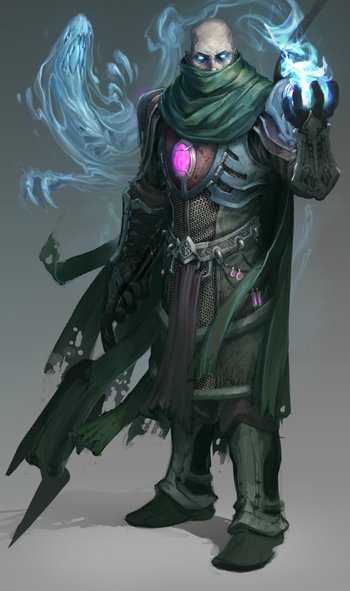
- And I Must Scream: Gets turned into a wight by Sliske using the part of your soul he took, and fights you twice in Sliske's Endgame. Sliske makes it clear Nomad can feel every injury you inflict on him. Even Saradomin was disgusted at this.
- Bad Boss: He subjugated his imp minion, Zimberfizz, to quite a bit of abuse.
- Deus est Machina: He creates a construct imbued with divinity through stolen souls.
- Dual Boss: You fight him, Gregorovic, and Linza the Disgraced all at once during the climax of "Sliske's Endgame".
- Freudian Excuse: Icthlarin says that had circumstances been different, he could have been a great hero, but the loss of his parents and resulting grief caused him to turn against everything, but also states that all his choices made him into the monster he is today and nothing is his past justifies his current actions.
- Killed Off for Real: You are given the option to execute Nomad at the end of "Nomad's Elegy", but regardless of your decision, Sliske takes him away. Double subverted in "Sliske's Endgame", where it is revealed Sliske turned Nomad into a wight using the part of your soul he took; it's not clear, however, what happens to him after you beat him a second time in the same quest.
- Leitmotif: "Battered Soul".
- Mad Scientist: He is considered a madman and his ethics are depraved, but he is certainly fairly creative with Magitek.
- Soul Power: He specializes in manipulating souls and their connection to divinity.
- Turns Red: In "Sliske's Endgame", if he is not the first boss to be killed, he will use his Soul Blast attack. If he is the last of the three bosses to remain, he will summon clones of himself. On the bright side, however, killing only one clone is enough to take him down.
- Well-Intentioned Extremist: He personally considers himself one, believing himself to be doing horrible things for the greater good. Everyone else considers him a deluded mad man, even Xenia.
- What Happened to the Mouse?: Not a peep has been heard of him following Sliske's Endgame. Did he finally die? Did he survive and is now biding his time for his next move?
- Your Soul Is Mine!: He steals them to augment his own power and for his projects, in many cases damning them to Cessation of Existence.
- You Will Not Evade Me:
- He freezes you to the spot just before using his HP to One attack and temporarily disables all of your abilities. This ensures that you cannot avoid it and you have to face the full force of it.
- Similarly, you can't teleport away when you face him during the quests or during the repeatable "Memory of Nomad" encounter unlocked after beating "Elegy"; the only way out is by winning or dying, similar to Araxxor's fight. You can, however, leave via the doorway in "Elegy", but this doesn't become an option during the "Memory of Nomad" encounter, when he traps you on the bridge during the final phase.
Char
A fire enchantress and one of Zaros' most loyal followers.- Did They or Didn't They?: According to Perjour, there were rumours about her being Zaros' concubine, but there was no evidence to prove them. Char herself refuses to divulge any information on the subject.
- Disproportionate Retribution: She takes out her anger at Zamorak's betrayal on the firemakers, a group of innocents who had absolutely nothing to do with it.
- From Nobody to Nightmare: She started out as an orphan who was rescued in the desert and became a dancer. She wound up as one of Zaros' disciples and an incredibly strong fighter.
- Last of Their Kind: Her people were attacked and killed by the Fremennik. A small number were enslaved, but after Char destroyed the Fremennik village, it's not certain if any of them survived.
- One-Winged Angel: Turns into a giant, six-armed version of herself during her boss fight.
- Playing with Fire: The Auspah are all fire-mages.
- Rip Van Winkle: She spent thousands of years in an enchanted sleep, waiting for Zaros to come wake her up, but Zamorak's plot succeeded and he couldn't help her.
- Roaring Rampage of Revenge: Went on one after being kidnapped by the Fremennik and discovering that they had enslaved many of her people.
- Too Dumb to Live: Yes, Char, go ahead and use a power-amplifying artefact while standing next to an Elder Artefact that's actually a portal to a dimension full of shadow monsters. Really, she's lucky that she only got pulled into Erebus, and didn't let another wave of monsters loose.
- Uncertain Doom: She gets pulled into Erebus during the Battle of the Monolith; whether or not she survives afterwards is unclear.
Hreidmar
Leader of the Red Axe, and the Big Bad of the Rise of the Red Axe quest series.
- Big Bad: The Rise of the Red Axe series is all about stopping him from conquering Keldagrim.
- The Corrupter: Transforms himself, Colonel Grimmson, and Veldaban into chaos dwarves with a dragon battlestaff. Veldaban, however, spends the duration of the battle resisting the transformation while you are left on your own to deal with the other two.
- Dual Boss: In the second half of the final boss battle, Hreidmar fights the player along with his right-hand Colonel Grimmson in Birthright Of The Dwarves.
- Evil Old Folks: He's 148 years old. In other words, he wouldn't hold the throne for long, and thus established his own kingdom after his final attempt to take over Keldagrim failed.
- Evil Sorceror: In the boss fight against him, he uses magic to attack.
- Royal Brat: An older example but still counts by being a Blue Blood. The reason he wants to conquer Keldagrim because he is the king by birthright.
- It's Personal: In addition to making Hreidmar atone for his vile deeds, Veldaban is motivated to take him down because he turned his girlfriend into a chaos dwarf.
- Leitmotif: "Rage of the Red Axe".
- Meaningful Name: Hreidmar is named after the king of the dwarves in Norse mythology. It turns out that HE is the king of dwarves by birthright.
- Obviously Evil: Discussed in-universe when trying to get the protesters not to help Hreidmar.
- Right-Hand Cat: He owns a cat named Tiddles who is very spoiled.
- Retired Monster: Eventually, Hreidmar gives up on trying to conquer Keldagrim and decides to make his own dwarvern city. Justified, as even if he successfully became king of Keldagrim, he would only have a short two years to enjoy his reign before stepping down.
- Turns Red: He uses a dragon battlestaff to turn himself, Veldaban, and Colonel Grimmson into chaos dwarves. Veldaban, however, spends the battle resisting the chaos transformation, and you are left on your own to deal with both Hreidmar and Grimmson.
- The Wrongful Heir to the Throne: He is a descendant of dwarven royalty and wants to claim his lost birthright from the mining consortium that currently rules the dwarves. His schemes to do so involve brainwashing poor citizens and turning them into monsters.
Charos

A legendary diplomatic human from Morytania. Much of his past is unknown and shrouded in mystery. Throughout his life he took on many disguises; in fact it's revealed in Desperate Times, that Reldo Trimmly is one of them, in order escape a bounty placed on him by Lord Drakan. See Varrock character page for more on Reldo Trimmly.
- Artificial Limbs: Charos possesses an artificial arm.
- Charm Person: What the Ring of Charos does- Charos describes it as giving people a gut feeling that tells them 'this is fine', which makes them inclined to go along with whatever the person wearing the ring wants.
- Faking the Dead: Charos made a simulacrum of himself for the sole purpose of it being publicly killed, after Lord Drakan put a price on his head.
- From Nobody to Nightmare: Charos started out as an urchin on the streets of Meyerditch, who became an informant for the vampyres and eventually the assistant of a haemalchemist. After he made the Ring, he rose through the ranks of vampyre society until he became an adviser to Lord Drakan.
- Iconic Item: The Ring of Charos, which grants one the power to exert will over the weak-minded.
- Magitek: Charos is a master of enchantments and invention, and can combine the two easily.
- Really 700 Years Old: As Reldo, he's only 28 years old. Charos, in reality, was born in the early 4th Age— almost 2000 years before the current year of Runescape.
- Silver Tongue: Through a combination of enchanments and natural charisma, Charos was able to make his way up the ranks of Lord Drakan's vampire court.
- Small Role, Big Impact: He's the one responsible for cursing Uri Molotov and indirectly creating the Treasure Trails. He also accidentally kicked off the events of Creature of Fenkenstrain by giving the Ring to Lady Rolobrae.
- Sole Survivor: In Dimension of Disaster, he's the only living human still left in New Varrock.
- Walking Spoiler: With the revelation that Reldo is, in fact, Charos.
Bob the Cat/Robert the Strong

A cat who wanders around Gielnor, occasionally returning home to Unferth in Burthorpe. He's the unofficial mascot of Runescape.
- Happily Married: He marries Neite in "A Tale of Two Cats."
- Heroic Sacrifice: In Old School, near the end of Dragon Slayer II, he jumps in the way of Galvek's dragonfire, saving the player.
- Odd Friendship: He's friends with the King Black Dragon, and the Moonclan's Oneiromancer.
- Was Once a Man: He's the reincarnation of Robert the Strong, a Fourth Age hero who nearly drove the Dragonkin to extinction.
Rasial
Also known as the First Necromancer, he invented Necromancy in Gielinor.
- Canon Character All Along: There are hints that Rasial, in life, was a character mentioned in the Meeting History quest named "Misalionar", a follower of Guthix who was among the first humans to settle on Gilenor. Misalionar was murdered in the First Age, and his name anagrams out to "No, I'm Rasial".
- Greater-Scope Villain: Murals in his citadel imply that Oreb, Nomad, and Taraket were all apprentices of his.
- Early-Bird Cameo: In the lead up to Necromancy's release, Rasial would pop up when players did certain actions, like visiting Fort Forinthry or killing bosses, in order to foreshadow his appearance.
- Hidden Agenda Villain: He chooses the World Guardian as his latest, and probably last apprentice, and leaves them with no choice but to learn necromancy to stop his plans for an undead invasion. Why? While the man himself and his methods are evil, there are hints that his motives are not entirely selfish. He implies that the Player Character made a "mess" during their adventures and that he is holding them responsible for cleaning it up. He picks apprentices to pioneer new knowledge in necromancy and abandons them when he thinks they have reached their heights. He wants the World Guardian to gather the most recent developments from the living world, and make any possible discoveries of their own. Plan A is to then kill the World Guardian and extract what they learned. If the World Guardian somehow becomes strong enough to beat him, then plan B is to entrust cleaning things up to them. The key discovery that the World Guardian makes is that by using consent instead of slavery, the spirits willingly loan their full power, allowing necromancers with a sense of morality to grow stronger a lot more quickly.
- Necromancer: He wasn't necessarily the first ever, but he was it's inventor in Gielinor.
- Noble Demon: When you defeat Hermod for the first time, he calls of his sword Angurvadal from tormenting the citizens of Um.
Ilujanka
Known to scholars as the Dragon Riders, these beings were, and still are, facing extinction due to infertility. Zaros brought them to Gielinor to fight for him in exchange for fixing that issue.- Dragon Rider: Ilujanka can form bonds with any large creature. Hannibus was bonded with the King Black Dragon.
- Dying Race: They are suffering from widespread infertility, and have largely accepted that their time is coming to an end.
- The Empath: Ilujanka are able to establish a mental link with the guhrs of their world, allowing them to tame them. The ones that travelled to Gielinor with Zaros used this ability to tame dragons and become dragon riders.
- Face Death with Dignity: Their race has resolved to do this. They know they will probably die before a cure for their near infertility can be found, so they wish to preserve their history so that when another sentient race arises on their homeworld, they can guide that race in spirit. When Seren attempts to hatch the eggs of the Elder Gods on Iaia during Extinction, some of the Ilujanka choose to stay behind and die with their homeworld while the rest scramble to evacuate. The ones who stay, however, make sure to pass their torches before the evacuation is complete.
- Friend to All Living Things: Their races philosophy involves this. The Ilujanka lived in harmony with their environment, and could adapt to other environments by befriending even vicious creatures such as dragons. In addition, when the player must protect Hannibus by fending off feral Steel Dragons, Hannibus reacts in horror every time one dies.
- Last of His Kind: It is implied that only one is left, Hannibus. Actually, there are some on their homeworld; births are lower than deaths, though, and the race is prepared to die out.
- Lizard Folk: They are a reptilian race also known as lizardmen.
- Naïve Newcomer: The Ilujanka were unprepared for the concepts of war and betrayal that they found on Gielinor.
- Pintsized Powerhouse: The Ilujanka are about a head shorter than most humans.
- Reptiles Are Abhorrent: Subverted big time. The Ilujanka are reptilian, with an anatomy being very similar to the Dragonkin, but are also described as a noble, good race.
TzHaar and TokHaar
The TzHaar live in the Karamja volcano, where their society is built on a sort of caste system, including craftsmen, leaders, soldiers, and hunters. And a playwright. During a quest, the player travels deep underground and encounters the TokHaar, the ancestors of the TzHaar and a direct creation of the Elder Gods.- Amplifier Artifact: The TokHaar, and the Kiln they come from, are a tool of creation used by the Elder Goddess Ful.
- Blank Slate: Inverted and played straight. TzHaar are born with their memories and knowledge of how to fill their role. Recently, TzHaar eggs haven't been hatching properly, resulting in Ga'al - physically small TzHaar with no knowledge at all. Unlike TzHaar, though, Ga'al are capable of learning at a very fast rate, including outside knowledge of the outside world. Turns out this began happening when the TokHaar cut off the sacred lava which gave the TzHaar their memories in an attempt to force the TzHaar to return to the Elder Kiln.
- Living Currency: They forge the bodies of their dead into obsidian coins, which are holy to them. They abandon the practice when they learn the Awful Truth that this treatment leaves the dead aware and in torment.
- Hive Caste System: TzHaar and TokHaar are divided into four castes that are physically different from each other. Ket are the guards, Xil are the hunters, Mej are the mages and seem to be the ruling class of the TzHaar, and Hur are the craftsmen. The TokHaar are ruled by a unique individual called TokHaar-Hok. The Ga'al are a defective form of TzHaar who originally were killed at birth but later gained acceptance as a new class.
- Magma Man: They are made of living volcanic rock. The TzHaar are patially molten and glow orange.
- Proud Warrior Race Guy: They seem to have this going on. The TzHaar have a number of gladiatorial events which emphasize fighting and dying with honor. Exaggerated by the TokHaar; as long as they stay in the Kiln, they literally cannot die, and have amused themselves for centuries with combat, although they will often wait until you accept their challenge before attacking.
- It seems that old habits die hard, as the TzekHaar (and Shrimpy) stand by as spectators when TzKal-Zuk decides to fight you personally.
Aviansie
A race of human like birds who come from a realm called Abbinah. Abbinah is revealed to be a planet in the same solar system as Kethsi. At some point in the Second Age, an aviansie ascended to godhood using an unknown artifact, and became Armadyl. Armadyl led his followers to Gielinor, where they prospered in the aerial structures which are today used as Clan Citadels. During the God Wars, the aviansie were believed to have been wiped out, but many deserters and infirm had been hiding back in Abbinah, and they would repopulate the race.- Bird People: Humanoids covered in feathers and with beaks and wings and claws.
- Death World: Abbinah is composed of floating rocks with liquid water existing only at the core. According to one aviansie, many have died securing basic provisions.
- Floating Continent: The islands where they lived in Gielinor.
- Giant Flyer: Kree'ara is a rather large aviansie, but even the regular ones could count. Armadyl is even more enormous.
- Human Popsicle: An army of them were frozen alive in the Temple of Lost Ancients (or God Wars Dungeon) during the god wars and only thawed out in the 5th age.
- Noble Bird of Prey: Strong warriors who fight for peace and resemble birds of prey.
- Winged Humanoid: Or maybe humanoid winged creatures.
Gorajo
When Bilrach was opening portals in Daemonheim to summon minions, one malfunctioned and opened into the realm of the Gorajo. The Gorajo were opposed to demon summoning and necromancy, and declared war on Bilrach. Today, they can be summoned as familiars by players.- Action Girl: The Stormbringer and Deathslinger familiars.
- Astral Projection: What happens when they are summoned, meaning that "dying" will only pain and inconvenience them.
- Boisterous Bruiser: Bloodragers are the friendliest of the Gorajo you can summon.
- Death World: From the Gulega, to massive sinkhole monsters, to creatures who make the dragons of Gielinor look tame, every description given of the Gorajo realm sounds terrifying. Even the Deathslingers, who have only experienced one of the more dangerous locations of Gielinor, agree their world is more horrifying.
- Evilutionary Biologist: The Polypore Dungeon is the work of an exiled Skinweaver who took interest in fairy rings and began experimenting with parasitic fungi.
- The Exile: The Ramokee. Ramokee are Gorajo who were cast out of the tribe for some crime.
- Family Honor: If a Gorajo gives birth to a powerful Stormbringer, they will be crippled from the raw magic of the infant. Mothers who experience this are honored greatly in their culture, and are even given their own Worldbearer servants.
- Fantasy Counterpart Culture: The Gorajo appear to be based off of Native American cultures.
- Hive Caste System: The Gorajo are born as either Bloodragers (warriors), Deathslingers (hunters and rangers), Stormbringers (mages), Skinweavers (healers), Hoardstalkers (foragers and skilled workers), and Worldbearers (manual laborers). The Exile's story in Ports establishes that there is a caste that has somehow been abolished Endbringers, which appear to be equivalent to assassins.
- Humans Through Alien Eyes: Gorajo familiars will sometimes remark on how weird it is that humans identify as individuals, by name, instead of having defined roles (a few Gorajo NPCs show more individuality, particularly if they have been exiled). Skinweavers will wonder aloud how you heal by eating food instead of by treating the injury.
- In My Language, That Sounds Like...: The Worldbearer familiar says that in the Gorajo language, (your name) means "one who juggles pigs".
- Interspecies Romance: The Fremennik Saga "Thok Your Block Off" heavily features Thok's courtship of the "Pretty Lass" Divine Skinweaver. At the end of the unabridged saga, they're apparently dating.
- Non-Action Guy: The Hoardstalker familiar detests combat, even though his caste's secondary function is to guard resources from Ramokee brigands.
- No Need for Names: Most Gorajo are addressed by a title consisting of their skill level (or, if exiled, their Ramokee status) and caste. Your character can discuss this with one of the Gorajo familiars, who finds the notion of personal names ridiculous.
- Sour Supporter: The Worldbearer familiar. He thinks you're a stupid cub with a stupid name and a stupid agenda. He doesn't want to talk to you, he doesn't want to look at you. But you summoned him, you need his assistance, and he will help you because that's his job, dammit.
- This Means War!: The Gorajo are a very moral race who are opposed to Bilrach's crimes. The Deathslinger declares that she is saving a poisoned arrow for his heart. Assuming he has one.
- Worthy Opponent: How combat-oriented Gorajo react to encountering the Warped Gulega boss. They will declare it to make a worthy trophy, and deal increased damage to it.
Demons
A group of races native to a realm called Infernus, these are the native devils of the setting. There are countless species of demons but they can generally be divided into three categories, Avernic, Chthonian, and Infernals. The general theme is that Avernic are more classic archetype while Chthonians borrow heavily from HP Lovecraft. Each of the three races ruled Infernus and enslaved all the others and were in turn overthrown and exiled by the next in receding order. Zaros used the Chthonian dukes in his armies to conquer Gielinor. They were overthrown by Avernics after Zamorak ascended to godhood.- Big Red Devil: For all their variety, this is the general characteristic of the Avernics.
- Cannibal Tribe: Chthonians were a cannibal race. The Chthonians had a complex legal system set up to prevent them from eating each other. After Hostilius died, it fell apart.
- The Exile: The fate of the Chthonians and Infernals after being overthrown.
- Hive Mind: The Penance monsters are described as being minions, not heirs, to Duke Cacus. As such, they are not granted sentience.
- Humans Are Ugly: The way Avernics see humans, which has lead to several Zamorakian demons shapeshifting into humanlike forms, albeit with wings and horns. One of them admits that not all of them see things that way, and she has in fact chosen human features that she likes.
- I Am a Humanitarian: Hazeel noted that some of the Chthonian didn't always follow Zaros's laws against eating humans. On the plus side, Senntisten had very few homeless people.
- I Know Your True Name: Most demons are reluctant to give out their true names since that gives one power over them. If a demon is open with its name, then that implies that it is a particularly powerful member of its kind and cannot be controlled in this way.
- Magically-Binding Contract: Demons seem to have the ability to create contracts that are nearly unbreakable, even to the gods.
- My God, What Have I Done?: In stark contrast to how the rest of his race enjoys eating anyone they can, the demon in "Broken Home" is actually horrified to realize that he consumed a human child, and went insane out of grief.
- Our Demons Are Different: Demons are basically a series of magically powerful alien races native to a planet named Infernus.
- Avernics are Red Devils - though they were originally more lanky and goat-like before an update - and are rather tribal. They helped Zamorak overthrow Zaros in exchange for his help freeing them from the Cthonians.
- Cthonians vary significantly in appearance. Though their mentality isn't terribly alien, their appearance can range from a little bit odd to full blown Eldritch Abominations. They used to rule over the Avernics, but they overthrew the Cthonians with Zamorak's help, and now mostly reside in the Abyss (the portion of which they reside in/which the player can visit is their leaders giant corpse!)
- A third race, the Infernal demons, used to rule over the former 2 but were driven to (near) extinction by the Chthonians coup so long ago that virtually nothing is known about them as a whole. The sole surviving variety is the Kal'Gerion Demon, which stand easily twice the size of a human, with enormous wings, cloven hooves and More Teeth than the Osmond Family.
- Physical God: Hostilius the Autocrat, with an emphasis on "physical". Hostilius was not a god, since he lacked a divine nature, but his power had grown to the point where he equaled one. Still didn't stop Zamorak from killing him (maybe).
- Teleport Spam: Abyssal demons will randomly teleport themselves and the player a few squares away while fighting. This serves more to disorient than as a means of travel.
- Tomato in the Mirror: Senecianus was Driven to Madness by guilt and came to believe he was the human girl he consumed. He took the form of a ghostly version of her and wondered why everyone he tried to play with kept disappearing, being completely unaware he was eating them.
- Voluntary Shapeshifting: A relatively common power among demons.
- You Are Who You Eat: Chthonians could absorb the knowledge and powers of those they ate. Hostilius, the leader, consumed so many Infernals as well as his own kind, that his power became equal to a lesser god, and his corpse became the home to many of his species after being killed and flung into the abyss.
- Your Soul Is Mine!: Chthonians can completely consume the essence of their prey. One unfortunate victim of this was a Fremmenik named Aesa Fellsdotti, leaving her The Soulless, and enabling the demon who consumed her to return to Gielinor after her body died. Inside a quest, another Cthonian devours a ghost and offers to devour another if you so request it.
Vampyres
The antagonists of the Myreque questline, overlords over all of Morytania, not that they are very satisfied with that. They are kept from invading the human lands only by the power of the River Salve. Most currently live in their capital city called Meiyerditch. The human population of the city live in sectors that are rotationally tithed to prevent them from dying of blood loss. Other settlements are forced to pay regular tithes in exchange for their continued existence. Lately, the Vampyre population has been growing large enough to strain even this system. The converted come in three stages, Juveniles Juvinates and Vyres. But most powerful are the trueborns, who are a separate race entirely and come from their own realm, Vampyrium.- Achilles' Heel: Vampyre juvinates and vyrewatch can only be damaged by silver and blisterwood weaponry.
- Always Chaotic Evil: Subverted. Ironically, it's the converted human Vampires that show the most cruelty. The trueborns usually fall under Pragmatic Evil or Noble Demons at worst, and a few of them do genuinely want to improve the life of humans.
- Bat Out of Hell: Their true form.
- Better to Die Than Be Tithed: Not them, but the humans of Port Phasmatys chose undeath rather than being subjected to the tithing system.
- Cannot Cross Running Water: Justified. The river Salve was empowered by a Saradomionist ritual to act as a barrier they can't cross. The barrier in practice is also a shield that covers all of Morytania, ensuring they can't circumvent it.
- Fur Against Fang: The werewolves have been enslaved by the vampyres, and are used for labor, combat, and blood tithes when the humans aren't productive enough. They're appropriately resentful, which eventually leads to them refusing to attack the World Guardian and declaring their independence from vampyre control during the events of River of Blood.
- Half-Human Hybrid: The most dangerous type of vampyre is called a Wyrd. They are massive, develop a strong hatred for all that is holy and good, and are very difficult for the vampyric ruling class to control. They are the result of converting human test subjects with sufficient icyene ancestry into vampyres. But, the combination of traits from all three races ultimately proves to be the catalyst needed to cure converted vyres entirely and reduce natural vyres' dependency on blood.
- Henchmen Race: The werewolves. They declared themselves independent from the Vampyres towards the end of River of Blood.
- Industrialized Evil:
- The ghetto of Meyerditch is a farm for human prey, and withdrawals are scheduled and regulated (poorly) to keep the stock plentiful and (sort of) healthy. New stock is routinely added by capturing or enslaving humans from outside the ghetto.
- Converting humans into vampires requires the subjects to be immersed in a special formula and then exposed to a type of magic rock called Daeyalt. The vampires have created an entire factory and assembly line for this purpose.
- Kryptonite Factor: Most have the standard weakness of Vampires, silver, mithril, holy powers, but the most effective is the blisterwood tree. Despite the Vampyres trying their hardest to destroy the tree, the best they can do is lock up the tree and put as many guards as they can around it.
- Large and in Charge: Lowerniel Drakan towers over the other vampyres, even in flashbacks. No explanation is ever given.
- Looks Like Orlok: Vampyres can take a human form. Most of the mooks look like Orlok. More plot relevant Vampyres have more distinct forms while still looking distinctly inhuman.
- Our Vampires Are Different: They have traits that are very similar to The Undead, even to the point of becoming trapped souls, but they are not in fact undead and are not vulnerable to holy water. They are actually an alien race that originates from the lower planes. They are able to convert humans and icyene into similar beings, but this ability is not innate and requires a form of magic called haemalchemy to perform.
- People Farms: Meiyerditch is essentially one giant farm. The "city" is divided into sectors/ghettos that exist only for consumption.
- Phantasy Spelling: "Vampyre" instead of Vampire. This was originally to distinguish the vampires of the haunted forest from the intelligent vampyres. Vampires were later renamed feral vampyres.
- Uplifted Animal: During "Fate of the Gods", one of Zaros's memoriam crystals recalls how he encountered the pack-hunting predators of Vampyrium and introduced sapience, language, and culture to them from the more advanced demons, turning them into a race he saw as more civilized.
- Vampires Hate Garlic: They suffer from something similar to an allergic reaction when near garlic. It won't kill them directly, but it makes them irritable and less focused. Garlic is one of the ingredients for the Guthix balance potion.
- Vampire Monarch: The trueborns as a whole serve as this, but the most notable is Lowerniel Drakan.
Lizardmen
A race of Lizard Folk created by King Shayzien VII (who was probably Xeric) using the power of the Dark Altar. Found throughout the Kebos Lowlands, lizardmen are savage and brutish creatures living in the damp caves and swampy ruins of Molch.- Always Chaotic Evil: Ever since Xeric was driven out, they've engaged in a perpetual war against House Shayzien.
- Large and in Charge: The lizardman shamans are the largest of the lizardmen, and they lead the others in rituals worshipping Xeric.
- Poisonous Person: All lizardmen have poisonous bites.
- Reptiles Are Abhorrent: In contrast to the Ilujanka, lizardmen play this straight.
- Sssssnake Talk: On the rare occasion they speak, they all talk like this.
