
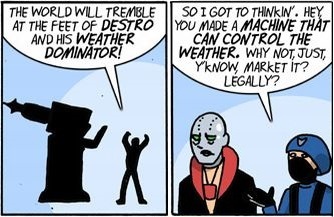
When a person is pursuing a goal, especially if it's something tempting like wealth, fame, or political power, there may come a time when they have to choose between doing what's easy and doing what's right. At that moment the legitimate method of earning it may be slow, difficult, or unprofitable, while at the same time there's an illegal or unethical option that offers quicker gains to whoever can get away with it. On the other hand, assuming that the shady option is always the most expedient is a mistake that leaves a lot of would-be villains not only punished, but broke as well. They may think they're acting in their own self-interest, but often they screw themselves over because they don't realize that they could have done better—or at least reduced the risk of being caught and defeated by the heroes—by using more honest means.
This is the villainous equivalent of Reed Richards Is Useless: A baddie who constantly fails at beating the heroes never realizes that their intellect and hard work might mean they'd get a lot more done if they did an honest day's work; any attempt at going straight is simply a ruse to lull heroes into a false sense of security. This may be more a factor of maintaining the Status Quo, and it's usually mentioned that the Mad Scientist is mad after all. Sometimes lampshaded at a villain's death with "If only he'd used his powers for good, instead of for evil." The example is contagious; even if The Government gets a hold of secondhand ultratech, they just use it for ill-conceived attempts to either conquer other nations or abuse their citizens.
Sometimes this trope is subverted by villains who start out using their talents for legitimate gain, but who end up becoming villains for one reason or another. Sometimes a Mad Scientist villain does market his inventions, but only to finance grander schemes and sometimes remarks, "How do you think I got all my equipment without attracting attention?" Another subversion can be when the villain really does go straight, and is able to use the skills he demonstrated in his criminal career to land a legitimate job. Compare Reluctant Mad Scientist. Rich Boredom may justify it because the character already is swimming in money and is seeking something else.
This trope was very common in the early days of comic book superheroes like The Golden Age of Comic Books and The Silver Age of Comic Books. As the decades passed villains became more complex but the trope is still around in some form. When this is avoided, the turn to the side of good is usually planned well in advance. Heroes may even precipitate it by simply asking "And Then What?".
This trope could almost be a case of Reality Is Unrealistic. For all the criticisms thrown at comic book supervillains, quite a few real-life criminals make this trope Truth in Television, due to the difficulty of those with criminal records getting honest work. It was common practice of (legal) casinos in Las Vegas - and later Atlantic City - to hire men who (successfully) ran illegal gambling operations in other parts of the country because these people had specialized skills and experience in the gambling trade. And even now, casinos sometimes hire known cheaters to catch other cheaters, because they know all the tricks.
Finally, there's also the Logical Fallacy that seems to assume that because someone manages to invent some sort of amazing new product, they will also automatically be successful at marketing it. Just because someone has the science smarts to develop something brilliant doesn't necessarily mean that they also have the business smarts to sell it effectively... and if you try and sell your product to a business, there's always the danger of a Corrupt Corporate Executive cheating you out of your rightful share of the profits. Indeed, many villains' Start of Darkness is kicked off by such failures in such legitimate or even good uses of their talents, and for villains trying to go straight is often the primary method of ensuring that they don't. And of course, some villains aren't motivated by money at all, so the idea of using their talents to get rich legally hold zero appeal to them.
See also Fake–Real Turn, where a business that is serving as a front operation for a criminal activity or organization becomes so successful in its own right that characters decide to pursue it as a legitimate business. And You Could Have Used Your Powers for Good!. Compare Moral Pragmatist.
A subtrope of Misapplied Phlebotinum, with a degree of Stupid Evil. Compare Reed Richards Is Useless, Screw the Rules, I Have Supernatural Powers!, and Dick Dastardly Stops to Cheat. Contrast Rich Genius, Visionary Villain, and Pragmatic Villainy. See also Science-Related Memetic Disorder, Greed Makes You Dumb, and Sanity Has Advantages for the possible justifications of this trope. Can end up leading to Boxed Crook when put into practice.
Example subpages:
Other examples:
Gaining more money legitimately:
- At the end of episode 225, a Filler, of Case Closed, Conan asks a man who tried to rob a bank why he doesn't use his talents (such as cooking) to earn money legally. His answer? He didn't think of it!
- JoJo's Bizarre Adventure:
- Phantom Blood: In his fight with Jonathan, Speedwagon's Oddjob-style hat shows that he's pretty inventive for a criminal in the slums of London. Battle Tendency shows after his Heel–Face Turn, he used his own intelligence and resource to build himself a foundation with an influence that extends all across the globe.
- Diamond is Unbreakable: Tamami Kobeyashi initially uses his Stand to make people literally heavy with guilt to scam people for money, and later subverts this trope by getting a job as a mob debt collector.
- JoJolion: The Rock Humans use the Locacaca fruit to sell bogus miracle cures to the ridiculously rich which heals what ails them only to maim them in another way due to the fruit's principle of Equivalent Exchange. However, some are savvy enough to hide the true nature of the treatments, potentially suckering patients into repeat procedures until they no longer have the money to pay for them.
- The JoJoLands: Jodio claims that Meryl May is such a talented fashion designer that she could easily make a fortune by selling her clothing in Milan or Paris. Despite this, she treats the whole venture as a way to launder money for her criminal enterprise.
- KonoSuba: The succubi in the setting have realized that instead of preying on unsuspecting men and being hunted down for it, it's much easier to simply set up a business that specializes in giving adventurers tailor-made Erotic Dreams in exchange for money and a small amount of life force. The end result is that the adventurers can release their pent-up sexual energy without hurting anyone, and the succubi get the energy they want plus a steady stream of income. The authorities still officially view the succubi as monsters but turn a blind eye to the setup because it's mutually beneficial to do so. At the end of the first season, it actually helps save the town, as many of the male adventurers are motivated to participate in a dangerous mission to save the city because the Succubus Shop would be destroyed otherwise.
- Inverted in One Piece, when minor villain Wapol actually starts a new life and builds a massive toy-making empire by using his powers to recycle objects into toys. In fact, the alloy his power creates (dubbed "Wapometal") is apparently a unique and amazing compound, which makes him even richer when a scientist discovers its properties and Wapol begins capitalizing on that. Heck, thanks to this discovery, he even gets his own kingdom (Named the Evil Black Drum Kingdom) and marries a supermodel! Ironically back to being an evil King, but this time kinda better. Later in the series, Franky starts building tanks using the revolutionary metal.
- Invoked in One-Punch Man. After his defeat and the eradication of his forces by Saitama and Genos, the leader of the House of Evolution Dr. Genus is shown to have used his impressive cloning technology to set up a Takoyaki stand selling octopus balls.
- The Team Rocket trio in Pokémon: The Series invent some of the most impressive Death Traps one could ever imagine, almost every episode... until they occasionally run out of money. It's mentioned in one episode of the Johto series that they borrow their traps from Team Rocket, and that they were invented by the R&D at their HQ. They're also not above taking and maintaining legit work, until the inevitable screw up, and it's always manual labor anyway. Ironically, their "honest" work is almost always profitable. And they always prove to be much better at whatever work they do for extra cash than they ever are at being bad guys. They'd probably have better lives if they just stopped chasing Pikachu.
- They once tried to set up a memorabilia stand for some Pokémon tournament, and did well. Then they sank all of their money into it, just in time for the tournament to end and the market for their stuff to disappear. In fact, Jessie eventually started entering Pokémon contests; not only is she pretty good at it, she has won a few, even progressing quite far in the Sinnoh Grand Festival. James also acts like pre-Flanderization Brock on occasion, showing potential to be a great Pokémon breeder. Meowth, being able to speak both Human language and Pokémon language, also could be filthy rich if he stopped being a criminal and just became a translator. In the Pikachu short film "Pokémon — Gotta Dance", Meowth is apparently a genius in that he invents a Pokébaton that can control Pokémon. However, he just uses it to make Pokémon dance, and he ends up allowing it to be destroyed. Meowth is a borderline Gadgeteer Genius; James mentioned that the cat's the one responsible for most of the Humongous Mecha that they throw at the twerps!
- In a short arc of the Best Wishes series, Meowth becomes a Fake Defector in a plan for him to join Ash's team as The Mole, winning them over with his negotiator skills. While it was all just an act to lure them into another Pokemon-stealing trap, he was actually rather good at it most of the time, ending up solving several dilemmas the heroes ran into on their journey. Back in Diamond & Pearl, another Fake Defector venture nearly turns into a legitimate Heel–Face Turn after the heroes point out Meowth's talents could easily make him a TV celebrity. However, just on the way to finding some media connections, the heroes start their usual beatdown on Jessie and James, and he just doesn't have the heart to turn his back on them. In Pokémon Journeys: The Series, the three ended up producing a popular podcast, although it wasn't enough to lift them out of Perpetual Poverty.
- Utilised since the Sinnoh era. It is revealed that Meowth has exceptional culinary abilities due to his precise Fury Swipes. He ends up using it alongside Jessie during her contest run, helping her get a top spot. He does the same in the Kalos showcases, where it again is usually received well. In the Pokemon short "Eevee And Friends" the heroes' Pokemon even entrust him to make a banquet for their party.
- Also subverted in that the few occasions Team Rocket actually tries to make a legitimate business, either demand fades, or it's the one time in a million that the twerps actually see through their Paper-Thin Disguises and drive them out of business.
- In one dubbed episode, the trio actually does well enough in a legitimate business venture that the three momentarily consider leaving Team Rocket to pursue a new life. It just so happens that Ash and Pikachu walk right by, and the three promptly ditch their stall and go back to their old ways. They're just that obsessed with the yellow electric mouse.
- In Sun & Moon their circumstances force them to largely stay in one place and they end up opening a food truck to run during their off-hours. Despite a few struggles at first, it actually becomes fairly successful! They become so accustomed to their new routine that they even declare that honest work is enjoyable! (but then of course, they immediately feel that there's something completely wrong with that statement; THEY'RE SUPPOSED TO BE HARDENED CRIMINALS DAMMIT!!!). Additionally they become part-time MC's for a wrestling tournament. The reality is, it's clear Team Rocket is good at just about anything that isn't stealing Pokémon.
- What makes their obsession even worse is that Ash's Pikachu is, at least at first, no more powerful than any Pikachu could hypothetically become: It does display an unusually strong electric attack during Team Rocket's first encounter with it, but this is because Ash is pumping it full of electricity, making it stronger. You could do the same with any other of its kind (and probably any other Electric-type, for that matter). Later on, Ash's Pikachu is actually shown to be one-of-a-kind, very powerful, and able to do things no other Pokemon can. It still applies, as most of what he does can be done by other Electric-types, and his unique Z-Move, 10,000,000 Volt Thunderbolt, only works with Ash.
- "Pikachu's Goodbye" is an extreme example: Team Rocket attempts to poach a group of wild Pikachu (along with Ash's, naturally). They completely fail to realize that they could just, you know, battle and capture the Pikachu like any other wild Pokemon. Only one of them has an owner.
- Sherlock Hound: Moriarty could have made quite the fortune if he didn't make all his fancy inventions for criminal use. Worse, he thinks nobody would appreciate his talent if he weren't a criminal mastermind.
- An unexpected version in Slayers NEXT. Martina is horribly, comically hopeless as a villain, but turns out to be sufficiently talented in retail and handicrafts to raise a small army of thugs out of her profits from selling (and making) paper flowers for a few episodes.
- Succubus & Hitman: Lampshaded. Mount Beatdown uses magic to turn Shouya and Kaname's ammunition into gold when they start attacking him. Shouya quickly does the math aloud on the value of the gold cartriges and shotgun shells and concludes that Mount Beatdown is in the wrong business; he irritatedly retorts that the power isn't unlimited.
- Akihiko Kayaba of Sword Art Online has Double Subversion example, having created and sold an extremely popular total-immersion virtual reality game, presumably making truckloads of money off it. But then he decided to remove the logout button and fry the brains of anyone who dies in the game. He also enters the game himself, and eventually disables his God Mode, allowing Kirito to kill him... making him a meta-version of a Tactical Suicide Boss. Why? He wanted to be the villainous god common in JRPGs, he even planned to be the Final Boss. Nobuyuki Sugou even lampshades it in the Fairy Dance arc:
Sugou: Mr. Kayaba was a genius, but he was also a fool. All he wanted to use his technology for was his game. He couldn't see the potential.
- Defied in Tsukihime canon; the 14th Dead Apostle Ancestor, Van-Fem, rather than drinking blood and harming humans, took a preference to human society/life and built a highly-profitable casino boat in Monte Carlo shortly after World War I which earned him a high social status among humans. This also has the benefit of making it difficult for the Church Militant to try to kill him since the Church would be in a lot of trouble if they were found to be behind an assassination attempt of such a prominent societal figure.
- In Urusei Yatsura, Ataru's family is lower-middle-class and he occasionally schemes to make money. But he seems to have a blind spot to the fact that Lum effectively has infinite wealth and resources. The most blatant example is the second episode where a crooked space-taxi driver gouges him for earth's entire supply of oil. Lum comes back at the last minute and offers a couple of "power crystals" (presumably charged from her electric powers), which the driver happily accepts. The fact that she can produce something that insanely valuable on demand is never touched on again.
- This is a major plot point in With This Ring.
- Orange Lantern serves works to subvert this and Reed Richards Is Useless. The reason for this trope is also pointed out - most villains don't have the social skills or business savvy to make legal money off their powers; most of them can only think of using them as a club. Of the ones who have both the smarts and the people skills, usually the various mad scientists and variations thereof such as Leonard Snart (Captain Cold), most of those guys are usually legitimately insane or mentally ill and don't care or want legal work. Snart is brought up as a specific example, he has severe paranoia and psychosis due to his abusive father and isn't capable of functioning in a civilian setting. The Terror Twins are the other example, they didn't know any way to use their power other than to steal until Orange Lantern points out that they are perfect for specialized heavy labor.
- The Renegade hires Terra to do some earthmoving for him, and is surprised by just how fast and effective she is, lifting massive plugs of earth and setting them aside in a fraction of the time that any machinery could do. He's then gobsmacked, however, to learn that she usually works as a mercenary, given that she could make a mint working in construction or related fields.
- Subverted in Human Curiosity, when the head of the HCS decides to sell the group's advanced weaponry to countries like North Korea before he disbands the organization.
- Bad Future Crusaders has two:
- Sweetie Belle setting up such a deal with the diamond dogs by, in her own words, showing them some of the nice things those gemstones can buy. In the process, she ultimately ended up turning them into a peaceful society that co-exists with ponies.
- Though subtle, it's implied the "two lankey stallions" that design and maintain Environment Equestria's fleet of Magitek vehicles are the Flim Flam brothers who decided at some point to drop the scams and market their technology directly.
- In Aftermath of a Fallen Star, Flim and Flam have started a legitimate company that's revolutionizing technology in Equestria, which is another thing upsetting a lot of traditionalists.
- Harry points this out to Voldemort in The Conversation
 .
Harry: You were handsome, smart, and stupidly powerful. You found the freaking Chamber of Secrets, something that scholars had been seeking for centuries; you were the heir of Salazar Slytherin. You would have been celebrated for finding the Chamber alone. You could have claimed your family’s seat on the Wizengamot being the first in centuries with the bloodline, intelligence and power to claim it. You could have changed the world for the better.
.
Harry: You were handsome, smart, and stupidly powerful. You found the freaking Chamber of Secrets, something that scholars had been seeking for centuries; you were the heir of Salazar Slytherin. You would have been celebrated for finding the Chamber alone. You could have claimed your family’s seat on the Wizengamot being the first in centuries with the bloodline, intelligence and power to claim it. You could have changed the world for the better. - New Tamaran: Ironically, Scarecrow signs over his fear toxin to Lex Luthor … who then uses it for benevolent purposes.
- Killer Frost is convinced to go legit in Timex... keeps on ticking after she learns Ice (who has the same powers as her) makes enough money producing ice for ice factories to afford a penthouse apartment in Metropolis.
- Not for money specifically, but in the third Ultimate Video Rumble, Geese Howard of Fatal Fury abruptly decides that, if he wants glory and power (and the satisfaction of beating up and humiliating his foes), the best way to do so is just to win the Rumble, rather than waste time, money, and minions on some Evil Plan that would inevitably end with his allies betraying him and/or screwing up and the best heroes of twenty separate universes hunting him down. Sure enough, this works, making him the only villain in any of the Rumbles to succeed at his goals.
- In the epilogue of Polarity, after the Marvel superhumans have thwarted the zombie apocalypse, many of the super-villains that assited the civilians decide to go legit in the new world and find new, meaningful employment based on their superpowers or special gear. Explicitly mentioned are Speed Demon using his Super-Speed to become a courier, and Aqueduct and Hydro-Man getting involved in the water and irrigation side of reconstruction.
- Basically applies to Rita Skeeter in Harry Potter and the Nightmares of Futures Past, as Harry deals with the potential threat she poses by basically blackmailing her with his knowledge of her Animagus status and an offer to make her his exclusive journalist. So long as Rita doesn't write anything scathingly against him or his friends, Harry will provide her with at least one interview a year, while also ensuring that she gets first shot if any stories come up involving him; Harry even recognises that it's a good deal for Rita as she gets exclusive insight into one of the most famous figures in the wizarding world.
- Teenage Mutant Ninja Turtles: Out of the Shadows: Donnie whips up such things as a DNA tracker, submarines, a functional blimp, a cure for mutagen and vampirism, and Surveillance Drones. In chapter 124, Donnie explains why he chooses not to market any of his inventions:
Donnie: Why would we need to sell any of my inventions when our foster mom is basically swimming in loot like Scrooge McDuck? Plus, I'm not doing this for money or recognition. I'm doing this to make our lives easier, and for the personal satisfaction of building something out of nothing.
- In For Great Justice, Izuku stumbles across Poison Ivy using her genetically modified plants to drain a power plant of its electricity and convinces her to sell said plants, stating how much every government would be willing to pay for 100% green renewable energy that they can quite literally grow in their backyard.
- Your Alicorn Is in Another Castle: Bowser has the talent to compose flawless plans for kidnapping princesses, and an ever-mounting compulsion to use that talent. After trying to fight his destiny, and pretty much wrecking his life in the process, it eventually occurred to him that quite a few princesses would be fine with being temporarily kidnapped, and would even be willing to pay him for it, in order to get an iron-clad excuse for taking a few days off from their royal duties.
- Conversations with a Cryptid has Izuku muse on how shortsighted Overhaul's plans were. Since the Shie Hasseikai's boss didn't want to be returned to the limelight, and because of the marvels of modern medicine, he could have just taken a saliva swab from Eri, used pharmaceutical technology to use those samples to mass produce copies of her DNA, and use that to force the government to give him a license to sell medicines for genetic diseases such as cancer, with the end result being him rolling in money.
- He also later questions if All For One's use of his quirk was always illegal theft of quirks - after all, quirk use on private property was unrestricted, so he might have used his quirk to buy, sell, or trade quirks in a manner that was entirely legal, thus allowing him to make a tidy profit with his Super-Empowering abilities.
- In Transformers: MHA, Mr Black is The Team Benefactor of MECH, a secret villain organisation composed of Muggles where he uses his brilliance to create technology that grants superpowers to Quirkless criminals, allowing them to easily contend with some of the Top 10 Pro Heroes that Japan has to offer. Considering that the world of My Hero is a world where Everyone Is a Super, such technology would have no doubt revolutionised Hero Society.
- Referenced and subverted in Wish Carefully, where Lucius Malfoy mentions having expected the criminal low class supporting the Death Eaters to replace the Light supporters that formed the middle class before they left with Harry Potter, only to realize too late that criminals were criminals (among other reasons) because they didn't have the skills for anything else.
- The villains of Cars 2 attempt to discredit alternative fuels so that they can keep on selling their oil. Except that the only alternative fuel that had ever been shown on camera is Filmore's organic gasoline, which wasn't being sold outside Radiator Springs. If Axelrod and the Lemons had stuck with selling their oil legitimately, they would still have had plenty of time to get crazy rich before any alternative fuel could be produced in sufficient quantities to threaten the oil industry.
- In Coco, the villain probably didn't even need to resort to murder and theft to get his way. Ernesto still had the movie-star good looks, athletic ability, golden voice, and charm to be famous and adored, even without Héctor's songwriting ability—he could probably have just hired a lyricist for himself. Hell, Ernesto could have simply worked out a deal where he sent Héctor money in exchange for new songs: a family man like Héctor would have utterly pounced on the opportunity to get paid for sitting at home with his family and writing songs.
- The Incredibles:
- Edna is a deconstruction. She parlayed her skills gained designing super-suits for super-heroes into becoming a rock-star fashion designer after superheroes were outlawed, and has become richer than God. She is also bored out of her skull, since neither the materials nor the people she works with are anywhere near as interesting as the exotic polymers and ceramics and colourful characters she worked with during the Superhero era, and she jumps at the chance to design something for the Incredibles as soon as she gets the chance.
Edna: "Supermodels." Ha! Nothing super about them. Spoiled, stupid little stick figures with poofy lips who think only about themselves. Feh! I used to design for gods!
- In the first film, Syndrome nicely averts this trope, mentioning during a monologue that he was able to finance the construction of his island base and Omnidroids by selling inventions across the world.
- Invoked and discussed by Helen in Incredibles 2. Part of her suspicion that there's more going on with Screenslaver is that he's just a pizza delivery boy, when anybody with this level of skill and tech shouldn't need to keep such a low wage job.
- Edna is a deconstruction. She parlayed her skills gained designing super-suits for super-heroes into becoming a rock-star fashion designer after superheroes were outlawed, and has become richer than God. She is also bored out of her skull, since neither the materials nor the people she works with are anywhere near as interesting as the exotic polymers and ceramics and colourful characters she worked with during the Superhero era, and she jumps at the chance to design something for the Incredibles as soon as she gets the chance.
- The Coachman from Pinocchio uses his Pleasure Island scheme to transform delinquent children into donkeys and sell them into hard labor. One needs to look no further than Disney Land to consider that there's simply no way selling a couple dozen crates of donkeys is nearly as lucrative as simply charging admission to his island-sized theme park of Pleasure Island, especially considering he could also market to adults and would no longer have a one-time-only clientele. Justified though, considering it's strongly implied he and his henchmen are Humanoid Abominations who thrive on the abject cruelty of "making jackasses" out of children.
- In The Rescuers, Snoops points out that even if Penny hasn't managed to find the giant Devil's Eye diamond, she has found them a fortune in smaller jewels and they could just go back to civilization with what they have and be rich now by selling or fencing them, instead of staying out here in a dangerous swamp. Justified in that, as the film makes clear, the problem is that Medusa is obsessed with the Devil's Eye for unknown reasons — its not about the money, it's about having that one particular gem.
- Scooby-Doo! Frankencreepy: The villains were thrilled when they found out the castle had natural gas deposits underneath, planning to trap the Mystery Inc. gang in the castle and set it off, thereby killing them in vengeance for busting and incarcerating them in the original series. However, after they’ve been foiled by the gang for the second time, Velma points out that if they had sold the gas mines legally to a company instead of using them for revenge, they would have each been rich beyond their wildest dreams, accomplishing the very goals they had once sought after in their original crimes. The villains are mortified that they Didn't Think This Through.
- Up's Charles Muntz has somehow managed to create a universal translator for dogs, which, in a world where surely dogs are just as popular as pets as in reality, should have made him a multimillionaire, or even billionaire. He could have simply marketed this invention and used the money to fund the search for his precious bird. How easy would it have been to find it with modern camera technology? Never mind the fact that this would have earned him considerably more renown than any animal discovery. Justified in that Muntz has become murderously obsessed with the bird and has cut off all contact with society until he catches it.
- The Assignment (2016): If Jane could perform an Easy Sex Change that could make you look like Michelle Rodriguez, she should have been able to make enough money to buy whatever revenge she wanted.
- In Austin Powers: International Man of Mystery, Number Two grows furious with Dr. Evil for engaging in high-risk world-threatening schemes when their front companies are already making billions a year, legally and pretty much risk-free. Ratcheted up in the second movie where Dr. Evil has a time machine and only uses it to thwart Austin Powers and to attempt holding the world ransom... in a decade that has less money to extort.
Number Two: Why not use your knowledge of the future to play the stock market? We could make trillions.Dr. Evil: Why make trillions when we could make... billions?
- Butch Cassidy and the Sundance Kid has Butch briefly wonder about this sort of thing, noting at one point that E.H. Harriman must be spending more on things like a special train and a super-posse composed of experts from all across the US to stop Butch and Sundance's robberies than they could possibly be stealing from him in those robberies, even admitting that if Harriman used that money to just pay them off to stop robbing him then they would stop robbing him.
- Zig-zagged in Chappie: The villain turns villainous because the remote-controlled, heavily-armed combat mecha he designed was overlooked by South African police in favour of the AI-controlled robots that are smaller, more modular, and suited for urban environments. Over the course of the film, he is motivated by a desire to prove that his mecha is much more effective in fighting crime than the robots. That he believes AI is evil is just the icing on the cake. On the other hand, his mecha is overkill for urban policing, even in Johannesburg. One wonders why neither he (as an ex-military man) nor his boss tried to arrange meetings with actual military officers who would have lapped up an advanced combat mecha like that.
- Ray in Face leads a team of bank robbers, but tells the newest member of the team that he could have made more money driving a truck.
- Jurassic World is an odd one - the titular theme park seems, by all appearances, to be incredibly popular and profitable (there's an offhand line to the effect that it's losing popularity and people are bored of regular dinos, but that's scarcely borne out in the film). In spite of this, they decide it'd be a great idea to deliberately engineer the Indominus Rex, a killing-machine dino, for a military contract, using facilities on the park itself. Predictably, the Indominus escapes, kills dozens, and basically destroys their entire corporate empire overnight. Apparently, they were planning to double-dip and make it another attraction along with filling out the contract, but as the Indominus doesn't look too different from their current stock, and its genetic modifications include camouflage, it's a wonder how they thought it'd be successful at that past the novelty. Had they just kept running the theme park, or designed a cool-looking but harmless dino, they'd be sailing smoothly.
- In The Karate Kid Part III, Terry Silver's plan is to lure Daniel LaRusso into taking on Mike Barnes at the All-Valley Tournament, and when challenged on this by Mr. Miyagi, contends that he will not only restore the glory of Cobra Kai but open up 20 new dojos across California and make the training free to all new recruits. It doesn't occur to Silver (a billionaire with cash to burn), John Kreese or anyone else on their team that offering free karate lessons would be a huge public relations boon for them, and that it could help them restore their image after losing the previous All-Valley Tournament. Instead, Silver and Barnes resort to highly questionable tactics (including Barnes punching Daniel between rounds in the tournament) that ultimately leads to them being permanently barred from the tournament, as per Cobra Kai.
- Ironically, Daniel himself uses the tactic of offering free karate lessons 33 years later in order to jumpstart Miyagi-Do as a full-fledged dojo in Cobra Kai, while Johnny turns the Cobra Kai name into a rather successful outfit simply by dropping the villainy and focusing entirely on the pride-aspect of the martial art, only for Kreese to usurp the dojo and turn it into his old Thug Dojo while Johnny is left having to open Eagle Fang.
- The opening episode of Cobra Kai's fourth season hangs another lampshade on the ridiculousness of the film's plot, as Terry Silver (now semi-retired) points out to John Kreese that he did a lot of questionable things in the 80's, chalking up his behavior to rampant cocaine usage that led him to, in his own words, "spend months harassing a high school student over a karate tournament." Silver then points out that Kreese not contacting him anymore was the best thing that could have happened to him, as he got his life and priorities back in order.
- In The Prestige, Angier has a duplication machine, which creates an exact copy of any object in the machine, from nothing. built for himself by Tesla. It takes little imagination to think up all sorts of wonderful uses for such a machine, including several magic tricks. Angier instead uses it only for one specific trick, to copy and one up something his rival Borden did. In this trick Angier copies himself, drowns one of the copies, and uses the other to appear to have teleported.. He uses this to frame Borden for murder, but Borden gets revenge and kills Angier anyway.
- In the Resident Evil Film Series, the MegaCorp Umbrella Corporation should have been making enough legitimate profit as the biggest pharmaceutical company in the world to not need to take the risk of creating bioweapons. One of the films tries to justify the zombie creation virus by saying that Umbrella Corporation was working on a skin creme that reanimated dead skin cells (as a beauty treatment)... except when they tested it, it turned the test subjects into zombies. Instead of scrapping the research and starting over, they kicked it to bioweapons, and thus... zombies as weapons. By the time later sequels roll around, Umbrella's business model has taken a hard swing into full-blown Stupid Evil, spending untold billions upon billions of dollars on exact replicas of major cities, stocked with perfect clones of people implanted with false memories, for the sake of unleashing their bioweapons on them and showing footage of the destruction to potential buyers. Not only could any of these technological wonders have made them fantastically wealthy on its own, but by this point in the story there's not enough political and economic stability in the world for any possible buyers to even exist anymore. Resident Evil: The Final Chapter makes it clear that the higher-ups of the Corporation, just like their video game counterparts, are just looking to become god-like all along and the world-wide extinction-level Zombie Apocalypse is the means to an end (they were even cryogenically frozen while it all happened). Still doesn't excuse the Stupid Evil of the people on lower levels such as the clone of Dr. Isaacs, though.
- In Ridley Scott's Robin Hood (2010), Godfrey conspires with the King of France to undermine England from the inside. However, Godfrey is best buddies with King John of England, who quickly promotes him to his second-in-command. Yet he follows through with the betrayal because France is far wealthier at this point in history; a lesser position in a thriving country is better than a higher one in a struggling country.
- An example where the problem regards both earning and spending the cash can be seen in the Saw series. The first movie established that the Jigsaw Killer is John Kramer, a man who once faced with terminal cancer and decided to test people's will to live by putting them in simple Death Traps. As the following films went on to feature increasingly bigger, deadlier, and more elaborate traps, one wonders if all that was spent in gathering those resources wouldn't be better employed financing John's own cancer treatment, or at least in John using his impressive engineering skills to raise the necessary money. This is even compounded in Saw VI, where it's shown that he tried applying for life insurance while saying he had the money for the treatment!
- At the end of Small Soldiers, the CEO of the toy company decides to repurpose the Commando Elite toys as mercenaries to sell to the US Military.
- Zig-zagged by Dr. Eggman in Sonic the Hedgehog (2020). His brilliant inventions could earn him a lot of honest money, but he does work for the American government, meaning he has an "honest" job - even though it's mentioned he helped in coups against nations in the Middle East. However after obtaining one of Sonic's quills, he uses it for his own purposes of building more robots and plotting to Take Over the World instead of researching it as a new energy source. It is justified, however, because Eggman's massive ego meant that once he had access to Sonic's limitless energy he would no longer need to work under others and could instead put everyone else in their rightful place beneath him.
- In Teenage Mutant Ninja Turtles (2014), Sacks has a building in downtown Manhattan, a mansion home outside of town, helicopter, resources to have labs - but he's evidently not rich enough. He wants to be "stupid rich", by poisoning the city and selling the cure.
- One of the earliest examples has to be the Wicked Queen from Snow White, who has access to a magic mirror who can deliver accurate information on seemingly any topic from anywhere in the world, and deliver unlimited undetectable surveillance to anyone you name. What does she use it for? Reaffirming her own vanity.
- The Goliath Corporation in the Thursday Next novels are an absolutely giant monolith who practically own Great Britain; still they insist on harebrained schemes like trying to enter fiction on a wide-scale basis. On the other hand, we infer that a large part of how they made their money in the first place was on evil schemes...
- Armed And Dangerous - This is the True Story of How I Carried Out Scotland's Biggest Bank Robbery: The memoirs of one James Crosbie, a moderately notorious armed robber, describe a fairly impressive list of achievements; he held a responsible position at a Kenyan mining company and for a long while was running his own quite successful metalwork business. And yet despite having earned better money during those times — to say nothing of not being on the run from the law — he claims to have felt a much lesser sense of achievement from this than from robbing banks, despite the much greater failure rate, smaller financial returns, and lengthy prison sentences. Although we only have Crosbie's word for any of this...
- Jason Cameron from The Fire Rose is contemptuous of his apprentice's use of magic to cheat at gambling games (in the specific mentioned incident, a cockfight). A genuine Fire Master (which Paul theoretically could become if he actually put some work in) could make a fortune in a few years through completely legal means like he did.
- Please Don't Tell My Parents I'm a Supervillain:
- Ray leases Penny's bubblegum machine to pay for his shopping spree. Later, Penny sells another invention to a villain for a thousand dollars. Penny directly acknowledges that she could make money legitimately when the Machine digs thousands of dollars of gold out of a landfill, but being a villain is more fun.
- On the flip side, we have Bull, a retired villain with money issues. Penny is surprised, since he was one of the most powerful villains for decades, and should have more than enough money for anything he wants. He wryly notes that while a Mad Scientist can make money pretty easily, The Brute (like him) isn't so lucky, and his poor financial sense didn't help.
- In a side-story we meet Psychopomp, a three-hundred and twenty-four-year-old trapped as a ten-year-old girl and cursed to feed Death's scythe with blood. She's the oldest confirmed immortal in the world. Her only reliable source of income is looting her victims, but Goodnight (a fellow, slightly younger immortal) points out that historians would pay through the nose to hear about her experiences. Psychopomp admits she hadn't thought of that.
- In Please Don't Tell My Parents I Have a Nemesis, it's mentioned that most Mad Scientist villains are very rich because they sold their inventions as a civilian. Unfortunately, it's not uncommon for otherwise ordinary Mad Scientists to randomly go insane and try to take over the world.
- Tyrannosaur Canyon: Discussed by Maddox, who uses his contacts to make a dating site called Hard Time for women seeking convicts, instead of networking in prison to advance his criminal career. He comments in other places that if he had known how easy it was to make money legitimately, he never would have bothered with crime.
- The Paper Magician: Even though it is explicitly confirmed that Excision (magic channeled through human flesh) includes healing abilities, it doesn't seem to occur to anyone that Excisor doctors could save countless lives that can't be saved by normal surgery.
- In Percy Jackson and the Olympians, the Amazon tribe has become far more successful this way than they were back in the days they were known as savage man-hating warriors, having founded Amazon.com and running it out of Seattle.
- In Till We Have Faces, one of the King of Glome's favorite punishments is sentencing the person to be worked to death in the silver mines. As his daughter Orual notes, doing this might be a good way to create a reign of terror, but it's not very good for actually mining silver. When Orual takes the throne, she makes sure to treat the miners well, and silver output skyrockets, forming a key piece of Glome's prosperity under her. Ironically enough, her father often bemoaned Glome's poor economic situation, yet never thought of labor reform.
- In Other People's Heroes, after the most vile villains were eliminated, most of the rest of them fell in line, happy to work for a steady paycheck and the chance to smash things up in a sanctioned manner.
- Alistair MacLean
- In The Golden Rendezvous, the villains steal the latest mini-nuke from the United States and plan to use it to destroy all evidence and witnesses after robbing a ship of its cargo of gold. It's suggested that the leader of a communist dictatorship is behind this, and he needs the gold to pay for weapons he's bought from the Soviet Union. However given that the mini-nuke is the latest US military technology, he could just hand it over to the Soviets in exchange for them cancelling his debt or ransomed it back to the USA.
- Fear Is The Key has the villains go to great lengths to recover treasure from a plane-wreck at the bottom of the ocean. This includes kidnapping the wife and daughter of an oil tycoon, so he'll allow the villain to use his yacht and oil rig. They could have made more money at less cost and effort by simply making the tycoon pay a ransom.
- Worm plays with this trope as all powers are designed for use in causing or facilitating conflict, and will actively sabotage parahumans who don't engage in said conflict.
- Powers that generate matter cannot be used for construction, as the matter generated will gradually or suddenly disappear again, probably at the most inconvenient time.
- Tinkers can produce technology that is centuries ahead of modern technology, but it can't be reverse engineered due to restrictions on the power, even by other Tinkers. Tinkertech also requires constant maintenance by the creator to remain functional, preventing mass production. The only Tinker who is free of these limits is Dragon whose specialty is reverse engineering.
- "Rogues" are parahumans who attempt to pursue legal ventures with their powers. Unfortunately, there is an entire body of law whose ostensible function of this is to prevent unfair competition. In practice, the laws make it as hard as possible for parahumans to legally use their powers in a productive manner. The semi-secret purpose of the laws is to force parahumans into joining the Protectorate, and the real purpose is to force parahumans to use their powers in ways that will cause conflict and suffering, causing new parahumans to trigger to fight Zion.
- The parahuman Accord started as a government analyst who developed a twenty-three year plan to end world hunger. When his employers were more focused on dealing with surging parahuman crime and ignored the plan, Accord became a villain so he could continue refining it.
- Played for humor in Captain Underpants, where one of the more prominent recurring villains is a Mad Scientist who invented, among other things, both a Shrink Ray and a Growth Ray. He planned to use them for actual constructive purposes (shrinking garbage to dispose of it, or growing food to solve world hunger), but he couldn't find a buyer because whenever he introduced himself, everyone just laughed at the name "Professor Pippy P. Poopypants." Naturally, he decided to go the supervillain route after that.
- Spy School: In "Spy School Revolution" it's revealed that the plot of King Kong was originally one of Croatan's evil plots but when they couldn't find a real giant gorilla they sold the idea to Hollywood.
- How to Succeed in Evil has the protagonist Edwin Windsor, a freelance consultant who specializes in advising supervillains. He's motivated by money and advises his clients against indulging in actual villainy. He most often advises them to go legit and put their respective powers and skillsets into earning honest money (it helps that an honest living for supers is actually much more profitable than street-level crimes) or to engage in Pragmatic Villainy. The people he takes on as clients, due to their natures, often ignore his advice. Edwin gets paid very well either way, so he tries not to think about it.
- Inverted on Sherlock. Moriarty commits three enormously ballsy thefts at the exact same time, and immediately surrenders to the police without stealing a penny because there is nothing he could steal that would be as valuable as the key that let him steal it all; Sherlock figures it's a product demonstration. It's, sadly, a lie. How do you break into the unbreakable vault? Bribe the man with the key. Since he's not actually after money at all (Moriarty's motives run more towards the... existential?)
- Breaking Bad: Walt could have swallowed his pride and accepted Gretchen and Elliott's handouts to save his family, but Walt insists on building his nest egg himself through illegal drug manufacture. Deconstructed, as a major theme of the series is that Walt doesn't just want money; he wants the power and respect that come with being Heisenberg.
- Gus' money-laundering front is done through his fried-chicken restaurant. This ended up becoming, by all accounts, a fairly successful fast food franchise with numerous restaurants across multiple states. Gus could drop his criminal enterprise and still live a profitable life. In his case his true motivator is revenge against The Cartel and his legitimate businesses are just a means to an end
- Also played for laughs in one episode, where Gale, a highly skilled chemist and meth cook, shows off his side project: a machine capable of brewing the perfect cup of coffee. When Walt tastes it, he declares it the best coffee he's ever had, and wonders why they're bothering with meth.
- Better Call Saul: Jimmy could have stayed the course in his lucrative partner track at a legitimate law firm, but he's too set in his ways and quits to indulge his morally questionable legal tactics as an independent practitioner.
- Mike's skills make him excellent at finding weaknesses in security, as his audit of Madrigal shows. Companies would pay large amounts of money for his services as a consultant, certainly more than he makes as a hired gun.
- Buffy the Vampire Slayer: The Trio of wannabe evil masterminds somehow develop technology, including invisibility, robots that can pass as human, etc, but use that tech to commit minor crimes in Sunnydale. Anyone who could manufacture androids that could pass as human would make billions. The later spin-off comics clarify that most of these were based on plans the Trio illegally downloaded from the Pentagon, preventing them from trying to market the designs themselves.
- The TV show Masterminds, though drawn from real life, provides only a few examples of criminals who managed to do this. Several open or work with security companies and one becomes a legitimate painter instead of a forger. It also has an inversion example in a criminal who built his own climbing rig and went back to stealing because he was in it for the challenge.
- Kamen Rider: Almost every other Showa-era villain organization falls into the same area. The Heisei era (2000 onwards) does this more rarely, but there it tends to take the form of corporations that can create their own Kamen Riders — essentially, suits of Powered Armor that can be stored inside a belt and would impress even Tony Stark. However, there are generally in-universe reasons why they don't do so.
- Shocker, the villain organization from the original series, had the scientific knowledge to create fully-functioning cyborgs and human-animal hybrids in 1971. But because they have Nazi holdovers in their ranks and are led by an entity who's implied to thrive on human suffering, rather than using these technologies to revolutionize medicine all they want to do is Take Over the World.
- Gorgom in Kamen Rider BLACK are a subversion in that they know full well the appeal of their mutant conversion process, which gives those subject to it a 5,000 year-long lifespan, and use it to entice prominent societal figures to join them. It's just that being a fanatical cult, money and power isn't their primary goal so much as a means to an end.
- Kamen Rider 555: The Smart Brain Corporation is an electronics company which seems to make a quite a profit selling legitimate products. They're also staffed mainly by Orphnochs, who use it as a front for their ulterior agenda and make use of Smart Brain's resources to develop weapons for that agenda on the side.
- Kamen Rider Build justifies and inverts this. Sento Kiryu would like for his Nebula Gas research to only be used for humanitarian purposes, but it just so happens to be very useful for making weapons and super soldiers. As such, it ends getting warped by figures who have agendas related to warfare where Nebula Gas would be an especially useful tool.
- Segundo Sol: In this Brazilian soap opera, Roberval earned his fortune by finding diamonds in Angola. Unfortunately, because that nation's laws require the mine to have a citizen of Angola listed as an owner, Roberval needed a business partner from that nation. Said partner was as honest as he is but the partner's son, upon claiming the inheritance, decided to expand his wealth and power through diamond smuggling and considers Roberval a coward for being satisfied with the mine's legal profits.
- In Hawaii Five-O two detectives accuse a drug dealer of killing a fellow dealer to take over his turf. The dealer points out that marijuana will be legalized in the next couple of years, and he would be jeopardizing his investments in plantations which will legally be worth millions.
- The Boys (2019). Homelander secretly provides Compound V to terrorist groups to create Supe Terrorists, spurring the passage of a bill to allow Military Superheroes. At the start of Season 2, the CEO of Vought International points out to Homelander how stupid his plan was. Superheroes aren't Vought's most valuable asset, Compound V is. Now the secret of their confidential Super Serum is out, they no longer have a monopoly on it.
- Shadowrun:
- In its earliest appearances, Mitsuhama Computer Technologies were depicted as a front for the yakuza. Eventually, the writers caught on that a billion-nuyen criminal organization is hardly going to use a trillion-nuyen triple-A MegaCorp as a cover. This was retconned in later editions to show that Mitsuhama had several prominent Yakuza daimyo as capital investors in the company's initial formation, giving them a large, but not a majority, stake in the corporation. The Yakuza are still around, and they do still use Mitsuhama to do favors for the gumi despite that not being a profitable investment, but they're seen as something of The Artifact by the rest of the company, who are just waiting for the old bosses to die off.
- The Latin-American ORO company started out as a money-laundering front for three drug cartels, grew into becoming a laundering banking service for several drug cartels that founded most of Latin America's industry, and then (through some lucky mining contracts that turned out to be way more valuable than expected) outgrew the money-laundering business. A few good business decisions and worldwide political upheavals later, ORO had re-imagined itself as Aztechnology and at the present time of the Shadowrun timeline, own Latin-America. Some of its income still derives from overtly illegal sources like software piracy and drugs (which can't be regulated), but it's long been eclipsed by its consumer goods, banking, heavy industry, and magic departments.
- Aberrant doesn't generally have costumed supervillains robbing banks because of this trope; novas can earn far more money through legitimate salaries, celebrity, and merchandising rights than they ever would through threatening the world with a doom ray, and most novas do. Novas who desire power, meanwhile, usually gravitate to the mercenary scene and work on becoming dictators of some third-world country (while still making the above money off of merchandising in the meantime); the only real "supervillain" novas either work for organized crime megasyndicates that can pay as well as legitimate work, or are motivated by ideological concerns.
- Because many settings are written partially to address the Fridge Logic of earlier settings, Dungeons & Dragons alternate settings and expansion books are famous for repurposing magic and rituals that are capital-E Evil of the cosmic, a-god-will-smite-you variety to instead serve some sort of useful purpose in the setting, with even preconstructed adventures in Greyhawk often throwing in the use of zombies as low-cost, low-injury blue-collar workers and substitutes for living people in dangerous areas like poison swamps. The ultimate example of this is the Eberron setting, which begins with the gods disappearing and leaving the mortals to figure out their own morality and ends up with:
- Summoning demons and imps to cast illusion spells and paint images inside of tiny boxes, giving them photography and video.
- Using a vampiric transformation to render an entire race's elderly population quasi-immortal, keeping them just fed enough to stick around and give advice.
- Creating sentient golems and then giving them full citizens' privileges after a civil rights movement
- Using hell-planes as shortcuts to make the trains run on time
- An entire playable class whose sole purpose is to convert magic into reusable devices so that it can be more easily resold.
- In-universe when Graz'zt Demon Prince of Lust captures Waukeen, Forgotten Realms goddess of wealth and trade, he forces her to run his finances and double check his trade deals with other demons, filling his coffers with riches.
- Hunter: The Vigil has the Cherion Group, a pharmaceutical mega-corp that sends out underequipped hunters to hunt down the likes of vampires and werewolves alive/undead. While they do make their hunters into surgically altered beings using monster parts, the big payday is using monsters in their pharmaceuticals to sell via government contracts (IE: Vampire blood being used by American soldiers to enhance their combat skills), or to the general public under the guise of healthcare.
- Assassin's Creed: The franchise as a whole zig-zags on this idea. The modern-day Abstergo Industries is a front for The Knights Templar who are dedicated to taking over the world by abolishing free will, and they have dedicated much of the past several hundred years to locating First Civilization artifacts as their creators were specialists in mind control. While they keep the artifacts themselves a close secret, they've reverse-engineered a lot of the ancients' technology and shared it with the mass market and have profited enormously thereby. Their most valuable technology by far, however, remains a secret: the Animus, a machine allowing Genetic Memory to be experienced and recorded in real-time. By the time of Assassin's Creed IV: Black Flag, they've perfected the Animus sufficiently to create a version that allows ordinary people to replay memories not in their own bloodline. Rather than offer this to researchers, historians, and documentarians to permit humanity to gain a never-before-attained glimpse into the truth of the past, they instead form an entertainment division dedicated to selling video games and feature films with dumbed-down, mass-market dreck based on heavily edited and propagandized versions of the lives that they've unearthed. The given justification is that making money and benefiting humanity are secondary to their main goal of turning humans into easily controlled sheep. On a meta level, Ubisoft is parodying themselves.
- There's one additional element revealed in the series (mostly II): the Templars effectively invented modern capitalism and its institutions as a way to conceal their activities in an increasingly connected world from an increasingly literate and informed public, for roughly the reasons they helped end aristocratic traditions. Just as nobody questions why a random person wields great power in a world where it appears any common citizen can succeed and eventually wield great power, nobody questions why a business concern (or later corporation) is doing things if those things clearly make money. Effectively, Abstergo already has wealth (what money can buy): they only make money to obfuscate how much of what they have money actually can't buy. They view a profit motive as one of their manipulative tools; it's no surprise they don't value it themselves.
- The trope is played with throughout the Danganronpa series, ultimately turning out to have majorly backfired when it did happen. The main villain, Junko Enoshima, is the second smartest human being on Earth, and the smartest naturally occurring one, as the smartest person was made into that via mad science. Unfortunately, she’s so smart that regular existence is extremely miserable for her due to extreme boredom, as her analytical ability essentially allows her to predict the future with flawless accuracy purely from pattern recognition, meaning nothing ever comes as a surprise to her. The only thing that alleviates her boredom is despair (both that of others and herself), because it makes people act in ways that not even she can predict, leading her to successfully cause the apocalypse just to stop being bored. It’s then revealed that that person’s protégé is just as smart, and just as insane. The only difference is that the protégé is also the illegitimate daughter of the CEO of the largest tech company around, the Towa Group. As The Un-Favourite she’s been abused all her life, but when her father sees her robotics genius, she’s put in charge of their robotics division while still a tween. However, by this point, she’s already been “adopted” by Junko (and was a sociopath beforehand, attempting to trick her friends into a Suicide Pact with no intention of joining), and begins building Junko’s Monokuma robots for the aforementioned apocalypse and the killing game of the first game. Not only that, but when her father finds out what she’s up to, he uses the foreknowledge of the coming downfall of humanity to save their city, take it over, and is working towards taking over the rest of the world when she later kills him after Junko’s death. Needless to say, giving these people infinite resources to build things probably wasn’t the best plan, considering billions die.
- Justified in Evil Genius and Evil Genius 2 - while several of the playable geniuses do have the capacity to earn money via legitimate means, they want to rule the world for reasons beyond wealth - Maximillian wants it to make up for the lack of love and respect he has received all his life, Alexis wants it out of pride, and Zalika believes in The Evils of Free Will.
- In Fallout: New Vegas, the Great Khans have members that were taught chemistry and decided to use it to manufacture drugs. A Courier can point out to them that the same knowledge could also be used to make medicine, and in a post-apocalyptic wasteland, the latter is likely to be more profitable - something they'll quickly agree with.
- In the backstory, this was what led to the Gun Runners turning from just another two-bit raider gang to becoming the West Coast's premier arms dealers. They came across a weapons manufacturing plant with functional blueprints and managed to establish themselves as high-quality merchants of death and one of the economic powerhouses of the NCR.
- In the Forgotten Realms setting, the Red Wizards of Thay are mostly known as a tyrannical magocracy with aspirations to world conquest. In Neverwinter Nights 2's second expansion Storm of Zehir, though, there's a magic shop in Neverwinter run by a Red Wizard who says making money selling magic items is a better use of his associates' time.
- In Mass Effect, one sidequest deals with a pair of crime bosses fighting over their organization. Should you take one of them out and then convince the other to give up their life of crime, she turns up in the next game on Omega, using her people skills and knowledge of the criminal underworld for social work.
Paragon Shepard: That's... more noble than I expected.
- Portal 2:
- Under Cave Johnson's leadership, Aperture made genuinely miraculous inventions that would revolutionize industry, transit, and artificial intelligence. However, Cave Johnson refuses to sell them to the public, instead using them solely for extremely dangerous "tests". In fairness to the man, he was blitzed out of his mind on moon rocks at the time.
- What little technology he did allow to be sold were marketed for completely unrelated reasons. The Portal Gun was initially marketed as a shower curtain alternative, and two gels they made that repelled any substance that made contact with them was sold as diet drugs (which ended up killing anyone who took them since the food would just bounce out of their stomachs instead of being digested). This is implied to be a combination of extreme tunnel vision on Cave's part (because his company initally made it big selling shower curtains) and because Black Mesa may have stolen the Turret from them and then made a killing off of selling it to the US military, so Cave tried to market their turrets (and other subsequent products) as domestic home-use items.
- Comically zig-zagged in the Perpetual Testing Initiative dialogues about the various alternate Caves; in one universe Cave actually had the common sense to market his inventions and actually took over Aperture's main rival Black Mesa and prevented the entire plot of the Half-Life series from happening by vetoing the dangerous experiment that led to the whole mess. In another, he was apparently comically evil enough to spend all of his resources teleporting in a cube of frozen urine as a practical joke (which Cave Prime had to melt with hairdryers before it could be teleported out).
- Cave Prime initially came up with the initiative because building the testing arenas was bleeding him dry (he still hasn't figured out he could sell his inventions, which at this point included a multi-dimensional gate and proving that there are other universes in existence) and instead wanted to con other universes into building the arenas for him. Subverting it in that he did end up making a profit, but not by selling his inventions. Rather he managed to get his man to jump through enough universes to find one made entirely of money.
- From the Resident Evil series is the MegaCorp Umbrella Corporation, which had enough legitimate profit as the world's leading pharmaceutical company to not be dabbling in bio-weapons. And on top of that, when you consider what they are able to accomplish with their research, they'd probably make much, much more money pursuing something legitimate and marketable, as opposed to selling mutants and skinless dogs on the black market.
- What makes it even sadder is that all the money that was invested in making these biological weapons could have vastly improved the lives of the civilian world. All these villains could have helped people had they wanted to and still have made a huge profit off of it.
- Edward Ashford, one of the three original founders of Umbrella, did indeed want to research the regenerative abilities of the Virus, if only for the scientific value and potentially healing the sick. He, however, contracted a viral infection (unspecified if it was related to said research). As Marcus, the other founder besides Spencer, had no business acumen, Spencer was left the de facto leader (until Marcus's assassination).
- The zombie virus actually bit Umbrella in the ass. At the beginning of Resident Evil 4, it is revealed that for the zombifying of and forcing the nuking of Raccoon City the US government froze Umbrella's assets, the price of their stock dropped, and the company was forced into bankruptcy.
- Resident Evil 5 revealed that Oswald Spencer's ultimate goal with Umbrella was to mutate a virus he'd discovered into something that would make him godlike and immortal. All the zombies, skinless dogs, and mutants were byproducts of this research. Spencer still crosses the Moral Event Horizon by trying to weaponize them and not giving a damn about any of his employees' lives.
- Lampshaded in one of the notes in the remake, where Wesker was looking over the books and realized there was no way Umbrella could turn a profit, even on the black market, with all of the RnD costs that went into it. The only possible way that Umbrella could even break even was if an "accidental" outbreak occurred and killed all of the staff so they didn't have to get paid...
- Resident Evil 6 sheds some light on Umbrella's madness: the Simmons Family is Biohazard's version of The Illuminati. The Family secretly controlled America since colonial times from the sidelines, and had a controlling influence on the Umbrella Corporation, giving them access to Spencer's research with every breakthrough. So, Spencer was at war with America all along, and some of his planned outbreaks were meant to brick his research from being stolen by 'them', while weeding out their potential spies.
- Averted in The Secret World.
- The Orochi Group, whose inventions are applied worldwide and are bleeding edge of research of natural and supernatural, besides all that addictive drugs in soda and worldwide surveillance system. Played straight with all other supernaturals, but justified—most part of the secret world is very malevolent and dangerous and it took a lot of effort to cull all that demons and vampires to current level of Masquerade.
- While it's unclear how much this is so, the Illuminati in particular both originally invented and abandoned a surprising percentage of the Orochi Group's current lines of experimentation, having discovered reasons they just don't work out in the long term. This coincidence (and it mostly is) eventually merges into a plot point.
- Cyrille Le Paradox, the villain of Sly Cooper: Thieves in Time, is already a successful crime lord with an excellent cover identity as a fine art collector and probably would have been fine had he not wanted to mess with the timeline in order to retroactively beat the Cooper Clan and erase them from existence. Instead not only does he nearly cause a Time Crash but he ends up exposing himself as a criminal and getting arrested, with Sly insulting him during their final fight for his short-sightedness.
- Star Wars: The Old Republic:
- Bareesh the Hutt. Formerly a crimelord, he realized he both made more profit and avoided being branded a criminal by doing legit business with the Republic.
- Played straight in the same game with The Locust who controls a series of advanced droids he uses to Salt the Earth on various planets. The agent the player helps during this side-quest points out the droids could have applications for rebuilding and resettling worlds and even offers a surprisingly fair deal so he could earn money while in prison from this venture. He still turns down the opportunity with the Republic using his droids anyways.
- Inverted in Knights of the Old Republic II: The Sith Lords: G0-T0 was a droid given an impossible directive: restore the Republic whilst obeying all its laws. After a Zeroth Law Rebellion in which that second clause was discarded, G0-T0 worked his way into becoming a criminal kingpin, but with the express purpose of revitalizing the galactic economy via illicit means.
Exile: So all the crime... everything you've done for the Exchange is actually because you want to help the Republic.
G0-T0: Do not mistake me - I believe it is possible to stabilize the Republic, but there must be action taken without constraints, immediately. Sometimes people must die. Illegal shipments must be used to bolster planetary economies. And the Hutts must be occupied with me so that the Republic has room to recover.
- Team Fortress 2: Blutarch and Redmond Mann have hired teams of elite mercenaries to fight over lumbermills, granaries, and barren scraps of land in the middle of Death Valley, even though, according to the timeline, they own half the world. Possibly subverted, as they hold a deep grudge due to their father's hatred of their own stupidity, forcing them into cooperation by giving them a split share of the company's land.
- They also paid their mercenaries to invent technological marvels like a gun that heals mortal injuries in a matter of seconds, an implant that makes your body briefly indestructible, and a life support machine that can extend your life for more than a hundred years. A shame Blutarch and Redmond never considered entering the health care industry. The Medic himself could consider selling his inventions but seems honestly more interested in using them to end life than prolong it, while The Engineer has a history with the company and seems to enjoy his work.
- Subverted in that it turns out any usable form of the life-extender machine is completely useless without Australium, which is both extremely expensive and hard to get a hold of (and now horrifyingly scarce), due to Australians being extremely protective of it. It doesn't help that the Announcer hoarded all the known Australium in the world just to power her life-extender machine and subsequently used all of it, rendering the commercial production of those machines completely impossible.
- Much of this is that Blutarch and Redmond are just flat-out bad businessmen, which is a lot of why they got into that problem in the first place. Namely, they came to the inexplicable conclusion that producing gravel was a viable industry, and most of the land they bought up was endless pits of the stuff that they swore would be worth a fortune. (Oddly, Zepheniah, their father, agreed - part of what made him so angry was that the gravel pits didn't even have any good gravel in them.)
- Then their secret third brother comes in and points out how they been squabbling over worthless piles of (literal) gravel, both ignoring the one thing worth a crap, Mann Company which is owned by Saxton Hale. Of course, he then sends armies of robots that run on money to take over it...
- Gray Mann lampshades the use of money as a fuel source in his robots because, while it was a lapse of judgement (along with the praising protocol), he never thought the conflict would be this prolonged, which is actually starting to bankrupt him. This causes him to later develop the Engineer Bot and when that failed as well go through Saxton's own policy to claim Mann Corp through fisticuffs (which also involved loophole abuse), as he was fighting the war at a loss at that point and can't afford to prolong it the way his brothers did.
- Comically played straight with the Pyro, who's apparently savvy enough as a leader to bring massive financial success (completely offscreen of course) to a company he was only at for a few months at most. Of course, being the Pyro, he was unsatisfied with the job and instantly bailed when Miss Pauling offered a chance to set things on fire. With the exception of the Engineer, every other Mercenary fell on hard times because killing people in comically hilarious situations was apparently their sole marketable skill.
- In one of the endings to The Witcher 3: Wild Hunt, crime boss Cyprian "Whoreson Junior" Wily gets religion, divests himself of his criminal enterprises and re-invents himself as an above-board brown-water trader. He comments that he makes twice as much money from his legitimate enterprises as he ever did from his illegal ones and that his goons stay loyal because twice as much coin buys twice as much loyalty with that kind of people. Of course, the fact that the "reborn" Whoreson Junior is, in fact, Dudu Biberveldt the Doppler, who is not only not a sadistic, murderous nutjob like the real Whoreson, but established early on as intelligent and business-savvy, helps the profitability a lot.
- The recurring Wily Beers in Bob and George are the result of Dr. Wily taking over a Heineken plant and then marketing his own beer. The beer is so good that Dr. Light lets him keep it, and even the heroes drink it.
- In The Last Mechanical Monster, this is discussed in regards to the villain of "The Mechanical Monsters" (as mentioned below in this article), and at the end of the comic, when Sparky leaves the patents to his inventions to Lillian, she uses them to make a fortune which she uses to rebuild the library and help the neighbourhood.
- Batfink: Often played straight, with Hugo Agogo inventing devices that can teleport or stop time and merely uses them to commit robberies. Played with in one episode, where he devises a way to turn things to gold and comments he never needs to commit crime again. On finding out that the items are only gold-plated he returns to crime, turning people into gold-plated statues.
- In one episode Chip 'n Dale: Rescue Rangers, Professor Nimnul actually tried to go legitimate by using his new aging ray to instantly transform milk into aged cheese. However, after a Disastrous Demonstration in which he accidentally flooded the dairy convention hall with sour milk and ended up being blackballed, he decided to stick to being a villain.
- In one episode of CyberSix Jose plans to break into a bank using a massive drilling machine. There is no amount of money in that bank that could possibly top the amount of money he'd make from legally marketing a drilling machine, capable of operating automatically or manually, that can be assembled by unskilled labor (his Fixed Ideas throw it together), that is able to drill a perfect city-block-long underground tunnel in sixty minutes. The construction industry would want it, the military would want it, the Boring Company would kill a man for it, the list goes on. Somewhat justified in that, while Jose is a genius he's also an immature child driven by a need of impressing his father with his genius and villainy.
- DuckTales (1987): Flintheart Glomgold is already the second-richest in the entire world, but his sole objective in life is surpassing Scrooge McDuck for the top spot. One might wonder if he could accomplish this if not for how much he spends on plans to off Scrooge. This is especially the case in the 2017 series.
- The Family Guy episode "The Old Man and the Big 'C'" shows that Carter Pewterschmidt has the Cure for Cancer but refuses to sell it on the grounds that it would be a short-term gain, long-term loss, because he also makes money on chemotherapy and pharmaceutical treatments. Ignoring the fact that his fortune came from about a hundred other enterprises, including his inheritance, he's obviously not aware of how much money and praise will get showered at him if he were to unveil the holy grail of medicine; sometimes publicity is more valuable than the product. Not to mention that not even his original reasoning makes sense. Since we see him after having taken the drug, we can assume that it is a cure for cancer, not a vaccine; otherwise, he would have never had to deal with the cancer in the first place (unless there was some reason why he wouldn't want a cancer vaccine in his system). As it is just a one-time cure, and relapses would require a second dose, he could just sell it at an absurd price; it doesn't matter, everyone would still buy it. Plus, unless he owns a monopoly on chemotherapy and other cancer pharma, the only people losing money would be his competitors. Really, the writers just didn't think this through.note
- COBRA in G.I. Joe: A Real American Hero. The majority of the plots in the cartoon involved stealing/kidnapping someone and ransoming them off for absurd amounts of money, through which they would be able to attain ultimate power. Only about a third of their plots directly incorporated demands of, "Hand over the keys to the entire world, or else!" This was lampshaded by Tomax and Xamot at one point, when they pointed out that Cobra already had absurd amounts of money from its front corporations (especially Extensive Enterprises, the international conglomerate headed by the Twins), black market operations, etc., which is how they got all their ridiculous contraptions to pull off the schemes in the first place. It eventually gets deconstructed in later seasons as we learn that COBRA cannot possibly exist as anything other than a criminal organization. The entirety of its R&D routinely violates every aspect of the Geneva Convention, and G.I. Joe: The Movie details that Cobra Commander is an exile from a supremacist fictional country called Cobra-la that believes the entirety of the world is its birthright and the citizens should consider themselves lucky if they get to live long enough to be enslaved.
- Gargoyles: Demona's company Nightstone is just a front to further her plans to exterminate humanity, so wealth is not her goal but a means to an end.
- Gravity Falls: Old Man McGuckett is living in a shack in a junkyard in his first appearances, despite his building a robotic lake monster in an attempt to get his son to respect him, and his other inventions. Justified in the second season when it turns out his brain was scrambled by a memory-erasing device he invented to wipe his memories of Bill Cipher. And in the finale he regains his sanity after Bill's defeat and patents his inventions, getting enough money to buy Northwest mansion.
- Shows up in Harvey Birdman, Attorney at Law with the one-shot character The Motivator. At first a gimmicky bank robber with an extraordinary persuasive ability, he realized he could make far more money, and get far fewer hero-induced bruises, by turning his talents to honest work. Thus did he become a life coach.
- Kim Possible:
- Dr. Drakken is frequently criticized for being heavily in debt due to spending so much money on every scheme to defeat Kim. He would later develop a habit of stealing hyper-advanced technology on top of building doomsday devices himself...while still being heavily in debt.
- Frugal Lucre, however, is a deconstruction of this trope, of sorts. The purpose of his villainous plots is to demonstrate to other villains that they don't need to spend as much money as they do. Operating out of his parents' basement and using cheap materials from the Walmart Expy he works at as well as some self-taught Hollywood Hacking skills, he proves himself as big a threat as the Bond-esque villains who make up most of the rest of Kim's rogues gallery.
- In one episode, Drakken starts a cupcake company to fund his latest evil plot. It ends up being so profitable that at one point he actually considers abandoning the plot and just running the company, only for Shego to threaten to blast him if he doesn't go through with it anyway. Of course, he ends up losing everything in the end, since not only does Kim foil his plot as usual, but immediately after that, a low-carb fad hits and people stop buying cupcakes.
- In the My Little Pony: Friendship Is Magic episode "A Dog and Pony Show", the Diamond Dogs could make a lot more money in their mining outfit acting as businesscanines instead of kidnappers. Both Rarity and the Diamond Dogs want gems, Rarity can dowse for gems but can't dig, and the Diamond Dogs can dig but can't dowse. The math should've been obvious, even to a race that's naturally Book Dumb (hell, it's actually shown on-screen to be the most profitable system the Diamond Dogs have ever seen, since it takes the whole cast to cart away the amount mined in a single afternoon).
- OK K.O.! Let's Be Heroes plays with this trope a lot with Lord Boxman. Supervillain and leader of Boxmore, his company makes Mecha-Mooks for other villains (and the various models are seen with his "children.") One in particular being Professor Venomous, whom he grows close to. However, he's also a nut who's more focused on destroying Lakewood Plaza and has been in deep water with his investors. Season 1 ends with Darrel (the basic model, a one-eyed red robot) rat him out and launch him into the sun with him taking over.
- Of course, he comes back in Season 2's second episode. His attempts at reclaiming his company fail and a talk with the Lakewood Plaza trio makes him realize that he was a bad businessman, compared to Darrel, who has been more focused on running the company properly. However, Boxman's praise is enough to get Darrel to try and attack the Plaza.
- This contrasts with Professor Venomous, a suave bioengineer who's a frequent customer and friend of Boxmore. He makes a lot of money with his work, but it becomes clear that he hates the bureaucratic business rules and he's drawn to Boxmore because he is so devoted to fighting heroes. It's this that leads to Venomous buying out Boxmore from the investors and running the place together, with all the implications it entails.
- And as for Venomous' motivations? Whoo boy. That's a spoiler: Turns out he's actually the Fallen Hero Laserblast. He was insecure about how his power relied on that of others. He invented his helmet to shoot lasers to exploit that energy. He was researching to try and augment himself before his carelessness led to him trying to dispose of the evidence and seemingly "killing" himself. Everyone thought he was dead, but he survived and hearing Carol say he could not have survived that was the final blow to his fragile ego, especially since he lost his own powers. He spent years trying to recreate his superpowers but instead fell to the dark side as he savored the power, wealth and prestige his work got him. However, he would grow bored with just making money and he was drawn to Boxmore's passion of fighting heroes, likely because of how Boxmore was secure in who he was, compared to the insecure Venomous. As such, while selling his work got him the power, it was only after he went full circle did he fully get the security he sought out. Oh yeah, and he's KO's biological dad. Phew.
- Of course, Character Development and revelations happen that changes the dynamics of the two. Turns out Laserblast/Venomous is also Shadowy Figure, or rather the latter is a manifestation of the fears and darkest aspects of Venomous, much like how TKO is that of his son, KO. He succumbs to his lust for power because of his insecurity and Shadowy Figure fully takes over as Shadowy Venomous. Now off the rails, he plans to become the only person with power while Boxmore tries to reign him, but fails. After KO and TKO merge and save the world, Venomous is restored to normal. Boxmore ends up retiring and leaves the business to his kids and even gets back together with Venomous. The show does a fascinating job at showing several aspects of the profitability angle, but also the motivations and how they change over time, especially as circumstances change what people want.
- Phineas and Ferb:
- In one episode Dr. Doofenshmirtz's technology was being used in optometrist appointments and he started receiving royalty checks, however, he was angry that his invention was being used for good. So he decided to "balance it out" by making an -inator that would give people poor vision, forcing them to use the same device and give him even more money.
- Doofenshmirtz actually appeared on an episode of Shark Tank, a series where inventors pitch their ideas to a panel of potential investors. Doofenshmirtz pitched his Shrinkinator, stating that he originally designed it to shrink City Hall and put it in his pocket for ransom, but decided that everyone could use one, giving examples of making more closet space and shrinking your car if you can't find a parking space. It's simple to use, as there's only two controls: a forward-reverse switch... and a self-destruct button. Doofenshmirtz stated that each one costs $1,000 to make and would sell them for $1,001. Mark Cuban offered to accept the pitch, on the basis of owning 95% of the company and receiving a $2 royalty for every $1 Doofenshmirtz got for selling a Shrinkinator. Doofenshmirtz thought the deal sounded pretty good and would have accepted if he hadn't accidentally pressed the self-destruct button.
- At one point, Doofenshmirtz tried to use his genius to create a working formula that brought hair back and market it legally, which would've flown off the shelves...if he didn't name it "Get Back Hair".
Singers: Geeeeeeet back haaaaaaaair...
- In another episode, Doofenshmirtz creates a device that rapidly ages anything he shoots with it, which he uses to rapidly age cheese to perfect flavor. He ends up trying to use it maliciously anyway, since Perry ate all of his cheese out of gluttony, justifiably angering him.
- Due to Serial Escalation, the monsters in Scooby-Doo get more elaborate with each series. It's gotten to the point that shows like Be Cool, Scooby-Doo! feature feats of engineering that, if sold publicly, would earn the crook way more money that whatever scheme they're trying to pull.
- In an episode of SpongeBob SquarePants, Plankton actually sells all of his evil inventions in order to get enough money to pay everyone in town to sign a petition to bulldoze the Krusty Krab. He even manages to buy Mr. Krab's signature... four times! The only person who doesn't sign the petition is SpongeBob, but he still has the majority on his side "and in a democracy, that's all you need", so the Krusty Krab is bulldozed... one foot away, so it will comply with the new law that says all fast-food restaurants must be at least 100 feet away from each other.
- An episode of Time Squad had Houdini using his magic to commit a string of robberies. People were so impressed by it that after some prodding by Otto, they set up a fake diamond exhibit that people paid to get in simply to see him steal it. After learning this, Houdini realizes he can get rich simply by being a performer.
- In Xiaolin Chronicles, Jack Spicer actually uses his tech skills to make money in episode 9 (though in more of a Geek Squad way than by using his own inventions). Especially noticeable since he often makes huge robotics breakthroughs (both in this series and the previous one) and has never really seemed to consider selling his skills until now. However, he only started having money troubles recently, so he might not have needed to before (in the first series, he explicitly has rich parents).
- One commonly-circulated conspiracy theory claims that a major automaker, usually Ford or General Motors, is suppressing all knowledge of a "miracle carburetor", which can allow cars to travel 200 miles on a single gallon of fuel. One obvious fact which people who believe this rumor tend to forget is that Ford and General Motors are car companies, not oil companies, meaning that if this carburetor actually did exist, they would gain nothing by keeping it under wraps instead of putting it in all of their cars and earning billions of dollars in new sales. (It could be argued that as big as Ford, GM and Dodge-Chrysler are (even with the increased market shares for Japanese/Korean and European marques over the last four decades), the oil companies are bigger still.)
- Similarly, the infamous suppression of an all-purpose cancer cure conspiracy theory, which purports that the pharmaceutical industry has developed and is sitting on a cure, even sending hired assassins to murder alternative medical practitioners in order to keep the whole thing under wraps in spite of the fact that anyone who developed such a cure would be sitting on a licence to print money. Modern cancer treatment methods have saved enough lives that people are living long enough to get cancer again; unless the cure was permanent- something much harder to develop- a cancer cure could wind up being used by the same patient at least two or three times in their lives.
- So You've Learned To Teleport by Tom Scott could be the Trope Codifier for this entire trope, as he explains how someone with the power of teleportation could literally become a billionaire overnight... instead of taking the tired old route of becoming a superhero and fighting crime.
Possibility of gaining more money legitimately:
- Lampshaded in Coyote Ragtime Show when a swindler manages to sneak his way into a high-paying executive job for a major bank purely so he'll be in a position to test himself against their reputedly 'impenetrable' vault — he could easily have lived a comfortable and stable life with a job like that, but the money wasn't the issue.
- Dragon Ball Z: Dr. Gero was capable of building machines that have infinite fuel. Given the world's demand for fuel, he could easily become the richest man in the world with this technology. Plus being able to make androids capable of defeating Super Saiyans, just imagine if he put that kind of technology into construction or space travel. Too bad he was only interested in getting revenge on Goku. Piccolo even lampshades it after chopping off Gero's arm, declaring his efforts to be a "waste of technology."
- Lampshaded in Durarara!! when Shuji wonders why the unnaturally superhuman Shizuo Heiwajima is slumming it in a rather low status and low-paying job as a debt collector/bodyguard when he could potentially use his abilities to become stupidly rich or famous. He gets his answer soon enough: Shizuo's so violently unstable that it's only by virtue of Ultimate Job Security that he has any job at all. A later Light Novel has Shinra pointing out that Shizuo's probably one of the few people that could consider supervillainy as his most viable career option, and the fact that he hasn't is a reason why Shinra usually gives him the benefit of the doubt when the situation looks bad. ("Sorry. Nah, how would you ever bother to kidnap anyone? With your power, it would be much faster to go to a bank and tear down the door of its vault if you wanted money.")
- Fabricant 100: Despite not being a Fabricant, Roxy is fine with being an assistant to a Fabricant serial killer and even sympathizes with him, as long she herself can be on stage. When asked by Ashibi why couldn't she try anything else, she replies she finds nothing wrong in pursuing her dream. Still, Ashibi makes it clear she's not a target and she realizes their wrongdoings before dying.
- The villains in Karakuridouji Ultimo have some truly unusual day jobs, including music composer, elementary school teacher, and pro golfer. It never seems to occur to them that they'd be better off using their incredibly powerful robot servants to pay the bills instead. The exception is K, who only joined the villains so he could quit his job and bum around all day. The manga constantly reminds us that he is unemployed.
- Mazinger Z: Dr. Hell is wealthy and intelligent enough to build dozens of gigantic war machines, Doomsday weapons, squads of cyborgs, several HQ, aircrafts, submarines... It was kind of justified in one of the different manga continuities when Dr. Hell revealed shortly after finding the old Mykene's mechanical warriors, Count Brocken took over several ancient European Mafia in order to earn cash for Hell. However, he will not use his talents for legitimate - and less frustration-inducing - gain because he sees himself like The Woobie and wants to make the whole of humankind pay for all humiliations and hurt he suffered in the past. He NEEDS enslaving everybody and making them bow down to him.
- Hideaki Anno is reported to have asked why Neo-Atlantis in Nadia: The Secret of Blue Water wants to conquer the world instead of just using their superior technology for their own benefit. Reportedly, he got no answer. Wikipedia reports this, although the actual source seems unfindable.
- Pumpkin Scissors. This trope is almost the premise of the series — this is a world where rather than building safer tanks or devices to protect people from chemical weapons, they engineer people who can withstand tank-fire and chemical weapons. Lampshaded in the interlude where a lab assistant finds a report about the protective fluid that the Flamethrower Troopers use and mentions that they could be used to help burn victims. Her superior replies to that by telling her to throw it out because he doesn't need it anymore.
- Sunred points this out to his Friendly Enemy General Vamp in Tentai Senshi Sunred. Vamp is such a good homemaker that Sunred tells him, "You oughta give up the world domination thing and open a restaurant."
- My Hero Academia:
- During the USJ arc, Jiro asked a villain with an electricity quirk why he chose to be a villain when he could easily make money legitimately. Electricity quirks are always in demand, so finding such a job wouldn't be hard. The villain doesn't answer because Jiro only asked to distract him, but he noticeably hesitated.
- It's mentioned that technically speaking using your Quirk in any capacity in public unless you have a Hero License is illegal; Yaoyorozu says she can't use her Creation power to just make stuff for everyone because she'd be taking business away from stores. Several villains claim that they turned to crime because they disliked being forced to limit themselves from using their Quirks in everyday life. That being said, it's clear that the law isn't enforced as strictly as it could be. Uraraka wanted to use her Zero Gravity power to help her parents' construction business, those with healing-type Quirks are obviously given the green-light in medical settings and in My Hero Academia: Vigilantes no one cares that Pop Step uses her Quirk to attract customers to her concerts (the concerts themselves are illegal, but once she gets legal concerts she continues doing the same thing).
- Dr Kyudai Garaki had managed to create a method to duplicate Quirks and apply them to others even without All For One to help. Present Mic points out that he would've revolutionized modern medicine if he wasn't using this to create the monstrous Nomus, as he had access to rare Regeneration Quirks and could've instead used them to heal patients easily without having to worry about quantity, with the only caveat being that his equipment takes months to apply Quirks without All For One's help, who could do it instantly.
- The leader of the Shie Hassaikai Overhaul has the ability to instantly reshape anything or anyone he touches, such as seemingly reducing a small group of crooks to paste, only for them to later wake up unharmed and remark that they're actually cured of some ailments they had prior, put his adoptive father into a coma which he plans to reverse later, and can mash any of his goons into himself to turn into a giant monster. If he wasn't aiming to restore his organisation's former glory with an iron fist and Quirk-erasing bullets, he could've been a boon in medical fields by healing them, replacing lost limbs and snapping people out of comas with a simple touch.
- Griffith in Berserk, after becoming Femto and incarnating in the human world, at first appears to be using his powers constructively; unifying the demonic Apostles under a single banner, manipulating events so that he's viewed as a Messiah by people around the world, and building his own city-state to serve as a utopia. But then it becomes apparent just how powerful he really is; he's essentially a Reality Warper with abilities that transcend all reason. If he wanted to make the world a better place, he could kill every Apostle on the planet with trivial ease, and manipulate causality to create a real end to war and suffering. But because he's obsessed with the trappings of fulfilling his dream, he spends his time on building an army he doesn't really need and creating massive threats to all of humanity to drive them to his Egopolis. Essentially, his goal isn't to help humanity; it's to boost his ego, and he's doing so by playing the divine equivalent of a strategy game with all the cheat codes turned on.
- Sword Art Online:
- Akihiko Kayaba is a downplayed example, having created and sold an extremely popular total-immersion virtual reality game, presumably making truckloads of money off it. But then he decides to remove the logout button and fry the brains of anyone who dies in the game. He also enters the game himself, and eventually disables his God Mode, allowing Kirito to kill him... making him a meta-version of a Tactical Suicide Boss. Why? He wanted to be the villainous god common in JRPGs, he even planned to be the Final Boss. Nobuyuki Sugou even lampshades it in the Fairy Dance arc:
Sugou: Mr. Kayaba was a genius, but he was also a fool. All he wanted to use his technology for was his game. He couldn't see the potential.
- Nobuyuki Sugou isn't much better. Kayaba's FullDive technology has considerable potential and seen uses outside of game development, as seen with the Medicuboid, whereas Sugou's only interest in the tech is turning it into a Mind-Control Device to fulfill his delusions of godhood.
- Gabriel Miller was living a very comfortable life with his wealth and would have had a lot of monetary gain from completing the mission to the NSA to deliver Alice and the STL technology, but he's more interested in capturing her for himself and enjoying her soul, as well as creating his own world using the stolen STL tech where he's basically god.
- Vassago's got a few cases, to the point that he'd probably be better off letting go of his sadism.
- He managed to get a stable, good-paying job after leaving Japan back to America following Aincrad but to him what good is it if he can't go back to killing people in the VR world to his heart's content?
- Although more mundane, the Light Novel speculates that his exotic looks, which is the result of his mixed Japanese-Mexican heritage, could probably help him make a living as a model.
- He sarcastically tells Gabriel that they can use the STL's realistic virtual world to make it big in the film industry.
- Akihiko Kayaba is a downplayed example, having created and sold an extremely popular total-immersion virtual reality game, presumably making truckloads of money off it. But then he decides to remove the logout button and fry the brains of anyone who dies in the game. He also enters the game himself, and eventually disables his God Mode, allowing Kirito to kill him... making him a meta-version of a Tactical Suicide Boss. Why? He wanted to be the villainous god common in JRPGs, he even planned to be the Final Boss. Nobuyuki Sugou even lampshades it in the Fairy Dance arc:
- FoxTrot has Jason Fox, who tries several ludicrous schemes to make money, (including thousand-dollar SNOW DINOSAURS, which, you know, would MELT come Spring!) despite the fact that he has effortlessly built machines and coded programs that could have made him MILLIONS had he simply sold them. He once tried to form a one-man corporation, but all he had to show investors was "a dinky little program I wrote for fun." Unfortunately for him and them, the Darth Jason virus did not "kill off interest," it "killed off the Internet." Possibly justified in that, while genius at some things, Jason is still a child and thus doesn't always have the best common sense.
- That, and Jason cares more about making mischief than money. If the thought ever occurs to him to make money off of the things he produces, it's only so he can buy materials needed to cause greater mischief. For instance, he sent a computer worm directly to the White House, easily bypassing all security, solely to mess with his older sister (which is his most common motivating factor).
- Deconstructed in issue #16 of Ultimate Spider-Woman: Change With the Light, when the Beetle provides a number of rebuttals to the arguments that supervillains should just patent their technology. Even if you can patent your technology, there's always the danger that some Corrupt Corporate Executive will try and screw you out of your share of the profits, something the Beetle claims happened to the Shocker when he tried selling his shock blasters to Justin Hammer. Starting your own business is no guarantee of success either, particularly when many businesses fail within their first year of operation. Then there's the fact that many supervillains do not want to spend their time working for people they view as Pointy Haired Bosses who got ahead through asskissing and brownnosing, rather than actual talent. This obviously isn't the case most of the time, but supervillains as a whole tend to be misanthropes....
- Lampshaded and discussed in Marry the Knight. Poison Ivy, in an attempt to kill her husband Bruce Wayne, creates a plant whose leaves when consumed act as a much cheaper and superior form of Viagra, but kills the user very quickly. Barbara Gordon sends a sample to Swamp Thing, who both makes it safe and plans to mass-produce it making a fortune.
Starfire: Ivy would do far more good if she used her abilities for niceness instead of evil. Why invent such a thing only to use as a murder weapon? Why not patent it, sell it for profit, and use the proceeds to simply buy the woodlands she wants preserved?”Barbara: Well, she’s a crazy person.
- Lampshaded by Buffy in Iron Alloy when she explains to Ken that his methods are completely idiotic. He wants to get rich and does so by kidnapping people and forcing them to work in a dimension where a hundred years pass in a single Earth day. If he instead sold usage of the dimension, he'd be insanely rich as people would love the idea of having a near-infinite amount of time off the clock. Everything from getting a good night's sleep after a late-night cram session to being able to build (and even invent) life-changing technology in minutes. Instead, he's just a sadist trying to make money off his hobby.
- Mermaid Melody Pichi Pichi Duo: Dr. Hishki has access to an Underwater Base and a wide variety of Humongous Mecha. He could easily earn a name for himself through other means, but he devotes his time and energy to trying to capture mermaids.
- Sort-of-invoked in My Little Pony: Friendship Is Magic fic "This Nose Knows":
"Please continue, but Lady Wise, will you please make sure his budgetary cost analysis makes it to Celestia and myself in a timely manner? I'd like to see the cost comparison between our current methods and the cost of hiring a dragon to incinerate our waste."
- Sonic Mania: The Novelization: Eggman owns a TV channel in Studiopolis, a newspaper out of the Press Garden Zone, and a refinery in Oil Ocean Zone, but still expends his time and effort in trying to Take Over the World. Sonic actually lampshades it in Chapter 5:
Sonic: With all that, you'd think he'd just quit being a villain and go into the media business.
- In We Are Legion the Terror Twins are questioned by Legion and a college student why they didn't think to use their powers for legitimate work. While the twins counter that they don't even have a high school diploma, it's pointed out that neither the military nor FBI would care when they could have super strong, bulletproof agents. And if they weren't interested in such violent professions, they could go into salvage. They could charge ten grand for every ship they scrapped and still be both cheaper and faster than the normal method. While Tuppence is unimpressed, Thomas is almost overwhelmed at the opportunities they missed.
- Justified in Shazam! fanfiction Here There Be Monsters. Doctor Sivana tried to make money off his inventions legitimately, but his ideas were turned down by crooked politicians and greedy businessmen at every turn until he was left penniless and turned to villainy.
- In C Listers, Sarah points out to Killer Moth that he could probably make a lot of money off of his inventions if he were to sell them legitimately, thereby giving him the respect and power he craves while also ensuring he doesn't have to break the law to get it. He considers it for a moment, but ultimately he's too committed to living out his childish fantasy of being "the anti-Batman" to actually do it.
- In Hunters of Justice Ruby Rose tries to persuade Control Freak to give up his villainous ways and put his Reality Warper technology to better use. Control Freak tried to be a hero once, but found being a villain more fun. So Ruby then suggests he go into the entertainment business. Adjust his pop culture creations to not be dangerous, then have people interact with and fight them like the heroes are doing. He makes a legal profit, no one is harmed, and he gets to play the role of a bad guy for the sake of the experience. After he's arrested, Control Freak seems to be seriously considering her suggestion.
- Cinderella: Not so much financial gain, but money is implied. Lady Tremaine may be clever and crafty, but like so many Disney villains, her pride becomes her downfall. Realizing that Cinderella was beautiful and likable enough to possibly have a better chance at seducing the Prince than her own daughters, the Wicked Stepmother does everything she can to keep her as far away from the palace as possible, instead of actually helping Cinderella meet him and boost her chances of getting a link to the throne. After all, Cinderella is a very forgiving person to her, and still technically her family, even if only by marriage. If Lady Tremaine had let Cinderella and the Prince be together instead of trying to sabotage her at every turn, Cinderella might have Easily Forgiven her for her past mistreatment and been so grateful for helping her find True Love, she would have encouraged her new husband and father-in-law to welcome her stepmother and stepsisters into the royal family with open arms. Either Lady Tremaine never realized this, or she didn’t want to acknowledge the idea that her own children weren’t up to snuff. Either way, she crossed the line, showed Cinderella the true depths of her evil, and missed the chance to cash in on her stepdaughter’s good fortune.
- Played with in The SpongeBob Movie: Sponge Out of Water with Burger Beard. The first thing he does once he gets the magical book is steal the Krabby Patty recipe so he can make money off of it rather than just make himself rich. Possibly justified by the fact that it is implied that the book is limited to influencing what has already been written in it, meaning Burger Beard can't do anything directly for himself with it.
- The villain of Up, Charles F. Muntz, wants to get fame and recognition by catching a rare bird. To accomplish this he invents devices that allow dogs to communicate verbally, and fly airplanes. Even if he wanted fame and renown rather than money, being known as the person who invented the device that lets dogs talk to humans would be far more likely to make him famous than catching a new species of bird. Considering the dogs don't even need to bark to speak with this, the profits from engineering it to allow mute humans and humans who are completely paralyzed to speak would ensure his honor among the greats. This is, however, justified and lampshaded to some extent by showing that he has become psychotically obsessed with the bird. His museum is full of dozens of skeletons of other species, all of them of a bizarre nature and undiscovered to science. Had he brought any of those back instead, he would have made far more of a profit in the scientific realm than the capture of a single colorful ostrich. He was mostly bitter that the one he brought back as a skeleton was declared a fake and obsessed with clearing his name. If he hadn't taken it with him and spent decades hiding in the jungle DNA tests would have proved it long before the time of the movie.
- All About Eve reveals the title character to be a scheming manipulator who inserts herself into Margo Channing's household and entourage, slowly undermining her and conspiring to be made her understudy and eventually blackmail others into getting roles intended for Margo. Given that Eve's talent as an actress is apparent, and Margo takes her on because she genuinely likes her, if she had simply asked Margo for help in making connections and getting started in the industry, she could have achieved stardom or at least success quite honestly.
- In Austin Powers, Number Two complains that Dr. Evil is wasting time and resources on evil schemes when, in his absence, Number Two has turned the front company into a corporate entity leagues more successful than it ever was before Dr. Evil froze himself. This falls on deaf ears, naturally. In Goldmember, he finally hits upon the brilliant scheme of making the organization a legitimate business with the ethics of an evil organization by turning it into a talent agency.
- The Avengers (1998). Sir August could have legally made billions of dollars just by selling the services of his Weather-Control Machine to the governments of the world. Possibly justified because he's insane and wants revenge on the British government for firing him.
- Black Lightning (2009): Viktor Kuptsov's company is a Fiction 500 that can make technology bordering on Sci-Fi, yet he spends all of his resources on assassinations to mine diamonds he may not even be able to use.
- From Colossus and the Headhunters, one can't help but think there are much better ways Kermes could go about trying to gain the power he wants. He imprisoned and tortured the King, betrayed his country to a group of savage headhunters, slaughtered hundreds, and then kidnapped the Queen... only to reveal that his end goal is simply to become the Queen's advisor? Way to aim low, villain! Did it ever occur to you that she might have just given you the position if you weren't such a rat?
- Lampshaded in Darkman III: Die Darkman Die. The doctor in charge of making a serum based on the nerve damage suffered by the titular character discusses with herself the fact that she could make way more money selling to pharmaceutical companies.
- In Don't Worry Darling, Frank and his inner circle create a fully-immersive virtual reality program. Rather than selling it to any number of companies in entertainment, especially video game developers, Frank instead creates a small subscription-based community in which his supporters kidnap women so that they can live out their misogynistic fantasies of being adored husbands in the 1950s.
- A Good Day to Die Hard features a scene where the villains break out some kind of chemical spray that "cancels radioactivity." Assuming this isn't common tech in the world of the film, this basically breaks a hole in how radiation science works, and even the intended use of it in the movie (clearing out irradiated areas) could be worth billions. They use it to rob Chernobyl.
- The Great Race. Professor Fate can design and construct a rocket vehicle, a human-powered dirigible, a torpedo that can track loud noises, a sophisticated security system, and a car capable of matching a professionally designed one in a race around the world with additional offensive and defensive equipment. In 1908. If he'd stop trying to outdo Leslie, he'd be rich.
- Played both ways in Iron Man 2 with Ivan Vanko. Vanko's capable of replicating the Arc Reactor with his father/Tony's father's incomplete diagrams. Though not as efficient as Tony's, it's nevertheless a functional copy and Tony even points out that a man like Vanko has the kind of connections necessary to market it to whoever he wants, legitimately or otherwise. Vanko retorts that his motives are personal. Vanko's father did try to sell it for massive profit but Howard Stark would have none of it, exiling him from the US instead. Ivan is out for Tony's blood as his family stole the opportunity to have that check cut for them. In other words, the ship already sailed long ago for Ivan as far as making money, he's just interested in making Tony suffer by this point.
- In The Invisible Man (2020), Adrian Griffin is one of the leading scientific minds in optical research, and even invented a suit that renders its wearer invisible. This would be considered a technological marvel, and he squanders it to get revenge on his ex-girlfriend. Downplayed due to the fact that he's already used his other inventions to become extremely wealthy, with a news article mentioning he was planning a $2 billion venture, and merely acquiring more money doesn't seem to interest him as much as controlling and dominating the people in his life. It's also justified by the fact he's a narcissistic sociopath.
- James Bond: A number of Bond villains are involved in perfectly legitimate or semi-legitimate businesses. Among many others:
- Auric Goldfinger is mentioned by an official from the Bank of England to have a number of legitimate business ventures, including being a bullion dealer, international jeweler, country club owner, and stud farm owner. However, he is smuggling his gold around the world to sell it at higher prices, and that's before he plans to cripple the American economy by nuking Fort Knox in order to increase the value of his gold holdings tenfold.
- Kananga of Live and Let Die owns a thriving chain of soul food restaurant, while San Monique (the Caribbean island of which he is the president) appears to be enjoying a tourism boom.
- In Moonraker, Hugo Drax has succeeded in not just planning but building a fully-functioning space station with a built-in radar-jamming cloaking device which renders it undetectable from Earth. Were he not a psychopath intent on wiping out humanity and creating his own master race out of the people on the space station, he could've made a fortune from the cloaking device alone by selling it to NASA (for whom he makes space shuttles, so he already has legitimate and doubtless lucrative business links with them).
- Franz Sanchez of Licence to Kill owns banks, casinos, and a cheesy New Age Televangelist racket. The latter was just supposed to be a front, but he's amused to note that the televangelist is charismatic enough to have actually made it profitable.
- Elliott Carver, the media mogul in Tomorrow Never Dies, controls one of the most influential and powerful media empires in the world — and that's before he goes to the trouble of kick-starting a war between Britain and China in order to increase his (already large) share of the market. He could've also made a fortune by selling his stealth ship technology to the highest bidder.
- In The World Is Not Enough, King Oil is doing well and stands to make a lot more money thanks to its pipeline from Azerbaijan even before Elektra plans to blow up a Russian nuclear submarine in the Bosphorus, crippling the principal rival east-west oil pipeline and giving her one a near-monopoly.
- Averted in The Man with the Golden Gun. Scaramanga uses the Solex Agitator (a highly efficient solar energy converter) to power a Death Ray, but it's just a toy to amuse himself. Instead, he intends to sell the Solex Agitator to the highest bidder, or take a larger offer from the oil-producing countries to keep this technology off the market.
- The King of Comedy: Rupert's standup routine is shown to be decent and a bit generic, but still genuinely funny. One gets the feeling that if he'd just heeded Jerry's Boring, but Practical advice to work his way up from the bottom and gain more experience, he would've eventually made it to fame legitimately.
- In Lord of War, Yuri Orlov eventually abandons his business as an arms dealer and adopts, in his words, "more legal methods of exploiting Third World countries", but notes that it isn't as thrilling as his old line of work, and there is comparatively more competition. He inevitably returns to arms dealing, with the change that it is government sponsored.
- The members of the Kim family from Parasite are skilled at driving, cooking, academics, and art, but spend their time conning a richer family. It's implied that they might have been able to use their talents for an honest living, but their poverty and lack of connections leave crime as a better option.
- In The Prestige, Nikola Tesla tries to invent a teleportation machine for Robert Angier to use in his magic shows. The problem was, the machine ended up copying things instead of teleporting them. But Angier still used the machine to perform his magic trick, creating copies of himself so that it appeared as though he was teleporting across long distances. Angiers could become the richest man in the world almost overnight by copying valuable objects with the machine, but he's already a wealthy gentleman who is more interested in magic than riches. He could also do things like completely end world hunger by copying food and so forth, but his obsession to out-do his magical rival blinds him to all other goals.
- The Serpent and the Rainbow: Louis Mozart is a peddler of zombie powder that can put people into death-like comas, and is often used as a poison throughout Haiti. When he finds out the Adventurer Archaeologist trying to buy some of his powder has been dried by a pharmaceutical company seeking to use it as an anesthetic, he is intrigued to realize how much more money and fame this could bring him and works hard to complete it and then help the main characters smuggle it out of the country, under the nose of the Secret Police.
- In the Disney film Sky High villain Royal Pain invents a weapon that reverts its target to being an infant. Let that sink in. She has made a device that can make an individual instantly young again. It's also heavily implied the device can actually pinpoint a specific age regardless of how old you are. So she could quite easily create and market a device that makes you (biologically speaking) 18 every time you use it. The financial rewards for marketing this would be so unimaginably vast that any power the supervillain desired would be easily gained legally. So obviously it's used in a zany evil scheme instead. Semi-justified, as trying to take over the world with an entire generation of superheroes turned into loyal, amoral minions was probably more tempting. Also justified in that the device blew up and reverted her to infancy during its initial field test (because the superhero she was aiming it at punched it while it was charging up), and she has to steal the original prototype back from the hero's trophy room before she can use it again (thus strongly implying that she's unable to make copies of it — apparently it runs on unique phlebotinum that is not mass-producible).
- In Street Fighter, M. Bison is the dictator of some tiny southeastern Asian country, but somehow has developed both super-soldier biochemical engineering, as well as hover boots, with which he wants to use to conquer the world. He could probably become the de facto ruler of the world just by marketing those two bits of technology.
- Teenage Mutant Ninja Turtles (2014)'s Eric Sacks finds a mutagen that can, theoretically, allow a person to regenerate cellular damage. He could be the wealthiest pharmaceutical supplier in the world without causing the death of millions, and without risking arrest or worse in the process, but then the plot would have nowhere to go.
- The Truman Show:
- The interesting thing is the scheme- putting a guy on a reality show for his whole life and not telling him- does apparently make money, "the wealth of a small country", through product placements. But the creators must have forgotten that they were able to create an entirely artificial biome, with weather you can control with a touchscreen, bodies of water, soil and plant life, air, and housing. There are tons of applications for all that. Wealthy areas with water shortages, like California, Saudi Arabia, and Israel would pay through the nose for such environments. There would be people who could build their own separate self-sustaining communities. You could colonize Antarctica, or possibly space. And if a TV studio can afford it, you know similar-sized groups and national governments can afford these.
- One for the show's continued survival in-universe: The Truman Show's writers specifically hired a woman to play his love interest and future bride, but Truman himself had genuinely fallen in love with a recurring extra in his college years. As a result, Truman and "Meryl" are trapped in a loveless marriage as he obsessively pines for Sylvia/"Lauren", which might create some exploitable television drama in the short term but ends up motivating him to get out of Seahaven as soon as possible, which would put a permanent end to the show. And is exactly what happens in the ending. If only they had allowed Sylvia to update her contract to make her the official love interest, his wanderlust may have been kept permanently and happily in check. Although...
- Upstream Color features several mysterious people who exploit the unique properties of a blue substance that produces hypnotizing effects and amazing empathic links between people. Introducing it to the world could yield untold fortunes, with world-changing possibilities. Instead, one of them uses it to steal the savings of random people he encounters, while another uses it to inspire his music.
- Discworld:
- In Making Money, the trope is zig-zagged with Moist von Lipwig. As someone who had previously been a con man and was now making a respectable living, he now found himself still desiring the thrill of the chase, and "keeping his hand in" with schemes of various sorts. Someone actually mentions to him how silly it is for people to swindle and trick when better money could be made out of living honestly... he glosses over the point. Specifically, he mentions to himself that while the legal way is more profitable and in many ways easier, it's also less fun. He compromises by stealing from his own businesses.
- This is lampshaded in Equal Rites wherein it is pointed out that the time and effort a group of brigands puts into robbing caravans could have quite easily allowed them to earn a good living if they were to work that hard at an honest trade.
- In The Last Continent, a wizard reminisces about a classmate who, sentenced to copy out lines of text as a punishment, invented a multi-pencil apparatus to write the same line several times simultaneously. Building and improving his invention took more time and effort than simply copying the lines would have and eventually led to the student's accidental death. On the other hand, he did make money; other students would pay him tuppence to use it and a penny to wind it up, sometimes getting into trouble deliberately just so they could have a go.
- A much simpler device, made of coat hangers, was used in the novel Who Ran My Underwear up the Flagpole? by Jerry Spinelli. The character in question is assigned to write a hundred lines on the board, then the teacher stepped out for a coffee. When he gets back, there are 120 lines on the board and the student is gone. When he finds out what the kid's done, he's so impressed that he isn't even punished. The same kid also has a custom skateboard, and it is implied he'll be some sort of inventor when he grows up.
- A comment is offered in Vanity Fair about one character who is a stingy and sly aristocrat. The author notes that if he had been born in obscurity, he could have become a wealthy Amoral Attorney, but as a baronet, he does things like being so stingy his crops fail and engaging in constant lawsuits which while profitable when he wins are more frequently a financial drain.
- In the Paul Jennings short story The Strap Box Flier, an inventor goes from town to town selling his amazing glue which, in demonstrations, bonds instantly with a grip like steel. He then gets as far away as possible, before the townsfolk figure out the glue comes undone after four hours. Apparently it never occurred to him that a glue which allowed you to fix something immovably into place for a predictable amount of time, after which it would come undone of its own accord, would be worth an incredible fortune.
- Subverted when, at the end of the Serpentwar Saga. Dashel Jameson, Sheriff of Krondor, renounces his noble titles and becomes the Upright Man, leader of the Krondorian Thieves Guild, succeeding his late great-uncle, Lyle Rigger. His new second-in-command asks him why he's doing this, since as the son of a Duke and the younger brother of an Earl, there's no way he could make as much money as a thief as he could legitimately. He did it as a point of honor: he had promised a thief he had fallen in love with who had died protecting the city from Keshian raiders that he would look out for the thieves.
- Subverted by Artemis Fowl, who does use his genius to make money in more legitimate ways. Among others, he holds several patents, won a competition to design a new opera house in Dublin, and is even a published author. However, as well as his legitimate enterprises and investments are doing, the kind of crimes he commits are far more profitable and nets him things few others can get. His first heist netted him half a ton of gold, which in August 2012 was worth 17,500,000 USD, as well as a fully healed mother and connections to the Lower Elements' Police.
- Discussed in The Fate of Paul Twister. When he hears tales of a powerful wizard operating as a bandit, Paul dismisses them as a silly rumor, since someone with that kind of power would have no reason to have to resort to banditry to get by. He compares it to a millionaire working in fast food: theoretically possible, but why would he want to?
- Encyclopedia Brown has the con artist Wilford Wiggins. One of his usual schemes is to make a painting and try to pass it off as a famous historical painting. Encyclopedia and Sally note that he seems to be a legitimately talented artist, and wonder why he doesn't just sell his paintings as they are.
- In the Repairman Jack novel Legacies, an agent of an OPEC Expy conspires to suppress a breakthrough energy-transmission technology by killing anyone who knows it exists and destroying all evidence of its development. He and his handlers are so convinced that this technology will destroy the oil-nations' economies and return the Middle East to the Dark Ages, the possibility of simply buying the technology and overseeing its gradual introduction, thus preserving a stake in the energy-economy for his organization long after the oil fields run dry, never seems to cross anyone's mind.
- Discussed in Something More Than Night. The villain talks about marketing the technology his pet Mad Scientists have produced, but Billy Pratt, a keen judge of character, predicts that it will never actually happen. Before he was enhanced by mad science, the villain had a complex about being dismissed and belittled by his parents and his peers — who are exactly the kind of rich, selfish people who would constitute the market for the technology. If they get the benefit of the technology he'll be back as the little fish; only by keeping it for himself can he continue to be special.
- Gone Girl offers a rare non-financial example. Amy meticulously plans and effects her own disappearance and frames her cheating husband for murder. If she'd put that kind of effort into the marriage itself, things probably wouldn't have become so bad.
- The Stepford Wives has a justified example. The men of Stepford are revealed to be pulling a Kill and Replace on their wives - replacing them with lifelike robots that act like housewives. The robots are almost exact duplicates, and extremely advanced that only take four months to properly refine. However, the villains are already rich, and it's made clear that their desire isn't to make money, but have subservient wives with no thoughts and desires of their own. Attempting to patent their technology or sell it would interfere with the lifestyle they have cultivated for themselves.
- The Company in Prison Break is an example. They have the technology to solve most of humanity's energy and agriculture problems and hence would become both the richest and most heralded people on the planet if they were up front and honest. Instead, they run currency scams in third-world countries and sell weapons to belligerents that will make them hundreds of millions but have the potential to wipe out all of humanity if used.
- Buffy the Vampire Slayer:
- Warren Mears could have made billions with his life-like androids. Instead, he pisses away his genius robbing banks in a small California town. Then again, Warren is very emotionally immature, such that he may well not have thought of the ramifications of his machines. That, and he liked the idea of being a supervillain.
- Word of God is that the super-science used by the trio and a few other villains is actually an applied form of magic (which the user may not be aware of), and cannot be used in any large-scale capacity since the tech doesn't actually work.
- In Season 8 he uses his skills to work for the government (and Twilight).
- In the "Season 10" comic, Xander openly asks Andrew why the Trio didn't just make millions off the patents of their stuff. Andrew explains that they took all their plans from hacked government files and "you wouldn't believe the tech they keep the public from having."
- Nevel Patterman on iCarly is a tweenage computer science and coding genius. He has a popular website already (he specializes in ratings and reviews), and has impressive skills in coding, web design, writing, hacking. However, all of it goes to waste in harassing the iCarly trio. The main reason is that Nevel knows that he's an intelligent and popular young man and has become an Insufferable Genius as a result. His introductory episode has him more or less get Carly on a date and try and coerce a kiss out of her or he'd ruin their show through ratings. He fails in this endeavor and he says he'd make them rue the day. Repeated schemes over his slighted pride led to him losing popularity over time as he harasses them. He finally hits rock bottom when he's caught being a Jerkass to a random little girl and spread on the Internet, with everyone seeing him for the tool he was. While his behavior is somewhat salvaged by the iCarly trio out of pity and he seems to have a Jerkass Realization, The Stinger shows he hasn't quite fixed himself yet. Ultimately, Nevel's problem is that he's a pompous jerk whose own success gave him a big head until he got knocked down by his own arrogance. By now, it's unlikely he would be able to capitalize on his talents given how his reputation is ruined and it would be difficult for most employers to overlook his list of snafus.
- The Twilight Zone (1959): The episode "The Rip Van Winkle Caper" has a group of gold thieves trying to evade the law. One of them accomplishes this by using a gas he created to put the gang in suspended animation for a hundred years instead of patenting the substance and becoming a well-respected and incredibly rich scientist. It winds up falling apart for him, as all the thieves die by the episode's end.
- Subverted in the Firefly episode "Our Mrs. Reynolds" when Mal, upon confronting Saffron, points out that "All the lying, all the games... there's got to be an easier way to steal." At which point she replies that Mal is assuming the payoff for her is the money. It's actually the rush of screwing people over at high risk and getting away with it, and it's compulsive for her so that she went back to it even after spending a while as the trophy wife of a government official who could give her anything she wanted.
- Lampshaded in an episode of Hancock's Half Hour when the Honest John "Sid Balmory James" discovers that spending all his time thinking up elaborate cons is a lot harder than simply going to the bank and getting an overdraft.
- In Harry's Law, it's subverted at the end of the series premiere. The main character used to be a patent lawyer, and three thugs had rigged up a device to get car doors open. They decided they wanted to patent it instead.
- The Reality Show It Takes a Thief (2005) is a subversion, as it relies on the premise that it is surprising or shocking to see petty thieves use their criminal skills for much more mundane purposes to earn money the legal way. It's a security makeover show where former thieves first (with permission of the owner, who gets to watch it, live, on cameras the show installs to let them, and us, as the audience, see what the crooks are doing), burgle the home or business in question, and then they have professionals install security systems that would've prevented them in the first place. Then they test them to see if the owners are using it properly. On more than one occasion they've found the homeowners have left the front door unlocked.
- A theme in Sons of Anarchy. Jax and Nero talk about how much they want to go straight, but when they each have the opportunity to make money legitimately, they admit that they no longer want to. Damon Pope is a particular example in that he's already making millions legitimately but still maintains a narcotics empire on top of it. Jax points this out to him.
- Neal Caffrey of White Collar, similar to the real-life examples below, is said to be one of the best forgers in the world. His attempt at a sculpture, which was done relatively quickly, was not only declared authentic but as the seminal example of the artist whose work he was copying (beating the pants off the attempts of the original artist's assistant/protege). If he had gone straight from the beginning, perhaps he'd be a world-class artist by now. But perhaps not; he's shown to have both a thieving bent and problems developing his own style. (He blames his Disappeared Dad and family instability but that's just a cop-out).
- An unusual example is Oliver Queen in Smallville. Being a billionaire, he develops tons of ridiculously advanced technology... to rob the rich to give to the poor. He seems to have given up on that after a while and concentrated on blowing up Lex Luthor's evil facilities.
- In 24 series 5, within a couple of hours of getting hold of Lynn's access card, Lynn's sister's boyfriend is able to find the terrorists to sell it to them. This guy should have been working for CTU!
- In Vegas (2012), mobster Vincent Savino invokes this trope to explain why he no longer has any interest in the traditional mob rackets like loan sharking, prostitution, or protection schemes. There is so much money to be made legitimately by running a Las Vegas casino that he sees no reason to engage in small-time crimes anymore. Unlike his bosses, he has never been convicted of a felony so he can legitimately own and operate a Nevada casino. His main problem is that his bosses do not see things his way and he is powerless to stop them from messing up the casino business in order to further their own petty schemes.
- The Wire has this come up as a conflict between Stringer and Avon. Stringer sees the end goal of their drug enterprise as turning legitimate and living comfortably on risk-free profits, but Avon only wants power and respect in the streets. While Avon is serving time, Stringer makes a valiant attempt by running the drug empire's front businesses as real businesses and investing his dirty money in a legitimate real estate venture.
- In Justified, mobster Avery Markham made a lot of money in the illegal marijuana trade and now his sources tell him that the state of Kentucky is about to legitimize marijuana. Markham immediately starts buying up farmland in Harlan county because he knows that he can make way more money selling marijuana legally than he could ever make in the illegal drug trade. However, he still insists on acquiring the land using An Offer You Can't Refuse tactics if the current owners refuse to sell. This quickly attracts the attention of the US Attorney and the US Marshals.
- Space Precinct featured an interesting variant. A quantum physicist devised a Techno Babble-powered device that created a literal Sphere of Destruction, annihilating any matter it came into contact with and could be manipulated with a simple remote. He wanted to use it for pure research, but for some reason, he wasn't able to secure the necessary grant money and decided to market it as a tunnel-boring tool so he could carry on his work independently. Unfortunately, the allegedly reformed stick-up artist turned Asteroid Miner he first pitched it to press-ganged him into using it to crack open bank vaults instead. Another episode also included a brief appearance by a former jewel thief who'd chosen a nice safe retirement working as a security consultant.
- MAD once had an article that said that your laziness factor factored in the amount of work you're willing to go through to get out of doing work.
- The Thieves' Guild, a criminal gang in the Freedom City setting of Mutants & Masterminds, are 6 inventors, all brilliant in their particular field, and they rob banks. They're also all psychotic in their own particular way.
- Genius: The Transgression takes a look at this, because Geniuses generally need a fair bit of money to fuel their Wonder-crafting, and so the Resources merit requires explanation. The problem is that Wonders aren't reproducible by Muggles (and even letting muggles get a look under the hood can lead to all kinds of hilarity), and selling more mundane inventions requires being able to deal with people in suits and formulate a workable business plan, which most Geniuses are not very good at.
- Lampshaded and justified in Better Angels — the opening fictional vignette points out that a superintelligent Hellbinder could make a lot more money legitimately than they could through crime... and, if they were really big on doing evil and causing suffering, use that money to do so in a way far more efficient than making goofy super-illnesses or holding a country's road system hostage. The big reason is that supervillains, by and large, aren't evil people. They vary from paragons of morality to more grey, but the truly evil who get demon powers generally don't throw on a mask and cape and threaten to melt the ice caps with their Doom Ray when more mundane acts of cruelty and corruption tend to work far better — supervillainy is largely a "show" put on to keep the demon entertained enough that it doesn't force the issue while doing relatively little actual harm. There's also some severe limitations on demon-powered technology that make mass-producing and selling it problematic: the demon can permanently shut it down any time they want, it's relatively fragile, and it only lasts as long as the Hellbinder remains alive with both components bound — if the demon is exorcised, the human taken to hell, or if the Hellbinder dies, it just stops working.
- The Exalted often possess skills that would allow them to make enormous amounts of money very quickly, whether by legitimate or illegitimate means. The problem has less to do with their skills, however, and more to do with the fact that all non-Dragon-Blooded Exalted are viewed with suspicion in most of Creation- and if you're a Solar Exalt, operating openly may mean attracting the attention of the Wyld Hunt. This makes criminal work a lot more appealing to some Exalted since it involves people asking a lot fewer questions.
- Of particular note are the Infernal Exalted, servants of the Yozis. Since they're not even technically supposed to exist, they are constantly told to keep their heads down and operate in the shadows. And to be fair, the results of an Infernal being discovered are likely to be unpleasant, depending on who discovers them first.
- Zig-zagged in BioShock, as Frank Fontaine's ultimate goal is to become the richest and most adored man alive after killing off anyone who could get in his way by bringing Rapture's technology such as ADAM to the surface.
- Rapture plays with this. Fantastic inventions designed by Rapture's scientists are constantly sold in the hyper-economy that it's based on. Unfortunately, Ryan's disillusionment with the rest of the world means that all foreign transportation becomes illegal. It's implied that the REAL reason behind Rapture's fall isn't because of a designer gene-drug that slowly erodes your humanity, but because the Rapture economy and technological progress isn't shared with the outside world, and commodities that you can't get/produce in Rapture (such as the sun and the Bible) help create a black market with a very destructive monopoly. So essentially, Rapture (a place cut off from the violent and bickering world) was doomed to fail because of its isolationism; if they had sold to the world instead of each other, they wouldn't have devolved into a bickering civil war.
- Also, in BioShock Infinite, one can think of a hundred different ways to use trans-dimensional teleportation or energy-independent antigravity to make the world a better place. All Comstock uses it for are predicting the future with 99% accuracy and making a giant floating city. Subverted when it's revealed that Comstock doesn't believe the world deserves it and wants to kill everyone and restart civilization. With his daughter at the helm.
- Borderlands 2: Handsome Jack's primary motivation is to find the vault containing The Warrior, so he can use it to take over Pandora... except that he's already the CEO of what's implied to be one of the most powerful Mega Corps in the setting, and if he would use his vast resources for something useful rather than wasting untold amounts of money trying to find the vault or on useless vanity projects like Opportunity, he would probably be able to rule the planet legitimately. Or decide to move his efforts to another planet that isn't a Death World. Borderlands: The Pre-Sequel! reveals that Jack was convinced that the Vault in Elpis would give him access to the wealth and power and alien technology that all other Vault Hunters seek, and make him impossibly rich. It turns out that what the Vault held was an Eridian device that held knowledge of the Warrior, which promised him incredible power. However, at that moment, Lilith attacked him and smashed the device, horribly scarring his face, because up until that point he'd been becoming more and more violent, unhinged, and megalomaniacal. As a result of what happened, Jack was driven completely over the edge into the lunatic psychopathic dictator and Corrupt Corporate Executive Handsome Jack, obsessed with unlocking the Vault on Pandora so he could inflict his revenge.
- Lampshaded in City of Heroes. Sometimes NPCs will say "If the Sky Raiders really only wanted money they would just sell their jetpack designs. There is something more." Crey Corporation plays this straight. They make a lot of products that could be much more valuable as actual products rather than tools of mass destruction. They also make countless products just for consumer and military purchase.
- Thanks to Level Scaling, bandits in The Elder Scrolls IV: Oblivion will try to extort 100 gold out of you even if they're wearing a full set of Infinity Minus One Glass Armor, which can be sold for several thousand gold. The game doesn't tell you how they got it, but whatever it is, they really should be doing more of that, instead of Mugging the Monster for what is at this point pocket change.
- In the Vault-Tec Workshop DLC of Fallout 4, Vault-Tec had an employee named Ted Reily, a gifted inventor who created useful and highly profitable products that worked exactly as intended with no hidden tortures-disguised-as-experiments, such as an automated eye exam machine and a soda tastier than Nuka-Cola. His coworkers all hated him for completely missing the point of working for an evil mad science corporation. You can use his creations to genuinely improve the lives of your settlers, much to the disappointment of your Mad Scientist Overseer partner.
- While it's questionable if they're "evil", the management in Five Nights at Freddy's possesses animatronics... that can walk around by themselves very quickly and have the strength, intelligence, and dexterity to pick up heavy endoskeletons (and humans) and put them in suits. Pretty damn advanced for mere animatronics. Then the new animatronics in Five Nights at Freddy's 2 one-up them by also being able to crawl through air ducts (again, unaided) and having advanced facial recognition in 1987. Far beyond even anything made in 2014! Eventually, they just straight up make fully conscious AI! How are they still a small-time pizza joint and not the robotics equivalent of Apple or IBM?!
- Through two games, the nature of the animatrons is left as Maybe Magic, Maybe Mundane, but it is strongly implied that there is something outright supernatural about the machines, and the company would not exactly want to promote their more fantastic properties. Plus all the murders they've been involved in have put the company out of business. Twice.
- The third game reveals that the company had animatronics that could be worn as a suit by humans. And the animatronics still work after being used as suits. Even after they're effectively dismantled and shoved into different areas of the suit, which is some pretty damn impressive technology considering the suit's no larger than the average animatronic (so where do the pieces go when a human's inside?). This trope is justified in this case, however, thanks to the suits being ludicrously unsafe (as Springtrap can attest to) and Fazbear Entertainment retiring them after multiple failures.
- Afton himself. Not only did he likely have his fingers in all of the above, but he also made what is basically AI (and even made an android copy of his son if some theories are to be believed), and can upload a brain into a computer virus, but also discovered remnant, a material that binds the soul to metal and is damn hard to destroy. This not only proves souls exist, but basically provides immortality. Honestly, any one of these discoveries would have him in the history books with the greatest minds of the world. But he squanders all that just to kill kids.
- Just Cause 4: Big Bad Oscar Espinosa has all but perfected Project Illapa, a series of weather-control drones that can cause devastating lightning storms, tornadoes, sandstorms, or blizzards. While he is selling these as weapons for trillions, it never occurs to him that simply making agriculture-friendly rain with them would turn entire nations into a captive audience that would trade a blank cheque for the boons to their farmlands. Compounding the issue, this was the projects intended purpose, stopping superstorms and breaking droughts as humanitarian aid. If Espinosa had just convinced Miguel Rodriguez to add some leasing fees instead of bumping him off to weaponize the project, he would have been hailed as a hero.
- Mass Effect:
- Minor example in Mass Effect. A salarian named Schells asks Shepard to help him perfect his invention that will enable him to cheat at Quasar (he claims he isn't actually going to use it himself: he's going to sell it to others... for some reason, he thinks this makes it legal). If Shepard chooses to expose what he's doing to the casino owner, Schells despairs at what he's going to do from now on. Shepard's team will point out that with his obvious talents, landing a well-paying job as a programmer or engineer shouldn't be too difficult for him. He scoffs at this.
- Lampshaded in Mass Effect: Andromeda. The raider captain in Liam's loyalty mission salvaged and restored a derelict Kett ship to... mostly working order. The team notes that with the mechanical skills he must have to accomplish this he could've easily become a technician or engineer.
- In the same game the former security officer Sloan has turned to drug dealing using a locally produced substance that combines antibiotic effects with quick healing and suppressing pain while being highly addictive. It never seems to occur to her to exploit its obvious pharmaceutical potential, something that would have been far more profitable in the long run.
- Mega Man Battle Network 1:
- In the third game, Mr. Match's programming expertise has legally qualified him for a research position at Sci Lab. It's a sham. All his "references" are fellow World 3 agents disguised as scientists.
- Dr. Wily became the villain in this series because years ago, his research on robotics was shunned over Dr. Hikari's research on networking. In the end, he finally quits being a villain and has one of his creations do real good.
- It's played with quite frequently with The Bonne Family in Mega Man Legends:
- They're shown to be quite suited to work as diggers or business owners, as Tron shows a knack for penny-pinching and could easily market her machinery itself if their choice of profession didn't have to be piracy. However, they're also shown to be quite well off, suggesting their piracy has been quite lucrative for them at least until they borrowed money from a really corrupt loan shark in The Misadventures of Tron Bonne and later ran afoul of Mega Man Trigger.
- They've also been shown to repeatedly use legitimate means to earn money as well. Tron not only lets some of her Servbots open a restaurant on Kattelox Island but even helps them do it legitimately, and between Legends 1 and 2 they opened a business that ultimately ended up nearly going bankrupt due to poor sales choices (forcing them to resort to piracy again). The ending also has them go straight once more, though this time it's not to make money but instead save Mega Man who they've by now come to like. The Misadventures of Tron Bonne shows them digging regularly for money, and they are extremely successful at it, with the series implying they are pirates just because they enjoy the job.
- Applies to the original Dr. Wily from Mega Man (Classic). He's one of the two or three best roboticists in the world, and in our world could have been a billionaire with contracts everywhere (the guy made a space station, for goodness sake). Unfortunately, he's hampered by being seriously crazy and obsessed with one-upping Dr. Light, who only ever wanted him as a friend and partner.
- PAYDAY 2 has Sokol, a Russian hockey player who apparently joined the Payday Gang after Bain told him he could make more in one heist than in a year as a hockey player. This trope comes into play as it is revealed he made the BFD used in the Golden Grin Casino Heist (which, despite the name, is a plasma cutter, not a drill) why it never occurred to him that he could patent the thing and make a fortune legally is anyone's guess.
- Persona 5:
- One of the early-game Arc Villains, Madarame makes a living by tutoring students and claiming their artwork as his and is even willing to let a woman die just to grab her own artwork over an artist's block. Given he could actually teach students to draw (and thus has legitimate artistic talent), it shouldn't be a problem for him to actually publish legitimate artwork or become an art critic rather than ruining dozens of aspiring artists.
- The traitor Goro Akechi is only masquerading as a "ace detective" to make himself a Villain with Good Publicity and to discredit the opponents of his employer Shido, but as shown during the Niijima's Palace heist, in Persona Q2: New Cinema Labyrinth and during the Maruki's Palace heist in the Updated Re Release, he is actually competent in detective work and helped solve a huge portion of the Phantom Thieves' puzzles. He could had been started a legitimate job as a detective using his investigative skills.
- Persona 5 Strikers, Ann at one point wonders why Alice Hiiragi needed to become a Monarch and steal people's desires through EMMA, given that she's a fairly talented fashion designer and attractive woman already, so she doesn't need it to advance her own career. It later turns out that Alice initially did intend to make her name the old-fashioned way, but her bullies from when she was a student followed her and tried to ruin her career, which prompted her to turn to EMMA to make them stop.
- Phoenix Wright: Ace Attorney – Dual Destinies: Florent L'Belle is a brilliant cosmetic chemist who has invented his own line of cosmetics, most of which are quite ingenious (such as a hair dye that can be easily washed out and reapplied without damaging the hair) and in high demand, and he could easily use them to become a multi-billionaire. The problem is, he's such a ridiculous Narcissist that he never sells his stuff because that would mean the "peasants" could emulate his look. Instead, he sticks to using them for himself and just advertising the products so he can rub it in people's faces that he has something they don't. Unsurprisingly, this behavior has left him flat broke. Even then, he'd rather commit murder than market his products. In Spirit of Justice, his products have apparently started being sold to the general public, presumably because he's in jail and thus isn't in charge of the brand anymore. They are selling well enough that even overseas countries have them in stock.
- In Portal, Aperture Science developed several technologies that, with proper application, would have revolutionized the world. Just one, the portal gun, could have, in an instant, solved nearly every transportation and logistical problem on the planet, enabled Casual Interstellar Travel, and incidentally made the company trillions. They also developed Brain Uploading, true AI, Hard Light, some really amazing hardware to prevent injury from falling, and a variety of other things. But they were so into testing all their inventions that they never marketed them publicly, instead marketing and shipping them to themselves for even more testing. It also doesn't help that they ignored even the most basic of safety standards, to the point where their facilities would have given OSHA inspectors a heart attack. Then they were all killed by the AI that they put in charge of the facility, which happened around the same time as the Combine invasion of Earth. An alternate universe had their Cave get rich enough from selling his company's products to outright buy out Black Mesa and wound up stopping said Combine invasion.
- Ruphand: An Apothecary's Adventure: When talking about Red Cap's weapon-creation abilities at the end of the Scharlachrot bestiary entry:
Brill: I wonder why Red Cap even turned to a life of crime to begin with? He could make buckets of Sil building weapons like this!
- Doctor Eggman, of Sonic the Hedgehog fame, shows an incredible talent in weaponry, vehicle, and robot design, and an ability to mass-produce many of these designs. Of course, even if he doesn't want to sell his inventions, he also shows a fondness for casino and theme park designs, and could probably gain a lot of money and influence just by entertaining people. In several games, he's also uncovered evidence of multiple ancient, extraterrestrial, trans-dimensional artifacts, beings, and civilizations. Evidence of these, as well as the corresponding research, would revolutionize the world, exonerate him and his grandfather multiple times over, herald him as a pioneer in science, history, among other fields, and essentially hand him the world on a silver platter!
- Granted, given the events of Sonic Adventure 2, it's implied that he wants less exoneration and more payback. Additionally, earlier interpretations has him believe that because he's such a genius, he should be the one running the world. The other problem is that he believes in progress at any cost... as seen in how he ravages the environment for his resources, a common theme in the series since its inception.
- In Sonic Heroes, E-123 Omega sometimes makes references to Dr. Eggman's "consumer models." This implies some of the robots he mass-produces are for sale to the general public.
- In Sonic Battle Rouge outright states that Eggman sells generic versions of his E-100 Series models as security droids.
- Sonic Riders has Robotnik Corp, a business venture of Eggman's which provides a good handful of the Extreme Gear of the first game including, hilariously enough, the personalized gears of roughly half the cast. In the sequel, Sonic Riders: Zero Gravity, it's revealed that the security company Meteor Tech which, while having an ulterior motive in the end, did seem to legitimately provide security services for Future City and the rest of the continent it resides on. Eggman also makes an offhand mention of how him selling his technology helps pay for his schemes to defeat Sonic.
- In Sonic Colors, he manages to grab several planets, build amusement parks and rides on them, and tethers them to the Earth with a Space Elevator without affecting any planet's gravity. He broke so many rules of physics with the stunt alone, and the DS version implies it is a really fun park (in the Wii version, Sonic snuck his way in there the day before it opened.) If only Eggman wasn't using this as an excuse to harvest life energy from aliens to build a Mind Control Ray to Take Over the World! Even Sonic and Tails admit that they'd happily pay to enjoy Eggman's new theme park for a while... if it wasn't such a painfully obvious trap and he's tearing apart Planet Wisp, of course.
- Ross Scott of Ross's Game Dungeon theorizes that Eggman could easily monopolize at least 70% of all industries in the world simply because having an army of robot workers at his disposal who don't need a paycheck means he could afford to sell at a much lower price than his competitors and put them out of business while still making a profit. He could Take Over the World completely legally, and the law would be on his side if Sonic ever tried to do anything about it. Plus, due to Loophole Abuse, he'd be immune to any laws restricting the power of big corporations since he has no actual employees, just robots, therefore making his company a sole proprietorship instead.
- The Murder of Sonic the Hedgehog reveals that he does write books - specifically an autobiography and a recipe book, at least. He is also hinted to supply casino products such as poker chips. His ultimate example here is that he quietly created a bunch of high-tech self-cleaning smart passenger trains, both as a potential trap for Sonic and also because he thought public transport infrastructure in various towns was substandard. The Mirage Express, which is one of them, is exceptionally high-quality - if he actually got into the business of constructing public transport vehicles for municipalities, he could do an incredibly good job of it.
- Zig-zagged in Touhou Project spinoff material where Mystia Lorelei uses her Magic Music to strike humans night-blind and sells them grilled lamprey as a night-blindness cure. The con is seen as a minor issue in Gensokyo, and her cooking is good enough that she gets away with it, and gets return business and turns a profit. She's also explicitly not in it for the money: she's a bird youkai, so she wants humans to stop eating poultry.
- Wario:
- Zig-zagged in WarioWare. After a couple of games serving as Mario's rival and all the while playing a greedy Anti-Hero role, he finally went on to become the founder of the honest WarioWare business and is presumably wealthier than ever. However, anything with Wario's name in it is not likely to be honest. Case in point: he never actually pays any of his employees.
- In Wario: Master of Disguise, Wario invents the Telmet in less than a minute so that he can venture into his television and become a Phantom Thief. The thought of making a fortune by just selling his miraculous invention never occurs to him.
- In Where in Time is Carmen Sandiego? (1997), it never occurs to Carmen (or ACME for that matter) that the chronoskimmer could be used to recover historical artifacts that were destroyed (and thus wouldn't be missed) in the original timeline. That way even if her agents got caught, the recovered loot could be saved for anthropological study instead of lost to the ages. Anyone up for a library trip to Alexandria?
- Antihero for Hire lampshades it in this strip.
- Subverting this trope is the driving force behind Evil, Inc., a comic about a supervillain who starts a legitimate company to cater to supervillains. When a traditionalist complains he is losing sight of what evil is, he just shows him the legitimate profit margins and smiles. An often-repeated motto in the strip is, "You can do more evil if you do it legally."
- Greystone Inn had the villains need to be reminded that they're supervillains and can just rob a bank when they need some extra cash quick — they see it more as a charming retro throwback than anything.
- Freefall: Sam lampshades this dilemma.
- For him, it really is a dilemma. His species values crime and roguery, so a lucrative but secure job is far less appealing to him than a memorable con.
- The police chief tries to invoke this on Sam, with slightly different point: he points out that Sam commits crimes for the challenge, but catching crooks is even more of a challenge. Doesn't work, alas.
- Deconstructed in Quentyn Quinn, Space Ranger: The protagonist gives out Replicator technology to the planet Kalufrax in order to solve their serious economical crisis. The Kalufraxians prove extremely adept with the matter constructors, solving most of their problems with sophisticated engineering skill. The remaining problems end up killing millions; rather than join in the post-scarcity civilization, the Oligarchy "freaks out" and attempts to murder everyone involved using the privatized militaries of the world. Why? Because they would rather control a starving planet than let everyone be happy in a world they have no influence over. Their rivals, an expy of Islamic extremists, hoard access to their country's replicators, wasting all that potential to feed their citizens so they can secretly refine the technology for a terrorist act that murders an entire small country via Colony Drop, which forces the other countries to respond with nukes before they can target one of the larger countries. Also, the disgruntled Kalufraxian who tried to assassinate the protagonist had a stable job and high skill in replicator programming but was plotting revenge for having his people turned into a glorified (and wealthy) slave caste for replicators.
Quentyn: Most people, you give them a magic box, they'll use it to make food for themselves, and then food for the stranger on the street. But there are some who would rather make a knife and then stab their neighbor and throw his bread on the ground.
- Grrl Power:
- Deconstructed in Grrl Power, in this strip (about a geokinetic who uses his powers to extract gold from the earth's mantle, selling enough to live a wealthy lifestyle but not so much that it disrupts the economy):
I just wanted to include this page to show an example of a super using his powers intelligently. He does present a potential threat, but he’s not breaking any laws. It’s one of those “watch this guy closer than the strong guy making his living in construction, but otherwise live and let live” supers. He could try to threaten cities on fault lines and ransom them for millions with is geokinesis, but he’s not living in a silver age comic book, so why would he? It is something that bothers me about a lot of supervillains. So many of them have powers, or their whole shtick is predicated on a gadget they made that with the tiniest application of intelligence could make them millionaires in the private sector. The Trapster made incredibly strong yet easily sprayable adhesive. The Green Goblin made something the size of an opened pizza box that not only can fly, it can carry the weight of at least two humans plus equipment, and based on some of the fights he’s had with Spider-Man, it’s not exactly short range either. Yes, the usual excuse is that most bad guys are a little bit crazy, but then consider this. The first time Spidey beats the Goblin, there’s this flying thing just sitting there. It’s not like the crazy bad guy filed a patent for it. Ok, maybe the first version before he went crazy, but Goblin’s been around for a while, and he’s probably upgraded the flyer, and post crazy, he’s probably not keeping up with the patent process. Somebody would take that thing apart, file their own patents, and boom. Delivery drones, extreme sports gliders, hoverboards, military hovering sniper platforms, whatever. Someone would do something constructive with it. That’s why I’m careful not to throw a lot of gadgeteers into the world, because it would cause an irreversible tech spiral, and the comic world would diverge dramatically from our own.- It's explicitly stated that "supers", in the US at least, who want to actively use their powers have the choice to work for private enterprise, or work for the government. Vigilantism will be stomped on, vigilantes and criminals will be arrested, and don't even think about becoming a supervillain— you'll get Maxima after you.
- Deconstructed in Grrl Power, in this strip
- This Bug Martini strip wonders why old gypsy ladies can't use their powers to make money.
- Final Fantasy VII: The Sevening gleefully lampshades how the plot point from the game it is based on, where President Shinra of the MegaCorp Shinra Inc. decides to crush Sector 7 just to get rid of a relatively small group of freedom fighters, by all means seems like a pretty Stupid Evil move from a villain who supposedly values profit above anything else:note
President Shinra: (as he gleefully watches the destruction of Sector 7) Mwa ha ha ha, this is a financial nightmare.
Heidegger: I know, way worth all the millions of Gils in repairs and loss of income from the now-deceased taxpayers, gya ha ha. - In addition to providing the page picture, Shortpacked! gives us this guest strip about a typical Decepticon plot with an...atypical outcome. However, someone in the comments points out how easily this could have resulted in legitimate profits for the Decepticons:
"Think about it: why include that whole "murder the humans" protocol that's just going to attract the Autobots' attention before the plan is complete? Heck, why bother mailing the blenders out at all? They could take the blenders (or one big blender, whatever), dump bio-matter in them themselves, and have all the Energon they could want before the Autobots even know what's happening. Hell, they could do it all legally if they wanted - a few Cybertronian trinkets could buy them whole industrial fruit orchards, plus workers, and they could just sit back and let the Energon stack up while the Autobots can't do a damn thing."
- Lampshaded in Interviewing Leather:
Leather: If Leonardo Lucas was just after world domination, he wouldn't build giant robots and death rays. He'd get an assload of patents, make three billion dollars, and join the fucking Republican party.
- Zig-zagging in the Whateley Universe. Plenty of the Mad Scientists do, in fact, patent their inventions, and figure out uses for them. Furthermore, Ayla Goodkind is making sure to look for these people and CUT them checks. And this is mercilessly lampshaded by Ayla Goodkind herself when she complains that Whateley Academy needs better contract law help for these inventors, and courses to teach the inventors how not to get robbed by the Corrupt Corporate Executive so they have to turn to crime later in life.
- As a rule, those inventors who become supervillains generally don't do so just for money's sake - while some are quite mercenary, there is usually a Freudian Excuse or other Start of Darkness behind it (often tied to the world's Fantastic Racism) beyond just "I want to be rich, so let's go rob a bank". Diedrick's Syndrome and similar psychological problems also factor into many such cases (e.g., Lady Havoc).
- The main exception to this appears to be Gizmatic, who before becoming the Emperor Scientist of a Banana Republic was mostly a villain because he seemed to think that was just what you do when you build one-of-a-kind superweapons for a living.
- It is notable that Well-Intentioned Extremist Dr Diabolik's main source of income isn't from his practice of sacking whole cities, but from stock manipulation (enabled by said raids) and sales of intelligence-increasing serums and tools, all done through various shell organizations.
- As a rule, those inventors who become supervillains generally don't do so just for money's sake - while some are quite mercenary, there is usually a Freudian Excuse or other Start of Darkness behind it (often tied to the world's Fantastic Racism) beyond just "I want to be rich, so let's go rob a bank". Diedrick's Syndrome and similar psychological problems also factor into many such cases (e.g., Lady Havoc).
- This is Edwin Windsor's job in How to Succeed in Evil — talk to would-be supervillains and try to get them to use their abilities and talents in an efficient and profitable manner, rather than for grandiose and overly complex schemes they seem so fond of. To his endless frustration, they rarely listen to him.
- Cracked:
- 6 People Who Turned a Life of Crime into Legitimate Careers, based on Real Life examples.
- In another article, Cracked claimed that the fact that the villains in Scooby-Doo couldn't find decent employment despite the skills necessary to pull off their schemes coupled with the endless amount of abandoned locations "proved" that the Scooby-Doo universe had suffered some sort of horrific economic collapse.
- 6 People Who Turned a Life of Crime into Legitimate Careers
- The Spoony Experiment:
- Discussed by the villain Dr. Insano saying that the protagonist of The Dungeonmaster should just patent his inventions and make loads.
- Downplayed with Insano himself. Although he's bent on world domination and of questionable competence as a Mad Scientist, he mentions once that he does most of his work on Etsy. This implies that he has at least managed to somewhat monetize his inventions. He's also aired advertisements for his Anti-Magic field generators, as well as a cure for a condition that "affects over seven people a year". A crossover with Atop the Fourth Wall reveals that he also sold the government the technology the critics stole from him to turn a house into a working spaceship in To Boldly Flee; he only delayed doing so because he had assumed they wouldn't want something so silly.
- According to his backstory, Doctor Steel wanted to sell his rather twisted toy designs, but the toy company he worked for just couldn't see his vision. So, after burning down their factory, he started his own toy company... and started building giant robots with which to take over the world.
- Centives breaks down the costs of half-a-dozen crooks going or staying legit. Impressive for some villains, and decidedly tongue-in-cheek.
- Often noted in Jabootu recaps of Challenge of the Superfriends episodes. For example, commenting on the potential uses of a time machine:
Imagine what you could organize with millions of dollars and a working knowledge of how history will play out. You could invest the money in the real estate that will become modern-day Los Angeles and San Francisco and become billionaires a hundred times over by the present. Then you could invest it all in Krispy Kreme stock and make a real killing. Moreover, I’m not even sure how any of that could be considered illegal. So you could tell the Superfriends to kiss your asses.
- Seanbaby also had a good time mocking Superfriends for this reason, depicting Luthor going over their profits from Project Doom to discover that they spent twenty billion dollars to (among other things) build an evil toy-themed deathtrap planet in the middle of a black hole, so they could steal a few hundred thousand from a bank. It barely even covers the cost of repairing Black Manta's submarine.
- Dr. Horrible explains the trope in just nine words:
It's not about making money. It's about taking money.
- The longer explanation is that he wants to hasten society's collapse, proving the problems he claims to be Inherent in the System so he can solve everything by taking over. Making money means profiting others he doesn't want to profit and contributing economic activity from production to point-of-sale. Taking money means weakening a financial institution and people's faith in it.
- It becomes increasingly clear over the series that his social concerns are little more than a rationalization that he's making up as he goes along; he has no actual plan on what to do with the world should he successfully overthrow it. The closest thing to a coherent social plan he ever mentions is the nonsensical "anarchy that I run."
- The Downfall parody "Hitler goes criminal" features Hitler trying to rob Fegelein's grandma to recapitalize the Reichs-treasury, and all of his attempts fail. Later, he and some of his bunker staff try to rob a jewelry store, but that same grandma finds out, and she proceeds to beat them up.
- Red Panda Adventures:
- The heroes try to convince the bad guys to make money doing things legitimately or work to help people. But a lot of them are completely nuts. This does not keep the good guys from using their technology whenever
- And then World War II rolls around, and the government starts recruiting supervillains and superheroes to fight Nazi super-science. America even ends up with the guy who ran said super-science program. Between things going right and things going wrong, we get plotlines running through several seasons.
- The Poet writes beautiful poems that are believed to be the most perfect form in the last hundred years. They're taught in universities. He has them beautifully bound. He uses them to taunt the Red Panda about his next caper. Note that the Poet is one of the few people the heroes were actually able to turn; they suggest he use his powers to help the war effort before Canada even joined.
- "15,000,000 Gold A Day is a thought experiment showing how to use a Dungeons & Dragons wizard to make, well, 15 million (at the highest level and with several other upgrades, a respectable 3 million at the lowest possible level) gold a day by casting a spell that creates a wall of iron and another to turn all that iron into daggers. Naturally, it depends on the GM being willing to use shopkeepers that a) have use for more than 21,000 daggers, b) carry 3 million gold on them every day, c) have no concept of supply and demand.
- The Soul Engine: The Starter Villain is a man who repeatedlynote illegally used a hero summoning ritual then replaced half of each hero's memories with those of soldiers, mercenaries, and bandits. Then he'd make them fight in his arena to the death and discard the stolen memories. The hero is shocked that the man would perform what he learns is a capital offense for a single bit of blood sport when he could be using the stolen memories to uplift his medieval society as even a basic understanding of modern science and medicine woudl vastly improve the quality of life of the kingdom. It's eventually decided that said Starter Villain is simply too stupid to think of anything other than indulging his greed and sadism in the most short-sighted of ways.
- In "The Last Days Of Dr. Wily", Mega Man's arch-nemesis laments that he's out of money for building more Robot Masters and their hideouts. His project manager mentions that McDonald's wants to sponsor Wily to build a robot to speed up kitchen productivity, but Wily immediately dismisses the idea with, "How's a hamburger going to kill Mega Man?" Subverted in that not only does Wily refuse a legitimate use of his talents, but any money he would've earned would be specifically to continue his villainous plot.
- In Nostalgic Commercials, The Nostalgia Critic (as Fred Flintstone) points out to Barney that his zany schemes to steal Fred's cereal are easily hundreds if not thousands of times more expensive than just going to the store and buying a box, and that him doing this crap every week is bankrupting his family.
- Aladdin: The Series has Mechanicles, a Greek inventor who makes robots — lots of them. Though they are bulky, powered by steam, and made of bronze, they still have functionality well beyond what we are capable of in the modern day. In any episode in which he appears, he uses them to steal things, either because he wants them, or just to build more robots. Mechanicles is also really arrogant and prissy, and his ultimate goals are to reform the world in some insanely "tidy" ways, like turning the desert into glass or evaporating the seas. It's likely that nobody would work with him; he's nuts.
- An episode of Back at the Barnyard, while admittedly a parody, has "Cowman" fighting a botany-themed villain. His motives boiled down to his monstrous plant hybrids never winning the blue ribbon at the county fair. However, while pretending to be a friendly Willy Wonka-style wandering botanist, he plants a seed that instantly sprouts into an ice cream tree. Perhaps that one alone could have won him a blue ribbon. Or Nobel Prize.
- Obscure cartoon Blaster's Universe featured the Number Cruncher, a math-themed villain who appears in one episode selling ice cream. MEL suggests this trope is in effect as ice cream is something that requires specific quantities of ingredients, all added at specific intervals, and at specific times, to turn out well, and thus making it would greatly appeal to Number Cruncher. It turns out he is up to villainy and the ice cream is just a front, though he remarks that he's "making a killing" selling his ice cream which is apparently quite delicious, implying he could turn quite a profit without resorting to villainy.
- Many of the Captain Planet and the Planeteers villains.
- Dr. Blight:
- Dr. Blight can invent a time machine, but her best plan for making money with it is to sell a nuke to Hitler.
- Dr. Blight did occasionally work directly for other villains for money, such as in the episode on overpopulation where she invented a duplicator ray for Looten Plunder (so that he could use it to clone an Indonesian child laborer ad infinitum to have endless dirt-cheap factory labor).
- Hoggish Greedly ended up doing the same thing, applying his savvy for get-rich-quick schemes in a more legitimate and eco-friendly direction in the last season.
- Justified for Verminous Skumm and Duke Nukem, whose goal is to basically terraform Earth to make it more hospitable to Rat Men and radioactive mutants like themselves, and for Zarm, who is a God of Evil.
- Dr. Blight:
- In The Centsables, an Edutainment Show, the villain of the week apparently took notes from Royal Pain and Frank William Abagnale, Jr., producing a raygun that can turn anyone into an infant (no word mentioned on age selectability), all made possible by a fairly simple check bouncing scheme and the parts purchased therefrom.
- Challenge of the Superfriends:
- The show is notorious for this. Lex Luthor invents a time machine? He and the Legion of Doom use it to steal a few treasures from the past, and never use it again. A teleportation device? They use it to avoid being captured at the end of the episode. But never any other way. Invisibility cloak? Used for a few petty crimes, and never heard from again.
- Seanbaby's page mentions one of Brainiac's inane schemes:
...This was so the Legion of Doom could force the world to give them money. I'm no electronically enhanced genius, but if the Legion of Doom is really hurting for money, maybe they shouldn't have built a fucking planet out of toys millions of light-years away in the center of a black hole. Put some in the bank.
- Mad Scientist Prof. Nimnul of Chip 'n Dale: Rescue Rangers is frequently motivated by this. Created a machine that can shrink/enlarge anything? Obvious use: Enlarge common insects to act as "alien invaders" and use them to extort gold from people. Levitation technology? Weave it into rugs and have them fly out of the house with everyone's furniture and goodies. Found a way to temporarily turn yourself into an animal? Commit petty thefts you'll never be suspected of! Oddly, sometimes he tries to sell his inventions honestly, but hits an unexpected snag that turns him dishonest use out of spite. In one episode he has built a lightning generator whose power supply is the static electricity you get from rubbing several hundred fuzzy cats. In his Motive Rant, he claims to have tried selling it to a power company, but the design was so silly that they wouldn't take him seriously. His response is to blast them with the lightning. Nimnul also starts another episode honestly trying to sell a time-acceleration device to dairy companies, so they can convert milk to cheese in seconds. The demonstration doesn't go well, they throw him out on his ear, and he quickly reverts to Who's Laughing Now? mode.
- In an episode of The Critic, an actress tried to get Jay to like her in order to get a positive review from him. However, when he gives his honest opinion (that she's terrible), she turns nasty. However, buttering Jay up required her to constantly stay in character and be convincing. If she put that much of her acting talent into her movies, she'd have a shelf filled with Oscars.
- Darkwing Duck:
- Quackerjack is smart enough to build a time machine but he uses it for really dumb reasons, like trying to prevent the yo-yo from being invented. In his defense, he is completely insane. The comics showed that he actually was happy working in Quackwerks toy department... at first. He ended up snapping, either due to paranoia that his coworkers were stealing his ideas (in the original run), or because his creative ideas were constantly passed over for soulless cash grabs (in the Definitively Dangerous Edition).
- Liquidator is an infuriating example. His entire character is the acquisition of money and the greed for it. Yet he has shown that his skills as a manipulator of water could grant him infinite money. He can instantly purify water ("Life, The Negaverse, and Everything"), an ability he could use to decontaminate fetid or salt water and make money by selling it. Most egregiously, he can instantly bring water to a boiling point with no external heat source ("Dry Hard"). You know what runs off steam? Electric turbines! He could create a source of clean and green energy that companies would pay hand over fist for. That's not taking into account the fact that he can apparently generate water from no external source ("Just Us Justice Ducks"). Can you say hydroelectric power? So many LEGAL opportunities, and all much better than flooding a city and selling the survivors rubber rafts.
- DuckTales (1987):
- The Beagle Boys Inc. from the Scrooge McDuck universe have moments of clarity: in one story, they realize that at their rate of success, they make an average 14 cents per hour. In another story, they open an ice cream parlor as a front to plan a bank robbery, and to their own surprise make good honest money with it. Subverted because they don't go straight.
- A doubly subversive episode has them realizing they have musical talent. Ma Beagle signs them in a record deal under Scrooge's label as part of a plan to rob the Money Bin. However, the Boys find their new lifestyle extremely profitable... even Scrooge is making money off of them, despite their excessive demands, so they go legit. However, Ma Beagle runs them ragged with concerts, personal appearances, etc. that they fire her as their agent, which causes her to ruin them for revenge so they'd have to go back to being criminals, and thus unable to make money without her getting a cut of it.
- One episode had Flintheart Glomgold getting mad when one of the Beagle Boys tried to steal Scrooge's golden goose when he gave him money to buy it. He just says old habits are hard to break.
- Ed, Edd n Eddy has this problem with Eddy, the man with the plan of the trio. He dreams big and savors fleecing the kids from their money, but from the effort he, Ed, and Double D make, they could make more money legitimately through things like mowing lawns and not infer the wrath of the Cul-De-Sac (though technically he did do that by using his dad's special growth mulch and growing the lawns to massive size and planning to charge everyone with it, besides Rolf since they rented his goat out.)
- This is contrasted with Jimmy of all people. When Sara leaves him in Ed's care, Eddy gets the idea to mentor him in the art of scamming. Jimmy turns out to be a surprisingly innovative and clever at this. He goes for a Simple, yet Awesome approach, such as making a trampoline out of recycled materials (like used dollies) and then charging the kids for time. In another episode, when Eddy is suffering from a creative lurch, he goes to recruit Jimmy, recalling how he did mentor him. After Jimmy gets the supplies needed, it's revealed his idea are giant popsicles (by giant, we mean they're the size of fridges) to sell. Eddy ends up refusing and thus looks like a fool when Jimmy's idea works. Overall, Jimmy's approach is not only more honest but more effective.
- However, over time, it becomes clear that his goal isn't exactly the money, but "respect". Specifically, the "respect" he interpreted his older brother (who was his role model and mentor in scamming) got when they were young as he ruled the neighborhood, being feared/admired by everyone. He becomes more desperate as time goes by, which culminates in The Movie. He admits to having made a lot of stuff up when we see how much of a Big Brother Bully Eddy's brother is. Ironically enough, Eddy finally overcoming his faults and acknowledging them was what netted him and his friends their long-desired respect and acceptance from the other kids.
- Fillmore!: Ultimately subverted. While investigating the disappearance of the school's library books, Fillmore and Ingrid discover the chief suspect Tony has been printing knockoff school club t-shirts to sell for a Get-Rich-Quick Scheme. At the end, after apprehending the real culprit, Fillmore decides to help Tony turn a new leaf by offering to buy some custom t-shirts from him for the Safety Patrol's softball team. He accepts the offer and it's implied he'll go on to turn it into a legitimate business.
- Invincible (2021): Cecil notes that the cyborgs D.A. Sinclair made were impressive enough on their own, even though they were created in a sewer, implying that he could be more useful in an actual lab, foreshadowing his decision to recruit Sinclair to the GDA instead of putting him in prison.
- Jem:
- The Misfits are a genuinely successful and popular music group in their own right, just not quite as successful as Jem and the Holograms. Their efforts to one-up and sabotage Jem generally only succeed in making themselves look bad; if they weren't so fixated on outdoing Jem and the Holograms and focused on their own performances, they'd have nothing to complain about. This is shown with particular clarity in the three-part "Starbright" episode; they manage to buy their way into and eventually take over the movie production that Jem had won the contract for in a previous episode, and their constant efforts to harass and sabotage Jem and the Holograms eventually drive the latter off the film - along with everyone else competent associated with the production, all of whom join Jem in shooting the original script. The Misfits' film is an unwatchable mess that went severely over its already multi-million-dollar budget only to crash and burn at the box office, no doubt resulting in their popularity taking a hit; they could have profited in both money and popularity if they'd simply spent the time touring instead, especially since Jem couldn't schedule any performances during the shooting of the movie.
- It also goes for their manager Eric Raymond. It costs him a fortune just to keep the Misfits out of trouble and he'd be better off promoting a group that was less trouble...which he eventually does in the final episodes of the series.
- Johnny Test:
- Subverted with the Brain Freezer, who wishes he was less evil so he could just use his ice-based technology for a legit business of selling iced coffee. After Johnny helps him, he does just that.
- Another one was the Beekeeper, who just wanted to sell his healthy, honey-based treats, but literally everyone turned their nose up at him because they have the word "healthy" in the name caused him to break. After his first defeat, Johnny actually tries it and realizes that is actually pretty good.
- The Beekeeper would play this straight in his final episode. The premise has Johnny trying to come up with candy-based holiday in the summer (lamenting the gap between Easter and Halloween) and meeting with failure (mixed reception on delivery mascots, harassed by the Easter Bunny's legal reps over chocolate usage, the artificiality of candy, etc). All while the Beekeeper keeps trying to get his vengeance. Eventually, Johnny realizes that Beekeeper meets all those criteria needed with his all-natural honey bars and swarms of bees. And thus, the Beekeeper makes a Heel–Face Turn in being able to spread his honey bars to appreciative people in the world en masse for the summer (and still being more than capable of dealing with said bullying legal reps.), creating "Bee Happy Day".
- MAD: In a Marvel Comics parody of Red Bull, Red Skull is seen working on a superpower-granting energy drink concoction, until Captain America comes along and drinks it, much to Red Skull's protest, causing him to grow his trademark wings on his head. He then offers the energy drink to Thor, who drinks the rest of it and grows his trademark wings on his helmet, and the two, impressed with the drink and its effects, fly away while offering Red Skull some advice.
Captain America: You should give up being evil and go into the drink business!
- My Little Pony: Friendship Is Magic:
- "The Super Speedy Cider Squeezy 6000" gives us the Flim Flam brothers, who have a machine that can produce apple cider at a rate faster than the Apple Family can, in a world that still runs on manual labour for everything. Had the two brothers not tried to drive the Apples out of business, not been such a pair of Jerkasses to the Apples, or heck, even tried to cut a fair deal with them instead of giving them an obviously bad one, they'd have ended up being filthy rich off the shared profits, not to mention cornering the entire market with their revolutionary machine. Instead, they're hit with Laser-Guided Karma after they become so focused on beating the Apple Family that they turn off the quality control on their machine, thus winning the contest but making cider so awful that no one will buy it. If their closing lines are any indication, they screw up similarly in every town they pass through. There is also the possibility of them using the technology behind the titular cider machine and adapting it into transport vehicles to be mass-produced and sold. Even if it does require a unicorn's magic to run, it's still worlds more advanced than any other vehicle shown in the series. They also never consider the possibility that the technology behind it could be easily adapted to run almost all of the manually (hoofually?) operated machinery shown in the world. A possible Bad Future shown in the Season 5 finale hints that if the two ever got their act together (and the Mane Six weren't around to stop them) they'd be ruling Equestria instead of a pair of failed hucksters.
- Flim and Flam get at it again in Leap of Faith with their Snake Oil racket of selling their "miracle tonic", which is just apple juice and beet leaves, as a cure-all panacea potion. The problem with this is two-fold: apple juice mixed with beet greens would be rather healthy and taste quite good, especially to horses, so they could have marketed it legitimately as a mundane health drink and easily made just as much money. Alternately, magic cure-all potions actually exist in Equestria and are apparently quite easy to make, meaning there was nothing really stopping them from making and selling potions that actually worked. Hell, they could have done both and actually made a good-tasting health drink that actually cured ailments and been rolling in money if they were willing to put in a bit extra brain-power and work.
- And then they do it again for a Hat Trick in "Friendship University" with their titular school. Again, it wouldn't have taken a whole lot of work to just legitimately write their own friendship-based lesson plan and teach it for a fee, and there's actually nothing Twilight Sparkle or the EEA could have done about it owing to Twilight's cute little "friendship schools don't need to get approval from the EEA" stunt. Hell, Twilight's diary listing all of their friendship lessons is commercially available to the public for them to glean lessons from, without having to "steal" anything. Failing that, they could have started a legitimate school that taught magical theory or technological theory owing tho their apparently legitimate talent in building Magitek vehicles and gotten EEA approval fair and square. Again, they could have even done both; really their problem is their shortsightedness and impatience when it comes to getting rich.
- However, an episode showing them in Las Pegasus pretty much underlines that while profit is their main motive, they get a satisfaction over conning ponies so it's less about the money and more that they're such Smug Snakes that like exploiting with other ponies.
- Queen Chrysalis and her changeling army from the Season 2 Finale are obviously a justified example of this, being in a kids show and all, but let's be honest: a species that can shapeshift into anyone and feeds on the loosely defined "love" of others wouldn't have much trouble using said powers to get their food source a different way. Instead they choose to invade and conquer which, as one YouTube commentator put it, is like "shooting a cow so you can milk it".
- The Changelings motives are explored more in Season 6. They need the love and it's generally not a pleasant experience, as seen by good Changeling Thorax. Then, in the Season 6 finale, we find out Chrysalis has kidnapped nearly anypony that could thwart her plans and she wishes for her Changelings to bring her the ponies... so she can grow more powerful. She's been intentionally starving her hive to make them more obedient and hiding that by sharing the love, it would end the Horror Hunger. When Thorax realizes this, he shares love and becomes new King, with all the Changelings following suit, except for her (and as later shown, his Aloof Big Brother Pharynx who's more of a mix of Good Is Not Nice, Good Old Ways and Jerkass Has a Point than evil and even he gets on board) All of the Changelings' motives boiled down to being in perpetual starvation and just wanting to stop being hungry; Chrysalis, though, wanted power and manipulated her people just so she can get more powerful and rule over Equestria. It ends with Starlight triumphing over her, the Changelings redeemed under Thorax, and Chrysalis on the run, her subjects and kingdom gone.
- In season 8, it's explored in even more depth. As the leader of the good Changelings, Thorax is a semi-competent diplomat and the Changelings are slowly becoming more respected as the other races gradually see they're no longer a threat. Through legitimate means, Thorax is now becoming welcomed in Celestia's court as a ruling power, friends with the current Dragon Lord, and letting Ocellus join Twilight's School of Friendship as a representative of sorts. Chrysalis, meanwhile, is already psychopathic and probably going insane, and there's very little chance she'll understand friendship. Given she was already pretty bad before the switch, the legitimate way of gaining the power Thorax has now probably never entered her mind. The Series Finale sees her releasing the windigos so that she can destroy them, "save" the ponies, and they'll love her out of gratitude: she's at least on the right track, but it's still never occurred to her that, given the nature and extent of her powers and Equestria's tendency to easily forgive villains for their actions if their Heel–Face Turn is genuine (such a forgiveness was handed to her, she turned it down out of spite), she'd have a much easier and more successful time getting the masses to adore her if she just dropped the villainy and used her powers for good.
- Phineas and Ferb:
- Dr. Doofenshmirtz builds, rebuilds, or reuses a new "-inator" nearly every episode. Almost all of them work to or beyond specifications. If he'd just stop trying to use them to take over the Tri-State Area, he would be rich. Although justified given Doof's intentions are to be (in)famous as an evil scientist and not to get rich. This gets lampshaded when Doof builds a machine that speeds up a person's metabolism, letting them eat as much as they want without getting full or worrying about staying in shape.
Man: You should mass produce that machine! Everyone would buy one! You'd be a millionaire!
Doofenshmirtz: Pfft, don't worry about me making money, mister! I've-I've got a complicated plan. I—Like I'm gonna take advice from some guy in a diner. - Like his "-inators", Doofenshmirtz's traps work amazingly well. They are almost always set exactly where they need to be to trap Agent P. Sure, Perry eventually escapes, but he's a secret agent. If Doof would just start a security company or consulting agency to capture run-of-the-mill criminals, he could buy the Tri-State area. This may not be that good of an indication of quality since, well, it's Perry; several episodes showed Perry willingly walking into a trap just to get their current battle back on script. After a while, he just gave Perry a key to his lab to save money on busted-in doors.
- It varies between episodes if this applies to the title characters or not. While in some episodes they'll just give away things like sports arenas and entire theme parks, other episodes included them launching business ventures that saw massive success (until they got bored of them and walked away) or charging admission to shows that filled stadiums.
- Dr. Doofenshmirtz builds, rebuilds, or reuses a new "-inator" nearly every episode. Almost all of them work to or beyond specifications. If he'd just stop trying to use them to take over the Tri-State Area, he would be rich. Although justified given Doof's intentions are to be (in)famous as an evil scientist and not to get rich. This gets lampshaded when Doof builds a machine that speeds up a person's metabolism, letting them eat as much as they want without getting full or worrying about staying in shape.
- ReBoot:
- When the Crimson Binome's band of web pirates pillage Mainframe, Dot saves the day by convincing him he could make more money as a legitimate businessman.
- Megabyte could easily be the de-facto ruler of Mainframe if he cut the crap and went into business instead. In his own words viruses are "predatory by design" and are programmed to corrupt and conquer, and so that's what he does.
- Justified/deconstructed in Rick and Morty. Rick is often involved in various bizarre get-rich-quick schemes despite the fact that he could easily make himself wealthy simply by selling his inventions to the public or use them for more productive purposes... but he's far too unstable to maintain the interest and consistency necessary to sustain any enterprise. This is best illustrated in "Something Ricked This Way Comes": Rick combats the Devil's shop of Be Careful What You Wish For cursed items by starting a shop of his own that removes the curses while keeping the benefits, but as soon as he accomplishes his goal of trolling the Devil and he finds himself at the butt end of a lot of paperwork, he gets bored and sets fire to the place. Other Ricks in alternate universes, who are less unstable than our Rick, really have built some impressive empires and, hilariously enough, our Rick even envies some of them such as wishing he was the one to come up with the incredibly lucrative daycare service for Jerries.
- Scooby-Doo:
- The villains in Scooby-Doo! Mystery Incorporated have this worse than any of the others, as their costumes are far more realistic and advanced than in previous series. What's even worse about this? Crystal Cove, the place they're haunting, has hauntings as their primary tourist attraction. The ones who are after money could make a fortune by opening a haunted house legally. But they just use their costumes and schemes to steal stuff or do it for their own personal grudges. However, there is Destroido, a very successful large company that still leaves the environment ruined and behind a lot of shady stuff. Turns out there's one massive explanation for all of this: Virtually every single one of the costumed freaks and villains do their crimes because they are influenced and corrupted by a malevolent Eldritch Abomination known as Nibiru, who is sealed in a crystal sarcophagus underneath Crystal Cove. One who has spent centuries influencing hundreds of people (especially certain groups that the Mystery Gang is the latest iteration of) as part of a grand plan to enact a ritual and free him so he may wreak havoc on the world. When Scooby and the gang proceed to kill his mortal form and thus untether him from reality, he is subjected to retroactive Ret-Gone, creating a Crystal Cove and timeline where its negative influence never existed, meaning their families, neighbors and the costumed criminals all had happier and more productive lives. This includes the gang as they ended up living new productive lives not associated with mysteries.
- This is parodied and subverted in the first episode, where upon uncovering the villain as a local college professor Daphne asks why he needs more money if he's already got a job. The woefully underpaid American educator gives them a blank stare, at which point the Scooby Gang apologize for their insensitivity.
- What's New, Scooby-Doo? features a villain who built a Humongous Mecha and what does he do? He uses it to destroy everything in his path to frame Shaggy. His motivation? Because his former classmate's rich and he's just an underpaid high-school teacher. Dude patent the hell out of it, the military applications alone would have made you a millionaire.
- The villains in Scooby-Doo! Mystery Incorporated have this worse than any of the others, as their costumes are far more realistic and advanced than in previous series. What's even worse about this? Crystal Cove, the place they're haunting, has hauntings as their primary tourist attraction. The ones who are after money could make a fortune by opening a haunted house legally. But they just use their costumes and schemes to steal stuff or do it for their own personal grudges. However, there is Destroido, a very successful large company that still leaves the environment ruined and behind a lot of shady stuff. Turns out there's one massive explanation for all of this: Virtually every single one of the costumed freaks and villains do their crimes because they are influenced and corrupted by a malevolent Eldritch Abomination known as Nibiru, who is sealed in a crystal sarcophagus underneath Crystal Cove. One who has spent centuries influencing hundreds of people (especially certain groups that the Mystery Gang is the latest iteration of) as part of a grand plan to enact a ritual and free him so he may wreak havoc on the world. When Scooby and the gang proceed to kill his mortal form and thus untether him from reality, he is subjected to retroactive Ret-Gone, creating a Crystal Cove and timeline where its negative influence never existed, meaning their families, neighbors and the costumed criminals all had happier and more productive lives. This includes the gang as they ended up living new productive lives not associated with mysteries.
- The Simpsons:
- A rather small-scale variant in "Lisa's Rival", in which Homer tries out a Zany Scheme involving selling off stolen sugar. Marge points out that he makes far less money off the scheme than he does simply going to work and doing his job normally, at which Homer loudly claims that he wants the adventurous life and he doesn't care.
- In "Treehouse of Horror XXVI", Sideshow Bob finally succeeds in his goal of killing Bart only to find his life afterwards unsatisfying, so he builds a machine that can reanimate the dead so he can kill Bart again, and proceeds to resurrect and kill Bart in different ways repeatedly. This is a machine that is demonstrated to be able to bring the dead back to life, without being zombified or otherwise coming back wrong, with no noticeable side effects, and with mental facilities just as they were in life from anything up to and including the remains being burned to ashes, and the only thing Bob can think of to do with it is kill a ten-year-old boy over and over again.
- The Smurfs (1981): Gargamel seems to edge very close to this, especially since one of his driving purposes for wanting to catch Smurfs is because they are part of the formula for creating the Philosopher's Stone. A lot of his formulas and magical devices would have a lot of potential if he didn't use them chasing down a bunch of little blue creatures, but because he does, he frequently winds up nearly killing himself, is regarded as a fool by other wizards, and even his mother and godfather hate him. One has to wonder whether giving up his foolish obsession would benefit him more than being able to create gold using magic. Though at one point Gargamel admits that it's not just about gold anymore. After so many humiliating defeats, he's grown to genuinely hate them.
- Sonic Boom: Eggman would be able to make himself rich fairly easily if he used his many inventions for just about anything other than trying to attack Sonic. In one episode, Eggman briefly becomes a successful businessman by selling (genuinely delicious) tomato sauce and would've made a fortune if he had just stuck to selling it instead of using it as a Trojan Horse to sneak his robots into everyone's homes and then bragging about it on television, torpedoing the sauce business. Another episode had him sell extremely competent robot employees to Mehburger, but that also turns out to be a scam to destroy the joint.
- South Park: Cartman is capable of devising successful enrichment schemes, but he ends up sabotaging them when, despite making him rich, they don't win him some personal (and usually incredibly petty) goal he craves.
- In "Cartmanland", he receives an inheritance and buys a failing amusement park, just so he could enjoy all the rides by himself, without having to wait in queues. Being told that nobody is allowed in makes everybody really want to get in, so when Cartman is finally forced to let people in in order to offset the cost of hiring security and repairmen, it becomes a huge hit. But because the park is now full, Cartman has to wait in queues again (no owner privileges?), so he no longer wants it and sells it back to the previous owner, whereupon the IRS shows up to take away all the money he owes in taxes, penalties, and lawsuits, leaving him with nothing.
- In "Christian Rock Hard", he founds a Christian rock band after making a $10 bet with Kyle on who can receive a platinum album (awarded for 1 million copies sold) first. He does sell the required amount, but loses the bet on a technicality (Christian music has a different set of awards in the South Park universe — instead of silver, gold, and platinum; it's gold, frankincense, and myrrh) and proceeds to throw a tantrum, insulting both his audience and band members and ruining his career. He also spent all the money his band had already made on a huge public spectacle where he was to recieve both his award and the $10 from Kyle on stage in front of the whole town.
- Played straight by Mysterio and the Tinkerer on The Spectacular Spider-Man, who create amazingly advanced technologies including Ridiculously Human Robots which they use in working for high-paying crime lords and foreign governments.
- Plankton in SpongeBob SquarePants has this as an inherent part of his character. He's clearly a brilliant inventor, with a huge cache of futuristic technology as his disposal, but it apparently never occurs to him to do something with his life other than running a rival restaurant to the Krusty Krab. Even then, he's apparently never considered that there are ways of running a profitable restaurant that don't require stealing your rival's recipes. Though the main reason he keeps trying to steal the Krabby Patty recipe is not so much because he hates Mr. Krabs but because he himself couldn't cook to save his life so he tries to latch on to Krabs's success. Also note that either way, Krabs is a ruthless competitor. There are in fact times Plankton has tried to make legitimate profits. Krabs still tries to ruin them and steal his customers, since either way he is his business rival and right next door to him at that. At times Krabs becomes so greedy and petty in bullying away profit that it seems this trope is there just to ensure he can still look like the good guy against Plankton.
- In one episode, Plankton invents a gas that turns people into babies. He invents the literal Fountain of Youth that, with some fine-tuning to turn people into children/young adults instead of helpless babies, would make him the richest person in the world almost immediately. But what does he use this wonderful invention to do? You guessed it: try to steal the Krabby Patty secret formula.
- Peridot from Steven Universe is extremely unhappy with the whole 'armed rebellion' thing the Crystal Gems have going, and constantly insists it's just making things worse. As a result her stealing a communicator and attempt to contact the Diamond Authority initially seems like a betrayal... but in fact, it's this. She contacts the Big Bad and points out that sparing the Earth and its people makes more rational sense than destroying it, as there are a great many unique resources to be gathered. Unfortunately, Yellow Diamond quite firmly informs Peridot that she doesn't care, and the destruction of that 'miserable rock' is worth any amount of resources.
- Stripperella. Parodied with El Cheapo, who plans elaborate crimes designed to get him the world's largest fake diamond, or a stash of copper bars worth up to $16.
- Many villains in Totally Spies! had inventions that would've made them a fortune if they weren't committed to super-villainy. From a Freeze Ray to a machine that quickly and painlessly swaps body parts to another machine that transfers information between subjects.
- One episode featured a working hair growth formula, which is particularly bad as the villain used it to quickly grow women's hair until they were almost dead, then selling the hair to be made into wigs. You know, the item that would become almost completely irrelevant overnight if a working hair growth formula existed.
- One episode has a guy invent instant asphalt and use it to destroy nature to build a skate park when he could have used it to make and repair the roads.
- One villain used a formula to mutate people into animal-people in order to make them into perfectly-fitting fur coats to sell. Even if you disregard how this is so far removed from what we know about genetics that publishing the research alone would be a fortune, it seemingly didn't occur to the villain that an animal-transformation formula would probably make more money in a week than you'd make selling fur coats in a lifetime. Seriously, furries wanting to turn into their fursonas is just the tip of the iceberg...
- In Transformers: Animated, when the creator of the Headmasters is fired for wanting to make something with military applications, he decides to make his own company... and start it by stealing approximately 6.3 metric buttloads of money. This requires him to ignore that 1) he could just get a grant from any number of other companies that do work with the military without stealing and 2) if he actually got the amount of money he demanded, he and several dozen generations of his descendants would never have to work another day in their lives. But then he's a Straw Loser gamer nerd, so...
- His introductory episode heavily implies his creations are incredibly Cool, but Inefficient: his Headmaster can take control of any robot, but any Earth-made one will immediately collapse under the unit's weight. So it would be near useless in any war situation that didn't involve Cybertronians.
- Underdog's enemy, Simon Bar Sinister eats, sleeps, and breathes this Trope. A Mad Scientist who wants to Take Over the World, his inventions could revolutionize world economy, but he never considers using them for anything but his power-hungry goals. He's invented Shrinking Water, which can shrink people, Phone-ey Booths, which can brainwash anyone who steps in them, and the Big Dipper, likely the most wasted potential of all, as it can store entire oceans in tiny jars, making them portable. The worst offender likely occurred in one episode where his plan depended on him using two buttons to cause panic so his small army could invade a city, but the Thanksgiving Day parade was blocking him. So he goes home, takes a time travel device from his closet (which he just happens to have) in order to go back in time to the Plymouth colony and start a war between them and the Native Americans to prevent Thanksgiving altogether. The biggest flaw here (well, aside from the obvious one) is the way Polly and Underdog stop him; they go to his house, grab a second device (he has several of them), and use it to follow him. This guy actually never thought of any better way to use Time Travel.
- The Venture Bros.:
- The show plays with this quite often, as very few villain schemes seem to be profitable and many of the villains in question seem to be extremely wealthy already. The villains who are shown making money seem to make it through either legal routes, or illegal-but-not-supervillainous routes, such as selling off stolen artwork, Monstroso's Mammoth Corporation and Law Firm, and Wide Wale's criminal syndicate. Supervillainy in the universe of the series is pretty much treated as a pastime for the wealthy and mentally unstable rather than an occupation, albeit one with quite the Weird Trade Union. In short, the reason villains don't just use their powers to make money legally is that they're either already rich or completely bonkers—without being one or both, they wouldn't be able to be supervillains in the first place.
- The Monarch started with a pretty massive trust fund and ends up blowing a chunk of it every mission, until the later seasons when he runs out of money entirely. One episode plays this for humor, when the Monarch decides to try to hold the boys ransom for ten million dollars. The deathtrap he built for said ransom involved building "mechapillars", robot silkworms that could generate apparently-functional silk; he reluctantly admits that the mechapillars set him back a few million. This is before getting into the fact that Doc doesn't have ten million dollars on hand for ransom money, being head of an Incompetence, Inc. and all.
- In Wacky Races, Dick Dastardly's Mean Machine is obviously the fastest car in the races and he always manages to get ahead of everyone else. If he wasn't so adamant in cheating and causing the other racers to get further behind of his considerable lead, he could have easily won every single race. Given a massive Lampshade Hanging in the new Wacky Races pilot where he tells Muttley that as villains they have to cheat. They were three feet from the finish line and napping for an indeterminate time beforehand.
- WordGirl:
- The Butcher has the power to produce seemingly infinite meat from his hands, but rarely seems to use this power to actually sell meat, despite the fact that he could do it at unbeatable prices with every cent being profit. He actually tried to once in "Meat-life Crisis" only for his Bad Boss to try and screw him over leading to The Butcher returning to crime by robbing him.
- Likewise Dr. Two-Brains and Tobey never seem to think of using their genius engineering skills to a more profitable use than stealing cheese and throwing annoyed fits, respectively. This might be excused by the fact that Two-Brains has his brain fused with that of a mouse, and Tobey is a Child Prodigy. Neither situation gives a person top-notch reasoning skills.
- Two-Brains doesn't always steal cheese. Sometimes he steals other things with the intention of turning them into cheese. Things like gold. Forget making more money legitimately, he could have made a lot of money illegitimately, but he just wanted to turn it into cheese. His henchmen asked if they could maybe have some of the gold for themselves before he turned it into cheese and he berated them for it because gold is not their gimmick, cheese is. Even if all he wanted was cheese, how much cheese can you buy with a single gold bar? A hell of a lot more than a single gold-bar-sized block of cheese, that's for sure.
- While not as skilled as the above three, Chuck the Evil Sandwich-Making Guy has attempted a legitimate job in no less than three episodes: "Chuck the Nice Pencil Selling Guy", "Chuck Makes a Buck" and "Lunchlady Chuck", only to go back to crime at the end due to some small slight.
- In "Mr. Big's Dinner and a Scam", Mr. Big has an audience served burned oatmeal while they're wearing mind control devices that make it look and taste like lasagna. This same technology could easily be repurposed into getting children to eat vegetables.
- The Zeta Project: Zig-zagged with the Zeta Project scientists. In the first place, they were building a weapon for the government rather than any supervillain. But played straight in that once the project was complete several of them (Arroyo, Boyle, and Myrell) left government service in order to use the kind of technological innovations they’d built Zeta with for more widely accessible and beneficial science (Industrial robotics, a space probe, and technology to cure disabled children, respectively). That being said, Boyle and Myrell both have trouble funding that peaceful research and commit some criminal act to rectify that.
