
An evil video game, usually packing some paranormal baggage. Playing the game will cause you to go mad, suffer from horrible nightmares, and even commit suicide in an effort to make the horrors stop, if the game doesn't kill you in the real world. Sometimes, they are less destructive, casting a trance over the player and causing him or her to play constantly, at the expense of their health and relationships.
This trope is often the result of old fogies (and thrill-seeking youth) concocting myths about the dangers of new, unfamiliar technology. However, it's become more and more popular in New Media found footage-style horror stories and Creepypastas made by actual gamers.
Lurking in the realm of urban legends as well as that of out-and-out fiction, the most dangerous video game occasionally finds its way into real life, in the form of outcries from concerned citizens and moral watchdogs who claim that real video games incite violence, antisocial behavior, and other ills on those who play them. Be that as it may, most of these theories are of the "fringe" variety.
A Sub-Trope of Fictional Video Game (usually), Deadly Game, The Game Plays You, Inside a Computer System, My Little Panzer, and Your Mind Makes It Real. Usually, you must Win to Exit, and sometimes it's a Single-Attempt Game because you wouldn't survive losing your first attempt.
Not to be confused with The Most Dangerous Game, nor the trope named after that story, though the intersection of that trope with this is not uncommon. Compare Deletion as Punishment.
Examples:
- The game in Angel Sanctuary allows an angel to steal the body of the player.
- Featured in the Case Closed Non-Serial Movie Detective Conan Film 06: The Phantom of Baker Street. Children are invited to play a virtual reality video game where if they all get a game over they die in real-life.
- Subverted in one of the regular cases, where an Asshole Victim Jerkass gamer was killed after playing a virtual reality fighting game in an arcade, where the aforementioned victim was poisoned instead.
- Darwin's Game is an augmented reality survival MMO where players are given superpowers known as Sigils, with its objectives being a series of Gladiator Games with the winners being given a huge sum of prize money. Being augmented reality, it takes place in the real world while players use their phones to access the more gamified elements such as a gacha system that teleports weapons to the user. Dead players simply vanish, taking whatever surface their corpse was on with them, leaving behind a person-shaped imprint reminiscent of pixel art that bystanders write off as street art.
- In Episode 10 of Digimon Ghost Game, the Blood Knight oni Digimon siblings Kinkakumon and Ginkakumon take over a popular Fighting Game, challenging skilled players who manage to secure a 20-win streak. If their human opponents lose, they get made into booze by Ginkakumon. The only one who managed to win was Kiyoshiro with Jellymon's help, which just made Kinkakumon excited enough to go for a round 2 in the real world.
- Doraemon: The Record of Nobita's Parallel Visit to the West introduces a new gadget, Doraemon's Virtual Reality Game Simulator, where the player can assume the role of their favourite literary characters on assorted adventures, with the catch that the simulator's entrance must be kept sealed at all times. Unfortunately, a simulation of Journey to the West is left opened, causing demons from the simulator to escape into reality kickstarting the adventure's plot.
- Good Night World: The Black Bird, introduced as a Superboss from a Fictional Video Game, sends the player to the hospital the first time it kills an avatar. Getting outright contaminated by it isn't much better, as it leads to death by a mental variant of The Game Never Stopped.
- The virtual-reality game Greed Island in Hunter × Hunter really physically transports players to a real gameworld (a small, uncharted island) and only lets the player leave using rare Escape Rope cards... which means you can be trapped in the game if you can't get that Last Lousy Point, and if you die you're really dead. It's also an MMO, which means not only do players have to contend with monsters in the game, but also with literal player-killers who try to take care of the game's item scarcity problem by wiping out the competition so their spellcards and MacGuffins are dumped back into the game world.
- One of the minor villains of JoJo's Bizarre Adventure Part 3, Terence Trent D'arby, can take away your soul if you lose a match against him in one of his videogames, thanks to his Stand. Interestingly enough though, those video games are otherwise unextraordinary.
- In Phantasy Star Online 2, the titular video game is slowly revealed to be an Interdimensional Travel Device that Darkers, universe-threatening Eldritch Abominations, can travel through to Earth. Thankfully, their opponents, the ARKS, can do the same.
- The "Legendary Heroes" filler arc in Yu-Gi-Oh! features an evil virtual-reality RPG created by the Big Five to trap Kaiba and keep him from firing them. Then Yugi, Joey, and Mokuba go in the game to free him.
- In YuYu Hakusho we have the Gamemaster Tsukihito Amanuma who can bring video games to life and alter the physical and logical laws of his territory to match any game he chooses. His choice of game against Team Urameshi is Goblin City, a port of an arcade game. This concept is played with in that, like with any video game you can continue as many times as you want even if you get a game over. But if you give up… then you die for real. This rule also extends to Amanuma himself wherein since he’s portraying the villain of Goblin City, when he loses he dies for real as well. He gets better thanks to Koenma pulling some strings though.
- Cartoon Network Action Pack: In issue 59's "Only a Game", it's not the game itself that's evil, but the modifications players end up making to it. Providence ends up encountering a group of MMORPG players who've figured out how to use their nanites to create a fully immersive gaming experience. Unfortunately, prolonged usage causes them to go EVO, and while said EVOs stay sedated while the players are still in the game, they wake up and go on a rampage if their character is killed.
- The Hack/Slash miniseries My First Maniac featured an old arcade game called Bludbus, which urban legends state was banned due to causing things like suicidal and homicidal thoughts (undoubtedly inspired by the real-life urban legend of the Polybius cabinets). The slasher of the story, Grinface, was a normal boy who was killed while playing the it. Whether he was possessed by the game or not isn't clear, but he came back and adopted the identity of the Villain Protagonist. He hunts for victims in a corn maze filled with traps and even upgrades to a bigger hammer as he gains 'points'.
- The Surrogates has a variation. People feel safe when they only interact with the real world through the titular robotic avatars: if it is destroyed, it is merely inconvenient. The discovery that someone has been remotely killed "through" their surrogate shocks the police and kick-starts the plot.
- A weird Venom story (intended to tie into the Maximum Carnage game) had Carnage sending pieces of his symbiote through electronics in order to kill people playing a game based on him called Carnage Unleashed. The story ended with a cyberspace showdown between Carnage and Venom.
- Fate Revelation Online: Subverted. Early on, Illya is able to briefly connect with the outside world, and discovers that people who have died in the game have not died in the real world (though the ones who had their NerveGear removed really did die). This is an important enough secret that Kayaba Akahiko himself immediately contacts Illya and makes a deal so that she will keep the secret; his experiment requires that the players truly believe they could die. Yui, the Mental Health AI, is using at least some of them to test new game features.
- Monstrous Compendium Online: Part of the deal the youkai lords made with the ancient dragon Beniryuu was that the kidnapped players would not be in real danger. Beniryuu promised that if they died in the game, they would be returned to their proper world. After the players are trapped, the lords realize that "returned to their proper world" doesn't necessarily mean returned alive. Tae Mistfeather, secretly a youkai who managed to get in the game as a player, says her father refuses to tell her one way or another.
Stheno: Dragons lie with truth. And it is lies, all the same. They may be truly dead.
- Sword Art Online Abridged uses the same premise as its source material, with one key distinction: the whole "players dies when their avatars do" deal is actually a Game-Breaking Bug that came up with SAO's designer was rushing to finish the game in time for the NerveGear's launch. By the time he found out about the glitch he'd lost his mind from sleep deprivation, so Kayaba decided to double-down, lock everyone in the game, and present himself as a nefarious mastermind rather than a colossal fuck-up, then kept up the charade for years because there was no way out for him that didn't involve landing him in a gigantic heap of trouble.
- In Wreck-It Ralph, Sonic the Hedgehog himself appears in a Public Service Announcement, warning other video game characters that if they die in a game that isn't theirs, they die for real.
- Arcade: A virtual reality game begins taking over the minds of teenagers.
- In Brainscan, a kid tries a product that supposedly uses hypnosis to make the in-game experiences more realistic, before discovering that he is affecting the real world by playing the game.
- Evolver, a mid-90's flick about a Robot Buddy that takes VR combat way too seriously. Of course, said Robot Buddy was originally a military Killer Robot prototype. The project was shut down when the robot broke its programming and proved impossible to control. The natural alternative is to make it a toy.
- Another variation in Gamer. Everyone knows that the characters they're controlling in Societies and Slayers are actually real people injected with Mind Control nanites (in the first case, they're highly-paid volunteers, while the second game uses life-sentence prison inmates who volunteer for a chance at freedom if they manage to survive). It's just that no one cares.
- The rather mediocre Hellraiser Hell World used this as a premise to try to Do In the Wizard. In the movie, Hellworld and the Cenobites and other mainstays of Hellraiser franchise are treated as part of a video game, and the premise is that after a young man kills himself because of playing too much Hellworld, his father sets up an elaborate scheme to kill the friends who did not come to the young man's aid by making them believe Hellworld is real via the use of hallucinogens and some theater. Then the film reverses course to Do In the Scientist when it turns out that Pinhead, the Cenobites, and Hellworld all do exist.
- How To Make A Monster had a video game coming to life after a lightning strike. It then starts killing its developers by animating an animatronic suit based off the game. It's only stopped when one junior developer dons a virtual reality suit of her own, which somehow allows her to destroy it in the real world too.
- In Jumanji: Welcome to the Jungle, Jumanji transforms itself into a video game that traps you inside it where you take the form of the character you selected. Each character has its own set of skills and weaknesses (with the exception of Smolder Bravestone, who has no weaknesses) and are given three Video-Game Lives before they, presumably, die for real.
- In Layer Game (or Megami no Chu), Japanese actress and model Ayaka Komatsu, as herself, is playing a fight game in which her avatar fights various adversaries while wearing a different cosplay for each level. (There's even one where she's dressed as a kangaroo!) Each level ends with her avatar being victorious or getting killed by her opponents. After completing every level, she discovers the game features a hidden level. When she chooses to play it, ninjas enter her room and murder her offscreen
 ◊. We only hear her screaming while her computer's screen reads "game over".
- In Maximum Overdrive a man is mesmerized by an arcade cabinet, which fatally electrocutes him when he touches it.
- In Never Say Never Again, Maximillian Largo challenges James Bond to a "high-tech" holographic arcade game called Domination that he designed himself, in which the goal is to Take Over the World. The machine is rigged to administer progressively more painful electric shocks to the loser of each round, and letting go of the controls is an automatic forfeit. Given that Bond is playing against a Diabolical Mastermind, it's implied that the shocks do go up to fatal levels, especially since they eventually reach the point where they blast Bond out of his chair. Bond wins before it reaches that point, though.
Largo: Unlike armchair generals, we will share the pain of our soldiers in the form of electric shocks.
- One of the four segments from the film Nightmares is about JJ Cooney, a video game whiz obsessed with beating an arcade game named The Bishop of Battle — a game so unfairly difficult, not even the best players could make it past the twelfth stage. When Cooney finally succeeds (after having snuck into the arcade in the middle of the night), he realizes that beating the game causes the threats and enemies from within to come alive.
- The Bollywood film Ra.One has a video game villain (programmed to be "undefeatable") come to life because A.I. Is a Crapshoot and Applied Phlebotinum allowed it to have a solid body.
- The game in Spy Kids 3-D: Game Over traps the player and keeps them playing.
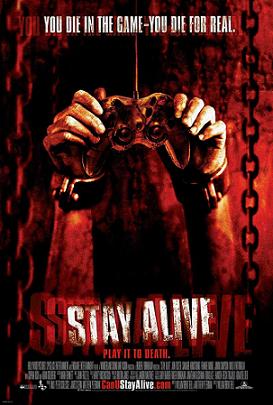
- The game in Stay Alive (2006) summons the spirit of the Blood Countess in its intro sequence. If your character in the game dies, she hunts you down and kills you in the same way. Not only that, but if you turn the game off or pause for too long, it will take control of your avatar itself—it... isn't very good at playing itself.
- Surrogates is a variation. See Comic Book example.
- In a sense, TRON was one of the earlier movies to pull this off. It wasn't the game itself sucking you in, but the MCP used several "game programs" (disc battles, the jai-alai looking arena, Space Paranoids, Light Cycles, the tanks) to help keep control over still-semi-free programs. The MCP simply zapped Flynn into the computer world and stuck him in the deadly games. TRON: Legacy took it a step further, in that CLU became just a dick that enjoyed making others fight to the death, program, user or otherwise.
- The discredited sequel TRON 2.0 has the Game Grids as a way to kill off invaders or condemned prisoners.
- WarGames has a variation. Global Thermonuclear War is itself just a simulator, but the computer JOSHUA can't tell the difference between simulations and real life, and is not inclined for NORAD to tell the difference either. Thus, what should have been just a game nearly causes a real nuclear war.

- Alex Rider: Damien Cray, the Big Bad of Eagle Strike is a loony pop star and Psychopathic Manchild who founds a video-game company as a cover for buying powerful supercomputers that are key to his Evil Plan. Naturally, he decides that his game, an Aztec-inspired Action-Adventure title called Feathered Serpent, should feature "pain synthesis" technology that renders injury and death as realistically as possible. To do so he builds a life-sized mock-up of the game populated by animatronics and psychopathic criminals in place of the enemies, and tosses Disposable Vagrants into it, all entirely For the Evulz.
- A Spanish children's book called La aventura de los chips biológicos (Adventure of the Biological Chips) is about an evil, addictive computer game that drains the life of the children that play it.
- One of Robert Rankin's Brentford Trilogy books features a Space Invaders machine at the Flying Swan that causes its only player to become possessed by actual space invaders.
- A Doctor Who novel involves a new game taking the world by a storm involving a brave human fighter sent to battle the evil praying mantis-like aliens by the benevolent porcupine-like aliens (the intro shows that the two alien races can't kill one another due to their natural defenses). In reality, the porcupine aliens are kidnapping homeless people and using them as Player Characters. One of the notable "bugs" in the game is the fact that the single save game is sometimes deleted, forcing the player to start anew. The real reason is more horrifying: the Player Character is left standing when his or her player logs off and becomes an easy prey for the mantises. Oh, and Rose ends up becoming one of the PCs, the Doctor being forced to "play" her to the end.
- Dream Park: In The California Voodoo Game, a game arcade becomes possessed by the loa Oggun, who conjures up a horde of holographic game avatars to attack the Gamers and some dogs they're protecting.
- In Epic, the titular VR MMO has been running for multiple generations without a hiccup. But near the climax of the story, a high-level vampire NPC (who is also the personification of the now-sentient MMO's survival instinct) reveals that he has found a way to hypnotize players to death through their VR equipment, which he demonstrates on an Asshole Victim.
- In Joseph Locke's Game Over, Hades Video Arcade is full of nothing but violent games — violent games where some of the enemies take on the features of the player's worst bully. Enough time spent playing and the victim eventually commits real-life violence against the person(s) depicted.
- The Give Yourself Goosebumps book, Zapped in Space, have the player hero being the first participant of a new video arcade, where they will end up being transported into the game world — either a space adventure or a wintry wasteland — where they will be forced to beat the game in order to survive.
- Twisted in Heir Apparent. Losing the game doesn't kill in itself, but if the game is not won, gamers will eventually die.
- In the InCryptid short story "Survival Horror", Annie and Artie play a game that tries to kill them.
- Piers Anthony's book Kill-O-Byte has a variation of this, where a former cop with a pacemaker and a diabetic are put at risk in a VR game because one of the shock feedback devices is perilously close to the former's heart (The shock device goes off every time the player dies in the game, which threatens to mess up his pacemaker), while both are trapped in the game, unable to log off due to a malicious hacker. It becomes a race against time as the hacker keeps trying to kill off the ex-cop to mess up his pacemaker more and more, and the diabetic starts to slip into hypoglycemic shock.
- Sergey Lukyanenko's Labyrinth of Reflections has a variation. There are a number of games in Deeptown, the most popular being the Labyrinth of Death. While there's no chance of physical harm coming to players, there is a very real chance of people dying from dehydration if they neglect their Real Life bodily needs (which happens a lot). There's also the fact that the nature of the Deep makes it impossible for most people to break the illusion without certain so-called "exit" points. This is one of the jobs of the Divers, people who have the ability to break the illusion at any point. They help rescue people who forgot to set a log-off timer and are in danger of dying. In the backstory, the first person to ever undergo a Deep-psychosis did so while playing Doom. Suddenly finding himself completely immersed in the game and being unable to exit until he beat it in one sitting.
- What kicks off the story of Otherland. A number of kids who access the future-Internet fall into comas.
- Inverted in Only You Can Save Mankind: you can't actually die in the game, but the mobs you're killing are real, sentient beings, under siege by Omnicidal Maniac Ace Pilots who won't stay dead.
- Comes with the implication that all games are like this; at one point they pass by the wreckage of a Space Invaders fleet.
- In The Reality Bug this happens with an alternate reality as opposed to a game.
- The Shivers (M. D. Spenser) novel The Animal Rebellion had a cursed (...or something, it's never really explained) computer game that caused all animals in the immediate vicinity to go violently insane. In order to reverse the effects of the game (which was purposely Unwinnable, being the kind where you just have try and survive for as long as possible) the main characters had to wipe it from the hard drive and destroy the physical copy.
- Subverted in Seven Senses of the Re'Union. While the game advertises Permadeath as a main feature, it's only towards the players' account and not the actual players themselves. The only character to have died in real life is Asahi via a heart failure and as the show's plot thickens, it's heavily implied that the game didn't kill her, rather a group of people who wanted to use her powers for their own gain. And that they possibly haven't killed her, but rather kidnapped her.
- Gillian Rubinstein's Space Demons trilogy featured three of these (each one a sequel to the previous): Space Demons, Skymaze and Shinkei.
- Sword Art Online:
- In the first Story Arc, ten thousand players can't log off from the Sword Art Online VR game and must Win to Exit. If a player dies in-game then the microwave scanner in their NerveGear game interface will overload and destroy their brain. The game and interface creator's simply wanted to play God in his virtual world. Two thousand die in the first month, with four thousand gone by the time the game is beaten two years later. Since towns are safe zones many players choose to hole up in a city rather than work on beating the game, except PKers figure out how to challenge sleeping opponents to a Duel to the Death. The whole process from sending the duel request to killing the target takes 2-3 minutes, longer if the victim is significantly stronger than the attacker. Here's hoping you wake up before that happens.
- By the third story arc, the NerveGear has been replaced by the AmuSphere, which omits the brain-frying microwave system exploited in the first story. The plot therefore revolves around figuring out how one particular player in the VR game Gun Gale Online is able to murder opponents in real life by shooting them in-game. Technically, he isn't - he works out his target's RL location, and has an accomplice kill the player in RL at the same time as he kills their VR avatar.
- Sword Art Online Alternative: Gun Gale Online: Pito escaped the SAO death game by sheer dumb luck, since she had another engagement on the day it went live. Unlike a sane person, she was upset that she wasn't trapped in a death game, and decided to invoke this in GGO. If she dies in a tournament, she plans to commit suicide after. Therefore, the only way for her to survive is for LLENN to kill her, since Pito promised LLENN earlier that they'd meet up in the real world if LLENN killed her.
- In the Italian book Terra!, the protagonists go to a shady arcade and find some videogame cabinets that kill the player unless they reach a high score: a Space Invaders machine will shoot lasers at them, an Asteroids cabinet drops giant rocks from an overhead pipe, etc. Then again, these machines only exist because players specifically demanded them. See, regular videogames were simply not exciting enough. Technically the law only allows games that hurt the player, not outright kill them, but that doesn't stop daring gamers from seeking out illicit machines in underground places.
- R.H. Berry (formerly R.R. Hood) wrote a novel with this premise called Virtually Reality, which follows the protagonist, Alexander Heron, as he and his party attempt to escape a deadly MMORPG.
- Neil Gaiman's poem "Virus" details how human civilization is destroyed by an utterly addictive video game.
- Kamen Rider Ex-Aid: The entire first half of the show is about then-Big Bad Kuroto Dan creating the ultimate game, Kamen Rider Chronicle, and the entire second half is about him teaming up with the other Riders to put an end to it when it's hijacked by other villains for their own purposes. Unlike most examples, Kamen Rider Chronicle actually backs up users' data so that nobody really dies; Kuroto in his own twisted way even intended it as a medical tool to save the lives of people with otherwise incurable ailments. This doesn't actually make anything better, as whoever's in charge of Kamen Rider Chronicle has full control of who gets to respawn and how, and by this point in the series it's in the hands of Kuroto's father Masamune, who holds players' lives hostage to get more and more people playing.
- In Kamen Rider Outsiders, Kamen Rider Chronicle would be used by Foundation X and Zein — to revive villains from previous seasons to oppose Zein, while Zein itself plans to repurpose Chronicle into a humanity self-destruction game by gaslighting unsuspecting players to their own demise as cannon fodder against the villains. Unlike Masamune Dan, Zein views Kamen Rider Chronicle as the Final Solution to human malice.
- The show Level Up revolves around a group of teens working with the creator of an MMO to defeat monsters from the game that have escaped into reality. The monsters keep escaping even after they initially defeat the game's Big Bad in the 90-minute pilot.
- Odd Squad: The Season 1 episode "Game Time" involves Otto being sucked into a Robo-Blast-Bots arcade cabinet after he plays it, ignoring the "Do Not Enter" sign hanging from the stanchion rope in front of it that is placed there to prevent people from playing it until Odd Squad can arrive. Oscar, who arrives to the arcade and fixes the cabinet so nothing else can get sucked into it, decides to play Robo-Blast-Bots since he's good at the game, but when he accidentally drops his Freeze-ray-inator gadget and gets trapped in an ice block, Olive is forced to play the game despite having never played video games in her life. True to her inexperience, she ends up getting numerous Game Overs and is forced to obtain tokens for a dollar each to continue playing, since if Otto dies in the game then he dies in the real world and cannot be revived. Eventually she manages to get Otto out of the game intact.
- In one episode of Power Rangers Ninja Steel, the Monster of the Week distributes an addictive video game that makes him stronger the more people play it. After his initial defeat, he invokes a bonus level to accomplish the Make My Monster Grow trope the series is fond of.
- Ship to Shore: In one of the episodes, the kids play a choose-your-own-adventure video game and, on a whim, give the player character the appearance and name of the local Buttmonkey Hermes Endakis. Shortly thereafter, it turns out that whatever calamity befalls the game's hero also soon happens to the real Hermes in real life. The episode doesn't make it clear if the game really could affect reality or if it was just a series of coincidences.
- In one episode of Stargate SG-1, Teal'c is trapped in a virtual reality device based on alien technology, which the SGC adapted as a training simulator. While dying in VR doesn't immediately cause him to die in real life, the shock and pain of his injuries in the simulation will eventually kill him, and the game keeps getting harder every time he dies. One of the reasons the bug triggered turns out to be that the neural interface picked up on Teal'c's subconscious fear that the Goa'uld will never be defeated.
- Star Trek:
- The Star Trek: The Original Series season one episode "A Taste of Armageddon" revolves around the most dangerous 4X game. Two neighboring planets, Eminiar and Vendikar, are fighting an entirely simulated Forever War to preserve their infrastructure. However, they have no regard for the actual lives involved and have mutually agreed to kill everyone who dies in simulated attacks, with casualties chosen semi-randomly via a Lottery of Doom. Everyone has such a fanatical devotion to this plan that it went on for 500 years before the Enterprise shows up and they're Saved From Their Own Honor.
- Though not deadly by itself, a virtual reality game in the Star Trek: The Next Generation episode "The Game" caused its users to become highly addicted, to the point of not wanting to do anything else, and also become extremely open to suggestion at the same time. It was planted by a woman seeking to gain control of the Enterprise by controlling her entire crew, and spread through the ship due to peer pressure and, eventually, crewmembers forcing it on the few individuals who refused to participate.
- The Star Trek: Deep Space Nine season one episode "Move Along Home" seems to feature one of these, a game called Chula, belonging to a race of aliens from the Gamma Quadrant obsessed with games called the Wadi. Sisko, Bashir, Dax, and Kyra find themselves transported into the game world to serve as pieces while back on the station, Quark is forced by the Wadi to play to get them back (The Wadi had been winning too much at dabo, so Quark had ordered the games fixed, which the Wadi discovered). It certainly seems like a dangerous game; one of the challenges Sisko and the others are subjected to involves poison gas, for example, and when Quark makes a desperate gamble to end the game quickly and get the crew back, he loses, and Sisko and his crew seemingly die...only to reappear back in Quark's, no worse for the wear, because, as the Wadi leader Falow points out "It's just a game!"
- The X-Files: In the episode "First-Person Shooter", co-written by William Gibson, a virtual reality game becomes haunted by an AI that kills players in real life. The episode gets virtually nothing right about programming or gaming.
- Mage: The Awakening: The Shard is an Abyssal spirit that manifests through a viral, supernaturally addictive MMORPG. It lures its most obsessive users into long quest lines that serve as genuine Summoning Rituals, creating more Abyssal intrusions and shattering the users' bodies or minds with the backlash.
- There have been a number of urban legends about people dying while/after playing Berzerk. The stories often differ on many details, such number of deaths, the score of the victim (often some variation of the Number of the Beast), the exact cause of death, etc. While it might seem like something Moral Guardians might make up to prove New Media Are Evil, people really have died from playing the game, though as explained in the Real Life folder, the role of the game has been rather limited.
- There's the Lavender Town Syndrome story, which has plain old Pokemon Red and Green/Blue being a dangerous video game, and talking about how various things (Lavender Town's music, fake stuff supposedly from the tower and haunted video games) led to mass suicide. There are actually two stories tied to this one, one haunted and one having various in-game stuff causing illness and death.
- Polybius, a fictional arcade game of American youth and urban lore that's become ubiquitous thanks to the Internet. The game, so the story goes, is a Tempest knock-off that appeared in Portland arcades in 1981. The children who played it suffered from all three of the symptoms detailed above before killing themselves in the middle of the night. The game disappeared shortly afterward, as suddenly as it had come — in some tellings, wheeled away by mysterious men in black. Someone actually decided to make a Polybius game, purposely simulating elements found in the mythology (subliminal messages, supernatural things, and so on). Of course, they can be toggled on and off. See it here.
- .hack: "The World" is a perfectly benign MMO to the vast majority of its users, but there are a number who get caught up in the series shenanigans that have... interesting things happen to them, such as getting their mind trapped within the game or having data from the game transfer to their brain and affect their real life behavior. It's not usually the game itself being malignant, but some entity within the game (often an AI) using its hidden functions in malicious ways.
- Parodied in the indie game Ben There, Dan That!.
- Danganronpa 2: Goodbye Despair has a variation in which a video game is a catalyst for the second murder. The game itself isn't dangerous, but it provides clues to the characters' past lives which serves as a motive.
- Played straight later on when The Reveal shows that the entire island was a Lotus-Eater Machine being used as a deprogramming device by Makoto, which Monokuma and Junko frequently compare to a video game. It worked by uploading the user's minds and representing them as virtual avatars which would then be downloaded back into their real bodies, but if the avatar is killed their real body is left brain-dead as there's nothing to send back.
- In Danganronpa V3: Killing Harmony, Monokuma creates a VR game using the code from the Lotus-Eater Machine from the previous killing game and it's explained that if you suffer fatal trauma in the game, your real body goes into shock and dies as a result. Guess what happens immediately after.
- Duck Season starts to speed ball into this quickly if you shoot the dog at any point in time. If you have done so, the dog will first make himself known by appearing around your house, before getting directly involved by killing your mother, and then you.
- Five Nights At Freddys VR Help Wanted: In-universe, the VR game "The Freddy Fazbear Virtual Experience" is deadly due to containing a digital representation of William Afton's spirit. During the normal ending, it's implied that he stuffs your body into the Freddy suit in the game's code with Hand Unit unaware and traps you in the game forever. During the other endings where you follow tape girl's instructions to seal it away by turning it into a plushie version of itself, getting the rabbit mask in the corn maze from the game's DLC and talking to the plushie with it on reveals that the player character, Vanny, has become brainwashed into its reluctant follower and continue Afton's work in the real world. This eventually leads into the events of Five Nights at Freddy's: Security Breach with Vanny as the villain of the game.
- Gamer 2 takes place entirely in a virtual reality machine that's been converted into a death trap.
- The Excuse Plot of the Toaplan Shoot 'Em Up Grind Stormer involves a fiendishly addictive game sucking players into arcades in the year 2210.
- A scrapped concept from Half-Life 2 involved the "Manhack Arcade", where some of the Manhacks (read: flying killer robots with spinning razor blades) in the game world would be controlled by arcade machines being played by your fellow humans, who would have no idea they were actually killing people.
- Hidden City: "Playing to Live" features a deadly board game which traps people inside and forces them to encounter various deadly challenges. Violet traps Mr. Black and Rayden inside the game after inviting them over for "peace talks", and the player must help Kira and Carlos free them before it's too late.
- Played for Laughs in Illbleed. In the "Killerman" level, you're asked to choose which of the presented options is the murderer. One of the options is the player, on the grounds that playing Illbleed has driven you insane and turned you into a psychotic killer. It's the wrong answer.
- In Kid Chameleon, the new Virtual Reality arcade game on the block turns deadly, and actively tries to kill the players. Kid Chameleon tries to beat the game at its own game, presumably to save the people the game has already beaten. It won't be easy.
- Lakeview Cabin Collection has the Lacus Lamia NES game in Part V, which will summon the Witch out into the real world. Though this is a subversion, as she does not attack the teenagers, and is actually needed to get rid of the killer.
- The nameless game in Nanashi no Game. Completing it reveals the game's name — Road to Sunrise.
- The premise of the Adventure Game Omikron: The Nomad Soul is that the player character is you, the person sitting in front of the computer, and that the game is a trap that sucks the souls of players into the game world, where they have to fight to save the world and escape back to reality or be eaten by demons.
- PaRappa the Rapper 2 features a non-lethal one called "Food Court". If you lose, it makes it so your body will reject any food that isn't noodles. Apparently, the game's cartridge can also hypnotize people if you put it in a tape deck.
- Pony Island has the titular game, programmed by none other than Satan himself. Pony Island itself isn't particularly harmful, being a shoddily-made endless runner game that frequently becomes Unintentionally Unwinnable and requires the player to hack into the game's code to progress through. The "danger" comes from the fact that Satan is essentially holding you hostage and forcing you to play it for all eternity, and the game often prompts you to sell your soul in order to progress further.
- The Stinger to Shadows of the Servants implies that this trope has been in effect all along: one of the game's characters put the game on the market to trap people's spirits and bring them to the mansion, your avatar among them.
- Space Quest I: The Sarien Encounter has Slots-O-Deathnote slot machine that burns Roger to ashes when he gets three skulls with crossbones.
YOU LOSE, HOMEBOY!!! (shoots laser)
- The makers of Strafe recorded a live-action trailer homaging the Totally Radical ads for '90s video games that presents the game as so awesome and extreme that it might kill you, as happens to the young boy in the ad.
- The titular game of the Urrezko Kaiola Alternate Reality Game is this. While it isn't dangerous for 'the players' because Kara removed all the dangerous parts, unsealing the can could potentially cause a Class 0, while unsealing The Shadow could cause a Class 1.
- Also used as the Excuse Plot for the Wayne's World video game; it's not quite clear if Wayne and Garth were sucked into the game or if the baddies came out, but the levels are 90's platformer versions of a few places from the movie; Wayne must use his laser-shooting guitar to rescue Garth, who has been consumed by the purple gelatinous cube from that game in Noah's Arcade in the movie.
- You Find Yourself In A Room is this mixed with No Fourth Wall.
- The Yu-Gi-Oh! video game Yu-Gi-Oh! The Falsebound Kingdom is about a virtual-reality game that's actually a method of gathering souls for a sacrifice.
- Invoked in Dead by Daylight. One of its DLC villains is The Unknown, a character based on various Creepypastas; specifically ones like Slenderman, where learning too much about the monster makes it want to getcha. One of its add-ons (an RPG-style functional accessory, and usually one of a Killer's personal effects from before they were brought into the Entity's power) is the Obscure Game Cartridge. This is a super-nintendo game carrying an interactive adaptation of the declassified documents compiled on the monster, "Project: Apple Pie."
- Bloodless Wars is about a high-stakes international war game, meant to reduce death and ruin in war by making everything a simulated blood sport, that risks losing everything when the first instance of this trope happens. The bad guys invented a neurotoxic poison which flares up when experiencing dying in the game, causing a seizure in real life. And it turns out that people die when their minds are brain-uploaded.
- Parodied in this Amazing Super Powers comic. The game in question? Real life basketball.
- Homestuck and how. We have Sburb, a game that brings about the apocalypse when played. It also uses Time Travel to cause itself to come into being as well as force its players to play, meaning the destruction is predetermined and inevitable.
- It gets worse from there. Sburb is necessary for the creation of other universes — meaning the players are forced to sacrifice their civilization to bring about a new universe. IF their game is not a "null session," meaning it is predetermined to fail, making the sacrifice completely senseless. And unfortunately, null sessions are much more numerous than the successful ones.
- Zig-zagged with a void session, which cannot cause an apocalypse, but the players themselves are still in danger.
- Ben Drowned (sometimes called simply Majora), an Internet meme / alternate reality game about a blogger named "jadusable" who gradually loses his grip on reality as he is tormented by a haunted Majora's Mask cartridge. The whole thing can be found here.
- This trope encompasses an entire subgenre of Creepypasta.
- Pokémon is a very frequent subject of these sorts of stories. Examples include Tarnished Silver and its sequel Audible, which use MissingNo., the Unown, and events from the protagonist's past to screw with his life and/or health.
- Stories of haunted / evil video games are a fairly common type of Internet meme. Games from Super Mario 64 to Wolfenstein and Sonic the Hedgehog have gotten this treatment.
- Pokémon is a very frequent subject of these sorts of stories. Examples include Tarnished Silver
- Parodied, to great effect, by JonTron in his "review" of Final Fantasy XIII.
- The French short film Game Over
- The NES Godzilla Creepypasta has a cartridge, which turns the game from simple glitches to an Eldritch Location, and also features the Hellbeast Red. The final battle shows that Red has the ability to cause Zach pain in the real world through his attacks on Zach's monsters, including a Hellfire attack that causes incredible pain, and killing all of Zach's monsters will enable Red to kill Zach himself for real, by means of inflicting a sudden heart attack.
- SCP Foundation:
- SCP-1315 is an NES cartridge that contains a "game" in which hazards manifest in real life, albeit only to the ones who are playing it. When you die in the "game", you vanish, and it is implied that you become minions for the "game".
- SCP-1590 is a mobile Hidden Object Game created by the Mad Artist clique Are We Cool Yet? that taunts its players with extremely personal (and often traumatic) details about their lives. When the player either finishes the game or fails a level, they can't play it again. After 72 hours, any door opened by the player will lead into one of said personalized levels, leaving the player with the choice of either entering the door and being trapped in the game level forever, or staying where they are and being trapped in the room they're currently in forever.
- SCP-1633 is a game where the AI gets smarter the more hours you have logged into it, starting out at bottom-of-the-barrel Artificial Stupidity where enemies just blindly rush the heroes without any sense of self-preservation or use of tactics, and eventually achieving enough Artificial Brilliance to realize that there is a real person controlling the heroes, at which point it starts going after the player directly. Usually it doesn't try to do any actual harm to the player, just troll them enough to make them Rage Quit, or use psychological mind games to creep them out. However, in one case, the game had a group of enemies coordinate repeated casts of a Blinded by the Light spell to create Epileptic Flashing Lights which gave the player a seizure. Another thing to note is that the game only creates or updates the "player data" file upon saving and quitting the game. When a player was instructed to beat the game in one sitting, the result was that the AI remained at its initial level of stupidity the whole way through, and exhibited no strange behaviour. After killing the final boss, the game autosaved and then spent several hours creating a player data file with an absolutely massive file size. The player was then instructed to pick the New Game Plus option that had appeared, causing the game to show television static, the sight of which immediately put the player and only the player into a coma, while everyone else was unaffected. Also, an Apocalyptic Log left by someone who worked on the game also suggests that if the game is allowed to get smart enough, the Eldritch Abomination Big Bad will start to think it is an actual Eldritch Abomination instead of just a video game character, and attempt to leave the game to destroy the real world.
- SCP-2219 is a Goldilocks and the Three Bears-themed video game that causes various things to happen to the player after completing, or failing to complete, various objectives. Good things like collecting enough Porridge cause feelings of contentment and instantaneous orgasm. Bad things like losing a life to a boss cause an inflamed throat, leprosy, blindness, and cardiac arrest. No one's been able to beat the final boss yet.
- Implied to be the case with SCP-2639, which is about three teenagers who somehow get trapped in a session of Quake for 10 years. In an inversion of this trope, though, the teenagers are in no harm at all, in fact, everytime they die, they just respawn. Instead, they pose a major threat to other people, for from their point of view, they are just enemies which they kill for ammo. When the teens realize the truth, they are understandably horrified.
- Implied to be the case with SCP-4904, a series of modified Sega Dreamcast games that when played display Alien Geometries and stylized spinning discs in the shape of eyes. Ordinarily this causes no ill effects in the viewer, but the man who created the discs for Sega spent years researching the phenomenon only to be found dead with chunks of his brain inexplicably missing.
- SCP-1315
- Much like the Neil Gaiman example above, SMBC Theater has a video about an MMO that's so addictive that the players die from completely neglecting their physiological needs. It's just a button that increments the player's score when clicked.
- Sonic R has the myth of Tails Doll. Tails Doll was an unlockable character with an appearance that many considered to be creepy (though some just find him cute). According to a number of Creepypastas, upon meeting certain conditions (usually tagging Super Sonic with Tails Doll on a specific track), Tails Doll would break into the real world and violently murder the player.
- Although some believers in the doll think he's good.
- There is also Sonic.EXE, which was infamous for being an overused cliche.
- Although some believers in the doll think he's good
- In the Batman: The Animated Series episode "What is Reality?" the Riddler traps Commissioner Gordon in a deathtrap-themed virtual reality game, forcing Batman to enter to rescue him. (Of course, the Riddler seems fond of video games in general in this continuity, having become a villain in the first place after being cheated out of the royalties for one he invented, as revealed in his first appearance. That game was harmless, but the amusement park that was based on it sure wasn't.)
- The entire plot of Code Lyoko is an inversion of this trope. While the VR world is deadly, the Big Bad would rather the heroes stay out of it; they have to go there to stop him every time he launches an attack.
- The inversion continues with the fact that 3 out of the 4 fighters will just reappear in the real world when their hit points reach zero. Aelita is the only exception, as she is stuck in Lyoko and extracting her is the goal of the first season- if she died before that, she would have been dead for real. That said, there were a couple episodes where this was played some degree of straight; the first featured the heroes being stuck in an alternate version of reality and at risk for deletion if they attempted to go into the VR world and the second featured the villain disconnecting the scanners used to go between VR and reality, not only putting the characters at risk of death but removing their pain dampeners (when Yumi takes a hit, she's rendered immobile for a good while and while Odd handles the pain better, he's obviously in pain whereas normally taking hits in VR was more an annoyance than anything else and the same had become true for being devirtualized by that point.)
- An episode of Darkwing Duck involves the titular character end up digitized into a popular game. Gossalyn has to control him using VR gloves to beat the game in order to return him to the real world.
- In DC Super Friends, the Joker turns Cyborg's room into one of these.
- In The Fairly OddParents! episode "Power Mad", Timmy wishes for a VR game that he can't wish out of. Timmy, Chester, and AJ then have to finish the game without losing all three of their lives otherwise they'll be destroyed.
- In the Gravity Falls episode "Soos and the Real Girl", Soos buys a Japanese Dating Sim that's possessed by a yandere AI.
- Megas XLR: Coop comes into possession of what he thinks is an old video game cartridge, but it's actually an intergalactic prison housing many dangerous alien criminals. When Coop finally finds a game console that it fits into (or rather one that he can hit it hard enough to fit into), he inadvertently releases one of these criminals, Grrkek the Planet Killer and spends the episode trying to defeat him. Later on, Coop accidentally breaks the cartridge, releasing all of the other prisoners. He just beats most of them up and puts them on a garbage scow, but Grrkek gets trapped in a copy of Love Those Lurps, where he has to endure an endless wave of Lurp NPCs trying to hug him.
- One episode of Men in Black: The Series revolved around Jay entering a virtual shooting range to improve his poor accuracy score, when something goes wrong. Kay has to go in after him because getting shot by the simulated hostiles will not result in the simulation ending/resetting, but in death.
- Ninjago: Season 12 revolves around Prime Empire, a video game which sucks people inside it, where they're forced to go through deadly games. Once they burn through their three lives, they're turned into a brick to allow Unagami, the ruler of the game world, passage into the real world.
- In The Powerpuff Girls special "Dance Pantsed", after the girls get a hot new dancing game, Mojo Jojo sends them a fake sequel that turns them into evil cyborgs. This being Mojo, he also outlined his plan on the back, which is how the Professor finds out what happened when the Girls are gone.
- The second episode of the short-lived series The Problem Solverz had the team take on a Digital Abomination living in a game cartridge that sucks them into cyberspace while attacking the real world.
- Destroyer of Worlds from Regular Show. Plugging it in (you don't need to play) unleashes an enormous, pixelated devil face with intent to, as the name implies, destroy the world. The characters eventually resort to summoning an amalgamation of several other games' heroes, a lemon-headed creature made of and able to shoot hamburgers, to defeat the Destroyer.
- Similarly, one episode featured the final boss of a video game ("The Hammer") coming to life and attacking everyone after Mordecai and Rigby short circuit the TV.
- In the Rick and Morty episode "A Mort Well Lived", in a parody of simulation theory Morty ends up trapped in a Brain Uploading video game but rather than being the Player Character, due to a glitch his consciousness ends up being divided between the 5 billion NPCs with no memory of the real world. Rick goes in as the Player Character to try to retrieve as much of his brain as possible, but for every NPC that dies a tiny part of him dies as well and if Rick were to die in the game it would reset and leave Morty brain-dead.
- SinisteRRR from We Are the Strange is an evil arcade game that (possibly) acts as a watchdog and alarm for the Big Bad and later transforms into a Humongous Mecha who proceeds to kill off all but 3 of the main cast.
- The first recorded death while playing a video game was with Berzerk in 1981 — a man had a heart attack immediately after he finished playing it. Granted, it was only part of his death. The man had a heart condition that made him more susceptible to heart attacks, and earlier in the day, he walked a couple of miles through the snow, a very strenuous activity that strained his heart to the point that, according to the coroner, any sort of exertion could have triggered an attack. It just so happened that a video game was that trigger.
- There's also another death related to Berzerk, but the game's role was rather tangential. The victim stole someone's spot at an arcade machine and they were stabbed in retaliation after leaving the arcade.
- There are many media accounts of gamers dying after playing for absurdly long periods without rest, especially in Asia. The deaths were mostly caused by the physical stress of such a long continuous session rather than any property of the games themselves. This goes back to 1981-82 with the two incidents from Berzerk mentioned above. Even more common are reports of health issues stemming from the same practices, which have prompted game companies and service providers to institute Anti Poop-Socking changes.
- There have been cases of online game players fighting or killing each other in real life over virtual property, though the players themselves were usually as much to blame as the service providers.
- The case of a Korean family leaving their infant daughter alone to play World of Warcraft, only to come back and find that she'd rolled over and suffocated.
- MMORPGs in general seem to attract these kinds of stories. Another same case, as a headline in the documentary film "Love Child" is basically the same, only the game is the now defunct "Prius Online" with the irony of that the game involves raising a virtual children as The Lancer.
- Imscared is a real-life version of this. The game can open itself, interfere with your browser, put files on your computer, has several fake endings to make you paranoid about if the game is over or not, and pretends that the villain is a monster that turned itself into a computer virus.
- Oculus founder Palmer Luckey has created a VR headset, in honor of Sword Art Online, designed to invoke this trope in the most literal sense. If you get a game over at any point in a game, three explosive charge modules shoot off that completely obliterate your head.
- Sad Satan, a video game found on the deep web, is also a real life version of this trope. The supposedly original version contained images and audio from killings and child abuse as jump scares. It really doesn't help that the music is distorted, the visuals are monochromatic, and there's unexplained child figures and a woman screaming. Mutahar (SomeOrdinaryGamers' host) became physically ill from both the music and the aforementioned images, and he quickly removed the link to the game from the video description and reported it to the FBI for its illicit material. It came to the point where Mutahar's viewers became worried about his health, but luckily he posted a follow-up video confirming that he was alright. But that's not all: it is said that some versions are heaving with malware, and give a bouquet of problems such as slowing the machine to a crawl, installing spyware, and permanent, irreversible shutdown.
