
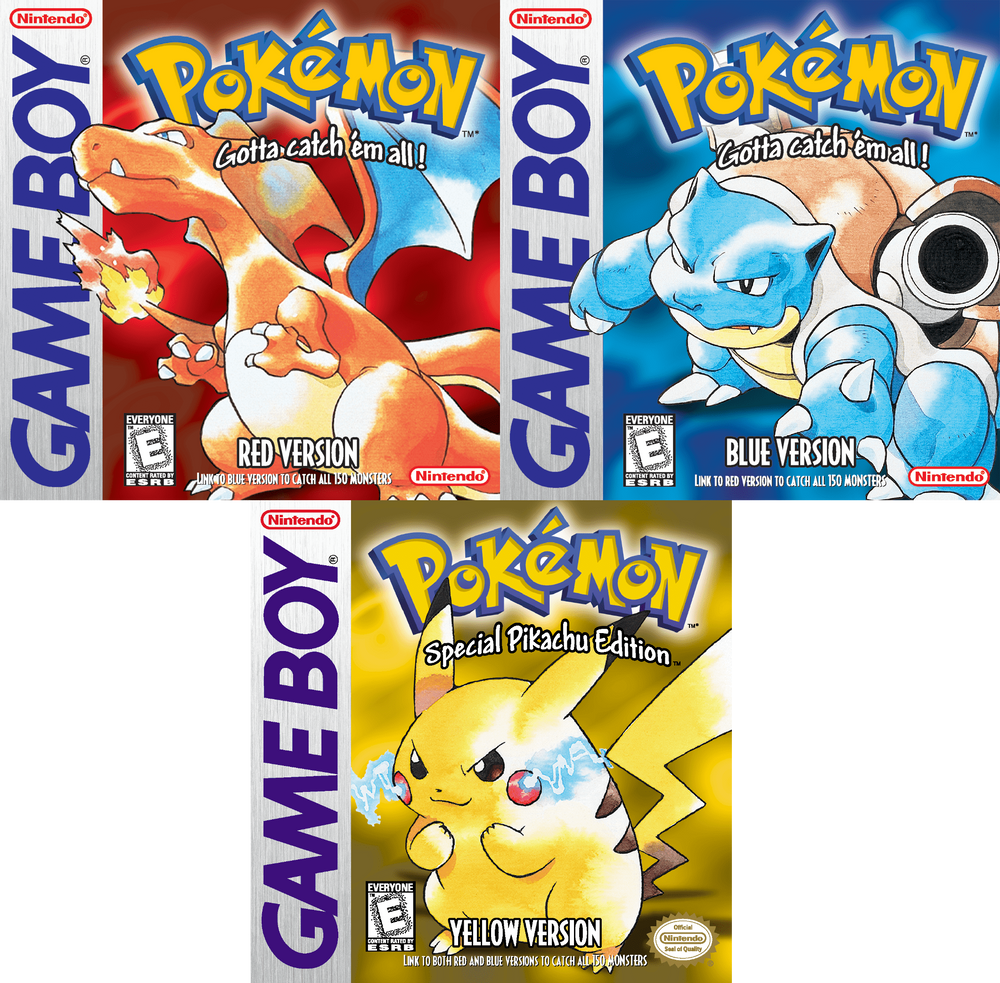
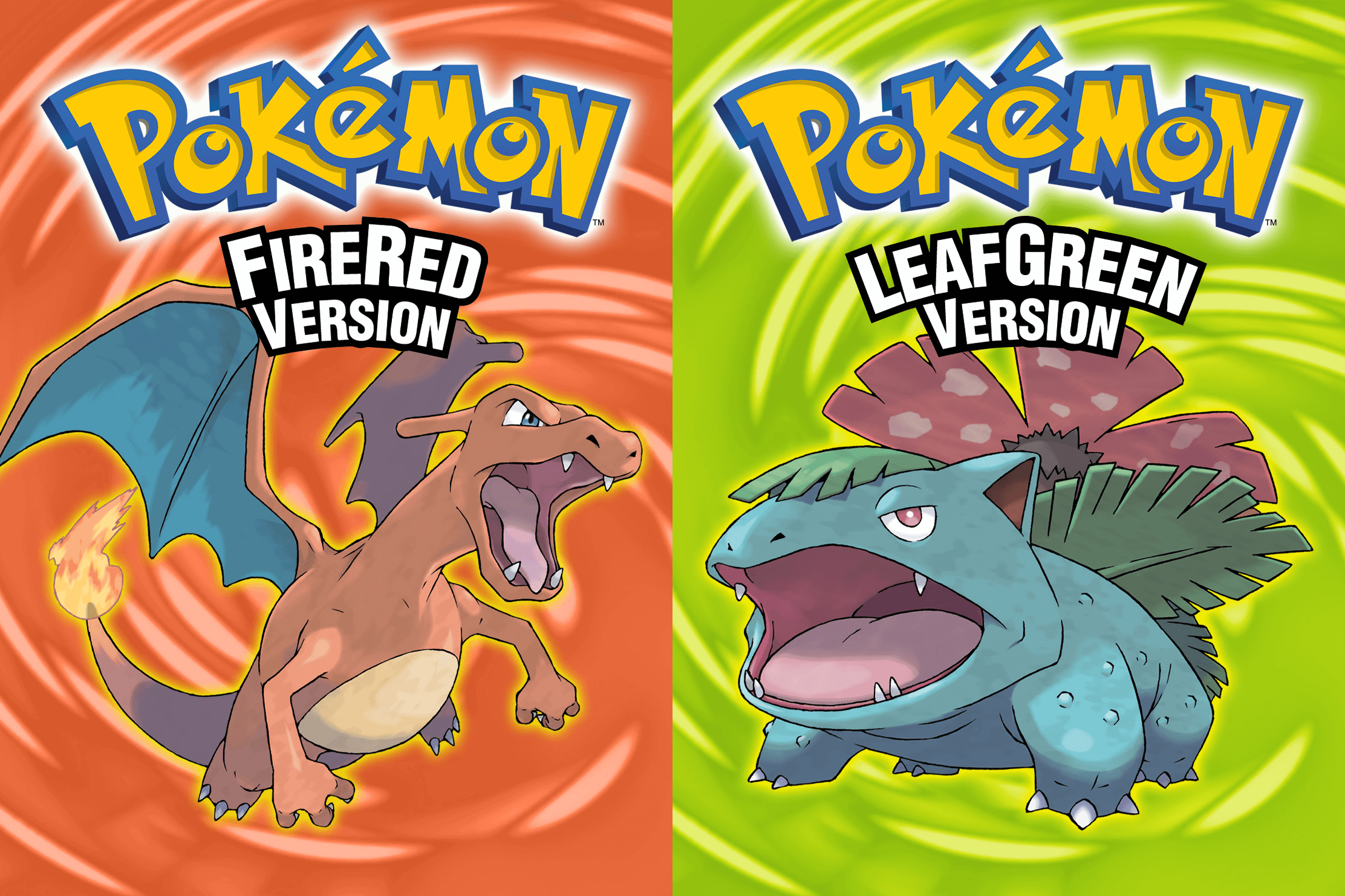
The first installments of the Pokémon franchise hit the Game Boy in 1996 in Japan (as Red and Green; see below), in 1998 in North America and 1999 in most of the rest of the world. Taking place in a part of the world called Kanto, based on the Japanese region of Kanto, the plot is simple: you, an eleven-year-old with a baseball cap, are offered your very first Pokémon by Professor Oak, the local authority on Pokémon. He gives you a choice of three different types: Bulbasaur, Charmander, or Squirtle. His own grandson, your long-time Rival, gets second pick, and takes advantage of this to snag whichever one happens to be strong against your chosen partner.
In exchange for your first Pokémon, Oak wants you to run an errand for him: travel around the region and collect as many different Pokémon as you can, recording all of them in your Pokédex. Of course, along the way, you're more than welcome to challenge the eight Pokémon Gyms, collect their badges, and take on the Elite Four in hopes of becoming the Champion of the Pokémon League. Then there's the emerging threat of Team Rocket, a proudly evil organization that uses Pokémon for its own selfish ends. Somebody's gonna have to deal with them, too — and who better than an eleven-year-old and his team of trained monsters?
While the game's Competitive Balance is undeniably broken and glitches abound...it's Pokémon.
It should be noted that in Japan, the first two games were released as Red and Green. Blue was released later as a third version, with a bit of a graphical improvement over the originals. For the international releases, the names Red and Blue were used. Although the Japanese Blue provided the graphics, codebase and game script for translation, the Japanese Red and Green provided the wild and version-exclusive Pokémon for the international Red and Blue respectively. Aside from its codebase, this makes the Japanese Blue the only main series game to lack an international release.
As evidence of its incredible popularity, Pokémon Yellow was later released as a fourth version in Japan in 1998, and as a third international version in 1999. Yellow took elements from the first season of the anime and transported them back into the games, however loosely. Instead of picking one of the usual trio, a wild Pikachu ends up as your starter, and follows you everywhere rather than getting into the usual Poké Ball. The familiar Team Rocket trio also show up, although Meowth acts as a normal mon as opposed to an equal member to Jessie and James, acting as the third member in their party alongside Ekans/Arbok and Koffing/Weezing.
After a successful run, Red, Blue, and Yellow were followed by the Game Boy Color-enhanced (though they can still be played on a previous incarnation of the Game Boy, as well as later ones) Pokémon Gold and Silver, taking place three years after Red became champion and featuring a kid from Johto, a region west of Kanto, the return of Team Rocket, and improved the graphics that Yellow didn't (back sprites, etc.).
Jump ahead a couple gens, and Red and Blue reappeared in the form of their Video Game Remakes on the Game Boy Advance: FireRed and LeafGreen. These allowed players to relive the classic games with many of the new benefits, tweaks, and balances of the second and third generations, though it took some Retconning here and there, and added in some new areas to explore after finishing the familiar challenge(s).
These games have received two animated adaptations. The first one is the first season of Pokémon: The Original Series. The second one is the anime special Mini Series titled Pokémon Origins, which aired on October 2, 2013 in Japan (10 days prior to the release of the tie-in games Pokémon X and Y) and November 2013 in the United States. This miniseries essentially serves as a more accurate depiction of the plot of Red and Blue, being a Truer to the Text Anime of the Game in comparison to the main Pokémon anime.
On November 12th, 2015, it was announced that Red, Blue, and Yellow would be making their way to the Nintendo 3DS's Virtual Console in the eShop in celebration of the franchise's 20th Anniversary. Trading and battling with other players was retained by modding them to work with the system's local wireless functionality, while the Restore Points option is disabled. Pokémon caught in the Virtual Console versions can also be transferred to future mainline Pokémon games, starting with 2016's Pokémon Sun and Moon, via Pokémon Bank. They were released on February 27th, 2016, exactly 20 years after their release in Japan.
As of May 29th, 2018 a third set of Kanto games were announced, this time being enhanced remakes of Pokémon Yellow, called Pokémon Let's Go, Pikachu! and Let's Go, Eevee!. It is available on the Nintendo Switch and features compatibility with Pokémon GO.
Another detail worth noting is that many of the tropes listed under Red and Blue's category also apply to Yellow, FireRed, and LeafGreen.
Random trivia: the games were developed on Sun's SPARCstation 1 computer; four or five units were used in their development.
- Abandoned Laboratory: The Pokémon Mansion on Cinnabar Island is actually a laboratory. It was where Mewtwo was cloned from Mew, and the place has since been abandoned. Now it is infested with Fire- and Poison-type Pokémon, along with some rogue scientists and burglars picking through the remains.
- Absent-Minded Professor: Professor Oak can't even remember his grandson's name.
- Absurdly High Level Cap:
- Played straight in single-player, where it's possible to take your Pokémon up to level 100, but you'll beat the game with a team in the 50s or 60s.note
- Averted for PVP purposes and taking your Pokémon to Pokémon Stadium, where you'll want to take them to level 100.
- Accent Adaptation: Bill's Kansai dialect is translated as a Southern accent.
- Acrophobic Bird: Despite having Flying as a secondary type and being depicted as flying throughout other Pokémon media or even with their in-game sprites, Charizard, Dragonite, and the Zubat line all can not learn the move Fly. Charizard would gain this ability in Yellow, while Dragonite would get it in Gold and Silver, and Zubat and Golbat would have to wait until Diamond and Pearl to finally learn it (though their final evolution added in Gen 2, Crobat, could learn Fly in its debut in Gold and Silver).
- A Dog Named "Dog": In the French version, Rock Tunnel is simply called "La Grotte", "The Cave". It finally got a proper name in Pokémon Let's Go, Pikachu! and Let's Go, Eevee!.
- A.I. Breaker: Trainers that are supposed to be highly-skilled and are given an explicit "good AI" flag in the coding, such as Gym Leaders and the Elite Four, will always use moves of a type which are super-effective against whichever Pokémon you have out... even if the move doesn't actually do any damage. Combine this with the fact that the AI will never run out of PP for their moves, and it becomes possible to beat, for example, Lance's Dragonite by sending out any Poison or Fighting-type of any level, as he will only use the non-damaging Psychic-type moves Agility and Barrier, fruitlessly only increasing its Speed and Defense until you inevitably beat it.
- A.I. Roulette:
- Standard trainers and wild Pokémon will pick their moves at complete random. The only caveat with trainers is that they'll avoid using status-inflicting moves if your Pokémon has a status condition (as you can only have one status at a time).
- Even with high-level trainers, this is still true. The exception is if they're programmed with the "good AI flag" and possess moves that are of a "super effective" typing against one of your Pokémon's types, at which point they'll use those moves without considering whether or not those moves actually do damage or would even affect your Pokémon. This is especially noticeable with the Elite Four, where you can see several of their Pokémon use nothing but non-damaging Psychic-type moves (like Agility, Rest, Amnesia, and Barrier) simply because you brought out a Fighting- or Poison-type.
- All There in the Manual: The manual explains the basic background of you and your rival, states your age, and tells of the events that lead up to the start of your adventure.
- Alphabet Soup Cans: Blaine's gym features quiz questions which you must answer correctly in order to open doors. Naturally, they are all about Pokémon. If you get them wrong, you must instead battle a trainer.
- Always Accurate Attack: Swift is specifically coded to never miss. Exact Words applies, because this also means it can hit Pokémon that are in the invulnerable phases of Fly and Dig, which is otherwise impossible and doesn't apply for later generations.
- Always Someone Better: Played with when it comes to your rival. Throughout the game, he is always at least one step ahead of you, such as on the S.S. Anne when he brags about having captured 40 Pokémon when you're lucky to have half that number (doing so by that point is possible, but would require massive Level Grinding to evolve every Pokémon you can catch and/or trade from another game). However, you avert it by beating him in every battle you have, showing that you are the more skilled trainer. Even after he becomes Champion, you show up to end his reign very quickly.
- Amazon Brigade: Erika's gym is populated entirely by female trainers. This means the (male) Gym guide can't be found there, and is hanging out in the Rocket Game Corner instead.
- Antidote Effect: In general, because you can only carry 20 types of itemnote , it is wise to carry as little as you can get away with. You can store up to 50 additional types of items in the PC, but this can only be accessed while in Pokémon Centers, not out in the world. A few specific examples:
- Awakenings become useless as soon as you get the Poké Flute. It will wake Pokémon up inside or out of battle, and has no use limit.
- Once Full Heals become available for purchase, most of the single-effect healing items (Antidotes, Paralyze Heals, Burn Heals, etc.) are no longer worth carrying. While more expensive than any of them individually, carrying a stack of Full Heals only takes up one precious inventory slot and covers any effect you come across.
- Anti-Wastage Features: The two types of healing items are only consumed when there's Hit Points to restore or Status Effects to remove, respectively.
- Anything You Can Do, I Can Do Better: Played with regarding your rival throughout the game. He's always a step ahead, having explored more, having caught more Pokémon, even becoming Champion before you. Ultimately subverted, as you'll need to defeat him in almost every instance in order to advance in the game, proving your skill as the superior trainer.
- Apathetic Citizens: Starts off the series' tradition. An evil gang is stealing fossils? Running a gambling operation? Taking over Pokémon Tower? Taking over a major company and holding the workers hostage? No problem, some kid will come along to stop them.
- Apocalyptic Log:
- The records of Mewtwo's birth, found in (the burnt ruins of) the Pokémon Mansion. Mainly the last entry:Diary: Sept. 1
MEWTWO is far too powerful. We have failed to curb its vicious tendencies... - The original Japanese entry is written more emotionally, implying it was written during or shortly before Mewtwo's rampage, and not after:Diary: September 1
The Pokémon Mewtwo is far too powerful. It's no use...I cannot control it!
- The records of Mewtwo's birth, found in (the burnt ruins of) the Pokémon Mansion. Mainly the last entry:
- Arrogant Kung-Fu Guy: The trainers at the Fighting Dojo in Saffron City. They used to be the official gym for the city until Sabrina came in, Curb-Stomped them with her Psychic-types, and then took over.
- The Artifact: Gust and Razor Wind being Normal rather than Flying is possibly this. It's speculated that the Flying type was originally known as Bird, an unfinished type that can still be encountered on glitch Pokémon (including Missingno. itself) in the finished game; as a remnant of this, only moves that are explicitly bird-related are classified as Flying.note As the Bird type was long gone by the time the Gen II games began development, Gust was converted into a Flying move and the type became more generally associated with wind and flying creatures, though Razor Wind remains a Normal move to this day.
- Artificial Stupidity: The aforementioned A.I. Roulette in general will lead to countless instances in each playthrough of the AI using blatantly sub-optimal moves, but here are some specific examples of particularly bad misplays the AI consistently makes:
- The infamous "Good AI" flag that certain trainers have, which will make such trainers always use their moves with the best type effectiveness. The A.I. Breaker section already covered how it makes no consideration for if the moves are actually damaging moves, but it also ignores if a less-effective move would have actually dealt more damage. The biggest example of this is with Misty's fearsome Starmie, whose Bubble Beam is powerful even against Pokémon that would resist it, but due to her "Good AI", she will always have her Starmie use the much weaker Tackle against Grass and Water Pokémon, making it much easier to beat with Water and Grass Pokémon.
- Some AI trainers are programmed to have a battle item like the X items, where it's then treated as another move that their A.I. Roulette may select randomly. This will often lead to them using the item when it's not helping at all, such as those whose item is X Defend (like Misty) using it when their Pokémon is already near death and thus will be fainted by the next hit regardless of the Defense boost.
- When a boss trainer has a type of potion as their item, they're programmed to only use it when their Pokémon's HP drops below a set percentage-based threshold. Blaine however, who has Super Potions as his item, was not programmed with any such threshold and so can randomly use them at any time. This means he'll often randomly use Super Potions in situations where his Pokémon don't need the healing, or may even try using them when his Pokémon aren't damaged at all. Never mind that a Super Potion heals too little to be useful for this point of the game when it wouldn't even recover half his Pokémon's health.
- On that note, the "Rival 2" Trainer class (i.e. the rival fights from the S.S. Anne up to the one on Route 23 after the final Gym) has regular Potions (the 20 HP-healing ones) as the used item. This still applies in said fight on Route 23, where his Pokémon have around 150 HP, meaning they'll barely heal anything.
- The A.I. Roulette makes no consideration for recovery moves, so AI trainers will often use them when they're barely damaged or even at full heath. In particular, this makes high-level enemy Kadabra and Alakazam (who are otherwise usually the most threatening opposing Pokémon in the game) quite a bit more manageable.
- AI trainers don't realize that Whirlwind, Roar, and Teleport do nothing in trainer battles, so trainers that have those moves can frequently waste turns trying to use them. Even in Champion Blue's battle, his Arcanine still has Roar and he will still try to use it as if it's any other move.
- AI trainers don't consider the fact that Dream Eater can only work on sleeping Pokémon, so Agatha's Gengar and Haunter will frequently try to use Dream Eater even when your Pokémon aren't sleeping.
- Selfdestruct and Explosion aren't given any special consideration for making the user automatically faint; AI trainers using Pokémon with those moves can have them blow up at any time regardless of the situation, even if it's their last Pokémon. This is most infamously seen with Koga, who will often have his last Pokémon, Weezing, blow up with Selfdestruct to auto-lose him the battle if you're not down to one Pokémon yourself, and sometimes doing so as his very first move with the Weezing.
- Artwork and Game Graphics Segregation: Almost every Pokémon in the game looks radically different from the official art — Gastly, for instance, is simply a cloud of gas with a face rather than a black orb surrounded by gas. Reportedly, the artwork was made after the spritework was completed, and Ken Sugimori made many deviations from what was present in-game. Pokémon Yellow would redo all the Pokémon sprites to better match Sugimori's artwork, tying in with its status as a recursive adaptation of Pokémon: The Original Series.
- Athens and Sparta: The rivalry between the Fighting (martial artist trainers) and Psychic (trainers with psychic powers) gyms, with the Psychic gym having handily won the title of official Saffron City gym.
- Awesome, but Impractical:
- Moves that take two turns to charge up, such as Solar Beam, Skull Bash, Sky Attack, etc. The charge-up turn leaves you vulnerable to being attacked in the meantime — when playing against a human opponent, it gives them the cue to switch to something that resists it before you get your attack off, and if your opponent uses something like Fly or Dig, your attack will miss anyway. Additionally, most of the time none of these moves are strong enough to outdamage using conventional 1-turn moves over those 2 turns; Sky Attack, the strongest of the bunch, has a power of 140, so you can deal more damage by just using a move with over 70 power with the two turns it would take to use Sky Attack, and most Pokémon have access to a STAB move stronger than that. Plus, if you're attacking twice instead of once, that's another chance at scoring a critical hit or getting a chance-based secondary effect to activate.
- High-damage but low-accuracy moves, including the One-Hit KO moves. While awesome when they hit, they're simply too inaccurate to be reliable. They also generally have low PP, meaning you can only use them a few times to begin with. This is why you'll see most players using weaker but more accurate/higher-PP moves, such as Thunderbolt instead of Thunder or Surf instead of Hydro Pump. Blizzard (in this generation) and Fire Blast are exceptions though, as the former with 90% accuracy and the latter with 85% accuracy remain reliable enough to be worth using with their significant power advantage over Ice Beam and Flamethrower.
- Toxic will often be this, as stalling out opponents is rarely a viable option in the first-generation Pokémon games; stalling moves are limited, non-Rest recovery moves are scarce, critical hits are much more common, and poisoning a Pokémon will prevent them from being inflicted with the much more devastating Sleep, Frozen, and Paralysis statuses. Plus, the first-generation games both downgrade badly poisoned into regular poison when a Pokémon is switched out, and only deplete a poisoned Pokémon's health by 1/16th each turn (making it mostly useless). And while in-game AI opponents won't take advantage of this switching flaw to negate it, you're often able to beat them down much more quickly with conventional moves or by focusing on inflicting Sleep/Paralysis instead.
- Backstory Horror:
- Team Rocket kills Cubone's mother in Pokémon Tower, leaving it an orphan.
- Mewtwo is cloned from Mew and is subjected to "years of horrific gene-splicing and DNA experiments".
- Bait-and-Switch Boss: Throughout the game, any mention of the Elite Four sets them up as the final boss. When you get to their final member, Lance, his dialogue makes it sound as though he is your final challenge before becoming Champion. However, after you defeat him, he reveals that your Rival beat you to the punch and claimed the title of Champion. You must now beat him as well in order to claim the title.
- Beat the Curse Out of Him: The channelers in Pokémon Tower are all possessed by Gastly and Haunter. Defeating these Pokémon brings the channelers back to their senses.
- Beauty, Brains, and Brawn: The female Gym Leaders. To wit:
- Erika, the beauty, isn't known as "the nature-loving princess" for nothing.
- Sabrina, the brains, is smart enough to know that Psychic-type Pokémon (which are themselves associated with brains) have virtually no weaknesses and uses an army of them in combat.
- Misty, the brawn, uses brute force with her Staryu and Starmie (especially the latter), which can cause problems even if you came armed with a Pikachu.
- Beef Gate:
- You can enter Diglett's Cave as soon as you get to Vermilion City. However, the wild Diglett there can be as high as level 22 (higher than the Pokémon most of the local trainers are using at that point), and there is even a chance to run into a level 31 Dugtrio whose speed and ability to hit hard can easily sweep your lower-leveled team. This is largely to discourage Sequence Breaking, but if you're strong or lucky enough, you can turn this into an advantage: capture a Diglett (or even one of the Dugtrio) and use them to curb-stomp Lt. Surge, the local Electric-type gym leader.
- While you can engage in Sequence Breaking regarding the middle four gym leaders, the levels of the trainers and the gym leaders strongly encourage tackling Lt. Surge, then Erika, then Koga or Sabrina (who, uniquely, have teams with near-identical levels).
- Behind the Black: Celadon Mansion has a back entrance that, owing to the game's top-down view, isn't immediately obvious. Taking this entrance all the way to the top allows the player to find an Eevee.
- Berserk Button:
- Some Lasses will take issue to your locking eyes with them alone and will use any belief of impropriety on your part as grounds for a challenge.Lass Janice: You looked at me, didn't you?
Lass Robin: Eek! Did you touch me? - The Super Nerd at the end of Mt. Moon is overprotective of his fossils and paranoid about Team Rocket stealing them, to the point where when you walk up to him, he'll mistake you for a plainclothes Rocket and challenge you.Super Nerd Miguel: Hey, stop! I found these fossils! They're both mine!
- Some Lasses will take issue to your locking eyes with them alone and will use any belief of impropriety on your part as grounds for a challenge.
- Big Boo's Haunt: Pokémon Tower in Lavender Town. The place is crawling with ghosts; your own Pokémon are too scared to fight them, and you cannot catch them until you obtain a special item that can unmask them. You can just run from most of the ghosts, but you will need a special item to reveal the ghost of a dead Marowak that haunts the top of the tower.
- Big First Choice: Begins the series tradition of having you choose from one of three starting Pokémon. You have to make this choice before getting to know anything about battling or the Mons themselves (other than their type.) Your rival will immediately choose the Pokémon strong against whichever you chose, and there is no legitimate way to get the ones you did not choose unless you trade them in from another game. However, nothing forces you to use your starter at all after you catch your first Pokémon, and in fact the starters all tend to be lackluster Pokémon in these games, with many better alternatives becoming available later on. As the selection of available Pokémon is very limited and poor early on, it's probably not advisable to ditch your starter until after at least defeating Misty.
- Big Red Button:
- What is the game's reaction to finding the secret switch to access Team Rocket's hideout? "Hey, a switch! Let's press it!"
- When prompted to push the buttons in the Pokémon Mansion's statues, selecting "Yes" makes the game reply, "Who wouldn't?"
- Bizarrchitecture:
- For some reason, exiting the Power Plant past Zapdos sends you out through the same door as the entrance... even though on the inside, the two are in separate locations. No longer the case as of FireRed and LeafGreen, where that exit instead leads to a ledge at the side of the building.
- On Route 13, there's an inexplicable maze of fences chock full of trainers standing in place and watching down rows of empty space.
- Blackout Basement: The interior of Rock Tunnel is dark, though the Player Character, walls, and ladders are still visible. Using the move Flash will light up the cave; navigation without it is possible, but you'll blunder into a lot of random trainers. FireRed and LeafGreen instead reduce visibility to a tiny circle around the player character, making Flash more necessary for finding your way.
- Blatant Burglar: The "Burglar" trainer class found in Pokémon Mansion and, oddly enough, Blaine's gym. They wear face-obscuring sunglasses and carry a Thief Bag.
- Bleak Level:
- Pokémon Tower is a graveyard for Pokémon with Creepypasta-inspiring music, possessed trainers, undead Pokémon, and the ghost of a Pokémon that was killed by humans.
- Cinnabar Mansion is a blasted, decrepit ruin full of rubble, Poison- and Fire-type Pokémon (along with Rattata and Raticate), and is inhabited only by Burglars and rogue Scientists using the basement laboratory. It is also implied to be where Mewtwo was cloned and tortured, with its escape causing the damage.
- "Blind Idiot" Translation:
- The Pokédex gives "Shellfish" as Blastoise's species, even though it's a sea turtle. This is a mistranslation of the Japanese original, in which its species was "Shell" instead. While some species names were later changed (like “Rat” to “Mouse” for Rattata), this one was not.
- The Celadon Mansion is not a mansion in the English sense, but an apartment building. In Japanese, it is called a manshon, which does derive from the English mansion but has acquired a different meaning. Later games corrected it by translating it as "Celadon Condominiums".
- The Spanish translations have a lot of examples. An infamous one was the message displayed after hooking a Pokémon with a fishing rod ("The hooked (Pokémon) attacked"), which was mistranslated as "El malvado (Pokémon) attacked" ("The evil (Pokémon) attacked").
- Bonus Dungeon: There are a few areas you're never required to step foot in to progress in the game, but can reward you if you do:
- The Fighting Dojo in Saffron City, which in-universe was Saffron's Gym until Sabrina and her Psychic-type trainers defeated the Dojo's Fighting-types and took the official Gym status in the process. Beating the Dojo's master will have him give you your choice of Hitmonchan or Hitmonlee, which cannot be obtained anywhere else in the game.
- The abandoned Power Plant south of Rock Tunnel, which can't be accessed until you can Surf. It's full of Electric Pokémon at rather high levels for the midgame and has some valuable items, while additionally having Zapdos at the end of it.
- The Seafoam Islands between Fuschia and Cinnabar's water routes; you can go through them to reach Cinnabar from Fuchsia, or skip them entirely by Surfing to Cinnabar from Pallet Town instead. They're full of high-leveled Water Pokémon and some evolved ones you won't encounter elsewhere, while additionally being the home of Articuno.
- The postgame Cerulean Cave, home of Mewtwo, which is blocked off until you become Champion. It also contains the strongest wild Pokémon in the game.
- Boring, but Practical: The bog-standard Normal/Flying type Spearow and its evolution, Fearow. You can catch one on Route 22 west of Viridian City, its Peck attack will make short work of the Bug-types in Virdian Forest while allowing for easy grinding, it evolves quickly (at level 20) to get you a Pokémon significantly stronger than the typical mid-evolutions shortly after you reach Cerulean, and Fearow's powerful STAB move Drill Pick and getting STAB off of strong Normal moves (plus its decent Attack and Speed) will allow it to remain viable late into the game. It can be swapped out for the superior Dodrio when you reach Celadon, but on its own it only starts to fall behind around the time of Victory Road, and by then you'll have had the opportunity to catch at least one of the legendary birds to replace it with.
- Boss Corridor: The second battle with Giovanni has a long corridor in front of it. Each stage of the final encounters with the Elite Four except for the battle with the Champion also has a corridor before the room the trainer is in.
- Boss in Mook Clothing:
- There's a Rocket in Mt. Moon with a Lv. 16 Raticate that knows Hyper Fang. While Raticate isn't that strong for a fully evolved Pokémon, it's a powerful foe due to Hyper Fang's 80 BP and the STAB bonus making it hit incredibly hard relative to everything you've fought up to that point. Yellow and the remakes replaced it with a Rattata and Zubat.
- The Bug Catcher just outside Vermilion City with a Lv. 20 Butterfree can be a huge pain too, thanks to it knowing Sleep Powder.
- Enter Diglett's Cave at your own risk: usually you will encounter the relatively harmless Diglett with levels around 20. Rarely though, you will encounter a level 31 Dugtrio. This is six levels higher than the strongest Pokémon of the nearest gym leader (Lt. Surge). Dugtrio is also very fast, and fast opponents reduce your chances of escaping, the Dugtrio is very likely to send you back to the last Pokémon Center. If you can catch it, however, it can and will steamroll the whole of Vermilion Gym.
- The first Juggler you are likely to fight in the Fuchsia City Gym only has one Mon, but that Mon is a level 38 Hypno (which is a higher level than two of the Gym Leader's Mons.) It is also of the broken Psychic-type, so your options to counter it are relatively few.
- Boss Rush: Red and Blue begin the tradition of ending a main Pokémon game's story by facing the Elite Four trainer group at the Pokémon League. Once you enter the room with the first member of the Elite Four, you're locked in and have to face all the trainers plus the League Champion (who is The Rival in this game) in a row to beat the game.
- Bowdlerize:
- The grumpy old man in Viridian City who initially won't let you pass because...he hasn't had his coffee yet. In the Japanese version, it's because he's drunk.
- One of the Hikers on Route 10 is constantly having a laughing fit in his dialogue. After beating him, in the Japanese version, he says it's because he recently ate some magic mushrooms. The English versions eliminate the drug reference by rewriting the line to him saying that he's not laughing, but rather sneezing due to hay fever.
- The Buddhist altars in some houses were renamed into "sculptures of Diglett", possibly due to its graphics on the overworld. Remakes set in Kanto would remove them entirely.
- Breaking the Fourth Wall:
- In the French version, the burglar Rocket will do so if you don't have room for TM28, mentioning that it's written in the story that he's supposed to hand it over to you before he takes off.Rocket: Tu portes trop d'trucs! Je dois te donner ça avant d'fuir. C'est écrit dans l'histoire!Literal English translation
- One of the video games in the Celadon Department Store's TV Game Shop reads "An RPG! There's no time for that!".
- In the French version, the burglar Rocket will do so if you don't have room for TM28, mentioning that it's written in the story that he's supposed to hand it over to you before he takes off.
- Breakout Character:
- Charizard is the face of the Red version and one of the most heavily marketed Mons, even receiving two Mega Evolutions in Pokémon X and Y.
- Pikachu's the biggest one, as it replaced Clefairy as the mascot of the franchise and can be found on just about everything Pokémon-related in one form or another.
- Meowth to only a slightly lesser extent as a result of becoming one of the lead villains in the anime. Expectedly, the anime's version made a cameo with Jessie and James in Yellow.
- Jigglypuff was popular enough in Japan to be a semi-recurring character in the anime and is in every entry of the Super Smash Bros. games as a playable fighter.
- The original Olympus Mon, Mewtwo, got not one, but two movies about it, is playable in three of the Smash Bros. games, and got two Mega Evolutions in X and Y like Charizard. Said Mega Evolutions also have the highest base stats of any Pokémon, matched only by Mega Rayquaza.
- Broken Bridge: In addition to the NPC Roadblock examples mentioned below, there are the two Snorlax blocking your way south to Fuchsia City after falling asleep in the middle of the road.
- But Thou Must!: When Bill asks for your help in returning to human form, you can refuse. However, even if you do, he'll just beg you to do it for a little bit before proceeding with the dialogue that would've been shown immediately had you agreed to do it at first.
- Can't Drop the Hero: Averted, perhaps surprisingly given the number of other classic RPG tropes the game plays straight. You're free to stuff your starter in the PC as soon as you've caught one other Pokémon; you can even release it into the wild, never to be seen again.
- Cap: Red, Blue, and Yellow only allow carrying up to 20 kinds of items in your Bag, in stacks of up to 99. LeafGreen and FireRed expand your bag to 30 slots and add a couple more pockets for items like Poké Balls and Key Items, but you still have a somewhat limited carrying capacity.
- Captain Obvious: The Team Rocket member in the hideout who says, "The elevator won't work? Well, duh, it needs a key. Who has the lift key?" He asks as if he doesn't know, then after you beat him he says, "Oh no, I dropped the lift key!"
- Cassette Futurism: In this setting with spray-on healing medicine, handheld ball devices that can hold creatures several times their size, and cloning technology, the actual appearance of technology is usually contemporary real-life tech from the time of the game's release. Personal desktops are CRT monitors with big, chunky PC towers, certain overworld tiles resemble reel-to-reel wall-spanning computers, and the protagonist's game console of choice is the Super Nintendo Entertainment System.
- Character Select Forcing: Downplayed, but extant in the beginning with your starter choice:
- If you choose Charmander as your starter, you're going to have a tougher time against Brock, as his Rock Pokémon will resist Charmander's Fire and Normal moves and the pool of available Pokémon is extremely limited to Com Mon Normal types, weak Bugs, and Nidoran. The intended strategy is to rely on your Pokémon's various stat-reducing moves to weaken Brock's Pokémon, but it's downplayed as Brock's Pokémon lack any actual Rock-type moves, reducing the difficulty significantly. Additionally, since both Geodude and Onix have low Special while their only attacking move is Tackle, Charmander's Special-based Ember still does decent damage to them and will outdamage their Tackles; if you're lucky, it can even inflict them with the Burn status to make Brock waste a turn using a Full Heal. You can win against Brock by just spamming Ember with a decently-levelled Charmander; you only need to be wary of Onix's Bide (avoid damaging him during the turns he is Biding or else Onix will inflict double the damage it sustains back at you). If you chose Bulbasaur or Squirtle as your starter, you just level them up enough to learn Vine Whip and Bubble respectively, and then you just one-shot sweep (or two-hit sweep with Squirtle if you take on Brock immediately after learning Bubble) Brock's team with their respective STAB moves.
- Against Misty, the available Pokémon pool has opened up some but is still quite limited. If you picked Bulbasaur as your starter, then you can rely on it against her; considering how strong Starmie is while Vine Whip is quite a weak move, however, it'll need to be levelled up some and preferably evolved into Ivysaur by then. Squirtle/Wartortle can handle her pretty easily too, since her AI will make her just use Tackle against them, but you'll need to level up a bit more than you would with Bulbasaur/Ivysaur to make up for not having the type advantage. If you picked Charmander, then you're pressed to go across Nugget Bridge and get either Bellsprout (if you're playing Green or International Blue) or Oddish (if you're playing Red or Japanese Blue), as those will be the only Pokémon available that can both resist Water moves and hit Water-types back super-effectively. Otherwise, your strategy will come down to relying on your numeric advantage and status moves, or just over-levelling a Pokémon to be stronger than her Starmie.
- Beyond Misty, your starter choice becomes irrelevant, as the available Pokémon pool widens significantly and Pokémon better than your starters are numerous, so you don't need to depend on your starter as the crux of your party anymore and can even ditch them completely for better alternatives.note
- Chekhov's Gag: One 20 years in the making, no less. When Bill fuses with a Pokémon, it's just a humorous reference to The Fly (1986), and he tells you to run the "Cell Separation System" to de-fuse him. Then in Pokémon Sun and Moon, Bill and the Cell Separation System are revealed as the only things that might save Lusamine, as she fuses with an Ultra Beast and ends up getting a lot of toxins from it in her body.
- Chest Monster: Several Voltorb and Electrode can be found in the Power Plant, looking like the balls that contain normal items. Bzzzt!
- Colorful Theme Naming:
- Starting in Generation II, the Gen I Player Character is canonically named Red, and The Rival is named Blue (Green in the original Japanese release). Initially, though, neither of them had an official name, though early materials (such as Nintendo's official strategy guide) tend to use "Ash" and "Gary", like the anime.
- Each of the towns is named after a color, except for Pallet Town which is instead named after the item where different colors of paints are stored while painting. In the original Japanese, Pallet Town is called Masara Town (from "masshiro", which means pure white).
- The badges in the original Japanese games are named after colors: Gray Badge, Blue Badge, Orange Badge, Rainbow Badge, Pink Badge, Gold Badge, Crimson Badge, and Green Badge. It’s anyone’s guess why these weren’t left as-is in the localizations.
- Color Wash:
- Even though the games were originally monochrome, this applies when playing them on a Game Boy Color (or Game Boy Advance). As with other original Game Boy games, a person can select from one of twelve color palettes that were built into the Game Boy Color. In the case of Pokémon, if no palette is already chosen, then the games will use a default palette that is assigned depending on which version you're playing:
- Red uses a predominately red palette, with characters and objects highlighted green.
- Green uses a predominately green & blue palette, with characters and objects highlighted red.
- Blue uses a predominately blue palette, with characters and objects highlighted red, similar to Green's palette.
- The Japanese Yellow uses a predominately yellow & red palette. International releases of Yellow, meanwhile, were specifically designed with the Game Boy Color in mind.
- Playing the games on a Super Game Boy enhances the color palette even further, and is roughly tied with Kirby's Dream Land 2 for one of the best uses of this trope in a Super Game Boy game. Tying in with the Colorful Theme Naming of Generation I, each area of the game uses a different tint for the overworld, with specific towns getting palettes based on the colors they're named after. Pallet Town is a very pale teal in RGB or a very soft purple in Yellow (as it's the closest one can get to white without blanking out most of the area's features), Viridian City is green, Pewter City is greenish-gray, Cerulean City is blue, Lavender Town is a soft purple, Vermilion City is deep orangenote , Celadon City is pale green, Fuchsia City is pink, Saffron City is yellow, Cinnabar Island is burgundy, and Indigo Plateau is deep purple. All routes use a yellow-green tint, while all cave areas are brown. Pokémon battles especially show off the SGB's potential by shading the bottom-left and top-right portions of the screen different hues based on the characters/Pokémon present, and the top-left and bottom-right portions where the life bar changes from green to orange to red depending on the amount of health a given Pokémon has.
- Even though the games were originally monochrome, this applies when playing them on a Game Boy Color (or Game Boy Advance). As with other original Game Boy games, a person can select from one of twelve color palettes that were built into the Game Boy Color. In the case of Pokémon, if no palette is already chosen, then the games will use a default palette that is assigned depending on which version you're playing:
- Combat Exclusive Healing: The healing moves Recover and Rest can only be used in battle. Softboiled can be used in battle or out, but has different effects. In battle, it will heal the user. Out of battle, it instead transfers some of the user's HP to a chosen Mon.
- Commonplace Rare:
- A simple Bicycle costs 1,000,000 Pokédollars, one more than you can even carry. Luckily, you get a voucher to acquire a bike for free.
- Beverages can only be purchased at one place: on the roof of the Celadon Dept. Store.
- Simple fishing rods aren't available for purchase anywhere. You can only get them as gifts from specific NPCs.
- Com Mons: Just about anything you can catch up through Mt. Moon qualifies. In particular are the Pidgey, Rattata, and Spearow you can catch around Viridian City as well as the Bug-types in Viridian Forest.
- Competitive Balance: Broken in a number of ways:
- Psychic effectively has no weaknesses, as nothing resists or is immune to it, its supposed weakness to Ghost is an immunity thanks to a coding error,* and damaging Bug-type moves are both low in number and very weak (the strongest being Pin Missile that hits up to five times for 14 power each). Even worse, many Bugs and every Ghost-type also have a Poison-type, meaning they're weak against the things they're meant to shut down.
- The Dragon-type was supposed to have two weaknesses; Ice-types, and itself. However, that latter weakness never comes into play because the only Dragon-type move is Dragon Rage, which does 40 points of damage no matter what.
- Normal-types are supposed to be at a disadvantage against Fighting, Rock, and Ghost types, and held back by having no real resistances (only having an immunity to damaging Ghost moves, which practically means just Lick). However, the one type super-effective against them, Fighting, is uncommon, countered hard by the aforementioned Psychic-type, and only has a few poor moves available; the best one, High Jump Kick, is exclusive to the awful Hitmonlee, and the next-best and only widely-distributed Fighting move, Submission, is an inaccurate move that deals recoil damage to the user and only has 80 power for such significant drawbacks. Rock-types resist Normal moves and Ghosts are immune, but Normal types tend to be able to learn a large variety of TMs, and many can get Water or Ice moves to take down Rock- and Ground-types that could withstand their Normal moves, and many get Earthquake and/or Dig to hit both Rock-types and Ghost-types hard (with the latter all being part Poison as covered prior). Then, while most types tend to have lackluster and/or limited options for STAB in Gen 1, Normal types have a lot of good moves to use, most notably the 85 power 100% accurate Body Slam that inflicts Paralysis 30% of the time (except to other Normal-types, another significant advantage for the Normal-type), and the terrifying 150 power Hyper Beam that skips the recharge turn in this Gen if the opponent is knocked out by it. In competitive play, Normal-types ended up even more prevalent than Psychic-types, with three omnipresent
 Game-Breaker Pokémon that are on nearly all teams being Normals (Tauros, Snorlax, and Chansey).
 - About half the types in the game have been shortchanged. Besides the questionable balancing of strengths and weaknesses, many types are only represented by a handful of mons while Water and Poison Pokémon together consist of nearly half the entire Gen 1 roster. Additionally, most types have few moves of their typing available, while nearly half the types don't even have a move of at least 80 power with no drawbacks, significantly weakening their damage output.
- Whereas physical Attack and Defense are separate stats, their special counterparts are one stat. This means that any intended Squishy Wizard also receives a high resistance to special attacks, unlike their physical counterparts (this is another reason why the aforementioned Psychic-type is so game-breaking in Gen I).
- Composite Character: A geographical example. Route 1 tends to be merged with Route 22 in adaptations.
- The Computer Is a Cheating Bastard:
- NPC Pokémon have infinite power points for their moves.
- Zig-zagged with status moves and debuffs, which have 75% accuracy when used by the AI. This means that some of them, such as Hypnosis (55% accurate normally), are more accurate than when used by the player, but also means that others, such as Growl and Leer (100% accurate normally), are less accurate.
- The AI decides and makes its actions when it's their Pokémon's turn to move, not before the turn starts like the player. As such, if you're fighting a trainer with the "Good AI" flag and switch your Pokémon out to one they have a super-effective move against, they'll get to pick the super-effective move after your Pokémon has been sent out. Additionally, this means when their Pokémon acts second in battle, they can use items and switch out their Pokémon after your Pokémon has already made its move, when normally these actions are supposed to occur at the start of the turn before everything else. The latter will rarely come into play as few AI opponents are programmed to be able to switch at all and those that can do it randomly, but the former means if your Pokémon goes first and brings their Pokémon's health low or inflicts a status, the AI can immediately respond with an item to recover their Pokémon's health or heal the status.
- Lance's Dragonite knows Barrier when there's no way for Dragonite to legitimately learn the move. Some of the trainers' Pokémon can also know moves at levels they normally couldn't know the move by, such as all the trainer Gyarados you fight having Hydro Pump even at levels far before it learns it.note
- The Con:
- An NPC in Vermilion City offers to trade you a one-of-a-kind Farfetch'd for an ultra-common Spearow. Spearow can evolve into the much-better Fearow, while Farfetch'd is a little on the weak side even when you get it (and only falls farther behind as you continue). Ultimately Subverted though, as you can easily catch another Spearow but there is no other way to get a Farfetch'd if you're going for 100% completion. Also, Farfetch'd can learn the much-maligned Cut HM (which you conveniently get in the same town) as well as Fly, making it a good option for an HM slave.
- Subverted with the Magikarp salesman. For 500 Pokédollars (which is a significant sum at this point in the game), he'll sell you a "swell Magikarp", which quickly turns out to be absolutely worthless in battle. Only a few towns later, you can get the Old Rod, which allows you fish up more of the things than you'll know what to do with, and the salesman even tells you he doesn't take refunds after the deal. However, if you have the patience to grind it up all the way to level 20, it will evolve into the monstrous Gyarados. Say hi to your new Disc-One Nuke!
- Concealing Canvas: The switch to open the secret door to the Team Rocket hideout in the Celadon Game Corner is hidden behind a poster.
- Console Cameo: There is a SNES (NES in the original Japanese and the remakes) in your bedroom where you first start the game. All future games continue this trend and feature a console from their generation.
- Conspicuously Light Patch: Koga's Gym has "invisible walls" that you have to find your way around to get to the Gym Leader. They're not so invisible in Red and Blue, where they're clearly visible as dotted lines. They're a little more well-hidden in FireRed and LeafGreen, but the tiles with invisible walls on them have four white dots in the corners, still allowing you to find the right path fairly easily.
- Continuing is Painful: Losing a battle means losing half the money you are currently carrying. This can be painful to the point of crippling since there are few reliable ways to make the money back.
- Contractual Boss Immunity: The storyline dictates that the Marowak ghost found in the Pokémon Tower must pass on via you beating it up, so don't even think of trying to catch it. Not even the Master Ball (if you use cheats to get it at this point) will work on itnote . And of course, Pokémon owned by Trainers can't be captured either.
- Convenient Weakness Placement: Some gyms are located quite close to places where you can easily catch Pokémon which are strong against them. For example:
- Diglett's Cave outside of Vermilion City is full of Ground-type Diglett, who are immune to Lt. Surge's Electric-type attacks.
- Just east of Celadon City is Route 7, where you can find either Growlithe or Vulpix (depending on your version), Fire-types who can deal a lot of damage to Erika's Grass-types.
- Blaine established a Fire-type gym on an island. Granted, it makes sense since Cinnabar Island is also the site of an active volcano, but still, he's literally surrounded by his greatest weakness.
- Cool Old Lady: Agatha of the Elite Four. She is a formidable Ghost-type trainer and was friends with Prof. Oak in their youth.
- Creepy Cemetery: Pokémon Tower is a massive cemetery tower where people all over pay their respects to Pokémon who have passed on. Team Rocket infiltrates the tower, disturbing the restless spirits, one of them a mother Marowak who was killed by Team Rocket Grunts.
- Crippling Overspecialization:
- Parasect (and its pre-evolution Paras) is the only Pokémon in the game with Spore, the only 100% accurate Sleep-inducing move (other Sleep-inducing moves have no better than 75% accuracy). Unfortunately, Parasect has awful stats, including being tied with Snorlax and Slowbro for the slowest fully-evolved Pokémon in the game, but without anywhere near the durability they have to afford taking hits. Parasect also learns few other worthwhile moves — the only Bug-type move it learns is the pitiful 20 power Leech Life, and it doesn't learn the only good Grass-type attack Razor Leaf, preventing it from making real use of its STAB and any possible type advantages. Plus, while its dual Grass/Bug typing gives it a valuable double resistance to Ground moves and a resistance to Water moves, it comes with a slew of exploitable weaknesses, including a crippling double weakness to Fire- and Flying-types. So all Parasect can really do is put an opposing Pokémon to sleep with certainty... if it can get a move in at all, that is.
- Onix has an insane Defense stat (at 160, it's the second-highest in the game after Cloyster's 180), but other than that, its only other remotely decent stat is a below-average Speed of 70. Its other stats are awful, with an anemic 45 Attack, very low health of 35, and barely-existent Special of 30. So Onix isn't doing much damage, and Special hits will destroy it, with even resisted ones still doing a lot of damage. On top of that, being a Rock/Ground-type gives it a plethora of weaknesses, including double weaknesses to Water and Grass moves, which with its low Special means it'll get one-shotted by Water and Grass moves unless it's ludicrously over-levelled (and still maybe not even then). Electric moves can't hurt it and Onix can tank Normal and Flying moves all day, but if the opponent has anything else, then Onix isn't doing much of anything.
- Electrode is the fastest Pokémon in this generation, with a base Speed stat of 140 while nothing else is faster than 130, and since this is in the days before held items, limited EV distribution, and natures, Electrode will always go first on equal grounds against any Pokémon but another Electrode. Plus, as Gen 1 based critical hits off of raw Speed, this also means Electrode has the highest critical hit rate, with it critting 27.45% of the time. However, Speed is all Electrode has; its Special is a mediocre 80, it is very frail with HP and Defense stats of 60 and 70 respectively, and it has an anemic Attack of 50. Electrode falls quickly to both Physical and Special attacks, it doesn't hit hard in return, and its movepool consists of just Electric and Normal moves, the latter of which, with its awful Attack, will be barely hurting opponents. Plus, with Speed being its only advantage, a paralyzed Electrode is practically useless. Jolteon pretty much just outclasses it; it trades a mere 10 Speed (allowing it to still outspeed or speed-tie everything but Electrode) in exchange for much better Special, less pathetic Attack, and access to Double Kick and Pin Missile to deal greater damage to Rock/Ground and Grass Pokémon that are immune to or resist Electric moves. Electrode's only real use is being the fastest Pokémon with Explosion (which coming off its 50 Attack still isn't going to hurt that much), and if you're fighting someone's Mewtwo, it's the only thing that will for sure be able to outspeed and paralyze Mewtwo to give the rest of your team a shot against him.
- Critical Annoyance:
- Low health makes a constant beeping sound. It even affects the cries of the Pokémon that are sent out, since the sound channels overlap.
- Walking while a poisoned Pokémon is in your party causes an irritating sound to play each time it loses health.
- Critical Hit Class: Any Mon with a high-crit move will crit all the time when it's used, assuming their species' base Speed stat is high enough. For regular moves, faster species have a crit rate of at least 20%, more than 3 times the universal rate later games had.
- Crutch Character: See the series' page here.
- Cut and Paste Environments:
- Virtually all environments fall into this. House interiors are pretty much all the same with some of the furniture rearranged, Pokémon Centers and Marts are identical save for the random NPCs inside, etc.
- The Celadon Hotel appears to be a hastily-redesigned Pokémon Center. You can even access a PC in the upper right corner (where one would normally be in a standard Center), even though the space is technically empty.
- Dark Reprise:
- The Team Rocket Hideout theme is a more intense version of that of Viridian Forest.
- The Victory Road score is a foreboding arrangement of the evolution theme.
- Death Mountain: Subverted. Mt. Moon is a mountain, but all you explore is the cave within.
- Demonic Possession: All the Channelers in Pokémon Tower are possessed by Ghost Pokémon (until you defeat them). You'll find Channelers in the Saffron City Gym as well, but they are not possessed and act like normal enemy trainers.
- Depth Perplexion: Being a classic Three-Quarters View game, you cannot walk behind anything, including tall buildings.
- Desperation Attack: If a Pokémon runs out of PP for every one of their attacks, they will be forced to use a move called Struggle. It's a Normal-type attack with a weak Base Power of 40 and deals damage back to the user if it hits.
- Developer's Foresight: Has its own page here.
- Developer's Room: There is one in Celadon City.
- "Die Hard" on an X: The Silph Co. Team Rocket takeover plays out this way.
- Dirty Old Man: One is outside of the Celadon City Gym, which is populated entirely by female trainers.Old Man: Heheh....This GYM is great! It's full of women!
- Disappeared Dad: You never meet your father in the game, and there is only one offhand comment made suggesting that he exists at all. The same is also true for your Rival, who appears to live with his sister.
- Disconnected Side Area:
- On Route 2, you may notice an inaccessible area on the other side of the line of trees. This area is first accessible only as an extension of the Diglett Cave dungeon until you obtain the Cut HM and get the corresponding badge.
- Just south of Pallet Town, there is a body of water. If you come back here once you're able to use Surf, you'll find a small patch of grass which is the only place in the game to find wild Tangela.
- In the Silph Co. building, the elevator and the stairs to the top floor only lead to a walled-off area, with the CEO's office (where you fight Giovanni to stop Team Rocket's "hostile takeover") only acessible via a Warp Tile.
- Disc-One Final Boss: Lance, the final Elite Four member who specializes in Dragon-types. He even says that you're the champion, before saying that your rival, the real final boss, has become the champion before you.
- Disc-One Nuke: See the series' page here.
- Does Not Like Men: The all-female trainers in the Celadon Gym, to the point that the Gym Guide is found in the Game Corner instead. It's unsure what Erika herself is thinking about barring males to challenge her Gym however, though that would likely have been in violation of League regulations were she to do so.
- Downloadable Content: Mew is the first in a long line of Pokémon who are only available via events. Since the games were released before Wi-Fi existed, obtaining Mew officially meant attending a physical event or otherwise sending the cartridge away, whereupon Mew would be downloaded into it. Thankfully, Mew can still be obtained in-game via glitches.
- Dub-Induced Plot Hole:
- There's an NPC on Cinnabar Island who offers to trade you his Electrode for a Raichu; if you speak to him afterwards he claims "the Raichu you traded me went and evolved!", which of course, isn't possible. In the Japanese Blue Version, which provides the script and engine for the international releases rather than having them directly based on the original Red and Green, the NPC traded you a Graveler for a Kadabra, both Pokémon that evolve by trading, and his line afterwards was meant to be a hint on how to obtain their final forms. For the English release, the localizers changed the Pokémon being offered to what they were in Red and Green, but simply forgot to alter the rest of the dialogue to match. The Red and Green trades were used in the remakes: while this meant that Westerners never got a chance to experience Japanese Blue's trades, the mix-up was at least fixed, and there’s no mention of Raichu evolving.
- Tail Whip. The name suggests that the user would smack the enemy with their tail to lower their Defense, but it is actually far less hardcore then that. Its original name is actually "Tail Wag", which is apparently used cutely to lower the enemy's guard. Later games would support the original depiction more in its description and animation. The later-introduced move Tail Slap is exactly what it sounds like.
- Dude, Where's My Reward?: In the Celadon Mansion (the building where you get Eevee), there is an NPC who offers you a "rare item" if you show him a completed Pokédex. After completing this gargantuan task, you show him your Pokédex and all you receive is an uneventful congratulations screen with your name.
- Dungeon Crawling: All of the "cave" levels, including Mt. Moon, Rock Tunnel, the Seafoam Islands, Victory Road, and Cerulean Cave. Less traditional but still qualifying examples include Viridian Forest, Pokémon Tower, the Game Corner basement, the Silph Company, the Safari Zone, and Cinnabar Island's Pokémon Mansion.
- Dynamic Loading: "Gates," also known as guardhouses or lookout stations, play this role. Thankfully, they usually have something interesting inside, such as an NPC to trade with or one of Prof. Oak's Aides to give you an item. Less interesting are the two Underground Paths which are just long corridors with a hidden item or two, but those are still necessary to get around Saffron City early on.
- Early-Bird Boss:
- Brock plays this role, but only if you started with Charmander. With the only other Pokémon available that early being Com Mons with mostly Normal-type attacks (which his high-Defense Rock-types are highly resistant to) and Crutch Character Bug-types (if you bother to level-grind them), your options to counter him are relatively few. A careful trainer can take advantage of his Mons' lack of actual Rock-type moves and poor Special stat by using Charmander's Ember, though you must be careful not to damage Onix while it is using Bide.
- The second fight with your rival near the start of the game, on Route 22, is this too. You likely don't have any fighting-ready Pokémon at this point other than your starter, while his starter has been levelled high enough that it has learned Bubble (Squirtle) or Ember (Charmander), giving him a type advantage over you. You can't buy Potions in Viridian City, either, so you have to make do with the few freebies available to you (one in the PC in your bedroom, one from an NPC on Route 1, and a hidden one in the tree by the old man in Viridian City). Just to make matters worse, your rival's Pidgey knows Sand-Attack too, which can be a real headache this early on.
- Early Game Hell: The most difficult part of the game is the early part up until you beat Misty, the 2nd gym leader. In terms of Pokémon, you're limited to your starter, Crutch Character bug Pokémon (if you bother to grind up their levels), and Com Mons such as the early-game bird Pokémon and Rattata, with Nidoran the only good non-starter Pokémon line available before Cerulean. There are also only a limited number of trainer battles, meaning you'll be low on money and won't be able to afford many Potions and status-healing items, while you will have to grind mostly against weak wild Pokémon. Viridian Forest is a blatant Noob Cave full of very weak Bug Pokémon you'll stomp easily regardless of what you use, but you run the constant risk of being poisoned by Weedle's Poison Sting, and as your Pokémon have such low total HP, the gradual HP drain of 1 point every few steps becomes dangerous if you don't have an Antidote. Brock will be a breeze if you start with Squirtle or Bulbasaur, but will be more challenging to a Charmander trainer (though a few Embers each can floor both of Brock's Pokémon with little trouble as long as you don't damage Onix while the latter is using Bide). Then you get to Mt. Moon, a labyrinthine multi-level cave full of trainers, Geodude (who will resist the Normal-type moves most of your low-level Mons will be using at this pointnote ) and Zubat (which are fast enough that you might not be able to flee and can inflict Confusion so you'll hurt yourself half the time trying to damage them). Eventually, you get through Mt. Moon... only to encounter your Rival in Cerulean City, followed by several trainers on a bridge that must all be defeated to move forward to Bill's House, which you need to visit to leave the city and continue with the game. Finally, you battle Misty, whose Starmie is extremely powerful for the part of the game you fight it in due to its very high stats. Survive all of that and the game then opens up, becoming much friendlier and giving you more options in terms of Pokémon to catch, trainers to battle, and places to explore. Additionally, as you progress through the game, your Pokémon will build up stat experience (this Gen's equivalent of EVs), which will significantly improve your stats while opponents' Pokémon will never have any, and certain Gym Badges will give a permanent 12.5% increase to a corresponding stat for all your Pokémon, so eventually your Pokémon will have ridiculously better stats than the opponents even if underlevelled. Plus, opponents have just awful movesets in Red/Blue, with endgame trainers still using early game moves (we're looking at you, Champion Blue), so you'll get a significant moveset advantage as you progress as well.
- Early Installment Character-Design Difference:
- The appearances of many Pokémon were codified by the anime and the later Yellow version. In Red and Blue, some of them are unrecognizable from how they're widely known now. Take a look at Geodude
 ◊, Cloyster◊, and Gastly◊, for example. Downplayed because the designs of the Pokémon in the anime and the later Yellow version are actually based on the concept art drawn by Ken Sugimori. Sugimori apparently took the time to unify the styles of many, many different spriters and designers.
 - Prior to Yellow, Red and Blue have slight differences in their designs that don't match their official art released at the time, though Red's finalized design can be seen in the title screen of Red and Blue (which was carried over from Japanese Blue).
- These are the only games in the series in which Gym Leaders (save for Erika and Giovanni) share the same overworld sprites as random NPCs. All later games would give each Leader their own unique sprite.
- The appearances of many Pokémon were codified by the anime and the later Yellow version. In Red and Blue, some of them are unrecognizable from how they're widely known now. Take a look at Geodude
- Early-Installment Weirdness: Enough to warrant its own page.
- Earth Drift: There are several references to real-world countries littered throughout the game. Lt. Surge's gym title was "The Lightning American", Mew is stated to have been previously discovered in the jungles of Guyana, and one Silph Co. scientist explains that he was sent to the company's Tiksi (Ponaya Tunguska in the original Japanese) branch, "in Russian no-man's-land," among others. The official real-life Pokédex,
 which was never localized, even claimed that the study of Pokémon originated in 18th century France through the efforts of one Baron Tajirin. While these references were kept in the remakes until Generation VI, references to real-world places have been entirely dropped by the following generations.
 - Easter Egg: If you Sequence Break so that the S.S. Anne doesn't leave, and you come back with Surf, you'll find a truck to the right of the ship. While it doesn't do anything in the original games, there's a Lava Cookie hidden near it in the remakes.
- Easy Level Trick: Erika's gym can easily be defeated by any Grass/Poison or Bug/Poison dual-typed Pokémon thanks to the A.I. Breaker described above. Every trainer in her gym will attempt to spam Poison-inflicting moves due to your Mon's part Grass- or Bug-type, but your Mon will be immune due to its Poison-typing.
- Elaborate Underground Base: Team Rocket's Game Corner hideout.
- Eldritch Location: The infamous Glitch City, accessible through several glitches. It's essentially a pile of glitched tiles that can only be escaped via warping abilities.
- Elemental Rivalry: Your Rival always chooses the starter Pokémon of the elemental type strong against whichever you chose.
- Elite Four: The Trope Namer and, at least in the west, the Trope Codifier. They serve as the Final Boss Rush in the game.
- Empty Room Psych: There's a singular truck in the game by the S.S. Anne, that's only reachable if you learn Surf before the S.S. Anne leaves. Since decoration in the game was rare, there were loads of rumors about it holding a Mew. It ultimately held nothing.
- Endangered Species: Lapras and Farfetch'd are specifically mentioned to be these. In a nice case of Gameplay and Story Integration, only one of each is available in the game to reflect their rarity; Lapras as a gift, and Farfetch'd in trade.
- End Game Plus: After becoming Champion, the credits will roll and you'll be returned to your home in Pallet Town. Cerulean Cave will now be open, and you're free to challenge the Elite Four again or battle against your friends. Stops short of being a Playable Epilogue (like the later games in the series have) because no one will recognize your achievement as Champion. Other than the NPC Roadblock in front of Cerulean Cave being gone, the game world is exactly the same.
- Escape Rope: The Trope Namer. Escape Ropes are items that will return you to the last Pokémon Center you visited. The moves Dig and Teleport can be used outside of battle to similar effect, with the former working in dungeons and sending you to the entrance and the latter sending you to the last Pokémon Center you used when used in outdoor areas. The move Fly expands on Teleport's function, allowing you to fly to any town (and, in some games, any rural Pokémon Center, such as the one outside Mt. Moon in FireRed and LeafGreen) you've set foot in, essentially making it a more flexible upgrade to Teleport (with the catch that not all Pokémon that can learn Teleport can learn Fly).
- Eternal Engine: The Kanto Power Plant located on Route 10. It is big, abandoned, and crawling with Electric-type Pokémon and the legendary bird Zapdos.
- Even Evil Has Standards: Team Rocket may be a band of criminals and murderers, but they display a strong sense of Mook Chivalry and will never go out of their way to cheat in a Pokémon battle.
- Everyone Owns a Mac: The PC's sprite bears a close resemblance to the original Apple Macintosh.
- Evil Tower of Ominousness: Pokémon Tower, which serves as a cemetary for deceased Pokémon and is full of ghosts, possessed trainers, and Team Rocket.
- Excuse Plot: There's really no overarching plot other than "Become a Pokémon Master!" The only real subplot is Team Rocket, which has virtually nothing to do with your main quest other than Giovanni being the last Gym Leader. Likewise, the Legendary Pokémon are completely divorced from the plot and pretty much just optional treasures to collect.
- Fake Difficulty: In the form of withholding critical information from the player. Examples include the following:
- The most blatant is unlike all other future Gens, nowhere in-game can you see what a move's power and accuracy is, nor any actual effects they have. Information about how type effectiveness behaves with dual-typed Pokémon is also withheld (which isn't helped by the in-game messages displaying hits that are super effective against one type but resisted by the other type as "It's super effective!" or "It's not very effective" even though it equals out to neutral damage), and the existence of the same-type attack bonus isn't told to the player either outside of a single random Bird Keeper who tells you about it if you talk to him again after beating him.
- When it comes to stone evolutions, the game never tells you that the stone evolutions (besides the Eeveelutions) don't learn any more moves naturally (or only learn one in the case of the Nidos), so many players back then had their stone evolution Pokémon left with crappy moves as they naturally evolved them as soon as they got to Celadon, not knowing they would be losing out on crucial moves like Flamethrower with the Fire types.
- Information about other battle mechanics like what the stats actually do, what moves are physical and what moves are special, by what degree stats are increased/decreased in battle by stat increasing/decreasing moves, and what each of the status effects actually do is additionally withheld from the player. This esotericness with the game's mechanics is probably why a lot of kids back in the day had any difficulty with these games their first time through, as anyone playing these games nowadays who knows what everything does or at least knows how to browse Bulbapedia to find out will blow through these games with ridiculous ease, even with self-imposed challenges tacked on.
- Fake Ultimate Mook: There is a reason this trope was formerly named "Level Five Onix." Despite being a massive, menacing snake made out of boulders, Onix has awful stats across the board except for Defense (which is negated by its low HP) and has a double weakness to Grass and Water. Brock's Onix in particular could be taken out easily by those who started with Bulbasaur or Squirtle, and even a Charmander trainer could take it out with relative ease while being cautious not to attack while Onix was using Bide.
- Fake Weakness: The game will tell you that Psychic-types are weak to Ghost- and Bug-types, but in practice, this is a lie.
- Due to a bug, Psychic-types are actually immune to Ghost-type moves. Even if they weren't, there are only two damaging Ghost-type moves: Night Shade is a Fixed Damage Attack that ignores weaknesses, and Lick has a measly 30 base power. Additionally, the only Ghost-type Pokémon in this game are the Gastly line, which are also Poison-type and so take super-effective damage from Psychic-type moves.
- Unlike the total failure of Ghosts against Psychics, Bug-type moves will actually hit and deal double damage. However, the three damaging moves of that type have even lower power than Lick (although Twineedle, despite its 25 power, approaches viability since it can hit twice), and again most Bug-Type Pokémon are also Poison-type.
- Fantastic Science: Prof. Oak studies Pokémon; specifically, the interactions between Pokémon and humans.
- Fantasy Counterpart Culture: Kanto is equivalent to the Kanto region of Japan, and eastern Chubu as well, with Johto from Generation II being based on the western part of Chubu in addition to Kansai. Kanto is the only region in the Pokémon games to share its name with the Japanese region it is based on.
- Fantasy Counterpart Map: The map of these games' Kanto region also looks like the real-world Kanto region.
- First Town: The game starts in the quaint Pallet Town, the place where the player and their rival grew up. There isn't much to it outside of Professor Oak's Lab, the only important landmark.
- Flying Firepower: The first-generation games introduce the Fire/Flying-type Charizard and Moltres.
- Forced Level-Grinding: There is a major level jump between the eighth gym leader (Giovanni), whose strongest Pokémon is a level 50 Rhydon (with four others at level 45 or less,) and the first Elite Four member, Lorelei, who has a team of five all at level 53 or above, while the levels go up to the 60s when you fight the champion. You don't actually need to grind in a normal playthrough despite this big level jump, due to extreme deficiencies with the AI and their teams, as well as Stat EXP and the badge boosts more than making up for any level deficiency with the player's Pokémon (you can be over ten levels lower and still have better stats). However when doing challenge runs, particulary solo Pokémon runs, this often proves to be a point in the game where the player will have to grind up to progress.
- Forced Transformation: Bill manages to combine himself with a Pokémon, and he begs you to undo the process. You don't really have a choice in the matter, since you need to do so to leave Cerulean City.
- Four Is Death: When a Pokémon is lingering after being poisoned in battle (if the player fails to use an antidote), they lose HP with every fourth step taken.
- Game-Breaking Bug:
- While Missingno and M Block were safe to encounter, catch, and use beyond messing up your Hall Of Fame data, other glitch Pokémon could end up crashing your game or worse. Generally, the more effort it takes to encounter a Glitch Pokémon, the more dangerous it is.
- Trying to use certain glitch moves will crash the game.
- You can go into the Glitch City without it affecting your game, but if you travel too far in the Glitch City the game will crash. Additionally if you go into the Glitch City without a Pokémon that knows Fly or Teleport, you'll be trapped there permanently and will need to reset your game, and if you save the game in that state, well your save file is permanently stuck.
- Buying too many Ultra Balls or Great Balls at once causes a bug that can lock you inside of the Poké Mart unless you restart or remove your Gym Badges. If done a certain way and saving, this will even corrupt the save file.
- Using Psywave or Counter during a Link Battle may cause the games to no longer sync up properly due to wonky RNG rolls. The battle will continue, but the actions will not match up between the games and both players will eventually be forced to restart their systems.
- In the original Japanese Red and Green versions, if you evolved your starter BEFORE delivering Oak's parcel and thus before getting your Pokédex the game will think you have your Dex already but still won't let you progress beyond Viridian City.
- Get on the Boat: Subverted with the S.S. Anne. You'll need to board the boat in order to get HM01, Cut, to clear trees that impede further progress, but the boat doesn't go anywhere until you get off.
- Give Me Your Inventory Item: In order to get past the Gate Guards to enter Saffron City, you'll need to give them a beverage purchased on the roof of the Celadon Department Store.
- Glitch Entity: The infamous MissingNo. (and the closely related 'M) is created by the game trying to access data that doesn't exist, so it takes on a glitchy appearance which can vary depending on which methods are used to encounter it.
- Global Currency Exception: The Game Corner operates using coins, which can only be won from the slot machines or purchased directly for ridiculous sums (50 coins for 1000 Pokédollars.) Expect to be playing a lot of slots if you want that Porygon, which costs 9999 coins (6500 if you're playing Blue Version) and is only available through the Game Corner.
- Gratuitous English: On occasion in the Japanese version. For example, if you tell the old man in Viridian City you're in a hurry:Old man: "Time is money"...Time becomes money, eh?
- Gratuitous Ninja: The Fuchsia City Gym is full of them, led by the ninja-master Koga who specializes in Poison-types.
- The Greatest Story Never Told: While Mr. Fuji is a kind old man whose biggest role in the story is giving the player the Poké Flute, hints on Cinnabar Island* suggest a greater history: that he was once known as Dr. Fuji, founded the Pokémon Lab, lived in the Pokémon Mansion, was the one to discover Mew... and ultimately used horrific genetic engineering to create the violent and dangerous Mewtwo, the aftermath of which seemingly shamed him into showing kindness towards other Pokémon in repentance. And not once is any of this directly brought up in the main story by anyone, least of all the man himself. In fact, it took over seventeen years before an adaptation addressed it.
- Great Offscreen War: Lt. Surge mentions having fought in one, where his life was saved by his Pokémon. Notably, this is the only mention of such a war in the series to date (except for the remakes where the line was kept exactly).
- Guide Dang It!:
- If you didn't add any new caught data to the Pokédex nor bought any Poké Balls by the time you beat Blue on Route 22, you can go to Prof. Oak for free Poké Balls. Outside of Yellow, this will probably need grinding. In FireRed and LeafGreen, however, Oak gives you the Poké Balls as soon as he gives you the Pokédex.
- Nowhere in the game itself does it tell you what certain moves actually do. This is especially frustrating when a Pokémon is trying to learn a new move. All you get to know is the name of the move, the type of the move, and the move's PP. Is it stronger or weaker than another move your Pokémon already knows? Can it inflict any status effects? Who knows?
- The game does not specify, anywhere, the attack power of any moves. You actually will need a guide if you want to know the power of, say, Tackle as opposed to Body Slam. A particularly bad example of this is Wing Attack. In every generation since, it has 60 power, but it's a paltry 35 in this generation, which can screw up those who were introduced to the series later on.
- The location of the Lift Key in the Game Corner hideout. In order to get it in Red and Blue, you have to beat a specific Rocket and then talk to him after the battle, prompting him to drop the Lift Key. He's the only trainer in the game who drops an item in this fashion, and the only trainer that requires you to talk with them after being defeated. In Yellow, the Rocket drops the Lift Key automatically, with no need to talk to him again.
- Despite constant mention of the game's Elemental Rock-Paper-Scissors, neither the game nor the manual specify that a Pokémon with two types that are both weak to a certain type will take quadruple damage from that type's moves. Likewise, none of the game materials mention that a type weakness and a type resistance cancel out to neutral damage, and to make matters worse, the algorithm responsible for the text message doesn't work properly (though the damage is still calculated as it should be).
- The "same-type attack bonus" isn't mentioned anywhere in the manual nor the game outside of a random Bird Keeper NPC, who tells you if you talked to him again after beating him; in short, if you use a move that's the same as one of your Pokémon's types, it does 50% more damage.
- Neither game nor manual mention the difference between physical and special moves, either, despite it being central to the battle system. The damage dealt by each move is determined by either the Attack or Special stat of the attacking Pokémon; which stat the move runs off depends on whether the type of the move is physical or special. Here's the breakdown: Normal, Fighting, Poison, Ground, Flying, Bug, Rock, and Ghost moves are physical, while Fire, Water, Electric, Grass, Ice, Psychic, and Dragon moves are special. The game never mentions which types are physical or special, nor does it even indicate that types are split in this way. Additionally, the game fails to mention that the Special stat covers both offensive and defensive damage for special-type moves.
- Entering Saffron City. The first time the player attempts to enter (from Cerulean City) the only path into the city will be blocked by the security guard, and the player has to go around, and every other guard on every other path to the city says the same thing. The only hint as to how to get in is that the guards mention that they are thirsty before telling the player to wait because the road is closed. Later in the game, the player can buy drinks, but only at a single set of vending machines which only exist on the roof of the Celadon Department Store, which a player could easily overlook. Even when the player gets them, nothing in the game says that they can now enter Saffron, and so the player might well avoid the city until they can do nothing else. This means that a first-timer could wind up fighting Blaine (the seventh Gym Leader) before Sabrina (the sixth).
- It's even worse in the remakes, because instead of getting a drink from the vending machines, the player must instead get a Key Item from an old woman in the Celadon Mansion, when there was nothing important on the ground floor of the Mansion in the originals. This is especially true since this is the only thing changed in the main story.
- Heavy Sleeper: Snorlax, which leads to two of them acting as Broken Bridges until you get the Poké Flute.
- Heroic Mime: Played with. You never hear your trainer speak (in the overworld, that is; your trainer is implied to be plenty chatty in battles, since you'd at least be calling out the name of the Pokémon you deploy and they'd need to get orders on what move to use somehow), but attempting to talk to the "Copycat" girl in Saffron City produces dialog, subtitled as your own, of a one-sided conversation; it's the Copycat's dialog, mimicking the things the trainer implicitly said to her.
- Hub City: Saffron City and Celadon City. Saffron is actually connected to four other cities (as long as the gate guards aren't thirsty) and is the largest city in the game. Celadon is the second largest, and includes the largest store and the Game Corner. With Kanto being based on the real-life Kantō region of Japan, these two cities both represent Tokyo: Celadon for the culture, Saffron for the commerce.
- Ineffectual Loner: Your Rival toward his Pokémon. It isn't until after you've defeated him as Champion that he finally starts to understand the advantage conferred by The Power of Friendship with his Pokémon.
- Infinity +1 Element:
- The Dragon-type was probably intended to be this, being equally effective against all other elemental types. Despite this, there is only one evolutionary family of Dragon-types, and the only actual Dragon-type attack, "Dragon Rage", is a Fixed Damage Attack exempt from Elemental Rock-Paper-Scissors altogether.
- The Psychic-type has no meaningful weaknesses due to bad Competitive Balance, nothing resists it except itself, and it has a type advantage against Poison, the most common type in the game.
- Normal only has one weakness (Fighting, which is easily covered by having a Psychic-type teammate) and it does regular damage to everything except Ghost and Rock, both of which can be hit with the widely-distributed Earthquake (every Ghost at this point was part Poison).
- Infinity +1 Sword: Mewtwo is massively powerful on his own, made even more powerful by being a horribly broken Psychic-type. Only available after becoming Pokémon League champion and comes at the massive level 70, when 50-60 is about where you'll be when the credits roll.
- Infinity -1 Sword:
- Alakazam is basically a slightly weaker Mewtwo — it has the second-highest Special stat, top-tier Speed, and the Psychic type. Unlike most examples of the trope, it can be obtained relatively early; if you have someone to trade with, you can evolve your Kadabra right after its first evolution at level 16.
- The three Legendary birds, Articuno, Zapdos, and Moltres. The former two are far from the main path and only available beating Koga, while Moltres appears close to the end of the campaign. In practice, only Zapdos lives up to the trope — the other two have extremely powerful STAB special attacks, but their typing can be easily countered, while Zapdos is a better defender and uniquely gets the powerful physical STAB attack Drill Peck.
- Dragonite is intended to be this. It is tied with Mew for the second-highest base stat total, and it has the highest Attack stat in these games and a diverse Special move pool. However, it is only obtainable by evolving the rare (and weak) Dratini, which can be rarely caught in the Safari Zone or bought at the Game Corner. After babying it until it hits level 55, you'll discover that Dragonite doesn't quite live up to its in-game hype as the only true dragon. It has surprisingly lower damage output than one would expect of the effort required to get it since it can't take advantage of STAB at all — its only Dragon-type move is the weak, fixed-damage Dragon Rage, and it doesn't learn any Flying-type moves (not even Fly, as in later games). Its Speed is mediocre, and its typing gives it a crippling weakness to Ice. It does have a wide coverage of elemental TM moves, and the high Attack means it can either abuse Wrap or, more commonly, fuel a monstrous Hyper Beam, but by the time you can get evolve a Dragonair, other Pokemon, especially the example right below, have been doing roughly the same thing for far earlier and not really any worse about it.
- By contrast, Gyarados is a better contender for this trope than Dragonite. Its stat distribution is lower but in the same neighborhood, and it has a more common double weakness (Electric versus Dragonite's Ice). However, it enjoys many benefits that Dragonite wouldn't receive until the remakes, such as several reliable STAB moves and high enough Special to do them justice. Most importantly, it's a much more lenient example of Magikarp Power than Dragonite, with its base form Magikarp being available near the beginning of the game and evolving at level 20.
- Innocent Flower Girl: Erika, a Grass-type gym leader, combines this with The Ojou.
- Interpol Special Agent: An unnamed NPC on the SS Anne claims to be one seeking out Team Rocket.
- Inventory Management Puzzle: In your bag, you are limited to 20 individual slots for unique items. For instance, whether you were carrying one Potion or 99 Potions, it only takes up one inventory "slot". Because of this, it is wise to carry as few unique items as you can get away with. You can store an extra 50 unique items in the PC to help alleviate this somewhat, but the PC can only be accessed in a Pokémon Center, meaning those items won't be available to you in the game world.
- Invisible Wall: The Fuchsia City Gym has them, forcing you to go around and fight all of the trainers instead of going to Koga directly.
- Istanbul (Not Constantinople): Averted for the only time in the series to date. The Kanto region here shares its name with the real life Kantō region of Japan, on which the game map is based.
- It's All Upstairs From Here: Quite a few buildings with plenty of stairs appear: Pokémon Tower, Celadon Mansion (especially if one goes in the back to get an Eevee,) the Celadon Department Store (though this also has an elevator,) and the Silph Co. Building (which also has an elevator as well as warp tiles between floors.)
- I Was Quite a Looker: Prof. Oak, according to Agatha.Agatha: I hear Oak's taken a lot of interest in you, child. That old duff was once tough and handsome. But that was decades ago. He's a shadow of his former self.
- Jack of All Stats:
- Nidoking and Nidoqueen. In this generation they don't reach 100 in any base stat (Nidoking's highest is 92 in Attack, Nidoqueen's is HP at 90), but no stat dips below 75 either. Additionally, none of the other early Pokémon rival their move pool for size and type diversity. This generalist nature (and their weakness to omnipresent Psychic, Ground, and Ice moves) makes them less than ideal for competitive PVP, but is a boon in PVE, and their utility in combination with their early availability has made Nidoking a darling of the one-Pokémon speedrunning scene.
- Mew started the trend of the mythical Pokémon that was good but not great at everything, with all its base stats being an even 100. Mew took it a step farther though by being able to learn every TM and HM in the game, and to this day Mew remains the only Pokémon with this distinction.
- Kubrick Stare: Giovanni's sprite has one.
- Lampshade Hanging: On Route 8, you'll find a rather conspicuous row of Trainers standing around for no apparent reason. The Lass at the bottom (and the last one in line if you fight them all starting from the topmost one) says "We must look silly standing here like this!" before battling you.
- Leaked Experience: The "Exp. All" item. If you have it in your inventory, it distributes a fraction of the experience gained from a battle between all of the Pokémon in your party.
- Leap of Faith: Cinnabar Island's Pokémon Mansion has a couple of spots where you will need to jump. Only one of the spots allows you to advance, so it becomes a bit of Trial-and-Error Gameplay.
- Level Grinding: Expect to be doing quite a bit of it throughout the game. The most flagrant case comes after beating the 8th gym but before taking on the Elite Four, where you'll need to gain about 10-15 levels with each of your Pokémon in order to stand a chance.
- Limited Sound Effects: Due to the software limitations of the day, two sets of two Pokémon had the exact same cry - Charizard and Rhyhorn shared one, and Poliwag and Ditto shared another. Even more Pokémon had cries that were just sped-up or slowed-down version of the each other - Caterpie and Goldeen, Fearow and Cloyster, Jynx and Exeggutor, etc. Future games did away with this, meaning no two Pokémon introduced in Generation II and beyond have the same cry.
- A Lizard Named "Liz": In Vermilion City, you can trade for a Farfetch'd, which is a Pokémon based on a duck. The nickname its original trainer gave it? Dux.
- Lost in Translation:
- Mewtwo's Pokédex entries make mention of a single scientist creating it, and various hints are dropped across the game that subtly imply Mr. Fuji was that scientist. Despite this, the English localization altered the journals so that they refer to a group of scientists rather than just one, while also keeping the mention of a single person in Mewtwo's Pokédex entry intact, thus the idea of Mr. Fuji alone creating Mewtwo is somewhat lost. This is retained in the remakes, which doesn't help.*
- The only time the word "Kanto" is mentioned prior to Generation II is when viewing the rival's map in his house before taking it from his sister... and it is only in the Japanese version.
- The Lost Woods: Viridian Forest, which also functions as the Noob Cave since the very first trainers appear here and the forest itself is a maze.
- Luck-Based Mission: Shares a page with the rest of the franchise.
- Magic Is Rare, Health Is Cheap: Potions of various strengths which can be used to heal HP can be purchased from PokéMarts and found all over the game world. Ethers and Elixirs, which restore PP, cannot be purchased and are extremely rare to find. It's best to save them all for the Elite Four, where you'll have to fight several difficult battles in a row without being able to restore the PP of moves at a Pokémon Center in between.
- Magikarp Power:
- Trope Namer. Magikarp can be purchased in Mt. Moon's Pokémon Center very early in the game, and it's completely pathetic even compared to the local Com Mons. Get it to level 20, though, and it'll evolve into the very powerful Gyarados, which can proceed to steamroll everything in its path.
- When you encounter an Abra, it only knows one move: Teleport. Teleport allows it to flee battle, making it very hard to catch without putting it to sleep first or getting lucky will a full-health catch. It will effectively be useless in battle for you, but grind it to level 16, and it evolves into the much more useful Kadabra. You can then immediately trade Kadabra to a friend and then trade it back, giving you the very powerful Alakazam.
- The rare Dratini, which could only be captured by fishing in the Safari Zone or purchased at the Game Corner, is also extremely weak. If babied until level 30, it evolves into the only-slightly-better Dragonair. Get it to 55, however, and it evolves into the mighty Dragonite. Dragonite has the second highest base state total in the game, the single highest Attack stat, a vast movepool from TMs, and only two weaknesses to the rare Ice type and weak Rock type. The complete lack of good STAB moves (including no Dragon moves besides the weak Fixed Damage Attack set damage Dragon Rage) limits it, however, and makes it less effective than several other fully-evolved Pokémon, so in practice it's not really worth the effort.
- Marathon Boss: The various Legendary Pokémon, particularly if you're trying to catch them. Due to their incredibly low catch rates, they can shrug off dozens of catch attempts even if they are reduced to extremely low HP and inflicted with a status effect. Meanwhile, they'll be blowing away your Pokémon with high powered attacks. Should you knock them out and need to reload a save to try again, you'll have to start all over again, making this a very time consuming process.
- Marathon Level:
- Mt. Moon is a labyrinthine multi-level cave full of trainers (including a Boss in Mook Clothing Team Rocket member with a Raticate), Geodude (who will resist the Normal-type moves most of your low-level Mons will be using at this point), and Zubat (which are fast enough that you might not be able to flee and can inflict confusion so you'll hurt yourself half the time trying to damage them). The latter two show up in roughly equal numbers, which makes it challenging to choose a Pokémon to lead with. Anything strong against one tends to struggle against the other. Expect to make deeper and deeper forays while retreating back to the Pokémon Center outside for healing.
- Routes 12, 13, 14, and 15 combine to make for a long trek connecting Lavender Town to Fuchsia City. It's full of trainers with nowhere close by to heal along the way. Thankfully, it's optional as you can take Cycling Road instead to reach Fuschia City, but you'll need to get through at least part of it if you want the Super Rod.
- Market-Based Title: The original games were released in Japan as Pokémon Red and Pokémon Green, with a third version called Pokémon Blue bringing minor fixes and changes to the table. This version served as the basis for the overseas releases, titled Pokémon Red and Pokémon Blue.
- Master of All: Mew has a solid 100 in base stats across the board, and can learn any TM or HM, allowing it to fill any role on a team.
- Merchant City: Celadon City, which has a multi-floored department store that sells a far greater variety of goods than the Pokémarts in other towns, including some goods (such as the Evolutionary Stones) which can only be purchased there.
- Metal Slime:
- Abra. While only a slightly uncommon encounter, it has the annoying habit of using its only move (Teleport) to flee from battle, making it incredibly difficult to catch. If you are able to catch one, you can evolve it into the much more powerful Kadabra (and, if you can trade it, Alakazam), giving you an extremely powerful Pokémon.
- Tauros is hands-down the hardest Pokemon to obtain without cheating, Mew aside. First, it appears only in the Safari Zone, at a 1% encounter rate; second, it has a 51% chance to flee every turn, increasing to 99.6% if you throw a rock at it; third, each Safari Ball thrown has a 6% chance to catch it. You can and probably will grind in the Safari Zone for hours and hours without ever getting one. On the other hand, it is also arguably the best non-legendary Pokemon in the game, particularly in multiplayer.
- Chansey is easier to get than Tauros, but it still appears only at a 4% encounter rate at most in the Safari Zone (and only in a certain area; elsewhere the rate is 1%), and at a 5% encounter rate in Cerulean Cave. They're hard to catch and in the former, they will almost always flee the first chance they get. Beating one, however, will give out the most experience you can get from wild Pokémon, and catching it gives you perhaps the best Special-oriented Stone Wall in the game.
- Minus World: "Glitch City", accessed by flying somewhere while the game thinks you're still in the Safari Zone, is a mess of tiles that can only be escaped from by Fly or Teleport. Depending on where the glitch is activated, the layout will look different.
- Missing Secret:
- There is a one-of-a-kind truck in Vermilion City which can only be accessed if you never allow the S.S. Anne to leave as it is scripted to do. Once you reach it, you find nothing there.
- One of the machines in the Game Corner is unplayable, with the text "Someone's keys! They'll be back." This was rumored to be connected to the truck, but in reality it's just Flavor Text.
- There appears to be a pathway behind Bill's house that leads somewhere but is impossible to reach.
- There are two patches of grass along Route 1 which cannot be reached.
- There's a pair of NPCs (Eric and Sara), one just inside the Safari Zone and one just outside it, who are explicitly named and are looking for each other. But there's no sidequest to reunite them.
- Mook Chivalry: Team Rocket, despite being an outright evil organization, still obeys the rules of a Pokémon battle. Even if they have dozens of mooks present (such as in Silph Co.,) they'll never attack more than one at a time.
- Mundane Made Awesome: The BubbleBeam animation is accompanied by the visual flashing negative with dramatic sound effects.
- Mundane Utility: The HM moves allow your Pokémon to perform actions outside of battle.
- Obtaining Mew through glitches allows you to obtain the single rarest Pokémon in existence (at the time). You can then fill its entire movepool with worthless HM moves and use it just to get around the game world, thanks to its ability to learn every HM in the game.
- Musical Spoiler:
- The first dungeon you go through is the Viridian Forest, not too far from the First Town of Viridian City which had an absent Gym Leader. Later on, the forest's theme is remixed for Team Rocket's Hideout under the Celadon Game Corner and where you first encounter their leader, Giovanni. Eventually, Viridian City's gym leader returns after you get 7 badges and it's revealed to be none other than Giovanni himself.
- Anyone who'd played enough RPG games by then may be able to figure out that Lance is merely the Disc-One Final Boss as soon as the fight begins, since the normal Gym Leader music is played during the battle, and by this point in video game history it was standard for RPG Final Bosses to have their own unique battle music.
- The first dungeon you go through is the Viridian Forest
- Mutually Exclusive Party Members: Without trading them in from another game, receiving them from Pokémon Stadium, or using exploits, you can only have one of the starters, one of the Eeveelutions, one of the Hitmonlee/Hitmonchan duo, and one of either the Omastar or Kabutops line.
- Named After Somebody Famous: In the Japanese release, the realistic optional names for the Player Character and The Rival are all derived from important figures at Game Freak or Nintendo—Satoshi for Satoshi Tajiri, Shigeru for Shigeru Miyamoto, Tsunekazu for Tsunekazu Ishihara, and Hiroshi for Hiroshi Yamauchi.
- The Needless: On Routes 19, 20, and 21, you will encounter swimmers who do nothing but swim and float around. Given the fact that ocean water is very salty and a poor conductor of heat, it's a small wonder how they will never expire from hypothermia and dehydration.
- Nerf: International releases reduced Blizzard's chance to inflict Freeze from 30% to 10%.
- New Skill as Reward:
- Gym Leaders start series tradition by handing out Technical Machines teaching their Signature Move once you beat them.
- Hidden Machines (HMs) are each given out as rewards, and each allows you to perform a new action outside of battle. The sick captain of the SS Anne hands out HM01 for talking to him, HM02 is given by a woman who lives just north of Cycling Road, HM03 is the reward for reaching to the final lodge in the Safari Zone, HM04 is exchanged for the Safari Zone warden's missing gold dentures, and HM05 is from one of Professor Oak's aides for catching a specific amount of Pokémon.
- No Campaign for the Wicked: There is no option to take up the offer of the Team Rocket recruiter on Nugget Bridge.
- No Celebrities Were Harmed: A corporate example. Given the placement of Saffron City in Kanto, Silph Co. is essentially a stand-in for Mitsubishi.
- No Fair Cheating: If you use a glitch to spawn and catch a Mew in the Virtual Console version, you will be unable to transfer it to newer gen games through Pokémon Bank. Unless you use another (very long and very, very convoluted) glitch to force it to have the appropriate Original Trainer and ID number, which fools the system into thinking it's a legitimate Mew from an event. Or you know, having said Original Trainer and ID number before you caught the Mew.
- Non-Damaging Status Infliction Attack: This game has the first in the franchise, and are used for later games. Some examples:
- Growl: Lowers attack.
- Tail Whip: Lowers defense.
- Non-Indicative Name: While all badges have names related to their elements, the poison and psychic badges are called Soul Badge and Marsh Badge respectively, names which probably would make more sense if switched around.
- Noob Cave: Viridian Forest is the first area of the game that isn't just a straightforward Route, and it's where items lying on the ground and NPC trainers besides Blue first appear.
- No-Sell: Legendary Pokémon can flat out evade Pokéballs if they haven't been sufficiently weakened. This was dropped in all future games.
- Not So Above It All: Even the plainclothes Rocket at the end of the Nugget Bridge partakes in the Double Entendre madness in the Japanese version, using such innuendo-laden phrases (roughly translated here) as "beat" and "give you".
- NPC Roadblock: All over the place. There's the old man in Viridian City who won't let you pass until he's had his "coffee" (which he has only after you deliver Oak's Parcel), the guy in Pewter City who won't let you pass to Mt. Moon until you beat Brock, the gate guards who won't let you into Saffron City until you give them a drink, the cop in front of the burgled house in Cerulean City who only moves aside after you talk to Bill at Cerulean Cape, the guy who stands in front of Cerulean Cave until after you beat the Elite Four and the Champion, etc.
- Obvious Rule Patch: The Virtual Console release does not allow Restore Points to prevent players from cloning Pokémon.
- An Offer You Can't Refuse: A Rocket grunt threatens you with this when you refuse to join Team Rocket.
- Old Master: Prof. Oak was quite the trainer in his youth according to Elite Four member Agatha. If his dummied out battle can be counted, he possesses the highest-leveled Pokémon in the game (5-11 levels higher than even the champion).
- Old Save Bonus:
- Any player who beats the Master Cup in Pokémon Stadium or its sequel with a Pikachu in their party will have said Pikachu learn Surf (a move Pikachu otherwise cannot legitimately learn). Pokémon Yellow took this unlockable a few steps forward in that not only is there a special overworld sprite for when Pikachu uses the move outside of battle, a house south of Saffron City allows the player can play an Excite Bike clone called "Pikachu's Beach". Since the Virtual Console release can't connect to any version of Stadium, it lets you play the minigame with your starter Pikachu instead.
- Beating the Elite 4 and rival in Stadium gave players who hook up their Red or Blue cartridge access to one of the following at random: Bulbasaur, Charmander, Squirtle, Hitmonlee, Hitmonchan, Eevee, Omanyte, or Kabuto. Note that all of them are Pokémon that are permanently missable (in Eevee's case, its evolutions) for anyone who does not have a friend to trade with, due to having to pick between two (Hitmons, fossils) or three (starters, Eeveelutions). This allows players to fill their Pokédex up entirely, outside of version exclusives from the other version.
- One Game for the Price of Two: The only major difference between the games is that some Mons are version-exclusive, requiring more than one to get 100% Completion and setting the trend for all future installments.
- One of the Boys: Route 3's Lass Sally uses Pokémon more typical of a Youngster (specifically, a Rattata and a Nidoran♂).
- One Stat to Rule Them All: "Special" dictated both attack and defense power in regard to special-based elements (Fire, Ice, Lightning, Psychic, etc.). It was toned down a great deal in Generation II, wherein it was divided into separate Special Attack and Special Defense.
- A Pokémon's base Speed stat was at its most important in this Gen, as besides Speed governing the important aspect of who goes first in battle, base Speed also deteremined a Pokémon's critical hit chance, with it ranging from around 5% and below for the slowest Pokémon to over 25% with the fastest Pokémon. Being able to hit these crits was also important as there was little you could do to boost your Pokémon's attack power, with there being no held items and setup moves being scarce, so unlike in later Gens hitting crits was often the only way for a Pokémon to deal more damage outside of type effectiveness. Plus with how Sleep and trapping moves work in this Gen (with waking up from Sleep taking a turn and trapping moves not letting you act during their duration), being slower than a Sleep or trap move user can doom a Pokémon if they're not lucky enough for those moves to miss.
- One-Time Dungeon:
- The S.S. Anne sets sail once you heal the captain and leave, taking any items you forgot or trainers you didn't fight with it. Since there's quite a few trainers and TMs in there, you might want to check it thoroughly before healing the captain.
- Downplayed with the Team Rocket base below the Game Corner and the Silph Co. building. While you can return to each to acquire any items you may have missed, all of the Rockets will clear out. If there are any you didn't battle, you miss out on the experience and money you could have earned. With the only sources of unlimited money coming from refighting the Elite Four at the end of the game and the rare move Payday, skipping trainer battles isn't advised for the average player.
- Open-Ended Boss Battle: The first battle with your Rival can be lost with minimal consequences. Losing in any other battle after this leads to the standard Game Over, forcing you to return to the last Pokémon center and lose half your money.
- Opening Boss Battle: Once you get your starter Pokémon, your very first battle will be against your Rival.
- Overflow Error: MissingNo. will always be at an absurdly high level due to the nature of the variables being read - characters in the player's name always having a hexidecimal value above 100, the normal Cap). Attempting to level up your Level 255 MissingNo. with a Rare Candy, however, will reset its level to a pathetic 0, and attempting to train it at "legal" levels past this will prove difficult because without the advanced level multipliers, it's quickly found out the hard way that it has the 6th lowest base stat total of all Generation 1 Pokémon, only being beaten out by Magikarp and the not-fully-evolved bugs.
- Overly Long Gag: In order to obtain the Bike Voucher, you'll need to endure a long conversation with the Pokémon Fan Club President.Chariman: My favorite RAPIDASH...▾
It...cute...lovely...smart...plus...amazing...you think so?...oh yes...it...stunning...kindly...love it!▾
Hug it...when...
sleeping...warm and cuddly...spectacular...ravishing... ...Oops! Look at the time! I kept you too long! - Path of Most Resistance: In nearly every gym, there is a path to get to the gym leader while only needing to fight a few of the gym's other trainers. Most players deliberately go out of their way to battle every trainer for the experience and money. In fact, most guides advise battling every trainer you come across to aid in leveling-up and earning money.
- Peninsula of Power Leveling: See the series' page here.
- Percent-Based Values: The move Softboiled can be used out of battle to transfer 20% of the user's Max HP to another Pokémon.
- Permanently Missable Content:
- You can only encounter Articuno, Zapdos, Moltres, and Mewtwo once. Run from them or knock them out, and they disappear, never to return. Hope you didn't save afterwards, 'cos then your only recourse is to start the entire game all over again! This also applies to Snorlax, but the game is at least kind enough to give you two in case you fail to catch one of them.
- Anything onboard the S.S. Anne, including Trainers and items, sets sail with it once the captain is healed. This also applies to seeing the truck (and the Lava Cookie south of it in the remakes), since you're not even allowed back onto the dock.
- Any undefeated Trainers in a Gym can't be challenged after the Leader is defeated, thus you're losing out on experience and prize money. This also applies to the Team Rocket grunts in Silph Co., all of whom disappear after Giovanni is defeated.
- Person with the Clothing: The first edition of the first generation of games, where opposing trainers other than unique ones weren't named. All are Lost in Translation:
- Lasses are "Miniskirts" (ミニスカート) in Japanese.
- Youngsters are "Shorts Youngsters" (たんぱんこぞう) in Japanese.
- Phenotype Stereotype: "The Lightning American" Lt. Surge is blonde-haired and blue-eyed.
- Place of Protection: A non-possessed Channeler in Pokémon Tower has "purified" a square which which instantly heal your Mons if you step inside. The best part is that it can be used as many times as you want, making it a great spot for some mid-game level-grinding.
- Plot Tunnel: After exiting Mt. Moon, there's a ledge with no ladders or stairs going back up. Once you jump down, you're effectively locked out of the Pallet Town-Mt. Moon area until you're able to learn and use the HM Cut, which requires some non-trivial progressnote . If you haven't been capturing a variety of Pokémon and/or are under-leveled, you may find yourself struggling with these parts while being unable to go back.
- Poison Is Evil:
- Played straight with the Team Rocket Grunts, who primarily use Poison-types (Zubat, Koffing, Ekans, Grimer, etc.) along with non-Poison-types who can use Poison-type moves (Sandshrew and Drowzee) as well as the Rattata-line.
- Played With in the case of Giovanni, the boss of Team Rocket. While he prefers Ground-types and is the Ground-type gym leader, his Nidoking and Nidoqueen are part Poison.
- Averted with Koga, who is the actual Poison-type gym leader but isn't evil.
- Played straight with the Biker-class trainers, who are implied to be motorcycle gang types, and use Poison-types along with Fighting-types.
- Police Are Useless: A police officer in Cerulean City blocks a house's front door in the northeast of town because it was vandalized by a Rocket and he is "investigating" the scene. After talking to Bill, the player can enter the house... where they find that the Rocket in question is still in the back yard.
- Poor, Predictable Rock:
- Every gym leader and Elite Four member devotes him or herself to one particular type. Justified, since they are meant to test trainers by providing them a challenge.
- When it comes to a Pokémon's level-up movepool, they'll generally only learn Normal moves and moves of their respective type(s) — and sometimes, such as with Scyther and Pinsir, not even that! This makes TMs more essential for giving Pokémon diverse movesets, though later games would give most Pokémon at least one move of a different type in their level-up movelist.
- Pop Quiz: If you don't want to fight the trainers in the Cinnabar Gym, you can also answer the questions provided by each computer to open the doors to progress.
- Port Town: Vermilion City. A world famous ship named the S.S. Anne docks here when not cruising the world and the ship is quite a destination spot for trainers.
- Pre-existing Encounters: The two Snorlax, the three legendary birds, and Mewtwo are non-random and battle is initiated when you interact with them. There are also several Voltorb and Electrode posing as item balls in the Power Plant.
- Pressure Plate: Victory Road uses these as part of a Block Puzzle.
- Press X to Die: There's no safeguard against depositing or releasing Pokémon in such a way that the only Pokémon remaining in your party are/is fainted, something that has absolutely no benefit. Upon doing so, you'll faint about three steps later. Later games fix this.
- Privileged Rival: Your Rival is the grandson of the world-renowned Prof. Oak, while you are the son of an apparently single mother. While you do get first pick of the three starter Pokémon, this puts you at a disadvantage, as he will choose whichever one is strong against the one you chose.
- Professor Guinea Pig: Bill accidentally merges himself with a Pokémon while working on his teleportation system.
- Proj-egg-tile: Egg Bomb, which remains exclusive to the Chansey and Exeggcute lines to this day.
- Properly Paranoid: The Super Nerd at the end of Mt. Moon (called Miguel in later generations) who is very protective of his fossils will assume you're a plainclothes Rocket. A bit later on, you'll find a plainclothes Rocket at the end of the Nugget Bridge, so Miguel clearly wasn't about to take any chances.
- Puni Plush: Just about every Pokémon sprite is done in this style, even when it really clashes with the design.
- Quieting the Unquiet Dead: The Marowak ghost who was killed by Team Rocket in Lavender Tower blocks entry to the tower's highest floor, where Team Rocket holds Mr. Fuji captive. Beating the Marowak calms her down and sends her to the afterlife, allowing the player to continue.
- Railroading: Along with the plethora of NPC Roadblocks, this is done via the required use of HM moves (Cut, Flash, Strength, and Surf) as well as the need for key items (Pokéflute, Silph Scope) to advance past various obstacles.
- Rainbow Motif: In effect for the Japanese versions when it comes to gym badges. The names were changed for the international releases (except for Erika's Rainbow Badge.)
- Rare Candy: The Trope Namer. Rare Candies are rare items which, when given to a Pokémon, increase that Mon's level by one instantly.
- Rat Stomp: The games' early routes are infested with Com Mon Rattata. They're not particularly challenging in the least.
- Really Gets Around: The Japanese version appears to imply that Bill gets some rare Pokémon through The World's Oldest Profession. Naturally, international releases instead simply say he'll do anything for rare Pokémon.
- Reassigned to Antarctica: A turncoat Scientist in Silph Co. mentions he was sent to the Tiksi Branch, which he clarifies is in some isolated part of Russia when you beat him. It's all but stated to be the reason why he betrayed the company.
- Recurring Boss:
- Your Rival is fought seven times (with an optional encounter early on to make it eight) over the course of the game.
- Big Bad Giovanni is fought three times.
- Required Party Member: Downplayed in that there are only a few points in the game where HM moves are required to advance, but you'll still need a Pokémon in your party to know them to get through those areas (as well as to access a handful of optional areas. Addtionally, Fly is extremely convenient for getting around the map). Out of the five HM moves, only Surf is actually worthwhile in battle towards the end of the game, meaning you'll need to handicap some of your good Pokémon to learn the others (which will permanently stick them with the HM moves as there isn't a Move Deleter in this Gen to forget HM moves) or handicap your overall party by keeping an "HM Slave" Pokémon on hand to use the moves and not much else.
- Rhymes on a Dime: As if the boy who escorts you to Pewter Gym wasn't annoying enough to Charmander users, the French version makes him combine an advertising jingle with a Wilkins Coffee pastiche!Si t'es fort...T'as pas tort...
Alors...Bats Pierre...Ou t'es mort!Literal English translation - Rival Dojos: The current official Gym in Saffron City is dedicated to the Psychic-type under Sabrina. Immediately next door is the Fighting-type dojo, which used to be the sanctioned Gym until Sabrina and her followers crushed it, though they still devote themselves to the practice. And then the Player comes along and sacks the Fighting-dojo a second time, forcing the Karate King to beg him not to take their emblem, instead offering up one of their prize Pokémon.
- Rival Final Boss: Quite possibly the "Crowning Example" in gaming. The page image even comes from the remakes.
- Roaring Rapids: Present in the Seafoam Islands. You can disrupt them by pushing boulders around so you can navigate the cave.
- Rouge Angles of Satin: Given the Color Motif Theme Naming, the opening town is meant to invoke the range of potential colors. Unfortunately, the correct word for this is "palette"; the game instead uses "pallet", which is a large platform for moving goods and has nothing to do with art or color.
- Rule of Three: The three starter Pokémon. The three legendary birds. The three options for evolving Eevee. The three units/heads some Pokémon get upon evolution. The maximum of three stages of evolution a Pokémon can have.
- Same Content, Different Rating: In Europe, the Virtual Console version is rated 12 due to the retention of gambling elements.
- Schmuck Bait: A likely unintentional example, but the game and the surrounding media at the time heavily tries to steer you towards using Ghost-type Pokémon to battle Psychic opponents, who in actuality will slaughter any Ghost Pokémon in short order thanks to the only three Pokémon of that type also being Poison-type, which is weak to Psychic, while the Ghosts aren't dealing any strong super-effective damage back. A NPC additionally mentions Bugs as being something Psychics "fear", but most Bug types are part-Poison too, and even then the available Bug moves are all very weak, so even when inflicting double damage they aren't out-damaging strong neutral moves. The actual best Pokémon to use were dual-typed Psychics like Starmie or Exeggutor who could resist the Psychic moves and then hit back with strong STAB or other moves for neutral damage, Pokémon that could hit hard physically to exploit the Psychic-types' typically poor Defense while being able to outspeed them or having enough HP and Special to take multiple hits from them, or if you were lucky enough to get one, Chansey, whose ludicrous HP and good Special stat made it nigh-unkillable by special-based moves.
- Schrödinger's Question: Professor Oak "forgets" the name of his own grandson, allowing you to choose your Rival's name.
- Second Place Is for Losers: How Prof. Oak acts toward your Rival when you defeat him as champion. Never mind that, despite his flaws, he was still skilled enough to defeat all of the gyms and the Elite Four, and would still be champion if you hadn't shown up.
- Secret A.I. Moves: There are a couple instances where trainers have Mons with moves they cannot legitimately learn or shouldn't be able to have yet. In particular, all the trainer Gyarados you fight will know Hydro Pump even when far below the level requirement to learn Hydro Pump (due to a technicality where Gyarados is programmed to also know Hydro Pump at level 1, and the movesets of trainer Pokémon functioned like wild Pokémon in that they have the last four moves the Pokémon is programmed to naturally know at their level), and Lance's Dragonite knowing Barrier, a move which it has never been able to legitimately learn even in subsequent generations (though due to this move not being that useful in general and what was described in the aformentioned A.I. Breaker section, this just does him more harm than good).
- See-Thru Specs: The Silph Scope works in this fashion, allowing the wearer to see the true form of Ghost Pokémon.
- Self-Damaging Attack Backfire:
- Confused Pokémon have a 50% chance of damaging themselves while trying to attack.
- The moves Jump Kick and High Jump Kick deal damage to the user if they miss.
- Sequence Breaking:
- The Seafoam Islands can be skipped entirely by surfing down Route 21 from Pallet Town instead of surfing down Routes 19-20 from Fuchsia City.
- Lt. Surge, Erika, Koga, Sabrina, and Blaine can be fought in nearly any order. The only constraint is that you have to beat Koga to get to Blaine, since Surf is required. You can also delay fighting Misty for a bit, as to progress beyond Cerulean you just need to help Bill, where you can then go to Vermillion City and complete the S.S. Anne, but you'll need to beat Misty before you can fight any of the other gym leaders as you need to be able to use Cut to reach them.
- Due to a lack of Developer's Foresight, while the ghost of Marowak in the Pokémon Tower cannot be caught and cannot be battled (without the Silph Scope), it can be distracted with a Poké Doll, which will end the battle and let you pass. This lets you skip the Team Rocket Hideout in the Game Corner, which is only needed for the Silph Scope.
- In general, trading Pokémon from other games that know HM moves like Cut and Surf can save a lot of time, as you don't have to go out and grab the necessary HMs anymore (unless you want to teach HM moves to more Pokémon, but that can be done afterwards at your leisure).
- The PC in Pokémon Stadium and the Color Case in Pokémon Stadium 2 allow you to freely transfer items between Generation I games (if you only have one game, starting over after saving the items in the Case works as well). Thanks to this, it's possible to bring a Fresh Water or other drink to the Saffron City guards right after helping Bill, enabling access the rest of Kanto before beating Misty and completely bypassing Rock Tunnel. You can even defeat Lt. Surge before Misty, provided you beat Koga and gain Surf in advance. There is still no way to access the Celadon gym without Cut, so you'll still need to beat Misty before you can fight Erika. This is what led to the developers implementing Green Tea as a key item in the remakes, to prevent new versions of this exploitnote .
- Ship Level: The S.S. Anne in Vermilion City. Your rival is fought there, and the player needs to visit it to obtain the Cut HM needed to access Vermilion's Gym.
- Shout-Out:
- When you first start the game, watch the TV in your house. It shows four boys walking along railroad tracks, and based on your mom's dialogue about children leaving home...note
- Bill merged with a Pokémon as a result of a failed experiment with a teleporter in reference to The Fly (1986).
- When you first encounter him, one Hiker trainer in Rock Tunnel says, "Hit me with your best shot!" After the battle, he says, "Fired away!"
- In the Rock Tunnel, Pokémaniac Ashton's introduction quote is "Pokémon fight! Ready, go!"
- The Dragon master is named Lance. As in the book series.
- One of the Gym Leaders is a teenage girl with magic powers named Sabrina.
- Checking the TV in Copycat's house references an earlier Gamefreak title.
- Sidetracked by the Gold Saucer: In an in-universe example, every Gym has an NPC standing near the entrance who offers general advice about the Gym's leader — except in Celadon City, where he's too busy playing slots at the Rocket Game Corner.
- Single-Palette Town: Every town (except for Pallet Town) is named after one particular color. If played on a Super Game Boy (or, in case of Pokémon Yellow, on a Game Boy Color), the screen changes its pallete to match the current town.
- Skewed Priorities: The Saffron City guards care more about them needing a drink than about Silph Co. being taken over by Team Rocket, and will actively bar the player from entering Saffron City in the first place until they give one of them a drink.
- Skippable Boss: It is possible to skip a couple of the battles with your Rival. First, by not exploring Route 22 and later, by trading in a Pokémon who already knows Cut so you can skip the SS Anne.
- Sleepy Enemy: The games introduce Snorlax, which often appears in the series as a sleeping Broken Bridge that requires special means to wake up. Once you've done so, it proves to be a Mighty Glacier that likes to use "Rest" to restore its health. Later generation games give it additional moves like Belly Drum (maxes out its attack at the cost of half of its HP, which it restores easily with Rest) and moves it can use while asleep like Snore and Sleep Talk.
- Socialization Bonus: Like many monster collecting games, trading is necessary to catch 'em all and Pokémon took a step further by having four Pokémon (Machoke, Graveler, Kadabra, Haunter) only evolve when traded. There is no other reason for this to be implemented other than to encourage trading among players.
- Spiteful A.I.: Due to A.I. Roulette, Trainers may have their last party member use Selfdestruct or Explosion.
- Spoiled Brat: Lass Ann behaves like this after you defeat her, flat-out demanding you heal her Pokémon.Lass Ann: You hurt my poor Pokémon! I demand that you heal them at a Pokémon Center!
- Standard RPG Items: Pretty much every one listed on the trope page has an equivalent here. Potions heal Hit Points, Revives heal Fainting, Antidotes heal Poison, Awakenings heal Sleep, etc. There are also items which cover multiple effects, such as Full Restores which heal all damage and status effects.
- Starter Mon: Kicks off the series standard of offering you three options: a Grass-type (Bulbasaur), a Water-type (Squirtle), and Fire-type (Charmander).
- Stealth Pun:
- The Fire Type move Fire Blast is based on the real life Kanji Dai\Oo, meaning "big" or "great" (its power is great, its size is big, and, if used on your Pokémon, your opponent wants it to die in a fire).
- Giovanni is the leader of Team Rocket, the Pokémon world's equivalent to The Mafia. Meaning he's a mafia don. Meaning he's Don Giovanni.
- Stinky Flower: Gloom is a Pokémon that resembles a flower and it drools honey that is said to smell terrible. Its pistil is said to have a foul smell as well. Also to note that in japanese, its name is "kusaihana" which literally means stinky flower.
- Suicidal Overconfidence: A Bug Catcher on Route 9 says, "Go, my super bug Pokémon!" before he fights you. By this point, your Pokémon have been through at least two Gym Leaders, meaning Bug-types stand almost no chance against you, especially if you use a Fire- or Flying-type.
- Superboss:
- You aren't required to battle any of the legendary Pokémon in the game, but each provides a big challenge if you choose to do so. Attempting to catch one makes the battle yet more difficult due to their sheer power and incredibly low catch rates.
- Professor Oak has battle data programmed in and can be battled with cheats or glitches. His Pokémon are even stronger than the champion, seemingly supporting Agatha's claim that he is a Retired Badass of a trainer.
- Support Party Member: Many of the best "status spreaders" fall into this role, as they lack the power and defenses to hang around late in the game. However, having a Pokémon in your party that can reliably put wild Pokémon to sleep (or, less effectively but better than nothing, paralyze them) makes it far easier to fill up your Pokédex and acquire all of the items from Prof. Oak's aides. Butterfree is the earliest available and comes with the widest variety of status-inflicting moves, but falls well behind the power curve by mid-game. A Haunter or, if you can manage a trade, Gengar with Hypnosis and Night Shade is a solid late game option as it can both put wild Pokémon to sleep and, since Night Shade deals damage equal to the user's level, gives you more control in whittling its health down while being immune to the very common Normal-type attacks. Its part Poison-typing makes it vulnerable to the broken Psychic-types, however. Going the full Crippling Overspecialization route, you can raise a Parasect until it gets the 100% sleep-inducing Spore attack at level 30. Its low Attack and weak movepool allows you to carefully whittle away a wild Pokémon's health while being able to put it back to sleep at any time. Its typing leaves it with several major weaknesses, however, so it won't last against Fire or Flyers.
- Suspiciously Specific Denial:
- One of the Rockets gives us this gem.Rocket: Don't touch the poster at the Game Corner! There's no secret switch behind it!
- A burglar in Cinnabar Mansion:Burglar: A key? I don't know what you're talking about!
- One of the Rockets gives us this gem.
- Take That!: When starting a new game within the English versions of the game, before entering the characters' names, the player's name is initialized to NINTEN and the rival's name to SONY.
- Teaser Equipment: The bicycle. When you first arrive in Cerulean City, it is on display for one million Pokédollars (one Pokédollar more than your carrying capacity). After advancing the plot in the next town, you get a voucher to acquire one for free.
- This Looks Like a Job for Aquaman:
- Mimic is a neat move that lets you copy one of your opponent's moves at your choice, but is normally Awesome, but Impractical, as even if the opponent's Pokémon will have a move that your Pokémon will benefit from so much to be worth giving up the turn to copy it, it's usually better and simpler to just switch to a different Pokémon to cover a bad matchup instead of trying to patch up a moveset defiency with Mimic. However for solo Pokémon challenge runs, Mimic becomes an extremely valuable move for most Pokémon. When switching your Pokémon out for another is no longer an option and when most Pokémon lack the movepool to tackle every endgame trainer without significant overlevelling, Mimic can cover those crucial moveset deficiencies and allow you to win at significantly lower levels and more reliably. It typically gets used to copy a vital stat-boosting move (particularly to exploit the Badge Boost glitch), a very useful status-inflicting move, or a vital coverage move a solo Pokémon needs to beat the opponent's team.
- Bide is normally worthless 99% of the time, but if you're doing a solo run with Eevee or Scyther in Red/Blue, it's necessary to get past the Pokémon Tower without breaking the run and using another Pokémon. Eevee and Red/Blue Scyther can only learn Normal-type damaging moves and can't learn any passive-damaging status moves besides Toxic, while Mimic can't be obtained until after you beat Team Rocket in Silph Co. (which can't be accessed until you complete Pokémon Tower), so Eevee and Red/Blue Scyther would have no way to damage the Ghost-type Gastly used by some mandatory trainers in the Tower. However, (in Gen 1) Bide ignores type immunity and can damage Ghosts, so the move makes a pure solo Pokémon run with Eevee and Red/Blue Scyther possible.
- Mimic is a neat move that lets you copy one of your opponent's moves at your choice, but is normally Awesome, but Impractical, as even if the opponent's Pokémon will have a move that your Pokémon will benefit from so much to be worth giving up the turn to copy it, it's usually better and simpler to just switch to a different Pokémon to cover a bad matchup instead of trying to patch up a moveset defiency with Mimic. However for
- Tier System: Pokémon Gyms are subtly tiered by size, and there are three gyms in each tier. The earliest gyms, Pewter and Cerulean, are the smallest (as is the disgraced Fighting Dojo); the middle gyms in Vermilion, Celadon, and Fuschia are longer; and the last gyms in Saffron, Cinnabar, and Viridian are twice the size of that.
- Tomboy and Girly Girl:
- Among the Gym Leaders, Misty (the tomboyish mermaid) and Erika (the nature-loving princess). Their strategies and their types also make the distinction between their personalities clear: Misty wields a Staryu and a Starmie, the latter especially that can wipe the floor with your Pokémon rather easily if you're not prepared, and Erika uses comparatively easy Grass-type Pokémon that, if you have a Fire-type, a Grass-type that knows at least one non-Grass-type move, or a Flying-type, should be a breeze to defeat by comparison.
- Picnickers and Lasses also share this dynamic; it even shows in their battle sprites.
- Too Awesome to Use:
- The Master Ball, which you obtain after defeating Giovanni for the second time, will catch any Pokémon without fail, but you only get one. Guides advise players to save it for Mewtwo in the post-game, as it's the hardest Pokémon to catch.
- Some rare healing items like Max Revives and PP restoring items like Ethers and Elixirs cannot be purchased from any store, only found in the overworld lying around.
- Some TMs count due to the comparatively barren level-up movepool most Pokémon have in these games, and only a few of the TMs have more than one copy you can obtain. For example, Rock Slide is the stronger of the only two offensive Rock-type moves in Gen I, but no Pokémon learn it naturally and there's only one TM of it per game.
- Probably the TM that most exemplifies this is the Dig TM. It's a 100 power Ground move with 100% accuracy that you can get before Misty, and it taking 2 turns to use isn't much of a detriment when fighting AI that will never take advantage of the digging turn to switch out or do something else to get an advantage. However for any Ground-type that isn't part of the Dugtrio or Marowak line (who get Dig naturally and the exclusive Bone Club early respectively) it'll be their only opportunity to get a STAB move early, as the only other damaging non-exclusive Ground move, Earthquake, is learned much later (if at all, quite a few Ground types don't learn Earthquake naturally either). Then Dig can be learned by many non-Ground Pokémon, where it makes a great coverage move as Ground is the second best offensive type after Psychic and will cover gaping holes in one's moveset (for example the Charizard line can be taught Dig to beat Rock, Electric, and other Fire types that would otherwise be a problem). So deciding between whether to give your Ground type desperately needed STAB or give one of your other Pokémon some desperately needed coverage they wouldn't get otherwise can be a really difficult decision to make.
- Tutorial Failure:
- This set of games and all of its associated media insist that ghost types are the best choices against psychic types. One trainer in Sabrina's gym even says "Psychics only fear ghosts and bugs!", which is, at best, a Half-Truth in the original Pokémon generation. Not only are the only ghosts in these games weak to psychic attacks due to their secondary poison type, and not only are there no strong ghost attacks, but psychic-types are outright immune to ghost attacks thanks to a programming bug. Furthermore, there are no strong bug attacks, and many bug Pokémon are also part poison. Ghost and bug types are thus in many ways the worst choice against psychics.
- A Lost in Translation example; one NPC in the international Red and Blue offers to trade his Electrode for your Raichu. After the trade, he comments that the Raichu you traded him "went and evolved". Raichu did not evolve at all in Gen 1 (and still doesn't, as of Gen 8) — what happened was that in the Japanese Pokémon Blue, from which international Red and Blue derive their scripts, this man traded a Haunter for a Graveler, both of which do evolve, and as this was intended to hint, they evolve after being traded. However, the trade was edited during localization to match the original Red and Green, just like every other in-game trade, while his dialogue was not.
- Unintentionally Unwinnable: There are certain chokepoints in the game where, given a dedicated player and a Zany Scheme, the player can make it impossible to progress to the end of the game.
- There are a few occasions in the game where a player must spend money to proceed, and so will permanently block progress if the player is bankrupt - which it is technically possible to do, given that unlike in future games, there are no trainers you can rematch until the Elite Four and no replenishable sources of items to sell, giving the player a finite amount of money until the Elite Four. (There is the option of catching and using a pokémon that knows Pay Day to generate cash, but only Meowth learns it naturally, which is Blue exclusive, and that requires the player to have Pokéballs to catch them. Metronome and Mirror Move can also activate Pay Day, though raising any money using them would be extremely time-consuming.)
- If a player cannot purchase a drink from the soda machine in Celadon City, the player cannot enter Saffron City, which means they can't resolve Team Rocket taking over Silph Co nor obtain the Marsh Badge.
- Surf is only available in the Safari Zone, which requires five hundred poké to enter. If you can't afford it, you can't progress to Cinnabar Island, where the Volcano Badge is.
- In certain places where Ability Required to Proceed is in play, it's possible for a player to strand themselves by getting rid of the ability.
- Cinnabar Island is water-locked, so the player can't leave without a pokémon that knows Surf or Fly—so if a player releases all Pokémon that have or can learn those moves and bankrupts themselves such that they have no pokéballs and cannot purchase more, they can trap themselves on the island permanently. (If a player really wants to make it inescapable, they will also rid themselves of every Pokémon except one, so that they cannot even trade for Pokémon that can use the needed abilities).
- A player can likewise trap themselves at the Indigo Plateau by ridding themselves of all money, resources, and Pokémon that can learn Surf and Strength to progress back through Victory Road, while leaving themselves with only Pokémon too weak to defeat Lorelei or any of the wild encounters in Victory Road (which then prevents being able to grind up to escape by defeating the Elite Four).
- A player who wishes to can trap themselves in Lorelei's room by ridding themselves of all but one Pokémon, either a Fighting-type or Poison-type, whose only usable move is Rage. Players must defeat Lorelei to proceed to the next room, which is impossible because Rage will never muster the power to beat Lorelei's Dewgong, which will always use the Psychic-type healing move Rest against a Fighting-type or Poison-type because the "smart" A.I. of the game prioritizes Elemental Rock-Paper-Scissors over all other considerations, and then Rage locks the player's Pokémon into only using it until it faints or the battle ends, while also never running out of PP. This Rage vs. Rest issue will inadvertently lock the game into a Healing Loop that cannot be escaped from.
- Struggle is treated as a Normal-type move, so Ghost-types are immune to it. This can potentially make a PvP battle unwinnable if both players' last Pokémon is a Ghost with no PP left (since AI opponents have unlimited PP in Gen 1, this cannot happen in single-player.) Future generations make it a typeless move to avoid this. The recoil damage from struggling is also treated differently, with the Pokémon taking half the damage they managed to deal. Gens II and III would reduce it to a fourth of the damage, while Gens IV onward would make it a fourth of your max HP, regardless of how much damage you inflicted.
- There are a few occasions in the game where a player must spend money to proceed, and so will permanently block progress if the player is bankrupt - which it is technically possible to do, given that unlike in future games, there are no trainers you can rematch until the Elite Four and no replenishable sources of items to sell, giving the player a finite amount of money until the Elite Four. (There is the option of catching and using a pokémon that knows Pay Day to generate cash, but only Meowth learns it naturally, which is Blue exclusive, and that requires the player to have Pokéballs to catch them. Metronome and Mirror Move can also activate Pay Day, though raising any money using them would be extremely time-consuming.)
- Unique Enemy: Each member of the Elite Four has a Pokémon that only appears on their team within the entire game. Lorelei has Lapras, Bruno has Machamp, Agith has Gengar, and Lance has three (Aerodactyl, Dragonair, and Dragonite).
- Unit Confusion: The Camper in Brock's gym tells you that "you're light years from facing Brock!" After you beat him, he'll acknowledge the mistake.
- Unprovoked Pervert Payback: Lasses and some Picnickers in Kanto have a thing for overreacting to things you may or may not have done before battle.Lass Robin: [after approaching the player from a few steps away] Eek! Did you touch me?
- Useless Useful Spell:
- Psychic's only weaknesses are Bug and Ghost-type attacks, but the only Bug moves in these games are incredibly weak and are only available to Pokémon that are part Poison type (so they're weak to Psychic) or Pokémon with a weak Attack stat like Jolteon, while Ghost is bugged so it has no effect on Psychic-types. Even when the bug is removed, Ghosts only have two offensive moves here; the feeble Lick and the Fixed Damage Attack Night Shade, while the only available three Ghost Pokémon are all part Poison too.
- Flash is a HM move that only has use in one area in the whole game (Rock Tunnel), and its effect is only lighting up the cave so it isn't almost pitch black. If you don't mind bumping around a lot or looking at a map (or just have the Rock Tunnel memorized), you really don't need to ever get Flash and teach it to someone. In battle, it just reduces the opponent's accuracy by one stage and has an appaling 70% accuracy. Oh, and Move Deleters don't exist in Gen I, so HM moves can't be forgotten.
- Roar and Whirlwind's only effect is to end battles with wild Pokémon. The "Run" command does it for free without requiring a moveslot and will usually work unless your active Pokémon is slower than the opponent, in which case you would have to take at least one hit anyway before using Roar/Whirlwind. Later generations improved these moves by making them Switch Out Moves in trainer battles.
- Similarly there's Teleport, which just lets you escape any battle with a wild Pokémon, and has no effect at all in trainer battles. Teleport additionally has its overworld use where selecting it in the overworld will bring you to the last Pokémon Center you visited, but this again often isn't worthwhile and is rendered obsolete when you get Fly. Though unlike Roar/Whirlwind, it would continue to have no effect in trainer battles until finally in Gen 8, where it switches the user out of battle with negative priority.
- Focus Energy is supposed to increase the chance of the user landing a Critical Hit by 25%, but it's glitched to instead lower it to 1/4 of the original value. This glitch was fixed in Pokémon Stadium, so the move can have usage there.
- Anything that afflicts the normal Poison status effect; unlike in future games where it depletes 1/8th of the target's health each turn, here it only depletes 1/16th, which on its own is going to do little to help you beat opponents, while also preventing them from able to receive the other, much more detrimental statuses. Moves that inflict standard Poison also have poor accuracy and terrible damage, so even Poison-types don't want to rely on them. It is more dangerous to the player for maingame play however, as it persists after battle and will gradually drain a Pokémon's health as you walk around with them poisoned.
- Substitute, unlike in later games, doesn't block status moves here, removing much of the effectiveness it has in the future (in Pokémon Stadium, however, Substitute does block status moves). Additionally, recovering the HP the move uses without items is a lot harder; hold items aren't a thing, recovery moves outside of Rest are scarce, and the Life Drain moves are all weak.
- Rage is an extremely weak Normal-type move (having only 20 power) with the perk of raising the user's Attack stat if it takes damage. In Gen I, however, using it locks the user into using the move until it faints or the battle ends, not even allowing for the option to use items, switch Pokémon, or run away. It can't even run out of PP (as only the initial use will use PP) or be knocked out of it by sleep or paralysis, and a glitch involving accuracy/evasion changes can reduce Rage's accuracy to a pitiful 0.4%.
- Razor Wind is a move that requires two turns to use, with the first turn requiring charging up the move while leaving you vulnerable. However it's just a Normal type move with 80 power and an awful 75% accuracy that has no additional effects, even beginning moves like Tackle would be better to keep on your Pokémon over teaching them this move. Skull Bash is another Normal type move that takes 2 turns to use and leaves you vulnerable, while it's quite a bit better than Razor Wind with 100 power and 100% accuracy, it's still far from good enough to justify the 2 turn requirement and every Pokémon that learns it can get a Normal move with more than 50 power, which will deal more damage over the two turns than Skull Bash would.
- Bide, the TM move you get from Brock. Your Pokémon sits there for 2-3 turns and then at the end will inflict double the damage they took in their Biding turns to the opponent. Problem is, in an even matchup you'll risk your Pokémon getting fainted before your Pokémon even gets to act by giving your opponent 2-3 free attacks, in an unfavorable matchup you probably will just get your Pokémon fainted, and in a favorable matchup you should KO the opponent by just attacking it for 3 turns and taking less damage in the process. Plus, for playing the game normally, using Bide will just mean you'll have to keep healing your Pokémon after using it, and in PVP a human opponent will just not attack you during your Biding turns and may even take the opportunity to get a free setup or free switch to a more dangerous Pokémon.
- Metronome, which will have your Pokémon call upon any move in the game randomly to use. You might be able to get something good your Pokémon wouldn't normally be able to use, but with over a hundred moves and most being rather lackluster, chances are you're just going to end up using moves worse than what your Pokémon already knows. It can even have your Pokémon use Selfdestruct/Explosion when you absolutely don't want your Pokémon to blow up, or the completely useless Splash.
- Psywave, the TM you get from Sabrina. It's a Fixed Damage Attack that will randomly deal between 1 damage to 1.5X your Pokémon's level. But each point of damage has an equivalent chance of occuring, so two-thirds of the time your Pokémon will be dealing set damage less than their level, potentially as low as single-digit damage even at high levels, and you should always be able to deal significantly more damage through conventional moves. Then if you want a set damage move, Seismic Toss and Night Shade are much more reliable options that always deal damage equivalent to the user's level, and the former is a TM learnable by nearly every Pokémon that can learn Psywave. Plus Psywave has a very shaky 80% accuracy, making it even more unreliable as if the purely RNG damage wasn't bad enough.
- Disable sees niche usage in later games since it can lock down a move the opponent relies on for a few turns. In Red and Blue however, it picks a random move to disable instead of the last one used, meaning more often than not (if it even hits through iffy accuracy) it'll shut off something unimportant. It mostly exists for AI trainers to use, being too unreliable for a human to find success with.
- Utility Party Member: Rather than permanently weakening one of your good Pokémon by teaching it a lousy HM move, you can instead choose to bring along what the fanbase has coined an "HM Slave" to learn the moves instead. While it takes up a party slot, you won't be using it in battle if you can help it, leaving your other five completely geared for battle. Once you hit the Pokémon League, you can safely deposit the HM Slave and bring out a sixth true battler.
- Utility Weapon: Several moves have uses outside of battle that can be utilized to get around obstacles, as transportation, or even healing.
- HM01 Cut removes certain trees and tall grass that is in front of you. The trees and grass will grow back after you leave the area.
- HM02 Fly will transport you to any town you've visited before.
- HM03 Surf lets you move across water.
- HM04 Strength allows you to push certain boulders.
- HM05 Flash lights up dark caves.
- TM28 Dig will take you to the last Pokémon Center you visited if used in a cave.
- TM30 Teleport will take you to the last healing spot (Pokémon Center or your house) you visited when used outside (but not in a town/city).
- TM41 Softboiled will transfer 20% of the owner's HP to another Pokémon.
- Video Game Delegation Penalty: You may choose to leave one of your Mons at the Pokémon Day Care. Pokémon in Day Care gain one experience point per every step the player takes. While its nice to have a Pokémon leveling-up while you simply walk around, there are several drawbacks to this method. For one, Pokémon in Day Care will not evolve. Two, if a Pokémon reaches a level where it can learn a new move, it will always learn that move; if the Pokémon already knows four moves, its first move will be forgotten and the new move will be placed last. This can lead to your Mons forgetting moves you wanted while learning moves you do not. Third, the Mon will not gain Effort Points as it would have if you leveled it up yourself through battle. This will leave it with somewhat lesser stats at higher levels than it would have had if you leveled it up yourself.
- Wake-Up Call Boss: Misty poses as the first true challenge of the game, due to her Starmie being strong enough to KO about any appropriately-levelled Pokémon in two turns or less with Bubble Beam, and its high Special allowing it to survive two or three or even four super-effective attacks, even if you chose Bulbasaur and/or caught a Pikachu back in Viridian Forest.
- Waltz on Water: The theme that plays when the S.S. Anne departs from Vermilion Harbor and any time you use Surf in the overworld has a distinctly waltz-like rhythm to it.
- Warm-Up Boss: Brock. Due to type advantages, a Squirtle or Bulbasaur trainer will be able to wipe the floor with him. Even a Charmander trainer can get around the type disadvantage due to both of Brock's Mons having a low Special stat and no actual Rock-type moves. You just need to beware of damaging Onix while using Bide.
- Warp Whistle: The move Fly will allow you to return to any Pokémon Center you've already visited when used outside of battle. It can only be used outdoors, however.
- We Can Rule Together: The Rocket grunt at the end of Cerulean Bridge wishes to recruit you into Team Rocket after seeing you battle.
- What Happened to the Mouse?: The third possible starter, the one neither you nor your rival picks, will remain on Oak's lab table for the entire game, never to be acknowledged again. Dummied Out data suggests it might have been used in a fight against Oak himself, but this idea didn't make it into the final game.
- When All You Have Is a Hammer…: Due to the unbalanced Psychic-type having no real weaknesses, you basically have few real options for countering Sabrina other than over-levelling. The simplest is to just send out your strongest physical attacker who isn't weak to Psychic-type attacks and has the Speed to outspeed them or the Special to tank multiple Psychic hits, then bludgeon her physically-frail Psychic Mons over and over until you win.
- Where It All Began:
- The map is naturally designed to send you back to your hometown of Pallet after you get the Volcano Badge.
- Viridian City, the first town you arrive at after Pallet, is also the location of the 8th Gym and where the road to the Indigo Plateau starts.
- Worth It: The NPC who tells you about the Pewter Museum ends his spiel by admitting that you do have to pay to get in, but promises that it's worth the price of admission. Given that that price is a mere 50 yen/Pokébucks, this is not actually a difficult bar to clear.
- Years Too Early: In a corruption of this trope, The Camper/Jr. Trainer in Brock's gym mistakenly claims you're ten thousand light years from facing Brock before battling him, only to realize his mistake after the fact.


- Adaptational Badass: Team Rocket's Meowth level grinds as much as Jessie and James' Pokémon, and, depending on how well you raised your team, can pose as much more of a challenge than he did in the anime. He even manages to learn Pay Day, an ability he officially sacrificed for human language skills in the anime.
- Adaptational Nice Guy: The trainer who gives away his Charmander is a Canon Immigrant version of Damien, the Character of the Day from "Charmander – The Stray Pokémon". Unlike the original Damien, who was a colossal Jerkass who put his Charmander in life-threatening danger essentially as a prank, this version knows he's a lousy trainer and figures his Charmander deserves better.
- American Kirby Is Hardcore: The American boxart has a Pikachu with a face that means serious businesses; the Japanese art is just a happy normal Pikachu.
- Anti-Frustration Features: As Brock's Rock/Ground types are resistant/immune to the starter Pikachu's Normal/Electric attacks, several Pokémon are made available with improved movesets before Brock's gym as compared to Red/Blue. The Nidoran line learns the Fighting-type Double Kick much earlier, the Fighting-type Mankey is added and learns a Fighting-type move much earlier, and Butterfree learns the Psychic-type move Confusion immediately upon leveling up.
- Art-Shifted Sequel: This is the first game where the sprites for Pokémon are closely modeled after Sugimori's concept artwork, which the anime brings to spotlight. All future games would follow suit.
- Balance Buff: To somewhat make up for the inability to evolve your starter Pikachu, Pikachu's natural learnset is improved some in Yellow, with learning Quick Attack and Thunder 5 and 2 levels earlier respectively, learning Thunder Bolt and Double Team fairly early (level 26 and 15 respectively) without having to expend their TMs to learn them, and gets a decently powerful Normal-type move in Slam at level 20. This does help make Pikachu a bit more useful early in the game, but unfortunately nothing else was done to improve Pikachu to make it more viable later on.
- Canon Discontinuity: Pretty much every change in this version was ignored by Pokémon Gold and Silver, which instead derived everything Kanto-based from Red and Blue aside from Red's team (Pikachu + three starters). FireRed and LeafGreen also incorporate very little of Yellow's gameplay. Among the few exceptions would be Pikachu's "relationship" with the player character, which served as a prototype of Gold and Silver's Friendship mechanics, and certain elements of the revised move sets.
- Canon Immigrant: A handful of characters are more or less obviously based on characters from Pokémon: The Series. Because of the relatively primitive engine, sometimes the only clues to a character's identity are in their Pokémon lineup and character dialogue.
- Team Rocket's Jessie and James confront the player character at or near the end of each Rocket-infested dungeon.
- Nurse Joy is naturally found at every Pokémon Center.
- The two trainers in a huddle on Route 6 are replaced with Joe and Giselle. Notably, while Joe and Giselle had a largely antagonistic relationship before they reconciled, the Joe and Giselle of the game are an item.
- A Jr. Trainer on Route 9 is replaced with a Youngster who proves to be AJ with his sandshrew.
- The player character can receive Bulbasaur, Charmander, and Squirtle from Melanie, Damien, and Officer Jenny, respectively. Damien, notably, is an Adaptational Nice Guy who gives his Charmander away for its own benefit.
- Clairvoyant Security Force: In the beginning of the game, you are presented with a Pokéball in Professor Oak's lab, intended to be your starting Pokémon. However, as soon as you touch it, your Rival bursts in and takes it for himself. As a result, you're given Pikachu instead.
- Color Wash: The game was enhanced not just for the Super Game Boy, but non-Japanese versions were also enhanced for the Game Boy Color. It uses a similar color palette to how Red and Blue looked on the Super Game Boy, but applied even more garishly in Yellow. The in-battle trainer sprites, instead of a subdued grey-purple/pale, are now colored bright yellow and red, even though yellow and red are notoriously clashing colors. Yellow features redrawn Pokémon battle sprites as well, which likewise use more vibrant colors. There's also the rosy brown tint used for some Pokémon being changed into deep olive of all things, which looks out of place for blue and purple Pokémon using that color scheme. Strangely enough, the Machop line retained that color for the entirety of Generation II.
- Convenient Weakness Placement: Those mentioned from Red and Blue are still present, but more are added here. In particular, you can now catch a Mankey on Route 22 near Viridian City, and the Nidoran in the same area can now learn Double Kick a lot sooner. These changes give the player access to invaluable Fighting-type moves, extremely helpful when battling Brock, whose Rock/Ground-types are immune or resistant to all of Pikachu's moves. Thus, the player now has a fighting chance against Brock, since you cannot proceed to Mt. Moon without the Boulder Badge.
- Crutch Character: See the series' page here.
- Developer's Foresight: Has its own page here.
- Disc-One Nuke: See the series' page here.
- Dynamic Difficulty: Subtle example in the form of what your Rival evolves his Eevee into depending on how you do in your first two battles against him. Win both, and he evolves it into a Jolteon, which is resistant to your Pikachu's electric attacks. Win the first but lose or skip the second, and he evolves it into a Flareon, which is neutral to your Pikachu's electric attacks. Lose both, and he evolves it into Vaporeon, which is weak against your Pikachu's electric attacks.
- Easter Egg: The Pikachu who follows you has a number of context-specific interactions.
- If you interact with the Jigglypuff in the Pewter City Pokémon Center, Pikachu will fall asleep. However, you won't be able to heal your party until you wake him up by talking to him, or exit the Pokémon Center and come back in, as Nurse Joy will just say "It looks very content asleep." Trying to deposit him in the PC will also result in the message "There isn't any response...".
- If you talk to Pikachu after using a fishing rod, he'll have a bucket on his head.
- If you talk to Pikachu immediately after he learns Thunder or Thunderbolt, he'll shock you. Oddly, the sound effect used is for Thunder Wave.
- Easy Levels, Hard Bosses: The latter half of the game; while wild Pokémon and the trainers generally remain about as strong as they were before, the last four gym leaders all have had their Pokémon levels boosted into the 50s. Additionally, the Pokémon of the gym leaders and Elite Four actually have decent movesets now, as they utilize TM/HM moves instead of just having the last four moves their Pokémon naturally learn at their level (e.g. Giovanni's Pokémon actually have Ground-type moves, and Lance's Pokémon aren't just stuck with Normal-type moves and Dragon Rage for damaging attacks).
- Four Is Death: You will run into the infamous Jessie & James a total of four times in this version of Pokémon. They take the place of several Rocket Grunts in key TR operations, including the first two instances where you meet their boss Giovanni. note
- Game-Breaking Bug: Missingno. in Red and Blue, while it corrupted the player's Hall of Fame data and using it in battles was ill-advised, was still very helpful since it duplicated the 6th item in the player's Bag. Missingno. in Yellow will normally freeze the game, and that's one of its more harmless effects on the player's game. Other glitch Pokémon tend to be even more dangerous
- One of the most infamous glitch Pokémon in Yellow is Female (a Pokémon whose name displays as just the female symbol). If it is encountered through a battle, it will severely corrupt the game's sound and its battle cry will be an infinitely-looping glitchy melody that will never end, forcing you to reset the game. Female can actually be obtained through trading a matching glitch Pokémon from Red and Blue or glitching a Meganium through the Time Capsule to Yellow from Gold and Silver, where then it can be used by the player without the infinite battle cry (with it just having Raticate's cry). Its back sprite however will obscure the battle menu in a black block.
- Idle Animation: Pikachu will start to look around randomly if you leave your character alone for a while, or jump or spin around after you jump down a ledge and leave Pikachu above.
- Love at First Sight: Pikachu falls in love with a Clefairy at the Pokémon Fan Club.
- Mythology Gag: Due to being a Recursive Adaptation of the anime, references to it are everywhere.
- The second default name listed for the player character and rival are Ash and Gary, respectively.
- Brock and Misty use their anime designs. If you talk to Brock after defeating him, he says he's in training to become a Pokémon Breeder, while in the original Japanese version, Misty will say "Go! My Steady!" before battle.
- Pikachu is your starter and has numerous behaviors derived from the anime.
- Pikachu will distrust the player at first, but will grow to like the player over time. He also doesn't like being in his Poké Ball, and will instead follow the player around.
- Pikachu will refuse to evolve if you attempt to use a Thunderstone on himnote .
- If you talk to Pikachu right after catching a Pokémon, he'll make a V-Sign, something Ash's Pikachu is prone to do.
- Pikachu will complain if you try to release him.
- The Gym Leaders' teams have been edited to match their anime counterparts.
- Lt. Surge's team is now only Raichu.
- Erika now uses Gloom, Weepinbell, and Tangela.
- Sabrina's team is now a sequence of Abra, Kadabra, and Alakazam to mimic the mid-battle evolution from the anime.
- Koga's team is three Venonat and a Venomoth to imitate the same effect.
- Giovanni uses a Persian for all of his battles.
- The game sneaks in several anime characters.
- Nurse Joy appears and always has a Chansey next to her.
- Jessie and James appear as a single trainer. Their team consists of an Ekans, Koffing, and Meowth. During the later encounters, Ekans and Koffing are replaced with their evolved forms, Arbok and Weezing.
- The Bulbasaur is given to you by a lady who says she nursed it back to health, the Charmander by a boy who wants to release it because he hasn't raised it well, and the Squirtle by Officer Jenny.
- There's a Bug Catcher in Viridian Forest who explains how cool Metapod is.
- There are two Junior Trainers on Route 6, one male one female, that have a Cubone and a Weepinbell on their team, respectively.
- There's a Youngster on Route 9 with a sole Sandshrew on his team, if you talk to him after you defeat him, he'll say he'll restart his 100-win streak with his Sandshrew.
- There's a house on Route 19 called "Summer Beach House". In it houses a trainer who also has a Pikachu that can surf.
- Pokémon distributions have been updated.
- You're able to catch Pidgeotto in Viridian Forest.
- The Weedle evolutionary line is not available—Ash failed to catch one.
- The Ekans, Koffing, and Meowth lines cannot be caught since they are owned by the Team Rocket Trio.
- The Safari Zone increased the encounter rate for Tauros and now has rare Dragonair.
- The Cycling Road adds a Ponyta and a rare Dodrio encounter, which are the highlights of the Big P Pokémon Race, as well as a Shellder as a fishing encounter.
- You're able to catch Muk at the Power Plant.
- You're able to encounter Ditto at the Pokémon Mansion.
- Nonstandard Character Design: A retroactive example with Jynx. In the Game Boy Color release, Jynx's color palette consisted of four colors like every other sprite in the game (for Jynx, it's red, black, yellow, and white). For the Virtual Console release, an extra color (purple) was added to change Jynx's skin color to avoid the accusations of Blackface that have plagued the Pokémon for decades. This is notable as the Game Boy Color could not support sprites with more than four colors; it was done by changing the palette for only part of Jynx's sprite. note
- Obvious Rule Patch:
- Some Unintentionally Unwinnable scenarios that were possible in Red and Blue had an escape hatch added in.
- The Safari Zone lets you get in with insufficient money (and even no money, once ever), to make sure you can get Strength and Surf.
- Lorelei's Dewgong has its own AI routine added to prevent you from getting Rage-locked.
- The interaction with the Old Man in Viridian City who shows you how to catch Pokémon is changed. He can no longer be used to trigger the Missingno glitch, as he disappears after the demonstration due to running out of Poké Balls.
- Some Unintentionally Unwinnable scenarios that were possible in Red and Blue had an escape hatch added in.
- Privileged Rival: Played up even more than in the original games, as now your Rival will force his way past you to take the Pokémon (Eevee) that was supposed to be yours, leaving you with a freshly caught, completely untamed, and, at least in terms of long-term battle potential, weaker Pikachu.
- Recurring Boss: In addition to the two from the original two games (Blue/Gary and Giovanni), this installment adds Team Rocket's Jessie & James as a recurring opponent. They replace a few unnamed Team Rocket grunts in certain parts of the game, including both times you confront Giovanni when he's leading Team Rocket (Jessie & James will not show up for your final encounter with Giovanni in the Viridian City Gym, when you face him for the Earth Badge and the ability to proceed to the end of the game). These two aren't that much better than their anime counterparts at this point of the show's run or the regular grunts (they have Ekans, Koffing, and Meowth for each of their fights, with Ekans and Koffing evolved for later), but they will always show up without warning, though viewers of the anime can anticipate when to see them.
- Regional Bonus: Even though it's still marketed as a Game Boy title, the international release includes a Game Boy Color mode that uses saturated versions of the Super Game Boy palette.
- Starter Mon: Pikachu, just like the anime. Also, uniquely for the series to date, you can get the Red and Blue starters as well (which also follows the anime).
- Surfer Dude: If Pikachu knows Surf (which is unlockable by using Pokémon Stadium), his field sprite for using the move will be him on a Surf Board. This also unlocks an Excitebike clone titled "Pikachu's Beach", which is accessible from a house on Route 19. In the Virtual Console release, you instead use your starter Pikachu.
- Tutorial Failure: The tutorial for catching Pokémon, the Old Man in Viridian City, is next to no help whatsoever. He throws a Poké Ball at a wild Rattata at full health, the catch will always fail, he never even hints at the fact that weakened Pokémon are easier to catch, and then just walks away.
- Updated Re-release: Yellow improves on Red and Blue with updated sprites, some bug-fixes, improved boss lineups and AI, a handful of anime character appearances, the ability to collect all three starters, and a mostlynote aesthetic friendship mechanic for Pikachu.
- Wake-Up Call Boss:
- Hope you didn't walk into Brock's gym thinking that the game mechanics would be suspended like in the anime. Sorry, this time the Ground Type is actually immune to the Electric. Luckily, there are Anti-Frustration Features in place to give you access to Butterfree who now learns Confusion upon level up, both Nidoran who learn the Fighting-type Double Kick much earlier, and even the Fighting-type Mankey so you have workarounds.
- Misty is still an Early-Bird Boss and her Lightning Bruiser Starmie still threatens anything at a low-enough level. Don't presume Pikachu's type and attacks will carry you; it still takes hits like a glass ornament.
- Watching the Sunset: The hi-score screen of "Pikachu's Beach" shows Pikachu on the shore watching the sunset under a palm tree. The player can print this out using the Game Boy Printer.
- Welcome to Corneria: No matter how many times you try to enter the Safari Zone for free, and no matter how often the guard tries to deny you entry, he'll always give in after what is always three tries at a time, give you a single Safari Ball, and tell you, "OK, you can go in for free, but just this once!"
- Absurdly Youthful Mother: In HeartGold and SoulSilver, Professor Oak claims to be 50 years old. Factoring in the three year Time Skip, Oak would've been 47 years old at the time of FireRed and LeafGreen. At the same time, it's All There in the Manual of the first generation games that his grandson, The Rival, is eleven years old. Assuming these ages are constant for each Video Game Remake, Professor Oak must've been a mere thirty-six years of age when his grandson was born and even younger when the rival's older sister was. This means the Oak family has managed to squeeze two whole generations into about thirty years.
- Adaptation Expansion: We get to learn more about Lorelei in the remakes, including getting to see her home, as well as learning where she obtained her Lapras on Four Island.
- Adaptation-Induced Plot Hole: Both in these games and the originals, a Bug Catcher on Route 3 says that he met you in Viridian Forest. But in this game, said trainer does not possess a name that matches with any of the ones in the forest during the player’s run through it.
- All Bikers are Hells Angels: You find one of the Sevii Islands which has been taken over by a Hells Angels style biker gang and naturally, it is up to you to get rid of them.
- Anti-Frustration Features:
- In these games (and only these gamesnote ), Charmander learns Metal Claw at level 13, giving players who chose it an easier time against Brock.
- Losing any Pokémon battle no longer penalizes you by taking away half your money. Instead, you now lose a set amount of money based on your number of Gym Badges multiplied by the level of your highest-level Pokémon. Though the original penalty for losing remains in Emerald, this new system becomes standard starting in Gen IV.
- The Artifact:
- One NPC still says her old line from the originals, wondering what Pokémon would look like if they had distinct genders... despite them having them since the second generation.note
- Altering Cave, a cave to the north of Six Island where you find nothing but low-level Zubat, was meant to work in tandem with Mystery Gift, where a player could visit kiosks at specific Nintendo events to replace the cave's standard encounters with any one of a set of Generation II Pokémon that were otherwise not available in the third generation.note No events to alter the encounters in the gave were ever hosted because its function was rendered redundant two months before the game even launched with the release of Pokémon Colosseum, which allows you to catch all of the Pokémon that would have been available in the Altering Cave. Even more weirdly, Emerald also includes an Altering Cave despite that by the time it launched they'd already decided that they would do nothing with it, as all of the encounters that would have been available through events were added to the regular game (Smeargle can be found in a cave in the Battle Frontier, all the rest were added to the Safari Zone).
- Artistic Age: While still stated to be 11-years-old like in the original games, Red and the rival both look at least a few years older with their slender, somewhat adult-like proportions and less childish facial structures. Leaf as well seems to be a bit more developed in official artwork than most 11-year-old girls.
- Artistic License – Biology: The Saffron City Gate Guards won't let you pass until you give them Green Tea to quench their thirst. The problem with this is that Green Tea is a diuretic which doesn't hydrate your body but instead stimulates it into urinating sooner and thus takes away water and makes you more thirsty. So Green Tea is not really a good choice for quenching thirst, especially when it's served hot.
- Ascended Meme: Many new features and secrets seem to call back to the wild rumors that surrounded the original games. For instance, Bill granting you access to a new area (in this case, the Sevii Islands) and the ability to find something by the truck near the S.S. Anne (in this case, a Lava Cookie).
- Automatic New Game: These games are the first in the series to automatically proceed to a new game from the title screen if there is no save file is present.
- Awesome, but Impractical: The glitch in Gen 1 that allowed a Pokémon using Hyper Beam to skip its recharge turn if it KO'd the opposing Pokémon with it has been fixed by Gen 3, so Hyper Beam and its derivatives Blast Burn, Frenzy Plant, and Hydro Cannon are rendered this here, as giving up a free turn to the opponent is often not worth hitting with one super powerful attack.
- Balance Buff: The starters all do much better here than in the original games thanks to buffed stats from the Special split and movepool additions.
- Zig-Zagged by the Bulbasaur line. It learns the status-inflicting Powder moves much sooner, and later on, get stronger STAB options like Giga Drain and Sludge Bomb, as well as Earthquake for coverage. Plus, Venusaur is one of the few Pokémon that had a 100 or higher Special stat in the Gen 1 games that didn't get one of its Special stats nerfed in the Gen 2 Special split (with both Special stats remaining 100), making its stats relatively better compared to other Pokémon, especially compared to the competing Victreebel and Exeggutor lines, who had their Special Defense drastically nerfed from the Special split. However, it's harmed by the Nerf to moves with an increased critical hit rate, so its Razor Leaf isn't anything like as powerful as it was in the original, and the changes to trainer movesets and AI mean that Venusaur will find its weaknesses being exploited more than in the original game.
- The Charmander line gets Metal Claw very early on to help players out against Rock Pokémon, and learns Flamethrower considerably faster, while learning more coverage moves like Iron Tail and Rock Slide from TMs. It also has a significantly higher Special Attack stat than in the Gen 1 games after the Special split, allowing it to better fulfill its Glass Cannon design and making it the best offensive Pokémon of the starters.
- The Squirtle line gets some utility moves like Rapid Spin, Protect, and Rain Dance, to help support its team. It also has a significantly higher Special Defense stat than in the Gen 1 games after the Special split, allowing it to better fulfill its Stone Wall design, and making it stand out better from the numerous other Water types that outclassed it before.
- Beef Gate: The Diglett's Cave example from the originals returns and is even harder this time around. Not only are the Diglett and Dugtrio just as strong as before, they may now come with the ability Arena Trap, which prevents you from fleeing unless your leading Pokémon is either Flying-type or has Levitate. You still need to get through it in order to get the Flash HM for navigating Rock Tunnel.
- Behind the Black: In some cases, a Trainer that's barely onscreen will still be capable of spotting the player. When this happens, the camera will pan over to them briefly before shifting back to the player.
- Boss-Only Level: The event-exclusive Navel Rock and Birth Island have no wild Pokémon, save for the Olympus Mons residing on them. They are also devoid of Trainers and items, except for Sacred Ash (which is hidden in the spot where Ho-Oh stood).
- Boss Remix: When battling a legendary Pokémon, the standard battle theme is played at a higher pitch.
- Bowdlerize
- Gambler-class trainers had their titles changed to gamer, leading to things like Route 8's Gambler/Gamer Rich exclaiming, "I'm a rambling, gaming dude!" That subverted rhyme aside, the change is less jarring considering that gambling is often referred to as "gaming" nowadays (i.e. Indian gaming, the Las Vegas Gaming Commission, etc.).
- Lavender Town's Pokémon Tower had a possessed woman say "Give...me...your...all"; contrast with the original line, which is "Give...me...your...soul." This particular instance of Bowdlerization seems a bit unpredictable, as there's another woman whose line remains as "Give...me...blood." in all versions.
- Rocket Grunts called you a little rat in the original version, which was changed to a little mouse in the remakes.
- Juggler Shawn's line in the originals upon defeat was "Dropped my balls!" Here, he instead says, "You're more skilled than I'd thought!"
- Character Select Forcing: Zigzagged from the originals when it comes to Charmander. Brock's Mons now get actual Rock and Ground type moves, but Charmander in turn has access to Metal Claw to even things out. Picking Charmander also causes the legendary beast that appears later on to be Suicune, who lacks Roar and thus isn't prone to the Game-Breaking Bug that causes it to disappear forever if it uses it.
- Color-Coded Speech: The games have an aesthetic feature not in any other Pokémon game: male characters have blue text, while female characters have pink text.
- Competitive Balance: Improved in comparison to the Gen I games, but the Psychic type still has a tremendous advantage owing in large part due to the sheer lack of Dark- and Steel-type mons. Further, while more and better Ghost-type moves are present, the only Ghost-type line (Gastly) is part-Poison and thus weak to Psychic type moves. A good Psychic-type Pokémon can still run roughshod over most of the game, with only the odd Dark or Ghost-type move being used to worry about. Even then, this was before the physical/special split, so the aforementioned Gastly line couldn't really take advantage of either of their STABs due to being special attackers, and Psychic types could tank the few offensive Dark-type moves easily since they still ran off the Special Attack stat (most Psychic types have high Special Defense).
- The Computer Is a Cheating Bastard: There are trainers with evolved Pokémon at lower levels than they actually evolve at. For instance, your Rival has a Pidgeotto at level 17 when you battle him in Cerulean City. Pidgey evolves into Pidgeotto at level 18 (which was its level in the original games).
- Console Cameo: Instead of an SNES in the player's bedroom from the original Red and Blue, there is now an NES. The SNES still appears at Celadon Department Store.
- Crutch Character: See the series' page here.
- Death Mountain: This time, Mt. Ember on One Island is an actual mountain. Since it is a volcano, it combines this with Lethal Lava Land.
- Developer's Foresight: Has its own page here.
- Disc-One Nuke: See the series' page here.
- Downloadable Content: Two items given out at Nintendo events, the AuroraTicket and MysticTicket, grant access to two extra Sevii Islands: Birth Island, which contains Deoxys; and Navel Rock, which has both Lugia and Ho-Oh. Both of these locations were also added to Pokémon Emerald with minor visual changes.
- Due to the Dead: On Five Island, there is a memorial for a dead Onix nicknamed Tectonix. The Player can set down a lemonade next to the one that is already there. This earns gratitude from the Trainer next to you, and he gives you TM42 Facade as thanks.
- Early-Installment Weirdness:
- When it comes to the music, FireRed and LeafGreen are two of only four games post-Ruby and Sapphire to not have the Poké Mart theme or the expanded portion of the Hall of Fame theme that were both introduced in Ruby and Sapphire (the other two being Pokémon Let's Go, Pikachu! and Let's Go, Eevee!). Even the remakes of Pokémon Gold and Silver use them to the point that there's a GB Sounds equivalent of the Poké Mart theme. It's also the only set of remakes to recycle the gym theme from the mainline generation games. All the other remakes either have their own remix of the theme (in the case of HeartGold and SoulSilver) or uses an updated version of the original game's incarnation (in the case of Omega Ruby and Alpha Sapphire).
- The ability to teach the final forms of your starter Pokémon Frenzy Plant, Blast Burn or Hydro Cannon was introduced within these games. Unlike within later generations, only the Kanto starters could learn them.
- FireRed and LeafGreen are the only remakes not to include a duplicate of the main game's Battle Tower/Battle Frontier analogue. HeartGold and SoulSilver has the resident Battle Tower replaced with the duplicate of the Sinnoh Battle Frontier while Omega Ruby and Alpha Sapphire replaces the Battle Tower of the original games with a replica of Kalos' Battle Maisonnote .
- These are the only remakes where the opposite gendered player character doesn't appear in-story, and thus, the only games where you don't get to see the canon names of both playable characters in-game until Sun and Moon, where both protagonists don't get a canon name. HeartGold and SoulSilver adds the opposite gendered playable character into the story (as well as retconning the canon name of the male playable character) and the original opposite gendered playable character of Ruby and Sapphire reprises their role as a rival in Omega Ruby and Alpha Sapphire.
- These are the only remakes to make some non-native legendary Pokémon event exclusive (as Ho-Oh and Lugia can only be captured in these games via an event).
- These are the only remakes not to alter the HM list and the only remakes that don't give field effects back to moves that previously had them. Downplayed as the original games are the only ones not to have moves with field effects exclusive to them and the first games that don't have HMs unique to them.
- Attempting to evolve a Pokémon with a non-Gen I evolution, trade in a Pokémon not native to Gen I, or even trade with one of the Hoenn games all before the National Dex is obtained will result in the evolution being cancelled and the trade being rejected. Later remakes would retcon most new evolutions into their regional Pokédexes and have no restrictions on trading, and even Pokémon Let's Go, Pikachu! and Let's Go, Eevee! (which outright removed all Pokémon past Mew) allowed the non-Gen I Meltan and Melmetal to be used, as well as Alolan forms.
- Deoxys's alternate formes, which are first introduced here, are version-exclusive: FireRed gets the Attack Forme, and LeafGreen the Defense Forme. There is no way to change it in-game unlike in later games, and a Deoxys traded from another version will always assume the forme specific to the game it is sent to.
- Easter Egg: An NPC near Lorelei's house will tell you that she comes back with plushes whenever she returns from the Pokémon League, which is something that actually happens in-game. If you rematch and beat the Elite Four many times, her room will gradually start filling with more Pokémon plushes, with the last being a large Lapras plush after 225 rematches.
- Extended Gameplay: After defeating the Elite Four, the Sevii Islands start opening more so than after Blaine was defeated. The islands are one of the few places in the third generation games where you can capture Johto Pokémon. This will also open up a daycare where you can breed your Pokémon. Your reward for traveling through and completing the Sevii Islands is the ability to trade with Pokémon Ruby and Sapphire.
- Fanservice Pack: Just about every character was upgraded in attractiveness from the originals, but especially Red and Blue. They went from being two average looking, if maybe a bit scrawny, looking eleven-year-old boys to Bishōnen who look at least a few years older than their listed age.
- Fauxlosophic Narration: The cave in Mt. Ember where the Ruby is found contains the following inscription, in braille: "Everything has meaning. Existence has meaning. Being alive has meaning. Have dreams Use power." This doesn't relate to the game's plot or themes in any way at all, and just seems there for the sake of it. Contrast the braille inscription near the Sapphire, which is an elaborate metaphor for cross-version trading, which the gems enable you to do. This could be a hilarious subversion as within the confines of the game, unlike its counterpart, the text has absolutely no meaning despite what it preaches.
- Forced Tutorial:
- Professor Oak insists on explaining how a Pokémon battle works during your initial battle with your Rival, and before you even play the game, there are mandatory introductory screens showing you which buttons do what and telling you about the world of Pokémon in even greater detail than Professor Oak.
- In Pallet Town, a certain woman wants to show you what's written on a newly-placed sign near the lab. You will not be able to leave Pallet Town unless you either read the sign or hear her recite what it says — and all it says is "Press Start to open the menu".
- Foreshadowing:
- After defeating Team Rocket in their warehouse on Five Island, the admin-in-charge swears that he will continue running Team Rocket until Giovanni returns. A nearby laptop also mentions Team Rocket conducting experiments with radio waves to forcefully evolve Pokémon. Both these events come to pass in Pokémon Gold and Silver and their remakes.
- Defeating the final Scientist in the warehouse has him ask the player character if he is Giovanni's son, but corrects himself and remembers that he had red hair. It's implied that Giovanni's son is Silver, the main rival Trainer of Gold and Silver, which is eventually confirmed in HeartGold and SoulSilver.
- Fun with Palindromes: The passwords for the Rocket Warehouse on Five Island are "GOLDEEN need log" and "Yes, nah, CHANSEY".
- Game-Breaking Bug: There are two such particular bugs with the roaming Legendary Beasts. One is if they use Roar on you to end the battle, they disappear permanently on your file and can no longer be caught, when normally them using Roar is supposed to be functionally equivalent to them running away, where the battle ends but you're able to find and catch them again. Then for the second bug with them, instead of being able to be generated with an IV up to 31 for each stat as it is normally, due to a glitch with how their IVs are handled they can never have an IV higher than 7 for their Attack stat and the rest of their non-HP stats will always have an IV of 0, meaning it's impossible for you to catch one in these games that doesn't have completely gimped stats.
- Gameplay and Story Segregation: There's one ranger on Seven Island who claims that city trainers (meaning trainers from Kanto) "sure are tough". This is despite the fact that the Sevii Islands are the Extended Gameplay, so any trainers living on them are guaranteed to be inherently better than nearly any Kanto trainer.
- Grandfather Clause: Inverted — the lack of a special song for rival battles and Team Rocket battles is allowed because the games they are a remake of didn't have such songs to begin with. It was after the first generation that the main games started using customized trainer battle tunes for rivals and criminal gangs.
- Guide Dang It!:
- Certain hidden items, like the Leftovers a defeated Snorlax drops, can only be found by using the Itemfinder while standing on the exact tile the item is on. The game will say there's no response if you're even one tile off, and it never tells you about this odd mechanic.
- Players who head to the top floor of the Celadon Department Store to buy drinks for the thirsty guards will be confused on why it doesn't work. They accept Green Tea instead, which is a key item obtained from an old lady at the ground floor of the Celadon Mansion, where nothing important happens there in the original games.
- Healing Spring: One exists on One Island.
- Inconsistent Dub: In the corner of Fuchsia City is a young girl named "Charine", who self identifies as Koga's daughter in training. Janine, you mean?
- Jack Bauer Interrogation Technique: Lorelei threatens some Rocket Grunts with an Ice Beam from her Lapras to this effect.
- Last Disc Magic: These games started a trend of including a late-game move tutor who will teach your fully evolved starter (and only your fully evolved starter) an elemental version of Hyper Beam depending on your starter's type. In FireRed and LeafGreen, the tutor in question is located on the Sevii Islands which are inaccessible until you defeat Blaine, the seventh gym leader.
- Lethal Lava Land: Downplayed with Mt. Ember on One Island. It's stated to be a volcano and various Fire-types can be found there, but there is no lava present.
- The Lost Woods: The Berry Forest on Three Island. You have to venture out here to find a girl with an unfortunate name — Lostelle.
- The Maze: Lost Cave in the Sevii Islands. One wrong move will send you right back to the entry room.
- Missing Child: Lostelle's father is sick with worry that she hasn't returned home yet. You find her weeping, lost deep in a forest, being pursued by a wild Hypno.
- Missing Secret: Altering Cave is a small cavern with nothing in it but Zubats with a 100% encounter rate. It was intended to swap out Zubat with one of several Johto Pokémon via using Mystery Gift at a specific event, but no such event was ever held anywhere.
- Mythology Gag: During the credits, the Generation 1 mascots are shown changing from the in-game sprites to poses they had on the Japanese boxart of their respective games.
- Nerf:
- The Pickup ability was greatly overhauled to keep it from being the Disc-One Nuke that let players coast through the first half of Ruby and Sapphire. Almost all of the valuable items that could be obtained in its first appearance were removed, and the ones that remained had their frequency lowered. In exchange, various berries were possible to obtain. It was still possible to use it to farm for funds to make the game easier, but it would take way longer, and still not be as effective. In addition, not only is the only Pickup user native to the game (Meowth) not available until after you reach the second gym, but its evolution loses the ability, so a player has to use an underpowered 'mon if they want to keep taking advantage of it.
- Being Gen 3, the old stat experience system of the original game was replaced with the modern EV system. The nerf is the old system only had a limit to each stat and not an overall limit to the amount of stat experience you could accrue, and the maximum stat exp would increase each stat by 63 points at level 100 (half that at level 50, the typical endgame level range), so you could go max out the stat EXP of every stat and make your Pokémon significantly better at everything. The new EV system, while far more streamlined and easier to work with, now has an overall limit to the amount of stats you can gain from it; each stat can still gain enough to max out at getting 63 points by level 100, but you can only get enough overall EVs to get an overall 127 points to your stats. As a result you can't get your Pokémon far better in every stat, you have to either specialize as you can only max out two stats and then only increase one other stat by a single point if you go that route, or get more modest boosts to all your stats from a more generalist approach, so your Pokémon will have much less of a statistical advantage over the opponents than they did in the original RBY.
- The Badge boost system is still intact, but the increase to your stats the Badges grant was slightly reduced from 12.5% to 10%, farther weakening the statistical advantage your Pokémon had over opponents.
- While most Gym Leaders give you considerably more useful TMs compared to what they gave in RBY, Lt. Surge now gives you a Shock Wave TM instead of Thunderbolt, a much weaker move with 60 power compared to Thunderbolt's 95 power. This removes another Disc-One Nuke move the original game handed you.
- A bunch of changes that occured in Gen 2 and in the prior Gen 3 games were carried over to here to nerf stuff compared to the original RBY games:
- The Psychic type is the big one; there's now the Steel type to resist them and the Dark type that is both immune and super-effective against them, while now Ghost is super-effective against them like it is meant to be and there's an improved variety of Ghost and Bug moves. And with the Special split that occured in Gen 2, most Psychic Pokémon either have worse Special Attack (the Hypno line) or worse Special Defense (the Alakazam, Starmie, and especially Exeggutor line). However most of this is only relevant in competitive Gen 3 PVP and not for playing through the game; Until you beat the game Dark types aren't around at all and the only Steel types around are the Magneton line, you still have the Gen 1 problem of the only Ghost types and most Bug Pokémon being part Poison type (and an overly large proportion of Gen 1 Pokémon being Poison type), the widely-distributed Dark moves are weak-to-mediocre in power and being Gen 3 they're all Special-based so they won't hit the Psychic types with above-average Special Defense hard, Bug moves still have very limited distribution and the two strong ones in this Gen (Megahorn and Signal Beam) can't even be learned by any of the Gen 1 Bugs, and the TM for the one good Ghost move that is widely-distributed, Shadow Ball, can only be gotten as an expensive prize from the Game Corner. Overall the Psychic type isn't outragously broken like it was in the Gen 1 games and opposing Psychic Pokémon have more options to be handled with, but they still have an unfair advantage in context of just playing through FRLG.
- Normal types were similarly nerfed by the Fighting type being improved so much since Gen 1, with the available Fighting Pokémon being improved and there being a variety of decent-to-good Fighting moves among both Fighting Pokémon and are more widely-distributed among non-Fighting Pokémon. Additionally many of the better Normal Pokémon were nerfed by the Special split (in particular notorious Gen 1 game breakers Chansey and Tauros have much worse Special Attack now), the Gengar line got Levitate so Normal types can no longer easily cover their inability to hit Ghosts with their STAB by learning a Ground move, and other types having a better variety of moves means Normal types no longer have such an unfair advantage in available STAB options over most other types. There's also the Steel type now existing as another type to resist Normal moves, but as covered in the prior section, Magnemite/Magneton being the only available Steel Pokémon until you beat the game means this is mostly moot.
- Several other Pokémon that weren't Psychic nor Normal with a high Special stat got a lower base Special Attack or Special Defense after the Special split. Some of the most notable examples includes all the Legendary Birds, all the Eeveelutions, and the Gengar line.
- The base critical hit rate is now a universal 6.25% and is no longer determined by a Pokémon's base Speed. Besides making critical hits drastically less common (as very few Pokémon in Gen 1 had a lower crit rate than that), this took a big advantage away from faster Pokémon.
- Similarly moves with the effect of having a higher critical hit rate only have their crit chanced doubled, instead of being increased eightfold. This means high crit rate moves like Slash and Razor Leaf are only critting an eighth of the time now instead of practically every time.
- The trapping moves (Wrap, Bind, Fire Spin, and Clamp) are completely different in function, unlike in the original RBY they hit just once (with their same pitiful power and accuracy issues) and only prevent the opponent from switching out/fleeing instead of preventing them from making any moves, and then they deal weak residue damage equal to 1/16th of a Pokémon's HP for 2-5 turns. This nerfed them from being game breaking to being not especially useful.
- When a Pokémon is put to sleep, waking up no longer requires a turn and so they can make a move immediately upon waking up, preventing faster Pokémon from being able to repeatedly put their opponent to sleep without the opponent getting a chance to retaliate. The maximum length Sleep can last was additionally nerfed from 7 turns to 5 turns.
- The Frozen status was similarly nerfed, as it's no longer permanent without items or being hit by a Fire move, with Pokémon being able to dethaw themselves at a 20% chance every turn. Pokémon will also now be able to make a move immediately upon dethawing.
- X Accuracy only raises a Pokémon's accuracy by one stage (which works out to a 1.33x increase from a neutral state), instead of granting the Pokémon perfect accuracy with everything regardless of all other factors. This nerf mostly applies in that you can no longer use X Accuracy to sweep entire teams with perfect accuracy OHKO moves.
- OHKO moves working or not is now based on level instead of Speed, with OHKO moves not working at all if the opponent is of a higher level. This means you can no longer cheese higher levelled opponents with OHKO moves by being faster or after paralyzing them.
- Dig's power here is significantly lower at 60 instead of the 100 power it had in RBY, making it no longer a Disc-One Nuke move.
- The move Psychic's secondary effect only reduces Special Defense instead of effectively both Special Attack and Special Defense like it did in the original RBY, and the chance of this effect activating was reduced from 33% to 10%. This also serves as another nerf for the Psychic type, since for all of them this was their main STAB move, and makes switching into them a lot less scary.
- Similarly after the Special split, Growth only raises Special Attack now by one stage, and Amnesia only raises Special Defense now by two stages.
- Blizzard's accuracy here is now 70% instead of 90%.
- Hyper Beam will no longer skip its recharge turn when it KOs an opponent, turning the move from a Game-Breaker to Awesome, but Impractical.
- No Fair Cheating: If you hack Mew or Deoxys into the game to skip having to need the events for them, since they don't get a special flag otherwise, they will disobey your every command regardless if you have the Earth badge. Downplayed in the sense that the anti-cheat measure only worked if you directly hacked them into your game. Hacking to teleport to their location and catching them there wouldn't.
- No Name Given: The female player character doesn't have an official name. Most fans have settled on "Leaf" to avoid the Blue/Green confusion between the rival and the female character in Pokémon Adventures and Let's Go; this name has been canonized in Pokémon Masters.
- Now, Where Was I Going Again?: Resuming your saved game gives you a quick recap about some of the things you were doing before you saved and quit.
- Optional Stealth: If you run, you will draw the attention of most trainers. They will turn to the side you are about to pass them by and challenge you to a battle. Walking allows the player a chance to slip by them.
- Peninsula of Power Leveling: See the series' page here.
- Permanently Missable Content: Due to a bug, if a roaming Entei or Raikou uses Roar to escape battle (Suicune mercifully doesn't know Roar), it permanently disappears as if it fainted.
- Pink Girl, Blue Boy: The speech text for most non-player characters in non-Japanese versions is color-coded this way - males will have blue text and females will have red text.
- Playable Epilogue: Upgrades the original games' End Game Plus into one. Cerulean Cave still opens the same way, but there are other changes as well. More of the Sevii Islands open up for exploration and you can start to catch Pokémon not native to Kanto.
- Previously on…: A new feature allows you to review the most recent things you did the last time you played.
- Read the Freaking Manual: The sidequest to trade with the other Gen III games, which also served as a requirement to enter Cerulean Cave and capture Mewtwo. It involves interpreting Braille puzzles visually by comparing the Braille symbols against the manual's Braille alphabet.
- Retcon:
- In the original versions, there were only 151 known Pokémon in the whole world. In the remakes, this was changed to there being only 151 Pokémon known to inhabit the Kanto region.
- Elements introduced in Gen II such as the Dark- and Steel-types and Pokémon Eggs are now retconned to have always existed. These retcons also carry over to HeartGold and SoulSilver, and dialogue is changed accordingly.
- Rule of Seven: The Sevii Islands are seven normally accessible islands (though a certain event lets you access two more) and they were all created in 7 days, according to a lady on Quest Island, the seventh island. Quest Island itself also houses the seven botany-themed Tanoby Chambers, which are chock full of Unown and shrouded in mystery. Additionally, there are seven beta "Sevii Islands" that are not accessible during normal gameplay.
- Schrödinger's Player Character: Along with Crystal, and Pokémon Sun and Moon, these games are one of the few in the series to date that play this straight. Whoever you do not choose out of Red and Leaf does not appear in the game at all.
- Shout-Out: The one to Stand by Me from the originals remains if you play as Red. You'll instead get one to The Wizard of Oz if you play as Leaf.
- Significant Anagram: "Tanoby" is an anagram of "botany" and the Tanoby Chambers are named after plants. The Japanese name is an anagram of Nanakusa and the chambers are named after Nanakusa-no-sekku.
- Sinister Geometry: The event-exclusive Birth Island, which is not only shaped like a triangle, but has a strange black triangle that moves around once inspected. Solving the puzzle with it triggers a battle with Deoxys.
- Stationary Enemy: The two sleeping Snorlax still act as roadblocks on Routes 12 and 16, and can still only be engaged and forced to move by playing the Poké Flute at them.
- Superboss:
- The legendary Pokémon from the originals return in this role, and are joined by one of the Johto legendary beasts once you've received the National Dex. The one that appears is the one which is strong against whatever starter you chose (Entei for Bulbasaur, Suicune for Charmander, and Raikou for Squirtle).
- When you first beat the game you won't be able to refight the Elite Four and the Champion like you could in the originals. But once you complete the Sevii Islands postgame plot, you can refight them again, where all of their Pokémon are 12 levels higher, have improved movesets, and their teams have swapped a Pokémon or two out for their final evolution or a superior Gen II Pokémon. Beating this harder Elite Four doesn't give you anything more though than some really good experience and money, but they can be refought as many times as one wishes.
- If the event-exclusive MysticTicket and/or AuroraTicket is on a player's save file, Lugia and Ho-Oh and/or Deoxys can be battled after access to the remaining Sevii Islands is granted. It's less overt with Deoxys, however, as it is found at level 30, while the two Johto legendaries are both level 70.
- Support Party Member: Just like its status as a Crutch Character, Butterfree gets an upgrade in this role as well thanks to the addition of its Compound Eyes ability, making its status-inducing moves even more accurate and allowing it to provide value by crippling tough Pokémon and helping to catch wild Pokémon deeper into the game.
- Temple of Doom: The Tanoby Ruins. Once again rather tame, because after completing a small puzzle, the player has access to a series of seven shrines, where they can encounter 28 different forms of the Pokémon Unown.
- Third-Person Person: Lostelle speaks like this.
- Wake-Up Call Boss: Misty is still this, as Starmie is still a strong Pokémon and you still won't be able to reasonably have anything close to as strong as it when you reach her (besides the type-disadvantaged Nidoking and Nidoqueen). She also has actual AI, too, so you can't depend on getting lucky with her using Tackle or wasting turns using X Defend. However, after the Special split Starmie has substantially less Special Defense, so you'll be hitting it quite a bit harder with your Grass and Electric moves.
- Would Hurt a Child: One of the Team Rocket grunts threatens to punch you at Celadon City.
- You Shouldn't Know This Already: Most mechanics from Generation III games are applied to the Generation I based remakes. However, the game will outright prevent evolution of Golbat and Chansey by friendship level-up, as the player isn't supposed to be aware of the Johto region or National Pokédex until after becoming the Champion.
