

Most games that have this perspective will still have character sprites as if they've being viewed straight on, though some will have a more Super-Deformed style. (This was the usual way of drawing character sprites and things like trees in older games dating back to the Atari 2600, though the lack of graphical detail caused by low resolutions and limited memory generally disqualify such games as examples.)
Very popular during the 16-bit era for JRPGs, as well as RTS games in the 1990s.
Despite console games having largely abandoned this style in favor of full 3D graphics, it remains popular in handheld systems due to the lower demands on the system, although its appearances even there are growing rarer as portable hardware becomes more powerful.
This view sometimes leads to secrets being hidden on the backs of buildings, which should logically be visible to the character but aren't to the player.
See also Isometric Projection, Top-Down View and Side View. For more information, see Graphical Perspective.
Examples:
- Android Two for the ZX Spectrum, which was actually sold as a 3D game, may have been the first game to use this perspective consistently. Characters are properly silhouetted in front of walls, but partly hidden behind them.
- The overhead segments of Blaster Master.
- Most Zelda games until the debut of The Legend of Zelda: Ocarina of Time. (Handheld titles still used this kind of perspective until the launch of the Ocarina of Time remake for the 3DS.)
- The original, at least was a very strange example that mixed top-down and ¾ view in the same game. Walls were top-down, and trees and stumps were a squashed ¾ view.
- Zelda II: The Adventure of Link primarily used a side-view for its action segments, and only used a ¾ view for its overworld.
- The Legend of Zelda: A Link to the Past had quite a good ¾ view for its sprites, though inside walls were top-down.
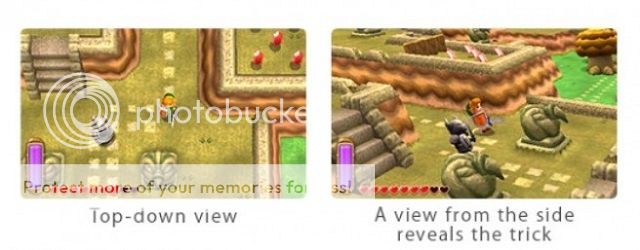
- The Legend of Zelda: A Link Between Worlds reuses the same ¾ view as A Link to the Past despite having 3D graphics, though it changes into a close-up view when Link turns into a painting. The way the game achieves this
 ◊ is a rather hilarious demonstration of liberties this trope takes with real-life perspective: they make everything lean back to an absurd degree to give the illusion of ¾ view.
- The Legend of Zelda: A Link Between Worlds reuses the same ¾ view as A Link to the Past despite having 3D graphics, though it changes into a close-up view when Link turns into a painting. The way the game achieves this
- Game Boy titles follow the same guidelines as above for the tiles, but sprites are Side View.
- Probably every third-person action-adventure-RPG or RPG made solely by SSI in the early 1990s (see also Dark Sun in RPG):
- Quantum Replica: The game is viewed from above in this manner.
- The Legends of Owlia: The game is viewed like this.
- Gate Of Doom
- Gauntlet
- Haunting Starring Polterguy
- Indiana Jones - Temple of Doom NES game had a hybrid of this view and overhead view.
- Last Alert
- Mad Age & This Guy
- Overcooked!
- Overcooked! 2
- Spark the Battle Dog
- Zombies Ate My Neighbors
- Avengers/Hissatsu Buraiken
- DownTown
- The Dark Castle, Mirage Palace and Dragon's Hole levels in Brutal Mario, as well as other Super Mario World hacks using Seiken Densetsu 3/Secret of Mana graphics.
- Super Mario World uses this on the world map screen, which causes, for instance, the peak of Yoshi's Island to obscure a small corner of the unconnected Donut Plains.
- Frobot: The game is viewed from an above perspective, with all of the southern walls visible.
- Spelling Jungle: In an unusual case, it's only some things in each level - Wali, the animals and Tricksters, the Abominable Snowman, the All-Terrain Vehicle and some of the collectible items - that are seen this way. Everything else, such as trees, stone walls and movable items like the boulders/giant snowballs and ice blocks, are viewed strictly from above.
- Command & Conquer' and Red Alert: Tanks are not exactly viewed from above, and soldiers definitely aren't.
- Dungeons of Dredmor
- Elona
- Nuclear Throne
- SYNTHETIK
- Shattered Pixel Dungeon, in an upgrade from the original's graphics.
- Albion when it isn't using 3D.
- Al-Qadim: The Genie's Curse, in contrast with most of SSI's other Forgotten Realms games (which use first-person perspective).
- Arcus Odyssey mixes this perspective up a little by giving most of the levels a 45-degree slant.
- Brandish is an unusual example where this perspective rotates with the player.
- Chrono Trigger
- Citizens of Earth
- All three Dark Sun video games:
- Dark Sun: Shattered Lands
- Dark Sun: Wake of Ravager
- Dark Sun: Crimson Sands MMORPG.
- Dragon Quest
- Dragonstomper
- Elemental Gimmick Gear, except for Boss Battles, which are in full 3D.
- Final Fantasy to Final Fantasy VI. The DS remake of Final Fantasy IV uses a similar technique to A Link Between Worlds to maintain this perspective with 3D graphics.
- The Golden Sun series.
- Holy Umbrella (towns only)
- Lunar: The Silver Star and Lunar: Eternal Blue.
- The Mario & Luigi series.
- The Mother series, though it had a different perspective in towns (and used Isometric Projection in a city).
- Pokémon. The move to the Nintendo DS with Gen 4 allowed them to use more a proper perspective, though this trope still applied when in buildings. They avert the trope in a few towns in Gen 5. By Gen 7, this trope is fully averted, bringing the camera down to proper third-person perspective
- Quest Arrest
- RPG Maker provides tilesets to create this kind of perspective.
- Slime Forest Adventure
- The Speris Legacy (a console-style Action RPG for the Amiga)
- The 2D World of Mana games:
- Children of Mana
- Final Fantasy Adventure (which also got a 3D remake mimicking this perspective)
- Secret of Mana
- Trials of Mana
- Shining Force series.
- The London Life pack-in game from Professor Layton and the Last Specter.
- Undertale; one of the puzzles in the ruins has a button that rotates the map so the player can see it from different perspectives.
- She Dreams Elsewhere
- Unhappy Ever After
- Wasteland
- Xak series
- Xak: The Art of Visual Stage
- Xak II: Rising of the Redmoon
- Xak: The Tower of Gazzel
- Xak III: The Eternal Recurrence
- Fray in Magical Adventure
- The Tower of Cabin
- Most of the 2D Ys games:
- The Guardian Legend for the stages inside NAJU; the flying stages use Top-Down View.
- Mattel's Armor Battle for the Intellivision has all its matches taking place in gamefields with this view.
- Time Bandit uses this perspective for all maps.
- RimWorld for the local map where the main gameplay (player colony, caravan encounters etc.) takes place; the world map uses Top-Down View.
- The original SimCity used an inconsistent mix of ¾ and top-down perspectives; later games switched to Isometric Projection.
- Stardew Valley
- Wolf (DOS)
- The 2D Metal Gear games.
- Voxatron has this, though the camera may be tilted a bit upward and downward.
- The computer game Lego Loco
- Uncharted Waters: New Horizons had this, but only in ports.
- Basingstoke is viewed like this.
- Fork Parker's Crunch Out is viewed in such a way.
- LUNA (RPG Maker): Being an RPG Maker Game, it's viewed from this perspective.
- Mean Santa: This is how the interior of houses is viewed. The outside is shown to Santa's side.
- Ninja Outbreak is viewed in this manner.
- Welcome To Boon Hill is viewed this way.
