Forest Demon: No no no, this isn't blackface, I'm an actual demon!
Woman: Are you fucking serious?
Man: Not cool, man!
Forest Demon: No no, you don't understand! I'm literally a forest demon from across the bridge. This isn't a costume!
Man: (punches the demon) Get the FUCK out, man!
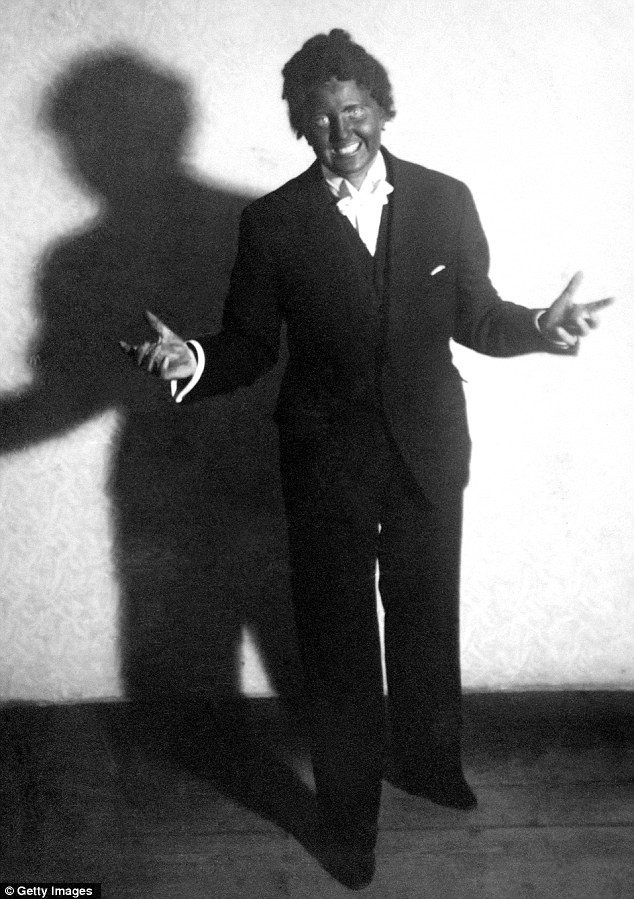
Blackface is the tradition of a performer putting on stylized black makeup to appear as a stereotyped character of African descent. The usual version includes dark or pitch-black makeup and bulging red or white lips. Blackface was often used in Minstrel Shows. The image is associated with negative, stereotypical depictions of black people in the Western world and has become shorthand for anti-black racism. As much as some people would like to forget it, blackface was a part of mainstream American entertainment for almost 100 years until racial backlash ultimately capsized it.
Because of their pervasiveness in the US, blackface minstrel shows traveled widely throughout Europe and Australia, where they were imitated by local actors. This led to domestic blackface traditions springing throughout the West and even in many non-Western countries. Lesser cultural stigma outside the US ironically allowed mainstream blackface to survive for far longer than in its country of origin. While most European countries nowadays do not consider the trope as mind-blowingly offensive as the Anglosphere, a mix of Eagleland Osmosis and a greater awareness about racism has led to it becoming increasingly socially unacceptable and controversial. Blackface characters still pop up in Japanese culture and media from time to time, often causing massive headaches for exporters.
The trope remains a sensitive subject to this day, partially because of its close association with Uncle Tomfoolery, and causes quite a backlash whenever it shows up in mainstream American culture. Even depictions that criticize the trope or people who engage in it can cause a work to become embroiled in controversy.
Instances of Fake Nationality involving lighter-skinned actors playing darker-skinned characters will often raise eyebrows due to straying too close to the trope. Yellowface is a similar practice involving Asian characters, while Brownface is for characters of various "brown" races.
The inversion, black actors playing white people, is rarely done straight. When this happens, it's almost always in-universe and for comic effect. Compare and contrast Black Like Me. Both involve using makeup to make a white person look black. However, Black Like Me is usually done to teach a moral about tolerance to the audience.
Tropes associated with Blackface
- Ability over Appearance: Used to be a justification for blackface in the days when it was acceptable; directors such as D. W. Griffith would claim they just chose the best actors for the parts and made them up accordingly. Of course, this was rife with racist unfortunate implications of its own: you mean to say that no black people anywhere were good enough actors to play black characters?
- Ash Face: Older animated works would often segue from an Ash Face incident to a Blackface gag.
- Big-Lipped Alligator Moment: A common trope of early cinema was to find some excuse for a character to intentionally or accidentally take on the appearance of blackface, then pause for a minstrel show-style musical number. Incidentally, the Trope Namer itself is an instance of this (namely, the "big-lipped" alligator).
- Blackface-Style Caricature: Cartoon charcters whose design resembles the appearance of blackface.
- Black Like Me: A white person makes himself look black and experiences everyday life as a black person and learning An Aesop about tolerance.
- The Coconut Effect: Black actors in minstrel shows often had to use makeup to accentuate their lips in order to look more like a blackface actor.
- Color Me Black: A Sister Trope in which a racist character is involuntarily transformed into a member of the race they hate.
- Copycat Mockery: Blackface performers are white people who imitate black people to make fun of them, playing up the negative stereotypes.
- Dead Horse Trope: Blackface seldom appears in modern mainstream media played straight. If it shows up at all, it's generally for Black Comedy, satirical purposes, or Deliberate Values Dissonance.
- Dude, Not Funny!: Needless to say, the racist connotations of the trope can make it extremely offensive to most present-day viewers. A character who dresses up in blackface in a modern production will likely get this reaction In-Universe as well.
- Grandfather Clause: The British stage and television show The Black and White Minstrel Show was first broadcast in 1957 but continued to use blackface until 1978, long after the practice was considered unacceptable in most media.
- Hollywood Natives: Often, the "natives" are depicted by white actors wearing blackface makeup along with other stereotypical accessories like grass skirts and bone jewellery.
- Modern Minstrelsy: Any time blackface shows up, offensive racial stereotypes will also be in play. Of course, the trope predates the "modern" part as well with its origin in actual Minstrel Shows.
- Monochrome Casting: Often a reason for the use of blackface in places where there simply aren't many black actors to be found.
- Older Than They Think: The tradition of blackface extends hundreds of years before its rise in popularity in America.
- Old Shame: For American culture in general. In its heyday, blackface was a major part of America's distinct artistic culture. Today it's treated as an embarrassing episode in American history. Many beloved film and cartoon characters appeared in blackface in the early days of film and animation, when the trope was still mainstream. The companies who now own these intellectual properties are understandably reluctant to air them.
- Overly Stereotypical Disguise: Overlaps in some cases where a clueless character thinks this is actually a convincing way to look like a real black person.
- Race Lift: May occur when a character was played in blackface in the original production and the creators want to avoid this in the remake.
- Self-Deprecation: A few famous blackface performers were actually black themselves, playing up the stereotypes for laughs. The jury is still out on whether this counts as exploitation by white culture, or whether they were simply making the most of the opportunity to advance their careers by performing for white audiences.
- Paper-Thin Disguise: Often when blackface cropped up in old cartoons and slapstick it was being used as a disguise.
- Pretty Fly for a White Guy: The modern-day successor to blackface, in which non-black people will behave in ways that are stereotypical for black people. However, the intention in this case is usually to be cool rather than to mock black culture.
- Uncanny Valley: Putting dark skin onto someone with European features almost certainly results in this. That's why the trope was usually played for comedy when it was popular, since it's pretty impossible to believe someone doing it is actually Black (D.W. Griffith tried to play it realistically and seriously, and was sorely mocked).
- Unfortunate Character Design: Sometimes, a character may unintentionally resemble a blackface, leading to controversy.
- Uncle Tomfoolery: Typically done by white people setting out to mock and stereotype black culture.
- Values Dissonance: Blackface was once considered harmless good fun, but appearing in blackface today is about as acceptable as burning a cross.
- White Like Me: The inversion where a black person puts on makeup to pass as a white person, almost always Played for Laughs involving White Dude, Black Dude jokes.
- The Zeroth Law of Trope Examples: In Othello, the eponymous character is a Moor and traditionally played by a white actor in blackface or brownface, and this remained the case long after blackface had become unacceptable in most media. Some "concept" productions have gone for a Persecution Flip by casting a white actor without make-up as Othello and black actors as most of the other characters.
Works in which Blackface appears
- The Black Looks, an anti-robot hate group, hide their identities by wearing blackface in the classic Astro Boy story Capetown Lullaby (aside from their leader who wears a weird mask that looks like a black Gonzo the Muppet).
- Episode 8 of Love Lab features a scene where the main characters pay tribute to American black celebrities by wearing brown makeup and imitating black culture. While intended as an Affectionate Parody, with the girls complimenting black women as strong and beautiful, the scene drew backlash from Western audiences due to its resemblance to a Minstrel Show.
- In One-Punch Man, Superalloy Darkshine, an originally pale, presumably Japanese, guy with a cartoony broad nose and thick lips, somehow got dark and shiny once he hit peak physicality.
- A number of Pokémon: The Series episodes were altered or pulled from rotation as a result of the controversy surrounding this trope: An episode where Ash disguises as a Passimian was skipped over in international releases of the Sun and Moon arc, as the makeup Lillie puts on him could be mistaken for this trope.
- An unknown character in an omake from The World God Only Knows appears to don this. The character was going to perform a ritual to curse people.
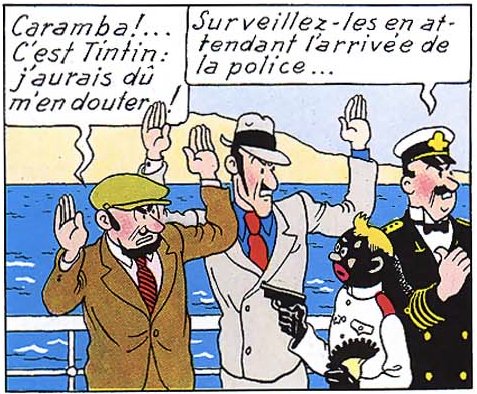
- Tintin disguises himself as a black cabin boy
 in the album The Broken Ear. The animated series turned his disguise into Wig, Dress, Accent. It became something of an Adaptation-Induced Plot Hole because both the comic and the episode had the antagonists being Properly Paranoid about Tintin following them and so they target two people who look like Tintin in disguise (an old, short man and a short fat man wearing a wig) but due to his very obvious disguise in the episode (similar facial features, voice and height with just a wig and a goatee), it becomes baffling that Alonso and Ramón didn't think of this guy as Tintin in disguise.
- An old Golden Age issue of Captain Marvel had Billy dressing up in Blackface as part of a Paper-Thin Disguise.
- In an April Fools' Day crossover strip made for Pilote, the original magazine that ran Asterix and other characters like Barbe-Rouge (a gang of pirates who the perennial useless pirates in Astérix are based on). In the comic, the Gauls and the (two white) pirates team up to play a joke on one of the other Pilote characters, who was always drawn in black and white, pretending they were going to colour him in with paint but instead just painting him completely black. While they're all laughing at him, Baba (a reasonably-drawn black pirate) comes in at the back, saying hi and asking what's going on. The captain's response:
Redbeard: Um... why don't you get back on board?
- During the 2001 Batman story "Close Before Striking", it was established that Bruce Wayne himself, of all people, tried this before he started his Dead Person Impersonation of Matches Malone, as one of his failed attempts at a deep cover identity was trying to pose as a black man to infiltrate the Joker's gang — only for the Clown Prince of Crime see right through it.
- Played for Innocently Insensitive laughs in a Crabgrass strip where 9-year-old best friends Miles (who is black) and Kevin (who is white) plan to dress as each other for an April Fools' Day prank. Miles' mom initially finds the idea funny and cute... until it hits her how the very naïve Kevin would likely go about making himself look like Miles, and rushes to call Kevin's mom so she can stop him before he gets too far painting himself black.
- A very rare inversion in the 1932 film adaptation of The Most Dangerous Game. Black actor Noble Johnson wore makeup to play the White Russian Cossack Ivan. The black-and-white cinematography made this easier.
- Mexican film "Angelitos Negros" (lit. Little Black Angels) of 1948 has an initial musical act where Jose Carlos, performed by singer Pedro Infante, sing in blackface with a group of mulato artists. Then later is inverted by his daughter, a mulato girl called Belen (Cuban actress Titina Romay) that tries to paint her face white so she can feel loved by her white mother,
- Spike Lee's Bamboozled: A modern African-American filmmaker creates a television minstrel show in which black actors perform in classic blackface. He's trying to make a point, but to his horror, the show becomes successful. The film ends with a montage of various instances of and allusions to this trope across white-made works of American media throughout history. Real-life audiences didn't respond well to the use of blackface in making a heavy-handed point about a minstrel show featuring dancers in blackface.
- Al Jolson's The Jazz Singer features the main character performing in blackface in a minstrel show as part of his journey to self-expression. Ironically, Jolson's character can only express himself by putting on the mask of a black man. This was also semi-biographical, as Al Jolson really did perform in blackface and felt a special kinship with African-Americans. He actually helped a lot of blacks break into the music business, demanded that they receive equal treatment, and was famously the only white man allowed in the all-black nightclubs in Harlem.
- This was also used in the 1980 remake of The Jazz Singer, starring Neil Diamond. Diamond's character dons blackface to join a group performing in a black nightclub in Harlem... in 1980.
- Gangs of New York features a propagandized performance of Uncle Tom's Cabin, in which actors playing parts of slaves wear blackface.
- Fred Astaire does a blackface number in Swing Time (1936). Many fans regard this as more of an "Othello" than a "minstrel show" situation, as it was an homage to a specific black performer (Bill "Bojangles" Robinson, whose dancing style was a major influence on that of Astaire).
- The Turkish movie Battal Gazi had the protagonist, a Turkish warrior, disguising himself as an Indian sheikh using blackface.
- The otherwise squeaky-clean classic Holiday Inn shows for Lincoln's Birthday a full minstrel show featuring dancers in blackface. Notably, its Spiritual Successor White Christmas omits this scene in favor of a blackface-free stage performance.
- Monica Vitti in L'eclisse made in 1962 dances wearing blackface with a spear imitating an African warrior.
- Laurence Olivier wears blackface in the 1965 adaptation of Othello, as did Orson Welles in the acclaimed 1951 version.
- The all-black cast of Stormy Weather makes the film an anomaly from The Golden Age of Hollywood era, and it's really wonderful to see such a rare showcase of black entertainers. But it does include a small moment of black characters participating in black minstrel.
- In the 1936 film version of Jerome Kern's Show Boat, Magnolia and the show boat troupe don blackface for the "Gallivantin' Around" number. Since one of the themes of this musical is the destructive nature of race prejudice, this may be deliberate irony — or it may just be a lamentable lapse of taste.
- In Whoopee!, Eddie Cantor tries to pass himself off as a black man, performing a pretty racist shuffling darky routine, then belts out a performance of "My Baby Just Cares for Me" in his classic singing style. Eddie Cantor was the last major vaudeville performer to use blackface in his act, and his character was Fair for Its Day - an intelligent, in fact nerdy character, as opposed to the "Carry Me Back to Ol' Virginee" standard.
- The Three Stooges disguised themselves as slaves using blackface in the Civil War-themed short "Uncivil Warbirds".
- Laurel and Hardy disguised themselves in blackface after breaking out of prison in Pardon Us.
- The Marx Brothers, evading the law, momentarily done blackface to hide among a bunch of stable hands in A Day at the Races (1937). Harpo only paints half his face.
- The Birth of a Nation used blackface not as a comedic device, but as a means to allow white actors to portray black and "mulatto" characters in an overtly racist film.
- The 80's comedy Soul Man features a Harvard Law student who darkens his skin with tanning pills to get a scholarship for black students. The film caused some controversy during its release.
- In the Polish film Vabank, set in 1930s Poland, one of the protagonists, Moks, at one point sings in blackface. Also, a fake 'Negro' appearance place important role in the caper the protagonists pull off.
- In Bob Dylan's film Masked And Anonymous, Ed Harris appears as the ghost of a murdered minstrel named Oscar Vogel, very much in the Al Jolson mode. Dylan has invoked minstrelsy on other occasions, notably naming his 2001 album Love And Theft after Eric Lott's academic book Love and Theft: Blackface Minstrelsy and the American Working Class.
- Lampshaded/parodied in Tropic Thunder—Robert Downey Jr.'s white Australian character, dedicated method actor Kirk Lazarus, portrays black Sergeant Lincoln Osiris by getting his face and body surgically altered to look like a fairly realistic black man. His character's personality, however, is embarrassingly over-the-top, and he stays in character at all times, much to the chagrin of the actually-black Alpa Chino. The fact that the whole thing is meant to be a parody of Oscar Bait and extreme Method Acting went over the heads of some critics and viewers, who claimed it was tantamount to blackface. On the flipside, though, the NAACP approved of the character in their own screening of the film, and Downey was nominated that year for an Oscar. It's also mentioned that the character's casting and actions are also highly controversial In-Universe.
- Pops up in C.S.A.: The Confederate States of America, where in the Alternate Universe in which the South won the Civil War it never becomes taboo. Also, Abraham Lincoln (who in real life regularly attended Minstrel Shows) used blackface to disguise himself as a black man to try to escape to Canada with Harriet Tubman. (They were caught by the Confederate forces.) There was also a clip from an in-universe film depicting Jefferson Davis' scheme to enforce slavery throughout the country in which a house slave also present at the event is clearly being depicted by a white actor in blackface, surely as a bit of commentary on the whole convention of blackface.
- The Paper-Thin Disguise variant shows up in Silver Streak. Con man Richard Pryor helps to disguise traveler Gene Wilder, who's been framed for murder. Presumably it helps that Wilder has naturally curly hair. Hearing Wilder's clueless Soul Brotha patter, Pryor says, "I sure hope we don't run into any brothers." Behind the scenes, Pryor changed a scene to so that the disguise does not fool the black janitor.
- Trading Places also uses it as a Paper-Thin Disguise for Dan Aykroyd in the scene on the train. The others with him are also in disguise/costume, but their target for a theft has met Aykroyd's character before, necessitating something more drastic: brown shoe polish. It doesn't fool anyone.
- The white voice actors of Amos N Andy appear in blackface in their sole feature film Check and Double Check. The comedy duo was at the height of their fame, but fans were apparently disappointed to see their favorite radio characters looking like white guys in blackface. The actors themselves weren't too happy to wear blackface either, as they considered the characters to be quite honest and kindhearted.
- An interesting example is found with Tommy Chong as the blues singer Blind Melon Chitlin' in Still Smokin: the humor is not based around the character being black, but being blind.
- This is how the villain of The Zebra Killer disguised himself while committing murders.
- Inverted in White Chicks in which Shawn and Marlon Wayans play two detectives who disguise themselves as white women.
- In South Park: Bigger, Longer & Uncut, Cartman briefly appears wearing blackface during his performance of "Kyle's Mom is a Bitch."
- In The Last Emperor, the deposed Emperor Pu-yi performs a concert backed up by Chinese musicians in blackface.
- A character seen briefly at the start (and in a throwaway gag near the middle) of Forbidden Zone is a slumlord and crack dealer played by a man in blackface; there are several others in bit parts throughout, done for comedic shock value. In a particularly odd case, one of the actors in blackface happened to actually be black.
- Rochester the butler in Gross Out is not only done up in blackface, but is a grotesque stereotype.
- In Django Unchained, Samuel L. Jackson put on darker makeup to play Boomerang Bigot house slave Stephen. Jackson conceived of the look when deciding that Stephen had no white ancestry at all. Funnily enough, he actually wore more than needed because he thought he didn't look dark enough yet, only to later see the film and realize the photography was making him even darker.
- The 1973 French comedy Les aventures de Rabbi Jacob (English title: The Mad Adventures of Rabbi Jacob) has a scene in which the protagonist, a bigot, accidentally gets a face full of ash. Although (unlike in similar gags from older animated shorts) he doesn't proceed to act "minstrel," he does get mistaken for a black person.
- A white actor with dark make-up plays a black farm hand in Seven Chances.
- The Ed Wood film Jail Bait randomly cuts to a blackface minstrel performance at one point. This was actually stock footage from a film done years earlier. It has no effect whatsoever on the plot.
- Parodied in Be Kind Rewind as Jack Black's character attempts to portray an overweight African-American. As soon as the locals see him in blackface (a majority of which are African American themselves), they react with disgust. Mos Def's character is given the part and Jack Black points out the hypocrisy that while he may not be black, he's still the right body type for the role.
- In Alfred Hitchcock's Young And Innocent, the (white) murderer masks himself with a blackface while playing in a jazz orchestra.
- Averted and Inverted in Watermelon Man. Originally, the film producers wanted a white man who'd be made up as a black man for the rest of the film. Instead director Melvin Van Peebles managed to convince them to cast Godfrey Cambridge, who was made up as a white man for the first section of the film before his transformation.
- In The Littlest Rebel, Shirley Temple plays the daughter of a Confederate family during The American Civil War. When Yankee troops invade her home, she dons blackface to disguise herself as a slave. Blackface is also featured in another Temple film, Dimples, although there it's not worn by Shirley herself.
- In The Spoilers (1942), John Wayne's character blackens his face to hide his features when he has to do something illegal. He hides from the ensuing posse in the room of a Sassy Black Woman who's delighted (they're in Nome, Alaska so she hasn't found any black men). The Duke plays along as a joke, but the illusion is destroyed when he takes his hat off to reveal a still-white forehead.
- Although Colombian-born Zoe Saldana herself is considered black by American standards, her use of darker makeup and prostheses to play Nina Simone was part of the many difficulties faced by the 2016 biopic Nina. Simone had made her dark skin tone a key part of her identity, and for many other dark-skinned African-American fans of the singer it was such a slap in the face to cast a light-skinned actress in the role and then make her up to be darkernote that not only were several online petitions started calling for production to stop, Simone's family asked Saldana to never again quote the singer after she did so in a tweet to defend herself.
- Dear White People begins with a How We Got Here moment, where the main cast watch a news report depicting the race riot that ensued when a predominantly white fraternity threw blackface party. A montage following the end of the film showed pictures from numerous American universities were such parties had taken place.
- In 1941 (1979), when Sgt. Tree's tank heads to the Pacific to face against the Japanese sub, Private Jones, played by Frank McRae gets flour on his face, and Pvt Foley, played by John Candy, laughs at him. Until Jones points out that he has soot on his face, and guffaws while telling Foley to "go the back of the tank."
- Cloud Atlas: Inverted. Halle Berry plays a Jewish woman, Jocasta Ayrs, in Frobisher's story.
- In Vampire Girl vs. Frankenstein Girl there's a high school club that dresses up in blackface and revere what they think is black culture, but is really just a mishmash of African and African-American stereotypes.
- Played with in Zoolander. At one point, Derek Zoolander uses a makeup kit to disguise himself as a black person, but blackface-Zoolander is played by an actual black person rather than Ben Stiller with his face painted. Not only did this help the film avoid negative publicity, but it creates a joke that the normally dim-witted Zoolander is unnaturally talented when it comes to cosmetics.
- Alluded to in Glass Onion, where Birdie, a white woman, mentions having gotten in trouble recently thanks to a costume that she intended as a "tribute to Beyoncé." The details of the costume are never elaborated upon, but it's strongly implied that it included dark makeup.
- Babylon: Sidney, a black jazz trumpetist in the 1930s, is made to wear blackface so that his appearance will match the white musicians who are also in blackface. He goes through with it under great pressure but quits his position immediately afterward.
- Rather shockingly, the only black nurse in Doctor in the House (1954) is played by a white actress.
- In Up Pompeii, Lurcio covers his body in black makeup to disguise himself as a Nubian eunuch.
- In Nellie Bly's travel memoir Around the World in Seventy-Two Days she describes some of the male passengers aboard ship putting on a minstrel show, complete with blackface, as their boat sailed down the Red Sea.
- In The Book Thief which takes place in Nazi Germany, Rudy pretends to be the black Olympic runner Jesse Owens by painting himself black with a mixture of water and charcoal then runs an imaginary race. He doesn't realize that trying to emulate a black man could land him in serious trouble with the Nazis, something that his father quickly sets him straight on.
- In one of the Little House on the Prairie books, the town has a contest where different townsfolk each put on a little show. Laura's father and a few of his friends win it with a Blackface routine. Don't bother looking for this scene on the television series, obviously.
- Part of the immense, immense controversy involved in the self-published Revealing Eden book is that, in its future where blacks have all the cultural cachet and whites are a minority, a number of whites use "Midnight Luster" cream that not only protects against UV radiation but allows them to "pass" as black. And yes, there were trailers for the book featuring white actresses in blackface
- There's an unusual version in Sharps which inverts the connotations of blackface. Nobility and elite soldiers from The Empire are darker skinned than people in the city states that have broken off, and so in the provinces, when actors portray aristocratic characters in plays, they darken their skin and put on plummy accents that are pale imitation of how Imperials actually talk.
- In the Father Brown story "The God of the Gongs", a black murderer tries to escape the police by disguising himself in blackface as a minstrel performer, as the one kind of person who nobody would imagine would actually be black.
- In "Betsy~Tacy Go Downtown" of the Betsy-Tacy series, a major point in the beginning of the book is a girl having passes to see "Uncle Tom's Cabin" on stage. Betsy, Tacy, and Tib try to get up their own play, where Tacy is to wear blackface. They end up attending "Uncle Tom's Cabin", where there are many performers in blackface. Which isn't too surprising, as the book takes place sometime around 1904 in Minnesota.
- In the Left Behind book Glorious Appearing, Mac McCullum had his face tinted dark to disguise himself as a Global Community officer of a different race so that he could go into Jerusalem to find Buck Williams. At that point, with the Global Community being more concerned about uniting together to destroy the Jews, the Christians, and the God they believe in, nobody on either side of the conflict either notices this or even cares to be offended by it. It also helps that Zeke Jr. is just that good of a makeup artist.
- In the Nero Wolfe novel Too Many Cooks, a witness to the murder claims to have seen an African American waiter at the scene of the crime, but when questioned another waiter reveals that it was actually a white man in blackface. As the novel is a critique of then-contemporary race relations, when questioned further the waiter rather scathingly points out that he can tell the difference between someone of actual African American descent and someone who's just covered themselves in burnt cork. The murderer was indeed a white man who had "blacked" himself up.
- In The Return of Rapido Clint and Mr J.G.Reeder by J.T. Edson, the killer turns out to be a blackface vaudeville comedian who travels everywhere in full makeup to cover terrible scarring he received in a gas attack in World War I. However, when Reeder and Fog remove the man's makeup, they discover it is actually the comedian's Negro valet. He had killed his employer several years earlier and adopted his identity to work as a Professional Killer. The comedian's fame allowed him to tour anywhere in the world, and he could disappear just by removing the makeup, as no one would suspect that the person under the blackface was actually black.
- P. G. Wodehouse's novel Thank You, Jeeves features an extended subplot where Bertie Wooster and Roderick Glossop seperately have reasons to smear on some shoe polish, and then are both unable to find any butter or petrol to remove it. There are repeated painful scenes of people being terrified by Bertie's blackface getup.
- The Mad Men season 3 episode "My Old Kentucky Home" features Roger Sterling in blackface, singing the title song to his new, twenty-something wife. Some of the characters are horrified, but more about a respectable businessman making an ass of himself than moral indignation over the racial insensitivity.
- It's Always Sunny in Philadelphia:
- Discussed and Lampshaded in "Dee Reynolds: Shaping America's Youth", where the gang decides to do a sequel to Lethal Weapon with both Mac and Dennis alternate playing Murtaugh. Dennis refuses to be in blackface, but has no problem doing a "black voice." Mac dons full shoe polish and tries to retroactively use Laurence Olivier as justification. Nobody remarks on the fact that Frank spends the entire movie playing a villainous Native American stereotype.
- Used again in "Lethal Weapon 6," when Mac again darkens his skin to play Murtaugh. During the shower scene, Mac's makeup begins to wash off. Dee also plays Murtaugh's daughter in blackface and does a stereotypical voice.
- In Australia, The Footy Show memorably did this one time when Indigenous player Nicky Winmar was unable to appear, and the show was speculating what happened to him. Well on the final segment of the show host Eddie McGuire was going to review the teams for Freemantle and West Coast when the audience starts laughing. He twigs that Sam Newman has done something and is almost scared to look at Sam impersonating Winmar wearing black facepaint. Despite the cries of outrage over the incident Winmar had the last laugh. One year later, there would be a knock at the guest door after Sam laments they never had that anymore. He gets up to answer it to reveal Winmar, all smiles, apologizing for being a year late.
- In another Australian incident, an act called "The Jackson Jive" appeared on Hey Hey, It's Saturday, a variety show, shortly after Michael Jackson's death. Five men, doctors in everyday life, danced in blackface and afro wigs, while a sixth, dressed as Michael, replete with ghost-white makeup, sang "Can You Feel It." American guest judge Harry Connick Jr. was understandably offended. The host apologized to Connick on air.
- Cop show Boney outraged Aboriginal rights groups. Due to a shortage of suitably qualified actors, the lead role of the Aboriginal copper who solves crimes through native tracking and hunting skills was played by a white man in blackface. And he was from New Zealand.
- In the Polish comedy series Alternatywy 4 (1983), one character was a black American exchange student named Abraham Lincoln, played by a white man wearing blackface. Poles attempted to justify the portrayal due to the relative lack of black people in Poland at the time.
- In a Halloween episode of the Irish video-diary sitcom Dan and Becs, the main characters plan to go to a party in fancy dress as a couple. Due to a miscommunication, Bec thinks they're going as Richard Gere and Julia Roberts from Pretty Woman and dresses accordingly. Dan thinks they're going as... Ike and Tina Turner. They give their diary entries on the night, still in costume, Dan still covered in blackface. Their black taxi driver is not impressed with Dan's get-up until, that is, he remarks, "Oh, you're meant to be Ike Turner. Why didn't your girlfriend go as Tina?"
- According to The Goodies, their ancestors were cruelly kidnapped by the BBC and forced into blackface as cast members on The Black and White Minstrel Show (see corresponding entry). They eventually fought for equal rights, no matter what colour paint, be it black, white, green, polka-dot. The episode was actually labelled: DO NOT BROADCAST - RACIST in the BBC archive. The Goodies also appear in blackface in the South Africa and Eckythump episodes. The show also mocked The Apartheid Era racists by showing how horrified they are of blackface performers: white people imitating black people. One episode has Bill Oddie covering his exposed arms and face with shoe polish and converting to Islam.
- Jeeves and Wooster:
- Bertie Wooster disguises himself in as part of a troupe of blackface minstrels comprised of his fellow Drones in order to escape J. Washburn Stoker, father of Pauline, the girl in of Bertie's ill-fated engagements. The minstrels were there as part of Stoker's son's birthday party. Wooster ends up having to perform Lady of Spain in blackface with the minstrels before being able to escape. Later the the Harley St. doctor Sir Roderick Glossop has to dress up in blackface to entertain a young boy who was promised that he could see the minstrels at Stoker's son's birthday party, but is unable to go in the confusion, while Jeeves advises Stoker to cover his face in black to be less visible during the night in order to catch Wooster.
- In another episode, Bertie is persuaded to disguise himself as an African chief in order to retrieve a tribal artifact, making things very awkward when the real chief shows up. In each case, unfortunate implications are mostly skirted because the joke is not on black people but on what a dolt Bertie is for thinking it would work.
- The Sarah Silverman Program played with this. Sarah argued with a black man that being Jewish is harder than being black, and the two agreed to go through one day as the other ethnicity for a day to test it. Sarah dressed up in a horribly stereotypical and offensive way, receiving very unpleasant remarks, thinking they actually thought she was black and their responses were genuine racism. When she met the man in the usual spot she and the gang get their coffee and said that she agreed that being black was harder, the black man said he realised being Jewish was actually harder. He was wearing a yarmukle, peot, a long false nose, and a shirt saying 'I <3 Money'. The man left the place as the two exchanged suspicious looks.
- The Python crew occasionally donned blackface to play Indian or black roles for Monty Python's Flying Circus sketches. For instance, on "The Atilla the Hun Show" (reimagining Atilla in a bland domestic sitcom) includes Eric Idle in an exaggerated blackface character named Uncle Tom.
- One episode of Do Not Adjust Your Set features the show's band, The Bonzo Dog Band, performing their song "Look Out, There's a Monster Coming" in blackface. This included rather large examples of exaggerated lips, even as far as blackface is concerned!
- Ex Bonzo, Neil Innes, reprised his blackface part for Python's successor series on TV, Rutland Weekend Television, where Innes provided the music; one of his musical interludes involved his performing pastiches of Motown acts like Four Tops.
- The Mighty Boosh has two characters that brush against the trope, which got the episodes banned from streaming services in 2020:
- Julian Barret plays "Rudy", a partially two-dimensional guitarist/sage with an appearance resembling Jimi Hendrix. Barret has darkened skin as well as fake teeth to make him appear to be gap-toothed. He also has a large afro with a door to another dimension. In another episode, Rudy is fully three-dimensional and is no longer blackface, though he does retain his magic afro.
- The recurring character "the Spirit of Jazz" is played by Noel Fielding, with black and white face makeup to resemble Baron Samedi. In spite of the inhuman nature of the character, his dreadlocks and jive accent make it clear that the character is supposed to be black.
- Inverted/subverted in the first episode of Toast of London: an African woman named Kikini Bamalam undergoes plastic surgery performed by rogue plastic surgeon Beezus Fuffoon, and ends up looking like 70s era Generation Game host Bruce Forsyth, all except for one hand which remains black.
- Are You Being Served?:
- Mr. Grainger does himself up in blackface to perform "Mammy" in the B-plot of an episode. Ultimately, this rolls back into the main plot: In order to replace a malfunctioning animatronic Santa, the Men's and Lady's Wear staffers are auditioning for the role (and its extra pay). Grainger doesn't have time to remove the blackface before the audition... which makes him more attractive to the child brought in to select who'll get the role. The kid is black.
- Another episode has the staff performing a minstrel number, in blackface, to celebrate Old Mr Grace's supposed African heritage. As you can see on his face at the end of the show as his staff is strutting about in blackface, he is horrified at this spectacle.
- Seen in the pilot episode of Boardwalk Empire (which takes place in the 1920s) during the New Year's celebration.
- Parodied by Spitting Image in "The White & White Minstrel Show" that features the polar opposite of this trope: black people wearing whitefaces. The sketch itself is a biting satire of The Apartheid Era in South Africa where they think "that blackfaces don't belong with black".
- The Black and White Minstrel Show performed musical numbers in blackface on a primetime BBC slot from 1958 to 1978. The show scaled back the blackface numbers toward the end of its run. Its cancellation was not due to the blackface, however, but due to cutbacks on variety shows. The stage show version continued until 1987!
- Scrubs has a flashback to an incident where Turk convinced JD to wear blackface (where Turk himself would be wearing whiteface) while they met with some friends of Turk's. Turk ends up being distracted at an inopportune moment, meaning that JD seems to be alone when the guys see him. It does not end well.
- Community:
- Chang dresses up as his Dungeons & Dragons Drow character, which includes jet black skin. Both Shirley, a black woman, and Pierce, a white man with antiquated social views, think he's in blackface. The episode was taken off of Hulu and Netflix following the 2020 George Floyd protests.
- In a season 4 episode, Pierce entertains a gathering with a "blackface Senor Wences routine in which he darkens his hand to act as a handpuppet of a stereotypical black caricature.
- In an episode of Gimme a Break!, Samantha dresses Joey up in blackface to perform at Nell's church in a Very Special Episode about racism.
- In the All in the Family episode "Birth of the Baby", Archie is forced by his lodge to appear in blackface in a minstrel show. Right before he's supposed to go onstage, he's informed that his daughter has gone into labor, so he ends up in the hospital in blackface.
- I Love Lucy: When Lucy goes into labor, Ricky had been performing — and he shows up at the hospital in a faux-African tribal getup and blackface.
- Played for Laughs in an episode of Soap when the Major, Chester, and Donahue are in blackface in preparation for a night raid on the Sunnies church/bunker along with Benson in order to rescue Billy. (The blackface in this case is an ordinary stealth technique so as not to be easily seen.) As they're planning, Jessica comes in and apologizes for interrupting Benson's reunion with his family. After they explain that they're them, Jessica asks why they're dressed as 'Negros'. During the raid they get caught, and Benson covers for them by saying they're the Step Brothers, and leads the others in a dance "audition."
- 30 Rock: Has had two episodes removed from streaming services for riffing on the trope:
- Jenna Maroney has appeared in blackface twice. The first time, not unlike the The Sarah Silverman Show example, arose from an argument with Tracy Jordan about whether it is harder to be black or a woman; Toofer calls her out after spotting her in dark makeup doing a minstrel performance. The second occurred when Jenna dressed as Pittsburgh Steeler Lynn Swann while her crossdressing boyfriend dressed as Natalie Portman in Black Swan making them ...two black swans.
- A live episode, where Kenneth defends live television, has a flashback to an Amos And Andy expy show— Tracy Jordan plays one half of the team, and Jon Hamm plays the other, in poorly applied blackface and horribly over-the-top mannerisms that finally got on Jordan's last nerve. Kenneth explains that the network thought two black people on the same show would make the audience nervous— "...a rule NBC still uses today!"
- Saturday Night Live:
- When Fred Armisen started playing Barack Obama, a minor stink was raised about whether it constituted blackface. The issue died out after it was argued that Fred Armisen and Barack Obama are both mixed race and the fact that they're not the same mix just makes it a standard case of Fake Nationality. Plus the darkening of Armisen's skin looks like the spray tan it probably is, and most people aren't offended by spray tans.
- In some older episodes, Billy Crystal portrayed Sammy Davis Jr., using extensive makeup and darkened skin. Unlike some other examples, this was done very convincingly. Crystal even performed that character with Jesse Jackson when he hosted the show, without complaint from Jackson.
- Jimmy Fallon infamously impersonated Chris Rock in a sketch.
- Darrell Hammond played Jesse Jackson with fewer complaints.
- In the pilot episode of Life's Too Short, Warwick Davis watches a performance of "Ebony and Ivory" performed by two dwarfs, one of whom is a woman in blackface. Warwick says that he's pretty sure you can't "black up" these days, but "maybe in the North."
- Billy Crystal sparked some very minor controversy when he appeared as Sammy Davis Jr. during his intro to the 84th Academy Award presentation. Crystal used realistic makeup to resemble Davis, not stylized blackface. Critics were apparently unaware that Crystal had been doing Davis impressions for years, including his time on Saturday Night Live, with Davis's personal blessing.
- It's implied Barney once used this on How I Met Your Mother. He mentions that the worst lie he ever told to get a woman into bed (and that is a very competitive category) was when he used a seduction technique called "The Soul Man". We're not told the details of what it involved, but aside from namedropping the film of the same name, he explains that he used it to hook up with a woman who would only date black guys, and that he did it while going by the alias "Barnell".
- Parodied in the first series of Little Britain in a recurring sketch featuring minstrels facing discrimination in a similar manner to minorities, with the joke being that they'd be accepted if they just stopped wearing blackface. It's also played straight as there are a number of black, Asian and Arabic characters played by the white leads. The copious use of blackface in the show would eventually get it pulled, then reedited by the BBC following the worldwide George Floyd protests in 2020.
- Inverted in Chappelle's Show in sketches where the black host Dave Chappelle lightens his skin in order to play white character Chuck Taylor. Chuck has appeared in several episodes of the show, and as a Running Gag, his skin gets lighter and lighter with each appearance until his final appearance has him almost literally white.
- In The Office (US), Dwight has a warehouse employee dress up as Black Peter, complete with blackface. Luckily he figures out that the office staff will find it offensive, so he texts Black Peter to not show up. He appears later with most of the makeup wiped off.
- In the episode "Korzenie" ("Roots") of Polish sitcom Swiat wedlug Kiepskich, the main protagonist wakes up to discover that not only him, but everyone around is suddenly black, including people on TV. Nobody understands his surprised reaction, all the pictures in the family album suggest that he has always been black, and his apartment holds a church service with gospel music. The episode ends with him finding out that his asshole neighbour is still white, and upon pointing it out he responds with "So what? Just because I'm white doesn't mean you can bully me! I'm a human being just like the rest of you!" The title of the episode references the TV miniseries, which was extremely popular in Poland in the 1980s.
- The Man Show had two recurring skits where Jimmy Kimmel browned his skin. One skit had Jimmy dressing up like Utah Jazz forward Karl Malone and dispensing Cloudcuckoolander ramblings about nothing. Kimmel had previously developed his Malone impression for the radio, where costuming was not an issue. The other skit had him dressed up like Oprah Winfrey as a parody of Oprah's feminine lifestyle segments on her own show. It's worth noting that Kimmel deeply regrets these moments.
- The very creepy Papa Lazarou from The League of Gentlemen is a subversion. That's what he really looks like.
- That Mitchell and Webb Look:
- The show briefly uses blackface as a punchline to a skit about a group of historical re-enactors who get tired of covering the English Civil War all the time and briefly try to re-enact a scene from the Congolese Civil War while awkwardly trying not to be racist (and failing).
- This also happened in the very first episode after Mitchell had come out in a burqa for a parody of "Improve your looks!" show. He was sporting this trope underneath because he felt more natural when wearing it.
- One Retraux sketch by The Two Ronnies has Ronnie Barker playing "Al Vermont", a singer who performs in blackface.
- In an episode of The Dick Van Dyke Show, Rob and Laura manage to accidentally dye their hands black with permanent ink just before they need to attend a ceremony to accept an award from "the Committee for Interracial Understanding." Realizing that this could be a major Fee Fi Faux Pas, they eventually decide to wear fancy gloves to the banquet in an attempt to cover it up. Fortunately when the truth comes out, everyone sees the humorous side of it.
- Peep Show: In one episode, Jeremy's girlfriend darkens his whole body to resemble a black man before sex. Jeremy is extremely uncomfortable with the idea.
- Seinfeld: One episode has Kramer falling asleep in a tanning bed just before a date to meet his black girlfriend's parents. They are outraged that he appears to be in blackface.
- The third episode of With Bob And David has two examples: in one sketch, a phony tech guru shows a picture of an old advertisement for blackface as part of his presentation. In a later sketch, an desperate police auditor tries to goad some police officers into brutalizing him by donning blackface. The episode was later removed from Netflix for the depiction.
- In the seventh episode of the second season of The Knick, a vaudeville duo performs in blackface to entertain the audience of a ball.
- Face/Off: In this promo, Greg Cannom transformed young model Malia Bautista into an 60-year-old African-American.
- Howard Stern during this 1981 appearance on Petey Greene's Washington.
- In The Big Bang Theory, Sheldon Cooper invites LeVar Burton to his podcast Fun With Flags, and, despite Leonard telling him it was racist, shows him a video of him portraying George Washington Carver. Burton was not pleased.
- The Christmas episode of Adam Ruins Everything averts this when Adam talks about the different incarnations of Santa Claus. He mentions the Dutch Sinterklass' slave, Black Peter (who is usually depicted by a man in blackface), but his sister, Reah, prevents the camera from showing Peter.
- Tosh.0 once featured a Webredemption for the little boy who dressed up as Martin Luther King Jr., make up and all, as part of his Black History project.
- Dear White People: Just as in the film, a party where white students dress up as black people occurs, and sparks the plot.
- The Deuce: Vincent arrives at his bar to discover a band playing a cover of "96 Tears" with the lead singer in a blackface get-up. Vincent asks his bartender why the singer is dressed like Al Jolson, and she says it's because he's half black. This only confuses Vincent more. Although never named, the singer is supposed to be Garland Jeffreys, who covered "96 Tears" and was half black.
- Get Shorty: Miles blackmails April with an old photograph of her in blackface, which will destroy her career in Hollywood if it ever goes public. The photo is never shown, but it's implied to be a Halloween costume of Oprah Winfrey. April defends herself by saying that it was a long time ago and meant as a tribute, but caves to his demands all the same.
- On a Filipino TV show of the Stars In Your Eyes genre, local pop star Kean Cipriano accepted a challenge to reprise Paul McCartney and Stevie Wonder's duet hit "Ebony and Ivory." With the aid of prosthetics and split-screen video, Cuipriano played both parts. Nobody was outraged very much at an Asian singer going into whiteface as Macca. But the outrage was loud and vocal about the same Asian singer blacking up to play Wonder.
- Watchmen (2019):
- Inverted for the reinvented backstory for Hooded Justice, as the show's version is a black man named Will Reeves who applied makeup around his eyes to make himself seem white.
- When Ozymandias meets with Dr. Manhattan after the latter's return to Earth, Veidt chastises Osterman, who was born white, for taking the appearance of a black man.
- Space Force: When F. Tony asks the astronauts if anyone has any skeletons in their closet, a woman says that she dressed as "a photo negative" one year for Halloween. F. Tony replies, "So... blackface."
- The Golden Girls: The episode "Mixed Blessings" has Rose and Blanche wearing mud face treatments, which makes it look like they're in blackface as they watch Dorothy and the mother of her son's black girlfriend argue about their children's mixed relationship. Rose explains, "This is mud on our face. We're not really black." The episode was removed from Netflix in 2020 for its depiction of "blackface."
- Australian sketch-comedy Fast Forward had an all-white cast who played various ethnicities, with Michael Veitch and Magda Szubanski getting blacked-up for some roles (in one Magda only has her face painted black) and impersonations of Nat "King" Cole and Natalie Cole. Averted with a Paula Abdul impersonation, where Gina Riley just plays her as a white woman. Magda Szubanski has since expressed regret for this.
- Played for laughs in Life Support, Penne tries passing for an aboriginal to receive government benefits, but only paints her face black while wearing a tank top.
- Chris Liley blacked up for the character S'Mouse in Angry Boys. The immediate reaction was one of disgust and made people leery of his most recent comedy series Lunatics, which featured a South African character who wears lots of fake tan.
- A rare example of whiteface that was not intended to make a satirical point took place in the Doctor Who story "The Curse of Fenric". For a shot of a dead Soviet soldier under the sea, the only stunt artist available was black, which was considered unlikely for a WWII-era Soviet soldier. As a result, he was "whited up" for the shot. His facial features are still obviously Black British.
- Nita Negrita, a Filipino Soap Opera, landed in hot water for doing this to portray the titular character who was part African-American. This was further exacerbated with the poor make-up job which made the light-skinned actress "appear black" but without the facial features of an actual black person's, because the actress was a Filipina mestiza and it showed.
- Impressionist Rory Bremner in Rory Bremner, Who Else? and Bremner, Bird and Fortune would sometimes black up for sketches where he portrayed Trevor McDonald.
- An entire genre of music, the "coon song" was dedicated to mocking black people, sung by performers in blackface. Paradoxically, such songs were often written by African American composers such as Ernest Hogan, Sam Lucas, and Bob Cole. The genre was a precursor to ragtime and was eventually replaced by it. Note that in popular usage, "coon song" was often applied to music sung, originating from, or merely in the style of, Negro music, without regard to content. One who sang Negro songs was a "coon shouter."
- David Byrne put on dark makeup and a curly wig to play a black reporter in the "Self-Interview" used to promote Stop Making Sense. He would eventually apologize for the bit on a Twitter thread and on his blog in 2020, describing it as "a major mistake in judgement" and clarifying that the reason why he took so long to apologize is that he forgot about the bit's existence.
- Appears rather shockingly in the video for Culture Club's "Do You Really Want To Hurt Me?" as Boy George is convicted by a jury of jazz-handing minstrels. Director Julian Temple explained that it was meant to symbolize the hypocrisy of gay judges in Britain supporting anti-LGBT legislation, but it fell on deaf ears in the US, where the racist legacy of blackface was far more deeply felt.
- Florence + the Machine's music video for "No Light, No Light" has two savage people in blackface menacing the white singer, who is saved by white choirboys and seen at the end with a white lover. Supposedly, the men in blackface are meant to be demons.
- The European version of the video for Taco's cover of "Puttin' on the Ritz" has tuxedo-clad dancers in blackface lean into view each time the words "Super duper" are sung, and the instrumental shows them tap-dancing. For the North American market, a photo of Gary Cooper (name-dropped in the previous line) replaces the blackface dancers, and the tap-dance segment shows them only from the waist down. The only part where blackface is still briefly seen is in profile on a few dancers in a longer-distance shot of Taco moving in slow-motion.
- Alluded to in the music video for "Say Say Say" by Paul McCartney and a pre-vitiligo Michael Jackson. The video, a satire of race relations in America, feature the two donning identical clown makeup and doing a vaudeville act in a parody of minstrel shows. Neither actually appear in blackface, but Jackson's white-painted lips against his dark skin deliberately reference it.
- Joni Mitchell appeared in blackface on the cover of her 1977 album Don Juan's Reckless Daughter as her alter ego, a man named Art Nouveau, who she claimed represented her "black soul."
- Music video for Tyler The Creator's "Tamale" criticizes censorship hypocrisy by openly showing lots of sexual content while censoring the short blackface minstrel bit appearing near the beginning of the video.
DUE TO "GRAPHIC" NATURE OF THIS FILM I WAS FORCED TO BLUR BECAUSE PEOPLE AREN'T READY TO HAVE INTELLIGENT CONVERSATIONS BEFORE THE JUDGE. WELCOME TO AMERICA.
- Joe Letz of industrial band Combichrist has performed in blackface during their 2017 tour, including photoshopping his head next to buckets of fried chicken in promotional materials.
- The video for "Norupo" by Nordic band Heilung shows the difference between Blackface and painting your face black: one is a mocking imitation of another race, the other is looking like a shaman lurking deep in the woods.
- Frank Zappa used this trope twice in his career:
- The cover of Joe's Garage features Zappa posing comically with dark makeup on his face, with the cover of Acts II & III depicting a woman applying the makeup onto him.
- He later used this trope as a plot point in his Rock Opera Thing-Fish, where a bigoted prince mutates black and gay people into exaggerated blackface-esque minstrel performers and forces them to put on a play. One of these performers is depicted on the front cover, his lips oversized to the point of looking more like a duck's beak.
- The music videos for Grace Jones' "Living My Life" and "Slave to the Rhythm" make frequent use of blackface imagery as a commentary on the relationship between black performers like Jones and the wider entertainment industry. The former video features ballet dancers in caricatured blackface masks (tying in with the frequent use of ballet imagery in Minstrel Shows), while the latter video includes a number of variations on blackface makeup.
- Pusha T's "The Story of Adidon", a diss track against Drake, uses a 2007 photo of the latter in blackface as its cover art. The photo was initially mistaken for a Photoshop at first before both performers confirmed it was real, with Drake explaining on Instagram that the photoshoot it was from was intended as a commentary on the prevalence of Modern Minstrelsy in how black actors are typecast.
- In 1998, D-Generation X mocked the mostly black Power Stable The Nation of Domination by dressing as them, complete with blackface. This somehow received little to no complaints, and is still considered one of Raw's funniest moments.
- At WrestleMania VI, Roddy Piper fought Bad News Brown with half his body in blackface, after Bad News Brown called him racist. Apparently he did it as part of a mind game to show that color doesn't matter, but the WWE ended up burying the entire match and its promo from their network and on Peacock (having understandably gotten them in trouble with the latter on day one of their partnership). The paint was a concoction that could only be removed by a specific solvent (so Piper wouldn't sweat or smear the paint off during the match). Piper would claim later that André the Giant and Arnold Skaaland, as a joke, dumped the solvent down the drain and replaced it with plain water; it took weeks of scrubbing and sitting in a sauna for the paint to finally come off.
- During a feud with Team 3D, the James Gang mocked them by cosplaying as them, complete with Kip James in blackface to imitate Brother Devon.
- One of the many wild looks adorned by Goldust (or rather, "The Artist Formerly Known As Goldust" at the time), featured along with an afro wig and a boom box before the 1998 Royal Rumble on Raw. He happened to be facing Flash Funk, who actually was black.
- At AEW's Double or Nothing 2023, the Blackpool Combat Club had a house band play "Wild Thing" for their entrance. For some bizarre reason, the singer was in blackface.
- Most black vaudevillians wore blackface. Some were light enough that they needed to put on burnt cork to make it clear to the audience; others just bowed to vaudeville standards.
- Minstrel shows were parodied in the late 19th century by the "Two Real Coons", a duo of black men who did minstrel shows. These minstrel shows parodied the mainstream minstrel show by featuring an entire black cast with only one person in blackface, popular vaudeville actor Bert Williams, also being black. Bert's minstrel shows and later his appearances in early film made him one of the first African-American celebrities. As he gained more success, his works phased out the extreme racial humor. His popularity among white and black audiences ultimately made him a force for increased racial tolerance.
- Bill Robinson, popularly known as "Mr. Bojangles", was among the first black performers to make it big without blackface.
- The title character in Shakespeare's Othello was traditionally played by a white actor in makeup, though the original King's Men might not have used it. It wasn't until 1943 that a black actor played the role in a major stage production of the play, but the success of that production didn't stop the common practice of using blackface to last well through the 60s.
- The antagonist Aaron in Shakespeare's Titus Andronicus was often played by a white man in blackface, most notably by Anthony Quayle in the 1955 staging at Stratford-on-Avon that starred Laurence Olivier in the title role.
- Inverted with Ira Aldridge, a nineteenth-century African-American actor who emigrated to the UK and Europe to get away from American racism and became well-known. While he often played black characters like Othello, he sometimes played white characters, in which he usually wore whiteface make-up.
- In opera, the title part in Verdi's adaptation of Othello and Monostatos in The Magic Flute were written for white actors using makeup, and some portrayals veered toward blackface caricature. Today they are usually done without the makeup (or with black performers) to avoid accusations of blackface.
- Referenced in the play No Sugar, which revolves around a family of Australian aborigines in the 1930s. In one scene, they recall a recent trip to the cinema, where they saw an American film with a blackface performer, who they joke must have been having a really rough time as a whitefella if he saw becoming black as a step up.
- Depending on the country and the company, blackface is still used in some ballets, such as for the Moor doll in Petrouchka, the Moor doll in The Nutcracker (if the production has one), and the children in the Golden Idol sequence in La Bayadere. In the US and UK, some companies have eliminated blackface or cast the roles with dancers of color, although the practice has still not disappeared.
- Word of God says that the Hungarian version of Avenue Q replaced the Gary Coleman character with Michael Jackson to avert this trope. This way, the character could be played by a white actor and still be considered African-American.
- In a very much Fair for Its Day production of Macbeth, Orson Welles relocated the story to the Caribbean and played the title role in blackface. The rest of the cast was themselves black, and Welles used his notoriety to further promote the play. Despite initial fears of Uncle Tomfoolery, the play was renowned for its quality cast.
- After a rather infamous bootleg production of the show in Italy which utilized this trope, Marc Shaiman banned the usage of blackface in all productions of Hairspray. As a a result, if a production of the show has actors of a different race in the roles of the African Americans, the following message was put into the program of each show:
"And so, if the production of Hairspray you are about to see tonight features folks whose skin color doesn't match the characters (not unlike how Edna has been traditionally played by a man), we ask that you use the timeless theatrical concept of "suspension of disbelief" and allow yourself to witness the story and not the racial background (or gender) of the actors. Our show is, after all, about not judging books by their covers! If the direction and the actors are good (and they had better be!) you will still get the message loud and clear. And hopefully have a great time receiving it!"
- Referenced in The Mikado with N-Word Privileges that are generally reworded these days. "The n- serenader and the others of his race" shows up on the original version of "I've Got a Little List" of "society offenders who might well be underground", showing what Sir William S. Gilbert thought of the practice.
- The "Jolly Nigger Bank" is a tin can money bank depicting a person in blackface as greedy.
- Golliwog dolls were a once-common trinket among kids that relied heavily on blackface imagery, with large red lips and an exaggerated afro. The Golliwog character was created by Florence Kate Upton, a white woman.
- Kingdom of Loathing features a status effect called Black Face, which raises your Muscle stat and damage, but lowers your combat initiative. The effect description simply reads: "Yeah, we went there."
- Unintentionally occurs with Passionate Patti in Leisure Suit Larry 5: Passionate Patti Does a Little Undercover Work due to a malfunctioning copy machine.
- MadWorld has the Black Baron, revealed to be white by the announcers (who proceed to argue on whether or not it's important). He has the mannerisms of a stereotypical pimp. Perhaps bowing to how the overseas market would view it, Anarchy Reigns (which is in color as opposed to its precursor's Deliberately Monochrome) portrays the Baron as an actual black man who goes by the title "The Blacker Baron".
- Metal Gear Solid: While normally fair-skinned, the only time Decoy Octopus is seen in-game is when he disguises himself as Donald Anderson, a Black man.
- In the arcade version of Sunset Riders, a character caught in fire got a blackface look before he collapsed. The SNES version censors that, replacing it with the standard death drop animation instead.
- An inversion is mentioned in Unsounded: the people of Cresce are black, so actors in a Crescian play with fair-skinned roles wear paleface.
- In this Scandinavia and the World , Netherlands insists that South Africa dress as Sinterklaas, so that Netherlands himself can dress as a traditional Zwarte Piet in blackface.
- In Brad Jones' Demo Reel, Gretchen said she played the title role in Othello while wearing blackface, and then whiteface over that.
- The pilot of the original Demo Reel had a bit where Tacoma, playing the Joker, wasn't sure if a black man wearing whiteface makeup was offensive or not. Rebecca points out that he's essentially playing a slave, so even if it is offensive they've got it coming.
- Bart Baker had a few parodies with himself in blackface.
- An elderly Chris Brown in "Senior Citizen Love" (International Love)
- Rihanna in the "Pour It Up" parody
- Kanye West in the "Bound 2" parody.
- Satirized by Jreg. One of the ideologies featured in Centricide 6 that join Nazi's "International Union of Nationalists" is Pan-Africanism, which is depicted by Greg Guevara jremself wearing a paper with the word "BLACKFACE" attached to jris face.
- Comes up during an episode of OneyPlays, in which Jeff Bandelin relates an unfortunate story (with included photo) from his childhood where his parents dressed him as a Smurf. Unfortunately, due to the high contrast of the old photo and the dark blue face paint used on the costume, the photo instead looks like poor, young Jeff is actually wearing blackface. In fact, it's this story which is implied to have inspired the similar events which occured in Smiling Friends, as detailed below.
- Looney Tunes: Characters such as Bugs Bunny would often get soot blown in their faces, causing them to spontaneously parody The Jazz Singer or Eddie "Rochester" Anderson. A famous example is Bugs singing Al Jolson's "Mammy" in Blackface in Any Bonds Today?. Scenes featuring blackface tend to be Bowdlerized in modern TV airings, but The Looney Tunes Golden Collection DVD set features unedited short cartoons featuring blackface and other stereotypes. note
- Tex Avery MGM Cartoons has used this in the same vein as Looney Tunes.
- Occasionally in Classic Disney Shorts, particularly earlier Mickey Mouse and Silly Symphonies shorts.
- At least one Terrytoons short ("Post War Inventions") has done this, as seen on Jerry Beck's site.
- South Park riffs on this trope in "Summer Sucks". The town gets covered in ashes, causing all the ash-covered residents to look like they're in blackface. Needless to say, Chef, the resident black man who'd just returned from his vacation, isn't pleased.
Chef: Okay, everybody get in line so I can whoop all your asses.
- Family Guy
- Parodied in season 9, when Chris wanted to dress up as Bill Cosby for Halloween, using blackface as well as his trademark sweater. Lois tried telling him it’s wrong, but Chris just said, ‘Why, don’t I look like him?’ Lois agreed that he did, but then said, ‘You can’t just go out on the street in blackface, it’s racist! Now go put on that Indian head gear I bought you!’
- Defied in another episode, where Peter gets in trouble for accidentally shooting Cleveland Brown Jr. and tries to prove he's not racist by wearing a fake afro and painting himself brown. He doesn't even get to do it because the moment Lois hears this plan, she completely snaps and starts beating the living shit out of Peter with a rolled-up magazine while screaming how sick she is of his horrible ideas.
Lois: You can't just pretend to be Black! That's a stupid idea!Peter: What?Lois: IT'S A STUPID IDEA! YOU'RE A STUPID MAN! A STUPID, STUPID MAN!
- The book Kaboom! Explosive Animation from America and Japan mentions that "Even today, the question can be legitimately asked: How much of Mickey Mouse is mouse, and how much is blackface clown?"
- The Smiths in American Dad! show up to a black organization's banquet in blackface after misreading the invitation. It turns out the party's name was "Black People Changing the Face of America".
- Archer: Krieger shows the other staff members a flyer for his horrible one-man show, which, according to their comments, includes him using blackface.
- Smiling Friends: Discussed in The Halloween Episode. Early in the episode, Charlie and Alan discuss about what sorts of costumes may be offensive in the future, citing blackface as an example. Later, towards the end is the Forest Demon, a horrible creature from a haunted forest that also has to repeatedly insist it actually looks like that, and that it's not wearing blackface. To it's credit, though, it lacks the Gag Lips, but the misconception is still definitely there. After chasing Pim into the Halloween party, it's forced to repeat this same spiel to partygoers that don't believe an ounce of it, and beat it to death before eating its corpse over its assumed offense.
Charlie: (completely nonchalant) See that's exactly why I don't dress up for Halloween. Right there, that's the reason.
- This happens in the Philippines, particularly in the province of Aklan in the Visayas every January, when the native brown people smear their bodies with black coal to celebrate a feast with the indigenous black minority called the Aetas, with a help of a miracle from a memento from the Spaniards that helped develop a culture. It's called the Ati-atihan, which literally means "festival of acting like Aetas".
- A Japanese earthquake safety pamphlet passed out as late as 2004 featured a cartoon "sambo" character with a blackface appearance. After some complaints, the pamphlet was redrawn.
- The helpers of Sinterklaas (the Dutch Santa Claus) are usually white people in blackface and colourful costumes called Zwarte Piet ("Black Pete"). After years of growing controversy in the Netherlands, as the Dutch became more aware of the racial implications of blackface, the makeup has largely been discontinued in favor of being similar to soot rather than full face paint.
- the traditional Finnish Christmas play "Tiernapojat" includes a character who is the "king of Mors" who appears only to surrender to Herod, and singing a song about being black.
- Adolf Hitler's girlfriend Eva Braun once "cosplayed" as Al Jolson, in suit and full blackface. Yes, you read that right.◊
- New York Assemblyman Dov Hikind landed in hot water when a picture surfaced of him costumed as a black basketball player for Purim, complete with darkened skin and an afro wig. Critics labeled the costume blackface, while Hikind insisted that no offence was intended.
- British comedians and social commentators David Baddiel and Frank Skinner of Baddiel And Skinner Unplanned attracted controversy after footage was unearthed of a long-ago TV show where they regularly blacked up to parody black footballers while providing commentary.
- If anyone knows anything about K-Pop or the Korean entertainment industry they also know Korea's love for blackface which was, and still is to this day, such a serious issue that many ex-pats and international fans really did not enjoy. Like, well-known Korean industry fan community OmonaTheyDidn't, who wrote an open letter and petition back in 2013.
- In pre-season testing for the 2008 Formula One season, Lewis Hamilton (the first successful black F1 driver) was racially abused by people blackfacing and wearing shirts reading "Hamilton's Family".
- Jane Hamsher, a blogger for Huffington Post, came under attack for posting a doctored picture of then-U.S. Senator Joe Lieberman, then a Democrat, in blackface, being shown alongside Bill Clinton. Hamsher subsequently apologized.
- In the United States, white people using blackface as part of a Halloween costume depicting a black person or character cause some controversy virtually every year:
- In 2013, Vice Principal Lionel Klotz, at Mayfield Secondary School in Brampton, Ontario, dressed as Mr. T in chains and blackface. He was briefly suspended.
- When Julianne Hough and friends went as characters from Orange Is the New Black in 2013, Hough dressed as "Crazy Eyes," a black inmate. Her costume included face make-up to darken her skin, which caused a controversy. She later apologized.
- "Real Housewife" socialite Luann de Lesseps caused controversy in 2018 by dressing as Diana Ross using blackface.
- News pundit Megyn Kelly landed in hot water when she defended de Lesseps's use of blackface, arguing that the tradition is acceptable when you're dressed as a character. She apologized the next day. Her show was cancelled by the end of the week.
- Morris dancing in England is sometimes performed in blackface. The name is thought to derive from "Moorish dance," though it's unclear whether the dance actually derives from Moorish traditions or just refers to its exotic flavor. The origin of the blackface is also unclear. It could be in imitation of dark Moorish faces, but there are other theories as well, including being part of a disguise or in imitation of coal miners' faces. The tradition is particularly popular along the Welsh border, where coal mining was a common profession. One Morris team in Cornwall changed the facepaint to dark blue to avoid controversy.
- Some cosplayers use makeup to darken their skin to more accurately replicate the characters they are dressed as. It is an extremely controversial practice due to being highly evocative of this trope for many.
- Lewis Parker, a former Youtube vlogger and current political journalist/equality officer for the London Young Labour party, came under fire when images were leaked of him in Blackface. Despite Lewis' attempts at dismissing it as a facial mask, the caption used for the initial image did not help his cause. Lewis later wrote an "apology" blog, in which he insists he not be held accountable for this as it was posted before he entered the world of politics, and somehow managed to shift the blame onto the colleague who publicly called him out over it. Lewis still currently holds his position as equality officer, ironically enough.
- In 2016, a Hungarian human rights activist was criticized for this. Having recently returned from an assignment in Africa, she sought to bring awareness of the Indigenous tribes that were in danger of dying out by donning dark skin makeup and dressing up in traditional attire.
- Justin Trudeau, the progressive prime minister of Canada, caused an international sensation in 2019 when photos leaked depicting him having repeatedly worn blackface as a younger man. With a public apology about that mistake that satisfied a good portion of the public, he weathered the outrage and was re-elected, perhaps taking a cue from Virginia Governor Ralph Northam, who also had embarrassing blackface photos from his past revealed some months prior.
- Ralph Northam's own blackface incident was part of a series of political scandals that rocked the Virginia state government in February 2019. Northam was discovered to have dressed in blackface as a college student in 1984. He was not helped by his initially evasive and constantly shifting answers about whether he was actually the man in blackface in the photo. Nor did it help that the photo in question showed a white man in blackface posing with another white man in a Ku Klux Klan hood and robe, leading to speculation about which one was actually Northam. And then he admitted that on another occasion he had worn blackface while dressing as Michael Jackson for Halloween. On top of this, Virginia Attorney General Mark Herring (second in line to become governor had Northam resigned as was widely being demanded) in the same week admitted that he had also worn blackface as a college student, while the (black) Lieutenant Governor Justin Fairfax was accused of rape. Ironically, the scandal growing to encompass his potential successors probably saved Northam's political career, since few wanted to see the entire state government resign. It also helped that he wasn't allowed to run for re-election anyways.note
- In 1993, Ted Danson infamously donned blackface for the Friars Club Roast of Whoopi Goldberg, whom he was dating at the time. Despite the sketch being Goldberg's own idea, Danson got a resounding "Dude, Not Funny!" from everyone present and issued a public apology. Now consider how offensive something has to be for it to offend the Friars Club.