When a show is sold to a foreign country, things may well be changed for a foreign audience. That is, things apart from the obligatory dubbing or subtitling.
This is especially prevalent in anime exported to America and other Western countries for broadcast, though it's lessened over time.
Sometime in the '70s or '80s, television standards in America changed to include more commercials for financial purposes, so shows made before a certain point might be edited to add several extra minutes of commercials (also, US local TV and off-prime network TV has always included more commercials than prime time network TV, so programs originally made for prime time are almost always trimmed for syndication to non-network stations, or non-prime time re-runs on the network). This might also happen to BBC shows exported to the US or Canada, unless shown on commercial-free public or pay television, or run in a longer timeslot with adverts added to make up time.
Occasionally this is done where there is no clearance for footage to be re-used and an alternate clip may be shown.
A similar phenomenon where chunks of screen time are removed for other reasons falls under Bowdlerise, though some scenes which are "edited for syndication" (read: the ones that are cut for reasons not pertaining to length or copyright/licensing issues) are cut because a scene is considered so violent, vulgar, blasphemous or sexually charged that it has to be cut or toned down in reruns on television, so bowdlerization and Edited For Syndication can go hand in hand, depending on the circumstances behind a given edit.
A Sub-Trope of Deleted Scene.
Examples:
- Syfy's former Ani-Monday block often made syndication-like edits for the anime being broadcast in order to fit in more commercials:
- When Noein was broadcast, some scenes were rearranged so that commercial breaks would seem more appropriate in certain slots in the episode.
- Instead of cutting scenes out, the Ani-Monday version of Tengen Toppa Gurren Lagann speeds some scenes up to fit in more commercial breaks, including both the opening and closing (the latter of which is impossible to hear anyway, as it's both crunched to the side and talked over by the announcer; even by adverts for itself). Most of the edits are surprisingly graceful, but some – especially in the last couple episodes (including Kamina's talk with Simon and Viral's family in the Lotus-Eater Machine and the Big Bad's impossibly huge explosion) – can really screw up important moments, as can some incredibly inappropriately timed commercial breaks. Though to be fair, there was almost nothing unimportant in the last couple episodes.
- [adult swim] has a practice of shortening anime openings/endings and removing every Eye Catch which allows more commercials than the original airing. Opening and ending themes in particular are cut out completely.
- The most jarring of opening/ending shortenings would be Durarara!!; its ending is a major Memetic Mutation, to the point that many people found out about the series through that ending. The opening meanwhile, is important due to the fact that it lists the main characters, and while it lists important characters like Celty, Shizuo, Izaya, Simon and Shinra, the Raira Trio (Mikado, Kida and Anri) are sadly left out.
- They also cut out the intros to Inuyasha, Trigun, Outlaw Star, and pretty much every anime they aired that wasn't Cowboy Bebop, Ghost in the Shell: Stand Alone Complex, or Bleach. (FLCL was exempt because it doesn't have opening credits, but the ending was still cut from the final episode due to time.)
- With the revival of Toonami, they've relaxed a little on cutting the openings and endings, especially for their more popular shows (they actually apologized when Attack on Titan was run with a shortened opening once after major backlash), but it still persists, with the aforementioned Attack on Titan still airing with a shortened ending, episodes one and six airing with the truncated opening during the second run, Bleach airing with no opening at all, and Beware the Batman having its opening cut down to five seconds. The current practice for most shows is to show the full opening during the premiere episode and then an edited one for the remaining ones.
- For a while in the UK, the CITV block had episodes of Pokémon: The Series awkwardly split into two parts.
- The same happened in Italy on Italia 1. Not only Pokémon, but many other shows too were split in two parts in order to have more time for commercials, since Italian law forbids commercial breaks during cartoons. The last show that suffered this was the first season of My Little Pony: Friendship Is Magic.
- A pretty acceptable and manga example is Cannon God Exaxxion's Dark Horse Manga translation; the love scene between Hoichi and Akane veered pretty hard toward the "too hot for American publication" side of things, and so was neatly trimmed from it. While some fans were annoyed any editing occurred at all, others didn't mind it since they thought that scene probably went too far in the original and the edit still manages to keep the heartwarming and comedy intact.
- Wandering Son's last two episodes were shortened and mashed together for the TV release. The DVD release has the original versions.
- The Tech TV broadcast of Betterman has the ending credits used for the Opening. A positive example of the trope, the Ending was well animated, with haunting imagery and a memorable song. Contrast with the Opening, which is just live-action footage of a tidal pool.
- Betterman was part of a larger anime block, Anime Unleashed, whose shows were trimmed to as short as 14 minutes per episode to make room for commercials. This resulted in the block's shows feeling like Random Events Plots due to so much material being cut out, most of which were emotional scenes or connecting plot points.
- The AB Group's French edit of Dragon Ball Z often cut more and more footage every time the episodes were rerun, with scenes rather jarringly fading to black. On some occasions, these versions were then distributed to other countries instead of the original prints — an example is episode 149, which cuts the big Cliffhanger-moment in the end and fades to black in the middle of Piccolo's fight with Android 17.
- Nelvana's dub of Cardcaptor Sakura in the early 2000s to create Cardcaptors is a rather infamous case of this.
- The version of the final episode of Tropical-Rouge! Pretty Cure that streams on Crunchyroll cuts out the post-credits scene with Yui Nagomi's cameo.
- Reversed in the case of Jalila: the Egyptian censorship board forced the publishers to cover up the title character's bare midriff, but the UK and US editions allowed her to go as originally intended.
- Despicable Me: During television broadcasts of the movie on certain channels, a part of Gru's Establishing Character Moment where he pops a kid's balloon was cut. They also shorten the scene where the girls play a carnival game to the part where Agnes hits the spaceship.
- The Polar Express: In Freeform airings, the parts where Hero Boy first encounters the Hobo and when the Conductor explains the first gift of Christmas are cut entirely.
- TBS airings of Sherlock Gnomes remove the following scenes:
- Watson saying "Cheese and crackers" in reaction to kidnapped gnomes.
- Moriarty riding Reggie.
- Juliet crying over the loss of Gnomeo in the museum.
- Half of the "Stronger Than I Ever Was" musical number.
- The Maneki-nekos asking when to attack.
- On Cartoon Network's airings of Teen Titans Go! To the Movies the "My Superhero Movie" song was removed entirely, even in airings of the sing-along version. This might have confused some viewers, as some elements of it are referenced later on in the film. In addition, the Bat-Mobile movie trailer was cut from the scene with the joke trailers.
- Wreck-It Ralph: Several parts of the movie were cut when aired on Freeform, specifically Ralph telling Sour Bill to "stick around".
- When TBS aired Jingle All the Way on December 4, 2020, the last ten minutes were omitted in order to make time for an E-Sports tournament.
- On the Buses films:
- The opening sequence in On the Buses was cut down for TV airings.
- When Holiday on the Buses is shown on ITVX, the shot of Joyce's breasts falling out of her top is cut out.
- Depending on where you live, airings of Scooby-Doo might cut a certain flashback scene where the gang ditches Scrappy due to his obnoxiousness because it involves a character getting peed on; this was the case when the movie was shown on television in Jamaica. Unfortunately, that scene being cut resulted in the removal of a critical plot point, which meant that a later major reveal came out of nowhere for some viewers and thus made no sense.
- Happened every time Channel 9 in Australia re-ran episodes of Farscape especially at earlier time slots - prime episode was "Out Of Their Minds" with every fake swear word and scene cut out, losing about 20 minutes.
- When ALF was released on DVD in the United States, many fans were outraged by the fact that all the episodes were in their syndicated format instead of their original broadcast versions. The only episode that was in its original format was the hour-long Season 2 episode "ALF's Special Christmas".
- When The Adventures of Pete & Pete was still being aired as shorts, several half-hour long specials aired during that time. When the series became Half-hour fulltime, those specials were re-edited to appear as standard episodes, adding the title sequence and song "Hey Sandy" and re-scoring the episodes with the standard cues. This is most jarring with "How We Spent Our Summer Vacation".
- When Star Trek: Voyager reruns aired on Spike TV, there were very noticeable cuts to several episodes.
- A small one, but in the '70s and '80s especially, the titles of the shows themselves were changed if the show itself was still first-run on the networks. See: Happy Days Again, Laverne & Shirley & Company, and CHiPs Patrol.
- Some more examples: Jim Rockford: Private Investigator (The Rockford Files), The Raymond Burr Show (Ironside (1967)), Ponderosa (Bonanza). Also reruns of The Ropers and Three's a Crowd are sometimes aired as part of the Three's Company syndication package under the name Three's Company's friends - The Ropers and Three's Company Too respectively.
- MeTV and other digital networks still run Gunsmoke as "Marshall Dillon".
- The Canadian cable network Prime (later known as TVTropolis and now known as DTour) used to alter the titles of syndicated series it broadcast to read, for example, "All in the Family on Prime". They even went so far as to digitally alter the title screens of these shows to incorporate the "on Prime" part. Their over-the-air counterpart Global was notorious for doing this as well, but they've finally stopped.
- Since reruns of Gladiators debuted on the MGM-owned American diginet Charge!, they've been edited for time. Extraneous music (including "Another One Bites the Dust", "We Are Family", and "The Boys are Back in Town") is edited out, more commercial breaks are put in, and the closing credits are dramatically shortened. Surprisingly, the London Weekend Television for ITV credit has been left in.
- Many of the syndicated versions of series mentioned above (such as "Happy Days Again" and "Ponderosa") used different opening credits music than the network work. In the case of "Happy Days", whereas the first two seasons of "Happy Days" featured a 1973 recording of "Rock Around the Clock" by Bill Haley & His Comets, the opening credits of "Happy Days Again" used Haley's original 1954 recording of the song, even on episodes that originally aired with Pratt & McClain's "Happy Days" theme song that replaced Haley's tune.
- In an interesting reversal, the UK version of Season 1 of 24 has a scene not transmitted in the United States: Teri informing Nina of her pregnancy in that series' finale. However, the American syndicated airings on the A&E Channel contain scenes which weren't broadcast during its initial broadcast run (for instance, a longer gunfight between Jack Bauer and the Drazen family in the first sveason finale).
- Every re-airing of the premiere episodes of the second and third season is edited down to the normal 42-or-so minute length as the originals were about 9 minutes longer as they did not feature any commercial interruption. Further, there is one instance in the Season 2 premiere in which some events occur in different orders.
- Two different versions of MythBusters were broadcast in the United Kingdom. On the Discovery Channel, the show is practically identical to the U.S. original except with an Anglicized voiceover (being more metric friendly, and replacing American terms with British terms where appropriate). The version shown on the BBC is edited down to 30 minutes with a more humorous voiceover.
- Meanwhile, down in Australia, MythBusters is repackaged and condensed for use as a segment on the gee-whiz science show Beyond Tomorrow (which is another production by the same production company as Mythbusters). The latter program is then turned around and re-broadcast in America on The Science Channel (owned by Discovery Networks, who make MythBusters in the first place), complete with the "new" version of MythBusters. (At least it still airs in full on SBS.)
- Some of the American DVDs contain the 43-minute episode that you saw on Discovery... but some contain the full 50 minute episode that Beyond Productions made. The cuts in the US-aired versions are all about the commercials.
- Sometimes the American version (and, presumably, other versions) will accumulate so much material that some of it has to be edited out just so that the episode will fit in the time slot; these usually include a quick sting at the end with Adam informing the viewer that they can see the stuff that didn't make it to air on the Discovery channel website.
- Over on another Discovery network, No Reservations also gets a few extra minutes per show in Europe; lampshaded when they do Clip Shows, during which some of the cut bits are aired for American audiences. Others show up as web extras (as is common for Mythbusters now).
- The British version of Whose Line Is It Anyway? had a game cut from each episode, due to added commercials when shown in America (first on Comedy Central and later on BBC America). Some language and raunchier jokes would be censored; a notable example is a Season 9 Film Dub which was removed entirely thanks to featuring footage of about a dozen topless women. Additionally, during the last few years of Comedy Central's airings and BBC America's run with it, the networks only aired episodes from Seasons 6 onward—probably to attract fans of the American version, since those episodes are from when Ryan and Colin became regular contestants.
- When the first season of Roseanne was released on DVD, it contained the syndicated version of many episodes. This was not received well by fans, whose uproar caused those in charge to provide the original uncut episodes in subsequent box sets.
- When Star Trek: The Original Series first went into syndication the episodes were distributed on 35mm film, so the cuts were, literally, bits of film cut out of the reels. Diced into single-frame "film clips," these quickly found their way into the fan market.
- Reversed when the Sci-Fi Channel first aired Star Trek: The Original Series: they restored scenes that had been cut from syndication for almost thirty years, aired the episodes in an expanded 90-minute timeslot, and crammed in an extra 20 minutes worth of commercials.
- The 2006-07 syndicated feed of Beakman's World removes all mention of the mailing address that kids used to send in science questions, which could make new viewers wonder where all those letters they get are coming from.
- Also, for some unknown reason, the same syndicated feed only included Seasons 1 and 4, omitting Seasons 2 and 3 (the Liza episodes).
- Netflix edits out the robotic Eye Catch bumpers, seeing as how there are no commercials to cut to.
- Thunder in Paradise started life as a straight-to-video movie. The movie was cut into two parts and served as the first two episodes of the spinoff TV series. (Some footage cut along the way was added to the episode "Eye For An Eye".) Inverted with the two-part episodes "Sealed With A Kismet" and "Deadly Lessons", which were edited together and sold in stores as Thunder in Paradise 2 and 3, respectively.
- The first episode of iCarly had to have a few minor scenes cut for time after its first few airings due to having a longer runtime than other episodes (28 minutes vs. the usual 24). The uncut version is available on DVD and streaming services.
- Possibly one of the first shows where fans cared enough to notice and complain about this sort of thing was M*A*S*H. Most egregious in the episode where Hawkeye and BJ try to top each other in pranks. A scene early on has a wounded soldier offering Hawkeye a cigar, which Hawk, Properly Paranoid at this point, refuses and proceeds to "disarm", fearing BJ had put the soldier up to giving Hawkeye an exploding cigar. This scene is cut in syndication, but a callback at the episode's climax, where BJ assures Hawkeye that the incident was innocent, is left in, likely confusing viewers who haven't seen the full version.
- Doctor Who has undergone this numerous times in its 50-plus year history.
- American syndication:
- The classic series was initially syndicated in the US to commercial stations, so episodes were re-edited to accommodate commercials. Recaps narrated by actor Howard da Silva were added to most episodes as well.
- The BBC pioneered the concept of "movie edits" of Who serials in the 1970s. Serving as holiday programming and the like, these reruns deleted recaps and other scenes to make their storylines flow better. When the series began to be primarily syndicated to commercial-free PBS stations in the U.S., many affiliates followed suit; complete storylines were edited into films lasting anywhere from 45 minutes (for 2-episode stories) to edits of several hours' duration (longer stories like the 10-episode "The War Games"). The earliest VHS releases of Who serials in The '80s were movie edits, and most of those would not reappear in their original forms on home media until the DVD era (the exception was "The Brain of Morbius", the very first Who home media release, which was cut to half its original length; the uncut original version was released in The '90s).
- The Sci-Fi Channel's run of the revival series saw edits make room for commercials, with normal episodes losing about two minutes each. This was thoroughly strange, seeing as Russell T Davies once claimed that the whole reason they decided to make the new series in 45-minute episodes (as opposed to 50 or even 60 minutes) is because they wanted to allow enough time for the American networks to insert the commercials, without them having to hack apart bits of the programme. Problem is, a typical "hour-long" TV show in America is only around 43 minutes (first-run shows on the Big 4 broadcast networks are a few minutes longer)! It only got worse when it came to the specials and season finales, which are usually extra-long; the Series 4 finale "Journey's End" lost 20 minutes in its SciFi edit. After this, SciFi dropped the show, whereupon BBC America picked it up...
- The Steven Moffat-produced episodes are cut on BBC America for the repeats (first air/night is uncut), who now own the US rights for Doctor Who after Sci-Fi changed its name and decided it wanted little to do with science fiction anymore. For instance, a set of Chekhov's Gun Arc Words were removed from "The Eleventh Hour", and several low-key Tear Jerker scenes in "Death in Heaven" were lost.
- There was one exception to this: "Heaven Sent". It's 55 minutes but BBC America didn't afford it extra time on its premiere night and time-compressed it instead — rather than cutting footage, they ran it at a slightly faster speed. The following week's repeat and later "Doctor's Notes" version (which added making-of/fan commentary text) gave it a 75-minute time slot and ran it uncompressed.
- The BBC America rerun rotation of Series 2-10 also averts the trope — by skipping many post-Series 4 extended-length episodes/specials rather than trying to edit them, though they appear uncut in extra-length time slots for marathons and the like. Unfortunately, this means a lot of missing Season Finales, Christmas Episodes, regenerations, Doctor debuts, and otherwise. Try figuring out everything that happened between "The Name of the Doctor" and "Into the Dalek", or "Face the Raven" and "The Pilot". As of 2017, the rerun rotation ends with "World Enough and Time" before going back to "The Christmas Invasion", leaving the Cliffhanger of a Cyber-converted Bill and the Doctor facing two different Master incarnations unresolved.
- Canadian syndication:
- The Master's dance number was disappointingly cut out of the Series 3 finale on CBC, presumably due to the rest of the things happening in the scene.
- The CBC usually made only minor edits to episodes to fit commercials in, but the fourth season finale "Journey's End" was butchered, with more than 15 minutes worth of scenes edited out to fit the timeslot. And one episode, "Voyage of the Damned", was never even broadcast. Outcry from fans over this is credited with CBC dropping Doctor Who immediately after and Space picking it up; Space has aired Doctor Who virtually uncut.
- Australian and New Zealand broadcasts were notorious for being censored, especially in the 1960s (though, fortunately for archivists, the censor authorities actually kept the scenes that were cut, which later were used to help restore missing Doctor Who episodes, or at least give a glimpse of lost stories).
- The 90-minute special "The Five Doctors" was re-edited for syndication as a four-part story. Similarly, the 1985 season, which featured 45-minute episodes rather than the standard 25-minute ones, were re-edited into 25-minute episodes for syndication.
- American syndication:
- BBC America routinely shows cut versions of BBC programs. Sometimes during comedy shows a commercial break will cut off the punchline to a joke or obscure a plot point.
- Red Dwarf was once given a test dub for the Japanese market (it's available on the Series I DVD). The episode has nearly 5 minutes of content cut out to fit a Japanese commercial timeslot. It wasn't too obvious at first, seeming to be the standard episodes with Japanese subtitles. However, any British references that the Japanese audience may not get have been crudely edited out, to the point where the entire middle of some scenes are missing and characters sometimes suddenly swap places. The audience reaction wasn't edited either, so laughter can be heard for no reason at some points.
- A now-defunct British satellite channel that made heavy cuts to archive programming was ironically called Granada Plusnote (italics the editor's).
- Episodes of Highlander: The Series shown in Europe and Canada were slightly longer than those shown in the US; the extra material is referred to as "Eurominutes".
- Little Britain was conceived to air on digital-only BBC Three, and then move over to BBC Two. It proved so successful that The BBC wanted to air the second season on its mainstream service BBC One. However, the creators were more extreme in their material for this season (Crosses the Line Twice in places). Before production, orders were received on high to record Bowdlerized versions of some scenes, on basis that "you can't say cock on BBC One". Results included the cutting from BBC One transmission of a scene involving a carer performing a particular act on an old woman ("it's on the DVD", apparently), and "What that boy (Daffyd) needs is a nice big cock up his arse" being rerecorded as "What that boy needs is a nice bit of bum".
- Police, Camera, Action!, a British Edutainment Show and documentary, has been heavily edited when it reaired during 2007-2014, with the following episodes changed significantly:
- The original episode "Police Stop!" from 1994 is retitled as "DANGER! DRIVERS AHEAD" on-screen and the show re-titled to Police Camera Action! with a lot of the original links removed, in an attempt to make it flow better; in this one, Alastair Stewart the presenter is very Mr. Exposition at the end of each sequence.
- "Safety Last", from 1995, has three pieces of footage edited out, including a jaywalking scene involving a Peugeot 205 and a woman on a bicycle nearly hit by a pickup truck; in re-runs, these are not shown.
- "Out of Control" from Series 4 in 1997 had a scene of go-karting removed from re-edits and some footage cut for rights reasons. This means the show has five presenter links (two before commercial break, three after) rather than the six presenter links originally. (three before commercial break, three after)
- "The Wild Side" from Series 5 in 1998 had a scene edited out where there's a Metropolitan Police control room in 1996 with a man viewing the footage from the helicopter, presumably due to likeness rights, and a mock hostage situation as a training exercise in Wales, and instead of being two presenter links, it's one sequence rather than two.
- "Rust Buckets" from Series 6 in 1998 had a scene edited out where presenter Alastair Stewart takes a 1970s Renault 5 to a crusher in a salvage yard in Watford, and then a clip from Touchdown Productions of a Ford Laser in unroadworthy condition is cut; instead there's only two presenter links in Part One before the commercial break rather than three presenter links, and the episode is 21 minutes long without commercials, rather than 24 minutes (full runtime with commercials is 30 minutes, whichever version was aired).
- "In The Driving Seat" from Season 7 in 2000 has some footage cut out towards the end, although it's shown before the commercial break, yet not aired in re-runs.
- "Getting Their Man" from Season 9 in 2001 replaces the end music with "The Stripper" by David Rose instead of Hot Stuff by Donna Summer.
- WKRP in Cincinnati is notorious for being heavily edited in syndication; the original series largely used music which was popular during the specific years (late 1970s) in which the series was made, but these hit songs were only licensed for use in the television series over a short time-frame and then removed. The Season 1 DVDs, to fans' dismay, had more music edited out. Which resulted in future DVD releases being abandoned until Shout! Factory picked up the complete series with a majority of the original songs restored.
- Top Gear (UK), as an hour-long BBC show with no room for advert breaks, has to be edited for the repeats on Dave. The cuts tend to be rather abrupt. Some of the music also goes missing due to copyright issues when the show airs on BBC America.
- Dave does that for Dragons' Den and perhaps various Ray Mears shows as well. However, half-hour shows (like pre-Dave Red Dwarf or Catherine Tate) aren't cut - instead, they become 40 minutes and three are shown, which gets them back to the "on the hour" schedule.
- BBC America used to run BBC shows in a 40-minute format. The remaining 20 minutes of the hour would be filled with short-subject films or previews for other shows. They quit doing this and began just hacking into the sitcoms to make them fit the 30-minutes-with-commercials template. "Red Dwarf" was shown in its complete format the first time BBCA aired it. By the time is was ready to repeat the show, it had edited all of the episodes dramatically.
- QI averts this, as the longer QI XL (45 mins) has been picked up for the channel, as of Series F- this is uncut, but fills an entire hour of schedule.
- UKTV, the larger network of channels responsible for Dave, receives a lot of criticism for cutting documentary programmes to fit normal schedules while leaving comedy intact. (And even comedies have sometimes lost the punchlines to gags because of abrupt commercial breaks.)
- Due to the overwhelming popularity of Top Gear (UK), however, BBC America has taken to cutting the hour-long, no commercials show into an 80-minute long block with added commercials in order to show the entire episode on first-run. Repeats, however, are still cut back to an hour with commercials.
- Dave does that for Dragons' Den and perhaps various Ray Mears shows as well. However, half-hour shows (like pre-Dave Red Dwarf or Catherine Tate) aren't cut - instead, they become 40 minutes and three are shown, which gets them back to the "on the hour" schedule.
- Law & Order: Criminal Intent: the dialog is sometimes censored in syndicated airings, and certain camera shots have been blurred. Many of the blurred shots tend to be in the opening credits, to avoid having to pay actors whose faces appear in them.
- When Sex and the City started airing in syndication, two different versions were made: one for TBS that kept most of the sexually explicit dialogue (but still redubbed/removed any lines that would have been too risqué for basic cable), digitally covered up most of the nudity with digitally-rendered lingerie or digitally-enhanced darkness, and aired late at night; the other, a heavily-edited one for regular daytime syndication that cut out all nude scenes and removed/redubbed the bulk of the sexually explicit content and lines. With TBS no longer airing the show, the second bowdlerized version has become the default syndicated version, as seen on E!
- In late '60/'70s syndication and original NBC summer re-airings of The Monkees, songs from earlier albums in the "romp" sequences were sometimes replaced by tracks from their then-recent albums.
- Also played straight, with some romps being entirely cut for time. Ironically, some of these romps had only been included in the original episode because they were too SHORT.
- For more recent syndication (Antenna TV, etc.), all the "romps' were kept in their entirety, with many of the original songs intact. However, they are now SPED UP at an annoyingly fast pace to save time (see Adrenaline Time).
- Also played straight, with some romps being entirely cut for time. Ironically, some of these romps had only been included in the original episode because they were too SHORT.
- The Buffy musical episode "Once More With Feeling" ran 1:10 on its first showing, and has almost 10 minutes cut from it in the syndicated version shown in the US (though the full version was regularly shown in Canada, in a 1 hour time slot.)
- An episode of Remington Steele actually used this practice as a major plot point: The killer du jour had used a co-worker as an alibi, noting that the two had watched a classic TV show together at the time of the murder (unbeknownst to the co-worker, the culprit had used a VCR and reset the clocks; but it turned out that due to syndication, the scene the two had watched together had been cut.
- Both Walking with Dinosaurs and Walking with Beasts were edited significantly when aired on the Discovery Channel, apparently for time.
- The Future Is Wild actually had at least two different edited versions made. It originally aired as a 13-episode series, was significantly edited into a two-hour special when aired on US TV (each time period lost one habitat, among other things). Then a longer version was created later, restoring some (but not all) of the removed content.
- For decades, episodes of The Sixth Sense have been aired in syndication as episodes of Night Gallery, with newly recorded introductions by Rod Serling, even though the shows aren't directly related (The Sixth Sense follows a main character whereas Night Gallery is a Genre Anthology). In many instances, hour-long episodes have been edited down to fit half-hour time slots, making the plots very difficult to follow.
- The thirteen episodes of Good Morning, Miss Bliss are aired in syndication as early year episodes of Saved by the Bell. In fact, prologues to the episodes featuring narration by Zack were recorded for this.
- Played with on It's Garry Shandling's Show. The show started (commercial free) on cable but was later picked up by the Fox Network and shown both with and without commercials. At one point Gary announced to the audience that they had gone to commercial but that the cable viewers shouldn't worry and proceeded to put on a Carmen Miranda outfit and did a short dance
- Although Who Wants to Be a Millionaire? was originally on ITV, which when it was filmed showed adverts in all its programmes, a few re-runs on other networks seem to be pretty abruptly cut and pasted - for example, much of the banter between the host and contestant is removed, as are the sections between one contestant leaving and the Fastest Finger First round. One episode skips the last question of the show entirely but strangely doesn't skip the pre-question status mention.
- McCloud is surely one of the worst victims. The first season, before the show was expanded to either 90 or 120 minutes as part of The NBC Mystery Movie franchise, consisted of six one-hour episodes. For syndication, these were chopped up and combined into 3 90-minute episodes, each of which haphazardly combined the plots of two separate episodes with hasty re-dubbing and re-editing. On DVD, these cuts are not restored. Quincy, M.E. reversed this problem; the first episodes were part of The NBC Mystery Movie in its final season, and these 90-minute shows were later cut for 60-minute slots in syndication.
- Pretty much every American TV series sold into syndication suffers from this. Since the shows are routinely syndicated to local stations throughout the country, each will make cuts to fit commercials from local advertisers. Therefore, people in different markets can get different scenes/lines cut. Also occurs when a US series is sold to another country. British channels often have breaks where the US version didn't, whereas the parts with two seconds of black screen (where the US version would have had a break) are intact. For example, the re-runs of Star Trek: Deep Space Nine, where a few episodes even have a break after the Cold Open, the result being that part 2 opens with the titles.
- As a gimmick in the Jeff Zucker era, NBC sometime had its shows do special episodes which are slightly longer than the standard half-hour/twenty-two minutes formula, called a "supersized" episode. When they reach syndication, or even reruns, they're trimmed down to the usual length or, if there's enough extra footage, stretched out into a two-parter; a couple of Friends episodes are incomplete or presented in SD in the show's Blu-ray release for this reason because the additional scenes weren't part of the syndicated cuts. Now that Jeff Zucker is gone from NBC though this doesn't happen any longer.
- Most of the BBC's natural history programming from the past couple of years has a rather obvious way to get around this - the British broadcast has a 50-minute show followed by a 10-minute behind-the-scenes slot, which can easily be removed to make space for adverts.
- When Green Acres was broadcast in Malaysia, all scenes with Arnold the Pig were edited out so as to not offend Muslim sensibilities. This meant that in some cases, the human characters were having one-sided conversations with an Arnold who never replied.
- BET's run of the HBO series The Wire is a truly epic case of being edited down for syndication - this time, to appeal to a very specific audience. The network has only aired the first four seasons, and while Seasons 1,3, and 4 aired with minimal censorship for content and in ninety-minute blocks, Season 2 (which primarily focuses on the plight of Caucasian dock workers in Baltimore) was absolutely butchered. The second-season episodes were cut down to run in an hour-long block, and a massive number of scenes crucial to the storyline (mostly focusing on Jimmy McNulty's investigation and Frank Sobotka's crew) were axed, leaving plot holes (such as the background regarding the rivalry between the dock workers union and the police union, which is the real reason the Major Crimes Unit reformed and launched an investigation on the dock workers, being entirely chopped out) and rendering the season's themes castrated. Interestingly, the entire plot of the second season changed as a result of these cuts (roughly 20 minutes chopped from each episode), as the entire dock subplot took a backseat to the drug storyline (which was minor at that point).
- Reruns of The Mickey Mouse Club were shortened down to 30 minutes from the hour long length they originally aired in.
- There are at least five syndicated versions of Saturday Night Live:
- The NBC Rerun: This is the version that airs during the weeks when SNL doesn't have any new episodes, usually between new episodes, during major holidays (Thanksgiving, Christmas, and Easter), or when the season ends or is on hiatus because of a writers' strike (as was the case for Seasons 6, 10, 13, 33, and 48). It's 90 minutes long (just like a typical first-run episode), has the phrase, "Previously Recorded From An Earlier Broadcast" during the opening credits, and has dress rehearsal scenes (and, in some cases, sketches) to replace the live show footage (either for content reasons, to fix a technical error or missed cue, or to make a sketch/segment funnier after flopping badly on its first-run). This cut is the same one that airs on the West Coast.
- The 60-Minute Rerun: This is the version of SNL that aired on the cable channels Comedy Central and E! Entertainment. It's Exactly What It Says on the Tin: a rerun of an SNL episode cut down to roughly an hour (minus commercial breaks). This version includes note the best and funniest sketches from a given episode, but excludes the sketches that weren't as good and the second song by the musical guest is cut for time. Originally, Comedy Central aired Saturday Night Live episodes from the 1970s to the 1980s (barring the Jean Doumanian episodes, except for the Bill Murray/Delbert McClinton episode, and the last episode of Season 6, which had no host, but included guest appearances by Chevy Chase, Robin Williams, and Christopher Reeve, with a musical performance by Jr. Walker and the All-Stars), but after a while, those got phased out for the episodes from the mid-to-late 1980s to the 1990s (Seasons 12 to 25), then those got phased out for episodes from the 1990s to the early 2000s (Seasons 21 to 27). After Comedy Central picked up MADtv in place of SNL, E! aired the 1990s to the early 2000s episodes, but also added episodes from Seasons 28, 29, and 30. NBC is now airing one-hour cuts of their SNL episodes at 10:00pm Saturday nights (provided a sports telecast doesn't run over) starting with episodes from Season 38 (2012-2013 season). In the 2014-15 in honor of the show's 40th season, one episode per week from each season will air with an hour-cut version in this timeslot.
- The VH-1 and VH-1 Classic Reruns: Similar to the Comedy Central and E! reruns (in which the show is condensed to one-hour, leaving in only the best sketches, Weekend Update jokes, and one musical performance), only the episodes that air on VH-1 and VH-1 Classic are from Seasons 24 to 38, with some "Best of" clip show episodes and the occasional behind-the-scenes special about the show's history. The "Best of" clip shows and the "behind-the-scenes" documentaries are the only 90-minute reruns of SNL ever aired on cable TV.
- The Nick At Nite Rerun: These were 30-minute reruns of SNL that aired in the early-to-mid 1980s, often with an hour-long syndicated cut of SCTV: Network 90. The episodes used were from the "Not Ready for Primetime"-era (fall of 1975 to spring of 1980), though episodes from Seasons 4 and 5 were shown more often than Seasons 1-3.
- The HA! Network Rerun note : A Season 7 SNL episode hosted by Susan St. James was the first program that aired when The HA! Network premiered. It (and other episodes) aired pretty much the same way as an NBC rerun (full 90-minute version with dress rehearsal footage added when necessary), but HA! Network only aired SNL episodes from when Dick Ebersol was executive producer (between 1981 and 1985), which was when the Susan St. James episode aired.
- The Comedy Network Rerunnote : This edited version of SNL is similar to the NBC rerun (airs for 90 minutes with little or no edits), only Comedy Network airs all of the Season 6 episodes produced by Jean Doumanian in addition to airing the good (or So Okay, It's Average) episodes from both Lorne Michaels eras (fall 1975-spring 1980 and fall 1985-present) and Dick Ebersol's era (spring 1981-spring 1985).
- The Xfinity Streampix On-Demand/Hulu/Netflix Version: Like the Comedy Central/E!/VH-1 version, in that only the best material is shown and everything else (including musical performances, though Seasons 1 to 5 had the musical performances intact, possibly because they were cleared for DVD release) is edited for copyright reasons, time, or just not being funny or memorable with viewers, only the episodes range from lasting 15 minutes to 58 minutes, depending on how much has been edited (the second time Kathleen Turner hosted SNL in the late 1980s has a streaming version so short, the only material in that episode is Kathleen Turner's monologue and Weekend Update with Dennis Miller). Also, the Season 30 episode hosted by Kate Winslet with musical guest Eminem is not there.
- MADtv (1995) first aired in syndication on local TV stations, under the title, "The Best of MADtv". Only the first two seasons aired. The show then got picked up by Spike TV (back when it was TNN — The Nashville Network, a channel dedicated to everything that most people would consider "redneck" or "trailer trash") and aired the first two seasons, followed by Seasons 3-5. The local station and TNN cuts of MADtv were 30 minutes long (MADtv runs their show for an hour while SNL runs for 90 minutes [an hour and a half], and, much like the reruns from Saturday Night Live, the ones for MADtv only had the best material from a given episode while leaving the weaker, less funny stuff on the cutting room floor). The TNN reruns were off before anyone noticed (that was when Viacom had "refocused" the network and eventually turned it into Spike TV) and eventually the show found its way to Comedy Central after E! acquired the rights to air Saturday Night Live (MADtv's long-standing rival). Comedy Central aired Seasons 1-7 of MADtv in their full, hour-long version [with some bleeping and/or muting for obscene language], and as the years went by, Seasons 8, 9, 10, and 11 were added as well (Seasons 12 and 13 were only shown on Comedy Central's Canadian sister channel, Comedy Network, and the final season [Season 14] has yet to be aired on either channel). In 2008, Comedy Central phased out the first seven seasons of MADtv in favor of the episodes from Seasons 8-11, and those episodes have been running until 2010, when MADtv was dropped from the syndication schedule in favor of reruns of reruns of canceled Comedy Central original programming, exports of canceled animated comedies (i.e. Futurama, The Goode Family, and Sit Down, Shut Up), more movies, and more stand-up specials.
- MADtv even parodied the practice to hell and back, with a PAXnote version of an episode of The Sopranos that removed all the swearing, sex, and violence, bringing its 40+ minute run time to just under three minutes
 . Once upon a time, it was merely a commentary on how the frank, HBO-style depictions of sex, violence, and foul language would be edited on any channel that wasn't a premium cable channel. Now, the idea of an edited for syndication Sopranos is a reality, only it's syndicated on A&E and a bit more well-done than what MADtv showed.
- MADtv even parodied the practice to hell and back, with a PAXnote version of an episode of The Sopranos that removed all the swearing, sex, and violence, bringing its 40+ minute run time to just under three minutes
- When Monty Python's Flying Circus was aired on ABC in 1975, it was heavily condensed, rearranged and edited all to hell for content, completely destroying the sketches — leading to a situation where the group had to go to court to prove their own material wasn't funny when treated thus and get it taken off the air. Apparently the trial was hilarious. In The Pythons Autobiography, Michael Palin describes trying to tell the judge about a sketch set in a courtroom where the judge keeps interrupting the prosecutor to ask questions about the witness's gaiters, and having the American judge keep interrupting to ask what gaiters are.
- A side effect of this dispute was that the Pythons obtained the copyright to their own series, something that has never happened with any other BBC show. The DVD releases are not on BBC Video or its partner comany 2|Entertain, and the packaging doesn't credit the BBC at all.
- The DVDs A&E distributed in America have some sketches missing. For example, the episode "How Not To Be Seen" had one of its cartoon segments cut short to remove scenes of Jesus crucified to a telephone pole.
- The episode with "A Book At Bedtime" originally opened with a choreographed party political broadcast. Time-Life, the original distributors, accidentally erased this opening so upon changing distributors it now opens with a quick captioning gag. The first A&E DVD release omits the ending, the preview of upcoming BBC comedies.
- The notorious "cannibal undertaker" sketch was apparently cut from the BBC master tape. The version appearing on PAL DVDs appears to be a reverse-standards-convertednote NTSC version.
- In Terry Gilliam's "Black Spot" animation the word "cancer" was redubbed by a completely different voice saying "gangrene". On Gilliam's disc on the Monty Python's Personal Best DVD box set, the word "cancer" has been reinstated from the soundtrack of the film And Now For Something Completely Different.
- Particularly noticeable in NCIS. Every new segment (i.e. when returning from a commercial) starts with a 2 second Black and White still shot of how this segment will end. When syndicated, you'll get at least one segment per episode that doesn't end with the preordained image, and then doesn't start up with the customary lead-in after the commercials.
- In Australia, they've apparently figured out how to make their own in house. You can still tell though, 'cause the DIY ones aren't still images. Which, if you're familiar with the show, is possibly even more jarring.
- The popularity of the series in Britain means that episodes are rerun on several channels, often in the daytime, and the daytime screenings are noticeably edited for gore and violence.
- GSN's airings of classic game shows usually have ticket fee plugs removed and prize plugs crunched to small size to accommodate promos for upcoming shows. Many shows are also time-compressed, which would normally not be an issue — but they tend to do it really poorly, resulting in parts of the show sounding like the Micro Machines man. Their replays of classic black-and-white shows (Bill Cullen's version of The Price Is Right among others) usually have ticket plugs and sweepstakes mailing information excised, as well as having shows with cigarettes as sponsors for those particular shows excluded from replays. Buzzr's airing of the Cullen series mutes and blurs out the winner of the home sweepstakes.
- Stargate SG-1's single 90-minute episode, "Threads", is cut down to 1 hour for syndication.
- SG-1 also cuts the full-frontal nudity in the pilot that was added at the behest of Showtime in order to classify the series as "adult".
- The Tracey Ullman Show was shown on BBC2 without the animated segments - that's right, they cut out The Simpsons. No wonder it took so long to start on UK terrestrial television, on the BBC no less.note
- There was a syndicated version of Knight Rider in which each episode was cut down to fit in a half hour time slot—which means that they mostly just kept the action scenes, and left out all the bits in between that explained why the action was supposedly necessary.
- There was a similar cut of B.J. and the Bear.
- The American cable channel TNT not only edits for commercials, but changes the timing of commercial breaks. After the opening teaser and credits, there should be a commercial break. Instead, TNT runs the first act directly after the opening credits. This means they later hack into the middle of another scene to put in the ads that should have run at the beginning. It's jarring.
- FOX sought to test the waters in the late '90s with a thirty minute re-edit of Ally McBeal for a quick cash-in for syndication at the height of the show's popularity. Effectively they purged the first two seasons of all courtroom related scenes/drama material in order to present it as a comedy show, which created episodes that had huge plot holes, such as the elimination of Lucy Liu's character's entire introduction episode and having her just randomly showing up in the cast without an introduction. Incidentally this half-hour version never saw syndication.
- The original opening titles and closing credits of Gomer Pyle, U.S.M.C., showing him continually failing to keep aligned with groups of marching soldiers changing direction, have not been seen since the series first ran on CBS in prime time (the replacement credits first appeared when the network itself aired daily reruns in the afternoon, where they also eliminated all "tag scenes" from the episodes, resulting in plots often left unresolved!).
- For many years, reruns of The Partridge Family had the audio of the opening titles of the first season, which had different, "introductory" theme song lyrics, replaced with audio from the later seasons.
- Reruns of the Screen Gems series Bewitched and I Dream of Jeannie had opening-titles audio that varied for different seasons "standardized" to audio from one particular season: in Jeannie's case, all color seasons had third-season audio (with its visuals that included Sidney Sheldon's creator-credit, which had been absent from the second season); both monochrome seasons of Bewitched had the audio of the first season. At times, both series have also had the monochrome version of their opening animation replaced with the color version shown monochrome; for Jeannie, this happened in early years of reruns (also using the color-episodes theme music); for Bewitched, this has been done for reruns in the recent years. The DVDs for Jeannie's second season even have the original opening-title visuals for the "Girl Who Never Had a Birthday" episodes (lacking Sheldon's creator credit) dubbed with third-season audio.
- Reruns of MythQuest have very noticeable cuts, although different channels edit out different amounts. In one case, they cut out the middle of a character's sentence, but left the rest of the line in.
- Friends is edited when it is aired on Nick at Nite to fit in more commercials, which often results in several jokes missing from many episodes. Additionally, the more risque jokes are often edited out as well.
- On the Hulu Plus version of Monday Night RAW, only the best matches/segments are left in while the other matches/segments (usually involving mid-carders, jobbers, and Divas) are cut from the broadcast.
- Dinosaurs started having cold opens in the third season, but reruns show a cold open before every episode (moving the first scene so it runs before the opening), in addition to including the third and fourth season theme in episodes from the first two seasons.
- In 1989, A Muppet Family Christmas was re-edited, removing a few scenes for time (including a scene where Fozzie's mom hangs his stocking), adding new fade-ins, putting some of the audio over shots of a fireplace and Christmas tree, and removing some of the background music. This version has been used for all subsequent rebroadcasts and video releases (which remove more scenes due to music rights).
- Because the UK's Channel 4 aired the first two seasons of Agents of S.H.I.E.L.D. at 8pm, before the Watershed (with repeats shown in the afternoon on sister channel E4 - for the third season there was a Channel Hop, with the series airing at 9pm on E4, and repeats airing in the afternoon on Channel Four), several episodes have been subject to this:
- The scene in "Girl In The Flower Dress" where Debbie is incinerated was toned down, omitting a closeup of her screaming face as she's burnt up... although it remained in the version available on Channel 4's website.
- In "Turn, Turn, Turn", Ward shoots Agent Hand three times, twice in the chest and once in the head. In the British broadcast, Ward only shoots her once and then the latter drops out of frame. This cut was replicated for the version available on Channel 4's website.
- The moment in "Beginning Of The End" where Garrett stabs a general with one of his own ribs was cut from Channel 4's airings, while May's use of a nail gun in the same episode is toned down (in the uncut version she shoots Ward with it three times; the C4 broadcast cuts it to one. The scene which follows in which May strikes Ward in the throat was also removed from the daytime airing, as it just cuts to Ward being knocked out by her follow up attack).
- In a non-violent example, the excerpt from Captain America: The Winter Soldier used as a trailer at the end of "End Of The Beginning" when shown in the US was removed from Channel 4's airings (which is why it's two minutes shorter than usual), as the movie had already been out in Britain for several weeks at that point.
- The UK DVD box set of Department S includes as an extra one episode that was edited from an hour-long format to a half-hour for US syndication. Needless to say, the plot and dialogue are butchered to the point of incomprehensibility.
- After Raising Hope ended and was sold into syndication to several networks including CMT and WGN America, they have scenes or parts of scenes removed. Examples include the scene where Jimmy finds out his friends are going to see the embarrassing movie based on his life, and the part of the scene in "Arbor Daze" where Sabrina tries to wake up Jimmy during the A Christmas Carol parody involving the Ghost of Arbor Day.
- Airings of the original Miracle On 34th Street suffered from this as they sought to add in more commercials, made especially egregious as they slowly chipped away at the critical Mailroom scene that sets up the climactic moment in the court room until all that was left was a brief glance at the letter with the courtroom's address being pulled from the sorting belt before cutting to the next scene, leaving viewers with no idea why they routed all the Christmas mail to the courthouse.
- When Big Wolf on Campus was broadcast on Fox Kids in The Netherlands, only the second season was ever shown, the first and third never airing. It would also omit The Teaser, starting with the Title Sequence instead. Only later reruns would include the pre-opening credits scene.
- In Living Color! has one famous example. The May 5, 1990 episode included an infamous sketch called "Bolt 45", which parodied the Colt 45 malt liquor commercial that featured Billy Dee Williams. The sketch ended with Kim Coles' character passed out on a table after downing an entire six-pack of malt liquor and Keenen Ivory Wayans as "Billy Dee" laying her on the table and spreading her legs apart. Due to complaints that the sketch made light of date rape, Fox censors cut it from the master tape before broadcast, but due to a studio mixup, the original tape with the Bolt 45 sketch aired. Since its premiere, the sketch has never been broadcast, and has been excluded from all home video issues and cable reruns seen on FX and FXX (being replaced with the sketch "The Exxxon Family", featuring Jim Carrey as a clumsy Exxon tanker trying to cover up a coffee spill while his wife [Kelly Coffield] talks about the accident her husband caused). Reportedly, the original tape of the sketch was destroyed, although several home tapers have uploaded the sketch to YouTube.
- BET and TV One's versions of In Living Color! mute out all misogynistic slurs (use of the words "bitch" and "ho").
- In Living Color is mostly uncut on the FXX reruns. In comparison to the DVDs, all the musical parodies and references to popular licensed songs are left intact. However, the "Bolt 45" sketch is still not there, and neither are the ad-libbed lines from the "Men on Football" sketch that aired during a live Super Bowl special where Antoine and Blaine imply that Carl Lewis and Richard Gere are homosexual (both original versions have been uploaded on YouTube). There's also a cut on the Season 5 sketch where Jim Carrey's Fire Marshal Bill tries to look for safety hazards at a magic show. After the magician assures him that his magic is safe, Fire Marshall Bill says, "That's what they said about the World Trade Center, son. But me and my friend Abdul and a couple of pounds of plastique explosives showed 'em different!" While the DVD version left this line intact, the FXX version cut it (as the line, which once referenced the World Trade Center's bombing in 1993, can now be applied to the September 11th attacks that happened eight years later), though the cut was a sloppy and obvious one, as the part where Bill laughs and says his catchphrase, "Lemme show ya somethin'" was also cut.
- The Cannon half of the Cannon/Barnaby Jones Crossover "The Deadly Conspiracy" originally ended with McKenna going the Destination Defenestration route via Parks, thus setting up a Cliffhanger to lead into the Barnaby Jones part. For syndication the episode climaxes with Corcoran trying to kill McKenna but ending up getting killed himself, so it can be shown as a one-parter... but the Barnaby Jones version continues on the original path (beginning with a Cannon recap) even in syndication, which can be awkward for anyone watching the episodes back-to-back.
- In a rather unique case Seinfeld was retimed for syndication on TBS with episodes being sped up approximately 7.5% to fit in two more minutes of commercials.
- This trope is inverted with Parks and Recreation on Netflix. Until Season 4 or so, many of the episodes include deleted scenes not present in the television airings.
- Many of the scenes of Ellen Hamilton Latzen in the Family Ties episode, Miracle in Columbus is cut in the syndicated version - and she's the main guest star of the episode!
- Rome appeared for some time on UK Netflix, the episodes missing around ten minutes of footage each. In the best case, this involved cutting out scenes of character development that didn't contribute much to the overarching plot, and in the worst case cut out the beginnings and endings of entire subplots, making the series seem even more rushed and unfinished than its Troubled Production made it.
- The live Nickelodeon broadcast of The SpongeBob Musical already eschewed a few scenes from the original Broadway and tour productions to make more room for advertisements, but the reruns edited it down even further, even cutting entire songs that already had lyrics cut in the original live broadcast.
- There are two versions of The Fresh Beat Band special The Wizard of Song in existence: a 30-minute two-parter and an hour-long movie edit.
- The Season One finale of Buffalo Bill, "Hit the Road, Newell", lost a Dream Sequence when the whole series was released on DVD. Before the episode plays, there is an unskippable text intro from co-creator Tom Patchett that describes the deleted scene (in which Bill imagines black people coming after him for his racist views) and explains that they could not clear the music rights for the Ray Charles Cover Version of "Hit the Road, Jack" used in it, and not because they couldn't afford to do so. Since the episode didn't suffer for the scene's loss, they just cut it.
- A minor example with the UK kids' game show Raven's spinoff Raven: The Dragon's Eye: when the series reran in 2015, the Cold Open in the first episode, which gives a brief recap of the previous spinoff Raven: The Secret Temple, was cut (presumably because said previous spinoff had not been rerun).
- The Golden Girls has suffered from this trope a lot. It's often Adored by the Network wherever it airs, and has appeared on no less than three different channels. Its original home in syndication was Lifetime, which ran it constantly; these episodes were largely intact, with few edits. In the New Aughts and Tens, it began airing on Logo (a nod to the show's LGBT Fanbase) with more cuts, but never to the point of being noticeable. The worst offender, though, is Hallmark Channel, which edits out not just a few jokes, but entire plot points and resolutions, leaving most episodes feeling half-complete. To give just one example: in "'Twas the Nightmare Before Christmas", the girls miss spending Christmas with their families, but a long sequence in a diner helps them realize that they're with loved ones—each other—after all. The Hallmark version cuts out almost the entirety of that sequence, making the "revelation" seem rushed and tacked on.
- The original DVD release of Hamish and Andy’s Gap Year USA started with them admitting that “all the ads had been edited out” for it. By “ads”, they meant deleting all the celebrity interviews (which, among other things, included a performance by Coldplay that was an obvious deletion), all the “Coming Up”/“Next Episode” breaks were deleted (causing abrupt fade-in and outs), and many segment introductions were (poorly) shortened.
- It was further edited for its release on Stan (and later YouTube) to remove some segments (mostly “100 Second New York Lessond” inserts), put into a 6-episode format (the DVD had them categorised in a seamless “weeks” format to ensure they were no longer standalone episodes) and they managed to make some segment introductions even shorter.
- The Banana Splits Adventure Hour has not been broadcast in its original form since it ended in 1970 - when the show was syndicated in the 70s, the segments created for the show were spliced together with the first season Split sketches to create an half-hour edition. It is this edited version that has been broadcast on Cartoon Network and has been released of home video.
- The DVD and Amazon streaming copies of The Love Boat episode "The Starmaker" omit the scene where Isaac performs "He's So Shy" with The Pointer Sisters. Seeing as how this performance was the entire point of the plot, its removal did not amuse fans.
- After the fiery talk show Hot Seat with Wally George was cancelled in 1992, it spent a decade in reruns. Originally, all the reruns did was dub a new theme song in and change the copyright year to whenever it reran. The edits got much heavier by 2000; The intros and credit sequences were replaced with completely new ones, yet another new theme song was dubbed in, and some episodes even had their segments moved around. The commentary, audience questions, and ticket plug were all removed, basically boiling the show down to just Wally grilling his guests. To fill out the runtime, clips from other episodes (deemed "Golden Oldies") were edited in.
- The show returned for another round of reruns from 2020 to 2021. These reruns would air the show as it originally aired, albeit with the top and bottom of the picture cropped to simulate widescreen. Also, the addresses and phone numbers during the ticket plugs were blurred out…but not muted in any way, so you could still hear Wally and the audience's "999-5000" call-and-response routine.
- Mystery Science Theater 3000 is really interesting with this trope. Since a normal episode is two hours long (90 minutes run time and 30 minutes commercials), the movies they are riffing are edited for time, meaning some plot points and characters disappear (and they will point this out if it’s big enough). When the series was aired as The Mystery Science Hour, all of the Host Segments were tossed out, leaving just the film itself.
- When EWTN aired the original direct-to-video episodes of The Donut Man, they were edited for time. For example, both "Camp Harmony" and "After School" lost their final songs, and the latter also lost the scene where Loafer is shown "half-baked".
- The American network Comet TV mutes instances of swearing. Unfortunately, they consider all conventional synonyms of "prostitute" to be swearing, which makes their airings of Firefly rather more obtuse than they should be.
- Every rerun of Lizzie McGuire starting with its WGN America run - even as seen on Disney+ - have the songs replaced with generic background music due to license issues.
- LazyTown: When aired on NBC Kids in the United States, the verse about Stephanie being new in town is cut from the opening theme and the closing credits are aired compressed at the bottom of the screen during the "Bing Bang" song. The opening theme is also compressed. Some episodes are slightly cut to make room for more commercials.
- The original airing of the Only Fools and Horses episode "Thicker Than Water" included a brief exchange where Del reminds Rodney that Reg was not aware if Grandad was alive or dead in the eighteen years he'd been gone, and Rodney comments that they never seem to know either. Following Lennard Pearce's death less than a year later, this exchange was removed from the episode and was not restored for any subsequent repeat airings or home media releases.
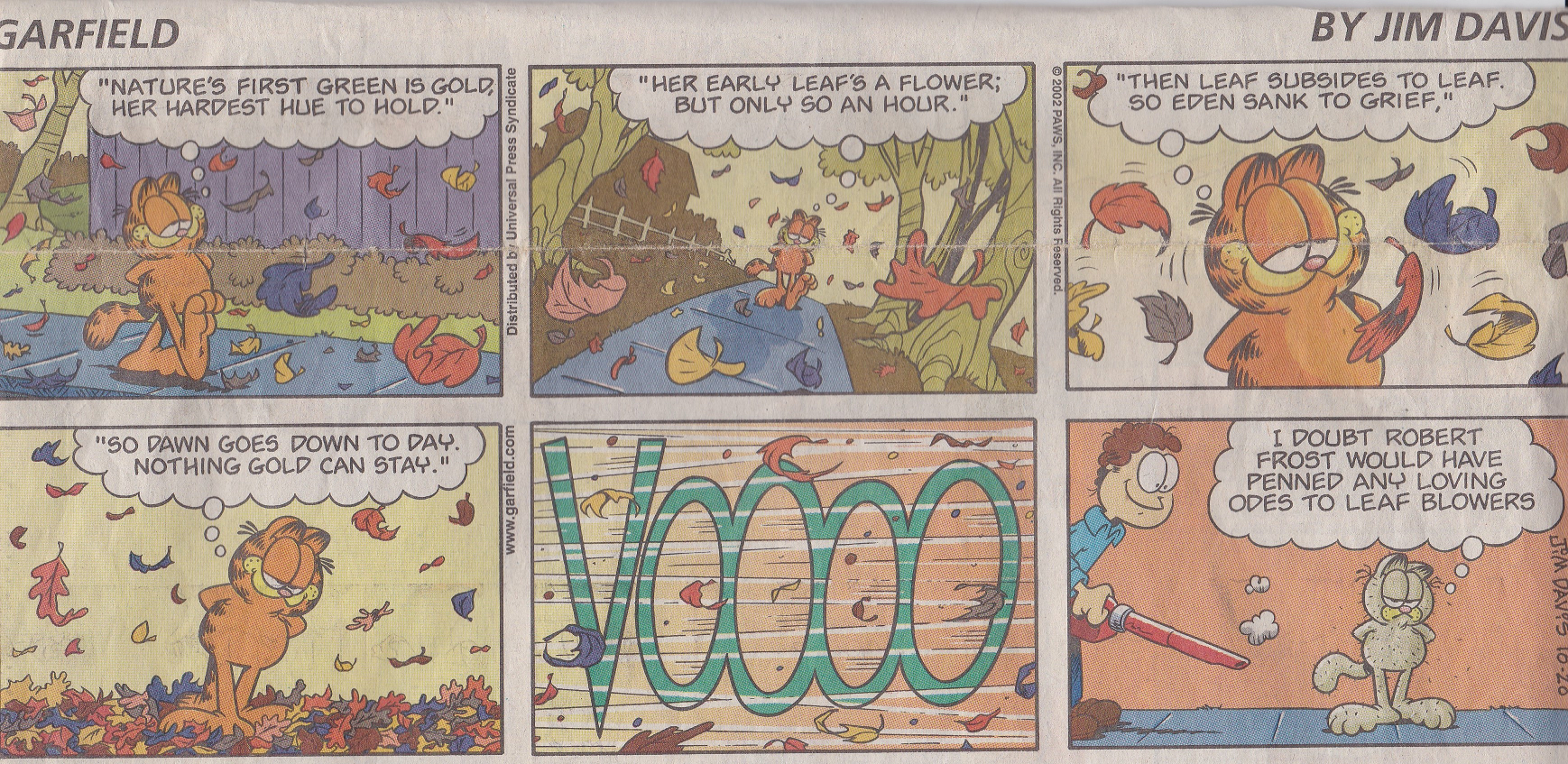
- The October 22, 2002 edition of Garfield originally quoted◊ Robert Frost's "Nothing Gold Can Stay". Due to the poem still being under copyright at the time, it was replaced in book reprints with original "poetic" lines. In relation, the line "I doubt Robert Frost would have penned any loving odes to leaf blowers" became "I sincerely doubt that poets have penned any loving odes to leaf blowers." (The original poem has since lapsed into public domain as of 2019).
- Arthur has "A Word From Us Kids" between the two segments. In Seasons 11 and 12, this was replaced by "Postcards from You!". Some episodes contain an additional segment after the second story, like "A Word From Marc Brown" and "Which Arthur Character Are You?".
- In addition to the routine international cut mentioned above, there's an isolated instance of an episode of Arthur being given an alternate title. The episode "When Carl Met George" has the alternate title "George and the Missing Puzzle Piece". One could argue that the production team anticipated that the original title would be misconstrued as homoerotic, and wanted to be prepared. More specifically, they probably didn't want a repeat of the Postcards from Buster "Sugar Time!" fiasco. note
- The Magic School Bus has a phone segment at the end of each episode where the producer will have a discussion with any number of viewers on all of the improbable aspects of the episode, where he would justify its usage for education. These are cut when the show is aired on commercial television in the US, though interestingly they went through the trouble of adding fades for Commercial Break Cliffhangers while the show was still on PBS, where they look rather out of place. TLC and Discovery Kids also showed the phone segments, as Ready Set Learn!, the block it re-ran on, was commercial-free.
- In Liberty's Kids, the "Liberty News Network" (LNN) breaks are cut.
- Dragon Tales has the "Dragon Tunes" songs that separate each episode. However, an odd example of this trope happened when PBS Kids Sprout aired the show: not only did the Dragon Tunes segments get removed, but some airings, along with the On Demand prints, omitted the show's theme song.
- Clifford the Big Red Dog has a "Speckle Story" between the two segments and "Clifford's Big Idea for Today" at the end of the episode.
- Sagwa, the Chinese Siamese Cat has the "What About You?" segments between each story, which has Sagwa and Fu-Fu talking about the different cultures from both China and around the world. In addition, a number of networks, such as TVOntario in Canada, only aired one short from each episode.
- Cyberchase has the "For Real" segments at the end of every episode, where a real-world application is given to the math topic in the episode proper. Like Magic School Bus, some episodes even had commercial break fade-outs, leading some to believe it wasn't originally produced for PBS.
- Daniel Tiger's Neighborhood has live-action segments where children discuss the theme of the episode, such as showing kids how to make a birthday cake, how toilets at school work, and how baby animals are fed at zoos. Netflix prints of the show omit these segments. Oddly enough, unlike most PBS interstitials, these segments did show up on international Disney Junior feeds.
- For the actual show itself, the specials Meet The New Baby and Tiger Family Trip each have two versions: the original Three Shorts cut with the titular episode of each special and the two eleven-minute episodes that are a part of the special's plot, and a two-part cut with the main story and the eleven-minute episodes that support the plot being two separate episodes. Amazon offers both versions of Meet The New Baby note while they have the first version of Tiger Family Trip, for instance. While the hour-long version of "The Baby Is Here" has rarely been aired, the way Tiger Family Trip airs on PBS stations tends to depend on the scheduling of the local station airing the episode. note
- Shining Time Station suffered a few cuts, mostly to the Jukebox Band segments, when it was aired on Fox Family and Nick Jr. The former also cut some scenes in Thomas segments on Storytime with Thomas to make room for music videos and Magic Adventures of Mumfie segments.
- Shining Time Station itself is an edited for syndication version of Thomas & Friends, modified so that the episode would run half hour by throwing in real human characters and music that was otherwise absent in the original, for the US market.
- Ready Jet Go! has live-action educational segments featuring NASA astronomer Dr. Amy Mainzer, who teaches the viewers about various things, such as the Voyager space crafts, infrared light, electromagnets, or how big the solar system is.
- When aired on Sprout, the funding credits and website plugs for most PBS Kids programming were removed for interstitial content and ads. Two exceptions happened when season one episodes of Dragon Tales aired on The Good Night Show, as they kept the Corporation For Public Broadcasting and U.S. Department of Education plug at the beginning of the show. Some Sagwa the Chinese Siamese Cat airings on Sprout are also known for retaining their funding credits.
- Oddly enough, if closed captioning was left on during airings of Zoboomafoo, one could briefly see the caption "To learn more about Zooboomafoo" from the website plug before the Credits Pushback came on, despite it being cut.
- Caillou has two different versions: one with the shorts strung together with extras (such as films narrated by kids and music videos tying into the theme of that day's show, performed by a children's group known as the "Caillettes") and puppets in one long 30-minute episode, or as five-minute (later 10-minute) shorts. In Canadian markets where both are available, the 30-minute episodes are marketed as Caillou and Friends while the five/ten-minute episodes are marketed as just Caillou.
- From 1999 to 2001, the BBC aired two versions of Noddy's Toyland Adventures: one that was just the 10-minute shorts by themselves (which was the original show that premiered in 1992, running in repeats), and the other being the 30-minute Canadian version of the show, The Noddy Shop (an edit originally meant for the North American market).
- In Malaysia, it was more clear-cut- the original Noddy's Toyland Adventures aired on Metrovision as one of its original launch lineups in 1994. In 2000, long after Noddy's Toyland Adventures had ended (and one year after Metrovision declared bankruptcy and ceased broadcast), government-owned RTM-TV2 brought in The Noddy Shop.
- The Polish dub of The Noddy Shop made the Anything Can Happen At Christmas special a two-part episode.
- Sesame Street:
- Some episodes had some film segments replaced with others during summer reruns in the '90s; in more recent years, some segments (mainly the Spanish language related ones) have been removed or replaced on prints made available on services like Hulu and HBO Max.
- Thirty-minute episodes feature Elmo's World episodes cut down to half their original length.
- When the spin-off Play With Me Sesame aired on PBS Kids Sprout, Prarie Dawn's art segment was cut out and instead replaced by the one for The Sunny Side Up Show.
- Back when Noggin was co-owned by Sesame Workshop, all of Sesame Workshop's programming that aired on the channel (including Sesame Street, The Electric Company (1971), and Square One TV) would be edited to make room for commercials (those shows were originally broadcast on the commercial-free PBS).
- To make room for live segments, PBS Kids Sprout would only air one segment of a Two Shorts show during their hosted blocks like The Sunny Side Up Show or The Goodnight Show.
- Some international airings of Barney & Friends cut out or shortened at least one song from each episode to make room for ads.
- On the US side of things, in later seasons where episodes follow the Two Shorts format, the show is split in half, with each segment airing as a 10-minute show. In those seasons, there was usually a music video that aired in-between, most notably Barney's Music Box.
- Curious George has segments after each story in which children do activities related to the episode that was just broadcast.
- Let's Go Luna! has segments in between each episode about a folktale or song from the country of the day. For example, during "What's The Big Idea / Day of the Dead", the Mexican song "De Colores" plays.
- Molly of Denali has live-action segments where kids demonstrate Alaskan Native culture.
- Xavier Riddle and the Secret Museum has segments where Berby hangs out with one of the main cast members. There are four variants - Berby helps Brad draw a comic, Berby and Xavier race around the world, Berby and Yadina play hide and seek, and Berby and Dr. Zoom hang out while the song "It's You" plays.
- Hero Elementary: These segments are played after the episodes instead of in-between them, but the show has segments starring live-action kids demonstrating a "Superpower of Science", accompanied by a song.
- Martha Speaks has segments of Martha and her friends doing a funny skit. At the end of the show, they recap all the words they've learned through the episode that just aired. When the show finishes airing, as of 2020, PBS broadcasts the Elinor Wonders Why minisode series, That's So Interesting!
- Elinor Wonders Why has segments where Senor Tapir sings about a famous scientist or Ms. Mole reading true stories about science with Elinor, Olive, and Ari.
- When DragonflyTV was put into commercial syndication as a cheap E/I-compliant program, the host segments were cut, all of the copyrighted songs were replaced with generic music, and the theme song was changed.
- Averted with Donkey Hodie, which has no in-between segment, likely so that it could be easily sold to other countries without editing anything out. However, to fill time, a short airs after the show ends. Depending on the episode, this is either That's So Interesting or Through the Woods.
- On TV Ontario and Canal Panda, the show airs as one 10-minute segment, though the latter channel tends to show two episodes back to back.
- Dinosaur Train: In between the episodes, Dr. Scott Sampson the paleontologist explains facts about the dinosaur featured in the episode.
- Odd Squad has a few different ones. "Teaming up with Teamwork Together as a Team" and the Gadget Guide segments, to name a few.
- Nature Cat has plenty: a music video by the In-Universe band Dog Gone, a product placement parody about things in nature, and a disclaimer that "Nature Cat and his friends are cartoon characters, and not real animals."
- Splash and Bubbles has "Get Your Feet Wet" which features kids asking questions about the ocean and marine biology that are occasionally followed up by a musical number.
- Pinkalicious & Peterrific has segments where real kids visit artists and learn about the art featured in the episode.
- The Cat in the Hat Knows a Lot About That!: Multiple. There's a comedy skit with Thing 1 and Thing 2, a music video, and a pop quiz courtesy of Fish.
- Wishbone: When some PBS stations started airing reruns of the series in the mid-to-late 2000s, some of the "Tail End" segments were either shortened or cut completely, and the credits music changed from an instrumental rearrangement of the theme song in a higher key, to a regular instrumental of the theme song.
- When they aired Elliot Moose as part of the "Bookworm Bunch" block, the episodes would have 5 segments, with 3 of the segments being animation and 2 being live-action. But on other places like Amazon, Treehouse Direct and reruns on Qubo, the show would only have 4 segments, with half being animation and half live-action. In addition, PBS, Amazon and Treehouse shortened the theme song to only the "Elliot Moose is on the loose" sections, while Qubo aired the full theme.
- ZOOM:
- The first two seasons underwent a remastering on some stations in 2002, in order to update the show's sponsors. This led to the original "ZOOM a Cum Laude" segments being replaced with the "ZOOM Into Action!" ones that had been used since Season 3.
- When the show aired on WGBH's sister station, WGBY in Springfield, Massachusetts, the segments that didn't feature the ZOOMers, such as What Zup and ZOOM Guest, were re-shot with kids from the Springfield area.
- Alma's Way, like Donkey Hodie, doesn't have segments in-between episodes, but after them - the short series Jelly, Ben and Pogo.
- Like Alma, Donkey, and Hero, Rosie's Rules has no in-between segment, but the end of each episode includes a short where Iggy plays with Gatita.
- Work It Out Wombats! has a 90-second music video in between each episode.
- The Muppet Show:
- The original U.S. airings had one skit per episode cut out; the DVD releases that have the trivia subtitles point this out by saying "This was the UK Spot for this episode".
- When reruns aired on Nickelodeon, the UK spots were included in most broadcasts, but other material had to be cut to allow for it.
- The DVDs themselves contain a few episodes cut down due to licensing issues. Seasons 2 and 3 came to DVD uncut.
- The first Italian dub of Thunderbirds was cut so that each episode lasted only 20 minutes. The series was later redubbed with full episodes, but for some reason this new dub was taken down and replaced with the old one, with subtitles for the missing parts.
- When Big Bag was reduced from an hour-long timeslot in the second season to a half-hour, the first season episodes got hit with this pretty badly to be rerun in the half-hour slot. Several parts of the framing story and half of the short cartoons would be cut, though on each episode, two versions of the rerun would exist: one with Troubles the Cat, Samuel and Nina and a Big Bag Beat music video, and another with William's Wish Wellingtons, Slim Pig and Koki. As part of this, Tobias Totz and His Lion was completely dropped from the reruns.
- Noggin airings of Eureeka's Castle shortened the show to half its' length, likely due to rights issues with the shorts used in the show. This is also the version used by Paramount+.
- The Star Wars Radio Dramas adaptation of A New Hope had this done to it twice:
- First when it was broadcast by The BBC shortly after its original run (they didn't carry the other two series), and edited by them for timing. Most of the cuts are just nips and tucks to long bits of dialogue, but there's a particularly egregious one in Episode 13, not only losing the scene where Motti conspires with Tarkin to overthrow the Emperor, but violating the show's format whereby major scene transitions are always accompanied by music.
- Second when NPR decided to lengthen the closing credits. The cut material includes a rather touching scene in Episode 2, where which Leia tells her father about a pleasant stroll she took on Alderaan. Unfortunately most of the home audio releases use the cut version.
- Inverted with The BBC's dramatization of The Lord of the Rings. The series was originally broadcast as 26 half-hour episodes, in practice about 27-28 minues in length. A couple of years later the show was re-run as 13 hour-long episodes. Each of these needed to run at least 57 minutes, necessitating the reinstatement of some material previously cut for timing. The reinstated material was kept for home audio releases.
- In the 1950s, radio comedy such as The Goon Show was written and timed to occupy the whole of a half-hour slot. Come the 2000s, the BBC had a dilemma on broadcasting the shows whole and unabridged: as in this decade, radio shows are routinely timed to occupy twenty-five minutes or less of a half-hour slot so as to allow for trailers to be played at either end: the BBC's all-pervading self-advertising that simply did not exist in 1954. Yes, the BBC chose to edit classic comedy shows so as to be able to fit in the trailers telling us what a great service the BBC provides and how it respects its eighty years of archive material.... Spike Milligan would have had something trenchant to say.
- Like many BBC shows, The Goon Show was cut for overseas transcription versions, losing a good deal of politically-incorrect material gags in particular. For many years these were the only versions of most episodes that were available for broadcast, but subsequent CD releases have restored almost all of the cut material from various sources.
- RWBY is a web-original series with 15-minute episodes, but when it was licensed for Japanese television, it had to be recut into more standard 22-minute episodes. This was especially a problem for Volume One, where the episodes ranged anywhere from 5 to 15 minutes. As such, the first Japanese episode actually covers the events of the first four webisodes, and in the process cuts the character-establishing scenes for most of Team JNPR, who serve as secondary protagonists to the titular Team RWBY. The sole exception is Pyrrha Nikos, seemingly because her first scene further establishes Weiss Schnee's initial Ice Queen personality.
- Parodied by Square Root of Minus Garfield strip #1275, "Square Root of Minus The Arbuckle Family in Reruns", which consists of a previous Square Root strip, with a panel removed.
- Scott The Woz airings on G4TV repackage several episodes together into hour-long time slots, so some scenes are cut short and any copyrighted video game music (which makes up most of the background music in the series) is replaced with a more generic track. It also replaces the censor bleeps with longer ones to obscure the curse words better (but, at least a couple times, they took out the bleeps while forgetting to add new ones), and replaces some footage with stock footagenote .
- The version of South Park that aired in over-the-air syndication and on WGN America is rated TV-14. You might ask, "How do you tone down a series like South Park to TV-14 levels?" Simple: extensive bleeping of curse words, trimming scenes for offensive dialogue that can't be bleeped, and in scenes vital to the plot, replacing them with black screens with humorous short descriptions of the offensive scene (e.g., "Red Hot Catholic Love"'s Running Gag of people defecating from their mouths). Furthermore, due to Parker and Stone having final say over the "censored" cuts of their episodes, certain episodes (such as "It Hits the Fan") were withheld from the syndication package. Ironically though, certain other episodes with questionable content have been heavily featured in syndication, including: "Jared Has Aides" (formerly banned from Comedy Central for mocking AIDS, as well as Butters getting physically abused by his parents for making a crank call) and the seldom-broadcasted "Death" (formerly banned by Comedy Central for the subplot about Stan's grandfather badgering Stan to assist him with suicide, as well as the gang talking about huffing gasoline, smoking crack, and watching porn).
- Inverted when [adult swim] had the rights to air Family Guy, as they were fine with having content not seen in the network cut. This means they include unedited versions of scenes that were cut or altered for being too disgusting, long, or raunchy for FOX broadcasts. Generally, the Adult Swim version is the same as the one included on the DVD. On the other hand, the network syndicated versions (at least the ones that air between 5:00pm and 7:00pm on local affiliates) are FOX cut episodes that have episodes cut even further to remove content that was okay to air on FOX, but not on whatever local affiliate is airing the show. Even if it's a FOX station.
- While the [adult swim] version is mostly uncensored, the TBS broadcast of Family Guy altered between being the same as the [adult swim] version or just a little bit more censored. Sometimes it is cut for time as [adult swim] has less commercial time than TBS but sometimes it's for content as Family Guy aired much earlier on TBS.
- FX, FXX, and Freeform got the rights to air the show from Adult Swim and TBS in September 2021, and sadly, FX and Freeform both use the free-to-air syndication prints (the ones seen on local broadcast stations) of the show's first 15 seasons, which are even more censored than the versions used for their initial broadcasts on Fox. Freeform even speeds up those butchered prints. However, just how much of the series gets edited on FXX, the main new cable home for the series, depends on what time of the day the show airs in: they also use the syndication prints if the series airs in the morning or afternoon, but air the original Fox broadcast prints (and on a few rare occasions, even the completely uncensored version of the show used for Adult Swim and the DVD releases) when the network airs the show in prime time.
- Certain scenes in DuckTales (1987), such as a scene in the pilot where Dewey breaks apart a robot's power cord and scenes where characters use or threaten others with guns (such as Scrooge attempting to shoot Fenton in the "Super DuckTales" serial), were cut when shown in cable syndication such as on Toon Disney. These scenes are thankfully restored on the DVD sets.
- The same is mostly true for other Disney Afternoon shows that were edited in reruns (such as TaleSpin and Darkwing Duck). There are many lost commercial break fade-in/outs, but the only actually censored episodes are "Dirty Rotten Diapers" and "Double Darkwings".
- Disney's streaming of Disney Afternoon shows unfortunately seem to have taken a step backwards regarding this. DuckTales (1987) and TaleSpin appear to completely be the Toon Disney cuts; Chip 'n Dale: Rescue Rangers seems to be completely uncensored, except for "Puffed Rangers" (which was heavily redubbed from its original airing to avoid Chinese stereotypes and jokes).
- On Network Ten airings of All Grown Up!, some scenes were cut, shortening the show to 20 minutes. An example is in "Saving Cynthia": Network Ten cut out a scene with Angelica, Susie and Harold at the thrift shop looking for Cynthia, which they can't find, and the scene also mentions the fate of Susie's old toy stethoscope. Susie mentions Angelica teasing her about the stethoscope at the end of the episode, but that dialogue is left intact on Network Ten, leaving viewers confused.
- Daria's run on The N suffered from this, removing any and all scenes of cursing, sex references, or darkly humorous content — and episodes that couldn't be cut without turning the episode into a lopped, cropped, and chopped mess were simply left unaired (i.e., "My Night At Daria's", where everyone thinks Daria and Tom slept together after they both fell asleep while studying in Daria's room). One episode, "The F Word", was even renamed "Fail". The three worst parts were that the cursing was cut on a random basis (one character might say "damn" in one scene and then cut in the next scene or even later in the same scene), some cuts ended up causing plot holes, and that The N would air Degrassi, which has a content level higher than Daria (Daria is TV-PG with Degrassi at TV-14) uncut. Reasons are unknown, but it's speculated that it only happened to Daria because it's a cartoon and networks don't treat animated shows as fairly as live-action shows — at least in America.
- Reruns on Logo replace the original music with soundalikes like the DVD release. The N's repeats (2002-2006) kept the music due to the music rights being different for both the broadcast and retail releases of the show. By the time Logo got the show (2010), all of the rights had lapsed and cut out the ending credits, instead opting to run them over the last minute of the episode, which seems to to be the norm for most Viacom owned networks as of recently. However, all of the content The N had cut was retained.
- The home video version of Is It College Yet? removes several lines and an entire scene from the original MTV broadcast.
- Hanna-Barbera shows from 1971 and 1972 had a portion of episodes made but not screened during their first season runs (i.e.: in the Hair Bear Bunch episode "Closed Circuit TV", the Slap Jack card game with the bears and Bananas the Gorilla being broken up by Peevly). They were added in during their second-season airings, but the scenes have not been shown in subsequent syndication and cable/satellite airings. Some scattered episodes have had scenes removed because, according to Warner Home Video, the scenes either no longer exist or their physical status is in question.
- The 1977 syndicated package series Fred Flintstone & Friends featured episodes from Pebbles & Bamm Bamm, The Flintstone Comedy Hour, Yogi's Gang, Jeannie, Goober & the Ghost Chasers and Partridge Family: 2200 A.D. (renamed here as The Partridge Family in Outer Space). In Atlanta GA, the station airing the program (then independent WANX) omitted Jeannie and Goober as the station was owned by Pat Robertson's CBN outfit and those shows violated their broadcast standards. They were replaced with elements from Magilla Gorilla and Peter Potamus. Similarly, the Fun World of Hanna-Barbera package aired on that station and they omitted The Funky Phantom. To accomodate the rest of the package, the station ran the Jackson Five cartoon Mondays and Fridays, The Perils of Penelope Pitstop Tuesdays, Wacky Races and The Amazing Chan & the Chan Clan on alternate Wednesdays, and Dastardly & Muttley Thursdays.
- When episodes from The Smurfs (1981) cartoon show started appearing in the syndicated Smurfs Adventures show, there were not only cuts from the shorter episodes to make two of them fit within a 30-minute showing time, but there were also episodes where the audio was noticeably sped up, resulting in the Smurfs and even Gargamel sounding more helium-ish. Some of the season set volumes of The Smurfs that were released in Australia and the United Kingdom even featured the episodes that were edited for syndication instead of their original unedited versions.
- When He-Man and the Masters of the Universe (1983) aired on CITV in the United Kingdom, several scenes were removed so that it would fit in a 20-minute slot.
- Rocky and Bullwinkle has had a variety of edits over the years. There were two primary syndication packages, the 15-minute "Rocky and His Friends" and the more common "Bullwinkle Show", the later of which, ironically, only includes Rocky and Bullwinkle segments from the last season that was titled The Bullwinkle Show, but all of the segments that originated on Rocky and His Friends. Cut from syndication as well as the VHS releases are the Bullwinkle puppet sequences (some were included on DVD as bonus material as opposed to part of the main program) and the commercial intros (which were included on the DVDs).
- In the original broadcasts, the show's structure was: Rocky and Bullwinkle, Fractured Fairy Tales/Aesop and Son, Bullwinkle's Corner/Mr. Know-It-Al/Bullwinkle Fan Club, Peabody's Improbable History/Dudley Do-Right, and Rocky and Bullwinkle. The Bullwinkle Show syndication package follows this format a little, but also includes either Bullwinkle's Corner, Mr. Know-It-All, or the Fan Club at the end, before the credits. Last season reruns actually include three Rocky and Bullwinkle segments and only one non-Bullwinkle supporting feature (though all four parts of the last storyarc, Moosylvania Saved, are shown in the same half hour). Additionally, installments of the various supporting segments are often not the same as originally paired together on television, with them usually being shown out of order (Mr. Know-It-All and Fan Club segments were added in Season 3, but this syndication package includes those segments in earlier episodes).
- Nickelodeon and Cartoon Network both aired reruns with their own special opening sequence (both of which reuse animation from the show). Nickelodeon's reruns featured episodes from both syndication packages but also showed three Rocky and Bullwinkle segments an episode, while Cartoon Network's broadcasts titled it "The Rocky and Bullwinkle Show", cut out the opening for the first "Adventures of Rocky and Bullwinkle" segment in the episode, but was otherwise the same as the "Bullwinkle Show" syndication package.
- The Buena Vista Home Video releases don't include the Rocky and His Friends or The Bullwinkle Show openings (instead starting with the opening used for "The Adventures of Rocky and Bullwinkle" segments), and at least two chapters of each "Rocky and Bullwinkle" storyline are edited together into one, cutting the next episodes "titles" and the recap at the beginning of the next episode. In some cases entire chapters were omitted for time.
- The ChalkZone TV movie The Big Blow Up would later be split into two parts for reruns and on Amazon Instant Video and the PlayStation Store.
- The music video for "Comin' To Life" at the end of the episode "The Wiggies/Rapunzel/Hair to Stay" had the audio sped-up slightly when the show began airing on Nicktoons. Despite this, the version with the audio at the correct speed was intact on Nickelodeon.
- When KaBlam! went into reruns on Nicktoons, the Lava segments were cut due to Nickelodeon losing the rights to them. International broadcasts omitted them as well. Despite this, a few episodes that aired on Nicktoons had the credits for the short intact (others cut it out with a noticeable audio jump and others were from episodes that never aired on Nicktoons).
- Occasionally, [adult swim] will air slightly edited versions of Robot Chicken in order to fit it in earlier timeslots. The edits include extra bleeping of strong language/sexual slang, and further obscuring some of the stronger sexual & scatological content.
- Syndicated episodes of The Simpsons are often butchered. Mostly these cuts are for time constraints, though there have been times where episodes were edited for content. In "Marge Gets a Job", references to Bart having Tourette's Syndrome [and Bart's subsequent barking and snarling of "Shove it, witch!" to Mrs. Krabappel] were redubbed with "rabies". Show creator Matt Groening expressed disdain for this practice on the show's season one DVD set.
- The opening credits of most syndicated episodes are also cut down, usually deleting Lisa's sax solo and Bart's chalkboard punishment gag and skateboarding through town the cutting straight to the "couch gag" (in most syndicated episodes, the couch gag used is the one from Season 5's "Rosebud"note where the family rush to the couch, only to find an exact clone of them already on the couch).
- Re-runs of the episode "The Itchy & Scratchy & Poochie Show" use a completely different couch gag. The Sgt. Pepper's Lonely Hearts Club Band cover pastiche in the original is replaced by The Flintstones gag from a few seasons prior, although the audio from the Sgt. Pepper one remains.note
- The FXX version of The Simpsons (first seen on the "Every Simpsons Ever" marathon) airs the episodes the way they are on the DVD (with a lot of scenes that were edited on free-TV syndication returned after years of being omitted). However, a lot of episodes that had content cuts haven't been reverted back to the way they used to air note , meaning that Burns says "I guess there's nothing left for me to do, except kiss my sorry ass goodbye" while Bart says, "Bad influence, my butt" on "Homer, Defined"note , the original "Tourette Syndrome" line on "Marge Gets a Job" is replaced with the "rabies" line (yet Bart's faking his Tourette-style twitching and muttering "Shove it, witch" and muttering "Tourette syndrome" are still there), Mr. Burns still calls Smithers "Chinese" instead of a "Chinaman" on "New Kids on the Blecch" and Homer remembers that Barney's birthday is on the same day as Lassie the Dog's (July 15th) instead of Adolf Hitler's (April 20) on "Viva Ned Flanders". note Interestingly, just how much of an episode FXX will cut seems to be dependent on the day and time its airing: when the channel plays marathons of the show on Sundays, the episodes are almost always uncut and feature every joke from the original Fox airings, while they use the syndicated versions when the show airs on weeknights.
- One channel in Ireland cut out the famous Land of Chocolate sequence from "Burns Verkaufen der Kraftwerk", but it was brought back later. It's unknown if this was either intentional or a mistake.
- "Lisa Gets an A" was edited to cut from Homer yelling, "Why, you little—" at Pinchy to Ms. Hoover distributing the test scores. What it skips over is a pivotal moment where Homer goes from raising Pinchy with the intention to eat him to truly bonding with him. ("I Can't stay mad at such a helpless little mammal.") Of course, the DVD/FXX version retains the full scene.
- There are occasional syndication cut-induced plot holes, such as Marge having a hole in her hair for one scene during "Sideshow Bob's Last Gleaming", attributed to part of a megaphone blasting through her hair.
- Two versions exist of "The Great Phatsby": the original hour-long version and a two-part version. Notably, Disney+ had the latter version on launch day before switching to the hour-long version in January 2020.
- Towards the end of "Team Homer", Homer tells Marge: "We were so close to winning the championship. Now, thanks to Burns, it's never going to happen. And I spent so much time building that trophy case." The scene then cuts to the trophy case with an Academy Award in it that Homer has stolen, with Don Ameche's name being crossed out. In the original broadcast, it was Haing S. Ngor's name who had been crossed out. Ngor was murdered between this episode's original air date and the subsequent syndicated broadcasts (including cable, streaming, and home media releases), and his name was changed to Ameche's because the producers were afraid it would be implied that Homer may have murdered Ngor to steal his Oscar.
- In the episode "Take My Life, Please", a man says that he is going to "think of all the women [he] could've talked to but didn't". The syndicated version cuts out the part where we actually see him doing so, in the form of a poem.
- When episodes of The Super Mario Bros. Super Show! were released on DVD, many of the songs that played during action sequences were replaced by others due to licensing issues. Meanwhile, the third season's Club Mario continuity has never seen any home media release, excluding the episode "The Unzappables", due to its live action segment, "George Washington Slept Here", having the same licensing issues.
- American airings of The Amazing World of Gumball severely shorten the opening theme sequence to only showing the title card, eliminating the psychedelic visuals. This was done in order to fit more commercials (which is normal for modern broadcasting practices) to maximize profits. Several times, though, re-runs of the first season episode "The Quest" showed the full opening, but consequently eliminated the episode title card. Several other American reruns have had the full opening shown, usually due to a movie on Cartoon Network running short and needing as much filler as possible to pad out the timeslot.
- Similar to Gumball, The Mr. Men Show in the American and Japanese airings have the short theme song. The European airings have the whole intro. However, it comes with a price that one of the segments on the episodes would be cut out (eg. Mr. Lazy's segment in "Chores", Miss Calamity's in "Movies".), so they would either pick the whole intro or the whole episode depending on the situation.
- My Little Pony: Friendship Is Magic:
- The Japanese broadcasting of the first two seasons (which are all Japan got at first until the Channel Hop from TV Tokyo to Dlife) had a longer intro and closing credits, plus a short segment hosted by Suzuko Mimori before the end credits, meaning that episodes had to have entire scenes and sequences cut out in order to fit these new additions.
- The initial Italian airing of Season 1 had every episode split into a two-parter to fit more commercials in, as Italian law forbids commercial breaks during cartoon episodes and each episode of the series is 22-minutes long.
- The original Croatian dub that airs on HRT 2, while otherwise not heavily edited, similarly has every episode split into two parts, possibly to accommodate the "Juhuhu!" block made for younger children that airs early in the morning. The newer dub by RTL Kockica - on the other hand - evades this due to commercials always taking place inbetween shows (not counting movies).
- When the first 13 episodes of Magic Adventures of Mumfie came to home video in the United States, they were edited into a Pilot Movie, removing quite a few scenes and songs, with the most notable being the removal of "Friendship is a Circle", which is one of the more popular songs.
- X-Men: The Animated Series: A few episodes had retakes and were rebroadcast with different and corrected scenes. "Night of the Sentinels Pt. I" had three versions: 10/31/92, 1/9/93, and 4/3/93. "Night of the Sentinels Pt. II" had three versions: 11/7/92, 1/9/93, and 4/10/93. Both episodes aired as a one-hour special on 1/9/93. "Enter Magneto" had two versions: 11/27/92 and 1/16/93. "Slave Island" had two versions, the first on 2/13/93 did not have the cliffhanger ending with the X-Mansion wrecked.
- SpongeBob SquarePants:
- The first airings of Season 1 in Italy removed the singing scenes from "Ripped Pants" and other episodes. They were kept in DVD releases and in later reruns.
- A thirty-minute version of the hour-long special SpongeBob's Birthday Blowout, which cuts most of the animated scenes, was aired in October of 2019.
- The official SpongeBob YouTube channel features several five-minute edits of some of the show's most popular episodes, mostly from the early seasons.
- Since 2014, all the episodes from Seasons 1-3 are sped up slightly, to make more time for commercials. This did not affect its Nicktoons airings, however.
- Later prints of the You Wish! version of "Shanghaied" cover up the phone number used for voting on the original airing with a disclaimer reading "Yikes matey! Original 800 number as aired has been retired to Davy Jones' locker!" and cuts out Patchy reading the number. This is because Nickelodeon let the number go after the original version of the special aired, and probably didn't like the idea of younger fans of the show seeing the original version of the episode and calling the number only to end up hearing something inappropriate (a lot of retired 1-800 numbers have ended up being used for things like adult entertainment lines once the original owners let go of them), hence why they covered up the number on screen and excised Patchy mentioning it.
- Nina Needs to Go!'s Italian dub, "Mi Scappa La Pipi"note , has some of its episodes shortened to half their length. "Snow" was the only episode that was the same length as the original version .
- When Futurama moved to Comedy Central, many of the earlier episodes had scenes cut, or moved around, presumably to make room for more advertisements. Most notably, the four post-season-four movies were cut into four episode-length segments each (also cutting out scenes in the process), creating a fifth "season" of sixteen episodes for Comedy Central to broadcast, which is the version of the movies available on Hulu. Occasionally this cuts out plot-important elements (for example: "Less Than Hero" cuts down the scene of Bender joining the team and giving Fry and Leela their outfits and the scene of Leela warning Fry not to give away their secret identities in case their loved ones get hurt, the latter of which sets up the main conflict of the episode).
- When Animaniacs and Pinky and the Brain aired on Nickelodeon, their intros were edited to include the Nickelodeon logo at random points in the intro. It was extremely bad with Animaniacs, where the intro was shortened to 20 seconds and the Couch Gag was changed to show Dot holding a crystal ball with the Nickelodeon logo inside it while saying "Nickalaney!".
- From the 1960s through to the early 1990s, anyone watching the first two seasons of The Flintstones in syndication saw opening and closing credits sequences featuring the theme song "Meet the Flintstones", which was not introduced until Season 3. The original "Rise and Shine" opening and closing sequences were not restored until the series was relaunched in syndication in the 1990s and subsequently released to DVD. And even then edits remain; all references to sponsorship (especially by the cigarette company that sponsored early episodes) remain excised. When MeTV started broadcasting the series in September 2019, they originally used "Rise and Shine" to open and close the first two seasons, but in October 2020, they switched over to using the "Meet the Flintstones" intro and closing credits as well.
- The Comedy Central run of BoJack Horseman shortens the theme song, and cuts a few lines short (for example: in the premiere of "Our A-Story is a D-Story", they cut the second part of Bojack saying, "That son of a bitch. That literal son of a bitch," regarding Mr. Peanutbutter, as well as the second half of the Aryan gang member telling Todd, "You dance like a white man, and I love it." The jokes still work without the second half, though they become more subtle). Occasionally this weakens the impact, however, especially for dramatic lines; in "Horse Majeur", when Mr. Peanutbutter talks about the dream where Diane is suddenly gone and his life goes on without her, they cut the part where he admits he feels relief in the dream.
- Italian airings of Baby Looney Tunes for years kept everything as it is, but since 2017 they started removing the songs that are usually played between each episode, repacking every 10-minute short as a standalone episode with opening and closing themes in order to cram more advertising in between (again, this is another way to circumnavigate the law forbidding commercial breaks during cartoons). This was also how the series was first shown on Cartoonito in the United States when the American version of the block in September 2021, with five of its standard segments airing together to make a 75-minute broadcast of the series. However, on November 2, 2021, the block started airing the show in its original format so that it can run on the clock, and the series stayed that way until leaving Cartoonito the following April.
- Discovery Family, who got the broadcast rights to the series in May 2023 following the Warner Bros. Discovery merger, not only cuts out the music videos, but also presents the series with PAL speed and audio in order to increase the show's commercial break length. This thankfully doesn't affect Boomerang's concurrent airings of the series, however.
- When Garfield and Friends aired in syndication from 1993 to 2007, only the second opening ("We're Ready To Party!") was used, and only one quickie was used per episode, with said segment being shown before the credits came on, omitting all the U.S. Acres quickies and Screaming with Binky segments note .
- The international prints omitted 15 quickies.
- The Boomerang channel's run of the remastered version speeds up not only the credits, but the theme song as well.
- The international prints omitted 15 quickies
- In 1986, the first two My Little Pony TV Specials edited out the original title sequences and ending credits, as well as two songs (one song from each special) when aired as part of the My Little Pony 'n Friends series.
- A similar case to the My Little Pony example above occured with Rainbow Brite in which the first five episodes, which originally aired as specials, were later edited to be part of the syndicated TV series, which not only changed the opening and ending but also included cuts for time. Unfortunately all DVD releases use the syndication cuts, the only way to get the original broadcast is to hunt down old VHS tapes. This video contains a comparison for the episode "Peril in the Pits."
- The Teen Titans Go! "Super Hero Summer Camp" arc initally premiered as five 11-minute episodes, which is also how they air on international Cartoon Network feeds. When re-ran, the arc is aired as an Extra-Long Episode. Island Adventures and The Day the Night Stopped Beginning to Shine and Became Dark Even Though it Was the Day also aired like this. Beginning in 2020, the US feed also airs these specials as 11-minute parts in reruns.
- A strange example happened with Beast Boy: That's What's Up!. This Multi-Part Episode was produced as 4 11-minute shorts, but the US feed of Cartoon Network has only ever aired the 40-minute long version.
- In reruns of Danger Rangers aired on commercial television, at least one song is cut out to make room for advertising.
- An infamous example of this occured when VeggieTales aired on NBC's qubo block in 2006. Aside from cutting various scenes for time, all references to God were removed. Parental complaints led to such references being reinstated in the second and third seasons.
- A particularly egregious example from this version of VeggieTales occurs in the episode The Toy That Saved Christmas. They cut to the ending straight after Mr. Nezzer's Heel–Face Turn, completely leaving out the entire climax.
- Whenever ABC aired the Peanuts specials alongside one of their in-house holiday specials, some sequences would be cut to accomodate both ads and time to show whatever special was playing before or after. For instance, in It's The Great Pumpkin, Charlie Brown, the scene with Schroder and Snoopy at the piano was cut.
- The Cleveland Show ’s airings on channels owned by ViacomCBS (specifically Comedy Central, BET, and VH1) usually shorten the intro down to 14 seconds, with the theme song cutting straight to the final line (“This is The Cleveland Show!”) after the verse “Right back in my hometown, with my new family”. Much like the Animaniacs example above, the final word in the aforementioned verse is also slightly pitched up to make the fact that the theme has been shortened seem less obvious. The full theme song still occasionally plays on those networks, but only if a movie shown right before it runs short and the network airing the show needs something to fill up the empty gap in its scheduling.
- The Adventures of Teddy Ruxpin:
- In international airings, the "Protect Yourself" segment is cut. This is how the show was released to home media as well. Oddly, it appeared on Teletoon's run of the show.
- The Arabic dub removes all of the songs.
- When The Alvin Show aired on Nickelodeon, they only included one song segment per show, instead of the usual two.
- The Doug Disney episode "Doug's Chubby Buddy" originally ended with a voiceover PSA from Patty about eating disorders and mental health resources. In reruns, this part was removed and replaced by Skeeter and Roger's in-episode dialogue.