
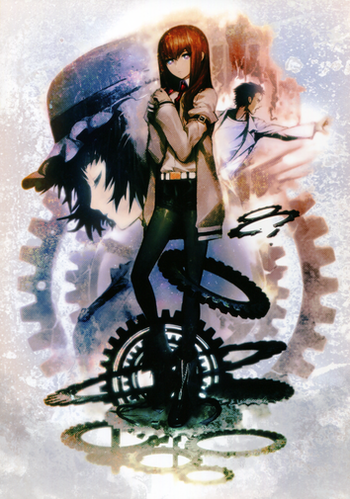
Stars too have a beginning, but are by their own power destroyed. —Finite.
History teaches us that those who hold wisdom are often the most foolish.
The fish in the sea know not the land. If they too hold wisdom, they too will be destroyed.
It is more ridiculous for Man to exceed light speed than for fish to live ashore.
This may also be called God's final ultimatum to those who rebel."
Being a Mad Scientist is awesome. Converting your microwave so that you can send e-mails to the past? Awesome. Being stalked by a secret organization doing their own Time Travel experiments and dead-set on capturing or eliminating you? Not so awesome.
Like many of his friends in the Akihabara district, Okabe Rintarou loves to tinker with different gadgets and inventions. However, he's taken this love so far as to declare himself a Mad Scientist who goes by the alias "Hououin Kyouma" and imagines himself fighting all manner of evil government conspiracies.
One fateful morning — July 28, 2010, to be precise — he and his ditzy childhood friend Shiina Mayuri are attending a lecture when they discover the dead body of Makise Kurisu, a celebrated researcher. As they flee the scene, Okabe sends a frantic text message to his Playful Hacker buddy Hashida "Daru" Itaru... and suddenly everyone around Okabe blinks out of existence, only to reappear a moment later.
Shortly thereafter, Okabe runs into a very-much-alive Kurisu, and Daru mentions a garbled text message he received one week earlier. Investigating further, the team of wannabe scientists discovers that by continuously modifying and upgrading their microwave, they've stumbled across the secret of Time Travel... or at least, the ability to send text messages back in time, which is a starting point, right?
Unfortunately, they're not the only ones interested in time travel. A shadowy French research organization called "SERN" has been running their own time-travel experiments, and after they catch wind of what Okabe has discovered, they begin to close in, sending in their agents, the Rounders, to acquire the machine. Soon, Okabe finds himself truly living his chuuni fantasy, and it is far worse than he could have ever imagined- he must evade the Rounders and their unknown leader, FB, while fixing his grave mistakes and finding a way to save those he loves from a universe that seems intent on killing them, no matter what.
The sequel to Chaos;Head and the second entry in the Science Adventure Series, Steins;Gate is set roughly one year after the events of the previous game. Instead of the "delusion trigger" system introduced in Chaos;Head, Steins;Gate uses the similar "phone trigger": whenever somebody calls Okabe, he can choose whether or not to answer. Text messages include blue hyperlinks that can be selected to reply to the text. The player's choices determine what sort of path the plot takes. Other than this though, Steins;Gate and Chaos;Head don't share any heavy direct connections, and the plot can be therefore easily be followed without having played Chaos;Head. (However, there are many references to Chaos;Head in terms of various character namedrops on what some of the cast from the previous game are up to during this time period, as well as a few recurring plot points and types of in universe fictional characters that are brought up in Steins;Gate, though these are likely to go completely over a blind readers' head.)
Two manga adaptations have begun: one by Sarachi Yomi is serialized in Monthly Comic Alive, while the other, by Kenji Mizuta, is printed in Monthly Comic Blade.
A 24-episode anime adaptation, animated by White Fox, aired starting in April 2011. Following the end of the anime's broadcast, a twenty-fifth episode was released straight to video and a theatrical film was announced. Funimation acquired the rights to the anime in 2011 and has dubbed it. The movie has also been acquired by Funimation .
.
Other tie-ins include the Epigraph of Closed Curve and Pandora of Eternal Recurrence light novels, which continue the story of the beta world line. These novels are accompanied by drama CDs.
A Gaiden Game called Steins;Gate: Linear Bounded Phenogram was released in April 2013 on the PS Vita. Unlike the first game, the sequel is told from the perspective of all the lab members. Linear Bounded Phenogram was eventually released internationally by Spike Chunsoft as part of their English release of Steins;Gate Elite on February 19, 2019.
A two-act stage play adaptation, Living ADV [Steins;Gate], ran from October 12 to 20, 2013, at the Zepp Diver City hall in Tokyo. While Act 1 is common across all runs, Act 2 varied by day (one VN ending per day); the full play (with the True Ending) can be watched with English subs here.
A full fan translation of the game exists, but much like the case was with Chaos;Head, the translators took down the patch when JAST expressed interest in localizing the game. While nothing came from the original agreement with Chaos;Head (the eventual localization of NOAH using a different translation entirely), JAST finally announced a US release for Steins;Gate at Anime Expo 2013, and it was released on March 31, 2014. This version is still available on JAST's website, though Spike Chunsoft published their own version on September 9, 2016.
Robotics;Notes, the sequel to Steins;Gate, was released on the Xbox 360 and PS3 in June 2012. An anime adaptation began airing in the noitaminA block in October of the same year.
Steins;Gate: Load Region of Déjà vu made its theatrical debut in Japan on April 2013 and takes place one year after the series. The DVD/Blu-Ray was released in December 2013.
A sequel Light Novel, titled Steins;Gate: The Committee of Antimatter, had been announced. It was scheduled for release in August of 2014, however, after several delays, in December of 2014, it was announced that the project had been abandoned.
A series of 4 anime shorts titled Steins;Gate: Soumei Eichi no Cognitive Computing* streamed on YouTube in October/November 2014, in collaboration with IBM Japan as a promotion of IBM's "Cognitive Computing" initiative.
On June 5th, 2015 in Europe and August 25, 2015 in America, PQube released JAST's English translation of the visual novel on PS3, Vita and iOS.
The "true sequel", Steins;Gate 0, launched in December 2015, and follows younger versions of the cast. The release of the game was preceded by a re-broadcast of the anime, which ended with a special recut of Episode 23, dubbed Episode 23 Beta, with an alternate ending that ties into the game.
After nearly nine years in Japan, a Gaiden Game titled Steins;Gate: My Darling's Embrace was released on Steam on December 10th, 2019. Unlike the rest of the series, it's a romcom that allows Rintaro to date any of the girls (and Luka).
Hack into the TROPES here:
- 13 Is Unlucky: The SERN raid on the lab and Mayuri's murder in the initial timeline occur on a Friday the 13th.
- 100% Completion: The achievements track how much of the story you've seen, how many CGs you've unlocked and whether or not you tracked down special conversations like uncovering Luka's history with his sister.
- Acceptable Breaks from Reality: It's admitted that time travel shouldn't be possible. Not only that, but the way it works in Steins;Gate (replacing memories such that no one can tell the past has changed) would prevent anything useful from being done with time travel. That, however, is boring, so Okabe gets to have the Reading Steiner.
- Accidental Pervert:
- When Okabe first discovers Kurisu is alive, he checks her for stab wounds. Around her chest.
- Okabe's attempt to confirm Luka's gender after making him a her by groping around the crotch area goes wrong when he winds up touching her vagina.
- After receiving a second threatening message, Okabe rushes to his apartment to see if Mayuri and Kurisu are OK. He hastily finds them unharmed, and unclothed, in the shower.
- Accidental Truth: In one email discussing the Gero-Froggies from the previous game, Okabe can reply by saying that the boom in their sales was a plot by the Organization. While this is just Okabe being his Chuunibyou self, he is correct in that the sale of Gero-Froggies was indeed engineered by a MegaCorp working for the Committee of 300, as anyone familiar with the previous game should know.
- Achievement System: There are a number of achievements in the story, ranging from completing chapters and reaching endings to gathering special emails or ignoring them altogether to doing weird things like messing up ten times when trying to dial the PhoneWave.
- Adaptation Distillation: The anime cuts out at least half of both Faris and Luka's arcs and simplifies the Moeka section of the story by cutting out a lot of elements that aren't directly related to the climax of the story. It also has a tendency to remove a lot of the science from the story. This means that being a recursive adaptation, Steins;Gate Elite is also guilty of this, as it follows the plot of the anime instead of the original visual novel. Plot elements that haven't already been adapted into the anime are Adapted Out entirely, though it zig-zags around in this case, as there are indeed new scenes animated and voiced just for the routes and their endings, which the anime glossed over.
- Adaptation Expansion: The anime adds a lot of additional scenes showcasing the characters' relationships outside of working on the Phonewave.
- Adaptation Induced Plothole: In the VN, hacking into SERN requires simply a Server Admin ID, with the IBN 5100 needed to hack a separate database. In the anime, the IBN 5100 is required to hack into SERN at all. Yet, when the world-line changes because the IBN 5100 goes missing, no one forgets what they saw in SERN's database, despite Ripple-Effect-Proof Memory otherwise being averted for everyone but Okabe.
- All There in the Manual:
- When watching the movie, some people who only had access to the anime wondered when Nae killed Moeka. It's a scene that only happens in the visual novel and was altered in the anime.
- In the side materials, it's mentioned that Okabe and Daru's taken course in college is engineering. It wasn't mentioned in either the anime or visual novel.
- Alternate Character Reading: Invoked with Okabe's name for the time machine e-mails, "Nostalgia Drive". It's written "time-travelling journey for nostalgia" (時を越えた郷愁への旅路). Similarly, "Shining Finger" is written as "Shiatsu Master of Flashing Lights" (閃光の指圧師). Of course, both of these are Lost in Translation.
- Alternate Timeline: Of an unconventional sort - world lines aren't ongoing continuities so much as they're potential continuities for a single world. Altering time is more akin to changing lanes or exiting a freeway than actually building a new one.
- And I Must Scream: Okabe's hopeless attempts to save Mayuri during the middle of the story. Having to watch his Childhood Friend die over and over, no matter what he tries to do, taxes him heavily. It gets so bad that even some of the other characters, such as Kurisu, Daru, and even Mayuri herself, suspect something is wrong when they know next to nothing about the events he's witnessed.
- The Anime of the Game: There's an anime adaptation of Steins;Gate.
- Another Dimension: Invoked but averted. There is apparently only one single timeline, but there are multiple paths it can take such as a world where you won the lottery or you didn't. Once you're on one path, the others fundamentally don't exist anymore and the world will still largely progress exactly as it would have otherwise. If you manage to make a truly critical change at a key point in time you can create fundamental changes the world, such as the noted ability to jump between the α from the β lines, but it's still fundamentally one single timeline. The other doesn't exist anymore.
- Arc Words: Subverted. Okabe loves throwing around the words "Steins Gate" and "El Psy Kongroo", but he himself admits that those words don't have any meaning whatsoever. At least until the ending, where "Steins Gate" refers to the perfect timeline, but both the present and future Okabe lampshade that the meaning is assigned. Ragnarok, Urd, and other Norse terminologies also deserve mention as he likes to name his various operations after them.
- Later on in chapter 7 when Okabe is dating Lukako as an agreement to delete her D-Mail, the related running gag is played a lot more seriously and takes on a whole new meaning.
- Artistic License – Biology: Although they didn't expect it to work, the lab team successfully turn Luka into a girl by telling his pregnant mother to eat lots of vegetables, under the reasoning that eating meat will infuse testosterone into the fetus. Physical sex is genetic and determined at conception, so this doesn't make any sense (Okabe himself is so baffled by it that he pulls a Crotch-Grab Sex Check on Luka), but in a series that deals extensively with the fallout of time travel, it's probably not so simple. It's probably worth noting that several disorders exist with males having two X chromosomes. Some of these are caused during or immediately after conception and as such could be subject to the butterfly effect. This perhaps makes the plot more believable, especially considering Lukako's feminine appearance.
- Artistic License – Geography: The real-life CERN is located on the border between France and Switzerland, but the closest airport is not in France, it is in Geneva. So if you want to go to CERN, you should fly to Switzerland. On the other hand, we were never given the exact location of the in-game SERN, it may be different. The flight that the Rounders took may well be not direct, which makes it somewhat pointless to observe the destination of the plane they took.
- Artistic License – Physics: Since the whole plot is built on the idea of time-traveling, this kinda goes without saying. Black holes inside the microwave oven? Yeah, why not. A special mention should be made for the "compress the digital data using the black hole" idea. Compressing data doesn't really have anything to do with physical "pressure", it's a purely mathematical procedure. Also, "streaming the digital data through the black hole" is impossible.
- Actually that middle part is incorrect. A black hole is the most informationally dense objects in the universe. Furthermore their surface records the full quantum information of any object that crosses the event horizon. A black hole the size of a proton would be able to hold the memories every every human thats ever lived much less one person. So yea that part they got right. The whole being able to do so with a microwave......
- Art Shift: In the anime, episode 11 turns for a moment in to a (fairly detailed) paper sketch.
- Attractive Bent-Gender: Lukako in the first few episodes before he uses the time machine to switch his gender. So much so that Okabe and Daru often make quips of how hot he is.
- Babies Ever After: Luka's ending in the visual novel ends up with this.
- Back from the Dead:
- The very first chapter has Kurisu, who Okabe saw murdered, somehow back to life and behaving as though nothing happened, and nobody else seems to remember her dying. It goes unexplained until the later chapters reveal that Okabe traveled to a world-line where, due to the Butterfly Effect, Kurisu was never murdered.
- Happens to Mayuri whenever Okabe goes back in time, though she inevitably ends up dying again so long as they remain in the Alpha worldline.
- Bad Future:
- The Alpha timeline, in which SERN successfully creates the time machine and uses it to create a dystopia under their rule and the Beta timeline in which Kurisu dies and World War III happens.
- The Gamma timeline (not present in the anime version) takes it a step further, as in this timeline, Okabe becomes a Rounder along with Moeka.
- Beat: Episode 25.
- Because Destiny Says So: Unless Okabe manages to change the attractor field, a significant person's death can never be changed. This also applies to his own death, as in both the Alpha and Beta timelines, he will not live past 2025. But on the flip side, this also means that he physically cannot die until 2025, which is the only reason he manages to survive the many deadly encounters he has with SERN without being killed instantly.
- Believing Their Own Lies: Okabe has descended into this heavily in the Dr.Jekyll Online chapter from Linear Bounded Phenogram, where he donned the Alpaca Man persona as a hero of justice to defend Akihabara from injustice and to right all wrongs. He did this to escape the grief of having Mayuri being deceased in 2010, where Okabe spent the whole year to delude himself as a hero of justice who will defend Akihabara (and Mayuri herself) from all criminal actions. It took practically everyone to get Okabe to wake himself up and accept Mayuri's passing.
- Belligerent Sexual Tension: Okabe and Kurisu spend most of their time bickering amiably.
- Be Yourself: Late in the story, after Okabe attempts to take Lukako out on a series of dates and follows advice from a dating manual on how to treat her, but fails spectacularly and makes her cry. He then time-leaps to redo the date with this in mind and thus decides to do the same thing with Lukako that they always did together, practicing with the Samidare sword; this date goes significantly better.
- Big Bad: The mysterious FB is the local leader of the Rounders, a private army employed by SERN to attack anyone who tries to expose their shady activities. FB is sent to spy on Okabe and his lab members with the intent of acquiring his time machine, which SERN aims to use to Take Over the World (and already has in a Bad Future). Many of the things Okabe has to deal with can be traced back to FB, including some of Mayuri's deaths and Nae going Ax-Crazy. It is eventually revealed that FB is Yuugo Tennouji/Mister Braun, Okabe's landlord. Once he is dealt with, the role shifts in the final two chapters to Dr Nakabachi/Shouichi Makise, Kurisu's father and killer who wants to steal her time travel research, which leads to another Bad Future- World War III. To save humanity, Okabe must save Kurisu from him.
- Big Damn Heroes: At the end of Chapter 5, just when SERN is about to capture the group, Suzuha saves them and asks Okabe to time leap.
- Big Fancy House: Played with considering Faris's living quarters. It's not necessarily big, but it's a lavish living space on the top floor of an expensive building that reveals just how rich Faris is.
- Bishie Sparkle: Luka. (But he's a guy.)
- Bittersweet Ending: In all the character endings, a Bad Future is in store for the world no matter which timeline it is. On a personal level, however, the situation is still something of a mixed bag for everyone.
- In Suzuha's ending she and Okabe journey together into the past, where they might get brain damage and will never see their friends again. Within the game it's unclear what effect this will have on divergence, but
 Word of God later established they succeed in setting things right. Nonetheless, Okabe leaves all his other friends behind and is trapped in the 1970s.
 - In Faris' ending, Okabe loses all his friends except Faris. On the bright side, he does have Faris and Mayuri will live. Somehow.
- In Luka's ending, she and Okabe are happy together, but Mayuri is dead. The group stays together. But this does have a divergence number that leads to SERN ruling the world, so it's more of a downer ending.
- In Mayuri's ending, Kurisu dies and a lot of Okabe's relationships are lost. This also has a divergence number that leads to a worldline where World War III happens, so it's more of a downer ending.
- In Suzuha's ending she and Okabe journey together into the past, where they might get brain damage and will never see their friends again. Within the game it's unclear what effect this will have on divergence, but
- Bland-Name Product:
- SERN and IBN play an important part in the plot. However, there's also Deluoode, MewTube, CLADANDAN, KBA84, Comima and "Wiki Wiki" for The Other Wiki.
- Zig-Zagged with Dr. Pepper. In the visual novel, it's pronounced as Dr. Pepper but the CG used displays it as "Dr. People" and the official English translation uses Dr. P, while the anime has "Dk. Pepper" instead.
- Also Zig-Zagged with 5pb. (the game's developer and the publisher for the console versions). You can find posters of their games, but one of the cardboard in the lab has 7pb. instead.
- Akihabara UDX becomes UPX in the game.
- UNIQLO also appears in the anime, but the bottom half of the logo blocked out.
- There are also electronic bland-names like Somv among others.
- There is also a fleeting shot of Prangles (Pringles, with the mascot mustache guy smoking a pipe).
- The scientific journal Science becomes Sciency instead.
- The forum website @channel is modeled after the Japanese forum website 2ch.
- Some aversions also exist; see Product Placement.
- "Blind Idiot" Translation: The fake Future Gadget lab website, accessible through Okabe's phone, had its own English page made for the official release. Since Okabe and Daru suck at English, the page is written like it was run through a machine translator, leaving it mostly incomprehensible.
- A Bloody Mess: Subverted. Okabe originally intends to use the red liquid inside a glow-in-the-dark lightsaber toy as part of his plan to fool his past self into thinking Kurisu's dead, but upon discovering that it's dried up and useless, he provokes Dr. Nakabachi into stabbing him so that he can use his own, genuine blood instead.
- Book Ends: The story starts and ends with Okabe finding Kurisu's body and believing she is dead, which leads to the beginning of his time traveling quest.
- Boom, Headshot!: Several characters suffer this fate. Mayuri in episode 12, and later Yuugo does this to himself in episode 20.
- Break Out the Museum Piece: The IBN 5100 (first release September 1975 IRL).
- Brick Joke: The movie revolves around the idea that "deja vu" is a result of another timeline interfering with the current one, and that remembering these memories is an indication that something happened from said timeline. Remembering too many of these timelines will force the person out of said timeline and into nothingness. Of course, the movie also likes to throw some gags in the movie itself, such as Kurisu thinking and reminding herself that Luka is a guy and Suzuha wearing Daru's hat.
- Broken Bird: Kurisu, Suzuha and Moeka. Mayuri was originally this.
- Broken Pedestal: Dr. Nakabachi is Makise Kurisu's father, and she does everything in her power to impress him and rebuild their damaged father-daughter relationship; she even offers him a co-writer credit on a paper on how to construct a time machine, and he repays the favor by beating her and stealing the paper for himself.
- But Thou Must!: Most calls or texts can be ignored at will, but there are certain points where Okabe has to take some sort of action.
- Butterfly of Doom: Multiple examples. At times, the things that randomly stay the same are even more bewildering than the things that randomly change;
- If you change Luka from a boy to a girl nothing changes regarding personality, appearance or relationships, but Luka admits to Okabe that they broke the IBN 5100 by accident while sweeping a storehouse. In the timelines where Luka was born a guy, Luka instead sweeps the shrine and the IBN is spared.
- In Faris' ending saving both her father and keeping Akiba the same somehow results in Okabe not knowing any of the people he's friends with. Not even Mayuri.
- Butt-Monkey: Okabe. Almost none of the cast takes him seriously during the first half of the story because of his behavior.
- Call-Back: Episode 25 is full of callbacks but they're a lot more noticeable if you read the visual novel:
- The choice of Los Angeles as a setting was because Kurisu used it in an example involving wormholes and Okabe's overreaction to the motel was a callback to him teasing Kurisu staying at a hotel.
- Okabe getting arrested was a reference to how trigger-happy he thinks American police are.
- Lukako being popular at a cosplay event was a call back from a comment by Mayuri about his appeal.
- That dude who was selling brooches in Japan is in fact also a taxi driver in LA.
- And another one which is much relevant to the plot, see Love Confession below.
- Call-Forward: The opening narration from Okabe tells the reader about the disastrous results of his failure to consider the potential consequences of his actions, apparently causing someone's death. It seems to be a message or journal entry from the future Okabe of the original Beta line reacting to the events of the plot after the Kurisu ending, hinting at the downer ending the reader is coming to. Of course, from this point forward he develops a time machine and sends Suzuha back to fix the past.
- Calling Your Attacks: Most of the main characters are anime, manga and moe junkies, but Okabe and Faris take it to the next level. As a result, they role-play in some of the more comedic scenes of the anime, which usually involves them revealing that they've learned a secret technique or two while punching the air or doing some dramatic motion.
- The Cameo:
- Takumi is briefly mentioned by his pseudonym Knighthart looking for IBN 5100. He has no involvement in the story, however.
- A huge TV airing FES's performance in Alpha timeline. Giving the right reply to Faris's mail earns the player Ayase's portrait and FES's music. Even Seira-tan appears
- Some of the characters from Steins;Gate have also found themselves in other media. Kurisu appears as a character spell in Hyperdimension Neptunia mk2; Mayuri also makes an appearance as a summon. Kurisu's also a character in Phantom Breaker, as well as in Nendoroid Generation.
- Posters of other 5pb. and nitro+ works occasionally appear in various locations. Additionally one of the computer shops bears the name 'Nitro+' in an alpha worldline, there is also a 'Nitro+' magazine.
- Can't You Read the Sign?: Okabe repeatedly uses his cellphone in a cafe while sitting in front of a "No Cellphones" sign.
- Cerebus Callback: There's an early running gag about how Luka is incredibly feminine despite being a guy. About two thirds of the way through the story, it's not funny anymore when not only was Luka finally given a chance to be a girl, but then she has to return. A clearly depressed Okabe repeats the lines in his head.
- Cerebus Syndrome: Cerebus strikes in the middle of nowhere during the 13th when Moeka breaks in and kills Mayuri, sending the second half of the story into action.
- Character Catchphrase:
- Mayuri's "Tuturu~" whenever she greets someone.
- Okabe always ends off every Chuuni phonecall he gets with the words, "El Psy Kongroo."
- Character-Magnetic Team: Most of the cast wind up as lab members once the time travel experiments begin.
- Invoked, even, when it's explained later on that at first, Okabe started the lab specifically to meet new people—mission accomplished there.
- Even when in the Steins;Gate timeline where time travel doesn't exist, therefore there being no reason for the lab members to come together the lab members still become friends, partially because Okabe deliberately seeks them out to reestablish his connections with them, and seemingly partially because their latent Reading Steiner abilities makes them aware of their relationship to each other and Okabe on a subconscious level.
- Cheaters Never Prosper: Averted during Faris' arc. She loses a Rainet match because her opponents used distraction techniques from the audience. Faris is debatably cheating herself, though, given that she genuinely has the ability to read people's emotions or tell when they're lying.
- Chekhov's Gun:
- The Metal Oopa that Mayuri received from Okabe in the first chapter was revealed in the True Ending to be Doctor Nakabachi's reason as to why he was stopped at the metal detector before boarding a plane to Russia, ending up having to hand carry Kurisu's time travel thesis instead of it burning up together with his luggage in the cargo hold. Thus, ending up as one of the sparks that starts World War III in the beta world line.
- The static mail that Okabe receives in chapter 1 is actually a mail from his future self, telling him how to solve the unsolvable situation and save Kurisu.
- Those wacky inventions Okabe and Daru made end up saving their lives. For instance, the Bit Particle Gun and the Moad Snake. Subverted with the Cyalume Saber; everyone thought it would be useful at a critical moment near the end, but it ends up being worthless.
- When the plot gets going, Okabe quickly forgets the important fact that in the world where Kurisu was killed, the 'satellite' time machine was on the roof but otherwise the same. Meaning Suzuha was in that world too. And who is Suzuha? John Titor. What did John Titor say would happen in the future? An apocalyptic world that leaves 2036 a radioactive wasteland. Not a bit of this is addressed until the true ending starts up, which doesn't start until after the credits roll after getting the ending that takes the longest to get.
- Chekhov's Gunman: Mister Braun is a SERN agent and Moeka's superior and contact. In the anime, when uncovered, he shoots himself and Moeka to keep Nae safe.
- Chick Magnet:
- Okabe, depending if you view Mayuri's, Luka's and Faris' feelings towards him as romantic. Overtly the case in the game where each of the aforementioned characters has a romantic ending. Suzuha's ending's more ambiguous but leaves the option open as well. The drama CD even adds Moeka to the mix.
- Lampshaded in Chapter 8, where Faris first guesses Okabe's date is Mayuri and then Kurisu (rather than Luka) before making light of his improbable attractiveness.Faris: Then some other girl, nya? Kyouma, you tomcat, you're making moves on too many girls, nya.
- In 0, the sequel, It's confirmed that Mayuri has always loved Okabe ever since he helped her cope with her grandmother's death.
- Chuunibyou: Rintarou is a self-proclaimed mad scientist and villain, and will often partake in strange mannerisms such as talking to himself via cell phone and laughing maniacally in order to keep up this persona.And while it's all in his head and he is forced to end his antics in the face of his trauma, returning to his Kyoma Hououin persona is the only way he finds the courage to do the impossible and save the world. His embarassing Chuunibyou antics end up being his greatest strength.
- Close-Enough Timeline: The Faris ending results in a world line where Okabe knows none of his friends besides Faris and the Future Gadget Lab (and thus time machine) never came into being. However, after he confirms that Mayuri does not die in this worldline, he decides that he's willing to accept this.
- Combat Pragmatist: No matter what he's doing, if there's an opportunity to cheat somehow, Okabe will take it.
- Commonality Connection: First came the lab coat. Then came Dr. Pepper and 2chan memes. By the halfway mark, Okabe and Kurisu are practically Birds of a Feather who don't get along only because they also share the trait of major tsundere-ness. Both of them, on different timelines, even feel up Luka to ascertain his/her real gender.
- Companion Cube: Daru has a crush on the LHC - or, as he calls it, "Large Hadron Collider-tan".Daru: It's seriously moe. Recommended.
- Conspiracy Thriller: There is a reason no one has ever developed time travel. An organization will exploit it for their own evil ends and kill anyone involved.
- Continuity Nod: Steins;Gate is officially a sequel to Chaos;Head, but the stories are almost completely unconnected. However, references are made to the ugly frog straps and even Takumi himself through his online avatar.
- Cosplay Café: Mayuri and Faris both work at a maid cafe, which Faris has really embraced.
- Covert Group with Mundane Front: Who would have thought the European Organization for Nuclear Research was run by The Illuminati and the Committee of 300? ... Well, besides Okabe, we mean.
- Cow Tools: There's a lot of junk lying around both literally and metaphorically. For example, the eight Future Gadgets aren't all used and are generally kind of useless and the plot overviews for RaiNet never amount to anything either. There are some things you need to pay attention to and a lot that you don't.
- Crazy-Prepared: Daru, who, for whatever reason, keeps a tub of apricot puree in the Future Gadget Lab's fridge just in case he gets a girlfriend who visits the lab and wants to cook. Kurisu then briefly lampshades how unlikely this scenario would occur.
- Crotch-Grab Sex Check: Luka is a girl?! Thanks a lot Okabe!! You made a dick move to confirm it in front of everyone and Kurisu slams your head with a book she's reading to tear in you for doing so.
- The Cuckoolander Was Right: Besides the obvious example of there actually being a world-shattering conspiracy behind the scenes, Okabe manages to guess/joke about a lot of stuff early.
- For instance, Moeka's superior, FB, turns out to be Tenouji, under the pseudonym of Ferdinand Braun. What does Okabe call Tenouji? Mr. Braun.
- In chapter 4 on the 6th of August, if Okabe sees Kurisu crying outside the retro TV store while also arguing with someone on her phone, he thinks that it could be her father whom she hasn't seen in seven years; He was right.
- Cut His Heart Out with a Spoon:Kurisu: One more word and I'll make your neocortex into a flowerpot!
Okabe: What kind of threat is that?! - Cyberpunk: It deals with cyberpunk themes.
- Cyberpunk Is Techno: The game's soundtrack is mostly techno.
- Death Is Cheap: Whenever Mayuri dies, Okabe time leaps back to several hours or days ago before her death.
- Lampshaded and deconstructed when Okabe wants to keep time-leaping to try and Take a Third Option to avoid having to let Kurisu be killed; when she says that seeing Mayuri die so many times will destroy him, he notes that he's already gone numb to the experience. Possibly subverted, though, since Kurisu at least doesn't believe he could still have a heart and not feel anything at all at the sight; thus, she calls him out on it.
- Deconstructed Trope:
- Okabe's Ripple-Effect-Proof Memory lets him accomplish things with time travel no one else can, but can also prove to be a huge liability since he has very limited means to figure out how things are different. Even worse, altering the present too significantly starts to seriously alienate him as his surroundings and even his friends shift from what he knew in ways he can't comprehend. Mayuri even states such a fate (without realizing it's this way for Okabe)—slowly and constantly separating from your friends as you know them—sounds horrible.
- The latter half of the series deconstructs Set Right What Once Went Wrong by showing that undoing the alterations caused by time travel may reverse the bad things they caused, but it also negates all the good things, forcing you to let go of the gifts you got from time travel. And even if you go through all the trouble of reversing one disaster, that doesn't mean that others can't happen...
- Decon-Recon Switch: ... but the True Ending makes a point that if you're smart about it you can Screw Destiny and avoid both without just causing something different but equally horrible.
- Being a mad scientist fighting a global conspiracy turns out to be far less enjoyable and far more traumatizing than it was in Okarin's Chuunibyou fantasies. Having to be in hiding 24/7 while being paranoid because the enemy can strike and kill your loved ones anytime, and can be hiding anywhere, even among your friends, all while no one believes you, can actually drive someone insane, and Okarin finds it increasingly harder to keep his mental state together. Even his stated goal to create a world of chaos (which is mainly part of his chunni persona) gets a dose of reality when he ends up succeeding... because he inadvertently caused World War III, which indeed threw the world into chaos. As Kurisu puts it:
SERN, the Committee of 300, Rounders... We were living in a nightmare straight out of one of Okabe’s chuunibyou delusions. But this is reality, as the despair in front of us can attest to. - Design Student's Orgasm: The anime's opening credits sequence.
- Despair Event Horizon: Suzuha upon failing her mission to retrieve the IBN 5100 after losing her memory by using her fixed time-machine.
- Determinator: Witnessing Mayuri's death multiple times is not enough to shatter Okabe's hope to save her. He actually nearly loses it for real after realizing he killed Kurisu accidentally in the Beta world line, though a video from his future self eventually returned his determination to set things right once and for all.
- Deus Angst Machina: Because Destiny Says So, Mayuri will always die, no matter how unrealistic the circumstances are.
- Didn't Think This Through: You'd think that Okabe would want to keep the discovery of time travel as secret as possible. After all, his persona as Hououin Kyouma is all about a mad scientist outwitting a secret organization. You'd think he'd be a little more savvy, if not paranoid. Yet he has loud conversations next to the lab's windows, which also provide a nice view of the inside of the room. He lets Moeka into the lab, despite the odd behaviour and obvious fixation on the IBN 5100. He sends several d-mails without ever considering the consequences until it's too late. This is especially egregious with Faris's d-mail, which Okabe didn't learn for the sake of Faris's privacy, and rewrote the history and structure of Akihabara. It also doesn't occur to him until it's too late that someone else might be able to detect their experiments. Once he realizes that they're being watched, he doesn't immediately tell the others or take the machine apart. Also, Okabe decides to go public with their discovery, which is absolutely the the last thing you should do if you have time travel technology. When Okabe angrily confronts Moeka about their encounter, she flatly spells everything out for him.
- Died in Your Arms Tonight: Mayuri, in Okabe's arms, every time her death isn't instantaneous. Mayuri's later description of her recollection of these deaths implies that (from her perspective) this is how her death always plays out.
- Disappeared Dad:
- Faris's father, who died in a plane crash. This makes her use D-mail to save her father and causes Akihabara to become well-known for electrical appliances instead of otaku culture. In addition, her father saved her from a kidnapping incident by selling his IBN 5100 to SERN in the past.
- Also, the fate that befalls Nae after her father's suicide.
- The Ditz: Mayuri, who can suddenly stop at a place doing Stardust Handshake, much to the dismay of Okabe.
- Does This Remind You of Anything?: In episode 19, taken out of context, the brawl Okabe has with Moeka looks very much like rape in progress. In the VN, she outright tries to take advantage of this by calling rape (only to be ignored).
- The Dog Was the Mastermind: The identity of FB turns out to be none other than Okabe's beleaguered landlord Mr. Braun.
- Downer Ending: In the Visual Novel, Kurisu's ending is the same as Mayuri's, except now Okabe is going to be a miserable wreck since he sacrificed the woman he loved. Furthermore, this timeline has the worse of the two potential bad futures: Nuclear holocaust. Fortunately, the True Ending follows up on this and makes it better.
- Dreaming of Times Gone By: It is revealed later on that Mayuri is on some level aware of her many deaths, through various dreams of her own demise (by gunshot, falling on the train tracks, being run down by a car), which always end with Okabe holding her and apologizing. Similarly, when Okabe finally tells Kurisu she will die if they return to the Beta timeline, she reveals she already knew; she has faded, barely-there memories of that timeline.
- Driven to Suicide:
- Suzuha, after she travels to 1975 using the time machine fixed by Daru, having lost her memories then recovering them 25 years later.
- Several characters go through this actually. Moeka hangs herself in one timeline and Mr. Braun shoots himself in another. Even Okabe tries to kill himself at one point while trying to save Mayuri.
- Dude Looks Like a Lady: Lukako in any of the timelines where he is actually male. He looks and sounds so much like a woman that Kurisu at first thought he was until she attempted to feel for breasts and came up empty-handed. (Eh? Eh?)
- Dystopia: SERN's One World Order in 2036 is the epitome of one. John Titor describes it as a global and oligarchic totalitarian regime with 19th-century living standards where SERN has near absolute control of all scientific research, technology, and knowledge.
- Earn Your Happy Ending:
- Okabe really puts himself through the wringer, but the Golden Ending is ultimately a happy one. Even though no one remembers anything that happened except for Okabe, everyone is alive and well, the Bad Future is averted, Okabe reassembles the lab members, and Kurisu manages to reunite with Okabe and they start their relationship over again. It is also implied that since all people actually have the ability of "Reading Steiner" (Okabe just has a much more advanced form of it) they could eventually end up remembering the sacrifices he went through over the worldlines.
- In the movie, Kurisu suffers the same trials Okabe put himself through, but she ultimately saves him from fading from existence and the two renew their love.
- Easter Egg:
- If you send an email to the address sg-epk@jtk93.x29.jp (aka future Okabe of the beta world line), you will receive a fake error message indicating that the address does not exist on this current world line as well as the same string of hex code originally sent to Okabe.
- During the installation of the PC version of the game, the window will state "Calculating worldline divergence..." above the progress bar.
- Elephant in the Living Room: After the halfway point in the story, Okabe eventually realizes that he needs to undo all the timeline changes he made. Though stressful, he succeeds along this path, occasionally remembering that the first and most important mail was the one where he said Kurisu died. Out of a mixture of stress and not wanting to think about it, he avoids realizing this until it's the last thing that needs to be done.
- The Empire: Alpha timeline SERN in the future.
- Everyone Can See It: Okabe and Kurisu have so much Belligerent Sexual Tension that even Moeka can pick up on it. From Funimation's dub:
- Everything Trying to Kill You: You are fated to die when the world says so, no time traveling can change that. If the world doesn't want you dead at that moment, you will never die, no matter what.
- Expanded Universe: Has a quite large one, which consists of Drama CDs, novels, manga, etc. Most of them usually tell about the events that happened in other worldlines, character backstories, and alternate retellings.
- Explain, Explain... Oh, Crap!: While Okabe is rejoicing that he's reached a world where the team has the IBN 5100 he explains that all they have to do is deal with the first message sent, only to realize that was the one that would stop from Kurisu from dying. He doesn't take it well.
- Fake Band: Phantasm from the previous game makes a few cameos.
- Fake-Out Make-Out: Okabe does this to Moeka when a neighbor comes to see what the source is of all the racket caused by their struggle, and gets bitten for his efforts. Luckily for him, the neighbor failed the spot check for the resulting spectacle ends up looking less like a make-out and more like rape in progress.
- Faking the Dead: How Okabe ultimately saves both Mayuri and Kurisu.
- Forced to Watch: Okabe watches helplessly as his good friend is shot by intruders, hit by a car, and run over by a train in the space of about six hours. And it gets much worse.
- First-Name Basis:
- Okabe to Kurisu. This specific instance occurs several times, actually, because Okabe continuously reverses the event due to his self-imposed "Groundhog Day" Loop.
- Faris asks Okabe to call her by her real name after he saves her from some kidnappers.
- Foreshadowing:
- At the beginning of the prologue/episode 1, as Kurisu drags Okabe out of the conference room, Dr. Nakabachi gives a resentful glance at Okabe for being called out on his plagiarism- but then glares at Kurisu as well, for some reason. When Okabe is back in the Beta worldline at the end to save her from her fated death, Nakabachi is revealed to be Kurisu's father, Shouichi Makise, and her killer, who hates her for being more intelligent than he is.
- Kurisu gets rather wistful when seeing how much Luka's father cares about him. Her own daddy issues come up about a week later; her father, Nakabachi/Shouichi, became jealous and distant when she became better than him at physics during elementary school.
- A lot of what Suzuha says to Okabe in the early chapters/episodes may sound odd at first, but takes on a new meaning when she is revealed as a time-traveler from the future.
- Early on, Suzuha tells Okabe that the IBN 5100 has a hidden function, to which Okabe notes that John Titor (from 2000) said the same thing- an early hint that they are the same person.
- In one of their first meetings, Okabe tells Kurisu about his memories of the Nakabachi presentation that do not line up with everyone else. One of the things Kurisu asks him is if he was the one who stabbed her. Okabe denies it, not knowing it was his future self who accidentally stabbed her.
- Early on, Okabe marvels at how convenient the IBN 5100 was to acquire, despite everyone else looking so hard for it. Suzuha arranged things for him over thirty years ago based on what she knew of how they got it in the first place.
- From the beginning, Okabe has always been very protective of Mayuri and worried about her safety, but in one early instance, he actually tackles her out of the way of the sparking PhoneWave, putting himself in the middle. It mirrors Mayuri tackling him out of the way of a car in a later episode.
- Kurisu warns Okabe that he's pushing himself too hard with the time leaps - if it isn't safe, he could end up erasing himself from existence. This is exactly what she has to fight in The Movie after his memories of past timelines prove to be too much strain.
- In the visual novel, the scream that Okabe hears during the prologue sounds like his own voice. It belongs to his future self, having just (accidentally) killed Kurisu.
- A forum poster asks Titor to lend his time machine so the poster can save their mother from dying. This foreshadows the journey that Okabe takes across time trying to save Mayuri.
- Another poster comments that John Titor is obviously an alias. It is- Suzuha Amane is Titor's real name.
- Okabe brings up the post about World War III that the original Titor posted, and Titor asks if it was a Titor from another timeline that said that. It is, and stopping the war becomes the goal of the final chapter.
- There are some points where Kurisu, a scientist with little tolerance for Okabe and Daru's interests, seems to accidentally display knowledge of the Internet culture only to retract it afterward. At one point, Daru is in the middle of making a Jojos Bizarre Adventure reference ('That's why we love you! That's why we admire you!'), Kurisu interrupts by saying 'I certainly don't admire him', to which the others are stunned. In the anime dub, Kurisu displays knowledge of fanfiction jargon by explicitly denying the idea that she and Okabe are
 OTP. This hints that Kurisu is a @channeler (specifically, KuriGohanAndKamehameha).
 - There are a few hints towards FB being Yuugo Tennouji/Mister Braun:
- Early on, Okabe mentions that Yuugo sometimes leaves during business hours. He claims it is to see his beloved daughter, but it is also likely he took the time to communicate with his superiors at SERN.
- It is eventually revealed that the lab building, which is owned by Yuugo, has a direct line to SERN, something that could not have been constructed quickly.
- Whenever the Rounders break into the lab, Yuugo never seems to bother trying to stop them, even though they have to go through him to get to the lab, and he is buff enough to stop them. While initially it could be chalked up to the store being closed, it becomes clear that he has no need to stop them, as he is their boss.
- In the Dr. Jekyll Online route from Linear Bounded Phenogram, Okabe and Kurisu haven't met each other for about a year after they met for the first time, while Okabe seemed to take the persona of Alpaca Man within that one year frame. It turns out that since this is the Alpha world line, Mayuri was fated to die in August 2010, and Okabe, deluding himself that Mayuri never perished in the first place, took on the Alpaca Man persona to distract himself from the immense grief caused by her death. And after the lab members were taken hostage by Rounders in 2010, Okabe and Kurisu hasn't contacted each other after SERN let them go.
- Like the above in Dr. Jekyll Online, If you compare the date on Okabe's phone in this route to the main VN's date on Okabe's phone too, there's a discrepancy with the day of the week as it's revealed that it's set in 2011. Mayuri's whereabouts are also hinted when Luka messages to Okabe about Mayuri's favorite food for Obon,note which he can have the option of replying with different answers.
- For Want Of A Nail: Okabe finally prevents World War III in the future of the beta line by stealing the "Metal Oopa" toy. If he hadn't done this, Mayuri would have gotten it and lost it, Kurisu would have picked it up, and then her father would have ended up with it when he ran off with her paper on time travel, triggering the metal detector at the airport, making him miss his flight, preventing the paper from being lost in a plane accident. Instead, Mayuri gets a non-metal Oopa, which doesn't set off the metal detector, and the paper is destroyed.
- Four Is Death:
- Stage 4 of SERN's Z-Program involves human experiments.Experiment Result: Human is dead, mismatch.
- Mayuri's family name is Shiinanote though not written with the kanji for four. You can figure out the rest. Also, Kurisu is lab member number 004.
- Stage 4 of SERN's Z-Program involves human experiments.
- Fourth Wall Psych: The first real chapter opens Okabe with his face pressed up against the screen, sneering at the other side of the monitor and proclaiming that he is the real one no matter what the observer thinks. He's actually talking to a piece of supposedly interactive software that won't react for some reason.
- Full-Name Basis: Suzuha of Alpha attractor field, with a few exceptions, calls people by their full name.
- Fun with Subtitles: When Okabe doesn't know a character's name, Okabe gives them a dialogue subtitle that gradually gets longer and longer as the scene goes on. For example, one RaiNet player goes from being "???" to the "Man with a Bald Spot Who Seems to Whisper to Gaia to Shine More".
- G.I.R.L.:
- The true identity of the mysterious FB is none other than Mr. Braun, who fakes being a mother figure for Moeka because that's what would buy her loyalty.
- Also invoked by name in one of the RaiNet anime episode summaries.
- Gainax Ending: The movie, in the sense that it makes everything else have entirely different meanings. "Hououin Kyouma" was based on the Bad Future of Okabe that Suzuha was trying to prevent. This was taught by present Kurisu to a younger Okabe after the previous timeline had Retgoned older Okabe, making Kurisu the technical creator of "Hououin Kyouma" and, to an extent, older Okabe.
- Gameplay and Story Segregation: In the part where Okabe is hiding from someone and is exposed by his phone going off, setting the ringtone to silent doesn't stop them from hearing it and finding him.
- Gamer Chick: Mayuri and Faris.
- Geek Physiques: Okabe is skinny. Daru, on the other hand, is extremely fat.
- Genius Ditz: Mayuri's not dumb, but she doesn't have a background in science like the other lab mems. She's, though, definitely ditzy: speaks in a cutesy third-person, gets lost easily, and stops in the middle of the street to do her Stardust Handshake. She's, however, incredibly good at reading people, and the times she does bother to intervene in the conversation she tends to be spot on with her thoughts (for example, when she easily batdeduced the identity of Suzuha's father when everybody was drawing a blank).
- Get A Hold Of Yourself Man: Done by Kurisu in chapter 6, and Mayuri and his future self's D-movie in chapter 11.
- The Glomp: Mayuri does that to Kurisu, burying her head in Kurisu's boobs in the process, much to Kurisu's embarrassment.
- Go Back to the Source: In order to Set Right What Once Went Wrong, Okabe has to go and find a nonlethal way to replicate the murder of Kurisu he first witnessed.
- Golden Ending: The True Ending where Mayuri and Kurisu both live, the time machine is not built, the SERN Bad Future is averted, and the entire group stays together.
- Got Me Doing It: At one point, when Okabe is trying to talk to Luka:”Umm, you said you have something to talk about, nya?” I’m trying to be gentle, but for some reason, I wind up talking like Faris.
- Government Conspiracy: After Daru hacks into SERN's documents, it becomes apparent that it is really just a subsidary backed by The Committee of 300 with a public front and they operate worldwide.
- Gratuitous English: All over the place, especially in Episode 25, when Okabe takes this even further.
- Gratuitous German: Every now and then, because of Okabe's fascination with Nordic mythology. The series' title, for starters.
- The Greatest Story Never Told: Only Okabe can remember the alternate timelines and what he's done. Maybe...
- Grief-Induced Split: The Time Travel basis of Steins;Gate causes an odd variant. After witnessing the repeated death of Mayuri, Rintaro is faced with a Sadistic Choice: Either he successfully saves Mayuri at the cost of Kurisu's life, or he gets to be with his dream girl but loses his best friend. When Kurisu hears of this, she insists Rintaro save Mayuri instead, accepting their split and her death in order to save Rintaro from suffering further trauma from Mayuri's deaths.
- "Groundhog Day" Loop:
- Okabe invokes this trope on himself to Set Right What Once Went Wrong using Time Leap Machine. In Suzuha's route, he refuses to erase Suzuha's memory with the group, using Time Leap Machine to trap himself in a continuous loop between August 11 to August 13 before Mayuri dies. His heart almost dies before Suzuha saves him and asks him to time travel with her.
- In A-4 world where Moeka successfully stole the IBN 5100 from the shrine it comes up again with a nastier though only implied example. The Time Leap machine was captured in 2010 and Nae joined SERN. In 2025, she captures and tortures Okabe to death and then uses the Time Leap machine to jump back to 2010 and murder Moeka. With nothing else to live for but unable to die, Okabe suspects she's just going to do it over and over again until she goes completely mad.
- Guide Dang It!: Good luck getting the True Ending without a walkthrough, thanks to the phone trigger system. The choices aren't really intuitive, so the official English release does provide a guide for not just all the endings but also all the achievements.
- Happy Ending: The True Ending has Okabe manage to save Mayuri and Kurisu, avert both bad futures and keep hold of all the relationships he made, though they've all suffered minor setbacks. At first, it seems it might have the bittersweet factor of never seeing Kurisu again but in the end she manages to find him and they reunite which Kurisu having some very vague memories of Okabe, hinting they'll get together. Luka and Faris get to be closer to the group like they wished and Moeka is finally finding some grounding for her life. Finally, the ending special for the anime confirms the Maybe Ever After and introduces Yuki, Amane's mother along with some awfully convenient fortune-telling.
- He Knows Too Much: SERN is trying to silence Okabe and lab members for inventing the time-machine.
- Heroic BSoD: Okabe, when he lost all his ways to save Mayuri and upon discovering that he is the one who stabbed Kurisu. In Episode 23 Beta, this escalates into full-on PTSD as he comes to terms with his murder of Kurisu. He even sheds his lab coat and dons a black outfit he once wore in his school days.
- Heroic Sacrifice:
- Kurisu decides to sacrifice herself so Mayuri can survive. It doesn't help.
- The Okabe from the alpha timeline was at least ready to do this (to fake Kurisu's death and to deceive the beta timeline Okabe), Suzuha saved him, though.
- Hollywood Hacking: Daru hacks SERN in 2 days. And this is the organization that invented The Internet.
- Somewhat Justified When Daru was hacking into the SERN in episode 14, he mentions that SERN ports were already open as SERN had been watching the group since the first D-Mail was sent. It's somewhat justified that he would be able to hack into a system quickly that already has it's doors open into Daru's computer in the first place.
- Hollywood Silencer: Suzuha's gun is very quiet. Then again, it's likely from the future.
- Justified and explained in 0: The pistol has a sawed-off nose and uses .32 mm rounds, which makes it very quiet and not as deadly as a 9mm handgun.
- Homemade Inventions: It's a time machine made from microwave and operated by a cell phone.
- Hope Spot: Okabe initially believes that additional divergence caused by Suzuha's trip to 1975 would subvert Mayuri's murder. Nope. Also really the only justification for him to keep time looping back to before Mayuri's death. The audience is spared seeing all of the repetitions, but he goes through dozens of hope spots back-to-back over the course of the series. Poor guy.
- Hourglass Plot/Perspective Flip: The Movie is this. Okabe is the one in trouble, and Kurisu is the one who needs to save him.
- Hypocritical Humor:
- Okabe and Kurisu spend a great deal of time mocking each other for being scrawny, nerdy virgins - naturally ignoring their own scrawny, nerdy virgin-hood.
- Okabe's encounter with 4℃ has him mocking the latter's cringeworthy and arrogant delusions of grandeur - this from the mind behind Hououin Kyouma.
- I Didn't Tell You Because You'd Be Unhappy: There is no good way to tell your best friend that they're going to die within hours and you've personally witnessed it countless times in your attempts to prevent it. So Okabe doesn't.
- I Resemble That Remark!Kurisu: I'm not a tsundere!
- If It's You, It's Okay: As far as Daru is concerned, Luka's just as ripe for Yuri Fan fantasies as any of his other non-Okabe friends, actual sex be damned.Daru: It's gettin' pretty yuri in there.
Okabe: Lukako's a guy.
Daru: That makes it even better. - The Illuminati: The group pulling SERN's strings are referred to as "The Committee of 300" in their documents. While that's the extent of The Committee's appearance in Steins;Gate, playing other Science Adventure Series entires shows overlap between SERN's actions in the Bad Future, namely reducing human population to 1 billion and subjugating them to slavery for the sake of False Utopia and The Committee's other puppets.
- I'm Having Soul Pains: In the sequel movie, Okarin's time travel blitzing leads to some unexpected side effects - all his memories of different timelines overload his Ripple-Effect-Proof Memory, giving him episodes where he can't control which timeline he's in as well as splitting headaches that get worse over time.
- In-Series Nickname: Fairly much the entire cast:
- Okabe: Hououin Kyouma, Okarin
- Mayuri: Mayushii, Tuturu~, ChuuChuuru~
- Itaru: Daru, Super Haker, Super Hacker
- Kurisu: Christina, Assistant, The Zombie, @channeller, Celeb 7, Chestnut Rice and Kamehameha, Class Rep Character.
- Chestnut Rice and Kamehameha might, given that the Japanese for Chestnut Rice is Kuri Gohan, actually be a Portmanteau Couple Name for Krillin (Kuririn) and Son Gohan.
- Chestnut Rice and Kamehameha might, given that the Japanese for Chestnut Rice is Kuri Gohan, actually be a
- Moeka: Shining Finger
- Suzuha: Weekend Warrior/Baito Senshi, John Titor
- Luka: Lukako
- Yuugo: Mr. Braun, FB
- Nae: Small Woodland Creature, Sister Braun
- In Spite of a Nail: While there can be surprising changes that come about as a result of D-mail usage, the world will fundamentally remain the same. For example, whether Luka is a boy or girl will changing almost nothing in relation to their life or relationships.
- Innocent Innuendo: Lampshaded by Daru every single time, much to Kurisu's annoyance.
- Insane Equals Violent:
- Moeka totally loses it once she's accepted by FB, and kills Mayuri just because FB told her to.
- A downplayed version of this, continuing from the above example (in visual novel only), the adult Nae (who had witnessed her father committed suicide in front of Okabe and Moeka and mistaken them for forcing her father to kill himself) decided to perform time leap from year 2025 all the way back to year 2010 to her younger self just to kill Moeka and succinctly threaten Okabe about his grim future, all while she dons a totally bloodshot face at his direction.
- Insult Backfire: Kurisu calls Daru a pervert and is forced to add that it's not a compliment.
- Intentional Engrish for Funny: The Defictionalization of the Future Gadget Lab's homepage. Apparently, it was coded and translated entirely by Daru. Since he doesn't speak a word of English, the results are predictable.This Paige of English is made of efforts to expansion into west, as a making into perfect English by glorious Super Hacka with a helping of machine translation software.
- Interface Spoiler:
- The game's glossary helpfully points out the internet lingo Kurisu is using before Okabe or Daru realize she's doing it.
- The subtitles also immediately give away the names of the speakers during certain moments, making their identity reveal that much less dramatic. This extends to the other tie-in releases such as Linear Bounded Phenogram and Hiyoku Renri no Darling.
- Internet Jerk: While Hououin Kyouma and John Titor basically act the same as their real-world counterparts, KuriGohan is sarcastic, vulgar and condescending.
- Interplay of Sex and Violence: Okabe's fight with Moeka is portrayed similarly to a rape.
- It's All My Fault: Upon realizing that his invention the D-mail machine causes all the troubles his lab members are facing.
- Karma Houdini: Despte knowing everything SERN does and the idendities of the Rounders, in the Golden Ending Okabe decides to not do anything about it to avoid another tragedy. He peacfully lives with Tennouji and Moeka in the same building and doesn't question what they may be doing in their spare time.
- Kill the Cutie: Mayuri is the first to go once things hit the fan...over and over again, thanks to the peculiarities of time travel.
- Knight of Cerebus: MOEKA of all people. When it's revealed that she's actually an agent working for SERN, the story suddenly takes a much darker turn.
- Know When to Fold 'Em: A minor example during Chapter 6: Rather than attempt to rescue Mayuri and keep her from getting jellified, Okabe realizes it's a much more practical approach to Time Leap and try again.
- The Lady's Favour: The only conceivable purpose for a handkerchief that Okabe knows about.
- Large Ham:
- Okabe ("I am Mad Scientist Hououin Kyouma!!")
- Faris and 4℃ are pretty hammy themselves, though they can't hold a candle to Okabe.
- Laser Blade: One of Okabe's many inventions is the Cyalume Saber, which is pretty obviously Darth Vader's lightsaber.
- Laser-Guided Karma: Invoked by Okabe to reach the Steins Gate worldline. While going back to the past to prevent Kurisu's death, he goes to the capsule machine and wins the metal Upa that would've gone to Mayuri and ended up in the folder of Kurisu's research paper that Dr. Nakabashi steals, which would've led to the paper being saved from a plane fire and cause World War III. In this new worldline, Mayuri wins a regular plastic Upa instead. It still ends up in the research paper, but it doesn't trip the metal detector and goes into the plane cargo hold that catches fire, burning it. As a result, Dr. Nakabashi is dismissed by the public as a raving lunatic when he's ranting about it on the news before his arrest in Russia.
- Last Day of Normalcy: The first episode introduces us to the characters of the Future Gadgets Lab, Okabe with his Chuunibyou personality quirks, Daru with his lecherous tendencies as well as his computer skills, and sweet and spacy Mayuri Shiina, all quietly killing time in the lab space. We also get to meet Kurisu Makise as she cooly and systematically destroys all of Okabe's theories on time travel, right before she's brutally murdered. Okabe makes a frantic text message that unwittingly alters the entire timeline at the end of the episode.
- Leaning on the Fourth Wall:
- When Okabe tells Daru about his exploits in previous world lines, Daru jokes that it sounds fantastic enough to be the plot of a light novel.
- A strange variety of this comes up when Mayuri gets Luka to crossdress and Kurisu stares at him for a little bit (when she thought Luka was a girl). Daru even notes how yuri it is with Okabe quickly pointing out that it's not since Luka's a guy.
- Also, during a conversation with Okabe, Mayuri and Lukako in the latter's route, Mayuri says: "Mayushii can't reach the ending for the Luka-chan route."
- During the Luka date storyline, Kurisu tells Okabe "You've triggered a romance flag," referring to Luka's feelings for him. There's a special dialogue immediately following this line - but it only appears if the True Ending flag, Kurisu's own romance flag, has been triggered.
- The My Darling's Embrace Dating Sim spin-off has the characters twice do this in the Mayuri route. At the pool, in response to yet another goofy rom-com situation, Kurisu says “It's like something out of a rom-com,” and much later Daru says “Is this some kind of cliched galge?note ”.
- Lethal Chef: Kurisu. In Cooking, Okabe and Daru call her and Mayuri out on this when they announce their plans to cook, but in the end ultimately subvert it with the help of the Cognitive Computing Oopa, who helps them make chocolate burritos that taste good.
- Lighter and Softer: Steins;Gate Hiyoku Renri no Darling, the sequel that focuses less on time travel conspiracies and more on fun and relationships.
- Like Brother and Sister: Okabe and Mayuri.
- Limited Wardrobe: Hilariously lampshaded by Nao in Fashion, who calls out Okabe and Daru for never changing their outfits. This winds up causing an increase in their rent and turning Kurisu and Cognitive Computing Oopa into their personal fashion designers.
- Living with the Villain: While Okabe worries himself sick about dealing with Moeka's assault in almost every worldline, he completely overlooks that his landlord is her boss.
- Locked Out of the Loop: Mayuri regarding her fated deaths. However, she frequently has feelings of deja vu about them.
- Lonely Together: In Amane's ending, they travel to 1975 together knowing their memories will be broken up in the belief that together they can stay happy.
- Loophole Abuse: The finale. Did Okabe see Kurisu dead? Or did he merely believe she was dead?
- Love Confession:
- A very bittersweet one from Okabe to Kurisu in episode 22.
- And a very very manly one from Okabe to Kurisu in episode 25. Note that this occurs in the Steins;Gate world line. He (and the audience) are left hanging at the credits. However, the last thing Kurisu tells him is "Close your eyes," a direct callback to episode 22 that makes it pretty clear what her answer will be, and the movie implies that they indeed shared a kiss.
- Okabe himself isn't very good at handling confessions. He gets a few, but he handles the one from the female Luka worst: He freaks out so badly that he staggers home and time travels back a few days.
- He also receives one from Kurisu, though he wasn't conscious of it, right before she decides to time leap in the Gaiden Game.
- Love Makes You Crazy: Tennouji Yuugo (Mr. Braun) loves his daughter, Nae very dearly, and as a result, SERN threatens him with Nae's life to get him to manipulate Moeka and other people into killing and stealing just to keep the IBN 5100 from reaching Okabe's hands.
- Luke, You Are My Father: Happens twice with Amane Suzuha.
- The first time is on the Alpha Attractor Field where Suzuha travels to the year 2010 to look for her father. After Mayuri reveals that Daru is Suzuha's father, Suzuha hugs Daru.
- The second time is on the Beta Attractor Field where a different Suzuha travels to the past to seek Okabe's help in preventing World War III. This time the information is given more casually because here Suzuha already knew her father's identity but Daru is naturally even more confused than before because this version of him is only just learning that time travel is actually possible.
- MacGuffin: Nearly half the series is focused around Okabe and SERN's attempts to get their hands on an IBN 5100.
- Madness Mantra: Quite a lot.
- The letter written by Suzuha to Okabe, filled with despair on how she failed her mission to get IBN 5100 and her life was meaningless.Mission Report: I failed... I failed... I failed... I failed... I failed... I failed... I failed... I failed... I failed... I failed... I failed... I failed... I failed... I failed... I failed... I failed... I failed... I failed... I failed... I failed... I failed...
- Also Moeka. After she loses contact with FB the only thing she can text on her phone is: FBFBFBFBFBFBFBFBFBFBFBFBFBFBFB...
- Okabe gets his own the first time he tries to save Kurisu and ends up accidentally killing her himself. All he can say while stumbling out of the time machine is "I'm responsible for her death...! I'm responsible for her death...! I'm responsible for her death...!"
- The letter written by Suzuha to Okabe, filled with despair on how she failed her mission to get IBN 5100 and her life was meaningless.
- Mad Scientist: Okabe, or, as he prefers to call himself, the Crazy Mad Scientist, Hououin Kyouma.
- Magical Particle Accelerator: The Large Hadron Collider can create miniature black holes and eventually becomes the basis of SERN's time machine in 2034.
- Makes Just as Much Sense in Context: The whole idea that a pregnant woman can change her baby's gender by what she eats, which is treated as absolute fact by the narrative despite being completely insane. Even the characters In-Universe comment on the ridiculousness of this plot point.
- Male Gaze: Anime only And lots of it.
- The Man Behind the Man: It's never focused on, but SERN is not actually in charge. They're yet another front for the Committee of 300 from Chaos;Head and even in the future that Suzuha comes from it's admitted that SERN really is just a research institution. In the present, it's not clear how much most of the normal scientists really know about anything.
- Maybe Ever After:
- Amane's ending has a few hints that a romance will develop in the past but nothing definite.
- In the true ending Tennouji (FB) hires Moeka and Okabe teases that they'll get together.
- Finally, the same ending strongly implies that Okabe and Kurisu will rebuild their relationship and their love.
- Mental Time Travel: The Time Leap Machine sends memories into the past, but nothing physical. Or, to be more specific, it could, but whatever it does would be jellied as the wormhole it generates is microscopic and can barely fit a few photons at a time (that is, electromagnetic waves, such as those making up a text message). It's compared to trying to fit a soaked sponge through the small hole in the sink.
- A Million Is a Statistic: Okabe invokes this when he says he doesn't care about future billions dying, but about changing the past to save Kurisu.
- Mind Screw: Time traveling will do that to everyone.
- Minimalism: The anime has washed-out colors, saturated lights, very little music and uses flashy effects sparsely. Combined with the fact there are less than a dozen relevant characters, it all gives it a very quiet atmosphere, even during dramatic or violent scenes.
- Mistaken for Romance:
- Three main characters guess that Okabe Rintarou and Shiina Mayuri are dating, a suggestion Mayuri responds to with confusion, and Okabe responds to with a flat denial. Though things have potential to progress in that direction, at the respective times of the guesses, neither of them think of each other that way.
- In another example...Makise Kurisu: ...just what are you doing? Where are you?
Okabe Rintarou: I'm at Kiryuu Moeka's apartment.
Makise Kurisu: So it was a woman. You're the worst.
- Motivational Half-Truth: Beta Suzuha wasn't lying when she said that Okabe could save Kurisu's life. What she didn't say was he was required to fail first.
- Multiple Endings: Suzuha, Faris and Luka all have endings that end the story prematurely. Mayuri and Kurisu's endings take almost the exact same path to their conclusion and end at the same place with the difference mainly being in Okabe's grounding. Finally, if you follow the Kurisu ending but answer the final call properly, you proceed into the True Ending. The anime also has the exclusive "23 β" ending, a recut of the True Ending that ties into the game's prequel by not having Okabe ultimately rescue Kurisu at the end.
- My Girl Is Not a Slut: Kurisu tries to invoke this after outing herself as a virgin, the very thing she mocked Okabe for being. Okabe won't have any of it, and decides to add American Virgin to his list of Embarrassing Nicknames for her.
- Nerds Are Sexy: For being lanky, unwashed, and seemingly delusional, Okabe sure has a lot of women crushing on him. To a lesser but significant extent, there are Kurisu, the game's main heroine, Faris, a Gamer Girl/Otaku who is very popular with the guys, and Moeka, a woman with the body of an Icelandic supermodel who's closest relationship is with her cellphone.
- Never the Selves Shall Meet: This is obviously not a problem considering that Okabe uses Mental Time Travel, but it comes into play at the end of the series when Suzuha helps him alter the past with a "conventional" time machine.
- N.G.O. Superpower: SERN has all the traits and trappings of the trope (far-reaching power, killer commandos, wants to conquer the world, etc.), ironically without actually being one: it's based on CERN which IS a (multinational) governmental organization... and has practically nothing in common with SERN apart from its character as a research-oriented organization. Since the Committee of 300 is behind SERN all along, it suddenly becomes logical as to how SERN can have so much power and resources to accomplish its goals.
- Nice Job Breaking It, Hero: By choosing to use D-mail to mess up the past, Mayuri will die, and SERN is dead set on capturing you.
- No Antagonist: Most stories in the series have a villain of some sort, but a few do not:
- Load Region of Déjà vu, The Movie, has the conflict be Kurisu trying to save Okabe from potential Cessation of Existence due to his time traveling. Neither SERN nor the Rounders play any role in this, being at most the Greater-Scope Villain.
- Built With Love, Yuugo's chapter in Linear Bounded Phenogram, in which the conflict is Yuugo trying to make his daughter Nae happy again. The closest thing the chapter has would be Yuugo himself, who repeatedly renovates the Future Gadget Lab against the wishes of Okabe, and he is FB, the Big Bad of most of the other chapters, but he doesn't do this out of malice and most of his screen-time is spent working with Okabe to make Nae happy.
- No Good Deed Goes Unpunished: All over the place.
- Every time Okabe lets a friend send a D-Mail or sends one himself, the divergence gets further away from 1% and further guarantees SERN's dystopia.
- Kurisu too. Who would have expected that picking up Mayuri's metal Oopa with the intent to find its owner would be the trigger that sets off World War III?
- Non Sequitur: Okabe slowly gets distracted when describing Luka's feminine traits and ends up talking about the heat and cicadas, but still insists that Luka is a guy after every line.
- Noodle People: The girls tend to have a noticeably slender, long-legged design, especially in the anime.
- Nothing Is Scarier: In the beginning, after Okabe decides to read a message from his future self, he suddenly gets transported to a place where there are no people, and everything is eerily quiet. It is explained in the movie that this is the "R" line, a place where he was successful to get Mayuri and Kurisu saved, but was falling under what was a paradox in the aftermath due to remembering too many timelines.
- Not What It Looks Like: Dubious of Okabe and Daru's intentions with Mayuri, Kurisu asks her if they used bribery or blackmail to rope her into Future Gadget Lab membership. Mayuri's response does not relieve her.Mayuri: Nothing like that - it's just I'm Okarin's hostage!
Kurisu: ... That's it. I'm calling the cops. - No Time to Explain: Okabe tells this to every other lab member after Mayuri is killed and he time leaps.
- No Waterproofing in the Future: Subverted. Amane's time machine is short-circuited by rain and can't be repaired so they have to undo it being damaged in the first place. However, it is alleged to be air-tight, and Okabe speculates that it was water-damaged due to it being breached when it landed inside Radio Kaikan rather than on top, rendering it open to water damage.
- Official Couple: Kurisu is the main heroine and the story revolves around her relationship with Okabe, both romantically and otherwise.
- Offing the Offspring: In the original timeline Professor Nakabachi stabbed his own daughter Kurisu after she realized what a scumbag he is.
- Actually, Okabe is the one who stabbed Kurisu in the original timeline. This is what would happen if Okabe never went into the past, however.
- Oh, Crap!:
- Okabe, every time Mayuri's watch stops, since it means that she's about to die again.
- In the visual novel, Okabe has one after hearing about the bomb threat on the Akiba train line. Not because of who might be on the train, but because it means SERN is trying to stop him from leaving the city.Okabe: [Everything] points to one inescapable truth. We've come too far. [...] I look over Mayuri's head at the entrance to the lab. The door is unlocked. Anyone could just waltz right in.
- In a more humorous example, Okabe and Kurisu suffer a massive one when the lab-members all watch Kurisu's dream on the analog TV's, which shows them kissing.
- Once More, with Clarity: All those oddities in the first episode were the result of Okabe's first attempt to prevent Kurisu's murder.
- Open Secret: Okabe is very bad at keeping his time-travel experiments under wraps.
- Otaku: Many of the characters are otakus and almost all of them have elements of it. Daru is the worst and is heavily into moe anime and eroge. Mayuri likes making cosplay outfits. Okabe and Kurisu aren't big otaku, but they are @channelers and get all the memes. Faris, meanwhile, appears to be in a perpetual state of LARPing Big Eyes, Small Mouth.
- Our Time Travel Is Different: Several forms of time travel are shown. First, our heroes send their text messages into the past, and later send their consciousness into the past, and Suzuha has a time machine that outright sends people physically into the past; in the beta timeline, Suzuha's time machine can also carry people forward in time.
- Overly Long Gag: Luka's introduction, which is interspersed with "But he's a guy." With pretty much every statement.
- Pair the Smart Ones: Kurisu and Okabe, despite their protests, clearly have chemistry.
- Parental Neglect: Kurisu's father keeps a distance from her, downright refusing to see her.
- Phlebotinum Analogy: Okabe and Kurisu explain the mechanics of Kerr black holes and world lines to Daru and Mayuri through a more otaku-oriented lens. Kurisu's not amused when Daru starts making requests.Daru: Can you compare it to an eroge? Tell me, oh erotic one.
- Planning for the Future Before the End: In the second-to-last time loop in the Alpha world line, Okabe spends the last few minutes before Mayuri's regularly scheduled death discussing plans for next year's Comima and promising her that he'll cosplay next time around. This becomes way more heartbreaking in Luka's ending, where Mayuri attempts to discuss future plans with Okabe when he's given up on saving her, with him unable to bring himself to respond out of guilt.
- Police Are Useless: Police officers only serve to interfere with Okabe's actions. They do absolutely nothing when Okabe and Faris are being hunted by a group of angry mobs all over Akihabara! Although by that point, that section of the city is well under the control of the Rounders.
- Poor Communication Kills: It takes Okabe ages to think of telling anyone else about what's going on once things start to go bad. And he never even tries to tell some people, at all, even when they'd logically have a huge amount to contribute and plenty of incentive to do so. Admittedly, he's nearly out of his mind with panic at this point - once he calms down and realizes he needs help, he makes a lot more progress towards fixing things, although the psychological damage has already been done.
- Post Cyber Punk: It deals with post-cyberpunk themes.
- Pretty Little Head Shots: Mayuri's (initial) and Mr. Braun's deaths. The former only shows the requisite trickle of blood down the face, while in the case of the latter, there's no indication at all that that person has even been shot. Averted in the visual novel, which paints the scene as much bloodier.
- Private Military Contractors: The Rounders under the control of SERN are essentially this, despite they looked more like a group of hired assassins than a professional group of mercenaries. They are said to have members across the globe (including within Japan itself) to seek any information regarding the existence of IBN 5100 computers which can be used to hijack SERN's systems and endanger their operations. Their origins are justified since their ranks are consisted of social outcasts such as hikikomori in Japan (with Moeka being one example) who are easier to recruit and dispose, despite some of them are seemingly random civilians who are hired by SERN to perform their objectives anywhere.
- Product Placement:
- Okabe only drinks Dr. Pepper.
- Sofmap computer shops are everywhere, much like in real-life Akibahara. Additionally actual Doujinshi store chains Toranoana and Mandarake are mentioned. The anime merchandise store chain animate also appeared. There is also a nitro+ computer shop.
- Psychopathic Man Child: Tennouji Nae upon receiving her 15 years later memories via time leaping in the visual novel.
- Purple Prose: In the English dub, Okabe talks like this when acting like a mad scientist. No surprise there — his actor is the lead scriptwriter.
- Putting the Band Back Together: In the true ending, Okabe seeks out and recruits everyone "back" into the lab, even though none of them should remember their adventures together. The eighth spot is held for Suzuha even though she won't even be conceived for nearly a decade, if she ever is.
- Pyrrhic Victory: In Kurisu's ending Okabe does save Mayuri, but he's a broken wreck and had to sacrifice the woman he loved for it.
- Redemption Equals Death: Moeka apologizes for her other world line self killing Mayuri after getting stabbed by Nae.
- Red Oni, Blue Oni: Kurisu and Mayuri, two of Okabe's closest female friends, have red and blue color schemes respectively. Kurisu is also much more hotheaded and loud while Mayuri is soft-spoken and laid back. Played with in the sense that the Red Oni, traditionally presented as foolish, is represented by the genius Kurisu while the traditionally cunning Blue Oni is represented by Cloud Cuckoo Lander Mayuri.
- Relationship Reset Button: While Okabe is able to prevent SERN's dystopia, avert World War III, and prevent both Mayuri and Kurisu's deaths, doing so temporally wipes out the relationship he developed with Kurisu, save for their first encounter. That isn't to say that Kurisu forgot it entirely...
- Rescue Romance:
- This is how Luka and Okabe met. In the timeline where Luka is a female, she fell in love with him, and it is hinted that Luka also fell in love in the timeline where he's a guy.
- This is actually a strange example since in the timeline where Luka is a girl, this didn't actually happen. She was just getting memories from the other timeline. It is interesting to note that she stated that this was the moment she started loving Okabe, implying that may actually be what the male Luka felt.
- In one of the drama CDs, Luka's feelings seem to be confirmed when he pretty much blurts out his attraction to Okabe to Suzuha (who is currently the victim of a romantic misunderstanding.) However, it takes place in a separate world line, so take it as you will.
- Kurisu to Okabe in the Steins Gate timeline, since the first thing he did upon meeting her was save her from her murderously jealous father. This prompts her to start looking for him on the streets of Akihabara to thank him and eventually restart their relationship from another timeline.
- La Résistance: In the Alpha timeline future, there's a resistance movement founded by Okabe and Daru that seeks to overthrow SERN.
- Ret-Gone: The main problem faced by Kurisu and Okabe in the movie. Okabe is in danger of never existing, slipping between the Golden Ending Steins Gate timeline and another due to his Reading Steiner being overloaded by his past time traveling.
- Revenge Before Reason: Nae in her Bad Future alternate self who kills Okabe for his hand in her father's death, then time travels to the past to kill Moeka. Easily one of the grimmest endings.
- Ripple Effect Indicator: The Divergence Meter, which shows the current world line's percent divergence and how close Okabe is to succeeding in returning to the beta world line.
- Ripple-Effect-Proof Memory: Okabe's 'Reading Steiner,' the ability to retain memory of prior timelines. However, if their memories are prodded properly, other characters can remember other world lines; this occurs separately with Faris and Luka. Later on we find out that Mayuri and Kurisu have both been dreaming of previous world lines.
- Rock Beats Laser: The IBN 5100 is central to the series, despite being an antique computer, because it can translate the source code SERN uses in its computers, allowing its owner to hack SERN's computer networks with ease.
- Rubber-Band History: Divergent world lines cluster together via Attractor Fields, meaning that most time alterations will eventually lead to the same outcome. Avoiding that outcome requires a world line divergence greater than 1%.
- Running Gag:
- Daru's "could you repeat that".
- Luka... (but he's a guy).
- Mr. Braun threatening Okabe he'll raise his rent and/or beat him up.
- An exasperated Kurisu starting to talk in memes only to get flustered when she realizes she's shown her geeky side and inevitably getting teased about it by Okabe.
- Luka's e-mails to Okabe always end with a postscript reporting on his/her progress with practicing with the Samidare, including one saying he was so bewildered by recent events that he couldn't practice.
- Daru's
- Sadistic Choice: Either undo the senders' D-mail, which cancels their wish and erase their memories, or choose not to and let Mayuri die and go to the respective sender's route. Taking a third option won't work, with the exception of the Faris and True endings.
- Samus Is a Girl: Done a few times. John Titor is revealed to be Suzuha. Reversed with FB, whom Moeka and Okabe assume is female due to her writing voice, when he is revealed to be Mr. Braun. Not to mention Luka's first appearance is followed quickly with a surprising gender reveal.
- Saying Sound Effects Out Loud: Cognitive Computing Oopa says "deroderoderoderodero" in place of an actual drumroll.
- Screw Destiny: Okabe's main goal is to save Mayuri from her fated death by undoing all the time traveling he did. This is actually a bit of a weird variety since it was him screwing with destiny to begin with that all of this happened.
- Set Right What Once Went Wrong:
- Amane came from the future to prevent a dystopia.
- The latter half of the story deals with undoing all the D-mails Okabe's lab members did to save Mayuri.
- After that, in the true ending, Okabe goes and abuses the hell out of time travel to create a world that avoids both dystopia and World War III by saving Kurisu and destroying her research after Nakabachi steals it.
- Serious Business:
- Rai-Net. In one timeline, a group of Rai-Netters attempt to kidnap Faris and beat Okabe half to death just because she beat them in a tournament.
- Daru, just about anything such as Super Hacker and Maid secret techniques.
- She Cleans Up Nicely: The Sagacious Wisdom of Cognitive Computing #3 reveals that Okabe is capable of turning Kurisu into a red-faced, panting wreck of hormones with the right clothes.
- Shipper on Deck: Daru for Okabe and Kurisu in the anime.Daru: They're theOTP in the fanfic I call "my life".
- Shout-Out:
- Daru's dialogue is occasionally peppered with references to various anime and video games, and before the group manages to settle on D-Mail as the name of their time machine, some of the names they come up with reference The Girl Who Leapt Through Time and Back to the Future. His usual response to Okabe's more outlandish demands is even "But I refuse!".
- Immediately as Suzuha introduces herself to Okabe in an incredibly outdated manner, he commented on how time itself has stopped moving, as if somebody had just activated The World. As he does this, a negative filter washes over the background behind Suzuha.
- Shining Finger, Moeka Kiryuu's nickname, given by Okabe. The first person to directly point out the reference, complete with the "My hand glows with an awesome power" line, is Daru, who is voiced by none other than Domon Kasshu himself.
- The name "D-Mail" was thought up after Mayuri came up with "Delorean Mail".
- In the visual novel, Kurisu mentions as one of the impossibilities of time travel the sheer amount of energy it would take to move at light speeds would almost certainly be at least 1.21 gigawatts.
- Suzuha says, "Heeey You Guuuuys!" near the start of the series.
- Faris makes a mention in episode 2 of months of harsh training in the Guyana Highlands and the death of her master. The dub adds another one right after — "I have the power!"
- Also in episode 2, the dub has Kurisu make a mention of time-jumping in a blue police box leading up to her lecture.
- In the same episode 2, when Okabe runs a web search about John Titor, one of the results is titled "John Smith" and tells something about "Suzumiya Hahi...".
- Kurisu's "One more word and I'll make your neocortex into a flower pot!" line may come from the MO of the first barcode killer of MPD Psycho.
- Okabe mentions "Maybe you should make an APA analysis on /b/". It's changed in the dub to him suggesting that she's checking out her AMA threads.
- Kurisu comments in the dub if Okabe "could be any more of a Wesley". He teases her about this after realizing what she just said. In the sub, she quotes Yagami Light instead.
- In Episode 12, Okabe says in the dub that Suzuha won the cake unfairly. Quote, "Therefore, the cake is a lie!"
- In the VN, Okabe accuses Suzuha of being an Organization assassin - code name: Miss Golgo.
- The future gadgets are inspired by whatever game or anime Okabe and Daru were watching; such as JoJo's Bizarre Adventure, Metal Gear Solid, and Lupin III.
- The English dub of the anime references Airplane! when Okabe attempts to talk "street" to someone in an alley, who promptly responds by apologizing that he doesn't speak jive.
- During Suzuha's ending in the visual novel, she references Groundhog Day by name, explaining that one of the few forms of entertainment available in SERN's dystopian future is watching old movies.
- At the end of Mayuri's route in the Hiyoku Renri no Darling spin-off, Daru wants to name Okabe's child "Kuroneko". Which is doubly amusing considering Mayuri's seiyuu.
- In the VN, one of the users in the @channel chat with Titor says this:If they’re promising peace, then I for one welcome our new SERN overlords.
- Another poster calls Titor's theories 'Eva-level bullshit'.
- Future Gadget No. 12, "Darling, You Idiot!" in My Darling's Embrace, complete with its tendency to deliver electric shocks for virtually any reason, is one to nearly every character trait of Lum from Urusei Yatsura.
- Also from My Darling's Embrace, in Luka's route, Okabe refers to him as a sweet summer child at one point.
- Kurisu's pink Cadillac in Episode 25 is almost certainly a nod to Time Machine (Data East).
- This conversation references CLANNAD:Itaru: Remember, there are good lies and bad lies: bad lies hurt people, good lies save them!Okabe: What eroge did you get that from?Itaru: CLADDAN... and it's not an eroge, it's a visual novel that teaches you the meaning of life, so shut up!
- One email has Okabe refer to Mayuri’s pocket watch as Unlimited Clock Works.
- Shout-Out to Shakespeare: When Okabe tries to give Suzuha a motivation speech and succeeds only in embarrassing himself, he says this in his head:My ranting is pointless. Sound and fury, signifying nothing.
- Shown Their Work:
- In one timeline of their first meeting, Kurisu lectures Okabe on the impossibilities of time travel; the lecture is cut quickly to a picture of Okabe straggling out of the lecture hall absolutely mauled by Kurisu's arguments. In the Visual Novel, this lecture scene is shown to the audience and Kurisu mentions exactly eleven different theories of time travel, subsequently shooting down two of these hypotheses. That the creators took the time to explain the absurdities of theoretical time travel in a visual novel/anime about time travel shows something pretty special.
- The OVA episode also shows a pretty good eye to detail about the geography of southern California, including reasonably accurate representations of LAX & the LA Convention Center as well as Freeway 15 going to Las Vegas. And a nod to how ridiculously overpriced hotels & motels are in the area.
- Show Within a Show: Thunder Battle Net, as well as Chaos;Head's Blood Tune.
- Shrinking Violet:
- Moeka is such an extreme case that she prefers texting over talking.
- Luka too, who is overly easy to spook.
- The Slow Path:
- Alpha Suzuha's time machine is backwards only.
- On a more constrained scale, so is the Time Leap machine, but Okabe points out that sending your past memories to the future would be completely pointless anyway.
- Someone Has to Die: Occurs when the attempts to avert Mayuri's fate put them on track for the timeline where Kurisu died, forcing them to choose between saving Mayuri or Kurisu. However, when they choose to save Mayuri, their decision gets turned on its head when that just makes things worse.
- Something Only They Would Say: FB gave each member of the Rounders specific codenames that no other member knows. It also becomes the key to finding out FB's true identity. (See Episode 20 Wham Line)
- Sophisticated as Hell: "I believe in street argot the phrase is: 'Payback's a bitch.'"
- Somber Backstory Revelation: Kurisu has a somber moment where she has come to have feelings for Okabe and reveals to him that she and her father used to be very close, and it was because of her father that she pursued the sciences. And then she began demonstrating that she was smarter than he was, knocking down one hypothesis after another of his, causing a rift between the two of them, as Dr. Nakabachi couldn't stand knowing that he'd been surpassed by his own daughter.
- Speak of the Devil: Okabe won't say the Organization's real name because to do so is a death wish. Definitely not because he probably hasn't bothered to think of a name for it, no sir.
- Spell My Name With An S: The fan translation and most Romanization systems use the Rukako, but the official translation is Lukako.
- Spoiler Opening:
- Absolutely everything in the opening dictates the entire series in chronological order. It's just that it's too vague and pretty for it to look like there's any storyline. Also, the characters at the end of the opening vanish in a particular order. That and the exact reverse are how the timelines are set up.
- The visual novel opening does little better and shows you Mayuri with a headshot and jellyman Mayuri among other things. There's even Mr. Braun about to commit suicide.
- Stable Time Loop: In the True Ending you find out that the entire thing has been one long loop with multiple versions of Okabe jumping around to different points in time though there is always a very specific exit point in mind.
- Stealth Pun: Presumably the joke behind the term "D-mail", an e-mail that is sent to the past.
- The Stinger:
- Episode 22. Despite returning to the beta world line and letting Kurisu die as she originally did, it turns out that the Bad Future has not been averted, but simply shifted from dystopia to World War III. The episode also uses a different, instrumental ending credit track, presumably to entice the viewer into sticking around, since the series had no next episode previews and no real incentive to stay for the credits until this episode.
- The DVDs/Blu-rays starts a new chapter right before the voice over.
- The original visual novel does a similar thing if you have all the flags for the true ending It plays a different version of the end credits without the normal ending theme, and after the phone call interruption it rewinds, flashes through the last CG from all the previous endings before launching into Chapter 11: Open The Steins Gate.
- Episode 23 Beta. At the very end of the credits, the scene suddenly shifts to an AI version of Kurisu manifesting before Okabe.
- Stupid Sexy Luka:
- Okabe's reactions toward Luka, after he cosplays a she.Okabe: My soul... My soul is being devoured!
- He even gives Kurisu a Gay Moment, as she still believed he was a girl.
- Okabe's reactions toward Luka, after he cosplays a she.
- Stupid Evil: If SERN was just willing to spare Mayuri they could easily have Okabe's cooperation, even if he wouldn't be too thrilled about it. But no, they insist on being "pragmatic" about what is needed and what isn't.
- Stylistic Suck: The Engrish in the English version of the Future Gadget Lab's website to promote the VN. The site is also laid out in the style of the best the late '90s has to offer, even including frames.
- Suspiciously Specific Denial: Kurisu just loves to do this. This is also an interesting moment because of the whole thing with her father later on.Kurisu: I'm not crying! I definitely wasn't terrified by a guy screaming in my face, so I definitely didn't start crying from relief afterwards! That's not what happened!
Okabe: So Daru, why is my assistant crying?
- Take a Third Option:
- Occasionally, Okabe considers taking one of these rather than deprive someone of their happiness outright. However, you are rarely given the choice to actually do so. The one time you do, Okabe does manage to save both Mayuri and Kurisu, but accidentally sacrifices his relationships with everyone but Faris, who is somehow his lover now. The PhoneWave (Name Subject to Change) was never invented and thus he is now stuck in this world. Which may or may not lead to the Bad Future.
- The Golden Ending offers one of these. Given the choice of either the Alpha timeline, where Mayuri dies and SERN turns the world into a dystopia, or the Beta timeline, where Kurisu dies and World War III breaks out, his future self offers the alternative of Tricking Out Time in order to create the Steins Gate timeline, where Everyone Lives and the world is saved.
- Taking the Bullet:
- Kurisu blocked a stab from Okabe meant for Dr. Nakabachi, giving him a huge Heroic BSoD. Later, Okabe provokes Dr. Nakabachi into stabbing him.
- In one of the timelines, when Okabe attempts suicide by getting hit by a car, Mayuri pushes him aside and gets killed that way.
- The Teaser: Used more often than not in the anime.
- Techno Babble: To wit: The Mental Time Travel machine involves compression of computer data via black hole.
- Temporal Paradox:
- The more Okabe messes with the past, the more the world and people around him begin to change. Some are beneficial, other changes can be downright catastrophic.
- The "paradox" piece itself is subverted through a number of mechanisms:
- Temporal messaging
- Multiple realities
- Being able to remember multiple timelines
- Time itself actually being pretty resistant to significant change, when it comes to character relationships. i.e. a character’s gender at birth can change, but it doesn’t seem to have a cascading effect on their relationships over the course of 16-20 years. The same thing can happen with an event that determines whether or not a character starts a company. If they don’t, they will still know the same people, regardless of such a major change. Lastly, as one of the main themes drives home: it requires a lot to keep a character alive, that’s ‘fated’ to die.
- That Came Out Wrong: Daru generally requests an immediate repeat whenever Mayuri or Kurisu accidentally make an innuendo or something that could be construed as one. Kurisu realizes what he's doing and quits rising to the bait, but Mayuri is too innocent to figure it out.
- That's What She Said: Daru can't seem to get his mind out of the gutter.
- Theme Naming: Okabe tends to name endeavors "Operation (figure from Norse Mythology)". Lampshaded by Kurisu, and later by Okabe when she makes up her own Norse-flavored Operation. Daru tends to add meaningless version numbers onto their inventions. The Operation names take on extra significance as the True Ending approaches. The first major operation was Urd, named after the Norn of the Past. The second was Verthandi, named for the Norn of the Present. Players who've been paying attention to their Norse mythology - or to their anime - will note that there's one more important Norn - Skuld, the Norn of the Future.
- Theme Song Power Up: Once Okabe receives his final objective from his future self in Episode 23, "Skyclad Observer", the theme song from the Xbox 360 version of the game, accompanies him as he resolves to rescue Kurisu and change the future.
- There Is Only One Bed: At the motel in episode 25, a fact which Daru does not let go unnoticed.Daru: Yuri's in the air, haha.
Okabe: Don't even start. And if it's yuri in the other room, then this room would be yao-
Daru: NO! - Third-Person Person: Mayuri, referring to herself as Mayushii☆.
- This Is Unforgivable!: Okabe hates Moeka with a passion for cold-heartedly killing Mayuri. Subverted later when Moeka dies.
- Time and Relative Dimensions in Space: Discussed in the VN as a reason that the jellymen end up in such random locations. Also for that fact that, of the hundred or so tested, only fourteen were found.
- Time Travel: Central to the plot, and hitting upon plenty of related tropes, with a healthy dose of Mind Screw and Deconstruction.
- The Time Traveller's Dilemma: Preventing a Bad Future and saving Mayuri's life requires a great deal of sacrifices, the most difficult one being Kurisu's life.
- Time Travel Escape: Okabe's meddling with the past gets so bad he must time travel to undo the changes he's made.
- Time-Travel Romance: Time travel - the ultimate(ly traumatizing) matchmaker.
- Title Drop: "This is the choice of Steins Gate!" shows up from the beginning. However, Okabe admits to himself if no one else that it has no real meaning at all. In the True Ending, it finally has a meaning, but it's an assigned one: Future Okabe eventually discovered that there was a theoretical third primary timeline to match Alpha and Beta, but with a less terrible future for the main cast. He named it Steins Gate in order to represent the idea that his struggles, even if erased by the timeline, were not meaningless, for it's because of them that he's there trying to save Kurisu.
- Took a Level in Badass: In the future, Okabe Rintarou becomes a founder and leader of La Résistance and is known as a famous terrorist working against SERN.
- Too Long; Didn't Dub: The official release doesn't bother translating the term 'Chuunibyou' and leaves a lot of Japanese memes intact. However, since there was already an in-game tips section explaining such things in the end they didn't really have to.
- Touché: Okabe is forced to admit that Kurisu knows way more than he does and is even a pretty witty speaker.
- Trauma Conga Line: Okabe crosses this multiple times trying to save Mayuri and Kurisu.
- Tricked Out Time: In the true ending, Okabe has to save Kurisu to prevent World War III. However, attempting to keep her from being stabbed by attacking Nakabachi has her Taking the Bullet for him, changing it from Nakabachi killing his daughter to Okabe doing it instead. The reason is simple: Kurisu has been observed in a pool of blood by the person trying to change things, so he can't make that not have happened. Instead, he has to engineer events so that his past self sees her lying in a pool of blood. With the primary observer fooled, her death can be faked.
- Troll: Nobody takes John Titor seriously. Most of the questions ask things like whether or not Selfcest is possible.
- Troubling Unchildlike Behaviour:
- Suzuha earns the nickname "Part-Time Warrior" due to her surprisingly violent outbursts. She nearly clobbers Kirisu with a pole during their first meeting and later "seduces" a character by strangling them with her sweater.
- In a visual-novel only scene, Nae calmly greets and kills Moeka with a cleaver after watching her father commit suicide. It's implied that an adult Nae time leaped into her child body, making this a subversion.Nae: I'll be back for you in fifteen years. I hope you spend every second of it cowering in terror.
- True Companions: Being a Lab member of Future Gadget Circle is like being in Okabe's true companions.
- Unobtainium: Kurisu's basic problems with time travel is that they frequently rely on some form of unobtainiumnote , such as a substance that has negative mass.
- Unreliable Narrator: A downplayed version in Linear Bounded Phenogram, where Okabe's struggle to defend Akihabara from wrongdoers as the Alpaca Man and his daily interactions with Mayuri are all simply delusional and dramatized, since a year has passed since 2010 (the year in which Mayuri died in the Alpha world line) and Okabe has been in immense denial over her death for a year. It took Kurisu to get him back to his senses and tell his story without any sense of denial to his own reality.
- Unsettling Gender-Reveal: Kurisu, when Luka's gender is revealed to her, and Okabe, when Luka's gender is female due to D-mail.
- Unspoken Plan Guarantee: Use the contents of a toy lightsaber as fake blood to fabricate Kurisu's death? Easy! Unless, of course, you discover just as you were planning to use it that it expired and solidified some time ago...
- Updated Re-release: Steins;Gate Elite, kind of, is a new version of the first game for the PS Vita, PlayStation 4, and Nintendo Switch. Elite is rather unusual as far as updated re-releases go in the sense that it's actually a Recursive Adaptation, in that it's essentially a visual novel version of the anime, following the anime's general plot, with new animated scenes for the game-only routes.
- Verbal Tic: Faris often ends her sentence with "-nya".
- Villainous Breakdown: Dear god, when Moeka loses contact with FB, she becomes an emotional wreck. Her situation is only worsened when Okabe steals her phone. In the world line where Okabe doesn't arrive at her apartment, Moeka eventually commits suicide in despair.
- Visual Novel: Described by the development team as "a Hypothetical Science ADV".
- Vomit Discretion Shot: Okabe can be heard throwing up after Mr. Braun's suicide. It's offscreen in the anime and undescribed in the visual novel.
- "Well Done, Son" Guy: Kurisu desperately wants her father's acknowledgment, which he will never give, and downright hates her. In the Beta timeline, he steals her thesis about time traveling, planning to take all the credit himself.
- Wham Episode:
- Episode 9, when Faris's D-mail causes Akihabara to be completely remade with Okabe being the only one to notice the differences.
- Anime episode 12, when the lab members are surrounded by the Rounders, hired by SERN and led by Moeka.
- Wham Line:
- A minor example from episode 3. This counts as something named the Jellyman report doesn't sound particularly serious but causes Okabe to have a minor Heroic BSoD."Human is dead: Mismatch"
- Episode 12:Moeka: Shiina Mayuri is not needed. [fires gun at Mayuri]
- Episode 14:Suzuha: I am the time traveler John Titor.
- Episode 20:Yuugo: [to Moeka] Did you betray us, M4? You sold us out, M4. Couldn't keep your mouth shut, eh M4?
- Episode 22:Suzuha: You must stop World War III. [episode ends]
- Episode 23, when Kurisu speaks to Dr. Nakabachi:Kurisu: Are you listening, Papa?
- A minor example from episode 3. This counts as something named the Jellyman report doesn't sound particularly serious but causes Okabe to have a minor Heroic BSoD.
- What the Hell, Hero?:
- All of the lab members' reactions to Okabe's groping of Luka to prove he's still a guy.
- Okabe is ironically this to the protagonists of Chaos;Head, because his first D-Mail jumped the worldline into an attractor field where SERN, and by extension, the Committee end up achieving their goal of killing all but 1 billion people of humanity and subjugating them, which in turn undos all the hard work the protagonists of that story did to stop the Committee from ruling the world.
- What You Are in the Dark:
- Kurisu notes that Okabe can erase any crime he commits by using the time leap machine. When she reluctantly suggests physically harming Luka and Moeka for information on their D-Mails, Okabe uses the "I'll know" response.
- In the visual novel, the endless time loop Okabe inflicts upon himself in Suzuha's path has him grow increasingly insane, going as far as to consider raping Suzuha since he's in a world with no consequences before snapping out of it. He also decides to see what happens when he doesn't pull Daru up from the front of an incoming truck he knows is coming.Okabe: What will happen... if I don't pull Daru back? Will the truck catch on Daru's fat? Will it send him flying like a rag doll? Will it take off his head? Will blood spray from the stump like a crimson fountain? Will the girls scream, I wonder? Let's find out.
- White-and-Grey Morality: No major characters in the story are truly evil. SERN is a definite black when it comes to morality, but the individuals making it up are generally troubled people who don't have any real choice, even FB. Dr. Nakabachi is admittedly a nasty piece of work, but he has very little screen time.
- Whole-Plot Reference: Suzuha's route in My Darling's Embrace is one to Back to the Future.
- In it, Daru falls in love with Suzuha, his Kid from the Future, and it is up to her to get her parents together and ensure her birth. Lampshaded:Okabe: Your own negligence caused one of your parents to fall in love with you, and now you need to help them along so that they get together, huh...
Suzuha: Hm? What's up?
Okabe: No, it's nothing. It's just...
Suzuha: Just?
Okabe: This sounds a whole lot like a movie I once saw... - It even ends a similar way, as Okabe notes:It really is exactly like that one movie. How did that one end again? Oh, right. There was a sequel. After bringing his mother and father together, the hero safely returns to his own time. But right when he's starting to feel some peace of mind- Nah, that'd never happen. There's no way something like that would-
(cue the appearance of a second time machine and another Suzuha, who comes to take Okabe to the future, just like in the movie.)
- In it, Daru falls in love with Suzuha, his Kid from the Future, and it is up to her to get her parents together and ensure her birth. Lampshaded:
- The Worf Effect: Early in the game, one of Titor's warnings is that SERN is influential enough to enact a global ban on firearms, even in the United States. Anyone with even the faintest knowledge of America can tell you what's wrong with that picture.
- Wrong Genre Savvy: Okabe is clearly trying hard to be a cool Anti-Hero like Lelouch, but his initially ordinary life frustrates these ambitions, twisting his lines into comedy, with his friend Daru claiming he is simply "deluded", even admitting that he (Okabe) is the only one who really cares about "destroying the ruling structure of the world". By the end, however, this is reversed, and those same lines sound downright awesome, and very convincing, notably at the end of episode 23.
- You Called Me "X"; It Must Be Serious: In the latter half of the story, Okabe finally begins addressing Kurisu by her real name instead of any of the half-dozen insane nicknames he's given her. She knows right off the bat that whatever he has to tell her is deadly serious.
- You Can't Fight Fate:
- Once the world has decreed that something will happen, it's going to happen. No matter what you do, certain events will take place unless you remove their cause in the past. These tend to be the critical events that greatly shape the world such as the birth or death of a person or acquisition of an item that has drastic effects on the world. On the other hand, certain critical events are also prevented from happening: Okabe eventually learns that it's impossible for him to die until 2025 on the Alpha and Beta Timelines.
- The True Ending shows that it's possible to "fool" fate. It's possible to change the outcome of critical events so long the critical event isn't "changed". For example, if the world decrees that you see a body in a pool of blood, the body doesn't necessarily have to be dead, and the blood doesn't necessarily have to be her blood.
- You Have Failed Me: In the anime, after Moeka helps Okabe track down FB, he executes her for betraying him.
- You Have Outlived Your Usefulness: The fate of all Rounder members. After their mission, they are supposed to commit suicide to hide the mission's secret. In one timeline, Braun also kills Moeka for similar reasons, and, shortly after, himself.
- Younger Than They Look: Both Okabe and Daru are supposed to be about 19, but look like they're closer to their late 20's. Their tall stature and Okabe's lab coat may have something to do with it. And even though she's a Womanchild, Mayuri still does not look like a 16-year old.
- Your Days Are Numbered: If the world says you're going to die, you're going to die. You have to make a massive change to affect this. Your cause of death won't always be the same, but if nothing logical comes up to kill you then a Diabolus ex Machina will ensue or even just dropping death if no cause of death can be manufactured.
- Mayuri will die on the 13th, and then a day later each time Okabe resets one of the changes he made. She'll keep dying until he removes info from SERN's database about the call he made to Daru. If this is done, then in the epilogue, Okabe has to trick time into allowing Kurisu to live. He even kills her once himself on accident in an attempt to save her.
- Similarly, Moeka and Mr. Braun will die after retrieving the IBN 5100. Either they will be disposed of or they will commit suicide.
- On a more distant note, Okabe himself will die in 2025 and Daru some years later. This actually works to Okabe's advantage: You can't die before your time either. Of course, for all of these, if you can find the Steins Gate choice you can make it to a new world line with different outcomes for all of them.
- Your Princess Is in Another Castle!: Congratulations, Okabe, you managed to save Mayuri and all you had to do is sacrifice the woman you love, the happiness of your friends and your own state of mind. Cue the credits! Then, right in the middle of the credits in comes a call from Amane Suzuha, but not the one Okabe knows. Turns out he forgot a few important things, namely that the time travel machine was on the roof even in the restored timeline and that John Titor predicted a devastating war that would kill over five billion people.
- Your Terrorists Are Our Freedom Fighters: Some of the @channelers are quick to call John Titor a terrorist for attempting to stop SERN's plans to bring world peace through conquest. Titor acknowledges this:Yes, I am a terrorist.
There are others like me who fight against SERN.
We think of ourselves as the Resistance, but there is no denying that our actions are a kind of terrorism.
