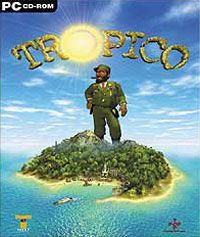
A series of Real-Time Strategy Simulation Games created and originally developed by Pop Top Software (first two games) and later, Haemimont Games (third to fifth), and now by Limbic Entertainment and Calypso Media. Like a cross between SimCity and The Settlers, Tropico puts the player in the role of the newly installed dictator of a Caribbean island nation.
The player is responsible for developing the island through tourism and exports, satisfying the citizens' needs, staying in power, and embezzling funds from the treasury. At the end of a typical game, the final score is determined based on the overall happiness of the islanders, the size of the island's treasury, and the size of the President's Swiss Bank Account.
As well as meters for the typical basic needs such as food, housing and entertainment, each citizen has an affiliation with a political faction, which links their respect for the President to the happiness of the faction's leader and how well the faction's goals are being met. The factions are as follows:
- Communists: Mostly the lower working class citizens of the country. Like to see full employment, everyone with a roof over his head, universal healthcare, and low income disparity. Preferred by uneducated, low paid workers, making it one of the larger factions on the island, and important to keep happy unless you want a peasant's revolt or the USSR to invade your island. Annoying the Communists also reduces the amount of aid the player can expect to receive from the Soviet Union.
- Capitalists: The middle and upper class citizens of Tropico. Like to see luxurious housing, upscale entertainment, and a growing, advance economy. Curiously don't mind that the economy is entirely state-controlled note Preferred by the more educated, wealthier workers who can be difficult to replace if they get upset - the Capitalist faction also influences American opinion, valuable for keeping wealthy US tourists flocking to your beaches, and US Marines away.
- Religious: The conservative Catholic citizens on your island. Like churches and cathedrals, a 'virtuous' and 'pious' society (no night clubs, pubs, casinos, or cabarets), and for everyone to have a high religion satisfaction rating. Similar in size to the Communists, but much harder to pacify. Oppose more 'progressive' actions such as allowing gay marriage in your country and supports more conservative edicts such as prohibition and contraception ban. As a result, they are often at odds with the Capitalists and the Intellectuals. Strong religious support is necessary for special actions like a Papal Visit or the Book BBQ.
- Intellectuals: The highly educated elites of Tropico. Like lots of educational buildings, high liberty ratings, and a progressive society. Generally a small faction, but like the Capitalists, many of their members are highly skilled and educated workers who can be difficult to replace if you lose their support.
- Militarists: The soldiers and police of the island. Like the country to have a strong military, good treatment and wages for the soldiers, and an 'orderly' society (the average safety happiness higher than the liberty rating) . This puts them at odds with the Intellectual who prefer more freedom and less military presence. Preferred by the island's soldiers and policemen, whom a president would really prefer to have on his side in the event of a rebellion. High militarist support is needed for special actions like declaring Martial Law or conscription. Potentially the most dangerous faction due to their ability to start a coup if their respect for you drops too low.
- Environmentalist: Mostly members from the Intellectuals faction. Concerned about the natural beauty and pollution scores for the island, and oppose the presence of polluting industries such as logging or oil. An extremely small faction, but given the way environmental damage works, very hard to win back once they have been upset.
Tropico, released in 2001, recieved an expansion in 2002, Paradise Island, centered on new tourist elements that was later bundled together with the game as Tropico: Mucho Macho Edition.
Tropico was followed by a sequel released in 2003 called Tropico: Pirate Cove, which took the same basic gameplay and transported it to a pirate setting with an economy based on raiding and captive worker labor. Instead of balancing between the US and the USSR, the player must now deal with Britain, France, and Spain. You can foster wars between them, receive patronages, and accept letters of marque.
A third title in the series, but this time by a different developer, was released in the Autumn of '09, with the setting returning to the Cold War. Tropico 3, developed by Haemimont Games, retains the original's factions, and adds a seventh.
- Nationalists: A faction consisting of citizens born in Tropico only. Value Tropico's independence from the major powers and from international aid organizations. Anti-immigration, and pro-local industry.
Absolute Power, the expansion for Tropico 3, added yet another faction.
- Loyalists: El Presidente's very own die-hard fan club. Consists mainly of citizens with below average intelligence. They value a strong and pompous president, and think the idea of elections, free or not, is generally preposterous, since El Presidente is the only candidate you will ever need. Sometimes considered the hardest faction to please in the game.
A fourth installment in the series, again by Haemimont Games, was released in August 2011. The superpowers are now USA, USSR, EU, China and the Middle East. There are more disasters, such as tornadoes and oil spills. The PC version offers Twitter and Facebook connectivity. Modern Times, Tropico 4's expansion, adds a whole host of new buildings and game modifying real world events that become available or occur at certain points on the timeline.
Tropico 5 was released in May 2014 and utilizes a new "era" feature, which allows the player to start his governorship in the 19th century, at the height of colonialism, and maintain it well into the middle of the 21st century, facing the challenges of historic events such as the Great Depression and both World Wars in between. With the lengthened timeline comes the dynasty feature, in which the player no longer just plays as el prez, but also his ancestors in earlier times, and can interact with his relatives. There are also tech trees to research as well as a more elaborate trade system. Radically different from previous installments, the map starts out partially fogged, adding elements of exploration to the game. A co-op/competitive multiplayer mode is also present.
Tropico 5 also added new factions, while scrapping the Loyalists and the Intellectuals (although the Environmentalists and the Globalists both inherited aspects of the Intellectual faction, and Nationalists have a few aspects of the Loyalist faction). The faction mechanic has been further changed by new factions emerging as the player advances in age, while in the case of transitioning from the Colonial to the World War era, removing the two colonial era factions. All factions are also grouped into a binary group (Values for Militarists and Religious, Economy for Communists and Capitalists, Environment for Environmentalists and Industrialists and State Power for Nationalists and Globalists). All citizens are either heavily one or the other, mildly one or the other or neutral for each of the groups, and new groups emerge with each age (Values and Economy in the World Wars, Environment in the Cold War and State Power in Modern times).
- Royalists: Most of the population starts out as this in the Colonial era, and have a perpetually low opinion of the Governor (which doesn't affect much, as elections, uprisings and rebellions do not occur during the Colonial Era). Their opinion can only be improved ever-so-slightly by certain events. The Royalist population decreases as the player performs assignments from the Revolutionaries.
- Revolutionaries: Only a handful of citizens start out as Revolutionaries in the Colonial era, but the population increases with completing assignments from the Revolutionaries. They have a perpetually high opinion of El Presidente, which can be increased further by constructing certain buildings (such as the colonial fort and the library).
- Industrialists: Consists of the population involved in industry and non-tourist advanced economy, and emerge in the Cold War era alongside the Environmentalists. They favor, as the name implies, industrialization while also having some similarities with the Capitalists (such as favoring Free Market in the Constitution), as well as moderate authoritarianism and decent education.
- Globalists: Consists primarily of well-educated citizens and immigrants as well as those working in the tourism sector and within diplomacy. They emerge in the Modern Era alongside Nationalists, and favor open immigration policies, good foreign relations, democracy and liberty.
Tropico 6 was released in March, 2019. Produced by Limbic Entertainment, the game has been rebuilt from the ground up with the Unreal Engine. Features include being able to build on multiple islands at once, a Presidential Palace with customization options, a greater link between economic prosperity and political peril for El Presidente, increased consequences for using autocratic edicts like imprisonment and assassination (not only will the victim not vote for you, but their entire family will never vote for El Presidente unless the player has Due Process upgrade from a courthouse), returning feature of Pirate Cove where initially the player can recruit and send pirates to plunder resources and artifacts, which eventually by era, evolves into the ability to dispatch Tropican special forces to steal technology and famous landmarks for your nation from abroad, the return of Election Speeches, and the removal of the Dynasty System from Tropico 5. And you can finally build bridges between islands and across rivers, as well as tunnels across mountains.
Not to be confused with Trope Co., and definitely not Poptropica!
Tropes Featured:
- Acceptable Breaks from Reality:
- Only height, budget, manager, and workforce affect the effectiveness of an observatory. Being surrounded by mountains, high-rise apartments, or polluting factories are irrelevant.
- Since all forms of pollution are abstracted, people will choose to live next to water treatment plants (which, if you've ever been to one in real life, smells like rotten eggs) simply because the pollution is lower there than somewhere else.
- A.I.-Generated Economy:
- If El Presidente doesn't build enough affordable housing, the Tropicanos will build their own, undesirable shacks.
- In "Absolute Power", add-on to the third expansion, the player was able to enact privatisation, selling all the facilities to the private sector, which would then have to pay a rent to the State while the selling price would be sent to El Presidente's Swiss Bank Account.
- In the succeeding expansions the player was able to fundraise money to build a facility, but it had the major drawback that they would get the raw materials for free.
- The Alcoholic:
- Reverend Esteban, speaker for the Religious faction in Tropico 4, is a whisky priest
 . He considers rum to be God's gift to Tropico, and would prefer to conduct his sermons in a bar rather than a church. Seems to be at odds with most of his followers, but reluctantly goes along with their wishes anyway. For example, he might approach El Presidente claiming that God told him to ask for a prohibition on alcohol, then if it is implemented call the radio station the next day as an anonymous "concerned citizen" to protest the very policy he asked for.
 - This is also one of the traits your Avatar can get, which brings a number of negative effects, but boosts relations with the USSR.
- Reverend Esteban, speaker for the Religious faction in Tropico 4, is a whisky priest
- Alliance Meter: The standing of El Presidente among the island's factions is shown in the ledger, in percentage figures — text in the first game — and with the detailed issues that influence their current opinion.
- All Just a Dream: Implied when you finish the DLC mission "Plantador".
- Alternate History: The USSR does not dissolve in 1991 and the EU and Red And Rich China are foreign powers from day one. Your soldiers carry M16 rifles over ten years before they were invented. This was somewhat averted in Tropico 5, where each era features historically correct superpowers (though World War 1's Central Powers are merged into World War 2's Axis). However, your soldiers also start carrying M16s in 1914.
- A major element of the Changing the World campaign in 5 is figuring out how to make one reality. The Waterborne and Espionage DLC campaigns hint that their events run along a parallel timeline to Changing the World.
- Anachronism Stew: The fifth game's Colonial Era includes elements of the 17th, 18th, and 19th centuries, though in gameplay terms, it's the shortest. The World Wars Era amalgamates the pre-war years, both wars, The Roaring '20s, and The Great Depression into a single conflict.
- Ambiguously Bi: Miss Pineapple may plead for the legalization of gay marriage. Not for her own gains, but for a "friend." We never find out if that friend even exists.
- Ancient Astronauts: They don't show up in any of the games, but in 5, if you build a tourist site on ancient ruins, you can pander to public enthusiasm about the idea by upgrading the site so that they display "alien" artifacts. This adds "Slob" tourists as an additional preferred tourist class for the site, indicating that it moved downmarket by pivoting to aliens.
- Announcer Chatter: 3 has DJ Juanito of Tropico News Today. Tropico 4 has your personal adviser and spokesman of the Loyalist faction Penultimo and Environmentalist representative Sunny Flowers. Tropico 5 has Lulu, the excessively peppy owner of the Jolly Roger Bar and Radio.
- Apathetic Citizens: Played with.
- Your citizens will start a demonstration if their respect for you is low and their life conditions are poor, attracting the attention of nearby walkers. If things don't improve they may emigrate to greener pastures, or become rebels and eventually attack your buildings or your palace. Unhappy faction leaders may trigger disaster events, including Nationalist Riots and Military Coups, and having too many very unhappy citizens might trigger a general uprising. If any of these events destroy your palace, Game Over.
- Any citizens who witness an execution will lose respect for you considerably, and the family of the victim will resent you forever.
- On the other hand, apparently people are so disillusioned that natural disasters, gunfights between rebels and soldiers, and buildings burning down right next to them do not alter their routines. Taken to extremes when cars won't even alter their routes, even if there's a tornado in front of them.
- You yourself can get away with an awful lot of cruelty, as long as you don't screw over the wrong people too many times. See Bread and Circuses further down the page.
- Appeal to Force: In the Tropico 3: Absolute Power expansion pack, your island will have the ability to develop your own nuclear program. Afterwards, as long as it remains fully staffed and operational, no matter how much you go out of your way to antagonize the super powers, you will never get invaded. Tropico 4 has a nuclear weapons program in the base bame whith much the same rules, and 6 brings it back with the twist that you can launch the missile to impress Tropican citizens at the cost of upsetting foreign powers.
- Arab Oil Sheikh: Sheikh Salim, the representative of the Middle East faction in 4. Like everything else in the game, this trope is Played for Laughs: he has several wives and missions from him will reward you a camel (his second-best in fact!) in addition to cash.
- Tropico 6 has Prince Thari, who is a very depressed and melachonic take on the trope. Having so much money you don't have to do anything on top of being isloated royalty has left him very lonely.
- Argentina Is Nazi-Land: A possibility in Tropico 5 when transitioning from the World War era to the Cold War era. If you don't have a positive enough relationship with the Axis, they'll want El Presidente to harbor "expatriates," which earns the displeasure of the international community in the next era. Deny them asylum and you face a violent invasion from the Central Powers.
- Arms Dealer: From Tropico 3: Absolute Power and 4, you can build weapons for export using iron you've mined. Weapons are one of the most profitable exports in the game (only jewelry sells for more), but unless you only sell handguns (lower production rate), this hurts your reputation with the US and the USSR. Not because you are a threat to peace, but a threat to the arms industry by producing cheap weapons.
- Arson, Murder, and Jaywalking:Agent Sasha: Communists of the world will not stand idle while the US and its lackey, Europe, strip the fellow Tropicans of their liberty, dignity and bananas!
- Artifact of Doom: The Black Pearl in Tropico 5: Waterborne. Legends surround it and when El Presidente gets his hands on it, he grows paranoid about its security and refers to it as his "precious."
- Artificial Stupidity:
- Tropicans are, on one hand, fairly smart about doing their jobs, handling most of their work automatically. On the other hand, they can be very dumb about doing those same jobs. When every builder on your island is drunk, every teamster is visiting a cabaret, and every doctor is in church waiting on a priest to show up (and the priests are visiting the restaurants!), sometimes work can grind to a halt. Tropicans sometimes forget to visit the farms or markets to get food, teamsters let highly valuable processed goods languish in the factories, factory workers can leave buildings unmanned for months at a time, dock workers can be halfway across the island when the cargo ship arrives and not get to the dock in time to load it, and construction workers will let unfinished buildings sit there for years. The usual workaround is to plaster the island with construction and teamster offices, to compensate with sheer numbers the amount of builders and teamsters knocking off work.
- They also tend to be less than efficient at choosing a building to satisfy a Need at, even in 4; tourists will frequently ignore entertainment buildings set up in your nice, pristine, carefully-crafted touristy area, cross to the other side of the island on FOOT, to go to an exact duplicate of the building in your considerably more crappy area for Tropicans, and then complain about all the shacks and tenements and industrial buildings being ugly.
- Lampshaded in one of the Tropico 4 radio announcements.
- One major reason for this (and which quite a few players miss) is the Service Quality of buildings. It's set up in such a way that visitors by default will pick a structure with higher service quality that is far away rather than one with a lower rating nearby, since distance, strangely enough, is not factored into the calculation.
- Housing problems are a bane in the latter Tropico games. This is due to Tropicans preferring to live near their workplace in spite of having a garage to allow trips, Tropicans not moving to better housing opportunities despite having the means to occupy said housing (you'll see well-off citizens living in shacks despite having empty condominiums), or Tropicans just being stubborn that you have to manually delete the shack to force them to live on a better house.
- Artistic License – Linguistics:
- In 4, immigrants and tourists from the Bahamas, Haiti, and Jamaica have Spanish names while the latter group speaks Spanish even though Spanish isn't the main language in all three countries.
- In 5, every one of your colonists have Spanish accents (and features) despite the island being quite clearly colonized by Jolly Ol' England.
- Artistic License – Politics: The Capitalist faction will remain happy as long as the island's economy is diverse and profitable, while ignoring the fact that the same economy is completely state-controlled all the way down to wages, pricing and hiring policy. Largely just so you don't have two separate games depending on which economic ideology you are pursuing the favor of. You can allow privatization of some buildings in a few games however, and this naturally makes the capitalists even happier but generally isn't as profitable or reliable for production.
- Artistic License – Religion: Tropico 4's religion is in practice more Protestant than Catholic Christian despite their temples looking like Catholic churches. If the religion was actually Catholic, the religious faction would be perfectly fine with drinking (the Roman Catholic Church has a light-hearted attitude towards moderate drinking on account of having grown at its highest on the wine-making Mediterrannean), Father Esteban's alcoholism in Tropico 4 wouldn't be so much of a big deal, their priests wouldn't wear black robes and a hat (Roman Catholic robes are white), and they wouldn't be able to marry anyone (since they're already "married to God"). This is likely done for technical and game-play reasons, to save extra work in coding priest-specific citizen behavior and to make the player think twice before plastering the island with pubs, night clubs, and cabarets.
- In Tropico 5, you can export rum to Qurac. Although given the humorous bent of the game, this may be intentional.
- Priests and bishops can get married. And can marry other men when Gay Marriage is allowed. This is done for game-play reasons: first, housing slots are assigned to families, not individuals, making housing single people a drain on space and maintenance costs; secondly, Special Actions like arresting or bribing citizens, affects their entire family's views, so this would encourage you to execute dissenting clergy, and discourage you from bribing them. Tropico 4 lampshades it in the Cathedral's description.
- Arson, Murder, and Jaywalking: A mutant papaya may escape from a new horticulture station and run amok in the city. Penultimo states that it is wanted for three attempted homicides, conspiracy against the state, and an alleged case of sexual harassment.
- Ascended Extra: Penultimo, your guide through the tutorial in Tropico 3, becomes one of your recurring advisers and the new host of TNT in 4. In 5 he becomes the full-blown Number Two to El Presidente. In 6, he becomes a full blown Deuteragonist.
- A-Team Firing:
- Spec Ops trained soldiers can and will continually miss when chasing down political opponents. And that's because they're highly trained, mind you — the rebels literally can't hit the broad side of a barn.
- Note, however, that your soldiers can shoot just fine when standing still and letting targets come to them. Pity you can't order them to set ambushes...
- "Ass" in Ambassador:
- Ambassador Crane, the American diplomat in 4, is a fairly unpleasant, imperialistic man who constantly makes not-too-subtle threats of bringing freedom and democracy down upon you if you don't try to please him. He's also the one single character who calls you "President" instead of "El Presidente." He reveals a Freudian Excuse when he fondly compares the nasty llamas to his mother.
- It's also implied that when the Custom offices opened that he openly insulted his wife, calling her a useless bag (and ended up requiring paying duties on her due to literal-minded bureaucrats).
- Yu Li, the Chinese ambassador, is the complete opposite. He is always overly polite. If your relationship with China is poor, he says over the radio that "the trade embargo is not a sign of hostility between us. Rather, take it as a promise that from now on, relations can only improve!"
- Ambassador Crane, the American diplomat in 4, is a fairly unpleasant, imperialistic man who constantly makes not-too-subtle threats of bringing freedom and democracy down upon you if you don't try to please him. He's also the one single character who calls you "President" instead of "El Presidente." He reveals a Freudian Excuse when he fondly compares the nasty llamas to his mother.
- Authority Equals Asskicking:
- One of the possible traits for your avatar is "War Hero", which makes him/her much stronger in combat. Even without it though, your avatar can still fight better than the average soldier, even though the soldiers have M-16 assault rifles and you have a pistol.
- Inverted when you pick "Coward" as a flaw, which makes your avatar fight worse, your soldiers twice as likely to flee in combat and lowers your respect among the militaristic faction. Before Tropico 4, it's mandatory to choose two flaws, and "Coward" is one of the less harmful ones as long as your rule doesn't raise armed opposition. This trait and "War Hero" are mutually exclusive.
- Awesome, but Impractical: The Ziggurat building in Modern Times, the expansion to the fourth game. It's one of the last buildings that you can unlock, and it houses a staggering 50 families with a high level of housing quality. However it's massive; so good luck finding a good place to put it. Plus, its cripplingly expensive at $100,000 and requires 100MW of power, the most in the game. Not only does it come very late into the game, but it's inferior in terms of quality to the far less expensive and energy-consuming Modern Condominium, making the Ziggurat mostly useless.
- Anti-Grinding: introduced with Going Viral are pandemics which can strike at any time and a deadly pandemic will hit you if you stay in the colonial period too long. Since it is impossible to research a cure until you reach the World Wars, old strategies of staying in the Colonial period to build up your economy and industry are now unwise as a deadly pandemic will crash your carribean colony faster than you can cough.
- Badass Bookworm:
- If you lose too much respect from the Intellectuals or outright outlaw their entire faction, they will take up arms and revolt against you just like anyone else would.
- You can be one yourself by having 'War hero' as your background and 'Scholarly' as one of your traits, or 'Professor' as your background and 'Athletic' as one of your traits.
- Bad "Bad Acting": If you keep the Martial Law edict active for too long in Tropico 5, you may be treated to a hilarious radio outtake of Lulu giving a stilted, monotone speech about how much she loves El Presidente and how much everyone else should love El Presidente, before asking the nice secret police officer if he's willing to lower his gun now... and make out with her. This is still Lulu, after all.
- Bag of Spilling:
- Sometimes played straight with the Swiss bank account or the Pirate stash and sometimes averted.
- Unlike in previous games where recurring islands start with a predefined, generic city layout in the campaign, in 5 any island you've already built will remain exactly as you left it if you wind up coming back later (in a linear timeline).
- Balcony Speech: In 3, 4, and 6, El Presidente can deliver one from the palace. It raises the respect of the people gathered to hear it.
- Banana Republic: A common state for early-game islands - Tropico 3 mentions the trope by name, and some islands may literally rely on banana exports. The Capitalists appreciate an economically advanced Tropico, with strong industrial and tourist sectors, and Tropico 4's expansion allows late-game diversification into a finance- and service-based economy.
- Belief Makes You Stupid: In 5 and 6, an Atheist State researches faster.
- Benevolent Dictator: You yourself can play as one if you so choose. You can be prone to avoiding elections, having citizens you don't like... erm, go missing at a moment's notice, and be partial to skimming money off the top for your Swiss Bank Account, along with erecting ostentatious statues of yourself everywhere (gold optional). But at the same time, you could do your damnedest to keep your population happy, healthy and well-fed, along with enacting edicts to keep your Banana Republic as well-run as possible.
- Betty and Veronica: Betty Boom and Veronica Veneno - one wishes to see you dead, the other is a corporate yes woman.
- More directly invoked in 5 with Evita Vasquez and Veronica Veneno, the Communist and Capitalist representatives. They even have similar hairstyles to the originals.
- Big Bad:
- Nick Richards in the main Tropico 4 campaign and The Conclave then Dr. Steinschneider in the Modern Times campaign.
- In Tropico 5's Changing the World we have Leon Kane and Adrianna Diaz.
- Tropico 6's Battle Royal campaign Lord Roger Wyndham, your overseer from the Colonial level.
- Big Brother Is Watching: You can enact the "Big Brother" edict in Tropico 5's Cold War era to reveal two-thirds of unknown manager roles and permanently reduce crime from residential buildings. It requires the "Secret Police" edict to be in effect, which allows the police to discover unknown roles (managers, rebels, and spies) faster.
- Big Eater: Rosanne Winnefree is one of the player character choices in 2. Her background states that she ate her ship's entire food storage in a single day!
- Bilingual Bonus:
- One of the ''Absolute Power' missions... provided you know or can translate binary.
- Since Spanish is omnipresent in the game, knowing a bit of it doesn't hurt e.g some of the rebel quotes are funny "¡Toma un bocadillo de granada! (Have this grenade sandwich!)"
- In one scenario where you have the goal to get popular on social media, the island is named "Caralibro" (Facebook). Other meaningful names include "Isla Desconocida" (Unknown Island) on a mission where you have to make your island famous, "Isla de Hierro" (Iron Island) where you have to make money from mining, "Isla de la Esperanza" (Hope Island) on a mission where you're the last hope to the world's worst rejects, and "Yermo Encarnado" (Wasteland Incarnate) where you have no resources, no tourism, and must make money from importing supplies and selling manufactured products.
- Penúltimo's name literally means "second to last", and he's your second in command. It is stated early in the fourth installment that he was the player's predecessor, what makes him penultimate Presidente.
- Black Comedy: The entire game. You see, it's a Cold War. You're the dictator of a Banana Republic, and you're ultimately a pawn in a much larger game between the US and the USSR. Your people aren't exactly cooperative, nor are they very bright. You can't stay in power (for long) lest you Kick the Dog on a regular basis. This culminates when you sell your island to the US to test nuclear bombs: your Announcer Chatter will say that "according to the scientists, the big shiny mushroom is harmless, and it's good for the skin tone", your history involves the worst in people (Being the only true graduate of every Harvard Grad in your class - where you have to be a pathetic banana republic dictator, your buddies go on to be POTUS). Can cross into outright Gallows Humor when the US or the USSR invade your island.
- Black Market:
- The second game has one as the import / export system since the European powers won't trade with outlaw pirates... until you ally with one of them.
- In Tropico 5, you can trade with both smugglers and pirates in the Colonial era for a better profit than trading with the Crown. Building a smuggler's dock allows you to continue trading with them beyond the Colonial era.
- Tropico 6 adds Raids, which are clandestine missions you can get by placing buildings such as a Pirate Cove or a Cyber Operations Center, with effects that include hunting treasures (you get $10,000 if your pirates find one), bringing in large amounts of inmigrants, sabotaging a foreign superpower in case of inminent invasion, baiting rebels into attacking your powerful army, or shilling your island in social media. It also puts your Swiss bank account to use with a Broker that gives you actions such as bribing factions, staging political distractions, or simply exchanging your CHF to USD in case you need money.
- Blessed with Suck:
- Rising to power through military coup in Tropico 3. The description states that you failed to take power so many times that the dictator of the island takes pity on you and gives you the poorest island in the entire region to rule.
- Tropico 6 mentions during the Colonial Era that you have been appointed the governor of the most insignificant island the British Empire could find. If you declare independence by paying $15,000 to the Crown, their representative will mention that they happily accept the money if that means getting rid of such an annoying and unnecessary backwater post.
- Some of the positive qualities for your character also contain negative effects. For example, being 'athletic' or having 'empathy' makes intellectuals respect you less, being a 'green thumb' lowers the factory production rates, and being 'sociable' leads to more crime.
- Inverted in that some of the negative qualities have some positive bonuses, such as being a drunk gets you a more positive relation with the U.S.S.R.
- Bling of War: Your avatar can be dressed up to look like this.
- Book Burning: The Book BBQ is one of the edicts you can carry out in order to curry favor with the religious crowd and cow the intellectuals into submission to your rule. It has a nasty effect on education, though.
- Boomerang Bigot: It's possible for a first-generation immigrant to join or even lead the anti-immigration Nationalist faction.
- Boring, but Practical:
- Tenements. They're relatively cheap and can pack loads of people. The only downsides are that they have low housing quality and generate crime, but some basic infrastructure can easily make both non-issues.
- From 3 onward, apartments picked that role. Rather than juggling around various factors and additional infrastructure, they deliver the middle of the line in every possible aspect, with no real downsides and most importantly, don't take much space.
- Bottomless Magazines: During battle your soldiers, generals, cops, and El Presidente never have to reload their weapons. Same for the rebels.
- Brains and Bondage: Implied with Miss Pineapple:Miss Pineapple: I have a few words about the cabaret that was recently built in Tropico...
Penúltimo: The... the cabaret was built for... educational purposes!
Miss Pineapple: My show starts at 8. And you WILL adress me as 'Mistress Pineapple', Penúltimo. - Brainwashed:
- The sanitarium in Modern Times can brainwash Tropicans to respect El Presidente more.
- The Player Character can be this as well in 4, if they choose their Rise To Power to be "Installed by the CIA"The guys from Langley brainwashed you so hard, that the first time you arrived at Tropico, you accidentally forgot who was calling the shots. The "Farm" didn’t take any chances and brainwashed you a second time. Now you’re a sterling example of an agent in service of Uncle Sam: obedient, unquestioning and of highly dubious ethics.
- Bread and Circuses: The public will continually re-elect you if their needs are met, they're more than willing to overlook your bouts of corruption or treading over their rights, so long as they don't outweigh your "good deeds".
- Taken a bit more literally with the Colosseum of Rome wonder power in 6. It makes it so that food and fun happiness are the only factors for overall happiness.
- Bread, Eggs, Milk, Squick: The description for the normal work mode of the Aqua Park in 4 says:Water splashing, kids screaming, and Cthulu lurking somewhere in the depths.
-
 Breather Level: "Get Rich Quick", located towards the end of Tropico 5's "Change the World" campaign, not only doesn't include any particular complications or a time limit but, essentially, gives you access to an infinite money cheat through the ability to deposit money into an account in which it will never diminish and grow exponentially (quickly reaching a situation where you literally could not withdraw it fast enough to run out before it's maxed out again at ten million dollars!). You can take as much time as you want, build as vast an infrastructure as you like, have so many of each building the main challenge can become finding space for them all, and finish the mission no sooner than you feel like you've gotten bored. This is actually a case of Gameplay and Story Integration, as the mission is about El Presidente, having gone back in time, using his knowledge of the future to play the stock market and secure the ridiculous amounts of money he'd need in order to threaten The Order.
 - Bribing Your Way to Victory: The Espionage DLC mission "Free-to-Play" parodies the model of microtransactions, urging you to buy "Gems" to keep Penultimo healthy as the universe tries to kill him for messing with the timeline.
- Then there's the fact that in 4 and 5, you can accelerate the construction of a building by using a "Build Now" option, which sucks the same amount of money it costs to build the building in the first place, effectively doubling the cost of a building. Although, if you're short of time in the timed missions or crap is dangerously close to hitting the fan, then this option is invaluable.
- There's also the fact that you can bribe your citizens so they have a higher opinion of you.
- Brick Joke: Quite a few, especially with random events. One particular instance is when you're finally given a UN grant to help you rescue trapped miners, which was delayed due to paperwork. It comes 5 missions later, which is nearly a century of in-game time!
- Broken Record: In the original game, the speakers of El Presidente's childhood museum loudly repeat "Viva El Presidente, Viva El Presidente" over and over again. This is also a workmode for the museum in Tropico 3 and 4, though no sound plays.
- But Not Too Evil
- In the original game, trying to use the eliminate edict on a child prompts the message "You can't do that to a child!"
- Despite the fact Tropico is a Caribbean island country, the Colonial Era (in Tropico 5) noticably doesn't seem to contain any African slaves or at least any reference to African slavery, even though slave labor could easily boost the economy and literally every major Caribbean country (Cuba, Dominican Republic, Puerto Rico, Haiti, Jamaica) imported large amounts of West African slaves. This is seemingly Lampshaded in the description for the Cotton Plantation in Tropico 5.We will not discuss cotton picking. Instead we will talk about the most interesting facts about cotton...
- Tropico 2 however, does contain slaves, but they're not a specific race/ethnicity.
- But Thou Must!
- In the "War on Terror" mission from the Modern Times campaign, you're presented with the following actions when terrorists bomb your ministry: Declare War on Terror, Declare War on Terror, or Declare War on Terror. Later in the mission, Penultimo gives you a list of three suspects, all of whom are the same person.
- For the rock-paper-scissors contest in the Tropico 5: Espionage mission "Penultimobowl," you have to choose to cheat; the other Penultimo always throws the same choice as your Penultimo, so you need to read his mind with some fancy radar dishes. For the final inner beauty contest, Penultimo balks at whatever choice you make to test his inner beauty and assumes you chose "with an X-ray."
- Butt-Monkey: Throughout the campaign missions, your adviser Penultimo will usually end up arrested, put into jail, fired and exiled, or kidnapped and replaced with clones. Lampshaded in the "Comedy" work mode for the Theater: "Everybody loves good comedy - Especially when it is directed at Penultimo." In the Espionage DLC campaign mission "Free-to-Play," he is constantly under threat from improbable disasters as the universe is out to get him, Final Destination-style, due to messing with time and causality.
- The Caligula: In Tropico 5's Colonial era, His Majesty demands things from the colonies that range from slightly unhinged (eg. build a lumber camp to provide the King with logs so he can build a giant bonfire) to completely crazy (raise money so His Majesty can build an underwater palace). Lord Oaksworth, his emissary to you, relays these plans in an entirely straight-faced manner.
- Capcom Sequel Stagnation:
- Tropico 3 is a loose remake of the first game and its expansion pack - the bulk of the mechanics, buildings, edicts, etc., built into a new engine and with new campaigns and game modes. Many of the NPC citizens are carried over verbatim except in 3D.
- Tropico 4 is pretty much Tropico 3, but with redesigned campaign mode (instead of sticking with single objective per scenario, the game has an RPG-esque "main objective" and "side objectives" clickable when there's a red-and-yellow exclamation mark and blue-and-yellow exclamation mark, respectively), slightly better graphics, larger maps, redesigned AI, a handful of new buildings and edicts. Everything else is exactly the same, especially the game models. And the Script! Especially the script...
- Modern Times, the expansion to Tropico 4, finally averts this as it introduces thirty new buildings and a few extra gameplay features, some of which radically change how the game is played.
- Tropico 5 averted the stagnation with a completely new engine and game structure. Though depending on who you ask, more features were removed than there were added, most controversially election speeches and the ability to directly walk around the island and visit buildings or participate in battles.
- Tropico 6 is made by a different developer, and definitely averts this, with new engine and new gameplay mechanics, though the premise is still the same.
- Card-Carrying Villain: The E.V.I.L. Corporation in the campaign of Tropico 3's Absolute Power expansion pack.
- Cheese-Eating Surrender Monkeys: Upon researching the "White Flag" in Tropico 5, Penultimo describes breaking into the French Museum of Military Accomplishments and finding only a white flag. The French version replaces the flavour text by this. note
- Christianity is Catholic: Justified, as in Real Life, a place like Tropico would be mostly Catholic. Averted in 2, in which the English prisoners are Protestant.
- Chummy Commies: Comrade Vasquez, the Communist representative, is one of the most reasonable people in your inner circle. He keeps El Presidente on his toes regarding food, shelter, and healthcare for the people. He does slip occasionally and request things like demolishing all banks or arresting the Capitalist leader.
- This tradition is kept up by his close relative Evita in 5, who is probably the most socially responsible advisor, representing the Revolutionary, Communist, and Environmentalist factions.
- This is continued in spirit by the Communist Leader in 6, as he is extremely friendly and it is very hard to make his faction unhappy unless you go out of your way to antagonize him, but it is also subverted when he asks for no seperation of offical powers (meaning you can arrest people at a whim) and asks for the creation of a survelliance state where everyone is spied upon. All for the security of Tropico, of course.
- The Cloud Cuckoolander Was Right: Penultimo is a dimwitted, slightly nutty toady, but following his advice usually goes pretty well. Sometimes it's because he stumbles on good ideas through his own distinctive brand of logic, while in others it's because the rest of the world proves as crazy as Penultimo himself.
- The Cold War: The game's primary setting. Even past 1991, the USSR doesn't go anywhere. An important part of the game is balancing Tropico's relations with the US and the USSR to gain development aid and trade benefits. One of the ways to lose the game is to annoy one of the superpowers enough to provoke an invasion.
- Less prominent in Tropico 5: the Cold War is just one of four eras in which the game is set, and the only era in which both the US and the USSR are present as foreign powers (in the Modern Times era, the USSR becomes Russia). However, the Changing the World campaign plays strongly with the stock Cold War tropes, including El Presidente scaring the superpowers away from the brink of nuclear holocaust by building Tropico its *own* nuclear program.
- Command & Conquer Economy: Played straight for all buildings beyond the very crudest housing until Tropico 3's expansion pack, which introduced a "Privatization" edict, which sells all non-essential industries to private interests, to the Capitalists' delight and the Communists' despair. After the initial cash influx, this was typically a bad deal - private buildings use up resources, but generate only a static rent instead of export profits. Tropico 4 replaced the edict with a Stock Exchange, which allows a range of private businesses to be built alongside national ones, sponsored by different superpowers and carrying different requirements and rent rates. Tropico 5 is fully back to a Command and Conquer Economy, which can be quite odd if your constitution laws include both Open Borders and Free Market.
- Compensating for Something: To unlock the modern apartment and fashion company in Tropico 5, you need to research "Inferiority Complex." Penultimo lampshades it once the research is done.
- Conspiracy Theorist: DJ Betty Boom in the Absolute Power expansion for 3. She'll report on genuine misdeeds of El Presidente, but even if the player plays a genuinely progressive, democratic, incorruptible, and generous El Presidente, she will still declare all taken actions acts of pure evil and use them as reasons to call for El Presidente's head on a stake. No, seriously; if you enact air pollution standards, she'll lambast you for keeping the "healthy" noxious fumes all to the bourgeoisie. If you build a wind turbine, she'll decry it as a symbol of oppression for only turning in the direction of the wind, and ask her listeners to join her in tearing down the turbine and building a new one that rotates against the wind. This is Lampshaded in 4.
- Consummate Liar: El Presidente and his cronies by default; it's part of the job description. The "compulsive liar" trait plays with it, making his lies less effective among the intellectuals and the religious. In the sequels it's an appealing trait for the loyalists and it nullifies the minor drawbacks related to breaking electoral promises. Admittedly, the average Tropican is not concerned about honesty and Blatant Lies are the rule rather than the exception.
- Corrupt Corporate Executive: Keith Preston, CEO of Fruitas LTD (itself a satirical expy of the exploitative Real Life United Fruit Company), fits this pretty neatly.
- Antonio Lopez, the capitalist faction's spokesman, also qualifies.Antonio Lopez: Excellent job! Now to restructure the banking system so that we will be able to rob the shirts off of poor people... I mean, to invest prudently and generate wealth that will trickle down.
- Antonio Lopez, the capitalist faction's spokesman, also qualifies.
- Corrupt Politician The game! El Presidente (the player) is designed to be an embezzling, casual tyrant who joyingly tramples at will on most of the rights of the people.Tropico 6 loadscreen: "It's true that Liberty is so precious it must be rationed." Vladimir Lenin
- Crapsaccharine World:
- If you want your island to be a tourist hotspot, it is best to keep all the dirty industry, the crippling poor people, and all the misery of your island away from your high paying guests. This is easier to do in 5 as you can set entertainment buildings to "Tourists Only."
- Tropico 2 essentially has you playing as a genocidal slave-driving psychopath lording over a band of murderous thugs who are kept fed, housed, and entertained by an economy driven entirely by slave labor. These slaves are kept in line with torture, random executions, and malnourishment. Despite this, the game is cheery, casual, and lighthearted, with a cartoonish art style, upbeat music, brightly-colored buildings and funny little comments in your citizens' thought boxes. Even the captives' crippling terror and miserable lives are played for laughs.
- Crapsack World: Killing civvies for the lols, can be jailed for no reason, dumb as hell citizens for starters.
- Cthulhu Mythos: A task chain introduced in Tropico 5: Waterborne has you build a relationship with R'lyeh, supplying their ambassador with fish and the city with canned goods (the only way they can get dry goods) in exchange for money and immigrants, and ends with Cthulhu awakening and causing a tsunami.
- Cult of Personality: One does not stay in power for decades without some Stalinesque... er, being showered by free and genuine signs of appreciation and devotion from the people. Say with me "Viva El Presidente!" (or else).
- Curb-Stomp Battle: If you get invaded by the US or the USSR, you will lose instantly and the game will be over. What? You honestly thought that your "large" army of 30 people can stand against the might of a super power?
- Averted if you have a nuclear program, in which case both superpowers will stay away in fear.
- Potentially averted in Tropico 5 if you maintain a large enough army, as foreign invasions can be defeated.
- Dancing Mook Credits: While not all of them are exactly mooks, the credits have various character models (including rebels, police officers and soldiers, and civilians) dancing and jumping about. Particularly amusing when the General character model (a Fidel Castro expy) is doing a rather nice dance.
- Deadline News: If you choose to shoot Juanito in the expansion to 3, his death will happen during one of his broadcasts.
- Death of a Thousand Cuts: In the original game, buildings are gradually destroyed by gun fire or blows. In the sequels, the rebels plant explosives in the buildings, but only after the loyalist forces are defeated. In 5, hostile forces attack buildings with thrown explosives and your troops with guns.
- Defcon 5: Averted in a mission on Tropico 4 where certain quests will decrease or increase the worldwide DEFCON level. You want to keep it as high as possible, and if you screw up and hit DEFCON 1, the world goes to war and you fail the mission.
- Democracy Is Bad: Played with. The difficulty of maintaining a democratic government varies through the games, and pure democracies generally require more ethical governance and a higher standard of living than corrupt or dictatorial systems. On the other hand, a certain degree of vote-rigging, bribery, campaign glibness, and Bread and Circuses is expected of the player, as part of the overall Black Comedy, and successful presidentes can be given decades of near-unlimited power within a 'democratic' system.
- Developer's Foresight:
- Enacting the "ban social media" edict disables Facebook and Twitter integration on the PC version.
- If the Religious/Militarists ask you to change a High School's work mode to Parochial/Military Education, and you respond but then change it back to the original work mode, the faction representative will scold you for going back on your word and you lose double the respect you earned for "fulfilling the request".
- In 6, there are no radio announcements reporting current events on or off the island until you reach the World War era. Despite this, there are some unique radio announcements for building colonial era buildings like a Pirate Cove if you do so any time during the World War era and beyond.
- Did You Just Have Tea With Cthulhu: The literal result of sending a dynasty member as your delegate to the Sunken City of R'lyeh in Tropico 5 (It Makes Sense in Context). Fortunately, they then proceeded to make a speech so boring Cthulhu went right back to sleep.
- Dirty Communists: The USSR and their local Communist allies can be potential allies or enemies. They are not the most unreasonable factions and will support a moderate social democratic Tropico, though they will sponsor strikes and terrorist actions, or even invade, if particularly displeased. Rebels, particularly from 3 onward, play this straight.
- Disproportionate Retribution: Is Juanito annoying you in 3? Just have him executed.
- The Ditz: Sunny Flowers shows signs of this.
- Double Entendre: In 5, Lulu continues Miss Pinneaple's tradition of inserting some sexual innuendo in almost every situation.
- Dragon-in-Chief: YOU in the campaign missions "The Toady" and "Divided Loyalty." In the former you are the President's advisor who does all the work for him, and in the latter you are the puppet president who is being controlled by the general from behind the stage. By the end of both missions, you can take over and put yourself in power.
- Drill Sergeant Nasty: General Rodriguez, the Militarist representative in 4, refers to everything in military terms. If a tornado forms on the island, he says "an enemy tornado has infiltrated our defenses." If you enact a Tourism Campaign, he'll demand the "foreign maggots" come to Tropico at once.
- Dropped a Bridge on Him: Juanito in Tropico 4, though Nick Richards pins the blame on his predecessor's assassination on an agent named "Juanito."
- Dull Surprise: If a citizen dies, look at his/her spouse's thoughts tab. The survivor's reaction reads rather flat for somebody who has just lost a loved one; compare to the dead citizen's children's thoughts, which, although still just text, read with more emotion.
- Dystopia Is Hard: Kick the Dog one too many times and/or fail to keep your citizens somewhat happy and you'll find yourself in the receiving end of armed revolts, shut down of entire economy sectors or invaded by the US or USSR.
- Eagleland: On the other hand, for those presidentes with more rightist leanings, the USA will shower you with development aid, trade benefits, and wealthy tourists if you play by their rules (have a high liberty rating, don't get too friendly with the USSR, and keep the capitalists happy) but will invade and overthrow you if you snuggle up with the Soviet Union too much. Mostly shown as Type 1 (politically), with some tourists and politicians being Type 2.
- Easy Evangelism: There are many ways to turn citizens into loyalists. Justified as the Presidente is usually a Manipulative Bastard with a huge Propaganda Machine at his service and the less intelligent individuals are easier to sway.
- Enlightened Self-Interest: While being an iron-fisted dictator is possible, raising the happiness and contentment of all your citizens, and putting in a few years of efficient and sustainable resource development, will usually result in increased industrial output and stable politics, and eventually give you more opportunity to skim a lot more money off the top than just robbing some poor corn farmers blind.
- Emergency Authority: you can delcare this in most games to give yourself emergency powers. Very useful for dealing with out of control rebels, and in DLC for 6, pandemics ravaging your island. Or giving justification for cancelling elections.
- An Entrepreneur Is You: There are several background traits that boost production or service quality for farms, industry, and entertainment buildings.
- Every Man Has His Price: Bribing faction leaders is a great way to boost El Presidente's popularity.
- Everyone Calls Him Bar Keep: The player has a name, but s/he is only addressed as El Presidente.
- Evil Colonialist: Many antagonists in the stock campaigns are greedy foreign imperialists. Played for Laughs like everything else.
- Not 'evil' so much as 'disloyal to the El-Presente-To-Be,' but the Royalists during the Colonial Era in 5 most likely will have an approval rating of 1%. Which means, push comes to shove, they would back the ruling monarch rather then the appointed governor. It is, however, entirely possible to make them like the local government more than the empire, and their opinion function as an early indicator of your popularity in the next era, where voting is a thing.
- Evil Mentor:
- The first few missions of Tropico 4 are a tutorial with a succession of mentors. The rest are revenge against them when they turn against you. Though whether any of them are more corrupt than El Presidente is open to debate.
- Leon Kane and Adrianna Diaz in 5.
- Evil Is Petty: in the Tropico 6 mission chocolate factory El Presidente moves to put an ethically run high quality choclatier called Wonkmeister out of buisness only to replace it with a company producing cheap, low quality chocolate possibly laced with drugs simply because the factory tour offered by the Wonkmeister was of a mundane factory instead of being a Willy Wonka style tour.
- Fake Difficulty: The original game lacked any sort of rapid transport. This meant your population had to live near their workplace, or otherwise they would never reach it before having to walk back to fulfill any of their needs. On top of that, your teamsters had a limited range (which was invisible in-game), so you had to build teamster offices all around the island if you planned to transport goods at all. The moment cars got introduced in Tropico 3, the game became much, much, much easier, despite barely changing anything else.
- Fan Dumb: In-universe, the Loyalist faction demands El Presidente be a grandiose and ruthless dictator — which can be a problem for relatively (or genuinely) benevolent Presidentes that have no problem with free elections and would rather spend money improving the island than building monuments to his/her own glory.
- Firewood Resources:
- Averted. While the logs harvested directly from a logging camp are indeed of the "firewood" variety, they need to be delivered to a lumber mill to be processed into planks before they can be assembled into furniture.
- And averted again in Pirate's Cove, where you need to set logging camps and then lumber mill to get your construction material.
- Fisher King: Personal traits selected at the beginning of the game influence the entire population. If you were a Farmer or Miner in your background, everyone will be much better at farming or mining. If you're Hardworking, everyone else will be hardworking. The managerial skill of each dynasty member in 5 also extends to a global effect, such as a Mentor increasing the graduation rate of all students.
- Fog of War: In Tropico 5 the island needs to be explored until the Compass is researched.
- Full-Circle Revolution: If El Presidente has a rebel leader background.
- Game-Favored Gender: Some jobs are gender-specific without much justification nor real life equivalency. A feature not changed since the original game and especially odd for white collar jobs. To name a few examples:
- Teachers, civil servants, shopkeepers, engineers, journalists and cooks can only be female.
- Doctors, professors, armed personnel, priests, miners and attendants can only be male.
- Farmers, factory labourers, construction workers, office workers, secret police note and rebels, native-themed entertainers can be either.
- Averted in Tropico 5, where both genders can be any profession. Even male Cabaret dancers.
- Gay Option:
- For your citizens, at least - you can issue an edict legalizing same-sex marriage in Tropico 3. In the 1950s.
- It is also possible to have 'Womanizer' as a flaw while you have a female avatar and suffer the exact same penalties.
- The Generalissimo: The player, aka El Presidente. One of El Presidente's mentors is Generalissimo Santana, complete with a stogie and thick beard, who always calls him "amigo."
- Generational Saga: Tropico 5 has El Presidente's family ruling the island from the 19th century to the 21st in a dynastic way.
- Global Currency: The U.S. Dollar. Truth in Television. No direct inflation would occur for 50 years except if the "Print Money" edict is enacted, which adds $20,000 to the treasury but increases the price of buildings, devaluating your purchasing power. Average Caribbean wages do rise over time and Tropicans expect to be on par with their neighbours.
- Global Ignorance: Penultimo's knowledge of the world is... astonishing. He is sure there's a king and queen of Europe, that in addition to Middle East there's also an Upper and Lower East, and he freaks out when he's told he's on an island.
- He's... oddly not wrong about the Upper and Lower East; those just aren't the names we typically use for Russia and the Indian subcontinent, respectively.
- The Government: El Presidente can avert it or play it straight. The series introduces more villainous possibilities with every release.
- Government Drug Enforcement: Modern Times introduces water treatment plants with a "Happy Powder" mode that increases the respect of nearby citizens but is a health hazard.
- Government Procedural: Ministers (Five) are introduced in Tropico 4 and are needed before some buildings can be built. They generate positive events if they are competent, and negative ones if they are craven or dumb. Sometimes El Presidente will have to fire them to avoid backlash (and El Diablo will want them fired if they're not Tropican-born). They show up again in 6, but this time they give bonuses depending on their faction.
- Government-Exploited Crisis: in the Going Viral DLC for 6, pandemics come to your island. Some are harmless, others deadly, but all provide opportunity to exploit them for your own benefit.
- Gratuitous Spanish: A few voiceovers contain Spanish words sprinkled in here and there (and don't forget that "El Presidente" is a key term). The citizens speak with a generic Caribbean Spanish accent and the music is performed by Latin American artists.
- Gunboat Diplomacy: If Tropico's relations with a Cold War superpower are poor, that superpower will dispatch a naval task force to your waters as a warning. If relations still don't improve after some time, an invasion usually follows. Foreign invasion is an instant game-over in most installments, but it's possible to repel the invaders in 2 and 5 if your military is up to the task.
- Hangover Sensitivity: The result of a girls' night out at the cocktail bar with Sunny Flowers and Miss Pineapple:Miss Pineapple: In other news, Penultimo has a concussion caused by blinking too loud near me.
- Have a Gay Old Time: In the description of the Legalize Gay Marriage edict, your adviser uses the old definition of the word gay, mistakenly assuming that it would allow happy people to get married.
- Hawaiian-Shirted Tourist: "Slob" tourists wear these, while wealthier tourists wear polo shirts.
- Hello, [Insert Name Here]: You must name your family at the beginning in 5.
- Hidden Depths: Despite him being responsible for more than one fuck up, Penultimo is shown to be one hell of an expert when it comes to research and blueprints.
- Elevated almost to Bunny-Ears Lawyer levels in 5, where Penultimo comes up with ever-more-ridiculous plans for, among other things, solving a high-profile murder and stalling a nuclear war that, despite being mocked by saner characters, almost always work exactly as he said they would. He's also the one that figures out Leon Kane's master plan, giving Presidente and Zweistein just enough time to stop it.
- Hide Your Children: Sort of. While children aren't hidden, you are unable to have them arrested, executed, or the like. Played straight during a rebel attack, uprising, or a coup where all the children are hidden from sight.
- Hide Your Gays: Played for Laughs. When you activate the "Same Sex Marriage" a radio announcement states that the Tropican Military had a "Don't ask Don't Tell" policy which was changed to "Don't ask Just don't ask" policy instead.
- Also played straight as no gay couples will appear until the edict is active.
- Historical Domain Character: In Tropico 2, several of the pirate captains are famous historical pirates, like Blackbeard or Anne Bonny. Most of the pregenerated personas in 4 are Cold War political figures like Fidel Castro and Eva Peron.
- Hollywood Voodoo: The Voodoo DLC mission centers around these.
- Hot Teacher: Ms. Pineapple, the spokeswoman for the Intellectuals in Tropico 4. How hot? She can vouch that Tropico's scientists are "experts in drilling", she likes to be surrounded by "intelligent, creative men. At least four of them," and when discussing a newly built cabaret with Penultimo, she says that her show begins at eight and he will address her as "Mistress Pineapple." And rumors has it that she's not only celebrating the Mardi Gras in Tropico, she's leading the parade.
- Horrible Housing: If you don't build any housing, your citizens will be forced to build and live in shacks, which have the lowest housing quality rating in the game (5). Even the lowest quality housing you can build (bunkhouses and tenements) is considered much better, with quality ratings of 25 and 35 (in comparison, apartments have a rating of 60, standalone middle-class houses have a rating of 70, and luxury houses have a rating of 95).
- Incredibly Lame Pun: The eccentric, Swiss physicist with the big nose and the messy hair who ends up inventing the atom bomb is named "Abraham Zweistein". "Ein" is German for one, "Zwei" is German for two.
- I Know Mortal Kombat: In Modern Times, Sunny grudgingly admits she plays video games and thus knows how to defeat the zombie hordes: with plants!
- Improbable Age: Rebels in 4 have random ages from pre-teens to senior citizens.
- Improbably Low I.Q.: Averted with the Moronic character trait in Tropico 3, depending on what measurement you use. The trait states that El Presidente is a "terminally retarded imbecile" with an IQ below room temperature, which is about 70 degrees Fahrenheit. IQ 70 is the exact threshold for profound retardation. On the Celsius scale, "room temperature" is generally in the low twenties.
- Improbable Infant Survival: Somewhat. Babies born in Tropico do not have in-game bodies, or needs that must be met, until age 3. This eliminates most causes of death. They don't even need parents or siblings! Children however, can be killed by disease and natural disasters, but cannot be targeted by the player intentionally. Painfull averted in Tropico 4 if your island is suffering food shortages, as Reverand Estaban will implore you to solve the issue after having to do a service for a young boy that starved to death.
- Informed Wrongness: Invoked and played for laughs when Socialism is researched.Penultimo: [heavyhearted] Presidente, don't research that. Don't you know that if you do, you will then research Socialism. Which everyone knows is bad. We should stick to our current model of capitalist cronyism. I, my friends, and and all my relatives think is the best model for government
- Insane Troll Logic: If you have any newspapers in 4, Sunny Flowers may ask you to demolish them because paper is made of trees, which are your friends, and you shouldn't read your news on the corpses of your friends.
- In 6, the description for cloth factories read that this factory makes cloth that is made for many things, including flags. Wars are fought over flags. Threfore flags contribute to wars. And since cloth factories make the cloth used for flags, these factories are legitimate military targets.
- Inspirationally Disadvantaged: It's possible to be a successful politician with Tourette's syndrome. In addition to various faction relationship penalties including randomly offending factions you get additional annual income from pay-per-view of your unintentionally profane speeches. Sadly when you actually execute a speech it sounds just the same.
- Instant Militia: Militias spawn in 5 during conflicts when the right constitutional principle is present. They are mostly cannon fodder units, useful for tying or softening up enemy forces until the Tropican army arrives.
- Invaded States of America: Discussed, planned, and averted in the mission "Countdown to Oblivion".
- It's Popular, Now It Sucks!: In-universe. When you build a modern art gallery, General Rodriguez may come on TNT to describe it. Paraphrased:Rodriguez: Listen up, maggots! This is modern art! You will love it! You will love it like your life depends on it! Unless it becomes mainstream; then, you should hate it! Now go in a corner and look thoughtful!
- Judge, Jury, and Executioner: If the SWAT HQ is set to "Personal Death Squad" mode, it will only employ loyalists who will immediately take the law into their own hands and gun down criminals in the streets as they come across them.
- Karl Marx Hates Your Guts:
- The imports system introduced in Tropico 4 needs some tweaks, as imported and exported goods unrealistically have the same prices (no middleman meddling or logistics cost), but you could use a customs office to raise export prices and make a marginal profit reselling previously bought goods or excedents thanks to it.
- There are other factors that incidentally affect prices, e.g. good relations with a foreign power provides discounts and better profits. If a TV Station is present in the island, El Presidente can enact an ad campaign that raises the exportation price of factory-made goods.
- Except for Scripted Events or diplomatic disasters, there is no yearly limit on transactions, market exhaustion/saturation, or the likes; foreign powers would sell and buy everything demanded and offered and the prices won't even flinch.
- The new trading system in Tropico 5 makes it possible to import goods at below the 'normal' price and export above it, depending on what trade deals are in effect at any one time. A Customs Office makes it even more profitable as it increases export prices, and an upgrade also decreases import prices.
- Tropico 6, on top of the previously mentioned trade deals, also has two Cyber Operations Center raids that have your hackers manipulate international trading networks to artificially increase your export and decrease your import prices.
- Kid from the Future: In the DLC mission "The Masked Avenger" you meet "Ultimo," the child of Penultimo and Sunny Flowers.
- Land of One City: Averted in the first game; different collections of buildings would have their own names hovering over them automatically. Whether or not you have just one "city" in Tropico 3 and 4 is up to you, though. Those games don't have an auto-naming system.
- La Résistance: The Rebels.
- Large Ham: In 3 and 4, the dictator you play as, and the capitalist leader. "Presidente, our current treasury balance is below negative ten thousand dollars! The World Development bank has imposed a baaan. On. Our. Spending!"
- Frankly, all of the characters in 4 have their moments, especially when they are horrified at something happening, or enraged by it. Special props for El Presidente, especially when he seeks vengeance and starts quoting William Shakespeare:(after throwing Generalissimo Santana out of power from your first island) What right did I have to exact revenge, you ask me? I think that Shakespeare says it best:
To bait fish withal: if it will feed nothing else, it will feed my revenge. He hath disgraced me, and hindered me half a million; laughed at my losses, mocked at my gains, scorned my nation, thwarted my bargains, cooled my friends, heated mine enemies; and what's his reason?
If you prick us, do we not bleed? If you tickle us, do we not laugh? If you poison us, do we not die? And if you wrong us, shall we not revenge? Why, revenge? The villainy you teach me, I will execute, and it shall go hard, but I will better the instruction. - The American President in Tropico 5 takes it up to eleven. His take on the Great Depression assignments: IF THERE IS ONE THING I CANNOT ABIDE, ITS MOPERY
- Coincidentally, pig ranches are one of the most profitable production buildings early on.
- Frankly, all of the characters in 4 have their moments, especially when they are horrified at something happening, or enraged by it. Special props for El Presidente, especially when he seeks vengeance and starts quoting William Shakespeare:
- The Leader: Every faction has a leader whose personal opinion carries a lot of weight among the members. If a faction is clashing with El Presidente over political issues, the faction can still be somewhat placated if the leader is otherwise happy with his or her life conditions, or bribed. Or you can have them arrested or shot if you're feeling vindictive.
- Lowered Recruiting Standards: El Presidente can enact Conscription, allowing uneducated citizens to become soldiers, but they will perform more poorly than educated soldiers. This increases chances of people leaving the island or becoming rebels though this can all be avoided by choosing the "Installed by the KGB" Rise To Power.
- A few Constitution options or building upgrades allow you to lower some educational requirements in 5, such as for soldiers and journalists.
- Made a Slave: In Tropico 2, this is your sole source of labor. It's mostly played for laughs.
- Majored in Western Hypocrisy: Possible as part of El Presidente's backstory, where he can be a graduate of either Harvard or Moscow University, getting a relations boost with the appropriate superpower.
- Make It Look Like an Accident: The secret police can arrange "accidents". They are more expensive than normal executions but are discreet and don't have negative repercussions.
- In 5, building a Drone Command lets you automatically eliminate crime lords and rebels without any repercussions. Anyone killed by a drone will his cause of death be "violence".
- Masked Luchador: The Steam Edition of Tropico 4 comes with a bonus outfit for El Presidente. Now he can wrestle in style.
- Memetic Badass: If some of Juanito's lines are to be believed, then El Presidente is an in-universe example.Juanito: I think I have some bad news. Russian warships have been spotted off the coast of our island, I think our little island's days are numbered. Don't the Russians know that our El Presidente can easily chase them off with a baseball bat?
- Middle Eastern Coalition: Existing as a minor power to trade and interact with in Tropico 4 onward.
- Misplaced Wildlife: Llamas aren't native to the Caribbean. Possibly justified by Rule of Funny. Random herds of wildlife appear on the islands in 5, including zebra (endemic to Africa).
- Mistreatment-Induced Betrayal: The country can devolve into civil war through this:
- Soldiers with poor living conditions are more likely to join or stage a military coup. Generals too, but their better job normally implies higher salaries and better houses so they are more loyal.
- If civil unrest gets too high, civilians will turn on the government, forming angry mobs to attack police stations and military buildings before converging on the palace.
- Modern Stasis: Tropico is trapped in a middle-20th century stasis and nothing really upgrades past the 1950's until the "Modern Times" expansion for 4, which finally lets El Presidente do things like build car and electronics factories, establish telecom towers for cell phones, and ban the use of Twitter and Facebook at work by presidential edict.
- Monumental Theft: 6 introduces raids which allow El Presidente to steal landmarks from other countries for the betterment of his country.
- Mood Whiplash: The tone of 4 is largely light-hearted, and all announcements from faction heads are at the worst darkly humourous... until you fail to provide enough food. Then Reverend Esteban will matter-of-factly inform you that he officiated at the funeral of another starvation victim today: a young child.
- Mook Chivalry:
- The Rebels, humble disillusioned citizens sworn to bring down your corrupt regime by any means necessary, will often emerge from the jungle and attempt to destroy your buildings - but only after politely waiting for your armed forces to show up. To be fair, they are trying to make a political statement, and "open rebellion" is a pretty strong one.
- This is nicely averted in the original game, where the rebels appear out of the blue and then beeline towards a sensible building, using hit and run tactics. Your military units have to be very close and strategically placed to engage them before it's too late.
- Averted in 5 as well, where they'll happily attack whatever they came to until something shoots back at them. This makes proper placement of guard towers important.
- Multiple-Choice Past: El Presidente's past and background can be selected by the player.
- Mutually Assured Destruction: The Tropico 5 mission "MAD" has the goal of starting Tropico's own nuclear program to keep the US and USSR from starting World War III.
- Mythology Gag: When you build a wind turbine in 4, Penultimo may announce that due to popular demand, it rotates against the wind.
- A few jokes in 5 come at the expense of the advisors from 4 who are no longer represented ingame, but apparently still around.
- Name of Cain: Tropico 5 has Leon Kane, El Presidente's contact in (and possibly leader of) The Order. He looks and sounds as sinister as they come, and indeed, it should come as little surprise to the player when, towards the middle of the campaign, he turns out to actually be the main villain whom you spend much of the rest of it trying to take down.
- Names to Run Away from Really Fast: The Nationalist Party leader in 4 is known only as "El Diablo." "El Diablo" is spanish for "The Devil."
- A Nazi by Any Other Name:
- "El Diablo," the speaker for the Nationalists in 4, is a rather foul skin-headed fellow who asks you to do unpleasant things like executing immigrants.
- The player can make their own little nationalistic dictatorship, with secret police controlling communications and schools indoctrinating children with El Presidente's own book of dogma.
- Necessary Drawback: Your Presidente has a number of mandatory positive and negative traits, and even those usually have positive and negative sides to them. Tropico 4 changed things around a bit; flaws and virtues were merged into one category, and you could slowly improve the positive sides of the traits as you played. Some of the purely negative traits got silly positive bonuses in Tropico 4, such as "Ugly" (makes you slightly less popular with all factions) granting you a bonus to your reputation with the Middle East because you look like a camel.
- Ninja: Though they are not seen in-game, you can hire ninjas in 4 to infiltrate a heavily-guarded fortress in Tibet. Unfortunately, the price for genuine Japanese ninjas is too high to afford, so you end up hiring Chinese ninjas instead. The Chinese ninjas are surprisingly effective, considering the last time you employed cheap Chinese services (the drill) didn't end up so well.
- Nintendo Hard: The original game is a very demanding game where logistics and construction are huge issues, which makes it hard to manage an all-pedestrian population with problems growing at a faster rate than El Presidente's ability to build and control things (building an airport takes years even if the whole island is dedicated to it). Elections are not a landslide and it is not uncommon having to struggle and invest in our own political survival instead of focusing on improving the actual economy of the island, which in turn makes the goals of a lot of scenarios very hard to reach in time. Overbuilding and a bloated welfare state can quickly bankrupt a prosperous island, and you can say goodbye to winning if a disaster strikes.
- No Celebrities Were Harmed: The game has a roster of selectable real life historical leaders, but there are thinly-veiled versions too:
- The towering original Presidente◊ from the first game is an Expy of the Cuban Comandante Fidel Castro, signature green uniform, cap hat, beard, Cigar Chomper and all. He was not present in some covers and looks like a more generic The Generalissimo in the sequels, but the generals are still modelled in-game after him with the mentioned traits.
- Nick Richards is not a crook, Sheik Salim is an expy of Yasser Arafat, Brunhilde Van Hoof is Margaret Thatcher, Marco Moreno◊ is a caricature of Che Guevara, Penultimo is clearly Augusto Pinochet, Antonio Lopez is Zbig Brzezinski and, for something completely different, General Rodriguez looks very much like the actor Luis Guzman◊. Additionally, in the Modern Times DLC, a rich man named Donald is accusing the president of being associated with terrorism on flimsy evidence.
- Abraham Zweinstein stands in for Albert Einstein. The US president in Tropico 5 is very clearly Theodore Roosevelt.
- After installing Tropico 5's Espionage DLC, Penultimo may ask you to get a foreign spy named Edward Iceman (Edward Snowden) to come to Tropico with all of the intelligence he's gathered.
- Tropico 6's leader of the capitalists Mason Belmonte is based on Leonardo Dicaprio's Jordan Belfort.
- The towering original Presidente
- No OSHA Compliance: Most factories have a literal sweatshop mode (in fact, this is the default setting). Most can be improved with upgrades that raise workers' comfort and job satisfaction. Factory-generated pollution can be reduced with an edict that also raises its maintenance costs.
- "Not Making This Up" Disclaimer: When you win the Propaganda DLC mission in 4, a disclaimer says that the communist slogans Penultimo was giving you are based on actual socialist slogans from the Cold War.
- Number of the Beast: In 6, one of the objectives in the mission "Better Dead Than Red" requires you to demolish all religious buildings and set the constitution's religious policy to Atheist State. You reward is $6,666.
- Obviously Evil: In 5 all the caricature portraits are dialed back making everyone look relatively normal...except for your capitalist adviser Veronica Veneno, who looks like a human/shark hybrid.
- Occupiers Out of Our Country: Nationalists will resent you if you allow a foreign military base in your soil. Having foreign embassies in 5 reduces their respect for the regime.
- Oddball in the Series: Instead of being set on a modern island dictatorship, Tropico 2 was set in a colonial-era pirate haven. The following games ditched that.
- Oddly Small Organization: Every branch of the Tropican government. Your palace guard? Four people. Your intelligence service/secret police and the foreign ministry are three people each. Your military is organized into squads of three people, each one commanded by a general, and it's considered extremely large if you have ten of these squads. It fits the scale of the island, which generally only has a few hundred citizens.
- Somewhat averted in Tropico 6, as some buildings like police stations and the palace allow you to double the number of employees you can have. Police can even assist the military in times of war or the military can act as police with certain constitution options and edicts. Naturally this makes it easier to create police states or dictatorships should the player see fit.
- One-Man Army: A literal example - it's fairly common to have a rebellion start with only one member. Subverted in that this one-man revolution is exactly as effective as you would expect - not at all, although he might, under really lucky circumstances, be able to take down three or maybe four of your soldiers before he is killed. Averted in Tropico 5 where soldiers operate in squads, including rebels, and El Presidente is unable to join battles.
- Captain Plant, the Final Boss in Tropico 5's Lord of The Pearl campaign. Unlike rebels or foreign invaders, he will attack you alone. He has about 25000 HP and 1000 attack power which will keep increasing the in each time he attacks. You have to complete the objectives to weaken him quickly before he overwhelms you.
- One True Faith:
- There is only one religious faction, and thus, only one set of religious buildings to construct. It's a realistic occurrence given the small size of your country and the Spanish-speaking Caribbean setting, where the Catholic Church traditionally dominates.
- Nicely averted in Tropico 2, in which there are multiple Christian denominations represented. However, this has little in-game effect besides determining which people won't be allowed into church if you choose the 'Fanatical Catholic' or 'Fanatical Protestant' character flaw.
- Our Presidents Are Different: The game positively encourages the player to play President Corrupt...er, El Presidente Magnifico, basing a large chunk of the score on embezzlement and the cult of personality, providing the opportunity to rig or cancel elections, and having a whole submenu devoted to bribing, arresting or assassinating political opponents.
- Painting the Medium: In Modern Times, you can issue an edict that bans social networking in the workplace, since they "reduce productivity." The icon for this edict? A stricken Facebook icon. Oh, and you can't connect to Facebook or Twitter from the game as long as this edict is active.
- People Puppets: Metaphorical and invoked in the Tropico 3 cover◊ where El Presidente joyfully pulls the strings of the whole society.
- People's Republic of Tyranny: A common occurrence. The official name is simply "República de Trópico" but other traits are there, with achieving a Landslide Election being way easier in the sequels (and with an unlockable trophy) than in the original game. The developers lampshade it in promotional materials with the slogan Vote El Presidente. Or Else.
- Permanent Elected Official: More or less a goal in any given scenario. The Player Character must remain in power long enough to complete all their objectives, or until they pass beyond the scope of the game's time period. While the Player Character can get elected out of office, this almost never happens as that would mean a Game Over and players have many options for avoiding it, including bribing party leaders, election fraud, and suspending elections in extreme cases. There are, of course, no practical term limits.
- Can be averted in 5 if you choose; as long as someone in your dynasty is elected you can continue. It doesn't always have to be the same member.
- Pirates:
- Tropico 2: Pirate Cove shows that it takes a lot of work to be a successful pirate lord, far more than just sailing the high seas to find victims or Buried Treasure.
- In 3 you can make your avatar dress like one. And one of the Absolute Power missions can have you indulge in some plundering too. Offscreen, of course.
- In 5 you have to deal with them attacking you in the Colonial period and you may get several missions to interact with them somehow, either by trading with them, bribing them to go away, capturing them, or giving them huge ransoms.
- In 6 pirates are how you perform raids during the colonial era. If you build a pirate cove during the World War eras or beyond, the radio will welcome the pirates to the island and remind citizens that 'It's not technically piracy when it's sanctioned by the state.'
- Player Character:
- The player (El Presidente or the Pirate Lord in Tropico 2) has a defined background, specific "rise to power" circumstances, and positive / negative traits that have a great gameplay impact.
- Since Tropico 3 El Presidente has an in-game customizable character that moves around the island inspecting buildings and interacting with the people.
- Political Strategy Game: A major element of the series, as in most installments, the population of the eponymous republic is divided into several factions, such as Communists, Religious, Intellectuals, Capitalists, Militarists, Environmentalists, etc. A big part of the game is finding ways to placate these factions, by constructing buildings and enacting policies (called "edicts") favored by their respective ideologies, while maintaining enough support to keep you in power.
- Population Control: An important gameplay element as the workforce needs to be expanded often, but too much unemployment generates unproductive citizens crowding public services, vagrancy, and crime. To manage the flux of people the government can set migratory policies to encourage (or restrict) mass immigration, qualified immigration, emigration or close the borders to prevent a Brain Drain. Pro-natality medicine can be set and a contraception ban can be issued. And then there are more direct approaches like Kill the Poor, Disposable Vagrant...
- Pragmatic Villainy: One of the best ways to deal with dissenters: Bribery. It increases the approval of not only that person, but their family too, and the money gets spent in state owned housing/businesses anyway. One of the reasons for any given faction disliking you is "Faction Leader is Unhappy", making them a prime target; it doesn't even count as election tampering, if you do it before the election starts!
- Present-Day Past: The Modern Times campaign starts with the world going through events which are clearly meant to resemble the post 2008 financial crisis, the 2011 London riots, and the 2012 apocalypse hysteria, yet the date is still listed as the 1950s.
- The third mission from Tropico 4 is this in spades — your island is called "Caralibro" (Facebook), you must get a million "twits" talking about your island (by "twits" they mean dumb people), and you can get 250,000 of them by sending "spam" (as in, Spam brand canned meat). It doubles as Breaking the Fourth Wall because the game actually does have Twitter and Facebook integration.
- President for Life: El Presidente can omit general elections altogether, and there is a "Martial Law" edict tailored to this option that mantains people in line. Some scenarios however impose clean elections under the supervision of the United Nations. The loyalists take offence if their dear president allows elections.
- Private Military Contractors: Marco Moreno rents out his rebels in some missions.
- Propaganda Machine: You can set radio and TV stations to broadcast propaganda, which increases the respect of the public. You can also build the Childhood Museum, dedicated to the reverence of your early life.
- Public Domain Character: Tropico 2 features Captain Hook and Long John Silver as two pirate captains.
- Public Execution: While the Presidente cannot execute people himself he can order his soldiers to do so.
- Quest Giver: Quest givers are designated individuals that will from time to time give you a task to complete. In Tropico 4, their tasks are marked by a spinning exclamation mark near a building (rather than following a person, which indicates a quest target).
- Race Lift:
- Bizarrely inverted: Every single character in the series who's not a tourist has skin color indicative of Latin American ancestry and speaks fluent Spanish even if they're immigrants fresh off the boat from, for example, Moscow.
- Conversely, every single tourist is absolutely lily-white.
- Bizarrely in Tropico 3 and 4, becoming employed as a doctor makes the character look much more African looking. If said character gets some other form of employment they go back to looking of predominantly Spanish ancestry.
- Especially noticeable in 4 with the special edict giving you one hundred Chinese immigrants - who also look and sound identical to everyone else on the island, only able to be distinguished by their names.
- Rags to Riches:
- Tropicans and immigrants can start as homeless or vagrants or be humble farmers but they or their children can and eventually will climb up the social ladder and thus gain access to luxuries, upper class housing, services and facilities if the adequate jobs and education opportunities are available. Or you can of course design an egalitarian society with flat wages, fees and pensions. This makes education less attractive since literate jobs won't have an obvious edge.
- The final score factors in the size of your Swiss account. Except in Tropico 4, El Presidente starts every scenario with zero personal funds. In the original game, when the player retires your advisor provides different remarks about your future well-being depending on how much you were able to amass. Over $40,000 is considered riches.
- Random Event: Events such as strikes, bomb threats, ministerial gaffes (or feats) and natural disasters happen from time to time and require presidential attention. They can also be scripted and some are semi-random since some conditions make them more likely to happen.
- Reading the Stage Directions Out Loud: When Comrade Vasquez asks you to arrest the Capitalist leader, the voice actor reads the entire page of text including the action's effects. No other page is voiced beyond the first paragraph.
- Real Is Brown: Parodied in Tropico 4, where you can allow nuclear explosions near your island for $10,000. When the nuke explodes, the whole view is tinted brown with tons of light bloom. Also played straight with a swirling hot air effect when a draught hits your island.
- Real-Time with Pause: Funnily enough, the ability to stop and otherwise mess with time is attributed directly to you El Presidente, because you are just that great.
- Rebel Leader: Marco Moreno, Flame of the Revolution! El Presidente can be one if you choose the proper Rise to Power.
- Red China: The Red and Rich version. China is one of the foreign 'Great Powers' that you have to deal with in Tropico 4. They like to buy canned goods and stuff like goat cheese and llama wool from you, and like it if you have low liberty on your island. They're also the ones who sell luxury goods to you for your shopping mall.
- Refining Resources: The purpose of Tropico's industry. This is one of two basic ways you make money (the other is tourism) though your economy may tend to boom and bust a lot depending on how regularly you can put out exports. Tropico 4 introduced the ability to import raw materials, letting you run factories that refine resources that you don't have access to on the island.
- Refuge in Audacity: The game draws much of its humour from "how to do more and more devilish things to the citizens and get away with it".
- A lot of Penultimo's plans and schemes to advance Tropico in the world seem to rely on this in 5, such as delaying an invasion by exporting enough rum to keep the invading army drunk or catching a murderer by naming a tourist attraction 'Scene of the Crime' so the murderer will go there.
- The Revolution Will Not Be Civilized: A popular uprising boils down to rebel citizens assaulting your palace after beating loyalist citizens' brains out with their bare fists, if their jobs don't imply carrying weapons. Armed personnel can slay antagonists in more elegant and civilized ways.
- Ridiculously Fast Construction:
- Sort of, anyway. Since the game isn't in real-time, the building actually take days, weeks, or months to construct, but it certainly looks fast. It certainly tends to not look so fast when the AI would rather have the construction workers wander around instead of building...
- Taken to the extreme in Tropico 4, which now provides the option to near-instantly complete construction of a building for double the construction price. DLC for Tropico 4 also includes a cement factory, which helps you build buildings faster, and as a bonus, produces lots of cement that you can sell as an export.
- In the original Tropico, where walking times are a real concern (no cars) the opposite is/was a problem that was explictly addressed in the expansion but not completely repaired. Workers have to walk to their construction sites but don't walk very far and only work if they have no other needs to refill first. Many construction offices have to be strategically placed to have something built in slightly peripherical areas. In addition non-flat ground requires a lot of preparatory work, so finishing an airport may take decades.
- RPG Elements:
- Citizens get more skilled and efficient at their specific jobs as time goes by. More intelligent individuals improve faster and the government can implement meassures to accelerate learning rates.
- In Tropico 4, every storyline mission you complete increases by one point the strength of the main personality trait you chose for El Presidente.
- Rule of Cool: When compared to the original classic campaign, the missions in the Absolute Power expansion pack are a lot less realistic and serious, for example you will be fighting against a rogue Soviet AI, working for an evil corporation, trying to escape a Stable Time Loop, etc.
- Rule of Funny: In general, Tropico 3 and Tropico 4 are more about being a funny political satire instead of a serious political simulation game.
- Salaryman: One of the new Modern Times buildings is a business tower full of uneducated employees who generate income depending on how many other people are living in an area. Office workers are bottom-of-the-barrel white-collar workers, but it allows you to make money off of dense populations without needing to export anything. The education requirements are raised in 5, where they are defined as people willingly confined and denied a variety of freedoms as a reward for their devoted studying in college.
- Sandbox Mode: There are a few sandbox mode variants; one is an infinite game with no goals or score, and in addition the player can also choose to set the political and economic difficulty sliders to sandbox mode (the description for the political sandbox setting is "at this level, not even political scientists can mess this up" and for the economic setting is "if only real life was this easy").
- Schmuck Bait: The description for Print Money states that if you run out of funds (due to building prices increasing) just Print Money again.
- Scripted Event: Well elaborated scenarios often make use of these events to simulate rebel activity, price fluctuations, migration waves, international relations, etc. For instance, the Cuban Missile Crisis activates a mandatory Conscription edict in Modern Times, while it was only a flavour radio announcement in Tropico 3 and not present in the original game stock scenarios.
- Screw the Rules, I Have Money!: Shows up in multiple forms. There is the Bribe special action, that increases the approval of the individual and their family, which can be used on a faction leader to remove the "Faction leader is unhappy" modifier. There is an Edict that does this for all of the leaders, at a discount. It's also one of the options for stopping strikes over poor work conditions.
- Screw the War, We're Partying: In the mission "Countdown to Oblivion," Soviet soldiers find getting drunk on rum and visting the island's burlesque theaters more important than preparing to invade the United States.
- Secret Police: You can recruit them and set them up in a building of your choice, from a newspaper office to a tiny poky restaurant.
- Self-Made Man: One of the possible background that you can have. You will get extra respect from the capitalists and US government and a boost in your citizens' productivity. And it is one of the few capitalist backgrounds that does not have the penalty of losing respect from the communists.
- Sensitivity Training: A policy that can be implemented if Tropico has a college or minister of education. It helps police and military personel be less of a drag on liberty ratings by offering such helpful suggestions as "Never hit a civilian anywhere that will leave a mark." In 5, it becomes a Cold War edict.
- Set Right What Once Went Wrong: Much of the latter part of the Tropico 5 Changing the World campaign involves El Presidente travelling back in time to prevent his mentor from invoking a nuclear apocalypse. For the most part this results in a Stable Time Loop (including, comically, El Presidente turning out to be the governor of the two islands that gave his original two islands grief throughout the first half of the game) and things going from bad to worse, but eventually El Presidente manages to win out.
- Sex Slave: Sexual gratification is one of the desires pirates need to have satisfied in Tropico 2. As with all others, this is handled with forced labor kidnapped from settlements or captured from ships.
- Shout-Out:
- In the original, random thoughts of the people include: "What this island needs is a good railroad simulation." PopTop just happened to have released Railroad Tycoon II in 1998, with an engine that would be later evolved for Tropico and Tropico 2.
- The details for "Inquisition" in the third start with "Nobody expects the Tropican Inquisition!".
- In Tropico 2, when you view the thoughts of the captives you get a lot of references: "I'm not dead yet!"
- Viewing the thoughts of lumberjacks in 3 will give you "I'm a lumberjack and I'm okay.". Referenced again in Tropico 5 which again references the sketch in the flavor text of the logging camp ("Being a lumberjack is a serious condition characterized by the sudden desire to sing about your occupation and whether or not you are okay").
- One of the first transmissions from Betty Boom has her saying "I'll show you how deep the rabbit hole goes."
- One of the cheat codes for Tropico 3 is "elpollodiablo".
- The Steam Edition for Tropico 4 includes a bonus island, Isla Nublar. Eep.
- Tropico 4 also makes it possible to unearth a displaced artifact. It is an elaborate dagger with a glass handle filled with sand, and originates from Persia.
- The details for Museum of Modern Art mention something about the decadent piece of art called "2 girls, 1 llama". Thank you for the image, Haemimont/Kalypso.
- The achievement for selling enough pieces of Tropican art? Mona Llama.
- "We received a crumpled note written in very bad English, Presidente. It says "All your building are belong to us. Somebody set up us the bomb".
- When your island is diagnosed with "Llama Flu", the tagline is "It's not Lupus".
- The Plantanador DLC mission for 4 is heavy on referencing H. P. Lovecraft, but it also mentions a giant space hamster named "Boo."
- In the first Modern Times mission, a report claims that Tropico is the least safe place to live during a hypothetical doomsday scenario. The safest? Madagascar.
- In the Modern Times campaign, the Conclave is controlling the transmission. They control the horizontal. They control the vertical.
- Modern Times has one mission where you must suck up to the Soviet Union and your advisor gives you a choice of insults that you can use on the American ambassador to help do this. One of them is "Your mother was a hamster and your father smelled of elderberries!"
- In the Tropico 4 mission "Into the Spotlight" propaganda states the El Presidente is The Most Awesome Man In The World.
- The Modern Times campaign mission called "Keep Calm and Carry On" is a piece of British propaganda during World War II that has been parodied many times.
- In the same mission, Ambassador Crane says that when the American people are aggravated, he is aggravated as well, and you wouldn't like him when he is aggravated. Reverend Esteban is contacted by the "Eastboro Church," which wants to protest in Tropico; at least one Take That! is directed to their protesting.
- In a threat letter sent by an Unnamed Enemy in the DLC mission "The New Sparta" one of the two reply options is Fighting in the shadenote while the other one is Declaring madness and declaring... ahem THIS IS SPARTA!.
- Also after the enemy kills all your generals by poisoning their food, one of the choices for words to encourage your soldiers is to say tonight we dine in hell.
- One of the positive Minister acts for the economic minister is called Deal or No Deal.
- In the DLC mission Plantador, choosing to research an infrastructure feature will give you a choice between "The Force (a Power Plant) or The Wheel (Roads).
- The teaser of Tropico 5 pays homage to The Great Dictator, with the second paying homage to Pirates of the Caribbean.
- When the fertilization edict is issued, a bunch of helicopters pop-up and spray the ground while Penultimo hums The Ride of the Valkyries.
- A soon-to-be prisoner will say "Get your hands off me, you dirty cop!"
- In Tropico 4, your minister of education may be asked to guest-star in an episode of Caribbean Legends Buster, which will earn you a discount on an education building.
- El Presidente says "War, war never changes" in the opening to the 5 mission "The Dogs Of War." The line is also spoken by military units and Lulu may say it at the beginning of the Cold War period.
- In 5, an island is called "Largo LaGrande", insult swordfighting is a counter against pirates. The Dread Pirate Roberts is among them.
- Penultimo writes a queer autobiographical story about two men on a mountain who want to form deep male bonds.
- "Space, the final frontier. These are the voyages of the starship Presidente [...] to boldly go where no dictator has gone before."
- One of the possible Colonial Era task paths has His Majesty set out to build an underwater palace. After you complete all the tasks, Lord Oaksworth will tell you that His Majesty has abandoned the project because the ocean floor is littered with lost cities, rich American industrialists, and sleeping alien gods.
- During the Tropico 5 mission "Back to the Past," Abraham Zweistein will inform El Presidente that his work has been sabotaged. "It's not a mirage; I'm telling you, it's sabotage!"
- When you build a jewelry factory in 5, Lulu talks on the radio about her shiny firefly brooch, a memento from her lost lover Malcolm (who was later
 killed by a very hot-tempered fox).
 - One of your potential citizens in Tropico 5 is a British fisherman named Barnabas Collins.
- The cheese mission in Tropico 5 allows you to crown yourself the King and Queen of Cheese.
- After completing the mission for the Supervillain DLC, Penultimo asks what you plan to do tomorrow night. Your reply is "The same thing we do every night, Penultimo: try to take over the world!"
- The "Mad World" DLC adds an Asylum modeled after Arkham and plenty of references to Batman, including the 60s shownote , The Killing Joke and The Dark Knight.
- In 5, "red staplers are officially banned from office buildings, they set off fire detectors. Don't ask Milton to lend you his, it will not end well".
- In 5, building your first dolphinarium would have Lulu claiming that she thinks the dolphins are thanking her for something and are waving goodbye
- In 5, part of the descriptions for the Guard Tower is "Ever-vigilant soldiers carry their duty there until they take a bullet to the knee.
- The Waterborne DLC for 5 has a final mission fighting against Captain Plant, only by harnessing the four elements and heart(tax breaks) can you defeat him.
- Shown Their Work: The loading screens in 5 and 6 are dedicated to listing the various crazy things real life dictators have done.
- A surprising amount of the story is more realistic than it would at first appear, such as El Presidente working for the CIA through their front in Las Frutas. The company it's based on is known to have had extensive ties to the CIA and the White House, all while making its money importing bananas.
- Side Quest: Tropico 4 introduces optional tasks, specific simple goals presented by faction and foreign leaders that provide small boosts. The icons for the tasks would appear over seemingly-random buildings associated with the faction; this changed in 5 by having all the icons appear around the palace so you don't have to hunt around the island when you hear the ding.
- Sinister Surveillance: One of the purposes of the secret police. El Presidente can increase its efficiency by enacting the edict "wiretapping". Big Brother Is Watching.
- Slave to PR: Or else you either face an uprising or invasion. But on the other hand, if you managed to keep your people happy, they will not mind too much if you put some of the country's public funding into your private bank account.
- Sliding Scale of Idealism Versus Cynicism:
- The message behind the game is extremely cynical. It basically says that all political leaders are there to either line their own pockets or just to hold power. Whether capitalist or communist, ideology is merely a way to obtain more power. The Cold War setting heavily reinforces this notion by having Tropico essentially be a very small pawn in a much larger game between the US and the USSR that is the same money-making, power-grabbing scheme on a larger scale. In addition, all of the factions are completely cynical examples illustrating the worst of their particular group as a whole: the religious faction is full of puritanical Moral Guardians, the capitalists are greedy plutocrats, the communists want you to keep everyone equal regardless of skill or effort, the militarists are club-wielding Black Shirts, the nationalists are xenophobic shut-ins, the environmentalists are so knee-jerk hateful of industry that they will protest even if you've invested heavily in sustainable low-pollution operations, the intellectuals are prone to offense at anything done to appeal to the uneducated, and the loyalists are universally depicted as boot-licking simpletons who measure a strong leader on how much he abuses his privileges, cultivates a near-religious cult of personality, and brutally oppresses the general population.
- The description of almost everything also is quite brutally cynical and extremely snarky, mocking the pretentiousness of the tropical islands, and your background is written by a Yes-Man who claims you are greater than Ayn Rand, Henry Kissinger, Milton Friedman, Karl Marx and Engels combined. The list goes on. The pirate one is no better as the pirates are surprisingly content eating slightly mouldy Yorkshire pudding or eating a poorly done steak with potato.
- Snooty Sports: One of the many buildings the Capitalists may ask you to build are golf courses. They're categorized as luxury entertainment buildings catered towards the well-off or better, and give you a temporary bonus to the Capitalists' relations, who are often snobby and self-absorbed.
- Snake Oil Salesman: In Going Viral a literal snake oil salesman shows up to peddle cures to the Tropican people should an epidemic breaks out. He must be supplied with Rum in order to cure his patients. Oddly enough, his cures are highly effective, although they do not immunize patients meaning the disease might strike again.
- Socialism: Basically the economic model of the simulation is state capitalism; in Tropico, the state owns everything and manages wages and production modes. Recent games are gradually introducing private capitalism, still ineffective as mentioned already (above, Command & Conquer Economy) but there are other traits like free health care, education, and food that are core concepts unchanged since the original game and cannot be changed by the player and fit well as at least social democracy. Although the game explicitly labels those services as "free", they could also be interpreted as being tax financed (and breaking even) since there is no apparent tax collection but there is a "Tax Cut" edict that simulates returning treasury money to the citizens to make them happier. There are optional edicts too, like "Free Housing" that are relevant to the model. In Tropico 5, you can implement edicts to charge for healthcare and food, but education is always free. Researching Socialism grants access to three socialist edicts (social security, literacy program, and mortgage subsidies).
- Space-Management Game: A mixture of Commodity and Service game.
- Stable Time Loop: One of the missions in the Absolute Power expansion has you running an island where something has gone wrong and time is stuck in a loop; you load the mission to find you've already tried, and failed, at it hundreds of times. When you do beat it, the game tells you to restart the mission to see how you succeeded.
- One of these forms the main campaign of Tropico 5. All the misfortune your competing islands cause you are your future self's fault as future-you tries to monkey-wrench Leon Kane's plans.
- The Starscream:
- It is strongly implied that your presidential advisor Penultimo is constantly trying to assassinate you and take power himself throughout the entire third game. He is, however, completely loyal in the fourth and fifth game.
- YOU will be one in the campaign mission "The Toady," in which you start as the president's right hand, with your goal being to eventually replace him. Near the end of the mission, the KGB will offer to put you in power in exchange for you becoming their puppet. No matter what you do, you will become president by the end of the mission.
- State Sec: In Modern Times the SWAT HQ can set to work as this.
- State Visit: The Presidente can receive a visit from The Pope (who is in fact a head of state), greatly enhancing his appeal to the religious faction.
- Stuffy Brit: Lord Chumley, the EU representative from 4. "Tally ho, old boy! The riff-raff are on my back again. You know how it is."
- Lord Oaksworth, the royalist, globalist, religious, and generic foreign representative in 5.
- Superweapon Surprise: You can actually start a nuclear program for your little island. As long as you keep it staffed and funded, the bigger powers won't invade you no matter how much you anger them.
- Suspiciously Specific Denial:
- "Of course the secret police does not operate out of this restaurant, where have you heard that, Citizen?"
- The description of the weapons factory. "Weapons? What weapons? They are nothing but pipes, pipes in which you could possibly shoot something out of..." After you build one in 4, Sunny may ask Penultimo what the new factory produces.Penultimo: Sprockets. Huge demand for them in the US.
Sunny: Such a huge, well-guarded factory to produce sprockets?
Penultimo: Also, bulb holders, paperweights; definitely not weapons of any kind! - American president Nick Richards will randomly deny being a criminal during totally unrelated discussions... while having a voice that sounds like Richard Nixon's.
- Swiss Bank Account:
- Explicitly part of the game in that El Presidente has one and you have to keep it nice and plumped with crooked donations. You are actually encouraged to put money into your account since it will give you bonus points in the end game.
- The Modern Times expansion for 4 finally gives you a gameplay reason to have a private bank account: all the best stuff unlocks that way! You can't set your SWAT HQ to "Personal Death Squad" without it, nor can you upgrade your palace to a modern Presidency or put "happy powder" in everyone's drinking water. Think of it as a "how much can I exploit the people?"-meter.
- In 5, it is used to upgrade the abilities of dynasty members.
- 6 adds a Broker that allows you to purchase Science Points, Raid Points, highly educated inmigrants or extra money with your Swiss bank account money, as well as special actions such as improved standing with a political faction, political distractions or improved trade routes.
- Take a Third Option: Having a secret police presents the player with new and subtler approaches when conflictive events arise.
- Take That!: One of the missions in Tropico 3 centers around international intrigue. At one point in that mission, the U.S. President will accuse you of hiding "nookular" weapons on your island that he is certain you will use to attack his Texas ranch, insisting that you "turn over the WMDs or embrace the way of the hamburger." Whether or not you actually have any sort of nuclear program on the island is irrevelant to this happening.
- In Tropico 5 the Immunization Campaign edict has Penultimo musing about how he's been spreading misinformation about vaccinations so he doesn't have to get one himself. He notes it's not working, then wonders if he should hire a celebrity to do it for him.
- Also in 5, Penultimo despairs that Thailand has banned Tropico and proposes to lure immigrants from there by developing your tourism industry. Completing the chain allows Tropico to ban Thailand and you choose a motto (and reward) for the campaign.
- Talk Show: El Presidente can broadcast his own, "Hola Presidente". A show with presumably only one guest who doubles as the host. Clearly inspired by Hugo Chavez's show "Aló Presidente", and highly similar to Andrés Manuel López Obrador's morning press conferences.
- Tank Goodness: Finally present in Tropico 5. Army Bases provide a squad of three and foreign invaders make use of them. The tanks are Russian T-34s or a similar model.
- Tempting Fate: In one event chain in the Tropico 4 campaign, a defective Chinese drilling machine causes an earthquake on your island. You can blame China, yourself, or the Powers That Be. If you pick the last option, another earthquake immediately strikes the island.
- Thriving Ghost Town:
- You know you're doing well when your population gets above 200. Justified in that the island is tiny, and even with every square foot of land developed it can usually only support around 900 individuals maximum. Then again, in Tropico you just need 4 scientists to run an entire nuclear plant.
- 5 and onwards starts averting this, with larger islands that can easily get 600-700 people and a whole island being capable of supporting a population of thousands.
- Timed Mission:
- Several scenarios in the first two games have a deadline. In Pirate Cove achieving a silver or gold medal victory has stricter time limits.
- In 5, Tropico must declare its independence before the end of your term as governor, which can only be prolonged up to a point. Some scenarios require completing objetives before an opponent island does. 5 is especially bad in that regard- one mission requires you to build a Catholic mission within 9 months so you can quickly marry a woman you accidentally made pregnant to avoid a scandal. Another requires you to build a farm of specific type (farm type is randomized) next to every waste disposal plant you have before two years is up or they'll all explode(long story).
- Tropico 6 allows you to choose mandate extensions as reward for fulfilling Crown quests.
- Time Travel: Is a plot element in the Tropico 5 campaigns "Changing the World" and "Catch the Toucan."
- Token Evil Teammate: Veronica Veneno, among the advisors in Tropico 5. She's a Corrupt Corporate Executive who wants you to turn Tropican society into an industrial dystopia, claiming that "worlds like that will be a real hit in the future." When you accept any of her business dealings with the Allies or Axis, she'll let out a small Evil Laugh after finishing the first paragraph.
- El Diablo, the leader of the Nationalists, can be considered this in Tropico 4, being a essentially a neo-nazi that views everyone that isn't Tropican as inferior. It's stated he constantly harasses, beats, and kills foreigners and will incite what are ostensibly race riots if you upset the Nationalists too much. Thankfully, being the Presidente of Tropico means him and his faction are more or less completely devoted to you, albeit not as religiously as the Loyalist faction.
- Too Dumb to Live: Many researchers in 5 are this. Of particular note are the ones researching the trigger.
- Too Clever by Half: In Tropico 6, the leader of the communist faction has a solution for the problem of Capitalism! Then he notices that his shoelaces are untied. By the time he fixes that, he forgot what he was talking about.
- Toxic Friend Influence: El Presidente's main adviser (later named Penultimo), especially in the first four games. While he's not treacherous except for in Tropico III, and his advice tends to be well-meaning and informative (though it gets less so with each new game), he also tends to suggest the player take the amoral and selfish approach to problems - like ignoring the people's problems if its inconvenient, using violence against strikers and spending a mint on the palace instead of the island. If you screw up and get booted off the island in the first game, he comes with you and he steals all of your money the moment you fall asleep.
- Trial-and-Error Gameplay: You're rarely warned what sort of problems (or specific goals) you're faced with in a level, leading to gameplay consisting of "Play the level for a while, learn your goals, and restart it with Traits that will help you accomplish it."
- Tropical Island Adventure: The games take place on a tropical island in the Caribbean called Tropico.
- Tyrannicide: This is what the guerilleros want to happen to El Presidente.
- Undead Laborers: In Tropico 2, building a graveyard on your island lets you resurrect dead pirates as skeletons that will haul cargo for you. Hauling is normally done by captives, so while skeleton haulers don't save you money on wages (and in fact even cost money in the short-term since you have to pay for each resurrection), they're still much more efficient long-term since skeletons never have to take breaks to eat or sleep, and it also frees up your unskilled captives to be reassigned to other jobs on the island such as farming and mining.
- Undying Loyalty:
- This is the point of the Loyalist faction. They're...loyal. What this means is they will always support you during a revolt, they will never become a rebel, they can become members of your personal death squad, and they always vote for you during an election (though they much prefer if you don't even put it to a vote). The only thing that upsets them is you not worshipping yourself the same way they do (not building your own childhood museum/personal mausoleum, having free elections, etc) and their faction disaster is that they simply stop being Loyalists; even in their faction disaster they don't really hurt you!
- While all your advisors fit, special mention goes to Lord Oaksworth in 5, considering he was just appointed as your liaison to the Crown and is supposed to be loyal to them. He will try to reduce your punishments for things you obviously did wrong, give a lot of helpful advice in dealing with the Crown, and will certainly not be involved in your successor's tragic kidnapping by pirates should your mandate come close to expiring. He'll also side with you should you rebel against the Crown and become your religious and foreign advisor.
- Universally Beloved Leader: It's fully possible for everyone on Tropico to like you- and this, of course, is a good thing, as it means you have little chance of losing unless something extraordinarily bad happens.
- Unstable Equilibrium: Very present in the much harder original game. Losing the very few initial male college educated citizens (usually exigent chaps prone to emigration) means no doctors if you don't realize it in time and hire expensive foreigners. No doctors leads to people dropping like flies, a critical hit early on. Also since citizens have to walk to the buildings that provide services, they sometimes neglect their own business. Working is a low priority by design; they serve themselves first. This is a critical issue with dockworkers, who can ruin your economy if they have to walk across the island satisfying various needs ahead of loading your exports onto freighters. Once the island has a deficit, wages are capped and things go sour(er). The sequels eradicate this with the introduction of cars and allowing spending a little while in debt.
- Urban Segregation: It's a good idea to separate residential, tourist, and industrial areas. There are many Not in My Backyard! buildings:
High-class tourists are a fantastic moneymaker. Unfortunately, earning enough money to build the infrastructure needed to attract them (especially the airport) usually requires you to first build the sort of industrial economy that they hate, so a sensible Presidente would build the polluting, messy industries on one side of the island and the tourist traps on the scenic, pastoral side. In 5, it's finally possible to set Entertainment buildings to "Tourists only," making a pretty tourist trap plan more viable. - Utopia Justifies the Means: Leon Kane and the Order appear to be legitimately concerned with the creation of a more enlightened humanity, and a world prospering under their benevolent guidance. Too bad that some time after the end of the Cold War they conclude human civilization to be a lost cause and that the only way forward is to start a nuclear war so they can restart humanity from the survivors and set it on a better path. By the time Kane reveals his plan, El Presidente has helped him so much that he cannot be stopped... Good thing Prof. Zweistein had those time-machine blueprints lying around.
- Velvet Revolution: One way to become El Presidente from Tropico 3 onward. You will get bonus respect from the US and the Intellectuals if you have this as your way of rising to power. Naturally, people will have very high democratic expectations and will not react kindly if you betray your ideals.
- Video Game Caring Potential: You can make sure all your citizens live like kings with high-class comfortable housing, well-paying jobs, quality education, plenty of entertainment options, a diverse and satisfying diet, and police keeping them safe. If you do, they work harder, are less likely to revolt, and consequently make your life much easier.
- Video Game Cruelty Potential: Or you can just force your people to live in shacks. Lock random people in prisons, have peaceful protesters shot, order random people on the streets executed by your soldiers, and order anyone who dares to run for president against you shot dead in the street.
- Video Game Cruelty Punishment: Push people too hard, get their happiness meters too low, and they will revolt. Usually this results in a trickle of citizens becoming rebels who will gradually attack your facilities before finally targeting your palace. If happiness completely bottoms out, you could have a full-scale Civil War where half of your citizens riot in the streets killing the other half.
- Villain Protagonist
- Villain with Good Publicity: You, if you're doing well. Radio and TV Stations can specifically broadcast programs that improve your approval ratio.
- Voice of the Resistance:
- DJ Betty Boom of Radio Free Tropico from the Absolute Power expansion. She is quite the Conspiracy Theorist, and is vehemently against everything El Presidente does. She does, however, report on genuine misdeeds of El Presidente.
- You can also build one of these as a radio station in the first and third games - setting it to "Radio Free Tropico" will release all government restrictions on the content of the station, massively boosting the Liberty stat for any listeners but increasing chances of uprisings or rebellions if happiness is very low.
- Vote Early, Vote Often: The Tropican electoral tribunal can interpret a fraction of opposit—- er, misprint ballots as votes in favor of El Presidente. This has some minor drawbacks and is rarely needed outside the first game. Even if you don't do the voter fraud thing, you can capitalize on a high happiness level (especially if you suspect it's only temporary) by invoking the Early Elections edict.
- Well-Intentioned Extremist: The Order (represented by Leon Kane) are a shadowy Illuminati-style organization that manipulates civilization ostensibly for the "better." When everything goes to hell, Kane enacts Day Zero, intending to nuke humanity back to the Stone Age over our apathy toward human suffering.
- Working-Class Hero: Depending on your Presidente's background, you can either be a real one (farmer, miner, self-made man), or a fake one (man of the people).
- World War III: Averting it is the goal of the mission "Countdown to Oblivion."
- Writing Around Trademarks: The antagonist of Tropico 5: Waterborne's final mission is an eco-themed superhero empowered by Earth, Fire, Air, Water, and Heart. His name is Captain Plant.
- You Have Researched Breathing: In the Plantador DLC mission, you have to research everything to be able to build it, even things as simple as roads.
- Quite a few research projects in 5 are this, such as Table Manners, the Wheel (in the Cold War Era), and Flexible Principles.
- You Killed My Father: If you execute someone, their family will hate you and may become rebels because of it. Although, bribing works the other way, raising the whole family's happiness and approval.
- You Lose at Zero Trust: A political version of this. You will need every political faction to at least tolerate you if you want to stay in power and avoid civil unrest or foreign invasion. From Tropico 3 onwards, faction-specific disasters (beyond the aforementioned invasions) have been introduced - Communists will import rebels, Intellectuals will shut down schools, the Religious will badmouth you in their sermons causing all church visitors to lose respect for you, non-superpower foreign nations will halt trade and aid, etc.
- Zeppelins from Another World: When you enact the Police State edict in Modern Times a bunch of police blimps float over the island to observe for crime. In 4, There is also a blimp station that is meant for tourists, but can also be turned to spying or propaganda mode. In 5 Police Blimp is an improved police station, that demands less workers to function and able to relocate at will.