
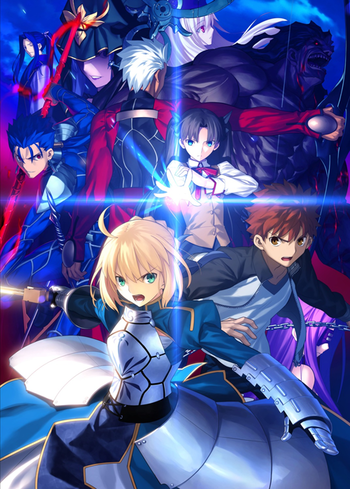
Steel is my body and fire is my blood
I have created over a thousand blades
Unknown to Death, Nor known to Life
Have withstood pain to create many weapons
Yet, those hands will never hold anything
So as I pray, Unlimited Blade Works.
The one that started it all.
Fate/stay night is a Japanese Visual Novel H-Game developed by the company Type-Moon. Created by Kinoko Nasu with character design by Takashi Takeuchi, it was first released on January 30, 2004 for the Windows PC and serves as the first installment of the Fate franchise.
There exists a plane outside of human concepts, within which lies the Throne of Heroes. Here, the records of the brave men and women whose lives have become legends are kept, to be used as eternal guardians of mankind. When a legend has been venerated enough by humanity, it can become immortalized as a Heroic Spirit that surpasses time itself. However, the definition of what a "hero" is, is broad; even the ruthless and heartless are the heroes of their own tales.
"Heaven's Feel" is a magical ritual where seven Heroic Spirits are summoned to become "Servants" to seven "Masters". They must then fight each other in a seven-way battle royale, whereupon the last Master/Servant team remaining is granted the ultimate prize: the Holy Grail, a legendary artifact said to grant any wish of whomever claims it.
The Servants are divided among seven classes: Saber, Archer, Lancer, Rider, Caster, Berserker, and Assassin. As public knowledge of a Heroic Spirit's true identity would reveal their strengths and weaknesses, they are referred to by their class titles. Finally, each Servant is armed with a number of "Noble Phantasms": the armaments and abilities that personify their legend.
Shirou Emiya is an Ordinary High-School Student who happens to know a little magic from his late adopted father, a retired mage. When he stays behind at school one night, Shirou stumbles into the beginning of Heaven's Feel V, aka the Fifth Holy Grail War. The official rules state that all witnesses must be killed, but before that can happen Shirou finds himself bound to a Servant of the "Saber" class, widely regarded to be the most powerful of the seven.
With the aid of Rin Tohsaka, a rival mage who summons an amnesiac "Archer" Servant, Shirou learns the rules of the Holy Grail War and just how far its participants will go to have their wishes granted. His dream is to become a selfless "Hero of Justice", but just how much meaning does that carry in a tournament where one must kill or be killed?
Although not initially released in English, the game originally had a Fan Translation patch made for it by the good folks at Mirror Moon. The visual novel was adapted for the PlayStation 2, with the pornographic content excised, but adds lots of cool new stuff in its place. The PlayStation 2 version is subtitled Realta Nua and the extra content from this version can be implemented onto the original 2004 PC version with this patch. A PlayStation Vita port of Realta Nua has been released in Japan on the 29th of November, 2012 with high-resolution graphics and three openings animated by ufotable. A version of Realta Nua was also released for PC in the beginning of 2011, with the three routes separated into individual downloads, as well as a port of the Vita version for iOS and Android in 2015. An English patch for Realta Nua PC can be found here for those who want to play that version of the game as-is; however, the newest (and arguably most complete) English fan-translation project for Realta Nua PC is the Fate/stay night [Realta Nua] Ultimate Edition project. The Ultimate Edition project features Mirror Moon's fan-translation, adds HD quality versions of the new openings (with the 2004 ones as an extra), updated high-resolution art from the Vita and mobile versions, the option to use the original or remixed soundtracks, 16:9 widescreen presentation, the ability to toggle and/or decensor the adult content as well as an optional mature content filternote , implements the jumpback feature from the PlayStation 2 version, the interactive Endings Menu from the PlayStation 2/Vita versions, and combines the three individual routes of Realta Nua PC into a single game à la the original 2004 release.
The Vita Realta Nua port was announced to have an HD remaster as Fate/stay night Remastered on Nintendo Switch and Steam with English and Chinese localizations included to celebrate the game's 20th anniversary and will release later in 2024, finally ending its long period of being only officially available in Japanese. Watch the first English trailer here.
Set in the Nasuverse. It is split into three routes. Although these routes can in theory be played in any order, it is generally recommended to follow the intended order as listed below:
- Fate: A route focused on Shirou's relationship with Saber and his ideal of becoming a selfless "Hero of Justice" who can protect the lives of everyone and everything. It also lays down the characters and the framework of the Holy Grail War for the reader.
- Unlimited Blade Works: A route focused on Rin and Archer, specifically delving into Archer's mysterious past and his conflict with Shirou's ideals.
- Heaven's Feel: The third and final route, focused on Shirou's childhood friend Sakura Matou, the dark machinations of her grandfather, and the secrets behind the creation of the Heaven's Feel ritual.
Adaptations
- An anime series created by Studio DEEN, released in 2006. The story is mostly based on the Fate route, with a few additions from the other two routes to make the series fill 24 episodes and give more attention to characters who were pushed into the background during the Fate route.
- Fate/stay night TV Reproduction, a two-part Compilation Movie of the series, released ahead of the Unlimited Blade Works film below. As such, some would count this as the first film in a series with Unlimited Blade Works.
- A movie, also created by Studio DEEN and released in 2010. This version adapts the Unlimited Blade Works route, with emphasis on the action scenes.
- A manga adaptation was serialised in 2006-2012. Like the anime adaptation, it's based on the Fate route while incorporating elements from other routes, as well as original content. The artist, Datto Nishiwaki, is a big Type-MOON fan, and makes references to other Nasuverse works in his end-of-volume rants.
- Fate/stay night [Unlimited Blade Works]: Another anime series by ufotable, based on the Unlimited Blade Works route, with 26 episodes altogether including a prologue "episode 0". Aired in 2014-2015 over two seasons.
- A Heaven's Feel manga by Task Ohna began serialization in May 2015.
- Fate/stay night: Heaven's Feel: Three movies by ufotable adapting the Heaven's Feel route. The first movie, presage flower, was released in October 2017. The second, lost butterfly, was released in January 2019. The third, spring song, was released in August 2020.
- An Unlimited Blade Works manga by Daisuke Moriyama began serialization in December 2021.
In 2005, it received a (sort-of) sequel titled Fate/hollow ataraxia, and in 2006, a 4-volume light novel prequel titled Fate/Zero which was adapted into an anime in 2011-2012. For other derived and related media set in the same universe, see Nasuverse or Fate Series. A light novel prequel detailing events in Saber's life, Garden of Avalon, was written by Nasu and included in the bluray release of the Unlimited Blade Works anime.
Tropes in Fate/stay night:
- All-Loving Hero: Shirou will literally kill himself with no hesitation if it means making even someone he just met happy. This is progressively deconstructed and reconstructed throughout the course of the three routes.
- Ancient Conspiracy: The Mage Association and The Church are big in the Nasu Verse. Also, the true purpose of the Grail Wars, and to a lesser extent, the true nature of the Fuyuki Grail.
- Arc Number: The number eight is very crucial to Shirou. As a skilled archer, he constantly reminds himself about how Japanese archery is an eight-step process. His favored magecraft, Projection, requires eight steps to perform perfectly. His Magical Incantation for his Reality Marble, Unlimited Blade Works, requires eight lines of incantation to activate — these lines, whether as his present-day self or as Archer, define him and his mindset.
- Arc Words: "My body is made of swords." It is a phrase that appears on the first screen of the game (not counting the prologue); as the story goes on, the phrase's different meanings and its purpose are revealed.
- There's also "hill of swords". It either refers to the Battle of Camlann, where Saber ultimately met her end and will return to in order to meet her fate, or Unlimited Blade Works, which represents Archer's/Shirou's struggles between his ideals and reality.
- Armored Villains, Unarmored Heroes: Played With — Saber is more heavily-armored than most of her opponents, bar Gilgamesh; however, Heaven's Feel features her turning to evil and the unarmored Rider opposing her.
- Armor Is Useless: Averted. Saber and Gilgamesh, the two characters who make use of plate armor, make very good use of it. Gilgamesh uses his plate armor to simply tank Saber's sword strikes when they fight in the Fate route, whereas in the Heaven's Feel route Saber Alter's helmet saves her from a strike to the head from Berserker (though the helmet was shattered in the process). Other characters try to actively seek weak points in these characters' armor when fighting them — typically the head, as for the most part Helmets Are Hardly Heroic in this story.
- Artifact of Doom: The Holy Grail. Due to events from the Third Grail War, it is inevitable that it will cause great calamity if activated.
- Artifact of Hope: Saber's Noble Phantasm, Excalibur: The Sword of Promised Victory, is one of the most famous Noble Phantasms in existence. As the crystallization of glory itself, it induces warm feelings of nostalgia and helps one recall fond memories in those that look upon it. It is also an enormously destructive Wave Motion Sword that can demolish a fortress in a single blow when used at full power.
- Battle Couple: Shirou and Saber provide the page image, though Shirou with Rin and Shirou with Sakura are also decent examples.
- Be Careful What You Wish For: Discussed. The Holy Grail is an artifact theoretically capable of granting any wish, but due to its corruption, it will grant that wish in the most destructive manner possible.
- Betty and Veronica: Across the whole franchise Saber and Rin frequently perform this task. Saber as Betty, Rin as Veronica.
- Big Bad Ensemble: Initially appears to be between Illyasviel von Einzbern, Shinji Matou, and Caster Medea, the three deadliest competitors of the Holy Grail War. However, Kirei Kotomine, Gilgamesh, and Zouken Matou are the true masterminds of the War. They are all working towards the same basic goal- whereas Kotomine is allied with Gilgamesh, Zouken is not. Said goal is unleashing Angra Mainyu from inside the Grail. Kotomine simply wants to watch the world burn, Gilgamesh is helping Kotomine so that he can rule over those strong enough to survive Angra Mainyu's apocalypse, and Zouken wants to use the Grail to become immortal. Each one, in turn, is the focus of one route: Kirei in Fate, Gilgamesh in Unlimited Blade Works, and Zouken in Heaven's Feel.
- "Blind Idiot" Translation: When Kotomine refers to the Einzberns having the Rhinegold in one scene, the Mirror Moon fan translation somehow bungled it into "the golden rule of the line". This went largely unnoticed for over a decade until the Einzbern's possession of the Rhinegold became relevant in Fate/Grand Order, at which point whereas Japanese fans just saw it as a nice callback, Western fans thought it was some new and out-of-nowhere revelation.
- Blood Magic: The runes in the ritual used to summon Servants are normally drawn in blood.
- Bloodstained Defloration: The original uncensored release shows Saber and Rin each bleeding when they lose their virginities. In Saber's case, it's when she has sex with Shirou to restore her expended mana in order to defeat Hercules on the "Fate" route.
- Body Horror: Students melting under Bloodfort Andromeda, Shinji being transformed into a giant mutant pile of flesh in Unlimited Blade Works, Shirou's body erupting blades and everything to do with the crest worms in Heaven's Feel.
- Book Ends: The first Servant defeated in the whole game is Rider, who is defeated by Saber. The last Servant defeated in the whole game is Saber Alter, who is defeated by Shirou with Rider's help.
- The first route that you play through is Fate, where Saber is the primary Love Interest who ends up losing her corporeal form and leaving Shirou behind. The final scenario you can unlock in Realta Nua is Last Episode, which serves as an epilogue of the route and shows how Shirou reunites with her.
- The Final Boss of the Fate route is Kotomine. The final boss of the Heaven's Feel route is him as well.
- Casting Gag: Shin-ichiro Miki voiced another blue-haired Kojiro in a different universe.
- The joke becomes full circle when a Historical Gender Flip of Miyamoto Musashi was introduced in Fate/Grand Order, though they didn't use Jessie's VA to voice her (Fate's Musashi is voiced by Ayane Sakura instead of Megumi Hayashibara).
- Chekhov's Boomerang: Done across timelines.
- Rule Breaker: In Heaven's Feel, Caster is taken out of the game early on. Since she and her Rule Breaker have played a major role in the previous route, most people put her out of their minds. But then, literally on the last day of the route... her Noble Phantasm, Rule Breaker, breaks Sakura's shackles to Angra Mainyu.
- The Azoth dagger: A near last-minute addition in Fate that Shirou uses to kill Kotomine, shows up again in Heaven's Feel, supposedly as a tool for Shirou to project Zelretch's Gem Sword. However, its real importance was Shirou using it to kill Saber Alter.
- Rin's pendant: Used to heal Shirou in the prologue. Archer's version of it, which he carried all his life and after (and returned to Rin in the prologue), turned out to be the catalyst for his summoning. In Unlimited Blade Works, Shirou returns his version of the pendant to Rin, giving the latter the final proof that Archer is Shirou's future self. However, in Heaven's Feel, Shirou's version of the pendant turned out to have the tiniest bit of magical energy left in it, which in the True End allowed his soul, newly-revived by Illya's sacrifice and the Third Sorcery, to hold on until Rider could rescue him. The pendant also probably anchored Shirou's soul to the material world; Rin commented that Rider "plucked Shirou out" of the rubble of the cavern two weeks after it had collapsed.
- Archer's swords: Shirou's Master clairvoyance during Unlimited Blade Works notes that Archer's swords, Kanshou and Bakuya, have a poem engraved on them. The purpose of the poem is noted to be unclear, with the clairvoyance hypothesizing that they're meant to ward off evil spirits, and the engravings were added by Archer and not by the original smith. This poem is actually the Magical Incantation for one of Archer's finishing moves involving the swords, though the move doesn't actually appear except in the Sparks Liner High ending of Heaven's Feel.
- Clingy Sleepers: Coupled with a Bedmate Reveal, after the battle with Berserker, Shirou wakes up in his futon being lectured by Saber, only for them both to hear a request to keep it down. Shirou pulls back his covers to find Illya clinging to him. Rin is not amused when she learns of this.
- Closest Thing We Got:
- If a Master specifically attempts to summon a Servant for whom no soul exists in the Throne of Heroes (i.e. the person in question never really existed), it will result in the summoning of a false Servant concocted of the closest match the Grail could find.
- Although it doesn't come up in the visual novel proper, later information confirms that the whole reason why Taiga, a remarkably skilled kendoka with a third dan under her belt (and she definitively could have reached higher than that), is instead in charge of the Japanese Archery school club is because Homurahara Academy simply doesn't have a kendo club.
 Word of God also says that Shirou would have immediately joined the kendo club upon entering high school, but after finding out they didn't have one anymore, he instead let Taiga drag him to archery.
- Conveniently Orphaned: Not a single remotely major character has living parents, and several (including the main character) are orphaned twice over. Not only that, but those who actually have something passing for surrogate parents would much rather that they didn't.
- Shirou is the sole exception to the latter. As much as Taiga picks on him and mooches off of him, his enraged reaction when Caster uses her as a hostage in the Unlimited Blade Works route proves that he cares about her greatly.
- The Corruption:
- Mad Enhancement, the Class Skill of Berserkers, alters their appearance. Fate/Zero Berserker's C-class Mad Enhancement gave him fangs and lank black hair beneath his helmet, whereas Fate/stay night Berserker's B-class Mad Enhancement is evidently at least partially responsible for his strange appearance.
- The contents of the current Grail, since the Third Grail War. The Einzbern family summoned the forbidden Avenger class as their Servant, causing him to be trapped into the Grail after his defeat due to his complicated circumstance. Since Avenger embodies All the Evils of the World, the corruption takes over the Grail. As a further result of this, any Servant exposed to Avenger in his present form is tainted by his hatred and turned evil, a process known as Blackening.
- Cryptic Background Reference: The events of the Third Grail War are pretty vague; pretty much all that is known is that the Edelfelts summoned good and evil versions of the same Saber and that the Einzberns summoned Avenger.
- Cue the Sun: The True End of each route usually features this as a sign of hope and new beginnings after the tribulations of the War.
- Curbstomp Battle: It takes Saber all of one slash to put Archer out of commission for over a week while he heals. Rin attempts to follow up, only to discover the hard way Saber's godlike level of Anti-Magic. The only thing preventing Rin from dying right then is Shirou's order to stop.
- Deconstruction: The story is a very harsh (yet also optimistic) deconstruction of the concept of heroes and heroism. It also examines the concept of ideals, what it takes to change ideals, and what kind of resolve a person needs to have in order to have a will to support those ideals.
- Deus Sex Machina: Mana Transfer Ritual. Sex ensues in the most inopportune times. Averted in the manga, Realta Nua editions of the game, the film, and anime adaptations.
- Didn't Think This Through: In Heaven's Feel, after Archer managed to force True Assassin to retreat, Rin decided it was a good idea to stop and congratulate Shirou for surviving, despite still being in battle with The Shadow. This of course allows The Shadow to get the jump on her, forcing Archer to sacrifice himself to protect her.
- Doorstopper: The Visual Novel is about a million words long in English, longer than The Lord of the Rings. The most conservative estimates puts the time it takes to go through the entire story at about 60 hours, but it is generally agreed that 80-100 hours is a more realistic estimate. It's partly why the VN hasn't been officially released in English.
- Dub-Induced Plot Hole: When discussing the Einzbern family, Kotomine mentions in the Mirror Moon fan translation that their wealth comes from "the golden rule of the line", which suggests some kind of Ley Line-related magic. In the actual japanese, he said that it came from "the gold of the Rhine", as in the massive and very cursed treasure hoard from the Nibelungenlied, which single-handedly explains why they've done nothing but screw up everything they attempt over several generations. It's fairly notable in that it took well over a decade to be noticed, specifically until Fate/Grand Order where Siegfried himself expresses concern for them as the new owners of his cursed loot.
- Dysfunction Junction: Everyone's backstory involves some past tragedy that has scarred them for life and supplied them with a fatal flaw. Each heroine's route takes time to explore said flaw and eventually have her get over it, but Shirou's Chronic Hero Syndrome is what really takes center stage.
- Elemental Powers: Very exceptional ones, they are attributes linked to the "Origin", explained in The Garden of Sinners; Shirou has "Sword", Rin has all the basic five ("Average One"), and Sakura has "Imaginary Numbers" and artificially "Binding".
- Embarrassing Relative Teacher: Inverted. Taiga (Shiro's legal guardian/aunt figure/moocher) teaches his class at school, but she's the one who gets embarrassed when they act too familiarly there. Shiro- not being your average teenager- is pretty chill about it.
- The End of the World as We Know It: The result if the Big Bad achieves his goal. The Evils of Angra Mainyu would be unleashed upon humans to destroy them.
- Equivalent Exchange: You pay for your magecraft, no matter what. True Magic, on the other hand...
- Even Evil Has Standards: Kirei Kotomine may be motivated solely by the pleasure he gets in seeing others suffer, but even he loathes Zouken Matou.
- Fatal MacGuffin: In each of the routes, the Holy Grail turns out to be more trouble than it's worth, as not only does it consume the Servant that touches it, it has been corrupted by Angra Mainyu since the third Grail War. Appropriately, the Grail is dismantled or outright destroyed at the end of each of the three routes.
- Food Porn: Lengthy segments of the Visual Novel are devoted to Shirou cooking, often along with Sakura. The process of making the food is usually presented in detail. In fact, these sections got so much attention that it spawned a spinoff.
- Foreshadowing: Loads of it, and in the most unlikely or innocuous places, too. For example, a major reveal in Heaven's Feel note is foreshadowed in the Mini-Theater you get by completing all Tiger Dojos in Fate.
- For Want Of A Nail: As per tradition with visual novels with multiple routes, while the novel's main story always begins the same, the choices made by the reader during this first chapter are what branches out into the novel's three main routes, each with drastically different events and outcomes. Even a single choice has the potential to completely alter the entire course of the Holy Grail War.
- Fate: As the first, and main default route, intended as an introductory route for first-time readers, Shirou is almost entirely a passive character for the first few days.
- As he does nothing to prevent Saber from attacking Archer in the first day, Archer is near-fatally injured, essentially excising him from most of the plot so he can heal. As a result, Rin is deprived of her Servant for most of the War and her second Command Spell. This forces her into a passive mentor role and being an early ally to Shirou, primarily to deliver exposition to the audience.
- The early fight with Illya and Berserker soon after thus results in Saber fighting solo and nearly losing horribly - a sight that sparks Shirou's obsessive desire to protect her, and thus their central character conflict.
- With the main heroes taking on a mostly passive and defensive role, the other enemy Masters are generally able to continue their operations uninterrupted - Shinji ends up "peacefully" reaching out to Shirou first in order to enter the plot with Rider; Caster's faction is able to sit back and also be entirely defensive (Caster herself being unseen for almost the entire route); and Kirei's faction stays almost entirely in the shadows, to the point where Gilgamesh straight up barges into the plot out of sheer boredom.
- Unlimited Blade Works: The sole difference between this route and the Fate route is Shirou's decision to use a Command Spell to stop Saber from injuring Archer, meaning both him and Rin are able to become much more active in the Holy Grail War.
- Archer's presence and better terrain means the first Berserker fight goes far better for Saber, putting Illya in the plot backseat for most of the route and allowing Shirou to accept his partnership with Saber with almost zero hang-ups, completely removing the conflict between them as seen in the Fate route.
- Meanwhile, Rin is no longer shoved into a mentor role, and Archer is able to further his personal goals - sparking the new central conflict of the route.
- No longer allied with Shirou, Rin initially (tries to) act as an early enemy to him - a sequence that accidentally runs them afoul of Shinji and Rider in a much more hostile manner, accelerating their plans by several days.
- Rin and Archer are even able to independently foil Caster's machinations in the city, forcing the normally-passive Caster and her faction to steal the spotlight as the mid-story villains - even directly supplanting their previous equivalents in Fate, Shinji and Rider, the latter of whom they excise from the plot almost as quickly as she entered.
- To make matters worse, Shinji's early departure from the War leads him to flee to Kirei... leading the priest, seeing an opportunity for a new pawn, to assign Gilgamesh as his new "Servant" to carry out their plans earlier than in the Fate route. As a result, Gilgamesh takes on an active role much earlier, and has much grander motivations than simply pursuing his romantic obsession with Saber.
- Heaven's Feel: The changes in this route involve Shirou paying closer attention to Sakura, and eventually personally walking her home. This single action gets him spotted by and draws the interest of Sakura's grandfather Zouken, who is normally a non-entity in the other routes. Zouken's noticing of Shirou's relationship with Sakura results in his renewed interest in the current Grail War, and deciding to take matters into his own hands.
- In their first meeting, Zouken casually mentions Illya's name to Shirou, leading to him recognising her name later after the first Berserker fight and taking an interest in her. Despite the early sequences being similar to the Fate route, this single difference soon sparks a wildly diverging chain of events: Shirou automatically declines Rin's proposal for an alliance to actively pursue learning more about Illya instead, eventually leading to him learning the circumstances behind the previous Grail War from Kirei and Saber only the day after he joins the current War (once a major plot reveal of the Fate route).
- This new knowledge (and Rin's absence) leads to Shirou and Saber sorting out their differences and working together to actively patrol the town in search of Masters - leading to them finding and (seemingly) defeating Shinji and Rider even earlier than in the previous routes.
- Shinji's early humiliating defeat leads him to abuse Sakura again, driving Shirou to have Sakura temporarily stay at his house for her protection at Rin's advice, cementing her story presence as the route's new heroine.
- Meanwhile, Zouken, after the War begins, makes a single additional remark about Rin's high odds of victory to Sakura, in order to stoke her jealousy and will to fight - emotions which activate her nature as an artificial Grail, and release the dormant Shadow within her.
- Zouken and the Shadow are able to almost completely hijack the Grail War as total wildcards, spawning the True Assassin as a new Servant and wiping out Assassin, Caster, Kuzuki, and Lancer within two days.
- The sudden appearance of new, far-more-malicious players in the War soon forces the remaining Masters to (mostly) put aside their differences to tackle the new threat - even former Big Bad Kirei, giving him more time in the story spotlight through increased interactions with Shirou.
- Fate: As the first, and main default route, intended as an introductory route for first-time readers, Shirou is almost entirely a passive character for the first few days.
- Four-Temperament Ensemble: The leading ladies of the different routes exhibit this: you have Saber as melancholy, Rin as choleric, Sakura as phlegmatic, and Illya (originally intended to be the fourth heroine) as sanguine.
- Future Self Reveal: Archer is revealed to be an alternate Future Badass version of Shirou himself, who took his younger self's "Hero of Justice" mentality to an extreme and brought peace through extreme violence.
- Gambit Pileup: The Fifth Grail War is complicated due to plots by Zouken, Kirei, Saber, Caster, the Einzbern family, Gilgamesh, Counter-Guardian EMIYA, and Avenger all being executed at the same time. Differences between each route result in specific gambits being of more concern, and some being completely irrelevant.
- Gender Bender: Other than being a gender flipped King Arthur, Saber was, for a period of time during her reign, given some... key male anatomy in order to produce an heir. This makes her a gender bender gender flip character.
- God of Evil: In Unlimited Blade Works, we learn that Angra Mainyu, the devil in Zoroastrianism, lives inside the Holy Grail and has corrupted it. As is explained in Heaven's Feel and further elaborated upon in hollow ataraxia, it turns out that Angra Mainyu isn't an evil god — he's a Servant whose legend was born of a ritual where a single man was ritually sacrificed to personify all the the sins of his fellow humans so he'd absolve them by being killed. In the Third Holy Grail war, when Angra Mainyu, summoned as Avenger, was killed because he was a horribly weak Servant, the Grail identified him as a human rather than a Servant and tried to fulfill his wish. Considering that the Holy Grail is an omnipotent device whose entire purpose is to seek and grant wishes and that Angra Mainyu is the personification of the world's wish for a concrete form of all evil... Let's just say it doesn't turn out well.
- Gold-Colored Superiority:
- The most powerful Servant one can summon is Gilgamesh, the King of Heroes. As the The Nasuverse runs on Older Is Better, Gil is more powerful than all other heroes that came after him and naturally has gold-colored hair, frequently wears gold earrings and other jewelry, and has his infamous Nigh-Invulnerable gold armor. It is unknown if the armor is actually made of gold but it can take a direct hit from Excalibur like it's nothing. For bonus points, his Noble Phantasm — Gate of Babylon — creates gold-colored rifts in the the sky to fire his many fantastically powerful treasures upon his enemies from.
- Saber, Artoria Pendragon, a.k.a. King Arthur, also gets this: she is said to be the strongest of the Saber class Servants, which is considered to be the strongest class, and she has golden hair. Though she can be pragmatic and is utterly duty-bound, she's actually very sweet when she opens up and counts for both this and Hair of Gold, Heart of Gold, unlike Gilgamesh. Although her sword is normally invisible as it is sheathed in wind magic, when she reveals it the blade shines with golden light and seems to be trimmed in gold — fitting as it is Excalibur, the strongest holy sword. Even her old sword from her legend, Caliburn, is shown to have been gold and incredibly powerful.
- Greater-Scope Villain: Angra Mainyu, the source of the Grail's corruption.
- The Greatest Story Never Told: Shirou's actions in Unlimited Blade Works and Heaven's Feel can never be fully explained for fear of the Association's response to his Reality Marble. In Heaven's Feel, the Association is told Shirou was an ordinary human who died during the War.
- Hair Color Dissonance: Both Rin and Sakura are stated to have black hair (although Mirror Moon's translation leaves out that detail with regards to Sakura). In the game sprites, Rin's hair is close to black and may be seen that way, but is technically a very dark brownish charcoal, while Sakura's is deep blueish purple. To complicate matters, illustrations show Sakura with the same hair color as Rin before being adopted by the Matous. A possible interpretation is that her purple hair is an out-of-story way of representing the biological alterations Zouken carried out on her, but her hair didn't actually change color in-story.
- Harmful Healing: The interaction of Shirou's Reality Marble and Avalon allows his body to rapidly heal by replacing damaged tissue with blades. One bad end involves this going out of control, resulting in blades erupting from his chest and shredding his internal organs. During Heaven's Feel, Archer's Reality Marble begins to intrude into his body, causing it to break down. His own Reality Marble generates blades to counter the damage, which then pierce his remaining flesh and cut him apart even more.
- Hermetic Magic: Summoning Servants and various rituals connected to the Grail and Shirou's projection magic involve runes and elaborate invocations.
- Human Resources
- The Holy Grail's power comes from absorbing the souls of the heroic spirits who died in the war.
- Servants can consume human souls in order to replenish their prana, though most traditional Spirits will find the action to be beneath their dignity and may require a Command Seal in order to do so. Caster and Rider both resorted to this at the start of the War due to their Masters lacking prana.
- Idiot Hair: Saber unless she's in Saber Alter mode.
- In Spite of a Nail: In all three scenarios, the best possible ending has The Holy Grail being destroyed. And even that probably didn't end the cycle of violence brought by the Heaven's Feel ritual, if Fate/hollow ataraxia is any indication.
- Intimate Healing: As usual for the Nasuverse, sex can be used to replenish magical energy. In the Réalta Nua, manga, and anime adaptations, it's Bowdlerized into the widely-mocked "Mana Transfer Dragon" in the case of Saber and "magic dolphins" in the case of Rin.
- Jackass Genie: Due to Angra Mainyu's influence, the Holy Grail will twist any wish made to it in a way that will kill or hurt as many humans as possible.
- Jacob Marley Apparel: Servants will be summoned wearing the outfit they had just before their death if they had a strong attachment to their particular appearance. Otherwise, their appearance will reflect what they looked like during their prime.
- Kung-Fu Wizard: In contrast to many magi who rely exclusively on magical means of combat, the Tohsaka family have a long-standing tradition of martial arts training which can be traced all the way back to their founder.
- Late-Arrival Spoiler: Many of the Servants' identities, particularly Saber's as a gender-flipped King Arthur, aren't really heavily guarded spoilers anymore.
- Limited Wardrobe: Almost everyone has, at most, two sets of clothes (typically school, armor, armor/casual, or school uniform/casual, or in Illya's case, cold-weather/normal). Other, non-standard outfits are Illya's Dress of Heaven, Rin's bedclothes, and the occasional birthday suit.
- Lost in Translation: When Illya first meets Shirou, she calls him "onii-chan". This is fairly innocuous to both Shirou and first-time Japanese readers — international consumers of Japanese media know that word better as the honorific for addressing an older brother, but it is also used to address strange young men. However, she is actually calling him her older brother. There's no way to preserve the older brother/random guy ambiguity in English without just giving it away, so the official English translation of the anime uses "mister".
- Luminescent Blush: The three main heroines, Saber, Rin, and Sakura, each have a blushing portrait in cases of embarassment.
- Magi Babble: Hours of exposition are devoted to explaining the mechanics of Functional Magic in different ways.
- Magic A Is Magic A: The Nasuverse has an extensive set of rules regarding what is and is not possible and how people meet the energy requirements for what they do. For example, even with magecraft it's normally not possible to make something out of nothing, nor can the output of energy be greater than what one puts into it, meaning most mages have to power their spells with the energy taken from the environment rather than the energy they produce internally. However, once this sort of baseline rule is established, there are then people who seem to break the rules by going outside the normal system, such as the True Magics or Reality Marble users, both of which are quite unnatural.
- Magic Must Defeat Magic: Servants cannot be harmed by modern weapons like firearms, as they're fast enough to Dodge the Bullet or simply disperse into spirit form rather than take the hit head on. As such, Servants are only injured and killed by other supernatural beings within the story such as other Servants, Angra Mainyu, magi, or people magically enhanced by magi. This is perhaps best shown in the Unlimited Blade Works route, where Kuzuki, enhanced by Caster's magecraft, manages to take Saber by surprise in hand-to-hand combat and defeat her. But when Archer murders Caster, Kuzuki is only able to land one hit that Archer doesn't even bother trying to dodge before Archer cuts him in half.
- Mêlée à Trois: The Holy Grail War is fashioned as one: seven Masters, their eventual associates, seven Servants. To reach the end of the War and fully open the path to the Holy Grail, all seven Servants must ultimately die. The Master's death is not required, but killing a Master is the fastest way to dispose of a Servant who doesn't have the Independent Action skill. A Servant who survives their Master's death long enough can take a new contract, and under some conditions a Master can have a contract with more than one Servant.
- Mood Whiplash: Before the player enters the Tiger Dojo, the story warns that if you want to preserve your image of the characters, you should skip this area. Most Tiger Dojos are very silly.
- Mundane Utility:
- Rin's first order of business to her Servant Archer, a Heroic Spirit of mighty power, is, "Clean up this mess." The next morning, the first thing Archer does is make tea. Damn good tea, according to Rin.
- Initially, Shirou's magecraft is so weak and underdeveloped that he can only harden objects or inspect them for repairs. By the end of each route, he can instantly generate enough swords for a whole army.
- Muscles Are Meaningless: A trope that applies to the Nasuverse in general. Almost all of the physical powerhouses rely primarily on Prana (analogous to "chi") rather than muscle to perform their physical feats.
- Saber's "Mana Burst" is an example of this. This is why Arcueid, who has the body of a supermodel, can inflict some the strongest physical destruction in the Nasuverse; and Saber, who is a tiny woman, can keep up with monsters like Berserker. Saber demonstrates the difference between her physical strength, with and without Prana, quite clearly in the game – as with a weak Master like Shirou, she herself is greatly weakened.
- Humans are generally an exception since most do not have a whole lot of Prana, in fact, most have almost none. They instead rely on Mana (Prana is essentially Mana that is innate or internal to any specific entity), making most of the most powerful humans closer to traditional mages. Though humans tend to avoid direct physical confrontations with serious threats, it certainly does help to be physically fit for various reasons.
- Mythology Gag: Shirou awakens to an Unfamiliar Ceiling and is introduced to his savior and mentor-to-be, a self-styled Magician. This is a reference to Shiki and Touko's first meeting in The Garden of Sinners, though not to the extent of basically recreating the scene as in Tsukihime.
- Neutral in Name Only: The Church is supposed to remain neutral. However, their long-term goal is to confiscate the Grail, and in the short-term, their current agent and overseer Kirei Kotomine is a master working for his personal gain against the rules.
- Never Given a Name: Normally a Noble Phantasm's name is a key part of its power, to the point where it cannot be used properly without knowing it, but Gilgamesh's sword does not have a name at all. It has been referred to as "Ea" or "The Sword of Rupture" for convenience, but neither of these names truly belong to it in a mystical sense.
- Nice Guy: Shirou.
- Nice Mean And In Between: Of the three heroines, Sakura is the nice, Rin is the mean, and Saber is the in-between. Sakura is unabashedly sweet, partially thanks to her incredibly low self-esteem but also her genuine love of Shirou. Rin is sarcastic, aloof, and unapproachable due to her strong defense mechanisms. Saber falls squarely in-between, being generally kind but stoic and stubborn.
- Older Is Better: A very strongly adhered-to rule. Older magi are capable of things modern magic-users can only dream of. It's also one of the reasons Gilgamesh is so powerful: he possesses the Platonic ideal of almost every weapon-type Noble Phantasm that ever was or will be, meaning that they're all at least one rank more powerful than the actual versions that were used by the Heroic Spirits.
- Old Magic: Caster is able to wield spells from the Age of Gods that vastly outstrip the raw firepower of modern day magecraft. Due to possessing the ability to use Divine Words lost to humans in the present, she can perform incredible feats with a single word when it would take entire teams of modern-day magi chanting for several minutes to do the same.
- Ominous Obsidian Ooze: The "black mud" of Aŋra Mainiiu, which resides in the Holy Grail contains "All the World's Evil" and is basically The Corruption in (mostly) liquid form.
- Ominous Pipe Organ: Church on the Hilltop, which is Kirei's theme and is supposed to be a soothing church tune but its effect is rather unsettling.
- Omnicidal Maniac:
- The goal of Archer 2 is to unleash Angra Mainyu to purge the Earth of those unworthy of his rule, and if all humans happen to perish then that just means that none of them were worthy.
- Angra Mainyu's sole purpose is to wipe out all humans. That is what he's supposed to do as he's all the evils of the world.
- Possession Implies Mastery: One of the big themes.
- The "Riding" skill. As long as the skill is ranked highly enough, a holder can simply grab the controls of any vehicle or mount and instantly know how to operate it as if they had been for years.
- Archer does not master his Projected weapons, but can get the skill/knowledge of utilization of a weapon thanks to his re-creation of the actual creation and its history as its master used it.
- Power Glows: Justified; Mana distorts reality, so strong enough amounts of it become visible to the naked eye.
- Projectile Spell: The Gandr spell sounds like a gun, and even leaves bullet holes behind.
- Reused Character Design: The real-life reason behind the existence of the "Saberfaces"note , explained in-universe as them being identical strangers, to the point of being mistaken for one another.
- The Reveal: One for each route.
- Fate: Saber is really a gender-flipped King Arthur, and her wish is to make it so she never became king, as she feels she is responsible for the destruction of her kingdom.
- Unlimited Blade Works: Archer is really Shirou from a Bad Future in which he turned to Kiritsugu's "kill one to save ten" ideal in order to save the world. That ideal eventually betrayed him, and Archer wishes to kill his past self because he feels his life was a waste.
- Heaven's Feel: Sakura is a failed Grail experiment and has been horribly tortured her whole life in an attempt to make a Holy Grail vessel, whereas the Shadow is... her Servant, though the situation is considerably more complicated than most Master/Servant relationships.
- Sealed Evil in a Can: Angra Mainyu was sealed within the Holy Grail during the Third War because the Grail identified him as human instead of a spirit.
- Second Year Protagonist: Shirou Emiya and Rin Tohsaka are both second years, while Sakura Matou is a first year. No really important third years, but the fact they aren't graduating until the next year is an important detail in the UBW True End epilogue.
- See No Evil, Hear No Evil: Berserker and Ilya's sudden appearance in the middle of an empty street completely catches Shirou unaware. This is justified because, like any other Servant, the humongous and usually quite noisy Berserker has the ability to recede into spirit form. This occurs in the original visual novel, but the anime makes it more apparent.
- Shout-Out:
- If you listen closely to the background music whenever Shirou's TV is telling the local news, you can hear some music from Tsukihime, another Type-Moon Visual Novel.
- During one of the Tiger Dojo chibis, there's a Touhou Project reference when Sakura and Rin briefly have a cute fight with each other, complete with rainbow-colored bullets everywhere and a side-shot of both of them vertically.
- The scene where we see the worms at work is a fairly obvious Shout-Out to Stephen King's novel IT, where Patrick Hocksetter dies in roughly the same way.
- The aftermath of the Grail Fire and Shirou's reaction is incredibly similar to the aftermath of the atomic bomb explosion as described in John Hersey's Hiroshima.
- In the anime, Saber asks "What are you going to do, bleed on me?"
- Berserker has a Noble Phantasm called God Hand.
- The form that the Angra Mainyu-corrupted Greater Grail takes – a massive, dark tower with prongs and an enormous black hole on top of it — is uncannily similar to the Eye of Sauron and the Tower of Barad-dûr in the Peter Jackson Lord of the Rings trilogy. It's particularly possible it had some influence, as the movies were all released during the development of the visual novel itself.
- Gilgamesh's golden-armor-with-blue-highlights design is almost certainly a nod to another famous Gilgamesh in golden armor who climbed a tower. The similarities stop at the armor, however.
- A very subtle one, but the Excalibur theme's main melody appears to have been taken from the song "Forever" by American metal band Kamelot, itself based on "Solveig's Song" by Edvard Grieg. Bonus points since some of Kamelot's more well-known songs concern the Arthurian Legend.
- Soul Eating: Servants can do this to replenish their Mana, though the more wholesome ones are understandably quite averse to it. In one case, the Servant – a Chaotic Evil Anti-Villain – expressed a preference for evil souls, because their foulness makes them that much tastier, and souls of similar alignment are easier to digest.
- Spoiler Opening: In the PS Vita version, this applies to all three routes. Heaven's Feel's opening in particular spoils Sakura being a corrupt Grail, and Saber Alter. The front cover of said version also prematurely gives away Sakura's alignment with her Servant, Rider.
- Sudden Game Interface: All Masters are granted an intuitive understanding of what's going on in the Grail War – even Shirou, who stumbled into the whole thing completely unaware. His appears as RPG-style character sheets, complete with listed Character Alignments.
- Summoning Ritual:
- The Holy Grail War System provides the power behind the ritual required for acquiring a Servant. The Servant will usually respond to the call if the mage has an artifact associated with him or her.
- The exception to this rule is the Assassin class. Since the word "Assassin" derives from "Asāsiyyūn", the sect founded by the first "Hassan-i-Sabah" and the subsequent 18 people who bore the same name, the act of summoning an Assassin negates the need for an artifact.
- Supernormal Bindings: One of Gilgamesh's noble phantasms is Enkidu, a special chain that was created to restrain the gods. Its strength is proportional to the divinity of its target, so whereas it can easily overpower gods, when used against a normal person it simply acts as a tough chain.
- Superpowerful Genetics: Magic in the Nasuverse is often genetically inherited through bloodlines. This isn't a hard-and-fast rule, though, as people from mundane families (like Shirou or Ciel) can be born with magic circuits, and it's a plot point that one bloodline has slowly lost all of its power over generations. It's also possible to artificially create or increase magical potential.
- Temporal Suicide: This is the primary goal of Archer, a.k.a. Shirou Emiya, who seeks to kill his past self in order to wipe himself from existence and free himself from the shackles of being a Counter Guardian. He also wants to do it to spare Shirou from going through the same experience as he did, trying to become a hero of Fuyuki City and ultimately becoming a Fallen Hero. Unfortunately for him, no matter how well laid out his plans are, several other factors prevent Archer from achieving his goal at the worst possible moments, and it's indicated in Unlimited Blade Works that his plan would fail even if he did succeed in killing his past self, since when he became a Heroic Spirit he became an existence outside the space-time continuum.
- Tempting Fate: Hoo boy, do the writers love this trope. It's played with, in both a comical and a serious tone, with varying results.
- Theme Music Power-Up:
- Anytime "Emiya" starts playing, you know Shirou is going to do something epic or an important battle is going to happen.
- "Sword of Promised Victory" plays whenever the Holy Sword or a similar Noble Phantasm is about to be used.
- "Into the Night" (The title music) plays when the Final Boss is about to get a beatdown – it's an even more reliable power-up than "Emiya".
- "Premonition of a Storm" is one of those "Shit's going down!" songs that can pump it up. Sadly, it's not in the original Visual Novel, but a new musique of the Fate/stay night Realta Nua version.
- There Can Be Only One: The very concept of the Grail War is that only one mage can have his wish fulfilled. The Grail provides the individuals who desire it with Command Spells. Things are far more complicated.
- Title Drop:
- In the songs:
- "ideal white", the first opening to the Unlimited Blade Works anime, mentions "fate" at one point.
- "Brave Shine", the second opening to the Unlimited Blade Works anime, contains the lyric "stay the night" in the first chorus.
- "I Beg You", the ending theme for Part 2 of the Heaven's Feel movie trilogy, contains the lyric, "heavenly feeling", before the final chorus.
- The title of Unlimited Blade Works comes from Archer's and later, Shirou's prayer.
- The Heaven's Feel route is another name for the Holy Grail War.
- In the songs:
- Translator Microbes: The Holy Grail acts as one. For the Servants, it implants a basic level of knowledge about the time period into which they are summoned. This prevents inconveniences such as, for example, a Servant from Ancient Greece being freaked out by cars or cellphones. Pretty convenient considering a Servant can come from across time and from any culture around the globe.
- Two-Teacher School: The only staff we ever see at school are Soichiro Kuzuki and Taiga Fujimura, despite the apparent size of the school.
- Unreliable Narrator: The Narrator, Rin or Shirou, is given to making observations which are later proven false.
- Wall of Text: A Visual Novel is text-based by nature, but at times the presentation bogs down with dense blocks accompanied by unvoiced, single static images.
- Weirdness Censor
- Not even a rumor about the war is going on, even when things that couldn't be covered up or downplayed easily (sonic booms from attacks, shining golden light shooting into the sky at a flying horse, etc) happen. Justified by a cover-up done by The Church and the Mages' Association, but we never see it in action during the Visual Novel.
- Played for Laughs on a smaller scale, when Rin gets so angry at Shirou that she shatters her "perfect student/school idol" image in front of everyone to shout at him. Everybody stares... then go back to what they were doing, subconsciously repressing those memories to maintain their "perfect" image of her. This happens on two separate occasions.
- With This Herring: Pretty awesome once you think about it: Shirou's first battle against legendary hero Lancer is Lancer and his Gae Bolg versus Shirou and his... reinforced newspaper. The fact that it survives SEVERAL HITS from a legendary spear says it all.
- Word Salad Title:
- Though the title still doesn't make much sense, one can at least find a recurring fate motif when thinking about it. Such as Saber's desire to rewrite history; Archer's musings that, no matter their lifestyle, ultimately all heroes will have to face the same fate, their death, and the collapse of everything they worked for; as well as Kotomine asking the question of how much one's life is determined by inborn nature and the intentions of God. There is, of course, also the recurring question of why the Grail chose the Masters it did.
- This also occurs with individual scene titles, though each one makes sense once you watch the scene. For example, Shapeless Island involves Rider stealing Shirou's mana with wet dreams, shapeshifting into Rin.
- In terms of unlocking the routes, the title makes an odd sense if you exclude that each set of choices has to be unlocked. Fate is there from the beginning and deals with Saber's fate, Unlimited Blade Works is the second available route and is unlocked by telling Saber to 'stay' in place and not attack Archer in their initial fight and finally Heaven's Feel is unlocked by not actively trying to fight in the Holy Grail War and 'staying' in at 'night' with Sakura.
- It could also be referring to how the battles the form the Grail War are mostly waged at night and the sexual/romantic parts of the story ("stay the night"), namely how each route has Shirou romance a different love interest.
- Worf Had the Flu: Happens really often. There are surprisingly few battles where both contenders don't have some sort of handicap.
- Saber spends most of the Fate route recovering from two serious injuries she took from Lancer and Berserker, severely limiting her mana supply. She is further weakened due to Shiro being an Inept Mage and not having a proper contract with her, and with Rin as her Master in Unlimited Blade Works she's able to quickly regain her full power.
- Archer takes his own grievous wound from Saber in Fate, resulting in him taking a back seat to recover. When he squares off against Berserker, he still hasn't recovered enough to use his trump card. In Unlimited Blade Works he has to deal with not having a master and needing to conserve mana to continue existing.
- Lancer is being compelled by his master to only sound out his enemies instead of fighting them seriously for his early fights with Saber and Archer.
- Rider's master is extremely weak and Rider has no source of mana other than draining it from other people, leaving her incapable of using her more powerful abilities freely. When Sakura becomes her master again, Rider's power skyrockets.
- Berserker is normally a Genius Bruiser whose immense strength is supplemented by his intelligence, but as he was summoned as a Berserker to ensure his obedience, his skill and genius have been lost. In Unlimited Blade Works he loses to Gilgamesh due to his enemy's willingness to attack Illya, forcing him to fight defensively. In Heaven's Feel his corruption causes him to get blinded and flayed, causing him to repeatedly crash into trees as he chases the heroes through a forest, as well as making him more susceptible to Shirou's counterattack.
- Assassin forces a decisive clash between him and Saber by blocking, instead of parrying. This damages his blade, ruining his Tsubame Gaeshi technique and allowing Saber to defeat him.
- And finally, Gilgamesh only ever loses because his pride makes him hold back his full might. Even when he decides to get serious, his previous slacking usually allows the heroes to already form a countermeasure and get the jump on him.
- Would Hurt a Child: Used in all three routes to show how evil the route's major antagonist really is.
- Fate: Kotomine has been using, the other orphans of the Fuyuki fire, as living prana batteries for ten years, though "living" is entirely too generous a term.
- Unlimited Blade Works: Gilgamesh tears out Illya's heart. And before that, he slices open her eyes.
- Heaven's Feel: Everything Zouken did, with regards to raising Sakura.
- And I Must Scream:
- If you refuse to participate in the Grail War when you're taken to the church for the first time, Illya proceeds to brutalize Shirou and torture him without killing him.
- Shirou is not the only Fourth Grail War orphan. The other children were taken in by the church and used by Kotomine for powering his associate Gilgamesh's mana — not to keep him in this world, since he already has a body, just to supply him with mana to use his abilities as a Servant. The children are stuck in a grave, their bodies and souls being slowly dissolved. And yes, they are fully aware. They'd be screaming except their vocal chords have mostly rotted away.
- Awful Truth: Getting the true end of the route requires you to discover Kirei Kotomine's ghastly basement of orphans by going down the ominous staircase that leads to it. Kirei himself later forces Shirou to remember all the people he knowingly left behind in the fire to save his own skin, which is something that has been subconsciously fueling his Survivor Guilt for years.
- Bad Guys Do the Dirty Work: Illya and Berserker conveniently kill Shinji after his Servant is defeated by Saber, saving Shirou from the moral quandary presented by having to deal with a totally defenseless person who crossed the
 Moral Event Horizon right in front of him previously.
 - Big Damn Heroes: Subverted by Gilgamesh who, after saving the heroes from their last opponent, becomes their new one.
- Bittersweet Ending: Shirou Did Not Get the Girl but decides that life goes on. Illyasviel survives, but probably won't live more than a few years (at best) due to her being a homunculus. And although the Distant Finale in the Realta Nua version has Shirou and Saber reuniting, it's also made very clear that not only are they both dead, but Saber and Shirou were separated for a very long time.
- Body Horror:
- The first ending possible results in Berserker leaving Shirou a disembodied head, which Illya will keep alive and torture for as long as she pleases.
- The fate of the other orphans from the fire ten years ago. They resemble nothing so much as rotting, bug-infested, limbless corpses... but they're still alive and aware so that Gilgamesh can feed on their prana.
- Chekhov's Gun:
- A sword keeps appearing in Shirou's dream throughout the route. It's the sword Caliburn, which Shirou projects in order to defeat Berserker.
- Saber mentions having lost her final Noble Phantasm, Avalon, Excalibur's sheath. Rin also narrates a story about Merlin, saying the King's true weapon is his sheath. It was inside Shirou and keeping him alive the whole time. It was also her summoning catalyst.
- Deus ex Machina:
- An early one happens when Saber gets hit by Gae Bolg, a weapon that reverses causality and always strikes the opponents heart no questions asked, yet it still missed her heart. Only much later is it revealed that she got by thanks to her high Luck stat making it so that it only grazes her heart, thus fulfilling the condition without killing her.
- During the group's encounter with Berserker in the woods, Shirou manages to create a copy of Caliburn from the image in his head. This has been foreshadowed for a while. What isn't foreshadowed is that with Saber's help, they're able to smash the projected copy through Berserker's own sword (which previously parried blows from the real Excalibur, a superior blade even to the true Caliburn), stab it into his body, and then release a Sword Beam powerful enough to kill Berserker seven times over, taking out his remaining five lives with interest and thus saving them from certain defeat.
- When Caster assaults Shirou's home, she manages to get both him and Saber into an extremely unfavorable position, planning to take Saber for her own. Then Caster gets skewered by Gilgamesh, a character whose existence hasn't even been hinted at up to that point aside from one small scene early on in the story.
- In Shirou's and Saber's first real battle against Gilgamesh, both get easily curb-stomped by him, with Saber's Noble Phantasm and Shirou's recreation of her sword easily beaten. Yet despite the injuries Shirou has suffered, being close to bisected, he manages to force himself to stand. Then not only does he somehow manage to repel Gilgamesh's finishing blow, but also manages to inflict damage on him, causing him to retreat. Although his healing and ability to stay alive are well established at this point in the story, suddenly repelling an attack that previously he couldn't even counter on a basic level really comes out of nowhere, once again saving them both.
- In the final battle, things go south for Shirou and Saber quickly, with Shirou being overwhelmed by the black mud from the corrupt Grail and Saber unable to overpower Gilgamesh's Ea, both barely hanging on with willpower and self-healing, respectively. Then just as they are at the verge of defeat they both summon Avalon, the sheath of Excalibur that Shirou gave back to Saber earlier, that turns out to have the ultimate ability to nullify any attack against the holder, including the mud containing all the world's evils and the Anti-World Noble Phantasm Enuma Elish. This particular ability has never been mentioned even by Saber before this point. It all ends up giving them both the opening they need to finish off their respective, shocked opponents in a single strike, giving them the win.
- Distressed Dude: Shirou gets kidnapped by Illya halfway through the route, forcing Saber, Rin, and Archer to come to his aid.
- Does This Remind You of Anything?: At one point, Shinji invites Shirou over to his house for a private conversation. Once they're inside, Shirou is surprised by the sight of Shinji showing off his Servant. Shinji then says now that he's shown Shirou his, he'd like Shirou to show his back in return. Shirou refuses to show anything and leaves soon after.
- Dramatic Irony: At the end of the route, when all the survivors are happily chatting in the Emiya living room, Illya comforts Sakura and tells her not to be too hung up on Shinji's death, which Sakura appreciates and takes to heart. Illya is the one who killed him!
- Dude Looks Like a Lady: Bedivere. He's voiced by one, too.
- Earn Your Bad Ending: Achieving Tiger Dojo 13 where Saber kills Shirou requires the player to go out of their way to keep Saber's affection as low as possible. Without the use of a guide it's incredibly difficult to earn this, something the game, itself, points out.
- Earn Your Happy Ending: In the ending of the scenario of Realta Nua, as Saber lies dying, lamenting on losing Shiro, she is visited by Merlin, who, feeling that she is owed something for all her hardships, claims that there is a way for her to be reunited with the one she loves. However, it would require two impossible feats: she must wait for him continuously and Shirou must pursue her endlessly. They do, and are reunited in what appears to be Avalon.
- Fission Mailed: Telling Saber there won't be lunch and teasing her about her growling stomach makes her mad enough to put on her armour and send Shirou to the Tiger Dojo. Except, it's not over and the story continues!
- Foregone Conclusion: It's impossible to save Saber from dying because it happened about 1500 years ago from Shirou's perspective. However, this doesn't mean she can't live out a full life here and then simply return on the verge of death back to the battlefield and then die there. This only happens in one ending, though.
- From Roommates to Romance: After being summoned by accident, Saber starts living at Shirou's house because she has the duty to protect her Master 24/7. Throughout the Fate route, they fall in love after a few days.
- Guide Dang It!: Gathering all the Tiger Stamps from the bad ends gives the player a number of special scenes in the end. Though most Bad Ends are fairly easy to figure out, Bad End 13 requires some hoop jumping to get Saber's Relationship Points low enough.
- H-Game: The original release of the game is one, featuring multiple explicit sex scenes between characters who are both visually depicted and vividly described in text. These scenes were removed in later releases of the game to ensure broader market appeal, with the subsequent franchise eventually becoming known more for its actual plot than for its pornographic origins.
- Holy Ground: The church in Fuyuki City is considered this, being used as a neutral site for Masters to meet.
- Instant Runes: Rider creates a rune circle almost instantaneously to use her Noble Phantasm and escape from Saber when cornered.
- Intimate Healing: When Saber all-but runs out of mana fighting Berserker for the first time, Shirou and Rin are forced to resort to drastic measures (having sex with her) to keep her from disappearing.
- Kill Steal: Illya apologizes to Shirou for killing Shinji Matou when he tried to escape because she assumes Shirou would have wanted the kill.
- Let Them Die Happy: In the ending, when a dying Artoria tells Sir Bedivere that she saw a dream and asks him whether she can see the same dream again if she closes her eyes, he says that yes, he had that experience once before.
- Locked Out of the Loop: The main characters themselves. A number of schemes by other characters, such as Archer's planned betrayal or Zouken Matou's quest for immortality, that are detailed in Unlimited Blade Works and Heaven's Feel never come to fruition in this route. By the time Gilgamesh skewers Caster in his first onscreen appearance, Kirei Kotomine has already outwitted most of his competition and is on the verge of seizing the Holy Grail for himself.
- Love at First Sight: Shirou falls for Saber the moment he first sees her after accidentally summoning her.
- Made of Evil: The contents of the Holy Grail is Angra Mainyu, a Servant-turned-embryonic god of evil that expels a a corruptive black ooze embodying All the World's Evils.
- Magic Contract Romance: Saber is bound to Shirou by the Command Spell, but she genuinely comes to love him and his willingness to protect her during the route.
- Mind Rape: Shirou sees horrific images of every crime imaginable when he's covered with mud from the Grail.
- No Guy Wants an Amazon: Self-invoked by Saber the second time Shirou sees her naked. She feels embarrassed that she is so muscular compared to other women like Rin.
- Not Quite Dead: Berserker is seemingly blown to pieces by Rin, but his noble phantasm gives him 12 lives, meaning Rin is still within his grasp.
- Offscreen Moment of Awesome:
- Archer's fight against Berserker, with the former managing to kill the latter six times before being defeated.
- Similarly, Lancer's You Shall Not Pass! against Gilgamesh. It's mentioned that the fight between the two dragged for half a day. Given the fact that Gilgamesh is established as the World's Strongest Man combined with the fact that he utterly defeated Rider in Zero and Berserker in the UBW route, one has to wonder about all the tricks Cu managed to pull.
- A Place Holds Memories: Shirou describes how he used to return to the empty park which used to be the neighborhood he lived in before the fire to imagine walking around his house and smiling at his mother, as if he could literally go back to that time.
- Set Right What Once Went Wrong: Saber's wish is to undo her rule so Britain can have a better king.
- Sex Is Good: Although Shirou and Saber's first time is incredibly awkward, note their subsequent sexual encounter is treated as the best thing ever, despite how inexperienced both are.
- Snow Means Love: Ilya makes it snow when parting with Shirou at one point. It isn't romantic love because Ilya is his adopted sister. It's one of the big clues to Shirou that her cheerful act is mostly a facade against being hurt anymore. Apparently, every Holy Grail War in Fuyuki has taken place in winter. You know some people love that grail.
- Star-Crossed Lovers: Shirou and Saber. He's a regular boy with a hero complex, she's a Heroic Spirit that only wishes for the Holy Grail. She also wishes to basically erase herself from history. Even though that doesn't end up happening, she has to return to the time of her death and finally die, reminiscing her time with Shirou as a dream.
- Stay in the Kitchen: Shirou has shades of this in both this route and the anime adaptation. In reality Shirou's insistence that Saber leave the fighting to him has little to do with sexism and much more to do with Saber being badly wounded, but because Shirou doesn't have the self-awareness to say "I don't want you protecting me because I don't feel my life has any value," he defaults to a half-assed excuse instead.
- Suspiciously Specific Denial: After a rather serious monologue with Saber contemplating protecting Shirou, and eventually having the brief thought of her feeling like a girl in love like in the story books, Rin walks by and asks where Shirou is.Saber: R-Rin! What is it? I-It's not like I'm surrendering to Shirou!
- Temporal Paradox: Saber's goal is to go back in time and have someone other than her become King Arthur, as she believes herself a bad king responsible for her country's destruction.
- Their First Time: Shirou and Saber have sex for the first time in a cabin and it is incredibly awkward, since despite their mutual feelings, Saber is at the verge of disappearing. Rin is there, and helps out.
- Three-Way Sex: The first H-scene between Shirou and Saber has Rin getting in on the action, coming to the realization that she's bisexual in the process. Though, that's only in the original Hentai version, and is not present in the finalised Realta Nua.
- Time-Travel Romance: Of the tragic variety. Saber is a woman summoned from medieval times, whereas Shirou is a boy from the 21st century. In the end, Saber has to return to the time of her death and finally rest.
- Title Drop:
- "Stay Night" is the title of the climactic scene of the Fate route, where Shirou and Saber face off against the villains.
- The title of the route's True End, "Continuation of the Dream", comes from its final words: "Do you see it, King Arthur? The continuation of your dream?".
- Together in Death: "The Last Episode" has Shirou and Saber reuniting in Avalon after their deaths. Shirou most likely followed the same path as Archer, but unlike Archer he did not regret his ideals because those were the ideals he shared with Saber, the ideals that he found to be so beautiful. Also unlike Archer, he had a goal in mind, a goal that is for nobody's sake but his own: to endlessly chase after the golden-haired girl who is eternally waiting for him alone in the fields of gold.
- Wall Slump: Rin leaves a trail of blood around her while slumping down the wall after Kotomine attacks the house to secure Illya.
- Alas, Poor Villain: Illya dies not as a cruel Master but instead as a scared little girl.
- Ambiguous Situation: In Bad End #16, Shirou gets ousted from the Holy Grail War due to Rin subjecting him to Laser-Guided Amnesia. However, when he wonders aloud whether or not he's forgotten something, Sakura promptly reassures him that nothing's wrong. However, given the revelations of Heaven's Feel, where she's revealed to be a Master who only avoided the war by giving her Servant to Shinji, it's left unclear whether her reassurance is genuine or she deliberately deceives him to ensure he won't remember the war.
- Attack! Attack! Attack!: Used by Shirou on Gilgamesh. Since both are owners of virtually unlimited weapons but neither is a master of any of those weapons, it becomes a battle of Attack! Attack! Attack!. Even though Gilgamesh's weapons are stronger than Shirou's, within the boundaries of Unlimited Blade Works Shirou can pull out weapons more quickly than Gilgamesh can, allowing him the decisive blow when a frustrated Gilgamesh decides to take the extra time to try to pull out Ea. It really helps that Gil is extremely arrogant and refuses to fight "mere trash" seriously until it is too late.
- Attempted Rape: Shinji attempts to rape Rin Tohsaka while she's captive in the Einzbern castle. It says a lot about him and his situation that even his potential victim isn't worried about him actually succeeding. He gets stabbed by Lancer and runs away in fear, looking exceptionally pathetic.
- Badass in Distress: Happens to both Rin and Saber at different points in the route.
- Batman Gambit: Archer's plan involves manipulating Shirou's hero complexnote and Caster's confidence in her power after capturing Saber. Playing Caster frees him to kill Shirou, whom he knew would come to save Saber, who could then be contracted by Rin. His only mistake is taking too long after killing Caster.
- Belligerent Sexual Tension: Shirou and Rin have some clashes during the course of the route with Rin being a grade-A Tsundere and Shirou a socially awkward Deadpan Snarker.
- Big Damn Heroes:
- Archer drops in and rescues Shirou when Caster lures Shirou to her temple. He has the chance to defeat Caster, too, but he passes it up.
- When Rin and Shirou are fighting against Caster and her Master, Archer, who supposedly betrayed them to join Caster, kills both Kuzuki and Caster.
- When a desperate Rin is prepared to die within the Holy Grail and have Saber destroy it, Archer, thought to be dead after his fight with Shirou, helps Rin get out.
- Bittersweet Ending: Shirou cannot absolve Archer's fate, but the Counter Guardian comes to find peace with it.
- If one follows the true end, Archer states that although he does find peace, the real EMIYA will not and Saber is gone, but has accepted her fate. Rin and Shirou are together and Archer is certain that if Rin is with Shirou, he won't become Archer. Shinji pulls a Heel–Face Turn.
- Body Horror:
- When Gilgamesh uses Shinji as the Grail's core, his body is transformed into an enormous mound of cancerous tissue leaking cursed mud.
- Shirou's fate in the "Hazy" bad end (leading to Tiger Dojo #20) is not extensively explained but it is implied he has become this, since he is held in some sort of a test tube as a living projection wand, conscious but not quite capable of free and coherent thought, in a state that has Saber acting apologetic towards him, and Rin has to put him out of his misery when she finds him, which she does by breaking said tube.
- Darkest Hour: Caster has kidnapped Saber and taken over the church, and Archer has betrayed Rin.
- Delayed Reaction: On the tenth day, Taiga casually accepts Rin's presence and chats with Shirou a bit, before suddenly realizing that Rin is present and shouting her question as to why.
- Deus ex Machina:
- In front of the church as Archer and Lancer fight, Lancer decides to use Gae Bolg, a weapon that always pierces the opponent's heart when used. Archer answers by pulling out Rho Aias, a shield used by a great hero from the Trojan war, that manages to successfully stop the spear despite its perfect accuracy pedigree.
- Not much later, the fight against Caster and Souichirou goes south for Shirou and Rin. Just as Caster is about to finish off Rin, she suddenly turns out to be capable of some serious martial arts. This alongside some reinforcement magic manages to completely turn around the fight, curb-stomping Caster.
- In his fight with Gilgamesh, Shirou ends up spending all the mana he got from Rin defending against Gate of Babylon and an earlier hit by Ea. As he is cornered by Gilgamesh, Shirou manages to somehow summon a huge amount of mana as well as a powerful and functional magical circuit, enabling him to use the Unlimited Blade Works Reality Marble and allowing him to turn the tables and corner Gilgamesh.
- Archer, after losing nearly all his mana from not having a Master for a few days while not doing anything, comes back from being gravely wounded by the Gate of Babylon to being in perfect health and able to use Projection for the ending. After losing a fight to Shirou, at that.
- Did I Just Say That Out Loud?:Shirou Emiya: [thinking] I didn't notice before, but her black hair looks really pretty and causes my heart to beat faster.
Rin Tohsaka: ...Huh? That's weird. the wound is smaller than before. Do you have a healing charm on you?
Shirou Emiya: Huh? No, t-that's not true!
Rin Tohsaka: Really? But your wound's almost healed.
Shirou Emiya: I didn't say anything about it being pretty — huh? What did you say, Tohsaka? - Dueling Messiahs: Shirou vs. Archer in the Unlimited Blade Works route, pitting Shirou's naive ideal of "the hero who saves everyone" against Archer's cynical attitude of "a hero must choose whom to save". Made all the more complex by Archer being Shirou from the future, remembering which way his idealism took him. The end of the route implies their conflict has prevented Shirou from going down the same path, however.
- Experience Entitlement: Gilgamesh possesses the prototypes of all the treasures in the world in his noble phantasm, on top of being the oldest known hero and king. He enjoys endlessly boasting his greatness. Although he's powerful enough to back it up, mind you, this makes him an unpleasantly arrogant, egotistical, narcissistic, and self-centered bastard whom very few actually tolerate. It gets even better when people like Shirou Emiya and Saber (King Arthur), who existed after his time, still best him in battle in certain routes.
- Feeling Your Heartbeat: Played with in the PS2 version when Rin transplants her Crest onto Shirou. Rather than putting his hand on her chest, she puts one hand on her chest and the other on his.Shirou: [narration] My breathing trembles as she says her spell. I can feel the magical energy coursing through Tohsaka's body through her hand. Her slender fingers are upon my chest. My heartbeat, and Tohsaka's pulse.
- Field of Blades: Unlimited Blade Works is a field covered in swords, making it feel like a battle took place there once.
- Final Boss, New Dimension: Unlike most examples of this trope, the new dimension isn't created by the boss, but rather the protagonist — in this case, Shirou materializing Unlimited Blade Works against Gilgamesh.
- Foreshadowing: One of the many praises of Ufotable's adaptation of the UBW route is how they do this. One good example can be found in this◊ single shot from episode six. The sign bellow the mirror says "danger," there's an arrow above it pointing to a mirror, and reflected in that mirror is Archer.
- For Want Of A Nail: When Shirou and Rin go to Illya's castle to seek an alliance with her, they find it under attack by Shinji and Gilgamesh. Rin then advises Shirou to keep himself hidden instead of rushing into confrontation, and when Gilgamesh is about to rip Illya's heart out, you can either heed her advice, or rush to stop him. The immediate consequences are the same regardless of what you choose, since Illya cannot actually be saved and Gilgamesh ends up discovering Shirou anyway. However, rushing to stop Gilgamesh causes Rin to call Shirou out on his decision, causing them to stay in the castle long enough for Lancer to arrive and offer his assistance. Heeding her advice, however, results in them leaving the castle on their own, triggering a Bad End.
- Gas Leak Cover-Up: A number of non-fatal incidents around the town (caused by Caster's efforts gathering mana) are attributed to gas leaks.
- Gratuitous English: "Unlimited Blade Works" and the Title Drop Noble Phantasm are examples of Gratuitous English. Archer's Noble Phantasm Invocation makes great deviations between the accurate translation from the Japanese text and the Japanese "translation" that accompanies it in the game.
- Guide Dang It!: Getting the Good Ending requires Saber to have 4 or more relationship points and Rin to have less than 8.
- Homoerotic Subtext:
- The way Caster tries to break Saber shows she enjoys it a bit too much.
- Shirou is quite blunt in asking his best friend Issei to remove his school uniform. And Issei, for his part, was strangely okay with it. Coupled with Issei's general dislike of women...
- If You Ever Do Anything to Hurt Her...: When Archer kidnaps Rin. Shirou threatens Archer that he'll have Saber kill him if Rin is hurt.
- Laughing Mad: Gilgamesh when Shirou orders Saber to save Rin instead of helping himself.
- Mythology Gag: Towards the end, Lancer snarks that, too bad, he would have wanted Rin as his Master. In Fate/Prototype we learn that one of Rin's prototypes actually did summon Lancer and that her other prototype allies with him as well after her Servant is taken and is very attached to her too. Meanwhile in a reference to this line, Rin or rather her near identical cousin with the same name, summons Lancer in Fate/EXTRA.
- Non-Standard Game Over: If you make the wrong choice when Rin attacks you at school (or attempt to transition to this route from the Fate route by refusing her offer of alliance), Shirou 'loses' the Grail War, but survives everything just fine and goes back to his mundane life (minus a few memories). The Tiger Dojo segment even pokes fun at this fact, with Taiga claiming that since Shirou's life went back to normal, you actually reached the True End of the route.
- Not Quite Dead: Caster thinks she's killed Kotomine, but Rin knows better — as she noted, Caster really should have checked the body.
- Offscreen Moment of Awesome: It is mentioned off-handedly in an intermission that Servant Assassin fought off Lancer, Saber, Archer, Rider, and Berserker when they approached Caster's temple. Shame we never get to see it.
- Polyamory: During the Unlimited Blade Works route, Shirou, Rin and Saber develop strong feelings between each other and they eventually even have a shared date — though Saber mostly acts like an attendant. In the Good Ending the three even start living together as mutual lovers in Shirou's household.
- Red Oni, Blue Oni: Rin is temperamental and prideful, while Saber tries to be aloof and stoic.
- Right Through His Pants: Lampshaded in the H-scene, when Rin tells Shirou that he's a failure as a man if he keeps his clothes on while doing it. Of course, the whole scene is being Played for Laughs, so...
- She's Back: When Rin makes a contract with Saber.
- Smug Snake: Caster overestimates how much she is in control of the situation after she steals control of Saber. Trusting Archer spells her end.
- Spectral Weapon Copy: Archer's and Shirou's eponymous Reality Marble. The latter provides the page quote.
- Storm of Blades: Gilgamesh's preferred form of attack. Shirou and Archer can also do it in this route.
- Taking You with Me: Shirou has the choice of falling into the black hole to kill Gilgamesh.
- Also subverted in the same scene. Shirou assumes this is what Gilgamesh is trying to do when Gilgamesh grabs Shirou's arm with Enkidu. Gil clarifies that he wants Shirou to stay where he is and pull him out.
- Lancer does this to Kotomine after the latter uses his Command Spell to force Lancer to kill himself. As a result, this is the only route in the visual novel where Kotomine does not survive until the final battle.
- Teeth-Clenched Teamwork: Shirou and Archer really don't like each other in this route. This ends when Archer betrays Rin.
- Temporal Paradox: Archer's goal is to create one by killing his past self, Shirou, so that the heroic spirit EMIYA will never come to be.
- Their First Time: Shirou and Rin have sex for the first time to transfer mana. She gets embarrassed and insists on starting before she's really ready, making the experience awkward and painful.
- Threesome Subtext: In the Good End, it is strongly implied that Saber and Rin live together with Shirou in his household as a real Ménage à trois.
- Title Drop: The Noble Phantasm, "Unlimited Blade Works".
- Too Dumb to Live: At one point, Rin and Archer decide to invade the temple after Saber has been captured by Caster, with Shirou backing them up in secret. The player is given the choice to keep Shirou hidden or make him reveal himself. Doing the latter leads Caster to sic Saber on Shirou. It's such a stupid choice that one of the last things to read is that Archer has basically given up the fight, and the Taiga Dojo doesn't even offer you any advice.
- Trying Not to Cry: After Archer betrays her, Shirou notes that Rin is basically doing this.
- Unspoken Plan Guarantee: To defeat Caster, Rin and Shirou decide to fight one-on-one. What the narrative doesn't tell the player is that Rin has an... unconventional idea in order to gain the upper hand.
- Unstoppable Force Meets Immovable Object:
- Lancer's Gae Bolg versus Archer's Rho Aias, in the scene "Lance of Sure Hit, Shield of No Loss."
- Gilgamesh makes this comparison between his Gate of Babylon, the ultimate offense, and Berserker's God Hand, the ultimate defense.
- Villains Act, Heroes React: This is brought up by Archer as a point of frustration with being a hero, as he feels he is merely a cleaner mopping up the mess after the damage is already done.
- Voices Are Mental: In the original Visual Novel, when Caster possesses Issei, Shirou notes that it's her voice coming out of his mouth. However, in "Realta Nua", where the voices are added in, it's Issei's voice that comes out.
- Wham Line: "Trace, On." Shiro's Catchphrase being said by Archer.
- Xanatos Speed Chess: Archer has a pretty good game of speed chess going on based around the goal of getting to kill Shirou. First, a direct attack. Second, when blocked by Tohsaka he attempts to go through a loophole to kill him. Third, he then breaks his contract with Tohsaka to get away from the Command Seal. It's a lot sneakier than it sounds.
- You Are Better Than You Think You Are: Shirou reassures Rin after Archer betrays them.
- Alas, Poor Villain:
- Kotomine dies for what he believes in. He never had a chance to be good and hates that more than anyone.
- Zouken doesn't die until we finally see what his original motivation was: He just wanted to live long enough to see the Grail War conclude successfully so it could be used for the betterment of mankind.
- Saber Alter, in a way, as she was forced into becoming a Broken Bird by being exposed to Angra Mainyu. Shirou killing her is more merciful than anything.
- Always Save the Girl: In stark contrast to the other storylines, Shirou chooses to sacrifice his ideal and the lives of hundreds of innocents in order to save Sakura.
- Armor-Piercing Response: Sakura asks Shirou if he would be able to forgive her if she became a bad person. One may expect him to answer, "Yes," but instead he answers no, he wouldn't — he would admonish her, harsher than anyone else. Sakura finds his answer interesting and responds that as long as it was from him, she would be okay with this.
- Art Shift: The True End epilogue gives brand new character sprites to every featured character except for Fujimura Taiga. Rider's new sprite, showing her in casual attire, went on to become a fan favorite and has been featured in numerous spin-offs since.
- Artistic License – Religion: At the climax, Kotomine alludes to an unnamed biblical scripture (presumably Hebrews 1:5) proclaiming that humans are morally superior to angels because humans can decide whether to be good or evil whereas angels have inclinations toward benevolence. This is wholly incorrect, as Hebrews 1:5 explicitly refers to Jesus, not to humans generally, though people who find the 'Narrow Path' will be "given a new name" in Revelations 2:17, and other verses throughout the New Testament.
- Attempted Rape: When Sakura goes looking for Zouken in the Matou household, an enraged Shinji attempts to rape her, as he's revealed to have done many times in the past out of spite and jealousy over her succeeding the Matou line. Sakura kills him, and as a result gives in to her darker self.
- Big Brother Worship: Illya grows to view Shirou as her "big brother", which for all intents and purposes is practically true due to both viewing Kiritsugu as their father. As soon as Shirou loses his status as Master, she stops trying to harm Shirou and tries to get to know him. As a result, both grow closer to one another and treat each other as family, even growing upset when one or the other is harmed.
- Big Damn Heroes:
- Rider swoops in and saves Shirou when he is cornered by Zouken and Assassin.
- When Dark Sakura attacks the Emiya household to retrieve Illya, once again, Rider, bound by the final command spell Sakura used on her, protects Shirou.
- In the True Ending Illya appears before Shirou can sacrifice his life, and before destroying the Grail she tells him it's her role as his elder sister to protect him.
- Bittersweet Ending
- In the Normal Ending, Shirou dies to save Sakura, who fails to move on. Illya survives, but has nothing to really look forward to (and being an homonculus, she doesn't have long left to live, anyway). Hundreds have died, but that list includes the antagonists, and the world is saved.
- Earn Your Happy Ending: The True Ending is very similar except Shirou saves Sakura and survives. He's come to a more pragmatic version of his ideals as a result of this, and although Ilya dies, as the Normal Ending shows, she wouldn't have much to live for if she didn't.
- Book Ends: The first Heaven's Feel ritual began at Mt. Enzou with an Einzbern homuculus sacrificing herself to open a path to the Grail. The fifth and last Heaven's Feel ritual takes place at Mt. Enzou, this time with an Einzbern homuculus sacrificing herself to close the path to the Grail.
- Broken Bird: Saber after becoming Saber Alter.
- But Thou Must!: Near the end of the route Shirou goes to rescue Illya. When he gets there, she refuses him and tries to make him go back. The player is given three options on how to proceed. They are all the same.
- Bring Illya Back
- Bring Illya Back
- Bring Illya Back
- The Cameo:
- Zelretch appears in the True End of the route in order to save Rin (one of his "pupils", who had used the second magic) from being tried and perhaps even executed by the Assocation.
- A certain puppetmaker is mentioned as having constructed Shirou's new body in the True End.
- Chekhov's Gun:
- Illya's explanation to Shirou of how transferring a person's consciousness works. That's how she saves his soul in the True End.
- A cross-route example: Medea's Rule Breaker, able to break any form of magical connection or control, is what ultimately frees Sakura.
- Chekhov's Skill: Illya can link Shirou's sense of sight to something else to show him things of its perspective. She uses the technique once to show him around her castle and the route through the forest to it, information that proves vital later on for him to reach her place when he decides to request Illya's help to deal with Zouken for Sakura's sake. Upgraded to Chekhov's Boomerang when Illya does the same to show him the Gem Sword Zelretch in her inherited memories from Justeaze Lizrich von Einzbern, in order to allow Shirou to reproduce it.
- Cherry Blossoms: Used as a sign of rebirth and new beginnings. Sakura tells Shirou that she'd like to see the cherry blossoms once spring comes around, so Shirou promises her they'll go once everything is over. In the True End, Sakura, Rin, Rider and Shirou visit the blossoming trees, symbolising their happiness and renewed hope.
- Cooldown Hug: As she can't quite bring herself to deliver the fatal strike, Rin gives one of these to Sakura at the end of their battle in Heaven's Feel instead.
- Curbstomp Battle: Saber vs Caster. Saber No Sells the one spell Caster fires off and, with the disparity between her Strength and Caster's Endurance, her one slash winds up as a One-Hit Kill. Then again, Caster is clearly very traumatized by the time Shirou and Saber arrive, Foreshadowing that very sinister forces are at play.
- Dangerous Forbidden Technique: Shirou is repeatedly warned that using Archer's arm will kill him. He ends up using it in the finale, and how much the player chooses to use it is one of the choices that determine whether they get the Normal or the True ending.
- Darker and Edgier: Heaven's Feel is this compared to the other two routes. The subjects of rape, torture, dismemberment, and humans being devoured in graphic detail are all present.
- Dark Reprise:
- "All the Evils of the World" that plays during the final confrontation before the Great Grail, is an ominous version of "Church on the Hilltop", which is ominous enough to begin with.
- "Realta Nua" has an added ominous remix of "Sword of Promised Victory" Saber Alter style.
- The Day the Music Lied: When Shirou squares off against Kotomine for the final battle, Emiya fires up... and then Shirou gets his ass handed to him in about 30 seconds.
- Deus ex Machina: Shirou and Kotomine are locked in their final Duel to the Death, and Kotomine is handing Shirou his ass. Even Shirou's frenzied counterattack is unable to take Kirei down, and it looks like Kirei will claim victory and allow Angra Mainyu to be reborn... cut to Kirei just losing all his remaining strength before landing the finishing blows since he hits his limit before Shirou does, allowing Shirou to use his remaining energy to destroy the corrupted Grail.
- Diabolus ex Machina: Kirei survives Dark Sakura crushing his curse-replacement heart through sheer willpower for several hours to fight Shirou at the end in a Duel to the Death. Which would be fine if the destruction of his heart (via being stabbed and exploded by the Azoth Dagger in Fate and pierced through by Gae Bolg in UBW) hadn't been near instant fatalities in those cases, meaning Kirei's sudden arrival at the end of the route comes off as contradictory to previous evidence.
- Double Standard Rape: Female on Male: In a meta kind of way. When talking about the darkest elements in the route, the most discussed is Sakura being sexually abused by Shinji and the crest worms. However, no one even mentions the fact Shiro was basically also being raped by Rider, who used him to replenish mana during nights, using induced wet dreams to keep him distracted and oblivious of it.
- Empty Shell: Saber after being exposed to Angra Mainyu and becoming Saber Alter. Shirou gets closer to reaching this point with every use of Archer's arm destroying his mind.
- Enemy Mine: Halfway through the route, Kotomine and Shirou have to team up to rescue Illya. Refusing Kotomine's help will result in Shirou attempting to go it alone and, upon successfully infiltrating the Einzbern castle, getting killed by the enemy Servant.
- Erotic Dream: Shirou dreams he has sex with Rin at some point in the route. It's revealed to be part of Rider's powers, as she can absorb Shirou's mana through such dreams.
- Freeze-Frame Bonus: Near the start of the opening video of the Vita port, the backsides of four people can be seen reflected on a puddle of water. The figures are upside-down, a bit distorted, and remain on screen for less than half a second — probably just enough to tell they're a family of four: father, mother and two kids — but those who have watched/read Fate/Zero before will realize they're the Tohsaka family as they were 11 years ago.
- From Bad to Worse: Things get progressively worse down the route, with barely any Hope Spots in between. Masters lose their Servants, the Shadow keeps attacking the city, Zouken's manipulations continue to bite the heroes and the heroine plunges into even worse despair every day.
- Homoerotic Subtext:
- "Realta Nua" replaces Shirou's Erotic Dream with a suggestive Rin x Mitsuzuri scene, as seen here. Soon it goes into Fan Disservice when it became obvious "Rin" is only there for Ayako's blood.
- Servant Rider's loyalty to her Master and the attempts to keep said Master safe give the impression there's something more than loyalty involved.
- "Realta Nua" replaces Shirou's Erotic Dream with a suggestive Rin x Mitsuzuri scene, as seen here
- Make Way for the New Villains: After spending the previous two routes as the main antagonists, Kirei and Gilgamesh are upstaged by Zouken, The Shadow, and later Dark Sakura, though Kirei ultimately survives long enough to become the final boss.
- Memento MacGuffin: Sakura's ribbon, which is the first ribbon Rin ever made, and one of the few signs of their true feelings for each other, as opposed to the apparent indifference or even outright hatred that is shown through most of the route.
- Moment Killer: At one point, a seemingly sick Sakura begins caressing Shirou while the music from the H-scenes plays... when Saber walks in.
- Morton's Fork: Played for Laughs. After Shirou receives his Badass Transplant from Archer on Day 10, Rin and Illya get in an argument for argument's sake over whose Servant he should be considered now (It Makes Sense in Context). He can pick either, but both choices will have him labeled as a Covert Pervert by the other. If Tohsaka is chosen, Illya will describe her as an "oppressive, greedy and loud" woman. If Shirou favors Illya instead, she will enthusiastically hug him and Tohsaka will give him the stink eye and suspiciously ask him why he's going to such lengths to flatter a little girl.
- Mundane Made Awesome: Shirou meets Kotomine at the restaurant... munching mapo tofu and managing to make something so simple look ''menacing''◊.
- Non-Standard Game Over:
- The "Superhero" Bad End (also infamously known as "Mind of Steel") where the war continues with Shirou still involved, having embraced Kiritsugu's methods by disposing of Sakura.
- The "Sparks Liner High" bad end has Shirou fight Saber Alter solo and die defeating her. Even if he dies, Shirou has defeated an impossibly powerful Heroic Spirit that canonically not even the Shadow itself could have taken on in a hypothetical straight-up fight.
- Notably, "Sparks Liner High" is the only bad end that doesn't explicitly call itself one, instead showing the regular "END" text from the main endings. It's clearly not one of the endings the player is supposed to get, but Shirou is such an absurd badass in it that even the Tiger Dojo doesn't give any grief for losing as the bittersweet "Ever-present Feeling" plays in the background instead the regular theme.
- Not Quite Dead: Kotomine grinds Zouken's skull to dust and exorcises him, but he can reform his body later as his soul is kept safe within Sakura's heart.
- Oh, Crap!: Zouken and Assassin aren't particularly worried when Rider stands against them, seeing as she has been unimpressive up to that point. They soon go into Oh, Crap! territory when she slams Assassin's face into the wall.
- Our Vampires Are Different: Zouken Matou by Nasuverse terminology is basically a magically induced vampire. His quest for immortality has caused his body and soul to decay, thus coming up against the problem all Nasuverse vampires face, causing him to seek something better.
- Paint It Black: The ones corrupted by the Shadow have their weapons and armour turn black and red. Berserker mostly turns a sickly red because his skin is apparently melting off.
- The Power of Love:
- Shirou's main motivation in this route. His love for Sakura keeps him going, even when he becomes so brain-damaged that he forgets her very name.
- Despite the absurd amounts of magic being flung around in the climax, it's simply a hug from her big sister that finally breaks Sakura free from Angra Mainyu's influence.
- Precision F-Strike: Shirou's response to the idea of letting Angra Mainyu be born and wrecking Sakura's life even more (in addition to pretty much destroying all of humanity) is, "Fuck that."
- Ship Tease: Oddly enough, Rider and Rin in the True Ending. With Shirou and Sakura teaching Official Couple status, and Rin being canonically bi (see the Fate route), fans noticed Rider was very happy to see Rin, and Rin spent a very long time thinking over how "beautiful" Rider is in her casual outfit...
- Sibling Murder: Sakura kills Shinji in response to the latter attempts to blackmail and rape her.
- Sick Episode: There are several between Shirou and Sakura.
- On the sixth day, Shirou wakes up with a cold for the first time in his life (he's actually low on life energy after Rider fed on him the night before) and Sakura skips school to take care of him.
- Shirou is given the choice to do the same for Sakura that night and the one before. Both of them, especially the one on the sixth day, are important to avoid a Bad End the next night.
- Theme Music Power-Up: "Light and Darkness" plays during the last battle, between Shirou and Kotomine. Or rather, half of the song plays at first, giving a tense techno beat while Shirou's getting his ass kicked. It's only when he reflects on Sakura and pulls off a frenzied counterattack that the second half of the song plays.
- Thicker Than Water: The resolution of one of the major plotlines of the route, namely Rin's relation with her sister Sakura.
- Throw the Dog a Bone:
- After two routes of being eliminated first and thought to be a weakling Servant, Rider gets to show that she's actually pretty powerful if not being held back by Shinji, and even survive the whole scenario.
- Kind of inverted by Lancer, when you think of it. In his first route, he had a decent showing. In the second route, he went out with a bang. In this route, he has pretty much the most anticlimatic death and becoming one of the first Servants to be eliminated.
- Title Drop: The words "Heaven's Feel" refer to two different things.
- Illya's dress for the ritual is called the third dress, "Heaven's Feel".
- The true name of the Holy Grail War ritual, whose real purpose is obtaining the Third Magic, capable of materializing the soul.
- Unspoken Plan Guarantee: Shirou's plan to defeat the far-superior Saber Alter together with Rider in the final battle is entirely unheard by the reader, and thus naturally succeeds with flying colours when the time comes. Shirou even goes to the level to whisper the plan to Rider, despite him internally noting that he has absolutely no reason to, as no one else is around to eavesdrop.
- Violence Is Disturbing: Whereas the first two routes of the visual novel are relatively light and fun, with typical shonen-level violence and only occasional moments of Nightmare Fuel, Heaven's Feel cranks up the gore quite a bit, and plays it for visceral horror at every opportunity. In particular, Shirou's condition through the end part of the route (and the way it plays into the final fight) is some high-octane Body Horror.
- Wall Pin of Love:
- Shirou unthinkingly does this to Tohsaka at school during the fifth day of the route if the player decides to consult with her. Shirou only wants to keep other people from hearing them, but Tohsaka goes full-on Luminescent Blush from his actions.
- The scene is somewhat different in the first Fate/stay night: Heaven's Feel movie, where Shirou is instead too angry at Shinji to even notice that Tohsaka is trying to threaten him. Her resulting Luminescent Blush is the same, though.
- Xanatos Speed Chess: Kotomine takes up the mantle. First, send Lancer to investigate. When he dies, use Gilgamesh to get things back on track. When he dies, embrace the new situation and set up Sakura to start eating everyone. Team up with Shirou because he's easily manipulated and have him help to keep Illya safe because she's needed. Destroy Zouken so you can beat True Assassin. Sakura crushes your heart? Big deal; you'll still make it to the final battle, anyway. Even when he loses, he still crushes Shirou's ideology.
- You Bastard!: Tiger Dojos in general are meant to give the player hints and lighten the mood after you get a Bad Ending. Tiger Dojo #30, Superhero in which Shirou decides to let Sakura die in order to protect his ideals doesn't result in this. Taiga just matter-of-factly points out that the player has reached one possible ending, and Illya calls the player an idiot with a look of pity on her face.
- Adaptation Expansion:
- The manga adds a short scene of Taiga in her high school days, Rin taking a shower, and Souichirou Kuzuki's backstory. It also tends to use end-of-volume bonus stories to expand on various scenes (most often for humorous effect): showing the details of the 'duel' between Saber and Taiga; telling the backstory behind the clothing Rin gives to Saber; a pre-War scene in the archery club with Shirou, Sakura, and Shinji that actually goes a long way towards explaining why anyone on Earth would want to be Shinji's friend...
- The Studio DEEN anime expands Caster's role in the Fate route by adding in scenes from Unlimited Blade Works and Heaven's Feel so as not to stretch the material in the original out. In particular, Caster is shown able to do something she was never shown doing in canon by creating a miniature city inside a pocket dimension in Ryuudo Temple and her plan involves using Sakura as the Holy Grail, implying she is aware of a connection between her and the Lesser Grail.
- The Unlimited Blade Works anime greatly expands a number of scenes; see the page for details.
- Adaptation Explanation Extrication: All over the place in the UBW film adaptation thanks to it being a Compressed Adaptation.
- The magic system goes largely unexplained outside of broad details.
- Gilgamesh's motivations are given zero context.
- The specifics of how Shirou can fight Gilgamesh are given zero explanation.
- Age Lift: The Western-released materials come with a disclaimer that all of the characters are 18 or older, despite Shirou and Rin being in their second year, and Sakura being in her first year in high school — making them 17 and 16 respectively in the Japanese version — with Saber being physically a year younger.
- All There in the Manual:
- The anime touches on elements from the Visual Novel, such as Archer's identity, Illya's parentage, and Sakura's relationship with Rin, without actually providing its own explanations. In order to understand certain elements from the Visual Novel, in turn, you may have to reference a published extra called Fate/side material.
- This is doubly true for the Unlimited Blade Works movie, which will make about no sense as a narrative unless you have already played the Unlimited Blade Works route, as it squeezes many hours of gameplay into a two-hour movie. But hey, explosions.
- All Wishes Granted: The first anime. We're told that the victor of the Grail War can have their fondest wish come true. Shiro's wish is to become a hero who can protect people. Rin's is to be reunited with her sister, Sakura. Saber's wish is to undo the past where she was made King. By the story's end, Shiro has become a hero without the use of the Grail. Rin was able to save and reunite with her sister, Sakura. And Saber learns, in the end, to make peace with her time as the King. Also very much a case of Earn Your Happy Ending.
- Bait-and-Switch Credits: Second anime opening, depicting Shirou and Archer facing off a la the "Unlimited Blade Works" scenario from the game.
- Battle in the Center of the Mind: The Deen anime and the manga replace the mana transfer sex scene with Saber's inner dragon — the manifestation of her magic circuits — almost eating him to symbolize the transfer.
- Between My Legs: At least one shot in every scene involving Rin in the movie is from this angle.
- Bloodier and Gorier: Injuries in the manga are drawn with much greater detail, and there is quite a bit more blood. One example is that although the censored H-scene in the house in the forest is more or less the same as in the anime, Shirou suffers some pretty brutal injuries while facing Saber's internal dragon. The injuries also manifest on his real-world body, which gives Rin a pretty big shock.
- Bowdlerise:
- The film, manga, and the PS2 version of the game (Realta Nua) replace the H-scenes that were in the original game with alternate, non-erotic versions, such as Shirou being attacked by Saber's inner dragon. The original anime adaptation alludes to Fate's sex scene with semi-erotic parts, especially Rin's pose with Saber, but otherwise follows Realta Nua's inner-dragon fight scene.
- The 2014 Unlimited Blade Works anime does the same as the above, replacing the sex scene between Rin and Shirou with Realta Nua's magic crest transfer ritual, complete with the magic dolphin from the first Unlimited Blade Works film adaptation.
- Compressed Adaptation: The Unlimited Blade Works movie skims over days of story at a time and completely excises most of the exposition, which is somewhat inevitable when adapting what's essentially a long Visual Novel exploding with exposition into a slightly-less-than-two-hour movie. The end result is a film with somewhat choppy pacing that's completely incomprehensible to newcomers, but has time to adequately show how epic the fights are.
- Disappears into Light: In the second to last episode of Unlimited Blade Works, Saber runs out of mana after destroying the Grail and disperses into motes of golden mana, following the visual novel's True Ending.
- Dramatic Irony: When trying to save Rin in the penultimate episode of the 2014 Unlimited Blade Works anime, Saber almost steps in Angra Mainyu's black sludge twice. Those who have seen Heaven's Feel know that exposure to the black ooze is what turns her into Saber Alter.
- Dressed Like a Dominatrix: Rider wears a black leotard dress with matching high legging boots and gloves. Her weapon is spike chains that she can wrap her opponents in. She also wears an eye mask. Though, that last bit is justified because she's Medusa and needs to cover her eyes.
- Fanservice: The movie is just less than two hours of pure fanservice to those already familiar with the Fate route and/or 2006 anime. If one hasn't watched the 2006 anime or read the Fate route, the movie will make little sense. For those who have, they get to see everyone being awesome at the expense of skipping some scenes used to build the route's actual conflict. There's very little in the way of the other kind of service in any medium despite Fate/stay night starting its life as an Eroge, except for the occasional Male Gaze.
- Generic Doomsday Villain: Gilgamesh in the movie thanks to having most of his characterization cut, leaving him with no real motives other than being evil.
- High-Pressure Blood: Blood seems to ooze aplenty in the Unlimited Blade Works movie.
- Inconsistent Dub: Mainly because there have been several different sources of translations, either the official anime translation, the Mirror Moon's Fate/stay night Fan Translation, or others. This isn't normally problematic, but the terminology tends to look very different between versions.
- The situation has been getting better ever since Aniplex took over the franchise, as their translations tend to stay consistent with each other (and in some cases, reflect Mirror Moon's Fan Translation weirdly accurately). However, it still applies to the earlier DEEN series, and the assorted manga.
- The situation has been getting better ever since Aniplex took over the franchise, as their translations tend to stay consistent with each other (and in some cases, reflect Mirror Moon's
- Lighter and Softer: The first manga, though Played With. On one hand, it focuses mostly on the rather idealistic Fate route, with Shinji of all people getting a softer side and surviving events that killed him in the Visual Novel. On the other hand, it is Bloodier and Gorier and takes some of the darker material of Unlimited Blade Works into its adaptation.
- Male Gaze: All over the Unlimited Blade Works movie. If a scene has Rin in it, there will be at least a few shots focused on her Zettai Ryouiki for no particular reason.
- Offscreen Moment of Awesome: In the manga, Rin and Archer come across the aftermath of a battle between Berserker and Caster at Ryudou Temple. Apparently Berserker avoided Assassin by not using the mountain gate, meaning he just ripped right through the mountain's anti-Servant barrier field. The battle itself left the Temple as kindling and the ground around it gouged with massive scars. And we get to see precisely none of this titanic conflict.
- Parrying Bullets: In the movie, Shirou gains the ability to deflect many incoming projectiles by Dual Wielding swords for no apparent reason other than Rule of Cool.
- Pragmatic Adaptation: In various degrees among various adaptations.
- The 2006 anime: There was no way for a 24-episode television series to adapt the entire visual novel with its three alternate timelines and still tell a coherent story — so the anime mainly adapts the Fate route, which comes first. But it also adds in scenes and events from the Unlimited Blade Works route, to better feature characters who spend the Fate route Out of Focus and to hint at plot developments elaborated on in the second and third routes. They also threw in references to the Heaven's Feel route — namely, the revelation that Rin and Sakura are sisters.
- The Unlimited Blade Works film: Especially noticeable. Some of the romantic undertones between Shirou and Rin are lost, and separate visits to locations in the original get merged into a single, very eventful one wherein things happen for different (but more easily explainable) reasons.
- The manga: Like the original 2006 anime it follows the Fate route, but takes more material from Unlimited Blade Works specifically that after defeating Rider, Caster attacks the Emiya residence and steals the weakened Saber away with Rule Breaker, with events then playing out similarly to that route and including Archer's betrayal, Lancer teaming up with the heroes, and Archer betraying Caster and 'almost' killing Shirou. However, Saber doesn't make a contract with Rin and Rin reestablishes the pact between Shirou and Saber and between herself and Archer. It also throws in a few references to Heaven's Feel, namely the reveal that Sakura is adopted into the Matous and is Rider's true Master.
- Punny Name: The main theme song of Fate/stay night is "This Illusion", and when it was remixed for the anime, its name was changed to "Disillusion". If said out loud, they sound almost the same but have exact opposite meanings.
- Really Dead Montage: The 2006 anime has one for Archer, showing images from throughout the series up until that point and even past it... hinting at Archer's true identity. The finale also ends with one for Saber.
- Road Cone: With three different story paths, it's only natural that adaptations of the series would leave out some things. Both the anime and (to a certain extent) the manga are based on Fate, though the movie is based on Unlimited Blade Works.
- Rule of Cool: The order of the day for the Unlimited Blade Works film. Notably, Shirou deflects both Archer's and Gil's sword-bullets rather than using his own sword-bullets as in the original route. In the 2014 anime adaptation he does both.
- Runic Magic: Lancer can use runes to supplement his immense skill with the spear. A single fire rune, Ansuz, is enough to burn down an entire castle, and he can also use runes to create barriers and force a one-on-one confrontation where no one leaves until either he or his opponent is dead.
- Theme Song Reveal: The 2006 anime doesn't outright state Archer's identity. However, it does implicitly make the reveal during the last moments of his fight against Berserker, due to the choice of music being a version of "Emiya", Shirou's theme from the VN.
- 100% Completion: You have to complete all three routes for the new splash screen, and get the Good, Normal and True endings to unlock Last Episode in the Realta Nua version. You can also accomplish every Tiger Dojo for other bonuses.
- Automatic New Game: The game will start up at the beginning of the prologue narrated by Rin until you finish it and reach the main story narrated by Shirou, at which point you start up at the title screen.
- Blamed for Being Railroaded: Oftentimes, the correct solution is (usually) the dangerously stupid one. Expect to get chewed out by your allies for your recklessness, even though the only other option usually leads to your demise.
- Developer's Foresight: The original release opened up new choices and event flags after every route you completed. The 2011 PC re-release, which packages each route as a separate title, also unlocks the choices in a similar manner... but will automatically lock you into the route you're supposed to be in even if you manipulate the choices for the sake of Sequence Breaking.
- Eroge: Even if the hentai is hidden amidst hours of non-sexual gameplay, Fate/stay night is a full-fledged eroge with one to three/four H-scenes for each route.
- Gameplay and Story Integration: Although pretty low on actual "gameplay", the status menu listing all the attributes and information gathered on Servants thus far is justified as being an ability granted to all Masters in the Grail War. Every master sees it in whatever way would be most comprehensible to them. Shirou apparently finds RPG-like status screens most familiar despite no indication of being a gamer.
- Have a Nice Death: The Tiger Dojo serves this purpose plenty of times. Taiga and Illyasviel are the hosts and will sometimes gently mock the player or make absolutely no sense. However, they will always throw in a hint about why the player reached this Bad End unless the player did something so stupid Taiga refuses to talk to them.
- It's a Wonderful Failure: Extensive bad ends exist solely for mocking Shirou's stupidity, and many Tiger Dojos love to rub the player's choice in his face. Even if you did find the good choice and reach the end without dying, you have to eventually see all those bad endings in order to unlock everything.
- The Many Deaths of You: The game gets very... graphic, discussing in first person perspective, how you die or fail.
- Multiple Endings:
- Fate has one True End.
- Unlimited Blade Works has a True and Good End. Getting the Good End requires juggling around Saber and Rin's affection points.
- Heaven's Feel has a True and a Normal End. Which you get depends on your Relationship Values with Illyasviel, the whether or not you used another projection in the fight against Black Saber, and in post-True End playthroughs, the final choice you make.
- There are 40 Bad Ends.
- Once per Episode: All three routes has one Tiger Dojo where Taiga or Illya (or both in Heaven's Feel) beat up Shirou for his dumb decision.
- Refusal of the Call: The Fate and Heaven's Feel routes allow you to opt out of the Holy Grail War at the outset by revoking Shirou's Command Spell. However, doing so always leads directly to a bad ending. The Unlimited Blade Works route drops the pretense of choice altogether as Shirou automatically decides to fight without any player input.
- Rewatch Bonus: If you had finished Fate/stay night and initially thought Rin Tohsaka was filled with worms during an interlude from Heaven's Feel, revisiting the route as a whole leads you to realize that the "daughter of Tohsaka" Zouken was referring to is Sakura Tohsaka/Matou, who was adopted into the Matou family before the Fourth Holy Grail War and was corrupted by Angra Mainyu after her grandfather implanted the worms into her so that she could be a Holy Grail vessel.
- Similarly, once you know that Archer is future Shirou all their previous interactions in UBW, as well as in Fate and Heaven's Feel take on a different meaning.
- Knowing in advance that Kotomine is a villain leads his monologues having a different meaning when he first appears.
- Stupidity Is the Only Option: Found in every Type-Moon visual novel — the more dangerous choice is frequently the correct one. The Tiger Dojo sometimes lampshades this: "Go back to the previous choice and try choosing the reckless, immature choice!"
- Violation of Common Sense: The choices you have to make sometimes are the least sensible and immature, placing you directly in danger. Made worse by the fact that you are, almost without fail, scolded by other characters for making the idiotic choices.
- Alternate Continuity: Possibly with itself. Archer's Mysterious Past is known to at least resemble the Fate scenario also followed by the anime, but how much is unclear. Essentially all routes and endings are alternate continuities, with Fate/hollow ataraxia taking place in yet another continuity. Also, Zelretch appears from an alternate continuity in one route, just to say hi. When speaking about this, Nasu affirms: "They're parallel sort of. But if Zelretch was observing, it'd become true, and my feelings on the matter is that I'd rather two routes disappear if one was true. If all of these became possible at the same time, the other routes would become meaningless."
- Anime Catholicism: Kotomine works for the "Holy Church", a secret department of the actual Catholic Church focused on the extermination of "heresy" (read: supernatural creatures, artifacts, and phenomena which obviously do exist but don't according to Catholic doctrine). Standard issue weaponry includes magical bible verses and throwing swords.
- Big Fancy House: A lot of them.
- The Emiya household is very big, having a main building, external building, a storehouse and a lot of free terrain (In fact, Saber even wonders about using the free terrain for growing vegetables and raising animals like chicken and pigs to always have fresh food in Fate/hollow ataraxia, Shirou of course refuses).
- The Tohsaka mansion is very big and Rin is already used to people thinking her house is a haunted mansion.
- The Matou mansion is even bigger than the Tohsaka mansion and looks sufficiently gloomy to make it abundantly clear nothing good is going on in there.
- City of Adventure: Fuyuki City, which is based on Kobe. However, there isn't a single character with the Kansai accent one would expect almost everyone to have in the heart of that region.
- Early-Installment Weirdness: A few rules established in this and maintained for Fate/Zero were quietly swept under the rug or adjusted in later installments such as Fate/EXTRA and Fate/Grand Order, in the interest of creating more varied and interesting Servants. These include the Assassin class being relegated exclusively to different incarnations of a single hero (Hassan-i Sabbah) unless exceptional circumstances are at work (see Kojiro's case);note Berserkers being so consumed by their madness they can't talk;note the Berserker class in-general being available to heroes of all backgrounds, existing primarily as a means of powering up weaker Servants at the cost of their sanity;note and there being a ban on Asian Servants.note
- Fantasy Kitchen Sink: A wide variety of legendary heroes from potentially any mythology who can be summoned as Servants. Other types of familiars, skeletal zombies, vampires, parasitic magic-devouring worms, spirits and dragons all exist in this universe.
- Legendary Weapon: Most of the Servants' Noble Phantasms count. Considering the setting is based on the real world and the Servants are actually spirits of legendary heroes, a lot of them overlaps with Public Domain Artifact.
- Medal of Dishonor: The Sealing Designation of the Mage's Association is a title of the "greatest honor" given to a mage who develops an ability that is both ground-breaking and utterly unique to their body. Those awarded this title are promptly dissected and their remains preserved for future study. Most Seal Designates choose voluntary exile in response and try their best not to attract attention.
- Non-Indicative Name: The Servant class titles can be slightly off the mark.
- The Archer class includes all projectile specialists, not only those who use arrows specifically. For example, Gilgamesh uses his Gate of Babylon to launch melee weapons like swords and spears at railgun-esque speeds.
- The Caster in this Holy Grail War is an actual magecraft user, but many Casters in the franchise as a whole are various non-mythical and decidedly non-magical intellectuals, academics, and authors.
- Press X to Die: In Fate/Zero and Fate/stay night, Masters have command seals (three per contract) that force their Servants to do exactly what the Masters say, even if the only possible outcome of said action is losing the Holy Grail War.
- Sliding Scale of Idealism Versus Cynicism: The decisions Shirou must make vary greatly by storyline. In Fate he is very idealistic; Unlimited Blade Works lies somewhere in the middle; Heaven's Feel has him become rather cynical.
- Ultimate Showdown of Ultimate Destiny: The plot is based around major figures from Arthurian, Babylonian, Celtic, Persian, Greek and Japanese myth fighting each other to the death as part of an arcane magic ritual.
- Upgrade vs. Prototype Fight: Older Is Better makes any instance of a Noble Phantasm clashing against an older version of the same myth a one-sided battle. Just ask Gilgamesh.
- Urban Fantasy: Fate/stay night, along with most other TYPE-MOON properties, takes place in modern Japan.
... I want to become a hero.
