

open/close all folders
A
- A*P*E, a Korean King Kong rip-off said to have some of the worst models ever. At one point, the giant monster steps over a toy cow. You can even see the strings on the helicopters at several points during the climax. The ape suit itself looks like a cheap Halloween costume, and you can see it falling apart throughout the film.
- The Adventures of Sharkboy and Lavagirl has this in spades, plus crappy greenscreen effects to sweeten the deal.
- Nearly every scene in After Last Season has some effect or prop that is worthy of being included here. The highlights include: the cardboard MRI machine, the constant use of A4 paper signs to establish locations, and an "invisible man" attack represented by chairs thrown from off-camera. And that's not even mentioning the extended CGI scene that looks like something a Maya amateur made in less than a day.
- The crash of the eponymous aircraft in Air Force One. The 1997 CGI looks like something out of a video game from that same year. This is especially unfortunate because the effects so far had been fine against the night background (mostly in part due to being miniatures, and not CGI); it only becomes obvious when the sun rises in the movie and the marriage of the CGI plane and water and practical plane debris looks astonishingly fake. The actors being inserted into these scenes also add to the artificiality to the proceedings with how obvious the compositing is.
- The Alien series:
- Alien:
- As Ripley repairs Ash, who has been revealed to be an android, the cuts between Ian Holm's head and the dummy's head used are very jarring. Worse still is the fact that the cut was intended to be seamless from dummy to live actor, with no change of camera angle or an in-between shot. Made even worse later when Parker sets the (now dummy again) head on fire, which blows off its skin and reveals a white plastic head underneath without a hint of mouth, nostrils, defined eyes, or indeed anything to suggest that it's something other than a piece of solid plastic.
- The chestburster darting across the table after its grand entrance, and the full-grown alien once it's been thrown out of the shuttle (allowing us to get a good look at the entire creature).
- The bizarre TRIPLE explosion that's meant to be the Nostromo going up. (The novel explains this: the towing vehicle goes first, followed by the much larger refinery section.)
- Aliens: The final action sequence has Bishop, an android who helps Ripley, ripped in half by the Alien Queen and left on the floor while Ripley dukes it out with the creature using a power loader. When Ripley opens up the docking bay hatch, and everything not bolted down in the bay starts getting sucked into space, Bishop's upper torso is pulled along towards the hatch, before he grabs onto a vent. The otherwise unique and interesting effect of Bishop's upper torso is ruined when he reaches out to grab the little girl Newt, and the audience can see that the FX team cut a hole in the floor for Lance Henriksen to stand in. The carefully orchestrated effect is ruined in the most climactic moment. It was so notable for so many years that the effect was digitally fixed for the Anthology Blu-ray release.
- The effects in Alien³ in general look dodgy and dated, which is surprising considering that the previous two films' effects still hold up very well. The Runner Alien runs at ridiculous speeds through tunnels, the creature that confronts Ripley after Clemens dies is very clearly a puppet, the "explosion" in the tunnel is obviously composited, and the optical effect of Ripley falling into the furnace looks terrible — one can still clearly see the optical "outlines".
- Alien: Resurrection: The "swimming xenomorphs", which are badly composited into the environment. The transition from Johner firing his weapon underwater shows a real bullet exiting the gun and turning into a CGI projectile mid-shot as the xenomorphs swim around it and bare their teeth.
- Alien: Covenant: When Tennessee and Daniels are tracking the xenomorph through the ship towards the end of the film, Walter watches on a camera feed as it crawls down a ladder onto a lower deck. The CGI for this shot is painfully bad, with the xenomorph's dorsal tubes actually clipping through the ground as it climbs down. It doesn't help that scenes both before and after this used practical suits that look and move better.
- Alien:
- Alien vs. Predator: while the effects are mostly good, if perhaps overdone, the animatronic mask for the last living Predator after he removes his helmet for the climax isn't very convincing, especially when compared to the one used for the very first Predator from the 1987 film. It looks much more like a rubber store-bought mask than something made by a professional film crew, and the asymmetrical articulation of the mandibles is rather odd.
- The opening scene of Along Came a Spider contains a car crash that is so fake, it's clear that the effects artists used CGI rather than a real vehicle to pull it off. The Narm is then piled on as the crashed car teeters on the edge of and falls off a hydroelectric dam, in a cartoon-like shot resembling Wile E. Coyote falling into a canyon.
- In Altered States, early '80s director Ken Russell filmed some wildly effective, vicarious hallucinatory experiences that the main character undergoes as he searches for a greater truth within himself... but then when William Hurt de-evolves into a primitive hominid from combining mushroom trips with sensory deprivation tank studies, the ridiculous fur suit he's wearing nearly ruins the film.
- The Amazing Bulk is a Mockbuster of The Incredible Hulk (2008) consisting of CGI largely taken from online libraries of 3D models and animations... and they still look better than the jittery and at times horrifying animation of the Bulk itself, at least when he isn't a live-action purple bald guy or a pair of Incredible Hulk electronic hand toys painted purple. The live-action scenes are no better: they're entirely filmed against a green screen, so any scene involving movement either has the actors jog or walk in place, or just has them stand still as the fake-looking backgrounds scroll and stop around them. Watch the epic chase scene here for proof
 .
. - American Sniper has exceptionally well-done special effects, with a standout example being a climactic battle taking place during a sandstorm. The one exception? An obvious doll standing in for the soldier's baby daughter in a nursery scene, noticeable to the point of Memetic Mutation. Word of God is that it was supposed to be a real baby, but the child who was to play her got sick at the last minute.
- An old kung fu movie, The Anonymous Heroes have fight scenes that still looks good... until it reaches the Traintop Battle. For it's painfully obvious the train is completely stationary in the entire scene.
- Apocalypto has some very good, fairly disturbing effects of headless bodies bouncing down steps, people being stabbed, and generally horrifically bloody action. Other shots of panther puppets being thrown at their victims are frankly adorable.
- In Are You Being Served?, the giant bug in the tents is very obviously a shoddy-looking puppet.
- Say what you will about Michael Bay, but when Armageddon (1998) came out it looked pretty darn impressive. However, even with Bay's heavy emphasis on special effects, there are still the expected slips:
- When a meteor shower bears down upon New York City, we get a closeup of Midtown Manhattan with the Empire State Building and the Chrysler Building prominently featured as meteors zoom past them and towards them. In said shot, a meteor bound for the Chrysler Building is clearly moving towards the East River, but when the camera cuts to the building being struck, we see said meteor also plow through the Grand Hyatt and finally into Grand Central Terminal below the MetLife Building, in the opposite direction of where the meteor had been going in the previous shot.
- During the same sequence, we see several shots where the Barclay Hotel is the site of the destructive carnage caused by the meteors. The fact that its prominent sign keeps reappearing in the background of the destruction shots makes it all too obvious that much of the destruction in the city is being filmed in one location.
- Regardless of the film's scientific inaccuracies, the scenes on the asteroid are quite elaborate and very imposing. However, in several shots, we can see that the rock shards of its surface are surprisingly fragile and in some shots, they even look rubbery; such obstacles likely would've shredded both shuttles and Frost's drilling rig if they weren't obvious props.
- Plus, after Frost lands the rig on the rock and Andropov returns to the vehicle after being dragged through the void of space, one can see grass on the slope of the asteroid.
- All the CGI in Artemis Fowl involved in realizing the time freezing scenes is pretty rough. A standout example is whenever Artemis's home is shown in a distant wide shot, which looks like it came from a cheap video game.
- The CGI used on Mulch Diggums every time he unhinges his jaw to dig is quite obvious; almost looking like he came from a completely different film. The film also does a rather unconvincing Adaptation Species Change to a "giant dwarf" in order to explain casting Josh Gad rather than simply casting an actor with dwarfism.
- When the Aculos is opened, not only does it change from a prop to unconvincing CGI, but the framerate of the footage slows down; showing that the editors somehow screwed up a basic Bullet Time effect. The Aculos itself is also clearly a cheap prop with very little weight to it.
- The effects on Attack of the 50 Foot Woman are bad even by '50s B-Movie standards. Most of what we see of the giant Nancy is a floppy papier-mache hand. Apparently, that one hand ate up most of the effects budget since all of the process shots are done with double exposure rather than Chroma Key, resulting in see-through giants. To cap it off, when Nancy finally gets even with her no-good husband, his stand-in dummy is not made to scale.
- The previous year's The Amazing Colossal Man (and its sequel the year after) has both the double-exposure issue and the prop hand problem. The hand is especially noticeable near the end of the first movie, where Glenn, in a state of delirium and rage, is supposedly holding up his fiancee as she screams at him to put her down. Thanks to the editing of his hand, his fiancee, and his head, he looks more like he's holding his right fist up to the side of his head much like one would hold a phone while he stares intently off into the distance.
- The Eye Creatures themselves have heads draped casually over their shoulders and visible zippers.
- Attack of the Killer Donuts: Mrs. Scolari's cat from the first scene in her house is very obviously a puppet.
- Avalanche: the 1978 disaster movie has some really bad effects. Namely that undisguised styrofoam blocks are uses as standins for snow in many scenes. There's also the scene where Nick and Carol are looking out a window at night. The "snow" that's coming down is obviously handfuls of shredded styrofoam that's being thrown by special effects people.
- Avalanche (or Escape from Alaska), a 1999 straight-to-video film, definitely falls into this trope. During the climactic scene when an avalanche strikes a town, you are treated to such special effects wizardry as people running away from an obviously superimposed white mist and models that are unconvincing in every way imaginable, from problems with scale to lack of convincing detail. The movie is actually worth watching for these scenes alone.
B
- In Disney's Babes in Toyland, you can spot a couple, such as the blooper of an extra accidentally closing her nightdress into the door as she walks inside, or where one of the trees' eyebrows falls over as they walk away.
- Baby Geniuses:
- The movie is heavily reviled for its use of CGI mouths superimposed over the film's diaper-clad child actors to make it look as if they're actually talking. Needless to say, many critics and viewers find the effect entirely unconvincing and disturbing.
- In several shots, the babies have their heads superimposed over the bodies of actors with dwarfism, with one particularly infamous case being when the main hero baby dances clad in a white suit while trying on various outfits in a mall clothing store. Once again, it disturbs more than it actually amuses.
- The animatronic characters (especially that giant baby) are also poorly done and are just as, if not more, disturbing than the superimposed baby lips.
- Superbabies: Baby Geniuses 2, the sequel to Baby Geniuses, commits the same offenses as its predecessor with little to no improvement. One critic sums up the ineffectiveness of the effect like so: "It goes to show that bad jokes still aren't funny when coming out of the mouths of toddlers."
- Back to the Future:
- The first film twice features chroma-key footage that is poorly executed and looks pasted-in: when the fire trails appear around Doc and Marty when the DeLorean is first seen disappearing into the future, and when Marty's hand starts fading out toward the end. The creators have stated that they refuse to remaster these scenes for future home-video releases, which is too bad since they're really the only effects shots that would be considered cheap even by modern standards.
- Back to the Future Part II:
- Watch the vents on the back of the DeLorean when it lands for the first time after the opening titles. You can clearly tell it's a subpar model they used for some of the shots, as the vents are the wrong shape and all the gadgetry on the back end looks like cardboard.
- An in-universe example: After Marty, Doc, and Jennifer travel to the then-future year of 2015, Marty sees a holographic shark that's used to promote Jaws 19, he's frightened at first as it lunges towards him...only to remark that it's as fake as the Jaws sharks from his time.
- The train in the third movie emits incredibly fake-looking colored smoke and explodes in an equally convincing way.
- In all of the shots where Doc Brown is talking Clara through getting to the front of the train, you can clearly see that the train is going closer to 10MPH than 88MPH.
- It is incredibly easy to tell they used scale models for the DeLorean and train crossing just after Marty goes back to the present.
- Barbarella:
- For the opening sequence, Jane Fonda was made to roll around on a pane of glass to give the illusion that she was floating in zero gravity. Unfortunately during some close-ups, she is very obviously reflected on the glass.
- The wires lifting Barbarella's spaceship are very easy to spot in the moments after Mark Hand repairs it.
- The invisible wall separating the Chamber of Dreams from the outside world. Invisible wall? More like pane of glass, considering you can see Barbarella reflected on it.
- Basket Case
- The blood spilling on Dr Lifflander's medical files in the opening scene is very obviously from a ketchup bottle.
- While the film boasts some impressive gore for its miniscule budget, the murder scenes consist of Belial screaming and rubbing his hands over his victim's face as they become more and more bloody between shots.
- The infamous sequence of Belial trashing his and Duane's hotel room in a jealous rage shifts between the use of simple hand puppets for Belial's POV shots and some very clunky stop-motion animation to show him moving around. Belial's face remains completely still even as he's screaming up a storm, and there are some very obvious cuts between Belial tossing aside a chair and a drawer and the much smoother footage of these objects crashing against the walls. This sequence was done by director Frank Henenlotter himself, who admits that he quickly lost patience with the animation process and soon resorted to just nudging Belial with his foot between shots. He realised that it looked terrible, but decided to include it anyway because he thought it could be funny. And he was right.
- Batman:
- Tim Burton's Batman (1989) has the cartoon Dark Knight on the Cathedral rooftop at the beginning, the cartoon Joker falling to his death in the climax, and the wobbly Gotham sky the Bat-Signal is projected on at the end.
- There's a nice wire on Batman's back as he crashes through the glass into the art museum.
- In Batman Returns, during the moment when Bruce discovers Max Schreck's electrocuted body just before the final encounter with Penguin, it's clear that the production team settled for a cheap-looking dummy that looks nothing like Christopher Walken.
- The moment just before Bruce dramatically rips his mask off in front of Selina Kyle reveals that he has no black makeup around his eyes, contrary to all of the other shots where he's in costume. The absence of said makeup makes the shot look very unconvincing.
- The final shot of the film (Catwoman looking up at the Bat-Signal) suffers from the same wobbly sky as the first film. That said, it could have been worse — the unused alternate ending shot has them using an animatronic, which comes off as overly fake (they ended up using a body double during reshoots).
- There is an infamous moment in Batman Forever. When Bruce and Dick agree to become partners and shake hands before going to fight Two-Face and Riddler, the very next shot after it shows an unfinished CGI render of the Batwing (it's shiny silver and missing its tail fin) traveling through the tunnels under Wayne Manor. Shots before and after this show the fully-detailed model with the tail fin.
- Batman & Robin has a number of bad effects, most notably the wobbling rubber icicles on the police car's door.
- The wire work in Batman & Robin is just atrocious. Almost every time a character is pulled or flies through the air it looks desperately unconvincing.
- When Robin is being pulled underwater by Ivy's plants in the Turkish bath scene, he surfaces for air and gets pulled under again. It's obvious the film is just being rewound. Then when he finally gets free, we see the shot that gets rewound is the same shot used when he escapes.
- While it seems throughout the films that they are trying to show Batman's eyes in shadow, it's especially obvious in several evenly-lit scenes in Batman & Robin that Batman is just wearing black makeup around his eyes. During the final conversation between Batman and Mr. Freeze, the 'ends' of the makeup, and George Clooney's normal skin can be seen briefly.
- When Richard Grayson saves Barbra from falling off a bridge after a motorcycle race, Barbra is seen in front of a laughably bad Chroma Key shot, which features the skyline of Gotham City wobbling unnaturally behind Alicia Silverstone.
- Tim Burton's Batman (1989) has the cartoon Dark Knight on the Cathedral rooftop at the beginning, the cartoon Joker falling to his death in the climax, and the wobbly Gotham sky the Bat-Signal is projected on at the end.
- Battlefield Earth has a few scenes that fall under this trope, but the most infamous example would be when Terl demonstrates his weapon to his human workers by shooting the leg off a cow. It's clear that when Terl does this it's just a leg being pulled off a cow dummy by an invisible string.
- The gun effects in the film are also poor, with a particularly infamous example of this being in the beginning when Terl and his minions fire lasers at Jonnie in a ruined mall. The final effect would barely be passable in a laser tag game.
- The film is extremely infamous for its abuse of the Dutch Angle throughout the film, with the majority of the film being shot at an angle (to the point where some reviews referred to the movie as being filmed in "tilt-o-vision"); this was intended to cover another special effects failure, namely the fact that the supposed nine-foot-tall Psychlos aren't actually as tall as they're supposed to be, but it just makes for a film that looks as clumsily shot as it is badly made.
- Other faults of the film include the use of tinted colors in various scenes to add to the intended feeling of tension, as well as the use of curtain wipe-style dissolution when the scene dissolves to the next frame.
- Finally, the overall appearance of the Psychlos, from their claws, dreadlocks, and heavy frames, combined with the still-human faces of John Travolta and the other actors, is downright laughable.
- Especially since they are described as rather alien in the books — purple furred monsters with exposed bones on their faces.
- The Belko Experiment involves office workers with bombs in their heads. Well, time comes that a character is picking the bombs out of dead character's heads... and it is plainly obvious that they are nothing more than small ball bearings from a hardware store. They made zero attempts to hide it, either.
- Beginning of the End has giant locusts invading Chicago. It's painfully obvious that it's really grasshoppers crawling over photographs of Chicago, because a) the perspective is wrong, and b) several of the locusts actually walk off the buildings and begin crawling on the sky. Also, when they destroy the locusts by luring them into Lake Michigan to drown, we discover that Lake Michigan has a white porcelain bottom.
- In Beyond Skyline as Mark makes his way out of the alien ship carrying the baby girl he just helped deliver, her diaper is visible despite the shirt wrapped around her. There's also a fair amount of CG alien blood in later battle scenes.
- There's a lot of bad special effects through the Bill & Ted franchise, but one particularly glaring example is in Bogus Journey when Bad Robot Ted is holding onto Bad Robot Bill's head, which alternates between the actual actor in close-ups to... a very unconvincing prop in wider shots. Also noteworthy is the scene with Colonel Oates in Hell. The barracks is supposed to stretch on infinitely, but you can tell where the set ends and the matte painting begins, especially when Bill & Ted are doing pushups.
- In Billion Dollar Brain, when Leo is shot dead, it's glaringly obvious that the blood looks like tomato sauce.
- The makers of Bio-Dome managed to screw up one of the only effects shots in the film: A homemade grenade is tossed, and the explosion appears six feet to the right of where it landed.
- Birdemic has killer eagles which appear to be animated GIFs — they are two-dimensional, are frequently out of scale relative to the background, and hardly move their wings. See here.
- Birdemic 2: The Resurrection's bird effects are just as bad, if not worse: there's at least one scene where they forgot to put the birds in. The other special effects, such as the "giant jumbo jellyfish", are just as bad. Granted, this may be at least partly intentional, since the producer and most of the actors of the sequel are well aware of the movie's particular appeal.
- Most of Hitchcock's The Birds uses actual birds and remains terrifying fifty years later. However, there is one shot of a bird breaking a window into the house that obviously can't be done with a real animal, with stilted puppetry and close up camera angle.
- The MCA Disco Vision Laserdisc of the film is Open Matte, thus exposing many shots that would have appeared real as rear projections.
- Blade Runner typically has very good special effects, but still falls prey in some ways:
- During Gaff and Deckard's drive to the police headquarters, we're treated to visible wires (when the spinner takes off), an obvious matte painting (buildings supposedly in the far distance moving and scaling at the same speed as buildings that are much closer), and shaky model work (the parked spinners on the building's roof aren't even painted). The wire issue was digitally corrected for the Final Cut. (Originally, they would have been painted out, but the film was too far over-budget by then for that to be feasible.)
- At least two matte paintings have noticeable perspective issues.
- In the Blade Trilogy:
- The "ninja fight" from Blade II. Even Guillermo del Toro hates it, and it's his damned movie.
- The blood pool Blade rises from is obviously colored water.
- There is a shot in Blade: Trinity where Blade opens his eyes after seemingly being knocked out during a police raid, and his eyes look like very bad composited CGI. This was done in a hurry because Wesley Snipes was being difficult on set and refused to open his eyes during filming of the scene, requiring that the production team put in a quick fix to cover his lack of involvement. The end result looks very fake.
- The Bloody Video Horror That Made Me Puke on My Aunt Gertrude:
- The police tape is a white piece of paper saying "Police Line: Do Not Cross" on a string.
- A newspaper has a new headline put on it by gluing a piece of paper with the new headline onto the regular headline section.
- Blue Crush: The triumphant scene at the end where Kate Bosworth is standing on a surfboard that is obviously sitting on the floor, in front of a green screen, is one of the silliest examples ever.
- Braveheart:
- Carefully watch the scene where William Wallace rides into a manor on a horse and assassinates one of the treasonous Scottish lords. Pay special attention when he rides the horse out of the barn door opening and into the lake. Doesn't seem to be a very lively horse for dropping twenty feet into a body of water.
- Towards the beginning when Wallace and Hamish have the throwing-rocks-at-each-other contest, just as the big rock passes Wallace's head, there's a continuity cut. It blatantly switches sides. Everyone's willing to forgive a certain amount of that kind of thing, but... you have to wonder how hard it would have been to reshoot a chunk of gray Styrofoam soaring gently through Mel Gibson's closeup.
- A really bad one comes from the Battle of Stirling Bridge when the English cavalry charges the Scottish lines to impale themselves on hastily raised pikes. The cut moves to a P.O.V. shot from the pikeholders' point of view as obviously animatronic horses crash into the pikes. That wouldn't be so bad, except it's also quite obvious the horses are standing on a wheeled platform — their legs don't move at all. During a charge. And then, just before the next cut, the platform rolls ever so slightly backwards...
- In the shots from the cavalry's POV, it is obvious that the Scots are holding up their spears long before Wallace gives the command to lift them.
- And in the battle scene where the Scots turn round and wave their arses at Longshanks, one pasty Celtic bum has quite clearly already got an arrow sticking out of it (presumably intended for the next shot, when the archers fire; either that or the character prepares for battle by stabbing himself in the ass with an arrow).
- In the scene where Campbell's hand is cut off, you can quite easily see that his entire arm is fake since it seems to be not only extremely long but also unnaturally bent.
- In the final shot of the film, look closely at Hamish's axe. It's flopping around like it was made of rubber, and probably is
- During the very end of one of the battles, you can see a couple of extras in the background are only half-heartedly and slowly bumping their swords together and aren't really fighting.
- Bride of the Monster has one of the most infamous examples in cinematic history, as director Ed Wood either forgot or couldn't afford to hire the motor needed to animate the legs of the rubber octopus that the Big Bad feeds his enemies to, resulting in the actors having to flail around with the prop and make it look like it's actually moving. Even Wood seemed to realise just how awful this looks and, in a rare display of competence, uses a combination of fast editing and minimal lighting in order to work around it.
- Bridget Jones' Diary: Some of the snowy scenes are less than convincing. Shortly before arriving for the Darcys' Ruby Wedding, a snowy field is clearly one with a white cloth on it. Also, Bridget's breath is not condensing when she is running after Mark in the snow, and she does not even look cold, despite being very minimally dressed.
- The Bye Bye Man: It's obvious that the Bye Bye Man's dog is really poor CGI.
C
- Camel Spiders: The CGI used to render the spiders and helicopters is noticeably low-res. And the explosion at the end is also easy to see is superimposed onto the screen.
- Carnosaur is, quite possibly, one of the only movie franchises to have the quality of its effects get lower with each passing film. A couple of the more glaring ones include the awkwardly designed (and awkward-looking) raptor suits in the third movie, a hand pulling on one of the tree hugger's legs in the first film (meant to be a small dinosaur), and the sad excuses for puppets and animatronics representing the dinosaurs themselves throughout all of the films.
- The climactic battle in the first movie is shot mostly with models. Very unconvincing models.
- Ironically, the filmmakers splurged on a life-sized animatronic T-Rex for the first film... which barely appears, since its movements are so stiff and robotic that they realized even their hand puppets and men in suits are more convincing.
- Carry On... Series:
- Carry On Cleo:
- When Cleopatra is having her bath, Amanda Barrie can briefly be seen wearing a bikini bottom.
- The table Cleopatra rolls into collapses before she hits it.
- Carry On Loving: When Miss Dempsey throws Gripper through the window, Patsy Rowlands is clearly throwing a dummy dressed like Bernard Bresslaw.
- Carry On Cleo:
- Sure it's 1942, but the scene in Casablanca with Humphrey Bogart and Ingrid Bergman driving with an obviously fake countryside projected behind them. It's so bad it's parodied in Airplane!
- Motion-capture disaster Cats actually had to release an updated version of the film to try and cover up some of the more memorable CGI failures, such as Judi Dench's hand being in multiple shots with no CGI at all, visible zippers up people's backs and so on. That's not even getting into the Uncanny Valley effects from the live actors' human faces and the infamous "digital fur technology" that jars terribly from the makeup and costumes of the original play.
- Catwoman (2004) adds special effects failures to its litany of other ones. In fairness, it's probably technically superior to the Spider-Man Trilogy films, but as they're trying to model different layers of costume and skin and imposing clearly inhuman motion on a human figure, it's more glaringly bad. Add to that the final fight being mostly CGI when it merely involves two human characters who (some wall-crawling aside) don't do anything a good pair of stunt-women couldn't do.
- In the first scene of Casino, Robert De Niro rather conspicuously transforms into a mannequin just before his car is blown up.
- The villain and star of Child's Play (1988), Chucky, is brought to life through animatronic dolls...at least in closeups of the dolls. For wide shots of Chucky running around, the crew used dwarf actor John Franklin and stuntman Ed Gale running around in life-sized costumes. This is made very obvious by the way Chucky moves in these scenes, being more reminiscent of human movement than robotic movement. Thank God the sequel fixed the situation by creating new ways for the killer doll to move while still being a puppet.
- Christine: When the titular possessed car is chasing down the last of the bullies who smashed it up earlier, shots of him running away indicate that he's moving as fast as he can, but shots of Christine in pursuit are much slower, seeming to indicate that the car is almost idling after him at an unhurried pace.
- Not a specific instance, but this trope is what caused C. S. Lewis to forbid any non-animation movie from being made of The Chronicles of Narnia. He believed that it was simply impossible for special effects to match up with the fantastic world in his stories, and it wasn't until decades after his death that anyone was able to convince his estate that doing so was now, in fact, possible.
- The BBC made a live-action miniseries of The Chronicles of Narnia in the early '90s. Fauns, Centaurs, Minotaurs, and some of the other normal-looking creatures are well done, with people in good costumes. Others, like phoenixes and fairies, are very obviously animated in the midst of an otherwise-live action film. The effect is poorly done and extremely jarring. It also portrays the giant Rumblebuffin as a regular guy with the camera positioned somewhere around his stomach looking up. The scene of him breaking down the castle gate is obviously a person kicking at a (not very convincing) model.
- Clash of the Titans (1981) has some impressive stop-motion monsters... and some downright terrible bluescreen effects. Particular offenders are the scenes with Poseidon RELEASING THE KRAKEN! and any time Bubo and Pegasus fly.
- Clawed: The secial effects used in the movie are so dirt cheap, it's easy to tell they're superimposed over the screen.
- Cloud Atlas: In spite of some very good instances of makeup, the attempts to change the races of several actors runs straight into Uncanny Valley and is highly distracting. There's some amount of contention between critics over whether it was intentional or not.
- Commando has a lot of this.
- Not only is it possible to tell Arnold Schwarzenegger apart from his stunt double whenever he's called upon for a shot, the catapults used to launch stuntmen through the air after being hit by "grenades" are clearly visible.
- When the Big Bad's island compound is blown up, the entire set has clearly been replaced with miniature scale model buildings and wooden/plastic standee mercenaries for the explosion shots.
- ...and when Arnold catches up to Sully, there's a part where his convertible crashes into a telephone pole. In slow motion, one can spot that both Schwarzenegger and Rae Dawn Chong were replaced in the car by dummies...and the head of the dummy filling in for Rae Dawn comes off and flies up into the air during the end of the shot. Shortly after, when Arnold is holding Sully over a cliff by his ankle, the wire that's really holding Sully up is clearly visible in the shot.
- The convertible ends up on its side with a lot of damage on one side of the car. After Arnie drops Sully, he flips the car back down onto its wheels. As he drives away in the convertible, the damage is gone.
- At one point Arnie passes by a dog who is supposed to be barking and snarling at him. But, when Arnie walks by, you can tell the dog isn't fixated on him and keeps looking off-camera (probably at an off-camera dog trainer).
- On top of this, the ammunition belt is very obviously wired on to Arnie's M-60 machine gun in shots where he isn't firing it.
- The Court Jester has obvious dummies when the villains are being thrown off of the catapult into the see, as well as some dodgy overcrank/reversed footage in the knighthood scene.
- The Crawling Eye isn't too terrible given its age, but there is a priceless scene of a character being hoisted up by the monster's tentacle, and in the next shot he's clearly a rigid miniature.
- Roger Corman's Creature from the Haunted Sea has a hilariously bad monster costume, even by 1950s/60s B-movie standards. It's a weird fuzzy creature with tennis ball eyes, complete with ping-pong ball pupils, and it wears diving flippers. Malcolm in the Middle inserts a shot of this monster into the opening credits, in which it snatches an unaware woman during a romantic moment.
- The Creeping Terror features a monster that looks remarkably like a giant tea cosy. It eats people, but in order to do so it has to move towards them very slowly, and the actors have to help it out by crawling into its mouth.
- In the Hammer Horror cheapie The Curse of the Mummy's Tomb, a character empties a revolver into the mummy's chest at point-blank range. The slugs appear to evaporate at some point between the end of the barrel and the mummy because the filmmakers declined to include any impact effects...including sound effects. Especially jarring if watched back-to-back with Hammer's The Mummy (1959), in which a similar scene results in chunks of the mummy's body being blasted off.
- You wouldn't expect much from a film named Cyborg Cop 2, and you would be right not to, but the pièce de résistance of its low effort effects comes when the protagonist destroys the evil cyborg minion army, consisting of a shot of a person in a green jumpsuit, the hero firing at them, and then an obvious mannequin in a green jumpsuit blowing up. It wouldn't be so bad, except A) they repeat this pattern half a dozen times in quick succession, and B) said mannequins apparently can't stand up on their own and are just leaning against bits of scenery.
D
- Dad's Army (1971):
- When Captain Mainwaring lines up the shotgun at the roadblock, the close-up reveals the shells have already been fired.
- A policeman used to stop traffic during filming is visible when the platoon marches through the High Street.
- As General Fullard approaches the pontoon bridge, it is obvious there is a floodlight on him as he has a shadow in the middle of an overcast day.
- The pontoon bridge is clearly carpeted to allow General Fullard's horse to walk on it.
- Damnation Alley features an uber-cheesy motorcycle vs. giant scorpions scene that looks like it was done as a 4th-grade summer-school project. What's truly mind-boggling is that this isn't a B-Movie — it was made the same year as Star Wars and its budget was 50% higher. There's also the rubber-mat cockroaches. And the "flood". And the lava-light sky.
- Danger!! Death Ray had various scenes that were very clearly just toys. When featured on Mystery Science Theater 3000, they had a field day with this.Mike: (as toy sub surfaces) Oh, Tidy Bowl Man is doing alright for himself.
Tom Servo: They're coming up for more baking soda.
Mike: Ah, the ocean is beautiful this side of the tub.
Tom: This set is at least three box tops.
Crow T. Robot: Special effects by Billy!
Mike: (as toy helicopter lands) These are not toys! - The Dark Crystal clearly substitutes a Gelfling puppet with a human actor during a climbing scene.
- The Dark Knight Trilogy:
- Subverted in The Dark Knight by way of Reality Is Unrealistic. The trailer was accused of fake-looking CGI for the shot where Batman clotheslines the Joker's eighteen-wheeler and it does a front-flip. As Cracked.com explains, that shot was created by flipping an actual eighteen-wheeler in the streets of downtown Chicago. The scene still falls into this trope for another reason, though — gas from the launching mechanism used to flip the truck over is incredibly obvious.◊
- When Batman is interrogating Salvatore Maroni for information on The Joker and drops him from a building, it cuts from Eric Roberts to an obvious stunt double, and back again. Even though the sound of Maroni's legs breaking is dubbed in, the way his actor moves is more like a sad little tumble than a fall from a building.
- In The Dark Knight Rises, during the shootout between Bane's mercenaries and the GCPD SWAT team in the alley, one of the SWAT members has obvious squibs wired across his back to simulate being shot, which can be seen even before Barsad guns him down with a sniper rifle.
- Subverted in The Dark Knight by way of Reality Is Unrealistic. The trailer was accused of fake-looking CGI for the shot where Batman clotheslines the Joker's eighteen-wheeler and it does a front-flip. As Cracked.com explains
- Sam Raimi joint Dark Man is about a vigilante who uses synthetic masks to impersonate people after being disfigured in a failed assassination, and it is very clear all the budget went towards Dark Man's appearance. Highlights include a scene where he holds a mook up through a manhole to scare him and it is very obviously a dummy with a wig and clothes moving around like a ventriloquist puppet; in a scene at a carnival, Dark Man accidently beaks a man's fingers, represented by him bending the fingers of a clearly rubber hand downwards; and during the final battle, Dark Man's hand is very crudely pinned to a girder with a superimposed rivet.
- Another subversion is Dawn of the Dead (1978)'s bright, pinkish blood, as director George A. Romero stated himself that it's meant to appear cartoony on purpose in order to give the movie a comic book feel. Less so is the greenish "undead pallor" makeup on some zombies that isn't applied around the actors' eyes.
- The Day After Tomorrow: The CG wolves. At a million dollars a wolf, they could have gotten some trained real wolves (or at least dog/wolf hybrids, or a husky-style breed that can easily be made to look like a wolf). The lack of shadows and poor compositing make it blatantly obvious.
- DC Extended Universe:
- Justice League (2017):
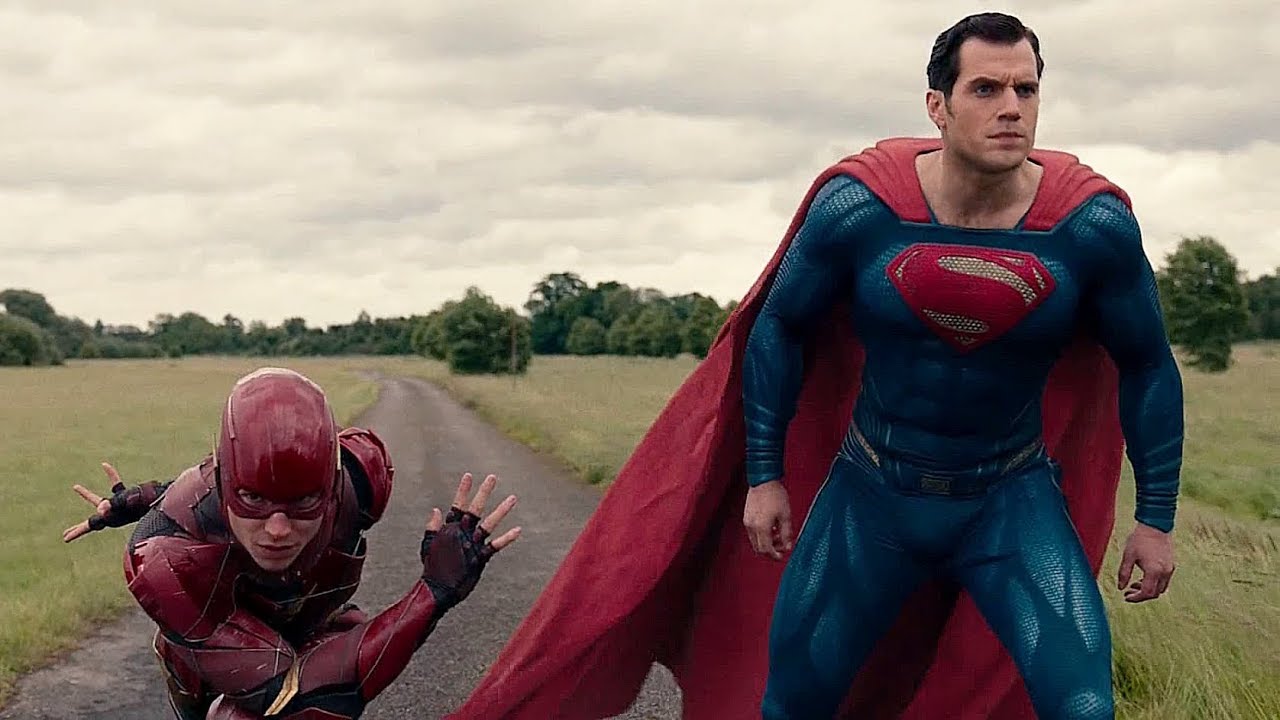
- When Henry Cavill signed on to do Mission: Impossible – Fallout, he was contractually obligated to grow out a full mug of facial hair for the role. This became an issue when Cavill was called back to do reshoots for Justice League and wasn't allowed to shave it. This resulted in the effects team having to airbrush out Cavill's mustache in all of his reshot scenes and replace it with a CGI mouth. The final product was very noticeable, looked creepily unnatural, and became a widespread subject of mockery. The fact that it could be found in almost all of Superman's scenes served as the first hint that the changes made to the theatrical cut were much more extensive than previously let on.
- In The Stinger, Superman looks like this◊. Yes, he's in fact wearing hockey pads. All the more embarrassing after all the proud claims that Cavill's muscles are real.
- A lot of reviews mention the CGI in this movie being good at best and atrocious at worst, with the most common offender being Steppenwolf, who is a completely CGI creation. The CGI looks so bad that characters genuinely look out of place in a lot of scenes because they're clearly standing in front of a green screen.
- Flash's CG is very obvious near the end of the film during Lois' monologue, as he looks like he's being pulled forward by strings.
- The final battle contains absurd amounts of CGI that's comparable to that of the video game Injustice: Gods Among Us rather than a major blockbuster, with the Orange/Blue Contrast having been inverted after Joss Whedon took over reshoots from Zack Snyder.
- In a rare example of lighting failure in a blockbuster movie, the way that Batman's costume is lit makes it look very, very stupid. His nose is blown out and the entire thing looks cheap and rubbery, when it was one of the few universally praised parts of the previous film, Batman v Superman: Dawn of Justice. It very obviously was never meant to be lit this way and does not hold up when it is.
- Zack Snyder's Justice League fixed all of the above issues. However, the Bad Future scene at the end looks very unpolished due to having been filmed on a shoestring budget and in pandemic conditions.
- The Flash (2023):
- During the "baby shower" at a collapsing hospital maternity ward, the infants saved by The Flash are obvious CG doubles.
- Most of the practical scenes involving Batman look fine, but the CG body doubles are quite obvious. Michael Keaton is in his early seventies; and the CGI augments during his major fight scenes clash terribly with the live actor.
- The alternate 2013 World Engine scenes look noticeably worse than they did in Man of Steel a decade ago; with the appearance General Zod in the film's finale being a particularly dire example.
- The practical appearance of Supergirl looks fine, but any instance of a CGI effect of her fighting looks like it came from Injustice 2.
- All the scenes in the Chronobowl were clearly shot against Chroma Key, with the CGI doubles of past DC characters in the film's finale being the worst example. The textures have been compared to models from a Playstation 3 game.
- Justice League (2017):
- The Dead Zone has one scene of Christopher Walken lying in a bed that's on fire. He's clearly sticking through a hole in the bed, although the shot is brief enough that you barely notice unless you pause it.
- Dear Christmas has a truly laughable excuse for a pregnant belly — it looks like they stuck a beach ball up the actress's shirt.
- Death Wish 4: The Crackdown has one scene guilty of this. When Paul Kersey kills the two mob members with the wine bottle bomb, the two mobs are obviously still shot dummies just before the explosion.
- In Demolition Man, when Spartan crashes the police car through the glass S.A.P.D. sign, the A fails to shatter due to its explosive charge failing to go off — the fact it's one of the middle letters and not an end one (which could be explained away as the car not striking it) makes it all the more jarring.
- In Diary of a Cannibal, when the girl eats the boy she met over the Internet, we're meant to assume that potatoes are his kidneys and a steak is his heart.
- Doctor in Trouble: When Dawn is soaked by a splash of water from Captain Spratt falling in the pool, the water has clearly been thrown by a crewmember offscreen, and it almost entirely misses Dawn who wails that she's all wet when she clearly isn't.
- Double Team: In the climax, a tiger pounces out from the shadows. Depending on the brightness and contrast settings of your television, you can pretty clearly see the outline of the animal handler standing beside the tiger cage and letting it out.
- Bats on strings in old Dracula films, from Universal to a late Hammer film. Plus the "rats" are actually being armadillos and opossums in the 1931 version...
- Driven has most of its racing scenes actually filmed with real cars, but a few are CGI, and it shows. The CGI quality is actually pretty good, and it would have been marvelous in a space setting where nobody expects battleships to be too realistic. But since Driven has real-life subjects, the contrast between real and CGI scenes makes the latter really jump out. Midway through the street chase scene, Jimmy's racecar speeds over a manhole cover, which bounces back upwards and flies through the air. Joe (in the car chasing him) narrowly misses it as the cover flies past him — and the shot in which this happens is so laughably fake it looks unrealistic. We see a comically-small manhole cover pass from right to left on-screen, just brushing past Joe's face. Aside from the fact that the cover is much too small, Sylvester Stallone no-sells the effect of being an inch away from a fatal flying object. Not helping matters is that the theatrical trailer for the film shows an alternate take of this scene that not only looks better (there's no obvious CGI), but Stallone actually sells the effect of nearly being hit by the cover.
- David Lynch's Dune (1984)
- The extended cut of the film is made of footage that was cut before the final effects work was done, so the Fremens' eyes will go from glowing blue to normal between scenes, and sometimes during the same scene.
- Far worse-looking is the hilariously bad shield scenes, where the actors look like they're dressed up in holographic cardboard Halloween robot costumes. (This was one of the first uses of CGI in a movie, however.)
- In Dungeons & Dragons: Honor Among Thieves, almost all fantastic races, from Aricokra to Zombie, are done with amazing CGI or subtle costuming. Except for a tabaxi family that look like they were played by someone's cousins in cheap fursuits or possessed diner animatronics. The official story is that the studio ran out of money for that scene.
- Christopher Nolan's Dunkirk. Nolan famously resisted the temptation to use CGI for dogfighting scenes, preferring to use real aircraft, because with the former it would have been too tempting to push what was physically possible. But a high-angle shot of an out-of-fuel Spitfire gliding along the French coast was apparently a step too far, because the compositing is jarringly apparent.

E
- The elevator crash in Earthquake was considered laughable even in 1974. It probably would have been laughed at in 1934, for that matter. A full elevator is caused to plummet by the earthquake, and to show that it's hit the ground, the camera lens is 'splattered' with cartoony, bright red blood.
- Straight-to-video movie Earthquake in New York is an example of CGI that isn't just terrible, but also unnecessary. An earthquake happens in New York, trapping some kids in the Statue of Liberty. Whenever we cut to a scene featuring said kids, we get an Establishing Shot of the statue, which is a computer-rendered graphic, slowly rotating against a background of grey mist. Not only does it look terrible and unrealistic, but they could have just used actual footage of the statue instead. The idea is that the statue is slowly falling apart (and each scene shows more damage), but if they'd just dispensed with using an Establishing Shot altogether, they could have avoided their movie looking like a 12-year-old knocked it up on a laptop.
- Epic Movie. When Captain Jack Swallows is breaking Edward out of prison, he pretty much just swings a plastic brown dummy with a featureless brown head around. Its foot even bends backwards at one point. The Agony Booth had a field day with this.
- Escape from L.A. had its effects work completed in a rush when the original FX house pulled out of production with only a couple months to go before production. Knowing that explains many of the more... questionable special effects seen throughout the film. John Carpenter made us used to cheap effects, but these are especially ambiance-breaking.
- Kurt Russell's surfing scene involves the character of Snake Plissken awkwardly attempting to simulate standing on a surfboard, juxtaposed against goofy-looking CGI waves that were awkwardly composited in. Even worse is the scene where Snake high-fives Pipeline, with it looking like Russell and Peter Fonda are standing on wobbly surfboards while they smack hands.
- The part where Snake lands his motorcycle on Cuervo Jones's car has the latter vehicle descending at an odd straight angle, without any variance or wobbling of the bike, onto the car.
- The infamously fake-looking CGI shark in the submersible sequence in which Snake travels to LA, which seems to travel at mach-speed past the submersible.
- One of the final shots of the film, of satellites powering up and firing EMP beams at the Earth, was badly dated even at the time the film came out — and hasn't gotten any better since then, as the effects come across as a first pass done by an animator before final rendering was completed. The CGI shot of a building in L.A. shaking and collapsing in the opening sequence is just as bad, which is even more noticeable because the few model shots they show of the building (which used practical effects) look much better.
- Occurs all the time in the Evil Dead series. The first Evil Dead suffers from it, but Evil Dead 2 is more lighthearted and Army of Darkness is pure comedy, so it doesn't matter so much. Indeed, it's arguable that in Army of Darkness, this is the point.
- The scene in Ex Machina where Ava takes an arm and skin from Jade. Jade’s Asian skin becomes Caucasian once Ava applies it to herself. Ava's normal torso looks like a busty woman wearing a bra and clothes, rendered in chicken wire, but when applying more material (skin from the spare android), she turns into a woman with smaller, unsupported breasts. This comes as a consequence of having Ava's actress's (Alicia Vikander) actual nude body as her skinned form, while her prior robotic torso had been CG-rendered.
- Near the beginning of Exorcist II: The Heretic, Richard Burton's priest seems strangely horrified that a cardboard cutout of a woman is on fire. Oh, wait. That was actually supposed to be a woman on fire. Oops.
- The Eye Creatures has so many failures that when it's featured on Mystery Science Theater 3000, Joel and the 'Bots catalogue a thorough list of them as evidence that the filmmakers "just didn't care!" Not the least of which is a night scene that is clearly filmed in broad daylight. As Tom Servo puts it, "You couldn't have picked a nicer day to film a night sequence!"
F
- None of the Fantastic Four films have had much luck in this department.
- The 1994 film's effects are laughable. They consist of cheap optical effects, awkward attempts to use poles to simulate the stretching abilities of Reed, heavy use of stock footage, and a Human Torch that came straight out of ReBoot. Subverted with the Thing, who is actually rather convincing, despite being a rubber suit creature. This is understandable, as the film was made on a paltry 1.4 million budget and was never meant to be released anyway.
- The films released in 2005 and 2007 fare a little better compared to the others, but it's still pretty obvious they hadn't gotten Reed's stretching abilities down. Silver Surfer in the second film wavers between a cheap rubber suit, or a cheap clone of the T-1000. The costume used for The Thing is an interesting case, as it looks decent in the first film, but looks a little more rubbery in the second.
- The 2015 film has it worst:
- In the first trailer's shot of Mr. Fantastic stretching, if you look closely, you can see that the same rock is copied and pasted to his left and right (but given slightly different lighting).
- The four themselves consist of a Mr. Fantastic pulled straight from the director's night terrors, a Human Torch that can't keep his all his flames lit (or composited properly), and a pitiful attempt at Sue's force fields. The only one that's even remotely passable (in comparison) is The Thing, and that's saying a lot. And his face still looks different in terms of structure and physical appearance from shot to shot.
- In general, much of Planet Zero looks like extremely unconvincing greenscreen.
- The Final Battle was filmed during the period of reshoots close to the end of post-production, and it shows; in addition to the greenscreen issues described above with Planet Zero, some of the cast appear to be digitally edited into certain shots (since not all of them were readily available in post-production). Furthermore, the digital effects of the characters using their superpowers in the battle also come across as sloppy and unfinished.
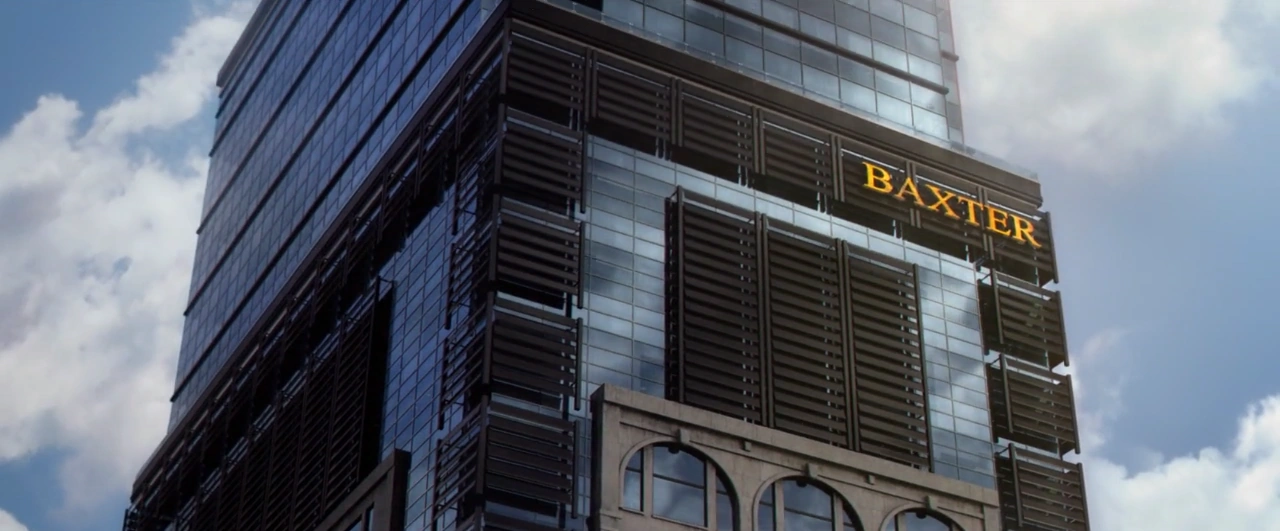
- The introductory shot to the Baxter Building is very conspicuously CG.
- In one of the trailers released, at 1:29 the Thing throws a tank turret only for it to completely disappear in an explosion. One second it's there, the next it disappears as it turns into a fiery explosion.
- The scene of Human Torch flying through an airplane features some questionable flight effects, and part of his flames outright disappear for a moment when he flies through debris.
- The "organic" test for the matter transporter has an obvious CGI chimpanzee that is far less impressive than the ape effects used by Rise of the Planet of the Apes from the same studio. As Brad Jones points out in his review of the film, given the time, money, and manpower needed to make a CG chimp, it would've been cheaper to just get an actual chimp.
- Numerous critics have pointed to Reed Richards using his stretching powers to put on a disguise, and then morphing back to normal, as being some of the worst CG ever put on film, which looks almost as if it was put together in the 90s while they were still trying to perfect the technology.
- Not even the practical effects were spared, as several people pointed out that Doom's redesigned costume looks like it was made from discarded tinfoil.
- The kid playing the young Reed is saddled with some quite fake-looking scars to match Miles Teller's real ones. It's especially weird since Reed could have easily been explained to have gotten them during the Time Skip.
- The wig Kate Mara wears during the film's reshoots is glaringly obvious. It looks more like something from Samurai Cop than a major studio release.
- Faust: Love of the Damned has many but the Homunculus in particular is a particularly bad case of dated CGI that probably looked unconvincing even upon release.
- Final Destination uses CG deaths for a lot of the kills, and for all of the premonitions. Whereas the prosthetics and physical special effects are on the whole convincing, the cartoon blood, organs, and other kibble are more reminiscent of a mid-'90s video game cutscene. It's especially odd in that the fourth and fifth movies' CG is somehow worse than the first three's.
- Fifth Element: When Zorg blows up his henchman for failing him, the henchman dummy is clearly visible still standing even after the explosion.
- Five Fingers of Death has a man being killed via Eye Scream, where his eyes pop out of their sockets before bouncing around a bit like painted ping-pong balls (because they are).
- The Steven Seagal film Fire Down Below has a big fight scene amongst "toxic waste." It even glows at points — thanks to the obvious use of black lights, to which the scene frequently switches to hide the fact that dishwashing or laundry detergent is used (under the black lights) to produce the "glowing" effect. The scene in question looks like a regular light and a black light are on an alternating strobe.
- Flash Gordon (1980) has a lot of effects that look very shaky, probably due to the sheer volume of effects shots needed in the movie. In this case, though, it's part of the appeal (Roger Ebert notes in his review that they could have left a tube of model glue in some of the shots, and he LIKED the movie).
- Un Flic has a scene where a criminal boards a moving train from a helicopter, at night. The shots of the helicopter flying above the train are obviously done with models. We see the gang in the cabin of a real helicopter, but the rotor is out of shot, suggesting that they're in a helicopter parked against a dark background. When the man is winched down and up, we only see him on the outside of the carriage or in the door of the helicopter, never in between.
- In The Fourth Man, when a row of poles goes through the windshield of Gerard and Herman's car, the shot of the poles going through Herman's head (not that one) makes it very clear that it's a dummy.
- Frankenhooker features lots of clearly fake special effects, none of which detract from audience enjoyment. Particularly memorable moments are the obvious substitution splices of papier-mâché hookers exploding after smoking "supercrack" and the puppet-work for theJohn Carpenter-esque spare limbs monsters in the freezer which kills Zorro the Pimp.
- Frankenstein Conquers the World has some cheesy moments.
- When Baragon attacks a farm, he clearly knocks over a horse doll.
- Earlier in the film, the giant Frankenstein tries to catch a toy warthog. Strange why they couldn't just get a real one, considering he never even touches it.
- Rick's death in Friday the 13th Part III. Not only is the model head extremely obvious,◊ but if you look close enough you can see the wire his popped eyeball moves on.
- The Frighteners:
- In Director's Cut DVD, one new scene has Frank and Judge in the car together, with Frank driving like a madman. There's a reaction shot of Judge looking terrified, and the composite makes him look extremely flat and unconvincing compared to the other ghost effects in the film.
- In the first scene, the lifting mechanism under the bed can be seen clearly.
- It's hard to tell if Fun in Balloon Land actually had a special effects budget, but if it did, it qualifies under this. The costumes look awful, to the point they make mascot costumes at a '50s amusement park like high tech (the Indians look downright horrific, and the 'King of Atlantis' character has a very obviously fake beard tied on by string). The balloons somehow look even worse, with the animal ones having dead eyes and open mouths and the human ones being horrendously out of proportion in an Uncanny Valley way. The movie's sets don't even look like what they're meant to represent and were obviously filmed in an empty warehouse somehow. Then to top it all off, they didn't even film a middle or ending to the story. It's just stock footage of a balloon parade (that lasts for 40 minutes) and a copy of the intro respectively. It's an abysmal failure on the effects level in every sense.
- In Furious 7, due to Real Life Writes the Plot (the death of actor Paul Walker), Brian O'Connor had to be replaced in certain scenes with body doubles and CGI. In some instances, such as the first scene with him and his son, this effect works. In others... not so much. Most notable is the scene where the gang stands in front of the L.A. skyline and discusses their plan (Brian is seen awkwardly staring out and turning his head robotically in shots), and the final scene, where he drives up to Dom's car and speaks to him, and there is an obvious seam from where the footage of his face was pasted in from a similar scene in Fast Five).

G
- Several in the Gundam live-action movie G-Saviour. It's clearly raining in the Sturges Airbase, yet all of the actors are completely dry. And then there's the CGI mobile suitsnote . While they look pretty decent (key word being "look"), their slow movements and actions (when compared to other Gundam shows or games) murder the awesomeness of the battle scenes.
- Game of Death. Because Bruce Lee tragically died while the film was being made, director Robert Clouse reuses footage Lee shot for the film along with stock footage of Lee's fighting in other moments of his career and new footage utilizing body doubles and camera tricks in a valiant attempt make a complete movie. However there is just no excuse for this infamous scene, where a cardboard cutout of Lee's face is imposed over a reflection of a body double to (very badly) create the impression the real man is sitting in front of a mirror.
- The entire Showa Gamera franchise has some pretty poor effects — quite often even worse than the Godzilla films of the period — due to their low budgets. Ironically, this situation is reversed by the two series' Heisei films. Even the Heisei Gamera trilogy isn't completely immune to this trope. Several of the shots from Gamera: Guardian of the Universe where Gamera and Gyaos fly above Earth's atmosphere look off-puttingly fake. Thankfully, such instances were fully smoothed out by the time the second and third films were made.
- The Garbage Pail Kids Movie, while already considered to be an abysmal film on every count imaginable, is another shining example of effects failure.
- Most infamous are the Garbage Pail Kids themselves; the costumes for them are designed so badly that their mouths barely close when they talk. Also noticeable are the soulless looks in their eyes (which rarely blink) and their poorly-functioning limbs. In some shots, you can even see where the heads attach to the rest of the suits or the edges of the gloves; all of this, among many other things, make for characters who are not only ugly beyond comprehension but also incredibly creepy.
- In one of the many scenes where Nat Nerd wets himself, it looks as if he's urinating in two directions at once.
- Valerie Vomit's vomiting effects are also quite crude; and when the kids are trying to hide their tv from Dodger, her facial animatronics malfunction giving her a particularly stupid look.
- The opening scene where the Garbage Pail Kids' "spaceship" floats through space uses a very crude model to stand in as their spacecraft, as well as a very fake-looking Earth against the backdrop of outer space.
- The beards in Gettysburg fall between this and Reality Is Unrealistic. It would have taken months (if not years) for the actors to grow the kind of facial hair that American men of the 1860s enjoyed, which meant that costume pieces were used in nearly all cases, and the effect is sometimes obvious. On the other hand, the beards from the historical photographs of certain persons (such as J.E.B. Stuart) already look like costume pieces.
- Ghostbusters (1984):
- Though groundbreaking with its visual effects, the film flubs it a bit with plain old-fashioned prop work. When broken bits from Dana's roof come raining down into the street during the face-off with Gozer, one of the chunks clearly bounces off a police barricade, revealing itself to be foam, not concrete.
- When the ground in front of the building breaks apart and some parts rise and some fall, you can see one part bounce a little after it stops — revealing that the section is on a spring of some sort. The edges of the chunks of road are also obviously hanging fabric instead of solid — you can see them flapping in the breeze!
- During Stay-Puft's rampage, there's several instances where the optical compositing fails spectacularly. This is most noticeable when he destroys the church, as it crumbles despite him not clearing it.
- The Stop-Motion terror dog doesn't look like it's actually there, even though they do a fairly good job of having it crush a table and smash down a door.
- In the widescreen edition, several ghost trails get cut off at the end when they get released from the containment chamber.
- In Ghostbusters 2 the pins used to make the toaster 'dance' are very visible almost every time that it hops.
- G.I. Joe: The Rise of Cobra has several bad effects, which surprised many critics because of the reported $175 million budget (as well as coming out the same summer as Transformers: Revenge of The Fallen and Star Trek, from the same studio).
- Any time CGI is used to animate a vehicle. In particular, the scene where the Joes' plane is heading to The Pit contains horrid texture work, looking almost as bad as the tie-in video game; they tried to give the plane a glossy shine but ended up horribly botching it.
- The chase scene in Paris: Scarlett on a motorcycle has unnatural rubbery movements, Duke and Ripcord in the Accelerator Suits have a shoddy sense of speed (made all the more grating by the special features on the DVD revealing that one of the CGI shots of them in the suits took the equivalent of four years computer time to render, and the practical suits look great), and the Nanomites being used on the Eiffel Tower look awful (some compared it to the slime from Ghostbusters).
- The sinking ice resulting from Cobra's underwater base being destroyed at the film's final battle.
- The Giant Claw outsourced its special effects to a small-time Mexican company, with results that were highly embarrassing even in its time. Look up its trailer.
- In The Golden Child, the Stop Motion photography used to animate Sardo Numspa's demon form looks absurdly cheesy, even for 1986.
- The eponymous Godmonster of Indian Flats◊ doesn't look so godlike.
- Godzilla's movies have featured quite a few notable special effects flaws.
- In Godzilla vs. Megaguirus, the villainous monster, Megaguirus, is spectacularly menacing-looking... except that in the big reveal scene when Megaguirus takes off, she is held up by incredibly obvious strings. And this is in a movie made in the year 2000. Even more jarring in that the wires holding up the puppets, like Mothra, are all but invisible in most of the movies. This can be blamed on Sony's handling of the film; when they put it on DVD, they used a brighter version of the print. The strings aren't visible in Japanese prints as those particular shots are too dark for the strings to be visible.
- On a non-monster note, one scene in Destroy All Monsters features a Kilaak-controlled man jumping out of a window to his death. However, the actual fall is portrayed by a stiff-legged dummy with its arms firmly at its sides, as if someone's accidentally dropped a well-dressed mannequin.
- The King Kong suit from King Kong vs. Godzilla is just horrid. Take a good look. The one in King Kong Escapes is a lot better, but still strange-looking in the eyes and mouth. Then there are the water scenes, which feature the old Kong suit quite blatantly wearing the head of the new one as some sort of mask. The body and head are also wildly out of scale.
- The suit in Godzilla vs. Gigan is the Soshingeki-Goji suit (from Kaiju Soshingeki or Destroy All Monsters). In the '70s, Toho stopped spending money on making a new Godzilla costume for every movie, so the 1968 suit ended up getting used for three more movies. The suit would be falling apart anyway since it's made of rubber, but all the fights it went through only adds to this so that Godzilla's skin is slowly falling off over the course of the film.
- At one point, Gigan is rampaging across Tokyo. You see the inside of the building that is going to be crushed by the monster in mere seconds. Inside stand two Kelly dolls, just staring at each other, which are soon crushed by the monster's claw. Now, they probably were intended to be store mannequins, but the place doesn't exactly look like a store, and it's not known why they even bothered including them. What's even worse is that they stand there for well over a second, as if the camera is deliberately focusing on them.
- In the same sequence, Gigan steps on a toy car and its bumper simply pops off, revealing the hood to be hollow.
- Several shots of Gigan and King Ghidorah flying are accomplished with stiff, inarticulate figurines.
- At one point in Godzilla vs. Gigan, a bright orange subcompact car is blown up by the bad guys. In the later Terror of Mechagodzilla, the hero drives a bright orange muscle car. When it's blown up, they use the subcompact footage from Gigan. No muscle cars were harmed in the making of this movie.
- Terror of Mechagodzilla has surprisingly good effects for a '70s Godzilla movie, except for an alien machine (which only appears for a few seconds, but still) which is clearly made out of Lego. Also, there are some shockingly bad composite shots among all the good ones. During the rampage of Mechagodzilla and Titanosaurus, there's a ground-level shot where the two monsters seem to be coming out of the ground at waist level, and the background even shakes around.
- The 1998 Godzilla film has plenty to go around:
- For starters, lighting on Godzilla always looks off (which is why Godzilla is always obscured by nighttime and rain), and very little water splashes when he seemingly falls to his death on the Hudson River. This is mostly a problem with the film print, which was fixed in digital releases to become Visual Effects of Awesome.
- The scale is completely off, with Godzilla seemingly changing size compared to the surrounding buildings throughout the film. The worst being when he can only fit his arm into a tunnel during the cab chase when his entire body earlier fit into what looked like a smaller one.
- There's a compositing error when Godzilla is feasting on the piles of fish — when we see it from behind, there's a squad of army men running to its right who pop into view between frames. The CGI guys neglected to rotoscope them into the shot, so the monster, who's supposed to be in the background, overlaps them.
- The helicopter chase, while on a whole a fairly cool scene, still features a cityscape that really looks very little like that of the real New York.
- In one shot when Godzilla first emerges in New York we see him apparently crush a fleeing civilian to death; said civilian is clearly seen continuing to run offscreen if you look hard enough, ruining the intended effect.
- The full CGI Godzilla swimming in Godzilla 2000 looks pretty bad, especially considering it was released the year after the American remake. The movie also offers tons of badly composited Chroma Key shots (along with, to be fair, some well-made ones).
- The Showa-era films often have vehicles (military or civilian) running on tracks, held up by supports in such a way that their tires don't even reach the ground.
- The 1967 suit used for Son of Godzilla is widely considered to be the worst suit in the entire series. Its abnormally long neck, googly-eyes, and wide-mouthed, frog-like face is often compared to the Cookie Monster. The design changes were made to emphasize the "family resemblance" between Godzilla and Minya, whose own design isn't exactly a fan-favorite either.
- The matte paintings in the film are also jarring, as there are thin black vertical lines running down the "sky" in virtually every shot that isn't filmed on-location. You don't have to squint to see them, they're so blatant.
- The 1955 film Godzilla Raids Again uses a poorly-made hand-puppet for close-up shots of Godzilla, who suddenly has very crooked teeth for some reason.
- In the very first Godzilla movie, two fire engines appear during Godzilla's rampage. The first one, which crashes into a building, is obviously a toy. The second fire engine is actually shown falling off the table that the model city was on.
- Though not nearly as bad as the folowing film, the hand-puppet used for close-up shots of Godzilla in the preceding film looks noticeably different from the head on the full costume.
- Anguirus's appearance in Godzilla Raids Again, oddly enough, is actually a subversion. Though his back armor is split down the middle and flops about, making it look like poor costume design, a comic based on the film shows that it's supposed to be this way.
- In the 1991 film Godzilla vs. King Ghidorah, they don't even bother making Ghidorah's wings flap (they hardly flap at all, in fact) when he first appears. Odd, considering that they were able to make a Ghidorah with flapping wings in the 1960s that looks great. Perhaps this is supposed to give the impression that he's gliding.
- Speaking of Ghidorah's wings, by 1972's Godzilla vs. Gigan, Ghidorah's costume, used ever since his 1964 debut, was in such poor shape that a new model had to be quickly built for the flying scenes, resulting in a non-articulate toy with glowing eyes. Ghidorah's costume is still used for the rest of the scenes, but due to its poor shape, lots of Stock Footage ended up being used for his action-oriented scenes, as he otherwise does nothing.
- 1994's Godzilla vs. SpaceGodzilla has okay effects, but one scene featuring Spacegodzilla and MOGUERA battling in an asteroid field is just awful. The asteroids, for one, barely move and are clearly made from Styrofoam. The conspicuous lack of stars in the background also makes it obvious that the scene is just props suspended in front of a black wall. What makes this even worse is when one considers that this was a full fourteen years after The Empire Strikes Back's fantastic asteroid field scene.
- One filming measure introduced in the Heisei era was to combine the miniature sets with composited footage of the actual locations they represent, taken from the same angle so it blends in smoothly. While this pays off rather well in most instances, one example which is quite funny when you spot it occurs during the final battle in Godzilla vs. Destoroyah — while the Haneda Airport miniature set is huge, pay close attention to the terminal area in a shot where Destoroyah takes to the air, with Godzilla held by the neck with his tail pincers; people can be seen walking casually through the well-lit jet bridges, and an All Nippon Airways 747 is actively taxiing towards the battlefield!◊ It would seem that nothing, not even two giant monsters (one of whom is undergoing nuclear meltdown and would surely be lethal to get anywhere close to by nature of the sheer amounts of radiation he's giving off) will stop this plane and its crew from getting where they need to go.
- The entire Heisei era is a huge step up in terms of SFX, so the failures listed here are ones that really stand out. Some infamous goofs occurring in Godzilla and Mothra: The Battle for Earth are Mothra's bouncy rubber legs, the wires holding her up being visible at times (as they are focused on by bright studio lights), and Godzilla's tail being a separate prop with a warped base during his first fight with Mothra. In Godzilla vs. SpaceGodzilla, the tip of Godzilla's tail even breaks off on-screen.
- Godzilla vs. Hedorah: In Godzilla's first appearance, he's obviously very poorly super-imposed over a still shot of a sunset; it's really apparent because, at one point, one eye is orange, and the other one is yellow.
- Subverted in Godzilla vs. Megalon; The infamous tail slide may look like this at first, but the fact that they show it again shows that it was intentional.
- The second US remake has a brief one in some rather obvious CGI insects in the scene where Dr. Brody and his son revisit their Japanese home to get information on Godzilla. While not as bad as some of the above examples in the franchise, it's still incredibly jarring in contrast to the rest of the film's effects. And one of those awesome effects is — if you freeze frame and look closely — the word "TONKA" on the bottom of one of the tumbling CGI trucks, in homage of the, er, low-budget effects of some of its predecessors.
- While Shin Godzilla does have some spotty CG in places, many of the "unrealistic" effects are actually subversions, as the film deliberately pays homage to the classic Japanese special and sound effects of yore. In fact, many people initially slammed the movie for still using a rubber suit for Godzilla's later forms, even though he was computer-generated and purposely made to look like rubber. However, one issue that was not intentional was when the JSDF first attacks Godzilla, the AH-64 Apache gunship still has an obvious safety cap covering the barrel of its autocannon when it starts shooting. This stands out especially since the Cobra gunships earlier in the same scene look extremely good when firing their miniguns.
- In the 2000 adaption of The Great Gatsby, Myrtle's corpse is pretty clearly a dummy. Legs just don't sever cleanly like that after being hit by a fairly slow-moving car.
- In the movie Gunslinger, a poorly designed hotel room door leads to this humorous exchange when it's shown on MST3K:Crow: Hey, doors don't open like that... there's a number... he's in the hall!
- Everything about Charles Stratton/Tom Thumb in The Greatest Showman. His lips look like they've been pasted onto his face a la Clutch Cargo and the dubbed over deep voice looks like something out of an old Godzilla dub. They also have the actor, who is already 4'2", look even smaller by having him go on his knees and paste new legs on him, which becomes really obvious whenever he's walking (just look at his walk when he has his big solo during "This Is Me"). They also hide the limitations this effect has on this actor poorly as the character keeps disappearing from places he was at just a second ago during every big dance scene during "This Is Me" and, in "From Now On", he just claps his hands (and kicks his "legs" once or twice) while everyone else dances (and at some points you can even see them trying to hide him behind a pole to make sure the limitations don't stick out too much).
- All the circus animals in the film are computer-generated. While some look alright, many look really bad, especially when combined with Tom Thumb (the horse during "Come Alive" and the elephant during the reprise of "The Greatest Show".
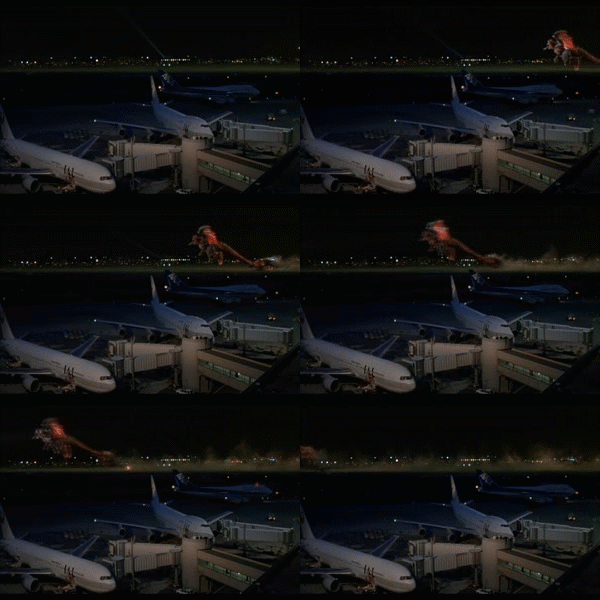
H
- Halloween:
- In John Carpenter's original Halloween (1978) film, when Michael smashes one of Marion's car windows, he obviously has a wrench taped to his hand.
- There is also one scene in Halloween H20: Twenty Years Later where Michael's mask is CGI. Really, really bad CGI. Word of God says that the director decided well into production to go with a different mask, so certain scenes with Michael had to be re-shot. However one scene couldn't be re-shot, so the mask had to replaced with CGI, frame by frame.
- In Halloween II (1981), they reenact the ending from the first movie, when it gets to the part where Michael falls over the balcony, he does so by going up a very visible ramp. Why they didn't just reuse the scene from the first movie is anyone's guess.
- Hancock has the scene where the protagonist throws a whale back in the ocean. The whale is a rather poorly rendered CGI effect.
- The cheetah-riding scene in Harold & Kumar Go to White Castle has a hilariously fake background, and the CGI cheetah looks very cheap and poorly-designed.
- Harry Potter:
- The "captives" in the fourth movie, which are clearly mannequins. Thankfully, the murky water helps obscure it a bit.
- The Chroma Key effects in the first film are pretty poor. When the Trio talks to Hagrid outside his hut near the end of the film, it's particularly obvious that the view of Hogwarts behind the Trio has been pasted in. The quality of the film's Quidditch match also suffers for this reason. Fortunately, they fixed these issues in the second film, and the Quidditch match in that film looks much better.
- There's a scene at the beginning at the Hogwarts Express in which Ron is holding his pet rat Scabbers, but it's clear that it's actually an incredibly fake-looking plush. He even moves it a bit and we see it remains stiff and lifeless all the time. One cannot help but wonder if the plush was just a placeholder meant to be replaced with a CGI Scabbers, but they forgot and left the scene as is. Or, why they didn't just use an actual trained rat.
- At the end of Deathly Hallows Part I, when Voldemort steals the Elder Wand, the supposed "white marble tomb" is very obviously made of styrofoam blocks. Worse, no attempt at foley effects was made to disguise this, so when the styrofoam blocks shift aside, not only are they visually obvious styrofoam blocks, the audience can HEAR...styrofoam blocks falling over.
- In the eighth movie's "19 years later" epilogue, the makeup and costuming used to make the characters look older... leaves a lot to be desired.
- Hellbound: Hellraiser II features gruesome, convincing practical effects for deformed and mutilated bodies, but the ending when the souls are released from Leviathan features incredibly unconvincing and crude 2-D drawings of skulls superimposed on the frame, whizzing by the running humans.
- In Hellboy (2019), when Hellboy comes to on the floor of the elevator that takes him down to Baba Yaga's realm, his horn stumps can be seen moving on his forehead when they briefly scrape along the floor, revealing them as the glued-on prosthetics they are. The film received much flak for its CGI monster effects, with many comparing them to creatures from a Playstation 2 game.
- Despite costing 30 million more to produce than its box-office rival The Legend of Hercules, Brett Ratner's Hercules (2014) doesn't fare much better. While the CGI for the creatures can be excused to them being nothing more than Tall Tale exaggerations of the classic myths unlike in Legend, and are for the most better executed in design and animation. Their interactions with Hercules vary between them, with the Hydra looking like it came out of that film.
- In Hercules Against the Moon Men, Hercules' bronzer rubs off on a spike in the attempted impalement scene and rubs off on Agar's dress when he pulls her onto his horse at the end.
- In High School Musical 2, during the song "Bet on It", Troy looks at his reflection in the water, and the "reflected" image is the same as the original, i.e. it's not mirrored. You might not notice it the first time, but it still looks ridiculous. At the very least, you will most likely notice that Troy's "reflection" is quite plainly a CGI image pasted onto the water.
- Highlander:
- The first movie:
- You can clearly see the cable Christopher Lambert is suspended from during the final quickening in two shots.
- The whole final quickening scene could qualify as this, with what looks like sketched cartoon demon faces surrounding MacLeod.
- Ironically, the lightning is intended to hide the cables that are holding Lambert in the air. Instead, it draws even more attention to them.
- The scene immediately before is worse: as the remnants of the Silvercup sign fall, you can see thick white cables on either side pulling it down for several seconds.
- The scene where the Kurgan fights Ramirez. As he chases him up a staircase in the castle, he takes swipes at him with his sword that somehow knock down the entire outer wall. Leaving aside how ridiculous this is for a second (since this is a franchise based on the premise of immortal warriors fighting each other with swords), the effect fails because it's very clear the wall he's swinging at is made of foam blocks painted grey, and definitely not stone.
- You can also actually briefly see the stagehands' arms pushing over a collapsing wall.
- The aging Heather is quite obviously just young Beatie Edney in bad makeup. Then again, it could simply be she aged very gracefully.
- In Highlander II: The Quickening Davis Blake's Destination Defenestration death is achieved through, as noted by this review "one of the all-time worst falling dummy shots ever committed to film."
- One of the fight scenes in the DVD cut of Highlander: Endgame has a JVC billboard sloppily edited into a blurry white square, and the cut shown in theaters actually has half-finished effects.
- The first movie:
- Zaphod Beeblebrox's second head in The Hitchhiker's Guide to the Galaxy (2005). The fans refer to it as "The Pez Dispenser". It's... pretty bad. Thankfully it gets removed about halfway through the film. At least it isn't a mannequin head on a stick shoved onto his shoulder.
- In the Honey, I Shrunk the Kids sequel Honey, We Shrunk Ourselves, at one point the parents inadvertently ride an out-of-control Hot Wheels car straight into a laundry chute and go plummeting down into a laundry basket. In the first shot of everybody falling down the chute, Wayne and Barton noticeably suddenly vanish as they reach the bottom of the screen.
- Horrid Henry: The Movie. Henry's dinosaur form here is so hideously performed, it has a black outline around it!
- Considering that the for-real animal action in Hotel for Dogs is amazing, the sight of a building rendered with crappy CGI is a shocker.
- An especially absurd example: The film by Uwe Boll very loosely based on the House of the Dead series intersperses actual gameplay footage from the games. In a live-action film. It's not even true gameplay footage, it's footage of the demo run from the arcade version, with the "insert a coin" message blinking! Apparently, the two quarters required to actually play the game would have tripled the film's budget.
- House Shark: The house shark costume looks like a giant puppet, and the explosions, blood, and water effects are obviously fake.
- Hulk. While its engine is actually impressive, and the depiction is quite faithful to the comic book, it still left most viewers unprepared for what a 3D version of that Hulk would have looked like in real life. Some remarked that he looks like Shrek, and others wished he'd been played by Lou Ferrigno (despite Ferrigno being human-sized). The 2008 Incredible Hulk movie follows up on these concerns, giving the character a darker green complexion and a lot more veins and wrinkles, more in line with the '90s drawing style of Dale Keown.
- In the Ang Lee film, the Hulk pulls the gun turret off of a (CGI) tank at one point, and there's no hole on the tank where the turret detached.
- The Hunt for Red October suffers from some less than brilliant blue screen work in the finale with Alec Baldwin and Sean Connery having their last conversation once the enemy sub's been destroyed and from missiles that are obviously animated (MAD's satire "Hunt For Last October" summed it up by having a missile be ridden by Tom and Jerry!). Like several other entries on this list, it shows that even Industrial Light & Magic can have an off day.
I
- I Am Legend: The CG vampire zombies featured throughout are blatantly obvious digital effects, though this is only obvious when you get a direct look at them — they are much more convincing when they are obscured in the dark.
- Parodied in I'm Gonna Git You Sucka, where Ma Bell's stunts are obviously performed by a man wearing her dress and hairstyle. He even has a mustache.
- A joke also used in the previous year's Spaceballs."You idiot! These are not them! You captured their stunt doubles!"
- A joke also used in the previous year's Spaceballs.
- In The Ice Pirates, Wendon (played by Bruce Vilanch) is decapitated by Roscoe and his severed head is carried around for a bit. Because Wendon is nothing more than a head, this is not fatal, and some scenes require him to speak while as a head. Most of the time this is done by having Wendon's head on a table (with Bruce's body underneath), but in one scene, when he's being carried, you can clearly see Bruce's body for a brief moment, and he appears to be wearing a t-shirt.
- In Harm's Way was praised for its excellent acting and storytelling, but is infamous for the extremely fake-looking model ships used in the sea battle scenes. In fact, starring actors John Wayne and Kirk Douglas were embarrassed at how badly the naval scenes compare to the rest of the movie. It's rather sad, really, considering how much they tried to avoid another trope.
- In the Name of the King: A Dungeon Siege Tale has one in the climactic battle scene, no less. The arrows that the archers use are obvious CGI.
- Independence Day features, for the most part, very well-done special and visual effects that hold up to scrutiny even today. However, there is a jarring moment where one of the giant alien spaceships is shown hovering just above the White House, tourists can be seen milling about and taking no notice whatsoever of the giant ship. Also, actors' marks are visible on the floor in many scenes, and during the alien's rampage in the operating room, you can see the legs of the puppeteer beneath the alien body. When the alien is shot, the wires that pull it back are also clearly visible.
- Indiana Jones:
- The introduction of CGI to the franchise in Indiana Jones and the Kingdom of the Crystal Skull has mixed effects. Notably, the car chase in the jungle has some really dodgy green-screening.
- To say nothing of the Shia LaBeouf Tarzan sequence. Not everything is better with monkeys. Actually, let's extend it to everything involving animals in the film because there are some of the fakest prairie dogs ever committed to film. And there have been a lot.
- CGI appears briefly in the 1989 Indiana Jones and the Last Crusade, to depict — amongst other things — a Zeppelin. Despite being a prime subject for computer realisation, with flat sides and limited animation, full-length shots of the Zeppelin are obviously matted into the sky.
- The dogfight that happens right after has some pretty obvious bluescreening, too.
- In the snake pit in Raiders of the Lost Ark, Indy lands on the floor inches away from a rearing cobra...with a highly visible reflection in the clear barrier protecting Harrison Ford from any accidents. This was fixed on the DVD, and nobody complained.
- Also in Raiders, after Indy shoots the driver of the truck and it ends up flipping on its side, the log from the spring-loaded mechanism the filmmakers used to flip it is clearly visible behind one of the rear tires.
- There is some slightly obvious Chroma Key work in Indiana Jones and the Temple of Doom, such as the scene where Indy, Short Round, and Willie have to escape their plane before it crashes. While the raft being used as a makeshift cushion and the ensuing whitewater rafting sequence still hold up, the plane crashing into the mountainside is clearly a separate element from the raft sledding down the mountain. The scenes outside the Temple, when they are clinging to the cliffside while the flood bursts past them, is also pretty badly done.
- The chroma keying for the final confrontation with the Thuggees is especially bad whenever any of them are falling to their deaths. This is made worse because they're shown falling into a crocodile-infested river; obviously they couldn't actually show humans being eaten by crocodiles so instead there are American alligators ripping apart empty clothes with screams dubbed over.
- The introduction of CGI to the franchise in Indiana Jones and the Kingdom of the Crystal Skull has mixed effects. Notably, the car chase in the jungle has some really dodgy green-screening.
- The controversial Innocence of Muslims features awful green screen that makes the actors look like they're floating on the desert, obvious brownface, and tire tracks in the sand despite the story taking place during the sixth or seventh century.
- Each version of The Invisible Woman has at least one:
- 1940: As Kitty strips to nothing in Mr. Growley's office, Virginia Bruce's black-sleeved arm can be seen passing in front of her midriff.
- 1983: When Sandy is Covered in Mud late in the film, it is obvious that Alexa Hamilton is not actually nude.
- It Conquered the World (later remade as Zontar, the Thing from Venus) The monster... suffice it to say that the scene where it strangles the heroine had to be shot several times because the actress, Beverly Garland, kept bursting out laughing. Believe it or not, this is because the creator of the monster was actually trying to make it work as a realistic alien creature — initially, it was supposed to be much more squat, as part of the idea that it's a being from a high-gravity world (which, it has to be pointed out, Venus is not any more than Earth is). Then Beverly Garland walked up to the outfit during a break, shouted, "Try to take over my planet, huh? Take THIS!" and kicked it over. Then he added the 3 feet of head, which has the side effect of making it look like an angry ice-cream cone crossed with a crab. He tried. Even he admits he didn't succeed, but he tried.
J
- The effects in Jack the Giant Slayer, while decent, are not up to the quality of the film's $195 million budget. A common complaint is that the giants by Digital Domain look too cartoonish. To say nothing about the beanstalk or the CGI in the opening.
- James Bond:
- Despite being touted as "the most realistic effects to date", the CG para-surfing scene in Die Another Day was criticized as being easily recognized as fake, especially in comparison with the other, more realistic CG effects of fellow blockbuster smash, The Lord of the Rings: The Two Towers. Particularly jarring since the film starts off with a very well-done surfing sequence done with actual waves in Hawaii.
- Almost any rendering of satellites in the franchise, particularly in Diamonds Are Forever.
- Ursula Andress is clearly wearing a flesh-colored towel when Honey Ryder steps off the conveyor belt "nude" in Dr. No.
- In Goldfinger the statue decapitated by Oddjob's hat has a clearly visible break at the neck, and the head starts falling off BEFORE the hat makes contact. This is especially strange because the MythBusters James Bond special proved that knocking the head off a plaster statue for real is almost trivially easy.
- Live and Let Die features a particularly bad shot of a man being killed by an inflating bullet.
- The bluescreening for Jaws jumping between the cablecars in Moonraker.
- Bond knocks a ski goon off a cliff in On Her Majesty's Secret Service. However, the resulting scene of the skier falling to his death was achieved by throwing a dummy off the cliff and dubbing in a man screaming. You can tell by how the dummy's arms often bend the wrong way or by the fact that it's surprisingly still for a man plummeting over a massively steep cliff to his certain doom.
- Oddly enough, claimed for the way Bond is rescued at the end of Thunderball. He launches a balloon attached to a harness, which is then picked up by a B-17G Flying Fortress. Claimed to be the most ridiculous special effect in the Bond series (or at least at the time), it is in fact the real-life Fulton Surface-To-Air Recovery System.
- May Day's spectacular parachute jump off the Eiffel tower in A View to a Kill is achieved with a (very visible) ramp. In the same movie, the very obvious dummies that are thrown from the zeppelin even have their extremities buckle in several places.
- The outer space sequences in You Only Live Twice are laughable, especially considering that the movie was made around the same time as 2001: A Space Odyssey.
- Some special effects failures actually improve the film: the mechanical shark in the first Jaws movie worked so badly and looked so fake on camera that Steven Spielberg shot most of the film without it. Not having a monster to occupy camera time, he substituted suspenseful direction, in-depth story-telling, memorable musical cues, and plenty of good acting and dialog. None of the sequels and almost none of the movie's imitators reach this level of quality.
- Jaws 3-D has an infamous scene where an obviously fake shark slowly advancing towards the window of a tank... and it's supposed to be scary because the 3D is meant to make it seem like the shark is swimming toward the audience. In theory, this might have worked. In execution, however, the "shark" in question moves towards the audience much too slowly to evoke fear. It seems more to float in the audience's direction, lacking any sort of motion to show swimming or, indeed, basic vital signs. That's not even mentioning the fact that it simply stops dead in its tracks after smashing the glass of the tank. You know, the tank that's underwater. It really has to be seen to be appreciated.
- Jaws: The Revenge suffers heavily from this. Besides the awful model work used when the shark explodes at the end of the film, there are some spots in which you can see the mechanisms controlling the shark. The film also makes blatantly obvious the finale was reshot for the international and home release, with clear Stock Footage Failure from the original film and even earlier in the same film. There's also scars that keep disappearing and reappearing on the shark model between shots.
- Parodied in an episode of Robot Chicken, where Jaws is re-released with CGI special effects, including the shark dodging a harpoon by leaping into the air in a multiple rotation somersault and giving it actual dialogue, claiming that it "adds a new dimension to the shark's character". This is also a reference to the controversy that ensued when Spielberg digitally replaced the FBI agents' guns with walkie-talkies in an Updated Re-release of ET.
- Parodied in Back to the Future Part II, where Marty stands near a movie theater in the future when a holographic projection of a cartoony, poorly-rendered shark emerges and advances towards him. Marty at first freaks out and ducks, but when the hologram disappears, he straightens up and comments, "The shark still looks fake."
- Jaws 3-D has an infamous scene where an obviously fake shark slowly advancing towards the window of a tank... and it's supposed to be scary because the 3D is meant to make it seem like the shark is swimming toward the audience. In theory, this might have worked. In execution, however, the "shark" in question moves towards the audience much too slowly to evoke fear. It seems more to float in the audience's direction, lacking any sort of motion to show swimming or, indeed, basic vital signs. That's not even mentioning the fact that it simply stops dead in its tracks after smashing the glass of the tank. You know, the tank that's underwater. It really has to be seen to be appreciated.
- John Carpenter's Vampires features some of the worst "burning vampire" effects ever committed to film. Vampires pulled into sunlight don't burst into flame, but instead appear to light Roman candles up their coat sleeves. Seriously, that's it. This is especially pathetic in light of the fact that filmmakers had been setting stuntpeople on fire for decades, to the point that there are stunt performers who specialize in being on fire.
- The 1956 adventure film Journey to the Center of the Earth features some very obvious rubber crystals that jiggle when brushed against.
- The CGI effects for the monkeys from Jumanji haven't aged well, they look like they came from a PlayStation game with their fur not looking like it was finished rendering and their cartoonish faces.
- At the end of the 1998 film Jungle Boy, a snake statue mutates into a really badly animated giant cobra. Also the film has an obvious elephant prop.
- Surprisingly, Jurassic Park — a film lauded for its masterful combination of practical and computer-generated special effects — qualifies for this. There are numerous scenes in the first film and some of the sequels where errors slipped through, such as an out-of-place potted plant on the soundstage being visible during the tour car attack scene when the front car is flipped over, and as the raptor is standing in the threshold at the beginning of the kitchen scene you can see a stage hand reach out to stabilize the animatronic puppet. These are very much Blink-and-You-Miss-It compared to a lot of other Special Effect Failures, though, and are so tiny and inconsequential that they don't hurt the finished product at all.
- It's easy to overlook in the film itself, but a careful analysis of Ellie's run from the clearing to the power shed while Muldoon heads off to try to kill one of the raptors shows that she runs through the same short stretch of jungle a few times, simply cutting back to earlier in it or running multiple takes from different angles together. This is made clearer if you compare the establishing shot showing how far away the shed is with two logs in the path when she climbs and jumps over more than two logs in the whole sequence.
- The animatronics in Jurassic World Dominion were given more focus due to backlash against their diminished presence in the previous two films, but in most scenes they're obvious because they move very stiffly and/or have a visibly rubbery texture. Only the scene of the Giganotosaurus attack looks convincing, because it's shot in dim lighting that minimizes any visual flaws.
- In Juwanna Mann, during the locker room scene after the titular character's first game, one of his/her fake breast forms flies out of under his/her shirt and onto the window. It looks obviously CGI, and in one shot it disappears on the last frame.
K
- In Kick-Ass 2, the effects of Hit Girl's sick-stick device are very obviously CGI; clearly nobody wanted to rig up practical puke and diarrhoea effects on teenage girl actors.
- King Dinosaur. The numerous alien life forms of the planet Nova are all clearly animals from Earth. The eponymous dinosaur is just an iguana on a miniature set... which would be tolerable had one of the characters not claimed that it "resembles the 'Tyrannosaurus rex'' of Earth's prehistoric past."
- While the Stop Motion of King Kong (1933) is respected even through a modern perspective, the rear projections are a more mixed deal; the scenes where Ann watches Kong battle dinosaurs have Fay Wray rather awkwardly pasted alongside the miniature set. Granted, this was half a century before Chroma Key was even a concept and everyone was halfway inventing this technology as they went, but it's still clear to a modern viewer that Wray has no idea what is going on in the full scene.
- Advance publicity for King Kong (1976) claimed that a full-sized mechanical ape would be used. Though one was built, it appears in only one scene, standing completely motionless before its hands open to drop the debris it is holding. It bears no resemblance to Kong as seen in the rest of the film, where he was played by a man in an ape costume.
- In Kingdom of the Spiders, the heroes board themselves inside a building to keep themselves safe from the killer arachnids. At the very end, they uncover one of the windows to look outside... only to see that the building they're in, as well as the entire town, has been covered in spider webs. The scene would be genuinely scary... if the webbed-up town wasn't a cheap-looking matte painting. What makes matters worse is, is it's not even like they show it briefly and then move on. They show the painting and freeze on it, keeping it up through the entire ending credits.
- During the church brawl in Kingsman: The Secret Service, one of Harry's victims turns into a very obvious rubber dummy before having his spine concertinaed. There is also poor CGI, first in the sparks sent flying when Harry smacks some people with a brazier, when he sets a man's head on fire using one of his gadgets, and then again when Eggsy uses the hand grenade on some of Valentine's goons.
- The Nicolas Cage-starring film Knowing contains a fair bit of CG, including the forest animals on fire and several of the disaster sequences. The train crash sequence doesn't seem to possess any sense of weight. The plane disaster scene is quite genuinely nasty and most likely the part of the film that'll stick in the viewer's mind for a while.
- Kunoichi Lady Ninja. Vagina tractor beam. 1982-ish special effects. There's also the shocking attack, complete with wobbly camera and transposed background.
L
- In Labyrinth:
- When David Bowie (as Jareth) is singing "Dance Magic Dance" — it's one of the best and most memorable scenes in the movie... but it's really obvious when the baby transitions back and forth between a real baby and a doll.
- The obviously animated bubbles turning into a glass bauble.
- When they're looking out on Jareth's "kingdom", Sarah says it doesn't look that far. And it really doesn't. It's obviously a matte painting.
- In the scene where Sarah and Hoggle almost fall from a crumbling ledge into the Bog of Eternal Stench, you can see part of the scaffolding holding the camera.
- Lara Croft: Tomb Raider and its sequel have examples of this. In the first, there are the stone monkeys in the Cambodian temple and the deconstructed Husky dogs (and various other objects) in the time storm. The second, however, is far worse. The underwater sequences at the start of the film feature bad CGI fish, but the most triumphant example has to be when Lara Croft is rescued by a submarine, and the matte work of the sunset in the background is just awful. Elsewhere in the film, we have the studio backlot as a bad substitute for a Kazakh prison, rancor lookalikes that emerge from the shadows, some clumsy Wire Fu involving a fight on top of the heads of terracotta warriors, and the Big Bad melting in acid.
- The Last Airbender:
- The CGI animals.
- At the beginning, Katara splashes an off-screen Sokka with water, but he is completely dry when he appears.
- In what is purportedly an Arctic area, you can't see anyone's breath.
- At times, the waterbending effects aren't even put in.
- Firebending is pretty much nothing but poorly composed live-action fire elements with CG that even the film version of Spawn would reject.
- The last-minute 3D conversion was universally panned and earned a one-off Golden Raspberry Award; Roger Ebert called it the nail in "low-rent 3D".
- The League of Extraordinary Gentlemen is particularly bad in this respect. The scene near the beginning with the house in Africa blowing up has obvious flame effects matted onto a real house, Mr Hyde doesn't reach even the lower standards established by the first The Incredible Hulk movie (see previous entry)...
- ...and the scenes where Venice is being destroyed are embarrassingly bad, where it's obvious that a model city has multiple visuals overlayed on top of it, and that the visuals were apparently done by different groups with different lighting sources and different ideas of the scale of the model. Never mind the fact that the Nautilus keeps changing size, where it's wide enough to have full-sized dining rooms and be huge in the open ocean, but tiny enough to navigate the canals of Venice.
- The worst offender in that film is the CGI water, which is supposed to be overwhelming the Nautilus crew but is obviously just overlaid with footage of them running through it.
- The Legend of Hercules, noted by many critics and audiences as looking suspiciously like a direct-to-video movie when it supposedly cost $70 million. Among the offenses:
- Almost non-stop use of green screen and CGI instead of actual physical sets, leading to scenery that often looks fake and/or doesn't blend well with the live-action elements (a great example is the massive Greek colosseum Hercules fights in, which looks like something out of a videogame — CGI spectators included).
- In some scenes with archers firing arrows, the arrows — made with CGI — instantaneously appear in the archer's hands instead of being drawn from a quiver.
- Hercules fights the Nemean Lion, which is one of the worst-animated CGI animals in recent memory. Apparently they used a lion head prop on a stick on set and were restricted to its movements when making the CGI. See it in action here: [1]
- Seen in 3D, some of the CGI effects stick out even more because they're actually rendered into the scene in 2D, making them look like flat cutouts.
- About the only thing that makes Let the Right One In near-perfect instead of completely perfect is the terrible-looking cat attack scene.
- Lifeforce (1985):
- The zombie corpses are impressive, but they move stiffly and unconvincingly. Same thing happens with the vampire at the film's climax.
- The shot of the rocket in the comet suffers from bad black outlines.
- There's a really bad blue screen shot of people running away from the chaos in London.
- The matte paintings of Earth have a very obvious "animated" feel to them.
- The overhead shot of London being attacked is obviously Only a Model. In fact it was a model that was outside of a closed church that the filmmakers used.
- The 2010 film Lifted has a scene with some painfully obvious digital rain. In one shot, the camera is looking straight down from a high angle and we can clearly see that the ground is not getting wet.
- The Loch Ness Horror: Nessie doesn't look particularly good, but gets even worse in one shot where the bottom edge of the neck briefly lurches onscreen, revealing that it's mounted on a pole.
- Logan's Run:
- The small scale of the city models are painfully obvious and unintentionally make it look like a model train set. The opening at least tries to hide the scale with an out of focus lens, but it only helps so much, and the rest of the film shows the model sets plain and clear. The water makes the city being a miniature particularly obvious since the surface tension/waves are out of proportion with the buildings.
- During one shot of the Carrousel scene, you can clearly see the wires holding some of the people in the air. When this footage was reused for the TV series, this was also visible. It's been speculated that this wasn't an error and that the citizens were actually meant to be hoisted up on wires in order to attempt renewal.
- Box is convincing enough for the time, but in a close-up shot while he's talking you can see Roscoe Lee Browne's teeth.
- The Lord of the Rings:
- The Return of the King, despite otherwise great special effects, has a somewhat shaky CG Legolas during the famous "elephant climb" scene, although most people are willing to forgive it because of how awesome that scene is. The beginning of the movie also has a not-quite-perfect CG Déagol when he falls into the river. The entire climactic sequence on Mount Doom is a bit dubious as well, especially whenever the scene requires the appearance of lava... however, it is understandable, as the post-production crew were working 72-hour days in a desperate attempt to finish those scenes in time for the film's premiere.
- In The Return of the King, on one panoramic shot of Edoras the smoke is pouring in to the house's chimneys.
- In The Fellowship of the Ring during the Mines of Moria, that one bit where we see Gollum's hands and eyes looks weird since it was made before the final CGI model as seen in the other two films was created (Andy Serkis had, in fact, been cast, contrary to previous reports, as his voice is plainly heard during the torture scene just before Frodo leaves the Shire).
- The animation in the cave troll fight scene in Moria is so bad that it's been used as an example in computer graphics courses of what suspension of disbelief-breaking animation looks like.
- At the end of Fellowship, when Aragorn is rushing towards Boromir, one of the orc corpses looks up nervously as he jumps over it, then quickly goes back to being dead.
- The scene at the beginning with Gandalf in Bag End. Just before the tea is set to steep, when Gandalf sits down at the table, his knees brush against it. The forced perspective trick momentarily falls apart when the part of the table in front of Gandalf wiggles and the rest doesn't.
- At the end of The Two Towers, as Gollum argues with himself about what to do with the hobbits, he angrily twists the branch of a dead pine tree. There is a sound of bark breaking off, but the branch is visibly unaffected. More jarring still is the fact that we can easily see that the pine needles he is walking on do not move, even slightly. Even more jarring is that as Gollum is leaning over the water and conversing with his reflection, a drop of water falls not into the water below but as though Gollum were standing up. This is especially odd as Gollum was played by Andy Serkis via motion-capture, meaning someone was actually walking over those needles and twisting that branch!
- Theoden's fellow riders are often swinging at nothing at the end of The Two Towers because the CGI orcs have already fallen by the time they get to them.
- There's a jarring instance in Lost in Translation, which is mostly a realistic, effects-free film. Bob goes to a golf course with a forest and Mount Fuji in the background, and it's clearly a bad matte painting. The scene is long enough for it to become painfully obvious.
M
- In the Roman Polański version of Macbeth, a spotlight is shone at characters that are holding lit torches to illuminate a circular area around them. In one such scene, there's a very visible shadow on a wall on the same side of the character as the torch in question.
- Many viewers of Madame Web (2024) have pointed out that Ezekiel's lines are overdubbed, but very poorly, as the lines frequently don't sync up to his mouth movements and sometimes even continue when his mouth isn't moving at all. While this would be forgivable if the movie's dialogue was originally in another language, the movie was entirely English to begin with. This suggests the use of automated dialogue replacement (a common trait of films that have undergone heavy rewrites), but due to the lack of Filming for Easy Dub, it becomes very evident.
- In The Man Who Fell to Earth, the people falling from buildings are clearly dummies.
- The Man Who Saves the World (aka Turkish Star Wars). Ever single special effect (excluding the ones stolen from Star Wars) looks cheaper than cheap. Most notable are the hilarious costumes of the various monsters.
- Internet humor writer Seanbaby points out exactly one glorious aversion: in one of the movie's several training montages, Turkish Luke kicks a rock so hard it hits a wall and explodes. Slow-mo replay reveals that the "rock" is actually a live grenade, thrown at a wall so a cameraman standing just outside the blast radius can film it. Solving SFX problems with More Dakka? We salute you, Turkish George Lucas!
- The funniest has to be the Big Bad's death: torn in half. How do we know this? Because the camera showing his face has a piece of cardboard on the right half, then on the left half, both sides having the whole nose. Special Effect Failure doesn't begin to describe it...
- Internet humor writer Seanbaby points out
- The Man Without a Face at one point shows a cat mauling a person, achieved by intercutting shots of a real cat with an incredibly unrealistic animatronic cat.
- In Manos: The Hands of Fate Torgo is supposed to be a satyr, but this fails rather spectacularly because his actor is wearing the leg construction backwards. It makes him look like he just has huge knees. The Mystery Science Theater 3000 take on the film posits that it looks like he's wearing Depends.
- Marked for Death at a certain point of the climactic fight adds in an obvious dummy starting when Hatcher knees Screwface's back.
- Marvel Cinematic Universe:
- A fairly minor one in Iron Man, but when Iron Monger, AKA Obadiah Stane, runs at Pepper after discovering her underground, Stane is very clearly not moving.
- In Captain America: The Winter Soldier, Hayley Atwell reprises her role as Peggy Carter 70 years after the events of the first film. She is artificially aged with computer effects rather than makeup (which could have done a much better job), and the end result is very off. One can't help but wonder why the studio didn't just hire an elderly actress; it would have been much less distracting for such a poignant scene.
- The Avengers has a small moment of when the light from Stark's arc reactor is not shining through his shirt in several shots during the scene after Coulson's death.
- For the most part, the FX for Rocket Raccoon in the first Guardians of the Galaxy is done well and he looks like how a real raccoon would probably look like if they could walk, talk, and wear clothes but, in the scenes where we first see him on Xandar and the scene where they're arguing whether or not to fight Ronan, he looks more like a cartoon character than he does in the rest of the film. He also tends to change size sometimes, sometimes being about 2-3 foot tall and other times being right under everyone else's crotch.
- There's also a point where Rocket's eyes look derpy for some reason.
- While the FX for Rocket has improved in the sequel, the green screen effects in the scene where Peter and Ego are playing catch are rather egregious and look more like Chris Pratt and Kurt Russell are playing catch behind an obviously green-screened background than they are playing catch on Ego's planet.
- There's also a point where Rocket's eyes look derpy for some reason
- Thor: Ragnarok is visually stunning most of the time, which serves to make its visual failures all the more glaring. In particular is after Thor gets his eye cut out by Hela; it's painfully obvious that Chris Hemsworth is just closing his right eye, which has been painted up with black makeup.
- Black Panther has mostly excellent visual effects, but in many shots during the climactic final battle between T'Challa and Killmonger, the CGI versions of the two charactersnote look like video game animation from five years prior, as this scene was added late in production and not enough time was left to render properly. Made especially annoying by the fact that in all other parts of the movie, CGI shots of T'Challa look pretty good.
- Avengers: Endgame has a small moment when Pepper/Rescue unmasks prior to the beginning of the final battle. When her mask opens up, Gwyneth Paltrow's face can be shaking slightly due to the fact that her image has been digitally pasted onto a CGI body.
- Spider-Man: Far From Home has moments of obvious CGI during Mysterio's illusion sequence to Spider-Man, and during the final battle against his hybrid Elemental. This may have been intentional since Mysterio's illusions incorporate CGI in-universe, so of course they would look fake because they are fake in-universe. However, it doesn't explain why Spider-Man's CG model looks as fake as the illusions in the final battle despite Spidey himself not being an illusion.
- Black Widow (2021):
- The climax of the film is a whole mess of CGI; Yelena destroys one of the airship's turbines, which has a particularly bad green screen effect, followed immediately by an obvious "wire jump", and the parachuting looks more fake than the preceding freefall Natasha does to get to Yelena because of how steady the camera is.
- Despite the reveal that Taskmaster is Antonia played by Olga Kurylenko, in many shots it is blatantly Andy Lister’s body in the suit, with the face reveal looking like a bad green screen of Olga's face over Lister's body.
- Doctor Strange in the Multiverse of Madness:
- The film gives Strange a CGI third eye in the middle of his forehead with very obvious seams between Benedict Cumberbatch's real forehead and the CGI.
- In the scene where Strange and America travel through multiple universes, one of those universes has the duo underwater. America ends up really close to the camera and exposes some very dodgy CGI◊ in the process.
- The Matrix Reloaded:
- In numerous instances, Neo is clearly not in the scene and the entirety of his body is computer-generated. While not necessarily a Special Effects Failure, it doesn't look very convincing, and the fact that the film cuts to slow motion every five seconds only serves to drive the point home.
- The first fight with the clones of Smith, the Burly Brawl, early on in The Matrix Reloaded looks especially horrible. Ironically, the filmmakers and studio touted the sequels' "virtual cinematography" as a breakthrough on the level of the first movie's Bullet Time.
- The scene where Morpheus is fighting on the semi features ridiculously poor bluescreen work. When they do use CGI for the scene, there are still failures, making Morpheus and Agent Johnson look like battling action figures. Johnson's earlier jumping off a car is similarly something that... well, if they hadn't done the shot in slow motion they might have got away with it for at least one viewing.
- The Medallion has plenty of bad green screen, Wire Fu, and a scene where Lee Evans pokes Jackie Chan with a knife, and light shines out of the wound—because Jackie is now immortal, see.
- Meet the Spartans has a particularly confusing example of this: In a scene where Leonidas addresses the fat Spartan who just had his eyes punched out by an enraged opponent in a Yo Momma joke contest, the fat Spartan's eyes are chroma-keyed out of the picture... and you can clearly see the stone wall behind him through his eye holes, which would imply he's missing the back of his head as well... except he isn't because just one shot ago, the audience has a clear view of the back of his head, and he looks fine.
- Meteor is a particularly infamous example of this trope, and the fact that it's a disaster movie makes it even worse.
- It's entirely obvious that all of the spacecraft, missiles, and probes used in the space scenes of the film are all plastic models, so much so that they look like children's toys. On the Hercules missile platform, one can see the bolts and stickers on the station and the missiles it carries.
- In an early scene where the manned Challenger 2 space probe (which is clearly a model of America's first space station, Skylab) is seen crossing the void of space, one can clearly make out our Sun as nothing more than a spotlight.
- In none of the shots does the asteroid Orpheus look any more real than the human spacecraft crossing the screen, owing largely to poor lighting effects and unrealistic movements.
- Particularly laughable are the shots of various meteors zooming into Earth's atmosphere, which consist of nothing more than bright red lights that in no way interact with the surroundings with which they impact.
- You're unlikely to find another movie where the missiles seen onscreen move slower than the ones in this movie do.
- Also of note is the obvious styrofoam snow used in reused footage from Avalanche during the scenes with meteors striking the Alps.
- The scene of the meteors hitting New York City, which features footage of building demolitions processed through a red filter.
- One of the more successful effects was accidentally so. A hit on New York causes the Hudson to burst through into the subway system. This was filmed by having a station platform stage and huge tanks offscreen that would be opened to supply the water. They were supposed to open in sequence, but by mistake were opened simultaneously. The resulting flash flood was much more powerful than the actors were expecting and several were genuinely carried off by it instead of them having to play along.
- The Mighty Gorga features a man in an store-bought gorilla suit fighting dinosaur hand puppets held in front of the camera. It looks about as rubbish as you'd expect it to look.
- Mighty Morphin Power Rangers: The Movie may have had a larger budget than the show, but $15 million does not go far when it comes to top quality effects.
- The film opts to use CGI for the Ninjazords because they didn't want to use the original props or costumes for the film. And boy, do the CGI ones look bad. They're a poor match for the correct designs, too, being based on the action figures rather than the show designs. The Ninja Mega Falconzord is the biggest offender, being based not off the full-sized toy but a smaller special edition, with the wolf's head uncovered and the cover for the Ape hand being able to hold a sword (a large version of one of the Ape's Ninja-to, but the artists interpreted it as the Shogun Megazord's fire saber. Ouch.) Finally, they botched the head.
- There's also the scene where Ivan Ooze launches the Ninja Megazord through a building, and it's extremely obvious the Megazord is a model (or perhaps even the action figure) being launched through it.
- Unlike in the series, Tommy keeps Saba in hyperspace instead of latched to his belt. This results in an obvious Jump Cut when he pulls Saba to finish off the Oozemen.
- Much of the CGI in general has issues, these range from unfinished rendering (such as when Hornitor is rampaging through the city during the day), missing textures (as seen when the Bear Zord loses its yellow markings when Hornitor smacks it into a building), clipping (The hand that comes out of the Ape Zord during the Transformation Sequence) and obvious moments of Continuity Snarl that make the fights feel disjointed (One moment Scorpitron's tail is ripped off by the Wolf Zord, the next it's back on as if nothing happened). The bad CGI extends to Ivan Ooze's morphing effects, which look dated even for 1995.
- The animatronics used for Goldar and Mordant's heads, as well as the skeleton that attacks the Rangers on Phaedos are rather poor as well. In fact, you can see a wire holding up the tail of the skeleton in one scene.
- During the skeleton fight, when Tommy is on the monster's back as it thrashes about, trying to shake him off, the camera follows the skeleton back and forth. At one point the camera actually reveals a crewman standing there watching the scene unfold.
- The command center rebuilding itself is quite obviously all the Trash the Set shots played back in reverse.
- Misery: During the big fight scene, just as Annie Wilkes (played by Kathy Bates) falls to the floor and hits her head on the typewriter, the actress is replaced by a really bad looking Kathy Bates dummy.
- Moby-Dick: The director and cinematographer of the 1956 film deliberately chose a dark look, to evoke old whaling prints. To the unsympathetic eye, it just looks underexposed.
- Monster a-Go Go, when it bothers to even attempt effects (as opposed to dodging effects scenes altogether with exposition), tends to do them badly, as in the scene where the crashed space shuttle is found:Narrator: Without question, this was the capsule that had put Douglas into orbit.
(MST3K crew laughs)
Tom Servo: Douglas was very short, pear-shaped, and stood the whole way. - Mortal Kombat: The Movie has some really bad effects, like Reptile (Notable in that he was a last-minute addition to the movie, and thus had to be rushed), the spear that comes out of Scorpion's hand, the shot of Sub-Zero freezing a monk, Goro looking incredibly goofy like a cousin of the Ninja Turtles, bad Chroma Key and that AWFUL CG shot of going up Shang Tsung's tower, spinning around it and entering the top window to reveal a badly superimposed Sonja. Unlike the sequel, most of these can be chalked up due to the filmmakers being a little too ambitious for the tech at the time and working with a relatively low budget.
- Mortal Kombat: Annihilation, despite having a higher budget and a few years of technical advancement, manages to somehow come off looking worse than its predecessor.
- The climactic fight scene involving absolutely rubbish CGI models for the Animality forms of Liu Kang and Shao Kahn stands out in a film that's already filled with terrible CGI.
- This review nominates the stop-motion animation of a "velosphere" rolling into a tunnel as "quite possibly the single most inept special effect to hit the screen in the last twenty years of theatrical cinema." The film has obvious cuts and a slower framerate when the characters board them, and the actors inside are clearly gyrating against obvious and shaky Chroma Key effects.
- The film is rife with terrible Chroma Key shots, an infamous one being when Sonya Blade and Jax are diving away from an explosion after their fight with Cyrax.
- At the end of the fight between Liu Kang and Baraka, when Liu kicks Baraka into the fire pit, not only does it reuse the same shot of Rain falling from earlier, but if you look closely, you can see a hand catch him before the fire occurs.
- The film's makeup effects aren't any better than the CGI. Baraka looks like an escapee from Spirit Halloween, while Motaro's front legs are nothing more than a pair of fuzzy pants. Even with Goro's goofy look, the effect for him wasn't that horrible, and very (perhaps too) ambitious for a People in Rubber Suits attempt.
- The Mummy Trilogy:
- The Mummy Returns has several instances. Dwayne Johnson's CGI form as the Scorpion King looks like something out of a videogame cinematic, and when the armies of Anubis attack, many of the jackal soldiers in the background phase through the actors or die without having been attacked.
- Interestingly, the scorpion parts of the Scorpion King's body look very good. The human parts...not so much.
- The CGI used on Imhotep's Mummy form is a failure of truly epic proportions. Due to the limits of technology, the original Mummy is part CGI and part guy-in-makeup, making him look incredibly realistic in both his movements and his interactions with the actors. But here he is entirely CGI, making a firm clash of Uncanny Valley with special effects failure, with his dead, lifeless eyes, jerky movements, dry untextured body, and (there is no other way to put this) a cheesy shit-eating grin. It doesn't help that the other cast members he interacts with apparently have no idea where he is meant to be at any one time, which draws unnecessary attention to the fact he isn't actually there.
- The problem is that back in '98, California was experiencing rolling brownouts that severely limited Industrial Light and Magic's processing time, and they had another project in the works at the same time — and when George Lucas built your studio, you know he gets top priority on anything he wants.
- There is a CGI waterfall with some terrible fluid effects that look like they came from a Nintendo 64 game; even worse when they try to make it speak.
- In the series' next installment, The Mummy: Tomb of the Dragon Emperor, Jet Li, along with his entire army, vomits up clay, which covers him and then fires itself, resulting in the Terra Cotta Army. The quality of the sequence is just atrocious.
- There are also Yetis who know kung fu.
- Jet Li's character transforms into several things made of bad CGI, including a hydra-like three-headed-dragon.
- The Mummy Returns has several instances. Dwayne Johnson's CGI form as the Scorpion King looks like something out of a videogame cinematic, and when the armies of Anubis attack, many of the jackal soldiers in the background phase through the actors or die without having been attacked.

N
- In The Name of the Rose, Salvatore is brutally tortured, and both of his arms end up broken and dangling limply. This would have been a traumatic scene if Salvatore didn't mistakenly end up with two left hands in this scene.
- In The Neanderthal Man, a saber-toothed tiger is clearly played by an ordinary tiger, except in the shots where he's played by an extremely obvious stuffed animal with huge fangs glued inside its mouth.
- Even in 1972, Night of the Lepus' use of cute little bunnies filmed on a scale-model set didn't exactly produce the intended scare.
- Night of the Living Dead (1990) remakes Night of the Living Dead (1968) with much improved effects and makeup work for some truly gruesome-looking zombies. What it does not have, however, are convincing-looking dummies: an early character dies by being knocked over and somehow transforming into a very obvious-looking dummy that hits its head on a gravestone; later, Barbara uses a fireplace poker to whack the cranium of a corpulent corpse that sways back and forth with each blow with its neck conspicuously not moving.
- The Night Watch movie had so many problems with special effects during production that the director had to replace most of them with computer graphics. Only one scene in the released cuts uses props: Zabulon pulling out his spine to use it as a sword. Thanks to this decision, the movie averts the trope.
- There's also a sought-after unfinished version that leaked to torrents a few weeks before the release. Among other things, it has several scenes with CGI objects rendered in wireframes and very poorly done face morphing.
- There are a few in the original A Nightmare on Elm Street (1984), particularly the extended arms bit with Freddy and the obvious stunt double when he's on fire during the climax.
- During the last few seconds when Freddy pulls Nancy's mom through the door to kill her, it's painfully obvious that it's a dummy.
- There's another scene when somebody jumps out a window... onto a horribly obvious mattress.
- In the commentary, one of the producers comments on the shot where Freddy is chasing Tina, only to appear right in front of her. The "first" Freddy is a double, but far shorter than the genuine article. It looks like Freddy has briefly become four feet tall. note
- Nine Lives (2016):
- Kevin Spacey-turned-cat is trying to prove he's human, so he does some pull-ups to show his family. Said pull-ups are just one shot of the cat slipping off of a bar, reversed and repeated to give the illusion of a cat doing pull-ups. It must be seen to be believed.
- Justified in that the actual movie does have him falling off the bar. They looped it for the trailer.
- There are several scenes in the movie where you can clearly tell that Tom's (Spacey) cat form had CGI animation used for it.
- Kevin Spacey-turned-cat is trying to prove he's human, so he does some pull-ups to show his family. Said pull-ups are just one shot of the cat slipping off of a bar, reversed and repeated to give the illusion of a cat doing pull-ups. It must be seen to be believed.
O
- On the Buses films:
- On the Buses:
- When Blakey is thrown off Stan's bus during the skid test and slides across the tarmac, the wheels on the trolley Stephen Lewis is rolling on are briefly visible when he comes to a stop.
- When Olive's sidecar separates from Arthur's motorbike, the extra wheel that allows it to keep going can be spotted.
- Mutiny on the Buses: Both during Arthur's first driving lesson, and when Stan is trying to deal with the monkeys on the bus, it is obvious the background outside the cab has been bluescreened.
- Holiday on the Buses:
- The nighttime scenes are all clearly filmed during the day but with an unconvincing dark filter over the picture. The worst culprit is the moonlight mystery tour scene.
- When Stan's bus is found to be submerged in the high tide, it is painfully obvious that an image of the bus (in a different resolution no less) has been superimposed over the ocean.
- On the Buses:
- Once Upon a Time in Mexico stands out for this. Many effects, from muzzle flashes to Antonio Banderas climbing a wall, are done near-perfectly...so it's all the more embarrassing when nearly every instance of blood or fire is painfully obvious CG on the level of a 1992 cartoon.
- The Oogieloves in the Big Balloon Adventure has animatronic heads so soulless and inexpressive that it (almost) rivals that of the aforementioned Garbage Pail Kids movie.
- Many exterior shots use very cheap-looking CGI that resembles a video game cutscene, and have very poor compositing. The giant cow on top of Milky Marvin's Milkshake Manor is a key example, as the cow is actually shown clipping the physical building.
- At the end of Ordeal by Innocence, the murderer commits suicide by jumping off a cliff. The camera cutting to a wide angle isn't enough to hide that the falling "person" is a mannequin.
- Ouija Mummy: It's clear that the scenes which are meant to be of Anubis are someone in a very poor werewolf costume.
- Overdrawn at the Memory Bank uses a lot of Chroma Key. The problem is that the movie is shot entirely on VHS tape, leading to a ton of pixellation. There's also a point where they don't match up a scene of Raúl Juliá Acting for Two properly, leading to a very awkward pause.
P
- Pay It Forward: When Trevor is "stabbed" by the bully torwards the end, if observed closely, it is clear that the bully's switchblade is actually pressed inside his jacket, so Trevor wasn't actually stabbed.
- The 2003 live-action adaptation of Peter Pan has this in about 90% of the scenes between the obvious green-screening and the CGI.
- The fight scene at the beginning of Pirates of the Caribbean: The Curse of the Black Pearl between Jack and Will, where Will throws a sword and it embeds itself at the door. Take another look at the sword. It's obviously plastic.
- Being an Ed Wood movie, the effects in Plan 9 from Outer Space are laughable, even by the standards of the time. Some of the more egregious examples include:
- The sheer crudeness of the cockpit and graveyard sets. The "cockpit" is clearly just two wooden panels with a shower curtain and a few pathetic props meant to be flying apparatusesnote . The actors don't even appear to be sitting on proper chairs, just wooden boxes. The "graveyard" is obviously a soundstage, with graves that are too close together to bury bodies and makeshift headstones that are clearly made out of styrofoam or cardboard and wobble and fall over when people hit them.
- The flying saucers wobble in the air and cast large shadows in space.
- In almost every scene, even scenes supposed to be at night, the actors are casting large shadows against the walls behind them. This obviously comes from the camera/studio lights.
- The scenes of the military attacking the flying saucers with artillery guns are obviously taken from stock footage of the Korean War. You can even see the thatched huts of a Korean village in the background, even though the action is supposedly taking place in California. And then, when Colonel Thomas Edwards is talking in the next scene, it looks like he is standing against an empty void.
- Bela Lugosi's 'body double' looks nothing like him. He is about a foot taller and is nearly bald. He actually hides his face behind a cape, and we're not supposed to notice.
- Several exterior sets on sound-stages are interspersed with footage shot outdoors (for example, the old man's reanimated corpse chasing Paula Trent through the cemetery). The outdoor footage was clearly intended to be shot day-for-night, but this is not apparent in video transfers of the film, making these scenes contrast harshly against the on-set footage.
- In some versions, an actor can clearly be seen reading off of his script.
- The flying saucers are described as "cigar-shaped", in direct contradiction to the footage — and then when they land, they appear to be boxes!
- Planet of the Apes:
- Beneath the Planet of the Apes, the first sequel, has this problem. In one shot, the pullover orangutan masks of the background apes are easy to make out (this is due to budget constraints on makeup).
- The final film, Battle for the Planet of the Apes, has a problem with Roddy McDowell's ape mouth appliance slipping at one point.
- An extremely bizarre shot in Tim Burton's Planet of the Apes (2001) has Mark Wahlberg's gun, hitherto a space ray gun, briefly turn into a nickel-plated M1911 and back again when the bad monkey is waving it around in a bad monkey fashion.
- There's also the very brief scene where one of the gorillas is giving a speech, which ends with simply roaring. The inside of his mouth is noticeably lighter than the shadow inside of the actor's mouth.
- In Pokémon Detective Pikachu, a lot of great effort was put into making the Pokémon actually look like they're there, regardless of what you think of their designs as a whole. That isn't to say that there weren't a few bumps along the way:
- Machamp◊ 's skin is the same colour throughout with only a few obvious shades, and the lack of any form of depth and texture on its skin makes its pectoral and abdominal muscles look painted on. It looks closer to a Full Motion Video model from the early PS2 era, or a cardboard cutout. Made even worse by Snorlax visible in the picture.
- On occasion, Pikachu's eyes look almost too dark, and many of the times, they don't move. The result is that sometimes, they look like black balls when they are actually supposed to be brown and human-like.
- The film also contains some intentional examples: the video introducing Howard Clifford contains segments with him on the news in the 1990s with the relative video quality being faked to match. After the Aipom attack on Tim Goodman while investigating Harry's apartment, no one seems to react to Tim's behavior in the nearby alley; only really addressing Tim when he calls attention to Detective Pikachu. This reveals the scene to be a fairly elaborate sight gag. In the final battle, when Ms. Norman is revealed to be Roger Clifford's Ditto turning on him, Ditto's eyes are slightly obvious CGI that remain the same in each form it shapeshifts into, which doubles as a Mythology Gag to its face not changing in other versions.
- Machamp
- Poltergeist:
- In the very first shot of the scene where Marty hallucinates that he's tearing his face apart, he's clearing wearing a rubber mask.
- The tornado at the beginning of the film is clearly VFX. The fact that there's no dust or debris at the tornado's base makes it all the more obvious.
- Prancer was billed with the tagline "Come see Prancer fly." It is about a poor little girl on an apple farm and a reindeer in a pen who may or may not be Prancer. The reindeer does not fly until the very end when he is shown leaping... only to cut immediately to a twinkling dot flying up to join other twinkling dots. The Pumaman has better special effects than this movie.
- Predator: when the characters point their guns in the direction of the camera, the blank-firing adapters are clearly visible down the barrels.
- The Pumaman and the infamous flying scenes, ripped apart by MST3K:Mike: He has the power to rear-project major cities!
- It's worth noting that there's some debate over whether Pumaman is intended to be a parody or not... the awful flying scenes lend a lot of weight to the parody argument.
- Both Indian Superman and Turkish Superman have the same effect, but worse.
- Parodied in Italian Spiderman.
:no_upscale()/cdn.vox-cdn.com/uploads/chorus_asset/file/14647099/Screen_Shot_2019_02_26_at_3.34.12_PM.png)
R
- There is one special effect shot in Reds; a ship tossing on a stormy sea. Not only is it a blatantly poor miniature, it's also a very unusual shot for the film which is otherwise always in the actors' faces.
- In the final scene of Remo Williams: The Adventure Begins, when Chiun runs on the water's surface to join Remo and Major Fleming in a boat, you can clearly see what Joel Grey's running on. And it ain't water. A few minutes earlier, when Remo is fighting his way through the villain's hideout, he executes a running dive through a plate glass window. The glass is replaced with already-cracked safety glass well before the actor actually hits it.
- Reptilian, a 1999 Korean Kaiju film made to cash in on the 1998 Godzilla remake, and somewhat of a Yongary: Monster from the Deep (see below) remake, has to have some of the absolute worst CGI ever. And the sad part is, it is apparently an upgraded version, so it may have looked worse at one point...
- Reptilicus involves the monster spewing a stream of green slime. The slime is poorly animated in stop motion. The rest of the movie doesn't fare much better; whenever the monster eats somebody, the effect is similar to the ones in the Shark Attack movies mentioned below, only about a million times worse. Perhaps the single worst effect is when Reptilicus devours a farmer whole. This is represented by the worst animation you will ever see in your life.
- Resident Evil (2002) has the incredibly bad animatronic Licker. This is opposite Retribution, wherein the CG Lickers are actually pretty decent-looking while the other effects are pretty bad (especially during the car chase in Moscow, where the car turns into an obvious CGI model at points).
- In Road to Singapore, you can see the air hose being used to blow bubbles into the soap solution during the Medicine Show scene.
- Road Trip: The character Barry is asked to look after a pet snake named Mitch and is informed that Mitch already ate, so he won't eat for a while. Barry ignores this and puts a mouse in Mitch's cage, then goes crazy when Mitch ignores the mouse. However, it is easy to see that Mitch's mouth is sealed with clear plastic tape.
- All three Robocop films have had their climactic moments ruined by shoddy effects work:
- During the final minute of the original film, when Murphy shoots Dick Jones (causing him to fall out of a window), the top-down shot of Jones falling downwards out of the building to the street below is an obvious model miniature that has comically-large arms. It's much more noticeable than the rest of the effects for the film (which have some of the greatest practical effects ever used in a movie up to that point), precisely because of how shoddy it looks.
- RoboCop 2 (shot in 1990) is the last film to use stop-motion FX — and it shows. Badly. This is most noticeable in the final fight sequence of the film — the shots where RoboCain tries to shake Murphy off of him look oddly stilted and jittery.
- The explosion of the OCP building in RoboCop 3. In what should have been an amazing shot that finally sees the end of the megalomaniacal corporation that tried to bulldoze Old Detroit, the footage looks five years older than the rest of the film and shows a poorly made miniature pathetically breaking apart. This comes after a climactic scene where the wires on Robocop's rocket pack are visible on-screen.
- Just before this, Robo incinerates McDaggett's legs before flying off with a woman and child. The shot just after Robo flies through the OCP building begins with McDaggett falling down — his legs are visible and are not burned in the slightest as he crawls, and the only aftereffect of Robo turning on his jets full-force on the floor is a light puff of smoke that disappears.
- Additionally, any scene which uses stop-motion animation to create ED-209 as opposed to having a real-life animatronic prop. The OCP board meeting with the "drop your weapon" demonstration failure looked great. ED-209 falling down the stairs... not so much.
- The green screen effects in The Room (2003) are pretty bad, although compared to the rest of the film, they are almost passable. The "throw the TV out of window" scene also features an obviously hollow prop, though if you've survived that long into the film you're unlikely to care.
- Run Silent, Run Deep:
- Much of the potential drama from watching one submarine shoot torpedoes at another is diminished by the tell-tale cable pulling each torpedo along a set path and informing the viewer that the torpedo will safely pass by without harm.
- In a case of artistic license with ships, when depth charges are used in the movie, a depth charge comes into direct contact with a submersed submarine, rolls off the hull, and explodes, but then does little damage inside. Depth charges work in such a way that they don't need to come into direct contact with an object to harm it. They explode and create a bubble underwater, which then displaces water with such force that it can bend and break metal.
S
- In Santa Buddies, the mouths of real-life dogs are animated with CGI to let it look like they are really speaking. In some scenes, the dogs are completely animated to let them, for example, dance. It is really painful to watch.
- Santa Claus Conquers the Martians has lots to complain about in this area, but what stands out the most is the "polar bear" that is obviously a man in a cheap costume.Joel: Aw, you can see the head piece draped over the body!
- Even a first-year film student could spot the fabricated footage in the 1976 mondo film Savage Man, Savage Beast from half a mile away. In more detail:
- The lion attack on Pit Dernitz has so many inconsistencies, especially in terms of editing, that it's a miracle anyone could be fooled into thinking that any of it was real. In addition, it's very obvious at times that the lions are chowing down on a dummy covered in raw meat, especially with how they manage to keep their faces suspiciously clean through the whole process.
- The castration of the indigenous man looks horribly fake, with the man neither bleeding out nor even really reacting to having his genitals sheared off. It's quite clearly a prosthetic penis being severed.
- The fabrication of the anti-hunting demonstration on the Isle of Wight is made blatantly apparent by the appearance of a well-known pornographic actress in the crowd.
- Scooby-Doo (2002): Even in 2002, computer graphics weren't quite there in rendering a cartoony character like Scooby in live action, and could only go as far as giving his exaggerated design hyper realistic features. Even for an $80 million feature film, all of the CGI characters look more like something out of a PS1 game. To give one an idea of just how much technology has advanced since, the two made-for-TV prequels, released towards the end of the decade, had better CGI.
- Seabiscuit. The far-shots all feature the jockeys on real horses, but the close-ups feature Tobey on an obvious animatronic horse with horrendously exaggerated neck movements that don't at all line up with the movements of the jockeys on the real-life horses.
- During the number, "Wonderful, Wonderful Day" in Seven Brides for Seven Brothers, if you play close attention, you can see a bird on the set flying into the clearly painted backdrop.
- The Shark Attack TV movie series are examples of the junk Jaws rip-offs, especially Shark Attack 3: Megalodon. Awful rubber sharks and ludicrous green-screen-meshed-with-stock-footage appears. The eponymous Megalodon is frequently seen rising up out of the water to grab victims in its mouth. This is accomplished by superimposing footage of the victim over the mouth of footage of a shark head. The (main) problem is that the superimposed victim is always the same size relative to the shark head, whether said "victim" is a person, raft full of people, or entire boat, leading to the impression that the shark can change size.
- Sharkenstein: The shark is either an obvious puppet, or a guy in a suit after it becomes bipedal. It's also obvious when the shark's chroma-keyed into scenes. Plus, the blood splatters, explosions, and fire are all obvious digital images imposed over the scene.
- A Shot at Glory features former Rangers footballer Ally McCoist acting as a former Celtic player Jackie McQuillan. The footage of Jackie's playing career is taken from McCoist's own, real-life one, and it is painfully obvious in some of the shots that Jackie is just wearing a Rangers top tinted from blue to green.
- The finale of Shotgun (1989) features a car with a flamethrower. Said flamethrower has a reach of maybe three feet but somehow manages to ignite mooks who are standing much farther away from it.
- In Silver Lode, the backdrop in the set of the Evans' residence's backyard is very unconvincing. Besides simply looking painted (as opposed to looking as though it has depth), multiple characters cast visible shadows on it.
- Sinbad and the Eye of the Tiger, despite the flawless Stop Motion of Ray Harryhausen, suffers from a lot of green screen colour spill.
- Son of the Mask is a shining example of special effects failure; most viewers found the predominantly CGI effects of the various characters, particularly those of the baby and the dog, to be cheap-looking as well as downright terrifying.
- Also noteworthy is Jamie Kennedy's nightmare sequence when his wife gives birth to multiple children. Bad enough that the scene's too inappropriate for a family film in the way it's portrayed. But besides the fact that Traylor Howard's character has no visible reaction to giving birth multiple times (supposedly played for comedic effect), the babies she gives birth to are clearly just plastic dolls.
- This glaring error is committed again later when Jamie Kennedy flees from Loki with his son in his arms... or rather, a plastic lookalike of him.
- Jamie Kennedy's facial makeup as The Mask himself is also horrific.
- The film's relentless use of wide-angle lens closeups does nothing to alleviate the already-disturbing effects and makeup of pretty much everything and everyone seen onscreen.
- The Blu-ray version of The Sound of Music. During the eponymous musical number, you can tell that the grass is painted green, which you couldn't in previous releases.
- Spaceballs has a few deliberate ones:
- Dark Helmet and Colonel Sandurz take to Yogurt's home planet in a seemingly hovering Volkswagen. It's plainly visible that the car's wheels are concealed behind a mirror.
- The singing alien that came out of John Hurt's chest has a very obvious metal pipe that drives it and a very obvious slot in the bar counter through which the pipe runs.
- Much of the action in Space Mutiny takes place in a building with visible bricks and sunlight. This movie is supposed to take place in a space ship.
- The 1997 film adaptation of Spawn is filled with a lot of poorly-executed CGI effects, despite being directed by a special effects artist who worked on Jurassic Park. The main offender is the demon Malebogia, who looks like he stepped out of a video game cutscene — his mouth doesn't even match what he's saying, it just occasionally moves up or down. Hell and the tunnel that leads into it are jarringly fake, and Spawn's cape is very textureless. This is a pity as the physical makeup and animatronic effects, as well as the Violator CGI, were done quite well.
- If you watch the army of demons in hell closely, you can see one going through his "jumping back and forth" animation cycle oblivious to the fact that he jumps off the piece of ground he's standing on and onto the air.
- The Nostalgia Critic points out during his review how the contrast of the explosions in one scene is so bad that their frames are visible.
- Speed: in the scene where the first bus explodes, a lone red van is traveling ahead of the bus at the same slow pace. One can not only see the cable the van is using the drag the bus' burning hulk, but also the film crew in the distance who have blocked off the busy street.
- In some shots when the second bus of the movie is speeding through the Los Angeles traffic, a camera can be seen hanging on its side.
- In one scene, the bus slams into a black sports car, sending it flying over the flatbed truck preparing to take it off the highway; several sets of wheels can be seen on its underside to aid in its glide off the truck.
- In the famous bridge jump scene, not only can you see the ramp the bus jumps off of, but you can also see shadows on the part of the bridge they digitally removed for the stunt.
- The obvious model underground subway train at the end of the film; additionally, after the train plows out of the unfinished rail station and grinds to a stop in front of Grauman's Chinese Theater, the final shot shows no sign of the unfinished station aside from the facade through which the train crashed.
- Speed 2: Cruise Control isn't a whole lot better in the effects department. Most of the underwater scenes look unfinished and the ship crashing into the marina (which supposedly cost more than the entire first movie) looks just like what it is — a model ship crashing into a model building.
- The Sam Raimi's Spider-Man Trilogy, as praised as they are for their groundbreaking movement and effects work, have moments where they just look... off:
- In the original film, the close-up moments where Peter (as Spider-Man) carries Mary Jane through the city after rescuing her from the Green Goblin smacks of bluescreen work, as they show what appears to be the camera moving in an arc around a stationary stunt double and Kirsten Dunst to simulate movement. Their bodies are completely straight while traveling and don't react to the swinging at all, and in fact, MJ's hair appears to be blowing backwards.
- The CGI in the rest of the film also looks very hokey, particularly during the parade fight.
- The opening scene of the sequel (where Spidey delivers the stack of pizzas) has animation that looks lower-quality than the rest of the web-swinging scenes. The model for Spider-Man looks to be slightly brighter than his costume in all other scenes, and at a lower resolution. This can be seen in certain distant shots in the third film as well.
- In the original film, the close-up moments where Peter (as Spider-Man) carries Mary Jane through the city after rescuing her from the Green Goblin smacks of bluescreen work, as they show what appears to be the camera moving in an arc around a stationary stunt double and Kirsten Dunst to simulate movement. Their bodies are completely straight while traveling and don't react to the swinging at all, and in fact, MJ's hair appears to be blowing backwards.
- Spy: When Susan is being pushed by Rick at the dance club, Rick's legs are obviously from a double.
- Spy Kids:
- Spy Kids 3-D: Game Over is a good example of how bad 3-D special effects can be when they're not done right. Despite the fairly convincing CGI animation of the first two Spy Kids movies, the third film heavily relies on the use of 3-D as its main selling point. Most critics and viewers agree that the 3-D rarely ever looks convincing, and some even complain of the effects and glasses giving them headaches. While the bulk of the film does take place in a video game and has the look and feel of a video game world (with one level closely resembling something from a Super Mario Bros. game), the interaction between the CGI and the child actors with one another is not done believably and is quite obvious. The poor CGI double of Valentin and the Toymaker's giant combat robots after he escapes into the real world during the film's climax don't help matters.
- The first two films have their moments too. In the first film, when Gregorio falls into the jigsaw puzzle pit and peels his face from the plexiglass, the puzzle pieces are actually above the plexiglass, rather than underneath. The Thumb-thumbs switching between CG and full-bodied costumes can also get obvious after a while.
- The fourth film's effects leave a lot to be desired: blatant green screens, poor CGI, and at one point, a circuit board for the Spy Tracker 6000 featuring the words "Prop 1 Controller" on it.
- In Stargate's Blu-ray edition, the picture quality is so much higher than when the movie was filmed that you can see the wires holding up the death gliders during close-ups on their pilots.
- The sequels to Starship Troopers have horrendously worse effects compared to the original movie. The effects of the original are the best you could have in 1997, while the sequels, both made in the 21st century, are worse than dodgy 90's CG cartoons. It is especially jarring because you hardly ever see the arachnids being affected by the supposedly more advanced weaponry, while in the '97 original it's hard to see an arachnid and not see it being blown to pieces by automatic fire.
- Speaking of the first one, it's quite obvious that some of the bugs are stiff animatronics.
- Star Trek:
- In the extended TV edition of Star Trek: The Motion Picture, after Spock leaves to go inside V-Ger and essentially trip on acid, Kirk decides to head out after him. As Kirk leaves the Enterprise in a spacesuit, the entire top fourth of the screen isn't actually the Enterprise... but the top of the set! Though some viewers mistakenly believe this shot was in the original theatrical release, it's actually from an unfinished sequence of Kirk and Spock taking the spacewalk together, which was cut due to effects problems and replaced with the solo-Spock spacewalk in the final film. The TV edition restores portions of this sequence to lengthen the film but merely cuts in the unfinished footage of Kirk's exit without the intended matte painting that would have hidden the visible wooden beams of the set. Note also that Kirk's spacesuit in this restored footage is different from the spacesuit he wears in the footage from the theatrical edition, so in the ABC version of the film, not only does the Enterprise consist partly of wooden beams, but Kirk's spacesuit has shapeshifting powers.
- Also from Star Trek: The Motion Picture, when Kirk, Spock, McCoy, and Decker leave the Enterprise to meet V'Ger near the end of the film, it's clear they're walking on a (bad) matte painting of the Enterprise's saucer section. The matte is so bad that the saucer section itself is distorted. This image compares the original to the CGI version used in the 2001 Director's Edition.
- Also from Star Trek: The Motion Picture, when Kirk, Spock, McCoy, and Decker leave the Enterprise to meet V'Ger near the end of the film, it's clear they're walking on a (bad) matte painting of the Enterprise's saucer section. The matte is so bad that the saucer section itself is distorted. This image
- In general, many of the Original Series movies' effects, although decent for the time, just don't hold up very well to modern audiences. This is especially the case with Star Trek II and Star Trek III, which were made on limited budgets and with early 1980s technological limitations, and as a result, their production values often look cheap or haven't aged well.
- The Genesis Space Station in Star Trek II is clearly two cheap sets and looks like something from Wonder Woman.
- The climactic battle between Kirk and the Klingon commander in Star Trek III does very little to hide that the Genesis planet is, in fact, a soundstage.
- The quality of special effects in Star Trek V: The Final Frontier is noticeably worse than in the earlier Star Trek: The Original Series movies (in particular, a shuttlecraft launch that is clearly a two-dimensional cell pulled across the frame).note
- The recap over at The Agony Booth breaks down this movie's failures in detail, including a capture of the very visible wire hauling Kirk's stuntman out of Lamehenge at the end of the movie.
- Star Trek II, III, IV, and VI contracted the special effects to Industrial Light and Magic. Star Trek V fell victim to ILM being booked up. With a writer's strike on, it was never going to get the extra time in post it needed before being punted out to starving theatres.
- The recap over at The Agony Booth breaks down this movie's failures in detail, including a capture of the very visible wire
- Star Trek VI: The Undiscovered Country has its own effects problems. Many of the visuals featuring the Enterprise look like the film was made for TV, and a couple of shots are just plain awful. In particular, the pan across the ship as Chang recites Shakespeare, and the "slowly warping through space" shot after the Kirk/Spock chat in his quarters.
- Reuse of sets and effects plagued Star Trek VI and Star Trek: Generations.
- It's painfully obvious that parts of Star Trek VI are shot on Next Generation sets, even though they place random crew members in the way to try and hide this.
- In an attempt to avoid this trope, the bridge scenes in Generations are filmed in fairly low light, as the old TNG sets, while good enough for television, just don't pass muster on the big screen.
- Star Trek: Generations reuses the Klingon ship effects from The Undiscovered Country. Not necessarily a Special Effect Failure, as they are good effects, but definitely an uncharacteristically cheap decision. This is made more jarring by the fact that Riker clearly orders a full spread of torpedoes to be fired because "we'll only get one shot." When the Klingon ship begins to decloak, the Enterprise only fires a single torpedo despite his order, because only one was used in Star Trek VI.
- Star Trek: Insurrection also fell victim to ILM being booked solid (in part due to them being busy on The Phantom Menace, though Rick Berman said at the time that he wouldn't have hired them anyway, since he felt other FX houses could provide the same quality for cheaper). As a result, many of the effects look shabby and cheap and are a major drop from the other films in the series (including its predecessor Star Trek: First Contact, which has state-of-the-art visual effects that still hold up well today). The effects aren't terrible for the most part, but they're considerably behind even what other films were doing with CGI in 1998.
- The most obvious case is the end fight scene in the projector, which is backed by blue windows that looks suspiciously like a blue screen that hasn't been chroma-keyed.
- In the extended TV edition of Star Trek: The Motion Picture, after Spock leaves to go inside V-Ger and essentially trip on acid, Kirk decides to head out after him. As Kirk leaves the Enterprise in a spacesuit, the entire top fourth of the screen isn't actually the Enterprise... but the top of the set! Though some viewers mistakenly believe this shot was in the original theatrical release, it's actually from an unfinished sequence of Kirk and Spock taking the spacewalk together, which was cut due to effects problems and replaced with the solo-Spock spacewalk in the final film. The TV edition restores portions of this sequence to lengthen the film but merely cuts in the unfinished footage of Kirk's exit without the intended matte painting that would have hidden the visible wooden beams of the set. Note also that Kirk's spacesuit in this restored footage is different from the spacesuit he wears in the footage from the theatrical edition, so in the ABC version of the film, not only does the Enterprise consist partly of wooden beams, but Kirk's spacesuit has shapeshifting powers.
- Star Wars:
- The Phantom Menace has good special effects in most cases. However, after Obi-Wan slices Darth Maul in half, you can clearly see Maul bounce off the sides of the pit he falls into like the rubber model he is in this shot.
- The Neimoidian animatronic heads look great and are a surprising example of good practical effects in a very CGI-driven movie. Until they open their mouths, and their lips don't match the overdubbed dialogue in the slightest.
- Attack of the Clones:
- During the establishing shot of the mature clones, either the clone closest to the camera just finished eating, or someone forgot to put CGI food in his plate.◊
- Even worse is the scene when Anakin and Padmé are infiltrating the foundry on Geonosis. Anakin's head clips through the metal door.
- During the establishing shot of the mature clones, either the clone closest to the camera just finished eating, or someone forgot to put CGI food in his plate.
- Revenge of the Sith:
- During the fight when Count Dooku drops part of the walkway on top of Obi-Wan, it looks really fake. Obi-Wan is just moved down on the screen when it falls on him without any of his limbs reacting to the impact. Even the game does that scene better than the damn movie.
- In the Obi-Wan vs Grievous fight scene, the lightsabers Grievous wields are actually the same lightsabers as the main cast. Even more of a screw-up is that they change color and position in different shots.
- During Anakin and Obi-Wan's final duel, there's a moment where Obi-Wan leaps off a tall structure and lands on a small platform floating above the lava, where he then switches his lightsaber on. The problem is you can hear the humming of his blade during the whole scene as if it was supposed to be on the whole time.
- A New Hope:
- Similarly to the aforementioned Jaws, the creature in the garbage compactor wound up looking so awful that it was filmed as little more than a bunch of tentacles reaching from the water — and is arguably much scarier for it.
- Every time a lightsaber is switched on or off in the film, there is a noticeable Jump Cut immediately before the blade appears or disappears. This is so the crew could switch out the deactivated hilt prop with the prop with the spinning dowel used to represent the blade attached. A higher budget and better props meant that this wouldn't be used in later films.
- The original film contained a few shots in which Obi-Wan and Vader's lightsabers were simple white sticks with no glow, which were corrected for the Special Edition.
- While fan-outcry against Greedo shooting first has more to do with messing with Han's character than anything else, it doesn't help that they illustrated the change by using the "Nudge" command in Photoshop to twitch Han three inches to his left and back again. It looks completely unnatural and happens at ridiculous speed. Thankfully, they corrected this in the re-re-release.
- The 1997 special edition also introduces a deleted scene where Han meets Jabba, originally shot with a human actor in a fur coat (who was meant to be replaced with a stop motion creature in the final product, but Lucasfilm lacked the time and budget to do this, so they canned it) and replaced with the most poorly animated and rendered version of Jabba the Hutt imaginable. When Han walks behind Jabba, the failure is complete (they had to digitally position Han to make him look like he's stepping over Jabba's tail). The 2004 DVD release has a better-looking Jabba model, but it's still rather poorly animated.
- As the heroes are entering the hall for the award ceremony at the end of the film, it's obvious there are only three real rebel soldiers standing on each side above the stairs while the rest of them are a matte painting. The entrance itself also wobbles visibly over the actual footage. Later versions replace the matte painting with actual actors composited in.
- In the original Mos Eisley Cantina scene, there are two wolf-like creatures who are quite obviously masks from a store. The 1997 release superimposes more convincing puppets over them...but the two aliens used as replacements have the same head rotated forwards and backwards, which is a fail all on its own. Funnily enough, the wolfman has become a martyr figure among fans who dislike the special edition changes, and like being reminded of the franchise's low-budget roots.
- There are a lot of alien suit failures in the original cantina scene (another notable one is the big-headed purple guys, one of which has big purple hands, the other having gloved human hands). Word of God is that the guy tasked with making the prosthetics got sick and wasn't able to finish in time. When you're making a movie on a shoestring budget, you can't wait for these things.
- The Empire Strikes Back: When Luke flees the Wampa cave, you can clearly hear the "lightsaber deactivation sound" even though his lightsaber remains ignited the whole time.
- Return of the Jedi:
- In the establishing shot of Jabba's barge floating over the dunes, they added a human walking across the deck, probably to give it scale. They shouldn't have, because it's spectacularly bad, with the guy seeming to teleport three times as he's "walking". This was replaced with a real person green-screened in the Special Edition. It is perhaps the least-noticed change made to the trilogy.
- Force Kick. More of a Fight Scene Failure, but still pretty stupid. This is averted in The Phantom Menace via CGI: behind-the-scenes promo webisodes show Ray Park Force-Kicking Ewan McGregor, and a post-production guy at ILM picking Obi-Wan up via computer and moving him about a foot closer.
- Although not as much as a failure, during the scene when Han is running away from the shield generator on Endor, a reflection of him can be seen on the ballistics glass.
- In a scene where Luke leaps off a platform, ostensibly to the floor below, he can briefly be seen bouncing back up again off a trampoline just before the scene cuts.
- The Rancor in Jedi is a wonderful effect by itself. Not so much when interacting with anyone else. Unlike most instances, this never got fixed until the Blu-ray editions of the films.
- Throughout the original trilogy, garbage mattesnote appear often around the ships. While easily hidden in the space scenes, other instances (like on Hoth) are not so lucky. All instances of this are removed for the special editions.
- During the scene where Han entrusts the Millennium Falcon to Lando, the Falcon is a very obvious wallpaper.
- In The Force Awakens, as BB-8 flees the massacre of the Jakku village near the beginning of the film, a very obvious puppet alien head pops its head out of the sand to look at him. According to J.J. Abrams, everyone knew how bad it looked but decided to keep it in anyway because they thought it was cute.
- Rogue One uses some very impressive CGI to make stand-in actors look just like characters whose original actors are either too old or outright dead. However, despite the clear amount of work that went into them, the way some of them move puts them very firmly into the Uncanny Valley.
- Used intentionally in The Last Jedi a few times as part of a deliberate homage to the original trilogy. First, when Connix closes a door aboard the Raddus, it closes using a Stop Trick effect that was used to close the prop doors in A New Hope. More notably, the appearance of Yoda featured a puppet instead of the CGI rendering most younger fans are familiar with. Which version looks better is best left to YMMV, but in the film, it was done to mirror how Yoda appeared in The Empire Strikes Back, down to digging out the molds used to make the original Yoda puppet, and tracking down the same artist who painted the original puppet's eyes.
- Most of The Rise of Skywalker's visual effects are beautiful and impressive. That said...
- Previously unused footage of Leia was incorporated into scenes with Rey and the Resistance, and it's often obvious that she is not physically present with them or interacting with them.
- In the flashback of Luke and Leia training, the faces of the young Luke and Leia are actually taken from footage of Return of the Jedi. Unfortunately the integration of old and new footage doesn't quite work, and many fans joke that the faces look like they came out of the video game Star Wars: Battlefront instead.
- While The Force Awakens touted its use of practical effects, miniatures, and puppets as a "return to basics," this film's spaceship action has hypersaturated colors and weightless camera motions that remove the sense of presence and believable physics.
- The Phantom Menace has good special effects in most cases. However, after Obi-Wan slices Darth Maul in half, you can clearly see Maul bounce off the sides of the pit he falls into like the rubber model he is in this shot.
- Most of the action scenes in Stealth are entirely CGI-rendered, save for the closeups of the main cast in their aircraft cockpits, and for many, it's all too obvious.
- Also jarring are some of the practical effects used in the action sequences, where the trucks and aircraft blown up by the pilots are clearly models on closer inspection.
- Also of note is the destruction of a skyscraper in Southeast Asia, where the pilots are tasked with killing the nondescript terrorist leaders meeting here with no collateral damage. The pilots succeed at this a little too well: The building collapses so neatly that one can clearly see the large roof of the tower separating, intact, from the tower below it as the whole thing crumbles into dust.
- Stroker Ace's blatant use of real-life crash footage during their racing scenes. The change in camera quality makes it obvious that they are using footage from actual NASCAR crashes, and the different cars and raceways only cement the fact. This could be excused by crashes in NASCAR being extremely dangerous to replicate using 1980s' methods without putting both the stuntman and the film crews in serious jeopardy.
- While 1981's Super Fuzz is one long special effects failure, two scenes stand out:
- Our hero blasts through the prison wall to escape in the climax (he's clearly jumping through a hole that was papered over with paper). Cut to the stuntman bursting through bricks outside, and a shot of... something... diving in a straight line into the sea with no hole in the wall behind him).
- Our hero earlier in the movie walking on water. It's easy to tell he's walking on poorly disguised platforms just below the surface.
- Superman: The Movie has fantastic effects, with one small exception: during the scene at the beginning where Krypton is falling apart, there's a shot of people falling into a chasm, but in the last frame before it switches to the next shot, some of the falling people disappear.
- Superman IV: The Quest for Peace is, on the other hand, an infamous example of this trope where poor special effects make a laughing stock of the superhero from the planet Krypton. It's been said by some involved that due to the multiple other projects they were working on at the time, The Cannon Group constantly made cutbacks on the film's budget; this was done to such a gratuitous extent that some of the actors went so far as to call the film unfinished.
- Notable examples include numerous instances of bluescreen failure, particularly in the scenes taking place in outer space when Superman combats Nuclear Man and attempts to commandeer some very fake-looking nuclear warheads.
- Particularly infamous is the scene where Superman repairs the Great Wall of China with his laser vision, done using a very bad stop-motion effect.
- The film is also loaded with reused footage from the earlier Superman films. Of particular note is a constantly-recycled shot of Superman flying directly at the screen in the exact same position, with the exact same expression.
- Apparently the film could only afford so many explosions, as the film cuts away from a shot of Lex Luthor's son's car sent flying into a quarry just as it's about to crash and explode.
- Also noteworthy is the scene where a disguised Lex Luthor sneaks into a museum where he tries to steal a strand of Superman's hair, which is shown to be strong enough to hold a half-ton weight in the air (just go with it), so he can create Nuclear Man; in said shot, not only is said weight shown to be an obvious prop when Luthor cuts the hair, but the floor of the display case clearly collapses before the weight comes crashing down on it.
- Also noteworthy are the scenes where Nuclear Man wreaks havoc in the streets on Metropolis at the Daily Planet, where his ability to send people and objects flying backwards is simulated by the film rewinding.
- Earth is backwards in some of the outer space shots.
- In the scene where Clark Kent is talking to Lois Lane in his apartment, the shadow from the cameraman can briefly be seen on Reeve. For the rest of the scene, the camera light is casting a hard shadow of Christopher Reeve on the wall next to the door.
- During the scenes where Nuclear Man makes people levitate in the air, as well as when he flies through the floors of the Daily Planet building, the wires holding the actors up can clearly be seen.
- Possibly the worst of the lot: the scene with Superman, Nuclear Man, and Lacy all breathing perfectly well in outer space is supposed to be in the sky above Metropolis!
T
- Probably done deliberately in Taoism Drunkard with the Watermelon Monster costume, with memorable results.
- Teenage Mutant Ninja Turtles (1990): Minor issues with the suits pop up from time to time, such as the occasional failure to blend the neck and headpiece together, visible wire rigging or the infamous shot of suit performer Leif Tilden's mouth poking through Donatello's.
- Things get worse for the third movie, as due to a change-up in suit makers from Jim Henson's Creature Shop to Eric Allard's All Effects Company (a company more experienced with actual robot effects and on-set practical special effects like explosions) between films, the suits take a severe hit in quality. And look far more rubbery and cartoonish by comparison with very jerky facial animatronics. Splinter however is hit the hardest, with him now becoming a full animatronic puppet built from the waist up instead of the full-bodied hand puppet of the previous films.
- In the finale, when Walker falls to his death into the ocean, Walker vanishes as he hits the water rather than splashing into it.
- Teenagers from Outer Space:
- They apparently couldn't even afford a decent prop for the gargon monsters, so they just used a lobster's shadow.
- Pause when they "scan" the planet. Look closely. Yeah, the scanner is a guitar amp, filmed upside down.
- In The Ten Commandments (1956), when Rameses leads his chariots out of his palace, everyone's shadows are pointing to the right. However, Nefertiri is watching them from a balcony, and her shadow is facing to the left. It's actually pretty glaring.
- The climax of Tentacoli features two killer whales ripping a giant octopus to pieces... or as it clearly appears, two killer whale hand puppets nibbling on a dead octopus bought from a fish market.
- Terminator:
- In the first movie, when the chrome skeleton rises out of the flames, in the background you can see a stagehand half-stand to reach a lever to pull to raise it.
- Whenever special effects are used in the original The Terminator, they fail. Most noticeable is the pale rubbery Ahnold head when he cuts out his injured eye, and all scenes involving the (largely Stop-Motion) übercool chrome-plated killing skeleton, particularly when it shoulders and breaks through a door. Truly, less would've been much more.
- Terminator 2: Judgment Day, the movie that brings you the T-1000's morphing, Ahnuld with half his body blown away to reveal a T-800 endoskeleton, Ahnuld receiving amateur 'brain' surgery in the director's cut, and the most realistic depiction of being caught in a nuclear blast... starts with a bar fight wherein the smoke jets meant to create the effect of a biker getting fried on a diner's grill are clearly visible.
- One scene clearly shows a Stunt Double riding Arnie's bike.
- When they are fleeing the Pescadero Hospital and barrel out into the street in reverse, you can very clearly see a driver behind the rear window, controlling the car.
- Forgivable for actually being difficult to see without going through each frame individually, but you can clearly see one of the biker's rubber knife bend when he stabs the T-800.
- The T1000 falls into molten metal and dramatically splashes around like a guy splashing around in colored water.
- Arnie is replaced with a super-obvious dummy during the scenes when the T-1000 attacks him with an I-beam.
- One scene clearly shows
- Stan Winston Studios, the special effects studio in charge of all the physical effects for The Terminator and Terminator 2 (as well as Jurassic Park, Aliens and Predator to name a few), later admitted the difficulties in making a dummy that could have its skin cut off for the repair scenes while still looking fairly realistic for close up shots. This is most apparent in the sequence in T2 where the T-800 walks towards the SWAT officers shooting at him — several show the dummy model walking awkwardly towards the officers.
- Terminator: Dark Fate has mostly fantastic visuals throughout, though the flashback scene with Sarah Connor in 1998 before John is killed by a T101 in Guatemala features some obvious CGI used to de-age the actors, giving off an Uncanny Valley effect. This is especially jarring as the Vanity Plate is intercut with archival footage of Sarah's interview from T2 which looks fine.
- Part of the infamous blood-test scene in The Thing, where the Palmer-Thing splits its own head open and uses the halves to grab Windows' head. Windows' body is clearly a dummy — it looks much lighter and smaller than Windows. Also, Palmer's clothing briefly changes from a denim vest to a green t-shirt.
- Also, during one shot after Copper's arms are pulled off, his face looks bizarrely stiff and unnatural as he screams. This is because it's actually an arm-less double wearing a mask of the actor. Apparently John Carpenter was well aware that it might look crappy but reasoned that no one would be looking at the dude's face anyway.
- The blue butterfly in the Eddie Murphy film A Thousand Words looks like a really cheap effect pasted in by an amateur video-editing program.
- The Three Stooges: When the stooges jump off the roof of a hospital, the next shot has obvious dummies falling to the ground. Clearly an homage to the original shorts, which occasionally use a similar technique.
- Thunderpants covers the main character's birth. He ends up farting, propelling himself out of the birth canal, up into the air, and into the arms of a doctor. While in the air (and, might it be added, at an impossibly steep angle), we get a close up of the new-born baby. It's obviously a doll, complete with hair, painted eyes, and not even being the right size.
- Tintin and the Golden Fleece: At the end of the movie, Calculus creates a flying birdcage for Paparanic's pet parrot, Romulus. In one shot, the wire pulling the cage into the air is clearly visible.
- Tombstone: Morgan Earp dies, and the music picks up as Wyatt stumbles out into the street with his blood on his hands, weeping, during a rainstorm. The wide shot makes it obvious that the "rain" is only falling within a twelve-foot radius around Kurt Russell.
- Tower of Death have an Animal Assassin moment when a lion is released to maul the hero. Said lion is a hilariously fake man in a suit.
- While The Towering Inferno is still a shining example of the disaster movie genre, it still has its expected lapses:
- One jarring example is during the rooftop scene where Doug character escorts several women to be evacuated by an incoming helicopter. After two of the women panic and rush towards the chopper, it's forced to pull away and is brought down by heavy winds. Cut back to the explosion and we see the chopper used here is a very obvious and blocky cardboard set piece with no rotors.
- Another comes after they blast the water tanks in the uppermost floor of the tower, where the concrete floor beneath the tanks begins to cave in two neatly cut halves, indicating that it is part of a model set.
- While most recognize that the Glass Tower in all of the fire scenes is a scale model, there are numerous scenes where it is particularly obvious.
- Transformers Film Series:
- Transformers:
- While the effects are believable most of the time, there are two instances when the CGI doesn't match up with the live-action elements — the scene when Ironhide steps out of the pool, and the scene where the Predator drone is over the desert during the Scorponok battle, revealing that the two are separate CG elements.
- Sam and Mikaela shake in an unnatural way when Optimus Prime picks them up, revealing the scene as a very elaborate green/bluescreen shot.
- Transformers: Revenge of The Fallen:
- Two of Soundwave's scenes use the same animation of him with different lines; he's only properly lip-synched the first time the animation is used.
- The robots lack any motion blur during the desert battle. While this makes it easier to distinguish them, it also makes their motion look choppy and unrealistic.
- Transformers: Dark of the Moon:
- The heads of JFK and Nixon are rendered very poorly. What's worse is that this movie uses some of the best 3D since Avatar, which makes the heads look even more like obvious CGI.
- Large poles with head cutouts were used during filming to help the cast and animators measure up the scale of the robots. However one of these "heads on a stick", representing Dino, accidentally ended up in the background of one scene in the finished film.
- Transformers: Age of Extinction:
- The transforming CG Rainbow Dash toy's movements are out of synch with those of the scientist holding it.
- Ratchet's head is an unpainted prop instead of a computer model in several shots within the KSI building.
- Several scenes set within Lockdown's ship have noticeably poor greenscreen compositing.
- Transformers: The Last Knight:
- In the scene where Bumblebee is being fitted with a new voice box, one shot has his body completely disappear while his head is clearly a prop (the background is clearly visible through the holes in Bee's battle mask, which is facing the camera).
- When Sir Edmund is viewing one of Unicron's horns in the Sahara, it's glaringly obvious Anthony Hopkins isn't on location with the other actors in the scene and is acting in front of a green screen.
- Transformers:
- At the climax of Troma's War, a truck filled with explosives drives into a boat. The explosion starts a good five seconds before the truck makes contact. Given the budget of the film, it's hardly a surprise they couldn't do another take.
- The Tuxedo is another film where Jackie Chan uncharacteristically relies on CGI. The movie had a bigger budget than The Medallion because it's a Hollywood film. The rapid "dehydration" is plenty terrifying, but the insects that cause this, the striders, look fake as can be. Granting Jackie Chan superpowers seems to be, most of the time, simply a matter of speeding up his movements digitally.
- The Twilight Saga:
- In the first movie, Robert Pattinson's "sparkles" look more like he's sweating.
- The part where they rip James apart is obviously foam.
- New Moon has laughable CGI werewolf transformations.
- Sometimes, nobody bothers to cover up◊ the obvious wires◊ holding Bella and Edward in trees.◊
- For some reason, baby Renesmee has a CGI face◊ rather than a real one. An animatronic baby was briefly tested to portray her, but it was scrapped for being unintentionally creepy and was dubbed Chuckesmee.

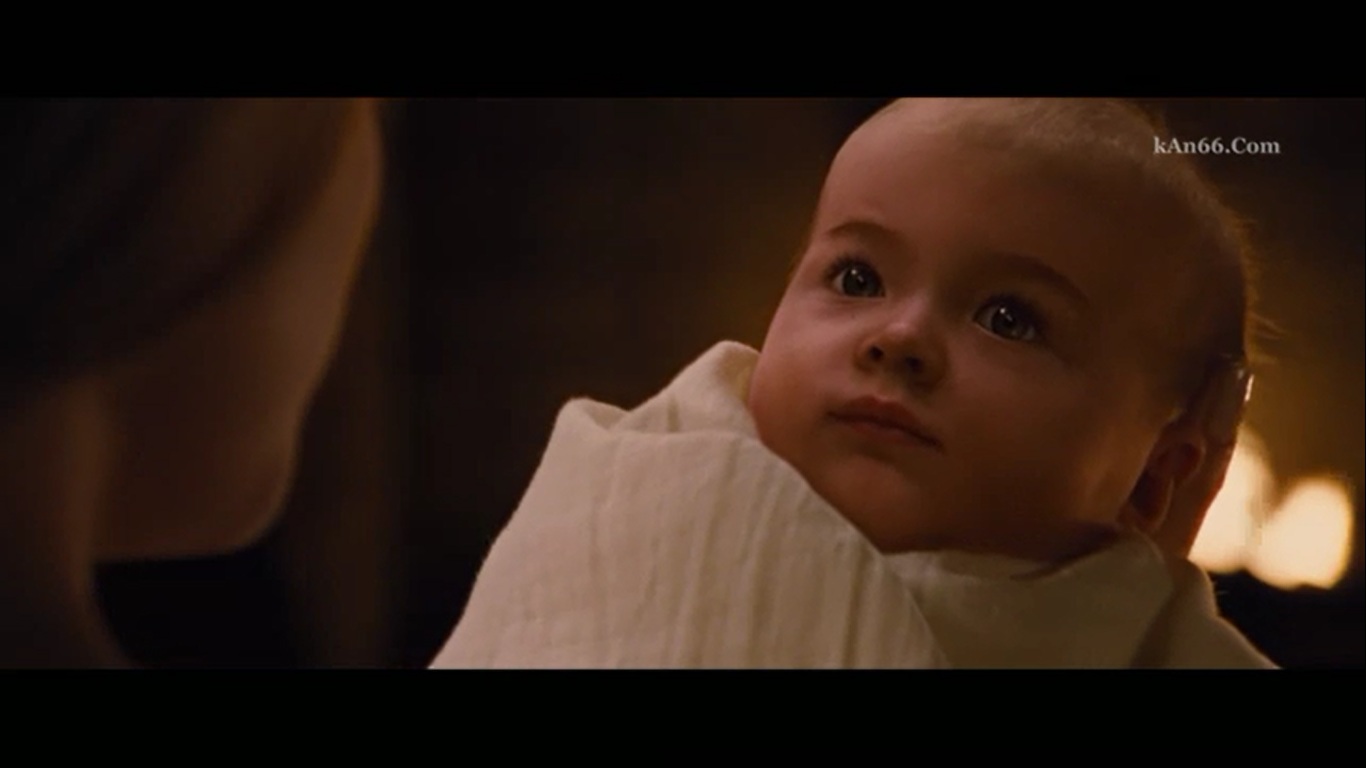
U
- Ultraviolet (2006) had a notoriously rushed production that resulted in some of the temporary CGI renders making it to the final print of the film. One of the most notable instances includes the infamous Motorcycle Chase.
- The Steven Seagal movie Under Siege 2: Dark Territory
- The film is notable for having the least convincing CG flame effect in recent memory.
- The brief scene where a still image of Eric Bogosian's character pulls himself up from a cliff at about three frames per second. See here (at 1:57; clip also contains the aforementioned "flame" effect starting at 3:11)
V
- In Vacation, When Christina Applegate's character falls off the obstacle course, she is obviously replaced with a CGI double.
- The psi-hounds in Vampire Academy are laughably bad and appear heavily unfinished. Christian setting them "on fire" isn't very convincing either.
- An awful lot of the CGI work in Van Helsing is shockingly bad. The 'swing on a rope' scenes where they just veer off to the side for no reason. The 'Anna falls on the roof' scene. Way too many of the monsters.
- The plot of Vault of Horror segment This Trick'll Kill You centers around an Indian rope trick that even an experienced stage magician can't figure out. This would probably be more effective if the black threads holding up the rope were less visible.
- Virus Shark: At some points, it's obvious to see that the sharks are puppets. In one scene, we're supposed to be seeing a shark being lifted into a tank. They shoot this with extendable grabbers and obvious forced perspective.
- The special effect failures in Volcano mostly have more to do with poor direction than effect quality, but the post-production effects often simply don't match the actors' reactions to them, such as people failing to notice a skyscraper-sized plume of ash and lava. There are, however, also some shots where the CGI elements are clearly rendered at framerates below 24fps, causing them to look quite jittery.
W
- The War of the Worlds:
- The original 1953 film. The terrifying and intimidating look of the Martian machines loses some power in certain shots as you can clearly see the wires holding them up.
- One of the three versions released in 2005 is set during the same period as the book and claims to be the most faithful adaptation. While the quality may be up for debate, the quality of the effects is not. The heat-ray is straight out of a '90s video game, the tripods clatter along independently of the surfaces that they're standing on and nighttime is represented by superimposing starry night sky over some of the visible blue afternoon sky while being filmed in bright sunny daylight.
- Waterworld has a couple of moments of blatant rear projection and some rather wonky physics in the model work. Compared to most of the stuff on this list, it actually looks decent enough. So what makes it worthy of being here? The final budget: 175 million dollars.
- The otherwise very good Where Eagles Dare has three: the first is when an obvious dummy plummets down a cliff to impact the bottom, the second a shot showing badly faked smoke added to the skyline of a castle that supposedly has multiple fires burning, and the third when a vehicle explodes and rolls off a road, with really obvious dummies sitting in the seats burning just before the roll.
- Some shots of the eponymous creature in The White Buffalo clearly show the rails that the animatronic creature gallops on.
- Who Framed Roger Rabbit was innovative when it came out in 1988, and still holds up today. However, there's one scene when Eddie is in the alley in Toontown and there are several shots where, due to time and budget concerns (see the DVD Commentary for more information), they had to opt out of rotoscoping out the fiberglass prop gun standing in for Eddie's toon gun and replace it with animation. Sticks out like a sore thumb among the rest of the film's effects. One really good example of a more "accidental" Special Effect Failure is when Roger pleads for the director Raoul to let him do another take. Raoul's coat sleeve goes up to Roger's hand, instead of Roger grabbing it himself.
- In Why Did I Get Married Too?, at the end of the film where the couples gather together again in The Bahamas for Gavin's memorial service, you can tell they that the paper lanterns they release into the sky and ocean float up towards a greenscreen effect.
- In the unrated cut of The Wicker Man (2006), during the famous scene where Nicolas Cage is tortured with bees, ("No! NOT THE BEES") he screams twice that the bees are, "IN MY EYES!" We can clearly see that they're not.
- Willy Wonka & the Chocolate Factory had only a modest budget by 1971 standards, and this shows through in several key scenes.
- The melted chocolate river looks more like brown water or sewage. (Appropriately enough, it is brown water.) It may or may not help that even the characters initially think it's such before Mr. Wonka corrects them!
- When Augustus Gloop is sent shooting up the pipe in the Chocolate Room, the effect is very clearly done via stop-motion. The chocolate river surrounding the tube also reveals that the film was sped up for said scene.
- Blueberry Violet doesn't look very genuine. The effect of her skin turning blue is "accomplished" by simply shining a colored light on the actress's face.
- Charlie and Grandpa in the Fizzy Lifting Drinks sequence are clearly cartoons, and as pointed out in the RiffTrax, the bubbles around the two almost hide the strings.
- The Wonkavision scene, when the Wonka bar and, later, Mike Teavee appear on the screen after being teleported there via Wonkavision. The podium holding the teleportee is clearly visible.
- The reason for the Adaptation Species Change from nut-sorting squirrels to giant chocolate egg-laying geese is to avoid this trope, as the filmmakers knew there was no hope of pulling off the squirrels with turn-of-the-Seventies tech.
- In the finale of The Witches of Eastwick has shades of this. When Susan Sarandon's character falls off a stone balcony, not only is her falling an obvious blue-screen effect but when her body stops falling mere inches above the floor. (she begins laughing, which makes the witches lighter than air, and thus float.) you can clearly see the wires holding her up and she begins floating into the air.
- The Wizard of Oz has some great special effects, as well as some not-so-great ones. The visible strings controlling the Lion's tail are acceptable for 1939. However, one egregious incident yanks one out of the narrative: you can actually see (in full view) the Tin Woodman unwinding the rope keeping the Wizard's balloon down.
- Women on the Run have a moment where a group of punks beats a puppy to death For the Evulz. Said puppy is played by an unconvincingly fake rubber toy, with the yapping dubbed in the background.
X
- X-Men Film Series:
- From X-Men, in the scene where Magneto force pulls the dog tags from Sabretooth's neck, the wire connected to them is slightly visible. Even more so on the Blu-ray release.
- Hugh Jackman's Wolverine beard in X2: X-Men United is well made, but close-ups make it very easy to see the mesh the hairs are glued to.
- X-Men Origins: Wolverine:
- The effect used to depict Emma Frost's diamond form pops out for its low quality.
- Though Wolverine's bone claws are well done, his adamantium claws, particularly in the bathroom scene, have inspired much derisive audience laughter. You'd think in a movie explicitly about a mutant with metallic claws, that would get more CGI attention than anything, especially when incarnations in previous films (by the same FX studio, even!) are pretty good quality.
- Professor X's cameo at the end of the movie. Let's just say that if the CGI technique to make Patrick Stewart look younger looks worse than the third movie (which predates Wolverine by three years), you're doing something wrong.
- The Wolverine:
- It's quite obvious that the train action scene is filmed in front of a green screen.
- The Silver Samurai suit doesn't look as convincing as it should, considering how well-rendered armored battle suits in movies like Iron Man are nowadays.
- While the CGI bear at the beginning of the film is somewhat hokey, the practical-effects-created bear that appears shortly afterward just screams animatronic.
- In X-Men: First Class, a quiet scene has Magneto teaching Mystique that she can't focus on hiding her mutant identity when threats could come from anywhere, demonstrating his point by levitating the weight she's lifting into the air and dropping it on her, forcing her to change back into her mutant form to grab it. Not only is the weight noticeably hanging on wires when Magneto levitates it (it can be seen jiggling in place as he speaks), but the makeup used when Mystique grabs the falling weight looks like it was whipped together for Jennifer Lawrence in a hurry, as it has an obvious "seam" where the makeup ends and her actual forehead begins.
- In X-Men: Days of Future Past:
- The special effects are mostly top-notch, but there are times when the 70s-era Sentinels (notably the one that Magneto places metal into on the train) look off.
- In the stinger, Apocalypse's pyramid-forming looks a bit on the CG side.
- The triumphant moment of Mystique smiling at Xavier and Beast after refusing to kill Trask is somewhat marred by the dodgy CGI effects used on her eyes when she looks over at them. The compositing of the CGI makes it look like she's going cross-eyed.
- Beast, who in his other appearances looks very feline, here looks like Teen Wolf...
Y
- Yongary: Monster from the Deep, a Korean version of Godzilla, has, at the very least, a visible nozzle during a close-up of the title monster's head as it's breathing fire and a visible fifth wheel to prop up the rear half of a jeep the monster slices in half with a laser shot from its horn.
Z
- Zu Warriors — the 2001 version, not the 1983 cult classic film. Awful, eye-burning effects that belong on a 1995 screen saver and the characters farting purple fireworks as they "fly" (read: get blatantly pulled along by thick, obvious wires).
Other
- This is almost a given with many low-budget films made today by studios such as The Asylum. The CGI is especially chintzy, lacking any sense of mass and often badly composited into the film. Watch any of their films: Mega Shark vs. Giant Octopus, Mega Piranha, Transmorphers, Alien vs Hunter, and you'll see just how shameful it is.
- In fact, the CG in Transmorphers is so bad that even the founder of the visual effects studio that worked on it thinks the overall result is crap.
- Anytime something is set on fire. The fire looks rather like an animated GIF pasted over the film. This is without mentioning the failure evident in almost every other effect.
- Anything toted as a "Sci-Fi/Syfy Original". Particularly bad in Sci-Fi/Syfy sequels to big-budget theatrical releases. Dragonheart has the main dragon splendidly rendered scale by scale, while the equivalent character in the sequel has scale-textured but smooth and shiny skin.
- Heatstroke has poor CGI even by Syfy standards and even worse compositing, to the point the monsters look almost badly photoshopped into the movie. The CGI blood is laughable, and even the practical effects are horrible (with the one practical prop alien looking next to nothing like the CGI model).
