

Not every Aesop passes the Voight-Kampff test.
"Wheel of Morality, turn, turn, turn, tell us the lesson that we should learn."
—Yakko Warner, Animaniacs
An Aesop is one of the most played with tropes in fiction. It has come to the point where parodies of them are becoming as repetitive as the morals themselves. There are several common ways to do this:
- Non sequitur morals, which get sillier and sillier.
- Backward morals, where the characters learn the exact opposite of what you'd expect them to.
- Morals that, although apropos and completely true, are extremely unlikely to become relevant again.
- A pun on a Stock Aesop that only makes sense in context.
- A Captain Obvious Aesop played for laughs.
- An intentional Space Whale Aesop.
- Ignored Aesop, in which characters use a generous dose of Lampshade Hanging to discuss what the moral is that they were supposed to learn. After going through several possibilities they end up concluding that they either learned something ridiculous or didn't learn anything at all.
- A Broken Aesop that immediately has a lampshade hung on its brokenness. Sometimes this can lead to an Ignored Aesop (as above) or a character pointing out the opposite of the lesson—often doing something immoral, or sometimes simply something neutral and logical—would avoid any trouble and thus nullifies said lesson.
- A Clueless Aesop that is negatively affected in a Meta sense can overlap.
When adding examples, bear in mind that just because a work is a spoof and has An Aesop, it's not necessarily a Spoof Aesop automatically.
See also Broken Aesop for when "action doesn't support the aesop" is unintentional. To add these to other works, check out Warp That Aesop.
Examples:
open/close all folders
Advertising
- A T-Mobile commercial has family sitting around the table. The teenage daughter lists who of her friends she made her "Fave Five." Then her younger brother says that he picked the exact same five girls as his "Fave Five."
BROTHER: Your friends are HOT!
DAUGHTER: [to her parents] Aren't you going to do something about this?
FATHER: Maybe you should have uglier friends.
Anime and Manga
- Speedy Cerviche of Samurai Pizza Cats offered up a great Spoof Aesop after a battle: "Whoever said 'Violence never solved anything' wasn't a Pizza Cat!"
- In Bobobo-bo Bo-bobo, the eponymous character spends a great deal of the fight against Halekulani (a money-obsessed villain) trying to convince him that friendship and normal life is more important than money. At the end, he starts saying what the most important thing in the world really is, and just as he knocks out Halekulani, admits that it's money, after all. It's somewhat implied Bobobo did this deliberately because he felt Halekulani wasn't worthy of hearing the real moral.
- Gintama combines this with Idiosyncratic Episode Naming; each anime episode/manga chapter is usually something like "Stress can lead to baldness, but if you try not to be stressed then that will make you stressed, so there's nothing we can do."
- One episode of Magical Project S opens with Sasami and Ginji driving off a cliffside road into the ocean and getting stranded on an island because the latter fell asleep at the wheel. When Ginji explains to Sasami what happened (in an intentionally labored way), they then enthusiastically jump up in excitement, having learned nothing as they continue their summer vacation.
- The Cowboy Bebop episode "Toys in the Attic" consists of each member of the Bebop's crew (well, except Ein, who is a dog) delivering an Aesop. Ed's aesop would probably count ("If you see a stranger, follow him"), but Spike's aesop is the primary culprit. The aesop is don't leave food in your fridge, put in the context of the contents of one of the ship's refrigerators having evolved into a horrible poisonous blob monster that attacks the crew. It avoids becoming a Space Whale Aesop because it's clear the writers weren't treating the subject matter seriously at all.
- It may or may not be intentional, but much of the first-season Gag Dub of Duel Masters implies that in order to win at card games, you gotta have great hair.
- Ninja Nonsense had "Don't waste food" at the end of episode eleven, which up until that point had nothing to do with the subject and consisted of an (extraordinary inaccurate) retelling of the "Crane Wife" folk tale. Then in the last 2 minutes, everybody falls asleep and Onsokumaru starts sticking oranges on people's faces, only to get chewed out by Kaede's mom. The ninjas comment "Thats the first moral we've had since the show began."
- In the Full Metal Panic! novel side story "Cinderella Panic!", it parodies the original fairy tale and gives a sort of backwards moral. Granted, the moral it gave was quite a bit more realistic than the original fairy tale's moral - "Don't always just rely on trying to find a "Prince Charming" who will bring you out of a bad situation, instead use your own strength and find a way out."
- Cinderella takes the lesson to heart and sells the other glass slipper for ludicrous profit to a would-be princess, before leaving the kingdom forever (together with the fairy godmother) to become a traveling merchant.
- Sousuke also delivers a spoof aesop at the end of Full Metal Panic? Fumoffu's rugby episode, wherein Sousuke declares that the rugby team's bad example has taught him the valuable experience that violence is never the answer... completely ignoring the fact that he is currently sitting in a literal penalty box for shattering the opposing team captain's jaw and that all the violence ensuing was at his instigation. Unamused by this irony, Kaname gives him a Dope Slap.
- The English dub of Sgt. Frog had "Recycle and don't pollute the ocean, or the creatures that live in it will eat you alive."
- A later episode has "Feel good about your body. Unless you're ugly."
- The English dub of Sonic X gives up this gem: "Kids, don't use Formula 1 race cars to chase hedgehogs!"
- Any Aesop from Sayonara, Zetsubou-Sensei falls under this.
- Sailor Moon had many incredibly stupid aesops delivered at their "Sailor Says" segments at the end in the DiC English dub, which are mocked in this way in Sailor Moon Abridged.
- Panty & Stocking with Garterbelt has an episode where totally-not-Optimus Prime and totally-not-Megatron agree (after seeing Panty And Stocking take over their respective armies and wage a pointless war) to stop fighting each other... they'll crush the Puny Humans together instead!
Comic Books
- An issue of Marvel Adventures: Avengers involved the group being turned against each other by the Hate-Monger, who was actually trying to help them by giving them a common enemy: himself, in order to improve their teamwork. After pointing out how stupid this plan was ("We already have common enemies!"), we get this exchange from Spider-Man and Storm:
Spider-Man: So the lesson today is "Trust no one."
Storm: That's not the lesson. - The Slave Labor Graphics Hsu and Chan comics, tend to lampshade this at the end of the stories. A comic on the author's website, The Mummy's Tooth, continues this tradition when Chan notes how the morals of their adventures are getting vaguer and vaguer. Hsu replies by saying that he likes to think that their inherent strength of virtue compensates for that. Immediately after this, one of their
friendsemployees uses a skeleton he looted from a museum garbage can as a ventriloquist dummy to say "That's all folks!"- Another example from the issue Evening of Destruction
Chan: You suppose there's a moral in all of this?
Hsu: Oh... probably.
- Another example from the issue Evening of Destruction
- Nextwave, in its typical style, brings us the aesop that "no good can come of a robot in a bra" in issue #6.
- While not necessarily the "lessons" of the cast's misadventures, the infoscrolls present at the bottom of nearly every page of The Intimates tend to skew this way, especially the "Teen Tips". "Teen Relationship Tip: Have sex early so you can get better at it sooner." "Teen Behavioral Tip: When frustrated by life, feel free to act out your aggressions." "Teen Empowerment Tips: Embrace feelings of insecurity, ambivalence, frustration, anxiety, and confusion." Those are all just in the first two issues.
- Final Crisis Aftermath: Dance has this little gem: "Heroes die. Fame lives forever."
- Brooklyn delivers us this gem in the Gargoyles comics: "You never know when a giant flaming magical time-travelling bird is gonna swallow you whole and spit you out in the tenth century—so hit those books, kids!"
- The Superior Foes of Spider-Man gives us "If you want a man to work with you, don't show him a video of a bull fucking his wife", a lesson that the Owl learned the hard way during a disastrous team-up with Man-Bull.
- League of Extraordinary Gentlemen opens with a narrator explaining that the morals one should take away from the story are that women never shut up, the Chinese are evil, and laudanum is good for you.
- Gravity Falls: Lost Legends: The second story, Comix Up, has the Mystery Shack crew traveling through cursed comic book environments to rescue Grunkle Stan. Once they make it back to the 3rd dimension, Wendy offers this nugget of wisdom:
Wendy: Well, I think we've all learned a lesson today. Reading is bad. We should burn all books, and overthrow the government!
Grunkle Ford: I'm... not sure that's the takeaway. - The Simpsons Futurama Crossover Crisis: In the second part of the second miniseries, every fictional character from every book ever written ends up causing trouble in New New York. Later on, the heroes are able to defeat the giant Homer partly thanks to a giant TV screen. Thus, Bart comes to the following conclusion:
Bart: Well, at least I learned a valuable lesson. TV saved the day, so that means TV is good and books are bad!
Lisa: [frowning] What? That's ridiculous! TV rots the brain!
Fry: [frowning] Maybe, but at least TV never tried to take over a city!
Bender: Death to books! All hail TV!
Comic Strips
- Calvin and Hobbes had these a few times:
- After the duplicator incident, Calvin tried to say what lesson they'd learned, but decided "OK, we didn't learn any big lesson." ("Live and don't learn, that's us," quipped Hobbes.)
- The "moral" of the encounter with Calvin's 'Deranged Mutant Killer Monster Snow Goons' was the extremely valid and helpful "Snow Goons are bad news." As Calvin noted: "I like maxims that don't encourage behavior modification."
- Another Spoof Aesop appears at the end of the strip where Calvin gets sent to bed after spending all Sunday getting his chores done, following Hobbes's advice that it would give them more time to goof off:
Calvin: [angrily] See if I ever listen to you again.
Hobbes: [with subtle sarcasm] Never put the low priorities first.
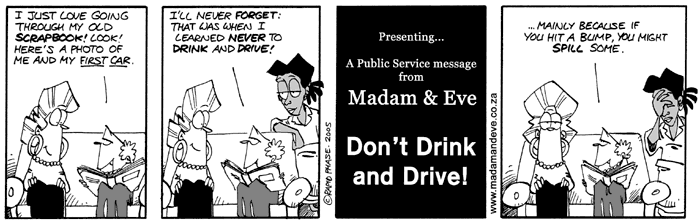
- Madam & Eve says Don't Drink and Drive!
 ◊
◊
- In Pearls Before Swine, we're treated to this exchange:
Zebra: So, Saint Peter wouldn't allow you into heaven?
Rat: No. He said I was bad.
Zebra: Well, now that you know your actions have consequences, what kind of things are you going to avoid from now on?
Rat: Death.- The morals Rat gives for his "Angry Bob" stories tend to be absolute non sequiturs. And they're not nearly as bad as the ones in his "Danny Donkey" stories...
- An Oor Wullie comic has the main character being asked to play hooky with his friends. He refuses, because he wants to go to art class instead. However, once at school, he gets mocked for the goofy smock he is wearing. The lesson he learns? Next time he should just play hooky. No "stay in school" here!
- Phoebe and Her Unicorn:
Phoebe: I now understand that hair is far more important than pencil toppers.
Dakota: That's a stupid moral.
Phoebe: At least it's not a cliche.
Eastern European Animation
- „Kérem a következőt!”, a Hungarian animated series, ends every episode with a parodied Aesop.
Fan Works
- Crack Shots by yonwords is a story Wes Janson is telling to the Wraiths, after which he tells them that he just gave them valuable insight about their commander. They think he picked the story to illustrate that Wedge Antilles has survivor's guilt and holds himself aloof from people he thinks will die on him.
Wes shook his head. "No, I told that story so you'd all know better than to try to out-drink Wedge. It's a mistake I've watched countless people make." He paused and gave them one of his most serious looks. He was a little out of practice but doubted they'd notice. "Even the most mild-mannered Corellian holds his liquor better than the rest of us. Remember that."
- The moral Calvin learns in "Attack of the Vampire Babysitter", an episode of Calvin & Hobbes: The Series? Though he may be literally locked in his room, he's still alive - to the apparent benefit of the rest of the world. Amusingly enough, he ends up saving the world several times over later on.
- Because You Got HaruhiRolled! is a Crack Fic, the Aesop it gives in one arc is a Spoof Aesop by default.
- Halloween Unspectacular: This is fine: At the end of "The Curse of the Cursed Curse", Rick ignores Morty's suggestions for a more conventional (and relevant) Aesop and claims that the moral of the story is "Christopher Columbus was a jerk".
- Sonic X: Dark Chaos claims that Muslims are all psychopathic pedophile fundamentalists who enjoy rape and torture because Islam says they should. Both Christianity and Judaism - and their followers - are depicted as stupid and naive at best or complete Religion of Evil at worst. Lampshaded in Episode 68:
Eric: Remember kids, Islam is bad and if you're a Muslim, you should feel bad!
Sonya: That's an... odd lesson. - Total Drama Do Over: All Stars gave many serious morals such as, "Old rivals could become friends," "You aren't entitled to someone just because you have a crush," and "Trust your friends when they come up with something serious." This is the same season that gave us, "Pancakes taste better with butter."
- At the end of the first chapter of Adventures of the Silver Bullets, the Silver Bullets do a PSA about the importance of education.
Percy: I learned that everything at school has a purpose, no matter how pointless it may seem!
Alphonse: I learned that learning is a lifelong process that never truly ends!
Kurumu: And I learned that... wait a minute, I didn't learn anything!- Kurumu then points out that the circumstance of Percy's lesson (a quiz on Newton's Law to use an access panel in a secret base) was a Contrived Coincidence and doesn't apply much to ordinary citizens, and Ed adding that the chapter never explained what counts as education or how people can educate themselves.
- The Remnant's Bizarre Adventure Chibi series will end spoof aesops based on what happened in each chapter.
- Chapter one is about how the heroes are abusing Josuke's Crazy Diamond to fix stuff for their benefits, and it ends with Kars crashing down into Beacon while they have their limbs detached. The aesop is about how you should appreciate your friends and their special talent more than what they can do you can do, or else the Perfect Being will come and kill you.
Films — Live-Action
- Gremlins 2: The New Batch which features a new gremlin outbreak in a state of the art automated high rise office building ends with the following statement "This isn't a place for people, it's a place for things, and when you build a place for things... well, it ends up getting filled with THINGS". The implication being the "Things" are gremlins. The gremlins have nothing to do with the automated nature of the building. Their outbreak had nothing to do with it other then the fact that they were leasing to a laboratory and Gizmo got wet initially from a malfunctioning drinking fountain. Further more several of the building's high tech features came in handy such as the pest detectors and their telephone network. The real moral of the story should be "mogwai make terrible pets".
- The Rocky Horror Picture Show reads like a morality play, saying essentially that hedonism and a queer lifestyle will get you kidnapped and/or killed by aliens.
Brad: You're going to kill him? What's his crime?
Dr. Scott: You saw what became of Eddie; society must be protected.- The typical audience response at this point is "Fuck society!"
- "You fuck society!"
- "We all fuck society!"
- "Gang-bang society!"
- "Better not, you'll get a social disease!"
- Not if society has protection!
- The typical audience response at this point is "Fuck society!"
- In xXx, Xander Cage steals the car of an anti-free speech senator named Dick. He then drives the car off a bridge and base jumps from the car. On the way down, he delivers the line "And the moral of the story is 'Don't be a dick, Dick!'"
- And similar to the Mass Effect 2 one below, he berates a man for smoking with the "It'll kill you" line. Late in the movie, it does... by leading a heat-seeking missile directly to his face.
- In Love Actually, jaded rock star Billy Mack appears on what seems to be a live talk show for teenagers, promoting his new album. After defacing a poster of a rival band - which prompts the hosts to inform him that there are kids watching - he looks deeply into the camera and intones:
Billy Mack: Here's an important message from your uncle Bill. Don't buy drugs.
[the hosts of the television show smile in relief]
Billy Mack: Become a pop star, and they give them to you for free! - Hot Shots! Part Deux: After disposing of a few soldiers, Harbinger turns directly to the camera and with a big smile on his face, announces "War! It's fantastic!"
Literature
- Douglas Adams did this masterfully in The Restaurant at the End of the Universe. While trapped on Earth two million years before the 20th century, Ford pitches a makeshift Scrabble tile into a bush out of frustration. The toss frightens a rabbit in the bushes, which runs away and is devoured by the fox. The fox chokes on the rabbit's bones and dies. The river rises and washes away the fox, becoming contaminated. It is then mentioned that Ford later falls in love with someone who dies suddenly due to drinking from the polluted river. "The lesson one should draw from this is to never throw the letter Q into a privet bush, but there are unfortunately times when it is unavoidable."
- In ''The Hitchhiker's Guide to the Galaxy Trilogy," Zaphod Beeblebrox advises "Never ever drink more than two Pan Galactic Gargle Blasters unless you are a two-ton wooly mammoth with bronchial pneumonia."
- Jane Austen loved this trope:
- At the end of Northanger Abbey where the hero of the piece has proposed very much against his father's wishes.
"I leave it to the reader to determine whether it is the point of this story to promote filial disobedience or parental tyranny."
- Pride and Prejudice: What's the secret of living Happily Ever After? Breaking promises, telling secrets, and being deliberately contrary. The Official Couple point this out when they realize they ultimately got engaged because Elizabeth demanded her aunt reveal something Mr. Darcy asked her to keep secret and Lady Catherine added the Forbidden Fruit appeal.
Elizabeth: For what becomes of the moral if our comfort springs from a breach of promise? ...
Darcy: You need not distress yourself. The moral will be perfectly fair. Lady Catherine's unjustifiable endeavours to separate us were the means of removing all my doubts. - Love and Freindship has a mock-Anvilicious scene at a dying friend's bedside that delivers the spoof Aesop, "Run mad as often as you choose, but do not faint." Mind you, the whole thing is a rather wicked parody of late-18th-century sentimental novels, so all the over-the-top shows of emotion are kind of required.
- At the end of Northanger Abbey where the hero of the piece has proposed very much against his father's wishes.
- Hilaire Belloc's book of poems Cautionary Tales, written in 1907, parodies the little stories with morals that the Victorians loved to tell their children, in which dire consequences would befall any child who broke the slightest rule. The poems include Matilda, Who Told Lies, And Was Burned To Death (a retelling of The Boy Who Cried Wolf), and Jim, Who Ran Away From His Nurse, And Was Eaten By A Lion.
- And, of course, Algernon who played with a Loaded Gun and upon missing his Sister was Reprimanded by his Father.
- Lewis Carroll threw a bunch into a single chapter of Alice in Wonderland, in which the Duchess responds to every piece of news with a moral, ranging from statements which are sensible but irrelevant to complete nonsense.
- Borgel by Daniel Pinkwater contains several folk tales which contain Spoof Aesops of the third type, such as "Never bet on an eggplant".
- In the last page of Daniel Pinkwater's Young Adult Novel, several Wild Dada Ducks ask what the story's moral is, and one of them answers that it doesn't have a moral — "it is a Dada story."
- The books in Lemony Snickett's A Series of Unfortunate Events do this at practically every turn.
- This from Catch-22: Yossarian left his tent in Marrakech one night to fetch a candy bar, and was lured into the bushes by some unknown WAC, and wound up with a dose of the clap. Clevinger once suggested that this should have taught Yossarian the evil of sexual misconduct. "It teaches me the evil of candy," says Yossarian.
- Some of the morals at the end of Charles Perrault's fairy tales can be read this way. For example, his moral at the end of Sleeping Beauty is, in effect, "Young women shouldn't rush into marriage – even if you wait a hundred years, the wait only makes love sweeter – but alas, it's no use to preach this moral." The final moral of Cinderella is "Virtue and intelligence are all well and good, but they're useless without connections" (e.g. the Fairy Godmother). And the two morals attached to Bluebeard are "Curiosity leads to regret" (never mind that the wife's curiosity leads to the just downfall of her Serial Killer husband) and "This tale of a wife-killer could never take place today, because modern husbands are too henpecked."
- Older Than Print: Sir Gawain and the Green Knight: What valuable lesson in chivalry and virtue does Sir Gawain learn after failing his Secret Test of Character? "Never trust women." — it really is a Spoof Aesop, not just a case of Values Dissonance. Gawain's short speech, in which he explains that, ever since Eve gave Adam the forbidden fruit, women have been leading men into evil, is just a shameless attempt to excuse his own failure by blaming someone else. The Green Knight sets him straight.
- Edgar Allan Poe's humorous short story "Never Bet The Devil Your Head": Exactly What It Says on the Tin. It expands upon it with the intentionally ridiculous Space Whale Aesop that if you do, he might eventually come to collect.
- Poe does this again in "The Spectacles", in which the moral is basically "always wear glasses if you need to".
- In Jonathan Stroud's The Bartimaeus Trilogy, one footnote goes off on a tangent about how after being trapped in a bottle for several decades, he was released by a fisherman. Bartimaeus emerged in suitably spectacular fashion as a lightning bolt throwing giant, and offered the fisherman a wish. Guy dropped dead on the spot of a heart attack. Bartimaeus then says "I know there's a moral in there somewhere, but for the life of me I just can't find it."
- Too many James Thurber stories to count.
- A footnote in Terry Pratchett's novel Eric explains, "Interestingly enough, the gods of the Disc have never bothered much about judging the souls of the dead, and so people only go to hell if they believe, in their deepest heart, that they deserve to go. Which they won't do if they don't know about it. This explains why it is important to shoot missionaries on sight."
- The Code of Dinotopia is a list of proverbs carved on a stone tablet. The bottom right-hand corner broke off at some point, cutting off the last code at "Don't p—" One Dinotopian suggests that the line might be "Don't pee in the bath."
- In the classic Canadian children's book, The Hockey Sweater, a boy in 1940s Quebec orders a Montreal Canadians sweater but a Toronto Maple Leafs one arrives instead (which, in that setting, was Serious Business). He is convinced that he is not allowed to play because of his sweater (which might be true) and breaks his stick in anger. The curate sees him and tells him to go to church and ask God to forgive him.
"Wearing my Maple Leafs sweater I went to the church, where I prayed to God. I asked God to send me right away, a hundred million moths that would eat up my Toronto Maple Leafs sweater."
- In Robert Burns' poem "Tam o' Shanter", Tam gets drunk at a pub and witnesses a gathering of undressed dancing witches on the way home. They spot him and come after him, and he barely manages to escape with his life although one of the witches got close enough to pull the tail off his horse. The ending reiterates the moral: don't get drunk or ogle pretty ladies, because otherwise your horse might lose its tail.
- According to the protagonist of King Dork, the moral of the story is: "if you're in a band, even a crappy one, semi-hot girls will give you blow jobs if you promise them never to tell anyone about it." He admits that that's not a very good moral, but it's the only thing he can think of that he learned from it all.
- The Devil's Dictionary: The messages are intentionally negative and deeply cynical, e.g. marriage is a form of mutual slavery, religious people are all hypocrites etc.
- Cryptozoologicon, a discussion on cryptids by experienced zoologists, concludes each segment on a cryptid with an analysis of what it might "really" be like if it were a real animal, from the perspective of a cryptozoologist who believes fully in it. Many of them end on a Green Aesop. Why? Because the fact that sightings of these creatures are becoming increasingly rare in an age where everyone has a camera is actually because these beautiful creatures are being driven to extinction. So remember, save the environment, or else we might not have Bigfoot!
- In The Map to Everywhere, Coll delivers a Curb-Stomp Battle to three guards, then immediately turns around to inform his companions:
Coll: Violence is never the answer. Those gentlemen just tripped.
Live-Action TV
- Brooklyn Nine-Nine: "The Therapist" has an Embarrassment Plot, with Terry trying to convince the precinct that the book of sex tips they received was actually ordered by someone else. Eventually he gets Scully to claim the book and secretly hand it back later, which Scully can do without embarrassment because he doesn't care what people think of him. Terry admits that this is an inspiring way of thinking, but quickly changes his mind after he realizes that Scully also doesn't care about things like "bathroom privacy".
Terry: You're not gonna wait for me to leave!?
Scully: (sitting on the toilet) Like I said, I just don't care. - Buffy the Vampire Slayer: In the fourth-season episode "Beer Bad," after a cursed batch of beer turns Buffy into a neanderthal, Xander steers us into a Spoof Aesop:
Xander: And was there a lesson in all of this? What have we learned about beer?
Buffy: Foamy!
Xander: Good. Just so that's clear.- There was a real Aesop to this episode, too (namely, "Beer Bad"), so that the show could apply for funding from the National Office of Drug Control Policy. Though most fans dislike "Beer Bad" for its extreme anviliciousness, the show didn't get the funds because the ONDCP thought it was a Space Whale Aesop.
Giles: I can't believe you served Buffy that beer.
Xander: I didn't know it was evil!
Giles: You knew it was beer.
- There was a real Aesop to this episode, too (namely, "Beer Bad"), so that the show could apply for funding from the National Office of Drug Control Policy. Though most fans dislike "Beer Bad" for its extreme anviliciousness, the show didn't get the funds because the ONDCP thought it was a Space Whale Aesop.
- An episode of Angel starts out this way, although there was a hidden moral. Cordelia has been impregnated by the monster of the week, and was surprised when her teammates helped her out:
Wes: What did we learn?
Cordelia: Men are evil? No, wait, I knew that. Sex is bad?
Angel: We all knew that.
Cordelia: Okay, fine. I learned that I have two people I can count on absolutely in my life. And that's new. - In Diff'rent Strokes, Arnold gets into a fight with the bullying son of the landlord's brother who is subbing for a short time. This leads to a loud confrontation where the brother confronts Mr. Drummond, threatens to evict the family and provokes Drummond to punch the blowhard out. This gives the landlord the excuse to exploit a lease violation that the brother found to raise the rent on the Drummonds, with a veiled threat of eviction to convince them to give in. The punchline is this: after the Drummonds cave in to this threat, the father tells the kids that this is the result of his act of violence. However, when asked if it was worth it, Mr. Drummond immediately remarks it was, for having the pleasure of shutting a bully up.
- Key & Peele has a spoof of Mr. T's 1980s PSA videos, but while the kids set up a series of Stock Aesops for him to preach about (don't be prejudiced, don't get in strangers' cars, drugs are bad) he instead lectures them on making fun of his clothes and name and hair.
- The Fresh Prince of Bel-Air had Will yell at his uncle's political rival, which leads him to have a heart attack. When his funeral comes around, all the mourners turn out to hate him, with most of them showing up to make sure he is actually dead. Will — wracked by guilt — yells at them all for it, saying they should respect the dead. It seems like this will end the scene on An Aesop, but when they ask who he is, he answers "I'm the dude that killed him" to rapturous applause.
- The Aesop of The King of Queens episode "Bun Dummy" is "Save the bun hairstyle for when you're an old lady, and if you're bold enough to wear it as a young lady, don't act like it's the greatest thing that ever happened to you".
- The Bernadette Peters episode of The Muppet Show, Sam the Eagle started reading the famous story of "The Ant and the Grasshopper". However, when winter came in the story, Sam was shocked to learn that the grasshopper drove his sports car to Florida, and the ant got stepped on.
- From a Saturday Night Live parody of the classic "Eye of the Beholder" segment of The Twilight Zone (1959) (on the season 23 episode hosted by Pamela Anderson {named Pamela Lee at the time}) comes this demolition of Rod Serling's usual closing narration:
Serling: So, there you have it. Something that is beautiful to one is not beautiful to another. As this woman learned when she... well... she didn't really learn anything. And neither did we. Frankly, usually I try to have some kind of ironic twist or moral in these things, but... I got nothing this time, because that woman was hot! In The Twilight Zone.
- Another one from a TV Funhouse segment starring Tracy Morgan (later of 30 Rock fame) as Mr. T, complete with Mixed Metaphors:
Mr. T: Let that be a lesson to all the Gary Burghoffs, Joey Lawrences, Tina Yotherses, and George "Goober" Lindsays! If you believe in yourself, eat all your school, stay in milk, drink your teeth, don't do sleep, and get eight hours of drugs - you can get work!
- Another one from a TV Funhouse
- Even with its "No hugging, no learning" motto, one episode of Seinfeld does have a Spoof Aesop. In "The Summer of George", George's plan to fulfill his personal goals during that summer (which he declared "The Summer of George", hence the title) go terribly awry (mostly because he becomes too lazy to do anything other than loaf in his apartment all day). As a matter of fact, in the ending, he has to go into traction because his muscles have atrophied that much, making the slip and fall he got a lot more painful than it normally would be. So the moral of the story is "Never name a season after yourself; it will only end in tragedy."
- The Baywatch spoof Son of the Beach ended each episode with a Spoof Aesop; usually of the non-sequitur and Broken Aesop varieties.
- On Star Trek: Deep Space Nine, Dr. Bashir attempts to explain to Consummate Liar Garak why no one believes a word he says by telling him the story of the boy who cried wolf. Garak thinks about it for a minute, then hilariously concludes that the real moral of the story is "Never tell the same lie twice."
- The entire basis of Strangers with Candy was producing "backwards" Aesops.
"You never really lose your parents, unless of course they die. And then they're gone forever, and nothing can bring them back."
- "Weird Al" Yankovic did these on his Saturday morning show, prompted by the E/I proposals.
- The fact that he literally learned the same lesson at least 7 times was made fun of in the DVD commentary. He never actually learned the lesson, either.
- From Top Gear (UK):
- In the "$1,000 American Car" special, the trio travels to the Southeastern United States and draws the ire of the locals in every way, in some cases deliberately (like scrawling provocative messages on each other's cars like "Man Love Rules" and "NASCAR Sucks"), in others tangentially (like remarking on the devastation wrought on New Orleans by Hurricane Katrina), and in still others completely accidentally (like donating their cars at the end to local families who were impacted by Katrina, only for one of them to sue Clarkson on a technicality). The lesson they impart is "Don't go to America!"
- Virtually all of the "Top Gear Top Tips" are Spoof Aesops.
Clarkson: If you're a 17-year-old boy and need car insurance, slice your penis off.
- After a serious demonstration of the effect that a 90-tonne locomotive would have on a car, Clarkson takes a page from your typical workplace safety bureaucrat with a tenuous attachment to reality: "Think! Wear a high-visibility jacket."
- Richard Hammond was hospitalised after crashing a Vampire dragster at 288 mph. It was pretty damn scary, and while the presenters are usually quick to rib each other, Clarkson and May mostly held off from joking about that one. But the audience certainly expected them to at least try to cross the line twice, and in Hammond's first episode back after the crash, Clarkson got the joking out of the way by intoning an Aesop in all seriousness: "Speed kills." The Reaction Shot from the very much alive Hammond is what sells it.
- In an Adam Sandler comedy sketch, a driver ejects his friends from his car one-by-one as they accidentally reveal that they've each had sexual liaisons with sixty-year-old men. In the end, the driver is killed in a car crash. The moral, we are told, is, "If your friends have fooled around with a sixty-year-old man, do not throw them out of your car. Or you will die."
- At the end of every episode of The Sarah Silverman Program Sarah sits on her bed and discusses the lessons she has learned for the day to her dog. These lessons will always be completely incorrect or will have absolutely nothing to do with the lessons she should have learned. For example, in the episode "Not Without My Daughter", the lesson she should have learned was not to live her life through her children, the lesson she learned was that children are evil, and in "High, It's Sarah" the lesson she should have learned was that pot impairs your judgment and it is not a good idea to act on ideas you have while high, the lesson she learned was "bacon spelled backwards is 'no cab'... which is what black people get!"
- Dinosaurs: "A New Leaf", a Very Special Episode on drugs, ends with Robbie addressing the audience, telling them that drugs were the leading cause of crappy anti-drug episodes of your favorite TV shows: "Say no to drugs. Help put an end to preachy sitcom endings like this one!"
- The Father Ted episode 'The Old Grey Whistle Theft' centres around the events that transpire when Dougal falls in with a bad influence. After everything is resolved, Ted and Dougal discuss what had happened:
Ted: Dougal, don't put too much faith in people who are 'cool'. Most of the time, they're just on the fast track to a life of crime. Father Lennon will probably end up like that corrupt cardinal in The Godfather 3.
Dougal: Oh, you're right there, Ted.
Ted: So, have you learned something from your experience?
Dougal: ...No. - The State did a series of spoof Spring Break Safety promos for MTV - one started out seeming to be about the dangers of excessive drinking, but turned out to have the backwards moral that you should drink whiskey instead of beer because you'll get drunk faster and won't get a hangover. Others had more non sequitir messages, like "raw pork chops that you find lying on the beach are perfectly safe to eat, but you should trim the fat first, make sure there aren't any crabs on it, and check for cartons of chocolate milk washing up onshore too", and "Don't get gangrene". That last one also seemed to be a parody of the kind of Clueless Aesop that's too vague to be useful: there was no discussion of what causes gangrene or what should be done if you do get it, just constant reiteration that it is a serious, potentially life-threatening infection and you should try to avoid it.
- Every episode of Check It Out! With Dr. Steve Brule ends with a list of lessons learned that, like the lessons on The Sarah Silverman Program are inevitably Spoof Aesops.
- That '70s Show:
- Michael Kelso and Jackie Burkhart are a good-looking but dim and very shallow teen couple. In the episode "Hyde Moves In", Jackie catches a cold, which slightly hinders her looks, but when Kelso sees her, he screams in horror. He later comes back to apologize, and tells that he learned a lesson: "Just because you look bad now, that, that doesn't mean you're gonna look bad forever! [...] I realized that this whole mess, that's just a temporary thing. But physical beauty, that lasts forever!" Jackie is touched.
- Another episode, "Streaking" from the first season contained one. Donna doesn't want to go with her parents to a presidential rally for Gerald Ford because she's embarrassed because she and her parents would be wearing jumpsuits to make them look like an American flag. When Kitty talks with her about it, it results in this exchange.
Kitty: Aren't you going Donna?
Donna: No, my dad's gonna make me wear this really queer jumpsuit. I don't know if I can do it. It's just too embarrassing.
Kitty: You know Donna, my grandmother came from Sweden, and she had this thick thick accent and it embarrassed me to no end. Well, I asked her not to come to my high-school graduation 'cause I didn't want my friends to hear her talk. And she didn't come. Sixteen years later, she got the gout and died. You see?
Donna: No.
Kitty: All families are embarrassing. And if they're not embarrassing, then they're dead.
- The second season finale of Scream Queens (2015) has Chanel survive another serial killer attack, then go on to find success. In the epilogue, she delivers what she sees is the moral of the story: she survived because she stayed true to herself and didn't compromise. The joke is that, while this sounds like a good moral, it's not what she should have learned. Most of the killers in the series were after her because she stayed true to herself, and she only survived through pure luck or through other people stopping the serial killers. Chanel just doesn't have self-awareness, and thus doesn't get that she was supposed to learn how her behavior constantly turned people against her.
- In the Better Off Ted episode "The Long and Winding High Road", Linda and Veronica come up with one way of cheating to make sure their project beats out its competitor from the other division, while Ted comes up with a completely different way; the combination of the two of them ends up being worse for the project than if they'd just done nothing.
Ted: Look, the project is now dead. Because we all took the low road. So, I was right. We should always stay on the high road. Lesson learned. The end. And you two are worse than me.
Veronica: Actually, I think the lesson here is, when we're on the low road, we really need to coordinate better. - Community every few episodes will do this.
Britta: Maybe you're one of those rare people with nothing underneath the surface. Maybe if you put stain remover on a turd, you don't get a diamond - you just get a turd with less direction in life.
- The G.I. Joe themed episode, "G.I. Jeff", ended with Britta lecturing a pair of teenagers heavy-handedly about spraying graffiti. Halfway through her lecture, Abed shows up to deliver an Aesop on how to deliver an Aesop.
- "Queer Studies and Advanced Waxing" has a subplot about Chang joining a stage adaptation of The Karate Kid, and getting mercilessly bullied by the director. Near the end, the director justifies his abuse by claiming that he truly believes Chang has the potential to be an amazing actor, but for him to reach that potential, he needs proper motivation. In the end, after all the abuse, Chang delivers a mind-blowing performance that wins mass acclaim and leaves the audience in tears. His friends are left wondering aloud exactly what lesson can be gleaned from this, since all available evidence suggests that the Jerkass director was correct all along.
Annie: I am at a total loss as to what lesson to take from this.
Elroy: Maybe that's the lesson.
Abed: I lost a button.
Elroy: Maybe we all lost a button. - In "VCR Maintenance and Educational Publishing", Shirley tries to evade blame for stealing school property, trying to blackmail Chang into keeping quiet, and then assaulting and kidnapping Jeff, Hickey, and Britta by claiming that they learned a valuable lesson.
Hickey: No, we didn't!
Shirley: We've learned that sometimes, there is no moral.
Jeff: How is that learning? - In "Competitive Ecology", the group suggest various possible morals to take from the episode's events, but then decide to just blame it all on Todd.
- One episode of Arrested Development, following various fake dismemberments, has the moral that you shouldn't use a one-armed man to scare someone. This aesop comes into the ridiculously over-specific category, although for the show it's actually good advice.
- For bonus points, it's also a Broken Aesop, since the lesson was completely hypocritical.
"And that's why you don't teach lessons to your son."— J. Walter Weatherman, who just got done teaching Michael a lesson about not teaching lessons
- For bonus points, it's also a Broken Aesop, since the lesson was completely hypocritical.
- Andy Richter Controls the Universe: Give a man a fish, and he'll eat for a day. Kill that man with a rock, and you can have all his fish, AND his wife.
- Blossom has a Show Within a Show example. One episode has Blossom, Joey and Six showing the short movies they made for a school project. According to their teacher, "it's an automatic A as long as it teaches a lesson". Joey's movie is a So Bad, It's Good Science Fiction Cliché Storm with no overarching message whatsoever - and then, once the movie's over, he has superimposed "Don't Drink and Drive" onto the final image.
Blossom: I think it's cheating. The moral of some low-budget sci-fi ripoff movie is "Don't drink and drive"?
Joey: See? Even you got it! - Castle gives us this gem, when his daughter considers trying out for cheerleading.
"Well, we both learned a valuable lesson today. You learned you can expand your horizons and grow. I learned that if that involves short skirts and boys I'm not gonna like it."
- The closing songs of the second series of Blackadder sometimes fell into this category
Take heed the moral of this tale.
Be not a borrower or a lender
And if your finances do fail
Be sure your banker's not a bender. - The final episode of The Gong Show was told as one of "Chuckie's Fables" ("The Land Of Ferb And Fenwick Gotterer"). The moral: "Never bet against the Minnesota Vikings at home in the wintertime."
- The Nanny did this twice with the same moral. Any time the children were arguing, Fran would tell them to be nicer to each other. Rather than do the typical Aesop about loving your family, the first time she said "Yes, because someday your father's going to be old and sick... You're gonna want him to live with her." The second was more abrupt, "Be nicer to your sister, someday you might need an organ... and your brother's a different blood type."
- On Mystery Science Theater 3000, Mike and the bots briefly discussed the message of The Deadly Bees after watching it.
Mike: So, what do you think was the message?
Crow: Don't watch it. Ever. - Occasionally used by the narrator on Mythbusters:
Narrator: The lesson is clear: Don't leave loaded guns in exploding rooms!
- In the House episode "Euphoria," House suspects the current patient got an infection from the pigeon droppings they discover he uses as free fertilizer for his marijuana crop.note
House: Let's hope this experience teaches our cop a lesson — don't cut corners when you're growing your pot.
- Monty Python's Flying Circus: The moral of the "Vocational Guidance Counselor" sketch is that chartered accountancy ruins people's lives, and the public should be informed of what effort is needed to prevent it.
- The sketch show MADtv (1995) once did a spoof of a "don't have sex without a prophylactic" educational short aimed at teenagers starring Avril Lavigne. Her horndog boyfriend BJ tries to get her into it, but she refuses because she thinks she has to wait until marriage. Her rather open-minded parents (apparently suffering a mid-life crisis) tell her that they did the same thing when they were young, but have regretted it ever since. They advise her to do the polar opposite instead: have sex with as many partners as possible, preferably at the same time and while doing cocaine, and never use a condom.
"Wow... I'm so glad my parents set me straight."
- A M*A*S*H episode has Frank Burns stealing a wounded colonel's antique pistol, to pass off as his own and impress Margaret. The gun's disappearance is discovered, and Radar (who was in charge of the gun bin) is held responsible, facing up to fifteen years in the stockade. After Col. Potter goes on the PA and prevails upon the thief to return the gun, no questions asked, Frank goes to replace it in the bin and accidentally shoots himself in the foot. After he confesses the deed to Margaret in her tent, there's this exchange:
Frank: Oh, I did a terrible thing, Margaret.
Margaret: Well, it's all right now.
Frank: I should've known better.
Margaret: Well, at least you regret it.
Frank: Oh, never again. When you steal something, don't ever try to return it. - The Thundermans: At the end of the "A Hero is Born" special, Phoebe delivers the aesop that lying to your friends is bad, and now that Cherry knows she's secretly a superhero, things are A-okay between them. Then she adds that Cherry now has to lie to everyone she knows about Phoebe and her family being superheroes.
- In the WandaVision episode "WandaVision Episode 5 "On a Very Special Episode..."", Billy and Tommy plead with Wanda to use her powers to resurrect Sparky after it dies. Wanda attempts to deliver the stock aesop that death is a natural part of life and we should accept the losses of our loved ones, but it's undercut by the fact that the entire series, including Billy and Tommy's very existence, is the result of her own inability to accept Vision's death.
- Almost Live!: Every "Mind Your Manners With Billy Quan" segment ended with Billy giving some sort of silly lesson, e.g. "Library Of Death" ended with Billy telling the audience "Remember, kids, the library is a place of solitude, so zip your lip or you'll be overdue for a pounding".
- The Inside Man is an IT security training program in the form of a dramatic serialized television series, with tips on IT security summarized at the end of each episode. A minor subplot in one of the episodes from the third series involves the mother of one of the people in the newly formed analytics company wanting them to hack the city planning department to try to get a one-up on their neighbor. At the end of the episode, one of the takeaway tips provided is "Don't hack the planning department."
Music
- "Three Little Pigs" by Green Jellÿ: "And the moral of the story is: A band with no talent can easily amuse idiots with a stupid puppet show."
- Few people probably needed to be told the moral of Tom Lehrer's song "Oedipus Rex", from An Evening Wasted with Tom Lehrer:
So be sweet and kind to mother, now and then have a chat
Buy her candy or some flowers or a brand new hat
But maybe you had better let it go at that... - In The Lonely Island's Threw it on the Ground, Andy Samberg throws Elijah Wood and Ryan Reynolds' table to the ground, causing them to retaliate by tazing his butthole. The moral? You can't trust the system!
- In "YOLO", they invert the typical interpretation of the acronym "You Only Live Once" (typically used as an inspirational "you should live each day to the fullest because it might be your last!" message) by pointing out that the phrase actually makes more sense if you take a cautionary "watch your step and be careful" lesson from it — after all, if You Only Live Once, then you want to spend as much time as possible actually being alive, and the thing with living each day to the fullest is that doing is full of risk. Then, of course, they go completely too far in this direction with it, to the point that they end up as crazed paranoiacs sealing themselves in their houses out of terror of every single thing that exists.
- "The Curse of Millhaven", by Nick Cave, is told from the perspective of a young girl who is recounting all the terrible things that have been happening in town lately. Near the end, she reveals that she is responsible for (almost) all of it, and is locked away in a mental institution. At the end, she's asked if she's learned her lesson.
''They ask if I feel remorse/And I answer "Why, of course"/There's so much more I could have done if they had let me
- Roy Zimmerman in This Machine:
"So if I have one message for you tonight, it's do good in the world and love each other...and that's two messages, so if I have just one message for you tonight, it's do each other!"
- Voltaire in Mechanical Girl:
"So you see, the moral of the story is: Never take a child away from a loving parent. Especially not ones who make children who shoot rockets from their eyes."
- brentalfloss's Baby Mario and Papa Yoshi:
"The moral of this fable is: do not eat a baby, cause he'll become your friend, one day... maybe."
- Bruce Dickinson of Iron Maiden describes their Filk Song adaptation of The Rime of the Ancient Mariner as "...what not to do if a bird shits on you."
- In the novelty tune "No Anchovies, Please" by the J. Geils Band, a curious young housewife calls a phone number she finds at the bottom of a can of anchovies. She's subsequently kidnapped by a shadowy organization and transformed into a bowling ball. Her poor husband sees and recognizes her later while he's watching Bowling for Dollars. The lesson? "Next time you place your order, don't forget to say....'no anchovies, please.'"
- Stephen Lynch, "Gerbil":
If you love your gerbil, don't stick him up your butt!
- The Brothers Four's "The New Frankie and Johnny Song":
And the moral of this sad tale, I'm a tellin' you
If you're gonna fool around then you better pull the shades - "Lizzie Borden" from New Faces of 1952 ends on this note:
No, you can't chop your poppa up in Massachusetts—
Massachusetts is a far cry from New York. - "Weird Al" Yankovic, "Albuquerque":
"I know it's kind of a roundabout way of saying it, but I guess the whole point I'm trying to make here is: I! Hate! Sauerkraut! That's all I'm really trying to say."
- Eminem's "The Kids" is a concept song about Slim Shady explaining to a class of schoolchildren why they shouldn't do drugs. All of his stories are nonsense (smoking pot will make you a serial killer, ecstasy drains your spinal fluid, magic mushrooms will make your tongue swell up like a cow's). Eventually he concludes that you shouldn't do drugs because if you do, your parents will blame his music for it, and he'll have to go into hiding.
- In "The Cat and the Mouse" a mouse gets drunk on some liquor spilled on a barroom floor and shouts "Bring on the goddamn cat!"
Then a black cat came from behind the bar,
And gobbled up the little white mouse.
And the moral to this story is:
Don't never take a drink on the house.
Radio
- John Finnemore's Souvenir Programme:
- If you're a mathemetician, always outline your ratios properly, and more importantly, don't be a dick.
- The Live Edinburgh show has an inversion of The Grasshopper and the Ant, where the father reading it to his children is scolded for going off-story and changing the aesop. They want the original version, so as to prove to him the aesop of how sometimes following your dream is impractical.
- Every episode of The BBC World Service's Reduced Shakespeare Radio Show ended with Austin Tichner asking the other two members of the Reduced Shakespeare Company what they'd learned. In a couple of episodes it was vaguely relevant to the events of the episode, but at no point was immediately useful, or anything to do with William Shakespeare.
Adam: I learned people are animals too.
Reed: I learned you can't hug a child with nuclear arms.
Austin: And I learned never to ask Reed and Adam what they learned today. - That Mitchell and Webb Sound: The moral of "The Boy Who Cried Wolf" is found by a lawyer to not be "don't tell a lie", it's "don't leave as the sole guardian of a flock of sheep someone you've decided to ignore", when the sheep's owner, the boy's uncle, is taken to court.
- A sketch on a Monty Python record parodying fairy tales ends with a character being run over by a bus on his return from his quest to buy a packet of cigarettes for the King, with the end moral proving to be "Smoking is bad for your health."
- The Catchup Advisory Council "commercials" on A Prairie Home Companion inevitably make "eat more ketchup" not merely the logical end of a sales pitch, but a full-on Spoof Aesop, with some overlap with Parody Product Placement.
Stand-Up Comedy
- Courtesy of Hannibal Buress:
"You know, in geometry class in high school, I was always wondering, "Why they teaching me this 'pi' and 'circumference' stuff?" And I got to use it in that dick joke just now. So stay in school, y'all."
Tabletop Games
- The rulebook for GalaxyTrucker has a number of in-universe explanations for certain rules. One of these explains why it is important to transport hazardous goods in the proper types of cargo holds. It tells the story of James “Skip” Fairweather, who decided to transport several tons of plutonium in used fruitcrates. Upon landing, he lost both arms and one leg to a mob of angry environmentalists.
Theater
- The "moral" given during the finale of the musical A Funny Thing Happened on the Way to the Forum: "Morals tomorrow, comedy tonight!"
- Shakespeare
- Twelfth Night ends with a song that teases a moral, but merely ends with A long while ago/The world was begun/But that's all one/Our play is done.
- Othello is adapted from an Italian story in which Desdemona delivers a Writer on Board speech saying Venetian/Italian women can't trust Turks or Moors or foreigners in general. Shakespeare leaves the plot largely unchanged but replaces this with a more appropriate speech by the villain saying a Moor such as Othello was silly to trust (an Italian?) man (himself) over his own wife, a Venetian... we can only guess at the contemporary audience reaction. But to audiences in slaving states of the Antebellum United States in particular, and to some extent Anglophone audiences in general in the 19th and 20th centuries, the idea that a negro or oriental should be cautious of trusting a European was (quite) laughable. And, of course, completely true.
- One seventeenth-century critic of the play complained that the moral seemed to be that women should keep track of their hankies at all times.
- The ending of P.D.Q. Bach's Oedipus Tex:
Well the moral of the story is, of course:
Don't love your mother, pardner, save it for your horse.
I guarantee you will be filled with great remorse
If you give your mom the love you should be saving for your horse! - (Could also be a case of Space Whale Aesop) There is a 16th century French farce which goes as follows: An alchemist arrives to a village and proclaims that he can remelt old men and make them young again. The old crones of the village convince their husbands to try the alchemist's foundry. They come out of it rejuvenated... and immediately dump their wrinkled wives and start chasing young girls. The moral of the play? "God save you from the idea to remelt your husbands".
- Or, more mundanely, "be careful what you wish for".
- The opera Don Pasquale ends with the characters pointing out that the elderly shouldn't get married.
- The song "Turn It Off" in The Book of Mormon is essentially a drawn-out version of this, where the characters explain how problems are easiest to deal with if you simply ignore them and suppress your feelings.
Elder McKinley: Turn it off, like a light switch - just go click! It's a cool little Mormon trick. We do it all the time! ...Really, what's so hard about that?
- In the second half of the song, Elder McKinley also goes on a rant about how he has to crush his homosexuality because "boys should be with girls, that's heavenly father's plan — so if you ever feel you'd rather be with a man, turn it off!"
Elder McKinley: My hetero side just won! I'm all better now.
- One of the stories Elder Cunningham makes up in trying to persuade the Ugandans to follow Mormon doctrine has the moral that you will burn in the fiery pits of Mordor if you have sex with a baby, but use a frog instead and the Lord might cure your AIDS. (This might sound like a dirty joke, which it basically is.)
- In the second half of the song, Elder McKinley also goes on a rant about how he has to crush his homosexuality because "boys should be with girls, that's heavenly father's plan — so if you ever feel you'd rather be with a man, turn it off!"
- H.M.S. Pinafore: Sir Joseph Porter, K.C.B. delivers one, carefully designed to poke fun at political appointees with no practical experience in their field whatsoever, at the end of "When I Was A Lad", which describes his ascent from office boy to First Sea Lord, note which at no point involved anything to do with the Navy apart from a "junior partner-''ship'' in a law firm.
Stick close to your desks and never go to sea / and you all may be rulers of the Queen's Navee!
Video Games
- From Baldur's Gate 2:
Jan Jansen: Well, there's a lesson in there somewhere, I suppose. Never whip a sick ogre? Never tell someone twice your size to pick something up? Never boss someone around unless you can run faster than they can? Aha! If you're going to hire ogres, give them sick days and benefits or they will kill you. Yes... that about sums it up, I think.
- Which are actually rather useful Aesops, all things considered.
- In Earthworm Jim 3D, Jim just spent the entire game exploring his four worm brains repairing his sanity, defeating the villains affecting his mind, collecting marbles to rebuild his IQ, and defeat his suppressed feminine side trying to take over his mind and body. Jim's reflection on the whole ordeal:
Jim: I can't believe it's over. I had no idea it would be so strange! ...But I think I learned something from all this. Nothing can destroy the Super-Suited worm hero! I am invincible!"
- Some of Otacon's misinterpreted proverbs in Metal Gear Solid 2: Sons of Liberty, such as how the concept of original sin means Snake has to take no responsibility for stealing and killing, and how the lack of profit in the fashion industry for pre-ripped jeans shows that no-one should subvert the natural order of things.
- In Psychonauts, Razputin accidentally sets loose the censors in Sasha Nein's brain during Psychic Blast training, and after Raz is forced to seal them away again, the following exchange occurs:
Sasha Nein: Young man, I hope you've learned a lesson here today.
Razputin: Yes I have. That shooting things is fun and useful!- Spoofed in the same level after Raz defeats the grotesque Mega-Censor.
Razuptin: Is this the part where I get another speech and learn another lesson?
Sasha Nein: No. Here's your merit badge. Let Us Never Speak of This Again. - Another comes when Ford Cruller gives Raz training on Pyrokinesis:
Ford: Now Razputin, remember only to use your power of Pyrokinesis only when it's very, very important... or really, really entertaining. And if you're doin' it to impress girls, make sure none of them have on a lot of hairspray. Whoo!
- Spoofed in the same level after Raz defeats the grotesque Mega-Censor.
- At the end of The Secret of Monkey Island, you get to choose one of three spoof Aesops for Guybrush to say:
1. How to deal with frustration, disappointment, and irritating cynicism.
Elaine: That sounds like something my husband would say.
Guybrush: Yikes!
2. It's not the size of the ship...
Elaine: Yes, I've heard that one.
3. Never pay more than 20 bucks for a computer game.
Elaine: A what?
Guybrush: I don't know, I'm not sure why I said that.- Monkey Island 2: LeChuck's Revenge has another one, after Guybrush is tasked to find the answer to the riddle "If a tree falls in the forest and no one is around to hear it, what color is the tree?". After finally finding an answer ("all of them") we get this exchange:
Herman: Now, what has this experience taught you?
Guybrush: That philosophy isn't worth my time.
Herman: I'm very impressed! It takes most people years to reach this point. You have learned all that you can from me. Go forth into the world with confidence.
- Monkey Island 2: LeChuck's Revenge has another one, after Guybrush is tasked to find the answer to the riddle "If a tree falls in the forest and no one is around to hear it, what color is the tree?". After finally finding an answer ("all of them") we get this exchange:
- One episode of Nintendo Week had this: "Video games are fun! And don't forget to eat food." Though, considering that many gamers DO forget to eat.... is this really a spoof aesop?
- A trailer for Portal had GLaDOS deliver the Aesop: "If at first you don't succeed, you fail."
- In Kingdom of Loathing, low-quality booze gives one very few adventures, and some even does Stench/ Sleaze damage, and takes one forever to get drunk off of. Only go for the good stuff.
- In Brütal Legend, When you complete all of the Overslaughter side-quests, the Hunter leaves with: "Whenever you kill something, a part of you dies. A tiny, pathetic little part of you that you didn't need anyway." (paraphrased)
- One of Zaeed Massani's anecdotes in Mass Effect 2 starts out with him telling Shepard not to smoke.
Zaeed: You smoke, Shepard? Don't. That stuff'll kill you. Knew a kid once, half your age. Smoked too close to a cache of explosives. Tossed a butt, blew himself sky high.
- It's more than likely that Jade is kidding when she gives this advice. At least, it's probably best to assume that she is...
- Howard and Kreese from MadWorld give a few of these from time to time through a couple of the one-off lines. Particularly when Jack is using a Happy Pill or eating a Happy Onion
Howard: Pay attention, kids! Jack's enjoying the benefits of eating his vegetables!
Kreese: Dude, you are so full of shit!
Howard: Guilty as charged! Everybody knows that vegetables are poisonous, and the only food real men eat are bull testicles and moonshine! - Nancy Drew: Ghost Dogs of Moon Lake. If you fail to put out the fire after escaping the burning shed, the forest will burn down, prompting a helpful PSA to turn up, presented by a cartoon skunk dressed in a ranger outfit.
Ranger Stinque Sez: "Hey, kids! Remember- after you've been knocked out, tied up, and left in a burning shed, be sure to put out the fire!"*
- In Space Quest IV: Roger Wilco and the Time Rippers, one Have a Nice Death message is "Smoking is bad for your health." It has nothing to do with cigarettes and everything to do with the smoldering exit wound just blasted through your midsection by the Sequel Police.
- Kendo Rage ends with this one:
O: Learn anything?
Jo: Yup, never trust a green-haired Japanese guy named Bob! - Shantae and the Pirate's Curse: Being a He-Man spoof, Bran-Son naturally delivers one of these.
Bran-Son: Just remember kid. It's not what's on the outside, like skin and hair. It's what's on the INSIDE that counts. A kind heart, and blood, and your guts. That's what makes the whole body go 'round.
- Undertale wraps up one minor subplot this way in the Playable Epilogue:
Fish Guy: In the end, I never caught any girls on my fishing line. So kid, take it from me... Don't try to catch hot people with a fishing rod.
(Somewhere, you hear a whinny of dismay.) - Spyro: Year of the Dragon: Agent 9 has this to say after you free him from captivity and visit him at his homeworld for the first time, which doubles nicely as a Fantastic Aesop.
Agent 9: Ooooh, take it from me, Spyro - never spend a week in a cage! Uh-uh! Next thing you know your whole island will be knee-deep in Rhynocs!
Web Animation
- Camp Camp will occasionally end on these:
- Episode 4 where Neil says that the main lesson is "never try to change anything, because someone more powerful than you will always get in the way and keep you down."
- Episode 5 has one about how there are some things in life more horrifying than ghosts, namely old people having sick pervy sex.
- Episode 9: Sometimes you've just got to hit kids.
- Episode 11: Never work together! or One skilled individual will trump teamwork by unskilled individuals.
- Season 2, Episode 10: As long as your heart is in the right place, it's okay if you fib a little.
- Every episode of Happy Tree Friends ends on some kind of Stock Aesop or saying. These sayings are, at best, loosely connected to the episode's plot through some manner of pun, but never actually flow from the episode's events. They just serve to end the episode on a cheesy joke right out of a kids show to contrast the prior carnage.
- Homestar Runner:
- Near the end of "Strong Bad is in Jail Cartoon", after Strong Bad is taken back into custody Homestar announces "It just goes to show, Strong Sad doing tai chi is really, really funny."
- In "Homestar Presents: Presents", when Marzipan seems disappointed in Homestar's literally last-minute gift for her (a pair of wire cutters), Strong Bad shows up to scold Homestar with "Decemberween is not about getting people presents. It's about getting people good presents! Good presents! Not this last-minute discount crap you're trying to foist on us!"
- In episode 100 of Red vs. Blue, Church gives a speech which is halfway between an Aesop and an angry rant about everyone around him.
Caboose: You ever wonder why we're here?
Church: You know, Caboose? I used to not care. I just went along with orders and hoped that everything would work out for me. But, after all that's happened, you know what I've learned? It's not about hating the guy on the other side because someone told you to. I mean, you should hate someone because they're an asshole or a pervert or a snob. Or they're lazy or arrogant or an idiot or a know-it-all. Those are reasons to dislike somebody. You don't hate a person because someone told you to. You have to learn to despise people on a personal level. Not because they're Red or because they're Blue, but because you know them... and you see them every single day... and you can't stand them because they're a complete and total fucking douchebag.
Caboose: ...I meant why are we up here in the sun when we could be standing down there in the shade?
Church: Oh! ...Yeah, okay. Let's go stand in the shade. - At the end of the Mappy web series, Sky Kid summarizes that the entire show was about the dangers of unregulated capitalism.
Sky Kid: If you or a friend is the evil CEO of a multi-billion dollar corporation, there are places where you can get help before it's too late!
Webcomics
- This Comic has an Aesop about the Lysistrata Gambit SO over-the-top, it just CAN'T be taken seriously...
- And leads into the more useful Aesop "If your door is broken crazy people can wander into your house and deliver bad jokes".
- 8-Bit Theater frequently uses the joke that Character Development cannot and will not happen to the main characters of the comic, and much of the humor deals with them missing out on/ignoring/or sometimes straight avoiding Aesops and opportunities for growth.
- Several times, Black Mage has learned a valuable Aesop - such as that a path of violence and hatred will only cause himself suffering, or that use of evil spells will alienate White Mage from him - but they just can't stick to his teflon soul and one knife-worthy comment from Fighter and he's all but forgotten they ever existed.
- The Evolutions of Homosexuality and Suicide: The bearded scientist explains that since a gay man might help both his own nieces and nephews as well as those of his lover's, on average he saves more children than an asexual man (who takes no lovers), thus more gene-carriers. He concludes: "So there you have it, gay love saves lives."
- Koan of the Day features a footrace between a guru and a tortoise that subverts this trope.
- Sluggy Freelance has several.
- The story "A Carnivorous Smurf for Kimmy Sue Hasenpfeffer":
Torg: We learned a valuable lesson that day.
Kiki: Yeah! Bun-bun was right! Peer pressure does save lives!
Torg: I was thinking 'Just buy the girl a smurf next time,'note but that'll do. - The story "Cannibals Anonymous" is about Aylee overcoming her addiction to eating humans. After she's "cured", she goes Actual Pacifist on Torg just when he and Riff are being held by cannibals who intend to eat them and she's the only one who could save them. Torg decides to announce that he was wrong to force Aylee to be someone she wasn't, and to make it up, he'd like her to eat all the cannibals in the room. (Even she doesn't buy it, until he says "Who's the prettiest alien in the world?") The aftermath prompts the following Aesops:
Percy the Mammoth: I've learned that I can be friends, even with people different from me.
Aylee: And I've learned that true friendship is worth more than eating even the tastiest human.
Torg: I've learned that I need to appreciate you more. I've been taking your friendship for granted when I should have listened with my heart.
Riff: And I learned it's OK to eat people if they're the bad guys. - Riff's story "The Isle of the Ployees" ends with:
Luckily the volcano was actually a magic portal that returned me to the real world. It was my salvation, not my destruction. I learned an important lesson that day. Lava heals all wounds. When life gets me down, I look to jump in some lava. Barring that, I remember that freedom is not found on the horizon. True freedom is found by looking within. Within mountains filled with lava.
- This story also seems to have a real aesop, which is that corporate jobs suck or something, but it turns out it's just a dream he had and has no particular point.
- Also done in this strip in the chapter "Mandatory Applause". The Aesop's actually a decent one, but it's too much of a Space Whale Aesop to take seriously.
Torg: Devaluing everything material is a road to ruin. That was a lesson Clutter Monster learned too late and at too high a price.
- The comic's version of the Gift of the Magi Plot, as told by Torg, features Riff and Torg selling their shoulders to science to buy each other a coat and a flannel. The person Torg is telling the story (Anthropomorphic Personification of the year 2003, as it turns out) isn't very impressed, leading to the following:
2003: How does that story show the Spirit of Christmas?!
Torg: Um... Well, the spirit of Christmas is intangible, so it doesn't have shoulders... either...? It was kinda a neat twist ending that you didn't see coming! You know, like that "Rudolph" story? - The story "A Carnivorous Smurf for Kimmy Sue Hasenpfeffer":
- From The Wotch: "Now Jennie, what did we learn again?" "That it's never okay to drop bowling balls on people's heads unless they are evil wizards hurting your friends."
- From Stickman and Cube: "Don't think too much or you'll disappear into nothingness. Especially if you're a cube."
- The Adventures of Dr. McNinja: At the end of every issue, Dr. McNinja struggles to find an Aesop except the 5th. Or the 1st ever.
- Gunnerkrigg Court:
- In chapter 15, Antimony and Kat see that Red has become estranged from her friend, Blue; they blame her acerbic personality, but Red blames her hair. Annie and Kat humor her by taking her to get a haircut, but they also tell Red that it will take more than new hair to win her friend back. Then the new haircut does win Blue back. So the real lesson is that fairies are capricious and weird. Or alternatively, "No one is too happy to wang (throw) tomatoes".
- Also one presented in The Rant for this strip:
Tom Siddell: Kids! Guys in forests are always willing to help!
- Or, after rejecting two fairly ordinary morals that do not apply to the (bizarre) story he just told, Coyote offers this one: "Do not be a dead goose in a bush next to a lake." According to The Rant, "a useful moral".
- El Goonish Shive:
- The inspiring pro-literacy posters in Moperville North High School just say "Read or the owl will eat you".
- The non-canon storyline "Nanase Craft and the Temple of Zappiness" ends with a lampshaded Broken Aesop: When Ashley learns that Diane and her friends want to use the magic scales to alter their body sizes, she says that nobody needs to change their size to be happy, you just need to be comfortable with who you are. Diane says yes, that's true and great, but since there is a magic scale that can adjust their attributes instantly with no side effects, why shouldn't they use it?
- Commissioned teaches us an important lesson about donuts and arm pimples here: [1].
- This Order of the Stick strip. "See what we learned today, Mr. Scruffy. Solve a mans problems with violence, help him for a day. Teach a man to solve his problems with violence, you help him for the rest of his life."
- The strip in question is entitled: "Technically, the 'Fish' Version is a Subset of This One."
- Just moments earlier, Belkar learned that his sociopathic nature was going to get him killed off. The conclusion his mentor (or hallucination; it's never made clear) drives him to is that he needs to FAKE character development.
- Belkar did this stuff pretty much from the beginning like this strip. When he quit from the Banjoist church, he says "I got into it strictly to injure Roy [...] But I've learned a valuable lesson: the power to inflict bodily harm was always mine. I just needed to use it more often. Like so." He then throws one of his knives at Roy.
- This strip. Roy's lesson learned after jumping on an undead dragon and then falling to his death from it? "I learned to do it where the ground is softer." The comic's title "Also, At Lower Altitude" applies as well.
- When Keira Knightley shows Rayne of Least I Could Do his future, this is the lesson he says he learns.
- This arc of Skin Horse ends with the team discussing what they learned on the mission. The first two are reasonable Aesops, though your typical Saturday morning cartoon show might have used "power" instead of "violence" for Unity's. Tip, however, learned that "sex is even better if you get the woman's name first!", prompting newcomer Nick to say "I learned not to let the lady-dude tell us his lesson".
- Saturday Morning Breakfast Cereal
- This strip spoofs the Broken Aesop of the ugly duckling (he was laughed at when he was ugly, but now he's beautiful so it was bad) by replacing "beautiful" with "knows how to program".
- 2010-10-29, which is about a clone of Hitler, is a "Shaggy Dog" Story that ends with the alleged "clear and useful moral": "You can't judge a man by his genetics. Except sometimes kinda."
- "Speciation" is about how a new human species evolves that all look like adorable children, due to natural selection for people who are the best at getting their healthcare crowdfunded... Anyway, the stated alleged moral ends up being "we need more missile defense systems in case of a first strike by little girls with fluffy red curls."
- This strip
- Homestuck: "This is exactly why babies should not be allowed to dual-wield flintlock pistols."
- One Ozy and Millie sequence ends with Millie learning the lesson that "pirates are good at math". Several others have rambling stories from Llewellyn that end with uterly bizarre morals that are Fantastic Aesops and have very little to do with the situation. As Ozy puts it "Dad's stories are as morally instructive as anyone else's. It's just that the moral is always irrelevent."
- Sandra from Sandra and Woo theorizes where loot from a robbery may be hidden, goes searching there with Larisa, Cloud and Woo. After finding nothing, they go home with several (more or less serious) aesops. A few minutes later, Cloud's mother finds the loot, inches away from where the kids were looking.
- The Seven Trials, by Nedroid.
- xkcd: "If you want something done right, learning from the Nazis isn't enough, you have to actually put them in charge."
- "Don't rip hotdogs (or people, the Aesop is not entirely clear) out of fridges and then open them with scissors."
- Educomix:
Dave: You've taught us all a valuable lesson! If we ever see evidence for a different religion, we should still treat the people that believe in it as idiots!
- Precocious:
- Evil's triumph over goodness is absolute
Alt-text: This one goes out to all the impressionable children!
- Also: "Moral of the story: Women are inferior?"
- Evil's triumph over goodness is absolute
- In Ansem Retort, after Aerith gets drunk during her bachelorette party and almost cheats on Axel, Axel, Zexion, Darth Maul and Larxene hijack an airplane and crash it into the cheatee's house. The aesop?
Aerith: Don't drink and cheat on your murderous fiance.
Red XIII: Bullshit I'm not adorable!note
Larxene: I will not name things.note
Darth Maul: I can hijack a plane with only a comb and a pack of Tic-Tacs! - This◊ Bob the Angry Flower comic featuring wheelchair basketball.
- In The Bird Feeder #177, "Pretending," Terry recounts what he did to a human who appeared to be making fun of him. The moral: don't make fun of birds while holding a sandwich.
- In Yokoka's Quest, when Mao justifies the extermination of creatures he originally intended to only drive out:
- In Bob and George, Mega Man interrupts the action to give a PSA that violence is wrong, only to be immediately set off by Roll making an innocuous comment and attempting to shoot her down. When she reminds him about the PSA he was trying to give, he takes it as a reminder instead of pointing out his hypocrisy, and with his blaster still aimed at Roll he says "And one more thing: ice cream is bad for you."
- Fans! had this strip involving Rikk, Aly and Rumi eating pot-laced brownies. "Don't do drugs, kids, or they might impair your ability to enjoy drugs later in life!"
- Housepets! gives one spoofing Jurassic Park, after being reassured that the brontosaurus is an herbivore and therefore won't eat anyone.
Olive (as Alan Grant): (to camera) Remember, kids, herbivores are not dangerous under any circumstances! Ask your local zoo to place hippopotamuses in the petting area!Peanut (as SFX): The more you know!

Web Original
- Atop the Fourth Wall has done "A Public Service Announcement from SNOWFLAME", in which Snowflame gives such advice as "It's better to take over a small central American military complex with a friend", "If someone dares you to do x, do fifty...AT THE SAME TIME!", and "WHERE IS SNOWFLAME'S FUZZY SLIPPERS?!"
- The TGWTG Year One Brawl has this Aesop at the end:
The Angry Video Game Nerd: We shouldn't hate each other!
The Nostalgia Critic: We should team up to hate other things! - Civil Protection would like to remind you that we're kind of fucked, so you'd better hope aliens from outer space conquer us and massacre four fifths of our population.
- "Hell, we almost had it coming!"
- Jon Bois: In Chart Party: "The Search for the Saddest Punt in the World", Jon concludes that unnecessary punting is "the signifier of a loser. This is what losing teams do." But then Jon admits this isn't actually true because, of the ten saddest punts that he examined, six of the offending teams went on to win those games, and one went on to tie. And of the three teams that lost, one of them — the 2000 Baltimore Ravens — immediately followed that with a ten-game winning streak and a Super Bowl victory. Jon concludes that he really has no idea what lesson should be learned from all this.
- From The Nostalgia Chick: "Remember, you can't spell rape without rap."
- At the end of Spatula Madness (from the creator of Charlie the Unicorn), after a series of bizarre adventures, Edward says:
"You know, I learned something that day. Yeah, I may have it rough sometimes. I may lose an arm or even an eye or even lose all hope. We all have our bad times, I'm no exception. But regardless of how bumpy the road becomes and regardless of how many limbs I lose or how bleak the future looks, I can always be thankful that hey, at least I'm not French."
- A gem from Yu-Gi-Oh! The Abridged Series right after Yami has a guy eaten by giant man-eating worms.
Yami: Let that be a lesson to you young man, bullying is not very nice, so I don't want you to doing it ever again. Got that?
Worm: [belches]- And a truly spectacular one toward the end of The Abridged Movie:
Yugi: It's time for the big message. Card games are the answer to all life's problems, and the only thing I know for certain in this world is that there's a strange man living inside my head who tells me to do things.
Yami Yugi (a.k.a. the man in question): You said it, Yugi. Now burn everything. Burn it to the ground! - From an article on Snopes:
I think there are two lessons here: Don't believe all those Coke stories you hear. And don't, for any reason, let a fly drink Roto-Rooter.
- An SMBC Theater sketch rewrote the ending of WarGames so that the computer picks up on one of these.
Joshua: Strange game. The only winning move is not to play.
[everyone cheers]
Joshua: Or to be player one. See, if you go first you take the middle square. Yeah, I guess that's the lesson. Go first, and hope your opponent messes up the first move.- Not only does it reverse the Aesop, it isn't even a good Tic-Tac-Toe strategy.
- Seanbaby said this about River City Ransom: "Kids, if there's one thing you take away from River City Ransom, may it be that violence is the answer to your problems. If you beat a gang member hard enough, he will become an honor student. And if you beat an honor student hard enough, he will give you his lunch money. And the final moral is: it's all about good grades and trips to the mall."
- The Tipping Forties like to end each episode with each player sharing what they've 'learned' from that day's Let's Play.
- This Cracked list about impersonators points out that at least two of them were able to achieve fame, fortune and very little punishment after dropping out of school and pretending to be someone else. #1 died of diabetes, so the writer decides that that's the moral: impersonate someone, and you get diabetes.
- 80's Dan Christmas special:
"Whether we think about Santa this season, or Jesus, whether we're religious, or we just like presents, we can all agree on one thing. And that's that killing Nazis is fun."
- Near the end of Doppelgänger, Victor's friend Lisa cheers him up by saying that his life basically sucks and there's nothing he can do to change that or stop being a loser. But hey, at least there's always someone out there who's life is even worse!
Victor: Lisa, that's awful!
- Friendship is Witchcraft includes a few of these, such as "Dear Princess Celestia, today I learned that you have got to check this ball out!"
- Mr. Poniator's What I Learned Today is based on a series of tongue-in-cheek alternate morals for the first 2 seasons of My Little Pony: Friendship is Magic posted on an image board. It includes claims that the moral of "Family Appreciation Day" is "Your granny was young and hot once!" and the moral of "Sweet and Elite" is "You friends will be hicks, but that's okay, because rich people will save your ass if you're hot!"
- There is now a sequel that has its tongue still firmly in its cheek, What I Learned This Time, with morals such as "Too much of a good thing ends with lots of murder!" for "Too Many Pinkie Pies" and "DO NOT OFFER YOURSELF AS A SLAVE." for "Spike At Your Service."
- There is now a sequel that has its tongue still firmly in its cheek, What I Learned This Time
- A series of YouTube videos exist parodying the G.I. Joe PSAs by replacing all the dialogue with complete nonsense and adding YouTube Poop-style edits. A couple of the videos managed to retain their original aesops, while others (if they had any at all) ended up with nonsensical ones like "Hey kid. I'm a computer. Stop all the downloading. Help computer."
- Matt Santoro ends his video Back to School- What NOT to Do! by telling the kids in his audience to stay in school for as long as possible, because when they go into a job, they'll have to take shit from the senior in their office.
- Don't Hug Me I'm Scared has "Now let's all agree to never be creative again."
- The Mysterious Mr. Enter's review of Norm of the North ends with Mr. Enter deciding the moral of the film is that the Arctic is evil and must be destroyed, and tries to destroy the Arctic with a giant magnifying glass, at which point Captain Planet and the Planeteers show up to stop him.
- RetroShock: After watching Invasion Of The Star Creatures, Keny states the moral is men are idiots, women need to be oppressed and the space helmet is the only thing that keeps us together in this evil corrupted world.
- Yes & No: A Dyseducational Road Movie. The message is that obediently following rules of the road will screw you over (it's all comedically exaggerated).
- Ultra Fast Pony has a few of these, as a satirical sendup of the unintentional messages that could be read into the source material.
- In "Fillin' Dem Plot Holes, Bro!":
Twilight: They rely on friendship, but they only work with magic.
Applejack: Well, that's a terrible lesson for the children. What are we supposed to tell them, "No matter how big your problem is, you can only solve it with magic"?
Twilight: That is exactly right! - In "Everybody Hates Gilda":
Celestia: What is this? Invisible ink? Is this what we're teaching our children these days? Yes, no, I see why they say this has great morals for all the children, oh, that's really great! I mean, what kind of idiotic writer tells children that it's okay to be continuously playing pranks on everyone? We're raising a generation of assholes, that's what we're doing.
- In "The Longest Episode:"
Twilight: We taught children all over the world that it's okay to crash parties, then run away.
- In "Fillin' Dem Plot Holes, Bro!":
- In the live recordings of What the Fuck Is Wrong with You?, whenever they cover a news story involving inept criminals, Tara has a habit of pointing out everything they did wrong and what they could've done better, to the point that Nash jokingly calls those segments "How To Be A Better Criminal."
- On Game Grumps, this is the lesson Danny takes from one of Ross's levels in Super Mario Maker 2. Being a two-player coop level it is brutally difficult and requires precision teamwork and timing to keep toggling switches to allow each other to pass. However it also has a one-player route in case you stumble across it in single-player 100 Mario mode. Said route takes you up to the clouds, with "1P EXIT" spelled out in coins and drops you right at the exit. Danny's takeaway from it is "Wow. Let it be a lesson to you. Having friends is not worth it!"
- In one of Viva La Dirt League's shorts, the griefer mocks and threatens another opponent online that he will destroy and conquer the opponent's land. However, it turns out the opponent isn't an ordinary person, as he teleports the griefer and his friends into the game world. His friends are stuck fighting against the opponent's soldiers, while the griefer plays the game battle on his PC. The opponent's avatar attempts to kill the griefer. We might think that griefing is bad, until the ending reveals that the griefer is really a professional and defeats the opponent's avatar. Now he has left his PC, he and his friends are exploring the land in the game world.
- This OfflineTV video is centered around the group doing a number of egg-related exercises to learn how to trust each other, but at the end they declare that they haven't learned anything in that department (even joking that the video's entire set-up was just an excuse for them to put Sykkuno in a nurse outfit). Brodin then declares that the real moral is "for OTV videos, I can get you guys to do anything."
Western Animation
- In the silent era of the Aesop's Film Fables cartoons, each cartoon would end with a so-called "Sugar Coated Pill of Wisdom". "Summertime" (1929), for instance, ends with the line "Hairs, brains and skirts are short this season."
- Adventure Time
- The original short.
Abraham Lincoln: It doesn't matter. What does matter is you need to believe in yourself!
Pen: NEVER! - In one episode, Finn tries to make everyone happy by fixing all their problems for them, but discovers it's impossible, because there's too many problems to fix and solving one always means making a different one worse. Then Jake asks, "What do YOU want, Finn?" and of course the viewer expects Finn to have an aesop and realize that he can't please everybody all the time. There's a pause, then Finn proceeds to fix everyone's problems and make everyone happy anyway.
- Another episode had the Magic Man turns Finn into a foot after Finn gives him a sugar cube in order to teach him a lesson. In the end, Finn tells the Magic Man he's learned his lesson that he shouldn't have hesitated when he gave him the sugar cube. Magic Man still keeps Finn as a foot, prompting Finn to say "You're a jerk" - which turns out to be the actual lesson that the Magic Man was trying to teach him. Finn and Jake later conclude that the lesson was "Never give sugar to jerks".
- "His Hero" had the Aesop of "Never listen to old people". Given by an old person. Somehow Finn never noticed the glaring Logic Bomb.
- The moral of "The Other Tarts" is that "This cosmic dance bursting with decadence and withheld permissions twists all our arms collectively, but... If sweetness can win, (and it can!), then I'll still be here tomorrow to high-five you yesterday, my friends. Peace."
- "Slumber Party Panic" has (paraphrased) "Breaking promises leads to awesome adventures."
- "The Limit" sees Finn and Jake are on an Quest for a Wish, over the course of which Jake gets badly injured by overuse of his stretching powers. The episode seems like it's leading up to an ending where Finn wishes to save Jake, accepting that his quest to get a wish was selfish and it's better to cherish what you have. Then Finn proceeds to wish for what he wanted to begin with, and uses Loophole Abuse to get a second wish and save Jake as well.
- "The Jiggler" has "kidnapping people is bad."
- From "Web Weirdos":
Jake: Love like theirs will always find a way. It'll crawl all over you and drain your body fluids, poisoning you slowly until you pass out.
- The original short.
- Adventures of the Gummi Bears: Cubbi says being handcuffed to Igthorn in "For A Few Sovereigns More" taught him "one important lesson": "Never trust Igthorn." Can't argue with that.
- The Adventures of Jimmy Neutron, Boy Genius: At the end of "My Big Fat Spy Wedding" we have this exchange:
Commander Baker: I think we all learned something very important today.
Jimmy: Once a crook, always a crook?
Cindy: Clothes make the man?
Sheen: The Atomic Monkeys Special Forces Squad rules?!
Commander Baker: No, we learned that we can all sing pretty darn well — except Sheen. - Some episodes of Alejo Y Valentina end with Gregory spouting one of these.
- American Dad!:
- Stan's realization of his dream, becoming his boss Avery Bullock's Number Two, results in his unreasonably imposing on, and neglecting, Francine. Every time she tells him he must finally say "no" to Bullock, Stan immediately breaks his promise. When he finally "gets" the "stand up for yourself" Aesop, it's at the worst possible moment, when Bullock is shot and tells him to call for help. Stan ignores him and walks away even after Francine assures him it's okay to say "yes" this one time.
- Stan becomes accepting of gay people after becoming friends with the Log Cabin Republicans and learning that being gay is not a choice by trying to become gay himself and failing. He concludes that people shouldn't discriminate against gays, they should discriminate against Democrats instead, because being a Democrat is a choice.
- In "Shallow Vows", Stan and Francine's renewal of their wedding vows goes bad when Stan says he only married Francine for her looks. She suspends her normal beauty regimen and shows up to the ceremony overweight and ugly. Stan wants to fix things but can't get past Francine's looks, so he blinds himself to render it a non-issue. At first Francine is happy with Stan's more attentive, caring attitude, but balks when he says she's going to have to get a job and support the family now that he's blind, saying that she liked being married to a major bread-winner. In the end they realize that they're both shallow in different ways, and resolve not to make such a big deal about it.
- "The Two Hundred" finishes with don't let Roger in a hadron collider after it is revealed that Roger accidentally ended the world as we know it after getting into one.
- In American Dragon: Jake Long, at the end of the episode "Siren Says," the main characters try to figure out an Aesop but can't. For instance, they start out thinking that it's that old chestnut "don't be prejudiced for the beautiful and against the less attractive"...except that lesson would be rather inappropriate since the beautiful girl was innocent, and the less attractive girl was the evil Siren that was framing the beautiful one. Jake briefly considers that agreeing to date the less attractive girl in the first place would have prevented her from attacking him in the first place... but then he'd be dating a clingy, psychotic Siren who could go off at any minute. They eventually decide the lesson is "don't trust children's paper fortunetelling toys, and always wait an hour after eating before going swimming".
- Many episodes of Animaniacs ended with the Warners getting a random lesson for the day from the "Wheel of Morality". In a great gag, one of the spots reads "Bankrupt", making it both a parody of "Wheel of Fortune" and of the phrase "morally bankrupt". There's also a prize space, which they actually hit at one point.
- Lessons "we should learn" from the Wheel of Morality include "Never ask what hot dogs are made of," "If you don't have something nice to say, you're probably at the Ice Capades," and "If at first you don't succeed, blame it on your parents." There are even some utterly nonsensical morals, such as "2B or not 2B, that is the pencil" and "Do not back up. Severe tire damage."
- An example not coming from the Wheel of Morality bits came from the show's Power Rangers parody "Super Strong Warner Siblings", with Yakko, Wakko, and Dot as pseudo-Power Rangers fighting off bug monsters and the like. At the end of the short, the Warners show up to deliver the moral of the story...
Yakko: Hey, kids! Remember: Playing with giant bugs isn't cool! If someone wants you to play with a giant bug, just say "No, thanks!"
- Averted in the movie, where the Wheel of Morality actually gave a genuinely good lesson: "Cheer up, and never give up hope".
- Aqua Teen Hunger Force: Frylock spends one entire episode saying too much TV was bad for you. In the end, he purchases a brand new television set for the house, which leads to this exchange:
Meatwad: I thought you said TV was bad for you.
Frylock: Oh, it is... but we ***ing need it!- ATHF also gave us from the episode "eDork":
Meatwad: Well really the moral, is that technology, and... that nice yellow padded chair in the living room is mine. That's mine and from now on I called it.
- ATHF also gave us from the episode "eDork":
- Arthur: In "Mom and Dad Have a Great Big Fight", a spilled carton of milk causes an argument between Arthur's parents, causing D.W. to fear that they might get a divorce and that she and Arthur will be left abandoned (this is, of course, a complete overreaction). The Aesop DW's Imaginary Friend delivers at the end of the episode isn't the obvious "It's no use crying over spilled milk", or even "You shouldn't jump to conclusions", but "Don't leave your milk too close to the edge of the table, because somebody's bound to knock it over." However, this could be interpreted in a metaphorical sense.
- Avatar: The Last Airbender: In "The Waterbending Scroll," Katara shoplifts a valuable scroll of waterbending techniques from pirates, which brings down both the pirates and the Fire Nation on their heads. At the end of the episode, Sokka reveals that he had the presumed-lost scroll, and demands, "First, what did you learn?" Katara says, contritely, "Stealing is wrong." Then, snatching the scroll from Sokka, she adds, "Unless it's from pirates!" (This having been Katara's original justification for stealing — that the pirates stole the scroll from a waterbender in the first place, and theft from a thief isn't really theft.)
- Of course, this event is suitably skewered during "The Ember Island Players" which primarily consists of a comedic fanfic-esque and Self Deprecatiing take on the Gaang's adventures:
Actor Sokka: Katara, why did you steal that waterbending scroll?
Actor Katara: [sniff] Because it gave me [sniff] so much HOPE! - "The Fortuneteller" would have probably had the actual Aesop of Screw Destiny/don't rely heavily on another person, but as one the villagers pointed out, all of Aunt Wu's predictions did come true. However, Aunt Wu herself seemed to lean towards the Screw Destiny theme, and as for not relying too heavily on another person, the entire village was involved in stopping the lava, even if Aang did save the day.
- "The Cave of Two Lovers" features a group of pseudo-hippies who repeatedly tell Sokka that he needs to focus less on the destination and more on the journey, and other such platitudes. At the end of the episode, the leader, Chong, delivers an Aesop-style summation and tells Sokka he hopes he's learned something. Sokka is no more impressed than he was at the start of the episode.
Aang: It's just like the legend said: we let love lead the way.
Sokka: Really? We let huge ferocious beasts lead our way. - "The Tales of Ba Sing Se" has Iroh advise a group of kids who kicked a ball through a window that owning up to your mistakes is a sign of maturity and restoring one's honor upon a misdeed is important. Then the owner of the house, an extremely large man, pokes his head through the window and declares he's going to break them even worse, at which point Iroh informs the kids to put his moral on hold and run for it.
- Of course, this event is suitably skewered during "The Ember Island Players" which primarily consists of a comedic fanfic-esque and Self Deprecatiing take on the Gaang's adventures:
- Batman: The Brave and the Bold In "Powerless!" Captain Atom, after acting like a Smug Super, loses his super powers and has to save the day by being brave and using his brain. At the end of the episode, he is asked if he has learned his lesson. Cut to him telling kids that he now knows that non-powered humans are the most fragile and pathetic beings on Earth.
- The Brak Show was fond of nonsensical morals delivered by the title character.
- Brak's spoof Aesops don't hold a candle to his father's:
Brak's Dad: Brak, remember that even though a man may have more hairs on his head that there are stars in the sky, that does not mean that he can plan a successful party that movie stars will attend and enjoy... responsibly.
- Brak's spoof Aesops don't hold a candle to his father's:
- Brandy & Mr. Whiskers: At the end of one episode, they were asked 'What did you learn today?' Unable to think of anything to say to fill the twenty-five seconds left of the episode, (and to keep Mr. Whiskers from dancing) the pair decides to say everything that they didn't learn. Hilarity Ensues.
"...I didn't learn the True Meaning of Christmas."
- The Cleveland Show: Cleveland Jr. and Kendra, the former being an obese pre-teen and the latter being so morbidly obese that she has to use a scooter to get around, attempt to get a law passed that would make discrimination against fat people illegal. They don't succeed so they attempt to run away from their problems by moving to Wisconsin where the entire state is nothing but fat people eating all day. They later admit that their eating habits are part of a problem they are hurting from, but they just shrug and eat some more. It does have an actual Aesop at the end: a black screen that reads, "Hey America, stop being so fat!"
- Clone High ends several episodes with these.
- "Litter Kills: Litterally" sets up a Green Aesop with an over-the-top scenario in which Ponce de Leon dies due to the copious litter left on the law. The clones clean up the lawn... but this results in the janitor losing his job.
"Maybe littering is good— in moderation."- "The Principal Principle: Sub-Zero to Sub Hero" ends with a Be Yourself moral where Confucius realizes he doesn't have to force himself to be strong and manly just to impress Harriet. Then he casually takes off his jacket and reveals he has an incredible set of muscles, and Harriet ignores everything he says to fawn over him. This actually pisses Confucius off enough to dump her.
- Codename: Kids Next Door: After a failed mission, Numbuh One asks his teammates what they learned from their mistakes.
Numbuh 1: What did we learn today?
Numbuh 2: Do not deviate from plans.
Numbuh 5: Teamwork is the key to mission success.
Numbuh 3: Operational procedures are important.
Numbuh 4: (in a wheelchair and a full-body cast) Pianos are heavy.
Numbuh 1: Oh, close enough. - In an episode of Cow and Chicken, Cow writes a play called "The Ugliest Weenie", about a misshapen hot dog who gets mocked by All of the Other Reindeer (except for the heroine). The final song talks about how "It's Good To Be Ugly After All"... because normal-looking hot dogs get roasted over a fire and eaten.
- Lampshaded by Danny Phantom: "Ghost attacks, we exchange witty banter, I kick ghost butt, then we all go home having learned a valuable lesson about honesty or some such nonsense."
- Drawn Together has a number of these.
- An example is at the end of the Indian casino episode, where Captain Hero preaches the moral of the story; that it was wrong for him to let innocent people die so he could make some money. Instead he preaches that although white people slaughtered the Indians and took their land, they shouldn't be allowed to have casinos because casinos bring out the worst in weak minded white people. He concludes his speech by yelling, "U.S.A.!" repeatedly while the crowd cheers along in a spoof of the film Rocky IV.
- Another one is when Clara learns that it's bad to keep your roommate sick by force feeding him an entire bottle of drain cleaner... because then if the sink gets clogged, you'll have no way to unclog it.
- One early episode had the moral "if you need to lose weight, bulimia is not the answer. Get anorexia instead."
- Daria is prone to giving sarcastic summaries of an episode's morals, even if there is an actual moral buried within an episode.
Daria: Yeah. Look, why don't you just come back with us?
Jane: I don't know. Some kind of dumb-ass notion about seeing this through, I guess. Anyway, it's just another two weeks and then we'll be back at school! ...Wait, what's my point?
Daria: That life sucks no matter what, so don't be fooled by location changes. - Duckman: The Longest Weekend.
Narrator: The following story could have happened. Only by treating everyone with dignity and respect can we hope to maintain that element of surprise on that inevitable day when we wipe our enemies from the face of the earth.
- The Fairly OddParents!
- "You Doo": Playing with voodoo dolls is bad; stick to action figures.
- In "Foul Balled", Timmy wishes Chester were a great baseball player, causing Acquired Situational Narcissism. The lesson Timmy takes from all this? Don't grant wishes for anyone but himself, as it leads to trouble.
- "Crocker Shocker" shows that fairies shouldn't just rely on one nutjob's strong belief in them (given that Fairy World lost power once Mr. Crocker stops believing in fairies) so Jorgen reassures that they should rely on all the nutjobs around the world.
- Family Guy did the fourth variety at least once:
Lois: Well, Peter, I guess you learned a very important lesson.
Peter: Nope!- "I think the lesson here is, it really doesn’t matter where you’re from, as long as we’re all the same religion."
- From "Brian Goes Back to College":
Lois: Well, how'd you do?
Brian: I failed.
Peter: What? You failed?
Brian: Yep.
Peter: Well, then what the hell are you smiling for?
Brian: Because I took it all the way. I didn't give up on myself, and I didn't cheat.
Lois: [pause] Wow, you probably should have.
Peter: Yeah, I was just gonna say... [Griffins mutter to each other in agreement]
Brian: Look, it doesn't matter how it turned out. I finished what I started, which means I have my pride. And that's something.
Lois: [another pause] No it's not.
Peter: Yeah, what, are you out of your mind? [Griffins mutter to each other again in agreement]
Chris: [to Brian] I hate you! [runs away in shame] - One episode (which revolves heavily around smoking and the tobacco industry) ends with Peter directly warning the audience of the dangers of... killing strippers.note
- In Family Guy the Spoof Aesop is the rule, not the exception. It's hard to think of a single aesop that wasn't treated like a spoof by the writers.
- Another episode had Stewie finish a time reversal device just as Peter learned a valuable lesson about not taking Lois for granted, thus eradicating the whole ordeal from existence. It takes him a near-death experience to relearn that one.
- One episode went so far as to have Lois, Stewie, and Meg make politically incorrect outbursts followed by a Spoof Aesop and the iconic "The More You Know" logo (Lois gives one about American Indians, Stewie gives one about Mexicans, and Meg gives one about Swedish people). Except the last one, in which Peter calls Canadians freeloaders, then just flat out says, "Canada sucks!" after a minute of silence.
- "Premarital sex turns straight people gay, and gays into Mexicans. We all go down a notch."
- "It doesn't matter whether you're black or white. The only colour that matters is green."
- The ending of "April in Quahog", where after Peter's heartfelt speech fails to convince the kids he loves them he decides to use bribery as a last resort and wins them over with a new Xbox 360.
- And who could forget:
Peter: And I learned that it doesn't matter what your family thinks of me.
Lois: That's right, because I love you anyway.
Peter: No, because your ancestors were all just a bunch of pimps and whores. Heheheheheheh. - "Of course I love you, son—I just don't like you."
- "Not All Dogs Go To Heaven" (for all the vitriol it has against it for its Broken Aesop) has Meg learning that religion doesn't have all the answers about life, but whatever the answer is, it's probably something far greater than we could ever imagine. The show then pans out to show that the universe is all part of Adam West's bedside lamp.
- The episode with O.J Simpson spends the whole episode teaching not to blindly believe popular opinion and to judge people only after getting to know them. One minute before the end, O.J stabs two people and runs away with the crowd after him.
Peter: Oh, I guess he did do it.- "Family Goy" had the moral of "It doesn't really matter what religion you are, because they're all complete crap."
- "Here's to our neighbours. Sure, they may be black (Cleveland), handicapped (Joe), and a perverted sex hound (Quagmire), but without them, some damn Hawaiians might move in."
- In "Fresh Heir", Carter changes his will to leave his entire fortune to Chris, due to Chris spending time with him because Peter wouldn't (with Chris). When getting on Chris' good side didn't work, Peter tries to marry his son in Vermont to get at the fortune. When Lois manages to stop the wedding, instead of realizing he should've just spent more time with his son, he says "I guess it was wrong to try to marry your son under false pretenses", to which Stewie replies "You should've known that."
- In "Seahorse Seashell Party" Stewie talks to the viewers at the end about drugs (following Brain's trippy experience with drugs in the course of the episode) and reminds the viewers that they can learn more about drugs by visiting their local library because, as he puts it "There is probably a guy behind the building selling drugs".
- The trope is lampshaded is an episode who gives us two particularly absurd morals:
Chris: I guess chemical castration isn't for everyonePeter: Is that... is that the lesson for this week?Brian: That or be nicer on the tennis court. - Father of the Pride, despite being a more adult-oriented animated sitcom with Funny Animals, plays this completely straight. And then subverts it with The Stinger or Aesop Amnesia on occasion.
- Futurama:
- In "Raging Bender", Bender joins the Ultimate Robot Fighting League. His final opponent in the episode is trained by Leela's sexist martial arts teacher, and while Bender gets curbstomped by Destructor, Leela fights Master Phnog under the ring and wins. Leela tells Bender's flattened form, "Sure, you lost. You lost bad. But the important thing is, I beat up a guy who hurt my feelings in high school."
- In "How Hermes Requisitioned His Groove Back", Hermes' song ends up having a tongue-in-cheek take on Be Yourself with the lyric "When push comes to shove, you gotta do what you love, even if it's not a good idea".
- At the end of The Beast with a Billion Backs, after Bender "rescues" all the citizens of Earth from Fluffy Cloud Heaven and they all start bickering about various things (like Kif breaking up with Amy because she gave in to Zap Brannigan's sleazy charms while Kif was temporarily dead), Bender announces that the moral of the story is that true love is all about having to wrangle with jealousy and other negative emotions (even launching into a parody of the "love is patient, love is kind" spiel from 1 Corinthians 13).
- Garfield and Friends:
- In the episode "Once Upon A Time Warp", Roy is convinced that he should pay Wade the $5 owed him by a rocket that homes in on the pilot's debtors. When the rocket disappears, Roy takes the money back, but then Orson finds his book of prehistoric monsters:
Orson: As you can see, kids, there's a lesson to be learned from this story.
Roy: Yeah. You don't repay money you owe, a dinosaur squishes your head.
Orson: That's pretty much it.
- In the episode "Once Upon A Time Warp", Roy is convinced that he should pay Wade the $5 owed him by a rocket that homes in on the pilot's debtors. When the rocket disappears, Roy takes the money back, but then Orson finds his book of prehistoric monsters:
- The Garfield Show: In one episode, Jon, Garfield and Odie go to Doc Boy's farm. Doc is proud of running an efficient operation, and to Garfield's horror he has no TV, because he thinks that would make things inefficient. While he's away, Garfield signs the farm up for cable. Now at this point the most likely moral would be "Doc learns that, in moderation, TV is okay" (or possibly "Garfield learns it's wrong to sign other people up for things they'll be expected to pay for without asking them"). Instead, this being Mark Evanier, we get "Doc Boy learns watching TV does indeed make farm animals lazy and inefficient, but that's okay because you can win Big Cash Prizes, and not need to work."
- The Ghost and Molly McGee: At the end of "No Good Deed", after Molly spends the episode trying to teach her younger brother Darryl that Good Feels Good, he learns it can be hard to be a good person and that it takes a lot of effort to always do the right thing. As such, Darryl concludes the real takeaway from his sister's teachings is that he should just give up and continue being a delinquent, before running off to cause more property damage, much to her dismay.
Molly: N-N-N-NO, THAT'S NOT THE LESSON!
- Gravity Falls
- In "Irrational Treasure", Pacifica makes fun of Mabel, leading her and Dipper to try to prove that Pacifica's ancestor was not the real founder of Gravity Falls. They succeed, but Mabel decides not to tell Pacifica, because she's learned that she has nothing to prove to her. After a Beat, Dipper says that he's learned nothing and rubs the truth in Pacifica's face himself.
Dipper: Man, revenge is underrated. That felt awesome!
- In "Summerween", Grunkle Stan decides that in the end, the titular holiday isn't about costumes, candy, or scaring people. It's a time for the whole family to get together and celebrate what really matters: "pure evil!" (Cue Evil Laugh)
- The moral of "Fight Fighters" is that Dipper and Robbie shouldn't fight over Wendy - instead, they should hate each other in secret ("Like girls do!"), because actually fighting is more likely to alienate Wendy from both of them.
- According to the final segment of the anthology episode "Little Shop of Horrors", Stop Motion animation is Black Magic.
- From "The Last Mabelcorn", Mabel's response to being told she's a "good person", after spending the entire episode attempting to prove just that:
"Thanks, Grunkle Ford, but today I learned that morality is relative!"
- In "Irrational Treasure", Pacifica makes fun of Mabel, leading her and Dipper to try to prove that Pacifica's ancestor was not the real founder of Gravity Falls. They succeed, but Mabel decides not to tell Pacifica, because she's learned that she has nothing to prove to her. After a Beat, Dipper says that he's learned nothing and rubs the truth in Pacifica's face himself.
- In The Grim Adventures of Billy & Mandy, Billy's fear of clowns eventually leads to him having a mental breakdown, where he gets some advice from his "Inner Frat Boy."
Inner Frat Boy: Aw, clowns aren't scary, Billy. They're just different. And just because someone looks different than you, or thinks differently than you, doesn't mean you should be afraid of them. It means you should be angry at them! How dare they be different! What, my way of life's not good enough for them?
Billy: So you're saying I should beat them up?
Inner Frat Boy: Billy, fighting outside of a hockey rink is wrong. But I'm imaginary, so do what you gotta do.- Also, "Don't be afraid of failure. It's what keeps families together!"
- From "The Taking Tree"
Grim: And that's how we learned our lesson.Mandy: Which was?Grim: Never trust baseball players. - Grojband makes a Once per Episode Running Gag out of it. At the end of every episode, Corey delivers a completely nonsensical Rousing Speech related to the episode's subject that reflects upon the events in a non-sequiteur fashion.
- In the Histeria! episode about World War II, Eleanor Roosevelt who saves the Freedom League from certain death at the hands of the Axis Powers teaches us that the moral lesson we're supposed to learn from WWII is that "sometimes the best man for the job... is a woman." Which, while certainly not the main lesson to be learned from WWII, is nevertheless worth considering.
- Kim Possible has done this occasionally:
- Kimitation Nation
Shego: What have we learned?
Drakken: [reluctantly] ...No clones.
Shego: Get in the car. - Return To Wannaweep
Ron: Normally I'd say we learned that suspicion and paranoia is bad, except that's what saved us.
Kim: Well, maybe we learned that... oh, I don't know.
Bonnie: I didn't learn anything.
Ron: That's it! Looking at you two, it's so clear!
Kim and Bonnie: What is so clear?!
Ron: If you two had set aside your differences earlier, one of you could have won that Spirit Stick. That's the lesson here!
Bonnie: How about, "Cheer camp stinks"?
Kim: Yeah, agreed.
Ron: Works for me. - And, of course, Grande Size Me, which has the Space Whale Aesop "A healthy diet prevents you from hulking out as a huge monster", but the moral Ron tells us at the end is "Don't fall into weird chemicals that will mutate your DNA."
- Interestingly, the Weighty Aesop was played completely straight in the first half of the episode, with Ron becoming more and more obese in his desire to prove Healthy Eating to be a lie, and it was starting to not just to impact his health negatively, but to put a strain in his relationship with Kim. So, the episode had something akin to FOUR aesops for the price of one, two enforced Spoof Aesops to go with the Rule of Funny that the series partly runs on, one Aesop about healthy living played straight before being solved humorously, and a maybe accidental, maybe on purpose Aesop about relationships being affected due to selfish pride and ego.
- Kimitation Nation
- Looney Tunes:
- In the short "Barbary Coast Bunny", after Bugs Bunny gets even with Nasty Canasta for stealing his gold by breaking the bank at Canasta's new casino (and getting the bad guy to shoot himself in the face), Bugs announces that the moral of the story is "Don't try to steal no eighteen-carrots from no rabbit."
- At the end of the short "Now Hear This", in which a man goes back to his old ear trumpet after he unwittingly uses the Devil's horn as a replacement, the moral of the story is announced as "The other fellow's trumpet always looks greener."
- Then there's The Looney Tunes Show, which in the first episode of season 2 had Daffy deliver the vitally important lesson "It doesn't matter whether you win or lose, because nobody cares about water polo."
Daffy: Seeing you kids have fun out there, despite what the scoreboard said, taught me a lesson that I will carry with me for the rest of my life: water polo is stupid. I mean outside of these dummies who are probably your parents, no one really cares about this sport. It'd be one thing if this had been football, or basketball, or even baseball, but it's not, it's only water polo. So go out there with your heads held high because no one cares about water polo!
- In a Sylvester and Tweety short, where Sylvester thinks he actually caught and ate Tweety, a voice haunts Sylvester about having committed murder. The moral at the end was, "Consciences make cowards of us all."
- On most episodes of Moral Orel, Orel is given a Spoof Aesop, but sometimes the Aesops are only Spoofs in comparison to the wrongdoings that go unaesoped. For example, an aesop about not playing favorites with your friends in an episode where Orel blindly follows his delinquent friend into vandalizing cars and beating up little kids, or the episode where Orel is chided for his crack addition because crack is a gateway to (* gasp* ) SLANG.
- Note that Orel became addicted to crack based on Clay's advice in the first place. The poor kid just can't win.
- In one episode of My Life as a Teenage Robot, Brad, having accidentally hijacked a flying saucer, baiting the military, and nearly getting himself and Tuck killed, delivers one to Jenny:
Brad: I think we've both learned something here today: you learned to never interfere with a driver at the wheel, and I learned... to forgive.
- My Little Pony: Friendship Is Magic ends almost every single episode of the first four seasons with a character describing what they've learned. The episode "Super Speedy Cider Squeezy 6000" gives this chance to Applejack, who goes with this;
Applejack: Dear Princess Celestia, I wanted to share my thoughts with you. Eh hem- (Beat) I didn't learn anything! Heh, I was right all along!
- She does follow it up with the real Aesop, which she just happened to know already - that hard work is better than cheating and taking shortcuts. She also says that she might have learned that her friends are always there for her, but that "the truth is, [she] knew that already, too".
- In "To Where and Back Again – Part 1", reformed minor villain Trixie tells Starlight that if there's one thing she's learned, it's that everyone makes mistakes and that the important thing is that you move on from them and refuse to admit that they ever happened.
Starlight: I feel like that's almost a good lesson...
- In Ned's Newt episode, Ned (a kid) and his Newt build a gigantic corporation by acquisitions and then let it collapse in on itself when they tire of it. As Ned enters his house:
Dad: I hope you've learned your lesson from this.
Ned: I sure have Dad. Never buy a company on leveraged credit.- Something of a subversion of the trope as the moral is actually sound for a lot of people, just not 8 year old kids and the target audience of their cartoons.
- OK K.O.! Let's Be Heroes: At the end of the Crossover episode "Let's Meet Sonic", KO notices that he forgot to learn a valuable lesson from the experience. This ends up triggering a parody of the infamous "Sonic Sez" segments from Adventures of Sonic the Hedgehog, which doubles as a Brick Joke about how KO's friends weren't there for the events of the episode because they were napping.
Sonic: Life's an adventure! Don't sleep through it, or you might miss the chance to meet me! And that's no good!
- The Patrick Star Show:
- In "Olly Olly Organ Free", Patrick is about to say what he's learned from the episode ("A wise man once said—") but then gets crushed under a huge ton of junk before he can finish his sentence. Considering the absolutely insane nature of the episode, there's probably no applicable moral to be drawn.
- In "There Goes the Neighborhood", Patrick gives a bizarre yet accurate account of the episode as a lesson:
Patrick: Never trust your neighbors, 'cause they'll just turn out to be a bunch of tentacles connected to some big, weird alien monster.
- Phineas and Ferb, "Meapless in Seattle":
Phineas: I think we all learned a very valuable lesson today, but we all know what it is, so why bother restating it?
- In Pinky and the Brain, Pinky sums up the moral for the three-parter, "Brain-Washed":
Pinky: I suppose the moral of this whole story is: If you give a mean big-headed kitty love, they won't try to dumb down the world with an evil dance.
- The Real Ghostbusters: Egon thought the ghost disappeared a split-second before the trap opened, but Peter assured him it didn't and everything was fine. Naturally, the ghost got away, possessed a geranium Egon gave Janine, and made it grow so big it began to take over the city, destroying everything in its path.
Egon: (glaring at Peter) I knew it wasn't in the trap...
Peter: (nonchalantly) Let that be a lesson to ya', Egon — never give a woman flowers. - Rocko's Modern Life:
- Their pro-environmentalist Musical Episode "Zanzibar" ended with the message "So you see, kids, if we're not nice to Mother Nature... she'll kick our butts!"
- After Heffer falls in (and out) with a cult of crazy sausage-worshipers in "Schnit-Heads", Rocko asks him if he's learned anything from the experience.
Heffer: I sure have, Rock. All that's shiny is not sausage... or something.
- Rocky and Bullwinkle: One recurring segment is "Aesop and Son". In each story, Aesop illustrates a standard proverb with a silly fable, and his son would reply with an alternate, punny moral based on the events of the story, such as "A chain is as strong as its weakest mink", or "A rolling stone gathers no moth."
- Sheep in the Big City: "Baa-ck in Time" features Sheep getting tired of modern life and going back in time with a hijacked time machine. After a wacky misadventure in ancient Greece, Sheep returns to modern times, with the narrator noting Sheep's learned "Technology may not be perfect, but it sure beats a wig full of angry bunnies!"
- The Simpsons frequently makes use of spoof Aesops.
- One memorable instance occurs at the conclusion of "Saddlesore Galactica", when Lisa has persuaded Bill Clinton to issue an executive order overturning the results of an elementary school band competition;
Clinton: Thank you, Lisa, for teaching kids everywhere a valuable lesson: If things don't go your way, just complain until you get what you want.
Marge: That's a pretty lousy lesson.
Clinton: Hey, I'm a pretty lousy president. - "The Old Man and the Lisa" had a particularly disturbing twist on the traditional Green Aesop. Lisa spends the episode teaching Mr. Burns about recycling and conservation. Burns takes the lesson to heart... so he kills all of Springfield's marine life to create a meat slurry "made out of 100% recycled animals."
- Homer Simpson, when trying to give advice to his children, is an endless source of these.
("Burns' Heir") Homer: Well, kids, you both tried your best and you both failed miserably. The moral is, never try.
("The Otto Show") Homer: If something's hard to do, it's probably not worth doing!
("The Old Man and the Lisa") Homer: I hope you learned your lesson, Lisa. Never help anyone.
("Realty Bites") Homer: (to Marge) Trying is the first step toward failure.
("Tennis the Menace") Homer: It's better to watch stuff than do stuff. - "Homer Badman" has the classic fourth type:
Marge: Hasn't this experience taught you you can't believe everything you hear?
Homer: Marge, my friend... I haven't learned a thing.- During the same episode, Marge's line "As long as everyone keeps filming one another, justice will be done." was a joke back in 1994, before cell phones with built-in cameras became commonplace.
- Bart the General has the perfectly reasonable moral that war is bad, but stated in a rather ridiculous and rambling way:
Bart: Ladies and gentlemen, boys and girls. Contrary to what you've just seen, war is neither glamorous nor fun. There are no winners, only losers. There are no good wars, with the following exceptions: The American Revolution, World War II and the Star Wars trilogy. If you'd like to learn more about war, there are lots of books in your library with cool, gory pictures. Well, good night, everybody. Peace, man.
- The comic collection The Simpsons Royale has two pages of this, including "Just do it. If that doesn't do it, undo it.", "The love you take is equal to the love you make, plus postage and handling fees.", "Tomorrow is the day after the first day of the rest of your life.", "Playing Solitaire is its own punishment.", "Don't follow advice you get from comic books.", and "Stalk your bliss."
- In "Monty Can't Buy Me Love", Homer offers an unusual version of the Be Yourself Aesop to Mr. Burns:
Homer: To be loved, you have to be nice to people. Every day. But to be hated, you don't have to do squat!
- In "Marge Simpson In: Screaming Yellow Honkers", because of her road rage, Marge gets ordered by the police to attend an anger management class, where she watches a video ending with this statement:
Sgt. Crew: Anger is what makes America great. But you must find a proper outlet for your rage. Fire a weapon at your television screen. Pick a fight with someone weaker than you. Or, write a threatening letter to a celebrity. So when you go out for a drive, remember to leave your murderous anger where it belongs — at home.
- In "A Streetcar Named Marge", Oh, Streetcar! ends on a musical number that proclaims "you can always depend on the kindness of strangers", because "a stranger's just a friend you haven't met!" Anyone even remotely familiar with A Streetcar Named Desire should know that this is definitely not the intended moral of the line that song is based on.
- In "Homer's Phobia", John states that since he won Homer's respect by saving his life, all he needs to get over his homophobia is for every other gay man in the world to do the same.
- One memorable instance occurs at the conclusion of "Saddlesore Galactica", when Lisa has persuaded Bill Clinton to issue an executive order overturning the results of an elementary school band competition;
- South Park:
- The backwards moral is common on this show, with such gems as "don't vote — it makes no difference" (from "Turd and Douche").. Also, many earlier episodes in the series ended with Stan or Kyle stepping forward to announce, "You know, I learned something today..." while the music swells and the ensuing monologue leads inexorably to yet another cruel spoof of the clichéd cheesy aesop one would expect in such a situation. They, however, tend to be more serious in later episodes.
- "Rainforest Schomainforest" ends with text on a black background, while the new "destroy the rainforest" music from the last scene keeps playing.
Each year, the Rainforest is responsible for over three thousand deaths from accidents, attacks, or illnesses. There are over seven hundred things in the Rainforest that cause cancer. Join the fight now and help stop the Rainforest before it's too late.
- In "Toilet Paper," the kids T.P. a teacher's house, but then decide to confess. However, Cartman—who literally cannot understand why they feel guilty—confesses first so that he is punished less than the others. He tried to give an Aesop speech about realizing that "just because you're not caught now, you can get caught later," but Kyle interrupts him, angrily noting that he learned nothing.
- In "The Snuke," Cartman interrogates an innocent Arab family like terrorists, and tells Kyle to research them. Kyle does and finds nothing suspicious, but in the process discovers information about an actual attack by Russian terrorists hired by the United Kingdom. Kyle points out to Cartman that his fear of Arab-Americans as terrorists was misplaced, but Cartman points out that if he hadn't suspected them, Kyle wouldn't have discovered the real terrorist plot.
Cartman: Me being a bigot stopped a nuclear bomb from going off, yes or no?!
Kyle: Th-that's not the right way to look at it, I—
Cartman: YES OR NO, KYLE?!
Kyle: No! ...Not...not like you're saying. - From "Pinkeye":
Stan: I learned something today. Halloween isn't about costumes or candy. It's about being good to one another and giving and loving.
Kyle: No, dude, that's Christmas.
Stan: Oh. Well, then what's Halloween about?
Kyle: Costumes and candy.
Stan: Oh, yeah. - In one episode (parodying the aftermath of Hurricane Katrina) where Stan and Cartman break a dam, which everyone blames on various things from global warming, to terrorists to Crab People. At the end of the episode Stan has had enough and admits "I broke the dam!" Everyone takes this metaphorically though, in that they all broke the dam, and all begin repeating "I broke the dam!" to Stan's annoyance.
- In "Chinpokomon", the parents narrowly keep all the kids of South Park from flying away to bomb Pearl Harbor because of a fad (It Makes Sense in Context). Then Stan notices Kyle is still going to do it, so he runs over and gives an aesop about not blindly following the crowd. Kyle points out that stopping now would be blindly following the crowd, so Stan then remarks that he learned something else right that second, and makes up an aesop about how it's good to go with the crowd sometimes. Kyle gets confused and gives up.
- "Korn's Groovy Pirate Ghost Mystery": This gem.
Jonathan Davis (Korn frontman): So I guess the lesson is: It's easy to perceive something some way and then be wrong–so we all need to learn to be a little less perceptive.
- "Cartman Joins NAMBLA" does the usual "I learned something today" speech, only it's from a NAMBLA member, who says that society just doesn't tolerate their life styles. They are interrupted by Stan and Kyle pointing out that they have sex with children, and saying that while they believe in free speech, he should go fuck himself.
- The bleeped speech near the end of "201" recommended using threats and violence to get what you want.
- The 1999 CD tie-in for the episode Mr. Hankey's Christmas Classics includes a reprise of the song "A Lonely Jew on Christmas," but after Kyle sings his stanza, an unnamed character comes in to cheer him up, telling him that being a Jew means he doesn't have to worry about the holiday season:
Unnamed character: You don't have to be on your best behavior, or give to charity; you don't have to go to grandma's house with your alcoholic family.
- Done in every episode of the short-lived cartoon Spacecats. In an unfortunate irony, the first such lesson was "Don't watch cartoons. They will rot your brain." The cartoon aired on NBC the year the network decided to replace its Saturday morning cartoon lineup with an expanded morning news show.
- Spliced had a recurring series of shorts called "Knowing is Growing" which delivered absurd and ridiculous morals parodying common lessons taught by kids shows. Lessons taught to children by these segments included 'don't put antelopes up your nose just because all the cool kids are doing it', 'gravy isn't a vegetable; it's a fruit', and 'don't take samurai from the wild to keep them as pets'.
- SpongeBob SquarePants:
- In "Stuck in the Wringer", SpongeBob gets unstuck from the titular wringer by crying. Then, he turns to the audience and says "I guess crying does solve all your problems after all!".
- "Jellyfish Jam": "SpongeBob has learned one of the sea's harshest lessons: wild animals can throw really wild parties."
Squidward: [bathing from all the jellyfish stings] Ahhhh....Narrator: Ooh, I felt that.
- “The Nasty Patty” ends with “Yes, they are all idiots, aren’t they?”
- Star Wars: The Clone Wars: "Dooku Captured" when Anakin complains that he can't see how a bunch of "drunken pirates" managed to capture Dooku when two Jedi with a battalion of highly trained clones at their command couldn't Obi-Wan says that maybe there's a lesson in all of it, but gives the possible lesson as that they should be "humble and never too proud to accept a gift when it comes [their] way." The more appropriate lesson it not to underestimate people, which is made resoundingly clear when the next episode begins with Anakin and Obi-Wan waking up from being drugged to find themselves captives of the same pirates.
- Static Shock: Despite how seriously the series generally handles its Aesops, some of which were delivered in the same scene, "The Usual Suspect" briefly heads into this territory: Virgil and Richie discuss how the events of that episode taught them the importance of not judging a book by its cover... as well as the importance of earplugs, due to the fact that the episode's villain was defeated via loud noises, which the protagonists found nearly as unpleasant as the villain did.
- Steven Universe: Sunstone seems to be an Affectionate Parody of Aesops in other cartoons from decades past. This character appears briefly in "Change Your Mind," talks in a Totally Radical style, and gives Aside Glances to provide advice to the audience.
Sunstone: [Pointing at Humongous Mecha] Let's take that bully down! [smiles to camera] But remember kids: if you ever have to deal with a bully, remember to tell an adult.
Sunstone: Ally-oop! [starts climbing up the side of the Humongous Mecha] Kids, Don't Try This at Home. Bungacowa!- Steven Universe: Future: "A Very Special Episode" is appropriately titled. Just as the episode seems to end in disaster, Sunstone pauses the action to explain that it was all merely a demonstration of the risks of overextending yourself. The lesson may be worthwhile, but the delivery is intentionally cheesy.
Sunstone: [Serves volleyball, turns to camera] It's cool to want to help people, but it's also cool to just say you're too busy.
Pearl: Who are you talking t- [gets hit by volleyball] Ow!
Sunstone: [extreme close-up] And most importantly: never jump off a cliff! [zoom out to reveal Sunstone has just jumped off a cliff] Unless you're a trained professional, that is! [Sunstone deploys parachute]
- Steven Universe: Future: "A Very Special Episode" is appropriately titled. Just as the episode seems to end in disaster, Sunstone pauses the action to explain that it was all merely a demonstration of the risks of overextending yourself. The lesson may be worthwhile, but the delivery is intentionally cheesy.
- Teenage Mutant Ninja Turtles (2012): The morals Splinter delivers to his sons in this series tend to be Hard Truth Aesops, but he also gives this gem: "The first rule of being a ninja is do no harm. Unless you need to do harm. Then do LOTS of harm."
- In the Trapped in TV Land episode of Teen Titans (2003) (Control Freak gets into the television and starts hypnotizing the viewers, so they have to go in there and stop him), at the end of the episode we're treated to this exchange:
Robin: So, I guess it is bad to watch too much TV.
Starfire: But, we were only victorious because Beast Boy watches too much the television.
Raven: So, I guess there really is no lesson.
Cyborg: Yep, it was all completely meaningless.
Everyone: [forced laughter]
SFX: [canned laughter]- "The moral of this story? Never make a deal with an interdimensional demon without a little protection." Something we should all take to heart. Especially since it's coming from a monster who seconds earlier had described Mind Raping a teenager, complete with undertones of so much worse, as one of the perks of working for said interdimensional demon. (Slade was obviously trying to be sarcastic, and Robin obviously didn't find it funny, but Slade is like that.)
- Teen Titans Go!:
- "Hot Garbage"'s message seems to be that never taking out the trash and letting it pile up is an acceptable thing to do.
- In "Artful Dodgers," while it's not said, it's basically the inverse of Cheaters Never Prosper.
- "Black Friday" is an entire episode dedicated to showing how wonderful Black Friday is.
- In "Lication," the moral is to never share anything. This is followed up by Cyborg saying "All robots are evil."
- "Pyramid Scheme" encourages viewers to commit Ponzi schemes.
- For several episodes, the moral of the story is "committing crimes to get what you want is okay and even cool".
- A Once an Episode part of The Tick is the titular character delivering Spoof Aesops, being that The Tick is the quintessential Cloud Cuckoo Lander. In fact, some episodes feel as if they are written around their Spoof Aesops. Here is a classic example:
Tick: You know, though today was the worst day of my life, I learned many things. First, the world looks a lot different when you're six inches tall and covered with feathers. Second, two heads are definitely not better than one. And finally, you can lay an egg and still feel like a man.
- The direct-to-video Tiny Toon Adventures special How I Spent My Vacation featured the following Credits Gag:
Moral of the Story (Pick One):
1) Enjoy Your Vacation
2) Relish Your Youth
3) Don't Pick Up Chainsaw-Wielding Hitchhikers
4) Feature Length Movies Should Not Have 18 Different Plots. - The 2 Stupid Dogs episode "Family Values", a parody of The Brady Bunch, had a lot of this trope. Every time some random mishap would happen (like getting a finger set on fire), the mother would ask the kids what they learned from all of it. The children would respond with such morals (irrelevant within the episode, but taken from actual Brady Bunch episodes) as "I learned not to get hit in the face with a football!" or "I learned that Jesse James is not a good role model."
Big Dog: What did you learn today?
Little Dog: Nothing. What did you learn?
Big Dog: I learned I like to shake. (shakes his whole body) note
Little Dog: Yeah! (begins shaking too) - VeggieTales: The song "The Yodeling Veterinarian Of The Alps" has the last line (which makes sense in context): "So the moral of our story is the point we hope we've made—if you've gone a little loopy, better keep your nurse well paid!"
- Wander over Yonder: In "The Fremergency Fronfact", Wander has a great time hanging out with Lord Hater when the latter is loopy from his dentist using some sort of electric face-hugger as anesthetic. When Commander Peepers comes looking for Hater, Wander reluctantly lets him go back to the Skullship, saying he's learned "True friendship comes from the heart, not an electric squid to the face."
- In Wolves, Witches and Giants a princess is fated to marry a common soldier and the episode follows a soldier that wishes to marry her. He goes to a witch's lair and finds an enchanted box of matches that contains three matches, each of which will grant one wish. He uses the first match to escape the witch, the second to get some food from the wolves, and the third to become a prince (forgetting that the princess is fated to marry a common soldier, thus preventing himself from marrying her). The princess later marries another common soldier and the moral is "never play with matches".
- Done twice in the same conversation in the second episode of Xiaolin Showdown:
Clay: I'd like to think we all learned a little somethin' today.
Kimiko: Never lose faith in a friend?
Omi: The power of simple solutions?
Raimundo: Omi can't use slang?
Clay: No, we learned that everybody hates mimes.
Real Life
- In Confessions of a Master Jewel Thief, Bill Mason mentions that in his first real crime his partner was caught. While the police didn't have any real evidence against him, his partner was on parole. The DA told Bill that if Bill confessed the partner would go clear but if Bill took it to court it would lead to the DA revoking his partner's parole. Bill's lesson here: never use a partner. He was never caught later.
