
The character sheet for the Tintin franchise.
French language names are indicated in brackets.
The Main Cast
Tintin

Voiced in French by: Georges Poujouly (Belvision series), Philippe Ogouz (1969's Temple of the Sun), Jacques Careuil (Lake of Sharks), Thierry Wermuth (Nelvana series), Benjamin Bollen (2011 film)
Voiced in English by: Larry Harmon (Belvision series, "Objective Moon"), Dal McKennon (Belvision series, remaining episodes), Colin O'Meara (Nelvana series), Richard Pearce (BBC Radio Series 1 and 2), Jamie Bell (2011 film)
Played by: Jean-Pierre Talbot (Tintin and the Golden Fleece, Tintin and the Blue Oranges)
The protagonist of the series, a young and adventurous reporter who seems to have a knack for getting himself involved in all sorts of adventures.
- The Ace: Hergé admitted Tintin was an idealized version of himself (even though Haddock was his favorite character).
- Amateur Sleuth: Tintin ends up doing Thomson and Thompson's jobs for them more often than not.
- A-Team Firing: Tintin is a crack shot when aiming at things without a pulse. Otherwise...
- Badass Adorable: He's been noted as baby-faced more than once.
- Badass Bookworm: A highly intelligent young journalist and a force to be reckoned with. Solves crimes and punches out bad guys on a regular basis.
- Badass Longcoat: His trenchcoat.
- Beware the Nice Ones: Tintin is as easy going and sweet as they come but he can knock down men twice his size with a single well placed punch.
- Born Lucky: Ooooh boy. He tends to get himself out of trouble through very unlikely circumstances. For just a few examples: An attempt to drown him didn't work because his captors mixed up knockout chemicals with sleeping chemicals (causing the water to immediately wake him up), trying to use a barbell to weigh him down failed because a wooden barbell used by a fake strongman got confused with the real thing, and a criminal attempting to ambush Tintin ended up throwing a vase into his own partner's face because the latter opened the door Tintin was in front of at the wrong moment. And that's not even the full list.
- The Cape: He's a totally morally upstanding sort of guy.
- Celibate Hero: In part because of when he was aired and where, but he never displays any particular interest in women.
- Character Catchphrase: He says "Great Snakes!" whenever he's surprised. In the original French language, he uses the expression "sapristi".
- Characterization Marches On: In his first two books, he was originally something of a rude, inconsiderate troublemaker who didn't mind getting into fights.
- Cloudcuckoolander's Minder: It's frightening to imagine what sort of (drunken) trouble Captain Haddock would get into if Tintin wasn't there to keep an eye on him.
- Cute Bruiser: Look at him; doesn't he look just sweet and innocent? But he's pretty good with the old fisticuffs or an improvised weapon, and has repeatedly battered far larger foes unconscious.
- Deadpan Snarker: Sometimes snarks at the antics of Snowy, Thomson and Thompson and Captain Haddock.(After Tintin escapes and foils his plans and holds both Jorgen and Wolff at gunpoint)
Colonel Jorgen: TINTIN!
Tintin: Yes, me!... Did I disturb you? I do beg your pardon. I really should have knocked before I came in. Now get up both of you, and put up your hands! - Determinator: In Tintin - Tintin in Tibet, as well as in the Spielberg/Jackson film. He inspires Haddock not to give up, which in turn inspires Haddock to encourage Tintin to do the same the one time he does almost give up. Bottom line, there's only so much Tintin will do or risk for himself, but for his friends there's nothing he won't.
- Villains also consistently learn the hard way that trying to kill him only makes him want to take them down even more. For any recurring villains, just seeing or even hearing about him usually elicits some colourful language because they know he will end up as a Spanner in the Works before long.
- Distressed Dude: He ends up in trouble, knocked unconscious and tied up constantly.
- Doesn't Like Guns: He's not fond of using guns, although he doesn't hesitate to use a pistol when necessary, and is very proficient in handling any firearm he obtains.
- Dub Name Change:
- His name is Kuifje (lit. 'little quiff') in the Dutch translation.
- His name is Tim in the German translation.
- Famed In-Story: Tintin is very famous in-universe, reflecting the character's real-life popularity in Belgium and beyond. For instance a whole crowd comes to welcome him back in Brussels in the first album, a sheikh admits being a long term fan of Tintin in Cigars of the Pharaoh, even the fact that he's coming somewhere is news-worthy. Admittedly, he makes the front page with extraordinary stories of his adventures on a regular basis, so that is to be expected.
- Forgiveness: He's quick to give people a second chance, and felt obligated to Save the Villain several times over the course of the series.
- Friend to All Children: His status as a Nice Guy easily makes him this. His best friend before Haddock was Chang, a younger, Chinese boy. While Abdullah is an exception, Tintin still tries to keep him out of danger.
- Friendless Background: Prior to meeting Haddock and Calculus his only regular associate was Snowy. Although by that point he had already struck up the extremely signficant friendship with Chang and the Thom(p)sons considered themselves Tintin's friends, as did a number of persons whom Tintin had met on his travels abroad and would meet again, notably Oliveira da Figueira, Ridgewell, and Bianca Castafiore.
- Good Is Not Soft: He's a very humble and understanding person, but he'll call out on anybody who does cross his limit or puts him in a dangerous situation. He'll even fight his friends if they prove to be too much of a hindrance at times.
- Good Old Fisticuffs: His very effective fighting style.
- Guile Hero:
- Throughout the course of the series, he would lie to the bad guys, disguise himself, trick the bad guys, fool the bad guys etc... A typical scene in an adventure could have him pointing behind a villain and yelling "Look out!" after they make him crash his car, and then he would steal their car while they were distracted.
- He would also use whisky and reverse psychology to get the Captain to cooperate.
- Heroes Love Dogs: Snowy is Tintin's longest companion and trying to hurt Snowy is one of very few ways to get Tintin genuinely mad.
- I Know Karate: As revealed in The Black Island. Notably, the live action films have him doing Judo throws.
- Improbable Hair Style: His quiff, which never seems to fall flat again.
- Incorruptible Pure Pureness: Immune to any kind of vice whatsoever (except getting drunk, a few times in the earlier volumes ...and for his initial racism, although that was more Characterization Marches On than anything else).
- Indy Ploy: Tintin's resourcefulness and quick thinking has gotten him out of more tight spots than he can count.
- Intergenerational Friendship: All of his friends are either significantly older than him or significantly younger.
- Intrepid Reporter: Subverted as his adventures only have a very tenuous connection to his job if at all. It's implied that he writes about his adventures afterwards and that's what we're reading in the comics.
- Jumped at the Call: All the time, except in Tintin and the Picaros.
- Master of Disguise: Tintin has pulled off quick disguises quite often to sneak into enemy ranks or avoid capture.
- Nice Guy: He's polite, calm, levelheaded, reasonable, rational, and all around a pretty nice fellow.
- Not So Above It All: Occassionally shows a trickster-ish side. In The Crab With The Golden Claws, he meets Thomson and Thompson (Dupond et Dupont) at a restaurant where they order beer. Thompson and Thomson each slap Tintin on the back in a greeting, hurting and startling him twice. As they take a sip of their drinks, Tintin slaps both of them on the back while saying, "And nice to see you too, my dear old friends", startling and hurting them both.
- One-Hour Work Week: Tintin is supposedly a journalist. This is rarely mentioned, and the only time he is ever seen writing an article or explicitly doing actual journalism is in Tintin in the Land of the Soviets.
- Only Sane Man: Between the hot-headed Captain, hearing impaired Professor and the bumbling Detectives, Tintin has his hands full.
- Pintsized Powerhouse: He's slighter and younger than many of the people he encounters... but he's capable of taking on two gorilla-henchmen at the same time!
- The Pirates Who Don't Do Anything: For someone who is supposedly a reporter, he doesn't get to do a lot of story writing. Most of the places he visits are because of his job, though. Due to Direct Line to the Author, the stories about his adventures are his reports, or at least are based on them; when they originally appeared in newspapers, Hergé occasionally wrote fake articles that had Tintin interviewing some of the other characters on the finer details of what was going on — an opportunity for Hergé to show his research.
- Red-Headed Hero: His hair is usually colored orange.
- Red Oni, Blue Oni: Level-headed, calm, and a think-before-you-act-mindset, Tintin is Blue to Haddock's Red.
- Screw the Money, I Have Rules!: Resisted bribery attempts at least twice.
- Sensitive Guy and Manly Man: The Sensitive Guy to Haddock's Manly Man.
- Sherlock Homage: He shares many similarities with Sherlock Holmes by being an intelligent Chaste Hero and Badass Book Worm solving crimes, while Captain Haddock is somewhat of a Watsonian sidekick. Hergé was a Holmes fan too.
- Technical Pacifist: While he is willing to fight, he goes to great lengths to avoid conflict.
- Vague Age: He's old enough to enter a pub and drink a beer (The Black Island) and old enough to live alone with his dog in his own apartment. However, he is still referred to as a "young boy", and a "puppy." Hergé stated that when he first thought about Tintin, the character was 14 or 15 years old, but in an interview he stated: "but now, let's say that he is 17."
Snowy (Milou)

Voiced in French by: Roger Carel (Belvision series), Susan Roman (Nelvana series)
Voiced in English by: Andrew Sachs (BBC Radio Series 1 and 2)
Tintin's faithful pet dog, a loyal and trusted companion who is always by Tintin's side.
- Animal Talk: Only in the original comics and in the radio adaptations.
- Big Damn Heroes: Frequently saves Tintin's ass by biting someone else's. Naturally, in the knick of time.
- And then there was the time in Cigars Of The Pharaoh when Snowy bit Tintin himself in the ass to break him out of the Fakir's hypnotic spell.
- Breaking the Fourth Wall: Comics only, when he talks to the reader.
- Canine Companion: One of the most famous in fiction.
- Characterization Marches On: In early albums, Snowy was subject to all kinds of Plucky Comic Relief, especially where alcohol is involved. After the introduction of Captain Haddock, Snowy became a more light-hearted character, though he still gets subject to comedic moments every once in a while.
- The Chew Toy: A mild example, there's a running gag of people stepping on his tail throughout the series. He also never gets to keep the bones he finds.
- Deadpan Snarker: In the comics, where he speaks, nobody is safe from his cutting remarks. Not even Tintin. In the animated incarnations, he is more of a Silent Snarker.Tintin: Piraeus, Naples, Marseilles, then home through the Straits of Gibraltar. How about that for a marvellous cruise, eh, Snowy?
Snowy: Marvellous… You mean dull as a ditchwater!… Why doesn't someone fall overboard to brighten things up? - Determinator: If Tintin gets into trouble, nothing can stop him from helping his master. The best example is the way Snowy tracks Tintin to Marlinspike after the Bird brothers kidnap him in Secret of the Unicorn. In the Spielberg/Jackson film, he jumps onto a truck in the middle of a busy intersection, leaps through a herd of cows, and sneaks onto a ship to find him.
- Dub Name Change:
- His original French name is Milou.
- His German name is Struppi.
- His Dutch name is Bobbie.
- Early-Installment Weirdness: He casually speaks to Tintin in Tintin in America, but for the rest of the series remain a Nearly Normal Animal. The very first book Tintin In The Land Of The Soviets takes his Amplified Animal Aptitude up to eleven by having him see through disguised OGPU agents before Tintin does (which can simply be chalked up to Evil-Detecting Dog), being able to come up with complex solutions to problems (dressing up as a tiger to scare the captors away) and being able to use a brush to pretty himself up without assistance or fingers.
- Evil-Detecting Dog: Snowy often has people figured out as evil on instinct before Tintin has proof.
- Friend to All Children: Befriends nearly every child character the gang encounters, with the possible exception of the prank-happy Abdullah.
- Good Angel, Bad Angel: Whenever he encounters a particularly tasty-looking bone.
- Or some of Haddock's spilled whiskey.
- Heroic Dog: He's Tintin's dog and he saved him multiple times.
- Hyper-Competent Sidekick: Occasionally. Snowy can figure out some matters way before Tintin has.
- Meaningful Name: In the English translation, he's called Snowy, and he's white, just like snow.
- Nearly Normal Animal: He seems to be able to speak to Tintin in the first books, but after that he mostly behaves like an extremely clever animal: he has inner, intelligible thoughts (for the reader), and understands enough of what is going on around him to be of invaluable help to Tintin every time. He is however not above stealing food whenever the occasion presents, occasionally misunderstands what Tintin wants, and can't resist a good bone (or spilled whiskey) even when given a particularly important mission. He also likes to chase cats and other animals even when Tintin asks him to follow a trail.
- Non-Human Sidekick: For the first ten or so adventures Snowy was Tintin's only companion.
- Team Pet: His role on the team.
- Why Did It Have to Be Snakes?: Snowy has a distinct phobia of spiders; a brief glance at one is enough to send him scurrying away from it.
Captain Archibald Haddock

Voiced in French by: Jean Clarieux & Marcel Painvin (Belvision series), Claude Bertrand (1969's Temple of the Sun and Lake of Sharks), Christian Pélissier (Nelvana series), Patrick Béthune (2011 film)
Voiced in English by: Paul Frees (Belvision series), David Fox (Nelvana series), Leo McKern (BBC Radio Series 1), Lionel Jeffries (BBC Radio Series 2), Andy Serkis (2011 film)
Played by: Georges Wilson (Tintin and the Golden Fleece), Jean Bouise (Tintin and the Blue Oranges)
A boisterous and fierce-tempered seaman, Captain Haddock was originally the captain of a trading vessel called the Karaboujan, where his criminally-involved First Mate, Allan kept him pliant in a whiskey-induced alcoholic stupor, allowing him to secretly use the ship as part of an opium-smuggling ring. With Tintin's help, the good captain snaps out of his alcohol-sodden fever dream, escaped and eventually aided in foiling the smuggling ring, but his ship was lost forever. Settling down on land, he returned to aid Tintin in pursuit of a treasure secreted by his ancestor, Sir Francis Haddock, after which he became wealthy in his own right and become a stalwart companion in Tintin's adventures.
- Added Alliterative Appeal: A lot of his cursing uses alliteration in the translation. For example, "Billions of blue blistering barnacles!"
- Addiction-Powered: Give a few drops of alcohol to a tired Captain Haddock, and he'll be good as new.
- Agent Scully: Always dismisses the supernatural despite having seen the impossible with his own eyes several times.
- In Tintin in Tibet, he refuses to acknowledge the existence of the Yeti.
- Happens again in Flight 714 when he states his disbelief in both aliens and hypnosis.
- And he refuses to believe in fortune telling in "The Castafiore Emerald". Even though he saw a pretty convincing case of it in "The Seven Crystal Balls."
- Alcohol-Induced Idiocy: Haddock, we're looking right at you. Literally. You're the picture on the trope page. Dry, he's a force to be reckoned with. Let him swallow a drop of liquor, though, and he's capable of starting a fire in a wooden lifeboat. And breaking the oars for fuel. And when he realizes what he's done, he'll try to put out the fire... With whiskey. ker-WHOOMP
- The Alcoholic: The good captain is quite fond of whiskey and rum, and early on, he is shown to get outright nauseated whenever he drinks non-alcoholic drinks, especially water. Despite often being played for laughs, the comic does makes it quite clear that his addiction is a huge problem for him and the people around him, especially as he frequently engages in Alcohol-Induced Idiocy, and a good part of his Character Development is him getting some measure of control over his drinking habits.
- Amusing Injuries: After his first appearance, the poor captain is frequently subjected to these, almost bordering on The Chew Toy if not for Thomson and Thompson having worse luck than he is.
- Angrish: He occasionally yells a string of unintelligible syllables or consonants instead of his usual Flowery Insults when he's particularly upset.
- Badass Family: His ancestor, Sir Francis Haddock was also quite a badass, being a captain in the marines under Louis XIV who memorably killed fearsome pirate Red Rackham in single combat and eventually sunk his entire crew.
- Benevolent Boss: To Nestor, who aside from nagging once or twice he seems to treat well and hold in high regard. He is horrified by Abdullah's treatment of him when coming back at the end of The Red Sea Sharks, and when the Thompsons suggests Nestor might be the thief in The Castafior's Emerald on the basis that he used to work for the Bird Brothers, Haddock is indignant and immediately speaks in his defense.
- The Berserker: He once charged swinging his rifle at a flank of desert bandits when they shot his bottle. Deconstructed, however, because it should have got him killed; he only survived because the bandits fled from a bigger menace behind Haddock.
- Berserk Button: Stealing or destroying his booze.
- The Big Guy: He's a big man, and though he isn't especially skilled in a fight, those he does hit stay hit. He once ripped a wooden chair in half with his bare hands when angered. While the director of the space center was still sitting on it.
- Boisterous Bruiser: He's the most boisterous, outgoing and aggressive member of the "Tintin Trio"; Tintin prefers to talk or outwit adversaries and Professor Calculus is usually too oblivious to even realise he's in danger, but Haddock is the first to take a swing at someone.
- Breakout Character: Not the main character, but almost certainly the most popular and well-known one after being introduced in The Crab with the Golden Claws.
- Bunny-Ears Lawyer: As troublesome as he may be, no one can deny that he's an excellent sailor with impressive navigation skills.
- Butt-Monkey: If there's a way for a character to have a humourous accident or injury, it'll happen to Captain Haddock. In Red Sea Sharks, he gets hurt 32 times in all! Eventually, everyone Lampshades this.
- Catchphrase Insult: More than one specific insult, Haddock is a walking encyclopaedia of insults, especially if they're Sesquipedalian Loquaciousness type, becoming integral part of the character (Haddock without throwing insults isn't Haddock at all). Out of Haddock's many, many insults he uses, the most frequently-used one seems to be "Bashi-bazouk". He made that one up,note just like most of his other colourful curses.
- Celibate Hero: Like Tintin, he doesn't seem to have any interest in romance. Admittedly, the fact he happens to be terrorized by Bianca Castafiore, the one prominent female character in the franchise, probably doesn't help.
- Character Catchphrase: Much of his Flowery Insults can be counted as this. The most prominent examples:
- Billions of blue blistering barnacles!
- Ten thousand thundering typhoons!
- Characterization Marches On: When first introduced he was a weak and pathetic alcoholic, but after he dried out he became the salty-mouthed, assertive, somewhat bullheaded sea dog everyone knows him as.
- The Chew Toy: Lampshades this himself in Destination Moon: when Calculus accidentally catapults a bit of plaster from his ear-trumpet into Mr. Baxter's face, Haddock exclaims delightedly: "Blistering barnacles! I thought that sort of thing only happened to me!"
- Clueless Boss: He was this during his introduction, where he was a drunken wretch of a man who had no idea that his ship was being used to smuggle opium.
- Cool Old Guy: While his age is never made clear, he is at the very least older than Tintin, likely in his 40-50s. He's also a pretty nice guy, despite his bad temper.
- Cowardly Lion: Not usually, but in Tintin in Tibet he's completely terrified when the Yeti appears at the cave, but he still charges after it with a pickaxe in a desperate attempt to save Tintin and Chang. He ends up getting send spinning in the air when the frightened Yeti runs into him.
- Crouching Moron, Hidden Badass: He's kind of a goofball with serious alcohol issues, but he's a pretty damn good fighter when he needs to be.
- Deadpan Snarker: Being the Sour Supporter of the team, Haddock displays this trope often.Mr. Baxter: I am delighted that a sailor should be one of the first men to set foot on the moon!
Captain Haddock: It would have been all the same to me if a piccolo-player had gone. - Determinator: When he's dead set on something, you better not stand in his way. Some instances include not giving up on the search for Calculus in "The Seven Crystal Balls", or doing everything in his power to cure Calculus' amnesia in "Destination Moon".
- Dissonant Serenity: In The Shooting Star, Tintin finds the captain at the helm during a fierce storm, cheerfully asking if Tintin's enjoying the breeze.
- The Drunken Sailor: He's initially an alcoholic, but he grows out of it over the series. He still likes his drink, until he loses the ability to stomach alcohol due to an invention by Calculus in the final album.
- Early Installment Character-Design Difference: In his first appearance, he was notably slimmer and more emaciated-looking due to his alcoholism. Hergé later started drawing him a stockier man.
- Embarrassing First Name: Tintin calls him Archibald during a bout of Easy Amnesia (on the Captain's part), which Haddock calls "ridiculous".
- Everyone Calls Him "Barkeep": Tintin, Calculus and the rest only address him by Captain. In fact, his first name is said literally once in the entire series, in "Tintin and the Picaros".
- Everyone Has Standards: Contrary to Tintin, he's far from being an Ideal Hero, but when he meets one of the modern-days slavers of "The Red Sea Sharks", he completely loses it. He hurls some of his hardest-hitting insults at the man who tries to buy slaves from him, and when he gets out of range, Haddock grabs a bullhorn and keeps on going.
- Father Neptune: A subversion. As soon as Haddock settles down in Marlinspike Hall, he finds he much prefers solid ground under his feet over a seafaring life — although he remains a very capable navigator when his services are called for.
- Flowery Insults: He spouts these instead of the distinctly more earthy curses you'd expect of a sailor. Enforced in that he was published for a Catholic children's entertainment comic, so naturally he couldn't be using swears, and it helped cement him as an iconic character.
- A Friend in Need: Despite his dislike of going on adventures, Haddock won't hesitate to come to the rescue of his dearest friends, Calculus included.
- Generation Xerox: He's a dead ringer for his 17th century ancestor, Sir Francis Haddock.
- Good Is Not Nice: In contrast to Tintin, who sometimes has to convince Haddock to be more forgiving with people who cross him.
- Good Smoking, Evil Smoking: Of the "Cool Old Guy pipe smoker" kind.
- Hair-Trigger Temper: He's quick to start spouting his distinctive curses or even make physical threats when he's crossed.
- Heterosexual Life-Partners: With Tintin, especially after they both start living at Marlinspike Hall.
- High-Class Glass: He tries wearing a monocle after inheriting Marlinspike Hall in The Seven Crystal Balls. Turns out it makes lousy adventuring gear. He even drops them so often that has to carry spare ones in his pocket. It's no wonder he's dropped the habit come Prisoners of the Sun.
- Honor Before Reason: In The Castafiore Emerald, Haddock sympathizes with the Romani forced to live in less than savory conditions, and immediately offers to let them stay close to Marlinspike Hall, despite Nestor's protests.
- Hot-Blooded: He really doesn't need a lot of excitement to get him raring for action.
- Hurricane of Euphemisms: A common part of his tirades of flowery insults.
- Hypocritical Humour: He's an alcoholic who is also the President of the Society of Sober Sailors.
- Iconic Sequel Character: Wasn't introduced until the ninth album, The Crab with the Golden Claws.
- Identical Grandson: To his forefather Sir Francis Haddock, right down to using his catchphrases.
- Jerk with a Heart of Gold: He may be a grumpy, ill-tempered old drunkard, but he cares deeply for his friends.
- It's stated by Tintin in Tintin in Tibet, after Haddock angrily tells Tintin he'll follow him in his wild goose chase all over the Himalaya so they can hypothetically find an old friend who would have had to survive a plane crash, the freezing cold and starvation before to be found:Tharkey: That's a great friend you have here.
Tintin: The best. - Many of his angriest moments also are the result of disgust when faced with injustice or horrible actions. Most memorably, he is enraged in The Red Sea Sharks when meeting a modern slave trader, and The Castafiore's Emerald has him react with anger upon learning the gypsies have been forced by the authorities to stay among the trash, before immediately offering them to stay in a valley near Marlinspike Hall.
- The fact that he often remarks that Abdullah deep down is a really nice kid on more than one occasion really reflects what kind of man he is deep down. Of course, being the Butt-Monkey of the series, whenever he makes statements like this, he immediately becomes a victim of one of his pranks, making him backtrack on his statements.
- It's stated by Tintin in Tintin in Tibet, after Haddock angrily tells Tintin he'll follow him in his wild goose chase all over the Himalaya so they can hypothetically find an old friend who would have had to survive a plane crash, the freezing cold and starvation before to be found:
- The Lancer: He quickly becomes Tintin's right-hand man and best friend despite them being near-total opposites.
- Large Ham:
- Ah yes, there's a reason why the people who made the BBC radio adaptations decided to cast Leo McKern.
- And a reason why Steven Spielberg and Peter Jackson cast Andy Serkis, a man who's proven that he can quite convincingly ham things up.
- Lethally Stupid: When he gets drunk. Especially in his first appearance, where he lights a fire in a boat and causes a plane to crash in the desert.
- This Loser Is You: Inevitable, being the Foil to Tintin.
- Manly Facial Hair: He's a very grizzled, masculine figure who sports an impressively bushy Seadog Beard, kept at chin length.
- Mr. Vice Guy: His alcholism and short temper might bring him into trouble quite often, but he is a throughly honorable man who is deeply upset by injustice and he will always stick his neck out to help his friends in the end.
- Odd Friendship: With Professor Calculus. Haddock is often deeply annoyed by the Professor's antics and deafness, and the latter often misunderstands the Captain. Yet, Calculus selflessly buys Marlinspike for Haddock, because it's his ancestors house, and Haddock holds him in high regards afterwards despite his (or rather their) quirks. Case in point Haddock is visibly distraught over Calculus's kidnapping, and immediately sets out to find him.
- Older Sidekick: Haddock is at the very least two decades older than Tintin.
- O.O.C. Is Serious Business: Normally, Haddock refers to Tintin by the formal French pronoun "vous", but he switches to the more familiar "tu" when Tintin gets in a dangerous situation.
- Power-Up Food: He easily gets re-energized by alcohol. On one occasion, he is instantly brought to full health from critical life support by just hearing the word "Whiskey".
- Punch-Clock Hero: The man just wants a quiet life. Is that too much to ask?
- Rags to Riches: Started off as an alcoholic, hardworking sailor, but becomes the wealthy owner of Marlinspike Hall after he and Tintin find the treasure of his ancestor Sir Francis Haddock. Since Marlinspike also operates as a museum, he'll get income from that too.
- Red Oni, Blue Oni: Loud, boisterous and aggressive, Haddock is Red to Tintin's Blue.
- Sensitive Guy and Manly Man: The Manly Man to Tintin's Sensitive Guy.
- Sour Supporter: As much as he grumbles and complains about whatever adventure he's on, he unfailingly sticks by Tintin's side.
- Trademark Favorite Food: Whiskey. Until Calculus slips his pills that makes the taste of it disgusting to him.
- Unusual Euphemism: The author originally wanted Captain Haddock to, well, swear like a sailor, but he had to keep the comic family friendly. He compromised by using this strategy, which ended up becoming Captain Haddock's signature character trait.
- Violent Glaswegian: He's given a Scottish accent in the movie to better emphasize his brash and aggressive personality.
Professor Cuthbert Calculus (Professeur Tryphon Tournesol)

Voiced in French by: Robert Vattier & Fernand Fabre (Belvision series), Fred Pasquali (1969's Temple of the Sun and Tintin and the Blue Oranges), Henri Virlojeux (Lake of Sharks), Henri Labussière (Nelvana series)
Voiced in English by: Dal McKennon (Belvision series), Wayne Robson (Nelvana series), Stephen Moore (BBC Radio Series)
Played by: Georges Loriot (Tintin and the Golden Fleece), Félix Fernández (Tintin and the Blue Oranges)
Although Tintin had encountered eccentric professors and scientists before, when he crossed paths with Professor Cuthbert Calculus, he found his most persistent ally. Mild-mannered and intelligent, but absent-minded, stubbornly in denial about his troubles hearing and generally oblivious, Professor Calculus was an important part of the hunt for Sir Francis Haddock's treasure; in return for his having purchased Captain Haddock's ancestral home of Marlinspike Hall as a gift to the Captain for allowing the trial of his anti-shark submarine, Haddock allows Professor Calculus to live and work on the estate.
- Abled in the Adaptation: He lacks his hearing problems in the Belvision animated adaptations (aside from a brief scene in Lake of Sharks) and is much less absent-minded as a result.
- Absent-Minded Professor: Mostly due to his poor hearing but see the conclusion of "The Calculus Affair" for a non-hearing example.
- Alliterative Name: Cuthbert Calculus, Tryphon Tournesol in the original version.
- Badass Bookworm: He's a force to be reckoned with when he is enraged, most notably in Flight 714 where Carreidas makes the mistake of arousing his ire and it then takes two men to subdue him. He has practised savate in his youth.
- Berserk Button: For all his usual gentleness, he has a lot of those buttons and a bit of a Hair-Trigger Temper. You don't want to mention his family members in inappropriate situations (including ones he doesn't have). You'll want to avoid knocking off his hat, as well. And for the love of God, never tell him he's "acting the goat". Still, of course, there's always the chance he'll mishear you, for better or worse.
- Beware the Nice Ones: Most of the time he's a very good-natured and polite person, but push one of his Berserk Buttons and you'll quickly regret it.
- Breakout Character: He was the last in a fairly long line of kooky scientists and eccentric professors when he was introduced, but after he joined the cast, he became a permanent member of the team, whereas his counterparts were all one-shot appearances.
- Bungling Inventor: Much more competent than many other examples and his inventions have helped immensely, but when they fail it's spectacular.
- Bunny-Ears Lawyer: He may be eccentric and severely hearing impaired, but absolutely nobody doubts his genius. Even Haddock, who doesn't trust his inventions, acts like this because he's wary of what they can do.
- Captain Oblivious: Due to being hard of hearing, he is blissfully unaware of most events going on around him and continually interprets them wrong.
- Captain Obvious: His near-deafness and absent-mindness causes him to see or realize things much later than others, and to say things others have already said or to make remarks about things that Tintin and Captain Haddock have already gotten, much to Haddock's annoyance.
- Character Catchphrase: In the BBC audio dramas, on some occasions when the Captain insults him, he remarks, "I heard that, Haddock." However, given that he's hard of hearing, it's anyone's guess as to whether he actually did.
- Cloudcuckoolander: Due to his curiously selective hearing impairment rather than his intelligence. He rarely has any idea of what the gang is currently involved in. Tellingly, he is far more competent and less oblivious during the Moon duology when he has perfect hearing via an ear trumpet/hearing aid for the sake of the mission (although still prone to some eccentricity, such as his primary concern over the rocket he's in being obliterated by an asteroid being that he would have to do his calculations all over again).
- The Cloudcuckoolander Was Right: He's a practitioner of radiesthesia, using a pendulum to try to guess and find things and others, which others understandably completely dismiss. As a result of it he comes to believe that Red Rackham's is not at the Unicorn and that Tintin and Captain Haddock should go west to find it. At the end of the album it's revealed that he was right about the treasure's not being at the Unicorn's location and being west, as the treasure was in Marlinspike all along. He even manages to find the secret room where the treasure is with his pendulum, much to Tintin and Haddock's shock.
- Comically Missing the Point: He often misunderstands the others because of his deafness, creating a lot of funny situations.
- Crouching Moron, Hidden Badass: When his Berserk Button is pressed, NO ONE can stand in his way. He becomes hyper competent, is able to scare off Haddock and even appears to have gained super strength and lifts a man twice his size.
- A Day in the Limelight: The Calculus Affair, as well as the Moon albums which turn him into a competent character.
- Distressed Dude: Calculus getting kidnapped is the main story drive of the Seven Crystal Balls/Prisoners of the Sun storyline and The Calculus Affair.
- Drives Like Crazy: He turns into a roadhog when he's acting the goat, notwithstanding the fact that he doesn't know how to drive a car.
- Expressive Hair: His hair and beard become noticeably bristlier and spikier when his Berserk Button is pressed.
- The Fool: He is often in the middle of dire straits without having any idea what's going on.
- Gadgeteer Genius: Introduced as having invented several bizarre inventions, including a wall bed and a clothes-brushing device.
- Genius Bruiser: He claims to be a former boxer and savateur, aside from other sports and physical occupations, and for what we see of his strength when angry, he's probably telling the truth. He notably picks up a man of twice his size and hangs him on a coat rack, and later gives the similarly heavier-looking Carreidas a savage beatdown off-page in mere seconds before he's restrained (despite the same book showing earlier that his current savate could use some work). However, he never fights against real enemies, as most of the time is not even aware of them.
- Herr Doktor: The Belvision Animated Adaptation gives him a German accent.
- Hidden Depths:
- As mentioned above, Destination Moon and The Calculus Affair proved that the good professor is very down-to-earth indeed whenever the world is threatened. He has even less concern for his personal safety in these situations.
- He also shows an unexpected romantic streak vis-à-vis the Milanese Nightingale in The Castafiore Emerald, thus becoming the only major character in the series to display such tendencies.
- He staunchly refuses to shake hands with Alvarez in "Tintin and the Picaros" because Tapioca's regime isn't giving basic human rights to its citizens, especially Bianca.
- Despite his rather lanky build, he claims to have been an avid athlete in his youth in "Flight 714": he has practiced horse riding, tennis, swimming, football, rugby, fencing and roller skating (as seen briefly in "Red Sea Sharks"). He also was a wrestler, boxer and savateur (although he admits, and shows, he has been out of practice for a long time).
- I Know Karate: In Flight 714. But he's admittedly gotten rather rusty since his university days, as he falls down rather spectacularly when he tries to demonstrate a jumping high kick (which he also misnames).
- Kidnapped Scientist: In The Calculus Affair. Also technically in Prisoners of the Sun, though his kidnapping there isn't because of him being a scientist.
- Minored in Ass-Kicking: He's a former combat sportsman aside from a science professor, although he only puts it on practice once.
- My Kung-Fu Is Stronger Than Yours: Almost textually, as he claims that western arts like wrestling, boxing and savate are superior to Judo and Karate.
- No Celebrities Were Harmed: Hergé based the character on scientist, inventor, and enthusiastic balloonist Dr. Auguste Piccard, who even invented a submarine.
- No Listening Skills: A Running Gag is that he never hears correctly what Captain Haddock has to say. To be fair to the Professor, he is hard of hearing, but his deafness seems to become stronger any time Haddock (and only Haddock) says something (even if he's yelling it aloud).
- Omnidisciplinary Scientist:
- Seems to specialize in physics (having invented a way to use nuclear propulsion on a rocket) but has done remarkable things even outside that field, such as design a miniature submarine (engineering), breed a special strand of white rose (botany) and create a pill capable of making those who take it find the taste of alcohol repulsive (pharmacology).
- The two movies The Golden Fleece and The Blue Oranges also show the lesser known talents of Calculus with a fuel-enhancing pill (chemistry) and a blue orange that can grow in desertic environment (botany) respectively.
- O.O.C. Is Serious Business:
- In "Destination Moon" at some point Captain Haddock notices and is troubled that Calculus seems to hear and talk perfectly with others. It's because he uses an auditive electronic device to help his hearing, a sign of how seriously he takes the lunar mission to swallow his denial about his deafness.
- In "The Calculus Affair" Calculus departs for Geneva with an unusual grim expression on his face, with Tintin noticing that he seems much more preoccupied and less jolly than usual. It's because he's deeply worried about the consequences and potential military uses of his latest sonic invention.
- Pride: It's heavily implied that this is the real reason Calculus refuses to do anything about his hearing loss. Notably, during his time on the moon rocket project, he swallows it to bet a hearing trumpet, and then wears an electronic hearing aid during the spaceflight itself. Once that adventure is over, however, he promptly discards both, but still carries his ear trumpet in the event of a long conversation.
- Rich Genius: Professor Calculus is at first presented as a Bungling Inventor and Omnidisciplinary Scientist, but he clearly manages to have enough money to fund his inventions (and is one of the lead scientists in a working space program at one point). At the end of "The Treasure of Rackham the Red", the titular treasure has not been found, so Professor Calculus jumps in to save the day, telling him that the government bought his shark submarine design and that he'll happily help Haddock buy the castle (as it was on Haddock's expedition that the sub proved its worth). When they visit, Haddock and Tintin find the treasure which was in the castle all along.
- Serious Business: Despite his eccentric personnality, he takes science and his researches very seriously, being distraught when the experiment rocket he made may be captured by foreign agents, accepting to wear a hearing aid for his mission on the moon, and in "The Calculus Affair" being very concerned about the consequences that his ultrasonic invention may have if it was weaponized. He makes it very clear that his inventions are to benefit humanity and for peace instead of war. His "acting the goat" Berserk Button is in great part because he cannot stand being accused of fooling around after everything he did for the rocket and moon project (and for science in general).
- Shorter Means Smarter: He is noticeably shorter than most of the main characters except Tintin, and is a brilliant scientist, to the point of being targeted for his inventions.
- Sustained Misunderstanding: He's deaf and thus often misunderstands what is going on around him.
- Throwing Off the Disability: In Destination Moon, he gets an ear trumpet and later a hearing aid so that he will be able to hear the radio transmissions; he insists he's "just a little hard of hearing in one ear", but needs to be able to hear absolutely perfectly for the mission. In The Castafiore Emerald, he keeps his ear trumpet with him in case he has to have a long conversation.
Thompsonnote & Thomsonnote (Dupond et Dupont)

Voiced in French by: Georges Aubrey, Roger Carel, Hubert Deschamps, Jean Bellanger and Jacques Marin (Belvision series), Guy Piérauld (1969's Temple of the Sun), Paul Rieger (Lake of Sharks), Jean-Pierre Moulin & Yves Barsacq (Nelvana series), Guillaume Lebon & Pierre Laurent (2011 film)
Voiced in English by: Paul Frees (Belvision series), Charles Kay (BBC Radio Series), Dan Hennessey and John Stocker (Nelvana series), Simon Pegg and Nick Frost (2011 film)
Played by: The Gamonal Brothers (Tintin and the Golden Fleece), Franky François & André Marie (Tintin and the Blue Oranges)
A pair of near-identical bungling detectives, Thompson and Thomson frequently cross paths with Tintin and often inadvertently complicate things as a result.
And yes, the musical group The Thompson Twins are named after them.
- Accidental Hero: In The Blue Lotus, they catch Rastapopulous by bumping into him when he's trying to escape.
- Always Identical Twins: Averted. While they look and act exactly like twins, they aren't related.
- Butt-Monkey: In contrast to the Captain, they generally bring about their own misfortune through their clumsiness.
- Cane Fu: Their favorite fighting style, although they are rarely competent at it.
- Character Catchphrase: One of them always adds "To be precise..." followed by the same sentence or explanation given previously by the other, only scrambled up.
- Characterization Marches On: In their first appearance, they're actually quite competent, donning effective disguises, doing brilliant spy field work and nearly trapping Tintin on several occasions. It's later when they become bumbling cops (with the exception of The Secret of the Unicorn, where they manage to trap their sought thief, if after a lot of try and failure).
- The Chew Toy: Because of their foolishness and clumsiness, they tend to be accident-prone, which played for laughs.
- Cloudcuckoolander: Well, Plural. After a misunderstanding involving an x-ray machine in Destination Moon, they become convinced that there is a skeleton wandering around the Sprodj Atomic Research Centre in. They even try to arrest a skeleton model hanging in the office of the Centre's resident osteologist, Dr. Patella.
- Clueless Detective: Well, Plural. Tintin does most of the sleuthing and the two are mostly there to officially take the villains in. They are at least somewhat aware of this: In The Black Island, they explicitly plan to let Tintin catch the crooks and then claim the credit for themselves.
- Culture Equals Costume: Their "disguises", are the worst possible mismatches that can ever be considered for camouflage, since they are in the habit of travelling through countries in ludicrously outdated and/or stereotypical traditional costumes.
- Nowhere more hilarious than The Blue Lotus, where they come wearing Qing Dynasty outfits, complete with pigtails and fans!Thompson: [with nearly the entire town parading behind them laughing] Don't look now, but something tells me we're being followed.
- In Destination: Moon, they even wear costumes from the wrong country:Thomson: Greek costumes? But we specifically ordered the tailor to make us Syldavian ones...
Thompson: I told you he didn't seem very bright.
- Nowhere more hilarious than The Blue Lotus, where they come wearing Qing Dynasty outfits, complete with pigtails and fans!
- Department of Redundancy Department: In the first half of the series, whenever one of the Thompsons says something, the other will add "To be precise", followed by either the same statement, or a rephrasing of it. In the later books, this evolves into a mangling of what the first twin said, usually as a Spoonerism.
- Determinators: While their competence is questionable at best later on, they won't let that slow them down. At one point (Prisoners of the Sun) they were canvassing the Earth trying to track down Tintin and Co. note
- The Dividual: They are practically one person in two clumsy bodies. Unlike most examples, they are not even brothers.
- Dub Name Change:
- Their original French names are Dupond and Dupont.
- Their Dutch names are Janssen and Jansen.
- Their German names are Schulze and Schultze.
- Their Spanish names are Hernandez and Fernandez.
- Their Afrikaans names are Uys and Buys.
- Their Bengali names are Jonson and Ronson.
- Early-Bird Cameo: Hergé retroactively added Thomson and Thompson to a single panel when he redrew Tintin in the Congo.
- Evil Counterpart: In the BBC radio adaptation of The Calculus Affair, the Bordurian guards assigned to escort Tintin and Haddock are essentially evil versions of the Thompsons, right down to mannerisms, ineptitude, and the voice actor.
- Face Death with Dignity: Say what you will about their intelligence, but they definitely don't lack courage. When they're facing the firing squad in Tintin and the Picaros, they refuse to be blindfolded and are willing to stare death in the face.
- Flanderization: Their first appearances showed them to be clumsy, comedic, but also quite capable, even busting Tintin out of prison at one point. Later depictions made them generally incompetent.
- Hero Antagonist: In a few of the earlier albums, they regularly arrested Tintin or try to stop him because he would be maliciously framed.
- Identical Twin ID Tag: Their mustaches look slightly different: Thomson's curls in while Thompson's flares out.
- Incredibly Obvious Tail: Played for Laughs in The Blue Lotus when the two are followed through the streets of Shanghai by a growing crowd of Chinese townsfolk who are laughing at them due to their ridiculous, incredibly out-of-date Chinese clothing
 ◊.
◊. - Inexplicably Identical Individuals: They are not related in any way, despite being almost totally indistinguishable in appearance (except for their mustaches) and manner of thinking. Haddock even sporadically calls them twin brothers in a joking way.
- Inspector Lestrade: To such an extent that this trope would probably have been named after them if this Wiki had been started by Francophones. By happy coincidence (or maybe not so much), their names are one letter away from a French word for "dumbass", and it's the go-to name in parodies.
- The Klutz: They can't walk out a hatch on a ship without tripping or bashing their heads.
- Manchild: In later stories they become much more silly and bungling.
- Nice Guy: They may be bumbling buffons but they do mean well and are determined to make sure crime is brought in.
- Newspaper-Thin Disguise: In the Spielberg/Jackson film.◊
- Noble Bigot with a Badge: Usually played for laughs, when their attempts to operate discreetly in a foreign country backfire due to them ignorantly dressing in a laughable attempt at dressing like locals... but less so in The Castafiore's Jewels, where they assume the gypsies must be the thieves behind the emerald's disappearance.
- Outdated Outfit: They try a few times to blend in when investigating in a foreign country, but their outfits are often too "folkloric", and on at least one occasion, the national dress of the wrong country. Far from blending in, they've been known to attract crowds come to laugh at them. Nowhere more hilarious than in The Blue Lotus, where they come wearing Qing Dynasty outfits, down to the pigtails and fans.
- Thompson: [with nearly the entire town parading behind them] Don't look now, but something tells me we're being followed...
- Paper-Thin Disguise: In addition to being totally out-of-date in respect to their surroundings (i.e., wearing ancient Chinese clothing in modern (1930s) China◊), most disguises employed by the pair do little, if anything, to conceal their true identities, with Tintin, Haddock and assorted others easily recognising them (much to their bewilderment).
- Private Defective: Most of the time are clearly shown to be police detectives, but some occasions make them look like they work in their own agency.
- Related in the Adaptation: The Belvision Animated Adaptation makes them genuine twin brothers.
- Single-Minded Twins: Almost to a tee, except that they aren't actually twins.
- Smart Ball: Invoked on a few rare occasions when it's necessary to advance the plot. They help Tintin out a few times in The Cigars of the Pharaoh, and manage to catch the pickpocket in The Secret Of the Unicorn... eventually, at least.
- Spoonerism: Their iconic verbal tic is a tendency to mix up each other's words.
- Those Two Guys: The two are practically always together, never separated for a single panel.
- Ultimate Job Security: Their incompetence varies from "harmless and amusing" to "screwing up big time" (especially in the Moon arc). Nobody but Captain Haddock seems to realize they are the worst detectives in the galaxy (Tintin seems to, but never says it directly), and they are consistently given important cases all over the world.


Recurring Characters
Bianca Castafiore

Voiced by: Micheline Dax (European French, Lake of Sharks), Marie Vincent (European French, Nelvana series)
Renowned as 'The Milanese Nightingale', Castafiore is a pompous and well-known opera singer who is a friend of Tintin's. She has something of an affection for Captain Haddock, who personally finds her singing grating and her presence unwanted, but is too polite to offend her, whereas Professor Calculus is infatuated with her.
- Accidental Misnaming: She is never able to get Haddock's name right.
- Beware the Nice Ones: While she's always a generally nice person, The Castafiore Emerald shows that when genuinely angry, she could be a real spitfire that even Haddock wouldn't want to cross. In Tintin and the Picaros, she ends up being quite a pain in the ass for General Tapioca, as she constantly throws the pasta made for her in her prison guard's face, complaining about it being overcooked.
- Brawn Hilda: Castafiore is a much more realistic portrayal of this trope - she is indeed large, but this is common for opera singers with her level of vocal vigor.
- Character Signature Song: Bianca Castafiore is usually seen and heard performing the Jewel aria from Charles Gounod's opera Faust. In the English Nelvana dub, she instead sings "How I love to see her lovely eyes!"
- Crouching Moron, Hidden Badass: To an extent. She doesn't seem to fear authority figures, which may be why she was so successful at getting information out of Col. Sponsz (The Calculus Affair) and taking just 6 panels to shut down her own trial in San Theodoros (Tintin And The Picaros).
- The Dreaded: Played for laughs. She is absolutely the bane of Captain Haddock's existence, and he does not make his disdain of her known. Tintin and Snowy aren't exactly fond of her either, but they try to put on brave faces when they're in her presence.
- Dreadful Musician: Tintin, Haddock and Snowy certainly think she's horrible at singing, though the fact that she's a world famous Opera diva may indicate that this is subject to opinion in-universe.
- Glass-Shattering Sound: While her voice was never explicitly shown to shatter glass in the comics (at best, Tintin looks relieved at the reinforced-plastic sign on the car window when she starts singing), The Movie takes this trope up to eleven when she unwittingly shatters a reinforced plexiglass cage, allowing the villains to steal the McGuffin within. The villains were counting on this to happen.
- Grande Dame: A more sympathetic version than most, but plays the role to the nines when required.
- Gratuitous English: She dabbles a bit in this in the original French-written version.
- Gratuitous Italian: In English translations as well as in the French version.
- Hidden Depths: Though Castafiore is a Brainless Beauty in most of her appearances, she proves to be rather good at deceitfulness in The Calculus Affair. She quickly hides Tintin and Haddock from Sponsz, entertains his exploits of trying to catch the both of them without letting anything slip, and she even makes up a lie about Haddock's misplaced cap being in the room when Sponsz discovers it by accident.
- Kavorka Man: She may be an extremely Rare Female Example of the trope. Despite neither being much of a looker nor very compelling company, she has quite a few male characters clearly enchanted, including Calculus and Colonel Sponsz. Granted, Calculus' reaction to General Alcazar's wife Peggy suggests he just may have a very unique taste in women.
- Launcher of a Thousand Ships: In-Universe, tabloids have reported that she's getting hitched with just about every single head of state, powerful tycoon or other influential figure they can think of.
- Malaproper: Gets a lot of peoples' names wrong, with the apparent exception of Tintin and important members of government. Especially noticeable with Captain Haddock in The Castafiore Emerald, although he did stumble a bit when he first introduced himself in The Calculus Affair.
- Meaningful Name: Her first name means "white", while her surname literally means "chaste flower". (Which becomes a Bilingual Bonus when Calculus names a white rose he has bred after her.)
- Men Are Generic, Women Are Special: Zigzagged, since the comparison here is "world-famous explorer-reporter, his highly colorful ex-captain partner, and a ditzy genius" to "world-famous Opera diva".
- Never a Self-Made Woman: Notably averted. She's single, unrelated to the main characters and has done well for herself despite being the sole female character of note in a series that takes place in a time where it was difficult for unmarried women to make their own living, let alone become world-famous singers.
- Obfuscating Stupidity: Comes off as a regular Cloud Cuckoo Lander... until her help is needed (as in The Calculus Affair or Tintin and the Lake of Sharks): then she proves to be a level-headed and resourceful ally.
- Pet the Dog:
- When Tintin warns her of the threat Colonel Sponsz poses to him and Haddock, she immediately resolves to hiding them in her dressing closet, and later spins up a lie to throw off suspicion when Sponsz discovers the Captain's cap by accident.
- While otherwise treating her rather poorly, she does go ballistic on the Thompsons when they bring Irma to tears by accusing her of being the one who stole the Emerald.
- Pity the Kidnapper: Picaros sees her locked up in a San Theodoros jail. She proceeds to make the jailers' life hell by demanding her pasta be cooked al dente. Then there's the singing...
- The Prima Donna: Fits the archetype, but is much nicer and more well-mannered than usual.
- The Smurfette Principle: One of the only female recurring characters, and certainly the only notable one.
- Take That!: Castafiore was inspired by one of Hergé's aunts. As a child, Hergé was forced to watch her aunt sing by his parents, something he truly disliked.
- The Thing That Would Not Leave: The Castafiore Emerald is all about her inviting herself to live in Marlinspike Hall for several weeks.
Nestor

A long-suffering, but loyal butler employed at Marlinspike Hall, first by the villainous Bird Brothers, and then by Captain Haddock after he purchases the estate.
- Badly Battered Babysitter: Abdullah's stay at Marlinspike in The Red Sea Sharks is "a little trying" on him. That is, he appears to have lost several pounds, most of it in the face.
- Battle Butler: He tries to be this in Secret of the Unicorn, with only relative success.
- Butt-Monkey: He's prone to accidents and mistreatment.
- Heel–Face Turn: Played with. In his first appearance, he is working for the villainous Bird brothers, but it's made very obvious from the start he had no idea about their criminal activities. Tintin speaks in his defense after the brothers are arrested, and he is hired back by Haddock once he becomes Marlinspike's new owner. Ever since then, he has been depicted as Haddock's loyal servant.
- The Jeeves: He's Captain Haddock's loyal butler; naturally, he fits this role.
- Noble Bigot: He's plainly prejudiced against Arabs and Roma, but overall he's still a pretty decent guy.
- Obliviously Evil: When working for the Bird Brothers; he had no idea about their activities, and only went after Tintin because he was told he was a thief.
- Satellite Character: To Haddock and the Bird brothers before him.
- Stealing from the Till: Is clearly used to helping himself to Captain Haddock's whiskey. However, when caught in the act by Haddock, the latter doesn't seem to mind, only asking him if it's still drinkable (Haddock having been slipped pills that make him hate the taste of alcohol).
Jolyon Wagg (Séraphin Lampion)

An insurance salesman that Tintin and Haddock seem to keep running into.
- Drop-In Character: To Haddock's eternal suffering, he somehow keeps running straight into Wagg.
- Captain Oblivious: Wagg can't seem to comprehend that neither Haddock nor anyone else at Marlinspike Hall can stand him.
- Hawaiian-Shirted Tourist: In Tintin and the Picaros. See, it's not only America that exports annoying boorish tourists in ugly shirts, Belgium apparently does too.
- Jerkass: A less intentional example than most, but there's no denying that he's basically a completely inconsiderate asshole and loudmouth. He could count as being Innocently Insensitive, but most of the time no one ever has the initiative to call him out on his obnoxiousness. One of his least sympathetic moments: learning that la Castafiore had her jewels insured, he calls Haddock to complain that the captain didn't try to convince her to switch to his company. Perhaps the only time where he is genuinely useful is bringing along the Jolly Follies in Tintin and the Picaros, who seem to be a respected musical group and allow the Picaros to launch their bloodless takeover.
- Old Windbag: His defining trait, and why Haddock will do anything to avoid him. Once he's cornered our heroes he entertains them with interminable, agonizingly boring shaggy dog stories.
- Screw This, I'm Outta Here: Much to Haddock's relief, he panics and leaves whenever anything dangerous or just plain weird happens.
- The Thing That Would Not Leave: He invites himself (and at one point, with his entire extended family) to stay at Marlinspike Hall at several points without Haddock's permission. At the end of "The Calculus Affair", when Haddock returns from the adventure to find his home occupied by Wagg's family, Wagg has the gall to tell Haddock to "act like he's at home".
General Alcazar
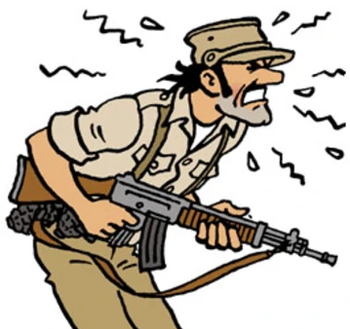
A South American soldier and the on-off leader of a Banana Republic that Tintin has something of a friendship with.
- Affably Evil: It's pretty clear that left to his own devices, he's not a good guy. Still, he's a happy-go-lucky guy who genuinely likes Tintin and his friends.
- Black-and-Gray Morality: The main difference between him and Tapioca is that Tapioca got help from the Commie-Nazi Bordurians in the form of Colonel Sponz. By contrast, Alcazar was supposedly sponsored by the International Banana Company.
- The Caligula:
- In his first appearance, as the military dictator of San Theodoros, he has a shade of this, though mostly he is more of a paranoid Stalin type than a sadist. However, he does indulge in such jokes as throwing a tantrum and shooting a military aide (with blanks, though he did not know that) for beating him at chess. He mellows considerably in later appearances, at least in his interactions with Tintin, but sometimes has throwbacks to this, firing weapons in the air and throwing around reckless death threats. These are taken all the more seriously by subordinates who can't know whether he will carry them out or not, even if Tintin ignores them as mere histrionics. And he remains a megalomaniac to the very end, renaming the capital of his country Alcazaropolis once he seizes power in Tintin and the Picaros.
- Crouching Moron, Hidden Badass: For all his lack of success at durably leading revolutions, he's a very good knife thrower.
- Eyes Always Shut: His art design always makes him look like his eyes are closed.
- Full-Circle Revolution: It's heavily implied that he's really no better than General Tapioca.
- The Generalissimo: His basic archetype.
- Gold Digger: Though technically non-canonical, in an original draft of Tintin and The Picaros he explains that he married his wife because she is very wealthy and has connections to an arms dealership.
- Gratuitous Spanish: Throws Spanish lines into his speech.
- Hair-Trigger Temper:
- Both played straight and subverted in The Broken Ear. When Alcazar drafts Tintin into his revolutionary army and makes him a colonel, his aide-de-camp Colonel Diaz suggests that Tintin should be made a corporal instead, since Alcazar's army already has 3,487 colonels and only 49 corporals. Alcazar is so furious at this suggestion that he immediately demotes Colonel Diaz to the rank of corporal and appoints Tintin as his new aide-de-camp.
- Tintin himself experiences the subversion when Alcazar makes Tintin play a game of chess with him. When Tintin wins the game, an outraged Alcazar gets up, pulls out his gun and shoots at Tintin, very narrowly missing him. Tintin is terrified, and Alcazar starts laughing, explaining that the gun was loaded with blanks and he was just playing a joke.
- Heel–Face Revolving Door: He's not exactly the most moral of Tintin's acquaintances.
- Henpecked Husband: His wife Peggy bullies him quite shamelessly.
- House Husband: He can wage a guerrilla war while washing the dishes... in a pink apron.
- Knife-Throwing Act: While deposed from power and in exile Alcazar performed such an act in Tintin's country to get by.
- Lantern Jaw of Justice: Has a huge chin, and although his heroic status is debatable, he is ultimately treated by Tintin as an ally.
- Latino Is Brown: Downplayed. He (and the other San Theodorians) has slightly darker skin than the European characters, but it's still paler compared to the skin of the Incas / Peruvians in Prisoners.
- No Celebrities Were Harmed: To Che Guevara and a lesser extent Fidel Castro - though only in his last appearance; mostly he is a generic South American caudillo.
- No Full Name Given: He always go by his last name, and even his wife calls him "Alcazar". His Affectionate Nickname, Zazar, gives no hint of what his first name might be.
- Progressively Prettier: He's shown to be quite rotund in his first appearance, but he grows leaner and well-built over his subsequent appearance.
- Perma-Stubble: He sports this.
- Punch-Clock Hero: He isn't a particularly good guy, he just happens to be on Tintin's side.
- Ragtag Bunch of Misfits: The Picaros are Alcazar's thirty or so hardcore (and alcoholic) supporters who remain loyal to him after he's overthrown by Tapioca.
- The Revolution Will Not Be Civilized: Tintin suggesting carrying on the revolution without unnecessarily shedding blood, especially Tapioca's, gets him enraged. Tintin was only able to convince him to act this way by offering him the necessary means to cure his militia of their alcoholism, but everyone could still tell how much Alcazar despised the idea. Tapioca himself sees this as utter madness, and outright begs to be properly executed by a firing squad.
- The Revolution Will Not Be Vilified: Or taken seriously.
- Token Evil Teammate:
- It's implied that he isn't much better than General Tapioca. In Tintin and the Picaros, Tintin and his friends are really only helping the General partly because of Tintin's past friendship with him, and-more importantly-so they can rescue the Thompsons and Madame Castafiore from being executed.
- In The Red Sea Sharks, he was involved in some fishy smuggling business.
Emir Mohammed Ben Kalish Ezab

The emir of a small Arabic nation whom Tintin occasionally runs into and can tenuously call a friend. Best known for his doting over his hellion of a child, Abdullah.
- Arab Oil Sheikh: His basic character design.
- Beware the Nice Ones: He usually comes off meek and is generally not very scary. However, in the Land Of Black Gold, Müller actually attempted suicide because he believed the only alternative would be to be handed over to the Emir for his crimes, suggesting the Emir is far more authoritative when the situation warrants. It's suggested he practices impalement and flogging as punishment.
- Doting Parent: He spoils Abdullah shamelessly and indulges his every whim, which is quite obviously why the little monster is such a brat. He waves off all of Abdullah's jokes (except on one notable occasion, when Abdullah trades his favorite cigars for exploding joke cigars) and gets quite offended at people not wanting to indulge Abdullah as much as he does. It goes to the point he got legitimately angry and threatened to end his contract with the Arabair and to expose their slave traffic all because they, understandably, refused Abdullah's ridiculous request of making Arabair planes do a loop-the-loop before landing, and refused to listen to their justifications for their refusal.
- Hypocritical Humor: He finds his son's pranks hilarious, unless he is the (indirect) target of one.
- Informed Attribute: Senhor Oliveira da Figueira descibes him as being a good man, but while Emir Mohammed is on Tintin's side, he's still fine with torturing his enemies to death, thinks trials are too complicated to bother with, and is apathetic about slavery.
- Skewed Priorities: Threatens to expose a slave-trafficking operation... if an airline doesn't make its passenger jets do a loop-the-loop before landing, for Abdullah's benefit. In the same album he gets far more concerned about his pet cheetah after one of his men, secretly a spy, stepped on its tail and got severaly injured by said cheetah in response.
- Token Evil Teammate: Much like General Alcazar, the Emir has somewhat lax moral standards. He was apparently perfectly fine with allowing Arabair to operate a slave trafficking ring in his country until they refused his son's ridiculous request to make their passenger planes fly in loops before landing. Much like with Alcazar, Tintin primarily aids the Emir for his own reasons; the first time to solve the mystery of the mysterious fuel sabotage before the impending war, and the second time to take down Rastapopoulos' slave trade operation.
Abdullah (Abdallah)

The obnoxious, bratty, spoiled-rotten son of Emir Ben Kalish Ezab.
- Enfant Terrible: To everyone but his father.
- Hated by All: With the exception of his doting father, practically everyone loathes Abdullah and his antics. He thoroughly humiliates and exhausts the likes of Captain Haddock and Nestor, and screws up the plans of Dr. Müller simply by being his Spoiled Brat self. Even Tintin, who is a polite Ideal Hero, can't stand being around the kid.
- Jerkass: A very obnoxious and spoiled rotten brat who inflicts his pranks and whims on everyone, refuses to be rescued when Tintin arrives to free him from Muller and bites Tintin's hand when Tintin covers his mouth to not alert the guards, and later throw sand in Captain Haddock's eyes when he tells him to leave Snowy alone because Snowy didn't want to be toyed by Abdullah.
- Karma Houdini: Thanks to his status as a prince and his father indulging his tantrums and pranks Abdallah hardly ever gets punished for his bratty and obnoxious actions, except a few times after his abduction, where his endless tantrums and whims cause Tintin and Captain Haddock to lose their patience and spank him.
- The Millstone: Is a thorn on the side of both the enemies of his father and those who want to help him with his tantrums and pranks. Tintin's attempts to rescue him from Muller in "Land of Black Gold" are constantly foiled because he doesn't want to leave his room and later plays at imitating a train instead of going with Tintin, though his farces such as fireworks and itching or sneezing powders also help Tintin find him and receive exterior help. In "The Red Sea Sharks" the conflict between his father and the Arabair and consequent coup against his father are a result of his ridiculous request to see the Arabair's passenger jets do a loop-the-loop before landing. He also put an alarm clock on Tintin later which stopped him from spying on Dawson, and allowed the British arms dealer to discover Tintin's involvement in his affairs and to try to eliminate him.
- The Nicknamer: Is also fond of this. His nickname for Haddock is "Blistering Barnacles."
- Practical Joke: Abdullah just loves these. His father finds them hilarious...until he's the target of one.
- The Prankster: His main hobby is to make pranks to everyone such as exploding cigars, sneezing or itching powder, ink or water pistols. Other than his father, until he's himself the victim, no one is amused by them.
- Royal Brat: Abdullah's father mentions that sitting for a painting was very hard on Abdullah... and the artist went mad after.
- Silver Spoon Troublemaker: He's a playful prankster. He pulls harmless (though annoying) pranks on others because his royal blood allows him to do whatever he wants. He even frequently pranks his father.
Igor Wagner
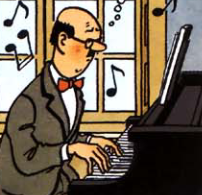
A pianist, and the accompanist for Bianca Castafiore.
- Distressed Dude: Along with Castafiore and Irma, he's put in prison in Tintin and the Picaros.
- Famous-Named Foreigner: His name is a two-for-one reference to Igor Stravinsky and Richard Wagner.
- The Gambling Addict: His most prominent characteristic outside of his pianist job given in The Castafiore Emerald, he likes to sneak away during piano sessions to bet on horse races.
- No-Respect Guy: Castafiore certainly doesn't have much consideration for him when she's in a foul mood.
- The Quiet One: Outside of The Castafiore Emerald, he borders on The Voiceless.
- Red Herring: His suspicious behaviour related to his gambling habits, as well as the soles of his shoes matching the footprints outside Castafiore's window, make him a suspect for the diamond thefts in The Castafiore Emerald.
- Satellite Character: Slightly less so than Irma, but outside of The Castafiore Emerald, he has no character beyond being Castafiore's pianist.
Irma
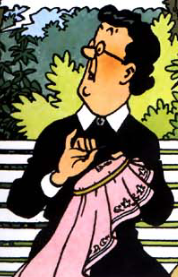
The long-suffering assistant to Bianca Castafiore.
- Battle Butler: Despite being treated like dirt by Bianca Castafiore, she possesses an unshakeable loyalty to her... and will beat the stuffing out of anyone who dares suggest otherwise.
- Beware the Nice Ones: The Thompsons learn this the hard way.
- Character Development: Starts out as a Flat Character, but becomes slightly more defined in her second appearance in The Castafiore Emerald
- Satellite Character: Almost always seen with her employer, Castafiore, and defined completely by her relationship with her.
- Undying Loyalty: To Castafiore, to the point where she's just as shaken as her employer when they think her jewels have been stolen.
Chang Chong-chen
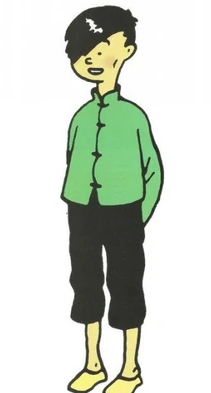
An orphaned boy Tintin first meets during the events of The Blue Lotus. The two would go on to form a close friendship.
- Distressed Dude: In Tintin in Tibet.
- His introduction also counts, given he nearly drowned when the orphanage he lived in was washed away by a flood. Luckily, Tintin was there in the nick of time, selflessly diving in to save the poor kid.
- Happily Adopted: Mr. Wang adopts him at the end of The Blue Lotus.
- Nice Guy: Chang is sweet, clever, humble and caring. He's certainly a big contrast against the rambunctious Abdullah.
- Parental Abandonment: His biological parents are dead.
- Small Role, Big Impact: He only actually appears in two stories (The Blue Lotus and Tintin in Tibet) and is mentioned in a few others, but in the latter, it is obvious that he is one of the people Tintin cares for the most.
- Also very obvious it's reciprocated, given Tintin risked his own life to save him, for no other reason that it was the right thing to do.
- Sole Survivor: Of the plane crash in Tintin In Tibet. He'd have died too if the Yeti hadn't found him and carried him to a shelter.
- Tuckerization: Hergé based him on his friend Zhang Chonren, who introduced him to Chinese culture.
Mrs. Finch (Mrs. Piggott)

The woman who owns the building Tintin lives in.
- Flat Character: Basically, she's Tintin's landlady and that's all we ever know about her.
- Ms. Exposition: In The Crab with the Golden Claws.
Piotr Skut (Piotr Szut)
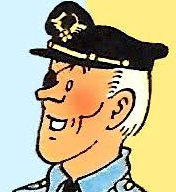
A one-eyed pilot from Eastern Europe who has a tendency to stumble across Tintin and Haddock on their adventures.
- Adaptational Nationality: In the German Editions of the books his nationality was changed from Estonian to Lithuanian.
- As Long as It Sounds Foreign: His name doesn't sound particularly Estonian, and neither does his accent in the cartoon. However, in at least the updated (American) English translation he is said to be "from Estonia" rather than specifically an ethnic Estonian, and so he could be German, Russian or any of a few other nearby ethnicities; the original French and first (British) English translation he is just said to be "Estonian" without further elaboration. Both his original names exist in real life: the first is the Russian version of Peter, and the second seems to be a rare Polish-Jewish family name. The Estonian translation "fixes" this by rendering his name as "Peeter Pähk", see below for more on the surname.
- Eyepatch of Power: Despite being a fighter pilot. Justified, since he is flying for a low-budget mercenary outfit, who are probably very short on trained personnel.
- Heel–Face Turn: Befriends Tintin and Haddock so quickly it's easy to forget he was technically a Punch-Clock Villain for the first two pages he appeared on.
- Punch-Clock Villain: Was a mercenary hired by Bab El Ehr, and holds no animosity towards Tintin for shooting him down.
- Punny Name: In the original French, his surname sounds like "zut", making Haddock think he's being difficult when he's actually introducing himself. In the English translations, Haddock misunderstands the name as a rude command to "scoot". The Estonian translation changes his surname to "Pähk", as "pähh" is a minor expletive like "zut".
- Remember the New Guy?: He's not an example in the comics, but the English dub of the animated series changes the dialogue in his first meeting with Tintin and Haddock for no apparent reason so that Tintin already somehow knows his name. Also, the animated version of The Red Sea Sharks takes place after Flight 714, so it's not even clear how they met in the series; in Flight 714, they know each other, that's that.
- That Russian Squat Dance: Does it in The Red Sea Sharks.
- You No Take Candle: Talks like this in Red Sea Sharks. When we see him later he speaks more fluently.
Senhor Oliveira da Figueira
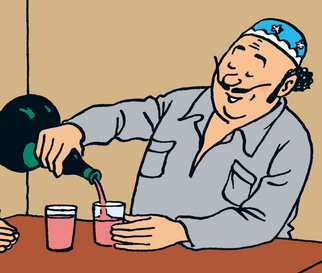
A travelling salesman with a massive catalogue of products.
- Honest John's Dealership: Played with. He's perfectly honest and a genuine friend to Tintin, but you really don't want to stay too long with him because he'll sell you enough useless items to fill a small truck. He's just that good at his job.
- Intrepid Merchant: He appears in several remote places of the world.
- The Storyteller: He's able to conjure a detailed, incredibly dramatic backstory for Tintin's disguise in Land of Black Gold from out of nowhere (there was a count and a snail breeder involved), which keeps Müller's men engrossed while Tintin infiltrates the study.
- We Sell Everything: His first appearance somewhere in the Middle East is announced by natives as "The white man who sells everything". He then proceeds to sell Tintin a random collection of objects, including for instance skis and a parrot, both of which are useless to Tintin's journey.
Marlinspike Cat
A Siamese cat who lives in Marlinspike Hall, who after a rough start, eventually comes to befriend Snowy. Based on Herge’s own Siamese, Thaike.
- Canines Primary, Felines Secondary: The only other recurring animal character in the series besides Snowy, but is mostly a background character while Snowy is one of the long-time protagonists.
- Cornered Rattlesnake: When it first met Snowy, the dog immediately started chasing it, only for the cat to fight back so hard when it was caught that it sent the tough little terrier running back to hide behind Tintin.
- Defeat Means Friendship: After some initial Animal Jingoism and mutual enmity with Snowy, the cat and Snowy actually seem to mellow out significantly towards each other. Later stories often have them quietly hanging out at Marlinspike together, having apparently made peace.
- Non-Action Guy: Unlike Snowy, the cat never accompanies the protagonists on their adventures, and stays behind at Marlinspike with Nestor.
- No Name Given: The cat is never named by anyone.
- The Speechless: Unlike Snowy (but like almost every other animal in the series), the cat never says a word the readers can understand.
Recurring villains
Roberto Rastapopoulos

Voiced in French by: Fernand Rauzena (Belvision series), Serge Nadaud (The Lake of Sharks), Serge Sauvion (Nelvana series)
A world-famous director and movie producer, Rastapopoulos is in reality a crime lord, running a drug ring that spans across the Middle East and Asia. The closest figure Tintin has to an Arch-Enemy.
- Amusing Injuries: Only Captain Haddock usually suffered the amount of physical punishment Rastapopulous takes in Flight 714, up to and including being hit by a stray grenade.
- Arch-Enemy: He's the closest to being this to Tintin, with him being the only reoccurring villain other than Allan. He's the Big Bad of four stories, having created a drug ring and later getting involved in human trafficking, and develops a strong hatred for Tintin after he keeps defeating him.
- Bad Boss: In Flight 714, under the influence of Truth Serum, he reveals that he was going to have all his henchmen (save for Allan) killed after he would complete his evil plan.
- Bald of Evil: Completely bald and very evil.
- Big Bad: He's the most prominent villains of the series and act as Tintin's nemesis.
- Breakout Villain: He is not in a whole lot of albums and only briefly in most of them, but he made enough of an impression to be universally considered Tintin's Big Bad. In fact, despite appearing in only four volumes, Rastapopoulos is still the most frequently appearing villain in the series alongside Allan, who in most of his appearances was working for him.
- Butt-Monkey: He is constantly humiliated and injured, especially in Flight 714.
- Card-Carrying Villain: When under the effects of Dr. Krollspell's shoddy truth serum, he starts bragging about every one of his own foul deeds and gets into a heated debate with the also drugged Carreidas about which one of them is the more evil, calling himself "the Devil incarnate".
- The Chessmaster: During his first appearance as the main villain, when it turns out he's the mysterious leader behind the opium smugglers from Pharaos Cigars and Blue Lotus. His other plans fall apart before he has time to rebuild.
- Classic Villain: His most obvious motivation is Greed, but Pride and Revenge are quick to come into play once Tintin start foiling his plots again and again. However in his last appearance Tintin gets caught up in their plot by accident.
- Devil in Plain Sight: His disguise as the Marquis di Gorgonzola consists of Mephistopheles from Faust, the original Big Red Devil.
- Early-Bird Cameo: A man looking very similar to Rastapopoulos appears in Tintin in America, a book before his actual introduction, sitting next to Tintin at a banquet. It is unclear whether Hergé actually meant this character to be Rastapopoulos, but it's worth noting that he's sitting next to the actress Mary Pikefort, which makes sense given his job as a movie producer, and that in the English translation of Cigars of the Pharaoh, Tintin states that he has met Rastapopoulos before*.
- Even Evil Has Standards: While he has no problem killing people to achieve his goals and is fine with killing his own henchmen once they become useless, he's not interested in torture and told Dr. Krollspell to quickly uses his truth serum on Carreidas because he doesn't like seeing people suffer. He was possibly just being sarcastic, however.
- Evil All Along: He is introduced in Cigars of the Pharaoh as a short-tempered but benign movie producer, then revealed in The Blue Lotus to have been the Big Bad all along. Surprising, eh?
- Faux Affably Evil: Likes to act polite and charming, but will throw tantrums and become violent at the slightest resistance.
- Gag Nose: He has a comically large nose. This is used for a gag in Flight 714 to Sydney, when Allen sees a proboscis monkey and laughs at its nose, saying that it reminds him of someone, only to have an Oh, Crap! reaction when he realizes that said someone is Rastapopoulos, who is standing next to him.
- Good Smoking, Evil Smoking: Evil cigars of decadence.
- Hair-Trigger Temper: Has a volatile temper that almost rivals Captain Haddock, including his Angrish catchphrase "FDJRK!!!!"
- High-Class Glass: Is usually seen wearing a monocle, it even often survives his Clothing Damage.
- I Have Many Names: After Tintin exposed his criminal activities, he returned in disguise as the Marquis di Gorgonzola. If the rumors about Tintin And the Alph-Art are true, he was also Endaddine Akass.
- Jerk with a Heart of Jerk: When Tintin first meets him in Cigars of the Pharaoh, he comes across as belligerent and arrogant as he attempts to hit Dr.Sarcophagus for accidentally bumping into him which Tintin stops him, the next time they meet each other after Tintin accidentally ruins a film set, he's quite amiable with him but in The Blue Lotus, he reveals to be a leader of a drug cartel and is willing to kill Tintin to hide it.
- Karma Houdini Warranty: He escapes the autorities at the end of The Red Sea Sharks but in Flight 714, it's revealed that Tintin's ruining his slave ring eventually bankrupted him.
- The Man Behind the Man: To fake bosses Mitsuhirato in The Blue Lotus and Mull Pasha/ Müller in Red Sea Sharks.
- Man of Wealth and Taste: Initially, before he regresses to a tacky rich man (who is not even rich anymore by that point).
- Never My Fault: During his Villainous Breakdown in Flight 714, a stalactite falls on his head and he starts raving that he doesn't deserve any of this and he'd never hurt a fly. Note that this happens after his Eviler than Thou drug trip.
- Sarcastic Confession: When Tintin barely escapes an ambush after leaving Rastapopoulos, he tells Tintin that if he didn't know better, he'd swear there was some hidden organization trying to destroy him.
- Villain Decay: He started out as a drug and arms smuggler and eventually moved on to slave trading. However, by the time he appears in Flight 714 he's reduced to trying to steal Lazlo Carriedas's fortune after he was bankrupted by Tintin foiling his schemes. That's just the start of his misfortune, as he tries to threaten to squash Tintin like a spider (and then repeatedly miss said spider), his Amusing Injuries (as noted, he got hit by a grenade, and only got singed), and his being accidentally injected with some defective Truth Serum and getting into a screaming match with Carreidas over which of them is more evil (and arguably losing, given by the way he cries afterwards). Then there's his ridiculous attire, which consists of a salmon-colored shirt, blue jeans, gawdy star-studded cowboy boots and an oversized Stetson. Hergé himself Lampshaded the decay, realizing that after he drew Rastapopulous in that silly outfit, he couldn't take poor Roberto seriously as a villain ever again.
- Villain with Good Publicity: Before his crimes were exposed by Tintin, Rastapopoulous was a beloved figure in the movie industry. After he was exposed he started operating under false names to get by.
Allan Thompson
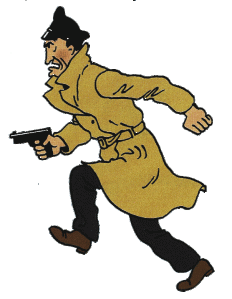
A corrupt captain working for Rastapopoulos.
- Bond Villain Stupidity:
- All Tintin villains like to spend quality time with the ol' Villain Ball, but it's Allan who really loves this trope. In all the stories he's in, he has Tintin at his mercy at some point, and decides to just leave him alone for him to escape.
- Actually justified a few times. In TCWTGC he is keeping him alive until the boss decides what to do to him, once he finds they want Tintin eliminated he tries to do so. In Flight 714 he leaves Tintin and other prisoners guarded, thinking they'll be sunk on the plane later.
- The Dragon: Has a tendency to work for the Big Bad of the stories he appears in, first to Omar Ben Salaad by helping him smuggle drugs after leading a munity against Haddock, and then to Rastapopoulos with the two at first working together to transport slaves. Is also this to Sakharine in the movie.
- Dragon-in-Chief: He is by far a more prominent villain than his boss in The Crab with the Golden Claws, and Tintin's final struggle is against him. He is less proactive when he becomes Rastapopoulos's lackey.
- Evil Counterpart: To Haddock after becoming The Dragon to Tintin's Arch-Enemy Rastapopoulos. They are both captains, but while Haddock is ultimately a good natured man despite his early alcoholism his former first mate has few moral scruples and takes over Haddock's ship to smuggle drugs and later gets involved in transporting slaves.
- False Friend: To Haddock. Also, rather tragically, his Only Friend before meeting Tintin.
- First-Name Basis: His surname is very, very rarely uttered, if anything because both enemies and coworkers know him in person.
- Good Smoking, Evil Smoking: Often seen with a fag end in his mouth.
- Gratuitous English: Obviously not evident in the English translation, but he does this sometimes in the original French.
- The Heavy: In The Crab with the Golden Claws, Allan is The Dragon as well as The Heavy. The Big Bad makes only a brief appearance, doesn't do much, and is defeated before Allan is.
- Humiliation Conga: His last appearance is basically this.
- One-Steve Limit: In the original French, his full name is Allan Thompson (but only mentioned once, in the retconned Cigars). To avoid obvious confusion, the English translation left out his last name entirely.
- Retcon: He was Retconned into being the villain that threw Tintin overboard in a newer edition of Cigars of the Pharaoh, even though canonically this album takes place before The Crab with the Golden Claws, Allan's introduction. His connection to Rastapopulous' drug cartel fits with his later work with Rastapopulous.
- Spared by the Adaptation: The film, specifically. In the original album The Crab with the Golden Claws, Tintin's struggle to capture Allan forms the climax of the story, and he succeeds (even though Allan must escape or be released by the time of The Red Sea Sharks). But in Spielberg's film, Allan is dispatched when Captain Haddock knocks him down from a height onto a moving truck, carting him out of the fray. It's reasonable to suppose he must have been brought to justice later, once Tintin and Haddock were able to give a full description to the local police — but this may otherwise have been a deliberate scriptwriting tactic, keeping Allan at large to make his return more plausible if a sequel introduces Rastapopoulous.
Dr. J. W. Müller

- Bald of Evil / Beard of Evil: A clean sweep of Evil hair!
- Better to Die than Be Killed: He would rather shoot himself than be tortured to death by the emir.
- Bungled Suicide: He tries to shoot himself to avoid being captured by the Emir and being tortured to a slow and painful death. His attempt fails because he tried to use a toy gun that shoots ink.
- Herr Doktor: He's an evil doctor with a German surname.
- I Have Many Names: Professor Smith in Land of Black Gold and Mull Pasha in The Red Sea Sharks.
- Meaningful Name: Named in honor of Adolfo Simões Müller, a Portuguese writer and publisher who was responsible for publishing Tintin in Portugal (which was the first country outside the French-speaking world where it was published) and who once helped Hergé's brother when he was in a prisoner's camp during World War II by paying Hergé in sardine cans that would later be delivered to his brother.
- Morally Ambiguous Doctorate: Apparently a psychiatrist or some other kind of doctor, and very evil.
- Playing Both Sides: During The Land of Black Gold, he has been working for both Bab-El-Ehr and Emir to play them against each other to start a Civil War.
- Psycho for Hire: In his last appearance.
- Psycho Psychologist: In his original appearance, where he used his practice and status to get rid of people who might have uncovered his crimes.
- The Quisling: Based on a real life Scottish doctor who worked for the Nazis.
- Surrounded by Idiots: His orders to have Tintin pursued by armored cars and aircraft ends in the planes shooting the cars due to Ambiguous Syntax.
- Those Wacky Nazis: Never explicitly stated, but implied, as Müller was largely based on a Real Life Nazi double agent named Dr. Georg Bell.
Colonel Boris/Colonel Jorgen

- Ascended Extra: Was a relatively minor character in King Ottokar's Sceptre, but is the Big Bad's proxy in the moon books.
- I Lied: Twice he promises to spare the protagonists. Twice he tries to go back on this.
- Kick the Dog: He literally kicks Snowy down a ladder at one point.
- Killed Off for Real: Accidentally shoots himself to death in "Explorers on the Moon".
- Knight of Cerebus: It was already the darkest entry in the series, but once he shows up in "Explorers on the Moon" things go very bad, very quickly.
- Putting on the Reich: His hair and moustache are probably directly meant to invoke Hitler's appearance.
- Secret Police: He's working with the Iron Guard.
- Thrown Out the Airlock: While offscreen, Jorgen's corpse is put into space by Tintin, Haddock and Calculus after he accidentally shoots himself.
- Revenge: The main reason he joined in the Bordurian plot against the Syldavian space program was to get revenge on Tintin.
- You Said You Would Let Them Go: As per I Lied, he never follows through on promising to spare the protagonists.
Colonel Sponsz

- Argentina Is Nazi-Land: Originally seen running the State Sec in a Central European fascist government, he's later seen in a similar situation in a South American dictatorship.
- As Long as It Sounds Foreign: His name is an elaborate pun on the word "sponge" (éponge in French), with his later alias, Esponja, being the Spanish word for the same thing. Taken at face value, his original surname sounds more Polish-Jewish than anything else, though.
- Badass Longcoat: As part of the uniform in his original appearance. Averted in Tintin and the Picaros, due to the warmer South American climate.
- Bad Boss: Not as much so as many other villains; he is actually a fairly "realistic" secret police officer in this way. However, while he will not usually employ You Have Failed Me, he can be quite unpleasant to subordinates who fail him.
- Beard of Evil: He sports a neat goatee in his second appearance.
- The Chessmaster: In his second appearance, when he lures Tintin to San Theodoros in order to have him killed and prepares a perfect coverup.
- Dragon-in-Chief: As Bordurian "technical advisor" to General Tapioca. It's heavily implied that he and the Bordurians are the ones really in charge, with Tapioca as little more than their front man.
- High-Class Glass: Presumably to invoke a German vibe.
- Putting on the Reich: Much like with real-life East Germany, Bordurian military and police uniforms look Nazi-ish with some Soviet-derived features.
- Sugar-and-Ice Personality: His subordinates get his ice side, Castafiore and (presumably) his personal friends see his sugar side.
- Surrounded by Idiots: The Colonel himself is a competent enough official, but his Bordurian subordinates are incompetent buffoons. In The Calculus Affair, Tintin and Haddock give some of Sponsz's agents the slip in heavy traffic, and get rid of others by getting them drunk and locking them in their hotel rooms.
- This Is My Name on Foreign: Becomes Colonel Esponja (Colonel Sponge) in San Theodoros.
- Wicked Cultured: Shows appreciation for the Castafiore's singing talent and invites her to sing for a party he's hosting. The next morning, he's humming the Jewels Aria.
General Tapioca
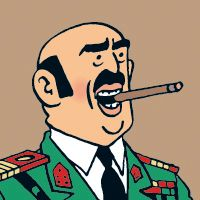
- Edible Theme Naming: "Tapioca" is also a kind of food.
- Evil Counterpart: To Alcazar, although there is little setting the two apart.
- Fascist, but Inefficient: His security is so lax that Alcazar and the Picaros are able to seize power by sneaking into his office and forcing him at gunpoint to read a declaration that he's stepping down and handing power over to Alcazar, all without firing a shot.
- Fate Worse than Death: He considers his humiliating banishment to be this; he'd much rather be executed.
- The Generalissimo: Like Alcazar, he looks the part. In his last appearance, he's actually wearing the standard Chest of Medals, albeit a more subdued one in the form of ribbons.
- Mirror Character: The last page of Tintin and the Picaros implies that there is little difference between him and General Alcazar.
- Villainous Breakdown: He bursts into tears when he realizes that Alcazar is going to spare his life at Tintin's insistence. Apparently it's a beloved San Theodoros tradition for the new dictator to put his predecessor in front of a firing squad if he can catch him.
One-shot characters
Bobby Smiles
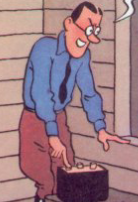
An American gangster and rival to Al Capone himself.
- Big Bad: The nearest thing to a main villain in Tintin in America. He's just one of several gang bosses who Tintin takes on during the course of the story, but he has by far the largest role of any of them.
- Enemy Mine: He tries this when he first meets Tintin, offering him a huge salary to help take down Al Capone. Tintin reacts by pulling a gun on Smiles and making it clear that he's there to take down all the gangsters, not just Capone.
- The Rival: To Al Capone, as Smiles is the boss of the second-biggest gang in Chicago. However, he soon switches to trying to take out Tintin instead.
- Surrounded by Idiots: Had his men been able to tell the difference between poison gas and sleeping gas, Tintin would have been dead right at the start of the story. The Native American tribe that he teams up with at the midway point of the story also don't prove to be the most helpful allies.
- Unusual Euphemism: He tends to shout "Alcatraz!" whenever things don't go his way, likely a reference to the prison where his in-story rival, Al Capone spent most of his sentence.
- White Gangbangers: Unlike most of the traditional organized crime in America (Irish Mob, Italian Mob, Jewish Mob, etc.), and unlike his rival Capone's crew, his outfit seems to be made up mainly or entirely of Old Stock Americans like himself.
The Fakir
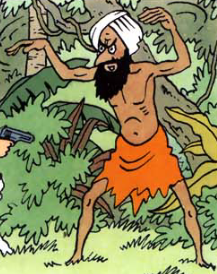
A mysterious Indian fakir with magical abilities and a member of the opium cartel in Cigars of the Pharaoh.
- Almighty Janitor: Has magical powers that would probably allow him to easily take over his organization, but instead plays a relatively minor enforcer role. Possibly downplayed if he was the chairman of the meeting of the hooded leaders, as it is vaguely implied but left unclear.
- Barefoot Sage: He's a fakir and accordingly never wears shoes.
- The Dragon: While he's just one member of a large criminal organization, he's the most visible member of them in Cigars of the Pharaoh, and the one who poses the biggest threat to Tintin.
- Enlightened Antagonist: He is a Sufi ascetic with genuine magical powers. He is also a dangerous criminal and a key member of an international drug cartel.
- Everybody Calls Him "Barkeep": His actual name is never revealed at any point; everyone just refers to him as "the Fakir."
- Hypnotic Eyes: One of his skills, with proper light effects in the animated series.
- Kung-Fu Wizard: He can work real magic, as seen in his magic rope, and later goads Tintin to a hand-to-hand fight, implying he is also a trained martial artist.
- Law of Disproportionate Response: One of the few things that genuinely angers him is Tintin knocking him out and then tying him up. Not because he allowed himself to be tricked and captured, mind, but because he considers it an insult to his escapology skills.
- Loincloth: His only attire aside from his turban.
- South Asian Terrorists: Being a fakir, he's by definition a Muslim Sufi ascetic,note although with the variation that he comes from South Asia rather than the Middle East.
- Story-Breaker Power: His magical powers are almost unique to the series' universe and make him an incredibly dangerous opponent. Accordingly, he's defeated by sheer luck, and he later escapes without problem again (although the comic's original version informed he was somehow arrested by regular police).
- What Happened to the Mouse?: In the Blue Lotus, he's stated to have escaped from prison, and a character receives a Rajaijah dart from an unseen shooter who is implied to be the Fakir himself. The original black-and-white version showed explicitly it was him, and it was later informed through a telegram that he had been recaptured by the police. However, nothing of this happens in the final version, so the Fakir presumably remains free after the takedown of his organization.
Mitsuhirato
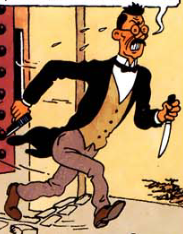
- Affably Evil: He honestly seems to have no real animosity toward Tintin and is unfailingly polite to him. When Tintin is about to be executed, he even offers him a way out if he agrees to a few conditions.
- As Long as It Sounds Foreign: His name, like those of many Asian comics characters of this period, is a relatively plausible but otherwise meaningless collection of Japanese syllables. Possibly, it was inspired by the real Japanese given name Mitsuhiro.
- Bait the Dog: At one point, he has Tintin under his mercy, but reveals he doesn't intend to kill him, and in fact has decided to let him go... only to reveal he will do so after a Rajaijah juice injection, which will drive him mad.
- Bitch in Sheep's Clothing: A very polite, affable host... who also happens to secretly be a drug-trader and a japanese spy.
- The Chessmaster: Runs a major Japanese spy ring as well as an international drug syndicate. Is consulted on foreign policy, manipulates Chinese tongs, British officials and even Tintin himself, and knows how to exploit the system for his own benefit.
- City of Spies: Shanghai in the 1930s. Mitsuhirato is portrayed as the top Japanese on-site man, with direct access to the government and the local Japanese commanders.
- Consummate Liar: Tintin is not the only one he fools.
- Double Agent: By knowing arrangement with his Japanese superiors. He works both for them and the Pharaonic drug ring, using the drug money to fund his intelligence operations and, occasionally, intelligence assets to further the drug trade.
- The Dragon: To Rastapopoulos.
- Driven to Suicide: He kills himself in jail soon after being arrested.
- Equal-Opportunity Evil: While a passionate Japanese nationalist, he does not seem to be particularly racist against either the Chinese or the Westerners, and indeed people of both races work in his organization.
- Every Man Has His Price: As a wealthy and generous businessman, Mitsuhirato has lots of connections in Shanghai, and, among other things, uses his financial ties with corrupt chief of police Dawson (in the Internatonal Settlement) to have Tintin apprehended and turned over to the Japanese. The same strategy backfires on him, however, when he tries it on Tintin himself.
- False Flag Operation: The Mukden Incident, as here portrayed. Also pulls an earlier, smaller-scale one in Tintin, to alienate him from the Sons of the Dragon.
- Genre Savvy: Towards the trope that Police Are Useless and villains best dealt with in person. When Tintin beats him up,note he reports him to the authorities—And since Tintin never cared to file a complaint with his version of the story, this results in charges for assault and attempted murder, as well as a manhunt that seriously limits Tintin's movements afterward.
- The Heavy: While Rastapopoulos eventually is revealed to have been the Big Bad all along, Mitsuhirato is the one who actively opposes Tintin for most of the book, and appears as the main villain until The Reveal.
- Historical Villain Upgrade: The Japanese in general don't come off very well in The Blue Lotus, and more specifically, the Mukden Incident (instigated by Mitsuhirato himself in this version, with the direct backing of the Japanese premier) is fictionalized and portrayed in a harsher way than the record would seem to justify.
- Honor Before Reason: Seemingly averted for most of the story, as he engages in various sorts of rather dishonorable villainy. However, when his schemes fail and he faces trial, thereby bringing shame and disgrace on his fatherland, he commits harakiri in prison, thereby expunging his guilt in the honorable Samurai fashion.
- Japanese Politeness: Downplayed. He has this, but less than the stereotype, as well as some hints of a sort of American-ish straight-to-business style in some cases.
- Non-Action Guy: Being a Japanese secret agent, you would probably expect him to be a Judo master or something similar, but in his sole fight in the series he's beaten miserably by Tintin (who even comes out unscathed from the off-page brawl, implying Mitsuhirato really didn't stand a chance).
- Patriotic Fervor: A Japanese super-patriot who serves his country loyally right to the bitter end. Which he inflicts on himself, to atone for his failure.
- Perpetual Smiler: Always (or nearly so) depicted with a huge, toothy grin. Sometimes it looks sincere, sometimes unctuous, and sometimes furious.
- Rank Scales with Asskicking: As an intelligence agent and underworld overlord, he is sufficiently proficient in the use of both guns and melee weapons to carry out his own assassinations in a pitch, and rather more dangerous than most of his Mook minions. However, in a fair fight he loses to Tintin.
- Seppuku: How he meets his end.
- Sharp-Dressed Man: Always impeccably dressed, except when his clothes are destroyed in battle. Usually seen in morning coat, vest and bow tie.
- The Social Expert: Well-connected and with significant influence among the British and American power-mongers in Shanghai, in spite of the handicap of being Asian. Also a Consummate Liar who fools even Tintin initially.
- Spared By Adaptation: In the Animated Adaptation of The Blue Lotus, for censorship reasons, there's no mention of Mitsuhirato committing harakiri or dying any other way after his arrest.
- Very Loosely Based on a True Story: The plot involves a heavily fictionalized retelling of the Mukden Incident, which is here personally instigated and supervised by Mitsuhirato in collusion with the Japanese government. Its aftermath, with the Lytton investigation and Japan's withdrawal from the League of Nations, is also fictionalized, with various important details changed, and/or simplified to better fit the comic-book format.
- Villainous Valor: While mostly a Non-Action Big Bad, he will fight when he has to, as well as do what it takes to preserve Japan's honor when he fails.
- Yellow Peril: To the extent that he is a ruthless, and sometimes sneaky, Asian villain (and drawn as a buck-toothed caricature of a Japanese stereotype). However, he also subverts the trope in some ways. As a cosmopolitan businessman, Mitsuhirato dresses in the Western style, moves in the same circles as the corrupt British and American officials and businessmen who are the minor villains of the story, and shows that he has a lot in common with them; by contrast, the Chinese characters who dress as inscrutable Orientals and speak in proverbs are mostly good guys.
Max and G. Bird
A pair of corrupt antique dealers and the modern day owners of Marlinspike Hall, the Bird brothers stumbled across one of Sir Francis Haddock's model ships and discovered it's secret, and were willing to resort to murder to find the other two clues to Red Rackham's treasure.
- Adapted Out: Famously removed from the plot of The Adventures of Tintin (2011), aside from a cameo appearance as art pieces shown off by a sketch artist. Their role is taken over by Sakharin, himself originally just a one-shot character in the comics.
- No Name Given: The balding Bird brother is never actually named, other than that his name starts with a G.
- Know When to Fold 'Em: "G" willingly co-operates with Thompson and Thompson after Tintin and Snowy beats them, realizing that there's no chance of avoiding the consequences of their actions now.
- Siblings in Crime: Brothers who resorted to theft, murder and kidnapping to achieve their goals.
- What Happened to the Mouse?: Max Bird is mentioned to have escaped from prison twice, but never appears again. In fact, neither of the brothers do, though there were apparently plans for them to reappear in Tintin In Tibet as part of a sub-plot, but this was dropped early. They were also going to have a cameo in the unfinished Tintin And the Alph-Art.
Red Rackham
A vicious pirate lord who plagued the West Indies in the 17th century, until one fateful day in 1676 when he and his crew attacked The Unicorn, a French ship captained by Sir Francis Haddock.
- Antagonist Title: Red Rackhams Treasure, which is centered around finding his treasure.
- The Dreaded: Red Rackham's name is already feared across the Seven Seas by the time he appears. Of course, Sir Francis Haddock couldn't care less.
- Expy: Based on several real-life pirates, most notably "Calico" Jack Rackham.
- Leave No Survivors: Because The Unicorn fought back and critically damaged his ship, Rackham orders his crew to fight to the death. Haddock is the only survivor.
- Posthumous Character: Dead by almos 400 years by the time The Secret of The Unicorn takes place.
Alonso and Ramirez
A pair of South American criminals involved in the theft of a mysteirous wooden idol made by the native Arumbaya tribe, which secretly contains a priceless jewel.
- All for Nothing: All their crimes and schemes are rendered pointless at the end due to the jewel being lost in the ocean.
- Dragged Off to Hell: The comic version infamously shows them being dragged off to Hell by grinning devils after they drown.
- Mutual Kill: In the comics, the two drown while fighting over the diamond as they sink into the ocean.
- No Honor Among Thieves: Pretty much everyone involved in the theft of the idol tried to screw over everyone else and escape with the loot.
- Spared by the Adaptation: In the Animated Adaptation, Tintin saves them after they fall overboard.
Zorrino
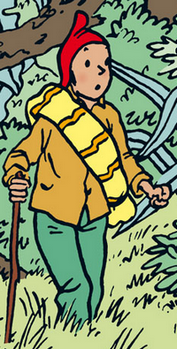
- As Long as It Sounds Foreign: Assuming Hergé was going for the Spanish word zorrito ("little fox"), his name is not entrely correct within Hispanic context. Zorrino does exist as a variation of zorrito, but it tends to be used solely in some parts of Spain, not so much Perú.
- Conveniently an Orphan: We never see his parents or have him talk about them, but seeing how young he is and how quickly he leaves with Tintin, it's safe to assume he's probably on his own.
- Distressed Dude: Tintin often has to rush in and save him from any peril he gets into. At one point he even gets kidnapped by the bad guys.
- Happily Adopted: Towards the end of Prisoners the Incas have taken him in; mostly for him to keep quiet of their secret location, but seeing how he previously lived on the streets, they might also be offering him a home.
- Never Bareheaded: He's always seen wearing his chullo (a hat with earflaps common in the Andes made with llama's wool, among others). The only time he doesn't wear his chullo is when he was kidnapped.
- Expy: He's a Peruvian version of Chang, an orphaned boy whom Tintin saves and in gratitude for that, he helps him in his quest. They both also end up being adopted at the end of their stories.
- Street Urchin: Managed himself on the streets selling oranges before meeting Tintin. His knowledge of the land and the secret of the Incas comes in handy for Tintin.
- Tagalong Kid: After Tintin saves him from being harassed by two racist bullies, he feels safe and grateful enough to confide in Tintin and Haddock to help save Calculus (even if that may cost him his life).
The Inca
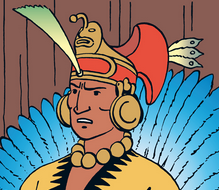
- Grey-and-Gray Morality: He seems cruel at first, what with cursing the seven explorers and ordering Tintin's execution, but he later on shows nobility by letting Tintin go (after understanding his motivation and seeing how he is a genuine, honest person) and breaking the curse. It's obvious that all his actions in the story are just a means of protecting his people from foreign invaders (to avoid what happened last time...).
- Mayincatec: Inca explicitly rather than a mish-mash (aside from a few details here and there), but he is the leader of the surviving Incan civilization.
- The Emperor: The Incas (the figure himself rather than the people as a whole) were pretty much the Emperors of their societies, thought to be the descendants/sons of the Sun God.
- The Remnant: The original Incan Empire was absorbed by the Kingdom of Spain after 1533 by the hand of an alliance of the invading Spanish and native rebels, leaving only this small enclave to survive in secrecy until present day.
Frank Wolff
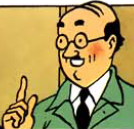
- Accidental Murder: Struggling to stop Jorgen shooting Tintin he accidentally shoots him.
- Easily Forgiven: Downplayed Tintin forgives him immediately when he defends them from Jorgen. Captain Haddock, less so. The captain only changes his mind after Wolff's Heroic Sacrifice
- Foreshadowing: His briefly panicking at the end of Destination Moon ultimately amounts to this.
- The Gambling Addict: Was forced into turning traitor in return for Borduria clearing his gambling debts.
- Guile Hero: A very minor case, but he improvised a lie to get past the Thompsons and used his technological expertise to make his Heroic Sacrifice without being interrupted or further endangering the other crew members..
- Heroic Sacrifice: Exits the rocket, so the others will have enough oxygen to get back to Earth.
- Mr. Exposition: Does this once in each of the moon books, the second instance being very different from the first.
- My God, What Have I Done?: His words right before the rocket launch, where he regrets getting into this dangerous ordeal, which makes sense as the other characters were also having second thoughts about going into space. Afterwards, it turns out the danger he was referring to was actually his espionage.
- Pride: Not explicitly stated, but if he'd just told his employers about his gambling debts and about the man who approached him, he could have avoided all his problems; apparently he was too ashamed to do this.
- Redemption Equals Death: Technically, Hergé left a loophole where he might have survived, but this trope otherwise fits. However, this loophole only exists in Wolff's farewell note in the collected album version: in the original magazine-published version (later changed under pressure from Catholic organizations) Wolff's last note makes it absolutely clear he has no hope of survival.
- Reformed, but Rejected: He does, eventually, win back the trust of everybody, but it comes at a hefty price.
- You Said You Would Let Them Go: Happens twice with Jorgen threatening to kill or abandon the other astronauts. Given that at the time there was a critical shortage of available oxygen, it comes across more as him being in denial.
Mr. Baxter

- Character Tic: Gnaws on his tie when nervous.
- The Chew Toy: He takes the role from Haddock in Destination Moon, to the amused surprise of the latter.
- Comically Missing the Point: Doesn't realize that Haddock does not want to go on the Moon voyage.
- Deadpan Snarker: To Haddock in one scene from Destination Moon.
- Greek Chorus: Acts as one in Explorers on the Moon.
- Mission Control: Acts as head of it during the protagonists' journey to the moon, and does a darn good job of it too, his level head and quick thinking saving the crew's lives more than once.
- Straight Man: To Haddock, Thompson and Thomson and especially Calculus in Destination Moon. Without him, you could easily forget the inherent seriousness of sending people to the freaking Moon amongst all the antics our heroes pull.
Arturo Benedetto Giovanni Giuseppe Pietro Archangelo Alfredo Cartoffoli da Milano
- Determinator: A very enthusiastic fellow; can't deny that.
- Drives Like Crazy: His crazy driving through a marketplace catches the attention of a police officer, who lets him go because his name would've taken too long to write.
- Hitchhiker Heroes: Although he ultimately subverts this by leaving the group shortly after he shows up, he initially comes across as a Debut Queue variation.
- National Stereotypes: In his own words, "Italian car. Italian driver".
- Overly Long Name: His name is so long that he avoids getting a speeding ticket because the police officer has trouble writing it down and decides to let him go instead. His full name is Arturo Benedetto Giovanni Giuseppe Pietro Archangelo Alfredo Cartoffoli da Milano.
Laszlo Carreidas
- Bitch in Sheep's Clothing: At the beginning of Flight 714 to Sydney, he first gives off an impression of a sorrowful homeless guy whom even the cantankerous Haddock feels compassionate for by giving him money to feed for himself but when the tramp is revealed not only to be a millionaire businessman all this time, he's also an unscrupulous and conceitful bastard who will screw over anyone for his greed.
- Bunny-Ears Lawyer: He's a rich and successful businessman, despite his many quirks and unpleasant personality.
- Card-Carrying Villain: When under the effects of Krollspell's shoddy truth serum, at any rate. He starts proudly recounting every foul deed he's committed in his life, and becomes offended by Rastapopoulos's (also drugged) assessment that he's more evil than him.
- Corrupt Corporate Executive: Has a vast amount of money hidden away to avoid taxes, which plays right into Rastapopoulos's scheme.
- Eviler than Thou: When he and Rastapopoulos are injected with truth serum, they have a debate about which of them is the worse human being.
- Evil Is Petty: For a certain measure of "evil". Carreidas has a camera installed in his private jet that allows him to cheat at a Battleship game; he invites Haddock onto the plane for the express purpose of screwing him over this way. Many of the evil deeds Carreidas boasts about when drugged with the truth serum consist of cruel pranks and petty theft, for instance he starts off with his first theft: a pear. He's also rather gleeful about getting a maid fired when she was blamed for stealing a ring from his mother which he stole.
- Hates Being Touched: He refuses to shake hands with others because he considers it unhygienic, and unlike the rest of his worst traits, this aversion seems to be genuine. It might be a Shout-Out to Howard Hugues, a real life millionaire who had an infamous germ phobia.
- It's All About Me: In the interview after the return to civilization Carreidas is asked why he has needle-marks on his armsnote but not the others, his response is: "I'm entitled to special treatment, aren't I?"
- Mean Boss:
- To his british secretary Spalding, telling him how ridiculous he is for having tripped over and even laughing at him, which certainely contributed to Spalding's betrayal of him for Rastapopoulos.
- Averted with his italian steward, Gino, who he treats respectfully and to who he gives winks, as a show of trust. In return Gino is genuinely loyal to him.
- Meaningful Name: "Carré d'as" means all four aces, fitting for a millionaire.
- No Celebrities Were Harmed: Visually based on French aircraft industrialist Marcel Dassault, whose looks were such that, according to one anecdote, a French photo journalist accidentally wanted to include a photograph of him in a feature on homeless people living in the streets of Paris.
- Perpetual Frowner: Known in-universe as "the man who never laughs", though Calculus's antics do manage to get several laughing fits out of him (for the first time in many years, apparently).
- Serious Business: He takes his rivalry with other businessmen very seriously, when his associate takes part in an auction sale and tells him about the paintings exposed he's uninterested as he already have many paintings from the same artists already, only to order his associate to buy everything at any price once he learns that Aristote Onassis is interested by these paintings.
- Skewed Priorities:
- Carreidas' obsession with his hat, to the point he keeps insisting they go back to look for it, and even when there are criminals close behind them and gas is coming through the tunnel he keeps running back for his hat, only being stopped by lava. At the end in an interview, he doesn't seem that upset about losing his new plane, secretary and two of the crew and says what really upsets him is losing his hat, a Pre-War Brosse and Clackwell.
- His obsession with hats comes back to bite him when, after Professor Calculus's deafness annoys him, his first thought is to knock Calculus's hat off. This results in Calculus beating the ever-living snot out of him.
- Carreidas' obsession with his hat, to the point he keeps insisting they go back to look for it, and even when there are criminals close behind them and gas is coming through the tunnel he keeps running back for his hat, only being stopped by lava. At the end in an interview, he doesn't seem that upset about losing his new plane, secretary and two of the crew and says what really upsets him is losing his hat, a Pre-War Brosse and Clackwell
Dr. Krollspell
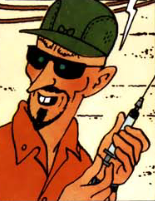
- Enemy Mine: After Rastapopoulos reveals (under the truth serum) that he was planning to murder Krollspell once he no longer needed the doctor's expertise, Tintin rightly assesses that Krollspell isn't too enthusiastic about the whole villain gig anymore. He goes on to help the heroes at a couple of points by keeping watch over the wayward Carreidas.
- Epic Fail: His truth serum is worse than useless. It makes the victim blab about everything except the question they're asked. Rastapopolous could've had Carriedas injected with Rajaijah Juice and gotten the same results.
- Evil Genius: Subverted. He's an ex-Nazi scientist who claims to have knowledge of truth serums, but his serum is actually useless.
-
 Fashion-Victim Villain: He's dressed in shorts, sneakers and high socks, making him look vaguely like a silly tourist.
 - Heel–Face Turn: He sides with Tintin and his friends after Rastapopoulos reveals (under the influence of the truth serum) that he was going to kill Krollspell once he wasn't needed anymore.
- Karma Houdini: Unlike the other villains in Flight 714, he is let off scot free by the aliens, left him in Cairo, albeit with his entire memory wiped. Of course, we don't know what happened to the other villains, who may have had the same thing happen to them.
- Lean and Mean: The skinniest of all the characters, even more than Tintin.
- Punny Name: "Krolspel" is a Brussels word for hair curler. It also echoes Krolloper Berlin Opera House, a Nazi-significant building.
- Satellite Character: To Rastapopulos, and to Carreidas once he's appointed caregiver to the latter.
- Screw This, I'm Outta Here: He tries to run out on Rastapopulos, but this doesn't work out as well as he'd hoped as Tintin and Captain Haddock were already outside with their guns.
- Sinister Shades: His eyes are never seen behind those black shades.
- Those Wacky Nazis: Not outright shown in the story, but aside from his name pun, Hergé stated in an interview that Krollspell had worked in a concentration camp.
- Truth Serums: Subverted. He developed what he claims is a truth serum, but it's completely worthless. It does reduce the victim's cognition, but also makes him blab about everything except what the interrogator asks them.
Mik Kanrokitoff (Mik Ezdanitoff)

- Absent-Minded Professor: Does not display this behavior on page, but his suit looks rather messy and has large documents awkwardly rolled and stuck in his pockets.
- Beware the Nice Ones: Although friendly and helpful, he's fearsome when he decides to use his Mind Control against evildoers, even if it is with relatively harmless consequences.
- Bunny-Ears Lawyer: Despite his eccentric appearance and demeanor, he's no bluff about his connection to aliens.
- Goggles Do Something Unusual: His glasses have a little antenna that presumably helps with his telepathy.
- No Celebrities Were Harmed: He's an incredibly thinly disguised version of French UFO theorist Jacques Bergier, who even founded a magazine named Planète like Tintin says in the text.
- Punny Name: His original last name references the phrase Is dat niet tof? ("Isn't that swell?") in Dutch. Also, it might or might not be also a subtle nod to another ufologist, Erik Von Daniken, the popularizer of the Ancient Astronauts trope. His English name is a pun on "Can rocket off", appropriate for a writer for a space journal.
- Telepathy: Has this power.
- Touched by Vorlons: He's connected to aliens and got his powers, or at least his technology, from then.
- Trrrilling Rrrs: Speaks like this in the French version. In the English translation, he speaks with a Russian Funetik Aksent.
The Aliens
A mysterious group of extraterrestrial beings, who have been visiting Earth for millennia.
- Ancient Astronauts: They, or at least the race they're part of, have been visiting Earth for thousands of years, as shown by the murals in Flight 714.
- Boring, but Practical: Rather than the tractor beam often used by space ships in science fiction, their ship uses... an extendable ladder to bring people onboard.
- Flying Saucer: Arrives in one to save the heroes when they're trapped in the volcano as it's about to erupt.
- The Ghost: Don't appear in person at all, and only ever communicate through Kanrokitoff.
- Humanoid Aliens: Implied to be pretty similar to regular humans, if their ancient stone statues are an accurate representation.
- Laser-Guided Amnesia: Uses mass hypnosis to remove any memory of their existance from the heroes, with the exception of Snowy, who's a dog and can't tell anyone anyway.
- The World Is Not Ready: Doesn't believe that Earth at large is ready for contact with other worlds, and thus restricts their communication with selected individuals who they share their technology with.
A monstrous, ape-like humanoid that inhabits the Himalayian mountains, and a mythological creature that turned out to be very much real.
- Bigfoot, Sasquatch, and Yeti: The myths about the mysterious "Abominable Snowman" turns out to be true, though he's really not all that "abominable".
- Big-Hearted Bigfoot: Saved Chang's and helped him survive long enough for Tintin to find him. The only real problem was that Chang had a fever, which the Yeti didn't understand, and couldn't have helped with even if he did.
- Killer Gorilla: Has this reputation among the natives of Nepal, though it doesn't seem to be true. The Yeti only acts agressive when it thinks someone is a threat to itself or Chang, and otherwise avoids humans.
Peggy Alcazar

- Fiery Redhead: Does not hold back her anger at Alcazar whenever he does something she considers wrong.
- Large Ham: Hergé apparently based her on a female member of the KKK he once saw.
- Perpetual Frowner: She is always frowing and never smile.
- Say My Name: ALCAZAR!!!! Most notably done in the Nelvana cartoon.
Martine Vandezande
- Mistaken for Murderer: Tintin assumes she's cooperating with the villains.
- Naïve Everygirl: After she realizes she had been helping the villainous Endaddine Akass she breaks out in tears. After that Tintin understands that she didn't have any evil intentions.
- Unwitting Pawn: Due to a listening device hidden in her necklace, she is made an unwilling informer for the villains.
