
The Chaste Hero is a character, usually a teenage male, who is completely oblivious to the appeal of women and to romance in general. Flirtation is dismissed, often without a shred of embarrassment, because he honestly doesn't get it, and sexual advances from the Hard-Drinking Party Girl are shrugged off with irritation. This can be a paradoxical commentary on the character's lack of "maturity," but strangely, this rule does not necessarily mean the younger male characters of the cast won't react to attractive people.
The female version is usually tomboyish and a slightly dense jock slowly being cultivated into a budding Hard-Drinking Party Girl.
One bonus from this is immunity from awkwardly placed falls, gestures, and hands that plague a lot of characters — and, if it happens, no apologies for it, something the average male would be expected to do. Similarly, it pretty much allows him to interact and talk to any woman in the series, something another friend may be incapable of doing. This is especially useful if the writers are trying to avoid Shipping, simply don't want it to seem the guy is taking advantage of having many admirers, or want to set up a romantic admirer who just doesn't get that he just doesn't get it. Quite a few times, in order to allow the Chaste Hero to string along a romantic admirer without seeming like a jerk, they might say something that sounds like a love confession, only for them to continue on by saying that they also love everyone.
The Chaste Hero is very common in "juvenile" fiction, especially in the past. It gets rather annoying when he sometimes wonders why his close female friend is so nice to him. Additionally, this is famous as a stereotypical trait of the Stock Shōnen Hero due to the genre's general focus on action and friendship over romance; if the trope is in play, expect the main character to be one of these or at the very least Oblivious to Love, while the Stock Shōnen Rival is usually more aware of such things but isn't interested.
Contrast with the Celibate Hero, who knows what romance and sex are but deliberately chooses not to pursue it.
Compare Innocent Fanservice Girl and Ms. Fanservice. To double on the appeal, Chaste Heroes often double as Chick Magnets. See also Clueless Chick-Magnet. If a seeming Chaste Hero turns out to be far more interested in sex than they appear, you've just met the Covert Pervert. The evil version of this trope may be No Love for the Wicked.
Examples:
- Eren Yeager from Attack on Titan is fairly oblivious to anything involving women. He considers his adopted sister Mikasa's protective behavior annoying, shrugs off Annie's multiple teasing comments, and states he considered Dude Magnet Krista to be kind of "creepy". His utter lack of interest in women is often played up in official parodies, often portraying him as the clueless "Archie" with Mikasa and Annie as his Betty and Veronica. In the very last chapter of the series though, this is Subverted; he is revealed to have learned to appreciate and reciprocate Mikasa's romantic feelings for him during the Time Skip, but by this point, he's so absorbed in his mission to save Paradise that he settles into the life of a Celibate Hero.
- Azumi was so naive as a young teen she didn't even know what the differences between boys and girls were, having been raised in complete isolation from the outside world amidst a group of boys. She later grows out of her naivety, but every man she falls in love with is killed, usually right in front of her.
- Brigadoon: Marin and Melan's hero, Melan Blue, is completely clueless about romance; he doesn't even know what a kiss is. Justified in that he belongs to a race of robots that apparently don't reproduce sexually (he tells Marin that he doesn't have parents), so why would he need to know about sexuality or romance?
- Fear from Cube×Cursed×Curious is also a female example. She doesn't seem to clue in much about love.
- Dragon Ball:
- Son Goku only agreed to marry Chi-Chi in the first Dragon Ball because he thought "marriage" was a type of food (their wedding night must have been an exercise in patience for Chi-Chi...). Goku must have learned something from it, considering the two kids they had, and he at least has some knowledge on the subject by the time the anime shifts into Z. Interestingly, while Goku himself is chaste, he isn't above noticing that other people are attracted to ladies on a sexual level, which is presumably where he got the idea to tempt Old Kai into giving Gohan a power-up by offering naughty pictures of Bulma as a reward (which he says in front of her husband, Vegeta).
- The classic example of Goku's approach is when Master Roshi tries to explain to him as a child what a pretty girl is with two photos: one of a hot lady, and one who, well, looks different than that. When Roshi asks which one Goku prefers, Goku nonchalantly says that he likes both, prompting Roshi to ask "What are you, a saint?".
- Of course how often do we actually see Goku kiss his wife? Sure, he may have learnt where babies come from (although he probably doesn't understand too many of the mechanics of it beyond the obvious) but he never gives the appearance of having a normal male sex drive either.
- Their son, Gohan, seems to have inherited this from his father where Videl is concerned. At least he picked up on it a lot faster than Goku did, and by the end of the Buu Saga, the two are an item before marriage.
- Their other son, Goten, averts this trope. He seemed to be more similar to his father than his brother did, but when puberty hit him, Goten became more interested in girls and dating than fighting.
- It is worth noting that, in either version of the Bardock backstory, this appears to be a trait among Saiyan men. Goku's mother, Gine, notes that it's very unusual for a Saiyan male to care at all about his offspring or mate. In either version, having sex is implied to be purely for procreation and lineage alone.
- Son Goku only agreed to marry Chi-Chi in the first Dragon Ball because he thought "marriage" was a type of food (their wedding night must have been an exercise in patience for Chi-Chi...). Goku must have learned something from it, considering the two kids they had, and he at least has some knowledge on the subject by the time the anime shifts into Z. Interestingly, while Goku himself is chaste, he isn't above noticing that other people are attracted to ladies on a sexual level, which is presumably where he got the idea to tempt Old Kai into giving Gohan a power-up by offering naughty pictures of Bulma as a reward (which he says in front of her husband, Vegeta).
- Eureka from Eureka Seven is a rare female example of this at first, but she does eventually grow out of it.
- Zigzagged with Natsu in Fairy Tail. Natsu has a lovable sense of naivety in moments where any normal teenage boy would either be uncomfortable, or much too eager. He doesn't seem to understand why Lucy would be upset when he breaks into her house without permission, while she's bathing. However, there was a time he tried to peek at the girls in the hot springs. Later, when a naked Lucy is thrown into him, she desperately asks him to not look at her breasts. Natsu's reaction? He covers her breasts with his hands. It's ambiguous whether he did it on purpose to get a feel or if it was an Innocently Insensitive solution (after all, if he covered her up, he couldn't look at her, and she only asked him to stop looking, not to stop touching). And shortly after that, he bathes in the same hot spring as Lucy, Erza, and Wendy, but says it's no big deal since he has seen them naked before. There's also multiple Ship Tease moments between him and Lucy suggesting he may be attracted to her.
- Sagara Sousuke from Full Metal Panic!, who doesn't recognize romance when it walks up to him and slaps him in the head with a Paper Fan of Doom. Repeatedly. He thinks that "kissing" is a synonym for "CPR", tries to "pick up women" by ambushing random women on the street, putting them in cages, and holding them captive at gunpoint, and wonders what high schoolers would need condoms for since it's unlikely they'll ever need emergency water containers. Piecing together the shreds of a love letter, he assumes it's a death threat, and the pink paper, perfume, and heart signature are an attempt at Reverse Psychology; chances are good that even if the letter hadn't been mostly destroyed, he still wouldn't have gotten it. The only Love Confession he doesn't completely misinterpret or blow off is the one that wasn't meant for him in the first place.
- This winds up being subverted in later light novels. Sousuke is sincerely clueless about romantic conventions, the vast majority of sexual innuendo, and how it feels to be in love, but he does know what actual sex is and that a lot of people are interested in doing it with him—because he's used to that interest leading to Attempted Rape. And since sex had always been largely divorced from love in his experience, he often finds sexual situations outright threatening.
- Makoto Kousaka from Genshiken partially fits this trope; he has a girlfriend, and is hardly chaste, but is otherwise a good embodiment, oblivious to flirtation even (most of the time), his girlfriend's, as well as any sense of embarrassment.
- Then again, given his demeanor no one can guess what he does during his time alone with Saki.
- It's made pretty clear that he isn't a virgin and that he has slept with Saki numerous times. He does partially fit the trope in terms of his personality though.
- Shungo Ninomiya, the titular character from Good Luck! Ninomiya-kun, is a martial artist with a Hard-Drinking Party Girl big sis who knows kung-fu. Because of his being more or less a Chaste Hero who also knows his way around a fight, and because his being Chaste makes him semi-immune to her out-of-control magical sex appeal, she saddles him with the task of trying to "heal" a young succubus's fear of men using shock therapy... or so they say. He's also pretty much the only one unaware that his rich admirer-turned-maid friend is head over heels for him.
- Hayate the Combat Butler:
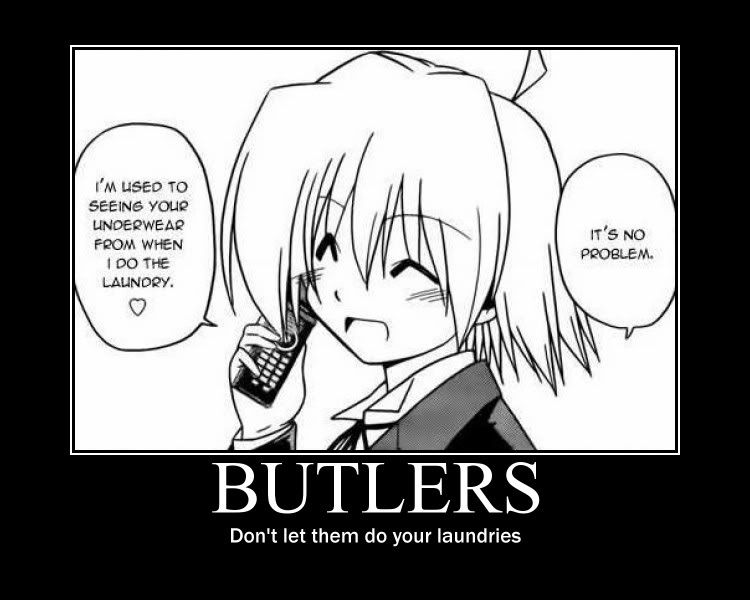
- The titular character. He lives in the house with a master who has a crush on him and daily interacts with her circle of female friends who all also have crushes on him and never notices. He also completely misinterprets all attempts to explain otherwise to him.
- Hayate
 ◊ expressly states that he falls into this trope.
- It's been revealed that his devotion to his ex-girlfriend from age 6 and his Failure Knight status to her, combined with her ingraining on him that only a self-sufficient male should pursue romance, has killed his libido. So it's a cross between this and Celibate Hero.
- Strangely enough, there's no hint of this when he's staying at Hinagiku's house. He clearly has unclean thoughts of three of the members of his harem, and a negative reaction to the implication of her sister in the same position.
- Hayate isn't exactly a Chaste Hero; he simply doesn't see his 13-year-old Mistress and other girls of her age who are in love with him as a potential love interest because he considers them kids and he definitely isn't a Lolicon. The situation changes when he is dealing with girls of his own age like Hinagiku, Ayumu, or Maria. Probably best exemplified when Hina tries to figure out whether he likes anyone.
- Ichika Orimura from Infinite Stratos has this trope forced upon him since there are at least 5 girls interested in him (with them perceiving his older sister to be a 6th rival). While he may seem incredibly dense most of the time, other times when he seems to be a little too friendly with one of the girls, the other ones get really jealous and will do what they can to stop it. Whether it's smacking him with a kendo stick while he's pinned down in bed by a naked girl grappling his arm, or nearly getting his head shot off by the girls wearing their Powered Armor suits because he tried to kiss one of them.
- In Jigoku no Gouka de Yakare Tsuzuketa Shounen, Flare seems to have little attraction to the opposite sex, if any. He's simply baffled when Aishera accuses him of being ready to jump Primavera at any time. He also doesn't understand why Primavera and Aishera are so mad at him for stripping them naked in their sleep so he can take their measurements given that it wasn't his first time seeing naked women.
- In Kemono Jihen, Kabane can't tell the difference between friendship, familial love, and romantic love due to lacking all of these things growing up. As a result, when Akira and Shiki ask who Kabane likes (as in, has a crush on), he simply says Inugami's name due to the gratitude he feels towards him. This is continually Played for Laughs throughout the series.
- Kouji Kabuto from Mazinger Z. He was not so bad in the original manga, but in the anime series, he doesn't get when a woman is interested in him, especially if that woman is Sayaka (or Maria from UFO Robo Grendizer). If they tried to flirt, often he replied by teasing them. Given that the two of them were hot-tempered Tsunderes, you can tell how well it ended for him.
- Tetsuya Tsurugi from Great Mazinger was even worse, since he was so obsessively focused on fulfilling his mission (due to he thought piloting Great Mazinger was everything that he had) that if Jun tried to seduce him he didn't get it or taunted her or both (and since she had no patience for stupidity, they ended up fighting).
- Mobile Suit Gundam 00 has Setsuna F. Seiei, who sneaks into a young princess's bedroom at night and doesn't seem to understand the implications... Then again, Setsuna pretty much has No Social Skills and is The Stoic, which doesn't exactly help his situation.
- Plus, he himself has stated twice that he shares no romantic feelings for Marina. She was just as quick with that "No". This means he actually "graduated" to Celibate Hero since he's now aware of what romance and sex are and just doesn't act on anything romance-related. It doesn't help that he seems to view Marina more as a mix of a Cool Big Sis and a Replacement Goldfish for his Missing Mom...
- On the other hand, he's clearly clueless about Feldt's open feelings for him in The Movie. Even though one of his fellow Innovators was shown to have Psychic Powers! Example: Feldt is a Bridge Bunny and as such, she has no reason to personally go to the docking bay to greet Setsuna as the latter is coming back from a successful mission. Yet she does exactly that and even offers him a drink, only to get ignored in Setsuna's pre-Character Development gruff manner. Lyle even lampshades it.
Lyle: That guy can be such an idiot sometimes...- Or maybe he does know... And has no idea what to do about it. He's not a sterling example of family values, considering why his Missing Mom went missing...
- Plus, he himself has stated twice that he shares no romantic feelings for Marina. She was just as quick with that "No". This means he actually "graduated" to Celibate Hero since he's now aware of what romance and sex are and just doesn't act on anything romance-related. It doesn't help that he seems to view Marina more as a mix of a Cool Big Sis and a Replacement Goldfish for his Missing Mom...
- Monster Musume: Kimihito Kurusu lives with seven women who are each a different monster species. Each one of them loves him and several have tried to have sex with him. They are usually stopped by the competition in the house. Kimihito isn't oblivious to their affections and would like to return someone's but knows by picking one the others would be crushed, so he strives to try and please all of them. Beyond those seven, he has earned the affections of some monster women who work on a farm and refused their passionate plea for him to stay with them on the farm. There is a moment where he is locked in a room wearing a chastity belt with several dozen sexually aggressive lamia who are tasked with testing his ability to resist their temptations and not give into their touch. He comes out with the belt untouched.
- Catarina in My Next Life as a Villainess: All Routes Lead to Doom! can get borderline confessions, proposals and even have pretty blatant passes made at her without having the faintest idea. Her suitors think she's way too innocent for her own good and have to protect her from each other. Her denseness is so strong that she manages to shrug off being kissed by her fiancé twice.
- Naruto: Sasuke is either a straight example of this or a Celibate Hero, pre-Face–Heel Turn at least. But Sasuke would be more likely this than Celibate Hero. The fact that one of his goals was to revive his clan and how he just tells every girl to get lost says much. Many fans even joke about how Sasuke doesn't know how babies are made. Once Sasuke pulls a Heel–Face Turn for good, he and Sakura become a couple and also have a daughter.
- Negima!:
- Negi Springfield from Negima! Magister Negi Magi is very innocent about love and doesn't have an interest in dating any of the cute girls in the class he teaches. Well, he is only ten years old.
- UQ Holder!: Touta Konoe, Negi Springfield's grandson, also seems to be mostly oblivious to sexuality and romance. A later chapter revealed that, due to various circumstances like him being only four years old despite looking fourteen, he had no idea what sex even was, and thought that the phrase "Going all the way" meant a kiss. After that revelation, he was given The Talk.
- Neon Genesis Evangelion: Deconstructed with Shinji. Asuka flirted with him several times (suggesting him sleeping in her bed in a very veiled way, pushing her breasts against his face, goading him to kiss her...), but even though he was attracted to her, he was too shy and oblivious to recognize her (admittedly clumsy) seduction attempts for what they were, or he mistook them for cruel teasing. Hence, Asuka mistook his confusion and obliviousness for indifference or rejection and her fragile self-esteem took a severe blow each time that she flirted with him, making her feeling worthless and more unstable. Cue her falling completely apart during her Mind Rape.
- One Piece
- Monkey D. Luffy isn't completely oblivious to the opposite sex; it's just that he generally doesn't pay attention to stuff like that unless he's in mixed company. Also, he's aware that Boa Hancock is in love with him and wants to marry him, he just isn't interested. Which is pretty impressive, since Hancock is considered to be the World's Most Beautiful Woman, and can turn people to stone with her Love-Love Beams if they find her attractive. When Hancock tried this beam on Luffy, it did absolutely nothing.note
- Chopper is an interesting case. He's quoted as saying he does not feel physical attraction to humans. Nami trusts him enough that she permits him to see her naked in the shower in Episode 574. Oda explained later that while Chopper may have the intelligence of and act human, he's still a reindeer in all other ways and doesn't find human women physically attractive, and his first romantic crush is on a Mink girl who's part reindeer.
- Ash Ketchum of Pokémon: The Series is this, though he wasn't always like this:
- As of the latest of the anime series, the list of girls to have shown canon feelings for him include Macey, Anabel, Angie, and Serena. To say nothing of the Pokémon (like Chikorita, Latias, Smoochum, Aipom, Oshawott and Meloetta) who have developed crushes on him. Although, as of the Unova League, he does seem to have picked up on the concept of Ho Yay, at least when he's in the compromising situation...
- He's been having trouble recognizing love between Pokémon too. He assumed Grovyle had a fever when Grovyle was clearly crushing on a Meganium and, throughout Sinnoh and Unova, he's been clueless to it all, to the point that his then-newborn Pokémon Scraggy understood more about love than he does. He does employ his female Snivy's Attract against opponents, though it's most likely because he recognizes it as an effective move when it hits without understanding how it works.note
- His response to Dawn's Piplup crushing on another trainer's Marill says it all:
But Pokémon like each other all the time. I don't get it. What's the big deal?
- In Unova, he doesn't understand that two Cottonees wish to mate, thinking that the male one just "wants a best buddy". This might just be the definitive showcasing of how his Characterization Marches On as, back in the first-ever season of the show, Ash's Butterfree fell in love and wished to mate and Ash was well aware of this fact. This can be supported by the fact that in the Decolore Islands, Ash was aware that his Oshawott was in love with Osharina.
- His response to Dawn's Piplup crushing on another trainer's Marill says it all:
- To a lesser extent, Dawn is similarly oblivious to the advances of Kenny and Piplup — ironic, since she's probably the girliest of Ash's six female companions.note This gives her a more "childish" feel, which was probably necessary as the two "ten-year-old" companions that came before her seemed a lot older (in both behavior and looks).
- James of Team Rocket could fall under this category as well, as the times he's shown to have fallen in love can be counted on one hand, and half the time he's under a spell (such as the Ghost on Maiden Peak episode.) The shippers will disagree, but you don't even want to start there...
- Downplayed in Rebuild World. While Akira does understand sex appeal, as shown by how embarrassed he gets when he's subject to Marshmallow Hell, he's not particularly interested in the actual act of sex due to his age and having bigger fish to fry. While staying over at Sheryl's place, he doesn't question it when Sheryl asks him to strip down to his underwear before climbing into her bed. He's equally confused when he discovers that Sheryl clung to him in his sleep in her underwear. An exasperated Alpha has to spell out that Sheryl wanted to have sex with Akira. This is subverted when Carol debunks Akira's claims to be this. The main issue is that Akira is The Paranoiac who associates sex with falling into a Honey Trap then being thrown away once no long useful, due to his Dark and Troubled Past. Sheryl sensed this attitude and had an Imagine Spot of Akira choking her to death during their first bath together, which made her prioritize earning his trust first.
- In Record of Lodoss War, Deedlit is in love with Parn, but he seems oblivious and/or doesn't know how to handle his emotions. Even so, she persists, and he eventually falls for her.
- Averted in The Red Ranger Becomes an Adventurer in Another World. Red is Oblivious to Love, to the point of making loud, hammy speeches that could easily be misinterpreted as Love Confessions before responding with confusion at Idola's embarrassment over them. Despite this, he's quick to point out that Idola is indeed a Head-Turning Beauty, but seems to respect and care for her as a friend rather than displaying any kind of romantic attraction toward her.
- Played with in Saber Rider and the Star Sheriffs. Saber has had at least three Girls Of The Week (a circus artist, a school teacher, and a female Vapor Being), but in one episode he's shown childishly embarrassed when his female teammate April Eagle puts the moves on him and attempts to kiss him after he saves her life. We don't know what's the deal with his original Japanese self, though...
- Ken from Science Ninja Team Gatchaman. Justified in that he spent most of his life in training to be the leader of an elite ninja team. (His Battle of the Planets counterpart Mark, though, is a Celibate Hero; while he acknowledges and admits to his feelings for Princess, he won't act on them because of duty.)
- Keith Goodman from Tiger & Bunny reacts to sexuality in one of two ways: stunning obliviousness or stammering embarrassment.
- Taiga in Tomica Hyper Rescue Drive Head Kidou Kyuukyuu Keisatsu. He is extremely popular with girls but doesn't seem to notice, he just finds the attention annoying due to being socially awkward. Unlike his comrades, he doesn't have any love interest.
- Yu-Gi-Oh!:
- Judai of Yu-Gi-Oh! GX, not seen much only because there's only one female main character in his world. (Of course, he's just as oblivious to the feelings of members of the same sex, anyway.) The point is driven home in one episode where he accepts a duel with a wager from an Obelisk snob, the winner being allowed to be Asuka's "fiancée." Judai accepts and ultimately wins... but then it becomes clear he doesn't even know what a fiancée is.
- Although that scene could just as easily be taken as him understanding perfectly well and jokingly working his way out of it/siding with Asuka, making it clear he was in it for the duel—"I never turn down a challenge"—and not the bet. Which would still leave it as an example of this trope.
- Yuma in Yu-Gi-Oh! ZEXAL shows that he is a Chaste Hero in a pretty hilarious way. In Episode 9 he repeatedly interrupts Cathy trying to confess to him during a duel only to beat her in it. Even Astral notices afterwards: "Observation #11: It seems Yuma still doesn't understand the thoughts of females."
- He's the same way with Kotori and Anna. They both have crushes on him, but he clearly doesn't realize it and is largely too focused on Dueling and Astral to notice.
- Later, Tetsuo gets a crush on Rio and is too shy to confess. Yuma has no idea what he is trying to do.
- In the Grand Finale when Kotori outright confesses to him, he finally gets it, though his reaction is ambiguous and he's still mostly focused on Astral.
- Yu-Gi-Oh! ARC-V has Yuya being generally oblivious to Yuzu's, Mieru's and Grace's interest, only noticing Mieru's advances because she's so unsubtle about them. It doesn't help Yuzu's case that he considers her his platonic life partner; though they both deny being a couple on multiple occasions, she's often angered by just how much he means it.
- Judai of Yu-Gi-Oh! GX, not seen much only because there's only one female main character in his world. (Of course, he's just as oblivious to the feelings of members of the same sex, anyway.) The point is driven home in one episode where he accepts a duel with a wager from an Obelisk snob, the winner being allowed to be Asuka's "fiancée." Judai accepts and ultimately wins... but then it becomes clear he doesn't even know what a fiancée is.
- Jughead Jones from Archie Comics. There's a reason for this, though. He hates women because he fears his heart is going to get broken a second time; the first was when his first love and childhood friend Joani Jump moved out of town. Or it was he who moved away from her.
- Another reason is that he already has a girlfriend, January McAndrews, who is from the future and works with him in the Time Police and is thus kept secret.
- The grown-up Godzilla Junior has this trope knocked in The Bridge. While he is a benign soul and his new unicorn form is alicorn size, dark; and not bad looking, he's completely clueless about romance. When a guardsmare named Blade Dancer starts flirting with him, his reaction is an odd mixture of confusion, shyness; and being creeped out. He eventually grows out of it when he realizes and admits he has feelings for Princess Luna.
Author in response to being asked why: The only prolonged female contact he's had is his human caretakers during his youth, his cousin Raiga; and a moth the size of two 747s. He hasn't exactly been acquainted with with the wide, scary world of dating.
- Evangelion 303: In chapter 5 Asuka is trying to seduce Shinji but he hesitates because she has been giving him mixed signals since they met and she drank several beers that afternoon (although Asuka claimed that she was perfectly sober and aware of her actions). After a short argument, she lies down beside him and says: "Last chance: Do you want to do this or not?". He takes up her offer.
- Bonus points for both Shinji and Asuka being virgins up to that point.
- Fire Emblem: Three Houses: Fifth Path: Dimitri doesn’t seem to understand sexual or romantic attraction which results in him being unaffected when everyone else is distracted by Yuri’s sexy.
- HERZ: Subverted. When Kurumi met Shinji, she thought he was not interested in women because he was shy and oblivious. Although it is true he IS shy and oblivious, the real reason was he was fixated on Asuka.
- Ashley Williams in I'm Nobody finds Roxas so naïve in regards to romance and sex that she becomes fiercely overprotective of him when he encounters a pair of flirtatious asari with No Sense of Personal Space.
- In A Leaf of the Tree, Shikamaru doesn't understand why others bother with relationships, finding them to be "too troublesome".
- Unlike his canon self, Ash in Pokémon Reset Bloodlines becomes a bit of a subversion, partly because he's aged up to 15 years old and thus old enough to notice the physical appeal of his female companions, but he tries not to show it. A sidestory has him go on a swimsuit-shopping spree with Misty, and he lets slip that she actually looks good.
- Roxas in A Song of Ice, Fire and Heart may be a skilled and badass warrior who can take on armies of Heartless without breaking a sweat, but he also has a child-like innocence when it comes to things like romance and sex. When he meets Ros, he has no idea that she's a prostitute who propositioning him, as her innuendos go straight over his head.
Gared: Even I have my virtue, but I find this oddly ridiculous.
Rodrick: God's, this must be like what Asher was like when keeping me away from the brothel girls.
Roxas: What are you guys talking about?
Gared: Don't you worry your pretty blond head over it, Roxas.
Rodrick: All you need to know is that your will is stronger than most men.
Roxas: I don't get what ya mean by that.
Gared: And you don't have to. Just know you have our respect.
- The Sword in the Stone: Upon being turned into a squirrel, Arthur/Wart finds himself being courted by a cute female squirrel, one who quickly gets on his nerves because he doesn't comprehend why she's acting "funny" around him. Justified, as he's a boy who is barely about to reach puberty and seems to have never interacted with girls his age, while the girl squirrel isn't even of his species. He does, however, realize he broke her heart when he turns back to human form.
- Though she wants desperately to change it, the socially awkward title character in Muriel's Wedding is utterly clueless about sex and dating.
- Inverted in Pleasantville, with the entire cast being chaste and unaware of sexuality, except for the heroes.
- Pirates of the Caribbean: Will Turner constantly misses his opportune moment with Elizabeth in the first film, and is so gentlemanly during their engagement that Elizabeth was practically shaking with frustration. "I'm so ready to be married...."
- The Villain: Handsome Stranger. Because of this, he does NOT get the girl in the end.
By Author:
- Robert A. Heinlein's early "juvenile" science fiction has several examples of this. He admitted the problem was more about outraging school librarians than boy readers, who would be either indifferent to girls or, once they reached a certain age, intensely interested in them.
- His Between Planets has the protagonist assisted by a woman who convinces her father to loan him money, despite the fact he has nothing to guarantee it. When he asks her to hold on to a ring for him (he thinks it has important secret information in it) she is startled about being given a ring and he doesn't understand why a woman would consider being given a ring something unusual. When her father finds out that the protagonist gave his daughter a ring, he questions it also, but the protagonist is still clueless about why it might be considered strange.
- His Citizen of the Galaxy has the protagonist becoming friends with a woman who makes an enemy of her stepfather to help him, as well as being there for him all the time. For some reason, he is mystified why she is so willing to help him. And then there's this scene earlier in the book after the hero meets a new girl on his ship:
"Oh, just talking with Loeen. I was introducing her to n-space... and darned if she didn't catch on fast."
Fritz looked judicial. "Yes, she's bright... Want to know how bright?"
"Well?"
"So bright that she taught in El Nido's school. Her specialty was math. Multi-dimensional geometry, in fact." - In Farmer in the Sky, Bill doesn't understand why Gretchen would get upset when she comes over to help him work and he immediately mentions they should also ask her sister to help. "Women are funny". When he is injured and she visits him in the hospital, "...[she] could hardly talk, which isn't like her".
By Title:
- Discworld:
- Lance-Constable Carrot in the novel Guards! Guards! never got The Talk, because his dwarf foster parents think of puberty as happening in one's fifties. Amongst other things, his innocence leads to him mishearing "bawdy house" as "boarding house" and taking lodgings in Ankh-Morpork's most popular brothel, run by the formidable Mrs. Palm, without noticing anything odd, even though his letters home make it clear one of the girls is very flagrantly propositioning him. In his next appearance (Men at Arms) he meets Angua, falls in love, and it's stated he always knew the "mechanics", even if he didn't see how they applied to him, so that meant an end to conversations like this:
Carrot: What's a virgin?
Colon: (quickly) An unmarried girl.
Carrot: (horrified) What, like my friend Reet?
Colon: Well, no.
Carrot: She's not married, you know. None of Mrs. Palm's girls are married. - Discworld also has the Nac Mac Feegle, on a race-wide scale. It actually makes perfect logistical sense as there is only one female Feegle per community, the Kelda, so the only male who ever even gets the chance to have sex is her husband, the Big Man. The rest of the men seem to be oblivious to romance — and perfectly happy being so — as well as indifferent once they do learn about it. Several dozen overhear Tiffany giving Letitia The Talk in I Shall Wear Midnight and find it interesting, but not much more.
- Lance-Constable Carrot in the novel Guards! Guards! never got The Talk, because his dwarf foster parents think of puberty as happening in one's fifties. Amongst other things, his innocence leads to him mishearing "bawdy house" as "boarding house" and taking lodgings in Ankh-Morpork's most popular brothel, run by the formidable Mrs. Palm, without noticing anything odd, even though his letters home make it clear one of the girls is very flagrantly propositioning him. In his next appearance (Men at Arms) he meets Angua, falls in love, and it's stated he always knew the "mechanics", even if he didn't see how they applied to him, so that meant an end to conversations like this:
- Galahad is given a Captain Ersatz in The Elenium with Berit, a novice knight whose chastity makes him a Clueless Chick-Magnet. The other knights, both amused and slightly annoyed by the attention he gets, contrive to get him laid in The Tamuli.
- Isaac Asimov's "The Foundation of S.F. Success": (Conversational Troping) This poem advises that aspiring authors should avoid romantic subplots, making their male heroes avoid getting entangled with distracting women.
Then eschew all thoughts of passion of a man-and-woman fashion from your hero's thoughtful mind.
He must spend his time on politics, and thinking up his shady tricks, and outside that he's blind.
It's enough he's had a mother, other females are a bother, though they're jeweled and glistery.
They will just distract his dreaming and his necessary scheming with that psychohistory.
And all the fans will say, As you walk your narrow way, If all his yarns restrict themselves to masculinity,
Why, what a most particularly pure young man that pure young man must be. - Sir Galahad, as the French chivalric addition to the Arthurian myths just about qualifies as Older Than Print and, as the paragon of knighthood conceived by trickery to succeed in the quest for the Holy Grail, he is the epitome and archetype of this trope. That aspect is treated with their customary irreverence by Monty Python in Monty Python and the Holy Grail.
- Reign of the Seven Spellblades: Hero of Another Story Alvin Godfrey, the Student Council President and head of the Campus Watch, is the apex of a Bisexual Love Triangle between Ophelia Salvadori, Tim Linton, and Leoncio Echevalria. Godfrey himself has never indicated romantic attraction to anyone at all.
- From the The Squire's Tales series by Gerald Morris, both Sir Dinadan and Beaufils. Galahad reads more as a deconstruction.
- In H. G. Wells' The Time Machine, the hero saves and bonds with Weena, a member of the obviously quite promiscuous and beautiful Eloi race, and she follows him around. He finds her attractive and charming, but, as he says when narrating his story, "I didn't come here to find a wife" and that's it. He sleeps with her, completely innocently. He is not even sure if she is male or female.
- Warrior Cats has Firestar in the first arc. Leafpool in Starlight might also count.
- Sheldon from The Big Bang Theory apparently has no interest in sex, but he's also shown to be oblivious to women (and men) coming on to him.
- Doctor Who: Depending on which regeneration we're talking about, the Doctor comes off this way from time to time.
- The Classic series indulged in Ship Tease at times but never, ever confirmed sexual relationships between the Doctor and his companions, which due to the Doctor's state as an immortal superbeing was thought to have limited prospects.
- Tom Baker claimed he made a point of always handling Sarah Jane in a slightly awkward way to give the impression that the Doctor wasn't used to touching women, and the Fourth Doctor referenced his lack of ability to tell if human women were beautiful in "City of Death" — though he still had a certain amount of UST with many girls, and made a point of showing he genuinely loved them.
- Peter Davison, the young and conventionally handsome Fifth Doctor, was prevented from even touching his female companions in case the audience thought "hanky-panky" was going on in the TARDIS. Eventually, 1980s Fanon insisted the Doctor was Chaste, despite being confirmed a grandfather, with contrived explanations even appearing in print about how this may be (such as Time Lords being born on "genetic looms" due to their race's asexuality).
- In the New Adventures novel Death and Diplomacy, the Seventh Doctor acknowledges the discrepancy, admitting that failing to notice or completely misunderstanding sexual overtures just makes his life simpler.
- The New Adventures novel The Dying Days breaks from tradition by having companion Bernice Summerfield initiate a sexual encounter with the Eighth Doctor (debated for nearly 20 years, the fact they had sex was finally confirmed in "Benny's Story", a Big Finish audio drama).
- The new series Doctors are generally a lot more sexual (though this is never depicted on-screen).
- The Ninth Doctor makes a point of getting offended when Rose implies he might never have had sex.
- Ten has never been hinted at having had sex with anyone, but he's quite attractive, which causes him to unwillingly attract a lot of girls (and guys, sometimes). He's quite clueless about people's advances, but when he does catch on, most of the time he quickly and awkwardly refuses.
- Eleven shows something of a girls-are-icky kissing-is-gross reaction to physical affection between Amy and Rory, even on their honeymoon, but that doesn't stop him from kissing River Song, a character who later confirms a sexual relationship existed (justified by the fact the two eventually marry).
- The relationship between Clara Oswald and both the young-looking Eleventh and older-looking Twelfth Doctor was a love affair, but there was no indication of it ever progressing into anything sexual; that didn't stop (thanks to the chemistry between the actors) intense UST being noticed throughout (with notable examples being "The Day of the Doctor", "The Time of the Doctor", "Listen", "Mummy on the Orient Express", "Last Christmas", "Under the Lake" and "The Girl Who Died").
- The Classic series indulged in Ship Tease at times but never, ever confirmed sexual relationships between the Doctor and his companions, which due to the Doctor's state as an immortal superbeing was thought to have limited prospects.
- Benton Fraser of Due South has skirted this trope more than a few times; while he has been known to take an interest in women, he can be astonishingly naive about sexual matters, and he is perfectly capable of carrying on a conversation with a half-dressed exotic dancer without even thinking of breaking eye contact. (Of course, the fans have a theory about this...)
- Carter in Hogan's Heroes seems absolutely clueless when it comes to women or the appeal of women, while all the other characters jump at the chance to even hang out with attractive girls. He has had one girlfriend, later his fiancee, later leaving him for a man of lower rank a year after he was captured by the Germans, but unlike the other men, he only describes her in romantic terms rather than anything relating to her physical appeal.
- Monk's title character, Adrian Monk is actually a widower, so he is presumed to have had a sex life once. But he's also saddled with plot-dependent OCD and phobias (which are implied to be so severe because of his wife's death). He's afraid of many things and disgusted by that which he isn't afraid of, so generally he does not consider himself available, nor is he generally considered worth approaching romantically by any female who happens to cross his path.
- More to the point, Monk thinks of himself as very married, and the mere fact that his wife happens to be deceased does not make it any less so. He dates occasionally and halfheartedly, and in the end always returns to his default condition of being in love with his wife.
- According to Monk while talking to his psychiatrist, the most physical his love life, even with Trudy, ever was is falling asleep holding Trudy's hand and waking up holding it.
- Monk eventually came to regret not having a child with Trudy, adored a toddler after taking him in, and absolutely gushed over Molly Evans, treating her like his own simply because she was Trudy's child.
- In Mr. Brain, Tsukumo is totally clueless about Kazune's advances on him (mostly due to partial brain damage caused by an accident) and keeps wondering why he's in possession of a porn magazine in the first place.
- Isaac from The Orville is an interesting variation. He is a genderless robot who is literally incapable of affection or sexual attraction. However, he forms a relationship with Doctor Finn as an experiment and while he, by his own admission, cannot love her, he comes as close as he constitutionally can. In his wedding vows he says that she "will ensure my continued efficiency". He can also perform sex as a physical action, although he derives no pleasure from it.
- Number Six from The Prisoner (1967) takes this trope to its logical extreme. Created as a subversion of the womanizing secret agent recently popularized by James Bond, Number Six is presented with numerous female guest characters over the course of the series, and he only shows any kind of sex drive towards his fiancé.
- It's worth noting that the episode with Six's fiancé is the episode that Patrick McGoohan is, for the most part, not in (they did a brain swap episode to get around the fact that he was in Hollywood filming Ice Station Zebra at the time). McGoohan was uncomfortable performing love scenes and tended to avoid them throughout his career.
- An episode of Spin City features the procurement manager of City Hall. He is utterly immune to the charms of the Sexy Secretary and the Token Gay. His sole passions in life appear to be his job and Tamagotchi.
- In the Book of Exalted Deeds supplement for Dungeons & Dragons, there are many Exalted Feats that can be taken after taking the Sacred Vow Feat, all of which give a Player Character benefits if they heed the vow. Vow of Chastity is one of them. (In other words, the character gains certain useful abilities by remaining chaste.)
- GURPS Supers: Mixed Doubles. The superheroine Justice doesn't realize how attractive she is and doesn't notice most of the compliments and passes she receives from men.
- In Assassin's Creed III, the hero Connor has no known love interest or sex life despite meeting many quite attractive female characters. When one of the NPC falls in love with a woman, it takes ages for him to understand what's happening, and the first advice he offers (giving flowers to a tomboyish girl) is completely inappropriate. Canonically however, he'd eventually have a child in order to be the ancestor of Desmond Miles.
- Dragalia Lost: Euden is quite the Chick Magnet and Even the Guys Want Him. Despite this, Euden never shows any romantic interest in anyone. He knows that people like Mym have feelings for him, but he just doesn’t really understand what romance is.
- Terra from Final Fantasy VI is a Chaste Heroine, because she doesn't know What Is This Thing You Call "Love"?. The Figaro Castle guards, and even Edgar, are surprised that Terra didn't react negatively to Edgar hitting on her. She eventually learns about the feeling of love later, but she's probably still a Chaste Heroine.
- Similarly Justin from Grandia. Super-hot Feena's rather overt moves on him are totally lost on him, to the point where, when she asks if he loves her, he replies, "Of course I love you! And-" goes on to name all the other people in their party, who also "love" her.
- In the epilogue, it is made perfectly clear that at some point he got the hint.
- While it never comes up in-story, the SPARTAN IIs of Halo also bear mention as they quite literally are this trope on paper, due to their sex drive being suppressed by their augmentations (specifically, the catalytic thyroid implant). "On paper" because this hasn't stopped some IIs from feeling vague romantic emotions.
- Hitman's titular character is kissed- on the lips- by a grateful rescuee, which results in a case of the jibblies one might get after grinding their nails over a chalkboard. Mind you, said rescuee was a kidnapped girl who had been forced into prostitution, so the 'jibblies' might just be Squick from wondering what that mouth's been doing recently. In the remade version of that mission in Hitman: Contracts, he just sneers at her grumpily. Agent 47 does seem to fit the trope, but that might have more to do with the only female in the games who isn't an unimportant civilian is his Mission Control.
- Crosses over to The Movie, where Nika practically comes at him crotch-first at one point, and he goes so far as to use a sedative to get her off him. Very likely justified by the fact that 47 was bred to be a superior assassin, and a sex drive isn't very conducive to efficient killing. One reviewer noted 47's asexual proclivities and accused the movie of appealing to "adolescent male fantasies," strongly suggesting that said reviewer has no idea what an adolescent male actually is.
- In The Legend of Dragoon, Dart is like this at first with Shana (not to be confused with the above show), but he warms up to her by the end of the second disc.
- The Legend of Zelda
- Link of the games has been the target of flirtation from a number of female characters, but he seems to be more taken aback than tantalized. To be fair, in most of the games he's prepubescent, but he seems no less innocent when portrayed as an adult.
- The Legend of Zelda: Ocarina of Time is when it happens the most, and it's also when it's most justified. He's only nine, and even as Adult Link he only has the body of an adult. Being raised among the eternally-young Kokiri who have no interest in that sort of thing didn't help. This also happens to be the most ironic case, as the game was originally conceived to have a Dating Sim element and Link was only going to be playable as an adult, which means there are more potential love interests here than in any other Zelda title. Ironically, given that the Link of Twilight Princess is the Hero of Time's descendant, this makes the latter the only confirmed Link to have relations with a woman.
- Vayne from Mana Khemia Alchemists Of Alrevis, being raised by a cat for six years, he has no grasp on such a concept. When Nikki starts to develop feelings for him (mainly through her character quests), he remains absolutely clueless. At one point Vayne receives a letter; the others think it's a love letter, while Pamela says "This is Vayne we're talking about! That's impossible!"
- Despite Mayl's obviously hitting on him, Lan in Mega Man Battle Network is mostly clueless about Mayl's feelings for him, although from time to time he's aware, and the ending of the sixth game reveals that they are married together twenty years later.
- By the time of Mega Man X8, Zero's pretty much celibate, but he's also quite clueless to the feelings that his new navigator has on him. On the other hand, after what happened the last time he almost had a girlfriend, can't fault the guy for not being much for feelings.
- In the Mega Man Zero series, it's questionable how much he cares for Ciel on the "Love" scale as well (despite the latter being very obviously in love with him by the end of the series) — whether he's a Chaste Hero, a Celibate Hero, or simply too stoic to say anything out loud is left entirely ambiguous.
- Boxing team captain Akihiko Sanada in Persona 3 is a variation of this trope. He finds his legions of fangirls to be highly annoying, and is completely oblivious to both any romantic/flirtatious cues or other peoples' feelings (Junpei's budding feelings for Chidori are a good in-game example of this; whereas the others are either worried for him or are secret shippers on deck, Akihiko is constantly annoyed with his behavior and doesn't get the hint.) In fact, the only women he's comfortable talking to are the female members of SEES, and his longtime female friend is not only a woman with a lot of power but has her own closet of social issues. If you play as a female protagonist in the Playstation Portable re-release, his Social Link involves him being interested in her primarily because she is SEES' new field leader, at least at first. Should you choose to become his lover, you will literally need to explain to him that his edginess around the heroine equals being in love.
- The variation appears in later games; in Persona 4: Arena, Akihiko hits it off with kung-fu enthusiast Chie, and for a humorous event in Persona Q: Shadow of the Labyrinth, in a conversation about finding "the one," you can have the P3 protagonist tell him to "find a buff girl," in which Akihiko reacts enthusiastically. These basically imply that the only women he takes interest in are ones who are as athletic or devoted to fighting as he.
- In Pokémon, those Pokémon with the ability "Oblivious" is immune to being charmed.
- Taken a step further in Pokémon Sun and Moon with Ash's Greninja who cannot breed at all.
- Sanada Yukimura from Sengoku Basara, a naive teenager who knows no life other than the battlefield, is not only oblivious to any romantic feelings girls may have toward him, but gets extremely embarrassed when anyone mentions love, sex, or relationships (something Keiji teases him about relentlessly). It doesn't help that the only mentors he has are Shingen and Sasuke.
Yukimura: "I don't understand. Women are so complicated..."
- Ryo Hazuki of the Shenmue series appears to not only be chaste, but asexual. Despite the very obvious advances of attractive females (Nozomi in Youkuska, and Joy in Hong Kong) stoic old Ryo can usually only muster a "Have you seen a black car?" when his love is clearly making advances. For all its sandbox and open-world play and decision-making structure, the complete lack of interaction options that make use of other characters' romantic feelings towards Ryo is quite jarring, as Chugworth Academy illustrates here.
- Super Mario Bros.:
- Mario, in both video games and every other iteration. He is described as Princess Toadstool/Peach's "love interest", but they don't seem to enjoy a physical relationship. Perhaps with good reason, as at least one Nintendo-approved source describes her as still being a teenager, while he appears significantly older.
- This arguably applies to Mario's younger brother Luigi as well. Granted, Mario and Luigi do blush whenever Princess Peach kisses them in gratitude for saving her.
- Played for Laughs with Ryusei Date from Super Robot Wars. His obliviousness to Mai Kobayashi and Latooni Subota's crushes on him was apparently because he was too busy swooning over their feminine-shaped Humongous Mecha. Even though Lamia Loveless is a Robot Girl, he ignores her too in favor of her mecha.
- Masaki Andoh is also like this, as he's oblivious to the fact that he somehow amassed an instant cluster of admirers. Polygamy isn't outlawed in his new homeworld of La Gias, but he decided not to get with any of them to make things easier for himself. His rival, Shu Shirakawa, has his own harem but chooses not to mess around with any of them in favor of messing with Masaki's head.
- Tales Series:
- This fully describes Senel Coolidge from Tales of Legendia. There's even a point in the game where one of the female characters suddenly grabs him and pulls him into a deep, passionate kiss...twice. He, however, is completely unaffected both times. He's just too fixated on STELLAAAAAAAAAAA! to notice any other girl.
- Lloyd Irving from Tales of Symphonia is much the same way. Observe the following exchange between him and Sheena in Flanoir:
Lloyd: You and I are a lot alike Sheena. I think we could be great friends!
Sheena: Great... Friends.
Lloyd: What, you don't wanna?
Sheena: (aside) ...Idiot! - Stahn plays the trope straight... and then doesn't. He's completely oblivious to the romantic infatuation he suffers from/causes towards Philia or Rutee, but when Ilene mentions she's taking him on a date, he... gets pretty expressive about the whole thing.
- Turovero: The Celestial Tower: Sigurd is tall, blonde, handsome, and regularly gets the attention of women, including that of a snake woman he can score free items from mid-game (not that he particularly wants to). Naturally, this earns the ire of the actual Chivalrous Pervert of the party, Ruby, who accuses him of not even utilizing the gifts the Four Gods gave him, to which he dismissively replies that he'll worry about romance once their mission is complete.
- Utawarerumono: While not actually physically chaste, sleeping with six different women throughout the storyline, Hakuoro somehow fails to realize they all love him until the very end. Oh, and the bunny princess also has a thing for him. It's most obvious with Karura, Yuzuha, and Eruruw. And Urtoriy. Doriy and Guraa also express some interest, but they're more into Oboro. Seriously, that's at least nine and he only expresses vague awareness of two or three tops before the story ends.
- Basically everyone in Xenoblade Chronicles 3 is this. There's a co-ed bathing scene early on that no character involved in even thinks twice about. It's revealed later on that the Flame Clocks essentially repress all feelings of love and attraction, and the main party eventually have to learn what love and romance are in addition to where babies come from. After all, what good is a soldier that has their mind on anything that's not killing the opposition?
- Adol from the Ys series. One can even say Adol is a Celibate Hero since his job description says, "After saving beautiful women and making them swoon all over for you, leave for another adventure."
- Saber in Fate/stay night is completely impervious to sexual or even romantic innuendo unless it's pointed out to her. This is a popular joke in doujinshi, where she usually thinks you're talking about food. This tends to be exaggerated by the fans: in the actual game, she does start picking up on it once she's aware of Shirou's feelings for her. Before that, she simply wasn't thinking of herself as female in the first place so those thoughts never occurred to her. It'd be especially odd to think she has no sexual experience considering that in her previous life, she was married and had fathered (yes, "fathered") a child.
- Miles Edgeworth from Phoenix Wright: Ace Attorney has all the sexual passion of a monk. Numerous women and girls try to catch his eye, but if he can't relate to them as "older brother figure" or "entirely professional colleague," their interest just makes him uncomfortable (if he notices it at all).
- Akira from Spirit Hunter: NG is mostly oblivious to the interest that Kaoru shows in him, gets irritated rather than flustered by Seiji shipping the two of them, and responds to Rosé's offer of a date with 'I'd rather sleep'. Romance is clearly not on his mind.
- Unsettlingly deconstructed with Jin from Bastard. Episode 15 reveals that he doesn't know what sex is, how it's done, or what its purpose is, despite being in high school. He has to ask classmate Kyun what porn is and doesn't understand why the question flusters her. He panics when he has his first wet dream and has to ask online to confirm what that "sticky and slippery liquid kinda thing" is. Given what his father is and the nature of their relationship, Jin has learned all about a woman's "parts" but has been deliberately kept in the dark by his father in regards to sexuality, likely to keep him from acting against him out of romantic or sexual passion.
- Girl Genius: All signs point to Barry Heterodyne having been this. Barry always ends up with "the High Priestess" in the stories and plays, "The High Priestess" being the catch-all term for whatever lost priestess, Damsel in Distress, or mad scientist's beautiful but misguided assistant (other than Lucrezia) happened to figure in any given Heterodyne play (basically, an in-world trope). There is no indication the real Barry actually had a love life though; Klaus says at one point that having a child of Barry's turn up would be a "surprise."
- John Egbert of Homestuck. At various points in the story, Karkat, Vriska, Roxy, Terezi, and (as revealed by Pesterquest) Dave all develop crushes on him, which he remains completely oblivious to until explicitly spelled out for him. When Dave asks him if he likes Roxy, John is surprised and genuinely has no idea; when Karkat informs him that he hate-likes Terezi, John panics and tries to shut out the thought. Come the dubiously canon The Homestuck Epilogues, his cluelessness regarding romantic relationships comes back to bite him in the ass: he's a pretty inattentive boyfriend who becomes an even less attentive husband in the Candy timeline, and Roxy eventually leaves him over it.
- In Moon Crest 24, Derek doesn't quite get why Dory laughs at him when she sees him with Lucy's clothes on. Poor guy thinks he put them on backwards.
- RPG World: Hero was completely oblivious to Cherry and Diane's crushes on him. Or anything else that didn't conform RPG combat tropes.
- Sinfest has Criminy. Perfectly portrayed here. Bonus points for the red demon Fucshia having a crush on him but him being oblivious to it.
- An episode of "Sinfest Nights" has her as a Hot Librarian and him oblivious.
- Recently he dug up a hole to hell to search for her, so he at least is fond of her.
- Earlier he admitted to never kissing or even holding hands -- he's saving himself for marriage -- in obliviousness to what the woman asking him might mean by it.
- An episode of "Sinfest Nights" has her as a
- Twenty-Fifth Bam from Tower of God doesn't really realize that two beautiful princesses have at least a minor crush on him. When he returns after five years, which he presumably spent with Hwaryun, he at least knows how to push the buttons of a female.
- "Hiro the Dense - Dense Shonen Protagonist" has the titular hero on a quest to slay the Demon Lord, and he's single-mindedly focused on the goal. When the succubus Izilith talks about playing with her, he takes this literally and demands to play an actual board game with her. She tries again to entice him with a "reward", and he agrees - asking for her to take him to her boss. Then it turns out that he'd misread the posting — the quest was to lay the Demon Lord — which he mistakes for finding her something to lay down and fall asleep on.
- Ace Lightning — The titular main character doesn't even know how to flirt.
- The Boondocks: Huey doesn't get romance, and doesn't want to get it either.
- Phineas from Phineas and Ferb, who remains completely oblivious to his best female friend's repeated hints that she has a crush on him. The fact that his same-age (step)brother is a borderline Covert Pervert only emphasises this.
- This dialogue shows this quite nicely:
Phineas: Ferb and I are going to use a laser to carve our faces in the comet so that when it passes over again in 73.5 years our grandchildren will see it. By the way, my parents are cooking outdoor steaks for everyone. What do you think, Isabella?
Isabella: You had me at our grandchildren...
Phineas: Huh?
Isabella: Steaks! You had me at steaks! - Apparently, he still doesn't get it...
- At the end of Across The 2nd Dimension, Isabella made sure he got it. However, she knew he wouldn't remember…
- It gets even better in the flash-forward episode "Act Your Age." Phineas developed a crush on Isabella when they were in high school, but is STILL oblivious to her feelings and hasn't even tried to ask her out because he thinks he's too firmly situated in the friend zone. When he brings this up, his friends immediately set him straight, to his astonishment and disbelief.
Baljeet: You are kidding, right? You do know she had a giant crush on you for ages.
Phineas: Uh...no...
Buford: Oh, come on! It was so obvious! She came over to your house every day for eleven years just to see what you were doin'!
Baljeet: When she looked at you, her pupils actually formed little hearts. Like, I do not know how that is physically possible. She changed her eyeballs!
Phineas: We— I don't believe it. Ferb?
Ferb: (nods)
- This dialogue shows this quite nicely:
- Freddy became this trope in Scooby-Doo! Mystery Incorporated. Ironically enough, the series cranks the historic Ship Tease up but he remains oblivious to all of Daphne's advances due to his obsession with solving mysteries and planting traps.
- Eric Cartman of South Park is the anti-hero version of this trope. He seems to be more focused on making the lives of others miserable and other things than romance.
- Although in Season 4, he nursed a brief crush on Wendy and in the "Le Petit Tourette" episode, Cartman did say he fancied and fantasized about kissing this girl named Patty Nelson.
