
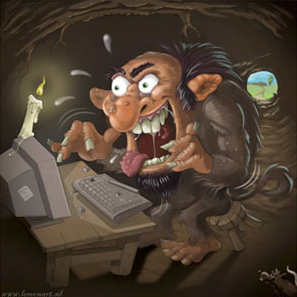
The term "trolling" originally comes from fishing, rather than the fantasy creature. Trolling in a fishing context means casting a baited line out in the water and dragging it through the water behind you as you move, in order to increase your catchment area (the word is a variant of "trailing"). The idea in the Internet context is that you set out some bait in much the same way and watch as your victim grabs it and writhes for your amusement. Malcontents on the Internet protected by anonymity have been doing this for years, hence the widespread usage of the term. Many trolls enjoy insults (and the like) thrown at them as a result of their trolling; those who threw such insults are said to have "fed the troll" (or "taken the bait").
Despite the term being unrelated to the mythological troll, it does evoke some very apt comparisons with them; they were reluctant to show their faces in public, or to emerge during the daytime as they were allergic to sunlight, which turned them to stone.
When encountered in an online game, a Jerkass troll is often called a Griefer. Developers may implement Anti-Trolling Features to discourage this in their games.
Compare with Shock Jock (people who do this in front of a lot of other people to quickly get mass attention), Memetic Troll (characters whose trolling has become memetic) and Card-Carrying Jerkass (a non-Internet version of this trope). Compare and contrast The Gadfly, who screws with people to cause amusement for all and is relatively harmless, but can be easily mistaken for a troll on the internet. However, there is an online term called "funny trolling" which is basically the same as The Gadfly. Contrast I Shall Taunt You, in which someone gets on an opponent's nerves in order to gain a tactical advantage. Supernatural versions of this trope can also be a Jackass Genie. Also compare and contrast Attention Whore, which nearly all trolls are accused of being, since their evulz rely on people actually responding to them. (Note, not all attention whores are trolls, but trolls are one of the worst kinds of attention whore.) Going beyond the worst type of troll are cyberbullies and Internet Jerks, pathological Sadists who are usually accused of trolling. If a troll is ignored, they are likely to become Offended by an Enemy's Indifference.
Contrast with Hanlon's Razor. See also Trolling Creator.
For an article about mythological trolls, see All Trolls Are Different.
For more information, read this note
Examples:
- Discussed in an ad for Oscar Health Insurance, which depicted a (mythological) troll on a laptop, accompanied by "Ask a doctor instead of randos on the Internet."
- Koro-sensei from Assassination Classroom especially when he has green stripes.
- Blade Skill Online has some off-screen. The reason protagonist Yuri chooses the summoner job, the bow as a weapon, starting skills [Guts], [Fatal Strike], [Enhanced Luck] and an entirely Luck Stat based build for his character is that the official game site listed all these as the best job, weapon, skills, and stats to build a character that quickly advances to being the strongest, as touted by the beta testers. Surprise, the game devs are morons who didn't bother to secure the website, allowing internet trolls to post Blatant Lies. They corrected the information after Yuri signed up and started playing. Enraged, Yuri swore revenge and strived to be the strongest player anyway regardless of what the actual experts had to say. Cue a very, very unusual playstyle built around Combat Pragmatism, Flaw Exploitation, and Loophole Abuse, that winds up taming dungeon boss monsters which is supposed to be entirely impossible.
- Cromartie High School had an episode about a gang leader that administrates a web forum and is incredibly polite. After running into a troll, he restrains himself. However, the troll later bumps into him in person, and is punched to the ground by the gang leader without either knowing who the other really is.
- Kiyoshiro's tsundere partner Jellymon in Digimon Ghost Game. She takes advantage of her Invisible to Normals status to "haunt" him relentlessly because his terror amused her, before forcing him to accept her as his Digimon so she could tease him even more. Despite him being her master, when they first meet she bullies him into using the sama honorific when addressing her. In her introductory episode it's revealed she's an Internet troll as well, as she repurposed Kiyoshiro's programs to disrupt the Japanese economy for fun which royally pissed off The Almighty Dollar Digimon Majiramon.
- Fullmetal Alchemist:
- Upon his release, Solf J. Kimblee pranked a Mook by transmuting his watch into a time bomb... that turned out to actually be a cuckoo clock toy.
- When the Elric brothers visit the Rockbell household for the first time since Ed received his State Alchemist certification, Pinako Rockbell tells Ed that she hasn't seen him in a while, and during that time he's grown... smaller. Ed takes it about as well as you'd expect.
Ed: (Tranquil Fury) Granny, you've got it wrong. You're supposed to say, "How big you've grown lately, Ed."
Pinako: But why would I say something so clearly untrue?
Ed: (Rage Breaking Point) I'M STILL TALLER THAN YOU, YOU MINI-HAG!!!
- Hikari no Densetsu has Hikari's Cool Big Sis Miyako. She's not above giving her dad a heart attack by implying that Hikari's out kissing boys, though she means it in good fun.
- Pariston Hill in Hunter × Hunter is a combination of this and Complexity Addiction, cooking up incredibly complicated schemes that might run for months or years, manipulating powerful figures even when they know him personally, just to make people dislike him. For instance, an arc was focused on him winning an election, playing everyone involved — his colleagues, fellow candidates, and voters — like fiddles, only to immediately step down and hand the position to the opposing candidate who hated him the most. Pariston was formerly an assistant to Isaac Netero, the World's Strongest Man. Isaac chose Pariston specifically because of his adversarial nature, as Isaac felt his intuition and decision-making would sharpen with someone always provoking him. The feeling is mutual, as Pariston explicitly states the only reason he became vice-chairman was so he could mess with the chairman. He actually misses Isaac deeply for that very reason, and tells Cheadle, the new chairman, that if she ever makes the Hunter Association boring, he just might have to go all-out in teasing her, too.
- Shippo in Inuyasha, to some extent. He often makes cheeky remarks and plays pranks on Inuyasha, and it never ends well for the young Kitsune.
- Nui Harime from Kill la Kill. She cheerfully admits to murdering Ryuko's father during her first appearance, and then later disguises herself as a male student just to screw with Ryuko all over again.
- Level E: Quite nearly everything Prince Baka does is merely to get under people's skin.
- Curren Hückebein from Magical Record Lyrical Nanoha Force loves pulling her tricks to her enemy, especially Special Duty Section 6.
- Koumoto Akane from My Monster Secret is this 99% of the time.
- Mai Minakami from Nichijou is infamous for her extreme levels of being a troll. She plays pranks on her friends, on other people and sometimes even on her own dogs, which are also trolls to some extent, or even herself, while keeping her emotionless-looking face the whole time.
- Fujisaki from Noragami seems to be written as a personified allegory of a dedicated internet troll. Due to his ability to Body Surf, he acts as a flesh-and-blood "sock puppet account" that he uses to take people on fake dates and rub it in their significant other's face later, call in a fake threat to send the authorities to take down an innocent scapegoat, and destroy a family's livelihood by orchestrating a massive PR nightmare just for slighting him. He holds everyone in contempt, but whenever he's even remotely threatened or challenged directly, he retreats and declares himself the winner. And he does it all For the Evulz.
- Bartolomeo from One Piece definitely counts, deliberately provoking everyone he meets for the sake of it and having fun using his Barrier Warrior powers to entirely deflect any consequences and reprisals. It doesn't help that he is a huge fanboy of the Straw Hat Pirates.
- Michiru Kaioh of Sailor Moon is quite possibly the most elegant troll in existence. She's certainly not malicious or evil, but the moment she says "Ara" expect the conversation to be full of innuendo and oh-so-innocent snarking.
- Hisa from Saki. Her initial reason for having Nodoka play with her stuffed penguin, Etopen, was to collect "joke material," on her, but she soon found that Nodoka having it at her side like she did when she played online made her play better. She also allows Momo to get the impression that something happened between her and Momo's close friend Yumi, causing her to freak out.
- Sayonara, Zetsubou-Sensei has Meru Otonashi, who (true to her name) is extremely shy around others, and only communicates through text messages... all of which consist entirely of outrageous slander of the recipient. And don't even think about taking her phone away, because she has extras. And don't bother waiting for the battery to die. She has extras. Many extras.
Nozomu: "What are you, Rambo!?"
- Seraph of the End: Shinoa loves riling up other people, especially Mitsuba and Yuu. She gets called out on this by Guren, who tells her that continuing this behavior for her own amusement will get someone killed.
- Higanbanna from The Unforgiving Flowers Blossom in the Dead of Night, who also loves to use dark Irony as part of it, especially to Hikaru in the visual novel.
- Vector from Yu-Gi-Oh! ZEXAL. He is probably the trollest character in the entire Yu-Gi-Oh! franchise.
- Hape Kerkeling's dorky character Siggi Schwäbli attempting to perfom an aria ("Der König ist tot") for the audience, only for musician Achim Hagemann to troll him by playing inappropriate samples.
- In the Disney Ducks Comic Universe Magica is prone to pull some ridiculous stunts if she thinks she can get away with it... Such as the time she discovered a potion that would make any object irresistible for anyone who sees it but the original owner and used it on an old slipper because she realized how ridiculous it would be to exchange it for Scrooge's entire fortune (Scrooge's reaction when the slipper being burned snapped him out of the spell was priceless).
- Most incarnations of the Joker dress themselves as being a lethal one of these. The best example is his DC Animated Universe version, who tailored each of his schemes as a joke or a prank, and sometimes even lectured his underlings on the importance of proper buildup and delivery when telling a joke. Batman in particular is the Joker's preferred victim, and many a Joker has refused to kill or unmask a Batman dead to rights, simply because it would spoil the fun of trolling him.
- Superman's longtime enemy the Prankster is a man obsessed with practical jokes who incorporates them into his crimes. His favorite target is the most powerful being on Earth, Superman, but the more other people he rope into a gag, the better he likes it.
- Loki, the Norse trickster god, constantly trolls the rest of the cast of The Mighty Thor and the Marvel Universe at large. His current incarnation(s) are also very tech, internet, and fandom savvy, and Medium Aware. Be afraid. Be very afraid.
- Spider-Man: Dan Slott's interpretation of Mysterio in The Amazing Spider-Man (Dan Slott) seems to realize the fact that he is seen as a Harmless Villain, and rather than snap and try to prove them wrong, he actually just takes the ball and rolls with it. In Ends of the Earth he's even seen killing time playing Angry Birds as opposed to aiding the Sinister Six.
- Superboy-Prime trolls DC Comics image boards when he returns to Earth-Prime.
- The Transformers: More than Meets the Eye mentions that Brainstorm used to do this at the Autobot research outpost he worked at by coming up with absurdly over-the-top weapons simply to piss off the ethics committee. He retains a very inappropriate sense of humour and a willingness to get on people's nerves into the series proper.
Ultra Magnus: You can't have people throwing made up words around willy-nilly. There are impressionable 'bots on board.
Brainstorm: Magnus is right. Making up words leads to criminanarchy and pandebordination.
- Calvin of Calvin and Hobbes has been known to do things solely to irritate his parents. Then again, he is six.
Calvin: I got the new album by Scrambled Debutante. All their songs glorify depraved violence, mindless sex, and the deliberate abuse of dangerous drugs.
Hobbes: Your mother's going to go into conniptions when she sees this.
Calvin: [throwing the record in the trash] Well, I sure didn't buy it for the music.
- Abraxas (Hrodvitnon): One of the recurring internet users who comments on news about Monster X, user HumanityHellYeah, is more or less an internet troll who talks smack about Monarch, xenophobically voices demands that Monster X be killed which rile up the rest of the commenters, has nothing to say when another commenter gives him a "Reason You Suck" Speech reply, and whines that everyone's gonna die once news of Monster X's true nature as a Two Beings, One Body fusion of San and Vivienne Graham gets out.
- TD of The Non-Bronyverse sometimes engages in this. He and Celestia take it up a notch in a few of the non-canon stories.
- Nova Shine, Aegis, and Celestia in The Apprentice, the Student, and the Charlatan.
- Nova tends to go to certain lengths to irritate Twilight Sparkle, usually by rearranging books. He has also put another pony off balance by letting them know that Princess Celestia could banish them or imprison them if they aren't careful around Twilight.
- Aegis gets a rise out of Nova every chance he can get. His first appearance is even scaring Nova into thinking he was being arrested.
- Princess Celestia constantly makes rather suggestive implications around Luna during the arc in the past. She tries it on Nova too, but Nova seems to be the only one immune to her trolling. Back in the present day, she's delighted when she manages to fluster Twilight with another such implication.
- Iron Will of Iron Will's Foalcon Necrophilia Sex Rampage trolls Sweetie Belle by dressing up as his own mother during sexual intercourse.
- Yukari of the Touhou Project series gets this treatment a lot in fanworks, given her habit of messing about with the other characters for her own amusement.
- As does Tewi of the same series, with Reisen Udongein Inaba as the most frequent victim of her pranks. Sometimes she'll prank someone else and leave Reisen to take the fall like the Karma Houdini she is.
- Seija also gets this, as her nature is to be contrary to everybody else — she likes being hated for causing trouble.
- Code Prime: Cliffjumper all the way. He really enjoys mocking Britannia and the Decepticons at any opportunity. Even his fellow Autobots and Black Knights aren't safe from his ribbing, such as when Lelouch and Rai were respectively staying at Kallen's and Shirley's places. Even when he dies, he makes sure his trolling grin is the last thing Luciano sees.
- In the Animorphs fanfic Ghost in the Shell, when Matter Over Mind gets a phone call from a man harassing them for (supposedly) harbouring former voluntary hosts, Eva decides to rack up his phone bill as high as possible.
- In Origin Story, after a homophobic man at the diner they're eating in tells Alex and Louise Harris (a lesbian couple) that God and the Bible says they're sinners destined for Hell, Alex asks him to specify which God. When the man responds with "The one true God!", Alex points out that there are at least a dozen religions claiming to have a "one true God". When the man says, "The God of the Bible!", Alex points out there are at least five different versions of the Bible that contain significant differences enough to effectively make them separate books entirely.
- In Latch Key Kids, after Robin responds to Batman's text with a smiley face, Batman sends him a message written in hieroglyphs.
- In Tame it's implied that the Sloths at the Zootopia DMV are incredibly slow just to screw with people. Flash was on the track team in high school with Nick and Nick notes that if Flash "slips up" he'll get a response to his text in a few seconds rather than hours.
- (Former) Evil Overlord Damien in Retired to Equestria generally does whatever he thinks will amuse him the most, generally at someone else's expense. Such instances include deliberately misunderstanding what he walked in on at the library between Gilda, Twilight Sparkle, and Fluttershy, dyeing Princess Luna's coat pink, and making a former enemy board with him in hopes of returning home.
- In Team Fishnet, all of Team 7 become trolls after they mess with their sensei (Anko) by showing up in fishnet. Instances include: Naruto and Sasuke staring longingly at each other in public, Sakura and Sasuke arguing whether Naruto or Anko is better in bed, and Sasuke getting into an extremely childish argument with Konohamaru (petty name-calling included).
- Jim and Rory, in the Skyhold Academy Yearbook series, are tormented by a pair of these over one of their fanfics. A reader criticizes them for not doing sufficient research about pregnancy, and rather than limiting herself to a single review, she then shares the fic with a friend who has a YouTube channel; he proceeds to make an entire video criticizing everything about the story (or rather, the single chapter of it he read), down to their paragraph spacing. The trolls soon learn why it's not really a good idea to harass students from a school staffed by the Second Inquisition of Thedas.
- In a much friendlier vein, Hawke describes Varric this way. Before leaving the school to have his wisdom teeth surgically removed, he pontificates at each of his colleagues about his affection and respect for them, and manages to leave them in a fairly emotional state since he claims he wants to say these things in case he doesn't survive the procedure. (He himself laughs his ass off as soon as he's out of earshot.) Hawke later chuckles about it with them, noting that "he was being a troll, but a sincere troll."
- To Hell and Back (Arrowverse): Barry Allen's default personality, though it's mainly lighthearted teasing with his friends; with his enemies, it's much more mean-spirited.
- Of Sheep and Battle Chicken: This is the defining trait of the Innusannon, who continue to maliciously troll the galaxy at large even long after their evident defeat at the hands of the Reapers.
- Most people are put off by the way Edward goes completely overboard when he thinks someone calls him short. In My Master Ed, Hohenheim thinks it's hilarious and pushes that particular button regularly.
- Sakura in Black Hole Heart sends Temari several pornographic novelty hand fans rigged with a glitter bomb after the Sand-Sound Invasion, including a dozen roses and a Valentine's special after the clerk suggests it. It's made even worse by the fact Sakura's the one who broke Temari's original fan in the first place.
- White Sheep (RWBY):
- Neo. In addition to stirring up resentment between Jaune's friends and Cinder in order to cause problems for Cinder, at one point she kicks Jaune down a skylight and into a White Fang meeting. This causes a police raid, a giant mech battle, and Cinder's plans getting set back severely... but since no one knows Neo was responsible, Cinder can't blame anyone but Jaune.
- Jaune's sister Coral is known for her cruel sense of humor. When they were younger she showed Jaune a smutty book just to mess with him, she gave Cinder an illegally short skirt so she'd get in trouble when she transferred to Beacon, and is implied to be the one responsible for naming Cinder's team CMEN (it's supposed to be pronounced "cinnamon," but everyone jumps to the obvious pronunciation).
- Dragon Ball Z Abridged:
- Cell comes off as this. When the bus driver keeps honking his horn at Cell to get him to move off the road, Cell simply starts saying "beep" in time to it. Also, the first thing he does after becoming semi-perfect is show off his new lips by motorboating.
- Tien loves doing this to Vegeta, needling him and insulting him, despite being outclassed by Vegeta in power level, because he knows Vegeta's pride will never let him just kill Tien outright. He's also trolled Cell once after his Beam Spam just to remind Cell that he did that.
Krillin: Why do you antagonise [Vegeta] like that? You know he can kill you right?
Tien: At this point, it's a game: If he gives in, I win and he knows it. - Kirito of Sword Art Online Abridged has The Gadfly qualities of his canon counterpart ramped up to this, going out of his way to piss others off for a quick laugh. And due to his high stats, no one can really stop him from doing what he wants.
- Parodied in episode 48 of Yu-Gi-Oh! The Abridged Series, where Internet trolls abduct Téa and prepare to cook her to death with their flames ("ONE STAR! DOWN THUMB!").
- I Saw Grayson Kissing Santa Claus: Jason Todd lets his younger brother Damian Wayne believe that Santa will kidnap their older brother Dick Grayson and take him to his dungeon in the North Pole to molest for no other reason than screwing with their family. He's so dedicated to it that he even dresses up as a Santa with horns and a sack with a fake arm hanging out of it on Christmas Eve, and breaks into the manor just to keep up the ruse.
- Issei: The Gaming Gear: Issei is convinced that the Gamer's Gear is sentient and that it is screwing with him repeatedly, like giving him Rare Candies, and snarking at him. Currently, he wants to find a way to speak with this consciousness so he can punch it in the face.
- In The Heroic Chronicles of a Young Man, after the Sports Festival, All Might tells Shoto the truth of his injury and how he'll be retiring in a couple years at absolute best, with the end of the current year being more likely. Once he realizes his father's plots will amount to absolutely nothing and the man will finally get the top spot in heroics by default, Shoto starts screwing with the man on purpose. Most pointedly, Shoto's hero name is Sobaman and his first statement to the press revolves around said ridiculous name.
Shoto: I'm the Hot and Cold Hero, Sobaman. I realize now that insisting on only cold soba was selfish of me, so I will serve up justice with all of myself, and dedicate that to helping Japan with all of my... soba.
- The Weaver Option:
- Venerable Ancient Pierre is something of a loon who always obeys orders but does so in a way that leaves his superiors exasperated. He's also started to wear hats stolen from his enemies, despite being a ten ton war mech, and nobody can stop him because they can't find where he's hiding them.
- Corvus Corax appears behind one of Lorgar's disciples, plants a bomb, and tells the disciple that if he wants to live he should cut the red wire. Said bomb contains over a thousand wires and, needless to say, they're all red. And he also lied; cutting any wire will detonate the bomb.
- Corax later plants a bomb by another disciple and tells him the only way to stop it detonating is by perfectly repeating a recorded sermon by a pious Imperial priest. The disciple realizes he'll either die due to the bomb detonating or suffer the wrath of his gods for praising the Emperor, no matter how insincere his words.
- Spinel from Switcheroo AU likes enabling Ronaldo's paranoia by pretending to be a cryptid stalking him.
- Looping Back to the Beginning: Class 1-A is this to everyone, up to and including each other. Izuku in particular has repeatedly tried telling the others to stop, as during the ten months before he regains his memories he's their favorite target.
- Batman Written by an AI: At the end, Joker gives Batman a present. It's a coupon for new parents... but it's expired. "This is a Joker joke."
- Batman Beyond: Return of the Joker: The second Batman (Terry McGinnis) exploits Joker's Fatal Flaw of being an Attention Whore by delivering an epic Boring Insult and laughing at him so the clown will have a Villainous Breakdown. After all, the natural enemy of the troll is The Heckler, and being mocked by others is the one thing Joker cannot tolerate. Joker always wanted to make the original Batman laugh, but when the new Batman does laugh, he's laughing at how pathetic the Joker really is. The façade cracks, and only the unhinged monster remains from that point on.
- Batman: The Dark Knight Returns has The Joker subscribe to troll philosophy, given his words to Batman.
Joker: You're in trouble now.
Batman: Shut up.
Joker: Make me. It doesn't matter. I win. I made you lose control. And they'll kill you for it. - In Frozen the trolls literally troll Anna and Kristoff during "Fixer Upper" when they want both to get married despite the fact that they just met, and that Anna is already engaged to Hans. Even when Kristoff explicitly tells then that she is already engaged, they continue to ship them and ignore Anna's progressively worse frozen heart until she faints from it.
- This is the whole point of Sacha Baron Cohen's repertoire, especially in Da Ali G Show, Borat, and Brüno (2009). His three most well-known characters are Ali G, a British wannabe gangsta; Borat Sagdiyev, a Kazakh Funny Foreigner; and Bruno, a Camp Gay Austrian. All his movies are mockumentaries where his characters interview people or make other real life appearances where Cohen, in-character, will say or do outrageous things to upset people who are not in on the joke.
- Both versions of Cyberbully have some horrible variations of this.
- The 2011 movie has people making crude jokes at Osment's character. They progressively get worse and she's almost Driven to Suicide.
- The 2015 movie features a troll as the villain. They claim that they were going after the main character because she trolled on a girl's video, which led to her being harassed online. The abuse was so bad that the girl started cutting herself and eventually killed herself. However, the troll's motives aren't because they had any special relations with her. They also trolled her and were ten times worse than Casey.
- Doctor at Large: During his attempt to hypnotize Joy, Tony briefly makes her and Dr. Sparrow believe he has put himself into a trance purely to mess with them.
- In Ford v Ferrari, Carroll Shelby continually trolls the Ferrari crew during Le Mans, doing everything from swiping their stopwatches to nonchalantly dropping a lugnut near them, sending the whole crew into a panic.
Phil: Nice stopwatch.
Carroll: You want one? They're Italian. - Guardians of the Galaxy (2014):
- Rocket says that he needs a prosthetic leg as one of the items for the prison breakout. After Peter Quill (Star Lord) got the leg, Rocket reveals that he only asked for the leg to see the owner hopping around without it. He later attempts this trick on a Ravager with a prosthetic eye, Groot ends up taking it in Vol.2 . He even tried it with Bucky Barnes when he visits Earth during the events of Infinity War.
- Quill does a literal version of this at the end of the film, leaving Yondu with a fake Orb with a troll-doll inside it.
- Hail Satan?: A historian specializing in Satanism posits this is really its essence in modern times, as a way to enrage fundamentalist Christians and undermine their efforts at eroding secular government. The Satanic Temple in the film, like many Satanists, don't actually believe in Satan and just use him as a symbol of freedom, being atheists who oppose Christian fundamentalism while advocating secularism. A lot of their specific actions fall into trolling, like putting up statues of Baphomet when Christians have made their Ten Commandments displays, the black mass and ritually turning Fred Phelps' mother into a lesbian as a takeoff from Mormon belief.
- In Interstate 60, O. W. Grant, who is (mostly) benevolent in granting wishes, considers messing with people to be the best form of entertainment there is.
- Dr. David Kibner in Invasion of the Body Snatchers (1978). He seems to relish in giving Jack Bellicec a hard time, from sending him on a wild goose chase to find someone he claims is a fan of his poetry to shoving him against a wall in order to make a point.
- In Jay and Silent Bob Strike Back, the plot is kicked off by the duo's reaction to trolls on a movie review site. The movie also ends with them flying to each troll's house and beating the ever loving hell out of them.
- Grantaire in Les Misérables (2012), solely directed at Enjolras. Just look at his face during "Red and Black".
- The Martian invaders towards humanity in Mars Attacks!.
- In No Kidding, the children trick Catherine into thinking Eileen has been cut in half, purely for a laugh.
- George the gorilla in Rampage (2018) likes (mentally) messing with people.
- In Scary Movie 3, Tabitha, the girl from the The Ring video, takes the form of a beautiful girl, claiming that seeing Cindy's love for Cody has freed her and she'll never have to kill again. "Really?" asks Cindy and she transforms back into her horrifying form, telling her she was just screwing with her.
- Laura in Unfriended. The ghost of a teenage girl who was Driven to Suicide by cyberbullying, she returns to Pay Evil unto Evil, barging in on her former tormentors' Skype chat and revealing all manner of embarrassing secrets about them before murdering them one by one — and quite clearly having an absolute blast doing so. She's Freddy Krueger as an internet troll.
- In Whiplash, Fletcher is an especially malicious one to Andrew throughout the film. His trash-talking and belittling ranges from harassing Andrew for his tempo and comparing him to a little girl to mocking his personal history. By the final performance, Fletcher even fools Andrew into thinking his new class will be playing "Whiplash", only to humiliate Andrew by having the band play a different song as his form of vengeance.
- Donnie in The Wolf of Wall Street clearly enjoys getting on people's nerves, even when it's really not in his best interests. Quite apart from deliberately quibbling with Max Belfort just to hammer his Berserk Button, he also goes out of his way to aggravate Brad — a drug-dealing bodybuilder with a gun — in the middle of a very sensitive money-laundering deal.
- In The Adventures of Caterpillar Jones, Sammy is a prankster, especially early on, and convinces C.J. that the Great Owl eats young caterpillars after the Life Watch.
- Bazil Broketail:
- Relkin often acts this way towards Bazil, especially when he wants to teach him a lesson.
- Judging from his behaviour when Alsebra outright asks him for a favor (something she never does, unless it's serious), Jak has a tendency for that too.
- Chektor seldom talks, but when he does speak, he seems to be fond of making snarky or provocative comments towards his comrades, like aggravating Bazil's bad mood by reminding him of various aching body parts after a very long march or claiming that Relkin has a lot of luck to be still alive, since his bones should rather be lying around somewhere in Tummuz Orgmeen.
- Gadjung takes perverse pleasure in degrading and insulting other people. Best evidenced in his behaviour during the magical tournament in Monjon — the winner of which princess Serena is supposed to marry. He is a shapeshifter, so he can take any form he wants... and while competing, he takes the visage of a hideous, montrous being that only barely resembles a human. When he comes to claim Serena's hand, though, he appears as a handsome young man. King Agrant catches upon this quickly, realizing that Gadjung took his previous, disgusting form solely and only to freak Serena and her father out. He is furious about it, of course, but at the same time too afraid to openly lambast the sorcerer.
- The main antagonist of Bleach: Can't Fear Your Own World, Tokinada Tsunayashiro, loves baffling anyone he meets, as well as seeing their faces become contorted with rage or despair. One of his Establishing Character Moments was having a heart-to-heart with Tosen after the latter unsuccesfully tried to discover why his friend's murderer was not being brought to justice, and doled out some harsh truths about the way Soul Society works... only to then reveal he was the one who murdered said friend. His stated reason for doing so was simply because he wanted to see Tosen lose hope after he gave him some.
- Nyarlathotep, The Crawling Chaos of the Cthulhu Mythos is definitely this. A lot of his actions can be summed up as "he loves to meddle into human affairs without directly harming them."
- Durarara!!'s Izaya Orihara not only trolls the internet (his favorite tactic appears to be posing as a girl in chatrooms) but also real life on a near-constant basis. His Arch-Enemy, Shizuo Heiwajima, maintains that 99% of the weird stuff going on in town has to do with him. The sad part is that he's right.
- In Ender's Game, Peter and Valentine troll message boards in order to learn from the angry responses. Step 1: Troll message boards. Step 2: ??? Step 3: World domination!
- Referred to in the introduction to David Hume's Enquiry Concerning the Principles of Morals, in which he calls people who are "entirely disingenuous, and really do not believe the opinions they defend, but engage in the controversy from affectation, from a spirit of opposition, or from a desire of showing wit and ingenuity superior to the rest of mankind" the most irksome of all types of people. Hume goes on to state that "the only way, therefore, of converting an antagonist of this kind, is to leave him to himself. For, finding that no body keeps up the controversy with him, it is probable he will, at last, of himself, from mere weariness, come over to the side of common sense and reason." Had he lived to see the internet, he might well have retracted that statement.
- In Fritz Leiber's Fafhrd and the Gray Mouser series, The Mouser frequently makes comments designed to provoke, bait, annoy, or harass, solely for the fun of it. Fafhrd and the sorcerer Ningauble of the Seven Eyes are frequrently the target of these remarks.
- Forbidden: Kit — at his worst — is a troll. Other times he's rather less of an asshole.
Kit, bored, is in one of his most dangerous moods, trying to wind everyone up so that he can sit in the eye of the storm and laugh at the chaos he has created all around him.
- In The Great Train Robbery, Edward Pierce is "casually outrageous" at his trial, brazenly stating his intent to escape and insulting Lord Cardigan, referring to him as "Mr. James Brudenell", and stating that Cardigan's stupidity on the battlefield was a crime far more worthy of hanging than anything he himself had done.
- The Marauders' Map from Harry Potter was charmed by Harry's dad and his friends to troll Snape and only Snape should he ever get his hands on it.
- He Who Fights With Monsters: Jason prefers to insult, mock, or just confuse people in order to keep them off-balance and allow him to manipulate them however he wants. He says he was like this even back on Earth, but he has leaned into it more that he's in a new world.
- In The Hunger Games, when Katniss and Peeta meet several of the other victors, they are incredibly unnerved by their creepy and generally odd behavior towards them. Finnick seemingly tries to seduce Katniss, offering her a sugar cube and asking her to "tell him all her secrets," Johanna strips down stark naked in front of both Katniss and Peeta and then shares an elevator with them, chatting genially the whole way up, and Chaff drunkenly tries to make out with Katniss (which Haymitch and Chaff find hilarious). Why? They're all just having fun fucking with the newest, "purest" victors.
- Edgar Allan Poe's only full-length novel, The Narrative of Arthur Gordon Pym of Nantucket, is a long, mean-spirited practical joke at the expense of readers. In an age where exploration narratives were one of the most popular forms of literature, he published it without a label indicating it as fiction, made it completely unbelievable, and turned most of the plot into a series of anticlimactic moments, and the ending is infamously abrupt. First editions tend to have marginalia along the lines of "I don't believe a word of this!" and "Damned liar!". Despite this, the work has often been analyzed, especially the final chapter, which is one of the earliest known examples of Cosmic Horror.
- Salem from Old Scores takes obvious pleasure in aggravating most of the people he meets, from random humans who cross his path all the way up to the King of All Vampires.
- Sex Robots and Vegan Meat: When viewing misogynistic groups on Reddit, the author notes that it can be hard to tell the difference between people who post extreme content because they really mean it, and people who know that that's the sort of material that gets upvoted. She also talks to a man who claims that his goal is "radicalise other men into giving up on women, so that there will be more women for him."
- Xellos from Slayers is a Mazoku who feeds off negative emotions, and enjoys pissing off and otherwise messing with the rest of the cast, often by withholding valuable information. In a couple of episodes of Slayers Next, he sends them into wild goose chases by passing on Claire Bible copy rumors despite knowing perfectly well that there is nothing behind them; only for him to eventually reveal that he knew where the master copy was all along.
- A Song of Ice and Fire: There are a lot of characters in this series who dabble in occasionally baiting others in various ways, from the more physical (and deadly) to the psychologically destructive mangle. Thus, listing them all out would take most of this page to do so. But, since most manage to restrict it to extreme snarkery of various descriptions and usually have substantive reasons behind their trolling that follow goals and motives other than simply being petty to watch people steam (even if a few like Joffrey Baratheon, Jaime Lannister, Ramsay Bolton, and Euron Greyjoy do often quite deliberately cross that line simply for the immediate lulz), we're not going to do that. However, for balls-out, pointless, verbal sparring just to be as annoying as possible expressly to get a rise out of the poor victim... just because? You really can't beat Lord Walder Frey: he's built a reputation on it over many decades and manages to take both a tremendous and perverse pride in it. He even admits to it being one of the few pleasures in life he has left to him (well, apart from his young wife). And, then he serves up the Red Wedding with the help of his Family and all the "style" it entailed: it's the Westerosi equivalent of repeatedly teabagging a corpse you could only hope to create by spawn-camping with an Infinity +1 Sword you borrowed off a mate in another Guild — for a couple of hours. And, then posting it on YouTube. That's when you realize, that, although he's also being used and did hope to gain materially from it, he's really not kidding about how seriously he takes his petty amusements. He's dragged his whole family in on this one, after all.
- According to the spinoff book for The Thick of It, The Missing DoSAC Files, Malcolm Tucker is one. Apparently, when he can't sleep, he spends all his time thinking about how much various public figures annoy him, and vents his anger by drafting abusive emails to them, which his assistant edits down into heavily Bowdlerized, friendly versions — such as Malcolm's suggestion to Bono that he go and contract AIDS getting turned into a 'radical new proposal to increase AIDS awareness', and 'fuck off and die, pal' becoming 'have a fucking great day, pal'. However, when he sends the draft of a foul email to Sky News presenter Adam Boulton to Sam, it gets returned saying that there's 'nothing wrong with it', so Malcolm sends it as is.
- Wedge Antilles, in the X-Wing Series, loves to give straight-faced lies to his friends and peers. (Subordinates are mostly exempt.) Han Solo tends to fall for them, Leia generally sees right through him — "You're such a liar", she says once — even Luke was fooled at least once — the Star Wars (Marvel 1977) story in which Wes Janson dies has been worked around into a story Wedge tells. Wes himself similarly enjoys trolling Wedge, who plays straight man for him unless a line is crossed, as in Solo Command, which led to a truly amazing reversal.
- In Season 3 of Babylon 5, Sheridan pulls an elaborate troll move on the League of Nonaligned Worlds in order to get them to agree to let Whitestar ships patrol their space. A classic case of reverse-psychology on a group who would normally argue the toss about anything that was for their own benefit.
- The Big Bang Theory:
- Rajesh Koothrappali is not above mocking even his own friends when the opportunity for it comes. None of them are above that, really. In Universe, he trolled on The Other Wiki as well. His research had reached a dead end. When his friends asked him what he did when he came to work as he had nothing left to research, one of his answers was "vandalizing Wikipedia articles."
- The show portrays Stephen Hawking this way, especially towards Sheldon. Apparently he spends time on science comment boards, posting perfectly-researched rude comments. And considering Stephen Hawking actually showed up on the show more than once, maybe this portrayal isn't completely off-base.
Stephen Hawking: If you spent forty years in a chair, you'd be bored too.
- In an early episode of The Brokenwood Mysteries, the Māori man who's part of an otherwise all-white golf advisory board reveals that he joined for the sole purpose of causing grief when the board votes on things and that he has no actual interest in golf.
- The First Evil in Buffy the Vampire Slayer, even more so than Angelus, enjoys messing with people and causing them pain. It's not just because it cannot take corporeal form and needs to manipulate others to do its bidding, it does so for the sheer enjoyment of hurting others, getting its jollies at taunting about the death of those it takes the form of, and driving the heroes to evil, madness, or suicide.
- Megan Parker from Drake & Josh's defining trait. She gets endless joy from causing all sorts of mischief towards Drake and Josh.
- Sherlock Holmes on Elementary frequents a conspiracy theorist BBS as a hobby. The joke is that the hobby is studying the other forumgoers, up to and including making up conspiracies out of whole cloth.
Sherlock: I adore them. As one does a barmy uncle, or a pet that can't stop running into walls.
- Mal Reynolds from Firefly has a moment in the pilot when he tells Simon that "Kaylee's dead." She's not — Mal was playing a pretty psychotic joke on him that the rest of the crew have a good laugh over.
- Season 2 of The Flash (2014) has the metahuman super-villain Zoom, who often kills people because he wants to, and particularly enjoys ripping away hope. As Earth-2's Flash, he acts as a genuine hero to give the people of Earth-2 a lot of hope, but he then rips away that hope as Zoom. He is clearly very amused by this when he explains his motivations to Team Flash.
- The Following:
- Joe Carroll manages to escape from prison, and take control of his cult. He occasionally calls Hardy on the phone, just to give him a Hannibal Lecture. It backfires in Episode 12. Carroll calls Hardy, who reveals they found the cult's armory/training ground. Carroll and the other cultists quickly realize this means they're screwed.
- In episode 13, Hardy manages to troll Carroll mocking him over the fact that Roderick has been arrested, and that Roderick kidnapped Joey. When Carroll tries to give a Hannibal Lecture, Hardy just hangs up on him. Carroll does not take any of this well.
- Game of Thrones:
- A common trait shared by the Bolton family members and their servants is a weird enjoyment of emotionally tormenting their captives in pointlessly cruel ways for no reason other than the lulz. Fittingly, they have something in common with an actual noble house called Trolle.
- Roose Bolton seems to take amusement from messing with people's heads, though tellingly only does this when he knows he can get away with it.
- When Jaime arrives in Harrenhal, the sly Roose Bolton does everything possible to make him think that Cersei died at the Battle of Blackwater before revealing she's alive and well. Though Ramsay, being without redeeming qualities, would have let Jaime think his sister had been raped to death. Bolton at least had the decency to tell him the truth after getting him to squirm a bit.
- After Jaime loses his hand, Bolton makes a Last-Second Word Swap.
Roose: You're in no position to insist on anything. I would have hoped you learned your lesson about overplaying your... position.
- In addition he has Brienne dressed in an incredibly frilly pink dress, whereas she'd been wearing armor and masculine clothing beforehand, and at dinner gives Jaime a tough steak he can't cut by himself. The subtlety of these actions shows how clever and sadistic, Roose is.
- He intentionally signals for Catelyn to pull back his sleeve and see he's wearing armour, just so he can get the satisfaction of seeing her put two and two together before shit hits the fan.
- When Ramsay's sadism threatens to embarrass the Boltons in front of Sansa, Roose takes the opportunity to announce that Walda is carrying his child, letting Ramsay know just how precarious his status as heir really is.
- Most of what Ramsay Bolton does. Shown in all his horrifying glory in "The Climb" and onward, like waving a sausage at Theon after pretending that it was Theon's recently severed penis.
- The Smalljon taunts Ramsay in his introduction and he's clearly loving every second of it.
- Tywin Lannister. It doesn't show up very often but it comes up in his negotiations with Lady Olenna, "The uncertainty makes you uncomfortable".
- Jaime gets a kick out of verbally taunting Catelyn, and doesn't seem to mind whether he gets beaten with a rock or bound in a dozen chains so long as he can piss Catelyn off. And when Catelyn decides to free Jaime and have Brienne escort him to King's Landing, he taunts Brienne non-stop through an endless stream of insults. It's amazing that Brienne hasn't strangled him yet. Probably because she swore to get him to King's Landing safely (for a given value of safe) but still, Jaime cannot shut up.
Brienne: I will NOT let you provoke me.
Jaime: I already have! - Bronn enjoys pushing people's buttons for no other reason than because he can.
- Sandor Clegane:
- He deliberately goads Polliver into attacking him after Polliver boasts about being able to rape and murder with impunity under his brother's command. (And for offering him food in exchange for raping Arya.)
- He taunts Arya with Syrio Forel's death, mocking her that her 'real killer' was supposedly killed by Meryn Trant and getting amused by her angry retorts.
- Tyrion Lannister, which is also his biggest weakness. Tyrion's Fatal Flaw is that he just can't help snidely mocking people even in situations where it would be a really bad idea to do so. Some of these return as tragic call backs in "The Laws of Gods And Men" when the likes of Ser Meryn and Maester Pycelle use these snide remarks as testimony against him in his regicide trial, acting as though they were legitimate threats and actions, rather than the humorous quips they really were.
- Robert, especially to Lancel, his squire — from sending him running after a breastplate-stretcher to guilting him for laughing at Ned's joke about him being fat only to turn around and berate him for not laughing at it.
- Euron is quite sharp with his wit and comments, especially when his goal is to prod and goad whoever he's talking to.
Euron: And here I am with a thousand ships...and two good hands.
(Jaime scowls pointedly)
- On Heroes' fourth season, Sylar finds his consciousness trapped inside of Matt Parkman's mind. Both of them are extremely unhappy about this, so in order to get out of Parkman's mind, Sylar spends the entire first half of the season trolling Parkman to the brink of insanity. He reignites Parkman's suspicions about his wife's infidelity and son's paternity and screws with his job performance by making him see things that aren't there. His goal is to make Parkman paranoid enough to seek out the other specials and restore him to his body, which he ultimately succeeds. However, Parkman was able to get his revenge on Sylar by trapping him in his own mind. Unfortunately, it didn't last as Sylar eventually escapes, and Heroes Reborn showed that his havoc completely destroyed Parkman's life. His wife ultimately divorced him and refuses to let him see their son, so his attempt to reunite his family is the reason for his Face–Heel Turn.
- House of the Dragon: If Daemon doesn't like you, he's going to provoke and mock you in the most petty way possible, and enjoy every second of it — especially if it's the otherwise strait-laced and calm Otto Hightower. Even his brother isn't safe from this, as Daemon masterminds a "prank" to challenge his brother's authority and get his attention.
- iCarly (2021): Justin from "iHate Carly" has been bombarding Carly with hateful comments online under the username IHateCarly57. All because Carly didn't play a video he sent in to iCarly when he was a boy. He does feel guilty about it after getting to know her and would have told her if she hadn't found out first.
- The InBESTigators: Ezra falls victim to one when the team takes part in a Young Small Business competition in "The Case of the Distracted Detective".
- The IT Crowd spoofs the 'Twitter Internet Counterattack' variant commonly referred to as trolls in the media, when Jen gets caught in a viral video and gets bombarded with hateful Twitter comments.
- Daiki Kaito from Kamen Rider Decade is a mild example in that he only purposely trolls one particular person, but every time he's onscreen with Tsukasa, he takes the opportunity to mess with him and try to ruin his plans, complete with a grin on his face. As the show continues, he eventually becomes a bit more friendly, but then in the finale, after tearful confessions of camaraderie, he beautifully comes full circle when he unexpectedly shoots Tsukasa in the face for a season-ending cliffhanger.
- Best exemplified by his cameo in the Kamen Rider Den-O movie The Onigashima Battleship (where he trolls someone else for once), which is nothing more than teleporting in, siccing copies of past Riders on the DenLiner crew, and teleporting out.
- Thanks to Villain Decay, Narutaki ended up as this: after the first few episodes, he did very little other than taunt Decade every time something went wrong.
- LazyTown: Sometimes, Sportacus will mess around with Robbie or the kids, like in "Sportacus Who" when he reminds Robbie of his promise to not save anyone when Robbie needs help, or in "The Lazy Cup" when he pretends to have lost the soccer game.
- The Lord of the Rings: The Rings of Power: Sauron must have had a lot of fun faking being a human, making constant Sarcastic Confessions about his true nature, yet going along with what the people chose to believe about him, deceiving everyone left and right, listening Galadriel recounting him how Sauron killed her brother and than let her lead him in Eregion.
- In one episode of M*A*S*H, the medics receive letters from fourth-grade children. Winchester, after initially dismissing replies as pointless, starts amusing himself by sending the children witheringly insulting letters criticising their ignorance and poor grammar.
- Midsomer Murders: Pub cook Jez Oliver in "Breaking the Chain", who sent Mary Appleton a cow's heart, threatening letters and spray painted the monument she was due to unveil with the word "murderer" in an attempt to get her to confess that her mistake in the first cycle race meeting had led to the death of his wife years ago, and that she had covered it up save herself. He was even in a relationship with her as well at the time. It worked, he recorded the confession, and handed it over to Barnaby.
- Bonnie from Mom loves to mess with people she takes a disliking to, even if it means interfering with Christy's sincere attempts at bridge building.
- The Muppet Show:
- During Roger Miller's episode, an epidemic of cluckitis is sweeping the theatre, turning everyone into chickens. It's hard not to get the impression that Miller figures this out fairly early on and is simply pretending he hasn't noticed in order to watch Kermit's increasingly absurd attempts to cover it up.
- In Arlo Guthrie's episode, Kermit asks the Swedish Chef not to knock over a stack of glass dishes (having done so twice already). Chef proceeds to drop the stack on purpose, revealing the stack in his hands are actually a string of paper plates, and he and Winny laugh at Kermit.
- An example from The Office (US): Ryan sees Todd Packer's vanity license plate: WLHUNG.
Ryan: So, are you a big William Hung fan?
Todd: Why do people keep asking me that? Who the hell is that?- (Given Todd Packer's personality, it's clearly supposed to be "Well Hung". And again, given Todd Packer's personality, apparently everyone who sees it trolls him over it.)
- The Rookie (2018): Oscar does enjoy being annoying for the LAPD due to being inconvenienced by their investigations.
- In Salute Your Shorts, when Mona Tibbs returns to Camp Anawana as a park ranger, she and Ug end up getting into a fight when she points out several violations around camp and threatens to shut it down if they aren't fixed. The boys decide to manipulate Ug into refusing to comply and continue to fight, reasoning that if the camp gets shut down, Dr. Kahn wouldn't send the campers home because that would mean he would have to give refunds to all of their parents, but with nowhere else to go, they would probably be sent to hotels, and all the closest hotels were next to the beach. This plan backfires horribly when the girls point that if Dr. Kahn is too cheap to give out refunds, he would also be too cheap to send the campers to a hotel, and as a result they would all instead be sent to separate camps for the remainder of the summer (all of which were even worse than Camp Anawana). The boys quickly take a 180 in their plans and encourage Ug to fix the violations and patch things up with Mona.
- In the "Celebrity Jeopardy!" sketches of Saturday Night Live, Sean Connery is easily the smartest and most lucid of the contestants (with the other celebrities being either too stupid or out there to get any correct answers), but he's more interested in getting under Alex Trebek's skin than actually winning the game. So dedicated he is to the idea of trolling Trebek, Connery wrote an album of dirty limericks for the sole purpose of being eligible for the "Rock & Roll" edition and turned down a role in Harry Potter to be able to attend another edition. His favored insult towards Trebek are his many, many variations of Your Mom jokes.
- Q from Star Trek: The Next Generation. Throughout the series he intrudes onto the ship, via teleportation, from time to time just to get on the crew's nerves. Although their first meeting was way more sinister, to judge humanity. From that point on it just became cartoonish trolling, nothing serious.
- Supernatural:
- The Trickster/Gabriel is a combination of this and a Poetic Serial Killer. This is most evident in his second appearance, which revolves around him trapping a completely unaware Sam in a "Groundhog Day" Loop where every day he has to watch Dean die in a different way in order to teach Sam a lesson about his dangerously codependent relationship with Dean. He also happens to be Loki.
- Demons, especially Alastair and Lilith. The only thing they love more than lying to mess with someone's head is telling the truth to mess with someone's head.
- In Top Gear, the America Used Car Challenge special essentially required them to troll Alabama by writing slogans on each other's cars. This leads to them having to quickly run for the state border after their "Man Loves Rules, Ok" slogan in particular earns the ire of a very angry mob.
- Clarkson tends to be most prone to doing this and even invoked it during news segments for a while.
Clarkson: I went on the internet and found this!
- Clarkson tends to be most prone to doing this and even invoked it during news segments for a while.
- Oliver Crangle in The Twilight Zone (1959) episode "Four O'Clock". He devotes himself to ruining his victims' lives, and boasts to an FBI Agent that he calls them in the middle of the night and reads them the charges against them.
- "Internet Troll" by The Doubleclicks is a silly love song addressed to a troll (and by the sounds of it, not a very clever or subtle one). The singer is fully aware that the troll is a horrible person, but All Girls Want Bad Boys somehow kicks in. Anyhow, he has passion, probably knows how to fix a computer, and does wonders for the singer’s self-esteem by comparison.
- Though it hasn't been outright stated by anyone affiliated with the band, the Icelandic self-proclaimed "anti-capitalist BDSM techno performance art group" Hatari certainly seems to be somewhat satirical in nature. They "announced" their split in December 2018, citing their inability to end capitalism as the main reason, only for their participation as prospective Eurovision Song Contest 2019 hopefuls to be revealed a month later. Around the time of the national selection, Söngvakeppnin 2019, they also unveiled Soda Dream, their own soft drink brand, which is named after the official 2019 Eurovision slogan "Dare to Dream" and would seem otherwise antithetical to their stated anti-capitalist goals. Additionally, they established their own company called "Relentless Scam Incorporated", stating that any purchase of their products does not guarantee to further the revolution or the end of the world. Hatari then went on to win the Icelandic national selection with their song "Hatrið mun sigra" ("Hate will prevail"), which includes such lyrical gems as "Europe will crumble" , "Love will die" and "The emptiness will get us all".
- John Lennon received a letter from a student once that said student's teacher made their class analyze the Beatles' lyrics. Amused by this, Lennon wrote "I Am the Walrus", using intentionally confusing and nonsensical lyrics purely to screw with analysts. Hasn't stopped it from being seriously analyzed in schools decades later, of course...
- Along with Affectionate Parody, this is the goal of Within Destruction. Their love of poking fun at Eastern European slam death metal tropes, their exaggerated Slav trap hypebeast aesthetic, and their adamant billing as "TRUE SLAM", has been confirmed by multiple members to all be an act; they are very aware that they are a deathcore act and privately do not pretend otherwise, but antagonizing slam fans is just too much fun for them and gets people to take the bait way too much for them to want to stop.
- "Low Budget Horror" by RedHook likens an internet bully to the villain of a bad, not actually scary horror movie. It even contains the line "I'm Exorcist, you're Troll 2".
- The Nigerian trickster god Edshu: In one story, he walks down the road wearing a hat that is red on one side and blue on the other. When people on one side of the road ask "Who's that going by in the red hat?", they get into fights with people on the other side who insist that the hat was blue. The god takes credit for this, saying "Spreading strife is my greatest joy."
- Satan from The Bible to the point of making Adam and Eve eat the forbidden fruit and blaspheming God to think he's better than Him.
- In Slavic Mythology, Veles does this repeatedly to Perun.
- The Norse trickster god Loki is almost a Memetic Mutation of trolling. Only the very best troll could turn a Laxative Prank into convincing the recipient of it that he was pregnant. For bonus points, he may also be a descendent or ancestor of literal trolls.
- Also from Norse Mythology, Ratotosk the squirrel: Yggdrisil is the World Tree, its roots and branches reach into all nine realms. At the bottom of the tree lies the dragon Níðhöggr, who spends his time gnawing on the world tree's roots and sucking the blood out of dead bodies. At the top of Yggdrisil is an eagle named Hraesvelgr, who creates the wind whenever he flaps his wings. The eagle and the dragon hate each other. Why? Because the squirrel Ratatosk spends all his time running back and forth, up and down the tree, telling the eagle and the dragon that the other is talking smack about them. Why is he doing this? Because he's a dick. Seriously, Ratatosk has no grand scheme, and the eagle and the dragon aren't prophesied to fight or do anything. Ratatosk is spending his free time perpetuating an animosity for no reason whatsoever.
- The Egyptian Mythological god Seth is defined as the more "evil" kind of troll fused with Combat Pragmatist and Roaring Rampage of Revenge, produced by a combination of Freudian Excuse and Then Let Me Be Evil.
- Horus trolled him back, too. See all the entries in "The Set-Horus War of Dickery" in this article for more information.
- Horus trolled him back, too. See all the entries in "The Set-Horus War of Dickery" in this article
- Michael Williams of Plumbing the Death Star, for one of the James Bond episode, pitches an evil scheme to get trolls from a variety of Imageboards to spam James Bond and cyberbully him to ruin him emotionally and eventually commit suicide "for the lolz."
- Roderick Strong and Bobby Fish (formerly known as Jerk Jackson before he was renamed by the boys at NOAH) are the main instigators for the sake of instigation in Ring of Honor. It took them twelve years in the company before they got around to each other, which then led to an Escalating War.
- Chris Jericho easily became this when he returned in 2012. When the cryptic messages dissolved and he came out, he got massively cheered, and he spent the next ten minutes pandering to the crowd, playing along with them, and then left without actually saying anything, leading to an instantaneous Face–Heel Turn without him doing a thing. When he finally spoke a month later, he flat-out admitted to trolling the audience and called them all a bunch of Jericho wannabes.
- "The Last Real Man" Silas Young openly admits to hating the internet, believing it is only good for teasing nerds.
- Kevin Owens would tease doing some high flying maneuvers out onto the ringside area, but instead just slide under the ropes and throw punches, just to piss off the audience.
- The Prescious One booked a flight from Puerto Rico to Florida for the purpose of stalking Orlando Colon just so he could find out when Orlando's son would be by himself and Orlando could walk in on Gilbert alone with his son, taunting him about how he and not his dad was WWC Universal Champion.
- CM Punk, who loves to fake out not just his opponents, but also his friends and especially the audience. While it's characteristic of his heel persona, he occasionally does it as a face as well. For example, he completely shut down the aforementioned Jericho's attempted "Reason You Suck" Speech during that very same promo from Jericho's above example by walking to the ring, holding up a mic (remember that Punk is famous for his scathing promos), before dropping it. He then raised the WWE Championship above his head, turned around to show the "Best in the World" slogan on the back of his t-shirt, and then left, causing an infuriated Jericho to shriek at him and demand that he come back so Jericho could get the last word in.
- True Capitalist Radio is notorious for the many, many trolls it incurs when it broadcasts. It is not helped at all by Ghost's Hair-Trigger Temper on many issues and topics. By the end of each episode, the infamous Radio Graffiti segment turns into a giant punching match between him and the mostly trolls that get called upon that he almost always loses.
- Akita Neru is a Vocaloid character created during a troll attack in the Japanese 2ch message board accusing the characters of being pointless moeblobs, and calling everybody who used the program a misogynistic freak who wanted the illusion of controlling women. She is now considered an Anthropomorphic Personification of trolls.
- When the St. Louis Ramsnote played the Washington Redskinsnote for the first time since the trade that allowed the Redskins to draft Robert Griffin III (a trade that didn't work out for Washington), Rams coach Jeff Fisher sent every player drafted with the picks acquired from the trade as captains for the coin toss.
- In Rocket Age Venusians, being huge debaters, will often say something designed to offend, just to get an argument going. Their tribal meetings are usually described as being a lot like internet forums, only louder and more obnoxious.
- Apostate from Sentinels of the Multiverse. In the card game proper he seems like a really creepy Satanic Archetype who fights the "Angel of the Lord," Fanatic. And then, in his episode, we discover that he's not actually devil spawn and is instead cultivating all the over the top devil stuff to troll Fanatic by being her idealized villain. Eventually, he just throws all this out the window and just keeps spouting BS lies while Fanatic keeps killing him; claiming to be an alien who's come to take her back to their home planet, for example, or that this is all a coma dream and he's her brother who's trying to get her to wake up.
- Warhammer 40,000:
- The Chaos god Tzeentch can be considered this, given that he's the god of scheming, magic, and backstabbing. One example is a traitor governor asking a daemon for something that would break the Dark Angels' siege on his fortress. The daemon complies, giving him a teleport homer that allows Dark Angel Terminators to deep strike around him, quickly ending the siege.
- In fanon, Eldrad Ulthuan and Ursukar Creed are considered as such. Eldrad is a powerful Eldar Farseer (Warlocks are very different) who uses his gift of prophecy to do things like manipulate events so a Banshee's Breast Plate falls off and generally be a dick. Creed is an Imperial general with a special rule that allows a unit to be hidden anywhere◊, which was quickly taken to include Baneblades and Titans. This is usually followed by someone yelling or raging out a single word: CREEEEEED!
- Asdrubael Vect of the Dark Eldar. To wit, this is a guy who once disposed of a rival archon by sending him a black hole in a giftbox. He also at one point seduced a young noblewoman and manipulated her into assassinating her own annoying father. In one short story, he ordered a particularly resilient slave to be brought before him. He poured a glass of wine for the slave, sat him down in a comfortable chair, and began to tell him the story of how The Fall happened, and how the Dark Eldar and their way of life came to be. When the slave asked why he was doing all this, Vect explained that he simply enjoyed telling the story and that everyone in his household already knew it. Vect intentionally piqued the slave's curiosity by refusing to finish the story, and sent the slave back to the torture pits, but not before informing him that the wine he just consumed is not fit for human consumption and causes them chronic stomach cramps. What a dick.
- Trazyn the Infinite once sent a "thank you" letter to an Inquisitor for "gifting" him five Imperial Guard regiments. Said letter contained a gift in return, that being a potentially lethal trap that he was sure the Inquisitor would be able to solve. The fandom, naturally, calls him "Trollzyn" .
- As a whole, the Kroot are renowned for their perverse and assholish sense of humor rooted in Cringe Comedy, with a shared enjoyment of making others deeply uncomfortable and watching their reactions. Classic Kroot jests include inviting sentients to their feasts and enthusiastically encouraging them to participate, possibly while hinting that they take a very dim view of others refusing their Sacred Hospitality and may be inclined to add them to the offerings if they continue to refuse (while knowing full well that other sentients have firm prohibitions against eating their own kind and are disgusted by the idea), or turning up their pheromones to hideously pungent levels and making a point of standing in close quarters with Tau Ethereals and others who can't stand the smell but are too polite to say anything.
- The Jar cards of Yu-Gi-Oh!, such as Morphing Jar and Cyber Jar. They are a group of weak monster cards who all have nasty effects, such as destroying every monster on the field and Special Summoning cards at random, or forcing both players to discard their entire hands. With the exception of Fiber Jar, they are all drawn with goofy smiles on their faces in their card artwork.

- The Golden Spider/Chakravartin from Asura's Wrath acts this way to prod Asura enough for him to escape Naraka.
- Jan Jansen of Baldur's Gate fame loves getting a rise out of some of the more serious party members, like Viconia, Keldorn, Anomen and Sarevok. All of them end up as The Comically Serious while he annoys them with ridiculous stories or indirect mockery. Only Korvak finds his antics Actually Pretty Funny.
- The Batman: Arkham Series version of Joker has him basically go, "Who is this Zinyak poser? I'm going to have to show him how trolling is done." From beginning to end he delights in torturing and tormenting as many as he possibly can, and his motivation is troll like in that the evil he commits is all so he can revel in how people pay attention to him.
- Bendy and the Ink Machine: Some of the cartoons produced for Chapter 3 show characters trolling Bendy.
- "Tombstone Picnic," as seen at the beginning of the Chapter 3 reveal trailer, has a skeleton tripping Bendy For the Lulz.
- Boris in "Haunted Hijinx" pretends to be asleep so he can scare Bendy.
- "Tombstone Picnic," as seen at the beginning of the Chapter 3 reveal trailer,
- Hazama / Terumi from BlazBlue practically revels in trolling and taunting everyone he comes across, as shown heavily on Ragna and Rachel.
- By BlazBlue: Continuum Shift, he has practically trolled the entire cast because no matter what you do, even if you Astral Finish him, he always wins. Interestingly, since he actually depends on the hatred of others to keep himself alive, his opponents are literally "feeding the troll".
- As of BlazBlue: Chronophantasma, he gets his just desserts, but not before killing off a main character as a final fuck you.
- But even that backfires in BlazBlue: Central Fiction in two ways; first off, Hazama has been revealed to merely be his own person that was literally an Azure Grimoire-Artificial Human made solely for Terumi to inhabit due to the latter having no physical body. Thus, through the extra interactions between both Hazama and Terumi as separate characters, the former appears to be much more of a behind-the-scenes-gleeful troll than the foul-mouthed-sociopath that Terumi is.
- Second, even as Terumi simply created a new version of his arch-enemy Hakumen via fusing with his body to form his original-self in the flesh (who was actually a god that hated his parallel so much that he essentially ended up being evil), eventually everyone gets wise to his hate dependency, and manage to kill the bastard once and for all by shifting mankind's perception of him from a villain into a hero, thus robbing him of his power source and rendering him vulnerable.
- Borderlands 2 gives us Handsome Jack. He's a petty bastard who enjoys calling up the Vault Hunters to fire insults at them. Sometimes it's just childish, sometimes it's brutally twisting the knife after a Player Punch, and sometimes it's to point out that the player is really doing terribly, but it's never for any point beyond aggrandizing himself and angering the Vault Hunters. Fortunately, you get to derail his 5+ years of work and watch him whine about it at the end, before putting a rather satisfying Bullet/Magnetic Rail/Pseudo-Nuclear explosion (I'm serious, look up the Torgue-manufactured Nukem) into his head.
- 'Eye of Adam' in The Cat Lady is a suicide cult leader who spends his time trying to convince members of various internet forums to commit suicide; Mitzi bears a grudge against him because he talked her boyfriend into gassing himself.
- Nox aka Norah in Child of Light takes pleasure in mocking Aurora for her innocence and for her choice in friends after she betrays Aurora. In the final stages of the game, Nox appears to prep herself for battle against Aurora's party, only to reveal she has instead activated a poison gas trap in the Temple of the Sun. When their battle finally begins, Nox declares that to Aurora that she'll help her half-sister rejoin her deceased family members so Aurora can rule down under..
- Demon Hunter: The Return of the Wings: Greed never gives a straight answer and likes to have the last word no matter how inappropriate it is, just to piss people off. He admits that he doesn't like being honest because providing the uncertainty is incredibly amusing.
- Troll Warlord in Dota 2. His backstory parallels the internet forum kind and he is the rudest hero in the entire game. He's still on the Radiant side, commonly considered the "good" side.
Troll Warlord: "Fighting a troll only makes him grow stronger."
- Techies aren't so much of a Troll personality-wise, but gameplay-wise, they are. Their style revolve in planting killer mines in everywhere, which allows unexpected, silly deaths, or they could even lure the enemies to the mine field, or even plant a minefield sign to play mind games if there really are mines in that area. Furthermore, on the icon of their Ultimate, the Remote Mine, the internet Trollface is pasted right onto it.
- Isabela in Dragon Age II goes out of her way to annoy Aveline at every opportunity, although as the game progresses her motivations drift from trying to piss off the main token Lawful character in the party to a kind of friendship. Occasionally Varric joins in, most notably in a conversation where they talk about the length and girth... of knives.
- One old-school example who directly targes the player is the sniggering dog of Duck Hunt.
- The Elder Scrolls:
- Sanguine, the Daedric Prince of Debauchery and Hedonism, is a god-level troll. He enjoys trying to tempt or trick mortals into sin using various vices, mostly because It Amuses Him. For example, in Oblivion, he asks you to crash the dinner party of a stuck-up hostess and cast a spell which strips everyone naked (including you). In Skyrim, he gets you black out drunk, leads you on some crazy adventures across Skyrim, and leaves you to pick up the pieces the next morning.
- Sheogorath, the Daedric Prince of Madness, is one as well. Sometimes, it seems he just likes to point and laugh. One of his 16 Accords of Madness has him challenging fellow Daedric Prince Hircine to combat-by-champion. Hircine fielded a huge, saw-toothed, dagger-clawed, vicious werebeast. Sheogorath revealed his champion to be... a songbird. The tiny bird then proceeded to goad the werebeast into tearing itself apart by perching on it, singing and then flitting away, over and over. The bird won. Sheogorath's sole reason for any of this was, apparently, that he finds Hircine's fury hilarious.
- Terry Bogard from Fatal Fury/The King of Fighters has listed under his hobbies in his bio in KoF 2006 as playing video games and trolling. This somewhat infamous bit is actually a case of "Blind Idiot" Translation, and the Japanese version meant actual fishing.
- Forum Warz is an RPG where you play a troll — an Emo Kid, a Camwhore, a Hacker, a Troll, or a Perma-Noob. People contact you to bring down forums by "fighting" forum threads, derailing them, and posting nonsense until you "pwn" the entire forum.
- There's a few of them in the in-universe internet of Hypnospace Outlaw. T1MAGEDDON is a malicious hacker who posts Surreal Horror Shock Sites and makes annoying viruses to try and impress a girl, M1NX is more of a Playful Hacker who strings conspiracy theorists along, and Zane and Corey are a pair of petty teenagers slinging crude insults at one another.
- Kid Icarus: Uprising has Hades, the Lord of the Underworld. This guy loves to troll everyone around him. The difference between him and most other trolls, however, is that he is actually likable and popular due to his delicious evilness.
- EVERY GOD in the game is a troll to some extent. Even Palutena, the Goddess of Light and Pit's Mission Control, makes frequent cracks at his expense. However she remains very likable because she never goes over the line like the other gods do and admits the gods tend to mess up the world they're supposed to be protecting.
- Xigbar from Kingdom Hearts knows more than any other character, even the Big Bad, about what's going on. He also has very little to actively do until after the endgame. He amuses himself in the meantime by taunting anyone and everyone via cryptic taunts that hold things he knows which they don't over their heads.
- Knights of the Old Republic:
- Revan deliberately programmed HK-47 to call organics "meatbags" solely to annoy his apprentice, Malak.
- If you choose Jolee Bindo to escape the jail on the Leviathan, he will Jedi Mind Trick a guard in letting him out, and then mind control him again, saying he should lock himself up for lettng a prisoner loose. After doing that, Jolee drops the mind control within earshot, just to mock the guard while he's down. Why? Why not?
- Mass Effect 3: Javik has been described by players as the galaxy's oldest and greatest troll. Most of his dialogue consists of him claiming various ways the protheans were more advanced than the galaxy's current "primitives", and he also loves letting someone else run their mouth and then completely shutting them down in a single statement.
- He's also been known to wind up his teammates with outrageous lies about how things were in his cycle, knowing they'll never be able to tell between him making something up and a genuine Prothean tradition. For instance, when observing a poker game in progress, he casually mentions a game the Protheans "used to play" involving a sort of sacrificial combat arena... which he made up out of whole cloth, since his real hobby these days is mocking primitives.
- EDI is also far too fond of jokes about robotic overlords and mechanical failures for some of the crew's taste.
- She doesn't restrict it to her friends either. It's one thing for an AI designed for electronic warfare to fight back against someone trying to hack her systems. It's another that she does so by overloading their servers with porn. 7 Zetabytes or 14 internets worth to be exact.
- Files seen in Lair of the Shadow Broker show that Jack was banned from the Citadel Newsnet forums for trolling.
- In ME3, after the destruction of Thessia, Kai Leng sends Shepard an e-mail where he childishly taunts them for their failure and brags about how he'll be the one to end "the Legend of Shepard".
- Chameleos from Monster Hunter is an Elder Dragon with the power of invisibility. Its fight can get very obnoxious quite fast, what with its pilfering items right from out of your pockets (which you can't get back,) spitting poison clouds everywhere, and generally just being a pain in the ass because of its erratic movements while invisible and that you can't see it at all until you break its horn and/or tail. This is actually justified on the monster's part; Chameleos despises fighting, and so it's just attempting to get the Hunters to go away by snatching items it knows are important to them and being as hard to hit as possible.
- The Anti enemies from Neptunia Virtual Stars represent trolls - one enemy is even called "Mr. Troll Account".note The boss Flaming Chirper is based on a Twitter troll and flamewars, being a burning blue bird posting insulting replies to "chirps" for his own amusement.
- Octopath Traveler:
- At the beginning of her story, Tressa Colzione has a bottle of wine she bought stolen from her by a group of pirates, who also steal the goods of an elderly man in her town. Tressa's plan to get the goods back? Offer a cask of wine to one of the pirates as an "apology" for thinking she and Rippletide stood a chance against them... except she had spiked the wine with a sleeping draught to knock them out so she can just walk right into their lair and recover the stolen goods. Tressa's dialogue and private chuckling make it clear that she thoroughly enjoys messing with the pirates, but things don't go entirely to plan as one of them wakes up just in time to catch Tressa in their lair, leaving her with no choice but to fight him and his partner.
- The boss of Primrose Azelhart's Chapter 3, Albus, provides a much more malicious example. He cruelly mocks her deceased father (whom he assisted in murdering) for staying true to his beliefs and getting killed for them. It goes about as well as you'd expect.
- Sombra from Overwatch is a Playful Hacker who enjoys getting laughs at others' expense. This includes fiddling with an automated door to mess with Reaper in the "Infiltration" short, the entirety of the Alternate Reality Game leading up to her release in the game, and a Highlight Intro where she hijacks another player's Play of the Game.
- Pokémon Diamond and Pearl has a very nasty NPC who goes by the name Mindy. She is one of four Trade NPC's, and will offer you a Haunter in exchange for a Medicham. Someone with common knowledge will know that a Haunter will evolve into a Gengar once it's traded, so you'd think you'll get an instant Gengar. It's a sweet deal, right? Wrong. Mindy is one brutal troll of a Trade NPC, since the Haunter she trades away is holding an Everstone, which prevents it from evolving. The cherry on top? She straight-up mocks you once the trade is finished.
- GLaDOS from the Portal games enjoys torturing Chell with promises of escape from the facility and then yanking the chance away from her while taunting her childishly. Naturally, Chell being a Silent Protagonist means she'll never give GLaDOS a reaction.
- Progressbar 95: Clippy. Even disregarding the fact that he tends to pop up at inopportune times, occasionally with a stick of TNT as well, he effectively mocks you if you get very close to upgrading a computer part. If you need less than 1000 points to get the next upgrade, he shows up with a ":)))))" in his speech bubble.
- Zinyak of Saints Row IV is an interstellar trolling grandmaster. Every single thing he does is to mock and hurt others, and he loves causing misery to people, he loves rubbing salt into the wound, and he loves pulling petty stunts simply for shits and giggles.
- In The Sims 3, Sims with certain traits, evil most notably, can troll forums, and derive fun from doing so.
- Another old-school example who directly targets the player is the Yeti in SkiFree, who does a gloating victory-dance upon killing your skier.
- StarCraft II: Legacy of the Void has Alarak, the Tal'darim Highlord. He constantly annoys everyone onboard the Spear of Adun (excluding Karax) just for the lulz. Not only that, he does this repeatedly. While sometimes it gets on the crewmembers' nerves, it is just plain fun to watch from our side. Being voiced by John de Lancie probably had something to do with it.
Vorazun: Ally with you? Do you think us fools!?
Alarak: Yes, but that is irrelevant. - Thief has an unusual example of an Artifact of Doom also being a Troll. The Eye likes to taunt and whisper to people that come near it or carry it... for no apparent reason, it just seems to like getting a rise out of people. When in the possession of the Order of the Hammer, it repeatedly moved itself out of their vaults and over their Cathedral's altar whenever they weren't looking, which disturbed them. It also locks the front door when Garrett comes to steal it (why? Apparently just because), forcing him to sneak his way through hordes of undead to escape.
- Flowey the Flower in Undertale loves screwing with the player's mind in the most malicious way possible. He starts out by offering you little white "friendliness pellets", which are bullets note , and he goes on trolling the players. One establishing moment for him (and the game in general) is when he shows up to call you out if you kill Toriel, something a lot of players do accidentally on their first run, and then reload your save file to spare her. And if you try to spare Asgore? Flowey will be there to tear him apart just as the king starts entertaining the thought of living together with you as a family. He gets another epic trolling moment when you "defeat" his God/Omega/Photoshop Flowey form, he pretends to be beaten and have a Villainous Breakdown, then loads a save file where he is still at full health and proceeds to tear you apart. He also gets an amazing trollface◊ when he does this.
- The character Sans is just as bad. One of his most notable troll moments is how you gain access to his normally locked room. He shows up right before the final bosses on a Neutral/Pacifist run to judge the player if they've killed anyone. If you don't kill anyone, he'll let you go. However, if you reload and go through the same scene again, he'll catch onto this fact and give you a series of ridiculous Trust Passwords before he gives you the key to his room and tells you it's time you learned "the truth". You're probably thinking you're in for a big reveal and when you enter his room, its pitch black with ominous music playing while you're seemingly walking down a long corridor... before his brother turns on the light and reveals you were just walking on a treadmill in the dark and his room is completely normal (though he does have a self-sustaining tornado of trash for... some reason). There's a note attached to the treadmill that reads "the truth is that you got owned, nerd." Yes, he trolls through Save Scumming.
Papyrus: IS SANS PRANKING YOU ACROSS TIME AND SPACE? I HATE IT WHEN HE DOES THAT!- A far darker, but no less hilarious example happens when he offers to spare you during his boss battle. Take him up on this, and he'll offer you a hug... that will instantly kill you and send you to a modified Game Over screen, playing a sped-up Dogsong as its music and displaying "geeettttttt dunked on!!!" instead of the usual "stay determined" message. Given that you only fight him if you have gone out of your way to kill everyone you could get your hands on in the Underground, it goes without saying that you deserve this. As a matter of fact, the entire battle is built to be as aggravating as possible. To wit: you've just gotten the most powerful weapon and armor in the game and Sans is "the easiest enemy" with only 1 attack and defense, this should be an easy fight, right? Sure enough, Sans can't take a hit... but dodges them all instead, and deals only Scratch Damage... every frame his attacks are in contact with your hitbox, piling up rapidly while inflicting a Damage Over Time effect. His attacks are wildly unfair and unpredictable, meaning that it's impossible to beat him without dying a bunch of times and learning his patterns by heart. All the while, Sans is taunting you and giving you "The Reason You Suck" Speech. And when you die and reload to try again (which you will, a lot) he'll mock you there too. In addition to being Toby Fox's personal Take That! to people who insist on playing a game to "100% completion" at the expense of everything else, this is all justified In-Universe, too. Sans knows that the player has Save Scumming on his side and that his only chance of winning is getting you to do a Rage Quit.
- As a goose, you are the troll in Untitled Goose Game. Your goal is to accomplish a variety of tasks, almost all of which involve tormenting and harassing the residents of a quiet English village.
- Vampire: The Masquerade - Bloodlines gives us Andrei, an older vampire who tends to look down his nose at most things.note Late in the game, in an event the player can easily miss, he calls into a late-night talk show to troll the host by telling her about various supernatural happenings, knowing full well she'll assume she's gotten a crazy on the line. This has led to speculation from players that the host of the show is herself a vampire, which would mean Andre is still trolling her knowing full well she can't give him a real response on the air.
- The notorious Corrupted Blood incident in World of Warcraft was caused in part by this type of player, trolls who had fun spreading the disease once they knew how it worked, spreading it all over the game world until it was out of control. Blizzard Security Focus editor Robert Lemos described them as "terrorists" of World of Warcraft.
- The Mastermind of Ace Attorney Investigations 2 gleefully trolls Edgeworth the entire time during his confrontation. He often imitates Edgeworth's voice to mock him and refute his arguments, and at one point he fakes a Villainous Breakdown just for shits and giggles. Of all people, it’s Simon Keyes who turns out to be this! He is dressed as a clown at the time, after all.
- Danganronpa:
- Monokuma, especially in the first game. He knows that none of the students can defy him, and milks that fact for all it's worth to fill them with hate and disgust. When he isn't trolling, he prefers to Break Them by Talking. Despair is his favorite word, after all. By extension, the first game's mastermind Junko counts too, seeing as she pretends to be one of the good guys and “kills” herself to keep up the illusion. Then, when she actually confronts the survivors, she confuses and intimidates them with her “multiple personalities” before informing them that she completely destroyed the world and rules over its remains, making everything they’ve done worthless. And that’s only in the first game...
- Danganronpa 2: Goodbye Despair: Monokuma plays this role once again, but special mention goes to Nagito Komaeda, who despite being on the side of Hope, purposely misdirects, splits hairs and withholds information during investigations, and outright manipulated Teruteru into committing the first murder, because seeing the others overcome despair on their own represents hope to him. The most blatant examples come during the third case, where he opens by casting all suspicion on Hajime, only to reveal it was to insure his innocence was irrefutable, and later presents a "decisive clue" to everyone, before immediately shutting up and refusing to elaborate on its relevance. And then there’s the fifth chapter, in which they both conspire to get Chiaki, the “traitor”, to unknowingly kill Nagito through random chance and thus make the case nigh-unsolvable. At the end, Monokuma/Junko not only executes Chiaki but drags Monomi with her too just to twist the knife in.
- Kokichi Oma, the “Ultimate Supreme Leader”, from Danganronpa V3: Killing Harmony might as well beat Monokuma and Nagito in terms of the biggest troll in the entire series. In the demo, he likes to tease Keebo a bit and then tells Kaede that he is an evil secret society leader only to state he is a liar afterwards, and in the game proper, went on to gleefully recount the piranhas eating Ryoma's body (despite Tenko getting increasingly grossed out), endlessly tease Himiko since she frequently doesn't understand what he's saying, manipulate Gonta into killing Miu and taunt everyone else about it, fake his own death, and before his breakdown in Chapter 5, he sometimes let out his "horror sprites" once or twice just to scare the shit out of people. As his final act, Kokichi extorted Kaito into killing him with a hydraulic press and filming it. However, it was made to look like Kokichi was the murderer, and the machine was broken so no one could identify the victim. During the trial, Kaito impersonated him and read off a script Kokichi prepared to keep up the charade. The entire point of it was to screw over Monokuma with an impossible case and break the game. Monokuma even at one point states that he really is “an evil bastard”.
- don't take it personally babe, it just ain't your story includes more than a few of these on the ImageBoard that the main character visits — the anonymity of the geeks and weirdos contrasting with the mainstream, fully-identified social networking of the class teenagers.
- Fate/stay night Kischur Zelretch Schweinorg is known to be a vampire, one of the most powerful beings of the Nasuverse, and the only user of the Kaleidoscope, the operation between parallel worlds. He is also known to be a prankster. This is why Zelretch is considered as one of the biggest troll of the Nasuverse, along with Kotomine Kirei, even if you never see him. This is actually fanon, since the canon Zelretch is described by Nasu having a personality similar to Kujo Jotaro.
- Higurashi: When They Cry:
- In arcs where she is the one who goes insane (especially Meakashi-hen), Shion Sonozaki becomes a truly horrifying troll, taking sadistic pleasure in the havoc she wreaks through phone calls and misdirection. Normally she's The Tease.
- We also have the Big Bad Miyo Takano, who actively provokes the Hate Plague in at least 4 of the first 6 novels.
- Barring ANGE-Beatrice, the witches of Umineko: When They Cry are all trolls of varying degrees of maliciousness, ranging from the capricious and amoral Lambadelta, all the way to full blown monster, as is the case with Bernkastel.
- Animator vs. Animation:
- In 2 and 3, The Chosen One wrecks Animator's PC just because he can.
- In 4, after his friends have their tasks ended, The Second Coming likes a Facebook post that shouldn't be liked, making it clear that he did that on purpose and waiting for said person's reaction. Then he goes on a spree of making rude comments on other Facebook posts.
- Played for Drama in the AVA shorts. The Dark Lord and The Chosen One are revealed to have escaped the blue screen of death, and the virus that was wrecking Animator's computer was created by The Dark Lord.
- Dreamscape: Sometimes Betty is one. She reserves her trolling for people who are The Stoic, so "shit doesn't stagnate" as she puts it.
- DSBT InsaniT: Lisa is a BIG time troll! Pissing people off for her own amusement is what she likes best.
- In contrast with their canon selves, Frollo and Gaston in The Frollo Show are slightly toned down into a pair of daredevils screwing over others for their own amusement. Mephiles the Dark is also portrayed as one here, whether it's competing against or even collaborating with the aforementioned Fegelein in antics, such as when they pulled a trolling combo on Hitler together.
- If the Emperor Had a Text-to-Speech Device: Cegorach, the Laughing God. Manages to stop Ahriman from reaching the Black Library by asking Ahriman for his Library card before simply evicting him after a round of fucking with him, and in the case of two that apparently were worthy of entering the Black Library, he ramped up the Monster Clown act and traumatized the hell out of them first for no reason other than amusement. And while he was laughing with the Deceiver about the C'tan eating each other:
God-Emperor: [imitating Cegorach] Killing all of your allies in the middle of a giant war... was apparently a bad idea — who would've fucking thought!
- Grim Reaper Flag-chan!: Romance Flag-chan can be this at times. Case in point:
- In this story when Heartbreak Flag-chan turns to her for help trying to get Mobuo's affection since he liked gyaru girls. Romance "helps" her by giving her a yamanba fashion magazine. Mobuo is creeped out by Heartbreak's new look until Gyarumi comes to fix her back to her earlier gyaru stile.
- In this story
- In one angry letter, Yahtzee of Zero Punctuation was called "A Professional Troll". To him, it invokes an image of a hideous creature under a bridge handing out business cards.
- The brentalfloss Webcomic has an entire series dedicated to the way of the "troll."
- Bronze Skin Inc.: Messy Miles has entire web series dedicated to being this, and in Chapter 5 his prank involves breaking into Bronze Skin Inc and pestering one of the giantess customers.
- Ctrl+Alt+Del: One who is Practically Joker is becoming Ethan, aka Analog's, Arch-Enemy. No superpower, just a typical internet jerk taken up to eleven, to the point of willing to take hostages, commit arson, and other dickish moves. Interestingly, contrary to the usual adage of 'Don't feed the Troll', Ethan chooses to feed the Troll in small amounts here and there, primarily to keep the Troll's attention on him instead of him going after civilians.
- For Dolan, a badly drawn, Ax-Crazy, rapist knock-off of Donald Duck, cruel emotional torment (for his own entertainment) of the other toons is the least of his terrible acts. All of this played for Black Comedy. One of his more infamous incidents involves giving Gooby a car as a gift, only to reveal that it was a stolen vehicle, resulting in Gooby being framed for grand theft auto.
- Existential Comics:
- Socrates is depicted as this, even barging in on other people and showering them with questions when they aren't in a conversation with him to start. The author notes this may have helped to get him killed, as his veiled insults toward the judges at his trial were not the best strategy for saving himself (presuming he didn't want to be martyred).
- Plato, as his student, also gets this depiction to a lesser degree.
- Zeno of Elea mostly cites his famous paradoxes as excuses for his misbehavior.
- In El Goonish Shive, there is Chaos. In her first appearance, she flat out tells one of the most powerful and well-connected wizards in the world, "Entertain me." When we get her backstory in Sister 3, she is revealed to have once spent all of her time giving mortals knowledge in exchange for having them do mysterious tasks like carrying a chicken on their head. Of course, since she was an immortal, people assumed these tasks were part of some greater plan. This was not the case.
- At one point, Ellen comes to the conclusion that her own magic is trolling her.
- At one point, Ellen comes
- Experience Boost: Castor the Bard and his guild specializes in this. Castor himself is the troll of Realm of Quests, and most players know him on sight or when his name pops up.
- In Ghastly's Ghastly Comic, Hitler is shown to use the Enigma to troll the Allies.
- The twelve trolls in Homestuck are actually major characters. They start off as simple internet trolls, but later befriend the four protagonists and act as exposition. And they are literal trolls, i.e. aliens from a different planet. Plus, with the exceptions of Terezi and Vriska, they're all pretty horrible at it in any case.
- Referenced by Kevin & Kell here.
- In Nightmare Factory, the Game Master, Phirre, constantly tricks and manipulates Emai and Kreyul while they’re in the Exchange with his tests. He mocks them whenever he can.
- One-Punch Man: The hero of the series, Saitama, is very good at goading, mocking, or belittling his opponents. Sometimes he does it on purpose and other times he's oblivious to the fact that people might be annoyed when you point out their flaws. Some good examples are:
- When he fights the king of the sea, the king starts a speech saying that he's the strongest in the world until he is cut off by Saitama saying "yeah, yeah, I get it, you're great and everything. Look, could we hurry this up, it's raining out here".
- During a lecture made by a class A hero about how heroes are expected to behave, Saitama looks absolutely disinterested to the point of blowing bubbles which irritates the speaker to no end.
- Unintentional examples are when he is simply unaware of things that others view as important, like when the first ranked B level hero Fubuki approaches Saitama with the intention of recruiting him into her group. When her underlings ask him if he knows who she is, he simply replies with a "nope" and when they tell him she is the first ranked hero, he only says "good for you" which they take as intentional disrespect.
- Paranatural: Boss Leader spends a surprising amount of effort on messing with her underlings. Consider her explanation of the Consortium's uniform, which merges business suits and footie pyjamas:
Boss Leader: Our agents need formal work attire they can sleep in on the go. They mingle, study, and receive orders in a shared dream hub and execute those orders in a cruel reality unkind to non-suit-wearing bozos what don't wear suits. Our pyjamas are a practical and elegant tool of the trade.
[Beat]
Boss Leader: Pfffffhahahahahaha they actually WEAR them hahahahaha. - Twisted Tropes: The strip shows Hulk arguing with Captain America that Communism wasn't so bad, stealing Hawkeye's food from the fridge, and in the bathroom calling Thor's "hammer handle" short.
- In Unwinder's Tall Comics, the title character is an oddly-dedicated troll both on the internet and in real life. "The real music is the jeers of the angry crowd!"
- Jimmy Bae from Weak Hero, a bully who delights in tormenting others and abusing loopholes to do so. In one of his first appearances, he deliberately leaves his cell phone ringing just to annoy everyone else in the room.
- Parodied by xkcd here. Then some fans put together the extended version.
- The Jolly Roger Telephone Company is a company that makes bots that are designed to engage with telemarketers and waste their time. Thanks to some enterprising users, this was extended for scambaiting purposes for the 419 Scam as well. The bots designed for this will troll the caller by starting to read off a supposed confirmation number and then suddenly stop. If the call continues long enough, they will do it again, except this time with a different fake confirmation number.
- Mirror World has "Cheshire," the mysterious entity that enjoys talking to people in cryptic, infuriating riddles and tends to send humorous text messages at the most inappropriate of times.
- Russell Wilson is the designated troll in NFL Quarterbacks On Facebook, getting every quarterback who's lost to him to threaten him in the most ridiculous way possible. He particularly enjoys pissing off Aaron Rodgers.
- Tails of the Bounty Hunter has Cale Tomlik, who takes delight in irritating the criminals he apprehends for his own amusement. He played a porno in front of a serial rapist after shooting him in the groin, making it physically impossible to masturbate, and later played the song "What Does the Fox Say?" by Ylvis in front of the Big Bad. Who is a fox.
- Atun Shei Films:
- Johnny Reb (and the Confederate cavalry officer that preceded him) clearly tries to get into Atun-Shei/Billy Yank's skin, even if they're reading YouTube comments. "LOL, look at this soy boy!" indeed.
- Then there was the time in "Were there really BLACK CONFEDERATES?" when Johnny made the outrageous statement that slaves happily took up arms to serve their masters in the fight against the North:
Billy Yank: ...Now you're just fucking with me, aren't you?
Johnny Reb: ...you got me!
Billy Yank: Ayyyy! - For his part, Atun-Shei/Billy Yank for the most part limits himself to just debunking the myths Johnny Reb/the Confederate cavalry officer expouses, but he can also set him off for fun if he want to.
Johnny Reb: ...like the brave boys at Fredericksburg...
Atun-Shei/Billy Yank: Fredericksburg! Fredericksburg!note
(Johnny Reb angrily fumes)
Atun-Shei/Billy Yank: Oh, sorry. Too soon, I guess.
- Parodied in a Dropout sketch featuring an Internet troll living under a bridge. He blocks the road and shouts racist, sexist, homophobic, or just plain inflammatory comments at people until they lose their temper, at which point they get sent flying Monty Python-style. The only way to defeat them is to agree with everything they say until you can get them to unironically and genuinely admit vulnerability and the need for friendship, which imposes the same fate on them as their victims.
- In December 2015, Historical YouTube video maker Skallagrim posted a video "End Him Rightly" -- A bizarre tactic in a Medieval fighting manual (Gladiatoria MS KK5013), that was about a truly bizarre combat tactic. The tactic was described as such: "If you want to end him rightly, hold your spear and sword together on your arm, unscrew the pommel of your sword and throw it at him vigorously. Close in with the throw and use your sword or spear, whatever suits you best." And it was accompanied by a picture showing exactly that. This lead to many, many people trying to figure out WHY such a ridiculously outlandish tactic is in a manuscript. Another member of that community, Shadiversity, pointed out that, along with Skallagrim in follow-up, the "End Him Rightly" tactic was likely a case of a Trolling Creator in the fifteenth century.
- Feeding these people and mocking them is the entire point of Feeding the Trolls.
- The YouTube parodies of Downfall transform Hermann Fegelein into a trickster Arch-Enemy of Adolf Hitler. Antics are his bread and butter, and he's dedicated to make life in the bunker a living hell.
- The Human Pet: Sam Deercot enjoyed messing with both Eric and the audience, proven by how he gleefully torments Eric while also misleading the audience on occasion.
- Internet Trolls: The Halloween Musical.
- Retsupurae tried to riff on a usual Let's Play, but about six minutes and thirty seconds in "The Marios", they discover it was intentionally made to be Retsupurae'd and it actually derails their commentary.
- When Game Grumps are playing co-op Shovel Knight, Danny begins to thrive off of deliberately doing counter-intuitive or stupid things which, on more than a few occasions, drive Arin into an utter froth. Such as:
- Bumping Arin off a cliff to steal his gold, and then dying to send them both back to the last checkpoint.
- Repeatedly dying and respawning to drain Arin's health (respawning costs half the other player's health).
- Running off the screen before Arin can gather gold or treasures.
- INFINIDAGGER!!!
- Dying to drain their gold so Arin can't afford upgrades.
- Standing in Arin's way until item drops vanish.
- Stealing health before Arin can reach it when he doesn't need it, and then dying on purpose and respawning.
- Leaping into the pit to try and steal the gold fish Arin caught... and then dying and losing gold. Repeatedly.
- Running off the screen before Arin can get health he desperately needs... and then dying.
Arin: THAT WAS THE MOST USELESS FUCKING THING I'VE EVER SEEN!!!Danny: Wait. I think I can top it.
- SMPLive: Many players can be considered such, and pranks are commonplace on the server. Cooper in particular is a massive troll, particularly aiming his antics against Joko. One of his pranks included building a giant gay pride flag on the side of Joko's cruise ship at spawn.

- Magic Man from Adventure Time is this. In the episode "Freak City," he transforms Finn into a giant foot until he learns his lesson, which happens to be "Magic Man is a huge jerk."
- The Amazing World of Gumball: Gumball Watterson uses Alan's ElmorePlus profile to make a post about how "drawn people" are ruining the economy, destroying Alan's reputation.
Nobody likes a 2D-ist.
- Avatar: The Last Airbender: In "The Deserter", Aang trolls the HELL out of Admiral Zhao by using his lack of self-control against him. It's actually very effective: Zhao accidentally destroys his entire fleet in the process.
- Batman: The Animated Series: The Joker loves to troll others and commit heinous crimes For the Evulz, but can't stand it when others upstage him. King Barlowe proved to be a big one in his Thanatos Gambit against the clown in the episode "Joker's Millions." In a posthumous spiteful Video Will, Barlow trolled the Joker with a mostly-fake fortune, knowing that the government would come for the taxes after the clown binge-spent on the real money, and he'd either go to jail for tax evasion or reluctantly admit that he got conned by a dead man.
- A Quailman special in Doug features S.T.U.A.R.T., an Acme-like company whose products always fail. Quailman finds out that it's because S.T.U.A.R.T. specializes in trolling their customers by deliberately having their products malfunction.
- Eddy's older brother in Ed, Edd n Eddy. The trolling this guy manages to get done despite being unseen for the entire series is insane. He left a (fake) treasure map in his old bedroom on the offchance Eddy might find it (which just leads to the Kanker trailer), sends a crate with baby toys to Eddy in "An Ed Is Born", sends Eddy another fake map to Spookyville in the Halloween special... yet despite this, Eddy keeps falling for it.
- Sarmoti from Father of the Pride is known for this type of behavior, especially towards Larry. He even likes to jeer at others, including Hunter.
- On Franklin, although she has her issues, Beaver isn't usually overtly mean or trollish. However, she does this to Bear in "Franklin's Party Plans." When Bear sees a plate of muffins and cookies that have been set out in preparation for the party, he asks "Can't I try just one?" She replies "May I try just one?," making him think she's just correcting his grammar, and he smiles sheepishly and asks "May I?" "No way!" she replies. "They're for the party."
- Even though he's more of a Jerk with a Heart of Gold, Garfield is not above being this, especially to Odie, Jon and Nermal. One memorable Garfield and Friends "Quickie" had him giving Jon a "tasty treat" which ends up being dog food. Horrified, he asks for an antidote, which turns out to be Tabasco sauce which he then is treated to some water that's from a goldfish tank...and the cycle goes on. Garfield even talks to the audience and proclaims that the whole routine could go on for days!
- Lex Luthor admits to being one in Justice League Unlimited, as least during the second season where his entire presidential campaign was a farce to get under Superman's skin.
- He was never serious in his campaign for President, because he'd have to give up too much power. No, he spent 75 million dollars just to piss off Superman, since that it was partly a Luthor presidency that tipped an alternate-universe Superman into evil. The other part? Death of the Flash. So in the season finale, he tries to kill Flash in the hopes of provoking Superman to break his Thou Shalt Not Kill rule... even though it would be broken against Luthor.
- Kaeloo: Mr. Cat enjoys messing with his friends and making Kaeloo angry for his own amusement.
- Looney Tunes:
- Bugs Bunny has been doing this since his debut in 1940◊. It's usually reactionary, but there are shorts such as "Duck Amuck" where Bugs spends the entire time getting under his victim's skin (usually Daffy Duck).
- Daffy himself was quite a troll in his earlier cartoons (before Flanderization turned him into an irritable, vainglorious Butt-Monkey), causing much pain and annoyance to Porky Pig in particular. My Favorite Duck (where he realizes he can’t legally be hunted, so he milks this for all it’s worth when Porky goes camping) and What Makes Daffy Duck (where he manipulates Elmer Fudd and a fox into fighting over him) are particularly good examples.
- Happy Rabbit, Bugs’ prototype, got a pretty big thrill out of messing with and pissing off his opponents for kicks unprovoked and had an Annoying Laugh to boot. The laugh would later be reused as Woody Woodpecker’s.
- Bugs Bunny has been doing this since his debut in 1940
- Molly of Denali: In "The Worm Turns," Grandpa Nat enjoys scaring the kids with a made up story about giant ice worms. When Molly informs him that she learned at the library that giant ice worms don't exist, Nat lowers his voice and replies, "Not anymore."
- Discord from My Little Pony: Friendship Is Magic gets this reputation in the first two episodes of Season 2. And continues to live up to it every time he appears from that point on.
- Aku from Samurai Jack embodies all forms of evil, from serious to incredibly petty. His Hope Crusher tendencies make him come off as a particularly malicious one towards Jack, especially since oftentimes his schemes serve no purpose other than just messing with poor Jack's head. Showing up out of the blue just as our hero is about to reach a time portal and destroying it before flying away, laughing mad, is one of the less needlessly cruel things he does to mess with Jack. Transforming into a woman to gain Jack's trust, fighting by his side and at some point even saving his life, only to slowly reveal his true nature at the climax of the episode before snatching away the MacGuffin Of The Week is a whole other story. And in one comics-only story, he does it again! And this time, he keeps poor Jack going for months if not years before revealing himself. This time, it wasn't even to advance an evil plan or to stop Jack from reaching a portal, Aku just wanted to drive him to despair and succeeded with flying colors.
- She-Ra: Princess of Power: At his worst Imp is this to his teammates, often quite happy to point out their mistakes and failings while encouraging Hordak to met out punishment to them. It's not hard to see why the other villains despise the little guy.
- In She-Ra and the Princesses of Power, Catra opts at the Princess Prom to troll the hell out of a justifiably suspicious Adora by doing things that look suspicious without actually breaking the rules of neutrality. Her first ploy is to drop something into the bin, and when Adora digs it out to make sure it's safe, humiliating herself in the process, it's a note reading "HI ADORA". Adora is, naturally, unimpressed.
- Gerald Broflovski from South Park may as well be the page image for this trope. He spent an entire season turning everyone against each other, driving a cancer survivor to commit suicide, and even forcing his kids to help.
- Mr. Krabs on Spongebob Squarepants is a bit of one, mostly toward Plankton, but he also once did it to Spongebob and Patrick (to the point of spitting).
- In "Rock Bottom", the buses come only when Spongebob is occupied or otherwise cannot catch it, to the point that it's clearly being done on purpose.
- Starscream of Transformers: Prime often enjoys the suffering of others, one of the best examples being when he tried to destroy Bumblebee's T-Cog (the Cybertronian equivalent to an organ) after holding it hostage, then taunting Bee about it before escaping.
"Time to jet. Because I can!"
- One Uncle Grandpa episode had Uncle Grandpa hunt down an internet troll who turned out to also be a literal troll.
- On Wander over Yonder, Wander deals with a tiny troll who tries to get the food from a planet of sheep warriors. Every time someone responds to his insults, the troll gets bigger and more powerful. Wander figures that the way to defeat him is to ignore him, which causes him to shrink down.

