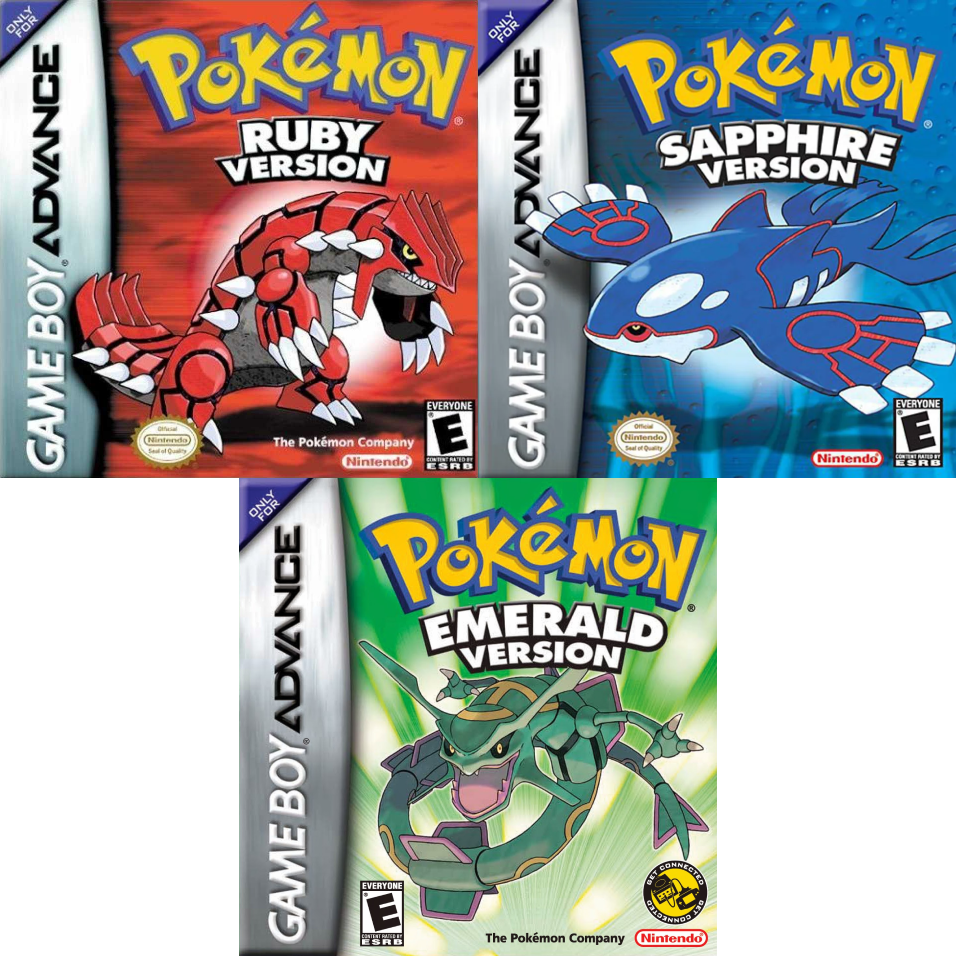

The third set of games in the Pokémon series, Ruby and Sapphire were released for the Game Boy Advance, with Emerald arriving a few years after. Along with FireRed and LeafGreen, Colosseum and XD, they are known collectively as Generation III of the Pokémon video game series. In addition to introducing a new story and region to explore and over 100 new Pokémon to catch, Ruby and Sapphire brought with it many new gameplay features such as individual natures and Abilities for each Pokémon, double battles, and Pokémon contests. Along with massive graphical improvements over its predecessors, these games also had an entirely new data structure; as a result, Generation III games were incompatible with the previous two generations.
The games took place in Hoenn, which is based on the Kyushu region of Japan rotated ninety degrees counterclockwisenote . The game begins with the player moving to their new home in Littleroot Town, and later saving the local Pokémon Professor, Birch, from a wild Pokémon. As thanks, he gives the player their own Pokémon, encouraging him/her to travel around the region and collect as much data on Hoenn's Pokémon as they can, much like Birch's child (and your rival) Brendan/May is doing.note
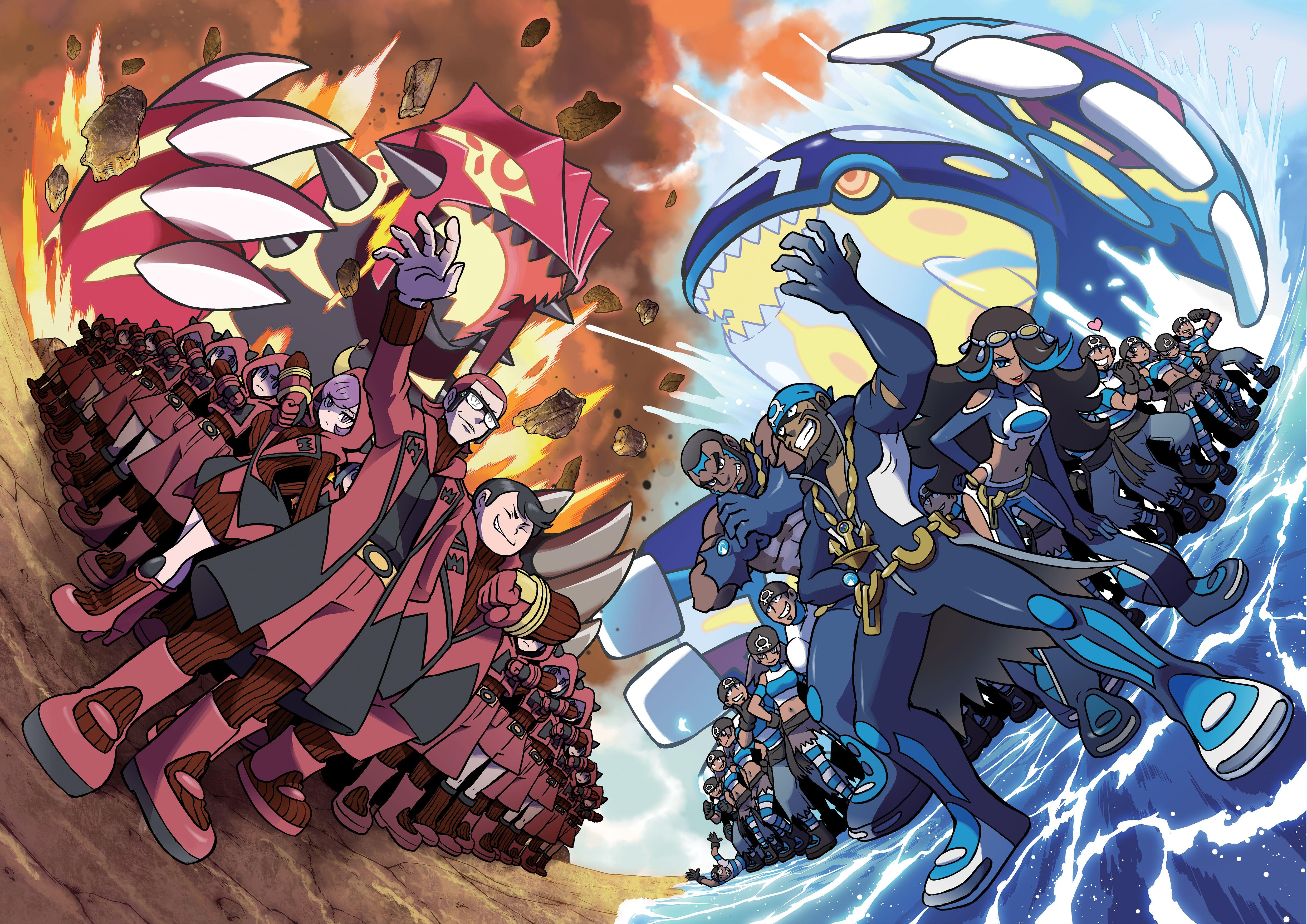
On their quest to be the best, players will encounter two villainous groups: Teams Aqua and Magma, who want to flood and dry out the planet, respectively. Sapphire players will become allied with Team Magma to stop Aqua summoning Kyogre, while Ruby Trainers help Aqua stop Magma summoning Groudon. Emerald put them both in the antagonist role, with Rayquaza being summoned to stop the chaos.
These games may be the biggest case of One Game for the Price of Two in the franchise, as there is no way to legitimately collect all 386 Pokémon without aid from FireRed, LeafGreen, Colosseum, and XD (and oddly, only Ruby or Sapphire, because Emerald has whatever Pokémon the other version lacks).note The Red and Blue remakes provided all 150 Kanto Pokémon and a small pool of Johto's, with Colosseum and XD having several from all three regions; together, they had all but the event-only Pokémon. Perhaps not coincidentally, it was during this generation that Nintendo stopped using "Gotta Catch 'Em All" as the franchise's slogan. Speaking of generations, the next one, Gen IV, starts with Pokémon Diamond and Pearl.
On May 7, 2014, The Pokémon Company announced remakes for the Nintendo 3DS, titled Pokémon Omega Ruby and Alpha Sapphire. Prior to their release, players could download a special demo version starting in mid-October 2014, which centered on Mossdeep Island. The games were released in November 2014 (Nov. 21 in most places, Nov. 28 in Europe), exactly twelve years after the originals' release in Japan. Groudon and Kyogre have newly-introduced "primal" formsnote , which are depicted on the boxart, other Pokémon get Mega Evolutions, lots of features were added or upgraded, and a post-league scenario known as the Delta Episode was included. These games are part of the "Sixth Generation" of Pokémon games and are compatible with Pokémon X and Y.
"Pokémon Omega Ruby and Pokémon Alpha Sapphire Animated Trailer" is an official animated trailer for the remakes.
- 100% Completion: First time in the series you get more than a diploma for completing the Pokédex - if you show Professor Birch a filled Hoenn Pokédex in Emerald, he'll give you your choice of one of the Johto starters.
- Ability Required to Proceed: The entire Eastern half of Hoenn is inaccessible to the player until the fifth badge has been obtained, as Route 118 cannot be traversed without HM Surf.
- After-Combat Recovery: The Battle Frontier facilities bar the Battle Pike (unless the Random Number God decided to be nice) and the Battle Pyramid will have your Pokémon healed after each battle.
- An Interior Designer Is You: The Secret Bases can be decorated with loads of different furniture and the like. You can also decorate your bedroom at home, though it's very limited in comparison.
- Animation Bump: Inverted in the case of the Pokémon battle sprites, which went back to being static after Crystal introduced animated sprites. Emerald brought back the animated sprites, but they were only two frames with some basic rotating and scaling as opposed to Crystal's full animations.
- Anti-Frustration Features:
- Relearning moves from a Pokémon's natural moveset was impossible in Gen I, and in Gen II required you to beat the Pokémon League of the side game Pokémon Stadium 2 with your own team of non-rentals. Starting from Gen III, an NPC (in Fallarbor Town for this generation) will do this for a Heart Scale. These can easily be farmed off of Luvdisc, can be found with the Item Finder scattered across the overworld, and occasionally can be given a reward from NPCs for doing certain tasks.
- The Soothe Bell was introduced to double up the happiness gain rate of its holder, speeding up the time needed to grind for happiness based-evolutions. This is very helpful since most Pokémon evolving through this method are too weak to grind happiness by leveling up, massages are limited to once per day and vitamins are expensive.
- In Ruby and Sapphire the Sky Pillar has sections with cracked floor tiles that force you to use the Mach Bike to traverse over them without falling through. Since Emerald added an event that requires you to come for Rayquaza's aid to complete the story, the cracked tiles are absent on your first visit.
- Starting in Emerald, some of the berries introduced will increase a Pokémon's friendship with its trainer at the cost of lowering one of its stats by a few points. Not only can the berries be regrown, this allows for fixing any mistakes made when Min-Maxing. And their secondary effects can also be stacked with the Soothe Bell.
- Alliterative Family: Victor, Vicky, Victoria, Vito, and Vivi Winstrate.
- Apocalypse How: The weather trio starts as an in progress Regional Disruption, but stated that if it is not stopped, will become a biosphere extinction (Groudon bringing harsh heavy everlasting sun, leaving desert wildlife, or Kyogre flooding the world, which allows purely aquatic life to remain).
- The Artifact:
- In Generation II, Pokémon hatched from eggs at level 5 to circumvent a glitch where if certain Pokémon gained less than a certain amount of experience at level 1, the value would underflow and they'd jump straight to level 100. It was fixed here, but Pokémon still hatch at level 5.
- In Emerald, there's a guy outside of the Slateport City Battle Tent that says he needs to catch Pokémon to compete in the battles there. However, the Slateport City Battle Tent uses solely rental Pokémon, meaning it shouldn't matter if the guy has Pokémon of his own. This is because in the other two versions, there's a Contest Hall there, where you do need to bring your own Pokémon. The line was only changed to switch the facility being referred to, without taking the different rules into account.
- Emerald, once you've beaten the Elite Four, adds an Altering Cave to Route 103 that's identical to the one in FireRed and LeafGreen. Like it, its purpose was completely defeated before the game even released - it was meant to be used with Mystery Gift events to change its encounters (by default you find nothing but low-level Zubat) into any one of a set of Generation II Pokémon that were previously unavailable in Generation III, but two months before FR/LG released all of those Pokémon were made available through Pokémon Colosseum. Emerald kept the addition of an Altering Cave, but there's no purpose to it, as all the Pokémon that would have been found through it were added to regular areas of the game: Smeargle can be found in Artisan Cave in the Battle Frontier, and all the rest were added to the Safari Zone.
- Artwork and Game Graphics Segregation:
- Banette is shown in official art to have pink eyes, a yellow tuft on its tail, and a golden zipper mouth, while the in-game sprite makes them all orange. The sprite also lacks the distinct triangle shape of the upper half of its eyes and the horns on its head also look smaller.
- Dusclops has five-fingered hands in its official artwork, but the in-game sprites have four-fingered hands instead.
- Salamence is shown to be the same shade of blue as its base form Bagon in official art, but the in-game sprites make him purple instead.
- Badass Family: The Winstrates, a family of trainers who challenge passers-by to fight them in succession. The family's oldest child and strongest member, Vito, is later met as a Cooltrainer (Ace Trainer in the remakes) in Victory Road.
- Bag of Spilling: The programming overhaul for the Mons made these games incompatible with the previous ones, and a large number of the Mons were unavailable until the release of FireRed and LeafGreen.
- Bait-and-Switch: Slakoth starts as a very lazy sloth that can only move every other turn, but it evolves into Vigoroth, a fast and ferocious Pokémon who can't even sleep. One might expect the final evolution to be even more aggressive, but Slaking actually becomes even lazier than Slakoth, though its monstrous stats help offset this.
- Balance Buff: Pickup received one in Emerald to smooth out the difference between the unintended Disc-One Nuke nature it had in Ruby and Sapphire and the poorly received Nerf it had in FireRed and LeafGreen. Rather than just one list that it could pull from, Pickup's rewards were scaled to level. Thus, it would generally only give low-level items early in the game. However, by the levels where you'd be expect to beat the Elite Four, it was giving out items on par with the Ruby and Sapphire version. And for the post-game, if you leveled up to above level 90, it gave out even better rewards than the original version. With tweaks, this version of the ability was used in all subsequent games in the series.
- Big Boo's Haunt: Mt. Pyre. The inside is your typical Pokémon resting place but the outside is a high mountain top that is covered by fog. Not all Pokémon encountered in Mt. Pyre are Ghost-type Pokémon, though.
- Big Damn Heroes: Invoked by the player character in Emerald, who climbs Sky Pillar to warn Rayquaza that Kyogre and Groudon are squaring off again. Rayquaza flies to Sootopolis City, makes a dramatic entrance from the clouds, and forces them both to retreat with a single roar.
- Blackout Basement:
- Brawly's Gym. Only the player and the three-by-three area around him/her are visible, but beating some gym Trainers increases the visibility radius. The Gym Leader grants the player Flash, which is used in a few caves.
- In the remakes, you can only see in front of you as everywhere else is pitch-black.
- Bookends: The first and last villainous team you fight in Emerald is Team Aqua.
- Bowdlerise: Occult Maniacs became Hex Maniac in the English versions.
- Brainy Pig: This game introduced Spoink and Grumpig, two highly-intelligent Psychic-type pig Pokémon who're themed around the proverb about "casting pearls before swine"- turning said pearls into literal pearls of wisdom carried around by the Pokémon.
- Breaking Old Trends: Ruby and Sapphire are the first games where the settlements aren't in some way related to a color, instead following a nature theme, which is lampshaded through Littleroot Town's motto being, "A town that can't be shaded any hue."
- Bring My Brown Pants: Implied to happen to Youngster Calvin in Emerald when he's doing crappy in Pokémon battles.Calvin: When I battled you, my shorts felt icky and coarse.
- Call-Back: One sidequest involves you running the gauntlet with a family, with the last member mentioning that their strongest member (the son) is off on a journey like yours. When you get to Victory Road, you meet said son, who misses his family and wants to visit them again.
- Call of the Wild Blue Yonder: Bagon's aspirations to fly fail causing it to fall and hit its head so hard and so often that it becomes tempered. However, its later evolutions see its dream realized, eventually evolving into a giant winged, flying Salamence.
- Cast of Expies: Downplayed; the first three Gym Leaders of Hoenn are riffs on the first three Gym Leaders of Kanto.
- Roxanne is Brock's Distaff Counterpart with a similarly defensive Rock-type Signature Mon and whose gym likewise involves the simple gimmick of navigating through a rocky arena to avoid trainers.
- Brawly is a Fighting-specialist Spear Counterpart to Misty the Water-specialist, but both share strong water athleticism motifs — Brawly's a surfer to Misty's swimmer.
- Surge and Wattson are Gadgeteer Geniuses that specialize in the Electric type and whose gyms are variations on the same theme of manipulating barriers with electric switches.
- Cave Behind the Falls: Meteor Falls is a rather small dungeon, until the player unlocks Waterfall, opening the rest up.
- Chekhov's Gun:
- A replica of Submarine Explorer 1 can be seen in Slateport's Oceanic Museum when you first visit it.
- There are a few oblique references to Rayquaza before you actually encounter it:
- At one point in Emerald, your rival calls and remarks on seeing a flying, green Pokémon in the sky. Players who don't know about Rayquaza beforehand may not think much of it due to the sheer number of calls from other trainers that are meaningless anecdotes about their day.
- Similarly, a couple in Lilycove mentions they are vacationing there and were excited because the first Pokémon they saw was a dragon flying through the sky.
- There's also a man in Fortree City who remarks on seeing a gigantic green dragon.
- Climax Boss: Norman, the fifth Gym Leader, and the player's father. Despite the fact that his Gym is closest to home, he refuses to fight you until you beat the other four Gym Leaders in the western half of the region. During the entire first half of the game, growing strong enough to challenge Norman is the player's primary goal. Beating him allows the player to use the Surf TM, unlocking the right half of the Hoenn region. Surpassing your father is what really gets you noticed by various NPCs. And Norman represents a massive spike in difficulty compared to the other Gym Leaders. The remakes make this even more apparent by adding particular focus on Norman's battle and its aftermath, wherein he sees you off as you and Wally set out for the other half of Hoenn and he even smiles at how proud he is at you surpassing him.
- The Computer Is a Cheating Bastard:
- Winona's Altaria has Dragon Dance despite it being only Level 33. It can't learn the move by level-up until Level 40, and Swablu doesn't learn it by level-up either...and that's all ignoring the fact that Swablu doesn't evolve into Altaria until Level 35 to begin with. What's more, in rematches she starts using a Dragonair that knows Earthquake - a move it cannot learn by any means until it evolves into Dragonite.
- The first battle against Maxie/Archie on Mt. Chimney have their ace Pokémon both in their final forms, despite them both being far below the level they evolve into said forms.
- In Emerald, Cooltrainer Dianne (fought in Victory Road) has a Lanturn with Earthquake.
- Console Cameo: Continuing the tradition from previous games, both playable characters have a Gamecube in their room and even a Gameboy Advance to use as the controller.
- Continuity Nod:
- The background music played inside the Oceanic Museum at Slateport is a remix of the S.S. Anne theme.
- One of the ship replicas contained therein is of the S.S. Anne itself.
- Ruby and Sapphire feature an NPC in Petalburg City stating that Norman (and by extension you and your mother) moved from Johto. For some reason, this was removed from Emerald, but the reference returns in Omega Ruby and Alpha Sapphire.
- Continuity Reboot: Essentially because Gen III reprogrammed the way Pokémon are coded, making it incompatible with Gen I and Gen II games. Because of this all the older games got remakes to bring them in line with the continuity Ruby and Sapphire started, both in how the games are coded and in narrative Retcons that imply Gen I is roughly concurrent with Gen III and Gen II with Gen IV, as well as planting a few more foreshadowing and shout-outs between all the games.
- Convection, Schmonvection: Mt. Chimney is an active volcano with a cable car station parked near its open crater. When Team Magma invades, one of the grunts will complain about his post and say his left ear is burning. After fighting him, he claims he's getting heat exhaustion and questions why Team Magma is wearing hoods in a volcano if you talk to him again after.
- Convenient Weakness Placement:
- The routes on the way to Rustboro give you 5 choices for Water- and Grass-types to deal with Roxanne's Rock-types; Marill (Emerald), Surskit (Ruby and Sapphire), Shroomish, Lotad (Sapphire and Emerald), and Seedot (Ruby and Emerald).
- There's also a boy on the northern side of Route 104 who hands you the TM for Bullet Seed, which, as a Grass-Type move, is super effective against Rock-Types.
- The Granite Cave near Dewford has the Ghost-type Sableye (Sapphire and Emerald) and Psychic-type Abra to deal with the Fighting-type user Brawly.
- Route 112, Fiery Path, and Jagged Path have the Fire/Ground-type Numel if you need help with Fire-type Gym Leader Flannery, and you can also potentially encounter the Rock/Ground-type Geodude when using Rock Smash on the boulders blocking the way to Route 112. Though the nearby desert of Route 111 that can't be accessed until Flannery's defeated has a couple more Ground-types, none of them would have been as useful due to being slow, not resisting Overheat, and not naturally learning any Ground-type moves stronger than Mud-Slap until very late levels.
- The routes on the way to Rustboro give you 5 choices for Water- and Grass-types to deal with Roxanne's Rock-types; Marill (Emerald), Surskit (Ruby and Sapphire), Shroomish, Lotad (Sapphire and Emerald), and Seedot (Ruby and Emerald).
- Cosmic Horror Reveal: The games start off as your standard Pokémon games (battle trainers, catch Pokémon, etc.) until it's revealed Team Aqua and Team Magma want to awaken an ancient god-like Pokémon (Kyogre or Groudon, depending on which version you're playing). As can be expected, it goes far beyond expectations resulting in either cataclysmic floods or drought that threatens to destroy all life on the planet. Naturally, it's up to the player character to save the world.
- Crutch Character: See the series' page here.
- Deadly Dust Storm: The desert in Route 111 is constantly plagued by a sandstorm so strong you initially can't explore it. You have to return with special goggles to avoid being blinded. This marks the point where subsequent regions would at least include a desert area covered in sandstorm.
- Death Mountain: Mt. Chimney is not just any mountain, but an active volcano. In the original games, Sootopolis is also a volcano, but a dormant one. Besides that is the mountain on Route 114 which also has Meteor Falls.
- Developer's Foresight: The series has a page here.
- Disc-One Nuke: See the series' page here.
- Downloadable Content:
- This is the generation in which Nintendo events blossomed into its full form. Various islands are accessible only with tickets, which are downloaded through Nintendo events, or via connection with an e-Reader and the appropriate e-Card.
- Ruby, Sapphire, and Emerald gives us Southern Island, which holds either Latias or Latios, and accessible with only the Eon Ticket.
- The AuroraTicket gives us Birth Island, which holds Deoxys, and is available only in Emerald, as well as Firered and Leafgreen.
- The MysticTicket gives us Naval Rock Isle, which holds Ho-Oh, Lugia, and the Sacred Ash, and is available only in Emerald, as well as Firered and Leafgreen.
- The OldSeaChart in Emerald gives us Faraway Isle which holds Mew.
- There are twelve kinds of berries only available through e-Cards, which could only be found by buying trading cards. Most of the cards were never released, some of which were only in Japan.
- Trainer Hill's layout can be modified with certain e-Cards.
- Jirachi and Celebi could be gotten only with certain promotional discs, to be connected with a Gameboy Advance-to-GameCube link cable.
- Some battles could be unlocked only with e-Reader connection and certain promotional e-Cards.
- Dramatic Timpani: The games are notable for having a timpani accompanying the Fanfare-like battle themes, to the point where they're famous for them.
- Dual Boss: Emerald includes an additional Double Battle where the player and Steven Stone team up against Magma Admin Tabitha and Magma Leader Maxie at the Mossdeep Space Center.
- Dying Curse: The new move Grudge works as one because when used by a Pokémon and that Pokémon faints from a direct attack by the opponent, the attacking move's PP drops to zero. This is upgraded from Spite, which lowers your PP by 1-5 points.
- Early-Installment Weirdness: An oddity relating to the Pokédex is that Hoenn's regional Pokédex is the first one in the series to not have every Pokémon numbered. What makes this stand out is that instead of stopping at 202, every Pokémon is still included, just without new numbers (or any numbers at all, rather). The 3DS remakes simply removed the unnumbered Pokémon from the Hoenn Pokédex.
- Emerald Power: Rayquaza, the being one of the strongest Olympus Mons you can capture and implied to be more powerful than Kyogre and Groudon.
- Endless Daytime: While the games do have an internal clock, the engine lacks of visible day-night cycle, causing Hoenn to appear to have perpetual daylight all the time.
- Eternal Engine: New Mauville. Originally meant as an underground city, construction was abandoned when it was found to be crawling with wild electric type Pokémon.
- Evil Versus Evil: Teams Magma and Aqua are constantly at odds with each other, though this trope only applies in Emerald where they are both evil. Each version lets you take a different response to it. (In Ruby, you team up with Team Aqua to defeat Team Magma. In Sapphire, it's the other way around. In Emerald, you fight both of them.)
- Fanfare: The gold standard, as far as Pokémon games go. One of many things the Hoenn games are famous for is the unique soundtrack.
- Fantasy Counterpart Culture:
- Sootopolis City's architecture is based on the island of Santorini, Greece.
- On the actual culture however, Hoenn seems to be a bit of a rural island, or at least an island that has very strong traditions. It has strong port cities but those don't have Gyms. The only major city to have a Gym is Rustboro, and it's implied that is a fairly new Gym at that.
- The legendaries seem to be based on Jewish mythical creatures: golems (the Regis), Leviathan (Kyogre), Behemoth (Groudon), and Ziz (Rayquaza).
- Fantasy Counterpart Map: Hoenn's map is that of Kyushu, Japan, rotated ninety degrees.
- First Town: Littleroot Town. For the first time in the series, the only way out is North with no alternate water path on the opposite side.
- Flashy Protagonists, Bland Extras: Hoenn has a large number of important characters with blue, purple, and even silver hair - more so than most other regions.
- Forced Tutorial: Unlike in the previous games, the tutorial on how to capture a Pokémon is now mandatory. Instead of the game teaching the player character directly however, they use Wally to do it and it doubles as a plot point since it is his first time catching a Pokémon and he becomes your rival later on.
- Forever War: Seviper. And. Zangoose. The feud between these species will be mentioned in the PokéDex entries for both in every generation going forward.note It will also become a plot point in the anime at least twice, since Jessie has a Seviper in Hoenn and Sinnoh.
- Franchise Codifier: Ruby and Sapphire established the formula for the series' plots from then on: each region is far away from the last, and the villains want to use the mascot legendaries as part of their plan. In terms of gameplay, they introduced abilities, completely overhauled the way Pokémon's stats are determined, and completely redesigned berries by giving them distinctive appearances, names, and flavours, and allowing players to grow them. They also defined the series' look from then on, such as making Pokémon Centers orange and Poké Marts blue, and the colours in Ken Sugimori's artwork became more vibrant.
- Game-Breaking Bug:
- One year after the game's release, an off-by-one bug, called the Berry Glitch
 , would result in Berries ceasing to grow in Sapphire and Ruby - along with stilling/freezing anything else relating to the passage of time (e.g. the tides in Shoal Cave). Linking with FireRed, LeafGreen, Emerald, Colosseum, XD, an event for a Shiny Zigzagoon at EB Games, a pair of Japanese promo e-Reader cards, non-Japanese releases of Pokémon Box, or the PAL release of Pokémon Channel patched the error. Due to the bug's nature, even if you couldn't access any of the myriad fixes, it would cease affecting your game at most one year after it started.note
 - The internal batteries that handled clock-based events in the initial Ruby, Sapphire and Emerald weren't the longest lived either, so there was a good chance they would fail (with the same effects as the Berry Glitch), and unlike the Berry Glitch, as it is a hardware issue and not a software one, it can't be fixed. Fortunately, unlike Gold, Silver, and Crystal, the battery isn't used to retain save data as well (which is stored using flash memory; FireRed and LeafGreen don't have batteries at all), so the game can still be played, just without the time-based events. Replacing the battery restarts the flow of day, allowing Eevee's evolutions to vary and Shoal Cave's tide to change, but completely destroys the clock-based events of the game unless you start a new file or use external devices. note
- The Pomeg Berry Glitch in Emerald allows you to reduce a Pokémon's HP to negative digits. While most side effects are normally harmless, you can potentially lock a battle into an infinite loop if the Pokémon with negative HP is hit with a HP draining attack.
- One year after the game's release, an off-by-one bug, called the Berry Glitch
- Gameplay and Story Segregation: There's an extremely rare but possible chance for Wally to knock out the Ralts he's trying to catch during the catching tutorial. Despite this, he'll still act like he caught his first Pokémon after the battle ends, and the story proceeds as normal.
- Giver of Lame Names: A pair of NPC's reference this trope, warning the player to be careful when choosing their Pokémon's names. Of note, the old man named his Pikachu "Pekachu". Worse in the remakes, as the said old man's Pokémon is now a Shroomish with the same name.
- Guide Dang It!:
- While the Pokédex tells you that Feebas can be found on Route 119, it does not tell you that they will only spawn in six randomly-chosen water tiles (out of the 436 in the route) that are re-rolled under certain conditions. Making matters worse is that you're not even guaranteed to find Feebas when fishing on those tiles.
- The Pokémon Chimecho is not used by any trainers in Ruby and Sapphire, which will leave you with an empty slot in the Pokédex that you won't be able to fill easily (the Pokédex tells you where you can catch Pokémon you've seen). It only appears in one area — the top section of Mt. Pyre — and is extremely rare on top of that with a 1% encounter rate, making it extremely easy to miss.
- In Contests, using certain move combinations (i.e. Sunny Day on turn 1 and then Solar Beam on turn 2) will net you bonus appeal points. The only hint towards this is that the second move is highlighted the turn after you've used the first one. Since Pokémon can only know four moves at a time, finding these combinations through gameplay is a tedious process, assuming you ever figure out that they exist to begin with.
- Finding the Regis. First off, you have to go to Pacifildog Town and solve a puzzle involving water currents. Once you find a water spot to Dive in, you'll follow a path to a cave. Once you're in the cave, you'll find walls written in Braille. Once you decipher the message of the walls, you'll need to get a Wailord, a Relicanth and a Pokémon that can use Dig (which if you accidentally lose, it makes getting them much harder), put them in your party in a specific order (Wailord in the front, Relicanth in the back) and go back to cave. The game will then shake and then you have to go to plains where specific rock formations are around Hoenn to find a cave that is now accessible. Then you have to solve individual and cryptic puzzles in each of those cave formations to open the room where the Regis reside so you can challenge them. You got all that? The only way this could be "easier" is if you had the European version and knew the game manual had a Braille section allowing the player to understand what the walls said. If not, good luck finding these guys without spending hours of trial and error.
- Hello, [Insert Name Here]: Standard for the player character. However, these games contain a notable inversion with the rivals, as they're the first (but not the last) that don't let you input names for them.
- Hot Skitty-on-Wailord Action: The Trope Namer via the possible breeding pair of the tiny Skitty and the huge Wailord.
- Hypocrisy Nod: In Emerald, Maxie calls out Archie for awakening Kyogre and causing heavy rainfall that will flood the continents, even though Team Magma awakened Groudon to expand the world's landmass. He then admits to the protagonist that he has no right to be critical of Archie, but asserts that this is beyond the matter of who is to blame and that stopping the two legendaries is their top priority at this point.
- Impassable Desert: The desert on Route 111 cannot be entered due to the perpetual sandstorm, so the player must detour through the Fiery Path under Mt. Chimney. Birch's kid will provide you with the Go-Goggles needed to protect your eyes so that you can explore it once you defeat Flannery at the Lavaridge Gym.
- Interface Spoiler: Ninjas are a class of trainer that appear on Route 119 and 120 and disguise themselves as parts of the environment they are in. Unfortunately, you can tell even from the start that they are not just a part of the environment because no "tree" in the game looks like their disguise.
- Jolly Roger: Team Aqua, a villainous organization that seeks to expand the world's oceans and whose members dress like pirates, use as their symbol a stylized A, white on a black or blue background, with a rounded central part and "legs" ending in femur heads. This is prominently displayed on both their vehicles and on the bandannas worn by each member.
- Just Add Water: Making Pokéblocks boils down to tossing a few berries into a berry blender, tapping triggers set around the central container to make it spin for a minute or so, and then out pops a tasty treat. In the remakes, it's simplified to just tossing berries into the blender.
- Justified Tutorial: The "How to Catch Pokémon" tutorial is justified by Norman asking the player character to teach Wally catch his first Pokémon.
- Lame Pun Reaction: Route 113 has the volcanic ash falling on it endlessly. One of the characters post-battle with you says "Ouch! Owww! I can't see! I got ashes in my eyelashes! Get it? Ashes and eyelashes? Okay, that was bad, sorry..."
- Large Ham: Several Trainers shout at the top of their lungs, especially in the Emerald-exclusive Trainer Hill.
- Lava Pot Volcano: The peak of Mt. Chimney, Hoenn's tallest mountain, is filled with an immense lava lake that constantly rains volcanic ash over the route to its north. In Emerald, the Legendary Pokémon Groudon sleeps within this lake.
- Lethal Lava Land: About a third of the way through the game the player visits Mt. Chimney, a volcano with an open lava dome. In Ruby and Sapphire only the outside is visited, but Emerald requires exploring the caves within the mountain.
- Lethally Stupid: The game constantly lampshades the fact Team Magma and Team Aqua's plans make no sense whatsoever, particularly when they appear in the Slateport Museum or the Weather Institute, and that their benefits would not only not happen if their plans are executed, but that they are actually going to make things worse. However, it is the aforementioned lack of knowledge and them having the resources to pull off their plans that makes them large threats to begin with.
- Long Song, Short Scene: The victory music against the Elite Four and Champion, which sounds like you being congratulated by a marching band, actually goes on for 35 seconds, but chances are most players will only hear the first 7 seconds. However, they really make those 7 seconds count, to the point people may not realize it goes on longer.
- Lost in Translation:
- The international versions of the game Bowdlerized the sprites of the Hex Maniacs by giving them pupils. This, in turn, missed the point of them having Monochromatic Eyes in the first place: to make them seem crazed like with their depiction in the Sixth generation games.
- Want to know why Azurill is referred to as a "Polka Dot Pokémon" despite its design not featuring any Polka-dots? In Japanese, Polka Dots are known as a "Mizutama" or "Water Ball", which is a more apt descriptor for Azurill.
- The "Where did you come from? Yes or no?" joke is also a pun on Game Freak headquarters (High Town) during development of the games. The pun does not translate in non-Japanese versions.
- Luck-Based Mission: Shares a page with the rest of the franchise.
- Missing Secret: After Birch's kid returns to Littleroot Town after their final rematch in Lilycove City, he or she speculates about meeting the Player Character on the road, but no such encounter happens.
- Mutually Exclusive Power-Ups: You can only have one of the e-Reader Berry species at a time.
- Narcissist: The Trick Master's passwords are made up of self-aggrandizing sentences."Trick Master is fabulous."
- Naval Blockade: Team Magma/Aqua use a team of tamed Wailmer to blockade one of the port cities, forcing you to deal with them and advance the story before you explore the ocean.
- The Needless:
- There are 7 people on Route 113, a Route that is covered in perpetual volcanic ash. In real life, prolonged exposure of the respiratory system to inorganic particulates such as volcanic ash would lead to suffocation or even worse, lung cancer. Yet, the people you meet there will never show any ill effects whatsoever from standing around in that area the entire time.
- Averted in Emerald for the man in the glass workshop. He has clearly suffered ill effects from living there for so long, stopping to cough or catch his breath at the end of every sentence.
- Nerf:
- The damage dealt by the weather effect Sandstorm has been decreased from 1/8 of every Pokémon's total HP to 1/16.
- The Frozen status effect now has a 20% chance to be cured on each turn, increased from Pokémon Gold and Silver's 10%.
- In Ruby and Sapphire, the newly introduced Pickup ability can randomly grant an item after battle, and has a static loot table it pulls from. This includes things like PP Ups, Nuggets, and Rare Candies, which are usually reserved for midgame but can be obtained incredibly early due Pokémon with Pickup being available as soon as the first Route. Emerald revamps loot table to change based on the owner's level instead, locking the more powerful items to lategame drops.
- No Fair Cheating: The Faraway Island event in Emerald has a small mini-challenge involving finding Mew, who is hidden in tall grass, to interact with and battle it. If you try using the Cut HM to cut the tall grass away, Mew immediately flies away, preventing you from battling it, and doesn't come back unless you leave and return.
- Non-Damaging Status Infliction Attack: This generation introduces the new moves of:
- Odor Sleuth, which removes the effects of Evasion Status Buffs and allow Normal and Fighting attacks to hit Ghost-types.
- Will-O-Wisp, which inflicts the Damage Over Time status, "Burn".
- Emerald has the only instance where one of these can inflict Frozen, and it's technically an event, not a battle. In the Battle Pike, A Gentleman's Dusclops can run up and try to freeze your Pokémon with an "Ice Beam", although not dealing the damage of a regular one. The trainer claims it's easily startled due to its Timid nature.
- Noob Cave: Petalburg Woods, as typical of the series. Basic Pokémon with weak attacks, a few hidden items and side-areas to explore, low-level trainers, and it's shortly after you become able to begin building a proper team.
- Not the Intended Use: Black Pokéblocks are intended to be a punishment for picking the wrong berries, with a paltry 2 points in three random flavors. However, since they still use the normal feel calculation, using four Nutpea or Kuo Berries (which have the smallest possible smoothness of 5) will make Black Pokéblocks with only a single point of feel, giving them a top-tier flavor-to-feel ratio and making them the best option to max out a Pokémon's contest stats... if you and three of your friends (as this is only possible with four human players) are willing to grind out the several hundred blocks this will require.
- Oddball in the Series: The Pokédex entries of these games are about twice as long as the others; where Generations before and since only had about two sentences in their entries, Ruby and Sapphire had two pages in theirs. They were trimmed for Emerald.
- Oh, Crap!: Kyogre and Groudon will do this once Rayquaza appears in Emerald and back off.
- Ominous Fog: The upper levels of Mount Pyre are perpetually covered in fog, giving it the ambiance expected of a giant Pokémon graveyard.
- Ominous Pipe Organ: A brief but memorable organ tune plays in Emerald as Rayquaza descends to halt Groudon and Kyogre's rampage.
- One-Hit-Point Wonder: Introduced in this generation, Shedinja only ever has one hit point but its Wonder Guard ability means it can only be hit by moves that would be super effective against it. However the ability does not protect against indirect damage caused by weather or side effects of moves like Leech Seed.
- One-Steve Limit: Zig-zagged. We have Wallace and Wally, with the latter being both a name and a nickname for someone named Wallace.
- Optional Boss:
- The ruins containing Regirock, Regice, and Registeel will open up after completing specific requirements in the Sealed Chamber.
- Both Kyogre and Groudon appear in Emerald after beating the Elite Four, in caves that mysteriously appear and disappear on several routes.
- Rayquaza appears at Sky Pillar in all three games, with the point of availability being dependent on version. In Ruby and Sapphire it's strictly post-game, while in Emerald you can go grab it as soon as the fight between Kyogre and Groudon has been resolved.
- The Frontier Brains in Emerald's Battle Frontier. Fighting them requires beating their facility twice without failure, and can be fought a second time (with a different team of Mons) by doing so again.
- Latias, Latios, Mew, Lugia, Ho-Oh, and Deoxys can be found on special islands only accessible via Nintendo distribution items that were available for a limited time. Deoxys' forme is dependent on what game it is encountered in (Normal in Ruby and Sapphire, Speed in Emerald), while whether Latias or Latios are fought via this method is dependent on how the Schrödinger's Question the player's Mom asks in Emerald was answered.
- Peninsula of Power Leveling: See the series' page here.
- Permanently Missable Content:
- It's very easy to miss the Master Ball in Ruby and Sapphire. It's hidden in an optional room of Team Magma/Aqua's Lilycove hideout that's only accessible via a warp-tile puzzle, and the base closes up once you gain access to the Seafloor Cavern. In Emerald, the hideout remains open.
- The opportunity to battle and catch Pokémon in the Cave of Origin is lost after the completion of the Weather Trio crisis event in Emerald.
- The rooms of the Trick House north of Slateport City cannot be revisited once they have been completed, resulting in the possibility of some items (visible and hidden) being missed forever.
- Naval Rock Isle, Birth Island, Southern Island note and Faraway Island were only available by getting special tickets from Nintendo events. In Ruby and Sapphire, Southern Island can't be revisited after the Lati residing in it has been dealt with.
- Perpetual Storm: Invoked in Sapphire when Kyogre is awakened by Team Aqua and starts an unrelenting downpour, although it's stopped by the Player Character before things get too far. Their plan is to increase the size of the oceans. (The opposite happens in Ruby, wherein Team Magma awakens Groudon to dry up the oceans instead.) In Emerald, Groudon and Kyogre's battle causes the weather to rapidly shift between oppressive rain and overwhelming heat until Rayquaza is summoned.
- Pet Contest Episode: This is what Pokémon Contests are, with participants winning prizes by comparing their Pokémon's beauty and showing off their moves rather than battling each other directly.
- Pop Quiz: The 5th challenge in the Trick House involves answering a series of questions posed by mechanical dolls.
- Port Town: Two in the series for the first time. There is the industrialized Slateport City and the luxurious resort and art center Lilycove City.
- Power-Up Food: Pokéblocks increase a Pokémon's stats for contest competition.
- Random Number God: Fishing in this game subjects you to a random check every time you were trying to get a Pokémon. Each check had to be precise and the number of seconds you had to wait per check was always different.
- Read the Freaking Manual: The PAL manual contains a translation of the Braille alphabet so you can read the writing found in the Sealed Chamber, Desert Ruins, Island Cave, and Ancient Tomb.
- Recycled Soundtrack: The music for Archie and Maxie battle recycles some parts from Game Freak's older game Bushi Seiryuden
- Red Herring: Early in the game, the player can fight the Winstrate family, who challenge you all in a row with no chance to heal in between fights. After they are defeated, every member of the family starts gushing about how great of a trainer the family's eldest son is, and how the player could never beat him. One of them even speculates that he has become the Champion. Towards the end of the game, you do eventually get to fight him— an Ace Trainer in Victory Road who is of no importance to the plot and no harder than any other trainer in the area. It's even possible to bypass him and not even realize it.
- Schrödinger's Question: Upon starting the post-game in Emerald, the Player Character's mother is watching a news report about the sighting of a strange Pokémon roaming Hoenn, but doesn't catch its color and asks the player what it was (between red and blue). Whatever answer the player chooses is correct, and determines whether the roaming Pokémon is Latias (red) or Latios (blue).
- Shifting Sand Land: There is a large desert on Route 111 with a constant sandstorm raging, so you need goggles to get across it. The Root and Claw Fossils and Regirock can be found here.
- Ship Level: The S.S. Tidal which can be taken between Slateport and Lilycove in the postgame. During the main story there is also the abandoned ship on Route 108 which is a broken down and half sunken ship.
- Shout-Out:
- Young Couple Lois and Hal; interestingly, they're absent from Emerald.
- Route 113 is a place covered in ash - but if you've ever played any of the EarthBound/Mother games, the music will make you think of a place covered in snow.
- The TV in the player character's house plays a movie in which "Two men are dancing on a big piano keyboard."
- On Route 127, there is a fisherman Jonah who has a Wailmer.
- Side Quest:
- New Mauville, an expansion project to Mauville City that the player can explore as an optional area.
- Pokémon Contests were first introduced in this generation.
- Silly Reason for War: The "war" Team Aqua and Team Magma wage on Hoenn as well as each other is all levels of dumb. One side wants to dry up all the oceans because more land is good for Pokémon. The other wants to flood the entire landmass because more water is good for Pokémon. The result? Either the sun turns baking hot, the rain falls uncontrollably, or you get both ridiculous weather conditions alternating rapidly back and forth. No matter what happens the entire Hoenn region is almost rendered unlivable for both Pokémon and humans alike if not for the timely intervention of our heroes.
- Skippable Boss:
- Subverted with Brawly and Winona. While it's possible to skip them and continue the story, the player will have to come back to beat them so they can access Norman (who requires you have the previous 4 badges) and the Elite Four and Champion (who require every badge).
- Played straight with final Rival fight in Lilycove City, though they will block access to the Department Store until they are beaten.
- Slippy-Slidey Ice World: The lowest level of Shoal Cave is inexplicably frozen over, complete with its own sliding ice puzzles. While you can find Ice-types anywhere in the cave, the lowest level is home to the rarest ones.
- Snake Versus Mongoose: This game introduces the serpentine Seviper and the herpestid Zangoose, whose Pokédex entries emphasize the bitter enmity between them and whose bodily markings are the same color as the others' main weaponsnote , suggesting that these are scars from one encountering the other.
- Summon Bigger Fish: After Kyogre and Groudon start fighting again in Emerald, threatening the world, you must climb Sky Pillar to warn Rayquaza about this, upon which the latter flies to Sootopolis City and forces them to back down.
- Superboss: Steven Stone can be found in a hidden room in Meteor Falls that opens up after beating the Elite Four in Emerald. He's the strongest trainer in the game, and one of the strongest in the entire franchise.
- Super Not-Drowning Skills: The Dive move allows the player to travel underwater, without a scuba mask. Humorously, if you have any Pokémon that are normally weak against water, they can battle and not lose their HP.
- Temple of Doom: A few examples, notably the Sky Pillar where the player can encounter Rayquaza. It has cracks in the floor that can only be moved over with the Mach Bike if moving fast enough. Otherwise the player just falls through the floor. There is also the series of Sealed Chambers where Regirock, Regice, and Registeel are hidden which require the player to interpret Braille and then complete an action. Emerald adds the Mirage Tower in Route 111's desert which has the same cracked floor puzzles.
- Third-Option Adaptation: When the stories of Ruby/Sapphire were combined for Emerald: in the originals, one of the Teams is less dangerous than the other (Aqua in Ruby, Magma in Sapphire) and the player helps them defeat the other Team, while in Emerald, both Teams become equally dangerous, and the player becomes a Wild Card.
- Toggling Setpiece Puzzle: Alternating electrical currents in the Mauville City Gym. As the player's character makes their way to the leader, they not only have to challenge the local trainers but also toggle the electrical barriers by pressing switches. Namely, when a switch is pressed, the current barriers turn off while others turn on, shifting the layout of the maze.
- Tree Top Town: The aptly named Fortree City is largely made up of treehouses. Only the Pokémon Center and Gym are on the ground.
- Tree Trunk Tour: You are able to create a hidden base, which you can then send to another player. One of the location types available for this are large trees.
- Triumphant Reprise: The second movement of the Champion encounter theme is an accelerated arrangement of the last movement of the Slateport City theme.
- Tropical Island Adventure: The Hoenn region is composed of tropical islands.
- Under the Sea: With HM08 (Dive), a feature that didn't return until Black and White. Over a quarter of the game takes place in the ocean.
- Video Game Delegation Penalty: You may choose to leave two of your Mons at the Pokémon Day Care. Pokémon in Day Care gain one experience point per every step the player takes. While its nice to have a Pokémon leveling-up while you simply walk around, there are several drawbacks to this method. For one, Pokémon in Day Care will not evolve. Two, if a Pokémon reaches a level where it can learn a new move, it will always learn that move; if the Pokémon already knows four moves, its first move will be forgotten and the new move will be placed last. This can lead to your Mons forgetting moves you wanted while learning moves you do not. Third, the Mon will not gain Effort Points as it would have if you leveled it up yourself through battle. This will leave it with somewhat lesser stats at higher levels than it would have had if you leveled it up yourself.
- Volcanic Veins: Groudon, Kyogre, and Rayquaza show this off in the title sequence of the game to show off how powerful they are.
- Waiting Puzzle: In Ruby and Sapphire, the way to open the door to Regice's room is... by waiting for two minutes. You might well do it accidentally while trying to decipher the Braille on the door.
- Waltz on Water: The Pokémon franchise's single most infamous use of this trope, its surfing music features a French horn solo that helped make the generation infamous for water and trumpets.
- Water Is Womanly:
- The Water-type Sootopolis Gym has all its trainers (excluding the Gym Leaders — the campy Wallace and Juan, who emphasizes the beauty, grace, and artistry of water, in Pokémon Emerald) as women. Most of the female trainers are of the "Beauty" Trainer Class and all their Pokémon are female as well.
- Most Water-type moves fall under the "Beautiful" condition for Pokémon Contests.
- Wham Shot: Entering the Champion's chamber after beating the Elite Four, and finding out Steven inside. The Champions in the previous two games were an arrogant kid and a clear badass, so finding out that the nice guy who's been helping you here and there is the Champion can be quite surprising.
- What the Hell, Player?: If you try to use a Poké Ball on the Interviewer duo's Pokémon, they'll remember it, unlike most Trainers. The next time you see them, they'll tell you they were so shocked about it that they told everyone else, and their next TV broadcast will include a stern reminder not to use Poké Balls against trainers, as well as another reminder that the player "is strong, but has no clue about the basic rules."
- You Are Not Ready: Norman, the player character's father and one of the Gym Leaders, requires you to go collect 4 badges before you're allowed to challenge him. This serves the purpose of dividing the game up neatly into two parts, as the east side of the map opens up after you defeat him and obtain Surf.
- You Can't Thwart Stage One: Played straight with the evil Team's plans to awaken the title Legendary. What makes the straightness interesting though is that its unique among Pokémon games; the rest have the evil teams stopped before the "let legendary Pokémon do X" stage, while these games actually show them in the process of attempting to burn the world to a crisp/flood the world.
- Abandoned Mine: Sea Mauville was an offshore rig for gold prospecting and energy research, and Mauville City, along with New Mauville, was the housing project intended to provide residence for the workers. The storage room contains an exorbitant stash of 12 Gold Nuggets (8 big, 4 small) and the Beedrillite.
- The Ace: Lisia treats you like one when you defeat her in a contest, stating that you're superior to her because you're a master at contests, filling your Pokédex, and taking on the Pokémon League.
- Achievements in Ignorance: Ironically, the villains in the game inadvertently achieve their stated goal, just on a much lesser scale. As Professor Birch tells you when he gives you the National Dex, the brief bout of extreme weather managed to change Hoenn's environment enough to make the region far more favorable to Pokémon, proven by the fact that you can find far more species now using the PokéNav.
- Adaptational Dye-Job: Shelly and all the female Team Aqua Grunts used to have orange hair. Now their hair is black, with a single blue streak for Shelly.
- Adaptational Attractiveness: The designers changed or updated many character designs to be less plain.
- Adaptation Expansion: The remakes added various new scenes and events to the story and greatly fleshed out the characters' personalities.
- Adaptational Villainy: Played with in both games; In Omega Ruby, Maxie is a bit more ruthless than he is in the original games, seemingly not caring about Pokémon and wanting humanity to simply expand at any cost, and accusing Tabitha of wanting to replace him as leader when the Admin tries to warn him against awakening Primal Groudon. Inverted with Archie in Alpha Sapphire, who cares a great deal about Pokémon and his grunts and admins; Matt sees him like a brother, and Shelly is a childhood friend. This even expands to their hideouts. In the Aqua hideout, Archie had a photograph of him, Shelly and Jirachi taken approximately twelve years agonote , and states when Kyogre awakens that he wanted to take the world back to its beginnings to make "that Pokémon" happy. Contrast this with Maxie, who only has a bed in his room, and simply talks about taking humanity to new heights once Groudon awakens.
- Advertising Disguised as News: The TV program "Shall We Dowse?" is an ad for the Dowsing Machine with Blatant Lies liberally applied, even claiming that the player character found a boy/girlfriend by using the Dowsing Machine.Host: What's more, from then on [name] became so popular with the [ladies/fellas] that it has become a problem!
Audience member: (Murmur murmur) Just like that?!
Host: Well I, for one, am jealous! This, too, is all thanks to the Dowsing Machine! - Age Lift: He's a minor character, but the Fossil Maniac used the sprite of the teenage-looking Pokémaniac in the originals. In the remakes, he's a Ruin Maniac, a trainer class that looks middle-aged at least. Strangely, his kid brother didn't get one.
- Inverted by Tate and Liza who go from been about the same age as the player to becoming young children.
- All There in the Manual:
- Wally's battle theme is not just a battle theme. It's also a theme meant to symbolize the rivalry between you and him (as evident by the fact that it's officially called "Rival's Theme" within the soundtrack).
- According to the soundtrack, the song that plays during the epilogue to the Delta Episode is meant to be the theme song of the remakes themselves and is named "Strains of a New Beginning" within the English translations of the game.
- The soundtrack reveals that Rayquaza's battle theme is meant to be the true version of the equivalent song from the original games, as they both share the name "Battle! (Super-Ancient Pokémon)". While the song for Groudon and Kyogre is extremely similar, it's meant for their Primal Reversions and called "Battle! (Primal Reversion)".
- Alternate Universe: The Delta Episode implies that the remakes are alternate universes to the original Ruby and Sapphire games, with the Points of Divergence being the fact that the evolution of Pokémon took a slightly different path, the existence of the war in Kalos, and the discovery of Mega Evolution. It's also implied that the different versions of each game could be alternate universes to each other (a fact that had already been explored somewhat in Black and White); when you first enter the Battle Resort in Alpha Sapphire, Maxie muses that perhaps, in another reality, he was the one you fought, and summoned Groudon. Archie does the same in Omega Ruby.
- Amazing Technicolor Battlefield:
- While fighting Maxie or Archie in Seafloor Cavern, the background is a sea of fire and lava with bypassing flying fire rocks, or a water whirlpool, respectively.
- You literally fight Deoxys within the stratosphere.
- You fight the non-Hoenn legendaries except Regigigas (as well as the Lati@s you get with the Eon Ticket in spite of being native to Hoenn) in an arena resembling pinkish dreamy clouds.
- And Your Reward Is Clothes: The Cosplay Pikachu is given to you once you enter your first Contest, at which point you can bring it to the dressing room in any Contest Hall to change its costume. Thankfully it's not just a Cosmetic Award, as each outfit gives her a new move normal Pikachu can't learn otherwise.
- Anti-Frustration Features: A lot of gameplay elements are tweaked to be more forgiving.
- Many of the features from X and Y return, such as Super Training and the changes to breeding mechanics.
- Rare Pokémon that you haven't caught yet appear more frequently in the overworld than normal encounters.
- Every O-Power except for the Hatching Power is obtained in Mauville's Pokémon Center, though each one requires progressing through the story first.
- Granite Cave has been redesigned so that Steven is right at the entrance, making the rest of the cave optional. In addition, the darkness in the lower floors is negligible, and can easily be navigated without Flash.
- It's now possible to own both the Mach Bike and Acro Bike at the same time, although you're only allowed to do so after beating the game. Still, it beats having to constantly run back and switch bikes to get through different areas.
- The kinds of Pokémon you can get are specifically arranged so that, with some trading between the various Generation VI games, you can complete the National Pokédex without having to import any Pokémon from previous generations despite this being possible through PokéTransport. Granted, you still need to do the latter in order to obtain Mythical Pokémon without getting their distributions, though they still won't count towards your completion rate (save for Deoxys).
- Pokéblocks are considerably simplified and easier to understand. The idea of them having feel is gone and they can only have two levels, you're not dependent on what berries NPCs throw in to get the color you want, and there's no need to play a minigame. Just open up the Pokéblock Kit, pop in four berries of your choice (with the game now pointing out which ones increase which contest stats), and out pop four Pokéblocks of the predominant color in the blend (or a rainbow block if four different ones are used). Further, there's no limit to how many Pokéblocks a Pokémon can eat now and their preference isn't affect by Natures, so feel free to stuff them full of basic-level blocks as much as you want if you can't get your hands on plus ones. This also makes it much easier to evolve Feebas.
- Several points in the game that required backtracking in the originals now give you an option to just travel there immediately. For example, after beating Flannery your rival will offer to travel with you to Petalburg City so you can fight Norman.
- The cracked floor tiles found in Granite Cave and Sky Pillar that required the Mach Bike have been completely removed, making traversing them much easier.
- Getting Feebas is no longer a Guide Dang It!, as it can be found anywhere on Route 119's river with any of the fishing rods. Alternatively, just fish in the shadow under a certain bridge during the day, and you will find Feebas all the time. If it's night, you can fish it by a rock in the southern part of the route instead.
- The Safari Zone is now free, doesn't have a step limit, and allows you to catch Pokémon the old-fashioned way, meaning no more fleeing Pokémon.
- If you couldn't catch Kyogre or Groudon, they will respawn in the Cave of Origin after beating the Elite Four. Deoxys will spawn at the top of Sky Pillar if you couldn't catch it during Delta Episode.
- The ice tile puzzles in Wallace's gym stay solved if you fall through the floor on the next one and need to climb back up; in the original games, a fall meant starting over.
- Surfing the ocean routes is made more manageable: encounter rates are lower, there are Ace Trainers so you're not just fighting Water Pokémon, the PokéNav map on the bottom screen makes it significantly easier to figure out where you're going, and movement speed is faster (and can be increased further by Surfing on a Sharpedo).
- You can use Fly to travel to any location now, not just towns. You still need to walk to the specific part of that location you want to get to, but it's a huge cut to travel time. After fighting the title Legendary in the Cave of Origin, you get the Eon Flute so you can use Latias/Latios to Soar without even needing them in your party. Without even needing them in your game, in fact.
- Since catching Rayquaza is now mandatory to complete the game, its catch rate has been increased significantly.
- If you raised the affection levels of a Pokémon in Pokémon-amie, then traded it from X and Y to Omega Ruby and Alpha Sapphire or vice-versa, the Pokémon will still have the same affection for its original trainer if it is traded back.
- None of the TMs require Battle Points to purchase, thus making it possible to collect them all without Battle Resort grinding.
- Berry farming is much more convenient than in XY. Berry yields are much larger on average and there is no more need to weed and get rid of pests. There are also more berry plots (including a large garden with 24 plots) and with the ability to fly to routes it is easy to maintain many plants. The PokéNav Plus also has an app that keeps track of all the berries you planted and lets you know if any of them are ready to harvest without having to go there.
- In addition, a few more NPCs that give berries were added compared to the original games. Some secret base trainers also provide berries when using their special skill. Also, audience members in the contests halls reward you items, including berries, when you win a Pokémon contest. This makes obtaining particularly rare berries a lot easier.
- Rainy weather no longer prevents Sweet Scent from triggering Hordes like in XY, since it is almost always raining on Route 119.
- Many players find the "Withdraw" and "Deposit" Pokémon options in the PC to be inferior to the "Organize" option below them, which does both along with other features. After meeting Lanette, players can ask her to put the "Organize" option at the top of the list to make it the default option.
- The Battle Resort is effectively optimized for breeding. In addition to a Day Care that takes two Pokémon, the island contains a unique camera setup that adjusts itself so that the shore runs along the bottom of the screen whenever you turn a corner. Positioned properly, you can achieve an "infinite loop" that enables you to bike circles around the island by just holding the Up button*. One could just weigh down the Up button with a heavy object and effectively let the game automate itself. The game's local Stat Judge is also located in the Pokémon Center just adjacent to the Day Care, allowing min-maxers to quickly check the IVs of their newly-hatched Pokémon without having to travel between locales, unlike in X and Y.
- Anti Poop-Socking:
- The games prevent battling the trainers in other players' Secret Bases added via QR Code until the day after they have been added.
- You can only obtain the Secret Bases, Mirage Spots and news of other players on the internet every eight hours.
- Apathetic Citizens: Like in the original, only a few select places avert this; Sootopolis, Lilycove, and this time around Mossdeep. Played straight everywhere else, which is ironic considering the BuzzNav reports everything within seconds and thus everyone in the entire country should be panicking. It gets somewhat ludicrous in Omega Ruby; the sky is literally burning thanks to Groudon yet the trainers you encounter on the routes will still want to battle you.
- Apocalypse How: Aside from the potential disaster from awakening Groudon and Kyogre in the main game, the Delta Episode introduces a six mile long asteroid that threatens to strike the planet.
- Apocalyptic Log: The various documents left in Sea Mauville. It used to be a huge facility that had to be closed after a number of incidents. At least one of the pages is very bleak, explaining a great number of people will lose their livelihoods.
- Arc Welding: The remakes take the space and meteor story themes of the originals and rework them as an explanation for where Mega Evolution and Mega Stones came from, and the Red and Blue Orbs and Primal Groudon and Kyogre are also made part of this plot. The post-game Delta Episode further connects the game's plot to X and Y.
- Arc Symbol: Fittingly, the Delta Episode has triangles — the Sky Pillar is shaped like one, Mega Rayquaza's tendrils form one as it flies you into space and Deoxys emerges from a red triangle shortly after you destroy its meteorite.
- Art Evolution: The artwork for this game looks a lot more refined than it did in the originals. This is also obviously true of the in-game graphics, thanks to the 3D.
- The Artifact:
- The player character still sets up the clock during the prologue. The game doesn't prompt you to enter the time, however, as after setting it up, the game stars using the built-in 3DS clock for its time functions, and the player seemingly sets the clock automatically.
- Super Training still contains Team Flare bags and Kalos-native Pokémon, despite Team Flare not appearing at all and the Kalos Pokémon not being available until after fighting Groudon/Kyogre.
- The multiple contest halls of the original games still exist despite the fact you can do any contest level wherever you are.
- While the Pokédex entries for Pokémon from the first three generations were borrowed directly from the original Ruby and Sapphire (though Kyogre, Groudon and Rayquaza's were altered), the Pokédex entries for Pokémon from generations IV - VI use the exact same entries as XY for Omega Ruby and Alpha Sapphire, respectively, leading to things like Pokédex entries being a lot shorter in comparisonnote , Pokédex entries talking about how a Pokémon can be found in certain environments (where you've just found them in a totally different environment), the Pokédex entries talking about how the Pokémon lives or used in other regions (in spite of being able to be caught in Hoenn), the Pokédex speaking of events possibly from the future (like Genesect's Pokédex entry), etc.
- Artifact Title: The fact that Pokémon Amie's name is partly in Frenchnote is no longer relevant now that it returns for the Hoenn remakes. Averted in the Spanish, Italian and French versions of the game with the name of the mode in being in those languages instead of being in Gratuitous French.
- Artificial Brilliance: NPC trainers who make 180-degree turns on the spot will now also spot players mid-turn and engage them in battle, just like how real life people are able to logically notice other people while turning around.
- Ascended Extra:
- In previous games, Deoxys was an event-exclusive Pokémon whose existence was seldom acknowledged In-Universe. Here, it's the Final Boss of the Delta Episode as the Pokémon appearing on the crash-landing meteor, and is now required to complete the National Pokédex.
- Rayquaza has a much bigger role in these games other than an Optional Boss (in the case of Ruby and Sapphire) or calming down Groudon and Kyogre (in the case of Emerald); it's one of the focus Pokémon of the Delta Episode and capturing it is now mandatory.
- The opposite gendered rival is now a lot more involved with the plot, and is the final trainer you fight in the main story, right after the credits roll the first time.
- The evil team Admins get more focus and characterization.
- Wally is no longer treated that much as a side rival — he now has his own theme music, his own battle song when you fight in Victory Road (which the soundtrack even labels as "Rival's theme"), access to a Mega Evolving Pokémon (his Gallade), and even gets a full trainer model instead of artwork when you battle him.
- Professor Cozmo now has his own overworld model instead of a generic scientist one and helps with the meteor crisis during the Delta Episode. Reading some old letters found in Sea Mauville reveals some of his history before the events of the game.
- Ascended Meme:
- In the original games, there was a persistent rumor that you could actually go to space at some point to catch Deoxys. In Delta Episode, you do just that on Mega Rayquaza to stop a meteor that contains Deoxys from hitting the planet.
- In the French translation of the games, Brawly says he was inspired from staring at a Helix Fossil for days.
- Fairy Tale Girl Franny on Route 113 mentions the early misconception that Fairies would be weak to Fire.Franny: Fairy type Pokémon are highly flammable, so watch out.
- A Team Aqua Grunt in Lilycove during Alpha Sapphire mentions wanting to take the 101 Skitty she had and introduce them to the Wailmer in her parents' house.
- Astral Finale: The final sequences of the Delta Episode (and thus, the entire storyline of the game) involve the protagonist flying to space with Mega Rayquaza to destroy a meteor and battle Deoxys.
- Ballet Episode: Subverted. The Ultimate Move Studio in Mauville is simply a Move Tutor shop with a pointe shoe as its insignia.
- Batman Can Breathe in Space: Well, Mega Rayquaza can at least when it goes into outer space to destroy the meteor. The player character needs to use the Aqua/Magma suit.
- Battle Amongst the Flames: The final battle against Maxie in Omega Ruby inexplicably has a sea of flames as its background, much like the final battle against Team Flare's boss in Pokémon X and Y.
- Beef Gate: There's nothing stopping you from entering the lower portion of Route 123 the first time you go to Route 118. The trainers there, however, have fully-evolved Pokémon at levels higher than the next Gym Leader, with no warning whatsoever.
- Being Watched: When you enter a certain room of Sea Mauville, some text appears saying you feel you're being watched. If you look through documents on a shelf concerning an Odd Keystone, then open the menu, a Spiritomb will appear behind you.
- Better to Die than Be Killed: Also, the Spiritomb knows Memento and often will use Memento when you're trying to catch it. Sometimes it's the first move it uses.
- Bilingual Bonus: A random man in the Battle Resort speaks Japanese in the English version of the game. However, in non-English versions, he speaks in English.
- Book Ends: The game's opening sequence starts with a calm pool of water in a forest. After you beat the Elite Four for the first time, you and your Rival meet at that pool before you have the last battle of the main game.
- Boss in Mook Clothing: Be careful when using the DexNav: keep searching for the same Pokémon and one much higher levelednote than the standard Pokémon in the area might show up. It may have powerful Egg Moves and good IVs too. Even a Wurmple of this caliber is perfectly capable of inflicting a Total Party Kill early on in the game.
- Boss Remix: Inverted with a calmer version of Archie and Maxie's battle music that serves as their theme in cutscenes. A straight example is Wally's battle theme.
- Bragging Rights Reward:
- Getting three different Pokémon to win each Master Rank contest (thus having every space in the second floor of the Lilycove Museum occupied by paintings of your Pokémon) earns you a special glass statue for your Secret Base.
- Getting a single Pokémon all five of the Master Rank ribbons within the Contest Spectaculars nets a special entry animation upon being sent out, similar to the one obtained in Pokémon Black 2 and White 2 for getting a strange ending in a Pokéstar Studios movie.
- Passing the other Trick House tests usually gets you a couple of unique healing items, and some TMs as well. What is the reward for completing the final, madness-inducing, insanely complicated level? A Blue Tent for your Secret Base.
- Brick Joke: The Intriguing Stone returns from X and Y, and this time it really is a Mega Stone - Pidgeotite. You need to take it to President Stone to get it analyzed.
- Broad Strokes: These games are remakes of Pokémon Ruby and Sapphire, but refer to events from Pokémon: The Series that occured long after the conclusion of Pokémon the Series: Ruby and Sapphire as if they happened in the past.
- Having the event Shiny Beldum (evolved or not) in your team unlocks dialogue such as Steven mentioning having fought Rayquaza alongside a young male trainer with a black Charizard.
- Wallace may show up in Master Rank Contests after defeating his niece Lisia, is noted to have once been great at contests, and, in fact, was the one who coached Lisia when it comes to contest (she had since surpassed him in terms of skills). Wallace once hosted a a major contest in Pokémon the Series: Diamond and Pearl, and his counterpart in Pokémon Adventures was also a known Coordinator.
- Having the event Shiny Beldum (evolved or not) in your team unlocks dialogue such as Steven mentioning having fought Rayquaza alongside a young male trainer with a black Charizard
- Broken Bridge:
- Brawly is now required to battle in order to progress the plot - there are people blocking the entrance way to Steven's room in Dewford Cave if you don't beat him.
- Similarly with Winona, who was entirely optional until you needed to beat the Elite Four (you needed to beat Brawly to fight your dad), but now a trainer blocks the way until you defeat her.
- Broken Record: If a program playing on the BuzzNav is interrupted (via entering battle, flying, evolving a Pokémon, etc.), it will reset when the interrupting action is completed. Unless you do nothing but stand or walk around for a few minutes, the program is going to repeat over and over until you give it enough time to finish. The best thing to do is to press on the screen to fast-forward the text to make it finish faster.
- But for Me, It Was Tuesday: A non-malignant version happens to an NPC at Slateport's shipyard. When talked to, he once reminisces about having met someone who used to work for him in the Sea Mauville project. The assistant apologized to him about losing the Odd Keystone, which the former doesn't actually remember at all, and instead made him feel nostalgic and happy.
- But Not Too White: Brendan and almost all of Team Aqua have notably darker skin, possibly due to tanning.
- But Thou Must!:
- Gabby and Ty won't relocate to a new location and thus become available for a rematch if you refuse to allow them to conduct an interview.
- As with the legendaries in Black and White and X and Y, you are forced to catch Rayquaza, and defeating it won't even get you any experience.
- Call-Forward:
- A model of the Royal Unova now appears in the Oceanic Museum. Examining it will reveal that it's still under construction.
- In the Battle Resort, there is a pair consisting of one Grunt from each team, who deserted from the teams to be with each other. In Black 2 and White 2, you can find a couple in Icirrus City that is made of a Aqua Grunt and a Magma Grunt.
- Each time you play the demo, the game randomly generates a group of three people meeting on the western end of the Mossdeep City beach. These three people can be any of the following: members of Team Aqua or Magma gathering for a briefing; Flannery being interviewed by the reporter duo; or three swimmers saying goodbye to each other, with the two on the right deciding to stay in Hoenn while the third will SWIM back to Kalos by himself. In Azure Bay during Pokémon X and Y, you encounter a male Swimmer named Kieran who claims, "I swam all the way here from the oceans of Hoenn, and I'm still not too tired for a battle!"
- A scientist in Devon Corp in the original games stated that he was trying to create a machine to reproduce the dreams of Pokémon with minimal success. He now says that his rival in a far away region (Fennel) is also working on one, so he has to catch up.
- A "Kalos Stone", excavated from Glittering Cave, is found in Roxanne's Gym.
- The Hex Maniac from Pokémon X and Y who goes "No, you're not the one." can be found in Mount Pyre and can be interacted with like a normal NPC. She says nearly the exact same thing.
- In the Hoenn equivalent of the O-Powers side quest, getting the final O-Power involves all the previous O-Power givers (and a random man) merging together, turning into Mr. Bonding from X and Y in the process.
- In the Team Magma/Aqua base, you can find a bookshelf with a file that states the laser they use to drill to where Groudon/Kyogre is sleeping was based on the ultimate weapon from 3,000 years ago in Kalos.
- In the Delta Episode, Wallace is talking to a random old man NPC, he says how grateful he was that "That huge man from Kalos came and planted this tree".
- AZ's theme as it appears in the epilogue of X and Y makes a cameo appearance as music to a TV Show Norman was watching out of shot.
- If you look closely at the base of the tree outside of the Cave of Origins,you can see the flower that AZ's Floette had with it planted amongst the other flowers.
- The Nameless Cavern, where you find the Lake Guardians, bares a striking resemblance to Lake Verity.
- The Cameo:
- Malva of the Kalos Elite Four is still the Holo Caster's announcer.
- Another X and Y cameo: If you look closely at the flowers surrounding the large tree before the entrance to the Cave of Origin, one of them resembles the same one held by the Eternal Flower Floette◊. The Delta Episode also reveals that the tree was donated by a "huge man" who visited from Kalos, referring to AZ, who befriended the Eternal Flower Floette.
- The painting of the "legendary Pokémon" in the Lilycove Museum that was painted from the artist's imagination and the painting of an odd landscape, is revealed in the remakes to be depicting the Pokémon Arceus and Giratina within the Distortion World, respectively.
- Looker washes up on the beach of the post-game Battle Resort. He's never named because he has Easy Amnesia, but gives you the Audinite.
- While impossible to choose them, the original Player Search System avatars of the Kalos games are still programmed into game to allow for backwards compatibility with Pokémon X and Y.
- Canon Welding: Some elements in the games, such as Infinity Energy and Deoxys, tie into Pokémon X and Y and its backstory, most notably AZ and the Ultimate Weapon.
- Chekhov's Gun:
- See those glass bird statues in the Lilycove Museum? Take a wild guess what Secret Base ornament you receive for filling the second floor with your Pokémons' Master Rank contest portraits.
- Remember that Meteorite you get during the main story? The Delta Episode sure does. It proves to be the final meteorite chunk needed for Rayquaza to Mega Evolve so you can get into outer space and destroy the meteor headed for Hoenn.
- The Magma/Aqua suit that you get before facing Groudon/Kyogre also allows you to survive in space when both you and Mega Rayquaza go there.
- Chekhov's Gunman: After saving the Devon researcher in Petalburg Woods at the beginning of the game, as you leave towards Rustboro City, you're treated to a cutscene of a female Grunt radioing one of the admins about her teammate's failure. Since you don't meet any other female Grunts until Slateport, you might not have noticed that she has a unique model. She actually has her own agenda and drives much of the plot of the Delta Episode.
- Cherry Blossoms: Your Pokémon is surrounded by cherry blossoms with the "Beauty" intro in competitions.
- Clothes Make the Superman: There's a special female Pikachu who can cosplay in Pokémon Contests. When you get her in your party, you can make her keep these costumes, which grant her a new move depending on the costume: Libre gets Flying Press, Belle gets Icicle Crash, Pop Star gets Draining Kiss, Ph. D gets Electric Terrain, and Rock Star gets Meteor Mash.
- The Computer Is a Cheating Bastard:
- Like in the originals, Maxie and Archie have their aces underleveled when fought on Mt. Chimney.
- The trainer in the Secret Base available through the main website uses the Hoenn starters, none of them in the standard Poké Ball. The starters were available in the Dream World during a Japan-exclusive event meaning they could be caught in any of the Poké Balls available in Generation V, but they were male only and thus couldn't pass down the ball they were caught in, and none of the ones the guy has have their Hidden Abilities.
- The A.I. trainers you can team up with in the Battle Maison Multi Battles are always aware of the opponent's Pokémon abilities, so you will never see events like your rival's Claydol using Earth Power on a Bronzong with Levitatenote , Wally's Magnezone or Steven's Aerodactyl using an Electric attack on a Volt Absorb user, or Archie's Sharpedo using a Water attack on anything with Water Absorb or Storm Drain.
- Conservation of Ninjutsu: This game introduces Horde Trainer Battles, where five trainers (specifically Magma/Aqua Grunts) fight you at the same time and send out their Pokémon all at once. However, their Pokémon are always severely underleveled.
- Console Cameo: Like previous remakes, the console from the original versions is updated. Brendan and May both have a Wii U in their rooms. In addition to that, the Pokédex has been redesigned to resemble a Game Boy Advance, as a reference to the console the originals came out on.
- Not exactly seen, but only mentioned, but one of the locked rooms in Sea Mauville contains a set of shelves containing "an old game system with two screens... Something about it is different from the system you have..."
- Convection, Schmonvection: Subverted. In Omega Ruby, unlike the original, you actually need to put on a special suit to deal with the hot temperatures surrounding Groudon. It's almost immediately double subverted when you are at the heart of the magma chamber in the Cave of Origin surrounded by lava as you take the suit off to fight it. You do still have the Blue Orb though, which is supposed to counter the magic of Primal Groudon.
- Credits Medley: The remake's end credits theme is a medley of the original game's credits theme alongside several of the town themes of the game.
- Crutch Character: See the series' page here.
- Curtains Match the Window: Since the trainer class sprites have been replaced by larger portraits in Gen. VI, it's clear that nearly every trainer you battle has hair and eye colors that match perfectly. For instance, compare the Teammates (known as "Sr. and Jr." in Ruby/Sapphire/Emerald) sprites and artwork.
- Damn You, Muscle Memory!: If players have Lanette make the "Organize" option the default one on the PC, players might accidentally select a different option on reflex upon playing a previous game.
- The Day the Music Lied: At the Battle Resort, when you enter the house of the two Star-Crossed Lovers (see below) the familiar battle theme starts, leading one to assume they're looking for a fight. When the conversation starts the music changes abruptly, turning sad and melancholy. There's no fight here to be had.
- Demo Bonus: The demo allows you to transfer the Glalie (Steelix in Japan) you caught into the official game, along with several gifts that can be obtained by playing the demo's missions.
- Developer's Foresight: The (first, if you fail to capture it) battle against Deoxys takes place in outer space. In spite of it being a location you'll only see once per playthrough, the Nature Power attack still has a unique effect there, behaving as Draco Meteor. Perfect if you feel like hitting Deoxys with a good dose of Irony.
- Dirty Old Woman: Zinnia's grandmother tells you that she sees Steven as a "silver haired dreamboat" despite Steven being in his mid 20s.
- Disc-One Nuke: See the series' page here.
- Divergent Character Evolution: In Ruby and Sapphire, Team Aqua and Team Magma were more or less interchangeable in terms of characterization, while the remakes give each team very distinct personalities. Team Aqua is much more laid back, with the male grunts slouching, and are something of an Animal Wrongs Group whose goal is to return the planet to a previous state where sea life dominated. Team Magma are much more orderly, with grunts saluting in their artwork and pre-battle poses, and they are Visionary Villains trying to advance humanity's evolution by giving more room for development. Best exemplified by this picture.◊
- A Dog Named "Cat": A man in Rustboro has a Shroomish named Pekachu, with his wife lampshading that something doesn't seem quite right about that.
- Does This Remind You of Anything?: The dynamics between the player, Lisia, and Chaz for the Contests comes off less as a three-way rivalry and more like a Love Triangle.
- Double Entendre: The vendor of Mauville Ramen Bowls will give you a pair of big nuggets for picking up your order in time. note
- Dragon Rider: While the Fly HM has been in every Pokémon game, this is the first time the franchise (or at least the main series) plays this trope 100% straight. Mega Latias and Latios can be flown like a Final Fantasy airship and while doing this, the player can encounter nearly every non-event legendary in the franchiseExceptions. Even better, Latios/Latias doesn't even need to be in your party for you to summon it with the Flute, meaning you don't need to set aside a space for a Pokémon that knows Fly if you don't need it to battle.
- Dull Surprise: In the BuzzNav show, "The Great Flag Hunter", the commentator is emotionless compared to the excited host.Host: Very well then! Today's flag hunter is just about to actually enter someone's Secret Base. It's [name]!
Commentator: This is nice. - Dungeon Bypass: Roxanne's gym allows you to maneuver around the three trainers and just go right to her.
- Easter Egg:
- Serebii.net is a very popular and extensive fansite dedicated to all things Pokémon. One popular part is a joined map of the worlds from Gens I through IV called "Pokéarth".
 The developers decided to sneak it in there, perhaps as homage to Serebii and the map's creators.
 - The QR Code on the main site explaining the Super Secret Bases is fully scannable. It leads to an undecorated secret base within the default location of the tree at Route 111, with a Secret Base Trainer whose team composes of a Treecko, a Mudkip and a Torchic, all with customised move sets and all at level 99.
- If the player looks at the chair next to Phoebe as they talk to her, they can see the ghost of a little girl holding what appears to be either a Pikachu, Hypno, or Jolteon doll a second before the cutscene starts. During the cutscene, you can also see part of the girl's face behind the player's head.
- Serebii.net is a very popular and extensive fansite dedicated to all things Pokémon. One popular part is a joined map of the worlds from Gens I through IV called "Pokéarth".
- Eldritch Location: Subtly done. The Seafloor Cavern loops back on itself and can even take you back to the entrance if you move through the wrong tunnel. Presumably this is to discourage people from awakening Groudon/Kyogre, who are hidden in the deepest part of the cavern.
- Enemy Mine: Unlike the originals, Omega Ruby and Alpha Sapphire make it abundantly clear that the team that aren't the villains of the version you're playing are still a dangerous group of fanatics; they just don't get to act on their goals since their rivals keep outmaneuvering them.
- Evolving Credits: The credits sequence shows the Pokémon you used to land the finishing blow against your opponent's final Pokémon during all the gym battles and major story points in the game. If you used a Shiny Mega Evolved Garchomp to end Kyogre's rampage, it'll show a Shiny Mega Evolved Garchomp matched up against Kyogre in the credits. The credits are different for every player.
- Expendable Alternate Universe: Defied in the Delta Episode. Zinnia sabotages the original plan for transporting the meteoroid to an alternate dimension with the reasoning that the other dimension may not be able to stop it.
- Face of a Thug:
- Sidney's new face is kind of...disturbing...
- On Route 120:
- There's Gomez, a Street Thug. He complains that he really likes Pokémon, but none will approach him because of his scary face. He says that he has such a hard time finding them, that he raises them as eggs instead. His trainer message is, "Y'know, it really hurts when people say I look scary..."
- Delinquent Sharlene, whose favorite Pokémon, according to her Trainer's Eye card, are "C-cute ones!". Delinquent Miley on Route 118, meanwhile, has playing with her Pokémon in Pokémon Amie as her hobby, something she acts rather defensive about.
- Fanservice: The female swimmers have been redesigned to look, well...
- Five-Second Foreshadowing: As the meteor approaches Earth in the Delta Episode, it begins to heat from black to red just before Rayquaza destroys it. Immediately afterwards, the other object that does so, the black triangle containing Deoxys, spills from the fragments of the meteor and begins moving in a familiar pattern...
- Foil:
- The two daycares of the game serve as foils to each other in terms of the daycare couples' respective ages, with the daycare on Route 117 still being run by an old couple and the one in the Battle Resort being run by two children.
- The redesigns of Team Aqua and Team Magma have added more contrast—Team Aqua leadership now consists of Lovable Jocks, while Team Magma leadership is a bunch of Stereotypical Nerds.
- Foregone Victory: After capturing Rayquaza, the only difference between winning and losing to Zinnia is the XP and money you get. You're still advancing the plot no differently. In addition, Rayquaza is 8 levels higher than her strongest Pokémon and more than capable of one-shotting her entire party once Mega Evolved, making the battle extremely lopsided in the player's favor.
- The Fourth Wall Will Not Protect You: It's possible for the players to invoke this trope by enabling a feature that would allow you to use the 3DS's external camera during the contests as the scene created by the 3DS's camera replaces the contest stage, allowing one to, for example, pretend their Pokémon's attacking their real life friends.
- Fusion Dance: In the Hoenn equivalent of the O-Powers side quest, getting the final O-Power involves all the previous O-Power givers (and a random man) merging together, turning into Mr. Bonding from X and Y in the process.
- "Get Back Here!" Boss:
- Averted for Latios and Latias, who were roaming in the original games. The version-specific sibling of your game automatically befriends you as part of the plot, and the other half can be challenged to a standard fight once you acquire the Eon Ticket.
- Pokémon found with the DexNav outside of grass wander around and are much harder to encounter. After your chain surpasses a certain number, they become nigh-impossible to approach as they stay still for only a second and run away more quickly.
- The Ghost: AZ is mentioned having visited Hoenn several times, once to plant a tree in Sootopolis. Another in Zinnia's history lesson in the Sky Pillar, mentions a "tall man from another region explaining Rayquaza's Mega Evolution".
- Giant Space Flea from Nowhere: After defeating Kyogre/Groudon, legendaries from outside Hoenn appear via giant rings scattered around the region. These rings are completely unexplained (though it is implied they're Hoopa's doing).
- Girliness Upgrade: May's redesign is slightly girlier than her original outfit, a few little frills added around the hem of her top and her headband tied to resemble a bow. She was also given a frilly pink contest outfit.
- Global Airship: Mega Latias and Mega Latios function this way once you obtain the Eon Flute. Blow it in any outdoor area and you'll be able to summon them and take to the skies, whether they're in your current party or not. You can not only reach most routes and cities this way, but also otherwise unreachable areas.
- Grail in the Garbage: A very literal case at the Battle Resort. One house belongs to a guy who says he in charge of picking up the trash around the resort and that the items in his house (which you're welcome to take) are just junk he picked up today. They actually contain one each of Protein, Iron, Calcium, Carbos, Zinc, and HP Up, and Gengarite.
- Gratuitous Japanese: One of the TV channels consists of a character spouting off something in Romanized Japanese.
- The Guards Must Be Crazy:
- Quite a number of the Team Magma/Aqua Grunts in the Magma/Aqua base don't even battle you no matter how much you talk to them, despite your notoriety in derailing their plans. During the Delta Episode in Alpha Sapphire, a Grunt tells Zinnia where Archie's room is, then muses that it probably wasn't a good idea to divulge the information to an intruder.
- On a more mundane level, there's nothing to prevent the boy from accessing the girls' side of the hot springs in Lavaridge, or vice versa, despite both sides being clearly labeled.
- Guide Dang It!:
- The games do not come with a Braille translation for the Sealed Chamber and Regi Temple puzzles like the originals, forcing you to look up the translation if you can't decipher the alphabet given to you in the first room of the Sealed Chamber or are just not familiar with the sidequest already.
- The requirements that you need to fulfill before Rydel gives you both bikes at once are not hinted at by the game, and you might not even know you can do so unless you explore the Safari Zone (as there are a couple of spots that obviously need both bikes to proceed). To unlock them, you need to talk to a Hex Maniac in the northern part of Route 111's desert using the Mach Bike, a Bird Keeper near the Weather Institute at Route 119 using the Acro Bike and the moves Surf and Waterfall, and a Biker in the post-game only Battle Resort.
- The Contest move combinations are again left unknown, but to make matters worse some have been changed.
- The Mirage Spots that contain Legendaries require having at least one Pokémon in your party with a specific attribute or relation to the Legendary you find at the spot, with each one having different requirements. The games give no hints as to what they are or even imply that any sort of trigger is required to access them, though at least some of them make a bit of sense (i.e. to encounter Kyurem you need to have Reshiram and Zekrom). Compounding this is that 3 of the Mirage Spots cycle through which Legendary you can encounter based off the time of day (or day of the week for Terrakion, Cobalion, and Virizion), which again isn't made privy to you so you might go off somewhere else thinking the spot is now empty.
- To encounter Regigigas, you have to capture all three Regis and go to the Island Cave (the location of Regice) with them in your party during the daytime while a nicknamed Regice holds a ice-related item. The only clues you get for these steps are very vague lines of dialogue from a girl in Pacifidlog, and even then she's not guaranteed to give them when talked to.
- Finding either Lugia or Ho-Oh in Sea Mauville requires you to nab a hidden item from the underwater part and then take it to the bottom or top of the rig. There's a guy who gives you a vague idea of the item you need to find, but that's it.
- There's a locked room in the Sea Mauville that tells you you're being watched when you enter, and reading through some files mentions the Odd Keystone (an item related to Spiritomb). You can encounter a Spiritomb by opening and closing your bag after reading the document about the Old Keystone, but the game never gives a hint about taking that course of action.
- The fact that you can chain Pokémon on the DexNav to increase the chance of obtaining Pokémon with ideal stats. The only hint to this is the fact that if you defeat or capture a DexNav Pokémon, searching for them again will almost always result in another DexNav Pokémon spawning.
- It's possible to beat Lisia, Wallace and Fairy Tale Girl Julia within the Contest Spectacular's preliminary rounds. This requires maxing out both the primary condition for that contest, plus the contest's two "secondary" (ie neighboring) catagories (for example, to get the best performance in a Coolness Contest, you have to also max out Beauty and Toughness). Your only indication of this is that maxing out one category doesn't quite flesh out its slice of the star representing that Pokémon's condition in all five catagories.. Because of this, you're best off only ever making and feeding them Rainbow Pokéblocks, since even for only one catagory it's more efficient for max performance.
- Heroic Mime: Much like the case of X and Y, this is only played straight only most of the time. The protagonist does have a few lines now and then when it's essential to the plot, but otherwise doesn't talk.
- Hidden in Plain Sight: One of the secret bases near Rusturf is suggested to be such a location, with a description that reads, "A Secret Base in a cave that people can’t usually find because it’s hiding out in the open."
- History Repeats:
- Omega Ruby and Alpha Sapphire were released November 21st, 2014 in America and Japan, exactly twelve years after the original Ruby and Sapphire were released in Japan.
- In-Universe, you obtain the other regions' starter Pokémon under similar conditions you've obtained your Hoenn starters (ie, Professor Birch being chased by a Pokémon or, in one case, his wife, with Birch somehow mistaking her for a wild Pokémon).
- Hive City: Mauville City was a conventional city in the original Ruby and Sapphire, but is converted into a single massive building in the remake as a project undergone by Greater Mauville Holdings, something that Wattson attempted to do in the original games but failed to complete, with paved hallways taking the place of city streets.
- Implied Love Interest: The opposite gender rival becomes this instead of just getting some light Ship Tease like in past games. Scenes have been added that make it seem like the player and the opposite gendered rivals are in love with each other, such as the date at the Mossdeep Space Center after the end of the Delta Episode. However, the only time that the term "boyfriend/girlfriend" is used is when an ad on the PokéNav+ jokes about the player character finding a love interest using the Item Finder.
- Improbable Age: The Daycare Annex at the Battle Resort is run by a pair of small children even younger than the player character. It's possible that the business is actually run by their parents, but they're never mentioned or seen.
- Inconsistent Dub: The Match Call from Emerald is mentioned in the Delta Episode, but here it's called Entry Call (its Japanese name).
- Interface Screw: Once in Kyogre/Groudon's chamber, the DexNav on the lower touch screen begins acting up; all the features become unusable and scrambled, there's electricity on the screen, and it doesn't fix itself till you leave the chamber.
- Interface Spoiler: Looking at Meteor Falls on the AreaNav shows "Move Tutor" as a point of interest there. Said Move Tutor (this being the one who teaches Dragon Ascent to Rayquaza) doesn't become avaliable until after completing the Delta Episode.
- Interspecies Romance: There's one in the storyline that's odd even for two Pokémon; Chaz's Machoke and Lisia's Altaria seem to be a little affectionate towards each other, despite the fact that they aren't even compatible.
- Irony:
- In Omega Ruby, Team Magma redesign the stolen submarine to resemble Camerupt. The irony here is that Camerupt has a double weakness to water.
- The burning sky that Groudon creates after being awoken has the same effects as Desolate Land and primarily affects the one part of Hoenn that is rife with Water-types and trainers with more Water-types, the majority of which will be left unable to defend themselves due to Desolate Land negating Water-type attacks.
- Jerkass: The Street Thug on the Sea Mauville. Once you access the Storage Room, he'll appear, see all the nuggets, and tell the player to scram. When his uncle, Mr. Raizoh, appears, he tries to steal the credit from the player. Contrast his much kinder and benevolent cousin, Professor Cozmo, as Raizoh is the latter's wayward father.
- Jiggle Physics: May's hair and the bow that her bandana is tied into are very prone to bouncing around.
- Keep It Foreign: The foreigner that resides within the Battle Resort speaks English in all languages...except in English where he speaks Japanese instead. Justified due to the implied Translation Convention.
- Laser-Guided Amnesia: The interviewee on "Mirage Detection Unit" who visited a mirage spot doesn't remember what or where the spot was because he failed to Cut a tree/failed to climb a waterfall/failed to smash a rock, and the shock from the resulting injury caused him to forget that one detail.
- Last Lousy Point: You can catch/evolve every Pokémon in the game, but there'll likely be one empty slot near the end of the Hoenn Pokédex - that being Jirachi. While this applies to every Mythical (i.e. event only) Pokémon after getting/completing the National Pokédex, it's more obvious here thanks to Deoxys coming after Jirachi and becoming a catchable Pokémon (as opposed to the original games where the 'Dex would end at Rayquaza for most players, with the two beng hidden with no means of seeing them). You can't even see it elsewhere like with Manaphy in Platinum, though mercifully you're not required to for 100% Completion. Still, that empty space will mock most players.
- Late-Arrival Spoiler: The song that appears whenever you visit a Pokémon Center on your birthday starting from Pokémon X and Y appears as a song within the game's official soundtracknote
- Level Scaling: All Trainers that can be rematched grow in power depending on the number of badges you have. Some of them will also add Pokémon not native to the Hoenn region on their teams.
- Luck-Based Mission: Shares a page with the rest of the franchise.
- Loads and Loads of Loading: Connecting to the internet for the first time in a while (as in, your Passersby log is empty) tends to take much longer than usual; since it has to connect, then update a mass amount of data, which includes unvisited Secret Bases, the news feed displayed through your Buzz Nav, and any Mirage Spots.
- Loony Fan:
- Lisia has one in Sootopolis. If you give the right answer to his question (you can try a second time if you answer wrong) he gives you the Infestation TM.
- The player has contest fans who will congratulate them and give them gifts, and some fit this trope, I.e. one fan will beg to shake the player's hand, and then claims she'll never wash it again. Another (who is a Collector class) will say he's looking forward to the next contest, and asks the player to make sure they wear their stage costume next time he meets them.
- Apartment 5 in Mauville Hills is home to a composer who's a little full of himself and won't let you enter because he assumes you are a fan. Next door lives "A Devoted Woman" who is his fan and criticizes you for trying to enter his apartment because she is more devoted than you are.
- Long Song, Short Scene: Due to the cutscene's length being reduced (and the fact that it now only plays when sailing to Dewford City or on the S.S. Tidal), the song played when sailing with Mr. Briney is now this.
- Ma'am Shock: This happens when Wally apologizes for bumping into the admins of the opposing version's enemy team at the Battle Resort, addressing them as "sir" and "ma'am" in the process. Team Aqua's Shelly and Team Magma's Courtney are both incensed at this, while Tabitha of the latter provides a male example. Aqua Admin Matt is the only one who isn't fazed.Tabitha: Hey! I just turned 27 recently! How old do you think I am?!
Courtney: I'll... make him cry...
Shelly: "Ma'am"? "MA'AM?!" I'm a "Ms.", not a "ma'am"! - Made of Iron: The Aqua or Magma Suit, which was developed by the villain team to reach the cavern where Groudon/Kyogre sleeps. Since getting there involves going through lava, they did all they could to make the suit indestructible. There's a list of tests they ran on its durability posted on a wall in their base, and it's a Long List of crazy punishments that would inflict a Rasputinian Death on anything else. No wonder the player can also use it to survive going into space without any sort of cockpit, ramming straight through a meteoroid, and fighting a Level 80 Deoxys with no problems.
- Magitek: Both the supernatural power of the Blue/Red Orb and the hi-tech protection of the Magma/Aqua Suit are needed for the player to follow Groudon/Kyogre to Hoenn's core. There's even a slot in the suit for placing the orb inside!
- MegaCorp: Mauville City, New Mauville, and Sea Mauville all got their name from the Mauville Corporation that built them, which mysteriously went under before the main character was born. Exploring Sea Mauville will shed some light on what had happened in the past...and reveal some dark secrets.
- Mon Tech:
- The Red and Blue Orbs are required to respectively turn Groudon and Kyogre into their Primal forms.
- Averted with Rayquaza, who simply needs to know the move Dragon Ascent to Mega Evolve, unlike other Mega Evolution capable Pokémon.
- Mook Chivalry: What is notable is that thanks to the new change to horde battles, Team Magma and Aqua's grunts are now capable of averting this trope and can now jump rush you 5-to-1, although Conservation of Ninjutsu still applies.
- Moral Event Horizon: In-universe, this is discussed between the villain team leader and one of his admins (Tabitha for Maxie, Shelly for Archie). After nearly destroying the world by awakening Groudon or Kyogre, the leader feels he is beyond redemption. The admin admits that while the wrongs the leader committed may be unforgivable, that is precisely why he should do everything he can to make up for what he's done, as it's the only way he can accept responsibility for his actions.
- Mr. Fanservice: Archie is noticeably buff and has his chest exposed at all times. Matt as well, veering on Testosterone Poisoning.
- Ms. Fanservice: Shelly, whose outfit is even more revealing then it was in RSE.
- Mundane Made Awesome: The hosts on the TV shows that focus on players met on StreetPass make everything they've done sound exciting, when in reality, most players would find nicknaming Pokémon, sneaking up on hidden Pokémon, buying items, and the like rather dull and repetitive.
- Mythology Gag:
- The new Pokédex is shaped like a Game Boy Advance while the new PokéNav is shaped like a Game Boy Advance SP.
- In addition to being an event distributed item, the Eon Ticket can also be obtained directly from StreetPassing players who already have an Eon Ticket, a reference to the fact that the Eon Ticket of the original games was also obtainable by mixing records with those who have it.
- The Delta Episode involves a battle between Rayquaza and Deoxys, just like in Pokémon: Destiny Deoxys.
- The climax of the Delta Episode involves climbing Sky Pillar to get Rayquaza to destroy a meteor before it wrecks Earth, not unlike Pokémon Mystery Dungeon: Rescue Team, where you climb Sky Tower in the finale for the same reason. Furthermore, after destroying the meteor, Deoxys emerges from it and fights you, while in Rescue Team, the meteor's remains turn into a postgame dungeon where you fight Deoxys.
- According to the demo, the Pokémon Attendant that gives you a Potion in Oldale Town is the younger brother...err, employee of the one in Mossdeep City.
- The intro movie has an interesting twist for those who've played the originals. The original intro featured Brendan/May riding their bicycle and running into Latias/Latios (depending on the version) who flies beside them. The new intro has the same scene...but it starts from Latias/Latios' POV this time, showing it flying over Hoenn and then running into the player character riding their bicycle.
- The game starts out literally identical to the GBA games...until Professor Birch sends out the Azurill. The scene then pans out to reveal the fact that your character was watching said scene on the PokéNav while still riding in the truck. The text in this scene also has the Bold Inflation that was commonly used in the first three generations.
- When you first encounter Deoxys in Delta Episode, a triangle appears not unlike the one from Birth Island of FireRed, LeafGreen and Emerald. Said triangle then moves across the screen on its own accord in a manner similar to the triangle puzzle from Birth Island (complete with a very similar sound effect as it moves). Deoxys then breaks out of the triangle. The only differences between the encounter on Birth Island and the encounter during Delta Episode is that you encounter Deoxys in space and that Deoxys' battle theme plays immediately after Deoxys awakens (instead of when the battle starts).
- The Game Corner still exists in Mauville City. However, it closed down before the events of the game. Speak to the reminiscing owner of the game store (who happens to be standing in front of the Game Corner's doorplace) and he'll give you the three starter dolls for your secret base (which were originally prizes for winning at the Game Corner).
- In the Delta Episode, the plan to avert the Colony Drop is to send the asteroid through a dimensional portal via an object called the "Link Cable". The Link Cable was an accessory for the Game Boy line that let players trade their Pokémon between games.
- In the original games, Wattson mentioned having plans to convert the entirety of Mauville City but was unable to do so. Come the remakes, it seems he was able to finally achieve his goal as Mauville City has gotten the largest overhaul of any city in Hoenn.
- A boy in Rustboro City's Pokémon Center mentions that ten years ago, Pokémon Centers used to have two floors and a service called the "Pokémon Cable Club", referencing the way the original games' multiplayer worked.
- The Rustboro Gym has been redesigned to feature fossils and artifacts at the front, much like the Nacrene Gym's Museum. A Dragonite skeleton is even featured on the back.
- The phone call PokéNav app from Emerald still exists. The reason why it's not available for everyday use is because it's still in development by the time the game starts. Delta Episode reveals that a prototype version of said app exists on all PokéNavs, which is how Steven manages to contact the player during the episode.
- In Alpha Sapphire there's a picture of Archie, Shelly, and Jirachi that was taken 12 years before the game. This is a reference to Pokémon Adventures, which had Archie (disguised as a man in a suit of armor named Guile Hideout) attempt to obtain Jirachi during the seven days it was awake during the opening ceremonies of the Battle Frontier in the Emerald chapter.
- It's possible to obtain a replica of the Pokéblock Blender from the original games for your Secret Base from an reminiscing old man in one of the Contest Halls. The description of said Pokéblock Blender said it was originally used long ago to make Pokéblocks, and is purely for decoration (as it's unusable).
- A woman in the Lilycove Department Store comments on how many TMs there are now, saying she can only name 50. The original games only had 50 TMs.
- An old man outside the Verdanturf Contest Hall says that his contest hall was where up-and-coming contest prospects would come. In Ruby and Sapphire, Verdanturf had the Normal-Rank (lowest ranked) Contest Hall.
- Wallace being the Champion in Emerald is referenced twice in the Delta Episode. Before you enter Sky Pillar he fights you using the same Pokémon he had in that game, while at the end Steven implies having Wallace be his successor should he ever choose to step down. Wallace also describes said battle as "a duty passed down by his former master", who may be implied to be Juan from Emerald.
- A sign in the Battle Resort mentions that a Battle Frontier project, complete with Battle Tower, is underway.
- The Move Tutors at the Battle Resort teach the same moves that the Move Tutors in Pokémon Black 2 and White 2 taught, with three of themnote replaced since they're now TM moves. In their place are Shock Wave, Water Pulse, and Focus Punch, which were TM moves in the original games.
- Someone on Mt. Pyre mentions that the floor there used to be full of holes. The hole puzzles that used to let you find the Sea and Lax Incenses are no longer there in the remakes.
- The first time you beat Wallace in a contest spectacular, he notes it's been "many years" since he's been in a Pokémon contest.
- While the Magma and Aqua Admins are for the most part Co-Dragons to their leader, their roles in the story make them a counterpart to the opposite-gendered admin on the other team (Tabitha with Shelly, and Courtney with Matt). This leaves Tabitha and Shelly with a role in the main story that is very similar to their ascended importance in Emerald (where both were THE Dragon to their leader), though the other two Admins are not as unimportant as they were in that game due to their ascended importance in the post-game.
- If you import Diancie from X or Y (via trade or Pokémon Bank) and have it in your team when you enter a Pokémon Center, an event is triggered very similar to the one when it was downloaded as a Mystery Gift in the previous games. Two guys come in (a Gentleman and a Black Belt) claiming their employer is looking for it, and try to convince you to give them the Diancie. Regardless of what you say, said employer (a Ninja Boy) comes in and tells them to back off, but in this case, he gives you the Diancite, the stone needed for its Mega Evolution.
- When you show the Eon Ticket to Norman, he comments on it saying it's been 11 years since he last saw one.
- In Mauville Hills, there's an apartment where a scientist who dreams of giving out HM06 to trainers. In the original games, a scientist gives HM06 to the players instead of Wally's uncle.
- Zinnia gives one during the Delta Episode, as a justification of sorts for not using the dimensional shifter to teleport the approaching meteoroid: she mentions the existence of another Hoenn region where Mega Evolution did not exist and none of the events that took place 3000 years ago in X and Y happened. She basically summed up the original Ruby, Sapphire and Emerald games.
- The Delta Episode is not the first time in the franchise where Rayquaza's power has been called upon to destroy a meteor to save the world...
- My Rules Are Not Your Rules:
- Surfing Ace Trainers finally make a debut in these games. However, none of their Pokémon you battle know the move.
- Mega Rayquaza does not need a stone to Mega Evolve, unlike any other Mega Pokémon (storywise, Rayquaza has a special "mikado organ" in its body having the same function as a Mega Stone). It only needs to know Dragon Ascent, which also means that it is the only Mega Pokémon that can use another boosting item like a Life Orb.
- Nerf: Downplayed. Knock Off has its PP reduced back to 20.
- Never Say "Die":
- Averted when Maxie/Archie awakens Groudon/Kyogre and it gets out of control, Archie/Maxie exclaims that the heat/rain will bring every living being to death. While its only mentioned once in Alpha Sapphre, it is mentioned again in Omega Ruby when Groudon is going to Sootopolis; Archie explicitly states that everything will die if they don't stop the drought.
- Also averted in Mt. Pyre. A female Poké Fan says, "Once you die, everything will be gone..."
- News Travels Fast: Everything you do is immediately reported on the BuzzNav. Save the world? On the news. Sneak up to a Pokémon rustling in the bushes in the middle of nowhere? Someone is timing how fast it took you to approach it, and whether you ran away, defeated it, or caught it. Fight a reporter and camera man looking for a scoop? You're the scoop. Set a new trend in Dewford Town? Not only will the entire island be celebrating it by the time you take two steps into the house next to the guy you told the trend about, but you'll be on the news being credited as the trend setter. Buy a certain item in huge bulk? You're reported on the news as a shopper who knows a good deal when you see one. In fact, the news even lampshades the importance of your presence in the story by mentioning how you're the very trainer who's been appearing in so many of the news stories lately. The trope is played straight even before you get involved in the story too. The news will inform you of Professor Cozmo's kidnapping before you learn about it.
- No Fair Cheating:
- Just like in X and Y, Pokémon with Contest Ribbons from Generations III or IV with have those ribbons converted into special commemoratory ones that identify how many they had before, probably to prevent people from jumpstarting their contest career. Then again, you could just trade with someone whose Pokémon has already won a contest in another copy of the game, right? Nope, because the ranks you are allowed to enter in are now tied to the player instead of the Pokémon.
- Like the other Pokémon games for the DS family of systems, changing the internal clock will pause all time-related events and berry growth for 24 hours.
- No Hugging, No Kissing: Averted for the first time in the series. The opposite gender rival is heavily implied throughout the story to be the player character's love interest. Not only that, but it's possible for the BuzzNav to outright state you have a love interest.
- No OSHA Compliance: Probably the biggest offender in this version is Sea Mauville, a wrecked, half-sunken, half-flooded offshore rig leaning on its side with dangerous-looking holes in the floor...which is open to tourists! Justified due to it being designated as a nature reserve in-story.
- Nothing Is Scarier:
- The Scorched Slab (which in the previous version was a tiny cave that had nothing but the Sunny Day TM) is much bigger in this version. However, there seems to be nothing at all in the dark cavern (except some Golbat) but there is a rock blocking the way down to the lowest level that you need Strength to move. Do so early in the game and go down and you'll find...nothing. Just a big, empty ominous cavern. However, if you go to the Scorched Slab after dealing with Kyogre/Groundon, you'll find Flannery down there looking for Heatran, and if you go to the bottom level then, you'll find a portal that leads to Heatran itself.
- When you enter one of the rooms in Sea Mauville, the narration tells you "You're being watched!" but the room seems empty aside from some junk and broken furniture. If you inspect an old locker, you find some barely readable files that mention a Odd Keystone; if you go in and out of a menu, a Spiritomb appears, and battles you.
- One of the apparently vacant rooms in Mauville Hills has a great deal on the lease. Ringing the intercom of an empty room usually gives the message "There's no answer..." The intercom of this room instead gives "..."
- Not Rare Over There: XY introduces Mega Evolution and gives the impression that Key Stones are quite rare. There's only one Mega Ring for the most deserving among the protagonist's friends, and Korrina, Diantha and Lysandre are the only other people who have Key Stones. Meanwhile (several years before) in Hoenn, they are relatively abundant, with the protagonist, Wally, Brendan/May, Matt, Courtney, Archie, Maxie, Lisia, Zinnia, the Elite Four, and Steven owning one. Sidney mentions in the post-game that Steven found a bunch of Key Stones and gave one to each of the Elite Four.
- Old Save Bonus: If you show one of the members of Game Freak a Pokémon originating from the original Ruby and Sapphire, he'll give you a special certificate to display in your Secret Base. You can only have one at a time, but you can bring any Gen III Hoenn Pokémon to the director after obtaining the certificate to change which Pokémon is named and depicted (with its original GBA sprite) on it.
- Ominous Pipe Organ: The interior of the Sky Pillar is filled with foreboding pipe organ music, remixed from the aforementioned Emerald theme.
- Optional Boss:
- Every Legendary that isn't already obtainable in X and Y or event-exclusive can be encountered between both versions. Most are in Mirage Spots found via Soaring.
- If you order the Mauville Ramen Bowl in the Food Court and manage to defeat seven trainers in triple matches in one round apiece (not an easy task) the eighth to challenge you is Fare Prince Trencherman, the kid with the glasses who described the rules of the place to you. Subsequent clearings of the Ramen Bowl instead have you fight Black Belt Banting, presumably the owner of the establishment you bought the bowl from.
- The Battle Chantalunes from X and Y return, with the same teams and requirements to fight.
- It is possible to fight Wally again- he shows up after successfully beating the 50th consecutive battle in a Super line in the Battle Maison. While the first time you rematch him isn't too difficult (especially after beating the 50th consecutive battle), all subsequent encounters are seriously difficult. In fact, his team might be one of the best in the series in terms of team choices and strategy!
- Optional Stealth: Omega Ruby and Alpha Sapphire introduces sneaking up on wild Hidden Pokémon. This is not a requirement for any part of the story; the protagonist can even botch the rival's sneaking tutorial without having to redo it. However, some Pokémon only appear as Hidden, so you'll need to sneak up on a few 'mons if you're gonna catch 'em all.
- Orchestral Bombing: The remixed soundtrack in the remakes slightly tones down the trumpets that dominated the originals and adds a more booming orchestral oomph to it. It is perhaps most noticeable with the Team Aqua/Magma theme.
- Orphaned Etymology: A Team Aqua Grunt mentions the Greek God Poseidon within the demo in spite of the fact that Classical Mythology might not even exist within the Pokémon universe. Unless the in-universe Poseidon and Kyogre are one and the same, that is.
- Palmtree Panic: The Battle Resort is found on a tropical island.
- Passing the Torch: Two examples, one very serious, the other played for laughs.
- The serious example: After you tame Rayquaza and defeat Deoxys, Zinia "retires" and passes the duties of the last of the Draconians to you. Then she leaves to go somewhere, but you can talk to her grandmother in Meteor Falls to gain the Salamencite, and also make Rayquaza relearn Dragon's Ascent again. (In case it ever forgets it.)
- The less serious example: When you defeat Fare Prince Trencherman in the Mauville Food Court, he confesses that he used to be bullied by bigger kids and created the whole "Pokémon battles over seats" nonsense and ruled the Food Court as the strongest trainer as a way of coping...until you defeated him. Now he feels he wants to leave to do some soul-searching and passes the Fare Prince title to you.
- Peninsula of Power Leveling: See the series' page here.
- Permanently Missable Content:
- Unlike the original games this is averted for the Master Ball with the Team Hideout, akin to Emerald. You even need to trek into the boss' office during the Delta Episode, making it extremely unlikely that you'll miss the ball pile.
- As it was in the originals but not Emerald, Southern Island is forever off-limits once you catch the Lati twins.
- Nobody in Mossdeep Gym apart from the guide and the leaders can be accessed or interacted with once you win the Mind Badge due to how the maze is set up.
- Pink Means Feminine: The female Player Character wears a frilly pink outfit for Pokémon Contests. There's also a female Cosplay Pikachu whose clothing options include a similar outfit.
- Pixel Hunt: There are still items hidden underneath the ocean bed. There's no hint on where they are as the Dowsing Machine can't be used underwater this time. Even the spots themselves aren't obvious.
- Post-Final Boss: May/Brendan challenges you to a battle at the pond in Route 103 right after the credits roll for the first time. They now have access to Mega Evolution for their starter, but the fight shouldn't be difficult since their team is mostly out-leveled by Sidney (the first member of the Elite Four). The fight mostly exists to wrap-up the rival's character arc.
- The Power of the Sun: Groudon, when awakened, makes the weather sunny - so much so that the sky is literally burning. Steven sums it up nicely:Steven: This sunlight...people and Pokémon need sunlight to live. So why does this sunlight fill me with such dread?
- Pre-existing Encounters: In addition to the classic Random Encounters, wild Pokémon can sometimes be seen in the overworld, which can only be fought if players sneak up on them. These encounters can also be spawned at will by searching for a Pokémon with the DexNav. As a Pokémon is encountered more, Pokémon found with the DexNav will have more perks such as perfect IVs, Hidden Abilities, and Egg Moves.
- Power Up Mount: There are three Pokémon in this game that get a unique model for surfing and diving: Wailmer, Sharpedo & Kyogre. Wailmer provides no extra bonuses, Sharpedo goes twice as fast as the others while sacrificing the ability to fish, and Kyogre goes slightly faster than Wailmer and miscellaneous Pokémon but is too large to fit into anything but the Sootopolis Cave while underwater.
- Despite this, a Wailord can fit perfectly well even though Kyogre can't,
 despite being much, much larger.
- Despite this, a Wailord can fit perfectly well even though Kyogre can't,
- Promoted to Love Interest: The opposite gender rival becomes the Implied Love Interest to the player character. More obvious during the epilogue of both the main game and the Delta Episode as well as if you're using the BuzzNav (as one of the possible news is them announcing you've found a love interest using the Search Finder).
- Rank Inflation: The DexNav normally ranks you with Bronze, Silver or Gold Crown, based on if you have caught every Pokémon in a given area and by the encounter method (Grass/Floor, Surfing and Fishing). However, capturing every Pokémon in the area, including the ones you encounter after getting the National Pokédex grants you a Platinum Crown.
- Rearrange the Song: Fortree's music is rearranged twice. one for the Secret bases and one for the town itself
- Recursive Canon: While the Console Cameo of what platform the current Pokémon game is on being hold by overworld NPCs (implying that they're playing Pokémon on their handhelds) were largely left out as of the fifth generation, two children within the Pokémon Trainer School of Rustboro City, as well as the quadruplets that live in Lilycove City, can still be seen with 3DS's. Talking to them implies that they're trading with each other.
- Red Eyes, Take Warning: Right before you fight Tabitha on Mount Chimney he opens his eyes which are bright red, as he gives a Slasher Smile.
- Red Spider Lilies of Mourning: The arena where you fight Wally at the end of Victory Road is full of these flowers, symbolizing that this is the point in the journey where Wally's frail self metaphorically dies, and is reborn as a capable, competent trainer.
- Regional Redecoration: In Omega Ruby And Alpha Sapphire, Sootopolis City's new backstory has it being formed from a meteor striking the area where it's located now, rather than it being an extinct volcano crater like in the original.
- Retcon:
- It was originally stated that examples of Mega Evolution can only be found in the Kalos region. Come these games, and not only can Mega Evolution be found in Hoenn, it's also implied to be the true birthplace of Mega Evolution rather than the Kalos region like in Pokémon X and Y.
- A short cutscene plays in X and Y that implies that the Fairy-type was discovered only recentlynote . Come these games, and not only do the Pokémon who were retconned to be at least part-Fairy keep said retconned typing, the Fairy Tale Girls are added to various routes and speak of Fairy-typed Pokémon as if they've been known for a while. This is in spite of the fact that these games come before X and Y in the series' timeline.
- To tie the Weather Trio, the Delta Episode, and the origins of Mega Evolution together, Sootopolis has been changed from a dead volcano to the crash site of a massive meteor that unveiled an abundant well of natural energy.
- The only Pokédex descriptions that differ from the original games are those of Groudon, Kyogre and Rayquaza, which were altered to accommodate their newly expanded backstory. Lampshaded when you go speak to a certain Devon Corp. employee and ask him about his research on Rayquaza. He specifically states its Pokédex description was altered to accommodate the new findings.
- The Lilycove Museum has an old painting of a legendary Pokémon. While originally it was rather nondescript◊, it is changed to depict Arceus. Likewise, a picture of a bizarre landscape is changed to depict Giratina in the Distortion World.
- Nine Pokémon were added to the Hoenn Pokédex listings: Gallade (alternate evolution of Kirlia), Probopass (evolution of Nosepass), Magnezone (evolution of Magneton), Budew and Roserade (baby form and evolution, respectively, of Roselia), Dusknoir (evolution of Dusclops), Chingling (baby form of Chimecho), Rhyperior (evolution of Rhydon), and Froslass (alternate evolution of Snorunt).
- Retraux:
- Many of the new PokéNav's map-related features use world sprites from the original games.
- The battle themes for the non-Hoenn Legendaries are taken directly from previous games, sound quality and all. This is most obvious with Entei, Raikou and Suicune, as they use the chiptune version of their theme from Crystalnote instead of the remixes they had been given in HeartGold and SoulSilver.
- The Primal battle theme plays with this a little, it actually switches back and forth between the remixed song and their original Ruby and Sapphire theme.
- The opening five seconds or so of the intro are done in the original GBA graphics - then revealed to be a point-of-view shot from the protagonist's perspective, looking at their PokéNav (which co-incidentally resembles a GameBoy Advance SP).
- Rule of Symbolism: Alpha Sapphire and Omega Ruby: Primal Kyogre's ability is Sea of Beginnings (Primordial Sea in English) and Primal Groudon has Land of Endings (Desolate Land in English).
- Running Gag: At the Battle Maison, there is once again a Nurse Joy who only came to watch, not to heal Pokémon.
- Scary Shiny Glasses: The Collectors, Bug Maniacs and male School Kids have these.
- Self-Contained Demo: The downloadable demo featured Brendan (named "Orlando" in the demo) in Mossdeep City. It contained an original scenario where you must fight both Team Magma and Team Aqua.
- Sequel Hook: In addition to the Battle Frontier still being built by the time these games take place, it's revealed at the end of the Delta Episode that Steven will be asking Wallace to take over his role of champion after he goes to travel around the world, which can be interpreted as a hint towards a possible future sequel with a few changes from Emerald being put into the games. However, as of Gen VIII, this has yet to happen, making it likely it will not be followed up on.
- Series Continuity Error:
- A man in Mauville City apparently knows what Genesect is in spite of the fact that it might not even exist yet, since according to the official timeline, Black and White take place several years after these games. He's there to give you Genesect's Drives in case you were to migrate it into these games.
- You are able to fight and catch Zekrom/Reshiram, despite these games happening several years before Pokémon Black and White occur (and hence the two should be in their Dark/Light Stone forms in Unova). This might be justified if the rings leading to them are reaching into the future or even an alternate universe.
- Shout-Out:
- Prof. Cozmo gives you the Galladite and Wanda gives you the Gardevoirite. Ralts is a part Fairy-type (until it evolves into Gallade).
- There's a Skitty Poké doll called Hi Skitty.
- In real life, the Leonid Meteor Shower happens every so often. The event is associated with the Leo constellation in the sky. Here, it's called the Litleonid Meteor Shower.
- In Pacifidlog Town, there is an NPC who says "One does not simply walk into a Mirage Spot."
- In the Italian version, the Ace Duo you meet in Victory Road are named Conan and Lana.
- If you scrounge around in Sea Mauville, you'll eventually find a dual screen game system that is said to be somewhat different from the one you have. It might be a regular DS, but given that Sea Mauville shut down decades prior it's more than likely something like a dual screen Game & Watch.
- Pidgeotite is given to the player in the same room as a large, framed picture of an Omanyte.
- Small Name, Big Ego: Chaz in the Pokémon Contests. He claims that he wants to be Lisia's (and to a lesser extent, your) rival in the competitions, but he will most likely come in 4th place when you actually compete against him. In fact, he seems to lack even a basic understanding of how different types of Pokémon relate to each contest; his star is a Machoke, but he adamantly refuses to enter it in the Toughness contests (where a Machoke would likely do best) claiming it's far too "lovely" for such a competition. That is, until Character Development sets in and he starts training with Brawly.
- Snake Oil Salesman: He doesn't offer you a Magikarp, and if you're clever, you can benefit from dealing with him. After dealing with Groudon/Kyogre, an old man who claims to sell stones appears on Route 114. He speaks highly of one he offers for 40,000 PokéDollars, even higher of one for 80,000, and highest of one for 150,000. But all three are Hard Stones. Two items he sells, which he claims are "for beginners" and tries to steer you away from, only cost 1,500; these are the Mega Evolution stones for the two Starters you did not choose.
- Socialization Bonus: Like in the original games, you can share your Super Secret Bases (via StreetPass and QR codes), except it grants even more bonuses this time. The trainers you defeat in bases can be recruited into a team of yours, and can grant you bonuses like being able to make eggs hatch faster, or experience boosts. Flags you can capture in other players' bases grant similar bonuses; the more flags you have, the better the bonuses are and the more you can use them each day. Furthermore, you can even set your team members as trainers in your own secret base, effectively creating your own gym.
- Space Suits Are SCUBA Gear: The Aqua Suit, which lets the player safely ride Kyogre at the bottom of the ocean, has a couple of tubes, one running around the helmet and one connecting to the back, which is presumably where the air supply is. It also functions as a space suit.
- Star-Crossed Lovers: After the Delta Episode, you can find a female Aqua Grunt and a male Magma Grunt in a house at the Battle Resort, who claim they've quit their teams to be together. However, after other Grunts arrive and tell them that hostilities between the two Teams is getting worse, the two decide to go back to try to make peace between the Teams and offer you a Camerupt and a Sharpedo in return, each holding a rather rare Berry.
- Static Role, Exchangeable Character: The game features two possible player characters, Brendan (male) and May (female), letting the player decide who to play as. The other possible PC then becomes The Rival to the player, with largely the same role, regardless who it is.
- Stealth Pun:
- An Ace Trainer in Rustboro City will give you a Float Stone, which halves the weight of the Pokémon that equips it. Leave the screen and come back, and the Ace will inexplicably have turned into a big, tubby Hiker.
- Lisia's Loony Fan will give you the TM for Infestation.
- Story Breadcrumbs: Much of the backstory for Sea Mauville is told through letters and documents scattered within it.
- Super Mode: The games introduce more Mega Evolutions; along with Mega Blaziken, new Mega Evolutions introduced in this game include Sceptile, Swampert, Sableye, Metagross, Diancie, Altaria, Lopunny, Salamence, Slowbro, Audino, Sharpedo, Camerupt, Gallade, Rayquaza, Beedrill, Pidgeot, Steelix, and Glalie. There are also Primal Reversion forms of Groudon and Kyogre, which are different from Mega Evolution and trigger automatically upon sending in the Pokémon if it is holding the proper item. Mega Evolutions can also be performed in Contests now, to blow the audience away even more.
- Super Not-Drowning Skills: The remakes finally avert this for the player; to dive underwater and not drown, you're given a miniature oxygen tank and goggles. Underwater trainers also feature gear similar to this. The Pokémon still play it straight, however.
- Surprisingly Realistic Outcome: In Mauville City lives a famous veteran trainer who stopped battling after her husband's death, having been depressed since then. Her granddaughter talks her into battling you, hoping to rekindle her passion for Pokémon and cheering her up. So you have the option to face her... only for her to be in the dumps afterwards, having just lost to the player character.
- Sword of Plot Advancement: Just like Zekrom/Reshiram in Black and White, and Xerneas/Yveltal in X and Y, you are forced to catch Rayquaza to proceed with the Delta Episode. Just like in those games, to make capture easier, Rayquaza's base capture rate is 45 instead of 3. Unlike in those games, however, you don't have the option to send it to the PC and proceed without it—you have to send one of your other Pokémon back to the PC.
- Take Your Time: Taken to ridiculous extremes. In the Delta Episode Deoxys' meteor will hit the Earth in approximately 42 hours, but you can level-grind a week's worth without batting an eye in the game.
- Thematic Sequel Logo Change: The Japanese logos contain the Red and Blue Orbs respectively, representing the Primal Reversion mechanic. The lettering is also jewel-pattered red or blue depending on the version to represent the original Ruby and Sapphire.
- Time Travel: Implied to be the case with Genesect if you were to transfer it to these games due to the implications that they are near the very beginning of the series timeline. (Genesect's backstory involves N of Team Plasmanote cancelling the project involving its creation, only for it to be secretly completed by the scientist in charge of it).
- Took a Level in Badass: Wally goes from a timid frail boy who needs help from Norman to capture Ralts into a strong trainer fully capable of testing the player's limits if unprepared.
- Translation Convention: It's implied a few times that the characters within this game are actually speaking within the Pokémon world's equivalent to Japanese.
- Tron Lines: The "Cleverness" intro of your Pokémon in the Pokémon Contests shows a circuit board lighting up in the background.
- 20 Bear Asses:
- The Glass Workshop on route 113 requires you to collect grams of volcanic ash from the 7 ash piles found on the route. The Elegant Desk the glass maker can create for you requires about 8,000 grams of ash, and the Elegant Chair about 6,000. You get between 35-105 grams every time you go back outside and collect the 7 piles again, so getting both furniture items for your secret base is going to take quite a bit of repetitious grinding.
- There's something similar if you want your Secret Base to be as useful as possible. Getting it to Bronze level, where your friends have higher level Pokémon when you battle them and can do two skills, requires gathering 30 flags from other Bases. Getting it to Silver (making their Pokémon even better and giving them three Skills) requires you to gather 100 flags (total). You need a total of 500 to get it up to Gold, where you can have the best base, and you need 1000 flags to gain the Platinum rank, which not only allows you to use special skills of your Secret Base Pals twice a day, it's also the only way to get the Garchompite without trading. (And because there are only 80 Secret Bases in Hoenn and you can only get one flag from each per day - if it's occupied - it may take a while.)
- Twinkle Smile: During the cutscene where Maxie/Archie summons Groudon/Kyogre, he'll turn to the player and grin in his triumph. It's a little hard to make out, but his teeth definitely twinkle.
- The Unreveal: Regarding the number of years that pass between some of the games. Looking at the description of the model of the Royal Unova in the Slateport City Museum says that it's "scheduled to be completed in — years. The number is too small to read."
- Video Game Caring Potential:
- Pokémon-Amie returns from X & Y. Just like in those games, you can pet, feed, and play with your Pokémon, which can grant quite a few bonuses if you keep on doing it.
- There's a Youngster on an early route whose Pokémon has been injured. You have the option of healing it for him with one of your Potions for nothing in return.
- Voodoo Shark: The game Handwaves portraying the cutscene on top of Sky Pillar at night, then jumping to daytime by Zinnia knocking you unconscious, which raises the question on why she did so in the first place.
- Vortex Barrier: Downplayed. The player is unable to access the desert blocking half of one route, as the desert is covered by constant sandstorms. This sandstorm never goes away, but the player can eventually enter the desert after obtaining the Go-Goggles.
- We Used to Be Friends: Archie and Maxie were on the same "team" once, according to an NPC.
- Well-Intentioned Extremist: Team Magma and Aqua both have good intentions for their actions like in the original games, except they've been expanded upon so their motives are more sensible this time.
- White-and-Grey Morality: The Heroes are trying to Save the World from Groudon and Kyogre, who will destroy the world if one of them is awakened. All the villains are sympathetic and well-intentioned, and realize the error of their ways in the end. One of the villains, Archie, is incredibly friendly even before his Heel–Face Turn, friendlier than even some rivals.
- Who Wants to Live Forever?: Discussed. An NPC at Mt. Pyre says that he wishes he could live forever with his Pokémon, but also believes that immortality isn't something one should force on another.
- Wolverine Publicity:
- Similar to the Pikachu cameo in Pokémon Black and White, Lucario is unobtainable via normal gameplay, but one appears in the Battle Resort and is scannable via DexNav, and it is the only interactable Pokémon not in the Hoenn Dex.
- Lugia is also fairly prominent in merchandise and marketing related to the games and their associated movie Pokémon: Hoopa and the Clash of Ages thanks to its popularity in Pokémon Gold and Silver. In ORAS, it's an "extra" Legendary Pokémon exclusive to Alpha Sapphire and has no bearing on the main plot (Ho-Oh, which serves as its counterpart in Omega Ruby, didn't receive the same kind of marketing and didn't appear in the movie).
- You All Look Familiar: The women who guards the entrance to the cable car and the woman who gives out tickets both look similar. Lampshaded by a hiker on the upper cable car house who claims that the ones at the top are twins while the ones at the bottom are also twins.
- You Bastard!: Just try to walk away from Professor Birch at the beginning:Professor Birch: Wh-where are you going?! Don't leave me like this!
- You Don't Look Like You: The character redesigns are a lot more prominent and drastic than they were in the remakes of previous gens. As just a few examples:
- Tabitha went from being tall and lanky to short and fat.
- Matt, originally sort of chubby and out of shape, is far more muscular and chunky.
- Shelly remains the same size and shape, but has so many changes to her hair, skin, and costume that she looks like a whole new character with the same name.
- A city example: Mauville has changed so much since the original games it's barely recognisable, becoming Hoenn's version of Castelia or Lumiose. (And, in fact, in includes Shout Outs to both of those.)
- Zerg Rush: Like in X & Y, horde battles have made a return. However, in addition, Team Magma and Aqua Grunts can also engage in you in 5-on-1 battles this time!