
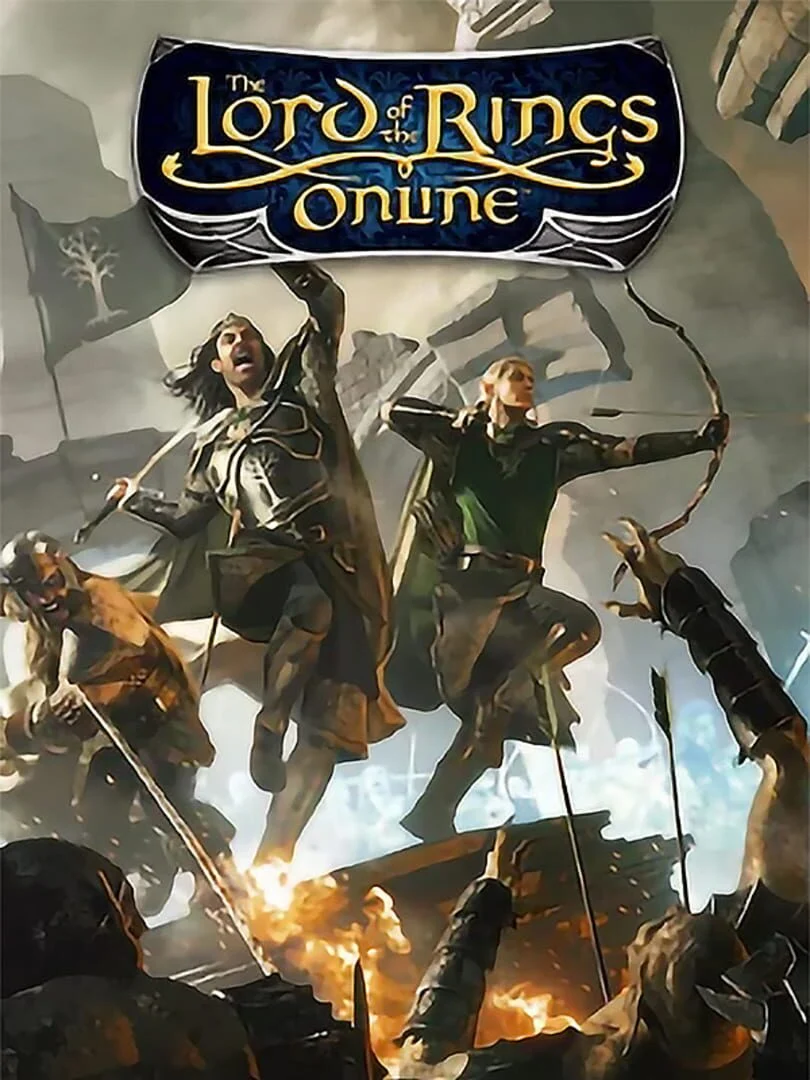
Beginning life as Middle-earth Online in 1998, the license to develop The Lord of the Rings Online bounced through several developers (including Vivendi Games) before landing with Turbine in 2004. The game launched in 2007, with the smoothest MMO launch in history. The game boasts several semi-unique features, such as the Music system, which allows players to form bands and play music in-game, either by playing manually, or by playing .abc files via in-game commands. The Outfit system also allows for much more character customization than some rivals allow.
Set in Tolkien's Middle-earth, this game is based entirely on the books; as such, it has a rich lore from which to draw quests, locations and scenarios. The game's storyline roughly follows the books; however, while the story follows the movements of the Fellowship, what it really focuses on is what everyone else is doing. As a player, you adventure and aid not only the Fellowship, but also the residents of Middle-earth as they prepare for battle against Sauron.
Aside from some introductory quests, the game's storyline begins in Eriador around the time Frodo Baggins begins his journey, and focuses on combating the rise of Angmar, the long-fallen realm of the Witch-King. In the 12+ years since the game launched, many updates and expansions have introduced additional regions, features, and quests. Each piece of new content takes place later in the timeline of the books. The main Story Arc of the game consists of the mostly-free Epic questline, supplemented by smaller storylines and Sidequests available in each region.
The Mordor expansion pack released in the Autumn of 2017 brought the game's storyline to the moment of the One Ring's destruction and beyond, launching a new story titled the Black Book of Mordor, in which the Free Peoples must deal with the remaining threat posed by Sauron's former underlings, starting by entering the Black Land itself. This expansion also introduced High Elves as a playable race. The Black Book was concluded with the release of the Minas Morgul expansion in late 2019, which also introduced Stout-axe dwarves as a playable race. In 2020, the War of Three Peaks expansion was released, followed by the Fate of Gundabad in 2021, comprising The Legacy of Durin and the Trials of the Dwarves. Before the Shadow expansion was released in 2022 and Corsairs of Umbar in 2023.
An arguably inventive stroke is in the character classes. While basic party roles and jobs are still used, the class that handles that role is usually not the traditional one to do it (though they all do make sense when you think about it.) Many classes have parallels to characters in the book, though certainly not all. A basic class breakdown is as follows in the folder:
- The Beorning: A unique choice, and the first new class introduced since Moria in 2008, the Beorning is both a race and a class: namely they are their own race locked into their unique class, also called Beorning, (no Hobbit Beornings or Beorning Champions). Based (of course) on Beorn and his descendants, the Beorning builds up rage to convert into a bear for more ferocious attacks and damage. Their primary role is damage or support, although they can tank and heal also, so the class is a definite hybrid. Also noteworthy: they are the only class that does not use power, as combat is solely about building rage and managing your transformations.
- The Brawler: A class introduced with Update 30 in 2021, available to all races except Beornings. Brawlers focus on hand combat and wear heavy armor. They are inspired by Helm Hammerhand, a King of Rohan who would head into battle wielding only his fists (and they were all he needed).
- The Burglar: LotRO's rogue, the Burglar is more of a Debuffer/CC class than the average rogue archtype. Their debuffs make them a good asset for raid groups and decent in PVP, especially as they can start Fellowship Maneuvers (party-based combo attacks,) better than anyone else. While a Burglar has many stealth abilities, and a few "backstabs," unlike many other MMOs, they're not assassins and have relatively weak DPS (compared to the Hunter or Champion.) Can dual-wield, but have few ranged abilities apart from the ability to stun an opponent, and a hobbit burglar's stone-throwing skill. Bilbo from The Hobbit is the prototypical Burglar. Only Men, Hobbits, and Stout-axes can be Burglars.
- The Captain: The Captain is the jack-of-all-trades with an emphasis on buffs. The Captain wears heavy armor and can use almost any melee weapon and light shields. He has no ranged attack abilities, though an archer herald is available at higher levels. He has a few tanking, healing, and mezzing skills, however the real strength comes from focused and party-wide buffs. The Captain's herald or banner grant aura bonuses (stat, morale, or power boost) that affect the whole party. They also have many shouts and battle-cries that heal or give temporary combat bonuses, again to the whole party. The Captain doesn't replace any role, he just makes everyone else do their job better. The class is clearly based off of Aragorn by being both a strong fighter as well as a healer. Only Men and High Elves can be Captains.
- The Champion: The dual-wielding warrior (but can use two-handed weapons as well). Their true specialty is their damage, which is AOE melee. Their AOE abilities made them a very popular class, and they're one of the easier classes to pick up and play. Think Gimli here. Boromir is a Champion, as confirmed by his skillbar and melee AOE damage during session play (though the Boromir character in the game is referred to as a Captain.) Every Race except Hobbits can play Champions.
- The Guardian: The primary tank. The Guardian was originally the only real tanking class in the game, until it was supplemented by the Warden. Uses heavy armor, shields, etc. You've seen this guy since D&D. However it should be noted that for a while, unlike most tanking classes, Guardians are capable of inflicting decent damage and can level solo pretty easily. Cannot use any ranged weapons until level 30. The game states that this class was inspired by Sam Gamgee. Any Race can play a Guardian.
- The Hunter: Many refugees from WoW see Warcraft's mage in this class, and it certainly has parallels. Based on the Rangers from the books (and Legolas, naturally), the Hunter is a ranged Nuker who can guide his party swiftly to many locations (read: teleport them). Does not employ pets, but uses traps and can deal decent melee damage via dual-wielding should they have to. And yes, every variant of the name 'Legolas' is already taken. Don't try. Any Race can play a Hunter.
- The Lore-master: The Beastmaster. While other MMO converts might first think this is simply the 'mage' of the game, the Lore-Master is also a pet class. The role of the Lore-Master is one of CC and Debuffers, but their damage is nothing to be sniffed at, either. Their pets (which, unlike the Captain's, are actual animals such as ravens or bears) are useful in all kinds of situations. Elrond is a good example of a Lore-Master, and the game cites him as the inspiration, though many would compare the Lore-Master to Gandalf; a good case could actually be made that the Lore-Master's trait-lines - fire/damage, animals, and crowd-control/debuffs - are based on Gandalf (wielder of Narya, Ring of Fire, and overall more martially inclined), Radagast (who favored birds and beasts), and Saruman (famed for his compelling and persuasive voice) respectively. Only Men, Elves, and High Elves can be Lore-masters.
- The Minstrel: The primary healer. The game uses morale points instead of HP (you don't die, you just get demoralized and must retreat from battle) and the Minstrel is the one to cheer you back up. Their music attacks, heals, and offers their party quite a few buffs. This versatility lets them level solo with some ease. The minstrel was largely revamped with the Rise of Isengard expansion and given simplified attack patterns and much stronger self-healing while in War-Speech mode. The class draws inspiration from Lúthien Tinúviel of The Silmarillion. Any Race can play a Minstrel.
- The Rune-keeper: The most debated class, as some see it as a break with Tolkien's lore (to which the game is otherwise generally faithful), due to its class abilities being more overtly magical than those of previous classes. The Rune-Keeper is a DPS/Healer hybrid that deals very powerful AOE and single target damage and also is a good healer (healing via HOTs). A sliding meter prevents both from happening at the same time (the more offensive skills you use, the stronger your damage spells become while healing ones become weaker, and vice-versa, though it resets to neutral out of combat.) Currently one of the more overpowered classes, but quite fun. This class was inspired by the Elven rune-smith Celebrimbor, the one who forged many of the Rings of Power. Only available to Elves, High Elves, Dwarves, and Stout-axes.
- The Warden: A tactical tanking class that uses medium armor and javelins instead of heavier armor and melee weapons. In contrast to Guardians that represent elite trained heavy infantry characters, Wardens are the plucky militia-type characters from the rest of the free-peoples. Guardians absorb damage through heavy armor and shields whereas a Warden uses skill and ability combinations, called Gambits, to cast short-term effects ranging from increased health regeneration, increased block/parry chances, or damage-over-time (DoT) attacks. Their ranged abilities with javelins make them ideal for kiting encounters, too. This caused them to be more popular than the Guardian in end-game raiding for a while. You can find more information here.
 No major character from the books would be considered a Warden, although it draws inspiration from the marchwarden Haldir, and the official description does bring to mind the Rangers of the North (who as the Grey Company carried spears, the Warden's signature weapon). Every Race except Dwarves and Stout-axes can be Wardens.
The Races are the various Free Peoples of Middle Earth; Elves (and High Elvesnote ), Dwarves (and Stout-axesnote ), Hobbits, and Men (and Beorningsnote ). Each Race has their own bonuses and unique traits that can be earned via special "Enmity" Deeds: Elves go after Drakes/Goblins/Orcs, Men hate Undead/Wargs/Hillmen etc. and each Race has their own specific traits to earn: such as bonus axe damage for Dwarves or a unique stealth mechanic for Elves.
It should be noted that LotRO follows the storyline of the books, so it contains most of the tropes from the books as well. The following lists only the tropes that apply to the game itself. For the full list of tropes for the storyline, see The Lord of the Rings.
Examples:
- Acceptable Breaks from Reality: Characters never need to rest or sleep, and eating is for the purposes of stat boosts or health and power regneration. Despite the fact that there is a day and night cycle, most characters and Non Player Characters don't sleep, they just continue with the usual routine.
- Adaptation Explanation Extrication: Happens occasionally with minor elements that only those familiar with the books would recognize and understand (major elements important to the bigger storylines are usually explained in enough detail that everyone might understand it), where explanations are either omitted, or tucked away where a lot of players are going to miss it. An example would be the Mirrormere, the lake outside of the East Gate of Moria, in which the night-stars reflect even at day. The fact that the stars are visible even at day is an important detail in Middle-earth lore, described in the Fellowship of the Ring, however, players not familiar with it have been known to report it as a bug.
- An Adventurer Is You: Technically you're a member of the other forces of the Free People mentioned briefly in the books, but otherwise, it's this trope to a T.
- Alcohol Hic: Characters hic and babble when they get drunk, mumbling to themselves as the screen goes sepia and blurry.
- All Just a Dream: The entire Siege of Minas Tirith, which spans across multiple quests and instances. To allow the player to witness all important events first-hand, they are allowed to escape Minas Tirith just before the city is surrounded and regroup with the Rohirrim. While the players still experience being trapped in the city, defending its walls and seeing the Gates broken by Grond, it is eventually revealed to be a very vivid prediction by Denethor.
- All Swords Are the Same: Although the weapons will have different visual appearances, the animations for attacking will treat each weapon as a one-handed sword or two-handed sword, with the animations being different for the specific skill rather specific type of weapon. You can thus stab someone with an axe or do a round-house slash with a dagger.
- All Trolls Are Different: Grouped into Troll-kind as a whole. In lore, most trolls turn to stone in sunlight, and though there is no game mechanic for such the game usually tries to keep them underground or in cloudy or shady places during daytime and at night spawn wandering trolls in places like the Trollshaws. Aside from the standard scaly/rocky skinned Trolls, there are also the more human-like Ettens; Gertherygnote , who can survive sunlight; and Wood-trolls, who look more like miniature, evil Ents or animated driftwood. They are always Signature or above.
- All Webbed Up: Most giant spider web sacs seen in the game are purely decorative. However, one quest in the Scuttledells has the player freeing elvish scouts who have been poisoned and encased in webbing by the local giant spiders. There's a similar quest given at Snowbourn during the Hytbold rebuilding process. At other points in the game players can sometimes open up web sacs containing money and items.
- Allegedly Free Game: It's technically free-to-play, but so much of the content requires LotRO points (fomerly known as Turbine points, which you buy with real money) that you're probably going to end up paying. Can be averted through hard work, though, since doing deeds also gives you LotRO points. However, one important note about that last part is that since most deeds pay about 5 Lotro Points each, and a Lotro Point is worth roughly $.01 USD, deliberately grinding content solely to get points earns you the equivalent of about 30 to 50 cents an hour.
- And Your Reward Is Interior Decorating: A number of quests reward the player with an item such as a portrait, statue, or trophy for their in-game house, and a few extremely rare drops can be exchanged for similar items.
- An Ice Person: Núrzum, the giant that's terrorizing Wildermore. Though in his case he's freezing the area with the use of an artifact given to him by Saruman rather than through any inherent powers.
- The frost giants in a remote corner of Forochel.
- An Interior Designer Is You: Buying an in-game house in one of the six housing neighborhoods gives the player the ability to decorate that house by placing various furniture items or yard items and to alter wall and floor colors and styles.
- And the Adventure Continues: The plot of the game revolves around the Free People's fight against Sauron and the Fellowship's quest to destroy the One Ring. That is, until the One Ring is destroyed at the end of Volume IV of the epic quest line. The plot then shifts to what happened after Sauron had been defeated.
- And Your Reward Is Clothes: Saying goodbye to the Grey Company in the Gravenwood will net you one of two ranger ensembles, or a mix and match. As a prisoner in Isengard, you earn a set of prison rags.
- Animal Motifs: The Rohirrim like to feature horses on their armour, as befitting their role as "The Horse-Lords".
- The Dunlendings are also divided into animal-themed tribes: The Ox-clan, the Stag-clan, the Boar-clan, the Avanc-clan, the Falcon-clan and the Dragon-clan.
- One tribe of White Mountain Orcs has taken the skull of a boar as their symbol, after watching the Boar of Everholt achieve a Mutual Kill on their foe King Folca.
- The mascot of Dol Amroth is western Gondor is the swan, and the city's elite force is called the Swan Knights.
- The Gauredain, Men of the Wolf, and Ungoledain, Men of the Spider, tame their signature creatures, dress in their pelts, and carve totems of them. They are also skin-changers, with the Ungoledain demonstrating the ability in-game.
- Anti Poop-Socking: Rested XP still exists in this game, though it's changed somewhat with updates. It's actually better than World of Warcraft in this respect, since you gain it no matter where you are, and you can use Destiny Points (earned via leveling and questing, and shared across characters) and LotRO Points to purchase more. You also gain it faster than in WoW.
- Armor-Piercing Attack: The Hunter's Piercing Shot, which bypasses some of the opponent's armour mitigation. The Lore-master has a debuff, Ancient Craft, which reduces an opponent's armor value by a significant margin.
- Arrows on Fire: Both seen being used by NPCs, and can be used by Hunters via an item.
- Artistic License – Geography: Oddly enough, with its own established geography. In the Moria instance, "We Cannot Get Out", the majority of the instance takes place on the Eastern Arch by the First Hall with orcs pouring from that direction, eventually revealing the Balrog and Trolls coming from that way as well. The First Hall is the eastern exit out of Moria, which means that not only should this be easily defensible, the Balrog has just come from outside of Moria to attack the dwarves.
- As You Know: If a quest takes place in a location you've visited prior during the same questline, the questgiver will often give directions to said location in this manner. Convenient for questlines featuring multiple locations, redundant for questlines featuring only back-and-forth between the questgiver and the same location.
- Ascended Extra: Thanks to the game focusing on what everyone else was doing, instead of the Fellowship, this trope comes up a lot. Many characters with secondary to extremely minor roles the Lord of the Rings can be found, often with increasing story relevance and characterization.
- Ascended Glitch: In Eregion, a rainbow can appear in the night sky. While definitely not intentional (not to mention physically impossible), it was considered such a unique and interesting sight by the players that the developers officially decided to leave it in, despite new players repeatedly filing bug reports over it.
- Attack Pattern Alpha: Fellowship Maneuvers, where every member of a group gets to choose one of four effects (damage, damage over time, healing, power restoring), that combined make up a coordinated attack. If players successfully mixes effects in specific orders, instead of all choosing the same effect, the attack ends up more powerful, and may also have other benefits like summoning a oathbreaker to help out in the fight. While initially very powerful in the original release of the game, the Fellowship Maneuvers were set to not increase much in effectiveness past level 50 or so (the cap is currently 115), and thus some groups ignore the combos and simply use the stun time to inflict free damage (on mobs not immune, anyway). Arguably, the last great hurrah for them was in the Rise of Isengard expansion where a level 75 Raid pretty much required the usage of 12 different FMs to drop the boss (or the boss would end up taking a very long, long time back when 75 was the level cap). After that Raid, FMs seem to not be a focus in the game.
- Attack Reflector: Both the Captain and Lore-Master have skill that will reflect some damage from attacks. Both are minor, however, and the Lore-Master's skill cannot be used on himself.
- Auction: Auction Houses exist in many major settlements such as Bree, Rivendell or Galtrev. Players can auction or outright sell crafted items or other goods.
- Back Stab: The Burglar specializes in sneaking up behind enemies and attacking them from stealth mode. Wargs are the monster-player equivalent of the burglar in the Ettenmoors, with a stealth/stun combination attack. The lore-master's pet lynx also performs a stealth attack.
- Badass Army: Most of the factions present.
- Badass Bookworm: Lore-Masters don't actually perform magic, but use their knowledge of Middle-Earth to perform various skills. Some of their skill animations actually have the players reading a book.
- Bag of Holding: Standard inventory. How those tiny bags can hold all of those hides and ore and spare weapons is a good question.
- Bat Out of Hell:
- At least they're mostly
 low-health mobs, so they die fast.
 - There also are Merrevail (sing. Morroval), who are much more resilient.
- At least they're mostly
- Batman Gambit: The storyline of the Siege of Mirkwood expansion, where the elves of Lórien attack Sauron's fortress in Mirkwood, Dol Guldur. While most of those involved in the attack believe that they're doing this to delay Sauron from attacking Lórien, the biggest motivation behind it (known only to Celeborn and Galadriel, and the players) was to make Sauron focus his attention upon Dol Guldur and nothing more, allowing the Fellowship of the Ring to leave Lórien and go down the river Anduin unnoticed.
- Amarthiel also pulls one to get her ring back by making Laerdan think he could use it to restore Narmaleth and letting the player bring the fragments to him.
- Bears Are Bad News: Bears tend to give really bad statuses with their regular attacks. They can inflict a temporary armor debuff (which causes you to take more damage), severe wound (which causes damage over time) and stun (which makes you character unable to do jack for a short while). Getting armor debuffed and wounded while stunned is NO FUN AT ALL.
- In the Norcrofts of Eastern Rohan, there are láthbears — demonic-looking bears that are classified as Ancient Evil.
- Be Careful What You Wish For: Sigmar and Sigun, two feuding brothers in Edoras. Both brothers refuse to accept their father's will that gave them joint ownership over the family home, tasking the player with finding some evidence for who the house really was meant for. Following a series of clues, the true will is uncovered which states that the owner is "the first person" to find the will, thereby making the player the new legal owner. This leads to the brother's finally reconciling, now united in their shared hatred of you.
- In South Ithilien, you meet the Rangers Duilin and his brother Derufin. Both are eager for the chance to take down a mûmak, only to find they're a little bigger than expected...
- Beef Gate:
- In North Chetwood (a starting part of the game with level 8-11 mobs), there is a path that one can take to go to the Weather Hills. Not only does it contain many level 19-21 mobs, but it also contains a ruin named Ost Alagos with signature orcs and half-orcs at Level 55!!!
- The Trollshaws become this for lower level players at night, due to the many roaming Trolls.
- Dol Dínen in the North Downs, south-east of Esteldin, where nearly every enemy type is elite and fellowships are required for most of the associated quests that are located there.
- If you are entering Isengard from the Gap of Rohan as part of the landscape and not part of the epic storyline in which you are held captive in Orthanc, the gate into the Ring of Isengard is guarded by two Arch-Nemesis trolls with over 900k morale each!
- Those who try to access Osgiliath via the conventional roads have to potentially contend with patrolling mûmakil.
- Been There, Shaped History: The player character is directly responsible for many behind-the-scenes events that benefit the Fellowship and becomes one of the most important characters in Middle Earth as a result. When the player character ISN'T keeping the Enemy distracted to protect the Fellowship, they are participating in all the major battles and playing a vital role in the important off-screen events the books mention in passing.
- Beneath the Earth: Khazad-dûm, the Mines of Moria, once the crown jewel of Dwarven civilization. Now it's filled with orcs, giant insects, nameless shadow creatures, and a creeping fungus.
- Big Bad: Believe it or not, Sauron is most certainly NOT the Big Bad in this game (at least not until Volume IV). Each volume of the Epic Story has its own Big Bad who is directly concerned with the events therein.
- Shadows of Angmar: Mordirith, the False King. His master the Witch-king appears briefly, but is more of a Greater-Scope Villain at this point in the story.
- Mines of Moria: You might think that Mazog is the Big Bad... until you find yourself facing Gorothúl.
- Allies of the King: Saruman. The events of the story might start in Rivendell, but you're quickly transported through Dunland and Rohan, and even get a chance to meet the old wizard face-to-face.
- The Strength of Sauron: Finally Sauron, who up to this point has been the Greater-Scope Villain, is now the main villain, though he is never directly confronted.
- Big Bad Ensemble: For the Black Book of Mordor, which takes place once Sauron and the Nazgûl are out of the picture. The leftover lieutenants of Sauron vying to succeed him are known as the Masters of Mordor. These include the Gúzyul, worshippers of Sauron whom he made The Ageless; Lhaereth the Stained, Sauron's Plaguemistress; Borangos the Horror, a great Rogmul Sauron found sealed away beneath Gorgoroth; and Gothmog.
- Big Damn Heroes: Both NPCs who save you (Tom Bombadil, for example) and you yourself.
- Bilingual Bonus:
- The game contains tons of locations, characters, and other things named in the languages Tolkien invented. Sindarin, the tongue of the elves, is the one you'll encounter the most, and Khuzdul, the dwarven tongue, is used plenty within Moria. There are also a few examples of enemies using the Black Speech.
- In Forochel, location names are actually Finnish words, so places like "Korkea-Järvi" translate to "High Lake" and so forth.
- In Dunland, locations and people have names that are basically anglicized Welsh, e.g. Uch-lûth (Llwyth yr Ych - Ox Tribe).
- The Dead Men of Dunharrow spoke a language based on Breton, hence the Paths of the Dead contain locations like Kêr Izel (low fort). Welsh and Breton are related and the Men of Dunharrow were probably ancestors of the Dunlendings.
- Black Magic: Practiced by agents of Sauron... usually at you.
- Blind Seer: The Rohirrim hermit Hildegard.
- Body Horror:
- The Dâr Narbugud bosses that used to be Orcs and Trolls. The fungus growing on them is not pretty at all.
- The Abominations resulting from Saruman's experiments.
- Bond Creatures: Lore-master pets. Technically the Captain pets as well, game play-wise... but seeing as they're actual people lore-wise... huh.
- Book Ends: Some time after finding the powerful mithril-axe Zigilburk, the dwarves trying to reclaim Moria decides to return it to where it was found, it having caused them nothing but trouble. While making your way where it was found, you will speak with a number of dwarves whom you have had dealings with during the storyline, reminding you of everything that you and they have been through.
- Booze-Based Buff: Mostly for fun; some of the house-decoration items are kegs that do interesting things to you as you get drunker.
- "You seem to have lost your pants. This makes you sad." (The icon is a sad panda face.)
- "It's Drunk O'Clock, do you know where your pants are?"
- "You are quite merry."
- One house-decoration keg apparently contains booze that is so potent that sipping it will cause you to pass out and wake up ... elsewhere. One potential location is the jail in Bree.
- "You seem to have lost your pants. This makes you sad." (The icon is a
- Born in the Saddle: The Rohirrim. They are widely known for their abilities as horsemen, and the horse motif is everywhere in their culture.
- Boss Banter: Bosses often have stuff to tell you before they engage, and during... and as they die.
- Boss in Mook Clothing: Many of them, most of which are Elite Mooks or King Mooks. However, some of them roam around much weaker mobs, forcing many players to have to try and avoid them.
- The first example you'll probably face would be Baugarch, a level 15 elite warg in an area populated by level 8-11 Mooks which have 150-200 or so health each. As for Baugarch himself - he has over 1500 morale!
- Bow and Sword in Accord: Almost all classes get a ranged ability of some sort; the melee class Champions and Guardians can equip bows upon getting high enough in level. Wardens on the other hand have javelins. While Captains don't get a ranged weapon, they can call Archer Heralds. The notable exception to this is the burglar who gets no ranged attacks or weapons (except for the ability to stun opponents), outside of throwing knives or rocks if he is a hobbit.
- Breaking the Fellowship:
- During the course of Volumes III and IV, the Grey Company is irrevocably splintered at several points on their journey south:
- Candaith and several other Rangers are killed on the Forsaken Path by Oathbreaker shades.
- More Rangers are killed when the Falcon Clan align with Saruman and betray the Grey Company.
- The Player Character and Lothrandir are imprisoned in Isengard after the Falcon Clan betray the Company. While you escape, Lothrandir remained a prisoner until Volume III, Book 14.
- The Player Character takes leave of the Company at the beginning of Volume III, Book 5 and does not meet them again until Volume III, Book 14.
- After the fiasco at Tûr Morva and the final confrontation with Gwyllion, Old Woman of the Mountain, Saeradan returns north to Eriador with the bodies of his fallen brethren.
- Eight members are killed at the Battle of the Pelennor Fields, including Halbarad, Golodir, and Halros.
- Finally, a few Rangers fall at the Battle of the Morannon, including Calenglad.
- The Player Character's own mini-fellowship falls apart during the course of Volume III:
- At the end of Book 8, Nona, not yet able to reconcile her feelings for Horn fully, leaves the party at Eaworth, Horn's hometown.
- In Book 12, Nona and Horn take leave together in search of the Falcon Clan.
- Corudan departs before the Battle of the Hornburg to scout but never returns. His current fate is still unknown.
- During the course of Volumes III and IV, the Grey Company is irrevocably splintered at several points on their journey south:
- Bribing Your Way to Victory: Since the fall of 2010, the game is free-to-play and utilizes a microtransaction system similar to that of Dungeons & Dragons Online.
- This is somewhat Subverted; it's possible, through the in-game deed system, to earn LotRO Points for playing. Many consider this excessive grinding, though. As well, there's very little available that actually empowers a character: the bulk are cosmetic things or expansions like extra character slots.
- Brick Joke:
- One early questline in the Shire deals with a hobbit who's gone missing. Turns out, he had hid himself on a pipe-weed wagon belonging to a group of brigands working for "Sharkey". The wagon actually went all the way south to Isengard, before returning to the Shire with the hobbit still on it. About 30 levels later, players questing in the Trollshaws will, on the road leading south, stumble upon a barrel - full of pipe-weed!Peregrin Took: How did that barrel of pipe-weed come to be there, I wonder?
- In Evendim, there is a questline where a hungry hobbit sends you searching for boars, in hope of being able to get some boar-meat, but no boars are to be found. In an update almost four years later, the hobbit finally got a piece of boar-meat.
- In the Shire, one of the deeds is completed by helping Holly Hornblower retrieve all the pies that she distributed which had been baked with spoiled berries. In Volume 3, if you choose to have Halros stay behind, the Book 10 Interlude Session Play will have Bounder Primrose remarking to Halros that Holly's pies have been more misses than hits and that she should quit the pie business.
- One early questline in the Shire deals with a hobbit who's gone missing. Turns out, he had hid himself on a pipe-weed wagon belonging to a group of brigands working for "Sharkey". The wagon actually went all the way south to Isengard, before returning to the Shire with the hobbit still on it. About 30 levels later, players questing in the Trollshaws will, on the road leading south, stumble upon a barrel - full of pipe-weed!
- Broken Bridge:
- The early chapters of the Moria storyline. You cannot enter Moria without defeating the Watcher in the Water, and you cannot defeat the Watcher without first obtaining your first legendary weapon and leveling it up. Once that's done, the player can enter Moria and gain access to the areas on the eastern side of the Misty Mountains.
- The Bridge of Khazad-dûm! Due to the actions of the Fellowship, this requires a player to go the long way around be able to exit Moria.
- There was a massive bridge south of Dol Amroth that had collapsed into the bay, barring progress in that direction. The bridge has since been repaired, and now leads to the premium housing area on the coast of the Bay of Belfalas.
- There is an unfinished bridge in the Great River region near the Limlight Gorge that at one point was under construction. Workers were present and constructing the bridge, with the clear implication that it would lead across the river and into what would be revealed as Wildermore. Go there now, and not only is the bridge still unfinished, but all the workers are dead. This is one Broken Bridge that will apparently never be finished.
- Brown Note:
- Minstrels have abilities that can cause enemies to run in fear, slow their attacks, etc. It's mostly the fear that falls under this trope.
- Hunters also have a few fear-inducing abilities, including one that affects only animals.
- Thrymm Red-beard, the Hero of Wildermore, wields the Horn of Winter, which is said to do harm to the Huorns of Fangorn forest.
- But for Me, It Was Tuesday: The player can often experience this upon re-encountering enemies who had previously appeared in minor roles several books (and over a dozen levels) previously. This becomes especially evident in the case of your Unknown Rival Avair/Gun Ain, who angrily lampshades the player having likely forgotten her since their last meetings, while she has been single-mindedly obsessed with them.
- But Thou Must!: During the Mirkwood storyline, the player and a company of elves are tasked with escorting a captured orc chieftain to Dol Guldur, with the intention of trading him for a dwarf that has been taken prisoner. If you tell the dwarf leader that that is a bad idea, he will simply overrule you. Later, both the orc and one of the elves are poisoned by spiders and you can only get one dose of antidote. You can seemingly choose whom to heal, but the elf declines and you end up having to choose the orc.
- Call a Hit Point a "Smeerp": Your HP in the game is called "Morale". Rather than being actual health, it represents your character's will to fight, a needed consideration because there just isn't the much healing magic in Middle-earth and resurrection magic is all but non-existent.
- Call a Rabbit a "Smeerp": Mostly averted, since Middle-earth was intended to a proto-earth. Some animals have odd names (such as some crows being called Crebain, the plural form of "raven" in Elvish) but this is often their association rather than their breed, or the fact they share a model with the normal animal.
- Calling Your Attacks: Common with instance-bosses, mostly to give players a chance to react to said attacks. Then there's one such boss doing it entirely in Black Speech.
- Cartography Sidequest:
- Both Deeds and Quests give you rewards for exploring. There's an exploration Deed for every zone, and a few zones have more than one.
- And then there is a map collecting deed that rewards you with a huge map of Eriador end the title "Cartographer"
- Cast from Hit Points: The Lore-master's more powerful offensive skills cost morale as well as power to use, and they also have skills that transfer morale or power from themselves to other friendlies.
- The hunter's Blood Arrow used to drain morale. Now it costs power and restores morale.
- Casting a Shadow: Commonly used by the Dead, Ancient Evil and evil sorcerers against the Free Peoples. Shadow debuffs are usually categorized as Fears.
- The Cavalry: Elfhelm and his riders, arriving just in time to win the first battle of the Fords of Isen (though not in time to save Prince Theodred).
- Chainmail Bikini:
- You won't see any exposed back or midriff exposure, but some gear does have noticeable cleavage.
- Dwarves can obtain a cosmetic "shirt" which removes their shirt, leaving them bare-chested. To minimise perversion potential, though, the item is only "wearable" by dwarf PCs, all of whom are male.
- Child of Two Worlds: Many of the Rohirrim in the Stonedeans have Dunlending ancestry, an unusual sight compared to how at odds the cultures are portrayed in other places. Unfortunately, mixed loyalties cause tension in this Riding.
- Cognizant Limbs: The Watcher in the Water. In the 12-man raid "The Vile Maw", the Watcher's tentacles function as separate mini-bosses. The tentacles also show up earlier in the main Moria quest line while the Watcher's head remains unseen.
- Color-Coded Item Tiers:
- White/Common
- Yellow/Uncommon
- Purple/Rare
- Cyan/Incomparable
- Orange/Epic
- Combos: There are two types:
- Fellowship Manoeuvres, which are group attacks in which each player selects one of four colored buttons on a wheel that pops up (red for direct damage, green for morale restoration, yellow for damage over type, or blue for power restoration), with more complex combinations having more potent effects.
- Gambits, the Warden's gimmick. Wardens' combat style is centered around three basic attacks which they can chain together (up to five when fully leveled-up) to unleash different combinations. Not every combination produces a unique attack (that would be 360 different attacks!) but Wardens currently get 41 different combos to play with. As of the Helm's Deep expansion, Wardens have two stances, one of which makes gambits melee attacks and the other makes most gambits ranged, but makes the Warden's ranged damage output suffer when he or she is hit in melee. Note that Warden combos aren't exactly like traditional beat-'em-up combos; they don't freeze enemies in place.
- The Computer Is a Cheating Bastard: Some classes have skills that are only usable during small windows of time, and are otherwise greyed out; For example, skills that are part of a skill-chain, where later skills are made useable by the execution of prior skills. Enemies with the ability to temporarily stun players are suspiciously good at timing their stuns for these small windows of time during which the aforementioned skills are useable, potentially leaving players stunned until said skills have turned unusable again. If you are fighting multiple such enemies, it is not uncommon to see more than one of them fire of the animation for their stun-attack at the very same time, as if they all immediately realized that it was time to stun the player.
- Conspicuously Selective Perception: And thank god for it.
- Continuity Nod: The sheer amount of continuity nods is staggering. Chances are if it was in the books, it will appear in the game somewhere, to the point where it is actually possible for players to plot the entire route of the Fellowship all the way from the Shire to Isengard, campsites et al.
- Contrived Coincidence: Multiple times during the Moria-storyline, you will find old records and journals (both intentionally and by accident) that just happens to contain the information needed to advance the storyline. This includes three separate trips to a huge library, with an immense amount of books, which just makes it all the more impressive that the player manages to find the exact books he/she needed.
- Cosmetic Award: All characters start able to use the Cosmetic Outfit system, allowing you to display the clothing of your choosing while retaining the bonuses provided by the actual armor. Many prizes in the festivals are these. Related to the aesthetic equipment, there are also many titles to collect.
- Cut and Paste Environments: Many of the ruins and houses; entire environments are not recycled, however.
- Damage Typing: Although it includes standard types like "Light" and "Fire," it also includes types such as "Westernesse" and "Ancient Dwarf."
- Many debuffs inflicted on players by enemies are classified as Wound, Fear, Poison, or Disease. These can usually be cured by drinking the proper potion or using a cure skill. (Some classes can cure other players, others can only remove effects from themselves).
- Dark Reprise: Warpipes to Hills of the Shire. Both are Awesome. Also, there is a not too notable music heard in auction halls, vaults and crafting halls which gets a less boring dark reprise in Moria.
- Death Is a Slap on the Wrist: The player characters never actually "die" over the course of the game. When morale is reduced to zero, they are "defeated", forcing them to retreat or be revived. If not in an instance or defeated by misdadventure, one can revive oneself, but only once in a while (cooldown depending on level, up to 2 hours at higher levels) or must use Mithril Coins to get extra revives.
- In earlier days of the game, suffering defeat inflicted Dread for a while, but this was removed in an update.
- Defeat Equals Explosion:
- The undead encountered in Rohan, the Draugar, swell up and grow as they take damage, and then explode in a burst of green goo when they are killed.
- Globsnaga Orcs will also sometimes start to explode when they are near death, you can avert this by finishing them off quickly first.
- Degraded Boss:
- The Barrow Wight Caller appears as a regular enemy in the second and third Great Barrow dungeons after serving as a boss in the first one. Thankfully, he doesn't summon the Giant Barrow-crawlers that made the first fight against him a living hell.
- The quest "Retake Weathertop" features a troll at the very peak of Weathertop as the final foe, and for many players (save for those who finished one particular questline in the Hobbit starting area), this is the first time they get to battle one. Later areas features trolls in much bigger numbers, and you will go one on one against them much more often from that point forward.
- The Barrow Wight Caller appears as a regular enemy in the second and third Great Barrow dungeons after serving as a boss in the first one. Thankfully, he doesn't summon the Giant Barrow-crawlers that made the first fight against him a
- Developer's Foresight: At the end of his quest line, if you use the ‘salute’ emote on Willem Whiskers, text will pop up stating “Willem nods at you, a salute of his own”.
- Didn't Think This Through: After his business ventures in the Lone-lands unexpectedly go south, a trader by the name of Pengail comes up with the less-than-brilliant idea of recouping his losses by selling his goods to the goblins. This goes about as well as expected.
- Does This Remind You of Anything?: The Dunlending-blooded Rohirrim in the Stonedeans. They're distrusted for not being of pure blood, and the poorer area of Woodhurst is definitely the more Dunlendish part.
- Doomed by Canon: Various Non Player Characters, most notably Boromir, Théodred and Théoden.
- Even though Khazad-dûm was eventually re-settled, it didn't happen until a few years after the War of the Ring, a fact confirmed to be known to the game writers. Which means the Iron Garrison expedition is doomed to fail. Some members of the expedition are later encountered in Gundabad and confirm that the Iron Garrison were driven from Moria with some loss of life.
- The Grey Company which settles out to ride south consists of over 60 named Dúnedain Rangers led by Halbarad. Yet in the Book of "The Two Towers" Halbarad only had 30 companions with him, of which developers again have confirmed to be perfectly aware. Proving that Tropes Are Not Bad, it creates an Anyone Can Die situation, so the tensions are rather high and every threat is being taken seriously. By the end of Book 4, it will be very apparent how those who didn't make it met their demise.
- The Battle of Pelennor Fields will have to be an even more tragic event in the game than in the movie, which only had to deal with Théoden's demise. Other casualties will include Halbarad, who has been a major Ranger NPC since early in the game. The Rohirrim listed among the fallen, most of whom are only mentioned this one time in the book, also feature to varying degrees in the game, particularly Horn, who is a companion of the player character throughout the latter part of Epic Volume III. As of Helm's Deep, Harding, Guthlaf, Deorwine, Grimbold, Herubrand, Herefara, and Fastred have also been featured, leaving only Dunhere, who has still been mentioned and expanded on slightly.
- Dracolich: The long-dead dragon Thorog is reanimated by the Gaunt-lord Drugoth.
- Dream Sequence: In each introductory zone, you can accept a quest to sleep in a bedroll, wherein you will fall into a deep sleep with Galadriel foretelling what will come to pass in your adventures down the line.
- Dressing as the Enemy: The only way to beat Challenge Mode in Fil Gashan. Also the only way to start your career as a Pit-fighter in Thorzhaf.
- Druid: In the Mournshaws, some Dunlendings have come to the forest to become Derudhsnote on behalf of their tribes and to worship the Rhi Helvarch, the Huntsman.
- Dual Wielding: Champions' main shtick; Burglars and Hunters can do it as well. High-level Lore-masters can eventually dual-wield with a sword and a staff.
- Dude, Where's My Respect?: Actually somewhat justified. Prior to Moria, you spend a lot of time helping the Rangers, who in the books are described as protecting the lands of Eriador without being thanked for it, and being happy with it; They probably wouldn't want you to drop the charade. This becomes even more apparent when you return to the Prancing Pony during the gathering of the Grey Company. Because of everything you have done throughout the game, the inhabitants of Bree have been able to live their lives as they always have, none of them knowing what kind of horrors you have saved them from. At one point, Glorfindel even suggests that a song should be written about the player's deeds, but Gandalf says no, that such things should be delayed until Sauron is ultimately defeated.
- Prior to the release of the "Shores of the Great River" update, the Elves of Lothlórien refused to even let you enter their domain until you proved your worth, despite the fact that you've survived crawling through Moria. Trying to enter the Golden Woods anyway would leave you instantly peppered with a volley of arrows from a dozen unseen archers. These days the elves will complain about so many people being allowed inside their forest, but they no longer shoot you down for crossing the border.
- After Siege of Mirkwood, the player's past exploits and actions in Dol Guldur are finally recognised as proof of their impressive credentials, while the Rise of Isengard has the player become something of a Living Legend amongst Theodred's Riders over the course of the storyline. Riders of Rohan continues this, with the player's reputation as a wandering hero frequently preceding them to the next town, although they still run into some occasional mistrust.
- Riders of Rohan does start with one particularly rough example. The first town that you come across is defeated by bandits who allied with Easterlings and a Nazgûl. You help defend the town, and then the retreat. You find the widow of the Thane along with the remaining survivors near the capital of that region. One of the guards notices your ability, and kindly suggests that you go to the sitting Reeve (lord of the region) to see if you can be of any help to him. Said Reeve threatens to throw you in jail for being a suspicious outsider who's up to no good. Apparently, the game interprets you talking to him as interrupting his council and trying to be a suspicious nuisance, and forgets the fact that the reason you're talking to him is that you were just seeing if he needed any help. You then have to perform a ridiculous number of fetch quests while being under banishment from the town, even to the point where you're attempting to locate homes for the refugees while being on The Wold's Most Wanted list. Fortunately, the expansion gets much better once the NPC realizes he's being a Jerkass to you.
- Dungeon Bypass: Early instances such as Fornost, Urugarth and Carn Dûm featured non-linear layout and shortcut doors that allowed to skip majority of the instance and head straight the final group of bosses. Moria and subsequent instances generally avoid this. The latest style for instances is to break large dungeons up into smaller instances that require the player to run them in sequence once, with each instance completion fulfilling a deed that grants permanent access to the next.
- In Carn Dûm, it's a little more complicated. Beating the boss at the end of one side route (that you're at first required to take) gets you a key you can use to open a gate near the start of the instance that leads to the final boss. Now, it is true that only one person in your party needs to have run the instance to open the gate. In order to get the key yourself you have to find a party of people who have not done the quest before, or who are willing to take the long way. Since several new expansions have come out and the level cap has been raised repeatedly, you can also try going back when you're ridiculously over-leveled and soloing the instance.
- An in-universe aversion in Moria, with the destruction of the Bridge of Khazad-dûm forcing the player to take the long and more perilous way around.
- Dungeon Crawling: In the loose sense of the term. Instances are sections of the game separated from the main world for the purpose of specific scenarios. Some, but not all of these, are actually inside or underground.
- In a more literal sense, Moria could be considered to be the ultimate dungeon crawl, as many areas are still not under the control of the Moria Expeditionary Dwarves.
- Exaggerated when you are given tasks which effectively make you perform a dungeon crawl inside of a dungeon crawl.
- In a more literal sense, Moria could be considered to be the ultimate dungeon crawl, as many areas are still not under the control of the Moria Expeditionary Dwarves.
- Dwindling Party: Siege of Mirkwood storyline. You are send on a dangerous errand with Five Elves which compose "The Hidden Guard". Their number starts to dwindle pretty fast. But when you barely knew the first one to die and couldn't really relate to his death, the passing of the last victim is truly heartbreaking.
- Dying Moment of Awesome:
- Achardor of the Hidden Guard (see Dwindling Party), going up against three of the Nazgûl by himself. He may not have taken anyone with him (not surprisingly, considering what he was up against), but he did allow the rest of the party, including the player, to escape.
- Durin the Sixth, going up against the Balrog that would end up being the doom of Moria so that his son can escape and become king.
- The ill-fated Battle of the Fords of Isen for Prince Theodred. Also his loyal esquire, Cynstan, who holds off over a dozen Orcs by himself to prevent them from reaching the mortally wounded Prince, before finally falling, seconds before the player reaches him.
- Early-Bird Cameo:
- Gollum. Canonically, he was stuck in Moria until the Fellowship entered, and he discovered them. In the game, players get a chance to meet him in the Trollshaws before the Fellowship leaves Rivendell. It's worth noting that Turbine and Standing Stone Games don't have the rights to the books stating that Gollum was in Moria at the time, so they had some leeway to make him appear this early, most likely as an Easter Egg to the players.
- Gollum also appears in Mirkwood, where you have to rescue him from being captured by an Orc-band. You are supposed to capture him yourself, but he makes a break for it while you are busy dueling the orc chieftain.
- Easily Forgiven: Jajax the Corsair captain who becomes one of your allies as you make your way through Gondor. He has raided the small town of Lothgobel and wreaked havoc on its inhabitants, but makes a Heel–Face Turn and aids you in killing the other Corsair captains.
- Easy Exp: At low levels, characters can level up easily just by crafting. They never have to fight or even leave safe areas. This assumes access to crafting resources. Since the XP given by crafting does not scale (much; crafting level 90 items does give about twice the XP that crafting level 30 items does; but the XP required to go from level 90 to 91 is over 30x that required to go from 30 to 31), the effect is negligible at higher levels.
- Eldritch Abomination: The Nameless in the Foundations of Stone. In The Lord of the Rings, the Dwarves Dug Too Deep and connected with "nameless things", where the Balrog was hiding- these are LotRO's take on them. There are actually several deeds for slaying Nameless creatures. Ironically enough, many of the powerful ones have names.
- Eldritch Location: The Foundations of Stone themselves could count as this, not in the altered rules of realty sense but in the scary, alien location sense. The stone there has a strange pinkish color and forms giant spikes. Webs of fungus hang down from above, light is provided by glowing mushrooms, and the underground lake is strangely green... especially disconcerting for those who have run the Angmar instances, since falling into the similarly-tinted green pools there causes instant defeat.
- Elves Versus Dwarves:
- Somewhat subverted. While the tension between the two races is shown at various points (especially in the elf/dwarf starter zone), you will often end up uniting the two races against a common foe. The elves of Lórien, as an example, are quick to help the dwarves within Moria, and their attack against Dol Guldur was partially motivated by one of the dwarves being taken captive, and imprisoned there.
- They do kvetch about it continuously though. Celeborn and Galadriel themselves treat NPC dwarves decently, but do occasionally allow for a slight undercurrent of blame to creep into their dialog. Lesser elves meanwhile don't even bother to be that nice, grousing openly to anyone within ear-reach.
- They don't like non-dwarves or even elves from other regions much better. Some elves in Lórien are reasonably friendly or at least neutral towards PCs, but there's one quest that requires you to go to a special spot and meditate, and when you do, one of the elves already there makes a snide comment showing he's outraged about outsiders "sampling [his] customs". In fairness, he does this even if your character is an elf, so he's not really a racist, he's just a jerk.
- Elemental Powers:
- Rune-keepers (Fire, Frost, and Lightning)
- Lore-masters (Fire, lightning and Light are the big ones, with a bit of Frost)
- Minstrels have a few powers activated by War-Speech that use light to damage the enemy.
- Wardens use several gambits that inflict light damage, and are one of two classes that can use fire oils on their ranged weapons.
- Hunters are the other class than can use Light or Fire oil on their arrows/bolts to do extra damage. Champions and Guardians can also use a bow, but do not have this ability.
- Elite Mook: They come in different varieties (from weakest to strongest): Signature, Elite, Elite Master. Nemesis and Arch-Nemesis are bosses. You'll know that you're fighting one when the border around their health bar is red. If the border also has spikes, a fiery texture, and/or the Eye of Sauron, you know you'll be in for a tough fight.
- Emote Animation: Quite a few, with more being added with the expansions. Many quests require you to perform certain animations to progress.
- Endless Winter: The region of Wildermore is locked in one, due to the presence of the enigmatic giant named Núrzum, who brings the winter cold with him and leaves a trail of devastation and ice shards. The player is sent to uncover the mysteries surrounding this unnatural winter cold and surrounding Núrzum.
- Enemy Mine: Invoked by Dunlending clans not loyal to Saruman, such as the Uch-lûth. While they have no love for the Dundain and a vehement hatred for the Rohirrim, they nonetheless are (begrudgingly) willing to put aside their ancient feuds temporarily to resist the forces of Saruman together.
- Enemy Civil War: Saruman's goal of becoming a power to rival Sauron in general serves as this, leading to a Mêlée à Trois between the White Hand, Mordor and the Iron Garrison forces for sole control over Moria.
- Escort Mission: Many. Most of them are very, very hard.
- The NPCs have 'mostly' gotten smarter with the game's age - but the escort quests that shipped with the original game, and mostly occurring at earlier levels, are truly painful. Either the NPC will have suicidal tendencies, walk at a snails pace, or in the epitome of bad NPC behavior, a combination of both. Nothing makes you want to pull your hair out more than having to wait for an extremely slow NPC, only to have them rush at enemies when they appear.
- Some (perhaps most) escortees seem to have a definite path that they will follow in full. If you get ahead of them and get in combat, they'll run up to assist ... but as soon as the combat's over they'll then run right back to where they were when it started before resuming their slow processional along their scripted path.
- Expanded Universe: This game is part of one as opposed to having one.
- Expansion Pack:
- Mines of Moria, released in 2008
- Siege of Mirkwood in 2009
- The Rise of Isengard which went live on September 26, 2011
- Riders of Rohan expansion went live on October 15, 2012
- Helm's Deep went live on November 20, 2013
- Mordor went live in August 2017
- Expository Gameplay Limitation: The game will often fear-stun (sometimes just stun) characters while exposition or dialogue is delivered.
- Everything Fades: As with most games, true with defeated enemies, who simply vanish after a few seconds. Convenient, since otherwise every area in the game would be piled high with dead enemies.
- Some quest objects also do this, forcing anyone else doing the quest to wait a few seconds for it to respawn. Usually however the object stays but becomes unusable to anyone who's already activated it/picked it up.
- Evil Counterpart: The Monster Play classes:
- Orc Reaver (Always Male) to the Champion;
- Orc Defiler (Always Male) to the Ministrel;
- Spider Weaver (Always Female) to the Lore-Master;
- Uruk Blackarrow (Always Male) to the Hunter;
- Uruk Warleader (Always Male) to the Captain;
- Warg Stalker (no, not like that) (Always Male, though only flavor-wise) to the Burglar.
- Evil Knockoff: Much like how the orcs and the trolls were noted in the books to have been made in mockery of the elves and the ents, the gaunt-lords created for the game are supposed to be a mockery of the five Wizards. This becomes even more apparent when you get to see Radagast the Brown, one of the wizards, take on his "evil copy", Ivar the Blood-hand, in a quick battle.
- Evil Power Vacuum: Occurs in both Moria and Mordor, with the player characters arriving shortly after the death of Durin's Bane and Sauron respectively:
- Contenders for the position of chief Eldritch Abomination of Moria include the Watcher in the Water, a lesser demon of Shadow and Flame called Gwathnor and the fungus-mongering Mistress of Pestilence.
- In Mordor, Sauron's former lieutenants seek his throne. Major players include Dulgabêth the Black Word (former Mouth of Sauron, now calling himself Sauron's Heir), his bitter rival Ugrukhôr, Captain of the Pit, Borangos the Horror, a Great Rogmul, and the plague-brewing Lhaereth the Stained. Volume 1, Book 4 of the Black Book of Mordor ends with Lhaereth wounding and capturing Dulgabêth and the other two swearing fealty to her.
- Experience Points: Mostly gained via questing, but as of Siege of Mirkwood you can level via Skirmishes now as well.
- Fashionable Asymmetry: The Rise of Isengard expansion gave those who pre-ordered it a set of Rohirrim clothing, which is noticably asymmetrical in it's design.
- Feathered Fiend: Hendrevail (evil hawks, sing. Hendroval) and Crebain (evil crows, sing. Craban), both used as spies for the Enemy.
- Felony Misdemeanor: An early minstrel quest requires you to help a hobbit seek revenge on those who have stolen his lunch. You later write and perform a ballad about it.
- Acca reveals that despite his years of loyal service as Saruman's manservant, he was ultimately imprisoned and forgotten within Isengard's dungeons, when Saruman discovered he'd shown pity to Gandalf during his captivity on Orthanc, simply by giving him a loaf of bread.
- Festering Fungus: An evil sort of fungus from the deepest depths threatens Moria, infecting Orcs, Trolls, and Spiders and turning them into the Globsnaga. Its source is the raid boss the Mistress of Pestilence, queen of the Nameless.
- Fetch Quest: Wouldn't be an MMO without 'em.
- The ones that make players groan are those that include the instructions "carry [object x] to [NPC y]. "Carry" means the character will be shown physically lugging the object — and while they're doing it, they can't engage in combat (which is a problem in areas where the PC is not ridiculously over-leveled), mount a horse (which is irritating everywhere), travel through water more than ankle-deep, or interact with anything else. Also, there's probably a timer ticking down, because for some reason it's apparently vital that items such as pies known to be already spoiled reach their destination within a few minutes. Sometimes, as a small gesture of mercy, the PC is given a slight bonus to run speed while carrying the item. Sometimes.
- Fiery Salamander: One of the varieties of Dragon-kind. Many of them can be found on the shores of Lake Evendim.
- Fishing Minigame: The fishing quests at the Farmer's Faire and Summer festival, as well as ones of the repeatable missions for Hytbold, and several in Dol Amroth, one of which is ridiculously annoying (there's a time limit of two minutes to catch three fish; since a single cast-to-creel cycle takes an average of around 30 seconds, if the random number generator has you hook weeds once during the quest you might fail, and if you hook weeds twice you're almost guaranteed to fail).
- Flashback: The "Session Play" mechanic, which allows you witness events from the past, while playing as another character. Some Session Plays feature characters and events made up by the developers, but from Moria and forward, you will also see Session Plays that display characters and events straight from the books, that normally would be unavailable to the players; The release of the Balrog of Moria, the last stand of Balin's Company in the Chamber of Mazarbul, and Aragorn's first meeting with Gandalf, as some examples. The sessions where you play as Boromir are hilarious ( until they turn tragic) due to the insight provided into just exactly what Boromir thinks of his traveling companions.
-
 Follow the Leader/Garnishing the Story: In Cataclysm and Skyrim, dragons play a big part. Though full-blown dragons have been rare in LotRO, a 24-player raid released in-between Cataclysm and Skyrim have the players challenging a dragon. Coincidence?
 - Foregone Conclusion:
- While players get to interact with the members of the Fellowship, the only explanation for their mission in-game is that it is "of great importance" and that "it will decide the fate of Middle-Earth".
- Technically the player character is aware of Frodo's quest since the whole game is given away by Fredagar Bolger in an early part of the Book 1 epic questline. The player helps him surives a Craban attack and then Fredegar mentions "the Enemy's ring", information that is then passed along to the ranger watching the Buckland border. This knowledge is never mentioned again.
- Several people you meet after completing the Rivendell epic questline will refer to it obliquely, in a sort of "we have a mutual friend engaged in a desperate venture, but we will speak no more of that here" way.
- Foreshadowing:
- During the storyline of Mines of Moria (released November 2008) Lady Galadriel looks into her Mirror and tells your character a vision of his future, unique for each class. Hunter's prophecy came to life during the storyline of Siege of Mirkwood (released December 2009), Burglar's and Lore-Master's during Rise of Isengard (released September 2011), and Champion's during Shades of the Past (released May 2012). Considering that some other visions contain hints to events in Rohan and Gondor, remaining ones may take years of real-time to happen at the rate the game is developed.
- The Rangers, when being summoned to the Grey Company, makes a big deal out of leaving, fearing that bad things will happen to Eriador when they are gone. That's exactly what happens in the "In Their Absence" storyline.
- Forging Scene: After a long questline, players get a chance to witness as Aragorn's pieces of Narsil are reforged as Andúril.
- Full-Boar Action: The number of boars, and quests related to killing them, have become a bit of an in-joke among the players, and the developers are not above lampshading this. In the Evendim-region, there's a quest solely to point out that there are no boars in this area. In Lothlórien, one questgiver who sends you kill a number of boars, asks why the players character is rolling his eyes at the mention of the word "boar". Another quest sends you picking boar-droppings. There's even a boar related title; Kill a boar in every region of Eriador and you get the title "Pork-Chopper"!
- Boars can get quite annoying with their disease-causing bite, which lowers your damage output for two long minutes...
- Fungus Humongous: Giant glowing mushrooms illuminate the Foundations of Stone in Moria.
- Gameplay and Story Segregation: There is a dramatic contrast between the body counts recorded in the books, and the body counts racked up by the players. For example, Gimli and Legolas' kill-competition at Helm's Deep ended at a score of 42-41, numbers easily bested by players in most longer battle sequencesnote . Another example would be Barliman's account of the death toll in Bree during the war, which totalled in at five (named) characters, a death toll easily bested during the skirmishes which represents the happenings in Bree during the war.
- Ghibli Hills: Most of the game world, but especially the Shire (which is the damn king of that trope) the Trollshaws, Bree-land, Ered Luin and Eregion.
- Giant Spiders: And lots of them indeed!
- They seem to get much larger on the eastern side of the Misty Mountains. Compare the dog-sized giant spiders in the Lone-Lands or North Downs with the much larger ones in Mirkwood, or especially the Limlight Gorge, where the spiders have to be the size of a house.
- Gladiator Subquest: Investigating the Arena of Thorzhaf in Talath Úrui involves getting an enterprising goblin to set you up as a combatant in the arena by disguising you as an Orc.
- Glass Cannon: It is possible to make a character this by focusing on offense at the cost of Morale and mitigations, but a more well-rounded choice of equipment and traits can prevent it.
- Hunters and Rune-keepers are especially susceptible, as they do a TON of burst damage, but generally can't take damage well (especially the Rune-keeper, who sports lighter armour).
- Champions used be like this when they had a Fervour stance, which increased damage at the cost of nullifying their avoidances and reducing incoming healing. Now the Champion can actually become a Lightning Bruiser with the right assortment of traits, items, and tactics. It gets to the point where they can solo lower-leveled raid bosses. These bosses should theoretically still be able to deliver a Curbstomp Battle to a solo player.
- The Master of Nature's Fury specialization for Lore-masters. It lacks the extra health or healing buffs from other lines, but gives them a ton of extra offensive spells, from lightning storms to tornadoes. Since a lot of these cause AoE damage and Lore-masters are limited to light armor, if they're not extremely careful they're likely to find out exactly where the "glass" part of the name comes from.
- Global Currency: Copper, Silver and Gold are used among players and with NPCs for things such as stable-master travel, repairing gear, and buying commonly available items. Makes more sense than it sometimes does, as the Free Peoples are pretty familiar with each other, so it'd make sense for them to have a common currency. However, most regions have their own special barter tokens used for valuable items and unique rewards.
- God Mode: Due to the refit on some zones, previously group quests have a solo mode. These modes often "power up" the player so you can take out the boss.
- Worth noting that since dread is percentage based, instances with a lot of landscape dread can still result in your death - even with this buff.
- Also this God Mode (called "Inspiration" in the game) does not alter the capabilities or tactics of the bad guys. This is a problem for the squishier support classes when they're thrown into boss battles without a tank - no amount of stat boosting can keep them alive long enough to win. Grinding and returning at a higher level is usually the only solution.
- Gondor Calls for Aid: Literally. Seven years after LotRO went live, players are finally able to enter Gondor, which (like every other area in the game) is under attack. The beacons are lit to call for aid to Minas Tirith, and the player character is kept busy fighting the many threats in southern Gondor. Many of the Non Player Characters actually ask for aid using this very phrase.Gondorian Non-Player Character: Gondor needs your aid.
- Good Pays Better: An annual mini-game festival event has a storyline where you can either choose to help homeless townsfolk, or help the mayor and festival organizers who exploited them. If you help the mayor, he rewards you with some fancy clothing. If you help the townsfolk they reward you with ragged old clothing — but about a month later, when they're presumably all doing well for themselves again (and when most players have already stopped thinking about the festival), they send you something really nice and extravagant.
- Gravity Barrier: Every map area is surrounded by cliffs or hills that are too steep to climb, or in a couple of cases a body of water that can't be crossed without dying. Given the geography of Middle-earth, this makes sense in some places (for example, Gondor is bordered on the north by the White Mountains), but not in others (such as the Lone-lands, which, according to the map, should be flat as a pancake).
- Great Escape: During the Rise of Isengard storyline, the player is imprisoned in Isengard itself and quickly forms an escape committee with several other prisoners to stage a prison break.
- Grimy Water: The poisoned water of instant death in Carn Dûm and Imlad Balchorth. Set one foot in in it, and you're dead. There are other areas with similar looking water that is actually harmless, such as the pool near Gath Forthnir, or the sludgy oily water south of Dol Guldur. These look dangerous, but aren't.
- The Morgulduin is a Downplayed example: swimming in it deals 2,000 damage per second. This is a somewhat significant, but not instantly lethal, quantity for the level 100 characters who first encounter it in South Ithilien, and negligible to level 130 characters questing in the Morgul Vale. However the water is much more noxious at its source: Eithel Gwaur, the Filth-well.
- Guide Dang It!: The Epic Instances in the Mirrored Halls of Lumul-nar and the Water Works of Nalâ-dûm, which rely on arranging mirrors/levers/wheels in just the right combination in order to advance to the next area. And many of said items are placed in rather out-of-the-way places...
- Guys Smash, Girls Shoot: Often applies to Dunlendings, but not in all cases. A notable exception is Nona, who fights with her brother's sword.
- Halfway Plot Switch: Happens at times throughout the epic storyline.
- In Shadows of Angmar, the introductory quests and the first five books involve the player rushing around Eriador, having adventures whose only ties to each other are that the Nazgûl and Angmar are involved behind the scenes. It isn't until Book 6 that the real story begins.
- In Mines of Moria, you spend the first 4.5 books helping the dwarves reclaim their old kingdom. Then, suddenly, the real threat in Moria is revealed, resulting in a complete 180 with the dwarves going on the defensive, and asking the Galadhrim for aid, and the whole thing winds up taking you to the heart of Dol Guldur.
- In Allies of the King, this happens a lot. The first four books involve the Grey Company on their journey south. Then in Book 5, you fight the Battle of the Fords of Isen. Then Book 6 has you journey to the shores of Anduin, where you fight a Nazgûl. Book 7 has you begin your adventure in Rohan, which takes up the remainder of the storyline.
- Hammerspace: Some emotes let you brandish a sword or a beer-mug even if there is none in your inventory or anywhere near you.
- Have a Gay Old Time: There's a lot of "queer" things going on in Middle-earth.Frodo: Have you been in Rivendell long? Sam thinks it's a queer place, but I think he likes it too.
- Healing Hands: The Minstrel and the Rune-Keeper are the primary healing classes. Captains and Lore-Masters can act as healers, though that isn't their primary role, and their healing abilities are more limited in scope.
- Hero Must Survive: Often happens when fighting a battle with one of the Rangers, or an allied elf or dwarf. Sometimes the NPC in question is very tough and can actually help you win the fight, while at other times the NPC is pitifully weak and keeping them alive is frustratingly difficult.
- Invoked about the player several times during the Rise of Isengard storyline, where various NPC's you're protecting tell the player that if the battle looks lost, they'll sacrifice themselves to give you time to ride to safety, so you can Bring News Back to their allies.
- Hero of Another Story: There are two prominent examples:
- Since the entire game revolves around what everyone else was doing while the Fellowship was off trying to destroy the One Ring, the player character is this in terms of the original story.
- Conversely, the Fellowship is this trope in terms of the game's story.
- Hidden in Plain Sight:
- In the epic Volume III Book 12, the player character discovers that one of Grima Wormtongue's lackeys has been sabotoging preparations to lead the refugees to Dunharrow, and is tasked with stopping him. Unfortunately, none of the witnesses got a good look, with the only distinguishable feature being a brooch with a red-jeweled eye, and as soon as he flees, he discards the brooch. The one time the player encounters him (unknowingly), he looks exactly like any other male Rohirrim NPC - blond, long hair and beard.
- In Woodhurst, Reeve Herubrand has taken shelter in a farmhouse in secret in a recent but unpublicised attack on the mead hall. The problem is that the attackers look like any one of the other townsfolk of the Stonedeans, who tend to be of mixed Rohirrim/Dunlending ancestry. He sends you out to determine friend from foe among all the other townsfolk.
- Hide Your Children: While there are plenty of civilians strolling around in Bree, Rivendell, etc, there were no teenagers or children visible until the Rise of Isengard added them all through Dunland. Subsequent expansions have added children to Bree and all through Rohan, but the trope still holds true in many other settlements throughout the game. Justified in places like Stangard, which are explicitly stated to be outposts, and in Stangard's case, an outpost of exiles serving sentences.
- Homage: One hobbit and his questline is directly based on the professor himself, and some of his stories, as well as his real-life literature group The Inklings. Particularly the quest where he asks you to find a piece of paper, upon which he had begun to write a story:Lost leaf of paper: In a hole in the ground there lived a boar. No, that's not it.
- A Homeowner Is You: Once they hit level 15, players can buy and decorate a house in one of four regions, based on the style of housing used by the four playable races.
- Honor Before Reason: A villainous example. Elves on the outskirts of Lothlórien ask you to kill an Orc Chieftain, protected by a big Troll bodyguard too strong for you alone. The solution is to mock the Chieftain in front of his lackeys - he then orders the Troll to stand back while he charges you alone, desperate to earn back the respect of his subordinates. Needless to say, the player easily defeats him. That said, taunting him only keeps the Troll out of the fight; other orcs hanging around the area will still rush you if the battle gets too close to them.
- Hopeless Boss Fight: Sambrog when fought during the Othrongroth epic quest. All you can do is try to stay alive until Tom shows up to bail you out.
- An irritating example due to how artificial it is. Sambrog will fully heal himself if it looks like the player is getting the upper hand. Many enemies can cast healing magic on themselves, but Sambrog disables the player's attacks while he does it.
- Horse of a Different Color: A game based on the Lord of the Rings doesn't allow for much in the way of mounts other than horses, but with Moria the players got oversized goats, so they could ride inside the mines, where no horse would dare enter.
- In a more literal interpretation, there are many varieties (differing in coat color and/or trappings like saddlebags and pennants) of horses you can get. Some of them just require in-game currency, others require you to complete deeds or purchase them with LotRO Points. As of the Riders of Rohan expansion, there are "war-steeds" (also horses) which allow mounted combat (something goats and regular horses do not permit).
- Horsemen of the Apocalypse: Four out of the five gaunt-lords, powerful beings made as a mockery of the five Wizards, have powers that somewhat resembles the Four Horsemen. These four are Ferndûr the Virulent (pestilence), Ivar the Blood-hand (war), Thadúr the Ravager (famine), and Drugoth the Death-monger (death). The fifth gaunt-lord, Gortheron the Doom-caller, the strongest of the five, is the embodiment of purest evil.
- Hub City: Every expansion brings a new regional hub, such as the 21st Hall for Moria or Galtrev for Dunland, but if the entire game has a single city that players will return to no matter the level, it would have to be Bree. Most other hubs have swift travel routes to Bree and vice versa, and it's certainly the major settlement for Eriador through which most other travel routes between north and south pass.
- Hyperspace Arsenal: Besides the aforementioned Bag of Holding, most quest items don't take up regular inventory space. Lampshaded by an NPC in Buckland who can't figure out how adventurers can carry the numerous animal corpses he asks for.
- In addition to your regular inventory, there's also the barter wallet, which holds currencies and barter items (items that previously took up regular inventory space). Less egregious for coins and tokens, very noticeable for trophies that can be exchanged for housing items (which includes the skull of a dragon, and the sword of a balrog).
- Note that the barter wallet, key rings, quest items shown in the quest log, etc. were not around in the initial game. Quest items and keys really did fill up your inventory.
Description for the skull of the dragon Thorog: This seems a bit big to be lugging around, but who could leave such a trophy behind? - I Don't Like the Sound of That Place: In the spirit of the books, places of evil are named accordingly, usually in Sindarin by Elves or Dúnedain. Goes double for scary names in Black Speech.
- I Know You Know I Know: Invoked when the player encounters Gríma Wormtongue in the Hall of Meduseld, with the player wondering if the Death Glare he's throwing towards them is because he's aware that the player knows he's The Mole for Saruman.
- Improbable Power Discrepancy: All enemies, even the Mooks and wildlife, in a location are about the same level. This way, they are an appropriate encounter for players fighting there, but as a result the minor pests in one region will be much more deadly than the most fearsome monsters in another.
- For example: Northcotton Farm, just a few minutes' ride north of the Shire, is home to minor pests (shrews, crows, locusts, etc.) that would annihilate a starting-level Hobbit. A level 60 character is a good level to take on the horrors that lurk in the depths of Moria, but has no chance against a badger in the Vales of Anduin.
- Informed Equipment: A side-effect of the cosmetic outfit system, which allows your characters to display armour or clothing completely independent of the actual gear he/she has equipped. This can lead to oddities like seeing a supposedly heavy-armoured class rushing headlong into melee wearing nothing but a dress.
- Interface Screw:
- Dread effects change your minimap to the Eye of Sauron if they stack high enough; they also darken your vision. Hope effects do the same but the other way around. (These effects can be disabled).
- As characters get more drunk, the camera starts to sway, vision doubles (with the after-image appearing more "real"), and at the highest levels, everything appears in sepia tone.
- A quest along the Great River has you breaking "reek-weeds" to help frighten off Rohirrim fishermen too close to Lórien. While the bad smell lasts, the screen is ringed by a fairly thick mixed-shade red and yellow border that obscures almost half the screen.
- Fungus infection in Moria does the same thing, gradually going worse depending on the number of debuffs.
- The giant toads in Moria are apparently in the genus Bufo, since fighting them can hit you with a status effect that blurs the screen and tints it lavender.
- If you get very cold (e.g. in Wildermore), ice flowers will appear on the screen.
- And then there are various festival items which poison or daze you for a short time, notably Saffron's Lipstick.
- Interface Spoiler: Quest rewards, which are shown when accepting a quest, are sometimes named in a manner that spoils the ending of the quest. One quest, as an example, tasks you with going to an old chamber in search of a powerful axe named Zigilburk. One of the quest rewards is named "Zigilburk's Finder", making it quite obvious that you'll end up finding what you're looking for.
- Invisible Monsters: Stealthed enemies will appear invisible until you get near them, at which you will notice them moving stealthily about. By then, it may be too late, because they will usually aggro anybody who gets near...
- Invisible Wall: In a few instances, the developers don't even bother with a gravity barrier, they simply place an invisible wall that prevents the player from moving forward on the map. The southern border of East Rohan was a prime example prior to the release of Helm's Deep. Though the river delta and opposite shore could clearly be seen, there was a point beyond which the character simply could not progress, even though there was no visible barrier blocking progress. These impediments to exploration (and thus venturing beyond the edge of the map) are few and far between compared to Gravity Barriers, but they are there.
- It Began with a Twist of Fate: One Lone Lands side quest starts with a menial task of finding out what happened to a delivery of oatmeal. This quest chain ends with the character taking part in a city wide battle in Annúminas. To be specific, the reason why there's no oatmeal is because the hobbits that supply it are having trouble with their festival. The reason they're having trouble with their festival is because some Hobbits from the Glassblower camp up north didn't show up. When the player investigates, they find that the Hobbit camp has been ransacked by bandits. After defeating the bandits, the Hobbits ask the player to talk to the Rangers, who will then ask the player to assist them in finding out why the bandits are there. After a long line of jobs ranging across the entirety of Evendim, you eventually find out that the bandits are working in allegiance with Angmar, and are raiding ruins to find the lost ring Narchuil, an important object in the main story. This entire series of events leads the player to Annúminas, in order to help the rangers repel the invasion.
- Item Crafting: There are numerous crafting options, including but not limited to cooking, farming, prospecting, woodworking, tailoring, etc. It's often the case that the best armor or weapons at any given level are player-crafted. There's an immersive quality to farming in the Shire, or forging in Rivendell.
- Jekyll & Hyde: Narmeleth/Amarthiel is a victim of this, brought on by having been corrupted by Sauron.
- Joke Character: There's an optional quest where you can play as a level 1 chicken. Yes, a level 1 chicken. And you have to travel all over the Shire, Bree-Land, Ered Luin, the Lone Lands, the North Downs, and the Trollshaws (the last one has unavoidable stealthed lynxes). Needless to say, get hit even once and you're fodder.
- You have to go through Evendim as well, which is second to the Trollshaws in terms of difficulty. (As a chicken.)
- Joke Item: A number of them, like shovels, pitchforks, and butter-knives, often available from vendors you gain access to after gaining reputation with a faction, or from festivals. Then there's Erebrandir's Horseshoe, which may seem like one, but is actually a possible reward from the Epic Questline that has to be explicitly chosen in favor of scrolls that applies actual bonuses to your weapon. Because of this, many has speculated that there is actually some hidden benefit to it, and it is probably one of the largest sources of Urban Legends of Zelda and Wild Mass Guessing in the game. The item's description ("Some people believe that horseshoes bring good fortune."), and deliberately vague confirmations from one of the Community Managers that "it does do something", just adds extra fuel to the flame.
- The current explanation is that the horseshoe changes one line of dialogue in the epic questline, gives a brief immunity to snowballs during the winter festival snowball fight, and spawns a hobbit during in the Infiltrator's Surprise instance.
- Just Add Water: With some crafting professions (in particular, the Farmer), you just add water (and it has to be bought from vendors).
- Lampshade Hanging: In Rohan, when you meet the same NPC for the fourth time, each time occurring in a different area, we get this gem:
- Burnoth:"I will not say that I am suprised... our paths seem destined to cross at the most opportune times."
- It didn't happen until the Isengard expansion though. There was never a literal "kill rats" quest before.
- Killed Off for Real: Due to the nature of the game's timeline (how far in the story you are depends on the region you are in and the quests you are doing) and monsters and instances reset, named enemies can be killed multiple times. However, characters who die in quests and instances, especially characters that are involved in the epic story, can be considered this although you can replay the event. However, once the players enter Dunland and beyond when phasing is employed in the game, some NPCs are genuinely gone once certain points in the story have been played.
- Kill It with Fire: The trope name is actually the title of a quest in Moria to burn fungal structures in the Foundations of Stone.
- Last Stand: The ending of the session play We Cannot Get Out, which puts the player in control of Ori during the fall of Balin's colony in Moria as recounted in the Book of Mazarbul. There are a few other session play instances where the objective is not to "win" or even survive, but to survive long enough (i.e., as long as the character being played lasted canonically).
- Late to the Tragedy:
- Most of the time the player arrives at locations previously visited by the Fellowship, they are usually inconvenienced due to their various offscreen moments of awesome causing a lot of collateral damage for them to clean up. This is especially true in Moria, where the battle with the Watcher in the Water forced the Iron Garrison to spend time digging through rubble to uncover the Doors of Durin, as well as be openly aghast at the (recent) destruction of the Chamber of Marzabul and the Bridge of Khazad-dûm, the latter which forced them (and the player) to take the long way around to the First Hall.
- In Dunland, you are sent to seek out a White Hand emissary whose offer was refused by the local Brenin, only to find that while you are gone, the town has been sacked. You return to the town to find a number of people you've helped, including a farmer whose in-laws had all been murdered, as well as the brenin, slain.
- In East Rohan, the towns of Thornhope and Hytbold have already been sacked. In West Rohan, you have the town of Torsbury. In Gondor, there are the towns of Thingobel and Lothgobel.
- Law of Chromatic Superiority:
- The names of the enemies will change colour depending on their level as compared to yours.
- 9 levels or lower- Gray (You shouldn't bother with these, as they will give you no exp. They will not even bother to aggro you. Some gray elites can curb-stomp a solo player, which can be a problem in skirmishes and instances, where gray mobs will still aggro you.)
- 5-8 levels lower- Green (Very weak, and they will give you very reduced exp.)
- 3-5 levels lower- Light Blue (Weaker than you, and will give reduced exp.)
- 1-2 levels lower- Dark Blue (Slightly weaker than you, and does not give reduced exp)
- Same level- White (These guys are on equal footing with you)
- 1-2 levels higher- Yellow (Slightly stronger than you, and will give you slightly more exp)
- 3-4 levels higher- Orange (Stronger than you, and will give you more exp)
- 5-7 levels higher- Red (Much stronger than you, and will give you quite a lot more exp, if you can even defeat them)
- 8+ levels higher- Purple (Run like heck, you have no chance to survive; even if they don't do a lot of damage, they'll wear you down due to their relatively high armor and regeneration rate making them all but impossible to kill)
- The frame around the enemy's status also shows their toughness:
- Swarm: Green (These guys are weak, they have 1/2 the hp and do about 1/2 the damage of a normal enemy of the same level. They tend to appear in groups, though)
- Normal: Blue (These guys are regular old Mooks, nothing special.
- Signature, Elite and above: Red (These guys are Elite Mooks, ranging from 2x to over 10x as strong as compared to a normal Mook)
- The names of the enemies will change colour depending on their level as compared to yours.
- Lethal Joke Character: The Lore-Master. At low levels, they don't seem much and can't do much. At higher levels, they are capable of whooping a Guardian with the right strategy, with melee attacks. From the front. With light armour. And a stick.
- Players who try out a burglar may feel like they're stuck with one of these at low levels. A little development will turn a burglar into a critical hit machine, though, and players who stick with them will find they have an extremely lethal character even when soloing.
- Lethal Lava Land: Talath Úrui, the Burning Plain, south of Mount Doom. It's where most of the lava spilled out when the mountain erupted.
- Level-Locked Loot: Very frustrating when you're trying to send your level 8 character some legendary weapons so they can fly through the game.
- In an update Turbine was nice enough to change lootboxes (rare drops containing valuable items ... sometimes ... and requiring equally-rare keys to open). Lootboxes used to have both a lower and an upper level limit; the upper limit has been removed. Players can hang onto boxes as long as it takes for them to find a key now.
- Level Scaling: Most Instances can be set to any level from the minimum required to unlock them to the level cap. Epic Battles and the Ettenmoors temporarily scale all players there to the same level.
- Life Meter: Called "morale" in-game, the idea being that the green bar represents your will to fight and your inner resolve rather than hit points.
- Living Legend: The player eventually becomes one as they progress through the main storyline.
- Shrouded in Myth: In Rise of Isengard, it's mentioned that your prison break from Isengard has become a hot topic amongst Théodred's Riders and made the player something of a Memetic Badass, with half the men unsure whether to believe such a tale could even be true.
- Shrouded in Myth: In Rise of Isengard, it's mentioned that your prison break from Isengard has become a hot topic amongst Théodred's Riders and made the player something of a
- Loading Screen: You'll see some of the same landscapes or architecture many times as the computer loads up a new area. The tips can be useful though.
- Lost Superweapon: The dwarves during the Moria storyline believe that they have found one in the mithril-axe Zigilburk, and that it will help them turn the tide against the orcs infesting Moria. Many of the hardships the dwarves suffer during the storyline comes from them growing overconfident and making stupid decisions in the belief that the discovery of the axe alone will give them victory. In the end, they return it to where they found it, vowing never to use it again.
- Magic by Any Other Name: Rune-keepers and Lore-masters.
- Magic Music: Minstrels use this, though technically since you operate off of morale rather than hit points, they're only "boosting your will to fight" with inspirational music rather than using magic to heal. The reverse is true when it comes to wearing down an enemy, though the logic breaks down when it comes to the actual killing blow.
- That's for the healing at least; there is a canon basis for the more directly magic Magic Music that the Minstrel uses in the Lay of Beren and Lúthien, in which Lúthien is able to lull Morgoth to unconciousness with her song so she and Beren can steal a Silmaril.
- It's also possible that the designers drew inspiration from the Ainulindalë, in which the music of the Ainur is used to shape the world itself (though it takes the word of Eru to make it actually exist).
- Mass Monster-Slaughter Sidequest: Many of the quests require the player to kill a small group of nearby enemies. There's even a quest named Kill Ten Rats.
- Maximum HP Reduction: Dread reduces maximum morale until it goes away, ranging from 95% max morale at 1 dread to 1% morale at the maximum of 15 dread! On top of that, Dread also increases incoming damage while reducing incoming healing, damage dealt, and the effective level of your skills. Fortunately, Hope counteracts dread and even grants a little extra max morale and damage dealt at positive numbers.
- Some bosses also have special attacks that temporarily reduce maximum morale.
- Meaningful Name: In Skirmishes, the enemy lieutenants which act as mini-bosses:
- Bearer of Blights attack with physical poison, disease, wound and fear attacks.
- Blood-Rooks are ravens with an area of effect attack that looks like a mist of blood and siphons off morale from anyone in it.
- Brood-Queens are Giant Spiders that lay an egg in a targeted character, which then hatches into a spider mook.
- Brothers of Destruction will summon copies of itself to attack the fellowship, the number of which depends on the fellowship size. Thankfully they're not found in solo skirmishes.
- Chaos-Fiends use a plethora of deadly debuffs on your characters.
- Crazed Hate-Mongers will go into a frenzied rage and attack players randomly.
- Daunting Spirit-Sappers create an aura that slows characters' speed, attack warm-up and attack cooldown.
- Death-Mongers are able to summon a fell spirit from their fallen allies to battle you.
- Defenders of the Vile will use defensive buffs on their allies, reducing incoming damage.
- Dourhand Keg-Masters drink beer, which gives them both a buff and debuff, as well as throwing the beer at you, making you drunk (which gives you the same buff/debuff). He also uses exploding beer-bombs as an attack.
- Dourhand Storm-Keepers attack your character with lightning magic.
- Echos of Death have an ability that reflects back attack effects as well as causing the attacker to take more damage for a period of time.
- Flesh Gorgers are lizards who love the smell of death, and will gain a stat boost every time it kills either a player or their soldier.
- Frigid Squalls are ice-spirits that come with a freezing aura which damages players on contact.
- Leech-Wardens use an area-debuff that drains HP and MP.
- Pale Trappers set up a trap of flames on the ground that constantly damage players who stand on it.
- Priests of Vengeance give their allies a buff that deals twice the damage back should an attacker harm them.
- Priestesses of Flames will set up an even larger flame traps on the ground that do large amounts of damage.
- Raging Marauders will go into a rage mode where their damage and attack rate is increased.
- Shepherds of Filth summon filth-crawlers which explode into sticky goo, slowing down your character's movement as well as attack speed. Probably the most annoying one out there.
- Silent Slayers are wargs that use stealth to disappear from view, then stealthily attack a player for large damage.
- Tempests of Flame are fire-spirits that cast a large flame aura that deals very high fire damage to anybody around it.
- Troll Wound-Takers are able to heal their allies at the cost of their own health.
- Venomous Blood-Arrows attack with poisoned arrows which, if not cured in time, will either do large damage to health, MP, both HP and MP, or stun the victim for a few seconds.
- Wretched Falconers will use their hit points to summon crows that attack the player.
- Zealots of Pain are able to buff their allies by inspiring them, increasing their attack power.
- Meanwhile Scene: A series of optional session play quests, accessed through the minstrel Gleowine's map, are available during Volume III Book 10: Snows of Wildermore. They allow the player in oplay as different Rangers of the Grey Company and find out what they have been doing since they were last seen in Dunland.
- Miniature Senior Citizens: The old women of Dunland and some in Rohan are very small.
- Mix-and-Match Critters: The Avanc in Dunland, creatures who appear to be half alligator, half turtle, have both fur and scales, and are classified as Dragon-kind. It is based on the Afanc of Welsh Mythology, in keeping with Dunland having Welsh/Celtic influences.
- Mood Whiplash: One quest line in the Eaves of Fangorn focuses on cleansing the corrupted part of the forest. This area is completely dark, the soil is black, and the enemies are evil flies, corrupted huorns, maggots, and a corrupted ent. The quest right after that focuses on searching for an ent's bird friend. The plot then turns to the pollution of orcs, and the condition of said bird.
- Mordor: Players can finally enter Mordor as of 2017. Prior to that,Angmar, parts of Moria, Mirkwood, and Isengard filled the role quite nicely.
- Update 16 included Southern Ithilien, which allowed the player to go to the Cross-roads (described in The Two Towers). You can venture east from here towards the Morgul Vale (one of Mordor's entrances), but your pathway is blocked by a barricade and two very nasty trolls. Attempts to bypass these obstructions result in instant death.
- Update 25, the Minas Morgul expansion, added the Morgul Vale as a second region of Mordor, accessible both from North Ithilien and from Gorgoroth. This expansion also introduced Mordor Besieged, a look at Mordor in the late Second Age as related to our characters by a witness to those days, the shade of Isildur.
- Monsters Everywhere
- Mounted Combat: Has appropriately been introduced (after much demand from players) with the Rohan-expansion. Each class has three fighting stances and new mounted combat skills that attempt to capture the flavor of their class.
- Musical Assassin: Minstrel again. Several of their abilities deal a quite large amount of damage, especially at low levels. This discrepancy at low levels was addressed in a later patch.
- Mythology Gag:
- Players are certainly quick to reference the movies, and the associated memes when given the opportunity. Asking to buy taters in a trade-channel, for example, will lead to (multiple) replies of "what's taters, precious?" The Isengard announcement also confirmed that we are, in fact, taking our hobbits to Isengard.
- Mines of Moria introduced a quest to find a location named The Bat Cave, due to being relatively hard to locate in an area where the density of mobs made exploration tedious, there were many pleas for help on finding this location. Much to those players' annoyance, the most common answer was "Under Wayne Manor".
- Named Weapons: We're talking about The Lord of the Rings here. In addition to Sting, Andúril and Glamdring, many characters you meet bear their own (Cumaeth, Dunachar, Zigilburk etc). Technically, every weapon you come across is named as well, though even when it's "Randiram" instead of "Hardened Yew Bow" it's mostly for gameplay reasons rather than the story. But eventually, you do get to name your own.
- This comes in two varieties - the first and original was the ability for crafters to "name" what they made if they achieved critical success or crafted some item that required a rare ingredient. This name would appear in the "Name" field of the tooltip. From Mines of Moria on, with the introduction of Legendary Items, it is possible to actually name your weapon, and have it appear as the main text on the tooltip.
- Amusingly enough on crafted Legendary Items, both systems come into play
- This comes in two varieties - the first and original was the ability for crafters to "name" what they made if they achieved critical success or crafted some item that required a rare ingredient. This name would appear in the "Name" field of the tooltip. From Mines of Moria on, with the introduction of Legendary Items, it is possible to actually name your weapon, and have it appear as the main text on the tooltip.
- Narrator: Cutscenes that are shown after completing parts of the main storyline, and instances seperate from the open world, are with few exceptions narrated by high-profile characters from the books. Before the first expansion of the game, it was Gandalf. Through Moria, and beyond, it was Galadriel. Volume 3 deviated from having universal narrator for all content: various bits are narrated by Elrond, Halbarad, Grey Company Rangers, minor Dunlendings, not-so-minor Rohirrim and Saruman himself whenever appropriate.
- Never Say "Die": Taking damage doesn't cost you hit points, it costs you morale points. When you run out of morale, you run away from the battle.
- For some reason, a great many of the quests tell you to "defeat" a certain number of enemies instead of kill them, although you clearly are killing them. At the very least we hope you're killing the ones you're getting hides/pelts/meat from.
- Nightmare Sequence: In the appropriately titled epic quest "Troubled Dreams" (Volume III Book 6). Ultimately it takes a turn into Dream Spying and then Dreaming of Things to Come and eventually does not come to pass.
- Nintendo Hard: The Epic Battles, mostly due to a inclusion of a lot of new mechanics combined with a lack of sufficient explanation for them. You receive a tutorial that's even shorter than the basic primer for Skirmishes, and doesn't cover a lot of the necessary details. There are also a few other things that make the instances particularly difficult.
- Although you can select to run them solo, you're actually running the duo option, and it may be literally impossible to get full awards for some of the side quests as a solo member. Although technically available from levels 10 and up (you're scaled up or down to exactly level 100), the scaling is far from perfect and it will be difficult to get full awards unless you have at least one member who is close to level 100.
- It is very difficult to achieve good awards for completing side quests and the main quest unless you have a good number of promotion points, at least 60. How do you get more promotion points? Getting good awards on side and main quests.
- One of the three promotion paths for Epic Battles is also near worthless, as it focuses on a non-optimal strategy of spending time killing mooks, requires a lot of investment to get even some decent benefits like increased speed, and its main mechanic of killstreaks doesn't play well with the existing soldiers helping you.
- What takes all of these things to the next difficulty level is the fact that these instances can take up to an hour to complete, and the side quests are random. Fail either a side quest or the main instance itself 45 minutes in? Hope you noticed exactly what you did wrong because you'll have to start all over again.
- As a result, the general strategy for starting Epic Battles is simply having an experienced player who knows the instances and who has a lot of Promotion Points already acting as a Crutch Character to get you enough Gold and Platinum awards to get you enough points where you can start doing the instances by yourself.
- No Campaign for the Wicked: Monster Play allows to play Sauron's forces and fight good guy player characters and NPCs in the Ettenmoors and the Sundering of Osgiliath. However, there is no Story Arc for them, simply some introductory quests, then a whole lot of Repeatables.
- No-Harm Requirement: One quest in West Rohan requires killing corrupted Huorns but not too many of the regular Huorns. Unfortunately, both kinds are equally hostile.
- Subverted when Radagast wants you to collect moss from the nests of bog-lurkers to find out why they've turned vicious, and he wants you to do it without hurting them because it isn't really their fault. Slaying the bog-lurkers doesn't actually affect the outcome of the quest.
- Non-Indicative Title / The Unfought: Naruhel, the Red Maid, is never encountered in the epic book of the same name (The Red Maid). The closest you get is to see Radagast blast Ivar Bloodhand with a single bolt of lightning, after which Ivar runs away with his tail between his legs.
- It's not played entirely straight; you can enter Garth Agarwen proper and face both Ivar and Naruhel. However, the trope still stands because you won't fight them during the epic quests they're supposed to be involved in; your fight against them only takes place outside the main storyline.
- Non-Lethal K.O.: When the Player Character's morale falls to 0, you are "defeated" rather than killed. You then "retreat" by respawning at a Rally Point with damage on all your equipment and dread. You are also given the option to revive on the spot, but you are given a debuff preventing you from using the Revive option for the next two hours.
- Not the Fall That Kills You…: Falling sprains your ankles (and causes one of the most bone-crunching cracks ever) and slows your movement speed for awhile. If you fall far enough, you die. (Unless you hit water that's deep enough... if it's not deep enough, your momentum will make you hit the bottom, and either your ankle will crack or you will die.)
- Actually averted in Moria; there are several places where you will die ("be incapacitated") long before you hit the ground below (two notable ones are jumping into the well in the Chamber of the Crossroads, where you respawn in the Water-Works, and jumping off the bridge Gandalf fell from, which should respawn you in Foundations of Stone, but actually respawns you in the area with the bridge). Presumably you have a weak heart. Or, since resurrection magic is extremely rare in Middle-Earth, perhaps the fall just causes you to pass out from fear and you're saved by unseen rescuers.
- One-Gender Race: Not in lore, but players can only make a male model dwarf. This is explained in that a) the women rarely leave the mountain-halls, and b) they look just like the men anyway.
- b) led to certain players creating a Dwarf, using some sort of feminine name, dyeing the armor rose or purple and role-playing a female dwarf anyway.
- Several female dwarves, including Thorin Oakenshield's sister Dis, can be found around Erebor. They're bearded, though with much smaller beards than the male dwarves.
- Stout-axe player characters can be set as male or female... but this option changes absolutely nothing about the character's appearance.
- La Résistance: Not all Dunlendings are onboard in joining the ranks of Saruman, most of whom feel that Saruman is exploiting them as cannon fodder or as slave labor. Resistance efforts exist in Galtrev, where most of the Dunlendings who were not recruited into Saruman's army expel the Half-Orc leadership. In other parts of Dunland, people opposed to Saruman have taken the moniker of the Boar Clan, which was nearly wiped into extinction. At one point, the player helps the Boar Clan infiltrate the Dunlending army's gathering point/base camp to wreak havoc, although that ultimately ends in failure.
- Offscreen Moment of Awesome:
- Everything the Fellowship does. We know what happens, but are never around to see it, only arriving at a later date. The Burnt Tor, where the Fellowship fought some wargs and Gandalf put the trees on fire, is a prime example; All we get to see is a hilltop with charred trees, and some remains from the battle.
- The Bridge of Khazad-dûm is another such example, having already been shattered during the battle between Gandalf and the Balrog by the time you reach it. This forces the player to have to take the long way around in order to leave Moria.
- Our Dwarves Are All the Same: Turbine originally fell into this trope in respect to the voices, as throughout most of the original game, dwarves would always be portrayed with the stereotypical Scottish accent. From Mines of Moria on, they caught and corrected this error - giving an accent that was more in line with Tolkien's description of them. This can result in a perceived Misplaced Accent, as the stereotype is so strong, those used to dwarves from other fantasy works may find this "correct" accent to be jarring. This trope is also averted with Dwarves being able to play as Runekeepers and Hunters, which are as far from the Waraxe-wielding Dwarf Beserker stereotype as is possible to get.
- It's also worth noting that they're nowhere near the alcoholics they're portrayed as in other fantasy stories. Apart from the Ale Association, which only appears during in-game festivals, when it comes to NPCs the only drunks you will see are hobbits or elves. There's even a quest where you have to scold a bunch of elves who have had too much wine!
- Originally all dwarves were of the same Norse-themed line of Durin's folk as in The Hobbit. Later the game introduced the dwarves of the other six clans who are more culturally distinct, even allowing women into dangerous adventuring roles. For example, the Zhélruka put more emphasis on moustaches than beards, fight with curved blades instead of axes and speak a Slavic-derived language.
- Our Ghosts Are Different: There are several types in the game. Most resembling classic ghosts are oath-breakers, men with Unfinished Business who failed to live up to sworn oaths in life and cannot find peace in death until they do what they originally promised. There are also Fell-spirits, evil... spirits that possess dead bodies to turn them into wights, and Darkwater, a type of evil spirit that animates water instead of corpses.
- The Western Gondor region introduces the books' original Shades, from the Paths of the Dead, along with the twist that not all of them sided with Aragorn...
- Our Liches Are Different: The Gaunt-men are sorcerers who look like pale, emaciated Men, are classified as Ancient Evil instead of the Dead, and use Wights as minions. The journal of Agath-kali the Gaunt-woman reveals she was once a living mortal who was transformed by the Nazgûl. Presumably the other Gaunt-men have a similar origin, though they predate the Nazgûl, having originally been made by Morgoth.
- Our Orcs Are Different: Tolkien Orcs! Most of them are the standard Mooks but there are a variety of subtypes.
- The classification of Orc-kind has several "species":
- (Standard) Orcs - the usual kind, commonly serving as the Enemy's warriors. Usually almost as big as a Man, but hunched over. Some of them are gangly and some are fat, most are average.
- Goblins - the smallest, weakest of Orc-kind. More likely to use stealth, bombs, nets, and throwing spears instead of fighting face-to-face. Boggarts are an even littler variety which are almost always found in packs.
- Half-orcs - crossbreeds of Orcs and Men, look like Men with Orkish features.
- Hobgoblins - very large tusked Orcs from the Grey Mountains. Sometimes classified as Orcs and sometimes as Goblins, but unique in appearance.
- Uruks - a newer, stronger breed, usually even larger than Men. Some are more like big, upright Orcs while others, like Igash the Fanatic, are more demonic-seeming.
- There are also different mutations and afflictions that can be found on Orcs and Trolls, such as the Ghâsh-hai, who are imbued with flame, and the grotesquely deformed Globsnaga, Abominations, and Hollowed.
- The classification of Orc-kind has several "species":
- Our Werebeasts Are Different: As their ancestor Beorn did in the books, the Beornings' signature ability is to "skin-change" into a bear, and Beorning players have different skills available in Bear-form and Man-form. There are also the Ungoledain (Spider-men) as well as Gauredain (Wolf-men), savage Men who tame and dress up as their totem animal, though the latter are not seen skin-changing. A quest in the Vales of Anduin reveals that Radagast was the one who originally taught Beorn's ancestors the art of skin-changing. The Gauredain and Ungoledain are evil skin-changers who tortured knowledge of the ability from those Radagast taught.
- Our Werewolves Are Different: The Gauredain (Wolf-men), found in Forochel and a few other wilderness areas. They dress in wolf pelts, howl like wolves, associate with genuine wolves and use man-made claws as weapons rather than swords or axes. They're probably closer to giants than humans, given how large they are, and though Radagast describes them as skin-changers they haven't (yet) been seen actually skin-changing.
- Our Wights Are Different: Of course, these are Tolkien-style Wights. The game only uses the term Wight to refer to reanimated corpses in particular, the evil spirits that animate them are called fell spirits. There are several quite creepy variations. One type are nothing more than zombie arms that drag themselves towards you with their fingers to attack (classified as Decayed), another kind are bloated corpses that vomit up a large crawler to attack you if you don't kill it fast enough, and another have a roar attack that sprays the player with a cloud of disease.
- Draugar are wights found in Rohan that grow larger when damaged.
- Painful Transformation: Orcs in Lhingris (the location of Cirith Ungol and environs) which have been infected by the local spiders go through a horrific and painful transformation called "hollowing" before becoming the "Zhávar-hai" completely subservient to the spiders (such that they are even classifiend as Spiders!).
- Perpetually Static: The game started out fully embracing this trope, with the main storyline tied to the that of the Fellowship. Each Region is locked in time, so it's always September 3018 in the Shire, December 3018 in Rivendell, February 3019 in Lothlórien etc. As a result, many characters can appear in different locations simultaneously - because they are also in different time periods, sometimes down to a specific date assigned to the room they're in. Any missions taking place on landscape as opposed to dungeons were actually set in instanced spaces designed to look like open world, with the world itself unchanged by your actions. The part of the story you're supposed to affect conforms to this trope as well: characters who died or permanently moved away were simply hidden behind suddenly impassible doors, locations you supposedly cleared of enemies were still crawling with mooks and Big Bads of group instances could be defeated repeatedly even despite sometimes surviving and opposing you in encounters later down the storyline as well.
- With The Rise of Isengard expansion, the designers have been experimenting with Phasing to a great effect: characters in open world can now appear and disappear by moving along the landscape with you or even be Killed Off for Real and the world itself can be affected by your actions, so the village being burned or overrun by brigands can be freed and rebuild after you save it - while other people walking around see different things depending on their own progress. This feature, however, is only implemented in regions beyond Shadow of Angmar and Mines of Moria. While developers have expressed their desire to eventually bring the rest of the world to date, it's admittedly not of the top priority. This feature can lead to unintentionally amusing consequences - such as if the player is still working through Book 3 and starts Book 4 in the Volume III epic quest line, there will be two Halbarads in the Enedwaith capital, standing about 20 feet apart.
- There's also a somewhat bizarre version that came into play with the Helm's Deep expansion: if you approach Isengard from the west (through Dunland), you'll see Isengard as it existed at the beginning of The Two Towers. If you approach it from the east (through Rohan), it will instead be Isengard as it existed at the end of The Two Towers. They're rather different.(If you start in Dunland and cross the Isen into Rohan, then turn around immediately and come back, it's amazing what happened in those few seconds).
- Due to their importance and heavy plot involvement, Minas Tirith and Osgiliath have pre-Pelennor Battle and post-Pelennor Battle versions, with the former being within the Gondor land map and the latter being within the Mordor land map. There is a third version of Minas Tirith that exists for the summer celebration of Aragorn and Arwen's wedding.
- Pillar of Light:
- The level-up animation. At certain levels, it's replaced with a great, white tree with falling leaves.
- A number of the Lore-master and Minstrel skills do this as well; Light of the Rising Dawn for the LM's and the Call of the Second Age (IIRC). Minstrels get Anthem of the Valar, Call of Oromë and a few other skills that involve a pillar of light as the method of attack.
- Plague Master: The theme of three major villains, all of which are capable of making minions out of the victims. The Mistress of Pestilence's Puppeteer Parasite fungus turns those infected into her servants. Like the other Gaunt-lords, Ferndúr the Virulent is a capable of raising the dead as Wights, and his Mystical Plague provides him with corpses. Lhaereth the Stained is responsible for the Great Plague, is worshiped by the infected Orcs of Agarnaith, and used her poisons to turn Dulgabêth the Black Word into a mutated, zombie-like minion.
- Power Creep: Not atypical for games of this nature. Damage for weapons increased in earlier levels, while a change to how stats work released in the Dunland expansion streamlined stats to make one particular stat primary for your class, two of the others to be good secondaries, and the remaining two to be fairly worthless. In comparison, the game released at launch tried to make all stats valuable for all classes, hence why you would find Heavy Armor with buffs to Will or Light Armor with buffs to Might. Most existing gear (except crafted) was not altered to accomodate this change, so monsters were likewise left alone. This resulted in a game that was significantly easier than launch, and getting access to gear which buffed the correct stats along with increasing those bonuses just exacerbated the issue. This wasn't an issue for too many years as players typically viewed the original, lower-level areas as something to skip through anyway. However, when the Legendary Servers were launched which focused on low-level, slowly-expanding content, the issue received extra attention as players who were eagerly anticipating getting to go through legacy content (especially Moria dungeons) at the original level ranges were shocked by how astoundingly easy they were, requiring neither good gear nor tactics as most players could kill average enemies within 2-5 seconds. The developers had to increase the power of the enemies to compensate.
- Pre-Order Bonus: For Founders, extra items at level 1; same with the expansions.
- The in-game bonuses given by expansions commonly take the form of cosmetic apparel and titles, mounts, items to speed up leveling (to help you get to where you can enjoy the expansion immediately upon launch), and LotRO Points. One edition of the Riders Of Rohan-expansion featured a set of exclusive quests, related to your war-steed.
- Prison Episode: As part of the Isengard storyline, players are captured and put to work in the caves beneath Isengard, being tasked to perform menial tasks such as cleaning the floors, killing ten rats, moving weapon-supplies and the like.
- Prolonged Prologue: Upon finishing character creation, you are placed in a starter dungeon. Once you complete that, you enter the starter zone (Thorin's Gate for dwarves and elves; Archet for Men and hobbits). Then you finally enter the game world, and are greeted with the prologue for Shadows of Angmar. Finally, at Level 15, you begin Book 1.
- Puppeteer Parasite: The Festering Fungus in Moria has this effect, turning those it infects into Globsnaga, tormented, deformed slaves of the Nameless. Fortunately, it apparently only affects Orcs, Trolls, and Spiders.
- Purely Aesthetic Gender: Again, via the modern conventions, though playing as a female in the race of Men will cause NPCs to refer to you as a Woman, making the more vocal enemies seem almost hilariously sexist. Conversely, playing a male human, where they will refer to you as "Man", will make those same enemies sound like Hippies.
- Putting the Band Back Together: The summoning of the Grey Company, the Rangers that will ride south to Rohan to the aid of their chieftain Aragorn. With the Rangers being scattered throughout Eriador, the player is forced to seek out the more prominent Rangers and deliver word of their new charge. The summoning follows a pattern of "find this Ranger, he is good at X and the Grey Company will need him" - "I will come, but first help me with this", repeated for each Ranger. While all but one of these Rangers have been featured before, it is a good way of catching up and refamiliarizing yourself with them, especially since it will likely have been a while since last you saw them.
- Racial Remnant: In the lore, the Boar Clan (Turch-lûth) was almost completely wiped out by the Dragon Clan (Draig-lûth). The few surviving members inhabit the lower section of a small town called Barnavon, ruled by the Ox Clan (Uch-lûth) leadership and forced to work in their mines.
- Racing Minigame: Horse races during festivals, and several races during the Hytbold series of daily quests. It's worth noting that most of these have the player racing the clock rather than other players or NPCs.
- Rainbow Pimp Gear: The games takes great care to avert this. You can make things like hats, cloaks, and boots invisible, you can dye all of your equipment in a wide variety of colors, and you use cosmetic system to replace the visuals of your actual equipment without having any effect on the stats.
- Of course, if you want to look like a rainbow pimp, the same system makes that possible without affecting your actual equipment as far as armor values and bonuses are concerned.
- Randomly Drops: Can get painful at times, but most of the time it's 100%/50% droprate on quest items, but lower on crafting ones.
- Rare Random Drop: The book pages required to earn legendary skills. Certain crafting items as well, such as Sigils of Rhi Helevarch are very rare drops.
- Even the Shop Fodder (see below) has elements of this. In a recent update all of the VT-collecting tasks were reset to "collect 10 [VT item]," where the target quantities were previously based on drop rarity. The rarity of the VT drops themselves was not adjusted, making some of the tasks ridiculously hard to complete.
- Real Money Trade: Turbine has made some effort towards shutting up gold spammers in the Trade and city chats, but it still happens. Their prices are pretty cheap, unsurprisingly...
- Reassigned to Antarctica: The town of Stangard, an outpost guarding the border of Rohan. The only crime of some of the Rohirrim there is getting on Grima Wormtongue's bad side.
- Redemption Equals Death: For Narmeleth.
- Regenerating Mana: The blue bar, power to perform attacks or use the game's equivalent of magic. Various items can cause it to regenerate faster in and out of combat, including both food and legendary runes among other things. In "Riders of Rohan", war-steeds have morale and power just like players.
- Repeatable Quest: A number of quests in Moria, Lothlórien, the Enedwaith, Dunland and the Great River region are repeatable daily and help boost xp, Legendary Item xp, and faction reputation.
- Reptiles Are Abhorrent: The Kergrim, reptilian creatures found primarily around tombs and barrows, who consume the remains of the dead.
- Respawn Point: The stone circles to which a defeated character retreats. Many players refer to these as the "Circles of Shame."
- Reward from Nowhere: Skirmish marks, a type of currency gained from skirmishes. You will gain some marks from looting enemies or chests, but many of them comes out of nowhere upon capturing flags (offensive skirmishes), surviving repeated enemy attacks (defensive skirmishes), or optional encounters.
- Rewriting Reality: The Rune-Keeper's method of attack. Some animations actually show him pulling out his scribing tool and writing on a tablet as his attacks occur. Numerous skill descriptions begin with 'When the Rune-Keeper writes of x, the effects can be real...'
- Ridiculously Cute Critter:
- The Aurochs Yearling. Aww...
- Also, with Rise of Isengard, Warg Pups. Apparently, they show up in a quest called "Not Cute At All".
- Rip Van Winkle: High-Elves have an introductory instance set during the Last Alliance in the Second Age on the slopes of the Dagorlad. Towards the end, they are stabbed by the Witch-king himself and spend much of the Third Age in a coma, eventually awakening in Rivendell just before the War of the Ring. It is here where the Player Character learns of the fate of Gil-galad, the missing Spear of Lindon, and the world at large.
- Roaring Rampage of Revenge Occurs in the Eaves of Fangorn when an ent finds out what happened to its bird friend. It died due to pollution caused by orcs
- Ruins for Ruins' Sake: Averted for the most part. There are plenty of ruins to be found throughout Middle-Earth, but they generally have a known history and reason for being where they are.
- Run, Don't Walk: Via standard MMO convention. You can choose to walk by hitting Insert, but really, who wants to? Pressing NumLock will turn autorun on and off, giving your hand a rest.
- Run or Die: The Session Play Instance "The Fall Of Moria." You play as a dwarf alongside Durin and break down a cave wall to find Mithril. Only to end up trapped, facing the Balrog. You then have to survive for about 2 minutes or so before the passage opens and you can run away.
- Super Swimming Skills: How else is the PC capable of the hours of swimming required while crossing and re-crossing Lake Evendim? Plus swimming while loaded down with armor and supplies. Later updates took note of this immersion breaker and introduced boats to allow players to fast-travel across the Lake, although swimming across still remains an option for those who enjoy the exercise.
- Savage Wolves: No matter where you go in Middle-Earth, you'll find the Wargs (evil wolf-like creatures) somewhere nearby. Even going underground in Moria won't get you away from them, since Moria has Warg-riders.
- Scenery Gorn: Areas that are bad guy strongholds tend to be like this.
- Carn Dûm is a strange mix of ominous, spiky old stone and iron structures, wooden Hillman buildings, and patchwork sheetmetal ramps. A great part of the city is suspended over a pool of toxic green sludge by rusty metal poles and scaffolding.
- Nan Curunír was once a pleasant forested valley, but now it's all grey, black and brown, covered in fallen trees and twisted thickets, and Saruman's servants build ugly iron and stone structures.
- Scenery Porn:
- Every zone is made of this. Vast, majestic natural vistas abound in Middle-Earth. There's even a quest which rewards the player by allowing them to climb to the top of the Way of Kings colossus and just have a look around.
- A hidden deed exists in Eregion that awards the title "Ridge Racer". It allows the player to get to a tower on the ridge above Pembar that gives some excellent views of Eregion from quite high up.
- Schmuck Bait: "It's Barrow-Brie! It's quite smelly and no doubt highly deadly. Only the unwise would eat it." And if you do eat the cheese despite the obvious warning, you get a debuff that does a considerable amount of damage every 2 seconds, for 20 minutes. You also get the apt title "The Unwise".
- Screaming Warrior: Captains have several shouts to raise threat, stun foes and rally/heal their allies. Guardians have similar abilities, albeit to a far lesser extent.
- Sealed Evil in a Can:
- The Balrog Thaurlach, who has been imprisoned in the Rift of Nûrz Ghâshu for two-thousand years. Naturally, he breaks free in time for the players to fight him.
- During a flashback, players take the role of one of the dwarves present during the accidental release of Durin's Bane in Moria.
- Borangos the Horror was sealed away within Nargroth until Urudanî Stonemaiden's minions accidentally freed him.
- Serious Business:
- The lore. While most players agree that some changes between the books and the game is necessary to make it fun to play, every now and then someone asks on the forums for something that many see as "over the line", leading to this. Topics like "eagle mounts," "open world PVP" and "ranger/wizard class" are frequently exposed to this.
- While the debate over open world PvP is always an intense one, whether you're for it or not depends entirely on your experience with it in other games, as opposed to the lore.
- Set Bonus: But of course! Comes in two flavors:
- Equipment sets. Many pieces of equipment (armor and jewelry) come in sets that confer added bonuses when some or all of the set is equipped.
- Trait sets. Putting enough Class Trait Points into the trait line you specialize in unlocks up to 7 set bonuses for your specialization.
- Shoot the Medic First: In addition to having a plethora of debuffs to inflict on players, Orc Defilers can also heal their brethren, making them a priority target.
- Shoulder-Sized Dragon: Dragonets and drakelings. The latter are baby drakes ready to fight right from the egg.
- Shout-Out:
- What does Colbert the Mad pick as the number one threat on the Fields of Fornost? The barghests? The orcs? The Oathbreaker shades? The wargs? No, the bears!
Colbert the Mad: It wasn't the Witch-King that brought Fornost to ruin. It was the bears.- Essence of Toad. "And the winner is... the Deep-Toad. Total renown to the Deep-Toad."
- Ashûrz the Great Goblin: "Madness? Madness? You fool! This is Goblin-town!"
- Except in this case, the messenger is kicked into a rancor... I mean, troll pit. Complete with Fluffy Tamer.
- Debatable, but there IS an NPC in the earlier Man missions named Wil Wheatley
- One of the events during the Winter Festival is a theatre where three players get to perform a play to the amusement (or bemusement) of their fellow players. Also present at the theatre is a pair of critical hobbits named Statdor Proudfoot and Waldo Tunnley.
Statdor Proudfoot : Another delay?
Waldo Tunnley: You think we'd be used to it by now...
Statdor Proudfoot : What, the disappointment?
Waldo Tunnley: No, the terrible acting!
Both: Oh-ho-ho-ho!- And the play is directed by none other than... Bill Shakesburrow?
- Concerned by certain events, the Shire chickens are planning to investigate matters. Led by the brave hen, Billina
- Quartermaster Ash: "Do you see this? This is my Orc-cleaver."
- There is one area in the game which goes by the name Dôl Dínen, which is Sindarin for Silent Hill. Given that the areas inhabitants are mostly orcs and trolls, this might be a coincidence.
- There is a skirmish trainer near Bree Town called Bill Tiller.
- In a somewhat secluded corner of Enedwaith, there is a small cave with a lone bunny inhabiting it, surrounded by corpses.
- One of the musical instruments available to Minstrels is the moor cowbell, a nod to Christopher Walken's Saturday Night Live sketch with Blue Oyster Cult.
- One of the quest rewards you get from the "Twistitongue" riddle questline all through Moria is a sword named "Sword of a Thousand Riddles" - which is an obvious Shout-Out to the World of Warcraft themed South Park episode 'Make Love, Not Warcraft' which features a sword by the name of "Sword of a Thousand Truths"
- During the Elven Spring Festival, there's a quest involving a game of "Stomp-a-shrew". In this quest, you have to wear a pair of special shrew-stomping boots. The description for said boots? "These boots were made for stomping, and that's just what they'll do. One of these days these boots are going to stomp all over shrews."
- The festival item Saffron's Lipstick. It makes you drunk if it's used on you.
- One of the Dunland quests is titled "Dunlending Versus Dunbog."Gwin: The trick to fighting avanc is to turn your ordinary fighting skills into extraordinary fighting skills!
- Simple-Minded Wisdom: During session-play, it's revealed that Sam Gamgee's one skill is "hobbit-sense".
- Slave Race: Angmar has the Pale-folk, while Mordor has Stout-axes and Nurnhoth.
- Smoking Is Cool: All players have access to the "smoke" emote which makes their character begin smoking a pipe. Various types of pipeweed are also available which allow for more elaborate smoking.
- Space Compression: Middle-Earth is obviously scaled down: while all significant (and not so) landmarks are in correct places relative to each other, the distances are obviously shrunk. Probably justified, as some people still complain about long travel times and the game has one of the largest landmass sizes among the MMOs.
- Speak Friend and Enter: Works well on Elf-enchanted doors, not so well when infiltrating a conspiracy hideout:Otis Woodman: Friend? What kind of password is that? I am not your friend!
- Spirit World: Visited by the player on four short occasions when running the Wild Hunt in the Mournshaws. Each time the spirit in question advises the player to leave quickly, since they don't belong in that world.
- Squishy Wizard: Rune-keepers, who wear light armour and cannot take much damage, though their spells can hurt for a lot. Lore-masters can also fall into this category, along with Minstrels since Rise of Isengard, now that medium armor can no longer be used by the class.
- Stab the Sky: One of your emotes (/heropose) allows you to do this with a sword, even if your character is not equipped with a sword.
- Standard Fantasy Races: Originally, the game included four races from Tolkien's Legendarium as playable: Hobbits, Elves, Men, Dwarves. A later update added Beornings, a lineage of Men with the ability to turn into bears. The Mordor expansion pack added High Elves, Elves who have seen the Light of Valinor and their descendants. The Minas Morgul expansion added Stout-axes, Dwarves of a clan from the East who were enslaved in Mordor. Each race is further divided based on background (Men can come from Rohan, Gondor, Dale, or Bree-land, for instance), but this is entirely cosmetic. All the races except Dwarves come in both male and female varieties (Dwarves are exclusively male), but again this is entirely cosmetic (though more apparent than origin, which only shows up as an optional title).
- Star-Crossed Lovers: Turbine seems to be in love with this trope. As of now, it can be encountered three times throughout the game — two of which occur duing epic quests.
- Bróin and Issuriel. Bróin is an Iron Garrison dwarf; Issuriel is a Galadhrim elf.
- Noriel and Wynmar. Noriel is a Galadhrim tasked with guarding Lothlórien's southern borders, while Wynmar is a Rohirrim who (along with his companions) his unknowingly intruded therein. Noriel is unwilling to enter a relationship due to the fact that she is immortal (and Wynmar is, well, not).
- Horn and Nona. Horn is from Rohan, and something of an exile, while Nona is from Dunland. Both countries have a long and violent history together, with the Dunlendings believing that the land of Rohan was stolen from them. Each side hates the other, making Nona and Horn's relationship very difficult. Also, Horn is canonically doomed to die at Pelennor Fields, though there is a choice the player could have made while gathering the Grey Company that can prevent Horn's death. Otherwise he will die, leaving Nona a widow who will raise their child alone.
- Possibly Gwindeth and Calenglad. Calenglad certainly has a huge crush on her; her feelings for him are less clear, but she does seem to at least be fond of him ... though the one time he comes starts dropping hints to her she rebukes him for it; she's an immortal of some kind and explains that if she were to give her love to a mortal it would mean she'd have to mourn him for a long time.
- Stat Grinding: In addition to leveling up, characters also have various virtue traits they can gain by doing deeds. Some of these will be earned as you travel around and explore and just play the game. Others require major grinding, either by killing hundreds of some type of enemy, or by exploration, or by doing a certain number of quests in a given region.
- Status Buff: Most classes can buff their party members in some way, but the Minstrel takes the cake: every skill you have will buff you or the party. Captains also excel in this area.
- Status Effects: Several effects inflicted both by players and by enemies:
- Dazed - cannot act until damaged, which ends the daze. Usually longer than stuns, typically 30 seconds.
- Disarmed - the player cannot use weapons. Usually just the primary melee weapon, making this less of a problem for Hunters, who rely primarily on their bows. Note also that most damaging skills' damage is based on your weapon, and so rely on having a weapon.
- Feared - cannot act, only run away. Getting hit breaks the fear, and existing damage over time has a small chance to break it.
- Rooted - cannot move from the spot but can still attack/heal anyone in range. Damage has a chance (usually 50%) to break the root.
- Silenced - the player cannot use skills that use voice. Crippling for Minstrels, who luckily have a skill to remove it.
- Stunned/Knocked Down/Knocked Out - cannot act, usually only for a few seconds, and gain a few seconds of stun immunity after recovering. Knocked Down and Knocked Out are in effect the same as Stunned but longer, long enough for squishier characters to take a serious beating.
- Stone Wall:
- Guardians. Their main role in battle is to tank damage and draw threat from the other members. However, their melee damage output isn't as good as a Champion, though the two-handed Overpower stance does allow for killing mobs quickly at the cost of protecting allies. Wardens fill in a similar role too as tanking characters.
- The Captain deserves special mention when soloing; while the Guardian can get decent offence out of the Overpower stance, soloing as a Captain typically involves patiently waiting for mobs to exhaust themselves trying to whittle down the Captain's very strong defenses.
- Story-Driven Invulnerability: There are several variations on this. On more than one occasion you have to talk to an enemy before fighting him. Despite the fact that you know you'll have to fight, you can't attack until you listen to what he has to say. In addition, at least one pair of enemies in Moria will alternate attacks, and while one is attacking the other cannot be hit. Some enemies cannot be killed, you can only whittle their morale down to a certain point, after which they'll surrender or run, and the fight is over.
- The former two scenarios also puts certain classes into disadvantageous situations, forcing them into a battle where they can't rely on strengths such as pre-battle preparations (Burglars can't take advantage of their stealth) and/or range (Hunters are forced into melee).
- Strongly Worded Letter:
- If you follow the Epic Prologue quests in the Shire, Mundo Sackville-Baggins asks you to deliver one to the Mayor of Michel Delving, blaming the latter for the former's kidnapping ordeal in Archet and demanding monetary compensation!
- Myrtle Boggs, one of Bingo Boffin's neighbours, has submitted a petition to Mayor Whitfoot to stop Bingo from leaving the Shire. The mayor informs the player that he has been overwhelmed and that this petition is the last thing on his mind, and would reject it. When Bingo takes the petition as a heartwarming sign, Myrtle becomes incredibly miffed and threatens to submit more petitions.
- Super Drowning Skills:
- Normally it's impossible to drown. Anyone who has crossed Lake Evendim time and time again will attest to this. But this changed when various regions of Southern Gondor opened up and players could swim in the ocean for the first time (the ice bay of Forochelnote excluded, of course). Now, go too far out, and morale starts dropping at the rate of 1,000 or 2,000 per second. Defeat causes this message to appear: You have been defeated by the deep and treacherous waters. So that island across the Bay of Belfalas that's just begging you to come explore? Forget it. You'll never get there alive.
- The "Vicious River Current" of the Anduin in Osgiliath causes 2,000 damage per second just for going ankle-deep in it.
- Because you must complete the Volume II Book 9 Chapter 1 public instance in order to access the Southern Mirkwood quests, even though you can see Mirkwood from Lothlórien, if you try to swim across the Anduin, you drown and are "incapacitated by misadventure," even after you unlock Mirkwood.
- If you try to swim in the Sarn Gebir rapids of the Anduin in the Wold, you will drown. Justified in this scenario because they're rapids.
- Supporting Protagonist: Your characters get some early heroics, but the real story in the epic chain leaves your character watching NPCs finish the fight.
- Sword of Plot Advancement: The first expansion, Mines of Moria, introduced the Legendary Item advancement system. Until the player receives his Legendary weapon and proves that he can operate with it (reforge, slot relics, apply titles etc) he cannot advance the Main Storyline and cannot pass the Doors of Moria.
- An example from the original book is Narsil / Andúril. Turns out a special mineral is required to reforge such an epic sword and the player is sent on a quest to get a piece of it (which composes the longest non-epic quest chain in the game by the way).
- Taking Over the Town: The introductory questline for Men and Hobbits involves an effort to protect the village of Archet which is having this done to them by the Blackwolds, a vicious brigand gang that has cut a deal with the evil forces of Angmar. After blockading the gate to Combe, the neighboring town, to prevent the people of Archet from going there for aid, they proceed to launch an assault against the town that is only stopped by the intervention of the village leader's son, his band of hunters, and the player.
- Also occurs in the In Their Absence storyline, when Ivar the Bloodhand attacks Stoneheight with an army of mercenaries and orcs.
- Tempting Fate: Bilbo reads Bingo's manuscript and hopes that Bingo's adventure continues without any of the hardships that he himself faced, "full of trolls, goblins, and dragons." Surely enough, toward the end of his journey, Bingo has to confront Draigoch to save Theordore Gorse.
- This Loser Is You: Invoked by a minstrel who tags along with the player during a Fetch Quest in Edoras, who takes several potshots at the player and wonders what kind of insane person would spend their time running around Middle Earth doing such meaningless tasks for a living.
- Time Skip: Made possible by elves and dwarves having longer lifespans than humans and hobbits, their tutorials takes place a long time before the rest of the game's storyline (which beguns just as Frodo leaves Bag End). The dwarf tutorial begins just as Thorin Oakenshield and Company are leaving for the Lonely Mountain. The elven tutorial takes place six hundred years prior to the main storyline!
- Since elf characters start at level 1 like every other race, in retrospect this means that if you play an elf, you've apparently been doing nothing for six hundred years except telling people the story of how Elrond soloed a troll while you stood there and wet your pants. For dwarves it's not quite so bad, as they've only been doing absolutely nothing (not even crafting, as that gives experience) for about sixty years since the events of their tutorial.
- The Rangers Who Don't Do Anything: While they do join you and take a more active role on a few occasions, most of the time the Rangers of the North, who are said to be protecting the lands of Eriador from dangers, will send you to do most of their work for them. It wouldn't really make for a fun game if they did all the work.
- The in-universe explanation seems to be that the Ranger's numbers are too few for the area they need to cover, forcing them to recruit outsider help to bolster their numbers and prevent their own people becoming too widespread. This allows them to focus on preventing the Enemy from establishing a strong foothold in Annúminas, Fornost and the North Downs.
- Averted for the most part by the Grey Company, who take a far more active role in many of the quests they task the player with carrying out and often accompany the player on various instances.
- Took a Level in Jerkass: Sabert, the gate guard of Stangard. In the region's questline he is very hospitable and invites the player character into Stangard despite the uneasy tension caused by Sithric's arrival and subsequent power grab. In the Bingo Boffin questline, however, he is quick to refuse admission to Bingo and the player for the same reasons, although he soon comes around.
- Tragic Monster: Poor Amdir.
- Training Dummy: Training dummies in the starting areas, and now, in Galtrev, Stangard and Etheburg.
- Treacherous Quest Giver: Calder Cob in the Archet starter quest chain.
- Also Dudsig in Stoke; at the end of the Wolves of Isengard quest, he expresses his disappointment that you survived. His boss is at least clever enough not to reveal treachery quite this early. However, by the end of the quest chain after your allies are being killed off left and right, and he and his boss are both making suspicious suggestions that his boss seems to ignore, the subsequent reveal that he's the villain isn't exactly a surprise. Frustratingly, at this point in the story your character is likely a Thane equivalent in station to him, plus acting for the King to boot, which makes your passivity in the face of the obvious betrayal inexplicable. It takes an ''NPC'' to actually point out to you that he's a villain after all of this!
- Also Dudsig in Stoke; at the end of the Wolves of Isengard quest, he expresses his disappointment that you survived. His boss is at least clever enough not to reveal treachery quite this early. However, by the end of the quest chain after your allies are being killed off left and right, and he and his boss are both making suspicious suggestions that his boss seems to ignore, the subsequent
- Tree Top Town: Caras Galadhon, the Hidden Elf Village that is the capital of Lothlórien. It's almost entirely built of platforms up in the Mallorn trees that comprise the forest.
- Tribal Face Paint: Many Dunlendings sport facial and body paint.
- Try to Fit That on a Business Card: Can happen to players, thanks to the the ability to give your character a surname, the many, many titles, and the option to display your Player Versus Player ranking.
- 20 Bear Asses:
- These are quite common in the game, to collect trophies from enemies, meat or hides from animals, et cetera. It is fairly common for certain quest-lines to consist of a Kill Ten Rats-quest, followed by a 20 Bear Asses-quest, and ending with a quest to kill an Elite Mook, all of them taking place in the same area. No, doing them all at once is not an option, even though you logically should have been able to, and probably killed the Elite Mook at least once during your first two visits.
- And they get freaking irritating with all those diseases and other debuffs they inflict on you, which lower your stats for a long time or drains mp. Worse still, you take damage from being right next to them due to their "Shadow Aura."
- Underground Monkey: Definitely has some (bears, boars, spiders, etc), although different versions of an enemy may have a few aesthetic changes.
- Underwater Ruins: A partial example: one of the last kings to rule in Annúminas asked the guardian of Lake Evendim to raise the level of the lake to protect an important artifact, leaving the lower portions of the city that were nearest the lake partially or fully submerged. And while characters can't actually go diving, there is a quest requiring them to recover artifacts from these submerged ruins.
- Ungrateful Bastard:
- The people of Trestlebridge towards the Rangers of Esteldin, big time. Most quest-givers complain that the Rangers refuse to lend soldiers to defend the town against small raiding parties of Orcs, ignoring that the Rangers efforts throughout the entire North Downs are the whole reason they're not staring down an entire army. They eventually get over this, in part to your efforts.
- Reeve Harding in Harwick is an especially annoying case. You have attempted to defend the nearby town of Langhold, and helped escort the refugees from that town to Harwick after it fell to the Easterlings and a Nazgul. You do a few quests to help out the guards of Harwick, and afterwards one of them compliments you on how useful you are and recommends that you talk to the Reeve. So, does he thank you for all of your assistance, or does he snidely make light of your accomplishments while still requesting your help? No, he banishes you because he finds you suspicious, and tells all of the guards to escort you out of town if they see you again, and several of his soldiers tell you how lucky you are that he didn't throw you in a dungeon. Yes, you're so lucky he didn't imprison you for going to his door with the message "Hey, one of your guards sent me over here and said you might want some help?". Bizarrely, not only his soldiers, but the refugees as well require you to perform a number of tasks (some of which involve entering Harwick and dodging the town guards) before they will finally put in a good word for you so he'll lift the banishment. Remember, you never once have asked him for anything other than to see if he wanted any help.
- Units Not to Scale: Usually averted, but some especially significant NPCs or tough enemies are unrealistically large, or can even change in size between appearances. The Orcs in the game are also a bit larger than described in the books, with standard Orcs being about Man-sized and Uruks being even larger than Men.
- Unknown Rival: A Hillmen of Angmar discovers that his ancestor was killed by a Halfling from the South and decides that a curse was then laid on his line, that can only be broken by him killing the descendant of said Halfling. He travels all the way to the Shire and unsuccessfully tried to attack the well-respected Hobbit, who stays oblivious of the vendetta until the player comes along.
- Avair/Gun Ain, first encountered in Angmar is revealed to have become this for the player. After being defeated by the player during the Rite of Clucath, she's stripped of her name and exiled from the Trev Duvardain, eventually reappearing in Forochel where she attempts to exact revenge on the player for her misfortune. Rise of Isengard reveals that despite being spared at the urging of the Ranger Lothrandir, her need for vengeance caused her to begin stalking the player and the Grey Company as they made their way through Enedwaith and Dunland, where she eventually entered the service of Saruman.
- Gun Ain may be a really unknown rival, since it's eminently possible to skip not just the Rite of Clucath quest but the entire Forochel region. Forochel is a non-free area that is not on the shortest path from the Blue Mountains to Minas Tirith/Mordor, so the Free to Play group is probably more likely to skip it than to play through it. (Forochel does cover an awkward level gap between the Trollshaws and Eregion, but the Misty Mountains and Angmar, which are also "off the beaten path" but considerably more important in the lore, cover roughly the same levels.) Players who "re"-encounter Gun Ain may be utterly mystified as to who this person is, where she knows them from, and why she bears them such hatred.
- Avair/Gun Ain, first encountered in Angmar is revealed to have become this for the player. After being defeated by the player during the Rite of Clucath, she's stripped of her name and exiled from the Trev Duvardain, eventually reappearing in Forochel where she attempts to exact revenge on the player for her misfortune. Rise of Isengard reveals that despite being spared at the urging of the Ranger Lothrandir, her need for vengeance caused her to begin stalking the player and the Grey Company as they made their way through Enedwaith and Dunland, where she eventually entered the service of Saruman.
- Unstable Equilibrium: Unfortunately found in the Epic Battles. Completing Side Quests well is required to get good promotions from Epic Battles. How do you get good scores on the Side quests? By having a decent number of Promotions already. This means that it can be miserable starting out because you don't have the required points to buy the skills you need to successfully complete the Side Quests, which in turn means you'll get few to no promotion points from doing them. The magic number tends to be having at least 60 Promotion Points, as that allows you to break down (and thus move) barricades and switch soldiers over to a 2-handed stance (which ironically tends to keep them healthier most of the time because The Best Defense is a Good Offense). This results in a situation where the optimal path of advancing through Epic Battles is to have someone who has quite a few promotion points already escort you through 4-5 battles and net you quite a few Platinum rewards along the way to get you past that magic threshold where you can start doing the battles on your own.
- Unusable Enemy Equipment: Somewhat justified in that the unusable items you pick up are described as damaged or in an otherwise undesirable state.
- Shop Fodder: And lots of it! Particularly since minor crafting materials drop a lot, but aren't worth much on the Auction House. Made slightly more tolerable with the introduction of "Tasks", which allow you to turn in a lot of the fodder, in exchange for xp, reputation, and Legendary Item xp. Plus simply collecting and selling the shop fodder supplements the character's income quite nicely.
- Video Game Caring Potential:
- A quest in the Dunbog involves a village of Abominations, Dunlendings that Saruman had been experimenting on. One of the Boar clan believes that the only way to deal with them is to kill them all along with their leader, while another believes that it's not their fault that they are the way they are, and that they should be left alone. In the last mission in the chain, the player is given the choice between attacking and negotiating a peaceful truce.
- Jarl Gurthilm, a Variag who helps the Host of the West in order to secure his pathway home, has a short quest chain which sees him kill an Easterling chieftain. After helping him kill his opponents, he offers you a sum of 50 gold coins. It is possible to refuse his offer, in essence helping him out of altruism.
- Video Game Geography: Though true to the shape of Middle-earth in the books, the landscape has been noticeably scaled down to a more practical size for a video game. For example, the Forsaken Inn should be a day's journey east of Bree according to Aragorn, but in the game it's actually about a five minute ride. Lake Evendim is 100 miles north of the Shire in the books, but is clearly nowhere near that far away in the game. Justified in that sticking to the distances depicted in the book would involve a lot of travel time.
- Somewhat mitigated in that the time of day in-game advances much faster than in the real world, but it's still quite possible to ride from Thorin's Hall in the far north-west of the world to the Falls of Rauros in the far south-east in a single game day. The journey from the East Wall to the eaves of Fangorn takes less than half a day in-game. It took Aragorn, Legolas and Gimli several days and nights to make the same trip.
- Video Game Stealing: Another burglar ability. Successful pickpocketing can produce items from an enemy that will never be obtained by killing and looting the enemy.
- Villain: Exit, Stage Left: A particularly egregious example with the old witch Gwyllion. After being confronted for the first time by the player character and the ranger Saeradan, Gwyllion manages to escape... by slowly wobbling away to her hut, while Saeradan stands still, shouting "Gwyllion! Return and face us!". Perhaps a little more effort could have been put into stopping her, Saeradan?
- Virtual Paper Doll: You have two free slots for cosmetic outfits, and can even bind them to a key. More slots are available, but must be paid for.
- Wakeup Call Boss: For many players it's the Barrow-wight Caller, first boss of The Great Barrow: The Maze instance. This guy can wipe out a party with ease, because he summons four Giant Barrow-crawlers that spit out AOE poison clouds that cause massive damage over time.
- And then it appears as a Degraded Boss. Thankfully, it doesn't summon those dreaded Giant Barrow-crawlers.
- Watching Troy Burn: Langhold, the northernmost town in Rohan, is destroyed by a combined force of Easterlings, brigands and a Nazgûl. And the player watches it happen after fighting to protect the town. Two other towns in Rohan, Thornhope and Hytbold, have also been burned down though in those cases the hero is Late to the Tragedy.
- We Buy Anything: And thank god for it.
- Webcomic Time: Ten years after launch, the storyline has progressed from The Fellowship of the Ring to the end of the first book of The Return of the King, an in-universe timespan of about seven months note This is especially noticeable in Gondor and Rohan, which comprise a large part of the game, and yet all the game's events there take place in the span of a month.
- Everything the player experiences between meeting the Fellowship in Lothlórien and participating in Theodred's raid on Isengard takes about two weeks. That's right, all the events in Mirkwood, back through Moria to the Enedwaith and all the roving around Dunland are somehow compressed into that very short window of time.
- When Theoden rides to battle, Eowyn mentions it's been one week since Theodred's death at the Battle of the Fords of Isen. Unless she was referring to the time it'd taken for the news of his death to arrive at Edoras, this would mean that in just one week, the player participated in said battle, journeyed through the Great River region, across all of Eastern Rohan and made a side-trip to Enedwaith and Lothlórien (twice).
- Wham Line: As the Grey Company rides towards Rohan, they end up encountering a crazy, old dwarf by the name of Nár. Most of what he says are either mad ramblings, or references to things that happened hundreds of years ago. Then, during a brief moment of sanity, he reveals that he knows about the Grey Company's mission, and their plans to pass through the Paths of the Dead.
- He later manages another one by revealing the source of his knowledge.
Nar: Well, Saruman the White of course. I thought you knew... - Whammy Bid: Isengard bids five.
- What Happened to the Mouse?/Cryptic Background Reference: The developers have made a habit of taking these kind of things from the books, references that were only briefly mentioned and left unexplained, and elaborated on them in-game. One storyline deals with the summoning of the Grey Company and their journey south to Rohan. In the books, their appearance after Helm's Deep came as a surprise to everyone, both to the characters and to the reader. Legolas and Gimli guessed that Galadriel had them summoned, but there was no confirmation of that in the books. More examples:
- The reforging of the Narsil/Andúril sword was backed with a long line of quest that went through finding a vital ingredient for the sword and then your adventurer attending the reforging with the company of some of the main cast of the book. None of these things were much mentioned in the book aside from that the sword was reforged before Aragorn left Rivendell.
- The books mentions that after the Nazgûl were wiped away at the Ford of Bruinen, only eight of their nine horses were found. In-game there's a long questline dealing with finding the ninth one.
- A number of regions in-game were mentioned in the books but not detailed, most notably Angmar and Forochel.
- While adventuring in the Brown Lands, players will run across Easterlings know as Blue Caste Sorcerors. This is likely a reference to the two Blue Wizards, Allatar and Pallando, who came over the sea with Gandalf, Radagast and Saruman, and who went into the east of Middle-Earth and never returned. Tolkien speculates in one story that they may have become agents of Sauron, or spawned cults of magic in the east. Apparently in the world of LotRO, this is exactly what happened.
- One of the player character's companions in Epic Volume III, Corudan, has not been seen since riding out to scout Saruman's forces before the Battle of the Hornburg.
- When Trees Attack: Mobile trees (known as Huorns in the lore) are a common hazard in the Old Forest and elsewhere. Many of them are Signature-level and have Swarm-level roots that also attack you.
- When traited for it, Lore-masters get a skill that lets them summon an ENT to stomp their foes (not as an actual pet, but as a brief visual effect). It does MASSIVE AOE damage and stuns everything for 10 feet around you. Its AWESOME.
- Why Did It Have to Be Spiders?: Bounder Boffin of the introductory instance for Hobbits hates spiders, meaning that you have to kill them for him.
- Widely-Spaced Jail Bars: The prisoners in the jail in Bree-town really should be able to just walk out of there.
- Wide-Open Sandbox:
- You can go anywhere in the world, provided you can survive. There are exceptions, such as being unable to enter Moria without completing the initial legendary weapon storyline, but for the most part players are not restricted by any sort of linear plotline.
- Players don't have to pay anything to explore the sandbox. While access to quests, skirmishes, and instances has to be purchased, free players can wander the whole of Middle-Earth without spending a dime.
- Will-o'-the-Wisp: Variations are seen across Middle-earth, referred to as Corpse-candles or simply Wisps. The Limrafn of Evendim, the Bog-lights of Mirkwood, and the Elhudan of Enedwaith, to name a few.
- Wintry Auroral Sky: The northern lights can be seen when visiting Forochel at night. Justified in that it's a polar landscape and the northernmost region on the map.
- Worf Had the Flu: The player will face off against Nazgûl and the Watcher in the Water at points and manage to hold their own. Though in fairness, doing so in a solo instance gives the player a massive health and stamina increase. The two times a Nazgûl is fought in the epic, it has been weakened a short while before the player encounters it: the first time by the flood of the Bruinen and the second time by having had its mount shot down by Legolas.
- Writing Around Trademarks: Standing Stone Games doesn't own the rights to all of Tolkien's books, only The Lord of the Rings and The Hobbit, so some things from his stories are off limits. As an example, even though Sauron called himself Annatarnote during part of the Second Age, the game names him Antheronnote during a flashback to that time period. Similarly, they can't use Ost-in-Edhil for Celebrimbor's capital city in Eregion, so the name Mirobel is substituted instead.
- The Blue Wizards (the last two of the group of five Wizards to which Gandalf, Saruman, and Radagast belongs) are only ever referred to as "The Blue Wizards" in the Unfinished Tales of Númenor and Middle-earth, which is not part of SSG's license. The game, however, features sorcerers of a "Blue Caste", and makes reference to a "Yirokhsar the Blue, a sorcerer of no small power", who bade the Easterlings not to serve Sauron, which does bring to mind Tolkien's speculations that the Blue Wizards might have tried to disrupt some of Sauron's efforts in the East. Players have speculated that this Blue Caste, and this Yirokhsar the Blue, are intended to be "coincidental" references to the Blue Wizards, made by the developers in the hope that players familiar with Tolkien's works would be able to connect the dots and figure it out. In the Bells of Dale instance, the leader among the Easterlings mentions a "Yetkeyin the Violet".
- The canonical names of the other six Houses of the Dwarves are off-limits, so the developers must find other ways to name the non-Longbeard dwarves. In the cases of the Dourhands and the Stout-axes, the original House names have been lost to history. Zhélruka sounds like the words for "iron" and "hand" in Slavic languages, making them a clear stand-in for the Ironfists.
- Isildur's sons feature in the Black Book of Mordor, but as they are not named in The Lord of the Rings, the game works around this by having them assume false names for their protection.
- You All Meet in an Inn: The Prancing Pony in Bree is the local hangout for most players, particularly on the RP servers.
- In fact, this makes an easy way to tell how roleplaying-focused a server is. On heavy RP servers, the Pony will be full of players chatting, flirting, and playing music at all hours; on more gameplay-heavy servers it'll be practically deserted.
- This is actually been a cited problem for players wishing to RP as elves. Depending on how seriously one takes canon, elves either never visit Bree or simply don't choose to (and probably wouldn't loiter in inns if they did). This can make finding an RP kinship or just casual RP rather hard for elves. Efforts to get casual RP going in elf-friendly locations like Rivendell and Lórien are often stymied by the higher levels of the areas in question, preventing lower level casuals from getting involved.
- You Wake Up in a Room: Played for laughs. A character can take a drink from the Inn League's Sinister Keg. They'll get drunk, pass out, and wake up somewhere random in Eriador. The Moria Keg will send them various places in Moria, all normally inaccessible, including a bar high up on the scaffolding in the 21st Hall.
- The "Treacherous Hole" yard decoration awarded as part of the Bingo Boffin episodic content line will similarly transport the user to random dungeons across the landscape.
- Zombie Advocate: Delwin, who supports attempting to redeem the Dunlending Abominations created by Saruman's influence. Luckily for her, pursing this course actually does work, should you choose to show kindness and not destroy them.
- Zombie Puke Attack: Barrow-wights often will puke on players.
