
All spoilers for the MSX2 Metal Gear games, Metal Gear and Metal Gear 2: Solid Snake, will be left unmarked. You Have Been Warned!
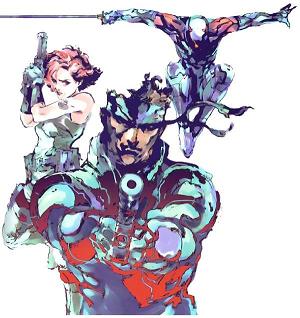

Roy Campbell: As usual, this is a one-man infiltration mission.
Snake: Weapons and equipment OSP?
Campbell: Yes. This is a top-secret black op. Don't expect any official support.
The series as a whole is called Metal Gear, without the "Solid" part. If you are looking for the page for the series in general, go here.
Metal Gear Solid is a stealth action game released by Konami for the PlayStation. It was one of the first 3D stealth games, having debuted at the 1996 Tokyo Game Show and E3 1997, before eventually releasing in 1998. With its cinematic style and fusion of gripping play mechanics with an equally gripping storyline, it shifted the acceptable degree of Story to Gameplay Ratio, perhaps irrevocably, while also single-handedly popularizing the Stealth-Based Game.
To many players' surprise, it is not the first game in the Metal Gear series; the original two MSX2 games in the series (Metal Gear and Metal Gear 2: Solid Snake) were never released in North Americanote (aside from a drastically altered Nintendo Entertainment System version of the former and an unrelated sequel titled Snake's Revenge), so Metal Gear Solid was the first proper game in the series that most people in the West played, and the Metal Gear Solid moniker carried on to the rest of the series, aside from a few spinoffs.
Six years have passed since Solid Snake, a special covert operative working for the United States military as a member of their FOXHOUND unit, infiltrated Zanzibar Land and assassinated the legendary soldier-turned-terrorist Big Boss. At the climax of the mission, Snake discovered that his best friend Gray Fox had been working for Big Boss, and was left haunted by the revelation that Big Boss was his real father.
Traumatized by the events of Zanzibar Land, Snake officially retired from active duty to a quiet life raising sled dogs in Alaska. But one day, he is suddenly kidnapped from his home by the U.S. government and brought to a submarine beneath the Bering Sea. There, Snake discovers that he has been forcefully drafted back into service to deal with an urgent situation.
FOXHOUND has gone rogue and taken control of a classified Alaskan nuclear disposal facility on Shadow Moses Island. Their new leader is a mysterious man who is the spitting image of Snake (long blonde hair aside), but calling himself Liquid Snake. They demand that the U.S. government turn over the remains of Big Boss and a ransom of $1 billion within 24 hours, or they will launch a nuclear strike against America. With the clock ticking down on their deadline, Snake must infiltrate the facility, ascertain the status of any hostages and whether Shadow Moses is really capable of launching a nuclear missile, and neutralize the traitorous members of FOXHOUND if necessary.
What follows is a game that loves to break the fourth wall while telling a surprisingly compelling (and serious) story about war, morality, and nuclear proliferation.
Metal Gear Solid became a huge hit for the PlayStation due to both its melodramatic (and incredibly juicy) plot and its satisfying gameplay; despite being the first 3D game of the franchise — hence the title's use of "Solid".
The game received a Japan-only Updated Re-release, Metal Gear Solid: Integral, which included a third disc of creative "VR Missions" (an expansion of the virtual reality tutorial from the original) to test players' skills. The VR Disc was later repackaged in North America and Europe as Metal Gear Solid: VR Missions and Special Missions, respectively, while Integral was used as the basis for a Microsoft Windows port in 2000 and later re-released onto GOG.com in 2020. In 2001, a direct sequel titled Metal Gear Solid 2: Sons of Liberty was released, which takes place two years after the events of this game and ramps the insanity of the plot. In 2004, the original Metal Gear Solid was fully remade for the Nintendo GameCube as Metal Gear Solid: The Twin Snakes.
The game's story was adapted into a graphic novel written by Kris Oprisko; it uses stylized, sketchy artwork by Ashley Wood that deliberately imitates Yoji Shinkawa's promotional art. The graphic novel itself was released in a semi-interactive format as Metal Gear Solid: Digital Graphic Novel on the PlayStation Portable. This same graphic novel and its sequel were eventually released on DVD in Japan as Metal Gear Solid 2: Bande Dessinée (with full voiceovers from the Japanese cast) and is included in English on the first disc of The Legacy Collection. There is also a novelization by Raymond Benson.
Note: this page is for the original PS1 game and its ports and remakes (including The Twin Snakes for the GameCube). For the Game Boy Color game released outside Japan as Metal Gear Solid, see Metal Gear: Ghost Babel. For the rest of the series, see the main Metal Gear page.
- Abusive Parents: In the English version, Liquid mentions that he wanted revenge on Big Boss because the latter told him that he was inferior. In the Japanese version, Liquid states that he believes that Big Boss knowingly chose him to be the inferior one.
- Action-Based Mission:
- All of the boss fights give no room for stealth, you must face your foe head on with deadly force.
- The sequence in which Snake has to climb the tower while being chased by guards, whom the player is given little choice but to gun down or stun.
- The Rail Shooter sequence near the end of the game gives you nothing to do but aim and fire a massive machine gun.
- Action Duo: Snake and Meryl through part of the game. Also, Snake and Otacon in the final car chase if you let Meryl die.
- Action Film, Quiet Drama Scene: Lots, sometimes in places that verge on being totally nonsensical. The most egregious of these is when Snake and Meryl stop to talk about love while, for all they know, a nuclear strike is on its way to blow them up real good.
- Adapted Out:
- Psycho Mantis' antics with reading the memory card and making the controller move are absent in the PC port, what with the titles he can scan for not being available for the PC and no DualShock functionality on PC controllers of the day or keyboards at all. Also, when actually fighting him, the swapping of the controller solution is replaced with using the keyboard, which, if you don't have a gaming controller for the PC to begin with, is your default control option anyway.
- The original PS1 version allowed the second player to control the guards in the checkpoints during the jeep escape sequence at the end. This is missing from the PC version as well.
- Adaptation Origin Connection: In the original MSX2 games, Solid Snake and Big Boss were strictly subordinate and commanding officer, respectively. This is the game that established Snake's origin as a genetically engineered clone of Big Boss and introduced his twin Liquid Snake, as well as Solidus after the end credits, setting the tone for the rest of the series.
- Alas, Poor Villain: Most of the bosses get an absurdly long drawn-out death scene in which they tell you a sob story, even if they never displayed any redeeming qualities before they were defeated.
- Alertness Blink: !

- The Alliance: Of a nefarious sort. If Liquid can just find a way to activate REX, he can bide his time until Ocelot's old Spetsnaz friends turn up and combine forces with the Genome Soldiers.
- Alternate History: Not much attention is called to this fact since the game, when it came out, took place in the future, but the backstory already calls for several Ruritanias from the Cold War. Just about everything else can be explained away or are the usual sort of fictional liberties, but Zanzibar Land sticks out.
- Anti-Frustration Features:
- Should the player be unable to swap controller ports during the Psycho Mantis fight, Campbell and Naomi will instead suggest that Snake shoot the statues on the opposite ends of the room as an alternative means to get past his defences. The PC version of the game obviously doesn't require the use of a controller, so the Psycho Mantis fight is altered so that he can be fought normally without switching controller ports.
- Right before the first fight against Sniper Wolf, Meryl creates a path with her footprints to show Snake how to avoid the hidden Claymores. When you leave and return with a sniper rifle to fight Wolf on even ground, the mines are removed so you don't have to worry about being blown up if you need to reposition yourself.
- In most boss fights, ammo will respawn so that you aren't boned if you run out.
- An Arm and a Leg: Revolver Ocelot loses his right hand, courtesy of the Cyborg Ninja.
- Armor Is Useless: Zigzagged as the Armor the player can pick up for Snake does reduce damage but Genome soldiers that visibly wear armor don't actually have any more health than other Genome soldiers.
- Armor-Piercing Question: Snake ends up having several directly at him:
- After saving Meryl and defeating Psycho Mantis, Naomi asks when did someone's death bother him so much after going great lengths to save Meryl. He does mention not wanting to see any woman die in front of him, a reference to when he saw Gustava Heffner die in front of him in Metal Gear 2. Campbell also comes to his defense.
- "You didn't think you made it this far by yourself, did you?"
- Liquid asks Snake why he bothered partaking his mission in Shadow Moses knowing full well that he was being betrayed. Snake clearly doesn't answer.
- Artificial Insolence: During the Final Boss fight, Gray Fox — an old ally of the Player Character Solid Snake — shows up and distracts the boss, giving Snake an opening to blow both of them up with a single rocket launcher shot. However, if the player actually aims at Gray Fox and pulls the trigger, Snake will not fire, obviously refusing to sacrifice his old friend.
- Artificial Stupidity: You can beat up guards and even shoot them in the back without causing them to sound the alarm. If you beat them unconscious or shoot them and hide before they see you, they will simply look around and then return to their patrol patterns as if nothing was amiss. Apparently being shot or beaten up isn't cause for alarm unless they see the person who did it.
- Artistic License – Biology: Anyone who's passed 10th grade Biology knows that "recessive gene" doesn't mean "inferior gene." Later games in the series retconned and invoked this; Liquid was raised to believe that he was inferior so that he would resent his brother. Kojima has stated that this was actually one of Liquid's character flaws; he is not that knowledgeable in genetics. note
- Artistic License – Physics: Otacon explains that one of the advantages of Metal Gear REX launching a nuclear warhead with its railgun is that there is no need for conventional rocket propulsion attached to the warhead itself, which negates traditional missile tracking systems as those require a heat signature. However, any object that gets launched with enough velocity to land over a thousand miles away would gain comparable level of heat from air friction alone.
- Asshole Victim: The VIPs being held hostage inside the base are far from innocent. Donald Anderson is in here on orders from the Secretary of Defense to implement a weapons delivery system, which can't be detected by radar or enforced by international law. This is not being done as a counter-strike measure, but to deliberately weasel out of the President's upcoming arms treaty with Russia. Kenneth Baker's looking out for his wallet and admits to bribing his way past the prying eyes of the Senate Armed Services Committee. Even the Secretary, Jim Houseman, doesn't like Baker as he included Baker in the FOXDIE program to rid the President of any loose ends. This is retroactively taken up to eleven in the fourth game when it's revealed that Anderson was actually a member of the Patriots.
- Attack of the 50-Foot Whatever: Snake encounters giant Genome Soldiers of varying sizes in VR Missions. Their voice clips are slowed down when you strike them. At the end, Snake faces a Puzzle Boss of sorts in Genola, a 50-foot mook who attempts to make off with Meryl(!). In addition to being a shout-out to classic monster movies (Godzilla and King Kong), "Genola" translated into Pig Latin becomes Enola Gay, the plane that dropped the bomb on Hiroshima and another reference to nuclear weapons.
- Back in the Saddle: Snake is forced out of retirement by Campbell to infiltrate Shadow Moses.
- Back Tracking: Happens a lot since the game takes place in one very large area. Even Snake complains about it. The two most egregious examples are:
- Snake having to fetch a sniper rifle from a very early area so he can fight Sniper Wolf and save Meryl.
- Snake having to return to earlier areas to activate the different temperatures of the PAL key.
- Badass Bandolier: Ocelot's wearing a lot of bullets for his revolver, though kept under his longcoat.
- Badass Longcoat: Many of the villains are shown wearing longcoats once or twice, but Liquid and Ocelot seem to wear theirs the most.
- Badass Normal: Solid and Liquid Snake have none of the superhuman abilities of the (other) FOXHOUND agents present in Shadow Moses. This doesn't prevent either of them from being extremely badass. This is justified as they are clones of the legendary soldier Big Boss, who is probably the biggest badass normal of the entire franchise.
- Batman Gambit: Liquid cannot actually launch the nuke because Anderson died prior to giving his code. Under Mantis' suggestion, Liquid decides to manipulate Snake into using the PAL key to activate the code to override the nuke's safety precautions instead.
- Bilingual Bonus: A subtle bit of foreshadowing that Naomi and Gray Fox are related is in their surnames: Gray Fox's real surname is Jaeger, which means "hunter" in German. Naomi's surname? Hunter.
- Bland-Name Product: Snake's so-called "smokeless cigarettes" (or "bent cigarettes" in the Japanese version) are specifically mentioned to be "Moslems" in the Japanese version. These were actually featured in Policenauts, where they came in a Marlboro-style red box.
- "Blind Idiot" Translation:
- Not a subtitle issue as much as pronunciation: "Saladin" doesn't actually rhyme with "Salad Bin".
- There is no place in China called "Lopnor." The proper transliteration is "Lop Nur," which is the version the novelization used.
- Otacon refers to "Rivermore National Labs". What he means is Lawrence Livermore National Laboratory. Possibly this a result of translation into Japanese and back; there are no "L" sounds in Japanese.
- Blood Knight: The FOXHOUND members involved with the revolt on Shadow Moses match this description, especially Vulcan Raven and Liquid. Snake himself is also heavily implied to be this throughout the game as well.
- A Bloody Mess: After Snake is captured, Otacon gives him a bottle of ketchup. It's possible to use this ketchup while Snake's on the floor during a guard's bathroom break, causing the guard to think Snake is dead and open the door.
- Bluff the Eavesdropper:
- Subverted to an extent in the torture room. Liquid mentions Decoy Octopus and Baker's deaths as well as the DARPA Chief's death by torture right in front of Snake, giving him an opportunity to figure out that the terrorists cannot launch a nuke, which Snake never does. Even many players missed it.
- Liquid and Ocelot discuss their PAL codes and Snake's card key deactivating Metal Gear REX, knowing that Snake is spying on them, to further fool Snake into unwillingly doing their bidding for them. The in-game novelization in the following game, In the Darkness of Shadow Moses: The Unofficial Truth, further emphasizes it, where it is heavily implied that most of the terrorists actually already knew about Richard Ames and the others eavesdropping on them via Snake's Codec, but continued "discussing" their plans in earshot anyways to further deceive them. Otacon somewhat supports this, stating that the grunts claimed that they already input the PAL codes.
- Bond One-Liner:
- Snake says this after he takes down the Hind D piloted by Liquid:"That takes care of the cremation."
- The novelization mixes this with Pre-Mortem One-Liner for astounding levels of narm: In the opening dock sequence, Snake approaches a sentry, says "Merry Christmas", and punches their lights out. "Oh, I forgot to tell you," he then adds, "Christmas came early this year." Zing!
- Snake says this after he takes down the Hind D piloted by Liquid:
- Book Ends: Both of Snake’s fights with Sniper Wolf occur right before and right after his time in the Communication Towers.
- Bootstrapped Theme: "Encounter". It's eventually used for the first part of the Snake/Ocelot Final Boss battle in Metal Gear Solid 4: Guns of the Patriots as well as one of the themes for the Shadow Moses Island stage in Super Smash Bros. Brawl.
- Boss Corridor:
- Features one of the most famous hallways in gaming: the entrance to Otacon's is littered with chopped-up bodies, the handiwork of the Cyborg Ninja. He kills a few mooks in increasingly-creative ways until he tires of them, tossing a limp Genome Solider away like a rag doll before passing the threshold, his suit generating an electrical field which shorts out the door controls. This scene is so iconic that Metal Gear Solid 2 paid homage to it.
- Other examples include the hallway leading to the Commander's Room (where Psycho Mantis is waiting), and the passage leading to REX's "lair." Raven's entrance is heralded by ravens cawing ominously as the lift approaches the Cold Storage room.
- Boss Tease: You will, at one point, run into a tense standoff with Sniper Wolf; the problem is that you won't have a sniper rifle at this point, so you'll have to come back for this battle when you acquire one.
- Bottomless Pit: As with the previous two games, a few floor spots in the base are in fact hidden trap doors that will dump Snake into a pit, equaling an instant game over if he falls.
- Briar Patching: Due to the accidental death of the DARPA Chief before they could learn the PAL Code to activate the nuke, a plan to use the keycard to activate it required tricking Snake into thinking that they had the PAL Code and activated the nuke with it, so he would naturally use the keycard to deactivate it, only for him to do the work for them.
- Breaking Speech: Delivered by Liquid to Snake, pointing out that he had only stuck to their current mission because they love the action and violence.
- Bring My Brown Pants: Otacon's very first scene has him pissing his pants in fear as the Cyborg Ninja advances on him.
- But Thou Must!: If the player didn't collect the SOCOM pistol from the truck in the Heliport before the gunfight in the cell with Meryl, a SOCOM will be slapped in front of the player at the beginning of the battle. You can run past it and choke/human shield the guards in the first wave, but in the short cutscene after that, Snake will automatically run to the SOCOM and equip it.
- Cain and Abel: The Hero and the Big Bad are twin brothers.
- Canon Welding: Though billed as a standalone game, Metal Gear Solid 2 reveals that the VR Missions are, believe it or not, canonical and performed not by Solid Snake but his imitator Raiden. This is actually a significant plot point in Metal Gear Solid 2.
- Can't You Read the Sign?: The player can invoke this by going to one of the armory rooms, and take a smoke directly beneath a very large "No Smoking" sign.
- Captain Obvious: Both Mei Ling and Snake refer to his Soliton radar as being made from "currently existing technology". They probably meant "technology currently available to the private sector," but any technology that's being used at all has to currently exist by definition.
- Casting Gag:
- This isn't the first time that both David Hayter (English) and Akio Ōtsuka (Japanese) voiced a character who was the byproduct of a Government-funded supersoldier project.
- Liquid's attire resembled that of Colonel Silver. Both characters were also voiced in the Japanese version by Banjo Ginga.
- Catching Some Z's: Sleeping guards.
- Caught with Your Pants Down: Can be done to Meryl if you're fast enough.
- Chekhov's Gunman:
- Sergei Gurlukovich, Ocelot's old ally from his Red Army days, is mentioned by name near the end. He and his private army will play an important role in the sequel.
- Dr. Clark, the scientist Naomi mentions she used to work for, will be a major supporting character in the prequel games. She is also a part of the franchise's Greater Scope Villains.
- The U.S. President that everyone frequently mentions will be the Big Bad of the sequel.
- Near the end, Campbell voices his concern that Naomi might be a spy for what is supposed to be a powerful organization. Said organization is the main antagonist of the franchise.
- Chekhov's Skill: Notably subverted with Nastasha Romanenko. The briefing, as well as the first Codec conversation with Nastasha, states that she was brought into the mission in order to aid Snake in dismantling a nuclear device should the time come. However, near the end of the game, Liquid wires Meryl to a time bomb which he explicitly states that it is a nuclear device. After defeating Liquid, Snake doesn't receive Nastasha's help at all. In fact, the part of the novel where Snake calls Nastasha after learning that Meryl is alive to have her give instructions to deactivate the nuclear device was actually one thing the novelization improves upon. More egregiously, the bomb isn't even dealt with once you beat Liquid. If you run out of time, the bomb will go off, but if you beat Liquid in time, it's not even mentioned.
- Chevalier vs. Rogue: Here, Snake is the ninja (ironically enough) to the knight of the Cyborg Ninja, a.k.a. his old Friendly Enemy Gray Fox. The latter wears a suit of Powered Armour, slaughters his way through scores of enemies and follows a strict code of honour.note Meanwhile, Snake sneaks around everywhere and is forced to hide if he's caught.
- Choke Holds: Snake can sneak up on guards, grab them by the neck, and throttle them unconscious. When they wake up, they're perfectly fine. Handled slightly realistically in that Snake can kill a guard by throttling him until his neck breaks.
- Climax Boss: Metal Gear REX.
- Cold-Blooded Torture: Snake, Meryl, the DARPA Chief and Baker are all vindictively tortured by Ocelot. Ocelot is so enthusiastic about it that he accidentally kills the DARPA Chief. Well, "accidentally".
- Company Cross References: Psycho Mantis will read your memory card and will comment if you have any saves from Castlevania: Symphony of the Night, Azure Dreams, Suikoden (the only games mentioned by name), Vandal Hearts, Broken Helix, Silent Hill, Contra: Legacy of War, Kensei: Sacred Fist, Project Overkill, or Poy Poy. The Japanese version also mentions Snatcher, Policenauts, the Gradius and Parodius deluxe packs, Ganbare Goemon: Uchū Kaizoku Akogingu, and Tokimeki Memorial. The Master Collection edition actually comes with the option to mimic those same save files to trigger his lines if the player so wishes.
- Container Maze: In the fight against Raven, Snake has to hide between the crates that all look alike and take him down by firing at his back.
- Copy Protection:
- Notably, the game requires the player to look on the back of the game case for a Codec frequency (Meryl's) that's required for the game to progress. However, since this frequency is identical for every game, it's not really copy protection so much as the game giving the bird to the Fourth Wall. That, and the game will simply add Meryl's frequency number to the Codec's memory window if the player calls Campbell more than four times.
- Some fans have pointed out that if you're playing Metal Gear Solid on certain emulators, you won't be getting past the Mantis fight, since you can't properly do the "second controller port" trick without some major hacking.
- Cut His Heart Out with a Spoon: Not spoken by the villains themselves, but mentioned by Snake after coming across Liquid's parachute. In a Codec conversation with Colonel Campbell, Snake remarks that nobody can bail out of a Hind in mid-flight without being "chopped up faster than an onion in an infomercial."
- Cutting Off the Branches: While the game has two different endings depending on who Snake escaped with, elements from both endings were combined as revealed in future entries though he canonically escapes with Meryl. Notably, not only Snake has both the Infinity Bandana and Stealth Camo, he also reveals in Metal Gear Solid 4: Guns of the Patriots that he knows the true relationship between Campbell and Meryl which he only knew if Meryl was killed.
- Darker and Edgier: This game is definitely darker than the MSX2 games, which reflects Snake's trauma and patricidal past. This is evident from the start with the colder color scheme and Gaelic opera in the introduction sequence. The color palette sticks to vivid greens and blues, which makes for a more solemn — and at times, creepy — atmosphere. The main villains also utilize torture this time around.
- Death Seeker:
- The Cyborg Ninja, who just wants one last battle to the death with Solid Snake.
- To some extent, Sniper Wolf, who is waiting for someone to kill her.
- Deconstructed Character Archetype: While Snake may fit the mold of the Action Hero archetype, he is shown to be a miserable person who is tormented by all the people he has killed and friends he has lost. He is also shown to only really know the life of a solider/spy and he takes on the mission despite knowing the risk and fact the people he worked for are lying to him because he enjoys the life and did not want to stay retired.
- Deconstruction: The story explores how the events of Metal Gear 2 affected Snake and his view on much of the world. He's distrusting and is only trying to survive and nothing more — at least at first. Also, unlike in previous installments, nearly all of Snake's support staff are manipulating or hiding secrets from him. The Pentagon only agreed to send him in because they needed a carrier for their virus, while the Secretary of Defense plans to simply shell the island with bunker-busters and be done with it. Like Liquid says, the market value for spies has dropped sharply since the fall of the Wall; Snake is an expendable tool, nothing more:Revolver Ocelot: You're a tough guy, Snake. But I've got some bad news for you. You're no P.O.W., you're a hostage. There's no Geneva Convention. No one is coming to save you.
- Department of Redundancy Department:
- "This is just like one of my Japanese animes!" It is probably a translation oversight. In Japan, anime does not refer specifically to Japanese animation.
- Mei Ling and Snake repeatedly describe the Soliton Radar and Metal Gear as being "made from currently existing technology."
- Developer's Foresight: See here.
- Difficulty by Region:
- The Japanese version only has two difficulty settings. The default one and an unlockable "No Radar" mode, which is just the same difficulty with the radar turned off. In the English version, the default Japanese mode became Easy mode, while the Normal and Hard modes (along with an unlockable "Extreme" mode) were added. The ranks from the Japanese version of the game are used for Hard in the English version, while the "Big Boss" rank, achievable only in No Radar mode in the Japanese version, is achievable in Extreme in the English version.
- The Torture event is a lot easier in Integral than it was in the actual North American and European versions of the original game. In the North American and European versions, the numbers of rounds per sessions increase gradually on higher difficulty levels (i.e. three rounds on Easy, four rounds on Normal, etc.). In Integral, they're always set to three rounds per sessions, regardless of the difficulty.
- Distressed Dude: Somewhat lampshaded by Snake on the torture rack. He gloats to the Russian captor that he's having "a nice nap on this revolving bed of yours." The whole sequence is very Bond-esque.
- Does This Remind You of Anything?: This can't be taken the wrong way at all, Ocelot:Ocelot: I love to reload during a battle. There's nothing like the feeling of slamming a long silver bullet into a well greased chamber.
- Dragon Their Feet: Ocelot just sort of disappears before the final battle with Liquid. However, it turned out that he wasn't really on Liquid's side during The Stinger and he had acquired the test data for Metal Gear REX, and had no more reason to stay.
- Dying Clue: Before he perishes, Raven reveals to Snake that the DARPA Chief who died in front of him was actually Decoy Octopus, and tells Snake to solve the riddle on his own.
- Dynamic Entry:
- The Cyborg Ninja makes his entrance by chopping off Ocelot's right hand. Ocelot himself may also count but he misses Snake during his own entrance, thus subverting this.
- Sniper Wolf makes her debut by shooting Meryl.
- Dystopia Justifies the Means: Liquid's goal is to ignite global conflict and plunge the world into perpetual warfare so that soldiers will always have a place and be valued for who they are. (Outer) Heaven for soldiers, Hell for everybody else. And even most soldiers would probably be against this; it's really for those Rambo-types who know nothing but war and aren't really able to fit in anywhere else, and again only the most sociopathic of these would sacrifice the welfare of everyone else on the planet to sate their own bloodlust or quench their thirst for purpose.
- Early Game Hell: The Heliport at the start of the game is by far the most complicated section to navigate through. You have no weapons, a small health bar and few tricks, you can only carry two rations and a small amount of ammo, there's searchlights, your footsteps can be tracked, there are surveillance cameras, and many guards. Presumably, newcomers are expected to partake in the tutorials first.
- Early-Installment Weirdness: Being the first 3D entry in the series, there are many elements that feel out of place after playing the later sequels:
- Snake's Life Meter, ammo capacity and item capacity are based off of the old upgrade system used in Metal Gear 2: Solid Snake where beating a boss would increase Snake's life and item/ammo capacity. Later games would have the player character's life meter remain at a fixed value and their item and ammo capacity would scale off of the difficulty level. The remake would also do this.
- When getting a call on the Codec, the colored box behind the "call" symbol is in red. Later games would have the red color only used for plot critical calls and optional calls would be colored green.
- Actions like hanging off a ledge and aiming and shooting any weapon (not just the sniper) in first person didn't exist yet.
- Guards that are killed will simply vanish. Later games would not subject enemies to this, thus the player needs to actually hide or dispose the body to prevent the guards from raising an alert. Likewise, the guards in this game don't use radios for backup.
- Unlockable items are based on what ending you unlocked. The sequels changed the method to other means such as collecting dog tags.
- Everytime you reload the game, you're asked if you need the mission log (a recap of what's happened so far in the story). This doesn't return in any other game in the series.
- Easy-Mode Mockery: Wryly suggested. Snake suddenly catches a cold if you submit to Ocelot's torture, almost as though his superhuman heroism and general badassery have been stripped away from him.
- Elevator Action Sequence: The game has two of these. There's one where you fight a group of soldiers in stealth mode aboard an elevator, and another where more soldiers simply leap onto an inclined elevator that Snake is using to leave. In either case, the restricted environment forces Snakes into combat — something normally discouraged in this game when dealing with regular mooks. Though, in the second one, at least, you can melee the mooks over the edge, though you won't get the items they drop.
- Empty Quiver: The terrorists have a mobile missile silo and a bottomless supply of warheads at their disposal. The Pentagon would love to bomb Liquid off the face of the Earth, but they can't risk losing REX and all its data. Liquid has the president's balls in a vise.
- Explain, Explain... Oh, Crap!: After taking down Liquid's Hind D, Snake asks Otacon to fix the seemingly broken elevator he needs to proceed; as it turns out, the elevator starts working on its own shortly afterwards, and when Snake gets on it, the weight limit warning goes off. As the elevator goes down, Snake gets a Codec call from Otacon, who reveals that he had gone back to his lab to retrieve one of the remaining stealth camo prototypes for Snake, only to discover that all four prototypes are missing. He goes on to say that it seems that someone was intentionally holding the elevator Snake is currently in, and that the weight limit warning went off for him as well; as Otacon explains, he only weighs 135 pounds, whereas the elevator weight limit is 650 pounds. Snake realizes that it would take at least five people to go over that limit...Otacon: Look out, Snake! The guys who stole my stealth prototypes are in there with you!!
- Exposed to the Elements: Almost nobody in this game is dressed properly for sub-zero weather. Liquid and Raven are both shirtless, Sniper Wolf is baring her cleavage even while outdoors, Snake's running around without so much as a hat, which Master Miller lampshades, and Meryl is stuck wearing a tank top. Kojima later regretted some of the wardrobe choices here. There are some nods to practicality, however — Meryl puts on a thick vest for the final escape, Sniper Wolf wears a heavier coat during her final battle, Liquid only loses his trenchcoat right before the REX fight, and the Genome Soldiers stationed outside are wearing heavier winter clothing than the ones inside. Raven already has a heavy supernatural element, so his bare chest is the least concerning aspect of his character.
- Expository Gameplay Limitation: Near the end of the game, Liquid has Gray Fox pinned with the rail gun of Metal Gear. Liquid is, at this moment, unprotected, and Snake is in a position to take him out with a Stinger missile - but would kill Fox in the process. Should the player try to fire, Snake mutters, "I can't do it!"
- Extremely Short Timespan: The whole game takes place over a single night.
- Failed a Spot Check: The guards will usually just take a look at the cardboard box, note it's "Just a box", and move on. However, if Snake is directly in their path or is spotted moving, the guards will avert this completely.
- Failure Gambit: Snake's goal is to shut down Metal Gear REX using a special key delivered to him by Otacon. Liquid and his forces had, at this point, spent much of the game trying to retrieve this key from Snake in order to prevent him from shutting down REX. In actuality, the key is the device that launches REX, and Liquid had counted on Snake to make it through his forces and attempt to shut down REX, thus activating it.
- Fake Difficulty: While it was an attempt to be creative and force the player to think outside the box (fairly literally at that), Meryl's Codec frequency ultimately falls under this as you may not have the original CD case on-hand to look at the back of it. This was especially problematic in the days of video game rentals as you wouldn't get the original packaging for the game with the rental, meaning you were SOL if you needed to find this information even if you managed to figure out what the game was telling you to do. Likewise, in today's day and age, anyone who digitally purchased and downloaded the game would be lacking this information as well, though scans of the back cover are included in the digital manual. Thankfully, Campbell will tell you the frequency if you call him four times.
- Fakeout Escape: One of the ways Snake can escape the jail cell he ends up in, is by simply hiding under the bed while the guard is gone.
- Fanservice: As a reward for completing the VR Missions, Snake can enter Camera mode and photograph either Naomi at her computer or Mei Ling. The more missions you complete, the closer you can zoom in. This gimmick has since been reused in Metal Gear Solid 4 and Peace Walker.
- Final Speech: The game contains many of them provided by some of the characters before they die.
- Fisticuffs Boss: Cyborg Ninja and Liquid:note Cyborg Ninja: Good, now we can fight as warriors. Hand-to-hand: it is the basis of all combat. Only a fool trusts his life to a weapon.
- Fixed Camera: It's effectively top-down. This is somewhat averted in Integral. The original game's first person mode was restricted to an unmoving look around feature, while the Scope and PSG1 gave a first person view including zoom. Integral includes a first-person view mode that lets you walk around, and you can even shoot your weapons.
- Fluorescent Footprints: Thermal goggles can track footprints.
- Foreshadowing:
- After his first encounter with Meryl, Snake briefly has a vision of Liquid berating Ocelot for killing someone and supposedly ruining their plans. Ocelot had killed the real DARPA Chief prior to Snake's arrival and had to trick Snake into using the card keys to activate the detonation code instead.
- If Snake manages to survive the third torture session with Ocelot, Ocelot will explain that his plans were to reignite war across the world because he feels that most people's true natures, feelings, and emotions are suppressed in the current age. Come Metal Gear Solid 4...
- Notice how Master Miller is not referred to even once in the briefings, yet ends up joining shortly after Snake arrives on Shadow Moses? More clues concerning Miller's true identity include: after you take out the Hind D, Miller doesn't respond to any Codec calls for awhile. Also, towards the end when you're using the PAL key, contact Miller, and he acts uncharacteristically excited.
- Why would a Russian ex-KGB agent name himself after an American cat, use an American firearm, and dress like a cowboy? The answer is that he is actually working as a double agent for the President of the United States.
- Gray Fox mentions that Snake "look[s] horrible... you haven't aged well." This gets mentioned quite a bit in this series, which of course all comes full circle in Metal Gear Solid 4.
- Baker mentions a "Jim" who wants to shut him up just before he's killed. The comment seems to be a throwaway line until the endgame where the Secretary of Defense, Jim Houseman, plans to nuke Shadow Moses.
- Ocelot mentions in The Stinger that the DARPA Chief was the only one who knew his true identity. At first, this line implies that Donald Anderson knew Ocelot was the President's mole until Metal Gear Solid 4 reveals Ocelot and Anderson were founding members of the Patriots.
- Naomi's behavior regarding about Gray Fox, a.k.a. the Cyborg Ninja, seems rather personal, especially after Snake defeats him before rescuing Otacon, asking Snake if "he'll fight [him] again? Until you kill him?". Later on, you find out from Naomi upon her arrest after being exposed as the traitor that Fox is her surrogate brother, and is not at all happy about seeing him as what he is now and how he wishes to be put out of his misery by the hands of his former comrade Snake.
- Naomi's relation with Gray Fox is hinted at further with her last name. Midway through the game, players are told (or reminded for longer time players) that Gray Fox's real name is Frank Jaeger, with "Jaeger" being the German word for Hunter. Naomi's last name is "Hunter."
- After defeating Raven a second time, he says that Solid and Liquid Snake are "not of this world" and he does not want to know where they came from. While it's easy to brush this off as more spiritual mumbo jumbo, it actually foreshadows that both Snakes are actually clones of Big Boss. Therefore, Solid and Liquid Snake weren't brought into the world through natural means.
- When suspicions about Naomi are escalating near the end of the game, Campbell voices his concern on the possibility that the spoiler tagged character is a spy for a certain powerful organization. He is talking about the Patriots, the franchise's main antagonist.
- Otacon asking Snake if "love can bloom, even on a battlefield" seems to appear to have inappropriate timing, given the circumstances. Later on, you'll find out that Otacon is asking this question because he has feelings for Sniper Wolf, who was among the few of the terrorists to treat him with any form of decency. It also foreshadows Otacon's inner turmoil regarding about how he would be unable to stop the woman he loves from battling Snake, which would soon lead to her death.
- If you call Master Miller on the Codec after removing the explosive Ocelot plants in Snake's gear, he'll be pissed off at Ocelot, having to calm himself down. After playing through the game, it takes on a different context: "Miller" isn't angry at Ocelot for doing something so cowardly; Liquid is ticked that Ocelot went against orders and actually tried to kill Snake, since he still needs Snake alive. The sole fact that Ocelot would disobey orders hints at his traitorous nature and how he's actually a double agent before The Stinger.
- If you try to leave the prison without collecting your gear first, you can call Miller and he'll ask if you're planning to complete the mission bare-handed and tells you to grab your gear. In the end, it was not only Liquid in disguise, but also after Snake destroys Metal Gear, he and Liquid fight on top of it bare-handed.
- Freelook Button: Hitting the triangle button lets out enter first-person mode. This is useful for identifying enemies just off-screen and noticing security cameras stationed above you.
- Freudian Excuse:
- Liquid's motivation. He believes that he's the "inferior" copy of Big Boss and so hates Snake, the "superior" clone, with a deep passion, as well as their mutual "father" for creating him.
- There's Psycho Mantis, who began his slow descent into madness when he peered into his father's mind and saw how much his father hated him.
- Futile Hand Reach: As FOXDIE is claiming his life, Liquid tries to reach out to Snake but succumbs before anything can come about it.
- Grim Up North: Shadow Moses is located in Alaska, specifically within the Fox Islands. The specific location is shown during the briefing.
- Hailfire Peaks: REX's hangar is separated by a blast furnace and a sub-zero storage facility. Snake's supposed to race between the two in order to reshape the temperature-sensitive PAL key.
- Hand Stomp: In the final battle, if Snake is hanging off the edge of Metal Gear REX, Liquid will stomp on his fingers.
- Hand Wave:
- We are told that various parts of the island are cut off from each other due to glaciers. This allows a more enclosed area for the game, and also gives an offscreen location for where the rest of the genome soldiers and the other scientists are.
- The exact size of the Next-Generation Special Forces is never given.
- Have a Nice Death: Die in the torture sequence, and Liquid harangues Ocelot for botching another interrogation:Liquid: Ocelot...YOU DID IT AGAIN!Ocelot: Sorry, boss.
- He Knows About Timed Hits: For the good majority of when the game breaks the fourth wall, it is simply to instruct you of what to do with your controller. None of the conversations and actions are ever treated like a tutorial for a game though.
- Heroic Sacrifice:
- Gray Fox pays the ultimate price for destroying REX's radome.
- Campbell attempts a non-fatal one by trying to give an order to cancel the bombing run, buying time for Snake to escape, which have surely landed him in prison at best.
- Otacon nearly does this by unlocking the gates in the Meryl ending, but it's subverted because the bombing run ended up being cancelled by President George Sears, Colonel Campbell, and Richard Ames.
- Heroism Motivation Speech: While the entire series is peppered with this, Snake's turning point comes during a discussion when Meryl is compromised:Naomi: ...I'm just surprised you're willing to sacrifice yourself... you've got the genes of a soldier, not a savior...
Snake: Trying to say I'm only interested in saving my own skin?
Naomi: I wouldn't go that far, but...
Snake: I don't know what the hell my genes look like, and I don't care. I operate on instinct.
Naomi: Like an animal?
Snake: I'm going to save Meryl. I don't need an excuse.
Naomi: Okay...
Snake: And I'm not doing it for someone else either. I'm saving Meryl for myself. Colonel, don't worry!
Colonel: Snake, thanks. - Hollywood CB: The Codec supposedly puts the sound straight into your earbones so only you hear the person talking to you. Plus, despite supposedly being an audio-only device, the HUD displays it almost like a videophone. On top of that, you have a number of people whose frequencies you have to find.
- Human Mail: You can hide in the cardboard box on a truck to rapidly travel between areas.
- Hyperspace Arsenal: To a lesser extent than later games, but still quite so. One noteworthy aspect is that, unless Snake is actively equipping a weapon or item, then the game treats it as if that item simply does not exist, such that security keycards have to be actively equipped to open their respective doors, despite the game explaining that they make use of a "personal area network" using the body's own magnetic field to let people open doors they have the clearance for just by having the right card on their person.
- I Cannot Self-Terminate: Gray Fox, who clearly wants to die but for some reason needs Snake to do it for him. Psycho Mantis and Sniper Wolf also really want to die, but they would rather kill as many people as they can in order to find somebody who can kill them in battle.
- I Never Said It Was Poison: While discussing Vulcan Raven, Master Miller comments on how Raven is part Japanese, just like Snake. However, Snake informs Miller that he never told him he was part Japanese.
- An Ice Suit: The Genome Soldiers patrolling the outside of the plant are wearing distinctive arctic wear. They've since become a Mascot Mook for the PS1 era: They're recruitable in Portable Ops, and replace the XOF soldiers in Ground Zeroes' "Déjà Vu" mode.
- Iconic Sequel Character: Ocelot, Otacon, Meryl, Johnny, Mei Ling, Naomi, Mantis, and Liquid all make their franchise debut in this game.
- Impersonation-Exclusive Character: For a long time, since most players only knew him from Metal Gear Solid, this was the case with Miller, who turns out to be Liquid Snake in disguise (having killed the original shortly before the events of the game began). This wouldn't change until he became a more important character in the "Big Boss" arc of the later games decades later. Similarly, there's the DARPA Chief that Snake meets at the beginning of MGS, who is actually the enemy spy Decoy Octopus in disguise (the real chief has been rotting in a cell the whole time). And just like Miller, the DARPA Chief became an important Mission Control character later in the series, under the name of "Sigint".
- Implacable Man: Both Solid and Liquid Snake due to their status as genetically engineered super soldiers. Liquid, however, deserves special recognition for being shot down, having his Metal Gear blown up under him (as well as with him in it), beaten senseless, knocked over a forty foot drop, taking multiple gunshot wounds, a car crash and he still nearly kills Snake before FOXDIE kicks in... and still survives in spirit thanks to Revolver Ocelot:Liquid Snake: Not yet Snake! It's not over yet!
- Improbable Aiming Skills:
- Ocelot is a villainous example. Though wielding a revolver (and never, ever using his other hand to steady it), he's got unerring accuracy, on-par with even Sniper Wolf. He can even ricochet bullets off of walls. When his right hand gets cut off, he just starts shooting with his left instead, without any perceptible drop in accuracy (although the GC version adds a scene where Ocelot tries to twirl his revolver in his left hand and drops it on the floor like a goof).
- Snake is able to cripple an M1A1 Main Battle Tank by pitching hand grenades perfectly into the open turret hatch (down the main barrel in The Twin Snakes).
- When Snake shoots someone in the legs with the PSG-1 (Kenneth Baker, Guards), the bullet magically hits them in the head or neck area.
- Improbable Piloting Skills: Liquid shoots down two F-16 fighter jets with a Hind D.
- Improbable Infant Survival: You can kill every wolfdog in the canyon area before Sniper Wolf, except for the pup at the very end who is enamored with Meryl.
- In-Universe Factoid Failure: In a three-way conversation with Naomi and Master Miller, Naomi claims her grandfather was an Asian-American FBI agent who took part in various stings to bring down The Mafia in New York in the 1950s. Privately, Miller points out Hoover would have been too racist to hire Asians and the first stings were in the '60s, and were in Chicago, and suggests Naomi is an impostor.
- Informed Attribute: In the original game, Liquid and Solid Snake are supposed to be physically identical; seemingly, Liquid's change in hair color was a last minute one, since Meryl's dialog is that he looks exactly the same as Liquid. This is changed in The Twin Snakes; both Campbell and Meryl note their hair color is different.
- Instant Awesome: Just Add Mecha!: Well, it is a Metal Gear game, so a giant robot armed with nuclear warheads is bound to appear, practicality be damned.
- Insult Backfire: During Snake's second encounter with Raven, Raven asks Snake if he was familiar with the World Eskimo-Inuit Olympics. Snake snarks that Raven must be quite a foe to be reckoned with in the "Muktuk Eating Contest." Raven seriously responds that he is. The Twin Snakes changes Snake's line to one where he wonders if Raven excelled at the "Stick Pull" and "Four Man Carry" events.
- Insurmountable Waist-Height Fence: One each in the two communications towers. Tower A has a jammed door that can be opened with C4, but only from the outside for some reason, regardless of the fact that Snake might be carrying enough explosives that, were this a Real Life situation, he could easily vaporize the damn door. Then there's that damaged stairwell in Tower B, which is even worse. It's less than a ten foot drop, but Snake still has to go all the way back up to deal with the stalled elevator and the Hind. In fact, the stairwell situation had to be revised in The Twin Snakes since the new play mechanics would probably allow the player to easily and safely drop to the floor and avoid the Hind fight.
- Interface Screw: Mantis making you think that your game system just turned off. This one is not given any rationalization though. It just happens.
- Inventional Wisdom: Discussed when Snake asks Otacon why he intentionally designed Metal Gear REX to have a weak point.
- Ironic Echo: When Liquid is taking off from the heliport with his Hind, he states that he's leaving to swat some bothersome flies, referring to the F-16s arriving at Shadow Moses Island, which he manages to do. Later, Snake tells Otacon something similar in the communication tower B, this time in reference to Liquid's Hind.
- Irony: At least two:
- Miller's accusation against Naomi, who turns out to have a completely different agenda, could very accurately describe Liquid's infiltration into Snake's team while posing as Miller:Miller: She might be a spy... working with the terrorists.
- Liquid is resentful of Snake for being the "superior" clone of Big Boss. It turns out that one of his cohorts, Revolver Ocelot, is secretly under orders from U.S. President George Sears, a.k.a. Liquid's other brother, Solidus Snake.
- Miller's accusation against Naomi, who turns out to have a completely different agenda, could very accurately describe Liquid's infiltration into Snake's team while posing as Miller:
- It Gets Easier: Snake gives a speech to Meryl on how he's felt less and less for those he's killed with times.
- Japanese Ranguage: Was REX a joint venture with Rivermore National Labs or Livermore National Laboratory?
- Kick the Dog: Master Miller (or rather, Liquid) gives this bit of advice at one point:Miller: Don't feel guilty about the soldiers that died from your bullets. They knew the risks they were taking, just like you.
- Killed Off for Real: Although most of the bosses have been killed, one before he even got the chance to fight Snake, the person best fitting for this is Gray Fox, since he ended up being revived from the last game, and then when doing a Heroic Sacrifice attempt at taking down Metal Gear REX, he ended up squished.
- Kill the Parent, Raise the Child: Frank Jaeger aka Gray Fox aka The Cyborg Ninja reveals to Snake right before he's killed that he killed Naomi Hunter's parents and adopted her as his sister due to his guilt. He begs Snake to tell Naomi the turth, but Snake can't bring himself to do this.
- Laser-Guided Karma: If the player submits to Ocelot's torture instead of withstanding it, and the player escapes from the cell, Snake will end up catching a cold from Johnny Sasaki. Later on, Meryl winds up dead.
- Laser Sight: The SOCOM pistol has one, which lets you know where your shots will go before you fire.
- Leave No Witnesses: The Secretary of Defense, realizing the Metal Gear REX project has been compromised, has Snake injected with a virus that is programmed to kill anyone with incriminating knowledge of the president's involvement. Naomi agrees to cooperate in the plan to fulfill her own personal vendetta against Snake.
- LEGO Genetics: The Genome Soldiers are the result of Gulf War veterans having the genes of a legendary soldier inserted into them and passed off to their offspring. Or more simply: normal soldier + Big Boss genes = mook.
- Logo Joke: The music that plays during the logo sequence is a Shout-Out to Policenauts.note
- Loophole Abuse: President Sears' recent arms treaty with Russia rules out intercontinental ballistic missiles, but REX's nuclear armaments are not technically considered "missiles" because they're launched by a railgun instead of being self-propelled. This is so reminiscent of real life arms treaties that it would be laughable if not so sad.
- MacGuffin: Everyone is after Big Boss' frozen remains. The purpose is not made clear until the end, when Liquid confesses that his Genome Army are all flawed copies of Big Boss. They're beginning to exhibit cellular degradation and need his DNA.
- Major Injury Underreaction: Meryl really shouldn't be running around with no problem scant hours after taking a rifle round through both her legs.
- Male Gaze: Meryl has a very distinct walk that gives her away even in disguise, and recognizing it is key to reuniting with her when she's disguised as a soldier.note This, of course, means plenty of butt shots. Snake even goes out of his way to compliment Meryl's butt later on.
- May–December Romance: The potential one between Snake and Meryl, big time. In this game, he's thirty-three; she's eighteen. Factor in Snake's accelerated aging thanks to Clone Degeneration, and it becomes a Mayfly–December Romance.
- Mind Screw: Psycho Mantis. The game dabbles in poking holes in the fourth wall from time to time, but Mantis' boss fight is where the game finally takes a sledgehammer to it.
- Minion Maracas: Snake does this to Otacon while interrogating him about Metal Gear REX, assuming Otacon had full knowledge it was a "nuclear-equipped walking deathmobile" as Snake put it.
- Moon Logic Puzzle: Famously, Meryl's Codec number. Your only clue is that the number is on the back of the CD case (or, as Baker puts it in The Twin Snakes "the package"), and you have an item in your inventory that vaguely looks like one, leading many players to search for ways to examine the in-game disc to find the number, or searching high and low around the levels to find what CD case Baker was talking about. Of course, the number is actually printed on the back of the actual game box, where you can see Snake talking to Meryl in the Codec screen. Fortunately, if players didn't have the original game box available for any reason, forcing the code is easy (as everyone knows by now it's 140.15, it only takes 15 attempts starting at 140.00). The PSN version includes the frequency in the software manual as well.
- More Dakka: The room right before the corridor leading into Metal Gear REX's hangar is filled with roughly 30 gun cameras. All it takes is a chaff grenade to disable all of them, but still...
- Mugged for Disguise: Meryl knocks out Johnny Sasaki and steals his uniform offscreen.
- Multiple Endings: Whether or not the player succeeds in the torture sequence decides if Meryl joins Snake in the ending scene (and grants the player the infinite ammo bandana for their next playthrough). If the player gives up, Meryl dies, and Otacon joins them instead (giving the player his stealth camouflage). With Meryl appearing again in Metal Gear Solid 4, Meryl's ending has been confirmed as the canonical one, although The Reveal from the alternate ending (Meryl is actually Campbell's illegitimate daughter, conceived from an affair with his deceased brother's wife) is referenced in Metal Gear Solid 4.
- Musical Nod:
- The jingle at the start of each VR training level is "Operation Intrude N313", Snake's riff when he emerges out of the bog in the original Metal Gear. The in-level and mission failure themes are the "Theme of Tara" and "Just Another Dead Soldier", respectively, both taken from that game as well.
- As you progress through the VR Missions/Special Missions expansion, the standard BGM ("Theme of Tara") is gradually replaced with music from Metal Gear 2, namely "Frequency 140.85" and "Level 1 Warning" as the sneaking music, with "Level 3 Warning" as the alert theme.
- The Integral version features three hidden music tracks that are only played by calling Codec frequency 140.66. Two of them are arranged versions of the "Theme of Solid Snake" and "Zanzibar Breeze", both from Metal Gear 2.
- Metal Gear Solid 2 uses the same tunes for its VR stages, along with a remix of "Sneaking Mode."
- Mysterious Informant: Gray Fox, going by the pseudonym "Deepthroat".
- Mythology Gag: The first suggested target for Metal Gear REX's nuclear strike is Chernoton, Russia. This is the location where the chemical weapon Lucifer-Alpha was developed in Kojima's earlier game Snatcher. The game also reuses the twist of a doppelgänger being revealed by finding the original's rotting corpse: an android impersonating Benson Cunningham in Snatcher, and Decoy Octopus impersonating the DARPA Chief in Metal Gear Solid.
- Naked on Arrival:
- Snake is fully nude during the briefing segments, with the camera cutting just above his waist or with Censor Shadow on his crotch, which is his first appearance in the game as well as the first appearance of his updated character design. The Twin Snakes gave him underpants, probably because the briefings were rendered in 3D with a controllable camera.
- In the English version, Johnny is stripped naked after Meryl stole his clothes.note
- Never Bring a Gun to a Knife Fight: During the boss battle with the Cyborg Ninja, he can block fire from anything in Snake's arsenal with just his HF blade. Snake has to run up and melee him to get anywhere in the fight.
- Never Trust a Trailer: One trailer that was peddled with various PS1 demo discs depicted the game being much more action-oriented, and implied that the whole point of the thing was sticking C4 everywhere.
- New Game Plus: Started a tradition in the series. Depending on which ending you get, you can start a second playthrough with either the stealth camouflage or the infinite bandana. Get both, and on your third playthrough, Snake will wear a tuxedo, while the Cyborg Ninja will be recolored to resemble Spider-Man. In the Integral version, Meryl will wear a sneaking suit.
- Nice Job Breaking It, Hero: Thanks to Liquid's Batman Gambit, Snake accidentally activates Metal Gear REX instead of deactivating it.
- No Fair Cheating: "Don't even think about using autofire, or I'll know." He's not joking. If the game detects it, Ocelot continues shocking you after the timer runs out until you finally die, and to rub salt in the wound you get a true Game Over with no Continue option, forcing you to reload your save. This is subverted by using a controller with adjustable autofire. "Cheating" is detected by reading button presses coming in faster than a human could possibly input them. If you mash fast enough, however, it's possible to set this off without turbo as well.
- No Fourth Wall: Zigzagged. Oddly enough, this isn't exactly played straight. The game always takes itself seriously, regardless of the situation. Never once is the production and development crew ever mentioned, or the voice actors or anything you would typically expect when breaking the fourth wall. The characters don't act like they're directly inside a video game, but rather always making very vague references to the game anyway. All the examples can be given in-game explanations, though with a little bit of Lampshade Hanging in the process:
- Campbell tells you to find Meryl's Codec number on the back of "the CD case", never going into more detail than that.
- Master Miller's Codec calls have frequent allusions to the fact that it is a video game. He refers to Snake as a "gamer" in one call, and makes several Anti Poop-Socking recommendations, like being prepared for long cutscenes.
- Campbell suggests you keep your rations selected while in the Cold Storage facility, as Snake's body heat will keep them from freezing solid.
- When you defeat Mantis, he finally realizes just how you were able to do it by using the secret method that you're supposed to. Snake just treats it as if he was trained in some form of anti-psychic therapy that Mantis didn't know about.
- One of Mei Ling's ancient Chinese proverbs mentions how grateful you should be to be able to play a game every once in a while. She doesn't imply that you are playing a game, but says it is nice to enjoy the time you have to do so.
- "Don't think about using autofire, or I'll know!" Spoken by Ocelot before the torture sequence, and he's not bluffing. The Twin Snakes takes this further, with Ocelot straight-up Addressing the Player as he says this, looking directly into the camera and pointing at the player as he makes this threat.
- No Honor Among Thieves: There's a lot of it going around. With REX in his grasp, Liquid sees no reason to hold up his end of the bargain and give Russia exclusive bidding rights — though he'll happily accept their chopper and ground units. Ocelot, in turn, is working with President Sears against the Russians and Liquid's confederates. The low man on the totem pole is Kenneth Baker, who is assassinated by his man in the White House, Jim Houseman, after his company has already finished building REX; the president had no intention of coughing up Baker's fee.
- No Name Given: Though Snake was never really given a full name even in the original games, this is when the series basically started referring to nearly every plot important character by their codename or nickname, although it's revealed in the end of the game that Solid Snake's real name is David. It's even lampshaded:Cyborg Ninja: I am like you... I have no name.
- No OSHA Compliance: Shouldn't the blast furnace have at least a railing next to it? The walkways above it do but not the floor that's even closer to the molten metal. Having a stairwell leading down into a sewer drain filled with nuclear water surrounding Metal Gear REX's hangar also counts. Snake even has to wade through it just to recover a MacGuffin.
- Non-Standard Game Over:
- If you mistakenly kill Baker during the first boss battle, it triggers a game over. Instead of one the support team screaming Snake's name, Ocelot will call you an idiot.
- If Meryl dies other than if you submit to Ocelot's torture, you lose the game.
- "There are no continues, my friend." If you don't submit or survive the torture session with Ocelot, this line becomes literal: you can't continue, and you have to load the game from your last save file. He'll even lampshade this if the player hasn't saved in a long time:Ocelot: Snake, it's been a long time since you saved your game. If your body can't survive the torture, it'll be game over. You really wanna travel down that long road again?
- If you fail to get rid of the time bomb in your gear following the torture sequence, Ocelot will laugh at you when you die.
- If you fail to defeat Liquid on top of REX before the time runs out, the latter will laugh maniacally.
- The Nose Knows: Stealth camouflage is useless against the wolfdogs because they can easily smell you.
- Not His Sled:
- Adapting the famous Psycho Mantis boss battle and its memory card reading controller-port-switching gimmicks into comic book form would have been incredibly challenging and awkward, so instead the writers redid the sequence for the graphic novel version, where Master Miller arrives at the nick of time to take out Mantis, he and Snake go to REX's hangar where they're ambushed by Liquid and Ocelot... but then Snake notices that Ocelot still has both his arms, and figures out that it's all an illusion set up by Mantis.
- The novelization does something similar to the above: Snake apparently blacks out, only for Master Miller to arrive to help Snake, they then leave the Commander's Room... only to end up in an amusement park that Snake apparently spent time at as a child when he wasn't being trained in military school. Miller disappears, he's alone in the carnival at night, Meryl apparently goes nuts on the rides, and then he finds the funhouse mirrors where Otacon, Meryl, and even Big Boss are trapped in the reflections. Otacon and Meryl are trying to get Snake to help them out, but Big Boss is resigned to his fate, although he does beg for Snake to input the detonation codes or something bad's going to happen to him. Snake doesn't know and Big Boss's face melts. As for actually defeating Mantis, in the novelization, at least, Snake gets the idea to trick him into performing as many psychic tasks at the same time as possible. This taxes Mantis's abilities enough that he's too distracted to notice Snake finally take aim and shoot him twice in the chest.
- The PC port was made at a time when USB still wasn't quite as ubiquitous as it is now, and there was still a decent possibility you were using the game port type, which there was usually only one socket for on the PC (with second players typically daisy chaining off a port on the first player's controller). So how did they handle the Psycho Mantis trick in this version? Simple: you have to switch to keyboard control for the fight. Note that if the player was already using the keyboard to begin with, this fight will be solved by default.
- "Not So Different" Remark: Liquid and Mantis's speeches indicate that Snake is just as much of a bloodthirsty psychopath, or even more of one, than themselves.
- Oh, Crap!: Otacon has this reaction when you ride an elevator, and then realize that four Genome Soldiers who stole four of his stealth prototypes are in there with you. He even has a unique Codec mugshot for this reaction.
- Open Air Driver: After the REX's radome is disabled, Liquid is forced to pilot with an open cockpit. Hal actually designed it this way so that REX would have a weakness for a character flaw.
- Opening a Can of Clones: Snake's brothers, Liquid and Solidus, are first introduced in this storyline. As a minor example, the Genome Soldiers share the same "soldier genes" that were harvested from Big Boss' remains. According to Liquid, this makes them all blood brothers.
- Paper-Thin Disguise: Retroactively subverted. In Metal Gear Solid, the player is led to assume that all Liquid had to do to pass himself off as Master Miller was changing his accent slightly, wearing his hair slightly differently, and putting on shades, and Snake totally fell for it, with Liquid even taunting Snake about his "flawless" disguise (which Snake could somehow see over his Codec). However, in the re-released versions of Metal Gear 2, Miller's portrait was updated to resemble Liquid's disguise, and in Peace Walker, not only do they have Miller look almost exactly like Liquid with shades, they even had his voice actor voice him in a similar manner to how Liquid spoke when he posed as Miller.
- Parachute in a Tree: A parachute in a tree, sans passenger, is how Solid Snake can learn that Liquid is alive after his helicopter was blown up. Snake believes it was left there intentionally as a coded threat by Liquid.
- Parrying Bullets: Cyborg Ninja has demonstrated the ability to cleave bullets in midair. However, since he has also demonstrated the ability to hold up a gigantic mecha by the foot temporarily, this is a fairly minor manifestation of his power.
- Passive Rescue: When Snake's captured, Otacon gives him some ketchup, which he can use to pretend to be dead and make Johnny Sasaki open the door to investigate. If you continue to screw up, the Cyborg Ninja will slice the jail door open.
- Permadeath: If you choose to surrender during the torture sequence, Meryl will be killed.
- Pet the Dog: Pointed out by Otacon, when he believes Sniper Wolf isn't evil because she loves dogs. Snake doesn't like it.
- Pietà Plagiarism: Snake cradles Meryl in this way upon discovering that she's dead in the non-canon ending.
- Pin-Pulling Teeth: Solid Snake pulls grenade pins with his teeth.
- Plot Parallel: The DARPA Chief retroactively turns out to be Decoy Octopus in disguise, and this introduction of the theme of disguise foreshadows the later revelation that Master Miller is Liquid in disguise.
- Point of No Return: This game has this with Metal Gear's control room. Once you insert the third and final PAL card, Metal Gear REX is turned on, with no way to turn it back off, and this is when Master reveals his true identity as Liquid Snake over the Codec. Once the player contacts Otacon and gets him to let Snake out of the control room, which starts filling with gas, the two Snakes will meet on the catwalk outside, starting the cutscene that leads into the endgame starting with the Metal Gear REX boss fight.
- Politically Correct History: Defied: When Naomi mentions that her Japanese grandfather used to work for the FBI in the 1950s, Miller grows suspicious of her story, knowing that J. Edgar Hoover, the head of the FBI at the time, was extremely racist and would have never allowed a Japanese man in the bureau.
- Post-End Game Content: The stealth camouflage and the infinity bandana, depending on the ending. Get both endings in one save and you get the tuxedo, and Cyborg Ninja's color palette changes to something like Spider-Man's.
- Potty Emergency: Johnny, the guard watching Snake during his imprisonment, undergoes this. After escaping, if Snake runs towards the torture room instead of knocking him out, Johnny will run towards the bathroom, ignoring Snake in the process.
- The Power of Legacy: Snake, at the end, refrains from telling Naomi that Gray Fox had confessed to killing her parents. This in itself was a call back to Metal Gear 2, where Snake refrained from telling a dying Gray Fox that he (Fox) killed his lover Gustava.
- The Precarious Ledge: In Disc 2, there is a blast furnace section. You have to cross a ledge on the wall, and there's a piece of crane-like machinery moving around that will hit you and make you fall into the open furnace— As a bonus, you can actually shoot the thing down before crossing it, not that your various Mission Control tells you that like they usually do. This is also the only ledge where there is an actual danger of falling.
- Press X to Not Die: While not technically a cutscene like shown throughout the rest of the game, the torture sessions only gives you two options: Either you hit select and give up (in which case Meryl dies), or you mash the Circle button to recover your health just to survive it. If you run out of health, you get a Game Over that you can't continue from.
- Previously on…: The Special menu includes plot summaries of the two MSX2 games for the benefit of players who missed out on them during their initial release.note The Mission Logs when the player loads a save file serves a similar purpose.
- Production Foreshadowing: Achieve 100% Completion in the VR Missions side game, and you'll get a sneak peek at Metal Gear RAY from the following game, labeled as "confidential".
- Production Throwback: Clips from Policenauts, or Zone of the Enders, if you're playing The Twin Snakes version, are used when Otacon talks about his fondness of anime.
- Protagonist Title: The Solid in the title stands for Solid Snake.
- Psychic-Assisted Suicide: Psycho Mantis attempts to do this to Meryl. Fail to knock her out in time, and he succeeds.
- Psycho for Hire: The majority of the FOXHOUND unit qualifies as such in addition to their Blood Knight status. To a lesser, but still notable, extent, Snake himself qualifies, as Liquid specifically told Snake when atop Metal Gear REX's ruins that he, Snake, enjoys all the killing, and Meryl mentioned something quite similar when they met in the bathroom (basically she deduced from Snake's status that Snake most likely felt alive when he saw everyone dying around him, that he enjoyed war and didn't want it to go away).
- Random Drop: If the player kills a guard without triggering the alert phase, a ration or an ammo will sometime appear after the enemy's body disappears. This is a play mechanic that was carried over from the MSX2 games, but was dropped in subsequent sequels.
- Rape as Drama: Implied near the end of the game, when Meryl mentions that she suffered more than torture, "But through all the pain and the shame, I held on to one hope." Subverted later in the series: she was Forced to Watch Snake get tortured, which was more tormenting to her than if she had been hurt the same way. Her shame was from being unable to stop it.
- Recurring Boss: Throughout the game, Snake will fight Liquid three times and both Vulcan Raven and Sniper Wolf twice.
- Recurring Riff:
- Da-da da da-da! Although it's mostly just a leitmotif for this game in particular, it proved popular enough to be used on the Game Over screens for every Metal Gear Solid game since, with the exception of Portable Ops.
- To a lesser extent, credits song "The Best Is Yet to Come" (or variants thereof) tends to play in the original game during emotional or sad moments.
- The Remnant: The terrorists join forces with a renegade Russian outfit led by Colonel Sergei Gurlukovich. A most sympathetic character, Sergei took those who had nowhere to turn after the Wall fell and made them into a mercenary force. Sergei's top guy, Ocelot, hints that certain corners of the Russian armed forces are disgusted with the current state of their country. Sergei himself has a personal motive: After the USSR collapsed, his hometown was bought up by the U.S. and turned into an atomic testing site. Sergei is delusional enough to think that if he can steal Metal Gear and deliver it into the Russians' hands, it will mean a renaissance for his country.
- Rescue Hug: In the good ending, Meryl drops from the remnants of Metal Gear REX into Snake's arms. The whole base is falling apart around them, but they just don't seem to care.
- Rescue Introduction: Snake meeting Otacon when he rescues him from the Cyborg Ninja.
- Retcon:
- Snake and Campbell state that Big Boss told Snake that he was his father back in Zanzibar Land, or at least implied it. Such a conversation did not occur in Metal Gear 2.
- Metal Gear 2 hinted in both its manual as well as the beginning prologue after the main menu that the entire world had disarmed most of its nuclear weapons by this point, and the only country to hold nuclear weapons was none other than Zanzibar Land. Turns out that wasn't the case at all in this game, where at least 20,000 nuclear weapons still exist in 2005 (the time the game is set in).
- FOXHOUND is changed from a NATO-run special forces unit to a U.S.-commanded black ops unit.
- The Reveal: This game has quite a few:
- Master Miller is actually dead and Liquid has been impersonating him the whole time throughout the game.
- The Cyborg Ninja is actually a Not Quite Dead Gray Fox.
- Snake is carrying a virus called FOXDIE that Naomi changed to include him as a target since Fox is her adoptive brother.
- Snake actually was the inferior clone of Big Boss not Liquid, who was actually the one who got all the superior genes.
- Ocelot is actually a double agent working for the President of the United States.
- Ring-Out Boss: Liquid can only be defeated by being knocked off Metal Gear REX.
- Rule of Cool:
- Yoji Shinkawa single-handedly drew up the Cyborg Ninja on the fly and presented to Kojima, because “it would be nice to have a ninja.” Kojima added, “Plus, it looked really cool."
- It's often observed by fans that the staggering costs of Metal Gear make it an impractical tool for warfare. Well, Shadow Moses is the first enemy stronghold in Metal Gear for which that could be said, too. This is the most needlessly complicated base known to man and its construction would probably bankrupt the country if any president tried it. But that's why it is awesome.
- Ruritania: Not to the extent of the first two games to be sure, but still to a small extent. The Fox Archipelago does in fact exist, but there's no such island as "Shadow Moses Island." However, Shadow Moses may just be the name of the military base (and top secret black project) located there.
- Same Story, Different Names: The plot structure of Metal Gear Solid recycles many events and situations from the MSX2 games, especially from Metal Gear 2:
- Shadow Moses Island is a fictional territory with a biblical-themed name, just like Outer Heaven.
- Snake begins his mission with an underwater insertion to Shadow Moses Island, just like he did at Outer Heaven. Snake also has to avoid enemies in an Early Game Hell so he can infiltrate the enemy fortress through a vent, like in Metal Gear 2.
- One of Snake's radio contacts is the enemy commander pretending to be an ally, who tries to sabotage the mission near the end (Big Boss in the original Metal Gear and Master Miller/Liquid Snake in Metal Gear Solid).
- The FOXHOUND bosses (Revolver Ocelot, Psycho Mantis, Sniper Wolf, and Vulcan Raven) in Metal Gear Solid are named after their weapon or tactic of choices, much like the Outer Heaven mercenaries in the original Metal Gear (Shoot Gunner/Shotmaker, Machinegun Kid, Fire Trooper, and Coward Duck/Dirty Duck). Raven's attack pattern, in particular, is very similar to Machinegun Kid.
- Snake gets captured at one point and is locked in a cell without his equipment. When he escapes and regains his gear, a booby trap is planted among his items (a transmitter in Metal Gear and a time bomb in Metal Gear Solid).
- Snake catches a cold after a certain event (if he remains in the underground drainage ditch for an extended period of time in Metal Gear 2 and if the player submits to the torture sequence in Metal Gear Solid).
- At one point, Snake must use a remote control missile to destroy a power generator in order to shut down an electrified floor in his path, which happens a few times in the original Metal Gear.
- Snake uses Meryl and Otacon to access doors he can't open himself, much like he did with Jennifer in the original Metal Gear.
- Snake must find a disguised female contact in the women's bathroom, like in Metal Gear 2.
- The first objective in each of the three games is to locate a hostage in the enemy's base (Gray Fox in Metal Gear, Dr. Marv in Metal Gear 2, the DARPA Chief in this game). Dr. Marv and the DARPA Chief both turn out to be enemy agents who used a tracking device to lure Snake.
- In both Metal Gear 2 and this game, a hostage is used to lure Snake into the first boss fight (Black Color in 2, Revolver Ocelot in this game).
- Snake is told to find the Metal Gear engineer (Dr. Pettrovich in the original Metal Gear, Dr. Emmerich in this game) after rescuing a hostage in the first building. On his way to the second building, Snake encounters a tank.
- While the Cyborg Ninja is none other than Gray Fox (a.k.a. Frank Jaeger), he is also a composite of the Arnold/Bloody Brad cyberoid from the original Metal Gear and Black Color/Black Ninja from Metal Gear 2. In the same way that Bloody Brad was create with the same technology that Dr. Madnar used to built the TX-55 Metal Gear, the Ninja was the result of Dr. Clark's gene therapy experiments that led to the creation of the Genome Soldiers who take over Shadow Moses. Likewise, the Ninja is a character from the previous game who was presumed dead, much like Black Ninja from Metal Gear 2 (who turns out to be Schneider, the Resistance leader from the original Metal Gear).
- Snake is assisted by a contact calling himself Deepthroat, who turns to be Gray Fox as well, a throwback to his role as an anonymous informant in Metal Gear 2.
- Snake's fight with the invisible Genome Soldiers in the Communications Tower's elevator is similar to the Ultra Box/Four Horsemen boss fight in Metal Gear 2.
- Gray Fox uses Metal Gear to blow up the bridge, which ensues a lot of backtracking and detouring. Liquid's Hind D did the same to the Communications Tower connecting bridge.
- Snake uses a parachute to jump off the roof of Building No. 1 in the original Metal Gear, while in Metal Gear Solid he uses a rope to rappel down the side of the first Communication Tower.
- The DARPA Chief and Baker both die of a "heart attack", just like Dr. Marv did in Metal Gear 2, although the cause is different.
- The temperature-sensitive PAL key is an obvious stand-in for Natasha/Gustava's shape-changing brooch.
- Snake loses his items after destroying Metal Gear D, then engages Gray Fox in a bare-knuckle brawl while surrounded by mines. He does it again with the Ring-Out Boss Liquid, this time atop REX's hide.
- Snake becomes romantically involved with a female contact (Holly and Meryl).
- All three games also feature a Hind D boss battle. The one in this game combines aspect from the previous two battles. Like in the original Metal Gear, it is set on the rooftop of a building, but requires Stinger missiles to be destroyed like the one in Metal Gear 2.
- Both games have the same overall layout of the entire game area consisting of three large buildings south to north with wilderness in between. Snake begins the game at the southernmost tip and the end of the game takes place at the far north end.
- In both games, Snake unavoidably triggers an alarm and has to run up a tall winding stairwell while an endless stream of enemies chase him.
- Say My Name:
- This happens when Snake dies.
- Liquid does this at the conclusion of the Hind D battle and when he loses the fist fight against Snake.
- During Fox's Heroic Sacrifice, Snake does this:Snake: FOOOOX!
- In the alternate ending, Snake calls out Meryl upon finding her dead body.
- Sci-Fi Writers Have No Sense of Scale: A mundane example, and more egregious for it. The cargo elevator in Tower B has a weight limit of 650 pounds. Most elevators that are not expected to carry military equipment or supplies, or heavy nuclear materials, have a much higher weight limit than that, usually between 1200 and 2300 pounds. In other words, weakest lift ever. Admittedly, if the weight limit was much higher, Snake and the four cloaked soldiers wouldn’t have set the buzzer off.
- Screw Destiny: Exactly what is written inside Snake's mind. No matter how much people around him talk about the inherent killer instinct in his gene, he still fights to defy it with his own free will. That mindset also inspires the natural courage in Meryl to live.
- Secret Character: A couple of the VR Missions put you in control of Gray Fox, who possesses all of his moves from the story campaign. Unfortunately, his stealth camo drains his HP as long as it's active (it's built into his exoskeleton), which in turn lowers your final score.
- Security Blindspot: This includes surveillance cameras, which have a blind spot directly underneath them, and their vision cone is shown on the radar. Alternatively, they can be destroyed by explosives, with later games allowing using first-person view to shoot cameras.
- Series Continuity Error: Metal Gear 2 was originally said to take place three years after the events of the first Metal Gear. However, the plot summary in this game state that the Zanzibar Land mission occurred four years after Outer Heaven. Note that even the Metal Gear 2 manual was a bit inconsistent about the timeline of the Outer Heaven mission, and later continuity has gone with the MGS summary's four years (Metal Gear 1 taking place in 1995 and Metal Gear 2 in 1999).
- Shirtless Scene: Several. Notably, at the end of the game, during the second-to-last battle with Liquid, both he and Snake are shirtless.
- Shout-Out:
- The freight elevator is a near duplicate of the one in AKIRA, even leading to a sub-zero basement area.
- Revolver Ocelot is an explicit shout out to Spaghetti Westerns, even down to his appearance modeled after actor Lee Van Cleef.
- There's Snake himself, who, besides the initial references made in the previous games, also takes his real name from David Bowman from 2001: A Space Odyssey.
- All three parts of Otacon's name are references: his first name "Hal" is a reference to 2001: A Space Odyssey, his last name "Emmerich" is a shout out to director Roland Emmerich, and his nickname "Otacon" is an explicit reference to Otakon, the Otaku Convention (which, according to his bio, he regularly attends). Otacon is also a slight subversion: He was originally supposed to resemble an overweight slob who constantly ate a chocolate bar (sort of like Dennis Nedry from Jurassic Park, but far more sympathetic), but Yoji Shinkawa decided to design him differently.
- Snake and Otacon share a 2001 joke when Snake reveals his name to be Dave. Snake himself wonders if they should go on a space adventure.
- When Otacon about how anime inspired him to make REX, FMVs from a past Konami game, Policenauts, are shown in the original game. In The Twin Snakes, FMV footage of Zone of the Enders: The 2nd Runner is shown.
- The Meryl ending has a shout out of its own. Snake still announces his real name as "David" to Meryl, who calls him "Dave", referencing Kojima's earlier visual novel game Policenauts which had the very same Meryl Silverburgh character (albeit older, wiser and tougher, being a Distaff Counterpart of pre-MGS Snake) as a supporting character who was partnered with a guy named Dave Forrest. Metal Gear Solid Meryl even wears the same orange bodywarmer in the ending that Dave wears in Policenauts.
- "I'm going to send you a love letter, Snake. Do you know what that is? It's a bullet straight from my gun."
- Meryl being shot at non-fatally by Sniper Wolf to try to draw Snake out is a direct reference to the same thing happening in the climax of Full Metal Jacket.
- Sniper Wolf's line about the best assassins being women might be a veiled reference to The Living Daylights, where Bond is told something similar. Or it might be Truth in Television. Or both.
- In the briefing, when Naomi talks about recreating Big Boss's genetic structure, Snake sarcastically replies, "It's like some dinosaur theme park."
- The basic premise (terrorists seize control of an American island facility and take hostages, threaten to launch weapons of mass destruction unless their demands are met, the American military responds by sending in a small infiltration unit) bears some resemblance to The Rock. Snake first gains entry to the island by swimming through a tunnel into an underground part of the facility using a personal submersible, much as the SEAL team did in that film.
- Shown Their Work: Kojima did a lot of research into how the American military works, even having consultant teams to make sure that things were right. While there are still some inaccuracies, a lot of those are done just because it makes the story and setting more interesting. Natasha's whole purpose in the game was basically to explain the intricacies of nuclear weaponry. The tidbit about the START II program in the ending is real as well. See the trope article itself for more detail.
- Sinister Silhouettes: FOXHOUND members are shown as silhouettes during the Briefing mode. You only see their full figures when they come to kill you.
- Skyward Scream: Snake will scream to the heavens as the camera pans up in the Otacon ending upon seeing Meryl's corpse.
- Slashed Throat: Yes, long before Naked Snake and his trusty Bowie knife, there was the Cyborg Ninja and his HF Blade. When playing as Fox in the VR Missions, Snake's neck-snapping move is replaced with a throat-slitting option, creating a glorious pixelated fountain of 32-bit blood.
- Small Girl, Big Gun: Meryl's Desert Eagle is comically massive on someome as short as her. Lampshaded by Snake while being somewhat chauvinistic:Snake: Isn't that gun a little big for a girl?
- Smoking Is Cool: Snake loves to smoke up so much, he was willing to smuggle his cigarettes onto the mission by swallowing a whole pack and then regurgitating it, after taking a shot that suppressed his stomach acids. Snake wasn't quite willing to go that far in the novelization, where he steals a pack of cigarettes on-site and spends the rest of the book complaining about the flavor. Their only practical purpose is to detect laser traps.
- Snow Means Death: The game is set in Alaska, so anyone who was killed fits. Textbook examples are Sniper Wolf and Liquid Snake after the final Boss Battle with them, with the former even wearing a White Shirt of Death.
- Sorry, I Left the BGM On: Right before your fight with Psycho Mantis, Snake notices that the background music stopped playing, but the way he comments, it is as if the whole military complex was playing music through speakers.
- Spoiler Cover: The back of the box shows a screenshot with Meryl's Codec number. This is subverted though, as when it's time to contact her, checking the back of the box is the only way to find it.
- Spotting the Thread: When Campbell brings up a tidbit about Naomi's grandfather, Miller spots an inconsistency regarding the story after Naomi previously mentioned she didn't have any family and looks into it.
- Steam Vent Obstacle: There's a blast furnace full of leaky pipes where you can pick up the optional body armor.
- Stock Footage: The game uses public footage of nuclear bomb testings from the 1950s and various shots of Alaskan wilderness and nature, but special mention goes out to using footage of the Gulf War. Even when the game came out in 1998, you'd be hard-pressed to find anything that actively focused any amount of detail on the Gulf War, much less video footage.
- Superweapon: Metal Gear REX was designed to be a game changer in world conflicts. It is capable of launching nukes from halfway across the world with an electromagnetic railgun, and since the nukes aren't being propelled by fuel once launched, they're undetectable by radar, rendering defense impossible.
- Sympathetic Murder Backstory: Snake is tormented by his murder of Big Boss and especially Gray Fox from the last game. Significantly, it's when he describes to Naomi how his murder of Fox was done with professionalism and with no hatred, and that they loved beating each other to death, "like a sport", that Naomi begins to realize that Snake is an Anti-Hero rather than a villain.
- Talking to the Dead: In the ending where Meryl dies, Snake apologises to her for not being strong enough, and asks for her forgiveness.
- Tank Goodness: The second Boss Battle has Snake going up against an M1A1 Abrams tank commanded by Vulcan Raven.
- There Is Another: There's a third clone. His name is "Solidus", and Ocelot has been in league with him since the beginning of the mission. Oh, yeah... and he's also the President of the United States.
- Throw the Mook at Them: In VR Missions:
- Puzzle mission 1 has you situated on a floating platform with several small "domino" platforms lined up in front and facing you, there are mooks on each platform. The objective is to throw a grenade to the frontmost Mook soldier in order to send hi flying backwards, hitting the soldier behind him and so on like dominoes. Failing to chain them correctly renders the mission Unwinnable and you have to restart.
- Puzzle mission 2 involves you having to play "domino" by pushing a Mook soldier off a VR ledge in order to kill the two Mooks below him who in turn fall onto another pair of mooks and so on until they're all dead. Note that failing to chain the domino effect makes the mission Unwinnable and you have to restart.
- Tongue-Out Insult: Mei Ling does this after the player calls her repeatedly and declines to save.
- Traumatic Superpower Awakening: Mantis had his powers fully awaken after he accidentally read his father's mind and thought his father would kill him, resulting in the destruction of his entire village.
- Treacherous Advisor: More than one. Like everything else in the series, it gets complicated.
- Unexpectedly Realistic Gameplay: The fight against Mantis. He starts controlling Meryl and making her try to blow her brains out. The easiest way to stop her? Just put her in a choke hold to knock her out.
- Unexplained Recovery:
- Liquid survives a ridiculous number of lethal attacks with not even a Hand Wave.
- Meryl's able to move freely despite being shot multiple times in crucial muscles with a high powered military grade rifle round (7.62x51mm NATO).
- The Unfought: Decoy Octopus is the only FOXHOUND member you never fight. Snake, or rather, the bioweapon virus that Snake was unknowingly carrying, killed him in the first ten minutes they met.
- Updated Re-release: Metal Gear Solid: Integral, which came out in Japan only for the PS1 and for PC everywhere else. It was mainly a recursive import of the English version, but with a couple of additional game modes (Very Easy mode, First Person View Mode), new Codec frequencies, and an alternate costume for Meryl in addition to the ones for Snake and the Ninja. However, the real meat of the game came with the third disc containing over 300 VR training missions, which was sold by itself as a literal Mission-Pack Sequel in the West. On the other hand, this version severely gimped the No Fourth Wall aspect of the Psycho Mantis fight, as a good number of compatible games mentioned by Mantis in the original Japanese version were cut out, due to using the English voice acting as the base for the Integral version, and those cut games were only released in Japan. The most notable victims of this were Mantis' mentions of Policenauts and Tokimeki Memorial, as well as the special message from Kojima triggered when he detects save data from both Snatcher and Policenauts.
- Victory Pose: Snake takes a long drag after each boss battle. Contrary to the disclaimers, this actually increases his health. It's a gameplay relic from Metal Gear 2, in which Snake's "rank" (his maximum health and item-carrying capacity) increases after each boss encounter.
- Video Game Cruelty Potential:
- You can refuse to save your progress again and again rapidly and make Mei Ling so mad that she refuses to talk to you.
- If you're feeling really cruel, you can beat up (or kill) two Genome Soldiers if you need to kill time for the elevator to descend during the opening stage.
- Video Game 3D Leap: This is the first 3D game in the series.
- Warrior Heaven: It turns out this is Liquid's ultimate goal, along with his whole "let's cure the Genome Soldiers of their random genetic diseases" thing and his desire to off Snake.
- Well-Intentioned Extremist:
- Liquid. His main motivation for his actions against the United States Government is that he wants soldiers to truly be respected and not be tools to be disposed of by the government via hypocritical political policies, and he needed Big Boss's remains to cure the Genome Soldiers as they are succumbing to an unknown illness.
- Ocelot. His main motivation for wanting a world filled with strife is explained as him wanting people to have the ability to actually voice their true emotions and viewpoints, something he knows the current age forbids. The fact that Ocelot states something similar in Metal Gear Solid 4 implies that for once, he actually was being honest about his goals that time. This explanation requires a lot of work and luck to get, though, as it can only be accessed after surviving the third torture round.Revolver Ocelot: You're a soldier. You should understand. You and I can't continue to live in a world like this. We need tension... conflict. The world today has become too soft. We're living in an age where true feelings are suppressed. So we're going to shake things up a bit. We'll create a world dripping with tension... ...a world filled with greed and suspicion, bravery and cowardice. You want the same thing that we do. Liquid Snake is the one. He is an incredible man. He is the man who can really make it happen.
- Western Terrorists: FOXHOUND, a former U.S. Special Operations unit whose main members include a British-American super soldier clone, a Native American shaman and heavy weapons specialist, a female Kurdish sniper, a Russian gunslinger and interrogator, a Russian psychic, and a Mexican master of disguise, and the Genome Soldier mooks are all Americans.
- Wham Episode: The entire third act. Everything after you beat Raven is pretty much a twist out of nowhere.
- Wham Line:
- Right after Snake uses the PAL keycard:Master Miller: Thank you Snake. Now the detonation code is completed. Nothing can stop Metal Gear now.
Colonel: Snake! You've been talking to...
Master Miller: Me... dear brother. (Miller takes off his sunglasses and undoes his hair, revealing he is actually the Big Bad...)
Snake: LIQUID!? How the—?!
Liquid: You've served your purpose. You may die now! - And one in The Stinger:Ocelot: Yes, thank you. Good-bye, Mr. President.
- Right after Snake uses the PAL keycard:
- What the Hell, Hero?:
- One of Naomi's reasons for injecting Snake with FOXDIE, besides Just Following Orders, essentially amounted to this in regards to what Snake indirectly had her adoptive older brother, Gray Fox, endure after the fight in Zanzibar Land.
- Liquid and Mantis's Not So Different Remarks.
- If the player submits to the torture, Ocelot will actually criticize Snake for endangering Meryl to him.
- What the Hell, Player?:
- Naturally, if you shoot the downed Meryl after she's wounded by Wolf, Campbell and Naomi are quick to call you out on it.
- If the player shoots the rats in the area where you fight Sniper Wolf and then call Campbell, he'll tell you that they don't need a mousetrap.
- If the player shoots the crows in the elevator to the Vulcan Raven boss fight, Raven will berate you for killing his friends.
- Why Am I Ticking?: After escaping from the torture room, Snake will recover his inventory. Unfortunately for him, he also has an extra gift among his belongings from Ocelot: a ticking time bomb with a 2 minute timer. Luckily, if the player doesn't notice it after the first minute, Deepthroat will let them know via Codec. It's not the only time this happens, either, as a timer bomb can also be "collected" in the drainage ditch, which Snake only has 10 seconds to dispose of.
- Why We're Bummed Communism Fell: It seems that elements in the U.S. and Russia aren't ready to disarm just yet. The prospect of the next "great war" has Baker positively glowing; his company has almost gone bankrupt in peacetime. Liquid's buyer, Colonel Gurlukovich, is eager to restore Russia to her former glory with Metal Gear. A political discussion takes place between Snake and Ocelot, of all people, in the torture room: Ocelot expresses disgust at the sorry state of his homeland; Snake thinks he's not giving the Russians enough credit.
- Wig, Dress, Accent: After the re-released versions of Metal Gear 2, as well as Peace Walker, Liquid disguising himself as Miller is closer to this. More obviously Decoy Octopus, as not only is he capable of matching a person exactly, hence his codename, but he even replaces his blood with theirs just to ensure that he doesn't get caught.
- With This Herring: This mission is On Site Procurement — except for cigarettes.
- Worth Living For: Living in this case as opposed to merely surviving, when Snake finds out he's going to die anyway.
- Worthy Opponent:
- Ocelot and Snake are this against each other.
- The Ninja (really Gray Fox) also respects Snake as a Worthy Opponent. He demands Snake fight him in hand-to-hand combat (shooting at him simply results in an automatic deflection). He even becomes disgusted if you attempt to hit him with a heavy weapon like the Nikita.
- Snake comforts Sniper Wolf in her last moments, rejecting her assertion that she betrayed her ideals and telling her she fought and will die like a proud wolf. He lets her hold her rifle before he finishes her with a quick bullet to spare her the slow, painful death of being lungshot and then covers her face with a handkerchief.
- Raven also regards Snake as a strong opponent and tells him to rejoice in what will surely be an awesome battle. He compares their standoff to an Alaskan Olympic event known as the "Ear Pull", a traditional Inuit sport in which two opponents pull on each others' ears with fine string until one of them quits from the pain, a test of pain endurance and spiritual resolve endured in the freezing conditions of the Arctic.
- You Bastard!: The "Otacon" outcome of the torture sequence. Basically, Ocelot crows that he's going to rape/torture/murder Meryl, and it's all your fault.Ocelot: I hope you can still look at yourself in the mirror, my friend.
- You Can't Thwart Stage One: What's that? You figured out that Liquid shouldn't be able to launch the nuke because they killed the DARPA Chief, and the Chief you talked to was Decoy Octopus in disguise? Well too bad; you've gotta use the PAL key to activate Metal Gear whether you like it or not.
- Adapted Out: In the original Gray Fox boss fight, reducing his HP to zero will cause him to unleash a powerful shockwave, forcing Snake to attack him several times for the fight to finally end. This part is excised for this game.
- Almost Kiss: Between Snake and Meryl on top of Metal Gear REX after the second-to-last fight with Liquid; they get interrupted by a Codec call from Otacon. This near-kiss was not present in the original version.
- Anti-Frustration Feature: Fighting Johnny in the prison cell. In the original game, you could snap his neck. The remake has Johnny become unconscious instead, which helps players that are aiming for a no-kill run.
- Armor Is Useless: Averted unlike the original game as both the armor the player can collect for Snake and the armor worn by certain Genome soldier models (who now only appear during alerts/scripted sequences.) reduce damage. (Though like Metal Gear Solid 2, Helmets are still cosmetic.)
- Aside Glance: When Psycho Mantis directs the player to put their controller on the floor for him to move, Snake, while keeping his gun trained on Mantis, will give the camera a brief nod of agreement.
- Back Tracking:
- Slightly averted in The Twin Snakes, where during the first fight with Sniper Wolf, Snake only has to go back a fraction of the distance he did in the original Metal Gear Solid to get an adequate sniper rifle (more specifically, a tranquilizer based PSG-1). Unfortunately, no one tells you about this, and indeed, contacting Otacon only alerts you to the sniper rifle back in the armory.
- When you get to the part where you must insert the PAL key at room temperature, then cold, then hot, there's two pipes around that area, one steam pipe and one liquid nitrogen to greatly shorten the distance. Once again, no one tells you about this.
- Bowdlerise: Snake is no longer naked in the briefing, but is wearing boxer shorts. This is a borderline example since the prologue is now rendered in 3D.
- Breaking the Fourth Wall: Before the torture sequence, Ocelot warns against using auto-fire just like in the original, but this time he turns to face the camera while doing so.
- The Cameo:
- You may notice that the magazine's centerfold has Alexandra Roivas on it, and the cover girl is Ellia. There's a reason for that. Both characters are from Eternal Darkness, which was developed by Silicon Knights, the same company that also developed The Twin Snakes. Other references to the former game include the tilting room trick during the fight against Psycho Mantis.
- Another change to the Psycho Mantis fight is that the framed photos in the command room are now of Denis Dyack (CEO of Silicon Knights), Hideo Kojima, and Ryuhei Kitamura (director of the cutscenes).
- Casting Gag: Rob Paulsen voices Gray Fox, who is a Cyborg Ninja. Sound familiar? Additionally, Liquid's voice actor, Cam Clarke, was a member of the Teenage Mutant Ninja Turtles cast as well.
- Company Cross References: Like the PS1 version, Psycho Mantis will comment on save files from other games; this time they're Nintendo games, namely Super Mario Sunshine, The Legend of Zelda: The Wind Waker, Super Smash Bros. Melee, and the Silicon Knights-developed Eternal Darkness: Sanity's Requiem.
- Compressed Adaptation: The VR Training mode was cut from the game completely, despite the script still alluding to their inclusion.
- Cool Code of Source: One cutscene shows a computer screen with complicated code showing up on it; it's a hexdump of a gzip file.
- Cosmetic Award: The player can collect dog tags holding them up just like in MGS2. Unlike MGS2, the player does not gain any extra items from collecting them. The stealth camo and the infinite ammo bandanna are unlocked simply by simply clearing the game with either ending, while alternate costumes are unlocked by getting both.
- Cutscene Power to the Max:
- Very conspicuously. Infamously, even. In the Coup de Grâce Cutscene for the Hind D battle, Snake leaps onto an incoming missile and jumps off of it, shooting down the Hind D in mid air. Such acrobatics are perhaps more suited for Raiden (who once claimed to have beaten Shadow Moses in VR, so there's that).
- Paradoxically, the same cutscene development also downplayed some of Snake's abilities. For instance, in the original game, before the boss fight against the tank, Snake was knocked back by the tank's cannon. He managed to recover mid air and land on the ground safely. In The Twin Snakes, Snake is knocked back by the tank's cannon, hits the cargo door before collapsing, and attempts to avoid the fuel barrels near him before the tank could blast them, only to fail.
- Dungeon Bypass: There are now steam and nitrogen pipes lining the walls of REX's lair. These are meant for freezing/warming the key and skipping the whole rigmarole. Additionally, a sniper rifle with tranquilizer rounds can be found inside the Nuke Building, allowing the player the choice to use that one instead of the lethal version found in the armory.
- Easter Egg: The remake retains most of the Easter eggs the original version had, plus some new ones:
- You can find posters of Pious Augustus, the big bad from Eternal Darkness as well as the protagonist, Alex Roivas as a centerfold within the dirty magazine item.
- In the lab where you fight the Cyborg Ninja, you can find a GameCube with a Wavebird controller with a monitor displaying the GameCube's main menu. In the same room, shooting the bobblehead of Mario produces the classic 1-UP sound effect and restores Snake's health by a little bit. Shooting the Yoshi bobblehead simply plays the character's voice clip.
- Leitmotif: Fox's boss theme incorporates tribal chants and drums, a nod to his previous encounter with Snake in the jungle. The theme is titled "Solider vs. Ghost."
- Not Even Bothering with the Accent: Jennifer Hale dropped Naomi's British inflection for the remake. Also, Kim Mai Guest is now speaking normally, without the stereotypical accent. This was made canon in Metal Gear Solid 4. What's really interesting is that Paul Eiding uses his normal baritone for Colonel Campbell. Presumably, Silicon Knights took "The Colonel's" robotic speech in Metal Gear Solid 2 as the character's canonical voice, and directed Eiding accordingly in the voice acting booth. Downplayed with Nastasha, as she now has a far more subtle accent.
- Not His Sled: The general structure of the boss fights remains mostly the same between the original game and The Twin Snakes, with the major exception of Psycho Mantis. After a certain point, he'll wise up to your controller-switching trick and start reading your input on Controller 2, forcing you to constantly swap between the GameCube's four controller ports in order to stay one step ahead of him.
- One Dose Fits All: Zigzagged in exactly the same way as in Metal Gear Solid 2 due to Gameplay and Story Segregation. The game features a tranquilizer pistol with which enemies can be dispatched non-lethally. Tranquilizer darts will be equally effective on any regular enemy regardless of size, provided they are not wearing full body armor, making this a straight example. In boss fights, however, it's played with. Bosses can also be defeated non-lethally, but rather than knocking them out with a single dart to the head, they instead have a "stamina" bar, much like their regular health meter, which depletes the more they get hit by tranquilizer darts. However, this stamina bar is based not on the enemy's size, physical fitness or constitution, but rather simply scales up linearly as part of the game's difficulty curve. So it's averted, but in the interests of gameplay rather than realism (could be considered an acceptable break from reality, as the boss fights would be very anticlimactic if the bosses reacted to tranquilizer darts the same way the regular enemies do).
- Refuge in Audacity: The action cutscenes run on this thanks to the over the top nature.
- Retcon: The date of the expected removal of all nuclear weapons and the date that, as of that time, 20,000 nukes still exist was changed from 2001 and 1998 to 2007 and 2003, respectively.
- Shown Their Work: Thanks to the added power of the GameCube, the Genome Soldiers are not only much more clever and dangerous (going into search mode when suspicious), they move as part of a team searching and clearing out rooms. Their fire and movement mirrors a special forces unit much more closely. This game uses the same engine as Metal Gear Solid 2, which also features similar AI behavior.
- Video Game Caring Potential: The Twin Snakes carries over the non-lethal weaponry of Metal Gear Solid 2 and actively encourages the player not to kill their enemies.
- Video Game Cruelty Potential: Sniper Wolf's wolfdogs can be killed, including the puppy. You can also shoot Sniper Wolf's corpse as well as Meryl during the first encounter with Wolf.
- Video Game Remake: As described above, The Twin Snakes is essentially a remake of Metal Gear Solid but featuring all the new game mechanics introduced in Metal Gear Solid 2.
- Vocal Evolution: David Hayter seems to portray Solid Snake as being very distant and cold through his speaking. In later games, while still very gruff, Snake's voice is warmer and more comforting.
- What the Hell, Player?: Like the original version, if you shoot the downed Meryl after she's wounded by Wolf, Campbell and Naomi are quick to call you out on it.
- Hello?
...Yes, sir, we've managed to complete the tropes page for Metal Gear Solid.
...Yes, sir.
...No, sir, the page is still unlocked, so tropers can add any relevant tropes their predecessors may have forgotten.
...Yes, sir.
...Okay... Mr. President.
ending sting
