
Main Cast (in order of billing)

Doctor (Lieutenant Commander) Leonard Horatio "Bones" McCoy
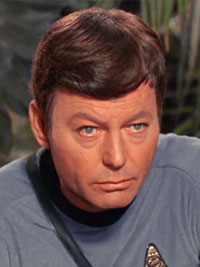
Played by: DeForest Kelley
Dubbed in French by: Michel Georges (TOS), François Marié (Star Trek I to V), Jean-Pierre Delage (Star Trek VI)
Appearances: Star Trek: The Original Series | Star Trek: The Animated Series | Star Trek: The Motion Picture | Star Trek II: The Wrath of Khan | Star Trek III: The Search for Spock | Star Trek IV: The Voyage Home | Star Trek: The Next Generation | Star Trek V: The Final Frontier | Star Trek VI: The Undiscovered Country | Star Trek Beyond note
The third member of the Power Trio. Nicknamed "Bones" by Kirk, McCoy was a highly competent doctor who wasn't entirely comfortable with deep space and always brought a more emotional and moral component to the philosophical debates. He clashed frequently, and colorfully, with Spock, as he found Spock's rejection of emotion to be absurd; however, the two men did genuinely respect each other. Despite his "down-home country doctor" routine, McCoy could and did carry moments of badassery frequently.
Despite a very wild appearance — including a full beard — in the first one, McCoy remained largely the same in the movies: a cantankerous but kind-hearted medical professional.
- Actual Pacifist: For all the verbal fights he gets into, he’s against war at any cost, is disgusted by prisons and is usually the one telling Kirk to be a diplomat not a soldier.
- The Alcoholic: Drinks in the sickbay on his off hours, regularly brings alcohol to Kirk to drown both their sorrows, and apparently both he and Scotty get worse as they get older, having more to grieve over.
- Ambiguously Christian: He frequently swears in the name of God, or Heaven. He explicitly mentions Jesus in Star Trek VI: The Undiscovered Country, one of only three times in the history of the entire franchise He is mentioned by namenote . When he is about to kill the salt vampire in "The Man Trap", he asks the Lord to forgive him. He teases Scotty once for "not believing in God." He remarks in "This Side of Paradise" how their rejection of the spores is the second time Man's been thrown out of Paradisenote . His staunch pacifism is certainly consistent with the tradition of Christian pacifism, and many conscientious objectors have served as medical personnel. However, the character never came out and professed a belief in the divinity of Christ (or in any other religion).
- Anger Born of Worry: Par for the course for a Sour Supporter with Undying Loyalty. He and Spock will often butt heads because either Bones thinks Spock doesn’t understand the feeling, or Spock does but is trying to not show it.
- Audience Surrogate: Is almost always the one to call Kirk out when he’s torturing himself, or Spock when he’s being too alien, or have the more sci-fi language explained to him.
- Badass Pacifist: He's a doctor and takes that very seriously. However, that doesn't stop him from doing extremely dangerous things to save lives. Circumstances sometimes force him to show that he is a decent shot and somewhat competent brawler, but he is hardly a willing Combat Medic, both disgust with violence and unashamed fear always extremely apparent on his face. Possibly best seen in "Space Seed," where he doesn't flinch at Khan holding a knife to his throat and even gives advice on the best way to kill him from their current position.
- Berserk Button:
- Don't recommend pragmatism and coolheadedness over compassion during a crisis.
- In “This Side Of Paradise”, what gets him out of a spores-induced Happy Place is even just the suggestion of not being a doctor anymore.
- Big Brother Instinct: He’s older than Kirk is, and when shit gets rough, looks out for him and tells him not to destroy himself with self doubt or hate himself too much for having a darker side.
- Blue Is Heroic: McCoy's blue uniform represents his gentleness and kindness. See also Innocent Blue Eyes.
- Catchphrase: Two:
- Casual Kink: Robert Hewitt Wolfe had a famous twitter thread
 where he all but confirmed that Dax pegged Bones.
- Series writer Theodore Sturgeon and DeForest Kelley came up with a scenario in which McCoy would give Spock a prostate massage, to ease the tensions between both men. The whole thing is even kinkier, given the differences in Vulcan anatomy.
- Series writer Theodore Sturgeon and DeForest Kelley came up with a scenario
- Character Development: Went from having emotional conniptions to the point of Hair-Trigger Temper when the situation looked bleak, to understanding Spock and the benefit of logic more. He admits to Spock’s body in the third movie that he doesn’t want to lose him again, and that helps the patience and understanding on both sides.
- Chivalrous Pervert: He's notable for being more open about his skirt-chasing than Kirk...and less successful at it.
- Chronic Hero Syndrome: He’s very proud of his medical profession, especially comparing it to earlier centuries, and takes it personally when he can’t save everyone. He euthanised his father who was dying, only a few months later to hear that there was a cure, and he's filled with self hatred over it.
- Combat Pragmatist: McCoy is especially fond of hitting an enemy (or even a reluctant friend) with a hypospray to render them unconscious/simulate a disease/etc. in order to get the upper hand. In "Amok Time," he does this without being an actual participant in the fight in order to save Kirk's life and Spock's career.
- The Confidant: Spock is a great friend, but he’s not that useful when Kirk is feeling anxious, so Bones helps out with advice, reassurance, Tough Love and booze.
- Deadpan Snarker: He specializes in snarky comments. "This Side of Paradise" has a couple gems.McCoy: [after Kirk informs a man that he will be taken from his planet with or without his cooperation] Should I get the butterfly net?
- Determined Doctor: Where Scotty wouldn't roll over and die on keeping the ship together, this man refuses to just let his patients die if he has any means to save them.
- Disappeared Dad: According to the show bible, he has a daughter called Joanna that despite his efforts, he can’t often see. There were a few plans to include her in the show (including one where she has a crush on Kirk and Bones as a father assumes the worst) but never came to fruition.
- Dr. Jerk: While he's a Jerk with a Heart of Gold, his cantankerous reminders of his actual occupation qualify for this trope. In "Friday's Child," he persuades an obstinate, haughty patient to let him ease her pain...by slapping her in the face. Justified in that the woman in question was a Capellan, a Proud Warrior Race that regards a show of force as a sign of respect and honesty, and that McCoy was an expert on this species, having been part of the first contact team that discovered them years earlier. Given that the woman later gave birth and named the child after McCoy, it worked as well as intended:Kirk: Never seen that in a medical book.
McCoy: It's in mine from now on.- Especially in "This Side of Paradise," when he's under the influence of Applied Phlebotinum that makes him more irritable.Sandoval: We don't need you, not as a doctor.
Bones: Oh, no? Would you like to see just how fast I can put you in a hospital?
- Especially in "This Side of Paradise," when he's under the influence of Applied Phlebotinum that makes him more irritable.
- Everyone Has Standards: Will tease Kirk for how often he seduces to get his way, but will be the first to be angry on his behalf if Kirk is drugged or gets his body hijacked. Same with Spock, Vitriolic Best Buds, but he’s disgusted that the Platonians will make him laugh and cry by force.
- First-Name Basis: With Kirk, although in Kirk's case, it's McCoy's nickname, "Bones," never his first name, "Leonard." (Kirk does call him "Leonard" exactly once, in "Friday's Child", but it's context-specific.)
- Forgets to Eat: For all he complains about Kirk and Spock neglecting their health, he’s the same when he’s wrapped up in his work.
- Four-Temperament Ensemble: McCoy is the Sanguine. While he's the complainer of the group, he's also got a folksy joie de vivre and casual manner that directly contrasts Spock's strict stoicism.
- Friend to All Children: Unlike Kirk who likes them but is never really sure what to do, and Spock who is just awkward, he’s both loving and professional around kids. Helps that he’s a father (who sees his child more often than Kirk does) and a doctor.
- Frontier Doctor: Dr. McCoy is perhaps Trek's outstanding example of a final frontier doctor —resourceful in the face of alien ailments, preferring simple homespun methods when possible, but cantankerous, eccentric, and not entirely happy with his lot (he fled to space on the heels of a divorce). Star Trek was pretty much the original Space Western, after all, and actor DeForest Kelley had an extensive background in westerns.
- Genre Refugee: He's a western frontier doctor who just happens to work on a starship. It helps that Kelley was a veteran character actor in several westerns.
- Good Is Not Nice: He's not hesitant about expressing his dislike for people or his refusal to suffer fools, but he is most often the one who suggests doing the right thing.
- Good Old Ways: He both enforces and subverts this trope. He's rabidly in favor of fighting the dehumanizing effects of too much technology (especially the transporter) in favor of enjoying "the simple things in life," and yet sees "primitive 20th-century medicine" as just above trepanation, leeches, and blood-letting in its barbarity, preferring the "high-tech approach" to healing. In general, he embraces the positive, constructive aspects of technological progress rather than the destructive or dehumanizing ones.
- Grumpy Old Man: He becomes this in the movies. His brief cameo in TNG has him even older and grumpier.
- The Heart: He's a deeply ethical man underneath his cantankerous exterior and always brings the moral side to a discussion.
- He's Dead, Jim: He's the Trope Namer.
- Honor Before Reason: McCoy believes in doing the right thing no matter what, and he will proudly admit it.
- Hospital Hottie: According to Jadzia Dax, one of her previous hosts discovered he has the "hands of a surgeon."
- Hypocritical Heartwarming:
- McCoy is always trying to get an emotional rise out of Spock, but in the episode "Plato's Stepchildren," McCoy jumps to Spock's defense when powerful aliens force him to cry and to laugh. And in other episodes, he's usually the first to jump to Spock's defense any time anyone attacks or insults him, possibly because his issues with Spock are more of a giant angry moral debate while other people tend to operate out of pure racism.
- The same goes for Kirk, as he'll regularly tease the man for being a charmer or Accidental Pornomancer, but looks out for him when he’s in a bad way, and will be first to get angry on his behalf when Sargon shows off the new body, or Elaan has drugged him into kissing her and worse. Star Trek II: The Wrath of Khan has him actually apologise when Kirk tells him bluntly that Carol is an old wound, and to not make jokes about it.
- I'm a Doctor, Not a Placeholder: He's the Trope Namer.
- Innocent Blue Eyes: McCoy has DeForest Kelley's bright, shining baby blues. He's probably the kindest, most compassionate character of the entire Trek franchise.
- In-Series Nickname: "Bones" is actually short for "saw-bones," an archaic term for a surgeon.note It was originally intended as the nickname of Dr. Boyce from "The Cage," but was never used in that episode, making it available for McCoy.
- Jerk with a Heart of Gold: Grumpy, impulsive, sarcastic and rather rude, but at heart he's a good man who always does the right thing.
- Knight in Sour Armor: He's grumpy, sarcastic, and has little respect for authority (with the exception of Kirk), but when the chips are down, you can always count on him to do the right thing.
- Meaningful Name: In addition to "Bones" recalling the old-fashion slang for a doctor ("Sawbones") it also reflects a character who relies on intuition over logic, i.e. he doesn't go by other people think, but by what he feels down to his bones.
- The Medic: He's even able to treat a silicon-based life-form.
- The McCoy: He's the Trope Namer. In a crisis, his proposed solutions usually involve trying to do the right thing in the moment and standing on principle no matter the long-term costs.
- Mildly Military: Unlike Spock who is naturally logical, and Kirk who (pre-Character Development) always believes in the Federation, he’s the least military; doctor first, in the service second.
- More Hero than Thou: In "The Empath," when aliens offer Kirk the choice of sacrificing McCoy or Spock, McCoy takes out Kirk with drugs. Spock is glad; since this leaves him in command, he can make the sacrifice himself. McCoy proceeds to drug him as well and sacrifice himself.
- Older and Wiser: In sharp contrast to both Kirk and Spock, who struggle with their age, his appearance in TNG has him glad to be old, as it means he hasn’t died yet.
- Promotion to Opening Titles: At the beginning of the second season.
- Psychological Projection: Bones has a tendency to assume what Kirk is feeling (usually romantic feelings for yeomen that he doesn’t actually have) or that Spock has less humanity than he actually does. Both of them call him out for it.
- Rank Up: By the time of Star Trek: The Next Generation, he's an Admiral. His promotion to Captain, while never seen on screen, has been stated in non-canon publications as having taken place sometime in the late 2290s. Several published works have also indicated that he later served as the head of Starfleet Medical School and as the Starfleet Medical Surgeon General. The reference manual Star Trek: The Next Generation Officer's Manual states that he eventually became Chief of Starfleet Medical and held a special rank known as "branch admiral".
- Red Oni, Blue Oni: He's the Red to Spock's Blue.
- Reasonable Authority Figure: Is the Admiral of a medical branch in TNG, and seemingly learns from the mistakes of Kirk in the movies, being as peaceful as his grumpy self gets.
- Resignations Not Accepted: At the beginning of the first movie, McCoy has retired to private practice, and is called back into service against his protests on Kirk's request.
- Sarcastic Devotee / Sour Supporter:
- He will follow Kirk into the pits of Hell and back, but he'll grumble about it first.
- Similarly, if Spock is in trouble he'll strive to help him, just don't expect him to hold back on a few jibes whilst he does.
- Southern-Fried Genius: One of the most respected doctors in the Federation—straight out of Georgia.
- Strawman Emotional: At times.
- Super Doc: He can be nothing else such as when he successfully treated the Mother Horta, a silicon based lifeform whose physiology he is not only completely unfamiliar with, but he didn't even believe such a lifeform even existed until that very moment.McCoy: By golly, Jim, I'm beginning to think I can cure a rainy day!
- Team Dad: He’s not a therapist but... he usually tries to give Spock some Tough Love as a counterpoint to his logic, always becomes a worried friend when Jim is being a Love Martyr, and a pregnant woman is very fond of him.
- Tall, Dark, and Snarky: Not as tall as Spock, but plenty dark-haired and snarky.
- Tough Love: He and Chapel make a great team for sickbay, her bluffing Good Cop/Bad Cop to self pitying patients, and Bones being a mother hen of both Kirk and Spock, telling them off if they’re ever planning on being martyrs (not that Bones is much better).
- True Companions: With Kirk and Spock.
- Vitriolic Best Buds: With Spock. They argue constantly but if anyone other than him attacks or criticizes Spock (and that includes Kirk), he will always rush to his defense.
- The Watson: Despite serving on Starfleet's flagship, McCoy is routinely unfamiliar with various technical aspects of the ship or other technology he encounters. (He is an excellent doctor, however, which makes up for it.)
- Wrote the Book: According to STV, he wrote a book called Comparative Alien Physiology, which is required reading at Starfleet Medical. It's apparently the Gray's Anatomy of aliens.
- You Called Me "X"; It Must Be Serious: In contrast to Spock, it's when Bones calls Kirk "Captain" and not "Jim" that you know he's not messing around.
Lieutenant Commander Montgomery "Scotty" Scott

Played by: James Doohan
Dubbed in French by: Julien Bessette (TOS), Georges Aubert (Movies)
Appearances: Star Trek: The Original Series | Star Trek: The Animated Series | Star Trek: The Motion Picture | Star Trek II: The Wrath of Khan | Star Trek III: The Search for Spock | Star Trek IV: The Voyage Home | Star Trek V: The Final Frontier | Star Trek VI: The Undiscovered Country | Star Trek: The Next Generation | Star Trek: Generations | Star Trek: Deep Space Nine note | Star Trek Beyond note
Chief Engineer of the Enterprise. Scotty's most frequent job was to solve a seemingly-impossible crisis with the engine or transporters (or whatever piece of Starfleet technology was making trouble that week), protesting all the way before either hitting on a creative solution or sweating it through. He was also Scottish and had many sterotypical Scottish traits, such as a love of good whisky and namedropping haggis. Scotty was firmly established as the ship's third-in-command behind Kirk and Spock, and seeing as those two were always members of the landing party, he took the conn with surprising regularity. Though he was sometimes used for comic relief, it's worth noting that Scotty was extremely badass whenever he was the ranking officer on the bridge and kept it safe from interfering aliens or Starfleet's many half-crazed admirals.
Scotty's role in the films was still the Chief Engineer, but he was relegated to the comic relief role more often. He also appeared in an episode of The Next Generation.
- The Ace: Scotty is certainly no slouch in the engineering department, and has gotten the Enterprise out of scrapes with his bare hands more times than he can count. It's through his talent than he got a promotion to Captain of the Engineering Division, and managed to rig the Enterprise to run on a skeleton crew of just 5 men. And even a century later, despite feeling useless throughout most of his time on the Enterprise-D, he bounces back and pulls off yet another miracle.
- The Alcoholic: Scotty's love of strong booze is apparent. He keeps a stash of all kinds of liquor in his quarters, including a green bottle of something he can't even identify. He dismisses Russian vodka as mere "soda pop" compared to what gets him hammered.
- Amusing Injuries: In The Final Frontier, he bangs himself up pretty badly trying to fix the Enterprise-A when she's conking out all over, and it's all Played for Laughs.
- Alternate Self: He has a counterpart in the Kelvin Timeline, and another in the Mirror Universe.
- Berserk Button:
- He's a very calm, polite, and peaceful man...unless you call the Enterprise a piece of garbage. Then he'll punch you in the face regardless of the cost.
- As Geordi learned, don't tell him he's getting in the way; he was fixing starships when LaForge's great grandfather was still in diapers!
- Beware the Nice Ones: Scotty's perhaps the friendliest fellow on the Enterprise. Just don't you dare call his baby a piece of garbage, lest you get a slug in the face.
- Big Damn Heroes: In "Friday's Child," Kirk, Spock, and McCoy are unarmed and surrounded by a superior Klingon force.Kirk: [to Spock] Too bad the cavalry doesn't come over the hill anymore. [cue Scotty beaming down with a large force of Redshirts to save the day]
- Break the Badass: Scotty may be the most renowned engineer of his time, but when he ends up stuck in a transporter loop for 75 years and awakens to find that the times have leaped ahead without him, he feels practically useless.
- Broken Ace: He goes through this arc in "Relics" when it's discovered he was stuck in a transporter loop on the Jenolan for 75 years. Upon seeing that the engineering technology of his time has jumped so far ahead, he takes to Ten Forward and guzzles down some Aldebaran Whisky.
- Bullying a Dragon: Sure, the Klingon who dared to insult the Enterprise had it coming when Scotty decked him for it, but the entire crew was explicitly warned not to start a diplomatic incident—and Scotty isn't a warrior who lived his entire life being bred for combat.
- Butt-Monkey: Sometimes, when he was left in charge of the Enterprise.
- The Captain: He gets promoted to the rank of captain in The Search for Spock, which puts him on equal terms with both Kirk and Spock. It's no small feat, either. He's one of the very few non-command division people to achieve the rank and the promotion is given in recognition of his engineering skills. He never pulls it on anyone, however.
- Captain Ethnic: Or in this case, Lieutenant-Commander Ethnic. In case the accent, taste for whisky, and the occasional wearing of traditional Scottish clothes and playing of bagpipes don't clue you in, there is also the surname. Lampooned in the I'm Sorry, I'll Read That Again parody:Uhura (Jo Kendall): Captain, our Scottish chief engineer Scott—"Scotty" for short—from Scotland has something terrible to tell you.Scott (Graeme Garden): [incomprehensible Scots English gibberish]Kirk (Tim Brooke-Taylor): Yes, that was terrible, wasn't it?
-
 Cargo Ship: Scotty and the Enterprise
 - Chick Magnet: He may not be as lucky as Captain Kirk in that department, but he's attracted his fair share of lovely ladies, most notably in "Wolf in the Fold" and even Uhura herself in The Final Frontier.
- Companion Cube: If Kirk saw the Enterprise as a demanding wife, Scotty saw the ship, particularly her engines, as no less than children ("My bairns! My poor bairns!").
- Compressed Vice: “Wolf In The Fold” has him hate women for a while because a woman caused an explosion that injured him. Kirk and McCoy’s solution is to bring him to see belly dancers.
- A Day in the Limelight: "Wolf In The Fold," "The Trouble With Tribbles," "By Any Other Name," and "The Lights of Zetar."
- Drowning My Sorrows: He always had a liking for the stuff, along with Bones, but after his nephew dies, Scotty thinking Peter stayed to impress him, he gets to the point in the books where Kirk has to pull rank and order him to bed. And when he ends up stuck in the TNG era feeling useless, he gets hammered, then goes to the holodeck to pull up a recreation of his old bridge.
- The Engineer: His primary duty.
- Father Neptune: Though as he is Recycled In Space, perhaps he would be Father Jove or Father Apollo, but you get the idea.
- Fish out of Temporal Water: His fate in TNG shows that in 2294, he was on the way to a retirement colony when the ship he was riding on crashed on a Dyson Sphere. He and one other crew member used a transporter loop to hold themselves inside until someone could find them, but it wouldn't be until 75 years later when the Enterprise-D happened to pass by the area did they pull him out, (and only him, his friend's pattern had deteriorated too much). When he heard that the Enterprise came to the rescue, he thought Kirk had pulled the A out of mothball to find him (having forgotten Kirk had died just a year prior), only to realize how far out of time he really was when Worf showed up. He spends most of his guest spot trying to readjust to his new time.
- Formerly Fit: He's fairly portly in most of his post-TOS appearances. Of course, since it's a live-action show it's a case of Real Life Writes the Plot.
- Four-Temperament Ensemble: Scotty is the Phlegmatic. He's a modest, simple guy and pretty content to just follow orders. The Enterprise is his personal Berserk Button... but even when a Klingon calls her "garbage", Scotty stays cool and offers him a chance to take it back.
- Gadgeteer Genius: Can MacGyver just about anything on his own, but particularly shines teamed with Spock. The two of them could turn the most obscure theory into a way to save the day.
- Genius Bruiser: Pretty handy with both his fists and his mind.
- Leitmotif: More an example of a Bootstrapped Leitmotif. A piece called "A Matter of Pride" was composed by Jerry Fielding for "The Trouble with Tribbles" to underscore the scene where Scotty admits he started the bar fight with the Klingons. It was then reused for "By Any Other Name" in the scene where Scotty drinks Tomar under the table. It was never used again, but because of its exclusive association with two of Scotty's greatest character scenes, it is sometimes remembered as "Scotty's Theme" among fans.
- Hoist by His Own Petard: Scotty is promoted to the Chief Engineer of the Excelsior in The Search For Spock. He's also the one who sabotages the ship so it can't follow the Enterprise when her crew steals her from Spacedock.
- Mr Fix It: He’s the only one who doesn’t act like an asshole losing his temper with Spock’s reactions in “The Galileo Seven”, mostly because he’s so focused on fixing the shuttlecraft.
- Nice Guy: He's a kind, humble, friendly, quiet and easygoing guy who's very loyal to his crew. He's perhaps the most agreeable - and absolutely the least prone to act like a jerk - member in his crew.
- Rapid Aging: In "The Deadly Years", he's one of a handful of crew members who get subject to a virus that causes this, though it's fortunately reversed.
- Rank Up: In Star Trek III: The Search for Spock, he gets promoted to Captain and reassigned to the USS Excelsior as Captain of Engineering during the ship's early test runs.
- Replacement Goldfish: With a bit of reality writing the plot, the book version of “Generations” has Kirk clinging to Scotty now that Bones and Spock are both back home, and it falls to the poor man to tell him off for doing stupid suicidal shit.
- Scotty Time: He's the Trope Namer. His section quote is an example: in that case, the ship didn't have 30 minutes to spare—it had 8 minutes before it would crash—so he had to use some drastic, unproven measures.
- Undying Loyalty: He's always stood by Captain Kirk's side in the most dire of situations.
- Unwitting Instigator of Doom: Twice from the same action. His sending the tribbles home with the Captain Koloth apparently resulted in an ecological disaster for the Klingon Empire, which in turn caused the Klingons to hunt down the tribble homeworld and obliterate it, rendering them extinct. At least for a century, or so. The DS9 crew undid the second part by accident.
- Workaholic: Would rather read technical manuals in his off time than actually taking shore leave.
- Wrote the Book: According to the TNG episode "Relics", he wrote some of the Starfleet engineering regulations that are still in use. Hence, he knows when it's safe to ignore them.
Hologram Scotty
Played by: James Doohan (archive recordings)
A holographic representation of Scotty appears as part of the Kobayashi Maru simulation on the holodeck of the U.S.S. Protostar.
For tropes relating to his appearance there, along with the other holograms, see, Star Trek: Prodigy.
Lieutenant Nyota Uhura

Played by: Nichelle Nichols
Dubbed in French by: Arlette Sanders (TOS), Laure Moutassamy (Star Trek: the Motion Picture, III, IV, V and VI), Jane Val (Star Trek II)
Appearances: Star Trek: The Original Series | Star Trek: The Animated Series | Star Trek: The Motion Picture | Star Trek II: The Wrath of Khan | Star Trek III: The Search for Spock | Star Trek IV: The Voyage Home | Star Trek V: The Final Frontier | Star Trek VI: The Undiscovered Country | Star Trek: Deep Space Nine note | Star Trek Beyond note
Uhura was Enterprise's communications officer and, according to Gene Roddenberry, was fourth in line of command behind Mr. Scott (something flatly contradicted in the series, where Sulu and even DeSalle took command ahead of her). Unfortunately, her character was vastly underutilized during the series' run, although the times she was allowed to do more than be the ship's phone operator, she was pretty good at whatever she was doing. Her role was somewhat expanded after the first season and she did get to take the captain's chair in the animated series.
Off-screen, Nichols was subjected to racist harassment and resigned when she learned that the studio executives had been withholding her fan mail. A conversation with Martin Luther King Jr. convinced her to stay; he told her that the idea of a black woman being equal to whites was something vitally important for children to see, as a role model or as an example of what should be. Both Mae Jemison (America's first black female astronaut) and Whoopi Goldberg have cited her as an influence, along with many others. Nichols worked with NASA to recruit women and minorities into the astronaut corps.
- '60s Hair: Wore a pixie cut before sporting a bouffant in the later seasons.
- Ace Pilot: Never really allowed to show it off in the series thanks to Roddenberry and execs banning it, but offscreen she was called a great pilot.
- Action Girl: In "Mirror, Mirror" and "The Gamesters of Triskelion." Even more so in the Animated Series episode "The Lorelei Signal", where she leads a landing party of female crewmembers on a phaser-stunning spree when the men are all disabled.
- All of the Other Reindeer: The far more Lower-Deck Episode-ish “Man Trap” implies heavily that she feels lonely, and only lets that out when she’s not in other company.
- Ambiguously Gay: She's as starry eyed as Chekov is over the androids in "I, Mudd", and visibly confused when Kirk asks for male androids.
- Badass Pacifist: Strictly on the diplomat side of the soldier vs diplomat conflict nearly every Trek character finds themselves on, finding war to be the last resort.
- Beware the Nice Ones: Very nice and even-tempered but as Bones lampshades in the third movie, it’s a bad idea to get on her bad side.
- Bridge Bunny: To Nichols' frustration. She did have a few episodes where she was in the landing party, but for the vast majority of the show, she was confined to her station.
- For a long time, in interviews Nichols would answer the question, "What is your favorite episode of the series" with "Any episode that got me off the bridge."
- Catchphrase: "Hailing frequencies open." She says this seven times in her debut appearance, "The Corbomite Maneuver", including five times in a row. It's no wonder she complains about hearing the word "frequency" too many times in "The Man Trap".
- Communications Officer: One of the most famous examples.
- Consistent Clothing Style: She always wears sparkling or bright earrings, with fancy nails. Lampshaded in Star Trek: Ex Machina, as she misses the bright colours of the old clothes, and like everyone in the book, hates the first movie uniforms.
- Cool Old Lady: “Catalyst Of Sorrows” has this be the reason for why so many adore her, she’s over a hundred years old and at peace with herself.
- Cuteness Proximity: Is the first to fall madly in love with tribbles.
- A Day in the Limelight: "Mirror, Mirror" and "The Trouble With Tribbles." She also got to play Large Ham as much as the boys did in "I, Mudd". Star Trek: The Animated Series added "The Lorelei Signal".
- Death Glare: “Catalyst Of Sorrows” calls it the Uhura Look, and describes it like a Kubrick Stare just sassier and angrier.
- Hidden Depths: NOMAD complains that her mind is a chaotic mess, full of conflicting wants.
- Humble Hero: “Catalyst Of Sorrows” has her admit that nothing makes her feel older than when people call her a legend.
- Like Brother and Sister: Ironically given that Nichols couldn’t stand Shatner, but forced kissing aside, he picks her up to hug her, she affectionately snarks at him that she never gets shore leave, and he makes her feel safer.
- Meaningful Name: Uhura is derived from Uhuru, which means "freedom" (which carried a strong
 Reality Subtext in the 1960s), while Nyota means "star".
 - My Beloved Smother: According to "Catalyst of Sorrows", the only time she felt free as a child was the month where she got to be with her grandparents, and not in a strictly regimented routine of after school activities.
- My Greatest Failure: In a minor Take That! towards the film, "Catalyst of Sorrows" has her call not being able to speak enough Klingon when it was needed as the most embarrassing moment of her career.
- Not Even Bothering with the Accent: She is African and her first language is Swahili, yet she sounds American. Justified in that she is a linguist.
- Passive-Aggressive Kombat: When trying to make conversation with Spock, it ends up with her telling him super politely that he's predictable.
- Plucky Girl: Attempted in "Plato's Stepchildren", as she tries to protect Kirk as he protected her, and tells herself and him that she's not scared of being forced to kiss him. She's lying — they're both afraid.
- Rank Up: At some point prior to Star Trek II: The Wrath of Khan, she made Commander.
- Ret-Canon: Her first name, Nyota, was used in the non-canon novels for decades before finally being made official. Very early Trek guides suggest that Penda was considered a possibility by the fans. Parodied in the 2009 film when Uhura refuses to tell Kirk her first name until the end of the movie.
- Shell-Shocked Veteran: In "Catalyst of Sorrows", she tells Crusher that the worst part of being a communication officer is having to listen to screams, and she keeps going in the service so she can finally make it stop.
- Ship Tease:
- She appears to show an interest in Spock in a few episodes. (Yes, long before the reboot.) According to Nichols, this was largely her own idea, that it was a one-sided relationship.
- By the later movies, she seems to be in a casual relationship with Scotty.
- She shares a kiss with Kirk in "Plato's Stepchildren", although given that it was under alien Mind Control and both were rather traumatized; if anything, it may be closer to Ship Sinking.
- Silk Hiding Steel: Uhura may be a non-combatant most of the time, but as noted above, she is quite the Action Girl when necessary. In particular, "Mirror, Mirror" and "The Gamesters of Triskelion" show that Uhura can kick someone's ass when necessary, and the animated series shows she's not afraid to take command and take the initiative when needed.
- Stepford Smiler: She's the worst of all of them in "This Side of Paradise", and in the novel version of the fifth film, she tries her best to tell herself that the Enterprise will be fine because everyone else is grumpy about it.
- Team Mom: In a story written by Nichelle Nichols, Kirk tells her she would make a great mother. She replies that she has experience, being that she’s on a ship full of little boys.
- Troll: She sings a light hearted jab about Spock being the devil in “Charlie X”, and the third movie novel has her provide a distraction by mixing all the channels with clips from TV channels.
- Tomboy and Girly Girl: Her tomboy to Christine's girly girl.
- Twofer Token Minority: The only black member of the crew, and the only woman besides Christine Chapel.
- Wrench Wench: She rigs a subspace bypass circuit to restore communications easily, and even gets a compliment from Spock.
Hologram Uhura
Played by: Nichelle Nichols (archive recordings)
A holographic representation of Uhura appears as part of the Kobayashi Maru simulation on the holodeck of the U.S.S. Protostar.For tropes relating to her appearance there, along with the other holograms, see, Star Trek: Prodigy.
Lieutenant (later Captain) Hikaru Sulu

Played by: George Takei
Dubbed in French by: Daniel Roussel (TOS), Tola Koukoui (Star Trek I to V), Patrick Guillemin (Star Trek VI)
Appearances: Star Trek: The Original Series | Star Trek: The Animated Series | Star Trek: The Motion Picture | Star Trek II: The Wrath of Khan | Star Trek III: The Search for Spock | Star Trek IV: The Voyage Home | Star Trek V: The Final Frontier | Star Trek VI: The Undiscovered Country | Star Trek: Voyager | Star Trek Beyond note
The helmsman, thankfully living in a time before bridge consoles were Made of Explodium. Sulu was an affable and level-headed officer, a staple of bridge drama and landing parties. He worked well with other members of a crew and sometimes shared his hobbies: botany, antiquing, and fencing (although the last one was not exactly in a clear state of mind). When Chekov was added to the cast, they formed a Those Two Guys dynamic. Although it was never firmly established in canon (where there is no clear command structure after Kirk-Spock-Scotty, and several different characters, Sulu included, are shown to take the conn in situations where all three are absent or incapacitated), Sulu is generally regarded as the ship's Third Officer and fourth-in-command.
Although he has a Japanese first name, his surname is deliberately ambiguous; it is the name of a sea that borders several Asian countries note . Like Uhura, Sulu was significant for being a non-stereotypical portrayal of an Asian man. In the fourth film, we learn that he was born in San Francisco.note
- The Ace: Like Kirk, an experienced and capable multi-talented officer who went on to have a distinguished career as a captain of his own. Unlike Kirk, who never made time for a family and whose hobbies seem limited to drinking, flirting, and the occasional camping trip/rock climbing expedition, Sulu also managed to have a happy marriage, a beautiful daughter who followed in his footsteps, and cultivated a variety of interests outside his career, including fencing, botany, and tea.
- Brainwashed and Crazy: Again, "The Naked Time."
- Canon Immigrant: His now-canon first name, Hikaru, was given to him in the non-canon novels by Vonda N. McIntyre, before officially being made his name in Star Trek VI: The Undiscovered Country. Very early Star Trek guides suggest that Walter was considered as a possible first name during the show itself, but never officially used.
- Cultured Badass: Very knowledgeable in many subjects, such as botany, and when he gets infected and runs amok with a fencing foil in "The Naked Time", he even scares Kirk.
- A Day in the Limelight: "The Naked Time" and "Mirror, Mirror."
- Deadpan Snarker: Sulu is prone to making pithy commentary on the events of the episode.
- Demoted to Extra: He has a much smaller role in The Undiscovered Country due to being busy commanding his own ship for most of the movie.
- Doting Parent: As a foil to Kirk, who couldn’t resist his job and wasn’t allowed to see his son, “Generations” as well as expanded material have him as a devoted father to his daughter Demora, who wasn’t planned and lived with him after her mother died.
- Evil Is Hammy: Every Mirror Universe character was hammy, but Takei was a particularly rich, dripping slice.
- Fan of the Past: He's a history buff and a competent fencer. Overlaps with Ace Pilot in the movies when, upon a simple inspection of the controls, he flies a 20th-century helicopter competently enough to perform cargo-lifting duties.
- Fleeting Passionate Hobbies: Including fencing ("The Naked Time") and botany ("The Man Trap"). In fact, in "The Naked Time," Kevin Riley Lampshades it.
- Generation Xerox: In Generations, we meet his daughter Demora, who is (where else?) at the helm of the Enterprise-B.
- Genius Bruiser: Just happens to be an expert in botany, swordsmanship, French history, and flying ancient aircraft.
- Good Scars, Evil Scars: His Mirror Universe counterpart has a big nasty scar on his face.
- Gun Nut: Overlapping with Fan of the Past, in "Shore Leave," he's thrilled to find an ancient revolver. An animated series episode expanded this to Sulu having expertise with weaponry across the board.
- Inscrutable Oriental: Deliberately inverted per the series bible. Sulu's most prominent trait was probably his sense of humor and enthusiasm for hobbies that never seemed to last. This got an in-joke in the animated series when he claimed, with a wink, you had to be "inscrutable" to fight the way he did—and Kirk replied "you're the most scrutable man I know."note
- Katanas Are Just Better: Averted in "The Naked Time." Sulu was originally supposed to go on his rampage with a samurai sword, but at Takei's request to do something less stereotypical, it was switched to an epee.
- Nice Guy: Consistently friendly and level-headed. Subtly demonstrated in "Day of the Dove", when an Energy Being triggers a Hate Plague on the Enterprise; Sulu is the only one who never seems to act out or show anger (even Spock is seething with Tranquil Fury). And when Bailey in “The Corbomite Maneuver” was freaking out, Sulu did most of his tasks for him.
- The One with a Personal Life: This was retconned for Sulu. The TOS movies gave the distinct impression that the crew killed time between Enterprise missions teaching at the Academy. They didn't have personal lives. Then the seventh movie revealed that Sulu had a daughter. The novel The Captain's Daughter (not to be confused with the Pushkin novel of the same name) elaborates on their relationship.Kirk: Sulu. When did he find the time to have a family?
- Rank Up: The last we see him, he's captain of the USS Excelsior.
- The Reliable One: He's quite competent at a variety of tasks, and very level-headed compared to characters like Chekov or Scotty. He's also fiercely loyal to his crewmates, to the point of disobeying Starfleet orders and potentially causing a serious diplomatic incident just to rescue them.
- Sad Clown: While freezing to death in “The Enemy Within”, he makes jokes about room service to try and reassure the others.
- Screw the Rules, I'm Doing What's Right!: In "Turnabout Intruder," Sulu gets a good moment when he says he'll flatly refuse any order to execute a fellow officer.
- Shirtless Scene: In "The Naked Time."
- Those Two Guys: With Chekov.
- Took a Level in Badass: As Captain of the Excelsior in Star Trek VI.
- Universal Driver's License:
- He adapts pretty quickly to the controls of a Klingon ship in Star Trek III: The Search for Spock.
- In Star Trek IV: The Voyage Home he learns to fly a 20th century helicopter in a single day; possibly barely justified in that he's a Fan of the Past so maybe he read about helicopters of the 1980's in his leisure time.
Ensign Pavel Andreievich Chekov

Played by: Walter Koenig
Dubbed in French by: André Montmorency (TOS), Thierry Bourdon (Star Trek: the Motion Picture), Vincent Violette (Star Trek II, V and VI), Nicolas Brémont (Star Trek III and IV), Gilbert Lévy (Generations)
Appearances: Star Trek: The Original Series | Star Trek: The Motion Picture | Star Trek II: The Wrath of Khan | Star Trek III: The Search for Spock | Star Trek IV: The Voyage Home | Star Trek V: The Final Frontier | Star Trek VI: The Undiscovered Country | Star Trek: Generations | Star Trek: Deep Space Nine note | Star Trek Beyond note
The ship's navigator from Season 2 onwards. Chekov had a tendency to refer to Glorious Mother Russia and claim that any human advancement, be it technological or cultural, originated there. He also had terrible luck and frequently ran foul of whatever physical or psychological menace the ship was facing that week, mainly because Walter Koenig had an excellent capacity for screaming. Aside from that, he and Sulu were good friends and would frequently banter about the action.
Chekov is, by far, the most junior of the regular bridge officers, but the writers justified his presence by having him act as the relief science officer whenever Spock was busy or incapacitated. In fact, Chekov would often abandon his navigation console in order to take up the science scanner if Spock had to step away, even at warp or in the middle of a battle. In Star Trek III: The Search for Spock, in a nod to this, Chekov identifies himself as the "Acting Science Officer" of the Enterprise.
Chekov was added for a few reasons: to attract younger viewers and give a nod to the Russians in the space race. (Also to fill in some of Sulu's role while Takei was filming The Green Berets.)
Koenig is reprising his role for the Fan Film series Star Trek: Renegades, where Chekov is now over a hundred and an admiral.
- Ambiguously Jewish: An idea with some popularity in the fandom, partially since Koenig (and Anton Yelchin, who played Chekov in the 2009 reboot) are Jewish.
- Brilliant, but Lazy: He does genuinely have a lot of knowledge, he just decides to make it all about Russian history instead.
- Butt-Monkey: Chekov did more screaming-in-pain than the rest of the crew combined. He even got a torture scene in the episode "Mirror, Mirror." This was explained as a convenient way to show there was mortal peril. Apparently, Kirk, Spock, and McCoy, all being older, dignified men, would have made it improper for them to scream, but Chekov is in his early twenties and still very boyish, so it's all right for him. Doesn't make it any easier on the poor guy, though. In a nice inversion, he's the only one who doesn't get hit with the aging disease in "The Deadly Years." He still ends up getting subjected to a thousand and one medical checks, though.Chekov: Blood sample, Chekov! Marrow sample, Chekov! Skin sample, Chekov! If—if I live long enough, I'm going to run out of samples!Sulu: You'll live.Chekov: Oh yes, I'll live. But I won't enjoy it!
- This trend continues into the films: In The Motion Picture Chekov gets electrocuted by one of V'ger's energy blasts. In Wrath of Khan he gets a Ceti Eel in the ear; The Voyage Home sees him nearly fatally injured when he falls off a ship onto the dock below. Walter Koenig jokingly subtitled the second film Star Trek II: Chekov Screams Again.
- Cloudcuckoolander: Chekov's constant references to Mother Russia appear to only make sense in his mind.
- Cultural Posturing: What didn't Mother Russia invent?
- A Day in the Limelight: "Mirror, Mirror," "The Trouble With Tribbles," "The Deadly Years," and "The Way to Eden."
- Deadpan Snarker: Not as much as Bones or even Spock, but he definitely has a smart-assed side. As he gets older, it gets worse.
- Did Not Get the Girl: In the “Generations” book, he tries to avoid retirement loneliness by contacting his old girlfriend from “The Way To Eden”, only to discover that she got married to someone else.
- Glorious Mother Russia: This trope is very much in effect with Chekov. He is the only person on the Enterprise's bridge who speaks with a thick, nearly incomprehensible accent (in the company of an African, an East Asian, and a half-alien), and much of his dialogue is Cultural Posturing about how Russia is the greatest country in the world that has apparently inwented everything.
- Iconic Sequel Character: Just as recognisable as Scotty, Uhura and Sulu, despite only joining the cast in the second season.
- The Intern: Much is made of his relative inexperience and impulsiveness.
- In the Original Klingon: A Running Gag is that he keeps claiming things were invented in Russia.
- Know-Nothing Know-It-All: Chekov both amused and annoyed his crewmates by spouting what he didn't know about Russian history.
- Mr. Fanservice: Really. Brought in specifically to appeal to younger Fangirls, complete with hair straight out of The Monkees.
- Plucky Comic Relief: Particularly as the films progressed.
- Rank Up: At some point prior to Star Trek II: The Wrath of Khan, he got promoted to Commander. Of all the characters in the TOS era, he has the biggest number of promotions (four).note
- Russian Guy Suffers Most: Oh, yeah.
- In Star Trek: The Motion Picture, Chekov's arm gets burned by an exploding console. An early draft had him dying during this scene.
- Walter Koenig called Star Trek II: The Wrath of Khan "Star Trek II: Chekov Screams Again", as Chekov gets a Puppeteer Parasite inserted into his ear by Khan.
- In Star Trek IV: The Voyage Home, Chekov gets arrested by law enforcement in 1986, and suffers a near-fatal concussion while attempting to escape.
- In "The Deadly Years", Chekov is the only one of the landing party who doesn't fall prey to the aging disease, which would seem to be a good thing. However, what it really means is that he's forced to go through numerous painful and annoying tests so McCoy can figure out why he wasn't affected.
- In Star Trek: The Motion Picture, Chekov's arm gets burned by an exploding console.
- The Scream: Walter Koenig had a good one, which is why it's Chekov who always gets stuffed into the agony booth, shot, driven insane, tortured by Klingons, implanted with parasitic worms... Koenig lampshaded this by jokingly calling the second movie in the series "Star Trek II: Chekov Screams Again."
- Sixth Ranger: Subverted. Chekov didn't appear on the show until Season 2, but apparently served on the Enterprise long before he appeared, because in the second movie, Khan recognizes Chekov, apparently having met him in the Season 1 episode "Space Seed."
Walter Koenig's explanation for how they met is that Chekov actually was serving aboard the Enterprise but was on duty during the night shift, and he and Khan met off-screen. The circumstances of their meeting were thus: Chekov was using the bathroom and he was taking an inordinately long time, and Khan approaches that very same bathroom, needing to use it. Finding it occupied, he soon loses his patience and pounds on the door. When Chekov finally emerges, Khan grabs him and fixes him with a Death Glare, and says "I will never forget your face!" This is further compounded by the fact that he expended all the toilet paper. - Suspiciously Similar Substitute: He was initially this to Sulu, due to George Takei's absence during much of season 2, with many of Sulu's lines rewritten for him (e.g. Chekov's sudden familiarity with botany, one of Sulu's areas of expertise, in "The Trouble with Tribbles").
- Those Two Guys: With Sulu, which makes sense since Sulu is the helmsman and Chekov is the navigator. The Final Frontier even shows them vacationing together.
Nurse Christine Chapel

Played by: Majel Barrett
Appearances: Star Trek: The Original Series | Star Trek: The Animated Series | Star Trek: The Motion Picture | Star Trek IV: The Voyage Home
The ship's nurse, known for her attraction to Spock.
- The Confidant: The writer’s bible calls her a medical confidant for Bones, and they have a friendly but professional relationship.
- Be Careful What You Wish For: She has a crush on Spock, but is horrified and traumatised when the Platonians force them to kiss.
- A Day in the Limelight: "The Naked Time," "What Are Little Girls Made Of?", "Amok Time," and "Plato's Stepchildren."
- Deadpan Snarker: "You know, self-pity is a terrible first course. Why don't you try the soup?"
- "Come along, Ensign. This won't hurt. Much."
- Hair of Gold, Heart of Gold: Blonde and among the Enterprise's most caring officers.
- Put on a Bus: Chapel only appeared as part of the crew in the first TOS film. After that other than a brief cameo in Star Trek IV: The Voyage Home she never appeared again.
- Rank Up: When she reappears in Star Trek IV: The Voyage Home, she's a doctor.
- Real Life Writes the Plot: Majel Barrett was the girlfriend and eventual wife of Gene Roddenberry, which may explain why we saw Nurse Chapel so much. In part, her role was also expanded in the latter half of the first season (after only sporadically appearing in the early episodes) due to Grace Lee Whitney leaving, and Nichelle Nichols also threatening to quit, which would have left the show without any recurring female characters.
- Single Woman Seeks Good Man: Roger Korby, her fiancé, was a man to whom "life was sacred" by her own description. Given that her reasons for crushing on Spock included his honesty, it seems this applies across the board for Chapel.
- Tomboy and Girly Girl: Her girly girl to Uhura's tomboy.
USS Enterprise (NCC-1701)

Played by: Majel Barrett (computer voice)
The most powerful armed ship in Starfleet, and the main method of transit for the entire cast. Alongside Kirk and Spock, she appears in every episode of the series, and is very often regarded as a character in her own right, both in and out of universe; in fact she is the only character mentioned in the legendary opening narration ("these are the voyages of the Starship Enterprise").
- Badass Crew: An important part of what makes her so great — and what becomes an important part of her legend — is her crew. Throughout the series, we are shown her sister ships, which always fail where she would ultimately succeed, and her crew is what makes the difference.
- Boring, but Practical: Unlike her predecessor, her successor, or her alternate timeline counterpart, this Enterprise is not the most advanced ship in the fleet, but rather is just one of the normal workhorse ships Starfleet has in service. That said, she repeatedly shows why the Constitution-class ships remain in service so long by being able to do just about anything Starfleet needs, from science missions to front line combat. With the right crew, she even manages to upstage the ship that was designed to replace her!
- Celebrity Paradox: One of her "ancestors" is the Space Shuttle Enterprise, a picture of which is in her recreation room as seen in TMP. That Space Shuttle got its name from this ship, after a massive write-in campaign from Trekkies convinced President Ford to change it from Constitution to Enterprise. Ironically the Space Shuttle Enterprise never actually went to space.
- Companion Cube: She's like a wife to Kirk and a daughter to Scotty, but everyone on the crew seems to have a certain fondness for the old girl... even Spock.
- Cool Old Lady: By the time we first see her, the Enterprise has been going around the galaxy for at least twenty years, first with Captain April, then with Pike. By the time she's destroyed, she's a good forty years old. Compare that to Enterprise-D, who only lasts slightly over seven years.
- Cool Starship: The Trope Codifier.
- Deader than Dead: Unlike the D or her alternate timeline counterpart, the original Enterprise has no chance of being rebuilt. After the saucer exploded, she is last seen burning up in the atmosphere of the Genesis planet. Anything that survived would have slammed into the surface at high velocity. Then the Genesis planet exploded. Sadly, you'd need a replicator to stitch her atoms back together.
- Explosive Overclocking: Thanks to her captain's tendency to overachieve, the Enterprise has had her systems strained and overloaded on many occasions.
- Famed In-Story: Like her crew, this ship is a legend in Starfleet. Sisko and Dax are awestruck when they see her in person.
- Heroic Sacrifice: During Star Trek III: The Search for Spock, the Enterprise was destroyed as part of a (successful) attempt to rescue Spock... who had done the same thing in order to save her (and all hands) in the previous film.
- Legacy Vessel Naming: Both In-Universe and out, she's named after two American aircraft carriers, Enterprise CV-6, the most decorated ship in U.S. Navy history, and Enterprise CVN-65, the world's first nuclear powered aircraft carrier. Paintings of the previous ships named Enterprise can be seen in her recreation room.
- Lightning Bruiser: The Enterprise is portrayed to be both very fast and extremely powerful in battle. Thanks to Deflector Shields, she can also temporarily become nearly impervious to enemy fire, but at a high power cost.
- Macross Missile Massacre: More subdued than most examples, the Enterprise can fire up to six Photon Torpedoes at a target in rapid succession without needing to reload.
- Master of All: She can handle pretty much any mission you can throw at her, from scientific surveys, to combat, to interstellar mapping, to cargo hauling.
- Orbital Bombardment: It's mentioned more than once that the Enterprise can destroy a planet's entire surface from orbit.
- Point Defenseless: Averted. The Enterprise's phasers can shoot down missiles with great accuracy.
- Retirony: The Enterprise had been taken off front-line duty and reassigned to academy training when Khan nearly blasted her into scrap metal; after that, she was scheduled for total decommissioning. Then Kirk took her on one more (unauthorized) mission...
- Self-Destruct Mechanism: The Enterprise had two ways to self-destruct:
- 1: The warp engines' antimatter reactors can be rigged to to blow themselves up, instantly vaporizing the ship and anything else unlucky enough to be nearby.
- 2: A controlled destruction that selectively destroys all livable and critical areas on the ship, leaving a hollowed husk of a ship behind. Kirk activated this one twice. The first time, it was a bluff and he calls it off in the nick of time. The second time wasn't a bluff.
- Standard Sci-Fi Fleet: In The Search For Spock, the Klingons identify her as a battlecruiser, which is an accurate description of her Lightning Bruiser design.
- Taking You with Me: When she goes down, she takes a Klingon crew with her.
- Took a Level in Badass: She's practically rebuilt after her five-year mission with a boatload of new tech that makes her even more of a Lightning Bruiser. In particular, her new Deflector Shields can No-Sell an attack from V'Ger that utterly vaporized a Klingon battlecruiser.
- Weapon of Mass Destruction: In addition to her ship-to-ship armaments, the Enterprise carries several antimatter bombs that are powerful enough to obliterate a planet's surface in one shot.

Other Enterprise Crew Members
Yeoman Janice Rand

Played by: Grace Lee Whitney
Appearances: Star Trek: The Original Series | Star Trek: The Motion Picture | Star Trek III: The Search for Spock | Star Trek IV: The Voyage Home | Star Trek VI: The Undiscovered Country | Star Trek: Voyager
A personal assistant to Captain Kirk, she later receives a promotion to Chief Petty Officer and eventually Lieutenant Commander.
- '60s Hair: The aforementioned beehive below.
- Beehive Hairdo: The infamous basketweave hairdo. Whitney's wig is supposed to be a 'futuristic' version of the contemporary beehive. From Lisabeth Shatner's (daughter of Bill) memoirs of being on-set:Eventually, I began looking around the room, and discovered I had a bird's eye view of the top of the actress's head. I was utterly fascinated by her hair, which was woven into a checkered pattern on top. I stared at that hair for a long time, wondering if it was possible to actually play checkers on it.
- Bridge Bunny: The Trope Codifier.
- The Bus Came Back: She became the Transporter Chief in the first film, had a cameo in Star Trek III, and was Captain Sulu's communications officer in Star Trek VI. She also appears in a flashback episode of Voyager set during her time serving aboard Sulu's ship. Tuvok nerve-pinches her, allowing Janeway to borrow her uniform.
- Chuck Cunningham Syndrome: Vanished halfway through the first season due to off-screen issues. She was replaced by Dr. Helen Noel in "Dagger of the Mind".
- Clingy Jealous Girl: Spock seems to like stoically taunting her on how Kirk is off-limits, even when he’s coldly seducing someone else.
- Damsel in Distress: She ends up endangered more than once, including being attacked by an evil clone of Kirk, temporarily zapped out of existence, and kidnapped and tied up by the Onlies.
- Got Over Rape Instantly: In "Enemy Within", Kirk is split into Good and Evil duplicates. The evil one almost rapes Yeoman Rand, and she's traumatized for the rest of the episode, but the reboot button is pressed and she's back to mooning over Kirk in her next episode as though nothing had happened.
- Ignored Enamored Underling: Kirk does have feelings for her, but refuses to act upon them, and after “The Enemy Within”, is mostly dismissive and awkward, except when sick and yearning in “The Naked Time”. Even in that former episode, his “good half” ignores her before his evil half tries to assault her.
- Mundane Utility: Yeoman Rand heated coffee with a phaser in "The Corbomite Maneuver."
- Hypercompetent Sidekick: Implied; there are several references to her ability to keep Kirk from being swamped in paperwork, and one to improvising with a phaser when the food systems won't provide hot coffee.
- Ms. Fanservice: The original media package described her as having "a strip queen's figure that a uniform can't hide." Not that those uniforms hide much, but whatever.
- Rank Up: In the series, she was a yeoman. In The Motion Picture, she's chief petty officer and transporter chief. In The Voyage Home, she's a communications officer assigned to Starfleet Command on Earth. Finally, in The Undiscovered Country, she's communications officer on the Excelsior, going from Lieutenant junior grade to commander.
- Satellite Character: With the exception of "The Man Trap," where she hangs around with Sulu for a large part of the episode, and "Charlie X," where she's the unwanted focus of Charlie's attraction until he (temporarily) zaps her out of existence, she has no significant interaction with any character other than Kirk.
- Suspiciously Similar Substitute: She herself is one, to Yeoman Colt from "The Cage" and Yeoman Smith from "Where No Man Has Gone Before". A Will They or Won't They? romance between the Captain and his female Yeoman (note that both Pike and Kirk explicitly complain about their Yeoman being a woman) was a key element of Roddenberry's concept for the series from the very beginning, and it took quite some time (and him stepping down as active showrunner in favour of Gene Coon) before it was finally abandoned.
- Although Rand herself vanished midway through the first season, several more episodes for the rest of the season contain a Yeoman character obviously written as Rand but hastily recast and renamed. (As late as the following season, in writing "The Trouble with Tribbles", David Gerrold had outlined the role that eventually went to Uhura in the finished episode as Rand, before Gene Coon informed him that Rand had "transferred to another ship".) Obvious Rand substitutes include Mears ("The Galileo Seven"), Barrows ("Shore Leave"), Ross ("The Squire of Gothos"), Tamura ("A Taste of Armageddon"), and Zahra ("Operation -- Annihilate!").
- Trauma Button: Every official book that includes her has feeling uncomfortable in some way around Kirk, eventually needing time away from him.
- Unreplaced Departed: Rand was intended to be a series regular as a recurring love interest for Kirk, and was featured even more prominently than Spock and McCoy in promotional materials, and indeed was a major fixture of the first half of season one. She was eventually cut from the show by the halfway point of the series.note Although Rand's role as Kirk's aide was taken up by the occasional background extra, there was never a permanent replacement for her character.
- Unresolved Sexual Tension: With Kirk.
Lieutenant Kyle

Played by: John Winston
Appearances: Star Trek: The Original Series | Star Trek II: The Wrath of Khan
- The Cameo: He's the communications officer on the Reliant in Star Trek II: The Wrath of Khan.
- Mauve Shirt: Because he was the only recurring redshirt not played by an extra, he usually had much more dialogue than other redshirts, a consistent name and position on the ship, and was allowed to play an active role in the plot (see "The Doomsday Machine" or "Mirror, Mirror" for examples).
- Only One Name: Though non-canon sources have variously used both "John" and "Winston," both obviously in tribute to the actor.
- Teleporters and Transporters: Contrary to popular belief, he was the Transporter Chief, not Scotty. Like other redshirts, he was occasionally seen on the bridge, though usually he was explicitly pinch-hitting for someone else (as in "Who Mourns For Adonais?" when Spock has taken command and Chekov is in the landing party, and Kyle mans the science station).
- What Happened to the Mouse?: We never see him on-screen again after being marooned on Ceti Alpha V, which caused much speculation about his fate, despite Kirk's log entry that they are heading there to pick up the crew of Reliant. The non-canon novels and comics established that he survived his unwanted shore leave on the planet, and eventually ended up on the Enterprise-A.
Lieutenant Leslie
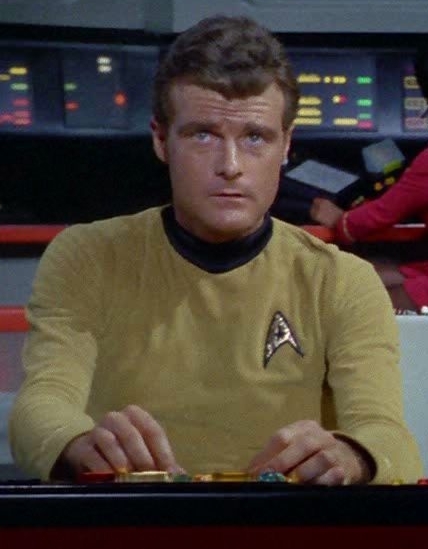
Played by: Eddie Paskey
- Inexplicably Identical Individuals: A common fan theory is that there is multiple Leslie brothers or clones, due to Leslie's occasional tendency to be seen on the bridge in one shot, then behind Scotty in engineering in the next.
- Omnidisciplinary Scientist: By virtue of Paskey being the omnipresent extra on set, Leslie is seen working in literally every conceivable position on the ship, from medical to security to transporter operation.
- Only One Name: And only referred to by that name on a few occasions. Various non-canon sources have called him "Frank," "Ryan," or "Ed" (the last, naturally, after the actor).
- Throw It In!: His otherwise un-named character was given a name by none other than William Shatner, who named Lesley after one of Shatner's young daughters.
- Red Shirt: The King of the Redshirts, no less, as he has the distinction of being the first Trek character to die and return to life. He dies in "Obsession", yet turns up later in the episode completely unharmed. Paskey was Shatner's stand-in and lighting double, and Doohan's hand double, so they couldn't really get rid of him, and he actually appears in more episodes than Chekov.
Lieutenant Kevin Thomas Riley

Played by: Bruce Hyde
- Ascended Extra: Actor Bruce Hyde was cast as a crewman with a significant part in "The Conscience of the King" without anyone realizing he had also played uber-Irishman Riley in "The Naked Time." When the producers finally realized this, the script was hastily re-written so that Hyde played the same character in both episodes. (The same thing happened with actress Barbara Baldavin, who appeared three times as Angela Martine but is accidentally addressed by other names more than once due to rewrites; figuring out who she really is almost approaches Continuity Snarl levels.)
- Dark and Troubled Past: Who would've guessed the dorky, fun-loving Riley was one of the few survivors of a horrific massacre when he was just a little kid?
- Dreadful Musician: "Iiiiii'll taaaaake you hooome again, Kathleeeeeen...."
- He Knows Too Much: Lenore poisons him, Hamlet-style, to prevent him from pointing at Kodos as a war criminal. (Ironically, he doesn't even know that Kodos is aboard until near the end.)
- Improbable Age: Riley seems pretty young for a full-braid Lieutenant - Hyde was 24 at the time, and looked it. This also makes him an improbable witness to a man who had disappeared 20 years before, when he would have barely been out of diapers. Amusingly, the greenhorn Ensign Chekov, introduced in the second season, was played by an actor five years older.
- Incessant Music Madness: "And now, crew, I will render Kathleen ONE MORE TIME!Kirk: Please, not again.
- Oireland: Got his "Irish" up when under the influence of the mind virus in "The Naked Time."
- O.O.C. Is Serious Business: Riley, the resident class clown of the lower decks, becomes deadly serious when he learns that Kodos is aboard the Enterprise.
- One Degree of Separation: Riley and Kirk are two of the only people in the galaxy who have seen Kodos the Executioner in person, and they both serve aboard the same ship.
- Real Life Writes the Plot: The reason Riley never returned after "The Conscience of the King," despite being very popular with fans, was that Hyde left to become a hippie. Yes, really. Remember, this was 1967. (He later became a professor of philosophy.)
Doctor M'Benga

Played by: Booker Bradshaw
The ship's ranking Chief Medical Officer when Bones was off the ship, Doctor M'Benga interned on Vulcan and specialised in treating Vulcan physiology, which came in useful when Spock was shot.
For tropes about M'Benga's character in Strange New Worlds, see here.
- All There in the Manual: The character originated in an ultimately unused script, which gave his first name as Joseph and his nationality as Ugandan. An early novel used "Geoffrey" and the Star Trek Novel 'Verse named him Jabilo. As of Strange New Worlds, Doctor M'Benga's first name has been canonised as Joseph.
- Cruel to Be Kind: Spock needs to be put in pain to be brought out of his trance, so Nurse Chapel taps him gently. Scotty pulls Chapel away from Spock, thinking she's gone mad, slapping her patient around. Then M'Benga steps in and gives Spock the necessary physical stimulus.
- The Main Characters Do Everything: Averted in the episodes he showed up. He fills in for Bones when the latter joins a landing party.
- What Happened to the Mouse?: Never even mentioned outside his two appearances, despite the many times his specialisation in Vulcan medicine would have been useful, and being Bones's second-in-command.
Angela Martine

Played by: Barbara Baldavin
An enlisted crewmember on the Enterprise. Her debut episode, "Balance of Terror," had her about to get married (with Kirk, as ship's captain, officiating) when her wedding was interrupted by an encounter with the Romulans. Her fiancé is killed. She's brokenhearted of course, but she musters her courage to cope with it. Returned in minor roles in "Shore Leave" and "Space Seed" (in the latter, she's addressed as Angela, but once is called "Teller"). Baldavin also appeared under the name "Lieutenant Lisa" in "Turnabout Intruder," though she was made up differently and Lisa is usually considered a separate character.
Fleet Captain Christopher Pike

Played by: Jeffrey Hunter ("The Cage"), Sean Kenney (Disfigured Pike in "The Menagerie")
Dubbed in French by: Yvon Bouchard
The previous captain of the Starship Enterprise and Spock's prior commanding officer. A celebrated space explorer, much like Kirk, he was later horribly disfigured in a training accident. Spock's loyalty to Pike was too much to allow Pike to remain a disabled wreck, so he returned Pike to the Talosians to live out his days in an illusion of good health with his love Vina.
For tropes relating to his other appearances, see Discovery and Strange New Worlds.
For tropes relating to his appearances in the Kelvin Timeline, see here.
- And I Must Scream: The training accident he was in gave him a huge dose of delta radiation, bad enough that he's completely immobilized. McCoy notes his brain is working as much as anyone else's, but he can't even speak. And when he realises what Spock's doing, all can he do is repeat "no" over and over again.
- Body Horror: What we see isn't pretty. His face is covered in scarring, and one massive burn going from chin to temple on the right side of his face. And it's hinted the radiation did a lot of other damage, given mention is made of his heart being kept operated by battery. Even getting agitated nearly puts him into a coma from the strain.
- The Captain: The original captain, preceding even Kirk. He later became a fleet captain.
- Celibate Hero: Especially when compared to Kirk. While he’s had fantasies of Orion slave girls, he runs out disgusted, calls out Boyce for being a Dirty Old Man and shows little interest in any husband and wife dreams cooked up for him.
- The Determinator: The Talosians expected Pike to quietly accept captivity. Pike had other ideas and didn't stop until he escaped.
- Due to the Dead: Star Trek: Deep Space Nine revealed that Starfleet named one of their combat decorations in his honor, the Christopher Pike Medal of Valor.
- A Father to His Men: Implied from how Spock was willing to risk his career and life to help his former CO.
- Happily Ever After: The end of "The Menagerie" implies this for him and Vina, as they get to spend their remaining years together in an illusion of good health.
- Hollywood Mid-Life Crisis: "The Cage" can be interpreted as an extended metaphor for a man going through a mid-life crisis. (Gene Roddenberry was well into his forties when he wrote the pilot, and even cast his mistress as the female lead.) Pike's character is clearly supposed to be older than Kirk, even before the eleven-year Time Skip in "The Menagerie", although Hunter was a relatively young man (he turned 38 during filming of "The Cage"). Subsequent depictions of the character clearly portray him as middle-aged even during his prime (played by 53-year-old Bruce Greenwood in Star Trek (2009) and 45-year-old Anson Mount in Star Trek: Discovery, both set some years before the TOS era).
- Mangst: He’s having a Heroic BSoD over getting some of his crew killed, and it takes drinking for him to admit he’s tired and wants to retire.
- Once for Yes, Twice for No: Following the accident, Pike is left in a state where his only form of communication is a light on his elaborate wheelchair, which he can light once for "yes" and twice in a row for "no".
- Small Role, Big Impact: He only appeared in two episodes, one of which didn't air until decades after the show ended, yet is easily one of the most recognizable things from TOS. His blinking lights and wheelchair have been been parodied and paid homage to in numerous other works.
- Stay in the Kitchen: Can’t get used to having women on the bridge, and when Number One is offended, he tells her she’s different, offending her again.
- Unresolved Sexual Tension: The Talosians noted that both Pike's first officer, the original Number One, and his yeoman were attracted to him, but since we never saw anything further of Pike's adventures, we don't know if anything came of it. He was apparently still in love with Vina, as he later accepted retirement with the Talosians to be with her.
- The Voiceless: The training accident left him unable to speak, so he had to communicate via blinking lights on his wheelchair. One blink for yes, two for no.
"Number One"

Played by: Majel Barrett
The first officer of the Enterprise and the second-in-command to Captain Pike, originally filling the cold, logical first officer role that would later go to Spock. She only appeared in "The Cage" and footage reused in "The Mengerie".
- Everybody Calls Him "Barkeep": Everyone calls her Number One, all the time.
- Not So Stoic: When Pike remarks that he "can't get used to having a woman on the bridge", she looks openly surprised before he excludes her as "different, of course."
- Only One Name: She's only referred to as "Number One" in "The Cage". A variety of apocrypha over the years either confirmed this as a given name or title on her homeworld, or suggested various real names, such as Una.
- Real Life Writes the Plot: Majel Barrett was the girlfriend and eventual wife of Gene Roddenberry, which caused suspicion among NBC executives when they viewed "The Cage". She was removed from the show and not acknowledged again for decades.
- Unresolved Sexual Tension: The Talosians noted that she was attracted to Pike, and her official biography confirms this, but we don't know if anything came of it. He was apparently still in love with Vina, as he later accepted retirement with the Talosians to be with her.
- You Look Familiar: Majel Barrett was later cast as Christine Chapel after Number One was removed from the show (which NBC executives were not informed about) and, much later, she also played Lwaxana Troi in Star Trek: The Next Generation, and was the official computer voice in most Star Trek productions over the years. She also played most of the female characters except for Uhura in Star Trek: The Animated Series.
Antagonists
- See his page.
Commander Kor

Played by: John Colicos
Appearances: Star Trek: The Original Series | Star Trek: The Animated Series | Star Trek: Deep Space Nine
The main antagonist of "Errand of Mercy" and Kirk's first Klingon opponent. Technically he isn't Star Trek's first Klingon since several troopers are seen before him, but he is the primary Klingon in the episode which introduces the race. He returned in one episode of The Animated Series, three episodes of Deep Space Nine (undergoing a Heel–Face Turn with the rest of the Klingons), and more novels and comics than you can shake a stick at.
- Affably Evil: Despite intending to execute Kirk once he discovers his identity, he has a drink with him first and is generally hard to dislike.
- Cold Ham: Dominates everyone in his first scene, not raising his voice in his command, but is shaking with barely contained power.
- Enemy Mine: When the Organians demonstrate their powers and use nonlethal force on both sides, Kor is quick to whisper to Kirk that they should team up to take them on.
- Evil Counterpart: Like Kirk, Kor is a senior field officer, but with the military dictatorship of the Klingon Empire rather than the democracy of the Federation.
- A Nazi by Any Other Name: Kor's control of Organia involves restriction of personal freedoms, mass executions, and constant surveillance.
- No Sense of Personal Space: As well as the famous “you’ll be taught how to use your tongue” line, he sees Kirk and immediately circles him like prey, along with a blatant check out of his ass.
- "Not So Different" Remark: Kor tries to pull one of these on Kirk, saying they are both warriors on a world of cowards. However, he is horrified when the Organians pull one on him and say one day humans and Klingons will be friends.
- Proud Warrior Race Guy: Unlike many TOS Klingons, Kor does seem to embody this trope.
- Small Role, Big Impact: John Colicos played Kor only once on TOS before reprising the role decades later on DS9, but his Genghis Khan-inspired performance set the standard for all Klingons.
- Yellow Peril: Kor's look was based on Genghis Khan.
Captain Koloth
Played by: William Campbell
Appearances: Star Trek: The Original Series | Star Trek: The Animated Series | Star Trek: Deep Space Nine
The second major Klingon antagonist to appear in the Original Series; he is one of the many problems Kirk has to contend with in "The Trouble With Tribbles". He is a boisterous and devious captain, cheerfully exploiting the terms of the Organian peace treaty for his benefit while scheming to advance the Klingon Empire's interests. Koloth proved extremely popular with fans and reappeared in the Animated Series and DS9 alongside his fellow Klingons Kor and Kang, as well as starring in several novels and short stories.
- Friendly Enemy: Kirk and Koloth (somewhat sarcastically) greet each other as "my dear captain" when they meet on K-7.
- Large Ham: William Campbell is channeling more than a little of his performance as Trelane into Koloth.
- Noodle Incident: Koloth and Kirk's first meeting prior to the episode.
- The Only One Allowed to Defeat You: According to William Campbell, Koloth wanted to be the one to defeat Kirk and would have happily fought anyone who tried to take that opportunity away from him.
- Rules Lawyer: Koloth uses the terms of the Organian peace treaty to get his men shore leave on K-7 over Kirk's protests.
- Smug Snake: Koloth is clearly enjoying the opportunity to tweak Kirk's nose while advancing the Empire's plot to poison the quadrotriticale shipment.
- Worthy Opponent: Koloth is clearly happy to be involved in verbal sparring matches with Kirk; decades later, Jadzia Dax tells Ben Sisko that Koloth always regretted never getting to face Kirk in battle.
Commander Kang
Played by: Michael Ansara
Appearances: Star Trek: The Original Series | Star Trek: Deep Space Nine | Star Trek: Voyager
The third and last major Klingon antagonist of the Original Series. Kang is a battle-hardened commander who squares off with Kirk at the remote planet of Beta-XII A. Originally created because John Colicos was unable to reprise his role as Kor, Kang proved popular enough to be brought back for guest appearances in Deep Space Nine and Voyager.- Cold-Blooded Torture: Kang threatens to torture and execute the Enterprise crew one by one until Kirk confesses to killing his men.
- Deadpan Snarker: He gets a few good lines in.Kang: Most interesting. The bulk of your crew trapped? Your ship racing from this galaxy at wild speeds? Delightful.
- Enemy Mine: When Kang finally accepts that the Klingons and the Enterprise crew are being manipulated by the Beta-XII A entity, he teams up with Kirk to defeat the energy being.
- Even Evil Has Loved Ones: His wife, Mara, is his science officer, and he clearly cares for her, though he also won't let her be used as a bargaining chip against him.
- A Father to His Men: Kang is pissed at Kirk for having apparently killed most of his crew.
- I Have Your Wife: Kirk tries threatening to kill Mara if Kang doesn't agree to a truce. Kang just shrugs it off as the inevitable result of war.
- Sheathe Your Sword: Kang lays down his arms when he realizes that he's being manipulated by the Beta-XII A entity.
- Yellow Peril: Like Kor, Kang's appearance takes a lot of cues from Genghis Khan.
Harcourt Fenton "Harry" Mudd

Played by: Roger C. Carmel
Appearances: Star Trek: The Original Series | Star Trek: The Animated Series
- Affably Evil: He's a shameless crook and totally unrepentant scam artist, but he's friendly, cheerful, easy-going, and surprisingly likable, so long as you remember never to trust him with anything, especially anything worth money. Basically, he's a proto-Ferengi.
- The Aggressive Drug Dealer: A Deleted Scene in "Mudd's Women" had him trying to sell the "Venus" drug to Uhura, as if she needed any help to be beautiful.
- Con Man: His first appearance is based on his scam to marry gorgeous women secretly modified with drugs to be super-beautiful to lonely, wealthy space-workers for a huge payout. In Star Trek: The Animated Series, it's mentioned he once tricked an alien species by selling them the Starfleet Academy building.
- Cool and Unusual Punishment: This gets visited upon him by Kirk at the end of "I, Mudd."
- Evil Is Petty: While downplayed as Mudd is mostly just a dick, but his role as Kirk’s antagonist just seems to be wanting to see him squirm and take Mudd’s orders.
- Full-Name Ultimatum:Stella: Harcourt! Harcourt Fenton Mudd!...Mudd: Shut UP, Stella!
- Henpecked Husband: It turns out in "I, Mudd" that he had a harridan of a wife named Stella; part of the reason he became a crook was to run away from her to the ends of the galaxy.Mudd: You see, gentlemen, behind every great man there is a woman urging him on. And so it was with my Stella. She urged me on into outer space. Not that she meant to, but with her continual, eternal, confounded nagging. Well, I think of her constantly, and every time I do, I go further out into space.
- Hoist by His Own Petard: By the Stella androids at the end of "I, Mudd."
- Honest John's Dealership: The first storyline involving him is his plan to sell brides to lonely space-miners (after giving them illegal "Venus Drugs" to make them super-beautiful). He'd also been convicted as a smuggler prior to his first appearance. In his second appearance, he describes how he escaped Deneb V after being sentenced to death for fraud.
- Lovable Rogue: He's a money-grubber and irresponsible, but he's affable and rarely trying to commit "truly evil" crimes.
- Recurrer: He holds the distinction of being the only non-Starfleet character in the entire series to appear in more than one episode. He returns for an episode of the Animated Series, as well. (He was also planned to make a third appearance on the show, but the proposed story was dropped.)
- Space Jews: His Irish accent, flamboyant dress sense, pierced ear, and dishonesty make him seem like a negative stereotype of Irish Travellers.
Trelane, Squire of Gothos
Played by: William Campbell
Appearances: Star Trek: The Original Series
A flamboyant, childlike, and surprisingly dangerous entity encountered by the Enterprise crew. Trelane ("General Trelane, retired") is intrigued by humanity, specifically its more warlike and savage aspects, and wants to "play" with Kirk.
- Agent Peacock: He dresses quite flamboyantly, with a frilled shirt and bright blue tailcoat dripping in gold braid and medals, but he's still a dangerous entity.
- Aliens Steal Cable: Trelane has apparently been monitoring Earth for some time, but his information is quite out of date, considering he's dressed like an 18th-century fop.
- Always a Bigger Fish: The episode is resolved when his parents show up and ground him for messing with the poor primitive earthlings.
- Beware the Silly Ones: Trelane spends the first half of the episode being a vaguely threatening cornball. Then he decides to hunt Kirk for sport and nearly succeeds in killing him.
- Enfant Terrible: Turns out to be one once his parents show up.
- Expy: Not Trelane himself, but Gene Roddenberry deliberately patterned the character of Q after his attitude and manner of interacting with the crew, something that John de Lancie and the TNG production staff noticed. Most fans nowadays take it as a given that Trelane and his parents are members of the Q Continuum, with at least one novel positing that Q is Trelane's father.
- Gratuitous Foreign Language: He switches into French and German to greet Lieutenants DeSalle and Jaeger, but uses English to give Sulu a faux-Japanese greeting, causing the latter to amusedly ask if he's serious.
- Klingons Love Shakespeare: Trelane seems enthralled by human history, specifically its martial aspects; he introduces himself as a retired general and asks Kirk to tell him about his battles and missions of conquest.
- Psychopathic Manchild: He is fascinated by Kirk's phaser, vaporizing several objects in his house before declaring that one could kill millions with it. He later throws a tantrum when Kirk and the others won't cooperate with him and ultimately decides to hunt the captain for sport, gloating and cackling all the while. Then it turns out he actually is a child, at least by the standards of his species.
- Reality Warper: He can twist space and matter as he pleases, though time is a bit beyond him.
- Sore Loser: He doesn't take it at all well when Kirk bests him. When his parents show up to haul him off, he whines and complains like a little boy being told to go to bed and fades out insisting that he "woulda won".
Tribbles
Appearances: Star Trek: The Original Series | Star Trek: The Animated Series | Star Trek III: The Search for Spock | Star Trek: Deep Space Nine | Star Trek | Star Trek Into Darkness
Harmless little fuzzballs featured in three episodes — "The Trouble with Tribbles" (TOS), "More Tribbles, More Troubles" (TAS), and "Trials and Tribble-ations" (DS9); and cameos in Star Trek III: The Search for Spock, Star Trek (2009), and Star Trek Into Darkness.
- Big Eater: They'd have to be, to support all that explosive breeding. They chew through the Enterprise's food stores, and absolutely demolish the huge bins of super-valuable quadrotriticale grain aboard station K-7.
- Born as an Adult: And pregnant. Which is quite a time-saver.
- Cuteness Proximity: For some reason, people tend to enjoy cooing over the fluffy, purring fuzzballs. Well, unless you're a Klingon.
- Explosive Breeder: Exaggerated. In three days, one tribble will become 1,771,561. (Assuming that tribbles reproduce every twelve hours with an average litter of ten.)
- Now You Tell Me: "We stop feeding the tribbles and they stop breeding!"
- Sitcom Arch-Nemesis: The only species that the Tribbles do not like are the Klingons, and the feeling is very mutual.
- Thrown Out the Airlock: Where they'll be no tribble at all.
Lieutenant Commander Gary Mitchell

Played by: Gary Lockwood
The antagonist of "Where No Man Has Gone Before." Mitchell was Kirk's best friend until contact with the great barrier at the edge of the galaxy gave him extra-sensory perception and psionic powers, leading him to believe that he was becoming a god.
- Anti-Villain: At first. His initial acts of villainy are simply attempts to stop Kirk and Spock from killing him out of fear for his power. He gradually becomes more evil over the course of the episode and by the end he's left this trope far behind.
- A God Am I: He frequently refers to himself as such. During the final confrontation he uses his telekinesis to force Kirk to kneel and pray to him.
- The Charmer: In Kirk’s bio, the female crewmembers all miss him when he dies, mostly because he flirted with them constantly by making them laugh.
- Chivalrous Pervert: He’s the one that pushed girlfriends on Kirk in the academy days, and apparently flirts a lot (the bio has Kirk be annoyed that he’s hitting on the female crew too much), but he’s a nice guy until his run-in with the galactic barrier causes him to mutate into a Physical God and go insane as a result.
- Forgotten Fallen Friend: The end of the pilot does give the crew a little time to grieve over him, but he's never mentioned again (the for-some-time-ambiguous canonicity probably didn't help), with his role as Kirk's close trusted friend getting transplanted onto Spock and McCoy (in fact, some fans watching the pilot get the impression that Mitchell was supposed to be first officer before Spock). He's there in the novel versions of the movies (and in one of Kirk's Nexus fantasies), with the implication that Kirk is trying very hard to forget about him.
- Glowing Eyes of Doom: After the accident, his eyes start to glow silver. His eyes return to normal when he's injured or is otherwise prevented from using his powers.
- Hoist by His Own Petard: He is killed when he is crushed by rocks while standing in the grave he created for Kirk.
- Hot-Blooded: Kirk’s bio has him making a lot of impulsive, rash choices. Sometimes they work out, sometimes they don’t, and he admits to Kirk at one point that he doesn’t think things through.
- Jerk with a Heart of Gold: Prior to his transformation.
- Physical God: He starts out gaining telepathy and telekinesis (powerful enough to deflect phaser fire and take control of the Enterprise through thought alone), and eventually evolves to nearly Q and Trelane's level, being able to will matter into existence through thought alone. Being crushed by rocks still kills him, though it takes being weakened in a psychic fight with another god-like being to get to that point.
- Positive Friend Influence: Kirk’s bio posits that he would still play it safe and just be another face in the academy if it hadn’t been for Gary’s charm and showing his friend that he needs to take risks. This is what makes his transformation into an insane god-like being even more tragic.
- Power Echoes: He eventually gains this.
- Screw the Rules, I'm Doing What's Right!: Tells Kirk in more than one prequel book that leaving people to die under the guise of the Prime Directive is a shitty thing to do.
- Shadow Archetype: Nearly every later official book involving him has him as what Kirk is considered to be in popular culture; too reckless, doesn’t think and overly flirty. He’s a decent person despite this though, and is a Positive Friend Influence when younger Kirk wants to be a By-the-Book Cop.
- Shock and Awe: After Kirk manages to convince Dr. Dehner to pull a Heel–Face Turn, she and Mitchell blast each other repeatedly with lightning, resulting in a Double Knockout; unfortunately Mitchell recovers relatively quickly, while Dehner is fatally wounded.
- The Stoic: He quickly loses all traces of human emotion.
- Super-Strength: After being briefly Brought Down to Normal after a psychic duel with Dr. Dehner, Mitchell gets into a fist-fight with Kirk in which Kirk initially has the upper hand, until Mitchell starts regaining his powers; even without his telekinesis, he's strong enough to flip Kirk with an Off Hand Back Hand and lift a huge boulder and toss it at Kirk.
- Tragic Monster: As Kirk says, Mitchell never wanted this to happen to him.
- Übermensch: He believes that he has become a higher being who is destined to change mankind forever.
- With Great Power Comes Great Insanity: After he starts mutating, he's initially relatively normal and only attacks the crew because they're considering killing him out of fear he'll evolve to the point where he starts to see human beings as insects. Pretty soon, though, he evolves to the point where he sees human beings as insects, losing all empathy for them and even demanding to be worshipped as a god.
The Gorn Captain
The captain of a vessel that attacked a Federation colony and lured the Enterprise to the ruins of it for an ambush, before being forced to battle Kirk to the death by aliens called the Metrons, where it is revealed that the Gorn only attacked because they considered the colony to be the prelude to Federation conquest.
- Anti-Villain: While utterly ruthless about how they went about dealing with it, the Enterprise crew concedes that they had no clue the colony was infringing on Gorn territory and that such a thing would look like an act of aggression if things were reversed. In the mind of the Gorn, they are acting in self-defence.
- Attack Its Weak Point: During their initial fight, Kirk manages to briefly stun him by slamming the ear-like nodes on his head. It looks like Kirk managed to hit a vulnerable spot, because the Gorn is otherwise tough enough to No-Sell a microwave-sized rock to the clavicle.
- Genius Bruiser: It looks like a brutish lizard monster that Kirk can't put down, yet it repeatedly outsmarts both Kirk personally and the Enterprise as a whole. Also, instead of relying on his superior natural strength, he takes the time to fashion a weapon from the location environment, just like Kirk does; however, he made a flint knife while Kirk made a cannon.
- Implacable Man: The Gorn Captain shrugs off every physical attack Kirk hits him with and even gets back up when Kirk drops a boulder on him.
- Made of Iron: As Kirk himself notes during the episode, the Gorn Captain easily takes attacks from Kirk that would kill a human being. Even Kirk dropping a boulder on him only knocked him out for no more than a minute, and didn't injure him at all.
- Mighty Glacier: Much more powerful and durable than Kirk, yet moves about as fast as molasses in January.
- Proud Warrior Race Guy: Implied, since their first response to finding a Federation colony on their territory is to utterly destroy it and set a trap for the nearest Federation starship, and they prove to be superior both tactically and in terms of firepower.
- Super-Strength: Kirk manages to pick up a large rock (maybe 60-80 pounds) and throw it at the Gorn Captain, hitting him square in the chest and accomplishing nothing. In response, the Gorn Captain easily picks up and lifts over his head a boulder that has to weigh at least a ton, and throws it (judging by the arc and how much time Kirk had to see it coming and dodge) probably fifty feet.
Janice Lester

Played by: Sandra Smith
Kirk's Psycho Ex-Girlfriend, stealing his body in "Turnabout Intruder" so he can finally know the "indignity of being a woman" and she can get the Captain status she's always craved.
- Ambiguous Gender Identity: Maybe she would have had an easier time if she just transitioned into being a man.
- Blatant Lies: Delivered the infamous claim that women in the liberal utopia that is the Federation are barred from commanding starships. Regardless of whether Gene meant that literally or not, several decades and many female captains later and we are able to put this down to the fact that she is just making up excuses for the fact that there is no way anyone would promote someone this mentally unstable to the rank of captain.
- Broken Bird: A manipulative Death Seeker who finds it easy to hit her ex boyfriend and hates herself.
- Easily Forgiven: Kirk has a habit of doing so to people who treat him awfully, but even Shatner complained that nothing in the episode actually got resolved.
- Death Seeker: Kirk points out that her “love” for him was actually torturing and punishing, and that they would have killed each other. She responds with “that might have been better”.
- Domestic Abuse: She's a little too happy to be finally stronger than her ex boyfriend, mocking him for being scared all the time and punches him out to shut him up.
- Final Boss: The villain of the original series' final episode, though due to the show's episodic nature there was no plot-related significance to this other than the fact it just happened to be the last episode filmed.
- I Just Want to Be You: She vehemently denies loving Kirk, telling Coleman that she just loves and wants the life he leads of being Captain.
- Man, I Feel Like a Woman: Inverted. Sure she hates Kirk, but still takes the time to grope his abs when she's finally in him.
- Mirror Character: For Kirk, as she seduces her assistant the way he seduces villains of the week, plays wounded gazelle gambits well like how he’s got the Enterprise to play dead multiple times, both have Death Seeker inclinations and while he’s an Agent Peacock comfortable in his gender, she’s rigid in gender norms and is a Troubled Abuser because of it.
- Never My Fault: In their conversation, Kirk is of the opinion that their relationship was a toxic mess, yet she blames Kirk for leaving, claiming he abandoned her when it got serious.
- Psychopathic Womanchild: She’s positively giggling when she manages to trap Kirk in her former body, and snuggles with him in her arms while talking about how he should have killed her.
- Too Clever by Half: Aside from being an Hysterical Woman, she partly fucks up because she thinks being a Captain means you’re formal with everyone, and shows no affection for the crew that Kirk does (like calling Bones “Doctor McCoy” constantly.)
- Troubled Abuser: According to the hearing, she hated being a woman, and took it out on Kirk, making it hell to be with her.
- Wounded Gazelle Gambit: She fakes having deadly serious radiation poisoning to get her Chronic Hero Syndrome ex alone with her and sympathetic.
Others
Ambassador Sarek

Played by: Mark Lenard
Dubbed in French by: Roger Rudel (Star Trek III), Georges Berthomieu (Star Trek IV), Mario Santini (Star Trek VI)
Appearances: Star Trek: The Original Series | Star Trek: The Animated Series | Star Trek III: The Search for Spock | Star Trek IV: The Voyage Home | Star Trek: The Next Generation | Star Trek VI: The Undiscovered Country
Father of Spock. A distinguished Vulcan Diplomat, he and Spock were not on speaking terms for some time prior to the former's first appearance in "Journey to Babel" (to the point where Spock never even mentioned to Kirk or Bones that they were related). Sarek had wanted his son to follow him in his footsteps by attending the Vulcan Science Academy, but instead, Spock chose to join Starfleet. Appears in only one episode of the Original Series, but returns in the films, the Animated Series, and even Star Trek: The Next Generation.
- Abusive Parents: Not intentionally, but cold Vulcan logic means he was emotionally distant toward Spock when he was a kid, and it's helped cause a lot of Spock's anti-human attitude. Sort of tells you what his parenting styles are like when Spock's reaction to being told Sarek's at threat of dying is "meh". Fortunately, they manage to repair their relationship.
- Ambadassador: He's proficient in Vulcan martial arts. Spock points out that he could be a plausible suspect in the Tellarite ambassador's murder since Sarek knows the technique that killed him.
- Antiquated Linguistics: Introduces Amanda as "she who is my wife" rather than just "my wife". He does the same thing decades later with Perrin.
- Blue Blood: Or at least he comes from good family, in so far as Vulcans count such things, and behaves in a courtly manner.
- Gentleman and a Scholar: A cut line indicated that Sarek was an astrophysicist before he turned to politics.
- Happily Married: Though Sarek and his human wife, Amanda, have their differences (as seen in "Journey to Babel"), and though he's culturally inhibited from expressing his emotions, it's clear the couple love each other very much.
- Has a Type: When he resurfaces in Next Generation, he has remarried after the death of his human wife Amanda... to another human woman.
- Jerk with a Heart of Gold: For all his stern, no-nonsense traits and his differences with his son, he is a loving father and proud to represent his planet for the Federation.
- Killed Off for Real: Died in the Star Trek: The Next Generation episode "Unification I".
- Marry for Love: Marrying Amanda was... logical. Obviously. (Well, if you love them, marrying them is pretty logical.)
- My Greatest Failure: Based on the emotions Picard feels during their mind meld, Sarek feels extreme disappointment and regret over his emotional detachment towards both his human wives. He also regrets never expressing his pride and love towards Spock appropriately."Perrin. Amanda. I wanted to give you so much more. I wanted to show you such tenderness. But that is not our way. Spock, Amanda, did you know? Perrin, can you know how much I love you? I do love you!"
- Not So Stoic:
- He teases Amanda in public at the end of "The Way to Babel".
- With a side order of O.O.C. Is Serious Business. In Star Trek III, he's visibly angry when he confronts Kirk about the latter's supposed failure to return Spock's katra to Vulcan. This only escalates when he figures out Kirk has no idea what the hell he's talking about. This is lampshaded later at the foot of Mount Seleya, when Sarek requests the Fal-tor-pan ritual be performed to reunite Spock's body and mind. High Priestess T'Lar protests that the ceremony is dangerous and its outcome uncertain, making his request illogical. Sarek replies "Forgive me, T'Lar. My logic is uncertain... where my son is concerned."
- Out-of-Character Moment: In Sarek, Picard is shocked to see him moved to tears by a musical performance. This is because he has Bendii syndrome, which is analogous to Alzheimer's in a human.
- Parents as People: He has the unfortunate task of being a full Vulcan parent to three messed up main characters: Spock, Sybok and Michael. Part of his issue is overconfidence in the Vulcan ways, and not really knowing what his children need.
- So Proud of You: He admits this to Spock in Star Trek IV, and in TNG's "Unification: Part II," Spock learns from mind-melding with Picard that he was even prouder, which almost moves him to tears.
- Super-Strength: Like all Vulcans. That Tellarite ambassador mentioned earlier tried to manhandle Sarek during an argument. Sarek effortlessly knocks away his hands with just a flick of two fingers each sending him reeling quite some distance as an aftereffect. He's lucky Sarek didn't actually hit him.
- You Look Familiar: In addition to Sarek, Lenard also played the Romulan commander in "Balance of Terror" and a Klingon captain in the first movie. He is the only actor to portray representatives of all three major galactic powers in the TOS continuity.
Vina

Played by: Susan Oliver
A human woman living among the alien Talosians, who falls in love with Captain Pike.
- Anatomically Ignorant Healing: She turns out to have been left disabled and disfigured by the Talosians' well-intentioned efforts to heal her — they were able to successfully restore her to physical health, but their unfamiliarity with human anatomy led to them putting her back together as a scarred hunchback.
- Body Horror: Downplayed, but she has been left scarred, withered and exaggeratedly hunchbacked as a result of her ship's crash.
- Face Palm: She does this when Pike gets punished for thinking wrong thoughts.
- Glamor Failure: Her beautiful appearance is an illusion; she's really an ineptly reassembled mess.
- I Will Wait for You: Enforced. She has to wait many years for the real Pike to return to Talos IV as she cannot leave the planet. The Talosians were at least kind enough to provide an illusion of Pike to keep her company.
- Love at First Sight: Pike and Vina are attracted to each other from their first meeting and explicitly say so.
- Loving a Shadow: The Talosians provided her with an illusory version of Pike to keep her company while she waited for the real Pike to return.
- Space Clothes: Like the Talosians, she wears shiny, silvery clothes.
