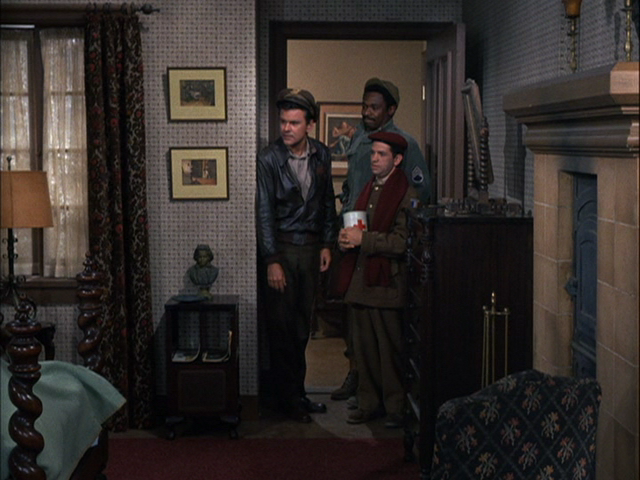
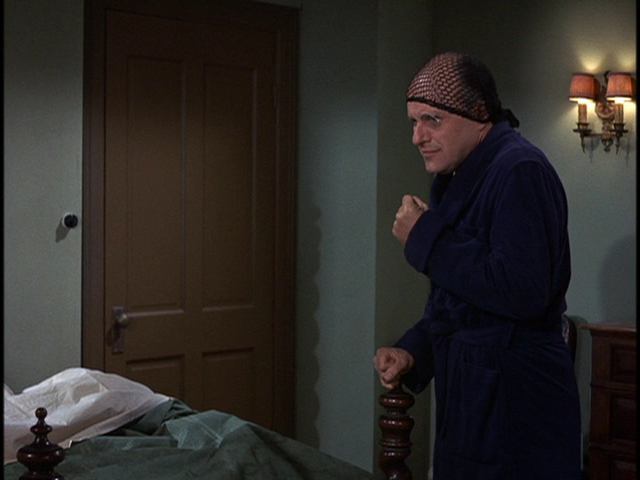
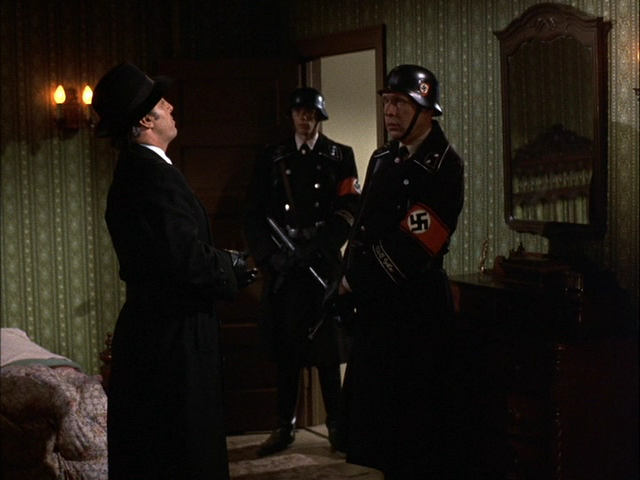
During the European campaign in World War II, a group of multinational POWs in a small German prison camp execute daring sabotage and spying missions right under the noses of their Nazi keepers. It's just like watching The Great Escape or Stalag 17 — every week. And the best part? It's a sitcom!
Starred Bob Crane as Hogan, Werner Klemperer as the bumbling Colonel Klink, and John Banner as the lovable Sergeant Schultz. Aired on CBS from 1965 to 1971.
Ironically, all the major recurring German army characters were portrayed by Jewish actors. (An old story claims that Werner Klemperer would only do the show when assured that the Nazis would never be anything close to successful or competent.) And Robert Clary (Cpl. LeBeau), born Robert Max Widerman, survived Buchenwald (12 other family members didn't).
The show was one of the first American sitcoms to feature a black character as an integral member of the cast. Kinchloe is Hogan's second-in-command and the camp genius (also very unusual for the time period). The producers cast a black actor to play Kinchloe in part to prevent the network from providing Southern stations with a "black-free" cut, as was common at the time — Kinchloe was too important to the story line for his scenes to be removed.
Hogan's Heroes provides examples of:
- Accidental Truth: In one episode, Hogan claims that he and his men were testing people for ESP in order to cover up some gambling. To help sell the lie, he mentions a "Dr. Otto von Tillerman" known for his work in the study of Psychic Powers. Later on, he finds out that there actually is a Dr. Otto von Tillerman who studies ESP, and quips that he might be psychic himself.
- Adolf Hitlarious: Hitler himself is specifically mocked on a few occasions. Carter impersonates Hitler several times to dupe Colonel Klink. Kinchloe, played by African-American actor Ivan Dixon, also impersonated Hitler a few times — over the phone, naturally. He once ordered Klink to send a German officer to the Russian front — the officer was secretly a Russian POW.
- After Show: Averted, due to Bob Crane's death.
 Word of God is that Larry Hovis was working on a pilot for a "next generation" spin-off, involving the children of the original POWs, fighting in Vietnam.
 - The Alcatraz: Stalag 13 has the reputation of being the perfect, escape-proof camp, a reputation the prisoners put in a great deal of effort to maintain, because if Burkhalter learned just how shoddy the security really is, he'd replace Klink with someone who would fix it. That said, given that the prisoners sometimes get themselves deliberately caught while outside the camp, even without knowing what's really going on, it would be more accurate to say that nobody has ever escaped from Stalag 13 without being recaptured within a day or so.
- All Germans Are Nazis: Conspicuously averted. Only one of the recurring German characters (Hochstetter, who was played by an American actor) belongs to the Nazi party and the anti-Nazi resistance movement among German civilians is frequently featured.
- Anachronic Order: The episodes tend to mention historic events of World War II and have the characters reacting to them. The plots of several episodes even rely on said events. But the events as depicted are not in order, the timeline jumps back and forth. For example one episode of season 5 ("The Big Gamble") and three episodes of season 6 ("To Russia Without Love", "That's No Lady, That's My Spy", "Kommandant Gertrude") mention the ongoing Battle of Stalingrad (August 1942- February, 1943). The characters learn of the end of this battle in a season 4 episode ("Guess Who Came to Dinner?"). An episode of season 1 ("How to Cook a German Goose by Radar") mentions the Allied invasion of Sicily (July-August, 1943) as a recent event. Two others episodes of the same season ("The Prince from the Phone Company", "Hello, Zollie") have characters mention strategic plans for the ongoing North African Campaign (June 1940-May 1943). And then we have The D-Day Landing (June 6, 1944) early in Season 3.
- Anachronism Stew: Some things that aren't as obvious to viewers today, but they're there...
- In "Psychic Kommandant", when Hogan says "By George, I think he's...not got it!"—but My Fair Lady
 didn't hit Broadway till 1956 (and the movie not till 1964, only a few years before the show aired)
 - In one episode Hogan uses a variation of Steve Allen's What's My Line? catchphrase 'Is it bigger than a breadbox?' which was first coined around 1953.
- In an example of stock footage that doesn't come from World War II, in "Reverend Kommandant Klink", LeBeau goes briefly to Paris. There's a shot of the Folies Pigalle (then a theatre/cabaret) where Vince Taylor
 is set to play. Vince Taylor was born in 1939.
 - In one episode Newkirk makes a reference to Speedy Gonzales regarding how quickly Hogan removed a packet of documents taped to Carter's back. Speedy was one of the last recurring characters in the Looney Tunes lineup, being introduced in 1953.
- In "Psychic Kommandant", when Hogan says "By George, I think he's...not got it!"—but My Fair Lady
- And Starring: The main cast roll ends with "and John Banner".
- And You Thought It Was a Game: As a diversion for a plan, the team intends to plant a fake bomb supposedly dropped in an air raid. Finding it and thinking that it's the phony planted by his men, Hogan immediately starts to defuse it with clumsy moves that would set it off for real. One of his men stops by and informs him that the fake explosives got stuck in a tunnel and that's a real bomb he's been messing with.
- Angry Guard Dog: Inverted — the dogs are always angry to the Germans, but the prisoners have them trained to a T. It helped that the guy who brought in the replacement dogs was part of the German resistance to the Nazi regime. (And not the only minor character to be, either.)
- Anti-Advice: A bomb lands in Stalag 13. Hogan asks Col. Klink which wire to cut to disarm it, then cuts the other one.Klink: If you knew which was the right one, why did you ask me?
Hogan: I wasn't sure which was the right one. But I was certain you'd pick the wrong one. - Arson, Murder, and Jaywalking: When Hochstetter tells Klink about the damage at Gestapo Headquarters, after an American plane bombed them.Hochstetter: Demolished the building, wiped out the garrison, killed Kommandant Heidrich, knocked the Fuhrer's picture off the wall and... everything!
- Artistic License – Engineering: You can't radio a submarine. The technology to communicate underwater wasn't developed until after the Cold War, and to this day can't transmit audio. A possible subversion if the submarine transmitted on the surface, which subs of the era spent most of their time between battles. However, the Stock Footage of the submarine being contacted always shows it submerged, if not very far.
- Artistic License – Gun Safety:
- In the opening credits, when Klink steps out of his office to inspect Hogan and his men, the guard at his door is holding his submachine straight in front of him, finger on the trigger, pointing it directly at Klink.
- In "The Schultz Brigade", Carter repeatedly points his gun (which is explicitly mentioned as having live rounds instead of blanks in it) at Hogan, Newkirk, and basically anybody else nearby.
- In the second part of "Lady Chitterly's Lover", Crittendon throws his gun from one hand to the other — while pointing it directly at Hogan.
- Artistic License – History:
- The real Klink coat of arms is not azure with a lion rampant vert fimbriated or.note
- Occasionally, they will meet a Femme Fatale Spy, and when they do, they'll act surprised that a lady is in the spy business. The field of espionage has always been equal opportunity, and historically leans towards women. They have the strategic advantage of being underestimated and universally welcomed. If asked to name a spy, everyone says "Mata Hari"note .
- In the episode "The Softer They Fall", General Burkhalter said that the Fuhrer was so enraged that Jesse Owens beat Germany in the Olympics that he left the stage during the awards ceremony. This never happened, and Jesse Owens reported he was treated very well by the Germans during the 1936 Olympics. However, when he came back to America, the white Olympians were invited to the White House, and he was not.note
- In "Klink Versus the Gonkulator", Hogan makes reference to having worked in the Pentagon. The Pentagon was constructed during WWII, with construction completed in 1943. The construction period overlaps with the time period when Hogan was in Stalag 13 (the pilot episode has Hogan already a prisoner in 1942).
- One episode has the Gestapo interrogate Hogan over the Manhattan Project. There is no evidence the Nazis ever knew of the Project's existence, much less its name.
- The real Klink coat of arms
- Artistic License – Military:
- Hogan, Kinchloe, and Carter are in the United States (Army) Air Force; Klink and Schultz are in the Luftwaffe (WW2 German Air Force); LeBeau is in the French Air Force; and Newkirk is in the Royal Air Force... however, almost all of them refer to themselves as soldiers, rather than airmen (Hogan once even makes a remark about "Those fliers" when an American bomber crew is shot down and sent to Stalag 13), and often comments about being in the Army. Kinch is actually a walking technical mistake: his uniform is that of a foot soldier, not a flier, bomber, or paratrooper.
- Hochstetter's black uniform is usually worn by S.S. guards stationed at locations of particular importance to the Third Reich. In most cases, a Gestapo officer like Hochstetter would have more than likely been seen in plain clothes.
- There are a few noteworthy errors with Stalag 13 altogether. First of all, none of the barracks are locked in any way or form. This more than likely would have to be chalked up to Rule of Funny, since otherwise, Hogan and his men wouldn't be able to get a lot of things done. The doors of the barracks would also have opened to the outside (not from the inside) and would have been boarded at night to lock the prisoners in. Also, each of the barracks in Stalag 13 seem to have a separate room, which, in the case of Barracks 2, serves as Hogan's office; barracks usually don't have separate rooms. Likewise, in most cases earlier in the war, each of the characters would have been detained with other prisoners of their own ethnicity and/or rank (Hogan would have bunked in an Oflag with other officers, LeBeau with other French enlisted men, Newkirk with other British enlisted men, Kinch with other African-American enlisted men, and Carter with other American enlisted men); however, much later into the war, as prison camps were becoming cramped for space, the Germans had pretty much stopped bothering trying to separate the prisoners by race and rank, and put them wherever there was room for them — so depending how far into the war this series takes place, it's not entirely impossible or inaccurate for Colonel Hogan to be sharing space with corporals and sergeants of different cultures. Klink's office should be outside the prisoner holding area for security reasons, meaning that Hogan should only be able to go there if summoned or if he makes an appointment to see the Commandant rather than walking in more or less at will. This was likely ignored deliberately, as Hogan walking in for a chat with Klink is a Running Gag that happens at least Once per Episode. The same applies to buildings only the guards should be able to access, such as the armory.
- None of the characters apparently wear any dogtags, or even prison tags; in fact, dogtags are only used strictly as plot devices, such as "The Great Impersonation", where LeBeau, Newkirk, and Carter are captured by the Gestapo, and their forged papers and dogtags are confiscated.
- Another error that could be chalked up to Rule of Funny is that realistically, the only clothing the prisoners would have are the uniforms they were shot down and arrested in. However, we see that this is not the case with the prisoners of Stalag 13, as we see them in standard issue sleepwear in night scenes (Hogan and Newkirk even have civilian pajamas), and in cases where Klink is entertaining an important visitor, all of the prisoners wear Class A Dress uniforms. One theory could be that since Hogan's men tailored all of their own clothing for masquerades, they could have easily made themselves pajamas or Class A uniforms, but then wouldn't Klink and Schultz be suspicious as to where their prisoners suddenly got extra clothing?
- The German officers refer to each other by the English equivalent of their respective ranks. This may or may not lend itself to Translation Convention, but Klink and Schultz's ranks in German, for example, are Oberst and Feldwebel, rather than Colonel and Sergeant.
- One episode focuses on the Germans coercing Hogan to go to England so that he can steal one of the "revolutionary" P-51 Mustang fighters so that he may fly it back to Germany for reverse-engineering, under threat of having the rest of the camp executed. By the time of the series' setting, however, Germany already had several Mustang airframes in flying condition and were actively being evaluated and operated by German clandestine units to the end of the war.
- In multiple episodes, the Germans try to use Stalag 13 as the base for some activity of active military value on the grounds that the Allies would never intentionally bomb a POW camp for fear of killing the prisoners. Using a facility that is marked as exempt from military attack for anything other than the purpose for which it is marked exempt is a violation of the Geneva Convention. On the other hand, so is POWs running military operations other than escape attempts out of a POW camp.
- Artistic License – Prison: Stalag 13 has a number of blatant security flaws that would never pass muster in a real POW camp, even if one disregards the ones that Hogan's people created themselves, such as the absurdly extensive Tunnel Network.
- Windows and external doors on the prisoner barracks open in when they should open out. This is so the guards can bar them shut from the outside, making it harder for the residents to get up to any monkey business after lights out.
- Areas that are supposed to be primarily for the usage of the prison staff, such as guard quarters, the armory, and (most notably) Klink's office, should be located outside the general holding area, with prisoners only allowed there with the express permission of (and while escorted by) the guards. This is to make it harder for prisoners to get to places they aren't supposed to be.
- A few time prisoners are sentenced to solitary, actually get sent into solitary (instead of Hogan talking Klink out of it), and then all of them are shown in the same cell in the cooler. Solitary confinement means solitary confinement, as in one person per cell, ideally without a way to interact with people in adjacent cells.
- Ascended Extra: Carter. In the pilot he was one of several escaped officers passing through Stalag 13, but becomes a major cast member during the rest of the show.
- As Long as It Sounds Foreign: Some signs are in amusing mock German, such as dynamite being stored in boxes labelled "Explosivstof".
- Bad "Bad Acting": Whenever the Heroes read from scripts to Bluff the Eavesdropper, their acting is hilariously atrocious. It's especially bad in "Klink's Escape", where Carter reads his part with the worst possible enunciation and LeBeau has one of his lines broken up by everyone noisily turning their pages.
- Bad Guys Do the Dirty Work: Multiple times, the Heroes will set someone up to be arrested by the Gestapo rather than just blowing them up like they do so many other problems. They use this a lot with regards to female spies, but in "Hello, Zolle" they set up a Field Marshal who was an old classmate of Klink's and who happened to be visiting right when a paranoid Gestapo officer showed up to try to find something wrong with the camp to be arrested as a supposed defector. Another episode has a Gestapo officer who's aware of the Heroes' operation killed by his own mistreated aide moments before Hogan was about to silence him for knowing about the existence of the Manhattan Project.
- Band of Brothers: The five Allied mains.
- Batman Cold Open: They do it occasionally, with Hogan & co. out on sabotage missions. Usually the consequences of that mission provide the plot of the episode.
- Batman Gambit: The show is fueled by them.
- Bavarian Fire Drill: In at least half the episodes, Hogan and his crew use this to complete their missions. In one literal case, the crew actually impersonated a German fire brigade to do it!
- Been There, Shaped History:
- The reason why the Allied Landings on D-Day went off (mostly) without a hitch? Col. Hogan pulled a Bavarian Fire Drill on the German General Staff who were in Stalag 13 at the time!
- One episode revolves around Hogan and his crew helping deliver a briefcase bomb to the Resistance — a bomb implied to be the one used for the July 20, 1944 assassination attempt on Hitler (a.k.a. the "Operation Valkyrie" plot). Further hilarity ensues when Schultz accidentally arms the bomb and Hogan has to distract him and disarm it.
- Big Eater: Schultz
- Big "WHAT?!": From "Monkey Business":Klink: When I looked out that window, I thought I saw a chimpanzee raking in the garden.
Hogan: Well, if it'll make you feel any better, there is a chimpanzee raking in the garden.
Klink: That's what I thought. Well, I need a rest- [beat] WHAAAAAAAAAAAAAT?!! - Bilingual Bonus: Some in German (Klink, Schultz, etc.), and some in French (LeBeau). Also a few surprising ones from Newkirk — apparently the US weren't quite as au fait with British slang as they are now, or they certainly would never have aired certain words.
- Blatant Lies: "Stalag 13 has never had an escape!" (bonus points if someone's sneaking out in the background while Klink's saying it). Hogan arranges it so that the escaping guest stars are blamed on others, so that Stalag 13's perfect record stays intact: if Klink starts losing prisoners, the Luftwaffe, Gestapo or SS would replace Klink with someone competent. It's lampshaded by LeBeau at one point:LeBeau: Oh yeah, not one escape. Maybe a hundred, but not one!
- Bluff the Eavesdropper:
- Hogan finds out that one of the new prisoners of war is actually a German spy, so they pretend to trust him and tell him they're going to take him to their secret hideout blindfolded. They then let some false information slip out while talking and make noises that imply their hideout is under the watertower.
- In another episode the Heroes discover Klink has bugged Hogan's office and decide to use it to their advantage.
- Turned against them by Hochstetter once. It almost got them all killed.
- Bluff the Impostor: One of Hogan's mole-digging methods: Ask the new guy what outfit he was with. Inquire about several supposed members of that outfit. Act very suspicious when he doesn't know who they are, and see if the new guy backtracks and claims to know the actually-nonexistent people.
- The Board Game: Yes, there was one, believe it or not.
- Bond One-Liner: Hogan fires one off after the Heroes blow up a fuel truck in "Drums Along the Dusseldorf".
- The Boxing Episode: "The Softer They Fall"
- Bread, Eggs, Breaded Eggs: There's a Running Gag about German personnel threatened with being shot, sent to the Russian Front, or both.
- Breakout Character: Hilda to only a certain extent. Originally, the producers were going to give Klink a new secretary each season (hence why Helga was replaced by Hilda to begin with), a similar practice on The Bob Cummings Show, however the producers were pleased enough with Sigrid Valdis/Patti Olson's performance that they kept Hilda for the remainder of the show's run.
- Briar Patching: One of Hogan's tactics to get Klink to do what Hogan really wants.
- Brick Joke: In the episode "The Collector General", when talking about Klink, Hogan asks if anyone would trust a man who wears a monocle to bed. Later in the episode, Klink is awakened by a late night phone call, wearing his monocle.
- But Not Too Evil:
- None of the main German cast, and only one of the recurring guest characters (Wolfgang Hochstetter, of the SS and later the Gestapo) is a member of the Nazi party. Truth in Television — according to The Other Wiki, officers of the regular German armed forces were forbidden from joining any political party, which at that time was pretty much the Nazi Party. What is a little strange in this regard is that most of the German regulars and recurring characters are members of the Luftwaffe, which was historically the branch of the Wehrmacht that was the most devoted to the regime and supportive of Hitler and his party.
- The show makes it very clear that both Klink and Schultz are decent men, and since conditions at the camp are not harsh at all it's likely all the other guards are as well. A very strong argument can be made that Klink and Schultz know exactly what Hogan and his men are up to and look the other way because they know Hogan's efforts will end the war sooner. It also lets them give a subtle curse you to the Nazis in general and Hitler in particular.
- At the time the show was made, the US government was heavily committed to the so-called "Clean Wehrmacht" myth. Because the US wanted West Germany to have strong armed forces as a bulwark against the Soviet Union, as soon as the Cold War broke out West German military officers who had been convicted or seriously accused of war crimes were suddenly forgiven and put back into their old jobs. To justify this, both West Germans and the governments of other Western nations propagated the idea that the Wehrmacht had spent the whole of WWII honorably obeying The Laws and Customs of War and that the Holocaust and other serious atrocities were entirely committed by the SS and other Nazi party organisations. Which since the end of the Cold War, is now mostly accepted as, to put it bluntly, "bollocks".
- Butt-Monkey: Klink, at least to some extent Schultz. Among the good guys, it's usually Carter.
- The Captain: Colonel Hogan
- Cardboard Prison: Good thing, too, or else the POWs would never have gotten so much done.
- The Casanova: Hogan always gets the girl(s), although occasionally Newkirk or Kinchloe (if she's black) get a kiss in.
- Casanova Wannabe: Klink
- Cassandra Truth: Carter once had to get caught with a microfilm so they could give fake information to the Germans. He outright told everybody he met that he was a Prisoner of War, and they thought he was a Gestapo agent with fake American papers. He got very frustrated. He finally gave up, asked a (real) Gestapo agent who was in the room checking papers for a ride back to camp, and was found out on the way.
- Casting Gag: Many of the actors playing Germans on the show were Jews who left Europe to escape the Nazi regime. They took parts in the show because the heroes would always outsmart the Nazis. Leon Askin (who played General Burkhalter) had a prominent scar on his cheek from being beaten by the SS in the street because of his religion and this was handwaved away in-universe as a fencing scar.note
- The Cast Show Off:
- Werner Klemperer was an accomplished violinist (naturally, as his father, Otto Klemperer, was one of Germany's great conductors); Colonel Klink, not so much. Except for this, which probably fits both Rule of Cool and Rule of Funny.
- Bob Crane was a highly skilled drummer. In the episode "Look at the Pretty Snowflakes", Colonel Hogan played an impressive drum solo for the song Cherokee in an attempt to cause an avalanche. Bob Crane actually supplies all of the drumming for the show's music, including the timpanis heard in the theme tune, or whenever a German officer, like Burkhalter, enters camp.
- Robert Clary managed to show off his singing voice on more than one occasion.
- Werner Klemperer was an accomplished violinist (naturally, as his father, Otto Klemperer, was one of Germany's great conductors); Colonel Klink, not so much. Except for this
- Catchphrase:
- Schultz's "Jawohl, Herr Kommandant / mein Herr" and "I know nussink!"
- Hochstetter's "Vhat is zis man doing here!"
- Klink's "Hooooo-GANNNN!", "Dis...missed!" (to Hogan), and "Nobody EVER escapes from Stalag 13!"
- Celebrity Resemblance: When the cast appeared in-character on The Leslie Uggams Show, Hogan gave each of them code names to use, which were their actual actors' names. It's further invoked when Hogan gives Carter his code name: Larry Hovis.Carter: Why?
Hogan: Because you look like Larry Hovis!
Carter: Well that's a fine thing to say! - Chaos Architecture:
- Barracks 2 (where Hogan and his men are kept) has far more bunks in it in the pilot episode than it does the rest of the series, not to mention the door opened to the other side.
- Klink's office was given an overhaul starting in Season Three, which made more sense and consistency with the exterior of the Kommandantur (for example, in the first two seasons, there is a window to the outside next to the door, however, that window would actually be looking into Helga's office). That said, Klink's private quarters◊ never look the same◊ twice.◊
- Character Development:
- Colonel Crittendon started off as a completely incompetent and oblivious Miles Gloriosus; in his last episode he successfully helps Hogan and co. carry out a mission by impersonating an English traitor.
- Despite it already being established that he's a con artist, pick pocket, and magician, Newkirk was a lot more of a generic and static character with no real defined personality during the first season. His notable Deadpan Snarker personality and occasional Sarcasm Mode began developing throughout the following season, and was fully established by season three.
- Character Tic:
- Hogan standing around nonchalantly, and smirking. He also puts his hands on his men's shoulders a lot.
- Klink swinging his clinched fist, and letting out a loud mutter.
- Kinch raising his eyebrow.
- Chaste Hero: Carter. Unlike the other characters, who are gaga for anything with two X chromosomes and a tight shirt, Carter is alternately confused and scared by female sexuality. The weird part is that in "Request Permission to Escape" his fiancée sends him a "Dear John" Letter. One wonders how he even got a fiancée in the first place. Ironically, in one of the last episodes, Carter becomes increasingly aroused at the prospect of visiting a beautiful dancer who happens to be with the Dutch Underground as a part of their latest mission.
- Chuck Cunningham Syndrome: Vladimir Minsk, the tailor (played by Leonid Kinskey), who only appeared in the black-and-white pilot episode, and turned down a regular role because he found the premise false and offensive, and that in real life, the Nazis were seldom dumb and never funny.
- Cloudcuckoolander: Carter again, and an argument could be made about Klink and Schultz to some extent.
- Les Collaborateurs: A one-shot member of Hogan's group becomes this in order to leave the camp. Naturally the Nazis don't plan on honoring any deal.
- Color-Coded Characters: Depending on how you look at it...
- LeBeau – Red
- Newkirk – Blue
- Kinchloe – Yellow (without his field jacket, his uniform is olive drab, which is similar to mustard, which is a shade of yellow)
- Carter – Green (also without his leather flying jacket)
- Comforting Comforter: In "Klink's Secret Weapon", Hogan drapes blankets over Kinch and LeBeau, who are so exhausted they just (like everyone else) collapsed into bed. It's a nice, quiet, and very sweet scene.
- Communications Officer: Sgt. Kinchloe is the crew's primary radio operator ("Papa Bear, this is Goldilocks, come in!").
- Con Artist: Hogan, naturally. The other heroes as well.
- Conflict Ball: In "One in Every Crowd", Newkirk starts a knock-down-drag-out fight with a fellow prisoner he catches cheating at cards. This isn't unusual for normal people, but Newkirk cheats at cards so often it's become a running gag. Justified by the fact every time Newkirk cheats, it's while pumping information out of Schultz.
- Continuity Nod: And only in the fifth episode, Klink brings up some of the bizarre events that have taken place in previous episodes, such as the Tiger Tank crashing out of the Rec Hall, and the train bearing the Inspector General blowing up.
- Correction Bait: One of the ways Hogan got information, by saying the wrong thing and then being corrected.
- Counting Bullets:
- Subverted (and played for laughs) in "Two Nazis for the Price of One", where it turns out that the gunman has one round left in his gun.
- Defied in "The Schultz Brigade", where Hogan asks how many shots have been fired, and Klink irritably asks "who's counting?"
- Crappy Holidays: "A Tiger Hunt in Paris" has Klink taking a week's leave in Paris. He has an absolutely miserable time: because Hogan needs to rescue a Resistance agent from the local Gestapo headquarters, Klink spends half his vacation looking for his car (Hogan stole it, along with all his luggage), and the other half locked up in the local Gestapo headquarters (because Hogan framed him).
- Crazy Enough to Work: Virtually all the schemes. Hogan becomes known for it, and the trope is name-dropped in one episode. It actually backfires once or twice and is usually lampshaded by Hogan as "I made it too complicated!"
- Dead Artists Are Better: The episode "Klink's Masterpiece" ends with Col. Hogan reminding Klink of this trope, noting that Vincent van Gogh and Claude Gauguin starved, only becoming popular after their deaths.
- "Dear John" Letter: The first-season finale ("Request Permission to Escape") focuses on Carter, of all people, getting one of these. The fact that it's from Mary Jane ("Gee, we've been going together since we were kids!") makes their trying to cheer him up even funnier.
- Deep Cover Agent: A few popped up, including two in one episode (one American undercover as a German, one German undercover in Allied Intelligence) who made up the plot of the episode.
- Demolitions Expert: Carter's primary role on the team.
- Depending on the Writer:
- Most of the time, Schultz will find out about what the Heroes are up to, or perhaps witness parts of their missions, and in many of these cases, Hogan and his men will flat-out tell Schultz exactly what they're doing (especially in the first season), knowing Schultz will simply turn the other way, and know NOTHING!!! However, on some occasions, the Heroes will actually try to keep Schultz from finding out what they're doing, and if he does find out, he actually will go to Klink to rat them out, putting them in the spot of having to cover up their current mission.
- Klink is also inconsistently written, being anywhere from simply incompetent to actively aiding the prisoners behind the scenes (the latter mostly showing up in SS episodes).
- Likewise for a lot of other small details throughout the series: Schultz fluctuates between being married and single, the exact locations of the tunnels vary as the plot calls for them to be moved, etc.
- Diegetic Soundtrack Usage:
- The prisoners whistle the theme all the time ("The Gold Rush" and "The Pizza Parlor" have great examples).
- Once, slowed-down, as a romantic interlude ("It Takes a Thief...")
- A mournful reprise in "The Great Impersonation" as Hogan finds out that Carter, Newkirk, and LeBeau have been captured while on a mission.
- Digging Yourself Deeper: Klink tends to do this in the worst possible ways around his superiors.
- Disguised in Drag: Several times, often with Newkirk pretending to be an old woman.Hogan: You know, Newkirk? You look good in basic black.
- Distracted by the Sexy: Hogan uses this ploy by having LeBeau taking snapshots of Helga modeling a swimsuit to distract a guard while he bugs his tower.
- Do Well, But Not Perfect: The Heroes go to considerable effort to make sure that Klink's record is good enough that nobody wants to dismiss him, but not so well that anybody wants to promote him.
- Draft Dodging: "Don't Forget to Write" has the Heroes helping Klink fail a physical so that he cannot be cleared for frontline duty and sent to the Russian Front. Unfortunately, Lowered Recruiting Standards have lead to the Luftwaffe taking anyone with a pulse. So they instead have to have a breakout after Klink stands down but before he leaves, so that the new guy looks bad and Klink is reinstated after he recaptures them.
- Dropped After the Pilot: The show had Leonid Kinskey as a Russian tailor named Vladimir Minsk in the pilot. Carter was an officer making his way through. Vladimir's actor decided the show wasn't taking the Nazis seriously enough and quit, and Carter became the fifth main character for the series proper.
- Dueling Scar: General Burkhalter has a dueling scar. Leon Askin, who played General Burkhalter, actually got the scar while being beaten by members of the SS for being Jewish. Klink mentions getting one in "Hello, Zolle", but his face is unmarred.
- Dumbwaiter Ride: During a plan to assassinate a roomful of German generals having a meeting in a hotel via exploding centerpieces, the crew learns from a spy in that meeting that the meeting was actually to give the generals the plans for the defense of France in preparation for an Allied invasion and securing them was vital. The spy was instructed by Hogan to leave his copy in the dining room after it had been cleared out. This meant LeBeau had to ride the dumbwaiter back up to the room and steal his copy of the plans for allied intelligence.
- During the War: Like M*A*S*H, this show actually aired for longer than the war it takes place in (Hogan's Heroes ran for six seasons)—and the US didn't even get involved until 1941.
- Early-Installment Weirdness:
- The pilot episode is in black-and-white, Klink is actually a rather strict and stern camp commandant (though still a bit of a push-over), Carter is a one-shot character passing through Stalag 13 in his journey back to England as an escaping prisoner, a Russian POW named Vladimir is the camp tailor, all of the prisoners are part of Hogan's team and have access to the tunnels, the tunnels are quite a vast underground network with various different departments (printing press, machinery shop, steam room, and a barber shop), Helga moonlights as part of Hogan's team behind Klink's back (although the series proper showed both Helga and Hilda to at least be allied with Hogan, if not in the tunnels), and Burkhalter is a colonel instead of a general.
- Although the show was known for its broad, slapstick humor, the first couple of seasons (particularly the earliest episodes from the first season) had a lot more wacky, off-the-wall, and at times cartoonish humor.
- The first season in general could have easily been called "Hogan and the Germans", as two-thirds of each episode was essentially nothing more than the bantering that went on between Hogan and Klink (with Schultz often times caught up in the middle).
- In the pilot and first season Schultz was so heavily involved in Hogan's schemes that he occasionally had to remind them that he was technically supposed to be on the other side. In later seasons he makes at least a token effort to do his job, although he still turns a blind eye to anything that would complicate his life too much and is open to the occasional Comically Small Bribe.
- Major Hochstetter isn't in the first season. Howard Caine's first appearance as a Gestapo man is in the second season episode "The Battle of Stalag 13", where he actually plays a different Gestapo man with basically the same personality as Hochstetter named Colonel Feldkamp, who Carter kills by planting a bomb in his staff car. His first appearance as Hochstetter is in the late season 2 episode "Heil Klink".
- Marya isn't in the first season either.
- Elaborate Underground Base:
- The P.O.W.s had so many tunnels carved out that it's surprising the whole camp didn't collapse and sink into the ground. Occasionally holes did pop up, and it would be up to the gang to convince Klink that there were natural caverns or hot springs under the camp.
- Interestingly the base actually came to be a bit less elaborate as the show went on. While the tunnels in the series proper never came to resemble the pilot's, there was still mention of the printing press and the metal shop (and the fact that prisoners other than the core group worked down there regularly). In later seasons the radio room is the only room shown, and forged papers seem to be solely Newkirk's job.
- Facepalm: At one point, Hogan, Klink and Schultz all do this simultaneously.
- Fake in the Hole:
- The POWs create a distraction by tossing a live grenade into Klink's office but without pulling the trigger cord (the equivalent of the pin on a potato masher grenade). This gives them time to pull off their Zany Scheme while the Germans are diving for cover.Klink: This parachutist is an idiot! He didn't even pull the pin!
Hogan: That's the idea, Kommandant! The Allies are trying to win the war without violence! - In "Praise the Fuehrer and Pass the Ammunition", a SS Colonel pulls the pin of a grenade and throws it into the compound. Everyone hits the ground, except Hogan, who picks up the grenade (actually a dummy used for war games) and has this exchange with the Nazi:Hogan: Oh, Colonel, you seem to have dropped something.
SS colonel: My compliments, Colonel. Tell me something, how did you know it was a blank?
Hogan: Easy. If it were a live grenade, you would have been the first to run. You see, you and I both know you're not a member of a super race.
- The POWs create a distraction by tossing a live grenade into Klink's office but without pulling the trigger cord (the equivalent of the pin on a potato masher grenade). This gives them time to pull off their Zany Scheme while the Germans are diving for cover.
- Fake Ultimate Hero: Whenever Hogan's people need a German soldier to look good so that he remains useful to them (usually, but not always, Schultz), they stage an escape and arrange for the patsy to recapture the prisoners.
- A Father to His Men: Hogan. Fittingly, his code-name on the radio is "Papa Bear" (in most of the first season, Stalag 13 is "Goldilocks", and their submarine-contact is "Mama Bear").
- Feed the Mole: In the black and white pilot Hogan and his men do this to an undercover German soldier planted by Burkhalter, by telling him things such as that the entrance to the underground tunnels is under the water tower, that the guard dogs in the truck are actually a stereo recording, and switching a gun-shaped lighter for a real gun. The tactic was used in various forms in later episodes as well.
- Finagle's Law: Most of Hogan's plots exploit this within the German Military. Conversely, whenever things seem to go well for the heroes early in an episode, you can count on something to go wrong either just before the midpoint commercial or at the 3/4ths pole.
- Five-Token Band: The pilot had a Multinational Team consisting of a (white) American officer, a black American sergeant, a Soviet sergeant, a French corporal, and a British corporal, with Helga as a Secret-Keeper. Unfortunately, Leonid Kinskey quit the series and his character was replaced with a third American, Sgt. Carter and the secretary was not overtly complicit in the series proper. However, Carter was later given a Native American ancestry, qualifying the team for this Super-Trope, though still not truly multinational, Shultz's (and possibly Hilda's) not-so-occasional aid notwithstanding.
- Flanderization:
- Hogan's snarkiness, in fact, he really began to put the "deadpan" in Deadpan Snarker, almost having no emotional range whatsoever.
- Klink's incompetence in his command of Stalag 13, it's a wonder why Burkhalter hasn't just transferred him to the Russian Front already.
- Carter's naïveté and absent-mindedness, it's a wonder why Hogan continues to keep him as part of his team.
- Foreign Cuss Word: LeBeau. Considering that French isn't usually translated the way German is in the show, he could be saying practically anything. He certainly calls the Germans pigs ("Boche") repeatedly, with Klink and Schultz being notable exceptions. He also tells a woman Newkirk is hitting on (in French), "This man thinks all French women are collaborators who will have sex with anyone." Unsurprisingly, it's not translated, and she slaps Newkirk for his troubles.
- Forgotten Theme Tune Lyrics: Jerry Fielding's "March" has 4 verses.
- For Science!: In one episode, a Russian scientist invents a tracking device for the Nazis, just to test a theory. Fortunately he has an attack of conscience and sabotages it. The same for a man working on the atomic bomb.
- Freeze-Frame Ending: First utilized a flash-freeze frame beginning in Season Five, when previous producer Edward H. Feldman had been promoted to executive producer (a position the series didn't previously have); this carried on for the remainder of the show's run.
- Genius Ditz: Sgt. Carter is clueless about most things, but with either explosives or German disguises he's brilliant — his Hitler is especially lifelike. Also he's apparently very good at running businesses. If he wasn't such a Cloudcuckoolander, he'd be a very dangerous man.
- Gentlemen Rankers: Before the war Sgt. Schultz was the owner of Germany's largest and most successful toy manufacturing company. The company got taken over by the German military to make munitions. Col. Klink asks him for a bookkeeping job when everyone thinks the war might be ending.
- Germanic Efficiency: Constantly undermined. Although occasionally we do see an efficient German (very memorably in "Hogan Gives a Birthday Party", when General Biedenbender gives Hogan a run for his money).[sound of bell ringing]
LeBeau: Roll call, colonel.
Hogan: [checking his watch] Thirty-one seconds early! Why can't these Germans learn to be methodical? - Gilligan Cut:
- In "I Look Better in Basic Black", Hogan, LeBeau, and Newkirk have to dress as woman to help three USO girls escape custody. Newkirk and LeBeau are resistant to the idea, and Newkirk declares "you can hang me from the highest yardarm, but under no circumstances will we dress as women!" Cut to all three Disguised in Drag.
- In "Everyone loves a Snowman", Hogan and his men are trying to hide a recently downed bomber crew and the Gestapo finds and needs to fill a false tunnel in the barracks. Hogan tells the airmen not to worry, "There are 20 barracks on this base and we have tunnels to all but one, barracks 4." Cut to the men standing in front of Barracks #4.
- In "Six Lessons from Madame Lagrange", Hochstetter has LeBeau arrested and put in the cooler to teach Hochstetter to dance. Hogan goes to Klink and Burkhalter to protest, saying "Who knows what kind of torture he's giving him?" Cue LeBeau yelping in pain because Hochstetter is stomping on his foot.
- Girl of the Week: As was common in series of the time; only a handful of the females on the series were recurring and, of those, only the Sexy Secretaries and Resistance Leader Tiger were Love Interests of Hogan.note Granted, the other characters get a few, even Klink and Schultz.
- Glad I Thought of It:
- Colonel Klink — Colonel Hogan uses this to manipulate him.
- Colonel Crittendon — Colonel Hogan uses this to manipulate him as well.
- Godwin's Law of Facial Hair: Sergeant Schultz wears a Hitler 'stache in some episodes to represent his role as antagonist, albeit an incompetent antagonist.
- Gonk: The mean, gruff, homely Frau Linkmeyer, General Burkhalter's sister, whom Burkhalter is frequently trying to marry off to Klink.
- Good Is Not Soft: They are at war. And while the Heroes will typically make an attempt to bring a scientist over to the Allies and get them to England, they're perfectly willing to kill them if it comes to it.
- Good News, Bad News: Lampshaded in the episode "Look at the Pretty Snowflakes", when Klink announces he has good news, and bad news, and the Heroes, to stall for time, argue over which of the two they want to hear first.
- The Guards Must Be Crazy:
- Schultz falls more under the Brilliant, but Lazy label. In one episode the heroes contrive to put Schultz in charge of the camp, but when he proves frighteningly competent at the job, Hogan works to return everything to the status quo... which Schultz preferred anyway.
- It's just as likely Schultz and Klink know about pretty much everything and are secretly letting it all go as a Take That! against their Nazi superiors.Schultz: Colonel Hogan, if you ever do try to escape...?
Hogan: Yeah?
Schultz: Be a good fellow and take me with you. - Also this beauty from Schultz when the crew tries to push him too far on a bargain: "Sometimes I have to work for OUR side!!!"
- Guile Hero: Hogan
- Hand Cuffed Briefcase: In "The Empty Parachute" a visitor to Klink has one of these.Hogan: We've got to see what's in that briefcase. [...]
LeBeau: Now how can we do that when it's chained to his wrist?
Hogan: Have him unchain it! - He Knows Too Much: In "The Experts" the Gestapo shows up to "arrest" two of Klink's new men (who were previously part of a top secret communications project) and gun one of them down on the spot (and on-screen no less, in an unusual move for the series). When the heroes find the second man (who is convinced to defect) he mentions that another man who worked with them was also shot while supposedly trying to desert.
- Hero of Another Story: Has its own page.
- Heterosexual Life-Partners
- A lot of fans feel this way about Hogan and Klink.
- LeBeau and Newkirk cross into this territory at times (when LeBeau departs in "Cuisine a la Stalag 13", he and Newkirk stop to give each other a brief hug).
- Hidden Depths: Someone in the guards or administration of Stalag 13 is the Allied agent "Nimrod". Even the Heroes don't know who.
- High-Class Glass: Colonel Klink wears a monocle in a not really successful attempt to look distinguished.
- Historical Villain Downgrade: Since this is a sitcom, there's not much indication of Nazi Germany being one of the most brutal and murderous regimes in history.
- It gets mentioned (especially when the Gestapo are involved) but is downplayed. It should also be noted that the extent of the Holocaust was not public knowledge until after the war, in fact Hitler did his best to keep it very secret, so a lack of any mentions or allusions to it is not unusual. Even someone as high up as Burkhalter may have been completely in the dark concerning it.
- Hitler's Time Travel Exemption Act: There's no time-traveling (although the idea of Hogan's Heroes...In SPACE! is just too awesome to contemplate head-on), but the numerous attempted assassinations on Hitler are all doomed to failure. One episode even had Hogan provide the time bomb to Colonel Claus von Stauffenbergnote and then have to (very quickly) scheme to get to him again and disarm it when Schultz inadvertently activates one of the timers without Claus noticing.
- There were several genuine attempts, however, including from Hitler's own "trusted" men.
- In "Crittendon's Commandos", the Heroes learn that Field Marshal Rommel is recuperating in a hospital in Hammelburg; part of the mission is to kidnap him and get him across the Channel. This is the part that fails, of course.
- Honey Trap: Besides the many, many women, Hogan occasionally operates as a male one.
- Hollywood Darkness: Gets especially funny when an officer uses a flashlight to read a map and it's dimmer than the light around him.
- Hollywood Density: "The Gold Rush" plays this for all it's worth. The Heroes manage to get a truck full of gold bars confiscated from the Bank of France into the camp, where they switch it with painted building bricks. When they unload the truck, they're shown two-handing the gold bars, but after dipping them in red paint, they casually lift them as if they don't weigh any more than a regular brick. They hide the painted bars as a set of steps leading up to Klink's office, but the weight doesn't cause the steps to sink into the ground. It isn't mentioned how much gold the truck contained, but it was a single vehicle the size of a modern SUV and contained at least enough gold to make the steps. It is mentioned, however, that when the shipment of painted bricks arrived, it was weighed and found to be lighter than it should have been.
- Hollywood Natives: Inverted and averted at the same time in the episode "Drums Along the Dusseldorf", which reveals Carter is a member of the Sioux tribe (his tribal name is "Little Deer Who Goes Swift and Sure Through Forest"), despite being fair-skinned and fair-haired. Many of the others razz him throughout the episode with stereotypical war cries, and peppering him with silly questions — not only is Carter clearly annoyed by all of this, but also uncharacteristically slips into Sarcasm Mode. He does, however, take the time to build a bow and arrow set, which he shows little skills with, despite claiming to have won a lot of trophies for his archery skills back home.
- Homage: The episode where Hogan & Co. trick a visitor into thinking he's flying in an airplane was a Shout-Out to Batman: The Movie, where the United Underworld tricks the kidnapped Commodore Schmidlapp into thinking he's still aboard his yacht.
- Identical Stranger:
- In one episode, the group has to protect a defecting financial expert, who, aside from his beard, looks a lot like Schultz. The group eventually uses this to their advantage to help the man escape. A rather funny scene is when the Fake Schultz is told to get back on patrol, after being caught "napping" by Klink while searching for the defector, only for the Fake to march towards the Real Schultz, who turns to look at the Fake's back as the Fake keeps walking. When the Real one mentions the odd situation to Klink, that's when "some" of the pieces are put together, but by then, the defector has already left.
- In another episode, plastic surgery was used to alter a German spy's face to make him be able to pass himself off as an English officer, in an attempt to assassinate Winston Churchill. The group uses this to their advantage to help the real one to escape, in place of the impersonator's "escape".
- Then there's the time Crittendon has to swap places with an English traitor.
- Kinchloe also gets a moment where he swaps places with an African Prince, who was helping the Axis powers.
- I Know You Know I Know: "Hogan Gives A Birthday Party" centers around Hogan playing this against General Biedenbender.
- I'll Pretend I Didn't Hear That: Sergeant Schultz frequently said "I see no-thingk!" because he knew that investigating would just make things worse for him.
- I'm a Doctor, Not a Placeholder: There's one episode where Newkirk says "I'm a soldier, not a surgeon!" Keep in mind he was trying to sabotage a motorcycle so Klink would get hospitalized.
- Impersonating an Officer: Hogan often does this as German military or Gestapo officers, Kinchloe uses this tactic over the phone and Carter sometimes impersonates Adolf Hitler.
- Improperly Placed Firearms:
- Throughout the series, Sgt. Schultz's rifle is a Krag-Jorgensen. While mostly obsolete and hardly standard issue, Norway was still making them when the Germans invaded. The Germans, hard up for weapons anyway, often handed older weapons out to units in Germany where a soldier might need a gun, but wasn't expected to use it much. The real reason is simpler: Schultz and most of the rest of the "German" guards were European Jews, and while quite willing to mock the Nazis, refused to use German firearms.
- Thompson submachine guns are sometimes carried by German soldiers, presumably for the same reason as the Krags.
- Incompetent Guard Animal: Invoked with the dogs of Stalag 13, which were secretly trained by the Heroes' French member LeBeau to disregard their comings and goings (one of their secret tunnel entrances is even beneath the dogs' kennel) and bark on their command whenever it was necessary to the Heroes' scams to pretend to be captured "trying to escape".
- Indy Ploy:
- Because nothing ever, ever goes exactly as planned.Hogan: We like to play these things out like Eliza crossing the ice — keeps us on our toes.
- Russian Spy Marya takes this to the next level by becoming an Indy Chessmaster. Her plans often center around purposefully getting Hogan and company into an unpleasant situation and then trusting that whatever wacky scheme they come up with to get out of the situation will benefit her cause as well, despite having no idea what they're specifically going to do. She actually deconstructs the trope to a degree, as it's repeatedly mentioned that if she just asked they would have helped her.
- Because nothing ever, ever goes exactly as planned.
- Idiot Ball: Carter occasionally puts it down and becomes competent. In one episode he can barely manage speaking German, in another he can impersonate Hitler and fool someone who'd actually met him. In at least one episode Hogan draws attention to the fact that he's been spending some time on a ruse for Klink and decides to use it for the heist of the week. It's very possible that Hogan has several stunts going at any one time for fun as well as profit.
- Ineffectual Sympathetic Villain: Klink.
- Insistent Terminology: In one episode where Newkirk banters with LeBeau over his cooking (Newkirk is just about the only one in the barracks who doesn't like LeBeau's culinary masterpieces):Newkirk: That's ruddy fish stew!
LeBeau: It's bouillabaisse à la marseillaise!
Newkirk: Well, it loses something in the translation, mate! - Instant Sedation: One episode had an Allied spy use a ring with a small needle to knock out a traitor in a few seconds during a handshake.
- Instrumental Theme Tune: The 4 verses of lyrics were never sung in the series proper.
- Interservice Rivalry: Klink, Major Hochstetter and General Burkhalter would often butt heads, especially when Hochstetter came in and claimed things as a Gestapo matter.
- Just a Stupid Accent: Very few "Germans" speak actual German on the show. In fact, because of the Translation Convention, it gets to the point that it's never quite clear who's actually speaking what at any given time. Even the characters lose track at times. Klink, Schultz, and General Burkhalter's actors weren't fakes though. They really were German born (well, at least, the latter two were Austrian)... it doesn't make it any clearer who's speaking what though. On the other hand, there are quite a few authentic German throwaway lines, mostly by Schultz. And LeBeau's actor really was French.
- Kangaroo Court:
- "The Schultz Brigade" centers around a group of Stalag Kommandants plotting to "independently" denounce General Burkhalter on false charges of peculation to the Gestapo in the hopes that they would subject him to one, shoot him, and then promote one of them to his job. Unfortunately for them, Klink waffles on whether or not to join their conspiracy for so long that Burkhalter learns about their scheme and subjects all of them (including Klink) to one himself.
- As a general rule, people arrested by the Gestapo face this if they're lucky.
- Karmic Death
- In "War Takes a Holiday" SS officer Wolfgang Hochstetter is tricked into letting Underground leaders go free. He is arrested by the SS at the end and it is likely he will face a firing squad.
- In another episode a German general arrives with his group of ruthless elite soldiers, boasting to Hogan's face that he disapproves of prison camps—since he never takes prisoners. Even Klink is horrified by him. He decides to play a joke on the prisoners by tossing a dummy grenade at them. Then Hogan dreams up the plan of replacing the general's war game supplies with something a little more realistic, and it's mentioned that the command post was wiped out by a live grenade.
- In "Two Nazis for the Price of One", Hogan finds out a Nazi general not only knows about their operation, but the Manhattan Project as well. (Hogan and company have no idea what the Manhattan Project is at this point, but know it's a top military secret.) They debate whether to kill him or not, until the general's aide, who he'd constantly treated like utter crap, does it for them. Doubles as Bad Guys Do the Dirty Work.
- Know-Nothing Know-It-All: Klink and Crittendon (but, strangely enough, not Sgt. "I know NUSSINK!" Schultz).
- Lampshade Hanging: In Major Bonacelli's second appearance, he notes that Hogan "never forgets a face". Funny, seeing as Bonacelli was played by a new actor that looked nothing like the first one.
- La Résistance: Many episodes involve the Heroes providing assistance to or receiving it from various resistance groups. Sometimes these are resistance groups from nations the Germans had conquered, but most often the group in question is a German anti-Nazi group referred to as the Underground, which has a surprisingly large membership in the communities near Stalag 13 (this likely ties in to the Cold War propaganda effort to whitewash German war crimes by shifting as much blame as possible on explicit Nazi organizations and away from the general population, so as to keep Germany as an ally against the Communists).
- Large Ham:
- Marya, the way she emphasizes some of her words and her flirtations with people like LeBeau and various Germans.Marya: But of course, dahling!
- Klink, if he's trying to be dramatic.
- For all that LeBeau is the smallest guy of the team, when the situation calls for (over)acting he's generally the biggest ham around.
- Carter when he's doing his Hitler impersonation.
- Schultz (and also given that he's the largest one in camp); in fact, the rest of the cast slowly grew annoyed with John Banner's scenery chewing during filming while underplaying his lines during table readings and rehearsals.
- Just about anyone when impersonating a German officer — and some of the guest actors playing German officers, as well.Major Hochstetter: [referring to Hogan] Who. Is. Zis. MAN?
- But perhaps one of the greatest examples of this is Hogan, in the episode "The Scientist". When Hogan has to get a woman out of German captivity, he poses as a general and proceeds to outham everyone in the series. His acting is so hammy, he doesn't just chew the scenery, he demolishes it. Literally. See it in all its glory here.
Hogan: I WANT THIS GIRL BROUGHT DOWN AND PUT IN MY MACHINE, [smash!] IN FIVE MINUTES, [crash!] REPEAT — FIVE MINUTES! [crunch!] IF YOU DO NOT FOLLOW MY ORDERS IN THAT TIME, [bash!] YOU WILL ALL BE TRANSFERRED TO THE RUSSIAN FRONT! [pow!] INCLUDING THE HOTEL ITSELF!!! [biff! sock! zowie!] DO YOU HEAR ME?!?
[Hogan embarks on a 30-second orgy of destruction in the lobby before stalking out]
Newkirk: He means it. I know him. - Marya, the way she emphasizes some of her words and her flirtations with people like LeBeau and various Germans.
- Last-Name Basis: For the most part, though both LeBeau and Carter are frequently referred to by their first names throughout the series.
- Laugh Track: This show has an odd history with its laugh track; in its earlier seasons (particularly the first), the laugh track is almost deafening, and very much abused, with loud bursts of laughter at rather mild gags. It eventually grows more conservative as the seasons progress, but then we get to the last two seasons, where the laugh track is curiously poorly edited, with many episodes (particularly from season five) having laughs no louder than whispers. Interestingly, the 2015 run of the show on ITV4 in the UK actually has the laugh track absent on most episodes. This arguably alters audience perceptions of the show by emphasizing the more dramatic moments over the comedy.
- Lethal Chef: At one point, Carter had to cook something. It apparently looked tasty enough, but after trying the dish, Klink ordered to Schultz to "take it away... and bury it".
- Limited Advancement Opportunities: Nobody ever gets promoted. Justified for the prisoners because it's extremely unusual for a POW to get promoted while a prisoner, and for the Germans because Hogan goes to great efforts to make sure that none of them get promoted/dismissed/transferred: if they did, their job might be taken by somebody competent.
- MacGuffin: Many plots center on trying to deliver something (or someone) to London, or to the underground. It usually matters little what that something (or someone) is, although there are occasional exceptions like a prototype rocket delivered by actually launching it towards London.
- Man of a Thousand Voices: Everyone when they're impersonating Germans, but Richard Dawson gets special mention for playing Newkirk and various German and British voices that sound nothing alike. This scene in particular, gives a good impression of his vocal talents.
- Master of Disguise: Pretty much all the good guys.
- Maximum Fun Chamber: The Russian Front. Not that much of an unspecified place, but since it's used as a gag, never shown, and Klink is deathly afraid of it... (actually, so is Schultz, but he gets threatened with it far less often) it probably fits. Given the casualties the Germans took on the Russian Front in real life, their fear is justified.
- Men of Sherwood: Hogan and his four main subordinates do about 90% of the espionage and resistance work, but there are at least a couple dozen prisoners who know what they're doing and help out, and some episodes imply the whole camp knows and they are occasionally shown doing things like acting as lookouts and helping dig new tunnels. The most prominent are Sergeant Olsen (who has prominent, credited roles in four episodes across three seasons) and a quartet of Recurring Extras who are in almost every episode but only have about half a dozen lines of dialogue between them. There are also a few distinguishable one-shot characters, like Sgt. Wilson the medic, Barns and Davis (who act as scapegoats for a failed escape attempt conducted by two men who aren't supposed to be in the camp), a meteorologist who helps plan a balloon escape, three men who impersonate members of Hitler's staff, and two men who fill in for regular characters during episodes with an absent actor. None of the minor prisoners die over the series or act like The Load save for one One-Shot Character tries to betray them, but he's The Friend Nobody Likes.
- Mildly Military
- When it comes to insults and snark, rank is not an issue. In particular, Corporal Newkirk gets away with calling Sergeant Carter an idiot quite often. The men have a pretty strong bond between them and Carter in particular is probably too nice to pull rank on anyone. For contrast, in one episode, Carter gets a "Dear John" letter, and starts acting more traditionally military, for example refusing to budge until saluted correctly. Hogan exasperatedly asks him if he has to act so military.
- Most of the time it's obvious that the men follow Hogan's orders and instructions out of respect, not deference to military rank. The amount of times he directly orders someone to do something is in the single digits, and it's usually when someone's life is at risk. One example is when Hogan is disarming the security lock (a good-sized bomb) on a briefcase so they can find out what's inside. It comes down to a Wire Dilemma type event — turning the handle one way disarms the bomb, the other way triggers it. The men are right behind him, and only back up when he says "That's a direct order!"
- Miles Gloriosus: Klink, and at times Schultz, Col. Crittendon all tend to act like brave, calculating and self-assured people only for it to fall apart when real adversity rears it's head.
- Minion with an F in Evil: Schultz all the way.
- The Mole: There's one in the first episode — the titular "informer". Fortunately, Hogan and the gang catch on and he devises a plan.
- Mood Whiplash
- "Operation Briefcase" was surprisingly dark, featuring an agent actually dying (offscreen) while in Hogan's care, when most involved escapes by the skins of their teeth. Even more unpleasantly, this episode dealt with the July 20th 1944 attempt to assassinate Hitler—an attempt, as everyone should know, that failed.
- In the Cold Open of another episode, the guys are meeting an Underground agent who was a female impersonator before the war. Jokes fly, then Germans crash the meeting, fire at the good guys and take off in pursuit of the Underground agent. Hogan and his men get up again, Newkirk cracks a joke at the expense of the French... and they realize that LeBeau is still on the ground and has actually been shot. Cue one of the most dramatic moments in the (usually) comedic series when Newkirk does a 180 from his usual Deadpan Snarker persona and says quietly, "Colonel, my little mate's been hit." Though it turns out the bullet only grazed him, but LeBeau fainted anyway because he's Afraid of Blood.
- "The Experts" also starts out pretty dark, possibly topping the other two examples. It begins with the Gestapo arriving in the middle of the night to arrest two Stalag 13 guards for black market operations. One is on vacation, but the other is at his post, so they go after him. Hogan is watching them arrest the man through the sink. A few seconds later, a machine gun is fired and the guard is dead.
- Ms. Fanservice: Several, including Klink's secretary Helga in the first season who made occasional returns in subsequent seasons, followed by her replacement Hilda; vampy Russian spy Marya, and Tiger with the French Underground.
- Multinational Team: Carter's place on the team was originally held by Soviet Sergeant Vladimir Minsk, qualifying the Pilot's team for this Sub-Trope.note
- My God, What Have I Done?: In "The 43rd, a Moving Story", Hogan, having failed to manipulate Klink into believing that a bombing raid will attack a certain city because of his new, hard-nosed XO, engineers things to allow the XO to overhear a few hints from which he can deduce that said city will be bombed. The XO then arranges for the 43rd Anti-Air Battery to be moved to that city to defend it. The following day, the bombers destroy a facility in the city where the 43rd was originally stationed and General Burkhalter comes to arrest the XO for his screwup. When the XO tries to scare the general off by pointing out that his uncle is a Field Marshal, Burkhalter replies that his uncle was at the facility that was bombed, and thus is no longer around to protect him. The man's expression when he realizes that he'd caused his uncle's death is painful.
- Name Drop: In one season-one episode ("German Bridge is Falling Down"), a pilot says "Hogan's Heroes... I don't know how they do it."
- A Nazi by Any Other Name: The fictional version of Stalag 13. Their activities were slapstick, nothing compared to those of the real-life version.
- Nazi Gold: One episode has them trying to intercept a shipment of gold the Nazis stole from the Bank of France. Other episodes involved the Heroes stealing back art or museum pieces that had been stolen from France.
- The Neidermeyer: Major Hochstetter is prone to yelling at his subordinates and/or Klink when things go wrong and throwing around his authority with relish.
- No Ending: The series never had a proper Grand Finale, so we will never know what happened when the Allied forces finally reached Stalag 13, thus ending Hogan's mission, at the closing of the war.
- No-Nonsense Nemesis: A few showed up over the course of the series, but the only recurring one was Major Hochstetter, who proved essentially immune to all manipulations by the Heroes.
- No Plans, No Prototype, No Backup: The episode "Drums Along the Dusseldorf" centers around destroying a truck of experimental jet fuel. When his men ask why the Nazis can't make more, Hogan says the inventor is riding along with the fuel. In other episodes with Nazi inventions, the heroes usually either sabotage the weapon or convince the scientist to defect.
- Noodle Incident: The last time Klink said "no" to a date.Klink: The last time I missed a date with a woman, it took two policemen and a priest to talk her out of jumping.
- No Swastikas: Sort of. The German dub replaces all instances of "Heil Hitler" with nonsense phrases such as "Heil Schnitzler", and Nazi salutes become comedically contrived gestures. None of the main German characters are members of the Nazi party, Klink outright stating he doesn't like them a few times.
- Not Even Bothering with the Accent: In the last two seasons, Hogan puts less and less effort into a fake German accent whenever he poses as a Kraut to the point that he eventually plays this trope straight in his last several masquerades.
- Nothing Can Stop Us Now!: Some episodes start with Hogan's team learning about a German threat by listening in when Burkhalter and/or some other high-ranking German are in Klink's office celebrating their imminent victory. Naturally, they discuss the details of their plans during this celebration, which ends up causing their plans to fail (courtesy of Hogan's team).
- Not-So-Harmless Villain: Sometimes Klink can be competent, or at least has the air of competence. One genuine example is in "Will the Real Adolf Please Stand Up?" where he's unfazed by Hogan's ploy, calls it out as a pack of lies, and tightens security further. Both Hogan and Schultz are caught off-guard. Another is in "A Man's Best Friend Is Not His Dog", where he and Schultz manage to keep Hogan on his toes for the majority of the episode.
- Not That Kind of Doctor: Subverted most of the time with the guys helping various doctors escape from Germany with it being understood by everyone that they are scientists not medical doctors. Played straight in "The Assassin" when Klink mistakes atomic physicist Dr. Vanetti for a physician.
- Obfuscating Stupidity
- Marya acts the part of an oversexed materialistic flirt, but her plans often run circles around Hogan himself.
- Schultz is supposed to be a fool, and always claims to know "noth-ink!", but he's the only German soldier aware of the heroes' activities. When he actively helps the heroes his competence occasionally jumps, even if he still sounds like a fool. In peacetime he owns and runs the biggest toy company in Germany.
- The British agent "Nimrod", who congratulates Hogan after Hogan convinces Hochstetter that Klink is Nimrod in order to get Klink rescued from the Underground. Later the real Nimrod is revealed to have slipped plans for a new German attack fighter into a model kit in Klink's office. This may imply that Nimrod is either Burkhalter, Schultz, Hilda, or Klink himself.
- There are a few hints that Klink is playing up his apparent idiocy intentionally, and he confessed to hating the Nazis a few times. A running gag was him figuring out what Hogan was trying to manipulate him into and then deliberately falling for it. On one occasion he sent Schultz to warn the prisoners when radio detection equipment was going to be used.
- Odd Couple: Hogan and Klink occasionally drift into this territory.
- Officer and a Gentleman: Hogan.
- Oh, Crap!: Everyone, at one time or another.
- Once an Episode: A few of the Running Gags approach this.
- Schultz's "I know NUSSINK!"
- Hogan getting called into Klink's office.
- Threatening to send someone to the Russian Front.
- Hogan's telling Klink, or another German officer, that their action/s is/are against the Geneva Convention.
- Once a Season: Each season, one of the actors would receive new footage during the Dramatis Personae-esque main title sequence; Ivan Dixon in Season Two, Richard Dawson in Season Three, Larry Hovis in Season Four, and Robert Clary in Season Five.
- One-Man Army: In "Operation: Hannibal", there's the following exchange:Hogan: [telling Lebeau he's needed on a mission the minute he gets out of a stay in the cooler]
LeBeau: Pour moi, again? What am I around here, a One-Man Army? - One-Steve Limit
- Colonel Hogan, Colonel Klink, and Colonel Crittendon (even though Crittendon should actually be a Group Captain). Actually, there are two Colonel Crittendons, it's just that the one time Hogan was sent to work with the competent one, Command mixed up their records and sent him to the wrong POW camp, where he ended up rescuing the usual one. The second Crittendon was never seen, or mentioned again.
- Corporal Newkirk and Caporal LeBeau.
- Sergeant Kinchloe, Sergeant Baker, Sergeant Carter, Sergeant Schultz.
- In addition to Major Hochstetter dropping in from time to time, in "Hold That Tiger" (one of the first episodes), a tiger tank is stolen from one General Hochstetter.
- O.O.C. Is Serious Business: One episode has Hogan ordered to kill a Nazi scientist to sabotage his work, which Hogan and his men object to because they seem resistant to the idea of actually killing someone... despite the fact their bombing raids, train explosions and all the other Allied offensives they have been involved in have either directly or indirectly killed thousands of people.
- Ooh, Me Accent's Slipping:
- In one episode Klink poses as an American officer. It's hilarious.
- Cynthia Lynn as Helga veered wildly between this and Not Even Bothering with the Accent throughout season 1, which may explain her Suspiciously Similar Substitute of Sigrid Valdis as Hilda from season 2 onwards.
- Only a Lighter: In the very first episode, a Nazi is sent in disguised as a prisoner to infiltrate their operation. One of the tricks they use to discredit him with his higher ups is showing him the novelty replica-Luger cigarette lighters they're mass producing, so that later, when he sees a real Luger, he fires it, thinking it's a cigarette lighter.
- Only Sane Man: Newkirk usually claims to take on this role, but Klink actually gets a moment in during "How to Escape from Prison Camp Without Really Trying", when Hogan is on one side of him spinning a line and Schultz is on the other trying to explain to him that achtung means good morning.Klink: I am surrounded by true lunatics.
- Paper-Thin Disguise: Almost anytime the Heroes pose as Germans, they basically Germanize their own names, such as Kinchloe posing as General/Admiral Kinchmeyer (on the phone, that is), or Newkirk signing Carter's phony papers as Major Newkirkheim. In fact, in one episode, where Hogan drags a reluctant Carter with him on a masquerade, not only does Hogan not even bother using a German accent (see Not Even Bothering with the Accent above), he introduces Carter as... Carter.
- The penultimate episode, "Hogan's Double Life", not only plays this straight, but deconstructs it as well. Hogan is identified by a Gestapo witness as a saboteur who blew up a bridge, and although the case was dropped, a Gestapo Major Pruhst intends to file charges against Hogan and bring him in. Knowing this, Hogan formulates a plan to masquerade as a German defector to arouse both Pruhst and Klink's suspicions while attending a birthday party held for a decorated retired field marshal. Upon first seeing Hogan (or "Erik Schafstein") at the party, they both remark his glasses and mustache are hardly a disguise at all.
- The Peter Principle: Klink and Crittendon have both reached their levels of incompetence at the rank of Colonel.
- Phony Psychic
- Marya does palm readings for a Nazi in Paris during her first episode.
- Kinchloe's high school friend, who is a beautiful medium from Africa. If by Africa you mean Detroit.
- At one point Hogan convinces Klink that LeBeau is psychic. In another episode, that Schultz is psychic. In another episode, he convinces Klink that Klink is psychic!
- Play-Along Prisoner: If Hogan had wanted to escape, he'd likely have been halfway to Switzerland by the second episode. But since he can contribute more to the war effort at less risk to himself by staying in Stalag 13, he only steps out for the occasional day trip. A few times, he actually breaks out of prison, does a full home-run escape all the way to London, attends a briefing about a special mission Command has for him, catches a flight back to Hammelburg, parachutes out, and sneaks back in to Stalag 13 before Klink even realized that he was gone!
- Plot-Driven Breakdown: Occasional episodes involve tunnels collapsing, or water pipes rupturing, or the microphones in Klink's office yielding only static when critical details (that Hogan's team need) are mentioned. These breakdowns then drive the plot for that episode.
- Pointy-Haired Boss: Colonel Klink, who is actually bald...
- Politically Correct History
- To maintain comedy, the show avoids mention of the more horrifying aspects of the Nazi regime.
- Then there's the whole matter of Kinchloe and Baker being black, which is never commented on. Klink even refers to Kinch as "the most popular prisoner in the camp" and seems to agree with the notion. Really, the only time race is brought up is by the fact that Kinchloe can't exactly go walking around disguised as a German (and yet he makes a wonderful German over the phone) and when the German brass get upset that Kinchloe can outbox the luftstalag champion. Klink doesn't see the problem until Burkhalter brings up that other African-American who was known for athletically outperforming Nazi contestants. Possibly lampshaded when Schultz runs across several of the crew (including Kinchloe) putting on German uniforms. "I know NUSSINK!"
- One of the few times the heroes acknowledge race is a brief gag when the crew is preparing for a sabotage mission. Passing around a can of black cammo paint to smear on their faces, Carter tries to pass it to Kinchloe... who simply looks at him with a raised eyebrow. Carter sheepishly hands it to the next person in line. Another time has Kinchloe pointing out his race to convince a Russian pilot that he isn't German.
- Portrait Painting Peephole: One of the ways the heroes monitor Klink's office. A prisoner sneaks into a cabinet in the adjacent office, and then watches Klink's office through the eyes of a portrait on the wall.
- POW Camp: It's the primary setting of the series.
- Prisoner Performance: One episode involves the prisoners putting on a play as part of a plan to covertly get a captured French Resistance member married to his girlfriend so he won't believe his captors' claims that she's unfaithful.
- Properly Paranoid: The Heroes. On several occasions they've dug deeper into either an apparently innocuous Nazi plot and found something worth blowing up or stealing, or ran a test on a new prisoner who appeared to be on the level and found him to be an infiltrator. The one time they skimp on this, it nearly gets them all killed.
- Punny Name
- The officer constantly threatening to send Klink to the
Maximum Fun ChamberRussian Front is General Burkhalter — pronounced "Brrrr-colder". - Prison camp commandant Klink's name as a pun on "clink," slang for a prison.
- The officer constantly threatening to send Klink to the
- Put on a Bus to Hell: Anyone who gets sent to the Russian Front. Except for the Russian they disguised as a German; he was more than happy to go.
- Ragtag Bunch of Misfits: The heroes.
- Real Fake Wedding: In one episode, the group has to prevent a captured member of the French Resistance from spilling his guts. His captors try to demoralize him by telling him his lover is unfaithful, so Hogan and company trick Colonel Klink into marrying them (reasoning that he has the authority to do so, for the same reasons as a ship captain) under the guise of a play.
- Recurring Character:
- General Albert Burkhalter: Klink's overbearing superior officer.
- Major Wolfgang Hochstetter: Gestapo officer always on the hunt for escaping prisoners or Underground agents.
- Helga and Hilda: Klink's secretaries — Helga for Season One, Hilda for Seasons Two through Six.
- Marya: The crazed and over sexed, yet highly annoying White Russian, who's actually a hyper-competent Soviet spy.
- Oscar: The town vet who lets Hogan and his men use his truck smuggle prisoners in and out of camp, and supplies the guard dogs secretly trained to be friendly to the POWs.
- Tiger: Important Underground leader.
- Recurring Extra:
- There are fifteen prisoners in Hogan's barracks and only five main characters. At least four of the other men in the barracks are played by the same actors throughout the show's whole six year run but are never once credited.
- In a handful of episodes, the same red-haired officer is seen doing paperwork in Klink's outer office while the main characters ignore him.
- Recycled Plot: Only really noticeable in the pilot, which is a simplified and comedic rework of the basic plot of Stalag17.
- Reassigned to Antarctica: Klink is constantly being threatened with being reassigned to a much-less cushy position on the Russian Front if he screws up too much.
- Refuge in Audacity: Hogan. Hell, the entire series in a meta-sense; it's a sitcom set in a Nazi prisoner-of-war camp. (Although they do stay away from the war-atrocities.) The best example is when he impersonates SS-General Himmelburger and goes on a rampage, threatening to send everyone within his sight to the Russian Front. The understandably rather shocked troops forget to check out his authenticity, and he spirits out a hostage right from under the Wehrmacht's nose.
- Right Behind Me: While Klink is on vacation at a ski lodge, he mentions to the desk clerk what a nasty tub of lard Burkhalter is, while Burkhalter approaches him after he was sitting in the lobby waiting for Klink to come down. The look on Burkhalter's face is what really makes the scene.
- Rock Beats Laser: In "Drums Along the Dusseldorf", a flaming arrow takes out a truck of experimental fuel.
- Run for the Border:
- Many episodes (especially ones from the first half of the show) feature Hogan and his men giving aid to escapees from other prison camps or shot-down airmen who've avoided capture as they flee back to Allied lines to rejoin the war effort.
- Several other episodes have Hogan helping German defectors avoid the Gestapo and flee to England to help bring an end to the war.
- In "The Pizza Parlor" Major Bonnacelli is trying to desert and ride out the war in Switzerland. He fails and is nearly arrested for treason, but Hogan (sensing that the major will make a good spy) tricks the Germans into thinking that it was all a Batman Gambit so Bonacelli could win the trust of the prisoners and then betray their escape attempt.
- "The Dropouts" features a pair of German atomic scientists and their bodyguard, who are fleeing for the Swiss border to keep their research out of Hitler's hands. They stumble across Hogan, who convinces them to go to London and give their research to the Allies.
- Running Gag: Several, mostly regarding the lack of Nazi competency. There's even a drinking game based on them. You can find it here.
- Threatening to send someone to the Russian Front.
- Schultz walking into the middle of a Zany Scheme, then doing an about-face, while declaring "I know NUZZINK!!"
- Hogan playing with his hat and Klink's spiked-helmet when he's in his office (season one especially).
- Hogan not knowing what to do, then one of the guys saying something unrelated, and Hogan having a lightbulb moment.
- Hogan walking into Klink's office anytime he wants, especially whenever other German military officers are visiting.
- In Hochstetter's earlier appearances, Hogan would be present when approaching Klink, prompting him to ask, "What is this man doing here?" or alternatively "Who is this man?" Hochstetter would then relay information to Klink, to which Hogan would also add his comment, prompting Hochstetter to repeat, "What is this man doing here?" Klink would respond to and resume the conversation with Hochstetter, after which Hogan would slip in one more comment, causing Hochstetter to shout loudly, "WHAT IS THIS MAN DOING HERE?!!" or the alternative.
- A lot of phone calls between Germans are concluded with "Heil Hitler." Klink seems to find it tiresome. The Heroes (especially Newkirk) seem to delight in repeating it as often as possible when they do phone impersonations. At one point Carter does it out of habit when Schultz shows up.Carter: Sorry. When I learn something, I learn it!
- On several occasions throughout the series, Klink uses the word "fantastic" — that is, a product of fantasy — in response to some audacious statement by Hogan. And Hogan, playing dumb, replies with "Thank you, sir," taking it as a straight compliment.
- Safecracking: Newkirk's speciality.
- Sarcastic Confession:
- Played with in the original pilot The crew's certain a new inmate is a spy and are trying to figure out what to do about him. Hogan decides to actually SHOW HIM their underground hideout. They blindfold him, walk him around the camp to the trap door and use a fake You Just Told Me to convince him they're under the water tower. Hilarity Ensues when the agent runs to his superiors, rambling about a counterfeit money press, a tailor forging Nazi uniforms, and a small factory that makes gun-shaped cigarette lighters—his "lighter" was swapped for an actual gun, and his attempts to trigger the trapdoor lead to him being doused in gallons of water. The other Germans think he's nuts.
- Happens again in a later episode, when Klink wonders why an allied agent suddenly disappeared from camp and asks if Hogan has anything to do with it. He responds with a sarcastic, "Next you're gonna say we smuggled him into camp and flew him out in a balloon!" That's exactly what they did.
- Hogan occasionally uses this with Schultz. Rather than convincing Schultz that he doesn't want to know what the prisoners are doing, Hogan describes exactly what they're doing, knowing that Schultz will find the idea completely absurd.
- Scooby Stack: Seen a few times, most notably in "Killer Klink". While Hogan is giving Schultz a sob story, Kinch, Newkirk and LeBeau provide melancholy background music (complete with harmonica).
- Screw the Rules, I Have Connections!: Upstart low-ranking officers trying to push Klink around or upstage him will often be quick to point out that they have either a relative or friend that's very high-up in the German ranks to scare him when he tries to fight back. However by the end of the episode their connection is either conveniently killed in Hogan's plan, arrested for treason, does something so bad they end up at the Russian front or will turn their back completely on the officer of the week.
- Self-Deprecating Humor:
- Werner Klemperer, who played Klink, would only take the role if the producers agreed to cast him as a bumbling, foolish commandant whose plans would never succeed with Hogan winning in the end. As a German-born Jew, he defended his portrayal of a Luftwaffe officer by rationalizing: "I am an actor. If I can play Richard III, I can play a Nazi." (He had played more serious Nazi roles before, such as his appearance on the horror series One Step Beyond.) In addition, Klink's screechy violin playing was a parody of the fact that in real life, he was actually quite a skilled and accomplished concert violinist and pianist. When Werner's father Otto Klemperer, a renowned conductor, saw his first episode of the show, he remarked: "Your work is good... but who is the author of this material?"
- John Banner, who played Sgt. Schulz, commented: "Who can play Nazis better than us Jews?"
- Werner Klemperer, who played Klink, would only take the role if the producers agreed to cast him as a bumbling, foolish commandant whose plans would never succeed with Hogan winning in the end. As a German-born Jew, he defended his portrayal of a Luftwaffe officer by rationalizing: "I am an actor. If I can play Richard III, I can play a Nazi." (He had played more serious Nazi roles before, such as his appearance
- Series Continuity Error:
- Some minor errors, usually regarding the characters' backgrounds, such as Carter's hometown being established as both Muncie, Indiana and Bullfrog, North Dakota (which apparently is a suburb of Crabapple Junction).
- In the pilot episode, the coffee pot in Hogan's office is actually a phone tap, allowing Hogan and his men to eavesdrop on Klink's phone conversations, though afterwards, it was strictly a bug in his office (with the mic hidden in the picture on the wall of Hitler giving a speech).
- In earlier Season One episodes, LeBeau is married — he directly mentions this in one episode, and is also seen wearing a wedding ring — till by the end of that season, he's single.
- LeBeau and Newkirk both did tailor for the prisoners' masquerades, though in the episode, "Gowns by Yvette", LeBeau apparently doesn't even know how to sew, yet complains about Newkirk's work with a needle.
- In "The Gold Rush", the prisoners destroy the wooden steps to Klink's office and blame it on termites to get Klink to replace them with brick steps. They use this as a cover to swap the contents of a gold convoy with painted over bricks, and then paint over the gold to make the brick steps. But every other episode of the series after that point goes back to having the steps made out of wood.
- Serious Business: Justified in one episode where the Germans bring a truck containing nothing but a barrel of water, yet it is guarded as if it were solid gold. Hogan and company have no idea why until they describe the situation to their superiors. They in turn are seriously alarmed and explain that it is heavy water used for atomic weapons research and order it destroyed at all costs.
- Sexy Secretary: Nearly every male visitor — and some permanent residents — hit on Hilda and/or Helga.
- Shame If Something Happened: In "Hogan's Hofbrau", two SS officers go around gathering funds to redecorate Hitler's private base, and extort five thousand marks from Klink that he doesn't have by saying that with the funds, they will also present the Fuhrer with the names of everyone who contributed, and everyone who was asked but didn't. Fortunately for the Kommandant, Hogan is able to provide him with five thousand counterfeit marks to make them go away.
- Shoot the Builder:
- In "Hot Money", Hogan uses the fear of being murdered to get a printing technician to sabotage a Nazi counterfeiting operation. Some Manipulative Editing of a recording is used to make the technician (who is in no real danger) think that he'll be shot for security reasons once the counterfeiting operation is complete. This gives the printer a vested interest in sabotaging the printing plates and sending the operation back to the starting line.
- In "The Experts", the Gestapo sets out to murder two radio experts stationed at Stalag 13 on false charges of organizing a black market operation. One of the men is shot while supposedly resisting arrest, but Hogan warns the other one. The surviving German eventually reveals that (along with another man who was shot during an alleged desertion attempt) the two of them helped install the communications facility at a secret bunker for the German high command. The efforts to keep that facility secret become directly responsible for its exposure.
- Shown Their Work: A lot of the plots referenced actual World War II events, such as the Manhattan Project or the assassination attempt on Hitler by other Nazis.
- Significant Double Casting: In "Heil Klink", John Banner plays both Schultz and a German defector that the Heroes sneak out of Stalag 13 by disguising him as Schultz.
- A Simple Plan: Usually resolved with the ol' Indy Ploy.
- Sitcom: The series humor comes from whatever hilarious situation the heroes are into, whether it involves sabotage or not.
- Slasher Smile: On Carter, of all people, when he pretends to be a chemical warfare specialist. If you know his usual character the result is a bit horrifying.Carter: Nobody trusted me, just because I liked to do...certain things...to cats...and grasshoppers...and butterflies...
- Small Name, Big Ego: If you asked Klink to describe himself, he'd probably say that he's a hero of the last war, a well-respected figure amongst the entire Nazi officer corps, and an iron-willed warden whose always outwitting his prisoners when he isn't masterfully wooing some girl. Anyone else's description of him is bound to be less glowing, and indeed he comes across as an ineffectual figure who only manages to achieve what little tolerance he does get because the heroes let him maintain a no-escape record.
- Sneaking Out at Night: The allied prisoners of Stalag 13 routinely escape from the camp through a series of tunnels during the night. Outside its walls, they conduct deviltry on the wehrmacht, then return to camp in time for the morning headcount.
- Snow Means Cold: The few episodes set during a blizzard pull off the "cold Central Germany" better than most episodes (that don't have snow).
- So You Were Saying...?: Too many to count.
- Spexico: A variant, in this case Hollywood mixing the Basque and Romani people. In "The Gypsy", LeBeau is almost hit by a bolt of lightning; Hogan takes advantage of this by claiming to Klink the lightning did hit LeBeau, and "[his] Basque blood has mysteriously awakened". LeBeau spends the rest of the episode pretending to be in a trance, wearing a clip-on hoop earring, and conning Klink into thinking he's a psychic Fortune Teller, with both Klink and Hogan referring to him as a "Gypsy".
- Staff of Authority: In addition to his monocle, carrying around a swagger stick tucked under one arm is the trademark of Colonel Klink
- Stealth Insult: Hogan often delivers these to Klink.Klink: Hogan, in the ways of war, you are a child.
Hogan: I'm not comparing myself to you, sir. - Spy Cam: The heroes take photos of documents and secret equipment/labs using miniature cameras hidden in books, cigarette packs, and similar everyday objects.
- Stock Footage
- The scenes of flying planes, submarines, bombs dropping, etc., were really reused WWII footage of actual military equipment in use. It's a bit obvious, but fits with the period feel of the show.
- Played regularly with oft-used scenes like the outside of the camp, the dogs being released, and so on.
- Throughout the first two seasons, the characters would usually say the same thing in regards to a situation, with the exact same footage, one example being Klink getting hurriedly dressed after being woken up in a false alarm screaming "After them! After them!" in the motorcycle sidecar. This stopped occurring by the end of season three.
- Stuff Blowing Up: Frequently, usually courtesy of Carter.
- Stupid Crooks: At the end of one episode, Schultz tells Hogan of a funny story he heard in town of a bank robber who got caught because he tried to deposit the money he stole into an account at the very bank he robbed a day later. While that's not what really happened (Hogan robbed the bank so he could pay off an informant, who didn't know that the money was stolen or from where when he tried to deposit it), the ostensible robber was pretty much stuck with playing along with the theory that he's an idiot to avoid confessing to treason.
- Stupid Jetpack Hitler: Occasionally, the plot of an episode would revolve around sabotaging a nazi superscience project, such as an advanced fighter plane, remote-controlled tank, or physics experiment.
- Super Multi-Purpose Room: The prisoner barracks and the tunnels underneath, with all their hidden goodies.
- Suspiciously Similar Substitute: Baker replacing Kinchloe, Hilda replacing Helga.
- Suspicious Spending: At the end of "The Great Brinksmeyer Robbery", in which Hogan robs the Brinksmeyer Bank of 100,000 marks to pay off an informant, said informant walks into the Brinksmeyer bank to deposit the 100,000 marks into his personal account. The bank promptly calls the police.
- Tanks, but No Tanks: In "Hold That Tiger", the team steals a goddamn tank from the Third Panzer Division. The script calls it a Tiger, but it's actually an American M7 Priest self-propelled artillery vehicle dolled up in German colors. The same M7 later stood in for a German AFV in "One Army At a Time".
- Technobabble: In the episode "Klink vs. the Gonculator", Hogan and Kinch use a bunch of this to convince Schultz, and later Klink, that Carter's rabbit trap is actually a Gonculator, a device so vital and secret that none of the Germans will admit they have no idea what it actually is.
- Temporary Substitute: This show utilized this regularly whenever one of the actors missed an episode. In one early episode LeBeau is absent, so another prisoner named Scotty takes his place; similarly, whenever Carter was absent, a pre-M*A*S*H William Christopher will appear in his place.
- Theme Naming: The code-names are almost all fairy-tale-related: "Papa Bear", "Mama Bear", "Goldilocks", "Little Red Riding Hood", "The Big Bad Wolf", "Rumplestiltskin", etc.
- This Is Gonna Suck:
- In "Hogan's Trucking Service, We Deliver the Factory To You", this is Hogan's response when Newkirk tells him that if the Mysterious Colonel X came to harm, it would be a great blow to the Germans.Hogan: A cold chill came over me as a name came to mind.
Newkirk: Name of who, sir?
Hogan: Please don't tell me... this mysterious Colonel X is our Colonel Crittendon. - In another episode he hears Crittendon coming up the ladder from the tunnels and facepalms, going "Oh, it can't be..." and manages to pass it off as a salute.
- In "Hogan's Trucking Service, We Deliver the Factory To You", this is Hogan's response when Newkirk tells him that if the Mysterious Colonel X came to harm, it would be a great blow to the Germans.
- Those Wacky Nazis: This show puts the "Wacky" in that phrase. It also goes to great lengths to establish that its German characters are not Nazis.
- Too Kinky to Torture: Marya. In one episode, Hogan has to tie her up and knock her out with the butt of his gun so it looks like she wasn't involved. She's ecstatic about it and Hogan can't bring himself to do it. He gives her the gun, telling her to knock herself out, and she does it with great eagerness."Darling, oh, they were brutal to me — let me tell you all about it!"
- To the Batpole!: The entrance to the tunnels is hidden inside a bunk bed and the crew often scramble to it as it slides open.
- Trash the Set: After the series wrapped up production, the HH producers were approached by the producers of Ilsa, She Wolf of the SS asking if they could reuse the Stalag 13 set. Since that movie's script called for the camp to be blown up, the Hogan producers agreed, so that they wouldn't have to pay to have the set demolished.
- Tricked into Signing: Kinch had pulled the "put a blank piece of paper in a big pile of papers to sign" trick on Col. Klink, so he just happens to have a blank paper with Klink's signature for the plot du jour.
- True Companions: The prisoners of Stalag 13.
- Tuckerization:
- Hogan was named after actor Robert Hogan (who made two appearances; a rock-happy escapee and a British commando), who was a friend of co-creator Bernard Fein and director Gene Reynolds.
- Sgt. James Kinchloe (played by Ivan Dixon), was named after test pilot Iven Kincheloe, who served in The Korean War, only to be killed in an airplane crash.
- Tunnel Network: So extensive that one has to wonder why the whole camp hasn't turned into a giant sinkhole. In one episode Hogan walks to a specific spot and says "I think this is the only spot in camp we don't have a tunnel under."
- Turn Coat: "One in Every Crowd". There are also several episodes where they need to intercept/sabotage/unturn people who have switched sides to ally themselves with the Germans.
- Tyrant Takes the Helm
- Happened the first two times Crittendon took over. (He had developed enough the third time around that he was merely Miles Gloriosus.)
- Surprisingly, Schultz, in "Kommandant Schultz". He was frighteningly efficient when put into a position of power; but in the end he was grateful for the return of the status quo.
- Unwanted Assistance: Klink to Hogan in "The Late Inspector General": "Get off my side!" See also Col. Crittendon. Any time he shows up.
- Uriah Gambit: On one occasion where Klink is threatened with the Russian front, Hochstetter says that his [Klink's] career will end "ten minutes after you arrive there."
- Vasor Gambit: In one episode, Klink's ambitious and much-hated new assistant demands that the prisoners press his uniform for a visiting by the brass. They do so, set his uniform up to literally come apart at the seams, and draw the Allied V for Victory sign on his undershirt in invisible ink—that becomes visible before reaching human body temperature.
- Vile Villain, Saccharine Show: A decent number of the one-time Nazi characters (and arguably Major Hochsetter in his less comical moments) come across as genuinely murderous and/or frightening despite how almost everything in the show is Played for Laughs. A prominent example is Major Hegel. A Gestapo major blackmailing the heroes (and threatening to shoot them for spying) with his Honey Trap assistant Myra, Hegel casually mentions forcing the spy who found out about the heroes to volunteer for the Russian front to avoid complications to his blackmail scheme. And he full pushes the episode into Cerebus Syndrome at the end when he prepares to kill the heroes after getting his payment, and also calmly mentions that he's killed Myra as well offscreen.
- Villain Exclusivity Clause: Klink (justified in that the setting of the show is a prisoners' camp and he's the commander of such).
- Villainous Breakdown: The fate of a few Nazis. One early example is a smug mole in the pilot who becomes more and more unhinged and desperate as Hogan screws up his summation of Stalag 13's underground activities to the point where Burkhalter has to order the hysterical fool be dragged off to the Eastern front.
- Vitriolic Best Buds: This can be said of Newkirk and Carter; the on-screen chemistry is helped by Richard Dawson and Larry Hovis being close friends off camera.
- Vocal Evolution: Many of the actors spoke with higher and a lot more overly charismatic voices in the earlier seasons; Richard Dawson seemed to exaggerate Newkirk's cockney accent even moreso in the first season; likewise, Werner Klemperer seemed to exaggerate his own accent in the pilot.
- War Is Hell: Mostly averted — while Hogan and the men are obviously prisoners (in the absolute loosest sense at times), they live a relatively comfortable life by POW standards and are given liberties that are outrageously lax. However, sometimes played somewhat straight when it is mentioned (in passing) that Hogan's secret missions have directly resulted in the deaths (and sometimes slaughter) of German soldiers.
- Weirdness Coupon: London is apparently used to Hogan's plans being bizarre, given by how they stopped asking questions about why Mama Bear wanted them to call an Italian restaurant in Newark to get a pizza recipe and the lyrics to Santa Lucia when they explained that it was for Goldilocks.
- We Need a Distraction: Usually involving strudel for Schultz, made in a prison camp barracks; mmmmm! Strudel, or beautiful women.
- What Happened to the Mouse?: Kinchloe is replaced by Baker in the last season without any acknowledgment or explanation. In real life, Ivan Dixon left the series after the fifth season to pursue other entertainment opportunities.
- Whip of Dominance: Both Kommandant Klink and the recurring character Colonel Crittendon often carry a riding crop. They don't use them on their men, but it makes them look pompous and authoritarian military officers, especially when combined with their other overbearing regalia like Klink's High-Class Glass or Crittendon's Commissar Cap. (Crittendon outranks Hogan, and will therefore insist on being in charge when he's in Stalag 13, even though he messes things up.)
- Who Needs Enemies?:
- Marya, the Russian spy. Not only is she blatant about her willingness to sell out the heroes to the Germans if it means she succeeds in her missions, at least once her mission directly hampers the heroes' mission (while still hurting the Germans). Sure, she is an ally, but it's hard to tell sometimes who's the bigger threat to them, she or the Germans.
- Also toyed with concerning the Germans. Nobody in the German military is explicitly an ally of the Heroes, but it seems like the Heer (ground forces) and Luftwaffe spend as much time messing with each other and the Gestapo as they do with the Allies. Truth in Television, mind you. It's lampshaded at least once by Kinch, who mentions that the Germans could start their own war and never even bring in the Allies.
- Willing Suspension of Disbelief: We are asked to believe that the saboteur heroes are able to operate inside Nazi Germany for multiple seasons of stories and not get caught. It's classic Rule of Funny. It even gets lampshaded in one episode, when it is noticed by the Gestapo that there is a group of unresolved incidents of sabotage surrounding Stalag 13. Naturally, a zany plan throws them off the track.
- Worthy Opponent
- In one episode, Klink tells Hogan (who at that point had more or less ensured that he would be shot for incompetence) that "somehow, I don't hate you. In another time, perhaps we could even have been friends." Hogan actually winces.
- General Biedenbender is actually a Worthy Opponent for Hogan — he's the one who got Hogan shot down (and in doing so, moved up from Colonel to General).
- Xanatos Speed Chess
- Hogan is a grandmaster. See also Indy Ploy.
- In "Hogan Gives a Birthday Party", General Biedenbender and Hogan play this throughout. Hilarity Ensues.
- Yes-Man: Klink, whenever a kissable butt of higher rank than his own is present. Subverted when an SS Colonel comes into camp and openly admits to never taking prisoners (earning the ire of Hogan, who responds with the "we try not to kill people we've met" rule applicable on this show). Klink instantly stops trying to suck up to him.
- You Do Not Want To Know: "Wanna know what we're really doing, Schultz?" The answer is always an emphatic no.
- You Watch Too Much X: Hogan occasionally lampshades We Have Ways of Making You Talk by saying they've been watching too many American movies.