
Vanilla is a subtle, sweet flavor, delicious all on its own, and its mild profile means it can blend harmoniously with stronger flavors: vanilla ice cream is never tastier than with syrups and other toppings. By analogy, characters without much complexity can fill the protagonist role quite well, since they provide a center for supporting characters who are more interesting but would be too disparate to function as an Ensemble Cast.
The vanilla protagonist will typically be an average person, giving the audience the opportunity to step into the world through them. If they have any established interests, the strongest will be something broadly relatable: they want To Be a Master, see the world outside their village, or find true love. They usually have basic skills in many areas without being a specialist, the better to play the Foil for the more colorful supporting cast who each have their own quirk. In other words, the VP is the vehicle to bring the audience into the story. They may even be The Voiceless or a Heroic Mime.
The main advantage of a VP, particularly in video games, is that they have no strong characterization to break the player's immersion — the sense that they are the ones acting in the game's world. The main disadvantage is that players or viewers who can't identify with the VP often find them flat or boring, sometimes to the point where they don't care what happens to this person.
Compare Lead You Can Relate To where the protagonist is modeled after the target audience to better engage them in the story, and Audience Surrogate, where the protagonist is intentionally left blank so that the audience can easily project themselves into the character. Also compare Straight Man who is normally The Stoic to better interact with the Plucky Comic Relief but not necessarily a protagonist at all, and the Pinball Protagonist, in which the protagonist seems to have no agency and whose role in the plot is merely to react to the other characters' actions.
Not to be confused with Designated Hero, which is a character whom the story plays up as being heroic, but comes off as being distinctly unheroic. Contrast Ensemble Dark Horse, who is a colorful but minor character. Not to be confused with Villain Protagonist. Also not a descriptor for protagonists of vanilla hentai... though they tend to be this for a reason. Also not to be confused with Vanilla Unit, which focuses on gameplay (though a Vanilla Protagonist can be a Vanilla Unit).
Compare to the Standardized Leader. For describing "bland characters", use Flat Character. This trope is NOT The Protagonist + Flat Character.
This trope is not about whether the protagonist is "likable", "popular", or "interesting". Therefore, this page is not for complaining about protagonists one may dislike. A work with a Vanilla Protagonist is not inherently "bad", even if the main character has a significant number of detractors. Please keep this in mind when making edits.
Examples:
- The 100 Girlfriends Who Really, Really, Really, Really, Really Love You: Owing to the constantly expanding rainbow of personalities among the titular characters, Rentarou's personality is defined entirely by his love for his girlfriends and the lengths he will go to in order to satisfy them.
- Akame ga Kill!: Tatsumi is a traveling swordsman and the protagonist of the series. He's also the least quirky character in Night Raid AND the Jaegers, which makes those quirks funnier or creepier, as fitting.
- AKIRA: Kaneda, despite being a badass in his own right, is otherwise just your standard biker. His outfit is more iconic than his personality. Meanwhile he’s surrounded by godlike psychics, a rebel group, and a military colonel who gets a character arc of his own.
- Anpanman: The main character is designed to have a simple and all-loving personality, so the characters he interacts with are able to shine through. Heck, most of the episodes featuring two characters interacting mainly only have Anpanman in it to get the two introduced and to end up saving them from Baikinman at the end.
- Genshiken: Sasahara is pretty passive as an otaku. Unlike the rest of the club, he's lacking an overriding passion for any one thing, and serves as the entry point for the non-otaku/closet otaku readers. In later issues, some characterization sauce is swirled in when his sister is introduced; his annoyance at her shallowness is the first negative emotion he shows.
- Girls und Panzer: Most of the high schools shown competing in the tankery tournament are themed after one of the nations that fought in World War II, but Oarai Academy, the protagonist team, are simply an ordinary Japanese high school with a motley assortment of tanks from several different nations.
- According to Word of God, Hunter × Hunter protagonist Gon Freecss was written with a rather generic shounen Kid Hero personality in mind to make the other characters stand out. However, readers/viewers and in-universe characters have pointed out that Gon's morality is anything but normal.
- The Lyrical Nanoha series has never actually been about Nanoha Takamachi. Nanoha is an exceptional combat mage and a major force for good in the multiverse, and she has her own character arc spanning multiple seasons, but said arc has never been the point of the series. Much rather, it has always been about Nanoha's "enemies", rivals, and students, i.e. people who experience dramatic character arcs (such as redemption and/or coming-of-age) thanks to her, from Fate Testarossa and the Wolkenritter, to the Forwards, the Numbers, and even Vivio. Nanoha herself, meanwhile, remains the humble, gentle woman who balances her career with her family life, taking only brief breaks to beat some sense into the newest bunch of dorks threatening others' peaceful life.
- My Hero Academia: Izuku Midoriya is at his core a formerly Quirkless Pro fanboy who is suddenly gifted One for All by the Big Good and begins training to be a hero. The series has a Cast of Snowflakes with very distinct personalities and superpowers, whereas Midoriya is a fairly straightforward Shounen protagonist who is described as "plain" in-universe. He's very much a point-of-view character who familiarises the audience with the world of Pros and Quirks thanks to his obsession with them.
- Shinji Ikari from Neon Genesis Evangelion — despite being the series protagonist, most of the characters he's surrounded by are more quirky, and unique than he is. This was done because Shinji is supposed to be a commentary on the average Japanese male.
- Pokémon: The Series: Satoshi/Ash Ketchum did not start as this actually. He was pretty immature and arrogant, and not all that competent at being a Pokemon trainer, with most of his team being unevolved, or outright disobeying him. This was deliberate on the part of former head writer, the late Takeshi Shudo. After the series proved to be a smash hit however, it was retooled into a Merchandise-Driven series to showcase the titular Pokemon and Ash himself gradually lost most of his negative traits, becoming a somewhat bland Nice Guy who is in fact a great Pokemon trainer. The writers probably realized this, and since the Advanced Generation (2002) the series has introduced a co-lead as part of Ash's traveling group who undergoes a character arc of their own as they become Pokemon trainers, usually acting as a foil to the much more plain Ash.
- The protagonists of Pretty Cure fall into this but not fully. It happens a lot where the other Cures, or even some of the villains, are more colorful and get more screen time than them. There are some notable exceptions, like Nagisa, Tsubomi, and Haruka, and all of the others do have some notable personality traits and flaws that make them unique but at their core, they fall into this trope.
- Re:CREATORS: Sota exists mainly to provide a normal person's perspective to the idea of fictional characters suddenly coming to life. It's the aforementioned fictional characters who provide the true heart of the series.
- Sonic X: Sonic is phased into the background as the role of The Ace, with Audience Surrogate Chris Thorndyke played more as the show's lead. Thus, the more (often literally) colorful side cast he encounters become the main draw.
- Thou Shalt Not Die plays around with this, the reader is introduced to the main character Usuki who is portrayed as the typical ace, a charismatic leader of the group, lacks any of the more bizarre quirks of those that surrounds him, has a very basic but useful telekinetic power and... is dead by the end of the first chapter. Thus the reader is bluntly reminded that this is a Yoko Taro work and is introduced to the real main character, Kuroi, who is anything but vanilla.
- Yu-Gi-Oh!: The Protagonist, Yugi, is the only duelist without a quirk. He's not the blue-eyed dragon guy, the bug guy, dino guy or even the gambling card guy. His own alter ego has his "age-old pharaoh" thing going for him. It's downplayed in the manga, where he definitely does have a few outstanding quirks (i.e. getting mad when somebody mistakes his age, having the tendencies of a Covert Pervert, etc.) but just not as much as other characters.
- The Flash: Many fans and readers view Barry Allen as this. Despite being one of the signature DC Heroes from The Silver Age, Barry simply could not stack up as well as the other members of the Flash Family and the Rogues during their various occasional and generally short-lived Heel Face Turns.
- Duke from G.I. Joe is fairly bland and doesn't have very much characterization aside from being "The Leader" and for refusing a promotion so he could stay in the field. His teammates include a silent ninja master with a wolf, a Vietnam veteran who was once a street thug, a heavy machine gunner who surfs and plays bass guitar, and a gourmet chef who wields a massive crew-served machine gun as if it were a lightweight rifle.
- Tintin was deliberately designed so that every reader could identify with him, so he has no family, no back story, no personal connections, nothing apart from what is shown in the adventures. Thus, it is no coincidence that he was overshadowed by the colourful Captain Haddock.
- Sonic the Hedgehog (Archie Comics): Princess Sally in her brief spin-off series. Since her role in the main series was usually to act as The Straight Man to Sonic, most personality and conflicts in her own series end up being granted to her more flawed Substitute Freedom Fighter team and Geoffery St John.
- The Tomb of Dracula: Playboy turned determined, gunslinging Vampire Hunter Frank Drake is the central protagonist throughout the original run and is by no means a Flat Character. Nonetheless, he often serves primarily as a vehicle to showcase more colorful characters, including his love interest Rachel (due to her Badass Family background and Improbable Aiming Skills), Daywalking Vampire and Hunter of Their Own Kind Blade, tragic Handicapped Badass Quincy Harker, Friendly Neighborhood Vampire Private Investigator Hannibal King, constantly reincarnated Tragic Villain Lilith, the angelic Janus, mute Scarily Competent Tracker Taj Nital, and Dracula himself (due to his Magnificent Bastard moments).
- The titular character of The Spirit, particularly under his main creator Will Eisner, isn't much beyond a Nice Guy take on the standard pulp detective archetype. In many stories, he's an outright Supporting Protagonist who only shows up briefly, with the focus being on his villains or supporting cast.
- Disney Animated Canon:
- Walt Disney's animated films were very much inspired by this element from the older fairy tales, in which the typically nondescript protagonist ventures into the unknown and encounters the supernatural. As such, "normal characters in bizarre situations" tended to be a trademark of his.
- Snow White has the eponymous character as simply The Ingenue — the dwarves are by far the most entertaining characters, while The Evil Queen brings all the drama and hamminess to the story.
- The titular heroine of Alice in Wonderland is the normal well-behaved Victorian little girl who ends up in bizarre fantasy worlds, surrounded by outlandish characters. She's the grounded Foil to the wackiness. The movie plays her Only Sane Man nature for as much laughs (and indeed drama as well) as possible.
- Sleeping Beauty: The creators of the film weren't all that interested in the beauty herself, hence why the movie spends so much time with the magical and bickering trio of fairies that it almost turns into a Perspective Flip of the original fairy tale.
- The Jungle Book (1967): Many people find Kid Hero Mowgli the least interesting character in the movie, in contrast to the funny and entertaining animals he interacts with (all of them, including Bagheera).
- Oliver & Company: While Oliver garners a lot of audience sympathy from being The Woobie and a Cute Kitten, he's mostly a Pinball Protagonist, and is outshone a fair bit by the very colorful supporting cast such as Fagin's gang and Georgette, who provide most of the film's humor and musical numbers.
- Beauty and the Beast: While Belle is ostensibly the film's protagonist, she doesn't have a lot in terms of strong personality traits or a character arc. She mainly serves as a means through which the Beast can learn to be a better person and a progressive contrast to Gaston and the ignorant townspeople. Showing that this need not be a bad thing, Belle is among the most popular in the Disney Princess line.
- Hercules: The title character is basically a standard innocent Everyman hero — who just happens to be a super-strong demigod — on a standard hero's journey. His supporting cast, especially his sassy Broken Bird Tsundere love interest Meg and the very colorful and funny Faux Affably Evil villain Hades, easily overshadow him in the viewer's memories.
- Atlantis: The Lost Empire: Milo is no Flat Character, but he is just a young Gentleman and a Scholar who goes on an adventure to find Atlantis vindicate his grandfather's life-long work. He shares the screen with a herd of supporting characters all with strong personalities and screen presence.
- The Princess and the Frog: Tiana is up against colorful supporting characters like Charlotte, Louis and Ray, and the entertaining villain Dr Facilier. Tiana has very little to do with the central conflict of the movie. The climactic confrontation between Tiana and Dr Facilier is actually the first time these characters meet in the whole film.
- Danny in Cats Don't Dance is incredibly vanilla compared to the very colorful and memorable cast he finds himself put in when he leaves his small home town and goes to Hollywood to become an actor. As he's the static catalyst who inspires the rest of the cast to change and develop, it works out best for him to be a generic All-Loving Hero for everyone else's much more flavorful personalities to bounce off of.
- The main protagonist of Aloft is Jania, a young journalist trying to find renowned faith healer Nana Kunning and getting her estranged son Ivan to accompany her on the trip. While Jania does have her own motivations and character arc—she has some sort of illness and is hoping that Nana will heal her—much of her purpose in the story is to bring Nana and Ivan together after decades of estrangement and to make Ivan more sympathetic by having someone he can defrost towards and befriend, and the narrative is far more focused on Nana and Ivan's troubled mother-son relationship than on her.
- The Belko Experiment: Mike spends most of the movie as The Heart of the office, arguing that people shouldn’t kill each other, but, while quite likable, is a Failure Hero who doesn't say or do much that hasn’t been said or done in similar movies, while a lot of fans are more drawn to secondary characters like Leandra (an Action Girl victim of sexual harassment and Milke’s crush and closest ally), Dany (the sweet newcomer who does well with Don't Ask, Just Run methods but tries to help the others from hiding), Silk Hiding Steel matronly secretary Peggy, Bud (the Mr. Fixit played by Michael Rooker), Erudite Stoner Marty and his Older Sidekick Chet (who respond to the chaos proactively but sometimes in an Entertainingly Wrong way), Evan (the security guard struggling to keep order), Gentle Giant Vince and his Actual Pacifist token Muslim secretary Raizya, several of whom could have been an effective protagonist.
- The Cabin in the Woods enforces this while still playing it straight anyway. Dana is shoehorned into being the Final Girl of the group — getting brainwashed to act like a boring, responsible virgin. She has hints of being a more interesting person in her first scene — where she's revealed to have been having an affair with one of her professors. Her Genki Girl of a best friend Jules has a far more colorful personality, as does her stoner friend Marty.
- The eponymous Captain Marvel begins the story as a human surrounded by more outlandish aliens in the Kree Star Force, and once on Earth she's surrounded by more colorful characters such as the younger Nick Fury, Maria Rambeau and Talos. As she's an amnesiac, she's a bit of a blank slate in terms of personality (her mentor's insistence that she's too emotional is very much an Informed Flaw) and doesn't have much outside of being a strong powerful woman.
- Exit Wounds: While Orrin Boyd may be a step above the average character Steven Seagal plays, he is still a fairly generic Cowboy Cop. He is surrounded by colorful characters who feel like they could have carried this movie or one like it, including Internal Affairs cop turned Reasonable Authority Figure Da Chief Mulcahy (whose past includes cleaning up several precincts), smooth Nouveau Riche Leon Rollins and his associates, fast-talking T.K. and Trish The Smart Girl (who are engaged in some clever Amateur Sleuth actions to ferret out police corruption and exonerate Leon's fall guy brother), Badass Bureaucrats Chief Hinges and Captain Daniels, high strung radio host and Ascended Fanboy Henry, Boyd's partner George Clark (a Family Man capable of Beware the Nice Ones moments), hulking Southern detective Useldinger (who once took down a KKK cell singlehandedly), and Sergeant Strutt (a Genius Bruiser who tries to keep the peace, sets up other cops with second jobs, and once killed a rabid Doberman with his bare hands). However, those other characters are all supporting players at best and Bitch in Sheep's Clothing villains at worst.
- Four Weddings and a Funeral: Charles and Carrie, the main couple, have a Fourth-Date Marriage and limited Character Development outside of their relationship, and are surrounded by an intriguing supporting cast, such as Disabled Snarker David, the bumbling but gentle Tom, former punk girl Scarlet, Fiona (with her Defrosting the Ice Queen moments and unrequited feelings for Charles), Henrietta (given her on-off relationship with Charles), Bernard and Lydia with their Friendship as Courtship relationship, and Life of the Party gay man Gareth.
- G.I. Joe: The Rise of Cobra stayed true to its comic roots. Ripcord is funny and charming, Heavy Duty is tough and awesome, Breaker is lovable and clever, Snake Eyes is a dang ninja, and Duke is... the main character.
- Godzilla (2014). This stoic soldier protagonist is in the same movie as scientists involved with conspiracies, secretive groups who wax poetical about monsters, and Godzilla who is what you're truly watching the movie for.
- Goliath Awaits: The rescue party members get more screentime than anyone else but are widely felt to be less interesting than the members of the survivor community in the air bubble aboard the sunken ship.
- Halloween codified this when it came to the Slasher Movie. Laurie Strode is the bookish Final Girl who prefers babysitting to partying — surrounded by two friends, rebellious and aggressive Annie, and ditzy and sexual Lynda. It's also an example of this trope working — as Laurie's shyness and innocence is what allows her to survive the killer, and going Mama Bear to protect the children. Other entries in the series subvert this by having her deal with the trauma of surviving a serial killer.
- Troy and Gabriella from High School Musical are the nice, reasonably well-adjusted students, Troy being a star basketball player and Gabriella a teen genius, contrasted to Sharpay and Ryan - outlandish theatre kids who want to snag the lead roles in the school's musical.
- Imitation of Life's protagonist is Lora Meredith — a strong, independent woman who wishes to become a successful actress. She achieves that dream very early on, and the second half's conflict with her character is based around her now grown daughter having a Precocious Crush on her boyfriend. Lora is there to be a Wish-Fulfillment figure for the female audience — and was made a Broadway star specifically to allow for a fancy wardrobe. This is because Douglas Sirk decided to play up the story of Annie — Lora's African-American friend and housekeeper — and her struggles raising her white-passing daughter. As this was the 1950s, the only way to get mainstream audiences to see a film dealing with racial themes was to lure them in with the promise of seeing Lana Turner and Sandra Dee in fancy clothes. He even cut down a few of Lora's scenes to emphasise Annie, which he viewed as the true story of the film.
- Kingdom of Heaven: Balian, the humble blacksmith, finds himself crusading with Godfrey, The Hospitaller, King Baldwin, Sibylla, Tiberius and Saladin.
- Labyrinth's protagonist is Sarah, a lonely teenage girl who goes to a fantasy world to rescue her baby brother. As a result, she gets surrounded by more colourful fantasy characters on her quest.
- Midnight Madness: The Yellow Team does have some good emotional depth and nuances (such as Adam forgetting his brother Scott's birthday). Still, they come across as slightly less colorful than the four less-prominent teams (the respect-craving sorority, the hilariously stupid Jerk Jock crew, Harold's Butt-Monkey group, and the nerd team). It doesn't help that the Yellow Team is just participating for fun, while several of the other teams have more interesting motives (the Red Team and the White Team want to show up the Green Team to get revenge for years of bullying and humiliation, while the Blue Team is ordered to participate by Harold's demanding father).
- A Nightmare on Elm Street 3: Dream Warriors: Team Mom Nancy and Kristen (an Action Girl who can bring people into dreams) are both powerfully portrayed and formidable characters with dark and troubled pasts, but the other Elm Street children at Westin Hills can inspire just as much investment with their own depth and suffering while being at least a bit more colorful (Sour Outside, Sad Inside Kincaid, recovering addict Taryn, paraplegic fantasy fanboy Will, logical Phillip, and Elective Mute Joey and his Translator Buddy Jennifer), especially those of them who get dream powers like Kristen.
- Pacific Rim: Raleigh is rather vanilla compared to the rest of the cast — such as the Russian, Chinese, and Australian Jaeger teams. All three of the latter have turned out to be Ensemble Darkhorses and Memetic Badasses.
- Pirates of the Caribbean: The Curse of the Black Pearl: Will Turner and Elizabeth Swan are polite civilians and so the contrast with the colorful crew of the hammiest pirates in the world is all the greater. There's Captain Jack Sparrow, who may or may not be insane, Cotton and his talking parrot, wily Barbossa, and others. Even as they take on some piratical traits themselves in the next two installments of the franchise, Will and Elizabeth remain much less colorful than the other major characters and accordingly their motivations remain the simplest: protect themselves and their loved ones, including each other.
- Naïve Newcomer bookworm Goreng is the protagonist of The Platform, but Trimagasi (The Old Convict and a reluctant cannibal), Cute Mute Action Mom Miharu (who travels down the Platform looking for her daughter, Imoguri (a dying former administrator of the prison who voluntarily went there to atone), Hot-Blooded Baharat (who brought a rope into the Hole with him that he seeks to use to climb different levels while being dependent on the fickle goodwill of anyone above him), and various minor prisoners who brought in odd things like a surfboard and a bag of money all feel like they could have carried the film with a bit more novelty.
- Power Rangers (2017) portrays Jason Scott this way. While he ends up in detention because of a prank gone wrong, he shows himself to be a Nice Guy by defending Billy from bullies and being nice to Kimberly after she's been kicked out of her friend group. The other four rangers have a lot more conflict - Billy being autistic whose only friend was his late father, Kimberly a former mean girl looking for redemption, Zack having to take care of his terminally ill mother, and Trini dealing with potentially being gay or bisexual - and thus this makes Jason most ideal to be The Leader.
- The Predator has Quinn Mckenna. He's just a gruff military type and he's always surrounded by characters that fit such a Denser and Wackier movie, including a group that was literally going to the loony bin.
- Star Wars: Luke Skywalker is a Farm Boy on his The Hero's Journey. He's traveling with a mystic war veteran, a Loveable Rogue smuggler, and two droid comedians. On the other side is an adversary that not only thickens Luke's mythical qualities but the movies he receives transform the series into his hero's journey...
- A lot of Luke's Vanilla traits are more apparent in A New Hope, largely to serve as an Audience Surrogate. However, the following films of the Trilogy do a lot more to flesh out Luke's personality, such as having him plagued by doubts, frustrations, and insecurities.
- Totally Killer: Jamie is an Action Girl Fish out of Temporal Water out to stop the murder of her mother, and she carries the role well. Nonetheless, there can be a sense that she'd stand out a lot more if not for the colorful cast of supporting characters in two different periods like Lauren and Amelia (who both invent time machines in their teens), 2023 Pam (Crazy-Prepared Action Mom), 1987 Pam (a Girl Posse Action Survivor who gets a lot of Character Development and enters into an early romance with her future husband based on knowledge of their future relationship), future rock star Eddie, Small Name, Big Ego "Well Done, Son" Guy podcaster Chris and his Living Legend Intrepid Reporter father, Adorkable karate trainee Doug, Made of Iron Big Man on Campus Blake, and Crouching Moron, Hidden Badass stoner Kara.
- Charlie and the Chocolate Factory: Charlie's Nice Guy lack of vices set a stark contrast when he's surrounded by the colorful bratty kids he encounters in the titular chocolate factory. He's their Foil. There's also the colorful and eccentric Mr. Wonka.
- Harry Potter: For most of the first three books, Harry was a Naïve Newcomer and Heartwarming Orphan who is introduced to the amazing world of magic and the wondrous school that trains its people. After a couple books, he is familiar with the school, its wizards, and witches, and Harry's own personality shines forth.
- The Lord of the Rings: Frodo Baggins's position in the Fellowship is "the Non-Action Guy carrying the Ring" and so the contrast with the epic heroes he's traveling with is all the greater. This was a deliberate choice by Tolkien to demonstrate the humble virtues of the Hobbit; the vanilla character can save the world, too. His even more humble companion Sam is one of the very few canon characters to not give into the Ring's temptation, thus emphasizing this point even further, despite the fact that his simple wisdom and impulsive hot-bloodedness make him more dynamic by comparison.
- K. A. Applegate once suggested this was true of Jake from Animorphs: while the other characters have clear, definable traits that make them easy to identify (Marco's ruthlessness, Rachel's bloodlust, Cassie's empathy, Ax's alienness, Tobias' conflicted nature as a hawk and a human) Jake is the Standardized Leader keeping them all focused, at least in the first books. Late into the series, this is dropped because he grows into the role of The Chessmaster. He also develops a serious complex regarding his leadership qualities.
- Twilight: Fans and detractors mostly agree that Bella lacks a personality, and this is because the author did not give her one. She was specifically written so that the reader can step into her shoes, and experience the cool supernatural world of vampires and werewolves (and the hotties fighting over her). Compare her backstory (moves from Phoenix to a small town in Washington, becomes popular, falls in love with supernatural beings) with that of Carlisle (devout Christian vampire hunter becomes vampire, spends his life helping people even though they're his natural prey), Rosalie (girl becomes a vampire after being raped and left for dead by her fiancé, kills him), Jasper (ex-Confederate soldier and some of his friends raise a vampire army), and others.
- Terry Pratchett says that when he wrote Guards! Guards!, he thought Carrot was the main character and that Vimes would be just a viewpoint character to introduce Ankh-Morpork and in general set things up for Carrot. Then he realized the vast potential Vimes had as both The Protagonist and The Hero and so he made the switch. The result is that Carrot reads like a stock character brought in from another fantasy 'verse entirely, and Vimes undergoes a rich and complex arc in the first book alone. Eventually, Pratchett Subverted the use of Carrot as Vanilla Protagonist. Many books later, Carrot is one of the few characters who has never been a viewpoint character, with hints of Hidden Depths and Obfuscating Stupidity, making it very dubious that he's the simple soul that he seems to be.
- In The Heroes of Olympus (the sequel series to the Percy Jackson books) introduces Jason Grace. He has no memories starting off and as a result, he's a vanilla sea for the more colorful toppings (i.e. secondary characters): Leo, Hazel, Annabeth, Nico, and others, who are more relatable and flawed. After he regains his memories, Jason grows into a more distinct character in the later books.
- The titular heroine of Alice's Adventures in Wonderland and Through the Looking Glass is the normal well-behaved Victorian little girl who ends up in bizarre fantasy worlds, surrounded by outlandish characters. She's the grounded Foil to the wackiness.
- Ivanhoe: In a story that features Robin Hood, Servile Snarker Wamba, dog-loving and surprisingly resilient livestock herder Gurth, an intriguing Betty and Veronica pair, a moneylender who somewhat subverts the Greedy Jew stereotype, and two villains who get some interesting Character Development and (Bois more than De Bracey) treatment, Wilfred's Pinball Protagonist status after the first act stands out to many readers.
- Stargate Atlantis: Atlantis itself is led by Elizabeth Weir, a stoic civilian Iron Lady with the support of the military commander, a rather bland Brilliant, but Lazy protagonist Major John Sheppard. The subordinate protagonist characters include memetical Smug Snake physicist and engineer Dr. McKay, Wide-Eyed Idealist medical Doctor Beckett, Proud Warrior Race Guy Ronon Dex and the constantly Beleaguered Czech Radek Zelenka. It is rare for Weir or Sheppard to to ever step outside their Straight Man roles.
- Charmed's first season put Prue in this role. She was the strongest sister, and also the level-headed responsible presence to offset Piper's neurosis and Phoebe's recklessness. By Season 2, she developed a more Deadpan Snarker persona, and the show began subverting her status as The Ace. When she was Killed Off for Real and replaced with a half-sister Paige, this was averted entirely; the latter was a Naïve Newcomer, and Piper advanced into the role of The Leader.
- Dollhouse has this as an Enforced Trope because a major point of the series is that Echo slowly develops a personality despite being repeatedly mind-wiped. This is emphasized by the side characters who already had developed personalities, or even her fellow Dolls Sierra and Victor, who managed character development early on via their romance.
- In Terminator: The Sarah Connor Chronicles: Sarah herself is sharing screen time with Robot Girl Cameron and Time-Traveling Terrorist Vigilante Derek. She was important because John would be important which means that both of them couldn't be important at once. The more John becomes The Chosen One, the more Sarah becomes just another sidekick.
- Lost Girl's cast includes include a goth pixie girl that comes from a family highly connected with Russian organized crime, a doctor who is a literal slave, the bartender who was once an all-powerful king who now lives anonymously, and a valkyrie who has laid waste to entire armies. One of Bo's Friendly Enemies is a mesmer who owns several bondage clubs, one of the light fae cops has a long family history, and even the leaders of the sides have vast histories. With such colorful supporting characters, the protagonist, Bo, is vanilla by contrast.
- WKRP in Cincinnati Andy Travis was written to be the Only Sane Man protagonist a la Bob Newhart or Mary Tyler Moore but they couldn't get it to work. Thus, reconfigured the show so all the characters were roughly equal in importance.
- Defiance: Nolan is just some guy living in a town with fascinating aliens. Emphasis on "vanilla" as every other notable human is either not white (Tommy and the McCawleys), not male (the Rosewater Sisters), or not straight (Kenya and Pottinger) and all of them have more colorful backstories and/or personalities than him. If he wasn't vanilla, then they would not appear so colorful in contrast to him.
- Jeremiah: Knight Errant Jeremiah's Rage Against the Heavens bitterness, search for his missing father, and desire for revenge against his enemies are compelling enough, but can feel repetitive and less affecting and nuanced than Markus working to build The Alliance, Kurdy doing a lot of the same badass feats as Jeremiah while getting a lot more soul-searching and Character Development, Mr. Smith being a potential Angel Unaware, to say nothing of Large Ham Wasteland Warlord Theo, mysterious Double Agent Lee Chen, and all the Hero of Another Story one-shot characters who show up in practically every episode. If nothing else, some fans question if Jeremiah really carries the show enough to warrant having his name be the title.
- Orange Is the New Black features Piper Chapman, a 30-something white yuppie from a privileged background who has her life turned upside down when she is sentenced to jail over a crime she committed nearly 10 years ago. However, her past background is fairly bland when compared to those of the loads and loads of other quirky inmates that she meets in prison. The writers seem to have picked up on the fans' preferences in Season 2 as they increasingly put Piper Out of Focus in favor of further development for the supporting cast members, all the while giving Piper a more pragmatic personality through Character Development.
- Gavin & Stacey was sold on the premise that Gavin and Stacey themselves are vanilla and the chocolate, strawberry and spice of the show is how their relationship affects their friends and families. It's telling that the show's two BAFTA Award nominations were for members of the supporting cast (who are also the show's lead writers) rather than the leads.
- Game of Thrones has fairly solid characterization throughout, but the male Starks (Ned, Robb, Jon Snow, and Bran) tend to have much more simple motivations and backstories than other main characters. In comparison, these characters don't face as many complex moral decisions, although they still read as believable humans. Examples:
- Jon Snow is fundamentally good, empathetic, kind of an outsider, and isn't sociopathic in this series' Crapsack World without being too psychologically weak to act on hard decisions.
- The men of the Night's Watch, the wildlings, and nearby townspeople tend to be a much more motley and diverse group than the comparatively vanilla Jon Snow. Yet when they are onscreen, their personalities and complex motivations are usually only revealed so far as they impact main characters they share screentime with (such as Jon) and you rarely, if ever, see them pursuing their own ends. This makes sense on the writers' part, since keeping the story about the Wall as linear as possible (by primarily focusing on how it relates to Jon, who is one of the main point-of-view characters for this storyline in the books along with Sam) means there is more time to spend on the other storylines.
- Benjamin Denton is the outsider to The League of Gentlemen who becomes acquainted with much of Royston Vasey's weirdness, and he is always best described as one of the very, very few normal characters in the show. That's it. He is the normal guy and the most memorable parts of him are his reactions towards the lunacy that surrounds him. Only then does he show a multi-faceted personality and isn't just a Pinball Protagonist.
- H₂O: Just Add Water's Emma in the first season. She provides a contrast to the quirky Naïve Everygirl Cleo - who Took a Level in Badass to get over her fears of becoming a mermaid to do the right thing (as well as having a Bratty Half-Pint of a sister who could expose their secret). Then there's the third mermaid Rikki - an antisocial non-conformist who shows her Hidden Heart of Gold and ends up falling for the boy who could expose their secret. Emma meanwhile is the well-adjusted good girl, with a healthy relationship with her family and a Nice Guy of a little brother. The only major conflict she deals with - that she's champion of the swim team and therefore has to give it up to keep her secret - is resolved in the second episode. Halfway through the first season and further into the second, the writers started playing her status as the responsible one for laughs and highlighting her neurotic nature.
- Once Upon a Time: Emma Swan is The Chosen One who doesn't believe in herself and, while that did form some interesting conflict of trying to get her to believe in magic — her main role in the series is the Audience Surrogate, there to react to the more outlandish fairy tale characters surrounding her.
- Scream Queens has Grace as the protagonist of the first season. She's the wholesome good girl, there to represent the Final Girl archetype in heavy contrast to more exaggerated characters; Chanel Oberlin is the ultimate Alpha Bitch and surrounded by a Girl Posse who may be conspiring against her. Grace likewise is put with the more outgoing and charismatic Zayday, and the more mysterious Pete. There are lots of other colourful supporting characters — who could all be potential suspects for the Red Devil killer. The end of the season does show Grace in a much greyer light, including making her a possible suspect too and the finale having her being willing to frame the Chanels for the greater good.
- The human child of Undertale never gets any sort of backstory or gender to identify them. The player is meant to put whatever kind of personality they want on the human child, which serves as a plot point in the game itself. As a piece of Meta Fiction, whether you have the child spare or kill the child's enemies frames the story. But the child themselves gets no distinction at all.
- Link of The Legend of Zelda is a Heroic Mime and a Memetic Badass in the large and colorful supporting cast, and amazing countries each one inhabits.
- Far Cry:
- Far Cry 2: The player chooses from one of 12 characters to play as at the beginning. The remaining 11 are found throughout the game, and interact with the player and they have distinctive personalities. The player's character, on the other hand, becomes a personality-less Heroic Mime.
- Far Cry 3 follows a similar trend. The main character, Jason Brody, is a virtual cypher, with the only real information about his past and relationship with his girlfriend showing up in the first few missions. Meanwhile, the supporting cast includes a villain who plays up the "definition of insanity", a tribal queen who alternately seduces and sends you on quests, a kooky survivalist with suicide vest-wearing monkeys (if you bought the DLC) and plenty more mysterious side characters.
- Valkyria Chronicles: Welkin is the main character and instantly becomes The Leader of Squad 7 despite all of his major subordinates being veterans, while this is his first tour in real combat. He's had officer training, but he's mostly in charge because he's the guy who owns the tank. The rest of Squad 7 is notoriously colorful, with three DLC stories centering around secondary characters and one centering on Selvaria. Unlike many video game heroes, Welkin does have a personality of his own, but it makes him less a generic game hero and more a generic romance-story hero, and so his contrast is all the greater with the quirky Squad 7 soldiers.
- Sonic the Hedgehog served as this in early installments of his series. While having slightly better stats than the other characters, his move set is more limited compared to Tails and Knuckles, usually limiting him to the games' primary path. This tends to be zigzagged in later games, since new exclusive moves such as the homing attack and light dash gave him his own edge in gameplay. As story and character were established, his personality was usually kept more simplistic than the others (if still often charismatic), relying less on specific back stories or roles than the others.
- BlazBlue's protagonist, Ragna the Bloodedge is a pretty clear-cut example of a Jerk with a Heart of Gold, but has a pretty down to earth personality otherwise. This is especially noticeable when most of the cast is filled with sociopaths, Large Hams, and Yanderes. As such, Ragna plays the Straight Man Deadpan Snarker to almost everyone he interacts with. Over time, he goes through a sufficient character arc, learns how to wield his own powers properly and becomes a more responsible and heroic individual. So he starts off vanilla, while gaining more flavor over time.
- Mortal Kombat:
- In a World… with energy-wielding ninjas, Physical Gods, fantastic creatures, Cyborgs, et al., Liu Kang was designed to be the accessible humble monk hero. There's not a great deal to his story other than winning the various mortal kombat tournaments, but the various rivalries and relationships in the series are the true focus.
- The second timeline does away with this by focusing on Liu Kang's moral strife as opposed to him being little more than a living set piece. With Raiden's visions of the future and his actions in response to them leading to increasingly disastrous results, the reboot showcases heavy fallout between the Shaolin monk and the thunder god, culminating in Liu Kang losing faith in his mentor, getting accidentally fried by Raiden in self defense, and cursing him in his dying breaths. He spends most of the next game as a vengeful revenant and ends up becoming the Netherrealm's ruler alongside his dead lover Kitana. And then, in the next game after that, his past self fullfills his destiny as The Chosen One by fusing with Raiden and his revenant counterpart, ascending to godhood and defeating Kronika.
- Street Fighter has Ryu, who has a run-of-the-mill personality consisting of being serious about training and wanting to be a great fighter. His opponents contrast him by being much more colorful. This is also portrayed in gameplay, as his playstyle is the most basic a traditional 2D fighting game character can get, being the originator of the Shotoclones.
- Tekken:
- Tekken 2 pulled a switcheroo by having the first game's Shotoclone hero Kazuya turn out to be the main villain. He was replaced as the main character with the equally stone-faced Jin in Part 3.
- Jin then morphed into a darker and more conflicted character after being betrayed by his grandfather and learning of the Mishima family's cursed bloodline, eventually becoming the main villain of Tekken 6 and plunging the world into what was essentially World War III. Except it was all a carefully orchestrated plan to lure an evil greater evil out of hiding (and allow Jin to put an end to his suffering).
- The role of protagonist was subsequently assumed by Lars, who formerly worked under Jin in the Tekken Force and turns out to be the only living Mishima who is squeaky clean in terms of morality. We're sensing a trend here.
- Mega Man (Classic): Mega Man is your standard 8-bit hero with little motivation other than doing the right thing (which came from his creator anyway). In this case, his uniqueness mainly comes from copying the abilities of the various colorful robot masters as well as fighting Dr. Wily. This can be contrasted with his more free-thinking brother Proto Man, as well his Evil Counterpart Bass.
- Certain games do attempt to challenge Mega Man's Incorruptible Pure Pureness, such as Mega Man 7 showing Mega Man attempting to kill Wily at end (but locking up due to entering an A.I. loop) and The Power Fighters having Wily question Mega Man over his efforts to keep the peace between humans and robots when he's essentially committing genocide on his own kind. This always comes with a Snap Back, as the morality questions don't truly come into play until his "little brother" X, the first robot able to think and make decisions of his own accord, is created.
- Super Mario Bros.: Mario was designed to be an extremely accessible character who can fit any role. He himself does not have too much personality other than cheerfulness, but it's the colorful world and challenges he inhabits that provides the true meat of the series. His brother Luigi's Cowardly Lion personality instantly made him an Ensemble Dark Horse with the fandom, simply by virtue of him having a clearly defined personality to start with.
- Bartz of Final Fantasy V is this. Within the game itself, his companions are a self-sacrificing Princess Classic looking for her Disappeared Dad, an amnesiac old man from another world with a mysterious compulsion to save the crystals, a pirate searching for his or her true origins, and (later) a bereaved Psychic Child who can talk to animals. He himself is a pleasant, easygoing fellow who cares about his companions but rarely goes overboard with the dramatics.
- Dissidia Final Fantasy: Warrior of Light has the fewest frills in a game full of many toppinged characters such as Cloud and Squall. Justified in story, as he's a sentient Manikin with no memories outside the cycles of war, and he doesn't really have much character to express beyond what he has developed over the past cycles. Also a case of Tropes Are Not Bad, as his Undying Loyalty to Cosmos — his only motivation — makes him The Paragon to the other heroes, and he has none of their confidence issues or emotional baggage, so the villains' usually effective mind games don't work on him.
- Bravely Default has Tiz Arrior, the first playable character. Aside from the first arc where he's acting to restore his village, he doesn't have a decisive role in the plot as a whole. He's primarily acting as a down-to-earth moral center and Agnes' love interest. Contrast his Farm Boy status with Agne's priestly chosen one, Edea's Defector from Decadence and Ringabel's Amnesiac Hero.
- Senran Kagura: Asuka has a personality, but it's expressed largely in how she's a Foil to other characters. Another case of Tropes Are Tools, as this is extensively commented upon. Asuka narrates several times that as a generalist, she fails to stand out compared to her allies, rivals, and enemies, and uses that as her motivation moving forward with the goal of becoming a Master of All.
- Riki from Little Busters! is a great example of this trope, being a generic male lead (lacking the snarky qualities of Key's other male leads) surrounded by a quirky & colorful male and female supporting cast. The only standout thing about him is his very feminine face.
- Apart from being a Wrench Wench, Nepgear from Hyperdimension Neptunia mk2 could best be described as "normal". She is a kind, responsible, Girl Next Door-type character who is contrasted with the other, more colorful characters, especially previous protagonist (and Nepgear's older sister) Neptune.
- The DonPachi series has the protagonist pilot in every game, who might have a few lines of dialogue in endings but otherwise has no features to speak of. This especially stands out in DoDonPachi dai ou jou and DoDonPachi SaiDaiOuJou, where the respective protagonists of both games are paired up with the Element Dolls, who have more in terms of visual design and personality. In SaiDaiOuJou in particular, the Dolls even have voiced lines, while the pilot doesn't; furthermore, there is official full-body artwork of the pilot
 ◊, but it only serves to demonstrate how featureless he is in comparison to the dolls, as he wears a Latex Space Suit with a mask that completely obscures his face. His sole personality trait is his extreme Undying Loyalty, refusing to question his orders in any way, even if they involve slaughtering his own allies by the hundreds.
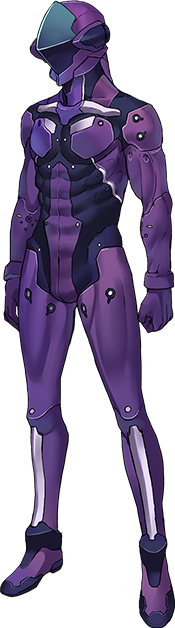
- Common in the mainline Danganronpa games. The cast is full of students with spectacular talents, quirky personalities, and unusual fashion sense. The protagonist, however, is much more plain:
- Danganronpa: Trigger Happy Havoc: The protagonist, Makoto Naegi, outright introduces himself at the start as an Ordinary High-School Student. Unlike the other students in Hope's Peak Academy, who were all scouted for their extraordinary achievements, Makoto only happened to get in by lottery (and was assigned the title of "Ultimate Lucky Student" solely for that reason.) He doesn't have a particularly oddball personality, instead being a standard protagonist type, with his defining traits being "friendly" and "courageous". His fashion sense is more down to earth than the other characters', and he doesn't have any particularly striking visual features about him, save perhaps for his ahoge.
- Danganronpa 2: Goodbye Despair: Hajime Hinata starts the game unable to remember what his talent is; it's eventually revealed that he never had one at all. His personality is plain, similarly to Makoto's. His fashion sense is almost boring (his huge tie being the only thing that stands out), and he looks fairly generic, save perhaps for his ahoge. At the end of the game this trope is deconstructed. It is revealed that in the past, Hajime was so fed up with being "normal", compared to the other talented students at Hope's Peak, that he agreed to a dubious experiment which turned him into the most talented man in existence—at the cost of destroying his personality, turning him permanently bored with everything, and indirectly playing into the plans of the series's Big Bad. The Hajime we see in the game is the result of his memories of that time being erased.
- Danganronpa V3: Killing Harmony: The protagonist of this game, Kaede Akamatsu, subverts this trope a bit, as she does have a concrete talent ("Ultimate Pianist") and some mild personality quirks related to it. Still, compared to the rest of the cast, she's still far closer to normal, save perhaps for her ahoge. Later in the game, the real protagonist, Shuichi Saihara, is even closer to the usual archetype. Although he does have a talent ("Ultimate Detective"), he doesn't really identify with it and believes that he got the title essentially by accident. Both his personality and his appearance are more subdued than the rest of the cast. Save perhaps for his ahoge.
- The Five Nights at Freddy's series has some interesting examples, caused partly by a Jigsaw Puzzle Plot and almost every situation being ambiguous in nature:
- The night guards in the earlier games were only given names, and not much outside of that. While justified by them being mostly audience stand-ins, they're still (probably) not directly involved in the backstory, which features child murder and corporate cover-ups. Of particular note is Michael Afton, the closest thing the series has to an overarching protagonist. Despite being the son of the Big Bad, having a Dark and Troubled Past, becoming a Revenant Zombie in Sister Location, and possibly being some of the past protagonists all along, he still doesn't get as much established characterization until supplementary material was released, showing that he has quite the snarky wit. While he does have some intriguing elements, some still feel he is not so interesting as a protagonist.
- While Gregory, the Kid Hero protagonist of Security Breach, has his fans who love him for his surprising resourcefulness, his mouthiness, his dynamic with Freddy, and implicitly having a Dark and Troubled Past of his own, there are also a few who feel he's less interesting than the other characters. Of note is that the cast includes a good guy animatronic Deuteragonist, a highly dysfunctional cast of enemy animatronics, and a Brainwashed and Crazy Rogue Protagonist. In contrast, Gregory's Mysterious Past is never fully elaborated on despite the game frequently hinting there's more to him than meets the eye, leaving some people more interested in Freddy, the enemy Glamrocks, or Vanny/Vanessa.
- There's not a whole lot to Ethan Winters from Resident Evil 7 aside from being determined to find his missing wife and being in way over his head. Instead, he mostly serves as an Audience Surrogate through which the player gets a front row seat to the over-the-top insanity of the Baker Clan. He does undergo a bit of character development through the game, eventually turning into an Action Survivor who fires off a Bond One-Liner or two after killing certain bosses, but it's clear most of the attention went to characterizing the Bakers, who are much more colorful characters and received all the focus in the marketing. You never even get to see his face in the game itself, as it takes place from an unbroken first person perspective. In fact, if you hack the game to be in third person, his character model lacks a head!note The sequel, despite leaning even harder into making him The Faceless, fleshes out Ethan's personality, broadens his emotional range, and gives him a much more personal motivation (saving his infant child).
- As a Heroic Mime, Gordon Freeman from Half-Life has barely even the implication of a personality. He's a theoretical physicist who just happens to be really good with guns, and that's all you need to know. The conspiracies, disasters, interdimensional wars, and apocalyptic spacetime anomalies that occur around him are more than enough to carry the story for him, not to mention the quirky supporting cast he receives in Half Life 2.
- Silent Hill 4 has Henry Townshend, who — unlike virtually every other protagonist in the franchise —he has no personal baggage tying him to the horrors of the titular town, and is genuinely an honest everyman who got into the situation from bad luck (i.e., his apartment turning out to be haunted).
- Itsuki Aoi, the protagonist of Tokyo Mirage Sessions ♯FE, is pretty much the self-insert protagonist who gets praise for almost doing nothing besides emotional support. Sure he is a Nice Guy but that is pretty much his only personality and manages to attract nearly every woman around him just by doing so. He also doesn't have a backstory, importance to the main story, or even dreams of becoming an idol. Meanwhile, the rest of the cast consists of up-and-rising idols as well as two veterans, all with colorful personalities and dreams of the future, yet allow the inexperienced newbie to be their leader.
- In Chrono Trigger, while the rest of the party are vibrant, memorable, have interesting flaws, quirks, and tons of Character Development, the Silent Protagonist Crono has... wild hair and that's about it. His party is the focus of the game, with every sidequest centering around them, while Crono is more or less just along for the ride and someone for the player to control. The game even emphasizes this by at first forcing you to include Crono in the party, but eventually giving you the option to not include him in your party by sidelining him at the End of Time and taking three of his friends along. The game even features full dialogues for Crono-free parties, and most notably gives you the option to leave him dead rather than time-travel to revive him after he is killed by Lavos.
- Antimony of Gunnerkrigg Court, whose general calm and open-minded approach to everything, combined with her ability to be near-central to every subplot she comes across just by existing and the enticingly vague development of the other students, tends to make her the vanilla of many plots. This is diminished after it's revealed that she's part fire elemental and unknowingly responsible for her mother's death, both of which give her emotional depth. Plus, she started having fun with it.
- Homestuck:
- John was the first character introduced out of the stupendously large cast and acts as the Audience Surrogate through much of the series, being the kid to whom all the bizarre and improbable game mechanics have to be explained, so he wasn't nearly as well-developed as some of the other characters at first. He's gotten a bit more Character Development now that we can see his actions from other points of view.
- Karkat on the Alternia side is the first troll introduced and becomes team leader, which in the end is responsible for their victory. His job is to hold the Sanity Ball so his friends can steal their scenes with craziness. Occasionally there are exceptions like calming down his homicidally insane friend by shoosh-papping him into submission. Also, the fact that Karkat has at least one major comedic trait...namely, his hilarious and ineffectual anger issues.
- Lampshaded out the wazoo and ultimately deconstructed by the title character of The Inexplicable Adventures of Bob! Described as the world's most average man, prior to the start of his adventures, Bob's life was "uneventful almost to the point of noteworthiness," and Galatea once derisively says he lives his "life as a veritable anthem sung in praise of conventionality." Over time, we see that he's considerably deeper and more capable than he initially seems.
- The nameless protagonist of PHD mainly serves as a generic representation of a grad school student, and has no distinguished personality or background. As such, he is frequently pushed Out of Focus when the author wants to write a proper story arc involving the cast. Cecelia, Mike, Tajel and even Dee has more development than our main guy.
- Classic Disney Shorts: Mickey Mouse became a pretty iconic case. Mickey started off a more mischievous scrappy protagonist, though as new additions such as Donald Duck, Goofy and Pluto were introduced and took over the more abrasive roles, Mickey ended up toned down into The Everyman to foil them and by the forties was Demoted to Extra. Modern works have tried to give Mickey star power again, with varying degrees of success.
- Daria rarely changes her facial expressions and is well known for her witty sarcasm spoken in a monotone voice in a show replete with characters who have more developed and quirky personalities.
- Doug takes this somewhat literally, as the title protagonist was deliberately written to be an average boy in a (literally) colorful cast of the more idiosyncratic characters, which also boils down to his normal skin color. Aside from a few quirks and his vivid imaginary thoughts, Doug is pretty much normal compared to the rest of the cast.
- For The Dreamstone, the protagonists, Rufus and Amberley, end up looking fairly unremarkable against the majority of the cast, lacking the quirks and humour value of the villains, and being overshadowed and made redundant by their more powerful and surreal comrades. They take the part well as newcomers encountering the show's different worlds and processes, but the focus otherwise usually sways in the Urpneys' favor due to their more colorful personalities and providing most of the show's slapstick.
- Its sister show, Bimble's Bucket follows a very similar formula for Bimble, who gets less screen time than the villains and largely exists as a naive newcomer for Teeny Weeny to explain all the details of the plot towards.
- Garfield and Friends: Orson, the main protagonist of the U.S. Acres segments, has gotten this reaction from the fanbase. The main reason is that (especially in the early seasons) his status as the resident Nice Guy Straight Man made him less entertaining to watch than the rest of the cast (especially Wade, Lanolin, and Roy).
- Hey Arnold! had the title character. While the first season had some palpable focus on his own dilemmas and personal conflicts, as episodes passed, his shortcomings and foibles faded and he ended up a messianic Only Sane Man to the far more flawed and eccentric universe around him. A high number of episodes (particularly in the last two seasons) barely even featured Arnold or had him appear at all, in favor of playing a borderline Ensemble Cast setup. The movies and the final two episodes put him back in the spotlight and he retains some of his old quirks.
- King of the Hill: Hank Hill is a straight-laced, hardworking, upstanding Texan suburbanite with strong morals and a comically mundane work life ("I sell propane and propane accessories!"). The bulk of the shows humor comes from such an normal man somehow finding himself in crazy situations, with Hank's failure to relate to his wacky neighbors and family leading to most of the conflicts. When the supporting cast includes a Conspiracy Theorist exterminator, a sad sack Army barber, a mush-mouthed womanizing Texas Ranger, a pudgy aspiring comedian, and a ditzy former trailer trash girl, the mild-mannered family man underscores the insanity.
- The Life and Times of Juniper Lee: The title character falls squarely into this. There isn't anything that truly stands out about her personality-wise other than her interactions with the various characters of Orchid Bay, and her fighting style doesn't help her win fans. In fact, there was an episode that focused on this: at a big supernatural social event, everyone was more interested in her Cool Old Lady grandmother than herself specifically for this reason.
- The Looney Tunes series went through a long tenure of this as it slowly gained its trademark slapstick. The series originally utilized Mickey Mouse-alike characters such as Bosko and Buddy, who missed this trope and hit the Generic Guy instead. Beans the Cat was then billed as a new more colorful star, but his sidekick Porky Pig outshone him in that regard. Porky then turned into this trope for more abrasive stars such as Daffy Duck and Bugs Bunny with his Everyman persona making him better fit as The Straight Man or The Comically Serious.
- The Loud House: While Lincoln Loud certainly is not a one-note character, much of the show's content comes from his reactions to being surrounded by and living with a large cast of varying female characters with such stark personalities. As a result, he comes across as the average and rather generic preteen protagonist through whom the audience lives through the adventures.
- Miraculous Ladybug: The protagonist Marinette Dupain-Cheng is a normal Cute Clumsy Girl who has a fairly good life, and even her worst problems (being picked on by the school's Alpha Bitch, being unable to confess her feelings to a boy) are not that bad compared to other troubled characters, like the deuteragonist Adrien (Broken Ace with a sad and lonely backstory, a Missing Mom, and an abusive father who is secretly the main supervillain of the show), or Alpha Bitch Chloé (who has terrible parents, wants to be loved by her abusive mother, and pre-season 4 Chloé also has Hidden Depths and has proven that she can be a hero, if still a very flawed Anti-Hero).
- My Little Pony: Friendship Is Magic:
- Twilight Sparkle was this in Season 1, being an Audience Surrogate by which the distinct personalities and antics of her friends could be observed without bringing much herself. Season 2 onward averted this by giving her distinct character flaws, episodes focusing on her story arc as a student to Celestia, and also demoting her slightly for more an Ensemble Cast setup.
- Sandbar is the one pony on the Young Six. While the rest of them have notable quirks and provide unique insights into their respective species and cultures, Sandbar is a generic Nice Guy whose lack of interesting background is Played for Laughs in "The Hearth's Warming Club" with how anticlimactic his friends found his backstory.
- Tommy Cadle from Pet Alien. While he has a few minor quirks of his own, for the most part, he's a normal kid who the audience is meant to relate to and primarily acts as a Straight Man for the wackier, more dynamic aliens to bounce off of.
- Rocko's Modern Life: Rocko is the Only Sane Man of the show in comparison to the more eccentric and idiosyncratic cast surrounding him.
- Steven Universe has an in-universe example of this. In the earlier episodes, Steven himself is a newcomer to the Crystal Gems. When not busy being generally awesome, they had a Comic Trio dynamic and so he felt left out. This serves as the contrast that the trope dictates. As the series progresses, he embraces to the max his status as an All-Loving Hero, steps into the legacy left by his mother/past incarnation Rose Quartz, and becomes more part of the group instead of its foil.
- Winx Club: The main character Bloom is meant to be this as the Audience Surrogate. While all her friends have their own personality quirks and their own different hobbies, Bloom can be described as an ordinary Plucky Girl heroine and leader, being more defined by her storylines and powers rather than her personality.
