
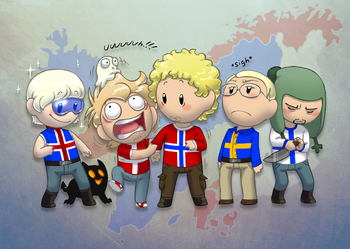
Because your country is weird too.note
Norway: Svalbard, wh...what happened?
Svalbard: You were being an idiot. That's what happened.
Svalbard: You were being an idiot. That's what happened.
Scandinavia and the World is a webcomic by Humon. It is a comic about stereotypes, history and culture in the form of national personifications interacting with one another, and focusing on, well, Scandinavia. The main characters are Denmark, a cheerful, but culturally naïve party boy; Norway, a friendly and calm nature lover; Sweden, the uptight technology expert; Finland, a quiet drunkard with psychotic tendencies; and Iceland, a sparkly, larger-than-life pretty boy.
An Animated Adaptation (for the Web) is being produced. Finished pieces can be seen here.
Her DeviantArt account and main comic regularly feature works based on Nordic folklore, with plenty of notes.
Scandinavia and the World provides examples of:
open/close all folders
Tropes # to E
- Abhorrent Admirer: Estonia to the "cute Nordic boys" and Sister Finland to Sweden. Sweden puts up with Sister Finland, despite being gay, because he doesn't want to know what she'd do if he didn't and he's reluctant to identify as homosexual more often than you'd think.
- Accidental Marriage: Apparently the civil union Denmark pronounced between Sweden and Norway in the first comic was considered legal.
- Actually Pretty Funny: To his own horror, Sweden catches himself thinking this about Denmark's racial caricature.
- Adaptational Villainy: Sweden in this strip that details the relationship between Nazi Germany and Denmark during WW II. The author acknowledges this is due to Rule of Funny and fixes it in later strips.
- All Animals Are Dogs: New South Wales, depicted as a lamb, wags its tail happily.
- All Germans Are Nazis:
- Averted in an interesting way. Nazi Germany and Modern Germany seem to be two separate entities (as opposed to the latter being simply the former after a very thorough makeover), evidenced by the fact that they both can appear in the same comic — wherein Modern Germany is outright terrified of his fascist counterpart. Moreover, Modern Germany is also terrified of being thought of as a Nazi.
- Also Germany has a third entity in the form of Prussia, in the sense of Bismarck's creation and the First/Second Reichs, who also appears alongside Nazi and modern Germanies.
- Averted in an interesting way. Nazi Germany and Modern Germany seem to be two separate entities (as opposed to the latter being simply the former after a very thorough makeover), evidenced by the fact that they both can appear in the same comic
- All Men Are Perverts: Along with All Women Are Lustful. In this universe, almost everyone is a pervert to some degree. Except, notably, England, as seen in "Monster," and Norway, although considering he is friends with Denmark and eagerly looks at the porn magazine handed to him in the first comic, he may be a case of Chivalrous Pervert.
- All Trolls Are Different: Norwegian trolls and Danish trolls are very different indeed. Troll figurines in Norway are mostly made of cheap rubber and sold to tourists, whereas in Denmark they are often made of ceramics, porcelain or wood and are much more pristine, sold to collectors at a high price.
- All There in the Manual:
- Humon's comments provide a lot of background about the characters, especially the ones she hasn't introduced into the actual comic.
- Sister Canada. Humon posted a picture of her alongside her brother in January 2010, but her first appearance in an actual comic wouldn't happen until eight years later.
- Ambiguous Gender: Thailand. Humon describes them as "different from a trans woman in that they still often identify as male on some level", eventually just placing Thailand in the "third gender" category.
- American Kirby Is Hardcore: Indirectly Referenced in "You Have My Gun": "America of course has a tendency to make their own versions of foreign films, but they also edit foreign film covers and posters to make them look more aggressive because apparently Americans respond best to that sort of thing."
- And I Must Scream: Doggerland has apparently been trapped at the bottom of the North Sea for the past ten thousand years. He's bored.
- Anthropomorphic Personification: The characters are almost all the Personifications of their countries — or rather, the Scandinavian stereotypes of their countries.
- Anything but That!: Iceland, Denmark and Norway are absolutely terrified of Amnesia: The Dark Descent due to the horror themes, but America is really just bored. Until Sweden reaches a level with naked corpses in it. America screams in fear at the sight of penises, while Norway, Denmark and especially Iceland actually smile.
- Are You Pondering What I'm Pondering?: Sweden tells Burger King that due to its food being unhealthy, it will need to make a few changes if it wants to open restaurants in the Nordics. Finland promptly suggests the addition of a sauna.
- Arson, Murder, and Jaywalking: "Devastating droughts! Terrible floods! Terrifying tornados! Slightly longer summers..."
- Artistic License – Biology: In-Universe, America and Sister America both think that "gays" lay eggs. Then they argue over what kind of bird a "gay" is. It Makes Sense in Context (sort of).
- Art Shift: "Slava Ukraini", the comic written about the 2022 Russian invasion of Ukraine, is drawn in a more serious style with the characters having realistic proportions.
- Asian Rudeness: "In China, it's considered rude to ask your friends nicely to hand you things, because it implies you aren't sure if they'll do it."
- Asians Love Tea: The webcomic has a page illustrating some of the differences between Japanese and Chinese tea ceremonies.
- As Long as It Sounds Foreign:
- What Denmark does when asked to speak Swedish. This includes saying "Börk börk börk."
- It also happens when he is asked to speak German. Dude needs to invest in some phrase books.
- Ass Shove:
- The Nordic Lodge now only has two rectal thermometers thanks to Denmark's misunderstanding.
- There was also the matter of Sweden's Stone Age artifact, although that was more understandable.
- Atlantis: Appears, alongside various other mythological entities, in "Drunken Party", much to the confusion of all witnesses.
- The Atoner: Germany isn't too proud of his actions in WWII.
- Author Appeal: Why most of the primary cast is male, despite having a female author. Humon admits it's because she likes drawing cute boys.
- Author Avatar: Several comics have Denmark representing Humon rather than the country, such as the New Years Comic.
- Back Up Bluff: In "Cold War Games," Russia keeps terrifying America by casually claiming to have better weapons than him, despite having little more than a firework.
- Banned in China: A rare in-universe usage in a strip about the 2018 Eurovision Song Contest. At first played straight as China censors two Eurovision performances he deems unfit for his national television... then inverted as King Europe responds by banning China from showing Eurovision, on the grounds that the show is sacred and it must be either aired entirely or not aired at all.
- Barbie Doll Anatomy: Finland in "The Day After". Averted in the full-sized drawings, where Humon blocks the naughty bits with little flags, but it's still evident that the characters have them. Averted in "boobs and a joint", where the flags are not included.
- Beat Panel: Often used, to great effect.
- Bedmate Reveal: In "Long Cold Nights", Sweden wakes up to find his bed pretty crowded.
- Bestiality Is Depraved:
- Played straight for Sweden. And then Denmark just wants to know the details. Cue Sweden strangling Denmark.Sweden: You have no right to judge me! You weren't there! I was a stupid teenager! I was horny! And it was a really cute horse!
- Inverted for Wales (a man) and New Zealand (a ewe). While all the human/human pairings are fraught with drama, the two of them are Happily Married. On top of that, New Zealand is not only shown to be sentient on a human level, but she even has dialogue at one point (when she built a robot, no less). Her conversational partner, Australia, talks back to her as if she were any other person.
- Played straight for Sweden. And then Denmark just wants to know the details. Cue Sweden strangling Denmark.
- Beware the Nice Ones: Wales, in "It's All About the Children."
- Big Guy, Little Guy:
- Canada and America, or rather, America and Canada, since America seems to be in charge despite being the "Big Guy".
- To a lesser extent, Norway and Denmark. Norway is the biggest and burliest of the three main characters and Denmark the smallest (though that's not readily apparent in the usual art style), but they are the closest friends and Norway usually goes along with whatever harebrained and/or depraved ideas Denmark comes up with.
- Big "NO!":
- Sweden gets one when he finds out Sister Sweden slept in Finland's room and he himself slept with Sister Finland. They were all really drunk the night before — It Makes Sense in Context.
- Also, Denmark after Sweden conquers Norway from him.
- Norway after Denmark kills his albino moose. With never-ending rain of sadness.
- Sweden again after finding out that someone set his straw goat on fire... again.
- Big, Screwed-Up Family:
- Åland and Finland don't get along at all.
- England was a rather inattentive parent to America and possibly to Australia, and is currently one to Sealand.
- The only reason Canada turned out alright was because by the time he was adopted into the family he was relatively old enough to raise himself.
- As for Scania, Fenno-Swede, etc., the author says, "All the children in SatW are completely fucked."
- Bilingual Bonus:
- "Denmark! Don't call Obama that!"note
- In and out of universe when Humon creates a comic where each country speaks their own languages - Only Sweden understands Finland, and America and China don't understand anyone.
- "Denmark! Don't call Obama that!"
- Bishie Sparkle: Iceland. Occasionally lampshaded: Denmark borrowed them for a strip.
- Bizarrchitecture: A Scandinavian specialty, as Kuwait finds out when asking Denmark and Sweden for building designs.
- Black Comedy: Scandinavians and Russians apparently love this, but it doesn't always translate well overseas...America: I... was expecting something different from a comedy called "Funny Friends"...
- Black Comedy Rape: "Leaking"
- Blue with Shock:
- Sweden, Denmark, and Norway, when Iceland shows off the latest addition to his penis collection.
- Finland when Fennoswede (his nephew) starts speaking Swedish.
- Germany when it was pointed out to him that he was wearing his own flag.
- Boring Religious Service: In "Rise and Shine or go to Hell", Norway drags Denmark and Sweden to a 3am mass to celebrate Duke Asbjörn becoming a saint after swallowing a splinter from Jesus Christ's cross. As the priest announces that they will start with 150 hymns, 5 preaches, and 3 holy communions, Norway is wearing a starry-eyed expression while Denmark and Sweden get out the beer.
- Braids of Barbarism: The Viking tradition is referenced. Even though the Nordics don't have long enough hair to really braid.
- Brain Bleach: Sweden wants to poke his eyes out after seeing porn of Sister Sweden on the Net.
- Bread, Eggs, Milk, Squick: Russia sneaks around Scandinavia, but Denmark's the only who has real problems.Sweden: [sees Russia swimming in Swedish water] Have you noticed any weird Russian activity?
Norway: No, not really [...]
Denmark: [being tackled by Sister Russia] CanIcallyoubacklaterSwedenI'mabitbusy!!! - Brick Joke:
- See Accidental Marriage — 3 years in the making, that one.
- America's gay penguins and flamingos. Lampshaded by Humon.
- Britain Is Only England: Subverted in the early comics; "England" seems to symbolise an overall British stereotype and wears a Union Jack shirt, but later on Ireland and Scotland show up and he explains he wears it because the Cross of St. George makes him look like a member of the Red Cross. Soon the comic switched to England wearing just the Cross of St. George, though Humon claims to have made the switch because it's easier to draw.
- Carpet of Virility: Canada... and his sister.
- Cast Full of Gay: A good amount of the cast is ambiguously gay/bi, if not explicitly so.
- Cast of Personifications: The comic centers around the personifications of the Scandinavian countries interacting with each other, with less frequent appearances from the personifications of other countries.
- Cloak and Dagger: America spies on Finland, Norway, Estonia, Sweden, and Denmark... Meanwhile, Sister Denmark is spying on him.
- Cluster F-Bomb:
- Finland. Even a Wall of Text's worth of "PERKELE!"
- Denmark utters lots of "shit" while hurrying to save his Jewish population from Nazi Germany.
- Finland. Even a
- Comically Missing the Point: Norway, Denmark, Sweden really shouldn't have overworked Poland for small pay...Norway: Where did the bucket go?
Denmark: And the sponge?
Sweden: AND THE CAR YOU IDIOTS!!! - Commie Nazis: Spoofed. "I don't wanna be a freedom-hating Communist hippie-Nazi like you guys!!!"
- Compensating for Something: Iceland owns three gigantic cars, goes sky diving down volcanoes, and collects dismembered animal penises... he also happens to have a very small... ahem... population.Iceland: I'VE ALREADY GOT THREE HUGE CARS!!! BUT IT'S NOT ENOUGH!!! IT'S NEVER ENOUGH!!!
- Con Recap: Humon has drawn a series of cartoons describing her experiences at conventions as a creator. "Diva Humon" describes the way convention organisers (at the better cons) have fallen over backward to look after her needs.
- Condescending Compassion: Denmark's approach to "primitive races."
- Confused Question Mark: Sister America's chihuahua spouts lots of these in the "Dance with Me" strip. But then again, traditional Danish folk dancing can get very confusing...
- Cool and Unusual Punishment: After Sweden attempts to discuss politics with him Morocco threatens to...slightly delay the opening of a new IKEA. By as much as a week.
- Corner of Woe:
- Creator Cameo: As seen in "No More Fun," "My Cookies," and "Back to the old."
- Crossover: With StupidFox.
- Dagwood Sandwich: Denmark's smørrebrød.
- Deliberate Values Dissonance:
- America doesn't understand the Scandinavian sense of humor.
- Japan asks Sweden and Åland, "Who is the father and who is the son?" Context discomforting both of them.
- America doesn't understand the Scandinavian sense of humor.
- Deadpan Snarker: Sweden has his moments.Denmark: Dear God — [Lady Germany] broke my hand between her breasts! I'll never be able to play violin again.
Sweden: Thank God. - Description Cut: After King Europe builds an extremely large telescopeChile: A telescope like that needs an awesome name.
King Europe: Don't worry. I'm very good at naming things.
Telescope reads "European Extremely Large Telescope" - Diegetic Visual Effects: Iceland is constantly accompanied by Bishie Sparkle. In one strip, it turns out that this is a physical substance, and other characters can borrow it to look more bishie themselves.
- Distaff Counterpart / Spear Counterpart: Very literal. Full-fledged nations (that is, not micronations, territories, regions, or other outlying exceptions) come in sibling pairs, one male and one female, and in most cases, the brother and sister are basically Half-Identical Twins. Because of this, it tends to be the case that one of the pair (usually the male, although there are exceptions such as France) is the "main" country personification, with the other one popping up only when the joke is gender-specific or when the country needs to appear twice in a comic. The counterparts are usually referred to as "Sister/Brother <Country>", though the honorific is dropped in some circumstances (such as when the Nordic sisters are hanging out together).
- Don't Explain the Joke: Yes, Humon usually adds an explanation for the comics which don't sound half as funny when read out aloud, but generally are an utter necessity for people who aren't natives of the countries depicted in a given comic strip—and sometimes even if they are—and yet, the explanations often make the comic funnier. Read the comic once, read the explanation, then read the comic again.
- Don't You Dare Pity Me!: Inverting this is apparently how Japan flirts, trying to woo Sister Sweden by first dropping a fan and crying over it, then purposefully spraining his ankle.
- Dope Slap: Sweden to Denmark, usually.
- Double Standard Rape: Female on Male: Arguably the only reason why Sister Finland has been able to get away with basically forcing Sweden into a sexual relationship with her. Whether it's just plain funny or even the others are too terrified to confront her, Sweden also took advantage of being able to use her to pretend he wasn't into guys since he wasn't entirely out & proud early on and she was the only woman he could find for the job right away.
- Drives Like Crazy: Everyone in France.
- Dropped Glasses: Sweden's.
- Dumb Is Good: When Denmark is voted happiest country in the world (again), the other Nordics brag about better nature preservation, gender equality and education. Denmark's response is to point out that being smart apparently can't make you happy.
- Dunce Cap: Norway and Denmark wear them in Sweden's version of the 2011 Norwegian butter crisis: "Too Little Butter."
- Eagleland: Evens out at about Mixed flavor.
- Brother America nails most of the Boorish traits. He genuinely tries very hard to be a Brave, but he is constantly tripped up by his own impulsive nature and general obliviousness.
- Sister America is much the same, living out the Boorish traits through a filter of "well-meaning but utterly clueless limousine liberal".
- Empathy Pet:
- Sister America's dog.
- Ocasionally Norway's fish.
- Europeans Are Kinky: Provides the page image. The biggest examples are Denmark, Sister Sweden, and King Europe, although France is also in that league.
- Even the Girls Want Her: Girls (and gay guys) are pretty into Sister Sweden, according to the author.
- Even the Guys Want Him:
- Denmark has certain appeal for guys, and Norway has it for lesbians, again according to the author.
- Notice that among Romania's victims was Denmark. Whether this reinforces Denmark's appeal to men or proves that Even the Guys Want Romania is unclear, but it's probably both.
- Everything's Better with Sparkles: Especially Germans.
- Exactly What It Says on the Tin: King Europe decides to build an extremely large telescope in Chile. He calls it... The European Extremely Large Telescope.
- Exact Words: The King of the Franks demands that Norway, Sweden, and Denmark kiss the king's feet. Denmark lifts the king's feet to his head before kissing them.
- Expy:
- Sister America is basically Paris Hilton with Strawman Liberal overtones.
- Canada's role as an inferior to America is very similar to Hetalia's version. Although this may have more to do with drawing on shared stereotypes/truths of America overshadowing Canada.
- America in some of the earlier comics reminds us of Calvin, especially in "I Want Oil."

Tropes F to K
- The Faceless: North Korea, when he (or she, or it) appears, is always wrapped entirely in a North Korean flag, with only a pair of disembodied eyes visible out of the shadows. This presumably symbolizes the country's isolation.
- Sister North Korea finally receives a face in Going for Gold... pulling the hood back just enough for a selfie with Sister South Korea, based on something that actually happened at the Olympics in Rio.
- Sister North Korea finally receives a face in Going for Gold
- Fan Disservice:
- The picture of the Canada siblings in swimwear. Let's just say... body hair. This was largely the point, or at least to point out that the author thinks the disgust of it is largely ridiculous.
- And Denmark in drag. As Humon says in the commentary, Denmark does not do pretty and sparkly well. The entire strip is inspired by this multinational rendition of "All You Need Is Love" (Denmark at 2:05).
- Sister Germany has a very visible moustache precisely to avoid the asociation of "big boobs = sexy".
- Fanservice: Let's just say there are a lot of strips where the characters are more detailed than usual...
- A specific mention should be made of the comic "Bath Time", which shows Iceland, Sweden, Denmark, Norway, and Finland (and all their female counterparts) taking a shower. Tiny flags are the only things covering their genitals.
- Female Gaze: Once when asked why, if she is a feminist, most of her characters are male, Humon replied that as a (mostly) straight woman, she likes drawing men for herself to ogle. She has also expressed irritation with fanworks that present/describe all the male characters as Pretty Boys, since she went out of her way to depict numerous different types.
- Foreign Queasine:
- The Scandinavian penchant for... interesting varieties of fish is pictured in one comic.
- The (historically false) reason for why Åland had to live with Finland. It only looks that bad when cooked by Finland, apparently.
- The Scandinavian penchant for... interesting varieties of fish is pictured in one comic.
- Forgotten Fallen Friend: Subverted with Doggerland. England only pretends to have forgotten him because talking about him would be too painful ...
- Four Eyes, Zero Soul: Nazi Germany wears little Himmler-specs.
- Freudian Trio:
- The Fundamentalist: America. Contrast that with his sister, who's a Hollywood liberal.
- Funny Background Event: During the Lord of the Rings parody starring New Zealand, Iceland can be spotted parachuting in Mount Doom. According to Humon "he just can't stay away from volcanoes".
- Fun Size: The style of most strips. Drawings that are not strips are in a more realistic style, and one comic was drawn like manga for artistical reasons.
- Glasses Curiosity: In this strip, Denmark tries out Sweden's glasses after the latter dropped them. Hilarity Ensues since Sweden is Blind Without 'Em and Denmark gets nauseous because everything is so blurry.
- Global Ignorance:
- Surprisingly not an America-only trait. The Scandinavians don't know anything about South America, America mixes up Sweden and Norway while forgetting Denmark, and Sister America thought Scandinavia was a country till she discovered the joys of shipping.
- America's introduction was by arriving in Denmark for a skiing trip: Denmark is one of the flattest countries in the world. This was based on a real encounter Humon had with two American tourists.
- Humon (or more likely America) tends to see "South America" as one area, rather than a separate dozen countries.
- Surprisingly not an America-only trait. The Scandinavians don't know anything about South America,
- Golem: Norway created Denmark from a pile of sand one day when he was at the beach.
- Goofy Print Underwear: The king of the Franks has Hello Kitty undies.
- Groin Attack: Sweden runs afoul of an invasive fish.
- Guy on Guy Is Hot: Built on it. In comic: Yaoi Surprise.
- Half-Identical Twins: Most of the sisters look just like their male counterparts, but with longer hair and no facial hair. It's most pronounced with the Denmarks, where the sister even has boyish features and a skinny figure.
- Hannibal Lecture: Employed by Sweden in "Size Matters" to stop Denmark and Norway singing the "ÆØÅ (Size Matters)" song.
- Have a Gay Old Time: Played with the real world ice cream: Golden Gaytime, very popular in Australia. Not what Denmark expected.
- Have I Mentioned I Am Heterosexual Today?: Sweden in the earlier comics. With the introduction of Åland into the comics, however, hiding his sexuality has been disproved. Sweden still tries to hide it. Åland, not so much.
- Headbutt of Love: Norway and Denmark pull off one of these. According to the author, it was because drawing them hugging would look weird in the comic's art style.
- Head Pet:
- Sister America has a pet chihuahua that sits on her head and has a perpetually confused expression.
- Brother America usually has Canada on his head.
- Norway sometimes puts an apparently living fish on his.
- Heroic Bastard: Multiple Examples.
- FennoSwede, whom Sweden conceived with Sister Finland while attempting to hide his homosexuality.
- Scania, whom Denmark conceived with Sister Sweden. Upon learning this, Sweden told Scania "your real father died in a horrible horrible car accident!"
- Christiana, who is also Denmark's son. His mother is never mentioned.
- Kven, Norway's son. His Dad is a bit neglectful...
- FennoSwede,
- Heroic BSoD:
- What happens when Germany, who has a fear of people flying his flag, is told that he wears it on his own shirt.
- When Finland's puppy suddenly grows Hitler's mustache and hairdo, and gives Germany a Nazi salute, Germany literally bluescreens.
- What happens when Germany, who has a fear of people flying his flag,
- Horny Vikings: Denmark, Norway and Sweden sometimes like to go back to their roots.
- Hypocritical Humor: America has Denmark prosecuted for handing prisoners of war over to a country he knew would torture them. The country he handed them over to.... was America
- Idiot Hair: Faroe Islands
- I Let Gwen Stacy Die:Denmark: England, do you remember Doggerland?
- I'm Standing Right Here: In one strip, America keeps mistaking Norway for Sweden and can't seem to see Denmark, implying that he is that oblivious. In the last frame, we see things from his perspective: Norway and Sweden look identical, Denmark isn't seen... but we see South America standing beside America, when he wasn't visible earlier! Seems like America's not the only one with selective blindness...
- In-Series Nickname: Denmark is known as Zealand to the internal regions of Denmark. Which one is the nickname is uncertain.
- Incompatible Orientation: Subverted, if not zig-zagged. Sister Finland, in her own stoic way, seems to genuinely be in love with Sweden, who despite dating Åland reciprocates - both to water down his own orientation and because he's too afraid to tell her no. Sweden takes the charade so far that he has a kid with her. How do we know it might be genuine affection on her part? There's always a little heart floating near her when she looks at Sweden.
- Interspecies Romance: Wales×New Zealand. Did we mention New Zealand's a sheep? Did we also mention New South Wales is their offspring?
- It Makes Sense in Context:
- In and out of universe; Humon got a lot of people asking why the characters spoke English, instead of her language or their own languages. She responded by making a comic where they all spoke their own language, some unable to understand each other. It ends with America and China screaming in frustration:America: WHAT THE HELL IS GOING ON!
China: 我不知道!note
America: SHUT UP! - One comic shows Norway being unable to leave his house because the door is blocked by a giant, burning block of ... cheese. All Humon says about it is "Norway had a giant cheese fire a while back."
- In and out of universe; Humon got a lot of people asking why the characters spoke English, instead of her language or their own languages. She responded by making a comic where they all spoke their own language, some unable to understand each other. It ends with America and China screaming in frustration:
- Kangaroo Court: Poor Denmark gets sued in one, with Sweden as his lawyer and America as judge.
- Kiss of Life: Well, Kiss of Beer — one of the ghosts performs this on Denmark in "No Beer Left."
- The Knights Who Say "Squee!": Sister America and Sister Japan.
Tropes L to P
- Laser-Guided Karma: Finland shoves Åland and Sweden off the end of a dock into the water. Two panels later, Åland comes back up screaming that he found a bunch of old 18th-century champagne bottles that are worth a fortune, and proclaims to Sweden that "we'll keep one and open it on the cruise trip I'll be taking you on around the world!"
- Latino Is Brown: The anthropomorphisms of Chile and Brazil both have brown skin and dark hair, representing the stereotypical South American look.
- Leeroy Jenkins: America starting the Iraq war.
- Loophole Abuse: Nazi Germany told Denmark he couldn't have his flag on the flag pole. But he didn't say Denmark couldn't put use it as a Christmas decoration, or breed the pattern on plants and animals.Nazi Germany: Is that a red and white pig?
Prussia: Yeah. He spent years breeding this thing into existence just because the Danish flag wasn't allowed. - Loud of War: South Korea torments North Korea with "Gangnam Style."
- Love Confession: Denmark makes one to Norway after the latter asks why the former named matches after him.
- Macho Masochism: Finland. Russia defies this.Finland: The cold cannot hurt me!
Russia: Fuck that. - Made of Indestructium: Discussed in "You got a call," where the reason Nokia phones are so tough is that Finland throws them at Sweden when Finland's in a bad mood. Too bad they aren't bulletproof.
- Male Frontal Nudity: Lampshaded in "Anything but That" (link SFW).
- Manchild: The author claims that the adult countries have the mentality of teenagers. For instance, this comic shows that America still sleeps with the stuffed eagle he had as a kid.
- Mass "Oh, Crap!": This is the reaction of USA, England and China when North and South Korea start to fight. Meanwhile Denmark is having a regular Oh, Crap! about snow.
- Seen again in "Makeover of 2016," as Sister America, Europe, China, and England are all shocked at Brother America's titular makeover.
- Seen again in "Makeover of 2016,"
- Mistaken for Cheating: Wales thought New Zealand was having an affair with Scotland in the mini-comic.
- Mistaken for Racist:
- In one comic, Denmark mistakes South Africa for a monkey, causing South Africa to attack Denmark. This stems from the stereotype that all Danes are racist without realizing it. Most likely, it is also a reference to the incident where a Danish TV host mistook a picture of an African man for a monkey. Also, far from all Danes are racist but are often seen this way because the most racist political party in the country is also the (arguably) most influential one — plus that whole thing with the drawings.
- Another comic has more of the "mistaken" aspect, as a quirk of dialect leads to Sweden thinking Denmark's insulting Obama.
- In one comic, Denmark mistakes South Africa for a monkey, causing South Africa to attack Denmark. This stems from the stereotype that all Danes are racist without realizing it. Most likely, it is also a reference to the incident where a Danish TV host
- Morality Pet: Sister Sweden for Finland.
- Most Definitely Not a Villain: "Yes hello fellow EUs. I am indeed Netherlands and no one else." Plus the Paper-Thin Disguise of changing his flag shirt.
- Mundane Made Awesome: Australia getting lost in the Outback.
- My Country Tis of Thee That I Sting: Despite being written and drawn by a Dane the comic strip is not afraid of poking fun at Denmark.
- My Eyes Are Up Here:Lady Germany: YOU WILL LOOK ME IN THE EYES OR DESPAIR!!!
- My Hovercraft Is Full of Eels: See Bilingual Bonus.
- The Napoleon: Canada threatens in one comic to America that just because he's America's hat, doesn't change the fact that Canada is on top. America just thought this was hilarious.
- National Stereotypes: The comic strip thrives on it.
- New Technology Is Evil: England is completely freaked out by instant pay systems, and even wonders if the 'e' in 'e-mail' stands for 'evil'.
- Nice Job Fixing It, Villain: When Finland pushes Åland and Sweden into the water seemingly for no reason other than to be a jerk, Åland finds two bottles of super-valuable champagne. He sells one and takes Sweden on a cruise around the world. Finland just mutters "Perkele".
- Ninja Pirate Zombie Robot: "Fishy Situation" features the Nordics being attacked by Nazi Germany's vampire werewolf robot martians. No, really.
- Noodle Implements: Faroes was just waiting for his chance.
- "Not If They Enjoyed It" Rationalization: In "Hetalia Personality Swap," Norway and Finland switch personalities with their Hetalia counterparts for a day. Though she never says the word rape, Humon does say in the description "Sweden was just minding his own business and watching the news when Finland suddenly got all cuddly and kissy kissy. Sweden was scared for his life but ended up doing things he regret, and which Finland will kill him for if he dares ever mention it again." In the followup comic "The day after", Sweden says "... I didn't start this!! I didn't want to, but suddenly you were all over me, and I didn't know what to do!! ... I tried to stop you, but then you started kissing me, and it rather surprisingly turned out you're a good kisser!!". This example is odd in that Sweden is using it himself to rationalize what happened, rather than Finland using it to justify his actions.
- Not So Above It All: Sweden, despite supposedly being the normal Only Sane Man of the Nordic club, tends to end up in a variety of bizarre and hilarious jams
- Not-So-Omniscient Council of Bickering: The Nordic Council. Greenland plays it up to America as a secret society, but it turns out to be this.America: The world keeps finding new ways to disappoint me.
- Nordic Noir: "Save the day" contrasts Nordic action protagonists with American and British ones. America is a gun-toting Leeroy Jenkins, Britain is a suave spy, while Denmark, Sweden and Finland are hapless, regular guys in disheveled clothing, smoking and maybe wielding a gun, alluding to the somber tone of Nordic Noir.
- Norse by Norsewest: Being a comic about stereotypes, each character shows varying shades of this trope. The classical Hollywood stereotype isn't that prominent, however, due to the stereotypes coming from a Danish viewpoint. The comic's premise actually inverts this, as it shows the Scandinavian perception of other countries.
- Nutritional Nightmare: Denmark's risalamande, a Christmas rice pudding mixed with vanilla, whipped cream, and chopped almonds, is delicious but so fattening that King Europe blows up like a balloon after eating two bites. Of course, America has no trouble scarfing down an entire bowl and asking for more.
- Official Couple: Sweden×Åland, Finland×Sister Sweden, and Wales×New Zealand.
- Offing the Offspring: What Iceland did to Vinland...
- Oh, Crap!:
- In World in Trouble USA, England and China have this over North and South Korea fighting, and Denmark has it over snow.
- In Uninvited Guest Denmark has it when he realizes there is someone unknown in the house.
- In World in Trouble
- Only Sane Man:
- Sweden would like to think he is this. He really, really isn't, and tends to embarrass himself whenever he tries to "educate" the other Nordics.
- Norway is usually this. He is generally nice and lacks the serious eccentricities of the other Nordics like Denmark's rampant stupidity and lust, Sweden's haughty attitude, Finland's... everything, or Iceland's need to compensate.
- Of Corpse He's Alive: Norway's friend Jan Mayen. He looks dead and can't think, but he's a good listener.
- O.O.C. Is Serious Business: Sweden, Norway, and Denmark react in horror after the normally quiet Finland starts talking in the sauna.
- Our Demons Are Different: As a result of having The Gateway to Hell in his territory, Iceland has "dark matter demons" hanging around his house. He treats them as somewhere between cute pet and annoying pest.
- Original Position Fallacy: After Brexit, England deports all the immigrants only to be handed his own citizens from abroad by King Europe, who notes they can't just go anywhere now.
- Our Vampires Are Different: Romania would rather steal your wallet than your blood.
- Our Ghosts Are Different: The Beer Ghost.
- Paper-Thin Disguise: The "obviously Swiss woman" harvesting spaghetti is Norway in a headscarf.
- Pass the Popcorn: Or the fishes in this case — Norway doesn't need to own a TV because he can watch Sweden and Denmark winding each other up.
- Patriotic Fervor:
- Inverted with modern Germany, who doesn't like flying his flag around since it might make his people prideful. Except when there is some big achievement to celebrate (for example, the German national team winning the World Cup in 2014).
- Played straight with the Scandinavian trio, seeing it as a symbol of joy and happiness. And when it's someone's birthday.
- Also played straight with America.
- Peking Duck Christmas: As seen in "Non-holiday."
- Pimp Duds: Sister Denmark gets one such attire while singing "My Wedding."
- Pineapple Ruins Pizza: In this strip, Iceland tears a pineapple in half while making that argument, while in this strip, Denmark and Norway are disgusted to find pineapple on their pizza, and then even more disgusted when Sweden proudly states his preference to use banana instead.
- Power Trio: The main characters.
- Denmark — Hedonistic, emotional and impulsive: Id.
- Norway — Calm, down-to-earth and flexible: Ego.
- Sweden — By-the-book, uptight and the most logical: Superego.
- Pretty Fly for a White Guy: Hungary attempts to apply for a job that requires a black person - so he claims he identifies as black because he likes jazz.note
- Prone to Sunburn: This strip portrays sunburn as a danger for all white people visiting Africa.
- Puppy-Dog Eyes:
- Norway does this sometimes.
- And Denmark.
Tropes R to Z
- "Rashomon"-Style: Norway, Denmark, and Sweden all have their own version of the butter shortage story.
- Ready for Lovemaking: King Europe for Norway.
- Real Life Writes the Plot / Ripped from the Headlines: Some of the strips center around real-life events happening to the corresponding characters.
- Really Gets Around: Sweden has slept with every member of Finland's family, and one of them wasn't due to alcohol. His sister's kind of the biggest skank in time and space too. However, a removed comic stated that Denmark is the country that has the most sex, and to date he has slept with Norway, Sweden, Sister Sweden, Sister Australia, quite possibly Netherlands and maybe even Germany.
- Really 700 Years Old: Due to being representations of countries, it's occasionally shown that each character is hundreds of years old.
- Real Men Wear Pink:
- Finland and Sister Sweden enjoy using a strap-on. Finland seems to hold no shame in this, and no-one else is brave enough to mock the knife-wielding sociopath about it.
- Sweden, Norway, and Denmark put pink bows in their hair as part of preparing to beat up England.
- Italy fights for the right to be this.
- Red Eyes, Take Warning: King Europe has actual red glows in his eyes as he's banning China from broadcasting the Eurovision Song Contest.
- Replacement Goldfish: England cackles that "You will be our new Diana, my dear Kate!"
- Right-Hand Cat: A white cat can show up in the arms of any character in "evil mastermind" mode.
- Rubber-Hose Limbs: When the characters' arms or legs show up at all, they're almost always in this form.
- Running Gag: The second appearance Canada made involved America using him as a hat. His next appearance had America trying to use England as a replacement hat when Canada left, and the Christmas comic had him eagerly force Canada on his head.
- Screw This, I'm Outta Here:
- Greenland abandons Denmark to the tender mercies of the beer ghost.
- Greece's brain deserts him for greener pastures.
- After Brexit is officially set in motion, England not only jumps off King Europe's plane, but takes Scotland along. For whatever reason, Wales and Northern Ireland are nowhere in sight.
- Self-Deprecation: While the other nations don't get off easy, Humon is quite willing to poke a lot of fun at her native nation.
- Serial Escalation:
- In "Just a Number", Denmark makes a list of food he wants Sweden to get for a party; not only do the numbers get bigger, but they get increasingly harder to understand due to Denmark's system of counting.note Denmark: Ten cows, four thirty pigs, two half threes chickens, one hundred three half five eggs and two hundred one threes nuts!
- England is very lax on why India can enter his country, but America is extremely suspicious of Mexico, because he believes there are drugs in her gun. Australia throws a fit when China almost brings an apple.
- In "Just a Number"
- Serious Business:
- Do NOT mess with Finland's coffee.
- Or Sweden's dinner party plans.
- Several of the characters — most notoriously Sweden — treat the Eurovision Song Contest as deadly serious.Humon: The Eurovision Contest is comedy gold for me.
- For Netherlands and Denmark, bicycles. A 2022 strip has them arguing over which one of the two is the most 'bike-extra', with Denmark winning the argument after revealing there are Danish-made exercise bikes in the International Space Station, but still acknowledging Netherlands as a Worthy Opponent.
- Shame If Something Happened: Downplayed. "What a nice garden you've got here, Sweden."
- Shipper on Deck:
- Sister America ships Denmark and Norway (and occasionally throws Sweden in as well)... which leads to an in-universe Ship-to-Ship Combat when Sister Japan begins shipping Denmark×Germany, a pairing Sister America dislikes.
- Sister Japan ships Netherlands×Belgium.
- Norway's on Team Jacob.
- Shout-Out:
- Quite a few to Hetalia: Axis Powers, one of them being when Prussia demands that Denmark call him awesome.
- It's always that kind of doctor.
- Sweden made and plays the game Amnesia: The Dark Descent.
- Sweden plays Minecraft. Finland plays Angry Birds. Minecraft makes a return with Germany too.
- Sleep Cute: Denmark and Norway.
- Small Reference Pools: Addressed in in a comic about classical music.
- Squee: Sister America: "cutecutecuteCUTE!!"
- Stylistic Suck: For New Year's Day 2014, Humon posted a single panel with sloppy mouse-drawn stick figures, the joke being that she was too hung over to do a real comic.
- Suddenly Speaking:
- New Zealand speaks for the first time in "How could it possibly go wrong."
- Finland usually speaks in his own native language, and even then, only once has he said anything other than "perkele." When he speaks in English for the first time, the Scandinavians panic.
- New Zealand speaks for the first time in "How could it possibly go wrong."
- Sugar-and-Ice Personality: Despite her expressionless (or homicidal, as the case may be) features, anytime Sister Finland shows up near Sweden it's always with a little heart nearby, suggesting she really does like Sweden quite a lot.
- That Came Out Wrong:Sweden: No thanks. I don't look at porn that has women in it.
- The Thing That Would Not Leave: Denmark does this to Iceland. He should not have.
- They Called Me Mad!: Iceland laughs like a maniac when, despite what everyone said, he manages to... grow some bananas by warming them with lava!
- Those Wacky Nazis: Nazi Germany is a separate character from Modern Germany, and is as creepy towards all the other countries as one would expect.
- Trigger-Happy: America fills this role.
- Throw the Dog a Bone: After their 2014 World Cup win, Germany's finally able to swell with National Pride without fearing the slippery slope.
- Token Religious Teammate: Of the three Scandinavian countries Norway is apparently the most religious.
- Translation Convention: Temporarily abandoned in one installment.
- Trivial Tragedy: In "Monster", England accidentally touches Sister Denmark while stretching, then immediately starts berating himself internally for being a perverse monster and a rapist, while applauding Sister Denmark's stoic dignity in the face of this vile harassment. England then goes off in tears to hand himself to the police for his misconduct. Sister Denmark didn't even notice the contact.
- Truth in Television: Despite the ridiculousness of all the comics, most of them are based off of actual events, such as Australia selling sand to the Saharan Desert,note Norway getting trapped in his house by a giant burning block of cheesenote and Iceland eating poisonous, rotten shark that's been buried for twelve weeks.note
- Twin Threesome Fantasy: Oh, Denmark...
- "Ugly American" Stereotype: America is a loud, impulsive, violence-prone ditz with Heteronormative Crusader tendencies, while his Distaff Counterpart Sister America is a well-intentioned but clueless Hollywood Liberal type. Both of them are constantly confused and upset by the behavior of the main Scandinavian cast. However, they're also played somewhat sympathetically and treated as basically good goofballs despite their many flaws.
- The Unpronounceable: Humon (and the Welsh themselves!) pretty much admits that the Welsh language resembles somebody whacking their head repeatedly against a keyboard. This strip has been translated into Welsh as "Sgandinafia a'r Byd".
- Unsound Effect: Many examples.
- VIHTA!!! The same comic gives us "SNOW!!!"
- *frustration*
- *weak protest!*
- *brain-broke*
- *BRO-FIVE!!!*
- *evil glare!!!*
- *Blue-Screen of Death!!!* (And, in the next panel, "*evil snigger*".)
- *Epic Sax Solo*
- *key smash* *key smash* *key smash* *key smash* *key smash* *FACE KEY SMASH*
- VIHTA!!!
- Unusual Euphemism: Too Hot for this World features "my helicopter is way better than yours."
- Used to Be a Sweet Kid: USA, as flashbacks showing his relationship with England illustrate. It's implied that all the years of neglect turned America into the Jerk Jock he is today.
- Vague Age: All the characters to an extent, but Denmark in particular. He mostly looks and acts like he's in his early to mid-20s, but he has two kids, one of whom is clearly a teenager. Also, he is either the oldest or the youngest of the Nordics depending upon whether he is viewed as a political or a geological entity... yeah, it's complicated.
- Vampires Are Sex Gods: Lampshaded in "Child of the Night".
- Visual Pun: America uses two boxes of cornflakes to create a wall between him and Mexico.
- Wearing a Flag on Your Head: Or on your chest, as the case often is.
- People wear flags on their shirts. In fact, every article of clothing and cloth item the characters own bears their respective flag design, including royal crowns and bed pillows.
- North Korea is worth noting, though.
- When a country lacks a flag, or is forbidden from wearing one, they wear a plain grey shirt.
- And in at least one comic, individual people are depicted with the flags of their native countries sprouting from their heads.
- White Hair, Black Heart: Iceland subverts this trope in that he's actually a pretty nice guy...then double subverts it by hanging out with demons.
- Wholesome Crossdresser: Sweden and Iceland in the "Eurovision Winners" strip, and Sweden again as St. Lucia in the December 2010 calendar page illustration.
- Your Approval Fills Me with Shame: Norway's reaction to the Trumpblob wishing for more Norwegian immigrants.
- Your Head A-Splode: Iceland couldn't think of a worse pizza topping than pineapple until Sweden showed him his banana pizza. Headpop ensues.
