
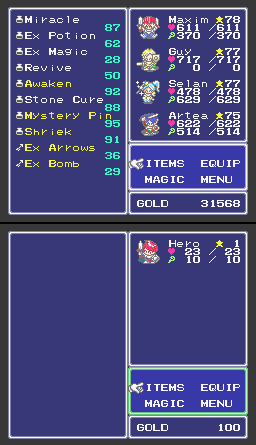
When starting a video game, a player sometimes starts out with an extremely powerful party, character, weapon/equipment or ability, which can easily slaughter anything it comes across. The player is in no real danger of losing, and often can't lose even if they tried. But this incredible power never lasts long. Once the introductory segment is complete, the player switches to the real party, usually at level 1 with basic starter gear and/or stripped of all those cool powers.
The primary purpose of this trope is to get a player into a game and teach them the rules without overwhelming them with dangerous enemies early on. This can also give them a preview of the powers and skills they'll be acquiring later in the game. Common marketing wisdom is that you have to sell your game on the players in the first ten minutes, or you risk them not sticking around to get to the really good parts - hence using A Taste of Power to draw a player in to show them how good they'll eventually become.
Another advantage to A Taste of Power is that the player gets to do something and have some fun while the scene is set and the story established, instead of sitting through a non-interactive opening cutscene or simply wandering around the First Town talking to people and trying to figure out what to do.
Of course, demonstrating early gear and powerful characters only for them to be taken away can have some pitfalls. When not handled well, it might spoil a game element that would be more fun for player to discover later. It might also orient the player into wanting to get back the gear over enjoying the process along the way.
Frequently used in RTS games to allow the player to be given a tutorial of all the game elements in one sitting.
This is sometimes done by means of a Crutch Character who leaves, is killed, or is depowered after the segment is over, weakening your fighting strength. It frequently ends with a Warmup Boss. Sometimes this is done through In Medias Res where the character starts in the midgame or endgame until it turns out that the majority of the game is in Flashback.
If some programming oversight allows you to retain some of this power, such as by removing the ridiculously powerful equipment from a temporary character, the result may make the game incredibly easy.
Also known as "Abilitease " on the Giant Bomb wiki.
In other media such as film and literature, the Taste Of Power is often used to show the future potential of a protagonist, or to justify a character's extreme future efforts in developing themselves. As a typical example, a character may have A Taste Of Power when first using magic in order that they will know magic exists and they have any talents necessary to perform it at the highest level, this justifying the character going on to spend months or years studying it and leaving the reader trusting that the results will be spectacular.
Compare Bag of Spilling, where a player character's hard-won power is somehow lost between the end of one game and the beginning of its sequel. If you wind up having to fight the Crutch Character later, you've been walking in Villain Shoes. May coincide with And Now for Someone Completely Different and Newbie Immunity. The inversion is 11th-Hour Superpower, where you get special abilities at the end of the game. Also contrast Second Hour Superpower, where the player character starts generically and gets his/her defining ability only partway through. May be Purposely Overpowered.
Examples:
- Castlevania: Symphony of the Night is a textbook example of this trope. After the (skippable) introductory scene with Richter Belmont, Alucard comes to the titular castle with a full complement of his signature equipment, with every enemy doing Scratch Damage and dying in one hit... which is promptly swiped from him by Daddy's Dragon, Death. It's not until you've explored the entire castle twice that you can get back everything you lost. Uniquely, his actual stats for the whole sequence are still his normal Level 1 stats; the boost from the equipment is just that huge.
- Darksiders starts War off with eight Lifestones, a maximum power Chaoseater and the ability to use Chaos Form indefinitely. A couple of battles later, War suddenly loses Chaos Form and four of the Lifestones. After the first Boss Fight, War is brought in front of his masters, the Charred Council, who accuse him of starting the End War early and siding with the demons. They then strip him of all of his powers and leash him with an Exposition Fairy before letting him go on a Roaring Rampage of Revenge. He'll eventually get it back all of it minus the infinite Chaos Form, but he'll also be able to add a few other weapons and abilities to make up for the difference and then some.
- Devil's Hunt: Right in the opening stage, the protagonist Desmond is already a monster-killing badass with a powerful Demon Form and the ability to unleash a Sword Beam from his demon's talons, taking plenty of names from assorted creatures and killing the first boss, a building-sized Big Red Devil. The next stage flashes back to days ago, when Desmond is a regular human, and it takes a few hours before the game catches up with the intro.
- Ecco the Dolphin: The Tides of Time: Ecco begins the game not having to breathe, as a token of the Asterite's power granted him in the first game. Once something wipes out the Asterite offscreen in one of the first levels, though, be prepared to see that oxygen bar start going down...
- The Hobbit (2003) begins with its first playable level being a dream in which Bilbo Baggins fights a group of goblins. In this dream he is invincible and already has the sword Sting (which later becomes the player's main weapon).
- Kameo: Elements of Power begins with the titular character infiltrating the fortress of Thorn, the troll king, with three Elemental Warrior transformations intact. Instructions are given on how to transform and use the Warriors' abilities. The attack on the castle fails; Kameo loses her Elemental Warriors, and must retrieve them, along with several other transformations.
- In Legacy of Kain: Soul Reaver 2, Raziel starts the game with a large health meter up until the scenes at William's crypt, upon which his maximum health will drop.
- NieR starts off with Nier accepting power from Grimoire Noir and becoming the Shadowlord in order to protect Yonah. He levels up like crazy and quickly gets access to the Sealed Verses that you have to quest for in the real game.
- Onimusha 3: Demon Siege starts Samonosuke off with the fully-powered versions of his three primary magic swords from the first game (Raizen, Enryuu, and Shippuu) only to rob him of all three by the second level, leaving him with naught but his regular, non-magical katana once again until he can find three new magical weapons. If you manage to find the special orbs in the Dark Realm you can start a New Game Plus using the above-mentioned magical swords.
- The Matrix: Path of Neo: You start the first level as Neo with a bunch of special moves and abilities... then the level ends and then it's back to regular guy Thomas Anderson until you get the abilities back. (Although as this level doubles as a test to suggest a difficulty for the main game, most players will find it more challenging than the next few... or even the next half of the game.)
- Nier: the game's opening segment has you fight off swarms of Shades with Grimoire Noir, leveling up quickly and gaining new spells at a fast rate. Afterwards, when the game begins proper, you start back over at level 1, and when you obtain Grimoire Weiss, you only have the Dark Blast spell to start off, the other spells being obtained as you progress.
- Shadow Complex starts with you controlling a different character who has the (mostly) assembled suit of Powered Armor you find the pieces of once you start the game proper. For this one shootout with a boss fight afterwards, you have plenty of armor, an assault rifle, grenades and missiles, and a double-jump.
- In The Force Unleashed, the prologue level is played as Darth Vader. He plays like the normal player character would after being powered up to the max, with all the combos and powers available, except he does not have the dash powers.
- In the Splatterhouse remake, the game starts you off in permanent Berserk Mode, which lets you cut through enemies with ease. Soon after, Rick is overwhelmed by the strain the mask's powers are causing him, forcing the mask to limit itself and let Rick ease into the powers.
- Mega Man X3 has this as an active game mechanic; at any point in a level a single time, you're allowed to switch out X for Zero, who, in this game, is basically X with most of his later upgrades. Despite Zero's power, he can't be taken into miniboss or boss fights or pick up upgrades, so your time with him is inevitably very short. Also, if you die as Zero, he's permanently disabled for the rest of the game.
- Tomb Raider has a subdued example of this in Rise of the Tomb Raider and Shadow of the Tomb Raider. In both games, Lara starts off with a good amount of equipment that allows her to traverse the starting areas with complete ease. She's also decently armed with modern firearms and bows. After the first area, Lara inevitably succumbs to an accident (such as a plane crash) that separates her from her gear. In some cases she can recover her traversing gear fairly early on, but must make do with improvised weapons until a few plot-relevant encounters with Trinity forces. However this only applies to gear, not any abilities Lara has picked up from leveling up (though Bag of Spilling is in effect between games, and abilities Lara learned in prior games don't transfer over).
- Alien Quarantine: You start with a very powerful weapon, but it gets quickly taken away as it's unauthorised and you have to buy a weaker authorised weapon.
- Alter Echo grants the player all three forms in quick succession during the opening chapter, allowing the player to get used to the shapeshifting mechanics and using all three forms in tandem effectively. At the end of the first chapter, the resident super-villain steals all but your basic form until your ally restores your other forms after beating the second and third chapters.
- Danny Phantom: The Ultimate Enemy video game lets you play as Evil Future Danny for the first level and boss fight and in the Boss Rush mode. After that, you play the rest of the game as regular Danny.
- Dragon Ball Xenoverse starts the player off as Goku in abridged and super-easy versions of three of his most iconic battles (against Freeza, Perfect Cell, and Kid Buu) before going to the character creation menu and letting you make your Time Patroller.
- In Resident Evil 6, the prologue treats you to an In Medias Res interlude with Leon. He has all of the weapons he would normally have at that point in the story, such as the viciously powerful magnum or assault rifle. When starting Leon's campaign proper, you will have... a pistol, with one magazine.
- Forza:
- Forza Motorsport 3 starts out with the player racing in a nice red Audi R8. After the race, you have to choose between a few cheap hatchbacks (like the Ford Fiesta) for the next races until you buy another car.
- Forza Motorsport 4 has a similar beginning, only now you start the first race in a Ferrari 458 Italia - and then have to pick an even slower 3-cylinder city car afterwards.
- Forza Horizon starts in the middle of a cruise towards an event, driving a SRT Viper against Darius Flynt and his Ferrari 599XX. You then wake up from your daydream in your old VW Corrado (it's actually a fast car, though the mechanic implies that it's seen better days), watching the Viper and the 599 speed past the gas station you're at.
- Forza Motorsport 5 starts with a race through Prague in the McLaren P1 and then makes you pick from a set of sport compacts for your first car.
- Forza Horizon 2 similarly starts with a drive to the festival in the Lamborghini Huracán, before giving you a choice of three lower tier cars.
- Forza Motorsport 6 starts off with a race in the Rio de Janeiro street circuit in the 2017 Ford GT. After that you have to choose between a selection of low-tier European and Japanese sports cars.
- In Horizon 3, you start off in the Lamborghini Centenario for a drive to the Australian seaside, then has you drive a Baldwin Trophy Truck through the beach, before doing the game's first Showcase event with a Penhall Cholla, before going back to the Centenario again and finally choose your starter car, though they are very fast cars in their own right; a high-end Ford Mustang, a Holden Maloo ute, a BMW M4, or modded Nissan Silvia.
- Horizon 4 starts off with the player racing through the UK countryside in a McLaren Senna during autumn, then driving on a frozen lake in a RJ Pro 2 Truck during winter, then racing against dirt bikes in a rally-spec Ford Fiesta during spring (which also doubles as a preview for the spring showcase event), before going back to the Senna during summer. After arriving at the festival, the player gets to choose their starter car; a Ford Focus, an Audi TT, or a Dodge Charger R/T.
- In Horizon 5, the player starts off racing downhill from a volcano in a 2021 Ford Bronco, then driving towards the sandstorm in a tuned out Chevrolet Corvette C8, followed by racing through the jungle in a rally-spec Porsche before ending with a race to the festival in a Mercedes-AMG One, with all cars being dropped from a cargo plane. Upon arrival, the player gets to choose between three starter cars: a modern Toyota Supra, the aforementioned Chevy Corvette and Ford Bronco.
- In the 2023 reboot, the player starts with a 2024 Chevrolet Corvette C8 E-Ray in Maple Valley (USA) in a practice lap session then the second race starts in a 20-lap endurance race starting you from the last two laps in Hakone, Japan putting you in hands of your 2023 Cadillac V-Series.R #01 Cadillac Racing. At the end of race, no matter your position, you have a selection of somewhat powered cars like the 2018 Honda Civic (FK8), the 2019 Subaru WRX STi (VA) and the 2018 Ford Mustang (S550).
- Need for Speed:
- In Need for Speed: Underground, when you begin a new career, you immediately start a circuit race with modded cars. After you win the circuit, it turns out the whole race was just your daydream, and your own car is completely unmodded.
- In Need for Speed: Underground 2, a friend of a friend lends you her modified Nissan 350Z as transportation once you touchdown at the city the game takes place in. You're asked to meet up with her at the car lot on the other side of the district as soon as possible so you can pick out a starter car using the insurance payout from your wrecked R34, but you can participate in up to three races with the Z before she gets pissed and demands that you get to the car lot at once.
- Need for Speed: Most Wanted (2005) begins with a flash-forward featuring the player racing in a high-performance BMW which becomes disabled partway through the race. The game then flashes back six days to show how the player got to the race at the beginning before coming full circle and having the player lose the car in the opening race. Then the player must start the actual game by purchasing a more modest vehicle and working back up to overpowered racing machine.
- EA loves this trope, because the same thing happens in Need for Speed: Carbon. Instead of having the car for three and a half races, however, you're treated to a sort of intro to canyon racing that you can only lose if you stop trying, before your car is totaled.
- Shift and Shift 2: Unleashed allows you to drive a powerful car during the game's tutorial before you start off with a low-tier car. Shift puts you in the BMW M3 (E92) around Brands Hatch, while Shift 2 puts you in the Nissan GT-R NFS Edition around the Suzuka Circuit.
- Criterion's Need for Speed: Hot Pursuit has Preview events, where you get to drive a high-powered car against the clock long before it becomes available to you.
- Need for Speed: Most Wanted (2012) begins with you driving an Aston Martin V12 Vantage along the streets of Fairhaven, then you'll drive the 2012 Porsche 911 Carrera at a race. Once the tutorial is finished, you can drive any car you want to use, especially the Chevrolet Corvette ZR1 or the Ford GT. Perhaps would be a breeze to beat your first Blacklist driver with supercars like these.
- In Need for Speed Payback, you get to drive Tyler's Nissan Skyline GT-R, to Mac's Chevrolet Bel-Air, to Jess's 2017 BMW M5. Later, you get to also drive a frickin Koenigsegg Regera!
- The prologue of Need for Speed Heat puts you in Joe's powerful Polestar 1.
- The prologue of Need for Speed Unbound lets you choose between a 1969 Dodge Charger, a 1988 Lamborghini Countach, and a Nissan S14 Silvia to restore, tune-up and drive for a few races until Yaz drives off with it when Rydell's car collection is stolen.
- While Midnight Club: Los Angeles gives you a low end starter car right away, it does have a variation of this trope with the delivery side mission which usually involves delivering high end cars across the city within a brief time limit, many of which will not be affordable until later.
- Race Driver: Grid allows you to start the game with a tuned Dodge Viper SRT-10 around San Francisco.
- When you start Grid Legends, you get to try out with a powerful Fauxrrari Le Mans prototype around the mountaious Strada Alpina.
- Pokémon Fusion Generation does this by giving you a Lv. 70 Rayquaza in the opening of the game before Oak takes it away from you and puts it in storage.
- Pony Fantasy VI combines this with Adaptational Early Appearance in order to accomodate its changed mechanics. Unlike the original game, only unicorns can learn and use Magic, while pegasi can all Soar and earth ponies get to double up on special skills. To compensate for this, right after joining, Celestia reveals she has the Unicorn Esper. This lets all the unicorns/Winged Unicorns learn a few good spells well before you 'offically' learn about Espers, but up until that point, you only have the one.
- Pokkén Tournament came with an amiibo card that would let you use the powerful Shadow Mewtwo in your game temporarily. He was unlocked permanently when you beat the main game.
- Chaos Legion starts the main character off with Thanatos as his legion, whose powers include wiping out everything and anything that happens to so much as look at you. You lose it once you meet the Big Bad at the end of the tutorial stage, and have to reassemble it.
- God of War:
- God of War II begins with Kratos as a (slightly depowered) god, allowing the player to slaughter his way through the armies of Rhodes, before he becomes all the way depowered.
- Shortly into the third game, he falls into the river Styx, losing almost all of his power in the process. Hardly the worst excuse ever, though.
- In Guardian Heroes, Han starts off with the powerful Sword of Legend. He loses it to the Golden Hero after the first stage, but may gain another, equally powerful sword if he follows the right path.
- Various stages in Honkai Impact 3rd allow the player to use "trial" battlesuits that are usually level 80 and come with the best equipment for them, which most players will not have yet when first made available.
- The prologues of all three games in the Infinity Blade series use this, and it escalates with each game.
- In the first game's prologue, you control the first Ancestor who has some decent mid-level gear. He defeats the God-King's Dark Knight and briefly spars with the God-King before he gets impaled. His successor is stuck using weaker beginner stuff.
- In the second game's prologue, you control Siris who is decked out with a set of very good gear including the Infinity Blade itself...right before he is tricked into giving it up to a fake seal and the God-King reclaims it. When Siris is revived, he has also lost the rest of the awesome gear and is stuck using weaker beginner stuff.
- In the third game's prologue, you control the God-King who wields the Infinity Blade as he tries to slay the true Big Bad of the series, the Worker of Secrets. His target the Worker is not impressed since he wasn't dumb enough to make the Infinity Blade capable of killing himself. After the God-King slays a mook and a fellow Deathless, he briefly spars with the Worker before he is quickly disarmed. The God-King's opponent offers him a chance to join him, not unlike the offer the God-King himself made to Siris in the first game. The God-King responds in a similar fashion and teleports a datapod to Siris. The Worker angrily skewers him with the Infinity Blade, permanently killing him. The game then returns to the actual playable characters, whose gear is weaker beginner stuff.
- In Phantom Breaker Battle Grounds, your character starts the game off at "Level ∞" with all of her combat abilities and spells. After defeating the boss of the prologue, your abilities get stolen and your level is reduced to zero, and you need to collect coins and gems to earn enough experience to regain your old combat strength.
- Aion:
- The game has a version of this around level 5-6, with a couple of flashback quests that take place in The Abyss, a much-higher-level PVP area. You're in impressive-looking armor, can fly, and characters around you are calling you their hero. In the second quest you'll also be facing off against some really tough-looking enemies who nonetheless go down easily before your "might", plus a "legendary" hero from the other faction, who ultimately kicks your butt in a cutscene.
- Happens at level 20, with the introduction of Stigma Stones: you're given a high-level stone, use it to decimate a tough enemy, then have it taken away.
- In Battlestar Galactica Online, one plotline mission gives you a chance to take an Escort-type starship for a spin. If you accept that mission as soon as it's available, it'll probably be the first time you're going to get to use an Escort if you haven't been Bribing Your Way to Victory.
- In City of Heroes, the first mission of the first Incarnate arc gives you a taste of what you're going to be working toward; during the mission, you fight several heroes and archvillains, some of whom number among the most challenging in the game, and they pose no threat whatsoever.
- Two missions added in the August 9th patch of LEGO Universe temporarily give new players special armour that has roughly the power of level 2 faction equipment and 4 extra hearts in order to fight the Spider Queen.
- Fallen Earth starts with a max-level character, but your DNA data gets corrupted when the cloning equipment is damaged.
- Chapter 62 of Granblue Fantasy has Katalina, Rackam, Io, Eugen and Rosetta use their SSR skills for that chapter only.
- In MapleStory, making an Aran places you through a tutorial in the form of a flashback. It introduces you to the Aran's basic playstyle by allowing you to use a maxed out Triple Swing/Final Blow, a 4th job skill combination.
- The Secret World has a relatively low key version of this. Each new character plays through a scene wherein they experience a major event in the game's storyline through the eyes of another person. By the end of the tutorial, you'll have five skills. When you start the main game, and reach the newbie area, you'll have three, maybe four (depending on your choices) skills. It doesn't take too long to catch up, though.
- The tutorial in TERA Online is a flashback which has the player at level 20. When the game starts proper, after the events of the tutorial, the player is back to level 1.
- Aura Kingdom combines this with Dream Sequence, to a lesser extent, that serves as the tutorial. The player is given an absurdly powerful weapon for the duration of the dream, and has a buff which heals an absurd amount of HP per second, ensuring even damage dealers don't die during it.
- World of Warcraft has a few variations on this, mostly not involving gear but other gameplay features.
- Several quests allow access to vehicles that act like mounts long before your character could have similar mounts normally. The goblin starting zone and the draenei starting zone both have quests that give you mounts or mount-like things for the duration of the quest, and Hellfire Peninsula has several quests that involve flying on a preset route. When it was released your character would get to Hellfire Peninsula at level 60 but not be able to fly on its own until level 68 at the earliest (although later patches reduced that.)
- The blood elf starting zone included a relatively simple version of an Alliance Meter. That was a big part of the endgame when it was released, but for everyone other than blood elves, would not matter before level 40 at the earliest. The gear available from that faction could quickly be replaced, except if you liked the look of the Bragging Rights Reward.
- Bionic Commando (2009) has a tutorial shortly after the beginning with several powers available to you. Although you get to practice them all, don't expect to use any of them until the game tells you it's okay (except zip line kicks, those you can do right away).
- In Captain Comic 2, you get unlimited fuel for your jetpack in the second to last level. The last level prevents you from using your jetpack at all.
- The Sega classic Wonder Boy III: The Dragon's Trap starts you off at the end of the previous game: in the labyrinth lair of the Meka-Dragon, equipped with Legendary Sword, Shield and Armor, bunches of Heart Containers, and mooks that drop heart refills nearly all the time, making it practically impossible to die at this point unless you do it on purpose. After a while you reach and defeat the dragon, and he leaves behind a Wisp that curses you, turning you into a lizard-man with a wimpy fire breath. And then, after escaping from the crumbling castle, all Heart Containers but one, as well as the Legendary gear, are mysteriously lost (the remake instead nerfs you as soon as you're cursed).
- Yooka-Laylee and the Impossible Lair: Yooka and Laylee are given access to the Beetalion Shield by Queen Phoebee for a brief segment of the opening levelnote . Then Capitol B uses the Hive Mind to steal it from the duo, right before the first attempt at the Impossible Lair. This helps set up the game's dynamic between the Impossible Lair and the Beetalion Shield.
- In the first Chinese mission in Command & Conquer: Generals after a bit of exploration you can find two Overlords, which is arguably the most powerful type of ground unit in the game - basically a Generals version of Mammoth/Apocalypse. They turn the mission into a walk in the park, especially if you upgrade at least one of them with the all-healing propaganda tower.
- Subverted in one later Chinese mission, which starts with a massive armored column (including Overlord tanks) moving across a bridge. The bridge then is bombed by GLA, leaving you with only a handful of troops making it across with which to rebuild and retake the city.
- Command & Conquer 3: Tiberium Wars allows you to use the GDI's superweapon in the tutorial mission. However, you won't be able to use it again until much later into the game. Also an example of Cutscene Power to the Max: While being highly devastating, Ion Cannon does not, normally, evaporate entire enemy bases in one shot. The NOD buildings are just rigged to all die no matter what via map scripting - try firing the ion cannon at the outskirt of the base rather than the center.
- In Company of Heroes, an early British mission puts you in a well fortified base with a pair of their terrifying super-heavy artillery cannons at your disposal. These cannons have much greater range than usual, access to abilities you won't be able to use normally till later, and near-unlimited sight lines granted by a series of unlimited recon planes lighting up the enemy positions. You can, and are encouraged to, flatten any and all signs of the enemy before taking your tanks to mop up effortlessly.
- In the tutorial of Dawn of War Retribution, you're given control of Gabriel Angelos and Jonah Orion. The two are so powerful they can effortlessly walk right through everything in their path. Makes sense, since the tutorial is the Final Battle from their perspective.
- Pikmin 4 begins from the perspective of Captain Olimar, who already has Moss for company alongside a bunch of Red, Yellow and Blue Pikmin scattered across the area. After you gather these Pikmin and defeat a Porquillion, you proceed to the actual campaign with the Rescue Corps, who only start with Red Pikmin and an undersized Oatchi.
- During the tutorial of RUSE, you are assigned the task of reaching Colditz Castle and given a small battalion of Super Pershing tanks, arguably the best armored unit in the U.S.A. faction. After the tutorial, most of the game focuses on what happened following up to that event and are only given access to infantry and other light units. Slightly justified as Pershing tanks were not developed that early chronologically.
- The first Spellforce has a lengthy tutorial with a level 5 character who's in little danger thanks to being a tanky Paladin type. Your created character comes in after this and starts at level 1.
- Supreme Commander does this in the UEF and Cybran campaigns. When tasked with defeating the enemy Commander the player's commanding officer gives them a handful of T2 heavy tanks, mobile missile launchers and mobile anti-air units. The commander from UEF lampshades the fact the player can't build them because "they're a bit above your pay-grade". Downplayed, as they don't break the mission right open, but missiles outrange Point Defense Turrets, giving another option in dealing with the perimeter instead of having to overwhelm entrenched positions with T1 chaff. Players get even less in the first mission of Aeon campaign, where after finishing their final assigned objective of destroying enemy anti-air turrets they only get to look while the commander they supported deploys a Czar to assassinate the enemy Commander.
- The Total War series will often combine this with Crutch Character at the start of the game by giving a faction a unit far stronger than what they'd be able to recruit themselves at that point in the game.
- In Rome: Total War, the Julii Romans will start with a unit of Triarii spearmen and the Greek Cities a unit of Spartan hoplites. Both units are at least two full tiers above what those factions would actually be able to recruit themselves for many in-game years. These units could almost single-handedly cut a swath through the low tier rabble the various "Rebel" faction neighbors have at that point, but any attrition suffered by the elite unit will hurt as the player will not be able to replenish the unit or recruit more for quite some time.
- Total War: Warhammer has the optional tutorial missions at the beginning of campaigns meant to introduce players to some of the new mechanics of the game. For example, Karl Franz has Ghal Maraz and most of his buffing auras in the tutorial, items that he won't actually gain access to until late game.
- Terminator Dark Fate - Defiance gives the player many armed vehicles, including an Abrams tank and a Bradley mounted with a laser canon before having to abandon them in an early defense mission.
- UFO Aftershock: The tutorial consists of three missions during which you control characters (one in the first mission, two in the second and the in the last part) with early game weapons but with armour (at true beginning you have no armour for your soldiers) and mid/late game skills and abilities (probably most notable is Ranger wielding double laser pistols).
- Unlikely the two previous instalments of the StarCraft II trilogy, Legacy of the Void starts with the player in control of a massive army of protoss warriors, including units you will only be able to recruit much later in the game. Immediately after the mission is over, Amon mass mind-controls almost all living protoss, leaving you with only a tiny force going forward.
- A minor example in Level 8's Modern Command, the opening mission has your firebase armed with a decent low rank missile launcher and machine gun as a tutorial. After that, you are thrown into the real campaign, and you must first research the lowest ranking missile launcher (the only available weapon and it takes an actual hour or so to do) and that's your only weapon until the campaign advises you to develop an autocannon. Another example is after a few missions in the first act, there'll be an available optional campaign where you must guide the battle-train, the Magnus Engine safely through the Ural Mountains. Each mission in that campaign has the Magnus Engine equip a new set of weapons, many of which will take you hours and days of actual time to research and manufacture.
- Command & Conquer: Red Alert Series:
- Played absolutely straight with the first Soviet Level of Command & Conquer: Red Alert 2, titled Red Dawn. You start the mission with 6 planes' worth of conscripts, which rains down on Washington DC, and instantly gets a base complete with all the resources you need. Right next to your base are civilians, buildings and facilities you can destroy for more loot, and the Allied Forces barely have a presence around your base. Later on, the game will award you with tanks, and throw a Tech Airport for you to capture so that you can periodically get more free conscripts, and Allied defense are at minimal level allowing you to Zerg Rush them with massively superior numbers of conscripts. What's even better is that if you make it to the Pentagon, the building you're assigned to destroy, the game then drops literally hundreds of additional soldiers and at least a dozen tanks, around the Pentagon which barely have any Allied infantry around. You literally can't fail this mission even if you try. Justified, however, because the first mission is about you leading a Soviet ambush on the States when they're least expecting it.
- Command & Conquer: Red Alert 3: Subverted in the Soviet mission "To tame a living god", which starts with a massive paratrooper drop... of which only a single Conscript and War Bear survive. You manage to kill the Emperor with them anyway (well the android decoy, anyway), and then you're given a base and access to units, including Apocalypse tanks.
- In Guitar Hero Metallica you begin Career Mode as Metallica. You have a slow walk out onto the stage to their actual entrance music as fans cheer you on and then immediately start playing "For Whom the Bell Tolls." You get to play another Metallica song as an encore before you're relegated to playing as the warm-up band for the next several songs.
- Agarest Senki 2 has Weiss facing off against Summerill, servant of the dark god Chaos. He at this point is at level 99 and equipped with the Werdefahrt, a very powerful sword. You get to own Summerill in your first fight. After which, a cutscene happens and you get flung over to who knows where at that point. When Weiss recovers, he gets reduced to level one, and you can't equip his sword anymore for some weird reason, not to mention he now has amnesia. Turns out, there's a lot more to that story later on.
- In Avalon Code, after receiving the Book of Prophecy, you use it to summon twin "Genesis" swords for a fight, which are very powerful. Immediately after, the Book runs out of power, and the Genesis sword becomes a rubbish rusty old sword.
- Baldur's Gate has an illusionist at the very start of the game teach you group tactics; several midlevel NPC friends with unusually high stats join your party, to help fight against swarms of illusory monsters that would have overwhelmed your character normally but which don't deal any damage. However, once you leave the training room, they're removed from your party, and you can't ever get them back. (By taking advantage of a glitch and using exact timing, it's possible to keep these characters in your party permanently, giving you a Disc-One Nuke.)
- In Boktai 2: Solar Boy Django, you start with the very powerful solar gun, Gun Del Sol. It is stolen from you a few screens later. You get it back near the end of the game, but it is damaged and uses many times as much energy as it used to.
- Breath of Fire III begins with you in dragon form. Your attacks consist of a weak melee attack and a dragon breath attack (which kills all enemies in one hit). In the event that you don't get initiative and the enemy attacks first, you have a 100% counter rate and automatically use the dragon breath. The only way to die in the initial battles is to attack yourself a few times (although doing this still advances the plot).
- Breath of Fire IV lets you play as the game's Final Boss at certain points in the story, usually near the beginning of each chapter. He's at a ridiculously high level (60+) and has the best equipment in the game, giving you a taste of what The Hero can do once he achieves the same level of butt-kicking power.
- Breath of Fire: Dragon Quarter does this in an odd way - the main character is given the power of The Wyrm Odjn, after being 'killed' by Bosch. Using this power, you can do tremendous damage to anything in your way - the catch is that every time you do, The Wyrm takes over a little bit of their soul. When The Wyrm takes over their soul completely... Odjn bursts out of his body violently, ending the game.
- Brigandine, in the 1st game if you selected Prince Rubino's kingdom, a valkyrie with maxed out levels names "Shooting Star" Hailey will join you. But after a year, she will permanently leave your kingdom.
- Chaos Rings III begins with you controlling the legendary Thousand Voyager Johannes. Johannes starts out with a powerful high-level Gene with awesome stats and skills and easily solos the forced encounters in the tutorial level. The game then switches to the Protagonist, who hasn't even heard of Genes yet or has one equipped.
- Chrono Cross begins with a dream sequence with Serge, Kid and one randomly selected character, at a somewhat elevated level and powers. Perhaps uniquely, it's a premonition, and the party goes through the very same events later in the game. Interestingly not only is the equipment you have in this dream impossible to have outside of a new game plus, but some of the random 3rd party members are characters you can never have at this point in the actual game like Orcha or Fargo.
- Corruption of Laetitia: In the prologue, Celeste is higher than endgame levels and is strong enough to defeat a fully-powered Malayna in a Duel Boss battle. After Marian steals her power and Malayna revives her, Celeste will start at level 1 in a weaker class.
- Crescent Prism: In the Action Prologue, Lunita is at high enough level to defeat Count Chroma's minions by herself. Then the game cuts to 10 years ago where she's a level 1 apprentice Oracle.
- Crisis Core:
- While it didn't exactly dazzle you with power, had the strongest of the 3 basic spells, a decent command attack, and several levels put on Zack for a level with a bunch of soldiers and a Behemoth.
- It can happen again later in the game, when Zack is assigned to protect Hojo. A simulation designed to test new materia gives that materia to Zack and forces him into a fight. The materia is quite powerful...and lost as soon as the fight is over. The real kicker is that that materia exists only for that battle - it's completely unobtainable in regular gameplay.
- The first Deception gives you access to an elite type of trap, the Volt Cage, in the first chapter, which has high accuracy and a long capture time. You don't get traps of that caliber again until chapter 11, and even then you have to pony up the gold to develop them.
- The start of Deus Ex: Human Revolution has Adam start slightly more durable than normal, and armed with a heavily-modified assault rifle with infinite ammo. The lack of a heads-up display and special abilities is offset by the fact that he is effortlessly slaughtering his way through the bad guys (except on Hard difficulty, where he instead becomes as tough as a wet paper bag). His special gun is lost after the mission ends, in exchange for one of four weapons with zero upgrades.
- Deus Ex: Mankind Divided begins with Adam on a mission for his new employer, with every single augment from the previous game unlocked. However, in a cutscene after Adam returns home, he takes a suicide bombing to the face, knocking out all his augments.
- Digimon World Dawn/Dusk gives you a full party, and depending on the pack you choose, two Ultimates whom will slaughter everything in their path with little difficulty, even against your rival, who has mons several levels ahead of yours. Even after the mysterious interloper devolves both of them, you still have a level 20 Coronamon/Lunamon and two level 1 rookies with high stats right off the bat.
- .hack//INFECTION has Orca, Kite's first Party Member. Good news, everyone! He's one of the strongest players around! Nothing can stop us now! Wait, who's this white-clad girl? What's with that book she gave him? And now we've got a new monster carrying a
CrossQ-Stick who's immune to Orca's attacks. Uh oh... - Dragon Age II begins with Varric telling a somewhat exaggerated story about Hawke. During the first ten minutes or so of the game you play as a veritable god with Regenerating Health, extremely quick Cooldown times on all your powers, Infinity Plus One Swords, and the ability to vaporize darkspawn by looking at them funny. Eventually Cassandra (Varric's audience) calls BS, whereupon Varric rewinds a bit and tells her the real story...
- Dragon Ball Z The Legacy Of Goku II uses a "flash-forward" version, taking full and clever advantage of a plot point in the show... the alternate future where the androids have destroyed everything. You play as Trunks, at a fairly high level (but unable to go Super Saiyan yet). And future (badass) Gohan runs you through the basics of your power and Ki Attacks, including, as mentioned, a failed attempt at going Super Saiyan. Then you're released to chase after Gohan just in time to see him killed by the Androids. Then in the cutscene, Trunks goes Super Saiyan in a rage, the screen flashes white, and you end up in the present, as Gohan, at Level 1, with none of the power or Ki abilities he and Trunks had in the future.
- Dragon Quest V has the Hero's father Pankraz accompanies you early in two points of the game with Sephiroth-like strength. He can wipe out all monsters before you can attack. You'll be awarded with exp. and even heals you after battle.
- EarthBound (1994) has your player character engage in his first boss battle with his bug-like guide, Buzz-Buzz, circling him around. You also have two somewhat helpful NPCs with you as well (Picky and your Dog), as well as one totally useless one (Pokey). Because of Buzz-Buzz's great and awesome PSI abilities, you are basically invincible for the first few minutes of the game. Then Buzz-Buzz gets swatted by Pokey and Picky's mom, who thinks it's a bug. Now you are all alone.
- The Fallout series often allows players to acquire weapons intended for higher level players early on, but keeping them supplied with ammo is a real issue as low-level enemies will still be using basic weapons; you need to cough up the caps to buy ammo from a store, or shove the gun into storage once the initial supply is out.
- In Fallout 3 the A3-21's plasma rifle, one of the most powerful weapons in the game, can be acquired as early as level 3, but the microfusion cells it fires are highly uncommon early in the game (unless you know exactly where to look), and the repair parts in the form of other plasma rifles to cannibalize on are practically non-existent until around halfway around the main quest.
- In Fallout 4, you get a T-45 Powered Armor and a minigun within the first hour of gameplay, allowing you to take on a Deathclaw and a band of raiders, but the minigun chews through ammo far faster than it can be resupplied, and the armor runs on rare fusion core batteries and is usually quickly damaged beyond your resources to repair it. Before that, you get a powerful Laser Musket, which can reliably one-shot many early enemies but its energy cell ammo remains rare for quite a while.
- The Final Fantasy franchise does this a lot:
- Final Fantasy II gives you the horrendously overpowered Minwu after playing for a short time. The catch is that he specializes in White magic, meaning he can heal you and protect you, but damage is not his forte. In this way, you're allowed to level up your characters without too much worry about death.
- Final Fantasy III tricks you into thinking you're getting this: the game starts in a cave, and you have to kill the boss to escape and begin the game proper. Fortunately, you're given a number of Antarctic Wind items, which have the same effect as the Ice2 (or Blizzara) spell, and the boss just happens to have a weakness to ice. Nevertheless, you're not actually more powerful ( and you should save those items for the much more difficult Jinn boss that's coming up).
- The original version of Final Fantasy IV shows Cecil taking out monsters with powerful attack items in an automated battle at the start of the game. The DS remake changed this by placing the player into a real battle with the aforementioned attack items in the inventory, presumably assuming that the player has played the original and remembers the items. Or the player can just take out the monsters themself, using regular attacks. On a longer term note, you have Tellah, who joins you on two separate occasions. The first time, he arrives with low-level magic that just so happens to be the weakness for everything in the dungeon you'll face, a powerful healing spell, an MP recovery spell, and an MP pool that, for the time, is ridiculously huge. The strategy for the game quickly becomes, "Have Tellah kill things." The second time you meet him, he starts off unchanged (and rather weak for the point you're at), but soon after gains access to nearly every spell in the game, many hours before you would ever normally see them, with spells so ridiculously powerful that he is capable of soloing bosses. His MP pool, however, remains unchanged, meaning he can only crack off about three of the highest level spells before needing to recharge. The strategy thereafter becomes, "Conserve MP until we get to the boss, then have Tellah kill things."
- When the adventure begins, your party consists of Cecil and Kain: two experienced fighters who can each kill enemies in one hit and take plenty of punishment in return. Soon after, however, you're separated from Kain—and his replacement is the the sobbing Level 1 child Rydia. While you still have Cecil, the next several hours consist of him babysitting everyone else who joins, both dealing and taking most of the physical damage. Tellah, as mentioned above, is a useful but limited Squishy Wizard (who also doesn't stick around for long himself); none of the mages are anywhere near their full potential yet, and even the physical fighters don't compare to Cecil or Kain.
- Final Fantasy IV: The After Years gives Ceodore two comrades who have better gear than what he starts with, Fira and Cura in their spell lists, and a Band that destroys everything in the dungeon. You lose them soon after, though you do gain The Hooded Man. Later, you take control of Magic Knight Cecil, who has White Magic and better stats than Ceodore at the time. If you're smart, you'll strip him of his gear and give it to Ceodore.
- Final Fantasy VI gives Terra a pair of soldiers and powerful Magitek armour until the Esper is found, at which point the armor is destroyed and both soldiers are lost. You only get Magitek armor again twice more (and the second time is optional). And just like the beginning, only Terra can utilize the advanced functions.
- Final Fantasy VII does this about six hours after the game begins, when Cloud is telling the story of his trip to Nibelheim with Sephiroth. Sephiroth has a six slot linked weapon, and a six slot linked armor piece, along with mastered materia coupled with All materia, in addition to a ridiculously high strength rating and the inability to be touched by enemies (all attacks default to 0 damage). Needless to say, if and when you find yourself in battle, he kills everything before you can even act. And then we all know what happens next...note
- Final Fantasy IX does this halfway through the game with Beatrix when she becomes a Guest-Star Party Member. She comes with several sword skills that are absurdly powerful and you won't have access to those skills for yourself until much later on. Likewise, she also comes with several white magic spells and has a few that you won't be getting until near the end of the game.
- Steiner and Vivi's Sword Magic combo is a slightly more varied take on it. It does lots of damage early on and will be your go to damage dealer to get you through the initial journey to Lindblum however after that for all of the rest of Disc 1 and all but one brief segment in Disc 2 you won't be able to have Steiner and Vivi both in your party at the same time. It won't be until hours into the game that you can select to have them both in and use Sword Magic freely again.
- Final Fantasy X does this a few times at different points in the game. When Tidus meets Rikku at the beginning of the game, she is able to steal Grenades from enemies and use it to blow them up, which is quite handly at that point in the game since Rikku's strength is pitiful and Tidus can't do much else besides attack with his sword. Rikku doesn't show up again until near the halfway point of the game and she has a lot of level grinding to do in order to catch up. About 1/4th of the way in the game, Seymour joins you for one boss fight as a Guest-Star Party Member and has access to powerful Black and White magic that you likely don't have access to by this point. Seymour's stats are so high that he can practically solo the boss by himself with little trouble. Once the battle is won, he leaves you.
"Woah, Auron starts the game with over 1,000 hit points and does double the damage of Tidus?! Awesome! This is gonna be - wait, where did he go?"
- Final Fantasy XII:
- The prologue of the game has you play as Reks, who starts at Level 3, travels with a small squad of Dalmascan soldiers, most notably Captain Basch, who will kill everything that isn't boss-strength in one hit, and one soldier that throws around healing potions to anyone who ever needs them, and never runs out. Reks also wields a shield, which provides a neat evasion at this time, and knows a handful of useful magicks, including Cure and Thunder. Then you change to his little brother, Vaan. Vaan starts at Level 1, doesn't have a shield, doesn't know magick, and is on his own until the second area of the game. You have to grind to at least level three in the first area to survive the sub-boss you have to face upon taking control of him.
- The second guest character, Larsa, has unlimited Hi and X-Potions, and isn't afraid to use them. During your first trip with him, dying isn't much of a concern. Unless you're playing the Zodiac versions, in which case Guests have been altered and he's given the still-useful Cura instead.
- The player is first introduced to the wonder and glory of the greatsword weapon class through the third guest character, Vossler, who briefly joins the party midway through the first act. You won't be able to buy an effective greatsword until near the end of the second act.
- Final Fantasy XIII inverts this trope to drill the combat basics into the player. See Second Hour Superpower.
- Final Fantasy XIII-2, on the other hand, plays this straight, starting you off as a very powerful Lightning before you switch back to Serah. To put it in perspective, Lightning has roughly ten times as much HP as Serah does at that point and a lot more abilities.
- Forever Home has the prologue set in a Bad Future, where Xero and his party are at endgame levels and are capable of curbstomping all enemies they come across. After the prologue, the POV is switched to the present, where Xero is at level 1.
- Midway through the first Fossil Fighters game, the at-that-point Big Bad gets their hands on a godlike superbeing from ages past named Frigisaur, and plans to use it to freeze the world. In order to combat it, you resurrect an Olympus Mon named Ignosaur. Ignosaur has insanely powerful moves, is resistant to all attacks, and has stats that are high even for a max-leveled vivosaur (when your own are likely still pretty far from maxed). You can play around with Ignosaur, but as soon as you beat the boss, he vanishes from your party. The only way to get Ignosaur (and Frigisaur) permanently isn't available until the Playable Epilogue.
- Golden Sun: Dark Dawn has this when Isaac and Garet join your party for a bit and let you borrow their Djinn. They let you have enough Djinn to use at least a level 3 summon, but when combined with their Djinn, you can summon a level 4 one. After they leave the party, they take back their Djinn too, putting you back in square one.
- The first part of Honkai: Star Rail's tutorial has you controlling a very high-level Kafka and Silver Wolf. Then they discover the protagonist, and control shifts to them, with them starting at level 1.
- Inazuma Eleven 3:
- Inverted where the opening cutscene shows off some of the awesome power of the rivals you'll be up against, as well as foreshadowing little bits of the plot involving those characters.
- Subverted for a first few matches. Your character do have evolved skills and game breaking abilities, however, these players have horrible stamina, and get tired after a few uses of specials, usually even before the first half ends.
- The opening section of Infinite Space, which also doubles as the tutorial, has you fighting a couple of easy battles as the dread space pirate Valantin, at the helm of his awesomely powerful battleship Corsair, capable of basically annihilating anything you point it at. After this sequence is over and the rest of the introduction has played out, you're left as a teenage boy at the helm of the good ship Daisy, a converted civilian vessel.
- Kingdom Hearts:
- Kingdom Hearts II has an early boss fight in which you fight as Roxas with two late-game keyblades and an ability set to rival that of a fully-leveled Sora. It also had one with an inordinate number of reaction commands. The latter teaches you how to use them. The former is just a teaser of what having powerful abilities does, and the Synch Blade ability isn't even regained for Sora outside of Drive forms.
- Kingdom Hearts III has a similar thing, except it happens after you complete the first world, Olympus. The plot briefly switches to the Realm of Darkness, where you control Riku against a Dark Tower. Riku has endgame stats and "-ga" spells, which make sense since, canonically, he didn't undergo Bag of Spilling after Kingdom Hearts 3D [Dream Drop Distance]. Later in the game, you will switch back to Riku again, but since Sora has considerably leveled up, the difference isn't as stark.
- Knight Bewitched: In the first dungeon, Lair of Typhus the Younger, Ruth wields the legendary Sylvans sword. This sword is the property of the Kingdom of Halonia, so she gives it back to the king after slaying the boss. Afterwards, she automatically equips a basic Short Sword.
- Knights of Pen and Paper 2: The game starts you off in control of the Level 99 Paper Knight curb-stomping a Tarasque, with items and abilities such as +255 damage vs. Tarasque. Although, it's just a taste of overpowered combat, no other gameplay beyond that before the real protagonists arrive. Lampshaded, of course.
Oh, did I forget to mention the Mirror Shield that reflected your damage? It is very useful in the current metagame.
- The Hentai RPG Knights of Xentar starts your character at the lower-mid levels, with decent stats. However, the moment we're done with the introductory area, the plot depowers you and strips you nude.
- The Legend of Heroes: Trails of Cold Steel is a rare RPG example of the In Medias Res variant. You start out controlling a class of badass Lv 50 military academy students (and their Badass Teacher) during The War Sequence. You don't get any tutorials during this sequence so the game just expects you to mess around with eveyone's super-powerful moves with little risk, you're so strong that not knowing the battle system is of little concern. Once the sequence ends on a Cliffhanger, the game flashes back to the same students on their first day at the military academy, with levels typical of a starting RPG party. Three quarters of the rest of the game is about how they got to that point, and by the time you do you'll have access to all the abilities you had in the prologue. And the same thing happens to Cold Steel III where you control a group of students trying to stop something that's also In Medias Res style till the end of the section where you get saved by Rean and his party. In fact, when players get to that section of the game, they're actually at a higher level compared to the prologue levels.
- Cold Steel IV has the players start off with Estelle, Joshua, and Renne, Lloyd, Elie at level 88 with mid to high tier quartz and mid level Master Quartz for about two to three hours before the game finally transfers to Juna, Kurt, and Altina where they suffer a massive Level Drain between III and IV at level 28. Thankfully, the game automatically levels them up within a week's time in-game to their official starting levels at 50 alongside Randy.
- The first game also has Rean's power up mode where he unleashes the power within him. While a recurring plot point throughout the game and his back story it only actively triggers in two fights one of which is a Hopeless Boss Fight anyway and it's not until midway through the second game that Rean finally gains the ability to use it at will in battle. Cold Steel III repeats this where Rean is now actively choosing not to use it so aside from an early battle where it's trigger by plot he again can't have the player control it until the halfway point.
- Lie of Caelum: Downplayed in the prologue. Shi, Kei, and Ten are at level 60 and can easily win battles of attrition with the Saith Facility's mobs, but they can't use specific inputs to activate techniques like the main story party members.
- Lufia & The Fortress of Doom starts the player off with a party of very high-level characters, taking on four of the most powerful beings in the game's universe. This turns out to be a flashback that sets up the story for the rest of the game. The prequel Lufia II: Rise of the Sinistrals climaxes with that very same battle and ends with its immediate aftermath.
- In the first dungeon of Lunar: Eternal Blue, Lucia has incredibly strong magic until you leave the dungeon (at which point plot/the Big Bad strips them from her), which she'll eventually get back later in the game. This is actually very useful, since you can use her to level up your other characters to make the upcoming boss fight much easier.
- In the first chapter of the Flash game MARDEK, the main characters pretend that they are legendary heroes, and the tutorial is played through using their extremely powerful imaginary personas.
- The Neverwinter Nights module Kingmaker starts you off at level 10 with four level 10 allies in a War Sequence populated by enemies that would be moderately challenging for a level 2 character. Then you get killed and resurrected at level 2, and have to choose two of your allies to resurrect alongside you.
- The first act of Parasite Eve 2 starts you with a semi auto pistol, but you can easily find a submachine gun, body armor with a good boost to HP, and a grenade launcher. After you finish the section, all the gear you found is taken from you under the justification that they belonged to the local SWAT team, thus they aren't yours to keep. You can find the gear again much later on the game assuming you didn't miss finding the black key card earlier, but by the time you get there, you'll probably have found better equipment.
- Persona 5 starts you off In Medias Res during a very important heist with the Phantom Thieves. While you're on your own as opposed to utilizing a party of four, you're given a high level version of Joker's Starter Mon Arsene to blast the enemy away. In the Updated Re-release Persona 5 Royal, you'll also be joined by a Guest-Star Party Member partway through this opening. She'll instantly knock down all enemies, then perform an All-Out Attack with Joker, in a battle that's impossible to lose. Once this sequence is over, Joker will end up arrested, and the rest of the game (until it catches up to Joker's arrest) is Joker telling the story of what happened while being interrogated by Sae Niijima.
- In Pokémon XD: Gale of Darkness, you start the game in a battle where you have a Level 50 Salamence squaring off against a Level 50 Metagross. After the battle, you realize that it was just a sim battle and you actually own a Level 10 Eevee instead.
- If you go to the Arena for a tutorial in Resonance of Fate, your party will have access to a hero gauge with 8 bezels or so in it. When you start actually playing the game, your hero gauge has only 3.
- The first chapter of Riviera: The Promised Land is Ein (our hero) and Ledah heading to the title country. Ledah carries one of the two Unbreakable Weapons in the game, heals far more health than he can be damaged for each turn, and is capable of doing about 200 damage a hit (which is usually instant death), and both characters are far stronger than their foes. Once you complete the chapter, Ein gets zapped away, ending up with his stats cut in half when he lands in Riviera proper.
- A Downplayed example in Ruined King, where the opening of the game sees you playing as Miss Fortune who starts out at level 10, before switching perspective to playing as Illaoi instead, who starts out at level 1 (Illaoi compensates by starting out with 2 minor characters helping her in combat until she meets the second proper party member, Braum). Miss Fortune joins your party roughly 1/3 of the way through the game, by which time you'll have roughly caught up with her (or possibly even outleveled her, depending on how much you grind).
- Secret of Evermore:
- It gives the player character the bazooka, one of the strongest ranged weapons in the game, in the very first fight. However after going into an escape pod afterwards and landing on Evermore you lose the bazooka and have to fight your way to the next village with... a bone.
- Halfway through the game, this trope strikes again. You meet someone that found your bazooka, and he gives it back to you for free - with one round of ammo. You can buy more ammo from the guy that sold you the bazooka, but the cost is extremely prohibitive (1000 gold coins for 10 shots, compared to 1000 creditsnote for 50 shots later).
- Before your first boss fight in Shin Megami Tensei I you can fuse your dog with a demon and get the very powerful demon Kerberos, who will obey you even though you're far below his level 43. (Usually demons won't obey someone who's lower level than them.) After the fight, he unwisely attacks a teleporter station and vanishes. Later you can catch up with him in Tokyo Land, though unless you carry a specific item he will be Brainwashed and Crazy. With it, though, he's healed and rejoins you. The trick is revisited in the sequel, set thirty years later, with the same Kerberos, although more justified: The Madame lends him to you to track down a rogue scientist, and returns to her when you're done. After Valhalla District is devoured by Abaddon, he'll join you again permanently, even if you're still underleveled - he recognizes your strength and potential, and he wants revenge on the people responsible for killing his master.
- Shin Megami Tensei: Devil Children: Book of Ice/Fire takes place sometime after the events of Demi Kids, and for a couple minutes you have what would have been a relatively powerful party by storyline standards. However, one of the Big Bad's henchmen does something to reset your level, your Guide's rank, and destroy the device that holds King-class demons.
- In Soul Hackers, your first experience with the battle system uses the (level 20) demons of a man named Urabe. Urabe later deletes these same demons to make room for Nemissa, which kicks off the plot and explains why you don't have the same demons when you inherit his COMP.
- In Spectrobes, you begin the second game by having everything you obtained in the first game stolen. You technically get it back.
- South Park: The Fractured but Whole: The game starts right after the last one, with you and your party being utterly powerful heroes of a fantasy story. And then Cartman declares they're all superheroes now, and everyone starts back at the bottom as their superheroic alter-egos. Amusingly, you later use time travel to come back to this exact point in time, and your party while you still had this taste of power is a boss fight for your current party.
- In Spyre Aflame by Jeffrey Dean and Greek Winter Media in the video gamebook A Road Less Traveled series, in the first few sections - depending on your choices, you could end up getting a grenade launcher using that in a fight with a mutant. After the fight, you have to return the grenade launcher to the armory and are issued a less powerful weapon of your choice in your forthcoming mission.
- Star Ocean: The Second Story has one of the two primary characters start out with a futuristic (and powerful) energy beam weapon as one of their special attacks. It doesn't take long for it to run out of energy, and the game doesn't provide a way to recharge it. The remake makes it useable and upgradeable at the start of the second half of the game, at which point you have plenty of other options, but it still remains as his best long-ranged option.
- During the battle tutorial in Star Ocean: Till the End of Time, the main character has a ridiculous amount of HP and MP, but has only about a tenth of that in the first real battle. This is explained in-game by the tutorial being a video game within the game's world. (This is also foreshadowing.)
- Suikoden II starts you off with Jowy and Riou, the two main characters. Although they are relatively weak, being only level 1, they have access to the devastating Combination Attack "Buddy Attack", which hits every enemy without fail for as much damage as they would inflict with two regular attacks. Needless to say, the enemies that survive the attack are quickly killed.
- Suikoden IV, with Lazlo and Snowe having access to the powerful Friendship attack at the beginning of the game. It only targets one enemy, but is more than enough to take out any bosses you meet with two or three shots.
- Since the main hero in Suikoden V is a prince, he gets to spend much of the first part of the game with a party of strong allies, including the kingdom's most powerful bodyguard, who is compelled to leave him midway through the game. (The hero still has his own personal bodyguard and aunt as permanent tagalongs, until plot events remove them from gameplay as well.)
- In the demo versions of Sword of Rapier, players are given access to the Fire Ball, Ice Wall, and Plasma Sphere spells right from the beginning. In the full version of the game, players don't get access to spells at all until after the game's opening act.
- The prologue of Tales of Innocence gives the player control of Asras for one easy battle. Asras controls are quite different from any other character you actually play, even his own reincarnation.
- Tales of Symphonia: Dawn of the New World has the player start with Richter in his party, who can take down any of the first-dungeon enemies with ease. He leaves after about twenty minutes and only rejoins for four other brief periods in the game, and that's assuming you do the sidequests.
- Tales of the Abyss has powerful spellcaster Jade join you during a Seemingly Hopeless Boss Fight. Jade is at level 45, at a time when your two other characters will be lucky to be at level 6, allowing you to defeat the boss very easily. Shortly afterwards, aboard Jade's ship, all his powers are suddenly sealed, and he goes down to level 3.
- Tales of Xillia has Milla be this in the beginning. She summons the four elemental spirits as her fighting, has at least double the amount of HP and TP than Jude at that point and can pretty much two-shot the second boss of the game (Jude's route) or first (Milla's route). This lasts for about 10 minutes, before a plot-event strips Milla of her summoning powers and she's brought down to a typical beginner videogame character's level.
- In Tales of the Drunken Paladin, Anebriate starts off with the maximum amount of gold, experience, etc. After a Curbstomp Battle, you lose everything and get to stare at your old items when they pop up from time to time in NPC shops.
- Tower Of The Sorcerer has you starting out with the Sacred Sword and Sacred Shield, allowing you to curb-stomp the puny slimes in your path. Unfortunately, you promptly have to hand them over to the Big Bad on floor 3, and get thrown in prison. Luckily, there's a friendly thief (oxymoron much?) who will get you out, albeit unarmed and having lost most of your health. You eventually get the Sacred Sword back (and potentially the shield, if you can find it), after fighting your way through most of the tower.
- In the older computer RPG Ultima VII Part II: Serpent Isle the player starts off with a good set of gear from the previous game, including the Infinity +1 Sword from the previous game's Expansion Pack, the Blackrock Sword. This sword can kill any foe in one hit. Upon setting foot on the titular Serpent Isle with all of the amazing gear from the first game, you and your party members are struck by magical lightning that swaps all of your gear (and your party members themselves) with otherwise innocuous objects, leaving you alone, wielding such things as a pumice rock and a furrier's cap. However, each item is a clue to where the corresponding powerful item ended up.
- Vacant Sky has the Villain Shoes variant; you start out controlling Sandarga, Vastale, and shortly afterward Weapon, all of whom are fairly high-powered right from the start
- Wasteland 2 does this with the Crutch Character Angela Deth, who you can acquire at the beginning of the game. She not only makes the game easier for you by being a more accomplished fighter (Level 14 in the original release, toned down in the Director's Cut), she also has several levels of Weaponsmithing so you can actually make a few useful weapon accessories right off the bat. Without this "taste", many people might elect to hold off on trying out Weaponsmithing until much later, not realizing the usefulness. When you lose access to Angela about 1/3 through the game, the natural inclination is to train up someone else in your party with Weaponsmithing ASAP!
- Dunban in Xenoblade Chronicles 1 provides this, with you controlling him in the opening whilst he wields the Monado, the game's titular weapon. He later temporarily rejoins the party for an early segment of the game, still wielding the weapon, and while he relinquishes it to Shulk before the end of that segment, he's still likely to be around 10 levels higher then the rest of the group and far stronger then them even without it. He rejoins for good at a point where everyone is likely to have caught up to him in level.
- Xenoblade Chronicles 2 tends to relax the rules when introducing a new mechanic to the player so they can see it in full effect, such as artificially increasing Affinity so a fight can be started with a Blade combo. So while you get the power in full from the moment you have the taste, you have to work harder for the effects going forward.
- Xenoblade Chronicles 3: during the opening boss fight with Moebius, Noah and Mio automatically Interlink, giving you a Super Mode with which to eke out a victory against the boss. Played With in that you're actually tasting the absolute bare minimum power the mechanic can bring: it's a level 0 Interlink since Noah and Mio were trying to kill each other minutes ago and Interlink strength relies on trust and cooperation, so its attacks are very slow. It's also completely un-upgraded and so cannot cancel any of its artes into each other to speed things up. Finally, even the "close" victory wasn't, since Interlinks are invulnerable — the only real bonus was the lack of an Overheat/time limit, and Moebius bows out of the fight mostly because he spent so long gabbing his own Interlink is visibly overheating.
- In Ys IV: The Dawn of Ys, Adol starts with the best equipment from the (chronologically) previous game. With it he can one-hit kill everything and nothing can really hurt him. Naturally, he loses it very quickly and doesn't get it back until much later. In Lacrimosa of Dana, Adol still has his Isis Blade from the previous game, but only uses it during the first boss battle, whereupon it gets lost at sea.
- For a Third-Person Shooter example, in The Bureau: XCOM Declassified, Agent William Carter starts alone, but quickly gets first Thomas Nils (a Recon) and then John Kinney (an Engineer) on his squad. Both Nils and Kinney have advanced abilities and are pretty good in a fight. After the introduction mission, Kinney is assigned to a different squad, while Nils is killed by an Outsider infiltrator, leaving you stuck with a bunch of rookies. The trope doesn't apply to Carter himself, though, as he plays through the intro at level 1 with Healing Hands as his only ability.
- Call of Duty: Black Ops II takes this to an absurd degree - just from the weapons alone, there is only one in any of the default classes that can be used immediately after unlocking custom classes(an RPG used as a secondary weapon), most of the rest all locked away until halfway through the total number of ranks.
- In Chaser, the only gun you get in the first level is the G11 — a powerful and accurate assault rifle with a 50-round magazine and an attached mini-scope. After getting used to effortlessly pulverizing every Mook in sight, you're downgraded to low-power pistols and submachine guns.
- In Danganronpa Another Episode: Ultra Despair Girls, Komaru has full access to all of the Hacking Gun's powers in infinite amounts for her first battle. Shortly afterwards, however, she's captured by the Warriors of Hope and the gun is modified to "balance it," leading to it being severely downgraded so that she has to find and reinstall all of its abilities. And even after she regains all of the gun's functions, she never regains the infinite ammo.
- In Half-Life 2: Episode One, you begin in the Citadel and shortly afterwards get the Supercharged Gravity Gun, the 11th-Hour Superpower from the previous game. Once you contain the Citadel's core, though, the Gravity Gun returns to normal. Unusually for this trope, you never get it back.
- Jedi Knight: Mysteries of the Sith has you play as Kyle Katarn, the full-powered Jedi Knight from the main series, for the first few levels. Then your point of view switched to Mara Jade, who was still in training.
- The first two games of the Metroid Prime Trilogy begin with a fully suited-up Samus playing through a short level, after which she loses her extra abilities and the real game begins. This is now a Beam Me Up, Scotty! joke for the franchise; "Samus always loses her powers near the start of the game." Metroid Prime 3: Corruption just uses the Bag of Spilling, but starts Samus off with the Space Jump Boots, Morph Ball and its bombs, and the Charge Beam. Word of God says that it was fun to make Samus lose her gear, but by the 3rd Prime game, they stopped doing it as a plot point because it wasn't fresh anymore.
- In Metroid: Other M, you get to use Samus' Missiles, Bombs, and Power Bombs in the training section at the game's start, then are told you can't use them unless you commanding officer says so once the game kicks off. Although you merely need to get to the first boss before bombs and missiles are unlocked again, Power Bombs are not unlocked until much later.
- Modern Warfare:
- Modern Warfare 2 multiplayer has something like this. The default classes that can be chosen have stuff, like the Grenade Launcher for the FAMAS or red dot sight for the UMP45, that will not be available immediately after you gain the ability to customize your own classes.
- Modern Warfare 3 continues this; only two of the five default classes give you primary weapons you'll immediately have once you unlock Create-A-Class, the other three equipping you with weapons you won't be seeing until level 28 at minimum. A lot of the late-unlocked weapons in multiplayer are also available much earlier in Survival mode, as well - for instance, the last unlocked shotgun in MP is available from the beginning in Survival.
- Serious Sam 4
- The game starts the player at the endgame with full equipment available. After a brief intro, it turns out that the player gets a flashback to the first level, only equipped with the starting equipment.
- At the end of level 2, the player gets to use a minigun against the boss of the level. The minigun is taken away after the boss battle which is only given to the player for real in level 8...for the duration of a level.
- Spec Ops: The Line begins with a the player shooting a Gatling Gun out of a Helicopter - shortly after, this is revealed to be a Flash Forward, and the player is sent to a typical Justified Tutorial, with a simple rifle and pistol.
- Pickle Pete by Frojo Apps has a Downplayed example. For the first 3 areas, the 3rd stage will always have a supply box. This is very generous as there's usually a choice of rare equipment or some in-game currency and even possibly gems (the game's premium currency). From the 4th area onwards, supply boxes are only available if you have the mutation that guarantees a supply box.
- Wingnuts 2 starts you out with the best plane in the game (fast, strong, a ton of missiles, etc.) as you shoot down training blimps. Then, when the action starts and the Baron busts loose of the Temporal Prison, you have to fight a boss... which steals your plane right as you defeat it. Your next selection of planes is... not as good.
- Super Nashwan Power, from Xenon 2. Oh Oh, Oh Yeah!
- That is, for a modest price in the shop, you can get a maximally upgraded dual shot blaster weapon with retro blaster and four max-level sideship laser beams to eradicate anything in your path... and it lasts all of ten seconds. You probably can't get a ship this good even in the last level.
- Your first ship in Ring Runner: Flight of the Sages is a top of the line racing craft with a teleporter and laser shotgun...which gets blown up about fifteen minutes in. Your second ship is an old missile boat your Voice with an Internet Connection found in a space landfill; it's centuries out of date, handles like a turtle, and has a movement ability based around setting off the missiles while they're still attached to the ship.
- The Arcade Mode of Ace Combat 5: The Unsung War, Operation Katina, gives the player an F-22 Raptor to toy with, which is far more capable than the F-5 Tiger that the player is made to start off with in campaign mode. The Raptor doesn't become available again for quite some time (even if the player unlocks it for purchase from the start by beating Operation Katina, being a high-tier plane it's hideously expensive).
- Euro Truck Simulator starts you out doing driving contracts in loaned, (usually) high-end 500+ horsepower 6x4 wheelbase Big Badass Rigs. When you take out a loan (or grind) your way to buying your first truck, it'll be in the range of 300 hp and bare-bones with only a 4x2 wheelbase; the money and reputation needed to buy your way back up takes a long time. Its cousin game, American Truck Simulator plays out exactly the same way.
- Mechwarrior 2: Mercenaries: One early mission sees you teaming up with rebels that loan you a Stalker, an 85 ton assault mech that's bristling with lasers and missiles at a time when you're probably still stuck with the wimpy 25 ton Commando you started the game in. It will be a very long time before you're given the opportunity to salvage or buy anything nearly as good as the Stalker for yourself. The game doesn't explain why the rebels have the Stalker or why they're letting you pilot it instead of using it themselves.
- While not a clear-cut example, Tachyon: The Fringe starts with you having a decent fighter with medium-level weapons. Then, after a number of missions, you are framed for a mass murder and exiled to the Fringe. The game then cuts to a few months later when you fly a tiny fighter that will blow up if you so much as sneeze at it and have to work your way up to better fighters and weapons.
- X: Beyond the Frontier starts Maj. Kyle Brennan off with the Xperimental Shuttle reasonably well-equipped during the Justified Tutorial. The moment they begin the test of the experimental jumpdrive, it goes haywire, stranding Brennan in deep space and shorts out all his equipment to boot.
- Done twice in Wing Commander: The Kilrathi Saga: In Wing Commander I the PC gets a chance to try out the endgame Rapier medium fighter (retroactively redesignated the YF-44 Rapier in Wing Commander II, and again retroactively renamed "Rapier II" in a desperate attempt to keep The Movie at least somewhat in-continuity) in the early-game Gimle system (the second mission sequence as long as the player completes The Tutorial successfully). In Wing Commander III: Heart of the Tiger, the player again gets to try out the F-103 Excalibur space superiority fighter - in a Callback to the first game, the Excalibur test is again in the third mission of the second system.
- The Sims, of all games, features a variant of the trope. The "Get a Life" mode in console versions starts off with your Sim in a huge and beautiful house, with lots of cool stuff and a loving boyfriend/girlfriend who wants you to join them in a hot bath. Then when you do, your Sim wakes up to find out that it was All Just a Dream, and they're just a lazy, unemployed Sim living in their mother's house, starting the game proper.
- Yes, Your Grace: One of the game's objectives is to form an army large enough to have a chance at winning an upcoming battle. In the game's first act, the one alliance the player is forced to make will give them 3000 men or even 6000 if the right choices are made. The event marking the transition between the first and second act results in those men being withdrawn, resulting in the player needing to seek out other allies, most of whom have fewer than 200 men, to rebuild an army that needs to be at least 1000 strong.
- In NBA 2K17, MyTEAM mode gives you a 90 rated NBA star with a limited number of contracts in addition to your starter teamnote . You can't add anymore contracts to the star player so once his contract count runs out, you are left to continue with your mediocre 60-70 rated squad.
- Assassin's Creed:
- In Assassin's Creed you start off with all equipment and a great deal of health. Sadly none of this is enough to stop you from failing the first mission (albeit by the fault of the protagonist), and being stripped of everything - including, rather confusingly, abilities that shouldn't be possible to take away, like dodging and being able to grab ledges while falling.
- Assassin's Creed: Brotherhood:
- It starts off right after the final battle of Assassin's Creed II, with Ezio having all the endgame equipment of that game, only to lose most of them soon afterward when his villa is sacked, Ezio having woken up and rushed to the ramparts with only a longsword and a hidden blade vambrace — fortunately, it was the one with both a built-in pistol (a late-game weapon in AC2) and a poison injector (an AC2 mid-game assassination tool).
- While the Armor of Altaïr that he wears in the beginning was lost in the villa attack, the player may also unlock an Armor of Brutus that's statistically identical, and/or download an Armor of Altaïr outfit through the Uplay service so that Ezio will appear to be wearing those robes and armor irrespective of what he's equipped with.
- In Assassin's Creed: Odyssey the game proper starts with you playing as Leonidas I during the Battle of Thermopylae. Statistically he's a fairly high-level character with a decent selection of skills to play with. Afterwards the game cuts to their grandchild, who's the actual protagonist.
- Justified in Splinter Cell: Double Agent. In the first mission, you're flouncing through the fjords weighed down with a plethora of high tech gadgets. In the second, you're locked up in prison and have to crawl through an air duct to snag a lockpicking kit. Ouch.
- Silent Hill 3's Nightmare Sequence prologue bestows you with the Submachine Gun from a later act of the game proper.
- Ramza's first battle in Final Fantasy Tactics is fought at the courtyard of Orbonne Monastery, defending it from brigands with the help of two Knights, a Squire, Holy Swordswoman Agrias, and Dark Knight Gaffgarion. The party is monumentally overqualified for engaging the brigands, it's nigh-impossible to get a Game Over, and Agrias and Gaffgarion make short work of them with their skills. Upon the end of the battle, the game flashes back to several months ago, where Ramza is allowed only a few other Level 1 Squires and Chemists to accompany him on his mission.
- Fire Emblem:
- Almost every game in the series starts the party with at least one tier 2 character. This can be good for beginning players, and useful for taking out early bosses, especially the heavily armored ones. It's not recommended you overuse them, though, as they gain XP slowly and usually have subpar growths. However, these characters are invaluable in harder difficulty modes throughout the game and are especially helpful for minimizing the number of turns it takes to clear a chapter.
- The biggest example is Eyvel from Fire Emblem: Thracia 776. She fits the above description of being a powerful tier 2 unit you get in the first chapter, leaves a couple of chapters in, and gets Taken for Granite in chapter 5. She doesn't come back until chapter 24x, the last chapter before the endgame.
- In Fire Emblem: Radiant Dawn:
- The player is given control of the Black Knight during the ninth chapter of the game, a Lightning Bruiser extraordinaire who is definitely Purposefully Overpowered, and leagues ahead of any of the player-controlled units up to that point. He's got strength high enough to One-Hit Kill all enemies on the map and defense high enough to No-Sell all enemy attacks, to say nothing of his Limit Break, Eclipse which multiplies his already impressive strength by 5, and then nullifies enemy defense. Notably, literally nothing in the game is capable of surviving it. He's only playable for two chapters in the first part of the game and one in the third before he's relegated to NPC status.
- The wolf laguz queen Nailah joins your party for two chapters in Part I of the game. She's a Lightning Bruiser that far outclasses all of the other allied units in play, and is Purposefully Overpowered enough to kill everything on the map effortlessly. She isn't deployable again until Part 4 rolls around, more than 20 chapters later.
- In chapter six of Fire Emblem Fates the player gets to control all the royal siblings of the side they picked before they're recruited later, and many of them are a much higher level and much more powerful than the player character and any other allied units up to that point.
- The final campaign in Heroes of Might and Magic V: Tribes of the East starts with a level 25 Zehir, but as he has to pay with experience to move his flying city, the very first summon (enforced in a cutscene) promptly drops him to level 8. Hilariously, his aide doesn't tell him about the price until after he moves the city.
- Makai Kingdom:
- It opens with the player taking control of the level 2000 "badass freakin' overlord" (yes, that's his actual title) Zetta (who also has the best stats in the game) during the tutorial battle, who in the first subsequent cutscene ruins his entire life by accident and is rendered unusable as a playable character, despite still being the main character. When appearing — in book form — as a superboss in Disgaea 2, he is still the most powerful overlord in the multiverse.
- Another example from in the game is when Alexander tries to kill Zetta, Salome, whose level 1200, interferes and allows you to take him down easily. This is actually necessary since Alexander is level 1000 and unless you're leveling up the superbosses, you have no chance of beating him.
- Soul Nomad & the World Eaters has moments of this in both its normal and demon paths. In the normal path, the player can get boosted to level 2000 if they accept Gig's power during during the first fight with Fienne, allowing for an easy win, but resulting in a Non-Standard Game Over afterwords since accepting Gig's deal leads to him taking over your body. Later there's an automatic occurrence of the player getting the same level boast during the 2nd fight with Fienne for no reason apart from the fact that she, like Alexander in Makai Kingdom, is far too strong for the player if they been leveling up normally. In the Demon Path, the player briefly Guest-Star Party Member in the form of Blazing Ghestal/zombie Median the Conqueror, who is by far the most powerful unit/character in the game.
- In Super Robot Wars Alpha 3, especially in Kusuha and Bullet's route, you get Mazin Kaiser and Shin Getter Robo right off the bat, with everything from Alpha 2. A few stages later and a lot of GaoGaiGar ass-kicking, and they're right back to Mazinger Z and Getter Robo G (granted, it's plot related - Mazinkaiser's getting its Scrander back and Professor Saotome's gotta fix Shin Getter's power imbalance)
- Super Robot Wars: Original Generation:
- The first level of the Ryusei route lets you play as the best pilot in the game, although he's in the worst unit. He doesn't become permanently playable until the penultimate level. The Kyosuke route is a better example, featuring several levels with the equally badass Sanger Zonvolt and his Grungust Type 0, who leave the party for most of the middle of the game. Since both of these guys show up as bosses in the mean time, it serves as a taste of the bad guys' power as well.
- The 2nd game does the same thing with the Aggresors: Gilliam, Sanger and Elzam, oops, Ratsel for a nice chunk of the game. They joined for good during mid game for Gilliam, and late game for Sanger and Ratsel complete with their Mid-Season Upgrade. In return, the game also give you Ace Pilot Badass Normal of the Aggresors Kai Kitamura, who is just as good as the rest of the Agressors and has an advanced Spirit Command compared to the whole team, turning him into a Disc-One Nuke.
- The prologue of The Moon Dwellers has players access to E-Selda, who only has access to two attacks in Granteed. However, he's such at a high level compared to his enemies that those two attacks are the only ones he needs. Of course he dies afterwards as he is heavily injured.
- Super Robot Wars Reversal started in the (canon) Bad Future version of Martian Successor Nadesico and Mobile Suit Gundam: Char's Counterattack, with their Mid-Season Upgrade, and a near complete Spirit Command unlocked from the start for everyone except the main character. A few stages later, your main character are transported into the past to meet with the past version of the same character, retaining their level, but not the Spirit Command and the Mid-Season Upgrade. The Mid-Season Upgrade is returned MUCH later in form of an 11th-Hour Superpower.
- An unusual cross-game example: Super Robot Wars Z 2: Hakai-hen gives you brief access near the end of the game to Allelujah Haptism's fusion with his other half Hallelujah, turning them from a mediocre pilot into easily the best pilot of the four. The ability is lost right after the stage you get it in and doesn't return until Saisei-hen, where it follows the normal format for this trope, making an appearance in a prologue stage and then vanishing again until much later in the game.
- Tactics Ogre:
- In two releases: Let us Cling Together and The Knight of Lodis, you play the first few levels with the support of very powerful, experienced units (the Zenobians in LuCT, and Rictor + Orsen in KoL.) You're separated from these powerhouses quickly, and left commanding nothing but a bunch of poorly-armed rookies.
- Also in Ogre Battle 64, during an Escort Mission where the player has to protect prince Yumil as he marches to the end of the map to the enemy fort, which is kept from being nearly as bad most missions of its kind by the fact that he's protected by four black knights, a high level melee class that isn't available to you, and you won't be seeing as enemies, until much later in the game. Unlike most examples on this page however, while the black knights are much stronger than anything the enemy throws at you in the level and likely to rip through anything in their, you can't control them, and they never stop heal. Because of this, they don't guarantee a victory since they can die if the player lets them get into too many fights.
- Valkyrie Profile: Covenant of the Plume gives the player two level 10 allies for the first battle (who are veteran mercenaries who also dispense tutorial advice), as well as a level 1 partner with three standard attacks and a Finishing Strike, two weapon attributes which will not appear together again for a long while. The protagonist willingly leaves the first two (who can optionally rejoin, but at that point of the story he'll be about the same level), while the latter dies to demonstrate the power of the Plume.
- XCOM 2: "Alien Hunters" has Bradford take to the field, while Lily does so in "Shen's Last Gift". Bradford has the abilities of a Colonel Ranger, while Lily has most of a Colonel Specialist's, from both branches, with some normally once-a-mission moves made cooldown-based instead. If you start the relevant missions early enough, you won't have any Colonels yet.
- Grand Theft Auto: Vice City Stories sorta does this. Vic is in the army and guess what he gets? Military hardware. That means while the Cholos and average thug is limited to baseball bats and pistols, you are cutting them down with your handy rifle received from unsuspecting patrols in your base (they will retaliate after the first patrol dies though.)
- [PROTOTYPE] begins with a scene featuring Alex Mercer rampaging through Times Square, showing off several of his powers. Then we flash back to three weeks prior, when his life bar was smaller and he didn't have the Claws, Hammerfists, Musclemass, Whipfist, or Blade.
- The Saints Row franchise does this quite a few times:
- While busting out of prison at the start of Saints Row 2, it's possible to find an assault rifle and satchel charges if you check a specific room. The game takes them away once you exit the prison building with no explanation given.
- The first mission of Saints Row: The Third gives you fully-upgraded guns with Bottomless Magazines to play with. Then you get caught by the police and those are taken away from you.
- Similarly, the first mission of Saints Row IV also gives you fully-upgraded guns with Bottomless Magazines. Then Zinyak takes over and drops you into the simulation, forcing you to restart from scratch.
- The start of Scarface: The World Is Yours has the player take Tony through the film-ending mansion shootout and play around with an unlimited-ammo M16+ M203. After the mission ends, Tony loses everything and is somehow made to lose the rifle too, forcing him to rebuild his reputation. The M16 does not become available again until much later in the game and it is no longer unlimited-ammo out of Blind Rage.
- The thematically similar Spider-Man: Web of Shadows also pulls the same In Medias Res variant of this trope.
- Far Cry 3: Blood Dragon's prologue tutorial gives you a taste of the game's big guns, before taking away your equipment and throwing you in a cave guarded by the titular Blood Dragons.
- In the prologue of Yakuza Kiwami, the Dragon style starts out with almost all its moves unlocked. After spending 10 years in prison, it gets degraded into a very weak style that lacks most basic functions and requires Non-Standard Skill Learning to upgrade.
Non-video game examples:
- Digimon Fusion: In the first episode, Taiki somehow manages to create a strange spectral incomplete variation of Shoutmon X3 from just Shoutmon and Ballistamon, which is powerful enough to cause severe damage to MadLeomon's forces. They wouldn't be able to properly form Shoutmon X3 until numerous episodes later, when Dorulumon finally joined Xros Heart. Also the very first DigiMemory he summoned was Leviamon, the Demon Lord of Envy.
- Digimon Adventure: (2020): At the very end of the second episode, in order to defeat the Ultimate-Level Algomon, Greymon and Garurumon fuse into Omegamon, way too early for them to logically be allowed to be capable of becoming a fused Ultimate/Mega Level at will. Sure enough, it is later revealed that neither of the Digimon involved in the fusion have any memory of it, and it's heavily implied that it was straight-up granted to them by the holy Digimon both then and during the battle against Nidhoggmon.
- Fairy Tail: Every. Single. Time a Dragon Slayer gets to use Dragon Force. It is stated to be the final form of Dragon Slayer Magic and gives the user power comparable to a real dragon. While the claim at the time was very debatable, given how none of the Dragon Slayers at the time had anywhere near enough power to actually fight a dragon, the actual power it displayed was still nothing to scoff at. The form puts people like Natsu and Wendy on a level where they're actually a serious threat to S-class, and even Wizard Saint level opponents. It's also not something any of the first gen slayers can activate at will until Wendy manages it over the second Time Skip, and it's only the fact she's the weakest Dragon Slayer power-wise, it's near the end of the story, and throwing herself at some of the most powerful opponents in the whole series that she doesn't just start rendering everyone irrelevant. And as such, Natsu himself only ever gets to use it a total of four/five times over the course of the original manga against opponents above his weight class. The first two instances result in pure victory, while the third one has him running out of power before he could deal the final blow (though granted, he was really serving as a distraction for Gray to deliver the real final blow), and the final two were against the same opponent in Zeref, who overpowered the first time before he did it again and knocked him down the second (and once again, the most Natsu could do against Zeref's immortality was render him immobile for Mavis to overcome it the only way she could).
- Mazinger Z: In the first dozen of episodes, the Mechanical Beasts barely can even scratch Mazinger-Z, let alone threatening it. They were too weak, their weapons not powerful enough, and the battle was over as soon as The Hero Kouji managed connecting several consecutive attacks. The only reason for Kouji struggled during that time was he was still trying to learn how piloting his HumongousMecha. When Spartan K5 -a Gladiator-alike Beast single-handily beat the crap out of Mazinger as easily shrugging all its weapons off- showed up in episode 14, it was a wake-up call of playtime was over and Big Bad Dr. Hell was at last stepping up his challenge.
- In Mookhyang: Dark Lady the titlar man is a Master Martial artist of incredible power transported to another world. For the first few dozen chapters Mookhyan all but unstoppable compared to nearly everyone in his new world due to having obtained massive Qi and enlightenment in his previous world. However, Mookhyang is cursed to change his body into that of an incredibly annoying little girl priestess. Since one's Qi and muscle tone are determined by the body one has, Mookhyang then has to start from square one all over again.
- My Hero Academia: At the climax of the Overhaul arc, Eri's Rewind quirk allows Deku to temporarily use his normally Awesomebut Impractical, Heroic RRoD inducing power to the fullest with no risk, putting the villain on the receiving end of a terrifying Curb-Stomp Battle.
- Naruto:
- In the Land of Waves Arc, Kakashi does most of the fighting until he is caught in one of Zabuza's attacks and injured. This forces the rest of team Seven to use their rookie level skills and ingenuity to free him and do some training on their own.
- More generally in the Invasion of Konoha Arc, Sarutobi fights Orochimaru, who summons the First and Second Hokages to fight for him. This is the first Kage level battle in the series. By midway through Shippuden/Part II, the main cast are able to fight with a few techniques as large and flashy, and by the Shinobi World War Arc, almost every fight is essentially at this level.
- Equestria Girls: Friendship Souls: Sunset, Human Twilight, and the Humane Five all get their magical geodes at the end of the Everfree Arc, using them to save Gaia/Gloriosa, and then Gaia uses them to stop the Equestria portal from exploding and killing everyone. Then Medley swoops in and uses her powers to snatch the geodes out from under them, deciding that if they keep them, they could legitimately threaten the Zero Division's plans. Sunset suspects that the pendants let Medley take them for some future plan.
- Harry Potter: Young magical children tend to subconsciously use magic comparable to what students learn in later Hogwarts years, such as teleportation and advanced forms of transfiguration or charms. Most of these displays are uncontrollable and triggered during times of danger or emotional distress. Education at Hogwarts actually teaches how to consciously control magic, meaning a student has to start simple. Specific examples include:
- Harry Potter makes a protective pane of glass disappear without wand or incantation - a level of magic comparable to the staff at Hogwarts - before knowing anything about it. When he's at Hogwarts, he initially can't even cast a simple levitation charm correctly.
- When running away from bullies at school, primary-school-aged Harry accidentally Apparates himself onto the roof. Apparition is a skill so advanced and dangerous that it's illegal without a licence, which isn't available until turning 17, and even then, the reader is told that many adult wizards and witches prefer easier and safer options. Harry certainly doesn't pick it up immediately when it's taught at Hogwarts in sixth year.
- The first couple of times Harry speaks Parseltongue, he does it by instinct and doesn't even realize he's doing it until Ron and Hermione point it out to him in Chamber of Secrets. Later in the book he struggles to do it on purpose.
- When Neville Longbottom was a young kid, he was accidentally dropped out of a window by his uncle. He subconsciously saved himself by making his body bounce upon impact, which seems like an advanced Charm. But when studying at Hogwarts, he gets constantly berated for being one of the worst students at the school. He only starts to show the ability to do advanced forms of magic in his fifth year.
- In His Dark Materials, Lyra Silvertongue is given an alethiometer (a device to discern truth) and has a natural talent for reading it — which normally takes an adult many years of study to learn. Unfortunately, when (and, it is implied, because) she reaches puberty, she loses her talent, and embarks on the long study needed to regain it.
- In Inheritance Cycle: Eragon the title character casts his first spell instinctively from desperation (he uses a fire spell to kill a pair of attacking urgals), then has to be trained on how to use magic in a controlled fashion. Brom explains that the Dragon Riders of old raised this to an art form by forcing their apprentices to perform impossible tasks until they ended up casting a spell to complete it out of frustration.
- In The Magicians, Quentin instinctively performs a whole series of spectacular transformations in order to gain entrance to Brakebills, but in his first lesson resorts to mundane stage magic tricks to hide his inability to do anything else. The professor does comment that's normal for a wizard to experience such a surge of power at first, and that it'll take years of study before he's able to repeat his entrance exam performance consciously.
- Journey to Chaos:
- Looming Shadow: During an emergency (surprise appearance of a kaiju), Eric and Tiza are granted use of special armor that elevates their abilities beyond what they are used to. They have to give the armor back afterward.
- Mana Mutation Menace: As part of his Deal with the Devil, Nolien is granted a one-time boost to both his magical power and his supply of mana. He marvels at what he is temporarily capable of and thinks that he won't be this powerful again for decades.
- In the Charmed (1998) episode "Primrose Empath", Prue is tricked into taking on the empathic ability that a demon was cursed with, to crippling effect. However, since her magic is powered by emotion, and she has half of San Francisco to draw from, she’s as powerful as she’d be in her 60’s or 70’s and easily curbstomps the demon at the end. Prue invokes this trope by saying she got a taste of what’s waiting for her.
- Kamen Rider:
- In the first episode of Kamen Rider Decade, the Power Copying main character turns into Kabuto, Faiz and Hibiki in quick succession. Kabuto's Super-Speed, Faiz's transforming bike and Hibiki's fire powers are all used on their respective breeds of enemy. Then their cards gray out, and he has to start traveling worlds to meet Riders and gain their powers the slow way.
- Kamen Rider Geats opens at the end of a Desire Grand Prix that's been running for some time, and thus Geats starts off with the Boost and Magnum Buckles, a powerful pair of equipment parts that are even more powerful when paired. Immediately afterward, the next game has him start back from zero alongside all the other new contestants. It's several episodes before Geats reclaims Magnum, and he almost never gets to use it together with Boost again.
- The evil ranger Staceasar of Kikai Sentai Zenkaiger shows off the ability to summon duplicates of not only rangers from previous seasons but also their mechs. In his first battle with the rangers he summons a huge number of mechs after the first four he summoned were defeated but then they all disappear because he had reached the limitations of his power. So in later battles with the rangers he does not summon so many things at once and switches to using a personal mech instead of using duplicate mechs.
- In the pilot of Merlin, the titular character has instinctive magical powers that simply involve him looking at the target. These abilities include telekinesis and localized time control. Starting with the second episode, he begins to learn spells from a book his uncle gives him... and no longer uses his initial ability, even when it's more powerful (and quieter) than using words.
- In Mummy: The Curse, there's a Descent mechanic whereby the main characters start with tremendous levels of power, but gradually lose it over the course of the chronicle until they're scraping by with barely-distinguishable-from-mortals levels in the late stages of the game.
- In Greyhawk adventure Vecna Lives, characters start the adventure playing members of a council of 20th level magic-users who are investigating an ancient burial mound. In the process, they awaken someone who was buried with the Hand and Eye of Vecna. That someone promptly uses time-stop and slaughters all the powerful mages in horrific ways. After that, the PCs play as their normal characters investigating the deaths of the council.
- Parodied in the Sluggy Freelance storyline "Years of Yarncraft." When Torg first creates his character for an MMORPG, he's got a cool looking sword and some impressive armor. These are almost immediately revealed to be a cardboard cutout concealing the real character, who's only got some cheap clothes and a small dagger. The game then takes away Torg's dagger and gives him a stick.
Torg: Well that didn't take long!
- The Owl House deuteragonist Eda is presented as the most powerful witch in the setting, and as such, is a plot-breaker who creates and solves the plot of many episodes with a whirl of her staff, while the protagonist Luz learns the ropes of magic. Come the end of Season 1, she goes through a De-power to save her life and ends up mostly devoid of magic power, giving way to Luz and friends as the most capable magic users in the face of the impending war against Belos.
