
open/close all folders
Advertising
- Celebrity endorsement of products was common for popular Roman gladiators. The writers of the Gladiator movie considered including that in the script, but thought it wouldn't fly.
- Take a look at the famous Ford Thunderbird "Spread Your Wings" TV ad. With its soothing synthesizer score and metallic insignia against a black background, it could easily pass for something from The New '10s, couldn't it? In fact, this commercial first aired during Super Bowl XIV; that was in 1980.
- Magazine ads with full-color photographs, now ubiquitous, began as early as the 1940s.
- Think the Screamer Prank was a 2000's invention? This PSA from 1970
 will make you think again, so go ahead and watch it.
 - The Shoddy Knockoff Product can be traced all the way back to the 10th century, when a smith (or possibly a family of smiths) somewhere in northern Europe made supreme quality swords marked with the phrase +ULFBERHT+. Several of these swords are still around. However, proving that humanity will never change, there are also many swords around of significantly worse quality, marked with things like +ULFBRTH+ or +ULEBERTH+.
- Thought Garfield was the first example of the lazy orange tabby cat stereotype? Well, think again - Morris the Cat beat him to the punch by ten whole years!
Animals
- Mammals are often considered the young upstarts of the animal world. While it is true that our reign as the dominant class has been relatively brief, about 50 million years or so, mammals have been around for quite a while longer than that. Our earliest ancestors may have appeared in the Late Triassic, about 225 MYA. Their ancestors, the therapsids, were actually Earth's dominant animals before climate changes forced the dinosaurs' ancestors to the top. That said, placental mammals, which make up the vast majority of living mammals, first appeared much later, either during the Late Cretaceous or just afterwards.
- The 65 million years ago date is so ingrained in popular imagination that people often forget that dinosaurs existed for a whopping 165 million years before that. This is why, for example, it's ludicrous to depict a Tyrannosaurus and a Stegosaurus together; there's a substantially larger gap (83 million years) between the extinction of Stegosaurus and the emergence of T. rex than there is between the extinction of T. rex and the emergence of humans.
- It's been known for a long time that birds date back at least to the late Jurassic (Archaeopteryx). What wasn't even suspected until beginning of the 21st Century was that several groups of modern birds like loons and fowl could have branched off already before the extinction of the dinosaurs, as supported by molecular research and scant fossil evidence. Here is a discussion of this example of Science Marches On.
- When most people think of sturgeons, they imagine caviar parties among the super-rich, indulging in private planes or ultra-modern condos. But sturgeons are primordial. They have remained virtually unchanged for 150 million years; early sturgeons go back 200 million years and their direct ancestors 240 million years, as old as the earliest dinosaurs.
- Sharks are famous for having remained essentially unchanged for millions of years, but few people realize just how old sharks as an animal are. Not only were sharks swimming in the oceans before the first dinosaurs appeared, the first creatures that could be called sharks existed before trees evolved!
- Examples of animals in isolated regions that were thought to have been introduced in ancient (or even modern) times by humans, but turned out to be fully native to the region:
- Natterjack toad in the Dingle Peninsula of Ireland. Revealed by mtDNA to have clinched there and survived Ice Age after Ice Age, while glaciers covered most of Ireland and Britain.
- Iberian magpie, not a population of Azure-winged Magpie released by Medieval bird merchants, but a species of its own isolated from its Asian relative by the Ice Ages.
- Egyptian mongoose in the Iberian Peninsula, not introduced by the Muslims or the Romans but somehow present there since the end of the Pleistocene (the other European viverrid, the common genet was confirmed as human introduced).
- The extinct Atlas bear in North Africa, not a Roman introduction but supported by fossil and subfossil remains (the latter ones from the Bronze Age to the early Middle Ages) to have been there since the Pleistocene. This might be a double case: Some bones are of bears similar to European bears in size, others considerably smaller. mtDNA research confirms two different bears in the recent Atlas: one related to brown bears in the Iberian Peninsula, the other far older in origin than any brown bear. It has been thus proposed that the small bear was actually a descendant or remnant population of Ursus etruscus, a relative of the Asian black bear that was present from Israel to Italy in the late Pleistocene.
- Bornean pygmy elephant, apparently unrelated to the elephants released in the island by the Sultan of Sulu in the 18th century, once considered their ancestors.
- Javan leopard, not introduced by Indian merchants but native to the island. Why there are leopards in Java but not in Sumatra remains a zoogeographical mystery (the two islands were connected to each other and the continent during the Ice Ages).
- Natterjack toad
- It was believed for the longest time that cats were first being kept as pets by the ancient Egyptians. The practice appears to have started even earlier than that, as a 9500 year-old burial site in modern Cyprus was found to contain the skeletons of a human adult and a cat. As cats were not native to Cyprus, people may have imported them by boat, possibly from the Levantine coast. The finding suggests that people throughout the Middle East and the so-called Near East were keeping cats as pets long before the Egyptians got the idea.
- The Galapagos tortoises and the Komodo dragon are often considered textbook examples of island gigantism, but more recent fossil evidence has indicated that they were already large on the mainland where they originated (South America for the tortoises and Australia for the dragons), and both giant monitor lizards and giant tortoises were widespread on most continents during the Pleistocene. It was simply that the big ones on the mainland died out, most likely due to combination of human colonization and climate change, leaving only small related species behind, while the large ones on islands survived due to their isolation, giving the misleading appearance that the large species on islands only got large afterwards.
Art and Symbols
- Many of the symbols, rituals and other aspects of Nazi Germany actually dated back from as far as thousands of years before Nazi Germany was even established. Unfortunately, this led to these symbols becoming taboo and (at least partially) falling out of use. The most famous example is the swastika, which is actually a major symbol in several cultures, including the religions of Hinduism, Buddhism, Jainism and Christianity and until Hitler co-opted it, it didn't in fact have anything to do with racism — though the swastika can "spiral" both clockwise and counterclockwise while the Nazi version only runs counterclockwise, both versions are now associated by many with the Nazis.
- Mussolini and Hitler were often openly saying that they imagined their countries as modern versions of, correspondingly, the Roman Empire and the Holy Roman Empire of the German Nation, which has made elements of both taboo. In Italy, the fasces (an ancient Roman symbol of government authority in both the Republic and the Empire) have been removed from many emblems due to the fascist connotations, and the Roman salute has also suffered a similar fate (for reference, prior to WWII it was the norm for American schoolchildren to do the salute towards the American flag while saying the Pledge of Allegiance).
- Speaking of the swastika, prior to the rise of Nazism the swastika was used in its "good luck" context in architecture for many buildings and as an emblem in several European armed forces (most notably the inter-war and early WWII Finnish Air Force). These mostly copied the original look of the swastika, while the Nazis made their version deliberately different from the others. Still, the unfortunate connotations with the Nazi regime have made the swastika a banned symbol in much of Europe and one that's not appreciated even in the nations where it's not formally banned (though you can routinely see it in its original form in various Asian countries, where the connotations with the Nazi version aren't as strong).
- In the early 20th century, in the US, the swastika was widely used as a good luck sign (alongside the horseshoe, the Four-Leaf Clover and the wishbone) on everything from playing cards to coins to souvenir spoons! In fact, from the 1920s to some time in the 1930s, the US 45th Infantry Division used a yellow swastika on a red field as their unit emblem. Once the Nazis rose to power and started to go nuts with the Sigil Spam, the 45th ID switched to the Thunderbird emblem they use to this day.
- The fasces was also widely used in the United States prior to World War II... but unlike the swastika it's still widely used in many government symbols. For example, the Oval Office, the House and Senate chambers and the Supreme Court building all have fasces prominently on display. Probably because Fascist Italy is considered an afterthought at best compared to Nazi Germany and Imperial Japan in the US view of the war, to the point that it's not even widely known that the fasces is the origin of the term fascism. The fasces have also been used as an official emblem of the French Republic from the first French Revolution to the present (strangely enough, Vichy France replaced the Republican fasces in favour of their own francisca - a double-headed axe with Marshal Pétain's baton for its handle).
- Prior to the rise of Nazism, the US Pledge of Allegiance involved stretching out one's hand towards the flag, similar to the Ave salute. This gesture was dropped by WW2, for obvious reasons.
- The conservatism of ancient Egyptian art often leads to people having a fairly anachronistic view of their culture. But ancient Egypt was ancient. It was arguably the longest surviving culture in history-before the Ptolemies ended the Pharaonic era in 300 BC. Here is some perspective: this stele depicts the ascension of the first pharaoh Narmer in 3100 BC◊. This wall art is from the Ptolemaic period, 3000 years later◊ down to the embrasures and merlons, making the design over 500 years older than Tutankhamun.
- Hieronymus Bosch and Pieter Bruegel the Elder made a number of very interesting surrealist paintings... roughly 400 years before the surrealist movement appeared. This depends on what your definition of surrealism is. Because Bosch and Bruegel's surreal paintings were actually just literal metaphors for well known Dutch/Flemish sayings, proverbs and biblical allusions that are nowadays faded away in obscurity. In Bosch's case his visions of Hell should be understood within the context of his time. They weren't meant as amusing fantasies, they were what most people at the time feared Hell was like. And they weren't the first or only painters to depict Hell in their paintings either. During the early Middle Ages we already have works depicting scenes of Hell in European art, though just not as memorably as Bosch's works.
- The Yin-Yang symbol of duality is one of the most iconic of all Chinese designs, right? Wrong; other cultures have used very similar symbols long before the Chinese. And if you're thinking the earliest users of the symbol were the Japanese or Hindi, you'd be wrong there too. The Chinese started using it, according to The Other Wiki, in or around the 12th century CE. The Celts were using a very similar symbol as early as 4th century BCE... 1600 years earlier... and they weren't the first. The Romans were using it a century earlier... and they might have gotten it from the Etruscans. That said, the concept of Yin-Yang in Chinese culture dates back around the 4th or 5th century BCE, perhaps predating the earliest usage of the "Yin-Yang-like" symbol, and no relation between the Chinese and Indo-European symbols have been established, so the similarities may be just coincidence.
- Wireframe computer graphics are less than 60 years old...the key word being "computer graphics". Wireframe-style illustrations date back at least as far as the Renaissance.
- This trope can be very fascinating when you are a chess problem composer. In many cases, a theme gets named decades after someone (unconsciously) showed it. Ask a modern composer when the first combination of King-Schiffmann and Dombrowskis paradoxon (don't ask) came up. "1988" would be not that unreasonable...but "1888" is correct. And your first ten problems as a junior composer will be anticipated.
- Most aesthetics or art styles begin quite a bit before the time they are expected to appear in the popular consciousness, especially considering how many of them are either revivals of older styles or simplifications/minimalizations of existing styles.
- The concept of combining classical Greek statues and modern imagery predates vaporwave or even Postmodernism as we know it today: surrealist painter Giorgio De Chirico was already doing it in the 1910s with The Song of Love◊.
- Closer to the modern vaporwave style is what is known as Radical Surrealism. Bright colours and intentionally clashing aesthetics are quite common in this style, as are "spacey" graphics and the use of older art in a cheeky, ironic way. This Edgardo Jimenez installation looks exactly like the late 2010s/early 2020s style of "Weirdcore".
- The 1980s obsession with clashing bright colors can be seen in a few early examples from as far back as 1973 with the work of Duggie Fields.
- Early modernist design from around 1910 to 1940 seems massively ahead of its time because of its use of minimalism. The poster works of Cassandre, geometric shapes of Mondrian, and the circles of Robert Delauney may surprise some who think that minimalist design is a modern invention. It helps that minimalism had a major revival in the 1960s and 70s as well as on-and-off popularity since then.
- Even this abstract minimalism is older than you might think: Hilma af Klint was doing abstract art in the mid-1900s decade. She received little attention during her life due to being a woman in the arts and her overall secretive nature.
- The concept of combining classical Greek statues and modern imagery predates vaporwave or even Postmodernism as we know it today: surrealist painter Giorgio De Chirico was already doing it in the 1910s with The Song of Love



Asian Animation
- Motu Patlu, Nickelodeon India's flagship series, became a big meme in itself in the West in 2016. Those only familiar with the show from the memes probably don't know it's a property that has existed since the 60's, starting as a comic series that is a mainstay of Lotpot, a magazine; not only that, but it's actually the second animated iteration of Motu Patlu, the first one premiering in the 80's or 90's and being recognizable by a much less refined-looking animation style, back when CGI was evidently not quite that advanced.
Clothing
- Although the modern popular conception of the kilt associates it exclusively with Scotland (where it is even Newer Than They Think), the kilt is actually one of the oldest known garments, predated only by the loincloth. Depictions of kilts have been found in early Dynastic Egypt (roughly 3000 BC), where they were one of the most commonly worn garments among the upper classes (slaves and laborers wore loincloths). They were typically short and made from linen. Wool kilts were the most common male garment in Minoan-period Crete (2700-1450 BC), and were adopted by Mycenaean Greece (1600-1100 BC).
- The standard uniform of the historical Greek military's Evzone troops was a white kilt known as a fustanella. The elite ceremonial Proedriki Froura (Presidential Guard) unit still wears the traditional fustanella as part of their uniform.
- Prior to a few thousand years ago (the date depends on the region), kilts or tunics without anything underneath were the norm. Pants were worn only by societies with a tradition of horse riding, since they offer greater protection from chaffing as the legs rub against the horse's hide.
- Ah, the Ice Ages. A time of savages that barely wrapped their bodies with fresh animal skins. What do you mean they already had pants and jackets back then? The sewing needle is over 40,000 years old??
- Pants were also (re-?)invented in Central Asia more than 3,000 years ago and were the norm among many West Asian cultures like the Persians and Europeans like the Continental Celts and Britons from the Iron Age onward. Even the Romans were commonly wearing them by the fall of the Western Empire. They were largely abandoned in Europe in favor of hose (thigh-high stockings) from the High Middle Ages until the 17th century, making them both Older and Newer Than They Think depending on the time period one is thinking of.
- The "Time-Traveling Hipster" meme refers to a photo of a man in modern-looking screenprinted shirt, sweater, and sunglasses, along with a modern-looking film camera, at the reopening of a repaired bridge in 1940. It's genuine— not only do other photos of the event show him, but the shirt, sweater, glasses, and camera have all been identified as belonging to the period. This is not so surprising since one key element of hipster fashion is a Retraux look. What makes the photo striking is the sheer number of those particular elements that would eventually characterize hipsterdom.
- Weren't dreadlocks introduced by Jamaicans as part of the reggae culture in the 1960s? No, they are described in writing in some ancient Indo-Aryan texts.
- Those women wearing bell-bottoms in the late 1960s were pretty mind-blowing, right? Too bad that had already happened as early as the 1920s.
- Whether you believe that Louis Réard invented the bikini bathing suit in 1946 or not depends on whether you want to call all two-piece bathing suits "bikinis". What is beyond doubt that navel-baring, bikini-like sports suits (though not swimsuits), for women are shown in paintings and mosaics from ancient Greek and Roman times, some of them looking almost identical to modern, strapless bikinis.
- While the modern brassiere was invented in the late 19th or early 20th century, and became common in the late 1920's, archaelogists have found 15th-century undergarments looking almost identical to modern bras.
- Aviators were not popularized by Tom Cruise in Top Gun, their popularity started in the late 1960s and were very popular back in the 1970s. They were in fact invented in 1936 and popularized in military circles by Douglas MacArthur during the Second World War.
- Whilst wraparound sunglasses are thought by many to have been popularized in the 1990s, Yoko Ono and Clint Eastwood wore similar sunglasses two decades before.
- Take a look at this picture◊ of a bearded, ungroomed man in a shallow baseball cap, hoodie sans-shirt, high cuffed jeans and dirty sneakers. Clearly some 2010s hipster taking a few pages from the Mac Demarco school of fashion, right? Actually Phil Collins in 1976. While an outfit like this was plausible in the 70s, it wasn't really considered photoshoot material.
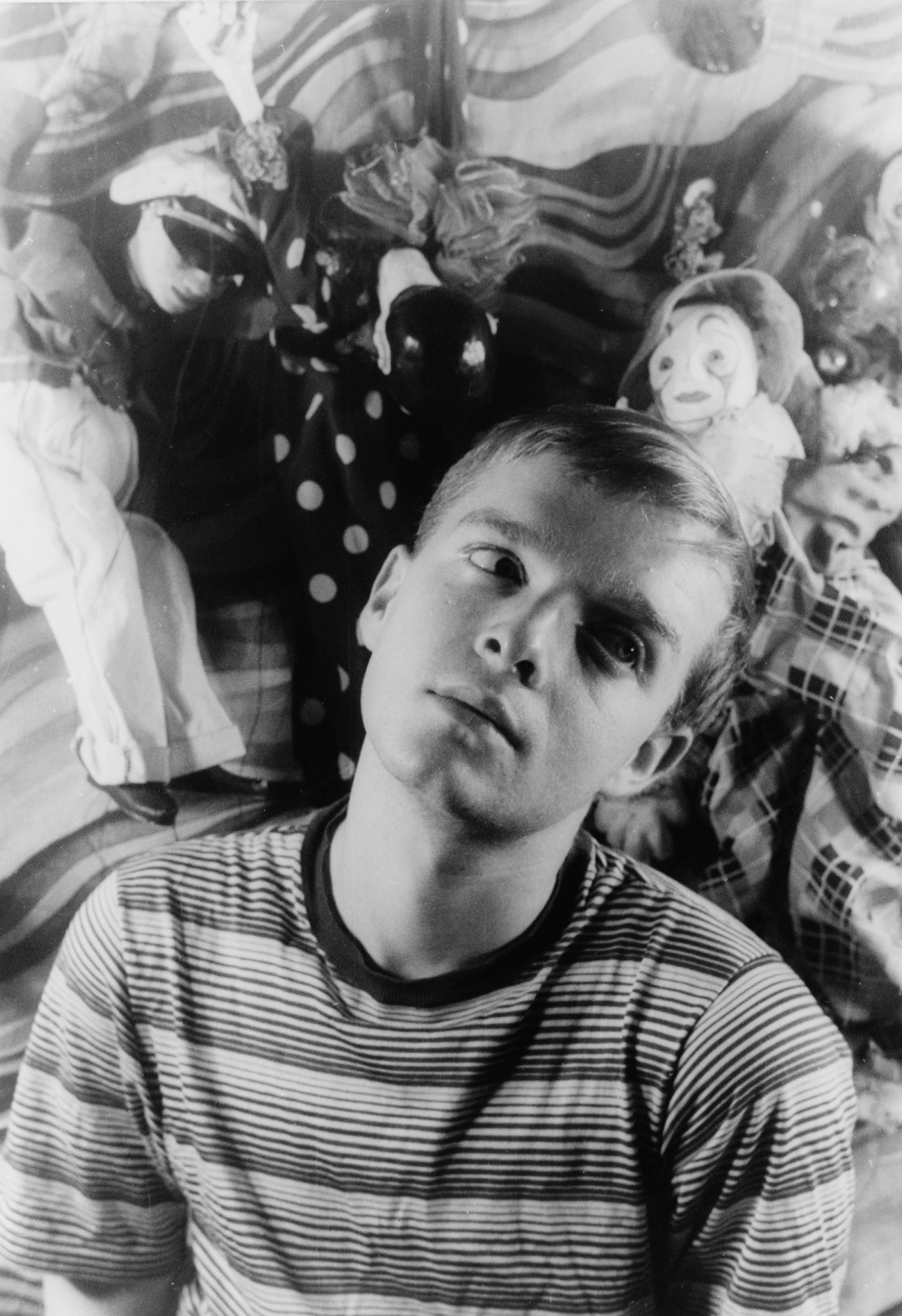
- Here's some modern twee hipster◊ Indie Pop musician's Deliberately Monochrome publicity shot. Boyish face, closely trimmed hair, faraway look in his eyes, retro "mod" striped t-shirt, marionettes in the background. Kind of over-the-top, really ...oh wait, it's actually a 1948 picture of Truman Capote.
- This fashion-conscious young English tourist, clad in a Henley shirt and Round Hippie Shades, with well-trimmed facial hair, just uploaded a selfie he took at the Taj Mahal to his Instagram...or, it's George Harrison in 1966.
- Between her fairly basic outfit and hairstyle and retro furniture styles coming back into fashion, this 1978 photo of Kate Bush could easily be a picture of some Zoomer singer taken this morning.


Comic Strips
- As omnipresent as Garfield has been over the years, what's not well known is that the strip began as Jon, which ran in the Pendleton, Indiana Times from 1976 to 1978. This small one-paper strip was the genesis for a number of facets of Garfield, including the lead characters and some of the early gags, but its existence was almost entirely unknown until 2019; for some reason, Jim Davis always referenced his earlier Times strip Gnorm Gnat in discussing his pre-Garfield work, but never Jon.
- Garfield was not the first orange tabby cat to be the star of his own comic - that honour would go to Heathcliff, who debuted five years earlier in 1973.
Companies
- These days IBM might well be thought of as a computer hardware company, but it actually predates electronics by a long way. The name dates from 1924 (it had been CTR, or Computing Tabulating Recording Corporation before), while the company itself dates from 1911, and was an amalgamation of several existing companies, which date to 1885, 1900 and 1901. Early products included cheese cutters, meat choppers, and scales.
- Nokia, now one of the main manufacturers of cell phone infrastructure (the company no longer produces phones; they recently got out of that business, licensing their name to a separate outfit founded by former employees), was founded in 1865. It was originally a pulp mill, and has transformed itself numerous times over the years performing different services.
- Nintendo is mostly known today as a video game company. While video games have certainly been one of their most successful business ventures, they existed a long time before computers were even invented, as a toy company. The company was founded in 1889, when it produced playing cards, which it still does to this day.
- Sega, Nintendo's most famous former rival, is also much older than nearly any other video game company still around today. While not quite as old as Nintendo, SEGA has been around since at least 1960, when it was a slot machine company, though depending on where you draw the line, may have been founded in 1957 (when David Rosen started up the company that would buy SEGA three years later), 1952 (when Service Games got started in Japan), or even as early as 1942 (when the slot machines began manufacture).
- Sony was founded in 1946 as Tokyo Tsushin Kogyo, a telecommunications company. It acquired its present name in 1958, because foreigners had difficulty pronouncing its name.
- Mitsubishi is mainly known for selling cars in the US in the 1980s, but its name goes back to 1870, though it did not exist as a company for all that time- it was disbanded and reformed during the US occupation of Japan after World War II.
- MegaCorp might sound like something that will happen in the near future, but an actual MegaCorp has been established as early as the 17th century: The Dutch East India Company.
- Not to speak about drug cartels: the British East India Company (officially named the Honourable East India Company) was the first drug cartel in the modern sense, and by far the largest and most influential ever.
- Arguably, the Hanseatic League was a MegaCorp that pre-dated even the DEIC.
- The Hudson's Bay Company (established 1670) never gained the notoriety of the two East India companies, but it functioned as the de facto European government of large parts of North America before various European nations (and later the United States and Canada) got around to claiming them, often using the trading posts and infrastructure established by the company as the basis for their own administration, and was the largest non-national landowner on the planet. It also outlasted the other examples mentioned here, as the Hudson's Bay Company is still in business as of 2020, and though no longer a major landowner it still brings in billions of dollars in revenue annually.
- Not to speak about drug cartels: the British East India Company
- Stora Enso, the world's largest paper producer, is the oldest extant joint stock MegaCorp. It was founded in 1288 as Stora Kopparbergs Bergslag for copper mining (at the copper mine in Falun, Sweden, which was in operation until 1992). It later adopted paper industry as its main area of competence.
- Anyone watching Japanese media might be familiar with the convenience store chain Lawson, and naturally assumed it was a Japanese franchise from the start like FamilyMart or Ministop. Lawson stores go as far back as 1938, with its first iteration being a company store in Ohio.
- Much publicity was made of the time that Crayola retired eight of its crayon colors in 1990 and introduced eight more. Even Crayola themselves hold the stance that this was the first time they had ever retired colors, and that the only two other color changes ever were renaming "prussian blue" to "midnight blue" and "flesh" to "peach". However, this extensive timeline makes it abundantly clear that the 64-count box had multiple changes early in its life, and many other colors were changed or renamed long before then.
- Considering it is known today mainly as a pioneer of streaming television, many people outside the US are surprised to learn that Netflix was around long before it broke into the streaming market in 2007. It was founded in 1997 as a movie rental that conducted its business via mail, in opposition to the then-traditional brick and mortar stores like Blockbuster and Movie Gallery. The movie rental still exists today — albeit only in the US, and a separate subscription plan is required.
- When the first Marriott hotel opened in 1957, it was as an expansion of founder John Willard Marriott's business venture Hot Shoppes, a fast food company that dates back to 1927. Hot Shoppes was renamed Marriott Corporation in 1967, as it moved into the hospitality business full-time.
Fanworks
- Fanfiction in general has been around at least as long as the printing press. Both Miguel de Cervantes and Johann Wolfgang von Goethe had problems with people publishing unofficial conclusions to their works when they had writer's block.
- The first (known English language) Ranma ½ fanfic to have Ranma revealed as transgender was "Clothes Make The...", which was written in 1997, four years after the dub started airing in America. The term "transgender" is older, at 1974.
Food and Drink
- Fast food seems like a modern convenience, but it's as old as civilization itself. In many early cities, most homes lacked amenities needed for cooking so eating out was the only option. Also, with fire standards essentially nonexistent, one untended stove could incinerate a neighborhood. With a city to feed, you can bet the food traders figured out really quickly how to serve as many people in as little time as possible.
- Americans will debate forever where the hamburger was invented, but in fact mince beef patties of various sorts have been a fast food stable for thousands of years. A Roman cookbook dated to the 4th century has a patty recipe with pine nuts, wine, pepper and garum (a Roman fermented fish sauce that was essentially the ketchup of its time, though in its preparation it more closely resembled modern Southeast Asian fish sauces like Thai nam planote ). The same goes for meatballs which were documented in ancient Roman cookbooks, but only became widespread after mainland Europeans migrated in large numbers to the United States.
- Chinese dim sum (buns and potstickers served for lunch) is one of the oldest fast foods, dating at least to the 12th century.
- Macaroni and cheese wasn't brought to America until the time of the poor Italian immigrants, right? Wrong. Thomas Jefferson dined on it at Monticello (although he didn't call it quite by that name).
- Good ol' macaroni and cheese is even older than that. The Liber de Coquina, one of the oldest known cookbooks (dating back to the 14th century), has a recipe for "makerouns", a cheese-and-pasta casserole.
- Another Italian dish, pizza margherita (topped with tomatoes, fresh mozzarella and basil leaves), is popularly claimed to have been invented in honor of Queen Margherita in 1889. The name was first recorded in 1866, and descriptions of pizza with the same toppings go back to the turn of the 19th century.
- The phrase "Drinking the Kool-Aid" has been around only since the late 1970s at the very earliest in connection to the mass suicide at Jonestown, but Kool-Aid itself was first brewed in the 1930s. In Nebraska, of all places. Also, it’s never been determined if Jones used Kool-Aid exactly in the poison he concocted, with some sources saying Flavor-Aid was used instead.
- Given how it's often served and treated today in the Western world, heavily-processed with all manner of flavors, it can be a surprise to learn that yoghurt is exceptionally old. As in, "probably about as old as human civilization" old. It would have been a meal for every ancient culture to have access to milk, especially nomadic ones—none other than Genghis Khan himself espoused it as a food of warriors. However, it only really caught on in the Western world in the 20th century.
- When Taco Bell came out with its "chalupas" (deep-fried soft tacos, often with exotic sauces or salsas applied as toppings) in the late 1990s, most Americans had never heard of them and probably assumed the restaurant chain had made them up. But chalupas are a traditional food from northwestern Mexico, and Californians living close to the Mexican border had been secretly munching on them for decades. Taco Bell was probably the last Tex-Mex eatery to start offering them.
- Mountain Dew pushed the "X-treme" marketing so very aggressively in the Turn of the Millennium that many younger consumers can easily assume the the drink was invented sometime in the late 80's or early 90's. Nope! It was invented in 1948, and as the name "mountain dew" implies, the original marketing angle was based on hillbilly moonshiners.
- Onion rings in a recipe from 1801, as explained by Jas. Townsend and Son.
- Pizza Hut was founded in 1958, and only started going international in the mid-1970s.
- Pancakes and marshmallows have been dated to Ancient Egypt. Pancakes have remained mostly unchanged over the thousands of years, though marshmallows at the time were made out of the roots of the eponymous marsh mallow plant, which grew along the Nile, and were irregularly shaped.
- The concept of a kids' meal with a toy in it was introduced not by McDonald's Happy Meals, but rather by Burger Chef's "Funmeal" a few years prior.
- When you tell people about Hydrox cookies◊, most people would probably say that's it's just a cheap Oreo◊ knockoff, but actually Hydrox started in 1908, four years before Oreo.
- Starbucks "sippy lids", commonly associated with their campaign to phase out straws after Seattle's July 2018 plastic straw ban, actually started being used about a year and a half prior in order to allow customers to enjoy the foamy elements of the chain's Nitro Cold Brew beveragenote . The strawless initiative simply rolled the lids out to all stores (not all Starbucks shops serve NCB) for use with all cold beverages, not just Nitro.
- Peanut butter predates George Washington Carver by a very long time; the Aztecs were eating it as early as the 15th Century.
- The three most common Dorito flavors — Nacho Cheese, Taco, and Cool Ranch — were rolled out over the course of 20 years (with Taco being quite a bit older than the "default flavor" Nacho Cheese, and having been retooled into a Taco Bell tie-in in the 1990s before changing back) but all three were invented in the 60s and were candidates for the chip's original flavor. Originally, Doritos had no flavoring and were just the same as any other tortilla chip; the unflavored variant is still sold as "toasted corn" in some markets.
- The first independent (think Uber Eats, GrubHub or Door Dash) food delivery service was started somewhere in The '80s by Geoff Schwartz and operated in and around Jenkintown, Pennsylvania. Although, he failed because a) he and his friends did all the work instead of it being farmed out to "independent contractors" (deficient logistics) and b) he conducted his business via phone and pager instead of having his own app (undeveloped technology). This was fictionalized in The Goldbergs episode "Food in a Geoffy", where in true Goldbergian fashion we can see Adam F. Goldberg-produced real footage of the actual operation at the end of the show.
- Papa John's got roasted online in 2022 for announcing a "crustless pizza" (i.e., the toppings of a pizza cooked as a casserole), but "take 'n' bake" chain Papa Murphy's has been offering the same thing (even calling it "crustless pizza") for years. Some observers have even pointed out that the "Cup O'Pizza" from The Jerk was the same idea.
- While the perception might be that Red Vines is the legacy red licorice brand and Twizzlers are the upstart challenger, it's actually the other way around. Twizzlers' founding company Y&S began in 1845 and the Twizzlers brand was launched in 1929, while the Red Vines brand was created in The '50s by the American Licorice Company (founded in 1914). Twizzlers didn't really go national or achieve their current form until Hershey bought the brand in 1977.
- No doubt you assume that tuna noodle casserole was the invention of some enterprising cookbook editor writing for suburban American housewives of The '50s. The first printed version of the recipe was a reader submission to Sunset magazine in 1930. The introduction of Campbell's Cream of Mushroom soup in 1934 (the 1930 recipe called for mushrooms and white sauce) and the necessity of using canned goods during World War II contributed to the dish's spread.
- The Starbucks coffee chain first came to international prominence in The '90s, but was founded in 1971.
- Krispy Kreme was founded in the 1930s, but was mostly limited to the south until the Turn of the Millennium.
- Surely with Subway becoming such a prominent restaurant since about The '90s, it can't be that old, right? It was founded in 1965.


Legends and Folklore
- Though abduction of humans by aliens wasn't commonly reported before the 1960s, people would tell tales of having been abducted by witches on broomsticks (Older Than Print) or spirits/ghosts/demons (Older Than Feudalism). Alien abductions and sightings bear uncanny resemblance to the fairy encounters of the old myths. The phenomenon of sleep paralysis only goes halfway in explaining the experiences, but clearly something in the human brain has a habit of creating illusions of otherworldly encounters.
- There were some "UFO" sightings as far back as the 19th century, with alien "balloons" and "airships" instead of "flying saucers."
- And then there is Agobard of Lyon, who wrote about the peasants' belief in flying ships coming from "Magonia, the land beyond the clouds inhabited by wizards" and how they ruined crops and kidnapped people only to return them to the same place after some time (maybe even years). All this right in Carolingian times (roughly 800AD to 1000AD).
- The funniest (and most unexpected) part is that Agobard is actually a skeptic, and his account of the capture of four supposed passengers from one of these airships is just a long reflection on how stupid people have to be to believe something like that. His text wouldn't look out of place as a troll thread in a modern UFO board on the internet.
- Jacques Vallée explores the pre-modern history of UFOS in his book Passport to Magonia.
- Crop Circles are often considered a recent occurrence, and in fact many people assume they're all a hoax because two Englishmen admitted to faking a ton of them in the nineties. However, reports of crop circle-like phenomena go back at least to the Mowing Devil in 1678.
- The first recorded "UFO investigation" took place in 1235 Japan, under the orders of (General at the time) Shogun Yoritsune Kujou. His consultants came to the conclusion that the strange lights in the sky were "Only the wind making the stars sway."
- The first reported UFO Crash was the Aurora Incident, which was said to have crashed into a farm after hitting a windmill, though witnesses said it was smoking before hitting the windmill. The pilot survived and was buried in the town's cemetery with "Full Christian Rights". The cemetery commission refuses to exhume the body and has even removed the marker to prevent tourists and nuts from finding the spot.
- There were some "UFO" sightings as far back as the 19th century
- The Masamune is a classic Public Domain Artifact, referring not just to a single sword but to the collected works of a famous swordsmith of that name who lived in the 13th and 14th centuries, although legends surrounding them have sprung up since thennote . Nevertheless, people on This Very Wiki have mistaken it for an original creation associated solely with Final Fantasy VII (which is double whammy of a mistake, since swords called "Masamune" were even appearing in video games as far back as Final Fantasy).
- The idea of the Daywalking Vampire dates at least as far back as 18th century, with Romanian Strigoi being so resistant to sunlight that they could start families and live normally. Other examples are even more extreme in this regard, such as the Upyr of Russia, which hunted exclusively between noon and midnight and the Greek Kathakano, which was strongest at noon. In fact, this is actually a case of Newer Than They Think, since the idea that vampires were burned by sunlight in the first place was invented for the 1922 F. W. Murnau film Nosferatu.
- Witch-hunting in Europe is sometimes held to be a consequence of Christian ascendancy, since in later centuries witches were accused of gaining power from Satan, plus, in modern times, confusion between witch-hunting and persecution of pre-Christian religions. But the European fear of witchcraft in its essence, that is, that your neighbors could use magic to curse you to bad luck or death, predates the existence of Christianity by centuries. Laws against and prosecution of evil magic are well-documented from the early Roman Republic, and at least one case is known from 4th-century BC Greece.
- This trope is one of the few cases of something being this and Newer Than They Think. Large witch hunts did not occur in Medieval Europe due to the dominance of the Catholic Church, which officially believed that witchcraft did not exist; in fact, it wasn't unknown for people who made accusations of witchcraft to get in trouble for heresy. When the Malleus Maleficarum was released, Catholic authorities strongly criticised it for unethical practices and doctrinal inaccuracy.
Literature
- The Junk and the Dhow by Rudyard Kipling gently covers a lot of proudly reinvented bicycles with this trope and then dances on it.
- Speaking in the third person is Older Than Feudalism. Julius Caesar refers to himself in the third person throughout his history of the Gallic Wars (a tendency parodied by Asterix).
- Most people assume that the Zombie Apocalypse started with George A. Romero's Night of the Living Dead (1968), but it can be directly traced to Richard Matheson's I Am Legend, published in 1954. Romero himself admitted that Night of the Living Dead was just a rip-off of Matheson's book.
- What's interesting is that I Am Legend hits most if not all of the hallmarks of a Zombie Apocalypse, even though the monsters in that book are vampires.
- Before that, the Mesopotamian goddess Inanna/Ishtar was threatening to cause Zombie Apocalypses when she didn't get her way in ancient myths.
- A Distressed Dude getting rescued by a female character is not a result of feminism. Many a Fairy Tale features an heroine rescuing one — or several. (Who killed the witch in Hansel and Gretel? It wasn't Hansel.)
- History and folklore are full of Action Girls, Ladies of War, knightresses, and mighty female heroes, many of them completely real. Jessica Salmonson compiled an Encyclopedia of the Amazons with every historical female badass she could find.
- Writing a prequel to tell the story of the father of the main character of a previous work? François Rabelais did this 500 years before George Lucas with Gargantua, the prequel to Pantagruel.
- Still earlier, Apollonius's Argonautica is essentially one big bachelor party, featuring the fathers of all the main characters in the Iliad.
- Likewise, remakes, reboots, sequels and prequels were not invented by Hollywood. It was common practice in ancient Greece and in 17th century France among classical authors to base their plays on well-known episodes of the Trojan war or to write their own version of the existing work of a more ancient author. Moliere's The Miser, for instance, is a remake of a latin play, Aulularia, by Plautus, with some dialogues lifted almost verbatim! The public wanted to see how a new author was going to use the subject material; it didn't matter that the later was not new.
- What about fanboys writing their own sequels and prequels to their favorite works? Well, there's The Aeneid, a Continuation Fic of The Iliad and The Odyssey written by Roman fanboy Virgil centuries after the original author's death. Or Paradise Lost, a fanfic of The Bible that explores the events leading up to Genesis... and gives Satan an unusually sympathetic and charismatic portrayal.
- Jesus fan fiction first appears in written form in the 2nd century or so. The Infancy Gospels are the exact equivalent of Superbaby.
- Fanfic in the modern sense (taking a published author's creation and having an organized fandom around it with amateur publications, use of Word of God, and the author well aware of the fandom) dates back to at least Sherlock Holmes and the Baker Street Irregulars putting out letterzines, unauthorized sequels, and so forth. For television, Star Trek: The Original Series originated and refined a lot of the tropes and process, but the zines and fanfic for The Man from U.N.C.L.E. predate the Enterprise by at least two years.
- Jesus fan fiction first appears in written form in the 2nd century or so. The Infancy
- The basic idea of a Macekre predates Carl Macek by over a century— the earliest translators of Jules Verne into English were infamous for their numerous misinterpretations of the text when they didn't rewrite, add, or delete entire scenes, and often changed the names and nationalities of characters willy-nilly. note The translations were so bad that they ruined Verne's reputation as a writer in the English-speaking world for a century, much like how anime had a bad reputation for a while thanks to companies like 4Kids Entertainment. See here for more information.
- Science Fiction literature must be something from the 20th century right? Nope, Jules Verne already wrote stories about moon travel, journeys to the center of the earth and travels to the bottom of the sea in the late 19th century. Even before him, there was Mary Shelley's Frankenstein in 1818note , and in the 17th century, there is Francis Godwin's "The Man in the Moone" (1638) as the first work of science fiction in English, and Cyrano de Bergerac's "Comical History of the States and Empires of the Moon" (1656). Space travel also figures prominently in Voltaire's "Micromégas" (1752), which is also notable for the suggestion that people of other worlds may be in some ways more advanced than those of earth.
- In that Jules Verne story, From The Earth To The Moon, Verne did the research and had his lunar explorers fire themselves out of a giant cannon from Florida, nearly a century before NASA set up shop at the Kennedy Space Center.
- Arthurian Legend was so popular amongst Victorian Britons that they held a mock-medieval tournament in 1839, which means HEMA and cosplay are close to two centuries old. Then there's Edward I of England in the 13th century, who was a big fan of King Arthur and used him as a political tool against the Welsh, so politics in fandom are about eight hundred years old. Few, however, can top Neuschwanstein Castle, a ridiculously expensive mock-medieval castle built by King Ludwig II of Bavaria in the late 19th century. It was heavily inspired by two operas of Richard Wagner, who in turn were essentially fan-adaptations of Germanic mythology and Arthurian legends. This makes Neuschwanstein the most expensive replica model in history.
Live-Action Television
- I Love Lucy was not the first television program. Neither was Milton Berle's Texaco Star Theater (1948-56) or Sid Caesar's Your Show Of Shows (1950-54). The reason that nobody knows about any of the earlier TV shows is because these shows were not filmed, but simply recorded and broadcast live. No copies of the shows were made, so they could only ever air once. By the time that television became affordable for the average American, the older programs were lost. This is also why most people are convinced that television was invented in The '50s, when it was actually around in some form ever since 1926. The first regular, scheduled public TV service started in 1936. Fans of The Three Stooges may also recall a scene their 1940 short "A Plumbing We Will Go", in which a wealthy woman shows off her new "television receiver" to her guests.
Personal Names
- The name Conan was not invented by Robert E. Howard. It is an old Irish name dating back to The Dark Ages, which is where the Irish-descended Arthur Conan Doyle and Conan O'Brien derive it from.note
- The name "Wendy" is commonly attributed to J.M. Barrie's Peter Pan and it's true he popularized the name, but the name was recorded as being used in the US as early as the 1820s, about forty years before Barrie was born.
- "Wendy" has an alternative etymology. "Gw-" names are common in Welsh; a typical opening prefix is Gwen-. Gwenda is perfectly possible, and King Arthur's wife in Welsh was Gwyneddfa - Guinevere. Gwendolyn is a girls' name that can be shortened to something sounding like "Gwendy", or sometimes "wendy".
- Barrie got it from his friend Margaret Henley. About three at the time (she died at five), she called him "my fwendy" and then "my wendy". Since Barrie popularized it, it's also become a nickname for "Melinda". Small children are responsible for a lot of nicknames, eh?
- "Wendy" as a nickname for "Melinda" became further codified when Wendy's grew into a major US (and eventually international) fast-food chain. The chain was named after the fourth of founder Dave Thomas' five children, who had that given name and nickname.
- "Jennifer", the single most popular name for American girls for almost all of The '70s and The '80s, dates to the Middle Ages as the Cornish variant of the Welsh "Guinevere".
- "Stacy" is a post-WWII creation, right? And it certainly is a girl's name - isn't it? Try telling that to Stacy Potts, a man who lived in New Jersey during the American Revolution (1775-1783), and who is known to us because he was a personal friend of the Hessian colonel Johann Gottlieb Rall, George Washington's opposite number at the famous Battle of Trenton on December 26, 1776. Stacy is Older Than Feudalism, as it existed as a nickname for two different Greek-derived names—Anastasis (male)/Anastasia (female), from Ανάσταση, Anastasi..."resurrection", or Eustace (male), from Εὐστάθιος, Eustathios..."fruitful". There are also the English surnames Stacey and Stacy, which derive from Eustace as well.
- Similarly, "Christy" has certainly been a personal name (and, like "Stacy", exclusively a female one) for only about, oh, 60 years now, huh? And it was first popularized by fashion model Christie Brinkley (born 1954), wasn't it? People who say such things have obviously never heard of the certifiably masculine Christy Mathewson, who debuted for the New York (now San Francisco) Giants in the summer of 1900, and who is still considered by baseball buffs to be one of the greatest pitchers ever.
- "Tiffany" sounds like a twentieth century name if there ever was one, but it's found in documents dating from the 1100s in England and France as a variation of the name Theophania. The reason for this is that the name went out of style for a few centuries, and wasn't really revived until The '60s. This is typically blamed on the success of the film Breakfast at Tiffany's, which came out a year before "Tiffany" cracked the top 1000 baby names in the U.S. I Am Not Shazam was probably a factor in this, since the "Tiffany's" in the title refers to the jewelry company, not Audrey Hepburn's glamorous character Holly Golightly. And the jewelry company was named after the last name of its male founder, Charles Lewis Tiffany.
- Thanks to Bette Davis and Bette Midler, "Bette" seems like a 20th Century American invention, as a sophisticated-looking diminutive of Elizabeth. In fact, it existed as a female name among the ancient Saxons, and the name of the Staffordshire village of Betley means "Bette's meadow" in Old English.
- "Audrey" certainly seems to be a product of the twentieth-century fad of giving last names as first names thanks to Audrey Hepburn, but it's actually a variant of the Old English Æthelreda and the name of a seventh-century saint.
- "Brice/Bryce" is almost certainly a product of the late nineties and early oughts, right? It's actually the Norman French variation of the Latin Bricius, itself from a Gaulish root, and is also the name of a fourth-century AD Bishop of Tours, also immortalized by a 1002 massacre in England which set the stage for the next 60 or so years of on-and-off civil war.
- Speaking of trendy names of the late nineties that are actually very old, "Austin" is the Norman French version of the extremely ancient Augustine, and was brought to the British Isles by the Normans during their invasion.
- African-Americans having distinctive names is often thought of as a trend that cropped up in the 1960s at the earliest, due to the influence of the Black Power movement. In reality, black Americans have had distinctive names since at least the mid-19th century, as recent analysis of census records and other documents shows.
- "Lucy" is often used as a nickname for "Lucille", so it's natural to assume that Lucille is the older name of the two, but no—Lucille actually originated as a nickname for Lucy. Lucy is the English form of Lucie, the French form of the Roman name Lucia. Meanwhile, Lucille is the French form of Lucilla, which was the Roman diminutive of Lucia (basically "little Lucia"). Even in Roman times the names were interchangeable; there are distinct early Christian saints named both Lucia and Lucilla.
Politics
- Pax Americana. The most commonly cited point for the U.S.'s ascension to superpower status is around the end of World War II, which the U.S., U.S.S.R., and U.K. won. In actuality, while they did not flex their power as much as they did from the mid-20th century onwards, the United States was already widely acknowledged as the world's strongest country for decades before World War II began. By the late 19th century, the United States had already surpassed the United Kingdom and its Dominions as the world's largest economy and manufacturer, and around the same time, it was shown to be powerful enough to field millions of well-equipped troops in North America (cf. American Civil War) and push around the European great powers in the Americas (cf. Napoleon III's Mexican withdrawal, the Venezuela crisis). It only got more formidable from there as its growth exploded into the early 20th century. The final nail in the coffin for anyone doubting America's dominance came in 1918-1922, not 1941-1945; it is in the former years that the U.S. demonstrated the capability to send millions of well-equipped troops across the Atlantic in a matter of months,note pay for a global war effort,note and dictate terms to European great powers in Europe (Woodrow Wilson was the only national leader who acted with complete impunity at the Versailles negotiations), something that continued into the interwar era (e.g. the U.S. declared France would forgive much of Germany's debts, despite France's protests).
- The idea that South America might be the next big superpower has been talked about for centuries, ever since Portugal moved its royal family to Brazil and the country became independent not long after. In the late 19th and early 20th century, Brazil especially seemed to already be a superpower. For a time, it was exceeding several European powers in terms of a navy, which was often used as the measuring stick of empires at time. Brazil, Chile, Argentina, and Peru have been theoretically capable of long range power projection since the early 20th century and demonstrated so to a limited extent. However economic and political turmoil at home and much more of the same in their neighbors always seem to stifle an interest in intervening outside the continent.
- The idea of "glasnost", namely partially opening up a system to protect its ultimate survival, predates Mikhail Gorbachev by over a century. It was originally proposed by Tsar Alexander II to please the growing revolutionary movements in Tsarist Russia in the late 19th century.
- The feudal system was not a Dark Age Europe invention. The Achaemenid Empire in the fifth-century BC already had a system that put The High King in charge of smaller vassal-kingdoms aka satrapies, that were administrative units who paid taxes to the central government in exchange of protection and moderate autonomy.
- Thanks to a certain John O'Sullivan (the man who also gave us the phrase "manifest destiny"), a lot of people think the United States was a "great experiment in liberty." They forget that the founding fathers were looking to the concepts of democracy/representative democracy found in the Greek poleis and the Roman Republic (which dates back to 509 BC). There's a reason why so much architecture in Washington DC mimics Greco-Roman style.
- A form of representative democracy has been practiced by the Iroquois Confederation since at least the sixteenth centurynote , while a similar system (the Alting) also existed in Iceland since 930 — though in their original forms, they may have been closer to oligarchies, as they were councils of warrior-elites.
- A representational democracy, where parliamentary representatives were elected on local level (according to one man - one vote rule) and the chief of state was elected by common vote was used between 1573-1795 in the Polish-Lithuanian Commonwealth (with the caveat that only nobility had the right to vote, but since Polish nobility was so ridiculously numerous it still made a percentage of potential voters higher than in the First French Republic).
- When the state of Arizona passed a tougher immigration law in 2010, the move was seen as largely controversial. One oft-stated reason was how unprecedented it was and so un-American in general. In actuality, most of Arizona's law mirrors the federal immigration law that had been on the books for 70 years.
- Most of the Arizona law was right out of the federal requirements for immigration. However, it was not quite identical. One of the main things that made the more intelligent critics of the AZ law go bananas was the requirement that state law-enforcement officials ask for documentation when stopping/arresting suspects. It makes a certain amount of sense to have federal law enforcement to do this, since federal law typically involves things moving across state lines and international borders (like drug smuggling) or things harmful to federal interests (like attacking federal officials and facilities), which often involve undocumented foreigners (think cartels and terrorists). Moreover, federal trials are expensive while deportation proceedings are not, so the US Attorney needs to know this to save Uncle Sam some money. On the other hand, state law enforcement is charged with day-to-day law and order, so it's no more likely that the offender is undocumented than not, meaning that the Arizona law had to include a bit that amounted to permission to engage in racial profiling (otherwise, you'd have to ask everyone to show their papers). Moreover, deportation hearings are federal matters, so while the state might save money, it shifts the burden for processing those undocumented the state does catch—which would be a lot more, since you're working off traffic violations and petty theft rather than smuggling—to the federal government. This, combined with the fact that immigration law is clearly assigned to the federal government by the Constitution, combines to get at the feds' main complaint about the bill: it's a state usurpation of federal power.
- Many people thought that the accusations that Barack Obama was born in Kenya/Indonesia was the first time a US president accused of being not constitutionally eligible on the grounds of not being a "natural-born citizen". However, the first president with that dubious honor is actually Chester A. Arthur who was rumored to have been born in Canada, then a British colony.
- The beginning of Barack Obama's "Forward"-themed 2012 presidential campaign was accused by detractors of being based in Socialism (the word "forward" allegedly having Socialist leanings), coupled with an appearance in Milwaukee's Master Lock factory in front of a blue flag reading "Wisconsin 1848" supposedly represented a labor union, made controversial by labor unions falling out of favor in U.S. conservative circles - "Forward" has been Wisconsin's official motto since 1851, and while the state flag was edited to include "Wisconsin" and "1848" for clarity in 1979, the coat of arms as a central part of the representation of Wisconsin dates back to 1881, with 1848 as the year Wisconsin became a state.
- The American Civil War wasn't the first time in the United States' history that the country faced a serious threat of secession. About fifty years before that, during the War of 1812, there was serious talk within the Federalist Party of New England seceding from the Union. What, you thought the "Yankees" were always the ones against secession?
- The idea of a general strike (associated with the modern labor movement) actually dates back at least as far as the early Roman republic, when plebeians would arrange to collectively march out side the city (leaving the patricians there alone and grinding all industry to a halt) in order to force concessions from the patrician-led government.
- The first recorded instance of a workers' strike was thrown by the pyramid builders. They wanted larger food rations.
- Rosa Parks was not the first black woman to refuse to give her seat to a white man. Elizabeth Jennings Graham is widely recognized as the first person to do this back in 1854 (although it was a streetcar, not a bus). On May 4, 1884, educator Ida B. Wells refused to move from her first class seat on a train to the designated black area in the smoker car. In 1946, Irene Morgan did the same thing on an actual bus. On March 2, 1955 Claudette Colvin did the same thing. On October 21st of the same year, Mary Louise Smith also did this. Rosa Parks refused her seat on December 1st.
- In Ancient Egypt, according to an ancient and significant law, no one may kill a cat... or a dog. The punishment was death. Dogs as well as cats were considered sanctified. Other animals were revered and treated well as they were supposed to be embodiments of the gods. It amounts to the fact that the Egyptians invented animal rights laws.
- Schools were first prohibited from using corporal punishment in 1783 when Poland did just that.
- In 1285, Edward I attempted to curb air pollution by outlawing the practice of burning coal... creating among the earliest versions of environmental laws.
- Same-sex marriage goes all the way back to medieval days, when there were ceremonies called the "Office of Same-Sex Union" and the "Order for Uniting Two Men". Documents verifying the marriage of Pedro Diaz and Muño Vandilaz in 1061 were found in a Galician monastery in 2011. In 1901, Marcela Gracia Ibeas and Elisa Sanchez Loriga attempted to marry, with Marcela taking on a male identity.
- Several cultures, such as various Native American tribes, have a word for "third gender" or an understanding of transgender/genderqueer/intersex issues. For many Americans, though, their first exposure to a trans person was a celebrity, such as Chaz Bono, John Jolie, or Caitlyn Jenner. A generation or two ago, the name you'd hear would be Christine Jorgensen, and the phrase would be "sex change operation". Nor was she the first; that would have been Lili Elbe in 1931.
- "The terrorists have won" originated no less than six years before 9/11, having been used in a journal published by the Ocala Star-Banner in the aftermath of the Oklahoma City bombing.
- As any expert on Korean history will tell you, the Korean Peninsula has been getting caught in the middle of skirmishes between competing enemy countries since about 400 years before the Korean War—which is understandable, since it occupies a rather perilous position right between Russia, China, and Japan. The shogun and the Ming Emperor were coming to blows over the peninsula as early as the 16th century, and it was the scene of much of the fighting in the First Sino-Japanese War and the Russo-Japanese War in the decades after the Meiji Restoration. When Imperial Japan finally gave up Korea after Hirohito's surrender in 1945, the United States, the Soviet Union and Communist China just became the latest countries fighting for control of the peninsula. In hindsight, the eventual stalemate between the various competing factions (with the resulting partition of North and South Korea) almost seems inevitable.
- The French Fourth Republic has become a byword for political instability, with twenty-one different administrations in the span of twelve years. However, this instability was not specific to the Fourth Republic, nor indeed to the Third Republic that preceded it; the July Monarchy had a similar problem with keeping its governments in place, with seventeen different administrations in the span of eleven years (not counting the seven years of relative immobility under Marshal Soult's third government).
- U.S. President Donald Trump's "Make America Great Again" Catchphrase actually dates back to Ronald Reagan's 1980 presidential campaign. In addition, Bill Clinton also briefly used the "Make America Great Again" phrase during the early stages of his 1992 campaign for President.
- On a similar note, the idea of a man with no experience of elective office or military service winning the presidency actually isn't new; the Republicans nominated another businessman, Wendell Wilkie in the 1940 election, and one of the chief reasons for the Democrats putting up Franklin D. Roosevelt for an unprecedented third term as president was because their polling showed that Wilkie would have easily trounced any of the other likely nominees that the Democrats could have put up, had Roosevelt followed tradition and stepped down after two terms.
- Shortly after his term ended, people were surprised to learn that Trump had a red button on his desk that would call in a sever with a can of Diet Coke whenever he pressed it. That factoid went viral quickly as it seemed too ridiculous to be true. Yet, Trump was not the first person to have a button that delivered a beverage to him. In fact, President Lyndon Johnson had a similar button on his desk, too. The main difference was the beverage of choice — Johnson preferred Fresca.
- In the US, every modern Democratic president and one Republican (Richard Nixon) have supported universal healthcare of some sort but the idea dates as far back as Theodore Roosevelt’s platform in 1912. Most countries developed systems post-World War II but the world’s first universal healthcare system started in the 1880s in Germany.
- The idea of a female President of the United States goes back even before Shirley Chisholm broke new ground by becoming the first woman in contention for a Presidential ticket—while President Woodrow Wilson was suffering from a debilitating stroke that had catapulted him well over the Despair Event Horizon, his wife Edith ran the executive branch in his stead while his staff kept his illness a secret, effectively serving as, for all intents and purposes, the 28½th President of the United States.
- Contrary to popular belief, the #MeToo movement against sexual harassment was not born from a tweet actress Alyssa Milano made in October 2017 after the Harvey Weinstein scandal unfolded. It was actually founded by Tarana Burke about eleven years prior. Burke’s version of the movement specifically focused on the problem among black women, while Milano universalized the movement to focus on all women.
- Prohibition wasn't the first ban of alcohol on American soil. The Province of Georgia started out as a "dry" colony where booze was illegal.
- Bernie Sanders wasn't the first Jewish American to run for President. If you define "Jewish American" as having Jewish ancestry, then it was 1964 Republican nominee Barry Goldwater, who was born to a Jewish father and an Episcopalian mother, and raised Episcopalian.note If you go by "ethnically and religiously Jewish", then it was 2000 Democratic vice presidential nominee Joe Lieberman, who ran for the Democratic nomination in 2004 but dropped out after the early primaries.
- While the half-black/half-South Indian Kamala Harris became the first woman of color (and the first person of both of those races) to be Vice President in 2021, she's not the first person of color to be one. Herbert Hoover's VP Charles Curtis was of not-quite-half (3/8) Native American descent and grew up on a reservation in Kansas.
- "Democrat Party" as a Malicious Misnaming of the Democratic Party by Republicans was popularized in the modern era by Newt Gingrich during his tenure as Speaker of the House (1995-1999), but it has a long history. Joseph McCarthy loved using the term. It was also used by the campaign of Republican presidential nominee Wendell Willkie in 1940. But it's actually Older Than Radio; the earliest citation of "Democrat Party" used pejoratively by a Republican is a speech from 1889.
Professional Wrestling
- The theme song for Brodus Clay, "Somebody Call My Momma", was played for Ernest "The Cat" Miller back in 2004.
- Certain signature moves in Professional Wrestling are attributed to current wrestlers who use them but in fact were actually around long before said wrestler started using them as a signature.
- The Bella Twins have a gimmick of wearing the same gear and switching with each other during matches to win. Kurt Angle did this twice, using his brother Eric first at Survivor Series 2000 and again on an episode of SmackDown in 2003. Kurt and Eric weren't twins though, so it was used mostly as a distraction so Kurt could quickly sneak out a win.
- The Killer Bees (Jim Brunzell and B. Brian Blair) did that in the 80s with masks. The rule of "in a tag match, the legal man must make the pin" was enforced far more then.
- Certain feuds are older than many people think due to some wrestlers moving from promotion to promotion at times and ending up in the same place long term. John Cena and Randy Orton's rivalry, the most personal one in recent years, goes back to their OVW days, back when Cena was The Prototype. In fact, their kayfabe dislike for each other, even when they're both faces, is one of the few things that is not affected by the Three Month Rule.
- The wearing of masks in wrestling has been popularized by the lucha libre of the twentieth and twenty-first centuries. But the first masked wrestler was not Mexican or even Hispanic, but French - and he started the trend during the late nineteenth century! He obviously didn't think what he was doing was going to be a big deal, because he billed himself as "The Masked Wrestler."
- Similarly, the use of facepaint in wrestling did not originate with the Legion of Doom, even though they certainly popularized it. There are photos from the 1960s of wrestlers with "Ultimate Warrior"-style winged symbols painted over their eyes.
- Depicting Kane as a "monster" in 1997 was pretty original, wasn't it? Actually, no, it wasn't, because Gorilla Monsoon had portrayed the "evil subhuman" character type nearly 40 years earlier.
- The theme for Ric Flair, Also sprach Zarathustra by Strauss, was released on 27 November 1896 and was featured in the Stanley Kubrick film, 2001: A Space Odyssey released in 1968.
- In 1997, WWF brought people over from ECW and NJPW as part of a shared talent contest, as well as bringing over Mexican wrestlers for their short-lived Super Astros series in 1998-1999. Notably, Yoshihiro Tajiri (via NJPW) and Super Crazy (via AAA) appeared in WWF before they became associated with ECW, and RVD's appearance as part of the ECW crossover led to him establishing connections that would make him a top star in WWF as soon as they bought out ECW in 2001.
- Prior to their TNA appearances, AJ Styles, Christopher Daniels, Elix Skipper and Samoa Joe appeared in WWF, with the first four also appearing in WCW, but all were lower card at the time. Similarly, Shark Boy had a brief run in WCW before he entered TNA a few years later.
- The CHIKARA storyline about Shane Storm selling out the tecnicos by giving UltraMantis Black the counter to Mike Quackenbush's Finishing Move the CHIKARA Special to give to Chris Hero, leading to Hero defeating Equinox (Vin Gerard) in their Mask vs. Hair match at The Sordid Perils of Everyday Existence on November 11, 2007, had been done 24 years earlier in reverse. In Mid-Atlantic Championship Wrestling in 1983, Pvt. Nelson (Boris Zhukov) turned Face by giving Ricky Steamboat and Jay Youngblood the secret to escaping Sgt. Slaughter's Finishing Move the Cobra Clutch.
- In re Brock Lesnar's "Eat Sleep Suplex Repeat": There had been a Friday the 13th spinoff novel titled Hate-Kill-Repeat.
Puppet Shows
- The gravelly voice used by Rowlf the Dog of The Muppet Show has been described as a Tom Waits impression — although Waits was only 13 when Rowlf debuted.
- This is parodied in More Information Than You Require.
- Punch and Judy came from the Italian commedia dell'arte, circa 16th century.
Religion and Mythology
- Homer's The Iliad may well be the oldest example of the expression "to bite the dust", rather than the western movies and the song by Queen that people generally associate with the expression. However, it was the King James Bible (first published in 1611) that first translated the original Greek wording into English.
- Mahabharata: The Brahmastra, a magical weapon of immense power that could completely obliterate its target with a single shot, but as a consequence, would wipe out all life in a vast radius of the attack, rendering the area a barren wasteland and causing all bystanders to become sterilised. Sounds like a Fantastic Nuke, right? Well, it could be...if it didn't come from Hindu Mythology's ancient Sanskrit scriptures that predate the Manhattan Project by millennia.
- Many people believe that theistic evolution was created after Charles Darwin's On the Origin of Species proposed the concept of Evolution as a way to fit Genesis with current science. Few know that the Roman Catholic Church accepted a concept very close to theistic evolution nearly 500 years before On the Origin of Species was ever published. St. Thomas Aquinas likened God's creation to a farmer who planted a seed and observed the plant growing and changing over time. The works that featured this concept are actually the reason he is honored as a saint.
- The concept of "X" as an abbreviation for Christ (e.g. "Xmas") is Older Than Feudalism, dating from the Roman persecutions of early Christians who'd use the Greek letter χ (chi), the first letter of Christ written in Greek, as code.
- The "XP" logo seen in Catholic and Anglican churches is χρ chi ro, the first two letters of Christ. The X is also seen in medieval manuscripts as shorthand.
- The traditional concern about Christmas becoming too "commercialized" is as old as the modern conception of the holiday itself. For instance, Harriet Beecher Stowe complained about as much in her 1850 book, The First Christmas in New England.
- The holiday of Easter is known in all other European languages with a name deriving from Latin Paschalis. This word itself is a loan from Hebrew - from פסח (pesach), which translates in English neatly as Passover. The commandment for Passover can be found in the Book of Exodus, making it Older Than Feudalism.
- The Easter Bunny totally feels like the creation of some American department store looking to jazz up Easter sales by creating a Spiritual Successor to Santa Claus. In fact, the Easter Bunny in its current form was codified quite a while before Santa was. It derives from the German custom of the Osterhase ("Easter hare"), which is attested in writings as far back as the 1500s. It came to America via the Pennsylvania Dutch, who emigrated from Germany to America in the later part of the 1700s.
- Similarly, Pentecost was originally a Jewish holiday, Shavuot (also known as the Feast of Weeks). Passover and Shavuot are both part of the Three Pilgrimage Festivals mentioned in Exodus; the remaining festival, Sukkot, in contrast, is not important in Christianity and as a result is obscure outside of Judaism.
- Thanks to Eurocentrism and the idea that Christianity is Europe's religion, many people today find themselves surprised that the religion has been known in many regions longer than they thought.
- Tiridates III of Armenia converted to Christianity in 301 and made it the kingdom's state religion immediately. This was over 70 years before Theodosius I made Christianity the state religion of the Roman Empire.
- Christianity in Korea dates back long before the Americans arrived in the 1950s - in fact, it goes back to the Joseon Dynasty during the early 1600s, when the writings of a Jesuit missionary visiting China made their way to Korea.
- Christianity in India did not come with the British Empire. Tradition says it was brought by Saint Thomas, the very apostle who wanted to see the scars of Christ. The Portuguese also came first, also bringing Christianity with them.
- As recently as the 1300s, there were Christians in China (albeit Nestorian Christians, an eastern rite), and still pagans in parts of northern Europe.
- Christianity in sub-Saharan Africa is similarly thought of by many people to be relatively new, brought in during European colonization. This misconception pisses off Ethiopians to no end, considering that they are the second oldest Christian nation in the world, after Armenia. "Do They Know It's Christmas?", the British Charity Motivation Song created to raise funds for victims of the 1983 Ethiopian famine, was seen as rather insulting considering its subject matter had probably known Christmas for far longer than the makers' ancestors had.
- Despite generally being thought of as a "modern" concept, universal religious toleration has a surprisingly long history. The revered Mughal emperor Akbar, for example, had views on religion that would seem unusually open-minded in some quarters today, let alone in 16th-century India. Among other things, he openly defied the idea of "one true religion" in his philosophical writings, and he went to great lengths to staff his court with scholars of practically every known faith, frequently encouraging philosophical discourse between them so that they could find common ground."Now it has become clear to me that it cannot be wisdom to assert the truth of one faith over another. ... In our troubled world, so full of contradictions, the wise person makes justice his guide, and learns from all."
- Until November 13, 2012, the Nirvana page on the Doom Wiki claimed that "Nirvana is the Buddhist version of the Christian Heaven". Then an editor pointed out that Buddhism is 500 years older than Christianity, so if there was any copying it was in the other direction.
- The Westboro Baptist Church rose to infamy with their pickets and anti-gay belief in the 1990s, but it was founded in 1955.
- The famous Christian apologetic known as the "Lewis trilemma" (i.e. the claim that Jesus was either a lunatic, a liar, or the Lord, and that one can eliminate the first two) was not actually created by C. S. Lewis, but rather a highly obscure preacher named Mark Hopkins, more than a century earlier. Lewis just popularized it, to the point where both supporters and detractors of the argument either credit or blame him for the logic employed.
- Also founded in 1955 was the Peoples [sic] Temple Full Gospel Church, a theologically and politically liberal Methodist/First Christian Church (Disciples of Christ) offshoot congregation and the first racially integrated church in the history of Indianapolis, Indiana. It later moved to California, and established a communal settlement in Guyana, but only a handful of Americans had even heard of it before 1978, when its founder and pastor Jim Jones ordered the murder of visiting congressman Leo Ryan and led his followers in a mass suicide, establishing a tragic legacy for the group.
- The Roman Catholic Archdiocese of Beijing was founded in 1307 (as the Archdiocese of Khanbalik).
- Tiamat as a dragon is both Older Than They Think and Newer Than They Think. In the original mythology, she wasn't a dragon, but Dungeons & Dragons, contrary to common citation, didn't invent this misconception, although it did popularize it greatly. It actually owes to a misinterpretation of the Enûma Eliš — which prominently identifies her as the mother of dragons and sea serpents — combined with conflation with the related Ugaritic deity Lotan, who was a dragon.
- The whole concept of Hell did not originate with Christianity as many think. In fact, many scholars believe the idea of hell came from Zoroastrianism, as it's not mentioned at all in the Old Testament.
- Virgil did not invent the idea that Aeneas was the ancestor of the Romans in The Aeneid and neither did his contemporaries Livy or Ovid. The story actually dates back to the 6th century BC, when Greeks who colonized southern Italy theorized that Aeneas was the ancestor of the Etruscans who lived to the north in order to explain the enmity between the two. The Etruscans enthusiastically took to the idea and pottery from that era displays scenes from the myth such as Aeneas carrying Anchises on his shoulders. The myth was most likely introduced to the Romans with the Tarquinian kings, who were of Etruscan descent, and eventually they coopted the myth at some point.
- Many modern readers of the Books of Kings find it extremely hard to view Jehu as a hero due to his being the leader of a bloodthirsty fundamentalist coup. It turns out that this particular Alternative Character Interpretation is as old as the Bible itself. According to The Talmud, Jehu became so focused on wiping out the House of Omri and Baal worshippers that he failed to do anything about the cults of any other gods in Israel, which ultimately was the reason why his dynasty and the Northern Kingdom failed—evidently, God was not pleased he had put his personal vengeance over fulfilling the mission he had been called to do. The Book of Hosea specifically cites the idol worship and faithlessness of Israel as the reason why God wiped out Jehu's descendants and their kingdom, pointing out that they had become just as rotten as the Omrides they replaced.
- The idea that punishing children is ineffective for managing bad behavior, or that positive techniques of behavioral management work a lot better, can be found prior to 20th century, and in otherwise "conservative" religious circles. In 1877 (that's 26 years before Dr. Spock was born), the Catholic priest St. John Bosco wrote a quite enlightened treatise in which he contrasted his own preventive method of behavioral management with the traditional "regressive system" which relied on reward and punishment.
- It's fair to say that all those knuckle-rapping nuns of the 20th century didn't get the memo...
Science and Health
- The earliest concept of Hydrologic Cycle (or Water Cycle) can date back to between 1500 to 400 BCE, as mentioned in a verse from Book of Job, it's also found in Book of Ecclesiastes."He forms the droplets of water, which cluster into rain, from His mist. The skies rain; they pour down on all mankind. ""All streams flow into the sea, yet the sea is never full; to the place [from] which they flow the streams flow back again."
- The concept of evolution is very old. Aristotle wrote down theories of natural selection. Charles Darwin's own grandfather also worked on evolution theories. Darwin was the first who clearly explained all the important elements of evolution, as well as a workable concept.
- The word "evolution" does not appear in On the Origin of Species. Darwin avoided the word because, at the time, the word "evolution" referred to Lamarck's ideas. Darwin preferred the phrase "descent with modification", and the word "evolve" only appears once at the very end:There is grandeur in this view of life, with its several powers, having been originally breathed by the Creator into a few forms or into one; and that, whilst this planet has gone circling on according to the fixed law of gravity, from so simple a beginning endless forms most beautiful and most wonderful have been, and are being evolved.
- Though now synonymous with the theory of evolution, the existence of dinosaurs had in fact been known long before Darwin ever published his famous book. Even evolutionary proponent Jean-Baptiste Lamarck had never considered that dinosaurs could contribute greatly to understanding evolution, partly due to how early portrayals of them were skewed (they were believed to be fat, lazy lizards) and were written off as evolutionary dead ends. It wasn't until this mistake was corrected and the idea of humanity having a "common ancestor" as claimed by Charles Darwin that paleontologists began to more closely associate dinosaurs with evolution.
- Medieval science, especially at the University in Paris, was a lot more advanced than it gets credit for. Jean Buridan had a theory of inertia similar to Isaac Newton's (though with circular motion) by the mid-1300s, and unlike Newton said that God had no need to interfere in celestial motions. Nicole Oresme had theories of, among other things, probability, the subconscious, music, gravity, and, supposedly, evolution. He also had the same proof of uniformly varied motion as Galileo about 250 years before Galileo did, and used "Cartesian" notation about 300 years before Descartes — and used it to invent analytical geometry, too. What ruined it? The Hundred Years War in France made the Italian schools, where Aristotle's physics had never been questioned, dominant.
- The theory that dinosaurs were active warm-blooded animals like modern mammals and birds is often thought to be first postulated during the "dinosaur renaissance" of the 1960s and 1970s, but it actually reaches back much further. Sir Richard Owen, the man who coined the word "dinosaur" in the mid 1800s, believed that despite their reptilian appearances, that dinosaurs probably had physiology more like mammals. It was only in intervening years that dinosaurs acquired the sluggish, plodding Dumb Dinos image, and subsequently lost it again in favour of the active, fast-moving animal one.
- Atomic theory goes back at least to the 4th century BC with the Greek philosophers Leucippus of Miletus and Democritus of Abdera.
- The four classical elements — Fire, Earth, Water, and Air — correspond pretty well to the four major states of matter of modern physics — Plasma, Solid, Liquid, and Gas, respectively.
- Quantum physics is often treated as the next big thing, while it actually dates back to the nineteenth century [1]. Justified as we still have a rather poor understanding of it and scientist believing in a major breakthrough being 'just around the corner' since the mid-eighties.
- Quantization dates back to the 19th century, but almost all of what we know as "quantum mechanics" (quantum states, operators, etc.) is less than a hundred years old. Many important developments are much more recent. For instance, the six quark model dates only to 1973.
- Pythagorean Theorem was an already known fact long before Pythagoras' time.
- Not only was the true shape of the Earth known since ancient times, the actual size was known as well (about 25,000 miles), and not due to Christopher Columbus. In fact, Columbus' expedition was rejected several times because he had severely underestimated the distance to Asia, and his potential patrons knew it.
- The Vikings also correctly guessed the Earth was round, although in their case it was more just luck.
- On similar matter, the heliocentric theory was first proposed around third century BC, far before Copernicus has presented it.
- Aristarchus of Samos, one of the earliest proponents of heliocentric theory, accurately calculated the distance to the Moon using trig and a lunar eclipse, and from this, was able to determine its size.
- The term "decimal" was the name of the base-ten number system for hundreds of years before the invention in the 17th century of the point-fraction notation with which it's most usually associated. Not surprisingly, since "decimal" is actually the adjective form of the Latin noun decem, "ten".
- The official term for what's usually known as a "decimal" is actually "decimal fraction". As in, a fraction with the denominator being a power of ten.
- The fractional point is itself an example of this trope. Although not introduced to the decimal system until the 17th century, the ancient Babylonians (who had a sexagesimal — base 60 — system which was positional (like the decimal system, unlike the Roman system) and thus used 60 "digit" symbols valued 0 to 59) had a fractional point following which symbols represented 60ths, 3600ths and so on.
- The famous story about Carl Friedrich Gauss (1777-1855) quickly adding up a series of numbers by matching the first and last one, while apocryphal in and of itself, is supposed to demonstrate his genius - but the method already appears in the Tosafot, a group of commentators on the Talmud who lived four hundred years earlier.
- The original anecdote did not claim that seven-year-old Gauss came up with an original new method, just one that you wouldn't expect a boy of his age, social background and unsophisticated education to come up with so quickly. It merely provides an explanation of how Gauss' teacher (could have) found out about his talent for mathematics which led him to support it by providing him with more advanced textbooks and seeing to it that Gauss could attend the best higher school in Brunswick.
- He also first came up with the 'recent' concept of Magnetic Weapons.
- Parts of special relativity were known well before Albert Einstein's 1905 paper. The Lorentz Transform was first derived in 1887 by Woldemar Voigt.
- The surge in education about the health risks of tobacco in the last two decades? King James VI tried to beat them to it by a few hundred years.
- Pluto was not the first planet to be demoted. On January 1, 1801, Giuseppe Piazzi discovered a previously unknown object between Mars and Jupiter. This object, dubbed Ceres, was declared the solar system's eighth planet going by order of discovery, and retained that classification for fifty years.note The next year, 1802, Pallas was discovered, followed by Juno in 1804, and Vesta in 1807, all of which were likewise declared planets. William Herschel argued as early as 1802 that these objects should be classified as a new type of astronomical body, but his opinion was in the minority until 1845 when the discovery of Astraea kicked off a huge spike in the detection of such objects, which proved that there was a large population of them. The main difference to Pluto's demotion was a smaller gap in discoveries and not needing to be forced by an even larger object.
- The first time that homosexuality was established as a normal sexual state in psychology was in the DSM-IV (1994). Before then, homosexuality was considered a paraphilia (which as a list included among others vorarephilia, pedophilia, zoophilia and vampirism), an idea that dates itself back to the 19th century due to Freud.
- Metamphetamine was invented in 1937 by a German pharmaceutical firm (it was sold under the brand name "Pervitin") and was massively used by German army as a Super Serum, especially during the invasion of France.
- The LCHF (Low Carb, High Fat)note diet is often decried as a "fad" diet, and thoughty to have begun with the book ''Dr. Atkins' Diet Revolution", published in 1972. However, Anthélme Brillat-Savarin recommended a diet of lean meat, root vegetables, cabbages and water, and minimizing one's intake of sugar, rice, bread, potatoes and beer, as a way to combat obesity in 1824.
- The COVID-19 Pandemic may not be the first pandemic caused by a coronavirus. Recent research has suggested that the "Asiatic flu" of 1889-90 was actually a coronavirus that spread from cattle to humans. A piece of evidence that's recently been pointed out as a possible confirmation of this theory is that descriptions of Asiatic flu symptoms from the period are strikingly similar to COVID-19 symptoms (loss of smell in particular).
Settings
- Many people think that eating international cuisine is something that came about in the 1980's. England's first Indian restaurant opened in 1810, i.e. before Queen Victoria, and while Napoléon Bonaparte was still stomping around in Italy. Granted, India wasn't exactly foreign to Britons then, and said restaurant quite specifically catered to officers and civil servants who had returned from service in India.
- The very idea of a restaurant is a little bit older than most people credit it, too. Ancient Greece and Rome had thermopolia, restaurants with bars. Eating out was considered an important part of social life. Restaurants as we know them existed in China beginning in the 11th-century Song Dynasty. India had taverns, called panagara, in the third century B.C. And in Europe, although taverns as rest stops for travelers had existed since at least the Middle Ages, the first recorded European establishment to serve specially prepared dishes as well as beverages existed in the late eighteenth century.
- Gay bars. There were certainly fewer of these than there are today, but people had them. Remember The Roaring '20s?
- Likewise, leather bars date to the return of U.S. soldiers in WWII largely on the West Coast taking up residence in biker bars - both masculine types of gay men dating back to time immemorial.
- Shopping malls were the product of 50s American suburban consumerism, right? Providence, Rhode Island opened an indoor shopping center called the Westminster Arcade in 1828. Cleveland, Ohio opened its own Arcade in 1890 (here's what it looked like in 1901), and before them indoor markets were built in England and Russia.
- It's true. The Brits called them "market halls".
- If a shopping mall is a covered area containing a number of stores, there was one in London as early as 1819.
- The bazaars or Souqs of the Islamic and Indian empires were shopping malls in all but name and their modern descendants, judging by what goods they sell, are the counterpart of Western malls. And in Rome before the birth of Christ.
- Relatedly, "dead malls" are largely seen as being a product of the late 90s-early 2000s, due in part to the economic turmoil, Internet shopping, and department store mergers among other factors. (Deadmalls.com, one of the biggest sites pertaining to the concept, was founded in 2000.) However, many malls were "dead" or dying even in The '70s and The '80s due to overbuilding, white flight, or other circumstances; one of the most famous "dead malls" is Dixie Square in the Chicago suburb of Harvey, which closed in 1978 and was famously repurposed for the famous "car chase through a mall" scene in The Blues Brothers. However, predating even that was Bayside Mall in Boston, which died in 1973 due to high crime and was repurposed as an expo center (since torn down).
- The internet would lead you to believe that the Furry Fandom is some new fad (or something of the 90s), but really, it's actually older than the internet we know of today. The first furry convention was actually held in 1982, but, there were "furries" known back in the 60s, (and a lot of old cartoons from the 20s to the 40s had mostly Funny Animals as characters).
- While the United States might be the first country/empire/kingdom to celebrate and proudly admit to being a melting pot, this has been going on since the rise of city-states albeit on a less global scale. The city of Rome itself was founded by runaway slaves and criminals from all over the Italian peninsula and as the Roman Republic and Roman Empire expanded it added Etruscan, Carthaginian, Celtic, Germanic, Greek, Egyptian, and Persian blood to the mix.
- Cyrus the Great in the 6th Century BC enthusiastically encouraged multiculturalism throughout the empire he founded, the Achaemenid Persian Empire.
- The history of England itself has been described as being constantly shaped by migrations and diversity ever since 1066, whether they were from France and Germany or the later colonial domains of The British Empire. In fact, multiculturalism across Britain could be traced to as far back as Roman times, where it's found that legionaries and citizens of African descent resided on the isles...and stayed, making Black British the oldest minority group predating the Anglo-Saxons.
- Supercenter stores (discount department store/supermarket combinations). Although Walmart started opening Supercenters in 1990 (after a false start in 1987), the concept actually dates back to Portland grocer Fred Meyer (now a division of Kroger) in 1931. Michigan-based Meijer followed suit in 1962 (incidentally, the same year that the first Walmart, Kmart, Target and many competitors thereof opened). Many discount stores in The '70s were often built adjacent to supermarkets (most notably with Kmart and its short-lived Kmart Foods division), but unlike modern supercenters, the discount and grocery sides were not typically connected. One exception was Red Owl Family Centers in the upper Midwest, which combined a grocery store, discount store, and pharmacy under one roof.
- Fast-food drive-through windows are a double example. They are both Older Than They Think in that several chains (including In-N-Out Burger and Jack in the Box) claim to be the first to have them as far back as the 1940s and 1950s. However, they are also Newer Than They Think in the sense that the "big" chains such as McDonald's and Burger King did not use them extensively until the 1970s. (In fact, the first McDonald's with a drive-thru window was made entirely out of necessity — it was near a military base, and was installed entirely so that they could serve soldiers who were not allowed to leave their cars while in fatigues.)
- All cities in the American West are pretty young and barely go back a century or two, right? Santa Fe, New Mexico is one of the oldest cities in the United States, having been established by Spanish explorers in 1610.
- Other Spanish-founded Western cities include Albuquerque (1706), San Antonio (1718), San Diego (1769), Tucson (1775), San Francisco (1776) and Los Angeles (1781).
- And no inhabited city on the eastern coast of the United States is older than 1607's Jamestown, VA, right? Saint Augustine, FL goes back to 1565.
- There's more to the United States than states: San Juan, in the U.S. territory of Puerto Rico, was founded in 1521.
- The oldest continuously inhabited settlements within the U.S. are the Acoma and Taos Pueblos of New Mexico. Those adobe pueblos managed to survive Spanish conquistadors as well as Manifest Destiny and Native Americans have now lived in them for about a thousand years.
- The very name "New Mexico". New Mexico has been New Mexico for 200 years longer than most of Mexico has been Mexico. In fact, it had been New Mexico for quite a while by the time the Pilgrims landed at Plymouth. The "Mexico" referred to in New Mexico is the Valley of Mexico, the region around the Aztec capital of Tenochtitlan. When the Spanish began their exploration of the northern part of New Spain, they called it Nuevo México, signifying it as an extension of their power base in what is now Mexico City; it also appears that the pueblos and general agricultural civilization of the indigenous people reminded them of the (larger and more complex) Native civilization of the Valley of Mexico (where Mexico City is). The first recorded use of Nuevo México was in 1581, just 60 years after the conquest of the Aztecs. After independence happened in 1821, the name Mexico was applied to the whole area of the former New Spain.
- Holiday Inn Express, a scaled-down, limited-amenity version of the eponymous hotel chain. Begun in 1991, right? Their first take at a scaled-down version of the chain was "Holiday Inn Jr." in the 1960s and 1970s.
- Some of the first American locations for Canadian-based coffee-and-doughnuts chain Tim Hortons were in Buffalo, New York starting in 1985. That makes sense, since they're right across the border. But Buffalo was not the first entry the chain made into America — back in 1981, the chain opened two locations in suburban Miami. However, they proved unsuccessful and were quickly closed.
- The way that some people erroneously refer to all static ride collections as "theme parks", even if they don't have any theme, is an example of this. In Britain for example, amusement parks date back to at least 1895 (the Pleasure Beach Blackpool), but theme parks only to 1980 (Alton Towers).
- Given its association with emo and scene culture of the Turn of the Millennium, one would think that Hot Topic was founded at the end of The '90s, right? It actually began in 1988.
Sports
- The use of the asterisk in baseball scoring. Modern fans think it means the player may have (or was caught) cheating, but this only happened at the Turn of the Millennium in part to an anti-steroids campaign and commentaries advocating this use. It used to mark a great defensive play, and was once used to denote that Roger Maris had 8 more games to play than Babe Ruth did.
- The phenomenon of girls playing basketball didn't start in 1996 with the founding of the WNBA. There was a girls' high-school basketball team in Seattle, Washington, around the time of World War I - barely two decades after basketball itself was invented!
- Women were playing basketball as early as 1892 at Smith College, and it quickly spread to high schools across the country as a healthy game for girls, often associated with the YWCA. Women's basketball made its Olympic debut in 1976.
- The WNBA wasn't the first American professional women's league, that honor goes to the Women's Professional Basketball League, formed in 1978 and closing up shop in 1981. Another league, the American Basketball League, debuted in 1996 (a year before the WNBA), but folded after one season. A couple other short lived leagues existed in the interim.
- Ladies' boxing goes back to the 1790s. Elizabeth Stokes was their Lucia Rijker.
- The latest wave of professional soccer in the United States got it start after the 1994 FIFA World Cup, and before that there was NASL in the 1970s and 80s, but the first US professional soccer league (the American Soccer League) got its start in 1921. With a strong fanbase of recent immigrants from Europe and a talented roster of well-paid stars from across the Atlantic, it rivaled the NFL in popularity. However, the Great Depression and disagreements with the United States Football Association (a FIFA member that later became the US Soccer Federation) left it to sink almost without a trace in 1933.
- Many modern baseball fans decry the use of the "shift"; that is, moving more defensive players to the side of the field where the hitter is most likely to hit the baseball. They speak as though it were a relatively new convention, but Keith Olbermann pointed out that the first known instance of a defensive shift was in the 19th century... and the mid-19th century, at that; shifts have existed for about as long as the game itself has.
- Similarly; fantasy sports such as fantasy football are often thought to be a phenomenon dating to the early 2000s. Actually, forms of fantasy baseball and fantasy football using the same basic structures that are familiar today existed in the early 1960s, and by the beginning of The '90s the American sports media was well-aware of fantasy sports.
- Skydiving. It was heavily subsided in the Soviet Union (the Red Army desired to found large parachute corps), and the oldest parachuting clubs in the USSR were founded already in early 1930s. Many of the early cosmonauts, such as Valentina Tereshkova, have been skydivers - not pilots.
- Many sports fans think stadium sponsorship deals are a relatively-recent (since about The '90s) development where corporations shell out mega dollars to have their name on a sports venue. The Chicago Cubs' "Wrigley Field" is perhaps the earliest example, with its name (owing to both the Wrigley Company and owner William Wrigley Jr.) changing in 1927.
- In the case of the old Sportsman's Park in St. Louis being sold to Anheuser-Busch president August Busch Jr. (who had just acquired the St. Louis Cardinals baseball team after its previous owner was convicted of tax evasion) in 1953 set up a strange string of events. Busch originally wanted to name it Budweiser Stadium before it was vetoed by MLB Commissioner Ford Frick due to public-relations worries over a stadium having a beer brand on the stadium. Busch's solution: Name the stadium after himself... then soon afterwards launch a new beer brand known as Busch Bavarian Beernote
- Sponsored stadium names became common in the NFL by the end of The '90s, but the first NFL-only stadium with one was Schaefer Stadium, named for Schaefer Beer, opened by the New England Patriots in Foxboro, Massachusetts in 1971 (it dropped the name in 1983).
- In the case of the old Sportsman's Park in St. Louis being sold to Anheuser-Busch president August Busch Jr. (who had just acquired the St. Louis Cardinals baseball team after its previous owner was convicted of tax evasion) in 1953 set up a strange string of events. Busch originally wanted to name it Budweiser
- It's easy to assume that Americans brought baseball to Japan after World War II. In fact, an American educator introduced the sport in 1872, the first Japanese baseball team was organized in 1878, and pro baseball started in the 1920s.
- Formula One fans complained about how in The New '10s the races were dominated by technology over-assisted cars. And in The '90s there was a similar state of affairs, as the vehicles were so reliant on electronic driver aids that they were borderline "alive", hence FIA banning most of those systems before the 1994 season to make things less automated and overall fairer to the teams that couldn't invest that much in sophisticated electronics.
- While the Houston Astrodome, which opened in 1965, was the first covered stadium built for events usually held outdoors, the concept dates all the way back to ancient Rome, where amphitheaters often had a retractable awning (called a velarium) to cover the seating areas during sunny or rainy days. Nor was the Astrodome the first stadium to host baseball or American football indoors. An indoor variety of baseball, using a soft rubber ball, developed in the latter part of the 1800s (because of the different material used for the ball, it's also considered an ancestor of softball). Meanwhile, football played indoors predates the invention of basketball! The earliest known indoor game is an 1889 college contest between Pennsylvania and Rutgers at the original Madison Square Garden in New York (Penn won 10–0). The second version of MSG, opened in 1890, hosted a high-profile game that year, with Yale defeating Amos Alonzo Stagg's Springfield College (the same school where basketball would be invented in 1891) team 16–10. The Garden was also the site of the first indoor pro game in 1902 (the World Series of Football). After Stagg moved to the University of Chicago, they were the first college team to play home games indoors (in 1893 and 1894 they played games at an equestrian arena, using bark on the floor instead of grass). The infamous 1933 NFL championship game was moved indoors to Chicago Stadium because of a blizzard. The Atlantic City Convention Center (now called Boardwalk Hall) started hosting college football games indoors in 1930, using sod laid over burlap on the floor. Atlantic City held dozens of indoor games over the next few decades, with Pennsylvania Military College (now called Widener University) in particular playing an annual game there. The hall was also the site of the 1964 Liberty Bowl between Utah and West Virginia, the first modern top level college football game played indoors.
- While the 2005 Cardinals/49ers game in Mexico City marked the beginning of the National Football League playing regular season games outside the United States in the modern era, the first NFL regular season game played outside the US was actually way back in 1926, when two now-defunct teams—the New York (football) Yankees and the Los Angeles Wildcatsnote —squared off in Toronto (Yankees won 28–0).
Terms and Phrases
- Adam Savage from MythBusters is known for popularizing the line "I reject your reality, and substitute my own", even to the point of wearing a T-Shirt reading that (a custom-made gift from a fan in Romania) on the show. However, the line actually comes from the 1985 Richard Moll sci-fi horror movie The Dungeonmaster. This line is the only good thing to come from it.
- The standard linguistic joke of spelling "fish" G-H-O-T-I ("gh" as in "rough", "o" as in "women", and "ti" as in "nation") is usually attributed to George Bernard Shaw. While Shaw was interested in spelling reform, this particular joke can be dated back to at least 1855 — the year before Shaw was born.
- The phrase "A woman needs a man like a fish needs a bicycle" has been attributed to everyone and everything from U2 to one of those Murphy's Law books. It's been definitively dated back to Irina Dunn in 1970, while she was a student at the university of Sydney, Australia. It was a paraphrase of an even older phrase, "Man needs religion [or "God"] like a fish needs a bicycle."
- The Other Wiki goes into the usual humorously serious detail on how "Your Mom" jokes are older than people think; used, for example, by Shakespeare.
- Shakespeare? Try the 3500 year old Babylonian tablet which would mean "Your Mom" jokes are Older Than Dirt.
- Russian reversals are older than Yakov Smirnoff. In fact, they predate the Cold War. A gag in the 1938 musical Leave It to Me! (written by Cole Porter) has a Russian telegram messenger rebuff an American's attempt to tip him with the line "No tipping. In Soviet Russia, messenger tips you."
- The word "Aryan" to refer to the prehistoric people who spoke Indo-European has been dropped for "Proto-Indo-European." While the work of historical linguists might have had something to do with it, the fact that Those Wacky Nazis are all over the connotations for that word most certainly has a hand as well. The word "Aryan" is very old. It appears in the oldest text in Indic, the Rigveda, the oldest portions of which date from approximately 1500 BC, and in the oldest text in Iranian, the Avesta, dating from around 1000 BC. What is new is applying the word to non-Indo-Iranians, which started in the 19th century.
- Bonus fact: "Aryan" and "Iran" come from the same word meaning "noble". The relation is more obvious if you pronounce "aryan" correctly: arr-yahn (nearest IPA for English /ɑɹ.jɑn/). And Iranians have been calling their country that since antiquity; "Persia" is a Greek exonym.note
- Afghanistan was actually called "Aryana" before the 19th century (there was no single word to call the country, because Afghanistan as a political entity didn't exist until the Pashtuns — archaic name "Afghans" — unified it in the 18th century). It was derived from the region of "Arya", which borders Iran immediately to the east.
- Another term derived from "Aryan" is "Alan", an Eastern Iranian people which existed in Eastern Europe during late Antiquity. The modern male given name "Alan" might be rooted from it (the other theory is that it came from a Breton word).
- The phrase "trick out" seems like an example of modern, urban slang. Actually, John Austin used it in The Province of Jurisprudence Determined, first published in 1832, and the phrase is probably much older. It's even used in the modern sense of out "to adorn or decorate in an extravagant or gaudy manner".
- Another unexpectedly old phrase: "I guess". Geoffrey Chaucer used it, in the modern sense, in The Canterbury Tales.
- There are many, many turns of phrase from This Very Wiki which are Older Than They Think. Lampshade Hanging is chief among these. There was an amusing example on Kangaroo Court where someone assumed the Phoenix Wright localization team were tropers because they used that phrase. And, if this wiki is the context in which you've learned the words "deconstruction", "subversion" or even "trope", it's advisable to look them up in a dictionary before trying to use them elsewhere.
- In his 1773 drama Götz von Berlichingen, writer Johann Wolfgang von Goethe attributes a 1520-ish use of the German variant of "kiss my arse" to the eponymous Swabian knight.
- Chaucer's Miller's Tale (d. 1400): "But with his mouth he kiste hir naked ers" — and this is not Ye Olde Butcherede Englishe.
- People from Spanish and Portugese-speaking countries often accuse U.S. citizens of calling themselves "American" out of ignorance and/or deliberate arrogance — as if Americans knowingly decided to call themselves that just to spite everyone else in North and South America. What they don't realize is that the demonym "American" has been used to mean "person of European descent living in British America" in the English language since at least the 1640s, as recorded in The English-American: A New Survey of the West Indies by Thomas Gage. That's over a full century before the Declaration of Independence, people.
- The United States was the first country established out of European colonies in either North or South America. Considering that (what are now) American citizens had been called Americans for over a century by 1776, and there were no other independent but culturally European countries in the Americas established at the time, "United States of America" is way less presumptuous than detractors claim.
- There is another factor in the case of the Spanish-speaking Americas: Until well into the 18th century, the Spanish colonial system simply refused to use the word "America", because it was a foreign word to them (it had been coined by Martin Waldseemüller, a German, in 1507), and used instead The Indies or The West Indies at most. This is why people in British America had a history of calling themselves "Americans" long before independence, and why people in Spanish America had not.
- The expression "no go" sounds like some "hip," mid-20th-century urban expression. In fact, its roots are urban - but it was being used on the East Coast as early as 1838! (Read all about it at 'What does "OK" stand for?'.) And for that matter, by the 1840s it was already considered funny to deliberately misspell the word as "know go".
- "No go" was used by both Charlotte and Emily Brontë in letters and diary notes.
- Using the word "like" as a meaningless place-holder while you try to think of a more appropriate expression (similar to "you know" or "whatever") is often thought to have originated with teenagers in the 1980s. It is in fact much older. Marilyn Monroe uses the expression when talking with Tony Curtis in the beach scene in Some Like It Hot, which was released in 1959 - and, for that matter, is set in 1929!
- Like was associated with like beatniks in the 1950s and parents would like complain about their kids slinging that lingo.
- The Oxford English Dictionary has quotations dating back to even further back than that — in the specific sense mentioned above, "like" dates back to at least 1840, and using the word as an interjection in general dates back to at least 1778.
- Who first turned "it stinks" into a Catchphrase, Jay Sherman, or Joel Robinson riffing on that guy from Pod People? Kolenkhov from You Can't Take It With You beat both of them by several decades.
- Some people use the term "A bird in the hand is worth two in the bush" jokingly in reference to GEICO commercials that use the term. The commercial shows the figure of speech portrayed literally for comedic effect. Some people, it seems, think that the term came from the commercial and have no idea that it is actually an extremely common saying. This is especially silly, since the whole point of the commercials is to show humorously literal interpretations of old sayings.
- The word misunderestimate has a pedigree that goes back long before the time of George W. Bush.
- The word "truthiness", though commonly believed to be a coinage of Stephen Colbert, in fact dates back to 1824, albeit with a slightly different meaning.
- Amazing though it may seem to those familiar with the works of Uwe Boll, the Britishism "bollocks" is not an eponym.
- "Groovy" is most commonly associated with The '60s, but it dates back to at least The '40s. The word is used as a Running Gag in the trailer for the original Miracle on 34th Street, with the joke being that even by 1947 it was viewed as Totally Radical and a bit outdated.
- The slang term "phat" is often thought to have been created recently, some time in The '90s. In reality, the term has been in use since at least 1963 and was already being used to describe something desirable back then.
- The concept of a backronym is much older than most people think; indeed, the word "backronym" itself is a neologism — the correct, much-longer-established word is "acrostic". As early as the second century A.D., Christians were using the Greek word "ichthys", meaning fish, as an acrostic for "Iesous Christos Theou Huios Soter" which translates to "Jesus Christ, Son of God, Savior".
- Most people think Abraham Lincoln coined, "A house divided can't stand," but actually Jesus Christ did.
- Lincoln may not have coined the phrase, but he did use the phrase "That's cool [with me]" in the same context a modern speaker would use the phrase.
- The word "earthling" was first used in 1595.
- The term "electric blue" dates back at least as far as 1884 (according to The Other Wiki), and appears in a Sherlock Holmes story ("The Adventure of the Copper Beeches", pub. 1892).
- The term "hipster" originated in the early 1940s, referring to those with an interest in jazz. In fact, the term "hippie" is derived from "hipster".
- Warren G. Harding did not invent the word "normalcy"; he only popularized it.
- The term "cold war" was coined in the fourteenth century by Spanish writer Don Juan Manuel, who said "War that is very fierce and very hot ends either with death or peace, whereas a cold war neither brings peace nor confers honor on those who wage it." He was talking about the uneasy peace between Christians and Muslims.
- Winston Churchill popularized "Iron Curtain" to characterize the USSR and its domination of Eastern Europe in a 1946 speech, but it was first applied to the Soviet Union in 1920 and had a long history as a metaphorical term before that.
- Winston Churchill popularized "Iron Curtain" to characterize the USSR and its domination of Eastern Europe in a 1946 speech, but it was first applied to the Soviet Union in 1920 and had a long history as a metaphorical term
- "Paging" someone is far, way far older than the internet. Originally it involved sending a servant (page) to find and bring somebody.
- The phrase "Night of the Long Knives" is nowadays mostly associated with the bloody end of the feud between the SA and the SS in Nazi Germany, and the less bloody but still shocking British Cabinet reshuffle of 1962. It actually dates back to The High Middle Ages, originally being used in Historia Regum Britanniae to refer to the alleged massacre of the Romano-British nobility by the Saxons at what was meant to be a banquet celebrating a peace treaty.
- The common interjection "What the Dickens?" is not, contrary to popular belief, a reference to Charles Dickens. It dates back to at least 1597, when William Shakespeare used it in The Merry Wives of Windsor ("I cannot tell what the dickens his name is my husband had him of. What do you call your knight's name, sirrah?").
- While the word "Holocaust" is used today to refer to the infamous Shoah conducted by the Nazis in WWII, it wasn't the first time the word would be used to describe a genocide. Back when Richard the Lionheart was first crowned King of England, a small-scale massacre kicked off that resulted in Richard having to order the Jews of England to be left alone. An account of the massacre used the term holocaustum to describe it.
- You might also find the word "Holocaust" in books written just before WW2, in reference to the Armenian Genocide.
- In addition, the word "holocaust" goes back to the Old Testament, where it's used to refer to the burnt remains of animals sacrificed to God.
- The slang term "my bad", as in an admission of wrongdoing, was coined in the late 1970s. The first citation in print was first attested in 1985, then by Chuck Wielgus and Alexander Wolff's Back-In-Your-Face Guide to Pick-Up Basketball in 1986 (in case you're wondering why, it was often used by basketball player Manute Bol). The slang phrase then came into widespread popular use in the mid to late 1990s via the 1995 movie Clueless and Hip Hop music.
- A lot of the standard style for email and textspeak predates the digital era by several decades, when initialisms (like "FYI" and "ASAP") and short, punchy messages were the norm for interoffice memos and other forms of written business communication. Much of the 1964 novel Up the Down Staircase is made up of memos from teachers and school administrators that read like modern email chains.
- "OMG" was used in a letter by a 19th-century British admiral, though he added "(Oh, my God)" afterward, indicating not everyone was familiar with the initialism at that point. Context suggest it may be a humorous allusion to existing forms in O, such as OBE (Order of the British Empire) or, more pointedly, OMG (Order of [Saints] Michael and George).
- The form "ax" for "ask" may be as old as the English language itself; as a parallel form, it occurs regularly from at least the 10th century onward.
- The use of "literally" to mean "figuratively" can be found in the works of Vladimir Nabokov, Mark Twain, Arthur Conan Doyle, James Joyce, Charlotte Brontë, and Charles Dickens.
- The slang word "iffy" smacks of being Buffy Speak, so most people would probably guess it wasn't coined until the 1970s at the very earliest. But it is much, much older: no less a figure than Franklin Delano Roosevelt is reported to have used it in the 1930s.
- Similarly, a lot of the "hip" urban expressions - "no go", "'nuff said", etc. - are over 150 years old.
- Many people think that the phrase "for whom the bell tolls" comes from a 1985 Metallica song. Others will point out that it's actually a Shout-Out to For Whom the Bell Tolls by Ernest Hemingway. Yet others will point out that the title of the Hemingway's novel itself is a Shout-Out to a line by John Donne from his 1624 work Devotions upon Emergent Occasions.
- The phrase "I'd buy that for a dollar!" is usually attributed to RoboCop (1987); but it is derived from a sarcastic putdown used by Cyril M. Kornbluth in his 1951 short story "The Marching Morons"; "Would you buy it for a quarter?".
- The expression "kick someone's butt", as in dominate or victimize a person, dates to the 19th century (when "kicked butt" was spelled "kick'd butt").
- "Frienemy"/"frenemy": coined by Walter Winchell in 1953 to describe US/Soviet relations.
- The use of gender as a rough synonym for sexnote is first recorded in 1955. It just didn't become a separate term in activism and academia until the 1970s, and a household expression until later than that.
- You'd be forgiven for thinking that "Millennial" as a title for the generation of kids who started coming into adulthood around the turn of the Millennium is a recent thing. The phrase was first used in that context in the early 1980s, in reference to the generation currently being born.
- Accusing of someone of "having a hate-on" for something dates back to the 1940s.
- The word computer existed in the 1600s, where it meant "person who performs computations." In the sense of "machine that performs computations" it was in use from the 1890s (mechanical calculators of various kinds being fairly common by then) and the human and machine definitions coexisted for the first half of the 20th century.
- "Plug 'n Play" was first uttered as early as 1983, on an episode of The Computer Chronicles centering on printers.
- "Happy holidays", often cited as a prime example of 21st century "Political Correctness", has been in common use in America since at least the 1860s.
- This conspiracy theory video cites occurrences in the King James Bible of various modern-sounding terms such as "alien", "matrix", "muffler", "tires" etc., and cites it as proof that some shadowy powers have secretly "changed" the biblical text. In reality, all these words have been around for centuries, although they had different meanings back then (and the context of the quotes makes it clear that they're being used in their old meanings).note
- "Oscar Bait" was first used in a 1948 review of Fort Apache.
- "It's been real", as a breezy farewell statement, sounds like cheeky slang from The '90s, but it was well-established enough in 1982 that William Safire mentioned it in his New York Times language column.
- "Swag" was first introduced to the English language around 1520, likely from a Scandinavian language. It was used in roughly its current form in Charles Dickens' works.
- While "coronavirus" was not a widely known term outside of those in the medical field prior to the COVID-19 Pandemic, that term was actually coined back in 1968 to refer to a family of viruses named such due to their crown-like appearance. The previous SARS and MERS outbreaks also involved coronaviruses, but because both didn't become a pandemic, the name did not catch on (SARS primarily affected China, while MERS affected the Middle East and South Korea). In fact, the common cold can be caused by coronaviruses as well, though most cases of the cold are caused by rhinovirus, of the picornavirus family.
- While the Turks did make it official, they didn't invent "Istanbul" as a name for the city of Constantinople. It was actually the Greeks who did; "Istanbul" came from the Byzantine Greek phrase "eis ten polin", which roughly means "to the city" — because Constantinople was the biggest city in the Byzantine Empire, most people simply referred it as The City. During the Ottoman period, the official Turkish name for Istanbul was "Konstantiniyye", while Istanbul was used as a colloquial name.
- "Fall" as an alternate term for "autumn" is often assumed by the English to be an American neologism,note but it actually originated in medieval England as "fall of the leaf", and got shortened into "fall" by the 1500s. When the original colonists went to America, they brought the word with them, but, separated by the Atlantic, they kept it while "autumn" (an alteration of the Latin-derived French word automne) became the preferred British form.
- While "simp" as a term to refer to a person (almost Always Male) who is excessively deferential, flattering, or does way too much for a person they like exploded in 2020, the term had been already used in the rap community since the 1980s, and that wasn't the first recorded use of it, as it had appeared in the New York Times as early as ''1923; on May that year, a letter was published in which a woman criticized members of the Atlantic City Widowers' Association and a then-defunct bachelors' club in the same city by saying, 'Those bachelor simps are afraid to take a chance and too tight to share their earnings with a wife.'"note
- "Lifestyle" is often viewed as a word that emerged in The '70s, exemplifying the vapidness of The Me Decade. In fact, its German cognate lebensstill first appeared in 1849. A 1915 review of a German book introduced the word and "life-style" as an Anglicized form to the Anglophone public. However, most likely the current form of the word was simply a streamlining of the older phrases "style of life" and "style of living", which have citations as early as 1784.
- "Welp", as a snarky version of "well" ("Welp, it was good while it lasted") is ubiquitous on Twitter and among meme creators, so it's natural to assume it originated somewhere on social media in the 21st century. A linguist cited it all the way back in 1945 (in an article that compares it to the similar "yep" and "nope").
- "A-OK", generally associated with the early years of the Mercury program (sometimes erroneously credited to Alan Shepard), appears to have been a popular slang term among the US Air Force in the years after World War II that migrated to NASA, and unconfirmed reports push it back even further, as a term used for equipment testing by telegraphers.
- The term "punk" is generally associated with the late seventies, and the rise of mohawks, leather, studs and harsh, abrasive music ascounter-cultural icons. In fact, the term "punk" dates back to the 16th century and originally meant a female prostitute, but by the mid 17th century it could be applied to anyone who flouted social norms.
- "Psychedelic", the word that practically defined the whole decade of The '60s, predates it, having been invented by psychiatrist and drug researcher Humphry Osmond in 1956, intended as a neo-Greek coinage meaning "mind-manifesting" (with the elements psyche and delos).
- "Nookie" as a slang for sexual intercourse is now usually associated with the 1999 Limp Bizkit hit of that title, but it's been cited in published works as early as 1930.
- Younger generations may believe that the "(noun) moment" snowclone (referring to an embarrassing occurrence seen as an embodiment of a certain stereotype) started with "Reddit moment", which took off in 2019. In reality, there are attestations of "senior moment" and "blonde moment" both being used in this manner (albeit in the context of Self-Deprecation) as far back as 1998.
- "Dweeb" became a popular insult in The '80s (particularly associated with Valley Girl lingo), but it was used in a 1964 Illinois newspaper advice piece about teen dating, in reference to guys who try to impress girls with their intellect.If this dweeb turns you off so completely, get the names of some other girls who need help with their geometry and channel them to him.
- "African-American" is about 200 years older than practically everyone would guess: freed slaves coined it toward the end of The American Revolution, and a Philadelphia newspaper used it in 1782. In fact, evidence points to it as the first "hyphenate American" term. The likes of "Irish-American" and "German-American" date to the middle of the 19th Century. Similarly, "people of color" has a long history, first appearing in print in 1837.
- "Trickeration" suddenly became popular among sportscasters and sportswriters around 2011, as a colorful synonym for "trickery", and most assumed it was just a recent internet coinage. In fact, Cab Calloway recorded a song called "Trickeration" way back in 1931.
Theme Parks
- Mack Rides, one of the world's biggest amusement ride and rollercoaster manufacturers today, can claim to have existed within the Holy Roman Empire. Founded in 1780 as a coachbuilder, it built its first rollercoaster in 1921, and had worked with carnivals and amusements long before then. Also impressively, the company has been a Family Business since day one.
- If you consider Universal's Studio Tour to be the direct predecessor of Universal's theme parks, then the company got its start in that industry in 1915, just three years after Universal Pictures was founded and eight years before Disney even existed as a company. If that's admittedly a bit of a stretch, then Universal Studios Hollywood having opened in 1964 can still catch some younger fans off-guard, since Universal Parks & Resorts is often viewed as Disney Parks' young upstart competitor despite not being that much younger in the grand scheme of things.
Toys
- Barbie is often cited as the first doll marketed to children that wasn't a baby or child doll intended to be cared for (and had an adult woman's shape as well). However, the Cissy doll by Madame Alexander came out four years before Barbie in 1955, and had a curved figure with breasts; there were also dolls like Sweet Sue and various others. Fashion dolls have existed for centuries — the first recorded example was in the 14th century — but were not sold as children's toys and instead intended to show off the current fashions of the day in a time where magazines weren't as prevalent. The first fashion dolls marketed to children specifically were bisque dolls of the mid-19th century, intended to represent adult women — though they did not have shapely figures — and aimed at children of wealthy families for play and to dress in fashions of the time.
- The "realistic" fashion doll Lammily, released in 2014, was hyped as a doll that was pushing back against Barbie's body shape and promoting a more healthy and realistic body image instead of the tiny waist and large chest Barbies have. However, she wasn't the first to do it by a long shot. "Real-shaped" Barbies go back almost as long as Barbie has and include the 1970s Dusty doll and the 1990s Happy To Be Me doll. The reason these kinds of "realistic" dolls get forgotten (and then remade so often) is they rarely make near the impact as Barbie has or truly last long enough to dethrone the brand. Most of the appeal of Barbie dolls is in the many glamourous clothes children can dress their dolls in, and the "realistic" dolls fade out of interest after children realize they can't buy Barbie's clothes for these dolls since they won't fit and have to only buy the limited sets that fit their particular doll.
- Troll dolls weren't introduced in The '90s, they were re-introduced. These toys actually date back to 1959.
- When Dubreq (makers of the Stylophone) introduced the Super Stylophone circa 1971, it flopped (as could have been predicted, since it lacked both the qualities which made the original such a hit — cheapness and simplicity). So they withdrew it, only to reintroduce it four years later as a "new hi-fi synthesiser" — a description almost hilariously wrong on all three counts, since "hi-fi" is not applicable to non-imitative sound generation, and it was a divider organ, not a synth.
- LEGO has had specialized parts and sets devoted to building one particular thing (as opposed to big boxes of random generic bricks) since the early fifties, no matter what that guy in his late twenties who just walked into a toy aisle for the first time in years and thinks They Changed It, Now It Sucks! says.
- One could think that "war games" in the style of paintball and airsoft are a relatively new invention. In fact, it goes at least as much back as 1909, where they used wax bullets and protective gear not much unlike the modern ones.
- Ty Inc.'s Beanie Babies have been around since 1993, although the craze didn't really take off until late 1995-early 1996. The company itself sold plush toys as early as 1986.
- Marvel Legends:
- Hasbro introduced the concept of a "Build-A-Vehicle" for their Spider-Man: Homecoming wave. Despite being touted as the first use of the concept, the idea actually originated over a decade earlier, back when ToyBiz was still in charge of the Marvel Legends line. The designers at ToyBiz had planned to release the Quinjet from the Avengers comics as a Build-A-Vehicle, and had a prototype made up, but the toy ended up being scrapped.
- Probably the most consistent complaint fans have had about the line ever since Hasbro took over the Marvel license from ToyBiz is the way Hasbro often recycles parts (and in some cases, entire bodies) from older figures to make new ones. In reality, this practice was already in use way back when ToyBiz first began the line, with the Human Torch from Series 2 using the body of the Spider-Man Classics Daredevil figure, and the Wolverine and Magneto from Series 3 being made from a Wolverine toy from the first X-Men movie and the Iron Man from Series 1, respectively. Other examples include the Venom from the "Sinister 6" box set being made from an older Sabretooth figure and the Kitty Pryde from the Giant-Man wave using the body of an Invisible Woman figure from the 2005 Fantastic Four movie.
- Ever think parents would allowed toys that were too dangerous without being told of a recall? Well, this Cracked Article found 8 toys would likely get recalled if released today, such as:
- A Lead-Toy making kit in the 1920s...
- A toy train fueled by alcohol or kerosene-laden water that set houses on fire in 1843.
- Atomic Lab with real uranium in 1951!
- A lot of tabletop games are just rebrandings (sometimes with minor changes, sometimes not) of old games. One such example came to light in September 2014, with the celebration of the centenary of the "invention" of the German board game "Mensch Aergere Dich Nicht" — which, on close examination, turns out to be just another regional variant of Pachisi.
- The Grossery Gang are often touted by reviewers as "Shopkins for boys", as both are Moose Toys products for blind bagged things. However, The Grossery Gang is actually a spin-off of The Trash Pack series, a Moose Toys toyline that started three years before Shopkins.
- Fidget Spinners have been around since 1993, but it wasn't until 2017 when they became a craze, partly because non-autistic children picked up the practice from autistic classmates. They are sold by shops catering to people with special sensory needs, as a calming device. Many teachers have given up on trying to ban the things and have simply created guidelines for their use in class. Similar devices have existed for decades, usually sold by scientific toy outlets like Edmund Scientific. In general "executive pacifiers" like the fidget spinner have been around since the 1920s or earlier, and include Newton's cradle and the drinking bird.
Weapons and Warfare
- While the Medieval Europeans are usually credited with inventing the fully plate-armored knight, forms of rigid metal armor for the entire body had actually been invented far back in the Bronze Age. The Dendra panoply is a Mycenaean era plate armor dated to about 1500 BC. This type of armour is known amongst the re-enactors as "oil-barrel armour", and it was used mainly by the maryannu, charioteers. Medieval Europeans didn't invent maille armor either, since it appeared in the Celtic regions of Europe around the beginning of the 4th century BC, and the Romans adopted it as lorica hamata. In fact, the invention of the famous segmented plate lorica segmentata in the late 1st century BC did not make mail obsolete and was actually outlasted by it, challenging the preconception that plate armor is self-evidently superior to mail as protection or technologically more advanced. The unique achievement of the Europeans during the 14th and 15th centuries was to create a sophisticated system of plate-on-plate articulation that made it possible for armor to be both closer-fitting and more flexible. This was never the only solution to the problem, however, since Ottoman Siaphis and Japanese Samurai fought with a similar level of protection, the first with plate-and-mail and the second with lamellar or laminar armor.
- Speaking of the Japanese, when the Europeans brought their form of plate armor to Japan it wasn't the first time they had ever had it. One of the earliest forms of Japanese armor was a type of plate armor called the Tanko◊, during the Kofun period of the 3rd to 5th centuries. The classic style of lamellar armor actually replaced the riveted steel plate cuirass in the Middle Ages, and then armor made of larger plates was brought back during the 16th century to make armor easier to maintain and stronger against bullets.
- And speaking of knights, heavy shock cavalry with both horse and rider armoured was already known in the 4th century BC. They were known as cataphracts. It is likely the Knights of Round Table are based on Roman cataphract units...
- ...as the Roman cataphracts had draco, a windsock-like emblem shaped like a dragon as their emblem which even made dragon-like hissing sound in the wake of the charging unit. Cataphracts usually were enclosed in mail and/or lamellar, not plate, though.
- The first true cataphracts were used by the Scythians and the Parthians. There are also records of Greeks fighting Persian cataphract-like units during the 5th century BC, and that is simply the Western world's first known encounter with them. The idea of heavy cavalry is even older.
- Speaking of the Japanese, when the Europeans brought their form of plate armor to Japan it wasn't the first time they had ever had it. One of the earliest forms of Japanese armor was a type of plate armor called the Tanko
- Gunpowder was introduced in Europe by the Mongols in the 13th century; the stereotypical Knight in Shining Armor of the 14th-15th centuries actually coexisted with cannons and, near the end of his reign, even with primitive handguns. This makes the trope Fantasy Gun Control in Medieval Fantasy settings look very nonsensical.
- It may be an independent innovation in Europe, as 13th century writers such as Roger Bacon deal with it and give several formulae for different uses. It was rifling, not gunpowder itself, which made armour obsolete as rifling enabled much more accurate fire and less windage between the round and barrel, enabling greater kinetic energies than smoothbores. Barrel rifling was invented in Augsburg, Germany at the end of the fifteenth century. Though true rifling dates from the mid-16th century, it did not become commonplace until the nineteenth century.
- The United States engaged in wars at a distant land against a Muslim faction. The War on Terror? How about the Barbary Wars in the early 19th century?
- The first bioweapons were used by the Mongols, who were known to throw plague-infected corpses over enemy walls to infect the soldiers.
- The Romans had a tamer version: They'd find the enemy's water supply and throw dead animals inside.
- And they dipped their arrows in human excrement, thus causing gangrenous wounds.
- The Romans had a tamer version: They'd find the enemy's water supply and throw dead animals inside.
- Surprisingly, Romans knew well the concept of chemical warfare as well, and had it also banned: war is to be waged with weapons, not with poisons.
- The Ancient Greeks knew about gas warfare - Spartan forces besieging an Athenian city placed a lighted mixture of wood, pitch, and sulfur under the walls hoping that the noxious smoke would incapacitate the Athenians, so that they would not be able to resist the assault that followed. Sparta was not alone in its use of unconventional tactics in ancient Greece: Solon of Athens is said to have used hellebore roots to poison the water in an aqueduct leading from the River Pleistos around 590 BC during the siege of Kirrha.
- How about deploying the army to help civilians during an unexpected disaster? 64 AD, Nero sends the army to put out the Great Fire of Rome (he also had soldiers give food that he paid from his pocket and opened his palace to house the survivors - nope, he didn't start the fire and play the lyre while watching the city burn); 79 AD, Pliny the Elder leads the Misenum fleet to evacuate Pompeii and Herculaneum.
- The first steam-powered warship, the Demologos (later renamed Fulton after her designer when he passed away), was designed and built during the War of 1812, to defend New York Harbor from the Royal Navy.
- Many weapons that get film and screen time in action films and first person shooter games for their "futuristic" looks have actually been around for quite some time. For instance, the Steyr AUG was first introduced in 1978. The FN P90 in 1991. The FAMAS in 1981 and the SA80 in 1985, with a design ancestry for the last one going back to 1951.
- GLOCK fans tend to dismiss any new polymer framed, striker-fired handguns as mere imitations of what they proudly hail as the granddaddy of them all. This must come as a surprise to Heckler & Koch, who designed and produced the polymer framed, striker-fired VP-70 over a decade before Gaston Glock's handgun first hit the market.
- As far as the idea of a polymer-framed pistol, even before that, Soviet scientists had drawn up plans for a polymer-framed version of the Makarov PM, designated the TKB-023, which had a small batch produced for military trials but was ultimately cancelled in 1965.
- And the concept of a striker-fired, hammerless pistol was around way before that: in fact, the famous Browning Hi-Power was originally intended to be a striker-fired pistol, but its designer John Browning unfortunately died before the gun was complete and the man who took over, Dieudonne Saive, redesigned it as a hammer-fired gun.
- World Wars I & II weren't the first two world wars, but the first two world wars that people decided to actually call "world wars".
- Similarly, World War One was referred to as "The Great War" by those who fought in it... but before then, anyone talking about "The Great War" meant The Napoleonic Wars.
- Similarly, it's commonly believed that it wasn't called the First World War until there was a Second World War to compare it with. In fact, the term was originally used in 1914, not to predict a second one but in the sense of the newly-declared war being the first that could be called a world war. (Which, as noted above, it wasn't.)
- And, oddly, the term "World War III" was first used in Time magazine a month before Pearl Harbor, in an article speculating that Hitler would back down after the Battle of Moscow and try to build German military strength for a future war.
- Macross Missile Massacre seems like a very futuristic, sci-fi trope...until you find out that the Hwacha, invented in Korea in the 15th century, was able to fire more than a hundred exploding arrows at once. the Mythbusters built one and tested it, saying that if the exploding arrows didn't tear down the majority of the enemy, the psychological effect of having a hundred of them rain fire down upon them would.
- The crossbow is held as the quintessential Medieval ranged weapon, but a primitive version, the gastraphetes, was already used by the Ancient Greeks.
- The world's first repeating weaponry was invented by the medieval Chinese — a repeating crossbow known as the Zhuge Nv (or Chu Ko Nu). Its invention is attributed to Zhuge Liang (in the 2nd-3rd century AD).
- The first known repeating ballista (polybolos) dates back to Dionysios of Alexandria who lived in 3rd century BC. The polybolos was also the first contraption utilizing a link chain.
- The Zhuge Nv may be attributed to Zhuge Liang, but he only improved the design. An earlier version was discovered and is said to be from the 4th century B.C.
- The first known repeating ballista (polybolos) dates back to Dionysios of Alexandria who lived in 3rd century BC. The polybolos was also the first contraption utilizing a link chain.
- Electric searchlights were used in combat by Royal Navy as early as 1882 and less successful attempts date back to the American Civil War. Arc lamps had been invented in the 1802-1809 period, but the huge acid battery needed to operate them before dynamos and mobile steam engines limited their use.
- Many of today's firearm designs are actually older than most people think. Examples include the M16 (1957), the M60 (also 1957), the MP5 (1966), the Remington 870 (1951), and the Uzi (1949).
- Those cool looking machine guns in Call of Duty: Modern Warfare must be pretty high tech, right? Well, the first truly automatic weapon, the Maxim gun, was invented in 1884, and the most advanced 21st century assault rifle works the same way as the Maxim gun. There have been improvements in material, but the method in which they load and fire hasn't changed in 120+ years. Oh, and electrical gun sights? Patented in the year 1900, and used on military aircraft as early as 1918.
- The RPD was first designed in 1943, and its first reported use was during the Korean War.
- The first submachine gun was designed in 1918 (and depending on what you consider a submachine gun, as early as 1915.)
- In fact, the basic idea of a submachine gun note is not only older than the trope codifying Tommy gun, it's actually older than the idea of gunpowder. Both the Romans and Chinese used repeating crossbows that fired absolutely pathetically small bolts but gave the soldiers using them the ability to lay suppressing fire in a light, easy to wield package.
- The first assault rifle. The AK47? Not even close. The STG44? Nope. That would be the Fedorov Avtomat, which dates back to World War I. An assault rifle is defined as being capable of selective fire and chambered in an intermediate cartridge, which the Federov fulfills.
- The first fully automatic multi-barrel gun, capable of firing 7200 rounds per minute (impressive even for today's standards) was a Fokker-Leimberger aircraft gun designed in 1916. It was abandoned only because wartime substandard ammunition was causing jams.
- Many gun operations can be attributed to John Moses Browning. For example, the current machine guns (M2, M240, and M249) used in the US military? They stemmed from Browning's designs. In addition, any semi-auto handgun in production today incorporates the recoil-operation of the Browning designed 1911.
- Similarly, multi-barreled rapid-firing firearms are well-used on the modern battlefield, such as the Vulcan Cannon carried by many western fighter planes or the Phalynx Anti-Air 30mm cannon designed to shot down incoming missiles. Based very closely on the design of the Gatling Gun, circa 1862. Gatling did that himself, patenting the idea of an electrically-powered Gatling gun back in 1893, with a rate of fire of 3,000 rounds per minute.
- And General Electric put the idea into practise in 1946 as Project Vulcan. They borrowed a 1906 vintage Gatling from a museum, equipped it with an electric motor, and the Minigun was born. The 40-year-old museum piece was able to fire 5,000 rounds per minute - almost twice the Gatling's estimate.
- The first operational military drones were fielded during World War II, and the first to be decently effective flew in 1959. Very early versions of what would later become cruise missiles first flew during World War I, but did not see operational use. And unmanned aircraft predate manned aircraft, with the earliest manned aircraft being developed from unmanned drones.
- Unmanned Aerial Vehicles might have just recently made headline news, but such devices may have been in use since the 1840's. Accounts state that Austria attempted to bomb Venice with pilotless balloons that dropped bombs. Remote-controlled pilotless vehicles have been around since 1916, with A.M Low's "Aerial Target". Not long after, the Hewit-Sperry Automatic Airplane made its first flight, which was intended to be used as a "flying bomb" against zeppelins. So already, we have our first radio-controlled UAV, our first cruise missile and our first anti-aircraft missile. Drones have since been in continuous use in many armies across the world, one of the more infamous examples being the V-1 "Buzz Bomb". Drone production also shaped film history: A young woman named Norma Jeane Mortenson was assembling Radioplane drones in a factory when she got her picture taken by Army Air Force photographer David Conover on June 26th, 1945 as part of a job assigned to him by his commanding officer. This was how Norma launched her career as a model and film star, later taking the stage name Marilyn Monroe. The man who had David take those pictures as part of a morale-boosting photo-op? Ronald Reagan.
- Go to any internet forum devoted to archery and try to claim that the classic "Over the Shoulder" quiver was NOT invented for Errol Flynn's movies and you may be flamed to a cinder. But, the Romans must have had time-travel machines, because several statues of Diana (Artemis) have the goddess using an over-the shoulder quiver several thousand years before Hollywood thought of the notion. The one in the Vatican museum even clearly shows her reaching above her shoulder to draw an arrow while holding the bow in her left hand, just like Errol did in the movies. It's a classic "hunter's" quiver, invented over and over again by hundreds of cultures throughout history, meant to keep the arrows convenient, yet away from being snagged by brush - and, far older than many people seem to think.
- The first aircraft carrier was the U.S.S. George Washington Parke Custis. It was equipped with a single Balloon that was used for aerial recon on Confederate camps and launched its first successful operation in November 1861.
- If we're talking about ships that are carrying fixed-wing aircraft, these first saw combat in World War I, with the first country to use carrier-launched planes to attack a ship being the Empire of Japan.
- Anti-shipping ballistic missiles, the newest Chinese weapon the US is worried about, are based on a Soviet concept from the 1960s.
- Most people aren't aware that the air to air guided missile was first used by the German Luftwaffe in WW2.
- The first cruise missiles were developed by the Americans during World War I (they didn't see action until World War II, however)
- The first cruise
- Everybody knows that the German Me-262 was the first jet fighter to see combat, during World War II. Fewer people know that Allied jet fighters, British Gloster Meteors, also saw combat, being used to intercept the V-1s. The first American jetfighter, the Bell Airacomet, first flew in 1943, but did not prove fit to see combat.
- The first practical jet, the Heinkel He 178 flew in 1939, and the unmanned Coanda-1910 may have made a short hop in 1910 (although historians disagree whether Coanda may have...embellished the tale in the telling).
- The first practical jet, the Heinkel He 178 flew in 1939, and the unmanned Coanda-1910
- The first submarine was built in 1620 by Cornelius Drebbel. The first use in warfare was in The American Revolution.
- Cornelius' submarine was based on the work of the mathematician William Bourne. Also, the Turtle (the name of the submarine 'supposedly' used during the Revolutionary War) was a total dud, and never actually did anything, and it was left up to the Hunley to be the first successful military submarine, during The American Civil War, albeit at the cost of itself and its crew.
- Cornelius' submarine was based on the work of the mathematician William Bourne
- Similarly, semi-submersible boats. While they have received some publicity as of late due inventive drug runners and regional powers with an interest in asymmetric naval strategy, they actually date back at least as far as The American Civil War, with the Confederate Navy's David torpedo boats.
- Railguns are the height of modern technology, right? Really futuristic, technical and...Wait, no, they were first patented in 1918.
- Multi-stage rockets fitted with explosive warheads, shaped exhausts and delta wing stabilizers? Look no further than Conrad Haas's Wie du solt machen gar schöne Rakette, die da von im selber oben hinauff in die hoch faren (How can you make very nice Rocket that can travel high and far) written around 1550. Same rockets with chemical, biological and incendiary warheads? See Kazimierz Siemienowicz's Artis Magnae Artilleriae pars prima (Great Art of Artillery, part one), published in 1650. The concept was also by no mean obscure, as the latter has been a most popular European artillery handbook for the next two centuries.
- Explosively formed projectiles have their place in modern anti-tank weaponry, but were not even invented as such. They were discovered by R.W. Wood investigating a fatal accident caused by one dynamite detonator that got in stove with coal. An empiric observation that slightly caved ones work better was used for many years without knowing they actually shoot a grape seed sized hypersonic "bullet" along the stick.
- Anyone who is a fan of Top Gun can tell you that the F-14 is the fighter jet of the 1980s. Not many of them could tell you that the F-14 served in The Vietnam War (specifically, two squadrons of F-14s provided air cover during the evacuation of Saigon at the very tail end of the conflict.)
- Almost every unique attribute of the Heckler & Koch G3, such as the "HK Slap" method of reloading, is near-universally attributed as originating with or being solely unique to the MP5 submachine gun based on its action, due to its more widespread use.
- Stealth bombers tend to be thought of as a late 1980s and onward thing. But the first stealth bomber was the Horten Ho 229 of 1944. It was a flying wing just like the modern B-2 (but much smaller), and made largely of wood with glue intended to help absorb radar waves. While this was quite primitive compared to modern stealth materials, the same is true of the radar it was designed to defeat. Modern testing has shown that the Ho 229 would've been very effective if it had made it into combat.
- While they were in use by the military for decades before, starting from the 1990s and onward, Gun Accessories have become insanely popular among the American civilian firearms market, especially lights and lasers. Well, the concept of mounting a light on a handgun to assist with target identification in poorly-lit conditions dates back to the late 18th century.
- Hand grenades are more than 1,200 years old. You probably wouldn't be surprised to know the Medieval Chinese had them, but they were first developed in the Byzantine Empire in the 8th century and powered with Greek fire.

