
Vegeta: [while crushing his scouter at the same time] It's over NINE THOUSAAAAAAAAAAAAAAAAND!
Nappa: What!? NINE THOUSAND!? There's no way that can be right! Can it!?
Some works can use Stat-O-Vision to record or sense the magnitude of a character's strength, to an exact number. Units are rarely included, though — it's senseless enough as it is. In any case, this is mildly useful for comparisons, until said levels start getting silly and are dropped altogether, never to be mentioned again.
Sometimes, power levels are mentioned only in supplemental materials since writers can't allow themselves to be bogged down by that sort of thing in the long run. A simpler system of ranks can suffer similar problems.
An advantage of Power Levels is that rating characters or other setting elements in real-world units inevitably falls foul of scientific-minded fans with too much time on their hands. Another is it gives a Fixed Relative Strength for the audience to compare characters. On the other hand, once they become popular for a certain show beyond said show's intent for its use, the reliance on Power Levels in arguments about characters can develop into Fan Dumb detrimental to its enjoyment.
Something like this exists in Real Life for measuring military strength: the force multiplier. A force multiplier is anything that allows a force to operate as if it were more (or less) numerous than it really is for a given situation. For instance, having good footwear might allow an army to fight better after a long march than an army that does not. With enough support, a small force can punch well above its weight in manpower.
See also Mana, and Super Weight for this very wiki's homegrown system of Power Levels. Not to Be Confused with the Peninsula of Power Leveling.
Over 9000 Examples:
- The Trope Namers and probable Trope Codifiers are probably the ki-based Battle Powers from Dragon Ball Z, known in the West as Power Levels. Just as iconic are the ki-detecting Scouters ("It's over nine thousaaaaand!"). The original Japanese version, however, has Vegeta saying "It's over 8000!" instead:
Nappa: How much is Kakarot's battle power!?
Vegeta: [while crushing his scouter at the same time] It's over eight thousand!
Nappa: EIGHT THOUSAND!? There must be some kind of mistake! It's a malfunction! - This was later brought up in the English dub version of Dragon Ball Z Kai:
Nappa: Vegeta! What does the scouter say about his power level!?
Vegeta: [while crushing his scouter at the same time] It's over eight thousand! Raah!
Nappa: EIGHT THOUSAND!? C'mon, that can't be right! It must be broken or something! - Even though Dragon Ball popularized the trope, the entire point was that it was an Unbuilt Trope, thanks to a reliance on the Scouter's numbers and the heroes being able to suppress their Battle Powers. Over the course of the Saiyan and Frieza sagas, nearly every villain will 1) Read a hero's weak Battle Power and reason they aren't worth fighting, 2) Be shocked when they then raise their power to insane heights, 3) Attack anyway whilst claiming the Scouter is on the fritz, then 4) Have their ass handed to them. So pervasive is this among Frieza's men that even King Cold is convinced that Trunks was able to kill his son Frieza thanks to his sword rather than his Battle Power. As a result, several characters criticize their opponents for putting too much stock in the number readings rather than using their instincts and the evidence right in front of them. Case in point: when Goku fights Jeice and Burter, he keeps his power suppressed until the instant he strikes them. This is quick enough that their Scouters don't detect any change, and instead of adjusting, they instead refuse the evidence and angrily attack out of protest and pride, leading to their defeat. Vegeta quickly catches on, discarding his scouter and telling Nappa to do the same before their battle with the Z-Fighters.
- Toriyama has stated in numerous interviews and commentaries that Power Levels were never meant to be an accurate representation of a character's abilities. Valor, focus, and purity of heart were supposed to be where someone's true power came from. However, the reason they caught on is that, aside from a few outliers (usually whoever was supposed to be The Hero of the current arc), the character with the higher number almost invariably won. Also, there was very little reason given in-universe for why one character's feelings pushed them into a new Traumatic Superpower Awakening and others' didn't. Because of this, a lot of people took power levels completely straight.
- Despite frequent breakage, they kept showing up until well into the Frieza Saga, at which point the numbers start exceeding 6 digits. The highest number given in-series was Frieza, at over a million in his second form; both he and Goku exceeded that level with additional transformations, but all the Scouters on the planet had already been destroyed by that point (not that they could read them). Characters could still sense power levels naturally, but their commentary never went beyond, "I've never felt such a strong Ki!"
- During the Frieza saga, while Super Saiyan Goku and Frieza were fighting, several of Frieza's henchmen on another planet read from a machine that is capable of reading power levels. They note that Frieza's power is at its maximum, and a loyalist boasts about it, but when reading the "other" power level, the machine overloads and explodes, killing everyone at the base. We never see another machine similar to this, but the fact that Scouters typically explode when a power level is too high suggests that Goku was indeed much stronger than Frieza at this point.
- Thanks to a portion of the fanbase having a strong interest in power levels, the Daizenshuu and the various Jump publications have been known to occasionally give official numerical power levels for characters that were never measured by Scouters on the show. This includes characters from the original Dragon Ball series, and characters from after the Scouters became useless. These measurements vary from Goku's mere level of 10 from his very first appearance, to Legendary Super Saiyan Broly's 1,400,000,000 within his first movie, and even beyond that to a staggering 2,500,000,000 by Super Gogeta during Fusion Reborn. note
- Keep in mind that the highest listed level is not necessarily the actual highest power level; Beerus is stated to be the absolute strongest being in Dragon Ball Z: Battle of Gods, making his power greater than Super Gogeta's. Word of God and Beerus himself say that Whis is even more powerful. Finally, Gogeta in Dragon Ball GT is a Super Saiyan 4, making his power level at least 20 billion (Super Saiyan 3 multiplied by the unknown Super Saiyan 4 multiplier).
- The disappearance of Scouters post-Frieza is justified in that only those working for Frieza, none of whom can sense ki without a scouter, use them regularly. And thanks to the Z-Fighters' ability to conceal their ki at will (or to skyrocket their ki in bursts of Unstoppable Rage, especially in the case of Gohan), those readings ended up being painfully mistaken more often than not. The last time we see them is when Frieza shows up on Earth at the beginning of the Androids/Cell Saga. The heroes can all sense ki naturally, so they never needed them.
- In the Majin Buu Saga, Goku's Super Saiyan level was counted by Babidi as 3,000 "kilis" as compared to his monster pet Yakon at a relatively measly 800 kilis. Apparently, according to Dabura, someone with at least 300 kilis can easily destroy the Earth. Also around this time the metric of "as strong as (Super Saiyan 2) Gohan was against Cell" started being thrown around as a benchmark. This was the power Babidi apparently sensed before target earth. Gohan himself falls short of it at the beginning of the Buu Saga, passes as Ultimate Gohan, drops below it in Dragon Ball Super, and finally passes it again while training for the Tournament of Power. Goku and Majin-Vegeta are first stronger than this level during their battle as Super Saiyan 2's. Dabura is roughly equal or slightly less than this level.
- The Dragon Ball Z and Dragon Ball GT trading card games uses "Power Stages" to determine various things such as attack damage and card cost. These are essentially various Power Levels of the characters' cards. Super Saiyan 4 Gogeta, the strongest character in the entire Dragon Ball universe, has a maximum Power Stage of over 20 million.
- Z played with this in the World Martial Arts Tournament just prior to Buu's introduction. A strength tester was brought out which had the applicants punch it to produce a number. Mr. Satan scored 137 with all his effort. The Z-Fighters just lightly tapped it and all scored around 200 each time (making all the attendants think the tester is malfunctioning). Then Vegeta punched it into oblivion.
- The overall Sorting Algorithm of Evil for the Dragon Ball franchise made it so that the power levels introduced in the Saiyan Saga were rapidly inflated to irrelevance by the Frieza Saga. A full power Goku with weighted clothing discarded had a power level of 400 by the start, and "over 9,000" by the conclusion, but was able to use the Kaio-ken technique to exponentially increase his power to match an 18,000 power level Vegeta at risk of burnout. Goku entered the Frieza saga after a round of Training from Hell with a power level of 180,000, and it only got bigger after that once the Super Saiyan transformations became part of the battles. The use of power levels were discarded in part because the villains had more esoteric abilities besides just being really strong, Cell and Majin Buu specifically had a Healing Factor that made them difficult to kill even if the heroes had reached a new pinnacle. While Dragon Ball Super tried placing more emphasis on strategy and countering enemy styles and techniques rather than just developing another transformation, that's ultimately still what allows the heroes to win the day against every antagonist.
- In Akudama Drive, the more dangerous a criminal is, the longer their estimated sentences are, with most Akudama (Kansai's most wanted criminals and the series main characters) having estimated sentences of hundreds of years. When a criminal with a Longer-Than-Life Sentence is caught, instead of serving it, they are outright condemned to death penalty, as seen with Cutthroat at the very beginning of the anime.
- To an extent, the "World's Greatest Robot" arc of Astro Boy treats Horsepower as a kind of power level, but also finds a way to deconstruct the concept even before it became widespread in the shonen genre. The monstruos Pluto, a robot with one milion horsepower has been travelling the world killing the strongest robots under the orders of his creator. Now, Astro knows Pluto is coming after him, so he demands that Prof. Ochanomizu upgrade his output from 100,000 horsepower to 1,000,001 horsepower so he can defeat Pluto. In a twist, Ochanomizu refuses to do that for two reasons: one, Astro was never meant to be a fighting robot, and he refuses to upgrade Astro in a way meant almost exclusively for combat and violence. Two, because he believes that raw power wasn't everything in a fight. So when Astro and Pluto have their final duel, the creator of Pluto reveals he had another super robot built; an even bigger one called Bora, who has two million horsepower. And this new robot destroys Pluto in a tragic scene. But Astro manages to defeat Bora because he's so small, he could pry his way into the giant robot's armor and dismantle him from the inside. A 100,000 horsepower naked robot kid beats a death machine with extreme power by using creativity.
- Black Clover:
- The Heart Kingdom and Spade Kingdom use a scale for magical power and skill known as Magic Stages, with Stage Zero the strongest and Stage Nine the weakest. Then there's Arcane Stages, whose powers are unconventional enough to not fit into the scaling. After the six-month timeskip the Clover Kingdom uses it as well.
- Sufficiently powerful Spirit Magic users with combat-oriented magic can reach the Saint Stage, which grants them the power to kill devils. This is accomplished by undergoing Spirit Dive and reaching a 100% resonance rate (that is, their mind and body must work in complete unison towards a concrete goal).
- In Bleach, two such systems exists:
- The ranking system of the 13 Court Guard Squads - Seatless Soul Reapers -> Seated Officer —> Vice-Captain —-> Captain ——> Captain-General. While seemingly just a military rank system rather than power levels, promotion is normally based entirely on combat ability. Higher rank is supposed to always correspond to higher power, though in some cases it doesn't because of characters deliberately hiding their full power to avoid promotion.
- Hollow classes - normal Hollow -> Gillian —> Adjuchas —-> Vasto Lordes. This is even more strictly power-based than Soul Reaper ranks. Even the weakest Gillian is always stronger than the strongest normal Hollow, and conversely even the strongest Gillian is weaker than any Adjuchas. And all Vasto Lordes are far above the rest. The only ways to bridge the gap are to eat enough other Hollows to ascend to the next rank, or to become an Arrancar.
- Bleach databooks also rated the various strengths of captains, namely Offense, Defense, Mobility, Kidō/Reiatsu, Intelligence, and Physical Strength, max 100 of each, many of which are listed on their wiki
 . These are never outright mentioned in the show, and some seem like they're an Informed Ability. Though it must be stated that these ratings came very early in the franchise's history (after we had been introduced to the captains but long before we ever got to see most of them in serious combat), and are probably just down to Tite Kubo changing his mind on the magnitude of the abilities of a given character later on.
- The NO BREATHES FROM HELL one-shot introduces the concept of Spirit Class, which measures the density of an individual's Reiatsu on a scale from 1 to 20, with most Lieutenants being rank 4 or 5 and Captains being rank 1, 2 or 3. This becomes a plot point to explain why deceased Captains are Dragged Off to Hell 12 years after they are killed in the line of duty.
- A Certain Magical Index:
- Espers in Academy City are classified as levels 0 through 5. Level 0 means having a power that is extremely weak or nonexistent - these are basically normal people. Level 1 means something like being able to bend a spoon with one's mind, but nothing more, and Level 2 isn't much better. Level 3 is when your power is actually strong enough to be useful in everyday life. Level 4 espers have tactical value as a military force, with some serving as part of law enforcement. Level 5 (of which there are only seven in the entire city) means having both massive raw power and fine-tuned control, to the point of being capable of defeating an army single-handedly. The gap between Levels 4 and 5 is far greater than that between Levels 3 and 4. Level 6 is still theoretical (though there are attempts made to reach it) and is implied to be divine in nature. Within the seven level 5's in the series, they each hold a numerical rank based on their strength, between 1-7.
- Both Accelerator (ranked #1 of the Level 5's) and Kakine Teitoku (the #2) possess powers ranked at a god-like level, and are the only ones theoretically able to reach the hypothetical Level 6 naturally. Kakine claims that even if he fights all the armies in the world and every esper (minus Accelerator, his only superior) in Academy City at the same time, he can still emerge victorious and unharmed. Given what we've seen him do, there is no reason to assume that this isn't an accurate assessment of his abilities. Likewise, Accelerator claims that it is fully within his power to annihilate all life on Earth or even destroy the planet itself... but he has no interest in doing either one of those things (a destroyed or lifeless planet would be boring). Mikoto Misaka, the third-ranked level 5, once underwent an artificial and unwilling power-up to reach level 6 via being forced to connect to the MISAKA Network and absorbing the power of nearly 10,000 of her clones at once, and despite not completing the transformation displayed feats of power that would have easily challenged Kakine and Accelerator at their best, with it being stated she could easily annihilate Academy City with one attack despite her incomplete state.
- It should be noted that the Levels are fairly broad, with people of drastically-differing capability often being included in the same Level. For example, Kuroko Shirai and Awaki Musujime are both Level 4 and possess the same teleportation powers, but Awaki is far more powerful than Kuroko, with twice the range and twenty times the haul limit, and she doesn't even have to be in physical contact with whatever she's teleporting like Kuroko does. Per Word of God, she's the strongest Level 4 in the series, and it's implied she'd be the eighth Level 5 if not for some childhood trauma (she teleported herself into a wall) keeping her from fully exploiting her ability.
- This ranking system isn't foolproof either, since the levels and ranking are derived through scientific research. The only reason that Sogiita Gunha (ranked #7 of the Level 5's) is ranked as the lowest is because the nature of his powers cannot be understood through scientific means. He is classified as a gemstone, a person whose powers are manifested naturally, and not through artificial means like most espers.
- Ironically, Touma, the protagonist, is classified as Level 0 because he registers as normal when scanned, even though his Imagine Breaker easily trumps everyone else's powers, even Accelerator's. This is likely due to the fact that his power doesn't manifest itself in normal circumstances, and only comes into effect when he encounters other espers or magicians. Moreover, his power is not an esper ability - its true nature is currently unknown. That's not getting into the one or more things that are being sealed by Imagine Breaker.
- Magicians also register as Level 0 because magic is completely different from psychic powers, so the scientific scanners don't detect anything from them.
- In the lesser-known (but completely insane) anime Ai City, power levels are displayed literally right on the foreheads of the psychics. They all have some sort of sub-dermal implant to let us see how charged up any particular person is. The protagonist, K, is only able to go up to "5" and that basically just gives him enough mind over matter to be really good at kung fu, while his female rival K2 effortlessly goes up to 20-something and can fly. On a couple of occasions when K links his mind with Ai ("I") his power meter goes all the way up to an infinity symbol.
- Claymore:
- Every main character is given a numerical rank, with #1 being the strongest. And come hell or high water, they will just NOT stop talking about what rank they are. Somewhat justified in that there are a LOT of claymores running around, and it's easier to just approximate off rank. Also provides Claire's status as the Almighty Janitor, she's dead last in rank, because she overspecialized to fight Awakened Beings. She gets better. Her replacement on the other hand, is.. less so.
- How far a warrior taps into her dark yoma powers is also expressed with seemingly precise numbers, even if the scale in this case is a relative percent rather than an absolute measurement of power. According to the veteran number 1 Teresa, when a warrior releases 10% of her power, her eyes go yellow, followed by distortion of the face at 30% and distortion of the body at 50%, with 80% being the point of no return at which the transformation is permanent.
- Akuma in D.Gray-Man have extremely strictly-defined Power Levels, going so far as to completely define them by said levels. They can even level up by killing people; it's quite like a game for them. Level Ones are mindless killing machines and all look the same, Level Twos have personalities and very varied appearances, and Level Threes are astronomically stronger than the earlier levels and generally look somewhat like armored knights. Level Fours look like twisted cherubs and are powerful enough to take on all of the Generals at once.
- Compare the Eva pilots with the male lead from Dual! Parallel Trouble Adventure, whose synchronization rating was negative 200%. Of course, one possible reason for his mecha being able to move at all could be that it's his alternate self from another dimension. Of course considering that every other pilot in the series has a positive rating one has to wonder exactly what a negative one is supposed to be. Or even how either side would have equipment that could measure a negative rating.
- Fabricant 100:
- Fabricant's strength is considered to strictly correspond to their creation order, from weakest to strongest, as the oldest Fabricants have inferior bodies and are fine targeting weaker humans.
- Mortsafe has "star ranks" from 1 to 5 corresponding to every 20 Fabricant numbers they can match with. Hugo is 1 star and Luka is 5, meaning Luka is considered to be stronger than Fabricant 80.
- Frieren: Beyond Journey's End: Aura's Auserlese spell allows her to "weigh" the mana of herself and her target's in a balancing scale (akin to measuring their levels relative to one another) and control their body if their mana is lower than her own. Frieren weaponizes this by suppressing her mana to make herself look weaker and bait Aura into using Auserlese, then cranking it up to turn Aura's spell against herself.
- Gangsta. has government dictated Power Levels for the Twilight, which are recorded on their dog-tags by letter and number. For example; the most powerful Twilight we've see is ranked A/0 with the weakest at D/0.
- Goblin Slayer has the Adventurer's Guild ranks, which are named after the material used to make an adventurer's ID tag. They are, from the lowest to the highest: Porcelain (newbies), Obsidian, Steel (where they are no longer considered newbies), Sapphire, Emerald, Ruby, Bronze, Silver, Gold (adventurers who handle matters at a national level) and Platinum (adventurers revered as legendary heroes).
- The protagonist, Goblin Slayer, is a Silver-ranked adventurer. According to the novel, Silver-ranked adventurers are trusted veterans who have built up their strength and reputation, and usually assume the role of leaders in adventuring parties. Usually, it's only Silver-ranks and below who are actually adventuring out in the field, as anyone ranked Gold and Platinum likely have more important matters to tend to.
- On the other hand, while rank usually reflects an adventurer's overall strength, promotion requires that they demonstrate not just their strength but also their capability with their deeds. Priestess is initially denied a promotion to Steel rank because, since she always tags along with Goblin Slayer's party (where literally every other member is Silver-ranked), it looks as if she's just coasting through jobs while contributing the bare minimum (which could not be further from the truth, as several of Goblin Slayer's plans hinge on Priestess using her miracles in unorthodox ways). It's only after she proves her mettle by leading a party of rookie adventurers as they fight off a goblin ambush that she's granted a promotion.
- As an Affectionate Parody of Dragon Quest, in Helck characters have Levels from 1 to 99, and you can gain a few levels by training or from Power-Upgrading Deformation.
- Hikaru no Go: For plot related reasons Hikaru's rating drastically underestimates his true skill. In a later match a competitor thinks he has an easy match against a mere 1-dan, and ends up horribly curbstomped.
- In Jewelpet (2009), the titular pets' magical power is ranked depending on the chances of a spell working as intended: Acrylic (1% chance of success), Glass (50%) or Crystal (100%). The Super Crystal rank gets introduced later, attributed to Jewelpets with divine-level magic.
- Jujutsu Kaisen has the Grade system for sorcerers/curse users and cursed spirits, tools and objects. The Grade system ranks vary from 4 to 1 (with 4 being the weakest and 1 being the strongest), with a Special Grade designation for when the scaling is broken.
- To give an idea of how strong cursed spirits of a certain grade are, traditional weapons are used as a measuring scale in terms of effectiveness: a wooden bat is enough for a grade 4, a handgun can handle a grade 3, a shotgun cuts it close for a grade 2, a tank might not be enough for a grade 1, and a cluster bomb has a slight chance of working against a Special Grade. As a frame of reference, a Special Grade sorcerer is someone with enough power to singlehandedly wipe out an entire country.
- Sorcerers can be recommended for promotion by their higher-ranked peers, after which they are expected to earn said promotion. The idea is that a cursed spirit of a certain grade is to be dealt with by a sorcerer of at least a higher grade in order to prevent unnecessary deaths.
- The system is demonstrated to be inherently inconsistent when Special Grades are vastly stronger than one another: the Finger Bearer in the Eishu Juvenile Detention Center easily manhandles Yuji and Megumi, but is obliterated by Sukuna at 10% of his full power. Satoru Gojo is perhaps aware of this, as he lampshades how the Grade system will not be able to measure the coming threats while Jujutsu HQ hides behind their status and traditions.
- Kill la Kill:
- Clothes Make the Superman and the power they give their wearers is based on the amount of Life Fibers within them. A One-Star Goku Uniform has 10%, Two-Star 20%, and Three-Star 30% (the strongest Goku Uniform a human can ordinarily use). A Kamui is made of 100% Life Fiber and gives the greatest power boost. However, the system just measures the strength of the uniform, not the capability of the wearer or their ability with using the uniform. Mako, for example, is a Two-Star, but due to her raw strength is more powerful than any of the Three-Stars when wearing her uniform.
- At one point, Mako's "fighting values" are shown on a scanner. She has 0000 in all areas when unequipped, but 9999 when wearing her personal Two-Star Goku Uniform. (Her brain stays at 0000, however.)
- "Life Fiber tolerance" is not measured in discreet levels, but is thrown around on a couple of occasions to explain Satsuki's and Mako's unusual strength. Someone who can tolerate high levels of Life Fiber contact can use a Kamui Uniform or get the most out of a lesser Goku Uniform.
- Kinnikuman:
- Used in the series initially to just show how powerful Buffaloman is. Prior to him, every one of the main characters had a Chojin Power around 1,000,000, almost all of them less than that. After that, well, we jump from the next arc's Big Bad, Akuma Shogun, who had a Chojin power of 15,000,000, to the five Big Bads of the Throne arc, who all had powers of 100,000,000. However, even longstanding characters' power levels didn't change any over the course of the series as villains get more powerful, and as a result these were numbers mainly ignored for the purpose of storytelling, so by the end of the Throne arc, Robin Mask with his by-then measly 950,000 power beating the berserker Mammothman, Chojin power 78,000,000. Also it was discussed with the Five Evil Chojin Gods noting how on earth Kinnikuman of 950,000 can defeat a Perfect Chojin of 50,000,000 who happened to be Neptune King. With the God Of Intelligence scanning the Machineguns' Muscle Docking attack defeating the Hell Missionaries; it turns out that Kinnikuman's Burning Inner Strength increased his own Chojin Power up to 70,000,000 in his attack. This lead to the plot in Scramble Of the Throne Arc to prevent Kinnikuman from becoming king due to his own increasing power that can surpass Chojin Gods.
- In the Kinnikuman 2012 manga series, it's revealed why are the Devil Chojin and Perfect Large Numbers are fighting against each other. It's for the latter's mission to preserve order to the Chojin World not only because of Suguru's Burning Inner Strength... It's also because of the Power of Friendship which affected all other Chojin he came contact with regardless of being Devil and Perfect!
- In K: Return of Kings, JUNGLE puts bounties on the Red, Blue, and Silver Clansmen, which provide this sort of ranking, possibly as a take on the One Piece example. Misaki's is 3000 Jungle points, which gives him an ego boost... until he sees that his rival/love interest Saruhiko's bounty is 4000.
- In The Legend of Koizumi, power levels are read as Adelhieds, which is how much power someone has when playing Mahjong. In a way, the physics work similar to Dragon Ball Z, power rises with anger and special abilities, as George W. Bush demonstrates when George H.W. Bush sacrifices himself to save his son, complete with W. Bush flying into a pissed-off rage and killing Otto Skorzeny. Hell, even the Adelhied level reader is similar to a Saiyan Scouter!
- Lyrical Nanoha:
- In Magical Girl Lyrical Nanoha, Nanoha and Fate's average magical power were given to be 1.27 million and 1.43 million respectively, the only instance of power levels to be found in the anime. Later seasons would use mage rankings instead. Presumably this was done because when you start at over a million, the numbers are going to get so high they're more humorous than impressive if you keep using that standard. Interestingly, the mage rankings cover skill as well as power, so a more powerful mage might be ranked lower than a weaker one, if the weaker one was simply better at using their magic.
- In Magical Girl Lyrical Nanoha StrikerS, Vice claims that the Weak, but Skilled Teana's magical power rating is twice his.
- Maken-ki! subverts it. The characters' fighting ability is separated into two categories: their Maken's rank and their ability usage (i.e. the user's ability to properly channel Element and to what extent). However, Minori explained that an ability user's rank is not absolute measure of their fighting ability. Meaning, it's entirely possible for someone at a lower rank to defeat an opponent ranked above themselves. Such as when Azukinote was able to fight evenly with Yan-Minnote .
- In Mobile Suit Gundam: The Witch from Mercury, there's Permit Scores. GUND-equipped Mobile Suits are set up to use these so that a person can figure out how much they can take before effects start getting noticeable in exchange for better performance. At levels 1 and 2, it's not noticeable, but at Level 3, pilots can feel it and anything higher runs the risk of killing the pilot. Antidotes, devices meant to disable GUND-based Mobile Suits, work up to Level 3. The Gundam Lfrith and Aerial are built to find a way to surpass those limits. Aerial ends up being Powered by a Forsaken Child, able to handle those limits and reach the max, Level 8.
- Negima! Magister Negi Magi:
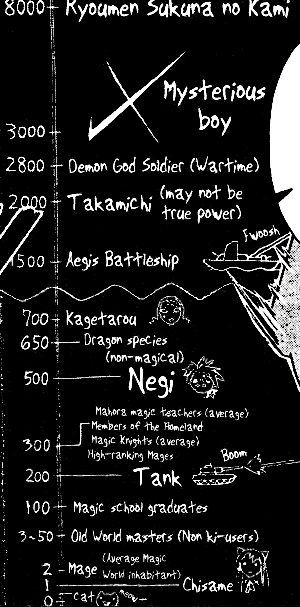
- Spoofed at one point in the manga, where Jack Rakan puts a major villain's power in context with an oddball list that includes: a tank (200), a magic teacher (300), Negi (500), a dragon (650), an Aegis Battleship (1500), the current villain (3000), and the Kyoto Arc demon that Evangeline took out in one hit (8000). Chisame doesn't even know where to begin in pointing out all the problems with such an arbitrary list.
Chisame: What an idiotic table... Where do I even begin? What's the basis for these numbers? The teachers are stronger than a tank?
- The list returns in a later chapter set, again made by Jack Rakan, showing Negi's growth and new ability. Negi is then listed at being 2200 with the right spells in mind. While Rakan himself is placed at 12000. However... due to various in plot activities by all involved... the list might not be all that off. As well as the long list of 'stupid things Rakan not only did but broke various laws of Physics to do'. The fun part is the cat that is listed at half of a point. Negi has a mental image in his depression of 1001 cats ganging up and kicking his ass.
- Kotaro makes his own list later, which has some curious implications if both lists use the same scale: Chizuru-neesan twice as strong as a tank?!
- Spoofed at one point in the manga, where Jack Rakan puts a major villain's power in context with an oddball list that includes: a tank (200), a magic teacher (300), Negi (500), a dragon (650), an Aegis Battleship (1500), the current villain (3000), and the Kyoto Arc demon that Evangeline took out in one hit (8000). Chisame doesn't even know where to begin in pointing out all the problems with such an arbitrary list.
- Neon Genesis Evangelion:
- Neon Genesis Evangelion measured its pilot-to-Eva synch rates by percentages. This gets slightly absurd at one point in the series where the rating exceeds 100%, although nobody ever says that it's a percentage of what's possible rather than a wonky way of reporting two statistics that combine to determine synchronization. Of course, the issue of Synchronisation can be simplified by the fact it doesn't equate to "ass kicking levels" but how easily and quickly one can operate an Evangelion. Someone with 100% can move an Eva as easily as one's own body, and someone with less than 20% can't do anything. Past 100% the pilot begins to lose the connection with their own body as they become more and more in tune with the Eva's soul. At 400% synchronization the barriers between their souls break completely and the pilot's body dissolves into a primordial stew; they essentially become part of the Eva. That's probably the least absurd number inflation in the series; success rates for insane and/or suicidal missions typically rank between 0.0000582958% and 1%. And they always manage to succeed.
- Rebuild of Evangelion removes synchronization in favor of the previously less-used "plug depth" to the list of technobabble jargon. It can apparently reach negative numbers. From a mechanical viewpoint, this is in fact understandable. The plug is inserted into the Eva's core to allow a connection between the pilot and Eva. Zero depth is not, however, entry into the core but the distance at which further movement into the core will risk "contamination", when feedback from the Eva begins to corrupt the pilot. Negative values are beyond that safety limit.
- One Piece:
- Pirates and other outlaws are assigned bounties as a measure of their threat to the World Government and the world at large. Bounties are not strictly a measure of physical power, since what earns a bounty doesn't necessarily correlate to that person's combat ability. For example, individuals who possess knowledge and intelligence deemed dangerous by the World Government will be assigned a high bounty, with one such example being Nico Robin, who was assigned a bounty of 79 million beli at the tender age of 8 years old. Despite not being particularly strongnote , the World Government put such a high price on her head because she is the only living person in the world that can read and decipher Poneglyphs. This clearly illustrates how bounties are not influenced solely by the individual's martial prowess. However, if the individual is strong, it will only serve to increase their bounty even further. There are just as many exceptions as there are examples, with bounties both over-estimating and under-estimating the real threat of the character. For example, Chopper's initial bounty was a measly fifty beli because the government just thought he was the Straw Hat Pirates' pet and are apparently unaware of his fighting prowess and human-level intelligence. Another example is Buggy who the Government believes is stronger than he actually is due to being a former member of the Roger Pirates, which is the reason why they offer him a title as a Warlord post-timeskip. This is also the reason why following the conclusion of the Wano Country arc and the defeat of both Big Mom and Kaido, Buggy has been declared one of the Four Emperors thank to a series of misunderstandings.
- An organization like the Marines will assign military ranks to each of its members, which serve as general indicators of their competence. The higher the rank, the more capable the individual. This is clearly illustrated with the Marine Admirals. Possessing the second highest rank in the Marines, the Admirals are some of the strongest and most fearsome characters in the One Piece world. However, on very rare occasions, a marine's rank is not a good indicator of strength. Like any formal organization, it's possible for any member to voluntarily decline a promotion to a higher rank, despite being qualified. Therefore, it is entirely possible that an otherwise powerful Marine would willingly stay at a lower rank. This is very rare, with the only known example being Monkey D. Garp, who has declined the promotion to Admiral multiple times, choosing to stay as a Vice Admiral. Additionally, current Vice Admiral Smoker was severely under-ranked at the beginning of the series, being a mere Captain. While he has been gaining promotions over the course of the series, he didn't become a Vice Admiral until after the Time Skip.
- Additionally, some villainous groups have group-specific power level-like ways of demonstrating their strength relative to one another, such as CP9's Douriki. The Douriki is pretty much a straight example, which was used during the CP9 arc to rank the members of that storyline's Quirky Miniboss Squad. For a scale comparison, the average soldier has a rating of 10, and anyone above 500 is essentially superhuman. CP9's strongest member, Rob Lucci, had a rating of 4000 (nearly double that of the next two below him, Kaku and Jabura who had 2200 and 2180 respectively). Afterward, Douriki was never mentioned again, on account of it being specific to CP9. Amusingly, the dub outright calls it power levels, including a not-so-subtle "Over 9000" reference.note
- Other examples include the numbering system for Gecko Moria's zombies, who were numbered based on what category they fell into, and Baroque Works, whose top six agent pairs were ranked in overall power with 5 being weakest and zero being strongest. Also, there were the percentage-based survival rates for the Upper Yard Priests' ordeals during the Skypiea arc.
- Speaking of Moria, he is a perfect example of why you can't use bounties as an indicator of strength. Of all of the pre-timeskip Warlords, his former bounty was the second highest, right after Doflamingo. However, during the events of the Marineford arc, it became explicitly clear that he was the weakest one. This was due to the fact that during the intervening years between his defeat at the hands of Kaido and the present time, he let himself go and suffered major Badass Decay. This would eventually lead to his expulsion from the group and the Government sending Doflamingo to kill him as a means of retaining the prestige of the Warlords by claiming he died in the war, only surviging thanks to Absalom rescuing him. In general, a Warlord's bounty is a poor indicator of their strength because it's frozen at the time of their induction and doesn't take into account whether they got stronger or weaker since then. Case in point, Boa Hancock and Crocodile's bounties were frozen at 80 million and 81 million, respectively; once their bounties are reinstated post-Time Skip, their bounties rise to 1.659 billion and 1.965 billion, respectively.
- Blackbeard intentionally exploited the idea of bounties as threat levels by having a bounty of zero before the Time Skip. Despite the fact he was extremely strong even before gaining a Devil Fruit, he deliberately hid as an unranked mook under the shadow of Whitebeard, making him a complete unknown until he decided to explode into the spotlight as dramatically as possible. Making the leap from a bounty of nothing to over two-billion in one go after his actions at Marineford and gaining Whitebeards position as one of the Four Emperors during the timeskip.
- Dosun of the New Fishman Pirates has a particularly hilarious version: his Verbal Tic changes to indicate his power level.
- One-Punch Man:
- Registered heroes within the Hero Association are measured in classes and ranks. The classes are, from lowest to highest, C, B, A, and S. Within each class, heroes still hold individual numbered ranks. The series subverts this, though: Genos is a genuinely talented S-class hero, while Saitama, who is infinitely more powerful than Genos, is relegated to C-class because of his poor performance on the written portion of his entrance exam. In practice, a hero's rank is determined based on combat ability, defeating monsters and other evildoers, contributing to society (like helping people), and popularity. Based on the latter two criteria, Saitama remains a C-class hero for a long time because his superhero presentation is very poor.
- It's later revealed that the Hero Association only had classes C, B, and A at its inception, as well as the above mentioned criteria, and that ranks changed in a weekly basis during six months because of the fierce competition. The S-class came into being because, while many high-ranking heroes needed to band together to defeat Demon-level Monsters and usually ended up dead, other heroes who were very low in the rankings by some measures but never cared about rank could easily defeat them on their own. Thus, given that the system was not helpful to keep these rare talents within the Association, the Association established the S-class for those heroes specialized in combat, each as powerful as one division of a nation's military force.
- Monsters and villains also have their own power levels that are assigned by the Hero Association, expressed in the form of Disaster Levels, each being signified by an animal/being: Wolf (threats that endanger a small group of people), Tiger (endangers a large number of people), Demon (endangers an entire city, including its infrastructure and inhabitants), Dragon (endangers multiple cities and their infrastructures) and God (endangers the survival of the human race).
- Child Emperor creates a machine to measure physical strength, hoping to use it to better quantify the power of a hero and the threat levels of the current rampaging monster or villain. At first, it seems to work, with higher ranked heroes being rated higher and civilians being rated low, but on the first field test, it quickly ran into problems. It can be fooled if different parts of a living being give different ratings. It cannot measure Saitama because he is too strong or King because he is too weak (though, thanks to their respective reputations, Child Emperor assumes it is the other way around). It also only measures physical strength as defined by muscle mass, so it can't give accurate ratings for Genos, who is a cyborg, and Fubuki, who is physically weak but has powerful telekinesis. Child Emperor gives up on the device he made as a failure because of these problems.
- Registered heroes within the Hero Association are measured in classes and ranks. The classes are, from lowest to highest, C, B, A, and S. Within each class, heroes still hold individual numbered ranks. The series subverts this, though: Genos is a genuinely talented S-class hero, while Saitama, who is infinitely more powerful than Genos, is relegated to C-class because of his poor performance on the written portion of his entrance exam. In practice, a hero's rank is determined based on combat ability, defeating monsters and other evildoers, contributing to society (like helping people), and popularity. Based on the latter two criteria, Saitama remains a C-class hero for a long time because his superhero presentation is very poor.
- Migi from Parasyte has been able to judge well in a fight against some bullys that each of them is stronger than his host. He gave his host a combat value of 10, and each of the bullys had a value between 14 and 18. In the course of the plot, the host of Migi but superhuman strength, and can easily defeat the leader of these bullys later.
- Pokémon:
- Pokémon: The Series has mentioned the numerical levels from the game in only two episodes. The show hasn't brought them up again since. It should be noted that in their brief appearances in the anime, the numerical levels are treated as petty, pedantic nonsense that a skilled trainer can overcome.
- Pokémon Adventures is much better with this, as the main character's Pokémon's strengths don't fluctuate like the anime does. At various points, the main character's teams are listed with their stats and abilities, levels included, which gradually do increase as time goes on. However, the levels only indicate their strength; evolution and learning new moves have nothing to do with it.
- The Pokémon Adventures Pokédex also has the ability to display levels. At one point, the bad guys make their own Pokédexes and laugh at Yellow for having weak Pokémon (levels ranging from 20-40). However, she uses her Super-Empowering ability, and their eyes pop out when the Dex informs them that her Pokémon's levels suddenly rise to the mid-eighties. They wisely run for it.
- Psychic Squad has a pretty basic ESP ranking system, from Level 1 to Level 7. It's at about Level 5 and up that ESPers start to become dangerous, and there are only three known Japanese Level 7s in the show - the lead trio (and the non-Japanese ones are also few in number). The show's Big Bad is beyond the rankings. To clarify, one character mentions that there are only 7 rankings because anything above level 7 is immeasurable. The Big Bad's former superior is possibly the same as him.
- In Rising × Rydeen strangers, superpowered humans, are given a strange ability rank that takes into account the effectiveness, versatility, and danger their powers may have on the user. The ranks range from E to A. Rank E strangers have useless powers while rank A strangers far outclass all of the ranks below them. The downside being that their powers are usually very dangerous to them.
- Sailor Moon: The Witches 5, from the Death Busters have levels, just like a RPG: Eudial (78), Mimete (40), Viluy (202), Tellu (404), Cyprine (999).
- Saint Seiya realistically measures fighting power in kilowatts; IIRC, however, Ki Manipulation are not measured. This was a gimmick used in the Galaxian Wars in order to give the audience a better understanding of the Saint's capabilities. They also measured exerts of strength with kilograms and freezing techniques with Celsius.
- The Seven Deadly Sins has the talking pig Hawk. Hawk is gifted a special amulet from Merlin, through which he can see the power levels of other people in numerical form, and break the numbers down into categories. It implies that Merlin can do it too.
- Shaman King has furyoku levels - Horo Horo's is just under 10,000, while the Big Bad, Hao's is over 1.25 million. Even after taking numerous levels in badass, most of the main characters are hovering around a few hundred thousand. Hao gets comparatively stronger. The characters acknowledge just how broken this is, and the story becomes less a matter of beating Hao, but of waiting till Hao wins and then killing him before he becomes God.
- In the Street Fighter II: The Animated Movie, Shadaloo's Monitor Cyborgs scout strong fighters by watching them fight and then measuring their fighting potential in cold, hard numbers. It is unknown how they calculate these figures, but apparently Ryu has the highest value.
- In the eponymous augmented reality game in Sword Art Online The Movie: Ordinal Scale, players are ranked with ordinal numbers that determines their overall battle prowess in comparison to other players: the higher their rank, the stronger they are.
- That Time I Got Reincarnated as a Slime
- Monsters and humans are rated by Rank. Before the start of the series, it was originally classified as a four-step system (Novice < Beginner < Intermediate < Advanced), but it was changed because of its vagueness to a letter-grade system of F to A, with F replacing Novice, E replacing Beginner, D replacing Intermediate, and Advanced being split among C, B, and A (otherwise known as "Hazard"). Later still before the start of the series, Rank Inflation hit hard as the system was further reevaluated to include "Special A" ("Calamity"), "S" ("Disaster"), and "Special S" ("Catastrophe"), along with "-" and "+" modifiers to indicate if you're in the lower or upper echelon of the rank.
- Another important note is that monsters and humans are ranked differently within said classes. Humans are rated for a class based on their overall fighting proficiency including such things as training, physical ability, and/or magical capacity. Monsters instead are rated solely by their Magicule capacity at least until they reach A Rank, at which point it's also judged by their threat to civilization. A Hazard-class is considered one capable of destroying at least a town on its own. A Calamity-class is powerful enough to wipe out armies on its lonesome and topple governments. A Disaster-class (which is the rank that all Demon Lords receive once accepted by their peers) can wipe out whole countries and on the high-end could destroy continents. A Catastrophe-class could wipe out the planet and destroy dimensions while in a bad mood at least.
- And then the series plays with the trope by noting these Ranks don't take into account things like the power of the human or monster's equipment (which depending on its rank could actually make one go up in threat), the acquirement of Skills that may or may not be unique to the individual (and the more numerous your Skills or the more powerful your Skills are actually decreases your total magicule supply in exchange for powerful and useful abilities that cost little to use), or certain magics such as Summon Magic. Monsters are also not judged based on their combat proficiencies, and the human rankings are made under the assumption that a team of humans are fighting a similarly-ranked monster. As such, there's major flucuations in the strength of individuals within certain Ranks.
- In Toriko, beasts are given Capture Levels, which measure how difficult it is to successfully hunt them. A beast with a capture level of 1 requires at least ten professional hunters to bring down. They are not normal measures of physical power; an ingredient with a phenomenally high level is so weak that even the presence of typical badasses would cause it to die instantly- its high level comes from the fact that getting to it means fighting past a waterfall that typically grinds mountains to dust.
- YuYu Hakusho:
- The series has official power classification systems for all demons and powerful humans which span over all the story arcs, but are never referred to within the show or the manga until the final arc by Yomi's group (complete with break downs of individual stats that make up the levels). More specifically, they're divided by classes: E class is the lowest mentioned level (probably beatable by a well-trained human with a weapon), then D class (too strong for normal humans, but spiritually aware humans can defeat them), then C (dangerous in general), then B (strong enough to flatten a block), then A (strong enough to wipe out a city), then the S class is for anyone who can punch out Cthulhu.
- Power rankings reach the 'immeasurable' point with S-Ranking, which is defined as any demon too powerful for the Spirit Government to handle. Yet, there are 3 'countries' with numerous S-ranked demons led by three rulers, each of whom are so strong they could singlehandedly kill every other being if not for each other.
- Done in every Yu-Gi-Oh! anime series, justified by the way the actual game operates in real life, as well, though one has to wonder by what scale they're able to determine the Attack and Defense powers of the monsters... or their monster level, for that matter. It's said somewhere that the "average" monster has 1500 attack and defense power. Yu-Gi-Oh doesn't use exponential power growth like DBZ, making 9000 mean a lot even late in the series.
- X-Men: There are 6 classes of mutation. It's worth noting that the Alpha, Beta and Gamma classes were introduced during the Age of Apocalypse storyline (anyone who didn't fit was rated "Dreg"). As part of a genocidal madman's Darwinist dystopia the classifications made sense, but the writers bled them back into the main timeline as convenient shorthand. Oddly enough there weren't any official Omega mutants in that timeline, although Nate Grey might have warranted that classification.
- Epsilon Mutants are unfortunate mutants. Epsilon mutants pretty much have no chance of having a regular life in society due to their major flaws like an inhuman appearance or their mutation makes it impossible for them to function normally. If that isn't bad enough Epsilon mutants also only have minor "superpowers" that are next to useless.
- Delta Mutants are like Alpha mutants in that they don't have any significant flaws. The only problem is that Delta mutants don't have powers that match an Alpha mutant, or even a Beta or Gamma mutant. They have a normal human appearance, but their mutagenic powers are weaker or only narrowly applicable, though still controllable.
- Gamma mutants have very powerful mutations, but they have flaws. Unlike the Beta mutants a Gamma mutant's flaw is a major flaw that makes his or her life very hard. Also, while Alpha and Beta mutants can pass as regular looking humans, many Gamma mutants cannot because they have physical deformities.
- Beta Mutants are on the same level as Alpha-level mutants as far as how potent their powers are. But the difference between Beta Mutants and Alpha Mutants is that the Beta Mutants have flaws, albeit very small flaws. They have a normal human appearance (or close to it) and their mutation is powerful, useful, but less controllable but can still lead a normal life with only minor preparation.
- Alpha Mutants are the second most powerful and feared mutants. Alpha mutants have extremely powerful mutant traits without any significant flaws. They have a normal human appearance and their mutation is powerful, useful and controllable (i.e. turn it on and off, direct it at will.)
- Omega Mutants are ones with the most powerful genetic potential of their mutant abilities. Until X-Men (2019), no firm definition had been offered in comics. As a result this classification's qualifications had fallen under Depending on the Writer, but some abilities depicted by mutants described as Omega-level include immortality, extreme manipulation of matter and energy, high psionic ability, strong telekinesis, and the potential to exist beyond the boundaries of the known physical universe.
- Hickman's House of X #1 defines Omega level mutants as having a super-power that has an undefined limit. For example, Jean Grey is both a telepath and a telekinetic, but is only considered an Omega level telepath, as her power of telekinesis could hypothetically be surpassed. In fact, Exodus is acknowledged as an Omega level telekinetic.
- While the original Official Handbook of the Marvel Universe tried to give exact, unit-specific measurements of strength and powers ("able to generate temperatures of 28,000 degrees Fahrenheit", "Able bench press ten tons") the newer supplemental material uses a system of levels that are not often consistent with observation and are maddeningly vague— level 3 strength means lifting "somewhere between 800 pounds and 25 tons". The original also went down the fairly mystifying road of saying everyone without strength based powers was average (or below or above) for someone of their age and size, without mentioning that an average obese man without any legs (like Box) can barely lift a coffee can. These days, the Marvel strength ratings are mostly used for comparative purposes. For instance, if an average Asgardian can lift thirty tons and the Thing can lift ninety tons, then, regardless of how much they can actually lift, the Thing is three times stronger than said average Asgardian.
- DC's Who's Who tends to take the deliberately vague, but understandable tack of putting everyone's strength levels (or at least the upper-tier powerhouses) as as strong, not as strong, or stronger than Superman.
- In The Authority, Apollo is described several times as a "Majestic-Class" superhuman, people in the Wildstorm Universe apparently classifying superhumans by notable figures of about the same power (Mr. Majestic, Wildstorm's Superman analogue, in this case).
- Powers, where ordinary detectives investigate superpowered crimes, has a rough and not very well defined set of power levels from 1-10 to identify how strong a Super Hero or villain is. The local Superman Substitute is ranked as a 10, but only because the entire world would be horrified to find out the truth that they have no way of classifying the upper limits of his power. Especially when he has a mental breakdown and decides it's time to stop being nice and firmly implement the sort of order he wants.
- In the Buck Godot: Zap Gun for Hire universe, civilizations as well as individuals are assigned 'Power Classes', as an easy way to keep track of who should step carefully around who. This 'Class seems to be determined mostly by technological level, but also by numbers and ability. Humanity, as a whole, is classified as Class 12. The only known Class 1 Power is Lord Thezmothete, who appears to be a sentient tree of some sort (he does, however, seem to have several similarly vegetative underlings). Another notable is The Teleporter, an extra-dimensional alien who exists in a state of continuous transmission, whose capabilities includes transporting entire PLANETS instantaneously across the galaxy—he's a Class 8 Power, all on his lonesome.
- Top 10 has power levels for psychokinetics. The one the officers have to deal with in issue #6—an escaped mental patient who thinks he's Santa Claus—has Class Two abilities, which allow him to levitate his stolen sleigh and reindeer, take control of Robyn's gadgets, and toss around Smax while making it snow all over the state. When Robyn wonders what a Class One can do, Smax tells her they can snuff and ignite suns.
- Über has a classification system based on how many doses of the Phlebotinum a person can be given. Most people die when exposed to it, but about 1 in 5,000 instead get super-powers. With two doses, a "tank-man" has Super-Strength, Super-Toughness, and a "halo effect" that works as a kind of energy attack. Much rarer is the "battleship," who can take twenty-four doses, and who has the same powers but to a much greater degree. Later in the series, "destroyers," who can take six doses, and "cruisers," who can take 12, are also discovered.
- However, this is complicated when it's discovered that the dosages can be altered, making a tank-man with two physical activations (a "heavy") or two energy activations (a "blitzmensch").
- Additionally, the overall number of doses is not necessarily an absolute measure of strength; it's noted that a destroyer with five physical doses is slightly stronger than a cruiser with six.
- Later still, two entirely new classes of superhuman are discovered: the Geltmensch, who have no physical enhancements and only a basic halo effect but can psychically disguise themselves, and the Zephyrs, who have neither physical or halo powers but instead have Super-Speed.
- A Certain Droll Hivemind: Misaka-11111's flatmates and their neighbors all have the same powers as the seven Level 5s, but far weaker. Aino Sumiko has the Meltdowner power, but she's level 1; she's often covered in radiation burns from her uncontrolled energy discharges. Abe Eiko has the Dark Matter power at level 1; she can create small objects with impossible properties (such as a magnetic coin that is not conductive), but she often misses details. Koizumi Kyoko has the Vector Control power at level 2; she can only affect the vectors of something she sees, as long as it's not moving too quickly. And of course 11111 has the electromaster power, at level 3. The Network is split on whether putting so many espers with powers similar to the level 5s is an experiment on seeing how long it takes for them to murder each other, or on whether it is an effort to study the powers of the level 5s without putting the actual important espers in danger. Last Order, on the other hand, thinks that the researchers are playing a game where they try to "collect a full set" of people with powers the same as the level 5s. The Network dismisses this theory as ridiculous, but considering some of the things we've seen the researchers get up to, it's not impossible.
- Child of the Storm has SHIELD use two separate ranking systems, both of which, somewhat confusingly, use the Epsilon, Delta, Beta, Alpha, Omega ranking system. The first is based on inherent power, with beings like Thor, Loki, the Hulk and Magneto ranking as Omega Class beings, with no easily defined limits on their power (it's later revealed that sub-divisions were bolted on, with Omega varying from 'continental' to 'universal'), and it's admitted In-Universe that this is largely an artefact of the system being created when the biggest threat known was Magneto. The second is based on potential threat: for instance, Skye, Team Coulson's Techno Wizard, would be an Omega Level threat if she got hold of 'The Index', SHIELD's list of superpowered people, complete with profiles and identities.
- Appears occaisionally in My Little Pony: Friendship Is Magic fanfics:
- In The Stars Ascendant, Luna and Celestia realize that Twilight Sparkle must be about as powerful as every non-alicorn pony in Equestria combined given her performance against Tirek, given that Tirek had drained Discord of his power, and Luna and Celestia combined were incapable of bringing down the spirit of chaos.
- In Estee's Triptych Continuum, there is both a power scale and a dexterity scale for unicorn casters. These scales are both on a 1-10 basis, with Celestia's power marking a 10 on the power scale, and Luna's dexterity marking a 10 on the dexterity scale, as they were the most powerful and most dexterous casters respectively when the scales were created.
- The Soulmate Timeline uses the concept as a means of explaining the differing potential of potential Magical Girls as mentioned in Puella Magi Madoka Magica, with Homura volunteering her own magical potential as a base unit, or 'Homuras', for the ease of explaining to Madoka, whose not contracted and can't see or sense them. An average person is said to have about a fourth or fifth as much potential as Homura does, Hitomi Shizuki has about two Homuras of potential, Sayaka Miki two and a half to three Homuras, Mami has raw magical potential worth about six Homuras, and Madoka's potential leaves Mami speechless and unable to give it a measurement of its own in Homura units. Kamihama City has a refined measurement method devised by Touka that measures the raw power of Magical Girls via milliToukas. The average Magical girl has a 'power level' of 10 milliToukas. More experienced magical girls, like Momoko and Yachiyo (who is one of two Magical Girls who has more raw power than Touka at 1.1 Toukas, the other being Madoka who is at least at 100 Toukas and possibly even more, though definitely greater than what Touka's ego can stand), find the concept very dumb, and are pretty blunt about how such measurements are only part of the equation of a Magical Girl's potential.
- Whateley Universe fanfics, which have a standard rating system for mutant powers:
- Casey Steele:
Kat pestered me further, "Oh come on, give, what did that really say?"
I sighed and said, "Esper Three," I didn't quite wince as Kat was both thrilled and suddenly worried at the same time.
"Oh cool is that good?" asked Pru.
"It means Casey here more or less could read our minds at will," Kat gave me a tight smile, "right?"
- Casey Steele:
- Star Wars: The Phantom Menace made Force talent measurable via "midichlorian count". After measuring kid Anakin's midichlorians, they are shocked by how high his level is (over twenty thousand, more than even Yoda).
- Used in Rocky IV. Ivan Drago's punching power is measured in PSI, and reaches ridiculous levels (2100, which would slam through iron if his arm didn't shatter first).
- In X-Men: The Last Stand, Mutants were inexplicably given power levels that everyone was aware of from 1-5 with Professor X and Magneto as 4s and Jean Grey being the only known 5. Apparently, Calisto can specifically "sense" these power levels- again having no prior mention in the movies or anywhere else in the X-Men universe.
- Levels in An Outcast in Another World provide a clear indicator of this – sort of. The difference can easily be made up by creativity or expertise honed by experience and training. Natural aptitude can also warp the balance of power between people of similar Levels, as some people gain free stat points for accomplishing noteworthy goals.
- Xianxia, in particular the Spirit Cultivation Genre of Xianxia, are arguably the Ur-Example in Asian Fiction. Generally, Spirit Cultivation is often seperated into realms, and depending on the work in question, range from basic martial artists that are closer to real world people, and go all the way up to immortal gods and beyond, with seemingly no end as long said story keeps going. More often then not, the levels of cultivation are split into two categories: Spirit or inner Ki, and the physical body that utilizes the Ki. A lot of modern day Fighting Series owe their Power Level systems to these novels.
- In the webnovel Brennus, superhumans are given a ranking between 1 and 13, with 1 being the level of perhaps a person with 20% more strength than the average human, while 13 is the level of The God-King of Mars, who's words can change the fundamental laws of the universe. However, the Brennus universe has also been noted using the standard F, D, C, B, A and S threat level scale.
- Discworld:
- One of the 'new witches' in Lords and Ladies made the mistake of asking Granny Weatherwax what level she was.
- Wizards have a ranking system that you could climb through by killing a wizard of a higher level, which can be done bycompletely non-magical means (such as a snake hidden in someone's bedsheets). The whole idea was scrapped when the University got Mustrum Ridcully, a head wizard who a) came down hard on any silly buggers who tried to get Klingon Promotion in his faculty and (importantly) b) was bloody impossible to kill.note
- Night Watch (Series):
- The series has power levels for its magicians, but they count down instead of up. A level 4 magician can do little more than tricks, a level one can do amazing things - but they're all limited to learning incantations or using artifacts; only magicians Beyond Classification have true and instinctive access to magic. It starts at level 7 and goes to 1 then beyond classification, and finally Absolute Zero. A Level 7 can visit the first level of twilight but just barely. They may have specific talents, but are quite weak. A Level 4 can influence large masses of people while a level 1 could rule a large nation or crush it. Anyone of Beyond Classification rating can't be measured accurately because this would require the full use of their power. Such a use is not only forbidden under the Grand Treaty but could also result in The End of the World as We Know It.
- Interestingly, it's mentioned in one novel that the word "rank" used to be used until the popularity of video games made them adopt "level" instead.
- A Zero-level mage can, theoretically, do anything and can absorb and use all the magic in the world. Only a few Others throughout history can be stated as being Zero-level. Merlin, post-Fuaran Kostya, Nadya, and (possibly) Jesus. In New Watch, it's speculated that a Zero-level mage could potentially destroy Twilight itself.
- The Talents of Anne McCaffrey's Rowan series have a count-up system for measuring Psychic Powers, with "Primes" as the very best in their fields and usually in charge of their entire planet's psi-operations. Notably, this measurement is not fixed, as a number of lesser Talents have been upgraded to better levels as their powers develop. Consistent with the trope, Primes get consistently stronger as the series evolves, with Superpowerful Genetics ensuring that later generations greatly surpass their parents.
- In David Farland's The Rune Lords series, people can use magic to bestow their strength, sight, intelligence and so forth onto others, thus giving the latter e.g. "the endurance of two men". The book starts with trained warriors and assassins having six to ten of such endowments, but quickly reaches ridiculous proportions with thousands of elite troops having hundred endowments each, and the main antagonist literally having thousands of endowments for each attribute.
- Metapsychic power and power usage in Julian May's Saga of the Exiles series is occasionally measured on a (apparently logarithmic) scale.
"Your over-modulated hell-load must have finished Felice off. Probably the Little King as well. The PC [psychocreative] equivalent was in the seven hundreds, for Christ's sake."
- Diana Wynne Jones's Chrestomanci novels seem to rank magical ability with names for levels, rather than numbers. Witches and warlocks are described as weakest, with power increasing as the rating system goes up to necromancers, wizards, sorcerers, magicians and enchanters. Enchanters are the strongest of all magic-users, and nine-lived enchanters are even stronger than normal enchanters. There are also side categories such as shamans and mages who are not described in detail. There are some vague differences in how each category of magic-user performs magic, but the stronger classes are able to perform all lower levels of magic.
- The Heralds of Valdemar series by Mercedes Lackey features a defined system for measuring the Power Level of mages. Apprentices are those with a bare minimum of talent or those just learning the art. Journeymen can manipulate their own Life Energy as well as power from their immediate surroundings. Masters are able to manipulate Ley Lines, and Adepts can manage nodes, the strongest energy sources. Somewhat confusingly, the same terms are used to describe both a mage's current rank and their maximum potential, so one could be a Journeyman who aspires to Adept or a Master who is incapable of progressing farther. It is implied that Psychic Powers operate on a similar scale but no formal measurements are ever introduced.
- In The Wheel of Time series how much of Saidin or Saidar, two parts of the One Power a person can hold is apparently an inborn trait, but they still have to train to reach their potential. Rand Al'Thor, The Chosen One, can hold the highest amount of the One Power of anyone in the series. Ishamael, his Evil Counterpart, appears to be a match for him in strength; the strongest female channelers (Alivia and Lanfear) are not as strong (but Lanfear has more finesse).
- In The Acts of Caine, Caine registers as a grade six weapon due to his Monastic training. This is only slightly higher than an armsman, so the Khryllians aren't particularly worried about it. After all, their Knights have divine-given Super-Speed and Super-Strength, they can deal with entire armies. Caine enjoys proving to them that their system is bunk.
- Jake and the Dynamo: All of the magical girls have a 0-10 "competency rating" assigned by the city's Threat Assessment Board. Tuneless Ramona stands out as having an infinite rating, due to once managing to defeat an Eldritch Abomination.
- Paradise Lost: Since every creature in is given their power by God, He can compare and expose their power levels by weighing them on the scales of the Libra constellation. This trick comes in handy when Satan and Gabriel are about to tear apart Eden in battle, since the scales show Satan that his power could never overcome the heavenly Gabriel's.
- Please Don't Tell My Parents I'm a Supervillain: Mad Scientist inventions are ranked from Tier One to Tier Three, and the number of higher-tier inventions a scientist has says a lot about their own power level.
- Tier One: Intelligent inventions, but within the realm of normal science. Sometimes referred to as "prodigy level." Many Tier One inventions can be replicated, but it's usually not worth the effort. Examples include an unfolding clockwork lunchbox and a real-time single-language translation device.
- Tier Two: Based on normal science, but just a bit beyond it. These inventions can be replicated by normal scientists with enough effort. It's mentioned that many of Thomas Edison's and Nikola Tesla's inventions were Tier Two. Examples include a portable air cannon and a low-level A.I.
- Tier Three: Based on unknown or impossible laws of physics. They are, by definition, impossible to replicate, but that doesn't stop people from trying. Examples include teleportation and self-replicating rag dolls.
- In Douluo Dalo people have a measurable rank that represent the power they should have and how far they have trained, this number's not absolute for comparison, but gives a good measurement of their powers and also limits their possible abilities. Each 10 ranks the person has to go out and hunt a magical beast to be able to continue their training.
- In The Dresden Files, almost everyone can perform at least a little magic if they study. The most powerful and skilled one percent or so of (human) magic wielders are known as wizards and members of the White Council. Of the White Council, the seven eldest and most powerful (though there is a fair amount of politicking) wizards serve on the Senior Council, who make the decisions for the rest of the White Council.
- There are other names for weaker talents, such as "sorcerors" or "hedge witches." Membership of the White Council is a measure of both power and skill, and there are a fair few characters who may have the raw power to join, but are incapable of doing so thanks to their lack of skill and training.
- In the Whateley Universe, most powers have defined levels (usually on a scale of one to six), at least as they're defined by the powers testing guys. The authors even wrote a bunch of them up on the website. Power levels are more for the purposes of classification (though they are also used by the Mutant Commission Office for threat assessment), and are known to be really deceptive, as they're very much descriptive, rather than prescriptive. Still, they're all WAY below Marvel or DC levels; for example, the very strongest characters, the 'Psychokinetic Superman' types (who have Mind over Matter -based superstrength) top out with a lift of about 12 tons and a Force Field which could resist an armor-piercing tank round.
- Worm: There's a government categorization system that sorts parahumans by ability (I.e. mind control powers are Master, shapeshifters are Changer, and so on) and ranks each category their powers fit on a scale of 1 to an undefined upper limit, although generally 10 is roughly the top, but Labyrinth gets a level 12 and entities such as Endbringers or the Sleeper are considered 15+. The scale system is only intended to be a simple shorthand, however, and raw power isn't even the prime factor in the numerical rating. The incredibly wide range of powers in the world means that many powers don't fit neatly into one category, and a parahuman working out more effective ways of using their powers could significantly change their ratings overnight. To a certain extent, even the parahuman's non-parahuman talents come into play— Leet and Uber would likely have gotten higher ranks if they were clever enough to exploit their powers to their fullest extent. The looseness of the rankings is further shown when the PRT decides they are done underestimating Skitter, and their boss declares that she be given a +2 ranking in every single category of power, including those she has never displayed any superpower in (i.e. Tinker), just to hammer the point home.
- Cradle Series:
- Being a Spirit Cultivation Genre story, this is of course common. In Sacred Valley, everyone is born at Foundation when they first learn their most basic techniques at about the age they can walk, they advance to Copper a few years later, Iron ten or so years after that, and the really skilled sacred artists will eventually advance to Jade. Then there's the legendary Gold, but no one has reached that stage in centuries. When Lindon gets outside the Valley, he discovers that they had no idea what they were doing; in the outside world, most people hit Gold before they're twenty. Gold is split into Lowgold, Highgold, and Truegold. The Lord realm is split into Underlord, Overlord, and Archlord, and peak Archlords can become Sages or Heralds. Monarchs are the highest level, so far above everyone else that even Archlords treat them as gods.
Suriel: There are a million Paths in this world, Lindon, but any sage will tell you they can all be reduced to one. Improve yourself.
- On a slightly more mundane level, the Blackflame Empire where most of the story takes place is known for ranking absolutely everything. When a shop advertises itself as "Best Mixed Bowls in the city (vegetable only category)," that's not idle boasting, they have been officially measured and ranked. And of course, the combat rankings are fierce. Eithan starts the series as the eleventh-ranked Underlord in the Empire (out of twelve), though it soon becomes clear that he's been deliberately keeping himself low in the rankings. Yerin shoots to the top of the rankings for her advancement pretty much the second someone gets a good look at her, and Lindon is disappointed that he's only twenty-fourth in his advancement. Fisher Gesha has to smack him to remind him that that's pretty impressive.
Fisher Gesha: They call you the twenty-fourth ranked Lowgold on the combat charts. You know what that means?
Lindon: That there are twenty-three Lowgolds stronger than I am.
Fisher Gesha: That you're ranked higher than three quarters of the Empire!
- Being a Spirit Cultivation Genre story, this is of course common. In Sacred Valley, everyone is born at Foundation when they first learn their most basic techniques at about the age they can walk, they advance to Copper a few years later, Iron ten or so years after that, and the really skilled sacred artists will eventually advance to Jade. Then there's the legendary Gold, but no one has reached that stage in centuries. When Lindon gets outside the Valley, he discovers that they had no idea what they were doing; in the outside world, most people hit Gold before they're twenty. Gold is split into Lowgold, Highgold, and Truegold. The Lord realm is split into Underlord, Overlord, and Archlord, and peak Archlords can become Sages or Heralds. Monarchs are the highest level, so far above everyone else that even Archlords treat them as gods.
- I Do Not Want To Do This is set in a modernized version of a world heavily inspired by D&D and other fantasy roleplaying games. Levels are something that still exists, and can be measured by modern technology. College grads tend to be level 3 or 4, with 5 considered to be a great achievement attained by a lifetime of training. One of the most powerful men in the world is "believed to be" level 9, and Brad considers ancient tales of heroes regularly hitting double-digits and even epic levels to be exaggerated myths that are probably based around some grain of historical truth somewhere.
- In The Bartimaeus Trilogy, demons are ranked in ascending order of power as imps, foliots, djinn, afrits, or marids. Below the imps are even weaker spirits called mites that magicians usually don't bother with, and above the marids are great entities of godlike power that are considered too dangerous to summon. Within those categories, spirits are further classified with a numeric power level; Bartimaeus is a "fourth-level" (or "fourteenth-level") djinni, which means he is right in the middle of the pack, power-wise. This is a downplayed example though, because no other character's level is ever given and it never really impacts the plot at all.
- In Level Up Hero The heroes and horrors are ranked based on powers, zeta, delta, gamma, beta, alpha, and omega.
- Babylon 5 had P-levels for its telepaths. Officially the rankings count range and power, with P0 or P1 being all but useless. P2-P5 become commercial telepaths, P6-10 work with the government, and P10-12 work in the corps with P12 being the rank of Psi-Cops. P13s, the maximum level on the official scale (for those not Lyta Alexander, anyway), are quite rare and tend to be the object of experiments.
- In Heroes, there's some online viral bonus material that lists the "power levels" of several of the show's characters, in the form of "case files" listing "control index" and "biological, cerebral, elemental, and temporal/spatial" levels . Most of the files are on characters from the on-line comics, but a few of the show's main characters are listed. I.E. Matt's stats are "25% control, 25/90/45/20", Ted's stats are "12% control, 45/55/95/5", and Sylar's stats are "76% control, 40/85/45/20".
- Kamen Rider
- The franchise typically provides data for the abilities of each Rider, such as how hard they can punch and kicknote , how fast they can run the 100-meter dash, how high they can jump, and other similar statistics. The stats are a measure of raw ability, completely disregarding outside elements like unique powers and equipment; for example, Kamen Rider Kabuto has a Super-Speed ability that lets him move at nearly the speed of light, but his 100-meter dash rating ignores this and is based entirely on normal running speed (enhanced by the suit, of course). The numbers don't actually have any bearing on what the characters are capable of in the shows and sometimes they're patently absurd, as seen with the memetic example of Kamen Rider Poppy (a Joke Character with Dating Sim powers) having higher stats than Kamen Rider Gaim's final form Kiwami Arms (who is quite literally a Physical God).
- Kamen Rider Ryuki plays it a bit straighter by assigning AP (Attack Point) values to all the Riders' attacks, from their basic punches and kicks to their Final Vents.
- Kamen Rider Blade takes it one step further - the Rider's weapons start with 5000 AP, and cards swiped through them have their AP values subtracted from this. Special cards that add AP appear late into the series.
- For both Ryuki and Blade, 1000 AP equals 1 ton of TNT as above.
- Kamen Rider Ex-Aid is based on video games, and as such all of the Gashats and forms have distinct Levels attached, starting with the distinctly Super-Deformed Level 1 and normal-looking Level 2. Rank Inflation soon kicks in, as the characters skip more and more levels with each successive power-up until they get all the way to 99. Some Riders at the absolute pinnacle of the scale don't even have a defined Level at all.
- The show also tried to defy this a little bit by having something called "Level X", which can't be definitively measured and has the capacity to be infinite. Despite being introduced like it was going to be a really big deal, not a lot ended up being done with it. Main reason being that the Rider who primarily used such a level, Genm, spent a lot of the show jobbing to other Riders who did have numerical levels, or whose powers were specifically created to outclass everything else in the show at the point they were introduced. One of the epilogue movies got a little silly with it, with Genm creating a form he claimed was "Level Billion", but he was opposed by one of the heroes with a new Level X form.
- Kamen Rider Build has "Hazard Level", which reflects peoples' ability to control the power of the Nebula Gas, the substance used to create Smash and powering the Riders' gear. Unlike previous instances, Hazard Level is highly variable and can be increased through experience, willpower, intense aggression, or further exposure to Nebula Gas.
- There's also a quantified measure: Level 1 marks people who will die after exposure (usually because of a pre-existing illness or poor health), Level 2 means they can become Smash but will suffer short-term amnesia if purified, Level 3 is capable of using the Build Driver, and Level 4 can use the more powerful Sclash Driver. Level 5 can use the Evol Driver, the template from which the Build Driver was created; it's thought to be impossible for a human to achieve, but both Sento and Ryuga manage to get all the way up to Hazard Level 7 by the end of the series, which makes their primary Fullbottles turn metallic and unlocks a new Super Mode. Nariaki Utsumi hits 5 once he joins Evolt and becomes Kamen Rider Mad Rogue, but since his Evol Driver had to be down-tuned for his human physiology it's not as strong as it could be.
- The Whedonverse apparently has power levels for witches (and possibly mages in general)- in "Checkpoint", a Watcher asks Willow and Tara what their levels are, and if they'd registered under the names they provided. However, "level" in this context might be akin to a grade level, or belt level in martial arts.
- Zui Wu Dao: There are two distinct levels that Martial Artists fall under. The Origin Realm, which consists of nine individual levels, and the Martial Artists Realm, which is implied to fall under a similar system but largely just means one has gone beyond the Origin Realm.
- Dungeons & Dragons
- Zigzagged with player characters. Rolls of the dice are usually more important than raw numbers. Higher modifiers in any of the six core stats — Strength, Dexterity, Intelligence, Wisdom, Charisma, and Constitution — raise both the floor and the ceiling for any character. But it's still possible to roll badly with high stats and roll excellent with low stats, and there's a number of abilities that don't check for the stats and just always work.
- Monsters play this straighter than player characters. Every monster has a Challenge Rating, which can be anything from 0 to 30. The higher this number, the greater the monster's power and the greater amounts of experience points that one gets for defeating them. Monsters that have a Challenge Rating of 30 are usually reserved for the likes of Evil-aligned gods, enormous legendary beasts, and ancient dragons.
- Warhammer 40,000
- Psykers are ranked by Greek letters in a system known as "The Assignment". The zero point for psychic potential is Rho or Pi, that of a normal human, and go in descending order, with the upwards climbing toward Alpha and descending towards Omega. Going upwards up till Kappa are very minor psychic talents who have many "good luck" occurrences, and Iota and upwards are true psychics who can manifest their abilities. An Epsilon is pretty terrifying, and an Alpha-class can snap a titan in half with a gesture. Going into the opposite direction, starting with Omicron and down to Omega is the degree of negative psychic potential, various degrees of an aura that negates psychic abilities.
- For negative values, the Tau range in Sigma or, well, Tau. This makes them deaf to telepathy and very hard to corrupt for Chaos, but otherwise they're affected by psychic abilities normally. Further down the scale are individuals called Blanks, Pariahs, or Untouchables, who are immune to psychic powers and invisible to daemons, and they negate psychic powers in their immediate vicinity. Unfortunately, this also means people instinctively don't like them, and it becomes very easy to feel antipathy or hatred for these individuals; and psykers find it painful to terrifying to be in the presence of a Blank. Surprisingly, the only Untouchables are humans. At least one Imperial institution utilizes any Omega that survives to adulthood, which is such strong anti-magic it can harm the souls of people nearby. That Imperial institution rebuilds them into superhuman assassins who specialize in killing psykers.
- Incidentally, the detachment from reality involved means that most human psykers above Beta level are almost certainly insane by default. Obvious exceptions include The God-Emperor and the Primarchs.
- Notably, while the Imperium is very interested in collecting and psykers for various reasons. Minor talents are fed into the Golden Throne to keep some of the most important pieces of Imperial technology functioning. Major talents are rounded up for sanctioning: they are used as advisors for Imperial luminaries or for psychic support on the battlefield, though much more often are trained to become an Astrotelepath (Astropath for short). Astropaths are the the only FTL-communication apart from sending a ship somewhere. If psykers are left uncontrolled, they can become a very real security threat. While it's bad enough that psykers could do things like read state secrets from an official's mind, throw around bolts of lightning or fire with impunity, or subvert the will of someone, rogue psykers who forgo sanctioning have a highly increased likelihood of mutation, insanity, or possession, or more catastrophically fall prey to daemons and allow them to materialize. The Imperium generally doesn't even attempt to train Alpha levels - the usual response is a bullet in the head.
- And there are some that don't actually fit in this - the scale is extended to Alpha-plus and Omega-Minus for those individuals for whom the 24 greek letters do not suffice. Older canon even covers higher plus/minus levels that double back through the alphabet, where you're really more talking about Eldritch Abominations than anything else. Or the Emperor.
- It should be noted however, that the scale is only really built for human psykers. Eldar Farseers and Warlocks don't have a known Assignment rating, and Cosmic Entities like the Chaos Gods far exceed the scale.
- It should also go without saying that being a tabletop game, models are also given a 'point' cost to field, with more powerful models costing more. In fact, the tabletop simplifies the matter by "mastery levels", the lowest ranking psykers have Mastery Level 1, while the higher psykers have up to Mastery Level 3, then comes the most powerful psykers, Eldrad Ulthran, Ahriman, and Kairos Fateweaver, who have Mastery Level 4. Magnus, the most powerful known psychic to walk the Galaxy short of the Emperor, has both Mastery Level 5 and some unique buffs which makes him more powerful than what his mastery level alone would imply.
- Warhammer Fantasy: Early editions had three rankings for unnamed hero types: there was Champion, Minor Hero and Major Hero which increased a hero's stats correspondingly.
- Mutants & Masterminds uses actual Power Levels to constrain characters to a roughly even playing field. All offensive and defensive powers must be at or under their character's PL. The only exception is that it is allowable to trade off on opposing traits like accuracy versus damage, or defense versus toughness. Powers like non-offensive teleportation and telekinesis lack such bounds except in house rulings. Like D&D, it's rare for this to come up in-character, however.
- Your base Essence stat in Exalted kinda represents this in that a higher rank unlocks more powerful Charms... except that the actual charms a character has means a lot more in terms of comparing power levels within Exalt types, and that the Super Weight between the different types means more than if their Essence stat matches. Terrestrials, for example, tend to be significantly weaker than Solars or Abyssals, and Alchemicals veer up and down wildly depending on whether they've had time to optimise their Charm loadouts against you or not. It is, however, played straight in-setting in Yu-Shan, where a being's status is largely determined by their Essence rating, and elder Sidereals with an Essence of 10 socially outrank anyone except the Incarna.
- Marvel Super Heroes ranked powers (and everything else in fact) in a scale from 1 to 100, broken into the following tiers: Feeble (1-2), Poor (3-4), Typical (5-6), Good (up to 10), Excellent (20), Remarkable (30), Incredible (40), Amazing (50), Monstrous (75) and Unearthly (100). Most Marvel characters had abilities between Excellent and Remarkable ranks, while the most powerful ones had some between Monstrous and Unearthly. A later expansion also added Shift Zero (0) for abilities ever lower than a 1, and Shift X (150), Shift Y (200), and Shift Z (500) for ones beyond Unearthly. Class 1000, Class 3000 and Class 5000 were added for the truly Cosmic Beings. The absolutely highest level was Beyond-Rank, that had no number (it was infinite.) Only one character had abilities of this caliber: the Beyonder from Secret Wars (1984).
- Marvel Multiverse Role-Playing Game, the current role-playing game about Marvel Comics, is more direct: each character has a numerical ranking from 1-6, determining how many points they're given and what ceilings on abilities are. Rank 1 are ordinary humans, from bystanders to Mooks. Rank 2 is street-level heroes with a few powers, like Daredevil and Moon Girl, or Elite Mooks. Rank 3 are slightly more powerful, but still the rank and file of superheroes, including the likes of Luke Cage, Iron Fist, Cloak and Dagger, and Devil Dinosaur. Rank 4 is elite heroes, like Spider-Man, and most of the regular members of the big teams like the Avengers, X-Men and Fantastic Four. Rank 5 is for the most powerful heroes in the world, like Thor, the Thing, or the villains who usually take on the big teams, like Dr. Doom, Ultron, Loki, and Kang. Rank 6 are force-of-nature characters or cosmic butt-kickers, like the Hulk, Dr. Strange, Magneto, Thanos and the Silver Surfer. Beyond that is Rank X, for Cosmic Entity characters who are so powerful, stat numbers are effectively pointless, and what they can do is completely at gamemaster discretion.
- Supernaturals in the New World of Darkness generally have a "Power Stat" that represents raw supernatural power — Blood Potency for Vampires, Primal Urge for Werewolves, Gnosis for Mages, Azoth for Prometheans, Wyrd for Changelings, Psyche for Sin-Eaters, Sekhem for Mummies, Primum for Demons, and Lair for Beasts. Across the board, the power stat allows for increased Mana storage and expenditure, as well as an increased resistance against mind-affecting supernatural powers.
- In the Old World of Darkness, Vampire: The Masquerade has Generation, which reflects how distantly descended a vampire is from Caine. The fourteenth and fifteen generation Kindred are viewed by a large chunk of vampire society as aberrations and harbingers of the end of the world, whereas third generation vampires are basically regarded as dread gods made flesh (the second generation was destroyed long ago, and the first generation is... well, Caine).
- In Werewolf: The Apocalypse, Rank determines what level of Gifts (magical powers) you can learn.
- In its rawest form, cheap (typically unauthorized) children card games featuring Toku characters assign power levels to both hero and villain cards, and the power levels indicate if the character will be powerful enough to defeat the other character or villain.
- Beings in the Souls series (Demon's Souls and Dark Souls) have a numerical value assigned to their souls, which shows roughly how strong they are. The primary method of getting more powerful is absorbing souls, which your character takes advantage of to get Character Levels. By the end of the series, the characters with the highest "soul levels"note are Darkeater Midir (170,000), Slave Knight Gael (140,000), the Burnt Ivory King (122,000), the Soul of Cinder (120,000), the Demon Prince (120,000), Sinh the Slumbering (112,000), Queen Nashandra (110,000), the Nameless King with his stormdrake absorbed (100,000), Gwyn (90,000), and Manus (78,000).note
- Beings in Darkstalkers are ranked by letters, "D" being a non-sapient monster with capabilities less than those of human beings; "C" being a weak monster on par with a human (and humans themselves); "B" being an average monster that can devastate a smallish army; "B+" being a trained and magical monster capable of wiping their butts with "B-Class" demons, "A" being exceptionally strong creatures, many of which are the rulers of Makai, the demon world; and "S" being essentially a Physical God. Most of the playable characters are B+s, with a few exceptions. note Baby Bonnie Hood, though human and a C by default, is the only known mortal with the slightest capability of damaging an S-Class demon thanks to her insanity, intense training, and impossibly large arsenal of hidden weapons.
- Disgaea
- As part of their being Genre Savvy and the game's thin fourth wall, characters in the series can sense each others' levels and reference them in conversation, such as when Rozalin asks where Adell's confidence comes from and ask if he's really level 10,000. (He isn't yet.)
- Supplemental materials also discuss how at least one character class has power ranked at over 100 Polga. There are no clues as to what this might actually mean.
- In the various Disgaea games, you can actually level your characters up beyond level 9000, but more importantly with enough grinding you can have the stats needed to to billions of damage easily, one-shotting the strongest bosses the games have to offer.
- The first three games in the Mega Man X series had listings of the robot bosses at the end, just before the credits. In X3, the images were combined with ratings for strength and speed. Most of the bosses topped at about 10,000 for one or the other, Sigma made it up to 16,000 both, and Battle Body Sigma reached 25,600 for both (despite the fact that he was slower than dirt). These numerical ratings have no real bearing on game mechanics and aren't explicitly referred to at any other time. However, X had a rating of "?", referring to his limitless potential, which is mentioned several times elsewhere throughout the series. It even forms the basis of his name. note Zero had a "?" too, but likely for a different reason.
- Breath of Fire: Dragon Quarter: The D-Ratios were a measurement of a person's chance — assumed to be genetic — of "linking" with a dragon. 1/4: 25% of that person linking with, and effectively becoming an avatar of, a dragon. 1/8192: .012% of the link occurring. A 1/8192 is doomed to a life of grunt work, a 1/64 is a shoo-in for leadership, a 1/4 is close to being a Physical God.
- Before boss fights in MadWorld, a screen with a "Death Watch" rating will compare the main character to whoever he's fighting.
- Escape Velocity Nova has T-rankings for psionic powers. T-6 is human standard, T-5 is telepathy, T-4 is mild telekinesis. T-3 and downwards are telekinetics strong enough to make spaceships and beam weaponry out of their powers. T-1 and T-0 are capable of uniting the minds of many lesser talents to do crazy stuff.
- Gear Score in World of Warcraft intends to measure this, but falls flat on so many levels that it has become prime Flame Bait. Most notably, it only counts the "Item Level" of equipment, not how useful that equipment is.
- Final Fantasy XIV, similar to World of Warcraft, has "Item Levels" for gear. Gear with higher item levels have better stats overall, and end-game content usually requires players to have a certain average item level to participate.
- The Gohma from Asura's Wrath power level's are measured by impurity levels. The higher the level, the stronger the gohma. The leader of the gohma, Gohma Vlitra, has an impurity level that is IMMEASURABLE.
- Middle-earth: Shadow of Mordor and its sequel have power ratings for Uruk leaders. Whenever an Uruk makes an accomplishment, such as winning a duel with another Orc, holding a feast, or killing you, their power level will increase. This makes them stronger, allows them to climb through the ranks of the army, and even helps them to shed some of their weaknesses. The sequel also gives you an ability to "Shame" Orcs, causing their power levels to drop and weakening them accordingly (in addition to potentially breaking their minds).
- Kingdom Hearts II Final Mix has a bonus battle against Lexaeus. Sora is depicted with a power level of 100 while Lexaeus' power level gets higher and higher the more he flares up his Battle Aura. The higher his power level, the greater the damage he inflicts, and his max level is 99,999. Sora has an Action Command where he momentarily adds Lexaeus' power level to his own, allowing him to briefly overpower the brute.
- Phantasy Star Online 2: New Genesis explicitly references "Battle Power" and will block the player from participating in things like Urgent Quests and even the main story unless their score is high enough.
- Super Smash Bros. for Nintendo 3DS and Wii U combines Power Levels with high scores in the form of "Global Smash Power". Rather than a leaderboard that shows how you rank among all players with rank 1 being the highest scoring player, Global Smash Power is a measurement of how many players you outscore. A GSP of 65,021, for instance, would indicate that your high score exceeds that of 65,020 players.
- Super Smash Bros. Ultimate gives a more straight example with the Spirits mechanic. Each Primary Spirit has a rank that rises according to its level (which caps at 99), and can be enhanced when Support Spirits are added. Spirits that are encountered throughout the World of Light maps and on Spirit Board also have a numerical rank determining their strength, depending on their rarity level: Novice Spirits (one star) have a power around 1000 and 1500, Advanced (two stars) rank between 3000 and 4000, Ace (three stars) are between 6000 and 9000, and Legend (four stars), the highest rank, goes between 9000 and 13000 (the latter two ranks getting higher as you advance through the mode).
- In a meta sense, particularly in role-playing games, experience levels and stats for attack, defense, et al.
- In the M.U.G.E.N community, there is the sorting algorithm for "cheapies", Purposely Overpowered characters, as a result of an arms race within the community to create the cheapest character possible. At the bottom of this list are "Nuke"-tier cheapies, which only One-Hit KO opponents. From there, the classifications include characters that manipulate the game engine to defeat opponents, and eventually progress to characters designed to manipulate the computer directly (ie. literal malware), regarded as "Dragon"-tier cheapies.
- Justified in Fate/stay night; a status screen a la Tabletop RPG is how Shirou is able to rank the abilities of each Servant. For each stat, (STR, END, AGI, MAG, LUK, Noble Phantasm) a letter from E to A is assigned, and a + marker is assigned for those stats which can be boosted depending on the circumstance. It is also noted that E-rank is already far beyond what a normal human could ever achieve. This same ranking system is also used for the Noble Phantasms. In addition, the Noble Phantasms are assigned a type depending on how much damage they can deal, from Anti-Personnel to Anti-World (in one case), or even Anti-God (in Fate/Apocrypha).
- Initially this format wasn't something that existed in-universe, just the way that Shirou processes things (other Masters are said to have different systems like colour-coding), and he never actually refers to Servants in these terms even in his inner thoughts. However, it has been retained in every Spin-Off, to the point where some works even have characters compare ranks with each other.
- Interestingly, these ranks don't seem to correlate directly to power, but meaning. Berserker's "God Hand" lets him No-Sell any attack below A-rank; as a result he can be injured by Rin detonating one of her mana-storing gems, which is considered an A-rank attack by human standards, despite being less powerful than a C-rank attack from a Servant. Word of God is that, in theory, an attack could be powerful enough to destroy the world yet not possess the rank needed to pierce Berserker's skin.
- In True Remembrance, a Mnemonicide's power is ranked through Greek letters starting from Epsilon until Alpha. The rarest and most powerful ones are branded Omega, which indicates that they can completely erase a person's memory without any traces.
- Spoofed in Episode 4 of Umineko: When They Cry, where in a fantasy scene, Krauss fights one of the goat butlers. It involves a whole lot of power levels and death flags in a ridiculously cliche fashion reminiscent of old-style shounen fighters. Suffice to say, it must be seen to be believed.
- In the Kajiri Kamui Kagura the power of the gods is divided in Taikyoku. Each God has a level that is between one and onehundred and if the difference goes over 10 the lower ranked god cannot harm the higher ranked god no matter what he does. Once someone reaches 100, like Tenma Yato, he has in theory reached the peak and cannot be defeated anymore, but this was broken by Hajun who managed to reach a level where he was measurred as infinitive with his Tumor.
- Flipside has a three-level system, but it's inherent to the system of magic; there are three barriers, or "seals", in the mind that must be broken to reach each level. The first seal can be broken by training under a master, the others require a life-or-death ritual at a magical location. The mage, Suspiria, broke all three seals at once. No one can figure out how she did it, Suspiria included. And the lack of practical experience shows. She doesn't let either fact stop her from considering herself a magical genius.
- In Crimson Flag the mages of Caerreyn have a level ranking system, the archmage is apparently a level four, while Lucian is level three and Sierra was just promoted to level two. The Grey Reyn have no formal system, though most of them are mages, and the archmage estimates that Lord Julian is equivalent to a level four.
- unOrdinary: In a world were almost everyone has powers, peoples' abillities are ranked on a scale of one to ten, something which also defines someone's place in society. 1 to 1.9 are defined as low tiers, practically defenseless with rank 1s having no powers at all. 2 to 3.4 are midlevels who have average abillities, 3.5 to 4.9 are elite tiers, 5 and up are high tiers. The strongest tier however, those with powers between 6 and 10, are considered members of a sub catagory refered to as god tier and are practically invincicible unless faced with one of their own.
- Dragon Ball Z Abridged:
- Nappa's scouter uses Raditz as a unit of measurement, since Raditz's power level clocks in at an even (but pitiful for a Saiyan, and equivalent to a Saibaman's power level) 1200.
- Later on in the series, power levels are parodied when Vegeta is watching Piccolo fight Freeza. He points out that earlier, Piccolo could barely stand up to Nappa, who was at less than 9000, but now he's able to fight Freeza's second form, which is over one million. This leads Vegeta to conclude that either Freeza hit him so hard he's in a delusional coma, or that "Power levels are bullshit!"
- Holo-Chronicles puts an interesting twist on this trope, it that it's not reliant on Stat-O-Vision of any kind. Rather, it depends on one of the powers of Sora Tokino. Namely, she possesses the power to summon up to 13 powerful spirits in the form of armored knights, each individual one capable of levelling a small country and the exact number summoned depending on the power of her opponent. Due to this enemy-scaling gimmick of her summoning ability, figuring out the characters' relative "power levels" is a matter of pitting them up against Sora and seeing how many knights manifest in response. Currently, we know that Roboco and Suisei could both bring forth 6 knights, while AZKi was able to make her manifest 8. Word of God states that several characters have the power to summon more of the knights than recorded though, and there's also the obvious issue of this grading system being capped at 13.
- The gods also have two separate ways to measure their abilities:
- First is their actual classification. Local gods (generally gods of various religions and mythologies) are considered the weakest, though chief gods are considered the strongest amongst them. Then we have the deus gods (any gods that reside in the Empyrean, otherwise simply known as the Divine Realm), which uniquely all hold complete immunity to any force or phenomenon not backed by either divinity or the Purity Trait. Atop the standard deus gods are the Primordials (embodiments of universal concepts like space, time, or chaos), and atop them are the Elder Gods (the ones who made the Primordials and who are so powerful that any Primordial barring Baelz fighting one is considered suicide, Arc Villain Omega is considered one). Beyond all other gods are the Ancient Ones, who generally come from the works of H. P. Lovecraft and are so stupidly powerful that they can't directly enter the mortal realm at all, requiring the use of one of several "vessels" in said realm to act as their medium.
- Then there is a measure that's not actively named, but is likely best called divinity levels. When a deus god or Ancient One descends into the mortal realm, their divinity is severely reduced and has to restore itself over time. They are calculated in percentages and are mostly relative to the user, as higher divinity percentages grant a god more and more of their powers and the higher level ones are absolutely insane. Omega, for one, gains the power to bypass the Power Limiter nature of her authority over "the beginning" and destroy the universe immediately upon hitting about 50% of her divinity.
- The gods also have two separate ways to measure their abilities:
- The SCP Foundation classifies anomalous objects, entities, and phenomena into object classes. However, an object class does not represent how dangerous an SCP is, but rather, how difficult it is to contain. In rough order, object classes for SCPs that have not been neutralized include:
- Safe: easily contained and unlikely to break free. An analogy is that if you lock it in a box and do nothing, it will stay inside the box.
- Euclid: moderately hard to contain. If you lock it in a box and do nothing, then the result will be unpredictable. As a rule of thumb, any SCP that exhibits sentience is classified as at least Euclid, due to the inherently unpredictable nature of beings capable of independent thought and action.
- Keter: very difficult to contain and liable to escape. If you lock it in a box and do nothing, it's very likely to escape and cause problems.
- Esoteric: this covers a wide range of subclasses such as Thaumiel (used to contain other SCPs), Apollyon (uncontainable and actively causing the end of the world), Archon (something that shouldn't be contained as that will have consequences), Cernunnos (can be contained in theory, but logistical and/or ethical reasons prevent it), Hiemal (multiple anomalies that contain each other), Tiamat (a threat to humanity that cannot be contained without breaking the Masquerade) and Ticonderoga (uncontainable, but doesn't need to be contained). Note that this isn't even an exhaustive list, it just includes some of the more commonly used ones. Also, the Esoteric class was introduced fairly recently and many older articles don't use it, instead treating its subclasses as full classes.
- OK K.O.! Let's Be Heroes: In K.O.'s world, heroes and villains have a "Power Level" that can be viewed on their POW Card (good guys have a positive level, while bad guys have a negative level). They seem to be based on a mixture of strength, skill, and experience, and heroes can "level up" with training. They're not a particularly hard and fast level of strength, and near the end of the series the new CEO of POW Cards Industries admits that power levels are kinda arbitrary.
- In the My Little Pony: Friendship Is Magic episode "Hurricane Fluttershy," the ability of a pegasus to displace air in flight is measured in Wing Power. Rainbow Dash, who is the only pony known to be able to break the sound barrier, comes in at an impressive 16.5 Wing Power, but Fluttershy, who is not a strong flyer, is individually measured no higher than 2.3. Despite the emphasis on training to raise one's individual power level, it takes a minimum of eight hundred cumulative Wing Power to create a tornado large enough to move water from the ground to the cloud factories in the sky, so doing work and breaking records is largely based on the number of pegasi involved.
- In The Real Ghostbusters, ghosts have "levels" which are measured by PKE meters; for anything above level 9, the proton packs and traps are totally ineffective, while level 1 is impossibly low. Certain ghosts who were victims of Ghost Dracula were ones and twos, and couldn't even fly and go through walls, being completely drained of ectoplasm).
- In The Venture Bros., the Guild of Calamitous Intent uses a "Equally Matched Aggression" rank of 1 to 10 to measure their member's threat level to ensure that villains don't get put in a one-sided fight after a particularly weak villain decided to kidnap Rusty Venture as a child and got himself murdered by The Action Man. A villain's rank is based on their personal capabilities as well as resources: The Monarch with an army of henchmen and a personal flying fort was considered a Level 10 and was dropped down to 4 upon losing all of that (as well as his wife ascending to join the Council of 13). Augustus St. Cloud is considered a Level 1 since he's not only Pathetically Weak and clumsy but despite being rich he doesn't have any weapons or goons (save for an albino manservant) at his disposal.
