Don Lockwood: Well, we don't know anything about this gadget!
R.F. Simpson: What do you have to know? It's a picture. You do what you always did! You just add talking to it!
A classic 1952 Musical film from MGM, Singin' in the Rain happened when the legendary team of Comden and Green were told to pound out a script based on songs the film's producer, Arthur Freed, had co-written for MGM's early musicals.note
The result, co-directed and choreographed by Stanley Donen and Gene Kelly, is a frothy but sledgehammer-accurate comedy set during the transition from silent film to talkies — a period of major upheaval in the movie industry, as stars learned to cope with the novel concept of 'talking' and all its attendant requirements. Chief among them being, of course, that now they had to act.
Don Lockwood (Kelly) is the current king of silent Hollywood, one-half (or perhaps three-quarters) of the A-list team Lockwood & Lamont. His "partner" is Lina Lamont (Jean Hagen), a bottle-blonde, bubble-brained diva whose ego has long since turned Don off any thought of carrying their romance off-screen... not that he can convince Lina of that.
In the main, however, Don's the George Clooney of his day: rich, debonair, enjoying the perks of celebrity life to the hilt. Loyally at his side at all times is his lifelong best buddy and current studio musician Cosmo Brown (Donald O'Connor), who is just tactful enough to keep quiet about the duo's past as a failed vaudeville act.
Then, fleeing a mob of fans one night, Don's rescued by self-described "serious actress" Kathy Selden (Debbie Reynolds). She not only proves immune to his movie star charms but accuses him of having no artistic substance whatsoever: "just a lot of dumb show!" Don is incensed, but her words prove prophetic with the startling acclaim for The Jazz Singer. The studio abruptly (as in mid-take) decides to make the current Lockwood & Lamont picture a "talkie" too.
Cue frantic — and cringe-worthy — attempts on everyone's part to come to grips with the new technical requirements. Unfortunately, no technology in the world can remedy Lina's voice, a shrill Brooklyn screech completely at odds with her silent image as a refined leading lady.
Faced with utter ruin when the now wildly-anachronistic Dueling Cavalier is hooted down at a test screening, Don, Cosmo, and Kathy cook up a plan so stupid it just might work: convert the whole mess into a fantasy musical. Of course, Don's co-star can't sing any better than she can speak. Thus, inspired by a synchronization accident during the screening, Cosmo also invents dubbing and arranges for Kathy to secretly record all of Lina's songs and dialogue. Inevitably, Lina discovers the ruse — and hatches a vicious plot to keep Kathy permanently in her shadow.
Will Lina's ego triumph over Kathy's dreams? Will the power of True Love win out over studio greed? And will Cosmo ever get to "start suffering and write that symphony"?
This film provides examples of:
- '50s Hair: Much of the cast's hairstyles are almost 50s-style 1920s 'dos. It's Cyd Charisse's sleek bob that felt nigh-accurate.
- Abhorrent Admirer: Lina, for Don. Lina herself, however, is undaunted. It doesn't help that Don frequently has to kiss and act romantically towards her, as part of his job.
- Actor Allusion: Jean Hagen's screeching squeak as Lina is an exaggeration of the voice she used for Billie Dawn while acting as understudy for Judy Holliday in the original Broadway production of Born Yesterday.note
- Actor Shipping: In-Universe: The gossip interviewer, the "Fan Magazine", and oh-so-many fans of "Lockwood and Lamont" ship them as actors. The gossip interviewer in the opening sequence asks if wedding bells approach.
- Added Alliterative Appeal: "Well, here comes our lovely leading lady now!"
- Affectionate Parody: Of the early Hollywood musicals, spoofing how sound screwed many things up. And like the best affectionate parodies, it pokes fun by being a great example of an old school Hollywood musical.
- Alliterative Name: The lovely leading lady herself, Lina Lamont, as well as the team of Lamont and Lockwood. Had they thought to also give Don a name that starts with L, they could have had The Lockhorns on their hands.
- There's also Zelda Zanders who gets far less screen time than Lina.
- All Just a Dream: The framing device used to switch The Dueling Cavalier from accidentally campy to intentionally campy. Although the film ends with the main character apparently not waking up and staying in the dreamworld...
- All Love Is Unrequited: "Broadway Melody" involves the guy not getting the girl, who wasn't interested in him in the first place.
- The Alleged Car: Cosmo's.Cosmo: I can't understand it. This car hasn't given me a lick of trouble in nearly six hours.
- All Musicals Are Adaptations: The Musical of the film exists, and has had at least one Broadway run, but Singing In The Rain is famous for being an original film musical: one of the few that was not based on a previous film, book, play or Broadway production.
- Almost Kiss: Between Don and Cyd Charisse in "Broadway Melody". All the mobster has to do is offer a diamond necklace to her and Don is rejected.
- Anachronism Stew: The film takes place in the late 1920s at the very start of the sound era, however the "Beautiful Girl" segment, supposedly being shot for a movie of the era, is technologically too advanced for what was possible at the time (compare the real-life film of the era, The Broadway Melody). The closing musical segment is also supposed to theoretically be part of a film within the film; however, it too is far more advanced than would have been possible in the late 1920s. In fairness it is presented as a fantasy sequence, so does not necessarily count as an anachronism.
- Arc Word: 'Dignity'. Don's claim to it is Blatant Lies; Lina has the appearance of it but it quickly vanishes as soon as her fame is in danger; Kathy struggles with it after Don catches her at her job. Cosmo, who never pretends to have any, is probably the happiest throughout the film, and Kathy and Don are a lot better off when they realize they could lose a bit of dignity every now and then.
- Artistic License – Film Production: It can be largely excused thanks to Rule of Funny, but the film acts as though sound mixing and editing didn't exist in the 1920s. While editing out sounds that were mixed in with dialogue, like the constant rattling of Lina/Yvonne's pearls, would have been essentially impossible for the time, they could have edited out other unwanted noises that didn't interfere with dialogue, like Don/Pierre throwing his cane aside and generating a thunderous crash.
- Artistic License – History: Once The Jazz Singer is a smash hit all the movie theatres are instantly installing sound equipment, the studios are racing to adapt and actors are struggling to make the transition, all within the span of a few months. In reality — as is portrayed at the beginning of the film — sound was first regarded as a fad that wouldn't last, and it wasn't until 1929 that the studios really adopted 'talkies' as a standard feature; the first full-length talking picture, Lights of New York, was released in 1928. Even until the mid-1930s, most Hollywood films were produced in dual silent and talking versions, and cinemas only gradually adopted the equipment necessary to play 'talkies'.
- Author's Saving Throw: In-universe; after a disastrous test screening, Monumental manages to save The Dueling Cavalier by turning it into a musical and having Kathy dub over Lina.
- Awesome, but Impractical: The studio's decision to turn The Duelling Cavalier into a "100% all-talkie" might have grabbed the headlines, but the troubled shoot and disastrous end result demonstrates full well why in real-life, studios generally used short films to hone their sound recording techniques before applying them to feature-length films.
- Bad "Bad Acting": Cosmo and Don (Don even admits it to Kathy), both humorously and charmingly; Lina, not so much on either count. Don takes it a little too far in the original version of The Dueling Cavalier, to the point where he actually manages to give an even less convincing performance than Lina.
- Banana Peel: Cosmo sings that one of the ways to "Make 'em Laugh" is to slip on a banana peel.
- The Beautiful Elite: Given this is Hollywood, of course the cast is of good-looking people. The "Beautiful Girl" number is all about this.
- Been There, Shaped History: Cosmo is clearly the greatest technical genius in cinema history. Starting as a lowly pianist for sappy love scenes, Cosmo single-handedly rescues an unreleasable picture in post-production by splicing it into a different movie (paving the way for Dub Induced Plotline Changes); comes up with the idea of using playback to dub new lines into existing scenes; invents lip-synching on the fly; invents the movie musical; and just generally saves the entire studio from going bankrupt. "Gimme a raise", indeed.
- Belligerent Sexual Tension: Inverted. Arguing with Lina only makes her hot under the collar, while Don himself is a block of ice.Lina: [after a take] Oh, Donnie...you couldn't kiss me like that and not mean it a teensie weensie bit!
Don: Meet the greatest actor in the world! I'd rather kiss a tarantula!
Lina: Oh, you don't mean that.
Don: I don't...? Hey, Joe, bring me a tarantula! - Beyond the Impossible: The "Fit as a Fiddle" sequence. It takes a lot of training to dance and play fiddle at the same time, but the way Don and Cosmo do it is way beyond anyone's reach.
- Big Applesauce: There's a combination of this and The Big Rotten Apple. In "Broadway Melody", a rube with aspirations of being a Broadway star (Don) arrives in Manhattan and quickly gains fame, at the expense of his innocence. The sequence ends on a hopeful note, with an identical nerd in glasses greeting a tuxedo-clad Don, continuing the cycle.
- Bitch in Sheep's Clothing: Lina has a nice public persona, but is a prima donna behind the scenes; ignoring Don when he's a stuntman until he's important enough to catch her interest, being extremely rude to Kathy at R.F.'s party, and getting Kathy fired for hitting her with a cake, but really because she could tell Don liked her. And that's before she gets wind of her voice being dubbed...
- Blatant Lies: "Dignity. Always dignity," says Don, while the flashbacks show his highly un-glamorous rise to fame.
- Blonde, Brunette, Redhead: The film has a Two Guys and a Girl version with brunet Don, blonde Kathy, and redhead Cosmo.
- Break the Haughty: Lina is humiliated at the end when it's shown that she doesn't do her own voicework after she arranged for extensive press coverage claiming otherwise.
- Broken Aesop: In-Universe. Cosmo has a cute moment of this early on when he tries explaining to Don that the pseudo-romance with Lina is the price of fame:
- Busby Berkeley Number:
 Word of God is that "Beautiful Girl" and its accompanying montage is a dig on the Busby Numbers which Gene Kelly and Stanley Donen always hated.
 - Butt-Monkey: The diction coach during the number "Moses Supposes" gets basically shoved around by Don and Cosmo. Still, he's in a better position than Lina's voice coach, who's stuck with a totally hopeless case. At least Don and Cosmo have decent voices.
- Captain Obvious: The man in the "talking picture" demonstration. Justified as he is trying his best to sell a totally new and unknown concept, and even then the party-goers don't quite get the idea at first."Hello. This is a demonstration of a talking picture. Notice: it is a picture of me, and I am talking. Note how my lips and the sound issuing from them are synchronized together in perfect unison."
- Creator Killer: In-Universe, the preview of The Dueling Cavalier is disastrous, and has the potential to wreck the studio and the careers of everyone involved.
- Chandelier Swing: Don's character does one during his climactic fight scene in The Royal Rascal (which is actually, like much of the footage shown of Royal Rascal, from the real-life 1948 version of The Three Musketeers).
- The Charmer: Cosmo at the party.Girl: Mr. Brown, can you really get me into the movies?
Cosmo: Oh, I should think so... - Cheer Them Up with Laughter: Don is depressed because he is smitten with Kathy and can't find her. Cosmo does a comedy routine to cheer him up, leading to the "Make 'Em Laugh" number.
- Chekhov's Skill:
- Don's on-the-job training as a Hollywood stuntman comes in handy when escaping overenthusiastic fans. It probably can also be credited for his quick reflexes, shown when he dodges the cake Kathy throws at his face.
- In a more subtle example, Don's barely-hidden background in vaudeville means that when talkies come in he already has a voice not only trained to theatre performance standards but also for excellent singing (not that it helps with convincing delivery of those lines!), as demonstrated by the "Moses Supposes" number, and he's an expert dancer.
- Comical Overreacting: At the premiere of The Royal Rascal, one of the crowd does a Fanboy Squee, with bugged-out eyes, over Zelda.
- This accidentally happens in The Dueling Cavalier, when acting made for silent movies is given sound and poorly done sound at that.
- Comically Missing the Point: Lina at the ill-fated preview of The Dueling Cavalier. "Sounds good an' loud, doesn't it?"
- Costume Porn: A movie premiere in the film's opening, gleefully skewering the red carpet fashions of the time; Don himself is dressed like Humphrey Bogart by way of P. Diddy. The "Beautiful Girl" sequence is another tongue-in-cheek example.
- The black glitter spiderweb dress worn by Olga Mara in the opening sequence and Cyd Charisse's green sparkly outfit certainly qualify.
- Covered in Gunge: The grunge-covered stuntman Don Lockwood meets the Friendly Corporate Executive.
- Crazy Enough to Work: The idea to turn The Dueling Cavalier into a musical, especially when Cosmo essentially invents dubbing and suggests incorporating the All Just a Dream plot so they can include contemporary musical numbers but still use some of the already filmed footage.
- Crowd Song: The 'Gotta Dance' dancing sequence.
- Cute, but Cacophonic: Lina has a face like a model, but a shrill voice with a New Jersey/New York accent.
- Damn You, Muscle Memory!: Part of the reason The Dueling Cavalier is such a disaster is that Lina and Don continue to act as they would in a silent film, with overly exaggerated movements and gestures — Lina tosses her head back and forth dramatically as she recites her lines (thus missing the microphone no matter where it's placed), while Don at one point flings a cane away in an overly theatrical manner, resulting in a loud offscreen clatter, and then addresses most of his dialogue to the camera instead of Lina (something that silent film actors often did for the benefit of audience members who were proficient in lip-reading).
- Dastardly Whiplash: The villain of The Dueling Cavalier (at least in the preview cut)."Pierre is miles away, you wench!"
- Deadpan Snarker: Don and Cosmo, generally in reference to Lina. Cosmo in general, really:Don: I'm no actor. I never was. Just a bunch of dumb show. I know that now.
Cosmo: Well, at least you're taking it lying down.- And another one during the after-party:Don: A movie? Didn't we just see one?
Cosmo: You have to show a movie at a party. It's a Hollywood law. - And when Lina angrily asks R.F. and the head of the publicity department why she can't make her own speeches:Rod: Lina, you're a beautiful woman, and audiences think you've got a voice to match! The studio has got to keep their stars from looking ridiculous at any cost!Cosmo: No one's got that much money.
- Kathy has her moments, especially when she's driving Don to his home (at the corner of Camden Drive and Sunset Boulevard):Kathy: Oh, no offense. Movies are entertaining enough for the masses but the personalities on the screen just don't impress me. I mean they don't talk, they don't act, they just make a lot of dumb show. Well, you know (she does some major league silent acting ) — like that.
Don: You mean — like what I do?!
Kathy: Well, yes! Here we are, Sunset and Camden!
- And another one during the after-party:
- Department of Redundancy Department: This gem from Lina Lamont: "It makes us all feel as though all our hard work ain't been in vain for nothin'."
- Description Cut: Don and Cosmo's flashbacks at the beginning of the movie differ a lot from what Don claims to have happened.
- Designated Victim: Lina's chief occupation is to be rescued by Don's characters.
- Did Not Get the Girl: Film Within a Film example. As the All Love Is Unrequited example shows, the "Broadway Melody" sequence shows Don being rejected by Cyd Charisse's character, namely because she wasn't interested in him in the first place.
- Didn't Think This Through: After years of keeping silent before audiences (to appear as a refined lady) and bullying the studio into making Kathy continue to dub for her, un-credited, Lina decides that she's tired of other people speaking for her and wants to address her audience directly. It goes about as well for her as you'd expect.
- Disney Acid Sequence: The "Broadway Melody" and "Beautiful Girl" numbers, both of which come from waaaaaaay out in left field stylistically. Though set pieces like those were pretty common in movie musicals of that era.
- Disproportionate Retribution: Lina has Kathy fired from her job as a chorus girl for accidentally hitting her in the face with a cake that was meant for Don, and also because she could tell that Don liked Kathy instead of her. She even warns Kathy not to call Don by his name out of sheer resentment.
- Distracted by the Luxury: During the "Broadway Melody" sequence, Cyd Charisse's character regularly flirts with the hapless lead male, only to be swayed back to her thug boyfriend by some shiny piece of jewelry he dangles in front of her.
- The Ditz: Lina. Oh, Lina."They can't make a fool out of Lina Lamont. They can't make a laughingstock out of Lina Lamont. What do they think I am, dumb or something? Why I make more money than... than... than Calvin Coolidge! Put together!"
- The Dog Bites Back: Lina forcing R.F. to drop Kathy's name from the credits of the new musical, and essentially blackmailing him into going along with her further demands, winds up becoming her undoing; R.F. decides he's had it with her and helps expose her "lip-synching" scheme.
- Doomed New Clothes: Don's tux and Lina's dress for The Royal Rascal premiere. Before the end of the night both are ruined; Don's via rabid fangirls and a car door, Lina's via an ill-aimed cake.
- Dream Ballet: Once Don's character strikes it rich in the "Broadway Melody" sequence, he bumps into Cyd Charisse a second time. In Don's imaginings, the dancer turns into a long-haired ingenue who flies into his arms; a far cry from the reality, which is a floozy.
- Dream Sequence: The Dancing Cavalier is retconned into an extended dream sequence by Don's character, a Broadway performer who gets pasted by a falling sandbag and dreams that he's in 18th century France.
- Driving a Desk: The scenes in Kathy's car when Don first meets her.
- Drunk on Milk: Don, Kathy, and Cosmo seem exceptionally giddy after drinking milk together into the wee hours of the morning, as The Hays Code prohibited the use of alcohol onscreen.
- Dude, Where's My Respect?: Poor Cosmo. Despite being Heterosexual Life-Partners with Don, helping him rise to stardom and playing the piano for the movies, he is frequently (and literally!) pushed aside for Don in terms of fame. He's usually a good sport about it, although he does Lampshade this when he comes up with the plan to have Kathy dub for Lina to save The Dueling Cavalier.Kathy: Oh Don, that's a wonderful idea! (kisses him)
Cosmo: (sullenly) Huh, I'm glad he thought of it.
Kathy: Oh, Cosmo! (walks over to him and gives him a kiss on the cheek) - Dumb Blonde: Lina Lamont. "What do they think I am? Dumb or something?"
- End of an Age: The film is a sped-up summary of the death of The Silent Age of Hollywood and the massive overhaul that ruined the careers of many silent actors:
- Lina's image as an elegant leading lady simply can't survive once audiences are actually confronted with her true voice; she goes to desperate and ruthless lengths to safeguard her public persona but ends up exposed and a laughingstock. Plenty of real actors, including some of the biggest stars, suffered this fate; many had bad/weak voices or thick accents that didn't match their screen personas, while others had real trouble remembering their lines since what they said on screen now had to actually match what the audience was hearing instead of reading.
- Don's voice is perfectly fine (albeit he needs a little coaching to improve his enunciation) thanks to his years in vaudeville before he got involved in the movie industry, but his overly-emphasized gestures and expressions that worked so well for silent films now make him look ridiculous even before the sound goes wonky; plus he faces the camera rather than Lina half the time and ad-libs lines that just sound daft when spoken out loud. He gloomily refers to both himself and The Dueling Cavalier as a museum piece; while he's incredibly lucky that he can return to his vaudeville roots and reinvent himself as a dancer and musical star, a lot of real film actors didn't have that option as 'silent acting' was all they knew. Don's arc also charts the career shifts of many vaudeville and radio stars; since their previous mediums couldn't compete with the silver screen now that they'd lost their one advantage of sound, they migrated to the film industry to find work.
- Cosmo, as a player of Background Music, explicitly says that he's out of a job when he hears the studio's switching to sound, although R.F. immediately makes him head of the new music department. Again, many thousands of real piano players for movie theatres lost their jobs, unless they could compose film music or play piano on-set.
- Establishing Character Moment: Lina won't even look at Don when he politely introduces himself because she thinks he's just a stuntman, but the minute she hears he's going to be a star, she's all over him, while Don is repulsed by her behavior. This establishes her as shallow and fame-hungry, and him as someone who hates "Hollywood Fake" people - even if they're rich and gorgeous.
- "Eureka!" Moment: When Cosmo jokingly suggests that Don could go back into vaudeville after the initial failed screening, Kathy has the idea that Don could do musical films, and she and Cosmo suggest how The Dueling Cavalier could easily be refitted into a musical. Following on from that, Cosmo realizes they can simply dub over Lina after he and Kathy mock some of the sound issues at the premiere.
- Everyone Calls Him "Barkeep": Cyd Charisse's role is simply called "The Dancer".
- Everything Has Rhythm:
- In "Good Morning", Don, Kathy, and Cosmo dance with their raincoats and hats.
- In "Make 'Em Laugh", Cosmo dances with a wall and a dummy.
- Exact Words:Don: Call me a cab!
Cosmo: Okay, you're a cab. - Excuse Plot: The film was specifically written as a setting for songs from MGM's back catalogues.
- Executive Meddling:
- In-Universe, R.F. demands that The Dueling Cavalier needs to be a talkie after the success of The Jazz Singer, which complicates things for the film, to say the least.
- The studio also is behind the rumors that Don and Lina have a romantic relationship off-screen. Apparently, the studio has done such a good job circulating that bit of gossip that even Lina is convinced.
- Lina blackmails R.F., who was more than happy to give Kathy the recognition she deserves, into erasing Kathy's credits. Luckily, R.F. supports Don and Cosmo's impromptu plan to expose Lina.
- Face of an Angel, Mind of a Demon: Lina's a downplayed example. She does look attractive on-screen in her silent films and is able to convince audiences she had the personality and voice to match, but in reality, she's fame-hungry, delusional, and not very loving. Although it ''was'' mean to just dub her voice without telling her.
- Faint in Shock: One of the spectators blacks out due to seeing all the celebrities.
- The Family for the Whole Family: Cyd Charisse plays the flirtatious moll of a mute, coin-flipping mobster with a scarred face, a la Al Capone. His goons flip coins, too. Later, when Don tries his luck with the dancer again, she answers him with a coin flip. Drat.
- Fangirl: A crowd of them rip apart Don's clothing at the beginning of the movie. The fans at the red carpet are also hilariously overenthusiastic.
- Fanservice: The sudden and unexpected appearance of Cyd Charisse's legs in the "Broadway Melody" sequence and the dance number they lead to.
- Fashion Show: The "Beautiful Girl" number has a show of outfits while a narrator rhymes about the clothes.
- The Flapper: Most of the women, with the notable exception of Lina.
- Foreshadowing: Don keeps Lina from talking during their public appearance at the movie theater, before she actually speaks on-screen.
- When Cosmo comes up with the idea of having Kathy dub her voice over Lina's singing, Don is hesitant, saying that Kathy would be throwing away her career. When Lina finds out about Kathy's dubbing she tries to lock her into a contract that would force her to dub for Lina and prevent her from taking any roles for herself.
- Forgotten Framing Device: In-Universe, The Dancing Cavalier begins with a modern guy getting bumped on the head and dreaming he's in 18th century France and ends with him still in 18th century France.
- Four-Temperament Ensemble: Cosmo Brown (sanguine), Don Lockwood (melancholic), Lina Lamont (choleric), and Kathy Selden (phlegmatic).
- Franchise Original Sin: A rare in-universe case. Lockwood-Lamont movies were known for their melodramatic, over-the-top writing and broad, overwrought acting. This worked at a time when movies were silent, because it helped compensate for the lack of sound, even if some people thought it was "just a bunch of dumb show". With the advent of sound, however, it just came off as cheesy, and combined with difficulty adapting to sound (and its technical problems) and the reveal of Lina Lamont's screechy nails-on-a-chalkboard voice, early screenings of The Dueling Cavalier were a goldmine of unintentional comedy. However, they manage to salvage the movie by giving it a retool into an intentionally campy musical, doing re-shoots to correct the technical problems, and hiring another actress to dub over Lina.
- Freakier Than Fiction: Cosmo says of Lina Lamont: "She can't act, she can't sing, she can't dance. A triple threat." Now, who in Real Life would build a musical around a Hollywood star who couldn't sing, dance, or act? That would be the producers of a musical revue titled Two's Company, which opened on Broadway the same year Singin' in the Rain was released. What critics had to write about Bette Davis's leading performance resembled the movie's put-down of its fictional actress.
- Freeze-Frame Bonus: As the Criterion Laserdisc edition's commentary points out, Lana Turner can be briefly spotted by going frame by frame in the footage of The Royal Rascal.
- Fun Personified: Cosmo loves to make silly jokes, and most of the comedic numbers involve him.
- Funny Background Event: Anytime when Cosmo is on screen. Particularly the man's massive eye roll as Don begins the story of how they got into the movie business with "Dignity. Always dignity."
- Get Thee to a Nunnery: "Lemme guess: you're a dashing aristocrat, and she's a simple girl of the people, and she won't even give you a tumbril
 . Hah!"
 - Glad I Thought of It: After Cosmo comes up with the idea of having Kathy's voice dubbed over Lina's:Kathy: Don, you're a genius!
Cosmo: (sarcastically) I'm glad you thought of it. - Gold Digger: Cyd Charisse loses interest in Don's character when her beau dangles a diamond necklace in front of her. The mobster's bored expression suggests this is becoming routine for him.
- Gone Horribly Right: One of these opens the door for Don's stuntman career: whilst filming a Bar Brawl scene, one punch lands a little too squarely, knocking the actor out cold, and Don is pinched to take his place.
- Groupie Brigade: Kathy rescues Don from a textbook example of one of these. Honourable mention to the audiences at the various previews: "She's so refined... I think I'll kill myself."
- Hakuna Matata: "Make 'Em Laugh" is possibly the most obvious example of this trope. "Moses Supposes His Toeses Are Roses" also counts.
- Happy Rain: It's raining when Don is walking home after Cosmo gives him ideas to save their film and he realizes he's falling for Kathy, so he starts dancing in the rain.
- Have a Gay Old Time:
- When Lina complains of having to speak into a hidden mic during a garden scene: "I can't make love to a BUSH!". "Make love" used to mean having a private, romantic conversation. And bush meant shrubbery.
- Don also assures Kathy that he isn't going to molest her. "Molest" used to mean something closer to "bother" or "aggravate" than anything sexual.
- Herr Doktor: The demo for the new sound equipment features narration by a creepy technician with an unplaceable accent.
- Heterosexual Life-Partners: Don and Cosmo have been friends and business associates since they were kids.
- Hidden Wire: While making The Dueling Cavalier, Lina has trouble being heard. First, the microphone is hidden in a plant, and she can't be heard because she "can't make love to a bush!" Then, they put the microphone in a giant brooch on her chest and get a nice background of her heartbeat. Then, it's placed in a poof of her sleeve on her left shoulder. Of course, when she turns her head to say "No, I cannot love you", she fades out and back in, which ends up in the finished version of the film.
- High-Dive Hijinks: Referenced when Don Lockwood laments that after The Dueling Cavalier comes out, no one would even show up to see him jump off the Woolworth Building into a damp rag.
- Honest Corporate Executive: R.F. is actually very supportive of Don and Cosmo's plan for The Dueling Cavalier and helps however he can, plans to push Kathy into the spotlight once The Dueling Cavalier is released, and helps Don and Cosmo reveal Lina as a fraud with visible glee.
- Hood Hopping: Don does this escaping from his fans after Cosmo's car blows a flat and Don's rushed by the mob.
- Hypercompetent Sidekick: Cosmo not only gives Don advice when he needs it, he comes up with numerous ideas that not only save a film but will likely revolutionize the entire film industry.
- Hypocritical Singing: See Ironic Echo.
- Identity Denial: This happens to Don, and he only escapes through a Meet Cute.
- Informed Flaw: Not in the film itself, but in some of the stage productions, Lina's voice may not be as terrible as everyone acts like it is. Or alternatively, it may be terrible in some scenes but normal in others. It depends on how well (and for how long) the actress playing her is able to fake it.
- In Love with the Gangster's Girl: During the "Broadway Melody" scene, Don falls for Cyd Charisse, but ultimately losing her to her mobster boyfriend.
- Iron Butt Monkey:
- Don started off his Hollywood Career by being a stuntman. Stunts included driving off a cliff on a motorcycle and entering an exploding shed.
- Cosmo risks life and limb in the name of "Make 'Em Laugh". The sequence exhausted O'Connor to the point of becoming deliriously ill.
- Ironic Echo: At the beginning of the movie, Don claims he always played his roles with the utmost dignity, which his flashbacks immediately disprove. Then, Kathy claims she works in a more dignified profession than Don, which turns out to involve jumping out of cakes.
- It Will Never Catch On: What the studio executives believe about sound in films when talking about the upcoming release of The Jazz Singer. Lampshaded by Cosmo:Cosmo: That's what they said about the horseless carriage.
- Jerkass Has a Point: Lina is thoroughly obnoxious while complaining about as much as possible, but when told "everybody" in the 18th century wore very heavy wigs, she says, "Then everybody was a dope." She has another good point during filming when she keeps turning her head from Don to the bush where the microphone is hidden, and Roscoe reminds her she needs to talk into the microphone in the bush. Lina points out "Well, I can't make love to a bush!!!"
- Jukebox Musical: As was the style for original movie musicals at the time, the songs were all written before the movie was made. There are, if you listen to the score, absolutely no proper nouns in any of the songs (except for "Moses Supposes," a nonsense song, but the only one original to the film).
- Jumping Out of a Cake: Kathy comes out of a cake at a Hollywood party. This after she gave Don a lot of grief about how she was a stage actress, as opposed to making "just a lot of dumb show" on film, and claiming she was "in a more dignified profession".
- Ladykiller in Love: Don has numerous fans admiring him, and according to Cosmo is quite the charmer, even if we never see him in action. He falls for Kathy, who at first isn't at all impressed by the moves he attempts to put on her.
- Lame Comeback: Lina: "I make more money than... Calvin Coolidge... put together!"
- Laser-Guided Karma: Lina pretty much sets up her own downfall by a) drumming up a lot of false publicity about her vocal talents and lying her ass off, while blackmailing R.F. into keeping quiet and b) improvising a speech, which reveals that she wasn't doing the singing in The Dancing Cavalier.
- Leg Focus: In the "Broadway Ballet" extravaganza, Cyd Charisse's entrance is marked by her slowly handing Gene Kelly his hat back after he drops it... using one of her very long, very beautiful legs to do it.
- Let Me Get This Straight...: Lina, summing up the plan to get her singing dubbed on stage: "You mean, she'll be back of the curtain singing, and I'll be out in front doing .. .. like in the picture?"
- Literal Ass-Kicking: In Don's backstory, after he rebuffs Lina for the first time, she retaliates this way.
- Literal Metaphor: Don has escaped his adoring fans by jumping into Kathy Seldon's car. After suggestive dialogue, Don must tearfully depart. He inadvertently closes the car door on his (already-ruined) suit.Don: Farewell, Ethel Barrymore. I must tear myself from your side. [exaggerated rip, followed by exasperated expression]
Kathy: [uncontrollable laughter] - Loophole Abuse: Lina's contract regarding management of her publicity means that R.F. and the studio can't call her out on her claims that Kathy's voice is hers, for fear she'll sue them. R.F., Don, and Cosmo can, however, manipulate her into making an utter fool out of herself and expose the truth, via a handy curtain raise.
- Love Makes You Crazy: In this case, it makes formerly cynical Hollywood stars (currently wearing expensive suits) toss their umbrellas aside to go dancing and swinging and splashing ecstatically through torrential downpours, all the while singing about how they don't care! because they're just that happy to be in love.
- Love Makes You Evil: Lina, thinking she and Don are an item, isn't happy that Kathy is about to take over her career.
- Love Triangle: Lina, Don, and Kathy.
- Match Cut:
- "The Broadway Melody" transitions back into reality by fading from Gene Kelly smiling to the viewers, to Don (also played by Kelly) talking to RF.
- During "You Are My Lucky Star", the last number, the film fades from Don singing to Kathy in profile, to a drawing of his profile, then zooms out to reveal a billboard for a movie starring both Don and Kathy, also titled Singin' in the Rain.
- Meet Cute: Don escaping the Groupie Brigade and winding up in the co-driver seat of Kathy's car.
- Merchandise-Driven: Take MGM's old songs, and make a movie out of them.
- The Millstone: Lina, as her voice can't be changed or fixed, unlike the other problems with remaking The Dueling Cavalier into a musical.
- Minor Character, Major Song: "Beautiful Girl". Jimmy Thompson isn't even credited.
- Modeling Poses: During the "Beautiful Girl" number, a bunch of contemporary outfits are shown, and the models are each in a pose typical for the garment (such as the sportswear model holding her tennis racquet as though she was in mid-swing).
- Mood Motif: Cosmo's job is to play these.
- Ms. Fanservice:
- Kathy jumping out of a cake at the party, and joining the other Chorus Girls.
- Cyd Charisse, especially in that slinky green dress that shows off her legs to great advantage.
- The Musical Musical: The film is about the making of a musical motion picture.
- My God, What Have I Done?: After Kathy accidentally hits Lina with a cake and runs off, Don feels immensely guilty over the fact that his teasing (indirectly) got her in trouble, and tries to find her again so he can apologize and make amends.
- Narm: An In-Universe example: The Dueling Cavalier is supposed to be a serious romantic drama, but the introduction of sound and the technical limitations that it imposes, with no knowledge of how to adapt, unintentionally turn it into a hilarious disaster. This was a lot of Truth in Television too, as many films did suffer both commercially and artistically when sound was first introduced.
- Nerd Glasses: Don's character in the "Broadway Melody" sequence.
- Nice Character, Mean Actor: Lina Lamont. She plays all sorts of glamorous princesses and whatnot (in silent films), but when she actually opens her mouth, you find out she sounds awful and has the personality to match.
- Nice Job Fixing It, Villain: Lina has Kathy and the entire studio under her control with her contract, which would set her up as a guaranteed star of the new talking film era on the strength of Kathy's uncredited dub work while preventing Kathy from pursuing any career of her own. But then, Drunk On Power, she can't resist the chance to address the public directly after years of being talked over. Even then, she might have pulled it off, but the crowd starts clamoring for a song and she panics, seizing on the idea of having Kathy sing for her behind the stage curtain. This sets up a perfect opportunity for Don, Cosmo, and R.F. to not only publicly reveal Lina as a fraud, but also to introduce Kathy to the public as the true star of The Dancing Cavalier and a new rising talent. Really nice going, Lina.
- No Celebrities Were Harmed:
- R.F. is clearly based on Louis B. Meyer, as well as an Affectionate Parody of producer Arthur Freed, right down to his catchphrase "I can't quite visualize it..."
- In the montage for the new talkies, one of the singers is a Rudy Vallee impersonator.
- Olga Mara is an amalgam of Pola Negri and Theda Bara; Zelda Zanders is a cross between Clara Bow and early career Joan Crawford.
- Don's an amalgam of the countless silent movie stars who failed to transition to talkies for a multitude of reasons. His attitude while filming the first version of The Dueling Cavalier in particular is very not-so-subtly based on real silent film star John Gilbert. Don replacing his romantic speech in favor of just saying "I love you" over and over is directly based on something Gilbert infamously actually did.
- No Name Given: Cyd Charisse's character in the "Broadway Melody" sequence. She's also The Voiceless and makes virtually no sound at all in both her two appearances.
- No Song for the Wicked: Lina has no singing number, just a brief sound test. Justified in that much of the plot of the film revolves around the fact that her singing voice (and actually, her voice in general) is godawful.
- Averted in the stage version, where she gets "What's Wrong With Me?"
- Not So Above It All:
- Shocked at Don just leaping into her car, Kathy claims not to have heard of him. Then she later 'fesses up that she's seen most of his films.
- Just after Don leaped into her car, she claimed she worked in something more dignified than silent movies. Turns out, she jumps out of cakes dressed as a Chorus Girl.
- Not-So-Harmless Villain: Everyone spends the first three-quarters of the film mocking and dismissing Lina for being "dumb or something." In the final act of the film, however, she proves cunning enough to hire a lawyer to Read the Fine Print of her contract and exploit a loophole that says she's allowed to control her own publicity: she gives interviews to multiple major newspapers making big claims about her singing and dancing prowess, smugly pointing out to R.F. that if the studio publicists attempt to contradict her to the media, it would infringe on her right to manage her publicity and she can sue. She uses this to blackmail R.F. into removing Kathy from the credits and force her to keep working as Lina's (uncredited) voice for the rest of her five-year contract. Thankfully, she doesn't quite think the whole thing through.
- Oh, Crap!:
- Kathy jumps out of the cake at the party, and her eyes land on Don. Who starts grinning in malicious delight.
- Everyone's excited about moving into the talking picture business... until they're reminded about Lina's voice.
- Lina herself is excited to address her audience for the first time after the success of The Dancing Cavalier... until she remembers that none of them have ever heard her speak on account of the silent nature of silent films and Kathy's uncredited dub work, and is mortified when the audience doesn't recognize her voice and demands a song.
- Old Shame: In-Universe example. Don would much prefer to forget his days hoofing it as a vaudevillian with Cosmo, as well as his big break as a stuntman.
- The Oner: "Fit as a Fiddle" is done in about 4 shots max and "Make 'Em Laugh" has a oner where Donald O'Connor does two backflips in a row off two walls.
- The Piano Player: Lina refers to Cosmo as this, even though he actually has a really big part!Lina Lamont: What do you know about it, you piano player? Are you anybody?
- Pie in the Face: Kathy tries to whack Don with one... and gets Lina instead when Don dodges, unfortunately for her (as Lina gets her fired for it). This is Lampshaded in Kathy's comment as she does it: "Here's one thing I've learned from the movies!" Of course, in past movies a thrown pie often hit an unintended target, so this is also a case of Dramatic Irony.
- Kathy's firing makes her more amenable to acting with Don, resulting in their falling in love, so this develops into It Began with a Twist of Fate. This further magnifies the meaning of Kathy's remark in an unexpected way, since this is a reasonable thing to happen in a romantic movie, but not in real life—which may even make her remark an indirect Breaking the Fourth Wall.
- Pimped-Out Dress: Quite a few, this being one of the eras where gratuitous dress decorations were popular. One of the dresses in the opening red carpet scene is covered in ermine tails as though it was fringe. Later, we see a montage of the very latest Jazz Age fashions as part of the "Beautiful Girls" production number. Lina's last dress has a skirt covered in feathers (and the rest of it is completely covered in silver sequins). Lina's dress in The Dueling Cavalier fits the mold of 18th-century dresses, being covered with frills and flowers (which isn't that far off from the real dresses of that time, except they were even more decorated).
- Plucky Comic Relief: At Don's side is his lifelong friend and second banana, Cosmo Brown. He is clearly out of his element in the sleazy showbiz world.
- Precision F-Strike: A G-rated one, but has the same impact - after seeing R.F.'s talkie demonstration, one of the reactions: "It's vulgar."
- Pretty in Mink: Several fur wraps and capes are worn by the actresses, especially in the opening scene where Zelda wears an ermine cape paired with a dress trimmed with ermine tails, another actress wears a full-length chinchilla cape, and Lina wears a cape trimmed with white fox including the huge collar (a style common in that decade and the next) to frame her glamorous (but silent) face for the crowd.
- The Prima Donna: Lina, such as getting Kathy fired, ostensibly for nailing her in the face with a cake and ruining her dress, but actually out of jealousy.
- There's also Zelda, who spills the beans to Lina about the dubbing out of professional jealousy, fearing what Kathy's rising star means for her own career.
- Prima Donna Director: Roscoe Dexter rapidly turns into this as the challenges of working on a talkie flick materialize.
- Publicity Stunt Relationship: The studio encourages rumors that screen partners Don and Lina are a couple for publicity, although in real life Don can't stand her. Lina, however, is constantly trying to make it real.
- Pungeon Master: Cosmo. Begged by Don to help him by calling him a cab: "OK — you're a cab."
- The Quiet One: Lina comes across as this to Hollywood in public because of her awful voice, and no one wants to let her speak because of it. Needless to say, she gets pretty fed up with not being allowed to speak in public and it causes her to kick-start her own downfall.
- Quit Your Whining: Cosmo does this to Don by singing "Make 'Em Laugh."
- Real Fake Door: During the "Make 'Em Laugh" number, Cosmo opens a movie prop door, "discovering" a prop brick wall behind it. He pretends to slam into it, then pretends that his face has been messed up by the collision.
- Rapid-Fire "No!": There's a combination of this and Rapid-Fire "Yes!". In The Dueling Cavalier, Lina's character and the villain exchange "No!"'s and "Yes!"'s for a seemingly endless amount of time. The
 Narm increases when a syncing error causes Lina's high, shrilly "No!"'s to come out of the villain's mouth, and his low, domineering "Yes!"'s to come out of hers.
 - Recycled Script: In-Universe, The Royal Rascal and The Dueling Cavalier are pretty much the same film before the latter's turned into a musical. Several comments from various characters imply that this is in no way unusual for Lockwood and Lamont's films."If you've seen one, you've seen them all."
- Repetitive Audio Glitch: At the preview showing of The Dueling Cavalier, a mishap causes the film to lose sync with the soundtrack (early sound films had the soundtrack on a phonograph record; they switched to printing the track directly on the film to avoid this very thing), leading to a scene where the villain and the Distressed Damsel speak each other's lines. This becomes a plot point, as it leads to the idea of having Kathy dub over Lina's nails-on-a-chalkboard voice.
- Retool: The Dueling Cavalier gets retooled into a talkie, and then becomes a musical after terrible previews.
- The Roaring '20s: Covering both The Silent Age of Hollywood and the Rise of the Talkies.
- Romantic Rain: The titular song comes when a lovestruck Don goes skipping through a heavy rain after parting from Kathy after they shared their First Kiss at her doorstep while it was raining.
- Rubber Face: Cosmo makes a lot of goofy faces during "Make 'Em Laugh", and a few others in the rest of the film.
- Rule of Cool: Why do Don and Cosmo break into dance during "Moses Supposes"? Or ever? Because it's cool and fun to watch, that's why!
- Rule of Symbolism:
- The two films within the film The Dancing (previously, Dueling) Cavalier and Singin' in the Rain function as the "little" movies used to enhance the "big" movie. The Dueling/Dancing Cavalier is the basis for most of the main film's conflict. When R.F. decides it will be a talkie, everything goes haywire and sets the movie's biggest plot points in motion. The Dueling/Dancing Cavalier is also used to deepen our understanding of the movie's major characters. In Lina's case, it's used to bolster her role as an antagonist. All of her involvement in the production is tainted: from being unable to remember where the microphone is to demanding Kathy get no credit. It also shows how tempestuous her relationship is with Don; think about when they enact a passionate love scene while simultaneously threatening to ruin each other. For Lina, the movie within a movie brings out the worst in her. But it also brings out the best in Don. Each time the filming of The Dueling/Dancing Cavalier presents a challenge, Don hikes up his knickers to meet it. It's going to be a talkie? No problem, Don can talk just fine. The screening's awful? Fine, we'll make it a musical. Don sings and dances better than he talks. Lina sings like a dying goat? No worries, Don's girl Kathy has his back. The movie within the movie highlights Don's willingness and ability to change, and it helps him evolve, in contrast to Lina, who quickly finds herself obsolete. The second film-within-the-film is the self-titled "Singin in the Rain" film Don and Kathy made together. It serves as their first feature film together and cements their happy ending and love for each other.
- The Broadway Melody Ballet — despite being a massive Big-Lipped Alligator Moment that lasts a whopping 13 minutes — is surprisingly essential to the film. It's a dance representation of Don's story rather than his made-up beginnings he rattles off to Dora Bailey at the beginning of the movie, but his real story — warts and all. The young hoofer in the yellow vest is a stand-in for Don. Visually, the ballet sequence may be extremely bright, bold and Technicolored, but, narratively, it's pretty dark. The hoofer comes up against menacing mobsters, gets his heart busted by a materialistic mystery woman, and has to wear a vest that makes him look like a banana. In other words, it includes all of the less-than-glamorous sorrows and struggles that Don encountered as he chased his dreams. It's absolutely glorious as it's basically the emotional climax of the movie represents the crucial turning point in Don Lockwood's ability to reveal his emotions and his internal crisis about his dramatic ability. Earlier in the film, Don tells Kathy that he's not good at expressing himself. Then he takes her on to an abandoned film set and tells her how much she means to him through song and dance in an improvised production number complete with fog and wind machines. This earlier sequence suggests that the only way Don can express authentic emotion is through song and dance. So it makes sense that the "Broadway Melody Ballet" is how Don chooses to tell his true story; it's the biggest musical number in the whole movie. It's also no coincidence that the whole sequence looks like a stage production. Remember that Kathy kick-started Don's whole emotional evolution when she proclaimed the theater superior to movies.
- Same Language Dub: The entire plot is an in-story example of a combination of this and Non-Singing Voice.
- Gets confusing (and funnier) when you find out that Jean Hagen (who played Lina) actually does some dubbing for Debbie Reynolds (who played Kathy). So Jean Hagen dubs Debbie Reynolds dubbing Jean Hagen.
- Not only that but in the songs "Would You" and "You Are My Lucky Star", Reynolds (and by extension, Kathy's voice coming out of Lina's mouth) is actually dubbed by Betty Noyes (although not because Reynolds' voice was no good), which is ironic, considering the premise of the movie.
- Sanity Ball: The one time Lina is on track about something is during the Dueling Cavalier filming scenes when she finally gets fed up with Dexter's constant admonitions to talk into the mike and exclaims "WELL, I CAN'T MAKE LOVE TO A BUSH!" since she obviously has to turn to Don when she speaks to him.
- Screw This, I'm Outta Here:
- Kathy bolts from the party after attempting to hit Don in the face with a cake, after it hits Lina instead.
- Lina at the end after she is exposed as a fraud. And a Subverted example right after that, as Kathy also tries to run away, but Don manages to get the crowd to stop her.
- Sealed with a Kiss: The film ends with Don and Kathy kissing in front of a billboard for their next movie.
- Second-Face Smoke: In the "Broadway Ballet" sequence, done to Don's character by Cyd Charisse's vamp.
- Self-Proclaimed Love Interest: Don and Lina are rumored to be together -— and Lina goes along with this because she read it in the tabloids. A few scenes are devoted to Don trying to convince her it isn't true.
- Sensational Staircase Sequence: During the "Good Morning" number, Don, Cosmo and Kathy dance down the stairs at Don's house.
- Serendipity Writes the Plot: In-Universe, the out of sync sound in the preview gives Cosmo an idea to dub over Lina's role.
- Set Behind the Scenes: Much of the movie is backstage or around the film studio.
- Shout-Out: Don's first musical film, The Dancing Cavalier, is about a modern guy who gets knocked out and dreams of being an aristocrat in old-time France. In real life, this was the premise of the 1943 musical film DuBarry Was A Lady, which was Gene Kelly's first musical film for MGM.
- The Show Must Go On: Verbatim from Cosmo, getting Don to stop thinking about Kathy.
- Show Within a Show:
- The movie starts off at the premiere of Don's and Lina's fictional The Royal Rascal. The footage shown is actually from a real film called The Three Musketeers (1948) starring Gene Kelly - which is in color and has sound.
- The movie depicts the troubles in making the fictional movie The Dueling Cavalier, later changed to The Dancing Cavalier.
- Two real-life movies are being referenced. The Jazz Singer (the first talkie) is mentioned. And in the final shot, we see a billboard advertising Don Lockwood and Kathy Seldon, in a picture called...wait for it...Singin' in the Rain.
- Sidekick Song: "Make 'em Laugh", Cosmo's attempt to cheer Don up by hurling himself around a living-room set until he resembles a one-man Looney Tune — amazingly, all done with almost no camera cuts. (Actor Donald O'Connor, a four-pack-a-day smoker at the time, was bedridden for several days after filming it.)
- Slapstick: Done at Lina's expense. She gets a Pie in the Face at R.F.'s party and later gets knocked over when the mic wire up her dress is pulled on.
- Slow "NO!": Accidentally done in the premiere for The Dueling Cavalier when the film gets messed up. Lina's line was even, "No, no, no".
- Small Role, Big Impact: Zelda Zanders appears exactly four times, the first three with no lines; once as part of the red carpet procession of stars at the premiere of The Royal Rascal (accompanied by "J. Cumberland Spendrill III, that well-known eligible bachelor"); once dancing at the after-party with some other rich old guy; once watching the "Beautiful Girl" sequence; and once when she sets the climax in motion, leading Lina to the sound studio where Don and Kathy are celebrating the last dub of Lina's lines with a long, passionate kiss.
- Smoking Is Glamorous: Lina at the release party. Cyd Charisse's nameless dancer in 'Broadway Melody' later takes it to an even higher level.
- So Bad, It's Good: The audience's reaction to the sneak preview of The Dueling Cavalier. The actors and executives don't take it half so well.
- Spinning Paper: Done twice.
- Stripping Snag: Don's jacket gets stuck when he closes the door of Cathy's car, leading to his sleeve getting ripped off as he walks away.
- Stylistic Suck: The preview for The Dueling Cavalier was this to a degree. It was still largely based on how silent films fell flat when sound was slapped on them, including adapting real incidents. It's just that all those incidents happened over several films, while the preview scene put them all in one movie.
- Stylish Sunhats: One of Lina's outfits is a pink dress and a matching huge sunhat, befitting her characterisation as a Rich Bitch and a famous actress.
- Surprisingly Realistic Outcome: Lina is savagely gloating about her scheme to force Kathy into dubbing for her, and then impulsively goes to make a speech to the audience who've just seen The Duelling Cavalier. Their confused reaction to hearing her real voice and their demands for her to sing wakes Lina up hard to the fact that, for her plan to work, Kathy needs to be her voice both on and offscreen. And Don, Cosmo, and R.F. very quickly ruin her plot by revealing that Kathy was singing for her, showing just how unlikely it would have been for Lina to actually pull her scheme off in the long run.
- Talent Double: Lina can't sing, so Kathy dubs her. In a particularly confusing occurrence, Debbie Reynolds, who played the fictional talent double, was herself using a talent double in real life — in one scene, the voice dubbed in over Debbie Reynolds' voice is Jean Hagen, who played Lina!
- That Reminds Me of a Song: The film does this with the longest song in the movie: "Broadway Melody" / "Gotta Dance!!!"
- That Syncing Feeling: Lina is forcing Kathy to dub all her performances from now on. When she's asked to sing a song at the movie premiere, she has Kathy behind the curtain singing for her. Don then pulls open the curtain, revealing Kathy to the audience, but Lina is not made aware until Cosmo starts filling in for Kathy.
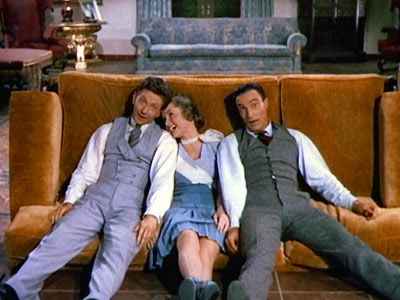
- Threesome Subtext: There's this picture◊ of Don, Kathy, and Cosmo laughing on the couch at the end of "Good Morning".
- Tired After the Song: "Good Morning" ends with Cosmo, Kathy, and Don collapsing onto a sofa with mock-exhausted expressions.
- Titled After the Song: Believe it or not, the song "Singin' in the Rain" was written in the 1920s and was prominently featured in The Hollywood Revue of 1929 a generation before this film was made.
- Title Drop: The movie is named after its Title Theme Tune.
- Tongue Twister: The diction coach has a book full of these, leading into the "Moses Supposes" musical number.
- Traintop Battle: Film Within a Film example. During a scene where Don and Cosmo wander around the studio, one of the events going on around them is the filming of a train-top fight scene (on a train carriage that's fixed in place in front of a Wraparound Background).
- Triumphant Reprise: "Singin' In The Rain (in A-Flat)"; Notably, Kathy herself is pretty despondent while singing it, thinking she's doomed to be Lina's singing voice for the foreseeable future, but unbeknownst to her or Lina, Don, Cosmo, and RF are cheerfully singing along as well, ready to (literally) pull back the curtain on Lina's charade.
- Troubled Production: In-Universe with The Dueling Cavalier. It starts out fine when it's just following the formula for the previous films Don and Lina have done, but then it's switched from silent to a "talkie" and the production becomes a mess. The one scene we see being filmed with sound turns into a disaster, and the preview shows this happened to the whole film.
- True Art Is Angsty: Invoked by Cosmo: "I'm out of a job! At last I can start suffering and write that symphony."
- He even flips it around when he's immediately told his job as a composer will still be needed at the studio."At last I can stop suffering and write that symphony!"
- He even flips it around when he's immediately told his job as a composer will still be needed at the studio.
- Tsundere: Kathy seems like this, but it's an act to cover up that she's a big fangirl of Don's.
- Tutu Fancy: There's a fantasy ballet sequence in which Cyd Charisse wears a completely impossible-in-real-life dress with a crepe train that's a mile or so.
- Two Guys and a Girl: Don, Cosmo, and Kathy.
- Unreliable Voiceover: Don does a combination of this and Unreliable Narrator. The film opens with him and Lina on the red carpet, and he narrates his rise to fame through a flashback, citing such things as his elegant, well-heeled parents and the fine arts academies he attended. His motto throughout, he claims, was "Dignity... always dignity." Meanwhile, what we're actually seeing is — for starters — Cosmo and himself as kids tapdancing in poolhalls for nickels.
- Urban Legend Love Life: Don is becoming obsessed with Kathy. Don's friend and sidekick Cosmo tells him, "She's the first dame who hasn't fallen for your line since you were four." We never actually see Don in action with the other ladies, or any other hint of womanizing.
- Vaudeville Hook: A long hook yanks one of Don and Cosmo's early acts off the stage in the opening flashback.
- Villain Ball: Lina thought that she could go on fooling audiences and derail Kathy's career by forcing Kathy to be her voice via dubbing. Even if the studio had been behind her in hopes of still being able to use her star power, and Kathy had been willing to forgo her own dreams by settling for the easy dubbing pay check, Lina couldn't have kept up the charade forever as her whole plan hinged on no one finding out that the voice they were hearing in the films wasn't hers. While R.F. wasn't able to tell all for fear of getting sued, other people lower down in the business such as film crews or extras could still talk anonymously to the papers or spread rumours. And if Lina hadn't shot herself in the foot on opening night by improvising her speech, she would still have been expected to speak unscripted for interviews or sing live sooner or later (with no excuse to bring Kathy along or keep her behind the scenes anywhere) especially since she played up her vocal talents in the publicity for The Dancing Cavalier. The truth would inevitably have gotten out and Lina's career would have been over regardless. Ironically, Lina probably would have been better off reinventing herself as a comedienne, using her squeaky awkward voice as a source of humor; it may not have been as glamorous as the regal leading lady image she had grown accustomed to, but it would have kept her in the spotlight.
- Virgin in a White Dress: Variation. Cyd Charrise's dancer swaps her green cocktail dress for a white gown in the casino "Broadway Melody" number. Don's character enters a dream sequence where he imagines her a virginal, ballet-dancing beauty. But she hasn't really changed.
- Visual Pun: "I must tear myself from your side," followed by Don's jacket tearing in half as he walks away.
- Vocal Dissonance: Lina, in the worst way. Despite having the appearance of a beautiful and refined movie star down pat, she has a shrill, screechy voice. This causes a lot of conflict in the plot, especially once Hollywood starts to transition from silent pictures to talkies.
- The Voiceless:
- Implemented (briefly) at the beginning of the film: the viewer doesn't hear Lina speak for the first time until the funniest possible moment.
- Cyd Charisse's character in the "Broadway Melody" sequence has no lines and barely makes a sound throughout all of her screen time.
- Waiting for a Break: Don and Cosmo in the opening narration, later mirrored in the "Broadway Melody" number. In both versions, Don ekes out a living in pool halls and Vaudeville before graduating to the big leagues.
- What Could Possibly Go Wrong?: The studio boss doesn't see the problem with just adding sound to silent movies, and just asked that it be slapped on a film already in production. The preview of that film is a big wake-up call to the folly of that idea.
- What Happened to the Mouse?: We never find out what happened to Lina after her terrible speaking and singing voice get exposed to the audience. Although it can be suggested she gets fired from Monumental Pictures and possibly arrested.
- When Props Attack: The "Make 'Em Laugh" sequence has Cosmo "flirting" with a headless prop, which proceeds to slap him and they tussle for a minute or two off-screen.
- Who Writes This Crap?!: During the disastrous screening for The Dueling Cavalier, someone in the audience asked if someone was paid to write the dialog, which ironically was in response to a line that Don ad-libbed (when he found the scripted line too difficult to say).
- World of Ham: From the opening reel to the end credits. The Dueling Cavalier director, Roscoe Dexter, probably takes the cake.
- Would Rather Suffer: When Don kisses Lina for a film scene after learning that she got Kathy fired from her job because she knew he liked Kathy:Lina: Oh Donny! You couldn't kiss me like that and not mean it just a teensy bit!
Don: Meet the greatest actor in the world. I'd rather kiss a tarantula.
Lina: You don't mean that.
Don: I don't— Hey Joe, bring me a tarantula! - Yandere: Lina is this about Don, firmly believing they're in love despite Don protesting otherwise, and resenting Kathy because she can see Don prefers Kathy over her.