
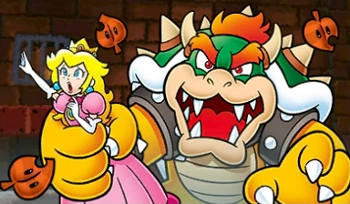
A female character is put into immediate danger in order to put the cast in motion. Her plight unites the cast, causing them to put aside their differences and work together to save her or provide the premise for The Quest and is considered Older Than Dirt.
The nature of the distress varies. The classic damsel has been kidnapped or captured and is locked away, awaiting rescue and afraid for her life and virtue. She may also be lost or stranded in a hostile area, trapped, or suffering any number of terrible fates where she needs help to survive. In other cases, the damsel's distress is due to someone in her own family, such as her husband, her Archnemesis Dad, or a Wicked Stepmother. If the abuser is her husband, she may be rescued by a Wife-Basher Basher. Although strictly speaking, since 'damsel' means a young, unmarried woman, if this character has a husband then she doesn't count as a true damsel in the literal sense.
This set-up is plausible if the damsel in distress is a beloved character, but can be very jarring if the audience fails to see what's so valuable about the damsel and why the rest of the cast should drop everything to go to her rescue. Some damsels are so annoying that the audience wouldn't mind seeing them dead; others end up in trouble in a way that just screams Character Derailment. This is particularly dangerous for the resident Action Heroine who will seem suddenly weak and helpless if her stint as a damsel isn't properly justified — if the moment is bad enough, she can be demoted to Faux Action Girl. On the other hand, anyone can have a bad day; perhaps she just had a moment of Badass in Distress after being thrown a Distress Ball.
A possible way to shake things up a bit is to give the damsel something to do besides stand around uselessly. The Damsel out of Distress will put up a fight, which can either help or make things worse. The Defiant Captive damsel will snarl and rage where her meeker sister would scream. There are even subversions in the line of Play-Along Prisoner: the Decoy Damsel puts on all the appearance of this trope, but her helplessness is all for show.
Sometimes the character gets kidnapped for the sake of her good looks or royal blood, but in other works she's more likely doing something that is a threat to the party that kidnaps her (reporters are common), which allows her to look smart and independent before she needs to be saved. Alternatively, she can end up prisoner as a Heroic Sacrifice; situations where she puts herself in peril so that others can get away are popular, even if her plan ultimately fails.
Generally expected to give The Hero a Smooch of Victory when he rescues her. Assuming he does, of course...
This is a type of Living MacGuffin. Chained to a Rock is an ancient form; Girl in the Tower and Hypnotize the Captive came later. Damsels may also be Bound and Gagged or put into Unwilling Suspension, especially when it satisfies Author Appeal.
If the kidnapper in question is particularly nasty, expect an I Have You Now, My Pretty situation to occur. If the character does not become a Damsel Scrappy but still is constantly captured, they are a Designated Victim. Compare with Disposable Woman, where a barely-developed character is killed off for Emotional Torque, but forgotten not long afterwards. Common for a Caged Bird Metaphor to be used.
A common variation is for the character in question to not be kidnapped per se, but instead simply placed in a situation where she needs to be protected by the other characters, such as a person of prominence being targeted by would-be assassins. This specific variation tends to be one of the more prominent manifestations of the trope in the modern day, as it can more easily allow the character in question to play an active role in the story instead of relegating her to a plot device. After all, just because a character physically needs to be protected doesn't mean she can't pull her weight in other areas. Depending on the nature of the story, this can oftentimes be a jumping-off point for a Bodyguard Crush, particularly in cases where a Lady and Knight dynamic is present.
For obvious reasons this trope is Always Female, unless a Crossdresser plays the role; if such a damsel is still the Love Interest for the protagonist, as the female version often is, "she" is probably Camp Gay (and the whole thing becomes more likely to be Played for Laughs). For the straight Spear Counterpart, see Distressed Dude.
See also The Dulcinea Effect, Distress Ball, Standard Female Grab Area, I Have Your Wife, Save the Princess, Hostage MacGuffin. If the girl is actually faking this for her own benefits, depending on her purposes she's either a Deliberately Distressed Damsel or a Decoy Damsel. A damsel who rescues herself is a Damsel out of Distress who probably used an Improvised Weapon. If she has a strong spirit despite captivity, then they are a Defiant Captive. If the hero leaves the damsel in distress (for the moment), that's Delaying the Rescue. If the hero tries to rescue them even though they don't need rescuing, then The Victim Must Be Confused. See also The Captivity Narrative for a plot based on this.
Not to be confused with the 2012 comedy film Damsels in Distress or the P. G. Wodehouse novel A Damsel in Distress.
This item is available in the Trope Co. catalog.
Examples subpages:
- Anime & Manga
- Comic Books
- Fairy Tales
- Literature
- Live-Action TV
- Music
- Pinball
- Video Games
- Webcomics
- Web Original
- Western Animation
Other examples:
- Lola Bunny at the end of this UK advert for Walkers Crisps.

- The Fernando Amorsolo painting Defence of a Filipina Woman's Honour features a Filipino man, bolo at the ready, in a defensive position in front of a young woman with a cloth covering her body. Details in the scene imply he is protecting her from a Japanese soldier.
- Child Ballad King Estmere. The king goes wooing on the recommendation of his brother, and arrives to find the lady is being forced to marry. He rescues her.
- Child Ballad The Maid Freed from the Gallows has the heroine about to be hanged if she is not ransomed. Various relatives arrive and declare they are there to see her hanged. Finally, her true love arrives and ransoms her. (Most American versions of this ballad feature a Gender Flip version, of a man about to be hanged, but this is the older variant.)
- Always Visible: In some ways, Delia has these traits in her, at least according to Galbraith.
- Ariana Black of The Ariana Black Series gets kidnapped or otherwise endangered by Voldemort at least once per fic.
- In Damona In The Details, Damona is kidnapped by Komane and an exorcist who want to put her back in the Crank-a-Kai, requiring Nate to rescue her.
- Discussed in Fate/Reach Out:
"Well then," Yosuke smiled. "Now we have a plan; Emiya fights, Teddie supports, I investigate, and Satonaka..." he paused as he stared at the lone girl of their party. "Well, try not to get kidnapped, alright?"
"Ha-ha, very funny," said lone girl deadpanned. - In the Turning Red fanfic The Great Red Panda Rescue, Mei is kidnapped.
- Greenfire:Most mares who stay around dragons are there because they've been kidnapped, but Rarity is both a willing visitor and a close friend of said dragon. That doesn't stop a roving knight from assuming this when he sees Greenfire and Rarity together.
- In hear the sirens calling/and the bombs are falling in the streets (we're all screwed), Starscream (who is a human female in the story) is kidnapped and held hostage by MECH.
- In Hellsister Trilogy, Darkseid locks Highfather's daughter D'reema away so she can't ruin his scheme by speaking the Life Equation.
- In Infinity Crisis, Jane Foster is captured by the villains as a hostage (justifiable as half of Thanos’s new allies were Thor’s enemies, so they naturally targeted Thor’s ex for maximum impact).
- Played With and Deconstructed in Infinity Train: Knight of the Orange Lily. Gladion sees his sister Lillie as this, believing her to be a Fragile Flower who requires protection from the Awful Truth about where her Poké-phobia stems from. But she did a lot of growing while he was off running around training, and has come to resent how he effectively abandoned her for years without word in order to become 'strong enough to protect her'... while keeping her and everyone else Locked Out of the Loop. A lot of problems could have been avoided if he'd actually TOLD others what he knew, but Gladion refuses to recognize he made any mistakes, preferring the notion that everything he did was a neccesary sacrifice for her sake, never mind how much she suffered in the meantime.
- Nala is this at times in The Lion King Adventures, most notably when she's kidnapped by Scar and Hago in King's Ransom.
- The Nightmare House, Leni Loud has a nightmare where she's immobilized and dragged away by giant, talking spiders.
- In the Star Wars Rebels fanfic Patron of the Art of War, given that Thrawn is overseeing her imprisonment personally, Sabine is not able to pull a Damsel out of Distress, though she tires at least once. She is forced to make the art he wants, after threating to remove her eyes when she defies him. All the while Thrawn is attempting to tame her, weeding out her rebel characteristics.
- In Sailor John: A Pirate's Vendetta, Emily and Lady Hatt are among those kidnapped by Sailor John and his henchmen.
- In Seeking for a Seeker, Windblade is kidnapped by traffickers after failing to convince Starscream to return to Cybertron, forcing him to rescue her.
- In Chapter 2 of Sew Cute Pretty Cure, Daffodil the fairy and Anna Double Scoops get trapped in the wind storm and need the Cures to rescue them.
- In Sword Art Online Abridged, Suguha wants to be this as part of her roleplaying in Alfheim Online as Princess Leafa. Unfortunately she can't get over her real-life kendo instincts, so even when a trio of Salamanders are menacing her and she's begging for her life in a Southern Belle accent, she can't stop herself from brandishing a sword at them, much to their annoyance.
- Tales of the Emperasque has Isha, Eldar fertility and life goddess, kept in prison by Nurgle. Her rescue is the first Moment of Awesome of many.
- While the Tokimeki PokéLive! and TwinBee series manages to usually avoid this trope since one of the appeals of the Side Stories and the major crossover arcs is to see your favorite Love Live! and Tokimeki Memorial girls who decide to become Pokémon Trainers be adept at using their Pokémon skillfully in Pokémon Battles, there are a couple of examples:
- In "Introducing Anata", Yuu Takasaki is cornered by a new model of SWATbot that Dr. Eggman has created with Eggman daring Yuu to battle the robot with her Pokémon despite Yuu not being a Trainer. Thankfully, her fellow NijiGaku classmates/friends Hilda White and Shiori Fujisaki accompanied her and made short work of the bot with their Samurott and Mega Charizard X respectively.
- In "A Friend Indeed!", Margo is cornered by three young teenage bullies and as part a Mythology Gag to Margo's movie debut, The Power of Us, one of the girls throws the lid of the ice cream they were carrying towards Margo, but Classic Sonic arrives just in time to prevent the lid from hitting Margo in the face and also manages to chase the girls off after beating their Phanpy!
- In The True Villain, Marinette becomes one after being kidnapped by a trafficker and separated from Tikki in the process.
- Twinkling in the Dark: In the prologue, Cure Peace, Cure Custard, and Cure Yum-Yum are tied up over a pond of Bad Energy sludge, with Joker threatening to drop them in.
- Voyages of the Wild Sea Horse: In the early chapters, due to being the Non-Action Guy (bordering on The Load), Nabiki Tendo is frequently captured or taken hostage by forces hoping to use her to get the upper hand against the Kamikaze Pirates. She is less than thrilled about this, lampshading that it used to be her little sister Akane that would get grabbed this way, and ultimately she works to become a competent fighter in her own right.
- Your Alicorn Is in Another Castle: Bowser does this throughout The Multiverse. Because he's contracted to. There are some ways this trope gets played with though: he often offers his services to princesses, who see getting kidnapped as a way to let down their hair, remove their mask, and just be a person rather than a ruler for a while. In fact, the whole story started because Celestia had hired him to kidnap her so she can get out of boring treaty negotiations, but forgot to tell him that Equestria now had three alicorns instead of just one, resulting in him kidnapping Twilight Sparkle by mistake.
- Zoo Coup Riot: Adelaide is kidnapped by the person who's been leaving threatening notes for Sid in order to force Sid to free all the zoo animals.
- The Cat Piano: The female white cat singer is kidnapped by a human for him to use in his cat piano.
- Disney Animated Canon examples (in chronological order):
- Cinderella: Cinderella is locked in her room by Lady Tremaine in the third act and the mice bring up the key needed to unlock the door, once Bruno takes care of Lucifer.
- Peter Pan: Wendy is almost always attacked by Tinker Bell, who almost murdered her, most notably when Tink made the Lost Boys attempt to bludgeon her to death. Later on, Wendy, her brothers, and the Lost Boys are all being held hostage by Captain Hook and his Pirate Crew. In order to save Wendy and the Boys, Peter Pan must fight against Hook and his crew, and have the Crocodile chase Hook and his fellow pirates away, once again.
- Sleeping Beauty: Princess Aurora ended up falling into an enchanted sleep after pricking her finger on the spinning wheel while being hypnotized by Maleficent, much to the horror and disbelief of the Three Good Fairies. Prince Phillip's final battle (with some assistance from the Three Good Fairies) against Maleficent (as a gigantic, horrifying, fire-breathing dragon) is to save Aurora and the other residents in the kingdom that were also put into an enchanted sleep by the Three Good Fairies, which includes her parents (King Stefan and Queen Leah), his father (King Hubert), and the two main servants (Sir Minstrel and Lord Duke).
- Robin Hood (1973): Maid Marian is a lovely Proper Lady but almost completely helpless, even when her love is about to be executed right before her eyes. However, she manages to convince Prince John to spare Robin through The Power of Love (with some help from a knife-wielding Little John), and hits a guard aiming for Robin with a pie, which just goes to show how helpful she can be when she tries.
- The Little Mermaid (1989): Ariel is trapped by Ursula at the bottom of a vortex in the climax before Prince Eric plows into Ursula with a ship.
- Beauty and the Beast: Belle is rescued by the Beast from a pack of wolves after leaving his castle, which is what convinces her to return to said castle in order to patch up his injuries. Later in the film, she (and Maurice) gets locked in the cellar of her cottage by Gaston. Chip, who stowed away in her bag, uses the inventions to free her and her father, so they can save the Beast.
- Aladdin: Jasmine is trapped in an hourglass slowly filling with sand during the final battle and nearly drowns in it until Aladdin breaks her out.
- Parodied in Disney's Hercules.
Hercules: Aren't you a damsel in distress?
Megara: I'm a damsel... I'm in distress... I can handle this. Have a nice day. - Tarzan: Jane is attacked by baboons and rescued from them by Tarzan, due to being an unprepared Fish out of Water in a wild environment.
- Kida from 2001's Atlantis: The Lost Empire, who spends the last third of the film crystallized by Rourke due to her Royal Blood and Milo and his teammates actually have to rescue her and change her back before Atlantis is destroyed permanently and she suffers the exact same fate as her dead mother in the prologue.
- Treasure Planet: Captain Amelia is kidnapped by Long John Silver the cyborg and is threatened to be killed by him as an ultimatum if Jim Hawkins refused to open the map after finally retrieving it from the ship.
- Penny plays one on the Show Within a Show in Bolt, and then becomes one for real when a fire breaks out in said show's studio.
- Elsa becomes this at the end of Frozen (2013) when Hans lies to her thinking that she killed Anna, thus allowing Hans to kill her, but fortunately, Anna performs a Heroic Sacrifice via An Actof True Love.
- Parodied in Ralph Breaks the Internet, when Rapunzel asks Vanellope "Do people assume all your problems got solved because a big strong man showed up?" When Vanellope answers "Yes! What is up with that?", the Disney Princesses declare she's one of them.
- DreamWorks Animation examples:
- Megamind: Parodied. Roxanne Ritchi routinely gets kidnapped by the titular supervillain, to the point where basically no deathtrap can scare her anymore.
Roxanne: Can one of you punch my frequent kidnappings card?
Megamind: You of all people know we discontinued that promotion. - Shrek:
- Lampshaded and averted in the first movie, especially in a scene where Robin Hood and his Merry Men try to "rescue" Fiona from the ogre they believe has kidnapped her, only to have her rebuff him and beat up all his men in a combination of styles from Xena: Warrior Princess and The Matrix.
- And in Shrek Forever After, where in an alternate universe where Shrek was never born and never came for her, Fiona eventually decided to rescue herself.
- Played straight at first but later subverted with Fiona in Shrek 4D, who at first is helpless after Thelonius kidnaps her, but eventually gains the upper hand and beats him.
- Megamind: Parodied. Roxanne Ritchi routinely gets kidnapped by the titular supervillain, to the point where basically no deathtrap can scare her anymore.
- Final Fantasy examples:
- One of the major complainants fans had about Final Fantasy VII: Advent Children is that Tifa doesn't get any massive kick ass moments like in the games, she does get one cool moment when she fights Loz but then is overpowered by his Super-Speed and has to be helped by Cloud again. She is however the last ally to help Cloud in the climax.
- Kingsglaive: Final Fantasy XV: Luna is kidnapped by Glauca, though to her credit she doesn't stand by and let her rescuer do all the work.
- Played with in Happily Never After, in which The Prince (whose name is revealed to be Humperdink) is searching for one of these (or a lady in waiting or whatever else is a typical princess) and sounds excited that Ella could be one of those things. When he asks if she's a damsel in distress, her response is "I will be. Kind of. At midnight". To say the least, Ella does more ass-kicking than servant boy Rick or Humperdink.
- Straight example in Hoodwinked!, where Red Puckett is Bound and Gagged and loaded into a tramway cabin filled with dynamite, and it's up to Granny to rescue her.
- Ariel's daughter Melody becomes this in The Little Mermaid II: Return to the Sea when she's transformed back into a human and Morgana locks her up in unmeltable ice. Melody's friends Tip & Dash have to save her.
- Lupin III:
- In The Castle of Cagliostro, Clarisse is pursued by the Count and one of Lupin's priorities in this story is protecting/rescuing her.
- The Fuma Conspiracy: Murasaki, who twice found herself the target of kidnapping and/or traps. The first was when she was captured by a Fuma Ninja during her wedding, and demanded the MacGuffin in exchange for her life. The demand motivated Goemon and company to steal the vase and deliver it to the Fuma.
- Lupin III: The Columbus Files shows an example of Fujiko being a Damsel In Distress and a Action Heroine, but without being a Badass in Distress. During the opening, she loses her memory, and her entire personality changes. She's terrified of nearly everything, and everyone is a stranger to her. When she contributed to part of her rescue via pure Muscle Memory, that also terrifies her.
- The Nightmare Before Christmas: Sally briefly becomes one when she's captured by Oogie Boogie at the end of the film.
- Quest for Camelot when Kayley tells her mother Julianna she wants to be a knight and rescue damsels in distress... then immediately asks what is a "damsel, anyway?" Ironic because both Julianna and Kayley play the roles of the DID in the movie, Julianna throughout the plot after being captured by Sir Ruber and Kayley initially when she escapes into the Forbidden Forest and having to be rescued/babysat by Garrett before she takes a level in badass to recover Excalibur and save Camelot.
- Strange Magic: Dawn, being a Princess Classic is kidnapped by The Bog King as a hostage to exchange for a stolen love potion Turns out the King is not actually evil.
- Studio Ghibli examples:
- Sheeta in Castle in the Sky needs her secretly royal butt saved frequently by everyone from Pazu to Sky Pirates and killer robots. She only subverts this twice, once while escaping on a train where she saves Pazu from Dola's boys with a shovel inciting the line "That's one strong girl" and when she makes a deal with the Big Bad so that Pazu is freed while she remains the Damsel. Should be noted her rescues do make some of the most exciting points in the movie.
- For Howl's Moving Castle, at the start of the film Sophie is saved from being harassed by soldiers by Howl despite him also being pursued himself by the Witch of the Waste causing Sophie to promptly fall in love with him. This trope is played with through most of the movie, with Howl continuing to protect Sophie as necessary and Sophie looking after Howl throughout and ultimately giving him his heart back saving him from dying.
- My Neighbor Totoro: Mei at the end of the movie when she runs off alone, it gets so dire the neighboring farmers believe she drowned in the river. Satsuki, Mei's older sister, retrieves her with the help of Totoro.
- Porco Rosso: Porco has to win the dog-fight against his old rival Curtis otherwise the main female character Gina will have to marry Curtis.
- In Princess Mononoke, San is introduced as an infamous figure and powerful threat to Iron Town and its leader Eboshi who she will stop at nothing to assassinate, but then she's knocked out by Ashitaka the hero and rescued from the town. Subverted later when San saves Ashitaka from bleeding to death despite initially being ready to kill him, only stopping when Ashitaka reveals he had saved het since she's "so beatiful". But sadly then it's played straight again as San is swallowed up by the demon boar and Ashitaka has to pull her out, for the titular character San is ironically the one who is most frequently in need of rescue.
- In Spirited Away, Chihiro at the start of the movie needs to be saved and protected by Haku. It turns out Haku saved her even earlier than that as a river spirit during a flood when she was a toddler. The rest of the movie inverts this since she learns to be independant and save her parents. Hell Hayao Miyazaki got the idea for the movie when he witnessed his grand daughter being a "lazy bum".
- Princess Odette from The Swan Princess gets kidnapped by Sir Rothbart in the first movie and Zelda in the second one. In the first film, Odette also turns down Rothbart's marriage proposals without a hint of remorse or fear, even though she knows he's a powerful warlock who actually assassinated her father, King William. Also, she doesn't exactly wait for Derek to show up and does everything she can to try and let him know where she is and what he has to do.
- In the second film, Odette is the one that does not get captured by the magician, Sir Clavis, though he does lock her up in Rothbart’s old castle before she escapes from the dungeon to help Derek. Instead, it was Prince Derek’s mother, Queen Uberta, who ended up being very unlucky as she spends most of her time in the film being captured, imprisoned, and taken prisoner by Clavius. Indeed, it drove Derek and Odette through out most of the film in order to save Uberta from Clavius and his conspirator, Sir Knuckles.
- Throne Of Elves: Princess Liya, being a Princess Classic, is attacked by the villain of the film and has to be protected by her romantic interest. She has no agency of her own, and the only thing she does is swoon and fawn over the hero who saves her. She even cries when she thinks he has died.
- Subverted in Titan A.E., when Akima is jettisoned into space, captured, and held to be sold into slavery. The rest of the crew undergoes a makeshift rescue operation, only to find out that she successfully knocked out all of her captors and is patiently waiting to be picked up.
- In Toy Story and Toy Story 2, Andy purposely has Bo Peep play this role, so Woody could save her. Not that she minds...
- Princess Patma's sole purpose in Against All Flags is to be rescued: repeatedly.
- All About E: Trish is held hostage by Johnny with a knife to her throat, but E saves her.
- In both Annie (1982) and Annie (2014), Annie is kidnapped by her fake parents and sent on a car chase with them during the climax.
- Subverted in The Avengers (1998). Emma Peel is captured by Sir August and brainwashed into a hallucinatory state. You'd expect Steed to break in and rescue her, but instead she escapes from Sir August, fights off her delusions and breaks out to freedom by herself.
- In Batman (1989), Vicki Vale, due to the Joker's obsession with her. First, Batman has to save her from a Captive Date with the Joker at the Museum, and then the Joker kidnaps her at the climax of the film.
- Black Lightning (2009): Kuptsov prevents Black Lightning from destroying the Nanocatalyst by noticing Dima in the security camera and rushing to the new-years party to take Nastya as Hostage for MacGuffin.
- Subverted hilariously in a scene of The Boondock Saints II: All Saints Day with Agent Eunice Bloom. She's snatched into an impenetrable panic room by a baddie (right in front of the cops, no less), and pandemonium breaks out. One of the cops even worries that she might be "touched and stuff", and it's played as high drama for a bit. He needn't have worried; in the next shot, Special Agent Bloom has the baddie pinned down and sputtering for relief.
- Cliffhanger. Jessie Deighan turns into one. She's a helicopter pilot. She does mountain rescues. Then she gets scared by bats in a cave, and cringes in a corner while the he-men fight.
- The Climax: The heroine Angela spends the entire movie being menaced—either covertly or overtly—by Dr. Hohner, and being rescued by her fiancé Franz. (or Luise, or Carl or the Vienna police...)
- Clownface: Zoe spends a year as Clownface's prisoner until she escapes.
- Conan the Barbarian (2011): Tamara is captured and then rescued multiple times by Conan, whom she enters a Rescue Romance with.
- Cut to the Chase: Izzy it turns out is being held captive by Nola, and Max rescues her in the end.
- In The Dark Knight Rises, Selina Kyle plays this straight when she is cornered by Bane's henchmen on the rooftop while confronting John Daggett. She also fakes it in the bar shootout, where she guns down two of Bane's henchmen, then begins screaming hysterically when the SWAT team bursts in, only to sober up as soon as they have chased Bane's men out.
- DC Extended Universe:
- Lois Lane (surprise, eh?). In just Batman v Superman: Dawn of Justice alone, Lois has to be rescued by Superman three separate times. The first was Lex, by proxy, testing if Superman would come for her if she were in danger. The second time was Lex using her to summon Superman.
- Lex also kidnaps Martha Kent to blackmail Superman into fighting Batman.
- Lauren's sole purpose in Death Ring is to be held hostage to ensure Matt's compliance. She comes good at the very end of the film when she shoots Ms. Ling to save Matt's life.
- Played straight in Desert Heat with a pair of blondes. Complete with threesome Rescue Sex.
- Played straight in Django Unchained with Broomhilda.
- Kerry Washington said she took the part because African-American actresses aren't usually offered the "damsel in distress" role.
- In Doctor in the House (1954), Nurse Gibson is taken away by two St. Crispin's medical students during the riot and has to be rescued by the St. Swithin's lot.
- Giselle starts out like this in Enchanted but reverses roles with Robert in the end.
- Subverted in Ever After: when Danielle is sold into slavery, Prince Henry shows up to rescue her. But, being the capable heroine she is, she has already threatened the bad guy and freed herself.
- Eyes of a Stranger: Blind, deaf-mute teen girl Tracy is taken captive in her own apartment by the titular Serial Killer in the movie's climax, leaving it up to her sister to rush back to the apartment in time to save her.
- Fire with Fire: Talia is shot but survives early on when an attempt is made on Jeremy's life. He manages to save her.
- In the original script of Game of Death, Hai Tien's wife and child are kidnapped by Korean mafia to force him to undertake the titular game of death.
- Fiona during the climax of The Giver, in which she's sentenced to Release for her role in helping Jonas escape.
- Elle Brody's role in Godzilla (2014) is basically to be in danger from the Kaiju and motivate Ford to risk his life to save her.
- The Hateful Eight has Daisy Domergue. John Ruth captures her for the Dead or Alive bounty on her head, and believes that a Knight in Shining Armor of sorts is going to try to rescue her. [[Turns out four such knights mostly wiped out most of Minnie's Haberdashery of innocents to do just that.
- Hayride 2: Ol' Pitchfork catches Amanda and holds her hostage in the secret cellar of his house.
- Rachel in Highway to Hell is kidnapped early on and spends much of the movie as a prisoner of hell.
- In Hudson Hawk, a kidnapped Andie MacDowell pretends to suffer side effects from curare poisoning so she can annoy the typewriter symbols out of her captors and lampshade the trope: "I'm not a very good damsel in a dress, am I?"
- Cheryl in I'm Gonna Git You Sucka when she's kidnapped by Mr. Big's Mooks.
- The Indiana Jones series
- Marion Ravenwood in Raiders of the Lost Ark. She's captured by Todt and threatened with torture in her own bar and has to be rescued by Indy. Later in Cairo she's captured by the Germans' Arab allies and carried away in a basket. Then she's captured yet again by Nazi troops while she's aboard the ship. Somewhat averted because she isn't completely helpless, including knocking out one of her Arab pursuers with a frying pan and pulling a knife on Belloq in an attempt to escape.
- Willie Scott in Indiana Jones and the Temple of Doom.
- Subverted at the end of Indiana Jones and the Last Crusade. Elsa became a distressed damsel when she found herself dangling over a crevasse after she tried taking the Holy Grail from its resting place. However, rather than letting Indiana pull her up to safety, she uses his hold to try and reach for the chalice, which had conveniently fallen just below her. In the final moment, she almost reaches the grail until her hand slips away from Indy's, causing her to suffer a Death by Materialism.
- It (1990): Bill's wife Audra is captured by the titular monster and is put in a comatose state, even after the surviving Losers's Club save her she remains motionless and shocked due to seeing It's true form. Bill returns his wife to normal by using the power of his bike Sliver.
- It (2017): Just after escaping her awful father, Beverly is captured by Pennywise and is taken to the sewer, leading the rest of the boys to chase to come to her rescue. Some fans were pissed that Beverly is seemly relegated to the damsel in distress role, when in the books and the original TV miniseries she is never put in that position.
- Isabelle getting captured by the giants is what sets the plot of Jack the Giant Slayer in motion.
- James Bond: A large number of Bond Girls fit this trope.
- For example, Honey Rider in Dr. No. Dr. No decides to execute her by cuffing her to the inclined side of a pool with water pouring in from a large pipe. Bond finds her and releases her. Originally she was supposed to be attacked by large crabs while chained◊.
- Thunderball: Bond's fellow agent Paula is kidnapped by a couple of Largo's thugs and taken to be tortured for information. Bond goes to Largo's estate to rescue her but arrives too late. Paula has taken a Cyanide Pill and killed herself so she can't be made to betray Bond and the operation.
- Spectre: In the climax, Oberhauser kidnaps Madeline and traps her in a locked room in the old MI6 building, which is set to be demolished and has already been rigged to blow. Bond has to race through the building to save her life.
- For example, Honey Rider in Dr. No. Dr. No decides to execute her by cuffing her to the inclined side of a pool with water pouring in from a large pipe. Bond finds her and releases her. Originally she was supposed to be attacked by large crabs while chained
- Jane Got a Gun: Jane was made a sex slave and held in a brothel, with Bill rescuing her.
- Kimi: Angela escapes the thugs after some other people come to help her twice.
- King Kong:
- The original 1933 film treated Fay Wray's Ann Darrow as nothing more than a prize for an evil gorilla.
- The 1976 film starts this way, but Jessica Lange's Ann Darrow gets to know King Kong, sees that he's lonely and forms a bond with the big guy.
- Naomi Watts' Darrow from the 2005 film takes the latter step further, and is more assertive in trying to stop a money hungry publicist from making Kong a circus attraction.
- The female lead in Legend (1985), it doesn't help that she's innocent to the point of stupidity either.
- Hey, she did manage to trick Darkness into believing her Face–Heel Turn long enough for her to free the unicorn. She got knocked out immediately afterwards.
- Defied in Live Free or Die Hard when Gabriel attempts to evoke this by taking McClane's daughter Lucy hostage as revenge for killing his lover Mai. It doesn't phase McClane or Lucy because they quickly realize he won't kill her because he knows how serious a threat McClane really is, and will keep her alive as a bargaining chip. While she lacks the muscle to resist, being an unarmed college student against armed professional mercenaries, she also takes zero crap from them, resists every chance she gets, smugly tells McClane how many bad guys are left when ordered at gunpoint to plead for her life over the phone, actually manages to shoot one of the mercenaries in the foot, and even manages to push Matt Ferrel, the actual damsel in distress, into toughening up and resisting as well. In the end kidnapping her was the worst possible thing Gabriel could have done, as not only does she help foil his plans but McClane rescuing her by shooting himself through the shoulder to kill Gabriel actually improves their relationship to the point her animosity toward McClane is completely gone in the end.
- Pretty much the whole point of A Lonely Place to Die, which has a group of mountaineers getting killed off one by one trying to take a young Serbian child they found buried underground in the Scottish highlands to safety.
- Marvel Cinematic Universe:
- Averted in Iron Man. Pepper Potts has to be rescued, but she is enough of a threat that the villain feels compelled to shoot her instead of taking her hostage. She's also generally competent and helpful throughout the film. Indeed, the one scene that seems obviously headed for her being captured and turned into a distressed damsel has her instead easily evading the villain's clutches, and then immediately alerting the authorities to his evil plans.
- Averted again in Iron Man 2 when Happy Hogan insists on accompanying S.H.I.E.L.D Agent Natasha Romanoff/Black Widow on her mission and fights a bad guy when they enter the building. By the time he has won the fight, he sees that she's taken down every other bad guy there is.
- Exploited by Natasha in the beginning of The Avengers (2012). She's held captive by a group of Russian mobsters who are ready to kill her until Agent Coulson calls her, ready to bring her back in. She even notes how she's playing them like a fiddle. When Coulson explains why it's urgent,note she easily frees herself and drops everyone she was dealing with in no time flat. With Coulson listening in on the whole thing, showing all the concern warranted by being put on hold.
- Iron Man 3 has Pepper taken prisoner again, but she ultimately saves Tony using part of one of his armors while under the influence of Extremis. It's worth noting that the same film also has Rhodey and the President of the United States needing rescue at various points.
- Tina in The Mask. Although she is able to get Dorian to take off the mask and then kick it to Stanley, which leads to the battle being won.
- In the first Men in Black movie, Edgar the Bug storms the morgue where Dr. Laurel Weaver works after learning Orion, the cat with the galaxy he's looking for is there. Here, he holds her hostage with a gun for a while to avoid getting stopped by agents Kay and Jay and promptly kidnaps her so she can take him to the flying saucers found at the towers of the New World Pavillion, which he plans to use to escape from Earth. He takes Laurel with him with the intent of eating her and feeding her to his family. Thankfully, Laurel quickly becomes a Damsel out of Distress shortly afterwards.
- Miss Meadows: Miss Meadows is kidnapped and held captive near the end. Though she does fight back, her fiance Mike must rescue her.
- Parodied in Monty Python and the Holy Grail. The Prince in the swamp castle is (obviously) actually a Distressed Dude, but it's worth mentioning as it is deliberately played as a Parody of a Damsel in Distress. Lancelot, in fact, thinks it is the latter, and is distinctly nonplussed when he realizes the truth.
- A willing example in The Mummy (1999). Imhotep wants Evy to be the sacrifice needed to bring his dead lover back to life, and she goes with him both on the condition that he spare the others, and knowing that he has to take her back to Hamunaptra to perform the ritual, which will buy them some more time to save her.
- Charlotte in the climax of Mystery of the Wax Museum, as she is under threat of becoming a waxed corpse.
- Subverted with Kelly in Mystery Team. Yes, she does get kidnapped... but it's not like the Mystery Team are much help in saving her.
- In Perfume, the Villain Protagonist sets his murderous sights on Laura Richis, a beautiful, virginal young lady. Her father becomes wary of the danger and does everything in his power to protect his daughter.
- The Ur-Example of this in film would probably be the protagonist of the 1914 silent melodrama serial The Perils of Pauline. A "talkie" version of the series was made in the '30s; the title was later used for a 1947 biopic of original Pauline actress Pearl White, and a 1967 film that was a camp spoof of the genre.
- Pearl White also starred in a nearly-identical series, The Exploits Of Elaine, around the same time.
- Pirates of the Caribbean
- Played with in the first movie. Although Elizabeth is kidnapped by the pirates, she initiates said kidnapping by demanding to go on board the ship and negotiate them leaving Port Royal, and just forgot to include her being returned to shore as part of the arrangement. They also take her thanks to her lying to say her last name is Turner (assuming they're after her as the Governor's daughter), mistakenly making them think she's the Living MacGuffin they need to end their curse. She's rescued midway through the movie by Will, and then has to rescue him in the climax.
- Played straight and then subverted as said damsel takes a level in badass over the course of the movies. It gets lampshaded by Jack when he refers to her as "a certain damsel in distress... Or should I say distressing damsel." after her Shoot the Dog moment of leaving Jack to die. By the climax of the third film, the same young woman who had previously been kidnapped and held prisoner by Captain Barbossa's crew has become The Pirate King, thanks in no small part to Jack's gaming the system of pirate politics.
- Syrena the mermaid from Pirates of the Caribbean: On Stranger Tides as an almost literal Fish out of Water on land amidst pirates who want to harvest a tear from her; clergyman Phillip is the only one trying to keep her from harm. Ironically, she later plays a role in saving two other characters (finding the chalices thrown in the deep pools allowing Jack to save a dying Angelica and kissing Phillip when he's badly injured as the lore is that a mermaid's kiss can prevent someone from drowning).
- Pitchfork: Jenny gets kidnapped by the killer early on in the movie, and is found held in a makeshift cell in his shack behind bed springs used as cell bars. Thenkfully, she gets saved before the killer has a chance to hurt her.
- Played straight in The Princess Bride. Princess Buttercup gets kidnapped by Vizzini, nearly eaten by the shrieking eels, is the oblivious target of a murder plot, gets set on fire, falls into a sand trap, and nearly gets maimed by a rodent of unusual size. At one point she even contemplates taking her own life.
- In The Prince of Thieves, Lady Christabel and, to a lesser extent, Marian exist to be kidnapped and imprisoned by the villains so Robin and Sir Allan can rescue them.
- Averted in The Proposition, as this role is occupied by the mentally handicapped younger brother. Obviously, there is no Rescue Romance. At the end, however, Charlie still has to rescue the police captain's wife from being raped and killed, although the captain himself — despite being Ray Winstone — is also being threatened, though not with rape.
- The Retreat (2021): Val is rescued by Renee when she's set to be murdered next.
- Anna Cipriani's role in Revolver (1973) is solely to be held hostage and force her husband Vito into action.
- Marian in Robin Hood: Prince of Thieves is a downplayed example - she directly helps Robin under the nose of the Sheriff and only went through with his scheme because Nottingham was holding the rebels hostage and would've killed them if she turned down his marriage proposal. During her wedding/rape scene she is defiant throughout by outright telling him "It may be my body but it will not be me!" And during the final fight between Robin and Nottingham she does not a bystander as she grabs what she can to help Robin, which isn't much since it's in a chapel.
- RRR (2022)'s plot is triggered by the Governor and his wife stealing Malli, a little girl, from her tribe and keeping her cloistered in their mansion. Bheem sets out to rescue her; Ram volunteers to nab the rescuer.
- Reconstructed in Scooby-Doo (2002). They point out that while, yes, Daphne did get kidnapped a lot, she never let that discourage her from joining the gang in their latest mystery. She's also studied martial arts so that she is eventually able to look after herself.
Daphne: [after defeating a henchman who tried to kidnap her] Now who's the damsel in distress?
Henchman: Me?
Daphne: Straight up! - WPC Helen Bradford keeps finding herself in this role in Scream and Scream Again. Sent undercover to act as bait for the Vampire Killer, she is overpowered by Keith and only saved by the arrival of her back-up. Later she helps Dr. Sorel brake into Dr. Browning's facility, but is overpowered by Dr. Browning while keeping lookout. Dr. Sorel later finds her Strapped to an Operating Table, about to be used as an unwilling donor for one of Browning's transplant experiments. In her defense, none of the men in the movie have any success going one on one against Browning's enhanced humans (of which Keith is one) either.
- Sheroes: Daisy gets kidnapped by drug traffickers while on vacation in Thailand with her friends. The rest of the plot focuses on them working to rescue her.
- Shoot to Kill: Sarah spends half of the movie as a hostage of the Big Bad, being forced to guide him to Canada as her boyfriend and Stantin try to rescue her. However, she has several Defiant Captive moments and fights back in an effort to escape on two occasions.
- In Showdown in Little Tokyo, after Yoshida recaptures Minako he takes her with him as a hostage. He eventually ties her up covered in gasoline and tries to burn her alive in front of Kenner.
- In Small Soldiers, the Commandos capture Kristy specifically to use as a hostage and make Alan give them what they want. Once he rescues her, she immediately goes to town on the Gwendy Dolls used to attack her, retroactively proving herself a Badass in Distress.
- In the Spider-Man Trilogy, Mary Jane gets kidnapped by the villain in the climax of all three movies. She's also in distress twice before the climax of the first.
- They tried to play it less straight in Spider-Man 2. After Spidey gets knocked down in the climax, M.J. picks up a steel beam and tries to sneak up on Doctor Octopus (Doc Ock, learning from his earlier encounter with Aunt May, brushes her aside).
- Kirsten Dunst actually only signed on for Spider-Man 3 when they promised not to make her a Damsel in Distress. When plans changed, Sam Raimi tried to make it up to her by giving her more to do in the finale. She ends up saving Spidey by chucking a cinder block at Venom, and uses some web to swing out of the way of a falling truck.
- Princess Leia from Star Wars manages to be this and simultaneously an Action Heroine. However she is something of a subversion because her plea for help was not a plea for a rescue but rather a plea to get the plans to the Death Star to Bail Organa on Alderaan. She wasn't expecting a rescue at all (and the guys didn't plan to do it either), And she wasn't exactly what one would call grateful when she did get the rescue, either.
- Princess Leia: I don't know who you are or where you've come from, but from now on you'll do as I say, okay?
- Carrie Fisher herself said: "I was not a damsel in distress. I was a distressed damsel."
- Rather funnily, Han Solo, of all people, plays this role in Return of the Jedi. He is rescued from a dragon... by a princess. And he is helpless and weak when she rescues him, seeing as he's blind at the time. This doesn't prevent him from (accidentally) knocking Boba Fett into the Sarlacc Pit - and then rescuing best friend Lando Calrissian after Lando had come to rescue him!
- She does end up captured by Jabba, and forced into Go-Go Enslavement but, in the end she's the one who kills him.
- Done remarkably effectively in Superman: The Movie with the famous helicopter rescue, but all of the climaxes in the movie involve this trope. Also used in the sequels.
- Played fairly straight in Sync episode 6 when computer prodigy Yoshi appears to have no sense of fighting or quick reasoning skill whatsoever. Ruthlessly exploited by our Genre Savvy main character when he gets her to panic in his favor by suddenly yelling, "Oh God, look at all the bad guys coming to get you, get on the motorcycle, quick, they're right behind us!"
- Tank Girl: Sam (a 10-year-old girl) is captured several times, with Tank Girl spending the movie tracking her down in order to save her. Subverted at one point when Sam cleverly uses a deadly toy to puncture a child molester's hand.
Sam: That's what you get for being a perv!
- Double subverted in True Grit western: the main character is a 14-year old girl trying to prove her companions she doesn't need babysitting, and succeeding. However, eventually she does, in a perfectly classical way: first getting kidnapped by outlaws, than falling into a snake pit.
- Van Helsing:
- Subverted with Anna. While she is a young woman in distress, it's less about saving her and more about giving her the help she needs to defeat Dracula, and in the second act, she's trying to save her captive brother. She does get captured midway through the film, but Dracula is merely using her as a hostage to get Van Helsing to trade her for Frankenstein's monster.
- When Dracula's children are awakened and attack a village, special attention is drawn to a young woman who's being carried away by one of them, and Carl saves her. She then sleeps with him as thanks.
- Wild Wild West: Rita Escobar, whose husband was kidnapped by Dr. Loveless and who ends up getting imprisoned and kidnapped by Loveless herself.
- The Wizard of Oz: During the attempt to reach the castle of the Wicked Witch of the West, Dorothy is kidnapped by the Witch's flying monkeys and taken to the castle. The Witch decides to kill Dorothy so she can obtain the ruby slippers Dorothy wears. The Scarecrow, the Tin Man and the Cowardly Lion must infiltrate the castle and save Dorothy from certain death.
- Wolves: Angel Timmons. Her entire function in the story is to help Cayden learn how to control his werewolf side, and be rescued by him. Somewhat justified as she's physically outmatched by Connor and his pack, and if she runs away he'll kill her family.
- X-Men Film Series:
- In X-Men, Rogue is kidnapped by Magneto for his machine.
- In X-Men Origins: Wolverine, Emma Silverfox is captured by William Stryker and he used her to blackmail her sister, Kayla.

- Michael Jackson's "Thriller" video has this twice, in the movie Michael and his date are watching at the start, then again in the date's dream. It's implied that it happens a third time once she wakes up.
- Tasha in LL Cool J's "I'm Bad" video.
- This is Older Than Feudalism, dating back at least to the Greek myth of Perseus and Andromeda.
- The story of Hesione and Heracles is very similar to that of Perseus and Andromeda. However, Deianeira, another woman in Heracles' adventurous life, subverts it by taking matters in her hands shortly after the rescue.
- Eurydice is in a classic Damsel In Distress situation. Unfortunately, Orpheus does not come up to expectations.
- Subverted with Helen of Troy, who is anything but innocent in what happens to her.
- In Ramayana, Sita is a crown example.
- In Celtic mythology (Mabinogion), Branwen finds herself in this position. Subverted with Deirdre, who voluntarily put herself in the situation which was considered as distress by her fiancé.
- To Deirdre's credit, she was in distress that the aging King Conchobhar wanted her as his wife and, for Deirdre, eloping with Naoise, Conchobhar's best warrior (and, in some versions of the story, his nephew), was a means to escape a man that disgusted her. For all the unwanted attention that she gets from men, she remains determined to live her life.
- Downplayed in the legend of St. George and the Dragon (a tale that has otherwise many parallels with the myth of Perseus and Andromeda): The princess is delivered to the dragon and saved by St. George, but she is not physically constrained, does not ask for help, and there is no romance between the princess and George, nor does the king offer her up in marriage.
- The legendary Battle of Clavijo had a hundred maidens (50 peasants and 50 noblewomen) demanded by the Emir of Córdoba to renew his Royal Harem or sell them as slaves. They were saved by Santiago (Saint James the Greater as he is known in the legend) when he descended from heaven to intervene the Spaniard behalf against the emirate forces.
- Circassian Mythology: In one of the Nart Sagas, Setenaya's "sister" Psatina is abducted by the giant Arkhon Arkhozh, and must be rescued by Warzameg. She isn't entirely helpless, however, and provides her hero with information that helps her escape.
- At least as old as The Bible itself, as shown by the case of Sarah, daughter of Raguel, saved by Tobias with Raphael's help.
- 1 Samuel 30 describes how David's wives (yeah Ahinoam and Abigail were kidnapped by the Amalekites. David then goes on a quest to rescue them from Amalek.
- Randy Savage has twice seen his valet, Miss Elizabeth, kidnapped by George "The Animal" Steele and King Kong Bundy. Hulk Hogan in the nWo even forced her to say she no longer loved Savage on camera.
- Mountain Fiji was practically invincible, so her enemies in GLOW frequently resorted to attacking and or kidnapping her little sister, often resulting in Mt Fiji losing matches by forfeit or count out as she left the arena to go save her.
- Later in WCW, the nWo would try to send a message to David Flair by kidnapping his Loony Fan Daffney Unger. Scott Steiner actually acknowledged that it might not have been the best idea.
- Smackdown did an angle revolving around Kurt Angle admitting that he wanted to have sex with Booker T's wife Sharmell, leading to many scenes of her failing to fight off or out run Angle before Booker came to the rescue, although he usually got beaten up too, until the very end.
- Stacy Keibler had several instances where someone would attack her. Sometimes it was to provoke the guy she was managing, other times it WAS the guy she was managing, sick of her getting all the attention.
- Trish Stratus was once abducted by MNM on an episode of Monday Night Raw, causing Jerry Lawler to abandon his commentary duties to go find her. Subverted in that she wasn't in any danger, as Melina just wanted to challenge her to a Women's Championship match.
- TNA would later revisit the assault someone else's wife I want to have sex with angle with Scott Steiner going after Kristal Lashley until her husband Bobby made the save.
- At SHINE 15, Valkyrie used Solo Darling who was helpless after being beaten up by their future target Mercedes Martinez, to lure Amazing Kong away from their leader, The Radiant Rain.
- Eve Torres was targeted by Kane in early 2012, including a memorable Raw where she and Zack Ryder were stuck in the parking lot thanks to a flat tyre that took forever to change. It was then a huge swerve when John Cena rescued her, and she kissed him to turn heel, later revealing she had been using the whole thing as a chance to get attention.
