
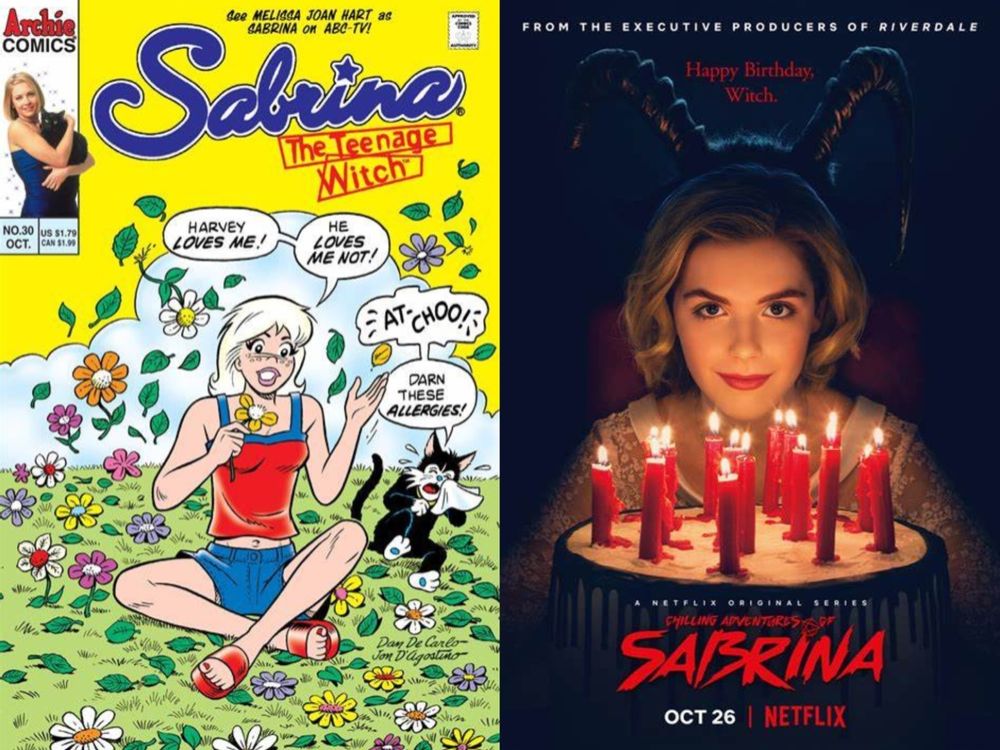
Sabrina went from magically fun adventures to chillingly dark adventures.
Examples of Darker and Edgier in live-action television.Series with their own pages:
- Arrowverse
- Kamen Rider
- Marvel Cinematic Universe
- Power Rangers
- Super Sentai
- Star Trek
- Ultra Series
- Whoniverse
- Cracked presents 5 Inexplicably Horrifying Episodes Of Classic Comedies
 , which is about... exactly what the title implies, really. The sitcoms referred to in this article include:
 - Nickelodeon went in this direction with their SNICK block in 1992, which consisted of shows that were considerably darker and more teen-focused than the otherwise perfectly kid-friendly programming of their main television block. In particular, Are You Afraid of the Dark? and Roundhouse were among the darkest and edgiest programs Nick had ever put out at that point. The former was a horror-themed series with some genuinely scary/creepy moments (which were sometimes undercut by the show's low budget), while the latter was a single-stage sketch show with a whole lot of demographically inappropriate humour. Unfortunately, while AYAOTD proved to be quite popular and lasted several seasons before cancellation, Roundhouse turned out to be a little too edgy for Nickelodeon's target audience and was replaced after two years with the Lighter and Softer All That.
- Louis Theroux's documentary work provides one of the rare examples of this in non-fiction: whilst his early series Louis Theroux's Weird Weekends was light and silly in tone and investigated amusingly weird and kooky subcultures (UFO nuts, pro-wrestling, swingers, bodybuilders) or in some cases took a fairly fluffy take on potentially dark subject matter (porn, Thai brides), his later documentaries have veered into much, much darker and more serious territory, including neo-Nazis, crystal meth addiction, the Coalinga centre for the treatment of paedophiles, the Westboro Baptist Church and life in prison.
- From 1995 until 1998, Belgian Network VT4 was this in comparison to the other Belgian networks that were airing at the time. They even pretended that they were illegal. In reality though they were only a Rule-Abiding Rebel. The headquarters of the owners were located in London and they send their content through U-turn construction. That means that they have to abide to the British law instead of the Belgian one.
- The 2018 adaptation of The ABC Murders by Agatha Christie. The novel is already one of her darker works from that period, but this adaptation went to great lengths to make it as grim as possible. Many characters were depicted in a very negative light with Inspector Crome being openly antagonistic against Poirot and the press being openly hostile as well. Many smaller characters are depicted as card-carrying members of the British Union of Fascists (a plot line that goes nowhere). Even Poirot's backstory is grimmer than him simply being a refugee re-settling in England because of the Great War. It creates a very odd, almost uncomfortable mood for people used to the more lighter but still serious Poirot adaptations.
- Akumaizer 3 was this to the other Toei Tokusatsu programs of the 1970s. Its storylines featured the titular heroes losing loved ones on an almost regular and often times having to go up against foes who were once their brothers. It also featured many villains who weren't wholly evil and had shades of grey to their characters. While it ended up becoming more Lighter and Softer midway through, it went back to being dark by the finale, which saw numerous characters, includin all three heroes, dying in their final battle against the Akuma Clan.
- Alex Rider (2020):
- The TV adaptation is grittier than the books, dialling back on the Moore-era James Bond elements. For example, Alex's only gadget is a phone disguised as a music player, which doesn't even work (so no circular saw CD player or exploding earring). Alex himself is also much less of a boy scout than the book version, sneaking off to parties and drinking.
- Season 2 continues on with this trend, having Alex already suffering from PTSD and cutting out the more theatrical set pieces (a real-life videogame mockup, a bullfight, and a man getting crushed by 12 million quarters) in conjunction with Big Bad Damien Cray's Adaptational Seriousness.
- For Ki.Ka, a German public channel aimed at kindergarten-aged kids at the least and young teens at the most, it was the teen drama Allein gegen die Zeit that crossed some borders. It treated such wonderfully whimsical topics like school hostage crises, terrorism, fascism, attempted mass murder, deadly viruses, had a rather unvilified take on ethnic youths (Turks in particular), and a less-than-family-friendly death or two.
- And Then There Were None (2015): The miniseries goes for this to some extent, including scenes such as Marston taking cocaine, Rogers beating his wife, gorier deaths than those described in the book, and very brutal flashbacks to the murders committed by each victim. And to top all that, all but two of the indirect deaths caused by the guests in the novels are turned into straight up murders committed by their own hands, presumably to make said flashbacks more interesting.
- Banshee The already dark TV show becomes more grim and more depressing as the series progress, the people who started out as good people become more corrupt and broken.
- Battlestar Galactica (2003). The Continuity Reboot is one of the more successful — and for that matter, logical — cases of darkening. The original Battlestar Galactica (1978) wasn't exactly a Sugar Bowl, but it did devolve into 1970s style camp a lot of the time. In the reboot, Anyone Can Die is in full effect, the fight scenes are much more violent, the characters have a whole lot of Dysfunction Junction going on, and the themes are much more heavily layered with a philosophical and religious bent.
- Blackadder is a very odd example since dark humour is always its main characteristic and each season's different elements can be darker or more lighthearted depending on the direction. Thanks to a more cinematic appeal, the first season has a grittier, more gothic atmosphere with an emphasis on the "dung" part of The Dung Ages and the squalor that people are forced to live in. Because of its budget and a more visual approach, it has the most brutal onscreen scenes of violence and often blurs the line between black comedy and historical dramedy with a very morose and sad ending. Even its soundtrack is complemented by grim and ominous church organ music. Blackadder II was much lighter (though not without its dark moments) because of the changes in all the aforementioned areas. Blackadder the Third, while still following the second series' direction, is edgier due to the absence of the slapstick of the first season and picturesque quality of the second season. In particular, Blackadder is shown to intentionally kill a larger number of people, with a higher proportion of them being undeserving than the previous ones, though the series is the only one of the four which doesn't feature an ending where everyone dies. Blackadder Goes Forth is the darkest and the most tragic series, with the main characters living permanently under the shadow of death (being set in the trenches of the Western Front and all), and a classic Downer Ending.
- Blue Heelers took a big one in 2004 with the station being bombed, killing Jo and Clancy, and Tom's wife raped and murdered. Dark, grisly crimes would become more of a forefront and rather than glossing over the details it became akin to something like CSI Mount Thomas or Criminal Minds Australia.
- Brave New World: The series adds lots of violence which the book didn't have. First of all, some "savages" ruthlessly murder outsiders and some of their own whom they consider traitors for entertaining them. John here also more quickly uses violence than his book counterpart did, and incites others to.
- Buffyverse:
- Buffy the Vampire Slayer:
- The TV series is way "Darker and Edgier" than the movie, which was a high-camp spoof of horror movies. Though most viewers agree that the tone of the TV series was a marked improvement, the series continually topped itself with even moodier stories.
- When the TV series was rescued from cancellation, there was a sharp turn away from light comedy. The reasons for this are twofold: Buffy was figuratively and literally killed at the end of Season 5, then resurrected when the series was bought by UPN. Secondly, the series was now under Marti Noxon's purview, as Joss Whedon did not return as showrunner (though he remained a producer). Every character underwent a deconstruction of their earlier, comedic roles: Buffy, having been yanked back from a blissful afterlife, became a borderline-suicidal, hedonistic loose cannon. Willow the witch began dabbling in black magic, with animal sacrifices and the like. The slacker student, Xander, did not miraculously become Cary Grant once he reached adulthood; rather, despite managing to get himself a job he enjoys despite not having a college education, ditches Anya at the altar as his insecurities catch up to him. Giles decides to stop acting as Buffy's surrogate father and leaves her just as her depression leads her to avoid Dawn and get in a toxic sexual relationship with Spike. There were attempts to emulate Whedon's off-the-cuff meta humor, but this was an entirely different show. Buffy no longer embraced and poked fun at tropes.
- Wishverse Buffy is a grim vampire hunter without friends.
- Angel was an even Darker and Edgier spin-off of the already-becoming-Darker-and-Edgier Buffy, dealing with more mature issues, having a higher cast turnover, and including a higher mortality rate. Like its parent show, the angst was ramped up with each passing year. By the final season, the heroes were stabbing each other with sharp weapons more often than the bad guys, and Buffy's faction had completely disowned them.
- Buffy the Vampire Slayer:
- Chespirito: Most of Chespirito's first episodes were family friendly slapstick comedy and light-hearted jokes with his classic characters like Chavo, Chapulin Colorado, Dr. Chapatin, etc. Later seasons of Chespirito changed the tone and focus only in former thieves Chompiras and Botija with much more adult-oriented plots, sexual innuendos, social issues and adult humor i.e. Darker and Edgier. Cast member Maria Antonieta de las Nieves even said that Chespirito’s motivation for the change in tone was because of this trope.
- Chilling Adventures of Sabrina is considerably darker and more adult-oriented than the original comics, and a whole magnitude darker than the previous live-action adaptation. In fact, this series takes elements that were either played for comedy or only implied in the sitcom and either expands on them or plays them for drama instead.
- The Chosen: Unlike other Biblical adaptations, the Chosen doesn't attempt to sanitize the bleak and depressing aspects of the time. A lot of the added context to the miraculous events of the Scriptures ends up making Jesus's actions that much more meaningful for the people involved.
- Mary Magdalene's possession and addiction to alcohol and gambling was the result of a chain reaction of events that started with her being assaulted by a Roman soldier. She nearly commits suicide before being exorcised.
- Due to being a tax collector and hated by just about everyone, Matthew starts off as an antagonist butting heads with Simon and Andrew. This adds a lot of tension when he eventually joins the disciples.
- The miracle of the fish changes from a simple demonstration of Jesus's power to a last-minute save that keeps Simon from being imprisoned by his unpayable debt.
- Running out of wine at the Wedding at Cana threatens the providers' reputation with the families involved. Jesus's actions end up saving them from utter humiliation.
- The leper and the woman with the issue of blood have to deal with being ostracized by everyone they come in contact with due to being ritually unclean. Both of them are so desperate to be healed that they throw themselves at Jesus's mercy.
- Continuum steadily becomes darker every season. In the second season, it shows decapitated heads. As the series progresses, the police become more and more like a private military and use any means necessary in order to stop terrorism. In the second season, it ends with Carlos leaving the police and Kara and him on the run. One of the FBI agents is killed and it later shows his dead, decaying body.
- Creepshow:
- “By the Silver Water of Lake Champlain” is significantly bleaker than a typical Creepshow episode, having absolutely no comedic moments whatsoever and lacking the over-the-top Bathos that makes Creepshow what it is. The story itself deals with a broken family that is still dealing with the fallout from the father's death, as well as the intrusion of a horrific new stepfather, with plenty of anger and sadness thrown around.
- “Meter Reader” involves heavy parallels of the COVID-19 Pandemic, which make this episode significantly bleaker than the others in the series.
- Series 4 of The Crown (2016) is much more cynical and critical in its portrayal of The British Royal Family than the first three, especially when it comes to how they treated Princess Diana.
- Parodied on CSI (of all places) in the episode "A Space Oddity," where the Darker and Edgier and Bloodier and Gorier revival of a Star Trek-like show, "Astro Quest," was revealed to SF convention goers by the murder-victim-to be/new show's producer. This Battlestar-esque Edgier version was so bad that one of the con-goers leaps up and screams to the producer, "You suck!" The yeller was Ron D. Moore, creator and Exec Producer of the new Battlestar series, in a real-life Stealth Parody (embedded within a Parody Retcon) of what happened to HIMSELF when he introduced the "re-imagined" BSG, back in 2002. The episode, incidentally, was written by David Weddle and Bradley Thompson, writers of many Battlestar episodes—who got to throw away their BSG Series Bible and use any and all Technobabble that came to mind. During this scene, actress Grace Park (the Cylon Sharon and now-star of Yet Another Edgier and Darker remake, Hawaii Five-O) was in the audience, looking equally appalled, to complete the inside joke. Between the many Battlestar references and Star Trek homages, this was certainly one of the Television's funniest moments. Fortunately for the CSI 'verse the creator of the D&E/BSG version is also the episode's Asshole Victim.
- CSI: NY was supposed to be the Darker and Edgier counterpart to the Lighter and Softer CSI: Miami: Mac Taylor lost his wife on 9/11; the lab was in a dingy 100-year old stone building; the area where the deceased were identified by their loved ones was a cramped, dark room where the corpses were lifted into the light by a hydraulic "elevator;" and liberal abuse of Unnaturally Blue Lighting (lampshaded in the pilot when Mac and H are lit by their respective filters: H is bathed in a warm orange glow while Mac is in cold blue shadow), though it only lasted one season.
- Danger 5: Series 2 begins with the death of The Colonel and Claire. Jackson has PTSD. Hitler comes back from the dead after killing Satan. A few one-shot villains from the first series return with varying degrees of Body Horror.That said, the series also becomes even more ridiculous as a result.
- The Degrassi franchise has gone darker many, many times over the years, starting with the transition from The Kids of Degrassi Street (typical crisis; friend's having a tonsillectomy and you're too young to visit them in the hospital) to Degrassi Junior High (typical crisis: Teen Pregnancy). The producers once acknowledged that they re-made the theme song (from being performed by a children's choir to being performed by rock band Jackalope) because of the show's shift in tone during the Emma era. Once the show started featuring storylines about STD outbreaks and school shootings, it no longer felt appropriate to have a bunch of children singing the theme song. They discussed leaving the theme entirely out of Bittersweet Symphony pt. 2.
- With its much smaller quantities of humor and less likeable Protagonists, Dollhouse is quite a bit darker than Joss Whedon's other work.
- Downton Abbey season 3 edges things up with the Crawleys facing financial ruin, Tom & Sybil getting exiled back to England and finally the double whammy deaths of Sybil and Matthew.
- Earth: Final Conflict steadily progresses in this direction with each season. While there are dark undertones even from the start, the first season is more focused on the wonders brought by the Taelons to Earth and the dawning of a new age. Then the main character is seemingly killed off to be replaced by another, and the series grows progressively darker, as it's revealed that the Taelons are a dying race engaged in an endless war with the Jaridians. The fourth season is all about trying to find a way to save the Taelon species. Then alone comes the fifth season, this main character is also seemingly killed off, and a much darker threat is on the horizon. The formerly powerful La Résistance is down to two people, and the villains are a race of vicious animalistic energy vampires.
- Emerald City is a dark reimagining of The Wonderful Wizard of Oz. NBC and the show's creators advertised the show as "Game of Thrones meets Wizard of Oz". The show is the most violent Wizard of Oz story and turns most characters into antiheroes. The Wizard of Oz is now the ruler of all of Oz and uses tactics such as fear and intimidation in order to get what he wants. Wizard Guards are shown murdering civilians, and Oz has outlawed magic due to it threatening his rule. The Scarecrow is part of the Wizard Guard and is shown murdering people. Dorothy steals from the hospital in order to help her family. In the season one finale, the Wizard is killed by Dorothy's mother.
- The Expanse is quite a bit darker than the already somewhat cynical book series it's based on. The main characters are strangers instead of people who have known each other for years and have a falling out, a lot of people get Adaptational Villainy and some of the already quite dark events in the books are even darker here.
- Family Matters — with the "Stevil" episodes. For a family friendly sitcom, this is R-rated stuff. But that's only one thing that makes it Darker and Edgier. It's the fact that it's played off for laughs. It seems that in making a comedic villain for Halloween episodes, they veered off-course and into The Joker's territory of his properly evil acts becoming even more monstrous because he treats it like a big joke. The Laugh Track didn't dilute the Nightmare Fuel.
- Fargo the movie is a farcical Black Comedy about a loser car salesman who hires two incompetent crooks to kidnap his wife so he can collect the ransom. Some of the humor is quite dark but it’s overall rather silly and absurd. Fargo the FX series is a relentlessly bleak, straight-faced crime drama that contains little humor and replaces the bumbling kidnappers with an Anton Chigurh expy.
- Briefly happened with Frasier in season one, specifically in the episode "You Can't Tell a Crook by His Lover". Roz gets scammed by a group of hardened criminals who are poolers. Daphne, Niles, and Frasier decide to replay them to get their money back, but when it goes wrong, it looks as though they're about to get killed or hurt. Daphne's command to "run for it" saves them as they manage to outwit the crooks and run off.
- Game of Thrones spent some time being notably darker than its already dark source material, A Song of Ice and Fire.
- Whereas the show likes to focus on the violence and sex (and rape), and famously declaring "If you think this has a happy ending, you haven't been paying attention", the books remain idealistic, with several of the shows more cynical characters still attempting to be heroes. This was then reversed as soon as the series Overtook the Novels, with the sixth season showing good guys actually achieving concrete things, and some of the novel series' more notorious Karma Houdinis and Invincible Villains actually getting defeated.
- A number of characters in the show receive Adaptational Villainy, gaining more villainous traits or becoming less sympathetic. Examples include Stannis, the High Sparrow, Ellaria and Littlefinger.
- GARO kicked in, reducing Kamen Rider into a three-story building under its ten-story height. To be short, it is full of monsters which are far, far scarier than your average Kamen Rider, Super Sentai, Ultra Series, or Power Rangers Monster of the Week. Oh, and getting touched by their blood begins an infection that leads to a horribly agonizing death. Their hosts are also in tremendous agony; killing the monster kills them, and that is very much an act of mercy. These guys are called the Horrors for a reason! Not to mention all the nudity & sex. IN A TOKUSATSU SHOW!!
- The George Lopez Show: For a sitcom, this show is pretty extreme (while still funny). Let us count the ways:
- There are multiple character deaths in the series (though none are shown onscreen): George's father Manny, Uncle Joe, Angie's sister-in-law Claudia, mother Emilina and a few others.
- At Carmen's first high school, one of her ex-boyfriends spreads a rumor which causes Carmen to become "the school whore" or more accurately "Carmen Hopez. She was unrelentlessly bullied as a result. Even after the boyfriend debunked the rumor, Carmen was still bullied, even implying that some boys tried to rape her. George and Angie knew she would never get her reputation back and Carmen went to private school.
- George going to jail for punching his father after he called Benny a cabrona (Spanish for asshole).
- One episode deals with Carmen running away from home and becoming a rap groupie after she and George had a pretty intense argument.
- A school shooting occurs at Max's school, with the episode focusing on the effect it had on the students.
- Carmen's boyfriend Jason has roid rage, shatters a lamp and almost attacks Carmen and George.
- Veronica's professor/boyfriend starts stalking her and George beats him up (though only one punch is shown on camera).
- A sexual predator moves into the neighborhood, with George rallying the neighbors together to start a riot. They calm down once they find out the predator is a woman who deeply regrets her actions. (Max was later found at her house attempting to be raped on purpose.)
- Pretty much every mention of George's Hilariously Abusive Childhood.
- Gotham: For the Batman mythos as a whole, this show is, compared to others, one of its darkest adaptations. Even in-universe to a slight extent, while the show was never lighthearted at all, as the series progressed it became even darker and more violent. Many characters were made into psychopaths and shown as corrupt. In most Batman shows/movies/ comics Jim Gordon is shown as a purely morally flawless character, in Gotham Jim Gordon has been forced to break the law on multiple occasions to get anything done, because of his fighting a losing war against an absolutely rotten system and the darkness of human nature, and has killed criminals when he realised that they deserved it and that there was no other way to deal with them and gradually became more of an antihero. The show has a bleak depressing tone where even main characters can die and no one is a pure hero.
- The Handmaid's Tale: If that's possible for source material that was already pretty dark to begin with. Janine gets an eye ripped out for sassing the Aunts at the reeducation center, and Ofglen is also subjected to female genital mutilation after she's 'reprieved' from being executed for homosexuality.
- The first two seasons of The Hardy Boys/Nancy Drew Mysteries had a very light-hearted, humorous tone. Season Three, though... oh dear GOD. It not only dropped Nancy Drew completely, but started off by killing Joe's fiancée in a car wreck (complete with Joe weeping over her body) and having Joe go on a Roaring Rampageof Revenge in response (Last Kiss of Summer). Season Three ditched almost all the light-hearted humor, showed actual dead bodies, and involved more dangerous situations (including references to selling off Joe and a missing woman to white slavers in China — huhwhat?) and more conflict between the brothers ("Game Plan" had Frank pulling a gun on Joe). The turn confused the show's teen audience, and lost viewers.
- Heroes Reborn (2015) is the much darker sequel to Heroes. In the first episode alone, a bombing kills over a thousand people, including Claire Bennet herself, and people with special abilities are persecuted, even murdered by anti-special extremists. As Noah Bennet puts it, all the specials are either hiding or dead. Even Rene, his former partner dies from a gunshot wound to the heart.
- Highlander:
- Any Queen song notwithstanding, the series was firmly in the "Living Forever Is Awesome" camp. During the last two years, however, the plot began focusing more on Duncan's pain and alienation of being immortal; this angst eventually carried over into The Raven, the ultimately doomed spin-off. One of the show's directors, Dennis Barry, suggested that the writers were dreading middle age, and that Duncan's existentialist crisis was a reflection of their collective mid-life crisis.
- Paradoxically, The Raven was an uneasy mix of this and Lighter and Softer. Amanda, the spin-off character, was intended as a Plucky Comic Relief character. To achieve the desired result, Amanda discovered (sixty years after the fact) that an armored truck she once robbed was actually carrying WWI battle plans, resulting in the deaths of hundreds of British troops. Despite this, the show's biggest weakness was its attempts to merge Highlander lore — lopping off heads, etc. — with domesticity and light comedy. There were creative differences over what the general tone should be, and the show ended on a confused coda: the male lead is transformed into an immortal. ...After being poisoned by golf balls filled with green gas by a comical bad guy.
- Home and Away took this direction in 2004 with the Summer Bay stalker storyline and has arguably remained the same.
- House of Anubis: In season 1, the mystery was finding clues, building a cup, and learning secrets about the house. Season 2 got darker, with curses and much more on the line, not to mention some more intense scenes (including the main villain being sucked into the Egyptian underworld). Season 3, and characters are losing their souls, someone impersonated their mentally ill adoptive sister, and even the romance is becoming more intense. No wonder it's been moved to TeenNick...
- iCarly: While "iPsycho" was scary yet had some awesome and humorous moments, the sequel "iStill Psycho" is probably the most dangerous situation Dan Schneider put the gang in.
- "iQuit iCarly" explored the strained relationship character study of the comedy pair when the majority of the special was filled with hard-to-watch heated arguments and eventual vindictive web-show ratings-related competition between the two comediennes Carly and Sam after another argumentative web-show comedy pair Fleck and Dave unintentionally manipulated them to turn against each other, which eventually led their feud to nearly cost their lives at the special's climax. While this was the third episode that featured Carly and Sam in a strained relationship and a temporary separation, this special was considerably darker and nearly bleaker then the past two as their feuding was mostly heart-wrenchingly mean-spirited, intense and almost culminated in nearly killing them because of it.
- Due to being aimed at the kids who grew up with the original show who are adults themselves now (as well as airing on the streaming service Paramount+), the 2021 revival in general has much more liberties, as such the characters can use profanity and drink alcohol. The jokes are also noticeably darker, one episode has Spencer accidentally hook Freddie up with a prostitute, and another one has a fortune teller die onscreen from an aneurysm, both are Played for Laughs.
- Inazuman's sequel series, Inazuman Flash, lacked any sort of Plucky Comic Relief like its predecessor had in the form of Gosaku and tended to focus on more serious plotlines. Its villains were also blatant Nazi analogues who were much less hammy and more no nonsense than the villains of their predecessor series.
- Judge Mathis Season 13, with more cussing with sounds of bleeps unlike previous seasons with less profanity with cuss words muted out.
- The French series Kaamelott is also a good example since it started out as only a parody and then evolved into something more epic and tragic (going as far as portraying suicide).
- Happened twice in The Killing. The third season took a much darker and more nihilistic tone than the previous two, complete with a Downer Ending. The fourth season, due to its shift to Netflix, featured much more coarse language and heavier violence.
- LazyTown: A 2014 stage play called Ævintýri í Latabæ hearkens back to the original plays in terms of dark content, as Robbie takes over Lazy Town by force with an army of robots and has a giant robot dog at his command.
- Lincoln Heights, an ABC Family show. For a show on a network known for soft-hearted family, teen shows it was pretty dark and gritty in the beginning. The first two seasons alone had robberies, kidnapping of minors, gang violence, prostitution, incest, racial tension, and drug use. Although by season 4 the show had mellowed out considerably and seemed to become more like a typical ABC Family show, it still remains the darkest show the network has aired.
- The Longest Day in Chang'an has more graphic violence than the majority of Chinese dramas. Among other things it features a man getting a knife driven into his hand on-screen and a woman being Buried Alive. Not to mention the man who had his eyes gouged out, and who appears in several scenes with his face covered in blood. Or Yu Chang getting her arm caught in the tower's cogs and cutting it off to free herself.
- The Magicians starts off as a somewhat lighthearted TV show, but as the show progresses, it becomes darker and more serious. Julia starts out as a hopeful character who cares about her friends and family, but she is consumed by a desire for vengeance which makes her lose any sense of empathy. In the second season, Quentin is forced to kill Alice due to her being consumed by magic, which causes him to go insane. Eliot and Margo start off as close friends in the first season but by the second season they constantly disagree with each other and go behind each other's backs. The show also becomes more violent.
- Magnum, P.I. was a happy-fun private eye show until Magnum asked a Russian spy: "...Ivan, did you see the sunrise?" Ivan, who had previously tortured Magnum and a couple of his buddies in a POW camp in Vietnam, planted a bomb in Magnum's car. The bomb killed one Magnum's friends, who had suggested a drive to watch the sunrise. Magnum caught Ivan but Ivan was immune from prosecution; Magnum threatened him, but Ivan said "you can't shoot me like this. I'm unarmed. You're too much of a good guy." Magnum asked Ivan "did you see the sunrise?" When Ivan said "yes," Magnum shot him in cold blood, right in the face.
- Mech-X4 is still firmly a TV-Y7 Disney action comedy. However, those used to the idea of Disney live action shows being lighthearted comedic affairs where nothing bad really happens might be surprised to see characters physically injured and in dangerous situations. They also don't shy away from death actually being a possibility for the characters and mentioning it instead of using euphemisms.
- Merlin has certainly gotten darker over its five year run.
- While Deliberate Values Dissonance has allowed them to have the hero impale someone in the back in the very first episode, most fans agree that the show grew the beard in The Beginning of the End when Merlin takes in an innocent orphan boy and Arthur helps him escape Camelot, and it turns out that he's Mordred. And this was just the first season.
- Merlin's Character Development is probably the best example of this, as he started as a Constantly Curious oblivious teenage boy, but over the years of Shoot the Dog, hiding who he is from his friends, having to deal with his problems completely alone, and having Aithusa, who he hatched and considers his kin, choose his enemy over him for a yet unknown reason, he's become an extremely dark antihero who is a Stepford Smiler and is only holding together because he's a absolutely focused on keeping his friends safe and freeing the magical people.
- Metal Heroes as a series was generally darker than its sister show Super Sentai when it aired, featuring more violence and serious episode plots.
- Space Sheriff Sharivan was darker than Space Sheriff Gavan when it aired. It featured a more dramatic overarching plot, villains who were very threatening and an overall much more serious tone than its predecessor.
- Jikuu Senshi Spielban had a more serious plotline that begins with the homeworld of the heroes being destroyed, an extended subplot revolving around the sister of the hero being forced to fight him and a more dramatic tone in general.
- Chōjinki Metalder was darker than all the Metal Heroes shows previous to it. It featured a much more serious and grounded plot compared to other series, existential themes around its main protagonist, several villains who were fleshed out and made to be sympathetic, a significantly higher body count and a rather bleak ending.
- After Metalder came the much more light-hearted Sekai Ninja Sen Jiraiya, but after it came Kidou Keiji Jiban to challenge Metalder for the title of darkest Metal Hero series. Battles in the series were significantly more costly, Jiban was often times outgunned in his battles against the futuristic crime syndicate he was fighting, bleaker themes around pollution and destruction of the environment came into focus, and there was a much higher rate of casualties, with most of Jiban's allies dying in the final episodes.
- Tokusou Exceedraft was the final season in the "Rescue Police" trilogy which followed Jiban and while the plotlines got a lot more out there, they also got to be much darker. To the point where it culminated in a Grand Finale about Exceedraft having to stop the end of the world and getting caught up in the conflict between God and Satan.
- When it began Blue SWAT initially was much darker than the shows that preceeded it, featuring a gritty take on an Alien Invasion that was intended to get more older fans interested. It worked, but when the new tone alienated younger viewers, it went through a retool that reversed this and made it more light-hearted, resulting in it becoming a more traditional Henshin Hero show and the villains progressively becoming jokes. This ironically led to the succeeding series, the kid-oriented Juukou B-Fighter, ending up darker than Blue SWAT, as it featured much more threatening villains who stayed competent throughout, higher stakes and a dramatic plotline that involved The Hero having to fight a duel to the death with his Evil Twin.
- Miami Vice seasons 3-5 are a marked departure from the first 2 seasons. This was largely caused by Law & Order writer Dick Wolf taking up head writer duties on the show. The Daytona was destroyed and replaced with the Testarossa, the pastel colors disappeared, the plots got much more serious (see Zito's death), and the overall tone was much more grim.
- Mocked in an episode of Mystery Science Theater 3000, where Crow writes a Christmas carol entitled "Let's Have a Patrick Swayze Christmas" (based on his favorite movie, Road House (1989)). Needless to say, this goes downhill rather quickly, but Joel and Tom Servo draw the line at the inclusion of a fight scene.Crow: Hey, what, like a good action sequence don't belong at Christmas?
Joel: Well, no, it's just that I've never heard an action sequence in a Christmas carol before... - My World… and Welcome to It: An In-Universe example occurs in "The Shrike and the Chipmunks." Author George Lockhart's claim to fame is writing sugarcoated children's books, but when he and John are assigned to work together, the two of them put off the assignment until the last minute. Turns out Lockhart is unable to write until he allows himself to produce a work that's notably darker than his usual output. Titled after this episode, the story is essentially a Black Comedy loaded with deadpan snark, one in which the depicted animal characters behave foolishly and end up dead.
- Nightwatch (2015): Compared to A&E's previous flagship programming like Storage Wars, this series is very dark and gritty. The success of Nightwatch ended up shifting all of A&E in this direction, with Live PD being hugely successful.
- The O.C. took this turn around the second half of season 3, especially concerning Marissa's rapid downward spiral (second half of season 3) and then with Ryan going to dark places, quite literally, in his grief after her death (first half of season 4).
- Odd Squad, in spite of it being an Edutainment Show on PBS Kids and being aimed for kids 2-6, is quite the dark show — the first two seasons in particular have themes of betrayal, violence, abuse and death, with one of the main characters suffering from trauma due to the Face–Heel Turn and the subsequent actions of her previous partner. Season 3 largely averts this following the show receiving a Retool, but it's certainly not without its dark moments, such as the entire plot of "Slow Your Roll" and even the season premiere, "Odd Beginnings", in and of itself. The dark tone of the show is justified, however, since it was originally slated to premiere on PBS Kids Go before the 2013 rebrand of PBS Kids caused them to shut the block down permanently and shift the show to the regular block, where it currently airs alongside other, more preschool-friendly fare.
- Once Upon a Time: Much of the series following the first season, particularly the second half of Season 2, the first half of Season 3, and all of Season 5.
- Once Upon a Time in Wonderland:
- This show's version of Alice falls closer to the warrior Alice of the Tim Burton movie than the innocent girl of the original stories and most earlier treatments.
- Jafar. If you thought he was evil in the original animated movie...
- Wonderland was always a little twisted and loopy, but it was originally intended for the delight of a six-year old girl. Now it's more akin to the nightmare at the end of the Disney animated version than the whimsical first half. It owes much more to American McGee's Alice than that, though. Violent and weird, and you can't trust anyone.
- One Piece (2023) is substantially grittier compared to the manga it's an adaptation of. The series tends to use darker lighting than what's seen in the manga, it's fairly more realistic in its violence, and whereas the manga (up to a certain point) is infamous for not killing off characters outside of flashbacks, this series avoids this and has several characters suffer Death by Adaptation.
- Outlander: To Ransom a Man’s Soul: Although the first series of the show had touched on dark themes before, the finale centers a graphic sexual assault and the following psychological torture that nearly breaks protagonist James Fraser’s spirit. Only after repeated cajoling is he able to escape the darkness of his mind and begin to heal.
- The Pacific, when compared to its companion series Band of Brothers. Band of Brothers wasn't a picnic, but The Pacific goes much deeper into the horrific conditions of the battlefields the men fought in and the psychological and emotional scarring that resulted from it. Plus, the tactics used by the Japanese army were far more malicious and atrocious than those used by the Germans in Europe. Even Bill Guarnere (from BoB) said in no uncertain terms that as bad as the War in Europe was, the Marines in the Pacific had it even worse.
- The 2020 Perry Mason reboot turned the title character from a crusading attorney into a rule-bending private investigator in a world of gratuitous sex, violence, racism and corruption.
- Pretty Little Liars: Original Sin, inspired by the horror/slasher genre and having more freedom thanks to airing on HBO Max, is this compared to its predecessor with this A being much more ruthless and violent.
- The Ranch took this turn after Rooster was killed off. The issues faced by the Bennetts got more serious and took much longer to resolve, Colt and Abby's marriage seemed to actually be ending, and the few laugh lines that remained often seemed tonally out of place.
- Revolution: Episode 11, "The Stand" (the first episode after the show's four-month hiatus), starts the second half of Season 1 in this direction, with enough disturbing war violence that NBC slapped the episode with a Viewer Discretion Advised warning.
- The Archie Comics adaptation Riverdale is a more modern and dark take on the original sentimental, Americana-fueled comics and characters.
- The first season starts with Cheryl's twin brother (who she has twincest implications with) Jason dying, and the entire season is about solving his death. In the pilot alone it has Archie sleeping with his teacher, Archie being Mistaken for Murderer, references to the "rainbow party" urban legends, and Reggie getting underaged drunk. Most of the characters much more miserable and depressed as well.
- Season 2 takes this even further. There is more violence and tragedy, with less levity to balance it out, and more of an emphasis on psychological horror. The new villain, the Black Hood, is a vicious Serial Killer who is more openly sadistic and Axe-Crazy than anyone before.
- Parodied by Saturday Night Live:
- The show did Reboot Snark about Disney's live-action remakes, imagining ''Bambi as an action thriller with humanoid animals.
- It spoofed the trailer for Joker with Grouch, a gritty take on Sesame Street.
- Mario Kart is reimagined as a dark, dystopian HBO drama in the vein of The Last of Us (2023).
- The Scarlet Pimpernel (1999) had a lot more of violence, gore and sex than Emma Orczy's original novels. Some viewers liked it as they felt that The French Revolution was a bloody and gory business in the first place, but some felt that it didn't focus much on deep love between Sir Percy and his wife and romantic sub-plots. There were also at least two heart-breaking Deaths by Adaptation.
- The third season of SeaQuest DSV takes place after a 10-year time shift, although many of the main characters (who have survived the season 2 finale) look the same due to Time Dilation. The world is no longer the relatively peaceful place. Basically, the first two seasons could more be more accurately described as "Star Trek IN SPACE!", if one talks about Original TOS or TNG with a lot of exploring the wonders of the ocean and some Negative Sea Wedgies. The third season is basically DS9 with the focus on the looming conflict between the UEO and the steadily-rising Macronesian Alliance. This is made clear in the first episode of the season, when Captain Bridger passes the torch to the much more militant Captain Hudson.
- In The '70s, not long after Sesame Street was created, MAD Magazine gave us a parody with random gang violence, drugs, evictions, prostitutes, pimps and gangsters called Reality Street (the writer was a pessimist). Even the intro was changed: "Smoggy days, feeling my lungs decay. It's a street of depression, Corruption, oppression! It's a sadist's dream come true! And masochists, too! Can you tell me how to get, get away from Reality Street?"
- The American remake of Shameless (UK) (its own page is here). The original already takes place in a Crapsack World filled with Dirty Cops and other degenerates and is generally hailed as a pretty grimly accurate depiction of modern poverty. The American remake is much harsher, with the family patriarch being a much less sympathetic character than his original source, and the Cerebus Syndrome really takes hold in the fourth season.
- Series 4 of Sherlock is significantly darker than the past three series, due to life-changing events that almost tore Sherlock's and John's friendship apart and destroyed Sherlock himself, like Mary's death taking a bullet for Sherlock, with the latter overdosing on drugs as a result of him feeling responsible, the reveal of the sadistic Eurus Holmes, the third Holmes sibling, who forces Sherlock, John and Mycroft into a maze of challenges that rivals Saw in terms of complexity and mental trauma, as well as the revelation that Sherlock had a childhood friend named Victor Trevor, who was killed by Eurus after she became jealous of their friendship. This traumatic event caused Sherlock to rewrite his memory so that instead of having a childhood friend, he had a childhood dog named Redbeard, and transformed him into the anti-social, "high-functioning sociopath" we have known from the very beginning.
- Smallville was initially a very family-friendly show that gradually turned Darker and Edgier throughout its ten years of running, taking its first attempt around season four, but the story arc is widely criticized as it doesn't fit well in the Superman background. Zod (the season six premiere) has a fair bit of unnecessary violence, but Phantom (season six finale) is a serious dip with high amounts of gore and violence wherever Bizarro goes (Enfant Terrible alert!), and more in season seven due to increased Brainiac activity. Season eight introduces Doomsday, which is pretty much a walking terror tank. On the morality side, Lana Lang dabbles in the Luthor business around season six; Kal-El proclaims "Clark Kent is dead" in the season eight finale, but the most shocking swerve comes in the beginning of season nine, with Chloe Sullivan, previously the living embodiment of Incorruptible Pure Pureness, turning into a Manipulative Bitch. Season 5 also had some darker edges to it, as the characters graduated from the high school setting, Lana and Clark's relationship frayed as the former grew closer to Lex, and Jonathan Kent succumbed to a heart attack and died, leaving Clark without a supportive father figure.
- Sonny with a Chance is a peppy teen comedy about a girl making it big in Hollywood, but the two-parter contains things like Sonny getting framed for several crimes, the main cast almost going down in a plane and Sonny's attempted murder.
- The Sopranos in general. This may explain the show's success. Much like Watchmen did for comics, The Sopranos had a significant impact on the shape of the American television industry, creating a huge push for more Darker and Edgier TV shows with difficult and controversial subjects including crime, Italian-American stereotypes, graphic sex, graphic violence, Black Comedy, Evil Versus Evil conflicts, unsympathetic characters, and villainous protagonists. The show itself became increasingly darker and more violent starting with Season 3. As for cinematography, there's the bleak, almost eerie atmosphere, especially in the final season.
- The 1994-1995 Gerry Anderson sci-fi series Space Precinct is a darker, more serious reworking of a primarily comedic pilot called Space Police that Anderson made a decade earlier.
- Spartacus: Blood and Sand The TV show is this to the 1960 movie. The heroes are antiheroes at best and do not always make the right choice, there are no role models and the show is much more gory and has violent scenes showing what battles look like in real life; in the movie, the battles never showed blood.
- Stargate Atlantis was announced to be Darker And Edgier than Stargate SG-1. It dealt with an all-around darker atmosphere in which Anyone Can Die, along with an arc enemy intended to be even more frightening than the Body Horror of the Goa'uld and Scary Dogmatic Aliens of the Ori. Unfortunately, they forgot to keep them dead, and the enemy's only advantages were soon nullified, until all they had was numbers. Early Stargate Atlantis did a good job of killing or bussing well-liked supporting characters and a main character was even Put on a Bus mid-season 2. They did start to shift away from this as the series progressed, though.
- Stargate Universe is a Darker and Edgier version of the previous two Stargate series. What makes this one significant is that the creators stated that it will be a Darker and Edgier Stargate from the get-go. And then... They never really shut up about it and all they were ever talking about was how much darker, edgier and grittier Universe will be. Ironically enough, Universe turned out to be unusually resembling of the younger and edgier version skit, done a mere two years before Universe premiered, in the SG-1 episode ''200''. Were the writers prophetic? We'll never know...
- The final two seasons of Stargate SG-1 were noticeably darker than the first eight, with the good guys on the wrong side of a galactic Curbstomp Battle against a Nigh-Invulnerable enemy.
- Stranger Things:
- Season 1 consisted of a singular monster and a Government Conspiracy. Season 2 consists of an army of them controlled by the Mind Flayer, the Greater-Scope Villain of Season 1, and some very brutal deaths, which is the result of the fallout from the above mentioned conspiracy.
- Season 3 similarly consists of the Flayer itself invading the world, as well as Russians infiltrating Hawkins for a desperate attempt to gain an edge over the Americans. The Flayer's invasion results in a multitude of deaths north of 2 dozen, including numerous children, most of them being assimilated into the monster as it almost kills a depowered Eleven.
- Season 4 ups the darkness yet again with the violent on-screen massacre of numerous children and teenagers, a villain who is essentially a serial killer targeting traumatized people in a clear allegory for suicidal depression, and a Satanic Panic-inspired mob attempting to hunt down the heroes. And unlike Season 3, there's virtually no comic relief to offer a reprieve.
- Suburgatory towards the end of its second season starts putting its characters through a lot more emotionally and in one surprising case, physically, culminating in a major downer ending. The third season retains some of this but not as much as the second season's ending.
- Survivors: The original version's third season goes in this direction. At the very least, the characters appear to be taking a lot fewer baths.
- Swamp Thing (2019) has a horror vibe compared to even Titans (2018). While the other DC Universe shows are hardly bloodless, this one provides increasingly gruesome and creative Body Horror with practically every new episode.
- Teen Wolf, compared to the original movie. The movie was mostly a comedy, but the show adds a ton of action, drama, and angst. It's hard to even see it as a reboot of the original by now.
- Tin Man has DG (Dorothy Gale) going to the Outer Zone (yup, the O.Z.) where she befriends a man who has lost part of his brain to evil experimenters, and a tortured empathic beast who seems to be a human/lion crossbreed, and the "Tin Man" of the title, a cop who wears a tin star. He was also locked in a metal life support box that kept him alive but awake and unable to move or talk, furthering the Darker And Edgier parallels. The whole thing is a combination of the movies, the book, and a bunch of Darker and Edgier twists and story details.
- The DC Universe's Titans (2018) and Doom Patrol (2019) is darker than the Arrowverse, and it takes full advantage of streaming rather than being on network TV, and is compared to the Netflix MCU series.
- Titans (2018) is a TV-MA show with swearing, brutal action (including bone snaps, people getting shot, burned, and mangled), and an overall darker tone taking advantage of being on a streaming service.
- Doom Patrol (2019) is a very dark series with swearing, sex and other mature themes being prominent throughout. There's brutal death, black comedy, and the cast is a Dysfunction Junction ensemble. It is, however, much weirder and more humorous than Titans and Swamp Thing, with a strong vein of hilariously bizarre randomness running throughout, particularly when Mr. Nobody is around.
- United States of Tara starts out pretty dark, but becomes an absolute Crapsack World in the third season.
- Ken Burns's War Trilogy gets progressively darker with each installment. The Civil War, while pretty violent at times, is still light enough to be rated TV-PG. Not so much with The War, a chronicle of World War II which includes, among other things, violent battlefield scenes and the horrors of the concentration camps. Even with all that, The Vietnam War is the edgiest of them all, with every last episode being rated TV-MA for violence and most installments also including an unprecedented amount of foul language for a PBS program. As brutal as World War II was, Vietnam was a lot deadlier, not to mention Bloodier and Gorier, and this documentary miniseries proves it; one promo shown with general programming in the months leading up to it even explicitly mentions Ludicrous Gibs as one soldier, a certain Roger Harris, recalls "putting pieces of 'special' people in bags".
- The West Wing: This trope happened in an odd way — since the original show had almost no on-screen violence involving the main cast, it couldn't be ramped-up: the last three seasons saw the artificial retconning of character personalities from the idealistic to the cynical end of the Sliding Scale of Idealism Versus Cynicism, deleting a lot of the morality from the characters' choices to make them "grayer", a shift to Ripped from the Headlines crises instead of political ones, a lot more military-oriented storylines, more disasters and suspense, a lot of verbal fighting and drama to make up for the fact that there was no regular violence, making the rare instances of violence more frequent, and casting a much darker political climate over the previously sensible in-universe Washington. Needless to say, the fans saw through this ploy right away and disapproved of its artificiality, especially as seasons 3 and 4 had already done a very different, organic take on the darker and edgier convention. Oddly enough however, the show did avoid MOST (emphasis on "most") easy opportunities for inserting more sex into the show.
- The Wheel of Time (2021): The TV show is darker than the books, at least the first season compared to the first novel. We see the trolloc attack on the village of Emond's Field, with people being killed onscreen, carried away or dying from wounds in the aftermath; the death of the ferryman at Taren River; the burning of an Aes Sedai at the stake and the Whitecloak torturer at work; trolloc cannibalism; gory deaths during Logain's escape attempt; Aiel War flashbacks; trolloc assault on Fal Dara and channelers literally burning themselves to death from overexersion.
- As Wizards of Waverly Place progressed, werewolves, vampires, mummies and Franken-monsters passed by, not to mention that Alex's magnificent Noble Demon skills developed and Justin became a monster hunter and a Mad Scientist. Oh, and Max lost his conscience for an episode or two. Really. Not to mention that they apparently killed off Stevie without anyone seeming to care. Alex even made a harsh, sarcastic comment about her death, then walked away happily. Season 4 takes it up a notch with the "Wizards vs. Angels" trilogy.
- Wonder Woman almost got this treatment: The Wonder Woman (2011 pilot), although not picked up by NBC, was examined by a number of reviewers who almost unanimously indicated that Diana was depicted as an ultra-violent In Name Only Designated Hero who tortured and killed without hesitation. Villains' Offstage Villainy combined with Diana's very much onstage over-the-top brutality makes her come off as the true villain of the piece.
- The Wrong Mans had a case of this with the second series. The first series, while dark in some places, started on a humorous note and kept the stakes lower. The second, by contrast, opens with an attempted car bombing, forces the characters to fake their deaths and migrate to the States, and then continues with Phil's mum at risk of dying from heart problems. From there, things go From Bad to Worse.
- Z Cars was launched as a Darker and Edgier alternative to Dixon of Dock Green among British Police Procedurals. While pretty tame by modern standards, its first airing in 1962 caused shock in the British public (especially the scene where a policeman calls someone over in the street to milk them for the horse-racing results). Z Cars was later overtaken by The Sweeney in the "grimdark"-department.
