

Blue is the most common favorite color in the world. As a result of being the natural color of the sky, it's universally known to calm and ease. But like any color, if it overwhelms a scene, it can instill negative feelings, in this case a cold and harsh mood. A subtrope of Mood Lighting and Color Wash, common in Science Fiction and Forensics shows, shots are suffused with vaguely blue lighting. This is usually complemented by stark, overly bright desk lamps. Occasionally this infects outdoor scenes, making sunny days look more overcast; this should not be confused with the dark blue camera filter used in shooting "day for night."
A low-intensity version of the effect can be produced by shooting a scene lit with daylight-balanced light on film (or its digital equivalent) that is balanced for incandescent (tungsten) lighting. Daylight has more blue than incandescent indoor lighting, but typically has less than some fluorescent lighting used in offices, which may be part of where the trope originated. In the early '80s, HMI-lighting (strong lights, with daylight temperature) came and was often used outside, mixed with regular bulbs, giving them a strong blue tint (as they were bluer than they are today), which is often seen in the early '80s. Today it still remains for moonlight, as otherwise it would be hard to separate from daylight, however often in a much subtler way.
Although this is a good way to cover up a lower-budget set, the light can sometimes become glaring and/or induce too many shadows.
The rise of Orange/Blue Contrast made this nearly ubiquitous in mainstream movies and television throughout the 2000s and early 2010s; it seems to have peaked since then. Contrast Warm Place, Warm Lighting, when orange or yellow lighting makes a place look hot — but like this, can also make it look ill.
Examples:
- For whatever reason, it's being used in recent Viagra commercials like this one
 (maybe because the pill itself is blue?). The effect is weird because that particular commercial takes place in the desert. Amusingly enough, one of the side effects of Viagra is cyanopsia, where you see everything in a more blue tint.
- K does this for most of the series. Some have theorized that it signifies the Blue Clan's power and influence - indeed, the color does shift a bit when the Red Clan and Green Clan gain influence. But blue is the default look for most of the series.
- Parodied in Thirty Nights Of Paranormal Activity With The Devil Inside The Girl With The Dragon Tattoo when the daughter (based on Lisbeth Salander) brings home a date based on Selene, which prompts the film to suddenly become very blue.
- Battlefield Earth: Most of the Psychlo-centric scenes are shot like this. It is possible they are taking their lead from the novel where Pyscho "breath-gas" has a purple tint.
- Blade II: Daylight is a cool blue, to contrast with the harsh, halogen yellow of night lighting.
- Flatliners - Scenery throughout the film is this way to an unnerving effect.
- George Lucas' short film, Freiheit, is entirely saturated in blue.
- The later Harry Potter films use this a lot for any non-Hogwarts scene, and some that are, probably to go with their Darker and Edgier tone.
- Heat is a very cool-looking film, with lots of dull, icy greys and blues.
- i am sam: A blue filter is used in certain scenes, portraying bad times for the hero, like in court or in the hospital.
- In the Mouth of Madness: In one dream sequence, Cane tells the hero his favorite color is blue. Much to his horror, he awakes to a Dream Within a Dream where all light has a very heavy blue tint.
- Used to great effect in Little Buddha, contrasting the cool blue Seattle shots with the warm reds of Tibet.
- The Mask uses this to make the nighttime that much more supernatural.
- The Matrix: All scenes that take place in said Matrix have green lighting (although the effect is relatively subtle in the first film's original releases). It's computerized tinting done entirely in post-production. That's why the non-remastered version is different. Similarly, scenes set in the real world have a blue bias. Could be justified because the Matrix is, after all, an artificial simulation and not a natural world.
- Justified in the second half of Melancholia, where the sky is dominated by a giant blue planet. It becomes intensely blue when said planet is about to crush Earth.
- Minority Report is a classic example (and thus the page image for that reason) — it's in most scenes and submerges some of them. Some viewers found it strained their eyes. Minimally desaturating some of the color schemes and giving them a blue-ish tint was allegedly done to make the film somewhat evoke classic black-and-white Film Noir from which it was inspired.
- The nighttime scenes in The Navigator show in stark blue colors.
- The One uses this to distinguish between the different universes that the film covers; the first universe plays this trope deadly straight with heavy violet-blue lighting, the "central" universe and Gabriel's one have slightly cold lighting with a little blue, and the "happy" universe that Gabe is sent to at the end has warmer, more orange lighting.
- Used in Pitch Black, though it's justified by making one of the planet's suns a blue giant and it's only blue when that sun's in the sky.
- Some of Platoon is filled with blue tint. Said tint is omitted from Blu-ray/HD releases.
- Contrary to its name, Red Dragon (shot by Heat's Dante Spinotti) is incredibly blue.
- Reign of Fire spends most of the film using a blue tint, then takes it off for the epilogue.
- Resident Evil uses a noticeable blue tint, particularly in the "laser corridor" sequence. The sequels use different color filters, but Apocalypse and Extinction both reapply the blue filter for scenes that reference/flash back to the first film.
- The US remake of The Ring is filmed with a blue tint.
- Traffic (2000) does this with Michael Douglas's politician storyline. Each plotline is distinguished by slightly different filters.
- The first Twilight had this, possibly to emphasize the characters' pale skin or the cloudiness of Forks. The sequels had more of a golden, warm tone to them.
- The Underworld (2003) series makes consistent use of this, blended with Hollywood Darkness. Individual scenes which aren't primarily blue are a rarity. Even the DVD covers invoke this.
- The Silver Chair: When the characters enter the Underworld, most of the light there is blue and cold, which is reflected in the sadness of the faces of the beings living there. Later, this is contrasted with "it's our kind of light, not all blue and cold".
- Most episodes of Arrow feature flashbacks to what Oliver experienced during his five years of being presumed dead, which tend to be their own "B plot" for the episode. They also have a slight blue tint to them, probably to both induce a sense of cold and unease and also to help distinguish these scenes from the present-day plot which aren't tinted.
- Battlestar Galactica: Used for most of the scenes that happen on New Caprica and the 1st Earth in the remake. In addition, the Algae Planet had a more grey-blue tint to it. Scenes in Caprica had a bad orange lighting even before the nukes hit.
- CSI-verse
- CSI: NY used this a lot in their first season, not only in the lab but in the outside sets, too. To the point where many viewers kept feeling that New York looked cold or in perpetual twilight. In an example of good Executive Meddling, the producers were asked to tone it down in later seasons. This and a change in sets for the lab (from cement basement to windowed skyscraper) helped the show feel less like CSI: Antarctica.
- CSI: Miami uses orange and yellow light a lot to enhance the "sunny" feel of the scenes. They are more subtle about this than CSI: NY was with the blue lighting, but it still shows, especially on sets located indoors.
- One instance where this became humorous was when they had a crossover with CSI: NY, and David Caruso obviously brought his orange with him when everything else was blue. This gets a Shout-Out in the ads for the CSI Trilogy with pictures of the three leads tinted with their respective lighting (original being green).
- The lighting used on the shows seems to extend to the DVD packaging with CSI being in green boxes, CSI: NY being in blue boxes and CSI: Miami being in orange boxes.
- The Cold Case episode "Saving Sammy" used this both in the past and in the present. The aforementioned Sammy, an autistic teenager, is believed to have murdered his parents three years prior and has a mental shutdown as he and his older sister, both being shuffled around in the foster care system, deal with their tragedy and current situation. Turns out, it was the sister's lovesick boyfriend who killed them to prevent their move to another state where Sammy would have gotten better care.
- Used once an episode on Dark Oracle, every time the comic began influencing the real world.
- The Defenders: Scenes that are mostly focused on Jessica Jones have a blue filter applied with varying degrees of depth. This is rather nicely seen in the police interrogation room, when Misty is trying to interrogate her. The room is entirely washed in blue, except for the door to the room, which is red and gives a visual cue that Matt is coming to represent her.
- Used in Instant Star in the school hallways, to disguise the fact that they're the same sets as Degrassi.
- Interview with the Vampire (2022): The front gate of Lestat's townhouse is pastel green, but in the "Louis at the Front Gate" and "Season 1 Character Quotes" promos, the blue lighting makes the gate appear blue.
- Legion: The scenes of Charles and Gabrielle at the psychiatric hospital are saturated in blue light to denote that it's an utterly drab and dreary environment for all the patients there.
- Life on Mars: The 2006 scenes are shot through a bluish filter, to emphasize the dull, soulless environment.
- Murphy's Law: Murphy has to infiltrate various criminal organizations, often ending up in harsh situations — emotionally and physically. These get the blue filter treatment. In "Go Ask Alice" the lighting visibly changes: from normal to starker and starker blue as Murphy discovers a whole family has been shot. There is a quick slide back into warm tones as he drives away for the next scene — which is a quiet, rural, conversational scene. The color isn't always explicable in-scene, but has assumed a life of its own, like visible background music.
- Used in Mystery Hunters for a "creepy" effect with personal accounts.
- The entire first season of Robin Hood has a bluish tint to it, making everything seem rather grey and gloomy. This was dispatched in the second season, leading to a striking change in atmosphere.
- The flashback sequences in the Shadowhunters episode "Of Men and Angels" have a blue filter.
- Silent Witness: Unnaturally Blue Lighting is used regularly, particularly in pathology scenes. Partially this is an exercise in fashion and style: many contemporary British dramas were also using the technique. In the pathology scenes, the lighting increases the cold, clinical and confronting atmosphere.
- Smallville was particularly fond of doing this in their early seasons to show contrast between Lionel's cold blue office in the urban Metropolis, compared to the golden glow of the Kent's farm home.
- Star Trek: Picard:
- In "Remembrance", there's blue lighting in the Parisian alleyway where Dahj contacts her "mother."
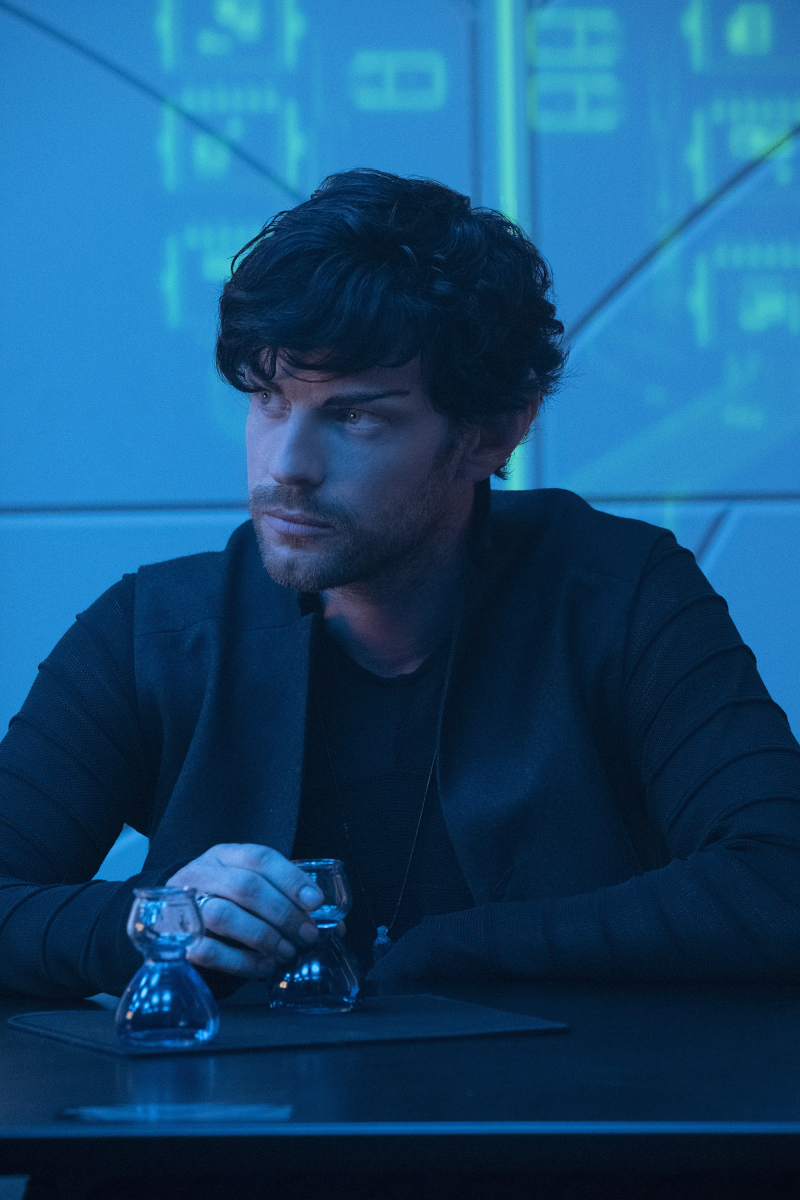
- In "Absolute Candor", the lounge where Narek and Soji enjoy Romulan ale is lit with an extremely vivid blue illumination, to the point where everything and everyone in the room appear blue-tinged.◊
- In "Nepenthe", the latter part of Narissa's interrogation of Hugh and the scene where Elnor and Hugh are forced to confront Narissa and her lackeys are saturated in blue light.
- Stargate SG-1 and its spinoff Stargate Atlantis has this in spades, the Asgard and Human spaceships especially. The Ancients get into it as well.
- Superboy: In the first season episode "Terror From The Blue", about corrupt police officers attempting to kill Lana Lang when she witnesses an attempted murder, the first segment has a heavy blue tint. After the first commercial break, the blue tint is gone and all colors are normal, making the blue tinted scenes particularly obvious when watched on DVD.
- Parodied on The Suite Life of Zack & Cody.
"Let's try the blue light." (yellow light comes on) "No, the blue that's not yellow."
- Titans (2018) becomes more and more saturated with blue as the seasons go. It does make sense given that is an R-rated take on comics.
- Tears for Fears: The first "Mothers Talk" music video has an extremely vivid blue tint to highlight the laboratory setting that the young girl is trapped in while she's being monitored by scientists.
- This trope is an early hallmark of director Chris Cunningham's Signature Style, as demonstrated in "Come to Daddy" by Aphex Twin, "Frozen" by Madonna, and "All is Full of Love" by Björk.
- Meisas's entrance often involves clouds of smoke over lighting to make it look blue.
- ANNO: Mutationem: Being propitious for being set in a Post-Cyberpunk setting, several areas such as Noctis City, are given a blue lighting to present a perpetual atmosphere.
- Battlefield 3 has everything tinted blue, even the night maps are just a slightly different shade of blue instead of black.
- The Color of Madness DLC for Darkest Dungeon is in a limited-palette cyan and grey color scheme.
- Fallout: New Vegas: While solely not for Mood Lighting purposes, night vision abilities work this way. In particular, using cateye (potent night vision drug) in very dark places will make everything heavily blue-tinted, which does make things easier to see, at least.
- The Mood Lighting of the city of San Fierro in Grand Theft Auto: San Andreas is predominantly blue.
- The Legend of Zelda: Skyward Sword: The Silent Realm is like this when Link isn't being chased by the Guardians.
- Mass Effect has a lot of it, going as far as giving crimson sunsets a blue halo.
- MindJack: Almost everything is blue-gray, probably so you can use the Color-Coded Multiplayer indicators a bit easier.
- Need for Speed: Carbon uses a lot of midnight blue for its night-time street racing.
- X-Wing has this in the scene where a disturbing-looking medical droid is helping treat your rebel pilot's injuries if he survives his ship being destroyed and doesn't get captured by the empire.
- Unnaturally bluish-purple colors were an all but Enforced Trope for IBM Personal Computer games with CGA graphics, since the commonly-used Palette 1's only colors besides white and black were cyan and magenta. (Palette 0 was less commonly used since its four colors did not include white. CGA could be made to display 16 simultaneous colors by adapting one of its graphics modes for composite video output, which some monitors didn't support, or by hacking a semi-graphic character-based mode to increase the number of character rows, but relatively few games did either.)
- Ink One of the few examples that isn't set in a science-fiction world. At least two scenes are tinted blue, one of which is so saturated, that it nearly drowns out the true colors.
- Avatar: The Last Airbender: Princess Azula fire is blue, to differ her from the other Fire Nation antagonists and to mark her as a more unstable and dangerous threat.
- During the 2022 World Cup, a meme about the Poland vs. Mexico game parodied the bluish filter used in media set in Eastern Europe, and the Warm Place, Warm Lighting filter used in media set in Mexico, with each team's half of the field having different palettes.
- Close your eyes and face a bright light source like the sun for a minute or two. Then turn away and open your eyes. Everything will appear blue tinted. This occurs because long wavelength red/orange light passes through the skin and blood of your eyelids but short wavelength blue/violet light is absorbed. The long wavelength light continues to stimulate the red-color perceiving cone cells or your retina, causing a reduction in their sensitivity, but fails to stimulate your blue-sensitive cone cells, causing them to increase in sensitivity. When you open your eyes your blue sensitive cones are over active and your red sensitive cones are burnt out, so everything looks blue.
- Wearing sunglasses with an orange tint will produce a similar effect.
- L.E.D. lights have much more blue light in them than fluorescent lights, and the most sensitive spot on the human retina, the fovea centralis, has no blue light-detecting cones, so blue lights are much more uncomfortable for the human eye to look at. This has raised some health concerns about them, as they may disrupt humans sleep patterns, since they suppress the production of melatonin, the sleep hormone. To be more specific here: "white" LEDs have a distinct blue tint compared to fluorescents (usually greenish) or incandescents (yellowish). The old-style red/green/amber LEDs have no blue to speak of; LEDs that can emit blue are a relatively recent (mid-1990s) invention. The color of the light given off by "white" LEDs is actually pretty close to daylight white, but it "looks wrong" since for most of your life you've been used to artificial lighting being yellowish or greenish and just subconsciously edit that out. There are now "warm white" LEDs that attempt to mimic incandescent color temperatures more closely, but opinions vary on how effectively they do so.
- For a more technical explanation, the blue tint of "white" LEDs is due to the fact that the actual semiconductor material which produces the light emits a fairly narrow band of blue light. The rest of the spectrum is filled out by a coating of yellow phosphor, which absorbs some of the blue light and radiates in other parts of the visible spectrum, but enough of the strong blue peak remains, biasing the color of the resulting light towards blue.
- This is largely addressed by manufacturers paying attention to the Color Rendering Index, or CRI, which, in simplest terms, is a rating from 1 to 100 describing how natural colors appear under a light source. A standard incandescent lightbulb, for example, has a CRI rating of 100, while a typical "white" LED is usually in the 70 range. However, there are high CRI LEDs which have a CRI of 90+ and appear very pleasing to the human eye, but given that they are more difficult (and therefore more costly) to manufacturer tend to be regarded as something of a specialty product. Or at least they were, as since about 2018 the L.E.D. industry has taken a turn for the quality of emitter light rather than just pure output.
- Cherenkov Radiation is bright blue.
- Blue LED lighting is being tested as a way to discourage drug use in public restrooms located in high risk areas. The blue light makes it difficult for IV drug users to see their veins.
