Maui: If you wear a dress and have an animal sidekick, you're a princess.
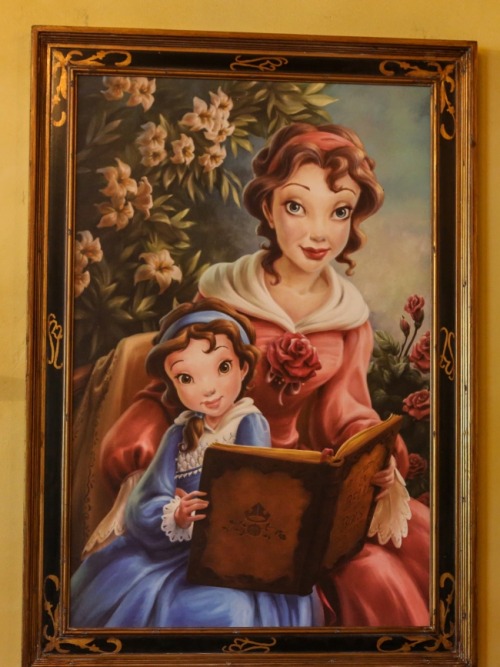
Disney Princess is a franchise incorporating select female characters from the Disney Animated Canon, most of whom actually are princesses (by birth or marriage).
Disney officially applies this title to (in order of their film releases):
- Snow White from Snow White and the Seven Dwarfs
- Cinderella from Cinderella
- Aurora from Sleeping Beauty
- Ariel from The Little Mermaid
- Belle from Beauty and the Beast
- Jasmine from Aladdin
- Pocahontas from Pocahontas
- Mulan from Mulan
- Tiana from The Princess and the Frog
- Rapunzel from Tangled
- Merida from Bravenote
- Moana from Moana
- Raya from Raya and the Last Dragon
Disney has included others in the merchandise at times, such as Alice of Alice in Wonderland and Giselle of Enchanted, but they have never officially been added to the roster. note Esmeralda of The Hunchback of Notre Dame was an actual Princess until 2004. Anna and Elsa from Frozen were expected to be the 12th and 13th to join the line-up, but Disney ended up retaining the Frozen brand as an adjacent but separate entity from the Disney Princess franchise, although Anna and Elsa are sometimes included with the other princesses in some media, most famously in an extended cameo in Ralph Breaks the Internet. Kilala Reno and Princesses Sofia and Elena are also excluded, though characters from the Disney princess line regularly feature in Sofia's own show. note
They were just a bunch of characters, but when Disney realized how popular they were with young girls (because of the so-called Princess Phase), they produced a toy line of them in a similar manner to Barbie. This includes not just dolls but in fact a whole variety of merchandise. The line also makes role models out of the princesses, often teaching the values of honesty, kindness, and recycling in their Direct to Video shorts and films.
Beyond their respective films and the Disney Princess line, they appear in a wide variety of other Disney-created media:
- Sofia the First: They make occasional guest appearances in this preschool-targeted series. Sofia costumes and accessories are also sold at the Bibbidi Bobbidi Boutique at Disneyland and Disney World.
- Kingdom Hearts: Snow White, Aurora, Cinderella, Belle, and Jasmine appear as "Princesses of Heart" alongside Alice of Alice in Wonderland and one of the original characters in this video game series. Ariel, Mulan, and Rapunzel also appear as party members, with Rapunzel being a new Princess of Heart alongside Anna and Elsa. Moana is only available as a collectible character in one of the side games.
- House of Mouse: The princesses were one of the most referenced properties, along with Alice in Wonderland, Hercules, and The Lion King.
- Ralph Breaks the Internet: The princesses appear in the film inside the Internet when Vanellope von Schweetz encounters them.
- Disney Girls: A chapter book series in which a handful of 9-year old girls in Orlando, Florida discover that they are Alternate Universe counterparts of the princesses.
- Kilala Princess: A Shoujo manga in which the titular Kilala travels through the worlds of six princesses to save a seventh kingdom.
- A Tale of...: A series of children's novels set in an Alternate Continuity for several of the fairy tale films, portrayed as existing in one setting of several adjoining kingdoms — and, via a Perspective Flip that turns the stories over to the villainous/antagonistic characters, are distinctly Darker and Edgier.
- A Twisted Tale
- The Queen's Council
- Disney Princess Enchanted Tales: Follow Your Dreams: Two shorts based on Aurora and Jasmine. It was originally intended to be a series featuring various princesses, but poor sales kept it to one film alone.
- Disney Princess: My Best Friend Is...: A series of books, each featuring a different little girl befriending a Disney Princess.
- Disney Princess Fairy-Tale Friendships: A series of books about the princesses making friends. Features Snow White, Cinderella, Jasmine, Mulan, Belle, Tiana, Rapunzel, and Ariel.
- Disney Princess: (princess name) is My Babysitter: A series of Little Golden Books, each featuring a different little kid having a Disney Princess for their babysitter for the day. Features Cinderella, Jasmine, Belle, Tiana, Merida, and Ariel.
- Palace Pets: A Littlest Pet Shop-esque spinoff of the Disney Princess franchise, revolving around the princesses' pets.
- Whisker Haven Tales with the Palace Pets: An animated series based on the Palace Pets franchise.
- Ultimate Princess Celebration: An annual event beginning in 2021 celebrating the Disney Princesses (including Elsa and Anna; South Africa included Sofia and Elena). Featured:
- Auli'i Cravalho, Mandy Moore, and Anika Noni Rose as readers for Tales Of Courage And Kindness, a collection of new Disney Princess tales.
- An original song by Brandy (Cinderella in the 1997 Rodgers and Hammerstein's Cinderella film adaptation)
- Susan Egan (Megara in Hercules), Laura Osnes (Cinderella in the 2013 Rodgers and Hammerstein's Cinderella Broadway stage adaption), Courtney Reed (Jasmine in the Aladdin Broadway stage adaption), and Aisha Jackson (Anna in the Frozen Broadway stage adaptation) singing for "Disney Princess - The Concert". Other singers joining the tours include Anneliese van der Pol (Belle in the 2007 Beauty and the Beast Broadway stage adaption) and Krysta Rodriguez (Megara in the Hercules Central Park stage production), among others.
- LEGO Disney Princess: The Castle Quest, a Disney+ animated special in collaboration with LEGO, released during World Princess Week in August 2023.
- There are also several other video games built on this franchise, including:
- Disney Princess
- Disney Princess: Enchanted Journey
- Disney Princess: Magical Jewels
- Disney Princess: My Fairytale Adventure
- Disney Princess: Royal Adventure
- Disney Infinity also includes some of the princesses as figures, specifically Jasmine, Mulan, Rapunzel, and Merida.
Compare Disney Fairies (a franchise that lasted from 2005 to 2015, focusing on Tinker Bell and her fellow fairies in Pixie Hollow) and Frozen (the popularity of Anna and Elsa was enough for the film to become its own viable franchise separate from the Disney Princesses). For the male counterpart (sort of), see Marvel and Star Wars.
This product line provides examples of:
- Adaptational Badass: It's common nowadays to see a previous princess who never actively engaged in battle being portrayed as a full-blown Action Girl, parody or otherwise. Cinderella seems to take the cake, as she's not only gotten a sequel movie where she kicks ass, but was prepared to do so again in Ralph Breaks the Internet.
- Adaptational Jerkass: Downplayed in Ralph Breaks the Internet. The princesses are shown to be more confrontational than normal and enjoy poking fun of C-3PO. They're still quite friendly, though.
- Adaptation Dye-Job:
- In the film, Cinderella has a silver dress and strawberry-blonde hair, but in the franchise, she usually has a blue dress and golden blonde hair. In fact, later editions of the film edited Cinderella's dress of silver to blue. It's believed that this change was because as Color-Coded Characters sell better, Cinderella's dress would've appealed to children more in blue than "grey". Funnily enough, a lot of early merchandise including records, comics◊, and books often made the dress pink.
- Aurora's hair is lightened from a dusky blonde to golden blonde. Her skin also tends to lighten up a bit in comparison.
- Snow White's skin has gone from white to pale beige and her hair now has blue highlights.
- In the film, Cinderella has a silver dress and strawberry-blonde hair, but in the franchise, she usually has a blue dress and golden blonde hair. In fact, later editions of the film edited Cinderella's dress of silver to blue. It's believed that this change was because as Color-Coded Characters sell better, Cinderella's dress would've appealed to children more in blue than "grey". Funnily enough, a lot of early merchandise including records
- Advertised Extra:
- This was initially inverted with Pocahontas and Mulan, and to lesser degrees Jasmine and Tiana. All are considered "official princesses" and are as major characters as the others, but they were left out of the majority of the advertising. Many observers have noticed this, speculating that it's a race related issue as they are the only non-white princesses — and ironically are some of the more recent and recognizable ones. When Disney decided not to renew their licensing agreement with Mattel to produce the dolls at the end of 2014, they opted to sign on with rival toymaker Hasbro. In a deal that managed to make the cover of Bloomberg Businessweek, Disney and Hasbro made sure that these characters were marketed as prominently as their non-POC counterparts. Mattel has since continued where Hasbro left off in 2022.
- The real example of this trope is Aurora, who is a very prominent character in the franchise, but who only appears for less than 20 minutes, half of which she spent as an infant or asleep as a result of the curse, in the original movie Sleeping Beauty.
- This was initially inverted with Pocahontas and Mulan, and to lesser degrees Jasmine and Tiana. All are considered "official princesses" and are as major characters as the others, but they were left out of the majority of the advertising. Many observers have noticed this, speculating that it's a race related issue as they are the only non-white princesses — and ironically are some of the more recent and recognizable ones. When Disney decided not to renew their licensing agreement with Mattel to produce the dolls at the end of 2014, they opted to sign on with rival toymaker Hasbro. In a deal that managed to make the cover of Bloomberg Businessweek,
- Art Evolution: When the franchise first debuted in early 2000, the princesses were simply shown in their unmodified dresses from the films. Later on, their gowns were made more elaborate, giving them touches such as frills, mink trims, gold recoloring, jeweled encrustation, sparkly elements, and later on a metallic look. For The New '10s, their appearance was modernized, with all of the princesses from before 1995 getting an update to their look. The gold recoloring and added jeweled encrustation were toned down after a backlash, but most franchise material still has the characters in more elaborate looks than their original films.
- Snow White was also made svelte unlike in the movie, where her body type is more realistically proportioned.
- Merida art proved controversial, as she too was slimmed down. Unlike Snow White who still looks very trim, that's no longer true of Merida. This appears to have been done for the 3D animation seen in Sofia the First.
- Artistic License – History:
- The redesign of Pocahontas' outfit adds glittering jewels. It seems the only jewels on her redesigned costume are turquoise, which was indeed popular among Native Americans...in the Southwest. A Native from coastal Virginia would more likely have worn shells as decoration.
- Jasmine is sometimes shown wearing a European style Pimped-Out Dress that would not have even existed around her time.
- The Beautiful Elite: All the princesses are attractive, and this is often made a major point in the movies. This is particularly true of Aurora, who received a fairy's blessing of beauty. Notably, their lives appear far more glamorous in the merchandise than their films: only Ariel, Jasmine and Merida are living as princesses for a significant portion of their movies, but the franchise products and marketing emphasize Pimped Out Dresses and fancy palaces.
- Beauty, Brains, and Brawn: Though many of the princesses are shown to possess all three, their main characteristics and personality traits make one of them stand above the other two:
- Beauties
- Snow White (All-Loving Heroine, Obliviously Beautiful, labeled “The Fairest One of All")
- Ariel (romantic personality, a lovely charismatic singing voice)
- Aurora (Hair of Gold, Heart of Gold, traditionally feminine)
- Pocahontas (spiritual Nature Lover)
- Cinderella (imaginative, soft-spoken and graceful)
- Brains
- Belle (Brainy Brunette, Cute Bookworm)
- Jasmine (intuitive, observant, quick-thinking)
- Tiana (Supreme Chef, Go-Getter Girl and Self-Made Princess)
- Rapunzel (clever, curious)
- Brawns
- Mulan (Combat Pragmatist, Strong and Skilled)
- Merida (Tomboy Princess, Fiery Redhead, Brave Scot)
- Moana (Bold Explorer, Muscles Are Meaningless)
- Raya (A hardened Warrior Princess)
- Beauties
- Blonde, Brunette, Redhead: A notable aversion applies to the frequent groupings of the three original princesses, Aurora, Snow White, and Cinderella. Aurora is blonde and Snow White is brunette, and Cinderella's official hair color is supposed to be "burnt orange," but Cinderella has been almost entirely marketed as a golden blonde in the merchandise.
- Clothes Make the Legend: Their most iconic outfits are still the basis for many of their new outfits, with the exception of Ariel, who is often marketed in her pink dress from her movie or an original teal one even though her most iconic outfit is a clamshell bra.
- Color-Coded for Your Convenience:
- Each Princess is assigned their own color(s). Snow White's is most commonly red, but white is also used. Aurora's is pink, Cinderella's is blue, Ariel's is sea green, Belle's is yellow, Jasmine's is aquamarine, Pocahontas' is tan, Mulan's varies between red or green and yellow, Tiana's is green, Rapunzel's is lavender, Merida's is royal blue or dark teal, and Moana's is orange.
- Before Tiana and Rapunzel came along and took green and purple for themselves, Ariel and Jasmine tended to switch off who was green and who was purple (Aurora was purple at times as well, as a compromise for her dress alternating between pink and blue throughout her movie). If it was Jasmine's turn to be purple, she wore the shimmery outfit from the end of her movie.
- Cool Crown: Their tiaras come in many forms, although Aurora and Tiana are notable for having tiaras that are a part of their main look (Tiana wears three!).
- Costume Porn: All of the girls have themed dresses: holiday, flower, designer, gold, bejeweled, etc. The iconic costumery of the princesses is a very popular subject for fanartists to play with: mod, hipster, school girl, historic, designer, and more versions of their dresses can be found.
- Covers Always Lie: Most of the princesses that wear multiple outfits usually are not presented in the clothes they wear for most of the film.
- Zig-zagged with Cinderella. She’s almost always presented in her ballgown, which she does wear for quite a bit of the movie. However, her dress in merchandise is blue, while it’s silver in the movie.
- Aurora spends most of her movie wearing the blue version of her dress, but usually appears in the pink version for the franchise. It was most likely changed to pink so she wouldn’t be mistaken for Cinderella.
- Ariel is often presented in a sparkly sea foam green dress with purple seashell jewelry — an outfit that doesn’t exist in The Little Mermaid. This combines clothing from both her iconic mermaid form and her human form.
- When Ariel is in mermaid form, her tail is usually sparkly, which it isn’t in the movie.
- Belle only wears her yellow dress for three scenes, but it's the dress she's marketed in most often. However, she is still closely associated with her blue and white dress, and is the princess most commonly seen in a peasant dress in merchandise and the parks.
- Some marketing changes Belle’s yellow dress from its movie version by putting roses on it, most commonly showing the roses etched in glitter.
- Occasionally, Pocahontas is given more jewelry. She’s also sometimes presented in a ballgown she only wears in the second movie.
- Mulan's is justified, as the outfit she wears for most of her movie is literally a disguise. However, she is frequently presented in the outfit that represented a life she hated.
- Tiana only wears her green dress for one scene, but it's the outfit she's most marketed in. On the covers for the movie, she’s in her blue dress that she also only wears for one scene.
- Merida was given a more traditionally feminine look, which received a lot of controversy. Nowadays, her Tomboy nature is respected.
- Damsel in Distress: Several of the princesses were in distress at least once during their movies, most notably Aurora (until Merryweather tweaked the spell), Jasmine (who was trapped in an hourglass filling with sand), and Snow White (who was in mortal peril, and whose rescue was the climax of her film). Notably averted, however, with Mulan, Merida, and Tiana, who were all very active in their own movies and were not rescued from danger. Furthermore, Cinderella, Ariel, Jasmine and Rapunzel, qualify as damsels out of distress or Defiant Captives, despite Rapunzel being tied up by Mother Gothel at one point.
- Detail-Hogging Cover: The artwork for their merchandise is way more detailed than in their movies.
- Disappeared Dad:
- Snow White and Cinderella end up with just their stepmothers after their fathers die.
- Tiana lost her father in World War I.
- Early-Installment Weirdness:
- The dresses weren't nearly as elaborate at first.
- Esmeralda and Tinker Bell were part of the Princess lineup until 2004.
- Ermine Cape Effect: In their movies, the princesses have modest dresses that they wear most of the time, but in the merchandising, their fancy gowns are more prevalent.
- Everything's Better with Sparkles: Their outfits feature plenty of sparkle, often to an unbelievable extent, especially in their holiday attire.
- Everything's Sparkly with Jewelry: They wear plenty of jewelry, at least in their merchandising art outfits.
- Expy: Cinderella, Ariel, and Belle are given rock-star-doll counterparts in the form of Ella, Ari, and Gabrielle — the Pop Dreamers. They even have a music album! Around the same time, there was also a Disney Girls children's book series, which centered around girls who were otakin versions of six of the princesses.
- Extremely Short Timespan:
- Snow White and the Seven Dwarfs takes place over about a week.
- Cinderella (1950) mostly takes place within 24 hours, from the time Cinderella wakes up the first morning until the climax.
- The bulk of Sleeping Beauty takes place on the day of Aurora/Briar Rose's 16th birthday, from when she awakens to when, well... she awakens again after Prince Phillip kisses her.
- The Little Mermaid (1989): The only unclear spot in the film's chronology is how long it took Triton to find out Ariel's secret, but it can safely be said to take place within a single week, with most of the focus set on the three-day period Ariel has to succeed in becoming human.
- Beauty and the Beast takes place over three days in-universe. The snowfall many fans remember as being winter literally starts on the first night, as Belle goes looking for her father, finds him and takes his place; meanwhile, Maurice returns to town to plead for help in getting his daughter back, LeFou cheers up Gaston with his Pep-Talk Song and Belle is entertained by "Be Our Guest" while being served supper.
- The sultan in Aladdin reminds his daughter Jasmine she has to be married by her next birthday, which is only three days away. The events of the film take place over about 48 hours, and the direct-to-video sequels flow seamlessly on, with Aladdin & Jasmine's wedding set to take place at the start of the third film before the plot pushes it aside.
- The Princess and the Frog takes place during New Orleans' week-long Mardi Gras carnival.
- Aside from the prologue, Tangled takes place during the 48 hours leading up to Rapunzel's 18th birthday.
- And lastly so far, Brave takes place over three days.
- Fairytale Wedding Dress: Cinderella, Ariel, and Tiana wear fancy wedding dresses in their movies, and the others have dresses for the toy lines and artwork. And now you can buy one for your own wedding! Before Alfred Angelo designing these wedding gowns, Kirstie Kelly was in charge of "Disney Fairy Tale Weddings" and had four collections, each featuring lines inspired by Ariel, Belle, Cinderella, Jasmine, Aurora, and Snow White. Each collection contained bridal gowns, bridesmaids' dresses, flower girl dresses, and jewelry.
- Friend to All Living Things: Every Disney princess has some kind of animal friend, or in some cases a whole posse: Snow White and Aurora are accompanied by various woodland animals (Snow White is usually pictured with songbirds, and Aurora with an owl); Cinderella had birds, mice, a dog, and a horse; Ariel has a fish, seagull, and crab; Belle has a horse; Jasmine had a pet tiger that drives away unwanted suitors; Pocahontas has a raccoon, a hummingbird, an army of technicolor leaves, and later a pug dog; Mulan had her pet dog, a dragon, a cricket, and her horse; Tiana has a firefly and a trumpet-playing alligator; Rapunzel has a chameleon and later a horse ally; Merida has her horse (and of course her mother and brothers as bears), Raya has Tuk Tuk and a dragon like Sisu for a traveling companion .
- Gem-Encrusted: The Jewel Princess set has precious stones studding their dresses and the fur on their capes.
- Gift of the Magi Plot: In the Disney Princess comics, Aladdin trades his canteen for a telescope holder while Jasmine trades her telescope for a canteen holder.Aladdin and Jasmine: [to each other] I wanted to get you a gift.
Jasmine: I guess great minds do think alike.
Merchant: They do this every week. - Gratuitous Princess: The franchise markets some non-princess characters as princesses:
- This is most notable with Mulan, a character who was never a princess in the entirety of her film. She is nevertheless included in the Disney Princess canon and has subsequently received more feminine and princess-friendly merchandising.
- Other non-princesses included in the Disney Princess lineup at one time were Esmerelda of The Hunchback of Notre Dame and Alice of Alice in Wonderland.
- The titular Pocahontas is The Chief's Daughter, but she was marketed as a princess from the very beginning — including merchandise showing her in a Pimped-Out Dress that conflicts with her expressed interest in simplicity and disinterest in the trappings of society.
- Happy Birthday to You!: The princesses recorded a birthday song. It's not the traditional one, but it's awesome nonetheless since you could personalize the CD so they could say your name.
- Happy Holidays Dress: The girls have had several versions over the years. Belle is notable for being the only princess to wear a holiday dress in a movie (namely Beauty and the Beast: The Enchanted Christmas).
- Hello, [Insert Name Here]: There was a CD released by Just Me! Music back in the 2000s where the princesses would sing you a birthday song and they would say your name.
- Honorary Princess:
- Mulan is actually the daughter and the wife of military men — nevertheless, she was included in the franchise . Mulan nearly married a prince in the sequel. When she offered her hand to the prince, a counselor of the king said he should accept because a heroine such as Mulan would be a better daughter-in-law than "simple princesses".
- In a meta example, Kida. While she's not officially recognized as part of the franchise, she has shown up in some Disney princess media such as My Princess Collection.
- Alice is sometimes included in the line, and was featured in the Disney Princess magazines in the early 2000s. She's also a Princess of Heart in Kingdom Hearts.
- Hotter and Sexier: In many instances, the princess' pictures are simply copied and pasted onto the merchandise while adding noticeable cleavage and trimming their physiques. This is especially jarring in Snow White's case, as she is comparatively flat-chested and her dress is high cut. Some princesses, such as Ariel, Jasmine, and Tiana, do have cleavage in their original cartoons.
- Hourglass Hottie: Applies to most all these characters, particularly those made during The '90s. The exceptions are Snow White (who is 14, and existed in a time when less curvy figures were fashionable), Merida, Mulan, and Rapunzel (who have wide hips and small busts), and Pocahontas (who is the opposite of Rapunzel, with slim hips and a wide bust and shoulders).
- Iconic Item: Each of the princesses is normally represented by a primary and secondary symbol of their movie:
- Snow White: Her apple is seen most often, and a red bow also appears frequently.
- Cinderella: The glass slipper is her primary symbol, and a pumpkin (usually just a pumpkin, not the carriage) is also sometimes seen.
- Aurora: Her crown stands out the most (it's used at Belle's Cottage in Walt Disney World to symbolize◊ that Belle's favorite book is the Disney version of Sleeping Beauty), with The Tragic Rose being secondary (since it's more commonly used to represent Belle).
- Ariel: Seashells are utilized most often, but other sea-related accessories also appear often.
- Belle: The Beast's rose is ordinarily used to represent her, with the mirror shown less frequently.
- Jasmine: The Genie's lamp (being an overall representation of her movie) is utilized most often, but one also frequently encounters a jasmine flower (or even the small white songbirds she frees).
- Pocahontas: Either her mother's turquoise necklace or an array of colorful leaves are shown (the latter referencing "Colors of the Wind").
- Mulan: She presents the most difficult circumstance, as the one symbol really associated with her is reflections; not necessarily mirrors, but just the concept itself. (Although some tangible objects could be used like her sword, medal, or lotus comb, none have ever stuck in the public consciousness). She generally is just shown with something that looks Chinese.
- Tiana: The lilies from the swamps get used exclusively, including a lily pad and vines.
- Rapunzel: The sun symbol of Corona, as well as the colorful daisies and flowers that decorate her hair in the film appear the most.
- Merida: Her bow represents her personally, but her mother as a bear is used frequently as well.
- Iconic Outfit: Pretty much every Disney Princess has one of these, usually their princess dress. These outfits are so iconic that elements of them are often used in non-Disney fairy tales to make it instantly clear who the character is:
- Snow White: Nearly all of Snow White's outfit is considered iconic — a yellow skirt, red-slashed blue sleeves, white collar, and red bow are utilized in part or as a whole to represent her.
- Cinderella: The big ballroom dress in blue (usually with short, attached sleeves) is almost always used to represent Cinderella.
- Aurora: The white neckline is the most iconic part other than her crown, though the dress is often pink. More relevant is the fact that fairy tale princesses often are portrayed like Aurora, featuring long and wavy blonde hair, violet eyes, and pink clothing. Japan tends to make Sleeping Beauty-inspired princesses especially overt◊.
- Ariel: In her mermaid form, it's her purple Seashell Bra. In human form her pink dress is seen (though a later redesign gives her a flowing green one that matches her mermaid tail).
- Belle: One rarely sees Beauty actually look like Belle from the movie (save perhaps for her brown hair). It's more common to see the Beast resemble his film version.
- Jasmine: A unique example, as the folk tale is rarely represented in the media visually, but when a Bedlah Babe needs to make an appearance, you'll bet she'll be dressed to look like Jasmine.
- Pocahontas/Mulan: Since neither are represented in fairy tales, generally the only depiction is the Disney version.
- Tiana: The Frog Prince's princess is more and more often represented as a young black lady.
- Rapunzel: Rapunzel's hair being blonde is a very common depiction of the princess anyway.
- A Minor Kidroduction: This seems to be a trend with the Revival-era princesses, who are all shown as a baby/child at the beginning of their movie. It also occurs with two out of the three Walt-era princesses (Cinderella and Aurora, but not Snow White). For whatever reason, it's done with none of the Renaissance-era princesses, unless you count the direct-to-video prequel The Little Mermaid: Ariel's Beginning.
- Missing Mom: Ariel, Belle, Jasmine, and Pocahontas don't have mothers, but their fathers are still around. This is even among the Princesses' questions when quizzing Vanellope in Ralph Breaks the Internet:Jasmine: Do you have daddy issues?
Vanellope: I don’t even have a mom!
Jasmine, Ariel, Pocahontas, Belle, Cinderella, Snow White, Elsa, Anna: [Excitedly while posing] Neither do we!- For the record, Aurora, Mulan, Tiana, Rapunzel, Merida, and Moana are the princesses whose mothers manage to stay alive for the entire movie.
- Modular Franchise: No Disney Animated Canon work depicted these heroines together in any combination until Ralph Breaks the Internet. However, in pictures of the ladies all together, they were often shown staring off at various directions or looking straight ahead into the "camera:" this was to acknowledge that they're not really "together" and existing in the same universe. Beginning with the 2021 Ultimate Princess Celebration, some pictures (such as the one on the top of the Disney Princess website's homepage) show the Princesses actually interacting with each other. The line has even extended to include Pixar heroine Merida.
- Ms. Fanservice: Ariel and Jasmine perhaps have the most exaggerated figures and show the most skin — Jasmine especially, as she is seen through the eyes of the male hero who is in love with her. This is true of Pocahontas as well, given that she wears the shortest skirt of the franchise and many camera angles in her movie highlight her beauty. Likewise, in her film, John Smith doesn't shoot her because he's so stunned by her beauty. More recent princesses try to avert this trope since less focus goes to their beauty and they get less revealing clothes.
- Multi National Team: After decades of being comprised of ambiguously European princesses, The '90s happened and we got in succession:
- A French girl
- An Arabic girl
- A Native American girl
- A Chinese girl
- An African-American girl
- A Scottish girl
- A Polynesian girl
- A Southeast Asian girl
- That said, most of the princesses are from various real-world countries—it is never explained which one. It can be presumed Snow White is from Germany, as the fairy tale it's based on is set there, as is the inspiration for the clothing. Similarly, Sleeping Beauty is probably set in France, as the anthem of the French monarchy plays at Aurora's arrival, and the movie is based upon the French version of the fairy tale.
- Near-Death Experience: Some of the princesses, official and honorary, experience this:
- Snow White is almost killed by the huntsman, but he spares her life.
- Maleficent places a death curse on Aurora, but Merryweather alters it into a deep sleep.
- Ariel almost drowns upon transforming into a human, but Flounder and Sebastian take her to the surface.
- Belle almost is killed by wolves, but Beast saves her.
- Mulan is shot in the chest and wounded, but receives treatment quickly.
- Anna freezes to death, only to come back to life because her Heroic Sacrifice was an Act of True Love.
- Elsa is almost murdered by Hans, but Anna sacrifices herself to save her.
- Neutral Female: Despite being stereotyped as "sitting around waiting to be rescued," this trope is actually averted. Never has a Disney Princess stood and watched while the man fought; at worst, they're incapacitated by magic or attempting to fight as best as they can. It isn't ideal, but at least they're not just standing around shrieking.
- No Name Given: Snow White's, Cinderella's, and Belle's beaus in their respective movies. However...
- Beast was given the name Adam in a licensed Disney CD-ROM game made by a third party company, but many official Disney company sources and record-keepers have declared the Adam name to be false, including Walt Disney Animation Studios, Glen Keane, the Walt Disney Archives, and the Disney Animation Research Library.
- Cinderella's prince, according to Disney press material, is actually named "Prince Charming".
- Snow White's prince is sometimes referred to as "Ferdinand", but this is actually a misinterpretation from fandom, who mistook Shirley Temple referring to various Disney characters like Snow White, the Seven Dwarfs, and Ferdinand — the Bull, not the Prince. "Frederick" and "Florian" are names given to the prince, allegedly. Concidentally, the Prince has other names that have been used to reference him (depending on who you talk to), and every single one of them starts with the letter "F." Even on Once, where he's Abigail's prince (as Snow White is with Ella's Prince Charming).note Amusingly enough, the closest thing to a canon name for him is "Prince Buckethead", a Self-Deprecation in an
 earlier screenplay of his first meeting with Snow White.
- Non-Human Sidekick: This is pretty much a prerequisite, featuring enough critters to fill a zoo. Included on the list are songbirds, horses, mice, dogs, fish, bears, an owl, a seagull, a crab, a raccoon, a hummingbird, a dragon, a cricket, a firefly, an alligator, a tiger, a chameleon, and assorted woodland creatures — not to mention an army of technicolor leaves.
- Non-Indicative Name: Downplayed. The franchise's definition of "princess" is more "popular heroine" than a literal title, although some of the characters are princesses in the literal sense as well. The line was created in 2000, and Mulan (not a princess by blood or marriage) was included from the start. Other Disney heroines who lack princess status, like Esmeralda, Megara, Wendy, or Alice, are occasionally seen in merchandise, but were never a part of the official line-up or only briefly considered in.
- Non-Standard Character Design: When a princess officially becomes a Disney Princess, they get a glitzy makeover so they can all share a unified art style. However, after fan backlash on Merida getting the "princess treatment," despite being an awkward Action Girl, they ceased using her Disney Princess design. On the official website, she uses art from her movie which is not only a different art style, but is in 3D when the others (even Rapunzel) are 2D. She received a new redesigned art style later on which more closely resembles her 3D appearance. This TV Tropes entry features her briefly-used Disney Princess art, though.
- Obvious Rule Patch: The 'act of heroism' rule seems to have been made solely so Mulan would have an excuse to be included.
- Official Cosplay Gear: Scads of official Princess outfits exist nowadays. A Disney executive was inspired to start this line when seeing girls trying to dress as the princesses at a "Disney on ice" show. In fact, official dresses in all sizes are available in many department stores nowadays.
- Parental Abandonment: Every princess has lost at least one parent, except for Rapunzel, Merida, and Aurora (who didn't even know her parents until her 16th birthday, as she was being protected from a curse). Both of Mulan's parents are alive and well (as is her grandmother); this movie's plot is centered on Mulan trying to keep her father alive by replacing him when he is called up for military duty.
- Parent Service: The merchandise tends to make all the girls look a bit more "curvy" than in the films. This occurs in the films themselves as well. Specifically:
- Ariel is effectively nude when she turns into a human.
- Jasmine is dressed in a sexy slave outfit by Jafar.
- Cinderella takes a sponge shower, revealing her bare back and showing she is quite clearly naked.
- Pocahontas gets a long shot where she's climbing up a rock and her behind is in the center of the camera.
- Mulan takes a naked dip in a river.
- Period Piece: All the Disney Princess movies take place at some point in the past, often (but not always) in a vaguely pre-industrial world.
- Snow White: Sometime in The Middle Ages.
- Cinderella: The level of Hollywood Costuming makes it hard to say for sure, but it appears they were going for the mid- to late-19th century in France.
- Aurora: "After all, this is the fourteenth century." note
- Ariel: Sometime during Wooden Ships and Iron Men.
- Belle: Eighteenth-century France.
- Jasmine: "Arabian Nights" Days. Although one DVD edition in the audio commentary said it was 15th century Iran (which is not an Arabian country).
- Pocahontas: "In 1607, we sailed the open sea".
- Mulan: Sometime in the days of Imperial China. Beyond that, her movie is an Anachronism Stew that randomly mixes elements from different Chinese dynasties.
- Tiana: The Roaring '20s, specifically 1926, according to an onscreen newspaper.
- Rapunzel: Extremely vague. The fashions seem to point towards The Renaissance, but this is contradicted by a reference to Wolfgang Amadeus Mozart.
- Merida: Medieval Scotland.
- Moana: Set at the end of the "long pause" in Polynesian history, whenever that was. Archeologists disagree over the dating, but it's (maybe) in the range of 300-600 AD.
- Pimped-Out Cape: Many of their outfit variations include fancy regal capes, especially the holiday ones◊.
- Pimped-Out Dress: While their main fancy dresses are somewhat elaborate (delineated more via fancy lines and fabrics than decorative elements), the merchandise pimps out their dresses even further.
- Pink Product Ploy: The background color of their products is almost always pink.
- Prefers Going Barefoot: Pocahontas, Rapunzel, and Moana all go barefoot for their entire movie, and this carries over to most related materials. Aurora is barefoot while living as the peasant girl Briar Rose, but gets shoes when she's made up as a princess and taken to the palace. While Ariel wears heels for most merchandise, in most story-related materials (books, movies, etc) she is usually shown barefoot.
- Pretty in Mink: Many of their holiday dresses have fur trim. One set had their dresses trimmed with white fur with matching white fur muffs.
- Princesses Prefer Pink: Surprisingly doesn't appear as much as you might expect. Although Cinderella, Belle, Ariel, Rapunzel, and Aurora have pink costumes, they don't wear them for very long and their iconic gowns are different colors. Aurora is usually advertised in her pink dress, possibly to break up the monotony of blue outfits. This trope may also be the reason Mulan gets advertised wearing her pink dress from the beginning of the movie.
- Proper Lady: The three classic princesses Snow White, Cinderella, and Aurora are all well-mannered and humble, quite different from the later princesses.
- Public Service Announcement: Cinderella is seen in a PSA reminding parents that children less than 4'9" (145 cm) tall need a booster seat when riding in a car (after all, she is the only princess whose originating fairy tale specifically states that she goes for a ride in a wheeled vehicle). Ariel and Aurora respectively promote ocean protection and forest fire prevention. Belle and her friends head up a campaign for healthy eating and exercise.
- Purity Personified: While Snow White, Cinderella, Aurora, and Rapunzel are usually depicted as being the most innocent, the other princesses at times count.
- Rebellious Princess: Pocahontas downplays it, as she resists an Arranged Marriage and goes against her father's wishes.
- Requisite Royal Regalia: They are often shown wearing their tiaras and sometimes royal capes (the latter especially with their holiday dresses).
- Ridiculously Cute Critter: Par for the course for a Disney Princess animal sidekick, especially given that several of the animals portrayed are stereotypically considered cute (songbirds, dogs, mice, raccoons, various woodland critters). Even less obvious candidates for this trope, such as tigers, alligators, and crabs, get this treatment.
- Royal Blood: Notably, Snow White is of royal blood, but it isn't of any importance to the story.
- Rule of Glamorous: Most princesses wear outfits designed foremost to look pretty (even beyond any reasonable real life circumstance, such as when Ariel sports fancy clothes while underwater).
- Satellite Love Interest: The blandness of Snow White's Prince and Cinderella's Prince Charming (and occasionally Sleeping Beauty's Prince Phillip and Ariel's Prince Eric) is mocked by some fans. The princes with the most character development — Aladdin, Beast, and Naveen — are often referenced in the title of the movie. Cinderella's prince got a lot more likable and charismatic in the sequels, particularly in Cinderella III: A Twist in Time.note
- Eric got more character development eventually, but not until the Broadway musical, since most Little Mermaid spin-offs take place before Ariel meets him.
- Simple, yet Opulent: While "pimped out" to varying degrees, the princesses' main dresses range mostly on the lower, more tasteful end of the scale. Belle's and Tiana's dresses are the exceptions.
- Single Woman Seeks Good Man: Even though some of the princes are undeveloped, all of them are good men—or at least, in the case of Naveen, the Beast, and Flynn, become so by the end of their movies.
- Sixth Ranger: The franchise was created in 2001 with a set number of princesses. However, Tiana, Rapunzel, Merida, Moana and Raya were all added to the lineup when their films were released.
- Sliding Scale of Beauty: This is Disney so none of the princesses ever fall below World Class Beauty standards, though one or two repeatedly get mentioned as being the most beautiful both within their respective universes and sometimes even in Real Life. This is usually visually represented by having the female lead drawn differently in comparison to other female characters, the best example being that of Belle vs. the Bimbettes. Merida is perhaps the only princess whose physical attractiveness is never mentioned or implied in her movie, although it's apparent from her appearance.
- Sliding Scale of Shiny Versus Gritty: Oh, so very shiny, at least in princess mode. Mulan, Merida, Pocahontas, and Tiana have mildly gritty moments in their respective movies, though.
- Spear Counterpart:
- The short-lived Disney Heroes franchise, whose lineup consisted of Aladdin, King Arthur, Hercules, Peter Pan, Robin Hood (1973) and Tarzan, was meant to be the boy-centric equivalent of the Princess franchise. It was discontinued quickly after very poor sales.
- The princesses' love interests are often colloquially referred to as the Disney Princes, clearly intended of being the gender-reversed version of the lineup.
- Atlantis: The Lost Empire and Brother Bear could well be this to The Little Mermaid (1989) and Pocahontas, respectively, due them being about underwater kingdoms and Native American tribes. The former movie even as a princess hail from an underwater kingdom as well.
- Spoiled Sweet: This trope applies to all those born in royalty to begin with, and all of them reach this status by the end of their films. While all the princesses are naive, a bit spoiled, and at least financially comfortable, they're also as nice as can be.
- Spotlight-Stealing Squad: While Snow White was the very first princess to be created by Disney, the lead princess in this franchise is Cinderella, Disney's second princess. (Walt Disney himself confessed in interviews that he resonated with Cinders more than Snow White. As a result, she gets more attention than Snow White and has more merchandise made than her. Case in point: whenever Snow White gets re-released on home video, there are very few pieces of tie-in merchandise released (with the 2001 release only getting a McDonald's Happy Meal and the 2017 release only getting a set of collector's dolls), while whenever Cinderella gets re-released, tons of tie-in merchandise is made. Tellingly, Cinderella has two sequels while Snow White has none.
- Disney seems to have rowed back on this idea to an extent, as the "Ultimate Princess Celebration" artwork from 2021 onwards shows all the Princesses hanging out with each other like best friends. And the rousing rendition of "When You Wish Upon a Star" from Once Upon a Studio shows Snow White having a solo line instead of Cinderella, which very much implies that the idea of the Princesses needing a de facto 'leader' has now become largely redundant.
- Take That, Critics!: In Ralph Breaks the Internet, the Disney Princesses accept Vanellope as one of them they find out that
 people assume that all her problems were solved by a big strong man.
 - Take That Us:
- In The Princess and the Frog, Tiana is reluctant to kiss the talking frog Naveen when he claims it'll break him of the spell, as she believes life isn't a fairytale, a lighthearted jab at Disney's famed uses of the Magic Kiss trope in their fairytale movies just like their older Disney Princess movies.
- Most infamously, in Frozen, Anna is excited to find her one true love at the ball who will bring her into a life outside of the castle, then has a Meet Cute with one of the guests, Prince Hans. After they sing a romantic duet, he suddenly proposes to her and she accepts, only to be met with bafflement from Elsa and Kristoff for accepting a proposal from a man she just met. She counters that it'll work out because "it's true love", and Elsa and Kristoff end up being right about him being a dangerous stranger, with the whole thing being a jab at Cinderella for ending with the princess marrying Prince Charming despite having only just met him.
- A lighthearted variant in Ralph Breaks the Internet, the Disney Princesses unexpectedly get into Xenafication poses on Vanellope when she suddenly appears to them, try to determine if she's a princess by asking her if she's ever encountered their standard tropes.
- The Theme Park Version:
- The merchandise and sequels as compared to the original films. This hits the first three princesses especially hard, because while the later ones are remembered for a few stock traits, any semblance of a personality from the earliest princesses is replaced with generic "sweetness." Can you imagine the plastic heroine of Cinderella II: Dreams Come True going after a cat with a broom?
- In Beauty and the Beast: Belle's Magical World, the Beast's castle comes off like a bland fairy tale castle whereas it looks Gothic and elegant in the original film. They manage this even when showing the same rooms which appeared in the first movie.
- Conversely, Pocahontas II: Journey to a New World transforms the lush, gorgeous fantasy Virginia of the first movie into a bland forest landscape with bleak colors.
- Token Minority: Tiana is the only Black princess, Mulan is the only Asian one, Jasmine is the only brown Middle Eastern example, and Pocahontas is the only Native American.
- Jasmine breaks the rule of having to be the film's main character, Pocahontas is just The Chief's Daughter, and Mulan flat out isn’t royalty. Despite this, they are all part of the lineup. This was most likely because when the franchise was created, there would have been no brown, Asian, or otherwise non-white princesses if they weren’t included.
- The Disney Princess concept was originally derived from European ideas of royalty and monarchy. To include other cultural backgrounds, it was necessary to stretch the definition of "princess" (especially to include a Native American princess, as her historical context would have no official "princes and "princesses").
- Jasmine breaks the rule of having to be the film's main character, Pocahontas is just The Chief's Daughter, and Mulan flat out isn’t royalty. Despite this, they are all part of the lineup. This was most likely because when the franchise was created, there would have been no brown, Asian, or otherwise non-white princesses if they weren’t included.
- Took a Level in Badass: The princesses as a whole became more action oriented in the 90s, except for Belle (not that she's not proactive; she's just not as much of an Action Girl as the others and relies on her intelligence).
- True Blue Femininity: The most common color for the princesses to wear in their films is blue. Only Pocahontas, Rapunzel, and Moana don't have any dresses that are wholly or prominently blue. Even Pocahontas and Moana still wear blue necklaces.
- Tutu Fancy: The "Ballerina Princess" set has tutu variations of the princess dresses, which might be practical if not for the loose tiaras included.
- Unlimited Wardrobe: There are apparently a lot of outfit variations that can be derived from their basis costumes, such as party dresses, ball gowns, and ballerina tutus.
- Vile Villain, Saccharine Show: Who do we have as the bad guys? An evil queen/Wicked Stepmother, another (non-royal) Wicked Stepmother, an evil draconic fairy, an octopus sea witch, an Egomaniac Hunter/bully, an Evil Chancellor-turned-Evil Sorcerer, an evil British governor, a ruthless Hun leader, a witch doctor that can manipulate shadows, an abusive old woman who poses as the parent of her kidnappee, and a hideously deformed demon bear.
- Virtual Paper Doll: A few games and on their main site now. Some of the dresses they wear are heavy on Artistic License, as they make absolutely no sense for the time period or region that they live in. Mulan's many European ball gowns for one.
- Xenafication:
- Cinderella becomes an Action Girl in A Twist In Time, infiltrating the palace, trying to steal back the Fairy Godmother's wand and escaping from a demonic pumpkin carriage to crash her own wedding.
- Belle in the live action remake too. She's already trying to escape the castle on her first night and has a more direct role in the climax.